Pacific
Islands
Monthly
February 22
1933
6 d
[Registered at G.P.O., Sydney, for transmission by post as a newspaper.]
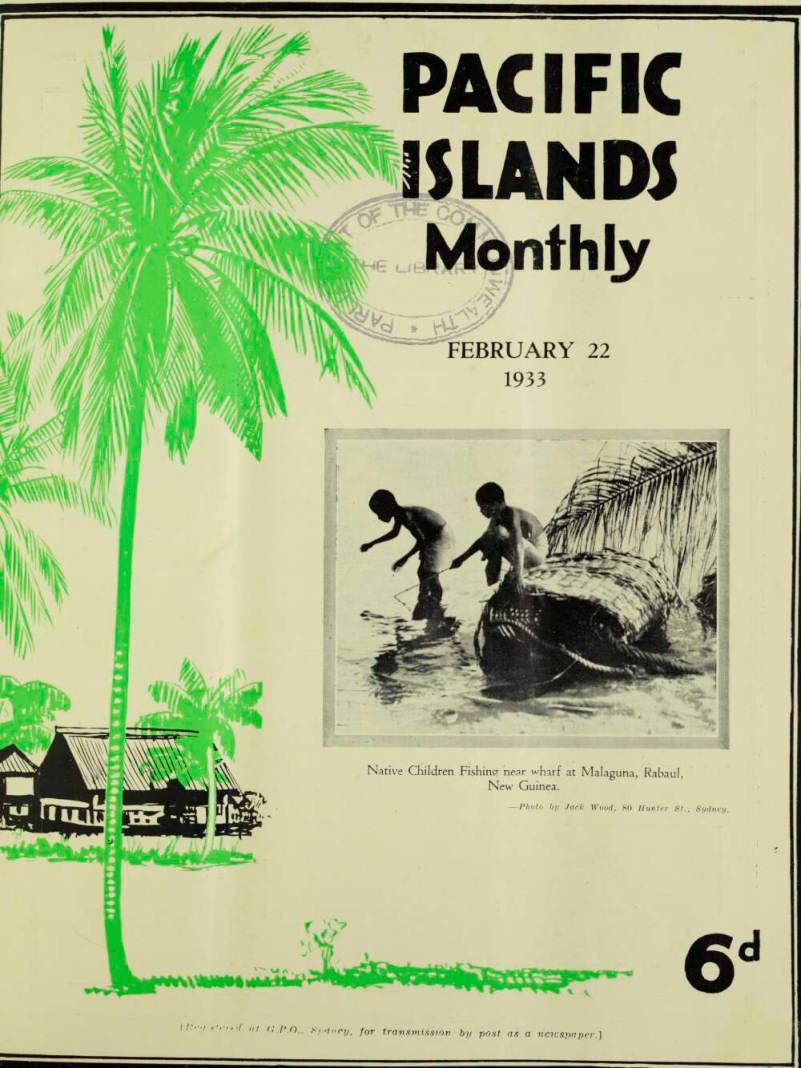
Native Children Fishing near wharf at Malaguna, Rabaul, New Guinea. -Photo by Jack Wood, 80 Hunter St., Sydney.
Advertisements & other items, p. 2 (1 item)
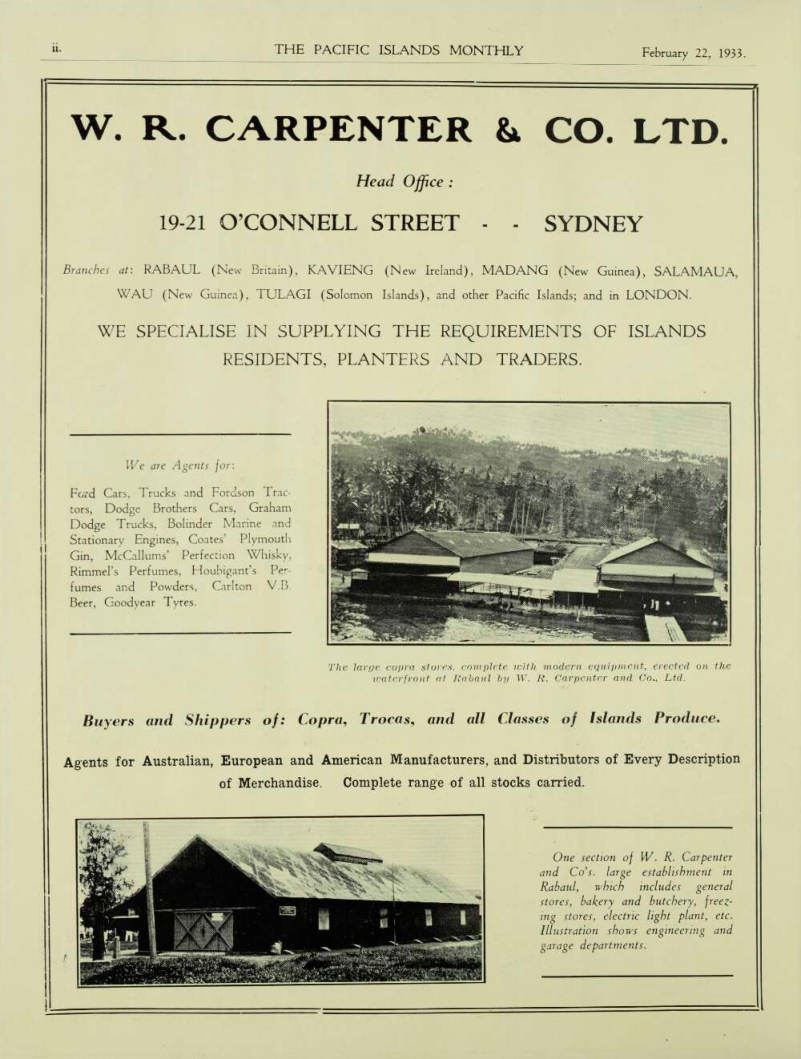
W. R. Carpenter & Co. Ltd.
Head Office :
19-21 O’CONNELL STREET
SYDNEY
Branches at: RABAUL (New Britain), KAVIENG (New Ireland), MADANG (New Guinea), SALAMAUA, WAU (New Guinea), TULAGI (Solomon Islands), and other Pacific Islands; and in LONDON.
WE SPECIALISE IN SUPPLYING THE REQUIREMENTS OF ISLANDS
RESIDENTS, PLANTERS AND TRADERS.
We are Agents for : Ford Cars, Trucks and Fordson Trac tors, Dodge Brothers Cars, Graham Dodge Trucks, Bolinder Marine and Stationary Engines, Coates’ Plymouth Gin, McCallums’ Perfection Whisky, Rimmel’s Perfumes, Houbigant’s Per fumes and Powders, Carlton V.B.
Beer, Goodyear Tyres.
The large copra stores, complete with modern equipment , erected on the waterfront at Rahaul hy W. R. Carpenter and Go., Ltd.
Buyers and Shippers of: Copra , Trocas , and all Classes of Islands Produce.
Agents for Australian, European and American Manufacturers, and Distributors of Every Description of Merchandise. Complete range of all stocks carried.
One section of W. R. Carpenter and Co’s, large establishment in Rabaul, which includes general stores, bakery and butchery, freez ing stores, electric light plant, etc.
Illustration shows engineering and garage departments.
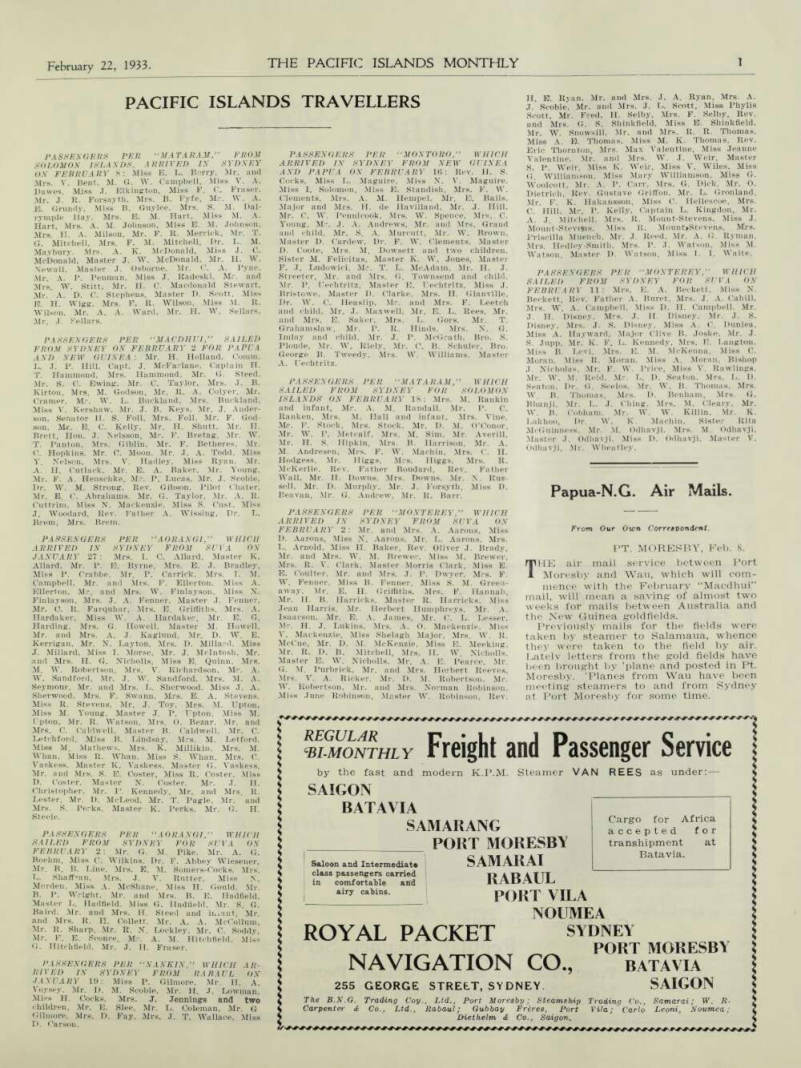
Pacific Islands Travellers
Passengers Per “Mataram," From
Solomon Islands, Arrived In Sydney
ON FEBRUARY 8: Miss E. L. Berry, Mr. and Mrs. V. Bent, M. G. W. Campbell, Miss V. A.
Dawes, Miss J. Elkington, Miss F. C. Fraser, Mr. J. R. Forsayth, Mrs. B. Fyfe, Mr. W. A.
B. Grundy, Miss B. Guylee, Mrs. S. M. Dal rymple Hay, Mrs. B. M. Hart, Miss M. A.
Hart, Mrs. A. M. Johnson, Miss E. M. Johnson, Mrs. H. A. Milson, Mr. F. R. Merrick, Mr. T.
G. Mitchell, Mrs. F. M. Mitchell, Dr. L. M.
Maybury, Mrs. A. K. McDonald, Miss J. C.
McDonald, Master J. W. McDonald, Mr. H. W.
Newall, Master J. Osborne, Mr. C. A. Pyne, Mr, A. P. Penman, Miss J. Radeski, Mr. and Mrs. W. Stitt, Mr. H. C. Macdonald Stewart, Mr. A. D. C. Stephens, Master D. Scott, Miss B. H. Wigg, Mrs. F. R. Wilson, Miss M. R.
Wilson, Mr. A. A. Ward, Mr. H. W. Sellars, Mr. J. Sellars.
Passengers Per “Macdhui," Sailed
FROM SYDNEY ON FEBRUARY 2 FOR PAPUA AND NEW GUINEA : Mr. H. Holland, Comm.
L. J. P. Hill, Capt. J. McFarlane, Captain H.
T. Hammond, Mrs. Hammond, Mr. G. Steed, Mr. S. C. Ewing, Mr. C. Taylor, Mrs. J. B.
Kirton, Mrs. M. Godson, Mr. R. A. Colyer, Mr.
Cramer, Mr. W. L. Buckland, Mrs. Buckland, Miss V. Kershaw, Mr. J. B. Keys, Mr. J. Ander son, Senator H. S. Foil, Mrs. Foil, Mr. F. God son, Mr. B. C. Kelly, Mr. H. Shutt, Mr. H.
Brett, Hon. J. Nelsson, Mr. F. Bretag, Mr. W.
T. Panton, Mrs. Giblin, Mr. F. Betheres, Mr.
C. Hopkins, Mr. C. Moon, Mr. J. A. Todd, Miss Y. Nelson, Mrs. V. Hadley, Miss Ryan, Mr.
A. H. Cutlack, Mr. E. A. Baker, Mr. Young, Mr. F. A. Henschke, Mr. P. Lucas, Mr. J. Scobie, Dr. W. M. Strong, Rev. Gibson, Pilot Chater, Mr. E. C. Abrahams, Mr. G. Taylor, Mr. A. R.
Cuttrim, Miss N. Mackenzie, Miss S. Cast, Miss J. Woodard, Rev. Father A. Wissing, Dr. L.
Baem, Mrs. Brem.
Passengers Per “Aorangi," Which
Arrived In Sydney From Suva On
JANUARY 27: Mrs. I. C. Allard, Master K.
Allard, Mr. P. B. Byrne, Mrs. E. J. Bradley, Miss P. Crabbe, Mr. P. Garrick, Mrs. I. M.
Campbell, Mr. and Mrs. F. Ellerton, Miss A.
Ellerton, Mr. and Mrs. W. Finlayson, Miss N.
Finlayson, Mrs. J. A. Fenner, Master J. Fenner, Mr. C. R. Farquhar, Mrs. E. Griffiths, Mrs. A.
Hardaker, Miss W. A. Hardaker, Mr. E. G.
Harding, Mrs. G. Howell, Master M. Howell, Mr. and Mrs. A. J. Kaglund, Mr. D. W. E.
Kerrigan, Mr. N. Layton, Mrs. D. Millard, Miss J. Millard, Miss I. Morse, Mr. J. Mclntosh, Mr. and Mrs. H. G. Nicholls, Miss E. Quinn, Mrs.
M. W. Robertson, Mrs. V. Richardson, Mr. A.
W. Sandford, Mr. J. W. Sandford, Mrs. M. A.
Seymour, Mr. and Mrs. L. Sherwood, Miss J. A.
Sherwood, Mrs. F. Swann, Mrs. E. A. Stevens, Miss R. Stevens, Mr. J. Toy, Mrs. M. Upton, Miss M. Young, Master J. P. Upton, Miss M.
Upton, Mr. R. Watson, Mrs. O. Bezar, Mr. and Mrs. C. Caldwell, Master B. Caldwell, Mr. C.
Letchford, Miss B. Lindsay, Mrs. M. Letford, Miss M. Mathews, Mrs. K. Millikin, Mrs. M.
Whan, Miss R. Whan, Miss S. Whan, Mrs. C.
Vaskess, Master K. Vaskess, Master G. Vaskess, Mr. and Mrs. S. B. Coster, Miss R. Coster, Miss D. Coster, Master N. Coster, Mr. J. H.
Christopher, Mr. P. Kennedy, Mr. and Mrs. R.
Lester, Mr. D. McLeod, Mr. T. Pagle, Mr. and Mrs. S. Perks, Master K. Perks, Mr. G. H.
Steele.
Passengers Per “Aorangi,“ Which
Sailed From Sydney For Suva On
FEBRUARY 2; Mr. G. M. Pike, Mr. A. G.
Boehm, Miss C. Wilkins, Dr. F. Abbey Wiesener, Mr. B. B. Line, Mrs. E. M. Somers-Cocks, Mrs.
L. Shaffran, Mrs. J. V. Rutter, Miss N.
Murden, Miss A. McShane, Miss H. Gould, Mr.
B. P. Wright, Mr. and Mrs. B. E. Hadfield, Master L. Hadfield, Miss G. Hadfield, Mr. S. G.
Baird, Mr. and Mrs. H. Steed and infant, Mr. and Mrs. R. H. Collett, Mr. A. A. McCollum, Mr. R. Sharp, Mr. R. N. Lockley, Mr. C. Soddy, Mr. F. E. Sconce, Mr. A. M. Hitchfield, Miss G. Hitchfield, Mr. J. H. Fraser.
Passengers Per “Nankin" Which Ar
Rived In Sydney From Rabaul On
JANUARY 19; Miss P. Gilmore, Mr. H. A.
Voysey, Mr. D. M. Scobie, Mr. H. J. Lowman, Miss H. Cocks, Mrs. J. Jennings and two children, Mr. E. Slee, Mr. L. Coleman, Mr. G Gilmore, Mrs. D. Fay, Mrs. J. T. Wallace, Miss D. Carson.
Passengers Per “Montoro,” Which
Arrived In Sydney From New Guinea
AND PAPUA ON FEBRUARY 16: Rev. H. S.
Cocks, Miss L. Maguire, Miss N. V. Maguire, Miss I. Solomon, Miss E. Standish, Mrs. F. W.
Clements, Mrs. A. M. Hempel, Mr. B. Bails, Major and Mrs. H. de Havilland, Mr. J. Hill, Mr. C. IV. Pennicook, Mrs. W. Spence, Mrs. C.
Young, Mr. J. A. Andrews, Mr. and Mrs. Grand and child, Mr. S. A. Murcutt, Mr. W. Brown, Master D. Cardew, Dr. F. W. Clements, Master D. Coote, Mrs. M. Dowsett and two children, Sister M. Felicitas, Master K. W. Jones, Master F. J. Ludowici, Mr. T. L. McAdam, Mr. H. J.
Streeter, Mr. and Mrs. G. Townsend and child, Mr. P. Uechtritz, Master E. Uechtritz, Miss J.
Bristowe, Master D. Clarke, Mrs. H. Glanville, Dr. W. C. Heaslip, Mr. and Mrs. F. Leetch and child, Mr. J. Maxwell, Mr. E. L. Rees, Mr. and Mrs. E. Saker, Mrs. L. Gors, Mr. T.
Grahamslaw, Mr. P. R. Hinds, Mrs. N. G.
Imlay and child, Mr. J. P. McGrath, Bro. S.
Ploude, Mr. W. Riely, Mr. C. B. Schuler, Bro.
George B. Tweedy, Mrs. W. Williams, Master A. Uechtritz.
Passengers Per “Mataram" Which
Sailed From Sydney For Solomon
ISLANDS ON FEBRUARY 18: Mrs. M. Rankin and infant, Mr. A. M. Randall, Mr. P. C.
Ranken, Mrs. M. Hall and infant, Mrs. Vine, Mr. F. Stock, Mrs. Stock, Mr. D. M. O’Conor, Mr. W. F. Metcalf, Mrs. M. Sim, Mr. Averill, Mr. H. S. Hipkin, Mrs. B. Harrison, Mr. A.
M. Andresen, Mrs. F. W. Machin, Mrs. C. H.
Hodgess, Mr. Higgs, Mrs. Higgs, Mrs. R.
McKerlie, Rev. Father Boudard, Rev. Father Wall, Mr. H. Downs, Mrs. Downs, Mr. N. Rus sell, Mr. D. Murphy, Mr. J. Forsyth, Miss D.
Eeavan, Mr. G. Andrew, Mr. R. Barr.
Passengers Per “Monterey" Which
Arrived In Sydney From Suva On
FEBRUARY 2: Mr. and Mrs. A. Aarons, Miss D. Aarons, Miss N. Aarons, Mr. L. Aarons, Mrs.
L. Arnold, Miss H. Baker, Rev. Oliver J. Brady, Mr. and Mrs. W. M. Brewer, Miss M. Brewer, Mrs. R. V. Clark, Master Morris Clark, Miss E.
E. Coulter, Mr. and Mrs. J. P. Dwyer, Mrs. F.
W. Fenner, Miss B. Fenner, Miss S. M. Green away, Mr. E. H. Griffiths, Mrs. P. Hannah, Mr. H. B. Harricks, Master R. Harricks, Miss Jean Harris, Mr. Herbert Humphreys, Mr. A.
Isaacson, Mr. E. A. James, Mr. C. L. Lesser, Mr. H. J. Lukins, Mrs. A. O. Mackenzie, Miss V. Mackenzie, Miss Shelagh Major, Mrs. W. R.
McCue, Mr. D. M. McKenzie, Miss E. Meeking, Mr. R. D. B. Mitchell, Mrs. H. W. Nicholls, Master E. W. Nicholls, Mr. A. E. Pearce, Mr.
G. M. Purbrick, Mr. and Mrs. Herbert Reeves, Mrs. V. A. Ricker, Mr. D. M. Robertson, Mr.
W. Robertson, Mr. and Mrs. Norman Robinson, Miss June Robinson, Master W. Robinson, Rev.
H. B. Ryan, Mr. and Mrs. J. A. Ryan, Mrs. A.
J. Scobie, Mr. and Mrs. J. L. Scott, Miss Phylis Scott, Mr. Fred. H. Selby, Mrs. F. Selby, Rev. and Mrs. G. S. Shinkfield, Miss E. Shinkfield, Mr. W. Snowsill, Mr. and Mrs. R. R. Thomas, Miss A. B. Thomas, Miss M. K. Thomas, Rev.
Eric Thornton, Mrs. Max Valentine, Miss Jeanne Valentine, Mr. and Mrs. W. J. Weir, Master S. P. Weir, Miss K. Weir, Miss V. Wiles, Miss G. Williamson, Miss Mary Williamson, Miss G.
Woolcott. Mr. A. P. Carr, Mrs. G. Dick, Mr. O.
Dietrich, Rev. Gustave Griffon, Mr. L. Gronland, Mr. F. K. Hakansson, Miss C. Hellescoe, Mrs.
C. Hill, Mr. P. Kelly, Captain L. Kingdon, Mr.
A. J. Mitchell, Mrs. R. Mount-Stevens, Miss J.
Mount-Stevens, Miss R. Mount-Stevens, Mrs.
Priscilla Muench, Mr. J. Reed, Mr. A. G. Ryman, Mrs. Hedley-Smith, Mrs. P. J. Watson, Miss M.
Watson, Master D. Watson, Miss I. I. Waite.
Passengers Per “Monterey," Which
Sailed From Sydney For Swa On
FEBRUARY 11: Mrs. E. A. Reckett, Miss N.
Beckett, Rev. Father A. Buret, Mrs. J. A. Cahill, Mrs. W. A. Campbell, Miss D. H. Campbell, Mr.
J. H. Disney, Mrs. J. H. Disney, Mr. J. S.
Disney, Mrs. J. S. Disney, Miss A. C. Dunlea, Miss A. Hayward, Major Clive B. Joske, Mr. J.
S. Jupp, Mr. K. F. L. Kennedy, Mrs. B. Langton, Miss B. Levi, Mrs. E. M. McKenna, Miss C.
Moran, Miss R. Moran, Miss A. Moran, Bishop J. Nicholas, Mr. F. W. Price, Miss V. Rawlings, Mr. W. M. Reid, Mr. L. D. Seaton, Mrs. L. D.
Seaton, Dr. G. Seelos, Mr. W. B. Thomas, Mrs.
W. B. Thomas, Mrs. D. Benham, Mrs. G.
Blianji, Mr. L. J. Clung, Mrs. M. Cleary, Mr.
W. B. Cobham, Mr. W. W. Killin, Mr. K.
Lakhoo, Dr. W. K. Macbin, Sister Rita McGuinness, Mr. M. Odhavji, Mrs. M. Odhavji, Master J. Odhavji, Miss D. Odhavji, Master V.
Odhavji, Mr. Wheatley.
Papua-N.G. Air Mails.
From Our Own Correspondent.
Pt. Moresby, Feb. 8.
THE air mail service between Port Moresby and Wau, which will com mence with the February “Macdhui” mail, will mean a saving of almost two weeks for mails between Australia and the New Guinea goldfields.
Previously mails for the fields were taken by steamer to Salamaua, whence they were taken to the field by air.
Lately letters from the gold fields have been brought by ’plane and posted in Pt.
Moresby. ’Planes from Wau have been meeting steamers to and from Sydney at Port Moresby for some time.
Advertisements & other items, p. 3 (1 item)
REGULAR BI-MONTHLY Freight and Passenger Service
by the fast and modern K.P.M. Steamer VAN REES as under: Saloon and Intermediate class passengers carried in comfortable and airy cabins, Cargo for Africa accepted for transhipment at Batavia.
SAIGON
BATAVIA
SAMARANG
PORT MORESBY
SAMARAI
RABAUL
PORT VILA
NOUMEA
ROYAL PACKET Sydney
PORT MORESBY
NAVIGATION CO., Batavia
255 GEORGE STREET, SYDNEY SAIGON
The B.N.G. Trading Coy., Ltd., Port Moresby; Steamship Trading Co., Samarai; W. R- Carpenter & Co., Ltd., Rabaul; Gubbay Freres, Port Vila; Carlo Leoni, Noumea; Diethelm & Co., Saigon.
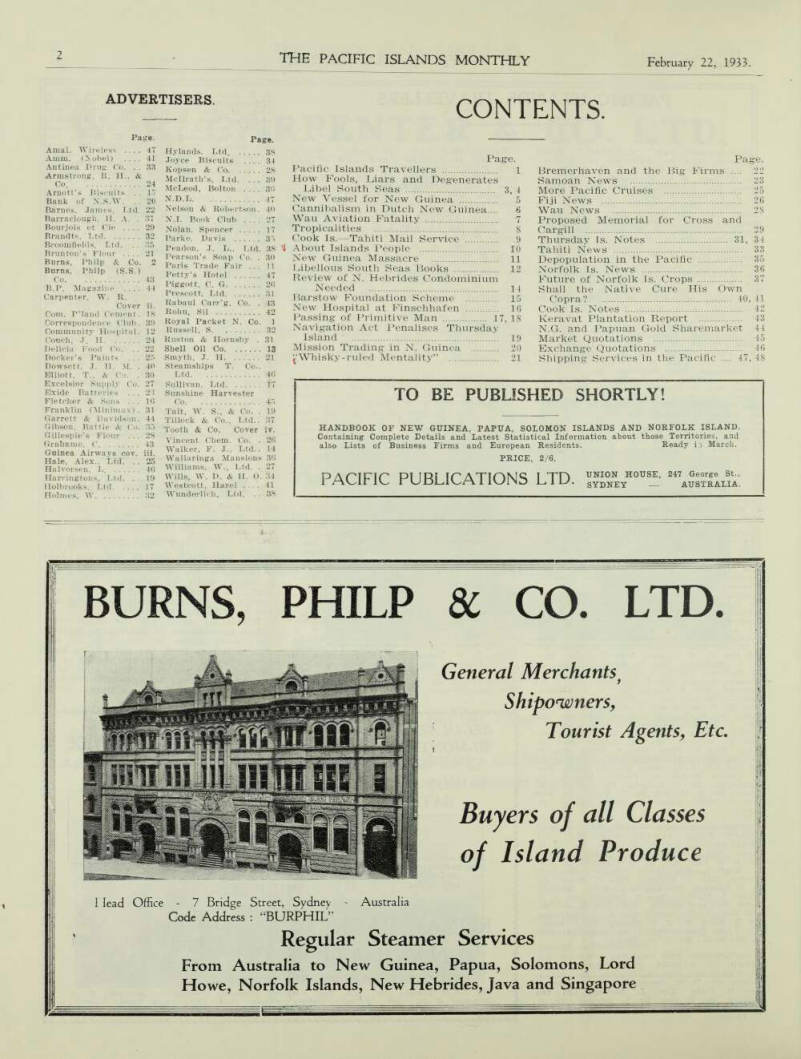
Advertisers.
Page.
Amal. Wireless ... 47 Amm. (Nobel) ... 41 Antinea Drug Co. . . 33 Armstrong. E. H., & Co. 24 Arnott’s Biscuits . . 15 Bank of N.S.W. . . 20 Barnes, James, Ltd. 22 Barraclougli. H. A. . 37 Bourjois et Cie ... 29 Brandts. Ltd 32 Broomfields, Ltd. .. 35 Bruntou’s Flour ... 21 Burns, Philp & Co. 2 Burns, Philp (S.S.) Co 43 B.P. Magazine ... 44 Carpenter, W. R.
Cover ii.
Com. P’land Cement. 18 Correspondence Club. 39 Community Hospital. 12 Couch. J. H 24 Delicia Food Co. . . 22 Docker’s Paints ... 23 Dowsett, J. H. M. . 40 Elliott. T.. & Co. . 30 Excelsior Supply Co. 27 Eixide Batteries ... 23 Fletcher & Sous ... 10 Franklin (Minimax). 31 Garrett & Davidson. 44 Gibson. Battle & Co. 33 Gillespie’s Flour ... 28 Grahame. C 43 Guinea Airways cov. iii.
Hale, Alex.. Ltd. .. 25 Halvorsen, L. 46 Harringtons. Ltd. . . 19 Holbrooks. Ltd 17 Holmes, W 32
Page.
Hylands. Ltd 38 Joyce Biscuits ... 34 Kopsen & Cos 28 Mcllrath’s, Ltd. ... 39 McLeod, Bolton ... 39
N.D.L 47
Nelson & Robertson. 40 N.I. Book Club 27 Nolan, Spencer 17 Parke, Davis 35 Peadon, J. L., Ltd. 38 Pearson’s Soap Cos. . 30 Paris Trade Fair ... 11 Petty’s Hotel 47 Piggott, C. G 20 Prescott, Ltd 31 Rabaul Carr’g. Cos. . 43 Rohu, Sil 42 Royal Packet N. Cos. 1 Russell, S 32 Ruston & Hornsby . 31 Shell Oil Cos. ... 13 Smyth, J. H 21 Steamships T. Cos., Ltd 46 Sullivan, Ltd 17 Sunshine Harvester Cos 43 Tait, W. S., & Cos. . 19 Tillock & Cos., Ltd.. 37 Tooth & Cos. Cover iv.
Vincent Chem. Cos. . 26 Walker, F. J., Ltd.. 14 Wallaringa Mansions 36 Williams, W., Ltd. . 27 Wills, W. D. & H. O. 34 Westcott, Hazel ... 41 Wunderlich, Ltd. . . 38
Contents.
Page.
Pacific Islands Travellers 1 How Fools, Liars and Degenerates Libel South Seas 3, 4 New Vessel for New Guinea 5 Cannibalism in Dutch New Guinea ... 6 Wau Aviation Fatality 7 Tropicalities 8 Cook Is. —Tahiti Mail Service 9 About Islands People 10 New Guinea Massacre 11 Libellous South Seas Books 12 Review of N. Hebrides Condominium Needed 14 Barstow Foundation Scheme 15 New Hospital at Finschhafen 16 Passing of Primitive Man 17, 18 Navigation Act Penalises Thursday Island 19 Mission Trading in N. Guinea 20 "Whisky-ruled Mentality” 21
Page.
Bremerhaven and the Big Firms ... 22 Samoan News 23 More Pacific Cruises 25 Fiji News 26 Wau News 28 Proposed Memorial for Cross and Cargill 29 Thursday Is. Notes 31, 34 Tahiti News 33 Depopulation in the Pacific 35 Norfolk Is. News 36 Future of Norfolk Is. Crops 37 Shall the Native Cure His Own Copra? 40, 41 Cook Is. Notes 42 Keravat Plantation Report 43 N.G. and Papuan Gold Sharemarket 44 Market Quotations 45 Exchange Quotations 46 Shipping Services in the Pacific ... 47, 48
Advertisements & other items, p. 4 (1 item)
Burns, Philp & Co. Ltd.
TO BE PUBLISHED SHORTLY!
HANDBOOK OF NEW GUINEA, PAPUA, SOLOMON ISLANDS AND NORFOLK ISLAND, Containing Complete Details and Latest Statistical Information about those Territories, and also Lists of Business Firms and European Residents. Ready in March,
PRICE, 2/6,
PACIFIC PUBLICATIONS LTD.
UNION HOUSE, 247 George St.,
SYDNEY AUSTRALIA.
BURNS, PHILP & CO. LTD.
General Merchant
Shipowners,
Tourist Agents, Etc.
Buyers of all Classes
of Island Produce Head Office - 7 Bridge Street, Sydney - Australia Code Address : “BURPHIL”
Regular Steamer Services From Australia to New Guinea, Papua, Solomons, Lord Howe, Norfolk Islands, New Hebrides, Java and Singapore
The Pacific Islands Monthly
THE NEWSPAPER - MAGAZINE OF THE SOUTH SEAS [Registered at G.P.O., Sydney, for transmission by post as a newspaper .]
Published Once Each Month and Circulated in Australia and New Zealand and in the following Pacific Territories and Island Groups:
Crown Colony of Fiji.
Australian Territory of Papua.
Mandated Territory (Australia) of New Guinea, Bismarck Archipelago, and Northern Solomon Islands.
Mandated Territory (Japan) of Marshall, Caroline and Mariana Islands.
American Territory of Guam.
Mandated Territory of Nauru.
British Crown Colony of Gilbert and Ellice Islands.
French Territory of New Caledonia.
British and French Condominium of New Hebrides.
American Territory of Eastern Samoa.
Mandated Territory (New Zealand) of Samoa British Solomon Islands Protectorate.
British Protectorate of Tongan Islands New Zealand Territory of Cook Islands.
Australian Territory of Norfolk Island.
French Colony of Oceania (Tahiti, etc > American Territory of Hawaiian Islands.
Owned and Produced by Pacific Ltd., Union House, 247 George Street, Sydney
Telephone Bw 5037
P.O. Box 3408 R
Editor and Publisher:
R. W. Robson.
Registered Address for Radiograms and Cables: “PACPUB” Sydney
Contributions
Articles, Stories and Photographs dealing with Pacific Islands Subjects are invited, and will be paid for on publication at usual rates.
Subscription Rates
Per Annum, within Postal Convention Territories, Prepaid, Post Free 6/- Per Annum elsewhere, Prepaid, Post Free 8/- Single Copies 6d.
Advertisements
Advertising rates furnished on application.
Colours, etc. by Arrangement Process Blocks made at Advertisers expense when required. Screen, 100.
Changes of Advertising Copy should reach this Office by 8th of each month, otherwise previous advertisement may be repeated.
Agents
The following are authorised to receive sub scriptions for The Pacific Islands Monthly — Islands Branches of Burns, Philp & Co.. Ltd., and Burns, Philp (South Seas) Co., Ltd.
Islands Branches of W. R. Carpenter & Co,. Ltd.
All Branches of Morris, Iledstrom & Co., Ltd.
J. H. MacGregor Dowsett, Rabaul.
Whitten Bros., Ltd., Port Moresby & Samarai.
All Branches and Representatives of W. H Grove & Sons, Ltd., Auckland.
S. Russell, Papeete. Tahiti.
Cook Islands Trading Co., Rarotonga.
Mrs. M. Campbell, Cascades, Norfolk Island.
Vol. III. No. 7.
Sydney, February 22, 1933.
Price 6d. Per Copy. prepaid: 6/- p.a.
South Seas.
How Fools, Liars and Degenerates Libel the South Seas.
IT is probable that no part of the world suffers more from the attentions of sensation-mongering, irresponsible writers than do the Pacific Islands.
Men with personal knowledge of the South Seas must often read with amazement the stories published in some of Australia’s yellow journals—usually wild and mendacious exaggerations of unimportant events, topped off with typographical screeches worthy of the Hearst press at its best—or worst.
On Sunday, January 29, for instance, the following huge headings blazed across the entire front page of Sydney’s most widely-circulated week-end newspaper: “New Guinea Head-Hunters Out of Hand—Recent Killings Ominous —Recruiting Resented by Inland Tribes—More Precautions?”
The ‘story’ contained an account of the murder of the prospectors Naylor and Clarius, and nine of their carriers; but it was written and presented in such a way as to suggest that the whole Territory was in a disturbed condition, and the safety of the European community menaced. Hundreds of people with interests in New Guinea, but knowing little of conditions there, became alarmed. New Guinea
people, at present in Sydney, merely expressed amuse ment, but a few were indignant at the gross mis representation of the condition of the Territory, and asked the newspaper to make a correction. The cor rection was refused. The newspaper, a fortnight later, published another and even more mendacious story about New Guinea.
The “Sydney Morning Herald,” however, courte ously acceded to a request by New Guinea residents, and published a statement explaining that, in remote parts of New Britain and New Guinea, there are still “uncontrolled areas,” where wild bush tribes still live as they did hundreds of years ago. These wild natives as yet are quite uninfluenced by European civilisa tion, and are always dangerous and liable to attack white men, who go among them entirely at their own risk.
Since 1926, when the development of the Morobe goldfield commenced, prospectors have been pushing out continuously into the untamed, unpatrolled country; and, almost every year, some of them are killed by Nomadic bush tribes, or Kukukukus. Baum, last year; Exton, in December; Naylor and Clarius,
in January—these men went out deliberately into dangerous country, seeking gold, and finding death, as such men have done all through history.
The New Guinea Administration, year by year, has extended its patrols and its influence, until to-day there is only a very small proportion of the Territory that is not as safe for European residents as Pitt Street, Sydney. Within a few more years, the in terior of New Britain, and the wild, almost inaccessible region behind Morobe, will be labelled "safe." Australian newspapers, instead of publishing silly, ill-informed articles about New Guinea, should pay tribute instead to the Administration, which has been so successful in bringing so large a part of the Territory under control within a few years.
In an article in this issue a writer in Tahiti pro tests strongly against the manner in which that fairest corner of Polynesia is libelled by irresponsible and mendacious producers of books —with the result that scores of expectant old gentlemen from less attractive countries have found their way into French Oceania, seeking to make contact with the idyllic, lotus eating existence of which they have read. It is, as our correspondent says, a great pity that those who love the Islands, and who are jealous of the reputation of Islands people, should not have the opportunity of dealing with these lying authors —preferably, of nailing their ears to the nearest capstan-head, after the manner of Kipling’s merchant captain.
In still another article in this issue complaint is made of the manner in which Australian newspapers have grossly exaggerated a report about sickness among the natives of Malaita, in the British Solomon Islands. Here, again, it seems a matter for regret that a few Solomon Islands residents could not be permitted to tell the sensation-mongers exactly what they think of them.
In a recent mail a friend, resident in England, sends us a copy of a London newspaper in which there is a review of a book “Deep Water and Shoal,” by a William Albert Robinson—described as “a young American who recently sailed round the world in a yacht.” Some of the statements made by this author are of an outrageous description. He says, for instance, that he found on the North coast of New
Guinea a Mission centre where a school is kept for the education of half-caste children of teachers of the Gospel and their native concubines. He says that on “one of the Eastern Islands’’ he met a repre sentative of a prominent American church living in a state of polygamy with several native girls under the pretext of teaching them domestic science.
This so-called author makes similarly lying state ments about many islands well known to Australians.
He says that the lepers at Makogai, Fiji, are cruelly treated and systematically robbed; that the Mission labourers at Alexishafen, New Guinea, are kept in a state of practical slavery for a monthly wage of one shilling; that natives in Santo, New Hebrides, were being fined for taking water from the river on Sun day; and that the Missions in the South Seas gen erally are systematically oppressing and robbing the natives.
It is a book, apparently, that can be described as nothing more than a tissue of monstrous lies and exaggerations, and it is a surprising thing that a responsible firm like Jonathan Cape should be pre pared to publish it.
In the next issue of the London newspaper referred to, Rev. William Paton, of the International Missionary Council, referring to the newspaper’s re production of the more sensational allegations in the book, said: "From a continuous contact with mission aries of all denominations in different parts of the world, I can say that these stories are utterly incredible."
The denial was timely enough, but quite ineffective.
The lie, as the result of an irresponsible publisher co operating with an irresponsible rascal, already was in circulation, and it really was too late to do any thing. Individuals may be libelled, and the libeller can be punished severely. Is it not time that it was made possible to punish people even more severely for libelling communities'?
The gross libels and distortions of the truth to which we have referred suggest that at least something should be done to protect the fair name of the Pacific Islands from the attentions of fools, liars and degenerates who have command of organs of publicity. —R.W.R.
Big Feast.
Shackleford-Dromgold Expedi tion Treats its Papuan “Supers.”
From Our Own Correspondent.
Pt. Moresby, Feb. 8.
THE Shackleford and Dromgold Ex pedition has shifted its headquarters to the Eastern Division of Papua, after working for some time around the reefs and native villages in the district of Port Moresby.
It has been impressed with the scen ery and the natives in the Central Divi sion and has taken excellent films to be adapted later for the main features of a spectacular film of the South Seas. Be fore leaving for Samarai, they gave a big feast to the natives of Hanuabada, who had been working consistently with
the expedition since its arrival in Papua.
The feast consisted of two bullocks, one ton of rice, and six hundred loaves of bread.
In order to get satisfactory results, the expedition spent large sums of money in experimental work for the ad aptation of the finer points of their film work to the nature of the country and the natives; and the Hanuabada people received more than exceptional payment for their services.
The danger is that this royal feast, following upon the heels of the easy money for some months past, will have the tendency to render their services prohibitive in these bad times to the re sidents of Port Moresby, and to any fu ture expedition (less affluent) coming this way, for some time to come.
The demands of the Hanuabada will be high and their attitude lofty. Still, the money was a very welcome addition to the currency of Port Moresby, and the natives may have by now reached the age of discrimination and regard the
whole proceedings in the light of a windfall.
Twelve hundred natives from Hanua bada, Baruni, Tatana, Pari and Vabukori took part in the feast.
Tahiti Copra.
Export Duty Proposal Shelved.
Papeete, Jan. 26.
AS a result of protests by the Tahiti Chamber of Commerce and other local bodies, the proposal to impose an export duty of 200 francs per ton on all copra exported to destinations other than France, has been shelved, at any rate, for the time being.
It has been agreed that 60 per cent, of the copra produced shall go to France and the remaining 40 per cent, may be shipped to foreign ports. Presumably any copra shipped over this 40 per cent, will be subject to the new scale.
Samarai Fire.
Mr. Bunting’s Store Destroyed.
From Our Own Correspondent.
Pt. Moresby, Jan. 10.
THE business premises of the Hon. A.
H. Bunting, at Samarai, were de stroyed by a fire in the early hours of the morning of January 5. The fire started at 4 o’clock and by 8 only smok ing ruins remained.
The retail stores and offices were separated from the bulk store, by an iron partition which made possible the salvage of the office records, the safes, and a portion of the retail store effects, but practically no stock was saved. Mr.
Bunting estimates his loss at over £ 2000 after allowing for £5000 covered by in surance.
The copra sheds of J. R. Clay and Co. adjoining Mr. Bunting’s premises were undamaged, though the heat from the fire blistered the paint on the main building.
A native bucket brigade rendered use ful work on one occasion when rafters caught alight on the shed nearby.
Mr. Bunting is carrying on business without interruption in temporary pre mises in Burns, Philp and Co., Ltd., bulk store. The rebuilding of new premises on the old site has already commenced.
The Hon. A. H. Bunting is a non official member of the Legislative Coun cil of Papua and has been over forty years in the Territory—and besides planting and trading, has taken an ac tive interest in mining.
30 Years’ Service.
Mr. Bond-James Retires.
From Our Own Correspondent.
Papeete, Jan. 26.
AFTER devoting practically the whole of their lives to mission work in the Eastern Pacific, the Rev. Bond-James and Mrs. Bond-James left by the “Ma kura” on January 30 for New Zealand.
Mr. Bond-James and his wife have served the London Mission Society for over 30 years, first in the Cook Group, then at the Ellice Islands, for a short period in Samoa and, during the last 20 years at headquarters of the Society’s Cook Islands branch, Rarotonga.
Such prominent and respected resi dents were not allowed to depart with out many functions being arranged in their honour. Prominent amongst these was a farewell gathering of friends ar ranged by Judge Ayson at his official residence, “Ngatipa,” at which a cheque donated by the European community was handed to Mr. Bond-James.
A round of leave-taking functions were given by the natives, presents of all kinds being heaped upon the missionary, his wife and daughter.
One of the practical results prominent in London Mission work here is that re lated to education. Many responsible positions in private firms and several in the Administrative offices have been suc cessfully filled for years by native as sistants educated at the Mission School conducted by the missionary and his wife prior to the opening of Government schools.
Messrs. Carpenter Build New
500 Ton Vessel For New Guinea.
Minister Launches “Bolton” at Jervis Bay.
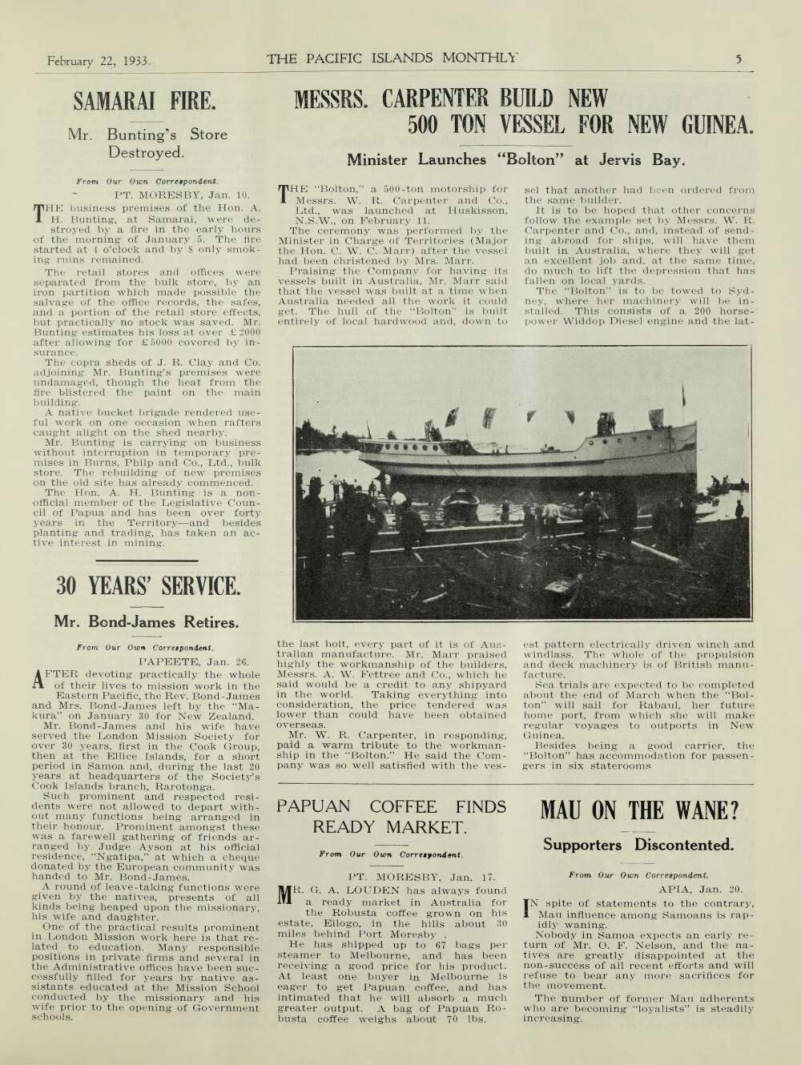
THE “Bolton,” a 500-ton motorship for Messrs. W. R. Carpenter and Co., Ltd., was launched at Huskisson, N.S.W., on February 11.
The ceremony was performed by the Minister in Charge of Territories (Major the Hon. C. W. C. Marr) after the vessel had been christened by Mrs. Marr.
Praising the Company for having its vessels built in Australia, Mr. Marr said that the vessel was built at a time when Australia needed all the work it could get. The hull of the “Bolton” is built entirely of local hardwood and, down to
the last bolt, every part of it is of Aus tralian manufacture. Mr. Marr praised highly the workmanship of the builders, Messrs. A. W. Fettree and Co., which he said would be a credit to any shipyard in the world. Taking everything into consideration, the price tendered was lower than could have been obtained overseas.
Mr. W. R. Carpenter, in responding, paid a warm tribute to the workman ship in the “Bolton.” He said the Com pany was so well satisfied with the ves
sel that another had been ordered from the same builder.
It is to be hoped that other concerns follow the example set by Messrs. W. R.
Carpenter and Co., and, instead of send ing abroad for ships, will have them built in Australia, where they will get an excellent job and, at the same time, do much to lift the depression that has fallen on local yards.
The “Bolton” is to be towed to Syd ney, where her machinery will be in stalled. This consists of a 200 horse power Widdop Diesel engine and the lat
est pattern electrically driven winch and windlass. The whole of the propulsion and deck machinery is of British manu facture.
Sea trials are expected to be completed about the end of March when the “Bol ton” will sail for Rabaul, her future home port, from which she will make regular voyages to outports in New Guinea.
Besides being a good carrier, the “Bolton” has accommodation for passen gers in six staterooms
Papuan Coffee Finds
Ready Market.
From Our Own Correspondent.
Pt. Moresby, Jan. 17.
MR. G. A. LOUDEN has always found a ready market in Australia for the Robusta coffee grown on his estate, Eilogo, in the hills about 30 miles behind Port Moresby.
He has shipped up to 67 bags per steamer to Melbourne, and has been receiving a good price for his product.
At least one buyer in Melbourne is eager to get Papuan coffee, and has intimated that he will absorb a much greater output. A bag of Papuan Ro busta coffee weighs about 70 lbs.
Mau On The Wane?
Supporters Discontented.
From Our Own Correspondent.
Apia, Jan. 20.
IN spite of statements to the contrary, Mau influence among Samoans is rap idly waning.
Nobody in Samoa expects an early re turn of Mr. O. F. Nelson, and the na tives are greatly disappointed at the non-success of all recent efforts and will refuse to bear any more sacrifices for the movement.
The number of former Mau adherents who are becoming “loyalists” is steadily increasing.
Trade In Human Flesh.
The Cannibalistic Orgies of Dutch New Guinea.
Written for “The Pacific Islands Monthly" by Dr. G. H. Vernon, of Daru, Papua, Copyright.
IN Malay countries, the British alone are distinguished from other Euro pean races by the title “Orang Puteh,” the “White Men”—and the Malays are no mean judge of character.
A handful of British bird-shooters who made South-west Dutch New Guinea their base for hunting operations during the decade following the war, fully de served the title, for they were a fine set of fellows. Alas, each one was destined to meet with a violent death in the land of his adoption!
You can count the members of this little team on the fingers of one hand — Bell, Penrose, Jackson and Roche; to the quartet add Dressier, a German, but a man of the same intrepid character, and you have the lot.
So far as the writer knows, no other Britons were settled in that unknown land during the years in question (1920- 1930), and, since their death, no one has taken their place. That they were men who could be ill-spared from any com munity is evident to anyone who knows what life in such a savage country en tails. Strength, mental and physical, was needed for such a career. Not only does inanimate Nature place all sorts of ob stacles to their journeyings, but Man, cruel and callous, living in a state of anarchism where might alone is right, is a constant menace to anyone who ventures outside the very circumscribed area that Dutch authorities have tamed.
Truly this quintet of adventurers were men of more than usual courage.
In 1924, a paper in Rotterdam, Hol land, published an account of the expedi tion written by one of the priests sta tioned at Merauke, the capital town of Southern Dutch New Guinea, who ac companied it into the wilds, and there is no doubt that the almost incredible state of cannibalism described is wholly ac curate. If confirmation of this were necessary, Dick Roche gave it many a time when he used to remark, in his im pressive way, “There’s more human meat bartered for and eaten in the jungles over there in a month than beef on Thursday Island.”
George Penrose’s death, details of which may still be unknown to many of his friends over the border in British territory, is graphically described in the Dutch paper by the Belgian priest, and it is from his narrative that this sum mary is made.
The expedition, which was apparently of an exploratory and punitive nature combined, left Merauke in October, 1921, and at a place called Assiba they fell in with Jackson and Roche.
The two bird-hunters were still in great distress on account of the loss of their friend and colleague Penrose, in the previous July. During that month birds had been scarce, and Penrose had decided to penetrate into the Upper Kawo district, notorious for the savag ery of its inhabitants, in search of bet ter luck. The others tried to dissuade him; they had heard from friendly na tives that the “Stone People” (so called because in their district are found the fine black stones so much in demand for axes and clubs) were fierce cannibals who objected to the intrusion of strangers and were habitual dealers in human flesh, which they preferred above
all commodities in exchange for the stones.
But their warnings fell on deaf ears and Penrose left with his boys, intent only on getting more birds.
A few days after, one of his shoot ing Malays cleared out with a gun, and in order to prevent a recurrence, Pen rose gathered all the arms in every night and placed them under his camp bed.
This precaution was undoubtedly the cause of his death.
At about 3 a.m. on the 14th of July, he and his boys were surrounded by a mob of natives. The unarmed boys scat tered in all directions, two being killed as they fled; Penrose himself received seven arrows in his body, one in the abdomen eventually proving fatal. He was a very strong man, fearless and re solute, and he fought his way out, only to collapse in the darkness of the bush, where one of his boys found him and, placing him on his back, carried him into a safer spot. Here he remained in hid ing through the rest of the night, weak from loss of blood and the increasing pain of his wounds, while his assailants could be heard preparing with shouts and chanting for their ghastly feast of victory.
Jackson was camped about six hours’ walk away and, on hearing from one of the fugitive Malays what had happened, set out with a rescue party and arrived at the spot before dark. The hideous orgy was at its height when he came on the scene, the murderers being then en gaged in eating the bodies of the Malays they had killed.
Jackson, with signal bravery, drove them off and, later, came across his friend lying under a tree in a dying con dition. Penrose recognised him; he looked at him, but could not speak.
Then he closed his eyes for ever.
Setting watch, Jackson prepared to spend the night by the body of his friend, but shortly after midnight he was disturbed; a light was cautiously ap
preaching their camp from the jungle.
Jackson picked up his gun, and would have fired at once, but one of his boys, with a better knowledge of savage cun ning, stopped him until the light came closer, when the spy was put out of ac tion. It was then found that the torch had been fastened at the end of a long pole, and premature firing would have missed the bearer.
According to the narrative, Penrose’s remains were finally brought to Merauke.
The members of the priest’s expedi tion later camped on the very spot where Dressier and Bell had been mur dered in 1920, and here they fell in with a tribe who spoke quite openly about their cannibalistic habits.
All the elderly people who cannot re sist are “Namnan” (eaten), and even some of the women share this fate, so that it is not only strangers who fall victim to the lust of the tribesmen. Some misdeeds, adultery, for instance, are punished by death and the culprits are subsequently eaten.
Human flesh is the greatest delicacy of these people and the chief medium of exchange, a leg having about the value of an axe. Men who go out to kill and who bring supplies of flesh to the mar ket place are held in high repute; they are the honoured citizens of these jungle communities. When asked if it were really any good, their reply was that no meat is so delicious as human flesh. So great becomes the craving for it that their own children, who perish by acci dent or sickness, are subsequently eaten.
A proof of this was forthcoming at this camp. Just as they were ready to move on, some of the carriers asked to be excused, as an accident had occurred in the village, one of the children having fallen from the raised verandah of a house. Next day, they reappeared, one of them bearing the parts of the little victim of this accident. ‘There is never any difficulty in ob taining carriers from these tribes for a punitive expedition; there is always the chance of meat, and they gleefully set out in the hopes of satisfying their sinister tastes.
“Homo homini lupus.” As one reads these tales of modern cannibalism, the old saying, “Man to man is a wolf” be comes startlingly real.
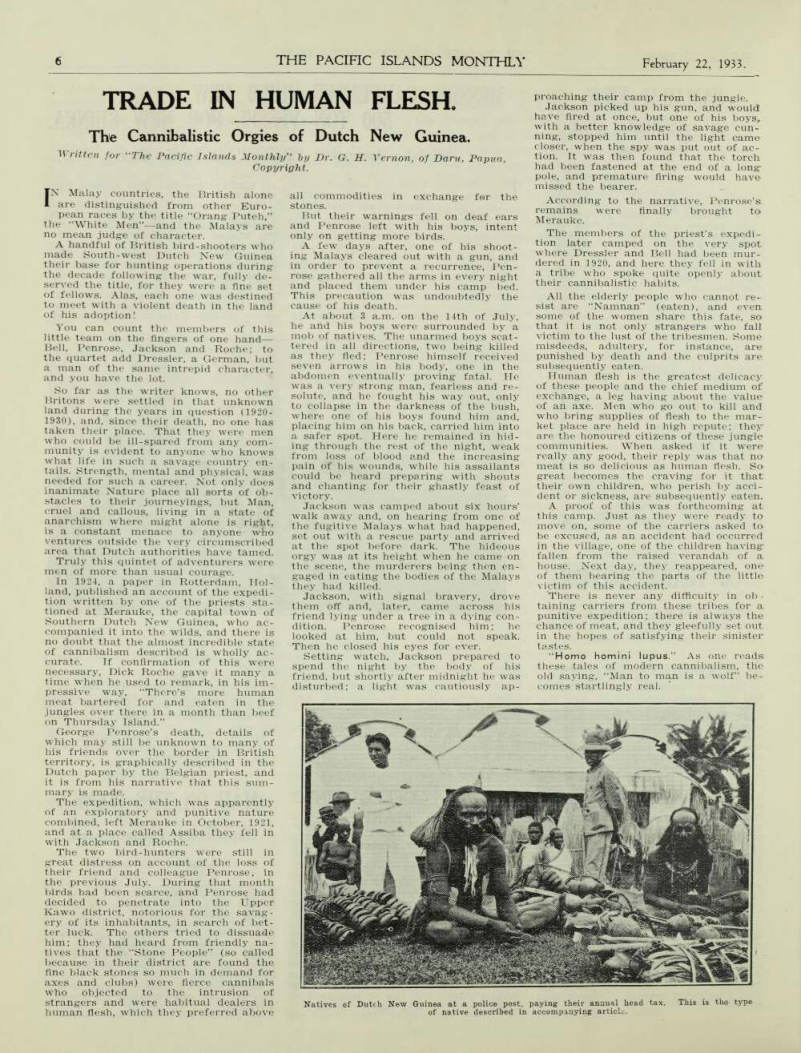
Natives of Dutch New Guinea at a police post, paying their annual head tax. This is the type of native described in accompanying article.
Wau Aviation
Fatality.
Ray Parer Gives Eye-witness’s Account of Accident.
From Our Own Correspondent WAU, Jan. 17.
DETAILS of the flying fatality at Wau on December 26, when Pilot Drayton and Mr. L. H. Harper were killed, are to hand.
The ’plane, a Moth, had taken off from Wau on a flight to Bulwa aerodrome, when it was seen to roll at a height of about 300 feet. Pilot Drayton, on finish
ing this move, apparently attempted to
recover and opened the throttle. The en gine did not respond and the ’plane struck some trees and crashed.
We quote the evidence of Lieutenant
Ray Parer, who was an eye-witness:
“I am the qualified Chief Pilot of Pacific Aerial Transport, Ltd., and reside at Wau. Yes terday afternoon, a little after 4 o’clock, I was sitting on the verandah of the Hotel Bulolo, when I heard an aeroplane engine rev up, and I noticed it was Guinea Airways, Ltd., ‘Moth.’
I saw the machine leave the ground. It appeared to be climbing very slowly. When about 200 feet above the aerodrome, I saw the machine turn to the right and complete two right hand turns.
Finishing the end of the second turn, pointing south, the machine went into full roll. It came out of this rather low. The pilot then apparently attempted to recover, and opened his engine. The engine spluttered appreciably, and did not regain its full revs until it was too late to miss the trees.
“A moment before striking the trees the engine appeared to be picking up. I think if it had picked up immediately, the machine would have cleared the trees.
“The machine appeared to be responding well to its controls, just prior to the crash, for the turns seemed to me to be well executed. I actually saw the machine in its manoeuvres until it passed out of my line of vision and crashed into the trees down in Wau Creek. I heard the crash, and about half a minute after wards saw smoke rising from the locality. I rushed down to the hangar for a fire extinguisher, but found it had been already taken out. I then proceeded to the scene, and from the bank of the creek viewed the burning machine and the attempts at rescue which were being made by Europeans and natives.
“I saw Mr. Drayton about fifteen minutes before the fatal flight, and he appeared quite normal to me. I did not know at the time of the accident that he was the pilot of the ‘Moth.’
“I know the Guinea Airways, Ltd., ‘Moth’ well, though I have never flown in it. I have seen it landing and taking off on the different ’dromes on many occasions, and I am of the opinion that the take-off of that particular "Moth” was not as good as some of the other ‘Moths.’
“From where I stood on the Creek watching the burning ’plane, I noticed that the ’plane was on its back, pointing South.
“There is no question in my mind that the engine ceased to function in the middle of the roll. The engine seemed to be working well when the pilot opened up, taking off, but the ’plane did not appear to gain height as quickly as it should have done. When taking off, I noticed that the pilot made right hand turns; it is more usual for pilots to turn to the left instead of the right. That is how I came to remember that turns to the right were made in this instance.”
The gallantry of the first men on the scene of the crash deserves praise, as they made brave attempts to rescue pilot and passenger from the burning wreck age. Mr. J. A. Crockett, of the clerical staff of New Guinea Goldfields, Ltd., sustained severe burns to the hands; but his attempts at rescue were foiled by the blaze.
The fatality, the first of its kind at Wau, cast a gloom over the district and
much sympathy is felt for the young widow of Pilot Drayton and his infant son, particularly as they are eye-wit nesses of the disaster.
The late Frank Dray ton came to the Terri tory in 1927 with Cap tain Moody, Les Trist and F. Ward, of the Air Gold Co. He was born in Richmond, N.S.W. In 1931 he married Miss Bobbie Thompson, of Sydney. Their only child is Peter John, who is a year old.
The late L. H. Har per, the passenger, was employed by Bulolo Gold Dredging Ltd., and had been in the Terri tory for two years. He came from Georgia, U.S.A., and was an only son. Being popular among his friends, he will be sadly missed.
After a short service conducted by Reverend Bradley, the remains of Frank Nelson Drayton were taken by Guinea Airways Junker ’plane to Lae for interment on December 27. A large cortege of his friends accompanied the coffin to the ’plane and there were many floral trib utes. The burial took place at Lae.
The remains of Lewis Heymes Harper were interred in the Wau Cemetery on December 27. The ceremony was conducted by Assistant District Officer H. L.
Dowling.
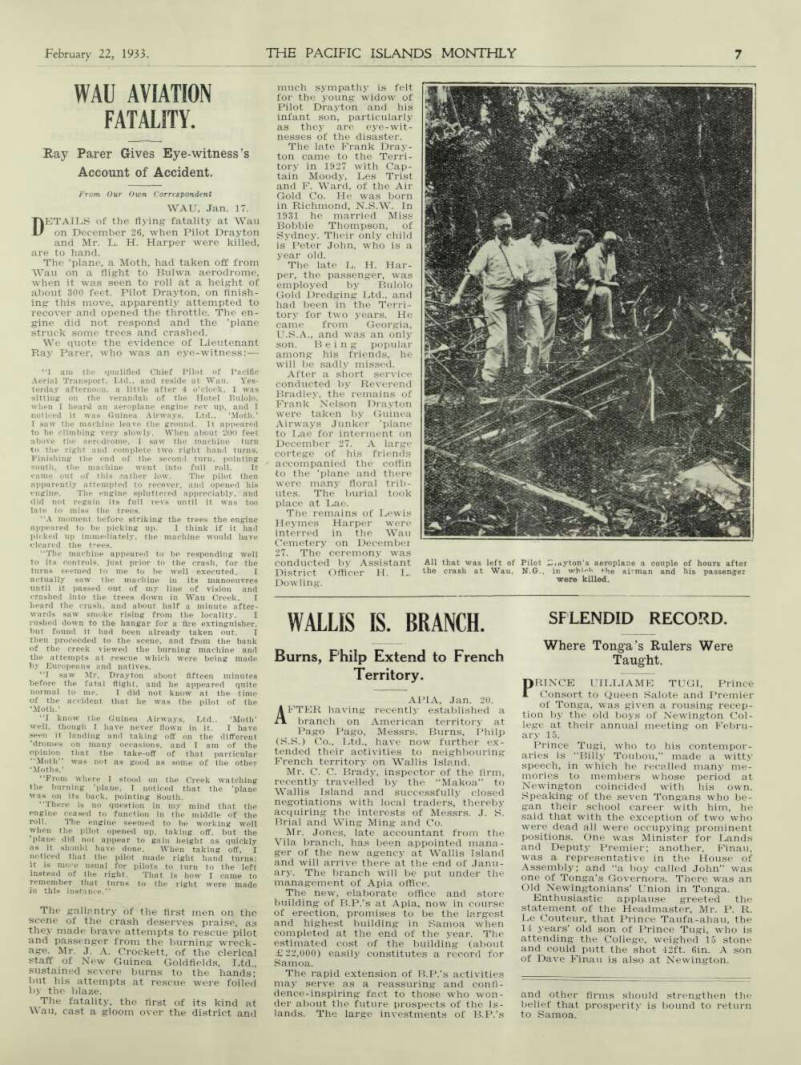
All that was left of Pilot Diayton's aeroplane acouple of hours after the crash at Wau, N.G., in which the air man and his passenger were killed.
Wallis Is. Branch.
Burns, Philp Extend to French Territory.
Apia, Jan. 20.
AFTER having recently established a branch on American territory at Pago Pago, Messrs. Burns, Philp (S.S.) Co., Ltd., have now further ex tended their activities to neighbouring French territory on Wallis Island.
Mr. C. C. Brady, inspector of the firm, recently travelled by the “Makoa” to Wallis Island and successfully closed negotiations with local traders, thereby acquiring the interests of Messrs. J. S.
Brial and Wing Ming and Co.
Mr. Jones, late accountant from the Vila branch, has been appointed mana ger of the new agency at Wallis Island and will arrive there at the end of Janu ary. The branch will be put under the management of Apia office.
The new, elaborate office and store building of B.P.’s at Apia, now in course of erection, promises to be the largest and highest building in Samoa when completed at the end of the year. The estimated cost of the building (about £22,000) easily constitutes a record for Samoa.
The rapid extension of B.P.’s activities may serve as a reassuring and confi dence-inspiring fact to those who won der about the future prospects of the Is lands. The large investments of B.P.’s
and other firms should strengthen the belief that prosperity is bound to return to Samoa.
Splendid Record.
Where Tonga’s Rulers Were Taught.
Prince Uilliame Tugi, Prince
Consort to Queen Salote and Premier of Tonga, was given a rousing recep tion by the old boys of Newington Col lege at their annual meeting on Febru ary 15 Prince Tujri , who to his contempor aries is "Billy Toubou," made a witty speech, in which he recalled many me mories to members whose period at Newington coincided with his own. speaking of the seven Tongans who be gan their school career him, he said that with the exception of two who were dead all were occupying prominent positions. One was Minister for Lands and Deputy Premier; another, Finau, was a representative in the House of Assembly; and "a boy called John: was one of Tonga's Governors. There was an Old Newingtonians' Union in Tonga.
Enthusiastic applause greeted the statement of the Headmaster, Mr. P. R. le Couteur, that Prince Taufa-ahau, the 14 years' old son of Prince Tugi, who is attending the college, weighed 15 stone and could putt the shot 42ft. 6in. A son of Dave Finau is also at Newington.
Tropicalities
ALL Islanders who ever had anything to do with the Prime Minis ter’s Department at Canberra must have read with pleasure the brief an nouncement that Mr. John H. Starling had been promoted to the post of Under secretary. He has been for years, in charge of that section of the Depart ment dealing with the affairs of New Guinea, Papua, Norfolk Island, etc., and he has been a most courteous, kindly and efficient official. Thousands of people sought his assistance, at different times, and he has never been known to refuse a hearing, even to cranks. He will prove a worthy successor to several notable men who have held this Under-Secre taryship; and probably he will leave be hind a much better reputation for good manners than some of the others. Mr.
Starling’s step up probably will mean promotion for two other popular officials of this Department who have much to do with Islands affairs —Mr. Halligan, who is concerned with New Guinea ad ministration, and Mr. C. G. Garrioch, whose special responsibility is Papuan affairs. * * * WHATEVER may be said against life in the Islands, it brings a certain peace of mind —not necessarily of the manana quality—that breeds a lengthy memory. Life in cities usually destroys this and with it go memories of many pleasant events.
When Island men are in Sydney on holiday, it is usual for them to fore gather at a well-known George Street caravanserai, which also enjoys the pat ronage of a band of Sydney journalists, possibly because some of the latter have themselves knocked about the Pacific.
Recently one of the scribes was hailed by two apparent strangers who used a half-forgotten nickname in addressing him. Recognition came to him slowly, for he left the Islands eight years ago; but he refused to let his memory be jogged until he had pronounced the names of the two Island men, who are well-known on the Guadalcanal coast and were celebrating their arrival in the “Smoke” on a well-earned holiday. They were just interrupting questions like, “Do you remember old Blank’s schooner the —?” with counter queries such as “What’s become of Long Bill?” and “Did Charlie Dash do any good out at ?” when another habitue, long known to the journalists by sight, joined in the con versation and did not lose much time in establishing his identity as “Balasuna Bill,” an ex-resident of Guadalcanal who has not been in the Group for twenty years.
The chin-wagging that ensued stirred even the blase barman to an excited in terest in Islands affairs. * * * THERE may be a ray of hope for copra-producers in the fact that one quarter of Antarctica has been placed under the control of Australia, said Mons. N. Hagen, of Noumea, to the editor of The Pacific Islands Monthly, the other day. “Australia,” he explained, “has huge amounts invested in coconut plantations in the South Seas. The price of copra has fallen so much that production is barely worth while. The main cause of the copra decline is the enormous quantity of whale oil produced in Antarctica, which is deodorised and purified, and comes on to the market as
a competitor of coconut oil. This whale oil production is rapidly destroying the Antarctica whales —if not checked, by international action, there will be no whales left, in a few years. Now, since Australia is responsible for the good government of so large a part of Antarc tica, Australia would do a double service in seeking co-operative action regarding this whaling industry—service in sav ing these creatures from extinction, and service in reducing the production of whale oil, and saving the copra-pro ducers from extinction.”
It is quite a sound argument: and we have had pleasure in passing it along to the Commonwealth Government.
Papuan Gold.
New Syndicate to work Lakekamu.
From Our Own Correspondent.
Pt. Moresby, Feb. 8.
THE Lakekamu is by no means dead, a local syndicate has been formed and named the Nipa Mining Syndicate, with, as manager, Mr. A. F. Bethune, an experienced miner of long standing who, in the early days of the Lakekamu (1909- 10), prospected the field. The Syndicate hopes to recover gold by hydraulic sluicing.
Leases have been granted and the plant for the operations arrives by next steamer, and in April or May the Syndi cate hopes to start work.
The Hon. J. G. Nelsson left by the "Macdhui” on January 20 for Australia.
He has mining leases on the upper Mambare and his visit to Sydney is a business trip in connection with their prospects. Reports say that both the Mambare and the Gira are well worth consideration.
Mr. Ward Williams is still at work on the Yodda, and though no definite news has come through, it is the general opinion that he is satisfactorily im pressed with the prospects, or at least sufficiently encouraged to continue.
Auckland Out!
“Morinda" Returns to Old N.L.- N. Hebrides Run.
OWING to confusion in the freight business, as a result of the New Zealand Government’s embargo on fruit grown in Australian territory, the shipping service which was maintained by Messrs. Burns, Philp and Co., Ltd. between Auckland and Norfolk Island is being- discontinued.
This service was maintained by the “Morinda,” which called at Auckland each round trip to Norfolk Island and the New Hebrides.
As from February 25 it will be con ducted as it was before Auckland was included. The “Morinda” will make a trip to Norfolk and Lord Howe; then will return to Sydney and sail a few days later for the round trip to Lord Howe, Norfolk Island and New Hebrides ports, returning by Norfolk Island and Lord Howe.
The “Morinda’s” time-table and itiner ary are given in our shipping pages.
Papuan Rubber.
Planters’ Representatives Confer With Manufacturers.
From Our Own Correspondent.
Pt. Moresby, Jan. 17.
His Excellency, Sir Hubert
MURRAY, returned to Port Mores by on January 11 from the Eastern Division, interrupting his journey to at tend a meeting of rubber planters in Pt.
Moresby.
In December the rubber manufac turers of Australia announced their de cision to cease buying- Papuan rubber as a protest against the import duty of 4d. per lb. on all raw rubber, other than Papuan, entering the Commonwealth.
A radio was sent at the time by Sir Hubert Murray to the Prime Minister at Canberra, drawing- attention to the fact that the rubber manufacturers were try ing to force the Commonwealth to re move the duty. A request to render the boycott harmless was also added and sug-g-estions were offered, if desired, by the Administration and the rubber planters.
The Prime Minister wired on January 5, asking- for suggestions. A meeting was held by the rubber planters in the pre sence of His Excellency and it was de cided that both the Hon. E. C. Harris, Treasurer to the Papuan Government and Hon. Arthur Jewell, non-Official Member of the Executive and Legislative Council, would go down to get in touch with the rubber manufacturers and the authorities at Canberra. Messrs. Harris and Jewell left for Australia by the “Macdhui” on January 18.
A conference between Messrs, Harris and Jewell, representing the Papuan Ad ministration and rubber growers on the one hand, and representatives of Aus tralian rubber manufacturers on the other, took place in Melbourne early this month.
The discussions —contrary to expecta tions —were not of a hostile character.
There were frank explanations from both sides and an appreciation by each of the other’s special difficulties. As a consequence, progress was made towards formulating a scheme which, while giv ing some substantial relief to the rubber manufacturers, will also protect the Papuan growers.
Details of the scheme are now under consideration by the various interests concerned.
An important aspect of the problem is the fact that the Federal Government has reaped an unexpected revenue ap proaching £500,000 per annum from the duty on raw rubber; and the Federal Government naturally is not eager to sacrifice this sweet morsel.
The fact that the rubber consumers of Australia, and the rubber manufacturers are being taxed to the extent of nearly £500,000 p.a. is not, of course, a matter of great concern to the Government.
Nauru Chiefs’ Request.
THE retiring Administrator of Nauru (Mr. W. A. Newman) on his arrival in Sydney recently, brought with him a petition from the chiefs asking that the Minister in Charge of Territories (Major C. W. C. Marr) should pay them a visit. No Commonwealth Minister has ever visited the island.
It is unlikely that Major Marr will have an early opportunity of paying a visit to Nauru, as he will leave in April for New Guinea.
Rarotonga-Tahiti Line.
Union Co. May Abandon Service.
From Our Own Correspondent.
PAPEETE, January 26.
RUMOURS are again afloat in Tahiti that the Union Steam Ship Com pany intends to abandon the San Francisco-Tahiti-Wellington service at the end of March, when the Australian and New Zealand mail subsidy expires.
Although these rumours are sup ported by an article in the local paper, “Le Reveil”, and by private informa tion from San Francisco and Sydney, we have not heard anything definite from the company’s local agency.
While the stoppage of the “Makura” and “Maunganui”, which provide a regular 28 day service both ways be tween Sydney and San Francisco for mails and passengers, will be a serious blow to Tahiti interests, it will come
as no great surprise in commercial circles. The least observant person among the crowd which habitually gathers on the Papeete wharf to watch the arrival of the mail steamers, can not have failed to remark the decrease in the number of through passengers travelling by this route. Since the in auguration of the Messageries Mari times service, a large proportion of the copra output has been sent direct to Prance, and the fact that the mail steamers will not carry such lines as timber and petrol has encouraged the sending of casual vessels from the Pacific Coast. These now take a large share of the copra going to America.
It is obvious that the Union Co. has maintained this service only at a loss for a long while.
Exchange Rate.
Samoa Anxious About Cost of Imports.
From Our Own Correspondent.
Apia, Jan. 20.
THOUGH imports from England make only 17.8 per cent, of the total im ports in 1931, a large portion of the New Zealand and Australian imports are re-exports of British goods. In 1932 the proportion of British-made goods has probably further increased, while imports from Germany, U.S.A., and other gold standard countries are practically negligible at present.
The raising of the exchange, New Zea land on England, to 25 per cent., which simultaneously came into force in Samoa, is bound to affect trading con ditions here adversely and again to raise the cost of living to a considerable ex tent. In this regard it may be of interest to point to the origin of our imports in 1930 and 1931, as given in the Adminis trator’s last report to the League of Nations.
EDITORIAL NOTE. —Our correspondent over looks the fact that, if imports cost more under the new exchange, exports of Samoan products become correspondingly more valuable. As a matter of fact, the advantage is with the Samoan producers. It is only countries like Australia and New Zealand, which have to send a huge interest payment overseas every year, which secure doubtful benefits from a high rate of controlled exchange. We think that non debtor countries like Fiji and Samoa, when ac counts are finally taken, will find that they have benefited enormously from this development of exchange.
Commander Garsia, the newly-appointed Administrator of Nauru, inspecting the native police, just after landing. He is accompanied by the retiring Administrator, Mr. W. A. Newman.
1930. 1931.
Percentage.
Percentage Value.
Value.
U.K. £47,183 17.1 £29,280 17.8 N.Z. 81,388 29.6 56,450 34.2 Aust. 58,653 21.3 35,468 21.5
U.S.A.
54,369 19.7 23,805 14.4 Other countries 33.762 12.3 19,941 12.1 £275,355 100.0 £164,950 100.0
Fliers From Wau.
From Our Own Correspondent
Pt. Moresby. Jan. 20.
MR. A. McLennan, of Rabaul, paid a flying visit from Salamaua to Wau and Port Moresby on December 26.
He left again for the Mandated Terri tory by the “Macdhui,” thus making a round trip by ’plane and steamer.
Captain Mustar, general manager of Guinea Airways, Ltd., arrived by ’plane from the goldfields on January 10, piloted by Mr. C. A. Gurney. He left on the return trip to Wau via Kokoda the next day, to inspect the route to Kokoda and the new landing ground which was opened up recently to assist mining op erations on the Yodda.
It is intended to use bigger ’planes on this route to carry freight and machin ery as soon as the drainage of the new Kokoda ground has been completed.
Seedless Oranges.
Discovery in Tahiti.
From Our Own Correspondent.
Papeete, Jan. 26.
Dr. Gerrit P. Wilder, Who Has
been engaged upon botanical re search in Tahiti for several months, is leaving by the tourist cruiser “Stella Polaris’’ on February 9, for Fiji, whence he takes the mail steamer for Honolulu.
Among other interesting discoveries, Dr. Wilder was fortunate in locating, in the Punaruu valley of Tahiti, a re markable orange tree, which not only produces a luscious seedless fruit, but is thornless. A quantity of wood from this valuable tree, suitable for grafting, has already been despatched to Hawaii.
Introduced by early English mission aries, the orange quickly became es tablished in the genial climate of Tahiti and ran wild over the island.
At the present time, fruit of unsur passed quality may be gathered in almost any valley; but, for some un explained reason, the citrus belt which once covered the flat land has been grievously depleted, leaving only an oc casional tree, and that bearing fruit much inferior to that of the valleys.
Before the citrus industry was well established in California, and as late as 1907, large quantities of oranges were shipped there from this group. The fruit was picked by the natives, rolled in pandanus leaves, about 3 to a leaf, tied in individual bundles and packed in crates made of Purau sticks, for shipment in steamers or sailing vessels.
In this trade, the schooner “Papeete” (now the “Zelee”) made a voyage from San Francisco to Papeete, under sail, in 17 days, which has never yet been beaten.
Papuan Produce.
From Our Own Correspondent.
PT. MORESBY, January 2u.
The “Montoro,” which left Port Moresby on December 29 for Sydney, shipped the following cargo:—1,160 packages of rubber, 648 cases of desiccated coconut, 122 bags of copra, and 14 bags of coffee.
About Islands People.
Mr. P. R. Hinds, a well known figure in Papuan commercial circles, has just severed his connection with the Terri tory by the disposal of his business at Daru and departure to New South Wales, where he intends to reside in future. Mr. Hinds spent nearly twenty years in Papua; he was in the medical department of the Government and later with the Anglo-Persian Oil Co. before starting in business on his own account.
He will be missed, for his generosity and open-heartedness, by many folk in the Territory.
Judge Paul Cruyl, Belgian and neutral judge and Acting-President of the Con dominium Court in the New Hebrides, and Judge E. de J. Carey, the British judge arrived in Sydney by the “Mor inda” on February 14.
The Rev. W. H. Cox, chairman of the New Britain District of the Methodist Mission Society, arrived in Sydney by the “Montoro” on January 4 to repre sent his district at the annual meeting of the Mission Board. He was accom panied by Mrs. Cox.
Mr. and Mrs. R. J. Burt returned to Sydney from Papua by the “Montoro ’ on January 4. Mr. Burt has been Tech nical Instructor at the Methodist Mission, Salamo, for three and a half years.
Judge Ayson, Administrator of the Cook Islands, sailed from Rarotonga for New Zealand by the “Makura” on January 30.
Mr. S. Savage, Registrar of Courts, Rarotonga, sailed by the schooner “Tiare Tapore” on December 24 for Manahiki to fill the position of Resident Agent, which has been vacant since the death of Mr. H. Williams last July. Mr.
Savage is regarded as an authority on native languages and has been working for years on the compilation of a dic tionary of Polynesian words. While stationed at Manahiki, Mr. Savage in tends to expedite this work.
Mr. F. W. Edwards, who was recently appointed Inspector of Police in the Cook Islands Administration, arrived at Rarotonga on December 30.
Mr. J. Cheyne, of the Customs De partment, Thursday Island, has been transferred to Brisbane, and, with his family, sailed in the “Taiping” on January 23.
The Rev. Dr. C. E. Fox, of Pawa School, Ugi, Solomon Islands, who has been in Sydney on furlough, will return to the Solomon Islands this month.
Mr. H. Holland, of the New Guinea Mission, returned from furlough by last “Macdhui.”
Mrs. D. E. Ure (Gwen Milne), of the L.M.S., Papua, is expected in Sydney this month.
Dr. C. J. Nicholas, S.M., Catholic Vicar-Apostolic of Fiji, who has been on a visit to Ireland, France and Rome, left Sydney on February 11 by the
“Monterey” on his return to Fiji. He was accompanied by Rev. Father A.
Buret, of Fiji.
Rev. T. G. Gibson left for Rabaul by last “Macdhui” to relieve the Rev. F. R.
Bishop, who has served with the New Guinea Mission for nine years.
Rev. Thomas McMillan is in Aus tralia on furlough from Tanna, New Hebrides, where he has been working for the Presbyterian Foreign Mission under the John G. Paton Fund.
Messrs. J. G. Nelsson, E. C. Harris and A. Jewell, members of the Legis lative Council of Papua, arrived in Sydney by the “Macdhui” on January 25.
Mr. George Fulton, manager in Aus tralia of Lever Bros., Ltd., and Major Frank Hewitt, the company’s manager in the Solomon Islands, arrived in Suva by the “Mariposa’' on January 20. They are on an inspection visit, after which they will return to Sydney on February 11.
Mr. W. Wise, Commissioner of Works, and Lieut.-Colonel J. S. Gamble, In spector General of Constabulary, have taken office as nominated members of the Legislative Council of Fiji.
Senator H. S. Foll left Sydney for Papua on the “Macdhui” on February 2.
He is accompanied by Mrs. Foll.
Mr. J. G. Nelsson, a Member of the Legislative Council of Papua who re cently visited Sydney, returned to Sama rai by the “Macdhui” on February 2.
Mr. J. A. Todd, B.Sc., left for Moe wehafen by the “Macdhui” on February 2. He has been permitted by the Aus tralian National Research Council to in vestigate sociological problems of the natives of New Britain and expects to be there about 12 months. Mr. Todd graduated at Sydney University in 1931 and has since been doing anthropological research work. His present mission has been made possible by a grant from the Rockefeller Trust.
Dr. and Mrs. Leo Brem, who recently arrived in Sydney from Germany, sailed by the “Macdhui” for New Guinea. Dr.
Brem is a graduate of Wurzburg and Dublin Universities, and Mrs. Brem is a qualified dentist. Both are members of a German society which has placed 300 medical missionaries in foreign lands. They will work with the Sacred Heart Fathers in New Guinea.
The Rev. G. S. Shinkfield, of the Methodist Foreign Mission, arrived in Sydney by the “Monterey” on February 1. With Mrs. Shinkfield, he is returning to England, after 17 years’ work in Western Samoa.
Miss I. Foulcher, of the Methodist Mission, Matavelo, arrived in Sydney from Fiji seeking medical treatment.
Nurse E. Geeves, of Bua Mission Station, and Miss A. Uphill, of Nadroga, are also in Australia.
Mrs. C. E. Gill, of the New Guinea, Mission, and her son David left Bris bane by the “Ormonde” for England on.
January 27.
Mr. N. D. Lewis has resigned his. position as chief accountant of New Guinea Goldfields to take up an appoint ment with a new concern which will commence operations on the Waria, River. With Mrs. Lewis, he arrived in Sydney on a short holiday by last.
“Macdhui.”
Mr. H. Taylour, mining warden at Wau, N.G., and Mrs. Taylour arrived in.
Sydney by the “Macdhui” on January 25.
Captain Eric Chater has joined the flying staff of the New Guinea Airways.
He was recently chief instructor to the Victorian Aero Club and introduced night flying and blind flying instruction, to Australian civil aviation.
Mr. N. Hagen, the well-known mer chant of Noumea, New Caledonia, who had been on a visit to Sydney, left by the last steamer for the French Terri tory.
Mr. F. Robartson, a well-known resi dent of Rabaul, New Guinea, has been appointed to the Lands Department of the Administration, and is at present engaged in field work in the Kavieng District of New Guinea.
Mrs. A. H. Nicholls, accompanied by Miss Nicholls and Miss Rowena Nicholls, were passengers from Vila for Sydney by the last “Morinda.”
Mr. A. L. Grant, who was accom panied by his wife, arrived in Port Moresby on January 20, has taken over the managership of the local branch of the Bank of N.S.W., relieving Mr. N.
Calcutt, who left for Sydney on Feb ruary 9.
Papua, etc.
Handbook of New Guinea, Papua, etc.
The Handbook of New Guinea, Papua, British Solomon Islands and Norfolk Is land, which has been compiled by Paci fic Publications Limited, will be pub lished within a few weeks. Publication had been arranged for the end of Janu ary, and everything was completed for that purpose; but final printing had to be postponed owing to the non-receipt of certain vital data from one of the Territories —the result apparently of a letter missing an Islands mail.
The Handbook will contain, in addi tion to all necessary general and statis tical information relating to the Terri tories (brought right up-to-date) a list also of the names, occupations and ad dresses of the European residents in all of the four Territories named. Therefore, it will be a useful directory.
The Handbook is being published at the low price of 2/6 per copy: and will be on sale at most of the Islands stores.
The request for a school at Kavieng has been refused by the N.G. Adminis tration on the grounds that there are only fourteen European children there.
The Administration insists on a mini mum of fifteen children before a school is established.
Planters’ Association And Missions.
[Letter to the Editor ] My attention has been directed to a letter appearing in your October number from a planter, signing himself “Mortgaged,” and a reply thereto in your issue of December 20 from “A Catholic Missionary,” on the subject of Mission Trading.
I do not desire to participate in a newspaper controversy of the nature raised by “Mortgaged” on this subject.
As the Planters’ Association’s name has been introduced without authority, some comment is called for.
His Lordship, Bishop Vesters, did not state —as alleged by your anonymous contributor —to the President of the Planters’ (and Trades) Association that trading is opposed to the Canon Law of his Church. “Mortgaged” made this statement without the knowledge or authority of the Association. This state ment is emphatically incorrect.
The most friendly relationship exists between this Association and the vari ous Mission organisations operating in the Mandated Territory. The Association does not hold itself responsible for mis leading statements introducing its name which may lead to a breach of existing good feeling, nor does it necessarily en dorse the views expressed in such state ments. This applies equally to irrespon sible statements emanating from either an anonymous contributor or from one with sufficient faith in the honesty of his views to append his signature thereto.
I would be obliged if you would kindly publish this letter on behalf of the Planters’ Association.
I am, etc.,
J. C. Mullaly,
President, Planters’ Association of New Guinea.
Rabaul, 26/1/’33.
Massacre!
Prospecting Party of 11 Killed In New Guinea.
TWO white men and nine native car riers were murdered in an “uncon trolled area” in the Morobe district of New Guinea on January 6.
The news was brought to Otibanda police post on Surprise Creek, in the Upper Watut watershed, by a native of the village of Wein, who had escaped from the massacre with two spear wounds in his back.
The victims were two prospectors, William Naylor and Emile Clarius who, with their party of carries, were at tacked at a spot two days’ journey from Otibanda.
When the news reached Salamaua, a party, under District Officer G. W. L.
Townsend and Assistant District Officer Penglase, immediately set out for the scene of the assault.
This party also was ambushed and in the subsequent fight three of the at tackers were killed and two wounded.
The Administration party escaped in jury.
The bodies of Naylor and Clarius were found, together with those of three na tives; all had been clubbed to death. No arrests had been made at latest reports, but special steps are being taken to bring the district under control.
Messrs. Naylor and Clarius were pros pecting in the country between Surprise Creek and the headwaters of the Langa mar River. Since October an Assistant District Officer and three Patrol Officers have been stationed in the area, trying to bring the natives under control; but such a task necessarily takes time. The prospectors had penetrated country well outside the sphere of the Administra tion’s influence.
D.O. Townsend’S Story.
District Officer Townsend arrived in Sydney by the “Montoro” on his way to England on furlough. Describing the country in which he found the bodies of Messrs. Naylor and Clarius and nine of their native carriers, he said it was rugged jungle which would make the ar rest of the murderers extremely difficult.
The bodies of the victims were found beside a creek and, owing to the absence of signs of conflict, it was evident that they had been the victims of a surprise attack. It is considered that three na tive carriers, who are unaccounted for, escaped into the bush.
Mr. Townsend considers that it will take about two months to search for and arrest the murderers. The area is prac tically unknown and a strong police party, sent out after the murderers, is endeavouring to bring it under control.
The natives of the area have never seen Europeans before and their savagery made journeying among them an ex tremely hazardous enterprise.
New Hebrides Tariff.
Suspended and Then Rescinded!
From Our Own Correspondent.
Vila, Feb. 7.
THE new Customs duties, which were to have come into force as from January 1, were suspended and have finally been rescinded.
Had they come into force they would have imposed an increase of 9 per cent, on general merchandise—i.e., necessities —a substantial increase on perfumes, silks, and other things considered lux uries and, for some obscure reason, an increase of 94 per cent, on matches. The superstition of three smokers not light ing from one match was threatented with extinction!
In the meantime, the business houses in Vila have been costing and selling their goods on the basis of the new tariff; and many good householders are now wondering how they will stand legally if they demand a refund.
EDITORIAL NOTE. —The only information available in Sydney to explain the extraordinary volte face described above, is to the effect that the Condominium officials discovered, when they sought to impose the new tariff, that it was in conflict with their constitutional law. It is ex pected that they will now seek some other method of raising necessary revenue.
Another Slump
Copra Down To £12/2/6.
THE London c.i.f. price for South Seas copra is down this week to the cal amitous level of £12 per ton. Even tak ing the Australian exchange premium into consideration, this means starvation for the coconut planter.
There is much comment among copra growers, copra exporters and students of international commerce; but no one seems able to ascribe to any one factor the steady de cline which has brought copra down from £15 per ton a few months ago to £12 per ton to-day. The general opinion is that Unilever Limited—the huge in ternational combine which virtually con trols the edible oil market of the world —has been able to buy enormous quan tities of Antarctic whale oil very cheaply; and that prices of all the veg etable oils are being slaughtered ac cordingly.
The slump which has taken place in price is not directly connected with in ternational exchange; it has nothing to do with the gold standard; it is a de finite fall in the value of the commodity itself —as fixed by the combine! How long it will last it is impossible to say— there is nothing to guide the student of the market. Present prospects are not encouraging.
The slump has come at an unfortun ate moment for the New Guinea pur chasers of expropriated plantations, who have been asked to resume interest pay ments as from January 1. It is impos sible in the circumstances for the New Guinea planters to accept any additional obligations—with copra at its present price it is almost impossible for the majority of planters with any capital obligations to carry on at all.
We understand that representations have been made to the Minister (Major Marr) along these lines and it is hoped that the Federal Government will see its way to extend the complete moratorium for a further period.
Until recently, the Rev. Father Vitale, of the Yule Island Mission, who has sel dom left the island since he arrived there in 1888, had never seen a motor vehicle. When one was taken to the Mekeo District, he was an interested spectator and did not lose much time in riding in it. His last visit to Port Moresby was about 20 years ago, when motors were unknown in the settlement.
Advertisements & other items, pp. 13-14 (2 items)
11
THE PACIFIC ISLANDS MONTFILY
February 22, 1933.
Trade Fair,
THE SHOP WINDOW
of THIRTY COUNTRIES.
PARIS
INTERNATIONAL
TRADE FAIR,
13th to 29th May, 1933.
Universally recognised as the world’s greatest art and manufac tures exhibition. 8,000 exhibitors with permanent buildings, covering an area double the size of the Place de la Concorde.
Rail, steam and air travel discounts to buyer-visitors.
Full particulars from The French Trade Commissioner, Bank of N.S.W. Chambers,
WYNYARD STREET, SYDNEY.
LUCKY SWASTIKA
BRINGS WEALTH
£5000 to New Guinea
Back in the old days the ancients said that those who had faith were truly blessed, and received what they believed in.
They themselves had faith in all been accepted as a luck token of extraordinary power. It brings to those who wear it and believe in it good luck. sorts of things — charms to bring luck, charms to bring health, charms to bring hap piness, charms to bring wealth. They combined all four in the Swastika — and right through the years the Swastika has Here is a chance for readers to get a lucky Health, Wealth and Hap piness Swastika in gleaming gold, and at the same time to give it an opportunity to bring them good luck.
Every person who posts this para graph with a Postal Note for 3/and a stamped addressed envelope will receive a Golden Swastika, six tickets in the New South Wales Hospital Competition, giving twelve chances of winning £500 and a tenth share in a New South Wales Lottery Ticket, which may win the £500, within a week.
Recently the first prize of £5000 was won by a reader in New Guinea, while thousands of pounds in smaller amounts have been won in the Islands.
Write to-day with this paragraph for your Golden Swastika and your chance to win cash to
Miss DAWN HAYES,
New South Wales Community Hospital, Government Savings Bank Building, Desk P. I.1, Box 939 GG, G.P.O., Sydney.
No tickets to sell.
The South Sea Myth.
An Indignant Resident of Tahiti Wants “Damages!”
Written for “The Pacific Islands Monthly ” by Robert Dean Frisbie.
ON the island of Moorea, along two kilometres of beach, there are 19 white men who have arrived during the past six months.
They are all victims of ridiculous, mendacious books about the Pacific is lands —such trash as “Isles of Eden” and “White Man, Brown Woman,” for in stance. A year ago there were two whites along this beach, both old resi dents, men who have a moral right to live in the islands, for they are pro ducers.
But our 19 new whites are a different species. They wander down the beach in such scanty attire that the natives turn their heads and blush; they stick gar denias behind their ears, make love to the native girls, strum ukuleles on the outer beach, and live on a native diet, even though it makes them ill. They are trying to create the atmosphere they ex pected, but failed to find.
Some of them are out-and-out beach combers; others are perfectly respect able people who are unable to adapt themselves to their environments.
All the more accessible islands of the Eastern Pacific have their quotas of de pression-evaders, beachcombers, alco holics, lechers and romanticists. It is true that there has always been a sprinkling of them —but never before so many as at present.
Mr. Loring Andrews is responsible for about half of them. In his book, “Isles of Eden,” he tells his readers that money is a secondary matter in the islands —in fact, one can “live on ten dollars a month and have a new girl every day,” or words to that effect —I am quoting the sense of an advertisement in the New York Times!
He says it is a simple matter to throw a line in the water and haul out any quantity of fish; that in pig hunting all one needs is a bush knife; and that you can have all the food you want for the picking!
Think of the effect such statements have upon the men who are suffering from the hard times! Some of those who have enough money left come to the islands, to be disillusioned; but they come with round trip tickets —the authorities see to that. When their few pounds are gone, they return to the bread lines of civilisation, wiser but poorer men.
Though its effect may not be as vicious as “Isles of Eden,” “Trader Tom”
Richards’ volume, "White Man, Brown Woman” is probably the most amazing mass of fabrications to appear since “Baron Munchhausen.” I do not object to the fibs he has told about himself, for, though he has certainly overdone it, still it is ethically permissible for an author to claim as his own the experi ences of another. It is simply a matter of technique: the first person is more effective than the third person in re counting an experience. However, it should not be over done, especially when the things recounted occurred before one was born.
But what I object to in “White Man, Brown Woman,” is Richards’ misrepre sentations —or rather, lies —about the is lands. Open the book at random, read a sentence, and the chances are that it will be a falsehood. I write advisedly.
For instance, about Manahiki (never
having lived there, “Trader Tom’’ does not know how to spell the name of the island): Hundreds of pigs were killed for the feast (there are not over a hundred pigs on Manahiki); the dancers trod on live coals (humbug!); the lagoon was red with the blood of man-eating sharks (there are no man-eating sharks in Manahiki lagoon); the chief always gives a stranger his eldest daughter (Tom had better not go back to Manahiki after writing that); Tom beat his native woman and one of his native men merci lessly (in the first place, he never had a native woman; in the second, he was a short, slight lad, hardly out of his teens when he was in the islands); Tom saved the day when the British flag was hauled down (the incident happened years be fore Tom was born). The above are only a few of the questionable things in one chapter about Manahiki.
I believe that men who have come to the islands on a wild goose chase, after reading such trumped-up and meretrici ous books, should have damages from the authors. If one is told, in a volume that claims to be factual, that he can go to an island and live on ten dollars a month; or that the chief will give him his prettiest daughter; or that he will be looked upon as a white god—and if he goes to such an island and finds that no such conditions exist, why should he not be able to sue the author and win his case.
The author has trespassed upon his credulity, has obtained money under false pretences and has done him an in jury, perhaps an irremediable one. Per sonally, I should much rather have an author pick my pocket for £10 than have him cost me £100 in a futile voy age to a mythical land.
I really believe that some day an author will be held responsible for the veracity of his work. Then such books as O’Brien’s “White Shadows in the South Seas,” Robert Keable’s “Numer ous Treasure,” Middleton’s “South Sea Foam,” Artist Gibbings’ “Iorana,” Mr.
Somebody’s “Island Women I Have Loved” (!), Andrew’s “Isles of Eden,”
“Trader Tom’s” “White Man, Brown Woman,” and a host of others will be published as romances or phantasies; and the Pacific Islands will be rid of many of the beachcombers, who are both unsightly in their semi-nude condition, and are injurious to the prestige and good name of the permanent white resi dents.
Thriving Secondary
Industry.
From Our Own Correspondent
Pt. Moresby, Jan. 17.
THE manufacture of desiccated coco nut is becoming a thriving in dustry in Papua.
In the Eastern Division, the Gili Gili factory and Ahioma factory are working at full pressure and absorbing a large quantity of coconuts. The Hisuo factory in the Western Division also reports that it is producing good quantities of the commodity.
Advertisements & other items, p. 15 (1 item)
Shell
In these days of economy... you’ll appreciate a Spirit which gives
GREATER
MILEAGE
...you’ll appreciate
SHELL
the shell company limited
The Condominium.
Opportunity to Review an Un
wieldy, Unworkable and Un
economic Arrangement.
ACCORDING to the annual report for 1931 of Mr. G. A. Joy, British Resi dent Commissioner in the New Heb rides, the non-indigenous population of the Condominium is:
Compared with 1930, the British have decreased by 33, the French have in creased by 87, and the French Asiatic labourers are fewer by about 1,500 (hav ing been repatriated owing to the de pression).
These figures disclose a movement that has been going on for years— namely, the gradual transfer of this rich group to complete control by the French.
We have nothing to say against the French. On the contrary, we must ac knowledge that they have carried on the work of developing and settling the New Hebrides with energy and intelligence; and they have been well supported by the government of France. The French deserve whatever good they may get out of the New Hebrides.
The record of Britain and Australia in connection with this Territory is dis creditable and deplorable. Both coun tries undertook certain definite obliga tions in the New Hebrides—and both ran away from those obligations. They carried out the letter of the Condo minium Agreement, but broke it in spirit
—and abandoned to their fate those British and Australian planters and traders who entered the Group in the belief that they would receive sympa thetic support and encouragement from Britain and Australia.
It is no use going over the ground again—we have tried for two years to induce someone in authority to take no tice of the New Hebrides position, and we have failed utterly.
We believe that, owing to the depres sion, a financial crisis threatens the New Hebrides Condominium Administration; and we suggest that this is a suitable time to call for a revision of the whole ridiculous and tragic arrangment. Britain may as well realise that it is absurd to maintain in this Territory a costly pub lic service organisation for the sake of 227 British people. She must either take steps to colonise and develop her share of the New Hebrides, or make the best bargain possible with the French, and get out.
Actually, the fault is not Britain’s.
Britain entered the New Hebrides, and became a party to the Condominium, only at the urgent solicitation of Aus tralia; and the successive groups of pro fessional politicians who have controlled the Commonwealth Government have been either too lazy or too ignorant to interest themselves in the New Hebrides problem. The transfer of the New Heb rides —a territory right opposite Aus tralia’s richest coast —to a friendly but foreign Power is only another default to be laid at the door of Australia’s dread ful political system.
British Planter’S Story.
The following is taken from a private letter written to the Editor of this jour nal by a British planter in the New Hebrides.
“To give you some idea of how the average Britisher is treated in this Group, I will write you an account of my experiences since coming here!
“I landed here from Australia, early in 1920 and was interested in and man aged two of the biggest British planta tions until 1925, when I started on my own account. In January, 1929, I pur chased this plantation, which was in a very run-down condition, overgrown and neglected.
“At that time, copra was bringing about £18 per ton on the beach, and there is no need for me to tell you how it has fallen since—to as low as £4/5/-.
“Of course, there was a big expense at first, cleaning, clearing, building, etc., and then with the low prices, it was a battle to keep going and out of debt, with no chance of putting by a reserve for a time such as this. However, the plantation was in good working order, and the palms loaded, when the Febru ary hurricane came along and wiped me out.
“I will not go into details of the hur ricane. Suffice to say, that every build ing (21 in all) was flattened out, in cluding the store with £300 worth of trade, which was swept out to sea! The dwelling-house, copra house, smoke house, kitchen, and outbuildings were flat and smashed to matchwood! The iron was twisted like tissue paper. A big tree was blown on to the cartshed and workshops, smashing the launch and cart! The morning following the hurricane we had not a stick standing— not even a sheet of iron to shelter under.
“About two weeks after this the B.P. steamer ‘Malinoa’ came in and the cap tain and supercargo, with two Govern ment officials (one British and one French) came ashore to estimate the damage. They took notes and were un animous in their decision that my losses exceeded £2,000. And there the matter has ended,, so far as assistance, financial or otherwise, is concerned!
“What annoys and disgusts me is the total inactivity and unconcern of the British Government on behalf of their settlers, badly hit, and practically crippled by this hurricane, in compari son with the activity of the French Gov ernment towards their people in a simi lar position.
“The French Government immediately set about helping their people in a prac tical way by making available a sum of three million francs in cash, to be dis tributed amongst their stricken planters and traders. This was to enable them to buy foodstuffs, rebuild, etc. —in fact, to put them on their feet again and so en able the mto carry on.
“The British, on the other hand, wrote us letters of sympathy, and let the mat ter end there!
“ ‘Love thy neighbour as thy self,’ sounds very nice, and I presume is as it should be. But, after living in a place like this; under dual control, where each national is supposed to have equal rights, one tends to become bitter or jealous when one sees the other fellow getting the easy end of the stick all the time, and in every way. That is what is hap pening here.
“When things were at their worst, and it was hard to see where the next ra tions were coming from, let alone any nails, timber, or iron for rebuilding, and, after seeing my French neighbours ap plying for and getting necessary relief, I personally approached the British Re sident Commissioner in Vila, and asked for a little temporary relief. I was in formed that it was not the policy of the British Government to move in the mat ter in any way.
“So that was that! It meant that I had to disband my labour, and let the thousand and one necessary jobs go to (Continued at foot of column, page 15.)
British.
French Nationals 227 1,018 labourers — Tonkinese — 3,300 Japanese — 42 Chinese — 44 Totals 227 4,534
Advertisements & other items, p. 16 (1 item)
Specially packed
1870. 1932
QUALITY STANDS
THE TEST OF TIME.
S.M.P.
“WAR
MEDAL”
BRAND
MEATS
Specially packed
for Island Trade
CORNED. BOILED, ROAST, BEEF OR MUTTON.
Packed in 12oz., 1lb., 1½lb., 2lb., 3lb., 4lb., 5lb., 6lb. tins.
SAUSAGES
BEEF
Tins fitted with Patent Key Opener.
S.M.P. MILESTONE BRAND.
CHICKEN SAUSAGES
FRANKFURTS SHEEP TONGUES
RABBIT OX TONGUES, etc.
ASSORTED FANCY MEATS, ETC.
F. J. WALKER LTD., 33 Macquarie Place, Sydney.
Sole Selling Agents for: THE SYDNEY MEAT PRESERVING CO. LTD.
College For “American” Samoans.
Barstow Plan — And Some Criticism.
THE Barstow foundation, which was created in September, 1931 and en dowed with £ 40,000 for the education of youth in American Samoa, plans to finance a school in Tutuila in which a selected group of young men will be educated in American and Samoan ways of life.
Last July a committee of the Founda tion visited Samoa and details were dis cussed. The school will have two white instructors, man and wife, a Samoan will be in full-time residence. In addi tion, there will be supplementary Samoan instructors in special subjects, arts and crafts.
Students, who will not exceed 18 in number, will live at the school and will be selected from young men recom mended by chiefs. No distinction will be made between men of full or part Poly nesian blood but only candidates of pro mise will be accepted. Other plans in clude the training of a Samoan nurse in hygiene in Honolulu and the sending of a selected candidate there for an in tensive course of agriculture. These of fers are being considered by the Gov ernor and will be sent for approval to the Secretary of the Navy, who has the final say in the matter.
Now comes the Hawaiian newspaper, “New Freedom,” on the scene. In two scathing articles it attacks the ideals of the Barstow Foundation, and says that while he means well, Mr. Barstow is “barking up the wrong tree.” Higher education for Samoans is dismissed curtly as unnecessary and uncalled for.
We quote from the article: “The Samoans during the last hundred years have been getting, in the London Missionary Society’s schools, all the edu cation they need or can absorb. What is very badly needed down there, in what they call ‘American’ Samoa, is not more education but some more doctors and sanitarians to teach the Samoans to use latrines, properly screened from flies, . . . . To look after their children, . . . . when their houses are swarming with flies that alight in bunches on the eyes of the little children. . . . On the small island of Tutuila, including the adjoining islets, there are a total of 270 persons either totally or partially blind in a population of 9,831. It’s a big blind institution that’s needed on Tutuila —not a college.”
The author then quotes American pot —in fact, put the clock back a couple of years! Having to let my labour go was like drawing several eye-teeth, but, under the circumstances, it was the only thing left to do as I could not feed them.
“All this has been very disheartening, to say the least; and it seems to me it is very like having to pay the penalty for trying to be British in a French col ony. For French this place is surely be coming, despite the fact that Britain maintains and retains a staff of officials in Vila.
“Please do not take it that I am ‘griz zling’ because the French were assisted. 1 know that that assistance was neces sary! What annoys me is the unfairness of the whole thing. If for one, why not for the other fellow, if there is to be equality of privileges between the nat ional of the Condominium.”
Samoan statistics, which show a large number of natives suffering from all sorts of diseases. He states that if the money it is proposed to spend on educa tion were spent on curing and prevent ing these, the Samoans would be much happier.
The results of education of natives in Honolulu are taken as an example.
There the natives have ceased to grow their own food (taro) and are too lazy to catch fish for themselves, leaving Chinese or Japanese to do it. The Ha waiian women consorted with American bluejackets in the same way that Samoan women are now doing at Pago Pago, and the result is that pure blood natives are disappearing, leaving a num erous progeny of half-white.
The second article goes on in much the same strain, and also says that Tu tuila is an unsuitable site for a school.
“New Freedom” perhaps overlooks the
fact that education of the natives is the best means of introducing sanitation to Tutuila, Recent investigations concern ing the causes of depopulation in the Pacific have shown that it is important that natives should get the right foods.
The Barstow Foundation proposes to educate young Samoans in agriculture and sanitation.
Salamaua-Wau
Aeroplanes.
Major H. de Havilland, who visited New Guinea to supervise the introduc tion to the Salamaua-Wau service of two Fox Moth ’planes for Messrs. W. R.
Carpenter, Ltd., returned to Sydney by the “Montoro” on February 16.
The new ’planes will be used for freight carriage between Salamaua and Wau (Major de Havilland told “The"
Sun”). By air, the return journey with 650lb. is 55 minutes. The same trip would take 10 days by land.
Major de Havilland said that at pre sent more flying was carried out in New Guinea than in the whole of Australia.
Advertisements & other items, p. 17 (1 item)
Famous Sao Biscuits
Try them with utter and Cheese, Fresh or stewed fruit, Ham or Paste.
Crisp, Delicious and
Popular, they are
the housewife’s most saver Manufactured by
WILLIAM ARNOTT LTD.,
THE BISCUIT SPECIALISTS
of 64 years’ experience.
FAMOUS SAO BISCUITS
REGD.
ALWAYS ASK FOR ARNOTT’S
Formally Declared Open.
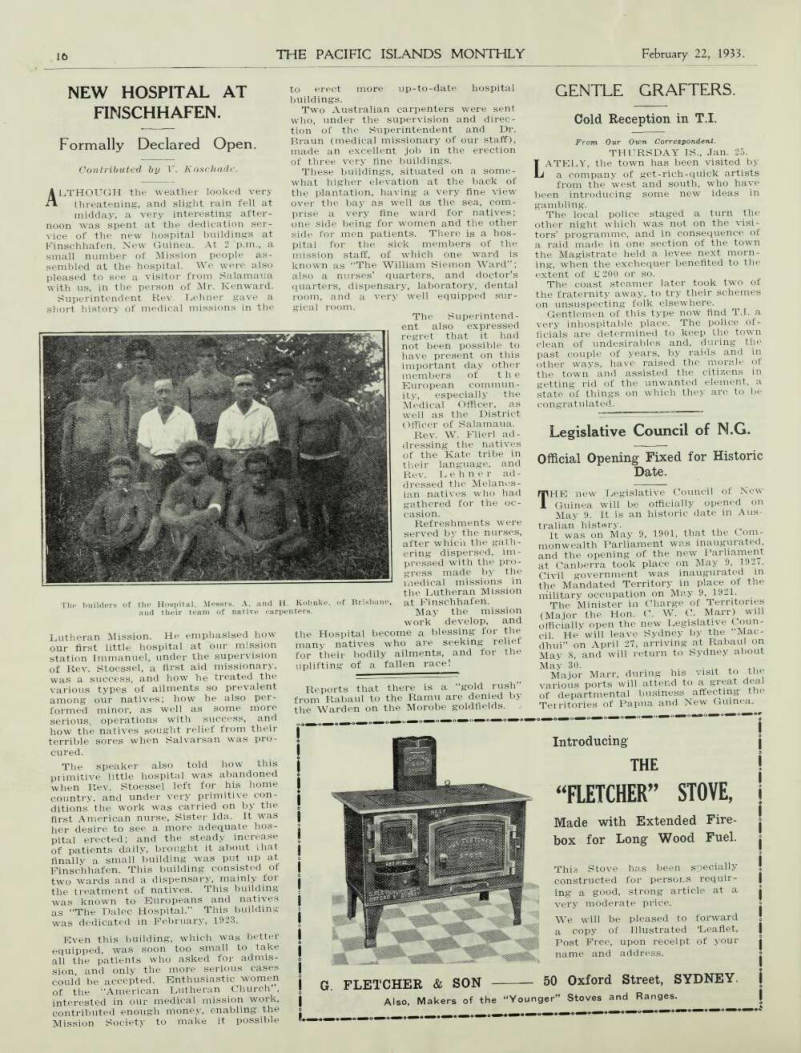
New Hospital At
Finschhafen.
Contributed by V. Koschade.
ALTHOUGH the weather looked very threatening, and slight rain fell at midday, a very interesting after noon was spent at the dedication ser vice of the new hospital buildings at Finschhafen, New Guinea. At 2 p.m., a small number of Mission people as sembled at the hospital. We were also pleased to see a visitor from Salamaua with us, in the person of Mr. Kenward.
Superintendent Rev. Lehner gave a short history of medical missions in the
Lutheran Mission. He emphasised how our first little hospital at our mission station Immanuel, under the supervision of Rev. Stoessel, a first aid missionary, was a success, and how he treated the various types of ailments so prevalent among our natives; how he also per formed minor, as well as some more serious, operations with success, and how the natives sought relief from their terrible sores when Salvarsan was pro cured.
The speaker also told how this primitive little hospital was abandoned when Rev. Stoessel left for his home country, and under very primitive con ditions the work was carried on by the first American nurse, Sister Ida. It was her desire to see a more adequate hos pital erected: and the steady increase of patients daily, brought it about that finally a small building was put up at Finschhafen. This building consisted of two wards and a dispensary, mainly for the treatment of natives. This building was known to Europeans and natives as “The Dalec Hospital.” This building was dedicated in February, 1923.
Even this building, which was better equipped, was soon too small to take all the patients who asked for admis sion, and only the more serious cases could be accepted. Enthusiastic women of the “American Lutheran Church", interested in our medical mission work, contributed enough money, enabling the Mission Society to make it possible
to erect more up-to-date hospital buildings.
Two Australian carpenters were sent who, under the supervision and direc tion of the Superintendent and Dr.
Braun (medical missionary of our staff), made an excellent job in the erection of three very fine buildings.
These buildings, situated on a some what higher elevation at the back of the plantation, having a very fine view over the bay as well as the sea, com prise a very fine ward for natives; one side being for women and the other side for men patients. There is a hos pital for the sick members of the mission staff, of which one ward is known as “The William Siemon Ward”; also a nurses’ quarters, and doctor’s quarters, dispensary, laboratory, dental room, and a very well equipped sur gical room.
The Superintend ent also expressed regret that it had not been possible to have present on this important day other members of the European commun ity, especially the Medical Officer, as well as the District Officer of Salamaua.
Rev. W. Flierl ad dressing the natives of the Kate tribe in their language, and Rev. Lehner ad dressed the Melanes ian natives who had gathered for the oc casion.
Refreshments were served by the nurses, after which the gath ering dispersed, im pressed with the pro gress made by the medical missions in the Lutheran Mission at Finschhafen.
May the mission work develop, and
the Hospital become a blessing for the many natives who are seeking relief for their bodily ailments, and for the uplifting of a fallen race!
Reports that there is a “gold rush” from Rabaul to the Ramu are denied by the Warden on the Morobe goldfields.
The builders of the Hospital. Messrs. A. and H. Kohnke, of Brisbane, and their team of native carpenters.
Gentle Grafters.
Cold Reception in T.I.
From Our Own Correspondent.
Thursday Is., Jan. 25.
LATELY, the town has been visited by a company of get-rich-quick artists from the west and south, who have been introducing some new ideas in gambling.
The local police staged a turn the other night which was not on the visi tors’ programme, and in consequence of a raid made in one section of the town the Magistrate held a levee next morn ing, when the exchequer benefited to the extent of £ 200 or so.
The coast steamer later took two of the fraternity away, to try their schemes on unsuspecting folk elsewhere.
Gentlemen of this type now find T.I. a very inhospitable place. The police of ficials are determined to keep the town clean of undesirables and, during the past couple of years, by raids and in other ways, have raised the morale of the town and assisted the citizens in getting rid of the unwanted element, a state of things on which they are to be congratulated.
Legislative Council of N.G.
Official Opening Fixed for Historic Date.
THE new Legislative Council of New Guinea will be officially opened on May 9. It is an historic date in Aus tralian history.
It was on May 9, 1901, that the Com monwealth Parliament was inaugurated, and the opening of the new Parliament at Canberra took place on May 9, 19217.
Civil government was inaugurated in the Mandated Territory in place of the military occupation on May 9, 1921.
The Minister in Charge of Territories (Major the Hon. C. W. C. Marr) will officially open the new Legislative Coun cil He will leave Sydney by the Mac dhui” on April 27, arriving at Rabaul on May 8, and will return to Sydney about May 30.
Major Marr, during his visit to the various ports will attend to a great deal of departmental business affecting the Territories of Papua and New Guinea.
Advertisements & other items, p. 18 (1 item)
“Fletcher” Stove,
Introducing
THE
Made with Extended Fire
box for Long Wood Fuel.
This Stove has been specially constructed for persons requir ing a good, strong article at a very moderate price.
We will be pleased to forward a copy of Illustrated Leaflet, Post Free, upon receipt of your name and address.
G. FLETCHER & SON 50 Oxford Street, SYDNEY.
Also, Makers of the “Younger” Stoves and Ranges.
The Passing Of Primitive Man.
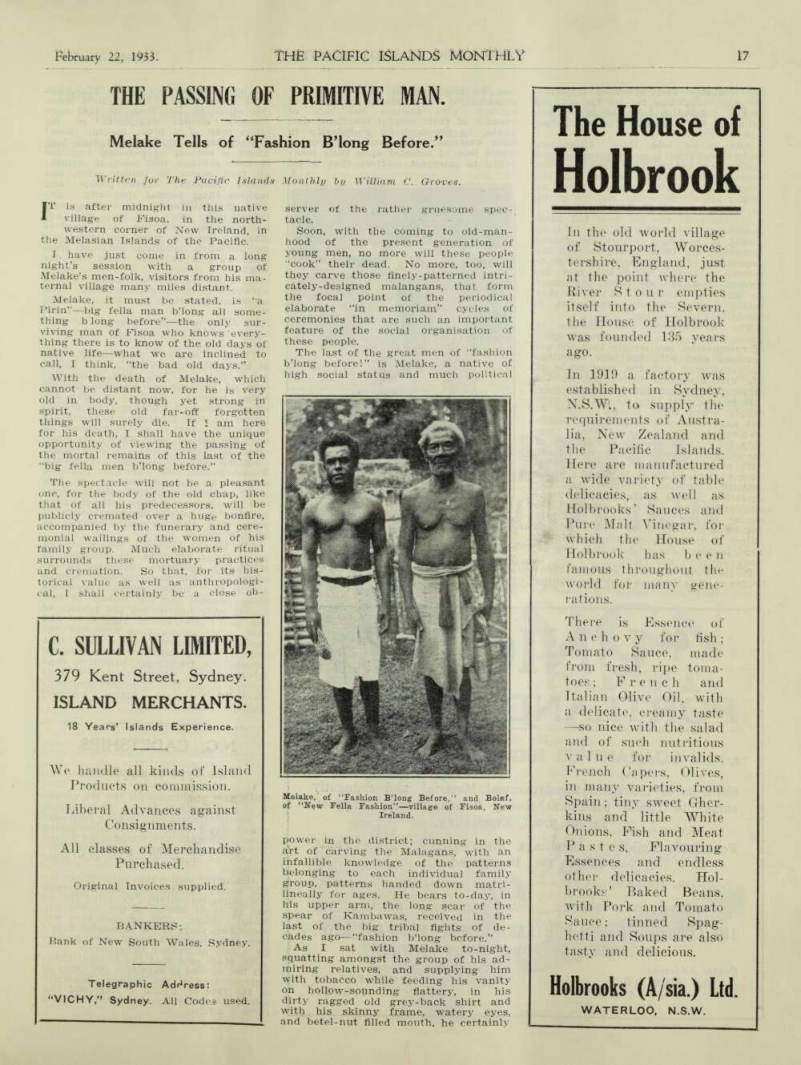
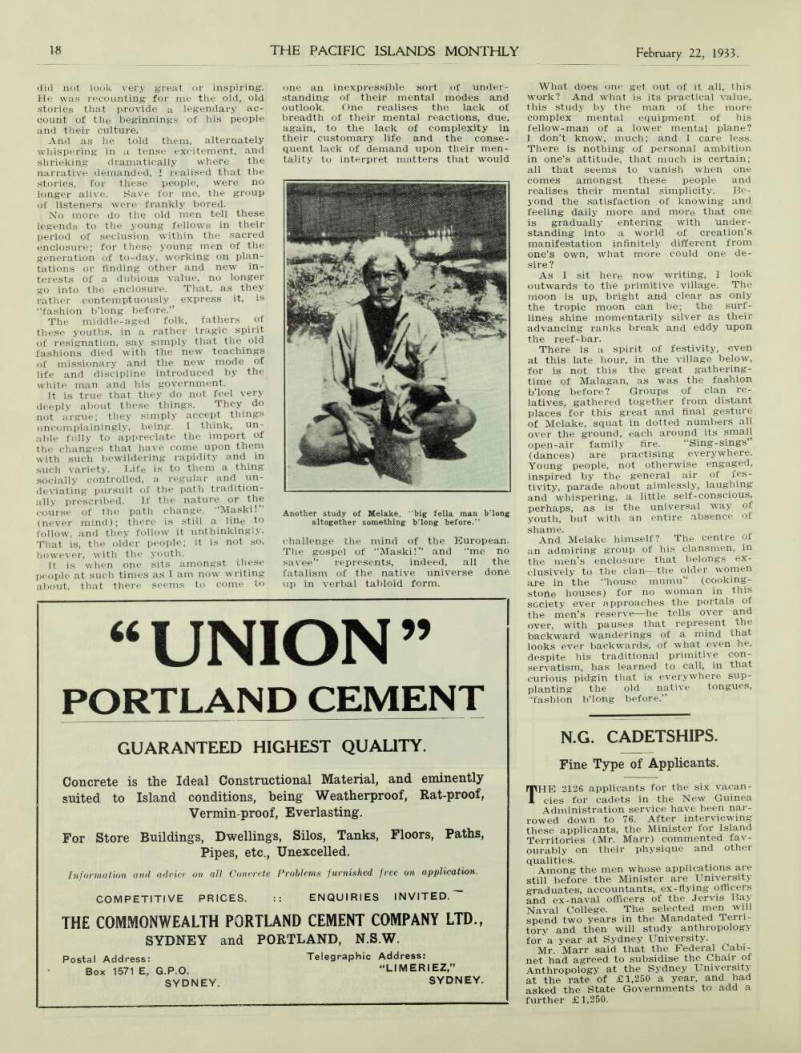
Melake Tells of “Fashion B’long Before.”
Written for The Pacific Islands Monthly by William C. Groves.
IT is after midnight in this native village of Fisoa, in the north western corner of New Ireland, in the Melasian Islands of the Pacific.
I have just come in from a long night’s session with a group of Melake’s men-folk, visitors from his ma ternal village many miles distant.
Melake, it must be stated, is ‘‘a Pirin”—big fella man b’long all some thing b'long before” —the only sur viving man of Fisoa who knows every thing there is to know of the old days of native life —what we are inclined to call, I think, “the bad old days.”
With the death of Melake, which cannot be distant now, for he is very old in body, though yet strong in spirit, these old far-off forg’otten things will surely die. If I am here for his death, I shall have the unique opportunity of viewing the passing of the mortal remains of this last of the “big fella men b’long before.”
The spectacle will not be a pleasant one, for the body of the old chap, like that of all his predecessors, will be publicly cremated over a huge bonfire, accompanied by the funerary and cere monial wailings of the women of his family group. Much elaborate ritual surrounds these mortuary practices and cremation. So that, for its his torical value as well as anthropologi cal, I shall certainly be a close ob
server of the rather gruesome spec tacle.
Soon, with the coming to old-man hood of the present generation of young men, no more will these people “cook” their dead. No more, too, will they carve those finely-patterned intri cately-designed malangans, that form the focal point of the periodical elaborate ‘‘in memoriam” cycles of ceremonies that are such an important feature of the social organisation of these people.
The last of the great men of “fashion b’long before!” is Melake, a native of high social status and much political
power in the district; cunning in the art of carving the Malagans, with an infallible knowledge of the patterns belonging to each individual family group, patterns handed down matri lineally for ages. He bears to-day, in his upper arm, the long scar of the spear of Kambawas, received in the last of the big tribal fights of de cades ago—“fashion b’long before.”
As I sat with Melake to-night, squatting amongst the group of his ad miring relatives, and supplying him with tobacco while feeding his vanity on hollow-sounding flattery, in his dirty ragged old grey-back shirt and with his skinny frame, watery eyes, and betel-nut filled mouth, he certainly
Melake, of “Fashion B’long Before" and Bolaf, of “New Fella Fashion" —village of Fisoa, New Ireland.
did not look very great or inspiring.
He was recounting for me the old, old stories that provide a legendary ac count of the beginnings of his people and their culture.
And as he told them, alternately whispering in a tense excitement, and shrieking dramatically where the narrative demanded, I realised that the stories, for these people, were no longer alive. Save for me, the group of listeners were frankly bored.
No more do the old men tell these legends to the young fellows in their period of seclusion within the sacred enclosure: for these young men of the generation of to-day, working on plan tations or finding other and new in terests of a dubious value, no longer go into the enclosure. That, as they rather contemptuously express it, is “fashion b’long before.”
The middle-aged folk, fathers of these youths, in a rather tragic spirit of resignation, say simply that the old fashions died with the new teachings of missionary and the new mode of life and discipline introduced by the white man and his government.
It is true that they do not feel very deeply about these things. They do not argue; they simply accept things uncomplainingly, being. I think, un able fully to appreciate the import of the changes that have come upon them with such bewildering rapidity and in such variety. Life is to them a thing socially controlled, a regular and un deviating pursuit of the path tradition ally prescribed. If the nature or the course of the path change, “Maski!” (never mind); there is still a line to follow, and they follow it unthinkingly.
That is, the older people; it is not so, however, with the youth.
It is when one sits amongst these people at such times as I am now writing about, that there seems to come to
one an inexpressible sort of under standing of their mental modes and outlook. One realises the lack of breadth of their mental reactions, due, again, to the lack of complexity in their customary life and the conse quent lack of demand upon their men tality to interpret matters that would
challenge the mind of the European.
The gospel of “Maski!” and “me no savee” represents, indeed, all the fatalism of the native universe done up in verbal tabloid form.
What does one get out of it all, this work? And what is its practical value, this study by the man of the more complex mental equipment of his fellow-man of a lower mental plane?
I don’t know, much; and I care less.
There is nothing of personal ambition in one’s attitude, that much is certain; all that seems to vanish when one comes amongst these people and realises their mental simplicity. Be yond the satisfaction of knowing and feeling daily more and more that one is gradually entering with under standing into a world of creation’s manifestation infinitely different from one’s own, what more could one de sire?
As I sit here now writing, I look outwards to the primitive village. The moon is up, bright and clear as only the tropic moon can be; the surf lines shine momentarily silver as their advancing ranks break and eddy upon the reef-bar.
There is a spirit of festivity, even at this late hour, in the village below, for is not this the great gathering time of Malagan, as was the fashion b’long before? Groups of clan re latives, gathered together from distant places for this great and final gesture of Melake, squat in dotted numbers all over the ground, each around its small open-air family fire. “Sing-sings” (dances) are practising everywhere.
Young people, not otherwise engaged, inspired by the general air of fes tivity, parade about aimlessly, laughing and whispering, a little self-conscious, perhaps, as is the universal way of youth, but with an entire absence of shame.
And Melake himself? The centre of an admiring group of his clansmen, in the men’s enclosure that belongs ex clusively to the clan —the older women are in the “house mumu” (cooking stone houses) for no woman in this society ever approaches the portals of the men’s reserve —he tells over and over, with pauses that represent the backward wanderings of a mind that looks ever backwards, of what even he, despite his traditional primitive con servatism, has learned to call, in that curious pidgin that is everywhere sup planting the old native tongues, “fashion b’long before.”
Another study of Melake, “big fella man b'long altogether something b'long before.”
Advertisements & other items, pp. 19-20 (1 item)
Holbrook
The House of
In the old world village of Stourport, Worces tershire, England, just at the point where the River Stour empties itself into the Severn, the House of Holbrook was founded 135 years ago.
In 1919 a factory was established in Sydney, N.S.W., to supply the requirements of Austra lia, New Zealand and the Pacific Islands.
Here are manufactured a wide variety of table delicacies, as well as Holbrooks’ Sauces and Pure Malt Vinegar, for which the House of Holbrook has been famous throughout the world for many gene rations.
There is Essence of Anchovy for fish; Tomato Sauce, made from fresh, ripe toma toes ; French and Italian Olive Oil, with a delicate, creamy taste —so nice with the salad and of such nutritious value for invalids.
French Capers, Olives, in many varieties, from Spain; tiny sweet Gher kins and little White Onions, Fish and Meat Pastes, Flavouring Essences and endless other delicacies. Hol brooks’ Baked Beans, with Pork and Tomato
Sauce; tinned Spag
hetti and Soups are also tasty and delicious.
Holbrooks (A/sia.) Ltd
WATERLOO, N.S.W.
C. SULLIVAN LIMITED,
379 Kent Street, Sydney.
ISLAND MERCHANTS.
18 Years’ Islands Experience, We handle all kinds of Island Products on commission.
Liberal Advances against Consignments.
All classes of Merchandise Purchased.
Original Invoices supplied.
BANKERS;
Bank of New South Wales, Sydney.
Telegraphic Address: “VICHY,” Sydney. All Codes used.
“UNION”
PORTLAND CEMENT
GUARANTEED HIGHEST QUALITY.
Concrete is the Ideal Constructional Material, and eminently suited to Island conditions, being Weatherproof, Rat-proof, Vermin-proof, Everlasting.
For Store Buildings, Dwellings, Silos, Tanks, Floors, Paths, Pipes, etc., Unexcelled.
Information and advice on all Concrete Problems furnished free on application.
COMPETITIVE PRICES. ENQUIRIES INVITED.
THE COMMONWEALTH PORTLAND CEMENT COMPANY LTD.,
SYDNEY and PORTLAND, N.S.W.
Postal Address: Telegraphic Address:
Box 1571 E, G.P.O. “LIMERIEZ,”
SYDNEY. SYDNEY.
N.G. Cadetships.
Fine Type of Applicants.
THE 2126 applicants for the six vacan cies for cadets in the New Guinea Administration service have been nar rowed down to 76. After interviewing these applicants, the Minister for Island Territories (Mr. Marr) commented fav ourably on their physique and other qualities.
Among the men whose applications are still before the Minister are University graduates, accountants, ex-flying officers and ex-naval officers of the Jervis Bay Naval College. The selected men will spend two years in the Mandated Terri tory and then will study anthropology for a year at Sydney University.
Mr. Marr said that the Federal Cabi net had agreed to subsidise the Chair of Anthropology at the Sydney University at the rate of £1,250 a year, and had asked the State Governments to add a further £1,250.
Penalises Thursday Is.
How the Navigation Act Penalises Thursday Is.
Residents Want Japanese Ships to Call.
From Our Own C»rrespondent
Thursday Is., Jan. 28.
SINCE the withdrawal of the E. & A. steamers from this port, owing to de viation of route, passengers have found it difficult at times to obtain travelling accommodation.
The A. & O. steamers, and the B.P. ships, as well as the coastal boat, make a regular monthly run, but only one of the B.P. steamers carries women passen gers, the other (a converted cargo steamer put on after the loss of the “Malabar”), having accommodation for only a limited number of males.
Another drawback is that, as time tables are at present arranged, all the steamers for South leave T.I. within a few days of one another, leaving a gap of a fortnight or three weeks before the next ship. The “Taiping” this month is a full ship, and the wires have been busy concerning passengers waiting to travel south, including children return ing to school.
It was announced first of all that there would be no accommodation for other than second-class passengers, and pos sibly not even that, no definite informa tion being available until the ship was within a couple of days of port. Com munication was then established with the Commonwealth authorities to ascer tain whether permission would be granted some waiting passengers to travel per the Japanese mail steamer, due within a few days.
The Japanese steamers call here monthly, and formerly carried passen gers to and from south, but under the provisions of the Navigation Act this privilege was withdrawn from them as well as from other overseas vessels not British-owned.
Following upon urgent representations, instructions were received locally for the A. & O. steamer to provide suitable ac commodation. A day before the steamer’s arrival, wireless messages were received stating that a case of smallpox was on board, and that there was every prob ability of the steamer having to proceed straight to Sydney in quarantine.
As over 20 people were anxiously awaiting information as to how they were to get away, there being no other steamers due with permission to carry passengers until the middle of February (and no airways service), the wires were again requisitioned, and permission sought for the Japanese steamer to con vey them when she calls in a few days.
On arrival at the anchorage on Janu ary 23, however, the Quarantine Officer pronounced the A. & O. ship clean, and a sigh of relief went up from the stranded ones.
It is time, however, that some definite steps were taken to have an alteration made in the Act permitting- Japanese steamers to carry passengers from here.
It will possibly be said that the stumb ling blocks are the rates of wages on these ships and the employment of col oured labour; but both the other lines employ coloured men and it would prob able be found that there is no very great difference in rates of pay.
Thursday Island residents, after the present experience, combined with the inconvenience of long waits between ships will now not be content until some better arrangements are made.
New Guinea Gold.
Rich Discoveries.
THE Mining Trust, consulting engineers for New Guinea Goldfields, Ltd., re port that they have received a mes sage from the manager that new dredg ing areas have been discovered —pre sumably in New Guinea.
The areas are at the junction of two rivers, each the size of Bulolo, one cov ering a grass flat, eight miles long by 1500 feet wide, the other ten miles by 3,000 feet. Both are potentially import ant dredging areas, Drilling will be necessary to deter mine the values and the character of the bed rock; but as an indication of the possible values of the new ground, pros pects taken on six of the best panning beaches average 3/6 per yard. The pros pect holes were not bottomed owing to water.
The hydro electric possibilities of the areas have not yet been investigated but are reasonably assured.
Advertisements & other items, p. 21 (1 item)
Ensign
W. S. TAIT & CO.
LTD.,
8 Spring Street, SYDNEY.
Buying and Selling Agents for Merchants and Traders throughout the Pacific Islands.
Correspondence invited.
Cable Address: “SUCCESS,” Sydney.
Established 1890.
BUY BRITISH
and
RECIPROCATE TRADE
Buy your Camera and Photographic Supplies
from Harringtons, who have the largest and most varied stocks in the Southern Hemisphere.
ENSIGN
CAMERAS
represent British Workmanship at its best,
challenging the world for quality, value and
photographic efficiency.
Full details in our 1933 Catalogue-just out.
Write for your copy.
Complete range of Kodaks, Brownies, and Kodak Supplies stocked.
OF ALL
HARRINGTONS DEALERS
George Street
SYDNEY.
And all States.
As Illustrated, Ensign Auto Kinecam Price, £27/10/-.
Mission Trading In
New Guinea.
[Letter to the Editor ] I have read with interest the letters of your various contributors about Mission Trading, and now let me kindly add my little squeal.
I have been trading for three years in the Markham Valley, New Guinea, where I am opposed by two Lutheran mission stations, one at Kayapit and one at Gabsonki. When Mr. E. A. Feldt was District Officer here and was en route to the Ramu disturbances I placed my case before him and he declined to issue licences to the missions men tioned. Later the missions appealed to the Administrator and have since been granted trading-licences. I am enclos ing the reply to my objection to these licences.
It is useless for these missions to say they do not trade. Their prices are dearer than mine, but they have more influence over the natives, and do not hesitate to use it to foster trade.
I have been compelled to close my Antiragin store on account of mission opposition. A missionary receives £40 per annum and found; the transport officer receives £10 per annum and found; missions receive a great quan tity of their goods in donations from Germany and America. So how can a trader be expected to survive against them ?
I think the missions should be com pelled by law to confine themselves to the spiritual welfare of the natives and thus put an end to such companies as “The Sacred Heart of Jesus, Ltd.” of Kokopo and the “Lutheran Mission Stores” of Finch-hafen and its branches.
I am, etc.,
Clement Hendry.
Sangan, N.G., Dec. 20, 1932.
The enclosed letter from the District Officer at Salamaua to Mr. Hendry is dated December 14, 1932, and reads;— “Receipt is acknowledged of your letter of 5th instant, in which you lodge an objection to trading licences being granted to the Lutheran Missions in respect of their properties at Gab sonki and Kayapit.
“In reply I have to advise that the Missions are, by law, entitled to trade on certain properties and, conse quently, when they apply for trading licenses for such properties same are issued.”
Caught in Fiji Waters.
Swordfish.
WHILE trolling- with a hanclline from the Government ketch “Derek,” Mr.
Rostier, of the Fiji Works Depart ment, hooked a swordfish near Kandavn on January 25. The swordfish fought viciously till subdued and it took the efforts of three Fijians to lift it on board. It measured 7ft. 5½ins. and the sword was 2ft. 7½ins. long. This is proof of the assertions of Mr. Zane Grey that there is good swordfishing to be had in Fijian waters.
Litigation in Papua.
Judgments In Port
Romilly Suit.
THE long-drawn-out litigation in con nection with the Port Romilly Saw mills was brought to a conclusion on January 3, when Mr. Justice Gore gave judgment for the plaintiffs (Port Romilly Sawmills) on one suit and for Captain Fitch (managing director of the Steam ships Trading Co.), defendant, on the other.
The Company claimed from Captain Fitch £1049/13/7 as an amount wrongly retained as commission while acting as a voluntary liquidator, together with £81/10/- as interest to the date of the writ. The plaintiffs got judgment for the amount claimed, but the claim for interest was disallowed.
Judgment was given for Captain Fitch on his counter claim of £1279/1/1. His Honor found that just and proper work, beneficial to the Company, was done by defendant and was unconnected with the voluntary liquidation. He allowed Cap tain Fitch £223/17/2 as an indemnity against costs incurred by defendant in the action Lett v. Port Romilly Sawmills and Fitch. The order of the Court was that the amount due for costs should rank equally with other costs, charges and expenses of the liquidation.
Malaria.
New Preventive Measure.
A NEW method of fighting the malaria scourge to be adopted by the Bengal Government in the Burdwan district, where the disease is probably more pre valent than elsewhere in India, and causes hundreds of deaths every year is thus reported in “The Sydney Morning Herald.”
Methods hitherto employed aimed either at curing people already infected or ex terminating the malaria mosquito, but the new experiment aims at preventing the mosquito from being infected by en suring that persons from whom the mos quito collects malaria parasites shall themselves be non-infective.
To achieve this it is proposed to ad minister a drug called plasmoquin. which, if taken with quinine for three days, it is claimed, will render the patient non-infective to mosquitoes. The experiment, which will cost £1540 will take place this summer, when treatment centres will be opened in a selected area of Burdwan and a field staff deputed to distribute the drug.
For the purpose of assessing the ex port duty payable on copra, the assessed value per ton of copra exported from the Mandated Territory during January was declared to be £ 10/11/10.
Advertisements & other items, p. 22 (1 item)
Exchange Facilities
Throughout the World
The Bank of New South Wales makes complete facilities available for the transaction of banking business throughout Australasia and between Australia and all other parts of the world.
The Bank establishes commercial credits by mail or by cable. It issues drafts and makes money transfers by letter or telegraph. It negotiates and collects Bills of Exchange and issues, for the convenience of travellers, Letters of Credit available all over the world. Exchange quotations direct on all countries are issued daily and trained officers of the Bank are always available to advise customers on matters relating to overseas money transactions.
Bank of New South Wales
(ESTABLISHED 1817)
with which the Western Australian Bank and The Australian Bank of Commerce Ltd. are amalgamated
“Whisky-Ruled Mentality.”
[Letter to the Editor]
Sir —Mr. Henry Dexter "does me proud” with certain of his remarks under the above title, in an open letter in your far-flung organ of the Pacific, ad dressed to my humble and aged self.
I, therefore, forgive him his witty criticisms —especially as they are really, when one analyses them, a defence of whisky-drinking in the tropics!
Dear old, wise, and selfish Lord Chesterfield gave us what we badly need, nowadays, as a chart, or “vade mecum”; but his “wise cracks*’ are hidden from the present, game-mad generation-in-plus-fours, by the eclips ing cricket and golf news. But I must quote his famous: “A letter left long enough, will answer itself.” Time will answer Mr. Dexter.
Mr. Dexter writes from beautiful Milne Bay, that wonderful and his toric harbourage, where pre-historic astronomers and voyagers graved upon the rocks their interesting evidences; and where later heroes, Captain Moresby, the noble and splendid Abel, and others, found a safe resting-place.
Now, my first experience of Milne Bay was as the guest of a hospitable pearl trader, whose dangerous vagaries nearly brought my Pacific investiga tions to a close —caused by his all too devoted attention to the whisky bottle !
How many a beautiful youth, the result of generations of parental care and civilisation, has received his fatal dose of malaria, or B.W. fever, when stretched in the inviting lounge-chairs under “pub” verandahs, with the usual, flash bare-knees, after a long looked-forward-to meeting with the “boys”—and a few drinks of that poison of tropic-hospitality— whisky!
Eve (whose apple was probably an orange, the peel of which has ever menaced the Achilles-heel of Adam)
to-day rules the modern world! Mere man can hardly enter her presence without observing the social procedure of first partaking of poisonous and ex hilarating cock-tails, or whisky.
The old, well-made, and valuable national-drinks of England, Germany, and France, beer, cider and wine, have mostly disappeared before the now prevailing Scotch pick-me-up—whose first and only excuse was that “vilain soir d’hiver” of Highland snows, and indigestible porridge-diet!
The only value of old fogies, like myself, to later-arrived humans is that our experiences may serve as guidance.
But this is proverbially unwelcome to the Dexters of the new generation!
When I arrived in Australia as artist for a London paper in 1887, the greatest writer the Pacific has seen, button-holed me at the Club, and said: “You look like a youngster who will take advice! Now, in Queensland, you must either be a teetotaller, or drink whisky like a fish. They’ll look upon you as a great fool for not getting drunk! But your compensation will come in after years, when you can regard them in that same light!”
There are great drinkers who can withstand tropic conditions, like the Boyds of Fiji and elsewhere, of past days; but they are the exceptions that prove the rule.
Probably most of our troubles in England and Papua, to-day, are born of this “whisky-mentality” which Mr.
Dexter has so kindly enabled me to have the opportunity of “gassing” at length about—not after “a few months’ experience,” as he writes; but after two or three times his experience, at any rate, of tropic conditions in the Pacific, as well as elsewhere, I am, etc.,
Arthur J. Vogan.
Pymble, 31/1/33.
Airmen For Pacific.
Departing Pilots Saluted by Aero Club.
THE “Macdhui” and the “Aorangi” both left Sydney on the same day (Feb ruary 2) and both vessels, as they departed, had air escorts as a mark of honour for airmen leaving on Islands enterprises.
Three members of the Aero Club were giving an airman’s farewell to Capt. H T. Hammond, who left by the “Macdhui” for the Morobe Goldfield, New Guinea; and three more saluted Mr. J. G. Boehm, of Australian Aircrafts, Ltd., who left by the “Aorangi” with Genairco ’planes and equipment for Fiji Airways. As an nounced in our December issue, Mr. A.
S. Cross, having organised Fiji Airways, Ltd., with the support of the Fiji Gov ernment and Guinea Airways, Ltd., is now settled down in Suva, and Mr
Boehm will join him there.
Beatrice Grimshaw To Grow
Tobacco.
From Our Own Correspondent.
Pt. Moresby, Jan. 10.
Miss Beatrice Grimshaw, The
noted novelist, who has recently re turned from a visit to Rossel Is land, to get local colour for a new novel, has bought a property on the Laloki River, 15 miles from Port Moresby, owned previously by Messrs. Flynn and Adams and called the Laloki Tobacco Plantation.
Miss Grimshaw intends planting to bacco and is making arrangements to secure a manager for the property.
Papuan tobacco has a market in Eng land and it is not long ago that over three shillings a pound was offered for a good grade of tobacco from Papua.
Tongan Princes In
Sydney.
Prince Uiliame Tugi, Prince Con
sort to Queen Salote, and Premier of Tonga, accompanied by his son Prince Taufa’ahan, arrived in Sydney by the "‘Aorangi” on January 27.
Prince Taufa’ahan will remain in Syd ney and will attend Newington College, where Prince Tugi was educated. Both are keenly interested in cricket and have spent much time at the test matches.
Other Tongan nobles have been and are being educated at Newington.
Advertisements & other items, p. 23 (1 item)
J. H, Smyth Ltd.
Postage Stamp Dealers,
121a CASTLEREAGH STREET,
SYDNEY.
The Leading House for
ISLANDS STAMPS.
Write for List of over 500 Sets of Australian, New Zealand, and Pacific Islands Stamps.
Stamps sent on approval on receipt of reference.
ISLAND STAMPS PURCHASED.
Highest Prices Paid.
ESTABLISHED 1888.
receive co-operation here Monopolies
“Bremerhaven” — And
“Monopolies.”
A valued correspondent in the British Solomons writes bitingly: On the arrival of the s.s. “Mataram at Tulagi, the capital of the Solomons Group, it is usual for the residents to go aboard and meet friends returning from holidays and to receive news.
On December 7 I was wandering around the lower deck and, on entering the hall, chanced to glance at the wire less news. There was one message at least that interested me.
“Bremerhaven will in future call at the Solomons to collect copra for direct shipments overseas. Great consternation here (Sydney) for fear of disease likely to be imported into the Group.
What a feeble effort on the part of “someone” to cruel the pitch for the ulti mate establishment of a cheap cargo service! It is about time we were given a cheaper service and those responsible for the “Bremerhaven” calling here will
receive co-operation here Monopolies
and frozen credit are undoubtedly the cause of world depression to-day and we have to thank monopolies for the slump in copra, and it is a well authenti cated fact that it entirely rests with one monopoly at least whether copra prices will ever rise again, unless other firms compete on the open market or the mon opoly evil is forbidden by law.
The same thing applies to shipping.
Burns, Philp and Co., Ltd. have for many years been left unmolested, with the re sult that they can charge what they like.
They also receive a mail subsidy. A five days’ trip from Brisbane to Tulagi costs an Island’s resident £3/12/- per day, yet a tourist—who, by the way, is noth ing but a damned nuisance and is utterly useless from a business point, as he spends nothing in this Group can travel from Sydney around the Group and back (occupying 28 days) tor the sum of 30/per day. Which, naturally, seems ridicu lous to the residents here.
Zeitgeist.
EDITORIAL NOTE. —Our conrespondent is so far astray in his conclusions that we were dis inclined to publish his communication. But, as others seem to hold similar views, perhaps we may reply to them all together.
The alarm concerning ships from the far East entering the Solomons and other groups without proper check against diseases, is quite real and genuine. So long as the New Guinea and Solo mons groups are worked by ships from Australia, there need be no anxiety; but there should be the strictest examination of vessels coming in o places where they may pick up diseases dangerous to men and plants. An Asiatic epidemic could do incalculable harm to the native races before it could be checked, and the introduction ot a plant disease might easily cause damage running into hundreds of thousands of pounds. There was no assurance in December—and there is none yet—that these ships from Asia, entering the Solomons, would comply with quaran tine and other regulations; and the agitation apparently will not cease until that assurance is givn.
The feeling against Messrs. Burns, Philp, ex pressed by our correspondent, is typical and quite illogical. If the big firm were making excessive profits and dividends, there would be justification for such talk; but its accounts show that, during many decades, it has traded only for a comfortable margin of profit, and can fairly claim to have been a benevolent monopoly. There is no point in the reference to tourist fares.
The ships are run primarily, not for tourists, but to give service to a certain definite com munity in the Islands; and fares are planned ac cordingly. The tourist traffic is irregular and evanescent, and cannot be depended upon, and rates, therefore, are kept low to attract tourists.
If there were a fixed number of tourists per
voyage, it is obvious that the residents’ rate could be lowered and the tourist rate increased.
But that is impossible under present conditions.
The attitude of both big trading firms towards the German competition is that such competition will not give them serious concern, so long as the Germans are forced to comply with the same conditions as are imposed upon the Australians.
Arrival at Tulagi.
From a Special Correspondent.
Tulagi, Jan. 31.
THE “Bremerhaven” paid her first visit to Tulagi on Boxing Day. It was rather an unfortunate time to turn up, as a trading licence for the remain ing days of the year would have cost £ 80, so business was somewhat hampered; especially as the “Mataram” had only a few days before cleaned up the port.
However, a common carrier’s licence costing £15 for the trip was taken out and a small amount of freight was landed in Chinatown from Hongkong.
Her main port on this voyage will be Gizo, where it is understood 800 tons per annum have been guaranteed.
If promises are fulfilled, this vessel may capture a fair amount of trade, and Messrs. Burns, Philp and Co., Ltd., and W. R. Carpenter will need to do some quick thinking and acting in order to compete with her.
Another point that will have to be considered is the effect on the stores.
Chinatown to-day is, very largely, im porting its own goods direct from China, in spite of the fact that most of the Chinese are heavily in debt to one or other or both of the big firms; and, owing to the alarming increase in vari ety, and astonishingly low prices of Chinese manufactured trade goods, these traders are capturing a slice of local white trade. Since the advent of the “Bremerhaven,” which is to call at Tu lagi every two months, they will no doubt land their goods more cheaply than hitherto.
Air Mail To Goldfields
THE Australian Postal Department advises that arrangements have been made to utilise the aerial service from Port Moresby to Wau and Salamaua for correspondence posted within the Commonwealth addressed to these places and goldfields in New Guinea.
The aeroplane leaves Port Moresby shortly after the arrival of the steamers “Macdhui” and “Montoro,” and air mail correspondence will be accelerated from seven to fourteen days according to the address.
The aerial service commenced with the “Macdhui,” which left Brisbane on February 4.
The air mail fee is twopence per ounce, in addition to ordinary postage, and if the Aus tralian air service is also utilised, an additional air fee of threepence per half ounce is necessary.
All classes of postal articles except parcels will be accepted, and they should bear a “Par Avion” blue label or be endorsed “By Air Mail.”
Advertisements & other items, p. 24 (1 item)
James Barnes Limited
Sutton’s
Canned Vegetables
GREEN PEAS,
in ½lb., 1lb. and 2lb. tins.
FRENCH BEANS
(sliced), in ½lb. and 1lb. tins.
Delicia Food Products Co.
DANK STREET, WATERLOO,
N.S.W.
JAMES BARNES LIMITED
2 Botany Street, Waterloo, Sydney
(ESTABLISHED 1881)
MANUFACTURERS OF
“Globe” & “Victory” Brands
OF
SHEEP’S TONGUES OX TONGUES SAUSAGES
PRESERVED MEATS BEEF EXTRACT DRIPPING
Also “Castle’ ’ Brand, which is specially packed for use by the White Population.
Globe Beef Extract is invaluable to Young and Old.
Tested Recipes on the packet 4oz. and 8oz. sizes.
Samoan News.
Brisk Christmas Business.
From Our Own Correspondent.
APIA, January 20.
CHRISTMAS in Samoa was much quieter than for many years. The merchants had tuned down their business expectations; but they were pleasantly surprised when business during the festive season turned out to be very good indeed.
Sidewalks and stores of Apia were thronged by busy buyers, and it seemed as if Europeans and natives had saved up in their proverbial stockings for a long time, to be able to celebrate Christmas much in the usual and normal way. Nobody will grudge the long suffering commercial community this well deserved good-luck, when fateful 1932 has spelt mostly losses and disappointments for them.
MALUA college breaking-up.
The Administrator and Mrs. Hart last month paid an official visit to the old-established London Mission Society College at Malua. The premises were tastefully decorated, and a guard of honour of 100 students paraded to wel come the visitors.
At the annual prize-giving of Malua College, Mrs. Hart graciously distri buted the prizes to the students.
Later, the adjoining Boys’ High School was inspected, and Mrs. Hart also distributed prizes for the year’s work. As at the College, His Excel lency again addressed the scholars in appropriate words. In the afternoon, a native ta ’a colo (dance and song) was given by the students in honour of the Administrator’s visit, and some beauti ful presents were handed to the guests.
The proceedings were terminated by the students singing the National Anthem.
Tamasese’S Memory.
On December 28, a memorial service was held at the handsomely decorated graves of the late High Chief Tamasese and other dead Samoans. A procession of about 400 Samoan Mau women, clad in Mau uniforms, marched in proces sion through Apia to Lepea, to attend the service.
Farewell To Rev. Shinkfield.
The Rev. and Mrs. Shinkfield were guests of honour at a farewell party at the Casino on January 17, when about 25 friends foregathered to say “Tofa” to the popular minister. Rev. and Mrs. Shinkfield received the good wishes of all present for their departure from Samoa’s shores.
Native followers of the Wesleyan Church from all parts of the group, had gathered at the Faleula Mission to bid farewell to Rev. Shinkfield. Large numbers of natives attended the gathering, and many valuable presents were given to the departing minister.
New Bathing And Boating
Club.
A club is being formed for bathing and boating amongst the younger sports of Apia. It is proposed to erect a bathing shed and boat houses for canoes etc., on a site conveniently Situated at Valala,
Anglican Women’S Guild.
An Anglican Women’s Guild has been formed by Apia ladies to promote the work of the new Anglican chaplaincy under Rev. Morain. At a gathering at the Casino, Mesdames McCarthy and Smyth acted as hostesses at tea to a large number of Apia ladies, prominent amongst whom was Mrs. Hart, the wife of the Administrator.
Personal.
Mrs. and Miss Turnbull left for New Zealand by last “Maui Pomare.”
Mr. C. McKay, of the Secretariat, returned from Furlough by the “Maui Pomare.” Mrs. McKay is staying in New Zealand for an extended holiday.
The Auditor, Mr. Gair, and Mrs.
Gair, left by the “Maui Pomare” on furlough.
Advertisements & other items, p. 25 (1 item)
Exide
There are
BATTERIES
for
Cars, Radio
Motor Launches
Motor Cycles
House Lighting
Telephones, Bells
Submarines
Aeroplanes
War Ships, Trains
Buses, Trucks
Hospitals . . .
Cinemas, etc.
Leaflets, dealing with the various types, supplied free on request.
BATTERIES OF AUSTRALIA
LTD.,
Grace Building, York Street,
SYDNEY.
N.S.W. Distributor :
EXIDE BATTERY SERVICE
(Gibson, Battle & Co. Ltd.), Hunt and Commonwealth Sts., SYDNEY.
Queensland Distributor:
EXIDE BATTERY SERVICE (Q.) PTY.
LTD.,
Adelaide Street, BRISBANE Also Sturt Street, TOWNSVILLE.
Two-Thirds British.
New Companies’ Ordinance in N.G.
A NEW Companies’ Ordinance for New Guinea, published on January 19, provides that no company having for its objects or one of its objects the engaging in agricultural, pastoral or for estry pursuits, or aerial navigation, shall be formed or registered under its pro visions unless at least two-thirds of the shares issued by the company are held by or on behalf of British subjects.
T.I. Rainfall.
Water Shortage Feared.
From Our Own Correspondent.
Thursday Is., Jan. 25.
THE town reservoir has been depleted for some weeks, and water has been turned off, residents having to de pend on their own rainwater tanks.
January has been a dry month, and only five inches of rain have fallen to date, though normally we should be get ting from twelve to thirty inches for the month. There have been exception ally dry years when the annual rainfall has been only about ten inches or so, as in 1890, and townsfolk are hoping that 1933 is not going to be included in that list.
In the early days of the settlement, when water was scarce, the naval cutter “Pearl” was requisitioned to carry a cargo to the town. The commander, how ever, objected to his “gunboat” being used for water-carrying and protested, but submitted to authority. Just as he got into the harbour, a deluge of rain came down and filled the domestic tanks.
The most pleased person was the “Pearl’s” commander, who straightway emptied his water tanks into the sea and was thus able to say—“I told them I wouldn’t act as a common water carrier, and I didn’t!”
The Postmaster (Mr. Grenier) has been looking up rainfall records over the last forty-two years, and comparisons are very interesting. Some of the figures are:
Inches.
Inches. 1890 10.50 1911 53.11 1891 80.37 1912 61.54 1892 71.08 1913 82.87 1893 79.79 1914 79.47 1894 79.58 1915 43.87 1895 34.16 1916 94.22 1896 34.67 1917 89.30 1897 59.65 1918 45.33 1898 98.50 1919 54.12 1899 63.53 1920 58.26 1900 32.04 1921 63.54 1901 57.09 1922 63.04 1902 68.67 1923 77.21 1908 60.68 1924 60.92 1909 80.28 1925 65.01 1910 75.82
Among Lunatics.
Their Practical Joke.
Trader Who Thought He Was Among Lunatics.
By “Zeitgeist."
A GOOD deal of interest has been manifested in the Solomon Islands of late regarding the identity and purpose in these waters of a Japanese mystery ship.
It is stated by those who have seen this ship that it is about 50 tons capacity, low in the water, has collapse able masts, carries a powerful search light and is exceptionally fast —its speed being no less than 20 m.p.h. with silent engines.
At first it was assumed that the ship was being used for the purpose of shell piracy, but after much consideration on the part of authority the conclusion is that some ulterior motive is connected with its presence here.
An amusing episode connected with the above was enacted in Tulagi a few days ago.
Two young Government officials de cided to have a joke with a new Gov ernment arrival. They entered a Chinese restaurant here for a meal, knowing that the new official would be along shortly. They had not long to wait. When all were eating, the matter of the Japanese ship was dis cussed, and one of the jokers said that a certain trader had actually obtained a distinct photograph of the ship. Up pricked the ears of the new Govern ment official; but he was told to say nothing about the matter. The next morning he had told his superior officer about the photograph, and the name of the trader. The result was that an urgent letter was immediately despatched to the trader, who was in port at the time, requesting his im mediate presence at the ‘‘top office."
He was received like a long-lost brother, and after much talk about patriotism, piracy, pratique, espionage, etc., he was firmly requested to hand over the photograph of the Japanese ship.
The trader, being quite ignorant of the whole thing, naturally concluded he had fallen among lunatics, and the explanations that followed were pain ful and embarrassing.
The newly-arrived official is believed to be planning a dark and dirty re venge.
Airman’S Engagement.
AN engagement of interest is that of Miss Ruby Waldon, daughter of Mr, and Mrs. B. Waldon, of Granville, Sydney, to the famous airman, Lieuten ant Ray Parer, of Wau, New Guinea.
Miss Waldon is a distinguished violin ist and won scholarships at the Sydney Conservatorium to the Royal Academy, London, where she graduated L.A.B. She holds the Colony Medal for the violin.
Miss Waldon, who is popular among New Guinea and Papuan residents, was a social hostess on the “Macdhui," where she met Lieutenant Parer.
The rainfall at Rabaul for the month of December was 13.22 inches. This is higher than the average, which for the last 18 years was 9.88 inches.
Advertisements & other items, p. 26 (1 item)
Steelo
EASIEST FOR
ALUMINIUM
Light rubbing with Steelo gets every thing off alu minium— and polishes it at the same time.
Good for baths, basins, sinks, too.
STEELO
Steelo is a line steel wool, made up into pads and sold, with special soap, in cartons containing a month’s supply. If unobtain able locally, write for free sample to the manufacturers, R. H. ARMSTRONG & CO., 44 King Street, St. Peters, N.S.W.. stating your grocer’s name.
DENTAL SERVICE
for Islands Residents.
Those who cannot easily obtain Dental attention —who may experience the Inconvenience and Embarrassment of a Dental Breakdown while on an isolated station —must have Reliable Dental Work. That is what I supply.
When you are about to visit Sydney, write to me and give your Sydney address, and I will arrange a special appointment, to meet your convenience.
Don't go Back to the Islands before you have had a Thorough Dental Overhaul. CHARGES MODERATE. Work Guaranteed 5 Years.
SCIENTIFIC METHOD'S IN DENTISTRY.
J. H. Couch SURGEON DENTIST
'Phone; MA 5931.
201 LIVERPOOL STREET, SYDNEY.
Over Australian Picture Palace— opposite Hyde Park.
Popularity of South Pacific Cruises.
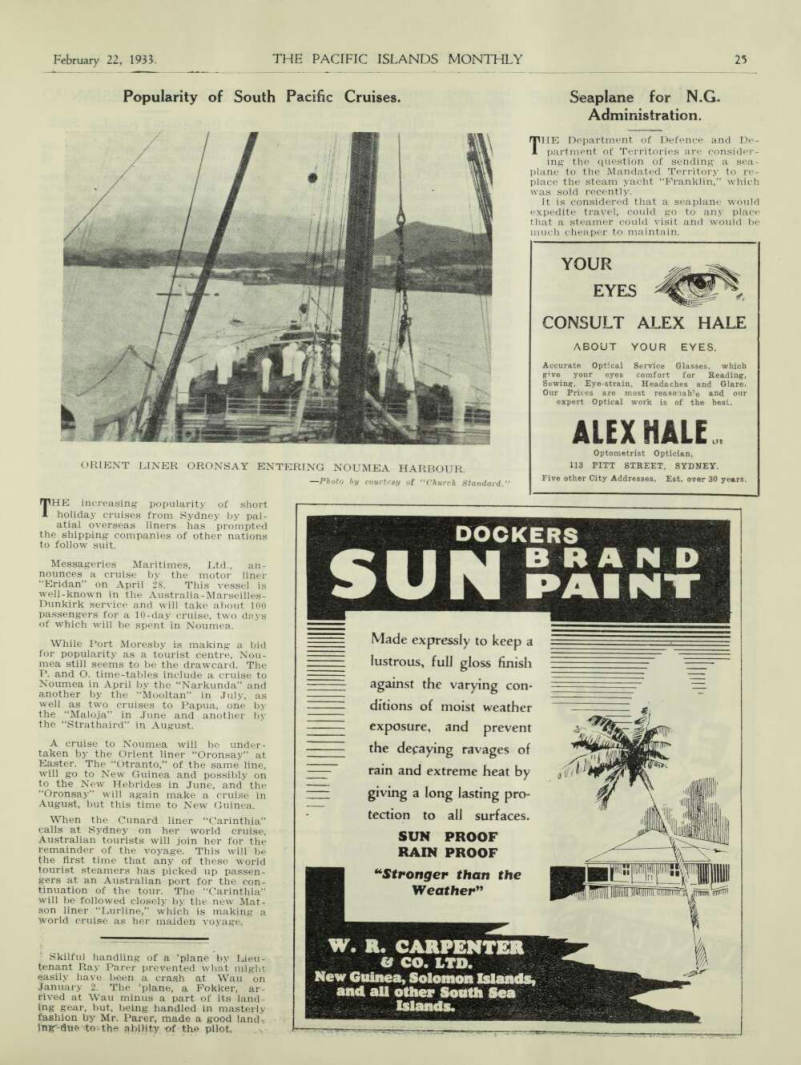
THE increasing popularity of short holiday cruises from Sydney by pal atial overseas liners has prompted the shipping companies of other nations to follow suit.
Messageries Maritimes, Ltd., an nounces a cruise by the motor liner “Eridan” on April 28. This vessel is well-known in the Australia-Marseilles- Dunkirk service and will take about 100 passengers for a 10-day cruise, two days of which will be spent in Noumea.
While Port Moresby is making a bid for popularity as a tourist centre, Nou mea still seems to be the drawcard. The P. and O. time-tables include a cruise to Noumea in April by the “Narkunda” and another by the “Mooltan” in July, as well as two cruises to Papua, one by the “Maloja” in June and another by the “Strathaird” in August.
A cruise to Noumea will be under taken by the Orient liner “Oronsay” at Easter. The “Otranto,” of the same line, will go to New Guinea and possibly on to the New Hebrides in June, and the “Oronsay” will again make a cruise in August, but this time to New Guinea.
When the Cunard liner “Carinthia” calls at Sydney on her world cruise, Australian tourists will join her for the remainder of the voyage. This will be the first time that any of these world tourist steamers has picked up passen gers at an Australian port for the con tinuation of the tour. The “Carinthia” will be followed closely by the new Mat son liner “Lurline,” which is making a world cruise as her maiden voyage.
Skilful handling of a 'plane by Lieu tenant Ray Parer prevented what might easily have been a crash at Wau on January 2. The 'plane, a Fokker, ar rived at Wau minus a part of its land ing gear, but, being handled in masterly fashion by Mr. Parer, made a good land . ing due to the ability of the pilot.
Orient Liner Oronsay Entering Noumea Harbour.
-Photo by courtesy of “Church Standard."
Seaplane for N.G.
Administration.
THE Department of Defence and De partment of Territories are consider ing the question of sending a sea plane to the Mandated Territory to re place the steam yacht “Franklin,” which was sold recently.
It is considered that a seaplane would expedite travel, could go to any place that a steamer could visit and would be much cheaper to maintain.
Advertisements & other items, p. 27 (1 item)
Alex Hale Ltd
YOUR
EYES
CONSULT ALEX HALE
ABOUT YOUR EYES.
Accurate Optical Service Glasses, which give your eyes comfort for Reading, Sewing, Eye-strain, Headaches and Glare.
Our Prices are most reasonable and our expert Optical work is of the best.
ALEX HALE Ltd
Optometrist Optician,
113 PITT STREET, SYDNEY.
Five other City Addresses. Est. over 30 years,
SUN
DOCKERS
BRAND PAINT
Made expressly to keep a lustrous, full gloss finish against the varying con ditions of moist weather exposure, and prevent the decaying ravages of rain and extreme heat by
giving a long lasting pro-
tection to all surfaces.
SUN PROOF
RAIN PROOF
"Stronger than the Weather”
W. R. CARPENTER
& CO. LTD.
New Guinea, Solomon Islands, and all other South Sea Islands.
Fiji News.
New Scenic Road.
From Our Own Correspondent.
BA, January 14.
The Lautoka-Sigatoka road was opened a few months ago to light traffic, and a number of motorists have made the trip. Some of the views are beautiful, and well worth the journey.
A pass has to be obtained from the District Engineer before one can pro ceed, as the road is sometimes impass able after heavy showers, and a car would plough it up. About 20 miles still remain to be gravelled, and the road will be open to public traffic.
This delightful trip should become a favourite with motorists, and charming Sigatoka will become a rendezvous for excursions.
Cyclone “Misses.”
We have had constant rain and hot weather lately, and, as is usual during this kind of weather, much mild sick ness is about; no doubt caused by the very sudden changes in temperature.
Swarms of mosquitoes are prevalent, and we should be thankful that malaria is not on our list of sicknesses.
The glass dropped a few points when a cyclone in the New Hebrides was veering our way. We felt quite re lieved at the news that it had passed by, as none would like to experience a recurrence of the disastrous flood and hurricane of 1931, when so many lives were lost.
Talkies For Lautoka.
Mr. C. Meyer, of Suva, has several times visited Ba and Lautoka with his “Talkie” outfit, and hopes soon to be able to erect his own theatre here.
Owing to the present hall not being built for talkies, none of his shows have been quite successful, but have
been good considering the circum stances under which he has to show, and he deserves every success for his enterprise. He has been unfortunate in having several serious breakdowns, but when he has a permanent installa tion we hope to be up with the times.
Cricket And Dance.
The Governor’s yacht, H.M.C.S.
“Pioneer” came from Suva to Lautoka on Christmas Eve with a full comple ment of sporting enthusiasts. The item of interest was the cricket match between the Northern and Southern divisions for the Governor’s Cup.
Suva was not able to send a represen tative team, so we had an easy vic tory of 9 wickets. The standard of play was not very high, owing, no doubt, to Christmas celebrations and the prevailing hot weather; but every body enjoyed themselves. The visitors were entertained at luncheon by the winners. It is hoped that a return match will be played in Suva at Easter.
On Boxing night, a dance was held in the Lautoka Social Hall for the visitors, which was patronised by a large crowd. No one seemed in a hurry to leave, and there was a rush to board the last boat for the ship in the wee hours. Everybody voted the dance a success, and all thanks are due to Mr. “Bhai” Bossley for his untiring efforts to give the visitors a good time. During the evening, Mrs.
N. Edwards, Miss Ryder and Mr. Frank Beddoes kindly contributed to the music.
A drowning occurred last Sunday in the Vitogo River, about 5 miles from Lautoka, when a Bombay Indian was drowned. About thirty of his com patriots went for a picnic, and the de ceased went further up the river than the others. He must have got out of his depth. The only witness of the tragedy was a young lad, who called for help which came too late.
Two Europeans and five half-castes have been made to take out prohibition orders against themselves or else loose their jobs. Every four weeks a large number of the C.S.R. Co.’s men get paid, and on the Friday and Satur day nights most them have a real “night out.” In a place like this, where there are so few amusements for the young folk, and where the male popu lation exceeds the female, it has been the custom for these men to congre gate at the local “pub.” Apparently the Company have got tired of warning them, with the above results, and last pay day passed almost unnoticed.
Unflattering Opinion.
The Melanesian.
[Letter to the Editor ] I note from recent issues of “The Pacific Islands Monthly” that wide publicity has been given to the severe sentence imposed upon a New Guinea planter for his treatment of a native labourer. Might I, as a reader of your most interesting and just publication, be permitted to express my admiration of the fair stand you have taken re garding the matter. I am specially re ferring to your remarks following the article written by Mr. Vogan.
This gentleman publicly states that he is an authority on native psy chology, etc., but my friends, who are internationally-known anthropologists, do not know him.
If Mr. Vogan knew anything about the hybrid mixture called Melanesians and their extremely distant descent from the first sub-race of the fifth root race, he would refrain from comparing them with the last sub-race of the fifth. The progenitors of the Melanians suffered nearly total annihilation, through causes created by themselves.
The Melanesian racially is an ex tremely poor specimen, ranking amongst the lowest type of humanity.
He has no form of religion, he is an arrant coward, a liar to the backbone, constitutionally weak, lacking in gratitude, and an animal by instinct.
There is a geometry that applies to races and nations, an equation of their curve of advance; but the Melanesians have not even advanced to the de finition stage. Mr. Vogan certainly defends the native and does not fail continually to emphasise the fact that their predecessors were, in the dear dead days beyond recall, natives of India. I suppose I could also state, with a fair degree of accuracy, that my own race progenitors sat at the Last Supper with Christ, but that does not prove that I am a Christian or that I am at liberty to partake of Com munion with the saints.
Mr. Vogan would probably do well to commit to memory the following, especially as it is a Vedic transla tion: — “Each gain for self denies the self that knows the self is vain; Who crowns accomplishment with pride must build the whole again”
I am, etc.,
Zeitgeist.
16/1/33.
Advertisements & other items, p. 28 (1 item)
C. G. Piggott
Vitality and Health are the
Main Factors in Every-day Life.
Put yourself in the hands of Specialists who have made an intelligent study of your requirements; it is vital to your health. We are everywhere as the Suppliers of the Right Goods and which put the into VITALITY. Thirty-five years is our record of supplying Fresh Fruit, Vegetables and Produce to the leading Houses throughout the world.
GET FULLY ACQUAINTED WITH US. ,
Tel.: MA 4799; FX 4350 Private.. Cable Address: Pigs, Sydney. Code: Bentley's.
C. G. PIGGOTT
WHOLESALE FRUIT AND PRODUCE MERCHANTS
DIRECT IMPORTERS AND EXPORTERS SYDNEY.
Office: Bulk Stores and Packing House: Fruit Sydney, Sales Dept.: Fruit Exchange and City Markets. Sydney. Bank N.S.W. Bankers.
On An Eastern Cruise.
Rush to Join “Franklin’s” Crew.
BY last “Macdhui” a party of 19 left for Rabaul, where they will join the ex Administration yacht “Franklin,” which was sold by the Commonwealth Government last month. The new owner, Mr. W. L. Buckland was a member of the party.
Mr. Buckland purchased the “Frank lin” with the object of cruising in the East in her. Having advertised in Aus tralian newspapers for a crew of “pas sage workers” at 1/- per month, he was inundated with applications, over 1,000 amateur mariners being eager for jobs.
Most of the applicants were young University graduates and under graduates and, after a strenuous period of interviewing applicants, the re quired number were chosen. The “crew" includes a number of young women and all were in the best of spirits when the “Macdhui” left Sydney and looking for ward eagerly to the adventure.
However, they will find the “Franklin” a vastly different proposition from the “Macdhui.” Though she is labelled a yacht, the “Franklin” is a notoriously bad roller and, as the tender for the R.A.N, College at Jervis Bay, distin guished herself on several occasions by making hard-bitten destroyer seamen seasick.
Once they got their “sea legs” the crew should have an interesting cruise, as it is seldom that an opportunity occurs of visiting the many ports the “Franklin” will of necessity call at.
Samoan Sentenced.
Fight About Native Title.
From Our Own Correspondent.
Apia, Nov. 20.
AFTER an extended hearing occupying five days, a case, arising out of an affray between Samoans over a na tive title, terminated last week. A native Tuimalo was struck with an axe during the fight and died in Apia Hospital from his injuries.
A native, Lamoletolo, known as Tolo, was arrested and charged mainly on cir cumstantial evidence, though he stead fastly denied his guilt.
The case was heard before four asses sors, one of whom was a Samoan chief.
Much conflicting evidence was heard and the accused, in the witness box, denied possession of the axe found at the scene of the murder and stated that he had not seen the victim at the time of the fight.
After lengthy deliberations, the Jury agreed on a verdict of manslaughter, which was pronounced by the foreman, Mr. F. A. J. Rutherford. The assessors added a recommendation for leniency, owing to the great excitement amongst the interested families over a disagree ment about their native title.
His Honor, Chief Judge J. H. Luxford, thereupon pronounced sentence of seven years’ imprisonment. He commented that the deed had been committed under pro vocation and specially admonished the Samoans in future to abide by the de cisions of the Lands and Titles Com mission in regard to their native titles.
His Honor specially thanked the asses sors for having performed their difficult and arduous task in a very satisfactory way.
Fiji’S Record Sugar
Crop.
How to Beat Depression.
From Our Own Correspondent BA, Jan. 14.
THE Lautoka mill stopped crushing early in the month, and Rarawai fol lowed suit a week later.
Both mills have just completed record crushes and are hoping to effect all re pairs and overhauling in 16 weeks, so that they may be able to dispose of the record crops of cane now growing.
Money now seems to be circulating and business in most of the stores seems to be improving. All we need now is rain and next year the ugly word “depression” will seem but a nightmare.
Both mills were fortunate in having no serious breakdowns, and everything ran smoothly, which reflects credit upon the efficiency of the staffs.
Advertisements & other items, p. 29 (1 item)
Excelsior Supply Co. Ltd.
Small Docket Books, Receipt
Books, etc.
x 4|, printed with name, trade, address. 3/- per dozen. Send for Samples.
WALTER WILLIAMS LTD.,
LIVERPOOL ROAD, BURWOOD TJJ 4170.
THE BOOK CLUB,
BURNT PINE,
NORFOLK ISLAND.
FIRST - RATE MODERN LIBRARY.
Five Hundred Books—added to by every mail. Very reasonable terms.
Visitors welcomed.
Conducted by
Mrs. CAMPBELL, Rep. P.I.M
EXCELSIOR SUPPLY CO. LTD.
The most extensive Manufacturers in the British Empire of
RUBBER STAMPS,
INKS, STENCILS,
Marking Devices.
ACME STAMP PADS
We have a big range of Special
FRUIT CASE MARKING SETS
We alto Manufacture or Supply a complete line of
Spraying Machines
for all purposes.
Let us know your requirements and we will quote you by return. Ask for our Big Catalogue.
Sole Australasian Distributors of the World Famous SHEAFFER FOUNTAIN
PENS and PENCILS.
EXCELSIOR SUPPLY CO. LTD.
Head Office:- 160 GEORGE STREET WEST,
SYDNEY, N.S.W.
Pioneer Of Tonga.
Death Of Mrs. Mary
Brahne
THE death occurred in Sydney on Feb ruary 1 of Mrs. Mary Brahne, who had been a resident of Tonga since 1879.
The late Mrs. Brahne was an Aus tralian and, in 1879, sailed with her brother in the schooner “John Wesley” on what was in those days an adventur ous voyage.
In Tonga she met and married Mr.
Brahne and settled on his plantation near Nukualofa. Mrs. Brahne had ten children, of whom three sons are still in Tonga; a daughter Violet is a nurse at the War Memorial Hospital, Suva; and two sons are in Auckland.
After the death of her husband, about three years ago, the late Mrs. Brahne came to Sydney and had been living quietly at Neutral Bay.
Murder Feared.
Two Travellers Disappear Near Dutch Border.
From Our Own Correspondent.
Thursday Is., Jan. 25.
FEARS are entertained that Messrs.
Sebree and Jones, two young men who bought a cutter at Thursday Is land and sailed her through Torres Strait and up to the coast, of New Guinea, have been murdered by New Guinea natives.
Boigu Island people, just off the coast of New Guinea but within Queensland borders —the island on which the “Tree of Skulls” stands —have brought along reports of the tragedy as they have re ceived the story from friendly natives of New Guinea, and the Thursday Island police are investigating, as relatives of the missing men are anxiously seeking news of them.
The “Kuiam,” the cutter in which the men sailed, was last seen to the west of Boigu, after the third member of the ex pedition, a young man named Gatty, had left the two others and made his way ashore on the New Guinea coast oppo site Saibai Island.
According to reports from friendly na tives, the boat called in at a spot near the Morehead River, and there the two men (who are said to have been on a prospecting expedition, but were reticent about their plans) landed and began to build a circular structure of cement, with “glass bottles and a lot of wires,” which caused the natives some concern.
How they were killed is not yet ascer tained, but a native policeman is stated to have obtained the heads of the vic tims from the tribe responsible, and to have taken them to the Dutch officials just over the border, as the nearest British officer is stationed at Daru, along way eastward.
Although the villages opposite Boigu and just along the New Guinea coast are quiet, further into the west the na tives have a bad reputation as head hunters, and strangers should certainly not go seeking adventure in that vicin ity unless they have due protection.
The Daru officials, in addition to being a long way from the spot, are without means of sea transportation at present.
There are no missionaries working in this particular locality, although Govern ment is represented by a native police man.
The idea that there are still canni bals within a day’s run of Thursday Is land is frequently smiled upon by visi tors, but incidents of this character in dicate that our neighbours on the nor’west side are not by any means all civilised.
Bananas For N.Z.
“Maui Pomare’S Full Load.
From Our Own Correspondent.
Apia, Jan. 20.
THE “Maui Pomare” took a full load of 5,670 cases of bananas for the New Zealand market on January 19, for which 3/- per case was paid to growers.
Owing to the effects of the hurricane season on banana plantations, the offer ing for shipment was exceptionally heavy and the fruit inspectors had a difficult task in condemning fruit un suitable for export, and repacking. About 9,000 cases were offered and 3,300 re jected.
It is expected that a full shipment will await the “Maui Pomare’s” next return voyage which is scheduled for Febru ary 9.
Wau Notes.
From Our Own Correspondent.
WAU, January 14.
Hogmanay Celebrations.
AN enjoyable dance was held in the Recreation Hall on December 31. This function was fancy dress and a farewell to the Old Year.
Wonderful and varied were the fancy costumes worn by the people present. Over twenty ladies and one hundred men took part, so the ladies were hopelessly outnumbered. One man remarked during the speech of the evening, “No wonder I can’t get a dance.”
Prize winners were: —Best-dressed lady in fancy costume, Mrs. T. Flowers as an ‘‘Early Victorian lady.” Best-dressed gentleman in fancy costume, Mr. T. Flowers as ‘‘master of the hounds.” Best-thought-out costume for ladies, Miss Christie as ‘‘theatre usher.” Best thought-out costume for gentleman, Mr. A. L.
Mount as ‘‘Admiral Nelson.” The prize for the waltzing competition was won by Miss D.
Stewart and Mr. C. G. Clark, who gave a spirited exhibition.
During the evening Major G. A. Harrison made a speech, in which he conveyed the best wishes of the people of Wan to Mr. and Mrs. H.
Taylour, who are going South by the ‘‘Macdhui” on a well-deserved holiday. Mr. H. Taylour.
Mining Warden, will be very much missed, and we hope, after a good holiday, he and his wife will be in our midst again.
New Year Sports.
The Bulolo Recreation Club held a sports meeting on the Cricket Ground at Wau on January 2. There were many visitors present from Salamaua, Lae, Edie Creek and Bulolo.
Horse and motor bicycle races were held. Foot races, tug-of-war, hop, step and jump, and other sports took place. The centre of attraction was the horse racing wheel, on which the sporting crowd tried their luck during the day.
Personal.
Mr. and Mrs. R. Dugan are leaving Wau by ’plane for Port Moresby to catch the ‘‘Macdhui,” and will be away for a few months.
Mrs. Drayton and her small son, Peter, are going South. We will be pleased to see them back again in Wau.
The manager of Edie Creek Alluvial, Mr. J.
P. Livingstone, will go South soon on a health trip.
Miss Josephs, matron of Wau hospital, has been kept busy lately. Mr. T. Flowers, who was operated on recently, has now recovered, and Mr. E. Bartlett, who has been in hospital with malaria, is on his way to recovery.
Prospectors Murdered.
Alarm was felt in the district when news came through of the murder of W. Naylor, a Swede named Clarius, and nine native labourers.
The party was prospecting on the headwaters of the Langamar River.
D.O. Townsend and a strong police party went to investigate immediately on receipt of the news, which was conveyed by a native who had been employed by Naylor,
Advertisements & other items, p. 30 (1 item)
Gillespie’S
"ANCHOR”
FLOUR
TRADE
MARK
The Standard of Quality.
SHIPCHANDLERY.
W. Kopsen & Co. Limited
Manufacturer a of PIONEER BRAND ASH OARS AND IMPLEMENT HANDLES.
Sole Agents for : KOPSEN’S SPECIAL YELLOW METAL SHEATHING AND NAILS.
Large Stocks of Chains, Anchors, Manilla and Wire Ropes, Wood and Iron Blocks, Oakum, Tar, Pitch, Oils, Paints. Leads, Zincs, Varnishes.
Shackles, Rigging, Screws, Sheathing, Felt, Lampware, etc.
Prices and Particulars on Application.
68-70 CLARENCE STREET, SYDNEY.
Cables: "Kopsen." 'Phone; BW 1114-8.
Mild Hurricane.
Samoa and Niue.
From Our Own Correspondent APIA, January, THE new year had a rough and inau spicious start in Samoa, when a cyclone broke on New Year’s Day and stormy weather, combined with torren tial rains, continued for the first week of 1933.
A strong north-westerly wind was blowing, the centre of the storm being reported at Rotuma Island. Rainfall on January 1 and 2 amounted to about three inches. A second cyclone developed in the Cook Islands on January 2, and exceeded in force the first cyclone.
On the Samoan coast mountainous seas prevailed. Shipping in Apia har bour had to seek shelter in Mulinu’u, and one of the large mooring buoys in Apia harbour was torn off the moorings and thrown on the beach. Luckily no damage to the shipping is reported, due, probably, to the timely warnings given by Apia Observatory.
Again the storm increased in force on January 5, 6 and 7, the blow again com ing from N.W. right into Apia harbour, causing exceptionally high seas and mountainous breakers, which caused considerable damage and inconvenience on the waterfront. Shipping was at a standstill. On the plantations breadfruit, coconut and cocoa trees in large num bers were blown down, while most seri ous damage was done to banana planta tions. A lot of old native houses crashed to the ground, whilst European houses suffered damage to a lesser degree.
On January 7 and 8 (Saturday and Sunday) 12 inches of rain fell in a con tinuous downpour. The rivers and creeks overflowed and in their course down the mountain sides were carried all kinds of trees, plants, livestock and debris. A number of bridges were damaged by the latter. There was no loss of life, except a native girl aged six years, who fell into the Fuluason River, near Vaimoso village, and was drowned before help could be rendered.
The district of Samatau and Falelatai, west of Apia, and the Manono straits suffered most severely from the blow.
The cocoa plantations of the West Coast report a lot of damage, especially to the young plants, while many of the larger cocoa pods of the maturing crop turned black from the effects of the continuous rain.
The island of Niue apparently was in the way of the cyclone, as conditions there, reported by wireless, were much the same as in Samoa.
By January 11, the weather had cleared up and the disturbance died out.
The rainfall for the week ended January 11 was reported by the Observatory as about 15 inches.
The Hurricane Season.
Rarotonga, Dec. 20.
Penrhyn offers the best haven for vessels dur ing the hurricane season, and shortly both the “Tagua” and the “Tiare Taporo’’ will go north to Penrhyn and remain there until February or March.
At present the “Tagua” is at Rarotonga pre paring for her final trip for the year to the Lower Group.
Both the lagoons at Penrhyn and Manihiki are open for pearl fishing. The percentages of pearls which are saleable on foreign markets is rela tively small—sales apparently being confined to pearls of a particular colour rather than to perfect shape.
The “Tiare Taporo” is at present on her way to Tahiti, where she will have her Diesel engine overhauled.
Methodist Missionary Society.
Annual Meeting Proposes “Cross and Cargill” Memorial.
THE annual meetings of the Methodist Missionary Society were held in Syd ney for four days, beginning on Feb ruary 8. The President General, the Rev.
A. T. Holden, presided.
The centenary of the landing at La keba of Cross and Cargill, the first white missionaries, is to be celebrated in 1935.
To commemorate this event, it was de cided to raise a fund of 10,000 guineas by private solicitations of the secretaries in each State, The objects of the fund will be a new church building and of fices at Suva, an endowment fund for district educational institutions, and a “Cross and Cargill” memorial church at Lakeba.
The Rev. W. H. Cox, giving an ac count of the work of the Society in New Guinea, said that services were held in 350 churches every Sunday, most of them being conducted by preachers trained in the institution. Sixty Chinese
children attended the day school at Ka ibaul and the first convert was recently baptised.
The Rev. G. T. Goldsmith, of the Northern Territory, said that evil in fluences among the natives were largely due to the crews of luggers of foreign nationality which visited the northern waters.
The general statistics of the Society showed that, excluding the Tonga Church, but including Samoa, there are 138 active ministers, 1960 teachers, 1123 churches and 42,907 members under its jurisdiction. Improved finances have made it possible to fill nearly all vacant missionary stations, and it is hoped to place 10 new men in the field in 1934.
The meeting offered its congratula tions to the Rev. R. L. McDonald, chair man of the Fiji district, and the Rev.
Roger Page, president of the Tonga Con ference, on the attainment of 25 years’ service.
Advertisements & other items, p. 31 (1 item)
Face Specialists.
RECOMMENDED BY ALL THE LEADING
THIS WORLD FAMOUS FACE POWDER.
Made in France
JAVA RICE
JAVA RICE FACE POWDER has unmistakably earned its wonderful world-wide popularity.
It never imparts unsightly flat appearance that sometimes happens with ordinary powders; but unfailingly throws a veil of loveliness over the most delicate skin—heightening the complexion in a subtle manner. Non-injurious to the ten derest skin.
The soft petal-like texture of JAVA RICE FACE POWDER achieves wonders with previously neglected complexions.
Obtainable everywhere. In two sizes and all shades.
Gold Discovery.
Rumours from Tavua Hint at Rich Find.
From Our Own Correspondent.
BA, Jan. 14.
EXCITEMENT has been caused by gold finds at Tavua and a number of claims have been pegged out by European prospectors. They are not let ting much information leak out, but we hope they are successful and that in a few months’ time it will be a paying proposition.
Another find has been reported near Penang and, if the rumours concerning these two discoveries are true, Fiji will soon be the scene of a “rush.”
At present, very little authentic infor mation is available.
Papuan “Discovery.”
Somewhat sensational reports in Aus tralian newspapers in December and January, about a rich discovery of gold and other precious metal in Eastern Papua, were subsequently discounted by reports from Port Moresby, to the effect that the Administration knows nothing about the matter.
Yellow Press And
Malaita.
Distorted Interview About Health of the Solomon Islanders.
WHEN L. M. Maybury, of the Mela nesian Mission arrived in Brisbane by the “Mataram” on February 6, the representative of certain Australian newspapers, apparently seeking a blood curdling “cannibal” story, interviewed him.
Their subsequent accounts of Malaita, where Dr. Maybury has been stationed, would convince readers who knew no thing of Solomons conditions, that the island was inhabited by a race of lepers whose only chance of not being killed by the disease was to die first of malaria.
Headed “Disease-ridden Island,” one paper’s “story” begins: “Sixty thousand natives, leprosy and tuberculosis rife, and not a single doctor! That is the plight of the Island of Fauaba, in the Solomons, where a hospital is being con ducted by two sisters and native boys.”
Dr. Maybury obviously did not suspect that his remarks would be so distorted.
Anybody who knows the Group knows that while the Government has some what retrenched its medical service it would not withdraw from an island with 40,000 inhabitants (not 60,000 as stated) all medical services unless it was well aware that this was being provided in some other way.
Another journal says that “malaria and yaws are among the other com plaints rampant on the island and Dr.
Maybury ... expressed the hope that another medical man would be found.”
At Auki, the Government Station on Malaita, is a District Officer, part of whose duty is to keep an eye on the health of natives, A few hours’ distant from Malaita is Tulagi, where there is a modern hospital for Europeans and na tives, staffed by two medical men helped by European nurses. Not long ago a medical expedition spent much time and effort on Malaita in an anti-yaws cam paign.
Besides these, there is the head quarters of the Malaita Company at Su’u at which medical men and women are frequent visitors. So it is fairly safe to assert that the health of the natives of Malaita is as good as that of those in any other island of the Group. If there is actually a larger number of natives there requiring medical attention, it is
Strait.
Place Names In Torres
Mr. P. R. Frith’s Researches.
From Our Own Correspondent.
Thursday Is., Jan. 28.
THE Geographical Society had another night out recently, searching for the authors of place names.
On this occasion, Mr. P. R. Frith, head teacher of the Aboriginal School at Ma buiag Island, addressed a large audience in the School of Arts concerning early navigators in Torres Strait with particu lar reference to D’Urville, the French ex plorer, and the question of who named Napoleon Passage, near Mabuiag.
For some time past Mr. Frith has been in communication with French authori ties, and at the lecture he produced copies of D’Urville’s route map, sent out from Paris, and also exhibited a number of excellently-drawn maps and portraits, some of his own handiwork. One which called for special comment was a plan of Mabuiag, showing the number of is lands, over 40, which may be seen from Kuiam Hill. This was used to illustrate the reference in De Prado’s “Relacion,” concerning the voyage of Torres through the Strait, that “from this island, which is lofty, we counted forty, all among the shoals.”
It has been thought by some that this “lofty island” is Dauan, close to New Guinea; but that assumption is almost certainly not correct, as men who know the Strait well declare that that number of islands cannot be seen from Dauan.
On the other hand, somewhere within the vicinity of Mabuiag (or Jervis, to give it its English name), Banks, or Mulgrave Islands, would seem to fit the description exactly.
At the above meeting, Mr. Frith was presented by the President (Alderman A.
Corran) with a fine atlas and book of photographs, as a memento of a visit made by members of the Society to Ma buiag during last year.
Seasonal Shut-Down.
From Our Own Correspondent.
Thursday Is., Jan. 28.
THE Murray Island Fisheries Com pany, engaged in the development of the sardine industry at the head of the Barrier Reef, has temporarily closed down, during the nor’-west season. The European staff has returned to Bris bane, with the exception of Mr. G.
Bright, who is in charge of the Com pany’s auxiliary ship “Troubadour.”
It is stated that a fall in the price of the product which the company has been working to place upon the market, combined with other reasons, are re sponsible for the temporary cessation.
At this season of the year there is a shortage of fish, the sardine shoals ap parently migrating to other regions, or, what is more probably the case, staying at home for three months or so, since it is now practically certain that the big shoals are visitors only and that Murray Island is not their real habitat, but this particular difficulty could be got over by providing for excess requirements dur ing the other nine months of the year. because Malaita carries about half the population of the entire Group.
Dr. Maybury is on his way to England via New Zealand. Two nurses of the Mission also returned by the "Mataram,”
Sister Y. A. Dawes being ill and Sister B. Guylee attending her.
Advertisements & other items, p. 32 (1 item)
T. Elliott & Co.
(Established 15 years) Real Estate Agents, Valuers,
Flat Specialists.
Controlling Agents for Principal Flat Buildings in Sydney, Darling hurst, Potts Point, Elizabeth Bay, Darling Pt., Edgecliff, Pt. Piper, etc.
When contemplating a visit to Sydney write regarding your requirements and see us immediately on landing, and our services will be at your disposal.
72 DARLINGHURBT ROAD,
(Opposite King’s Cross Theatre),
King’s Cross, Darlinghurst,
SYDNEY,
Telephone: FL 1968.
A TEST ON
YOUR LINOS
Try Pearson’s Sand Soap for cleaning them ... a free sample will be sent on request. Pearson’s Sand Soap makes the colours brighter, the surface smoother; and, the linos polish more easily.
PEARSON’S CARBOLIC
SAND SOAP,
Made by The Pearson Soap Co., Ltd.
ROZELLE, N.S.W.
Mysterious Craft.
Suspected Poacher in Torres Strait.
From Our Own Correspondent.
Thursday Is., Jan. 28.
THE strange launch reported three or four months ago in Torres Strait, and identified as a Japanese shell poaching outfit, has reappeared in the Strait and called in at Naghir Island to replenish water supplies. Yesterday afternoon, excitement was caused locally by the appearance of another strange vessel, this time not far from T.I.
It was sighted by the sigalman at Goode Island lighthouse, who immedi ately communicated with the harbour master. A launch was sent out to make enquiries, but on seeing it approach the stranger made hurried departure and vanished.
It is described as a launch about 100 feet long, without masts, grey in colour, and carrying a number of Japanese.
There are no vessels belonging to the authorities at T.I. which can be used for overhauling poachers or other craft. The Customs Department is without a boat; the police authorities have no vessel in which to do patrol work or pursue run aways; and there are no naval ships here.
EDITORIAL NOTE. —Discussing reports of the presence of unidentified vessels in Torres Straits, believed to be poaching on Australian pearling and trochus grounds, the Minister for Defence (Sir George Pearce) expressed the opinion that a Government patrol boat should be stationed in those waters. If sufficient funds are available, some action will be taken.
Thursday Is. Notes.
More “Ocean Messengers.”
From Our Own Correspondent.
Thursday Island, January 25.
A NUMBER of globular glass floats, used on fishing nets down south, come floating round the Torres Strait islands now, and every now and then the natives bring in tide-current papers from bottles flung over from ships cross ing the Pacific.
The currents work up into the central part of Torres Strait, but ocean-current bottles have been picked up on Saibai Island, close to New Guinea.
Through an arrangement arising out of a suggestion by the local branch of the Royal Geographical Society, the records are handed in to the Harbour Master for forwarding, instead of being sent direct, to the United States or Samoa, so that official note may be made of the information for Australia’s benefit.
When the Islanders first came across the glass floats, they imagined they were a new form of container for the tide-papers, but couldn’t dis cover an aperture through which it might be inserted. One widely travelled native explained their real use. “That one he no belong paper; he belong along table when white man he want drink rum. I been see that kind along steamer, for put whisky inside, only he got something stop on top for capsize him along glass.”
But his suggestion that it was a decanter that had come floating in faded out when he, too, couldn’t discover a hole in it.
Produce Shipments.
Shipments of M.O.P. go forward slowly. A consignment of nearly 400 cases was ready for despatch by the “Taiping” this week, but only about 140 cases could be taken, owing to the fact that the oil-tanker “Pinna” was discharg ing a big cargo alongside the wharf, and the “Taiping” had to anchor in the stream, making loading operations much more difficult.
Trocas continues to maintain a good price, and is at present round about £80 to £82 a ton.
Beche-de-mer has dropped again, and, with the troubled conditions in China, the market is very uncertain.
Cure Of Leprosy.
Expedition to Investigate.
From Our Own Correspondent.
Pt. Moresby, Jan. 18 .
AN expedition of eleven doctors and four nurses will assemble soon in Pt.
Moresby to experiment on the treat ment of leprosy in New Guinea and the Islands.
The party will include the noted scientist, Dr. Arthur Torrance, of the University of California, who recently returned from research work in Man churia.
The party carries supplies of the lat est ethyls of chaulmoogra oil for the treatment of leprosy and hopes, with the wide field for experimental work in the Islands, to find a cure for the disease.
Mr. Quincy F. Roberts, who has occu pied the position of American Consul at Suva for several years, arrived in Syd ney by the “Lurline” on February 19, accompanied by Mrs. Roberts. He is on his way to Saigon to take up an ap pointment as Consul-General.
Advertisements & other items, p. 33 (1 item)
Ruston-Hornsby
VICTOR IN
110,000 FIRES.
For Unfailing
FIRE
PROTECTION
you may Trust
MINIMAX
Chemical Fire Extinguishers.
Non-deteriorating Machines for Every Type of Fire Risk.
B TYPE
(illustrated), 2 gallons, £5/10/-.
LAUNCH TYPE
(foam), £4/5/-.
Send for particulars.
A. L. FRANKLIN,
Scientific Instrument Maker,
190 A Sussex St.,
Sydney.
PRESCOTT LTD
Sussex St, Sydney are sole wholesale agents for
PINEAPPLE BACON & HANS
DAISY BRAND BUTTER
TIGER Swiss Gruyere CHEESE
LEA & PERRINS' SAUCE
& Most other Super-Quality lines of the Trade.
RUSTON-HORNSBY
COLD STARTING OIL ENGINES
FOR CRUDE AND LOW GRADE FUELS.
Horizontal and Vertical Types up to 1200 h.p.
The Most Economical Prime Movers. Low Fuel Consumption Guaranteed.
Sole Agents for Australia and the Islands:
RUSTON & HORNSBY (AUST.) PTY. LTD.,
Registered Office: 174-180 King Street, MELBOURNE.
CABLES: HORNSBYS, MELBOURNE.
Branches at SYDNEY (10-14 Young St.) and BRISBANE (Barry Parade).
Another Mysterious Visitor
From Our Own Correspondent.
Thursday Is., Jan. 25.
MYSTERIOUS craft have been seen at various times lately in Torres Strait, and this week a mysterious aeroplane put in an appearance. The flying machine was seen circling over Horn Island, and a launch with Customs and other officials on board (the sub Collector of Customs being a represen tative of the Naval Department, amongst his other duties) went across to make investigation, and endeavour to get some information from the people there that would reveal the identity of the stranger.
Australia’s northern door is apparently attracting quite a lot of attention from strangers, but whether it is with a view to acquiring information regarding the Barrier Reef and its commercial possi bilities, or with the object of collecting information for other purposes must be left to the imagination.
Samoa Herald.
G. W. Griffith Assumes Editorship.
From Our Own Correspondent.
Apia, Jan. 20.
FROM January 1, “The Samoa Herald” appeared under the editorship of Mr.
George W. Griffith, Mr. W. Tarr hav ing resigned his position on the paper.
The new editor hails from Australia and has had considerable experience on newspapers in Queensland, New South Wales and New Guinea. Mr. Griffith was introduced to Samoa by the proprietor of the “Herald,” the Hon. Alport Barker, of Suva, Fiji, who paid a short visit to Apia for the purpose.
Mr. Griffith announced his future pol icy in the issue of January 13 and in vited the co-operation of the public, pro mising a neutral and open-minded deal ing with all the difficult political, social and economical questions of the moment.
The first few numbers of the “Samoa Herald” under his editorship are in at tractive form and if he succeeds in in ducing local talent to colloborate more effectively and actively with the enter prise, his success will be certain and well-earned.
Papua “Discovered.”
American Tourist Enthusiasm.
From Our Own Correspondent
Pt. Moresby, Jan. 10.
WITH nearly three hundred passengers on board, the Cunarder “Carinthia” is due at Port Moresby on March 5.
Though the vessel leaves the same day in continuation of her world cruise, ar rangements have been made for the en tertainment of the tourists.
The call at Port Moresby has become a feature of these tours.
The Matson liners “Mariposa” and “Malolo” both called at the port in their cruises in 1931 and 1932 and it was ac knowledged by passengers to be the most interesting place the vessels visited.
Referring to Port Moresby, Mr. A. H.
O’Connor, representative of the Aus tralian National Travel Association in America writes: “A wonderful tourist at traction rivalling even the highly pub licised island of Bali.” To advertise fur ther the attractiveness of Port Moresby, he urgently supports an arrangement with the Australian and Papuan Gov ernment to organise a spectacular dis play in America of the highly decorative ornamentations of the tribes of the Ter ritory.
“Linked with Australia,” he continues, “I am convinced that if Port Moresby is the extraordinarily interesting place which tourists seem to think it is, we should seize upon it as one great attrac tion to bring people to Australia.”
The Federal authorities have communi cated with the Administration of Papua and it is reported that they intend for warding a collection of curios for the purpose shortly. Suggestion from resi dents have been invited for other means of attracting publicity.
"Seafarer’S" Voyage.
THE yacht “Seafarer,” which left Suva on January 3, arrived in Maunganui, N.Z., after an eventful voyage lasting nine days. The yacht was manned by Messrs. Langdale, Longren, Stenbach and Lee brothers.
Owing to strong headwinds, the crew accepted a tow on the last 30 miles of the voyage.
Vila Tennis.
Resch's Cup Results.
From Our Own Correspondent.
VILA, January 23.
THE tennis tournament for the Resell’s Lager Cup, presented by Tooths & Co., Ltd., for the winners of the men’s doubles for three successive years, was played on January 21 and 22. The results were: — First Round: Dollahan and Gollan v. L. de Gaillande and A. Rossi, 6—l, 6—4, 9—7; Keegan and Thomas v. Hill and McCoy, G—3, 14 —12, G—o; Capel and Tassy v. W. McCoy and J.
Jocteur, 6—-3, 6—l; Desg,ranges and Desestre v.
McLean and Bairstow, 6—3, 6—3.
Second Round: L. de Gaillande and A. Rossi v. Buteri and F. Rossi, 6—3, 6—2; Keegan and Thomas v. Laroque and Chaverot, 6—3, B—6; Capel and Tassy v. Demoulieres and Gratlan, for feited; McLean and Bairstow v. Jones and Steenbohm, 6 —o, 9—7.
Semi Final: McLean and Bairstow v. Capel and Tassy, 6—l, 6 —4; Keegan and Thomas v.
L. de Gaillande and A. Rossi, 6—3, B—6.8 —6.
Final; Keegan and Thomas v. Bairstow and McLean, B—6, 6—4, 6—3.
Advertisements & other items, p. 34 (1 item)
Comfort
SAMUEL RUSSELL,
ESTATE AND GENERAL AGENT,
P.O. Box 64, Papeete, Tahiti.
Real Eatate. Investments. Estate management and administration. Valuations and Reports Houses and Lands for Lease or Sale.
Sole Proprietor: TAHITI PERFUMES.
Cables: Russell. Tahiti (Bentley’s Code).
W. HOLMES
SHIP, LAUNCH, & BOATBUILDER & ENGINEER,
All classes of Islands Vessels a Speciality.
McMAHON’S POINT - - - - SYDNEY.
Cable Address: “HOLMAC,” SYDNEY.
COMFORT
37/6 Each. Postage Extra.
“Banish long faces and bad tempers. Take the bother of ironing away
by using a Comfort.
The heat is evenly distributed over the entire ironing surface, and can be regulated and controlled as required.
The perfectly shaped handle is always cool, and the fount is in such a posi tion that it avoids contact with the arm of the operator and at the same time clears the garment being ironed.
COMFORT
BENZINE IRONS.
BRANDTS LTD., 371 Pitt St., SYDNEY
Tahiti News.
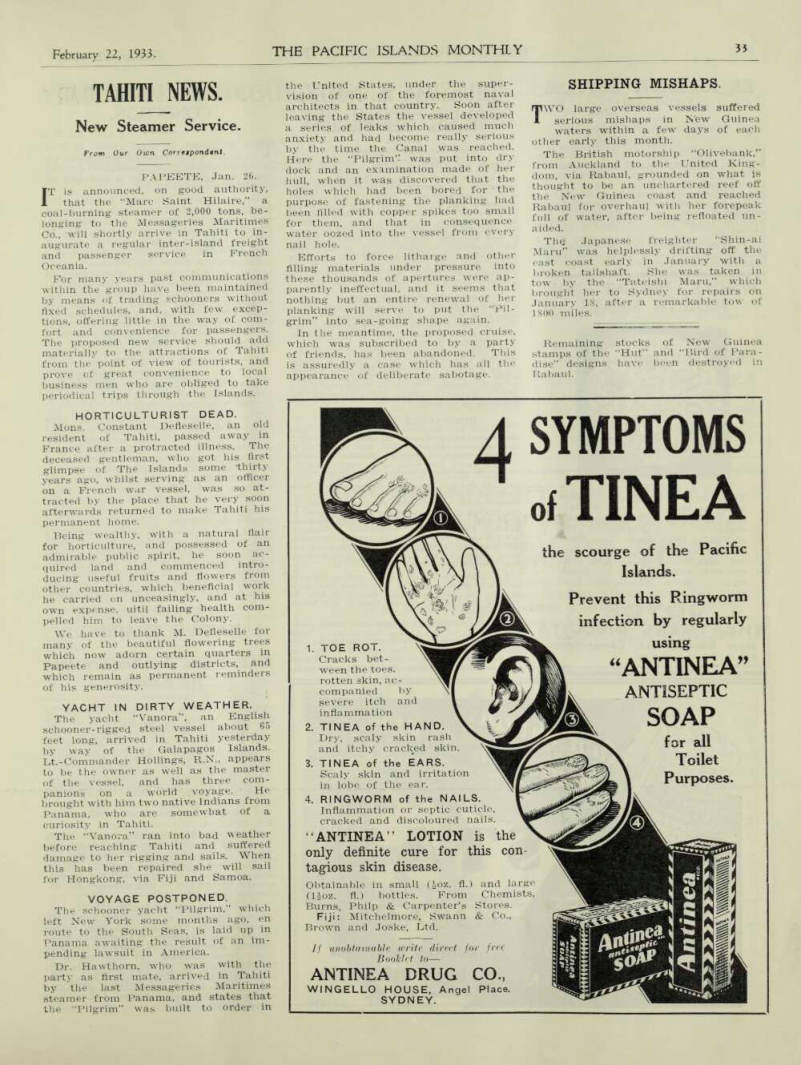
New Steamer Service.
From Our Own Corretpondmt.
Papeete, Jan. 26.
IT is announced, on good authority, that the “Marc Saint Hilaire,” a coal-burning steamer of 2,000 tons, be longing to the Messageries Maritimes Co., will shortly arrive in Tahiti to in augurate a regular inter-island freight and passenger service in French Oceania.
For many years past communications within the group have been maintained by means of trading schooners without fixed schedules, and, with few excep tions, offering little in the way of com fort and convenience for passengers.
The proposed new service should add materially to the attractions of Tahiti from the point of view of tourists, and prove of great convenience to local business men who are obliged to take periodical trips through the Islands.
Horticulturist Dead.
Mons. Constant Defleselle, an old resident of Tahiti, passed away in France after a protracted illness. The deceased gentleman, who got his first glimpse of The Islands some thirty years ago, whilst serving as an officer on a French war vessel, was so at tracted by the place that he very soon afterwards returned to make Tahiti his permanent home.
Being wealthy, with a natural flair for horticulture, and possessed of an admirable public spirit, he soon ac quired land and commenced intro ducing useful fruits and flowers from other countries, which beneficial work he carried on unceasingly, and at his own expense, until failing health com pelled him to leave the Colony.
We have to thank M. Defleselle for many of the beautiful flowering trees which now adorn certain quarters in Papeete and outlying districts, and which remain as permanent reminders of his generosity.
Yacht In Dirty Weather.
The yacht “Vanora”, an English schooner-rigged steel vessel about 65 feet long, arrived in Tahiti yesterday by way of the Galapagos Islands.
Lt.-Commander Hollings, R.N., appears to be the owner as well as the master of the vessel, and has three com panions on a world voyage. He brought with him two native Indians from Panama, who are somewhat of a curiosity in Tahiti.
The “Vanora” ran into bad weather before reaching Tahiti and suffered damage to her rigging and sails. When this has been repaired she will sail for Hongkong, via Fiji and Samoa.
Voyage Postponed
The schooner yacht “Pilgrim,” which left New York some months ago, en route to the South Seas, is laid up in Panama awaiting the result of an im pending lawsuit in America.
Dr. Hawthorn, who was with the party as first mate, arrived in Tahiti by the last Messageries Maritimes steamer from Panama, and states that the “Pilgrim” was built to order in
the United States, under the super vision of one of the foremost naval architects in that country. Soon after leaving the States the vessel developed a series of leaks which caused much anxiety and had become really serious by the time the Canal was reached.
Here the “Pilgrim” was put into dry dock and an examination made of her hull, when it was discovered that the holes which had been bored for the purpose of fastening the planking had been filled with copper spikes too small for them, and that in consequence water oozed into the vessel from every nail hole.
Efforts to force litharge and other filling materials under pressure into these thousands of apertures were ap parently ineffectual, and it seems that nothing but an entire renewal of her planking will serve to put the “Pil grim” into sea-going shape again.
In the meantime, the proposed cruise, which was subscribed to by a party of friends, has been abandoned. This is assuredly a case which has all the appearance of deliberate sabotage.
Shipping Mishaps.
TWO large overseas vessels suffered serious mishaps in New Guinea waters within a few days of each other early this month.
The British motorship “Olivebank,” from Auckland to the United King dom, via Rabaul, grounded on what is thought to be an unchartered reef off the New Guinea coast and reached Rabaul for overhaul with her forepeak full of water, after being refloated un aided.
The Japanese freighter “Shin-ai Maru” was helplessly drifting off the east coast early in January with a broken tailshaft. She was taken in tow by the “Tateishi Maru,” which brought her to Sydney for repairs on January 18, after a remarkable tow of 1800 miles.
Remaining stocks of New Guinea stamps of the “Hut” and “Bird of Para dise” designs have been destroyed in Rabaul.
Advertisements & other items, p. 35 (1 item)
A Tinea
1. TOE ROT.
Cracks bet ween the toes, rotten skin, ac companied by severe itch and inflammation 2. TINEA of the HAND.
Dry, scaly skin rash and itchy cracked skin, 3. TINEA of the EARS.
Scaly skin and irritation in lobe of the ear.
4. RINGWORM of the NAILS.
Inflammation or septic cuticle, cracked and discoloured nails.
“ANTINEA" LOTION is the
only definite cure for this con
tagious skin disease.
Obtainable in small (½oz. fl.) and large (1½oz. fl.) bottles. From Chemists, Burns, Philp & Carpenter’s Stores.
Fiji: Mitchelmore, Swann & Co., Brown and Joske, Ltd.
If unobtainable write direct for free Booklet to —
ANTINEA DRUG CO.,
WINGELLO HOUSE, Angel Place.
SYDNEY.
A SYMPTOMS
a TINEA
the scourge of the Pacific
Islands.
Prevent this Ringworm
infection by regularly
using
“ANTINEA”
ANTISEPTIC
BL SOAP
for all
Toilet
Purposes.
T.I. Resident Settles
At Daru.
From Our Own Correspondent.
Pt. Moresby, Feb. 8.
IT is reported that Dr. G. H. Vernon from Thursday Island has settled at Daru in the Western Division of Papua, and that he has recently pur chased the business of Mr. P. R. Hinds.
It is reported that Dr. Vernon intends making a study of the diseases of the western tribes and the natives of the Fly River.
The western tribes are interesting and primitive without the gloss and veneer that covers some others.
Thursday Is. Notes.
Regatta and Picnic.
From Our Own Correspondent.
Thursday Island, January 28.
One of T.I.’s flourishing institutions is the Aquatic Club, which, as an indication of its popularity, has recently had to add to its boat shed accommodation. Some young ladies, coached by Mr. C. Cleveland, are proving adepts at the sculls, and fine outings in this exhilarat ing exercise have taken place. On December 4 the Club held its annual picnic, and this proved a very enjoyable finale to the season’s racing.
The picnickers, in launches and sailing boats, visited the sand beach near King Point, on Horn Island, and had a happy time. Mr. H. G.
Vidgen’s boat “Alice" was the winner of the handicap sailing race, held during the day.
Bishop Of Carpentaria.
The Lord Bishop of Carpentaria returned from Sydney in November, but went through to Dar win, instead of landing at Thursday Island, and after a month there returned to the Island by the B.P. boat in December.
The Rector of Darwin, the Rev. W. H. Davies, who has been there for seven years, is return ing to Wales, and the Bishop has made arrange ments for the position to be filled by the Rev.
J. A. G. Housden, who is at present in charge of the Cathedral during the absence of the Sub-Dean on furlough.
Missionaries' Movements.
Mr. and Mrs. Dogherty, and Miss Byron, from the Presbyterian Mission stations in the Gulf, have gone on furlough, and Mr. and Mrs. S.
G. Port, from the Anglican Mission station on Arnhem Land, also went on furlough recently.
Ladies’ sport is becoming increasingly popu lar, and the formation of a ladies’ cricket team is the latest development. A match, married versus single, was played on December 26, on the cricket ground, and brought out a crowd of interested spectators. The married members knocked up 55 amidst considerable enthusiasm, but the single girls started in with determination and beat the score by 30. However, there are some more matches to be held, and doubtless the losers will get their revenge.
The talkies have duly arrived, and so far have been well patronised. The installation was made in time for townspeople and visitors to have an evening out at the opeu-air theatre just before Christmas.
New Year’s Eve saw a successful dance under the auspices of the Cricket Association. There have been several other attractions during the holiday period also. The coloured people had a well-attended dance evening in the Parish Hall recently, with music by their own orchestra.
Fiji Bananas In Bad
Condition.
THE shipment of 1,407 cases of Fiji bananas which reached Melbourne by the “Dimboola” on January 31 caused much disappointment, as a quantity of the fruit was unsaleable.
Mr. A. Barrow, the agent handling the fruit, said some of the fruit was green and some over-ripe and badly crushed.
The prices realised were from 15/- to 27/- a case, as compared with 35/- a case paid for the previous shipment.
Major Clive Joske, the growers’ repre sentative who visited Melbourne to watch the shipment, was also dissatis fied with the shipment and blamed the conditions under which the bananas came from Sydney. Transhipment in volved five handlings of the fruit. It is probably that future shipments to Mel bourne will be carried direct by the
The Boycott.
Melbourne, Jan. 28.
Attempts by a Labour organiser to stop the sale of Fiji bananas in Mel bourne were unsuccessful.
The “Mariposa’s” consignment were being sold, and the prices had increased from 27/6 a case to 35/- a case, when the organiser went among the buyers and suggested that they should not touch the fruit as it had been grown by black labour. He made very little im pression and left the saleroom when asked to do so by an official.
To prevent the sale of well-developed Australian fruit, misrepresented as Fijian, it has been suggested that every Fiji banana packed should bear a small brand. While this would involve an en ormous amount of work by either grower or shipper, it would stop misrepresenta tion and a similar scheme has been used with success by the N.S.W. Egg Board.
All Aspects.
Native Trading.
N.G. Board To Enquire Into All Aspects.
ACCORDING to a circular issued by the Acting- Administrator of the Mandated Territory (Brigadier Gen eral T. Griffiths) and dated January 25, a Board of Enquiry has been appointed and will enquire into the question of na tive trading-.
The Board will submit recommenda tions to govern the future Administra tion policy regarding the system of na tive trading. The personnel of the Board is: President: His Honour Judge F. B.
Phillips: Central Committee Members, Mr. V. A. Pratt, Tohera Plantation; Mr.
J. H. Jones, Assistant District Officer, Rabaul. Mr. J. H. Jones will act as sec retary to the Board and arrange for at tendance of witnesses.
Aspects of native trading to be in quired into are: (1) Trading Allotment Licenses. (2) Freehold and long lease hold trading stations. (3) Licenses, mer cantile, copra, pedlars, permits to buy shell from natives. (4) Sub-letting of trading stations. (5) Trading limits and restrictions. (6) Management and trad ing policy of trading stations. (7) Con ditions applicable to leases for trading purposes.
Advertisements & other items, p. 36 (1 item)
made faom
WHOLE WHEAT FOR
HEALTH MEALS.
The whole of the plump, gulden grain is used in Joyce Wheat meal Biscuits. They are easily digested . . . containing the elements that build up hone, muscle and tissue. And, they are deliciously crisp, too, with the rich, nutty flavour of choice wheat. Joyce Wheatmeal Bis cuits are ideal for light meals.
JOYCE
WHEATMEAL BISCUITS
Joyce Biscuits, Ltd., Camperdown,
N.S.W.
CAPSTAN
CIGARETTES
CORK TIPPED
OR PLAIN
TAN
NAVY CUT
TOBACCO
made faom
BEST VIRGINIA
LEAF 4.065-6-2
The Pacific Islands.
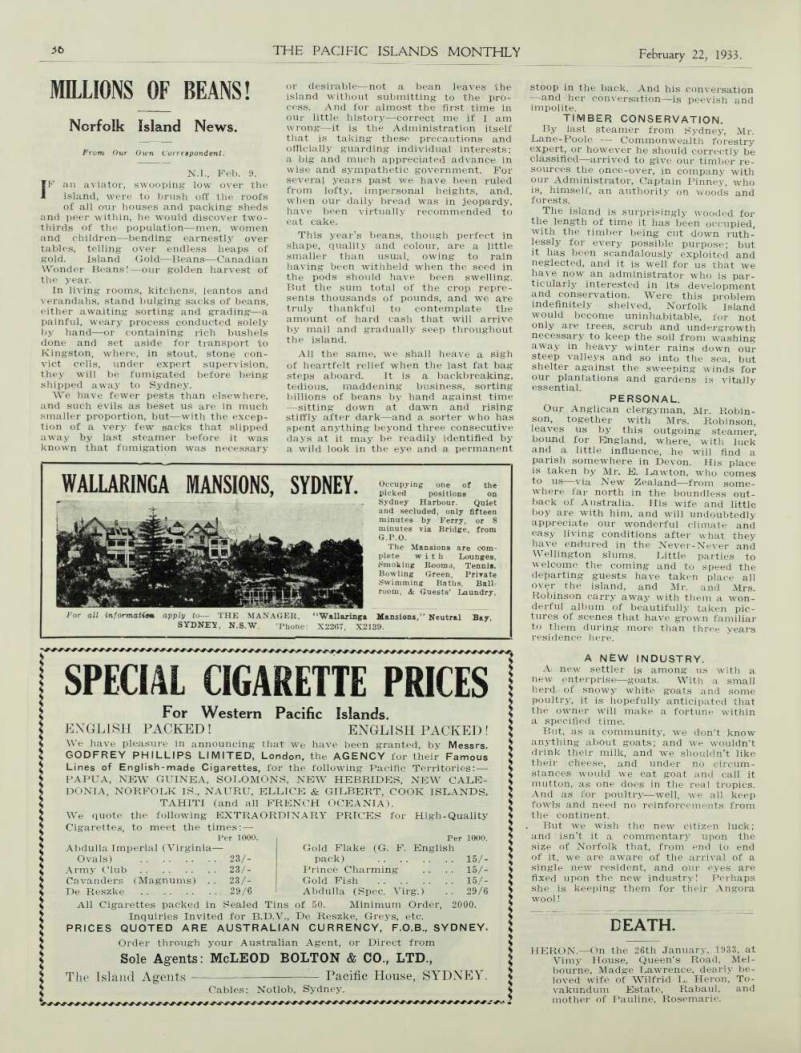
Problem Of Depopulation In
Dr. Cilento’s Masterly Summary of How Native People React to Contact With European Civilisation.
THE problem of depopulation of the Pacific will, one day, be one of the gravest Australia has to face. If for no other reason than sentiment, the Pa cific Islands races should not be allowed to die out without every means being taken to prevent that possibility.
Though thoughtlessness and callous ness have played their parts in reducing the native population of the South Seas, they are not altogether the direct cause of the regular fall in the census returns in most of the Pacific groups. Nor is the cause always the diseases and vices which are brought by the intruding races, though these, of course, have played a large part.
Discussing tropical medicine as it ap plies to depopulation, Dr. R. W. Cilento, M.D., B.S., D.T.M. and H., in a paper in the Medical Journal of Australia, Octo ber, 1932, considers the position is not hopeless, though it will require the skil ful handling of patient, sympathetic men who are interested enough to regard the solution of the problem as a life work.
After reading Dr. Cilento’s article, one is left with the impression that the pre vention of depopulation is as much a question of economics as of medicine.
The first effects of the early intrusion by white races was a waste of life by violence, disease and alcohol. As the Pacific became more “civilized” this waste intensified and continued, and other factors were added which hastened what has, to-day, become a serious men ace. These were the dislocation of tribal customs and normal village life by the indenturing of native labour for work on plantations, schooners trading stations, etc. The recruiters naturally picked the young, virile men, and an enormous de cline in the native birth rate was the result.
The ill-effects of recruiting on the numbers of the native population were felt in many ways. Firstly, the boys, after a taste of civilisation, were disin clined to return to village life, the pro cess of “civilisation” having begun.
Those who did return took with them the habits and half-baked ideas they had become accustomed to while working for white men.
There is a point in the civilisation of native races where the road forks. Either the natives take to civilisation and flour ish with it or else they go to the wall.
Dr. Cilento, who may be regarded as an authority, says: ‘‘While medical officer with the British mili tary occupation of German New Guinea during the war, and later as Director of Public Health for that Territory when under mandate, I was able to make a close study of the various factors suggested by different observers. It was soon obvious that actual destruction of native life by violence might be disregarded, and that over-recruitment, though to some extent a factor, was increasingly controlled by Government action. The wearing of clothes was found to have no significance one way or the other, where close comparisons could be instituted between populations clothed or unclothed. The patriarchial system of marriage, which had been impugned, was defended by the fact that it had existed from the earliest times, not only through the period of decline, but through the whole period of former density of population. It began to be obvious that, in a medical sense, one must look for, as one would anticipate, factors of a more definite nature to explain depopulation—factors
not confined to Melanesia, but universal in their application. ‘‘Three phenomena present themselves to the medical administrator. They are, first, the heavy infantile mortality rate observable in many parts of Melanesia; secondly, the considerable mortality rate at all ages from preventable diseases; and thirdly, the fact that the great majority of the native populations live on a borderline diet, or alternate between periods of plenty and periods of actual starvation. ‘‘An opportunity arose to test these probabili ties, and others, in actual practice among the whole population of the Western Islands of the Mandated Territory. ‘‘Population was found to be declining in places where native institutions flourished with all their original vigour, as well as where they had been destroyed so long as foodstuff’s were scanty and disease rife, and people were found thriving in places where white men had entirely disrupted their social organisations (as, indeed, they must inevitably disrupt it everywhere in the course of time), but only where disease was controlled and food abundant. ‘‘ln Matupi, for instance, near Rabaul, the natives have been under white domination for forty years they have lost all semblance of native institutions, they are now a community
of native pedlars and hawkers, boat-boys, laundry men, etc., and they are increasing. The secret of this advance is the virtual absence of malaria from that island.” (The latest census for the British Solo mon Islands shows that the only dis tricts in which the native birth rate ex ceeds the death rate are those close to the larger settlements. These are N’Gela and Savo, which are near Tulagi.) ‘‘Unia and Garowe are the eastern and western islands respectively of the Witu Group, off the north coast of New Britain. In Unia the popu lation is flourishing: in Garowe it is rapidly approaching extinction. The disease menaces are the same, but Unia has abundant food stocks, while Garowe is half starved for staples. If Garowe had as many children born as Unia, and they survived only to the extent they do at present, the population would be flourishing. If the children of Unia survived only to 50 per cent, of the number born, the population would show a heavy surplus, which would require and desire employment. ‘‘Though, by the courtesy of the League of
(Continued on page 38.)
Nations, my investigations have since been ex tended from Fiji throughout the whole of the Melanesian groups to the border of Dutch New Guinea, I have seen nothing to suggest any necessity for an alteration to the conclusion at
which I arrived, by examination of the declining stocks of New Guinea.
“The various permanent agencies found operat ing might be tabulated as follows;—(1) Intro duced or accelerated diseases, especially malaria and tuberculosis; (2) faulty conditions of sani tary environment; (3) privation and poverty of diet; and (4) consequential lessened fertility with frequent miscarriage, deliberate abortion and infanticide.
“These causes, again, are merely the two factors of disease and food deficiency, which constitute a vicious circle of decline.
“Malaria, tuberculosis, and such chronic diseases produce a mental lassitude and actual bodily weariness which prevent anything but the most essential tilling of the soil and casual foraging for food, while the very poverty of the resultant diet lowers the resistance to those diseases, and so provides a vicious circle of more frequent diseases and constantly lessened food supplies, until the point is reached at which the human organism can no longer cope with the situation.
“The psychological depression found among some native groups is as obviously a consequence of sickness and under-nutrition as are the lack of initiative, the lack of vigour, and the despair found among white races in similar circumstances of ill-health, poverty and privation.
“To suggest that this depression of outlook is a primary cause of depopulation, and to argue (as some have done) that it can only be met by the withdrawal of Europeans and the prohibition of any further intrusion of European influence, good or bad, is to render the situation hopeless indeed, and to provide a very ready excuse for
doing nothing—an excuse only too readily grasped by the indifferent or the inept.”
There is, of course, the theory that the extinction of native races is natural and inevitable and little can be done to stop it, except by local or partial measures. This is the attitude of hope lessness and those who hold it suggest, as a remedy, the introduction of Asiatic labour. Another section of popular opin ion advocate a mixture of race as a solution.
“New Blood” Theory.
Experiments with the latter theory have not met with the success that its holders believed. Buka Islanders who were brought to “introduce new blood” to the areas to which Dr. Cilento refers were given special attention by him.
Not one case gave justification for the statement that they were more fertile or of more value to the community than the average local native.
The attitude of the inhabitants of is lands to which the “new blood” is intro duced has also to be taken into consid eration. They bitterly resented the in trusion of what was to them a foreign race of Papuo-Melanesians. The natives easily agreed to the proposal that a number of Melanesians be brought among them but their true opinion is shown by the fact that not one foreigner had been given a virgin wife. Most were widows and the discarded women of white men and their children were re garded locally as half-castes.
The “new blood” theory falls down, too, from the other end. In 1923 some healthy Polynesians from Sikiana were recruited for labour in the Solomons, where, it was thought, they would thrive.
But these boys failed miserably to adapt themselves to the customs of Melanes ians and whites alike and the condition of most of them was so pitiable in a few weeks that the Government ordered their return and stopped recruiting from Sikiana.
Many examples have been quoted of the' dismal failure of the “new blood” theory and the following illustrates simi lar experiments: “Henry Marshall, writing in 1821 of the Africans who composed part of the troops in Ceylon, says that that island appears to have been extremely unfavourable to the health and propagation of the Caffres: not a trace of the many thousands brought to it by the Portuguese Colonial Government is to be perceived. The same may be said of a colony of Africans which was imported about the year 1782 by Governor Van de Graaf.
“It is interesting to note that these very Africans were imported because the local in habitants were anaemic, weak, and sickly—natural results of the malaria and hookworm diseases that were, and are, rife in Ceylon, and the Africans merely fell victims to those same dir orders. Had the Portuguese or the Dutch known how to treat these causes, they would not have needed to lament the lack of stamina of the local Sinhalese.”
From these conclusions it is apparent that there is no remedy except an attack on the causes of decline. As these differ so widely in various groups and even in districts of the same group, the problem of the preservation of native races be comes one for conscientious officers suf ficiently interested in their job to regard it as a life work. In the medical sense the two main factors to be considered are food and disease. The medical man’s job is to combat food deficiencies and the diseases to which they add a fatal virulence. Dr. Cilento says;
Importance Of Diet.
“Even at its best the diet of the Mel anesian in his own village is bulky, in nutritious, hard to digest, deficient in fat and in protein, and often poor in vita mins A and C. The deficiencies of the
diet are made up by the use from time immemorial of the growing shoots of plants, certain grasses, ferns and fruits, the raw liver of certain animals, and various kinds of fish. To provide a suf ficiency requires the unrestricted range of a considerable territory; and since the physical importance of vitamin ele ments in diet has been dimly recognised by the natives, and, as such, they have often come to figure largely in matters of tribal ritual and taboo, the protection of native institutions which have been built up round them, or the substitu tion for them of observances equally ef fective is important.
“. . . Restriction of families follows the reduction of food. In many localities in primitive Melanesia the usual outcome of a diminished food supply is the de struction of infants. In certain localities within recent times, as, for example, in the Markham Valley of Eastern New Guinea, infants are traded between neighbouring tribes as food.
“In more civilized communities, such as those of Fiji, the barbaric aspects of the subject are not seen and date back a hundred years. The population has reached a stage, in the neighbourhood of settlements, where it leases its land to Indian holders and lives on the rentals.
It grows very little native food, except the grosser staples, and supplements these bulky articles more and more, not with essential vitamins, but with tinned food from the stores.
“A curious fact presented to our Health Mission for the League of Na tions was the evidence at Vitogo, that the native women reach a stage of in fertility at an early age (perhaps after the birth of one child or two) and that this could be and often was corrected by introducing into the diet large quan tities of the growing shoots of plants and other items rich in vitamins, which no longer formed a part of their usual diet. This fact is in complete accord with recent investigations on the vita mins associated with fertility.
“In the second stage of adaption to European intrusion, therefore, and if the recent investigations into the import ance of foods are correct, it would be probable, considering the present routine diets of the native in his home, to find him poorly developed and short in sta ture, inclined to the prominent abdomen and the thin legs of malnutrition, lack ing in energy and initiative, though pos sessed of occasional endurance, particu larly prone to skin ulcerations and such indolent conditions, and liable to suc cumb very readily to respiratory dis eases, especially tuberculosis and pneu monia, and to diseases of the intestinal tract, such as bacillary dysentery. This precisely mirrors the condition that act ually is found.
“When free natives are brought from their village fastnesses to work under indenture upon plantations or as govern ment labourers, the whole problem of their diet and feeding is rendered much more complicated.
“To civilized people such a transfer seems a trivial matter, but to a native it is actually a period of most considerable danger. He has lived in his village from infancy, isolated from the outside world, and because he has been untouched by outside diseases he is surprisingly sus ceptible to them. Moreover, he has ac customed himself to feeding upon a diet which, though almost always below the optimum scale set by investigators, he has learned to assimilate to the satis faction at least of his minimal needs.
“Whether in his village or on a plan tation, then, once this isolation is in vaded and its specialized and unstable defences overset by new diseases,
anew environment, new conditions of work and new dietetic sub stitutes, the weaknesses of the native constitution are immediately manifest, and the problem of depopulation is seen in full operation.
“Finally, one of two things occurs.
Either the factors for decline predomin ate and the native race disappears—and this is rare, except in localized com munities —or adjustment become gradu ally complete and the native population begins to express this feature in a steady increase.
Three Stages.
“The end of the first stage may be seen in the New Hebrides; the second in all its phases in Melanesia; while the beginnings of a successful third stage are seen in Fiji, and are obvious in Samoa, and, of course, in New Zealand.
“Apart from the diseases introduced by white men, and deficiencies in protein and vitamin-rich stocks available to the natives, even the staple yams and taro . . . are threatened. With European plan tations come pests that attack these food staples. In several localities taro, which is the best of foodstuffs of the native Melanesian, can no longer be grown on account of the ravages of an introduced pest.”
Disease.
Of the diseases in the Pacific there are three which are almost prevalent. These are filariasis, fram boesia and hookworm. Leprosy is also prevalent in South Melanesia and is also present in North Melanesia. Tuberculosis and respiratory infections which are most common in the neighbourhood of white settlements with bacillary dysen tery and gonorrhoea. The last mentioned is widely spread and dysentery is mildly epidemic. This is the disease problem that must be tackled.
That the immigration of Asiatics has helped the spread of these diseases is shown by the fact that the distribution of amoebic dysentery coincides almost exactly with the distribution of Asiatic population and the same is true of hookworm.
Native administration, therefore, de pends for its success largely on public health and must go far beyond the range of ordinary medical work, as it em braces, medicine, anthropology and na tive agriculture.
Dr. Cilento stresses the vital need of co-operation through a centre for the adequate exchange of medical informa tion, opportunities for a wider field of interest and better prospects in medical and personal status for officers con cerned. His praise for the Sydney School of Public Health and Tropical Medicine is high.—W.B.
Advertisements & other items, p. 37 (1 item)
Breakfast
McLaren-Benz High-Speed
DIESEL ENGINES
Marine, Stationary, Traction.
Used in the Royal Navy. British-made.
8-120 B.H.P.
GIBSON, BATTLE & CO. LIMITED,
535 Kent Street, SYDNEY, N.S.W.
SHIP CHANDLERY - HARDWARE
BROOMFIELDS LIMITED, 152 Sussex St., SYDNEY.
Large and Complete Stocks of SHIP CHANDLERY.
Ironmongery of all kinds. Paints, White Lead and Oils.
Sole Agents for P. H. MUNTZ & CO.’S 3-CROWN BRAND METAL SHEATHING.
PEACOCK & BUCHANS’ ENGLISH READY - MIXED PAINTS.
WRITE FOR SHIP CHANDLERY CATALOGUE.
Special “In Bond” Prices for all Island enquiries quoted on application.
CABLES: “BOOM,” SYDNEY.
Be Bright at
Breakfast
time
A COMFORTABLE Shave
means a good start for the day. If you find shaving a bore in the morning, give Parke-Davis Shaving Cream a trial. It really does soften the beard quickly and effec tively, and yet protects the skin from irritation.
NEXT WEEK SHAVE
COMFORTABLY BY SENDING
FOR FREE SAMPLE.
To PARKE DAVIS & CO., Box 4198 XX, G.P.O., Sydney,—Please send Sample of Shaving Cream.
NAME
ADDRESS
Millions Of Beans!
Norfolk Island News.
From Our Own Correspondent.
N. I., Feb. 9.
IF an aviator, swooping low over the island, were to brush off the roofs of all our houses and packing sheds and peer within, he would discover two thirds of the population—men, women and children —bending earnestly over tables, telling over endless heaps of gold. Island Gold—Beans —Canadian Wonder Beans! —our golden harvest of the year.
In living rooms, kitchens, leantos and verandahs, stand bulging sacks of beans, either awaiting sorting and grading—a painful, weary process conducted solely by hand —or containing rich bushels done and set aside for transport to Kingston, where, in stout, stone con vict cells, under expert supervision, they will be fumigated before being shipped away to Sydney.
We have fewer pests than elsewhere, and such evils as beset us are in much smaller proportion, but —with the excep tion of a very few sacks that slipped away by last steamer before it was known that fumigation was necessary
or desirable —not a bean leaves the island without submitting to the pro cess. And for almost the first time in our little history—correct me if I am wrong—it is the Administration itself that is taking these precautions and officially guarding individual interests; a big and much appreciated advance in wise and sympathetic government. For several years past we have been ruled from lofty, impersonal heights, and, when our daily bread was in jeopardy, have been virtually recommended to eat cake.
This year’s beans, though perfect in shape, quality and colour, are a little smaller than usual, owing to rain having been withheld when the seed in the pods should have been swelling.
But the sum total of the crop repre sents thousands of pounds, and we are truly thankful to contemplate the amount of hard cash that will arrive by mail and gradually seep throughout the island.
All the same, we shall heave a sigh of heartfelt relief when the last fat bag steps aboard. It is a backbreaking, tedious, maddening business, sorting billions of beans by hand against time —sitting down at dawn and rising stiffly after dark —and a sorter who has spent anything beyond three consecutive days at it may be readily identified by a wild look in the eye and a permanent
stoop in the back. And his conversation —and her conversation —is peevish and impolite.
Timber Conservation.
By last steamer from Sydney, Mr.
Lane-Poole — Commonwealth forestry expert, or however he should correctly be classified —arrived to give our timber re sources the once-over, in company with our Administrator, Captain Pinney, who is, himself, an authority on woods and forests.
The island is surprisingly wooded for the length of time it has been occupied, with the timber being cut down ruth lessly for every possible purpose; but it has been scandalously exploited and neglected, and it is well for us that we have now an administrator who is par ticularly interested in its development and conservation. Were this problem indefinitely shelved, Norfolk Island would become uninhabitable, for not only are trees, scrub and undergrowth necessary to keep the soil from washing away in heavy winter rains down our steep valleys and so into the sea, but shelter against the sweeping winds for our plantations and gardens is vitally essential.
Personal.
Our Anglican clergyman, Mr. Robin son, together with Mrs. Robinson, leaves us by this outgoing steamer, bound for England, where, with luck and a little influence, he will find a parish somewhere in Devon. His place is taken by Mr. E. Lawton, who comes to us—via New Zealand—from some where far north in the boundless out back of Australia. His wife and little boy are with him, and will undoubtedly appreciate our wonderful climate and easy living conditions after what they have endured in the Never-Never and Wellington slums. Little parties to welcome the coming and to speed the departing guests have taken place all over the island, and Mr. and Mrs.
Robinson carry away with them a won derful album of beautifully taken pic tures of scenes that have grown familiar to them during more than three years residence here.
A New Industry.
A new settler is among us with a new enterprise—goats. With a small herd of snowy white goats and some poultry, it is hopefully anticipated that the owner will make a fortune within a specified time.
But, as a community, we don’t know anything about goats; and we wouldn’t drink their milk, and we shouldn’t like their cheese, and under no circum stances would we eat goat and call it mutton, as one does in the real tropics.
And as for poultry—well, we all keep fowls and need no reinforcements from the continent.
But we wish the new citizen luck; and isn’t it a commentary upon the size of Norfolk that, from end to end of it, we are aware of the arrival of a single new resident, and our eyes are fixed upon the new industry! Perhaps she is keeping them for their Angora wool!
Death.
HERON—On the 26th January, 1933, at Vimy House, Queen’s Road, Mel bourne, Madge Lawrence, dearly be loved wife of Wilfrid L. Heron, To vakundum Estate, Rabaul, and mother of Pauline, Rosemarie.
Advertisements & other items, p. 38 (1 item)
Special Cigarette Prices
WALLARINGA MANSIONS, SYDNEY.
Occupying one of the picked positions on Sydney Harbour. Quiet and secluded, only fifteen minutes by Ferry, or 8 minutes via Bridge, from
G.P.O.
The Mansions are com plete with Lounges, Smoking Rooms, Tennis, Bowling Green, Private Swimming Baths, Ball room, & Guests’ Laundry.
For all information apply to — THE MANAGER, “Wallaringa Mansions,” Neutral Bay, SYDNEY, N.S.W, 'Phone; X 2267, X 2139.
SPECIAL CIGARETTE PRICES
For Western Pacific Islands.
ENGLISH PACKED! ENGLISH PACKED!
We have pleasure In announcing that we have been granted, by Messrs.
GODFREY PHILLIPS LIMITED, London, the AGENCY for their Famous Lines of English-made Cigarettes, for the following Pacific Territories: PAPUA, NEW GUINEA, SOLOMONS, NEW HEBRIDES, NEW CALE DONIA, NORFOLK IS., NAURU, ELLICE & GILBERT, COOK ISLANDS,
TAHITI (and all FRENCH OCEANIA).
We quote the following EXTRAORDINARY PRICES for High-Quality Cigarettes, to meet the times: All Cigarettes packed in Sealed Tins of 50. Minimum Order, 2000.
Inquiries Invited for 8.D.V., De Reszke, Greys, etc.
PRICES QUOTED ARE AUSTRALIAN CURRENCY, F. 0.8., SYDNEY.
Order through your Australian Agent, or Direct from Sole Agents: McLEOD BOLTON & CO., LTD., The Island Agents Pacific House, SYDNEY.
Cables: Notlob, Sydney.
Future Of Norfolk Island.
Visiting Horticulturist Gives Expert Advice.
Mr. Herbert J. Rumsey, F.R. Hort.
Soc., returned by the “Morinda,” after several weeks’ stay at Norfolk Island as the guest of the N.I. Planters’
Association, who desired him to make a report on the horticultural possibilities of the Island.
Owing to the very severe illness of Mr.
Webb, the resident of the Association, the duty of showing Mr. Rumsey over the farm and gardens fell on Mr. T.
Healy, the vice-president. After a couple of weeks spent in investigation, Mr.
Rumsey gave an address at the Rawson Hall, embodying his conclusions and ad vice.
Some years ago there was quite an in flux of farmers from New Zealand to the island, and prices of land for banana growing went to a very high level. As in common with most other industries, the demand for bananas was reduced and prices fell to such an extent that the industry no longer showed any mar gin of profit. Just as matters in this way began to look serious, an opening was given in a new industry by the failure of Victorian bean seed crops, and all available land was put under Can adian Wonder beans for seed. For a couple of years, this industry filled the gap and enabled the growers to carry on, but a report that Norfolk Island seed had shown traces of infection caused a doubt as to whether the industry could be kept going under those conditions, especially in view of a return to normal supplies of clean seed from the old main land sources.
The choice of money-making crops is qualified, to a great extent, by the long periods between the arrival of the steamers and the occasional complete or partial hold-up of loading by rough seas in the open roadsteads of the island.
As regards the bananas, Mr. Rumsey did not support the popular idea of root ing them all out at once; but suggested that they might be gradually superseded by suitable nuts, such as macadamia or pecan, which were showing a good growth on the island, with a probability of early fruiting and within a few years the production of a crop that could be marketed at any time without a chance of deterioration.
These nuts are doing well in the north of New South Wales and in Queensland —in fact, in all the coastal parts of Aus tralia not subject to heavy frost. The macadamia being a native nut, also known as the Australian nut, while the pecan is a native of some of the warmer parts of the United States, but being deciduous will stand a greater degree of cold.
As regards the banana, it seems ad visable that a certain amount of experi mentation be undertaken with a view of raising from seed a variety more suited to the climatic condition of the island, which is barely tropical enough for the established varieties to do their best.
So far as the seed beans themselves are concerned, the greatest drawback is that the small areas available for culti vation make it difficult to grow them in proper rotation to prevent the spread of such diseases as the crops are subject to. The speaker mentioned that there were many crops on the island that ap peared to be quite free from the dreaded bacterial disease, but that it was so easily conveyed from plant to plant that
the greatest precautions should be taken to prevent its spread, and to prevent in fected crops from being exported as Norfolk Island produce. Without a hor ticultural inspector of some sort it would be very difficult, if not impossible, to control the spread of disease.
There are quite a number of beans, other than Canadian Wonder, that may be profitably grown in small quantities and if there were someone to allot the seed to growers, they might turn over to these varieties, especially as so far very little disease has been observed in these other varieties.
The lecturer expressed his opinion that the future prosperity of the island lay in the fostering of the tourist trade and the growth of food products for a large float ing population of visitors. This outlet for the energies of the islanders has been noticeable, to a small extent, for some time, but was emphasised by the arrival of the “Strathaird” at Christmas time with over 1,000 tourists who, in the one day, spent quite a large sum of money on island produce, photographs and sou venirs, as well as keeping every avail able car and lorry busy. There are al ready quite a number of houses catering for visitors in a more or less systematic way, and a few more of these, and an increasing number of furnished homes, would help to advertise the island.
Mr. Rumsey was very emphatic on the possibilities of improving the landscape at Kingston by making this gateway to the island into a beautiful botanic gar den, instead of a desert waste, and cloth ing the bare ruins of the old convict
establishment with shrubs and beautiful sub-tropical climbing plants.
At the close of the formal address the chairman, Mr. Healy, appealed for ques tions in reference to the matters under discussion; and, for over an hour, the lecturer was plied with a question on every conceivable aspect of the subject, to which he gave impromptu replies.
Mr. C. C. R. Mobbs, in proposing a vote of thanks to the lecturer, expressed his opinion that it had been the best lecture they had ever had the pleasure of listening to on the Island; and he was very strongly supported by Hon. W. H.
Holman, M.P., who was a visitor to the Island at the time.
Advertisements & other items, pp. 39-40 (2 items)
Aunt
Have Your Eyes Seen to
When You Visit Sydney.
While you’re in Sydney you should avail yourself of the opportunity to have your eyesight carefully tested.
Our Optical treatment is a service perfected by attention to detail, enabling us to offer glasses of accurate workmanship and dis tinctive appearance, at most reasonable fees.
H.A.BARRACLOUGH Ltd
OPTOMETRISTS AND OPTICIANS
Optometrist
J.A BARRACLOUGH D.B.O.A. F.I.O.
385 GEORGE STREET
Opp the Strand SYDNEY
AUNT
MARY'S
PURE FOOD
PRODUCTS
These high-grade products are still supreme after thirty years’ trading with the Islands. Specially manufactured from the finest ingredients and packed to meet Island conditions.
Only goods of the very highest standard are packed by the Proprietors, ensuring satisfaction and confidence to all who purchase.
Aunt Mary’s Pure Food Products and “Defiance” Brand Canned Goods are prepared and packed only by “Defiance”
Brand
Canned
Goods
Packed by the Proprie tors of Aunt Mary’s Pure Food Products, these quality Canned Goods are hermetically sealed and specially prepared to withstand tropical heat, thus giving satisfaction to the consumer.
TILLOCK & CO. LTD.
Kent and Liverpool Streets, SYDNEY, NS W
PURE FOOD
MANUFACTURERS,
JOHN L PEADON LTD.,
RABAUL, NEW GUINEA,
Engineers and Garage
Proprietors,
All Classes of General Engineering Undertaken.
CARS FOR HIRE.
Territory Agents for — Goodrich Products. Clyde Batteries.
Berger’s Lacquers. B.E.S. Plugs.
Chas. Hope, Ltd., Brisbane.
Lamson Paragon Ltd., Printers.
'Phone: Rabaul 20.
HYLANDS POULTRY,
EGGS, FISH
DESPATCH ORDERS PROMPTLY.
Primest Quality at Reasonable Prices.
All varieties of Poultry, Game, Fresh Pish and New-Laid Eggs.
Send your next order to:
DAVID HYLAND & SONS PTY. LTD.,
755 Harris Street, SYDNEY, N.S.W.
Cable Address: “Hylands,” Sydney.
BUILD NOW WITH DURABESTOS
Island Homebuilders can now erect an everlasting Home easily and economically by using “DURABESTOS” (Asbestos Cement) Building Sheets to line the exterior walls and interior walls and ceilings.
Economical to transport, easy to fix, and fireproof.
Send for Prices and Free Catalogue “DURABESTOS HOMES OF COLOURFUL BEAUTY,” containing plans, designs and suggestions for Homebuilders.
WUNDERLICH LIMITED
BOX 474 AA, G.P.0., SYDNEY.
DURABESTOS
BUILDING SHEETS
38
February 22, 1933.
THE PACIFIC ISLANDS MONTHLY
DEPOPULATION
PROBLEM.
(Continued from page 35.)
Heavy Rain.
Welcome Falls in Papua.
From Our Own Correspondent
Pt. Moresby, Feb. 8.
NORTH-WEST squalls (Gubas) have been fiercer this year and there has been more rain than usual.
The Laloki and the small streams flowing- down from the Astrolabe are all in flood, and for a day or two traffic to the plantations in the hills was held up.
The road up to the Grass Plot by Rona Falls on the steep slopes of Warirata is difficult to manage after many inches of rain, and the other further on is im passable.
Still, the rain was very welcome; the tanks are all full and the vexed ques tion of water shortage will be shelved for some time. The N.W. season always catches Port Moreby by surprise, and there is much growling at the incon venience it causes, except by ambitious gardeners who are few in Port Moresby, where straggling zinnias and drab shrubs are often pointed out as a splen did achievement after long toil and much sweat.
Advertisements & other items, p. 41 (1 item)
Mcilrath’S Ltd.
EXCHANGE! STAMPS!
PEN-FRIENDS! FRIENDLY
CORRESPONDENCE!
JOIN GENUINE ISLANDS CLUB.
Member List (Islands and World- Wide) in interesting Club Magazine.
Send 2/- in Stamps (fee) or write for particulars to “South Sea Islands Corres pondence Club,”
NATUVU, FIJI.
McILRATH'S
THE SYNONYM FOR SERVICE AND SATISFACTION.
Rangoon Ration Rice, double 100’s .. 12/6 bag, 235/- ton Hardman’s Navy Biscuits (2 x 50 lb. ' ns ) 29/6 crate Nestle’s Sweetened Condensed Milk (4 doz -) • • • • • • 8/3 doz., 29/- case I.X.L. Assorted Jam, 240 z. tins (4 doz.) 10/6 doz., 38/ case Crown Mixed Soap, wrapped, 72 s or 56 ’s 24/- case Crown Mixed Soap, unwrapped, 72’s or 56’s 23/- case I.X.L. Tomato Sauce, 10oz. bots 74d. bot., 7/3 doz.
Rosa Worcester Sauce, 9 oz. bots 6d bot., 5/9 doz.
Rosa Jelly Crystals, pint pkts 4½d. pkt., 4/3 doz!.
Rosa Custard Powder, 1lb. tins .. .. 1/2 tin. 13/6 doz.
Rosa Baking Powder, 1lb. tins .. .. 1/6 tin, 17/6 doz.
C.S.R. Coy. ’s Golden Syrup, 2lb. tins .. 7d. tin, 6/9 doz.
Rosa or I.X.L. Peaches, 30oz. tins . . 11d. tin, 10/9 doz.
C.S.R. Coy.’s I.A. Crystal Sugar (2 x 351 b. tins) 20/ case Garden Vale French Beans, 11b. tins . . 8d. tin, 7/6 doz.
Garden Vale Carrots, 11b. tins . . . . 8d. tin 7/6 doz.
Haricot Beans, loose 2½d. lb. 2/3 doz.
I.X.L. Baked Beans, 10oz. tins .. .. 6½d. tin, 6/- doz.
I.X.L. Spaghetti in Sauce or Curry, (8oz. tins) 6½d. tin, 6/- doz.
Yoga Tea, a choice blend, 1lb 1/7 pkt., 1/11 tin All prices f.o.b. Sydney.
EXPORT PRICE LISTS ARE AVAILABLE ON APPLICATION.
McILRATH’S Ltd.
SYDNEY (Aust.)
Shall The Native Cure His Own Copra?
From a Special Correspondent.
KAVIENG, January 7.
A MATTER that is giving rise to much discussion, for and against, is the recent development (encouraged, it is thought, in local administrative circles) of the natives in their villages drying and preparing for market the copra produced from their own coconut groves.
The development is a natural out come of the policy pursued by the ad ministration for some years, of eu couraging the extension of native owned plantations. Practically every village from Kavieng to Karu, along the east coast road, has its village plantation, communally worked and
cleaned (when cleaned at all!), the rows of palms generally being owned by the individuals who planted them.
With the coming into full bearing in the next year or two, of these small “plantations,” in addition to the copra from old native-owned clumps of palms, the amount of the production of copra by natives will be greatly increased.
Now the native, who, in spite of con tact with European influences over a long time, does not understand the causes or consequences to him and the coconut industry of world economic crises, fluctuating prices, and uncertain markets, practically ceased a year or two ago to sell his coconuts to the trader at the then ruling price—a price which, as we Europeans appreciate, is ent on the market conditions, etc., overseas, over which the producer has no control whatever. So that “trade” in copra has languished, stores have been closed, plantations have allowed their licences to lapse. Even the thrifty Chinese trade-store lessee has found it almost impossible, and certainly unprofitable, to carry on.
One result of this state of affairs was that the flow of money into the villages through “trade” was stopped, and it appeared that the natives in many cases would this year find difficulty in “meet ing” the annual head-tax, a fact that caused some concern in native circles, and, it is believed, in official quarters also.
The facts, then, in summary, as fairly
as the writer is able to put them, were something like this: The price offered for native coconuts in the trade-store dropped (as did the world-price of copra); the natives, accustomed to the high price formerly ruling and not un derstanding the change, ceased to sell coconuts to the trader (who, in many cases, maintained a trade-store in con junction with his plantation, more as a small and unimportant side-line than as an important business, and did not, therefore, worry much at the falling off in his trade-copra returns); money ceased to flow into the villages; the possibility of collecting the head-tax was remote under the circumstances; coconuts lay sprouting on the ground; officially-encouraged village plantations (“peasant proprietorship” it is euphe mistically called) became neglected; pests began to increase, to the detri ment of local plantations: the local planter, in most cases, put a little more than his customary bitterness or venom into his oft-reiterated and only partlytrue assertion that “the kanaka is lazy” (not always quite so free of adjectival embellishment as that innocent looking sentence).
And so “something must be done.”
Something was done. Soon, in nearly every village, there appeared a sun drier, constructed on a common design (and a very satisfactory design, too); the luluais (head men) and their assist ant tul-tuls whipped the native men up into a new and unaccustomed activity.
Coconuts in all stages of development began to mount into large heaps in front of the driers. One or two (more or less itinerant) “traders” sought the favour of the natives’ custom in dis
posing of their copra, and things appeared satisfactory (to some people).
The local branch of the Planters and Traders’ Association lodged its cus tomary objection. I say “customary” with all due deliberation. It was con fidently believed—even rumoured wildly —that the Administrator (who has al ways courteously listened to, but not always granted the requests of the abovementioned organisation) would immediately intervene to stop the new idea.
But the natives still dry copra—and, from what I have seen of it, it has been good quality copra, though it would be foolish to expect all native-dried copra to be of high quality. The “itinerant traders” still press their suit, offering varying prices; the banking account of the villages grows—in one case it is above £20 in a few months, the average of copra dried being 5 bags a week.
Within a month or two the “Kiap” (government representative) will be along to collect the tax.
The one noticeable result of the move ment is the new air of prosperity about the villages. This writer believes that it is through such new interests (with tangibly profitable results) that the sal vation of this people and their rehabili tation (which is ultimately in the in terests of the white man permanently settled here) will be found.
Say what we will, and forgetting per sonal animus against the native, the important facts remain—(a) that the interests of European and native in this country are inter-dependent, and must be reconciled (remember the story of the goose and the golden eggs!); and (b) that, in the terms of the Mandate, we are officially adjured “to promote to the utmost the . . . material well being of the native.” The government dare not—that is, openly—legislate to prevent or frustrate any effort at de velopment of the native by himself.
Now, what is against the proposal? is it so bitterly attacked in cer tain quarters? First (and in this one feels a very great sympathy for the man struggling along with a young plantation not yet in bearing or only partially bearing, for to him trade copra meant a good deal), there is the loss in “trade” receipts of the regular "trade-store.” In most cases of older
plantations this amounts to very little, for, as before said, such trade is only a small side-line. The argument, how ever, is regularly advanced, But the trump-card of the opponents is this: That Rabaul sun-dried copra is held in high regard on the Lon don markets for its consistently good quality, and brings always a better price than other copra; in consequence, the shipping from Rabaul of native cured copra—always, it is assumed, of poor quality—will interfere seriously with the market and diminish the market esteem for the old product, This, it is admitted, is a powerful argument, but not an unanswerable one.
The solution is this: If it is true that the copra dried by natives is of poor quality, its export as a high-grade pro duct will be prevented by the fact that all copra is subjected to examination for grading purposes by a Government copra inspector.
And, secondly, surely it is the busi ness of the Administration, it having encouraged the extension of native coconut plantations and (allegedly) this native drying scheme, to provide means of an educational nature (“education” not implying book-learning, but of a much wider connotation) to overcome this defect; to teach the native, that is, to dry copra properly, “But you can’t teach him anything!” comes the persistent single-melody re frain. Some day it will be recorded on a gramophone!
Meanwhile, the fight is on; though at present there is only an exhibition of light sparring. An onlooker can only hope that neither party is knocked out on a foul. The Administration must be the referee.
Advertisements & other items, pp. 42-43 (1 item)
Nelson And Robertson
J. H. MacGregor Dowsett
RABAUL, NEW GUINEA,
for
RELIABLE CARS, SERVICE & DRIVERS.
Gramophones and Latest Records.
Musical Instruments and Sundries.
Cameras and Photographic Goods, Developing, Printing, Enlarging & Framing.
Recruiter, Mining & General Agent,
BUILDER AND CONTRACTOR.
Agent for The Australian Provincial Assur ance Assoc. Ltd. Sub-Agent for The Central Assurance Co. Ltd.
Outstation Orders Promptly Executed.
Sample Rooms;
MALAGUNA ROAD, RABAUL.
'Phone: Rabaul 149.
NELSON and ROBERTSON
ISLAND MERCHANTS. [Established, 1895.]
Copra, Cocoa, Trocas Shell and other Island produce sold on commission. All classes of Merchandise purchased and original invoices supplied.
Agents for SKANDIA CRUDE OIL ENGINES. Marine and Stationary, powers from 5-h.p. up.
PENTA MARINE ENGINES, Outboard and Inboard types.
PUMPMOBIL, the only portable pumping plant manufactured, light in weight and reliable. Suitable for mining work.
UPSON WALL BOARD, in both Plain and Tile pattern, strong and light.
Non-conductor of heat and cold. British manufacture.
Also New Guinea, Papuan and Samoan representatives for the famous
CHALLENGER KEROSENE BATH HEATER
Communicate with
NELSON & ROBERTSON
12 SPRING STREET SYDNEY, AUSTRALIA
Telegraphic Address: “IVAN SYDNEY."
The Beaumont operates without atten tion for 24 hours, costs a few pence weekly to run, and relies on a kerosene lamp to create intense cold!
Quality built of porcelain enamelled steel; 4in. thickness of insulation, white duco exterior, stainless metal fittings.
Write for Catalogue and Particulars of Terms Proposition.
Westcott, Hazell
& CO. LTD.
225 Castlereagh St., SYDNEY.
Cables: “Westhazell"
Samoan Cocoa.
Record Crop Expected.
From Our Own Correspondent APIA, January 20.
THE cocoa market in America as well as in England continues depressed, though sales are reported from London of Samoan cocoa at a rate of up to £60 per ton for selected parcels of first grade.
Stocks are still high, and the demand is very small. A large parcel, sold some time ago to an American factory, re sulted in a claim by the buyers, who alleged that the cocoa had a taste or smell of ham fat and therefore was un acceptable. This allegation must be considered wholly unfounded, as the cocoa came from various sources and had been cured in different ways, never coming in touch with any ham fat or similar stuff.
The Administration’s estimate of the 1932 crop was correct, as 825 tons were grown. As considerable new acreage will come into bearing soon, future crops, if given favourable weather con ditions, should pass the 1,000 ton mark and eventually break previous records.
The damage done by the recent blow to the cocoa crops is considerable, but the ill effects will be bearable, if we get through March without further blows and too heavy a rainfall.
The future, in any case, looks much brighter to cocoa planters, owing to the considerable saving effected by the wage reduction of Chinese plantation labour from 3/- to 2/- per day, which will be put into force on April 1.
Advertisements & other items, p. 43 (1 item)
Start!
To
Know
When You
Start!
To KNOW when you START on a shooting trip that you will come back with a “good bag,” provided birds are about, is a big source of satisfaction.
The keen shooter with a good gun who uses
ELEY & KYNOCH
CARTRIDGES
DOES know this because Eley and Kynoch cut out the chance of lost birds, killing cleanly and being absolutely reliable under all conditions.
Perfect ignition, high 351 velocity, wonderful pat tern and penetration —and long range — can always be relied upon. rax
NOBEL
Obtainable
Everywhere
Bulolo Gold.
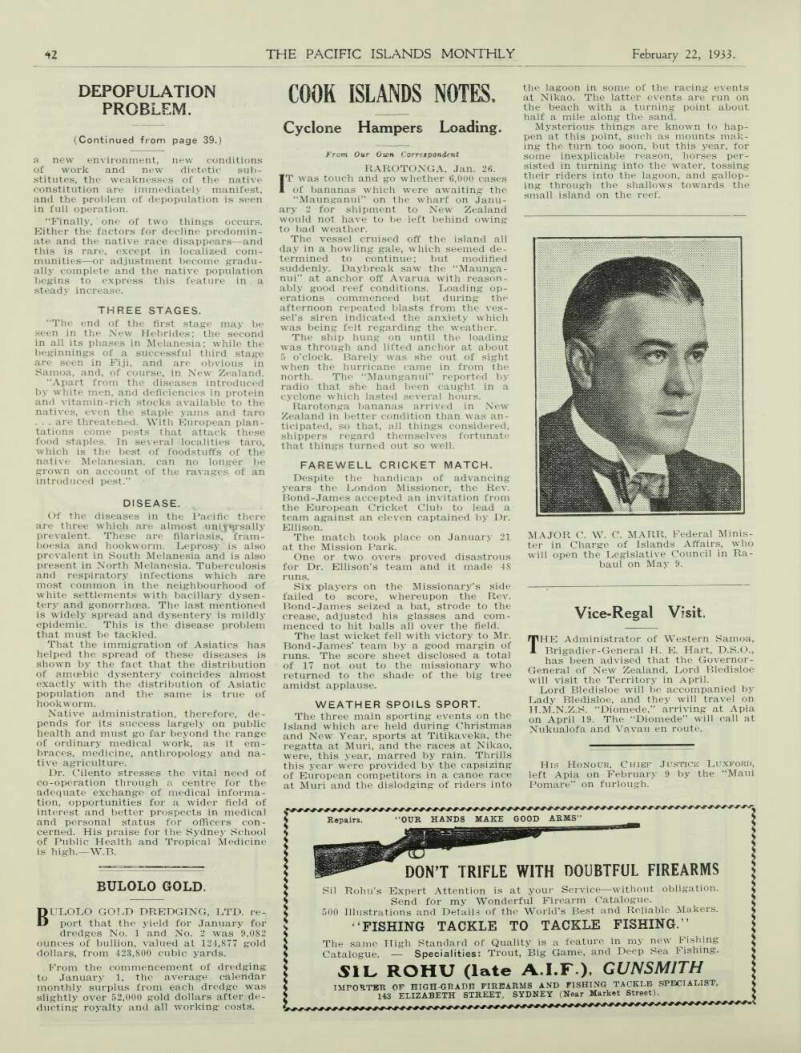
Bulolo Gold Dredging, Ltd. Re
port that the yield for January for dredges No. 1 and No. 2 was 9,082 ounces of bullion, valued at 124,877 gold dollars, from 423,800 cubic yards.
From the commencement of dredging to January 1, the average calendar monthly surplus from each dredge was slightly over 52,000 gold dollars after de ducting royalty and all working costs.
Cook Islands Notes.
Cyclone Hampers Loading.
From Our Own Correspondent
Rarotonga, Jan. 26.
IT was touch and go whether 6,000 cases of bananas which were awaiting the “Maunganui” on the wharf on Janu ary 2 for shipment to New Zealand would not have to be left behind owing to bad weather.
The vessel cruised off the island all day in a howling gale, which seemed de termined to continue; but modified suddenly. Daybreak saw the “Maunga nui” at anchor off Avarua with reason ably good reef conditions. Loading op erations commenced but during the afternoon repeated blasts from the ves sel’s siren indicated the anxiety which was being felt regarding the weather.
The ship hung on until the loading was through and lifted anchor at about 5 o’clock. Barely was she out of sight when the hurricane came in from the north. The “Maunganui” reported by radio that she had been caught in a cyclone which lasted several hours.
Rarotonga bananas arrived in New Zealand in better condition than was an ticipated, so that, all things considered, shippers regard themselves fortunate that things turned out so well.
Farewell Cricket Match.
Despite the handicap of advancing years the London Missioner, the Rev.
Bond-James accepted an invitation from the European Cricket Club to lead a team against an eleven captained by Dr.
Ellison.
The match took place on January 21 at the Mission Park.
One or two overs proved disastrous for Dr. Ellison’s team and it made 48 runs.
Six players on the Missionary’s side failed to score, whereupon the Rev.
Bond-James seized a bat, strode to the crease, adjusted his glasses and com menced to hit balls all over the field.
The last wicket fell with victory to Mr.
Bond-James’ team by a good margin of runs. The score sheet disclosed a total of 17 not out to the missionary who returned to the shade of the big tree amidst applause.
Weather Spoils Sport.
The three main sporting events on the Island which are held during Christmas and New Year, sports at Titikaveka, the regatta at Muri, and the races at Nikao, were, this year, marred by rain. Thrills this year were provided by the capsizing of European competitors in a canoe race at Muri and the dislodging of riders into
the lagoon in some of the racing events at Nikao. The latter events are run on the beach with a turning point about half a mile along the sand.
Mysterious things are known to hap pen at this point, such as mounts mak ing the turn too soon, but this year, for some inexplicable reason, horses per sisted in turning into the water, tossing their riders into the lagoon, and gallop ing through the shallows towards the small island on the reef.
MAJOR C. W. C. MARK, Federal Minis ter in Charge of Islands Affairs, who will open the Legislative Council in Ra baul on May 9.
Vice-Regal Visit.
THE Administrator of Western Samoa, Brigadier-General H. E. Hart, D.S.O., has been advised that the Governor- General of New Zealand, Lord Bledisloe will visit the Territory in April.
Lord Bledisloe will be accompanied by Lady Bledisloe, and they will travel on H.M.N.Z.S. “Diomede,” arriving at Apia on April 19. The “Diomede” will call at Nukualofa and Vavau en route.
His Honour, Chief Justice Luxford, left Apia on February 9 by the “Maui Pomare” on furlough.
Advertisements & other items, p. 44 (2 items)
42
February 22, 1933.
THE PACIFIC ISLANDS MONTHLY
DEPOPULATION
PROBLEM.
(Continued from page 39.)
Sil Rohu (Late A.I.F.). Gunsmith
Repairs.
"OUR HANDS MAKE GOOD ARMS”
DON’T TRIFLE WITH DOUBTFUL FIREARMS
Sil Rohu’s Expert Attention is at your Service —without obligation.
Send for my Wonderful Firearm Catalogue. 500 Illustrations and Details of the World’s Best and Reliable Makers.
“FISHING TACKLE TO TACKLE FISHING.”
The same High Standard of Quality is a feature in my new Fishing Catalogue. Specialities: Trout, Big Game, and Deep Sea Fishing.
SIL ROHU (late A.I.F.). GUNSMITH
IMPORTER OF HIGH-GRADE FIREARMS AND FISHING TACKLE SPECIALIST, 143 ELIZABETH STREET, SYDNEY (Near Market Street).
Keravat Plantation.
Report for December.
THE report of the Keravat Demonstra tion Plantation, New Guinea, for De cember, shows that much interest is being taken by local planters and others in the experimental and general agricul tural work. Eleven visitors came to the plantation during the month in search of information and advice.
Besides the general routine work of cultivation, many acres have been planted with new crops, including rice, native foods, maize, shade and cover crops. The cacao section, in which seed lings are making rapid growth, was cleaned and cover crops sown. Coffee sections also received attention, being suckered and cleared.
Pepper vines were transplanted in their permanent positions in the field and various leguminous trees are used as supports. Rice, broom millet, maize, native foods, shade and cover crops were harvested, 3,472 lbs. of sweet potatoes being distributed to the labour as rations.
Of the trial plots ot maize, planted last September and October, “Fitzroy,”
“Small Learning,” and “Silver Mine” were the most successful varieties.
Strong north-west winds were experi enced during the month, but little damage was done. A few coffee plants were injured by falling trees on the western boundary.
The following plantings were made during the month:—
The Public Works carpenter, having completed the work in hand, left for Rabaul on 16th inst.
The reconditioning of drains through out the plantation was completed.
Two labourers were paid off on ex piration of contract during the month and three signed on. Two were admitted to hospital, of whom one died. One was returned from hospital as well as the native who has undergone three months’ tuition at Rapindik.
Working units at the close of Decem ber totalled 9-7.
Three Surprise Creek natives were re turned from hospital, making a total of eight now at Keravat.
Meteorology.
Total rainfall for the month was 978 points. Rain fell on 24 davs, the heaviest fall being on the 22nd, when 244 points were recorded.
At a dinner at Kokopo, tendered to Mr. and Mrs. Taylor on the eve of their departure to Salamaua, every resident of Kokopo was present except one, who was unavoidably absent.
Acres.
Rice 10 Maize 5 Cassava 3 Sweet potatoes 2 Taro .. .. 1 Shade and cover crops, interplanted with growing staples.
The following produce was distributed: — Rice 677 lbs.
Ground nuts . . 733 lbs.
Cowpeas .. 34 lbs.
Sesamum 10 oz.
Crotalaria 20 lbs.
Maize 33 lbs.
Coffee, hulled 40 lbs.
Papua.
American Expedition to Papua.
AMONG the passengers on the Matson line “Lurline,” which arrived in Syd ney on a tour of the Pacific on Feb ruary 20, was Mr. R. Archbold, who is on his way to Papua.
Mr. Archbold was sent out by the Am erican Museum of National History, to make a general survey of the birds, mammals, and plants of the Territory.
He is accompanied by Mr. A. L. Rand, and they will be joined in Brisbane by Mr. L. G. Brass, who has been doing scientific work in the Solomon Islands.
Papuan Customs.
From Our Own Correspondent
Pt. Moresby, Feb. 8.
The Papuan Customs revenue for De cember, 1932, is as follows: Pt.
Moresby. Samarai. Daru.
Import duties .. £1,183/9/9 £842/15/8 £25/13/7 Primage £236/12/8 £181/10/11 £13/9/1 Export duties .. £1/3/11 £23/11/3 18- Shipping and other fees £6/7/8 £3/3/8 Totals £1,427/14/- £105/1/6 £4/0/8
Wau-Pt. Moresby Service.
From a Special Correspondent.
Pt. Moresby, Feb. 8.
THE Guinea Airways passenger ’plane with Pilot Gurney and seven pas sengers arrived in Pt. Moresby on January 18 from the New Guinea gold fields. The ’plane left again after the arrival of the “Montoro,” with 18 pas sengers, for the field.
Pilot Denny took charge on the return trip. Pilot Gurney leaving by the “Mac dhui” on January 20. Three trips were made to the fields.
The price of mixed parcels of trochus shell in Rabaul on January 27 was £60 per ton.
Norfolk
Island Trade
Imports.
From Australia.
From N.Z.
Month. £2,070 £1,016 December 1982 . £2,178 £673
Exports.
To Australia.
To N.Z.
Month.
December . £1,108 December, 1932 £1.123 £404
N.G. Sulphur.
MR. A. C. MACKAY, who arrived in Rabaul, has been commissioned to make a thorough inspection of the deposits of sulphur in the Tawurwur Crater, Matupi Bay, by boring and other tests, so as to be able to compile the full est information on these deposits gener ally.
Papuan Produce.
From Our Own Correspondent.
PT. MORESBY, February 8.
TUB “Macdhui” sailed from Port Moresby on January 20. taking the following cargo for Sydney:—2,159 packages of rubber, 883 boxes of desiccated coconut, 21 bags of beche-de-mer, 16 bags of coffee, 209 bags of copra, and 12 bags of sundries.
The “Antigone,” from Sydney, bound to Europe via Samarai, loaded 398 tons of copra on January 17.
Advertisements & other items, p. 45 (1 item)
Burns, Philp
TO PLANTERS I am a Buyer of
CASTOR OIL SEED
IN ANY QUANTITY.
Advice and Instructions Regarding Plant ing, Harvesting and Packing of Castor Oil Seeds given gratis.
Your Inquiries Solicited Regarding Disposal of all kinds of Oil-Bearing and Edible Seeds and Nuts.
C. GRAHAME
17 BOND STREET SYDNEY.
BURNS, PHILP
(South Sea) Co. Ltd.
Island Traders & Shipowners Registered Office: Suva, Fiji.
Also Branches at Fiji: Levuka, Lautoka, Labasa, Ba, Sigatoka, Rotumah.
Tonga: Nukualofa, Haapai, Vavau.
Samoa: Apia, Pago Pago (American Samoa).
Solomons: Makambo, Gizo, Faisi.
New Hebrides: Vila.
Gilberts : Tarawa.
Norfolk Island. Nauru. Niue.
Code Address: "Bumsouth."
The Native Mind.
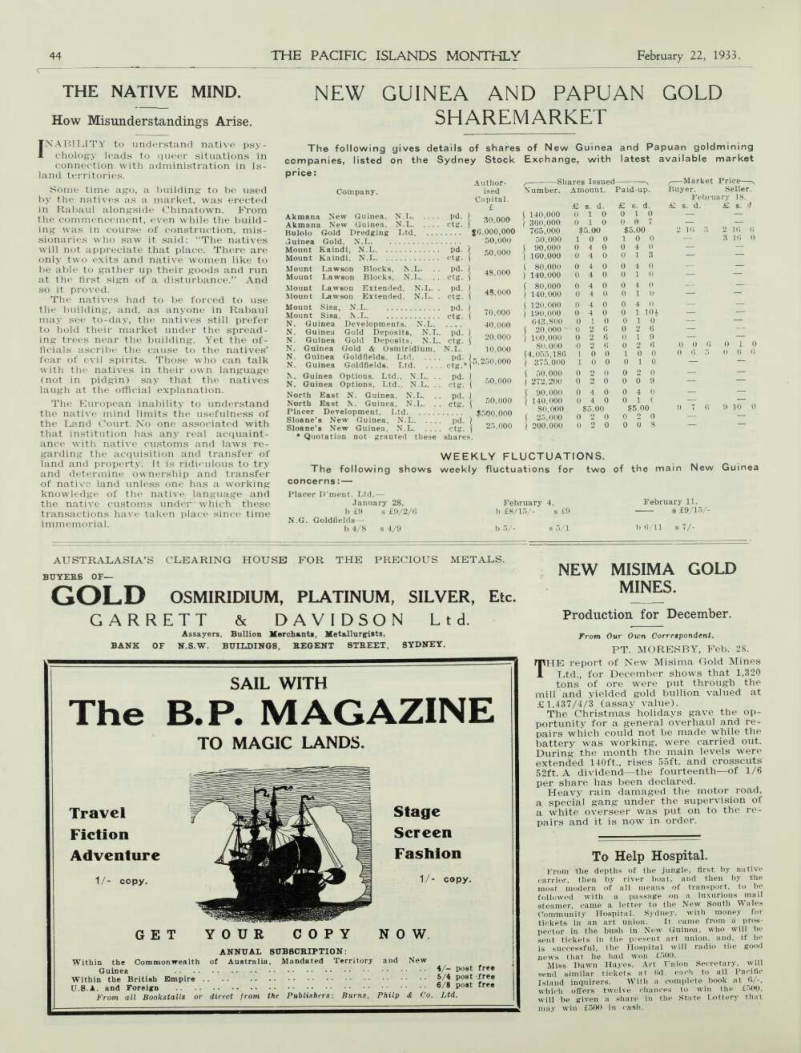
How Misunderstandings Arise.
INABILITY to understand native psy chology leads to queer situations in connection with administration in Is land territories.
Some time ago, a building to be used by the natives as a market, was erected in Rabaul alongside Chinatown. From the commencement, even while the build ing was in course of construction, mis sionaries who saw it said: “The natives will not appreciate that place. There are only two exits and native women like to be able to gather up their goods and run at the first sign of a disturbance." And so it proved.
The natives had to be forced to use the building, and, as anyone in Rabaul may see to-day, the natives still prefer to hold their market under the spread ing trees near the building. Yet the of ficials ascribe the cause to the natives’ fear of evil spirits. Those who can talk with the natives in their own language (not in pidgin) say that the natives laugh at the official explanation.
The European inability to understand the native mind limits the usefulness of the Land Court. No one associated with that institution has any real acquaint ance with native customs and laws re garding the acquisition and transfer of land and property. It is ridiculous to try and determine ownership and transfer of native land unless one has a working knowledge of the native language and the native customs under which these transactions have taken place since time immemorial.
New Guinea And Papuan Gold
Sharemarket
The following gives details of shares of New Guinea and Papuan goldmining companies, listed on the Sydney Stock Exchange, with latest available market price:
Weekly Fluctuations.
The following shows weekly fluctuations for two of the main New Guinea concerns:
Authorised Capital £ Shares Issued Market Price Company.
Number.
Amount.
Paid-up.
Buyer.
Seller.
February 18. £ £ s. d £ s. d. £ s. d. £ s. d Akmana New Guinea, N.L pd. 30,000 140,000 0 1 0 0 1 0 — — Akmana New Guinea, N.L ctg. 360,000 0 1 0 0 0 7 — — Bulolo Gold Dredging Ltd. . . . $6,000,000 765,000 $5.00 0 $5.00 0 2 16 3 2 16 6 50,000 50,000 1 0 1 0 — 3 16 0 Mount Kaindi, N.L pd. 50,000 90,000 0 4 0 0 4 0 — — Mount Kaindi, N.L ctg. 160,000 0 4 0 0 1 3 — Mount Lawson Blocks. N.L. pd. 48,000 80,000 0 4 0 0 4 0 — — Mount Lawson Blocks, N.L. ctg. 140,000 0 4 0 0 1 0 Mount Lawson Extended. N.L. . pd. 48,000 80,000 0 4 0 0 4 0 — — Mount Lawson Extended, N.L. . ctg. 140,000 0 4 0 0 1 0 — Mount Sisa, N.L. pd.
Mount Sisa, N.L. ctg. 120,000 0 4 0 0 4 0 — — 70,000 190,000 0 4 0 0 1 10½ — — N. Guinea Developments, N.L. 40,000 643,800 0 1 0 0 1 0 N. Guinea Gold Deposits, N.L. p.d. 20,000 0 2 6 0 2 6 N. Guinea Gold Deposits. N.L. ctg. 20,000 100,000 0 2 6 0 1 9 0 0 6 0 0 1 9 N. Guinea Gold & Osmiridium, N.L. 10,000 80,000 0 2 6 0 0 2 o N. Guinea Goldfields, Ltd pd. 4,055,186 1 0 1 0 0 0 0 5 6 6 N. Guinea Goldfields, Ltd. ctg. 5,250,000 375,000 1 0 0 0 I 0 N. Guinea Options, Ltd., N.L. . . pd.
N. Guinea Options, Ltd., N.L. . . ctg. 50,000 50,000 272,200 0 0 2 2 0 0 0 0 2 0 0 9 — — North East N. Guinea, N.L. pd. 50,000 90,000 0 4 0 0 4 0 — — North East N. Guinea, N.L. .. ctg. 140,000 0 4 0 0 1 0 — 10 0 Placer Development, Ltd $500,000 80,000 0 $5.00 $5.00 9 7 6 Sloane's New Guinea, N.L pd. 25,000 2 Sloane’s New Guinea. N.L ctg. 25,000 200,000 0 2 0 0 0 8 *Quotation not granted these shares.
Placer D’ment. Ltd. — January 28.
February 4.
February 11. b £9 s £9/2/6 b £8/15/- s £9 s £9/15/- N.G. Goldfields— b 4/8 s 4/9 b 5/- s 5/1 b 6/11 s 7/-
New Misima Gold
Mines.
Production for December.
From Our Own Correspondent.
Pt. Moresby, Feb. 28.
THE report of New Misima Gold Mines Ltd., for December shows that 1,320 tons of ore were put through the mill and yielded gold bullion valued at £1.437/4/3 (assay value).
The Christmas holidays gave the op portunity for a general overhaul and re pairs which could not be made while the battery was working, were carried out.
During the month the main levels were extended 140 ft., rises 55ft. and crosscuts 52ft. A dividend —the fourteenth —of 1/6 per share has been declared.
Heavy rain damaged the motor road, a special gang under the supervision of a white overseer was put on to the re pairs and it is now in order.
To Help Hospital.
From the depths of the jungle, tirst by native carrier, then by river boat, and then by the most modern of all means of transport, to be followed with a passage on a luxurious mail steamer, came a letter to the New South Wales Community Hospital. Sydney, with money for tickets in an art union. It came from a pros pector in the bush in New Guinea, who will be sent tickets in the present art union, and, if he is successful, the Hospital will radio the good news that he had won £500.
Miss Dawn Hayes. Art Union Secretary, will send similar tickets at 6d. each to all Pacific Island inquirers. With a complete book at 6/-, which offers twelve chances to win the £500. will be given a share in the State Lottery that may win £500 in cash.
Advertisements & other items, p. 46 (1 item)
The B.P. Magazine
AUSTRALASIA’S CLEARING HOUSE FOR THE PRECIOUS METALS.
BUYERS OF—
GOLD OSMIRIDIUM, PLATINUM, SILVER, Etc.
GARRETT & DAVIDSON Ltd.
Assayers, Bullion Merchants, Metallurgists, BANK OF N.S.W. BUILDINGS, REGENT STREET, SYDNEY.
SAIL WITH
The B.P. MAGAZINE
TO MAGIC LANDS.
Travel Fiction Adventure 1/- copy.
GET
Stage
Screen Fashion 1/- copy.
YOUR COPY NOW
ANNUAL SUBSCRIPTION:
Within the Commonwealth of Australia, Mandated Territory and New Guinea 4/-post free Within the British Empire 5/4 Post free U.S.A. and Foreign 6/8 Post free From all Bookstalls or direct from the Publishers: Burns, Philp & Co. Ltd.
Market Quotations
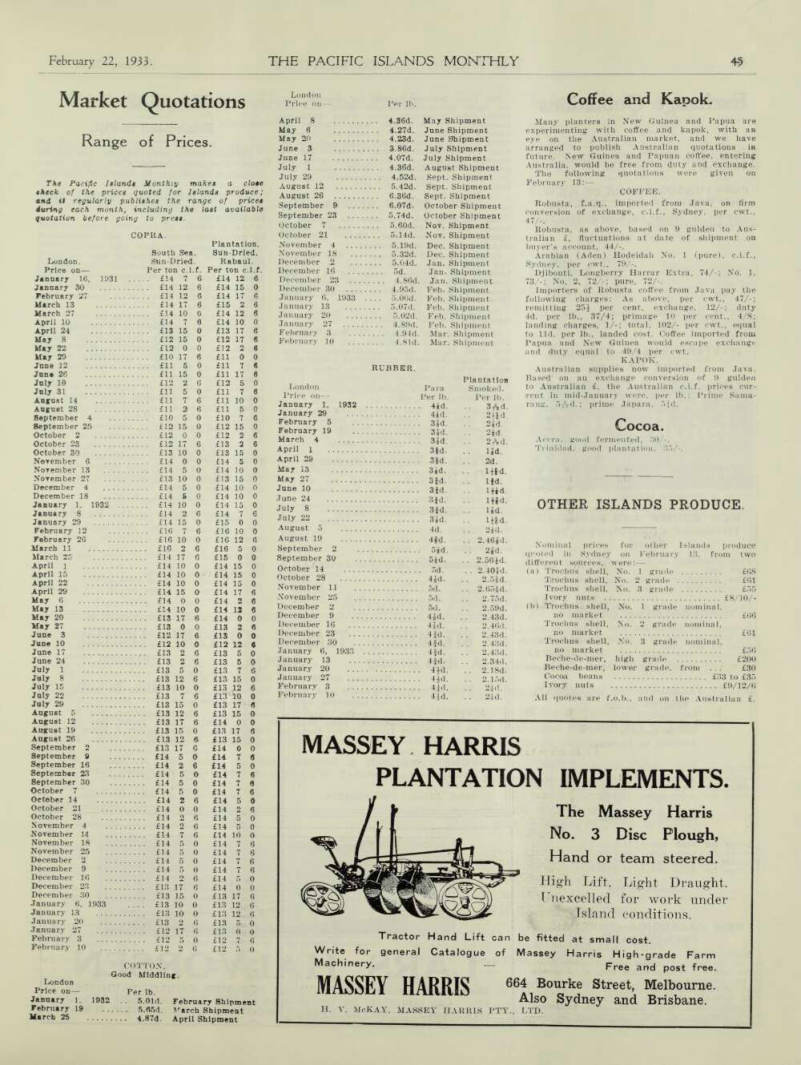
Range of Prices.
The Pacific Islands Monthly makes a close sheek of the prices quoted for Islands produce; and it regularly publishes the range of prices during each month, including the last available quotation before going to press.
Coffee and Kapok.
Many planters in New Guinea and Papua are experimenting with coffee and kapok, with an eye on the Australian market, and we have arranged to publish Australian quotations ia future. New Guinea and Papuan coffee, entering Australia, would be free from duty and exchange.
The following quotations were given on February 13: —
Coffee.
Robusta, f.a.q., imported from Java, on firm conversion of exchange, c.i.f., Sydney, per cwt., 47/-.
Robusta, as above, based on 9 gulden to Aus tralian £, fluctuations at date of shipment on buyer’s account, 44/-.
Arabian (Aden) Hodeidah No. 1 (pure), c.i.f., Sydney, per cwt., 79/-.
Djibouti, Longberry Harrar Extra, 74/-; No. 1, 73/-: No. 2, 72/-; pure, 72/-.
Importers of Robusta coffee from Java pay the following charges: As above, per cwt., 47/-; remitting 25½ per cent, exchange, 12/-; duty 4d. per lb., 37/4; primage 10 per cent., 4/8; landing charges, 1/-; total, 102/- per cwt., equal to lid. per lb., landed cost. Coffee imported from Papua and New Guinea would escape exchange and duty equal to 49/4 per cwt.
Kapok.
Australian supplies now imported from Java.
Based on an exchange conversion of 9 gulden to Australian £, the Australian c.i.f. prices cur rent in mid-January were, per lb.: Prime Sama rang, prime Japara, ssd.
Cocoa.
Accra, good fermented, 30/-.
Trinidad, good plantation. 35/-.
London Price on— Per lb.
April 8 .. 4.36d.
May Shipment May 6 .. 4.27d.
June Shipment May 20 .. 4.23d.
June Shipment June 3 . . 3.86d.
July Shipment June 17 . . 4.07d.
July Shipment July 1 . . 4.36d.
August Shipment July 29 .. 4.52d.
Sept. Shipment August 12 .. 5.42d.
Sept. Shipment August 26 . . 6.36d.
Sept. Shipment September 9 .. 6.07d.
October Shipment September 23 . . 5.74d.
October Shipment October 7 .. 5.60d.
Nov. Shipment October 21 .. 5.14d.
Nov. Shipment November 4 .. 5.19d.
Dec. Shipment November 18 .. 5.32d.
Dec. Shipment December 2 . . 5.04d.
Jan. Shipment December 16 Jan. Shipment December 23 ... 4.86d.
Jan. Shipment December 30 Feb. Shipment January 6, 1933 . . .. 5.00d.
Feb. Shipment January 13 .. 5.07d.
Feb. Shipment January 20 .. 5.02d.
Feb. Shipment January 27 Feb. Shipment February 3 ... 4.94d.
Mar. Shipment February 10 .. . 4.81d.
Mar. Shipment
London. Price on—
Copra.
South Sea, Sun-Dried. Per ton c.i.f.
Plantation, Sun-Dried. Rabaul. Per ton c.i.f.
January 16, 1931 £14 7 6 £14 12 6 January 30 £14 12 6 £14 15 0 February 27 £14 12 6 £14 17 6 March 13 £14 17 6 £15 2 G March 27 £14 10 0 £14 12 6 April 10 £14 7 0 £14 10 0 April 24 £13 16 0 £13 17 6 May 8 £12 15 0 £12 17 « May 22 £12 0 0 £12 2 6 May 29 £10 17 6 £11 0 0 June 12 £11 5 0 £11 7 6 Juna 26 £11 15 0 £11 17 e July 10 £12 2 6 £12 5 0 July 31 £11 5 0 £11 7 6 August 14 £11 7 6 £11 10 0 August 28 £11 2 6 £11 5 0 September 4 £10 5 0 £10 7 c September 25 £12 15 0 £12 15 0 October 2 0 £12 2 6 October 23 £12 17 6 £13 3 6 October 30 0 £13 15 0 November 6 . . . . £14 0 0 £14 5 0 November 13 . . . . £14 5 0 £14 10 0 November 27 . .. . £13 10 0 £13 15 0 December 4 .. . . 0 £14 10 0 December 18 . . . . £14 6 0 £14 10 0 January 1, 1932 . £14 10 0 £14 15 0 January 8 £14 2 6 £14 7 6 January 29 £14 15 0 £15 0 0 February 12 £16 7 6 £16 10 0 February 2G £16 10 0 £16 12 6 March 11 £16 2 6 £16 5 0 March 25 £14 17 6 £15 0 0 April l 0 £14 15 0 April 15 0 £14 15 0 April 22 £14 10 0 £14 15 0 April 29 £14 15 0 £14 17 6 May 6 £14 0 0 £14 2 6 May 13 £14 10 0 £14 12 6 May 20 £13 17 6 £14 0 0 May 27 £13 0 0 £13 2 6 June 3 £12 17 6 £13 0 0 June 10 £12 10 0 £12 12 « June 17 6 £13 5 0 June 24 £13 2 6 £13 5 0 July 1 £13 5 0 £13 7 6 July 8 £13 12 6 £13 15 0 July 15 0 £13 12 6 July 22 £13 7 6 £13 10 0 July 29 £13 15 0 £13 17 6 August 5 6 £13 15 0 August 12 £13 17 6 £14 0 0 August 19 0 £13 17 6 August 26 £13 12 6 £13 15 0 September 2 £13 17 G £14 0 0 September 9 0 £14 7 6 September 16 £14 2 6 £14 5 0 September 23 £14 5 0 £14 7 6 September 30 £14 5 0 £14 7 e October 7 £14 5 0 £14 7 6 October 14 6 £14 5 0 October 21 ... £14 0 0 £14 2 6 October 28 ... £14 2 6 £14 5 0 November 4 £14 2 6 £14 5 0 November 11 ... £14 7 6 £14 10 0 November 18 £14 5 0 £14 7 6 November 25 . . . £14 5 0 £14 7 6 December 2 ... £14 5 0 £14 7 6 December 9 0 £14 7 6 December 16 . .., £14 2 6 £14 5 0 December 23 .. .. 6 £14 0 0 December 30 ... £13 15 0 £13 17 6 January 6. 1933 £13 10 0 £13 12 6 January 13 £13 10 0 £13 12 6 January 20 6 £13 5 0 January 27 £12 17 0 £13 0 0 February 3 £12 5 0 £12 7 6 February 10 £12 2 6 £12 5 0
Cotton.
Good Middling.
London Price on— Per lb.
January 1, 1932 . . 5.01d, February Shipment February 19 March 25 5.65(1. March Shipment 4.87d April Shipment
London Price on—
Rubber.
Para Per lb.
Plantation Smoked. Per lb.
January 1. 1932 44d. 3Ad.
January 29 . 44d. 2iJd.
February 5 3Jd. 2*d February 19 . . 2jd March 4 3id. 2Ad.
April l IJd.
April 29 3|d. 2d.
May 13 Mid.
May 27 IJd.
June 10 IHd.
June 24 Mid.
July 8 lid.
July 22 IHd.
August 5 .. 24d.
August 19 4id. .. 2.464'J.
September 2 2id.
September 30 5id. .. 2.56Jd.
October 14 .. 2.40Sd.
October 28 . . 2.5|d.
November 11 .. 2.65gd.
November 25 .. 2.75d.
December 2 5d. . . 2.59d.
December 9 . .. 4Jd. . . 2.43d.
December 16 . . .. 4id. 2.4Gd.
December 23 . . . . 4 Jd. . . 2.43d.
December 30 . . 2.43d.
January 6, 1933 4 id. .. 2.43d.
January 13 . ... .. 2.34d.
January 20 . ... .. 2.18d.
January 27 . . .. .. 2.15d.
February 3 . . . . 4id. .. 2Ad.
February 10 .. 2id.
Other Islands Produce.
Nominal prices for other Islands produce quoted in Sydney on February 13, from two different sources, were: — (a) Trochus shell, No. 1 grade £68 Trochus shell, No. 2 grade £61 Trochus shell, No. 3 grade £55 Ivory nuts £8/10/- (b) Trochus shell, No. 1 grade nominal, no market £66 Trochus shell, No. 2 grade nominal, no market £61 Trochus shell, No. 3 grade nominal, no market £56 Beche-de-mer, high grade £200 Beche-de-mer, lower grade, from .. . £30 Cocoa beans £33 to £35 Ivory nuts £9/12/6 All quotes are f.o.b., and on the Australian £.
Advertisements & other items, p. 47 (1 item)
Massey Harris
PLANTATION IMPLEMENTS.
The Massey Harris No. 3 Disc Plough, Hand or team steered.
High Lift, Light Draught.
Unexcelled for work under Island conditions.
Tractor Hand Lift can be fitted at small cost.
Write for general Catalogue of Massey Harris High-grade Farm Machiner y- Free and post free.
MASSEY HARRIS 664 Bourke Street, Melbourne.
Also Sydney and Brisbane.
H. V. McKAY, MASSEY HARRIS PTY., LTD.
Exchange Quotations
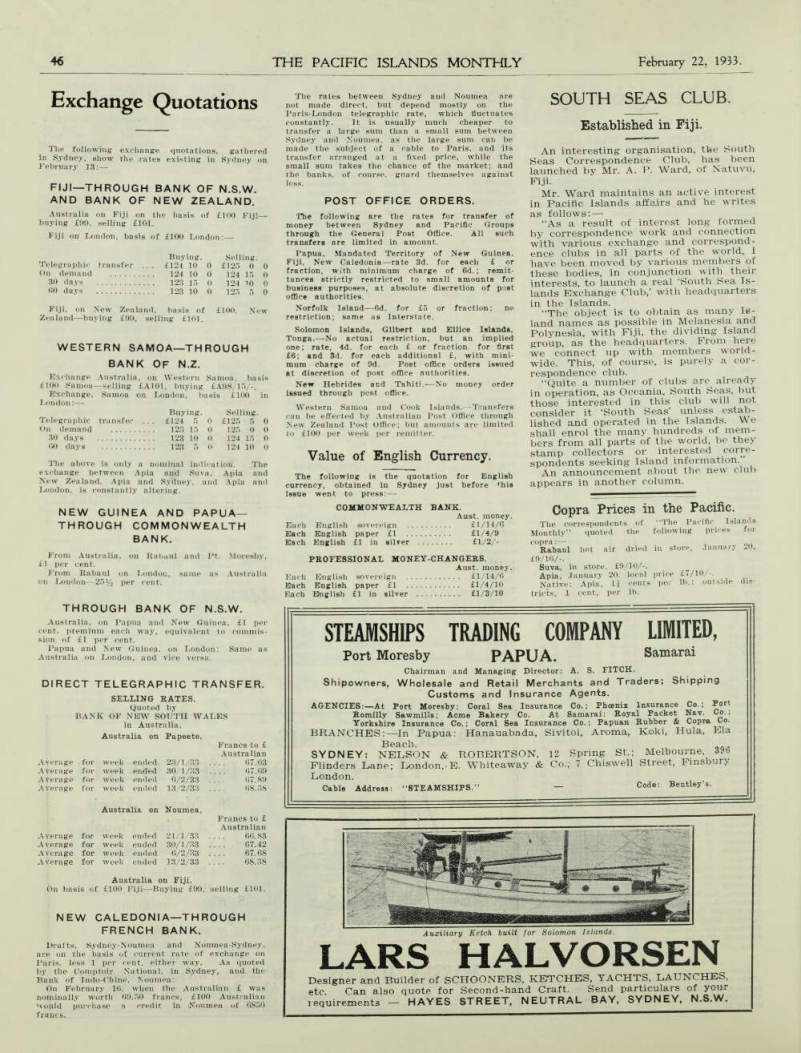
The following exchange quotations, gathered in Sydney, show the rates existing in Sydney on February 13:—
Fiji—Through Bank Of N.S.W.
And Bank Of New Zealand.
Australia on Fiji on the basis of £100 Fiji— buying £99, selling £101.
Fiji on London, basis of £100 London;— Buying. Selling.
Telegraphic transfer .. . £124 10 0 £125 0 0 On demand 124 10 0 124 15 0 30 days 123 15 0 124 10 0 60 days 123 10 0 125 5 0 Fiji, on New Zealand, basis of £100, New Zealand—buying £99, selling £101.
Western Samoa—Through
Bank Of N.Z.
Exchange Australia, on Western Samoa, basis £100 Samoa—selling £A101, buying £A98/15/-.
Exchange, Samoa on London, basis £100 in London:— Buying. Selling.
Telegraphic transfer .. . £124 5 0 £125 5 0 On demand 123 15 0 125 0 0 30 days 123 10 0 124 15 0 60 days 123 5 0 124 10 0 The above is only a nominal indication. The exchange between Apia and Suva. Apia and New Zealand, Apia and Sydney, and Apia and London, is constantly altering.
New Guinea And Papua
Through Commonwealth
Bank.
From Australia, on Rabaul and Pt. Moresby, £1 per cent.
From Rabaul on London, same as Australia on London —25% per cent.
Through Bank Of N.S.W.
Australia, on Papua and New Guinea, £1 per cent, premium each way, equivalent to commis sion of £1 per cent.
Papua and New Guinea, on London: Same as Australia on London, and vice versa.
Direct Telegraphic Transfer.
Selling Rates.
Quoted by
Bank Of New South Wales
in Australia.
Australia on Papeete.
Francs to £ Australian Average for week ended 23/1/33 ... 67.03 Average for week ended 30/1/33 ... 67.69 Average for week ended 6/2/33 ... 67.89 Average for week ended 13/2/33 ... 68.58 Australia on Noumea.
Francs to £ Australian Average for week ended 21/1/33 ... 66.83 Average for week ended 30/1/33 ... 67.42 Average for week ended 6/2/33 ... 67.68 Average for week ended 13/2/33 ... 68.38 Australia on Fiji, On basis of £100 Fiji—Buying £99, selling £101.
New Caledonia—Through
French Bank.
Drafts, Sydney-Noumea and Noumea-Sydney, are on the basis of current rate of exchange on Paris, less 1 per cent, either way. As quoted by the Comptoir National, in Sydney, and the Bank of Indo-Chine, Noumea: On February 16, when the Australian f was nominally worth 69.50 francs, £100 Australian would purchase a credit in Noumea of 6850 francs.
The rates between Sydney and Noumea are not made direct, but depend mostly on the Paris-London telegraphic rate, which fluctuates constantly. It is usually much cheaper to transfer a large sum than a small sum between Sydney and Noumea, as the large sum can be made the subject of a cable to Paris, and its transfer arranged at a fixed price, while the small sum takes the chance of the market; and the banks, of course, guard themselves against loss.
Post Office Orders.
The following are the rates for transfer of money between Sydney and Pacific Groups through the General Post Office. All such transfers are limited in amount.
Papua, Mandated Territory of New Guinea.
Fiji, New Caledonia—rate 3d. for each £ or fraction, with minimum charge of 6d.; remit tances strictly restricted to small amounts for business purposes, at absolute discretion of post office authorities.
Norfolk Island—6d. for £5 or fraction; no restriction; same as Interstate.
Solomon Islands, Gilbert and Ellice Islands, Tonga.—No actual restriction, but an implied one; rate, 4d. for each £ or fraction, for first £6; and 3d. for each additional £, with mini mum charge of 9d. Post office orders issued at discretion of post office authorities.
New Hebrides and Tahiti. —No money order issued through post office.
Western Samoa and Cook Islands. —Transfers can be effected by Australian Post Office through New Zealand Post Office; but amounts are limited to £100 per week per remitter.
Value of English Currency.
The following is the quotation for English currency, obtained in Sydney just before this issue went to press:—
Commonwealth Bank,
Aust. money.
Each English sovereign £1/14/6 Each English paper £1 £1/4/9 Each English £1 in silver £1/2/-
Peofebsional Money-Changers.
Aust. money.
Each English sovereign £1/14/6 Each English paper £1 £1/4/10 Each English £1 in silver £1/3/10
South Seas Club.
Established in Fiji.
An interesting organisation, the South Seas Correspondence Club, has been launched by Mr. A. P. Ward, of Natuvu, Fiji.
Mr. Ward maintains an active interest in Pacific Islands affairs and he writes as follows: “As a result of interest long formed by correspondence work and connection with various exchange and correspond ence clubs in all parts of the world, I have been moved by various members of these bodies, in conjunction with their interests, to launch a real ‘South Sea Is lands Exchange Club,’ with headquarters in the Islands.
“The object is to obtain as many Is land names as possible in Melanesia and Polynesia, with Fiji, the dividing Island group, as the headquarters. From here we connect up with members world wide. This, of course, is purely a cor respondence club.
“Quite a number of clubs are already in operation, as Oceania, South Seas, but those interested in this club will not consider it ‘South Seas’ unless estab lished and operated in the Islands. We shall enrol the many hundreds of mem bers from all parts of the world, be they stamp collectors or interested corre spondents seeking Island information.”
An announcement about the new club appears in another column.
Copra Prices in the Pacific.
The correspondents of “The Pacific Islands Monthly’’ quoted the following prices for copra: — , Rabaul hot air dried in store, January29, £9/16/-.
Suva, in store, £9/10/-.
Apia, January 20. local price £7/10/-.
Native: Apia, 1½ cents per lb.; outside dis tricts, 1 cent, per lb.
Advertisements & other items, p. 48 (1 item)
Lars Halvorsen
STEAMSHIPS TRADING COMPANY LIMITED,
Port Moresby PAPUA. Samarai
Chairman and Managing Director: A. S. FITCH.
Shipowners, Wholesale and Retail Merchants and Traders; Shipping Customs and Insurance Agents.
AGENCIES;—At Port Moresby: Coral Sea Insurance Co.; Phoenix Insurance Co.; Port Romilly Sawmills; Acme Bakery Co. At Samarai: Royal Packet Nav. Co.; Yorkshire Insurance Co.; Coral Sea Insurance Co.; Papuan Rubber & Copra Co.
BRANCHES:—In Papua: Hanauabada, Sivitoi, Aroma, Koki, Hula, Ela Beach. Q SYDNEY: NELSON & ROBERTSON, 12 Spring St.; Melbourne, Flinders Lane; London, E. Whiteaway & Co., 7 Chiswell Street, Finsbury London, Cable Address; “STEAMSHIPS.” Code: Bentley’s.
Auxiliary Ketch built for Solomon Islands
LARS HALVORSEN
Designer and Builder of SCHOONERS, KETCHES, YACHTS, LAUNCHES, etc. Can also quote for Second-hand Craft. Send particulars of your requirements HAYES STREET, NEUTRAL BAY, SYDNEY, N.S.W.
Shipping Services in the Pacific
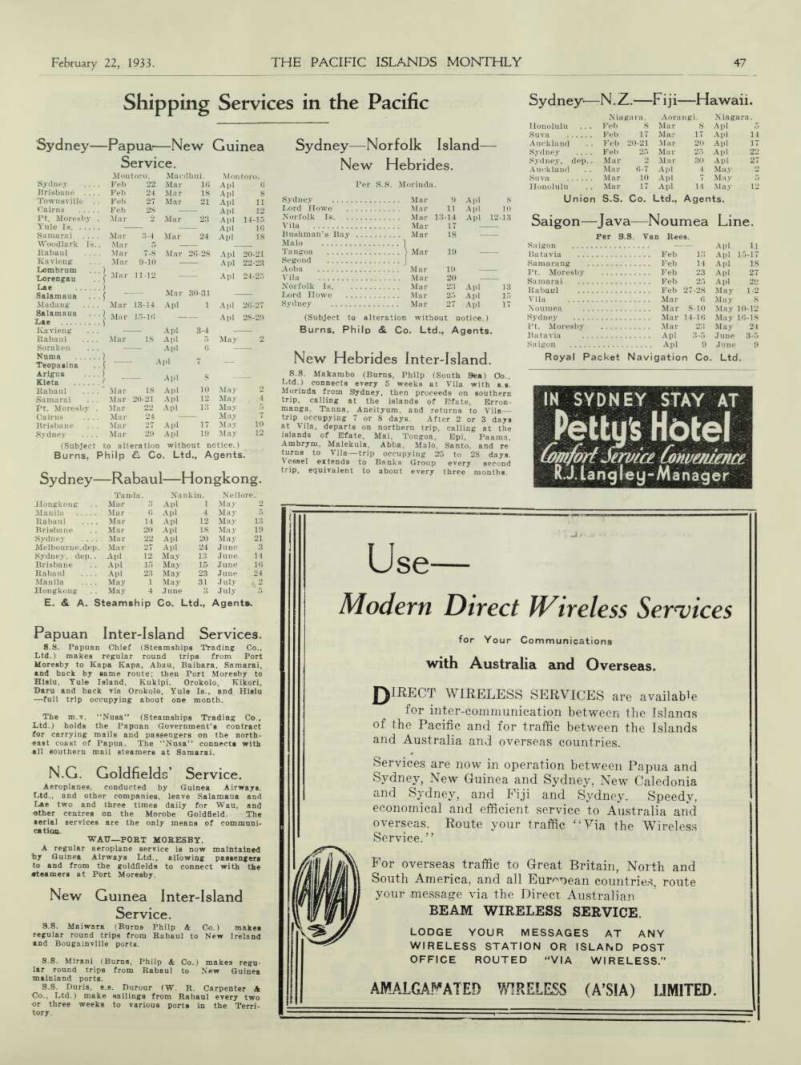
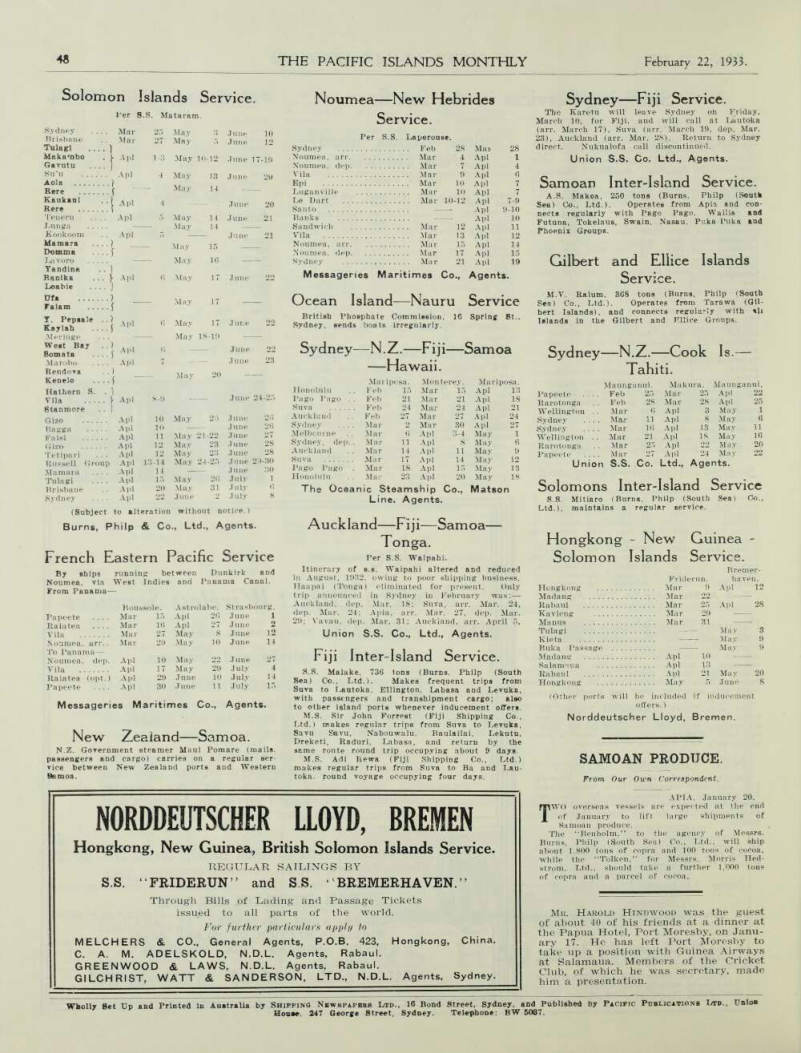
Papuan Inter-Island Services.
S.S. Papuan Chief (Steamships Trading Co., Ltd.) makes regular round trips from Port Moresby to Kapa Kapa, Abau, Baibara, Samarai, and back by same route; then Port Moresby to Hlslu, Yule Island, Kukipi, Orokolo, Kikori, Daru and back via Orokolo, Yule Is., and Hisiu —full trip occupying about one month.
The m.v. “Nusa” (Steamships Trading Co, Ltd.) holds the Papuan Government's contract for carrying mails and passengers on the north east coast of Papua. The “Nusa” connects with sill southern mail steamers at Samarai.
N.G. Goldfields’ Service.
Aeroplanes, conducted by Guinea Airways, Ltd., and other companies, leave Salamaua and Lae two and three times daily for Wau, and other centres on the Morobe Goldfield. The aerial services are the only means of communi cation
Wau—Port Moresby.
A regular aeroplane service is now maintained by Guinea Airways Ltd., allowing passengers to and from the goldfields to connect with the ateamers at Port Moresby.
New Guinea Inter-Island
Service.
S.S. Maiwara (Burns Philp & Co.) makes regular round trips from Rabaul to New Ireland and Bougainville ports.
S.S. Mirani (Burns, Philp & Co.) makes regu lar round trips from Rabaul to New Guinea mainland ports.
S.S. Duris, s.s. Durour (W. R. Carpenter A Co., Ltd.) make sailings from Rabaul every two or three weeks to various ports in the Terri tory.
New Hebrides Inter-Island.
S.S. Makambo (Burns, Philp (South Sea) Co., Ltd.) connects every 5 weeks at Vila with s.s.
Morinda from Sydney, then proceeds on southern trip, calling at the islands of Efate. Erron manga, Tanna, Aneityum, and returns to Vila— trip occupying 7 or 8 days. After 2or 3 days at Vila, departs on northern trip, calling at the islands of Efate, Mai, Tongoa, Epi, Paama.
Ambrym, Malekula, Abba, Malo, Santo, and re turns to Vila —trip occupying 25 to 28 days.
Vessel extends to Banks Group every second trip, equivalent to about every three months.
Sydney—Norfolk Island—
New Hebrides.
Per S.S. Morinda.
Sydney Mar 9 Apl 8 Lord Howe Mar 11 Apl 10 Norfolk Is Mar 13-14 Apl 12-13 Vila Mar 17 Bushman’s Bay ...
Malo Mar 18 —— Tangoa Segond Mar 19 — Aoba Mar 19 Vila Mar 20 Norfolk Is Mar 23 Apl 13 Lord Howe Mar 25 Apl 15 Sydney Mar 27 Apl 17 (Subject to alteration without notice.) Burns, Philp & Co. Ltd., Agents.
Sydney- — N.Z. — Fiji- — Hawaii.
Niagara.
Aora ngi. Niagara.
Honolulu Feb 8 Mar 8 Apl 5 Suva Feb 17 Mar 17 Apl 14 Auckland Feb 20-21 Mar 20 Apl 17 Sydney ...
Feb 25 Mar 25 Apl 22 Sydney, dep..
Mar 2 Mar 30 Apl 27 Auckland Mar 6-7 Apl 4 May 2 Suva Mar 10 A pi 7 May 5 Honolulu Mar 17 Apl 14 May 12 Union S.S. Co. Ltd., Agents.
Saigon —
Java —
Noumea Line.
Per S.S. Van Rees.
Saigon Apl 11 Batavia ...
Feb 13 Apl 15-17 Samarang , Feb 14 Apl 18 Pt. Moresby , Feb 23 Apl 27 Samarai . . .. , Feb 25 Apl 2U Rabaul ...
Feb 27-28 May 1-2 Vila , Mar 6 May S Noumea , Mar 8-10 May 10-12 Sydney Mar 14-16 May 16-18 Pt. Moresby Mar 23 May 24 Batavia Apl 3-5 June 3-5 Saigon . Apl 0 June 9 Royal Packet Navigation Co. Ltd.
Sydney— -Papua—New Guinea
Service.
Montoro.
Macdhui.
Montoro.
Sydney ...
Feb 22 Mar 16 Apl 6 Brisbane ...
Feb 24 Mar 18 Apl 8 Townsville . .
Feb 27 Mar 21 Apl 11 Cairns Feb 28 — Apl 12 Pt. Moresby .
Mar 2 Mar 23 Apl 14-15 Tule Is Apl 16 Samarai ...
Mar 3-4 Mar 24 Apl 18 Woodlark Is..
Mar 5 — Rabaul ...
Mar 7-8 Mar 26-28 Apl 20-21 Kavieng Mar 9-10 Apl 22-23 Lombrum Mar 11 -12 Lorengau Apl 24-25 Lae Salamaua — Mar 30-31 Madang ...
Mar 13 -14 Apl 1 Apl 26-27 Salamaua . ..) Lae f Mar 10 Kavieng .. . -16 — Apl 28-29 Apl 3-4 Rabaul ...
Mar IS Apl 5 May 2 Soraken — Apl 6 — Numa Teopaaina Apl i — Arlgus . . . .) Apl 8 Kieta ' Rabaul Mar 18 Apl 10 May 2 Samarai Mar 20 -21 Apl 12 May 4 Pt. Moresby .
Mar 22 Apl 13 May 5 Cairns ...
Mar 24 May 7 Brisbane Mar 27 Apl 17 May 10 Sydney ...
Mar 29 Apl 19 May 12 (Subject to alteration without notice.) Burns, Philp & Co . Ltd., Agents.
Sydney— —Rabaul —Hongkong.
Tanda.
Nankin.
Nellore.
Hongkong Mar 3 Apl 1 May 2 Manila Mar 6 Apl 4 May 5 Rabaul ...
Mar 14 Apl 12 May 13 Brisbane Mar 20 Apl 18 May 19 Sydney ...
Mar 22 Apl 20 May 21 Melbourne, dep.
Mar 27 Apl 24 June 3 Sydney, dep..
Apl 12 May 13 June 14 Brisbane A pi 15 May 15 June 16 Rabaul ...
Apl 23 May 23 June 24 Manila ...
May 1 May 31 July 2 Hongkong May 4 June 3 July 5 E. & A. Steamship Co. Ltd., Agents.
French Eastern Pacific Service
By ships running between Dunkirk and Noumea, via West Indies and Panama Canal.
From Panama —
New Zealand—Samoa.
N.Z. Government steamer Maui Pomare (mails, passengers and cargo) carries on a regular ser vice between New Zealand ports and Western Samoa.
Ocean Island—Nauru Service
British Phosphate Commission, 16 Spring St., Sydney, sends boats irregularly.
Auckland—Fiji—Samoa—
Tonga.
Per S.S. Waipahi.
Itinerary of s.s. Waipahi altered and reduced in August, 1932, owing to poor shipping business.
Haapai (Tonga) eliminated for present. Only trip announced in Sydney in February was:— Auckland, dep. Mar. 18; Suva, arr. Mar. 24, dep. Mar. 24: Apia, arr. Mar. 27, dep. Mar. 29; Vavau, dep. Mar. 31; Auckland, arr. April 5.
Union S.S. Co., Ltd., Agents,
Fiji Inter-Island Service.
S.S. Malake. 736 tons (Burns. Philp (South Sea) Co., Ltd.). Makes frequent trips from Suva to Lautoka, Ellington. Labasa and Levoka, with passengers and transhipment cargo; also to other island ports whenever inducement offers.
M.S. Sir John Forrest (Fiji Shipping Co., Ltd.) makes regular trips from Suva to Levuka, Savu Savu, Nabouwalu, Baulailai, Lekutu.
Dreketi, Raduri, Labasa, and return by the same route round trip occupying about 9 days.
M.S. Adi Rewa (Fiji Shipping Co., Ltd.) makes regular trips from Suva to Ba and Lau toka. round voyage occupying four days.
Sydney—Fiji Service.
The Karetu will leave Sydney on Friday, March 10, for Fiji, and will call at Lautoka (arr. March 17), Suva (arr. March 19, dep. Mar. 23), Auckland (arr. Mar. 28). Return to Sydney direct. Nukualofa call discontinued.
Union S.S. Co. Ltd., Agents.
Samoan Inter-Island Service.
A.S. Makoa, 250 tons (Burns, Philp (South Sea) Co., Ltd.). Operates from Apia and con nects regularly with Pago Pago. Wallis and Futuna, Tokelaus, Swain, Nasau, Puka-Puka and Phoenix Groups.
Gilbert and Ellice Islands
Service.
M.V. Ralum, 368 tons (Burns, Philp (South Sea) Co., Ltd.). Operates from Tarawa (Gil bert Islands), and connects regularly with all Islands in the Gilbert and Fllice Groups.
Solomon Islands Service.
Per S.S. Mataram.
Sydney
Mar 2.1 May 3 June 10 Brisbane . . Mar 27 May 5 June 12 Tulagi • 1 Makambo • I- Apl 1-3 May 10-12 June 17- 19 Gavutu • J Su’n ... . . Apl 4 May 1 Q T 20 i o Aola May Rere ... — 14 — Kankaa1 Here
•■1 Apl
4 — .
June 20 Teneru . Apl 5 May 14 June 21 Lunga May 14 Kookoom . . Apl 5 June 21 Mamara May 15 Domna I^avoro
May
16 — Tandina • 1 Banlka
• }• Apl
6 May 17 June O')
Loabie • J Ufa •1 - May 17 Falam ■ S T. Pepsale Kaylah
..} Apl
G May 17 June oo Meringe May 18-19 — Weit Bay Somata
■ ' Apl
0 June 22 Marobo Apl 7 June 23 Rendora May 20 Kenelo ■S Hatborn S. . 1 Vila
. y Api
8-9 June 24 -23 Stanmore . i Gizo . ... . . Apl 10 May 20 June 26 Kagga . . Apl 10 June 26 Faisi ... . . Apl 11 May 21-22 June 27 G izo Apl 12 May 23 June 28 Tetinari . . Apl 12 May- 23 June 28 Russell Group Apl 13-14 May 24-25 June 2 *-30 Mamara . . Apl 14 June 30 Tulagi . . Apl 13 May 26 July 1 Brisbane . . Apl 20 May 31 July 6 Sydney . . Apl 22 June o July 8 (Subject to alteration without notice.) Burns, Philp & Co Ltd., Agents.
Roussole.
Astrolabe.
Strasboui i’g.
Papeete ...
Mar 15 Apl 2G June 1 Raiatea . . . .
Mar 16 Apl 27 June 2 Vila Mar 27 May 8 June 12 Noumea, an 1 ..
To Panama — Mar 29 May 10 June 14 Noumea, dep.
A pi 10 May 22 June 27 Vila Apl 17 May 29 July 4 Raiatea (opt.) Apl 29 June 10 July 14 Papeete Apl 30 June 11 July 15 Messageries Maritimes Co., Agents.
Noumea —New Hebrides
Service.
Per S.S. Laperouse.
Sydney Feb 28 Mat 28 Noumea, an. ...
Mar 4 Apl 1 Noumea, dep.
Mar 7 A pi 4 Vila Mar 9 Apl (1 Epi Mar 10 Apl 7 Luganville ...
Apl 7 Le Dart Mar 10-12 Apl 7-9 Santo 0-10 Banks Apl 10 Sandwich Mar 12 Apl 11 Vila Apl 12 Noumea, arr.
Mar 15 Apl 14 Noumea, dep.
Mar 17 Apl 15 Sydney Mar 21 Apl 19 Messagenes Maritimes Co., Agents.
Sydney—
-N.Z . —
-Fiji-
— Samoa
Hawaii.
Mai iposa.
Monterey.
Mariposa.
Honolulu Feb 15 Mar 15 Apl 13 Pago Pago . .
Feb 21 Mar 21 Apl 18 Suva Feb 24 Mar 24 Apl 21 Auckland Feb 27 Mar 27 Apl 24 Sydney ...
Mar 2 Mar 30 Apl 27 Melbourne ..
Mar ({ A pi 3-4 May 1 Sydney, dep..
Mar 11 A pi 8 May 6 Auckland Mar 14 Apl 11 May 9 Suva Mar 17 Apl 14 May 12 Pago Pago .
Mar 18 Apl 15 May 13 Honolulu Mar 23 Apl 20 May IS The Oceanic Steamship Co., Matson Line. Agents.
Sydney- —N.Z.- —Cook Is.—
Tahiti.
Maunganui.
Makura.
Maunganui.
Papeete ...
Feb 2 5 Mar 25 Apl 22 Rarotonga Feb 28 Mar 28 Apl 25 Wellington . .
Mar 6 Apl 3 Mav 1 Sydney ...
Mar 11 Apl 8 May 6 Sydney ...
Mar 16 Apl 13 May 11 Wellington . .
Mar 21 Apl 18 May 16 Rarotonga Mar 25 Apl 22 May 20 Papeete ...
Mar 27 Apl 24 May 22 Union S.S. Co. Ltd., Agents.
Solomons Inter-Island Service S.S. Mitiaro (Burns. Philp (South Sea) Co., Ltd.), maintains a regular service.
Hongkong - New Guinea - Solomon Islands Service.
Hongkong Friderun.
Mar 9 Bremerhaven.
A pi 12 Mar 22 Mar 25 Apl 28 Mar 2f> . Mar 31 Tulagi May 3 May 9 May 9 Kieta Buka Afadfln?
A pi 10 Sulfllii *J \1 fi \pl 13 Rabaul A pi 21 May 20 Hongkong May June S (Other ports will be included if inducement offers.) Norddeutscher Lloyd, Bremen.
Advertisements & other items, pp. 49-50 (1 item)
Petty's Hotel
IN SYDNEY STAY AT
Comfort Service Convenience R.J. Langley-Manager
Use—
Modern Direct Wireless Services
for Your Communications with Australia and Overseas.
WIRELESS SERVICES are available for inter-communication between the Islands of the Pacific and for traffic between the Islands and Australia and overseas countries.
Services are now in operation between Papua and Sydney, New Guinea and Sydney, New Caledonia and Sydney, and Fiji and Sydney. Speedy, economical and efficient service to Australia and overseas. Route your traffic “Via the Wireless Service.”
For overseas traffic to Great Britain, North and South America, and all countries, route your message via the Direct Australian
BEAM WIRELESS SERVICE.
LODGE YOUR MESSAGES AT ANY
WIRELESS STATION OR ISLAND POST
OFFICE ROUTED “VIA WIRELESS.”
AMALGAMATED WIRELESS (A’SIA) LIMITED.
NORDDEUTSCHER LLOYD, BREMEN
Hongkong, New Guinea, British Solomon Islands Service.
REGULAR SAILINGS BY
S.S. “FRIDERUN” and S.S. "BREMERHAVEN."
Through Bills of Lading and Passage Tickets issued to all parts of the world.
For further particulars apply to MELCHERS & CO., General Agents, P.O.B. 423, Hongkong, China.
C. A. M. ADELSKOLD, N.D.L. Agents, Rabaul.
GREENWOOD & LAWS, N.D.L. Agents, Rabaul.
GILCHRIST, WATT & SANDERSON. LTD., N.D.L. Agents, Sydney.
Samoan Produce.
From Our Own Correspondent.
APIA. January 20.
TWO overseas vessels are expected at the end of January to lift large shipments of Samoan produce.
The “Benholm,” to the agency of Messrs.
Burns, Philp (South S,ea) Co., Ltd., will ship about 1.800 tons of copra and 100 tons of cocoa, while the “Tolken,” for Messrs. Morris Hed strom. Ltd., should take a further 1,000 tons of copra and a parcel of cocoa.
Mr. Harold Hindwood was the guest of about 40 of his friends at a dinner at the Papua Hotel, Port Moresby, on Janu ary 17. He has left Port Moresby to take up a position with Guinea Airways at Salamaua. Members of the Cricket Club, of which he was secretary, made him a presentation.
Advertisements & other items, pp. 50-52 (2 items)
48
February 22, 1933.
THE PACIFIC ISLANDS MONTHLY
Wholly Bet Up and Printed In Australia by Shipping Newspapers Ltd., 16 Bond Street, Sydney, and Published by Pacific Publications Ltd., Union House. 247 George Street. Sydney. Telephone: BW 5037
Guinea Airways Ltd
LAE
SALAMAUA
WATUT
WAU
WAMPIT
SANGAN
BULOWAT
BULOLO
ZENAG
TOP: No. 2 Bulolo Dredge in course of construction. Carried in by aeroplanes.
BOTTOM: Bulolo Aerodrome , showing Passenger and Cargo- Carrying Aeroplanes.
New Guinea Aerodromes Pioneers of Aerial Transport in New Guinea Two Dredges, operated by Bulolo Gold Dredging, Ltd., are now at work on the Bulolo Flats, New Guinea. A large Hydro-Electric Station provides Light and Power. Preparations are being made by the same Company to instal Two More Dredges in the Bulowat Area.
All the Plant, Equipment, Supplies and Personnel Required for these Enterprises have been carried in, without accident or delay, by the Regular Established Services of Guinea Airways Ltd.
Guinea Airways Ltd . pioneered and developed Aerial Transportation in New Guinea. As the New Guinea Gold Industry extends, so do the Company's Aerial Services. New landinggrounds for Guinea Airways machines, through which prospectors receive their supplies, have been constructed in the Ramu region (New Guinea) and at Kokoda (Yodda Goldfield, Papua).
The Company maintains a regular passenger service between Port Moresby (Papua) and the Morobe Goldfields, in New Guinea.
GUINEA AIRWAYS Ltd
LAE - SALAMAUA
PACIFIC ISLANDS MONTHLY, February 22, 1933
It's KB ... thats why he smiles!
He knows that as a thirstquencher and an appetiser nothing is so good as a glass of Tooth's K.B.
TOOTHS
IN QUART BOTTLES
AND HALF BOTTLES
LAGER.