Advertisements & other items, pp. 1-2 (2 items)
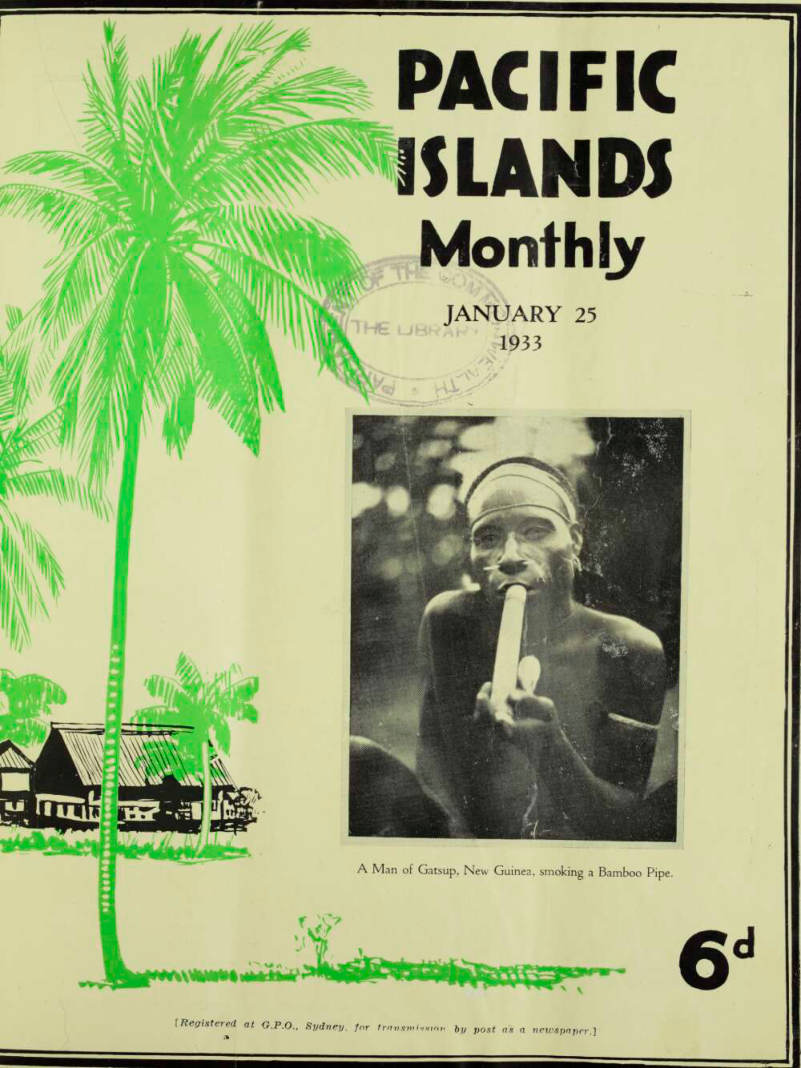
Pacific
ISLANDS
Monthly
JANUARY 25
1933
6 d
[Registered at G.P.O., Sydney, for transmission by post as a newspaper.]
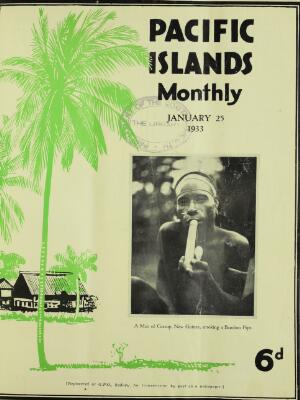
A Man of Gatsup, New Guinea, smoking a Bamboo Pipe.
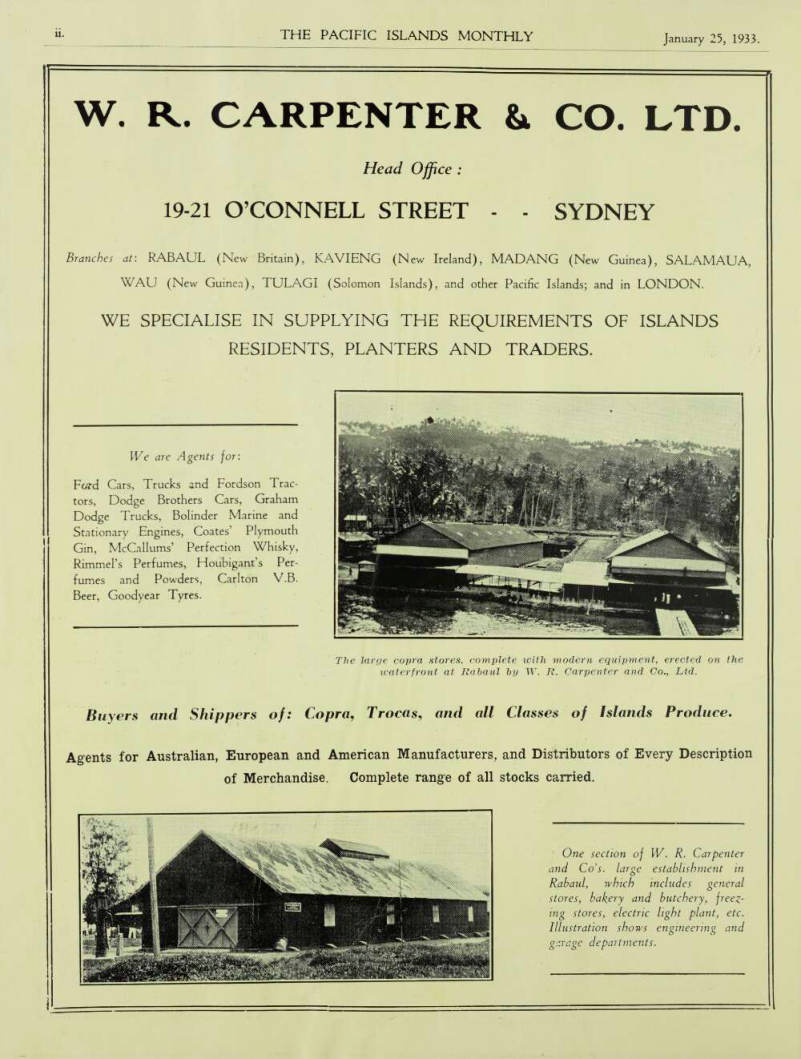
W. R. Carpenter & Co. Ltd
Head Office :
19-21 O’CONNELL STREET - - SYDNEY
Branches at: RABAUL (New Britain), KAVIENG (New Ireland), MADANG (New Guinea), SALAMAUA, WAU (New Guinea), TULAGI (Solomon Islands), and other Pacific Islands; and in LONDON.
WE SPECIALISE IN SUPPLYING THE REQUIREMENTS OF ISLANDS
RESIDENTS, PLANTERS AND TRADERS.
Buyers and Shippers of: Copra , Trocas , and all Classes of Islands Produce.
Agents for Australian, European and American Manufacturers, and Distributors of Every Description of Merchandise. Complete range of all stocks carried.
Gin, McCallums’ Perfection Whisky, Rimmel’s Perfumes, Houbigant’s Per fumes and Powders, Carlton V.B.
Beer, Goodyear Tyres.
We are Agents for: Ford Cars, Trucks and Fordson Trac tors, Dodge Brothers Cars, Graham tors, Dodge Dodge Trucks, Bolinder Marine and Stationary Engines, Coates’ Plymouth The large copra stores , complete with modern equipment, erected on the waterfront at Rabaul by W. R. Carpenter and Go., Ltd.
One section of W. R. Carpenter and Co’s, large establishment in Rabaul, which includes general stores, bakery and butchery, freez ing stores, electric light plant, etc.
Illustration shows engineering and gstrage departments.
Pacific Islands Travellers
Passengers Per “Monterey,” Which
Arrived In Sydney From Suva On
DECEMBER 8: Mrs. G. Alyson, Mrs. Dias Ber nard, Mr. and Mrs. B. Bentley, Mr. Eric Lahey, Mrs. J. E. Martin, Mrs. J. C. Melhuish, Master J. Melhuish, Master A. Melhuish, Mrs. J. C.
Rutter, Mr. A. L. Tabrett, Mr. T. C. J. Teague, Miss Mary Teague, Mrs. Clara Wilkins, Rev. A.
G. Adamson, Mrs. A. G. Adamson, Mrs. M. E.
Cleary, Mr. W. B. Cobham, Miss E. B. Geeves, Mrs. W. Harris, Miss H. Harris, Mrs. C. Hunt, Mr. D. Lees, Rev. and Mrs. A. D. Lelean, Miss Alison Lelean, Master Drew Lelean, Mr. and Mrs. R. L. Lowell, Master R. L. Lowell, Master L. R. Lowell, Mrs. E. R. Messenger, Miss E. M.
Montier, Mrs. E. B. Montgomery, Mr. and Mrs.
Chanda Singh, Master B. Singh, Master C. Singh, Mr. and Mrs. J. P. Tarby, Mr. P. Straube, Mr. and Mrs. W. V. Terry, Miss D. Terry, Master J. Terry, Master D. V. Terry, Master R. Terry, Miss A. M. Uppill, Mr. H. Wheatley, Miss E. M.
Williams.
Passengers Per “Aorangi” For Suva,
Which Sailed From Sydney On Decem
BER 8: Mr. J. H. Harricks, Master M. de St.
C. Howell, Master K. W. Brooks, Rev. Father A. Gonnet, Sister V. McCormack, Sister A.
Liston, Master E. E. Nicolls, Mr. J. J. M.
Clark, Miss B. Fenner, Mr. W. F. White, Mr.
J. Lallu, Mr. and Mrs. J. Narsey, Mr. and Mrs.
M. Jamanadas, Mrs. L. Turbet, Miss C. Turbet, Mrs. A. Hill, Miss M. Hill, Mrs. I. D. Leaps and infant, Master D. Leaps, Mr. W. S. Tideald, Mrs. A. Lanyon, Mr. S. W. Meeks, Mr. G.
Cakobau.
Passengers Per “Mataram” From
Solomon Islands, Arrived At Sydney
ON DECEMBER 30: Mr. S. Boye, Mr. S. Brown, Mr. W. Browning, Mr. J. Donovan, Mr. H.
Downs, Mr. R. Fuller, Rev. J. Goldie, Miss H.
Harris, Major F. Hewitt, Mrs. M. Hicks, Mrs.
M. Hodgess, Mr. S. Kajewski, Mr. W. Lynch, Mr. R. McGregor, Mrs. O. Neil, Mrs. M. Robin son, Mr. G. Rodger, Mrs. L. Ward, Mr. and Mrs.
F. Whitlock, Mr. J. Wilson.
Passengers Per “Macdhui” Sailed
From Sydney December 22 For Papua
AND NEW GUINEA : Rev. Father Fastree, Rev.
Brother Angers, Major H. De Haviland, Mrs. De Haviland, Miss J. Gee, Mrs. A. J. Hunter, Miss E. McMahon, Mrs. H. R. Niall, Miss Rowlands, Mrs. C. Tuckey, Mr. Joubert, Mrs. Joubert, Miss C. Lennon, Miss L. Barbour, Mrs. Wilson, Miss A. Comer, Miss L. Campbell, Miss B. E. Smith, Mr. Clay, Mrs. Clay and child, Mr. A. G. Fuller, Mr. H. Alday, Mrs. Alday, Miss I. C. Littler, Mr. J. Garlick, Mr. de Groen, Mr. C. C. Marr, Mr. W. Angel, Mr. Gordon, Mr. B. W. Faithorn, Mr. W. H. Fitzgibbon, Miss J. Carter, Miss M.
Cocksedge, Miss W. Webb, Mr. J. Bartlett. Mr.
A. D. Thomson, Mrs. Thomson and two children, Mr. Hardie, Mrs. Hardie, Mrs. E. Barkley, Miss J. Carr, Miss D. McArthur, Mrs. L. Austen, Mrs. F. J. Vickery, Captain A. S. Fitch, Mrs.
M. F. Stayte, Miss G. W. Stayte, Miss A. Brew ster, Miss G. Darby, Miss D. Cooke, Mr. J. T.
Berkley, Mrs. Berkley and two children, Miss M.
Rae, Miss J. McGrouther, Mr. B. Platt, Mr. R.
Turnbull, Mr. A. R. Parry, Mrs. Parry, two children and infant, Mrs. Gill, Mrs. Chadderton and two infants, Master K. W. Jones, Mr. N.
W. K. Seeman, Mr. F. Deckert, Mr. A. J. Burns, Mr. R. E. Seale, Master T. Clarke, Mr. Lussick, Mrs. Lussick, three children and infant, Mr. A.
C. Eldridge, Mr. C. R. Ferguson, Mr. A.
Strachan, Mr. L. C. Tindale, Mr. Williams, Mr.
A. C. Berry, Mrs. G. Clay and two children, Mr.
H. T. Wyatt, Mr. G. A. Hately, Mr. L. F.
Ferris, Mr. W. G. Johnson, Mr. Moore, Mrs.
Moore and infant, Mr. W. A. Aitkenhead, Mr, H. J. W. Farr, Mr. J. Wilson, Mr. C. R. King, Mr. A. J. Bell, Mr. E. Beaney, Mr. F. Evans, Miss Barnetson, Mr. J. G. Hides, Mr. R. F.
Barwick, Mr. E. P. Lee, Mr. A. W. Lind, Miss H. Campbell.
Passengers Arrived At Sydney By
“Montoro” From New Guinea And
PAPUA ON JANUARY 5: Mr. and Mrs. A. W.
Mack, Miss L. Maguire, Miss E. Standish, Mr.
W. G. Higgs, Miss L. M. Wendt, Mr. D. G.
Barrett, Mr. A. J. Hunter, Mr. F. W. Phipps, Mr. C. Gatenby, Mr. and Mrs. T. Underwood and two children, Mr. and Mrs. E. A. Cox, Mr. A. F. Dickson, Mr. and Mrs. C. Helton, Mrs. R. Hyde, Mrs. G. Bowen-Jones, Mr. E. C.
Kelly, Mr. U. Lynch, Mr. W. J. Paton, Mr.
M. Shillito, Mrs. M. T. Smith and infant, Mr.
W. Kemp, Mr. A. G. Kemp, Miss N. Beckett, Mr. G. Braddon, Rev. and Mrs. W. Cox, Mrs.
J. M. Dowsett and two children, Mr. C. W.
Hams, Mrs. N. Hutchinson, Miss M. E. Margrie, Mr. B. C. McDonald, Master A. C. Smith, Mrs.
J. Walstab, Mr. E. A. Baker, Mr. and Mrs.
R. Burt and three children, Mr. A. H. Cut lack, Miss M. E. Foreman, Miss E. Froomes, Miss N. Inman, Mr. and Mrs. G. Kingscote, Miss L. F. Lashmar, Mr. and Mrs. E. Wilson, Mr. L. W. Bergstrand, Mrs. E. B. Bignold and child, Mrs. K. Broadfoot, Mr. J. Downs, Mr. H. J. Mans, Miss P. R. Osborne, Mrs. T. L.
Sefton and two children, Mr. I. G. Spychiger, Mrs. S. A. Rowney, Mrs. A. W. Turner.
Passengers Per “Niagara,” Which
Sailed From Sydney For Suva On
JANUARY 5: Mr. G. Mitchell. Mr. D. W.
Robertson, Mr. R. Watson, Mr. W. D. Kerrigan, Mr. A. W. Sandford, Miss E. C. Quinn, Mr. J.
Wallis Sandford, Mr. and Mrs. H. Sabben, Mrs.
D. W. Richardson, Mr. J. Harper, Mrs. E.
Stevens, Miss R. Stevens, Mr. V. McKenna, Mr.
F. McKenna, Miss V. Guinery, Mr. F. E. Trotter, Mr. R. Kelly, Mr. J. Maxwell, Mr. J. Poole.
Passengers Per “Mariposa,” Which
Arrived In Sydney From Suva On
JANUARY 6: Mr. and Mrs. F. Apted, Mr. and Mrs. A. L. Bayley, Mr. J. Campbell, Miss A. M.
Clements, Miss M. J. Corrigan, Miss A. K.
Cowie, Miss M. Cummings, Mrs. B. Frith, Miss P. Goldman, Mr. C. F. Grahame, Miss M. Green slade, Mr. and Mrs. F. Hart, Mr. J. Hepburn, Mr. T. Hughes, Mr. C. W. James, Miss N.
Lawrence, Mr. D. Leach, Miss N. Leslie, Mr. and Mrs. J. L. Madigan, Master T. W. Madigan, Master J. W. Madigan, Miss F. M. Manwaring, Miss J. McKenzie, Miss G. Mentiplay Mrs. A. C.
Miller, Mr. and Mrs. E. A. Nettleford, Mrs.
C. M. Nicholson, Miss N. M. Nicholson, Master G. H. Nicholson, Mrs. H. A. Norris, Miss J.
Norris, Mrs. G. O’Callaghan, Mr. and Mrs.
P. B. A. Parsons, Mr. and Mrs. R. W. Plaisted, Master J. Plaisted, Miss M. Plaisted, Miss A.
Plaisted, Miss B. Plaisted, Miss I. Rodan, Miss F. E. Saunders, Miss M. Saunders, Mrs. A. B.
Snodgrass, Miss M. Snodgrass, Master J.
Snodgrass, Master X. Snodgrass, Miss M.
Surtees, Mrs. S. V. Stutt. Master J. D.
Stutt, Master W. J. Stutt, Mrs. A. B.
Bond, Miss B. Bond, Master A. Bond, Mr. and Mrs. P. Boyd, Miss M. Boyd, Master R. Boyd, Mr. Chee Long, Mr. and Mrs. R. C. Whittaker, Mr. I. K. Whittaker, Miss S. M. Whittaker, Miss M. E. Whittaker, Mr. A. Wilson, Miss J. Wilson, Mr, C. H. Young, Mrs. G. A. Young,
Master R. Young, Rev. E. R. Elder, Mrs. P.
Watson, Mr. R. G. Smith, Mr. and Mrs. H.
Gault, Mr. and Mrs. A. J. Hathaway, Mr. and Mrs. G. I. Hathaway, Miss E. J. Hathaway, Miss C. McDonald, Sister R. McGuinness, Mr.
L. McHugh, Mr. D. Polglase, Mr. W. Sawyer, Mr. and Mrs. C. E. Sharp, Miss F. A. Sharp, Mr. and Mrs. A. Valentine, Miss M. Wangmann.
Passengers Per ‘Tanda,” Which
Arrived In Sydney From Rabaul On
DECEMBER 21: Mr. E. K. Abrahams, Mr. T.
Pryke, Mrs. T. Pryke, Mr. P. Benny, Mr. E.
Gaude, Miss G. Sayce.
Passengers Per ”Mariposa” For
Suva, Sailed From Sydney On January
14: Mr. and Mrs. A. Aarons, Miss D. Aarons, Miss N. Aarons, Mr. L. Aarons, Miss R.
Andrews, Mrs. L. Anderson, Mrs. L. Arnold, Miss H. Baker, Mr. A. E. Beddows, Rev. O.
Brady, Mr. and Mrs. W. Brewer, Miss M.
Brewer, Miss D. Browne, Miss E. E. Coulter, Judge and Mrs. J. P. Dwyer. Mr. G. Fulton, Miss S. M. Greenaway, Mrs. F. Hannah, Mr.
F. R. Hewitt, Mr. W. T, Higgins. Mr. H.
Humphreys, Mr. A. Isaacson, Mr. E. A. James, Mrs. B. S. Jones, Master D. Jones, Mr. T. S.
Louch, Mr. L. E. Lesser, Mrs. McQue, Miss E.
Meeking, Mr. R. D. B. Mitchell, Mrs. S. Pem berton, Mr. and Mrs. N. Robinson, Mr. G. M.
Purbrick, Mrs. D. Purbrick, Miss E. Thomas, Mr. and Mrs. H. Reeve, Mrs. V. A. Ricker, Miss J. Robinson, Master W. Robinson, Mr. and Mrs. J. A. Ryan, Rev. H. Ryan, Mr. J. A. G.
Ryrie, Mrs. A. J. Scobie, Mr. and Mrs. F. H.
Selby, Mrs. A. B. Snodgrass, Master J. Snod grass, Master N. Snodgrass, Miss M. Snodgrass, Mr. O. W. Stevenson, Mr. A. J. Tabrett, Mr.
A. L. Tabrett, Mr. and Mrs. R. R. Thomas, Miss A. E. Thomas, Miss M. K. Thomas, Rev.
E. Thornton, Miss V. Wiles, Miss G. William son, Miss M. Williamson, Miss I. Foulcher, Mr.
H. Hughes, Mr. G. Hunt, Mr. G. Jessop, Mr.
W. Macgraw, Mr. E. Robinson, Mr. F. Sing, Mrs. A. Thomas, Mr. and Mrs. W. Thompson, Master D. J. Thompson.
Passengers Per "Morinda” From New
Hebrides. Norfolk Island And Lord
Howe Island, Who Arrived In Sydney
ON JANUARY 16: Miss M, Carnell, Mr. F. W.
Glover, Mr. H. Moon, Mr. B. J. Tollis. Mr. A. W.
Jones, Mr. G. J. Reed, Mr. G. Tapper, Mr.
F. J. Fleming, Miss D. Fleming, Mr. and Mrs.
R. D. Blandy, Mr. and Mrs. H. Fores, Mr.
R. E. Thomas, Mr. A. H. Buckland, Rev. T.
Macmillan, Mrs. M. S. Robertson, Mrs. B.
Baldwin, Mr. and Mrs. J. Croger and infant, Miss M. Carroll, Miss F. C. Crossman, Miss D. Dethlefs, Miss G. Dixon, Mr. A. F. Edwards, Miss C. B. Farrell, Miss E. B. Hale, Mr. and Mrs. W. T. Hyder, Hon. W. A. Holman, Miss E. Haworth, Mr. J. P. Jones, Mr. and Mrs.
(Continued on page 8.)
A. V. Lanes, Miss Jones, Mrs. E. Kane, Miss R. B. Latter, Mr. A. B. Lanes, Mr. A. H.
Lanes, lieut. J. S. Mesley, Miss R. Morgan, Miss M. M. Olsson, Miss E. Prescott, Mrs.
R. F. Pearson and child, Mr. E. C. Robinson, Mr. H. J. Rumsey, Mr. C. Rossiter, Mr. J.
Sandes, Mr. and Mrs. A. B. Sandes, Miss J.
Storey, Lieut. O. J. Stephenson, Mr, and Mrs.
W. H. Sanders and infant, Mr. T. Yager, Mr.
F. J. Brown, Mrs. F. J. Brown, Mr. and Mrs.
J. E. Creer, Mr. and Mrs. J. N. Creer and infant, Mrs. A. Creer, Miss J. Clarke, Mr. and Mrs. J, Clarke and infant, Miss W. Durle, Mr. F. Davis, Mr. S. Fenton, Mr. and Mrs.
R. Fulton and infant, Miss F. Furguson, Mr.
H. Frame, Mr. A. A. Griffiths, Mr. M. Gold stein, Miss N. Herald, Miss M. B. Henson, Misses R. and M. Herlihy, Mr. F. Hutchens, Mr. J. Kitching, Miss L. Knox, Mr. and Mrs.
A. Livingstone, Miss M. Lyons, Mr. and Mrs.
J. Lyons, Miss E. McDonald, Miss M. Mackey, Mr. A. Mackillop, Mr. J. Murphy, Mr. H.
Murphy, Mr. and Mrs. T. P. Monaghan, Mr.
M. Nicholls, Miss I. Patrick, Miss C. B. Procter, Mrs. R. Rhodes, Miss J. Ross, Miss M. Simon sens, Mr. and Mrs. H. L. Shean, Mr. A. H.
Stevens, Mr. B. Troughton, Miss E. Thompson, Miss J. White, Mr. J. Wilson.
Passengers Per “Montoro" Which
Sailed From Sydney For Papua And
NEW GUINEA ON JANUARY 12; Mr. O. Denny, Mrs, Denny and two children, Mr. T. Pearson, Mrs. Pearson and two children, Mr. A. Newton, Mrs. Newton, Mr. F. T. Lane, Mrs. Lane, Mrs.
R. H. Hyde and two children, Miss I. Solomon, Mrs. R. J. Cunningham, Mrs. G. E. E. Davies and two infants, Mr. A. L. Clarke, Mr. J. W.
Hincks, Mr. N. G. Wilson, Mrs. I. M. Horan and infant. Miss S. M. Ayre, Miss E. L. Slade, Mrs. A. Zelman, Mr. E. Gollet, Mr. C. Byrne, Mr. C. Mackellar, Mr. J. Scobie, Mr. C. Lane, Master G. Holmes, Dr. A. Gilroy, Mrs. Gilroy, Mr. W. Phelps, Mrs. Phelps, Mr. F. J. Giles, Mrs. Giles, child and infant, Mr. A. Eglington, Mr. F. Headon, Mr. W. G. Weideman, Mr. W.
Elworthy, Mr. D. McDonald, Mr. W. C. Abbie, Sister M. Annette, Mr. Atkins, Mrs. Atkins, Mr.
F. J. Deckert, Mr. W. E. Allen, Mr. N. R.
Wilde, Mrs. Wilde, Mr. E. J. Frame, Rev. H.
S. Cocks, Mr. Storey, Mr. Farnham, Mr. C.
Poland, Mr. J. Tinnion, Mr. R. Ely, Mr. B.
Lang, Mr. G. Moen, Master Jones, Mr. J. H.
Sutton, Mr. L. N. Tribolet, Mr. R. C. Chugg, Mr. H. B. Carver, Miss Handley, Mr. J. Ireland, Miss Savage, Miss Barker, Miss Wright, Mr. S.
A. Savage, Mr. A. B. Macdonald.
Passengers Per “Mataram," Which
Sailed From Sydney On January 11
FOR SOLOMON ISLANDS : Mr. K. Bolton, Mr.
G. W. Campbell, Miss E. Wigg, Miss K. Shannon, Mr. du Faur, Mr. W. Oliver, Mrs. Symes, Master Symes, Mr. J. Darlington, Mr. Grant Smith, Mr.
R. Johnson, Mr. J. C. West, Mr. T. Wilson, Mr.
J. V. Mather, Mr. Mitchell, Mrs. Mitchell, Mr.
Lojtze, Mrs. Lotze and infant, Mrs. F. E. John ston, Mr. A. P. Penman, Mrs. W. Johnson, Miss E. Johnson, Miss H. Crawford, Dr. Hogbin, Mr.
R. P. Creaghe, Mr. Isaacs, Mr. G. E. Poole, Miss K. Buckley, Mr. W. H. R. Stitt, Mrs. Stitt, Mr. T. B. Donald, the Rt. Rev. Bishop Baddeley, Mr. B. M. Clark, Miss P. Beattie, Rev. R. E.
Tempest, Mrs. Wilson, Miss Wilson, Mr. W. E.
Gundry, Mr. J. Sellers, Mr. H. W. Sellers, Miss F. Fraser, Mr. D. Luttrell, Mr. T. Yeomans.
Passengers Per “Morinda" Which
Sailed From Sydney For Norfolk
Island, Auckland, And New Hebrides
ON JANUARY 19: The Hon. F. A. Chaffey, Mrs.
Chaffey, Miss Lane-Poole, Mrs M. A. Rankin, Mrs.
M. Forbes, Mrs. L. Anderson, Mrs. A. Forrest, Miss E. A. Buffett, Mrs. E. N. Smith, Mr. F. J.
Hyde, Mr. I. Tidier, Mr. C. A. Bourke, Mr.
T. O. Mulhearn, Mrs. T. A. Lawrie, Miss Lawrie, Mr. W. P. Whitford, Mrs. W. Maher, Mr. C. E.
Lane-Poole, Mr. Breusch, Mr. Wilson, Mr. W.
Inskip, Mr. A. Wilson, Mr. C, Sadler, Mr. F.
Skinner, Mr. A. H. K. Weir.
Advertisements & other items, p. 3 (1 item)
REGULAR BI-MONTHLY Freight and Passenger Service
by the fast and modern K.P.M. Steamer VAN REES as under:
SAIGON
BATAVIA
SAMARANG
PORT MORESBY
SAMARAI
RABAUL
PORT VILA
NOUMEA
ROYAL PACKET Sydney
PORT MORESBY
NAVIGATION CO., batavia
Saloon and Intermediate class passengers carried in comfortable and airy cabins.
Cargo for Africa accepted for transhipment at Batavia.
255 GEORGE STREET, SYDNEY
SAIGON
The B.N.G. Trading Coy., Ltd., Port Moresby; Steamship Trading Co., Samarai; W. R.
Carpenter & Co., Ltd., Rabaul; Gubbay Freres, Port Vita; Carlo Leoni, Noumea; Diethelm & Co., Saigon.
Advertisers.
Page Adams. W., Ltd. .. 39 Amal. Wireless ... 47 Antinea Drug Co. .. 16 Armstrong, R. H., & Co 21 Arnott’s Biscuits .. 25 Bank of N.S.W. .. 29 Barnes. James, Ltd. 37 Barraclough, H. A. . 31 Birth Notice 24 Bourjois et Cie 27 Brandts. Ltd. 46 Brunton s Flour ... 31 Burns, Philp & Co. 2 Burns, Philp (S.S.) Co. 21 B.P. Magazine ... 30 Carpenter, W. R.
Cover ii.
Com. P'land Cement. 32 Couch, J. H 22 Delicia Food Co. ... 39 Docker’s Paints ... 23 Dowsett. J. H. M. . 15 Elliott. T.. & Co. . 28 Excelsior Supply Co. 20 Fletcher & Sons ... 44 Franklin (Minimax). 17 Garrett & Davidson. 44 Gibson, Battle & Co. 18 Gillespie's Flour ... 17 Gourock Co 23 Grahame. C 12 Guinea Airways cov iii Hale, Alex., Ltd. .. 25 Hall & Co 36 Halvorsen, L 42 Holbrooks, Ltd. . 41 Hylands, Ltd 37
Page.
Joyce Biscuits 35 Kodak 15 Kopsen & Co. 26 Lysaght, John, Ltd.. 38 Mcllwrath’s, Ltd. .. 45 McLeod, Bolton 35 Nelson & Robertson. 43 N.I. Book Club ... 2 4 Nolan, Spencer 17 Parke, Davis 41 Peadon, J. L., Ltd.. 28 Pearson s Soap Co. . 23 Petty's Hotel 21 Piggott, C. G. 24 Prescott, Ltd. 40 Rabaul Carr'g. Co. 43 Rohu, Sil 32 Royal Gold Exchange 24 Royal Packet N. Co. 1 Russell. S 17 Ruston & Hornsby . 33 Shell Oil Co 13 Smyth, J. H 47 Steamships T. Co., Ltd. 48 Sullivan, Ltd 36 Sunshine Harvester Co 40 Tillock & Co., Ltd.. 28 Tooth & Co. Cover iv.
Vacuum Oil Co 19 Vincent Chem. Co. . 22 Walker, F. J., Ltd.. 14 Wills, W. D. & H. O. 12 Westcott, Hazel 18 Wimbledon Tennis Co 36 Wunderlich, Ltd. ... 34
Contents.
Page.
Pacific Islands Travellers 1, 8 Currency Muddle in Fiji 3, 4 ‘B” Mandate for Samoa? 5 Death of Pere Rougier 5 Unilever, Ltd., and Copra Industry 6 New Guinea Moratorium 6 Tonga’s Trilithon 7 Tropicalities 8 About Islands People 10 N.G. Criminal Code 11 B.S.I. Police Force 12 Early Pt. Moresby 15 Tahiti’s Trade 16 Fighting Malaria in N. Guinea ... 17 Solomon Is. Finances 18, 20 Cook Is, News 21,35 Depopulation in Papua 22 New Hebrides Tariff 23
Page.
Castor Oil Seed Cultivation 24 Thursday Is. Notes 26 Report of Bulolo Co 27 Filming Papua 28 Fiji Bananas 29 Story of “Southern Cross” Wreck . . 30 Book Reviews 31 “Carinthia’s” Tour 33 Papuan News 34 Samoan News 36 Norfolk Is. Notes 37,39 Tahiti News 40 Papuan Rubber 42 N.G. and Papuan Gold Sharemarket 44 Market Quotations 45 Exchange Quotations 46 Shipping Services 47, 48
Advertisements & other items, p. 4 (1 item)
Burns, Philp & Co. Ltd.
TO BE PUBLISHED SHORTLY!
HANDBOOK OF NEW GUINEA, PAPUA. SOLOMON ISLANDS AND NORFOLK ISLAND, Containing Complete Details and Latest Statistical Information about those Territories, and also Lists of Business Firms and European Residents. Ready about end of January.
PRICE, 2/6.
PACIFIC PUBLICATIONS LTD.
UNION HOUSE, 247 George St.,
SYDNEY AUSTRALIA.
BURNS, PHILP & CO. LTD.
General Merchants,
Shipowners,
Tourist Agents, Etc.
Buyers of all Classes
of Island Produce
Head Office - 7 Bridge Street, Sydney - Australia Code Address : “BURPHIL”
Regular Steamer Services From Australia to New Guinea, Papua, Solomons, Lord Howe, Norfolk Islands, New Hebrides, Java and Singapore
The Pacific Islands Monthly
THE NEWSPAPER - MAGAZINE OF THE SOUTH SEAS [Registered at G.P.O., Sydney, for transmission by post as a newspaper.]
Published Once Each Month and Circulated in Australia and New Zealand and in the following Pacific Territories and Island Groups:
Crown Colony of Fiji.
Australian Territory of Papua.
Mandated Territory (Australia) of New Guinea, Bismarck Archipelago, and Northern Solo mon Islands.
Mandated Territory (Japan) of Marshall, Caro line and Mariana Islands.
American Territory of Guam.
Mandated Territory of Nauru.
British Crown Colony of Gilbert and Ellice Islands.
French Territory of New Caledonia.
British and French Condominium of New Hebrides.
American Territory of Eastern Samoa.
Mandated Territory (New Zealand) of Samoa British Solomon Islands Protectorate.
British Protectorate of Tongan Islands New Zealand Territory of Cook Islands Australian Territory of Norfolk Island.
French Colony of Oceania (Tahiti, etc.) American Territory of Hawaiian Islands.
Owned and Produced by Pacific Publications Ltd., Union House, 247 George Street, Sydney
Telephone Bw 5037
P.O. Box 3408 R
Contributions
Articles, Stories and Photographs dealing with Pacific Islands Subjects are invited, and will be paid for on publication at usual rates.
Subscription Rates
Per Annum, within Postal Convention Territories, Prepaid, Post Free 6/- Per Annum elsewhere. Prepaid, Post Free 87- Single Copies 6d.
Editor and Publisher:
R. W. Robson.
Advertisements
Advertising rates furnished on application.
Colours, etc. by Arrangement Process Blocks made at Advertiser’s expense when required. Screen, 100.
Changes of Advertising Copy should reach this Office by Bth of each month, otherwise previous advertisement may be repeated.
Registered Address for Radiograms and Cables: “PACPUB” Sydney
Agents
The following are authorised to receive sub scriptions for The Pacific Islands Monthly — Islands Branches of Burns. Philp & Co., Ltd., and Burns, Philp (South Seas) Co., Ltd.
Islands Branches of W. R. Carpenter & Co., Ltd.
All Branches of Morris, Hedstrom & Co., Ltd.
J. H. MacGregor Dowsett, Rabaul.
Whitten Bros., Ltd., Port Moresby & Samarai.
All Branches and Representatives of W. H.
Grove & Sons, Ltd., Auckland. 9. Russell, Papeete. Tahiti.
Cook Islands Trading Co., Rarotonga.
Mrs. M. Campbell, Cascades, Norfolk Island.
Vol. 111. No. 6.
Sydney, January 25, 1933.
Price 6d- Per Copy, Prepaid: 6/- p.a.
Extraordinary Currency Muddle in Fiji
F'XCHANGE difficulties have created an extraordinary currency muddle in Fiji.
For a reason that is not clear, the Fiji Government in December tied its cur rency to the New Zealand currency. The New Zealand exchange has now gone to 25 per cent, under sterling—which is the same as the Australian exchange.
The net result of it all is that the Fiji currency had either to follow New Zealand exchange and be valued 25 per cent, under sterling—which appears absurd, in view of the fact that Fiji probably is the richest territory in the Empire or else the new New Zealand connection had to be broken, the exchange loss on the N.Z. notes on hand paid, and Fiji currency again based on sterling.
In any event, there is certain to be a gorgeous row at the next meeting of the Fiji Legislative Council, for the non-official members warned the Government of what was likely to happen.
LATER: Fiji exchange has been fixed at 25 per cent.
THE recent history of Fiji currency de velopments makes remarkable read ing.
For currency, Fiji uses notes supplied by the two banks trading there (New South Wales and New Zealand). British silver and copper coins are also legal tender, just as they are in New Zealand.
Australian coins were also freely circu lated while exchange was normal, but they naturally are out of favour now.
The issue of Fiji notes is con trolled by the Fiji Currency Commis sioners, whose authority is derived from the Currency Notes Ordinance (No. 9 of 1913). They may issue notes to the Banks, or similar institutions, in return for gold coin, or, in some special cases, for silver coin. This system was fol lowed satisfactorily for many years. The Fiji Government held the gold against the issue, of notes.
When Britain went off the gold stand ard, and gold became scarce, the system was varied. The Currency Commissioners issued the notes against a small propor tion of gold, the balance being made up by the bank concerned giving the Com missioners (or Treasury) a sterling draft on London.
This system proved highly profitable to the Fiji Government. The Governor, in a speech on June 30, 1932, said that, by accepting sterling drafts on London in return for Fiji notes, the Government had established in London an invest ment fund of £349,000. As the differ ence between the London and Fiji £ was 10 per cent., this fund in Fiji money was worth £383,000. It was earning in interest, for Fiji, between £20,000 and £ 30,000 per annum. The gold received and held by the Fiji Government in con nection with notes issue was 83,000 sov
ereigns—worth nominally £ 83,000 as paid in in return for notes, but worth actually, if converted into Fiji currency values, about £ 40,000 more.
Everything went along happily until the beginning of December last. Then two things happened simultaneously.
The Colony is harvesting a record sugar crop, and the banks calculated they would need at least £50,000 more Fiji currency (notes) in order to finance it.
They had only a small amount of gold, so they prepared to employ the usual method —to hand over to the Fiji Cur rency Commissioners all the gold they could spare, and the balance in a sterl ing draft on London.
At the same time, the Commissioners discovered they had no legal authority to accept, in return for their notes, any thing except gold. They could not accept any more sterling drafts. If there was no gold, there could be no more notes issued.
When the banks were informed of this, there was great dismay—almost a panic. It looked as if Fiji, richer in pri mary production than at any time for years past, would be actually ruined be cause of the lack of a medium by which the producers could be paid, during the time the crop was being assembled, transported and marketed.
The banks urgently consulted with the two leading non-official members of the Legislative Council —Sir Henry Scott and Sir Maynard Hedstrom. The latter recognised the truly alarming nature of
the development. There was a series of conferences with the Government, and a long cablegram was sent to the Colonial Office.
The procedure needed seemed simple enough—to pass a law to give the Cur rency Commissioners legal authority to accept sterling drafts instead of gold.
The non-official members urgently re commended this.
But when the Legislative Council was called together on December 13, to amend the Currency Notes Ordinance, it was disclosed that the Colonial Office was not in favour of such a procedure.
References were made by the Acting- Governor to a mysterious message, of a highly confidential character; and all that could be said was that the accept ance of sterling drafts was not desir able.
The alternative presented to the Coun cil was that, for a period of six months from December 13, the Currency Com missioners be allowed to accept New Zealand currency notes, or bankers’ drafts on New Zealand, instead of gold, in return for Fiji Treasury notes.
The Council finally agreed to this alteration of the law, but only under strong protest from non-official mem bers Sir Maynard Hedstrom, Sir Henry Scott and Mr. Alport Barker. These three men could not see why Fiji should tie itself up to New Zealand currency, instead of to sterling. It was true that the New Zealand exchange, in relation to sterling was exactly the same as that of Fiji, but New Zealand might decide, at any time, to inflate its exchange, and then Fiji finance would be in a deplor able position.
The Ordinance was also amended to clear the Currency Commissioners from any blame due to the fact that, for some time, they had been accepting sterling drafts on London instead of gold.
The new law operated immediately: and it may be assumed that Fiji is now holding about £50,000 worth of New Zealand currency.
On Friday, January 20, it was an nounced that the New Zealand banks, under pressure from the N.Z. Govern ment, had inflated the New Zealand ex change on sterling from about 10 per cent, to 25 per cent, which is equal to the Australian rate. Fiji must now either bring its own exchange rate on sterling into line with New Zealand, or else face the loss of 15 per cent, on approximately £50,000 worth of N.Z. currency.
It will be most interesting to see what Fiji does. It is a country which exports primary produce, and imports all neces sary manufactured goods, and much of its food. It sells mostly to countries on or near the gold standard (sugar to Canada and copra to U.S.A. and Europe) so that adherence to N.Z. ex change must greatly benefit its pro ducers. It has considerable London in vestments, and the inflated exchange would increase the income from that source. It has no oversea debts; and it could buy most of its imports from Australia and New Zealand, where it would pay no exchange penalty.
It does seem absurd that the Fiji £ should be 25 per cent, under sterling, and about 45 per cent, under gold; be cause, as we have repeatedly pointed out, both the internal and external fin ance of this Crown Colony is so strong that its currency should be on gold. But if, by a curious combination of circum stances, Fiji were allowed to remain in the New Zealand-Australian exchange bloc, it may be a good thing for the Fiji primary producer.
Incidentally, it will provide the oppor tunity of the century for the investor in command of sterling or gold.—R.W.R.
Apia Port Dues.
Is N.Z. Flirting With Matson?
From Our Own Correspondent.
THE negotiations to include Apia as a port of call for the Matson line have resulted in the Administration agree ing to a considerable reduction of har bour and pilot fees in case of such calls being arranged.
As the present agreement of the Mat son Line with the U.S.A. Government, which provides for a substantial subsidy to the Line for their calls at the U.S.
Naval Station at Pago Pago expires next April, the matter will be taken up energetically at the proper time by the interested parties.
A call by direct liners at Apia would greatly benefit Western Samoa and im prove the mail, passenger and freight communications with Australia, New Zealand, Fiji, U.S.A. and Europe. It would also revive the tourist traffic and put Samoa again on the map.
EDITORIAL NOTE.—It is most surprising to learn that the New Zealand Government is en couraging the Matson Line to call at Apia, and take business away from British ships. It is true that Western Samoa’s shipping communica tion with Fiji, New Zealand and Australia are most unsatisfactory, and should be improved.
But surely the approach should be made to the Canadian-Pacific Line, whose regular mail steamers could easily call at Apia; and not to the Matson Line , which, most liberally subsidised and supported by the American Government, is conducting a merciless war against British ship ping in the South Pacific.
Mrs. R. R. Kane.
Death in Sydney.
IT is with regret that we announce the death on December 29 of Mrs.
R. R. Kane, wife of Captain Kane, a former Resident Commissioner of the British Solomon Islands, and niece of the late Sir John Thurston, ex-Governor of Fiji.
The late Mrs. Kane, who had suffered a long and painful illness, had been liv ing for some years at North Sydney, where her three sons had attended the Church of England Grammar School.
She was formerly very well known in Fiji, where she spent her youth and where she met and married Captain Kane. Mrs. Leembruggen, of Ocean Island, is a sister, and Mr. H. Thurston, of Suva, a brother. Captain Kane is at present in Ireland, and her three sons are now resident in Sydney.
Correct Address for Wau.
The Chief Postmaster of New Guinea has asked us to announce to those who take delivery of their mail at Wau Post Office that delivery will be facilitated if they advise their correspondents to address mail to “Wau, New Guinea.”
The use of the address “Wau, via Sala maua,” is likely to cause belated delivery.
Fiji Gold Find.
Rich Formation Discovered on Viti Levu.
MINING men who have seen samples of a gold find about seven miles from Tavua on the coast of Viti Levu, Fiji, are impressed with the pos sibilities of the field.
The find was made by Mr. W. Borth wick, who has been prospecting on be half of Mr. Patrick Costello, and at the latest report the lode has been un covered to the extent of 200 feet by 700. “It is too large to be true,” said Mr. Costello in an interview. ‘The samples show gold as if sprinkled on with a pepper pot all over the stone.”
The outcrop is of rotten felspar and quartz and samples are said to show at least six ounces to the ton. The only work done so far has been trench ing to open up the formation.
There is no reason for a rush, as owing to the peculiar mining laws of Fiji, the area will have to be declared a goldfield before prospectors will be allowed to peg a claim.
Sugar In Papua.
New Co. to Begin Planting.
From Our Own Correspondent .
PT. MORESBY, December 28.
Representatives of sound New Zealand interests have registered a company in Papua to undertake sugar cane cultivation. Land has been taken up near Collingwood Bay in the North Eastern Division, and prelimin ary work has commenced.
Prospects of the sugar industry are perhaps more promising than those of any other in the Territory. Sugar cane is indigenous to New Guinea, the best cane in Queensland having come from Papua. The gardens of the Papuans with their luxuriant growth of cane impress on one the possibilities of scientific cultivation. Soil, climate, rainfall and labour are all suitable, and Papuan planters with the encourage ment of the Papuan Government should be able to compete successfully with other sugar growing countries —even if Papua cannot get for its sugar the special preference given by Britain to sugar from “Crown Colonies.”
European Vegetables.
Successfully Grown Near Rabaul.
IN many native gardens in the Rabaul- Kokapo district of New Guinea, European vegetables and rice are being grown successfully.
An area of about 40 acres between the two peaks of the Mother, which is watered by a spring, produces potatoes which find a ready sale in Rabaul.
The Department of Agriculture is devoting much attention to these gardens, and luluais are receiving in struction in the cultivation and rotation of crops.
Papua’S Gold.
Rich Discovery Reported.
REPORTS of another rich gold discov ery in Papua were brought to Syd ney by Mr. H. M. Cutlack and Mr.
E. A. Baker, who arrived by the “Mon toro” on January 5.
Acting on rumours of gold in Eastern Papua. Messr. Cutlack and Baker led an expedition into the interior of the main land about 120 miles from Samarai. After an arduous journey through country in which they crossed mountainous ranges and traversed jungles they made the strike.
Mr. Cutlack considers that the dis covery is even more important than that at Edie Creek. The gold is associated with platinum and, while an accurate as say has not jet been made, Mr. Baker, who is a practical miner, believes it to be 90 per cent, pure and grading about 22 carat.
The interests represented by the ex pedition are prepared to start work al most immediately, a large area having been pegged out.
From the account of the prospecting party, much development work will be necessary before the field is in produc tion, as it is completely shut in by rough country. The party met hostile natives but Mr. Cutlack, who has a knowledge of medicine, was able to win their confi dence by treating two sick natives. One of the bearers died of pneumonia on the journey.
Nothing yet has been made public to show the exact location of the new field.
Radio In Samoa.
RADIO is increasingly popular in Samoa. During the year ended last March, 30 listeners-in were licensed in the Territory.
The broadcasting station at Apia, which formerly was privately owned, has now been taken over by a syndicate.
Net receipts on radio-telegraphic busi ness during the same period amounted to £2,463, the number of messages handled being 11,642. The four out-sta tions and one in the Union Group have also given satisfactory service and, though the charges are only 2d. per word, they are self-supporting.
“Permititis!’
Strange Annual Epidemic In Rarotonga.
From Our Own Correspondent
Rarotonga, Jan. 1.
Numerous cases of sickness—technical rather than medical —appeared amongst white people here during the week or two preceding Christmas.
The Cook Group is a “dry” territory but the doctor has power to prescribe suitable liquid treatment for “general health purposes.” It is believed that many cases of Europeans being off colour with the painful symptom of dry ness about the throat (difficult to shake off) have occurred during December.
The outbreak has now subsided. A few odd cases of this complaint, “permi titis,” will possibly occur again during the year.
For Western Samoa?
WHY NOT “B” INSTEAD OF “C” MANDATE
Interesting Suggestion for Settling Thorny Problem.
THE following is a most interesting extract from a letter received by the editor from a gentleman now resident in the middle of Africa —a widely-travelled man who has made a special study of the administrative problems connected with League of Nations Mandates: “The Samoan trouble seems to be never-ending, and I think the one and only solution is that the terms of the mandate be altered. . . .
“I have been at Geneva; and I cer tainly did not get the impression that those sitting around that table had any other interest, beyond drawing their fat salaries. As far as the future of the Mandated Races was concerned, they just didn’t care. It was just one of the after-war farces, and it was difficult to understand why they were and are allowed to carry on.
“What I mean regarding the altera tion of the terms of the Mandate is this: There are three classes of Man dates, A, B, and C. It is hardly possible to rank Samoa under A; but to me— and I have had a life-long connection with native races—it seems nothing short of a tragedy to classify the Samoan in the same category as the
New Guinea boy (C mandate), and that is what their Mandate calls for.
“If proper representations were made to the Governments concerned, and the class of Mandate altered from C to B, then the Samoans would have, as their right, exactly what they are fighting for now, and it would also raise that awful stigma which the Treaty has placed on them, and that is that, ac cording to the ruling of the World Court, they are on no higher level of civilisation than the most backward races of mankind —whereas they have a civilisation almost as long as most of the European countries.
“It is several years since they cele brated their missionary centenary, and even the English people cannot go back much further in religious matters, as freely as they do.
“Of course, as you say, there is a lot of pigheadedness on both sides, and no doubt a little wise talking would have lifted this awful feeling of mis trust. But, in my opinion, the one and only way to settle the argument is to give the Samoan race, by law, the right to eventually govern themselves, and place them on the same footing as their sister country, Tonga.”
Father Rougier.
Death In Tahiti Ends
Picturesque Career.
From Our Own Correspondent
Papeete, Dec. 30.
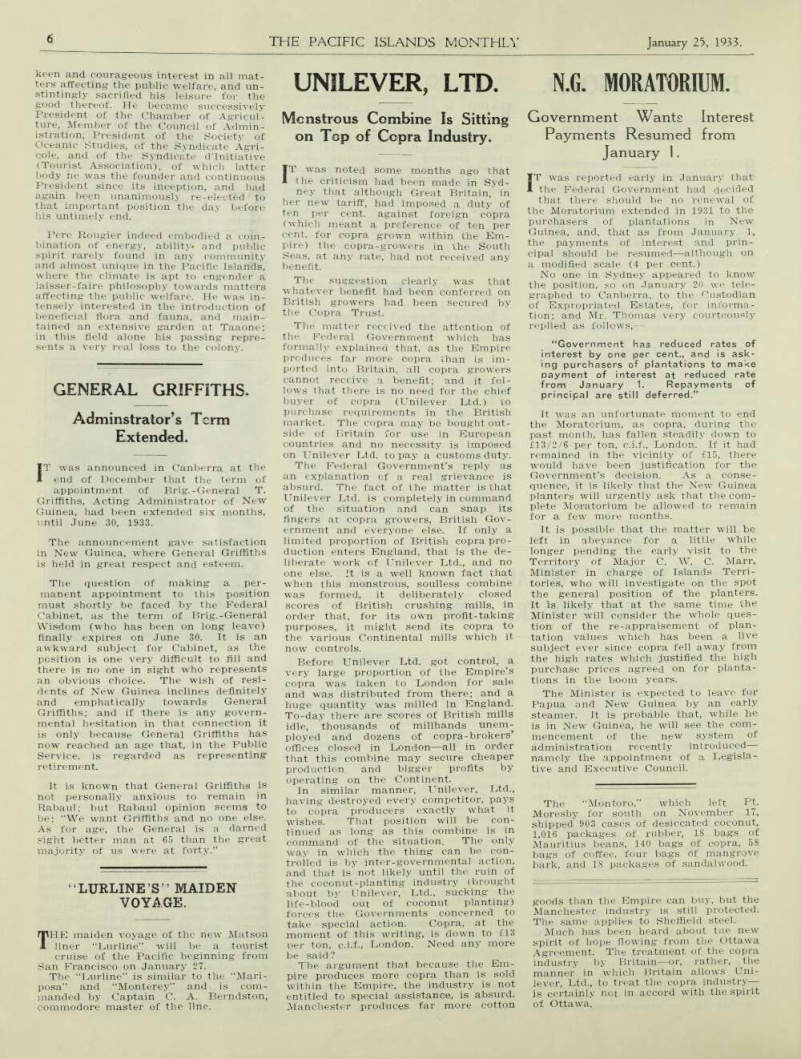
A PICTURESQUE career was brought to an unexpected close on December 16 by the death of Monsieur l’Abbe Emmanuel Rougier, who passed away very suddenly at his home at Taaone from heart failure.
According to “Fiji Encyclopedia” for the year 1907 the deceased gentleman, more familiarly known as “Pere” Rou gier, was born in Auvergne, France, in 1864, educated at La Chartreuse, Riom, and St. Chamond, and his studies in divinity were accomplished under the Sulpicians le Puy; he also studied in England and Spain. Joining the Marist
Order in 1887, he was ordained priest in 1888 by special permission of the Pope, he being at that time under the age of 21 years.
Arriving in Fiji in August, 1888, Pere Rougier was appointed almost immedi ately to the Rewa District and was still there in 1907.
Subsequently, Pere Rougier spent several years in the New Hebrides, where he appears to have had some dif ference of opinion with the Bishop of New Caledonia in connection with the administrative side of the Marist Brothers affairs, as a result of which he received a special dispensation from Rome and withdrew from active partici pation in the religious life of his Order.
Henceforth, though he retained his clerical habiliments to the end, we find Pere Rougier actively engaged in large plantation enterprises in the northern equatorial area of the Pacific. Fanning Island came into his possession, to be subsequently sold to the British Com pany which owns it at present, and he later acquired a 99 years’ lease of Christ mas Island, and operated from his headquarters in Tahiti by means of the three-masted schooner “Marechal Foch.”
Since he arrived in this Colony some fifteen years ago, Pere Rougier took a
Late Father Rougier.
keen and courageous interest in all mat ters affecting the public welfare, and un stintingly sacrifled his leisure for the good thereof. He became successively President of the Chamber of Agricul ture, Member of the Council of Admin istration, President of the Society of Oceanic Studies, of the Syndicate Agri cole, and of the Syndicate d’Initiative (Tourist Association), of which latter body he was the founder and continuous President since its inception, and had again been unanimously re-elected to that important position the day before his untimely end.
Pere Rougier indeed embodied a com bination of energy, ability and public spirit rarely found in any community and almost unique in the Pacific Islands, where the climate is apt to engender a laisser-faire philosophy towards matters affecting the public welfare. He was in tensely interested in the introduction of beneficial flora and fauna, and main tained an extensive garden at Taaone; in this field alone his passing repre sents a very real loss to the colony.
General Griffiths.
Adminstrator’s Term Extended.
IT was announced in Canberra at the end of December that the term of appointment of Brig.-General T.
Griffiths, Acting Administrator of New Guinea, had been extended six months, until June 30, 1933.
The announcement gave satisfaction in New Guinea, where General Griffiths is held in great respect and esteem.
The question of making a per manent appointment to this position must shortly be faced by the Federal Cabinet, as the term of Brig.-General Wisdom (who has been on long leave) finally expires on June 30. It is an awkward subject for Cabinet, as the position is one very difficult to fill and there is no one in sight who represents an obvious choice. The wish of resi dents of New Guinea inclines definitely and emphatically towards General Griffiths; and if there is any govern mental hesitation in that connection it is only because General Griffiths has now reached an age that, in the Public Service, is regarded as representing retirement.
It is known that General Griffiths is not personally anxious to remain in Rabaul; but Rabaul opinion seems to be; “We want Griffiths and no one else.
As for age, the General is a darned sight better man at 65 than the great majority of us were at forty.”
“Lurline’S” Maiden
Voyage.
THE maiden voyage of the new Matson liner “Lurline” will be a tourist cruise of the Pacific beginning from San Francisco on January 27.
The “Lurline” is similar to the “Mari posa” and “Monterey” and is com manded by Captain C. A. Berndston, commodore master of the line.
Unilever, Ltd.
Monstrous Combine Is Sitting on Top of Copra Industry.
IT was noted some months ago that the criticism had been made in Syd ney that although Great Britain, in her new tariff, had imposed a duty of ten per cent, against foreign copra (which meant a preference of ten per cent, for copra grown within the Em pire) the copra-growers in the South Seas, at any rate, had not received any benefit.
The suggestion clearly was that whatever benefit had been conferred on British growers had been secured by the Copra Trust.
The matter received the attention of the Federal Government which has formally explained that, as the Empire produces far more copra than is im ported into Britain, all copra growers cannot receive a benefit; and it fol lows that there is no need for the chief buyer of copra (Unilever Ltd.) to purchase requirements in the British market. The copra may be bought out side of Britain for use in European countries and no necessity is imposed on Unilever Ltd. to pay a customs duty.
The Federal Government’s reply as an explanation of a real grievance is absurd. The fact of the matter is that Unilever Ltd. is completely in command of the situation and can snap its fingers at copra growers, British Gov ernment and everyone else. If only a limited proportion of British copra pro duction enters England, that is the de liberate work of Unilever Ltd., and no one else. It is a well known fact that when this monstrous, soulless combine was formed, it deliberately closed scores of British crushing mills, in order that, for its own profit-taking purposes, it might send its copra to the various Continental mills which it now controls.
Before Unilever Ltd. got control, a very large proportion of the Empire’s copra was taken to London for sale and was distributed from there; and a huge quantity was milled In England.
To-day there are scores of British mills idle, thousands of millhands unem ployed and dozens of copra-brokers’ offices closed in London —all in order that this combine may secure cheaper production and bigger profits by operating on the Continent.
In similar manner, Unilever, Ltd., having destroyed every competitor, pays to copra producers exactly what it wishes. That position will be con tinued as long as this combine is in command of the situation. The only way in which the thing can be con trolled is by inter-governmental action, and that is not likely until the ruin of the coconut-planting industry (brought about by Unilever, Ltd., sucking the life-blood out of coconut planting) forces the Governments concerned to take special action. Copra, at the moment of this writing, is down to £13 per ton, c.i.f., London. Need any more be said?
The argument that because the Em pire produces more copra than is sold within the Empire, the industry is not entitled to special assistance, is absurd.
Manchester produces far more cotton
goods than the Empire can buy, but the Manchester industry is still protected.
The same applies to Sheffield steel.
Much has been heard about the new spirit of hope flowing from the Ottawa Agreement. The treatment of the copra industry by Britain —or, rather, the manner in which Britain allows Uni lever, Ltd., to treat the copra industry— is certainly not in accord with the spirit of Ottawa.
N.G. Moratorium.
Government Wants Interest Payments Resumed from January 1.
IT was reported early in January that the Federal Government had decided that there should be no renewal of the Moratorium extended in 1931 to the purchasers of plantations in New Guinea, and, that as from January 1, the payments of interest and prin cipal should be resumed —although on a modified scale (4 per cent.) No one in Sydney appeared to know the position, so on January 20 we tele graphed to Canberra, to the Custodian of Expropriated Estates, for informa tion; and Mr. Thomas very courteously replied as follows-- “Government has reduced rates of interest by one per cent., and is ask
ing purchasers of plantations to make
payment of interest at reduced rate from January 1. Repayments of principal are still deferred.”
It was an unfortunate moment to end the Moratorium, as copra, during the past month, has fallen steadily down to £13/2/6 per ton, c.i.f., London. If it had remained in the vicinity of £15, there would have been justification for the Government’s decision. As a conse quence, it is likely that the New Guinea planters will urgently ask that the com plete Moratorium be allowed to remain for a few more months.
It is possible that the matter will be left in abeyance for a little while longer pending the early visit to the Territory of Major C. W. C. Marr, Minister in charge of Islands Terri tories, who will investigate on the spot the general position of the planters.
It is likely that at the same time the Minister will consider the whole ques tion of the re-appraisement of plan tation values which has been a live subject ever since copra fell away from the high rates which justified the high purchase prices agreed on for planta tions in the boom years.
The Minister is expected to leave for Papua and New Guinea by an early steamer. It is probable that, while he is in New Guinea, he will see the com mencement of the new system of administration recently introduced namely the appointment of a Legisla tive and Executive Council.
The “Montoro,” which left Pt.
Moresby for south on November 17, shipped 903 cases of desiccated coconut, 1,016 packages of rubber, 18 bags of Mauritius beans, 140 bags of copra, 58 bags of coffee, four bags 6f mangrove bark, and 18 packages of sandalwood.
Yams - Ugh!
Memories of Shipwreck in Santa Cruz.
[To the Editor ] It is with fear and trembling that I enter a discussion against one who is such an authority on the Pacific as Mr.
A. J. Vogan, but I cannot let his paean of praise for the yam as an article of kaikai fit for white stomachs (P.I.M., 20/12/32) pass without slight protest.
I, too, have had more than a nodding acquaintance with a yam diet, and the memory of it will last to my death-bed.
In 1923, while going about our lawful occasions in the Santa Cruz Group, our schooner brought up one dark, dirty night on the outer reef of Utupua and very rapidly began to come unstuck; so we grabbed what food we could and got ashore in the copra boats.
In those days, Santa Cruz was prac tically uninhabited, except for a timber camp on Vanikoro, and the timber-men were nearly out of tucker themselves — we had had supplies for them in our schooner.
In Utupua there is plenty of kaikai — of a kind. We got fish, bush pig and yams, and they were welcome after the tinned, salted, dried and otherwise pre served schooner grub; but after a week, during which yam figured on the menu three times a day, we were getting sick of the sight of it. After a fortnight, we would willingly have swapped half a ton of yams for a porterhouse steak and a mug of Pilsener. When we had been on Utupua a month we would have bartered the whole yam crop of the island for a fathom of “hot-dogs.”
I am indebted to Mr. Vogan for the information that the yam is a mono cotyledon. What we called it, before we were picked up by a casual recruiter, could only be printed on asbestos.
But, as Mr. Vogan points out, there are “yams” and yams, and we certainly must have encountered the quoted vari ety. Even our Chinese cook, who was an expert at disguising “tinned dog” and all the other monotonous viands so well-known to the “man belong schooner,” could do nothing to put some taste into Utupua yam. We had them boiled, fried, roasted and baked in the ashes and camp oven; and each new style of cooking left this abomination of foodstuffs as tasteless and (I say it em phatically) unnutritious as the last.
If Mr. Vogan had spent as much energy in writing of the virtues of taro, I could agree with him. It comes nearer to what no Islands vegetable can ever hope to equal—the humble spud.
I wish Mr. Vogan every success in his attempt to acclimatise yams at Mr. Jou bert’s farm on the Tweed and hope, for the sake of their consumers, that he gets more flavour into them than do the dusky gardeners of Utupua.
I am, etc.,
Bullwhanger.
Advertisements & other items, p. 9 (1 item)
Norfolk Island Trade.
November. 1931
IMPORTS.
From Aust. £3,948 From N.Z. £329 November, 1932 £3,324 £997 November. 1931
EXPORTS.
To Aust.
To N.Z.
£1.370 November, 1932 — £798
Mystery Of The Pacific,
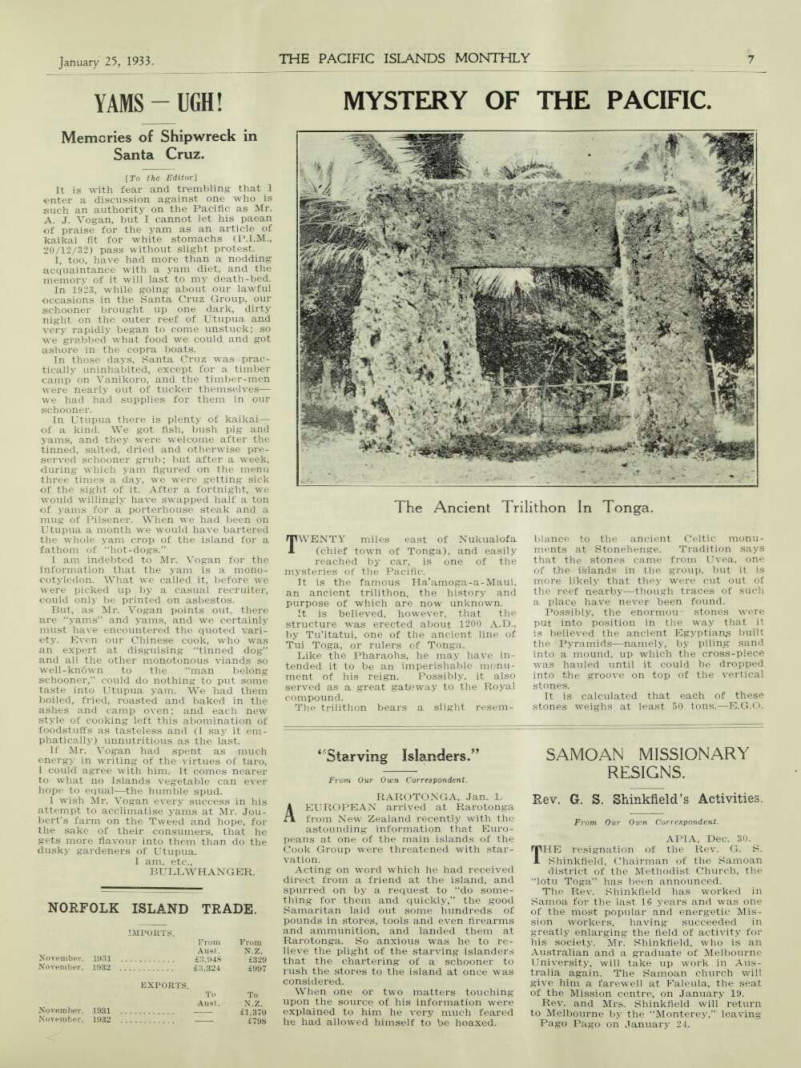
TWENTY miles east of Nukualofa (chief town of Tonga), and easily reached by car, is one of the mysteries of the Pacific.
It is the famous Ha’amoga-a-Maui, an ancient trilithon. the history and purpose of which are now unknown.
It is believed, however, that the structure was erected about 1200 A.D., by Tu’itatui, one of the ancient line of Tui Toga, or rulers of Tonga.
Like the Pharaohs, he may have in tended it to be an imperishable monu ment of his reign. Possibly, it also served as a great gateway to the Royal compound.
The trilithon bears a slight resem
blance to the ancient Celtic monu ments at Stonehenge. Tradition says that the stones came from Uvea, one of the islands in the group, but it is more likely that they were cut out of the reef nearby—though traces of such a place have never been found.
Possibly, the enormou stones were put into position in the way that it is believed the ancient Egyptians built the Pyramids—namely, by piling sand into a mound, up which the cross-piece was hauled until it could be dropped into the groove on top of the vertical stones.
It is calculated that each of these stones weighs at least 50 tons.—E.G.O.
The Ancient Trilithon In Tonga.
‘Starving Islanders.”
From Our Own Correspondent.
Rarotonga, Jan. 1.
A EUROPEAN arrived at Rarotonga from New Zealand recently with the astounding information that Euro peans at one of the main islands of the Cook Group were threatened with star vation.
Acting on word which he had received direct from a friend at the island, and spurred on by a request to “do some thing for them and quickly,” the good Samaritan laid out some hundreds of pounds in stores, tools and even firearms and ammunition, and landed them at Rarotonga. So anxious was he to re lieve the plight of the starving islanders that the chartering of a schooner to rush the stores to the island at once was considered.
When one or two matters touching upon the source of his information were explained to him he very much feared he had allowed himself to be hoaxed.
Samoan Missionary
Resigns.
Rev. G. S. Shinkfleld’s Activities.
From Our Own Correspondent.
Apia, Dec. 30.
THE resignation of the Rev. G. S.
Shinkfield, Chairman of the Samoan district of the Methodist Church, the “lotu Toga” has been announced.
The Rev. Shinkfield has worked in Samoa for the last 16 years and was one of the most popular and energetic Mis sion workers, having succeeded in greatly enlarging the field of activity for his society. Mr. Shinkfield, who is an Australian and a graduate of Melbourne University, will take up work in Aus tralia again. The Samoan church will give him a farewell at Faleula, the seat of the Mission centre, on January 19.
Rev. and Mrs. Shinkfield will return to Melbourne by the “Monterey,” leaving Pago Pago on January 24.
Tropicalities
CONSIDERING the numbers of natives and white residents who are occu pied on plantations, accidents from falling nuts and leaves are rare. Mr. C.
R. Bignell, of Fulakora, B.S.I., had a narrow escape recently. He was walk ing home from the store, carrying a can of sugar and a fresh egg when he heard the “click” of a leaf breaking above him. He jumped aside but the falling leaf caught him across the shoulders.
He was brought back to consciousness by his Alsatian dog licking his face and whining, to find that the sugar was un spilled and the egg unbroken. With abrasions and a stiff back, he got off lightly, as a falling leaf hits with con siderable force and he thought he had been hit with a sledge hammer.
With the fall in copra and the leaf fall, coconuts are not popular at Fula kora.
ALTHOUGH Les Holden is dead —the result of an accident in New South Wales in October —Holden’s Aerial Transport Co. still has the old ’plane “Canberra” in service on the Morobe field, in New Guinea. The old machine is being fitted with a new engine, the old one having been removed after four years’ hard service. The Company has recently imported a new de Havilland 50, which has a capacity of 1,500 lbs.
A REPRESENTATIVE of The Pacific Islands Monthly, learning of the pre sence in Sydney of Mr. L. Joubert, a New Guinea mining man, went along to interview him about certain develop ments on the Gira River, in which he is interested. Mr. Joubert looked vague, then laughed. “You’ve got the right story but the wrong Joubert,” he said.
There are two mining men in the Ter ritory with the same uncommon name and the same initial. One is A. L. (Les) Joubert, who has been prospect ing in Papua and New Guinea for years and the other is L. J. (Louis) Joubert, assistant manager of Bulolo Gold Dredg ing Limited. The Bulolo Joubert left Sydney on the “Macdhui” for New Guinea on December 22, after a holiday in the United States. While he was in Sydney, an old-timer from the Papuan goldfields, looked him up expecting to see his long-lost pal, Les. * * * A VISITOR to T.I. tells of a pearl shell “rush” in Birmingham many years ago. Large quantities of pearl art icles were manufactured in that city at the time, but very wasteful methods were in use, the best part of the shell being picked out and the remainder put out to fill up an old quarry on the out skirts of the town. Gradually a large deposit of M.O.P. was built up and covered with rubbish.
In the early ’seventies, an acute short age of the shell occurred and the price soared. An immediate rush by all the unemployed and riff-raff of the Midland city was made to the quarry and, after removing tons of old tins and other garbage, a large quantity of valuable shell was retrieved. * * * THE value of pearls is often enhanced by removing the successive coats of nacre covering the gem, but there is a risk in doing so, as the existing top coat may prove to be the best. Three years ago, a Japanese diver was re
warded by a valuable pearl won from the famous “1929 pearling ground,” the ground in the Gulf of Carpentaria, the discovery of which caused so much ex citement on Thursday Island.
The lucky owner put it up for sale and refused £2,000. He then set to work to “skin” it, in the hope of im proving its value. One coat after another was removed and the value steadily de creased; yet the diver persisted, hoping for a bigger offer. The pearl was whittled down till it eventually fetched only £5.
The two English proverbs—one about a bird in the hand, and the other about a substance and a shadow —are, appar ently unknown to the Japanese. * * * THE ancient idea that there is ever lasting war between Missionary and trader persists in some quarters; but is not highly regarded by those who know the Pacific. Take, for instance, Milne Bay, Eastern Papua. On the one hand we have Mr. Henry Dexter, “hard boiled” trader. He was knocking about, the Pacific 20 years ago; saw hard ser vice in British destroyers; planted rub ber in Malaya for eight years; and has been running a store on the Papuan coast since 1924. On the other hand, we have several missionary organisations, all keenly at work among the Eastern Papuans. And between Trader Dexter and Missionaries Anglicans, Roman Catholics, Methodists, etc. —there is warm friendship and mutual esteem.
The Missionaries do much of their trad ing through Dexter’s store; and Trader Dexter, in a private letter which has come to our hand, says some nice things about all denominations. “The Rev.
Rich,” he writes, “is a tonic in himself — a jolly fine chap.” We hope Mr. Dexter will forgive us for publishing this: but it comes so opportunely to support our belief that, by and large, the relation ship between mission and trade-store is generally friendly. If it is not, then either the trader or the missionary is a fool. * * * MR. C. S. SHARP, a principal of the Government Training College for na tive and Indian teachers in Fiji, told “The Sydney Morning Herald” of the changes that had come over the younger generations of Fijians, who realised that there was no future for their race unless they competed with the Indians as agriculturists.
When the indenture system under which Indian labour was brought to Fiji, was abolished, the Colonial Sugar Re fining Co., Ltd., leased its land to Indian farmers and bought their crop, said Mr.
Sharp. Where before there had been a floating population of Indians, who re turned to their native land after seven years’ service, there was now a firmly established peasant class. The Indian and Fijian populations were about equal, and as a result of the Government’s child welfare work among the Fijians the rate of increase was also nearly equal. It was fairly obvious to young Fijians that they were in danger of losing the lands which their forefathers had owned. A Fijian farming settlement had been established on the north-western coast of Viti Levu, and the experiment was being watched with interest.
Mr. G. F. Grahame, Mayor of Suva, also commented on this development.
The Fijians were at a disadvantage, he said, because of the old tribal customs, which were a form of practical Com munism. The Fijian settlement would be just reaping a crop, when a nearby village descended upon the growers, and it had to be shared.
Advertisements & other items, p. 10 (1 item)
8
January 25, 1933.
Pacific Travellers. (Continued from page 1.)
THE PACIFIC ISLANDS MONTHLY
Football In Papua.
Causes Lively Brawl.
THE sequel to a football match be tween the villagers of Elevala and some native policemen on New Year’s Day is thus reported in “The Sydney Morning Herald.”
Towards the end of the game one of the police cut the ball up, and in the fight that ensued chased some of the vil lagers into the sea. The next evening between 200 and 300 villagers, armed with clubs and other weapons, rushed the barracks.
Mr. Hall, officer in charge, was absent, but Mr. Faithorn was there. The Lieu tenant-Governor (Sir Hubert Murray), hearing the noise from his residence ad joining, hurried down the hill, sustain ing a fall on the way, and with the as sistance of Mr. R. V. Oldham, who is also on good terms with the natives, succeeded in pacifying the villagers and persuading them to return to their vil lage.
Samoa.
Land Dispute In
One Native Dead.
From Our Own Correspondent APIA, December 30.
A SERIOUS dispute occurred in Ma tauto Uta, Western Samoa, on the night of December 13 and resulted in the death of one of the participants and severe injury to about a dozen others from knife, spear and axe wounds.
An argument about a native land title led to the fight, during which a native, Tuaimato, received a fatal blow from an axe.
Eleven Samoans were charged before Chief Judge Luxford on December 22 with being concerned in the affray. Tolo, one of the men, is charged with the murder of Tuaimalo. Two others were sentenced to 12 months’ imprisonment: and charges against the others were dismissed.
Eteuate, who was sentenced to three months for having possession of an au tomatic pistol, said he bought it about four years ago from a man on a ship for £10.
Bulolo Gold Deposits.
AT a special meeting of the board of directors of Bulolo Gold Deposits, Ltd., in Sydney on December 20, it was decided to exercise options on sluic ing areas in the Mandated Territory.
The first report of Mr. G. F. Grahame, the engineer in charge of the boring party on the Company’s dredging claims, was received. It states that “the valley seems to be a fine dredging proposition from surface indications, with its wide river flats, adequate water supply, and free, clean wash without any appreciable overburden. The aerodrome is being en larged. Several dishes of surface gravel from near the camp have been washed and all showed fine gold.”
It is not known in Sydney to what areas the report refers, but they are be heved to be in the Watut district, Morobe.
Anthropological
Research.
THE importance attached to anthropo logical research by scientists is not shared by various Australian govern ments, most of which have refused or cut down their grants to the advance ment of the science so much that the chair of anthropology at the University of Sydney is in danger of being discon tinued.
Since 1927, the Rockefeller Institute has made grants totalling 105,000 dol lars to the Australian National Research Council for the purpose of carrving out field work and research in anthropology in Australia and the Pacific Islands. Now there is a chance of further grants be ing refused if the chair is not main tained.
Scientists agree that, if only from a humanitarian point of view, the study of the causes of depopulation in the Pacific Islands should be continued, but it looks as if whole races of natives may die out while our typical politicians fritter away on useless and unrepro ductive works, money that would be far better spent on developing the Pacific peoples.
Dr. Raymond Firth, formerly Profes sor of Anthropology, resigned from the University last month to take up work at the University of London. Dr. A. P.
Elkin has been appointed in his place.
Tahiti Copra.
Stiff Export Duty Sought.
From Our Own Correspondent.
Papeete, Dec. 15.
THE commercial community is greatly concerned over a report, which ap pears to be well authenticated, to the effect that an export duty of 150 francs per ton is to be imposed upon all copra destined for countries other than France.
This is in order to secure more freight for the Messageries Maritimes vessels and, incidentally, may lead to an in creased reciprocal business with France.
The local Chamber of Commerce, how ever, does not appear to view the pro position favourably and recently held a special meeting to consider the question, when all but one of the members voted against it.
It is realised that while the proposed measure might conceivably bring about the results anticipated by the Adminis tration, its operation would react unfav ourably in other ways. The undoubted result, so far as the producer is con cerned, is that he would get 150 francs per ton less for his copra when selling to the local merchant, for the latter can never be sure, at the time of purchase, to which port the copra may be ulti mately shipped. This always depends upon factors not to be determined be forehand —the price of copra in France, as compared with San Francisco, avail ability of freight space at any given time, conditions of exchange, and so on, to say nothing of the fact that many staple lines imported into Tahiti can not be obtained in France.
Apparently, the preferential bonus scheme in favour of French copra pro ducers has been abandoned as imprac tical.
No More Silver!
Tongan Ordinance Regulates Currency Imports.
THE Kingdom of Tonga is still strug gling with problems connected with the sharp difference in exchange value between British, Australian and New Zealand currencies.
A number of drastic steps have been taken, as described in past issues of The Pacific Islands Monthly and the latest development is a special ordinance is sued by the Government of Tonga on December 7, wherein it has been made unlawful to import silver coin exceeding £ 2 in value into the Kingdom except in accordance with the terms of a permit issued by cabinet. The ordinance pro vides that persons breaking this new law shall be liable to a fine of £500.
It was the practice of some traders, of importing considerable quantities of Australian coin, and using it for gen eral purposes in the Group (where British, Australian and New Zealand currency remained at the same value for a surprisingly long time) that caused the severe crisis in the Tongan treasury as described in a recent issue. What has been done now by special ordinance should have been done in 1931; but a number of people who have successfully "played the exchange” are very glad that action was delayed so long.
N.Z. Psychologist.
Research in Austral Islands.
From Our Own Correspondent.
Papeete, Dec. 15.
DR. SUTHERLAND, Ph.D., of the Wel lington University, was a passenger by the schooner “Tiare Taporo,” which arrived in Papeete early in No vember. Dr. Sutherland is pursuing his researches in psychology among the na tives of the Austral Islands.
Captain Viggo Rasmussen, of the “Tiare Taporo,” reported having run into exceptionally heavy weather on the voyage, about 200 miles from Tahiti.
Considerable damage was done to the schooner’s standing gear and sails and he was forced to shelter in the Leeward Group.
A Kind Of A Joke.
From Our Own Correspondent APIA, December 30.
WHILE our worthy Chief of Police re cently was visiting a trader at an outside trading station of the West Coast, some Samoans with a pronounced sense of humour, thought the time op portune for a practical joke. While the Chief chatted with the trader at a late hour of the evening, they opened the store some 20 yards from the dwelling by means of a false key and got away with the till containing some £20 in cash.
No trace of the offenders has been found; but, while all Samoa enjoys the joke, the trader is mourning, as he has to stand the loss sustained by his firm.
Mr. P. pF. Boyd, colonial postmaster of Fiji, was a passenger on the “Mari posa” which arrived in Sydney on Janu ary 6. With his wife and daughter, he is on his way to England.
About Islands People.
The Right Rev. W. H. Baddeley, the new Bishop of Melanesia, arrived in Sydney from Auckland on January 10.
He left the following day by the “Ma taram” for the Solomon Islands, accom panied by the native crew of the wrecked mission vessel “Southern Cross.” • • ♦ Mr. Robert Easthope, a respected and popular resident of Samoa, died at his home in Apia on December 16. Born in 1846, he went to the Tongan Group in the early ’seventies and for some time was engaged in trading for the German firm, the D.H.P.G., with whom he re mained for 16 years. In 1894 he arrived in Apia, Samoa, and acquired the Club Hotel. Later, he took over the Tivoli Hotel and the International Hotel. For the past 15 years he was attached to the Customs Department at Apia. * * * Rev. Mark Kerediredi, a priest of the Anglican New Guinea Mission in Papua, died on December 2, after a short ill ness. He was ordained deacon in 1926 and priest in 1930, by the Bishop of New Guinea (Dr. Newton) and was assistant to the Rev. C. W. Light, at Boianai. * * * Mr W E. Russell, who is well-known in Fiji and Tonga, left Apia, Samoa, by the “Waipahi” on December 5 for Auck land. With his.wife, he had been visit ing their daughter, who is the wife of Mr D. R. Eden, manager of Vailele Plantation. Mr. Russell was formerly District Commissioner in the Fiji Gov ernment service and later British Con sul and Agent at Nukualofa, Tonga. * * * Captain G. B. Landenberger, Governor of American Samoa, accompanied by his wife and a party of officials, arrived at Apia, Western Samoa, on December 10.
The visit was unofficial and an enjoy able time was spent visiting the Ifi Ifi and Malifa schools. The party returned to Pago Pago by the U.S.S. “Ontario” on December 13.
Rev. J. W. Hills, a member of the London Missionary Society, who was formerly engaged in mission work in Samoa, died in England on October 31.
He came to Samoa in 1887 and until 1911 was Principal of the Boys’ School at Leulumoega. He was transferred to the Malua College and was Principal there until he retired in 1924 and returned to London. He was an expert linguist and had written several books in the Samoan language. * * * Mr. W. McBride, the Secretary for Native Affairs, left Apia, Samoa, by the “Makoa” on December 5, on an official inspection of the Tokelau Group. He re turned to Apia on December 17 and re ported that the health conditions of the people in the Group were excellent. * * * Among the passengers who arrived in Sydney by the “Macdhui” on December 14, was a party of Methodist mission aries. In the party were Rev. and Mrs.
H O. Williams, Ubiua, and Rev. and Mrs. G. P. Lassam, East Cape, Papua; Mr. and Mrs. E. W. Pearce. Malakuna, and Miss M. W. Woolnough, Raluana, New Guinea.
Major C. B. Joske, managing director of Brown and Joske, Ltd., of Suva, and president of the Fiji Banana Associa tion, arrived in Sydney by the “Niagara” on December 31. He was accompanied by Mr. A. E. Barnes, Director of Agri culture in Fiji, and they are cooperating in making arrangements for the new distribution of Fiji bananas in Australia. * * * Rev. F. Browning arrived in Sydney by the “Mataram” on December 30. He has spent eight years at Siota, Solomon Islands, and is on his way to Bedford, England, to be married. With his wife he will return to the Solomons, after a short holiday in England. * * * Captain A. J. Donovan, who has been harbour master at Thursday Island for the past three years, has been appointed to the pilot service at Brisbane, and his place will be taken by Captain J. Smi bert, of Rockhampton, Mr. John Maynard Hedstrom, son of Sir Maynard Hedstrom, passed his final law examination at Melbourne Univer sity and received his LL.B. degree in December. He was also awarded a blue for hockey, he will be articled to a Melbourne firm of solicitors and called to the Bar about the end of the year. * * * Mr. Chas. W. Sturgeon, wireless operator at Aitape, is in Sydney on leave. He went to the Territory as junior clerk at Bita Paka when the Edie Creek rush began and, in his spare time, studied wireless telegraphy. He has been in the service of Amalgamated Wireless for six years. He speaks French, Span ish and Italian. * * * Mr. C. C. Beckett, operator of the radio station at Wau, is at present in Sydney on holiday. He was employed as radio officer at Bita Paka in 1918 and since then has been stationed at Rabaul, Kavieng, Morobe, Aitape, Edie Creek and Wau. Mr. Beckett will visit Mel bourne and Brisbane before returning to Wau. * * * Sir Aldo Castellani has been ap pointed director-in-chief of the Ross In stitute for Tropical Diseases, in succes sion to the late Sir Ronald Ross, reports The Times. * * * Sir Joseph Carruthers, who made fre quent visits to Fiji and Honolulu, died in Sydney after a long illness. Sir Joseph made a lifetime study of the voyages of Captain Cook, and it was largely through his efforts that the memorials to Cook were erected at Kurnell (Bot any Bay) and at Keala Kekua Bay, Ha waii, where Cook was killed. * * * Captain E. J. Stevens has joined the flying staff of Holden’s Air Transport Co. at Salamaua. He formerly piloted three-engined Fokkers for Australian National Airways on the Sydney-Mel bourne and Sydney-Brisbane routes. He was also on the staff of New England Airways and was a well-known war pilot. * * * Mr. H. Forbes, accountant in Port Vila (New Hebrides) for Messrs. Burns, Philp (S.S.), Ltd., is at present in Sydney on leave.
Mr. G. F. Grahame, mayor of Suva, arrived on a holiday visit to Sydney by the “Mariposa” on January 6. He is ac companied by Mrs. Grahame. * * * Mr. W. A. Freeman, chairman of Bu lolo Gold Dredging Co., Ltd., left Sydney for London via America by the “Mari posa” on January 14. * * * M. P. Laborde, editor of the New Cale donia newspaper “La France Australe,’” arrived in Sydney on January 11 by the “Laperouse” from Noumea. * * * The Rev. J. W. Burton, general sec retary of the Methodist Missionary So ciety, arrived in Sydney from Fiji by the “Mariposa” on January 6. * * * Mr. R. D. Blandy, Assistant British.
Commissioner in the New Hebrides, accompanied by Mrs. Blandy, arrived in Sydney by the January “Morinda,” en route for England on long leave. * * * His Honour C. M. Murray-Aynsley, Chief Justice of Tonga, has been ap pointed also Judge of the Land Court. * * * Judge de Jersey Carey, a member of the Condominium Joint Court in the New Hebrides, is expected to arrive in Sydney on leave next month. * * * Captain Fitch, managing director of Papuan S.S. Trading Co., Ltd., and Mr.
J. R. Clay, a well-known merchant of Papua, both of whom have been in Syd ney on a brief visit, will return to Port Moresby by the December “Montoro.”
Beautifying Tahiti.
Syndicat's Scheme to Attract Tourists.
From Our Own Correspondent.
Papeete, Dec. 15.
As an essential part of its programme for the development of Tahiti’s tourist resources, the Syndicat d’Initiative, through its committee of foreigners, has made a commencement in the important work of beautifying the native villages and public thoroughfares of Tahiti.
Nurseries for the propagation of suit able flowering trees are to be prepared immediately, and the native inhabitants are to be encouraged to co-operate in the scheme by the distribution of prizes annually for the best kept village, the prettiest school garden, etc. A consider able sum has been contributed towards this from the Syndicat’s funds, as well as by public-spirited residents, and the Syndicat is also assured of substantial Government assistance.
It is hoped that in time the untidy, and so unpleasantly conspicuous fences, may be eliminated from the landscape and replaced by growing hedges, which will not only be much more beautiful, but much more useful in this country, where wooden fence posts swiftly decay and the best of wire barriers are broken down by falling coconut leaves.
If the Syndicat’s efforts are enthusias tically persisted in for a few years, we may expect to find the already great natural beauty of Tahiti, so enhanced as to be world-famous, and to be worth a visit from this point of view alone. A start has also been made on the scenic road from the village of Faa to Mount Marau.
Native’S Death.
Further Information in Larkin Case Shows Need for Revision of N.G.
Criminal Code.
IT will be remembered that the opinion has been expressed very emphatic ally by The Pacific Islands Monthly, that there should be a review of the verdict and sentence given by Judge Wanliss in the Larkin case, on the ground that the evidence showed that Larkin, in causing the death of a na tive in his employ, was guilty of man slaughter and not of murder.
In support of this view we quoted in the December issue, Webster’s definition of murder.
We have now received from a valued correspondent who writes us as a legal man, a copy of the Criminal Code of Queensland which has been adopted for use in the Mandated Territory; and it is pointed out that according to this code, the law in regard to murder in New Guinea is different in some re spects from that of England, New South Wales and other States. The Criminal Code of New Guinea, as amended by the Criminal Code Amend ment ordinance, reads as follows: 300. Any person who unlawfully kills another is guilty of a crime, which is called wilful murder, murder, or manslaughter, according to the circumstances of the case. 301. Except as hereinafter set forth, a person who unlawfully kills another, intending to cause his death or that of some other person, is guilty of wilful murder. 302 defines murder. 303 defines manslaughter. 305. — (1.) Any person who commits the crime of wilful murder shall be liable to the punish ment of death. (2). Any person who commits the crime of murder shall be liable to imprisonment with hard labour for life, with or without solitary confinement, and with or without whipping. 310. Any person who commits the crime of manslaughter is liable to imprisonment with hard labour for life with or without whipping.
This is a different interpretation of murder, and partly justifies Judge Wan liss. But the punishment named is not expressly imposed on the criminal —he is only “liable” to it. The degree of criminality, and the severity of the punishment, are left, seemingly, to the discretion of the Judge. Which does not alter our emphatic opinion that, in imposing ten years’ hard labour on Larkin, Judge Wanliss inflicted a punishment that was cruel and un justifiable, and quite inconsistent with his other verdicts, and with the prac tices of his Court.
We suggest that experience has shown that there is urgent need for a revision of this code. There have been numerous cases involving the indus trial relationship between Europeans and natives wherein it has become necessary to punish Europeans for un necessarily severe handling of natives leading to their death.
Europeans must be punished for causing the death of a native; but it is obviously wrong to call such a crime murder where no intent to kill is dis closed; and to punish accordingly. In other words, in the peculiar circum stances existing in New Guinea, it is necessary to revise the code so that there will be the usual clear distinc
tion between murder and man slaughter.
There may be some justification for this arrangement of the criminal code in Queensland, which is a white man’s country; but there certainly is no such justification in New Guinea, where very peculiar conditions govern the re lationship between Europeans and natives. Earnest old gentlemen who know nothing of tropical conditions will argue, of course, that black life is just as sacred as white life. We need not pursue a very arguable subject.
The point is that it is necessary to provide a punishment to discourage a certain class of white man from brutally ill-treating natives; while, at the same time, we must see that the law is not employed to justify the savage sentence of ten years’ hard labour imposed upon Larkin for what was clearly an accidental killing.
Still Another Case.
Another case concerning the death of a native labourer has come under the notice of the P.I.M., the verdict in which is in sharp contrast with the Larkin case.
At the Central Court, Rabaul, recently, Aquelino Crestani was charged with the death of a native, Ambuna, whom he had employed. The Crown alleged that the accused kicked Ambuna several times and about ten minutes later Ambuna collapsed and died. It was alleged that death was due to rupture of the spleen caused by the violence of Crestani.
The case for the defence was that the accused kicked Ambuna once on the buttocks and that rupture of the spleen was not due to his violence. Three me dical practiitioners gave evidence.
On November 19, Crestani was found guilty of manslaughter. He was fined £20 with imprisonment till the fine is paid, but the period of imprisonment was not to exceed three months.
Association.
Pacific Islands
New Officers Appointed.
THE arrangement under which all the privileges of the Millions Club be come available to members of the Pacific Islands’ Association came into operation on January 1; and from that date Millions House, Rowe Street, Syd ney, became the address of the head quarters office of the Association.
At the January meeting of the Asso ciation’s Management Committee, Mr. J.
P. Fitzgerald ceased work as acting sec retary, and Mr. W. Bruce Rainsford con sented to accept appointment as hon. secretary. Mr. R. W. Robson was ap pointed chairman of the committee, and Mr. Fitzgerald vice-chairman.
A considerable number of formal mat ters were dealt with. It was reported that the special office being prepared for the Association in Millions House will be ready for occupancy at an early date.
The question of giving assistance to the movement to erect at some central place in the Pacific, a memorial to the late Sir Ronald Ross, the discoverer of the cause of malaria, was referred to the coming general meeting of members.
Various plans for extending the ac tivity and usefulness of the Association are under consideration.
Papuan Prospector's
End.
Frank Mahoney Dead.
From Our Own Correspondent.
PORT MORESBY, December 28.
NEWS has come from Kukipi by the “Papuan Chief” of the death of Frank Mahoney, a well known resident and prospector in the Terri tory, while prospecting for gold in the upper reaches of the Lakekamu.
Though his mates fear some acci dent, no definite news has been re ceived, and at last report he was in good health and was optimistic as to the success of his claim.
Frank Mahoney had many friends in the Territory who all confidently hoped to hear soon of his making a rich strike as a reward for his zeal and unshaken belief in the ultimate success of the field. Early in 1931, he and his mates —Mahoney Gold Syndicate—began prospecting on the Tauri. This in volved a strenuous journey of 90 miles from Kukipi up the Lakekamu with an additional tramp through the jungle to Tauri watershed.
Frank Mahoney, who was born in Samarai about 1892, was the son of Mrs. Elizabeth Mahoney, known throughout the Islands as "Queen of Sudest.” With her husband she landed on Sudest Island in 1889 when gold was first discovered in New Guinea, and miners poured in from Cooktown.
Mrs. Mahoney, who is 77 years of age, is now living quietly in New South Wales after 33 years of adventure and incident in Papua.
Papuan Co. to Exploit
Kapok Planting.
Papuan Co. to Exploit Australian Market.
A company is being organised, called Ceiba Plantations Ltd., to under take kapok planting on an exten sive scale in Papua.
It is proposed to take over a con siderable area of leasehold land lying between Brown River and Laloki River, twelve miles from Port Moresby, and plant kapok trees, which take about six years to mature. During the growing period it is proposed to plant cover crops—particularly castor oil seeds and Mauritius beans.
The organiser and manager of the enterprise is Mr. K. G. Leydin, who has had experience of tropical agriculture.
Mr. George Murray, tropical agricul tural expert, has advised the company that he regards the area as eminently suitable for kapok growing.
The possibilities of kapok production in Papua and New Guinea for the Aus tralian market are very great. Aus tralia’s requirements at present come from Java and a Sydney importer re cently told us that the present ex change position imposes on these goods a tax of fully 100 per cent. Kapok produced in Papua or New Guinea would escape this burden, and further more, would receive a Federal bounty equal to 2d. per lb. (£18per ton).
The B.S.I. Ceremonial Police.
Revision and Reform of System Called For.
Written specially for The Pacific Islands Monthly by “ Vigilant.’
THE police establishment of the British Solomon Islands Protectorate con sists of armed native constabulary; and the question arises whether a re vision of status and functions is not urgently called for.
The likelihood of these troops being required to quell an armed rebellion is extremely remote. The Group was thoroughly combed for firearms after the murder of two Government officials on Malaita about six years ago; and the only weapons now in the possession of natives are shot-guns issued under li cense to approved men.
To maintain a large body of men drilled to present arms and look pictur esque may appeal to tourists, and gratify the military aspirations of those who revel in ceremonial parades and taking salutes, but the impressive look ing ceremonies are wasted on unemo tional citizens who possess a vivid re collection of what happened during the panic created at Tulagi, when news of the murders on Malaita reached the capital, and rumours of a native rising were afloat. The first act of those in authority was to disarm the head quarters police! That act was eloquent of the lack of confidence reposed in armed native troops by officials and public alike.
The public have a right to demand or
dinary police protection for their per sons and property, and that protection is not given to the extent needed; mainly because the men are not taught the rudiments of civic police duties; and discipline, apart from that displayed on the parade ground, leaves much to be desired.
Tulagi, the seat of Government and headquarters of the police establishment, bears an evil reputation for cases of molestation of white women by natives.
No woman feels safe there; and the dis trict station of Gizo appears to be only a step behind.
At the latter place, according to re cent reports, wholesale robbery had been proceeding for months, and natives fre quently indulged in drinking carousals within a short distance of the barracks, yet the police appear to have been un aware, or discreetly silent, as to what was going on.
The firm which suffered heavy losses by reason of these thefts has a moral, if not a legal, claim upon the Government for failure to afford the protection that taxpayers who maintain the police force have a reason to expect.
Until the police establishment is placed on a civil footing, and trained in civic duties by a competent police in structor, the prevention of crime will re main of secondary importance to farci cal and useless military manoeuvres. It is about time a commission was ap pointed to inquire into the whole stupid business, and public representatives on the Advisory Council should impress that fact upon those in authority.
The long-drawn-out litigation in Port Moresby in connection with the Port Romilly Sawmilling Co. was advanced a further stage recently when Mr. James resigned his office as liquidator of the Company and Mr. Gerald Smith was ap pointed by the court to the position. Mr.
James is the third to hold the position, the first having been Mr. Guinane.
Trader And Native.
The Part the Mission Plays,
From Our Own Correspondent.
Thursday Is., Dec. 12.
THE report that the Anglican Mission in New Guinea is strongly opposed to Mission trading is interesting, as this is also the line taken by the Angli can Church with regard to its missions hereabouts.
On the aboriginal stations on the mainland, where there is no contact with European traders and so no possi bility of the charge of unfair competi tion by mission stores, supplies have to be kept on hand for disposal to the na tives as a matter of necessity; but in the Torres Strait islands, where the na tives have opportunity of obtaining their requirements from traders in Thursday Island or elsewhere, the Mission has steadily opposed any suggestion that it combines trading with its spiritual ac tivities.
Strong pressure was used from out side some years ago to induce the Mis sion to take over the Papuan Industries stores at Badu and run them as a co operative concern for the natives of Torres Strait; but the then Bishop (now Bishop of New Guinea), backed up by his staff, very wisely resisted this.
It is rightly felt that the legitimate trader has his place in the sphere of things, and, although in past days one has heard stories of “victimisation” of ignorant natives by unscrupulous men (often Asiatic), it is recognised that the native must learn to stand on his own feet, and that in buying and selling, as in other things, although he may re quire guidance, he must be fitted to act and think for himself.
The Islander now rubs shoulders with the outer world a good deal, and rightly asks that he may spend his own earn ings in what he considers the best mar ket. With the business community of Thursday Island he is on good terms, generally knowing what he wants and how far his “cash money” should go; and when working on boats further south he is accustomed to go into shops and purchase his various needs.
The Missions here have always en couraged him to look upon the trader as an honest man, not as a rogue; and if, on occasion, he has made a misdeal, that has only served him to place greater confidence in those with whom his transactions have been perfectly straight. The Missions have tried to teach him that the practical profession of Christianity is not the sole preroga tive of the members of the mission but he will find it behind the ordinary shop counter as well.
Apia Lottery,
From Our Own Correspondent.
Apia, Dec. 30.
THE secretary of the Apia Lottery has published a statement of the ticket sales, which shows that up to date 571 books of 10 tickets each have been sold out of a total of 4,000. The committee of the Lottery has applied to the Adminis trator for an extension of the drawing date to June 30 and the application has been granted.
Advertisements & other items, pp. 14-15 (2 items)
made fiom
TO PLANTERS I am a Buyer of
CASTOR OIL SEED
IN ANY QUANTITY.
Advice and Instructions Regarding Plant ing!, Harvesting and Packing of Castor Oil Seeds given gratis.
Your Inquiries Solicited Regarding Disposal of all kinds of Oil-Bearing and Edible Seeds and Nuts.
C. GHAHAME
17 BOND STREET SYDNEY.
CIGARETTES
TIPPED
OR PLAIN
TAN
NAVY CUT
TOBACCO
made fiom
BEST VIRGINIA
LEAF
Shell Is Better
THE CENTRE OF ACTIVITY
Like dropping a pebble in a pool of water, your purchase from the Shell pump sets in ripple-like motion an everwidening ring of concentrated action.
To maintain abundant supplies of SHELL Motor Spirit ---road waggons, rail waggons, storage tanks, tankers, refineries and wells—ALL SHELL OWNED—are in turn unceasingly employed in replenishing the kerbside pump.
THEY ALL COME BACK TO SHELL
SHELL is BETTER
THE SHELL COMPANY LIMITED
Samoa’S Oldest
Inhabitant.
Robert Easthope Dead.
From Our Own Correspondent
Apia, Dec. 30.
MR. ROBERT EASTHOPE, a native of Cumberland, England, died at Apia on December 16. He was 86 years of age.
Mr. Easthope came to the Islands in the early seventies, in charge of a small schooner, trading in the Tongan Group for the old D.H. and P.G., for which firm he worked for 16 years.
In 1894 he left Tonga and settled in Apia, running various hotels, but he suf fered heavy losses by fire. He was very popular as a hotel owner, owing to his genial character and his generosity, and always extended a helping hand to those in trouble. For 15 years he was em ployed in the Customs Department of the Administration, which he left a short time ago owing to advanced age.
The funeral of the deceased, who was the oldest British settler of Western Samoa, was attended by only a few per sonal friends.
Stowaways Encouraged.
Pt. Moresby’s Good Samaritans.
From Our Own Correspondent.
Pt. Moresby, Dec. 8.
WHEN the residents of Port Moresby gave financial help to two stow aways who crossed from Cairns by the “Montoro” on March 24, the possi bility of attracting others by this kindly treatment was not overlooked. During their imprisonment in Port Moresby a subscription list was sent round the town, £17 was collected, and divided be
tween the two men on their departure.
Since then further cases have been reported. There were three in Novem ber and now word has come of a fourth on the “Montoro” arriving in Port Moresby on December 8. Messrs. Burns, Philp have made arrangements to transfer this man on to the “Macdhui” leaving Port Moresby for Australia the same day.
The first stowaways, Macaulay and Hoffman, who so fortunately received financial help from the residents of Pt.
Moresby, were charged and convicted on their return to Australia and fined £20 or a month’s imprisonment.
These men come over from Australia without money or means of support and hope to proceed to the New Guinea goldfields or to prospect on their own in Papua and they become a charge on the public.
There is not the remotest chance of their finding employment and prospect ing is not to be undertaken lightly in Papua, even if the immigration laws permitted them to land.
Typhoid Outbreak.
Yule Island Cases.
From a Special Correspondent.
Pt. Moresby, Dec. 28.
BROTHER GEORGE and Sister Cate yan, of the Catholic Mission of the Sacred Heart at Yule Island, have been admitted to hospital, both suffer ing from typhoid fever.
Brother George is seriously ill and his condition is causing some alarm, while Sister Cateyan is progressing favour ably.
Typhoid is rare in Papua. There have been only a few cases in the last ten years and before that it was almost un known.
Reduced Wages.
Save Samoan Cocoa Planters.
From Our Own Correspondent.
Apia, Dec. 30.
FOR years the cocoa planters of Samoa have endeavoured to get cheaper labour for the plantations to keep in line with developments in other cocoa growing countries, and with the steadily decreasing cocoa price. The committee of the Samoa Planters’ Association, which includes the two recently elected Legislative Councillors, Messrs.
Carruthers and Cobcroft, recently waited upon the Administrator and presented their views on the labour question, pointing out that it is absolutely vital for the industry to obtain a wage re duction and that otherwise the planters are in a desperate position, facing ruin and bankruptcy.
It is reported that, at the urgent re quest of the planters, the Administra tion has agreed to bring about a reduc tion of the daily wage rate for Chinese coolies from 3/- to 2/- as from April 1, 1933, and that the Chinese Government has expressed its consent to this wage reduction.
This will mean a saving of approxi mately £10,000 a year to the industry and will be the saving of many planters.
It will also greatly benefit the Govern ment-owned N.Z. Reparation Estates.
Useful Career Ended.
Rev. J. W. Hills Dead.
From Our Own Correspondent.
Apia, Dec. 30.
NEWS was received by last mail of the death in London of the Rev. J. W.
Hills, who was one of the best known and most beloved workers of the London Mission Society in Samoa.
The Rev. Hills was in Samoa for 37 years. He was Principal of the L.M.S. boys’ school at Leulumoega until 1911 and principal of Malua Training College till 1924, when he retired and returned to England.
Besides being an expert linguist and writer in the Samoan language, he was specially noted for the deep interest he took in botany and horticulture, and the technical education of the Samoan youth entrusted to his care. He was the first to study the Samoan flora and compile a comprehensive list of Samoan native bush trees and their commercial possibilities. By obtaining seeds and plants from many tropical countries, he created a botanical gardens first at Leu lumoega and later at Malua, devoting much of his time and energy to these special studies. His gardens were an at traction to numerous visitors. He was a deeply religious and inspiring teacher, who is remembered by numerous pupils scattered as missionaries of the L.M.S. over all the Pacific.
On December 18 the Rev. H. S. Per kins at Apia Protestant Church, referred in his sermon to the deceased and his faithful and unselfish work for the church. The congregation stood in silence for a few minutes while the Rev. Per kins offered up a special prayer for the deceased.
Advertisements & other items, p. 16 (1 item)
S.M.P. 2 Meats
1870. 1932.
QUALITY STANDS
THE TEST OF TIME.
S.M.P. 2 MEATS
Specially packed
tor Island Trade
BEEF
CORNED
CORN ED, BOILED, ROAST, BEEF OR MUTTON.
Packed in 12oz„ 1lb., 1½lb., 2lb., 3lb., 4lb„ 5lb., 6lb. tins.
SAUSAGES
BEEF
Tins fitted with Patent Key Opener.
S.M.P. MILESTONE BRAND.
CHICKEN SAUSAGES
FRANKFURTS SHEEP TONGUES
RABBIT OX TONGUES, etc.
ASSORTED FANCY MEATS, ETC.
F. J. WALKER LTD., 33 Macquarie Place, Sydney.
Sole Selling Agents for: THE SYDNEY MEAT PRESERVING CO. LTD.
Papuan Legislature.
Hon. Arthur Jewell Appointed.
From Our Own Correspondent.
PT. MORESBY, December 28.
THE Hon. Arthur Jewell, non-official member of the Legislative Council of the Territory of Papua, was sworn in as a member of the Execu tive Council by Sir Hubert Murray on December 13. He has since taken his seat in the Assembly, The Papua Act provides that one member of the Executive Council shall be chosen from and by the non-official members of the Legislative Council.
Cr. Jewell is the first non-official mem ber to sit on the Executive. The Hon.
Erie Huntley was appointed a few years back, but left the Territory be fore his appointment was confirmed.
The Hon. Arthur Jewell has been in the Territory for nearly 30 years. In 1903 as private secretary to the Ad ministrator, Mr. Justice C. S. Robin son, formerly Chief Judicial Officer in succession to Francis Winter, he first saw Papua, and, since then, as general manager of Pacific and Papuan Pro ducts, Ltd., he has taken an active interest in the welfare of the Territory.
Chosen by the non-official members of the Legislative Council, the appoint ment was approved by his Excellency, Sir Hubert Murray, and later confirmed by the Governor-General of Australia.
Restrictions Waived.
Overseas Ships on East Coast.
From Our Own Correspondent.
Thursday Is., Dec. 12.
A FEW months ago, a small boat which was bringing a sick man into hos pital at Thursday Island from a place two hundred miles down the east coast, hailed a passing overseas steamer which was bound northwards and asked it to take on the patient to save time and for greater comfort. The captain, bound by the restrictions of the Navi gation Act, was regretfully unable to accede to the request.
The Bishop of Carpentaria has since made representations to the Common wealth Government, asking that over seas vessels be allowed to accede to similar requests.
The Federal Member, Mr. G. W. Mar tens, who took up the matter with the departments concerned has written to the Bishop stating that the Department of Trade and Customs will not raise ob jections to vessels picking up sick people north of Cooktown for convey ance to Thursday Island.
The quarantine authorities state that there is nothing in law to prevent a sick person being taken on board an out ward bound vessel, but the master must report the case if quarantinable or infec tious, on arrival at Thursday Island.
Under the Navigation Act, a technical breach would be committed; but under such special circumstances no prosecu tion would be likely to follow. Consid eration is being given by the Depart ment to an amendment in the Act to provide for cases of this kind. The Torres Strait Pilot Service has been advised, so that the pilots can inform masters of overseas ships as to the posi tion.
Early Port Moresby.
Commemoration Service.
From Our Own Correspondent.
Pt. Moresby, Nov. 28.
A SERVICE was held at the Mission flagstaff, Hanaubada, on November 21, to commemorate the landing in 1874 of Dr. W. G. Lawes, the first mis sionary of the L.M.S. to settle in Papua.
The flagstaff marks the site on which the first mission house was erected for Dr. and Mrs. Lawes by the sailors of the ‘‘John Williams.”
It was not until the end of 1877 that the Rev. James Chalmers joined the Mission and landed in New Guinea. The preface of ‘‘Adventure in New Guinea,” by J. Chalmers, states: ‘‘In 1874, Mr. and Mrs. Lawes, with their son Charles, settled at Port Moresby—the only white people on the whole of New Guinea.”
Later in his book the Rev. James Chalmers describes Port Moresby. ‘‘We arrived at Port Moresby about 6 o’clock (Oct. 21, 1877). I cannot say I was much charmed with the place; it had such a burnt-up, barren appearance. Close to the village is a mangrove swamp and the whole bay is enclosed with high
hills. At the back of the Mission pre mises and close to them is a large swampy place, which in wet weather is full of water. There can be no doubt about Port Moresby being a very un healthy place.”
Fifty-five years have made a great difference to the district. There are now no mangrove swamps; the swampy places have long disappeared and Port Moresby is considered one of the health iest spots in Papua.
Advertisements & other items, p. 17 (1 item)
KODAK Catalogue
J. H. MacGregor Dowsett
RABAUL, NEW GUINEA,
for
RELIABLE CARS, SERVICE & DRIVERS.
Gramophones and Latest Records.
Musical Instruments and Sundries.
Cameras and Photographic Goods.
Developing, Printing, Enlarging & Framing.
Recruiter, Mining & General Agent,
BUILDER AND CONTRACTOR.
Agent for The Australian Provincial Assur ance Assoc. Ltd. Sub-Agent for The Central Assurance Co. Ltd.
Outstation Orders Promptly Executed.
Sample Rooms:
MALAGUNA ROAD, RABAUL.
'Phone: Rabaul 149,
It's ready
YOUR COPY OF
THE NEW
KODAK Catalogue
Hot from the press—a magnificent
production —ninety-six pages just
overflowing with illustrations and
interesting reading matter covering
every new development in modern
photography.
This beautiful production will certainly strengthen your conviction that photography is the hobby supreme.
There’s a copy reserved for you. Write or call at any Kodak Branch. Post free on request.
KODAK (Australasia) PTY LTD.
379 GEORGE STREET, SYDNEY,
Tahiti's Trade,
1931 Figures Show
Record Low Level.
From Our Own Correspondent.
Papeete, Dec. 30.
STATISTICS for the year 1931, just published in the “Journal Officiel,” give the total trade of the Colony for that year as 65,935,476 francs, as com pared with 84,529,000 francs in 1930. The figures include a transit business of 8,661,000 francs and re-exports amount ing to 6,691,000 francs, these items being made up chiefly of liquors transhipped to the Mexican coast, liquors sold ex bond to passing vessels, and copra from the Cook Islands brought to Tahiti as a more convenient point from which to ship it.
Total imports in 1931 amounted to 26 million francs in round numbers, as com pared with 45 million francs in 1930.
Exports were 24 million francs, as com pared with 37 million francs in 1930.
Judging by comparison with other coun tries where the bulk of the population is also natives, Tahiti, with its per capita importation of 650 francs in 1931, would still appear to be one of the rich est place on the globe, in spite of the prevailing depression.
The principal exports for the years 1930 and 1931 were as follows:
New Zealand and Australia continue to provide the principle market for phos phate, the two countries together hav ing taken considerably more than half the entire output for the years 1929 to 1931; Japan is the next best customer.
Of the copra exports the U.S.A. took 10,0/63 tons, France 6,571 tons, and the remainder of 171 tons went to Great Britain.
Of the imports France supplies princi pally wines and distilled liquors (1,375,000 frs), soft goods (1,207,000 frs), metal goods (1,113,000 frs.) and sundries (702 000 frs), while foreign countries supply chiefly flour (3,954,000 frs.), com bustibles (3,100,0100 frs.), animal pro ducts (2,462,000 frs.), soft goods (1,475,000 frs.), metal goods (1,239,000 frs). and colonial products (1,828,000 frs.). The Tahiti business in such stand ard lines as condensed milk and flour has gone almost entirely to New Zea land and Australia. This is undoubtedly due to the favourable rate of exchange with those countries as compared with the U.S.A. It may, therefore, be ex pected that the figures for 1932 will show that a still greater share of this business has gone to the neighbouring British Colonies mentioned. The surprise of the import figures is the revelation that the sugar trade is steadily becom ing a Chinese monopoly. Chinese sugar appears to land here some 65 francs per ton cheaper than New Zealand sugar, in spite of the longer sea freight. N.Z. supplied 184.7 tons in 1929, as compared with 54.4 tons from China, while in 1931 N.Z. supplied only 18.4 tons as against China’s 376.9 tons. For some unexplained reason the U.S.A. has been
almost entirely eliminated from the sugar business, though the available figures indicate that the American pro duct lands here at less cost than any other kind.
France’s share in the total trade of the colony for 1931 was 22.08 per cent., as compared with 30.18 per cent, for the year 1930.
Overseas shipping entering the Colony during- 1931 amounted to 277,178 tons, as against 306,691 tons for 1930. Of these 173,768 tons were British, 54,234 tons French, and the balance American, Nor wegians, Swedish and Japanese; the latter being- mostly tramp phosphate steamers.
In his report accompanying the re turns for 1931, M. Marhic, the Chief of Customs for the Colony, draws attention to the fact that the balance of trade has been deficient from 1927 since when there has been a constant excess of im ports over exports. He attributes the un satisfactory situation, as revealed by the 1931 figures, which constitute a low record for 10 years past, to the univer sal depression and the depreciation in values of exported products.
Metric Value Value Tons. 1930. (fr.) 1931. (fr.) Copra ... 14,185 19,834,176 10,803 12,314,383 pearl shell. 321 1,045,089 3.9 696,366 Vanilla 71.0 3,531,889 68.6 1,958,244 Phosp h a t e rock . . . 172,059 7,570,000 111,432 4,904,000
A.B.M. Annual Report.
ACCORDING to the annual report of the Australian Board of Missions, reduced expenditure resulting in cur tailed activities was necessary.
The grant to the diocese of New Guinea was reduced from £12,000 to £8,400 and the remainder of the Aus tralian and South Pacific Missions suf fered a 20 per cent. reduction. In 1929 the gross income of the Board was £41,550, in 1930 £34,282, and in 1931 £29,080. The indebtedness of the Board at the end of 1931 amounted to £11,262.
The Right Rev, H. Newton, Bishop of New Guinea, said that there were 47 white missionaries in the diocese, the most that had ever been on the staff.
The native staff was being increased and was doing invaluable work as the native mind had changed completely towards Christianity since natives had been made priests and deacons.
More efficient medical work in Papua was the result of the doctor in charge also being a priest. Attendances at hos pitals exceeded 11,000 a year.
Advertisements & other items, p. 18 (1 item)
Beware
TINEA STARTS
HERE
~it stalks about
UNKNOWN!
Ward off TINEA
Source of Tinea and Dhobie Itch.
or TROPIC RINGWORM
with
Inflammation, rotten white skin and cracks between the toes, with severe itch and unpleasant odour, are in dications that the TINEA RING
WORM germs —TINEA ALBU-
GINEA —are making their attack.
Antinea
antiseptic
SOAP
and
LOTION
The only effective specific treatment for TINEA or irritating skin infections of a fungus nature, i.e.Ringworm, Dry Ec zema, Dhobie Itch, Skin Rashes, Tropic Ringworm, etc Dandruff, Scurf.
ANTINEA DRUG CO., Angel Place, Sydney
Fighting Malaria In New Guinea.
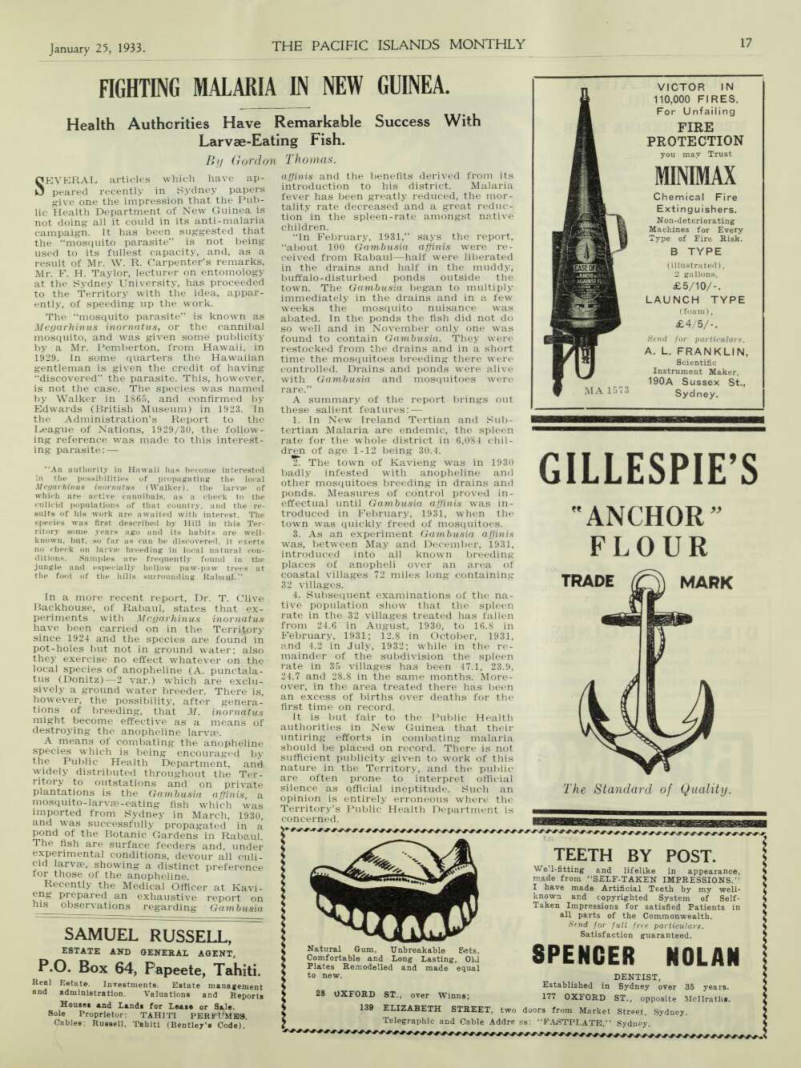
Health Authorities Have Remarkable Success With Larvæ-Eating Fish.
By Gordon Thomas.
SEVERAL articles which have ap peared recently in Sydney papers give one the impression that the Pub lic Health Department of New Guinea is not doing all it could in its anti-malaria campaign. It has been suggested that the “mosquito parasite” is not being used to its fullest capacity, and, as a result of Mr. W. R. Carpenter’s remarks, Mr. F. H. Taylor, lecturer on entomology at the Sydney University, has proceeded to the Territory with the idea, appar ently, of speeding up the work.
The “mosquito parasite” is known as Megarhinus inornatus, or the cannibal mosquito, and was given some publicity by a Mr. Pemberton, from Hawaii, in 1929. In some quarters the Hawaiian gentleman is given the credit of having “discovered” the parasite. This, however, is not the case. The species was named by Walker in 1865, and confirmed by Edwards (British Museum) in 1923. In the Administration’s Report to the League of Nations, 1929/30, the follow ing reference was made to this interest ing parasite: “An authority in Hawaii has become interested in the possibilities of propagating the local Megarhinus inornatus (Walker), the larvæ of which are active cannibals, as a check to the culicid populations of that country, and the re sults of his work are awaited with interest. The species was first described by Hill in this Ter ritory some years ago and its habits are well known, but, so far as can be discovered, it exerts no check on larvæ breeding in local natural con ditions. Samples are frequently found in the jungle and especially hollow paw-paw trees at the foot of the hills surrounding Rabaul."
In a more recent report, Dr. T. Clive Backhouse, of Rabaul, states that ex periments with Megarhinus inornatus have been carried on in the Territory since 1924 and the species are found in pot-holes but not in ground water; also they exercise no effect whatever on the local species of anopheline (A. punctala tus (Donitz) —2 var.) which are exclu sively a ground water breeder. There is, however, the possibility, after genera tions of breeding, that M. inornatus might become effective as a means of destroying the anopheline larvæ.
A means of combating the anopheline species which is being encouraged by the Public Health Department, and widely distributed throughout the Ter ritory to outstations and on private plantations is the Gambusia affinis, a mosquito-larvæ-eating fish which was imported from Sydney in March, 1930, and was successfully propagated in a pond of the Botanic Gardens in Rabaul.
The fish are surface feeders and, under experimental conditions, devour all culi cid larvæ, showing a distinct preference tor those of the anopheline.
Recently the Medical Officer at Kavi eng prepared an exhaustive report on his observations regarding Gambusia
affinis and the benefits derived from its introduction to his district. Malaria fever has been greatly reduced, the mor tality rate decreased and a great reduc tion in the spleen-rate amongst native children.
“In February, 1931,” says the report, “about 100 Gambusia affinis were re ceived from Rabaul —half were liberated in the drains and half in the muddy, buffalo-disturbed ponds outside the town. The Gambusia began to multiply immediately in the drains and in a few weeks the mosquito nuisance was abated. In the ponds the fish did not do so well and in November only one was found to contain Gambusia. They were restocked from the drains and in a short time the mosquitoes breeding there were controlled. Drains and ponds were alive with Gambusia and mosquitoes were rare.”
A summary of the report brings out these salient features: 1. In New Ireland Tertian and Sub tertian Malaria are endemic, the spleen rate for the whole district in 6,084 chil dren of age 1-12 being 30.4. 2. The town of Kavieng was in 1930 badly infested with anopheline and other mosquitoes breeding in drains and ponds. Measures of control proved in effectual until Gambusia affinis was in troduced in February, 1931, when the town was quickly freed of mosquitoes. 3. As an experiment Gambusia affinis was, between May and December, 1931, introduced into all known breeding places of anopheli over an area of coastal villages 72 miles long containing 32 villages. 4. Subsequent examinations of the na tive population show that the spleen rate in the 32 villages treated has fallen from 24.6 in August, 1930, to 16.8 in February, 1931; 12.8 in October, 1931, and 4.2 in July, 1932; while in the re mainder of the subdivision the spleen rate in 35 villages has been 47.1, 23.9, 24.7 and 28.8 in the same months. More over, in the area treated there has been an excess of births over deaths for the first time on record.
It is but fair to the Public Health authorities in New Guinea that their untiring efforts in combating malaria should be placed on record. There is not sufficient publicity given to work of this nature in the Territory, and the public are often prone to interpret official silence as official ineptitude. Such an opinion is entirely erroneous where the Territory’s Public Health Department is
Advertisements & other items, p. 19 (1 item)
Gillespie’S
MA 1573
VICTOR IN
110,000 FIRES.
For Unfailing
FIRE
PROTECTION
you may Trust
MINIMAX
Chemical Fire Extinguishers.
Non-deteriorating Machines for Every Type of Fire Risk.
B TYPE
(illustrated), 2 gallons, £5/10/-.
LAUNCH TYPE
(foam), £4/5/-.
Send for particulars.
A. L. FRANKLIN,
Scientific Instrument Maker,
190 A Sussex St.,
Sydney.
GILLESPIE’S
"ANCHOR”
FLOUR
TRADE
MARK
The Standard of Quality.
Natural Gum, Unbreakable Sets, Comfortable and Long Lasting, Old Plates Remodelled and made equal to new. 28 OXFORD ST., over Winns;
TEETH BY POST.
Well-fitting and lifelike in appearance,
made from “SELF-TAKEN IMPRESSIONS.
I have made Artificial Teeth by my well known and copyrighted System of Self- Taken Impressions for satisfied Patients in all parts of the Commonwealth.
Send for full free particulars.
Satisfaction guaranteed.
SPENCER NOLAN
DENTIST,
Established in Sydney over 35 years. 177 OXFORD ST., opposite Mcllraths. 139 ELIZABETH STREET, two doors from Market Street, Sydney.
Telegraphic and Cable Address: “FASTPLATE,” Sydney.
SAMUEL RUSSELL,
ESTATE AND GENERAL AGENT,
P.O. Box 64, Papeete, Tahiti.
Real Estate. Investments. Estate management and administration. Valuations and Reports Houses and Lands for Lease or Sale.
Sole Proprietor; TAHITI PERFUMES.
Cables: Russell. Tahiti (Bentley’s Code).
Sudden Death At
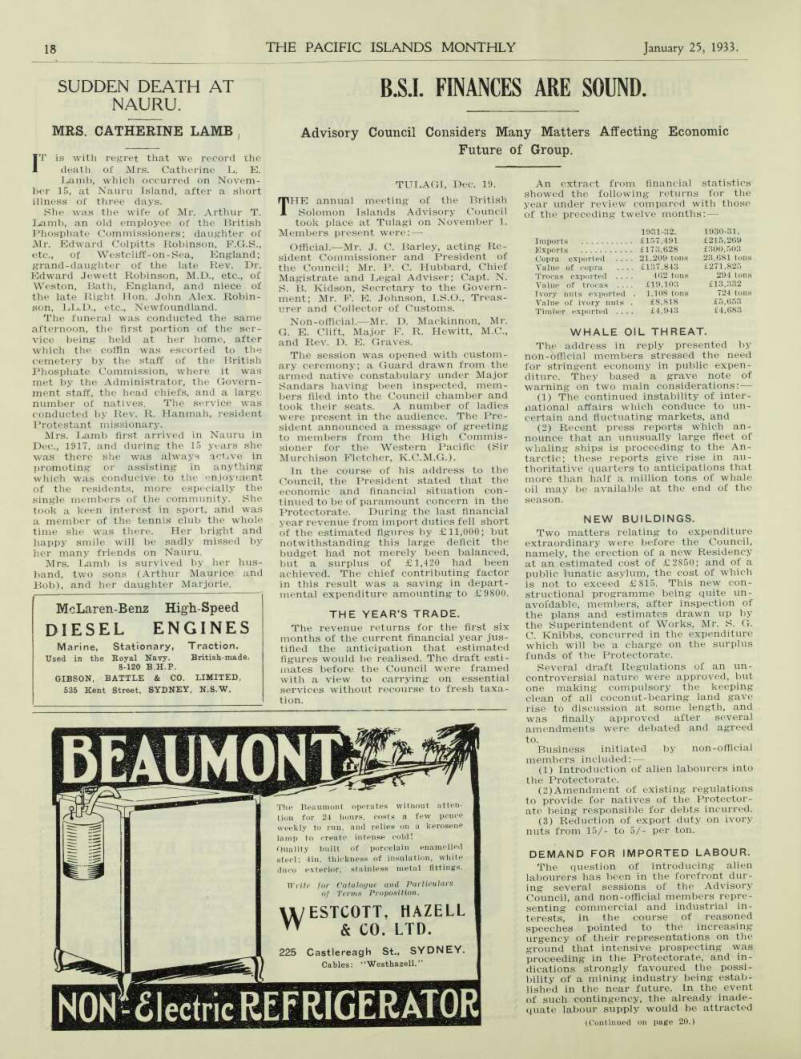
Nauru.
Mrs. Catherine Lamb
IT is with regret that we record the death of Mrs. Catherine L. E.
Lamb, which occurred on Novem ber 15, at Nauru Island, after a short illness of three days.
She was the wife of Mr. Arthur T.
Lamb, an old employee of the British Phosphate Commissioners; daughter of Mr. Edward Colpitts Robinson, F.G.S., etc., of Westcliff-on-Sea, England; grand-daughter of the late Rev. Dr.
Edward Jewett Robinson, M.D., etc., of Weston, Bath, England, and niece of the late Right Hon. John Alex. Robin son, LL.D., etc., Newfoundland.
The funeral was conducted the same afternoon, the first portion of the ser vice being held at her home, after which the coffin was escorted to the cemetery by the staff of the British Phosphate Commission, where it was met by the Administrator, the Govern ment staff, the head chiefs, and a large number of natives. The service was conducted by Rev. R. Hanmah, resident Protestant missionary.
Mrs. Lamb first arrived in Nauru in Dec., 1917, and during the 15 years she was there she was always active in promoting or assisting in anything which was conducive to the enjoyment of the residents, more especially the single members of the community. She took a keen interest in sport, and was a member of the tennis club the whole time she was there. Her bright and happy smile will be sadly missed by her many friends on Nauru.
Mrs. Lamb is survived by her hus band, two sons (Arthur Maurice and Bob), and her daughter Marjorie.
B.S.I. Finances Are Sound.

Advisory Council Considers Many Matters Affecting Economic Future of Group.
Tulagi, Dec. 19.
THE annual meeting of the British Solomon Islands Advisory Council took place at Tulagi on November 1.
Members present were: Official.- —Mr. J. C. Barley, acting Re sident Commissioner and President of the Council; Mr. P. C. Hubbard, Chief Magistrate and Legal Adviser; Capt. N.
S. B. Kidson, Secretary to the Govern ment; Mr. F. E. Johnson, I.S.O., Treas urer and Collector of Customs.
Non-official. —Mr. D. Mackinnon, Mr.
G. E. Clift, Major F. R. Hewitt, M.C., and Rev. D. E. Graves.
The session was opened with custom ary ceremony; a Guard drawn from the armed native constabulary under Major Sandars having been inspected, mem bers filed into the Council chamber and took their seats. A number of ladies were present in the audience. The Pre sident announced a message of greeting to members from the High Commis sioner for the Western Pacific (Sir Murchison Fletcher, K.C.M.G.).
In the course of his address to the Council, the President stated that the economic and financial situation con tinued to be of paramount concern in the Protectorate. During the last financial year revenue from import duties fell short of the estimated figures by £11,000; but notwithstanding this large deficit the budget had not merely been balanced, but a surplus of £1,420 had been achieved. The chief contributing factor in this result was a saving in depart mental expenditure amounting to £9800.
The Year’S Trade.
The revenue returns for the first six months of the current financial year jus tified the anticipation that estimated figures would be realised. The draft esti mates before the Council were framed with a view to carrying on essential services without recourse to fresh taxa tion.
An extract from financial statistics showed the following returns for the year under review compared with those of the preceding twelve months;
Whale Oil Threat.
The address in reply presented by non-official members stressed the need for stringent economy in public expen diture. They based a grave note of warning on two main considerations: (1) The continued instability of inter national affairs which conduce to un certain and fluctuating markets, and (2) Recent press reports which an nounce that an unusually large fleet of whaling ships is proceeding to the An tarctic; these reports give rise in au thoritative quarters to anticipations that more than half a million tons of whale oil may be available at the end of the season.
New Buildings.
Two matters relating to expenditure extraordinary were before the Council, namely, the erection of a new Residency at an estimated cost of £2850; and of a public lunatic asylum, the cost of which is not to exceed £815. This new con structional programme being quite un avoidable, members, after inspection of the plans and estimates drawn up by the Superintendent of Works, Mr. S. G.
C. Knibbs, concurred in the expenditure which will be a charge on the surplus funds of the Protectorate.
Several draft Regulations of an un controversial nature were approved, but one making compulsory the keeping clean of all coconut-bearing land gave rise to discussion at some length, and was finally approved after several amendments were debated and agreed to.
Business initiated by non-official members included: (1) Introduction of alien labourers into the Protectorate. (2) Amendment of existing regulations to provide for natives of the Protector ate being responsible for debts incurred. (3) Reduction of export duty on ivory nuts from 15/- to 5/- per ton.
Demand For Imported Labour.
The question of introducing alien labourers has been in the forefront dur ing several sessions of the Advisory Council, and non-official members repre senting commercial and industrial in terests, in the course of reasoned speeches pointed to the increasing urgency of their representations on the ground that intensive prospecting was proceeding in the Protectorate, and in dications strongly favoured the possi bility of a mining industry being estab lished in the near future. In the event of such contingency, the already inade quate labour supply would be attracted
(Continued on page 20.)
1931-32. 1930-31.
Imports £157,491 £215,269 Exports £173,628 £800,503 Copra exported ... 21,209 tons 23,681 tons Value of copra ... £137,843 £271,825 Trocas exported ... 462 tons 294 tons Value of trocas ... £19,103 £13,332 Ivory nuts exported . 1,108 tons 724 tons Value of ivory nuts . £8,818 £5,653 Timber exported ... £4,943 £4,683
to the mines by the inducement of higher wages, and the established copra industry, which provides most of the public revenue would be ruined.
Gold mining, it was argued, was much too speculative a business on which to place reliance as a permanent source of public revenue. The establishment of a mining industry was in itself desirable, but it could not be carried on in con junction with agricultural pursuits suc cessfully without a considerable infla tion of available labour supplies. Even without any demand from a mining in dustry imported labourers were neces sary if further agricultural development were to take place.
Natives As Debtors.
The desirability of introducing legis lation to provide for natives being held responsible for debts contracted, it was contended, was clearly manifest.
Through educational and other in fluences they had long since become thoroughly aware of the immunity they enjoyed under a Regulation now 36 years old, and were given to the prac tice of obtaining credit from traders to
the utmost extent and then adopting a policy of repudiation. Of late the Gov ernment had been issuing trading li cences to natives thus creating the an omaly of considering them sufficiently advanced and capable of engaging in business on their own account, while treating them as irresponsible at law for any debts they might contract. The Administration was, as one member put it, encouraging the natives in the prac tice of wilful deceit and deliberate dis honesty; and ethical and equitable con siderations called for the repeal or amendment of the Regulations of 1896.
Export Duties.
Details of the cost of placing ivory nuts on the market and the prices real ised were submitted by Mr. G. E. Clift in support of a proposal to reduce the export duty from 15/- to 5/- per ton Other members concurred, and the President undertook to make favourable recommendations on the subject.
Demand For Economies,
Various amendments connected with the draft estimates were submitted. One
related to the payment of passages to Australia for wives of Government offi cials at periods other than those when they accompanied their husbands on leave. This was strongly represented as undue extravagance, particularly during a period of serious economic depression.
Commercial firms, it was pointed out, did not pay passages for wives of em ployees, even when the latter were pro ceeding on leave, and Government’s dis regard of present conditions and display of selfishness at the expense of tax payers gave rise to considerable public dissatisfaction.
Members recommended the discontinu ance of the annual grant to certain mis sions for technical education as no gov ernment supervision or examination was possible. The substitution of a bonus for each native proved to be competent in the trade he had been taught was proposed.
In reply to questions upon notice, the President announced that the matter of reducing rentals of native leases was still under consideration by the Secre tary of State. He undertook to make the decision known to members as soon as received.
Advertisements & other items, pp. 20-22 (2 items)
Westcott, Hazell
McLaren-Benz High-Speed
DIESEL ENGINES
Marine, Stationary, Traction.
Used in the Royal Navy. British-made.
8-120 B.H.P.
GIBSON, BATTLE & CO. LIMITED,
535 Kent Street, SYDNEY, N.S.W.
The Beaumont operates without atten tion for 24 hours, costs a few pence weekly to run, and relies on a kerosene lamp to create intense cold!
Quality built of porcelain enamelled steel; 4in. thickness of insulation, white duco exterior, stainless metal fittings.
Write for Catalogue and Particulars of Terms Proposition.
WESTCOTT, HAZELL
& CO. LTD.
225 Castlereagh St., SYDNEY.
Cables: “Westhazell.”
PLUME Motor Spirit
Enjoy the best
your Car can give
Greater power and more miles per gallon will be your reward if the tank be filled with Plume Motor Spirit.
You will experience a smoother, sweeter running engine.
Plume’s high volatility and its absolute purity make it instantly responsive to the accelerator—always.
Use Plume always and know the very real pleasures of trouble-free, economical motoring.
PLUME Motor Spirit
“For added power and
VACUUM OIL COMPANY PTY. LTD.
1 P 14
EXCELSIOR SUPPLY CO. LTD.
The most extensive Manufacturers in the British Empire of
RUBBER STAMPS,
INKS, STENCILS,
Marking Devices.
ACME STAMP PADS
We have a big range of Special
FRUIT CASE MARKING SETS
We also Manufacture or Supply a complete line of
Spraying Machines
for all purposes.
Let us know your requirements and we will quote you by return. Ask for our Big Catalogue.
Sole Australasian Distributors of the World Famous SHEAFFER FOUNTAIN
PENS and PENCILS.
EXCELSIOR SUPPLY CO. LTD.
Head Office:--160 GEORGE STREET WEST,
SYDNEY. N.S.W.
Queen Teriimaevarua II.
Death In Tahiti
from Our Own Correspondent.
Papeete, Dec. 15.
ANOTHER link with the picturesque native government formerly existing in the Society Islands was severed on November 19 by the death, in Tahiti, of Teriimaevarua II., late Queen of Borabora Island, and direct descendant of the famous Pomare line.
The deceased lady was a daughter of Tamatoa V., late King of Raiatea, and a granddaughter of Queen Pomare IV., who reigned over Tahiti and the adjacent groups from 1827 to 1877. It was during the latter’s reign that the French Pro tectorate was inaugurated. Pomare V. succeeded to the throne in 1877 and reigned until 1880, when his kingdom was ceded to France.
A few kilometres from Papeete, in the district of Arue, there is a long point of land forming the southern arm of a bight into which the Pacific swell rolls uninterruptedly to crash on a beach of shimmering black sand. This is the home of surf riding from which, in olden days, the cult was taken to Hawaii.
Here, set amidst a dense grove of co conut palms and casuarina trees, is a low, rambling bungalow built upon land which was part of the ancestral domain of the Pomare family long before Cook dropped anchor in Matavai Bay. It was in this tranquil spot that Teriimaevarua II. passed the last years of her life since the political troubles in the Leeward group made her a virtual exile from Borabora, with only her memories and a few retainers to remind her of a past greatness. She was 61 years of age at the time of her death.
Surviving members of the Pomare family include Tamatoa, sole remaining issue of Teriivaitua, sister of Teriimae varua, and Mr. Norman Brander, and the children and grandchildren of the late Prince Hinoi, one of whom married Mr. Cowan, of Rarotonga, and has a large family.
Cook Islands News.
From Our Own Correspondent.
Rarotonga, Dec. 5.
THE schooner “Tagua” left for the inner group on November 12.
Justice Ayson, Resident Commissioner, who is visiting the group before the hurricane season, was a passenger.
Among the passengers who returned by the schooner were Mr. J. McGruther, Resident Agent at Mangaia, and Mrs.
McGruther, who are en route to New Zealand on furlough. The “Tagua” connected with the “Makura,” which left Rarotonga on December 5.
Also leaving by the “Makura” is Mr.
W. Calwell, Chief of Police, who has completed his term of office in the Cook Group.
Santa Claus Causes Terror.
Picnic parties have been arranged for the children following the breaking up of the schools for the summer.
The Director of Education, Mr. W.
McKenzie, arranged for the school children, the staging of the arrival of Father Christmas at the school grounds, where he distributed to each pupil a toy from a large tree.
So realistic was the figure of Santa Claus emerging from the plantation of trees near the school that several of the children broke the ranks and ran terror-stricken from the scene.
Moving pictures of native children at drill and performing some of their dances were taken.
Funds Temporarily Depleted.
Races and carnivals in New Zealand, combined with the Christmas trade, usually result in better prices being paid for fruit at local packing sheds.
Early in the month, traders financed the purchase of fruit, and funds avail able among the European section of the community began to disappear, first from the traders, then the stores, and finally, the Administrative offices.
As there is no commercial bank in Rarotonga, the only solution was for money transfers to be effected by means of I.O.U’s. until the position can be re lieved by the arrival of funds from New Zealand with the mail steamer,
“White Man, Brown Woman.”
“Exaggerated and shameless,” sums up the criticism passed here on the recently published book on Polynesia by Tom Richards and T. Stuart Gurr. Tom Richards poses as the central char acter in fantastic events, the majority of which are not his own experiences, but the yarns and experiences of other men. Inaccuracies are numerous, and there are ungenerous reflections on in dividuals whose hospitality the author accepted. Several of them have grounds for resentment against Richards for the publication of per sonal references.
But the author does well to warn the uninitiated against the kind of life he claims to have led in these islands.
One case does not establish proof of deplorable conduct of all white men in Polynesia. Many white men are mar ried to brown women, and strive for the welfare of their families.
It is feared that the book will cause many readers to regard the Pacific Islands as a sort of Elysium for loose living. Tom Richards’ book does not tell a true story of life in Polynesia.
Ramu Gold.
Search Intensifies and Extends.
From Our Own Correspondent.
Madang, Nov. 22.
WITH further discoveries of gold on the Ramu River, Madang has been the busy centre of late of parties preparing for the trip into the scene of operations and, at the same time, to fur ther explore fresh country.
Representatives of Guinea Airways have been sent to find suitable landing grounds at Madang, and at other Lower Ramu points, if necessary. On the Up per Ramu fields, some three hours from the present workings, a landing ground has been made and an aerial service from Lae already established.
One expedition going into the hinter land is equipped with a complete send ing and receiving wireless set with a qualified operator.
The methods adopted by the Govern ment regarding permits, more especially firearms, are being criticised. Parties do not leave Rabaul for Madang until they are told by the Customs and other authorities that all is in order. On ar rival in Madang they often find they are held up for about a month on the same subject, whilst the air burns up cash in radios.
It is about time that all this useless waste of time and money was avoided and these parties fully advised by the authorities in Rabaul as to all necessary permits, which should be either granted there or immediately on application at the local centres.
A lot is to be said, however, against some parties who enter with an air of great secrecy and are unaware that cer tain formalities have to be complied with and do not bother to find out until they land at their destination.
Mr. Nason-Jones has left Madang area, after testing some parts locally, and is now testing alluvial and dredging areas on the Upper Ramu. The New Guinea Alluvial Goldmining Co., met with mis adventure, and is at the present time disbanded. It is rumoured that several other companies are forming to exploit
and develop certain area, as it is known for certainty that some good stuff, with high quality gold, has been discovered.
Advertisements & other items, p. 23 (1 item)
Petty's Hotel
IN SYDNEY STAY AT
Comfort Service Convenience
RJ.Langley-Manager
ECONOMICAL &
LABOUR. SAVING
With less rubb ing, and more quickly than ever, Steelo cleans pots and pans, baths, basins and sinks.
One carton con tains a month's supply.
Steelo is a fine steel wool, made up into convenient pads, which scour the surface bright and smooth without scratching. If unobtain able locally, write for free sample to the manufacturers, R. H. ARM STRONG & CO., 44 King Street, St. Peters, N.S.W., stating your grocer’s name.
BURNS, PHILP
(South Sea) Co. Ltd.
Island Traders & Shipowners Registered Office: Suva, Fiji.
Also Branches at Fiji: Levuka, Lautoka, Labasa, Ba, Sigatoka, Rotumah.
Tonga: Nukualofa, Haapai, Vavau.
Samoa: Apia, Pago Pago (American Samoa).
Solomons: Makambo, Gizo, Faisi.
New Hebrides: Vila.
Gilberts : Tarawa.
Norfolk Island. Nauru. Niue.
Code Address: “Burnsouth.”
Depopulation.
Sir Hubert Murray Discusses Pacific Problem.
From Our Own Correspondent
Pt. Moresby, Dec. 15.
DURING the year interest has been re vived in the depopulation of the na tive races of the Pacific. The sub ject has been under discussion by medi cal men and anthropologists as far back as 1874, when Dr. Litton Forbes, Medi cal Officer to the Fijian Government,
first attributed the fall of population to psychological factors.
In 1893 a commission was appointed to inquire into the decrease of the Fijians, which was then already causing some anxiety. In the report at the time the Commissioners were satisfied that the decrease had begun in Fiji and in the Pacific generally before the arrival of Europeans, but they stated that vari ous causes since then had hastened the decrease.
Sir Hubert Murray, Lieutenant-Gov ernor of Papua, as President of the Aus tralian Association for the Advancement of Science, in an address on Depopula tion at the meeting of the Association in August at the Sydney University, said; “With us in Papua there is no evi dence of depopulation in general, though we were hit very hard by the recent in fluenza epidemic; but there are un doubtedly certain parts of the Territory notably in the Eastern Division and the South Eastern Division, where the popu lation is declining. Innumerable explana tions have been given of this decline, and an interesting attempt at a solution was made by the native staff of the Anglican Mission, and is reported in our annual report of 1925-6. They mentioned four main causes: 1. A general shortage of food, which was aggra vated by— 2. A desire to make the most of such food as there was by way of a display of feasts. 3. The opinion, which was general among the women, that their children were killed by evil spirits, and that it was therefore useless to bear them. 4. A strong public opinion that there was some thing disgraceful in having a large family.
“It is interesting to see that all these causes are quite independent of white settlement, and that the first two are those which are operative in our own civilisation—that is the economic fear and the desire for display.
“This expression of the opinion by the Mission staff must carry weight, for it seems probable that these men, living in the native community, know at least as much of their countrymen and coun trywomen as strangers and foreigners could know, coming in from outside. But the curious thing about the opinions ex pressed is that they lay special stress upon causes which have probably al
ways been in operation and can hardly be a satisfactory explanation of the sud den decrease which we think we have now before us.”
Sir Hubert Murray expressed his opinion that the question of food, both quantity and quality, is of the first im portance in relation to maintaining the standard of population, but, as far as he gathered, anthropologists argue that the native loses heart when his old habits are abolished and his old life comes to an end. and that he, consequently, suc cumbs to the first illness that attacks him.
Medical men argue that the loss of heart is an effect, not a cause of the ill health; and that the ill-health is prob ably caused or accentuated by a defi ciency in the food supply and that the abolition of native custom has compara tively little to do with it.
Dr. Cilento, in his paper on the West ern Islands of New Guinea, states that one finds native communities who have abandoned their old life altogether and yet flourish amazingly. Sir Hubert Mur ray remarks on the interesting experi ment, tried in Dutch New Guinea, where a clean sweep has been made of the na tive culture of one tribe and an Euro peanised culture established in its place.
“Still,” writes Sir Hubert Murray, ‘‘I am convinced from experience that the psychological factor is an important one and I can well understand the feelings of the old chief of Spanish Guinea, who told Mgr. Leroy, ‘The whites have taken our beliefs from us and given us nothing in their place. That is why we are go ing to die.’
“Speaking as an Administrator, I sup pose all one can do is to accept the opinion that there may be some lack of food rich in vitamins, which once formed part of the natives’ ordinary diet; that the abolition of native custom may well be a cause of inertia and despair; and that all sorts of diseases, especially, per haps, malaria, find a suitable home in the native’s enfeebled frame. The reme dies which we can and, I think for the most part, do apply, are; 1. Introduction of new foods as rich in vitamines as those which have been discarded. 2. The preservation of native custom or the substitution of something in its place. 3. The extension of the activities of the Medical Department as far as possible among the native population.
It is thought by many settlers who have had long and considerable experi ence in Papua among the different tribes of the Territory, that some tribes, less virile, must inevitably die out with the advance of civilisation, but that others of a more tenacious nature will stand and that the natural increase, to quote Sir Hubert Murray, “will be more than sufficient to make up the loss.”
Mr. F. E. Williams, Anthropologist to the Papuan Government in relation to Depopulation, has written the following reports and articles this year: 1. Depopulation in the Suau district. 2. Depopulation and Administration (read at the Scientific Conference at the Sydney Univer sity, August, 1932). 3 Practical Education in Relation to Depopula tion, and food scarcity, with a suggested remedy, namely, establishments for training natives in agriculture and in new and better methods in the care of their gardens and in the storage of their foods.
Mr. Williams has recently returned from the Morehead River, to the West of Papua, where he has been studying the native life and customs of the tribes west of the Fly River.
Advertisements & other items, p. 24 (1 item)
Sunburn
PAIN
IN “sun-baking,” the skin should be protected by a coating of oil, and browned gradually. But if you have exposed the skin too suddenly, bathe the part in warm water, dry, and apply carron oil. Then take a genuine Vincent’s A.P.C. Powder or Tablet, with a glass of water, to obtain quick, safe relief. If there is serious distress, see a doctor. Be sure you get genuine Vincent’s A.P.C. Vincent’s A.P.C. is absolutely safe, and does not affect the heart or All Chemists and Stores or direct from Vincent Chemical Co., Sydney.
PINK
POWDERS
& TABLETS
1/6 & 2/6
DENTAL SERVICE
for Islands Residents,
Those who cannot easily obtain Dental attention—who may experience the Inconvenience and Embarrassment of a Dental Breakdown while on an isolated station—must have Reliable Dental Work. That is what I supply.
When you are about to visit Sydney, write to me and give your Sydney address, and I will arrange a special appointment, to meet your convenience.
Don’t go Back to the Islands before you have had a Thorough Dental Overhaul. CHARGES MODERATE. Work Guaranteed 5 Years.
SCIENTIFIC METHODS IN DENTISTRY.
J. H. COUCH SURGEON DENTIST,
'Phone: MA5931.
201 LIVERPOOL STREET, SYDNEY.
Over Australian Picture Palace —opposite Hyde Park.
New Hebrides Tax.
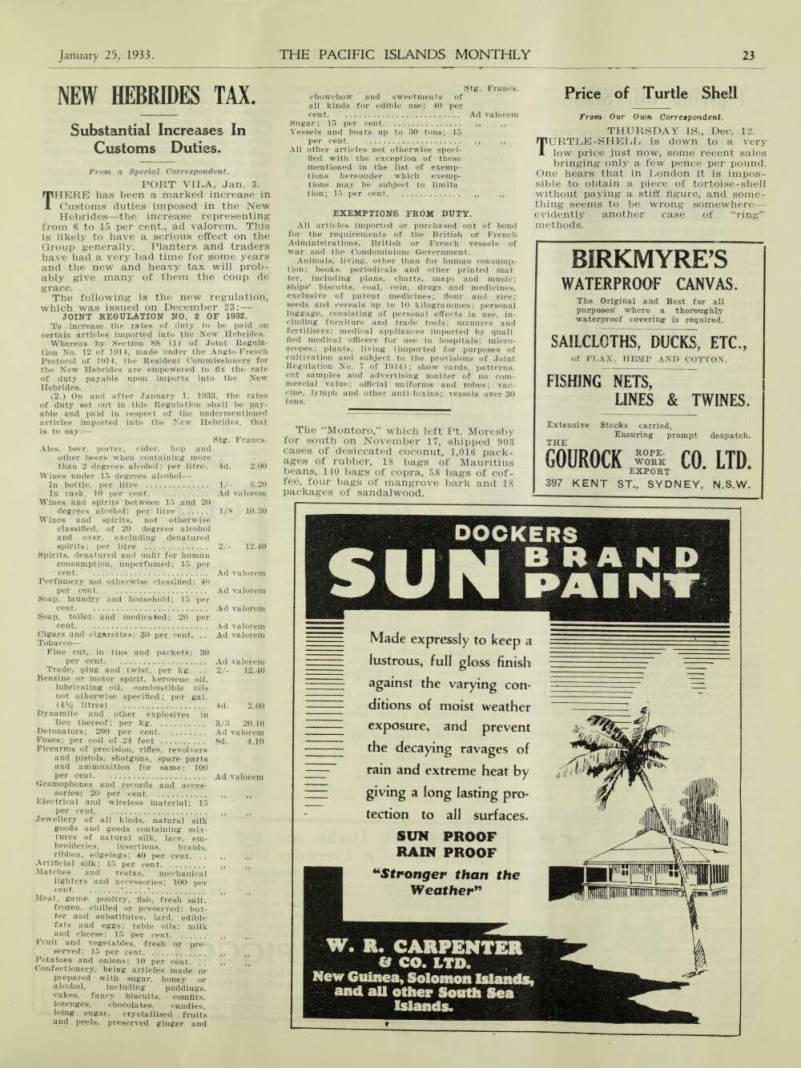
Substantial Increases In Customs Duties.
From a Special Correspondent.
Port Vila, Jan. 3.
THERE has been a marked increase in Customs duties imposed in the New Hebrides —the increase representing from 6 to 15 per cent., ad valorem. This is likely to have a serious effect on the Group generally. Planters and traders have had a very bad time for some years and the new and heavy tax will prob ably give many of them the coup de grace.
The following is the new regulation, which was issued on December 23:
Joint Regulation No. 2 Of 1932.
To increase the rates of duty to be paid on certain articles imported into the New Hebrides.
Whereas by Section 88 (1) of Joint Regula tion No. 12 of 1914, made under the Anglo-French Protocol of 1914, the Resident Commissioners for the New Hebrides are empowered to fix the rate of duty payable upon imports into the New Hebrides. (2.) On and after January 1, 1933, the rates of duty set out in this Regulation shall be pay able and paid in respect of the undermentioned articles imported into the New Hebrides, that is to say:— Stg. Francs.
Ales, beer, porter, cider, hop and other beers when containing more than 2 degrees alcohol; per litre. 4d. 2.00 Wines under 15 degrees alcohol— In bottle, per litre 1/- 6.26 In cask, 10 per cent Ad valorem Wines and spirits between 15 and 20 degrees alcohol; per litre 1/8 10.30 Wines and spirits, not otherwise classified, of 20 degrees alcohol and over, excluding denatured spirits; per litre 2/- 12.40 Spirits, denatured and unfit for human consumption, unperfumed; 15 per cent Ad valorem Perfumery not otherwise classified; 40 per cent Ad valorem Soap, laundry and household; 15 per cent Ad valorem Soap, toilet and medicated; 20 per cent Ad valorem Cigars and cigarettes; 30 per cent. .. Ad valorem Tobacco— Fine cut, in tins and packets; 30 per cent Ad valorem Trade, plug and twist, per kg. . . 2/- 12.40 Benzine or motor spirit, kerosene oil, lubricating oil, combustible oils not otherwise specified; per gal. (4½ litres) 4d. 2.00 Dynamite and other explosives in lieu thereof; per kg 3/3 20.10 Detonators; 200 per cent Ad valorem Fuses; per coil of 24 feet Bd. 4.10 Firearms of precision, rifles, revolvers and pistols, shotguns, spare parts and ammunition for same; 100 Per cent Ad valorem Gramophones and records and acces sories; 20 per cent Electrical and wireless material; 15 per cent Jewellery of all kinds, natural silk goods and goods containing mix tures of natural silk, lace, em broideries, insertions, braids, ribbon, edgeings; 40 per cent.
Artificial silk; 15 per cent Matches and vestas, mechanical lighters and accessories; 100 per cent Meat, game, poultry, fish, fresh salt, frozen, chilled or preserved; but ter and substitutes, lard, edible fats and eggs: table oils; milk and cheese; 15 per cent Fruit and vegetables, fresh or pre served; 15 per cent Potatoes and onions; 10 per cent Confectionery, being articles made or prepared with sugar, honey or alcohol, including puddings, cakes, fancy biscuits, comfits, lozenges, chocolates, candies, icing sugar, crystallised fruits and peels, preserved ginger and
Stg. Francs. chowchow and sweetmeats of all kinds for edible use; 40 per cent Ad valorem Sugar; 15 per cent Vessels and boats up to 30 tons; 15 per cent All other articles not otherwise speci fied with the exception of these mentioned in the list of exemp tions hereunder which exemp tions may be subject to limits tion; 15 per cent
Exemptions From Duty.
All articles imported or purchased out of bond for the requirements of the British or French Administrations, British or French vessels of war and the Condominium Government.
Animals, living, other than for human consump tion; books, periodicals and other printed mat ter, including plans, charts, maps and music; ships’ biscuits, coal, coin, drugs and medicines, exclusive of patent medicines; flour and rice: seeds and cereals up to 10 kilogrammes; personal luggage, consisting of personal effects in use, in cluding furniture and trade tools; manures and fertilisers: medical appliances imported by quali fied medical officers for use in hospitals; micro scopes; plants, living (imported for purposes of cultivation and subject to the provisions of Joint Regulation No. 7 of 1914); show cards, patterns, cut samples and advertising matter of no com mercial value; official uniforms and robes; vac cine, lymph and other anti toxins; vessels over 30 tons.
The “Montoro,” which left Pt. Moresby for south on November 17, shipped 903 cases of desiccated coconut, 1,016 pack ages of rubber, 18 bags of Mauritius beans, 140 bags of copra, 58 bags of cof fee, four bags of mangrove bark and 18 packages of sandalwood.
Price of Turtle Shell
From Our Own Correspondent.
Thursday Is., Dec. 12.
TURTLE-SHELL is down to a very low price just now, some recent sales bringing only a few pence per pound.
One hears that in London it is impos sible to obtain a piece of tortoise-shell without paying a stiff figure, and some thing seems to be wrong somewhere— evidently another case of “ring” methods.
Advertisements & other items, p. 25 (1 item)
Sun Brand
BIRKMYRE’S
WATERPROOF CANVAS.
The Original and Best for all purposes! where a thoroughly waterproof covering is required.
SAILCLOTHS, DUCKS, ETC.,
of FLAX, HEMP AND COTTON.
FISHING NETS,
LINES & TWINES.
Extensive Stocks carried, Ensuring prompt despatch.
THE
GOUROCK Ropework Export CO. LTD.
397 KENT ST., SYDNEY, N.S.W.
DOCKERS
SUN BRAND
PAINT
Made expressly to keep a lustrous, full gloss finish
against the varying con
ditions of moist weather exposure, and prevent the decaying ravages of rain and extreme heat by
giving a long lasting pro
tection to all surfaces.
SUN PROOF
RAIN PROOF
“Stronger than the Weather”
W. R. CARPENTER
& CO. LTD.
New Guinea, Solomon Islands, and all other South Sea Islands.
Castor Oil Seed.
Suggested To Planters As Quick Crop.
A Sydney agent, Mr. G. Grahame, has decided to give special attention to the marketing of castor oil seeds ; and (as his advertisement, published elsewhere, indicates) he is prepared to give advice to Islands' residents about the growing of this crop.
The circular which he has prepared appears to us to have special interest for all Islands' planters; and it is therefore reprinted hereunder.
THIS circular is written for the pur purpose of bringing to the notice of planters and farmers the value of castor seed, either as a catch or main crop.
For some years, with copra at high figures, no one worried about any thing else, and all were content to carry all the eggs in the one basket. Now that prices have slumped, and do not appear to be going much higher for some time, planters are looking round for a crop which will augment their returns, and the castor bean, giving a quick return, requiring very small outlay, little atten tion, comparatively free from pests, a hardy grower, and giving a crop which will keep indefinitely under reasonable conditions, stands out as suitable for this purpose.
In many places the castor tree, grow ing wild, is regarded as a pest, because of its seed, which is thrown out to a distance when ripe if not harvested. The fact is, however, that the tree grows only from seed, and under cultivation, when the seeds are harvested, is less troublesome than many other crops. If necessary, the tree can be eradicated in a season, as the plant grows only from seed, and once it is pulled out there is an end of it.
The danger to cattle lies only in the seed, and if they are kept away from the trees while actually in bearing, as would be done with any other tree, and the seed stored away from food crops, this danger ceases. The leaves of the tree are an excellent cattle food, and fed to milch cows tend to improve the milk supply, while the husks and stems left after the crop has been harvested form a most valuable manure, rich in potash.
With most crops, a market exists for sufficiently large quantities, and buyers usually make forward contracts for their supplies. The grower of a small crop is often unable to sell his produce for this reason, and to plant a large area of a crop not previously proved in a particular soil or district is risky.
It is not wise to plant large areas of castor seed to begin with. The plant should be encouraged to grow where it does best. Small patches here and there on the plantation should be selected; half an acre is one spot, an acre somewhere else, a grove down by a creek, or on the edge of a swamp; a line or two as a wind-break or boundary line; between other trees as a catch crop, on the waste land where the offal is thrown, or on ground not suitable for other crops. The tree makes a useful firebreak, as its leaves and stems, holding large quantities of water, will not readily burn.
After planting, some attention dur ing the first six weeks is all that is necessary until harvesting, and the
plant is very hardy and drought resisting. As the crop is obtained in from four to seven months, the return is quick, and as long as the seed is unbroken and kept dry, it will last indefinitely in store.
The plant is almost free from insect pests, the main trouble being a species of caterpillar which attacks the leaves in the early stages, and which can be dealt with by spraying. Two other troubles which have never been known to affect more than 30 per cent, of a crop are the bacterial wilt and grey mold, both of which are caused by too sour and acid condition of the soil, and can be prevented by remedying these faults.
Experience has shown that the crop gives the best returns when treated as an annual, though it will yield crops of decreasing quantity for three or four years, after which it is not worth keeping.
The seeds should be soaked for 24 hours in hot water (not boiling), and, if the tree is to be planted as an an nual, sown about 18 to 24 inches apart in rows 4 feet apart in good soil, or 4 feet by 4 feet, if the soil is not rich.
Any good maize land is suitable for the castor tree. Two or three seeds should be planted in each hole, about three inches apart, and the strongest left in when the trees are about six inches high. Those culled out, if healthy, can be transplanted to fill up any misses, or planted out in a new area, for which spare ground shou always be left. About ten pounds of seed is sufficient for one acre. When the plants are about two feet high, the main stem should be nipped back to keep the tree from growing too high and encourage fruit-bearing laterals This not only ensures a better crop, but makes picking quicker and easier.
The trees should not be allowed to grow more than about five feet high unless they are being used as a wind break. when the planter will use his own discretion.
The fruit appears in spiked clusters first green, then red, and as they ripen turning brown. At this stage the fruit should be picked. All the clusters not ripen at once, and the trees should be gone over once a week at least pick the clusters whose lower pods are turning brown. In hot countries it has been found that if after picking, the frees are cut back to about four feet, they will give a second crop in about three months.
The picked fruit should be taken to a drying ground, where it is spread out to dry in the sun for four or five
days. The ground should be hard and clean, so that the seed can be readily gathered, and the fruit should be spread to a depth of about six inches, being turned over at least once a day to ensure all pods drying out. In case of rain it should be raked together and covered with a tarpaulin, as it must be kept dry, and in rainy districts it is advisable if possible to use dry ing sheds, where the fruit can be dried out regardless of the weather.
If the drying ground is in the open, it should be surrounded by a fence of bag ging or iron or bamboo, as the seeds pop to some distance as they leave the pods, and this fence should be at least four feet high. A little flailing will help to separate seeds which do not readily leave the pods, and when all are sepa
rated they should be gathered up and bagged, while the pods and husks make valuable manure. In bagging, care should be taken not to break the mottled skin of the bean, so long as this is intact, and the seed kept dry, it will last indefinitely, without deterioration.
The yield should average a ton per acre, and the cost with native labour has been not more than £2/15/- per acre. The return is therefore worth while. Putting cost at £3, freight at £ 2, bagging at 5/- and other charges at say £1, the total cost is £6/5/-, and the present price is between £13 and £14 per ton c.i.f. and e., which gives a good margin.
The writer is prepared to supply sel ected seed for planting at 6d. per lb., and to contract to purchase any quan tities, large or small, at the current market price, less 5 per cent. The price will be determined on samples to be submitted, on which a firm figure will be quoted, 75 per cent, of which will be paid against documents in Australia, and the balance on acceptance of con signments as up to sample.
The market is therefore assured, and the writer will be glad to answer any inquiries from planters and farmers willing to grow the crop, and to give any information.
Advertisements & other items, p. 26 (1 item)
Piggott
THE BOOK CLUB,
BURNT PINE,
NORFOLK ISLAND.
FIRST-RATE MODERN LIBRARY.
Five Hundred Books—added to by every mail. Very reasonable terms.
Visitors welcomed.
Conducted by
Mrs. CAMPBELL, Rep. P.I.M,
OLD GOLD
and
MONEY
Buyers and Sellers.
Gold Prices are at present excep tionally High, and it is advisable to sell without delay.
MAIL your SCRAP JEWELLERY
to us, and we will remit your cash by return mall.
HIGHEST PRICES PAID for Sovereigns and New Zealand Notes and English Notes.
English Silver American Dollars English Copper Canadian Dollars Fiji Notes South African Notes Dutch Gulden French Francs And all Foreign Currency.
REGISTER ALL PARCELS
Full particulars from
THE ROYAL GOLD &
CURRENCY EXCHANGE,
40 Martin Place, SYDNEY, AUST.
Vitality and Health are the
Main Factors in Every-day Life.
Put yourself in the hands of are known Produce to ThTleldTg Houses throughout the world.
Tel • MA 4799; FX SKfS:Sfi. Code: B«U^ C. G.
WHOLESALE FRUIT
DIRECT IMPORTERS
L/UUlt; Aum coo . - “
PIGGOTT
and produce merchants
and EXPORTERS SYDNEY.
Office: Bulk Stores and Packing House: Fruit Exchange Sales Dept.: Fruit Exchange and City Markets. Sydney. Bank of N.S.W. Bankers.
Sydney Anthropologist Leaves
For Outlying Solomons.
DR. H. IAN HOGBIN, recently a lec turer in anthropology at Sydney University, is on his way to Guadalcanal, B.S.I., to carry out general anthropological research on behalf of the Australian National Research Council.
Dr. Hogbin, who was the first to be admitted to the degree of Master of Arts in Anthropology in the University of Sydney, was with the 1927-28 expeditions to Ongtong - Java, and Rennell Island. The first job con fronting him on Guadalcanal will be the writing of a grammar of the lan guages, and he will study the natives in their primitive state in the bush, as well as those on the coast who have come into contact with white civilisation.
Dr. Hogbin has made a study of the causes of depopulation. He had ample opportunity to pursue this in Ongtong Java, where the population has de creased from 5,000 in 1907 to fewer than 800 in 1932.
An Austrian ethnologist, Dr. Hugo Adolf Bernatzik, is at present on his way to Rennell Island, where he will spend some months studying the natives. Here, also, the population (Polynesian) has decreased in 20 years from several thousands to a few hundreds.
Apia Lottery.
From Our Own Correspondent.
Apia, Nov. 26.
Owing to a misunderstanding, the number of tickets sold so far was stated wrongly in the October P.I.M. The amount sold was £100 not £10.
The lottery was to close at the end of December, but has to be extended and, if possible, will be changed into an art union and made more attractive to the public.
“Pirates” Escape Through
Torres Straits.
From Our Own Correspondent
Thursday Is., Dec. 12.
INFORMATION has been received from the Dutch authorities that the launch stolen from Cairns about three months ago has turned up in Dutch New Guinea.
Apparently the two men in her, mak ing their getaway, passed right through Torres Strait without touching at any of the islands in their haste to get into foreign waters.
As the expense of having the alleged pirates brought back is likely to be con siderable, and the owner of the boat hardly feels justified in spending further money in attempting to recover it, it is probable that this will be the last of the matter.
This is the second launch stolen with in a short period, in which the thieves have made their escape to Dutch New Guinea. The authorities at Thursday Is land have no fast motor boat at their
disposal for chasing runaways, and the Torres Strait islands have no wireless communication to report the presence of strange craft.
Advertisements & other items, p. 27 (1 item)
Arnott’S;
Consult ALEX. HALE
ABOUT YOUR EYES.
Accurate Optical Service and Comfort for your Eyes.
All Optical Repairs and Broken Lenses Replaced by return post.
SEND FOR SELF-TESTING
EYE CHART.
All our Prices will please you.
ALEX HALE ..
Optometrist Optician,
113 PITT STREET, SYDNEY.
Five other City Addresses. Est. over 30 years.
ALL the precious elements of the whole wheat grain in a form crisp, delicious
and tempting. They have a wonderful
attractiveness for young and old alike.
Made in Australia, Financed by Australians and pro duced by highly trained Australian workers.
Manufactured by WILLIAM ARNOTT LTD.. The Biscuit Specialists of sixty-four years’ experience.
ARNOTT’S;
FAMOUS
Shredded Wheatmeal
BISCUITS
ASK YOUR STOREKEEPER FOR ARNOTT’S
AND MAKE SURE YOU GET THEM !
Thursday Is. Notes.
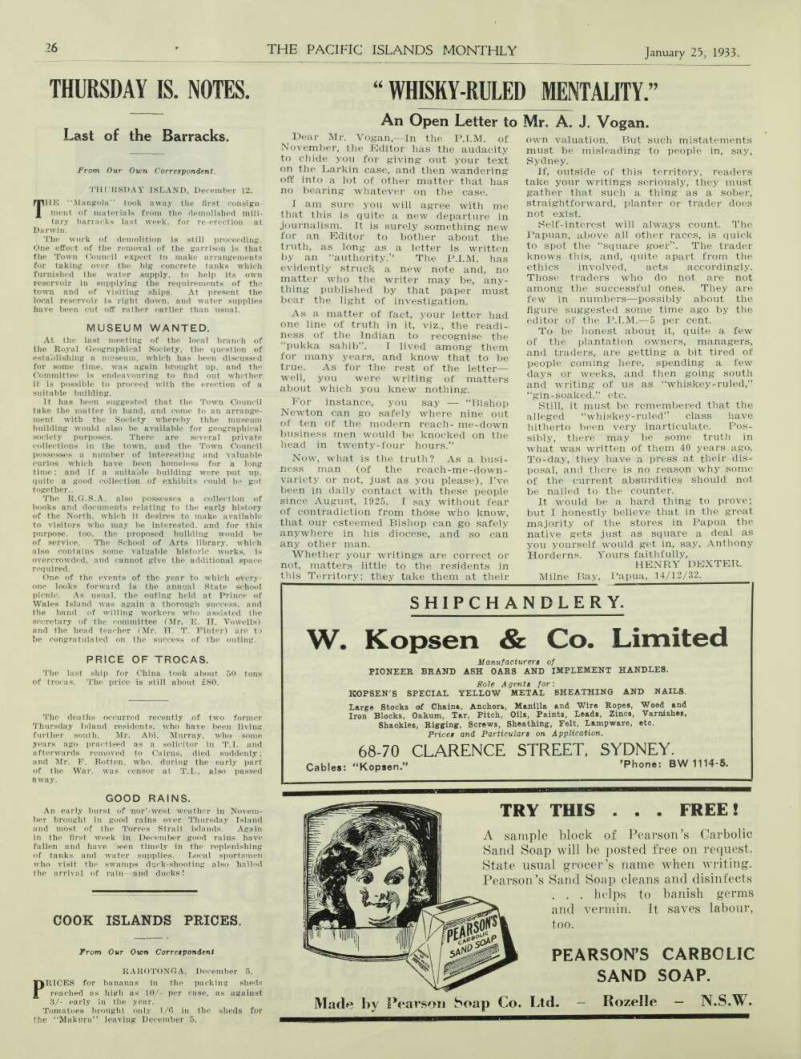
Last of the Barracks.
From Our Own Correspondent.
THURSDAY ISLAND, December 12.
THE “Mangola” took away the first consign ment of materials from the demolished mili tary barracks last week, for re-erection at Darwin.
The work of demolition is still proceeding.
One effect of the removal of the garrison is that the Town Council expect to make arrangements for taking over the big concrete tanks which furnished the water supply, to help its own reservoir in supplying the requirements of the town and of visiting ships. At present the local reservoir is right down, and water supplies have been cut off rather earlier than usual.
Museum Wanted.
At the last meeting of the local branch of the Royal Geographical Society, the question of establishing a museum, which has been discussed for some time, was again brought up. and the Committee is endeavouring to find out whether it is possible to proceed with the erection of a suitable building.
It has been suggested that the Town Council take the matter in hand, and come to an arrange ment with the Society whereby thhe museum building would also be available for geographical society purposes. There are several private collections in the town, and the Town Council possesses a number of interesting and valuable curios which have been homeless for a long time; and if a suitable building were put up, quite a good collection of exhibits could be got together..
The R.G.S.A. also possesses a collection of books and documents relating to the early history of the North, which it desires to make available to visitors who may be interested, and for this purpose, too, the proposed building would be of service. The School of Arts library, which also contains some valuable historic works, is overcrowded, and cannot give the additional space required.
One of the events of the year to which every one looks forward is the annual State school picnic. As usual, the outing held at Prince of Wales Island was again a thorough success, and the band of willing workers who assisted the secretary of the committee (Mr. E. H. Vowells) and the head teacher (Mr. H. T. Finter) are to be congratulated on the success of the outing.
Price Of Trocas.
The last ship for China took about 50 tons of trocas. The price is still about £80.
The deaths occurred recently of two former Thursday Island residents, who have been living further south. Mr. Abi. Murray, who some years ago practised as a solicitor in T.I. and afterwards removed to Cairns, died suddenly; and Mr. F. Rotten, who, during the early part of the War, was censor at T.I., also passed away.
Good Rains.
An early burst of nor’-west weather in Novem ber brought in good rains over Thursday Island and most of the Torres Strait islands. Again in the first week in December good rains have fallen and have been timely in the replenishing of tanks and water supplies. Local sportsmen who visit the swamps duck-shooting also hailed the arrival of rain—and ducks!
Cook Islands Prices.
From Our Own Correspondent RAROTONGA, December 5.
PRICES for bananas in the packing sheds reached as high as 10/- per case, as against 3/- early in the year.
Tomatoes brought only 1/6 in the sheds for the “Makura” leaving December 5.
“Whisky-Ruled Mentality.”
An Open Letter to Mr, A. J. Vogan.
Dear Mr. Vogan,—In the P.I.M. of November, the Editor has the audacity to chide you for giving out your text on the Larkin case, and then wandering off into a lot of other matter that has no bearing whatever on the case.
I am sure you will agree with me that this is quite a new departure in journalism. It is surely something new for an Editor to bother about the truth, as long as a letter is written by an “authority.’’ The P.I.M. has evidently struck a new note and, no matter who the writer may be, any thing published by that paper must bear the light of investigation.
As a matter of fact, your letter had one line of truth in it, viz., the readi ness of the Indian to recognise the “pukka sahib”. I lived among them for many years, and know that to be true. As for the rest of the letter — well, you were writing of matters about which you knew nothing.
For instance, you say “Bishop Newton can go safely where nine out of ten of the modern reach-me-down business men would be knocked on the head in twenty-four hours.”
Now, what is the truth? As a busi ness man (of the reach-me-down variety or not, just as you please), I’ve been in daily contact with these people since August, 1925. I say without fear of contradiction from those who know, that our esteemed Bishop can go safely anywhere in his diocese, and so can any other man.
Whether your writings are correct or not, matters little to the residents in this Territory; they take them at their
own valuation. But such mistatements must be misleading to people in, say, Sydney.
If, outside of this territory, readers take your writings seriously, they must gather that such a thing as a sober, straightforward, planter or trader does not exist.
Self-interest will always count. The Papuan, above all other races, is quick to spot the “square goer”. The trader knows this, and, quite apart from the ethics involved, acts accordingly.
Those traders who do not are not among the successful ones. They are few in numbers—possibly about the figure suggested some time ago by the editor of the P.I.M.—5 per cent.
To be honest about it, quite a few of the plantation owners, managers, and traders, are getting a bit tired of people coming here, spending a few days or weeks, and then going south and writing of us as “whiskey-ruled,”
“gin-soaked.” etc.
Still, it must be remembered that the alleged “whiskey-ruled” class have hitherto been very inarticulate. Pos sibly, there may be some truth in what was written of them 40 years ago.
To-day, they have a press at their dis posal, and there is no reason why some of the current absurdities should not be nailed to the counter.
It would be a hard thing to prove; but I honestly believe that in the great majority of the stores in Papua the native gets just as square a deal as you yourself would get in, say, Anthony Horderns. Yours faithfully,
Henry Dexter.
Milne Bay, Papua, 14/12/32.
Advertisements & other items, p. 28 (1 item)
W. Kopsen & Co. Limited
SHIPCHANDLERY.
Manufacturers of PIONEER BRAND ASH OARS AND IMPLEMENT HANDLES.
Bole Agents for: KOPSEN’S SPECIAL YELLOW METAL SHEATHING AND NAILS.
Large Stocks of Chaim, Anchors, Manilla and Wire Ropes, Wood and Iron Blocks, Oakum, Tar, Pitch, Oils, Paints, Leads, Zincs, Varnishes, Shackles, Rigging, Screws, Sheathing, Felt, Lampware, etc.
Prices and Particulars on Application.
68-70 CLARENCE STREET, SYDNEY.
Cables; "Kopsen.” ’Phone: BW 1114-6.
TRY THIS . . . FREE!
A sample block of Pearson’s Carbolic Sand Soap will be posted free on request.
State usual grocer’s name when writing.
Pearson’s Sand Soap cleans and disinfects . . . helps to banish germs and vermin. It saves labour, too.
PEARSON’S CARBOLIC
SAND SOAP.
Made by Pearson Soap Co. Ltd. Rozelle N.S.W.
What Bulolo Co. Has Done.
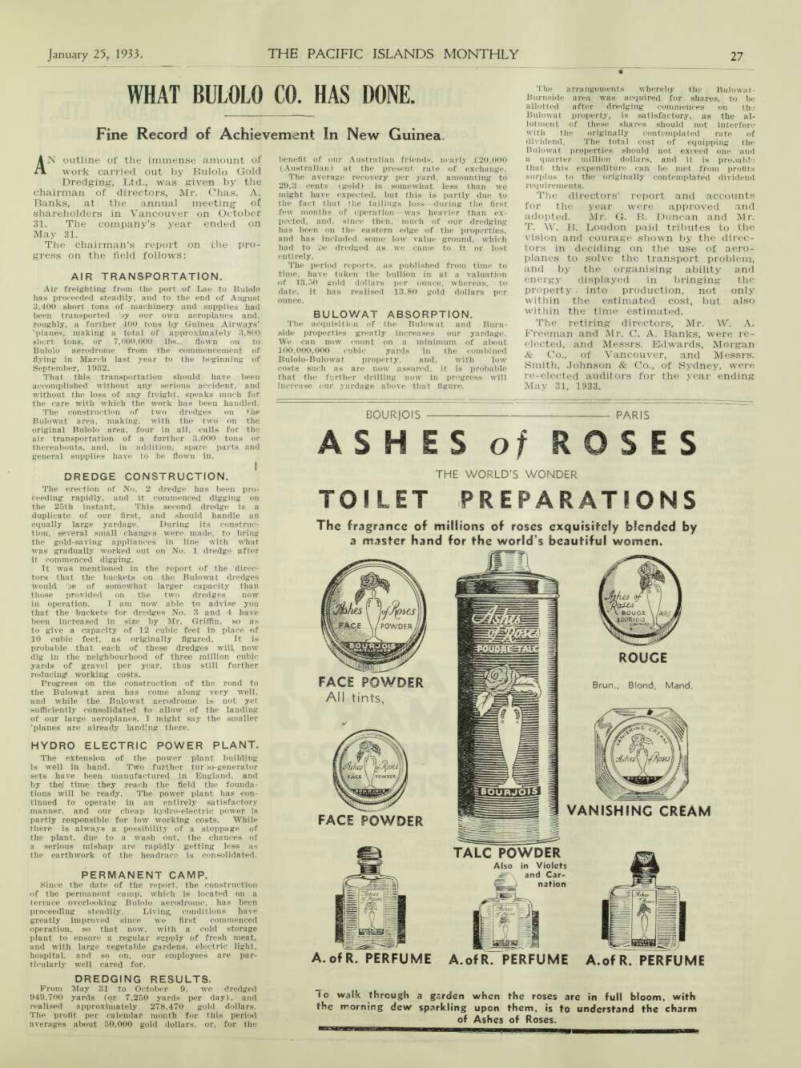
Fine Record of Achievement In New Guinea.
AN outline of the immense amount of work carried out by Bulolo Gold
Dredging, Ltd., was given by the
chairman of directors, Mr. Chas. A.
Banks, at the annual meeting of shareholders in Vancouver on October 31. The company’s year ended on May 31.
The chairman's report on the pro gress on the field follows:
Air Transportation.
Air freighting from the port of Lae to Bulolo has proceeded steadily, and to the end of August 3,400 short tons of machinery and supplies had been transported by our own aeroplanes and, roughly, a further 400 tons by Guinea Airways’ ’planes, making a total of approximately 3,800 short tons, or 7,000,000 lbs.. flown on to Bulolo aerodrome from the commencement of flying in March last year to the beginning of September, 1932.
That this transportation should have been accomplished without any serious accident, and without the loss of any freight, speaks much for the care with which the work has been handled.
The construction of two dredges on the Bulowat area, making, with the two on the original Bulolo area, four in all, calls for the air transportation of a further 3,000 tons or thereabouts, and, in addition, spare parts and general supplies have to be flown in.
Dredge Construction.
The erection of No. 2 dredge has been pro ceeding rapidly, and it commenced digging on the 25th instant. This second dredge is a duplicate of our first, and should handle an equally large yardage. During its construc tion, several small changes were made, to bring the gold-saving appliances in line with what was gradually worked out on No. 1 dredge after it commenced digging.
It was mentioned in the report of the direc tors that the buckets on the Bulowat dredges would be of somewhat larger capacity than those provided on the two dredges now in operation. I am now able to advise you that the buckets for dredges No. 3 and 4 have been increased in size by Mr. Griffin, so as to give a capacity of 12 cubic feet in place of 10 cubic feet, as originally figured. It is probable that each of these dredges will now dig in the neighbourhood of three million cubic yards of gravel per year, thus still further reducing working costs.
Progress on the construction of the road to the Bulowat area has come along very well, and while the Bulowat aerodrome is not yet sufficiently consolidated to allow of the landing of our large aeroplanes, I might say the smaller ’planes are already landing there.
Hydro Electric Power Plant.
The extension of the power plant building is well in hand. Two further turbo-generator sets have been manufactured in England, and by the] time they reach the field the founda tions will be ready. The power plant has con tinued to operate in an entirely satisfactory manner, and our cheap hydro-electric power is partly responsible for low working costs. While there is always a possibility of a stoppage of the plant, due to a wash out, the chances of a serious mishap are rapidly getting less as the earthwork of the headrace is consolidated.
Permanent Camp.
Since the date of the report, the construction of the permanent camp, which is located on a terrace overlooking Bulolo aerodrome, has been proceeding steadily. Living, conditions have greatly improved since we first commenced operation, so that now, with a cold storage plant to ensure a regular supply of fresh meat, and with large vegetable gardens, electric light, hospital, and so on, our employees are par ticularly well cared for.
Dredging Results.
From May 31 to October 9, we dredged 949,700 yards (or 7,250 yards per day), and realised approximately 278,470 gold dollars.
The profit per calendar month for this period averages about 50,000 gold dollars, or, for the
benefit of our Australian friends, nearly £20,000 (Australian) at the present rate of exchange.
The average recovery per yard, amounting to 29.8 cents (gold) is somewhat less than we might have expected, but this is partly due to the fact that the tailings loss—during the first few months of operation—was heavier than ex pected, and, since then, much of our dredging has been on the eastern edge of the properties, and has included some low value ground, which had to be dredged as we came to it or lost entirely.
The period reports, as published from time to time, have taken the bullion in at a valuation of 13.50 gold dollars per ounce, whereas, to date, it has realised 13.80 gold dollars per ounce.
Bulowat Absorption.
The acquisition of the Bulowat and Burn side properties greatly increases our yardage.
We can now count on a minimum of about 100,000,000 cubic yards in the combined Bulolo-Bulowat property, and, with low costs such as are now assured, it is probable that the further drilling now in progress will increase our yardage above that figure.
The arrangements whereby the Bulowat- Burnside area was acquired for shares, to be allotted after dredging commences on the Bulowat property, is satisfactory, as the al lotment of these shares should not interfere with the originally contemplated rate of dividend. The total cost of equipping the Bulowat properties should not exceed one and a quarter million dollars, and it is provable that this expenditure can be met from profits surplus to the originally contemplated dividend requirements.
The directors’ report and accounts for the year were approved and adopted. Mr. G. B. Duncan and Mr.
T. W. B. Loudon paid tributes to the vision and courage shown by the direc tors in deciding on the use of aero planes to solve the transport problem, and by the organising ability and energy displayed in bringing the property into production, not only within the estimated cost, but also within the time estimated.
The retiring directors, Mr. W. A.
Freeman and Mr. C. A. Banks, were re elected, and Messrs. Edwards, Morgan & Co., of Vancouver, and Messrs.
Smith, Johnson & Co., of Sydney, were re-elected auditors for the year ending May 31, 1933.
Advertisements & other items, p. 29 (1 item)
Toilet Preparations
BOURJOIS
PARIS
ASHES of ROSES
THE WORLD’S WONDER
TOILET PREPARATIONS
The fragrance of millions of roses exquisitely blended by a master hand for the world’s beautiful women.
FACE
POWDER
FACE POWDER
All tints,
FACE POWDER
ROUGE
Brun., Blond, Mand.
VANISHING CREAM
TALC POWDER
Also in Violets and Car nation A. of R. PERFUME A. of R. PERFUME A. of R. PERFUME To walk through a garden when the roses are in full bloom, with the morning dew sparkling upon them, is to understand the charm of Ashes of Roses.
Lakatois Help.
Big Fleet Manoeuvres for Interesting Film.
From Our Own Correspondent.
Pt. Moresby, Dec. 15.
THE American Shackleford-Drumgold Expedition, which arrived from Thursday Island on October 14 by the “Veimauri” to take films of tropical scenery and native life and customs in Papua, are at present very energetically at work on scenes near Port Moresby.
These, later, will be adapted for the set ting and background of a highly spec tacular film of adventure in the tropic seas.
The preparations and performances in connection with the production have stirred both the imagination and the cupidity of the Hanuabada natives —who are ever hawks upon the wing. In their eagerness to act they out-Herod Herod and demand payment for the merest gesture or grimace. Though puzzled at times they enter whole-heartedly and with little prompting into the spirit of the performances.
The quest for hidden treasures in the battered hold of a forsaken wreck on a coral reef, especially pleases them. It is play to their liking.
At times some of the natives are con fused. They find it difficult to follow the drift of the proceedings, but others do not bother; they put it all down to buf foonery, and wonder at the strange ways of some white people. On the whole, they are all alive to the game and are quite useful to the expedition.
On November 28, in connection with the “Search for Hidden Treasures,” a fleet of 150 canoes, under the direction of Mr. Drumgold, left their moorings by Hanuabada and set sail before the early morning breeze. Across the harbour they came, through the entrance, and out to the reef and the wreck, four miles from the shore. Those of the residents of Pt.
Moresby, who were awake, had never before witnessed such a scene, which was unexpectedly beautiful.
Canoes of all shapes and sizes, single canoes and double, with and without outriggers, with crab claw sails and canvas, all joined in, and, after the in evitable jumble and tumble inseparable from any native undertaking had died down, they fell in and set sail. In the faint light of the early morning against the dark outline of the surrounding hills, the soft grey of the sky and the dark grey of the sea, the flotilla appeared visionary and airy in the distance —a phantasy.
Thick as autumn leaves they followed in the wake of the “Veimauri” and, in scattered groups, passed with her out of the harbour to the wreck.
The “Pruth,” a forsaken derelict, stranded on the reef four miles from the harbour, was formerly a vessel of the St. Iver Shipping Co., carrying general cargo and oil to the islands. Eight years ago, while attempting to make the en trance, she struck the reef and all at tempts to dislodge her proved futile.
Ever since, she has been a familiar land mark and a warning to all vessels en tering Port Moresby. £200 was paid to the owners of the canoes at Hanaubada for the day’s work.
Lurid Yarns.
London Newspaper’s Geography Gets Adrift.
THE joke of the year has come to light in a cutting from a London newspaper “The People,” describing the departure of the ill-fated “Southern Cross” from Greenwich.
Headed “Crew Doomed to Isles of Danger,” and “Cannibals Will Keep Them Busy,” the report tells a lurid story of the life the crew have to live “doomed to virtual isolation for the rest of their lives among natives, who are liable to become head-hunters and cannibals at the first beat of the war drum.”
The island of “Malay” is described as one of the danger spots of the Solomons, “where a spear or an arrow are considered the best finish to an
argument.”
To one whose geography is so adrift as to think that “Malay” is in the Solomons, the notion of being “vir tually isolated” in a modern motor vessel in the Pacific would come easily.
One imagines a member of the crew of the “Southern Cross” gently ex tending the leg of a cub reporter whose knowledge of the wide world is limited to the daily journey from a Pimlico lodging-house to his office. But he got nearer the truth when he called the “Southern Cross” the “ship that will never return.”
Rev G. Shinkfihld left Apia on January 20, for Pago Pago, where he joined the “Monterey” and proceeded to Melbourne. He arrived in Samoa in 1917 and for the past 14 years was Chairman of Apia District for the Samoa Method ist Church.
Advertisements & other items, p. 30 (1 item)
Aunt
JOHN L PEADON LTD.,
RABAUL, NEW GUINEA,
Engineers and Garage
Proprietors,
All Classes of General Engineering Undertaken.
CARS FOR HIRE.
Territory Agents for — Goodrich Products. Clyde Batteries.
Berger’s Lacquers. B.E.S. Plugs.
Chas. Hope, Ltd., Brisbane.
Lamson Paragon Ltd., Printers.
'Phone: Rabaul 20.
T. ELLIOTT & CO.
(Established 15 years) Real Estate Agents, Valuers,
Flat Specialists.
Controlling Agents for Principal Flat Buildings in Sydney, Darling hurst, Potts Point, Elizabeth Bay, Darling Pt., Edgecliff, Pt. Piper, etc.
When contemplating a visit to Sydney write regarding your re quirements and see us immediately on landing, and our services will be at your disposal.
72 DARLINGHURST ROAD,
(Opposite King's Cross Theatre),
King’s Cross, Darlinghurst,
SYDNEY.
Telephone: FL 1968.
AUNT
MARY'S
PURE FOOD
PRODUCTS
These high-grade products are still supreme after thirty years’ trading with the Islands. Specially manufactured from the finest ingredients and packed to meet Island conditions.
Only goods of the very highest standard are packed by the Proprietors, ensuring satisfaction and confidence to all who purchase.
Aunt Mary’s Pure Pood Products and “Defiance” Brand Canned Goods are prepared and packed only by
“ Defiance”
Brand
Canned
Goods
Packed by the Proprie tors of Aunt Mary’s Pure Food Products, these quality Canned Goods are hermetically sealed and specially prepared to withstand tropical heat, thus giving satisfaction to the consumer.
TILLOCK & CO. LTD.
Kent and Liverpool Streets, SYDNEY, N.S.W.
Boycott Fails.
Fiji Bananas in Keen Demand.
THE threatened boycott of Fiji ban anas by Sydney and Melbourne fruit distributing houses came to nothing.
The first shipment of 1000 cases ar rived by the “Niagara” on December 31 and was eagerly purchased, orders com ing from as far as Western Australia.
Despite the promise of some 70 Sydney and Melbourne distributors to Queens land and New South Wales growers that they would not handle the fruit, a Syd ney house was eager to undertake the distribution. Of the first shipment, which opened in excellent condition, 675 cases were re-shipped to Melbourne, the remainder being consumed in Sydney.
Major Clive B. Joske, President of the Fiji Banana Association, came to Syd ney by the “Niagara”; and, in an inter view with The Sydney Morning Herald, pointed out that had the boycott suc ceeded, it might have caused Australia to lose a very profitable trade with Fiji.
“Queensland, which stands to gain more than any Australian State from the Ottawa agreement, is doing its best to get behind that agreement where Fiji bananas are concerned,” Mr. Joske averred.
Fiji, he proceeded, was a valuable customer of Australia.
Because of Australia’s exclusion of Fiji bananas, a trade agreement was negotiated with New Zealand and efforts were made to divert trade from Aus tralia to Canada. At Ottawa, an attempt was made to remedy the position, and they in Fiji had to agree to put Aus tralia on the same footing as their good friends New Zealand and Canada, in re turn for the right to send a very small quantity of bananas to the Sydney and Melbourne markets. The quota, 50,000 cases, was most meagre. Australia’s consumption was about 2,225,000 cases per annum.
“It seems reasonable to expect a coun try which supplies two-fifths of the total imports of another one to recipro cate to some extent,” said Mr. Joske’s colleague, Mr. A. C. Barnes, Director of Agriculture, Fiji, “and certainly to pur chase more than a mere £64,000 worth of goods in return for trade valued at nearly £500,000 per annum.”
Commenting on the boycott the “Fiji Times and Herald” accuses the Queens land growers of “carrying their opposi tion to the Fiji quota to ridiculous ex tremes. Even were the Sydney mer chants susceptible to the threats of a boycott, it would not be a difficult mat ter for Fiji to get round the boycott and dispose of the shipments.” After show ing many ways of doing this the article continues: “It is pleasing to note that the Federal Government does not intend to submit to any intimidating tactics by the Queensland growers, and in taking up the attitude that the growers are only attempting to bring discredit on Aus tralia’s name, the Government has also indicated that it will take firm measures to ensure the Ottawa agreement being honoured.”
The article concludes by warning the Fiji shippers that only the best fruit should be exported, as, in the present position of the industry, no outlet, how ever small, should remain neglected.
Suva Mayoralty
Councillor Grahame Re-elected.
THE annual election of Councillors for the Municipal Council of Suva was held at the Suva Town Hall, on De cember 3. Though considerable public interest was shown, only 371 electors of 567 on the roll recorded their votes. Mr.
R. C. Evans, the Returning Officer, an nounced that the results were: Costello 250 Beattie 236 Martin 187 Shirley 167 Duncan 143 Muir 142 He then declared that Mr. Patrick Cos tello, Dr. Ivor H. Beattie and Mr. Albert H. Martin were duly elected for the en suing three years’ term.
Election Of Mayor.
The Suva Municipal Council met on December 7 to elect a Mayor and Chair man for the following term. Nomina tions were called for and Mr. B. N.
Marks proposed Mr. G. F. Grahame, the retiring Mayor, and Mr. J. T. Johnson proposed Mr. A. Barker. A ballot was taken and four votes were recorded for each candidate. The decision was de cided by lot and Councillor Grahame’s name was drawn from the box. He was declared elected and invested with the robes of office.
Mr. George Frier Grahame was first
elected to the Council in 1919 and was Mayor from 1922 until he retired in 1925.
Some years later, he rejoined the Coun cil and was again elected Mayor of Suva in 1931. After his present re-election, His Worship announced that he would retire from public life in Fiji at the completion of his term, in December, 1933.
Exchange.
Solomons Natives and Exchange.
THE natives of the Solomon Islands, becoming more sophisticated, are be ginning to enquire into the intricacies of the rate of exchange. A resident in B.S.I. in a letter dealing with copra
conditions, says:
“The natives are cooking very little copra, and trading is practically dead. The native student of political economy can tell you why he is not cooking, and tells others why they should not cook. I heard one say the other day: ‘White man, he get ’em ’change, but no givem change along me.’
“From what I can gather, someone has men tioned within hearing of the natives that the exchange was favourable, and meant an in creased price—or, possibly, some enlightened cookboy has overheard a conversation at the table. It got to such a stage that there was almost a boycott of the white trader until such time as he was prepared to pass on to the natives this precious ‘ ’change.’
“However, I gathered when out in the dis trict last week that the native was beginning to realise that, when there was competition, they got better prices than when they cut out a number of the white traders and sold only to the Chinese.”
Advertisements & other items, p. 31 (1 item)
Bank of New South Wales
(ESTABLISHED 1817)
with which are amalgamated the Western Australian Bank and The Australian Bank of Commerce Ltd.
Reserve Liability of Proprietors - £8,780,000
Aggregate Assets Exceed - - £107,000,000 The Bank transacts all customary Banking and Exchange Business throughout Australia and overseas. It establishes commercial credits and negotiates and collects Bills of Exchange. It issues drafts, Travellers' Letters of Credit, available throughout the world, and makes money transfers by mail or cable. Fixed deposits at current rates are accepted at all branches for any period from three to twentyfour months. 705 Branches and Agencies throughout Australia, New Zealand, Pacific Islands, and London.
Agents and correspondents throughout the World.
Head Office: Sydney, New South Wales.
Paid-up Capital
Reserve Fund - £8,780,000 £6,150,000
BRANCHES IN—
Suva Lautoka Levuka Kavieng Rabaul Salamoa Port Moresby Samarai (Agency Ba)
Story Of Shipwreck.
Southern Cross Men Show Heroism When In Desperate Plight.
THE wreck of the new mission schooner “Southern Cross” in the New Hebrides at the end of October shows that even in these days of effi cient wireless, Diesel engines, revised charts and perfected navigating instru ments, navigation in the Pacific is still attended with risks and dangers.
Interviewed on their arrival at Syd ney by the “Laperouse” the crew told “The Sydney Morning Herald” a thrill ing story of narrow escapes in a heavy surf, and subsequent dangers and hard ships.
The vessel was caught in a squall and driven on to one of the jagged coral reefs in the comparatively shallow water around Aneityum. Huge seas broke over the schooner, and it rapidly commenced to break up. It was about 3 o’clock in the morning. Rain was falling in tor rents, and land could not be seen. The lifeboats were swept away, and the ship’s complement, comprising eight Europeans and 15 Solomon Island boys, were in desperate straits. Fortunately, only one man could not swim. After battling with the surf, the entire party managed to reach the beach. A series of perilous adventures beset them, how ever, before they ultimately reached Vila.
The complement of the “Southern Cross” consisted of Captain M. Stanton, who was formerly chief officer of the Mawson Antarctic expedition in the “Discovery”; J. Scott, chief officer; R.
Holmes, second officer; O. D. Wilkes, third officer; G. R. Newton, chief engi neer; A. S. McGregor, second engineer; H. Roberts, steward; W. Stolte; and the natives.
About an hour before the vessel struck, Captain Stanton was called to the bridge. Rain was commencing to fall, visibility was bad, and a heavy sea was running, with a grinding crash the ves sel struck the reef. No land was visible.
The doomed ship heeled over to star board, and was swept continuously by mountainous seas. The deck cargo was carried away. The searchlight was turned in the direction from which came the sound of the pounding surf, but no land could be seen, only black, low-lying rocks. Then the dynamo failed and the ship was in complete darkness. The captain made an attempt to salvage the ship’s books, but the saloon was rapidly filling with water, and he narrowly escaped from the cabin.
The crew had been ordered to put on their lifebelts. The vessel was pounding and grinding violently, and it appeared that it would sink at any moment. The starboard lifeboat had been swept away, and an attempt was made to launch the port boat, but it was caught in a huge wave, flung through the sky-deck, and smashed to matchwood.
The chief officer, Mr. Scott, then vol unteered to attempt to swim ashore with a line. He reached the beach. He pulled in the slack of the line, and found to his horror that it had been cut through on the sharp coral. The ship was breaking up, and it was a case of every man for himself.
Stolte, a German, who had been signed on as purser, could not swim. Holding him tightly, Captain Stanton plunged into the boiling surf, and, after battling
with the breakers for about 20 minutes, they reached the shore. He found that everyone else had managed to swim to safety. Some were on the verge of ex haustion, and all had been badly cut and bruised on the coral.
Daylight broke. Torrential rain was falling. Captain Stanton, who was dressed in pyjamas, with bare feet, de cided to search for habitation. He set off at about 6 a.m., accompanied by the sec ond officer, leaving the chief officer to at tend to the salvage. The natives directed them, and they trudged over the razor sharp coral for about 14 miles to the home of Mr. Freeman, on the Ithumu Estate, arriving in a state of exhaustion.
They borrowed a whaleboat, and made their way back to the wreck. Heavy seas were running, and they had to beach the whaleboat and make their way back on foot.
The “Southern Cross” was a total loss.
It had been smashed in two. The two portions were almost submerged. The crew was ordered to continue round the island to the home of Mr. Wilson, which was nearer than Mr, Freeman’s house, and where they were given food and clothing.
An appeal was then made to the na tives for volunteers to man the whale boat, and to sail to Vila for assistance.
Not one responded. Captain Stanton de cided to attempt the trip with three of ficers. Mr. Holmes, in the meantime, developed fever, but he insisted on sail ing. On November 3 the party set out.
They ran into heavy weather, and three of the crew had to bale the boat con tinuously. Frequently a capsize seemed imminent, and the small boat was tossed like a cork by the mountainous seas.
The next day they reached Tanna Is land, and were towed by the “Lolita” to Lenukel, where they were met by the British agent. The master and the chief and second officers received medical at tention, following their long exposure and ceaseless activity.
Arrangements were then made by Captain Stanton to commission a launch to carry them the 125 miles from Tanna to Vila. They arrived at Erromanga, and set out again, but heavy weather
was again encountered, and they were compelled to return. Holmes, who had suffered intensely, had to be left behind for treatment, and Captain Stanton, Scott, and Wilkes continued their long voyage on November 9.
They arrived at Vila on the following day. Their nerve-wracking experiences and continuous hardships had under mined the health of Scott and Wilkes, and they were sent to the British hos pital for treatment.
Captain Stanton then commissioned the French schooner “Caledonie” with the object of returning to the wreck and salvaging the stores, and to pick up Holmes at Erromanga. Engine trouble developed, and throughout the night the engine did not give service for more than an hour, and then it broke down altogether. Heavy seas were running, and they broke over the small craft to such an extent that it was decided that it would be futile to continue. In the teeth of a strong westerly, the vessel crept back to the shelter of Vila Har bour.
No suitable craft was available for the purpose of rescuing the crew, and Capt. Stanton sailed on the “Bucephale” for Erromanga to pick up Holmes. Ar rangements were then made by wireless to divert the steamer “Morinda” to Ane ityum to take aboard the rest of the crew of the “Southern Cross” and to take them to Vila.
Captain Exonerated.
The Court of Marine Inquiry, held at Vila on November 24, exonerated Cap tain Stanton and the officers of blame for the loss of the ship and praised them highly for their heroism during the wreck and their strenuous efforts after wards.
Advertisements & other items, p. 32 (2 items)
Papuan Customs.
THE Papuan Customs revenue for October, 1932, was as follows; — Duty. Primage.
Port Moresby ... £1,092 . £323 Samarai £902 £163 Danu £9 £4
The B.P. Magazine
SAIL WITH
TO MAGIC LANDS.
get your copy now.
Within the Commonwealth of Australia, Mandated Territory and New Guinea 4/- post free Within the British Empire 5/4 post free U.S.A. and Foreign 6/8 post free From all Bookstalls or direct from the Publishers: Burns, Philp & Co. Ltd.
ANNUAL SUBSCRIPTION:
Radio-Telephones For
Islands.
From Our Own Correspondent.
Thursday Is., Dec. 12.
INTEREST is still maintained in the proposals, commented on in The Pa cific Islands Monthly, to establish some form of wireless communication be tween Thursday Island and the outlying islands of Torres Straits and other iso lated places.
The Federal Member, Mr. G. Martens, in a recent letter, states that he is tak ing up the matter with various depart ments concerned; and the Deputy Chief Protector of Aboriginals, who has been in Thursday Island for the past two months, is making further enquiries as to the possibility of action.
The Presbyterian Mission station at Aurakun expects to instal one of the “baby portable” sets early next year, in connection with the A.I.M. scheme, and if arrangements can be made to effect the installation of other similar sets Mr.
Traegar, the inventor, will pay a per sonal visit to T.I.
Pilot Drayton Killed
Fatal Crash at Wau, N.G.
WHEN a Moth ’plane, owned by Guinea Airways, Ltd., failed to take off from Wau aerodrome on Christmas Day, it crashed heavily and a well-known pilot, Mr. Frank Nelson Drayton, and Mr. D. H. Harper, an Am erican surveyor, were killed.
The ’plane had risen about 50 feet when the engine failed and, in swerving to avoid some trees, the tail hit one with great force. The ’plane plunged down, crushing Mr. Harper, and imme diately burst into flames. Attempts to rescue Pilot Drayton—who was alive though unconscious and badly hurt — were frustrated by the violent flames.
Mr. Drayton, who was 29 years of age, was trained as a pilot at Point Cook.
Gaining his “wings” at the end of 1925, he remained in the Australian Air Force till 1927, when he obtained his “B” class license and joined the staff of Guinea Airways. With 2,000 flying hours to his credit, he was recognised as one of the most experienced commercial pilots in Australia. He was one of the best-liked and most highly-respected members of the New Guinea aviation staff.
Mr. Drayton was married early last year to Miss Gloria Thompson.
Recruiting Up To Date.
During a recent recruiting voyage to the Gilbert Group, the British Phos phate Commission’s steamer “Triona” was in constant communication with Ocean Island by wireless telephony.
The operator, an A.W.A. man, states that the Assistant Manager of the Com mission on board was able to give daily reports to the Manager at Ocean Island.
The loud speaker was used throughout the voyage, headphones being unneces sary. All the transmissions were con ducted in daylight and only once was a message repeated. This was caused by a nearby spark transmitter jamming the speech.
New Books
WHAT BUTTERFLY IS THAT? This is a monumental work. Dr. G. A. Waterhouse has given in detail the result of an intensive study and classification of practically the whole of the butterflies of Australia; and when one re members the size of the Continent and the ap parently endless variety of insect life, one be gins to appreciate the colossal nature of the task. This book is one of a series. “What Bird is That?’’ and “Australian Finches,’’ were re cently produced by Mr. Neville Cayley, F.R.Z.S. —two books that, although of great scientific value, contained much matter presented in popular form, with the result that there has been a great demand for them. This book on butterflies, written by Dr. Waterhouse, is illus trated in colours by Mr. Cayley, and here again an enormous task has been performed with meticulous attention to detail. We predict for the butterfly book as great a success as that achieved by the bird books.
Our copy from Angus & Robertson, Ltd., Syd ney. Published at 12/6.
CHRISTMASTOWN. An Australian writer who is coming rapidly into popularity is William Hatfield, who, as a result of his wanderings in the comparatively little-known interior, writes fascinating books describing the Australia we do not know, spiced with kindly descriptions of the quaint and lovable people of the outback.
His latest production is “Christmastown’’—an extremely amusing description of what happens in a little town in the far west when the festive season arrives. One meets again the characters for whom we formed so warm a regard in “Ginger Murdoch,’’ and there is a laugh on every page. Many of Australia’s allegedly funny books were simply broad farce of the slapstick order. The books of Wm. Hatfield, however, have high literary value, ami he gets his effects by artistry in description rather than by incident.
He is entitled to rank high among humorous writers —of whom there are all too few.
Our copy from Angus & Robertson, Ltd., Syd ney. Published at 2/6.
MAN — SHY. Here is a new book by another Australian author who is coming into his own by sheer merit—Mr. F. D. Davison. No one who has not read this fascinating story about cattle could have any idea of how it is possible to write attractively about so prosaic a subject. The book is devoted to a description of how wild cattle live in the ranges, at constant war with advancing civilization —and somehow Mr. Davison makes the hopes and fe.irs, the comedies and tragedies in the lives of these animals as fascinating as if he were describing a com munity of human beings. It is a book full of charm, colour and incident, with high literary quality, and anyone commencing to read it will find it as interesting and exciting as any first class novel.
Our copy from Angus & Robertson, Ltd., Syd ney. Published at 4/6.
N.Z. Quota System.
Will Help Samoan Banana Growers.
From Our Own Correspondent.
Apia, Nov. 26.
BY last New Zealand mail, reports were received in Samoa that the Prime Minister had announced in Parlia ment the introduction of a quota system for bananas, imported into New Zealand.
Not more than 25,000 to 30,000 cases of bananas per month will be admitted into the whole of New Zealand. The intention is to stabilise prices and protect pro ducer and consumer at the same time.
The announcement is welcomed by the Samoan growers, who, at present, work on a very uncertain and unprofitable basis. The price, lately raised to 2/6 per case, will probably be further raised to 3/- a case for the December (Xmas) shipment.
The last “Maui Pomare” lifted about 6,500 cases of bananas and small trial shipments of pineapples, mangoes, avo cado pears and pawpaws. About 8,000 cases of bananas had been offered for shipment.
Advertisements & other items, p. 33 (1 item)
Established 1868.
Have Your Eyes Seen to
When You Visit Sydney.
While you’re in Sydney you should avail yourself of the opportunity to have your eyesight carefully tested.
Our Optical treatment is a service perfected by attention to detail, enabling us to offer glasses of accurate workmanship and dis tinctive appearance, at most reasonable fees.
H.A. BARRACLOUGH Ltd
OPTOMETRISTS AND OPTICIANS
Optometrist
J.A. Barraclough D.B.O.A. F.I.O.
385 GEORGE STREET
Opp the Strand SYDNEY
ESTABLISHED 1868.
Papuan Actors
Perform Three Plays.
From Our Own Correspondent.
Pt. Moresby, Dec. 15
ON December 6, the London Mis sionary Society arranged a dramatic entertainment in the Institute Hall at Port Moresby. The performers all being Papuans, it was of unusual interest.
His Excellency Sir Hubert Murray and many members of the Government were present, and keenly appreciated the histrionic efforts of the native teachers and students who took part in the two short, one-act plays.
They showed considerable ingenious ness, humour and originality in their impersonations.
The programme was an old Papuan legend dramatised by members of the local native scout troop; musical in terlude, by the Poreporena native choir, under Mr. J. Spychiger; and two short one-act plays (original), by
native teachers and students of the
L.M.S.
Members of the London Missionary Society are to be complimented upon the excellent results of their intensive cultivation of the Papuans.
"Franklin” Sold
THE steam yacht “Franklin,” which has been idle in Rabaul for twelve months, has been purchased from the Commonwealth Government for £826.
Only one tender was received —that of W. L. Buckland Pty., Ltd.
The new owners intend to make a voyage from Rabaul to Java and other parts of the East and continue on to England and return to Australia.
The “Franklin” is 30 years old. She was built for an Adelaide resident who named her “Adele.” In 1914 the Com monwealth Government acquired her for a naval tender at the Jervis Bay Naval College. She was taken over by the Administrator of the Territory in 1924 and, even while laid up in Rabaul, was costing about £ 800 a year to maintain.
“NO dissatisfaction;*
N.G. Planter Defends Administration,
REPLYING to Mr. James S. Inch, whose comments on New Guinea in the Australian press brought him some adverse criticism, Mr. W. L. Heron, of Tovakundum Estate, Rabaul, denied, in a letter in “The Sydney Morning Herald” that there was dissatisfaction in the Territory.
Mr. Inch, he said, was only in Rabaul for 24 hours and it was regrettable that disparaging remarks should be made against the Territory without any reason.
“The facts speak for themselves,” pro ceeded Mr. Heron. “Numbers of people to-day are desirous of investing in Ra baul in plantations and mining ventures.
This is an indication of confidence in the Territory. Extraordinarily good prices have been offered for plantations, but the owners are unwilling to sell.
“There is no section at all favourable to German control. We have full con fidence in the existing Administration, which is carrying out its work efficiently and with due regard to the interests of all sections. Undoubtedly, there is a future for the Territory, with efficient administration, and with assistance from plantation, mining, commercial and other interests.
“Rabaul is the most law-abiding com munity among the islands of the Pacific,” added Mr. Heron. “People passing through should study it more closely be fore expressing ill-founded opinions.”
Difficult Salvage Job.
From Our Own Correspondent.
Papeete, Dec. 15.
MR. STEVE HIGGINS, a local ship wright, left Tahiti some days ago for the island of Raivavae, where he will attempt to salvage the schooner “Valencia,” which was wrecked on the outer reef two months ago. It is stated that the insurance on the vessel and cargo has already been paid, so it is presumed that Steve’s trip is taken in the interests of the underwriters.
The salvage of the hull will be a mat ter of extreme difficulty, if not an im possible task, but there may be some good pickings above water line, as well as in the engine room.
If anyone can get the “Valencia” back to Papeete, we are confident that Steve Higgins is the man to do it.
Squall.
Cutter Founders In
THE cutter “Tui Matafele,” owned by Messrs. Morris, Hedstrom, Ltd., foundered near the entrance to Kan acea, Fiji, on November 28.
Heavy weather had been experienced for two days previously and the native skipper decided to run to Kanacea for shelter. While making a board out to sea to make the passage, a heavy squall hove the vessel down and, before she could be relieved, she filled and sank.
The crew and a passenger had a peri lous experience in the dinghy, which had only one oar and was half swamped before the shore was reached. All hands landed safely.
The “Tui Matafele” had 11½ tons of copra on board when she sank. She will be replaced by another vessel in the Lau-Levuka service.
Advertisements & other items, p. 34 (1 item)
Portland Cement
Repairs.
‘OUR HANDS MAKE GOOD ARMS’
THE WONDERFUL 22 CAL. WALTHER RIFLE
is a Single Shot, a Repeater, and an Automatic, all combined in ONE RIFLE.
Magazine holds five, 22 cal., Long Rifle Cartridges. 24-inch Barrel, Price £8/12/6. Rifle with Aperture Sight, £10/17/6.
Rifle with Zeiss Telescopic Sight, £15.
Wonderful Accuracy for 200 Yards.
THIS IS THE RIFLE YOU WILL EVENTUALLY BUY.
SIL ROHU (late A.I.F.), GUNSMITH
IMPOSTER OF HIGH GRADE FIREARMS AND FISHING TACKLE SPECIALIST, 143 ELIZABETH STREET, SYDNEY (Near Market Street).
“FISHING TACKLE TO TACKLE FISHING.’’
“UNION ”
PORTLAND CEMENT
GUARANTEED HIGHEST QUALITY.
Concrete is the Ideal Constructional Material, and eminently suited to Island conditions, being Weatherproof, Rat-proof, Vermin-proof, Everlasting.
For Store Buildings, Dwellings, Silos, Tanks, Floors, Paths, Pipes, etc., Unexcelled.
Information and advice on alt Concrete Problems furnished free on application.
COMPETITIVE PRICES. :: ENQUIRIES INVITED.
THE COMMONWEALTH PORTLAND CEMENT COMPANY LTD.,
SYDNEY and PORTLAND, N.S.W.
Postal Address: Telegraphic Address:
Box 1571 E, G.P.O. “LIMERIEZ,”
SYDNEY. SYDNEY.
“Carinthia’S” Tour.
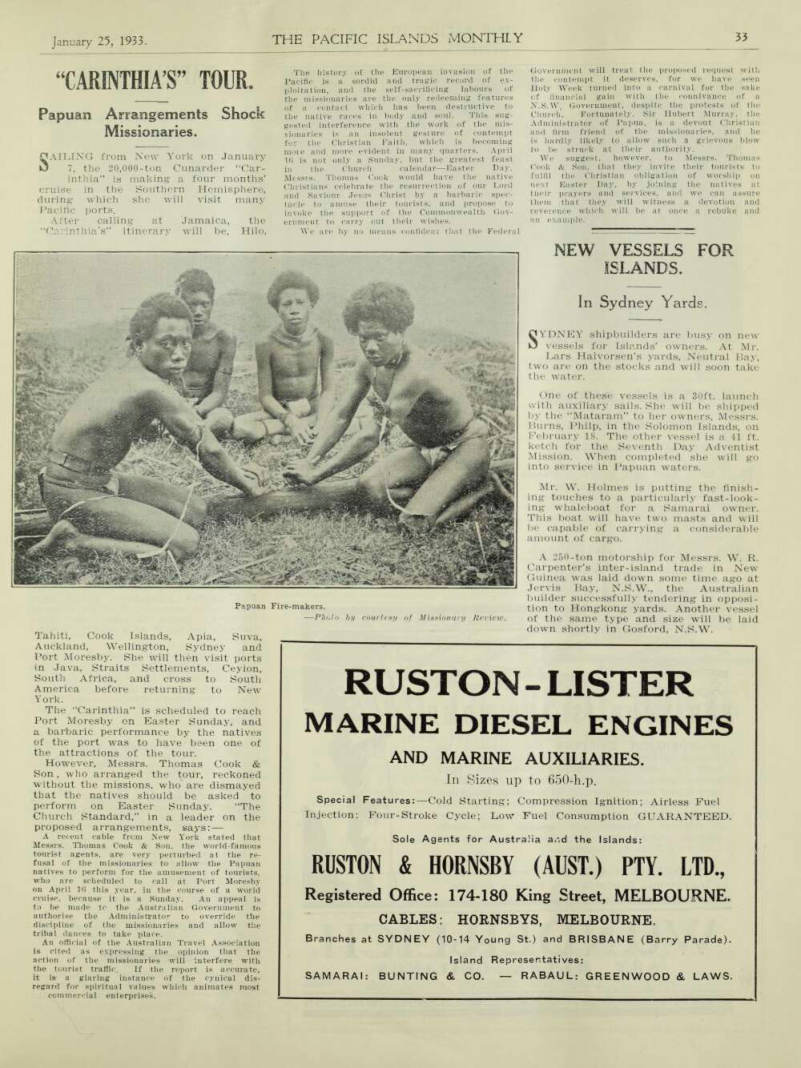
Papuan Arrangements Shock Missionaries.
SAILING from New on January 7, the 20,000-ton Cunarder “Car inthia” is making a four months’ cruise in the Southern Hemisphere, during which she will visit many Pacific ports.
After calling at Jamaica, the “Carinthia’s” itinerary will be, Hilo,
Tahiti, Cook Islands, Apia, Suva, Auckland, Wellington, Sydney and Port Moresby. She will then visit ports in Java, Straits Settlements, Ceylon, South Africa, and cross to South America before returning to New York.
The “Carinthia” is scheduled to reach Port Moresby on Easter Sunday, and a barbaric performance by the natives of the port was to have been one of the attractions of the tour.
However, Messrs. Thomas Cook & Son, who arranged the tour, reckoned without the missions, who are dismayed that the natives should be asked to perform on Easter Sunday. “The Church Standard,” in a leader on the proposed arrangements, says: A recent cable from New York stated that Messrs. Thomas Cook & Son, the world-famous tourist agents, are very perturbed at the re fusal of the missionaries to allow the Papuan natives to perform for the amusement of tourists, who are scheduled to call at Port Moresby on April 16 this year, in the course of a world cruise, because it is a Sunday. An appeal is to be made to the Australian Government to authorise the Administrator to override the discipline of the missionaries and allow the tribal dances to take place.
An official of the Australian Travel Association is cited as expressing the opinion that the action of the missionaries will interfere with the tourist traffic. If the report is accurate, it is a glaring instance of the cynical dis regard for spiritual values which animates most commercial enterprises.
The history of the European invasion of the Pacific is a sordid and tragic record of ex ploitation, and the self-sacrificing labours of the missionaries are the only redeeming features of a contact which has been destructive to the native races in body and soul. This sug gested interference with the work of the mis sionaries is an insolent gesture of contempt for the Christian Faith, which is becoming more and more evident in many quarters. April 16 is not only a Sunday, but the greatest feast in the Church calendar —Easter Day.
Messrs. Thomas Cook would have the native Christians celebrate the resurrection of our Lord and Saviour Jesus Christ by a barbaric spec tacle to amuse their tourists, and propose to invoke the support of the Commonwealth Gov ernment to carry out their wishes.
We are by no means confident that the Federal
Government will treat the proposed request with the contempt it deserves, for we have seen Holy Week turned into a carnival for the sake of financial gain with the connivance of a N.S.W. Government, despite the protests of the Church. Fortunately. Sir Hubert Murray, the Administrator of Papua, is a devout Christian and firm friend of the missionaries, and he is hardly likely to allow such a grievous blow to be struck at their authority.
We suggest, however, to Messrs. Thomas Cook & Son, that they invite their tourists to fulfil the Christian obligation of worship on next Easter Day, by joining the natives at their prayers and services, and we can assure them that they will witness a devotion and reverence which will be at once a rebuke and an example.
Papuan Fire-makers.
Photo by courtesy of Missionary Review.
New Vessels For
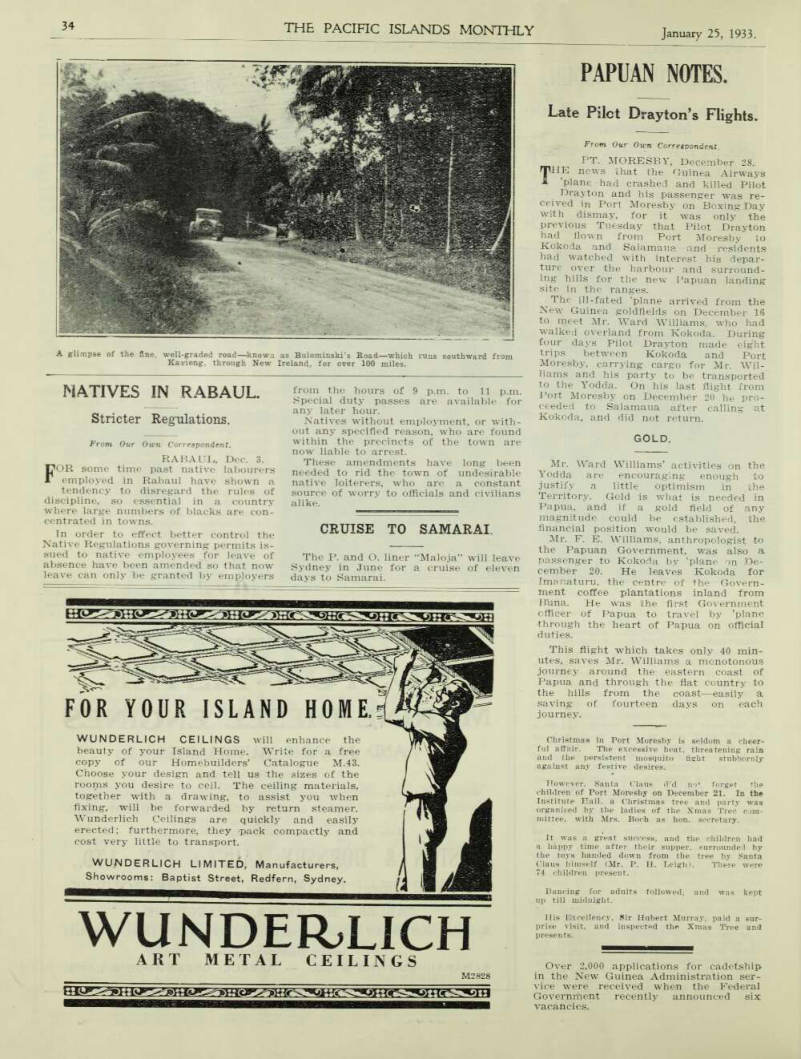
Islands.
In Sydney Yards.
SYDNEY shipbuilders are busy on new vessels for Islands’ owners. At Mr.
Lars Halvorsen’s yards, Neutral Bay, two are on the stocks and will soon take the water.
One of these vessels is a 30ft. launch with auxiliary sails. She will be shipped by the “Mataram” to her owners, Messrs.
Burns, Philp, in the Solomon Islands, on February 18. The other vessel is a 41 ft. ketch for the Seventh Day Adventist Mission. When completed she will go into service in Papuan waters.
Mr. W. Holmes is putting the finish ing touches to a particularly fast-look ing whaleboat for a Samarai owner.
This boat will have two masts and will be capable of carrying a considerable amount of cargo.
A 250-ton motorship for Messrs. W. R.
Carpenter’s inter-island trade in New Guinea was laid down some time ago at Jervis Bay, N.S.W., the Australian builder successfully tendering in opposi tion to Hongkong yards. Another vessel of the same type and size will be laid down shortly in Gosford, N.S.W.
A glimpse of the fine, well-graded road—known as Bulominski’s Road—which runs southward from Kavieng, through New Ireland, for over 100 miles.
Advertisements & other items, p. 35 (1 item)
Ruston- Lister
MARINE DIESEL ENGINES
AND MARINE AUXILIARIES.
In Sizes up to 650-h.p.
Special Features:— Cold Starting; Compression Ignition; Airless Fuel Injection: Four-Stroke Cycle; Low Fuel Consumption GUARANTEED.
Sole Agents for Australia and the Islands:
RUSTON & HORNSBY (AUST.) PTY. LTD.,
Registered Office: 174-180 King Street, MELBOURNE.
CABLES: HORNSBYS, MELBOURNE.
Branches at SYDNEY (10-14 Young St.) and BRISBANE (Barry Parade).
Island Representatives: SAMARAI: BUNTING & CO. RABAUL: GREENWOOD & LAWS.
Natives In Rabaul.
Stricter Regulations.
From Our Own Correspondent.
Rabaul, Dec. 3.
FOR some time past native labourers employed in Rabaul have shown a tendency to disregard the rules of discipline, so essential in a country where large numbers of blacks are con centrated in towns.
In order to effect better control the Native Regulations governing permits is sued to native employees for leave of absence have been amended so that now leave can only be granted by employers
from the hours of 9 p.m. to 11 p.m.
Special duty passes are available for any later hour.
Natives without employment, or with out any specified reason, who are found within the precincts of the town are now liable to arrest.
These amendments have long been needed to rid the town of undesirable native loiterers, who are a constant source of worry to officials and civilians alike.
Advertisements & other items, p. 36 (1 item)
Cruise To Samarai
The P. and O. liner “Maloja” will leave Sydney in June for a cruise of eleven days to Samarai.
Papuan Notes.
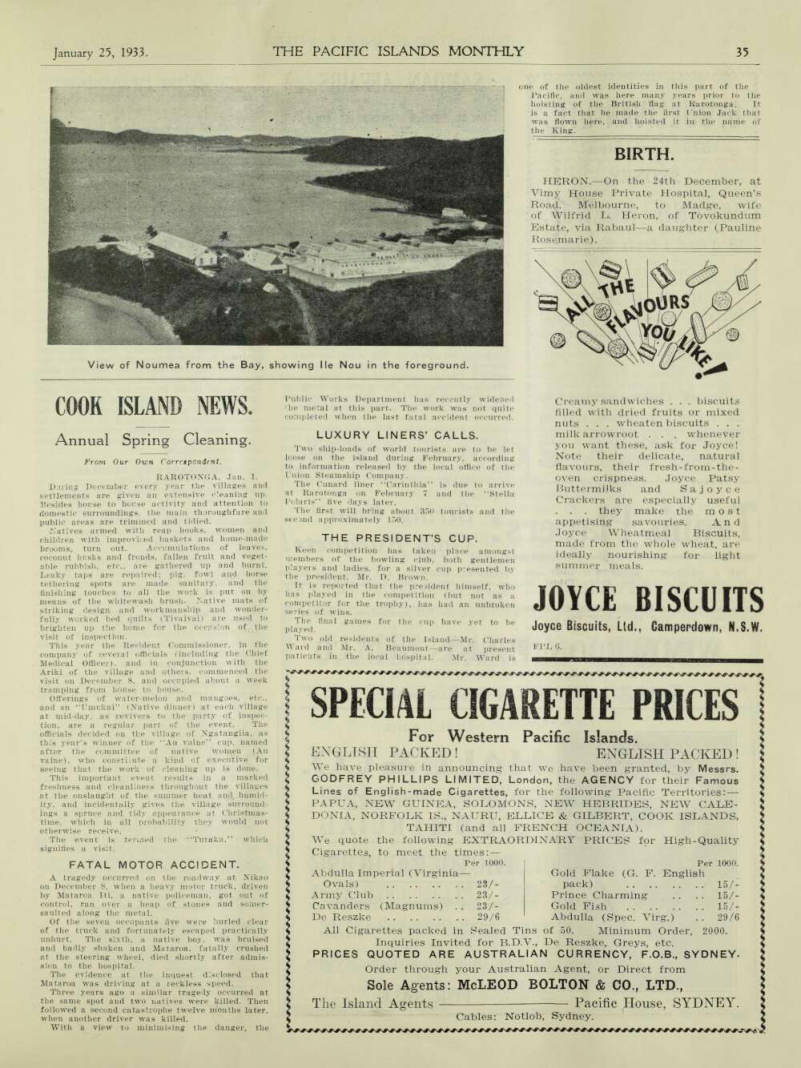
Late Pilot Drayton’s Flights,
From Our Own Correspondent.
PT. MORESBY, December 28.
THE news that the Guinea Airways ’plane had crashed and killed Pilot Drayton and his passenger was re ceived in Port Moresby on Boxing Day with dismay, for it was only the previous Tuesday that Pilot Drayton had flown from Port Moresby to Kokoda and Salamaua and residents had watched with interest his depar ture over the harbour and surround ing hills for the new Papuan landing site in the ranges.
The ill-fated ’plane arrived from the New Guinea goldfields on December 16 to meet Mr. Ward Williams, who had walked overland from Kokoda. During four days Pilot Drayton made eight trips between Kokoda and Port Moresby, carrying cargo for Mr. Wil liams and his party to be transported to the Yodda. On his last flight from Port Moresby on December 20 he pro ceeded to Salamaua after calling at Kokoda, and did not return.
Gold.
Mr. Ward Williams’ activities on the Yodda are encouraging enough to justify a little optimism in the Territory. Gold is what is needed in Papua, and if a gold field of any magnitude could be established, the financial position would be saved.
Mr. F. E. Williams, anthropologist to the Papuan Government, was also a passenger to Kokoda by ’plane on De cember 20. He leaves Kokoda for Imanaturu, the centre of the Govern ment coffee plantations inland from Buna. He was the first Government officer of Papua to travel by ’plane through the heart of Papua on official duties.
This flight which takes only 40 min utes, saves Mr. Williams a monotonous journey around the eastern coast of Papua and through the flat country to the hills from the coast —easily a saving of fourteen days on each journey.
Christmas in Port Moresby is seldom a cheer ful affair. The excessive heat, threatening rain and the persistent mosquito fight stubbornly against any festive desires.
However, Santa Claus did not forget the children of Port Moresby on December 21. In the Institute Hall, a Christmas tree and party was organised by the ladies of the Xmas Tree com mittee, with Mrs. Boch as hon. secretary.
It was a great success, and the children had a happy time after their supper, surrounded by the toys handed down from the tree by Santa Claus himself (Mr. P. H. Leigh). There were 74 children present.
Dancing for adults followed, and was kept up till midnight.
His Excellency, Sir Hubert Murray, paid a sur prise visit, and inspected the Xmas Tree and presents.
Over 2,000 applications for cadetship in the New Guinea Administration ser vice were received when the Federal Government recently announced six vacancies.
View of Noumea from the Bay, showing Me Nou in the foreground.
Advertisements & other items, p. 36 (1 item)
Wunderlich
5E
FOR YOUR ISLAND HOME.
WUNDERLICH CEILINGS will enhance the beauty of your Island Home. Write for a free copy of our Homebuilders’ Catalogue M. 43.
Choose your design and tell us the sizes of the rooms you desire to ceil. The ceiling materials, together with a drawing, to assist you when fixing, will be forwarded by return steamer.
Wunderlich Ceilings are quickly and easily erected; furthermore, they pack compactly and cost very little to transport.
WUNDERLICH LIMITED, Manufacturers,
Showrooms: Baptist Street, Redfern, Sydney.
WUNDERLICH
ART METAL CEILINGS
M 2828
Cook Island News.
Annual Spring Cleaning.
From Our Oxen Corrctpondent.
Rarotonga. Jan. 1.
During December every year the villages and settlements are given an extensive cleaning up.
Besides house to house activity and attention to domestic surroundings, the main thoroughfare and public areas are trimmed and tidied.
Natives armed with reap hooks, women and children with improvised baskets and home-made brooms, turn out. Accumulations of leaves, coconut husks and fronds, fallen fruit and veget able rubbish, etc., are gathered up and burnt.
Leaky taps are repaired: pig, fowl and horse tethering spots are made sanitary, and the finishing touches to all the work is put on by means of the whitewash brush. Native mats of striking design and workmanship and wonder fully worked bed quilts (Tivaivai) are used to brighten up the home for the occasion of the visit of inspection.
This year the Resident Commissioner, in the company of several officials (including the Chief Medical Officer), and in conjunction with the Ariki of the village and others, commenced the visit on December 8, and occupied about a week tramping from house to house.
Offerings of water-melon and mangoes, etc., and an “Umukai” (Native dinner) at each village at mid-day, as revivers to the party of inspec tion, are a regular part of the event. The officials decided on the village of Ngatangiia, as this year’s winner of the “Au vaine’’ cup, named after the committee of native women (Au vaine), who constitute a kind of executive for seeing that the work of cleaning up is done.
This important event results in a marked freshness and cleanliness throughout the villages at the onslaught of the summer heat and, humid ity, and incidentally gives the village surround ings a spruce and tidy appearance at Christmas time, which in all probability they would not otherwise receive.
The event is termed the “Tutaka,” which signifies a visit.
Fatal Motor Accident.
A tragedy occurred on the roadway at Nikao on December 8, when a heavy motor truck, driven by Mataroa Iti, a native policeman, got out of control, ran over a heap of stones and somer saulted along the metal.
Of the seven occupants five were hurled clear of the truck and fortunately escaped practically unhurt. The sixth, a native boy, was bruised and badly shaken and Mataroa, fatally crushed at the steering wheel, died shortly after admis sion to the hospital.
The evidence at the inquest disclosed that Mataroa was driving at a reckless speed.
Three years ago a similar tragedy occurred at the same spot and two natives were killed. Then followed a second catastrophe twelve months later, when another driver was killed.
With a view to minimising the danger, the
Public Works Department lias recently widened the metal at this part. The work was not quite completed when the last fatal accident occurred.
Luxury Liners’ Calls.
Two ship-loads of world tourists are to be let loose on the island during February, according to information released by the local office of the Union Steamship Company.
The Cunard liner “Carinthia” is due to arrive at Rarotonga on February 7 and the “Stella Polaris’’ five days later.
The first will bring about 350 tourists and the second approximately 150.
The President’S Cup.
Keen competition has taken place amongst members of the bowling club, both gentlemen players and ladies, for a silver cup presented by the president, Mr. D. Brown.
It is reported that the president himself, who has played in the competition (but not as a competitor for the trophy), has had an unbroken series of wins.
The final games for the cup have yet to be played.
Two old residents of the Island—Mr. Charles Ward and Mr. A. Beaumont —are at present patients in the local hospital. Mr. Ward is
one of the oldest identities in this part of the Pacific, and was here many years prior to the hoisting of the British flag at Rarotonga. It is a fact that he made the first Union Jack that was flown here, and hoisted it in the name of the King.
Advertisements & other items, pp. 37-38 (2 items)
Birth.
HERON. —On the 24th December, at Vimy House Private Hospital, Queen’s Road, Melbourne, to Madge, wife of Wilfrid L. Heron, of Tovokundum Estate, via Rabaul—a daughter (Pauline Rosemarie).
Special Cigarette Prices
All the flavours you like!
Creamy sandwiches . . . biscuits filled with dried fruits or mixed nuts . . . wheaten biscuits . . . milk arrowroot . . . whenever you want these, ask for Joyce!
Note their delicate, natural flavours, their fresh-from-theoven crispness. Joyce Patsy Buttermilks and Sajoyce Crackers are especially useful . . . they make the most appetising savouries. And Joyce Wheatmeal Biscuits, made from the whole wheat, are ideally nourishing for light summer meals.
JOYCE BISCUITS
Joyce Biscuits, Lid., Camperdown, N.S.W.
FPL G.
SPECIAL CIGARETTE PRICES
For Western Pacific Islands.
ENGLISH PACKED! ENGLISH PACKED !
We have pleasure in announcing that we have been granted, by Messrs.
GODFREY PHILLIPS LIMITED, London, the AGENCY for their Famous Lines of English-made Cigarettes, for the following Pacific Territories: PAPUA, NEW GUINEA, SOLOMONS, NEW HEBRIDES, NEW CALE DONIA, NORFOLK IS., NAURU, ELLICE & GILBERT, COOK ISLANDS,
TAHITI (and all FRENCH OCEANIA).
We quote the following EXTRAORDINARY PRICES for High-Quality Cigarettes, to meet the times: PRICES QUOTED ARE AUSTRALIAN CURRENCY, F. O. B., SYDNEY.
Order through your Australian Agent, or Direct from Sole Agents: McLEOD BOLTON & CO., LTD,
The Island Agents Pacific House, SYDNEY.
Cables: Notlob, Sydney.
G. SULLIVAN LTD.
379 Kent Street,
SYDNEY,
ISLAND AGENTS,
18 Years' Islands Experience.
Buyers of all Classes of Islands’ Produce. Liberal advances made against Consignments.
Buyers’ Orders entrusted to us receive our utmost care in Selection of Quality at a Fair Price and in Prompt Despatch.
Tennis Players: String Your Own Racquets!
USE A TRUE-GRIP STRINGING VYCE—the
only method by which the Frame Cannot be pulled out of Shape. Used by Leading Stringers throughout Australia.
One man, with our equipment (with which full instructions and clear illustrations are issued), can re-string Racquets for himself and all his friends and club-mates, and can quickly become an expert. An interesting and profitable hobby!
Machine, with full equipment, costs only £5/5/- (Australia).
Send for full particulars of method
and price to
WIMBLEDON TENNIS GUT CO.
Q.V. Building , George Street, SYDNEY.
Suppliers, at Wholesale Rates, of all brands of Racquets, Nets, Balls and Tennis Equipment.
Order from us and get the Benefit of Australian Exchange.
TEL.: B 2118.
HALL & CO.
20 Hunter Street, Sydney.
COMMERCIAL
PHOTOGRAPHERS
Special Portrait Studio.
AMATEUR FILMS AND PLATES
DEVELOPED AND PRINTED
WITH CARE.
A Fine Collection of Islands Views, etc.,
FOR SALE.
Samoan Affairs.
Prices and Politics in 1932.
From Our Own Correspondent.
Apia, Dec. 28.
AS another year nears completion, a re view of the economical and political situation does not offer much en couragement.
The copra price is still keeping at a low level, though the crop for the year is satisfactory as far as quantity is con cerned. The cocoa growing industry, however, has to contend with continu ally dropping price values and we are fast approaching the time, when the cocoa planter will have no profit left.
Most, if not all, of the 1931 Samoa cocoa crop is unsold and stored in America and England with little prospect of sales in the near future.
The only silver lining in the black clouds is a slight advance in the banana price from 2/6 to 3/- per case, an nounced recently by the Administration, due to a more advantageous contract with a Christchurch firm of buyers for 1933 and based on the quota system in troduced by the New Zealand Govern ment in regard to banana imports.
A trial shipment of pineapples re cently shipped to N.Z. by the “Maui Pomare” brought good prices and re sulted in a repeat order for another 100 cases, which unfortunately arrived too late to be filled by the incoming boat.
A profitable trade could be developed in
this line. It is too early yet, to predict the chances for coffee growing and the creation of a market for this product in N.Z.
Politically there is still a feeling of uncertainty and doubt. Mr. Nelson’s re turn is announced for February, but even the most enthusiastic adherents of the Mau movement do not believe that Mr. Nelson will return to Samoa in the near future. The great mass of the Mau followers are getting tired of the luck less and seemingly hopeless game of waiting for developments; time is ap parently fighting on the side of the Ad ministration. It is possible that 1933 will see the end of the Mau movement.
Christmas Business.
Though business in Apia stores was very dull during the few weeks before Xmas, the festive season, which was marked by the announcement of “cheap sales” by nearly all the Apia business houses, brought a pronounced revival of business and, to the surprise of the business community, business was much better than anticipated. The Samoans, as well as the Europeans, attracted ap parently by the bargains offered, seem to have dug out their hidden savings and spent them freely for seasonal pur chases. The much suffering business community cannot be begrudged the satisfactory business and it is to be hoped that the upwards swing will con tinue and remain a permanent feature of the coming year.
Postmaster’S Busman’S
Holiday.
The public are indebted to our popu lar postmaster, Mr. Dunwoodie, for open ing the post office during the Xmas holidays for the distribution of mails from Australia and New Zealand and the despatch of correspondence.
“Ontario’S” Visit.
Our American cousins from T'utuila apparently find Apia an attractive week end resort, as the frequent visits paid us recently seem to demonstrate. The “On tario” came over on December 10 and remained for a few days, while an of ficial party led by Governor Landenber ger visited at Government House, Vailima.
These American visits are very wel come. The “gobs” are free and generous spenders and, at the present rate of ex change, certainly get full value for their money.
Children Entertained.
A very successful and enjoyable func tion of a novel character was held at Apia Playhouse on December 16, when over 200 European children were gathered for a fancy dress ball and spent a happy time with dancing, sing ing, games and other pastimes till 10 p.m. to the music of the Apia Orches tra. The children enjoyed themselves thoroughly and the fun culminated in the distribution of toys to the young sters, who were addressed by the Hon.
A. R. Cobcroft and who called upon them to give three cheers for Mrs. A.
G. Smyth, the president of the commit tee and all those, who had generously contributed to the success of the evening.
Host Holbrook Entertains.
The annual conference of Holbrook (Australia), Ltd., on December 16, was attended by repre sentatives from all parts of the. Commonwealth.
After the activities of 1932, and the plans for 1933 were discussed, the indoor staff were the hosts at a luncheon at which only the products of the Company were used. The conference con cluded with an inspection of the factories, and the following day was spent by members of the staff and sales force on the Harbour.
Norfolk Island.
Luxury Liner, Beans and Mr. Greene.
STRATHAIRD Day on Norfolk Island was a great success.
After being hunted for the greater part of the voyage from Sydney by a gale that put half the passenger list to bed, seasick, the vessel dropped anchor off our island on Boxing morning in a blue, unruffled calm —not a ripple on the reef. Coming slowly in, she was a mag nificent sight; while visitors reported that, from the ship, the island presented a never-to-be-forgotten picture. Remote . . . solitary . . . dreamlike; hillside and valley picked out in every shade of green; the low mountain top and tall pines dark against the sun-flushed sky.
The ship anchored a mile or more off shore and over a thousand persons were carried to and fro —transhipped, as the tide went out from the P. and O. life boats to our local whaleboats without disorder or a splash of water on pretty frock or dashing beach pyjamas—and, after a crowded day of novelty and in terest they left again at nightfall; sail ing out into the still, warm dark, ablaze from stem to stern with flood lights—a sight that we simple souls ashore will never forget; while, for the 1500 voy agers who made the trip, Norfolk Island will live, a green and fairy land set for ever in a windless, cloudless, blue and boundless sea.
Mr. Greene Is Merciful.
We have also received publicity in America where Mr. Marc T. Greene — who recently visited the South Seas, leaving a trail of wounded susceptibili ties behind him —has published an illus trated article on Norfolk in “The New York Sun.” Making allowance for jour nalistic license and the grouch Mr.
Greene apparently feels against all white residents in native lands, he dealt with us more kindly than we had anticipated.
He speaks of the island as being “one of the most delightful of sea-girt isles, in natural beauty unsurpassed anywhere in the South Seas; tranquil and aloof from the world, with a most amiable climate and a harmonious atmosphere.” We do not work, we spend our days in idle sport, and the oversea settlers as a whole are not a desirable type and have brought nothing worth while to the is land population; but such slight criti cism as that should be helpful and wholesome, and we should profit by it.
Our National Wealth.
On the evening of January 4, a meet ing of such of us as do languidly till the soil was convened in the Rawson Hall to listen to an address by a Mr. Rumsey, partner in a seed business in Sydney, Member of the Royal Horticultural So ciety and a world-wide traveller and in vestigator into horticultural conditions in other countries.
Mr. Rumsey, who was here at the in vitation of our Planters’ Association, read a most interesting paper and, in the course of it, was able to tell us things about our island of which we were ignorant. For instance, when Cap tain Cook landed here —whenever he did land here —he discovered in the dense vegetation that clothed the island to the waterline, bananas that were indigenous and of good qutlity. In view of the fact that we are situated in about the ulti mate degree of latitude that will grow
bananas, that is most interesting and points, one would say, either to an earlier and forgotten occupation, or to a passing visit of natives bound elsewhere.
Mr. Rumsey wondered if, possibly, the descendants, so to speak, of those or iginal palms still lurked unknown upon the island and might be discovered and fostered till we had a unique variety to put upon the market.
The real business of the evening, how ever, was the development and market ing of our bean crop, grown for export as seed. Our Canadian Wonder Beans have a particularly good reputation overseas and it is anticipated that the harvest now under way will reap good prices and bring a temporary prosperity to the island: but Mr. Rumsey earnestly advised us, in future, to cut out the Can adian Wonder and concentrate upon the newer variety, “Tweed Wonder,” which is becoming very popular with market gardeners and smallholders. The Tweed Wonder resists blight and disease to a very great extent and the green bean travels well.
Passing on from beans, our visitor touched upon other likely products suit able to our soil and climate and recom mended us to plant out groves of the Australian Nut “Macadamensis” or something like that; a sort of cross be
tween a barcelona and a brazil nut in texture and flavour, and a large three cornered barcelona in shape. Increas ingly popular with confectioners and such folks it is destined to oust all im ported nuts.
We listened breathlessly, with fortune at last in sight—until it was revealed to us that the tree took something like ten years to come into full bearing and then we might hope to get sixpence a pound for a crop per tree—twenty-five trees to the acre—of about sixty pounds. Then our interest waned perceptibly and we occupied ourselves in stealthy surmises as to where we might all expect to find ourselves in ten years if present condi tions continue.
At the close of Mr. Rumsey’s dis course, Mr. W. A. Holman, some time Premier of New South Wales and now a Member of the Federal House, rose in a practiced manner to his feet from among the audience and paid us the stereotyped compliments upon our fair isle, our high standard of intelligence and beauty and so on, assuring us of his interest in and furtherance of our fortunes. We lapped it up like cream, and parted from Mr.
Holman with reluctance, wending our way homeward with a very high opinion of his personal qualifications . . .and so to bed.
Advertisements & other items, p. 39 (1 item)
James Barnes Limited
HYLANDS Poultry, Eggs, Fish
DESPATCH ORDERS PROMPTLY.
Primest Quality at Reasonable Prices.
All varieties of Poultry, Game, Fresh Pish and New-Laid Eggs.
Send your next order to:
DAVID HYLAND & SONS PTY. LTD.,
755 Harris Street, SYDNEY, N.S.W.
Cable Address: “Hylands,” Sydney.
JAMES BARNES LIMITED
2 Botany Street, Waterloo, Sydney
(ESTABLISHED 1881)
MANUFACTURERS OF
“Globe” & “Victory” Brands
OF
SHEEP’S TONGUES OX TONGUES SAUSAGES
PRESERVED MEATS BEEF EXTRACT DRIPPING
Also “Castle' ’ Brand, which is specially packed for use by the White Population.
Globe Beef Extract is invaluable to Young and Old.
Tested Recipes on the packet 4oz. and 8oz. sizes.
Slightly Mixed.
The announcer of the A.W.A. Broad casting Station 4TO, Townsville, Mr. H.
E. Cox, received a letter from Mr. H.
Dexter, of Milne Bay, Papua, recently, in which the latter remarked: “A queer thing happened while I was in touch with you some time ago. You were on ‘Goldenia’ Tea, and at the same time the Hon. W. M. Hughes was speak ing from another station. The set was a little out of adjustment at the moment — your voice and that of Mr. Hughes was coming through with equal strength.
“You asked a question, ‘And how many cups do you think one pound will make?’
“It was answered by Mr. Hughes: ‘Over two million.’
“This amazed some English-speaking mission boys who were listening to the set! ‘Goldenia’ is excellent; it is sold in this little store, but ‘two million—! —!’” —From “The Radiogram.”
Torres Straits.
Bottle Messages In
From Our Own C»rreipondent
Thursday Is., Dec. 12.
SEVERAL bottle papers, containing particulars for the purpose of chart ing ocean currents, have been picked up lately in Torres Strait and handed in to the Harbour Master, who forwards them to their destination. They were thrown overboard from steamers be tween Sydney and America, and one had been floating for five years, although an other bore only a very recent date.
The trend of currents brings these ocean messengers up into the central part of the Strait, usually round about the Yorke Island group, although some get right up to Saibai, close to New Guinea.
We Apologise and Withdraw.
Several months ago we received a letter from an irate subscriber in Papua who had not re ceived his P.I.M. Our records showed that the paper had been posted.
We had received other complaints in similar circumstances; it was very irritating.
So we published a little paragraph apologising to these disappointed subscribers, and expressing the opinion that the missing journals must have been stolen from up-country post offices.
We thus stepped from the frying pan into the fire.
The Chief Postmaster of Papua (Mr. E. C.
Harris) fastened his teeth into us, and demanded particulars of allegedly stolen newspapers.
Naturally, we were not able to supply details — only surmises and suspicions—which are of no use to a competent administrative officer.
Recognising the weakness of our position, we offered lengthy explanations, and tried to bluff.
It was no use. Mr. Harris was definitely on the warpath in defence of his staff and organisa tion, and we had either to substantiate the charge or withdraw.
We have withdrawn—and we hope to goodness no more Papuan subscribers fail to receive their journals. We emphatically do not want any more arguments with the tenacious Mr. Harris.
Port Moresby Shipments.
From Our Own Correspondent PT. MORESBY, December 28.
The “Haleric” arrived on December 3, bring ing cargo and mails from Australian ports. She left for Europe via Samarai and Rabaul, after loading 3,248 bags of copra.
The “Macdhui,” en route to Sydney from Rabaul, arrived on December 8. She took the following cargo from Port Moresby:—1,180 pack ages of rubber, 302 packages of desiccated coconut, 141 bags of copra, and 39 bags of coffee.
Teacher For Saibai Is.
From Our Own Correspondent.
Thursday Is., Dec. 12.
SAIBAI ISLAND, which has been with out a resident white Government of ficial for almost a year, has now a new teacher and superintendent, Mr. W.
Bryant having arrived to take up that position. The Government ketch “Mel
bider” took him to his new field at the beginning of December.
Saibai is close to the coast of Papua, but is officially within Queensland boundaries and is administered by the Aboriginal Department. At one time, the dreaded Tugeri head hunters found Saibai a convenient raiding place, al though the Saibai men themselves were not above suspicion of collecting heads whenever there was a chance.
Advertisements & other items, p. 40 (1 item)
Lysaght
The Famous Brands of
Galvanized Iron
ARE NOW MADE IN AUSTRALIA
At Newcastle, N.S.W The first cost of these brands is so very little more than that of inferior Qualities that to buy
“ORB” or “QUEEN’S HEAD” is a
proved sound investment.
The 15th edition of “The Referee,” a handbook of useful information, containing a ready-reckoner of much value to all engaged in building operations, may be obtained post free on application to John Lysaght (Aust.) Ltd., c/o. Box 196 D, G.P.O., Sydney.
CORRUGATED
PLAIN
Sheet Guaranteed
Excited.
Norfolk Island
Preparations for “Strathaird's”
Trippers.
From Our Own Correspondent.
Norfolk Isld., Dec. 9.
MORE like London every day! That is, if London has two race meetings within a single year, the constant competition of two amateur dramatic companies in up-to-date plays, and an influx of distinguished visitors from oversea.
That is the situation on Norfolk at present. We have just held our second race meeting since Easter, with horses, owners, trainers, and jockeys familiar figures in our daily life. Two plays, with equally familiar players but totally different casts, have been most successfully produced to crowded houses within a week of each other; and we face the overwhelming excite ment of the arrival on Boxing Day, of the luxury liner, “Strathaird,” twenty six thousand tons, with over a thous and travellers aboard.
We are accustomed to the incon spicuous arrival of the little “Morinda,” landing cargo, mail, and a handful of visitors, who sink without a ripple into the easy flow of our daily existence.
But this Leviathan is to steam majes tically through the dawn, along our rocky coastline from Anson Bay to Kingston. The interest and excitement of the passengers will scarcely rival that of our unsophisticated community lining the cliffs from dawn and pre paring to dog the footsteps of the strangers from the moment they land till their lamented departure. We have a resident population of less than nine hundred. Over eleven hundred visitors, their ranks swelled by the holiday presence of a hundred or more of the ship’s complement, will descend upon us and blot out for a few merciful hours, our too familiar selves.
New faces, new clothes, new voices and strange topics of conversation.
How refreshing! And for them the novelty of setting foot upon our rough stone jetty—of circling our tropic island, ringed with surf and bright with parrots flashing through banana groves. A storied island, also.
Tumbled grey prison ruins still bear silent witness to the cruelty of man a century ago; splendidly built descen dants of the famous mutineers of the “Bounty,” who, a hundred and fifty years ago, cast adrift in the Pacific, their commander, Bligh, and, with their Tahitian wives, took refuge on the islet of Pitcairn. Their descendants were, in eighteen fifty six, transferred to Norfolk, abandoned in the same year as a penal settlement, and nowadays live in harmony and fellowship with settlers from every part of the British Empire.
With this great day in prospect and the hope of attracting new settlers and new business enterprise, local public bodies are busy upon schemes for their comfort and entertainment. A trans port committee is organising a fleet of everything upon wheels to convey all those who wish to survey the entire island in a sort of continuous circus
procession; covering a definite route, and including all that is worth seeing.
Guides will accompany the parties and tell the history of the island, and a bureau of assistance and information will be in capable hands. Picnic lun cheon, brought ashore from the ship and served by stewards assisted by local volunteer is to be laid on the site of the annual Bounty picnic, while rich and individual afternoon teas pre pared by island hands will be offered everywhere that the visitors find them selves at the appropriate hour of the afternoon.
When the liner takes her departure at nightfall, her pathway across the dark encircling seas will be lit by rockets and Catherine wheels set off by the waters of Emily Bay, and we shall hope, as she disappears to “the pleas ant sound of music and dancing on her decks,” that every traveller will carry away the happiest and most pic turesque memories of a day that we shall have done our best to render agreeable. And for ourselves, there is no doubt that for many years we shall date our Christmas seasons from that one “when the ‘Strathaird’ was here.”
There are rumours, too, of another shipping company starting a regular service between Melbourne, Norfolk, and Noumea (New Hebrides), with a four thousand ton vessel. Many are hoping that we may thus connect up with two new markets and two new sources of tourist traffic, but, should it eventuate and become popular and profitable, then, at last, historic little Norfolk Island will be definitely estab lished upon the map of the Pacific.
Prince Miliame Tugi, Prince Consort to Queen Salote, and Premier of the Kingdom of Tonga, will arrive in Syd ney on January 27 from New Zealand.
He is accompanied by his son, Crown Prince Taufaahan, who will be educated in Sydney.
L.M.S. Conference.
From Our Own Correspondent.
Pt. Moresby, Nov. 2G.
Representatives of an the Lon don Missionary Society stations in Papua are gathered for their annual conference, which is to be held at the Metoreia Mission Station, near Port Moresby.
The chairman of the conference is the Rev. B, T. Butcher, a well-known per sonality of the Western District, who has long been recognised by the Admin istration for his excellent efforts and re sults in industrial education amongst the tribes of Western Papua.
The conference will extend over a week. Members of the Eastern Central districts are waiting for other delegates to arrive before the sittings commence.
Advertisements & other items, p. 41 (1 item)
Canned Vegetables
Sutton’s
Green Peas, In 1lb. and 2lb. Tins.
French Beans (Sliced) in 1lb. Tins.
Carrots, In 1lb. Tins.
Beetroot (Sliced) in 1lb. Tins, Packed by
Delicia Food Products Co.
WATERLOO, N.S.W.
Natural Steel Grey
FERRODOR PAINT
(Now Manufactured in Australia.) Is the Ideal Paint for Steel Structures of all Descriptions,
and for Galvanised Iron Roofs, etc.
IT IS ELASTIC—so that expansion and contraction of metals caused by atmospheric changes, leave it quite unaffected.
IT IS ANTI-CORROSIVE—being physically incapable of absorbing more Oxygen than the atmosphere.
IT IS NON-POISONOUS —making it safe in handling and for use on roofs where water is used for domestic purposes.
Used extensively by N.S.W. Government Railways and Public Works Dept. Hawkesbury and Nepean Railway Bridges now painted with Ferrodor.
WILLIAM ADAMS & COMPANY
LIMITED
Other colours obtainable — Suitable for Iron and Wood. 175 Clarence Street,. SYDNEY
Tahiti News.
New Tourist Hotel.
From Our Own Correspondent.
Papeete, Dec, 15.
M. MILES RIVNAK, late proprietor of the Hotel Tiare in Papeete, which he has sold to Mlle. Irene Salmon, has taken up a location near the village of Tautira, on the east coast of the Tiarapu penisula, and intends to open a country hostelry on January 1.
He has chosen what is perhaps the most beautiful site in Tahiti, on the banks of the Tautira river, which at this point is separated from the ocean beach by a sand bar some 50 yards wide, and commands unparalleled views of the rugged mountains of the peninsula as well as of the main island.
There is first class fresh and sea water bathing close to the establish ment, and the hills in the background offer good sport in the way of pig hunting. The river itself abounds in small Tahitian trout or “nato” as the natives call them, which are not only good sporting fish on light tackle, but a welcome addition to any cuisine.
We trust that M. Rivnak will meet with success in his new venture.
Sandalwood Expedition.
It is rumoured on the beach that the small schooner yacht “Valkyrie” (Cap tain Gilling), which has been anchored here for a year or so is about to set out on an expedition to the islands of Henderson, Gene, and Ducie, pros pecting for sandal-wood, etc. We un derstood that this concession had already been granted to a New Zea lander, but in any case we wish Cap tain Gilling and his expedition the best of luck.
Armistice Day Celebrations.
Armistice Day was celebrated in Tahiti with all due ceremony, and a large crowd gathered at the Monument Aux Morts in St. Amelie Avenue, to place wreaths and attend the service.
The day was observed as a public holiday, and the meeting held in the afternoon on the Fautaua racecourse was well attended.
Mr. Frank H. Cunningham.
Sudden Death In Tonga.
Haapai, Oct. 27.
AVERY well-known and popular man in the Tongan Group, where he had lived for over forty years past, Mr.
Frank H. Cunningham collapsed and died at Haapai on October 19.
During the past fifteen years Mr. Cun ningham had served as harbourmaster and Customs Boarding Officer at Haa pai and on many occasions acted as Col lector of Customs at Haapai and Vavau.
He only commenced his leave of ab sence on October 1, prior to retiring from the Tongan Civil Service. He had booked his passage by the incoming “Waipahi” to Auckland, where he in tended to retire on his pension. His familiar figure will be greatly missed at Haapai.
Noumea’S Chance!
In Favour For Short Sea Trips.
IT seems probable that, in the near future, catering for tourists will be a staple industry of Noumek The Christmas cruises of the “Strathaird” and “Oronsay” were so popular that Easter cruises have been arranged for both vessels. The “Moldavia” is to leave this month on a short cruise to Noumea.
Nor are the overseas companies to have a monopoly of these short, tourist cruises, as the Mcllwraith, McEacharn steamer “Karoola” is also booked for an Easter cruise to Noumea.
The “Karoola” will leave Sydney on April 13 and, after calling at Brisbane, will spend a day and a night at Nou mea before returning to Brisbane and Sydney. The “Oronsay” will leave Syd ney the same day for Noumea direct, but her cruise will be extended south wards to make Hobart a port of call.
Noumea seems to be the Mecca of holiday making Australians, and it, un doubtedly, has many attractions from a tourists’ point of view. Besides being the only foreign port within the South western Pacific, and close to the big Australian cities, it is the nearest to Australia of what the tourist literature writers love to call the “South Sea Is lands.” It can offer to the Australian tourist the double experience of visiting a French port, and a Pacific island.
This is Noumea’s big' opportunity. If the popularity of the Christmas cruises is an indication, well over a thousand tourists should visit New Caledonia at Easter; and the Noumea people should organise vigorously to make their day ashore interesting and entertaining.
The Charm of Norfolk Island.
There are many who will feel regret that Noumea is to catch the tourist traffic, instead of Norfolk Island. The trouble is that Noumea is “real Pacific Island,” while N.I. is merely sub-tropi cal; Noumea has a good port, while N.I. has an uncertain roadstead; and Noumea is foreign, while N.I. is only Australian.
For all that, the praises of N.I. are being sung by an increasing number of recent visitors, and it is a safe forecast that, within a year or two, the beautiful little island will have a better steamer service, and large numbers of people will go there to enjoy a sub-tropical holiday in one of the most delightful climates in the world.
The B.P. Magazine For December,
1932 : A feature of the last number of the B.P.
Magazine is a series of photographs of Italian cities. These are from photographs supplied by J. H. S. Brooks-Thornley and the Italian State Tourist Bureau, and they are reproduced in a manner which reflects great credit on Australian typography. An article on “Southern Royalty” gives interesting sidelights on the Pomare family and these are several interesting and well illus trated travel articles.
Advertisements & other items, p. 42 (1 item)
Prescott Ltd
are sole wholesale agents for
PINEAPPLE BACON & HANS
DAISY BRAND BUTTER
TIGER Swiss Gruyere CHEESE
LEA & PERRINS' SAUCE
& Most other Super Quality lines or the Trade.
SUNSHINE PLANTATION IMPLEMENTS
Specially Designed for Queensland and Island Planters.
THE “SUNGLINT”
A one or two horse high clear ance plough for sugar, maize and general plantation work.
Turns furrows 12 inches wide and to 10 inches deep. Has strong steel beam; 20-inch clearance at throat. Polished board, 25i inches long.
Write for 96-page Illustrated Descriptive Catalogue and Price List of all Sunshine Agricultural Machinery. They will be sent free.
The Sunshine Harvester Works
SUNSHINE, Near MELBOURNE, AUSTRALIA.
(Also Sydney and Brisbane.)
“Taronga” Afire.
Rataul Copra Damaged.
A THOUSAND tons of cargo, including a shipment of copra from Rabaul, were damaged by fire and water on December 17, when the Wilhelmsen motorship “Taronga” caught fire at Pyr mont, Sydney.
The outbreak was subdued after six hours’ fire-fighting. Water pumped into the hold caused the ship to list danger ously. Very slight structural damage was done, and the “Taronga” departed on schedule.
Abandoned In Red Sea.
January 16.
The “Taronga” has been abandoned as the result of another serious fire which broke out while the vessel was in the Red Sea on January 14. Captain Neilsen put the ship about and made for Perim, where the holds were flooded, and, later, the ship was beached to pre vent her from capsizing. Her cargo consisted of wool, flour, wheat and copra.
Most of the copra is insured with Lloyd’s.
Story Of Ambush.
Exton’s Murderers Arrested in New Guinea.
DETAILS of the adventures which befell the party sent out to arrest the murderers of Mr. T. F. Exton in the hinterland of Wewak, in the Aitape division of New Guinea, were given by District Officer C. E.
McDonald, who arrived in Sydney by the “Montoro” on January 5.
Mr. McDonald was the leader of the party. It penetrated into the rugged and mountainous country near the villages of Lawindugun and Wamba, where the murderers were eventually arrested.
No resistance was offered to the patrol, and, in fact, no natives were encountered till the party fell in with a boy who expressed ignorance of the murders and offered to guide searchers to Lawindugun.
But the willing “guide” had been sent out to lead the police into a trap, for, in a small clearing, it was suddenly ambushed. A shout from the dense vegetation bordering the clearing was followed by a shower of spears, some of which narrowly missed the bogus guide as he ran to cover. The police immediately opened fire, and, though some of the attackers were shot, they were dragged off by their retreating companions.
After the attack, a party of friendly natives was met, and they led the police into the village and helped to arrest the murderers. Mr. McDonald found that a clearing near the one in which he was attacked was the scene of the murder of Mr. Exton, who him self had been the victim of a similar attack.
Nine natives were arrested and taken back to Rabaul, where they were sen tenced to death. They expressed no dislike for Exton, but were only carrying out a tribal decision to kill the next recruiter they met.
Anthropology.
Where Scientists Are Working.
From Our Own Correspondent.
Madang, Nov. 22.
Anthropological research on the Sepik River has been further ad vanced by the arrival from Aitape of Dr. Fortune and Mrs. Fortune (Dr.
Mead). These anthropologists are work ing under American Societies and have settled down on the Yuat River, in the Nudugamur villages.
The natives in this locality are still wild and the parts further up have not yet been patrolled. Quite recently a me dical assistant in the patrolled area was dumped in the sak-sak and had difficulty in obtaining carriers to get him to the river. Recruiters in these parts have often been chased out, even in patrolled villages, where the Government have ap pointed Luluais and Tul-Tuls.
The customs and habits of these people vary in many ways to their up river brethren, where Mr. Gregory Bate son is stationed. Mr. Bateson, with his outboard attached to a canoe, is able to visit all the native tribal ceremonies and with his knowledge of the language is able to obtain information of their weird and strange customs. However, much secrecy is maintained amongst the natives, and it is extremely difficult and, in some cases, impossible almost to ob tain the reason and idea of many things.
Information is often only obtained by special pay and then under almost a sworn promise that the information or its source is not divulged.
Samoan Bananas.
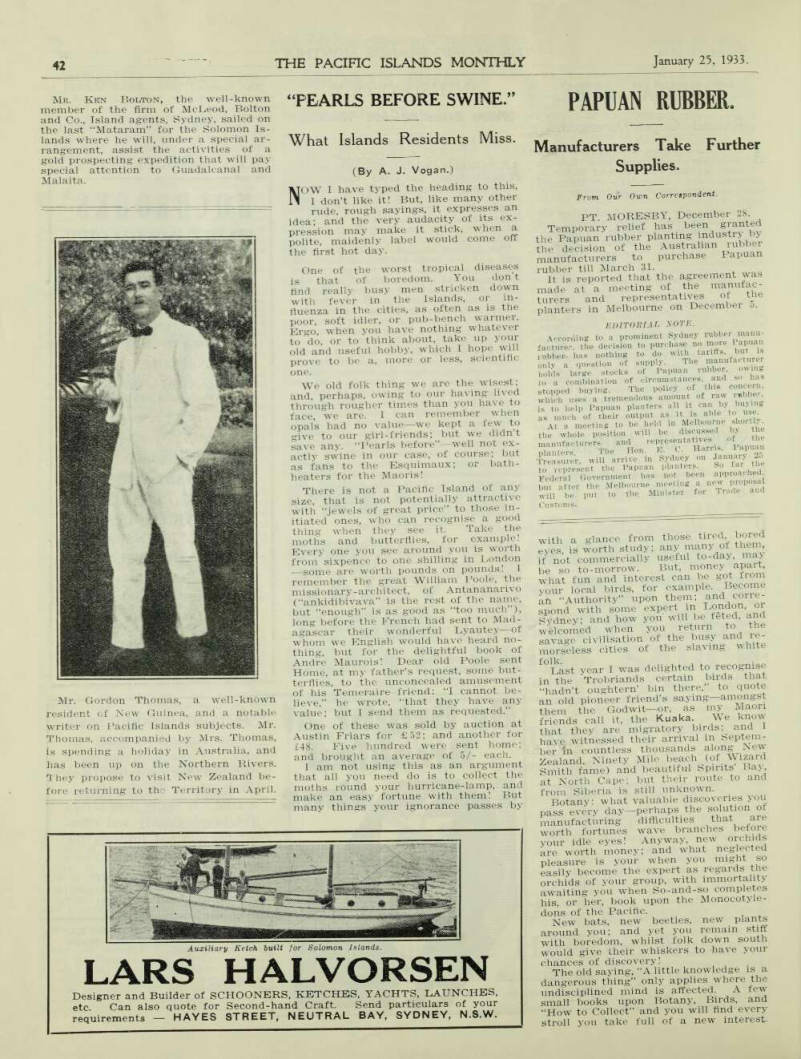
Quota System Introduced by N.Z.
Apia, Dec. 30.
THE banana trade with New Zealand has been placed on a more solid basis by the introduction of the quota sys tern by the N.Z. Government and ac cordingly the new contract for 1933, which has been awarded to a Christ church firm, is on more advantageous terms for producers.
The Samoan growers had applied to the Administrator to be paid at the original rate of 5/- per case, but the Administrator was not able to grant this request. However, he has fixed the new rate at 3/- until further notice.
The quota for Samoa and Niue to be delivered to Wellington and the South Island of N.Z. is 8,000 cases per month.
Mr. Ken Bolton, the well-known member of the firm of McLeod, Bolton and Co., Island agents, Sydney, sailed on the last “Mataram” for the Solomon Is lands where he will, under a special ar rangement, assist the activities of a gold prospecting expedition that will pay special attention to Guadalcanal and Malaita.
Mr. Gordon Thomas, a well-known resident of New Guinea, and a notable writer on Pacific Islands subjects. Mr.
Thomas, accompanied by Mrs. Thomas, is spending a holiday in Australia, and has been up on the Northern Rivers.
They propose to visit New Zealand be fore returning to the Territory in April.
Advertisements & other items, pp. 43-44 (1 item)
Breakfast
HOLBROOKS
TABLE DELICACIES
WORCESTERSHIRE
SAUCE.
No. 2 SAUCE
(A thick, fruity sauce).
TOMATO SAUCE.
FRENCH OLIVE OIL.
SPANISH OLIVES
(Plain and Stuffed).
CAPERS.
FLAVOURING ESSENCES.
CHUTNEY.
PURE MALT VINEGAR.
JELLY CRYSTALS.
TINNED SOUPS.
BAKED BEANS AND
SPAGHETTI.
In Tomato Sauce.
A wide variety of Pickles, including Sweet Gherkins and Small Pearl White Onions.
Holbrooks (A/sia.) Ltd.
WATERLOO, N.S.W.
Be Bright at
Breakfast
time
A COMFORTABLE Shave
means a good start for the day. If you find shaving a bore in the morning, give Parke-Davis Shaving Cream a trial. It really does soften the beard quickly and effec tively, and yet protects the skin from irritation.
NEXT WEEK SHAVE
COMFORTABLY BY SENDING
FOR FREE SAMPLE.
To PARKE DAVIS & CO., Box 4198 XX, G.P.O., Sydney,—Please' send Sample of Shaving Cream.
NAME
ADDRESS
Auxiliary Ketch built for Solomon Islands.
LARS HALVORSEN
Designer and Builder of SCHOONERS, KETCHES, YACHTS. LAUNCHES, etc. Can also quote for Second-hand Craft. Send particulars of your requirements HAYES STREET, NEUTRAL BAY, SYDNEY, N.S.W.
“Pearls Before Swine.”
What Islands Residents Miss.
(By A. J. Vogan.)
NOW I have typed the heading to this, I don’t like it! But, like many other rude, rough sayings, it expresses an idea; and the very audacity of its ex pression may make it stick, when a polite, maidenly label would come oft the first hot day.
One of the worst tropical diseases is that of boredom. You don't find really busy men stricken down with fever in the Islands, or in fluenza in the cities, as often as is the poor, soft idler, or pub-bench warmer.
Ergo, when you have nothing whatever to do, or to think about, take up your old and useful hobby, which I hope will prove to be a, more or less, scientific one.
We old folk thing we are the wisest; and, perhaps, owing to our having lived through rougher times than you have to face, we are. I can remember when opals had no value —we kept a few to give to our girl-friends; but we didn't save any. “Pearls before” —well not ex actly swine in our case, of course; but as fans to the Esquimaux; or bath heaters for the Maoris!
There is not a Pacific Island of any size, that is not potentially attractive with “jewels of great price” to those in itiated ones, who can recognise a good thing when they see it. Take the moths and butterflies, for example.
Every one you see around you is worth from sixpence to one shilling in London —some are worth pounds on pounds! I remember the great William Poole, the missionary-architect, of Antananarivo (“ankidibivava” is the rest of the name, but “enough” is as good as “too much”), long before the French had sent to Mad agascar their wonderful Lyautey —of whom we English would have heard no thing, but for the delightful book of Andre Maurois! Dear old Poole sent Home, at my father’s request, some but terflies, to the unconcealed amusement of his Temeraire friend: “I cannot be lieve,” he wrote, “that they have any value; but I send them as requested.”
One of these was sold by auction at Austin Friars for £52; and another for £4B. Five hundred were sent home; and brought an average of 5/- each.
I am not using this as an argument that all you need do is to collect the moths round your hurricane-lamp, and make an easy fortune with them! But many things your ignorance passes by
with a glance from those tired bored eyes, is worth study; any many of them, if not commercially useful to-day, may be so to-morrow. But, money apart, what fun and interest can be got from your local birds, for example. Become ah “Authority” upon them; and corre spond with some expert in London, or Sydney; and how you will be feted, and welcomed when you return to the savage civilisation of the busy and re morseless cities of the slaving white folk.
Last year I was delighted to recognise in the 'Trobriands certain birds that “hadn’t oughtern’ bin there.” to quote an old pioneer friend’s saying—amongst them the Godwit —or, as my Maori friends call it, the Kuaka. We know that they are migratory birds; and I have witnessed their arrival in Septem ber in countless thousands along New Zealand, Ninety Mile beach (of Wizard Smith fame) and beautiful Spirits at North Cape; but their route to and from Siberia is still unknown.
Botany: what valuable discoveries you pass every day—perhaps the solution of manufacturing difficulties that are worth fortunes wave branches before your idle eyes! Anyway, new orchids are worth money; and what neglected pleasure is your when you might so easily become the expert as regards the orchids of your group, with immortality awaiting you when So-and-so completes his, or her, book upon the Monocotyle dons of the Pacific.
New bats, new beetles, new plants around you; and yet you remain stiff with boredom, whilst folk down south would give their whiskers to have your chances of discovery!
The old saying, “A little knowledge is a dangerous thing” only applies where the undisciplined mind is affected. A tew small books upon Botany, Birds, and “How to Collect” and you will find every stroll you take full of a new interest
Papuan Rubber.
Manufacturers Take Further Supplies.
From Our Own Correspondent.
PT MORESBY, December 28.
Temporary relief has been granted the Papuan rubber planting industry by the decision of the Australian rubber manufacturers to purchase Papuan rubber till March 31.
It is reported that the agreement was made at a meeting of the manufac turers and representatives of the planters in Melbourne on December 5.
Editorial Note.
According to a prominent Sydney rubber manu facturer the decision to purchase no more Papuan rubber has nothing to do with tariffs, only a question of supply. The manufacturer holds large stocks of Papuan rubber, owing to a combination of circumstances, and so has stopped buying. The policy of this concern, which uses a tremendous amount of raw rubber, is to help Papuan planters all it can by buying as much of their output as it is able to use.
Federal Government has not been approached, but after the Melbourne meeting a new proposal will be put to the Minister for Trade and Customs.
Advertisements & other items, p. 45 (1 item)
Chinese Problem In New Guinea.
Chinese Mission School Boys. Rabaul. —Photo from Mission Review.
A Note Of Warning.
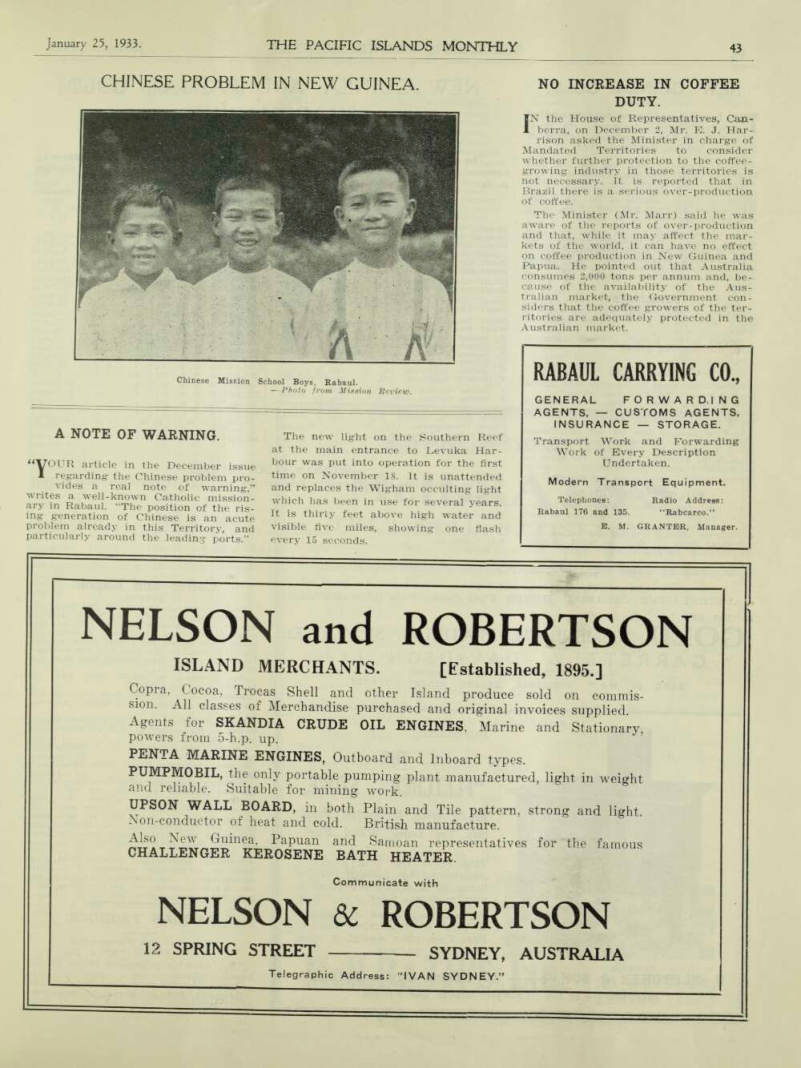
“YOUR article in the December issue regarding the Chinese problem pro vides a real note of warning,” writes a well-known Catholic mission ary in Rabaul. “The position of the ris ing generation of Chinese is an acute problem already in this Territory, and particularly around the leading ports”
The new light on the Southern Reef at the main entrance to Levuka Har bour was put into operation for the first time on November 18. It is unattended and replaces the Wigham occulting light which has been in use for several years.
It is thirty feet above high water and visible five miles, showing one flash every 15 seconds.
No Increase In Coffee
Duty.
IN the House of Representatives, Can berra, on December 2, Mr. E. J. Har rison asked the Minister in charge of Mandated Territories to consider whether further protection to the coffee growing industry in those territories is not necessary. It is reported that in Brazil there is a serious over-production of coffee.
The Minister (Mr. Marr) said he was aware of the reports of over-production and that, while it may affect the mar kets of the world, it can have no effect on coffee production in New Guinea and Papua. He pointed out that Australia consumes 2,000 tons per annum and, be cause of the availability of the Aus tralian market, the Government con siders that the coffee growers of the ter ritories are adequately protected in the Australian market.
Advertisements & other items, p. 45 (1 item)
Nelson And Robertson
RABAUL CARRYING CO.,
GENERAL FORWARD.ING
AGENTS, CUSTOMS AGENTS,
INSURANCE STORAGE.
Transport Work and Forwarding Work of Every Description Undertaken.
Modern Transport Equipment.
Telephones: Radio Address: Rabaul 176 and 135. “Rabcarco.”
E. M. GRANTER, Manager.
NELSON and ROBERTSON
ISLAND MERCHANTS. [Established, 1895.]
Copra, Cocoa, Trocas Shell and other Island produce sold on commis sion. All classes of Merchandise purchased and original invoices supplied.
Agents for SKANDIA CRUDE OIL ENGINES. Marine and Stationary powers from 5-h.p. up.
PENTA MARINE ENGINES, Outboard and Inboard types.
PUMPMOBIL, the only portable pumping plant manufactured, light in weight and reliable. Suitable for mining work.
UPSON WALL BOARD, in both Plain and Tile pattern, strong and light.
Non-conductor of heat and cold. British manufacture.
Also New Guinea, Papuan and Samoan representatives for the famous
CHALLENGER KEROSENE BATH HEATER.
Communicate with
NELSON & ROBERTSON
12 SPRING STREET
SYDNEY, AUSTRALIA
Telegraphic Address: "IVAN SYDNEY.”
New Guinea Gold,
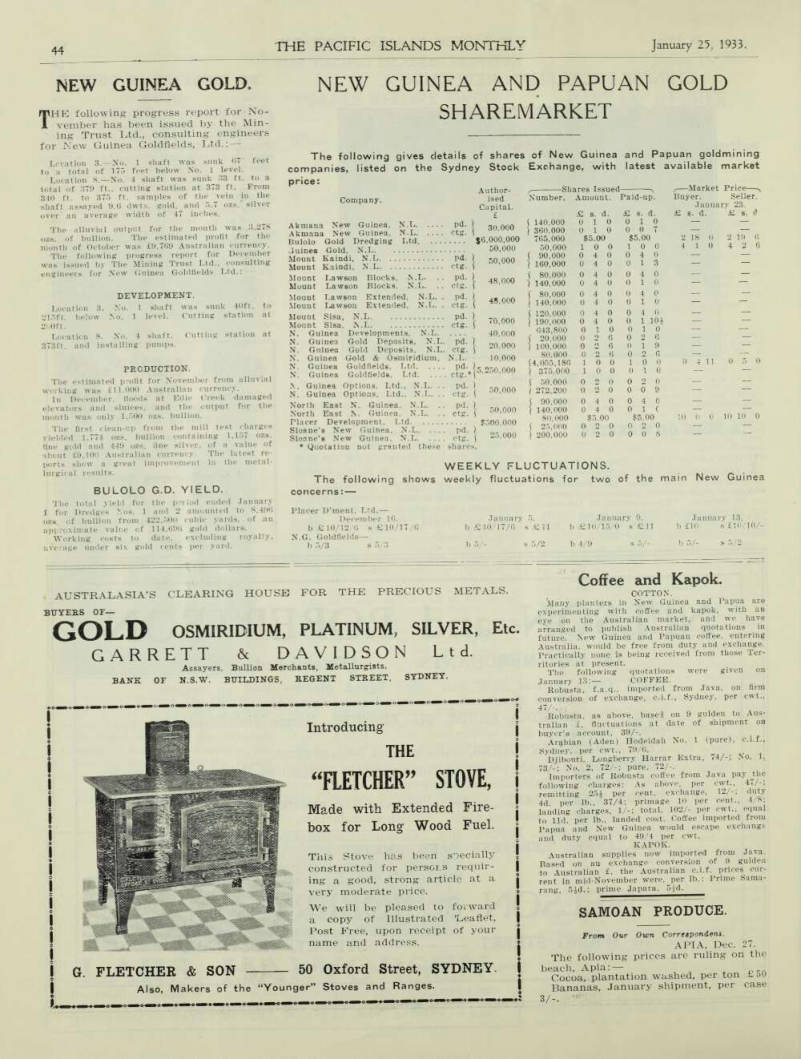
THE following progress report for No vember has been issued by the Min ing Trust Ltd., consulting engineers for New Guinea Goldfields, Ltd.: Location 3.—No. 1 shaft was sunk 67 feet to a total of 175 feet below No. 1 level.
Location 8.- —No. 4 shaft was sunk 33 ft. to a total of 379 ft., cutting station at 373 ft. From 340 ft. to 375 ft. samples of the vein in the shaft assayed 9.6 dwts. gold, and 5.7 ozs. silver over an average width of 47 inches.
The alluvial output for the month was 3.278 ozs. of bullion. The estimated profit for the month of October was £9,769 Australian currency.
Tlie following progress report for December was issued by The Mining Trust Ltd., consulting engineers for New Guinea Goldfields Ltd.:
Development.
Location 3. No. 1 shaft was sunk 40ft. to 215 ft. below No. 1 level. Cutting station at 200ft.
Location 8. No. 4 shaft. Cutting station at 373 ft. and installing pumps.
Production.
The estimated profit for November from alluvial working was £11,000 Australian currency.
In December, floods at Edie Creek damaged elevators and sluices, and the output for the month was only 1,500 ozs. bullion.
The first clean-up from the mill test charges yielded 1,774 ozs. bullion containing 1,157 ozs. tine gold and 449 ozs. fine silver, of a value of about £9,100 Australian currency. The latest re ports show a great improvement in the metal lurgical results.
Bulolo G.D. Yield.
The total yield for the period ended January 1 for Dredges Nos. 1 and 2 amounted to 8,496 ozs. of bullion from 422,500 cubic yards, of an approximate value of 114,696 gold dollars.
Working costs to date, excluding royalty, average under six gold cents per yard.
Sharemarket
New Guinea And Papuan Gold
The following gives details of shares of New Guinea and Papuan goldmining companies, listed on the Sydney Stock Exchange, with latest available market price:
Weekly Fluctuations.
The following shows weekly fluctuations for two of the main New Guinea concerns:—
Authorised Capital £ Shares Issued Market Price Company.
Number.
Amount.
Paid-up.
Buyer. Seller.
January 23. £ £ s. d £ s. d. £ s. d. £ s. d.
Akmana New Guinea. N.L pd.
Akmana New Guinea, N.L ctg.
Bulolo Gold Dredging Ltd. 30,000 $6,000,000 50,000 140,000 360,000 765,000 50,000 0 1 0 0 1 0 $5.00 1 0 0 0 1 0 0 0 7 $5.00 1 0 0 2 18 0 4 1 0 2 19 6 4 2 6 Mount Kaindi, N.L pd.
Mount Kaindi, N.L ctg. 50,000 90,000 160,000 0 4 0 0 4 0 0 4 0 0 1 3 — — Mount Lawson Blocks, N.L. pd.
Mount Lawson Blocks, N.L. ctg. 48,000 80,000 140,000 0 4 0 0 4 0 0 4 0 0 1 0 — — Mount Lawson Extended. N.L. pd. 48.000 80,000 0 4 0 0 4 0 — — Mount Lawson Extended, N.L. ctg. 140,000 0 4 0 0 1 0 Mount Sisa, N.L. pd.
Mount Sisa N.L. ctg. 70,000 120,000 0 4 0 0 4 0 — — Mount Sisa. N.L ctg. 190,000 0 4 0 0 1 10½ — — N. Guinea Developments, N.L. 40.000 643,800 0 1 0 0 2 6 0 1 0 0 1 9 1 0 0 N. Guinea Gold Deposits, N.L. pd.
N. Guinea Gold Deposits, N.L. ctg. 20,000 20,000 100,000 80,000 4,055,186 375,000 0 2 6 0 2 6 0 2 6 — — N. Guinea Gold & Osmiridium, N.L.
N. Guinea Goldfields. Ltd pd.
N. Guinea Goldfields, Ltd ctg.* 10.000 5.250,000 0 2 6 1 0 0 1 0 0 1 0 0 0 1 0 0 4 11 0 5 0 N. Guinea Options, Ltd., N.L. pd.
N. Guinea Options, Ltd., N.L. ctg. 50,000 50,000 272,200 0 2 0 0 2 0 0 2 0 — — North East N. Guinea, N.L. pd.
North East N. Guinea. N.L. ctg.
Placer Development. Ltd 50,000 $500,000 90,000 140,000 80,000 25,000 200,000 0 4 0 0 4 0 $5.00 0 2 0 0 2 0 0 4 0 0 1 0 $5.00 0 2 0 10 0 0 10 10 0 Sloane’s New Guinea, N.L pd.
Sloane’s New Guinea, N.L ctg. 25,000 0 2 0 0 0 8 — — • Quotation not granted these shares.
Placer D’ment, Ltd. — December 16. January 5. January 9. January 13. b £10/12 6 s £10/17/6 b £10/17/6 s £11 b £10/15/0 s£ll b £10 s £10/10/- N.G. Goldfields — b 5/3 s 5/3 b 5/- s 5/2 b 4/9 s a/- b o/- s ;./2
Coffee and Kapok.
Cotton.
Many planters in New Guinea and Papua are experimenting with coffee and kapok, with an eye on the Australian market, and we have arranged to publish Australian quotations in future. New Guinea and Papuan coffee, entering Australia, would be free from duty and exchange.
Practically none is being received from those Ter ritories at present.
The following quotations were given on January 13: — COFFEE.
Robusta, f.a.q., imported from Java, on farm conversion of exchange, c.i.f., Sydney, per cwt., Robusta, as above, based on 9 gulden to Aus tralian £, fluctuations at date of shipment on buyer’s account, 39/-. .
Arabian (Aden) Hodeidah No. 1 (pure), c.i.f., Sydney, per cwt., 79/6.
Djibouti, Longberry Harrar Extra, 74/-; Na. 1, 73/-; No. 2, 72/-; pure, 72/-.
Importers of Robusta coffee from Java pay the following charges: As above, per cwt., 47/-; remitting 25i per cent, exchange, 12/-; duty 4d per lb., 37/4; primage 10 per cent., 4/8: landing charges, 1/-; total, 102/- per cwt., equal to 11d. per lb., landed cost. Coffee imported from Papua and New Guinea would escape exchange and duty equal to 49/4 per cwt.
Kapok.
Australian supplies now imported from Java.
Based on an exchange conversion of 9 gulden to Australian £. the Australian c.i.f. prices cur rent in mid-November were, per lb.: Prime Sama rang, 5½d.; prime Japara, 5½d.
Advertisements & other items, p. 46 (2 items)
Samoan Produce,
From Our Own Correspondent.
APIA, Dec. 27.
The following- prices are ruling on the beach, Apia: Cocoa, plantation washed, per ton £50 Bananas, January shipment, per case 3/-.
“Fletcher” Stove,
AUSTRALASIA’S CLEARING HOUSE FOR THE PRECIOUS METALS.
BUYERS OF—
GOLD OSMIRIDIUM, PLATINUM, SILVER, Etc.
GARRETT & DAVIDSON Ltd.
Assayers, Bullion Merchants, Metallurgists, BANK OF N.S.W. BUILDINGS. BEGENT STBEET. SYDNEY.
Introducing
THE
“FLETCHER” STOVE,
Made with Extended Fire
box for Long Wood Fuel.
This Stove has been specially constructed for persons requir ing a good, strong article at a very moderate price.
We will be pleased to forward a copy of Illustrated Leaflet, Post Free, upon receipt of your name and address.
G. FLETCHER & SON 50 Oxford Street, SYDNEY.
Also, Makers of the “Younger” Stoves and Ranges.
Market Quotations
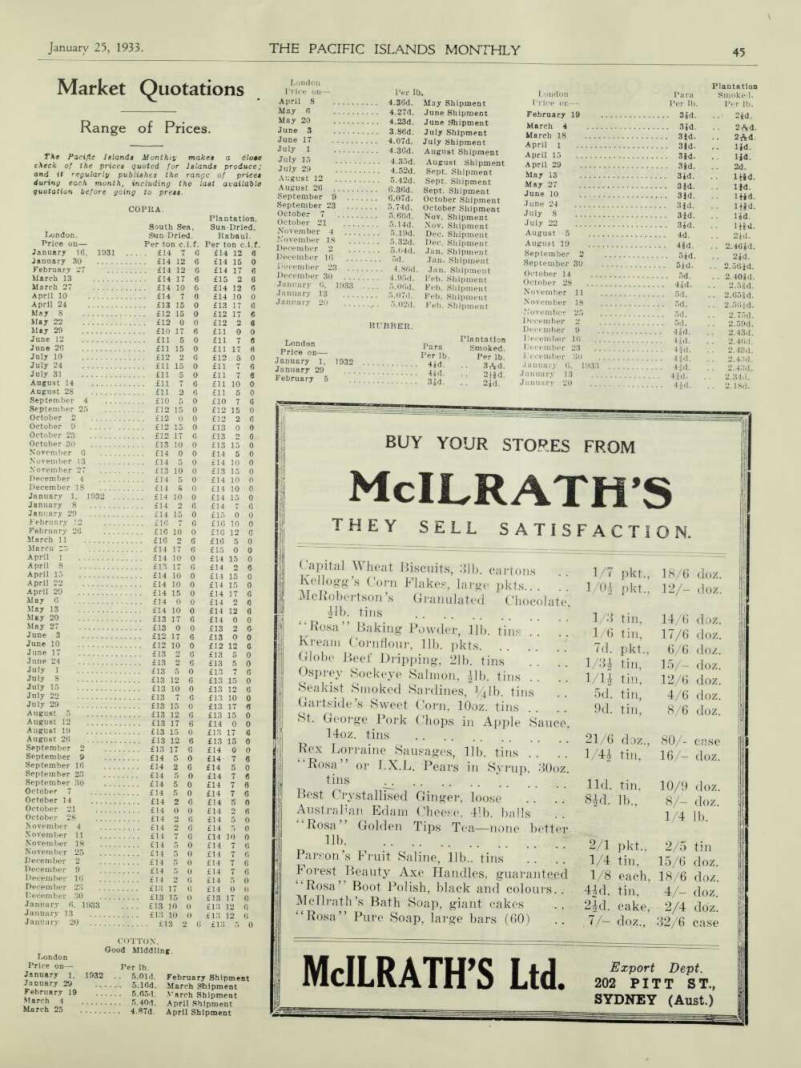
Range of Prices.
The Pacific Islands Monthly makes a close check of the prices quoted for Islands produce; and it regularly publishes the range of prices during each month, including the last available quotation before going to press.
London Price on— Per lb.
April 8 ...
May 6 May 20 June 3 ...
June 17 ... 4.36d. 4.27d. 4.23d. 3.86d. 4 07d May Shipment June Shipment June Shipment July Shipment July Shipment July 1 July 15 ...
July 29 August 12 ...
August 26 ...
September 9 .
September 23 .
October 7 October 21 November 4 November IS December 2 December 10 December 23 December 30 January (i. 1933 January 13 January 20 4.3Gd. 4.35d. 4.52d. 5.42d.
G.3Gd. 6.07d. 5.74d. 5.60d. 5.14d. 5.19d. 5.32d. 5.04d. 5d. 4.8Ud. 4.95d. o.OGd. 5.07(1. n.02d.
August Shipment August Shipment Sept. Shipment Sept. Shipment Sept. Shipment October Shipment October Shipment Nov. Shipment Nov. Shipment Dec. Shipment Dec. Shipment Jan. Shipment Jan. Shipment Jan. Shipment Feb. Shipment Feb. Shipment Feb. Shipment Feb. Shipment
Rubber.
London Price on— January 1, 1932 Plantation Para Smoked.
Per lb. Per lb. ■♦Id. 3,*bd. 4id. .. 2f|d. . . 2id.
January 29 February 5
London Price on — Para Per lb.
Plantation Smoked. Per lb.
February 19 3Jd. .. 2jd.
March 4 2^d.
March 18 2Ad.
April i Hd.
April 15 3|d.
Ud.
April 29 2d.
May 13 Ittd.
May 27 Ud.
June 10 IHd. •Tune 24 IHd.
July 8 lid.
July 22 Hid.
August 5 .. 2id.
August 19 .. 2.46id.
September 2 2id.
September 30 ... .. 2.56*d.
October 14 .. 2.40j|d.
October 28 ... . . 2.5Sd.
November 11 5d. .. 2.65|d.
November 18 .. 2.5(iid.
November 25 2.75d.
December 2 5d. 2.59d.
December 9 . . 2.43d.
December 16 2.4Gd.
December 23 . . 2.43d.
December 30 4}d. .. 2.43d.
January 0, 1933 ... 4Jd. .. 2.43d.
January 13 ... .. 2.34.1.
Januarr 20 ... .. 2.18d.
London.
Price on— January 1G, 1931 JannarT 30 ...
Copra
South Sea Sun-Dried. Per ton c.i.f. £14 7 G £14 12 6 Plantation, Sun-Dried, Rabaul. Per ton c.i.f. £14 12 0 February 27 £14 12 6 £14 17 6 March 13 £14 17 6 £15 2 G March 27 £14 10 0 £14 12 £14 10 o April 10 £14 7 0 o April 24 £13 15 0 £13 17 G May 8 £12 15 0 £12 17 G May 22 £12 0 0 £12 2 £11 0 £11 7 £11 17 £12 5 G May 29 £10 17 6 o June 12 £11 5 0 G June 26 £11 15 0 6 July 10 £12 2 6 o July 24 £11 15 0 £11 7 £11 7 £11 10 £11 5 £10 7 £12 15 £1° 2 G July 31 £11 5 0 G August 14 £11 7 6 o August 28 £11 3 6 o September 4 .. . £10 5 0 Q September 25 .. . £12 15 0 o October 2 £12 0 0 6 o October 9 £12 15 0 £13 0 £13 2 £13 15 £14 5 £14 10 £13 15 £14 10 £14 10 £14 15 £14 7 £15 0 flG 10 £1G 12 flG 5 £15 0 £14 15 £14 2 £14 15 £14 15 £14 17 £14 2 £14 12 £14 0 £13 2 £13 0 £12 12 £13 5 £13 5 £13 7 £13 15 £13 12 £13 10 £13 17 £13 15 £14 0 £13 17 £13 15 £14 0 £14 7 £14 5 £14 7 £14 7 £14 7 £14 5 £14 2 £14 5 £14 5 £14 10 £14 7 £14 7 £14 7 £14 7 £14 5 £14 0 £13 17 £13 12 ■f 1 •> 1 o October 23 £12 17 G G October 30 £13 10 0 o November G . .. . £14 0 0 0 November 13 .. . . £14 5 0 o November 27 . .. . £13 10 0 o December 4 . . . . £14 5 0 0 December 18 . . . . £14 g o o January 1. 1932 . £14 10 0 o January 8 £14 2 G 6 January 29 £14 15 0 o February 12 ... £10 7 6 o February 2G £16 10 0 G March 11 £16 2 6 q March Zo £14 17 6 o April l £14 10 0 0 G April 8 £13 17 0 April 15 £14 10 0 0 q April 22 April 29 £14 15 o G May G £14 o 0 G May 13 £14 io 0 May 20 u A May 27 V G June 3 A June 10 V ft June 17 V A June 24 V o July 1 G July 8 q July 15 G July 22 o Julv 29 G August 5 o August 12 £13 17 6 o August 19 q August 26 o September 2 £13 17 c q September 9 . ..
G September 16 £14 2 6 o September 23 £14 5 0 * September 30 £14 5 0 6 G October 7 ... £14 5 0 G October 14 o October 21 0 October 28 £14 2 6 A November 4 £14 2 G V o November 11 ... £14 7 g q November 18 . ...
G November 25 . ... £14 5 o 6 0 December 2 . . . .
December 9 . .. . ... £14 5 0 0 December 1G . £14 2 G 0 0 6 0 December 23 £13 17 g December 30 £13 15 Q January 0. 1933 January 13 £13 10 0 January 20 £13 5 0 r Shipment
Cotton.
Good Middling.
London Price on— Per lb.
January 1, 1932 .. 5.01.1. February January 29 K imi xr„ ai February 19 March 4 March 25 '-U C'Ul|JUiriU 5.656. March Shipment 5.40i. April Shipment 4.87d. April Shipment
Advertisements & other items, p. 47 (1 item)
Mcilrath’S
BUY YOUR STORES FROM
THEY SELL SATISFACTION.
Capital Wheat Biscuits, 3lb. cartons Kellogg’s Corn Flakes, large pkts McRobertson’s Granulated Chocolate, ½lb. tins "Rosa" Baking Powder, 1lb. tins Kream Cornflour, 1lb. pkts Globe Beef Dripping, 2lb. tins Osprey Sockeye Salmon, ½lb. tins Seakist Smoked Sardines, ¼lb. tins Gartside’s Sweet Corn, 10oz. tins St. George Pork Chops in Apple Sauce, 14oz. tins Rex Lorraine Sausages, 1lb. tins “Rosa” or I.X.L. Pears in Syrup, 30oz. tins Best Crystallised Ginger, loose . .
Australian Edam Cheese, 4lb. balls “Rosa” Golden Tips Tea—none better 1lb Parson’s Fruit Saline, 1lb.. tins Forest Beauty Axe Handles, guaranteed “Rosa’ Boot Polish, black and colours. .
Mcllrath’s Bath Soap, giant cakes “Rosa” Pure Soap, large bars (60)
McILRATH’S Ltd.
SYDNEY (Aust.)
Exchange Quotations
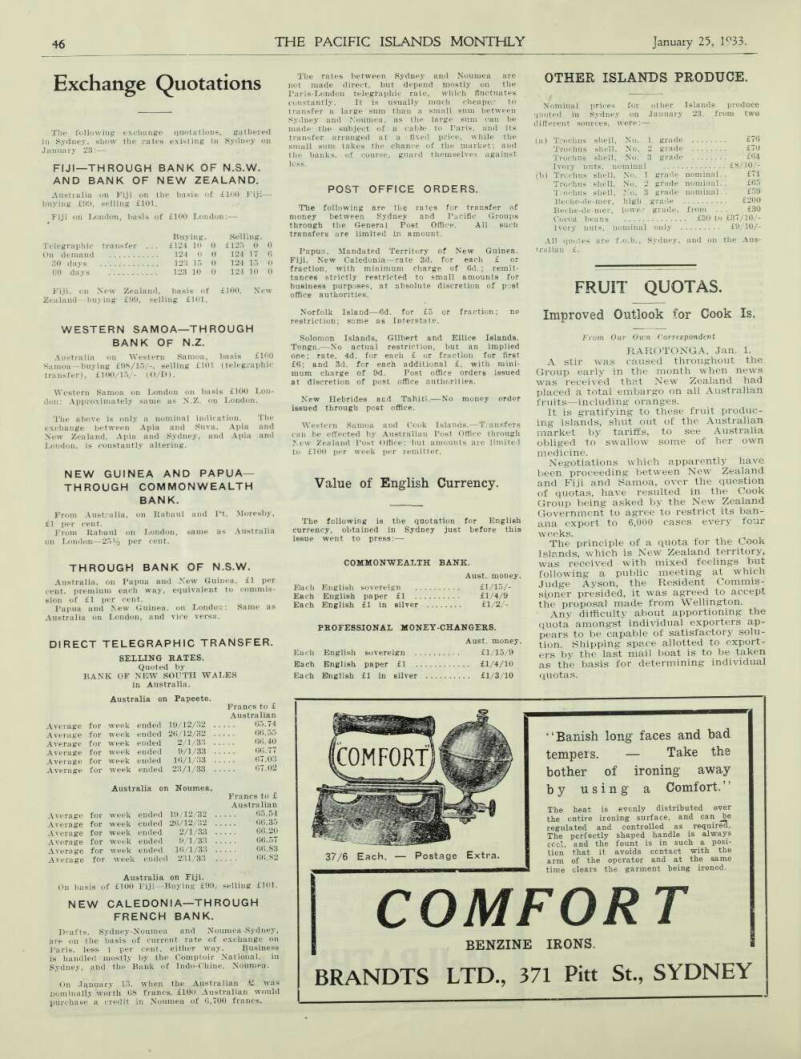
The following exchange quotations, gathered in Sydney, show the rates existing in Sydney on January 23: —
Fiji—Through Bank Of N.S.W.
And Bank Of New Zealand.
Australia on Fiji on the basis of £100 Fiji— buying £99, selling £101.
Fiji on London, basis of £100 London: —
Fiji, on New Zealand, basis of £100, New Zealand—buying £99, selling £101.
Western Samoa—Through
Bank Of N.Z.
Australia on Western Samoa, basis £100 Samoa —buying £98/15/-, selling £101 (telegraphic transfer), £100/15/- (O/D).
Western Samoa on London on basis £100 Lon don: Approximately same as N.Z. on London.
Tire above is only a nominal indication. The exchange between Apia and Suva, Apia and New Zealand, Apia and Sydney, and Apia and London, is constantly altering.
New Guinea And Papua
Through Commonwealth
Bank.
From Australia, on Rabaul and Ft. Moresby, £1 per cent.
From Rabaul on London, same as Australia on London—25½% per cent.
Through Bank Of N.S.W.
Australia, on Papua and New Guinea, £1 per cent. premium each way, equivalent to commis sion of £1 per cent.
Papua and New Guinea, on Londos; Same as Australia on London, and vice versa.
Direct Telegraphic Transfer.
Selling Rates.
Quoted by
Bank Of New South Wales
in Australia.
Australia on Fiji.
On basis of £100 Fiji—Buying £99, selling £101.
New Caledonia—Through
French Bank.
Drafts, Sydney-Noumea and Noumea-Sydney, are on the basis of current rate of exchange on Paris, less 1 per cent, either way. justness is handled mostly by the Comptoir National, in Sydney, and the Bank of Indo-Chine, Noumea.
On January 13, when the Australian £ was nominally worth 68 francs, £100 Australian would purchase a credit in Noumea of 6,700 francs.
The rates between Sydney and Noumea are not made direct, but depend mostly on the Paris-London telegraphic rate, which fluctuates constantly. It is usually much cheaper to transfer a large sum than a small sum between Sydney and 'Noumea, as the large sum can be made the subject of a cable to Paris, and its transfer arranged at a fixed price, while the small sum takes the chance of the market; and the banks, of course, guard themselves against loss.
Post Office Orders.
The following are the rates for transfer of money between Sydney and Pacific Groups through the General Post Office. All such transfers are limited in amount.
Papua, Mandated Territory of New Guinea, Fiji, New Caledonia —rate 3d. for each £ or fraction, with minimum charge of 6d.; remit tances strictly restricted to small amounts for business purposes, at absolute discretion of post office authorities.
Norfolk Island—6d. for £5 or fraction; no restriction; same as Interstate.
Solomon Islands, Gilbert and Ellice Islands, Tonga.—No actual restriction, but an implied one; rate, 4d. for each £ or fraction for first £6; and 3d. for each additional £, with mini mum charge of 9d. Post office orders issued at discretion of post office authorities.
New Hebrides and Tahiti.—No money order issued through post office.
Western Samoa and Cook Islands. —Transfers can be effected by Australian Post Office through New Zealand Post Office; but amounts are limited to £100 per week per remitter.
Value of English Currency.
The following is the quotation for English currency, obtained in Sydney just before this issue went to press:—
Other Islands Produce.
Nominal prices for other Islands produce quoted in Sydney on January 23, from two different sources, were; — (a) T.rochus shell, No. 1 grade £76 Trochus shell, No. 2 grade £70 Trochus shell, No. 3 grade £64 Ivory nuts, nominal £8/10/- (b) Trochus shell, No. 1 grade nominal.. £71 Trochus shell, No. 2 grade nominal.. £65 T.ochus shell, No. 3 grade nominal.. £59 Beche-de-mer, high grade £200 Beche-de-mer, lower grade, from .. . £30 Cocoa beans £3O to £37/10/- Ivory nuts, nominal only £9/10/- All quotes are f.o.b., Sydney, and on the Aus tralian £.
Buy ing.
Selling.
Telegraphic transfer . .
. £124 10 0 £125 0 0 On demand 124 0 0 124 17 6 30 days 123 15 0 124 15 0 60 days 123 10 0 124 10 0
Average for week ended 19/12/32 . 65.74 Australia on Papeete.
Francs to £ Australian Average for week ended 20/12/32 . ... 66.55 Average for week ended 2/1/33 . 66.40 Average for week ended 9/1/33 . 66.77 Average for week ended 16/1/33 . 67.03 Average for week ended 23/1/33 . 67.02 Average for Australia on Noumea. week ended 19/12/32 .
Francs to £ Australian 65.54 Average for week ended 26 12 32 .
Average for week ended 2/1/33 . 66.20 Average for week ended 9/1/33 . ... 66.57 Avera ge for week ended 16/1/33 . 66.83 Average for week ended 231/33 . 66.82
Commonwealth Bank.
Aust. money.
Each English sovereign £1/15/- Each English paper £1 £1/4/9 Each English £1 in silver . . £1/2/-
Professional Money-Changers.
Aust. money.
Each English sovereign £1/15/9 Each English paper £1 £1/4/10 Each English £1 in silver . .. £1/3/10
Fruit Quotas.
Improved Outlook for Cook Is.
From Our Own Correspondent
Rarotonga, Jan. 1.
A stir was caused throughout the Group early in the month when news was received that New Zealand had placed a total embargo on all Australian fruits —including oranges.
It is gratifying to these fruit produc ing islands, shut out of the Australian market by tariffs, to see Australia obliged to swallow some of her own medicine.
Negotiations which apparently have been proceeding between New Zealand and Fiji and Samoa, over the question of quotas, have resulted in the Cook Group being asked by the New Zealand Government to agree to restrict its ban ana export to 6,000 cases every four weeks.
The principle of a quota for the Cook Islands, which is New Zealand territory, was received with mixed feelings but following a public meeting at which Judge Ayson, the Resident Commis sioner presided, it was agreed to accept the proposal made from Wellington.
Any difficulty about apportioning the quota amongst individual exporters ap pears to be capable of satisfactory solu tion. Shipping space allotted to export ers by the last mail boat is to be taken as the basis for determining individual quotas.
Advertisements & other items, p. 48 (1 item)
Comfort
37/6 Each. Postage Extra.
“Banish long faces and bad tempers. Take the bother of ironing away by using a Comfort."
The heat is evenly distributed ever the entire ironing surface, and can be regulated and controlled as required.
The perfectly shaped handle is always cool, and the fount is in such a position that it avoids contact with the arm of the operator and at the same time clears the garment being ironed.
COMFORT
BENZINE
IRONS,
BRANDTS LTD., 371 Pitt St., SYDNEY
Shipping Services in the Pacific
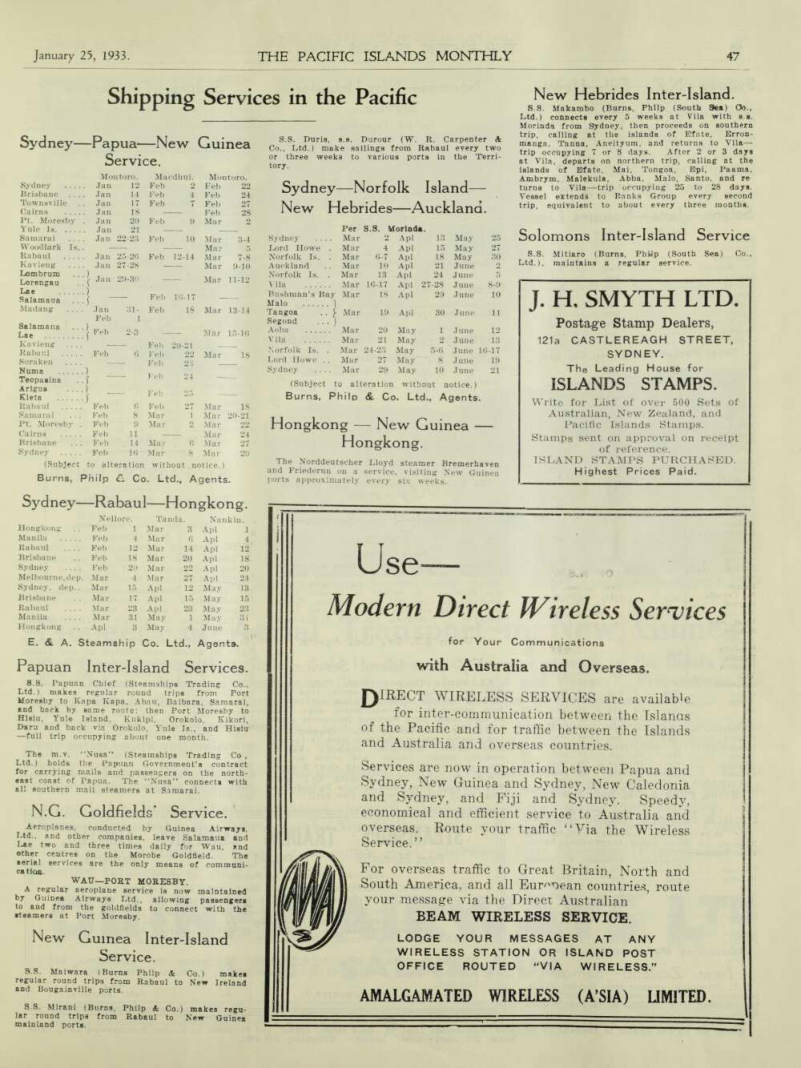
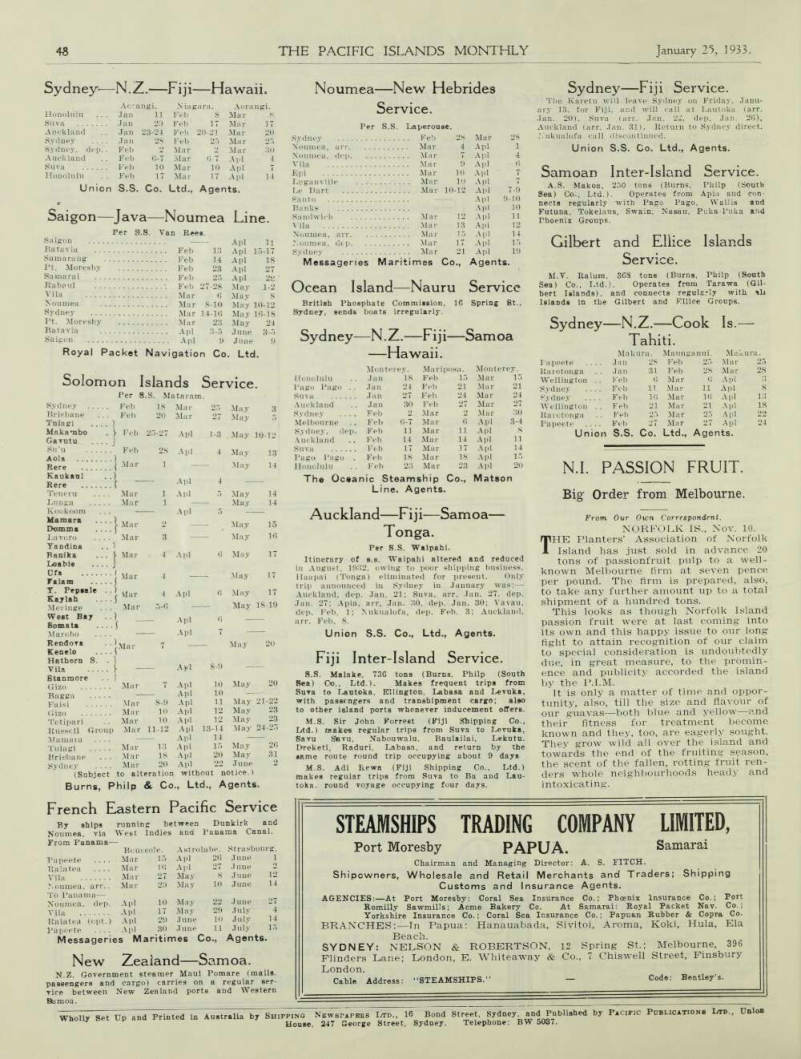
Sydney—Papua—New Guinea Service.
Sydney—Rabaul—Hongkong.
Papuan Inter-Island Services.
S.S. Papuan Chief (Steamships Trading Co., Ltd.) makes regular round trips from Port Moresby to Kapa Kapa, Abau, Baibara, Samarai, and back by same route: then Port Moresby to Hisiu, Yule Island, Kuklpi, Orokolo, Kikori, Daru and back via Orokolo, Yule Is., and Hisiu —full trip occupying about one month.
The m.v. “Nusa” (Steamships Trading Co , Ltd.) holds the Papuan Government’s contract for carrying mails and passengers on the north east coast of Papua. The “Nusa” connects with all southern mail steamers at Samarai.
N.G. Goldfields’ Service.
Aeroplanes, conducted by Guinea Airways, Ltd., and other companies, leave Salamaua and Lae two and three times daily for Wau, and other centres on the Morobe Goldfield. The aerial services are the only means of commnni cation.
Wau—Poet Moresby.
A regular aeroplane service is now maintained by Guinea Airways Ltd., allowing passengers to and from the goldfields to connect with the steamers at Port Moresby.
New Guinea Inter-Island
Service.
S.S. Maiwara (Burns Philp & Co.) makes regular round trips from Rabaul to New Ireland and Bougainville ports.
S.S. Mirani (Burns, Philp & Co.) makes regu lar round trips from Rabaul to New Guinea mainland ports.
S.S. Duris, s.8. Durour (W. R. Carpenter & Co., Ltd.) make sailings from Rabaul every two or three weeks to various ports in the Terri tory.
Sydney—Norfolk Island—
New Hebrides—Auckland.
Hongkong New Guinea
Hongkong.
The Norddeutscher Lloyd steamer Bremerhaven and Friederun on a service, visiting New Guinea ports approximately every six weeks.
New Hebrides Inter-Island.
S.S. Makambo (Burns, Philp (South Sea) Co., Ltd.) connects every 5 weeks at Vila with s.s.
Morinda from Sydney, then proceeds on southern trip, calling at the islands of Efate, Erron manga, Tanna, Aneityum, and returns to Vila— trip occupying 7 or 8 days. After 2 or 3 days at Vila, departs on northern trip, calling at the islands of Efate, Mai, Tongoa, Epi, Paama, Ambrym, Malekula, Abba, Malo, Santo, and re turns to Vila—trip occupying 25 to 28 days.
Vessel extends to Banks Group every second trip, equivalent to about every three months.
Solomons Inter-Island Service
5.5. Mitiaro (Burns, Philp (South Sea) Co., Ltd.), maintains a regular service.
Sydney Per . Mar S.S. Morlnda. 2 A pi 13 May 25 Lord Howe . Mar 4 Apl 15 May 27 Norfolk Is. . Mar 6-7 Apl 18 May 30 Auckland . Mar 10 Apl 21 June 2 Norfolk Is. . Mar 13 Apl 24 June c Vila . Mar 16-17 Apl 27 '-28 June 8-9 Bushman’s Bay Mar IS Apl 29 June 10 Malo Tangoa • 1 Mar 19 Apl 30 June 11 Segond Aoba . 5 . Mar 20 May 1 June 12 Vila . Mar 21 May 2 June 13 Norfolk Is. . Mar 24-25 May 5-6 June 16-17 Lord Howe . . Mar 27 May 8 June 19 Sydney . Mar 29 May 10 June 21 (Subject to alteration without notice.) Burns, Philp & Co. Ltd., Agents.
Montoro.
Macdhui.
Montoro.
Sydney . ... .1 a n 12 Feb 2 Feb 22 Feb 24 Brisbane Jan 14 Feb 4 Townsville . Jan 17 Feb 7 Feb 27 18 20 Pah 9ft Pt. Moresby Jan Feb 9 r cu Mar 2 Yule Is. . 21 22-23 Samarai Jan Feb 10 Mar 3-4 Woodlark Is. — : Mar 5 Rabaul ...
Jan 25-20 Feb 12-14 Mar 7-8 Mar 9-10 Kavieng Jan 27-28 Lombrum
' Jan
29-30 Lorengau — Mar 11-12 Lae .{ Salamaua Feb 10-17 — Madang Jan Feb 31- 1 Feb 18 Mar 13-14 Salamaua
■| Feb
Lae 2-3 — Mar 15-1G Kavieng Feb 20-21 Rabaul Feb G Feb 22 Mar 18 Soraken Feb 25 Numa ) Feb 24 Teopaaina 5 — Arlgua Kleta 1 f Feb — Feb 25 » i Rabaul G Feb 27 Mar IS Samarai Feb 8 Mar 1 Mar 20-21 Pt. Moresby .
Feb 9 Mar 2 Mar 22 Cairns Feb 11 Mar 24 Mar 27 Brisbane Feb 14 Mar . G Sydney Pph ifi Mar 8 Mar 29 (Subject to alteration without notice.) Burns, Philp & Co. Ltd., Agents.
Nellore.
Tanda.
Nankin.
Hongkong Feb 1 Mar 3 Apl 1 Manila Feb 4 Mar 6 Apl 4 Rabaul . Feb 12 Mar 14 Apl 12 Brisbane . Feb 18 Mar 20 Apl 18 Sydney . Feb 20 Mar 22 Apl 20 Melbourne,dep. Mar 4 Mar 27 Apl 24 Sydney, dep. . Mar 15 Apl 12 May 13 Brisbane . Mar 17 Apl 15 May 15 Rabaul . Mar 23 Apl 23 May 23 Manila . Mar 31 May- 1 May 31 Hongkong . Apl 3 May 4 June 3 E. & A. Steamship Co. Ltd., Agents.
Sydney—N.Z.—Fiji—Hawaii.
Saigon—Java—Noumea Line.
Solomon Islands Service.
French Eastern Pacific Service
By ships running: between Dunkirk and Noumea, via West Indies and Panama Canal.
From Panama —
New Zealand —Samoa.
N.Z. Government steamer Maul Pomare (mails, passengers and cargo) carries on a regular ser vice between New Zealand ports and Western Samoa.
Noumea —New Hebrides Service.
Ocean Island —Nauru Service British Phosphate Commission, 16 Spring St., Sydney, sends boats irregularly.
Sydney—N.Z.—Fiji—Samoa —Hawaii.
Auckland —Fiji—Samoa—
Tonga.
Per S.S. Walpahi.
Itinerary of s.s. Waipahi altered and reduced in August, 1932, owing to poor shipping business.
Haapai (Tonga) eliminated for present. Only trip announced in Sydney in January was: — Auckland, dep. Jan. 21; Suva, arr. Jan. 27. dep.
Jan. 27; Apia, arr. Jan. 30, dep. Jan. 30; Yavau, dep. Feb. 1; Nukualofa, dep. Feb. 3; Auckland, arr. Feb. 8.
Union S.S. Co., Ltd., Agents.
Fiji Inter-Island Service.
S.S. Malake, 736 tons (Burns, Philp (South Sea) Co., Ltd.). Makes frequent trips from Suva to Lautoka, Ellington, Labasa and Levnka, with passengers and transhipment cargo; also to other island ports whenever inducement offers.
M. S. Sir John Forrest (Fiji Shipping Co., Ltd.) makes regular trips from Suva to Levuka, Savu Savu, Nabouwalu, Baulailai, Lekutu.
Dreketi, Raduri, Labasa, and return by the same route round trip occupying about 9 days M.S. Adi Rewa (Fiji Shipping Co., Ltd.) makes regular trips from Suva to Ba and Lau toka. round voyage occupying four days.
Sydney—Fiji Service.
The Karetu will leave Sydney on Friday, Janu ary 13. for Fiji, and will call at Lautoka (arr.
Jan. 20), Suva (arr. Jan. 22, dep. Jan. 26), Auckland (arr. Jan. 81). Return to Sydney direct.
Nukualofa call discontinued.
Union S.S. Co. Ltd., Agents.
Samoan Inter-Island Service.
A.S. Makoa, 250 tons (Burns, Philp (South Sea) Co., Ltd.). Operates from Apia and con nects regularly with Pago Pago, Wallis and Futuna, Tokelaus, Swain, Nasau, Puka-Puka and Phoenix Groups.
Gilbert and Ellice Islands
Service.
M.V. Ralum, 368 tons (Burns, Philp (South Sea) Co., Ltd.). Operates from Tarawa (Gil bert Islands), and connects regularly with all Islands in the Gilbert and Ellice Groups.
Sydney—N.Z.—Cook Is. —
Tahiti.
Per S.S. Laperouse. 28 Mar 28 Noumea, arr. .. .
Mar 4 Apl Apl Apl Apl Apl Apl Apl 1 Mar 4 Vila Mar 9 6 Epi 10 7 Mar in 7 Le Dart Mar 10-12 7-9 Santo 9-10 Banks Apl Apl Apl Apl Apl Anl 10 Sandwich Mar 12 11 Vila Mar 13 12 Noumea, arr.
Mar 15 14 Noumea, dep. ...
Mar IT 15 Sydney Mar 21 19 Messagenes Maritimes Co Agents.
Monterey.
Mariposa.
Monterey.
Honolulu Jan 18 Feb 15 Mar 15 Pago Pago . .
Jan 24 Feb 21 Mar 21 Suva Jan 27 Feb 24 Mar 24 Auckland Jan 30 Feb 27 Mar 27 Sydney ...
Feb 2 Mar 2 Mar 30 Melbourne Feb 0-7 Mar 6 Apl 3-4 Sydney, dep.
Feb 11 Mar 11 Apl 8 Auckland Feb 14 Mar 14 Apl 11 Suva Feb 17 Mar 17 Apl 14 Pago Pago .
Feb 18 Mar 18 Apl 15 Honolulu Feb 2;i Mar 23 Apl 20 The Oceanic Steamship Co., Matson Line. Agents.
Makura.
Maunganui.
Makun Papeete ...
Jan 28 Feb 25 Mar- 25 Rarotonga Jan 31 Feb 2S Mar 28 Wellington ..
Feb 6 Mar G Apl 3 Sydney ...
Feb n Mar 11 Apl 8 Sydney ...
Feb 10 Mar 10 Apl 13 Wellington ..
Feb 21 Mar 21 Apl IS Rarotonga Feb 25 Mar 25 Apl 22 Papeete ...
Feb 27 Mar 27 Apl 24 Union S.S. Co. Ltd., Agents.
Aciangi. Niagara. Aorangi.
Honolulu ... Jan 11 Feb 8 Mar 8 Suva Jan 20 Feb 17 Mar 17 Auckland .. Jan 23-24 Feb 20-21 Mar 20 Sydney ... Jan 28 Feb 25 Mar 25 Sydney, dep.. Feb 2 Mar 2 Mar 30 Auckland . . Feb 6-7 Mar 6-7 Apl 4 Suva Feb 10 Mar 10 Apl 7 Honolulu . . Feb 17 Mar 17 Apl 14 Union S.S. Co. Ltd., Agents.
Per S.S. Van Rees Saigon A nl 1 1 Batavia ajii Apl 15-17 Samaraug ... Feb 14 Apl IS Pt. Moresby ... Feb 23 Apl 27 Samarai Apl 2K' Rabaul Feb 27-28 May 1-2 Vila May 8 Noumea May 10-12 Sydney May 10-18 Pt. Moresby ... Mar 23 May 24 Batavia ... Apl 3-5 June 3-5 Saigon June 9 Royal Packet Navigation Co, . Ltd.
Per S.S. Mataram.
Sydney Brisbane Tulnpi ...
Makambo Gavutu ...
Feb Feb Feb 18 20 2.1-27 Mar Mar Apl 25 27 1-3 May 3 May 5 May 10-12 Sn’u Feb 28 A i)1 May 13 Aola 4 Here ...
Mar 1 — May 14 Kaukaal Rere — Apl 4 Teneru ...
Mar 1 Apl 5 May 14 Lunga Kookoom Mamira Dom m a Lavoro Yandina Ranika Loable ...
Mar 1 Apl Apl May 14 Mar Mar Mar 2 3 A 6 May 15 May 16 May 17 Dfa Mar Mar Mar 4 May 17 Fa lam ...
T. Pepaale .
Kaylah Meringe Weit Bay Bomata Marobo 4 5-6 Apl Apl Apl 6 7 May 17 May 18-19 Rendora Kenelo Hathorn S. .
Vila — 7 Apl 8-9 May 20 Stanmore Mar 7 Apl 10 May 20 Apl Apl Apl Apl Apl U 10 — uagfeii Faisi Mar Gizo Mar
Tetipari . . Mar
Bussell Group Mar 8-9 10 10 11-12 11 12 12 5-14 May 21-22 May 23 May 23 May 24-25 M.amaia Tulagi Mar 13 Apl Apl 14 15 May 26 Brisbane Sydney (Subject to alteration without notice.) . Mar 18 Mar 20 Apl 20 May 31 Apl 22 June 2 Burns, Philp & Co., Ltd., Agents.
Boussole.
Astrol: abe.
Strasbourg.
Papeete Ralatea Vila Mar Mar Mar 15 10 27 Apl Apl May 20 27 8 June June June 1 2 12 Noumea, air.
Mar 29 May 10 June 14 To Panama — Noumea, dep Vila Raiatea (opt.
Papeete
Messageri
Apl 10 May 22 Apl 17 May 20 Apl 29 June 10 Apl 30 June 11 es Maritimes Co., June July July July
Agents.
27 4 14 15
Advertisements & other items, p. 49 (1 item)
Modern Direct Wireless Services
J. H. SMYTH LTD.
Postage Stamp Dealers,
121 a CASTLEREAGH STREET,
SYDNEY.
The Leading House for
ISLANDS STAMPS.
Write for List of over 500 Sets of Australian, New Zealand, and Pacific Islands Stamps.
Stamps sent on approval on receipt of reference.
ISLAND STAMPS PURCHASED.
Highest Prices Paid.
Use-
Modern Direct Wireless Services
for Your Communications with Australia and Overseas.
DIRECT WIRELESS SERVICES are available for inter-communication between the Islands of the Pacific and for traffic between the Islands and Australia and overseas countries.
Services are now in operation between Papua and Sydney, New Guinea and Sydney, New Caledonia and Sydney, and Fiji and Sydney. Speedy, economical and efficient service to Australia and overseas. Route your traffic “Via the Wireless Service. ”
For overseas traffic to Great Britain, North and South America, and all countries, route your message via the Direct Australian
BEAM WIRELESS SERVICE.
LODGE YOUR MESSAGES AT ANY
WIRELESS STATION OR ISLAND POST
OFFICE ROUTED “VIA WIRELESS.'’
AMALGAMATED WIRELESS (ASIA) LIMITED.
N.I. Passion Fruit.
Big Order from Melbourne.
From Our Own Correspondent.
Norfolk Is., Nov. 10.
THE Planters’ Association of Norfolk Island has just sold in advance 20 tons of passionfruit pulp to a well known Melbourne firm at seven pence per pound. The firm is prepared, also, to take any further amount up to a total shipment of a hundred tons.
This looks as though Norfolk Island passion fruit were at last coming into its own and this happy issue to our long fight to attain recognition of our claim to special consideration is undoubtedly due, in great measure, to the promin ence and publicity accorded the island by the P.I.M.
It is only a matter of time and oppor tunity, also, till the size and flavour of our guavas—both blue and yellow—and their fitness for treatment become known and they, too, are eagerly sought.
They grow wild all over the island and towards the end of the fruiting season, the scent of the fallen, rotting fruit ren ders whole neighbourhoods heady and intoxicating.
Advertisements & other items, pp. 50-52 (2 items)
48
January 25, 1933.
THE PACIFIC ISLANDS MONTHLY
Wholly Set Up and Printed In Australia by Shipping Newspapers Ltd., 16 Bond Street, Sydney and Published by Pacific Publications Ltd., Union House, 247 George Street, Sydney. Telephone: BW 5037.
Steamships Trading Company Limited,
Port Moresby PAPUA. Samarai
Chairman and Managing Director: A. S. FITCH.
Shipowners, Wholesale and Retail Merchants and Traders; Shipping Customs and Insurance Agents, AGENCIES:—At Port Moresby: Coral Sea Insurance Co.; Phoenix Insurance Co.; Port Romilly Sawmills; Acme Bakery Co. At Samarai: Royal Packet Nav. Co.; Yorkshire Insurance Co.; Coral Sea Insurance Co.; Papuan Rubber & Copra Co.
BRANCHES:—In Papua: Hanauabada, Sivitoi, Aroma, Koki, Hula, Ela Beaeh.
SYDNEY: NELSON & ROBERTSON, 12 Spring St.; Melbourne, 396 Flinders Lane; London, E. Whiteaway & Co., 7 Chiswell Street, Finsbury London.
Cable Address: “STEAMSHIPS.” Code: Bentley’s.
TOP: No. 2 Bulolo Dredge in course of construction. Carried in by aeroplanes.
BOTTOM: Bulolo Aerodrome, showing Passenger and Cargo- Carrying Aeroplanes.
New Guinea Aerodromes
LAE
SALAMAUA
WATUT
WAU
WAMPIT
SANGAN
BULOWAT
BULOLO
ZENAG
Pioneers of Aerial Transport in New Guinea Two Dredges, operated by Bulolo Gold Dredging, Ltd., are now at work on the Bulolo Flats, New Guinea. A large Hydro-Electric Station provides Light and Power. Preparations are being made by the same Company to instal Two More Dredges in the Bulowat Area.
All the Plant, Equipment, Supplies and Personnel Required for these Enterprises have been carried in, without accident or delay, by the Regular Established Services of Guinea Airways Ltd.
Guinea Airways Ltd . pioneered and developed Aerial Transportation in J\etv Guinea. As the New Guinea Gold Industry extends, so do the Company's Aerial Services. New landinggrounds for Guinea Airways machines , through which prospectors receive their supplies , have been constructed in the Ramu region (New Guinea) and at Kokoda (Yodda Goldfield , Papua).
The Company maintains a regular passenger service between Port Moresby (Papua) and the Morobe Goldfields, in New Guinea.
GUINEA AIRWAYS Ltd
LAE - SALAMAUA
Out of the sunshine, into the shade—and the coolness which conies only from a glass of Waverley Bitter Ale!
Thoughtful hosts keep a
good stock of this pleasant refreshment.
Ask for the bottle with the green label
RESCHS
WAVERLEY
BITTER
ALE