Advertisements & other items, pp. 1-2 (2 items)
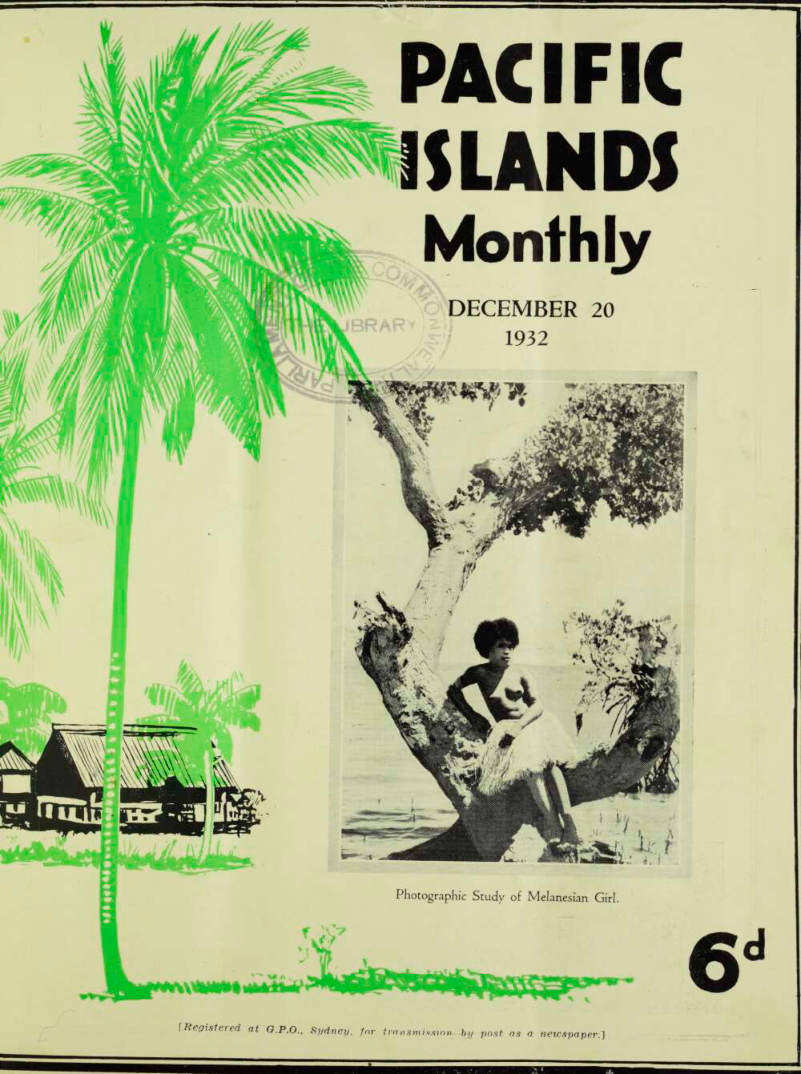
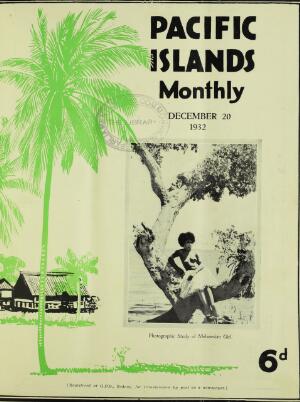
Pacific
ISLANDS
Monthly
DECEMBER 20
1932
6 d
[Registered at G.P.O., Sydney, for transmission by post as a newspaper.]
Photographic Study of Melanesian Girl.
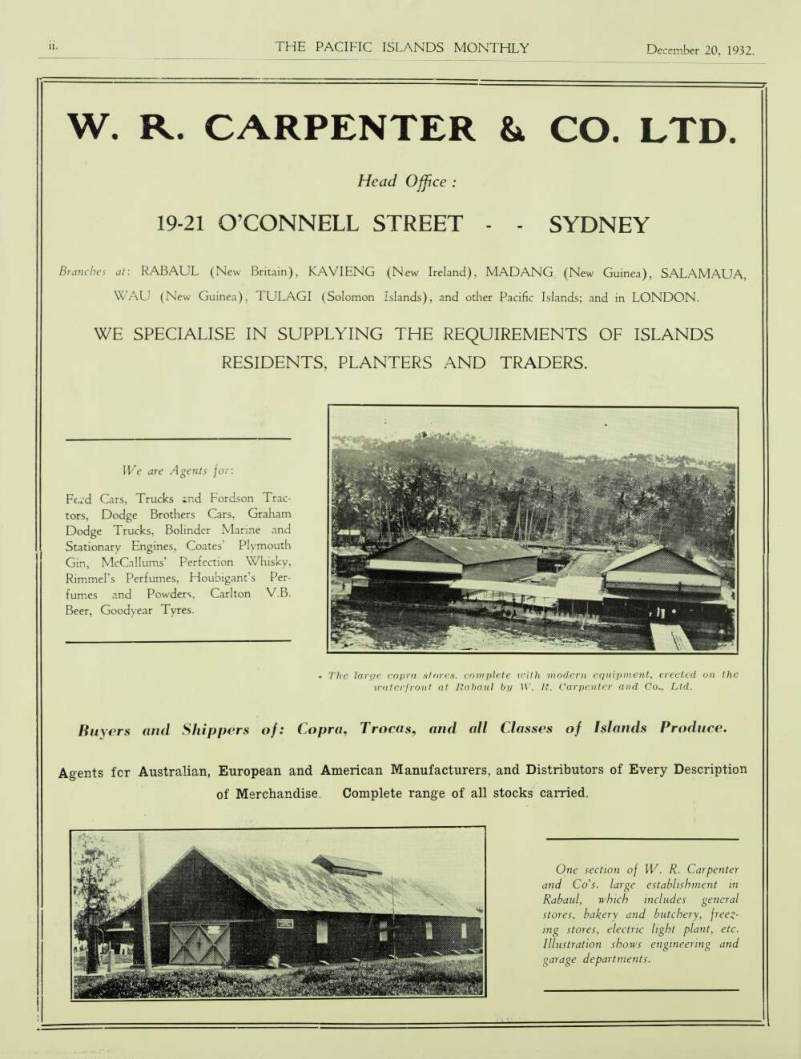
W. R. Carpenter & Co. Ltd
Head Office :
19-21 O’CONNELL STREET
SYDNEY
Branches at: RABAUL (New Britain), KAVIENG (New Ireland), MADANG (New Guinea), SALAMAUA, WAU (New Guinea), TULAGI (Solomon Islands), and other Pacific Islands; and in LONDON.
WE SPECIALISE IN SUPPLYING THE REQUIREMENTS OF ISLANDS
RESIDENTS, PLANTERS AND TRADERS.
We are Agents for : Ford Cars, Trucks and Fordson Trac tors, Dodge Brothers Cars, Graham Dodge Trucks, Bolinder Marine and Stationary Engines, Coates’ Plymouth Gin, McCallums’ Perfection Whisky, Rimmel’s Perfumes, Houhigant’s Per fumes and Powders, Carlton V.B.
Beer, Goodyear Tyres.
The large copra stores, complete with modern equipment, erected on the waterfront at Rabaul by W. R. Carpenter and Go., Ltd.
Buyers and Shippers of: Copra , Trocas, and all Classes of Islands Produce.
Agents for Australian, European and American Manufacturers, and Distributors of Every Description of Merchandise. Complete range of all stocks carried.
One section of W. R. Carpenter and Co’s, large establishment in Rabaul, which includes general stores, bakery and butchery, freez ing stores, electric light plant, etc.
Illustration shows engineering and garage departments.
Pacific Islands Travellers
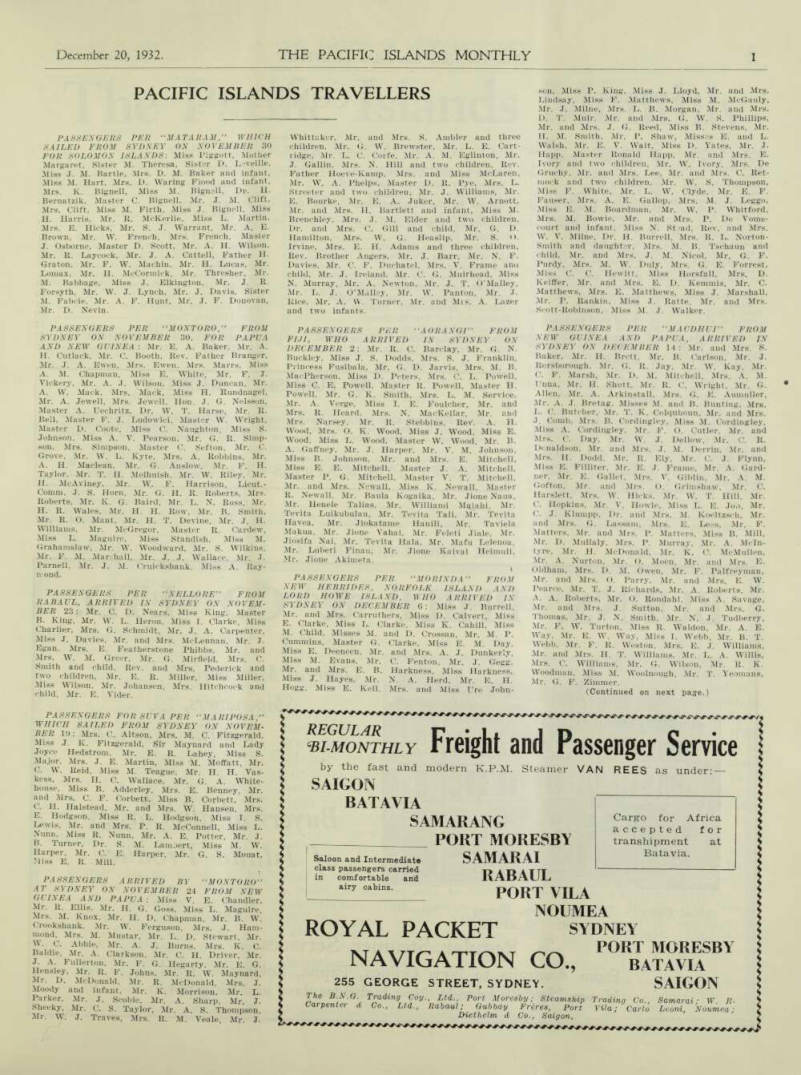
Passengers Per "Mataram," Which
Sailed From Sydney On November 30
FOR SOLOMON ISLANDS: Miss Piggott, Mother Margaret, Sister M. Theresa, Sister D. Leveille, Miss J. M. Bartle, Mrs. D. M. Baker and infant, Miss M. Hart, Mrs. D. Waring Flood and infant, Mrs. K. Bignell, Miss M. Bignell, Dr. H.
Bernatzik, Master C. Bignell, Mr. J. M. Clift, Mrs. Clift, Miss M. Firth, Miss J. Bignell, Miss H. Harris, Mr. R. McKerlie, Miss L. Martin, Mrs. E. Hicks, Mr. S. J. Warrant, Mr. A. E.
Brown, Mr. W. French, Mrs. French, Master J. Osborne, Master D. Scott, Mr. A. H. Wilson, Mr. R. Laycock, Mr. J. A. Cattell, Father H.
Graton, Mr. F. W. Machin, Mr. H. Lucas, Mr.
Lomax, Mr. H. McCormick, Mr. Thresher, Mr.
M. Babbage, Miss J. Elkington, Mr. J. R.
Forsyth, Mr. W. J. Lynch, Mr. J. Davis, Sister M. Fabcie, Mr. A. F. Hunt, Mr. J. F. Donovan, Mr. D. Nevin.
Passengers Per “Montoro,” From
Sydney On November 30, For Papua
AND NEW GUINEA : Mr. E. A. Baker, Mr. A.
H. Cutlack, Mr. C. Booth, Rev. Father Branger, Mr. J. A. Ewen, Mrs. Eweu, Mrs. Marrs, Miss A. M. Chapman, Miss E. White, Mr. F. J.
Vickery, Mr. A. J. Wilson, Miss J. Duncan, Mr.
A. W. Mack, Mrs. Mack, Miss H. Rundnagel, Mr. A. Jewell, Mrs. Jewell, Hon. J. G. Nelsson, Master A. Uechritz, Dr. W. T. Harse, Mr. R.
Bell, Master F. J. Ludowici, Master W. Wright, Master D. Coote, Miss C. Naughton, Miss S.
Johnson, Miss A. V. Pearson, Mr. G. R. Simp son, Mrs. Simpson, Master C. Sefton, Mr. C.
Grove, Mr. W. L. Kyte, Mrs. A. Robbins, Mr.
A. H. Maclean, Mr. G. Anslow, Mr. F. H.
Taylor, Mr. T. H. Melhuish, Mr. W. Riley, Mr.
H. McAviney, Mr. W. F. Harrison, Lieut.- Comm. J. S. Horn, Mr. G. H. R. Roberts, Mrs.
Roberts, Mr. K. G. Baird, Mr. L. N. Ross, Mr.
H. R. Wales, Mr. H. H. Row, Mr. B. Smith, Mr. R. O. Mant, Mr. H. T. Devine, Mr. J. H.
Williams, Mr. McGregor, Master R. Cardew, Miss L. Maguire, Miss Standish, Miss M.
Grahamslaw, Mr. W. Woodward, Mr. S. Wilkins, Mr. F. M. Marshall, Mr. J. J. Wallace, Mr. J.
Parnell, Mr. J. M. Cruickshank, Miss A. Ray mond.
Passengers Per “Nellore” From
Rabaul, Arrived In Sydney On Novem
BER 23: Mr. C. D. Nears, Miss King, Master B. King, Mr. W. L. Heron, Miss I. Clarke, Miss Charlier, Mrs. G. Schmidt, Mr. J. A. Carpenter, Miss J. Davies, Mr. and Mrs. McLennan, Mr. J.
Egan, Mrs. E. Featherstone Phibbs, Mr. and Mrs. W. M. Greer, Mr. G. Mirfield, Mrs. C.
Smith and child, Rev. and Mrs. Pederick and two children, Mr. E. R. Miller, Miss Miller, Miss Wilson, Mr. Johansen, Mrs. Hitchcock and child, Mr. E. Vider.
Passengers For Suva Per “Mariposa,”
Which Sailed From Sydney On Novem
BER 19: Mrs. C. Altson, Mrs. M. C. Fitzgerald, Miss J. K. Fitzgerald, Sir Maynard and Lady Joyce Hedstrom, Mr. B. R. Lahey, Miss S.
Major, Mrs. J. E. Martin, Miss M. Moffatt, Mr.
C. W. Reid, Miss M. Teague, Mr. H. H. Vas kess, Mrs. H. C. Wallace, Mr. G. A. White house, Miss B. Adderley, Mrs. E. Benney, Mr. and Mrs. C. F. Corbett, Miss B. Corbett, Mrs.
C. H. Halstead, Mr. and Mrs. W. Hansen, Mrs.
E. Hodgson, Miss R. L. Hodgson, Miss I. S.
Lewis, Mr. and Mrs. P. R. McConnell, Miss L.
Nunn, Miss R. Nunn, Mr. A. E. Potter, Mr. J.
B. Turner, Dr. S. M. Lambert, Miss M. W.
Harper, Mr. C. E. Harper, Mr. G. S. Mouat, Miss E. R. Mill.
Passengers Arrived By “Montoro”
AT SYDNEY ON NOVEMBER 24 FROM NEW GUINEA AND PAPUA ; Miss V. E. Chandler, Mr. R. Ellis, Mr. H. G. Goss, Miss L. Maguire Mrs. M. Knox, Mr. H. D. Chapman, Mr. B. W.
Crookshank, Mr. W. Ferguson, Mrs. J. Ham mond, Mrs. M. Mustar, Mr. L. D. Stewart, Mr.
W. C. Abbie, Mr. A. J. Burns, Mrs. K. C.
Baldie, Mr. A. Clarkson, Mr. C. H. Driver, Mr.
J. A. Fullerton, Mr. F. G. Hegarty, Mr. E. G.
Hensley, Mr. R. F. Johns, Mr. R. W. Maynard, Mr. D. McDonald, Mr. R. McDonald, Mrs. J.
Moody and infant, Mr. K. Morrison, Mr. L.
Parker, Mr. J. Scobie, Mr. A. Sharp, Mr. J.
Sheeky, Mr. C. S. Taylor, Mr. A. S. Thompson, Mr. W. J. Traves, Mrs. R. M. Veale, Mr. J.
Whittaker, Mr. and Mrs. S. Ambler and three children, Mr. G. W. Brewster, Mr. L. E. Cart ridge, Mr. L. C. Corfe, Mr. A. M. Eglinton, Mr.
J. Gallin, Mrs. N. Hill and two children, Rev.
Father Hoeve-Kamp, Mrs. and Miss McLaren, Mr. W. A. Phelps, Master D. R. Pye, Mrs. L.
Streeter and two children, Mr. J. Williams, Mr.
E. Bourke, Mr. E. A. Juker, Mr. W. Arnott, Mr. and Mrs. H. Bartlett and infant, Miss M.
Brenchley, Mrs. J. M. Elder and two children, Dr. and Mrs. C. Gill and child, Mr. G. D.
Hamilton, Mrs. W. G. Heaslip. Mr. S. O.
Irvine, Mrs. E. H. Adams and three children, Rev. Brother Angers, Mr. J. Barr, Mr. N. F.
Davies, Mr. C. F. Duchatel, Mrs. V. Frame and child, Mr. J. Ireland, Mr. C. G. Muirhead, Miss N. Murray, Mr. A. Newton, Mr. J. T. O’Malley, Mr. L. J. O’Malley, Mr. W. Panton, Mr. J.
Rice, Mr. A. W. Turner, Mr. and Mrs. A. Lazer and two infants.
Passengers Per "Aorangi” From
Fiji, Who Arrived In Sydney On
DECEMBER 2: Mr. R. C. Barclay, Mr. G. N.
Buckley, Miss J. S. Dodds, Mrs. S. J. Franklin, Princess Fusibala, Mr. G. D. Jarvis, Mrs. M. B.
MacPherson, Miss D. Peters, Mrs. C. L. Powell, Miss C. E. Powell, Master R. Powell, Master H.
Powell, Mr. G. K. Smith, Mrs. L. M. Service, Mr. A. Verge, Miss I. E. Foulcher, Mr. and Mrs. R. Heard, Mrs. N. MacKellar, Mr. and Mrs. Narsey, Mr. R. Stebbins, Rev. A. H.
Wood, Mrs. O. K. Wood, Miss J. Wood, Miss E.
Wood, Miss L. Wood, Master W. Wood, Mr. B.
A. Gaffney, Mr. J. Harper, Mr. V. M. Johnson, Miss B. Johnson, Mr. and Mrs. E. Mitchell, Miss E. E. Mitchell, Master J. A. Mitchell, Master P. G. Mitchell, Master V. T. Mitchell, Mr. and Mrs. Newall, Miss K. Newall, Master R. Newall, Mr. Baula Kogaika, Mr. Jione Nana, Mr. Henele Talias, Mr. Williami Maiahi, Mr.
Tevita Luikubulau, Mr. Tevita Tali, Mr. Tevita Havea, Mr. Jiokatame Hanili, Mr. Taviela Makua, Mr. Jione Vahai, Mr. Feleti Jiale, Mr.
Jiosifa Nai, Mr. Tevita Hala, Mr. Mafu Lelenoa, Mr. Lubeti Finau, Mr. Jione Kaivai Heimuli, Mr. Jione Akimeta.
Passengers Per “Morinda” From
New Hebrides, Norfolk Island And
Lord Howe Island, Who Arrived In
SYDNEY ON DECEMBER 6; Miss J. Burrell, Mr. and Mrs. Carruthers, Miss D. Calvert, Miss E. Clarke, Miss L. Clarke, Miss K. Cahill, Miss M. Child, Misses M. and D. Crossan, Mr. M. P.
Cummins, Master G. Clarke, Miss E. M. Day, Miss E. Deeneen, Mr. and Mrs. A. J. Dunkerly, Miss M. Evans, Mr. C. Fenton, Mr. J. Gegg, Mr. and Mrs. E. B. Harkness, Miss Harkness, Miss J. Hayes, Mr. N. A. Herd, Mr. E. H.
Hogg, Miss E. Kell, Mrs. and Miss Ure John
son, Miss P. King, Miss J. Lloyd, Mr. and Mrs.
Lindsay, Miss F. Matthews, Miss M. McGauly, Mr. J. Milne, Mrs. L. B. Morgan, Mr. and Mrs.
D. T. Muir, Mr. and Mrs. G. W. S. Phillips, Mr. and Mrs. J. G. Reed, Miss B. Stevens, Mr.
H. M. Smith, Mr. P. Shaw, Misses E. and L.
Walsh, Mr. E. V. Wait, Miss D. Yates, Mr. J.
Happ, Master Ronald Happ, Mr. and Mrs. E.
Ivory and two children, Mr. W. Ivory, Mrs. De Gruchy, Mr. and Mrs. Lee, Mr. and Mrs. C. Ret mock and two children, Mr. W. S. Thompson, Miss F. White, Mr. L. W. Clyde, Mr. E. F.
Fauser, Mrs. A. E. Gallop, Mrs. M, J. Leggo, Miss E. M. Boardman, Mr. W. P. Whitford, Mrs. M. Bowie, Mr. and Mrs. P. De Vome court and infant, Miss N. Stead, Rev. and Mrs.
W. V. Milne, Dr. H. Burrell, Mrs. R. L. Norton- Smith and daughter, Mrs. M. B. Tschaun and child, Mr. and Mrs. J. M. Nicol, Mr. G. F.
Purdy, Mrs. M. W. Duly, Mrs. G. E. Forrest, Miss C. C. Hewitt, Miss Horsfall, Mrs. D.
Keiffer, Mr. and Mrs. E. D. Kemmis, Mr. C.
Matthews, Mrs. E. Matthews, Miss J. Marshall, Mr. P. Rankin, Miss J. Batte, Mr. and Mrs.
Scott-Robinson, Miss M. J. Walker.
Passengers Per “ Macdhui” From
New Guinea And Papua, Arrived In
SYDNEY ON DECEMBER 14 : Mr. and Mrs. S.
Baker, Mr. H. Brett, Mr. B. Carlson, Mr. J.
Rorsborough, Mr. G. R. Jay, Mr. W. Kay, Mr.
C. F. Marsh, Mr. D. M. Mitchell, Mrs. A. M.
Unna, Mr. H. Shutt, Mr. R. C. Wright, Mr. G.
Allen, Mr. A. Arkinstall, Mrs. G. E. Aumuller, Mr. A. J. Bretag, Misses M. and B. Bunting, Mrs.
L. C. Butcher, Mr. T. K. Colquhoun, Mr. and Mrs.
J. Comb,Mrs. B. Cordingley, Miss M. Cordingley, Miss A. Cordingley, Mr. F. O. Cutler, Mr. and Mrs. C. Day, Mr. W. J. Dellow, Mr. C. R.
Donaldson, Mr. and Mrs. J. M. Derrin, Mr. and Mrs. H. Dodd, Mr. R. Ely, Mr. C. J. Flynn, Miss E. Filliter, Mr. E. J. Frame, Mr. A. Gard ner, Mr. E. Gallet, Mrs. V. Giblin, Mr. A. M.
Gofton, Mr. and Mrs. O. Grimshaw, Mr. C.
Harslett, Mrs. W. Hicks, Mr. W. T. Hill, Mr.
C. Hopkins, Mr. V. Howie, Miss L. E. Jon, Mr.
C. J. Klumpp, Dr. and Mrs. M. Koeltzsch, Mr. and Mrs. G. Lassam, Mrs. E. Lees, Mr. F.
Matters, Mr. and Mrs. P. Matters, Miss B. Mill, Mr. D. Mullaly, Mrs. P. Murray, Mr. A. McIn tyre, Mr. H. McDonald, Mr. K. C. McMullen, Mr. A. Norton, Mr. O. Moen, Mr. and Mrs. E.
Oldham, Mrs. D. M. Owen, Mr. F. Palfreyman, Mr. and Mrs. O. Parry, Mr. and Mrs. E. W.
Pearce, Mr. T. J. Richards, Mr. A. Roberts, Mr.
A. A. Roberts, Mr. O. Rondahl, Miss A. Savage, Mr. and Mrs. J. Sutton, Mr. and Mrs. G.
Thomas, Mr. J. N. Smith, Mr. N. J. Tudberry, Mr. F. W. Turton, Miss R. Waldon, Mr. A. E.
Way, Mr. E. W. Way, Miss I. Webb, Mr. B. T.
Webb, Mr. F. R. Weston, Mrs. E. J. Williams, Mr. and Mrs. H. T. Williams, Mr. L. A. Willis, Mrs. C. Williams, Mr. G. Wilson, Mr. R. K.
Woodman, Miss M. Woolnough, Mr. T. Yeomans, Mr. G. F. Zimmer.
(Continued on next page.)
Passengers Who Arrived On Decem
BER 17 PER “VAN REES” FROM BAMARAI, RABAUL, VILA AND NOUMEA : Messrs. Parker, Briggs, Blackley, Granter, Abbot, Rollinson, Wormall, Drayson, Heinicke, Coe, Fletcher, Coupils, Rigoulet, Johnston, Destoop, Flourac, J.
Weir, D. Weir, Rouel, Mounier, Mesdames Parker, Rigoulet, Cacot, Rollinson, Drayson, Larney, Westoop and four children, Rolland and two children, Atkinson, Rigoulet, Flour, Misses Larney, Larney, Parker, Flourac, Carter, Rolland, Fosset, Landais, Grant, Master Parker.
Passengers Per “Nellore,” Which
Sailed From Sydney For Rabaul On
DECEMBER 14: Mr. H. B. Coldham, Mrs. G. L.
Lacey, Mr. and Mrs. Champion-Hoskings and infant, Mr. N. A. O’Dwyer, Miss J. C. Croggatt, Miss M. H. Wade, Mrs. V. Cardew, Mrs. N.
Garrett, Mr. W. W. Clark, Mr. A. Lyall, Rev.
Father Joseph Schuttler, Rev. Father Henry Kohlstetter, Rev. S. Schwergen, Sister S. M.
Edeluima, Sister O. K. Hermergildis, Sister J. D. Imina, Rev. Adolph Nattehrede, Rev. F.
Bahmann, Rev. J. Schultinghamper, Rev. Franz Severin, Rev. Joseph Lanlinge, Rev. Eduard Christladler.
Passengers Per “Morinda” For Lord
Howe Island, Norfolk Island And
Few Hebrides Sailed From Sydney On
DECEMBER 19: Mr. W. T. Hyder, Mrs. Hyder, Miss J. Storey, Miss G. Dixon, Miss J. Morison, Miss D. Dethfels, Miss M. Mackey, Miss Patrick, Miss J. White, Miss E. Haworth, Miss T. Lyons, Miss Herlihy, Miss Knox, Mr. F. Glover, Mr. H.
C. Moon, Miss Olsson, Mrs. Olsson, Mr. A. S. Ger ber, Mr. B. Tollis, Mrs. V. Innes, Mrs. Thompson, Miss M. Carnell, Miss Herlihy, Miss Hale, Mrs.
Baldwin, Mrs. E. Taylor, Miss Crossman, Mrs. E.
Kane, Miss E. P. Evans, Mr. A. Lanes, Mrs. Lanes, Mr. A. E. Lanes, Mr. A. H Lanes, Miss R.
Morgan, Miss C. Farrell, Miss E. Prescott, Miss M. Carroll, Mr. J. A. Mackillop, Mr. H. J.
Rumsey, Mr. J. Creer, Mr. J. E. Creer, Mrs.
A. Creer, Mrs. J. N. Creer, Miss W. Durie, Mrs.
J. E. Creer, Mr. H. Stubbs, Mrs Stubbs, Mr.
W. A. Holman, Miss E. McDonald, Miss M.
Simonsens, Miss M. Jones, Miss Baxter, Miss E. Speich, Mrs. A. Speich, Mrs. T. P. Monaghan, Mrs. J. Lyons, Mrs. Fulton, Mrs. Brown, Miss E J. Helmers, Mrs. Shean, Mr. W. S. Thomp son, Mr. Sandes, Dr. Colquhoun, Mr. R. Fulton, Miss C. B. Procter, Miss M. Herald, Miss J.
Clarke, Miss M. B. Henson, Mr. F. Hutchens, Mr. E. L. Troughton, Mr. A. A. Livingstone, Mrs Livingstone, Mr. J. Lyons, Mr. Brown, Mr.
Shean, Mr. J. Murphy, Mr. J. Kitching, Mr. E.
Small, Mr. T. P. Monaghan, Mr. Murphy, Mr.
A. A. Griffiths, Mr. M. Goldstein, Mr. S. Crakan thorp, Mr. A. F. Edwards, Mr. S. Christian, Miss E. Ferguson, Mrs. R. Rhodes, Miss J. Ross, Lieut. C. J. Stephenson, Lieut. J. Mesley, Mr.
J. Wilson, Mr. G. G. Clarke, Mr. G. Nichols, Mr. J. P. Jones.
Advertisements & other items, p. 3 (1 item)
NAVIGATION CO., batavia
Saloon and Intermediate class passengers carried in comfortable and airy cabins.
Regular Bi-Monthly Freight and Passenger Service by the fast and modern K.P.M. Steamer VAN REES as under
SAIGON
BATAVIA
SAMARANG
PORT MORESBY
SAMARAI
RABAUL
PORT VILA
ROYAL PACKET
NOUMEA
SYDNEY
PORT MORESBY
NAVIGATION CO., batavia
255 GEORGE STREET, SYDNEY. SAIGON
Trading , Port Moresby; Steamship Trading Co., W. R.
Carpenter & Co., Ltd., Rabwul; Gubbay Freres, Port Vila; Carlo Leom, Noumea; Diethelm & Co., Saigon.
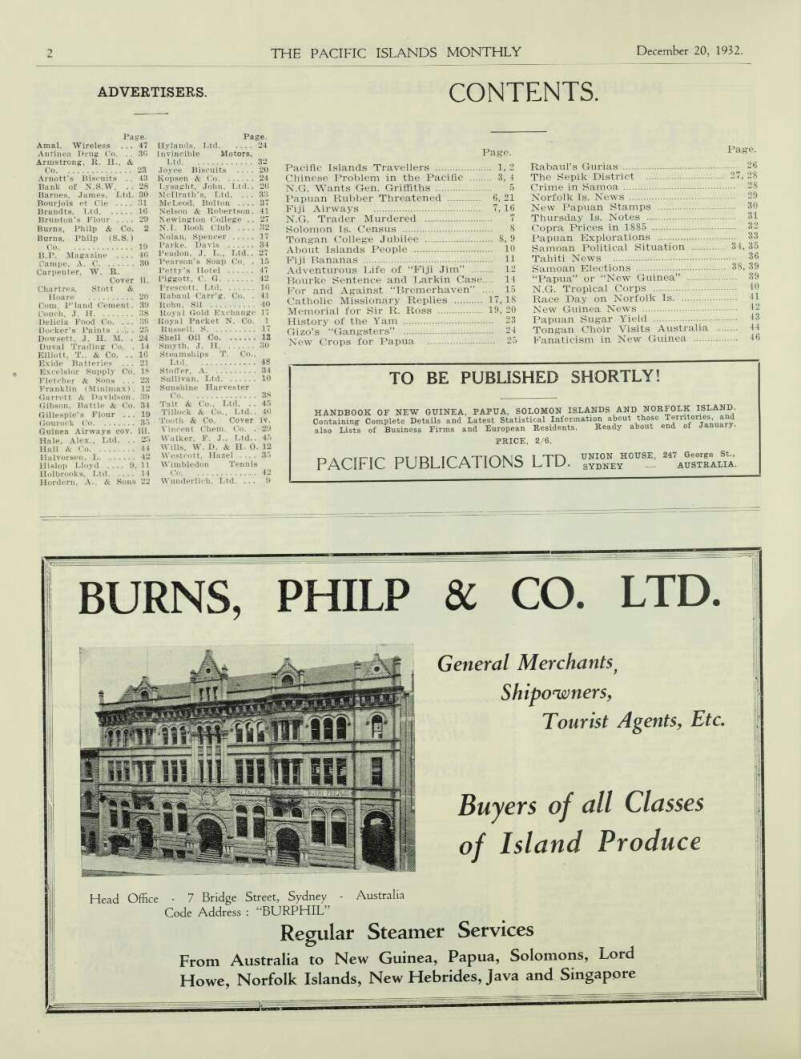
Advertisers.
Page.
Amal. Wireless ... 47 Antinea Drug Co. . . 36 Armstrong, R. H.. & Co 23 Arnott’s Biscuits .. 43 Bank of N.S.W. . . 28 Barnes, James, Ltd. 30 Bourjois et Cie ... 31 Brandts, Ltd 16 Brunton’s Flour ... 29 Burns, Philp & Co. 2 Burns, Philp (S.S.) Co 19 B.P. Magazine ... 46 Campe, A. C 30 Carpenter, W. R.
Cover ii.
Chartres, Stott & Hoare 20 Com. P’land Cement. 39 Couch, J. H 38 Delicia Food Co. ... 39 Docker’s Paints . . 25 Dowsett, J. H. M. . 24 Duval Trading Co. . 14 Elliott, T., & Co. .. 16 Exide Batteries ... 21 Excelsior Supply Co. IS Fletcher & Sons ... 23 Franklin (Minimax). 12 Garrett & Davidson. 39 Gibson, Battle & Co. 34 Gillespie’s Flour ... 19 Gourock Co 35 Guinea Airways cov. iii.
Hale, Alex., Ltd. .. 25 Hall & Co 44 Halvorsen, L 42 Hislop Lloyd ... 9, 11 Holbrooks, Ltd 14 Hordern, A., & Sons 22
Page.
Hylands. Ltd 24 Invincible Motors, Ltd 82 Joyce Biscuits ... 20 Kopsen & Co 24 Lysaght, John, Ltd.. 26 Mcllrath’s, Ltd. ... 33 McLeod, Bolton 37 Nelson & Robertson. 41 Newington College .. 27 N.I. Book Club 32 Nolan, Spencer 17 Parke, Davis 34 Peadon, J. L., Ltd.. 27 Pearson’s Soap Co. . 15 Petty’s Hotel 47 Piggott, C. G 42 Prescott, Ltd 16 Rabaul Carr’g. Co. . 41 Rohu, Sil 40 Royal Gold Exchange 17 Royal Packet N. Co. 1 Russell. S 17 Shell Oil Co 13 Smyth, J. II 30 Steamships T. Co., Ltd 48 Stoffer, A 34 Sullivan, Ltd 10 Sunshine Harvester Co 38 Tait & Co., Ltd. .. 45 Tillock & Co., Ltd.. 40 Tooth & Co. Cover iv.
Vincent Chem. Co. . 29 Walker, F. J., Ltd.. 45 Wills, W. D. & H. O. 12 Westcott, Hazel 35 Wimbledon Tennis Co 42 Wunderlich, Ltd. ... 9
Contents.
Page.
Pacific Islands Travellers 1, 2 Chinese Problem in the Pacific 3, 4 N.G. Wants Gen. Griffiths 5 Papuan Rubber Threatened 6, 21 Fiji Airways 7, 16 N.G. Trader Murdered 7 Solomon Is. Census 8 Tongan College Jubilee 8, 9 About Islands People 10 Fiji Bananas 11 Adventurous Life of “Fiji Jim” 12 Bourke Sentence and Larkin Case... 14 For and Against “Bremerhaven” ... 15 Catholic Missionary Replies 17,18 Memorial for Sir R. Ross 19, 20 History of the Yam 23 Gizo’s “Gangsters” 24 New Crops for Papua 25
Page.
Rabaul’s Gurias 26 The Sepik District 27, 28 Crime in Samoa 28 Norfolk Is. News 29 New Papuan Stamps 30 Thursday Is. Notes 31 Copra Prices in 1885 32 Papuan Explorations 33 Samoan Political Situation 34, 35 Tahiti News 36 Samoan Elections 38, 39 “Papua” or “New Guinea” 39 N.G. Tropical Corps 40 Race Day on Norfolk Is 41 New Guinea News 42 Papuan Sugar Yield 43 Tongan Choir Visits Australia 44 Fanaticism in New Guinea 46
Advertisements & other items, p. 4 (1 item)
Burns, Philp Dc Co. Ltd.
TO BE PUBLISHED SHORTLY!
HANDBOOK OF NEW GUINEA, PAPUA, SOLOMON ISLANDS AND NORFOLK ISLAND.
Containing Complete Details and Latest Statistical Information abont those Territories and also Lists of Business Firms and European Residents. Ready about end of Janua y.
PRICE, 2/6.
PACIFIC PUBLICATIONS LTD.
UNION HOUSE, 247 George St.,
SYDNEY AUSTRALIA.
BURNS, PHILP dc CO. LTD.
General Merchants,
Shipowners,
Tourist Agents, Etc.
Buyers of all Classes
of Island Produce
Head Office - 7 Bridge Street, Sydney - Australia Code Address : “BURPHIL”
Regular Steamer Services From Australia to New Guinea, Papua, Solomons, Lord Howe, Norfolk Islands, New Hebrides, Java and Singapore
The Pacific Islands Monthly
THE NEWSPAPER - MAGAZINE OF THE SOUTH SEAS [Registered at G.P.O., Sydney. for transmission by post as a newspaper .]
Published Once Each Month and Circulated in Australia and New Zealand and in the following Pacific Territories and Island Groups:
Crown Colony of Fiji.
Australian Territory of Papua.
Mandated Territory (Australia) of New Guinea, Bismarck Archipelago, and Northern Solomon Islands.
Mandated Territory (Japan) of Marshall, Caroline and Mariana Islands.
American Territory of Guam.
Mandated Territory of Nauru.
British Crown Colony of Gilbert and Ellice Islands.
French Territory of New Caledonia.
British and French Condominium of New Hebrides.
American Territory of Eastern Samoa.
Mandated Territory (New Zealand) of Samoa.
British Solomon Islands Protectorate.
British Protectorate of Tongan Islands.
New Zealand Territory of Cook Islands.
Australian Territory of Norfolk Island.
French Colony of Oceania (Tahiti, etc.) American Territory of Hawaiian Islands.
Owned and Produced by Ltd., Union House, 247 George Street, Sydney
Telephone Bw 5037
P.O. Box 3408 R
Contributions
Articles, Stories and Photographs dealing with Pacific Islands Subjects are invited, and will be paid for on publication at usual rates.
Subscription Rates
Per Annum. within Postal Convention Territories, Prepaid, Post Free 6/- Per Annum elsewhere, Prepaid, Post Free 8/- Single Copies 6d.
Editor and Publisher:
R. W. Robson.
Advertisements
Advertising rates furnished on application.
Colours, etc. by Arrangement Process Blocks made at Advertiser’s expense when required. Screen, 100.
Changes of Advertising Copy should reach this Office by 8th of each month, otherwise previous advertisement may be repeated.
Registered Address for Radiograms and Cables: “PACPUB” Sydney
Agents
The following are authorised to receive sub scriptions for The Pacific Islands Monthly — Islands Branches of Burns, Philp & Co., Ltd., and Burns, Philp (South Seas) Co., Ltd.
Islands Branches of W. R. Carpenter & Co., Ltd.
All Branches of Morris, Iledstrom & Co., Ltd.
J. H. MacGregor Dowsett, Rabaul.
Whitten Bros., Ltd., Port Moresby & Samarai.
All Branches and Representatives of W. H.
Grove & Sons, Ltd., Auckland. 9. Russell, Papeete, Tahiti.
Cook Islands Trading Co., Rarotonga.
Mrs. M. Campbell, Cascades, Norfolk Island.
Vol. 111, No. 5.
Sydney, December 20, 1932.
Price 6d. Per Copy - Prepaid: 6/- p.a.
Chinese Problem in the South Seas
ONE of the most difficult problems in the Pacific, and one which the European races must soon at tack, is that of the Chinese. Partly by slow immigration, partly by natural increase, they are steadily penetrating all the Islands Groups and Territories, and are taking con trol of small trading and distribu tion. Already, in New Guinea, the Solomons, Fiji, Samoa and French Oceania, they are a thorn in the side of the European merchant and a source of anxiety to the respective administrations.
The problem is not peculiar to the Islands—it is racial. The Chinese is not a pioneer. He has no capacity for colonisation—he tames no wilderness, imposes no adminis trative order, has no ability for community organisation. But, once a new country has been opened up and rendered safe, he enters readily and eagerly, and displays genius as a barterer, and much industry and
technical skill as an artisan. Many Chinese merchants become rich and influential.
His standard of living definitely is below that of the European: con sequently, when European and Chi nese compete in trade, the Euro pean inevitably is starved out. That naturally creates bad feeling. The Europeans quite properly resent the fact that the Chinese deprive them of the fruits of their work and sac rifices in opening up new countries and developing them.
The trouble, in some of the Pa cific Territories, threatens to be come acute. New Guinea is a case in point. When Australia took over New Guinea from Germany, in 1914, there were between 1200 and 1500 Chinese men and women there, who had been brought in mostly as plantation labourers. The bulk of them were marked by the Germans for repatriation, and they should have been sent home. But, under
the exigencies of war, they were al lowed to remain; and when Aus tralia was given the Mandate in 1921, they already were “dug in.”
Australia imposed two important laws—no more Chinese immigra tion, and no Chinese to hold trad ing licenses—and left it at that.
To-day, in the Territory, there must be 2000 Chinese, and their numbers are steadily increasing.
They are the artisans, small shop keepers and small traders of New Guinea. The large Chinese com munity in Rabaul provides engi neers, carpenters, car drivers, schooner captains, tailors, bakers, contractors, restaurant-keepers, etc.
In the artisan division, they are of no special benefit to New Guinea: their wages are little, if anything, below the wages of a European— which simply means that, if there were no Chinese there, there would be jobs in New Guinea for some hundreds of skilled Australian
workmen. In the trading division, they are clearly a menace. Legally, they may not hold licenses to trade with natives. But, to an increasing degree, there has grown up a sys tem under which debased Euro peans, financed by Chinese, obtain trading licenses and then allow the Chinese to run the whole business.
The European’s name is over the door, and probably he draws a pit tance from the Chinese boss: but, actually, it is a Chinese business.
This system is established in New Guinea and, although clearly an evasion of the law, is permitted by the Administration; which is a cause of bitter grievance to Euro pean traders.
Over in the Solomons, the trouble is even more acute. The British law seems to permit the im migration of Chinese, and there is no restriction on their trading with the natives. Consequently, they are a source of extreme annoyance to the European traders. The Euro peans, little by little, have tamed these dangerous Solomon natives, and established trading stores among them. But no sooner is an island regarded as safe, and the na tives persuaded to engage in barter, than the Chinese trading schooners begin to hover around; and, be cause the low living standards of the Chinese permit them to cut European prices to pieces, the European very soon finds himself deprived of the rewards of his dif ficult and dangerous pioneering work. One of these days, if some thing is not done to check the trouble, the B.S.I. Administration may find itself with a few murdered Chinese traders on its hands.
The Administrators are not blind to these problems. But because they are British, their hands are tied in a peculiar manner. The Chi nese are breaking no law, and com mitting no offence. Generally speaking, they are decent, kindly, law-abiding citizens, strictly hon ourable in their business dealings, thrifty in their ways, and charit able. There have been —and there are still—Chinese merchants in New Guinea who have spent their money wisely for the good of the Territory, and who generously have helped indigent Europeans to the extent of tens of thousands of pounds, which they never will see
again. Generally speaking, the Chinese merchants in British coun tries are held in high regard—and, in any event, British administrators do not punish Chinese because they are Chinese.
Yet the problem is there—an acute racial problem. Because these people are Chinese, they can under sell the European in trade, and their natural increase is more rapid —two factors of great importance in rich, undeveloped countries, where the indigenous population is disappearing under the impact of Western civilisation.
In Polynesia, the position is even more alarming. The Polynesian people are steadily disappearing and the Chinese, wherever permit ted —as in Tahiti—are definitely taking their place. The Chinese do not mix readily with the Mel anesians ; but there are thousands of Chinese-Polynesian half-castes in the more easterly groups, and it is claimed that they are an attractive, clever, adaptable people. The Chi nese-Hawaiian half-castes, for in stance, are regarded as a race em inently suited for the depopulated islands of the south-eastern Pacific.
The Chinese have a firm footing in Fiji, although they do not mix to
any extent with the Fijians; but in Samoa they were inter-marrying so freely with the Samoans, and dis playing such readiness to settle down in Samoa, that the New Zea land authorities recently became alarmed and imposed against the Chinese a stern system of repatria tion.
It is a double-barrelled problem.
First of all, there is the general question of admitting the Chinese freely to the Pacific Islands. It is a vital question because, if the immi gration barrier is thrown down, it is as certain as the sunrise that they will over-run these beautiful and fertile countries. If the Islands are wanted for the indigenous races, or some other race, then the barriers should be raised higher and made effective. As they are now, they are not effective ; they are merely checking and, to some ex tent, filtering the flow. Next, there is the local problem. What is to be done with the Chinese already domiciled in New Guinea and the Solomons? It becomes more urgent, every year, that the British Admin istrators, at least, adopt a common policy relating to Chinese immigra tion and settlement in the numer ous Territories they control.
A Recent Chinese Wedding In Rabaul.
—Photo by courtesy “Missionary Review.
Two Aeroplanes For
W. R. Carpenter.
For Salamaua Goldfields’ Service.
THERE was surprise expressed in Syd ney when Mr. R. O. Mant, formerly assistant instructor at the Aero Club, left by the “Montoro” on November 30 for Salamaua, to take charge of a new aeroplane service for Messrs. W. R.
Carpenter and Co., Ltd.
Until then, it was not generally known that Messrs. Carpenter were to engage in the business of aerial trans port.
It appears that the “big firm’s” de cision was taken some months ago. The air transport concerns operating between Salamaua and the N.G. Goldfields, war ring among themselves, reduced freight rates to 4d. per lb. Then it was an nounced that they had found the rate unprofitable, and they returned to 5d. per lb.
This affected Messrs. Carpenter, whose Goldfields business has been growing steadily, and they decided to instal their own transport service. Two De Havil land Fox Moths were immediately ordered. These machines are now on their way. They will be in Sydney on December 20, and in Salamaua on Janu ary 10. They should be flying by the middle of January.
The Carpenter hangar, etc., will be at the Salamaua aerodrome. All the ma terial for the building, cut to length, was sent away in November, and already is being erected.
It is announced by Messrs. Carpenter that their new aeroplanes will be en gaged only in transport work for the firm between Salamaua and the Gold fields —they will not seek freights from anyone, nor enter the general transport business, nor compete with any of the firms already engaged in the New Guinea aerial transport business.
Holmes.
Chinese Sherlock
How He Got His Man.
From Our Own Correspondent.
THE Chinese community of Vila can count a Sherlock Holmes among their number.
When they were assembled at their club taking high tea, followed by a little wine, to welcome three arriving com patriots and speed three parting ones Hongkong bound, some of their number slipped out quietly and broke into the premises of Lup San. A safe containing £40, mostly in silver, was stolen.
Then Sherlock Holmes got to work. A polite invitation to all Chinese to as semble at the club on Sunday afternoon was issued, and accepted.
When all the Chinese people were mustered, the doors were locked and the men were asked to remove their shirts.
An inspection of shoulders followed and there was thus brought to light a straight, red mark, such as could be made by carrying a heavy, angular ob ject, on the right shoulder of one of the most muscular of the men.
In the middle of his floundering efforts to explain how the mark got there, the culprit was hauled off to the calaboose
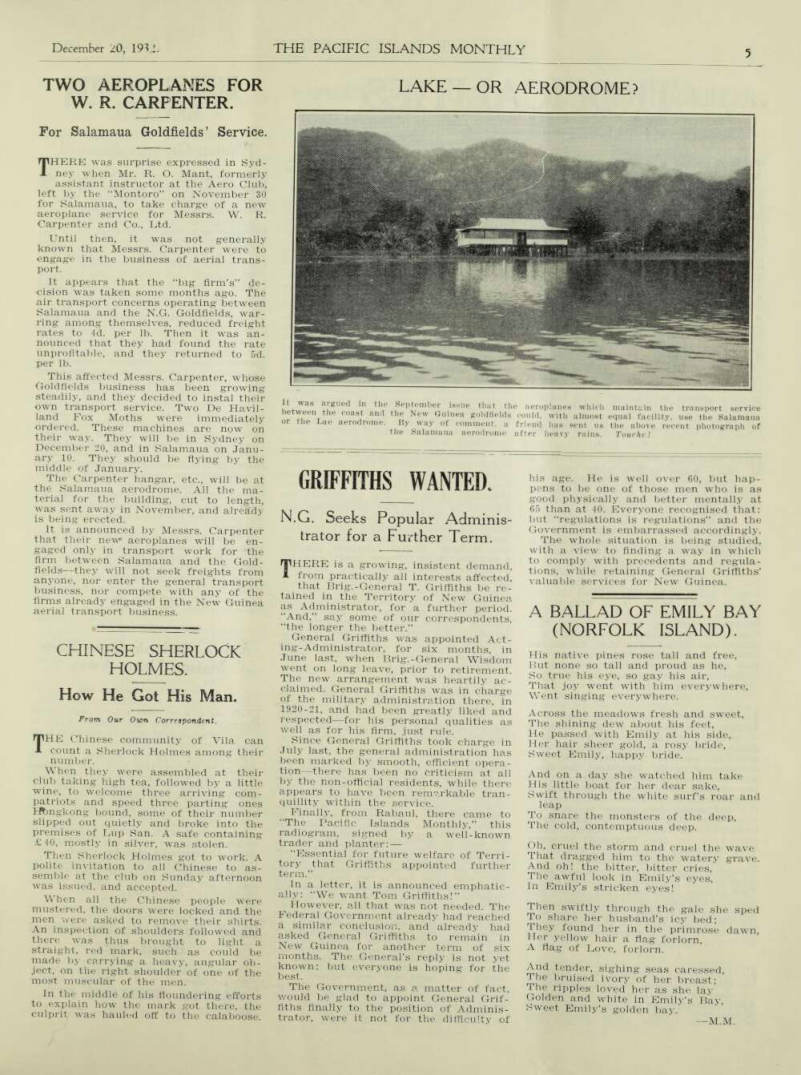
Lake—Or Aerodrome?
It was argued in the September issue that the aeroplanes which maintain the transport service between the coast and the New Guinea goldfields could, with almost equal facility, use the Salamaua or the Lae aerodrome. By way of comment, a friend has sent us the above recent photograph of the Salamaua aerodrome after heavy rains. Touche!
Griffiths Wanted.
N.G. Seeks Popular Adminis trator for a Further Term.
THERE is a growing, insistent demand, from practically all interests affected, that Brig.-General T. Griffiths be re tained in the Territory of New Guinea as Administrator, for a further period.
“And,” say some of our correspondents, “the longer the better.”
General Griffiths was appointed Act ing-Administrator, for six months, in June last, when Brig.-General Wisdom went on long leave, prior to retirement.
The new arrangement was heartily ac claimed. General Griffiths was in charge of the military administration there, in 1920-21, and had been greatly liked and respected—for his personal qualities as well as for his firm, just rule.
Since General Griffiths took charge in July last, the general administration has been marked by smooth, efficient opera tion —there has been no Criticism at all by the non-official residents, while there appears to have been remarkable tran quillity within the service.
Finally, from Rabaul, there came to “The Pacific Islands Monthly,” this radiogram, signed by a well-known trader and planter: “Essential for future welfare of Terri tory that Griffiths appointed further term.”
In a letter, it is announced emphatic ally: “We want Tom Griffiths!”
However, all that was not needed. The Federal Government already had reached a similar conclusion, and already had asked General Griffiths to remain in New Guinea for another term of six months. The General’s reply is not yet known: but everyone is hoping for the best.
The Government, as a matter of fact, would be glad to appoint General Grif fiths finally to the position of Adminis trator, were it not for the difficulty of
his age. He is well over 60, but hap pens to be one of those men who is as good physically and better mentally at 65 than at 40. Everyone recognised that: but “regulations is regulations” and the Government is embarrassed accordingly.
The whole situation is being studied, with a view to finding a way in which to comply with precedents and regula tions, while retaining General Griffiths’ valuable services for New Guinea.
(Norfolk Island).
A Ballad Of Emily Bay
His native pines rose tall and free, But none so tall and proud as he, So true his eye, so gay his air, That joy went with him everywhere, Went singing everywhere.
Across the meadows fresh and sweet, The shining dew about his feet, He passed with Emily at his side, Her hair sheer gold, a rosy bride, Sweet Emily, happy bride.
And on a day she watched him take His little boat for her dear sake, Swift through the white surf’s roar and leap To snare the monsters of the deep, The cold, contemptuous deep.
Oh, cruel the storm and cruel the wave That dragged him to the watery grave.
And oh! the bitter, bitter cries, The awful look in Emily’s eyes.
In Emily’s stricken eyes!
Then swiftly through the gale she sped To share her husband’s icy bed; They found her in the primrose dawn, Her yellow hair a flag forlorn, A flag of Love, forlorn.
And tender, sighing seas caressed, The bruised ivory of her breast; The ripples loved her as she lay Golden and white in Emily’s Bay, Sweet Emily’s golden bay.
M.M.
Tropicalities
THOSE people who argue that British Administrative establishments are over-staffed with clerks who do much unnecessary work, should see the number of documents which came to the hand of the Editor of this news paper, in connection with the despatch to him from Tahiti of a small bottle of specially-prepared coconut oil. It was sent along to us to show the scope and enterprise of a small factory in Tahiti; but, in order that it might pass the of ficial barriers in Tahiti, and climb the well-guarded tariff wall in Australia, it was necessary that this small article, worth about fourpence, should be ac companied by no less than four docu ments filled in with elaborate detail—all stamped, sealed, signed and delivered.
Apparently, both the Post Office and the Customs Department at Tahiti had a finger in the pretty pie. We sometimes argue that the Australian Public Service is very skilled in making work for it self; but if it wants any further fine points in the art, we can unhesitatingly refer it to the French officials of Tahiti.
OLD traditions die hard. There is a story which still persists that the well-known “Quetta” Memorial Ca thedral at Thursday Island, erected to commemorate the tragic wreck of the B.I. steamer “Quetta” in 1890, was built out of timber from the wrecked ship, and that the windows were once the steamer’s portholes. As the building is of concrete, this is, of course, incorrect, although there are a number of relics from the ship set up in various parts of the church. Just the other day, how ever, a party of tourists walked into the Parish Hall (which is of timber) by mistake, and an American voice was heard proclaiming to the party that "this little old church was built,” etc.
When one of the office staff within the building had sufficiently recovered, she was able to slip out and interrupt the lecturette by guiding the party to the actual building a few yards away. * * * IT is considered very likely that when Brigadier-General A. E. Wisdom’s term as Administrator of New Guinea finally expires on June 30 next, his out standing services to Australia as Ad ministrator of the Mandated Territory, will be rewarded with a knighthood. We have reason to believe that the name of Brigadier-General Wisdom has been in the list noted for titular honours for some time. It probably will not appear in the list of New Year honours, but it should be in the Birthday Honours.
Very flattering things about the record of Brigadier-General Wisdom in New Guinea were said in the Federal Parlia ment during the various debates on the New Guinea Bill—and all those who know anything of the record and achievements of the Administrator dur ing his eleven years in the tropics will heartily endorse the praises that were showered upon him. * * * CROWN jewels, shipped in a kerosene box and lying around unclaimed, seem a little bizarre; but that is what happened to the crown of Queen Salote, of Tonga. The crown was
shipped from Auckland to Nukualofa, but failed to arrive. As the opening of Parliament was due, the non-appear ance of the emblem caused a little con cern in Tonga. When he arrived in Tonga, Sir George Richardson was in formed that an unclaimed box was lying at the Customs. Inside the box was the missing crown, which was hastily de spatched to Queen Salote. The crown has not carried a full complement of jewels for some time. * * * THE proposal to raise the annual sub scriptions from 10/6 to 21/- was ap proved at a general meeting of mem bers of the Pacific Islands’ Association held in Sydney on December 14. The attendance, necessarily, was small, but a large number of proxies were received.
All the members who communicated with the committee, by letter or proxy, approved of the proposal, except two, who expressed strong opposition. Mr.
Bruce Rainsford and Mr. R. W. Robson, who moved and seconded the new rule, expressed regret that it was necessary to increase the subscription, but a year’s experience had shown that no tangible benefits, beyond an expression of pious hopes, could be given if the subscription remained at 10/6. But by raising the amount to £1/1/-, and completing the agreement with the Millions Club, all members visiting Sydney would auto matically receive the full facilities of the Millions Club; adequate clerical assistance would be secured; and the committee, having got its domestic affairs into order, would now be able to push on with wider and more effective organisation. This would include the formation of branches in the various islands centres, and the preparation of remits to the central body, dealing with matters of common interest to Islands residents. The new arrangement oper ates from January 1. * * * THE following letter, from Mr. J. E.
Mathews, of Fauro, B.S.I., explains itself. The photograph was supplied by an American agency, and, as usual, the title appears to have been wrong: I hope you won’t think me over-critical, but I would point out to you that the sailing canoe illustrated on the cover of your August number, and described as being built by the coast-dwellers of New Guinea, is in reality a “tepukai,” used by the Reef Islanders, of Santa Cruz.
They are chiefly built in the Duff Group (Taumaco), where the natives seem to be natural shipwrights and riggers, and where there are regular shipyards. After construction, they are sailed to the other islands of the Group— Sta Cruz, Reef Islands and Tapua. They are rigged with a heart or shield-shaped lateen, boomed out from the central superstructure, the sail having a long stick or yard laced down each side, one stick being longer than the other, and fitting into a socket in the cleats shown at either end of the deck. The outrigger is always kept to windward when sailing, and the sail shifted from end to end when it is necessary to go “about ship,” and I can assure you that it is a full-sized man’s job to swing the boom and sail round. Of course, they make a lot of leeway when the wind is before the beam, although the broad-bladed steer-oar shown in your illustration acts as a lee board to a certain extent.
I have done some sailing in these vessels dur ing a residence of 18 years in the Sta Cruz group, so you may know that I am no tourist.
Wishing your little paper every success.
Rubber Industry
Menaced.
Papuan Growers Alarmed.
INFORMATION to hand since the article on page 21 was written shows that the position regarding Papuan rubber has developed alarmingly.
Information was received in Port Moresby on November 29 that, after De cember 31, the Australian rubber manu facturers would accept no further Pa puan rubber until further notice.
No reason was given; but Papuan rubber producers were informed shortly after that the manufacturers would use no more Papuan rubber so long as the Federal Government maintained its duty of 4d. per lb. on all non-Papuan rubber.
The report caused alarm in the Terri tory and a meeting of Papuan rubber planters was held in Port Moresby on December 5. The position was discussed but nothing could be done pending fur ther information from Australia.
On December 15 we were again in formed in Sydney that the Australian manufacturers had definitely decided to use no more Papuan rubber after De cember 31. We tried to get this report confirmed but, although we placed our selves in telephonic communication with several different people in the rubber manufacturing trade, we were met by statements of blank ignorance. Not one man of all those interrogated would ad mit that he knew anything about the position.
The position is an extraordinarily diffi cult one for the Papuan rubber growers.
There is no doubt that, if the rubber preference is withdrawn, or if the com bined Australian manufacturers are not going to use Papuan rubber, something approaching economic chaos will fall upon the Territory of Papua.
Apia’s Harbour Dues Keep
Matson Liners Away.
From Our Own Correspondent.
Apia, Nov. 26.
FOR some time past efforts have been made to induce the Matson Line to include a call at Apia in its mail boat schedule.
It appears that the Matson Line is willing to include this port, but declines to pay the high harbour and pilot fees for a stay of a few hours in harbour.
The Administration shows no inclination to reduce these fees, so the negotiations have ended in failure.
In contrast with pre-war days, no big oversea steamers now call regularly at Apia, although its size and trade place it third or fourth among the Pacific Is lands centres. It is bigger than Rabaul, and ranks next to Suva among British ports in the South Seas.
Advertisements & other items, p. 8 (1 item)
Small Docket Books, Receipt
Books, etc.
3½ x 4|, printed with name, 3/- per dozen. trade, address.
Send for Samples.
WALTER WILLIAMS LTD.,
LIVERPOOL ROAD, BURWOOD. UJ 4170.
Fiji Airways.
Two Genairco Seaplanes To Go To Suva.
FIJI AIRWAYS LTD. should be func tioning early in 1933. It will inaugu rate and develop aerial transport ser vices in the group, and will also encour age and organise the tourist traffic.
The company will commence opera tions with three small machines —a sea plane which it will take over from Cap tain Fenton, and two new Genairco sea planes, which have been built in Sydney, and which will be shipped to Suva on January 5.
One of these machines has just been tested from its floats in Sydney Har bour. Loaded with 4½ hours’ petrol, a pilot and three passengers, it was the first seaplane to fly under Sydney Har bour Bridge, and it behaved excellently.
The new company is also having built, tor despatch next month to Fiji, a spe cial speed-boat, 30 feet long and 8½ feet beam, fitted with a 240 h.p. Puma en gine, which will drive the boat at a speed of 30 knots. The boat will carry 10 passengers in specially designed, air cushioned seats, and it will have fittings installed for the comfort of passengers such as refrigeration. The boat will be available, when required, to supplement the air services: but probably it will be used mostly for sight-seeing trips by tourists, of whom large numbers pass through Suva on the mail-liners.
An interesting feature of the boat is the engine-starter system. The usual electric-starter will operate on a 20 h.p. petrol-engine; and the latter, in its turn, will start the 240 h.p. Puma, to which it is connected through a clutch. If any thing should go wrong with the Puma, or it is not needed, the 20 h.p. engine can be connected with the propellor, and it will take the boat along at six miles per hour.
A steel hangar for the seaplanes is being fabricated in Sydney and will be erected shortly on the waterfront at Suva.
Mr. J. G. Beohm, a well-known motor and aeronautical engineer, will leave Sydney on January 5 with the plant, which is described as “the best that money can buy.”
Mr. Alan S. Cross, organiser and man aging director of the new company, who has been in Australia attending to all these details of preliminary organisa tion, sailed again for Suva on December 17. He and Captain Fenton are to be the pilots of the new seaplanes.
It is a most interesting development and everyone who believes that aviation will play a big part in the future of the Pacific will wish Fiji Airways, Ltd. the best of luck.
Simple Racket Repairing.
In re-stringing a tennis racket—a process that is frequently necessary in tropical humidity—the main thing to avoid is straining the frame when the strings are being set up taut. To obviate this the “Truegrip” racket stringing clamp was invented, and is now made available to tennis players and sports dealers by the Wimbledon Tennis Gut Co., Q.V. Buildings, Sydney. With this device the frame is held firmly by the bow, and straining of the throat and shoulders is im possible. Equipped with the clamp and a supply of special tropical tennis gut, a player, by the aid of the illustrated instructions sent out with each clamp, would have no difficulty in carrying out his own repairs and those of his club members.
Papuan Gold Search.
Good Prospects on Gira and Yodda.
From Our Own Correspondent
Pt. Moresby, Nov. 28.
Preliminary work on the Yodda and Gira Rivers, in the Northern Division of the Territory, and on the Musa in the north-eastern, inland from Collingwood Bay, have all been sufficiently encour aging to justify further prospecting, boring and drill testing operations.
Messrs. A. L. Joubert and George Arnold, two experienced prospectors and prominent men of the Morobe gold field, are well satisfied with their out look on the Upper Gira, which is now said to be one of the richest fields in Papua.
Mr. Ward Williams, on the Yodda, is optimistic and on the Musa the pros pectors are more than pleased with their undertaking. At Misima, in the Luisiade Goldfield, the New Misima Gold Mines Co., Ltd., is still working successfully and paying regular divi dends. The Company, in its last year’s operations, treated 10,879 tons of ore for a return of 4,699 ounces of gold, valued at £14,398/18/8.
N.G. Recruiter Killed.
Patrol Meets Violent Resistance.
THE Acting District Officer, Mr. Oak ley, returned to Aitape on November 9 from the neighbourhood of Kara wop. He brought with him the body of Thomas Frederick Exton, a recruiter, who was murdered by natives from the villages of Lawandiguin and Wimbei on September 19.
News of the murder reached Mr. Oak ley while he was at Wewak and he im mediately set out in pursuit of the mur derers.
When proceeding to the scene of the murder, Acting Assistant District Officer McDonald, of Wewak, with a party of native police, was ambushed and attacked by natives.
During the fighting, three natives were killed and wounded and one police boy was wounded.
Eight natives have been arrested and lodged in Aitape gaol.
Mr. McDonald and Warrant Officer Bird, with a strong detachment of na tive police, were still in the area at the end of November and expected to make further arrests.
Mr. Exton was a native of Sydney. He was 34 years of age. At 18 years of age he enlisted in the 36th Battalion. A.I.F., and was with that unit on the Western Front. He was on a recruiting expedi tion when murdered and three natives in his employment were also killed.
Half-Caste Problem In
Samoa.
From Our Own Correspondent
Apia, Nov. 26.
WRITING in the “Guardian,” Mr. Nel son denies the existence of a half caste problem in Samoa and points with pride to the fact that his firm in Samoa employs a large number of local born and pays them higher wages than the Administration pays for similar work.
It is obvious that the praiseworthy ac tion of Mr. Nelson’s firm in employing a few dozen local-born clerks and traders cannot solve the problem of work and future existence of the numerous local born population. An enquiry would probably show that a large number of local-born artisans, labourers, drivers, traders and clerks are out of work at the present time and living, by force of circumstances, as natives. That this is desirable or in the best interests of the community, can surely not be asserted by Mr. Nelson or anybody who knows local conditions.
Mr. W. R. Carpenter, head of the Is lands trading firm, gave a lead to Syd ney business men in December by pro viding Christmas dinner for 200 depend ents of returned soldiers. The Australian Legion is behind the move, which aims at giving Christmas dinner to 5,000 people.
Advertisements & other items, p. 9 (1 item)
7
PACIFIC TRAVELLERS.
(Continued from page 1.)
THE PACIFIC ISLANDS MONTHLY
December 20, 1932
93,415 Natives.
Census Shows Reduced Numbers
In B.S.I.
WITH the problem of depopulation of the Pacific becoming yearly more acute, the 1931 report of the Resi dent Commissioner of the British Solo mon Islands Protectorate does not make pleasant reading.
The British Solomons have been re garded for years as carrying a native population of 150,000, but actual census returns for 1931 show that the popula tion is less than two-thirds that num ber. The actual total is 93,415.
According to the Pacific Islands Year Book for 1932, the population of Malaita was estimated at 60,000, and was the most populous island in the Group. The report shows that Malaita carried only 40,067 in 1931.
The total population of the various districts, as shown in the report, is as follows: N’Gela and Save 5,300 Santa Cruze 5,080 Ysabel and Cape Marsh 5,700 Guadalcanal 14,215 Malaita 40.067 Shortlands 1.301 Gizo 7,173 Clioiseul 4,051 Lord Howe 750 Rennell and Bellona 1,500 Sikiana 235 Unclassified 483 As regards the health of the Group, the year 1931 promised to be a good one but an outbreak of influenza occurred in July and lasted for several months, with the usual disastrous results to the native population. Despite this, there was a marked falling off in the admis sion to the hospital at Tulagi as com pared with previous years. Admissions in 1931 were: European 36, Asiatic 19, Native 468.
This cannot be taken as an indication that the general health of the natives is improving. The report attributes it to lack of transport for patients, as there are fewer vessels operating in the Group since the depression.
Births and deaths are recorded in the Districts of Guadalcanal, Gizo, Eastern Solomons, N’Gela and Savo, and the records are believed to be accurate.
Owing to illiteracy of the natives and to infrequency of communication, complete figures cannot be collected till some time after the end of the year and are not available for inclusion in the report for the year. Vital statistics for 1930:
Only in two districts do the female births outnumber the male. They are E.
Solomons, where there were 104 male and 115 female births and N’Gela, 24 male and 43 female births.
The Fiji Medical and Health Depart ment reports that during 1931, 119 patients were admitted to the Leper Colony on Makogai Island. These in cluded 66 Indians, 31 Fijians, 13 Solo mon Islanders and seven Samoans.
Population. Births. Deaths.
Guadalcanal 14.393 376 678 Gizo 6,475 205 150 N’Gela 3,892 67 65 E. Solomons 7,976 219 287 Savo 748 21 19
Jubilee Of Tonga College.
Queen Salote Unveils Memorial to King Georgs Tubou I.
From a Special Correspondent.
Nukualofa, Nov. 3.
FEELINGS of deep affection for their old College marked the gathering of hundreds of Old Boys at Nukualofa for the Jubilee celebrations of Tonga College, founded on October 30, 1882, by King George Tubou 1.
On Sunday morning, October 30, a commemoration service was conducted in the College Hall by the Rev. R. C. G.
Page. The Queen and the Prince Con sort were present. The hall was full to overflowing, and the Native Jubilee Choir under the direction of Alo Vei
kune sang appropriate hymns and also gave a magnificent rendering of the Hallelujah Chorus.
An interesting personage at the ser vice was Pauli Taumoepeau, a veteran of ninety-four years of age and the first native tutor to be appointed to the Col lege staff.
The following day revealed the strik ing popularity of this Government insti tution, and fully 5,000 people—Old Boys and their relatives, and friends of the College assembled in the College
grounds during the morning. At 12.30 p.m. the Principal (Mr. Ragnar Hyne, B.A.) welcomed to the College Her Ma jesty the Queen of Tonga, In a most interesting address, Mr.
Hyne outlined the history of the College and also emphasized those ideals of true education which actuated King George Tubou in establishing Tonga College, The Queen unveiled the beautiful me morial stone which had been given by the Old Boys of the College. The in scription on the stone—engraved both in Tongan and in English—is as fol lows;
This stone was erected by Old Boys of the Government College to the memory and honour of His Majesty King George Tubou I, the founder of this College; and was unveiled by Her Majesty Queen Salote Tubou, D. B. E. on the fiftieth anniversary of the founding of the College.
The memorial, which is of Balmoral Red granite, was supplied by Messrs.
W. Parkinson and Co., Ltd., of Auck land, N.Z.
Following the unveiling ceremony,
Her Majesty of Tonga (Queen Salote Tuoou, D.B.E.) at the formal unveiling of the memorial to mark the 50th anniversary of the establishment of Tonga College. Left to right: The Queen; Mr. H. Selwood, Master at Tonga College; Mr. Ragnar Hyne, B.A., Director of Education in Tonga; Jiaoji Vilai, aide-de-camp to the Queen.
huge native feast was held, to which everybody was invited. Singing and dancing—which had begun in the early morning—were continued until sunset.
Among the many and graceful native dances witnessed during the day, par ticular mention may be made of the Iakalaka arranged by Princess Fusibala.
Surrounded by members of his family, the central figure is Pauli Taumoepeau aged 94. who was the first tutor employed in Tonga College, in 1882. He was one of the first students in the Wesleyan College, in Tonga, in 1863. In the front row, extreme left, is his great-grandson Jione, now a student at the College. This group gives an excellent idea of the fine type of Polynesian people that has been evolved in the Kingdom of Tonga. The College celebrated its Jubilee in October, 1932.
Malaria Pest.
A FURTHER development in connec tion with the possibility of making use of the New Britain mosquito parasite to combat the anapholes or malaria mosquito took place at the end of November, when, under arrangement with the Federal Government, Mr. F. H.
Taylor, lecturer on entomology at the School of Public Health and Tropical Medicine, University of Sydney, left by the “Montoro” on Nov. 30 for Rabaul.
Mr. Taylor has been commissioned to make a special investigation on the vari ous means available of combating mal aria fever in New Guinea, and he will give special attention to the general question of propagating the parasite dis covered in New Britain by an American entomologist about 1929, with a view to using it to check the breeding of the anapholes mosquito.
It will be remembered that this mat ter was brought recently before the Ad ministration by Mr. W. R. Carpenter, who makes a strong point of the eco nomic cost of malaria in the Territory and who has offered, if no other means is available, to himself bear the cost of making a special investigation of the possibility of using the mosquito para site against the malaria pest. Mr. Car penter recently brought before the Is lands Trade committee of the Chamber of Commerce (of which he is chairman) the question of further investigating the malaria mosquito; and it is believed that it is the result of representations made by the Chamber of Commerce to the Federal Government that Mr. Taylor has been appointed to make a special in vestigation.
We understand that Mr. Taylor will remain in New Guinea during his Uni versity leave; —about three months.
The dancing of these girls and boys was really excellent.
A stirring spectacle took place during the afternoon, when the Old Boys of the College paraded on the sports ground.
The Queen took the salute from the royal dais and, at the conclusion of the march past, all the students —past and present—formed themselves into a mighty phalanx and gave resounding cheers for their Queen.
Tuesday, November 1, was likewise given up to feasting and dancing. There is little doubt that Tonga College is held in great affection by the entire Tongan population, and it is hoped that this institution may long flourish and uphold those worthy ideals so admir ably portrayed by its illustrious founder.
Advertisements & other items, p. 11 (2 items)
9
December 20, 1932.
Durabestos
ISLAND AGENTS, TRADERS,
STOREKEEPERS.
A well-established MOTOR ACCES SORY HOUSE desires REPRE SENTATION in the Pacific Islands, and would be glad to hear from interested and responsible parties.
A wide and varied range of goods are carried, such as STORAGE
BATTERIES, DRY BATTERIES,
SPARK PLUGS, GLOBES, and
SPARE PARTS, etc.; and prompt attention is guaranteed to all enquiries.
See our Advertisement in other columns.
Send for our Price List and Catalogue.
Hislcp Lloyd Limited,
335/7 PITT STREET, SYDNEY.
BUILD NOW WITH DURABESTOS
Island Homebuilders can now erect an everlast ing Home easily and economically by DURABESTOS ’ (Asbestos Cement) Building Sheets to line the exterior walls and interior walls and ceilings.
Economical to transport, easy to fix, and fireproof.
WUNDERLICH
BOX 474 AA, G.P.O.
Send for Prices and Free Catalogue “DURABESTOS HOMES OF COLOURFUL BEAUTY,” containing plans, designs and suggestions for Homebuilders.
LIMITED
SYDNEY.
DURABESTOS
BUILDING SHEETS
D 3
About Islands People.
Ratu J. L. V. Sukuna, a leading chief of Fiji, and in the Government service as a District Commissioner, has re ceived from Paris, through Major Clive Joske (French Consular Agent in Suva), the Military Medal of the French Army.
Ratu Sukuna was an Oxford University student in 1914, and was unsuccessful in an attempt to enlist in the British Army.
He joined the French Foreign Legion, and was in an attack in the Champagne before Fort Navarin in December, 1914, from which only 35 men returned out of 250 in his battalion. He was two years in the Foreign Legion, was wounded and returned to Fiji, where his arrival was the occasion of a remarkable de monstration. He subsequently returned to France with the Fiji Labour Corps, which did good work in France and Italy.
Among the passengers who arrived in Sydney from Vila by the last “Morinda” on December 6 were Mrs. Norton Smith, wife of the Vila manager of Messrs.
Burns, Philp, and Captain Tschaun, of the inter-island steamer “Makambo”.
Dr. H. Burrell, of the Paton memorial Hospital, Presbyterian Mission, was also a passenger.
Mr. S. J. P. Pickett, who was well known in Levuka, Fiji, died at Hamil ton, New Zealand, on October 23. Mr.
Pickett arrived in the Colony in 1926 and was manager of the Levuka branch of the Bank of New Zealand until he was transferred to New Zealand in April of this year. He was held in high es teem by the people of Levuka and had rendered valuable service to the com munity, particularly the Levuka Bowl ing Club.
Rev. J. F. Goldie, of the Methodist Church of New Zealand, will arrive in Sydney by the December “Mataram.”
He is stationed at Roviana, on New Georgia Island, Solomon Islands.
Rev. A. W. Pederick, a Methodist mis sionary at Piniqidu, New Ireland, ar rived in Melbourne, on furlough, by the “Nellore” on November 27. He is accom panied by his wife and their two children.
Hon. Tugi, Prince Consort to Queen Salote, and Prime Minister of Tonga, arrived in Auckland on December 7. He is accompanied by his son, the Crown Prince Taufaatan, who will go to Syd ney to be educated after a six months’ holiday in New Zealand. The Hon. Tugi will make representations to the New Zealand Government regarding the re striction of banana imports, the results of which have been felt severely in Tonga.
Mr. R. Meredith, manager of the en gine department of the Neptune Slip and Engineering Co., Lavender Bay, Sydney, will leave for Rabaul next month. A special job on one of the ves sels of Messrs. W. R. Carpenter and Co., Ltd., takes him north. Mr. Meredith is an expert Diesel engineer, having served his apprenticeship in the shops of Vic kers, Ltd., at Barrow-in-Furness. He has made frequent passages to the Is lands and recently he perfected the Aus tralian-made Nesco Diesel marine en gine some of which are in service in the Pacific.
The Rev. A. H. Wood, M.A., B.D., who brought the choir of sixteen Tongan boys to Sydney by the “Aorangi,” is the Principal of Tubou College, Nukualofa.
This is not the first time he has visited Australia with a choir, as he brought a party on a tour of Victoria and New South Wales early in 1928. The present choir will tour Victoria, Tasmania, South Australia and Queensland before returning to Tonga in April.
Mr. James Johnson, who was Super intendent of the New Guinea Public Works Department, died at Fremantle, Western Australia, on October 11, while on furlough. Mr. Johnson arrived in the Territory in 1917 with the Australian Contingent Forces and later was in charge of the Administration Depot at Matupi Island. He was very popular and took an active interest in the social and sporting life of Rabaul, being one of the founders of the Rabaul Masonic Lodge and, at one time, President of the New Guinea Club.
Mr. J. A. Carpenter, managing direc tor of W. R. Carpenter and Co., Ltd., returned to Sydney by the “Nellore” on November 23, after a business trip to New Guinea.
Mr. J. W. Liston, accompanied by his wife, left Apia, Western Samoa, on Oc tober 28 by the “Tiafau,” for Pago Pago, en route to England. For the past eight years Mr. Liston has been in charge of the L.M.S. printing office at Malua, the headquarters of the Society. Mr. Liston is on furlough and will be absent for 16 months.
Mr. R. Walshe, of Papua, deserves to be congratulated on having recently been awarded the degree of Fellow of the Faculty of Practising Accountants. He received this further recognition of his accountancy and commercial qualifica tions during his visit to the South, where his characteristic energy and ability is recognised, and this adds one more to his many other diplomas of ac countancy and commerce, etc. Mr.
Walshe is well-known in Papua, Fiji, and other parts of the Pacific and Aus tralia, where his work in connection with planting and other activities has from time to time taken him, and is highly esteemed for his genial, unas suming manner and quiet efficiency, Mr. Louis Jersy, a resident of Suva for the last 40 years, died in the War Memorial Hospital, Suva, on November 7. He was born in France and was 85 years of age.
Mr. James H. Watson, who died sud denly in Rabaul on November 14, was widely known as a capable cattleman in Australia before taking up residence in the Territory. He was well-known in the Solomons, where he was in the service of Choiseul Plantations Ltd. Afterwards he went to New Britain and was mana ger of Ablingi Plantation for some years.
Mr. Gordon Thomas, of Soraken, Buka, New Guinea, who is a well-known resi dent of the Territory, arrived in Sydney by the December “Macdhui.” Mr.
Thomas, who is accompanied by Mrs.
Thomas, probably will visit New Zea land before returning to the Territory in April.
Mr. J. Devanet has joined the staff of Holden’s Air Transport Co., Salamaua.
Mr. John Sandes, the well-known Australian journalist, was a passenger to Norfolk Island by the “Morinda” which left Sydney on December 20. He will visit his son, Mr. Archer Sandes, who was lately a Patrol Officer in Papua and is now a resident of Norfolk Island.
Rev. Maurice Prater, who has been en gaged in mission work under the direc tion of the John G. Paton Fund Com mittee, at Paama, New Hebrides, arrived in Melbourne during December on fur lough. Mr. Prater will remain in Vic toria for two months and then proceed to England, where he will deliver ad dresses on the work of the Presbyterian missions in the New Hebrides.
Mr. Ronald Stebbins, the headmaster of the Toonak School at Suva, Fiji, ar rived in Melbourne on December 4. He will leave for Fiji again in April next.
Pastor Cyril Palmer returned to Syd ney by the “Zealandia” on December 13, after eight years’ missionary work in Fiji and Tonga.
Mr. “Boy” Wilson, who until a year ago had been employed as an engineer in the Public Works Dept., Suva, for ten years, died in the War Memorial Hos pital, Suva, on November 9. He was a married man and had nine children.
Mr. Louis J. Joubert, assistant mana ger of Bulolo Gold Dredging Ltd., ac companied by Mrs. Joubert, has returned from a visit to America. He will be a passenger by the “Macdhui” to New Guinea.
Messrs. Tom Yeomans, S. Baker and O. Moen, of the staff of Bulolo Gold Dredging Ltd., arrived in Sydney on fur lough by the “Macdhui” on December 14.
Advertisements & other items, p. 12 (1 item)
G. Sullivan Ltd.
379 Kent Street,
SYDNEY,
ISLAND AGENTS,
18 Years' Islands Experience.
Buyers of all Classes of Islands’ Produce. Liberal advances made against Con signments.
Buyers’ Orders entrusted to us receive our utmost care in Selection of Quality at a Fair Price and in Prompt Despatch.
Fiji Bananas,
Melbourne Threatens Boycott of First Shipment.
THE first shipment of Fiji bananas to be admitted to Australia under the reciprocal clauses of the Ottawa Treaty, is expected in Sydney by the “Niagara” at the end of December.
Although the importations are to be restricted by Australia to 40,000 centals per annum, the Fiji authorities are watching this small first shipment with close attention. They are determined that transport facilities shall be satisfactory, that only first-class bananas shall reach Australia, and that Australian fruit-re tailers shall not indulge in their notori ous practice of passing off well-grown Queensland bananas as “full-flavoured Fiji.”
The Queensland banana interests are using every means and artifice to block the distribution and marketing of the Fiji product. They have compelled all Melbourne fruit-agents, except two small firms, to refuse to handle Fiji bananas.
Something of the same sort is being tried in Sydney; but with what result is not yet known.
Mr. A. E. Pearce, of Suva, has been busy in Melbourne and Sydney, making arrangements for the reception and mar keting of the Fiji fruit. It was he who first told the Australian newspapers about the Melbourne boycott. It is re ported that Mr. Barnes, Director of Agriculture in Fiji, will accompany the first shipment to Sydney. It is not ex pected to be more than about 2,000 cases. Fiji production has fallen off, owing to the restriction of the New Zea land market: but growers are now planting up again.
Although importation at the reduced tariff has been limited to less than 4000 centals per month, it is not expected that the trade will remain at that figure.
Fiji bananas are so much better than the Queensland variety that it is ex pected, when they return to the Aus tralian market, the demand for them will be so great that people will will ingly pay a higher price, and that will take care of the duty (8/6 per cental) which will have to be paid on all im portations in excess of 4000 centals per month.
Later.
It is reported on December 19 that the Federal Government take's a serious view of the attempt to boycott Fiji ban anas, and will take special steps to pro tect the Ottawa Agreement.
Products
Prospects Of Samoan
From Our Own Correspondent.
Apia, Nov. 26.
ACCORDING to reports from outside districts copra is coming in in large quantities, exceeding deliveries for the same period last year.
After the recent ample rains the cocoa crop has started and prospects are now much better, though the main crop will not be due before March of next year.
Unfortunately, market reports are con tinuing bad, and lately a large quantity of the accumulation of Samoan cocoa in the States has been shipped to the Eng lish market and sold at 8½ cents per lb., a very low rate for quality product.
Wedding In Papua.
From Our Own Correspondent.
Samarai, Nov. 7.
A WEDDING was held at the Wanigela Mission Church on arrival of the “Nusa” from Samarai on Sunday, November 6, when Miss Myra Blanche Hain, of Manly, N.S.W., was married to Mr. W. R. Humphries, Resident Magistrate at Tufi, by the Rev. A. J. Thompson.
Many hundreds of natives gathered on the shore, waiting for a sight of the new Sinabada, and as the Government whaleboat drew near, bringing Mr. Humphries and his fiancee ashore from the “Nusa,” the beach was crowded.
Wanigela, with its Coconut palms, mission houses and native village, made a beautiful picture in the early morning. On going up to the house it was evident that Mrs. Thompson had put her heart into the work of welcoming the stranger. A mat of plaited coconut leaves had been laid from the house to the church, both of which were tastefully decorated with palm leaves and native roses.
The ceremony was held at 11 o’clock. The bride, who was given away by Captain Austen, of Samarai, looked charming in a long princess frock of white and blue floral chiffon voile with puff sleeves and low boat-shaped neck. A blue chip hat and tafetta sash of the same color completed the pretty ensemble. A sheaf of
white crocus lilies was made and presented to the bride by Miss Hullett, of Nainu Mission.
Miss Turner, of Wanigela Mission, who was bridesmaid, wore a very dainty frock of lemon voile with hand-embroidered panels of oriental colourings and a hat to match; a pale yellow bouquet completed her toilet. Mr. C. H. Karius acted as best man. As the bride and bride groom left the church a choir of native girls sang “The Voice that Breathed O’er Eden” in the native dialect.
A guard of honour of armed native police, in charge of Mr. C. Healy, also of Tufi, formed an arch of fixed bayonets at the door.
A wedding breakfast, at which 11 guests were present, was served on the mission house verandah, where several small tables were decorated with Native roses. A wedding cake made by Miss Devitt was on the bride’s table.
After the usual speeches were responded to and a happy hour spent, Mr. and Mrs. Hum phries left by the “Nusa” en route for their home in Tufi. Mrs. Thompson and Miss Turner, together with Miss Hullett and Miss Devitt, who were visiting Wanigela for the occasion, deserve much praise for the happy function.
Mrs. W. R. Rutherford, wife of the manager of the Pacific Cable Co. at Suva, died suddenly on board the “Aorangi” en route to Bamfield (Canada) on December 16.
Advertisements & other items, p. 13 (1 item)
335-7 Pitt St, Sydney.
STRONG
DURABLE
GUARANTEED
Specially Manufactured for MARINE,
AUTO, HOUSE LIGHTING, AND RADIO
WORK.
All fully Guaranteed.
Batteries are fully charged, and are ready for installation on arrival.
Prompt attention is assured to orders, and return steamer shipments are guaranteed.
SEND FOR OUR BATTERY AND
SPARE PARTS CATALOGUE.
ISLAND AGENTS WANTED.
335-7 PITT ST, SYDNEY.
CABLE ADDRESS HISLOP SYDNE Y - - PO BOX NO 3265 G.P.O. SYDNEY
Fiji Jim.
Adventurous Life of a Samoan Among the Esquimaux.
Specially written for The Pacific Islands Monthly hy A.M.G.
THERE is still romance to be found in the sober and sordid lives of present day man. Here is evidence in the eventful life of Fiji Jim or Jim Asesela, a native of Samoa, who is reported missing from his adopted home in the far north of the Polar regions. The re port of his strange career reads like a chapter of a sensational novel.
Fiji Jim was one of a troupe of native Samoan dancers and performers, who were picked and conducted by the late
Mr. H. J. Moors, an American merchant and pioneer of Apia, Samoa, and a friend of Robert Louis Stevenson, to show a picture of Samoan native life at the World’s Exhibition of Chicago, 1893.
The Exhibition over, Fiji Jim went to San Francisco to wait for a boat to take him back to his Samoan home. There he met a few Hawaiian sailors and, hav ing made friends with them, they per suaded him to sign on a sailing vessel just leaving for the north. The young Samoan had had his first touch with western civilisation and it fascinated him. So he went out and looked for ad venture.
The vessel went to Herschel Island, about 300 miles inside the Arctic Circle, and the young Samoan had, without be ing aware of the fact, made an agreement to serve three years on the vessel. But, contrary to expectations, the son of the sunny south got well used to the hard ships of the Polar climate and even liked them, so that after his safe return to San Francisco, he went back to the north on another whaler. He became a hunter and trapper in the lonely regions of the far north, and hardly ever think ing of his faraway home in the palmy islands of the Southern Seas, he was perfectly happy in his new surroundings.
In 1906 the Canadian explorer Stefans son met him the first time, became in terested in him and got him to sign on as guide of his expeditions to the Polar regions for the next three years.
Stefansson declared that Fiji Jim was one of the best men he ever met in the north. He was a splendid worker, tem perate and good-natured, skilful in hunting and trapping, and unafraid of any of the dangers confronting the in habitant of the Polar region. He had
made quite a fortune by hunting and trapping, but never kept the money with him, having it deposited in a bank.
His savings are said to amount to about 40,000 dollars and they would have made him an exceptionally rich man among his Samoan countrymen at home.
In 1917 Stefansson counselled Jim to return to Samoa. With his hard-gained money he should spend the remainder of his life at well-earned rest.
Jim went to San Francisco for the second time, to return to Sunny Samoa.
By chance, he met a Samoan, who told him all about the new order in Samoa and about conditions there, and Jim did not like the tale. He found it much too hot, even in temperate San Francisco.
How, then, could be stand the tropical heat of Samoa? No, not for him any more! The lure of the far north proved too much. Jim returned to his adopted home in the far north and ever since re mained true to it.
Newspaper reports state now that Fiji Jim has been missing for the last four months. It is reported from Vancouver that a thorough search by the Royal Mounted Police along the coasts of the Polar Sea, where he put out his traps, proved fruitless, and it is feared that he was driven out to sea on floating ice, never to return. The Esquimaux, who missed him first, were superstitious and therefore did not try to save him. But they told of his disappearance to a mis sionary, Father Griffin, who in turn in formed the authorities.
Scientists have pointed to the life story of Fiji Jim as a striking instance of the adaptability of man to contrary climatic conditions.
Exports.
Fiji’S Trade.
Remarkable Increase In Exports.
THE outstanding feature of the state ment of the Comptroller of Customs at Suva of imports and exports for the nine months ended September 30, is the marked increase in the value of ex ports from the Colony.
This is mainly due to a much greater output of sugar, which was valued at £775,430. For the same period (nine months) last year the sugar exports were £430,649.
Copra exports dropped in value from £143,376 in 1931 to £118,714 in 1932.
Exports listed under the head “other articles” showed a surprising jump from £85,477 in 1931 to £121,212 in 1932.
Total export figures for the three ports for nine months are:
There was a sharp fall in the value of goods imported, consequently duty col lected and wharfage and tonnage rates were also lower. Duty collected this year was £158,913 as against £186,457 for the same period in 1931. Wharfage was £5,282 as against £5,813, and ton nage duty £2,168 as against £2.411.
The import figures compare thus:
1931. 1932.
Suva £275,363 £305,998 Levuka £72,331 £58,377 Lautoka £356,510 £651,050 Totals ... £704,210 £1,075,425
1931. 1932.
Suva £496,333 £412,124 Levuka £33,439 £20,878 Lautoka £201,301 £156,034 Totals ... £731,303 £589,036
Advertisements & other items, pp. 14-15 (2 items)
Capstan
VICTOR IN
110,000 FIRES.
For Unfailing
FIRE
PROTECTION
you may Trust
MINIMAX
Chemical Fire Extinguishers.
Non-deteriorating Machines for Every Type of Fire Risk.
B TYPE
(illustrated), 2 gallons, £5/10/-.
LAUNCH TYPE
(foam), £4/5/-.
Send for particulars.
A. L. FRANKLIN,
Scientific Instrument Maker, 190 A Sussex St., Sydney.
CIGARETTES
HfIUT
now CORK TIPPED
OR PLAIN
CAPSTAN
NAVY CUT
TOBACCO
made from the
BEST VIRGINIA
LEAF 4085-6-2
Shell Oil
DRAIN YOUR
CRANKCASE
and Refill with
SMELL OIL
THE DIPSTICK
WILL PROVE ITS
GREATER MILEAGE
AND ECONOMY
START TESTING TODAY
SHELL OIL
is better
the SHELL COMPANY LIMITED
Bourke Verdict And Sentence In
Striking Contrast With Larkin Case.
THE agitation which has been carried on for a review of the Larkin case has disclosed a considerable differ ence of opinion in many directions.
It will be remembered that Larkin, a plantation manager of Manus, N.G., was tried in the Central Court in Rabaul be fore Judge Wanliss on a charge of mur dering a native labourer. The labourer was insolent and savagely attacked Lar kin, and Larkin had the man spread eagled and very severely thrashed. The flogging was excessive, with the result that the native suffered considerable in juries and, although no medical evi dence on the subject was available, it is understood that as a result of those injuries the native died from septic poisoning.
Judge Wanliss found Larkin guilty of murder and sentenced him to ten years’ hard labour, which sentence he is now serving in the New South Wales prisons.
Larkin appears to have displayed con siderable brutality in the manner in which he punished this native, and the case was made blacker against him by the fact that on four previous occasions he had been found guilty of assaulting natives. The case was brought recently before the Federal Parliament and the politicians found that no review of the sentence was necessary.
“The Pacific Islands Monthly” has taken the view that whatever the cir
cumstances surrounding the incident may have been, and whatever evidence has been produced against Larkin, the facts clearly show that the verdict should be one of manslaughter and not of murder, and that the finding of the Court and the sentence imposed should have been in accordance with that fact.
We were under the impression that the agitation for a review of this case had reached a dead-end, in so much that there was no appeal from the finding of the Central Court in Rabaul. We were officially assured, however, that under a recent amendment of the law it is now possible for an appeal to be made from a finding of the court in Rabaul directly to a Judge of the High Court in Aus tralia.
When we made inquiries, to ascertain just what steps should be taken to secure the hearing of an appeal, we dis covered that the legal machinery re ferred to —reference to a High Court Judge—is quite useless. There never has been an appeal made through this chan nel; and, because it is so hedged about with technicalities and procedure that cannot be observed, it never will be.
We can only hope that the new Legis lative Council will introduce a better system.
Webster’s definition of murder is as follows: —“The offence of unlawfully killing a human being, with malice aforethought, express or implied Murder is intentional and unlawful homicide.”
It is clear that there must be deliber ate intent to kill before a man can be adjudged guilty of murder; and there is nothing in the Larkin case to show de liberate intent to kill.
Remarkable Coincidence.
It is a remarkable coincidence that a case has just been completed in Rabaul in which a white man was charged with the death of a native and in which the circumstances were almost similar to those in the Larkin case.
The native was cruelly treated and met his death in circumstances of great brutality—but there was no deliberate intent to kill. The Judge, Mr. Justice Phillips, presiding at the Central Court, referred to the conduct of the white man (Bourke) in very severe terms and imposed imprisonment with hard labour for two years. Bourke was brought to Sydney by the November steamer and is now serving his sentence in N.S.W. prisons.
The circumstances were that on Au gust 27 a native prisoner, Tombolong, was sent to the road-construction camp at Wurrunga, of which Bourke was in charge. A few days later he escaped but was recaptured by native police and brought back to the camp about mid night of the same day. Tombolong was struck by two police boys and his cries aroused Bourke, who went to the prisoners’ quarters and told the police boys to handcuff their prisoner and put him with the other prisoners for the night.
Next day, at roll call, Bourke had Tombolong spread-eagled over an oil drum and thrashed by a police boy but, because the police boy was not using enough force in the blows, Bourke took the cane and flogged Tombolong him self. In all about 15 to 20 strokes were given and Bourke admitted that the strokes administered by him were severe. Other prisoners were present, as
it was thought that the example made of Tombolong would deter them from attempting to escape.
Apparently none of the blows cut the skin and, after an application of iodine to the weals, Tombolong was set to work with a pick, but still handcuffed.
He did not work with the pick for long, because the action caused the manacles to slip off (there was evidence that he had small wrists). When he complained of the handcuffs hindering him, Tombo long was again struck with a cane by a native constable and also by Bourke.
Tombolong was then leg-ironed to a wheel-barrow and set to shifting earth and, under instructions from Bourke, native police kept him “on the run.” At this work he frequently fell and the effects of maltreatment began to make themselves apparent in several ways.
Though he appeared normal, Tombo long was evidently very ill but he was kept at work and did not report sick.
Two days after the first punishment Tombolong fell while Bourke was near and Bourke hit him on the head with a constable’s baton, after which Tombo long walked off with his barrow. In the opinion of the doctor who made a post mortem examination, that blow did not cause death.
After the 11 o’clock break that day, during which Tombolong had a normal meal, he was pushing his barrow when he collapsed and died. The doctor who examined his body, concluded that death was due to heart failure caused by ex haustion.
Bourke was charged with unlawfully killing the native; but the Judge found him guilty only of serious assault.
A comparison of the Bourke and Lar kin cases shows an unequal justice.
Larkin was found guilty of murder, yet his crime was committed more or less in the heat of the moment: he cruelly flogged a native after he had been at tacked very savagely by that native — and the native died. In the Bourke case, there was evidence of cold brutality and ruthless torture of a helpless native, ex tending over a period of days, but Bourke was found guilty only of having assaulted Tombolong.
In neither case was there intentional homicide; so that in singling out Larkin for ten years’ hard labour,, while the perpetrator of an even more brutal crime is comparatively lightly sentenced, the law lays itself open to sharp compari sons and criticisms.
Advertisements & other items, p. 16 (1 item)
Holbrooks’
TABLE DELICACIES
WORCESTERSHIRE
SAUCE.
No. 2 SAUCE
(A thick, fruity sauce).
TOMATO SAUCE.
FRENCH OLIVE OIL.
SPANISH OLIVES
(Plain and Sluffed).
CAPERS.
FLAVOURING ESSENCES.
CHUTNEY.
PURE MALT VINEGAR.
JELLY CRYSTALS.
TINNED SOUPS.
BAKED BEANS AND
SPAGHETTI.
In Tomato Sauce.
A wide variety of Pickles, including Sweet Gherkins and Small Pearl White Onions.
Holbrooks (A/sia.) Ltd.
WATERLOO, N.S.W.
Evinrude
Outboard Motors
FOR
RACING, UTILITY, FISHING.
12 Models to choose from.
Send for latest Catalogue.
SPECIAL OFFER.
Two only, brand new 16-h.p.
“Speeditwin” Models, £45 each, f.o.b. Sydney (under Bond).
DUVAL TRADING CO. LTD.,
KEMBLA BUILDING SYDNEY.
Bremerhaven Again!
Points For and Against Germans Vigorously Stated by N.G. Interests.
WHEN it became known in Sydney during- the month that the N.D.L. service from Hongkong to the Cen tral Pacific had been extended, so as to give a six-weekly schedule to New Guinea and British Solomon Islands ports and outports, to be maintained by the two steamers “Bremerhaven” and “Friedrun,” a strong protest was pub lished in the Australian newspapers.
The following points were made against the Germans being permitted to develop this enterprise: — The frequent, regular running of ships between Asiatic ports and the Islands ports mentioned created a serious risk of the introduction of disease —epidemics such as bubonic plague and smallpox, which would decimate the natives; and plant diseases, which could easily do in calculable damage to Australian-owned plantations.
The Germans definitely are seeking to attack and undermine the Australian trading and shipping firms. The latter have undertaken huge obligations con nected with the development and pro gress of the Australian Territories: and the Germans are now trying to undercut and handicap them, while their hands are tied. The Australian firms have pro vided stores, wharves, regular steamer services, gathering depots for copra, and many other trading facilities. The Ger mans have done none of these things and therefore, by picking up copra direct from plantations, and cutting out the costs of inter-island freights and stor age, can afford to offer planters a higher rate for copra.
The Germans are introducing German and Asiatic goods into a market that, considering the Territory is Australia’s obligation and responsibility, should be kept for Australian goods.
The Japanese hold the Mandate over the Caroline and Marshall Islands; and no foreign vessel is allowed by the Jap anese to enter those groups, in the man ner that the German ships are entering New Guinea.
Before 1914, when Germany was supreme in New Guinea and the north ern groups, no British or Australian ship was allowed to enter and trade freely.
The trade of the Islands groups was a close preserve for the Germans.
On these grounds, an appeal was made for Commonwealth intervention.
Case For The Planters.
The case for the planters and resi dents who are interested in the service maintained by the “Bremerhaven” and “Friedrun” was put by Mr. B. O. Mo catta in an article in “The Sydney Morn ing Herald” of December 10. Mr. Mocatta made the following assertions: — The Norddeutscher Lloyd line is pro viding lower freights, better prices and wider markets. It eliminates shipment and freight by inter-island steamer to Rabaul as calls are made at the smaller ports.
The carrying out of the mandate is largely affected by the prosperity of the Territory and the lowered freights and better prices for copra due to competi tion will be of value in restoring pros perity.
Native crews of the N.D.L. steamers do not bring disease among the natives
any more than do the crews of other vessels, as they are subject to the same investigation.
The Commonwealth Government pays a heavy subsidy in connection with the island trade, as do the travelling public and planters of the Territory for freight rates and fares on the steamers, yet it is claimed that this is done to hold Pacific trade for Australia. The firms concerned sell large quantities of foreign rice and tobacco, but no Australian rice is ever imported and these articles are brought from Burma and Japan in ves sels with native crews.
The advent of the “Bremerhaven” has no political significance—it it purely a matter of business and of benefit to pro ducers and residents.
Reply To Mr. Mocatta.
A reply was prepared on behalf of the Australians interested in shipping and trading in New Guinea, which pointed out that if German ships were allowed to cut in on the New Guinea coastwise traffic, they might just as well be al lowed to run on the Australian coast, where their low freights, made possible by German rates of pay and conditions, might be similarly welcomed by Aus tralian primary producers and shippers generally. The Germans are under no obligation to pay Australian rates or ob serve Australian conditions, and they do not provide wharves or any of the trad ing and finance facilities which Aus tralian concerns operating in the Terri tory are expected to do.
One firm said it was prepared to offer to Mr. Mocatta or his friends one of its inter-island vessels which is, at present, idle through slackness of trade, at a charter based on five per cent, on its capital value, to demonstrate that it is not possible to pay current rates of wages, conform with the New Guinea port regulations and run the vessel at a profit at “Bremerhaven” freight rates.
Referring to the danger of the “Bre merhaven’s” crew bringing disease to the Territory, the firm contends that the risk lies in disease developing among the Chinese crew (not native, as Mr.
Mocatta says) after they have been granted pratique. It is emphatically stated that it is dangerous to allow a foreign ship with a Chinese crew to call at any other than the main ports, even if coastal trading by such vessels is al lowed. Only a few weeks ago two or three steamers from China arrived in Fiji to load sugar and, before they were allowed to go to Dautoka and Levuka (which ports both have health officials) they were subjected to strict medical examination and fumigation. What is good enough for Fiji should be good enough for New Guinea.
Aerial Service.
Growth Of Wau-Papua
From Our Own Correspondent.
Pt. Moresby, Nov. 28.
The Guinea Airways service between Wau, Port Moresby and other Papuan stations is growing, and coming into more general use.
A passenger ’plane, with Pilot Dray ton, arrived from Wau on October 27 and left the same day for Kokoda, the new landing ground near the Yodda, with a quantity of cargo for Mr. Ward Williams, and with Mr. Adams as pas senger.
The ’plane returned and made another trip to Kokoda the following day, with Mr. Ward Williams as passenger, and cargo.
On October 29 the ’plane left again for Wau, with mails and passengers— making two trips and carrying nine passengers in all.
Praise For P.I.M.
[To the Editor ] Owing- to the courtesy of a correspond ent in Rabaul (New Guinea) the writer was given an opportunity of reading an issue of your excellent production, “The Pacific Islands Monthly.”
There can be no two opinions, that the P.I.M. fills a long-felt want, and should be appreciated and well sup ported by the Island residents.
Such a publication is calculated to dispel much of the absurd misconception regarding the conditions and life on these Islands, now held by people over seas—not excepting the neighbouring Dominions, Australian and New Zea land.
Although it was by a mere chance that the writer was given an opportun ity of perusing the publication, it was an eye-opener, and it at once occurred to me that it was just what was wanted to further the interests and general wel fare of these much misunderstood places.
Wishing you, Mr. Editor, every suc cess and a long and prosperous life for the P.I.M.
I am, etc.,
Richd. B. Howard.
Fiji, 10/9/32.
EDITORIAL NOTE: We may say, in all modesty, that we have gratefully received many letters like this one from Mr. Howard; but we take the liberty of publishing Mr. Howard’s letter because he emphasises the point that is important to us —that the main purpose of the P.I.M. is to make the conditions and oppor tunities of the Pacific Islands much more widely known.
Advertisements & other items, p. 17 (1 item)
Samples Free!
It’s antiseptic, quick-acting-, and leaves everything fragrantly clean. So, if you cannot obtain Pearson’s Carbolic Sand Soap locally, write to the manufacturers for a free sample. State usual grocer’s name. Pearson’s Sand Soap is splendid for baths and tiling . . . for floors and woodwork.
PEARSON’S CARBOLIC
Made by Pearson Soap Co., Ltd.
SAND
SOAP.
Rozelle, N.S.W.
New Guinea Laws.
Urgent Need for Revision.
WITH the rapidly increasing commer cial activity in New Guinea, the laws of the Territory are found de fective in various directions and the de mand for a revision and consolidation of the Territory’s ordinances is becoming more marked One direction in which a revision or extension of the law is urgently neces sary is that affecting the marriage rela tionship. Under present conditions there is no way in which a European can be compelled to support his wife.
A case in point has been brought under our notice. A young woman in 1929, resigned a good position in Sydney and married the owner of a plantation in New Ireland. The two lived happily together for a time, but in 1931 they quarrelled and there was talk of a divorce. The wife came to Sydney and the husband dropped divorce proceed ings. Since then the wife has been liv ing on the charity of friends and can get nothing from her husband.
Legal advice is that “In New Guinea there is no law enabling a wife who is forced by her husband to leave home, to obtain maintenance.” The husband is deaf to all appeals and the law does not affect him.
The wife, under the New Guinea law, is not able to obtain a divorce except for adultery, plus something else. The New Guinea divorce law is described as “fifty years behind the times.”
Fiji Airways.
Local Committee Approves of Proposed Regular Seaplane Service.
THOUGH the air service maintained in Fiji by Captain Fenton has been in valuable, a regular seaplane service is essential to the Colony and should soon be in operation.
A committee appointed to consider the establishment of the service pro posed by Fiji Airways, Ltd., tabled its report at a meeting of the Legislative Council at Suva recently. The members of the committee were Sir Maynard Hedstrom, Sir Henry Scott, and Messrs.
J. P. Bayley, A. A. Ragg and A. C.
Barnes (chairman).
In making an offer to run the service, Mr.
A. G. Cross and Mr. G. Jeffrey, of Guinea Airways, Ltd., came equipped with valu able experiencing in establishing a simi lar service in the tropics. Their proposal to the committee was that they should provide a capital of £10,000 and operate
two single-engined “Genairco” seaplanes, a powerful speedboat carrying ten pas sengers, a small motor boat, and build suitable hangars and provide an expert staff. The company would be known as Fiji Airways, Ltd.
The committee reported favourably on their proposal. After having heard Cap tain Fenton and Mr. A. H. Marlowe it recommended as follows; (1) That provision be made in the Colonial Esti mates of a sum of £1,500 per annum for a period of three years for the promotion of civil aviation in the Colony; (2) That favourable consideration be given to the proposals of Fiji Airways, Ltd.; (3) That if the establishment of a seaplane service by Fiji Airways, Ltd., be approved by the Secretary of State for the Colonies the concessions asked for regarding the sub sidy of £1,300, and the admission duty free of the machines and equipment to the Colony; (4) That having regard to the advice of the acting Commissioner of Works (the Hon.
A. A. Ragg) approval be given to the accept ance of licences and certificates of air worthiness issued by the Australian Civil Aviation Department, subject to the com pany permitting examination of machines and equipment by a Government nominee at Any time; (5) That seaplanes imported for the operation of the service be accompanied by certificates of airworthiness.
Captain Fenton was complimented on the service he had given in the past by the Colonial Secretary, who moved the adoption of the recommendation. He had, however, been unable to maintain a regular service and the Government had not seen fit to continue the subsidy.
Sir Henry Scott, a member of the com mittee, pointed out that it was impos sible for one man to maintain a regu lar service.
The service will be inaugurated with single engined machines, the efficiency of which had been proved by Captain Fen ton. Later two-engined ’planes will be used.
The new service will take care of Captain Fenton’s interests. The com pany has offered to buy his machine and accessories at a price fixed by an arbi trator appointed by Sir Murchison Fletcher, and to include him in the staff at a salary of at least £300 p.a.
The Company proposes to begin with a service across the Koro Sea. At first the fares will be fairly high, but they will be reduced as the traffic increases.
Advertisements & other items, p. 18 (2 items)
“Reliance ”
PRESCOTT LTD Sussex St Sydney are sole wholesale agents for
PINEAPPLE BACON & HANS
DAISY BRAND BUTTER
TIGER SWISS GRUYERE
LEA & PERRINS; SAUCE
& Most other Super Quality Lines of Trade.
“Reliance ”
The Ideal
Cooker A small, wickless kero sene stove that is sturdily built, and gives a flame as fierce as gas.
It is easily controlled and regulated, and can be fitted with an oven capable of cooking and roasting. A 3-burner stove as illustrated, Price £5 (freight extra).
Write for Catalogue.
BRANDTS LTD., 371 Pitt St., SYDNEY
T. Elliott & Co.
(Established 15 years)
Real Estate Agents, Valuers,
Flat Specialists.
Controlling Agents for Principal Flat Buildings in Sydney, Darling hurst, Potts Point, Elizabeth Bay, Darling Pt., Edgecliff, Pt. Piper, etc.
When contemplating a visit to Sydney write regarding your re quirements and see us immediately on landing, and our services will be at your disposal.
72 DARLINGHURST ROAD,
(Opposite King’s Cross Theatre),
King’s Cross, Darlinghurst,
SYDNEY.
Telephone: FL 1968.
Missions And Trade-Spirited
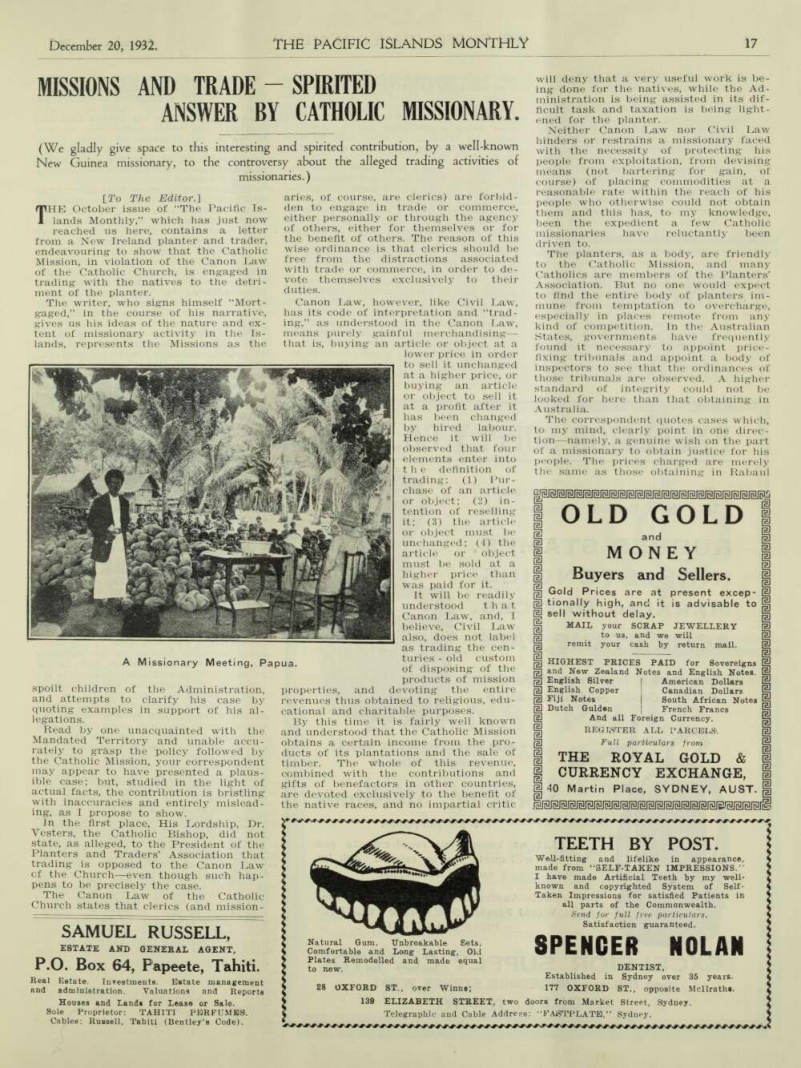
Answer By Catholic Missionary.
(We gladly give space to this interesting and spirited contribution, by a well-known New Guinea missionary, to the controversy about the alleged trading activities of missionaries.)
[To The Editor.] THE October issue of “The Pacific Is lands Monthly,” which has just now reached us here, contains a letter from a New Ireland planter and trader, endeavouring to show that the Catholic Mission, in violation of the Canon Law of the Catholic Church, is engaged in trading with the natives to the detri ment of the planter.
The writer, who signs himself “Mort gaged,” in the course of his narrative, gives us his ideas of the nature and ex tent of missionary activity in the Is lands, represents the Missions as the
spoilt children of the Administration, and attempts to clarify his case by quoting examples in support of his al legations.
Read by one unacquainted with the Mandated Territory and unable accu rately to grasp the policy followed by the Catholic Mission, your correspondent may appear to have presented a plaus ible case; but, studied in the light of actual facts, the contribution is bristling with inaccuracies and entirely mislead ing, as I propose to show.
In the first place, His Lordship. Dr.
Vesters, the Catholic Bishop, did not state, as alleged, to the President of the Planters and Traders’ Association that trading is opposed to the Canon Law of the Church—even though such hap pens to be precisely the case.
The Canon Law of the Catholic Church states that clerics (and mission
aries, of course, are clerics) are forbid den to engage in trade or commerce, either personally or through the agency of others, either for themselves or for the benefit of others. The reason of this wise ordinance is that clerics should be free from the distractions associated with trade or commerce, in order to de vote themselves exclusively to their duties.
Canon Law, however, like Civil Law, has its code of interpretation and “trad ing,” as understood in the Canon Law, means purely gainful merchandising— that is, buying an article or object at a
lower price in order to sell it unchanged at a higher price, or buying an article or object to sell it at a profit after it has been changed by hired labour.
Hence it will be observed that four elements enter into the definition of trading: (1) Pur chase of an article or object; (2) in tention of reselling it; (3) the article or object must be unchanged; (4) the article or object must be sold at a higher price than was paid for it.
It will be readily understood that Canon Law, and, I believe, Civil Law also, does not label as trading the cen turies - old custom of disposing of the products of mission
properties, and devoting the entire revenues thus obtained to religious, edu cational and charitable purposes, By this time it is fairly well known and understood that the Catholic Mission obtains a certain income from the pro ducts of its plantations and the sale of timber. The whole of this revenue, combined with the contributions and gifts of benefactors in other countries, are devoted exclusively to the benefit of the native races, and no impartial critic
will deny that a very useful work is be ing done for the natives, while the Ad ministration is being assisted in its dif ficult task and taxation is being light ened for the planter.
Neither Canon Law nor Civil Law hinders or restrains a missionary faced with the necessity of protecting his people from exploitation, from devising means (not bartering for gain, of course) of placing commodities at a reasonable rate within the reach of his people who otherwise could not obtain them and this has, to my knowledge, been the expedient a few Catholic missionaries have reluctantly been driven to.
The planters, as a body, are friendly to the Catholic Mission, and many Catholics are members of the Planters’
Association. But no one would expect to find the entire body of planters im mune from temptation to overcharge, especially in places remote from any kind of competition. In the Australian States, governments have frequently found it necessary to appoint price fixing tribunals and appoint a body of inspectors to see that the ordinances of those tribunals are observed. A higher standard of integrity could not be looked for here than that obtaining in Australia.
The correspondent quotes cases which, to my mind, clearly point in one direc tion—namely, a genuine wish on the part of a missionary to obtain justice for his people. The prices charged are merely the same as those obtaining in Rabaul
A Missionary Meeting, Papua.
and which are daily availed of by hun dreds of natives. Conditions at Kavieng are the same as at Rabaul.
Would anyone expect a missionary in a village, devoting his life to the uplift ing of hundreds of natives, to look on while his people are being exploited by one or two unscrupulous planters or traders? Of course, this statement will be denied. “Reasonable prices” is a very elastic term to certain minds, and it is notorious that exorbitant prices are not only charged to the natives but even the assistance of the missionary is not rarely asked to make the native a more pliable creature in the hands of the trader.
A visiting New Ireland planter came to my station, situated only a short dis tance from Rabaul and, in the course of a conversation, quite boastfully told me about his methods of enriching himself.
Lengths of laplap for which he paid 7½d. were sold for 3/6; knives for which 9d. was paid were disposed of for 2/9. In reply to my query as to whether he con sidered such conduct proper, he replied: “They are all doing it —the native does not value money.” Yet this person had one idea, and that was to become rich
quick, dispose of his holding to an is land company and return to Australia.
One actually asked me to persuade the natives to part with their produce for less than 50 per cent, of what they were already obtaining for it. Another made no attempt to deny that he sold bicycles for more than four times what they cost.
It may be urged that these cases—and the number could be easily multiplied are rare. No one would impute improper trading to the planters as a body; but the examples quoted serve to show the necessity of protecting the natives, and I am fully convinced that what was complained of was fully justified and nothing has so far come to light to prove the mission or an individual mis sionary engages in trade.
One other observation of the writer would like to throw a little light on is his statement that the missions are here for the purpose of ministering to the spiritual and mental requirements of the kanaka and, in consideration of this, the Government allows them cer tain concessions. Are missionaries to ac cept direction as to the scope of their activity from planters —many of whom,
uninfluenced by any form of religious belief, have an ingrained aversion for the native and a sneering contempt for what is being done to uplift him? The League of Nations has stated that the material and moral well-being, as well as the social progress of those living under the Mandate must be promoted.
Year by year questions are being asked at Geneva as to the manner this precept is being carried out.
Official records show that more than 38,000 native children are being educated in the Mandated Territory to-day. Ap proximately seventy are in the Govern ment school and their education and maintenance absorbs between £ 8,000 and £10,000 annually. The remainder, that is, 38,000 are educated solely by the missions, who purchase pieces of land, erect schools, train teachers and pay them afterwards, thus providing free education to the native without a penny of expense to Administration or tax payer.
The maintenance and education of half-castes, which would cost thousands of pounds annually, is left entirely to the Missions. In Rabaul, alone, approxi mately 200 children —Chinese, Malays and half-castes —are educated entirely by the Missions, thus saving at least five teachers and a large school.
Again, it is admitted that 50 per cent, of native infants die. Year by year, Catholic Mission sisters, many of whom are trained nurses, have worked suc cessfully to reduce this high mortality, without any cost to taxpayer. A Gov ernment institute costing thousands of pounds was erected at Malabunga, in the Toma district, for child welfare; yet only two young expectant native mothers entered there in fourteen months. The mission orphanages are the only places orphan children can go to.
The medical work done by the Catho lic mission is extensive and a great benefit to natives, as well as great help to the Administration.
An accurate reading of these facts will readily dissipate the erroneous view that missions are the spoilt pets of the Administration, receiving concessions that others do not enjoy. I submit that the missions are, according to the Man date, powerful factors in the uplifting of the natives, the greatest help to the Administration, and a decided aid to the taxpayer—although the latter may be slow to admit it.
In Australia, Governments have wisely drawn a sharp line of distinction be tween institutions not worked for profit and those that are. All realise that vol untary effort of every kind should be fostered and encouraged and few will quarrel with the contention that taxa tion should fall lightly on those who, without personal gain, are spending their lives for the benefit of others.
In conclusion, I would state that the Catholic Mission has never, during the half century of its existence, engaged in trading. The Catholic mission can gain neither pleasure nor profit from inter fering with the legitimate rights of others.
Most of the stupid and empty talk about missions and trading is found on investigation to be without the least foundation in fact. A small but malig nant clique may seek to discredit mis sions and missionaries, but cannot suc ceed in destroying their work in the de velopment of the Territory and the up lifting of the native races.
I am, etc.,
A Catholic Missionary.
Rabaul, Nov. 2, 1932.
Advertisements & other items, pp. 19-20 (1 item)
Spencer Nolan
OLD GOLD
MONEY
Buyers and Sellers.
Gold Prices are at present excep tionally high, and it is advisable to sell without delay.
MAIL your SCRAP JEWELLERY
to us, and we will remit your cash by return mail.
HIGHEST PRICES PAID for Sovereigns and New Zealand Notes and English Notes.
English Silver American Dollars English Copper Canadian Dollars Fiji Notes South African Notes Dutch Gulden French Francs And all Foreign Currency,
REGISTER ALL PARCELS.
Full particulars from
THE ROYAL GOLD &
CURRENCY EXCHANGE,
40 Martin Place, SYDNEY, AUST.
Natural Gum, Unbreakable Sets, Comfortable and Long Lasting, Old Plates Remodelled and made equal to new. 28 OXFORD ST., over Winns;
TEETH BY POST.
Well-fitting and lifelike in appearance,
made from “SELF-TAKEN IMPRESSIONS.
I have made Artificial Teeth by my wellknown and copyrighted System of Self- Taken Impressions for satisfied Patients in all parts of the Commonwealth.
Send for full free particulars.
Satisfaction guaranteed.
SPENCER NOLAN
DENTIST,
Established in Sydney over 35 years. 177 OXFORD ST., opposite Mcllraths. 139 ELIZABETH STREET, two doors from Market Street, Sydney.
Telegraphic and Cable Address: “FASTPLATE,” Sydney.
SAMUEL RUSSELL,
ESTATE AND GENERAL AGENT,
P.O. Box 64, Papeete, Tahiti.
Real Estate. Investments. Estate management and administration. Valuations and Reports Houses and Lands for Lease or Sale.
Sole Proprietor: TAHITI PERFUMES.
Cables: Russell, Tahiti (Bentley’s Code).
EXCELSIOR SUPPLY CO. LTD.
The most extensive Manufacturers in the British Empire of
RUBBER STAMPS.
INKS, STENCILS.
Marking Devices.
ACME STAMP PADS
Wc have a big range of Special
FRUIT CASE MARKING SETS
We alio Manufacture or Supply a complete line of
Spraying Machines
for all purposes.
Let us know your requirements and wc will quote you by return. Ask for our Big Catalogue.
Sole Australasian Distributors of the World Famous SHEAFFER FOUNTAIN
PENS and PENCILS.
EXCELSIOR SUPPLY CO. LTD.
Head Office:- 160 GEORGE STREET WEST,
SYDNEY. N.S.W.
Memorial Urged For Sir Ronald Ross,
Who Found Cause Of Malaria.
A FEW weeks ago there died, in com parative obscurity and poverty, a man whom every resident of the tropics should be delighted to honour — Colonel Sir Ronald Ross, K.C.M.G., F.R.C.S., LL.D., D.Sc. He is the man who discovered the life-history of mal aria parasites in mosquitoes and there fore is entitled to a place, for all time, among the great men of the earth.
He was born in 1857, the son of Gen eral Sir C. C. G. Ross, and he entered the Indian Medical Service in 1881.
Eleven years later, in 1892, he com menced the special study of malaria.
Within two years, he presented his startling and revolutionary theory of the mosquito method of malarial infection; in 1897-98, he confirmed and proved it.
In 1899, he led an expedition into West Africa, where he proved again that it was actually the fever-carrying an opheles mosquito which had given that region its sinister reputation as the “white man’s grave.”
This was one of the world’s epochal discoveries. Other men, quickly follow ing along the pathway blazed by Ross, secured some sort of control over the malaria scourge, and in the ensuing two decades large sections of the world’s surface, hitherto fever-ridden, became comparatively safe for white settlement.
We are inclined to regard malaria as a very serious obstacle to European penetration of the tropics. So it is— much remains yet to be done. But, now adays, we know exactly the nature of the problem we have to deal with. We must either find a safe prophylactic or cure for the fever itself, or we must discover a means of destroying or bet ter controlling the anopheles mosquito.
In the meantime, because the anopheles can be kept out of particular localities, and because drugs are moderately suc cessful in combating malaria, white women, as well as men, can live com fortably in places which formerly were hopelessly fever-ridden, and thousands of European families regard the tropics as their permanent home.
The change that has taken place in this respect within 30 years is extra ordinary—and that change is the direct result of the brilliant work of Sir Ronald Ross. His achievements added incalculable millions to the value of all tropical territories, and of British tropi cal territories in particular.
We know little of the later life of this brilliant scientist—only that, according to the he is dead at the age of 75, in poverty. Academic honours were showered upon him in the years which followed his discoveries (1895- 1890); but 20 years passed before his grateful country, in 1911, created him K.C.B. Within the same period, no doubt, hundreds of profiteers and lime lighting politicians received titular dis tinction. Sir Ronald Ross was raised to K.C.M.G. in 1918.
The proposal has been made —and we heartily endorse it—that it would be a grateful act if residents of the Pacific Islands, who owe so much to the great Scottish scientist, were to erect a memorial to him. The suggestion is that a plain, inexpensive, conspicuous struc ture of indestructible rock be placed by public subscription in some part of the Pacific Territories, where it may be seen by future Pacific travellers, who thereby may learn what European civil
isation in the South Seas owes to Sir Ronald Ross.
Mr. Vogan, who is taking a keen in terest in this matter, and whose article follows, has urged that the Ross me morial should be placed at or near Samarai. There are some good reasons for this. Samarai is the centre of a re gion that was handicapped for half a century by malaria, and this extra ordinarily beautiful little town is itself built on an island that, 50 years ago, was a fever-swamp, and a notorious death-trap. Now, it is a pleasant, healthy place. Samarai, also, is becoming one of the minor cross-roads of the Pacific. All the regular New Guinea and Papuan steamers call there.
A claim can also be lodged on behalf of Rabaul, which is a larger place and busier port than Samarai, and which also has succeeded in cleaning out the anopheles and keeping the malaria fever at bay.
The obvious place for a Ross me morial is Suva, now an important and busy port, where almost all Trans pacific traffic calls; but, fortunately for that part of the Pacific, there is no ma laria in Fiji, and the Fiji community is under no special debt to Sir Ronald Ross.
We hope the plan will be approved. A sum of £100, raised by public subscrip tion, would suffice to provide a fitting memorial. A statue of Cook, who found Eastern Australia, is conspicuous in Sydney; a stone figure of de Lesseps guards the Mediterranean entrance of the Canal, which he built; the memory of Sir George Grey, who laid the founda tions of New Zealand, is kept green in Auckland. What more fitting that at least a stone slab, with adequate in scription, be placed in a prominent posi tion to honour the memory of Sir Ronald Ross, whose genius made the white settlement of Melanesia possible. (Continued on next page.)
More Light For Apia.
THE hydro-electric power station at Apia, Samoa, is self-supporting, the plant having been operated success fully throughout the year ending March, 1932.
The benefits of electric light, which are accentuated in the tropics, are now enjoyed in almost every residence in Apia. A number of native fales in and near Apia are also connected.
Advertisements & other items, p. 21 (1 item)
Gillespie’S
"ANCHOR”
FLOUR
TRADE
MARK
The Standard of Quality.
BURNS, PHILP
(South Sea) Co. Ltd.
Island Traders 8C Shipowners Registered Office: Suva, Fiji.
Also Branches at Fiji: Levuka, Lautoka, Labasa, Ba, Sigatoka, Rotumah.
Tonga: Nukualofa, Haapai, Vavau.
Samoa: Apia, Pago Pago (American Samoa).
Solomons: Makambo, Gizo, Faisi.
New Hebrides: Vila.
Gilberts: Tarawa.
Norfolk Island. Nauru. Niue.
Code Address: "Bumsouth."
“He Who Opened the Pacific Door!”
By A. J. Vogan, F.R.G.S.
To old battlers like the writer, who can look back over more than half a century of Pacific memories, nothing perhaps stands out so vividly as the change that has become apparent re garding our views of the malarial curse.
It is not too much to say that had our therapeutic knowledge remained at the level it was in my youth, the “Summer Isles of Eden” of our busy British col onies, mandates, and States would to day have remained “in statu quo.”
The archaeologist and naturalist, wan dering through the lesser-known of the thousands of islets of the Pacific, soon recognises the fact that a few hundred years ago, a large, important, and, more or less, civilised population of Asiatics had their being where now nothing but sparsely-peopled jungles obtain.
Stone foundations, enormous earth works, curious carvings, hieroglyphics, Ogmaic and other inscriptions, pottery of artistic merit, wonderful cuttings for canoes to pass through coral-reefs, buildings that show engineering skill and the finished artisanship that tells of an ancient civilisation, meet the eye again and again; and awaken in the mind a kind of requiem of sober thoughts anent the great people who once trod these wilds —Gone! Into the
Ewigkeit!
And further inquiry seems to show that it was the mosquito that shut down the door of the Pacific, upon a promis ing influx of Asian immigrants. Just as Yucatan, and other portions of the world’s surface, became depopulated be neath the dread wings of that pernicious pest —that angel of death that brooded over the fairest portions of the world until “he who was duly appointed” ar rived upon the scene!
To the student of historical happen ings, nothing, I suppose, is so forcibly patent as the fact that at certain phases of the world’s happenings, “when the world is ripe and ready for his ad vent” (as the great writer put it) the “Man of Destiny” appears to carry out his job.
Such an one was that quiet, unassum ing lover of Science for Her own sweet sake: the shy and almost timid young Dr. Ronald Ross, whom the writer re members as slightly older than himself, working away amidst the dread possi bilities of the dangerous, fever-stricken swamps round Rome. The son of a dis tinguished Indian Army officer, he studied in St. Bartholomew’s Hospital, where he was the friend of a young Mr.
Appleton, an intimate of our family.
In 1899, Ross, already acknowledged as the authority upon his subject, left the Indian Medical Service and founded the Liverpool School of Tropical Medi cine—becoming ultimately its professor.
His enthusiasm was so great that he was led to demand what various gov ernment bodies considered was too much at their hands. He was the first who showed that malaria was a preventive disease; and he developed a pugnacity which did not spare his official oppon ents who, with that nonchalance that characterises the typical civil-servant, did not understand why their ease and circumlocution-methods should be inter fered with by this unsociable medico, who never drank cocktails at their clubs or played golf like other “good-fellows."
But he it was, Sir Ronald Ross, who did more for the Pacific than perhaps
all the other authorities and civil-ser vants combined. Owing to his discov eries, we can walk and work where a white-man could not live before. By his sacrifice of the world’s pleasures and luxuries he opened up new lands for old jungles, “where brooding fever hung.”
The Pacific owes him a debt of grati tude ; and of remembrance, far greater than it can ever pay.
Even if the thoughtless youths in flash “shorts,” and the tempting lounges under the “pub.” verandah, DO make it easy for Her Ladyship the Malarial Mos quito to carry on her deadly work; and if it still remains apparently impossible to get municipal and other responsible authorities to see that breeding places for the larvae do not obtain, we still can fall back upon the second lines of de fence: the No. 295 in the greenish brown bottle.
Ross did his “Veni, Vidi, Vici” turn; and passed on —leaving us the half opened door! Will our civilisation fol low that of the first Pacific immigrants?
Or will we take advantage of the chance he gave us?
Anyway, a memorial of Sir Ronald, here and there, would be a useful re minder to us not to let the authorities get too lax, or the youngsters too for getful of what malarial fever can do if we forget ordinary, sane precautions against it!
Papuan Rubber.
[To the Editor ] Sir, —Might I correct a quite forgive able error in your September journal (page 8) touching the price of Papuan rubber. The basis of your calculation was “Para” rubber at 5¼d., quite a dif ferent thing from the plantation variety produced in Papua, The East, and else where, which was, at the date men tioned —viz., September 9 —only 2 7/8d., and has actually been below 1 7/8d. —all the difference in the world as far as Papua is concerned.
I am, etc.,
Eraser.
Moso’Oi’S Value.
From Our Own Correspondent.
Apia, Nov. 25.
DURING a visit to Samoa in 1931, Dr. and Mrs. J. R. Hosking, of the New Zealand Department of Scientific and Industrial Research, investigated the possibilities of the commercial pro duction of essential oil in the Territory.
The flower of the local Moso’oi has been found to produce an oil similar to ylang-ylang which is of considerable value to perfume makers. A small par cel has been prepared and sold by a local resident.
Advertisements & other items, p. 22 (1 item)
Chartres,
SERVE
these biscuits
with drinks!
Light, flaky and easily digestible . . . with the nutty, true - wheat taste . . . Joyce Fon Crackers and Thin Captains are ideal with drinks. Their mellowness blends delici ously with other flavours.
They are good, too, JOYCE for invalids.
Gold Medal Biscuits
You get them with all their goodness sealed in.
Write to P.O. Box 31, Camperdown, N.S.W., if unobtainable locally.
FPL-5.
CHARTRES,
STOTT & HOARE’S
CORRESPONDENCE
COLLEGE
Founded 1885.
Pioneers and Specialists in Postal Instruction.
All Educational and Commercial subjects taught thoroughly and efficiently by correspondence.
Experienced Certificated Instructors. Write for particulars.
CHARTRES, STOTT & HOARE’S CORRESPONDENCE COLLEGE,
Liverpool Street, Sydney, Australia.
Papuan Rubber
Preference.
Application for Removal.
A SOMEWHAT awkward position for the Federal Government is develop ing in connection with the sale of Papuan rubber in Australia.
It will be remembered that the Fed eral Government, at the urgent solicita tion of Sir Hubert Murray, last year, placed a special duty of fourpence per pound on raw rubber imported into Australia, with the provision that the rubber produced in Papua should be ex empt from duty. The result of this has been that there has been a sale in Aus tralia for all the Papuan rubber, and it has meant also that the price of rubber in Australia has been fourpence per pound higher than otherwise would have been the case. It did not mean that the rubber from other countries sold in Australia was fourpence per pound higher than the Papuan rubber.
The consumer in Australia pays exactly the same price for Papuan rubber, as he pays for any other rubber, but whereas the Australian customs received a duty of fourpence per pound from the rubber imported from other countries, the Papuan rubber-grower receives the fourpence that otherwise would have gone to the Customs.
As the rubber being imported from Papua is only a very small proportion of the total rubber consumed in Aus tralia, and therefore the duty represents a heavy tax on the rubber industry in Australia, the combined rubber manu facturers have urgently represented to the Federal Government that if the Fed eral Government will remove the duty, the rubber trade in Australia will pay a special bounty to the Papuan rubber growers, equal to fourpence per pound.
The net result of this would be that while the Australian rubber trade would be paying the same price as now for Papuan rubber, it would be getting fourpence per pound off all the other rubber used.
This seems a fair enough proposition —but another consideration now enters, namely, that of finance. It transpires that the total amount of duty collected on account of rubber by the Customs authorities in a year is in the vicinity of £ 460,000. If the Federal Government does what it has been asked to do, it will have to forfeit £460,000 worth of revenue per annum. If the users of rub ber goods in Australia were to get the benefit of this there might be some good argument in favour of the proposal, but an investigation shows that the cost of rubber goods to the consumer in Aus tralia has actually decreased since the fourpence per pound was paid placed on foreign rubber.
In these circumstances it seems very unlikely that any alteration will be made for the present in the present tariff in so far as it relates to rubber imports. (Later developments affecting the Papuan rubber industry are referred to elsewhere in this issue. )
Missing!
Two Young Adventurers from “South."
From Our Own Correspondent.
Thursday Is., Nov. 25.
A FEW months ago, three young men from south arrived at T.I, and, after looking round, bought a small cutter
in which to tour the Straits and visit New Guinea. None of them seemed to have much idea of seamanship, nor of northern conditions generally.
One of the party left the others, going ashore on the New Guinea coast, and later returning to Thursday Island to go south.
The cutter “Kuiam,” went on towards the western part of New Guinea with the other two aboard, and there is now a report that they have been killed by the Tugeri people, towards the border of Dutch New Guinea. Portion of the
“Kuiam” was found on the beach oppo site Saibai Island, and brought into Thursday Island; this was probably smashed off before the cutter proceeded further along the coast, as she was seen in the vicinity of Boigu Island.
It is feared that the sinister rumours have strong foundation, however, as the natives in that region have a reputation for aggressiveness, and were responsible for killing a number of Javanese politi cal prisoners, who escaped from Dutch New Guinea about three years ago.
Head hunting is by no means a played out pastime in that locality.
Advertisements & other items, pp. 23-24 (1 item)
There's an Exide Battery
for every purpose
To-day, Exide Batteries are manufactured in five countries, England, America, Canada, Italy and Australia. For over forty - four years now Exide has been making dependable batteries for every purpose.
You can secure an EXIDE for your Motor-car, Motor-cycle, Motor-launch, Radio, for lighting your home, and any other purpose.
Send for Free Illustrated Booklets.
Be sure to mention for what purpose the battery is required.
Batteries
Distributors: New South Wales: EXIDE BATTERY SERVICE, Hunt Street,
SYDNEY.
Queensland: EXIDE BATTERY SERVICE (Q.) PTY., LTD., Adelaide Street, BRISBANE.
‘THE SENIOR STORE.”
‘TRUTH IN ADVERTISING” —AND IN EVERY ACT.
ANTHONY HORDERNS’
"Selfreezer" £33/ 10
The Cabinet.
Is made of wax-finished maple.
Its interior of porcelain enamel has rounded corners, making hygienic cleanliness easy to achieve. Notice how thick are the walls and lid of the ‘Selfreezer,” for complete insu lation from outside warmth. The ample storage space is 24in. long x 18in. wide x 19in. deep—un doubtedly ample space for all your necessaries. Removable wire trays add to the effective ness of the interior.
Cost of Upkeep.
Surprisingly economical! The cost of upkeep is 1½d. a day, for the kerosene necessary to heat the Freezing Unit, and remem ber, this is your total cost, the Freezing Unit lasting, with care, indefinitely. You have no re newals of parts, there is nothing to wear out.
How it Works.
Will last a lifetime, there is nothing to get out of order, and it needs no attention. It is foolproof, and here lies the supremacy it gives perfect refrigeration. Dry, frosty cold is in your cabinet for 24 hours. All you have to do it to heat the Freezing Unit for a short while daily, place it in the tank, then in your cabinet —and the job is done. Did you ever hear of such simplicity?
Freezing Unit.
The Freezing Unit is suspended inside the cabinet by a stout pipe connected with the Chemical container, which hangs outside.
Every morning the Unit is lifted out and heated by the aid of a primus stove, as directed in the instructions supplied. When it is cooled in the tank a white frost appears, and this perfect, complete refrigeration is main tained for 24 hours,
economical, costs 1½d. a day
ample storage space
makes its own ice
no moving parts
Attractive, economical and labour-saving, these cabinets meet all the demands for modern refrigeration at a moderate cost. Handsome in appear ance, simple in use, there is nothing to wear out and no replacements are necessary. Perfect insulation is ensured by the heavily-packed lid and sides.
The Freezing Unit is easily moved into position at the side of the cabinet.
Ifter Unit is Seated, and it has been cooled in the tank a white frost begins to form. The Freezing Unit is then placed within the Cabinet, where it will keep the cabinet icy-cold for 24 hours. It ,s most effective because of the dry cold, which will keep all food as well as fresh.
And your total cost, including large galvanised tank and
‘SELFREEZER.”
primus, for the daily heating, is only £33/10/- Write for Folder, which completely describes the
ANTHONY HORDERN & SONS LTD
POSTAL ADDRESS: SYDNEY **l 8401,’
BOX 2712 C, G.P.O.
SYDNEY
The Yam
Food Value, and Some History.
(By A. J. Vogan, F.R.G.S., in “The Sydney Mail")
AUSTRALIA is strangely ignorant of that most important of all food vegetables—the yam.
Having had occasion to spend the winters of the last twenty years amongst sixty to eighty of the lesser known islands of the Pacific, I have learned the value of this wonderful vegetable.
Mohammed, in his famous panegyric upon the date-palm, calls it “our uncle,” for it is practically the sole food of millions of believers. The rice plant to China is what the potato was to Ireland, and such is the yam to the descendants of those Asians who peopled the Pacific and introduced an expanding civilisation, until the mos quito, introduced from America (like many other pests), brought the same cessation of progress as happened in Persia and in Greece.
Anyone who has lived long in those lovely “typees” of the Pacific misses the succulent vegetables when he re turns to more civilised parts, just as the Englishman does his beefsteak or the Frenchman his coffee. And now the doctors are awakening to the fact, put before them in 1919, that where the yam is eaten no cancer obtains.
But, of course, just as there are new-laid eggs, fresh eggs, and—“aigs,” so are there “yams” and —yams. I had always thought that the white Samoan yam was the most delicious and valu able vegetable on earth until I recently spent some time in the weirdly won derful Trobriands. Mr. Lumley, the only white man there who has any attempt at a farm, has just sent me over some boxes of carefully selected tubers of the many varieties of splendid yams grown by the natives; and Mr. A. H. Joubert, of Ter ranova, on the Tweed, has undertaken to acclimatise these for future multi plication and distribution.
The intelligent brown inhabitants of the Trobriands and Lusancy Islands have devoted many centuries to the cultivation of this root; and their greatest religious ceremony is in con nection with the gathering in of the yam harvest. The roots, when gathered, are stored in very artistic food-houses shaped in a particular way, which tells the archaeologist of a connection with Babylonia and Persia, and at that period of harvest the spirits of the ancestors, who, during the year rest blissfully in the spiky little island of Tuma, where I stayed awhile, revisit their old villages and plantations to see the crops, com menting upon them through the priest chiefs. A little rumpus occurred just before I left the group because a mis sionary, having entered a village, so prevented the ancestral spirits passing over it that he upset the programme of events.
The yam is one of the many species of monocotyledons, which include most of our food plants, from wheat to onion. In the Trobriands, it reaches 15ft. and even 20ft. in length. It closely resembles the potato in composition, but is more tasty and contains more nitrogen, so being more nutritious.
Those kinds referred to above are of Indian origin, but have been crossed long since with Chinese kinds. In France, they are called igname, and varieties of Chinese origin are grown there and in Algeria. They have been successfully grown in England, but re quire more heat than obtains there.
If I may add my personal experience, I may say that I have lived for days entirely upon yams, and they are the ideal food of the vegetarian.
Trading Changes In Torres
No More Heads.
Trading Changes In Torres Straits.
From Our Own Correspondent.
Thursday Is., Nov. 25.
IN the old days, before boundaries were defined so closely as now, there was a good deal of intercourse between the natives of New Guinea (Papua) and Torres Strait; and bartering was car ried on for various commodities.
The Torres Strait islander took up arm-shells and human heads, both of considerable value in Papuan eyes: and in return received canoes, sago, bows and arrows, cassowary feathers, and other things.
Permits have to be procured now if the Islanders desire to visit the neigh bouring “big island,” which is only three miles from the most northerly of the Torres Strait group; and under special circumstances the latter people may go straight to Darn and obtain permission instead of having first to travel 80 miles south to Thursday Island to be passed.
Canoes from New Guinea also have per mission to visit their Straits friends from time to time, and on these occasions there is generally sale of commodities.
Arm shells (from which the orna ments are cut) still have a value; but, human heads being a prohibited export on the one hand, and an article which regulations do not approve of on the other, something else has to take their place. Give turtle, caught on the reefs on the way up, form a modern substi tute, and are readily saleable to the Papuan. The islander, despite facilities for purchasing rice and flour, has not lost his taste for sago; and the long
packages of “Bissi,” as it is called, con sisting of the native sago wrapped in leaf and then secured by pieces of palm three or four feet long, are much sought after.
The Fly River supplies most of the sago bought; and if the Island folk do not have opportunity of purchasing right on the spot, they either get it from Daru through the stores, or else the Mabudauan people purchase a con signment of sago from the Fly River home manufacturers and bring it down to the Saibai Island group for sale, get ting their own little bit of commission on the transaction, of course. A package of sago weighing about twenty pounds is sold at three shillings, the heavier parcels being priced proportionately.
Advertisements & other items, p. 25 (1 item)
Steelo
FOR.
burnt
pans
Use Steelo and save a lot of rubbing. It scours them clean and bright . . , gets burnt stuff off in no time.
Steelo is specially good for aluminium , . and for cleaning rust stains off enamel or porcelain baths, basins and sinks.
Steelo is a fine steel wool, made up in handy pads and supplied with special soap.
If unobtainable locally write to the manu facturers, R, H ARMSTRONG & CO,. 44 King Street. St. Peters, N.S.W., for free sample, stating usual grocer’s name.
STEELO
17.
Do you know that the Famous
YOUNGER
STOVES AND
RANGES
made with extended Firebox specially for long Wood fuel, are Self-Setting and, provided sufficient Flue Piping is attached, can be used in almost any position.
The No. 7W. ‘‘Younger” Range can now be supplied fitted with Legs as per illustration Ask for quotation for this range, also Illustrated Catalogue and Price List for both Single and Double Oven Stoves!
Younger Stoves are Widely Used Throughout the Pacific Islands.
G. FLETCHER & SON 50 Oxford Street, SYDNEY.
Gizo’S “Gangsters.”
How They Raided B.P.
Liquor Store.
BETWEEN Gizo, one of the main ports in the British Solomons, and the nearest kirk lie many miles of tur bulent ocean; so that if there is any thing in the old tag about “the nearer the kirk the farther from grace,” Gizo ites might be accounted fortunate. How ever the township runs to two "pubs," which may have something to do with upsetting the theories of wiseacres ac complished in the art of inventing slo gans to adorn an argument; for of late Gizo has displayed evidence of being very graceless indeed.
When the usual mob of plodding planters and tired traders arrived in port recently in the course of their six weekly pilgrimage to meet the R.M.S.
“Mataram,” and obtain that long awaited and much-needed “cold one customarily imbibed to the accompani ment of the latest news from Sydney town, their next move was to hie them to the post-office to collect mail and learn the worst.
The sight that met the gaze of visi tors from distant beaches as they en tered the official sanctum occasioned a momentary guilty feeling that, gauged by prosaic Euclidean standards, the term “cold one” might express a trifling mathematical inexactitude; but clear re collection of the latest copra quotation and intimate acquaintances with eco nomic restrictions quickly dispelled that Closer inspection revealed that the neatly-stacked piles decorating the of fice were really composed of cases ot whisky, beer and gin, surrounded and surmounted by innumerable unopened bottles bearing the labels of well-known purveyors of spirituous comforts. It was indeed a monument worthy of Bacchus, and one such as had not been seen within the memory of the oldest inhab itant —at least not since “depression as cended the throne.
Curiously mingled were the thoughts that passed through the minds of the astonished onlookers. Had the much maligned Government acquired a modi cum of public spirit at last and decided to provide the public with the spirit at cut rates to the confusion of “profiteer ing publicans”? Was this a tangible in dication of commendable business en terprise briliantly conceived, perhaps at at Ottawa Conference? Direct sales to the public, and perhaps the bonus sys tem! Great idea: “A glass of beer given away with a bob’s worth of stamps. ‘Pay your dog license and sample our Treasury blend!!” or, “Pass your entries before lunch and secure an appetiser! ! !"
Truly an inspiration of genius Boost the revenue and bust the pubs!
But, alas! memory of the ways of gov ernments supervened. In that direction one need not look for business genius or generous impulses. There was a catch in it, somewhere. Now, become cynic ally pessimistic, the visitors visualised wholesale confiscation. Prohibition had struck the Solomons! and Christmas close at hand, too! Truly, as some high brow had feelingly declared: “Life was just one damn thing after another"; what with copra. . . . !
The arrival of the D.O. broke the spell and stifled further speculation. In an swer to a chorus of inquiries, he eluci dated the mystery, which savoured more of the traditions pf a city underworld
than of those of the romantic South Seas.
It appeared that native labourers em ployed by Messrs. Burns, Philp and Co. had gained access to the firm’s bulk store by the simple expedient of remov ing a sheet of corrugated iron. They then helped themselves to whatever took their fancy—cases of whisky, beer, gin and tobacco. The sheet of iron was carefully replaced, and the loot removed to the solitude of the bush, and hidden away for future consumption.
There is reason to believe that thefts from the store had been taking place over a long period; one “boy,” when charged in Court, admitted to having purloined a case of tobacco some months previously, but only of late (evidently emboldened by earlier successes) had goods been removed in wholesale quan tities.
Drunken orgies appear to have taken place in the bush at various times, usu ally at week-ends, and these were con ducted with surprising secrecy. Recent investigations followed the discovery of several “boys” lying in alcoholic slumber when they ought to have been at work.
Placed under arrest, they eventually im plicated other members of the gang, and the hiding places of the exhibits which had aroused such hopes and fears were gradually revealed.
The culprits were duly tried before the District Officer, and sentenced to various terms of imprisonment. The "swag” has been returned to the right ful owners to be dispensed in the old manner; and our rosy visions of Bonus Beer have dissolved into the mists that crown the summit of majestic Kulam bangra.
The “God of the Waters” frowns down upon the small township; meditating, it may be, on the rapid strides black brother is making along the road to Civilisation. —M.
Advertisements & other items, p. 26 (1 item)
Rainfall In Vila.
During October, 16.01 inches of rain fell in Vila.
General Purposes.
Education Tax For
AN interesting development in connec tion with the Administration of New Guinea is a recent official de cision that the Education Tax there shall in future be paid into the consoli dated revenue fund.
This tax, which is imposed upon all employers of labour as a means of rais ing funds for the education of the na tives, is one of the grievances of the planters and miners of the Territory.
It represents in the course of the year quite a heavy imposition and it is an aspect of the Australian Administration that reads very well in the annual re port to the League of Nations. But it is a nightmare to the employers who de clare that while it represents a substan tial sum taken each years from their pockets, there is very little to show for it in the way of educational benefit con ferred upon the natives.
It is believed that the new arrange ment means that, while it is not in tended to forego the tax, it is intended to use the money thus raised for the general benefit of the natives rather than for a particular purpose, the bene fit of which has not been too apparent in the past.
Advertisements & other items, p. 26 (1 item)
HYLANDS Poultry, Eggs, Fish
J. H. MacGregor Dowsett
RABAUL, NEW GUINEA,
for
RELIABLE CARS, SERVICE & DRIVERS.
Gramophones and Latest Records.
Musical Instruments and Sundries.
Cameras and Photographic Goods.
Developing, Printing, Enlarging & Framing.
Recruiter, Mining & General Agent,
BUILDER AND CONTRACTOR.
Agent for The Australian Provincial Assur ance Assoc. Ltd. Sub-Agent for The Central Assurance Co. Ltd.
Outstation Orders Promptly Executed.
Sample Rooms;
MALAGUNA ROAD, RABAUL
’Phone: Rahaul 149.
HYLANDS Poultry, Eggs, Fish
DESPATCH ORDERS PROMPTLY.
Primest Quality at Reasonable Prices.
All varieties of Poultry, Game, Fresh Fish and New-Laid Eggs.
Send your next order to;
DAVID HYLAND & SONS PTY. LTD.,
755 Harris Street, SYDNEY, N.S.W.
Cable Address: “Hylands,” Sydney.
SHIPCHANDLERY.
W. Kopsen & Co. Limited
PIONEER BRAND ASH TaSs Tn D ImPEEMENT HANDLES.
KOPSEN'S SPECIAL SHEATHING AND NAILS
Large Stocks Manilla and Wire -p.., etc
68-70 CLARENCE STREET, SYDNEY.
Cables: “Kopsen.”
Experiments With New Crops
And Fruits In Papua.
Pt. Moresby, Nov. 28.
THE native coffee plantations at San gara, in the Northern Division, with their headquarters at Imanaturu in charge of Patrol Officer S. E. Smith, are showing great promise. The system is a part of a Government scheme to teach industries to the natives of Papua, to give them interests in place of the cruder customs it has been found neces sary to abolish, and to master their in ertia due to these abolitions.
Natives working on these plantations are exempt from taxation. Each village in the district has its plantation, on which a native under supervision of the controller works 80 days of the year— a native of the village, working under indenture, being, of course, excepted.
On the sale of the coffee by the Gov ernment, from each plantation, half of the proceeds go to the natives of the village (to those who have worked). The other half the Government claims for the Native Taxation Fund—a fund held in trust by the Government for the na tives of the Territory, Both Robusta and Stenophylla are grown on the plantations—and as both varieties are growing well, the output is rapidly increasing. Already, for the year, nine tons have been sold, the amount received being over £800. Robusta at
present fetches 9d. per lb. for the Papuan Government.
The Papuan Government, besides growing coffee, is experimenting in tropical fruits from other countries at Imanaturu (Sangara). It has planted fruit trees from India, Malaya, and Tahiti.
The plants growing are Mangosteen, Durian, Rambutan, Avocado Pear, Grape Fruit and Tahiti Bread-fruit which are ell doing well. Rambutan and the Avo cado Pear are already bearing, and the others seem likely to flourish.
As the experiments in fruit trees show good results, it will be an opportunity for residents and planters settled in dis tricts similar to Imanaturu, to plant those trees which prove the most suc cessful and so increase the variety of tropical fruits in the Territory—which, except for a few more enterprising plantations, is often limited to pawpaws, pineapples, bananas, granadillas and seporas.
An Indian pea called Dhal is also being planted, as an experiment. It was thought to be a good additional food for Papuans: it also grows successfully on the station. In India it is widely grown and eaten by the natives—but the Pa puan does not take readily to innova
tions. Importations of the Government, extending many years back, such as manioc, maize, pumpkins and tomatoes, are now widely eaten by the Papuan, together with beans pawpaws and oranges. So, in time, he may adopt the Indian pea. It is, however, tasteless and uninteresting as a food, though superior to rice in some respects.
The Tahiti bread-fruit is said to be better than the Papuan variety, con taining vitamines of sorts and is a big ger fruit and of a more delicate flavour.
“Big” Fisherman.
Zane Grey Prepares for Northern Hunt.
From Our Own Correspondent Thursday Is., Nov. 25, LOCAL fishing enthusiasts are compar ing notes with a view to giving Zane Grey, who is expected this way next year, the best information regard ing big fish of Torres Strait.
Advices received intimate that the famous deep-sea angler is having an it inerary arranged for him by Mr. E. F.
Pollock, which will begin at Tahiti, or thereabouts, in June, and will take in the New Hebrides, Huon Islands, Mel lish Cay, Willis Islands, Cairns, along the Barrier from Cairns to Cape York, down the Gulf of Carpentaria, through Torres Strait, then into Papuan waters, and across to Java, Singapore, and the Cocos-Keeling Islands. Six weeks or so will be spent on the Barrier Reef a month in the Gulf, a fornight at T.I. and the Gulf, and six weeks in Papuan waters.
The objective is giant fish. Having heard of giant sail fish in the Indian Ocean which are described by a Danish expert as “being like a fleet of schooners, with sails eighteen feet long and ten feet high,” one of which was dragged ashore and weighed three tons the fisherman-author hopes to put up some new records, and incidentally, help to put these waters on the map.
His yacht, the “Fisherman II,” 363 tons, a craft nearly 200 feet long is equipped with seven fishing launches carried on deck: two of these are 34 feet long, fitted with twin screws and the latest thing in wireless telephones for communicating with each other and the parent ship.
Advertisements & other items, p. 27 (1 item)
Paint
Consult ALEX. HALE
ABOUT YOUR EYES.
Accurate Optical Service and Comfort for your Eyes.
All Optical Repairs and Broken Lenses Replaced by return post.
SEND FOR SELF-TESTING
EYE CHART.
All our Prices will please you,
ALEX HALE .
Optometrist Optician,
113 PITT STREET, SYDNEY.
Five other City Addresses. Est. over 30 years.
SUN
dockers
BRAND
PAINT
Made expressly to keep a lustrous, full gloss finish against the varying con ditions of moist weather exposure, and prevent the decaying ravages of rain and extreme heat by
giving a long lasting pro
tection to all surfaces.
SUN PROOF
RAIN PROOF
"Stronger than the Weather”
W. R. CARPENTER
& CO. LTD.
New Guinea, Solomon Islands, and all other South Sea Islands.
The Guria.
No Scientific Records Kept of Rabaul’s Quakes.
THE town of Rabaul, headquarters of the New Guinea Administration, is right on the earth’s great earthquake belt. It is seldom that a week passes without its “guria” (earth tremor). Part of the town is actually built on the lower slopes of volcanoes that are not altogether extinct—they regularly smoke and stink, and occasionally rumble.
Therefore, it was a natural assump tion that some official in Rabaul would keep accurate record of the valuable seismological data thus made available —and a learned body, not long ago, made inquiry for certain data. To its surprise, it found that the Administra tion at Rabual is not officially interested in earthquakes, and there is not, any where in New Britain, an instrument capable of measuring or recording an earth tremor.
This appears to be a matter worthy of the attention of the Administration. The Federal Government maintains an ob servatory and Director at Canberra, and that organisation probably would be glad to cooperate with Rabaul in ar ranging for records of earthquakes to be regularly kept. On the staff at Ra baul there are several gentlemen of scientific attainments who probably would be quite prepared to add to their duties that of supervising seismographi cal observations and records.
Apart from its scientific value, such data ought to be kept in Rabaul. Its study might disclose whether there is any danger of increasing volcanic or earthquake activity in this part of the Territory.
An Ingenious Theory.
Roman Words In
Gilbertese.
[To The Editor.] ACCORDING to tradition (vide works by Mr. A. F. Grimble on the people of the Gilbert Islands) there were, amongst the parent stocks of the Gil bertese race, fair-skinned people known as I-Matang (inhabitants of Matang), whose home was a four-square island towards the north-west.
These very probably were Indo- Aryans from the Ganges Valley, such as colonised Ceylon, Java, Cambodia, etc. There is, however, another possi bility.
When the army of Crassus was de stroyed at Carrhae in 53 8.C., some 10,000 prisoners are known to have gone into slavery in Parthia. It may well be supposed that the Parthian king utilised the military qualities of these Roman soldiers by setting them to garrison his eastern frontier, whence escape to Roman territory would have been im possible; and thence they may have escaped eastward across India to the Bay of Bengal—or southward to the Arabian Sea —and made their way to the East Indies.
There are several words in the Gil bertese language which (though they may be derived from another Aryan lan guage or from a different source alto gether) have a close resemblance to Batin words of similar meaning.
Such are ruo, to fall or rush down (Latin, ruo, “I fall or rush down”); mate, dead (Latin, mortis) ; mamma, a breast (Latin, mamma); tari, salt (Latin, sal—t and r regularly taking the place in Gil bertese of s and l respectively, as in Tamoa, for Polynesian Samoa); taku, to say (Latin, dico, “I say”); nati, a son or child (Latin, natus); ura, a flame (Latin uro, “I burn”); toka, a lord (Latin, dux,
“a leader”—whence English “Duke”); nikawai, old (Latin, antiquus), etc.
Furthermore, the squareness of “Ma tang” may possibly be a memory of “Rome Quadrata” and of the square camps of the legions.
I am, etc.,
P. T. English.
Ocean Is., 17/10/32.
Advertisements & other items, p. 28 (1 item)
Lysaght
The Famous Brands of
Galvanized Iron
ARE NOW MADE IN AUSTRALIA
At Newcastle, N.S.W The first cost o t these brands is so very little more than that of inferior qualities that to buy
“ORB” or “QUEEN’S HEAD” is a
proved sound investment, The 15th edition of “The Referee,” a handbook of useful information, containing a ready-reckoner of much value to all engaged in building operations, may be obtained post free on application to John Lysaght (Aust.) Ltd, c/o. Box 196 D, G.P.O., Sydney.
CORRUGATED
PLAIN
Sheet Guaranteed
The Sepik.
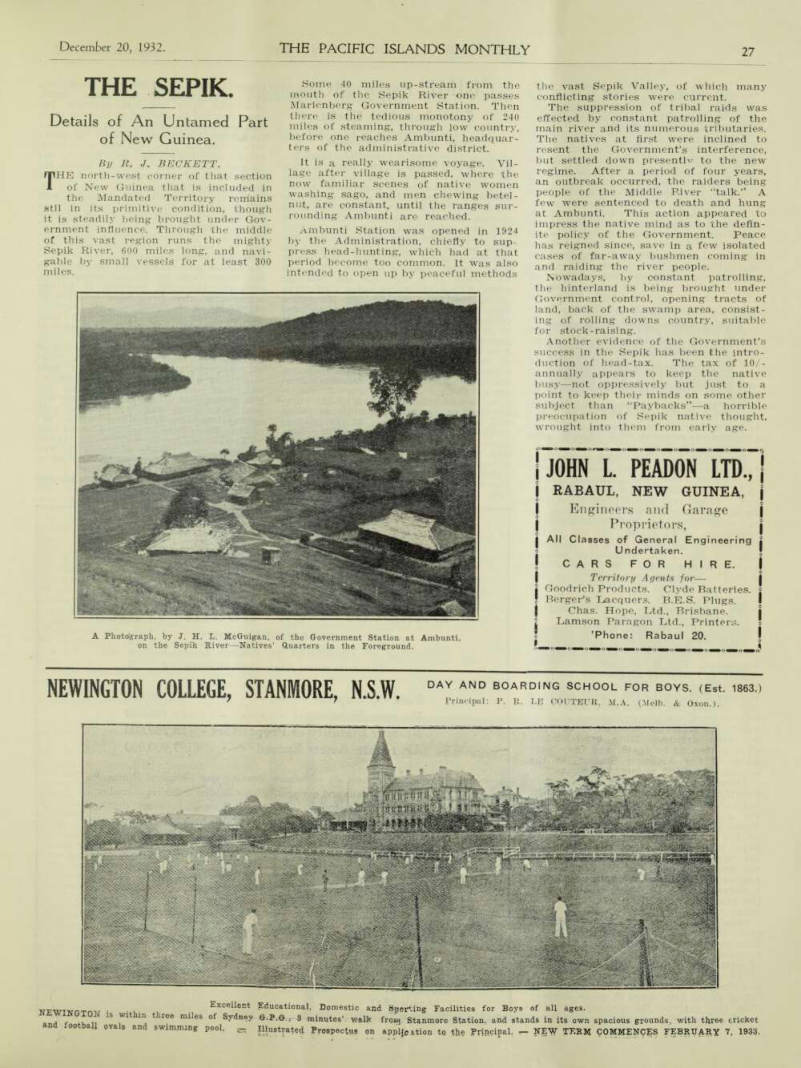
Details of An Untamed Part of New Guinea.
By R. J. Beckett.
THE north-west corner of that section of New Guinea that is included in the Mandated Territory remains stll in its primitive condition, though it is steadily being brought under Gov ernment influence. Through the middle of this vast region runs the mighty Sepik River, 600 miles long, and navi gable by small vessels for at least 300 miles.
Some 40 miles up-stream from the mouth of the Sepik River one passes Marienberg Government Station. Then there is the tedious monotony of 240 miles of steaming, through low country, before one reaches Ambunti, headquar ters of the administrative district.
It is a really wearisome voyage. Vil lage after village is passed, where the now familiar scenes of native women washing sago, and men chewing betel nut, are constant, until the ranges sur rounding Ambunti are reached.
Ambunti Station was opened in 1924 by the Administration, chiefly to sup press head-hunting, which had at that period become too common. It was also intended to open up by peaceful methods
the vast Sepik Valley, of which many conflicting stories were current.
The suppression of tribal raids was effected by constant patrolling of the main river and its numerous tributaries.
The natives at first were inclined to resent the Government’s interference, but settled down to the new regime. After a period of four years, an outbreak occurred, the raiders being people of the Middle River “talk.” A few were sentenced to death and hung at Ambunti. This action appeared to impress the native mind as to the defin ite policy of the Government. Peace has reigned since, save in a few isolated cases of far-away bushmen coming in and raiding the river people.
Nowadays, by constant patrolling, the hinterland is being brought under Government control, opening tracts of land, back of the swamp area, consist ing of rolling downs country, suitable for stock-raising.
Another evidence of the Government’s success in the Sepik has been the intro duction of head-tax. The tax of 10/annually appears to keep the native busy—not oppressively but just to a point to keep their minds on some other subject than “Paybacks”—a horrible preoccupation of Sepik native thought, wrought into them from early age.
A Photograph, by J. H. L. McGuigan, of the Government Station at Ambunti, on the Sepik River —Natives’ Quarters in the Foreground.
Although they acclaim themselves to be mighty warriors, I have never heard a single instance of a stand-up fight.
The early-morning pounce and kill is the invariable procedure.
Sorcery plays a big part in their lives.
A native supposed to be a sorcerer is generally some old man not worth his weight in salt, or a man who perhaps has had the misfortune to lose an eye, or been born deformed, and who lives apart from the social group.
One man, to my knowledge, owing to the constant bickering of his women, es tablished a new camp some miles away from his village. Years later, he was acclaimed a sorcerer. People from far and wide came to him, with native pay, bribing him to desist from killing off the remainder of his or her family.
They were all sure that he had “worked poison” against a lately deceased. Even tually, the matter came before the Dis trict Officer. The accused sorcerer stoutly denied any knowledge of sorcery, but enlightened the Court with infor mation. The reputation had been placed upon his shoulders, and people came to him with pay, and this was too much for his honesty, so he carried on, letting the people think he had magical powers. The episode closed with a fine of several pounds, including return of all native pay, which took many months to effect.
In village life, the Sepik native is a handy agriculturist, and a good hunter on land or water; but he excels himself in a ceremonial house, chewing betel nut. Homicidal decorations in various forms are used. The chief forms, on the main Sepik, are the skin of a flying fox, worn as an apron; the bill of the horn-bill, worn on the back of the head; and the lime-stick, with many tassels, each denoting a kill, used in connection with the chewing of betel-nut, as the method of passing lime from the pot to the mouth. One native, to my know ledge, has 28 tassels on his lime-stick.
Editorial Note.
This article, by Mr. Beckett, was written several months ago. Early in November, by a curious coincidence, Mr. L. J. Perichon, of Madang (now in Australia on leave), called at this office.
He was formerly in the Public Service; and he was one of the four white men who carried out the executions at Am bunti in 1928, as described in Mr.
Beckett’s article. Nine head-hunters were sentenced to death, and they were hung at the Ambunti Station, in the presence of 7,000 untamed natives.
According to Mr. Perichon, it was a ghastly experience. The assembled natives were threatening and sulky, and the gallows were primitive. In four cases, when the murderers were thrown off the execution platform by the police boys, the ropes did not run clear, and the jerk which is supposed to dislocate the criminal’s neck did not occur. Con sequently, the kicking, squirming head hunters had to be hauled back on to the platform, and thrown off a second time.
Finally, all nine were duly executed, and their dead bodies, with ropes attached, were handed over to their tribesmen, as a warning and example of white men’s justice. The Sepiks hung about the station for a couple of days, and the four white men and their hand ful of police boys were in some danger; then the natives disappeared into the jungle.
Advertisements & other items, p. 29 (1 item)
Newington College, Stanmore, N.S.W.
JOHN L PEADON LTD.,
RABAUL, NEW GUINEA,
Engineers and Garage
Proprietors,
All Classes of General Engineering Undertaken.
CARS FOR HIRE.
Territory Agents for — Goodrich Products. Clyde Batteries.
Berger’s Lacquers. B.E.S. Plugs.
Chas. Hope, Ltd., Brisbane.
Lamson Paragon Ltd., Printers. ’Phone: Rabaul 20.
NEWINGTON COLLEGE, STANMORE, N.S.W.
DAY AND BOARDING SCHOOL FOR BOYS. (Est. 1863.) Principal: P. R, LH (TOUTBUR, M.A. (Melb. & Oxon.).
Excellent Educational, Domestic and Sporting Facilities for Boys of all ages.
NEWINGTON is within three miles of Sydney G.P.O, 3 minutes’ walk from Stanmore Station, and stands in its own spacious grounds, with three cricket and football ovals and swimming pool. Illustrated Prospectus on application to the Principal. NEW TERM COMMENCES FEBRUARY 7, 1933.
Crime In Samoa.
Some Impudent Thefts.
From Our Own Correspondent.
Apia, Nov. 2.
LIKE other parts of the world, little Samoa, as a result of the world de pression, seems to experience an in crease in crime. This gives our well staffed Police Department the right to justify its establishment in the eyes of the long-suffering taxpayer.
A burglar recently intruded into the office of the manager of the Reparations Estates’ Vailele Plantation,. Mr. H. T Jones; coolly opened a small office safe by means of a duplicate key and got away with a bundle of notes containing £125, ready for paying out plantation labour. The police were informed by tele phone and Sub-Inspector Fell, formerly of the detective force in New Zealand and returned to Samoa only a few days ago, started an investigation. A search of the premises and surroundings re sulted in the recovery of £103 in notes, hidden in a stone wall near the mana ger’s house.
A Chinese coolie, working on the plan tation, then was arrested under suspicion and taken to Apia gaol. At the trial on October 12, the coolie, Kwan Chung, con fessed to having committed the theft and was sentenced to four years’ im prisonment.
Another Chinese coolie, of Mulifanua Plantation, took part in a Chinese gamb ling party. He lost heavily, whilst a
coolie from a neighbouring plantation, won about £15 in the same game.
Mourning after his lost savings, the loser decided to attempt to recover same and, next day, knowing that his luckier friend was absent, broke into his quar ters to get his £15. He was unsuccess ful, as the money was well hidden, but he was trailed later on by the police. He was convicted and sentenced to four years’ imprisonment.
A young Samoan, whose hobby was the stealing of clocks and watches, was arrested after activities extending over several months. A whole collection of timepieces was found in his possession and the various owners were very glad indeed to recover their property.
Another interesting case was heard in the High Court of Samoa, when seven Samoans appeared, accused of having killed and eaten a valuable Jersey cow, belonging to Mr. W. Gibbs, of Ululoloa.
The arrested pleaded guilty and were sentenced to four months’ imprisonment What was probably the first case of bigamy ever heard in a Samoan court was brought recently before the Apia High Court. A Chinese-Samoan, R. Ah San, had married, first, a Samoan girl and afterwards a half-caste girl. He had sent both away and was living with another Samoan girl when he was ar rested. Before the court he pleaded that he had committed the offence only at the urgent request of his second wife, who never gave him a rest till he agreed to marry her.
The Samoan Don Juan was sentenced to six months’ gaol.
Advertisements & other items, p. 30 (1 item)
Bank of New South Wales
(ESTABLISHED 1817)
with which are amalgamated the Western Australian Bank and The Australian Bank of Commerce Ltd.
Reserve Liability of Proprietors - £8,780,000
Aggregate Assets Exceed - - £107,000,000 The Bank transacts all customary Banking and Exchange Business throughout Australia and overseas. It establishes commercial credits and negotiates and collects Bills of Exchange. It issues drafts, Travellers’ Letters of Credit, available throughout the world, and makes money transfers by mail or cable. Fixed deposits at current rates are accepted at all branches for any period from three to twentyfour months. 705 Branches and Agencies throughout Australia, New Zealand, Pacific Islands, and London.
Agents and correspondents throughout the World.
Head Office; Sydney, New South Wales.
Paid-up Capital
Reserve Fund £8,780,000 £6,150,000
BRANCHES IN—
Suva Lautoka Levuka Kavieng Rabaul Salamoa Port Moresby Samarai (Agency Ba)
Fertile Norfolk Island.
How Inspection and Grading Would Assist Selling
From Our Own Correapondent.
N. I., Oct. 24.
IT is no betrayal of our domestic or economic interests to reveal the fact that, alone, among the islands ship ping fruit and garden produce to the mainland markets, Norfolk has no authorised inspector.
Buyers oversea are only too well aware of our handicap and with no ab solute guarantee of our stuff being true to label, it is seldom that we receive any thing like the top prices announced each evening over the wireless. Local agents buying occasionally f.o.b., do their best to pass their particular shipments on the jetty as they come down; but, in the hurry of despatch, it is impossible to in spect every single case or even a catch sample of every grower’s consignment.
There are those amongst us who, in their own temporary interests, forget the interests of the island as a whole and are more than careless in grading and packing. The shipment for Norfolk goes upon the market en masse, and agents and merchants on the other side who have once been caught with inferior produce, or produce that is not true to brand, will not only refuse to touch Nor folk Island merchandise in future but will do us irreparable damage by broad casting their injuries in the market place.
In the interests of the whole com munity, therefore, we should do our ut most to secure the services of a really good man, who would not only set his seal of guarantee on each outgoing case but would also be available to advise growers and planters as to the necessi ties of their individual plantations, to recommend certain crops or rotation of crops, and to detect and check disease in its earliest manifestations.
Conditions in every profession are so bad at present that it should be possible to get a first rate man for a term of years for a very much lower salary than he would ordinarily demand. We should reap financial benefit that would far more than offset the cost of such an expert and, if we cannot expect his sal ary to be met entirely from the sum allocated by the Commonwealth Treas ury to the maintenance of the island, we should be willing to contribute a sub stantial portion of it, ourselves. It could be done by imposing a small tax upon each case passed for shipment and ac cording to the grade of the produce ex amined; in that way the tax would not bear too hardly upon the small grower, but each consignor would pay in propor tion to the size of his shipment.
By last “Morinda,” to Sydney, we shipped 3333 cases of mixed produce, but prices secured are not yet known.
Within the last few weeks, after we had disconsolately disposed in various unprofitable directions of a great quan tity of passionfruit pulp, in excellent condition, one of our largest growers and most prominent settlers has received from Melbourne urgent orders for sev eral tons of pulp. It seems an incredible situation because, for months at the be ginning of the year when the fruit was newly pulped, we communicated urgently with all possible buyers throughout the Commonwealth but disposed of scarcely any—in spite of the fact that commer cial analysts to whom samples were
submitted, reported most highly upon its flavour, sugar content and mode of treat ment.
Now, when last season’s output is only a sore memory and the vines are not even flowering for the next crop, come more than one desperate demand for im mense quantities, and at once! It does not seem reasonable, somehow. What were those firms doing when we were approaching everybody likely to be in terested in our wares, months and months ago?
It really seems as though we shall not reach any satisfactory solution of the problem of our fruit until some oversea company establishes a factory on the is land and deals with each variety as it ripens and reaches perfection. Bananas that do not reach top grade, or that ripen between steamers might either be sun-dried, according to the very simple formula discovered in Tahiti and re corded in P.I.M. of April last, or turned into banana flour, for which there is an increasing demand, especially in the
U.S.A.
The red and yellow guavas that grow in vast groves all over the island, make beautiful jelly, that finds a very ready sale in Australia. Several years ago, the local manager for Messrs. Burns, Philp was induced to forward samples of this jelly to Sydney and the response was such that he expressed himself as will ing to handle as much as he could get.
But the maker left the island and no one else has been enterprising enough to ask for the same opportunity.
There are enormous canning pears grown here to perfection; loquats and figs; while the juice of the oranges and lemons that grow wild and fruit all the year round, might be bottled and the rinds turned into candied peel. Both passionfruit and guavas make a delicious light wine—passionfruit wine being com parable to a very nice light hock. In deed, there are endless possibilities open to a company of vision and gnancial resources.
Once again, the bean planting season is upon us and, from end to end of the island, rich, warm acres of soil are being
prepared to grow the Canadian Wonder Bean for export as seed. From some for tuitous combination of soil, sun and cli mate the Canadian Wonder Bean grows here to a perfection of colour and qual ity that is recognised by all buyers and for this crop we receive top prices, while every bushel grown finds a ready mar ket. The local storekeepers acts as agents and shippers for merchants on the other side, and they are very keen at grad ing and classifying, so that only the very best goes forward —greatly to the advantage of our reputation as pro ducers of the finest seed that reaches the market.
A Government inspector would do for our other produce what the store keepers do for our Canadian Wonder Beans.
Advertisements & other items, pp. 31-32 (1 item)
to Humanity
Australia's Gift
in Pain!
A.P.C.
Vincent's
STOPS
PAIN
SAFELY
Prepared on the scientific formula now in use in the argest hospitals in Australia. Recom mended with safety by your Doctor, Chemist, Dentist, Nurse.
Headache, Neuralgia, Neuritis, Sciatica, Rheumatism, Backache, Sleeplessness, Influenza, All Chemists and Stores, or direct from Vincent Chemical Co.
Sydney.
Abdominal Pains in Women
Beware of
Imitations
Genuine
Powders and Tablets, 1/6 & 2/6
DO NOT AFFECT THE
HEART OR NERVES
Brunton's Flour ask for it
ESTABLISHED 1868.
A. C. CAMPE,
21 SYDNEY ARCADE, KING ST.
113 PITT STREET,
SYDNEY.
Pays Highest Prices
FOR ISLAND STAMPS.
General Collections. Fine Specialised Collections. Rarities of every description. Special Items of Philatelic Interest, etc.
Before disposing of your Collections, Get in touch with us.
IT WILL PAY YOU!
J. H. SMYTH LTD.
Postage Stamp Dealers,
121a CASTLEREAGH STREET,
SYDNEY.
The Leading House for
ISLANDS STAMPS.
Write for List of over 500 Sets of Australian, New Zealand, and Pacific Islands Stamps.
Stamps sent on approval on receipt of reference.
ISLAND STAMPS PURCHASED.
Highest Prices Paid.
JAMES BARNES LIMITED
2 Botany Street, Waterloo, Sydney
(ESTABLISHED 1881)
MANUFACTURERS OF
“Globe” & “Victory” Brands
OF
SHEEP’S TONGUES OX TONGUES SAUSAGES
PRESERVED MEATS BEEF EXTRACT DRIPPING
Also “Castle” Brand, which is specially packed for use by the White Population.
Globe Beef Extract is invaluable to Young and Old.
Tested Recipes on the packet 4oz. and 8oz. sizes.
New Papuan Stamps.
Striking Designs Replace The Famous Lakatoi Issue.
From Our Own Correspondent.
Pt. Moresby, Nov. 28.
THE much discussed new stamps for Papua became available on Novem ber 14 at Port Moresby and Samarai and will entirely replace the old issue.
These stamps are 16 in number. They are of 16 different designs and are all exceedingly interesting as they deal with the chief aspects of Papuan village life and describe vividly their most out standing customs.
Five are taken from the decorative drawings of E. Whitehouse, of the Pa puan service. In bold designs he depicts the Papuan. The 10/- stamp is by far the best of the series and should be considerably admired. It has been taken from his selection and is an energetic and vivid drawing of Papuan manhood decorated with feathers and hibiscus flowers. He is seen making fire by fric tion.
Nine have been taken from photo graphs by Mr. A. Gibson, also of the Papuan service, and the remaining two are from realistic sketches by Mr. F. E.
Williams, anthropologist to the Papuan Government.
A bird of paradise and boar’s tusk, sapi sapi (native money) and shells are the main features of the 2d. stamp, which will be mostly in use. It is orna mental and decorative, though it will never quite capture the charm held by the old lakatoi, which has been a fav ourite for over 30 years.
The shilling stamp, which depicts a Dubu of the village of Hanuabada, show great talent and is an artistic and sym bolic representation of the idolism of the Motuan tribe. A Dubu is a cere monial platform, supported by four
elaborately carved and painted posts. It stands in the village compounds and is used only on special occasions. The sacred emblem of the crab’s claw crowns the post.
Mr. Williams’ sketch of a dwelling of the Purari Delta is taken for the £1 stamp and is in two colours. It is art istic and skilful. Mr. Williams has made a close study of the Purari Delta tribe and in the 2/- stamp he depicts their most valued paraphernalia, grouped to gether in a recess of their Ravi (men’s house).
Already a great deal of interest has been shown in these stamps, both in Australia and countries abroad. They will be in demand not only for their philatelic value but also for the talent and ability shown in their construction.
Each stamp will be printed in two col ours, except for the five decorative de signs by E. Whitehouse.
It is over 30 years since the first issue of stamps was made in Papua and, ex cept for an occasional surcharge, the Lakatoi has been in use until to date.
40 Years In Papua.
Alf. Greenaway Dead.
From Our Own Correspondent
Pt. Moresby, Nov. 28.
Another of Papua’s old-timers, Mr.
Alf. Greenaway, has passed away. He came to the Territory some 40 years ago and his sturdy figure was well-known to most residents.
An old sailor, his activities in Papua were very varied and covered trading, planting, recruiting, boat-building and prospecting. A quiet, good-natured man, he was genuinely liked. Lately he had been employed by Mr. G. A. Stewart on the Napa Napa slipway, Port Moresby, and was recently transferred to the slip at Samarai. Like many sailors, Alf had never learned to swim and a fall from the Samarai wharf put an end to an active and useful life.
Alf Greenaway was born in Kent and was one of a ship-wrecked crew who landed in Papua about 43 years ago. He had remained in the Territory ever since, without a holiday or change.
“Printed and Published
In B.S.I.”
We have been much interested to re ceive a special parcel of eight different books from the Melanesian Mission Press, established on the island of Guadalcanal in the British Solomons.
These have been sent to us by Mr. Isom, the printer in charge of this establish ment, to show what can be done by his staff and plant. The character and qual ity of the work is certainly calculated to open the eyes of a mainland printer.
Some of the books are neatly bound in paper covers, but others have been done in stiff imitation leather covers, and are nicely sewn and bound —the work com pleted in a way that would be a credit to any printing office in any part of the world. The books, of course, are all books required in connection with church services and are all in the native language.
The production of these books printed in the native language, and in this fashion, gives a remarkable demonstra tion of the progress made in the Solo mon Islands by the Melanesian Mission since the martyred missionary, Bishop Patteson, went among these savages some seventy years ago.
Thursday Is. Notes.
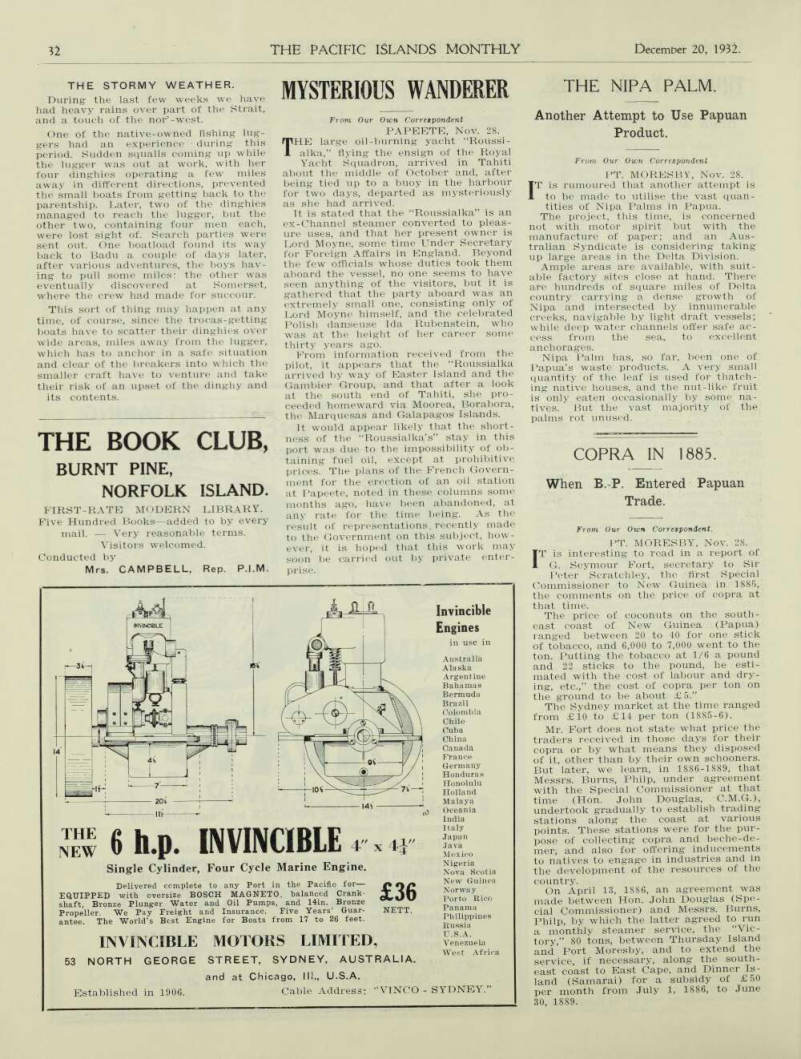
Bligh and Torres Straits.
From Our Own Correspondent.
Thursday Is., Nov. 25.
THE local branch of the Royal Geo graphical Society has added several new members to its list recently. A course of meetings has been arranged for some time ahead, and some good evenings are expected shortly from vis iting lecturers. Recently an evening was given to “Captain Bligh, the Bounty mutiny, and their relation to Torres Strait discovery,” the paper being one prepared by the Rev. W. H. MacFarlane.
There was a large attendance of members and friends, and some inter esting relics were shown, including an old sword picked up years ago on the Barrier Reef somewhere near Raine Is land, a copper kettle of the period of the “Bounty” (found by a Murray Island native in the same vicinity, so that it is quite possible that it may have be longed to the “Pandora,” which found ered when carrying some of the muti neers to England via Torres Strait), and a specimen of breadfruit. The lec ture covered the events down to the wreck of the “Pandora,” and a subse quent evening will be devoted to the second voyage of Bligh through Torres Strait.
It is interesting to notice that some of the names given by Bligh on his voyage have not survived—for instance, his Prince Edward Islands are now known by other names, and cartographers did not retain the name of the “Clarence Archipelago,” which he gave to the Straits when he hoisted the flag at North Possession Island. But one who fared much worse in this respect was Captain Edwards, whose designations of Wolf Bay (so called because of the howling of wolves—which must have been blackfellows’ dogs or possibly din goes), Sandwich Sound, Parker’s Island (now Wednesday), Lafory’s Island, etc., are just memories.
The Roman Catholic bazaar is one of the annual fixtures that is always looked torward to, and this year the event was as successful as ever, despite the bad times. It was held on November 11, in the church grounds, which were illum inated by electric light, and good work was put in by the stallholders. The proceeds amounted to about £218.
Refrigerators.
The installation of electric light in the town has enabled business people to make use of the power plant for various purposes, and one of the results is the putting-in of capacious refrigerators for handling of perishable lines.
With the new Port Kennedy Fresh Food and Ice Company operating in addition to the old-established Torres Strait Company, and the installation of refrig erators in the big stores, the island is finding itself able to make the best sel ectmn of small-goods, etc., that it has ever had.
The "talkies” are coming northward, and the Island, moving with the times, is to have its present silent pictures re placed by the vocal films very shortly.
It is expected that the necessary new plant will be installed before Christmas.
The work of dismantling the Barracks is going steadily forward, and the en gineers who were left by H.M.A.S. “Al
batross” a couple of months ago have now most of the buildings down ready for transhipment to Darwin, where they are to be re-erected. The process of transportation will take some time, how ever. It is rumoured that one or two of the military buildings will be left, and a small staff retained here. The removal of the garrison will have an effect on T. I., both from a commercial and social standpoint, however, and people here are very regretful at seeing the gradual disappearance of the big buildings on the hill.
State Enterprise?
Some time back, the co-operative en terprise which was started many years ago at Badu Island, Torres Strait, with the object of assisting Torres Strait in dustries and benefiting the natives, and which was known as “P. I.” (Papuan In dustries, Ltd.) was taken over by the Aboriginal Department and run by a Board under the name of “A. I.” (“Ab original Industries”). The stores at Badu were very convenient for natives on the western side, but those of the eastern group did not share this advantage so much, and the boats lost much time in
having to go round that way for their supplies after coming into Thursday Is land.
The Deputy-Protector of Aboriginals, who is up from Brisbane, has recently made a tour of the islands, and has ar ranged that, in addition to the Govern ment ketch “Melbider” carrying supplies of goods for sale to the natives, there will also be a small store on each of the bigger islands, worked as a department of the A.I. stores at Badu, and under the care of the Government Teacher.
This will prove very satisfying to the native (so long as he has the money to get stuff), but business people in Thurs day Island will feel the difference, and are wondering whether there is justifi cation for what would seem to be Gov ernment opposition to private enterprise.
The local branch of the Country Women’s Association has lately been en gaged in formulating some plan where by there might be a house or some suit able accommodation provided in Thurs day Island for the families of island officials, visitors from the Gulf district, or elsewhere, when they have to come in for varying periods.
The Stormy Weather.
During the last few weeks we have had heavy rains over part of the Strait, and a touch of the nor’-west.
One of the native-owned fishing lug gers had an experience during this period. Sudden squalls coming up while the lugger was out at work, with her four dinghies operating a few miles away in different directions, prevented the small boats from getting back to the parentship. Eater, two of the dinghies managed to reach the lugger, but the other two, containing four men each, were lost sight of. Search parties were sent out. One boatload found its way back to Badu a couple of days later, after various adventures, the boys hav ing to pull some miles: the other was eventually discovered at Somerset, where the crew had made for succour.
This sort of thing may happen at any time, of course, since the trocas-getting boats have to scatter their dinghies over wide areas, miles away from the lugger, which has to anchor in a safe situation and clear of the breakers into which the smaller craft have to venture and take their risk of an upset of the dinghy and its contents.
Advertisements & other items, pp. 33-34 (1 item)
Face Specialists.
RECOMMENDED BY ALL THE LEADING
THIS WORLD FAMOUS FACE POWDER.
Made in France JAVA RICE FACE POWDER has unmistakably earned its wonderful world-wide popularity.
It never imparts unsightly flat appearance that sometimes happens with ordinary powders; but unfailingly throws a veil of loveliness over the most delicate skin—heightening the complexion in a subtle manner. Non-injurious to the ten derest skin.
The soft petal-like texture of JAVA RICE FACE POWDER achieves wonders with previously neglected complexions.
Obtainable everywhere. In two sizes and all shades.
THE BOOK CLUB,
BURNT PINE,
NORFOLK ISLAND.
FIRST-RATE MODERN LIBRARY.
Five Hundred Books—added to by every mail. Very reasonable terms.
Visitors welcomed.
Conducted by
Mrs. CAMPBELL, Rep. P.I.M.
THE
NEW
6 h.p. INVINCIBLE 4" x 4¼"
Single Cylinder, Four Cycle Marine Engine.
Delivered complete to any Port in the Pacific for— EQUIPPED with oversize BOSCH MAGNETO, balanced Crank shaft, Bronze Plunger Water and Oil Pumps, and 14in. Bronze Propeller, We Pay Freight and Insurance. Five Years’ Guar antee. The World’s Best Engine for Boats from 17 to 26 feet. £36
NETT,
INVINCIBLE MOTORS LIMITED,
53 NORTH GEORGE STREET, SYDNEY, AUSTRALIA.
Invincible
Engines
in use in Australia Alaska Argentine Bahamas Bermuda Brazil Colombia Chile Cuba China Canada France Germany Honduras Honolulu Holland Malaya Oceania India Italy Japan Java Mexico Nigeria Nova Scotia New Guinea Norway Porto Rico Panama Philippines Russia
U.S.A.
Venezuela West Africa and at Chicago, Ill., U.S.A.
Established in 1906. Cable Address; “VINCO - SYDNEY.
Mysterious Wanderer
From Our Own Correspondent
Papeete, Nov. 28.
THE large oil-burning yacht “Roussi alka,” flying the ensign of the Royal Yacht Squadron, arrived in Tahiti about the middle of October and, after being tied up to a buoy in the harbour for two days, departed as mysteriously as she had arrived.
It is stated that the “Roussialka” is an ex-Channel steamer converted to pleas ure uses, and that her present owner is Lord Moyne, some time Under Secretary for Foreign Affairs in England. Beyond the few officials whose duties took them aboard the vessel, no one seems to have seen anything of the visitors, but it is gathered that the party aboard was an extremely small one, consisting only of Lord Moyne himself, and the celebrated Polish danseuse Ida Rubenstein, who was at the height of her career some thirty years ago.
From information received from the pilot, it appears that the “Roussialka arrived by way of Easter Island and the Gambier Group, and that after a look at the south end of Tahiti, she pro ceeded homeward via Moorea, Borabora, the Marquesas and Galapagos Islands.
It would appear likely that the short ness of the “Roussialka’s” stay in this port was due to the impossibility of ob taining fuel oil, except at prohibitive prices. The plans of the French Govern ment for the erection of an oil station at Papeete, noted in these columns some months ago, have been abandoned, at any rate for the time being. As the result of representations, recently made to the Government on this subject, how ever, it is hoped that this work may soon be carried out by private enter prise.
The Nipa Palm.
Another Attempt to Use Papuan Product.
From Our Own Correspondent
Pt. Moresby, Nov. 28.
IT is rumoured that another attempt is to be made to utilise the vast quan tities of Nipa Palms in Papua.
The project, this time, is concerned not with motor spirit but with the manufacture of paper; and an Aus tralian Syndicate is considering taking up large areas in the Delta Division.
Ample areas are available, with suit able factory sites close at hand. There are hundreds of square miles of Delta country carrying a dense growth of Nipa and intersected by innumerable creeks, navigable by light draft vessels; while deep water channels offer safe ac cess from the sea, to excellent anchorages.
Nipa Palm has, so far, been one of Papua’s waste products. A very small quantity of the leaf is used for thatch ing native houses, and the nut-like fruit is only eaten occasionally by some na tives. But the vast majority of the palms rot unused.
Copra In 1885.
When B.P. Entered Papuan Trade.
From Our Own Correspondent.
Pt. Moresby, Nov. 28.
IT is interesting to read in a report of G. Seymour Fort, secretary to Sir Peter Scratchley, the first Special Commissioner to New Guinea in 1885, the comments on the price of copra at that time.
The price of coconuts on the south east coast of New Guinea (Papua) rang-ed between 20 to 40 for one stick of tobacco, and 6,000 to 7,000 went to the ton. Putting the tobacco at 1/6 a pound and 22 sticks to the pound, he esti mated with the cost of labour and dry ing, etc.,” the cost of copra per ton on the ground to be about £ 5.”
The Sydney market at the time ranged from £10 to £14 per ton (1885-6).
Mr. Fort does not state what price the traders received in those days for their copra or by what means they disposed of it, other than by their own schooners.
But later, we learn, in 1886-1889, that Messrs. Burns, Philp, under agreement with the Special Commissioner at that time (Hon. John Douglas, C.M.G.), undertook gradually to establish trading stations along the coast at various points. These stations were for the pur pose of collecting copra and beche-de mer, and also for offering inducements to natives to engage in industries and in the development of the resources of the country.
On April 13, 1886, an agreement was made between Hon. John Douglas (Spe cial Commissioner) and Messrs. Burns, Philp, by which the latter agreed to run a monthly steamer service, the “Vic tory,” 80 tons, between Thursday Island and Port Moresby, and to extend the service, if necessary, along the south east coast to East Cape, and Dinner Is land (Samarai) for a subsidy of £50 per month from July 1, 1886, to June 30, 1889.
Exploring The Fly.
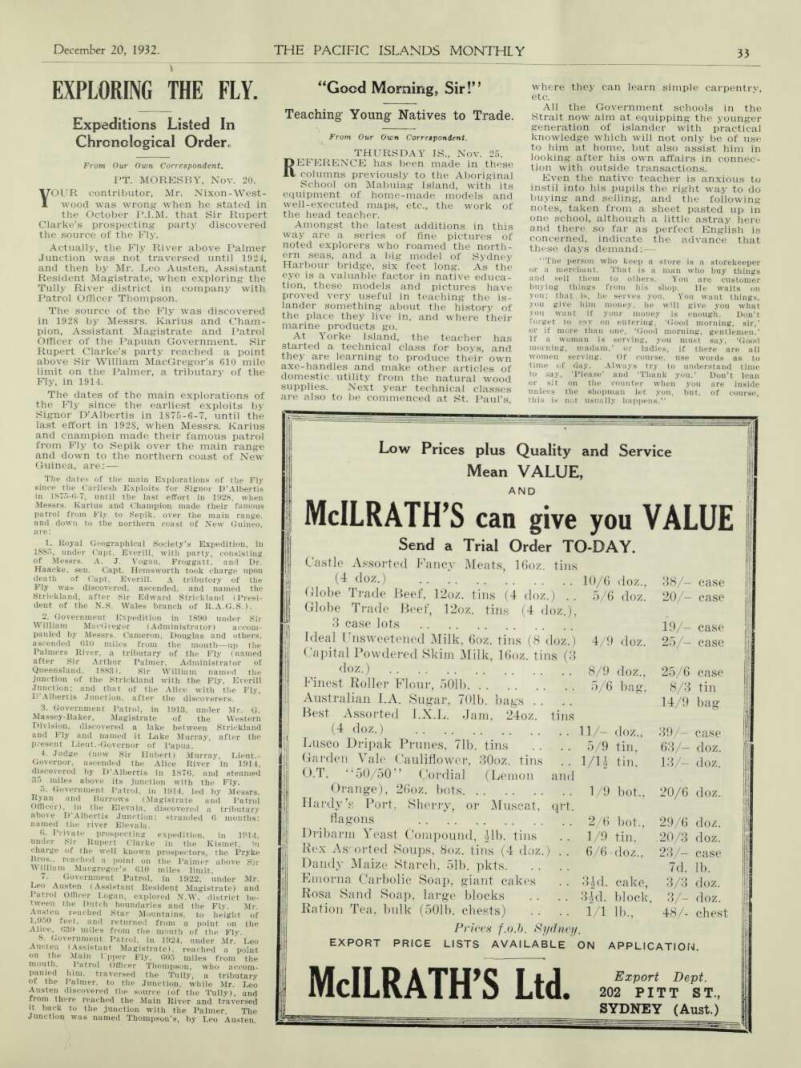
Expeditions Listed In Chronological Order.
From Our Own Correspondent.
Pt. Moresby, Nov. 20.
YOUR contributor, Mr. Nixon-West
wood was wrong when he stated in the October P.I.M. that Sir Rupert
Clarke’s prospecting party discovered
the source of the Fly.
Actually, the Fly River above Palmer Junction was not traversed until 1924, and then by Mr. Leo Austen, Assistant Resident Magistrate, when exploring the Tully River district in company with Patrol Officer Thompson.
The source of the Fly was discovered in 1928 by Messrs. Karius and Cham pion, Assistant Magistrate and Patrol Officer of the Papuan Government. Sir Rupert Clarke’s party reached a point above Sir William MacGregor’s 610 mile limit on the Palmer, a tributary of the Fly, in 1914.
The dates of the main explorations of the Fly since the earliest exploits by Signor D’Albertis in 1875-6-7, until the last effort in 1928, when Messrs. Karius and champion made their famous patrol from Fly to Sepik over the main range and down to the northern coast of New
Guinea, are;
The dates of the main Explorations of the Fly since the Carliesh Exploits for Signor D’Albertis in 1875-6-7, until the last effort in 1928, when Messrs. Karius and Champion made their famous patrol from Fly to Sepik, over the main range, and down to the northern coast of New Guinea, are: 1. Royal Geographical Society’s Expedition, in 1885, under Capt. Everill, with party, consisting of Messrs. A. J. Vogan, Froggatt, and Dr.
Haacke, sen. Capt. Hemsworth took charge upon death of Capt. Everill. A tributory of the Fly was discovered, ascended, and named the Strickland, after Sir Edward Strickland (Presi dent of the N.S. Wales branch of R.A.G.S.). 2. Government Expedition in 1890 under Sir William MacGregor (Administrator) accom panied by Messrs. Cameron, Douglas and others, ascended 610 miles from the mouth —up the Palmers River, a tributary of the Fly (named after Sir Arthur Palmer. Administrator of Queensland. 1883). Sir William named the junction of the Strickland with the Fly, Everill Junction; and that of the Alice with the Fly, D’Albertis Junction, after the discoverers. 3. Government Patrol, in 1913, under Mr. G.
Massey-Baker, Magistrate of the Western Division, discovered a lake between Strickland and Fly and named it Lake Murray, after the present Lieut.-Governor of Papua. 4. Judge (now Sir Hubert) Murray, Lieut.- Governor, ascended the Alice River in 1914, discovered by D’Albertis in 1876, and steamed 35 miles above its junction with the Fly. 5. Government Patrol, in 1914, led by Messrs.
Ryan and Burrows (Magistrate and Patrol Officer), in the Elevala, discovered a tributary above D’Albertis Junction; stranded 6 months: named the river Elevala. 6. Private prospecting expedition, in 1914, under Sir Rupert Clarke in the Kismet, in charge of the well known prospectors, the Pryke Bros., reached a point on the Palmer above Sir William Macgregor’s 610 miles limit. 7. Government Patrol, in 1922, under Mr.
Leo Austen (Assistant Resident Magistrate) and Patrol Officer Logan, explored N.W. district be tween the Dutch boundaries and the Fly. Mr.
Austen reached Star Mountains, to height of 1,930 feet, and returned from a point on the Alice, 630 miles from the mouth of the Fly 8. Government Patrol, in 1924, under Mr. Leo Austen (Assistant Magistrate), reached a point on the Main Fpper Fly, 605 miles from the mouth. Patrol Officer Thompson, who accom panied him, traversed the Tully, a tributary of the Palmer, to the Junction, while Mr. Leo Austen discovered the source (of the Tully), and from there reached the Main River and traversed it back to the junction with the Palmer The Junction was named Thompson’s, by Leo Austen.
“Good Morning, Sir!”
Teaching Young Natives to Trade.
From Our Own Correspondent.
Thursday Is., Nov. 25.
REFERENCE has been made in these columns previously to the Aboriginal School on Mabuiag Island, with its equipment of home-made models and well-executed maps, etc., the work of the head teacher.
Amongst the latest additions in this way are a series of fine pictures of noted explorers who roamed the north ern seas, and a big model of Sydney Harbour bridge, six feet long. As the eye is a valuable factor in native educa tion, these models and pictures have proved very useful in teaching the is lander something about the history of the place they live in, and where their marine products go.
At Yorke Island, the teacher has started a technical class for boys, and they are learning to produce their own axe-handles and make other articles of domestic, utility from the natural wood supplies. Next year technical classes are also to be commenced at St. Paul’s,
where they can learn simple carpentry, etc.
All the Government schools in the Strait now aim at equipping the younger g-eneration of islander with practical knowledge which will not only be of use to him at home, but also assist him in looking after his own affairs in connec tion with outside transactions.
Even the native teacher is anxious to instil into his pupils the right way to do buying and selling, and the following notes, taken from a sheet pasted up in one school, although a little astray here and there so far as perfect English is concerned, indicate the advance that these days demand: “The person who keep a store is a storekeeper or a merchant. That is a man who buy things and sell them to others. You are customer buying things from his shop. He waits on you; that is, he serves you. You want things, you give him money, he will give you what you want if your money is enough. Don’t forget to say on entering, ‘Good morning, sir,’ or if more than one, ‘Good morning, gentlemen.’
If a woman is serving, you must say, ‘Good morning, madam,’ or ladies, if there are all women serving. Of course, use words as to time of day. Always try to understand time to say, ‘Please’ and ‘Thank you.’ Don’t lean or sit on the counter when you are inside unless the shopman let you, but, of course, this is not usually happens.’’
Advertisements & other items, p. 35 (1 item)
Mcilrath’S Ltd.
Low Prices plus Quality and Service Mean VALUE,
McILRATH’S can give you VALUE
Send a Trial Order TO-DAY.
Castle Assorted Fancy Meats, 16oz. tins (4 doz.) 10/6 doz., 38/- case Globe Trade Beef, 12oz. tins (4 doz.) .. 5/6 doz. 20/- case Globe Trade Beef, 12oz. tins (4 doz.), 3 case lots 19/- case Ideal Unsweetened Milk, 6oz. tins (8 doz.) 4/9 doz. 25/- case Capital Powdered Skim Milk, 16oz. tins (3 doz -) 8/9 doz., 25/6 case Finest Roller Flour, 50lb 5/6 bag, 8/3 tin Australian LA. Sugar, 70lb. bags .. .. 14/9 bag Best Assorted I.X.L. Jam, 240 z. tins (4 doz.) 11/ doz., 39/ case Lusco Dripak Prunes, 7lb. tins . . . . 5/9 tin, 63/- doz.
Garden Vale Cauliflower, 30oz. tins .. 1/1£ tin, 13/- doz.
O.T. “50/50” Cordial (Lemon and Orange), 260 z. bots 1/9 bot., 20/6 doz.
Hardy’s Port, Sherry, or Muscat, qrt. flagons 2/6 bot., 29/6 doz.
Dribarm Yeast Compound, tins . . 1/9 tin, 20/3 doz.
Rex Assorted Soups, Boz. tins (4 doz.) . . 6/6 doz., 23/- case Dandy Maize Starch, 5lb. pkts 7d. lb.
Emorna Carbolic Soap, giant cakes . . 3½d. cake, 3/3 doz.
Rosa Sand Soap, large blocks . . . . 3½d. block, 3/- doz.
Ration Tea, bulk (501 b. chests) .. .. 1/1 lb., 48/- chest Prices f.o.b. Sydney.
EXPORT PRICE LISTS AVAILABLE ON APPLICATION.
McILRATH’S Ltd.
SYDNEY (Aust.)
All Quiet In Samoa.
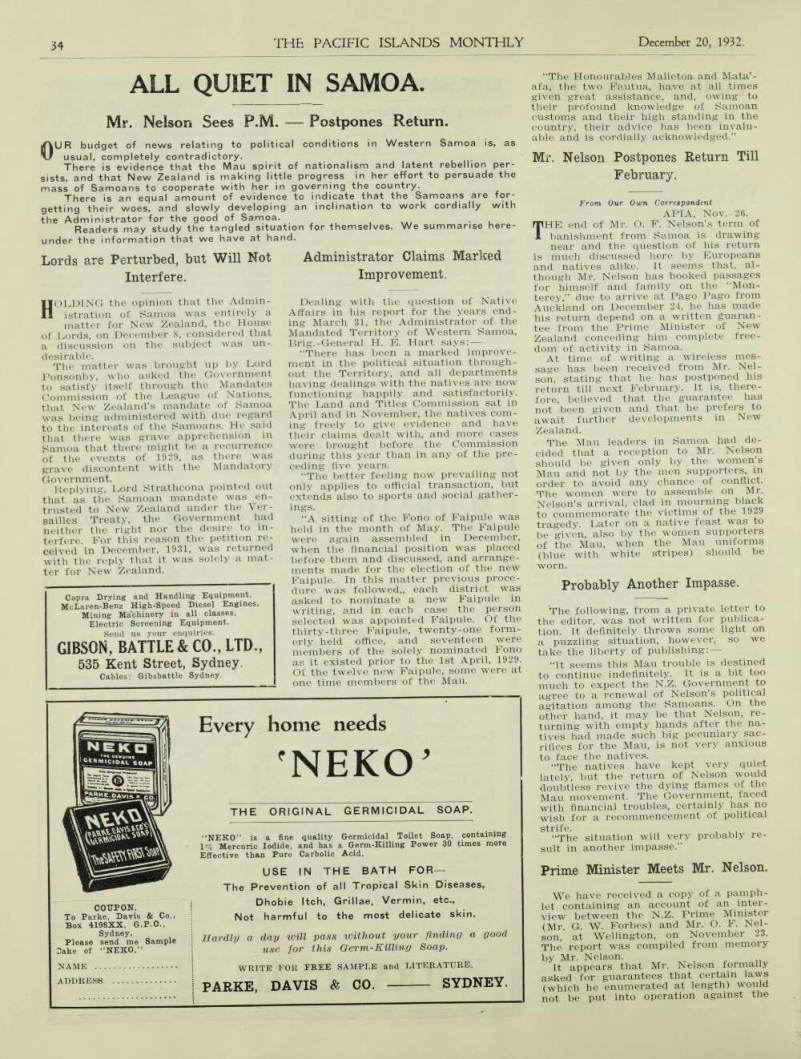
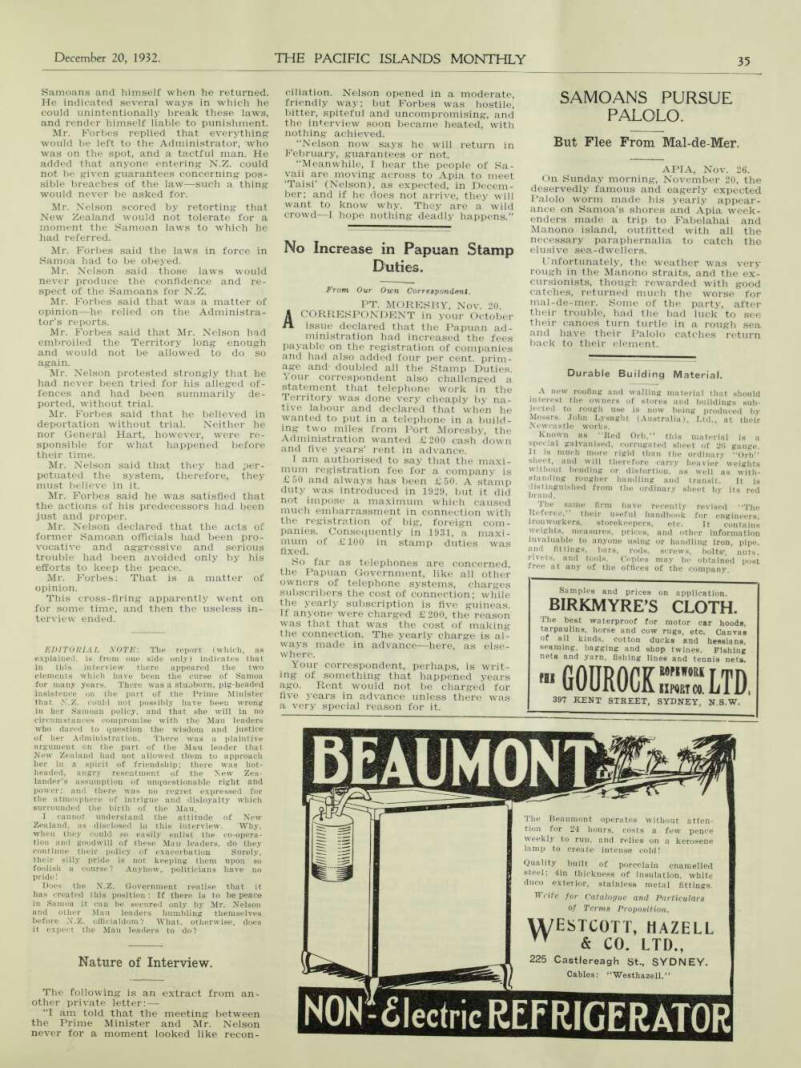
Mr. Nelson Sees P.M. — Postpones Return.
OUR budget of news relating to political conditions in Western Samoa is, as usual, completely contradictory.
There is evidence that the Mau spirit of nationalism and latent rebellion per sists, and that New Zealand is making little progress in her effort to persuade the mass of Samoans to cooperate with her in governing the country.
There is an equal amount of evidence to indicate that the Samoans are for getting their woes, and slowly developing an inclination to work cordially with the Administrator for the good of Samoa. .
Readers may study the tangled situation for themselves. We summarise here under the information that we have at hand.
Lords are Perturbed, but Will Not
Interfere.
HOLDING the opinion that the Admin istration of Samoa was entirely a matter for New Zealand, the House of Lords, on December 8, considered that a discussion on the subject was un desirable.
The matter was brought up by Lord Ponsonby, who asked the Government to satisfy itself through the Mandates Commission of the League of Nations, that New Zealand’s mandate of Samoa was being administered with due regard to the interests of the Samoans. He said that there was grave apprehension in Samoa that there might be a recurrence of the events of 1929, as there was grave discontent with the Mandatory Government.
Replying, Lord Strathcona pointed out that as the Samoan mandate was en trusted to New Zealand under the Ver sailles Treaty, the Government had neither the right nor the desire to in terfere. For this reason the petition re ceived in December, 1931, was returned with the reply that it was solely a mat ter for New Zealand.
Administrator Claims Marked
Improvement.
Dealing with the question of Native Affairs in his report for the years end ing March 31, the Administrator of the Mandated Territory of Western Samoa, Brig.-General H. E. Hart says: “There has been a marked improve ment in the political situation through out the Territory, and all departments having dealings with the natives are now functioning happily and satisfactorily.
The Land and Titles Commission sat in April and in November, the natives com ing freely to give evidence and have their claims dealt with, and more cases were brought before the Commission during this year than in any of the pre ceding five years.
“The better feeling now prevailing not only applies to official transaction, but extends also to sports and social gather ings.
“A sitting of the Fono of Faipule was held in the month of May. The Faipule were again assembled in December, when the financial position was placed before them and discussed, and arrange ments made for the election of the new Faipule. In this matter previous proce dure was followed, each district was asked to nominate a new Faipule in writing, and in each case the person selected was appointed Faipule. Of the thirty-three Faipule, twenty-one form erly held office, and seventeen were members of the solely nominated Fono as it existed prior to the Ist April, 1929.
Of the twelve new Faipule, some were at one time members of the Mau.
“The Honourables Malietoa and Mata’ afa, the two Fautua, have at all times given great assistance, and, owing to their profound knowledge of Samoan customs and their high standing in the country, their advice has been invalu able and is cordially acknowledged.”
Mr. Nelson Postpones Return Till
February.
From Our Own Correspondent
Apia, Nov. 26.
THE end of Mr. O. F. Nelson’s term of banishment from Samoa is drawing near and the question of his return is much discussed here by Europeans and natives alike. It seems that, al though Mr. Nelson has booked passages for himself and family on the “Mon terey,” due to arrive at Pago Pago from Auckland on December 24, he has made his return depend on a written guaran tee from the Prime Minister of New Zealand conceding him complete free dom of activity in Samoa.
At time of writing a wireless mes sage has been received from Mr. Nel son, stating that he has postponed his return till next February. It is, there fore, believed that the guarantee has not been given and that he prefers to await further developments in New Zealand.
The Mau leaders in Samoa had de cided that a reception to Mr. Nelson should be given only by the women’s Mau and not by the men supporters, in order to avoid any chance of conflict.
The women were to assemble on Mr.
Nelson’s arrival, clad in mourning black to commemorate the victims of the 1929 tragedy. Later on a native feast was to be given, also by the women supporters of the Mau, when the Mau uniforms (blue with white stripes) should be worn.
Probably Another Impasse.
The following, from a private letter to the editor, was not written for publica tion. It definitely throws some light on a puzzling situation, however, so we take the liberty of publishing: “It seems this Mau trouble is destined to continue indefinitely. It is a bit too much to expect the N.Z. Government to agree to a renewal of Nelson’s political agitation among the Samoans. On the other hand, it may be that Nelson, re turning with empty hands after the na tives had made such big pecuniary sac rifices for the Mau, is not very anxious to face the natives.
“The natives have kept very quiet lately, but the return of Nelson would doubtless revive the dying flames of the Mau movement. The Government, faced with financial troubles, certainly has no wish for a recommencement of political strife.
“The situation will very probably re sult in another impasse.”
Prime Minister Meets Mr. Nelson.
We have received a copy of a pamph let containing an account of an inter view between the N.Z. Prime Minister (Mr G. W. Forbes) and Mr. O. F. Nel son, at Wellington, on November 23.
The report was compiled from memory by Mr. Nelson.
It appears that Mr. Nelson formally asked for guarantees that certain laws (which he enumerated at length) would not be put into operation against the
Samoans and himself when he returned.
He indicated several ways in which he could unintentionally break these laws, and render himself liable to punishment.
Mr. Forbes replied that everything would be left to the Administrator, who was on the spot, and a tactful man. He added that anyone entering N.Z. could not be given guarantees concerning pos sible breaches of the law —such a thing would never be asked for.
Mr. Nelson scored by retorting that New Zealand would not tolerate for a moment the Samoan laws to which he had referred.
Mr. Forbes said the laws in force in Samoa had to be obeyed.
Mr. Nelson said those laws would never produce the confidence and re spect of the Samoans for N.Z.
Mr. Forbes said that was a matter of opinion—he relied on the Administra tor’s reports.
Mr. Forbes said that Mr. Nelson had embroiled the Territory long enough and would not be allowed to do so again.
Mr. Nelson protested strongly that he had never been tried for his alleged of fences and had been summarily de ported, without trial.
Mr. Forbes said that he believed in deportation without trial. Neither he nor General Hart, however, were re sponsible for what happened before their time.
Mr. Nelson said that they had per petuated the system, therefore, they must believe in it.
Mr. Forbes said he was satisfied that the actions of his predecessors had been just and proper.
Mr. Nelson declared that the acts of former Samoan officials had been pro vocative and aggressive and serious trouble had been avoided only by his efforts to keep the peace.
Mr. Forbes; That is a matter of opinion.
This cross-firing apparently went on for some time, and then the useless in terview ended.
EDITORIAL NOTE: The report (which, as explained, is from one side only) indicates that in this interview there appeared the two elements which have been the curse of Samoa for many years. There was a stubborn, pig-headed insistence on the part of the Prime Minister that N.Z. could not possibly have been wrong in her Samoan policy, and that she will in no circumstances compromise with the Mau leaders who dared to question the wisdom and justice of her Administration. There was a plaintive argument on the part of the Mau leader that New Zealand had not allowed them to approach her in a spirit of friendship; there was hot headed, angry resentment of the New Zea lander’s assumption of unquestionable right and power; and there was no regret expressed for the atmosphere of intrigue and disloyalty which surrounded the birth of the Mau.
I cannot understand the attitude of New Zealand, as disclosed in this interview. Why, when they could so easily enlist the co-opera tion and goodwill of these Mau leaders, do they continue their policy of exacerbation. Surely, their silly pride is not keeping them upon so foolish a course? Anyhow, politicians have no pride!
Does the N.Z. Government realise that it has created this position: If there is to be peace in Samoa it can be secured only by Mr. Nelson and other Mau leaders humbling themselves before N.Z. officialdom? What, otherwise, does it expect the Mau leaders to do?
Advertisements & other items, p. 36 (1 item)
Every home needs
Copra Drying and Handling Equipment.
McLaren-Benz High-Speed Diesel Engines, Mining Machinery in all classes.
Electric Screening Equipment.
Send us your enquiries.
GIBSON, BATTLE & CO., LTD.,
535 Kent Street, Sydney.
Cables: Gibsbattle Sydney.
COUPON.
To Parke, Davis & Co..
Box 4198 XX, G.P.O.,
Sydney.
Please send me Sample Sake of “NEKO.”
NAME
ADDRESS
Every home needs
'NEKO’
THE ORIGINAL GERMICIDAL SOAP.
“NEKO” is a fine quality Germicidal Toilet Soap, containing 1% Mercuric Iodide, and has a Germ-Killing Power 30 times more Effective than Pure Carbolic Acid.
USE IN THE BATH FOR—
The Prevention of all Tropical Skin Diseases, Dhobie Itch, Grillae, Vermin, etc., Not harmful to the most delicate skin.
Hardly a day will pass without your finding a good use for this Germ-Killing Soap.
WRITE FOR FREE SAMPLE and LITERATURE.
PAEKE, DAVIS & CO. SYDNEY.
Nature of Interview.
The following is an extract from an other private letter: “I am told that the meeting between the Prime Minister and Mr. Nelson never for a moment looked like recon
ciliation. Nelson opened in a moderate, friendly way; but Forbes was hostile, bitter, spiteful and uncompromising, and the interview soon became heated, with nothing achieved.
“Nelson now says he will return in February, guarantees or not, “Meanwhile, I hear the people of Sa vaii are moving across to Apia to meet ‘Taisi’ (Nelson), as expected, in Decem ber; and if he does not arrive, they will want to know why. They are a wild crowd —I hope nothing deadly happens.”
Duties.
No Increase in Papuan Stamp Duties.
From Our Own Correspondent.
Pt. Moresby, Nov. 20.
A CORRESPONDENT in your October issue declared that the Papuan ad ministration had increased the fees payable on the registration of companies and had also added four per cent, prim age and doubled all the Stamp Duties.
Your correspondent also challenged a statement that telephone work in the Territory was done very cheaply by na tive labour and declared that when he wanted to put in a telephone in a build ing two miles from Port Moresby, the Administration wanted £200 cash down and five years’ rent in advance.
I am authorised to say that the maxi mum registration fee for a company is £50 and always has been £50. A stamp duty was introduced in 1929, but it did not impose a maximum which caused much embarrassment in connection with the registration of big, foreign com panies. Consequently in 1931, a maxi mum of £100 in stamp duties was fixed.
So far as telephones are concerned, the Papuan Government, like all other owners of telephone systems, charges subscribers the cost of connection; while the yearly subscription is five guineas.
If anyone were charged £200, the reason was that that was the cost of making the connection. The yearly charge is al ways made in advance—here, as else where.
Your correspondent, perhaps, is writ ing of something that happened years ago. Rent would not be charged for five years in advance unless there was a very special reason for it.
Samoans Pursue
Palolo.
But Flee From Mal-de-Mer.
Apia, Nov. 26.
On Sunday morning-, November 20, the deservedly famous and eagerly expected Palolo worm made his yearly appear ance on Samoa’s shores and Apia week enders made a trip to Fabelahai and Manono island, outfitted with all the necessary paraphernalia to catch the elusive sea-dwellers.
Unfortunately, the weather was very rough in the Manono straits, and the ex cursionists, though rewarded with good catches, returned much the worse for mal-de-mer. Some of the party, after their trouble, had the bad luck to see their canoes turn turtle in a rough sea and have their Palolo catches return back to their element.
Durable Building Material.
A new roofing and walling material that should interest the owners of stores and buildings sub jected to rough use is now being produced by Messrs. John Lysaght (Australia), Ltd., at their Newcastle works.
Known as ‘Red Orb,” this material is a special galvanised, corrugated sheet of 26 gauge.
It is much more rigid than the ordinary “Orb” sheet, and will therefore carry heavier weights without bending or distortion, as well as with standing rougher handling and transit. It is distinguished from the ordinary sheet by its red brand.
The same firm have recently revised “The Referee,” their useful handbook for engineers, ironworkers, storekeepers, etc. It contains weights, measures, prices, and other information invaluable to anyone using or handling iron, pipe, and fittings, bars, rods, screws, bolts, nuts, rivets, and tools. Copies may be obtained post free at any of the offices of the company.
Advertisements & other items, p. 37 (1 item)
Westcott, Hazell
Samples and prices on application.
BIRKMYRE’S CLOTH.
The best waterproof for motor car hoods, tarpaulins, horse and cow rugs, etc. Canvas of all kinds, cotton ducks and hessians, seaming, bagging and shop twines. Fishing nets and yarn, fishing lines and tennis nets, The GOUROCK Ropework Export Co. LTD,
397 KENT STREET, SYDNEY, N.S.W.
The Beaumont operates without atten tion for 24 hours, costs a few pence weekly to run, and relies on a kerosene lamp to create intense cold!
Quality built of porcelain enamelled steel; 4in thickness of insulation, white duco exterior, stainless metal fittings, Write for Catalogue and Particulars of Terms Proposition.
WESTCOTT, HAZELL
& CO. LTD.,
225 Castlereagh St., SYDNEY.
Cables: “Westhazell.”
Tahiti Notes.
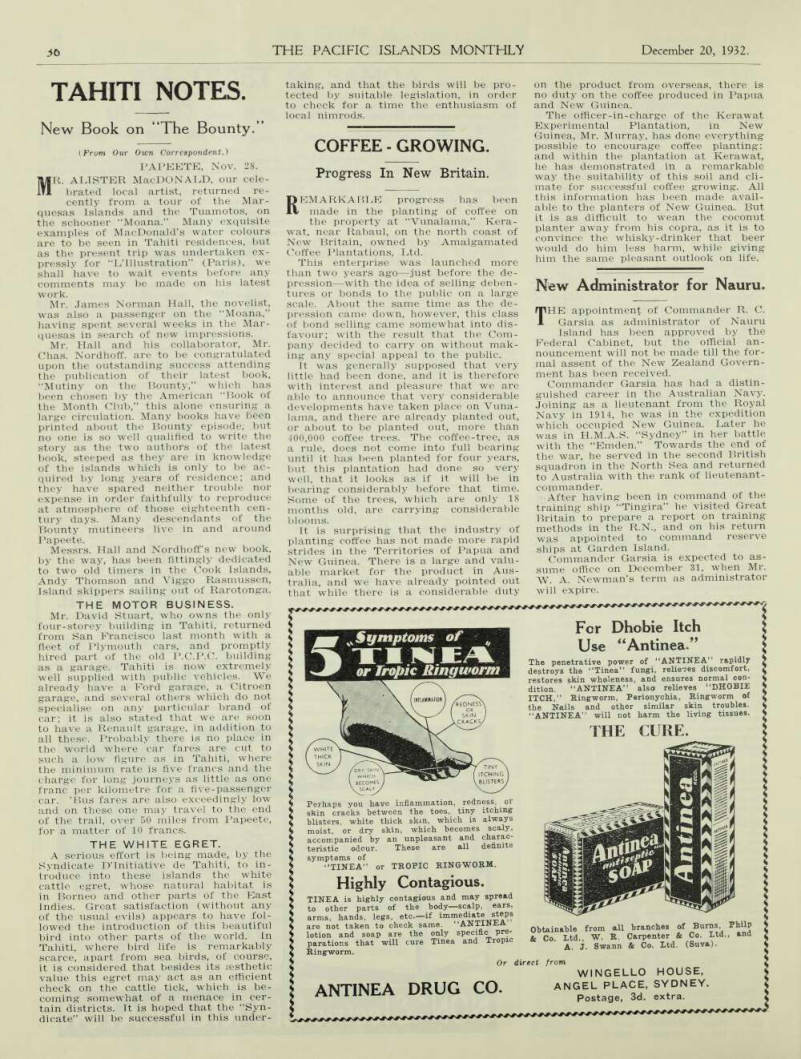
New Book on “The Bounty.”
(From Our Own Correspondent.)
Papeete, Nov. 28.
MR. ALISTER MacDONALD, our cele brated local artist, returned re cently from a tour of the Mar quesas Islands and the Tuamotos, on the schooner “Moana.” Many exquisite examples of MacDonald’s water colours are to be seen in Tahiti residences, but as the present trip was undertaken ex pressly for “L'Illustration” (Paris), we shall have to wait events before any comments may be made on his latest work.
Mr. James Norman Hall, the novelist, was also a passenger on the “Moana,” having spent several weeks in the Mar quesas in search of new impressions.
Mr. Hall and his collaborator, Mr.
Chas. Nordhoff, are to be congratulated upon the outstanding success attending the publication of their latest book, “Mutiny on the Bounty,” which has been chosen by the American “Book of the Month Club,” this alone ensuring a large circulation. Many books have been printed about the Bounty episode, but no one is so well qualified to write the story as the two authors of the latest book, steeped as they are in knowledge of the islands which is only to be ac quired by long years of residence; and they have spared neither trouble nor expense in order faithfully to reproduce at atmosphere of those eighteenth cen tury days. Many descendants of the Bounty mutineers live in and around Papeete.
Messrs. Hall and Nordhoff’s new book, by the way, has been fittingly dedicated to two old timers in the Cook Islands, Andy Thomson and Viggo Rasmussen, Island skippers sailing out of Rarotonga.
The Motor Business.
Mr. David Stuart, who owns the only four-storey building in Tahiti, returned from San Francisco last month with a fleet of Plymouth cars, and promptly hired part of the old P.C.P.C. building as a garage. Tahiti is now extremely well supplied with public vehicles. We already have a Ford garage, a Citroen garage, and several others which do not specialise on any particular brand of car; it is also stated that we are soon to have a Renault garage, in addition to all these. Probably there is no place in the world where car fares are cut to such a low figure as in Tahiti, where the minimum rate is five francs and the charge for long journeys as little as one franc per kilometre for a five-passenger car. ’Bus fares are also exceedingly low and on these one may travel to the end of the trail, over 50 miles from Papeete, for a matter of 10 francs.
The White Egret.
A serious effort is being made, by the Syndicate D'Initiative de Tahiti, to in troduce into these islands the white cattle egret, whose natural habitat is in Borneo and other parts of the East Indies. Great satisfaction (without any of the usual evils) appears to have fol lowed the introduction of this beautiful bird into other parts of the world. In Tahiti, where bird life is remarkably scarce, apart from sea birds, of course, it is considered that besides its aesthetic value this egret may act as an efficient check on the cattle tick, which is be coming somewhat of a menace in cer tain districts. It is hoped that the “Syn dicate” will be successful in this under
taking, and that the birds will be pro tected by suitable legislation, in order to check for a time the enthusiasm of local nimrods.
Coffee-Growing.
Progress In New Britain.
REMARKABLE progress has been made in the planting of coffee on the property at “Vunalama,” Kera wat, near Rabaul, on the north coast of New Britain, owned by Amalgamated Coffee Plantations, Ltd.
This enterprise was launched more than two years ago—just before the de pression—with the idea of selling deben tures or bonds to the public on a large scale. About the same time as the de pression came down, however, this class of bond selling came somewhat into dis favour; with the result that the Com pany decided to carry on without mak ing any special appeal to the public..
It was generally supposed that very little had been done, and it is therefore with interest and pleasure that we are able to announce that very considerable developments have taken place on Vuna lama, and there are already planted out, or about to be planted out, more than 400,000 coffee trees. The coffee-tree, as a rule, does not come into full bearing until it has been planted for four years, but this plantation had done so very well, that it looks as if it will be in bearing considerably before that time.
Some of the trees, which are only 18 months old, are carrying considerable blooms.
It is surprising that the industry of planting coffee has not made more rapid strides in the Territories of Papua and New Guinea. There is a large and valu able market for the product in Aus tralia, and we have already pointed out that while there is a considerable duty
on the product from overseas, there is no duty on the coffee produced in Papua and New Guinea.
The officer-in-charge of the Kerawat Experimental Plantation, in New Guinea, Mr. Murray, has done everything possible to encourage coffee planting: and within the plantation at Kerawat, he has demonstrated in a remarkable way the suitability of this soil and cli mate for successful coffee growing. All this information has been made avail able to the planters of New Guinea. But it is as difficult to wean the coconut planter away from his copra, as it is to convince the whisky-drinker that beer would do him less harm, while giving him the same pleasant outlook on life.
New Administrator for Nauru.
THE appointment of Commander R. C.
Garsia as administrator of Nauru Island has been approved by the Federal Cabinet, but the official an nouncement will not be made till the for mal assent of the New Zealand Govern ment has been received.
Commander Garsia has had a distin guished career in the Australian Navy.
Joining as a lieutenant from the Royal Navy in 1914, he was in the expedition which occupied New Guinea. Later he was in H.M.A.S. “Sydney” in her battle with the “Emden.” Towards the end of the war, he served in the second British squadron in the North Sea and returned to Australia with the rank of lieutenant commander.
After having been in command of the training ship “Tingira” he visited Great Britain to prepare a report on training methods in the R.N., and on his return was appointed to command reserve ships at Garden Island.
Commander Garsia is expected to as sume office on December 31, when Mr.
W. A. Newman’s term as administrator will expire.
Advertisements & other items, p. 38 (1 item)
Highly Contagious.
5 Symptoms of "TINEA"
or Tropic Ringworm
Perhaps you have inflammation, redness, or skin cracks between the toes, tiny itching blisters, white thick skin, which is always moist, or dry skin, which becomes scaly, accompanied by an unpleasant and charac teristic odour. These are all definite symptoms of
"TINEA” or TROPIC RINGWORM.
Highly Contagious.
TINEA is highly contagious and may spread to other parts of the body—scalp, ears, arms, hands, legs, etc.—if immediate steps are not taken to check same. ‘‘ANTINEA lotion and soap are the only specific pre parations that will cure Tinea and Tropic Ringrworm.
For Dhobie Itch
Use “Antinea,”
The penetrative power of “ANTINEA” rapidly destroys the “Tinea” fungi, relieves discomfort, restores skin wholeness, and ensures normal con dition. “ANTINEA” also relieves “DHOBIE ITCH,” Ringworm, Perionychia, Ringworm of the Nails and other similar skin troubles.
“ANTINEA” will not harm the living tissues.
THE CURE.
Obtainable from all branches of Burns, Philp & Co. Ltd., W. R. Carpenter & Co. Ltd., and A. J. Swann & Co. Ltd. (Suva)
ANTINEA DRUG CO.
Or direct from direct from
WINGELLO HOUSE,
ANGEL PLACE, SYDNEY.
Postage, 3d. extra.
Value Of Tung Oil.
THE answer to the question of how much oil a tung-oil tree will produce and what may be expected in the way of income may now be given with approximate accuracy.
The average yield of tested trees over a ten year period as reported by the University of Florida Experiment Sta tion was 24.08 pounds of dry shelled nuts per tree. Nuts have been crushed, to find that they yield about 33 1/3 per cent. oil. On this basis, the average yield per tree for the ten years would be eight pounds plus of oil. The average price of oil over the ten-year period from 1922 to 1931, inclusive, was high 15.54 cents and low 14.02 cents. Each tree, therefore, produced approximately 1.20 dollars’ worth of oil in a year.
A four-year-old tree at the University Experimental Station grew forty pounds of nuts. From these nuts were taken eight pounds of oil, and at fifteen cents a pound the tree earned 1.20 dollars. An acre with sixty trees would yield 72 dollars. Each year it will increase the yield until the tree is fifteen years old.
After the trees are big enough to shade the ground they need very little cultivation. A very important factor in keeping down expense is the use of live stock in the groves. They do not harm the trees, but gather the grass and cover crop so that the nuts can be easily found. Where the weeds and grass grow high under the trees it is expensive to gather the crop and diffi cult to find the nuts. —J. F. Massey in “Country Gentleman.”
EDITORIAL NOTE: It should be noted that the Fordii variety of Tung Oil tree is grown in Florida, and it is very doubtful whether Fordii can be grown successfully in the Pacific Islands, although experiments are being made in many places. We believe that the Montana variety, although a less prolific yielder than the Fordii, will yet be found most suitable for the Pacific Islands cultivation. The Fordii is indigenous in the Yangtse Valley, China; while the Montana comes from much further south, in the Cochin China region.
A Narrow Escape from The “Tree
“Tree of Skulls.”
IT was not only in pre-European days that the savage Tugiri people came to Saibai Island to collect further me mentoes for their grisly ‘‘Tree of Skulls,” as Ion Idriess would suggest in his story in the P.I.M., 21/9/32.
Mr. A. W. Minshull, of Brisbane, writes that he was on Saibai as a child during one of these raids. He says: ‘‘My mother, sister and I were on Saibai when the Tugiri men came in their war canoes within a mile of the shore. We were ordered into the church with the women folk and, after a battle, the Tu giri men were beaten off. Thank God! for otherwise we wouldn’t be alive to tell this tale.” ‘‘We were still on Saibai when the Rev. Chalmers and Tomkins were mur dered. My mother and sister were the first white women and I was the first white boy there. That was in 1901 and the Tugiri men often came to Boigu, not far away, during our two years’ stay at Saibai. ‘‘My mother was school teacher and my sister assistant at Saibai and we afterwards went to live on Badu. On the whole, I have very pleasant recollec tions of both places.”
New Guinea Land Laws To Be Tested.
A SOMEWHAT remarkable procedure by the New Guinea Departments of Native Affairs and of Lands has come under the notice of Messrs. W. R.
Carpenter and Co., Ltd., who have sup plied us with summarised particulars.
In December, 1927, the Custodian of Expropriated Properties sold to Miss Caroline Hoffman, 2,350 hectares of vir gin land at Hatzfeldthafen, Madang, for £700. In August, 1928, Miss Hoffman sold this land to Messrs. W. R. Carpen ter and Co., Ltd., who paid the costs of the transfer. Since then the Lands De partment has surveyed some 400 hec tares, but the balance of the property is still unsurveyed.
The firm has now been approached by the Administration who state that the cost of determining the native rights in connection with the unsurveyed portion may be heavy, and it is suggested that the unsurveyed land, therefore, should be returned to the Custodian, who will sell it to the Administration at the same price as was paid for it by Miss Hoff man. Presumably the present owners would receive from the Custodian a cor responding amount.
The firm has declined the proposal and has determined to fight for what is clearly its legal rights. It is pointed out that the principle which the Adminis tration is seeking to establish—namely, the right practically to cancel all sales of land by the Custodian to private per sons—strikes at the very root of com mercial development and financial security in New Guinea.
It appears that the Administration is basing its proposal on what is known as the Malala case.
The Custodian, in the Malala case, sold 5,400 hectares; the purchase pre sently came before the Land Court to determine the natives reserves; and the Court was satisfied that the land had been properly purchased from the na tive owners. A judgment, therefore, was
confidently sought clearing Malala of all native claims. But the Judge of the Land Court exercised the powers con tained in Section 27C of the Lands Reg istration Ordinance (No. 2 of 1922), which section reads as follows: “In the determination of any matters referred to it in connection with native rights, the Court shall not be bound by the principles and rules of Common Law and Equity which were in force in England on the 9th May, 1921, but may be guided by such principles or right and good conscience as it deems to be applicable to the matters referred to it, having regard to the tribal institutions customs and usages of the natives of the Territory and to the con ditions existing in the Territory since its occupa tion by persons other than natives.”
The Judge accordingly deprived the purchaser of Malala of 3,000 hectares which was regarded as the property of certain natives concerned, and allowed the purchases less than 2,500 hectares, comprising the poorest part of the pro perty. The purchasers of Malala and the Custodian felt very strongly about this matter because great care had been taken to deal fairly with all native claims at the time of the purchase.
It is pointed out, in connection with Malala and all other land sales similarly concerned, that under the Ordinance quoted it is quite possible—and indeed probable—that more or less sophisti cated natives can work up some sort of claim affecting almost any land pur chased and which claim may cause an over-conscientious judge to exercise the powers conferred on him under this or dinance in an oppressive manner.
It is in order that the fairness of the system that has developed may be con sidered and the soundness of the Ordin ance questioned that Messrs. W. R. Car penter and Co., Ltd., have determined to fight the case described. They are tak ing this action to establish, if possible, the soundness or otherwise of scores of land purchases which have been made in the Territory of New Guinea during recent years.
Advertisements & other items, pp. 39-40 (1 item)
Special Cigarette Prices
For Western Pacific Islands.
ENGLISH PACKED! ENGLISH PACKED!
leasure in announcing that w e have been granted, by Messrs.
GODFREY PHILLIPS LIMITED, London, the AGENCY for their Famous Lines of English-made Cigarettes, for the following Pacific Territories: PAPUA, NEW GUINEA, SOLOMONS, NEW HEBRIDES NEW CALE DONIA, NORFOLK IS., NAURU, ELLICE & GILBERT, COOK ISLANDS,
TAHITI (and all FRENCH OCEANIA).
We quote the following EXTRAORDINARY PRICES for High-Quality Cigarettes, to meet the times: Per 1000.
Per 1000.
Gold Flake (G. F. English Pack) 15/.
Prince Charming . . . . 157- Gold Fish 15/- Abdulla (Spec. Virg.) . . 29/6 Abdulla Imperial (Virginia Ovals) 237- Army Club 23/- Cavanders (Magnums) .. 23/- De Reszke 29/6 All Cigarettes packed in Sealed Tins of 50. Minimum Order, 2000.
Inquiries Invited for B.D.V., De Reszke, Greys etc PRICES QUOTED ARE AUSTRALIAN CURRENCY, F.O.B., SYDNEY Order through your Australian Agent, or Direct from Sole Agents: McLEOD BOLTON & CO., LTD.,
The Island Agents Pacific House, SYDNEY
Cables: Notlob, Sydney.
MASSEY HARRIS
Agricultural
MACHINERY
includes a wide range of implements suited to plantation work.
The
No. 43 Pony Plough,
Ideal for small area work.
Cuts furrows 7-inches wide and to 8 inches deep.
Steel Share and extra Chilled Cast Share provided.
Price: £4/5/0
(Australian currency) delivered to Steamer.
Extras: Gauge Wheel 8/6 Knife Coulter 10/- Rolling Coulter 25/- Write for free catalogue of all Massey Harris Implements to
Massey Harris
664 Bourke Street,
MELBOURNE,
Australia.
Also Sydney and Brisbane.
DENTAL SERVICE
for Islands Residents.
Those who cannot easily obtain Dental attention — who may experience the Inconvenience and Embarrassment of a Dental Breakdown while on an isolated station — must have Reliable Dental Work. That is what I supply.
When you are about to visit Sydney, write to me and give your Sydney address, and I will arrange a special appointment, to meet your convenience.
Don’t go Back to the Islands before you have had a Thorough Dental Overhaul. CHARGES MODERATE. Work Guaranteed 5 Years.
SCIENTIFIC METHODS IN DENTISTRY.
J. H. COUCH SURGEON DENTIST,
Phone: MA 5931.
201 LIVERPOOL STREET, SYDNEY.
Over Australian Picture Palace —opposite Hyde Park.
Samoan Elections.
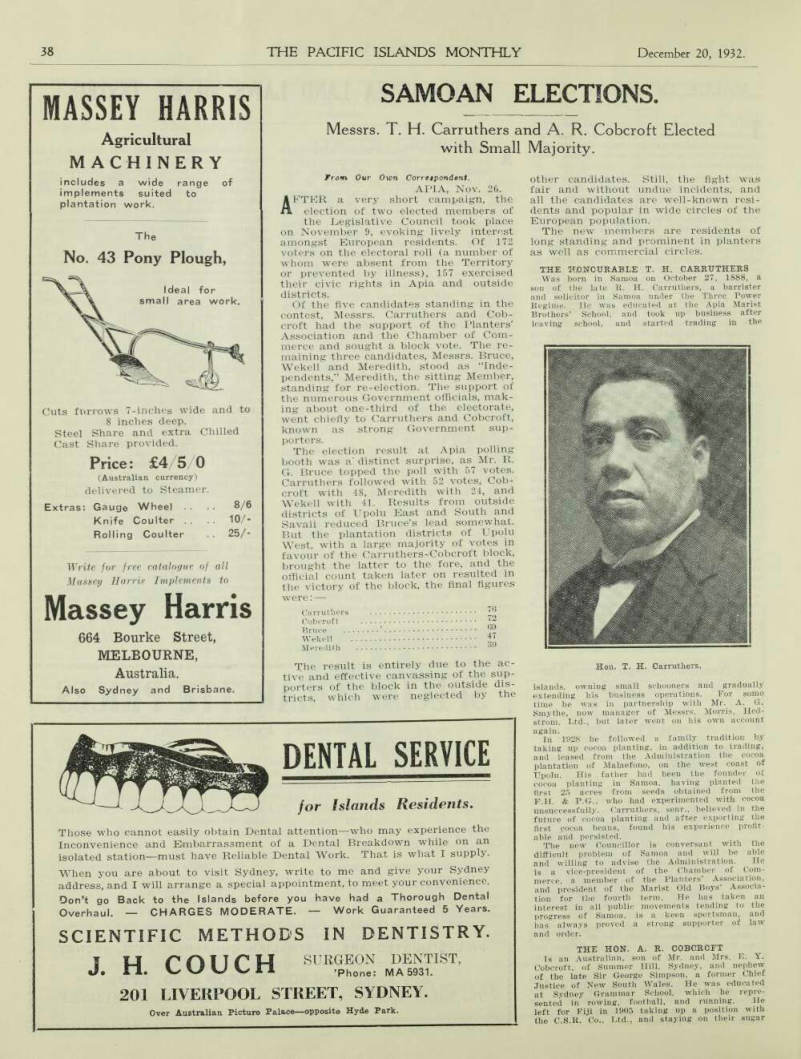
Messrs. I. H. Carruthers and A. R. Cobcroft Elected with Small Majority.
From Our Own Correspondent.
Apia, Nov. 26.
AFTER a very short campaign, the election of two elected members of the Legislative Council took place on November 9, evoking lively interest amongst European residents. Of 172 voters on the electoral roll (a number of whom were absent from the Territory or prevented by illness), 157 exercised their civic rights in Apia and outside districts.
Of the five candidates standing in the contest, Messrs. Carruthers and Cobcroft had the support of the Planters’
Association and the Chamber of Com merce and sought a block vote. The re maining three candidates, Messrs. Bruce, Wekell and Meredith, stood as “Inde pendents,” Meredith, the sitting Member, standing for re-election. The support of the numerous Government officials, mak ing about one-third of the electorate, went chiefly to Carruthers and Cobcroft, known as strong Government sup porters.
The election result at Apia polling booth was a distinct surprise, as Mr. R.
G. Bruce topped the poll with 57 votes.
Carruthers followed with 52 votes, Cobcroft with 48, Meredith with 24, and Wekell with 41. Results from outside districts of Upolu East and South and Savaii reduced Bruce’s lead somewhat.
But the plantation districts of Upolu West, with a large majority of votes in favour of the Carruthers-Cobcroft block, brought the latter to the fore, and the official count taken later on resulted in the victory of the block, the final figures were: Carruthers 76 Cobcroft 72 Bruce 69 Wekell 47 Meredith 39 The result is entirely due to the ac tive and effective canvassing of the sup porters of the block in the outside dis tricts, which were neglected by the
other candidates. Still, the fight was fair and without undue incidents, and all the candidates are well-known resi dents and popular in wide circles of the
European population.
The new members are residents of
long standing and prominent in planters
as well as commercial circles.
The Honourable I. H. Carruthers
Was born in Samoa on October 27, 1888, a son of the late R. H. Carruthers, a barrister and solicitor in Samoa under the Three Power Regime. He was educated at the Apia Marist Brothers’ School, and took up business after leaving school, and started trading in the
islands, owning small schooners and gradually extending his business operations. For some time he was in partnership with Mr. A. G.
Smythe, now manager of Messrs. Morris, Hedstrom, Ltd., but later went on his own account again.
In 1928 he followed a family tradition by taking up cocoa planting, in addition to trading, and leased from the Administration the cocoa plantation of Malaefono, on the west coast of Upolu. His father had been the founder of cocoa planting in Samoa, having planted the first 25 acres from seeds obtained from the F.H. & P.G., who had experimented with cocoa unsuccessfully. Carruthers, senr., believed in the future of cocoa planting and after exporting the first cocoa beans, found his experience profit able and persisted.
The new Councillor is conversant with the difficult problem of Samoa and will be able and willing to advise the Administration. He is a vice-president of the Chamber of Com merce, a member of the Planters’ Association, and president of the Marist Old Boys’ Associa tion for the fourth term. He has taken an interest in all public movements tending to the progress of Samoa, is a keen sportsman, and has always proved a strong supporter of law and order.
The Hon. A. R. Cobcroft
Is an Australian, son of Mr. and Mrs. E. J.
Cobcroft, of Summer Hill, Sydney, and nephew of the late Sir George Simpson, a former Chief Justice of New South Wales. He was educated at Sydney Grammar School, which he repre sented in rowing, football, and running. He left for Fiji in 1905 taking up a position with the C.S.R. Co., Ltd., and staying on their sugar
Hon. I. H. Carruthers.
plantations for six years. Coming to Samoa, then under German administration, in 1911, he took up the management of Papaseea Plantations, Ltd., an Australian-owned cocoa plantation company. During the War he was appointed manager of the large Mulifanua Coconut Plantation (at one time the largest coconut plantation in the South Seas) and re mained there under Government Administration for four years. After a short stay in New Guinea on official business, he came back to Samoa and started planting on his own account, leasing Vaipoto Cocoa Plantation from the New Zealand Reparation Estates. He has since
successfully extended his cultivations and has succeeded in producing a high-class cocoa on his plantations, which commands a good price.
Mr. Cobcroft has taken great interest in the public life of Samoa. He has been a president of the old Planters’ Association for several terms and is on the committee of the present Association, working entirely for the good of the plantation industry. He is a keen supporter of racing, vice-president of Apia Turf Club, and owner of several good horses. He is also in terested in boxing and football.
Mr. Cobcroft is married to a daughter of the late R. H. Carruthers, and is thereby a brother in-law of the Hon. I. H. Carruthers.
Government’S Congratulations.
In a radio message the Prime Minis ter of New Zealand has asked the Ad ministrator to convey his warm con gratulations to the Hons. Carruthers and Cobcroft on the occasion of their election to the council. He further ex pressed his earnest hope, that their col laboration on the Council would be con ducive to the welfare of the Territory.
Hon. A. R. Cobcroft.
“Papua” Or "New
Guinea?”
[To the Editor] One of your correspondents, in his let ter headed “Civilisation Versus Savag ery” mentioned that he hates the modern, unhistoric and stupid name “Papua,” and prefers New Guinea.
Apparently he has not a very good memory and is not very strong on Pa puan history, or he would recollect that in his boyhood days, and long before that, all atlases showed the country as “Papua or New Guinea”—the names be ing shown in that order.
Papua was first named by Don Jorge de Menisis in 1526. In 1528, Alvarez de Savaedra called it Isla Del Oro or Isle of Gold, on account of having found traces of gold at various places on the northern coast. In 1545, Inigo de Retes called it Nueva Guinea, or New Guinea, because of the resemblance of the na tives to those of the Guinea coast, in Africa. So the name Papua was the first name given it by Europeans in the old, historic days, and being over 400 years old, it is therefore not modern or unhistoric.
It may interest him and others to know why the official name was changed from British New Guinea to “Papua.”
At least two good reasons were ad vanced at the time, and there were probably others. The principal one was that much of the early day correspond
ence to New Guinea was sent in error to British Guiana, in South America, and to the Guinea coast, in Africa, the names being somewhat similar. Inci dentally, for the past 30 years I have been receiving from New York, “The Importers and Exporters’ Journal,” and it always has been and still is addressed thus: C/o. Burns & Co., Phillip, Port Moresby, British New Guiana, S. America.
The “Port Moresby” alone brings it home, and reflects credit on the P.O. officials.
Another reason was that Papua or British Papua (the name proposed by me when sole unofficial member of the Legislature there) seemed more euphoni ous than British New Guinea and the New Guineans.
As for the name being stupid: Well, it was selected by the first Commonwealth Government. I am, etc.,
“Papuan Pioneer."
Sydney, 4/12/32.
Papuan Products.
Fropi Our Own Correspondent.
Pt. Moresby, Nov. 28.
The Burns, Philp motorship “Macdhui” left Port Moresby for Brisbane and Syd ney on October 22.
The following cargo was shipped at Pt. Moresby:—1,120 packages of rubber, 512 packages of desiccated coconut, seven bags of castor oil seed, 86 bags of copra and 60 bags of coffee.
Advertisements & other items, p. 41 (2 items)
"Union"
AUSTRALASIA’S CLEARING HOUSE FOR THE PRECIOUS METALS.
BUYEES OF—
GOLD OSMIRIDIUM, PLATINUM, SILVER, Etc.
GARRETT & DAVIDSON Ltd.
Assayers, Bullion Merchants, Metallurgists, BANK OF N.S.W. BUILDINGS, REGENT STREET, SYDNEY.
PORTLAND CEMENT
"UNION"
BRAND
GUARANTEED HIGHEST QUALITY.
Packed in Special 5-Wall Strong Paper Bags (24 to ton).
Easier to handle. Will Resist Damp.
Can also be supplied in Jute Bags (18 to ton).
COMPETITIVE PRICES. ENQUIRIES INVITED.
THE COMMONWEALTH PORTLAND CEMENT COMPANY LTD.,
SYDNEY and PORTLAND, NS W.
Postal Address: Telegraphic Address:
Box 1571 E, G.P.O., “LIMERIEZ”
SYDNEY. SYDNEY.
Canned Vegetables
Sutton’s
Green Peas, In 1lb. and 2lb. Tins.
French Beans (Sliced) in 1lb. Tins.
Carrots, In 1lb. Tins.
Beetroot (Sliced) in 1lb. Tins.
Packed by
Delicia Food Products Co.
WATERLOO, N.S.W.
New Hebrides Notes.
From Our Own Correspondent.
Vila, Nov. 18.
THE French High Commissioner for New Caledonia and Dependencies, Monsieur Jore, arrived at Vila by the Laperouse from Noumea on November 18. He will be present at the British Residency reception on November 20 and continue on with the Laperouse round the Group. His itinerary will include some of the more isolated settlements and plantations which are rarely honoured by an official visit.
Monsieur Jore, and Monsieur Carlotte French (Resident Commissioner for the New Hebrides) who accompanied him on his tour, will return to Vila on November 26.
Vila Tennis.
THE Vila Tennis Club commenced the first round of its first tournament on November 20. There were some extremely good matches, the most notable being Messrs. Baistow and McClean (British) v. Tassy and Capel (French) in men’s doubles, and Dr. Tassy (French) v.
Blandy, Assistant British Resident Commissioner (British) in men’s singles.
In the first match Baistow and McClean lost the first set 6-5, and put up a stubborn resist ance and some fine play in the second, eventually losing 12-10. The second set took well over an hour.
The second match, Dr. Tassy v. Blandy, was an exhibition of really first class tennis, Blandy winning both sets 6-4 and 7-5, respectively.
The tournament is in no sense English v.
French, contestants drawing for opponents.
Armistice Day At Tanna.
A social evening was given by Dr. and Madame Legrosdidier at the French Residency, Tanna, New Hebrides, on November 12 to celebrate Armistice Day. Dancing and games were in dulged in and all agreed that many thanks were due to the host and hostess for an en joyable evening.
The guests included Mrs. Nieol, Mrs. Taylor, Mr. and Mrs. Suggate, Mr. Robertson, Miss K.
Robertson, Mr. P. G. Suggate, Mr. Chas. Eedy, Mr. Powell, Mr. Buckland, Mr. Wilkinson, Mr. and Mrs. Craig.
The Residency was decorated with palm and other leaves, giving a feeling of coolness and comfort, the French and British flags enhancing the decorations on the verandah.
The Tropical Corps.
Still Under Consideration.
NOTHING has been heard for some time of the Federal Government’s suggestion that an amalgamation of the Administrative services of Papua and New Guinea may be possible in the future —such an amalgamation to be under one control and direction and to be known as the Australian Tropical Service Corps.
Several practical difficulties in the way of such a scheme had been put for ward since it was first mooted and, as a result, the impression gained ground that the Federal Government had dropped the idea for the present.
A statement made by the Minister representing the Government, Sir George Pearce, when the New Guinea Bill was under consideration on November 16, in dicates that the matter is not by any means finished with.
A Senator moved an amendment to the Bill which meant that the Adminis trator would be under instructions to appoint Judges in the Territory for cer tain terms and under strictly defined conditions. Sir George Pearce said that the Government could not accept the amendment and he appealed to the Min ister to withdraw it.
Sir George Pearce continued: “There is another and a much stronger reason why the amendment should not be ac cepted; that is, that the establishment of a judiciary ought to be dealt with in a separate measure. For some time the Government has considered that the whole system under which our territorial services are dealt with needs recasting.
At the present time matters concerning them are dealt with piecemeal. We now have the Administration of the Northern Territory, Papua, New Guinea, Norfolk Island, and, temporarily, Nauru. Obvi ously, what we should aim at is a Terri torial service in which the officers are interchangeable.
“In no section of the service is that more commendable than in respect of the judiciary. It is not desirable that we shoud ask a man to spend the whole of his life in one of these tropical coun tries. If the services were interchange able, there is no reason why a judge who on appointment to the territorial judiciary should not spend part of his life in New Guinea, and the latter por tion of it in, say, the Federal Capital Territory.
“The Minister has been studying the whole question with a view to reorgan ising the system, but the proposals of the Government have not yet taken shape—in fact, they are still in process of being incubated.”
Reduced Price Of Engines.
A drastic cut in the prices of engines is announced by Invincible Motors Ltd., of 53 North George Street, Sydney, who have just published their 1933 catalogues. Prices on several sizes have been reduced, an example being the 6 H.P.—4" x 4½"—single cylinder, shown in the advertisement on page 32 of this issue. This is a medium weight, four cycle motor weighing 225 lbs., fitted with counter balanced crankshaft, therefore nearly vibration less. The price of £36 complete includes packing and free delivery to any place in the Pacific Ocean; a liberal five years’ guarantee is given with every engine. All spare parts are pro curable at Invincible Motors Ltd.’s Sydney Service Station.
Advertisements & other items, p. 42 (1 item)
Mary's
Repairs.
"OUR HANDS MAKE GOOD ARMS"
RELIABLE 22 CAL. REPEATING RIFLES,
Winchester, 1906 and 62 . . £5/15/- Erowning £5/5/- Savage Sporter £6/17/6 Walther Auto £8/17/6 New Model 61 Winchester Browning Auto B.S.A, Repeater Mauser . . £7/10/- £4/17/6 £6/7/6 £8/15/-
QUALITY TACKLE FOR ISLAND FISHING.
Write for Illustrated Catalogues.
SIL ROHU (late A.I.F.), GUNSMITH
IMPORTER OF HIGH-GRADE FIREARMS AND FISHING TACKLE SPECIALIST, 143 ELIZABETH STREET, SYDNEY (Near Market Street).
"FISHING TACKLE TO TACKLE FISHING."
Still Supreme!
After thirty years’ trading with the Islands, Aunt Mary’s Pure Food Products are still supreme.
Highest quality goods, specially manufactured and packed to meet Island conditions.
AUNT
MARY'S
PURE FOOD
PRODUCTS
“Defiance” Brand Canned Goods
These High-grade Products are packed by the proprietors of Aunt Mary’s Pure Food Products. Hermetically sealed and specially prepared to withstand tropical heat, thus ensuring satisfaction to consumers.
Only goods of the highest standard are packed under these brands, thus the Proprietors keep faith with their clients and consumers.
Aunt Mary’s Pure Pood Products and “Defiance” Brand Canned Goods are prepared and packed only by
TILLOCK & CO.
LTD.,
PURE FOOD
MANUFACTURERS,
Kent and Liverpool Streets, SYDNEY, N.S.W.
Race Day On Norfolk
Island.
“Going to the races?”
The words conjure up the same feel ing of expectation and excitement on Norfolk Island as they do on your way to Epsom Downs.
You have the same opportunity of showing off your judgment in picking a winner from among the lesser breed, as from finest blood stock. You get the same thrill watching your choice striv ing his utmost to make your speculation —be it a “bob” or your last shirt —pay you a “divvy,” and the rest of the field doing their best to make it pay someone else’s “divvy.”
“Going to the races?”
“Yes.”
“Right-ho, hop up!” We pick up a friend on the way in our horse and trap and remnants of harness.
We meet a lorry with trembling mud guards and a silencer which has lost its silence. The horse makes objections and bang goes one of the remaining straps!
A bit of string or wire from the nearest house and we are off again. It will last until we get home!
We arrive early. Some kind friends ask us to help them to eat their lunch, so we lend them our assistance. By the time our lending powers are exhausted, the place is getting filled up and they are thinking about starting the first race. So we stroll over to the “Tote.” which, this year, is the new Golf Club House converted for the occasion.
We inspect the imposing array of of ficials within and, having satisfied our selves that their knowledge of mathe matics is sufficient to warrant us plac
ing 1/- in their care, we study the blackboard with the necessary informa tion on it and, although there are only three entries for this race, after due consideration we carefully back the “also ran.”
We enquire why jockeys keep hopping in at one window and out at another, like a harlequin parade, and find that they being “weighed out” and the usual entrance is not available. One of them, finding he is a pound or two over weight, kicks off his boots and rides in socks.
The jockeys carry the owner’s colours in true orthodox style, but from the col ours downwards their costumes are varied. One favours white flannel trousers, with the legs tucked inside a pair of stockings, and tennis shoes. An other prefers riding boots instead of the shoes. But this does not affect their en thusiasm and efficiency.
Half a dozen tents of various construc tion are dotted about, providing refresh ments. Tables are placed under the pine trees, making it very pleasant —al though dead pine needles, pieces of bark and festive birds provide some disad vantages.
After many greetings, during which we express our opinions on politics in general and the banana quota in par ticular, we pull out early to get ahead of the mechanical vehicles —for if another strap goes we may have to camp out!
E. Dudley Dorman.
At the Levuka Municipal Council elec tion held on November 10, Mr. F. G.
Brewis, with 106 votes, and Mr. H. H.
Adcock, with 93 votes, were elected. The other candidate, Mr. H. O. E. Palmer, obtained 89 votes.
Season’s Output Purchased.
Whale Oil.
WHALERS are overjoyed at the news that Unilever, Ltd., has purchased the whole of the 1932-3 season’s production of whale oil. The amount in volved is estimated at £3,500,000.
The whale-oil industry, like most others, is suffering from over-produc tion, hence the whalers’ glee.
It may be some consolation to the struggling coconut planter to know that even with the wholesale purchase and a bumper catch, the whalers’ margin of profit is very small. The price of oil for the present season is only £15 per ton.
But that, of course, will tend to keep copra prices at their present low level.
Advertisements & other items, p. 43 (1 item)
Nelson And Robertson
RABAUL CARRYING CO.,
GENERAL FORWARDING
AGENTS, CUSTOMS AGENTS,
INSURANCE STORAGE.
Transport Work and Forwarding Work of Every Description Undertaken.
Modern Transport Equipment.
Telephones: Radio Address: Rabaul 176 and 135. “Rabcarco.”
E. M. GRANTER, Manager.
NELSON and ROBERTSON
ISLAND MERCHANTS. [Established, 1895.]
Copra, Cocoa, Trocas Shell and other Island produce sold on commission. All classes of Merchandise purchased and original invoices supplied.
Agents for SKANDIA CRUDE OIL ENGINES. Marine and Stationary, powers from 5-h.p. up.
PENTA MARINE ENGINES, Outboard and Inboard types.
PUMPMOBIL, the only portable pumping plant manufactured, light in weight and reliable. Suitable for mining work.
UPSON WALL BOARD, in both Plain and Tile pattern, strong and light.
Non-conductor of heat and cold. British manufacture.
Also New Guinea, Papuan and Samoan representatives for the famous
CHALLENGER KEROSENE BATH HEATER
Communicate with
NELSON & ROBERTSON
12 SPRING STREET SYDNEY, AUSTRALIA
Telegraphic Address: “IVAN SYDNEY.”
New Guinea Notes,
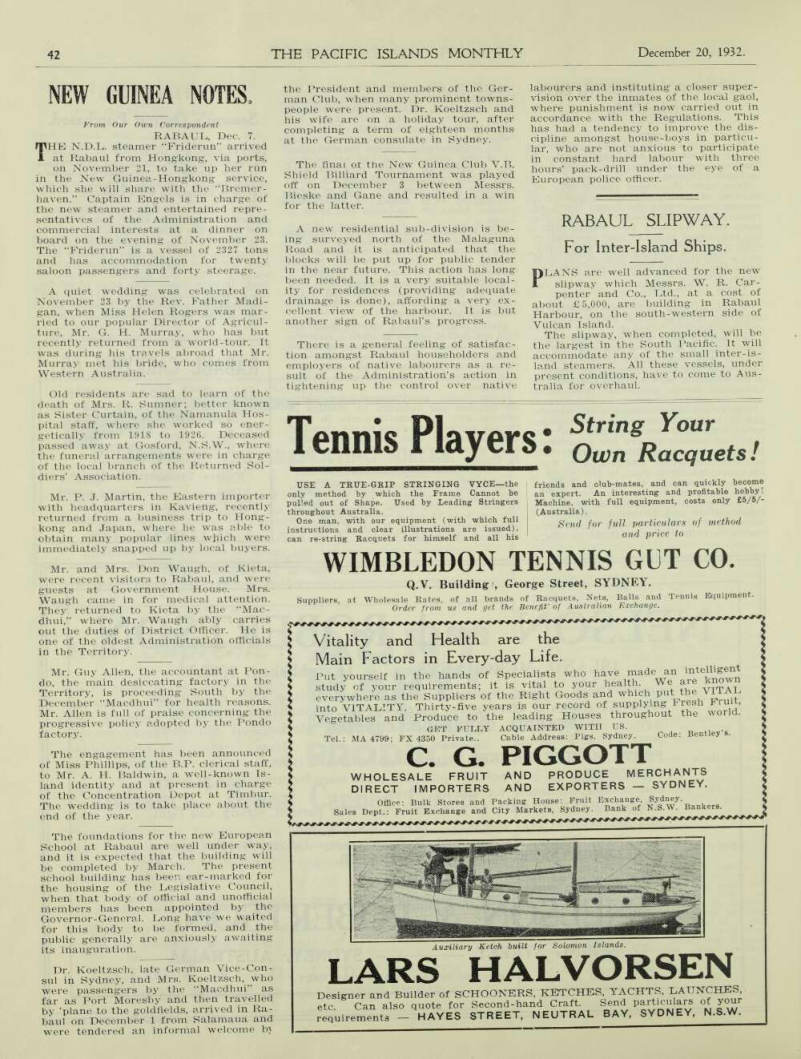
From Our Own Correspondent
Rabaul, Dec. 7.
THE N.D.L. steamer “Friderun” arrived at Rabaul from Hongkong, via ports, on November 21, to take up her run in the New Guinea-Hongkong service, which she will share with the “Bremer haven.” Captain Engels is in charge of the new steamer and entertained repre sentatives of the Administration and commercial interests at a dinner on board on the evening of November 23.
The “Friderun” is a vessel of 2327 tons and has accommodation for twenty saloon passengers and forty steerage.
A quiet wedding was celebrated on November 23 by the Rev, Father Madi gan, when Miss Helen Rogers was mar ried to our popular Director of Agricul ture, Mr. G. H. Murray, who has but recently returned from a world-tour. It was during his travels abroad that Mr.
Murray met his bride, who comes from Western Australia.
Old residents are sad to learn of the death of Mrs. R. Sumner; better known as Sister Curtain, of the Namanula Hos pital staff, where she worked so ener getically from 1918 to 1926. Deceased passed away at Gosford, N.S.W., where the funeral arrangements were in charge of the local branch of the Returned Sol diers’ Association.
Mr. P. J. Martin, the Eastern importer with headquarters in Kavieng, recently returned from a business trip to Hong kong and Japan, where he was able to obtain many popular lines which were immediately snapped up by local buyers.
Mr. and Mrs. Don Waugh, of Kieta, were recent visitors to Rabaul, and were guests at Government House. Mrs.
Waugh came in for medical attention.
They returned to Kieta by the “Mac dhui,” where Mr. Waugh ably carries out the duties of District Officer. He is one of the oldest Administration officials in the Territory.
Mr. Guy Allen, the accountant at Pon do, the main desiccating factory in the Territory, is proceeding South by the December “Macdhui” for health reasons.
Mr. Allen is full of praise concerning the progressive policy adopted by the Pondo factory.
The engagement has been announced of Miss Phillips, of the B.P. clerical staff, to Mr. A. H. Baldwin, a well-known Is land identity and at present in charge of the Concentration Depot at Timbur.
The wedding is to take place about the end of the year.
The foundations for the new European School at Rabaul are well under way, and it is expected that the building will be completed by March. The present school building has been ear-marked for the housing of the Legislative Council, when that body of official and unofficial members has been appointed by the Governor-General. Long have we waited for this body to be formed, and the public generally are anxiously awaiting its inauguration.
Dr. Koeltzsch, late German Vice-Con sul in Sydney, and Mrs. Koeltzsch, who were passengers by the “Macdhui” as far as Port Moresby and then travelled by ’plane to the goldfields, arrived in Ra baul on December 1 from Salamaua and were tendered an informal welcome by
the President and members of the Ger man Club, when many prominent towns people were present. Dr. Koeltzsch and his wife are on a holiday tour, after completing a term of eighteen months at the German consulate in Sydney.
The final or the New Guinea Club V.B.
Shield Billiard Tournament was played off on December 3 between Messrs.
Bieske and Gane and resulted in a win for the latter.
A new residential sub-division is be ing surveyed north of the Malaguna Road and it is anticipated that the blocks will be put up for public tender in the near future. This action has long been needed. It is a very suitable local ity for residences (providing adequate drainage is done), affording a very ex cellent view of the harbour. It is but another sign of Rabaul’s progress.
There is a general feeling of satisfac tion amongst Rabaul householders and employers of native labourers as a re sult of the Administration’s action in tightening up the control over native
labourers and instituting a closer super vision over the inmates of the local gaol, where punishment is now carried out in accordance with the Regulations. This has had a tendency to improve the dis cipline amongst house-boys in particu lar, who are not anxious to participate in constant hard labour with three hours’ pack-drill under the eye of a European police officer.
Rabaul Slipway.
For Inter-Island Ships.
PLANS are well advanced for the new slipway which Messrs. W. R. Car penter and Co., Ltd., at a cost of about £5,000, are building in Rabaul Harbour, on the south-western side of Vulcan Island.
The slipway, when completed, will be the largest in the South Pacific. It will accommodate any of the small inter-is land steamers. All these vessels, under present conditions, have to come to Aus tralia for overhaul.
Advertisements & other items, p. 44 (1 item)
Tennis Players:
String Your
Own Racquets!
USE A TRUE-GRIP STRINGING VYCE—the
only method by which the Frame Cannot be pulled out of Shape. Used by Leading Stringers throughout Australia.
One man, with our equipment (with which full instructions and clear illustrations are issued), can re-string Racquets for himself and all his friends and dub-mates, and can quickly become an expert. An interesting and profitable hobby!
Machine, with full equipment, costs only £5/5/- (Australia).
Send for full particulars of method
and price to
WIMBLEDON TENNIS GUT CO.
Q.V. Building , George Street, SYDNEY.
Suppliers, at Wholesale Rates, of all brands of Racquets, Nets, Balls and Tennis Equipment.
Order from us and get the Benefit'of Australian Exchange.
Vitality and Health are the
Main Factors in Every-day Life.
Put yourself in the hands of Specialists who have made an study of your requirements; it is vital to your health. We are everywhere as the Suppliers of the Right Goods and which put the VITAL into VITALITY. Thirty-five years is our record of supplying Fresh Fruit, Vegetables and Produce to the leading Houses throughout the world.
GET FULLY ACQUAINTED WITH US.
MA 4799; FX 4350 Private.. Cable Address: Pigs, Sydney.
Code: Bentley’s.
C. G. PIGGOTT
WHOLESALE FRUIT AND PRODUCE MERCHANTS
DIRECT IMPORTERS AND EXPORTERS SYDNEY.
Office; Bulk Stores and Packing House: Fruit Exchange, Sydney.
Sales Dept.: Fruit Exchange and City Markets, Sydney.
Bank of N.S.W. Bankers.
Auxiliary Ketch built for Solomon Islands.
LARS HALVORSEN
Designer and Builder of SCHOONERS, KETCHES, YACHTS, LAUNCHES, etc. Can also quote for Second-hand Craft. Send Particulars of your requirements HAYES STREET, NEUTRAL BAY, SYDNEY, N.S.W.
Sangara Output Described as
Papuan Sugar.
Sangara Output Described as “Phenomenal.”
From Our Own Correspondent.
Pt. Moresby, Nov. 30.
WHILE the Lieutenant-Governor (ac companied by Mr. H. W. Champion and Mr. H. L. Murray) was on tour in the north-east recently, he inspected the sugar areas under cultivation by San gara Sugar Estates, Ltd., about twenty miles inland from Buna.
His Excellency was impressed by the healthy and vigorous condition of the cane and the apparently excellent pros pects of successful sugar cultivation in this district—where the soil, rainfall and labour supply are most suitable.
Sangara Sugar Estates, Ltd., was reg istered in Papua late in 1931. It ac quired 20,000 acres of suitable land and planned big scale developments: but owing to the general depression, it de cided to engage merely in experimental cultivation for the present.
It is officially announced on behalf of Sangara that this season’s harvest on the experimental area near Buna records the phenomenal yield of 76 tons of cane to the acre.
The Commonwealth Department of Trade and Customs comments. “This is quite phenomenal—even for planted cane grown on heavy stump-grubbed land.”
In North Queensland the average yield is around 22 tons per acre occasionally rising to 50 or 60 tons, but in Queens land only a small proportion is plant cane, the balance being second, third or fourth year ratoon crops. The result of the Papuan experiment, therefore, must not be regarded as anvthing like what would be the normal production. At the same time, it proves that Papuan con ditions are extremely suitable for sugar growing.
Papuan Radio.
Inland Station Connects with Canberra.
From Our Own Correspondent.
Pt. Moresby, Nov. 28.
THE Lieutenant-Governor (Sir Hubert Murray) and his party, while on their recent north-east tour, walked from Buna to the inland station of Ko koda in the Owen Stanley Ranges, and back, a distance of 140 miles.
From Kokoda, His Excellency com municated by radio with the Prime Min ister at Canberra and received a reply the following day. This is the first oc casion on which an official wireless mes sage has been sent from an inland sta tion in the heart of Papua.
The wireless apparatus used is the property of Mr. M. Rich, A.R.M. at Kokoda.
Norfolk Island Trade.
The following are the Norfolk Island Customs figures for October, 1932, as compared with the figures for October, 1931:
Imports.
From From Aust. N.Z.
October, 1031 £2,519 £1,416 October, 1932 £2 292 £818
Exports.
To To Aust. N.Z.
October. 1931 £672 £1,354 October. 1932 £499 £879
Islands), Ltd.
W. R. Carpenter & Co. (Solomon Islands), Ltd.
NET profits of W. R. Carpenter and Company (Solomon Islands), Ltd., for the year ended October 31, amounted to £14,418, a decrease of £917 on that of the previous year. With £6,133 brought forward £20,552 is available.
Dividend of 8 per cent, on preference shares, less the statutory reduction, requires £6,200, a sum of £1,895 is carried to the replacement and renewals reserve. Dividend of 6 per cent, on ordinary shares, which are held by W. R.
Carpenter, Ltd., is recommended, accounting for £6,720. No ordinary dividend was paid either in 1930 or 1931. A sum of £5,736 is carried forward.
Ordinary capital is £100,000 and preference £112,000, a total capital of £212,000. Reserves are contingencies £500, bad debts £328, and re placements and renewals £5,104. The item, “sundry creditors,” which includes overdraft and advances on produce in transit, amounts to £5,152, an increase of £2,218, but the item.
“W. R. Carpenter, Ltd., advances £13,878,” of 1931 no longer appears in the published balance sheet. Statement of assets is in one item, “mortgages, debtors, tranches balances, shipping property, and investments,” £241,364, a re duction of £7,932. —“S.M. Herald.”
New Guinea Gold.
Edie No. 2 Vein Struck.
The Mining Trust, Ltd., consulting engineers for New Guinea Goldfields, Ltd., report that No. 1 shaft on Morobe goldfield was sunk 42 feet to a total depth of 108 feet below No. 1 level.
No. 4 shaft was sunk 52 feet to a total depth of 346 feet, and at 340 feet encountered the Edie No. 2 vein, which assayed 13 dwts. gold and 8 ozs. silver over a width of 37 inches. The full width of the vein was not exposed.
The alluvial output for October was 3,274 ozs. of bullion.
Bulolo G.D. Returns.
The Bulolo Gold Dredging, Ltd.’s, yield for the four weeks ended December 5 was:—
Ounces.
Yards.
Value in Dollars.
No. 1 Dredge 238,000) 63,355 No. 2 Dredge 4,290 233,000 59,265 9,083 471,000 122,620
Advertisements & other items, p. 45 (1 item)
I Lk-Coffi
DELICIOUS and POPULAR
Manufactured by
WILLIAM ARNOTT LIMITED,
THE BISCUIT SPECIALISTS
of 64 years’ experience.
Delicious and benefi cial with coffee, at afternoon tea or at supper. Packed in airtight tins, they are always ready to please D
FAMOUS
I LK-COFFi
BISCUITS
YOUR STOREKEEPER WILL SUPPLY YOU.
Cultured Boys From Tongan
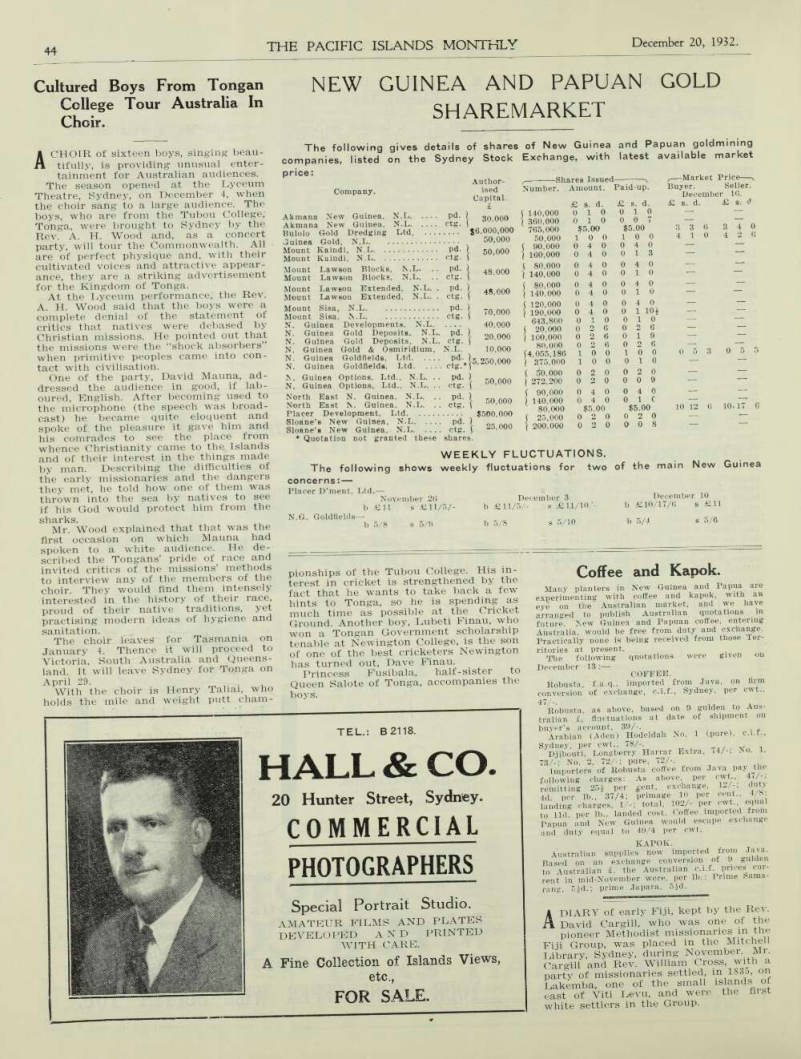
College Tour Australia In Choir.
A CHOIR of sixteen boys, singing beau tifully, is providing unusual enter tainment for Australian audiences.
The season opened at the Lyceum Theatre, Sydney, on December 4, when the choir sang to a large audience. The boys, who are from the Tubou College, Tonga, were brought to Sydney by the Rev. A. H. Wood and, as a concert party, will tour the Commonwealth. All are of perfect physique and, with their cultivated voices and attractive appear ance, they are a striking advertisement for the Kingdom of Tonga.
At the Lyceum performance, the Rev.
A. H. Wood said that the boys were a complete denial of the statement of critics that natives were debased by Christian missions. He pointed out that the missions were the “shock absorbers” when primitive peoples came into con tact with civilisation.
One of the party, David Mauna, ad dressed the audience in good, if lab oured, English. After becoming used to the microphone (the speech was broad cast) he became quite eloquent and spoke of the pleasure it gave him and his comrades to see the place from whence Christianity came to the Islands and of their interest in the things made by man. Describing the difficulties of the early missionaries and the dangers they met, he told how one of them was thrown into the sea by natives to see if his God would protect him from the sharks Mr. Wood explained that that was the first occasion on which Mauna had spoken to a white audience. He de scribed the Tongans’ pride of race and invited critics of the missions’ methods to interview any of the members of the choir. They would find them intensely interested in the history of their race, proud of their native traditions, yet practising modern ideas of hygiene and sanitation.
The choir leaves for Tasmania on January 4. Thence it will proceed to Victoria, South Australia and Queens land. It will leave Sydney for Tonga on April 29.
With the choir is Henry Tahai, who holds the mile and weight putt cham
pionships of the Tubou College. His in terest in cricket is strengthened by the fact that he wants to take back a few hints to Tonga, so he is spending as much time as possible at the Cricket Ground. Another boy, Lubeti Finau, who won a Tongan Government scholarship tenable at Newington College, is the son of one of the best cricketers Newington has turned out, Dave Finau.
Princess Fusibala, half-sister to Queen Salote of Tonga, accompanies the boys.
Sharemarket
New Guinea And Papuan Gold
The following gives details of shares of New Guinea and Papuan goldmining companies, listed on the Sydney Stock Exchange, with latest available market price:
Weekly Fluctuations.
The following shows weekly fluctuations for two of the main New Guinea concerns: —
New Guinea And Papuan Gold
Sharemarket
The following gives details of shares of New Guinea and Papuan goldmining companies, listed on the Sydney Stock Exchange, with latest available market price: Market Price Company.
Authorised Capital £ Number.
Amount.
Paid-up.
Buyer.
Seller.
December 16. £ £ s. d. £ s. d. £ s. d. £ s. d.
Akmana New Guinea, N.L.. pd. 30,000 140,000 0 1 0 0 1 0 $5.00 1 0 0 0 1 0 0 0 7 $5.00 1 0 0 Akmana New Guinea, N.L. ctg.
Bulolo Gold Dredging Ltd.
Guinea Gold. $6,000,000 50,000 360,000 765,000 50,000 3 3 6 4 10 3 4 0 4 2 6 Mount Kaindi, N.L pd.
Mount Kaindi, N.L ctg. 50,000 90,000 0 4 0 0 4 0 — 160,000 0 4 0 0 1 3 Mount Lawson Blocks, N.L. pd. 48,000 80,000 0 4 0 0 4 0 — Mount Lawson Blocks, N.L. ctg. 140,000 0 4 0 0 1 0 Mount Lawson Extended, N.L. pd. 48,000 80,000 0 4 0 0 4 0 0 1 0 Mount Lawson Extended. N.L. ctg. 140,000 0 4 0 Mount Sisa, N.L. pd. 120,000 0 4 0 0 4 0 0 1 10½ 0 1 0 Mount Sisa, N.L. ctg. 70,000 190,000 643,800 20 000 0 4 0 0 1 0 N. Guinea Developments, N.L. 40,000 0 2 6 0 2 6 — N. Guinea Gold Deposits, N. L. pd.
N. Guinea Gold Deposits, N. L. ctg.
N. Guinea Gold & Osmiridiun, N.L. 20,000 100,000 0 2 6 0 1 9 — — 10.000 80,000 0 2 6 1 0 0 0 2 6 1 0 0 0 1 0 0 5 3 0 5 5 N. Guinea Goldfields, Ltd. pd. 5,250,000 4,055,186 375,000 50,000 272,200 90,000 140,000 1 0 0 1 0 0 0 2 0 0 2 0 N. Guinea Goldfields, Ltd. ctg.
N. Guinea Options. Ltd., N.L. pd. 50,000 50,000 0 2 0 0 0 9 — — N. Guinea Options, Ltd., N.L. ctg.
North East N. Guinea. N.L. pd. 0 4 0 0 4 0 0 4 0 0 1 0 — — North East N. Guinea, N.L. ctg. 80,000 $5.00 $5.00 0 2 0 10 12 6 10 17 6 Placer Development, Ltd. $500,000 Sloane’s New Guinea. N.L. pd. 25,000 0 2 0 Sloane’s New Guinea. N.L. ctg. 25,000 200,000 0 2 0 0 0 8 * Quotation not granted these shares.
Placer D’ment, Ltd.— November 26 December 3 December 10 b £11 s £11/5/b £11/5/- s £11/10/b £10/17/6 s £11 N.G. Goldfields— b 5/8 s 5/9 b 5/8 s 5/10 b 5/4 s 5/6
Coffee and Kapok.
Many planters in New Guinea and Papua are experimenting with coffee and kapok, with an eye on the Australian market, and we have arranged to publish Australian quotations in future New Guinea and Papuan coffee, entering Australia, would be free from duty and exchange.
Practically none is being received from those Ter ritories at present.
The following quotations were given on December 13 :
Coffee.
Robusta, f.a.q., imported from Java, on firm conversion’ of exchange, c.i.f., Sydney, per cwt., Robusta, as above, based on 9 gulden to Aus tralian £, fluctuations at date of shipment on buyer’s account, 39/-.
Arabian (Aden) Hodeidah No. 1 (pure), c.i.f..
Sydney, per cwt., 78/-. n Djibouti, Longberry Harrar Extra, 74/-, No. 1, 73/-; No. 2, 72/-: pure, 72/-.
Importers of Robusta coffee from Java pay the following charges: As above per cwt 47/-. remitting 25i per cent. exchange, 12/-, duty 4d per lb., 37/4; primage 10 per cent., 4/8, landing charges, 1/-; total, 102/- per cwt. equal to lid. per lb., landed cost. Coffee imported from Papua and New Guinea would escape exchange and duty equal to 49/4 per cwt.
Kapok.
Australian supplies now imported from Java.
Based on an exchange conversion of 9 gulden to Australian £, the Australian c.i.f. prices cur rent in mid-November were, per lb.: Prime Sama rang, 5½d.; prime Japara, sid.
A DIARY of early Fiji, kept by the Rev.
David Cargill, who was one of the pioneer Methodist missionaries m the Fiji Group, was placed in the Mitchell Library, Sydney, during November Mr.
Cargill and Rev. William Cross, with a party of missionaries settled, in 1835, on Lakemba, one of the small islands of east of Viti Levu, and were the first white settlers in the Group.
Advertisements & other items, p. 46 (1 item)
Hall & Co.
TEL.: B 2118.
20 Hunter Street, Sydney.
COMMERCIAL
PHOTOGRAPHERS
Special Portrait Studio.
AMATEUR FILMS AND PLATES
DEVELOPED AND PRINTED
WITH CARE.
A Fine Collection of Islands Views, etc.,
FOR SALE.
Market Quotations
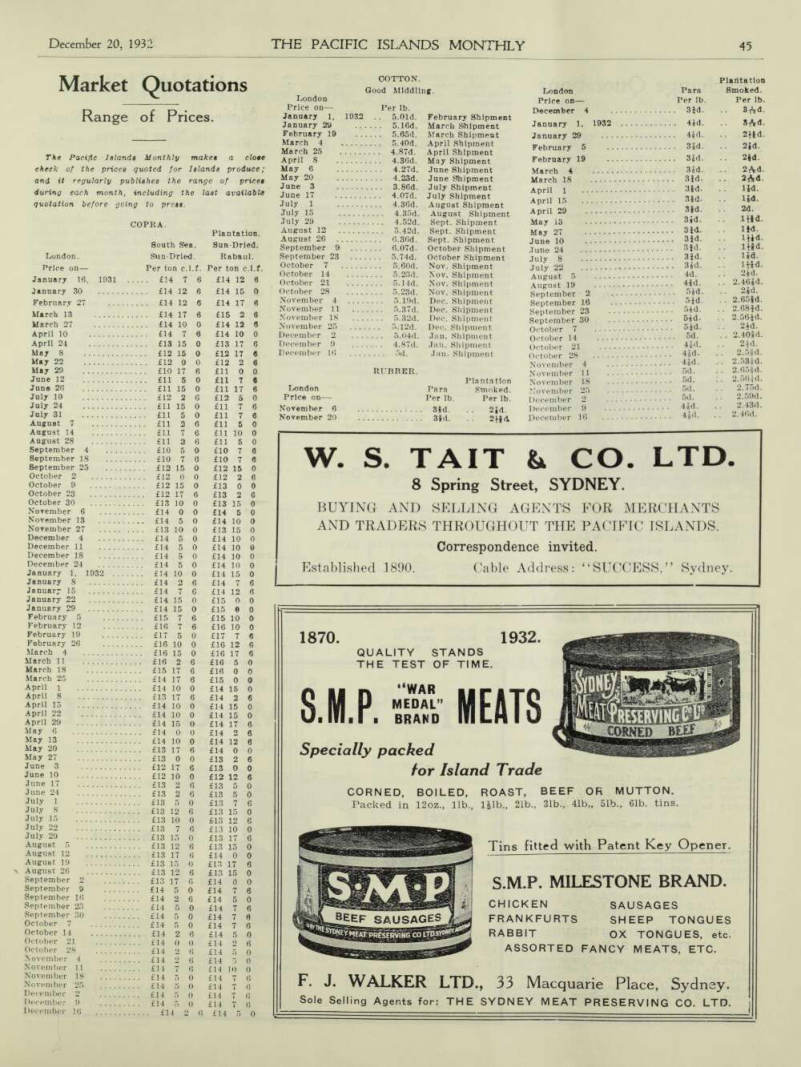
Range of Prices.
The Pacific Islands Monthly makes a does cheek of the prices quoted for Islands produce; and it regularly publishes the range of prices during each month, including the last available quotation before going to press.
Cotton.
Good Middling.
London Price on— Per lb.
January 1, 1932 . . 5.Old.
February Shipment January 29 5.1Gd.
March Shipment February 19 5.65d.
March Shipment March 4 5.40d.
April Shipment March 25 4.87d.
April Shipment April 8 4.36d.
May Shipment May 6 4.27d.
June Shipment May 20 4.23d.
June Shipment June 3 3.86d.
July Shipment June 17 July Shipment July 1 August Shipment July 15 4.35d.
August Shipment July 29 4.52d.
Sept. Shipment August 12 5.42d.
Sept. Shipment August 26 . 6.36d.
Sept. Shipment September 9 6.07d.
October Shipment September 23 5.74d.
October Shipment October 7 5.60d.
Nov. Shipment October 14 5.23d.
Nov. Shipment October 21 5.14d.
Nov. Shipment October 28 5.23d.
Nov. Shipment November 4 5.19d.
Dec. Shipment November 11 5.37d.
Dec. Shipment November 18 5.32d.
Dec. Shipment November 25 5.12d.
Dec. Shipment December 2 5.04d.
Jan. Shipment December 9 4.87d.
Jan. Shipment December 10 5d.
Jan. Shipment London
Rubber.
Plantation Para Smoked.
Price on— Per lb. Per lb.
November 6 8«d. . . 2Jd.
November 20 3td. • ■ 2H<1
Plantation London Para Smoked.
Price on — Per lb.
Per lb. 3}d. 3Ad.
SAd. 2«d. 4Jd. 44<1. 3Jd. 2|d. 3Jd. 2|d.
March 4 3 id. 2Ad.
March 18 3}d. 2Ad 3|d.
Ud. 38d- Hd.
April 29 3|d. 2d. 31d.
IHd. 3 Id. l|d. 3}d.
IHd. 3Jd.
IHd.
July 8 3 Jd. lid.
July 22 3id.
IHd. 4d. 2id.
August 19 4|d. .. 2.46id. 5Jd. 2id.
September 16 5Jd. .. 2.65*d.
OCp LtUl UCl S6pt6iub0r 23 54d. .. 2.68Jd.
S6pt6mbGr 30 54d. .. 2.56Jd. 5Jd. 2id. 5d. . . 2.40id.
October 21 4|d. 2Jd.
October 28 4Jd. . . 2.5|d.
November 4 4|d. . . 2.53id. nd. . . 2.65|d. y ( -I lO 5d. . 2.561d, 5d. 2.7">d.
December 2 5d. 2.59d. 4|d. . . 2.43d.
December 16 .. 2.46d.
Copra
South Sea, Sun-Dried.
Plantation. Sun-Dried, London. Price on— Rabaul.
Per ton c.i.f.
Per ton c.i.f.
January 16, 1931 £14 7 6 £14 12 6 January 30 £14 12 6 £14 15 0 February 27 £14 12 6 £14 17 6 March 13 £14 17 6 £15 2 6 March 27 £14 10 0 £14 12 6 April 10 £14 10 0 April 24 £13 15 0 £13 17 6 May 8 £12 17 6 May 22 £12 2 6 May 20 £11 0 0 June 12 £11 5 0 £11 7 6 June 26 £11 17 6 July 10 £12 5 0 July 24 £11 7 6 July 31 £11 5 0 £11 7 6 August 7 £11 2 6 £11 6 0 August 14 £11 7 6 £11 10 0 August 28 £11 2 6 £11 5 0 September 4 £10 7 a September 18 £10 7 6 September 25 £12 15 0 October 2 £12 2 6 October 9 £13 0 0 October 23 £13 2 6 October 30 £13 15 0 November 6 £14 5 0 November 13 £14 10 0 November 27 £13 10 0 £13 15 0 December 4 £14 5 0 £14 10 0 December 11 £14 5 0 £14 10 0 December 18 £14 5 0 £14 10 0 December 24 £14 10 0 January 1, 1932 ... £14 10 0 £14 15 0 January 8 £14 7 6 January 15 £14 7 6 £14 12 6 January 22 £15 0 0 January 29 £15 e 0 February 5 £15 7 6 £15 10 0 February 12 £16 7 6 £16 10 0 February 19 ... £17 5 0 £17 7 6 February 26 £16 12 6 March 4 £16 17 6 March 11 £16 5 0 March 18 £16 0 0 March 25 £15 0 0 April i £14 15 0 April 8 £14 2 6 April 15 £14 15 0 April 22 £14 15 0 April 29 £14 17 6 May 6 £14 2 6 May 13 £14 12 6 May 20 £14 0 0 May 27 £13 2 6 June 3 . . . . £12 17 6 £13 0 0 June 10 £12 12 6 June 17 £13 5 0 June 24 £13 5 0 July 1 £13 7 6 July 8 ... £13 12 6 £13 15 0 July 15 £13 12 6 July 22 £13 10 0 July 29 £13 17 6 August 5 .. . . £13 12 6 £13 15 0 August 12 £13 17 6 £14 0 0 August 19 £13 17 6 August 26 £13 15 0 September 2 ... £13 17 6 £14 0 0 September 9 ... £14 5 0 £14 7 6
September 16
... £14 2 6 £14 5 0 September 23 ... £14 7 6 September 30 ... £14 5 0 £14 7 6 October 7 £14 7 6 October 14 £14 5 0 October 21 £14 2 6 October 28 £14 5 0 N ovember 4 £14 2 6 £14 5 0 November 11 £14 7 6 £14 10 0 November 18 £14 7 6 November 25 ... £14 5 0 £14 7 6 December 2 £14 5 0 £14 7 0 December 9 ... £14 5 0 £14 7 G December 16 £14 5 0
Advertisements & other items, p. 47 (1 item)
S.M.P. S Meats
W. S. TAIT & CO. LTD.
8 Spring Street, SYDNEY.
BUYING AND SELLING AGENTS FOR MERCHANTS
AND TRADERS THROUGHOUT TOE PACIFIC ISLANDS.
Correspondence invited.
Established 1890. Cable Address: “SUCCESS,” Sydney.
1870. 1932.
QUALITY STANDS
THE TEST OF TIME.
S.M.P. S MEATS
Specially packed
lor Island Trade
CORNED, BOILED, ROAST, BEEF OR MUTTON.
Packed in 120 z., 1lb., 1½lb., 2lb., 3lb., 4lb., 5lb., 6lb. tins. fitted with Patent Key Opener.
S.M.P. MILESTONE BRAND.
CHICKEN SAUSAGES
FRANKFURTS SHEEP TONGUES
RABBIT OX TONGUES, etc.
ASSORTED FANCY MEATS, ETC.
33 Macquarie Place, Sydney.
Sole Selling Agents for: THE SYDNEY MEAT PRESERVING CO. LTD. beef
SAUSAGES
F. J. WALKER LTD.,
Exchange Quotations
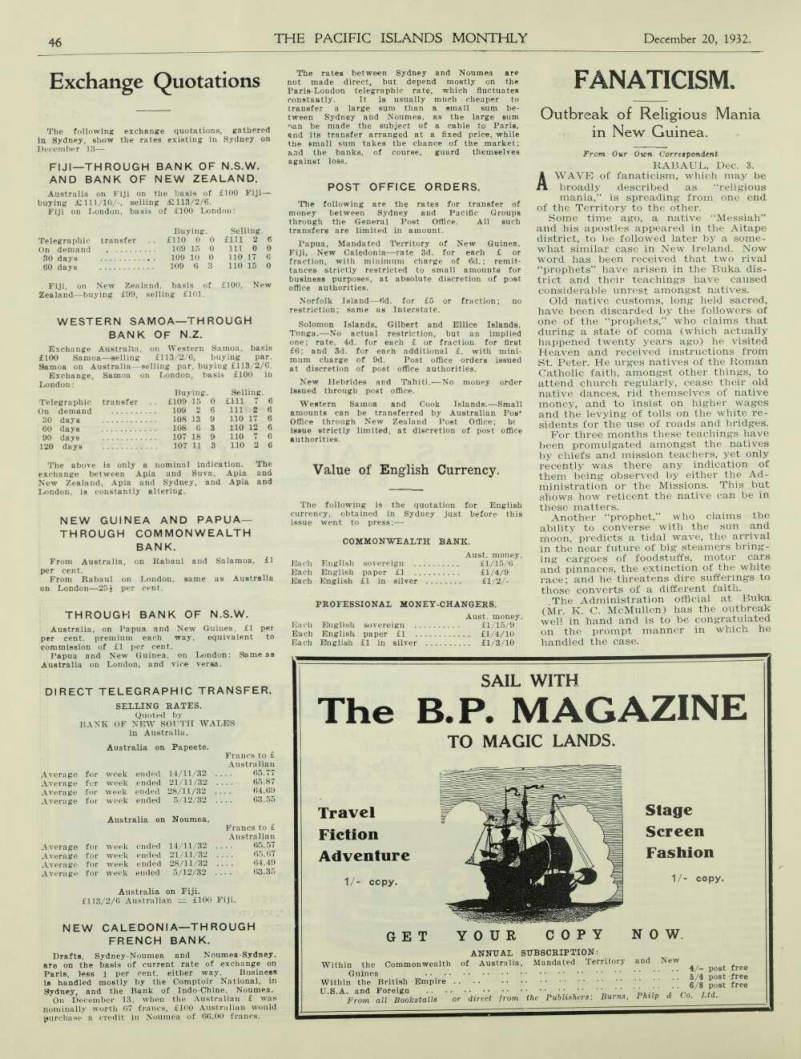
The following exchange quotations, gathered in Sydney, show the rates existing in Sydney on December 13 —
Fiji—Through Bank Of N.S.W.
And Bank Of New Zealand.
Australia on Fiji on the basis of £100 Fiji—buying £111/10/-, selling £113/2/6.
Fiji on London, basis of £100 London;
Western Samoa—Through
Bank Of N.Z.
Exchange Australia, on Western Samoa, basis £100 Samoa—selling £113/2/6, buying par.
Samoa on Australia —selling par, buying £113/2/6.
Exchange, Samoa on London, basis £100 in London:
The above is only a nominal indication. The exchange between Apia and Suva, Apia and New Zealand, Apia and Sydney, and Apia and London, is constantly altering.
New Guinea And Papua
Through Commonwealth
Bank.
From Australia, on Rabaul and Salamoa, £1 per cent.
From Rabaul on London, same as Australia on London —251 per cent.
Through Bank Of N.S.W.
Australia, on Papua and New Guinea, £1 per per cent, premium each way, equivalent to commission of £1 per cent.
Papua and New Guinea, on London: Same as Australia on London, and vice versa.
Direct Telegraphic Transfer.
Selling Rates.
Quoted by
Bank Of New South Wales
in Australia.
Australia on Fiji. £113/2/6 Australian £100 Fiji.
New Caledonia—Through
French Bank.
Drafts, Sydney-Noumea and Noumea-Sydney, are on the basis of current rate of exchange on Paris, less 1 per cent, either way. Business is handled mostly by the Comptoir National, in Sydney, and the Bank of Indo-Chine. Noumea.
On December 13. when the Australian £ was nominally worth 67 francs, £100 Australian would purchase a credit in Noumea of 66.00 francs.
The rates between Sydney and Noumea are not made direct, but depend mostly on the Paris-London telegraphic rate, which fluctuates constantly. It is usually much cheaper to transfer a large sum than a small sum be tween Sydney and Noumea, as the large sum oan be made the subject of a cable to Paris, end its transfer arranged at a fixed price, while the small sum takes the chance of the market; and the banks, of course, guard themselves against loss.
Post Office Orders.
The following are the rates for transfer of money between Sydney and Pacific Groups through the General Post Office. All such transfers are limited in amount.
Papua, Mandated Territory of New Guinea, Fiji, New Caledonia—rate 3d. for each f or fraction, with minimum charge of 6d.; remit tances strictly restricted to small amounts for business purposes, at absolute discretion of post office authorities.
Norfolk Island—6d. for £5 or fraction; no restriction; same as Interstate.
Solomon Islands, Gilbert and Ellice Islands, Tonga.—No actual restriction, but an implied one; rate, 4d. for each £ or fraction, for first £6; and 3d. for each additional £, with mini mum charge of 9d. Post office orders issued at discretion of post office authorities.
New Hebrides and Tahiti.—No money order issued through post office.
Western Samoa and Cook Islands.—Small amounts can be transferred by Australian Post Office through New Zealand Post Office; but issue strictly limited, at discretion of post office authorities.
Buying.
Selling.
Telegraphic transfer .. £110 0 0 £111 2 6 On demand 109 15 0 111 0 0 30 days 109 10 0 110 17 6 60 days 109 6 3 110 15 0 Fiji, on New Zealand, basis of Zealand—buying £99, selling £101. £100, New
Buying. Selling.
Telegraphic transfer .. £109 15 0 £111 7 6 On demand 109 2 6 111 2 6 30 days 108 13 9 110 17 6 60 days 108 G 3 110 12 6 90 days 107 18 9 110 7 6 120 days 107 11 3 110 2 6
Australia on Papeete.
Francs to £ Australian Average for week ended 14/11/32 . 65.77 Average for week ended 21/11/32 65.87 Average for week ended 28/11/32 . 64.69 Average for week ended 5/12/32 . 63.55 Australia on Noumea.
Francs to £ Australian Average for week ended 14/11/32 , 65.57 Average for week ended 21/11/32 65.67 Average for week ended 28/11/32 64.49 Average for week ended 5/12/32 . 63.35
Value of English Currency.
The following is the quotation for English currency, obtained in Sydney just before this issue went to press:—
Commonwealth Bank.
Aust. money.
Each English sovereign f 1/15/6 Each English paper £1 £1/4/9 Each English £1 in silver £1/2/-
Professional Money-Changers.
Aust. money.
Each English sovereign £1/15/9 Each English paper £1 £1/4/10 Each English £1 in silver £1/3/10
Fanaticism.
Outbreak of Religious Mania in New Guinea.
From Our Own Correspondent
Rabaul, Dec. 3.
A WAVE of fanaticism, which may be broadly described as “religious mania,” is spreading from one end of the Territory to the other.
Some time ago, a native “Messiah” and his apostles appeared in the Aitape district, to be followed later by a some what similar case in New Ireland. Now word has been received that two rival “prophets” have arisen in the Buka dis trict and their teachings have caused considerable unrest amongst natives.
Old native customs, long held sacred, have been discarded by the followers of one of the “prophets,” who claims that during a state of coma (which actually happened twenty years ago) he visited Heaven and received instructions from St. Peter. He urges natives of the Roman Catholic faith, amongst other things, to attend church regularly, cease their old native dances, rid themselves of native money, and to insist on higher wages and the levying of tolls on the white re sidents for the use of roads and bridges.
For three months these teachings have been promulgated amongst the natives by chiefs and mission teachers, yet only recently was there any indication of them being observed by either the Ad ministration or the Missions. This but shows how reticent the native can be in these matters.
Another “prophet,” who claims the ability to converse with the sun and moon, predicts a tidal wave, the arrival in the near future of big steamers bring ing cargoes of foodstuffs, motor cars and pinnaces, the extinction of the white race; and he threatens dire sufferings to those converts of a different faith.
The Administration official at Buka (Mr. K. C. McMullen) has the outbreak well in hand and is to be congratulated on the prompt manner in which he handled the case.
Advertisements & other items, p. 48 (1 item)
The B.P. Magazine
SAIL WITH
TO MAGIC LANDS,
Travel Fiction Adventure 1/- copy.
Stage Screen Fashion 1/- copy.
GET YOUR COPY NOW.
ANNUAL SUBSCRIPTION:
Within the Commonwealth of Australia, Mandated Territory and New Guinea 4/- post free Within the British Empire 5/4 post free U.S.A. and Foreign 6/8 post free From all Bookstalls or direct from the Publishers: Burns, Philp & Co. Ltd.
Shipping Services in the Pacific
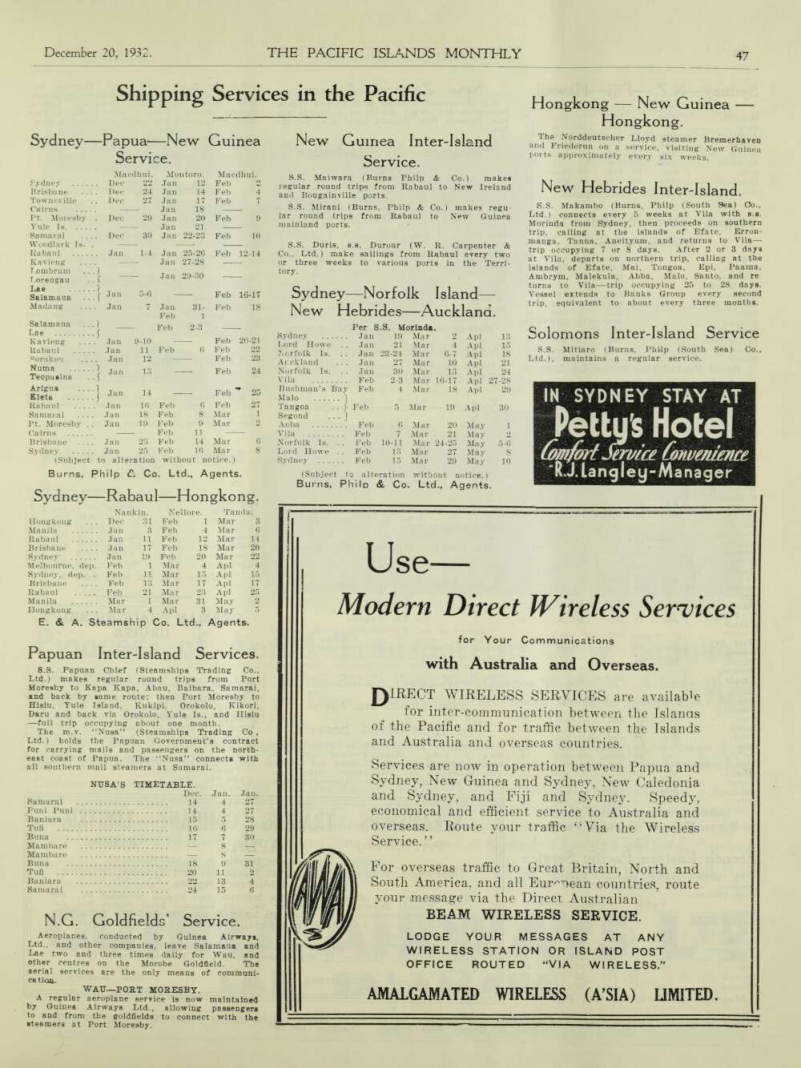
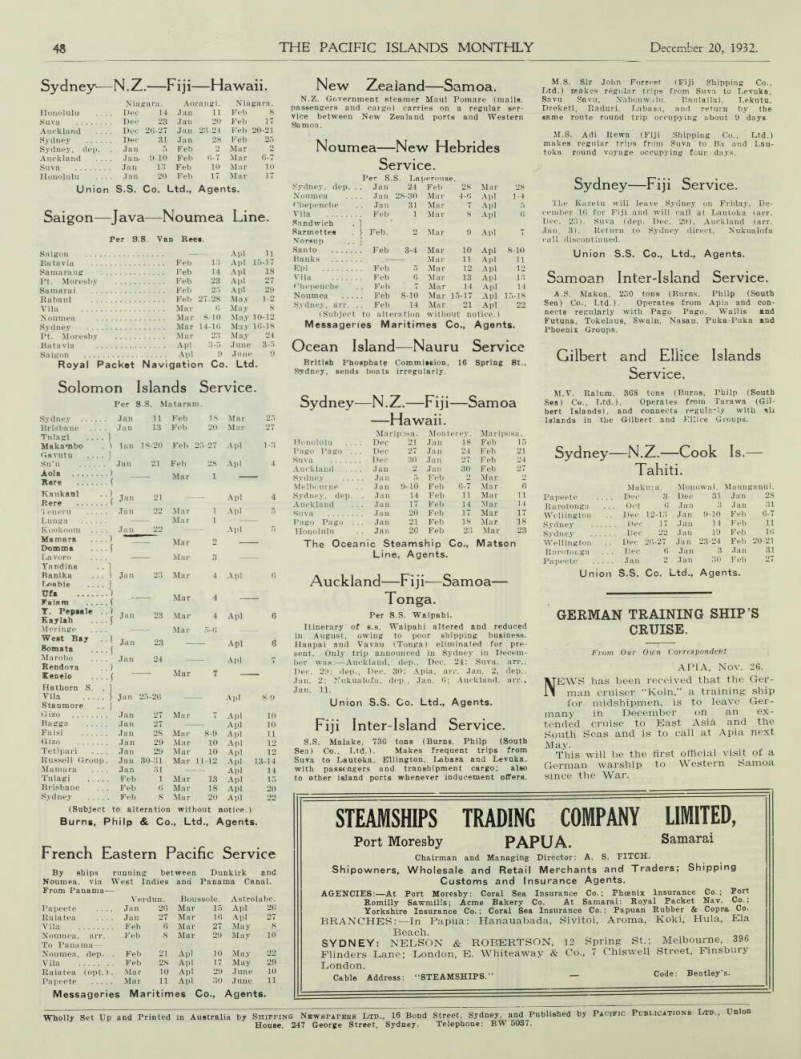
Sydney—Papua—New Guinea Service.
Sydney—Rabaul—Hongkong.
Papuan Inter-Island Services.
S.S. Papuan Chief (Steamships Trading Co., Ltd.) makes regular round trips from Port Moresby to Kapa Kapa, Abau, Baibara, Samarai, and back by same route; then Port Moresby to Hisiu, Yule Island, Kukipi, Orokolo, Kikori, Daru and back via Orokolo, Yule Is., and Hisiu —full trip occupying about one month.
The m.v. “Nusa” (Steamships Trading Co, Ltd.) holds the Papuan Government’s contract for carrying mails and passengers on the north east coast of Papua. The “Nusa” connects with all southern mail steamers at Samarai.
N.G. Goldfields’ Service.
Aeroplanes, conducted by Guinea Airways, Ltd., and other companies, leave Salamaua and Lae two and three times daily for Wau, and other centres on the Morobe Goldfield. The aerial services are the only means of communi cation.
Wau—Port Moresby.
A regular aeroplane service is now maintained by Guinea Airways Ltd., allowing passengers to and from the goldfields to connect with the steamers at Port Moresby.
New Guinea Inter-Island
Service.
S.S. Maiwara (Burns Philp & Co.) makes regular round trips from Rabaul to New Ireland and Bougainville ports.
S.S. Mirani (Burns, Philp & Co.) makes regu lar round trips from Rabaul to New Guinea mainland ports.
S.S. Duris, s.s. Durour (W. R. Carpenter & Co., Ltd.) make sailings from Rabaul every two or three weeks to various ports in the Terri tory.
Sydney—Norfolk Island—
New Hebrides—Auckland.
Hongkong — New Guinea —
Hongkong.
The Norddeutscher Lloyd steamer Bremerhaven and Friederun on a service, visiting New Guinea ports approximately every six weeks.
New Hebrides Inter-Island.
S.S. Makambo (Burns, Philp (South Sea) Co., Ltd.) connects every 5 weeks at Vila with s.s.
Morinda from Sydney, then proceeds on southern trip, calling at the islands of Efate, Erron manga, Tanna, Aneityum, and returns to Vila— trip occupying 7or 8 days. After 2or 3 days at Vila, departs on northern trip, calling at the islands of Efate. Mai, Tongoa, Epi, Paama.
Ambrym, Malekula, Abba, Malo, Santo, and re turns to Vila—trip occupying 25 to 28 days.
Vessel extends to Banks Group every second trip, equivalent to about every three months.
Solomons Inter-Island Service
S.S. Mitiaro (Burns, Philp (South Sea) Co., Ltd.), maintains a regular service.
Sydney ...
Per S.S. Morinda.
Jan 19 Mar 2 Apl 13 Lord Howe .. Jan 21 Mar 4 Apl 15 Norfolk Is, . . Jan 23-24 Mar 0-7 Apl 18 Auckland . . Jan 27 Mar 10 Apl 21 Norfolk Is.
Jan 30 Mar 13 Apl 24 Vila Feb 2-3 Mar 1C 1-17 Apl 27-28 Bushman’s Bay Feb 4 Mar 18 Apl 29 Malo Tangoa
Feb 5
Mar 19 Apl 30 Segond Aoba Feb 6 Mar 20 May 1 Vila . Feb 7 Mar 21 May 2 Norfolk Is. .
Feb 10-11 Mar 24-25 May 5-6 Lord Howe Feb 13 Mar 27 May 8 Sydney Feb 15 Mar 29 May 10 (Subject to alteration without notice.) Burns, Philp & Co. Ltd., Agents.
Sydney Macdhui.
Dec 22 Montoro.
Jan 12 Macdhui.
Feb 2 Brisbane Dec 24 Jan 14 Feb 4 Townsville . Dec 27 Jan 17 Feb 7 Jan 18 Jan 20 Pt. Moresby . Dec 29 Feb 9 Yule Is — Jan 21 — Samarai Woodlark Is. .
Rabaul Dec . Jan 30 1-4 Jan 22-23 Jan 25-26 Feb 10 Feh 12-14 Kavieng Lombrun Lorengau Lae
Jan
Jan 27-28 Jan 29-30 — Salamaua 5-6 — Feb 16-17 Madang Jan 7 Jan 31- Feb 18 Salamaua Lae 7 . Jan . Jan Jan Feb 1 Feb 2-3 Kavieng Rabaul «orakeu 9-10 11 12 Feb 6 Feb 20 Feb Feb -21 22 23 Numa
Jan
Feb 24 Teopusina 13 Arigua . . . .
Kleta
Jan
Jan 14 — Feb 25 Rabaul 16 Feb 6 Feb 27 Samarai Jan 18 Feb 8 Mar 1 Pt. Moresby . .
Jan 19 Feb 9 Mar o Cairns Feb 11 • - Brisbane Sydney Jan Jan 23 25 Feb 14 Feb 16 Mar Mar 6 8 (Subject to alteration without notice.) Burns, Philp & Co. Ltd., Agents.
Nankin.
Nellore.
Tanda.
Hongkong Dec 31 Feb 1 Mar 3 Manila Jan 3 Feb 4 Mar 0 Rabaul Jan 11 Feb 12 Mar 14 Brisbane ...
Jan 17 Feb 18 Mar 20 Svdnev Jan 19 Feb 20 Mar 22 Melbourne, dep.
Feb 1 Mar 4 Apl 4 Sydney, dep. .
Feb 11 Mar 15 Apl 15 Brisbane ...
Feb 13 Mar 17 Apl 17 Rabanl Feb 21 Mar 23 Apl 25 Manila Mar 1 Mar 31 May 2 Hongkong Mar 4 Apl 3 May 5 E. & A. Steamship Co. Ltd., Agents.
Samarai
Nusa's Timetable.
Dec. 14 Jan. 4 Jan. 27 Puni Puni . 14 4 27 Baniara 5 28 Tnfi 0 29 Buna 17 7 30 Mamba re ■ — 8 — Mamba re — 8 — Buna 9 31 Tufi 20 11 2 Baniara 22 13 4 Samarai 24 15 6
Sydney — N.Z. — Fiji — Hawaii
Saigon—Java—Noumea Line.
Solomon Islands Service.
French Eastern Pacific Service
By ships running between Dunkirk and Noumea, via West Indies and Panama Canal.
From Panama—
New Zealand—Samoa.
N.Z. Government steamer Maiii Pomare (mails, passengers and cargo) carries on a regular ser vice between New Zealand ports and Western Samoa.
Messageries Maritimes Co., Agents.
Ocean Island—Nauru Service
British Phosphate Commission, 16 Spring St., Sydney, sends boats irregularly.
The Oceanic Steamship Co., Matson
Line, Agents.
Auckland—Fiji—Samoa—
Tonga.
Per S.S. Walpahi.
Itinerary of s.s. Waipahi altered and reduced in August, owing to poor shipping business.
Haapai and Vavau (Tonga) eliminated for pre sent. Only trip announced in Sydney in Decem ber was: —Auckland, dep., Dec. 24; Suva, arr., Dec. 29; dep., Dec. 30: Apia, arr. Jan. 2, dep., Jan. 2; Nukualofa, dep., Jan. 6; Auckland, arr., Jan. 11.
Union S.S. Cos. Ltd., Agents.
Fiji Inter-Island Service.
S.S. Malake. 73G tons (Burns, Philp (South Sen) Cos., Ltd.). Makes frequent trips from Suva to Lautoka, Ellington, Labasa and Levuka, with passengers and transhipment cargo; also to other island ports whenever inducement offers.
M.S. Sir John Forrest (Fiji Shipping Co., Ltd.) makes regular trips from Suva to Levuka, Savu Savu, Nabouwalu, P.aulailai, Lekutu, Dreketi, Raduri, Labasa, and return by the same route round trip occupying about 9 days M.S. Adi Rewa (Fiji Shipping Co., Ltd.) makes regular trips from Suva to Ba and Lau toka. round voyage occupying four days.
Sydney—Fiji Service.
The Karetu will leave Sydney on Friday, De cember 16 for Fiji and will call at Lautoka (arr.
Dec. 23), Suva (dep. Dec. 29), Auckland (arr.
Jan. 3). Return to Sydney direct. Nukualofa call discontinued.
Union S.S. Co., Ltd., Agents.
Samoan Inter-Island Service.
A.S. Makoa, 250 tons (Burns, Philp (South Sea) Co., Ltd.). Operates from Apia and con nects regularly with Pago Pago, Wallis and Futuna, Tokelaus, Swain, Nasau, Puka-Puka and Phoenix Groups.
Gilbert and Ellice Islands
Service.
M.V. Ralura, 368 tons (Burns, Philp (South Sea) Co., Ltd.). Operates from Tarawa (Gil bert Islands), and connects regularly with all Islands in the Gilbert and Fllice Groups.
Sydney—N.Z.—Cook Is.—
Tahiti.
Niagara.
Aorangi.
Niagara.
Honolulu . . . .
Dec 14 Jan 11 Feb 8 Suva Dec 23 Jan 20 Feb 17 Auckland ...
Dec 26-27 Jan 23-24 Feb 20-21 Sydney Dec 31 Jan 28 Feb 25 Sydney, dep.
Jan 5 Feb 2 Mar 2 Auckland ...
Jan- 9-10 Feb 0-7 Mar 0-7 Suva Jan 13 Feb 10 Mar 10 Honolulu ...
Jan 20 Feb 17 Mar 17 Union S.S. Co. Ltd., Agents.
Per S.S. Van Rees.
Apl 11 Apl 15-17 Apl 18 Apl 27 Batavia Feb 13 Saraarang Feb 14 Pt. Moresby Feb 23 Feb 2~t Apl 29 Mav 1-2 Feb 27 -28 Vila Mar (I May 8 Is oumea Mar 8 -10 May 10-12 Sydney Mar 14 -10 May 10-18 Pt. Moresby ...
Mar 23 May 24 June 3-5 Batavia Apl 3-5 Saigon Apl 9 June 9 Royal Packet Navigation Co. Ltd.
Per S.S. Mataram.
Sydney Jan 11 Feb is Mar 25 Brisbane Jan 13 Feb 20 Mar 27 Tulngi Makambo 1 V Ian 18-20 Feb 25 -27 A pi 1-3 Oavutu Su’n . .
J Jan 21 Feb 28 A pi 4 Aola ... f Mar 1 Kaukanl Here Jan 21 — Apl 4 'leneru Jan 22 Mar Mar 1 1 Apl 5 Kookoom 1 f Jan 22 Apl 5 Mamara Domma Mar 2 — Lavoro Tandina Ranika Lonble Ufa Mar Mar 3 Jan 23 4 Apl 6 Fainm Mar 4 T. Pepaale Eaylab Meringe West Bay Bomata Marobo Rendova Kenelo Jan Jan Jan 23 23 24 Mar Mar Mar 4 5-6 7 Apl Apl Apl 6 6 Hathorn S Vila Jan 25-26 Aid 8-9 Stanmore A\n Gizo ...
Jan 27 Mar j Apl Ard 10 10 11 12 12 !-14 14 15 Bagga Jan Jan Faisi 28 Mar 8-9 10 10 -12 13 18 20 Apl Apl Apl Apl U Apl Apl Apl Apl (Subject to alteration without notice.) Gizo Tetipari Russell Gr Mamara Tulagi Jan Jan Jan Jan Feb 29 29 30-31 31 1 Mar Mar Mar 11 Mar Brisbane Svdney Feb Feb 6 8 Mar Ms r 20 22 Burns, Philp & Co Ltd. , Agents.
Verdun.
Boussole.
Astrolabe.
Papeete Jan 26 Mar 15 Apl 26 Raiatea Jan 27 Mar 16 Apl 27 Vila Feb G Mar 27 May 8 Noumea, arr.
Feb 8 Mar 29 May 10 To Pana ma — Noumea, dep. .
Feb 21 Apl 10 May 22 Vila Feb 28 Apl 17 May 29 Raiatea (opt.).
Mar 10 Apl 29 June 10 Papeete Mar 11 Apl 30 June 11 Messageries Maritimes Co., Agents.
Noumea — New Hebrides
Service.
Per S.S. Laperouse.
Sydney, dep. . . .Tan 24 Feb 28 Mar 28 Noumea , . Jan 28-30 Mar 4-6 A pi 1-4 Fliepenche . . Jan 31 Mar 7 A pi 5 Vila . Feb 1 Mar 8 Apl 6 Sandwich 1 Sarmottes \ Feb. 2 Mar 9 Apl i Norsup j Santo . Feb 3-4 Mar 10 Apl 8-10 Banks — Mar 11 Apl 11 Epi Feb 5 Mar 12 Apl 12 Vila . Feb 6 Mar 13 Apl 13 Fhepenche Feb 7 Mar 14 Apl 14 Noumea . . Feb 8-10 Mar 15-17 Apl 15-18 Sydney, arr.
Feb 14 Mar 21 Apl 22 (Subject to alteration without notice.)
Sydney— -N.Z.—Fiji —Samoa
—Hawaii.
Mariposa.
Monterey.
Mariposa.
Honolulu ...
Dec 21 Jan 18 Feb 15 Pago Pago . . .
Dec 27 Jan 24 Feb 21 Suva Dec .10 Jan 27 Feb 24 Auckland ...
Jan 2 Jan 30 Feb 27 Sydney Jan 5 Feb 2 Mar 2 Melbourne Jan 9 -10 Feb 6-7 Mar 6 Sydney, dep. .
Jan 14 Feb 11 Mat- 11 Auckland Jan 17 Feb 14 Mar 14 Suva Jan 20 Feb 17 Mar 17 Pago Pago . ..
Jan 21 Feb 18 Mar 18 Honolulu Jan 26 Feb 23 Mar 23
Makura.
Monowai.
Maunganui.
Papeete ...
Dec 3 Dec 31 Jan 2S Rarotonga Oct 6 Jan 3 Jan 31 Wellington Deo 12-13 Jan 9-10 Feb 6-7 Sydney Dec 17 Jan 14 Feb 11 Sydney Dec 22 Jan 19 Feb 16 Wellington Dec 20-27 Jan 23-24 Feb 20-21 Rarotonga Dec 0 Jan 3 Jan 31 Papeete Jan 2 Jan 30 Feb 27 Union S.S. Co. Ltd., Agents.
Advertisements & other items, p. 49 (1 item)
Petty's Hotel
IN SYDNEY STAY AT
Comfort Service Convenience R.J. Langley-Manager
Use—
Modern Direct Wireless Services
for Your Communications with Australia and Overseas.
[)IRECT WIRELESS SERVICES are
for inter-communication between the Islands of the Pacific and for traffic between the Islands and Australia and overseas countries.
Services are now in operation between Papua and Sydney, New Guinea and Sydney, New Caledonia and Sydney, and Fiji and Sydney. Speedy, economical and efficient service to Australia and overseas. Route your traffic “Via the Wireless Service. ”
For overseas traffic to Great Britain, North and South America, and all countries, route your message via the Direct Australian
BEAM WIRELESS SERVICE.
LODGE YOUR MESSAGES AT ANY
WIRELESS STATION OR ISLAND POST
OFFICE ROUTED "VIA WIRELESS.”
AMALGAMATED WIRELESS (A’SIA) LIMITED.
German Training Ship’S
Cruise.
From Our Own Correspondent
Apia, Nov. 26.
NEWS has been received that the Ger man cruiser “Koln,” a training ship for midshipmen, is to leave Ger many in December on an ex tended cruise to East Asia and the South Seas and is to call at Apia next May.
This will be the first official visit of a German warship to Western Samoa since the War.
Advertisements & other items, pp. 50-52 (2 items)
48
December 20, 1932,
THE PACIFIC ISLANDS MONTHLY
Wholly Set Up and Printed in Australia by Shipping Newspapers Ltd., 16 Bond Street, Sydney, and Published by Pacific Publications Ltd., Union House, 247 George Street, Sydney. Telephone: BW 5037.
Steamships Trading Company Limited,
Port Moresby PAPUA. Samarai
Chairman and Managing Director: A. S. FITCH.
Shipowners, Wholesale and Retail Merchants and Traders; Shipping Customs and Insurance Agents.
AGENCIES:—At Port Moresby: Coral Sea Insurance Co.; Phoenix Insurance Co.; Port Romilly Sawmills; Acme Bakery Co. At Samarai: Royal Packet Nav. Co.; Yorkshire Insurance Co.; Coral Sea Insurance Co.; Papuan Rubber & Copra Co.
BRANCHES;—In Papua: Hanauabada, Sivitoi, Aroma, Koki, Hula, Ela Beach.
SYDNEY: NELSON & ROBERTSON, 12 Spring St.; Melbourne, 39b Flinders Lane; London, E. Whiteaway & Co., 7 Chiswell Street, Finsbury London.
Cable Address: “STEAMSHIPS." Code: Bentley's.
TOP: No. 2 Bulolo Dredge in course of construction. Carried in by aeroplanes.
BOTTOM: Bulolo Aerodrome, showing Passenger and Cargo- Carrying Aeroplanes.
Pioneers of Aerial Transport in New Guinea Two Dredges are now at work on the Bulolo Flats, New Guinea Goldfields. A large Hydro- Electric Station provides Light and Power. Preparations are being made to instal Two More Dredges in the Bulowat Area.
All the Plant, Equipment, Supplies and Personnel Required for these Enterprises have been carried in, without accident or delay, by the Regular Established Services of Guinea Airways Ltd.
Guinea Airways Ltd. pioneered and developed Aerial Transportation in New Guinea. As the ew Guinea Gold Industry extends, so do the Company’s Aerial Services. New landinggrounds for Guinea Airways machines, through which prospectors receive their supplies, have been constructed in the Ramu region (New Guinea) and at Kokoda (Yodda Goldfield, Papua).
The Company maintains a regular passenger service between Port Moresby (Papua) and New Guinea Goldfields.
GUINEA AIRWAYS LTD
LAE • SALAMAUA
The best drink south of the line EK/1 You men need a bottle of KB at dusk . . . there’s stimu lation in every glass!