Advertisements & other items, pp. 1-2 (2 items)
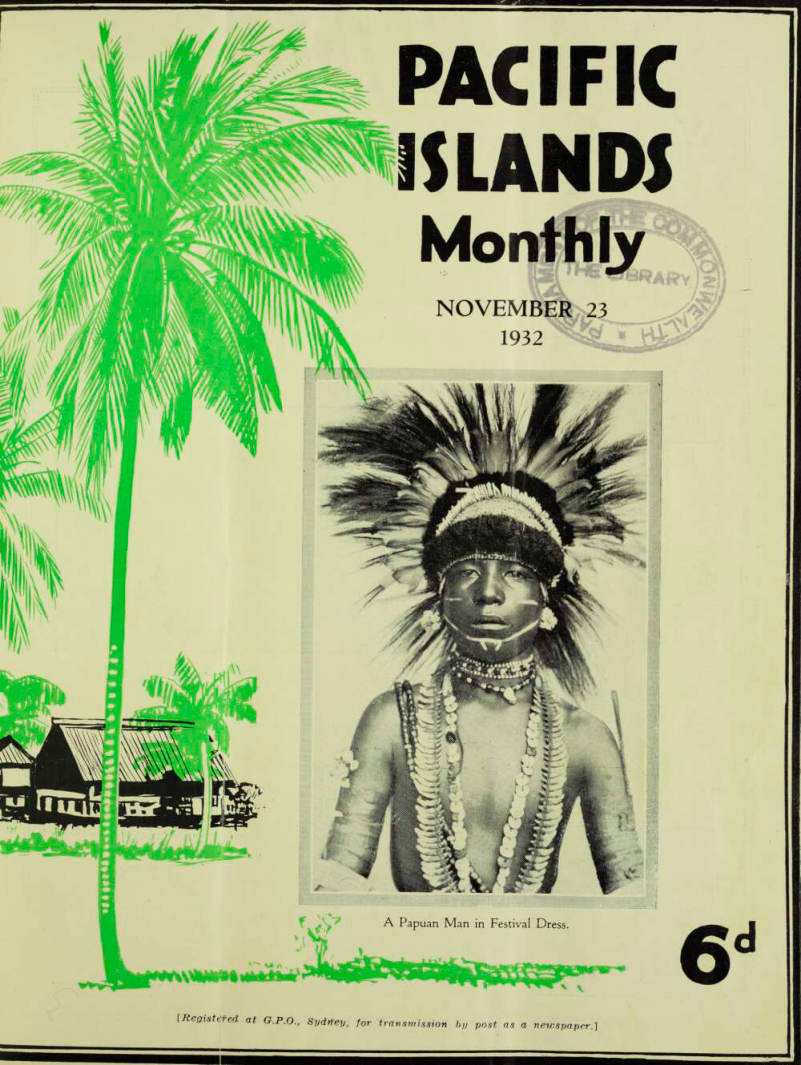
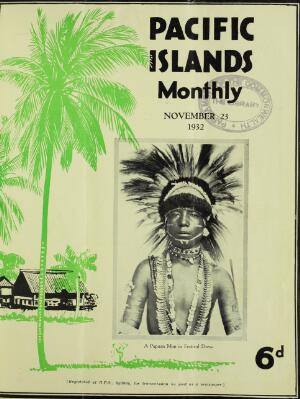
Monthly
PACIFIC
ISLANDS
NOVEMBER 23
1932
6 d
[Registered at G.P.O., Sydney, for transmission by post as a newspaper]
A Papuan Man in Festival Dress.
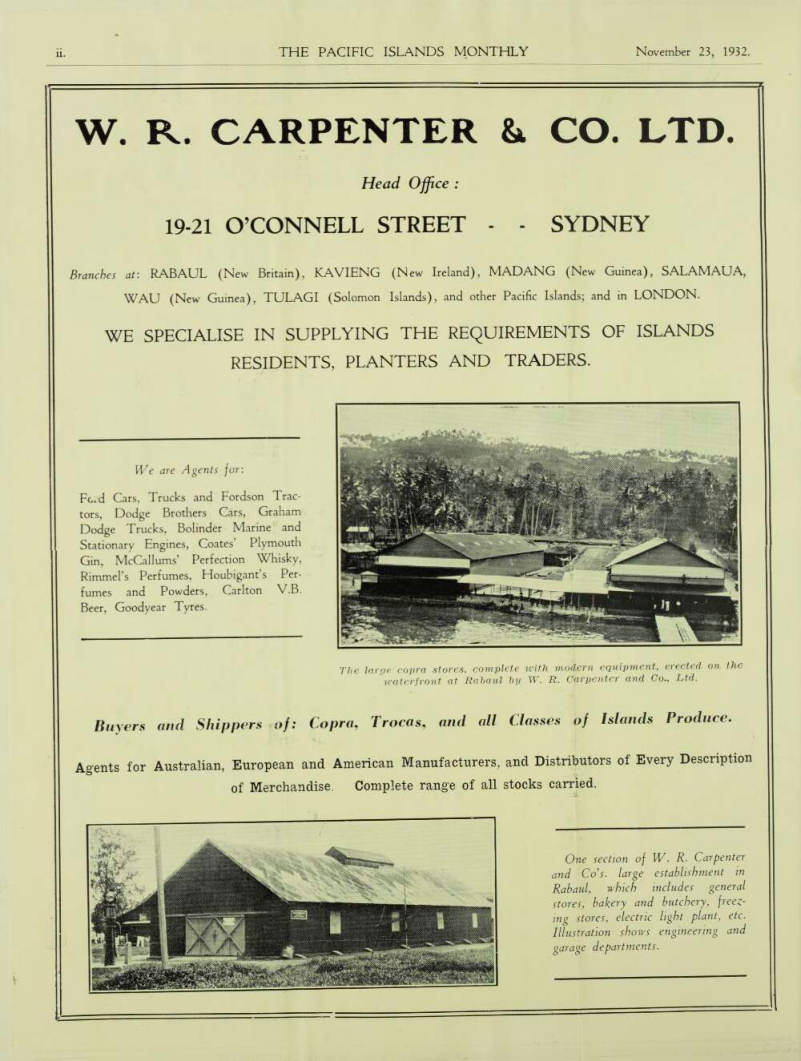
W. R. Carpenter & Co. Ltd.
Head Office :
19-21 O’CONNELL STREET - - SYDNEY
Branches at: RABAUL (New Britain), KAVIENG (New Ireland), MADANG (New Guinea), SALAMAUA, WAU (New Guinea), TULAGI (Solomon Islands), and other Pacific Islands; and in LONDON.
WE SPECIALISE IN SUPPLYING THE REQUIREMENTS OF ISLANDS
RESIDENTS, PLANTERS AND TRADERS.
We are Agents for: Ford Cars, Trucks and Fordson Trac tors, Dodge Brothers Cars, Graham Dodge Trucks, Bolinder Marine and Stationary Engines, Coates’ Plymouth Gin, McCallums’ Perfection Whisky, Rimmel’s Perfumes, Houbigant’s Per fumes and Powders, Carlton V .B.
Beer, Goodyear Tyres.
The large copra stores, complete with modern equipment, erected on the waterfront at Rahaul hy W. R. Carpenter and Go., Ltd.
Buyers and Shippers of: Copra , Trocas , and all Classes of Islands Produce .
Agents for Australian, European and American Manufacturers, and Distributors of Every Description of Merchandise. Complete range of all stocks carried.
One section of W. R. Carpenter and Co’s, large establishment in Rabaul, which includes general stores, bakery and butchery, freez ing stores, electric light plant, etc.
Illustration shows engineering and garage departments.
Pacific Islands Travellers
Passengers Who Arrived On October
26 Per “Morinda” From New Hebrides
AND NORFOLK IS. : Mr. W. Giles, Mrs. Giles, Mr. A. K, Perrett, Mrs. D. N. Adams and in fant, Captain W T . Colquhoun, Rev. M. Frater, Mr. L. E. Jourdan, Mr. and Mrs. E. Atkinson and three children, Miss B. Bartle, Mrs. K.
Bignell, Miss Bignell, Mr. W. R. Castles and two children, Mr. B. M. Clark, Mrs. C. Crowther, Mr. R. E. Eastman and child, Mrs. A. Fairlie and infant, Mr. A. F. Hunt, Mr. V. W. Hunter, Mrs. Hunter and infant, Mr. F.J. Hyde, Mr. K. Mc Coy, Mr. C. D. Rankin, Mrs. Rankin, Mr. W. Ren nie, Mrs. A. Rennie, Mr. G. V. Shillinglaw, Mrs. J. Austen, Miss M. Barker, Mr. J. Black well, Mrs. Blackwell, Mr. H. Clayton, Mrs.
Clayton, Mr. P. Colquhoun, Mr. E. Decent, Mr.
D. Dolan, Mrs. S. Fenton, Mrs. F. Gressier, Mrs. D. Happ, Mr. G. Harrison, Mrs. Harrison and two children, Mrs. H. A. Innes, Miss R.
Lindsay, Miss A. Lindsay, Mr. Livingstone, Mrs.
Livingstone, Miss W. Livingstone, Mrs. P. Mac Dermott, Mrs. M. McCann, Miss C. McKeough, Miss A. Moore, Mrs. J. Murphy, Mr. G. Nichols, Miss P. Nichols, Miss V. Nichols, Mrs. C.
O’Connor, Mr. E. R. Park, Mr. A. Russell, Mr.
F. Pursell, Mrs. Pursell, Mrs. S. Rippingdale, Miss T. Speedy, Mr. J. Stewart, Mrs. Stewart, Mr. J. Sykes, Mrs. O. C. Thompson, Mr. R.
Thompson, Mrs. W. Thompson, Master W.
Thompson, Miss T. Towey, Mrs. F. Winter botham, Miss F. Winterbotham.
Passengers Per “Montoro” From
SYDNEY ON OCTOBER 20 FOR PAPUA AND NEW GUINEA ; Mr. S. O. Irvine, Mr. G. D.
Hamilton, Mr. McLean, Mrs. McLean, Miss H.
M. Colebrook, Mrs. L. Bowden, Miss M. Hain, Mr. B. Thomas, Mr. R. Durcher, Miss L. Ma guire, Miss V. E. Chandler, Miss W. Jennings, Miss M. Voysey, Mrs. M. Hempel. Mr. C. Nor moyle, Mr. T. J. Richards, Mr. Kirk, Mr. H.
Hotz, Mr. F. J. Carey, Mr. B. McGrath, Mr.
A. Lohmann, Mrs. Lohmann, Mr. C. E. Dale, Mrs. Dale and two children, Miss C. Kennedy, Miss I. W. Charlier, Mr. B. Roja, Mr. J. M.
Atherton, Mr. C. J. Thompson, Mr. M. D.
Cobb, Mr. R. Clark, Mr. H. G. H. Goss, Mr. W.
R. Thomas, Mrs. Thomas, Mr. H. C. Beaver, Mr. A. Kellock, Mr. E. J. Ryan, Mr. E. Gal lett, Mr. W. T. Hill, Mr. W. Kemp, Mr. G.
Kemp, Mr. E. H. Guinan, Mrs. Guinan, and infant, Mr. C. H. Karius, Mrs.
Karius, Mr. R. Ellis, Mrs. Halford Thompson, Mr. B. G. Morris, Mr. P. Connolly, Mr. J. Henry, Mr. E. J. Stephens, Mr. C. B. L.
Grey, Mr. B. Bails.
Passengers Per M.V. “Macdhui” From
Papua And New Guinea Ports, Arrived
OCTOBER 28: Mr. A. W. Allen, Mr. R. V.
Amiss, Mrs. A. E. Anderson and three children, Mr. J. W. Anderson, Mr. O. M. Anderson, Mr. and Mrs. E. G. Baker, Mr. D. G. Barrett, Mr.
J. Bassett, Mr. and Mrs. W. J. Brooke, Miss D. Brooks, Mr. and Mrs. N. Courtney, Mr. O.
D. Denny, Mr. V. C. Dixon, Mr. W. Dyson, Mrs. D. Esson, Mr. J. A. Ewen, Mr. L. F.
Ferris, Captain A. S. Fitch, Rev. Brother Gar rod, Mr. F. J. Giles, Dr. and Mrs.
A. Gilroy, Mr. F. B. Godson, Mrs. M.
Godson, Mr. W. H. Gordon, Mr. E. E. Grove, Mrs. J. Gurney, Mr. F. Hambridge, Mr. H.
Holland, Mrs. L. G. Hunter, Mr. A. Hyde, Mr.
H. Ingham, Mr. and Mrs. A. Jewell, Miss L.
E. Job, Mr. R. M. King, Mr. O. Kleinschmidt, Mrs. C. Klump, Rev. and Mrs. F. Lane, Mr. and Mrs. W. P. Lapthorne, Mr. G. L. Mackay, Mrs.
M. T. Mann, Mrs. I. Mclntyre, Mr. F. T. D.
Meares, Mrs. I. A. Meldrum, Mr. W. T. G.
Morrison, Mr. J. C. Morrow, Mr. and Mrs. L.
J. Perichon, Mrs. N. M. Rinehart, Miss H. M.
Rogers. Mr. B. D. Ryan, Mrs. F. G. Schuler and child, Mr. L. C. Steenbhom, Mr. I. Tait, Mr. and Mrs. A. D. Thomson and two children, Mrs. W. H. Truscott, Miss R. I. Waldon, Miss T. Waldon, Mr. H. R. Wales, Mr. and Mrs. L.
V. Waterhouse, Miss J. M. Waterhouse, Mrs.
L. Way, Mr. G. H. Wilson, Mr. C. Winard, Mrs. J. Zimmer.
Passengers Per “Mataram,” Which
Sailed From Sydney On October 22.
FOR SOLOMON ISLANDS: Mr. P. J. Ward, Mrs. D. Whitehead, Miss I. V. Wilson, Mr. E.
M. Smith, Mr. C. J. Mason, Mrs. Mason, Mr.
H. Mann, Mr. E. Grant Smith, Mrs. Grant Smith, Mr. Monckton, Mr. A. B. Tyrell.
Passengers, Per “Morinda,” Who
Sailed From Sydney On November 10
For Lord Howe Island, Norfolk
Island, Auckland, And New Hebrides:
Mr. E. B. Harkness, Mrs. Harkness, Miss Hark ness, Mr. D. T. Muir, Mr. Muir, Mr. W. H.
Sanders, Mrs. Sanders and infant, Miss D.
Yates, Mrs. M. W. Duly, Miss C. Dupertuis, Miss Hewitt, Mr. E. D. Kemmis, Mrs. Kemmis, Miss J. Ratte, Miss L. Walsh, Mr. R. Pearson and infant, Sister M. Kirkham, Mrs. J. Hick ling, Mr. L. W. Clyde, Mr. R. J. Clancy, Mr.
A. E. Carter, Mr. H. J. Dunkerley, Mrs. Dun kerley, Mr. E. Fauser, Mr. J. Gegg, Mr. J.
Reid, Mrs Reid and infant, Miss P. Buxton, Mr. P. Shaw, Mr. E. H. Hogg, Miss G. Hayes, Mrs. E. H. Leggo, Miss L. M. Hilliard, Mrs.
A. Gallop, Miss M. Crossan, Miss D. Crossan, Miss E. Walsh, Miss M. Fitzhardinge, Miss P.
King, Miss M. Evans, Mrs. G. W. S. Phillips, Miss M. Child, Miss J. Lloyd, Miss M. Wilson, Miss C. Denneen, Miss K. Cahill, Miss J.
Burrell, Miss L. Clark, Miss F. Matthews, Miss E. Kell, Miss B. Stevens, Miss D. Calvert, Miss E. Clarke, Miss M. McGauly, Miss H. Richard son, Mrs. C. M. Lindsay, Miss E. White, Mr.
G. W. S. Phillips, Mr. R. Johnston, Mr. M.
P. Cummins, Mr. H. M. Smith, Mr. C. M.
Lindsay, Mr. W. Herd, Mr. C. Fenton, Mr. J.
Milne, Mrs. Ure-Johnston, Miss Ure-Johnston, Mr. W. Rope, Captain Walker, Mr. L. C.
Thompson, Mr. McG. Crowe, Mr. C. Hickling, Mr. B. Hickling, Mr. F. J. Tarleton, Mr. W.
McLachlan, Mr. E. V. Wait.
Passengers, Per “Macdhui” Sailed
From Sydney November 10, For Papua
AND NEW GUINEA : Mrs. H. Fraser, Mr. E.
V. Crisp, Mr. G. Pike, Mr. H. Strong, Mr. A.
E. Ray, Mrs. Ray, Mrs. Rich and infant, Miss M. Uhe, Mr. C. Durham, Mr. V. G. Smith, Mr. I. H. Grabowsky, Mrs. Grabowsky and infant, Mr. W. P. Wiltshire, Mr. H. M.
Hadley, Mrs. B. Cordingley, Miss M. Cordingley, Miss A. Cordingley, Mr. E. Rondahl. Mr. N.
Smith, Mr. Donaldson, Mr. E. Knox, Mrs.
Knox, child and infant, Miss C. Wedgwood, Dr. M. Koltzsch, Mrs. M. Koltzsch, Mr. K. W.
Nettleship, Mrs. Nettleship and infant, Mrs.
M. M. Francis and two children, Mrs. Strick land, Miss N. Murray, Mr. D. W. Waldon, Mrs.
Rangel Bennett, Miss E. Cassell, Mr. Walshe, Mrs. Walshe and infant, Mr. F. W. Turton, Mr. W. J. Dellow, Mr. J. Rice, Mr. V. P.
Hides, Mr. A. P. Stewart, Mr K. Jones, Mr.
G. F. Sidery, Mr. J. G. Hoffman, Mr. J. G.
Lawton, Mr. E. A. Beeby, Mr. G D. Cowdery, Mr. M. C. Morasen, Mr. J. G. Bolton, Mr.
S. Marrs.
Passengers From Rabaul. Per S.S.
"Nankin’’, Arrived In Sydney On
OCTOBER 29: Mr. and Mrs. A. L. Robinson and child, Mr. W. Dee, Mr. C. M. Pines, Mr.
N. O’Dwyer, Mrs. B. B. Perriman, Miss I.
K. Trudinger, Mr. G. Scanlon, Miss E. R.
Groves, Mr. and Mrs. J. W. Anderson, Mr. and Mrs. K. T. Allen and child, Mr. E. Lee, Mr.
J. Sinclair, Miss E. P. Coghill, Mr. W. H.
Fitzgibbon, Mr W. Martin, Mr E. Donin, Chief Judge D. S. Wanliss, Mr. O. H. Sturgeon.
Passengers For Swa From Sydney,
Per S.S. “Monterey” On October 20:—
Mr. L. A. Abrahams, Mr. and Mrs. W. S. F.
Bottomley, Mr. and Mrs. E. M. Bland, Miss R.
Bland, Master J. Bland, Mr. W. L. Clarke, Mr. and Mrs. J. Darling, Mr. and Mrs. R R.
Greenwood, Mr. and Mrs. W. J. Martin, Miss M. Madsen, Mr. and Mrs. S. H. Sperling, Mr. and Mrs. A. B. Thomas, Mrs. L. D, Whyte, Mr. E. Y. Warringer, Mr. and Mrs. " W.
Davis, Mr. J. F. Grant, Mr. M. E, Lilley, Miss L. F. Ragg, Mr. P. S. Stanley, Mr. C. M.
Teulon, Mr. W. A. Thomison.
Passengers For Cook Is And Tahiti,
From Sydney, Per S.S. “Makura". Ox
OCTOBER 27; —Mrs. Kingsley Henderson, Miss W. McLeod, Miss Isabel Gullett.
Passengers Per “Niagara” From
Sydney For Suva On November 10:
Mr. G. Buckley, Miss J. S. Dodds, Mr. D. Jervis.
Rev. Father J. Nicolas, Mr. T. W. Wigmall, Miss I. J. Morse, Mrs. G. A. Guinery, Mrs. A. F. Ragg, Miss A. Ragg. Mrs. D. Seccomb, Miss L. Rama samuj, Miss E. Ramasamuj, Mr. and Mrs. F. S.
Baker and Master L. Baker, Mr. A. Carr.
Passengers Per “Nankin’' For
Rabaul, Which Sailed From Sydney On
NOVEMBER 12: Mr. J. C. Archer, Mr. W. H.
Briggs, Mr. G. L. Briggs and child, Mrs. Y.
Elwes, Miss D. Carson, Miss H. M. Rogers. Mrs.
J. Duncan, Mr. W. Brechwoldt, Mrs. W. Marshall and child.
Passengers Per "Mariposa" Which
Arrived In Sydney From Suva On
NOVEMBER 10: Mr. L. Abrahams, Mr. and Mrs. W. S. F. Bottomley, Mr. F. Clarke, Miss A. Cripps. Mr. A. S. Cross, Mr. and Mrs. L. F. J.
Darling, Miss V Doyle, Mr. and Mrs. S. H. Ellis, Miss S. Ellis, Master J. Ellis, Mr. and Mrs. R.
Greenwood, Sir Maynard Hedstrom, Lady J.
Hedstrom, Mr. F. Hennings, Miss M. Madsen, Mr. and Mrs. W. J. Martin, Mr. and Mrs. R.
H. Sperling, Mr. and Mrs. O. W. Stevenson, Miss M. Stevenson, Miss J. Stevenson, Mrs. D. Staf ford, Mrs. M. Stuchbury, Miss J. Stuchbury, Mr. E. G. Warriner, Mrs. L. S. Whyte, Mr. and Mrs. S. J. Andrews, Miss E. Burstal, Mr. J. L.
Ching, Miss M. J. Harbison, Miss H. Hayward, Miss E. L. Martin, Mr. and Mrs. H. R. Martin, Mr. J. E. Martin, Mr. and Mrs. H. Ragg, Miss P. Ragg, Mr. and Mrs. M. Steed, Master V.
Steed, Mrs. W. Warden, Miss M. Warden, Master W. Warden.
Passengers Arrived Per “Mataram,”
Which Reached Sydney From Solomon
ISLANDS ON NOVEMBER 19: Rev. Father A.
Brugmans, Major W. V. J. Blake, Mrs. Blake, Mr. K. McLeod Bolton. Mrs. McLeod Bolton, Miss B. Culliney, Mrs. H. Downs. Mr. F. C.
Hollobone, Mrs. F. Hewitt. Mrs. P. Hubbard, Mr. R. P. Johnson, Mrs. S. G. C. Knibbs, Mr.
J. V. Mather, Mrs. W. Newall, Mrs. J. Sim, Mr. A. M. Turnbull. Miss E. R. Totenhofer, Mrs. I). Whitehead, Mr. H. Wheatley.
Advertisements & other items, p. 3 (1 item)
Royal Packet Sydney
Saloon and Intermediate class passengers carried in comfortable and airy cabins.
REGULAR BI-MONTHLY Freight and Passenger Service by the fast and modern K.P.M. Steamer VAN REES as under:
SAIGON
BATAVIA
SAMARANG
PORT MORESBY
SAMARAI
RABAUL
PORT VILA
NOUMEA
ROYAL PACKET Sydney
PORT MORESBY
NAVIGATION CO., batavia
255 GEORGE STREET, SYDNEY. SAIGON
The B.N.G. Trading Coy., Ltd., Port Moresby; Steamship Trading Co., Samarai; W. R- Carpenter & Co., Ltd., Rabaul; Oubbay Freres, Port Vila; Carlo Leoni, Noumea; Diethelm & Co., Saigon.
Advertisers.
Page.
Adams. Wm., & Co. 37 Allingham, C. E. . . 39 Amal. Wireless ... 47 Aiitinea Drug Co. .. 42 Armstrong, R. H.. & Co. 29 Arnott’s Biscuits . . 41 Barnes. James, Ltd. 36 Bourjois et Cie ... 17 Brandts, Ltd 46 Brunton’s Flour 22 Burns, Philp & Co. 2 Burns, Philp (S.S.) Co 9 B.P. Magazine ... 44 Cameron, Stuart ... 26 Campe, A. C 48 Carpenter, W. R.
Cover ii.
Com. P’laud. Cement 21 Couch, J. II 14 Dangar, Gedye & Co 19 Delicia Food Co. ... 43 Docker’s Paints ... 18 Dowsett. J. H. M. . 36 Elliott, T., & Co. .. 12 Ever-Ready Batteries 25 Excelsior Supply Co. 28 Fletcher & Sons ... 24 Garrett & Davidson. 42 Gibson. Battle & Co. 16 Gillespie’s Flour ... 19 Gold & Silver lav.
Co 16 Gourock Co 33 Guinea Airways cov. iii.
Hale, Alex., Ltd. .. 25 Hall Bros.. Ltd. .. 14 Hall & Co 38 Halvorsen, L 34 Holbrooks. Ltd 15 Hylands, Ltd 43 Invincible Motors, Ltd. 20
Page.
Joyce Biscuits ... 14 Kodaks Pty 11 Kopsen & Co. 24 Langridge, T. A. .. 34 Levinson’s Radio ... 6 Lysaght, John, Ltd.. 27 Mcllrath’s, Ltd 29 McHugh, J. J 18 McKinlay & Cum mins 23 McLeod, Bolton 19 Nelson & Robertson. 35 N. I. Book Club 22 Nolan, Spencer ... 34 Parke, Davis ... 15 Peadon, J. L., Ltd.. 24 Pearson’s Soap Co. . 30 Petty’s Hotel 30 Piggott, C. G 32 Prescott, Ltd 23 Rabaul Carr’g. Co. . 23 Rohu. Sil 40 Royal Gold Exchange 36 Royal Packet N. Co. 1 Russell. S 19 Shell Oil Co 13 Smyth, J. H 40 Steamships T. Co., Ltd 26 Stoffer, A 34 Sunshine Harvester Co 32 Tait & Co., Ltd. .. 45 Tillock & Co.. Ltd.. 33 Tooth & Co. Cover iv.
Vacuum Oil Co. ... 31 Vincent Chem. Co.. 46 Walker, F. J.. Ltd.. 45 Wallaringa Mansions 10 Wills. W. D. & H. O. 12 Westcott, Hazel 29 Wimbledon Tennis Co 20 Wunderlich, Ltd. ... 43
Contents.
Page.
Pacific Islands Travellers 1 Gold Discoveries in Pacific Islands 3,4, 35 “Banana Fritters” 5 Tropicalities 6 Plea That “Pidgin” Be Official in New Guinea 7 “Uncle Cornish” of Norfolk Is 8 “Mana” of the Pomares 9 About Islands People 10 Ramu Goldfield 11 Samoan Impasse 12 Copra Market 14 Fiji Indians Seek Common Roll 15, 16, 33 Tongan Notes 17 Sardine Industry in Torres Straits 18, 19 Opening of Bulolo No. 2 Dredge 4, 20, 21 Australia and Fiji Bananas 22 Scientific Expedition for Papua ... 23 Traders and Missions 24
Page.
Detribalized Natives 25 Christmas at Solomon Islands ... 26 Mr. Green and Tonga 27 Tahiti News 28 Dobu Passage, Papua 29 Thursday Island Notes 30 Adventures in Solomon Islands ... 32 Fiji-Australian Trade 33 Cook Island Notes 34 N.G. Legislative Council Bill ... 36-38 Samoan News 39 Mr, Vogan and Larkin Case 40 Half-castes in Samoa 41 Wreck of “Southern Cross VI.” ... 42 Solomon Is. News 43 N.G. and Papuan Gold Sharemarket 44 Market Quotations 45 Exchange Quotations 46 Shipping Services 47, 48
Advertisements & other items, p. 4 (1 item)
Burns, Philp & Co. Ltd.
TO BE PUBLISHED SHORTLY!
HANDBOOK OF NEW GUINEA, PAPUA, SOLOMON ISLANDS AND NORFOLK ISLA .
Containing Complete Details and Latest Statistical Information about those Terntones and also Lists of Business Firms and European Residents. Ready about end of January.
PRICE, 2/6.
PACIFIC PUBLICATIONS LTD.
UNION HOUSE, 247 George St.,
SYDNEY AUSTRALIA.
BURNS, PHILP & CO. LTD.
General Merchants
Shipowners,
Tourist Agents, Etc.
Buyers of all Classes
of Island Produce
Head Office - 7 Bridge Street, Sydney - Australia Code Address : “BURPHIL”
Regular Steamer Services From Australia to New Guinea, Papua, Solomons, Lord Howe, Norfolk Islands, New Hebrides, Java and Singapore
The Pacific Islands Monthly
THE NEWSPAPER - MAGAZINE OF THE SOUTH SEAS [Registered at G.P.O., Sydney, for transmission by post as a newspaper .]
Published Once Each Month and Circulated in Australia and New Zealand and in the following Pacific Territories and Island Groups:
Crown Colony of Fiji.
Australian Territory of Papua.
Mandated Territory (Australia) of New Guinea, Bismarck Archipelago, and Northern Solo mon Islands.
Mandated Territory (Japan) of Marshall, Caro line and Mariana Islands.
American Territory of Guam.
Mandated Territory of Nauru.
British Crown Colony of Gilbert and Ellice Islands.
French Territory of New Caledonia.
British and French Condominium of New Hebrides.
American Territory of Eastern Samoa.
Mandated Territory (New Zealand) of Samoa.
British Solomon Islands Protectorate.
British Protectorate of Tongan Islands.
New Zealand Territory of Cook Islands.
Australian Territory of Norfolk Island.
French Colony of Oceania (Tahiti, etc.) American Territory of Hawaiian Islands.
Owned and Produced by ‘Pacific Publications Ltd., Union House, 247 George Street, Sydney
Telephone Bw 5037
P.O. Box 3408 R
Contributions
Articles, Stories and Photographs dealing with Pacific Islands Subjects are invited, and will be paid for on publication at usual rates.
Subscription Rates
Per Annum, within Postal Convention Territories, Prepaid, Post Free 6/- Per Annum elsewhere, Prepaid, Post Free 87- Single Copies
Editor and Publisher :
R. W. Robson.
Advertisements
Advertising rates furnished on application.
Colours, etc. by Arrangement Process Blocks made at Advertiser’s expense when required. Screen, 100.
Changes of Advertising Copy should reach this Office by Bth of each month, otherwise previous advertisement may be repeated.
Registered Address for Radiograms and Cables; “PACPUB” Sydney
Agents
The following are authorised to receive sub scriptions for The Pacific Islands Monthly — Islands Branches of Burns, Philp & Co., Ltd., and Burns, Philp (South Seas) Co., Ltd.
Islands Branches of W. R. Carpenter & Co., Ltd.
All Branches of Morris, Hedstrom & Co., Ltd.
J. H. MacGregor Dowsett, Rabaul.
Whitten Bros., Ltd.. Port Moresby & Samarai.
All Branches and Representatives of W. H.
Grove & Sons, Ltd., Auckland. 9. Russell, Papeete, Tahiti.
Cook Islands Trading Co., Rarotonga.
Mrs. M. Campbell, Cascades, Norfolk Island.
Vol. 111. No. 4.
Sydney, November 23, 1932.
Price 6d. Per Copy Prepaid; 0/- p.a.
Gold Search and Discoveries in Pacific Islands
search for gold in some of the Pacific Territories is becoming more intense, and the area of the search is widening.
Because the production of gold on any considerable scale in any country is almost invariably followed by rapid development of all that country’s primary industries, a survey of what has happened, and is happening in the gold industry is of great interest and importance to New Guinea, Papua, Solomon Islands, Fiji, etc.
IN the following short article, we have summarised the information which has been supplied to this journal by its correspondents, and by others, during recent months. Our comments are the result of careful observation, extending over the past two years.
Present indications are that a flood of new gold companies is about to be re leased on the investing public. Of these, we would say that they are all more or less speculative in character —to put one’s money into a company formed to seek gold is necessarily a gamble. The investor’s problem is to distinguish be tween the genuine and the fraudulent enterprise. In the final analysis, the best guide is the character and reputation of the people who are responsible for the flotation. Their history and associations should be very closely scrutinised. The Sydney and Melbourne marts, just now, are crowded with a rather desperate lot of “go-getters,” who are prepared to float anything if thereby they can get their clutching hands on a few shillings.
But, on the other side, there are several
soundly-floated gold-seeking enterprises being offered to the public which provide a genuine opportunity for speculation and are worthy of encouragement be cause, if they succeed, they will do much to assist in the development of the Is lands’ Territories.
NEW GUINEA: The Morobe field, discovered more than six years ago, and with its appalling transport problem solved by aviation, is now reaching the point of big production. There are two main groups of companies, and some smaller concerns.
The Bulolo Gold Dredging Co. has two dredges working now—one which was started several months ago, and one started at the end of October. Here is the latest return, for the four weeks ended November 7;
£24,000 in sterling, and £30,000 in Aus tralian currency. Another calculation shows that the dredges are each produc ing an ounce from every 50 yards; and that the gross return is about 2/3 per yard. This represents a good profit— and the price of the company’s shares on the exchanges suggests that many people take that view. It is calculated that those two dredges have fifteen years’ digging ahead of them in the Bu lolo area, that their average return will be 2/1 per yard, and the production cost sd. per yard. Two more dredges will pre sently commence operations in the Bulo wat area. Their returns will be not so good, but they, nevertheless, will be very profitable. This company’s calculations have been remarkably accurate.
The other big company, New Guinea Goldfields, Ltd., is also very active, but is cruelly handicaped by an enormous capitalisation, exceeding £4,000,000. It has a large area of rich country, and its various recovery operations, in them selves, are highly profitable. But to reach production on a scale which will give an adequate return on £4,000,000, this company will have to provide enorm ously more plant—and that would mean raising more capital. New investors will not buy shares which would rank with the present shares —which means either the writing down of the present share capital, or the creation of a new class of shares. No one knows how the company proposes to solve the problem created by its former policy of lavishly issuing
Value in Ounces.
Yards.
Dollars.
No. 1 Dredge . 4,535 226,400 61,222 No. 2 .. . 836 41,800 11,286 Total 5,371 268,200 72,508 That gold is worth approximately
shares to buy out existing leases. Mean while, we believe that this company’s £1 shares at 6/- to 7/- are good buying.
Other smaller concerns, such as Day Dawn, Ltd., and a few tributers, are do ing very well on the Morobe field; but the day of the individual miner here is past.
Private enterprise, however, is respon sible for the presence in another New Guinea area of a large and growing swarm of prospectors and prospecting companies. This is the district north wards of Morobe, which lies generally in behind the New Guinea ports of Madang and Eitape. The region of the search extends from the watershed between the head waters of the Markham and Ramu Rivers, right across the Ramu Valley and the Bismarck Mountains, into the watershed of the Sepik River. It is a region only partly explored, exceed ingly broken and mountainous in places, with heavy jungle and a large and very primitive native population. The search has been going on here for fully three years, and much good gold has been and is being found; but, in recent months, it has been stimulated and quickened. All these prospectors are very reticent, but there is little doubt that the results of their work have been progressively en couraging, and the general opinion in New Guinea, based on the reports re ceived in Madang, is that a good field, warranting big-scale operations, will be located very soon in the Ramu Valley or in the Bismarck Ranges—perhaps in both places. The majority of the pros pectors are private individuals, mostly Australians: but there are a few expedi tions, one at least American, which have been well equipped and staffed by big companies.
PAPUA. —While Papua has been un lucky in not locating a big, rich field like Morobe (which is just over the Papuan border) there is much gold in Papua, and prospecting is going on actively in two districts —on the southern water sheds of the main dividing range; and along the rivers in the north-east corner, close to the New Guinea border —while production on a distinctly profitable scale is proceeding on Misima Island, eastwards of Samarai, in Eastern Papua.
Again and again, prospectors have re ported rich fields among the inland val leys of the mainland —the Yodda and the Tauri, for instance —but always the good prospects, after investigation, have faded away. Yet these valleys and plateaus all show traces of gold and, somewhere in that wild, inhospitable re gion, there is a rich reward waiting for some lucky prospector. The search goes on, ceaselessly.
The river flats and valleys, along the Gira and other rivers, right up in the north-east corner, suggest a dredging proposition. A recent report stated that Messrs. Arnold and Joubert, well-known on the Morobe field, are at the head of a company which contemplates the early installation of a dredge or dredges in this area.
The position on Misima is interesting.
A small, privately-owned company has been operating a mine and mill there for the past two years, and is said to have had exceedingly rich rewards. A new concern, Misima Options, Ltd., recently commenced test operations in the same area, on what is believed to be the same lode, and is reported to have had satis factory results. At any rate, a new com pany, Eastern Papua Goldfields, Ltd., was registered in October, with a nom inal capital of £ 250,000, to take over Misima Options, Ltd., and undertake production on a big scale. Misima Op tions, Ltd., appears to own an option
over the assets, etc., of the Mount Sisa concern, which went into liquidation some two or three years ago, after a hectic career.
BOUGAINVILLE.— At the back of Kieta, in Bougainville, in the Northern Solomons, a small Adelaide company is opening up what appears to be an en ormous mass of ore —low-grade, but consistently carrying enough gold to make mining practicable and profitable, even under the difficult transport con ditions of this somewhat inaccessible region.
SOLOMON ISLANDS.— There has been much prospecting on most of these great islands, but with poor results until the recent discovery on Guadalcanal — which is described fully elsewhere in this issue.
FIJI. —As recently reported herein, a Sydney-Suva company is now operating a gold mine, with excellent prospects, on the Yanawai River, Savusavu Bay, in the south-west corner of the great is land of Vanua Levu. The mine is situ ated in somewhat wild and broken coun try, but a good recovery of the metal is being made, and the first shipment of high-grade gold was reported in August last.
Gold Find.
Rich Prospects on Guadalcanal,
B.S.I.
IT was reported during the month that an important gold discovery had been made in the Solomon Islands.
The find is in the island of Guadal canar, at the back of Berande, on the north coast. It is 50 or 60 miles nearly due south of Tulagi (the chief adminis trative centre) which is on an island off the coast of Florida Island.
The discovery was made many months ago, but was not advertised. Following careful investigations, a powerful Syd ney group has secured mining rights over 15,000 acres. Testing plant was sent to the field by the October “Mataram,” and an expert staff leaves by the “Ma taram” on November 30.
The find was made by a young Queensland botanist, Mr. Kajewski. He is about 30 years old, and of a bold and adventurous disposition. He was in Bou gainville (Northern Solomons) in 1931, collecting botanical specimens for one of the American universities. Later, he worked his way southwards through the group, eventually reaching Guadalcanal and, wherever he went, he prospected for gold.
Early in 1932, seeking rare plants, Mr.
Kajewski, penetrated into country where white man never before had been seen — the broken, mountainous region lying southwards a little east of Berande, on the north coast of Guadalcanal Only a very strong and courageous man would go where he went.
At a point about 14 miles inland, at a height of 1200 feet (Guadalcanar at this part, is about 25 miles across), Mr.
Kajewski found rich gold. He returned to the Berande plantation of the Solo mon Islands Development Co., and told Mr. Robinson, the manager, of his dis covery. The find was further investi gated; and then a local syndicate was formed to exploit the discovery. It com prised.
Mr. Kajewski.
Mr. Robinson.
Mr. Alan Campbell, a plantation in spector for the S.I.D. Co.
Mr. J. C. M. Scott, manager at Ma kambo for Messrs. Burns, Philp (S.S.) Co., Ltd.
Mr. Whiddy, plantation inspector for Messrs. Levers’ Pacific Plantations, Ltd.
Mr. Johnstone, owner of ice-works, etc., at Tulagi.
Two members of the syndicate came to Sydney, and succeeded in interesting the well known Pratten group, who made several fortunes out of Malayan tin. As a result, Mr. E. P. Penman, a well known mining engineer, was sent to the Solomons by the Pratten group.
Mr. Jenman is a cautious, non-excit able type of man; but it is said that even he was startled by the richness of some of the ore found in Mr. Kajewski’s new field. We have been told, on good authority, that one specimen assayed 1½ ounces to the yard; some others went one ounce to the yard.
(Continued on page 35.)
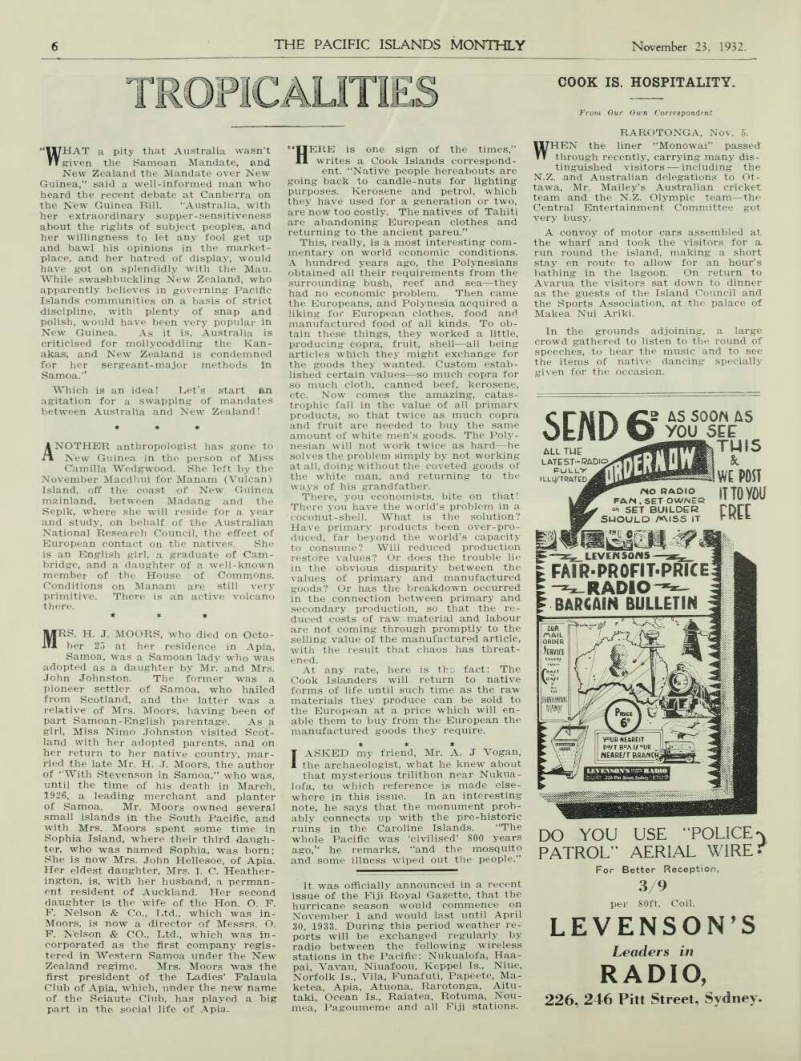
Official opening of No. 2 Bulolo Dredge, T.N.G.. on 15th October. Mrs. L V. Waterhouse, who performed the ceremony, is the central figure of the group on the lower platform. See page 20 for full report of proceedings.
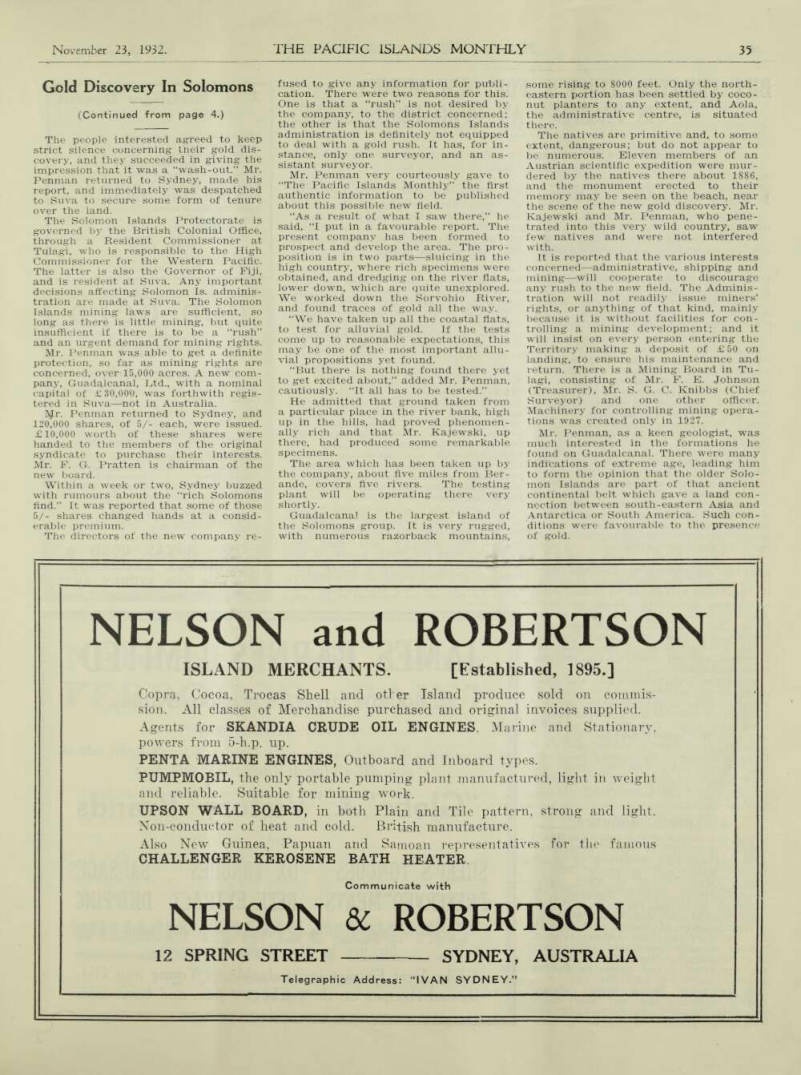
The people interested agreed to keep strict silence concerning their gold dis covery, and they succeeded in giving the impression that it was a “wash-out.” Mr.
Penman returned to Sydney, made his report, and immediately was despatched to Suva to secure some form of tenure over the land.
The Solomon Islands Protectorate is governed by the British Colonial Office, through a Resident Commissioner at Tulagi, who is responsible to the High Commissioner for the Western Pacific.
The latter is also the Governor of Fiji, and is resident at Suva. Any important decisions affecting Solomon Is. adminis tration are made at Suva. The Solomon Islands mining laws are sufficient, so long as there is little mining, but quite insufficient if there is to be a “rush” and an urgent demand for mining rights.
Mr. Penman was able to get a definite protection, so far as mining rights are concerned, over 15,000 acres. A new com pany, Guadalcanal, Ltd., with a nominal capital of £ 30,000, was forthwith regis tered in Suva —not in Australia.
Penman returned to Sydney, and 120,000 shares, of 5/- each, were issued. £10,000 worth of these shares were handed to the members of the original syndicate to purchase their interests.
Mr. F. G. Pratten is chairman of the new board.
Within a week or two, Sydney buzzed with rumours about the “rich Solomons find.” It was reported that some of those 5/- shares changed hands at a consid erable premium.
The directors of the new company re
fused to give any information for publi cation. There were two reasons for this.
One is that a “rush” is not desired by the company, to the district concerned; the other is that the Solomons Islands administration is definitely not equipped to deal with a gold rush. It has, for in stance, only one surveyor, and an as sistant surveyor.
Mr. Penman very courteously gave to “The Pacific Islands Monthly” the first authentic information to be published about this possible new field.
“As a result of what I saw there,” he said, “I put in a favourable report. The present company has been formed to prospect and develop the area. The pro position is in two parts—sluicing in the high country, where rich specimens were obtained, and dredging on the river flats, lower down, which are quite unexplored.
We worked down the Sorvohio River, and found traces of gold all the way.
“We have taken up all the coastal flats, to test for alluvial gold. If the tests come up to reasonable expectations, this may be one of the most important allu vial propositions yet found.
“But there is nothing found there yet to get excited about,” added Mr. Penman, cautiously. “It all has to be tested.”
He admitted that ground taken from a particular place in the river bank, high up in the hills, had proved phenomen ally rich and that Mr. Kajewski, up there, had produced some remarkable specimens.
The area which has been taken up by the company, about five miles from Ber ande, covers five rivers. The testing plant will be operating there very shortly.
Guadalcanal is the largest island of the Solomons group. It is very rugged, with numerous razorback mountains,
some rising- to 8000 feet. Only the north eastern portion has been settled by coco nut planters to any extent, and Aola, the administrative centre, is situated there.
The natives are primitive and, to some extent, dangerous; but do not appear to be numerous. Eleven members of an Austrian scientific expedition were mur dered by the natives there about 1886, and the monument erected to their memory may be seen on the beach, near the scene of the new gold discovery. Mr.
Kajewski and Mr. Penman, who pene trated into this very wild country, saw few natives and were not interfered with.
It is reported that the various interests concerned —administrative, shipping and mining—will cooperate to discourage any rush to the new field. The Adminis tration will not readily issue miners’ rights, or anything of that kind, mainly because it is without facilities for con trolling a mining development: and it will insist on every person entering the Territory making a deposit of £50 on landing, to ensure his maintenance and return. There is a Mining Board in Tu lagi, consisting of Mr. F. E. Johnson (Treasurer), Mr. S. G. C. Knibbs (Chief Surveyor) and one other officer.
Machinery for controlling mining opera tions was created only in 1927.
Mr. Penman, as a keen geologist, was much interested in the formations he found on Guadalcanal. There were many indications of extreme age, leading him to form the opinion that the older Solo mon Islands are part of that ancient continental belt which gave a land con nection between south-eastern Asia and Antarctica or South America. Such con ditions were favourable to the presence of gold.
Banana Fritters.
By Mollie Lett.
I HAD a Papuan cook whose vocabu lary, so far as I was concerned, con sisted of five English words and two phrases: "Where”; “yesterday”; “right oh”; “no”; and “yes”; “Yes, I know”; and “He finish.”
They are all good words, and I had no objection to them in their right place. Neither had he, whether in the right place, or wrong. But, unfortun ately for me, they conveyed no mean ing to him. They were just words. And how I hated them!
“Puri,” I said, one day. “Tea ready?”
“Where, Sinabada?” he answered.
I tried again. “You bring him tea, Puri,” I said kindly.
“Yes, Sinabada, yesterday,” was the reply.
I swallowed hard. “Puri,” I tried again, firmly. “This one tea.” I made a sign of a teapot; I brandished im aginary cups in the air; I drank, I gulped. “This one tea,” I said. “Puri, you bring him now, quick-time, schnell, vitement.”
Puri grinned. He was very good natured, and I was really rather an un usual white person. Never before had he met such a one. Quite funny, in spots.
“Yesterday, no, Sinabada,” he agreed as he left.
It was all very trying. He was in dustrious, clean and amiable, and I had hopes of training him. But those five awful words! And those phrases!
It was most unfortunate that we had no means of communication whatever.
He knew no Motuan or English except, of course, those five imperishable words.
So it was with some mutual relief that, late one afternoon, we indirectly came nearer to the truth of things— pierced the veil, so to speak. He had discovered a new phrase!
“Sinabada,” he called excitedly, as he came forward, holding a basket of Siporos (lemons) which had arrived.
“Banana Fritters! Banana Fritters!”
And he ran to the kitchen.
The result of his subsequent efforts was too much for me. He is now cut ting wood. “He finish!”
All that was left of the plantation, homestead and out buildings on "Burnsilo.” Epi, New Hebrides, after the hurricane had passed, a few months ago. These snapshots by Mr. E. Sarginson convey a very good idea of the havoc and loss with which all planters in the “hurricane belt” are always threatened.
Mysterious Craft.
Thought To Be Poaching.
From Our Own Correspondent.
Thursday Is., Oct. 10.
DURING August, several islands in Torres Strait reported the visit of a strange launch, about 60 feet long, carrying half-a-dozen small boats fitted with sails of Eastern type and manned by a crew of Japanese.
The vessel anchored off some islands, while the men worked over the neigh bouring reefs, and at one place water was taken on.
The mysterious craft is thought to be a poaching outfit. She is fitted with a powerful engine, which is very loud in operation, and she has a collapsible mast.
Future Of Samoa.
(To the Editor.) Sir, —With reference to suggested Colonial Office administration for Samoa, I was very pleased to see your able correspondent, Mr. Ernest Davies’s admirable letter. The “P.I.M.”, all along, has bravely and righteously ex posed the stupid, blundering methods of the military martinets from ultra democratic New Zealand, who have so ruthlessly trodden underfoot the ten derest instincts cf the Samoan elders — Te Ariki.
The Colonial Office, with its hundreds of years of experience, understands the business of guiding the explosive Asian-Pacific mind towards the en telechy of civilisation. I most heartily endorse Mr. Davies’s wise suggestion.
The untrained, amateurish political pup is not the kind of watch-dog we need in the Pacific just now, with the cryptic, financial “World War” now de veloping across its once remote surface.
I am, Sir, etc..
Arthur J. Vogan.
Sydney, Oct. 25, 1932.
Fiji shippers of bananas deny sugges tions made on behalf of Australian ban ana-growers that the Fiji fruit caused bunchy-top to develop on Australian plantations. Fiji bananas, they state, are particularly clean and free of dis ease, and Fiji had never sent any ban ana disease to Australia.
Tropicalities
"WHAT a pity that Australia wasn’t given the Samoan Mandate, and New Zealand the Mandate over New Guinea,” said a well-informed man who heard the recent debate at Canberra on the New Guinea Bill. “Australia, with her extraordinary supper-sensitiveness about the rights of subject peoples, and her willingness to let any fool get up and bawl his opinions in the market place, and her hatred of display, would have got on splendidly with the Mau.
While swashbuckling New Zealand, who apparently believes in governing Pacific Islands communities on a basis of strict discipline, with plenty of snap and polish, would have been very popular in New Guinea. As it is, Australia is criticised for mollycoddling the Kan akas, and New Zealand is condemned for her sergeant-major methods in Samoa.”
Which is an idea! Let’s start an agitation for a swapping of mandates between Australia and New Zealand! * * * ANOTHER anthropologist has gone to New Guinea in the person of Miss Camilla Wedgwood. She left by the November Macdhui for Manam (Vulcan) Island, off the coast of New Guinea mainland, between Madang and the Sepik, where she will reside for a year and study, on behalf of the Australian National Research Council, the effect of European contact on the natives. She is an English girl, a graduate of Cam bridge, and a daughter of a well-known member of the House of Commons.
Conditions on Manam are still very primitive. There is an active volcano there. * * * MRS. H. J. MOORS, who died on Octo ber 25 at her residence in Apia, Samoa, was a Samoan lady who was adopted as a daughter by Mr. and Mrs.
John Johnston. The former was a pioneer settler of Samoa, who hailed from Scotland, and the latter was a relative of Mrs. Moors, having been of part Samoan-English parentage. As a girl, Miss Nimo Johnston visited Scot land with her adopted parents, and on her return to her native country, mar ried the late Mr. H. J. Moors, the author of “With Stevenson in Samoa,” who was, until the time of his death in March, 1926, a leading merchant and planter of Samoa. Mr. Moors owned several small islands in the South Pacific, and with Mrs. Moors spent some time in Sophia Island, where their third daugh ter, who was named Sophia, was born; She is now Mrs. John Hellesoe, of Apia.
Her eldest daughter, Mrs. I. C. Heather ington, is, with her husband, a perman ent resident of Auckland. Her second daughter is the wife of the Hon. O. F.
F. Nelson & Co., Ltd., which was in Moors, is now a director of Messrs. O.
F. Nelson & CO., Ltd., which was in corporated as the first company regis tered in Western Samoa under the New Zealand regime. Mrs. Moors was the first president of the Ladies’ Falaula Club of Apia, which, under the new name of the Seiaute Club, has played a big part in the social life of Apia.
“HERE is one sign of the times,” writes a Cook Islands correspond ent. ‘‘Native people hereabouts are going back to candle-nuts for lighting purposes. Kerosene and petrol, which they have used for a generation or two, are now too costly. The natives of Tahiti are abandoning European clothes and returning to the ancient pareu.”
This, really, is a most interesting com mentary on world economic conditions.
A hundred years ago, the Polynesians obtained all their requirements from the surrounding bush, reef and sea —they had no economic problem. Then came the Europeans, and Polynesia acquired a liking for European clothes, food and manufactured food of all kinds. To ob tain these things, they worked a little, producing copra, fruit, shell —all being articles which they might exchange for the goods they wanted. Custom estab lished certain values —so much copra for so much cloth, canned beef, kerosene, etc. Now comes the amazing, catas trophic fall in the value of all primary products, so that twice as much copra and fruit are needed to buy the same amount of white men’s goods. The Poly nesian will not work twice as hard —he solves the problem simply by not working at all, doing without the coveted goods of the white man, and returning to the ways of his grandfather.
There, you economists, bite on that!
There you have the world’s problem in a coconut-shell. What is the solution?
Have primary products been over-pro duced, far beyond the world’s capacity to consume? Will reduced production restore values? Or does the trouble lie in the obvious disparity between the values of primary and manufactured goods? Or has the breakdown occurred in the connection between primary and secondary production, so that the re duced costs of raw material and labour are not coming through promptly to the selling value of the manufactured article, with the result that chaos has threat ened.
At any rate, here is tho fact: The Cook Islanders will return to native forms of life until such time as the raw materials they produce can be sold to the European at a price which will en able them to buy from the European the manufactured goods they require. * * * I ASKED my friend, Mr. A. J. Vogan, the archaeologist, what he knew about that mysterious trilithon near Nukua lofa, to which reference is made else where in this issue. In an interesting note, he says that the monument prob ably connects up with the pre-historic ruins in the Caroline Islands. ‘‘The whole Pacific was ‘civilised’ 800 years ago,’’ he remarks, ‘‘and the mosquito and some illness wiped out the people.”
It was officially announced in a recent issue of the Fiji Royal Gazette, that the hurricane season would commence on November 1 and would last until April 30, 1933. During this period weather re ports will be exchanged regularly by radio between the following wireless stations in the Pacific: Nukualofa, Haa pai, Vavau, Niuafoou, Keppel Is., Niue, Norfolk Is., Vila, Funafuti, Papeete, Ma ketea, Apia, Atuona, Rarotonga, Aitu taki, Ocean Is., Raiatea, Rotuma, Nou mea, Pagoumeme and all Fiji stations.
Cook Is. Hospitality.
From Our Own Correspondent
Rarotonga, Nov. 5.
WHEN the liner “Monowai” passed through recently, carrying many dis tinguished visitors including the N.Z. and Australian delegations to Ot tawa, Mr. Mailey’s Australian cricket team and the N.Z. Olympic team —the Central Entertainment Committee got very busy.
A convoy of motor cars assembled at the wharf and took the visitors for a. run round the island, making a short stay en route to allow for an hour’s bathing in the lagoon. On return to Avarua the visitors sat down to dinner as the guests of the Island Council and the Sports Association, at the palace of Makea Nui Ariki.
In the grounds adjoining, a large crowd gathered to listen to the round of speeches, to hear the music and to see the items of native dancing specially given for the occasion.
Advertisements & other items, p. 8 (1 item)
Send 6 D
AS SOON AS
YOU SEE
THIS
WE POST
IT TO YOU
FREE
NO RADIO
FAN . SET OWNER
SET BUILDER
SHOULD MISS IT
DO YOU USE “POLICE
PATROL” AERIAL WIRE?
For Better Reception, 3/9 per 80ft Coil.
LEVENSON’S
Leaders in
RADIO,
226, 24-6 Pitt Street, Sydney.
Official In New Guinea.
Plea That “Pidgin” Be Made
Written for “The Pacific Islands Monthly ” by “ Malakuna.”
IN spite of the official encouragement of the use of English and the rather pathetic efforts of the Administration to teach it in the Government schools — the missions refused the suggestion of Administration to grant a subsidy to those missionary schools that included English in the curriculum —“Pidgin,” the picturesque “lingua franca” of the Pa cific, which has attained its most graphic and useful form here in the Territory of New Guinea (due largely to German in fluence in the early days of the colony), continues to gain ground.
It has spread all over the Territory where European penetration has taken place, and where “boys” returning from periods of labour on plantations in other districts, have brought it back to their homes. Every District Officer knows its usefulness.
Even those few of us who have mas tered a native tongue here know that there is absolute need for a common means of communication since one dis trict (Kavieng in New Ireland) for in stance) may represent half a dozen al most unrelated dialects. Father Kirsch baum, of the Sepik River, and one of the missionaries of Manus, neither of whom can be accused of being dilatory in the study of and attitude towards native so cial organisation and linguistics, use it in a phoneticized form in their mission ary work. And it is remarkable how quickly, on a phonetic basis, “boys” learn to write pidgin.
The great advantage of accepting “Pidgin” as an official medium and teaching it lies in the fact that a stand ardised form would be developed throughout the whole Territory. The teaching of English as a universal lan
guage here is acknowledged even by teachers as hopeless; the adoption of any one of the innumerable native dia lects is impracticable; “Pidgin” has proved by its popularity its claim to acceptance; nothing but pig-headedness on the part of the Administration and education authorities holds its official progress back. Why can’t we be honest about the thing?
I recently heard a missionary preach for nearly an hour to an assembled group of New Ireland natives —in the Blanche Bay dialect, that is the official language of the Mission. Not 20 per cent, of his hearers —hundreds were pre sent in the open air for the annual Waratabar gathering—understood fully the sermon, in spite of the dramatic nature of its presentation and the facility of the missionary in the dialect he was using.
To show the usefulness and practic ability of “Pidgin,” here is a report of a birth, written in “Pidgin” and despatched to the local District Office by a boy who had been taught phonetic script: Uan (one) fala (fellow) pikinini (child —baby) olikarim (the term “all ’e carry ’im” represented phonetically, meaning “carried” or “born”) log
(along) mun (moon-month) Augus
(August) log 5, 1932.
Naen (name) blog (belong) pikinini Mogan. Papa (father) blog em (him) Komarag. Mama blog em Nunuat.
Every official can testify to the vari ety of uses that “Pidgin” can be put to.
When will we recognise the inevitable, and drop all our administrative and lin guistic snobbishness? Has no one in the Territory read anything of the of ficial doings in Africa?
Madang Notes.
Madang, T.N.G., Oct. 15.
It is with regret that I report the death of Mr. W. H. (“Bill”) Murphy, who died on September 25.
For some time he had been in ill health and on Saturday the doctor ad vised he was much better. But on Sun day he took a turn for the worse, and it proved fatal. Fever was the main cause, but a weak heart accentuated matters.
Strangely enough, some time ago a Greek named A. Crambovitis was en gaged in distilling the oil from the bark of the Massoi tree, and he died from fever. Mr. Murphy carried on the part nership with Mr. Crambovitis’ partner, George Bartsos. It rather makes one wonder about the locality of that plant.
Just after dark, towards the end of September, there was a great commotion in the town. A burning ship was sighted about mile off the coast. The District Officer, and his assistant, chartered a boat and proceeded immediately to the scene. After searching for some time for the vessel, the flare of which had de creased considerably, it was found to be not a ship in distress, but merely a bush fire further down the coast. It is now not safe to discuss burning ships with the D.O.
The repairs to the wharf are being carried out under the guiding hand of Mr. Woodman, of the Administrative staff. When the whole work is com
pleted it will be more pleasing to the eye than when repairs were effected some two years ago.
Some years ago a petition, addressed to the Administrator, was signed by the residents of Madang with the request that a female nurse be attached to the Madang Hospital. Considering the white population in this district now, it is surprising that nothing has been done.
More Roads And Water.
From Our Own Correspondent.
Rarotonga, Nov. 5.
ROAD widening operations have been in progress for some months past at different points along the main road of this island. A much safer margin for motor vehicles to pass each other is now provided. Another improvement is the cutting back of vegetation, allowing bet ter visibility.
The Public Works Department has commenced laying down a new water main from the Avatiu Reservoir to the Nikao settlement. The work includes an extension of the water system to the wireless station, a distance of about three miles.
Blasting operations in the reef, off the village at Arorangi, were carried out for the purpose of improving the existing passage, so that canoes could more readily get out for deep sea fishing and back again.
Pomare.
Expensive “Maui
Commission’s Criticism.
From Our Own Correspondent.
Apia, Nov. 1.
THE New Zealand National Expendi ture Commission in its report to Parliament comments on the unfor tunate venture the running of the Gov ernment Island steamer “Maui Pomare” has proved to be.
According to the report, the loss on the vessel for 1930-31 amounted to over £20,000, that for 1931-32 to about £3000, while the estimated loss for the financial year 1932-33 is £4500.
The Commission recommends the Gov ernment to maintain the island connec tions with Nuie and Samoa by a sub sidised service at much lower cost, and to dispose of the “Maui Pomare” at the earliest possible date.
The Commission’s report further sug gests a thorough overhaul of the expen diture and establishment of the External Affairs Department of New Zealand, which controls the Mandated Territory of Western Samoa with a view to reliev ing the New Zealand taxpayer, as far as practicable, of the cost of the Samoan administration.
This may necessitate further stringent retrenchment of expenditure in Samoa, especially in view of the continued shrinking of revenue from import duties, licenses and taxes.
“Etablissement Donald.”
From Our Own Correspondent.
Papeete, Nov. 4.
THE old-established New Zealand firm of A. B. Donald, Ltd., which has car ried on business in Tahiti and the surrounding islands for very many years past, has recently changed its status by incorporating as a French Company, and is now known as the “Etablissement Donald Tahiti.”
By this means it is hoped to obviate certain difficulties which exist for for eign concerns doing business in French Territory, particularly in connection with the ownership of trading vessels.
Mr. Hemas, the firm’s inspector from Auckland, has been in Tahiti superin tending the change over. Mr. J. Donald, one of the principal partners in the firm, who returned to New Zealand last month, was also here on the same busi ness.
New Mission Vessel.
For Solomon Islands.
A new auxiliary ketch for the Marist Brothers' Roman Catholic Mission in the Solomon Islands was launched from the yards of W. M. Ford, junior, Berry’s Bay, Sydney, in October and was loaded on the October “Mataram” for the Solo mons.
Built of Australian and New Zealand timber, the new ketch, will replace the wrecked ketch “Hambia,” whose engines have been salvaged and will be fitted in the new boat on her arrival at the head quarters of the mission. The engines and steering gear will be housed for ward, in contrast to the usual method, but an auxiliary tiller will be fitted aft.
“Uncle Cornish,” Of Norfolk Island.
Specially written for “The Pacific Islands Monthly ” by Mildred Campbell.
ONE of the outstanding personalities of Norfolk is old Mr. Cornelius Quintal —"Pa,” to his handsome middle-aged family, "Uncle Cornish” to the rest of the world.
Grandson on both sides of his family to two of the famous Bounty Mutineers, he is the eldest of the four remaining Islanders who were actually born on Pitcairn; and as he was 15 years old when that romantic little community was transferred in 1856 to Norfolk Island —then recently abandoned as a penal settlement —that makes him now a hale and hearty 91 on his last birth day.
His memory covering the years of his childhood is as keen as ever it was and, to favoured visitors, he tells tales of the days when the world was young that are as vivid as though he were talking of yesterday. There was sharp-tongued neighbour woman on Pitcairn who used to drive him, as little fellow, up into coconut palms that seemed to reach into the sky; and on Norfolk, when the wide-eyed children of the Garden of Eden arrived here, there still remained a dozen convicts in charge of cattle and growing crops.
To the innocent Pitcairn boy, knowing nothing of evil beyond the simple sins of omission or commission of his island brotherhood, these men told stories of wrong and horror and cruelty that drove the blood from his heart, blackened the beauty around him and dimmed the rose and gold of the sky.
When Cornish grew up he became deeply devout and in the train of Bishop Patteson —afterwards murdered in the islands —he wandered the Pacific, helping to bear the torch of religion and civilization among the darker races. Later, he became an expert whaler, with headquarters on his own island; and his children remember playing with a box of golden sovereigns, which meant no more to them than beads or buttons to youngsters else where.
On one occasion a whale boat was overturned twelve miles from shore and, with a man who could not swim clinging to him, accompanied by a couple of sharks as a menacing escort and guided by flares ashore, he finally staggered exhaustedly through the shallow waters of the stony little beach of Cascade Landing—which is still littered with the bones of Leviathan.
A quarter of a century ago Uncle Cornish made his first visit to Sydney on serious business; and the manner of it was this.
Years and years before, when the Pitcairners first landed on Norfolk, they were granted short-sighted per mission to demolish the prison ruins —which should have existed to this day as a perfect example of penal or ganization and system a hundred years ago—and to take the stone to build new homesteads "up country” where their fifty-acre blocks of land were situated.
To Uncle Cornish’s mind—fifty years later —that permission had never been rescinded, nor was it possible for an” later authority to do so, seeing that the Island —lock, stock, and barrel—
had been deeded to the Pitcairn Is landers upon their first taking posses sion. He wanted stone in quantity, and he took it, calmly disregarding the warning of Colonel Spalding, the first Administrator appointed from oversea.
He was haled before the Court and fined.
That might have been enough for many men; but not for Cornish, then a young and determined sixty-five. He took passage to Sydney by the little “Tamba,” and laid his grievance before Admiral Sir Harry Rawson, the then Governor of New South Wales —by which State, in those days, Norfolk Island was administered.
Sir Harry listened sympathetically, as one sea-dog to another, and, after due consideration, not only remitted the fine but saw to Mr. Cornelius Quintal’s entertainment in Sydney, and granted him a free passage back to the island by H.M.S. ‘‘Powerful,” shortly en route for Fiji, but instructed to deviate from her course and land her picturesque passenger. He was great success aboard, from the Com modore down, and on their Sunday at sea he was invited to address the lower deck in the evening, in his capacity as minister of the Methodist Brotherhood on Norfolk Island. This he did with high enjoyment and the utmost aplomb, taking the opportunity to re count the story of the Mutiny of the Bounty and solemnly warning his con gregation not to attempt such "goings on” in these days, when the Pacific Ocean is an open book to all seafaring men and such an enterprise could only end in "hanging from the yardarm.”
In addition to being a fine sailor and an expert farmer, Uncle Cornish, until very recently, was a notable horseman; and when this writer arrived
upon the island, less than five years ago, and used to explore the highways and byways with a trap and a vener able nag, it was nothing uncommon, in the furthest recesses of the island, to suddenly hear the thunder of and be overtaken by Uncle Cornish, on a skittish young horse; galloping in chivralous pursuit, in case the lady met up with one of the lorries that, five years ago, were an unpleasant novelty to the horseflesh of Norfolk.
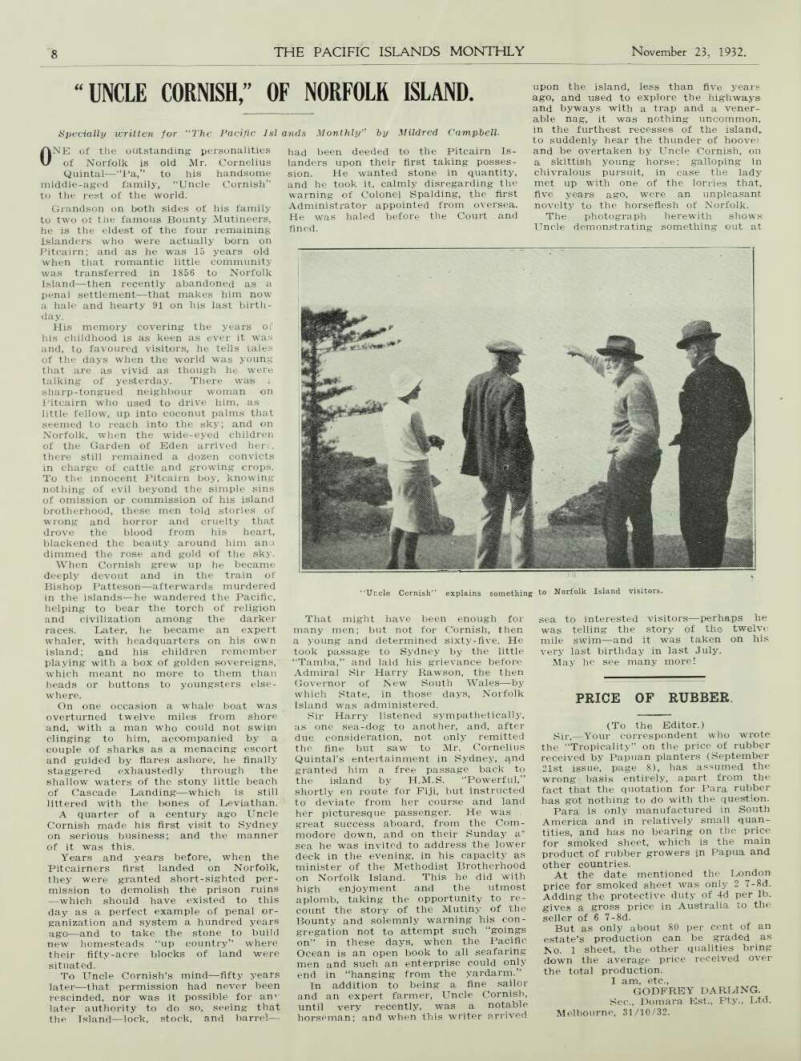
The photograph herewith shows Uncle demonstrating something out at
sea to interested visitors—perhaps he was telling the story of the twelve mile swim—and it was taken on his very last birthday in last July.
May he see many more!
“Uncle Cornish” explains something to Norfolk Island visitors.
Price Of Rubber
(To the Editor.) Sir, —Your correspondent who wrote the “Tropicality” on the price of rubber received by Papuan planters (September 21st issue, page 8), has assumed the wrong basis entirely, apart from the fact that the quotation for Para rubber has got nothing to do with the question.
Para is only manufactured in South America and in relatively small quan tities, and has no bearing on the price for smoked sheet, which is the main product of rubber growers in Papua and other countries.
At the date mentioned the London price for smoked sheet was only 2 7-8d.
Adding the protective duty of 4d per lb. gives a gross price in Australia to the seller of 6 7-8d.
But as only about 80 per cent of an estate’s production can be graded as No. 1 sheet, the other qualities bring down the average price received over the total production.
I am, etc.,
Godfrey Darling.
Sec., Domara Est., Pty., Ltd.
Melbourne, 31/10/32.
Pomares.
The ”Mana” Of The
How the Spirit of The Ancient Days Smote a Political Egg- Thrower in 1932.
From Our Own Correspondent.
Papeete, Oct. 29.
A STRANGE incident occurred in Tahiti during the recent political campaign for the election of a dele gate to represent Oceania in the French Senate —an incident which bears out the native belief that the old Maua at tributed to chiefly families is not yet dead, but maintains its potency in spite of modern innovations; though the Ta hitians admit that it is of little or no avail so far as Europeans are con cerned.
No native will so much as disturb a stone on one of the old maraes, except under compulsion, lest he become the victim of some malignant disease, or his mouth be twisted sideways.
Consequently, these old temples, where human sacrifices were offered up in the olden days, are given a wide berth and left to crumble under the in fluence of time. Even in a modern co conut grove one may happen across a patch of uncleared bush in the shade of which stands one of these remains, its original form reduced to a shapeless mound of stones by the growing jungle and the aerial roots of the sacred ban yan tree.
Neither, and for the same reason, will a native comport himself in anything but the most respectful fashion upon the premises of any hereditary chief, curtailed though their temporal author ity now is—except under the influence of liquor or some other unusual excite ment.
And perhaps that was the case on the present occasion.
It was in the village of Arue and the natives had gathered in the garden of the Chief for a big political meeting.
The Orator, a man well versed in na tive lore and customs, and with a re markable gift for extempore speaking, was extolling the good qualities of his candidate with all the powers at his command —and no doubt the audience got worked up to an unusual pitch of excitement.
Suddenly, out of the dark edges of the crowd, two rotten eggs were thrown in quick succession, presumably by a supporter of the opposing candi date. Both missiles missed the speaker but broke with an evil splash on the newly-painted house of the chief, in the rear.
“Speak to them in my name!” cried the last scion of the house of Pomare, an enormous man standing not much less than seven feet in height, and scal ing at least 200 kilos.
And the Orator proceeded, in terms that no native could misunderstand, and with all the invective of which he was such a master, to call down retri bution upon the head of the unlucky offender.
“What!” he thundered. “Do you not know that you stand in the grounds of the Chief? It is at his prestige that you have hurled these rotten eggs of yours, and not at me. This night’s work will recoil upon your own forehead, and your right arm will be blasted to
keep it from further mischief. Let others beware!”
And so the incident ended —for the moment.
But there was a sequel the following day. The news spread among the na tives with the customary astonishing rapidity.
In the hospital at Papeete, Tamarua came back to reality, after a longish spell on the operating table. His right arm had been badly smashed but not yet amputated, and his forehead scored with deep cuts —all the result of an un accountable tumble from a car.
The first words he uttered were: “This is the work of Tuatau, the guardian spirit of Hinei. It is my own fault. I should not have thrown those eggs!”
The chauffeur who drove Tamarua’s party from the meeting that night told how a monstrous black shape had be straddled the road ahead of him and deranged his steering, so that the car rocked and rattled as though stricken by an earthquake. Until they gained the crest of the hill on the road to Haa pape, no one noticed that one of their party was missing.
Then they mustered their courage and returned, to find Tamarua bleeding and unconscious by the roadside.
Tonkinese Labourers.
A New Hebrides correspondent writes: “Your informant is not quite correct when he says that Communism has been responsible for the repatriation of Ton kinese labourers from the New Hebrides.
The reason is chiefly £ s. d. —Tonkinese gentlemen are an expensive luxury in these hard times. There are very few left now—barely 1,000 working units.
“I have not heard that the planters here are thinking of introducing Javan ese instead of Tonkinese. I do not think the Dutch Government in Java will be too enthusuiastic about the in denturing of their coolies for the New Hebrides.”
Death Of Mr. Gardain.
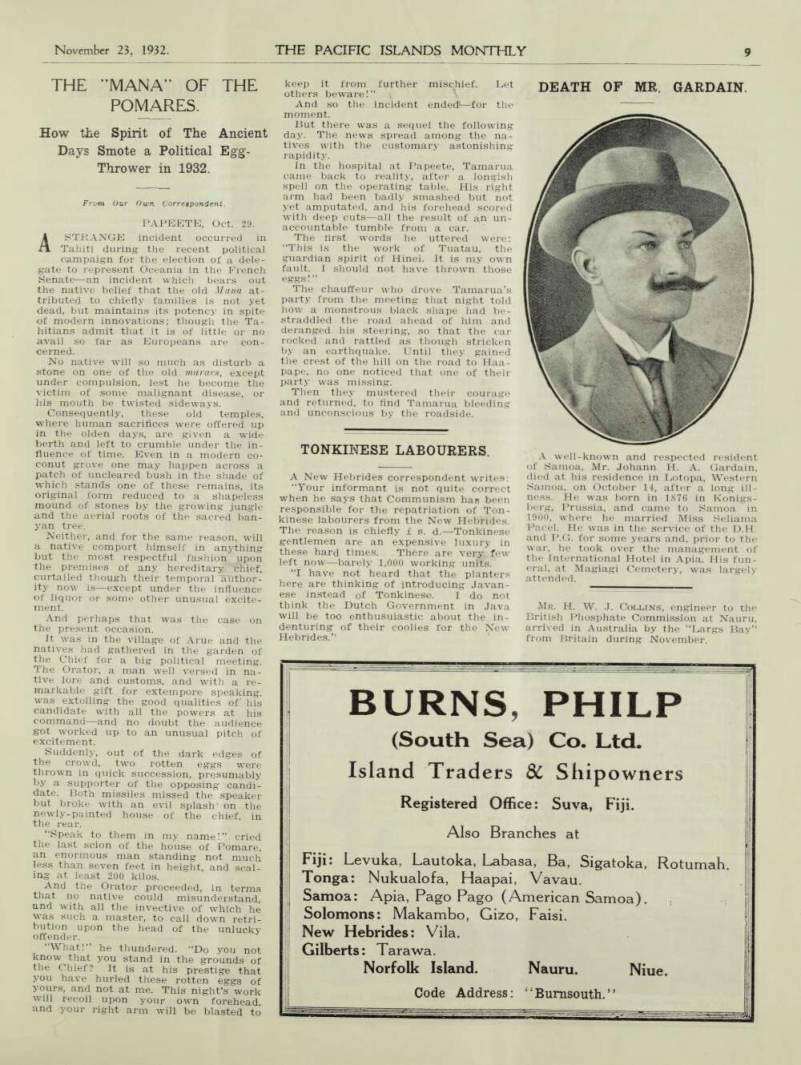
A well-known and respected resident of Samoa, Mr. Johann H. A. Gardain, died at his residence in Botopa, Western Samoa, on October 14, after a long ill ness. He was born in 1876 in Konigs berg, Prussia, and came to Samoa in 1900, where he married Miss Seliama Pacel. He was in the service of the D.H. and P.G. for some years and, prior to the war, he took over the management of the International Hotel in Apia. His fun eral, at Magiagi Cemetery, was largely attended.
Mr. H. W. J. Collins, engineer to the British Phosphate Commission at Nauru, arrived in Australia by the “Bargs Bay” from Britain during November.
Advertisements & other items, p. 11 (1 item)
Burns, Philp
(South Sea) Co. Ltd.
Island Traders & Shipowners Registered Office: Suva, Fiji.
Also Branches at Fiji: Levuka, Lautoka, Labasa, Ba, Sigatoka, Rotumah.
Tonga: Nukualofa, Haapai, Vavau.
Samoa: Apia, Pago Pago (American Samoa).
Solomons: Makambo, Gizo, Faisi.
New Hebrides: Vila.
Gilberts: Tarawa.
Norfolk Island. Nauru. Niue.
Code Address: ‘‘Burnsouth.’’
About Islands People.
Mr G. MacGregor, B.A., of the Yale University, left Apia, Samoa, by the “Makoa,” on October 4, for the Tokelau group, where he will engage in ethno logical research for the Bernice P. Bishop Museum of Hawaii. Mr. MacGregor will return to Apia during December.
Mr. M. D. O’Sullivan, a popular radio officer at Bitapaka wireless station, New Guinea, died in hospital after an opera tion for peritonitis and pneumonia, on October 6. Mr, O’Sullivan was appointed to the radio service in 1921, and had been stationed at Bitapaka for the last ten years. He was much interested in sport, and was a member of the committee of the Kokopo Sports Club.
Mr. Knox, an engineer who has been employed in the Federal Works Depart ment in Canberra, and who is also secre tary of the Engineers’ Association, has been appointed Director of Works in New Guinea, and left Sydney by this month’s “Macdhui” for Rabaul to take up his new duties. The Works Department has been carrying on without a Director for some time.
Mr. F. G. Fowler, of the Papuan Ser vice, who has been on long leave in Aus tralia, returns to duty by the December “Montoro,” and will be stationed at Baniara, in the N.E. Division, as A.R.M.
Mr. Fowler was for some time in hos pital in Brisbane, but is now quite well again.
His Honour Chief Judge D. S.
Wanliss, of the New Guinea Adminis tration, arrived in Sydney by the “Nankin”, from Rabaui, on October 20, and will spend some time in Australia.
Mr. J. N. D. Campbell, formerly a magistrate in the Papuan service he was stationed in the Trobriands about 13 years ago—died in Brisbane recently.
Mr. Campbell was 72 years old. He re tired from the Papuan service 12 years ago, and had since lived in Queensland.
He was held in high esteem by residents and fellow-officials in the Territory.
Mr. Benjamin Cocker, a well-known and respected resident of Nukualofa.
Tonga, died in October. He was over 80 years old.
Mr. Charles Percival, a well-known planter and trader, died suddenly in Nukualofa, Tonga, on October 13, from heart trouble.
Mr. L. J. Perichon a well-known plantation manager from Madang, N.G., accompanied by Mrs. Perichon, arrived in Sydney by the October “Macdhui,” on three months’ furlough.
General Sir Sydney and Lady Law ford stated, on arrival in Sydney, that they had intended to spend six months in Tahiti, but only remained six weeks, deciding to devote the remainder of their time to Australia. They both in dicated that, whilst Tahiti was a lovely spot, cherished illusions regarding life in the Pacific Islands had been shattered. “Tahiti,” said Lady Lawford, “is a tropical isle in more ways than one.” Both had been more impressed by Rarotonga, which Sir Sydney described as “Tahiti cleaned up.”—S.M. Herald.
Miss Betty Stephenson, who went to the Sepik region of New Guinea in July last to carry out anthropological re search, returned to Sydney in October.
She suffered considerably from illness, and was forced to seek a colder climate and skilled attention.
Rev. Dr. H. Newton, the Bishop of New Guinea, left Brisbane for Rabaul by the “Macdhui” on November 12. His Lordship was given a flattering recep tion in Australia and made much of by church and public bodies during his brief stay.
Rev. Dr. C. E. Fox, of the Melanesian Mission at Pawe, British Solomon Is lands, is in Melbourne on furlough. Dr.
Fox has been engaged in mission work in Melanesia for over 30 years.
Mrs. F. R. Elder, of the New Guinea Mission staff, will arrive in Sydney dur ing November and will be accompanied by Nurse Brenchley. Mrs. Elder is com ing South owing to ill-health.
Sir Everard IM Thurn, K.C.M.G., K.B.E., a former Governor of Fiji, died in Lon don on October 10. He was appointed Governor of Fiji and High Commissioner for the Western Pacific in 1904 and held the post until 1910, when he retired from the service. He was a man of states manlike vision, and was regarded as an authority on Pacific affairs.
Sir Maynard Hedstrom, a director of Messrs. Morris, Hedstrom, Ltd., of Suva, Fiji, arrived in Sydney, on a business trip, by the “Mariposa” on November 10.
Anthropologists.
NEW GUINEA, owing to the number and variety of its primitive types, has become one of the places of chief interest to the world’s anthropologists, and many scientists are turning their attention to the Territory.
We are indebted to a valued corre spondent for the following notes.
Dr. Raymond Firth has accepted an appointment to the School of Economics of London University, as a lecturer in Social Anthropology, where he will be associated with professors Bronislau Malinowski and Seligmann, both well known in the field of Papuan ethnog raphy. Dr. Firth is a brilliant young"
New Zealander, whose book “Primitive Economics of the New Zealand Maori” got him his Doctorate in London School of Economics. He subsequently spent a year on field-work in the Polynesian out lier of the Solomons, Tikopia, and has been acting Professor of Anthropolgy at Sydney University since Professor Rad cliffe Brown’s departure for the United States, two years ago.
Dr. Ian Hogbin, who has been assist ant to Dr. Firth as lecturer in Anthro pology in Sydney University, goes out to field research on Guadalcanar, Solomon Islands.
Mr. J. H. Todd, Science and Anthro pology graduate of Sydney, who has been associated with the Sydney Uni versity School of Anthropology for the past year as Research Assistant, is go ing out on a year’s field research to Moewe-hafen (Gasmata District of New Britain).
Dr. Hogbin and Mr. Todd are being financed by grants-in-aid from the Rockefeller fund for anthropological re search, administered by the Australian- National Research Council.
Dr. Gregory Bateson, financed by his English Alma Mater, is still at work up the Sepik River of New Guinea —a field hitherto untouched. His recent contri bution to “Oceania” (the journal of the Sydney anthropological interests) on these people is one of great interest and scientific value.
Mr. W. C. Groves, who is at present at Fison village, 65 miles from Kavieng, in New Ireland, carrying out anthropologi cal research under a Fellowship granted him by Australian National Research Council, expects to move on to Finscha fen (Huon Peninsula, mainland of New Guinea) in January, and probably will return to Sydney in April.
Dr. Rio Fortune and his wife (Dr.
Margaret Mead) are still at work behind Wiwak, Aitape District of New Guinea, Nothing is yet known definitely of the future of the Anthropology School at Sydney University, which is maintained largely by Commonwealth grant. Though there are no cadets at present awaiting anthropological training from the New Guinea service, it would be a pity to see the closing down of an institution which, in a few years, has made such a large contribution towards our understanding of the life of primitive man in the Pa cific and Australia, and towards the science of his government.
Mr. Frank H. Cunningham, who had been a member of the Tongan public service for 40 years, mostly as harbour master and Customs Collector at Vavau and Haapai, collapsed and died suddenly at Haapai on October 19,
Advertisements & other items, p. 12 (1 item)
Wallaringa Mansions, Sydney.
For all information apply to— THE MANAGER,
SYDNEY, N.S.W, ’Phone;
Occupying one of the picked positions on Sydney Harbour. Quiet and secluded, only fifteen minutes by Ferry, or 8 minutes via Bridge, from
G.P.O.
The Mansions are com plete with Lounges, Smoking Rooms, Tennis, Bowling Green, Private Swimming Baths, Ball room, & Guests’ Laundry.
“Wallaringa Mansions,” Neutral Bay, X 2267, X 2139.
Ramu Gold.
Is a New Field Being Opened Up?
'I'HEEE are persistent rumours
that a new goldfield is being
opened up in the Ramu River-
Bismarck Ranges region of New
Guinea. This region lies generally
south-west of Madang, and north
west of the present Morobe field.
But, although prospectors are in
creasingly active, we have had no
word of any rich “strike”.
The following are two communications recently received:
Transport Organised.
Madang, Oct. 6.
The entry of the big gold-mining com panies to the Morobe field and the buy ing up of large tracts of the gold-bear ing country of Edie Creek, Bulolo and adjacent country, have forced prospec tors into new territory. Many new fields and finds have been reported from time to time and mostly all have fizzled out.
Some wonderful prospects are now be ing reported from that part of New Guinea that forms the watersheds of the Markham and Ramu Rivers —but the area being worked is on the Ramu fall.
The proposition is a dredging one.
Messrs. Rowlands and Day have been for some considerable time in the area.
They were followed by Mr. A. J. Peden who, with pack horses, brought in large quantities of food, tools and equipment.
Cattle were even driven in. Mr. Peden returned to Sydney and procured more equipment, and is now on the way to being well paid for his enterprise.
Many others have now gone into the Ramu area and taken up leases. A land ing place for aeroplanes in the Ramu has been cleared, and used by the Guinea Airways ’planes from Lae and Salamaua.
The best road into the new field, which is only a few miles longer than the Markham route, is that in from the Ma dang end.
A company, said to have sufficient capital, is now fitting out in Madang.
It will be remembered that Mr. Fitz gerald died from fever, in 1930, in this region, while trying to locate an alleged German find in the Bismarcks.
It takes money and muscle to explore this country. Everyone hopes the pros pectors will reap rich rewards.
D.O. Becomes Miner.
Madang, Oct. 2.
A growing number of prospectors are coming into the Madang district. Ar rivals by last “Macdhui” included Mr. A.
J. Hunter and Mr. Phipps.
Mr. Hunter was formerly District Of ficer here, but now, it appears, is en gaged on a much more lucrative pro position.
Also, on the same boat, was Mr.
Schmidt, junr. Mr. Schmidt has joined his father and they have again gone back on to the Ramu; and, if Dame Rumour hath it correct they will benefit to no small extent.
It is hoped they will all do well as, apart from their own pecuniary benefit, Madang will profit by their labour.
If gold is found to any extent in the Ramu, possibly the old argument— whether Madang or Salamaua should be the port for the goldfields—will be auto matically settled.
Death of Agent at Manihiki.
Rarotonga, Oct. 20.
TIDINGS of the death of Mr. H. Wil liams, senior. Resident Agent at the island of Manihiki (Cook Group), reached Rarotonga by the schooner “Tiare Taporo” on return from her last voyage to the northern group.
Mr. Williams was over 70 years of age and had been Resident Agent at Mani hiki for about 28 years.
Manihiki is one of the most northerly islands of the Cook Group. It lies at a distance of 674 miles from Rarotonga.
The Registrar of Rarotonga, Mr. S. Sav age, is reported to be leaving shortly for that island to fill temporarily the posi tion of Resident Agent.
Copra Tax Reduced.
From Our Own Correspondent,
Rarotonga, Nov. 5.
ONE prompt and beneficial result of the visit of the Minister (Sir Apirana Ngata) to the Cook Group in August has been the reduction of the local ex port tax on copra from 20/- to 10/- per ton. This may tend to revive the copra trade here—for some time past it has been almost dead.
Vila Races.
The Port Vila “Comite des Cours” held its New Caledonia Day race meeting a little late this year, as the pre-arranged date happened to fall on the third Saturday of the month, and clashed with the usual monthly French Residency “At Home.’’ The Comite showed its sporting spirit by postponing the meeting in order that M. Carlotti (French Gouverneur-Resident) and Madame Carlotti should not be inconvenienced.
Unfortunately, the day proved to be very wet.
This, however, did not damp the ardour of horse-owners or public. There were no scratch ings, and there was a good attendance. Almost every one of the eight events were run in pour ing rain. The following day was a “fever day” for most of the older inhabitants.
Advertisements & other items, p. 13 (1 item)
KODAK Catalogue
It's ready
YOUR COPY OF
THE NEW
KODAK Catalogue
Hot from the press—a magnificent
production—ninety-six pages just
overflowing with illustrations and
interesting reading matter covering
every new development in modem
photography.
This beautiful production will certainly strengthen your conviction that photography is the hobby supreme.
There’s a copy reserved for you. Write or call at any Kodak Branch. Post free on request.
KODAK (Australasia) PTY LTD.
379 GEORGE STREET, SYDNEY.
Samoan Impasse.
Administrator Returns. — Con ference Plan Rejected. — Expiry of O. F. Nelson’s Banishment.
THE Samoa position continues indefin ite and unsatisfactory.
A month ago it was announced that the Administrator of Western Samoa (Brig.-General Hart) had unex pectedly arrived in Wellington. Mr. G.
E. L. Westbrook, an old and respected resident of Samoa and a Mau Sympa thiser, with an intimate knowledge of Samoan history extending over 40 years, had also arrived in New Zealand; and it was therefore assumed that at least un official conversations would take place in Wellington, with a view to finding a way out of the present impasse.
But nothing happened. General Hart has returned to Samoa. It appears that letters were sent to the Prime Minister on behalf of Mr. Westbrook and Mr.
O. F. Nelson, suggesting a conference of some kind; but the Prime Minister, in pursuance of his considered policy, re fused to see anyone or do anything.
The official attitude of the New Zea land Government is at least consistent.
It insists that there is nothing seri ously wrong in Samoa; that whatever was wrong is being righted; and that, if any awkward situation arises, N.Z will deal with it as circumstances de mand.
If everything goes well in Samoa in the future, New Zealand will be praised for her wisdom and steadiness. If things go wrong, the Forbes Government will be very strongly condemned for its stubborn attitude, conceived in the finest spirit of Tory pigheadedness. The responsibility, or the present, is defin itely on the knees of the high gods.
The next developments, perhaps, will be due when Mr. O. F. Nelson returns to Samoa next month, after the expiry of his five years’ banishment.
Newspaper Comment.
The following appeared on November 3 in “The Observer,” an Auckland weekly newspaper: “All is quiet in Samoa —officially; but there is good reason to believe that below the surface the currents of dis trust and suspicion still flow, and ac cordingly the impending return of the Hon. O. F. Nelson is a matter of grave national moment.
“Last time one of the Samoan exiles returned —when General S. S. Allen was administrator —the annals of New Zea land administration in the Pacific were ineffaceably stained by the legalised slaughter of Tamasese and several other Samoans.
“What will happen when Mr. Nelson returns? The present administrator, in a statesmanlike communique on the sub ject, stated that such contingencies would be dealt with ‘if and when they occur.’ This commits the administra tor to nothing. He is still at liberty to have ball cartridge ready for the festal day.”
Administration and Man.
From Our Own Correspondent.
Apia, Oct. 28.
IN due pursuance of the official policy of the last few years, the Adminis tration’s report to the League of Nation’s Mandate Commission for 1931- 32 again states that there is marked improvement in the political situation of the Mandated Territory.
The Administrator (General Hart), on his visit to New Zealand in October,, in Press interviews, confirmed these statements, and added that the political situation in Samoa at present was better than it had been for many years.
Independent observers, however, fail to see any facts on which such state ments might possibly be based. Only a short time ago the Mau leaders ad dressed a letter to the Administrator asking him for an undertaking to allow Messrs. O. F. Nelson and E. W. Gurr, whose term of banishment from Samoa terminates next December, to freely travel about the islands and address native meetings without any restric tions after their return.
This letter can only be termed a studied insult to the Administration, and it shows the unreasonable and fool ish attitude of the Mau leaders, and the hopelessly difficult task confronting well-meaning people who attempt to find a way out of the impasse.
The answer of the Administrator, of course, was a flat refusal of the demand, stating that the attitude of the Admin istration would be dictated by the ex igencies of the future.
But the letter has shown, very clearly, that the political situation continues unsatisfactory, and that no progress whatever has been made lately in the passification of the great majority of the natives who constitute the Mau movement.
Regarding the economical position in Samoa, General Hart has stated that Samoa hardly felt the depression, that there exist no unemployment and no shortage of food, and that there is no house rent to pay. To a degree, these statements are true; but anybody m close touch with the natives knows chat owing to the considerable reduction of the natives’ income by low prices for copra and bananas, and the small amount of cash now in circulation, the snending power of the natives has been curtailed and their standard of living has been reduced appreciably. They have nowadays to do without many of the foodstuffs and luxuries they used to buy in the stores in former days Where formerly one saw neatly and cleanly dressed men and women, and especially children, you see at present people in rags, and scantily dressed.
Health and sanitation are suffering in consequence.
Advertisements & other items, pp. 14-15 (3 items)
12
The Pacific Islands Montly
November 23, 1932.
Capstan
T. ELLIOTT & CO.
(Established 15 years)
Real Estate Agents, Valuers,
Flat Specialists.
Controlling Agents for Principal Flat Buildings in Sydney, Darling hurst, Potts Point, Elizabeth Bay, Darling Pt., Edgecliff, Pt. Piper, etc.
When contemplating a visit to Sydney write regarding your re quirements and see us immediately on landing, and our services will be at your disposal.
72 DARLINGHURST ROAD,
(Opposite King’s Cross Theatre),
King’s Cross, Darlinghurst,
SYDNEY.
Telephone: FL 1968.
CIGARETTES
CORK TIPPED
OR PLAIN
CAPSTAN
NAVY CUT
TOBACCO
made from the
BEST VIRGINIA
LEAF 4085-6-2
Islands Newspapers.
The files of the following Pacific Islands Newspapers may be seen at the office of Pacific Publications, Ltd., Union House, Georere Street. Sydney;—
FIJI TIMES AND HERALD, Suva.
THE RABAUL TIMES, Rabaul, T.N.G.
POLYNESIAN GAZETTE, Levukn, Fiji.
THE PAPUAN COURIER, Port Moresby, Papua.
THE SAMOA HERALD. Apia, Samoa.
VRIDDHI (Indian Newspaper), Suva, Fiji.
The dipstick
will prove it..
DRAIN YOUR
CRANKCASE
and Refill with
SHELL OIL
SHELL OIL
THE DIPSTICK
WILL PROVE ITS
GREATER MILEAGE
AND ECONOMY
START TESTING TODAY
is better
the shell company limited s. 1342
Copra.
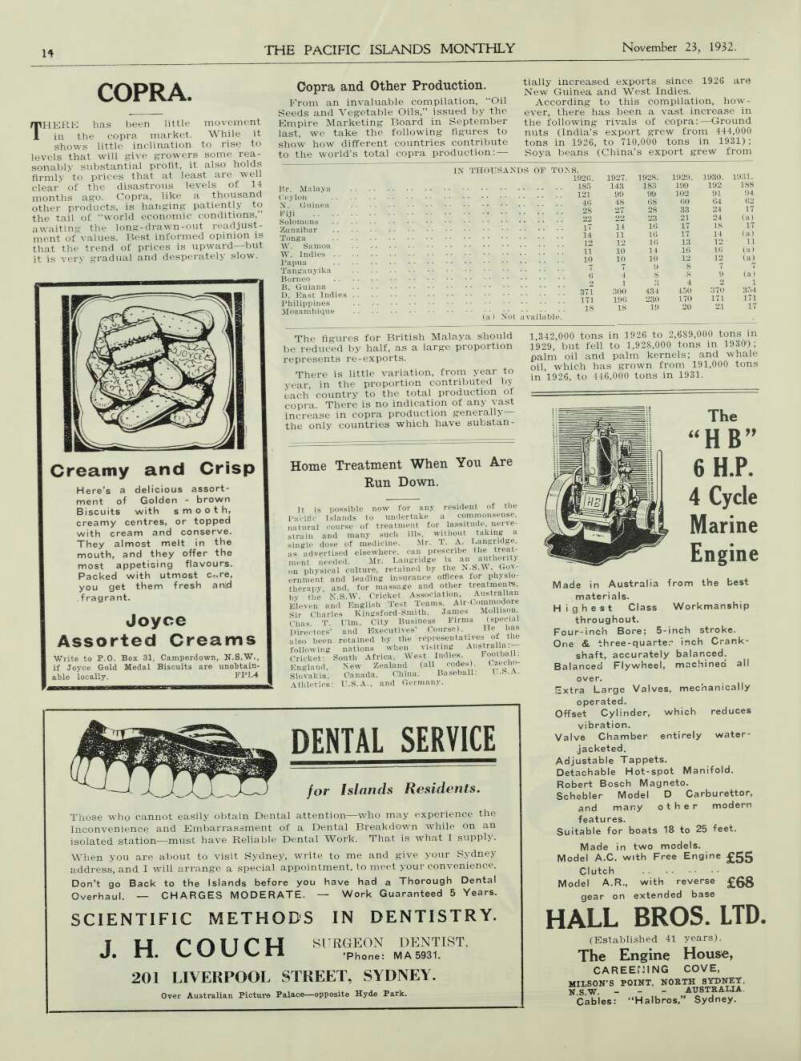
THERE has been little movement in the copra market. While it shows little inclination to rise to levels that will give growers some rea sonably substantial profit, it also holds firmly to prices that at least are well clear of the disastrous levels of 14 months ago. Copra, like a thousand other products, is hanging patiently to the tail of “world economic conditions, awaiting the long-drawn-out readjust ment of values. Best informed opinion is that the trend of prices is upward —but it is very gradual and desperately slow.
Copra and Other Production.
From an invaluable compilation, “Oil Seeds and Vegetable Oils,” issued by the Empire Marketing Board in September last, we take the following figures to show how different countries contribute to the world’s total copra production:
The figures for British Malaya should be reduced by half, as a large proportion represents re-exports.
There is little variation, from year to year in the proportion contributed by each country to the total production of copra. There is no indication of any vast increase in copra production generally the only countries which have substan
tially increased exports since 1926 are New Guinea and West Indies.
According to this compilation, how ever, there has been a vast increase in the following rivals of copra: —Ground nuts (India’s export grew from 444,000 tons in 1926, to 710,000 tons in 1931); Soya beans (China’s export grew from
1 342,000 tons in 1926 to 2,689,000 tons in 3 929, but fell to 1,928,000 tons in 1930); palm oil and palm kernels; and whale oil, which has grown from 191,000 tons in 1926, to 446,000 tons in 1931.
Br. Malaya Fiji Tonga Tanganyika Philippines
In Thousands Of Tons.
1926. 121 28 22 14 12 11 10 6 2 371 171 (a) Not available. 1927. 143 99 48 27 22 14 11 12 10 10 7 4 1 300 196 18 1928. 183 99 68 28 23 16 16 16 14 10 J 230 19 1929. 199 102 60 33 21 17 17 13 16 12 8 8 4 450 170 20 1930. 192 91 64 24 24 18 14 12 16 12 7 9 2 370 171 21 1931. 188 94 62 17 (a) 17 (a) 11 (a) (a) 1 354 171 17
Home Treatment When You Are
Run Down.
It is possible now for any resident of the Pacific Islands to undertake a commonsense, natural course of treatment for lassitude, nerve strain and many such ills, without taking a single dose of medicine. Mr. T. A. Langridge, as advertised elsewhere, can prescribe the treat ment needed. Mr. Langridge is an authority on physical culture, retained by the N.S.W. Gov ernment and leading insurance offices for physio therapy and, for massage and other treatments, bv the N S.W. Cricket Association, Australian Eleven and English Test Teams Air-Commodore Sir Charles Kingsford-Smith, James Mollison.
Chas T. Ulm, City Business Firms (special Directors’ and Executives’ Course) He has also been retained by the representatives of the following nations when visiting Australia:— Cricket: South Africa. West Indies. Football.
England. New Zealand (all codes), Czecho Slovakia, Canada, China. Baseball; U.S.A.
Athletics; U.S.A., and Germany.
Advertisements & other items, p. 16 (2 items)
Dental Service
Creamy and Crisp
Here’s a delicious assort ment of Golden - brown Biscuits with smooth, creamy centres, or topped with cream and conserve.
They almost melt in the mouth, and they offer the most appetising flavours.
Packed with utmost care, you get them fresh and fragrant.
Joyce
Assorted Creams
Write to P.O. Box 31, Camperdown, N.S.W., if Joyce Gold Medal Biscuits are unobtain able locally. FPL4
DENTAL SERVICE
for Islands Residents .
Those who cannot easily obtain Dental attention —who may experience the Inconvenience and Embarrassment of a Dental Breakdown while on an isolated station —must have Reliable Dental Work. That is what I supply.
When you are about to visit Sydney, write to me and give your Sydney address, and I will arrang-e a special appointment, to meet your convenience.
Don’t go Back to the Islands before you have had a Thorough Dental Overhaul. CHARGES MODERATE. Work Guaranteed 5 Years.
SCIENTIFIC METHODS IN DENTISTRY.
J. H. COUCH SURGEON DENTIST,
Phone: MA5931.
201 LIVERPOOL STREET, SYDNEY.
Over Australian Picture Palace- —opposite Hyde Park.
4 Cycle
The
“H B” 6 H.P.
Marine
Engine
Made in Australia from the best materials.
Highest Class Workmanship throughout.
Four-inch Bore; 5-inch stroke.
One & three-quarter inch Crank shaft, accurately balanced.
Balanced Flywheel, machined all over.
Extra Large Valves, mechanically operated.
Offset Cylinder, which reduces vibration.
Valve Chamber entirely water jacketed.
Adjustable Tappets.
Detachable Hot-spot Manifold.
Robert Bosch Magneto.
Schebler Model D Carburettor, and many other modern features.
Suitable for boats 18 to 25 feet.
Made in two models.
Model A.C. with Free Engine £55 Clutch Model A.R., with reverse £6B gear on extended base
HALL BROS. LTD.
(Established 41 years).
The Engine House,
CAREENING COVE,
MILSON’S POINT, NORTH SYDNEY,
N.S.W. - - - AUSTRALIA.
Cables: “Halbros,” Sydney.
But Abandon Non-Cooperation.
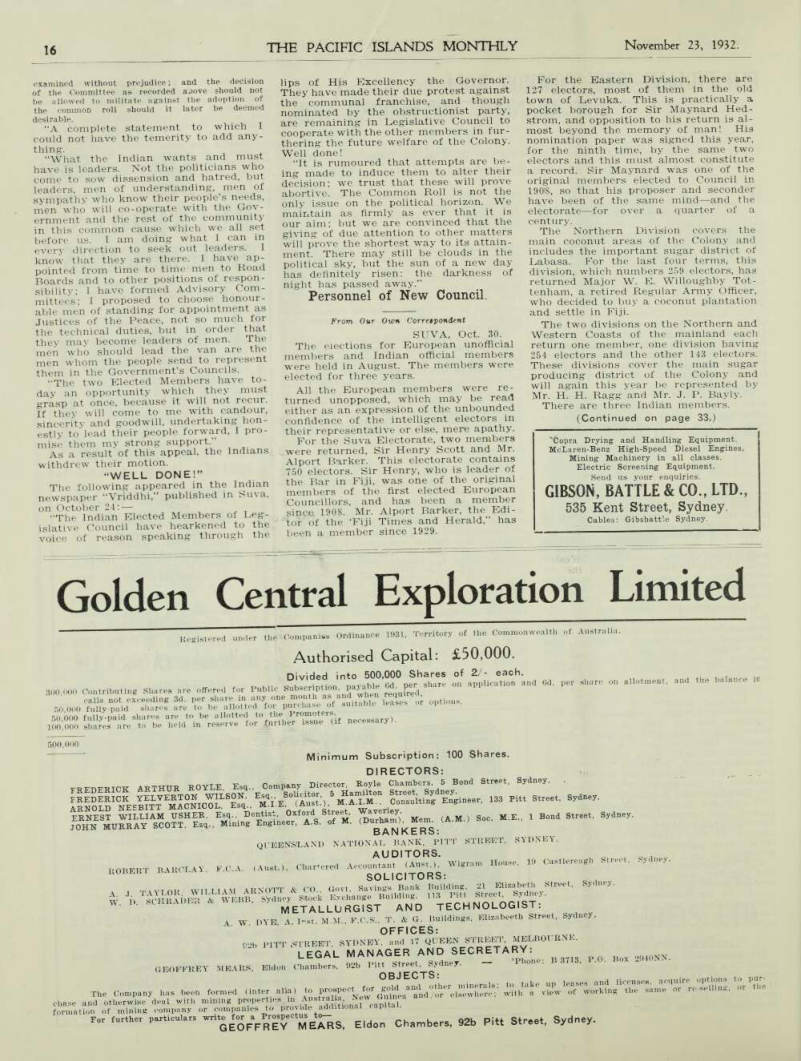
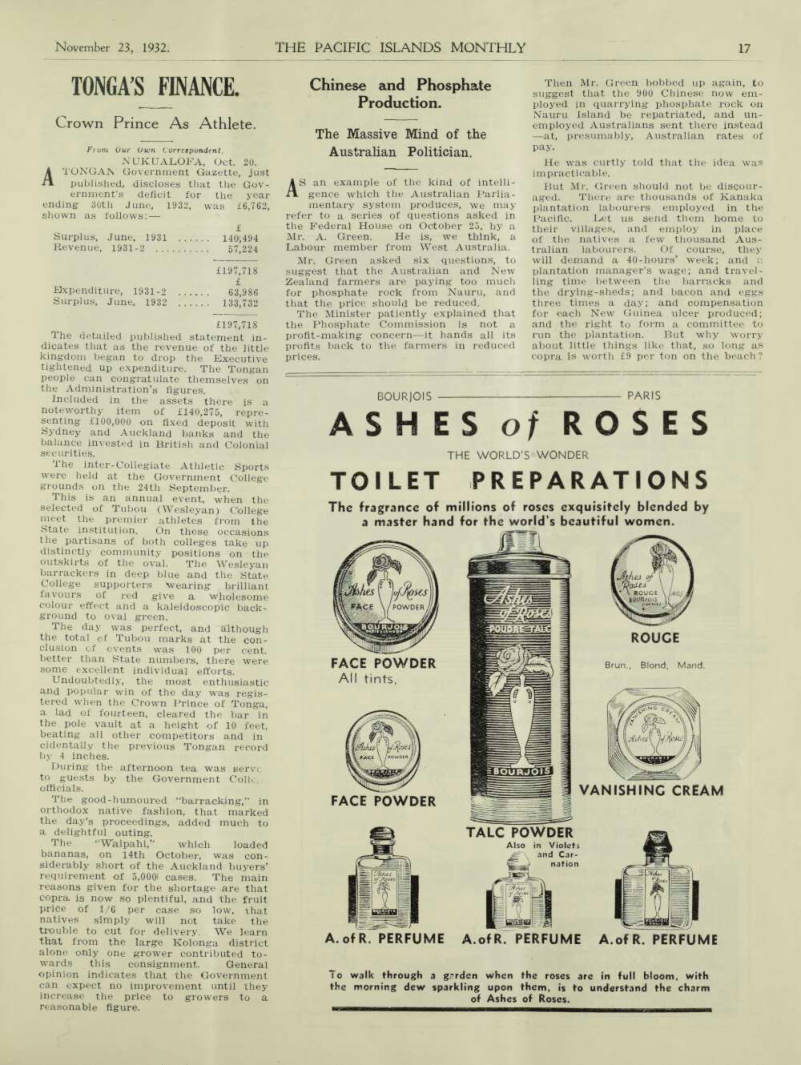
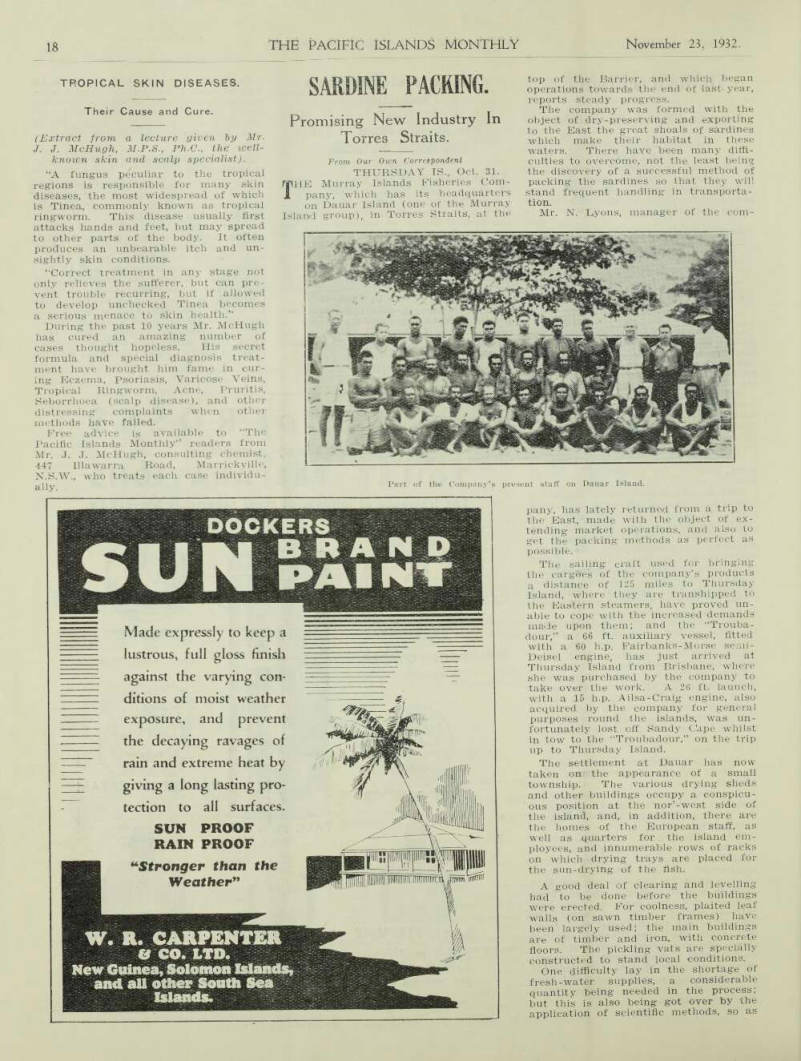
Fiji Indians Seek Common Roll
There have been interesting developments in Fiji in connection with Indian representation and the demand for the Common Roll.
WHEREVER a Hindu (or Indian) population has established itself in the British Empire, outside of India, there is a demand for communal equality with Europeans, and consequent politi cal unrest. This particularly has been the case in South and East Africa.
In Fiji, where an Indian community of 75,000 has been established, the demand takes the form of an agitation for “the common roll.” It has been going on for many years.
The Legislative Council there consists of 13 nominated, six elected European, three elected Fijian and three elected Indian members. There are separate rolls for European and Indian electors.
The Indians consider this a sign of in equality, and agitate constantly for re form.
There are many well-meaning people, both in and out of Britain, who try to advance the theory that these coloured races of the far-flung British Empire may be taught and allowed to govern themselves. But the majority of people, no matter how ardently they may be lieve in nationalism, know in their own hearts that the happiest, most progres sive and best protected coloured com munities are those which are governed by Europeans, while allowed to have an influential but not a dominating voice in the administration.
The Fiji system has worked excel lently, and the British Colonial Office would be extremely ill-advised to tinker with its constitution. If there is to be any reform, it should be in the direction of giving the elected section of the Leg islative Council a little more power.
When the newly-elected Fiji Legisla tive Council met in October, the Indian demand for the common roll was again advanced, in a series of questions, and in a resolution, moved by the Indian member for the Southern Division and seconded by the member for the North ern Division.
It should be explained, perhaps, that the Indians’ practice in the past has been to elect three members (one for Southern, one for Eastern and one for North and West). These men usually attended the first meeting, moved for the common roll, were defeated, and promptly retired, following the Gandhi policy of non-cooperation for the re mainder of the term. In last election the Southern and North-west Divisions (776 and 669 electors respectively) re turned non-cooperators. The Eastern Division (140 electors) did not nominate anyone. It was expected that the non cooperation policy would again be fol lowed.
The submission of the usual motion in mid-October was responsible for two notable developments—a very effective speech by the Governor (Sir Murchison Fletcher) and a decision by the two noncooperators not to retire, but to remain in the Council —and cooperate.
Governor’S Speech.
His Excellency, addressing the Indians, spoke in a frank, friendly way. He pro mised them that he would do every thing within reason to remove legitimate grievances. For instance, he undertook to include Indians in the official lists of
jurors and assessors, and to cancel the old regulations relating to the curfew.
In regard to the common roll, the Gov ernor said: “The Fijian and the European are subject to inequalities also. The Fijian, for example, is under the Native Regu lations. What would the Indians say if they were required communally to build houses, to turn out on the roads, to do this, that, and the other task which is assigned to the Fijians. Again, the Euro peans. I have referred to an inequality in the marriage law.
“There are other inequalities. The In dian at will can get married under the European marriage law, but the Euro pean cannot get married under the In dian marriage law—an inequality. The Indian can get divorce on terms much more easy than those allowed to the European—again an inequality. The In dian may entice away a European’s wife and go scot free. If a European entices away an Indian’s wife, he is liable to six months’ imprisonment—another in equality.
“The Indian gets practically free educa tion. The European and the Fijian pay half the cost—again inequality. The In dian gets free medical attendance. The European, and the Fijian to date, have to pay—again inequality. In this matter of inequality I am satisfied that on the balance the Indian community in this Colony come out at least even, and I am sure that the Government does both in the letter and in the spirit honestly give effect to the various declarations which have been made from time to time by His Majesty’s Government in the United Kingdom.
“I have now cleared the ground for examination of this question of the com mon roll. The latest pronouncement on the subject is in the report of the Com mittee of both Houses of Parliament which considered the question or closer union in East Africa, published in Oc tober last year. They said:
“The Committee have carefully considered the arguments for and against the common roll While not denying that strong arguments have been brought forward on both sides, they feel that it would be impracticable under present conditions to advocate the adoption of the system of common roll representation in preference to the existing system of election. Thev would be allowed to militate against the adoption of were made in the constitution, the desirability of introducing the common roll should be re
examined without prejudice; and the decision of the Committee as recorded aoove should not be allowed to militate against the adoption of the common roll should it later be deemed desirable.
“A complete statement to which I could not have the temerity to add any thing.
“What the Indian wants and must have is leaders. Not the politicians who come to sow dissension and hatred, but leaders, men of understanding, men of sympathy who know their people’s needs, men who will co-operate with the Gov ernment and the rest of the community in this common cause which we all set before us. I am doing what I can in every direction to seek out leaders. I know that they are there. I have ap pointed from time to time men to Road Boards and to other positions of respon sibility; I have formed Advisory Com mittees; I proposed to choose honour able men of standing for appointment as Justices of the Peace, not so much for the technical duties, but in order that they may become leaders of men. The men who should lead the van are the men whom the people send to represent them in the Government’s Councils.
“The two Elected Members have to day an opportunity which they must grasp at once, because it will not recur.
If they will come to me with candour, sincerity and goodwill, undertaking hon estly to lead their people forward, I pro mise them my strong support.”
As a result of this appeal, the Indians withdrew their motion.
“Well Done!”
The following appeared in the Indian newspaper “Vriddhi,” published in Suva, on October 24: “The Indian Elected Members of Leg islative Council have hearkened to the voice of reason speaking through the
lips of His Excellency the Governor.
They have made their due protest against the communal franchise, and though nominated by the obstructionist party, are remaining in Legislative Council to cooperate with the other members in fur thering the future welfare of the Colony.
Well done!
“It is rumoured that attempts are be ing made to induce them to alter their decision; we trust that these will prove abortive. The Common Roll is not the only issue on the political horizon. We maintain as firmly as ever that it is our aim; but we are convinced that the giving of due attention to other matters will prove the shortest way to its attain ment. There may still be clouds in the political sky, but the sun of a new day has definitely risen: the darkness of night has passed away.”
Personnel of New Council.
From Our Own Correspondent
Suva, Oct. 30.
The elections for European unofficial members and Indian official members were held in August. The members were elected for three years.
All the European members were re turned unopposed, which may be read either as an expression of the unbounded confidence of the intelligent electors in their representative or else, mere apathy.
For the Suva Electorate, two members were returned, Sir Henry Scott and Mr.
Alport Barker. This electorate contains 750 electors. Sir Henry, who is leader of the Bar in Fiji, was one of the original members of the first elected European Councillors, and has been a member since 1908. Mr. Alport Barker, the Edi tor of the ‘Fiji Times and Herald,” has been a member since 1929.
For the Eastern Division, there are 127 electors, most of them in the old town of Levuka. This is practically a pocket borough for Sir Maynard Hed strom, and opposition to his return is al most beyond the memory of man! His nomination paper was signed this year, for the ninth time, by the same two electors and this must almost constitute a record. Sir Maynard was one of the original members elected to Council in 1908, so that his proposer and seconder have been of the same mind —and the electorate —for over a quarter of a century.
The Northern Division covers the main coconut areas of the Colony and includes the important sugar district of Labasa. For the last four terms, this division, which numbers 259 electors, has returned Major W. E. Willoughby Tot tenham, a retired Regular Army Officer, who decided to buy a coconut plantation and settle in Fiji.
The two divisions on the Northern and Western Coasts of the mainland each return one member, one division having 254 electors and the other 143 electors.
These divisions cover the main sugar producing district of the Colony and will again this year be represented by Mr. H. H. Ragg and Mr. J. P. Bayly.
There are three Indian members.
(Continued on page 33.)
The three Fijian members are nomin ated by the Great Council of Chiefs. One Fijian member of the last Council has since died and the new nominee has not yet been appointed. The two present members are Ratu Pope Seniloli and Ratu Deve Toganivalu, I.S.O. Ratu Pope is the descendant of King Cakobau and is, therefore, the hereditary Paramount Chief of Fiji. Ratu Deve is a Retired Civil Servant.
The obvious choice of the Council of Chiefs —and doubtless of the Government —would be Ratu J. L. V. Sukuna, a graduate of Oxford and a member of the English Bar with a distinguished war record. Ratu Sukuna, however, has been appointed District Commissioner for Eau, where he has jurisdiction over Europeans, Fijians, Indians and Chinese alike.
The Official Members.
The other half of the Legislative Council will consist of the 12 Official Members, heads of various departments, who will be condemned for the next three years to sit in a bored and silent row opposite the elected and nominated members and not be permitted to speak save with the consent of the Governor.
As a species of purgatory, the duties of an official member of the Legislative Council have much to commend them!
Advertisements & other items, pp. 17-18 (1 item)
'Nekct
HOLBROOKS’
TABLE DELICACIES
WORCESTERSHIRE
SAUCE.
No. 2 SAUCE
(A thick, fruity sauce).
TOMATO SAUCE.
FRENCH OLIVE OIL.
SPANISH OLIVES
(Plain and Stuffed).
CAPERS.
FLAVOUR ING ESSENCES.
CHUTNEY.
PURE MALT VINEGAR.
JELLY CRYSTALS.
TINNED SOUPS.
baked beans and
SPAGHETTI.
In Tomato Sauce.
A wide variety of Pickles, including street Gherkins and Stnall Pearl White Onions.
Holbrooks (A/sia.) Ltd.
WATERLOO, N.S.W.
To Parke, Davis & Co.,
Box 4198 XX, G.P.0.,
Sydney.
Please send me Sample Cake of “NEKO.”
NAME
ADDRESS
Every home needs
'NEKCT
THE ORIGINAL GERMICIDAL SOAP.
‘•HEX©” is a fine quality Germicidal Toilet Soap, containing Effective “thai^°Put e Garble 30 times more
USE IN THE BATH FOR—-
The Prevention of all Tropical Skin Diseases, Dhobie Itch, Grillae, Vermin, etc., Not harmful to the most delicate skin.
Hardly a day will pass without your finding a good use for this Germ-Killing Soap.
WRITE FOR FREE SAMPLE and LITERATURE,
PARKE, DAVIS & CO. SYDNEY,
Copra Drying and Handling Equipment.
McLaren-Benz High-Speed Diesel Engines, Mining Machinery in all classes.
Electric Screening Equipment.
Send us your enquiries.
GIBSON, BATTLE & CO., LTD.,
535 Kent Street, Sydney,
Cables: Gibsbattle Sydney.
Golden Central Exploration Limited
Registered under the Companies Ordinance 1931. Territory of the Commonwealth of Australia.
Authorised Capital: £30,000.
Divided into 500,000 Shares of 2/- each. 300,000 Contributing Shares are offered for Public Subscription, payable 6d. per share on application and 6d. per share on allotment, and the balance in calls not exceeding 3d. per share in any one month as and when required. 50,000 fully-paid shares are to be allotted for purchase of suitable leases or options, 50,000 fully-paid shares are to be allotted to the Promoters. 100,000 shares are to be held in reserve for further issue (if necessary). 500,000 Minimum Subscription: 100 Shares,
DIRECTORS:
FREDERICK ARTHUR HOYLE, Esq., Company Director. Hoyle Chambers, 6 Bond Street, Sydney. .
AINSLS IC H K Ecl?T L rsl™ic'2 1 L LS Efq,, 133 Pitt Street, Sydney.
QUEENSLAND NATIONAL BANK, PITT STREET, SYDNEY.
AUDITORS. „ .
ROBERT BARCLAY. R.C.A. (Anst.,. Chartered Acconnta^ (AnsLK W, g r„m House. 19 Oas.lerea g h Street, Sydney.
metallurgist and technologist.
\ w DYE \ I"8t. M.M., F.C.S., T. & G. Buildings, Elizabeth Street, Sydney.
OFFICES;
92b PITT .STREET, SYDNEY, and 17 QUEEN STREET, MELBOURNE.
IEGAL MANAGER AND SECRETARY.
GEOFFREY MBARS, Eldon Chambers, 92b Pitt - 'Phone: B STI3. P.O. Boy 2940NN.
The Company has been formed (inter all.) v?ew'T or'Viuln*. or toe
sr nsa sipr -
For further particulars MEARS, Eldon Chambers, 92b Pitt Street, Sydney.
Tongas Finance.
Crown Prince As Athlete.
From Our Own Correspondent.
Nukualofa, Oct. 20.
ATONGAN Government Gazette, just published, discloses that the Gov ernment’s deficit for the year ending 30th June, 1932, was £6,762, shown as follows:
The detailed published statement in dicates that as the revenue of the little kingdom began to drop the Executive tightened up expenditure. The Tongan people can congratulate themselves on the Administration’s figures.
Included in the assets there is a noteworthy item of £140,275, repre senting £100,000 on fixed deposit with Sydney and Auckland banks and the balance invested in British and Colonial securities.
The inter-Collegiate Athletic Sports were held at the Government College grounds on the 24th September.
This is an annual event, when the selected of Tubou (Wesleyan) College meet the premier athletes from the State institution. On these occasions the partisans of both colleges take up distinctly community positions on the outskirts of the oval. The Wesleyan barrackers in deep blue and the State College supporters bearing brilliant favours of red give a wholesome colour effect and a kaleidoscopic back ground to oval green.
The day was perfect, and although the total of Tubou marks at the con clusion of events was 100 per cent, better than State numbers, there were some excellent individual efforts.
Undoubtedly, the most enthusiastic and popular win of the day was regis tered when the Crown Prince of Tonga, a lad of fourteen, cleared the bar in the pole vault at a height of 10 feet, beating all other competitors and in cidentally the previous Tongan record by 4 inches.
During the afternoon tea was serve to guests by the Government Collect officials.
The good-humoured “barracking,” in orthodox native fashion, that marked the day’s proceedings, added much to a delightful outing.
The “Waipahi,” which loaded bananas, on 14th October, was con siderably short of the Auckland buyers’ requirement of 5,000 cases. The main reasons given for the shortage are that copra is now so plentiful, and the fruit price of 1/6 per case so low, that natives simply will not take the trouble to cut for delivery. We learn that from the large Kolonga district alone only one grower contributed to wards this consignment. General opinion indicates that the Government can expect no improvement until they increase the price to growers to a reasonable figure.
£ Surplus, June, 1931 140,494 Revenue, 1931-2 57,224 £197,718 £ Expenditure, 1931-2 63,986 Surplus, June, 1932 . ., £197,718
Chinese and Phosphate
Production.
The Massive Mind of the Australian Politician.
AS an example of the kind of intelli gence which the Australian Parlia mentary system produces, we may refer to a series of questions asked in the Federal House on October 25, by a Mr. A. Green. He is, we think, a Labour member from West Australia.
Mr. Green asked six questions, to suggest that the Australian and New Zealand farmers are paying too much for phosphate rock from Nauru, and that the price should be reduced.
The Minister patiently explained that the Phosphate Commission is not a profit-making concern—it hands all its profits back to the farmers in reduced prices.
Then Mr. Green bobbed up again, to suggest that the 900 Chinese now em ployed in quarrying phosphate rock on Nauru Island be repatriated, and un employed Australians sent there instead —at, presumably, Australian rates of pay.
He was curtly told that the idea was impracticable.
But Mr. Green should not be discour aged. There are thousands of Kanaka plantation labourers employed in the Pacific. Let us send them home to their villages, and employ in place of the natives a few thousand Aus tralian labourers. Of course, they will demand a 40-hours’ week; and a plantation manager’s wage; and travel ling time between the barracks and the drying-sheds; and bacon and eggs three times a day; and compensation for each New Guinea ulcer produced; and the right to form a committee to run the plantation. But why worry about little things like that, so long as copra is worth £9 per ton on the beach?
Advertisements & other items, p. 19 (1 item)
Ashes Of Roses
BOURJOIS
PARIS
THE WORLD’S WONDER
TOILET PREPARATIONS
The fragrance of millions of roses exquisitely blended by a master hand for the world's beautiful women.
FACE POWDER
All tints,
FACE POWDER
ROUGE
Brun., Blond, Mand
VANISHING CREAM
TALC POWDER
Also in Violets and Car nation A. of R. PERFUME A.of R. PERFUME A. of R. PERFUME To walk through a garden when the roses are in full bloom, with the morning dew sparkling upon them, is to understand the charm of Ashes of Roses.
Tropical Skin Diseases.
Their Cause and Cure.
(Extract from a lecture given ty Mr.
J. J. McHugh, M.P.S., Ph.C., the wellknown skin and scalp specialist).
“A fungus peculiar to the tropical regions is responsible for many skin diseases, the most widespread of which is Tinea, commonly known as tropical ringworm. This disease usually first attacks hands and feet, but may spread to other parts of the body. It often produces an unbearable itch and un sightly skin conditions.
“Correct treatment in any stage not only relieves the sufferer, but can pre vent trouble recurring, but if allowed to develop unchecked Tinea becomes a serious menace to skin health.”
During the past 10 years Mr. McHugh has cured an amazing number of cases thought hopeless. His secret formula and special diagnosis treat ment have brought him fame in cur ing Eczema, Psoriasis, Varicose Veins, Tropical Ringworm, Acne, Pruritis, Seborrhoea (scalp disease), and other distressing complaints when other methods have failed.
Free advice is available to “The Pacific Islands Monthly” readers from Mr. J. J. McHugh, consulting chemist, 447 Illawarra Road, Marrickville, N.S.W., who treats each case individu ally.
Sardine Packing.
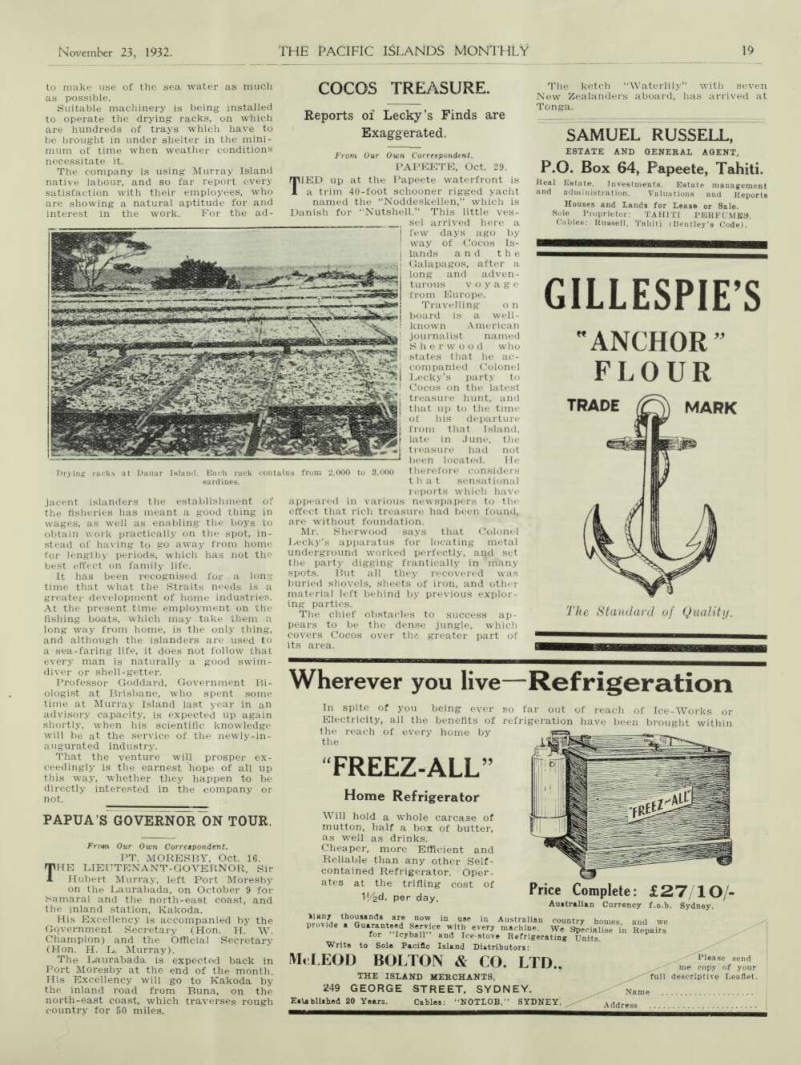
Promising New Industry In Torres Straits.
From Our Own Correspondent
Thursday Is., Oct. 31.
THE Murray Islands Fisheries Com pany, which has its headquarters on Dauar Island (one of the Murray Island group), in Torres Straits, at the
top of the Barrier, and which began operations towards the end of last year, reports steady progress.
The company was formed with the object of dry-preserving and exporting to the East the great shoals of sardines which make their habitat in these waters. There have been many diffi culties to overcome, not the least being the discovery of a successful method of packing the sardines so that they will stand frequent handling in transporta tion.
Mr. N. Lyons, manager of the com
pany, has lately returned from a trip to the East, made with the object of ex tending market operations, and also to get the packing methods as perfect as possible.
The sailing craft used for bringing the cargoes of the company’s products a distance of 125 miles to Thursday Island, where they are transhipped to the Eastern steamers, have proved un able to cope with the increased demands made upon them; and the “Trouba dour,” a 66 ft. auxiliary vessel, fitted with a 60 h.p. Fairbanks-Morse semi- Deisel engine, has just arrived at Thursday Island from Brisbane, where she was purchased by the company to take over the work. A 26 ft. launch, with a 15 h.p. Ailsa-Craig engine, also acquired by the company for general purposes round the islands, was un fortunately lost off Sandy Cape whilst in tow to the “Troubadour,” on the trip up to Thursday Island.
The settlement at Dauar has now taken on the appearance of a small township. The various drying sheds and other buildings occupy a conspicu ous position at the nor-west side of the island, and, in addition, there are the homes of the European staff, as well as quarters for the island em ployees, and innumerable rows of racks on which drying trays are placed for the sun-drying of the fish, A good deal of clearing and levelling had to be done before the buildings were erected. For coolness, plaited leaf walls (on sawn timber frames) have been largely used; the main buildings are of timber and iron, with concrete floors. The pickling vats are specially constructed to stand local conditions.
One difficulty lay in the shortage of fresh-water supplies, a considerable quantity being needed in the process: but this is also being got over by the application of scientific methods, so as
Part of the Company’s present staff on Dauar Island.
to make use of the sea water as much as possible.
Suitable machinery is being installed to operate the drying racks, on which are hundreds of trays which have to be brought in under shelter in the mini mum of time when weather conditions necessitate it.
The company is using Murray Island native labour, and so far report every satisfaction with their employees, who are showing a natural aptitude for and interest in the work. For the ad
jacent islanders the establishment of the fisheries has meant a good thing in wages, as well as enabling the boys to obtain work practically on the spot, in stead of having to go away from home for lengthy periods, which has not the best effect on family life.
It has been recognised for a long time that what the Straits needs is a greater development of home industries.
At the present time employment on the fishing boats, which may take them a long way from home, is the only thing, and although the islanders are used to a sea-faring life, it does not follow that every man is naturally a good swim diver or shell-getter.
Professor Goddard, Government Bi ologist at Brisbane, who spent some time at Murray Island last year in an advisory capacity, is expected up again shortly, when his scientific knowledge will be at the service of the newly-in augurated industry.
That the venture will prosper ex ceedingly is the earnest hope of all up this way, whether they happen to be directly interested in the company or not.
Drying racks at Dauar Island. Each rack contains from 2,000 to 3,000 sardines.
Advertisements & other items, p. 20 (1 item)
Made expressly to keep a lustrous, full gloss finish
lustrous, full gloss finish
against the varying con
ditions of moist weather exposure, and prevent the decaying ravages of rain and extreme heat by
giving a long lasting pro
tection to all surfaces.
SUN PROOF
RAIN PROOF
“Stronger than the Weather"
Exaggerated.
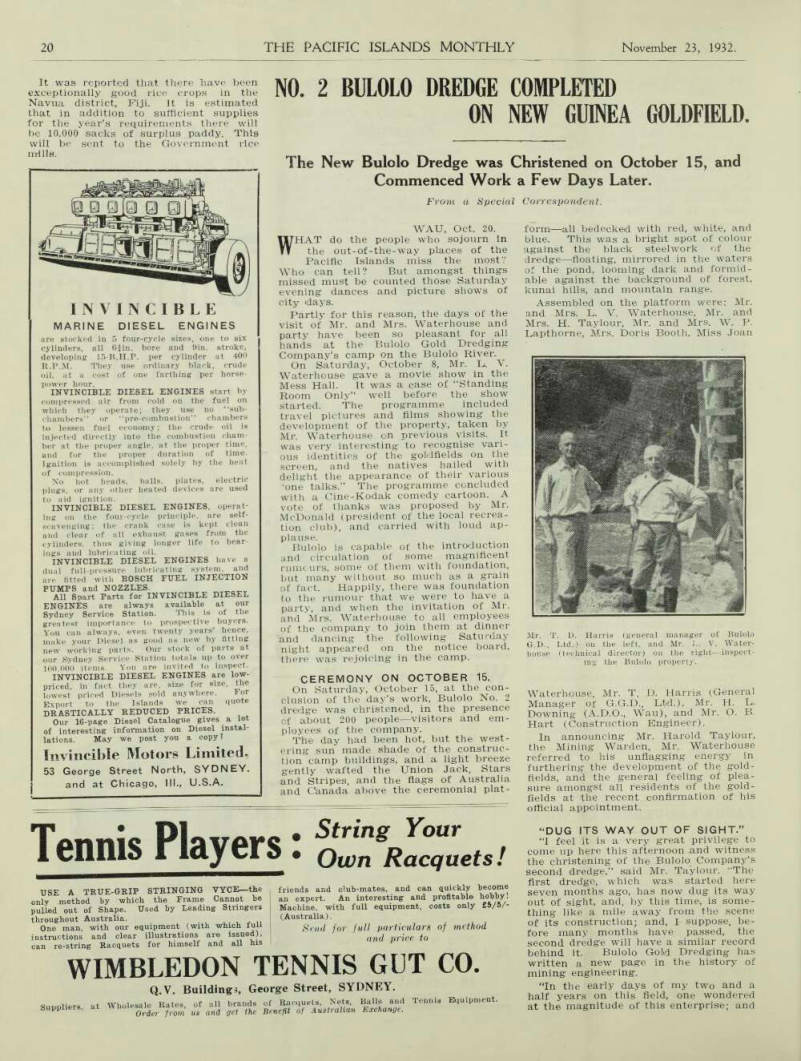
Cocos Treasure.
Reports of Lecky’s Finds are Exaggerated.
From Our Own Correspondent.
Papeete, Oct. 29.
TIED up at the Papeete waterfront is a trim 40-foot schooner rigged yacht named the “Noddeskellen,” which is Danish for “Nutshell.” This little ves
sel arrived here a few days ago by way of Cocos Is lands and the Galapagos, after a long and adven turous voyage from Europe.
Travelling on board is a well known American journalist named Sherwood who states that he ac companied Colonel Lecky’s party to Cocos on the latest treasure hunt, and that up to the time of his departure from that Island, late in June, the treasure had not been located. He therefore considers that sensational reports which have
appeared in various newspapers to the effect that rich treasure had been found, are without foundation.
Mr. Sherwood says that Colonel Lecky’s apparatus for locating metal underground worked perfectly, and set the party digging frantically in many spots. But all they recovered was buried shovels, sheets of iron, and other material left behind by previous explor ing parties.
The chief obstacles to success ap pears to be the dense jungle, which covers Cocos over tht greater part of its area.
It was reported that there have been exceptionally good rice crops in the Navua district, Fiji. It is estimated that in addition to sufficient supplies for the year’s requirements there will be 10,000 sacks of surplus paddy. This will be sent to the Government rice mills.
Papua’S Governor On Tour.
From Our Own Correspondent.
Pt. Moresby, Oct. 16.
The Lieutenant-Governor, Sir
Hubert Murray, left Port Moresby on the Laurabada, on October 9 for Samarai and the north-east coast, and the inland station, Kakoda.
His Excellency is accompanied by the Gqvernment Secretary (Hon. H. W.
Champion) and the Official Secretary (Hon. H. L. Murray).
The Laurabada is expected back in Port Moresby at the end of the month.
His Excellency will go to Kakoda by the inland road from Buna, on the north-east coast, which traverses rough country for 50 miles.
Advertisements & other items, p. 21 (1 item)
Gillespie’S
The ketch “Waterlily” with seven New Zealanders aboard, has arrived at Tonga.
SAMUEL RUSSELL,
ESTATE AND GENERAL AGENT,
P.O. Box 64, Papeete, Tahiti.
Real Estate. Investments. Estate management and administration. Valuations and Reports Houses and Lands for Lease or Sale.
Sole Proprietor: TAHITI PERFUMES.
Cables; Russell. Tahiti (Bentley's Code).
GILLESPIE’S
ANCHOR
FLOUR
TRADE MARK
The Standard of Quality.
Wherever you live — Refrigeration
In spite of you being- ever so far out of reach of Ice-Works or Electricity, all the benefits of refrigeration have been brought within the reach of every home by the
"FREEZ-ALL"
Home Refrigerator
Will hold a whole carcase of mutton, half a box of butter, as well as drinks.
Cheaper, more Efficient and Reliable than any other Selfcontained Refrigerator. Oper ates at the trifling cost of
1½d. per day.
Price Complete: £27/10/-
Australian Currency f.o.b. Sydney.
Many thousands are now in use in Australian country homes and we provide a Guaranteed Service with every machine. We Specialise in Repairs for Icyball and Ice-stove Refrigerating Units.
Write to Sole Pacific Island Distributors
McLEOD BOLTON & CO. LTD.,
THE ISLAND MERCHANTS,
249 GEORGE STREET, SYDNEY.
Established 20 Years. Cables: “NOTLOB,” SYDNEY.
Please send me copy of your full descriptive Leaflet.
Name Address
No. 2 Bulolo Dredge Completed
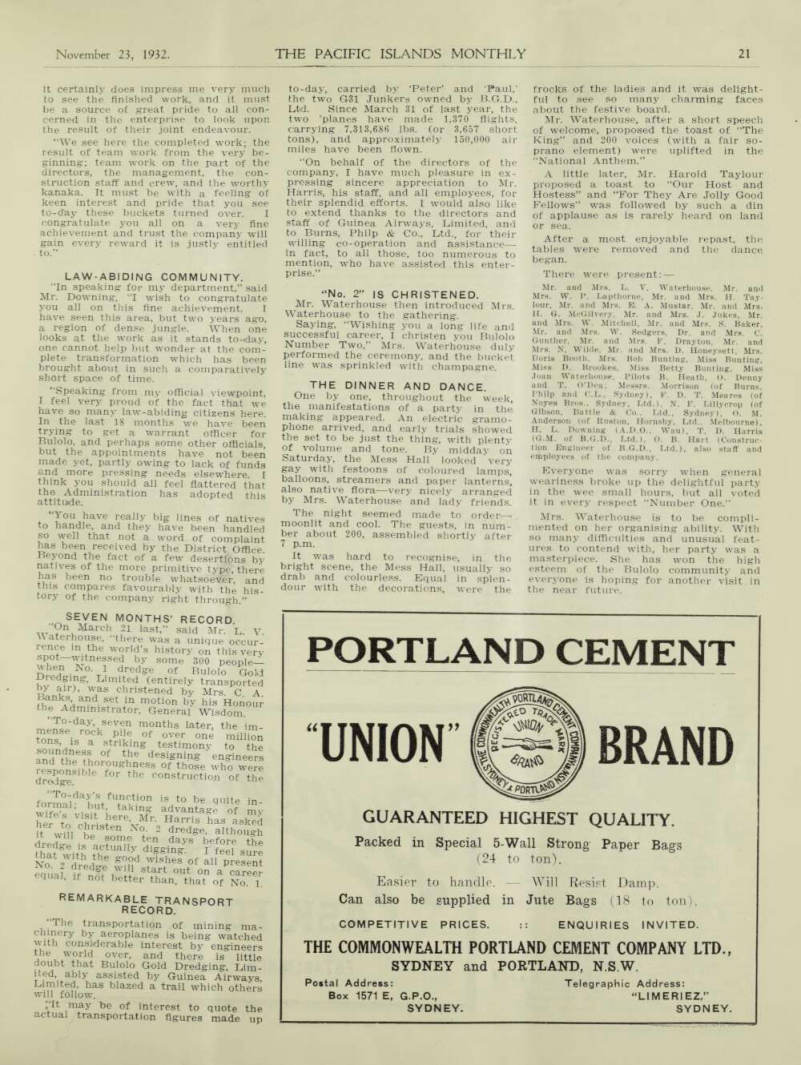
On New Guinea Goldfield.
The New Bulolo Dredge was Christened on October 15, and Commenced Work a Few Days Later.
From a Special Correspondent.
WAU, Oct. 20.
WHAT do the people who sojourn in the out-of-the-way places of the Pacific Islands miss the most?
Who can tell? But amongst things missed must be counted those Saturday evening dances and picture shows of city days.
Partly for this reason, the days of the visit of Mr. and Mrs. Waterhouse and party have been so pleasant for all hands at the Bulolo Gold Dredging Company’s camp on the Bulolo River.
On Saturday, October 8, Mr. L. V.
Waterhouse gave a movie show in the Mess Hall. It was a case of “Standing Room Only” well before the show started. The programme included travel pictures and films showing the development of the property, taken by Mr. Waterhouse on previous visits. It was very interesting to recognise vari ous identities of the goldfields on the screen, and the natives hailed with delight the appearance of their various ‘one talks.” The programme concluded with a Cine-Kodak comedy cartoon. A vote of thanks was proposed by Mr.
McDonald (president of the local recrea tion club), and carried with loud ap plause.
Bulolo is capable of the introduction and circulation of some magnificent rumours, some of them with foundation, but many without so much as a grain of fact. Happily, there was foundation to the rumour that we were to have a party, and when the invitation of Mr. and Mrs. Waterhouse to all employees of the company to join them at dinner and dancing the following Saturday night appeared on the notice board, there was rejoicing in the camp.
Ceremony On October 15.
On Saturday, October 15, at the con clusion of the day’s work, Bulolo No. 2 dredge was christened, in the presence of about 200 people—visitors and em ployees of the company.
The day had been hot, but the west ering sun made shade of the construc tion camp buildings, and a light breeze gently wafted the Union Jack, Stars and Stripes, and the flags of Australia and Canada above the ceremonial plat
form—all bedecked with red, white, and blue. This was a bright spot of colour against the black steelwork of the dredge—floating, mirrored in the waters of the pond, looming dark and formid able against the background of forest, kunai hills, and mountain range.
Assembled on the platform were; Mr. and Mrs. L. V. Waterhouse, Mr. and Mrs. H. Taylour, Mr. and Mrs. W. P.
Lapthorne, Mrs. Doris Booth, Miss Joan
Waterhouse, Mr. T, D. Harris (General Manager of G.G.D., Ltd.), Mr. H. L.
Downing (A.D.O., Wau), and Mr. O. B.
Hart (Construction Engineer).
In announcing Mr. Harold Taylour, the Mining Warden, Mr. Waterhouse referred to his unflagging energy in furthering the development of the gold fields, and the general feeling of plea sure amongst all residents of the gold fields at the recent confirmation of his official appointment.
“Dug Its Way Out Of Sight.”
“I feel it is a very great privilege to come up here this afternoon and witness the christening of the Bulolo Company’s second dredge,” said Mr. Taylour. “The first dredge, which was started here seven months ago, has now dug its way out of sight, and, by this time, is some thing like a mile away from the scene of its construction; and, I suppose, be fore many months have passed, the second dredge will have a similar record behind it. Bulolo Gold Dredging has written a new page in the history of mining engineering.
“In the early days of my two and a half years on this field, one wondered at the magnitude of this enterprise; and
Mr. T. D. Harris (general manager of Bulolo G.D., Ltd.) on the left, and Mr. V. Water house (technical director) on the right—inspect ing the Bulolo property.
it certainly does impress me very much to see the finished work, and it must be a source of great pride to all con cerned in the enterprise to look upon the result of their joint endeavour.
“We see here the completed work; the result of team work from the very be ginning; team work on the part of the directors, the management, the con struction staff and crew, and the worthy kanaka. It must be with a feeling of keen interest and pride that you see to-day these buckets turned over. I congratulate you all on a very fine achievement and trust the company will gain every reward it is justly entitled to.”
Law-Abiding Community.
“In speaking for my department,” said Mr. Downing, “I wish to congratulate you all on this fine achievement. I have seen this area, but two years ago, a region of dense jungle. When one looks at the work as it stands to-day, one cannot help but wonder at the com plete transformation which has been brought about in such a comparatively short space of time.
“Speaking from my official viewpoint, I feel very proud of the fact that we have so many law-abiding citizens here.
In the last 18 months we have been trying to get a warrant officer for Bulolo, and perhaps some other officials, but the appointments have not been made yet, partly owing to lack of funds and more pressing needs elsewhere. I think you should all feel flattered that the Administration has adopted this attitude.
“You have really big lines of natives to handle, and they have been handled so well that not a word of complaint has been received by the District Office.
Beyond the fact of a few desertions by natives of the more primitive type, there has been no trouble whatsoever and this compares favourably with the his tory of the company right through.”
Seven Months’ Record.
March 21 last,” said Mr. L. V.
Waterhouse, “there was a unique occur rence in the world’s history on this very spot—witnessed by some 300 people— when No. 1 dredge of Bulolo Gold
Dredging, Limited (entirely transported
by air), was christened by Mrs C. A.
Banks and set in motion by his Honour the Administrator, General Wisdom.
“To-day, seven months later, the im mense rock pile of over one million tons, is a striking testimony to the soundness of the designing engineers and the thoroughness of those who were responsible for the construction of the dredge.
"To-day's function is to be quite in formal; but, taking advantage of my wife’s visit here, Mr. Harris has asked her to christen No. 2 dredge, although it will be some ten days before the dredge is actually digging. I feel sure that with the good wishes of all present No. 2 dredge will start out on a career equal, if not better than, that of No. 1.
Remarkable Transport
Record.
“The transportation of mining ma chinery by aeroplanes is being watched with considerable interest by engineers the world over, and there is little doubt that Bulolo Gold Dredging, Lim ited, ably assisted by Guinea Airways, Limited, has blazed a trail which others will follow.
"It may be of interest to quote the actual transportation figures made up
to-day, carried by ‘Peter’ and Paul,’ the two G31 Junkers owned by B.G.D., Ltd. Since March 31 of last year, the two ’planes have made 1,370 flights, carrying 7,313,686 lbs. (or 3,657 short tons), and approximately 150,000 air miles have been flown.
“On behalf of the directors of the company, I have much pleasure in ex pressing sincere appreciation to Mr.
Harris, his staff, and all employees, for their splendid efforts. I would also like to extend thanks to the directors and staff of Guinea Airways, Limited, and to Burns, Philp & Co., Ltd., for their willing co-operation and assistance— in fact, to all those, too numerous to mention, who have assisted this enter prise.”
“No. 2” Is Christened.
Mr. Waterhouse then introduced Mrs.
Waterhouse to the gathering.
Saying, “Wishing you a long life and successful career, I christen you Bulolo Number Two,” Mrs. Waterhouse duly performed the ceremony, and the bucket line was sprinkled with champagne.
The Dinner And Dance.
One by one, throughout the week, the manifestations of a party in the making appeared. An electric gramo phone arrived, and early trials showed the set to be just the thing, with plenty of volume and tone. By midday on Saturday, the Mess Hall looked very gay with festoons of coloured lamps, balloons, streamers and paper lanterns, also native flora —very nicely arranged by Mrs. Waterhouse and lady friends.
The night seemed made to order moonlit and cool. The guests, in num ber about 200, assembled shortly after 7 p.m.
It was hard to recognise, in the bright scene, the Mess Hall, usually so drab and colourless. Equal in splen dour with the decorations, were the
frocks of the ladies and it was delight ful to see so many charming faces about the festive board.
Mr. Waterhouse, after a short speech of welcome, proposed the toast of “The King” and 200 voices (with a fair so prano element) were uplifted in the “National Anthem.”
A little later, Mr. Harold Taylour proposed a toast to “Our Host and Hostess” and ‘‘For They Are Jolly Good Fellows” was followed by such a din of applause as is rarely heard on land or sea.
After a most enjoyable repast, the tables were removed and the dance began.
There were present: Mr. and Mrs. L. V. Waterhouse, Mr. and Mrs. W. P. Lapthorne, Mr. and Mrs. H. Tay lour, Mr. and Mrs. E. A. Mustar, Mr. and Mrs.
H. G. McGilvery, Mr. and Mrs. J. Jukes, Mr. and Mrs. W. Mitchell, Mr. and Mrs. S. Baker, Mr. and Mrs. W. Sedgers, Dr. and Mrs. C.
Gunther, Mr. and Mrs. F. Drayton, Mr. and Mrs. N. Wilde, Mr. and Mrs. D. Honeysett, Mrs.
Doris Booth, Mrs. Bob Bunting, Miss Bunting, Miss D. Brookes, Miss Betty Bunting, Miss Joan Waterhouse, Pilots B. Heath, O. Denny and T. O’Dea; Messrs. Morrison (of Burns, Philp and C.L., Sydney), F. D. T. Meares (of Noyes Bros., Sydney, Ltd.), N. F. Lillycrop (of Gibson, Battle & Co., Ltd., Sydney), O. M.
Anderson (of Ruston, Hornsby, Ltd., Melbourne), H. L. Downing (A.D.O., Wau), T. D. Harris (G.M. of B.G.D., Ltd.), O. B. Hart (Construc tion Engineer of B.G.D., Ltd.), also staff and employees of the company.
Everyone was sorry when general weariness broke up the delightful party in the wee small hours, but all voted it in every respect “Number One.”
Mrs. Waterhouse is to be compli mented on her organising ability. With so many difficulties and unusual feat ures to contend with, her party was a masterpiece. She has won the high esteem of the Bulolo community and everyone is hoping for another visit in the near future.
Advertisements & other items, pp. 22-23 (2 items)
Tennis Players:
INVINCIBLE
MARINE DIESEL ENGINES
are stocked in 5 four-cycle sizes, one to six cylinders, all 6¾in. bore and 9in. stroke, developing 15-B.H.P. per cylinder at 400 R.P.M. They use ordinary black, crude oil, at a cost of one farthing per horse power hour.
INVINCIBLE DIESEL ENGINES start by
compressed air from cold on the fuel on which they operate; they use no “subchambers” or “pre-combustion” chambers to lessen fuel economy; the crude oil is injected directly into the combustion cham ber at the proper angle, at the proper time, and for the proper duration of time.
Ignition is accomplished solely by the heat of compression.
No hot heads, balls, plates, electric plugs, or any other heated devices are used to aid ignition.
INVINCIBLE DIESEL ENGINES, operat
ing on the four-cycle principle, are selfscavenging; the crank case is kept clean and clear of all exhaust gases from the cylinders, thus giving longer life to bear ings and lubricating oil.
INVINCIBLE DIESEL ENGINES have a
dual full-pressure lubricating system, and are fitted with BOSCH FUEL INJECTION
PUMPS and NOZZLES
All Spart Parts for INVINCIBLE DIESEL ENGINES are always available at our Sydney Service Station. This is of the greatest importance to prospective buyers.
You can always, even twenty years’ hence, make your Diesel as good as new by fitting new working parts. Our stock of parts at our Siydney Service Station totals up to over 100.000 items. You are invited to inspect.
INVINCIBLE DIESEL ENGINES are low-
priced, in fact they are, size for size, the lowest priced Diesels sold anywhere. For Export to the Islands we can quote
DRASTICALLY REDUCED PRICES.
Our 16-page Diesel Catalogue gives a lot of interesting information on Diesel instal lations. May we post you a copy?
Invincible Motors Limited-
53 George Street North, SYDNEY,
and at Chicago, Ill., U.S.A.
Tennis Players:
String Your
Own Racquets!
USE A TRUE-GRIP STRINGING VYCE—the
only method by which the Frame Cannot be pulled out of Shape. Used by Leading Stringers throughout Australia.
One man, with our equipment (with which full instructions and clear illustrations are issued), can re-string Racquets for himself and all his friends and dub-mates, and can quickly become an expert. An interesting and profitable hobby!
Machine, with full equipment, costs only £5/8/- (Australia).
Send for full particulars of method
and price to
WIMBLEDON TENNIS GUT CO.
Suppliers, Q.V. Buildings, George Street, SYDNEY. at Wholesale Rates, of all brands of Racquets, Nets.
Order from us and get the Benefit of Australian Balls and Exchange.
Tennis Equipment.
Brand
PORTLAND CEMENT
"UNION"
GUARANTEED HIGHEST QUALITY.
Packed in Special 5-Wall Strong Paper Bags (24 to ton).
Easier to handle. Will Resist Damp.
Can also be supplied in Jute Bags (18 to ton).
COMPETITIVE PRICES. ENQUIRIES INVITED.
THE COMMONWEALTH PORTLAND CEMENT COMPANY LTD.,
SYDNEY and PORTLAND, N.S.W.
Telegraphic Address: Postal Address:
Box 1571 E, G.P.O.,
SYDNEY.
"LIMERIEZ”
SYDNEY.
Banana-Growers’ Howls Of Agony.
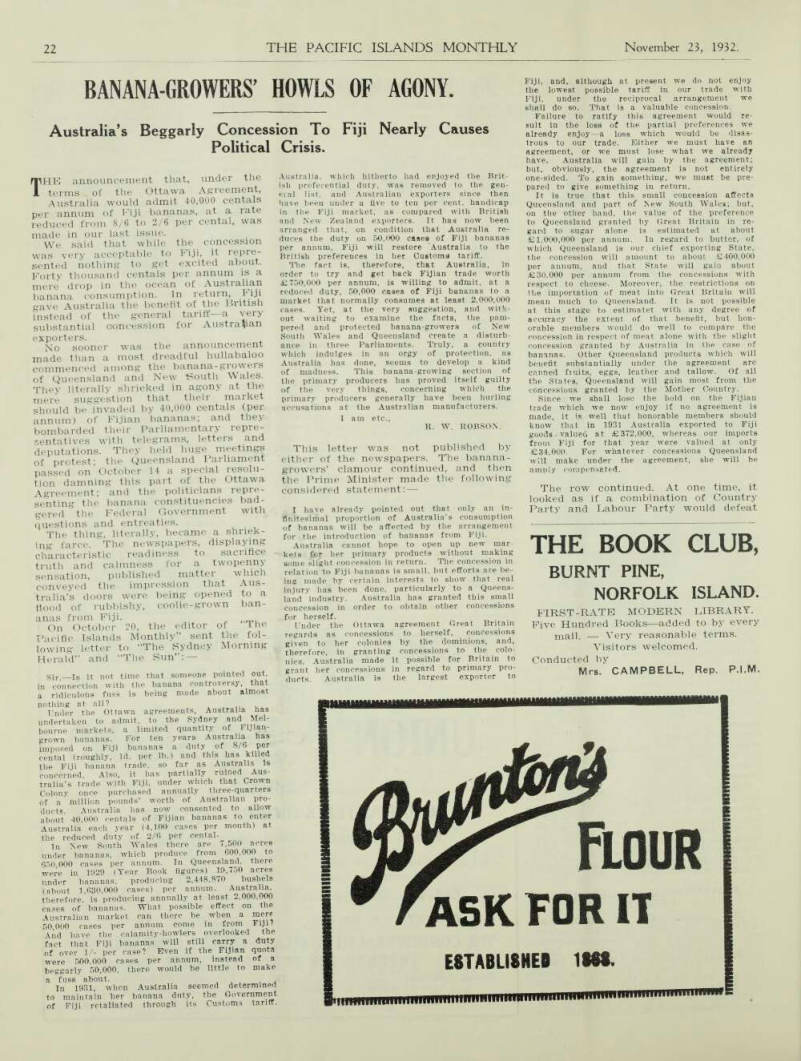
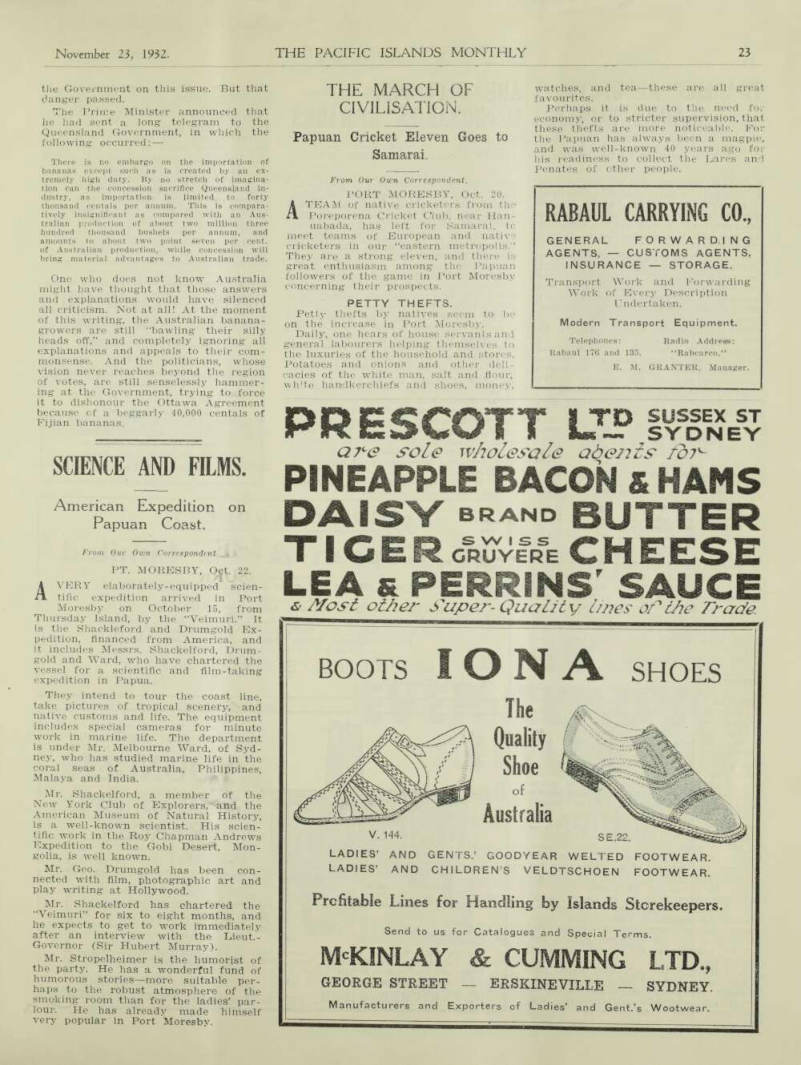
Australia’s Beggarly Concession To Fiji Nearly Causes Political Crisis.
TIME announcement that, under the terms of the Ottawa Agreement, Australia would admit 40,000 centals per annum of Fiji bananas, at a rate reduced from 8/6 to 2/6 per cental, was made in our last issue.
We said that while the concession was very acceptable to Fiji, it repre sented nothing to get excited about.
Forty thousand centals per annum is a mere drop in the ocean of Australian banana consumption. In return, Fiji gave Australia the benefit of the British instead of the general tariff —a very substantial concession for Australian exporters.
No sooner was the announcement made than a most dreadful hullabaloo commenced among the banana-growers of Queensland and New South Wales.
They literally shrieked in agony at the mere suggestion that their market should be invaded by 40,000 centals (per annum) of Fijian bananas; and they bombarded their Parliamentary repre sentatives with telegrams, letters and deputations. They held huge meetings of protest: the Queensland Parliament passed on October 14 a special resolu tion damning this part of the Ottawa Agreement; and the politicians repre senting the banana constituencies bad gered the Federal Government with questions and entreaties.
The thing, literally, became a shriek ing farce. The newspapers, displaying characteristic readiness to sacrifice truth and calmness for a twopenny sensation, published matter which conveyed the impression that Aus tralia’s doors were being opened to a flood of rubbishy, coolie-grown ban anas from Fiji.
On October 20, the editor of "The Pacific Islands Monthly" sent the fol lowing letter to ‘‘The Sydney Morning Herald” and “The Sun”: Sir, —Is it not time that someone pointed out, in connection with the banana controversy, that a ridiculous fuss is being made about almost nothing at all?
Under the Ottawa agreements, Australia has undertaken to admit, to the Sydney and Mel bourne markets, a limited quantity of Fijian grown bananas. For ten years Australia has imposed on Fiji bananas a duty of 8/6 per cental (roughly, 1d. per lb.) and this has killed the Fiji banana trade, so far as Australia is concerned. Also, it has partially ruined Aus tralia’s trade with Fiji, under which that Crown Colony once purchased annually three-quarters of a million pounds’ worth of Australian pro ducts. Australia has now consented to allow about 40,000 centals of Fijian bananas to enter Australia each year (4,100 cases per month) at the reduced duty of 2/6 per cental.
In New South Wales there are 7,500 acres under bananas, which produce from 600,000 to 650,000 cases per annum. In Queensland, there were in 1929 (Year Book figures) 19,750 acres under bananas. producing 2,448,870 bushels (about 1,630,000 cases) per annum. Australia, therefore, is producing annually at least 2,000,000 cases of bananas. What possible effect on the Australian market can there be when a mere 50,000 cases per annum come in from Fiji?
And have the calamity-howlers overlooked the fact that Fiji bananas will still carry a duty of over 1/- per case? Even if the Fijian quota were 500,000 cases per annum, instead of a beggarly 50,000, there would be little to make a fuss about.
In 1981, when Australia seemed determined to maintain her banana duty, the Government of Fiji retaliated through its Customs tariff
Australia, which hitherto had enjoyed the Brit ish preferential duty, was removed to the gen eral list, and Australian exporters since then have been under a five to ten per cent, handicap in the Fiji market, as compared with British and New Zealand exporters. It has now been arranged that, on condition that Australia re duces the duty on 50,000 cases of Fiji bananas per annum, Fiji will restore Australia to the British preferences in her Customs tariff.
The fact is. therefore, that Australia, in order to try and get back Fijian trade worth £750,000 per annum, is willing to admit, at a reduced duty, 50,000 cases of Fiji bananas to a market that normally consumes at least 2,000,000 cases. Yet, at the very suggestion, and with out waiting to examine the facts, the pam pered and protected banana-growers of New South Wales and Queensland create a disturb ance in three Parliaments. Truly, a country which indulges in an orgy of protection, as Australia has done, seems to develop a kind of madness. This banana-growing section of the primary producers has proved itself guilty of the very things, concerning which the primary producers generally have been hurling accusations at the Australian manufacturers.
I am etc.,
R. W. Robson.
This letter was not published by either of the newspapers. The banana growers’ clamour continued, and then the Prime Minister made the following considered statement: I have already pointed out that only an in finitesimal proportion of Australia’s consumption of bananas will be affected by the arrangement for the introduction of bananas from Fiji.
Australia cannot hope to open up new mar kets for her primary products without making some slight concession in return. The concession in relation to Fiji bananas is small, but efforts are be ing made by certain interests to show that real injury has been done, particularly to a Queens land industry. Australia has granted this small concession in order to obtain other concessions for herself.
Under the Ottawa agreement Great Britain regards as concessions to herself, concessions given to her colonies by the dominions, and, therefore, in granting concessions to the colo nies, Australia made it possible for Britain to grant her concessions in regard to primary pro ducts. Australia is the largest exporter to
Fiji, and, although at present we do not enjoy the lowest possible tariff in our trade with Fiji, under the reciprocal arrangement we shall do so. That is a valuable concession.
Failure to ratify this agreement would re sult in the loss of the partial preferences we already enjoy—a loss which would be disas trous to our trade. Either we must have an agreement, or we must lose what we already have. Australia will gain by the agreement; but, obviously, the agreement is not entirely one-sided. To gain something, we must be pre pared to give something in return.
It is true that this small concession affects Queensland and part of New South Wales; but, on the other hand, the value of the preference to Queensland granted by Great Britain in re gard to sugar alone is estimated at about £1,000,000 per annum. In regard to butter, of which Queensland is our chief exporting State, the concession will amount to about £400,000 per annum, and that State will gain about £30,000 per annum from the concessions with respect to cheese. Moreover, the restrictions on the importation of meat into Great Britain will mean much to Queensland. It is not possible at this stage to estimatet with any degree of accuracy the extent of that benefit, but hon orable members would do well to compare the concession in respect of meat alone with the slight concession granted by Australia in the case of bananas. Other Queensland products which will benefit substantially under the agreement are canned fruits, eggs, leather and tallow. Of all the States, Queensland will gain most from the concessions granted by the Mother Country.
Since we shall lose the hold on the Fijian trade which we now enjoy if no agreement is made, it is well that honorable members should know that in 1931 Australia exported to Fiji goods valued at £372,000, whereas our imports from Fiji for that year were valued at only £34,000. For whatever concessions Queensland will make under the agreement, she will be amply compensated.
The row continued. At one time, it looked as if a combination of Country Party and Labour Party would defeat
the Government on this issue. But that danger passed.
The Prime Minister announced that he had sent a long telegram to the Queensland Government, in which the following occurred: There is no embargo on the importation of bananas except such as is created by an ex tremely high duty. By no stretch of imagina tion can the concession sacrifice Queensland in dustry, as importation is limited to forty thousand centals per annum. This is compara tively insignificant as compared with an Aus tralian production of about two million three hundred thousand bushels per annum, and amounts to about two point seven per cent, of Australian production, while concession will bring material advantages to Australian trade.
One who does not know Australia might have thought that those answers and explanations would have silenced all criticism. Not at all! At the moment of this writing, the Australian banana growers are still “bawling their silly heads off,” and completely ignoring all explanations and appeals to their com monsense. And the politicians, whose vision never reaches beyond the region of votes, are still senselessly hammer ing at the Government, trying to force it to dishonour the Ottawa Agreement because of a beggarly 40,000 centals of Fijian bananas.
Advertisements & other items, p. 24 (1 item)
The Book Club,
BURNT PINE,
NORFOLK ISLAND.
FIRST-RATE MODERN LIBRARY.
Five Hundred Books —added to by every mail. — Very reasonable terms.
Visitors welcomed.
Conducted by
Mrs. CAMPBELL, Rep. P.I.M.
ESTABLISHED ISSS.
Science And Films.
American Expedition on Papuan Coast.
From Our Own Correspondent.
Pt. Moresby, Oct. 22.
AVERY elaborately-equipped scien tific expedition arrived in Port Moresby on October 15, from Thursday Island, by the “Veimuri.” It is the Shackleford and Drumgold Ex pedition, financed from America, and it includes Messrs. Shackelford, Drum gold and Ward, who have chartered the vessel for a scientific and film-taking expedition in Papua.
They intend to tour the coast line, take pictures of tropical scenery, and native customs and life. The equipment includes special cameras for minute work in marine life. The department is under Mr. Melbourne Ward, of Syd ney, who has studied marine life in the coral seas of Australia, Philippines, Malaya and India.
Mr. Shackelford, a member of the New York Club of Explorers,' and the American Museum of Natural History, is a well-known scientist. His scien tific work in the Roy Chapman Andrews Expedition to the Gobi Desert, Mon golia, is well known.
Mr. Geo. Drumgold has been con nected with film, photographic art and play writing at Hollywood.
Mr. Shackelford has chartered the “Veimuri” for six to eight months, and he expects to get to work immediately after an interview with the Lieut.- Governor (Sir Hubert Murray).
Mr. Stropelheimer is the humorist of the party. He has a wonderful fund of humorous stories —more suitable per haps to the robust atmosphere of the smoking room than for the ladies’ par lour. He has already made himself very popular in Port Moresby.
Civilisation.
The March Of
Papuan Cricket Eleven Goes to Samarai.
From Our Own Correspondent.
Port Moresby, Oct. 20.
A TEAM of native cricketers from the Poreporena Cricket Club, near Han uabada, has left for Samarai. to meet teams of European and native cricketers in our “eastern metropolis."
They are a strong eleven, and there is great enthusiasm among the Papuan followers of the game in Port Moresby concerning their prospects.
Petty Thefts.
Petty thefts by natives seem to be on the increase in Port Moresby.
Daily, one hears of house servants and general labourers helping themselves to the luxuries of the household and stores.
Potatoes and onions and other deli cacies of the white man, salt and flour, white handkerchiefs and shoes, money,
watches, and tea—these are all great favourites.
Perhaps it is due to the need for economy, or to stricter supervision, that these thefts are more noticeable. For the Papuan has always been a magpie, and was well-known 40 years ago for his readiness to collect the Lares and Penates of other people.
Advertisements & other items, p. 25 (1 item)
Lea & Perrins' Sauce
RABAUL CARRYING CO.,
GENERAL FORWARDING
AGENTS, CUSTOMS AGENTS,
INSURANCE STORAGE.
Transport Work and Forwarding Work of Every Description Undertaken.
Modern Transport Equipment.
Telephones; Radio Address: Rabaul 176 and 135. “Rabcarco.”
E. M. GRANTEH, Manager.
PRESCOTT L TD Sussex St Sydney are sole wholesale agents for
PINEAPPLE BACON & HAMS
DAISY BRAND BUTTER
TIGER Swiss Gruyere CHEESE
LEA & PERRINS' SAUCE
& Most other Super-Quality lines of the Trade.
BOOTS IONA SHOES
V. 144.
The
Quality
Shoe
of
Australia
SE.2
LADIES' AND GENTS.' GOODYEAR WELTED FOOTWEAR.
LADIES’ AND CHILDREN’S VELDTSCHOEN FOOTWEAR.
Profitable Lines for Handling by Islands Storekeepers.
Send to us for Catalogues and Special Terms.
MCKINLAY & GUMMING LTD.,
GEORGE STREET ERSKINEVILLE SYDNEY.
Manufacturers and Exporters of Ladies’ and Gent.’s Wootwear.
Traders’ Reputations Are Defended
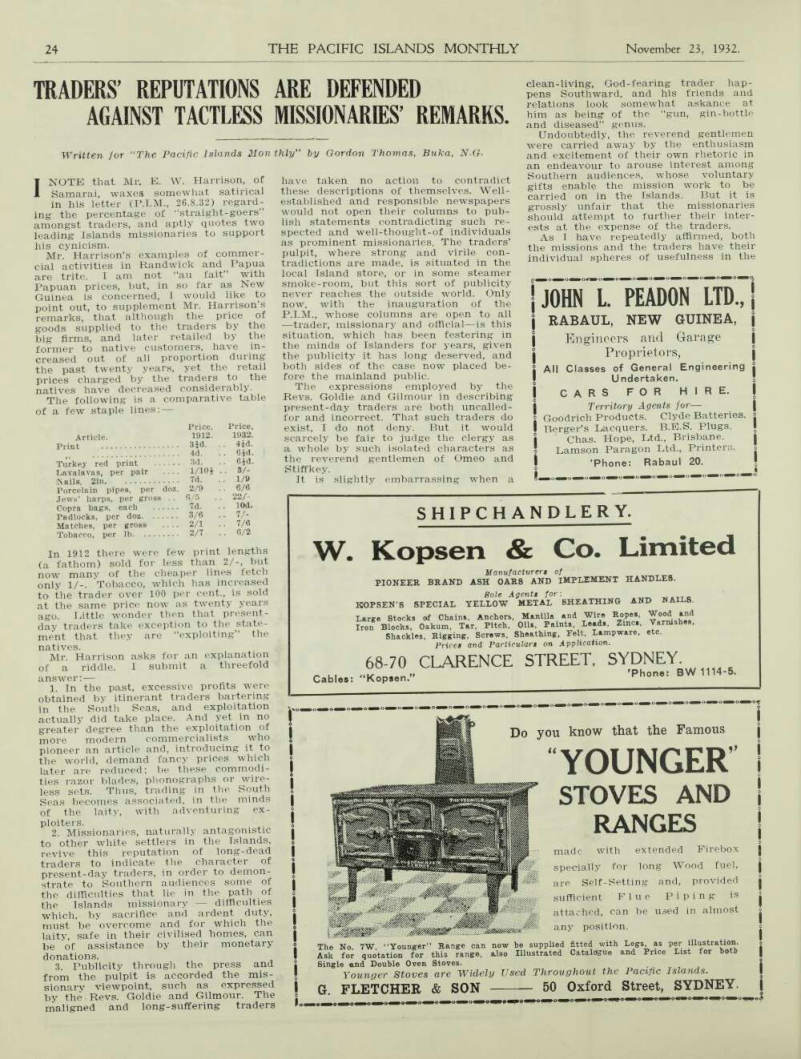
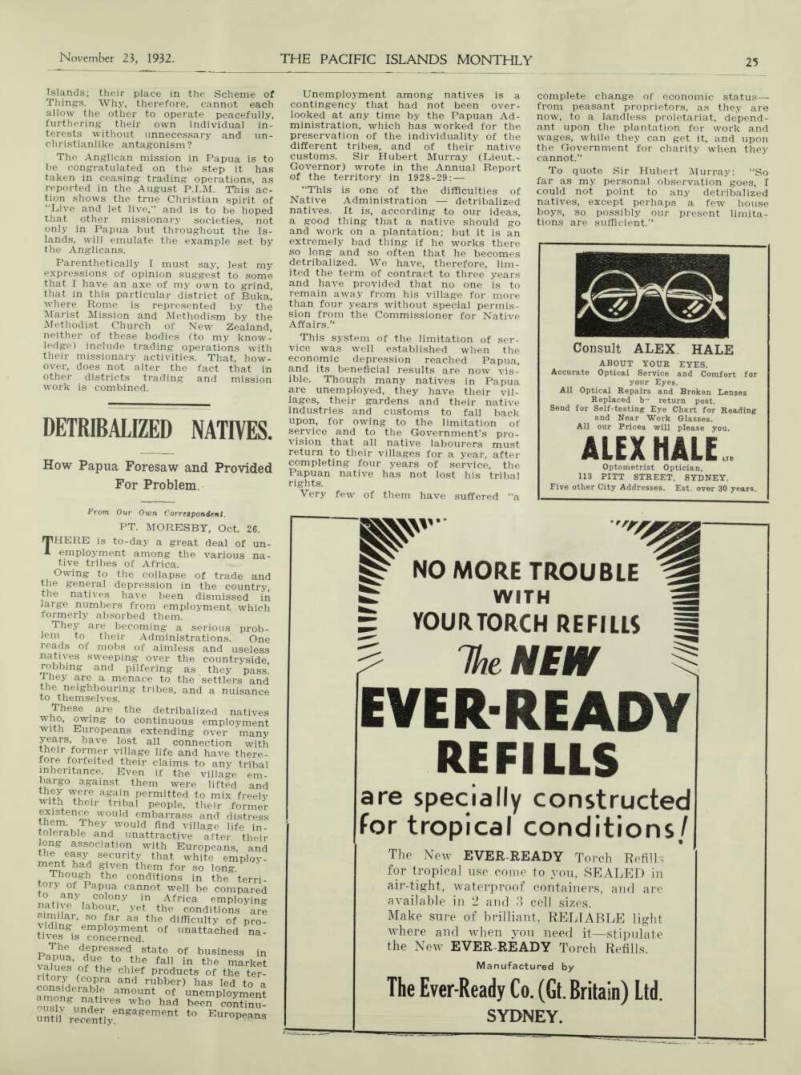
Against Tactless Missionaries’ Remarks.
Written for “The Pacific Islands Monthly ” by Gordon Thomas, Buka, N-G.
I NOTE that Mr. E. W. Harrison, of Samarai, waxes somewhat satirical in his letter (P.I.M., 26.8.32) regard ing the percentage of “straight-goers” amongst traders, and aptly quotes two leading Islands missionaries to support his cynicism.
Mr. Harrison’s examples of commer cial activities in Randwick and Papua are trite. I am not “au fait” with Papuan prices, but, in so far as New Guinea is concerned, I would like to point out, to supplement Mr. Harrison’s remarks, that although the price of goods supplied to the traders by the big firms, and later retailed by the former to native customers, have in creased out of all proportion during the past twenty years, yet the retail prices charged by the traders to the natives have decreased considerably.
The following is a comparative table of a few staple lines:
In 1912 there were few print lengths (a fathom) sold for less than 2/-, but now many of the cheaper lines fetch only 1/-. Tobacco, which has increased to the trader over 100 per cent., is sold at the same price now as twenty years ago. Little wonder then that presentday traders take exception to the state ment that they are “exploiting” the natives.
Mr. Harrison asks for an explanation of a riddle. I submit a threefold answer: 1. In the past, excessive profits were obtained by itinerant traders bartering in the South Seas, and exploitation actually did take place. And yet in no greater degree than the exploitation of more modern commercialists who pioneer an article and, introducing it to the world, demand fancy prices which later are reduced; be these commodi ties razor blades, phonographs or wire less sets. Thus, trading in the South Seas becomes associated, in the minds of the laity, with adventuring ex ploiters. 2. Missionaries, naturally antagonistic to other white settlers in the Islands, revive this reputation of long-dead traders to indicate the character of present-day traders, in order to demon strate to Southern audiences some of the difficulties that lie in the path of the Islands missionary difficulties which, by sacrifice and ardent duty, must be overcome and for which the laity, safe in their civilised homes, can be of assistance by their monetary donations. 3. Publicity through the press and from the pulpit is accorded the mis sionary viewpoint, such as expressed by the Revs. Goldie and Gilmour. The maligned and long-suffering traders
have taken no action to contradict these descriptions of themselves. Well established and responsible newspapers would not open their columns to pub lish statements contradicting such re spected and well-thought-of individuals as prominent missionaries. The traders’ pulpit, where strong and virile con tradictions are made, is situated in the local Island store, or in some steamer smoke-room, but this sort of publicity never reaches the outside world. Only now, with the inauguration of the P.I.M., whose columns are open to all —trader, missionary and official —is this situation, which has been festering in the minds of Islanders for years, given the publicity it has long deserved, and both sides of the case now placed be fore the mainland public.
The expressions employed by the Revs. Goldie and Gilmour in describing present-day traders are both uncalled for and incorrect. That such traders do exist, I do not deny. But it would scarcely be fair to judge the clergy as a whole by such isolated characters as the reverend gentlemen of Omeo and Stiffkey.
It is slightly embarrassing when a
clean-living, God-fearing trader hap pens Southward, and his friends and relations look somewhat askance at him as being of the “gun, gin-bottle and diseased” genus.
Undoubtedly, the reverend gentlemen were carried away by the enthusiasm and excitement of their own rhetoric in an endeavour to arouse interest among Southern audiences, whose voluntary gifts enable the mission work to be carried on in the Islands. But it is grossly unfair that the missionaries should attempt to further their inter ests at the expense of the traders.
As I have repeatedly affirmed, both the missions and the traders have their individual spheres of usefulness in the
Article.
Price, 1912.
Price, 1932.
Print 3½d. . . 4½d. 4d. 6id.
Turkey red print 3d. 6Jd.
Lavalavas, per pair 1/10 h ■ 3/- 'Kails, 2in 7d. 1/9 Porcelain pipes, per doz. 2/9 6/6 Jews’ harps, per gross . . 6/5 .. 22/- Copra bags, each 7d. lOd.
Padlocks, per doz 3/6 7/- Matches, per gross ... 2/1 7/6 Tobacco, per lb 2/7 6/2
Islands; their place in the Scheme of Things. Why, therefore, cannot each allow the other to operate peacefully, furthering their own individual in terests without unnecessary and un christianlike antagonism?
The Anglican mission in Papua is to be congratulated on the step it has taken in ceasing trading operations, as reported in the August P.I.M. This ac tion shows the true Christian spirit of “Live and let live,” and is to be hoped that other missionary societies, not only in Papua but throughout the Is lands, will emulate the example set by the Anglicans, Parenthetically I must say, lest my expressions of opinion suggest to some that I have an axe of my own to grind, that in this particular district of Buka, where Rome is represented by the Marist Mission and Methodism by the Methodist Church of New Zealand, neither of these bodies (to my know ledge) include trading operations with their missionary activities. That, how over, does not alter the fact that in other districts trading and mission work is combined.
Advertisements & other items, p. 26 (1 item)
Younger
JOHN L PEADON LTD.,
RABAUL, NEW GUINEA,
Engineers and Garage
Proprietors,
All Classes of General Engineering Undertaken. cars FOR HIRE.
Territory Agents for — Goodrich Products. Clyde Batteries.
Berger’s Lacquers. B.E.S, Plugs.
Chas. Hope, Ltd., Brisbane.
Lamson Paragon Ltd., Printers.
'Phone: Rabaul 20.
SHIPCHANDLERY.
W. Kopsen & Co. Limited
Manufacturers of PIONEER BRAND ASH OARS AND IMPLEMENT HANDLES.
Sole Agents for : KOPSEN’S SPECIAL YELLOW METAL SHEATHING AND NAILS.
Large Stocks of Chains. Anchors, Manilla and Wire Ropes, Wood and Iron Blocks, Oakum, Tar, Pitch, Oils, Paints, Leads. Zincs, Varnishes, Shackles, Rigging, Screws, Sheathing, Felt, Lampware, etc.
Prices and Particulars on Application.
Cables: ‘Kopsen.
68-70 CLARENCE STREET, SYDNEY.
’Phone: BW 1114-5.
Do you know that the Famous
YOUNGER
STOVES AND
RANGES
made with extended Firebox specially for long Wood fuel, are Self-Setting and, provided sufficient Flue Piping is attached, can be used in almost any position.
The No. 7W. “Younger” Range can now be supplied fitted with Legs, as per illustration.
Ask for quotation for this range, also Illustrated Catalogue and Price List for both Single and Double Oven Stoves.
Younger Stoves are Widely Used Throughout the Pacific Islands.
G. FLETCHER & SON 50 Oxford Street, SYDNEY.
Detribalized Natives.
How Papua Foresaw and Provided For Problem.
From Our Own Correspondent.
Pt. Moresby, Oct. 26.
THERE is to-day a great deal of un employment among the various na tive tribes of Africa.
Owing to the collapse of trade and the general depression in the country, the natives have been dismissed in large numbers from employment which formerly absorbed them.
They are becoming a serious prob lem to their Administrations. One reads of mobs of aimless and useless natives sweeping over the countryside robbing and pilfering as they pass! ihey are a menace to the settlers and the neighbouring tribes, and a nuisance to themselves.
These are the detribalized natives who, owing to continuous employment with Europeans extending over many years, have lost all connection with their former village life and have there fore forfeited their claims to any tribal inheritance. Even if the village em bargo against them were lifted and they were again permitted to mix freely with their tribal people, their former existence would embarrass and distress them. They would find village life in tolerable and unattractive after their long association with Europeans, and the easy security that white employ ment had given them for so long Though the conditions in the terri tory of Papua cannot well be compared to any colony in Africa employing native labour, yet the conditions are similar, so far as the difficulty of pro viding employment of unattached na tives is concerned.
The depressed state of business in Papua, due to the fall in the market values of the chief products of the ter ritory (copra and rubber) has led to a considerable amount of unemployment among natives who had been continu ously under engagement to Europeans until recently.
Unemployment among natives is a contingency that had not been over looked at any time by the Papuan Ad ministration, which has worked for the preservation of the individuality of the different tribes, and of their native customs. Sir Hubert Murray (Lieut.- Governor) wrote in the Annual Report of the territory in 1928-29: “This is one of the difficulties of Native Administration detribalized natives. It is, according to our ideas, a good thing that a native should go and work on a plantation; but it is an extremely bad thing if he works there so long and so often that he becomes detribalized. We have, therefore, lim ited the term of contract to three years and have provided that no one is to remain away from his village for more than four years without special permis sion from the Commissioner for Native Affairs.”
This system of the limitation of ser vice was well established when the economic depression reached Papua, and its beneficial results are now vis ible. Though many natives in Papua are unemployed, they have their vil lages, their gardens and their native industries and customs to fall back upon, for owing to the limitation of service and to the Government’s pro vision that all native labourers must return to their villages for a year, after completing four years of service, the Papuan native has not lost his tribal rights.
Very few of them have suffered “a
complete change of economic status— from peasant proprietors, as they are now, to a landless proletariat, depend ant upon the plantation for work and wages, while they can get it, and upon the Government for charity when they cannot.”
To quote Sir Hubert Murray: “So far as my personal observation goes, I could not point to any detribalized natives, except perhaps a few house boys, so possibly our present limita tions are sufficient.”
Advertisements & other items, p. 27 (1 item)
Ever-Ready
Consult ALEX. HALE
ABOUT YOUR EYES,
Accurate Optical Service and Comfort for your Eyes.
All Optical Repairs and Broken Lenses Replaced b- return post.
Send for Self-testing Eye Chart for Reading and Near Work Glasses.
All our Prices will please you.
ALEX HALE .
Optometrist Optician,
113 PITT STREET, SYDNEY.
Five other City Addresses. Est. over 30 years.
NO MORE TROUBLE
WITH
YOUR TORCH REFILLS
EVER-READY
REFILLS
are specially constructed
for tropical conditions!
The New EVER-READY Torch Refills for tropical use come to you, SEALED in air-tight, waterproof containers, and are available in 2 and 3 cell sizes.
Make sure of brilliant, RELIABLE light where and when you need it—stipulate the New EVER-READY Torch Refills.
The Ever-Ready Co. (Gt. Britain) Ltd.
The NEW
Manufactured by
SYDNEY.
How Christmas Is Celebrated
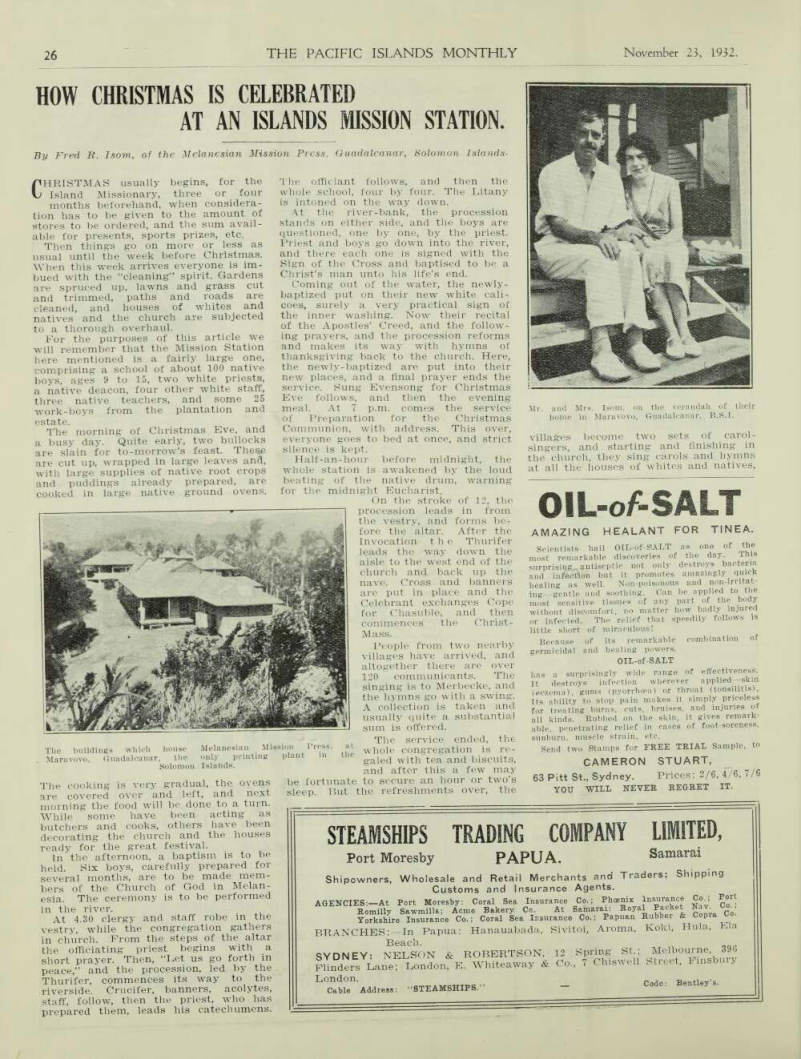
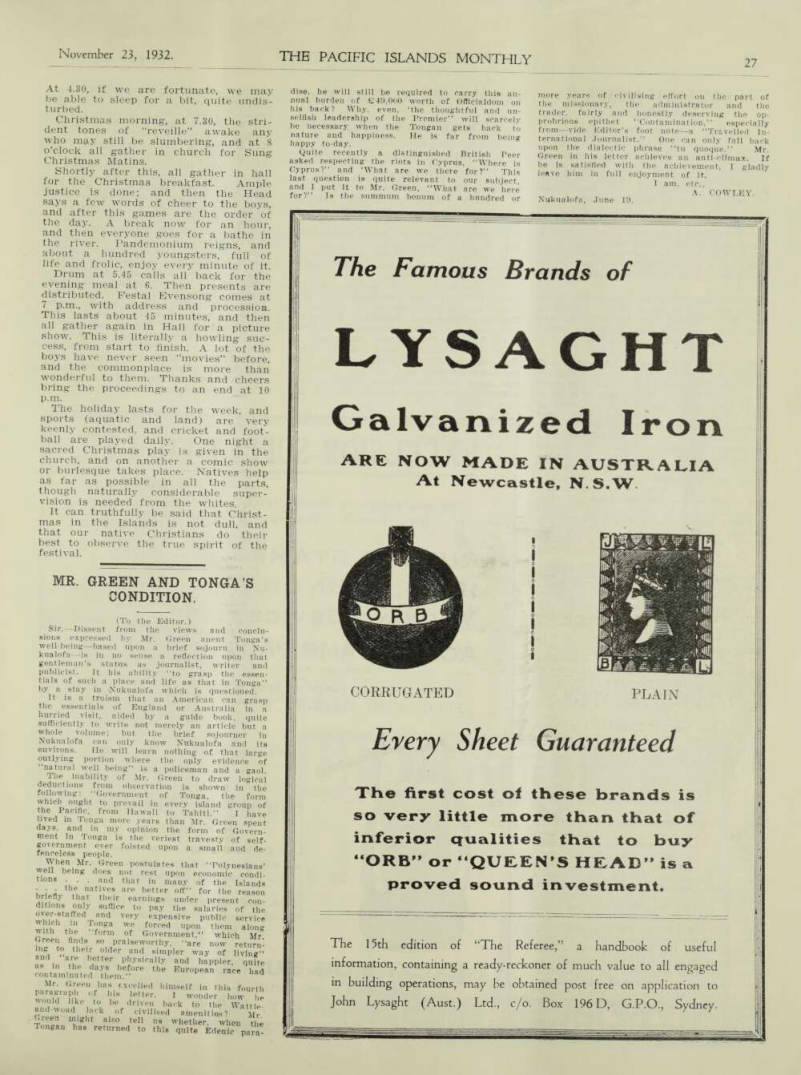
At An Islands Mission Station.
By Fred R. Isom, of the Melanesian Mission Press, Guadalcanal, Solomon Islands
CHRISTMAS usually begins, for the Island Missionary, three or four months beforehand, when considera tion has to be given to the amount of stores to be ordered, and the sum avail able for presents, sports prizes, etc.
Then things go on more or less as usual until the week before Christmas.
When this week arrives everyone is im bued with the “cleaning” spirit. Gardens are spruced up, lawns and grass cut and trimmed, paths and roads are cleaned, and houses of whites and natives and the church are subjected to a thorough overhaul.
For the purposes of this article we will remember that the Mission Station here mentioned is a fairly large one, comprising a school of about 100 native boys, ages 9 to 15, two white priests, a native deacon, four other white staff, three native teachers, and some 25 work-boys from the plantation and estate.
The morning of Christmas Eve, and a busy day. Quite early, two bullocks are slain for to-morrow’s feast. These are cut up, wrapped in large leaves and, with large supplies of native root crops and puddings already prepared, are cooked in large native ground ovens.
The cooking is very gradual, the ovens are covered over and left, and next morning the food will be done to a turn.
While some have been acting as butchers and cooks, others have been decorating the church and the houses ready for the great festival.
In the afternoon, a baptism is to be held. Six boys, carefully prepared for several months, are to be made mem bers of the Church of God in Melan esia. The ceremony is to be performed in the river.
At 4.30 clergy and staff robe in the vestry, while the congregation gathers in church. From the steps of the altar the officiating priest begins with a short prayer. Then, “Let us go forth in peace,” and the procession, led by the Thurifer, commences its way to the riverside. Crucifer, banners, acolytes, staff, follow, then the priest, who has prepared them, leads his catechumens.
The officiant follows, and then the whole school, four by four. The Litany is intoned on the way down.
At the river-bank, the procession stands on either side, and the boys are questioned, one by one, by the priest.
Priest and boys go down into the river, and there each one is signed with the Sign of the Cross and baptised to be a Christ’s man unto his life’s end.
Coming out of the water, the newly baptized put on their new white cali coes, surely a very practical sign of the inner washing. Now their recital of the Apostles’ Creed, and the follow ing prayers, and the procession reforms and makes its way with hymns of thanksgiving back to the church. Here, the newly-baptized are put into their new places, and a final prayer ends the service. Sung Evensong for Christmas Eve follows, and then the evening meal. At 7 p.m. comes the service of Preparation for the Christmas Communion, with address. This over, everyone goes to bed at once, and strict silence is kept.
Half-an-hour before midnight, the whole station is awakened by the loud beating of the native drum, warning for the midnight Eucharist.
On the stroke of 12, the procession leads in from the vestry, and forms be fore the altar. After the Invocation the Thurifer leads the way down the aisle to the west end of the church and back up the nave. Cross and banners are put in place and the Celebrant exchanges Cope for Chasuble, and then commences the Christ- Mass.
People from two nearby villages have arrived, and altogether there are over 120 communicants. The singing is to Merbecke, and the hymns go with a swing.
A collection is taken and usually quite a substantial sum is offered.
The service ended, the whole congregation is re galed with tea and biscuits, and after this a few may
be fortunate to secure an hour or two’s sleep. But the refreshments over, the
The buildings which house Melanesian Mission Press, at Maravovo, Guadalcanal, the only printing plant in the Solomon Islands.
Mr. and Mrs. Isom, on the verandah of their home in Maravovo, Guadalcanar, B.S.I. villages become two sets of carol singers, and starting and finishing in the church, they sing carols and hymns at all the houses of whites and natives,
At 4.30, if we are fortunate, we may be able to sleep for a bit, quite undis turbed.
Christmas morning, at 7.30, the stri dent tones of “reveille” awake any who may still be slumbering, and at 8 o’clock all gather in church for Sung Christmas Matins.
Shortly after this, all gather in hall for the Christmas breakfast. Ample justice is done; and then the Head says a few words of cheer to the boys, and after this games are the order of the day. A break now for an hour, and then everyone goes for a bathe in the river. Pandemonium reigns, and about a hundred youngsters, full of life and frolic, enjoy every minute of it.
Drum at 5.45 calls all back for the evening meal at 6. Then presents are distributed. Festal Evensong comes at 7 p.m., with address and procession.
This lasts about 45 minutes, and then all gather again in Hall for a picture show. This is literally a howling suc cess, from start to finish. A lot of the boys have never seen “movies” before, and the commonplace is more than wonderful to them. Thanks and cheers bring the proceedings to an end at 10 p.m.
The holiday lasts for the week, and sports (aquatic and land) are very keenly contested, and cricket and foot ball are played daily. One night a sacred Christmas play is given in the church, and on another a comic show or burlesque takes place. Natives help as far as possible in all the parts, though naturally considerable super vision is needed from the whites.
It can truthfully be said that Christ mas in the Islands is not dull, and that our native Christians do their best to observe the true spirit of the festival.
Advertisements & other items, p. 28 (1 item)
Oil-Of-Salt
AMAZING HE ALA NT FOR TINEA.
Scientists hail OIL-of-SALT as one of the most remarkable discoveries of the day. This surprising, antiseptic not only destroys bacteria and infection but it promotes amazingly Quick healing as well. Non-poisonous and non-irritat ing—gentle and soothing. Can be applied to the most sensitive tissues of any part of the body without discomfort, no matter how badly injured or infected. The relief that speedily follows is little short of miraculous!
Because of its remarkable combination of germicidal and healing powers,
OIL-of-SALT
has a surprisingly wide range of effectiveness.
It destroys infection wherever applied-skin (eczema), gums (pyorrhoea) or throat (tonsilitis).
Its ability to stop pain makes it simply priceless for treating burns, cuts, bruises, and injuries ot all kinds. Rubbed on the skin, it gives remark able, penetrating relief in cases of foot-soreness, sunburn, muscle strain, etc.
Send two Stamps for FREE TRIAL Sample, to
CAMERON STUART,
63 Pitt St., Sydney. Prices: 2/6, 4/6, 7/6
YOU WILL NEVER REGRET IT.
STEAMSHIPS TRADING COMPANY LIMITED,
Port Moresby PAPUA. Samarai
Shipowners, Wholesale and Retail Merchants and Traders; Shipping Customs and Insurance Agents.
AGENCIES:—At Port Moresby; Coral Sea Insurance Co.; Phoenix Insurance Co.j Port Romilly Sawmills; Acme Bakery Co. At Samarai: Royal jacket Naw co Yorkshire Insurance Co.; Coral Sea Insurance Co.; Papuan Rubber & Copra Co.
BRANCHES: —In Papua; Hanauabada, Sivitoi, Aroma, Koki, Hula, Ela SYDNEY- NELSON & ROBERTSON, 12 Spring St.; Melbourne , 396 Ibnders LaneT London E. Whiteaway & Co., 7 Chlswell Street, Finsbury Address: “STEAMSHIPS.” - Code: Bentley's
Condition.
Mr. Green And Tonga’S
(To the Editor.) Sir, —Dissent from the views and conclu sions expressed by Mr. Green anent Tonga’s well-being—based upon a brief sojourn in Nu kualofa —is in no sense a reflection upon that gentleman’s status as journalist, writer and publicist. It his ability “to grasp the essen tials of such a place and life as that in Tonga” by a stay in Nukualofa which is questioned.
It is a truism that an American can grasp the essentials of England or Australia in a hurried visit, aided by a guide book, quite sufficiently to write not merely an article but a whole volume; but the brief sojourner in Nukualofa can only know Nukualofa and its environs. He will learn nothing of that large outlying portion where the only evidence of “natural well being” is a policeman and a gaol.
The inability of Mr. Green to draw logical deductions from observation is shown in the following: “Government of Tonga, the form which ought to prevail in every island group of the Pacific, from Hawaii to Tahiti.” I have lived in Tonga more years than Mr. Green spent days, and in my opinion the form of Govern merit in Tonga is the veriest travesty of self government ever foisted upon a small and de fenceless people.
When Mr. Green postulates that “Polynesians’ well being does not rest upon economic condi tions . . . and that in many of the Islands . . . the natives are better off" for the reason briefly that their earnings under present con ditions only suffice to pay the salaries of the over-staffed and very expensive public service which in Tonga we forced upon them along with the form of Government,” which Mr Green finds so praiseworthy, “are now return ing to their older and simpler way of living” and are better physically and happier, quite as in the days before the European race had contaminated them.”
Mr. Green has excelled himself in this fourth paragraph of his letter. I wonder how he would like to be driven back to the Wattleand-wood lack of civilised amenities? Mr.
Green might also tell us whether, when the Tongan has returned to this quite Edenic para
dise, he will still be required to carry this an nual burden of £49,000 worth of Officialdom on his back? Why, even, 'the thoughtful and un selflsh leadership of the Premier” will scarcely be necessary when the Tongan gets back to nature and happiness. He is far from being happy to-day.
Quite recently a distinguished British Peer asked respecting the riots in Cyprus, “Where is Cyprus?” and ‘What are we there for?” This last question is quite relevant to our subject and I put it to Mr. Green, “What are we here for?” Is the summum bonum of a hundred or
more years of civilising effort on the part of the missionary, the administrator and the trader, fairly and honestly deserving the op probrious epithet “Contamination,” especially from—vide Editor’s foot note—a “Travelled In ternational Journalist.” One can only fall back upon the dialectic phrase “tu quoque.” Mr.
Green in his letter achieves an anti-climax. If he is satisfied with the achievement, I gladly leave him in full enjoyment of it.
I am, etc.,
A. Cowley.
Nukualofa, June 19.
Advertisements & other items, p. 29 (1 item)
Lysaght
The Famous Brands of
Galvanized Iron
ARE NOW MADE IN AUSTRALIA
At Newcastle. N.S.W The first cost of these brands is so very little more than that of inferior Qualities that to buy
“ORB” or “QUEEN’S HEAD” is a
proved sound investment.
The 15th edition of “The Referee,” a handbook of useful information, containing a ready-reckoner of much value to all engaged m building operations, may be obtained post free on application to John Lysaght (Aust.) Ltd., c/o. Box 196 D, G.P.O., Sydney.
CORRUGATED
PLAIN
Guaranteed
Tahiti Items.
(From Our Own Correspondent.)
Papeete, Oct. 25.
THE Danish yacht “White Shadow,’’ which left Tahiti some time ago to continue her voyage round the world, returned unexpectedly on September 12, and has since been stripped of her sails and put in shape for a long spell in harbour.
It seems that serious engine trouble developed shortly after leaving Tahiti, which can only be satisfactorily reme died by a new installation, for which the vessel may have to wait several months.
In the meantime the owner, Mr. Wes sells, has taken up a shore residence, and it is stated that he contemplates acquiring property here with the object of building a permanent home.
September has been an unusually wet month in Tahiti with record rainfalls in some districts. At Papua the con crete river bridge, which was rebuilt at great cost after the disastrous floods of 1926, was partly destroyed, and thus dislocated communications with the south-east end of the island until a temporary structure could be placed across the river. Since then, the make shift bridge has been twice washed away and replaced.
A destructive fire occurred in Pa peete early on the morning of October 3 when, for some unknown reason, the garage at the rear of the British Con sulate took fire and, with its contents of two motor cars and other material, was completely destroyed.
Luckily, the loud clanging of the fire bell in the market place brought the local fire brigade to the scene in time to prevent the fire spreading to the main consular building, which is only a few yards distant. It is understood that the garage itself was covered by insurance, but that the loss of the cars, etc., falls on the owner, Dr. Williams.
The old Consulate was torn down and entirely rebuilt some two years ago, on the original site given for that pur pose by the Royal family of Tahiti.
News has reached Tahiti of the wreck of the local trading schooner “Val encia” on a reef at the south-west end of Raivavai Island, one of the Austral Group, which occurred at night during the heavy weather experienced in Sep tember. Apparently there were no cas ualties. So far as present information goes the vessel is very badly holed and her salvage exceedingly problematical.
The “Valencia” is a locally-built schooner which was launched from Higgin’s shipyard in Papeete last year, when she started her career with a voyage to Easter Island to rescue a party of Chilian revolutionaries who had been interned on that desolate spot by the Chilian Government, and bring them to Tahiti. Among these refugees was Colonel Grove, whose name has been conspicuously mentioned in con nection with the recent political dis turbances in the Chilian Republic.
On her last voyage the “Valencia” was on route to Rapa and the Tuamote archipelago, on her customary trading circuit, and carried a stock of pro visions valued at 700,000 francs. It is stated that the hull is insured with a Ban Francisco Company.
Learning White Man’s Ways.
Torres Islands Natives.
From Our Own Correspondent.
Thursday Is., Oct. 31.
THE deputy Chief Protector of Abori ginals (Mr. C. O’Leary) arrived from Brisbane a fortnight ago, to allow the local Protector to take his furlough, and also to visit the various islands in Torres Strait.
Conditions in the Strait have changed considerably during the last few years, and are still changing.
The islander is now much more ad vanced in general knowledge; and par ticularly in the working of the island fishing cutters and luggers. These are the property of the natives, bought and paid for by themselves, and held in trust by the Aboriginal Department.
The native follows the trocus and shell markets keenly, and always anxiously enquires whether affairs in China are affecting his beche-de-mer sales ad
versely. So that, with these and a good many other questions affecting working conditions, payments, trading, and where he shall purchase his own requirements—at the stores in T. I. or the Aboriginal Stores at Badu—there are generally some problems that re quire careful judgment and handling on the part of the officials.
The boys who engage for service in the luggers which work down as far as Townsville and other places see much more of civilisation than they used to, and the same thing applies also to the native-owned vessels which seek marine produce along the Barrier. News papers circulate in the islands, brought back by the boys, and they are not un aware of the upheavals that are occur ring in commercial and political life, The Aboriginal Office in Brisbane, therefore, requires to be in close touch with the people of the islands, and as the Deputy-Chief Protector was here as Protector for a number of years, his present visit will be of increased use fulness. At present, he is visiting the eastern group of Torres Strait islands, in the Government ketch "Melbider."
Advertisements & other items, p. 30 (1 item)
Excelsior Supply Co. Ltd.
The most extensive Manufacturers in the British Empire of
RUBBER STAMPS,
INKS, STENCILS.
Marking Devices.
ACME STAMP PADS
We have a big range of Special
FRUIT CASE MARKING SETS
We also Manufacture or Supply a complete line of
Spraying Machines
for all purposes.
Let us know your requirements and we will quote you by return. Ask for our Big Catalogue.
Sole Australasian Distributors of the World Famous SHEAFFER FOUNTAIN
PENS and PENCILS.
EXCELSIOR SUPPLY CO. LTD
Head Office: - 160 GEORGE STREET WEST,
SYDNEY, N.S.W.
Dobu Passage.
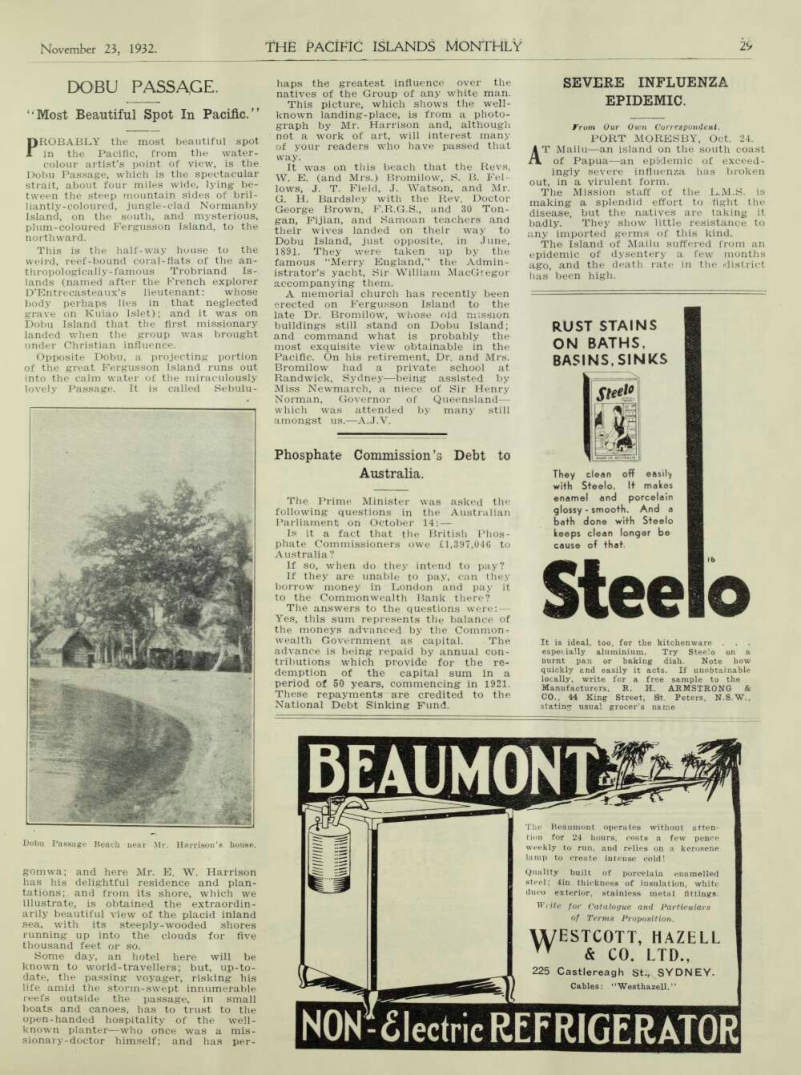
“Most Beautiful Spot In Pacific.”
PROBABLY the most beautiful spot in the Pacific, from the water colour artist’s point of view, is the Dobu Passage, which is the spectacular strait, about four miles wide, lying be tween the steep mountain sides of bril liantly-coloured, jungle-clad Normanby Island, on the south, and mysterious, plum-coloured Fergusson Island, to the northward.
This is the half-way house to the weird, reef-bound coral-flats of the an thropologically-famous Trobriand Is lands (named after the French explorer D’Entrecasteaux’s lieutenant: whose body perhaps lies in that neglected grave on Kuiao Islet); and it was on Dobu Island that the first missionary landed when the group was brought under Christian influence.
Opposite Dobu, a projecting portion of the great Fergusson Island runs out into the calm water of the miraculously lovely Passage. It is called Sebulu
gomwa; and here Mr. E. W. Harrison has his delightful residence and plan tations; and from its shore, which we illustrate, is obtained the extraordin arily beautiful view of the placid inland sea, with its steeply-wooded shores running up into the clouds for five thousand feet or so.
Some day, an hotel here will be known to world-travellers; but, up-to date, the passing voyager, risking his life amid the storm-swept innumerable reefs outside the passage, in small boats and canoes, has to trust to the open-handed hospitality of the well known planter—who once was a mis sionary-doctor himself; and has per
haps the greatest influence over the natives of the Group of any white man.
This picture, which shows the well known landing-place, is from a photo graph by Mr. Harrison and, although not a work of art, will interest many of your readers who have passed that way.
It was on this beach that the Revs.
W. E. (and Mrs.) Bromilow, S. B. Fel lows, J. T. Field, J. Watson, and Mr.
G. H. Bardsley with the Rev. Doctor George Brown, F.R.G.S., and 30 Ton gan, Fijian, and Samoan teachers and their wives landed on their way to Dobu Island, just opposite, in June, 1891. They were taken up by the famous “Merry England,’' the Admin istrator’s yacht, Sir William MacGregor accompanying them.
A memorial church has recently been erected on Fergusson Island to the late Dr. Bromilow, whose old mission buildings still stand on Dobu Island; and command what is probably the most exquisite view obtainable in the Pacific. On his retirement, Dr. and Mrs.
Bromilow had a private school at Randwick, Sydney —being assisted by Miss Newmarch, a niece of Sir Henry Norman, Governor of Queensland — which was attended by many still amongst us. —A.J.V.
Dobu Passage Beach near Mr. Harrison’s house.
Phosphate Commission’s Debt to Australia
Australia.
The Prime Minister was asked the following questions in the Australian Parliament on October 14: Is it a fact that the British Phos phate Commissioners owe £1,397,046 to Australia?
If so, when do they intend to pay?
If they are unable to pay, can they borrow money in London and pay it to the Commonwealth Bank there?
The answers to the questions were: Yes, this sum represents the balance of the moneys advanced by the Common wealth Government as capital. The advance is being repaid by annual con tributions which provide for the re demption of the capital sum in a period of 50 years, commencing in 1921.
These repayments are credited to the National Debt Sinking Fund.
Severe Influenza
Epidemic.
From Our Own Correspondent.
Port Moresby, Oct. 24.
AT Mailu—an island on the south coast of Papua—an epidemic of exceed ingly severe influenza has broken out, in a virulent form.
The Mission staff of the L.M.S. is making a splendid effort to fight the disease, but the natives are taking it badly. They show little resistance to any imported germs of this kind.
The Island of Mailu suffered from an epidemic of dysentery a few months ago, and the death rate in the district has been high.
Advertisements & other items, p. 31 (1 item)
Steelo
RUST STAINS
ON BATHS,
BASINS,SINKS
They clean off easily with Steelo. It makes enamel and porcelain glossy - smooth. And a bath done with Steelo keeps clean longer be cause of that.
Steelo
It is ideal, too, for the kitchenware . . especially aluminium, Try Steelo on a Durnt pan or baking dish. Note how quickly and easily it acts. If unobtainable locally, write for a free sample to the Manufacturers, R, H. ARMSTRONG & CO., 44 King Street, at. Peters. N.S.W.. stating usual grocer’s name
Beaumont
The Beaumont operates without atten tion for 24 hours, costs a few pence weekly to run, and relies on a kerosene lamp to create intense cold!
Quality built of porcelain enamelled steel; 4in thickness of insulation, white duco exterior, stainless metal fittings.
Write for Catalogue and Particulars of Terms Proposition.
WESTCOTT, HAZELL
& CO. LTD.,
225 Castlereagh St., SYDNEY.
Cables: “Westhazell.”
Thursday Is. Notes.
The Price of Trocas.
From Our Own Correspondent.
Thursday Is., Oct. 31.
TROCAS shell still keeps round about about £70 to 80 per ton. A new patch was struck the other day by one of the native-owned luggers, but the shell was of large, heavy variety— evidently the finders had come upon the grandparents of the species!
A Japanese, in the employ of one of the pearling firms (who has been out here sixteen years and should have known better), started a venture of his own recently by landing and selling a quantity of beche-de-mer which was not his property. The police found the stuff, already bagged, to go to China.
At the Police Court the magistrate im posed a stiff fine, and intimated that next time it would be imprisonment without the option.
The “Naunga,” a new launch acquired for the Lockhart River Mission, on the east coast of Cape York Peninsula, arrived in Thursday Island recently.
Search For Gold.
T. I. has seen quite a run of yachts and visiting craft this year. In some cases the owners are simply on a plea sure cruise, in others the lure of gold has attracted venturesome spirits. The “Mitsi,” and auxiliary ketch, arrived from Sydney the other day with a party on board who are at present having a look over the old gold workings on Possession Island. Years ago, Posses sion Island carried quite a flourishing community, and there were a couple of batteries established there. One drive is almost immediately below the Cook Memorial. Had the Captain detected signs of gold when he hoisted the flag Australia’s history might have been very different in so far as settlement is con cerned.
Another visitor to T. I. was the
"Veimauri,” carrying a company of
scientific men who are working their
particular ’ologies in Southern Papua,
and possibly, later, in Torres Strait.
Need For Tourist Committee.
Last week the Blue Funnel steamer “Ulysses’’ arrived at Thursday Island, carrying upwards of 200 English tourists who are making the round trip. This is a new venture, and as T.I. was the first port of call in Australia, the Mayor went out to the anchorage at Black Rock and extended a welcome before the passengers came ashore.
There was not much time to organise any thing for the visitors, and, as a matter of fact, it was not known until after the ship anchored whether people would have time to get ashore. However, a number came off and did a hurried run round. It is likely that another ship will be carrying out a similar programme in a few months’ time.
There is nothing in the way of a Travellers’
Reception Committee, or Tourist Bureau, in our little community, and when visitors arrive they have to rely on friends to show them round. There is often an amount of uncer tainty as to whether the ship will be able to come up to the wharf, or anchor out at Black Rock, thereby necessitating launch trans portation involving perhaps an hour’s run.
But some organisation which could be of assistance to those who either spend only a few hours here or stay in between steamers would find scope for its energies, and help to further interest in our island and surroundings.
It has been suggested that a body composed of representatives of the Town Council, Chamber of Commerce, Royal Geographical Society, and C.W.A., with some others, might be formed, which would disseminate informa tion, and put visitors in touch with what is to be seen, as well as make arrangements for short shooting and fishing trips, etc.
Lightship Astray.
The lightship “Carpentaria,’’ which is anchored at the western approaches to Torres Strait, the other side of Booby Island, again broke loose from her moorings a couple of weeks back, and was picked up about ’ ty miles west of where she should have been.
A sister ship is kept at T.I. for such emer gencies, but the escapee will be taken back to its place when the Commonwealth lighthouse steamer arrives.
Captain Gamble, the popular skipper of the A. & O. steamer “Taiping’’, is at present in the local hospital. A poisoned leg is the trouble, his condition being such when the steamer arrived here that the medical officers advised his getting off immediately. He is now making good progress.
Mr. H. L. Perriman arrived from south by the last B.P. steamer, on his way back to Groote Eylandt Mission Station (of which he is the superintendent) after furlough.
The new manager of the A.W.A. radie station, Mr. J. B. Stoyle, has arrived and taken over from Mr. Cox, who has now gone south.
Geographical Interest.
At the annual meeting of the Royal Geo graphical Society, held this week, Mr. D. G.
Harmon was appointed hon. sec. The local branch, which was founded by Dr. Vernon, is a very vigorous one- —in fact, it has the re putation of being the most active country branch in Queensland. In recognition of the fine services rendered by Dr. Vernon, the branch has asked him to accept life membership. A number of new members have joined up this year, and interest promises to be well maintained.
There are a number in the town who are very keen on anything pertaining to historical or geographical matters, and Torres Strait, with its romantic history, offers plenty of scope in this direction. We are also singularly for tunate in being able from time to time to commandeer visiting or passing scientists and others for an evening’s lecture, and already two or three gentlemen who are known to be contemplating a run this way shortly have been booked up on the secretary’s list. Some local research work is being done, also, connected chiefly with the history of the locality.
So far, however, no one has succeeded in discovering who was actually responsible for naming Thursday Island! Both Cook and Bligh have been mentioned, but there seems to be no definite evidence that either of them were sufficiently close to T.I. itself to recognise it as a separate chunk of land from the rest of the Prince of Wales group. If any P.I.M. reader has anything to offer in the way of suggestions, the R.G.S.A. folk here will be glad to have it.
A Novel Wedding.
THE launch “Weenona” carried a happy party of T.I. visitors to St. Paul’s, Moa Island (thirty miles away) on September 26, for the wedding of Miss Kathleen Prior to Mr.
W. J. Daniells.
Miss Prior came up from Sydney seven years ago to take charge of the school at St. Paul’s, and since then has become principal of the High School (the first for Torres Strait natives) and matron of the Girls’ Hostel. Mr. Daniells has been Government official at Saibai Island, and was recently appointed to the charge of the new aboriginal mission at Edward River, in the Gulf of Carpentaria.
The Rev. T. W. Schomberg performed the ceremony; and a guard of honour consisting of native Girl Guides and school pupils formed up outside the church. Decorated dancers and drummers escorted the bridal party through the village to where a big native feast was set, and the islanders carried out native custom in presenting various gifts and dance ceremonies.
It was a very picturesque affair, gay with colour, and the visitors found it quite a new and interesting experience. The happy couple sailed for Edward River in the ketch “Francis Pratt’’ at the beginning of October.
Ingenious Teacher.
One of the Torres Strait Island schools, that at Mabuiag (Jervis) has a head teacher gifted in the art of modelling and sketching, and he turns these to good practical use for the ad vancement in knowledge of his dusky pupils.
On tables are erected large models of the Suez Canal, Tilbury Docks, a coal mine, and the Straits, with model ships indicating the various shipping lines passing through; and the latest addition is a six-foot model of Sydney Bridge, with shipping passing beneath and a stream of traffic crossing the structure. The walls carry presentations in colours of the various marine and other products which the islands provide, with pictures signifying what pur poses commerce puts them to and the countries which buy them. The ceiling is decorated with portraits of Cook, Bligh, Torres, and other navigators who wandered over these waters in the past. Thus, the youngsters here know a good deal more of wdiat becomes of the stuff their fathers bring up in the way of trochus, m.o.p., beche-de-mer, etc., than do a great many southern children, while their knowledge of early North Australian history is also pretty considerable.
Painting Made Easier.
If you want to make a better and easier job of any re-painting around the home, just rub the woodwork first with a dry pad of Steelo, the steel wool that's used for cleaning aluminium and kitchenware. It doesn’t take long, and it leaves the surface beautifully even, so that the new paint goes on more easily and smoothly, and with a higher gloss. Steelo is unequalled, too, for cleaning rust off metal, golf clubs, tools, engine parts, etc.
Advertisements & other items, pp. 32-33 (2 items)
Petty's Hotel
IN SYDNEY STAY AT
Comfort Service Convenience R.J. Langley-Manager
A TEST ON
YOUR LINOS
Try Pearson’s Sand Soap for cleaning them ... a free sample will be sent on request. Pearson’s Sand Soap makes the colours brighter, the surface smoother; and, the linos polish more easily.
PEARSON’S CARBOLIC
SAND SOAP,
Made by The Pearson Soap Co., Ltd.
ROZELLE, N.S.W.
glimmering landscape on the sight
Now fades the
. . . and as the shadows deepen, lamps filled with Laurel dispel the tropic darkness ... In thousands of homes where wicks are trimmed.
Laurel is famous for its soft white eye comforting radiance ... Try Laurel in your lamp and enjoy its better light.
VACUUM OIL COMPANY Pty. Ltd.
Kerosene
Papua’s Potential Value.
CONSIDERABLE attention was given by the Sydney newspapers in Octo ber to statements by a well-known Papuan official, Patrol-Officer J. G.
Hides, who is at present in Australia on furlough.
Patrol-Officer Hides spoke at a Mil lions Club luncheon on 26th October on the customs and habits of the primitive natives of Papua (says Sydney “Morn ing Herald”). Mr. Hides was one of two white men sent with a party of native police to capture head-hunting Sukis, who had killed 29 members of the Weredai tribe on the Lower Fly River in Septembeer of last year.
Of the 400,000 natives of Papua, very few were cannibals, said Mr. Hides, and even those regarded their actions as part of their religion. By far the most interesting race was an inland pigmy tribe. These people were adept with bows and arrows, and were the smallest living race in the world, measuring, on the average, only 4 feet 8y 2 inches in height, compared with the African pig mies’ height of 4 feet 11 inches.
The potential value of Papua was em phasised by Mr. Hides. It was a coun try, he said, with vast unexplored areas.
Practically everything would grow; maize and tobacco flourished; sugar cane had a higher sugar content than the Queensland variety, and a move ment was on foot to produce the cheap est sugar in the world in Papua. With capital, Papua could be made one of Australia's most valuable assets
Papua’S Trade.
Chief Items of Production.
From Our Own Correspondent
Port Moresby, Oct. 20.
AN interesting line on the trend of this Territory’s trade can be obtained from a study of the export figures.
The Montoro, sailing for Sydney on October 4, loaded the following pro duce; — 1164 packages of rubber. 651 cases of desiccated coconut. 30 bags of Mauritus beans. 147 bags of copra. 55 bags of coffee.
The growth in the production of Mauritius beans is significant. This vegetable is required for sowing, as a green fertiliser, on the sugar and ban ana plantations in Queensland; and Queensland seems now to be getting a cheaper or better article from Papua than from Fiji, which formerly sup plied all requirements.
The Customs revenue collected in Papua during August totalled £4115 — of which about 20 per cent, is primage, the balance being import duties. Port Moresby contributed £2,224; Samarai, £1,860; Daru, £25; and Woodlark, £5.
In September, Port Moresby collected £967, Daru £47, and Woodlark £180.
From The Solomons.
Captain Reardon Brings M.V.
Kurimarau to Sydney.
CAPTAIN J. E. Reardon, one of the leaders of the expedition which captured the murderers of District Commissioner Bell, Cadet Lillies, and a party of native police on the island of Malaita, in the Solomons, in 1927, reached Sydney on October 30, in com mand of the small copra motorship Kurimarau.
Officers of the vessel described how Captain Reardon had, single-handed, captured one of the ringleaders in the heart of a hostile country. The captain was chosen as a member of the expedi tion because of his knowledge of the country and of the six or seven native dialects. The further the party went into the jungle the more hostile was its reception. Captain Reardon, at first unable to break the silence of natives shielding their fellows, at last secured certain information upon which he acted promptly, thus securing the cap ture of one of the murderers.
The second officer of the Kurimarau, a native of Newcastle,, recalled an ad venture he had recently, when recruit ing labour at one of the smaller islands.
He was warned by friendly natives that he was likely to be murdered, and was requested to leave. He found later that a native girl who had been converted to Christianity had married a heathen.
Her relatives considered this a deadly sin, and ordered her brother to slay the couple. He had killed the girl, been arrested, sentenced, and hanged. The natives had blamed a white missionary, and had sworn to have their revenge on a white man. “I considered it un necessary to offer myself as their vic tim,” said the officer, ‘‘and left the island.”
The Kurimarau is a vessel new to Sydney. Built at Hongkong in 1930, the Kurimarau is of 288 tons gross, with a 330-horsepower Deutsch-Diesel engine, which gives her a speed of nine knots. She has come to Sydney for docking and overhaul, and brings a cargo of 230 tons of copra.
Three days before reaching Sydney the vessel struck a cyclone, the seas being higher than the chief officer (Mr.
R. O. Davis) remembers having seen before on the Australian coast. She was hove-to for three hours.
As most of the 18 native boys who form the crew had never before left their native Solomons, the rough weather upset them. They confessed in quaint English that they had not had a very good time in consequence. —“Sydney Morning Herald.”
New Guinea Cadets.
HAYING decided to train another batch of cadets for the New Guinea public service, the Prime Minister’s Department, Canberra, is inviting appli cations from young men between 20 and 24 years of age. Applications close on 28th November. Possibly half-a-dozen men will be selected. We were informed, about October 25, that 200 applications had already been received
Advertisements & other items, p. 34 (1 item)
Massey Harris
includes a wide range of implements suited to plantation work.
No. 43 Pony Plough,
Ideal for small area work.
Cuts furrows 7-inches wide and to 8 inches deep.
Steel Share and extra Chilled Cast Share provided. (Australian currency) delivered to Steamer.
Extras: Gauge Wheel 8/6 Knife Coulter . . 107- Rolling Coulter . . 25/- Write for free catalogue of all Massey Harris Implements to
Massey Harris
664 Bourke Street,
MELBOURNE,
Australia.
Also Sydney and Brisbane.
Agricultural
MACHINERY
The
Price: £4/5/0
Vitality and Health are the
Main Factors in Every-day Life.
Put yourself in the hands of Specialists who have made an intelligent study of your requirements; it is vital to your health. We are know everywhere as the Suppliers of the Right Goods and which put the VIiAL into VITALITY. Thirty-five years is our record of supplying Fresh Fruit, Vegetables and Produce to the leading Houses throughout the world.
GET FULLY ACQUAINTED WITH US.
Tel.: MA 4799; FX 4350 Private.. Cable Address: Pigs, Sydney. Code: Bentley’s.
C. G. PIGGOTT
WHOLESALE FRUIT AND PRODUCE MERCHANTS
DIRECT IMPORTERS AND EXPORTERS SYDNEY.
Office: Bulk Stores and Packing House; Fruit Exchange, Sydney.
Sales Dept.: Fruit Exchange and City Markets, Sydney. Bank of N.S.W. Bankers.
Fiji-Aust. Trade.
Advantage For Sydney Shippers.
INTERESTING comment on new trade conditions between Fiji and Austra lia were made by Sir Maynard Hed strom, of Suva, when he arrived in Syd ney on November 10 by the Mariposa.
Sir Maynard thought Australia would be benefited by a recent decision of the Fijian Government to charge ad valorem duties on the depreciated value of the Australian pound and the appreciated value of the English pound. Thus, an article which cost £1 in Aus tralia would be dutiable at about 18/-, and goods valued at £1 in England would be dutiable at about 22/6.
The level of New Zealand currency was the same as that of Fijian currency.
Another move in favour of Australia had resulted from the Ottawa Confer ence, in consequence of which the pre ferentian tariff of 10 to 15 per cent, in favour of New Zealand had been can celled on October 13.
Sir Maynard Hedstrom said that the present season’s sugar crop was ex pected to give a new record yield. This followed a number of bad seasons caused by hurricanes and floods. With excellent prospects for sugar, business generally had improved in the islands.
The quota of Fiji bananas to be ad mitted into the Commonwealth under the Ottawa agreement, he said, was so small that he was surprised anything had been said about it by Australian growers. In any case he doubted if the quota would be reached, at any rate for several months, as Fijian growers had been growing almost exclusively for the New Zealand market.
Australia's Advantage.
Suva, Nov. 9.
Merchants here do not like the new method of computing Customs duty. It gives too much to Australia. It actually means that the tariff on English and Canadian goods will be increased and the advantage of the new method will be with Australia, except that many lines imported from the Commonwealth carry a specific duty. These include flour, coffee, beer, wines, and cocoa. On unspecified lines Australia obtains pre ference over New Zealand, amounting approximately to 2 per cent.
The position now is that on that basis on a £100 invoice, duty on English goods will be paid at the rate of £110, on Aus tralian goods at £87/10/-, and on New Zealand goods at £99/10/-.
Mr. Inch Says We Are
“Rude.”
[To The Editor.'] Sir, —Under the heading, “Pestilential Hole,” in your October issue, you quoted some of my published remarks, and in rather rude terms expressed your dissent therefrom, while, in the same issue, publishing many proofs of the accuracy of my observations and the folly of your own! You also misquote me as to the Mandate, which I kindly suggested you should read carefully, as
you had expressed an erroneous opinion to me over the ’phone—as proved by your comment.
The matter was much more accur ately dealt with in the Federal Parlia ment, in the carefully prepared second reading speech of Mr. Marr on the 2nd instant.
I think your references to Judge Wan liss were even more regrettable than those referred to above.
It is wrong to suppose that all your readers are of the larrikin type, and, in any case, you would do well to stat the facts and leave something to you readers.
I am, etc.,
James S. Inch.
Sydney, 11/11/32.
EDITORIAL NOTE. —Mr. Inch is the gentle man who, on the strength of a stay of a few hours in Rabaul on an E & A. steamer, told newspaper reporters that New Guinea is of no use or value to Australia, and expressed the opinion that it is “a pestilential hole”. Ap parently, he is as ready to tell us how to conduct this newspaper, as he is to instruct Australia concerning her territorial respon sibilities. His terminological confusion is such that we cannot quite follow his arguments: but we gather that he thinks we were rude. We admit it. When one meets a certain complacent type of gentleman, who proceeds condescendingly to lecture one on something be obviously knows nothing about, deliberate rudeness is the only answer. Sarcasm, which some advocate, would not penetrate the epidermis.
Half the people who gaze at the coast of New Britain over the rail of a passing ship seem to become seized with the idea that they are now become authorities on New Guinea affairs; and the Islands have suffered cruelly under this kind of thing. We have consistently attacked the public utterances of these unin formed people, and shall continue to do so— and we shall do it as rudely as we can. We have the utmost respect for the genuine seeker after knowledge, no matter how far he may stray from the paths of truth. But we have none whatever for the ‘limelighter” who babbles irresponsibly whenever he finds himself within hearing of a newspaper reporter.
Advertisements & other items, pp. 35-36 (2 items)
New Fiji Council.
(Continued from page 16.)
Mary's
Samples and prices on application
BIRKMYRE’S CLOTH.
The best waterproof for motor car hoods, tarpaulins, horse and cow rugs, etc. Canvas of all kinds, cotton ducks and hessians, seaming, bagging and shop twines. Fishing nets and yarn, fishing lines and tennis nets.
The GOUROCK Ropework Export Co. LTD.
397 KENT STREET, SYDNEY, N.S.W.
AUNT
MARY'S
PURE FOOD
PRODUCTS
These high-grade products are still supreme after thirty years’ trading with the Islands. Specially manufactured from the finest ingredients and packed to meet Island conditions.
Only goods of the very highest standard are packed by the Proprietors, ensuring satisfaction and confidence to all who purchase.
Aunt Mary’s Pure Food Products and “Defiance” Brand Canned Goods are prepared and packed only by
“Defiance”
Brand
Canned
Goods
Packed by the Proprie tors of Aunt Mary’s Pure Food Products, these quality Canned Goods are hermetically sealed and specially prepared to withstand tropical heat, thus giving satisfaction to the consumer.
TILLOCK & CO. LTD., PURE FOOD
manufacturers,
Kent and Liverpool Streets, SYDNEY, N.S.W.
HERE’S A SIMPLE WAY TO TREAT
YOURSELF FOR LASSITUDE, NERVE
STRAIN, LACK OF ENERGY.
Build yourself up naturally . . . it’s the safest, surest method!
Nine times out of ten these are just the symptoms of an over-run system . . . clogged with poisons and broken down by its inability to get rid of them. The natural remedy is Medical Physical Culture easy, pleasant, unstrenuous. It prescribes gentle move ments that soothe and invigorate tired muscles and worn nerves . . . guides you in choice of a diet that builds up and stimulates.
Just write a complete description of your case, stating age, occupation, condition and habits, and I will pre scribe. Medical Physical Culture cannot harm you. Its effects are speedy and certain. And, it s less costly than constant dosing.
T. A. LANGRIDGE
254 GEORGE STREET,
278 GEORGE STREET,
SYDNEY, N.S.W.
Natural Gum, Unbreakable Sots, Comfortable and Long Lasting, Old Plates Remodelled and made equal to new. 28 OXFORD ST., over Winns; 139 ELIZABETH STREET, two doors from Market Street, Sydney.
Telegraphic and Cable Address
TEETH BY POST.
Well-fitting and lifelike in appearance,
made from “SELF-TAKEN IMPRESSIONS.
I have made Artificial Teeth by my wellknown and copyrighted System of Self- Taken Impressions for satisfied Patients in all parts of the Commonwealth.
Send for full free particulars.
Satisfaction guaranteed.
SPENCER NOLAN
dentist, Established in Sydney over 35 years. 177 OXFORD ST., opposite McIlraths. ss: “FAOTPLATE,” Sydney.
Auxiliary Ketch built for Solomon Islands.
LARS HALVORSEN
Designer and Builder of SCHOONERS, KETCHES, YACHTS, LAUNCHES, etc Can also quote for Second-hand Craft. Send particulars of your requirements HAYES STREET, NEUTRAL BAY, SYDNEY, N.S.W.
Cook Is. Notes
Rarotonga. Nov. 5.
It is not uncommon in the Islands, where “haunted” houses are said to exist, to hear peculiar reasons given for the cause of death among natives. Recently a native at Raro tonga, Tane by name, while engaged wrapping tomatoes at the Government packing shed, Arorangi, took suddenly ill, and died almost immediately. Nothing much could be found to account for the man’s death until the discovery was made that, shortly before, word had come through that the price offered for tomatoes at the shed had dropped to 9d. per case. No other deaths took place—fortunately.
Improved Village Sanitation,
Shallow pits, for the most part open disease traps and pest-holes—the inevitable result of native-constructed conveniences—are shortly to be things of the past in the Cook Group. Dr. E.
C. Lambert (Rockefeller Foundation) arrived at Rarotonga some weeks ago from Fiji. As a re sult of recommendations made by Dr. Lambert, following a comprehensive health survey of the Group in 1926, the Cook Islands Administration, in conjunction with the Rockefeller Foundation, has now commenced the installation of some hundreds of conveniences of standard design— sufficient for every native domicile throughout the Group.
Moulds, plant and large quantities of material have arrived.
Police Inspector’S Good Record.
Possibly no section of Islands Administration is more harassed with work during periods of trade depression than the police service. Lean times demand a reduction in personnel, yet at suctf periods crime, more particularly thefts and assaults, tend to increase. Thefts generally are committed under cover of darkness, so that an Islands Chief of Police is on duty practic ally day and night.
Inspector Calwell arrived at Rarotonga just before the depression descended upon the Group, three years ago, and during that difficult period administered the police service with a modicum of restraint and with due patience towards native offenders so that now, at the time of his de parture he enjoys the goodwill both of the native people and the community generally. He leaves on December 5 for New Zealand.
Drought Conditions At Rarotonga.
At the beginning of November, no rain of any consequence had fallen at Rarotonga for several months, and steps were taken to conserve the small quantity of water that continued to trickle through to the two small reservoirs—Takuvaine and Abatiu.
While, outwardly, the bush remains green, it conceals a heavy under-mass of dry leaves, twigs and rubbish, which constitutes a danger from fire.
Smoke about the hillsides is beginning to create concern in the minds of the older residents, who fear that plantations, and possibly parts of the lower-lying residential area, may be swept by fire in the event of a strong wind getting up.
Advertisements & other items, pp. 36-37 (2 items)
Satyrin Silver
The Tonic and Restorative for those living in the Tropics.
SATYRIN GOLD
Promotes Energy and Stimulates the Brain Cells.
SATYRIN SILVER
Rejuvenates and Strengthens the Nervous System.
NELSON and ROBERTSON
ISLAND MERCHANTS. [Established, 1895.]
Copra, Cocoa, Trocas Shell and otter Island produce sold on commis sion. All classes of Merchandise purchased and original invoices supplied.
Agents for SKANDIA CRUDE OIL ENGINES. Marine and Stationary, powers from 5-h.p. up.
PENTA MARINE ENGINES, Outboard and Inboard types.
PUMPMOBIL, the only portable pumping plant manufactured, light in weight and reliable. Suitable for mining work.
UPSON WALL BOARD, in both Plain and Tile pattern, strong and light.
Non-conductor of heat and cold. British manufacture.
Also New Guinea, Papuan and Samoan representatives for the famous
CHALLENGER KEROSENE BATH HEATER
Communicate with
NELSON & ROBERTSON
12 SPRING STREET SYDNEY, AUSTRALIA
Telegraphic Address; "IVAN SYDNEY,"
35
November 23, 1932.
THE PACIFIC ISLANDS MONTHLY
Gcld Discovery In Solomons (Continued from page 4.)
Bill Creating Council For New Guinea
Is Passed—An Uproarious Scene.
REPORT AND COMMENTS BY R. W. ROBSON.
THE New Guinea Bill, which confers a new Legislative and a new Executive Council upon the Mandated Territory of New Guinea, in place of the recent Advisory Council, passed its second and third readings in, the House of Representatives on 2nd November, and was immediately transferred to the Senate.
It is expected that the measure will be put into operation as soon as it is through the Commonwealth Parliament —which will be this month.
THE debate on the second reading and committee stages of the Bill occu pied 45 wearisome pages of Han sard —which provide an example of the futility and hopelessness of the modern form of Parliament.
I sat down to read this verbatim report of the debate, intending to con dense it somewhat and re-publish it for the assistance and encouragement of New Guinea residents. I ended the task in a condition of mental exhaus tion and physical disgust—and with a strong feeling that someone ought to apologise to New Guinea on behalf of Australia.
A few of the speeches were well-in formed and helpful; but most were either the silly outpourings of men without any knowledge or conception of tropical administration, who babbled about New Guinea problems in terms of the trades hall and the shearing camp; or were the uninspiring plati tudes of hopeless politicians.
One reflects that it is bad enough to give the government of Australia into the hands of the gentlemen, thick in the head and myopic as to vision, who are thrust into high places by dear old Mr. Demos; but it is terrible to think that our trained and educated officials, who rule over huge tropical areas and hundreds of thousands of primitive natives, must do the bidding of such people.
Therefore, I shall not waste the time or insult the intelligence of my readers by attempting to reproduce the debate.
I shall give some of the principal points from the more thoughtful speeches; and, for the rest, I perhaps can add something to the gaiety of the New Guinea nation by describing some of the quaint views held regarding Is land administration by the represen tatives of the great Australian democ racy.
A Careful Minister.
The provisions of the Bill were pub lished in full in our September issue. They were described in detail by the Minister in charge of Islands affairs (Major C. W. C. Marr) in a careful speech, which contained an excellent historical summary. It ob viously was a speech prepared to tickle the ears of Geneva and placate the great Australian Labour Party, which is quite convinced that oruel and rampageous “bosses” are exploit ing the country and enslaving Brown Brother.
Major Marr, in a speech of an hour’s duration, did not say much about the need for assisting and en couraging private enterprise in the
development of this Territory’s rich natural resources, and in creating conditions suitable for white settle ment; but he spoke at length concern ing what the Administration has done, and will do, in civilising and educating the natives, and in creating better health conditions.
In many ways it was an admirable speech. One could almost hear the cheers in Geneva, and even the sullen Langites purred a little. Although subjected to an irritating battery of uninformed and silly interjections, the urbane Major kept his temper and per formed his task creditably, and left everyone with a comfortable feeling that the whole resources of Australia are being devoted to building up a magnificent New Guinea for the native New Guineans.
There was nothing new in the speech —simply a review and, in a sense, a defence of Australia’s administration in N.G. The minister said that the following were the “main heads’’ of the Government’s policy at the present stage of the Territory’s development: 1. The preservation of native laws and customs so far as they are not repugnant to our sense
of morality, and the cultivation of a better under standing of native thought and native habits of life. 2. The eradication of native diseases and the acceptance of responsibility for the medical care and treatment of natives. 3. The prohibition of traffic in arms, liquor and opium. 4. The protection of the native labourer in his contractual relationships. 5. The inauguration of a system of native agriculture for the cultivation of foodstuffs and economic crops by the natives. 6. The participation of natives, to an increas ing extent, in the administration of the territory.
Splendid!—as far as it went. But what about the encouragement of the planters, and the miners, and the founders of industries, and the trans port firms (shipping and aviation), and all the others who are really doing Australia’s work of developing these tropical regions?
The minister, with one timid eye on the League of Nations, and one calcu lating eye on the Red corner where the Langites snuffled suspiciously over his Bill, had very little to say about those things.
Interjections!
The Minister said that more cadets would be appointed, to become patrol officers presently, and penetrate into unknown territory.
Mr. A. Green: And look for a bit of gold in between times!
The Minister (sternly): If they go prospecting they will be obliged to leave the service. (Residents of New Guinea will please refrain from making disrespectful re marks.) The Minister described the Constitu tion of the new Legislative Council. (See P.I.M., Sep., 1932.) Mr. James (who is a particularly noisy member of the Lang Group): Are the natives not to have their representa tives?
The Minister, instead of ignoring the quaint gentleman, patiently explained
that the N.G. natives are hardly yet in a condition to accept political responsi bility.
Mr. James insisted that in five or ten years the natives might have developed sufficiently to take a share in Govern ment.
The Minister said that the N.G. na tives were the most backward in the world.
Mr. James: But the Government is educating them!
The unfortunate Minister kept his temper, and patiently explained that there are about 520,000 natives in New Guinea, and only a very small section are reached by schools. He said the League of Nations was pleased with Australia’s record in N.G., where the na tives had responded in gratifying man ner to kind treatment by the whites.
“And where they have been belted to death by plantation-owners,” interjected the ineffable Mr. James!
Rabaul’S “Hell”!
Mr. Makin, a thoughtful, moderate Labourite from South Australia, ap peared to generally approve of the Bill — but voted against it on the second read ing! He considered that greater protec tion should be given the paid-off labourer against exploitation by Asiatic tradesmen. Chinatown, in Rabaul, was one of the worst hells through which a native had to pass.
Mr. Makin thought the natives should have a trade union, and suggested that, in due course, they would organise! He thought, also, that N.G. should have, in stead of the dictatorial Administrator, a system of local government, providing for representation by franchise. Evi dently, Mr. Makin is quite willing to thrust the horrors of democracy (farcical Parliaments, unstable Governments and professional politicians) upon New Guinea.
Mr. Makin considered that the Gov ernment was missing a golden opportun ity to amalgamate the Papuan and N.G. administrations.
Plea For Amalgamation.
The outstanding speech of the debate was made by Mr. R. F. H. Green, the Country member for Richmond, who has a wide experience of tropical adminis tration and an excellent knowledge of conditions in Papua and New Guinea.
Mr. Green’s speech was informative and well-reasoned in character, and moder ate in tone, and is worth preserving as a valuable contribution to the literature dealing with New Guinea affairs. Only a summary is possible here, Mr. Green strongly urged that the Papuan and New Guinea administra tions should be amalgamated. The con ditions in the two territories were prac tically the same, although there is some diversity of native types and consider able differences in the languages—not as between the two territories but as be tween the very numerous tribes and communities throughout the two terri tories. There should be one Legislative Council, one Executive Council and one administrator or governor. The advan tages of amalgamated control far out weighed the disadvantages. The advan tages were fundamental and would go to the root of administration. The dis advantages were merely the difficulties of co-ordinating two systems of admin istration that had been built up from different bases. There were also ob stacles to amalgamation in the finances of the two territories. But these diffi culties could be fairly easily solved, to the great future advantage of the two territories and Australia. One immediate advantage would be the co-ordination of the laws of the two territories —a re vision and consolidation of the laws of New Guinea were most urgently needed and were long overdue. Amalgamation had been urged by Sir Hubert Murray in 1921 and subsequent developments had strongly supported the views of that able and far-visioned administrator. Mr.
Green feared that the passing of this bill would make amalgamation less likely.
Mr. Green made a strong point of the fact that the bill and past acts were deeply concerned with native welfare, while giving little attention to the needs of those who were settling in the territories and improv ing the lot of the natives. He empha sized that the mandate instructed Aus tralia to consider the welfare of the Ter ritory’s inhabitants, which did not ne cessarily mean only the native inhabit ants.
Administration Praised.
‘‘I have visited New Guinea several times and most tropical countries,” said Mr. Green, “and being thus qualified to form a judgment, I have no hesitation in saying that the Australian administra tion of that Territory has been particu larly good. It was initiated by officers who had to gain their experience, and they can be justifiably proud of the re sults they have achieved.”
Mr. Green then dealt in detail with the work of the various departments. His review was favourable, his criticism kindly, and his numerous suggestions constructive and helpful. Most residents of the Territory will heartily endorse his remark that New Guinea has suffered from too much centralization and that Rabaul is inclined to regard itself as the whole Territory. He hoped that the ap pointment of the new council would check that tendency.
“Stone-Age People.”
Another good speech was made by Major R. G. Casey, D.S.O., M.C., a new member of the house, who attended the League of Nations meeting and, with
Mr. P. E. Coleman and Mr. E. W.
P. Chinnery, explained to a critical com mission what Australia is doing in New Guinea. Major Casey gave particular praise to the medical services in the Territory and the education activities of the missionaries.
“These natives are stone-age people,” said Major Casey. “They have the men tality of children. I speak on the author ity of persons who know the anthropo logical development of New Guinea na tives when I say that for generations to come the natives will not reach a posi tion appreciably above their present cul ture. Their participation in the conduct of the territories’ affairs is out of all reason.”
Dictators And Mr. Beasley.
In spite of this definite statement of fact, the Langite leader, Mr. J. A. Beas ley, entered the debate with a strong plea that the natives of New Guinea should have some direct representation in the new council. And, of course, be ing Mr. Beasley and a product of the great Australian democracy, Mr. Beasley insisted that the 3,000 white residents of New Guinea were much more competent to govern New Guinea than any single individual who might be selected by the Federal Government for the post of ad ministrator and given dictatorial powers.
Mr. E. J. Harrison made some thought ful remarks about the need for main taining the high type of official in the services; and then came another con tribution from the Lang corner this time from Mr. J. S. Rosevear, a hitherto un known gentleman who was used by the machine to throw the Napoleonic Theo dore out of the Dalley seat in the last election.
Mr. Rosevear, of course, expressed his lively hatred of the administrator’s dic tatorial powers and insisted that there shall be “representative government.”
He declared that “the eyes of the civil ised world are upon New Guinea.” We may also pass from this speaker with the pertinent reflection that his appear ance in public life is the result of the form of “representative government” which he advocates.
The main contribution to the debate by Mr. Moses Gabb (the gods were in a jovial mood when they created a poli tician with a name like that!) was a statement that the difference between what is now proposed in New Guinea and what now exists is the difference between “tweedledum and tweedledee.” The final authority still lay with the adminis trator.
Which is perfectly true —and, on the whole, a very good thing.
The next speaker was Mr. R. James, the Langite giant from the coalfields.
He is the gentleman whose mental horizon is limited to New South Wales and the magnificence of Mr. Lang and who, nevertheless, lifts his voice on all possible occasions, as a self-constituted authority on industrial conditions in New Guinea. He is of the opinion, which he expresses noisily and nastily that Pacific Islands natives have been gen erally enslaved by brutal and ruthless planters. He talked for 20 minutes about the Larkin case, in defiance of the Speaker, who tried to make him keep to the Bill; and when the House refused to allow him to incorporate in the de bate a lot of newspaper matter relating to the Larkin case, he blazed with wrath.
A Lively “Scene.”
Then occurred an incident which had a lively sequel.
Mr. James contended that the brutal handling of natives had been going on for a long time before the Larkin case.
Mr. R. Green: Nothing of the kind!
Mr. James: How do you know?
Mr. R. Green: I know the Territory and the honourable gentleman does not.
Mr. James (nastily): I have not put the country to the cost of paying my expenses to New Guinea as the hon. member has frequently done. I am not prepared to accept the cock and bull stories which he brings back with him.
Mr. R. Green (savagely): And I have not put the country to the expense of maintaining me in gaol, as the honour able member has done more than once.
This section of the debate closed in uproar, but it was re-opened on Novem ber 9.
Mr. Green then pointed out that Han sard had reported Mr. James’s attack on him, but not his reply to Mr. James.
“It is well-known that he has served more than one sentence, including one for indecency,” added Mr. Green.
There were cries of “Shame,” uproar and a demand for a withdrawal and apology.
Mr. Green complied; but complained bitterly of an obvious campaign of studied personal insult. He could not get protection, and had to protect him self.
The Speaker sternly refuted the sug gestion.
Mr. James, white with fury, said it was 25 years since he was last in trouble.
Chorus of members: Let it go we don’t want to hear it!
Mr. James declared that he had never been convicted of indecency. He added that Mr. Green was the greatest drunk ard in the House.
There was more uproar.
Mr. James was compelled to with draw.
Mr. Green demanded an apology owing to “the utter untruth of the state ment,” but the Speaker ordered no fur ther action.
More Of The “Debate.”
We return to the New Guinea debate.
The Minister spoke for half an hour in reply to various points made concern ing his Bill; but he did not have much to answer. He declared that in no other
part of the world are the native workers so explicitly protected by law as in New Guinea—a statement which New Guinea people will heartily support. No native in New Guinea is compelled to work.
He did not receive a high wage—and he did not expect it. His needs were simple —so long as he was well fed and kindly treated he was happy and contented.
Commenting on Mr. Green s plea for a jury system for white men charged with criminal offences, the Minister made the interesting announcement that if the New Guinea people desire the jury sys tem may make representations to new legislative council, The Bill passed its second reading on what apparently was a party vote—the United Parties supporting it, and the Labour Parties opposing. Even on a non-party subject like New Guinea, these unfortunate politicians cannot rid themselves of the habits of the environ ment in which they are trained.
In committee, Mr. A. Green made fur ther sapient remarks about N.G., con tending that there should be no change there, such as handing over the Terri tory to the planters, traders and miners, until natives can take part in the Gov ernment.
Mr. Beasley again insisted that the workers be given representation, Mr. Makin said that could be done through the shop assistants’ organisa tion.
The patient Minister explained that the shop assistants are black, though departmental heads are white, Mr. Scullin opposed the idea ot capital punishment and boasted of how he, while Prime Minister, sent a radio to Sir Hubert Murray, stopping an execution of a native murderer that had been or dered by the Lieut.-Governor and his council.
So it went on, hour after hour, while the few men in the House who know something of tropical conditions writhed in their seats.
The Bill went through, about 11.30 p.m., and the Minister assured Mr. R.
Green that the new Legislative Council will, at an early date consider various urgent questions relating to the native labour ordinance, indentured labour, education, clothing of natives, and the
goldfields road.
Advertisements & other items, pp. 38-40 (2 items)
James Barnes Limited
J. H. MacGregor Dowsett
RABAUL, NEW GUINEA.
for
RELIABLE CARS, SERVICE & DRIVERS.
Gramophones and Latest Records.
Musical Instruments and Sundries.
Cameras and Photographic Goods.
Developing, Printing, Enlarging & Framing.
Recruiter, Mining & General Agent,
BUILDER AND CONTRACTOR.
Agent for The Australian Provincial Assur ance Assoc. Ltd. Sub-Agent for The Central Assurance Co. Ltd.
Outstation Orders Promptly Executed.
Sample Rooms:
MALAGUNA ROAD, RABAUL.
’Phone: Rabaul 149.
OLD GOLD
MONEY
Buyers and Sellers.
Gold Prices are at present excep tionally high, and it is advisable to sell without delay.
MAIL your SCRAP JEWELLERY
to us, and we will your cash by return mall.
HIGHEST PRICES PAID for Sovereigns and New Zealand Notes and English Notes.
English Silver American Dollars English Copper Canadian Dollars Fiji Notes South African Notes Dutch Gulden French Francs And all Foreign Currency.
REGISTER ALL PARCELS'.
Full particulars from
THE ROYAL GOLD &
CURRENCY EXCHANGE,
40 Martin Place, SYDNEY, AUST.
JAMES BARNES LIMITED
2 Botany Street, Waterloo, Sydney
(ESTABLISHED 1881)
MANUFACTURERS OF
“Globe” & “Victory” Brands
OF
SHEEPS TONGUES OX TONGUES SAUSAGES
PRESERVED MEATS BEEF EXTRACT DRIPPING
Also “Castle” Brand, which is specially packed for use by the White Population.
Globe Beef Extract is invaluable to Young and Old.
Tested Recipes on the packet 4oz. and Boz. sizes.
Natural Steel Grey
FERRODOR PAINT
(Now Manufactured in Australia.) Is the Ideal Paint for Steel Structures of all Descriptions,
and for Galvanised Iron Roofs, etc.
IT IS ELASTIC—so that expansion and contraction of metals caused by atmospheric changes, leave it quite unaffected.
IT IS ANTI-CORROSIVE—being physically incapable of absorbing more Oxygen than the atmosphere.
IT IS NON - POISONOUS —making it safe in handling and for use on roofs where water is used for domestic purposes.
Used extensively by N.S.W. Government Railways and Public Works Dept. Hawkesbury and Nepean Railway Bridges now painted with Ferrodor.
WILLIAM ADAMS COMPANY
LIMITED
Other colours Clarence Street, Suitable for obtainable. SYDNEY Iron and Wood.
TEL.: B 2118.
HALL & CO.
20 Hunter Street, Sydney.
COMMERCIAL
PHOTOGRAPHERS
Special Portiait Studio.
AMATEUR FILMS AND PLATES
DEVELOPED AND PRINTED
WITH CARE.
A Fine Collection of Islands Views, etc.,
FOR SALE,
37
THE PACIFIC ISLANDS MONTHIY
November 23, 1932.
Teacher Of Chinese.
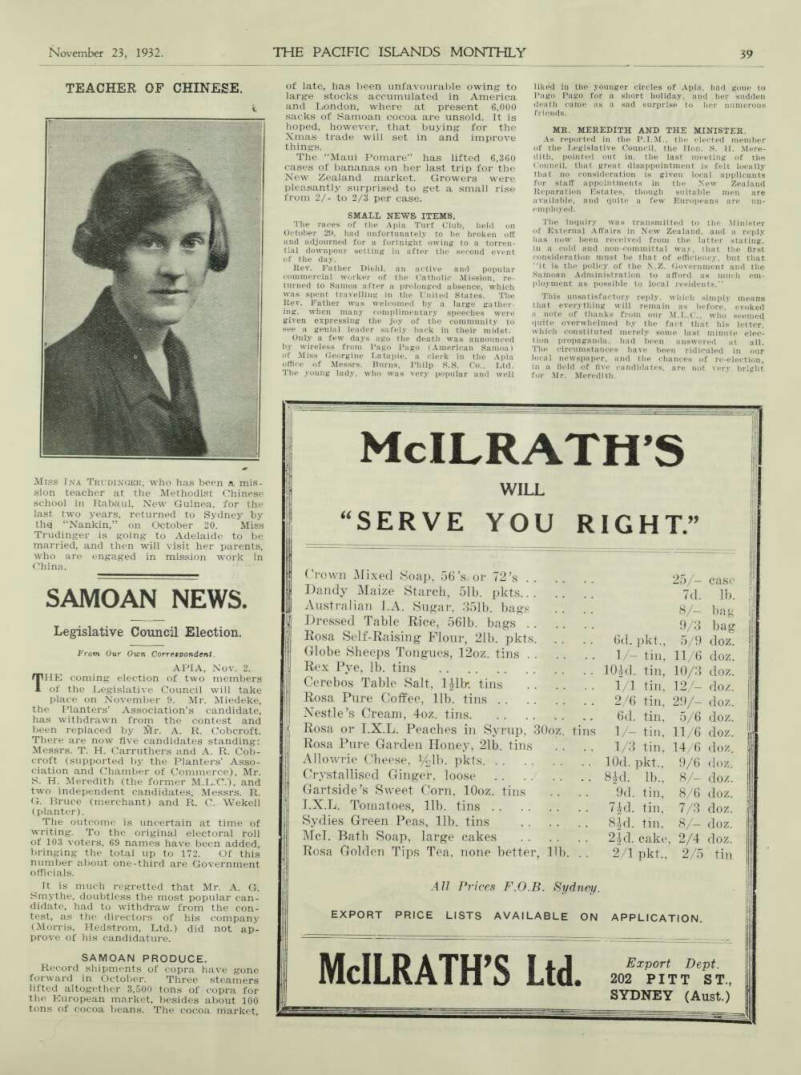
Miss Ina Trudinger, who has been a mis sion teacher at the Methodist Chinese school in Rabaul, New Guinea, for the last two years, returned to Sydney by the “Nankin,” on October 20. Miss Trudinger is going to Adelaide to be married, and then will visit her parents, who are engaged in mission work in China.
Samoan News.
Legislative Council Election.
From Our Own Correspondent.
Apia, Nov. 2.
THE coming election of two members of the Legislative Council will take place on November 9. Mr. Miedeke, the Planters’ Association’s candidate, has withdrawn from the contest and been replaced by Mr. A. R. Cobcroft.
There are now five candidates standing: Messrs. I. H. Carruthers and A. R. Cobcroft (supported by the Planters’ Asso ciation and Chamber of Commerce), Mr.
S. H. Meredith (the former M.L.C.), and two independent candidates, Messrs. R.
G. Bruce (merchant) and R. C. Wekell (planter).
The outcome is uncertain at time of writing. To the original electoral roll of 103 voters, 69 names have been added, bringing the total up to 172. Of this number about one-third are Government officials.
It is much regretted that Mr. A. G.
Smythe, doubtless the most popular can didate, had to withdraw from the con test, as the directors of his company (Morris, Hedstrom, Ltd.) did not ap prove of his candidature.
Samoan Produce.
Record shipments of copra have gone forward in October. Three steamers lifted altogether 3,500 tons of copra for the European market, besides about 100 tons of cocoa beans. The cocoa market,
of late, has been unfavourable owing to large stocks accumulated in America and London, where at present 6,000 sacks of Samoan cocoa are unsold. It is hoped, however, that buying for the Xmas trade will set in and improve things.
The “Maui Pomare” has lifted 6,360 cases of bananas on her last trip for the New Zealand market. Growers were pleasantly surprised to get a small rise from 2/- to 2/3 per case.
Small News Items.
The races of the Apia Turf Club, held on October 29, had unfortunately to be broken off and adjourned for a fortnight owing to a torren tial downpour setting in after the second event of the day.
Rev. Father Diehl, an active and popular commercial worker of the Catholic Mission, re turned to Samoa after a prolonged absence, which was spent travelling in the United States. The Rev. Father was welcomed by a large gather ing, when many complimentary speeches were given expressing the joy of the community to see a genial leader safely back in their midst.
Only a few days ago the death was announced by wireless from Pago Pago (American Samoa) of Miss Georgine Latapie. a clerk in the Apia office of Messrs. Burns, Philp S.S. Co., Ltd.
The young lady, who was very popular and well
liked in the younger circles of Apia, had gone to Pago Pago for a short holiday, and her sudden death came as a sad surprise to her numerous friends.
Mr. Meredith And The Minister.
As reported in the P.I.M., the elected member of the Legislative Council, the Hon. S. H. Mere dith, pointed out in, the last meeting of the Council, that great disappointment is felt locally that no consideration is given local applicants for staff appointments in the New Zealand Reparation Estates, though suitable men are available, and quite a few Europeans are un employed.
The inquiry was transmitted to the Minister of External Affairs in New Zealand, and a reply has now been received from the latter stating, in a cold and non-committal way, that the first consideration must be that of efficiency, but that “it is the policy of the N.Z. Government and the Samoan Administration to afford as much em ployment as possible to local residents.”
This unsatisfactory reply, which simply means that everything will remain as before, evoked a note of thanks from our M.L.C., who seemed quite overwhelmed by the fact that his letter, which constituted merely some last minute elec tion propaganda, had been answered at all.
The circumstances have been ridiculed in our local newspaper, and the chances of re-election, in a field of five candidates, are not very bright for Mr. Meredith.
Advertisements & other items, p. 41 (1 item)
Mcilrath’S
WILL
“SERVE YOU RIGHT”
Crown Mixed Soap, 56’s or 72’s 25/- case Dandy Maize Starch, 51b. pkts 7d lb.
Australian LA. Sugar, 351 b. bags ... 8/- bag Dressed Table Rice, 561 b. bags 9/3 bag Rosa Self-Raising Flour, 21b. pkts 6d. pkt., 5/9 doz!
Globe Sheeps Tongues, 12oz. tins 1/- tin, 11 /6 doz.
Rex Pye, lb. tins tin’ 10/3 doz!
Cerebos Table Salt, tins 1/1 tin, 12/- doz.
Rosa Pure Coffee, 11b. tins 2/6 tin,’ 29/- doz.
Nestle’s Cream, 4oz. tins 6d. tin, 5/6 doz.
Rosa or I.X.L. Peaches in Syrup, 30oz. tins 1/- tin, 11/6 doz.
Rosa Pure Garden Honey, 21b. tins . . . . 1/3 tin. 14/6 doz.
Allowrie Cheese, y 2 lb. pkts lOd. pkt., 9/6 doz.
Crystallised Ginger, loose BJd. lb.. 8/- doz.
Gartside’s Sweet Corn, lOoz. tins .. .. ~9d. tin, 8/6 doz.
I.X.L. Tomatoes, 11b. tins 7£d. tin, 7/3 doz.
Sydies Green Peas, lib. tins BJd. tin, 8/- doz.
Mcl. Bath Soap, large cakes 2Jd. cake, 2/4 doz.
Rosa Golden Tips Tea, none better, 11b. . . 2/1 pkt., 2/5 tin All Prices F. O.B. Sydney.
EXPORT PRICE LISTS AVAILABLE ON APPLICATION.
McILRATH’S Ltd.
SYDNEY (Aust.)
Civilisation Versus
Savagery.
(To the Editor.) Sir, —With reference to your article on the Larkin case (New Guinea) and your criticism of Judge Wanliss’s verdict, I am reminded of this: He it is that is unswerving of purpose. No hot ardour of the mob, demanding unjust courses; nor the bullying of superior tyrants, can shake his steadfast soul! Not the southerly, that turbulent ruler of the restless Adriatic, nor even thunderbolts hurled from the mighty hand of Jupiter, can afright him! Though the sky shatter and fall around him, the frag ments shall strike him unafraid! —Horace III.,
No. Iii.
You have honoured me by printing some thousands of words from my pen, knowing that I commenced exploratory work in New Guinea 48 years ago, since when I have had experience in 60/80 of the lesser-known islands of the Pacific. I am quoted as an authority upon Australian native matters in Webster’s; and I had charge of fifteen to fifty native-scouts in Africa during the Boer War. I may claim, therefore, to know some thing of the treatment of natives of Pacific, and other lands.
Firstly, let me say that I know no thing of this particular case except from what has been stated in Parlia ment and the Courts. Secondly, allow me to again express my deep admira tion for the general policy of His Ex cellency Sir Hubert Murray: and the example of such splendid men as Dr.
Newton, and the late Mr. Abel.
It is this Christian policy, followed out regardless of political action, or the sneer of the selfish trader and un scrupulous planter, that has changed New Guinea (I hate the modern, stupid, and un-historic name of “Papua”!) from what it was to what it is. The superficial observer may think that the Aboriginal regards all white-men as “Taubada” or “Turaga” (Fiji); but no one is so acute as the Island natives (descended from an Asian civilisation far older than ours!) to comprehend the difference between the disciplined mind of a gentleman and the savagery that lies, lightly shackled, beneath the whiskey-ruled mentality of the ill-bred.
All of us who have known Island life, in the rough of early days, will endorse my statement that ninety-nine out of 100 cases of trouble with natives arise because a brown savage has found himself opposed by a white savage, for whom he has no respect especially when the latter was a dribbling drunkard! Bishop Newton
can go safely where nine men out of ten of the modern, reach-me-down business white-men would be knocked on the head in twenty-four hours.
I deeply sympathise with Judge Wanliss, and all such brave men who are upholding the old Christian method against the get-rich-quick methods of the modern greedy, undis ciplined, and utterly pagan white-men, who are now endangering the steady advance of civilisation in Samoa and New Guinea.
I am, etc.,
Arthur J. Vogan.
Editorial Note.
Mr. Vogan appears to have been carried away by some strong feeling, the cause and object of which are not very clear; and has quite missed the point.
The point at issue in the Larkin case has nothing whatever to do with the general treatment of the New Guinea natives. Larkin, by adminis tering excessive punishment to a native who assaulted him, committed a punishable offence —there is no doubt of that. But, we contend, Larkin was not guilty of murder, or of any crime carrying the dreadful punishment of ten years’ penal servitude.
The reference to Judge Wanliss “bravely upholding the old Christian method’’, is a little obscure. Judge Wanliss is under criticism, first, be cause he has fastened the crime of murder upon a man apparently guilty of manslaughter; and, second, because the punishment (10 years’ penal servi tude) with which he sought to fit the crime, is grotesquely out of alignment with the punishment which he has on other occasions imposed on Kanakas found guilty of murder.
We are puzzled by what Mr. Vogan says about the pagan white men en dangering the advance of civilisation in New Guinea. “Civilisation” —by which, of course. Is meant ‘European isation!” —has advanced more rapidly in New Guinea during the past ten years than in any other part of the world. This is due partly to the Ad ministration’s wisely executed policy of bringing the bush natives under control: and partly to the development of the Territory’s resources under the thrust of private enterprise. But there has been no exploitation or degrada tion of the natives. On the contrary, it is charged against the New Guinea Administration that its policy of ‘pro tecting” the natives is carried to ex tremes, so that employers of native labor are supervised and checked to the point of persecution. The Larkin case is
really a result of that. The official method of dealing with industrial offenders is so weak and lenient—a spell in the calaboose has no terror for the sophisticated “coon” —that isolated planters simply take the law into their own hands, and control their labour in the only logical way, which is by a judicious application of the cane to the place apparently provided by nature for such a purpose. Under the German system—where an employer was al lowed to inflict corporal punishment, and, after administering chastisement, had to make a careful record of all the circumstances, for subsequent in vestigation by a visiting official —Larkin probably would not have over-flogged the Kanaka.
A Sand Soap Trial.
By way of introducing Pearson’s Sand Soap, the Pearson Soap Co., Ltd.. Rozelle, Sydney, N.S.W., is sending handy little samples free on request to residents or traders who write, men tioning this journal. Pearson’s Sand Soap is a speedy cleaner for kitchenware, woodwork, etc., and is antiseptic as well. It helps to get rid of flies, ants and other vermin, and is well worth trial.
Position Wanted.
Two well-educated young men of strict integrity and personality, want POSITION in Islands, as mates or sepa rately. One is a Carpenter, Joiner and Cabinetmaker, age 27; the other is a Plumber, age 27. Both thoroughly ex perienced in all branches of respective trades, with thorough knowledge and practical experience of tropical require ments. Willing to go anywhere as any thing. Can supply references of charac ter and ability, if required. Reply to
Trevor J. Casling-Cottle, 42 El
lerton Road, Mt. Eden, Auckland, New Zealand.
Correspondent Wanted.
A Lady (not young), living in a coun try town in New South Wales, inter ested in life and conditions, etc., in New Guinea and the Mandated Territory, would like to correspond with a gentle man, well-educated, between the ages of 48 and 50, living in Samarai, Rabaul, or any part of the Territory, with a view to creating fresh interests and a pleasant pen friendship generally.
Address, in first instance — Miss McKENZIE, c/o. Hotel Windsor, Park and Castiereagh Sts., SYDNEY.
Advertisements & other items, p. 42 (2 items)
Islands Stamps.
WANTED TO PURCHASE.
Collections or Loose Lots.
Highest Prices Paid.
We carry a large stock of Stamps of all kinds — Want Lists Solicited. — Approval Selections sent on Request. — Send for Free Lists and Specimen Copy “Australian Stamp Journal.”
J. H. SMYTH LTD.,
121 a Castlereagh St., SYDNEY.
Sil, Rohu (Late A.I.F.), Gunsmith
EVERYTHING for the GREAT OUT-OF-DOORS
SHOOTING AND FISHING
Sil Rohu’s Expert Advice is at your service in choosing a Gun or Rifle, Rod or Reel. My High Standard of Quality Firearms and Fishing Tackle is known throughout Australasia & Pacific Islands.
If interested, send for my Firearm (500 Illustrations) and Fishing- Tackle (200 Illustrations) Catalogue.
Firearm Repairs: “OUR HANDS
MAKE GOOD ARMS.”
SIL, ROHU (late A.I.F.), GUNSMITH
IMPORTER OF HIGH-GRADE FIREARMS AND FISHING TACKLE SPECIALIST, 143P ELIZABETH STREET, SYDNEY (Near Market Street).
“FISHING TACKLE TO TACKLE FISHING.”
Treatment Of Half-Castes In Samoa.
Vigorous Reply on Behalf of Mr. Nelson.
The following reply to an article in the September issue, dealing with Western Samoa's half-caste problem, has been received. The writer is Mr. Percy Andrew, of Auckland.
The Pacific Islands Monthly has become quite a useful organ for the ventilation of the views of the European community in Samoa, where they clash with the bona fide interests of the native Samoans. When the Euro peans (including the half-castes) have dared to criticise the Administration, they have been called “foreign agita tors’’ and reminded that the primary duty of the Mandatory was to promote the welfare of the indigenous popula tion and to hold “Samoa for the Samoans.” When, however, the Euro peans have been encouraged by arbi trary and drastic laws to support un conditionally the wiles and whims of the military dictatorship, they have be come quite a factor and quoted as a significant portion of that small min ority which the Mandatory is pleased to call “loyalists.”
The half-castes or “local-born Euro peans” have always been a pawn in the game, to be used by the Government and the whites as suit their own in terests best. That section now forms the subject of another new bogey or phantom styled “the half-caste prob lem.” In an article “Specially written for ‘The Pacific Islands Monthly’ (September 21st) by a Samoan (white) planter,” the so-called “problem” is discussed under the caption “What is Western Samoa doing for its 3800 half-castes?”
A perusal of the article in question quickly shows that the writer must have been one of the signatories to the petition asking for the sub-division of the ex-German Estates among the white planters, who are now said to have been mostly “local-born.”
Sir George Richardson’s belated out burst in the interests of the half-castes receives favourable comment, but noth ing is said of why the same gentleman did not carry out that scheme which he now advocates when he had full power and authority to do so, and why he did not allow the higher positions in the Administration to be open to all according to merit instead of according to colour? It is not too late to make this change even now. Would “Samoan Planter” go to this extent?
Mr. Nelson’S Attitude.
The concluding paragraph of the said article states: “Strange to say, Mr. O.
F. Nelson, . . . who has devoted so much time to the furtherance of the Mau movement, has never paid much attention to the future of the Samoan half-castes, nor has he advanced any practical ideas or suggestions for the solution of the problem.”
Talk is cheap, but actions speak louder than words. The only large con cern in Samoa, where the highest posts are filled by half-castes and Samoans, is that of O. F. Nelson and Co., Ltd.
It has always been Mr. Nelson’s policy to employ no other than “local-born” (full, and part Samoans, especially the latter) where such was possible. One has only to visit the Head Office, and branches of the large commercial con cern which Mr. Nelson, by his own en terprise and integrity, has built up in
Samoa and elsewhere, to find that this is true, in substance and in fact.
Preference To Samoa-Born.
At the Parlamentary Joint Commit tee on the Samoan Petition of 1927, Mr. Nelson was asked by the present Chief Justice of New Zealand, Sir Michael Myers, then counsel for the Government, if it were not a fact that he gave no employment to white men where half-castes and Samoans were available, and Mr. Nelson admitted that such was his policy.
The same question was repeated to Mr. Nelson at the Royal Commission in Samoa the same year, and on both occasions the purpose was evidently to prove that Mr. Nelson had no love for
white men and as such he was pre judiced.
When Mr. Nelson left Samoa a Board of Directors controlled the Company’s affairs during his absence. Three mem bers of that Board were half-castes and only one was a white man; the whole four received equal salaries. The engineer-in-charge of his mechanical Engineering Department was a full Samoan at a salary of about £450 per annum. The leading positions in the Company’s Head Office and Branches are mostly half-castes and Samoans, without prejudice as to colour or nat ionality as to the rate of pay received in any other case.
Cheap Government Labour.
Compare this with the Government rates of pay where the lowest-paid white medical officer in Samoa receives £625 per annum and the highest-paid native medical practitioner receives £136! The Secretary of Native Affairs is listed at £660, while the two High Chiefs Mailetoa and Mataafa as Chief Native Advisors to the Administrator get £132 each; which munificent allow ance was raised from £50 per annum during Colonel Tate’s regime by the
persistent urgings of the same Mr. Nel son, as both Col. Tate and the Hon.
Malietoa would admit.
It is therefore, absurd to give Gen eral Richardson credit for all his big talk of things he should have done and did not do and to say that “Mr. Nelson has never paid much attention to the future of the Samoan half-castes, nor has he advanced any practical ideas or suggestions for the solution of the problem.”
Those interested in the new bogey “problem” should now advocate the adoption by the Government and other concerns in Samoa of Mr. Nelson’s “practical ideas” in the advancement of the half-castes and Samoans. If that were done, the question now re ferred to as a “problem” would soon pass away, there would be no Black and Tans in Samoa, and all or most of the big jobs in Samoa would be filled by half-castes and Samoans.
Even New Zealand has found it necessary to get Sir Otto Niemeyer from London to advise the Government on financial matters, and Professor Hornell from Sweden to point out the costly mistakes of the New' Zealand electrical engineers in Arapuni, etc. Mr.
Nelson has proved what can be done by half-castes and Samoans, and it is for the Government, and the corre spondent of the “P.I.M.,” to follow his example as an earnest of their pro fessed goodwill to the Samoans.
The one problem which dominates Samoa is New Zealand.
Advertisements & other items, pp. 43-44 (2 items)
Famous Sao Biscuits
Try them with Butter and Cheese, Fresh or stewed fruit Ham or Paste Manufactured by
WILLIAM ARNOTT LTD.,
THE BISCUIT SPECIALISTS
of 64 years’ experience.
Crisp, Delicious and
Popular, they are
the housewife’s most effective labour saver.
FAMOUS SAO BISCUITS
( RLCD.)
ASK YOUR STOREKEEPER FOR THEM AND
REFUSE SUBSTITUTES.
AUSTRALASIA’S CLEARING HOUSE FOR THE PRECIOUS METALS.
BUYERS OF—
GOLD OSMIRIDIUM, PLATINUM, SILVER, Etc.
GARRETT & DAVIDSON Ltd.
Assayers, Bullion Merchants, Metallurgists, BANK OF N.S.W. BUILDINGS, REGENT STREET, SYDNEY.
Symptoms of
or Tropic Ringworm
Perhaps you have inflammation, redness, or skin cracks between the toes, tiny itching blisters, white thick skin, which is always moist, or dry skin, which becomes scaly, accompanied by an unpleasant and charac teristic odour. These are all definite symptoms of
"TINEA” or TROPIC RINGWORM.
Highly Contagious.
TINEA is highly contagious and may spread to other parts of the body—scalp, ears, arms, hands, legs, etc.—if immediate steps are not taken to check same. “ANTINEA” lotion and soap are the only specific pre parations that will cure Tinea and Tropic Ringworm.
Or
ANTINEA DRUG CO.
For Dhobie Itch
Use “Antinea ”
The penetrative power of ‘‘ANTINEA” rapidly destroys the “Tinea” fungi, relieves discomfort, restores skin wholeness, and ensures normal con dition. “ANTINEA” also relieves “DHOBIE ITCH,” Ringworm, Perionychia, Ringworm of the Nails and other similar skin troubles.
“ANTINEA” will not harm the living tissues.
THE CURE.
Obtainable from all branches of Burns, Philp & Co. Ltd., W. R. Carpenter & Co. Ltd., and A. J. Swann & Co. Ltd. (Suva).
Irect from
WINGELLO HOUSE,
ANGEL PLACE, SYDNEY.
Postage, 3d. extra.
Wreck Of The Southern Cross Vi.
Photograph of Southern Cross VI., as she left Auckland Harbour at the end of October. —Block by courtesy of “The Christian World.”
Maiden Voyage.
Lost In New Hebrides on Maiden Voyage.
THE new motor schooner, “Southern Cross VI.,” 200 tons, which was built recently in England by the Melan esian Mission, at a cost of £25,000 was totally wrecked in a storm off the coast of Aneityum, Southern New Hebrides, early in the morning of November 2.
The vessel, which replaced the “South ern Cross V.”, a steamer of 500 tons, was built and fitted specially for inter-island communication. She was dedicated by the Archbishop of Canterbury at Graves end on July 28, and left immediately for Auckland, in command of Captain A. M.
Stanton, who had spent four years in is land traders in the Solomons and Santa Cruz groups, and who was subsequently chief officer of the “Discovery” (Maw son Antarctic Expedition). She came via Panama, and was entirely refitted in Auckland, where she was loaded with stores for missions and for private persons.
She left Auckland on her first Islands cruise at the end of October. The new Bishop of Melanesia had been expected to travel by her. but did not reach Auck land until November. She was caught in a squall a few days later and driven on to one of the jagged coral reefs in shal low water near Aneityum. After a severe struggle, in which all the officers, and particularly Captain Stanton, displayed great bravery and resource, the whole complement —four deck officers, three engineers, and 15 Solomon Islanders were landed on Aneityum. Some were severely injured on the coral.
Captain Stanton went immediately by boat to Tanna Island, where he procured a launch and departed for Port Vila, to secure assistance in rescuing his crew.
He did not arrive there as soon as ex pected, and some alarm was expressed: but he was finally reported at Vila on November 11.
The “Southern Cross” and the mission stores were fully insured; but a great quantity of Christmas gifts, sent by the various churches to the missions, were uninsured.
The monetary loss is severe, but an even greater loss is the time involved in building and commissioning another schooner. Special arrangements have had to be made, at great inconvenience, to send stores to the various missions.
The ship’s officers were Captain Stan ton; Mr. J. Scott, chief officer; Mr. R.
Holmes, son of Captain Holmes, formerly of the “Iris,” second; Mr. O. D. Wilkes, son of Rev. F. W. Wilkes, Auckland, third; Mr. G. R. Newton, chief engineer; Mr. A. S. McGregor, second. Mr. W.
Stolte had signed on for the trip as purser.
It was reported in mid-November that the construction of another vessel would immediately be commenced by the Melanesian Mission; and it was being urged that the work should be done in Auckland, so as to avoid delay, and get the exchange benefit (some £1500) of transferring the insurance money from England.
It is interesting to recall that “Southern Cross I.” was a fast and beautiful schooner and was built at Blackwall in 1854 by Messrs. Wigram.
Bishop Selwyn and his young friend, John Coleridge Patteson (afterwards the famous and ill-fated bishop) were to have sailed by her to Auckland: but they found her so small and “leaky” that they took passage instead in the “Duke of Portland” on March 28, 1855. The “Southern Gross” followed them, sailing also on March 28, and arrived in Auckland only 14 days behind them, on July 20, 1855. During the ensuing five years she gave invaluable service, mostly under the command of Mr. Patteson, in founding many of the original stations of the Mielanesian Mission; and was wrecked in a storm on the east coast of New Zealand on the night of June 17, 1860.
Solomon Islands.
Imported Labour Question.
From Our Own. Correspondent.
Tulagi, Nov. 9.
AT the annual Advisory Council meet ing just concluded, another plea was made by the non-official members for imported labour—-though it is ques tionable whether such a move is a wise one.
Arguments can be put forward for and against the place; but the point that stands out on the negative side is that the world seems to have all the veget able and animal oil it requires, or is likely to require, for a number of years ahead, and an “increased production” of copra under such circumstances does not appear to have much to recommend it.
Ivory Nuts Duty.
Another plea was for a reduction in the export duty to 5/- per ton on ivory nuts, on account of the low and muddled state of this market. But, of course, it is realised that revenue muse be got in somehow and, as an ample set-off, it was recommended that free steamer passages to wives of officials travelling without their husbands should be dis allowed in future, and also that Choiseul natives should be called upon to pay a tax in common with all other natives. It it not clear to the writer why this has not been done before.
Natives' Technical Training.
A further suggestion was that grants to missions for technical education of natives should only be made when such
natives had completed their courses and were able to pass an examination by the Government Superintendent of Works and a non-official competent tradesman in the calling selected by the native can didate.
Up to the present, practically nothing has been done by the authorities to en courage skilled labour among natives, and in this respect domestic service is probably the most essential calling.
The outlay in setting up a school for domestic training and the maintenance of same should surely be amply repaid in the long run, but, of course, it would be necessary to extend the indenture period of natives desiring to be so trained, from the present two years to, say, four or five years, at a graduated scale of wages. The Government should have little difficulty in recruiting young natives for this training at a very small cost, while those desirous of securing the services of a trained domestic would willingly pay perhaps more than the pre sent recruiting fee, so that some return might be made in this wav towards re ducing cost.
No charge will be made for the sug gestion; and, though the scheme mav have its drawbacks, it is high time that something was done to lighten the trials of those taking up an Islands life—to
say nothing- of the civilising and useful effect such a training would have upon “black brother,”
Advertisements & other items, p. 45 (1 item)
Canned Vegetables
Sutton's
Green Peats, In 1lb. and 2lb. Tins.
French Beans (Sliced) in 1lb. Tins.
Carrots, In 1lb. Tins.
Beetroot (Sliced) in 1lb. Tins.
Packed by
Delicia Food Products Co.
WATERLOO, N.S.W.
HYLANDS
DESPATCH ORDERS PROMPTLY.
Primest Quality at Reasonable Prices.
All varieties of Poultry, G-ame, Fresh Pish and New-Laid Eggs.
Send your next order to:
DAVID HYLAND & SONS PTY. LTD.,
755 Harris Street, SYDNEY, N.S.W Cable Address: “Hylands," Sydney.
FOR YOUR ISLAND HOME
WUNDERLICH CEILINGS will enhance the beauty of your Island Home. Write for a free copy of our Homebuilders’ Catalogue M. 43.
Choose your design and tell us the sizes of the rooms you desire to ceil. The ceiling materials, together with a drawing, to assist you when fixing, will be forwarded by return steamer.
W underlich Ceilings are quickly and easily erected; furthermore, they pack compactly and cost very little to transport.
WUNDERLICH LIMITED, Manufacturers,
Showrooms: Baptist Street, Redfern, Sydney.
Future Of Pacific
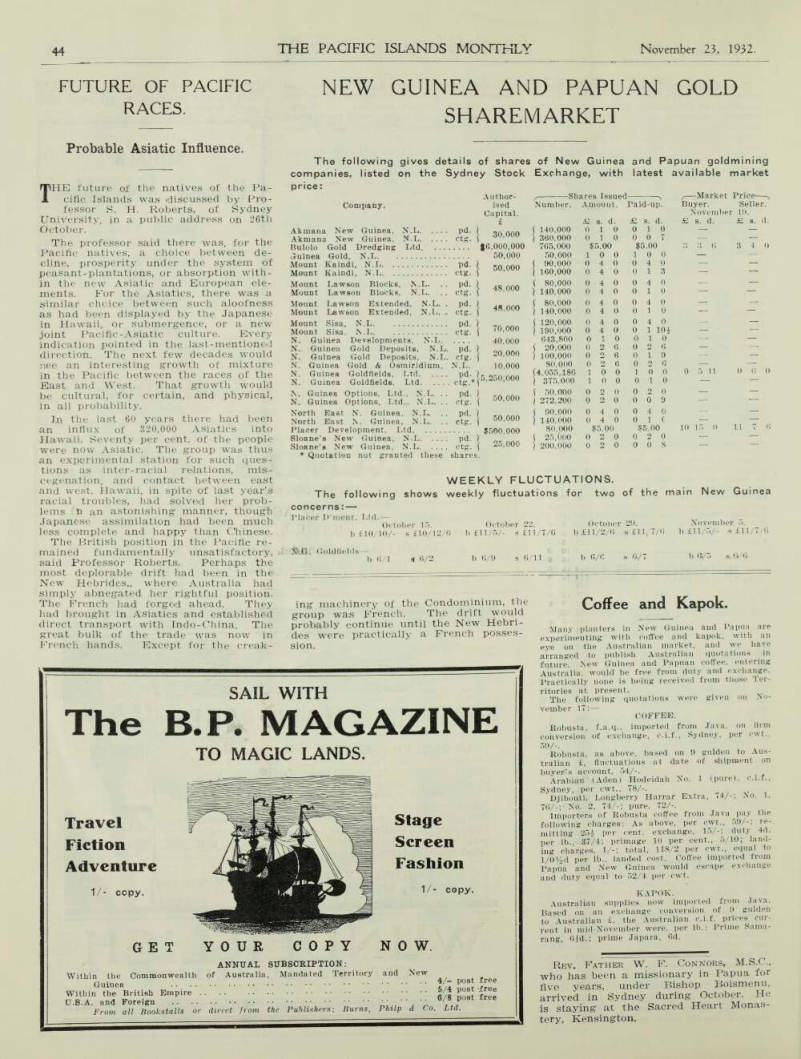
Races.
Probable Asiatic Influence.
THE future of the natives of the Pa cific Islands was discussed by Pro fessor S. H. Roberts, of Sydney University, in a public address on 26th October.
The professor said there was, for the Pacific natives, a choice between de cline, prosperity under the system of peasant-plantations, or absorption with in the new Asiatic and European ele ments. For the Asiatics, there was a similar choice between such aloofness as had been displayed by the Japanese in Hawaii, or submergence, or a new joint Pacific-Asiatic culture. Every indication pointed in the last-mentioned direction. The next few decades would nee an interesting growth of mixture in the Pacific between the races of the East and West. That growth would be cultural, for certain, and physical, in all probability.
In the last 60 years there had been an influx of 320,000 Asiatics into Hawaii. Seventy per cent, of the people were now Asiatic. The group was thus an experimental station for such ques tions as inter-racial relations, mis cegenation, and contact between east and west. Hawaii, in spite of last year’s racial troubles, had solved her prob lems in an astonishing manner, though Japanese assimilation had been much less complete and happy than Chinese.
The British position in the Pacific re mained fundamentally unsatisfactory, said Professor Roberts. Perhaps the most deplorable drift had been in the New Hebrides,, where Australia had simply abnegated her rightful position.
The French had forged ahead. They had brought in Asiatics and established direct transport with Indo-China. The great bulk of the trade was now in French hands. Except for the creak
ing machinery of the Condominium, the group was French. The drift would probably continue until the New Hebri des were practically a French posses sion.
Sharemarket
New Guinea And Papuan Gold
The following gives details of shares of New Guinea and Papuan goldmining companies, listed on the Sydney Stock Exchange, with latest available market price:
Weekly Fluctuations.
The following shows weekly fluctuations for two of the main New Guinea concerns:
Authorised Capital £ Shares Issued Market Price Company.
Number.
Amount.
Paid-up.
Buyer.
Seller.
November 19 £ £ s. d. £ s. d. £ s. d. £ s. d.
Akmana New Guinea, N.L pd. 140,000 0 1 0 0 1 0 — — Akmana New Guinea, N.L ctg. 30,000 360,000 0 1 0 0 0 7 — — Bulolo Gold Dredging Ltd. $6,000,000 765,000 $5.00 $5.00 3 3 6 3 4 0 Guinea Gold, N,L 50,000 50,000 1 0 0 1 0 0 — — Mount Kaindi, N.L pd. 90,000 0 4 0 0 4 0 — — Mount Kaindi, N.L ctg. 160,000 0 4 0 0 1 3 — — Mount Lawson Blocks, N.L. pd. 48,000 80,000 0 4 0 0 4 0 — — Mount Lawson Blocks, N.L. ctg. 140,000 0 4 0 0 1 0 — — Mount Lawson Extended, N.L. . pd. 48,000 80,000 0 4 0 0 4 0 — — Mount Lawson Extended, N.L. . ctg. 140,000 0 4 0 0 1 0 — — Mount Sisa, N.L pd. 120,000 0 4 0 0 4 0 — — Mount Sisa, N.L ctg. 70,000 190,000 0 4 0 0 1 10½ — — N. Guinea Developments, N.L. 40,000 643,800 0 1 0 0 1 0 — — N. Guinea Gold Deposits, N.L. pd. 20,000 0 2 6 0 2 6 — — N. Guinea Gold Deposits, N.L. ctg. 20,000 100,000 0 o 6 0 1 9 — — N. Guinea Gold & Osmiridium, N.L. 10,000 80,000 0 2 6 0 2 6 — — N. Guinea Goldfields, Ltd pd. 5,250,000 4,055,186 1 0 0 1 0 0 0 5 11 0 6 0 N. Guinea Goldfields, Ltd ctg.* 1 375,000 1 0 0 0 1 0 — — N. Guinea Options, Ltd., N.L. . . pd. 50,000 0 2 0 0 i) 0 — — N. Guinea Options, Ltd., N.L. . . ctg. 50,000 272,200 0 2 0 0 0 9 — — North East N. Guinea, N.L. .. pd. 90,000 0 4 0 0 4 0 — — North East N. Guinea, N.L. . . ctg. 50,000 140,000 0 4 0 0 1 C — — Placer Development, Ltd $500,000 80.000 $5.00 $5.00 10 15 0 117 6 Sloane’s New Guinea, N.L pd. 25,600 0 2 0 0 2 0 — — Sloane’s New Guinea, N.L ctg. 25,000 200,000 0 2 0 0 0 8 — — * Quotation not granted these shares.
Placer D’ment, Ltd. — October 15.
October 22.
October 29.
November 5. b £10/10/- s £10/12/0 b £11/5/- s £11/7/6 b £11/2/0 s £11/7/6 b £11/5/- s £11/7/0 NUG. Goldfields — b 6/1 0/2 « 0 b 6/9 s 6/11 o b 6/6 s 6/7 b 6l/5 s, 6/6
Coffee and Kapok.
Many planters in New Guinea and Papua are experimenting with coffee and kapok, with an eye on the Australian market, and we have arranged to publish Australian quotations in future. New Guinea and Papuan coffee, entering Australia, would be free from duty and exchange.
Practically none is being received from those Ter ritories at present.
The following quotations were given on No vember 17: —
Coffee.
Robusta, f.a.q.. imported from Java, on firm conversion of exchange, c.i.f., Sydney, per cwt., 59/-.
Robusta, as above, based on 9 gulden to Aus tralian £, fluctuations at date of shipment on buyer’s account, 54/-.
Arabian (Aden) Hodeidah No. 1 (pure), c.i.f..
Sydney, per cwt., 78/-.
Djibouti, Longberry Harrar Extra, 1 4/-; No. 1, 76/-; No. 2, 74/-; pure, 72/-.
Importers of Robusta coffee from Java pay the following charges: As above, per cwt., 59/-; re mitting 254 per cent, exchange, 15/-; duty 4d. per lb., 37/4; primage 10 per cent., 5/10; land ing charges, .1/-; total, 118/2 per cwt., equal to 1/0½d per lb., landed cost. Coffee imported from Papua and New Guinea would escape exchange and duty equal to 52/4 per cwt.
Kapok.
Australian supplies now imported from Java.
Based on an exchange conversion of 9 gulden to Australian £, the Australian c.i.f. prices cur rent in mid-November were, per lb.; Prime Sama rang, 6¼d.; prime Japara, 6d.
Rev. Father W. F. Connors, M.S.C., who has been a missionary in Papua for five years, under Bishop Boismenu, arrived in Sydney during October. He is staying at the Sacred Heart Monas tery, Kensington.
Advertisements & other items, p. 46 (1 item)
The B.P. Magazine
SAIL WITH
TO MAGIC LANDS.
GET YOUR COPY NOW.
ANNUAL
Within the Commonwealth of Australia Guinea Within the British Empire U.S.A. and Foreign From all Bookstalls or direct from
SUBSCRIPTION;
Mandated Territory and New 4/- post free 5/4 post Tree 6/8 post free the Publishers: Burns, Philp & Co. Ltd.
Market Quotations
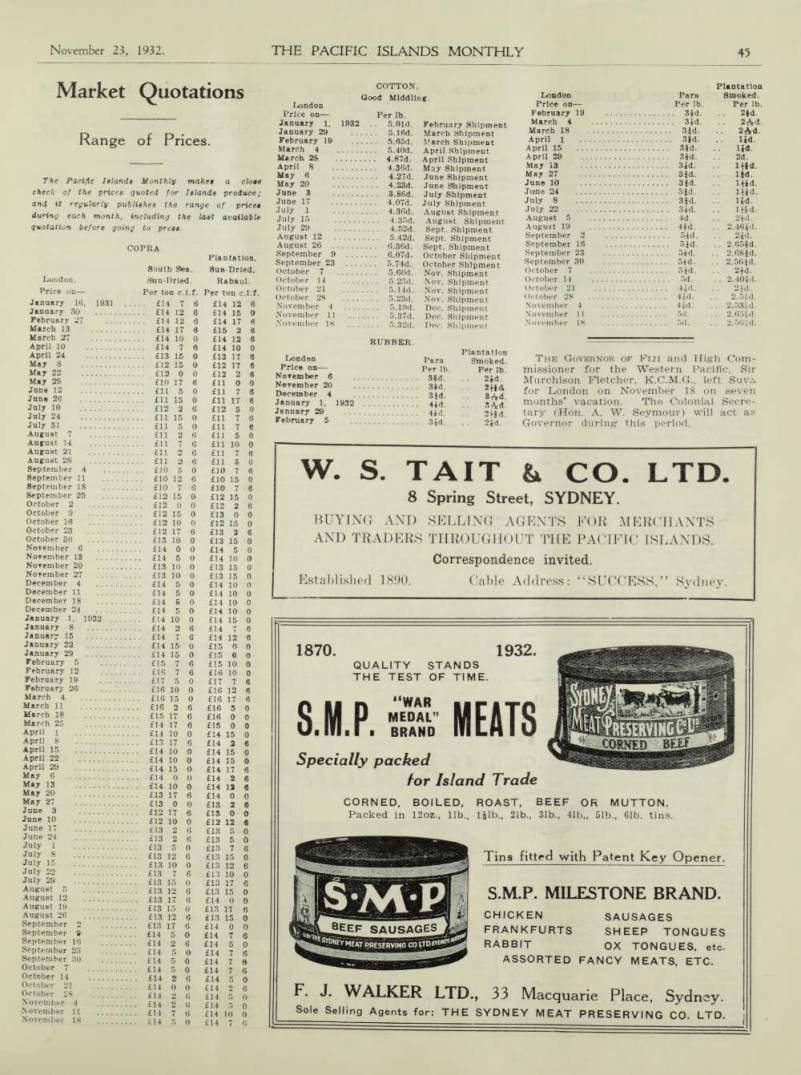
Range of Prices.
The Pacific Islands Monthly makes a close check of the prices quoted for Islands produce; and it regularly publishes the range of prices during each month, including the last available quotation before going to press.
The Governor of Fiji and High Com missioner for the Western Pacific, Sir Murchison Fletcher, K.C.M.G., left Suva, for London on November 18 on seven months’ vacation. The Colonial Secre tary (Hon. A. W. Seymour) will act as Governor during this period.
Plantation London Para Smoked.
Price on— Per lb.
Per lb.
February 19 3}d. 2*d March 4 3id. 2^d.
March 18 3Jd. 2Ad.
April 1 3|d. lid.
April 15 3|d. lid.
April 29 3|d. .. 2d.
May 13 IHd.
May 27 ltd.
June 10 Uid.
June 24 3|d.
Hid.
July 8 3Jd. lid.
July 22 3 3d.
U8d.
August 5 2*d.
August 19 4Jd. 2.46|d.
September 2 5id. • . 2id.
September 16 51d. .. 2.65gd.
September 23 5*d. 2.681d.
September 30 5*d. 2.561d.
October 7 5*d. 2*d.
October 14 2.40Sd.
October 21 4Jd. .. 2id.
October 28 4*d. 2..lid.
November 4 4Jd. 2.13id.
November 11 5d. 2.65fid.
November 18 5d. 2.5Gld.
Cotton.
Good Middling.
London Price on— Per lb.
January 1, 1932 . . 5.Old.
February Shipment January 29 5.16d.
March Shipment February 19 5.65d.
March Shipment March 4 5.40d.
April Shipment March 25 April Shipment April 8 4.36d.
May Shipment May 6 June Shipment May 20 4.23d.
June Shipment June 3 3.86d.
July Shipment June 17 July Shipment July 1 4.36d.
August Shipment July 15 4.35d.
August Shipment July 29 4.52d.
Sept. Shipment August 12 5.42d.
Sept. Shipment August 26 .
Sept. Shipment September 9 6.07d.
October Shipment September 23 5.74d.
October Shipment October 7 5.60d.
Nov. Shipment October 14 5.23d.
Nov. Shipment October 21 5.14d.
Nov. Shipment October 28 5.23d.
Nov. Shipment November 4 5.19d.
Dec. Shipment November 11 5,37d.
Dec. Shipment November 18 5.32d.
Dec. Shipment Ixmdon
Rubber.
Plantation Para Smoked.
Price on— Per lb. Per lb.
November 6 S»d. . . 2Jd.
November 20 3ld. 2Hd December 4 3}d, 3r^d January 1, 1932 4id. . , S^d.
January 29 41d. 2*|d.
February 5 3Jd. 2{d.
Copra
Plantation, South S'ea, Sun-Dried, London.
Sun-Dried.
Rabaul.
Price on— Per ton c.i.f.
Per ton c.i.f.
January 16, 1931 £14 7 6 £14 12 0 £14 15 0 £14 17 0 £15 2 6 £14 12 6 £14 10 0 £13 17 6 £12 17 6 £12 2 6 £11 0 0 £11 7 6 £11 17 6 £12 5 0 £11 7 6 £11 7 a £11 5 0 £11 10 0 £11 7 6 £11 5 0 £10 7 6 £10 15 0 £10 7 6 £12 15 0 £12 2 6 £13 0 0 £12 15 0 £13 2 8 £13 15 0 £14 5 0 £14 10 0 £13 15 0 £13 15 0 £14 10 0 £14 10 0 £14 10 0 £14 10 0 £14 15 0 £14 7 6 £14 12 0 £15 0 0 £15 0 0 £15 10 0 £16 10 0 £17 7 6 £16 12 6 £16 17 6 £16 5 0 £16 0 0 £16 0 0 £14 15 0 £14 2 6 £14 15 0 £14 15 0 £14 17 6 £14 2 6 £14 12 6 £14 0 0 fl !> •> ft January 30 £14 12 6 February 27 ... £14 12 6 March 13 £14 17 6 March 27 £14 10 0 April 10 £14 7 0 April 24 £13 15 0 May 8 £12 15 0 May 22 £12 0 0 May 29 £10 17 6 June 12 £11 5 0 June 26 £11 15 0 July 10 £12 2 6 July 24 £11 15 o July 31 £11 5 0 August 7 £11 2 6 August 14 £11 7 6 August 21 .. . . £11 2 6 August 28 £11 2 6 September 4 . . .. £10 5 0 September 11 ... . ... £10 12 6 September 18 . . . . ... £10 7 0 September 25 .. .. £12 15 0 October 2 £12 0 0 October 9 October 10 £12 10 0 October 23 £12 17 6 October 30 £13 10 0 November 6 £14 0 0 November IS £14 5 o November 20 ... £13 10 0 November 27 £13 10 0 December 4 £14 5 0 December 11 £14 5 o December 18 £14 5 0 December 24 £14 5 0 January 1, 1032 £14 10 0 January 8 January IB January 22 .. .. £14 15 0 January 29 £14 15 0 February 5 . . .. £15 7 6 February 12 ... £16 7 6 February 19 ... £17 5 o February 26 £16 10 0 March 4 £16 15 0 March 11 £16 2 6 March 18 £15 17 6 March 25 April i April 8 April 15 April 22 April 29 May 6 May 13 May 20 £13 17 6 May 27 June 3 £12 17 6 £lo * O June 10
X 15 U O
ri2 12 A June 17
X 1 Q A
June 24 HO o v/ £13 5 0 July 1 £13 7 6 £13 15 0 X t 9 19 f* July 8 July 15 July 22
Axu 1M O
xiin a July 29 Il'i 1U u
Xiq 17 G
August 5 £13 12 6
Aio A 4 O
£13 15 0 £14 0 0 August 12 August 19 £13 17 6 August 26 £13 15 0 £14 0 0 £14 7 6 £14 5 0 £14 7 6 £14 7 0 £14 7 6 September 2 £13 17 6 September d £14 5 O September 16 £14 2 6
September 23
£14 5 0 September 30 ... £14 5 0 October 7 October 14 £14 5 0 October 21 ... £14 0 0 £14 2 0 £14 5 0 £14 5 0 £14 10 0 £14 7 G October 28 £14 2 6 November 4 ... £14 2 6 November 11 £ 14 7 6 November 18
Advertisements & other items, p. 47 (1 item)
W. S. Tait & Co. Ltd.
8 Spring Street, SYDNEY.
BUYING AND SELLING AGENTS FOR MERCHANTS
AND TRADERS THROUGHOUT THE PACIFIC ISLANDS.
Correspondence invited.
Established 1890. Cable Address: “SUCCESS,” Sydney.
1870. 1932
QUALITY STANDS
THE TEST OF TIME.
S.M.P.
“WAR
MEDAL”
BRAND
Specially packed
for Island Trade
CORNED, BOILED, ROAST, BEEF OR MUTTON.
Packed in 12oz., 1lb., 1½lb.. 2lb., 3lb., 4lb„ 5lb., 6lb. tins.
Tins fitted with Patent Key Opener.
S.M.P. MILESTONE BRAND.
CHICKEN SAUSAGES
FRANKFURTS SHEEP TONGUES
RABBIT OX TONGUES, etc.
ASSORTED FANCY MEATS, ETC.
F. J. WALKER LTD., 33 Macquarie Place, Sydney.
Sole Selling Agents for; THE SYDNEY MEAT PRESERVING CO. LTD.
Exchange Quotations
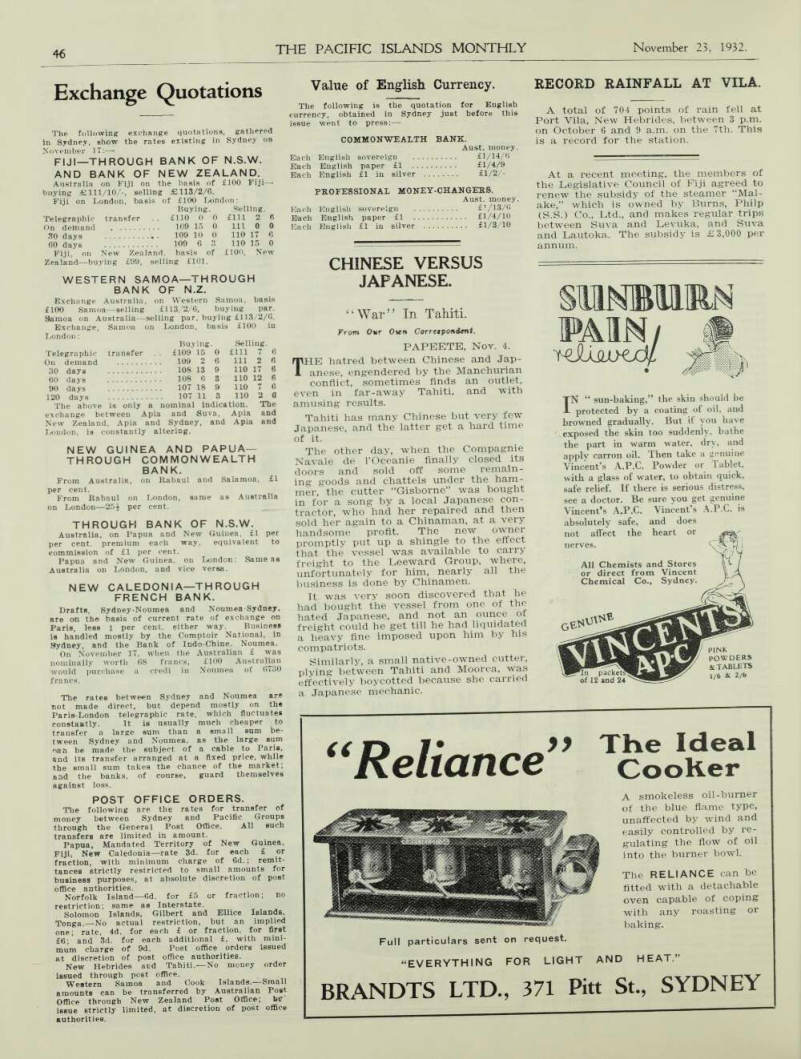
The following exchange quotations, gathered in Sydney, show the rates existing in Sydney on November 17:—
Fiji — Through Bank Of N.S.W.
And Bank Of New Zealand.
Australia on Fiji on the basis of £100 Fiji—buying £111/10/-, selling £113/2/6.
Fiji on London, basis of £100 London;
Western Samoa—Through
Bank Of N.Z.
Exchange Australia, on Western Samoa, basis £100 Samoa—selling £113/2/6, buying par.
Samoa on Australia —celling par, buying £113/2/6.
Exchange, Samoa on London, basis £100 in London:
The above is only a nominal indication. The exchange between Apia and Suva, Apia and New Zealand, Apia and Sydney, and Apia and London, is constantly altering.
New Guinea And Papua—
Through Commonwealth
Bank.
From Australia, on Rabaul and Salamoa, £1 per cent.
From Rabaul on London, same as Australia on London —25$ per cent.
Through Bank Of N.S.W.
Australia, on Papua and New Guinea, £1 per per cent, premium each way, equivalent to commission of fl per cent.
Papua and New Guinea, on London: Same as Australia on London, and vice versa.
New Caledonia—Through
French Bank.
Drafts, Sydney-Noumea and Noumea Sydney, are on the basis of current rate of exchange on Paris, less l per cent, either way. Business is handled mostly by the Comptoir National, in Sydney, and the Bank of Indo-Chine, Noumea.
On November 17, when the Australian f was nominally worth 68 francs, £100 Australian would purchase a credi in Noumea of 6730 francs.
The rates between Sydney and Noumea are not made direct, but depend mostly on the Paris-London telegraphic rate, which fluctuates constantly. It is usually much cheaper to transfer a large sum than a small sum be tween Sydney and Noumea, as the large sum oan be made the subject of a cable to Paris, and its transfer arranged at a fixed price, while the small sum takes the chance of the market; and the banks, of course, guard themselves against loss.
Post Office Orders.
The following are the rates for transfer of money between Sydney and Pacific Groups through the General Post Office. All such transfers are limited in amount.
Papua, Mandated Territory of New Guinea, Fiji, New Caledonia—rate 3d. for each f or fraction, with minimum charge of 6d.; remit tances strictly restricted to small amounts for business purposes, at absolute discretion of post office authorities.
Norfolk Island —6d. for £5 or fraction; no restriction; same as Interstate.
Solomon Islands, Gilbert and Ellice Islands, Tonga.—No actual restriction, but an implied one; rate. 4d. for each £ or fraction, for first £6; and 3d. for each additional £, with mini mum charge of 9d. Post office orders issued at discretion of post office authorities.
New Hebrides and Tahiti. —No money order issued through post office.
Western Samoa and Cook Islands.—Small amounts can be transferred by Australian Post Office through New Zealand Post Office; but issue strictly limited, at discretion of post office authorities.
Buying. Celling.
Telegraphic transfer . . £110 0 0 fill 2 0 On demand 109 15 0 111 0 0 30 davs 109 10 0 110 17 6 00 days 109 6 3 110 15 0 Fiji, on New Zealand, basis of £100, New Zealand—buying £99, selling £101.
Buying. Selling.
Telegraphic transfer . . £109 15 0 £111 7 6 On demand 109 2 6 111 2 6 30 davs 108 13 9 110 17 6 60 days 108 6 3 110 12 6 90 days 107 18 9 110 7 6 120 days 107 11 3 110 2 G
Value of English Currency.
The following is the quotation for English currency, obtained in Sydney just before this issue went to press: —
Commonwealth
Bank.
Aust. money.
Each English sovereign £1/14/6 Each English paper £1 Each English £1 in silver . .. £1/2/-
Professional Money-Changers.
Aust. money, Each English sovereign £1/13/6 Each English paper £1 £1/4/10 Each English £1 in silver ... £1/3/10
Chinese Versus
Japanese.
“War” In Tahiti.
From Our Own Correspondent.
Papeete, Nov. 4.
THE hatred between Chinese and Jap anese, engendered by the Manchurian conflict, sometimes finds an outlet, even in far-away Tahiti, and with amusing results.
Tahiti has many Chinese but very few Japanese, and the latter get a hard time of it.
The other day, when the Compagnie Navale de l’Oceanie finally closed its doors and sold off some remain ing goods and chattels under the ham mer, the cutter “Gisborne” was bought in for a song by a local Japanese con tractor, who had her repaired and then sold her again to a Chinaman, at a very handsome profit. The new owner promptly put up a shingle to the effect that the vessel was available to carry freight to the Leeward Group, where, unfortunately for him, nearly all the business is done by Chinamen.
It was very soon discovered that he had bought the vessel from one of the hated Japanese, and not an ounce of freight could he get till he had liquidated a heavy fine imposed upon him by his compatriots.
Similarly, a small native-owned cutter, plying between Tahiti and Moorea, was effectively boycotted because she carried a Japanese mechanic.
Record Rainfall At Vila.
A total of 704 points of rain fell at Port Vila, New Hebrides, between 3 p.m. on October 6 and 9 a.m. on the 7th. This is a record for the station.
At a recent meeting, the members of the Legislative Council of Fiji agreed to renew the subsidy of the steamer “Mai ake,” which is owned by Burns, Philp (S.S.) Co., Ltd., and makes regular trips between Suva and Levuka, and Suva and Lautoka. The subsidy is £3,000 per annum.
Advertisements & other items, p. 48 (1 item)
“Reliance”
SUNBURN
IN “sun-baking,” the skin should be protected by a coating of oil, and browned gradually. But if you have exposed the skin too suddenly, bathe the part in warm water, dry, and apply carron oil. Then take a genuine Vincent’s A.P.C. Powder or Tablet, with a glass of water, to obtain quick, safe relief. If there is serious distress, see a doctor. Be sure you get genuine Vincent’s A.P.C. Vincent’s A.P.C. is absolutely safe, and does nerves.
All Chemists and Stores or direct from Vincent Chemical Co., Sydney.
“Reliance”
The Ideal
Cooker
Full particulars sent on request.
A smokeless oil-burner of the blue flame type, unaffected by wind and easily controlled by re gulating the flow of oil into the burner bowl.
The RELIANCE can be fitted with a detachable oven capable of coping with any roasting or baking.
“EVERYTHING FOR LIGHT AND HEAT.”
BRANDTS LTD., 371 Pitt St., SYDNEY
Shipping Services in the Pacific
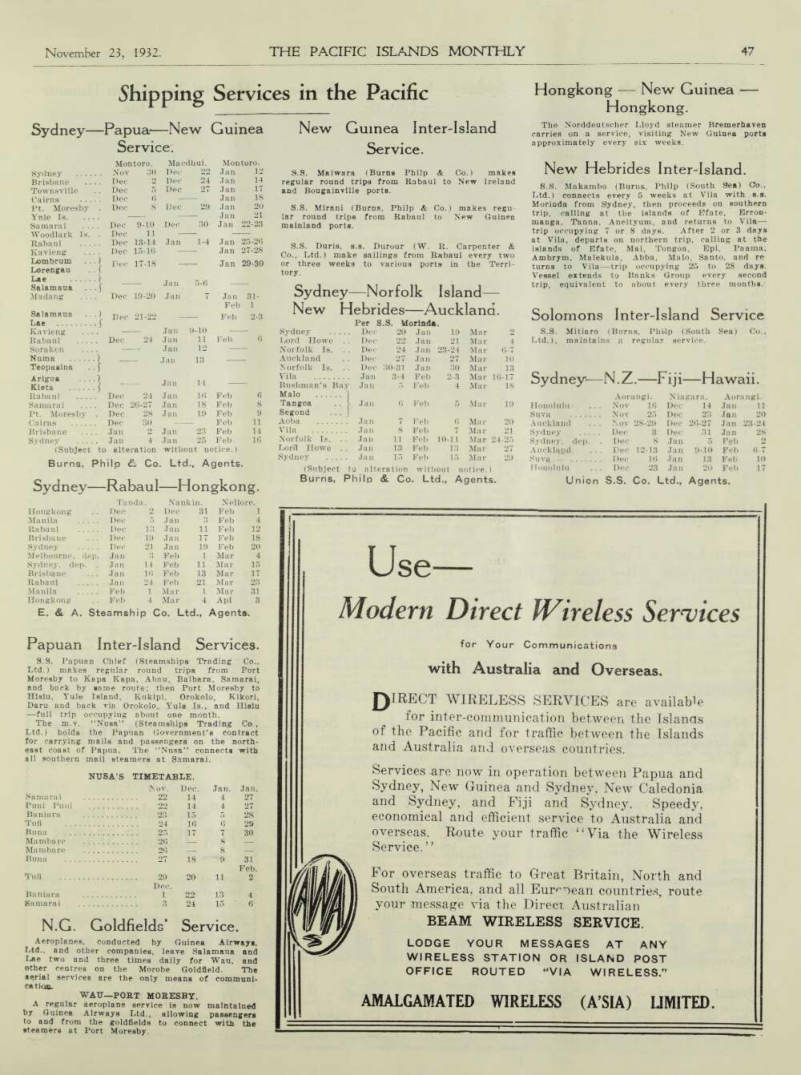
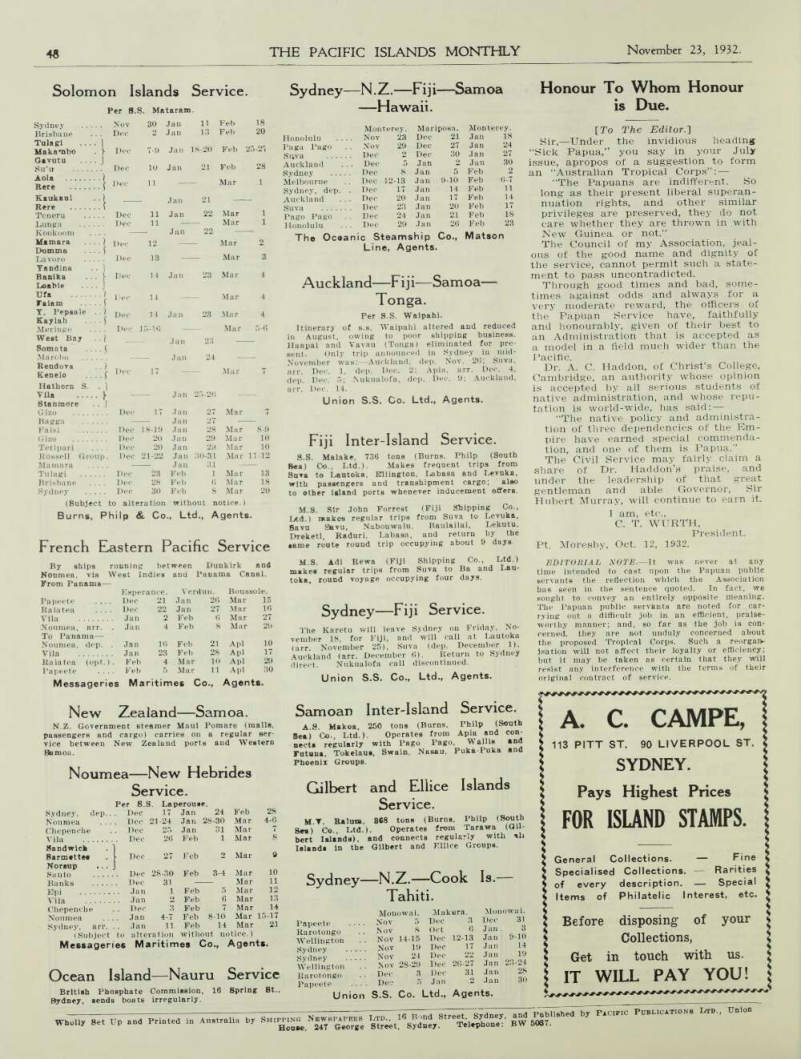
Sydney—Papua—New Guinea Service.
Sydney—Rabaul—Hongkong.
Papuan Inter-Island Services.
S.S. Papuan Chief (Steamships Trading Co., Ltd.) makes regular round trips from Port Moresby to Kapa Kapa, Abau, Baibara, Samarai, and back by same route; then Port Moresby to Hislu, Yule Island, Kukipi, Orokolo, Kikori, Daru and back via Orokolo, Yule Is., and Hislu —full trip occupying about one month.
The m.v. “Nusa” (Steamships Trading Co, Ltd.) holds the Papuan Government’s contract for carrying mails and passengers on the north east coast of Papua. The “Nusa” connects with all southern mail steamers at Samarai.
N.G. Goldfields’ Service.
Aeroplanes, conducted by Guinea Airways, Ltd., and other companies, leave Salamaua and Lae two and three times daily for Wau, and other centres on the Morobe Goldfield. The aerial services are the only means of communi cation.
Wau—Port Moresby.
A regular aeroplane service is now maintained by Guinea Airways Ltd., allowing passengers to and from the goldfields to connect with the steamers at Port Moresby.
New Guinea Inter-Island
Service.
S.S. Maiwara (Burns Philp & Co.) makes regular round trips from Rabaul to New Ireland and Bougainville ports.
S.S. Mirani (Burns, Philp & Co.) makes regu lar round trips from Rabaul to New Guinea mainland ports.
S.S. Duris, s.s. Durour (W. R. Carpenter & Co., Ltd.) make sailings from Rabaul every two or three weeks to various ports in the Terri tory.
Sydney—Norfolk Island—
New Hebrides—Auckland.
Hongkong New Guinea
Hongkong.
The Norddeutscher Lloyd steamer Bremerhaven carries on a service, visiting New Guinea ports approximately every six weeks.
New Hebrides Inter-Island.
S.S. Makambo (Burns, Philp (South Sea) Co., Ltd.) connects every 5 weeks at Vila with s.s.
Morinda from Sydney, then proceeds on southern trip, calling at the islands of Efate, Erron manga, Tanna, Aneityum, and returns to Vila— trip occupying 7 or 8 days. After 2 or 3 days at Vila, departs on northern trip, calling at the islands of Efate, Mai, Tongoa, Epl, Paama, Ambrym, Malekula, Abba, Malo, Santo, and re turns to Vila —trip occupying 25 to 28 days.
Vessel extends to Banks Group every second trip, equivalent to about every three months.
Solomons Inter-Island Service
S.S. Mitiaro (Burns, Philp (South Sea) Co., Ltd.), maintains a regular service.
Sydney-—N. Z.—Fiji—Hawaii.
Montoro.
Macdhui.
Montoro.
Nov 30 Dec 22 Jan 12 Brisbane Townsville Dec Dec 2 5 r Dec Dec 24 27 Jan Jan Ja n 14 17 18 Pt. Moresby Dec 8 Dec 29 Jan 20 Yule Is.
Samarai Jan Jan 21 22-23 Dec 9-10 Dec 30 Woodlark Is.
Dec 13-14 Jan 1-4 Jan 25-26 Kavieng 15-16 Jan 27-28 Lombrum Dec 17-18 Jan 29-30 Lorengau Lae 5-6 Salamaua Jan Madang Dec 19-20 Jan 7 Jan Feb 31- 1 Salamaua Dec 21-22 Feb 2-3 Lae Kavieng Rabaul ..., Jan 9-10 11 Dec 24 Jan Feb 6 Tii <1 12 Soraken •fail Numa Ton 13 Teopasina *1 clll Arigua Jan 14 Kieta Rabaul ...
Dec 24 Jan 16 Feb 6 Samarai Dec 26-27 Jan 18 Feb 8 Pt. Moresby Dec Dec Jan Jan 28 30 Jan 19 Feb Feb 9 11 Brisbane Sydney 4 Jan Jan 23 25 Feb Feb 14 16 (Subject to alteration without notice.) Burns, Philp & Co. Ltd., Agents.
Per S.S. Morinda Sydney .. Dec 20 Jan 19 Mar 2 Lord Howe Dee 22 Jan 21 Mar 4 Norfolk Is.
De< 24 Jan 23-24 Mar 6-7 Auckland .. Dec 27 Jan 27 Mar 10 Norfolk Is.
Dec JO-31 Jan 30 Mar 13 Vila Jan 3-4 Feb 2-3 Mar 16-17 Bushman’s Bay Jan 5 Feb 4 Mar 18 Male Tangoa Jan f> Feb 5 Mar 19 Segond Aoba 7 Feb 6 Mat- 20 Vila . Jan 8 Feb 7 Mar 21 Norfolk Is. . Jan 11 Feb 10-11 Mar 24 -25 Lord Howe . Jan 13 Feb 13 Mar 27 Sydney . Jan 15 Feb 15 Mar 29 (Subject to alteration without notice.) Burns, Philp & Co. Ltd., Agents.
Aorangi.
Niagara.
Aorangi.
Honolulu Nov 16 Dec 14 Jan 11 Suva Nov 2o I )(M 23 Jan 20 Auckland Nov 28-29 Dec 26-27 Jan 23-24 Sydney Deo 3 I )ec 31 Jan 28 Sydney, dep. .
Dec 8 Jan 5 Fpb 2 Auckland Dec 12-13 Jan 9-10 Feb 6-7 Suva Dec 16 Jan 13 Feb 10 Honolulu Dec 23 Jan 20 Feb 17 Union S.S. Co. Ltd., Agents.
Tauda.
Nankin.
Nellore Hongkong Dec 2 Dec 31 Feb 1 Manila . .. Dec 5 Jan 3 Feb 4 Rabaul 13 Jan 11 Feb 12 Brisbane . . . Dec 19 Jan 17 Feb 18 Sydney 2J Jan 19 Feb 2U Melbourne, i lep. Jan 3 Feb 1 Mar 4 Sydney, dep . . Jan 14 Feb 11 Mar 15 Brisbane Jan KJ Feb 13 Mar 17 Rabaul 24 Feb 21 Mar 23 Manila ... Feb 1 Mar 1 Mar 31 Hongkong . . Feb 4 Mar 4 Apl 3 E. & A. Steamship Co. Ltd., Agents.
Nusa's Timetable,
Nov.
Dec.
Jan.
Jan.
Samarai 22 14 4 27 Puni Puni 0*2 14 4 27 Baniara 15 5 28 Tufi . . . 10 0 29 Buna . . . 2 r. 17 7 30 Mambare 20 8 Mambare 20 — 8 — Buna . . .. 27 18 9 31 Feb.
Tufi 29 Dec. 20 11 2 Baniara 1 20 IS 4 Samarai 24 15 6
Solomon Islands Service.
French Eastern Pacific Service
By ships running between Dunkirk and Noumea, via West Indies and Panama Canal.
From Panama—
New Zealand—Samoa.
N.Z. Government steamer Maul Pomare (mails, passengers and cargo) carries on a regular ser vice between New Zealand ports aud Western Samoa.
Noumea—New Hebrides
Service.
Ocean Island—Nauru Service
British Phosphate Commission, 16 Spring St., Sydney, sends boats irregularly.
Sydney—N. Z.—Fiji—Samoa —Hawaii.
The Oceanic Steamship Co., Matson
Line, Agents.
Auckland —Fiji—Samoa—
Tonga.
Per S.S. Waipahi.
Itinerary of s.s. Waipahi altered and reduced in August, owing to poor shipping business.
Haapai and Yavau (Tonga) eliminated for pre sent. Only trip announced in Sydney in mid- November was; —Auckland, dep. Nov. 26; Suva, air. Deo. 1, dep. Dec. 2; Apia, arr. Dec. 4, dep. Dec. 5; Nukualofa, dep. Dec. 9; Auckland, arr. Dec. 14.
Union S.S. Co. Ltd., Agents.
Fiji Inter-Island Service.
S.S. Malake, 736 tons (Burns, Philp (South Bea) Co., Ltd.). Makes frequent trips from Suva to Lantoka, Ellington, Labasa and Levuka, with passengers and transhipment cargo; also to other island ports whenever inducement offers.
M.S. Sir John Forrest (Fiji Shipping Co., Ltd.) makes regular trips from Suva to Levuka, Savu Sbvu, Nabouwalu, Baulailai, Lekutu.
Dreketl, Raduri, Labasa, and return by the game route round trip occupying about 9 days.
M.S. Adi Rewa (Fiji Shipping Co., Ltd.) makes regular trips from Suva to Ba and Lau toka, round voyage occupying four days.
Sydney —Fiji Service.
The Karetu will leave Sydney on Friday, No vember 18, for Fiji, and will call at Lautoka (arr. November 25), Suva (dep. December 1), Auckland (arr. December 6). Return to Sydney direct. Nukualofa call discontinued.
Union S.S. Co., Ltd., Agents.
Samoan Inter-Island Service.
A.S. Makoa, 250 tons (Burns, Philp (South Sea) Co. Ltd.). Operates from Apia and con nects regularly with Pago Pago. Wallis and Futuna, Tokelaua, Swain, Nasau, Puka-Puka and Phoenix Groups.
Gilbert and Ellice Islands
Service.
M.T. Ralum, 868 tons (Burns, Philp (South Sea) Co., Ltd.). Operates from Tarawa (Gil bert Islands), and connects regularly with all Islands in the Gilbert and Ellice Groups.
Sydney—N.Z. —Cook Is.
Tahiti.
Per S.S. Mataram.
Sydney ...
Nov 30 Jan 11 Feb 18 Brisbane Dec 2 Jan 13 Feb 20 Tulagi Makambo Dec 7-9 Jan 18 -20 Feb 2: i-2'i Gavutu ...
Su’u Deo 10 Jan 21 Feb 28 Aola 1 Here Dec 11 Mar Kaukaul Jan 21 Here Teneru ...
Dec 11 Jan 22 Mar 1 1 un£*i 11 Mar 1 Kookoom Jan 22 Mamara Dec 12 Mar 0 Domma Due 13 Mar 3 Yandina Banlka Dec 14 Jan 23 Mar 4 Doable Ufa Dec* 14 Mar 4 ralam Y. Pepsale Dec 14 Jan 23 Mar 4 Kaylab Meringe Dec 15-10 Mar 5-6 West Boy Jan 23 Soma ta Marobo . ... — Jan 24 — Rendova Kenelo Dec 17 — Mar 7 Hathorn S.
Vila Jan 2 5-26 —— Stanmore Gizo Dec 17 Jan 27 Mar 7 Jan Faisi Dec 18-19 Jan 28 Mar 8-9 Gizo l »ec 20 Jan 29 Mar 10 Tetinari Dec 20 Jan 29 Mar 10 Russell Group.
Dec 21-22 Jan 30-31 Mar 11-12 Mamara Jan 31 Tulagi ...
Dec 23 Feb 1 Mar 13 Brisbane Dec 28 Feb 6 Mar 18 Sydney Dec 30 Feb S Mar 20 (Subject to alteration without notice. ) Burns, Philp & Co. Ltd., Agents.
Esperance.
Verdun.
Boussole.
Papeete ...
Dec 21 Jan 26 Mar 15 Raiatea ...
Dec 22 Jan 27 Mar 16 Vila Jan 2 Feb 6 Mar 27 Noumea, arr. .
To Panama — Jan 4 Feb 8 Mar 2b Noumea, dep. .
Jan 16 Feb 21 Apl 10 Vila Jan 23 Feb 28 Apl 17 Raiatea (opt.).
Feb 4 Mar 10 Apl 29 Papeete ...
Feb 5 Mar 11 Apl 30 Messageries Maritimes Co., Agents.
Per S.S. Laperouse.
Sydney, dep.. .
Dec 17 Jan 24 Feb 28 Noumea ...
Dee 21-24 Jan 28-30 Mar 4-G Chepenehe Dec 25 Jan 31 Mar 7 Vila Dec 26 Feb 1 Mar 8
Sandwich . ]
Sarmettes Deo 27 Feb 2 Mar 0
Noraup ...
Santo Dee 28-30 Feb 3-4 Mar 10 Banks Dec 31 — Mar 11 Epi Jan 1 Feb 5 Mar 12 Vila Jan 2 Feb 6 Mar 13 Chepenehe Dec 3 Feb 7 Mar 14 Noumea ...
Jan 4-7 Feb 8-10 Mar 15-17 Sydney, arr. . .
Jan 11 Feb 14 Mar 21 (Subject to alteration without notice.) Messageries Maritimes Co., Agents.
Monterey. Mariposa. Monterey.
Honolulu ... Nov 23 Dec 21 Jan 18 Paga Pago .. Nov 29 Dec 2< Jan 24 Suva Dec 2 Dec 30 Jan 27 Auckland . .. Dec 5 Jan 2 Jan 30 Svdney Dec 8 Jan 5 Feb 2 Melbourne . . Dec 12-13 Jan 9-10 Feb 6-7 Sydney, dep. . Dec 17 Jan 14 Feb 11 Auckland . . . Dec 20 Jan 17 Feb 14 Suva Dec 23 Jan 20 Feb 17 Pago Pago . . Dec 24 Jan 21 Feb 18 Honolulu . . . Dec 20 Jan 26 Feb 23
Monowai.
Makura.
Monowai.
Papeete ...
Nov 5 Dec 3 Dec 31 Rarotongo Nov 8 Oct r> Jan 3 Wellington Nov 14-15 Dec 12-13 Jan 9-10 Sydney Nov 19 Dec 17 Jan 14 Sydney Nov 24 Dec 22 Jan 19 Wellington Nov 28-29 Dec 20-27 Jan 23-24 Rarotongo Dec 3 Dec 31 Jan 28 Papeete Dec 5 Jan 2 Jan 30 Union S.S. Co. Ltd., Agents.
Advertisements & other items, p. 49 (1 item)
Modern Direct Wreless Services
Use—
for Your Communications with Australia and Overseas.
DIRECT WIRELESS SERVICES are available for inter-communication between the Islands of the Pacific and for traffic between the Islands and Australia and overseas countries.
Services are now in operation between Papua and Sydney, New Guinea and Sydney, New Caledonia and Sydney, and Fiji and Sydney. Speedy, economical and efficient service to Australia and overseas. Route your traffic “Via the Wireless Service. ”
For overseas traffic to Great Britain, North and South America, and all countries, route your message via the Direct Australian
BEAM WIRELESS SERVICE.
LODGE YOUR MESSAGES AT ANY
WIRELESS STATION OR ISLAND POST
OFFICE ROUTED “VIA WIRELESS.”
AMALGAMATED WIRELESS (ASIA) LIMITED.
Honour To Whom Honour
is Due.
[To The Editor .] Sir, —Under the invidious heading “Sick Papua,’’ you say in your July issue, apropos of a suggestion to form an “Australian Tropical Corps”: “The Papuans are indifferent. So long as their present liberal superan nuation rights, and other similar privileges are preserved, they do not care whether they are thrown in with New Guinea or not.”
The Council of my Association, jeal ous of the good name and dignity of the service, cannot permit such a state ment to pass uncontradicted.
Through good times and bad, some times against odds and always for a very moderate reward, the officers of the Papuan Service have, faithfully and honourably, given of their best to an Administration that is accepted as a model in a field much wider than the Pacific.
Dr. A. C. Haddon, of Christ’s College, Cambridge, an authority whose opinion is accepted by all serious students of native administration, and whose repu tation is world-wide, has said; “The native policy and administra tion of three dependencies of the Em pire have earned special commenda tion, and one of them is Papua.”
The Civil Service may fairly claim a share of Dr. Haddon’s praise, and under the leadership of that great gentleman and able Governor, Sir Hubert Murray, will continue to earn it.
I am, etc.,
C. T. Wurth,
President.
Pt. Moresby, Oct. 12, 1932.
EDITORIAL NOTE. —It was never at any time intended to cast upon the Papuan public servants the reflection which the Association has seen in the sentence quoted. In fact, we sought to convey an entirely opposite meaning.
The Papuan public servants are noted for car rying out a difficult job in an efficient, praise worthy manner; and, so far as the job is con cerned, they are not unduly concerned about the proposed Tropical Corps. Such a reorgan isation will not affect their loyalty or efficiency; but it may be taken as certain that they will resist any interference with the terms of their original contract of service.
Advertisements & other items, pp. 50-52 (2 items)
48
THE PACIFIC ISLANDS MONTHLY
November 23, 1932.
won. Be. P p .-a Prt-t* ... .» * PIOT,C POBL '° iT,ONS ' 8,,i0 ”
A. C. Campe,
113 PITT ST. 90 LIVERPOOL ST.
SYDNEY.
Pays Highest Prices
FOR ISLAND STAMPS.
General Collections. Fine Specialised Collections. Rarities of every description. Special Items of Philatelic Interest, etc.
Before disposing of your Collections, Get in touch with us.
IT WILL PAY YOU!
The Expert Staff of Guinea Airways Ltd. photographed in front of one of the large Hangars at Lae, New Guinea.
Staffed and Equipped to Carry on One of the Biggest Aerial Transport Services in the World WITH its giant Three-motored Aeroplanes, and its large staff of Experienced Pilots and Expert Mechanics, Guinea Air. ways Ltd. carries on the Transport Service between the Coast of New Guinea and the Goldfields Centres. There is no other form of Transport in this part of New
Guinea—only Aeroplanes.
In all kinds of weather, irrespective of the seasons, the Aeroplanes of Guinea Airways Ltd. maintain
communication with the Goldfields, safely carrying
mails, passengers, heavy mining machinery, native
labourers, foodstuffs, livestock, etc.
New Guinea Aerodromes
LAE
SALAMAUA
WATTUT
WAU
WAMPUT
SANGAN
BULOWAT
BULOLO
ZENAG
GUINEA AIRWAYS Ltd
LAE - SALAMAUA
When two long thirsts equal one
long bottle!
"What’s yours?”
"Resch's Pilsener. ”
"So’s mine.”
When you ask for Pilsener insist on the long bottle.
RESCH'S
PILSENER
P 10 27