Islands
Pacific
Monthly
October 19
1932
6 d
[Registered at G.P.O.. Sydney, for transmission by post as a newspaper.]
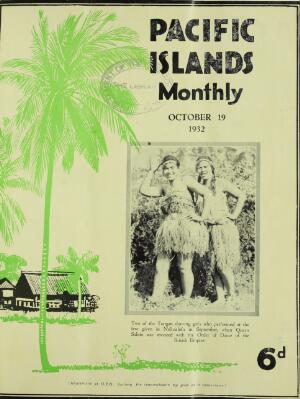
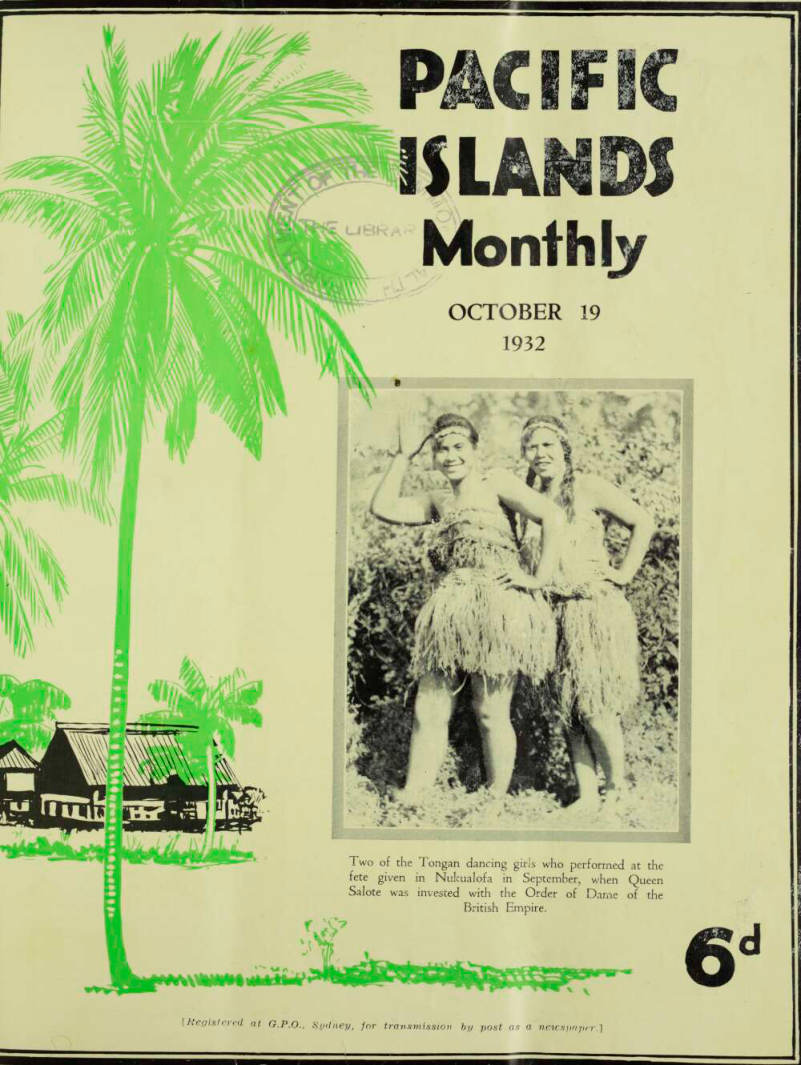
Two of the Tongan dancing girls who performed at the fete given in Nukualofa in September, when Queen Salote was invested with the Order of Dame of the British Empire.
Advertisements & other items, p. 2 (1 item)
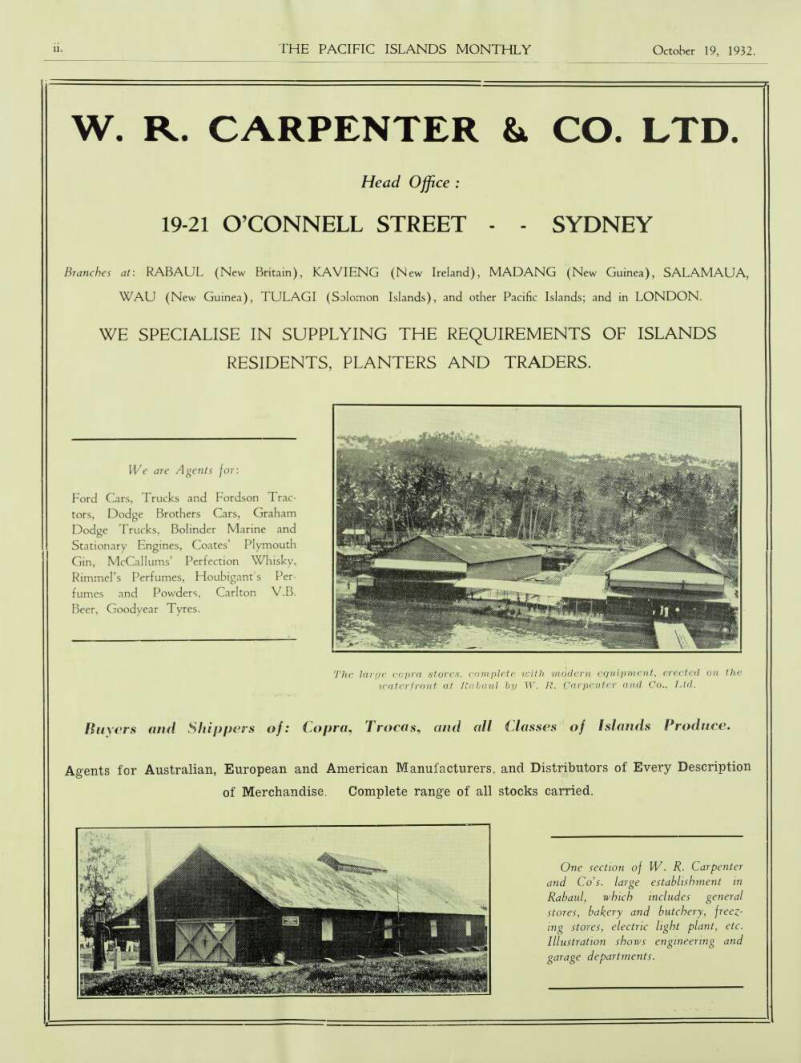
W. R. Carpenter & Co, Ltd.
Head Office :
19-21 O’CONNELL STREET - - SYDNEY
Branches at: RABAUL (New Britain), KAVIENG (New Ireland), MADANG (New Guinea), SALAMAUA, WAU (New Guinea), TULAGI (Solomon Islands), and other Pacific Islands; and in LONDON, WE SPECIALISE IN SUPPLYING THE REQUIREMENTS OF ISLANDS
RESIDENTS, PLANTERS AND TRADERS.
We are Agents for: Ford Cars, Trucks and Fordson Trac tors, Dodge Brothers Cars, Graham Dodge Trucks, Bolinder Marine and Stationary Engines, Coates’ Plymouth Gin, McCallums’ Perfection Whisky, Rimmel’s Perfumes, Houbigant s Per fumes and Powders, Carlton V.B.
Beer, Goodyear Tyres.
Buyers and Shippers of: Copra , Trocas , and all Classes of Islands Produce.
Agents for Australian, European and American Manufacturers, and Distributors of Every Description of Merchandise. Complete range of all stocks carried.
The large copra stores, complete with modern equipment, erected on the waterfront at Ralaul Ity W. R. Carpenter and Co., Ltd.
One section of W. R. Carpenter and Co’s, large establishment in Rabaul, which includes general stores, bakery and butchery, freez ing stores, electric light plant, etc.
Illustration shows engineering and garage departments.
Pacific Islands Travellers
Passengers Per “Morinda,” Which
Arrived Ix Sydney From New Heb
Rides And Norfolk Is. On September
18; Mr. C. G. Dawson, Miss P. Dawson, Miss N. Dawson, Mr. T. Black, Miss J. Bond, Mrs.
M. Branch, Mr. W. Cadwallader, Mr. C. Cad wallader, Mr. W. Eudey, Mr. W. Ferguson, Mr.
W. Lynch, Miss A. Morrice, Mr. G. Rowlands, Mrs. C. Mackie, Mrs. J. Purdy, Mr. C. Pratt, Mr. G. Barnard, Mr. W. Elwell, Mr. R. Grif fith, Mrs. A. Hunter, Mrs. K. McKerlie, Mr., Mrs.
A., and Miss M. McLachlan, Mrs. D. Nobbs, Miss G. Nobbs, Miss D. Thomas, Mr. A. Walton, Mrs. J. Waterhouse, Mr. K. Wilson, Mr. Mur ray Wright, Miss D. Alderson, Mrs. E. and Mr.
A. Atteridge, Miss K. Boland, Mr. R. Cowie, Miss L. Connellan, Mr. and Mrs. H. Dallimore, Mr. H. Douglass, Miss M. Easson, Dr. W. Jer myn, Mr. G. M. Kirby, Mr. J. McFarland, Mr.
J. Payten, Miss A. Rielly, Miss H. Roper, Mrs.
J. Thorpe, Miss A. Virgons, Mr. G. Vial, Mr.
P. Woods.
Passengers Per “Morinda" Which
Sailed From Sydney On September 29
For Lord Howe Island, Norfolk Is
Land, Auckland And New Hebrides :
Mr. Giles, Mrs. Giles, Mr. F. Pursell, Mrs. F.
Pursell, Mrs. L. B. Morgan, Miss L. Horsfall, Mr. J. Blackwell, Mrs. Blackwell, Mrs. J.
Murphy, Mrs. Matthews, Mrs. T. A. Smith, Mr. E. J. Decent, Mr. B. M. Clark, Mr J.
Sykes, Mr. W. Randall, Miss M. Bignell, Mrs.
K. Bignell, Miss S. Melot, Mrs. L. Hagen and infant, Miss A. Twomey, Miss B. Bartle, Mr.
E. H. Cherry, Mrs. Cherry, child and infant, Mr. A. K. Perrett, Mr. P. W. Colquhoun, Mr. and Mrs. J. Stewart, Mr. B. R. Park, Mr. H. Clayton, Mr. R. Thomas, Mr. C. T. Brockhoff, Miss E.
Boardman, Mrs. M. Nichols and infant, Miss I. Speedy, Mrs. P. S. MacDermott, Miss P.
Lindsay, Miss A. Lindsay, Mrs. F. Winter botham, Miss F. Winterbotham, Mrs. S. Rip pingale, Mrs. Happ, Mr. W. Livingstone, Mrs.
Livingstone, Miss Livingstone, Mr. E. Sommer ville, Master Happ, Mrs. H. S. Clayton, Mrs.
F. A. Gressier, Mrs. C. M. O’Connor, Miss A.
M. Smyth, Miss F. Hooper, Miss V. Nicholls, Miss A. Moore, Miss T. Towey, Miss C. M.
McKeough, Mr. A. R. Teaman, Mr. G. M.
Kirby, Mr. A. Russell, Mr. W. R. Hooper, Mr.
J. Sloane.
Passengers Per M.V “Macdhui,”
Which Sailed From Sydney On Sep
Tember 22 For Papua And New
GUINEA ; Mr. L. C. Steembohm, Mr. and Mrs.
W. J. Brooke, Mr. W. G. Hosking, Mr. H. W.
Champion, Miss D. Brooks, Mr. A. L. Joubert, Mr. and Mrs. J. W. Anderson, Mr. and Mrs.
K. T. Whyte, Mrs. E. W. P. Chinnery, Mr. and Mrs. Swinfleld, Mr. G. Mackay, Mr. J. T.
Powell, Mr. W. Upton, Mr. B. Kprenimr, Mr.
G. Davies, Mrs. K. F. Walke, Miss M. Werner, Mrs. C. Norris, Mr. J. B. Bailey, Mr. G.
McLaren, Mr. H. Gross, Mr. P. F. O’Sullivan, Mr. G. H. Wilson, Mrs. H. P. Truscott, Mrs.
M. T. Mann, Mr. N. F. Lillycrop, Mr. W.
Buchan, Mr. and Mrs. L. V. Waterhouse, Miss J. Waterhouse, Mr. F. T. D. Meare, Mr. O.
M. Anderson, Mrs. A. M. Allison, Mr. J. Nason Jones, Mr. G. C. Foley, Mr. F. Hambridge, Mr. W. Morrison, Mr. G. Lansley, Mr. H. Ing ham, Mr. W. Dyson, Mr. E. G. Hadley, Mr. W.
Keppie, Mr. G. W Rae, Dr. and Mrs. G. D.
Broome, Mrs. W. Martin, Mrs. W. McLaughlan, Miss D. Dupain, Miss L. Dupain, Miss L. E.
Job, Miss R. Waldon, Miss T. Waldon, Mr. H.
A. Badger, Mr. R. S. Salmond, Mr. C. E. Hop kins, Mr. E. C. Vider, Miss D. Downing, Miss L. Willoughby, Miss H. M. Bowse, Mr. R. Cran ston, Mr. D. Gore, Mr. N. D. Hunt, Mr. E. R.
Disney, Mr. G. W. Bellany, Mr. D. L. Pullen, Mr J. Michell, Mr. A. Graham, Mr. T. R.
Coles, Mr. D. Barriskill, Mrs. E. F. and Miss I. F. Robertson, Mr. A. James.
Passengers Per “Mariposa,” Which
Sailed From Sydney For Suva On
SEPTEMBER 24 : Miss V. E. Brahne, Mrs.
M. A. Barry, Mr. A. S. Cross, Mr. E. Cohen, Mrs. M. Dawborn, Mrs. H. F. Guthrie, Rev.
Father J. Griffin, Mrs. D. Holterman, Mr. and Mrs. G. Hood, Mr. J. Jeffrey, Mrs. S. Kane, Miss I. Kane, Mrs. R. H. Morton, Mrs. N Phillips, Mr. and Mrs. A. P. Penman, Mr. and Mrs. J. S. Rennie, Mrs. D. Shaw, Miss C. Shep hard, Mr. C. L. Stokes, Mr. and Mrs. C. S.
Stokes, Miss V. Stokes, Mr. G H. V. Saun ders, Miss D. Worssam, Miss C. L. Benjamin, Mrs. M. D Goodfellow and four children, Mr.
N. Naidu, Miss M. Offee, Mr. H. S. McKay.
Passengers Per S.S. “Montoro,”
Which Arrived In Sydney On October
10 FROM RABAUL AND PORTS : Miss V. E.
Chandler, Miss C. C. Jamieson, Miss L. Maguire, Mrs. M. Ellis, Mrs. R. Hines, Miss M. M.
Brodie, Mr. A. D. Pedley, Miss M. D. Stephen son, Mr. G. M. Keogh, Mrs. G. C. Walker and infant, Mr. R. J. Winters, Mr. C. Allen, Mr.
W. E. Allen, Mrs. R. Budden and child, Mr.
F. Dechert, Mr. P. Deutscher, Mr. C. Durham, Mr. R. B. Earl, Mrs. M. A. Helbig and child, Master C. Hendry, Mr. J. Lindner, Mrs. E.
Newton, Mr. R. E. F. Seale, Mr. R. Spenceley, Mr. J. R. Stapleton, Mr. E. Ward, Mr. and Mrs. R. C. Chugg and two children, Mrs.
Ellis, Mrs. W. H. Jenner, Mr. E. E. Munro, Mr. T. Spencer, Miss E. C. Williams, Miss C.
O. Heuston, Mr. J. G. Nelsson, Mr. T. R.
Thomson, Mr. H. R. Waring, Miss M. E.
Werner, Mr. W. Angel, Miss I. C. Baker, Miss B. F. Bragg, Mr. and Mrs. J. R. Clay and child, Rev. Father W. Conners, Mr. B. W.
Faithorn, Mr. and Mrs. H. H. Fraser, Mr. H.
Gors, Miss A. Gors, Miss E. B. Hardie, Mr.
L. H. Ross, Mr. W. M. Strong, Miss M. Grant, Mrs. A. Monkley.
Passengers Per “Aoranoi” From
Suva, Who Arrived In Sydney On
OCTOBER 7: Mr. H. J. Alsop, Mrs. K. P.
Alsop, Mr. H. B. Gilbert, Mrs. E. R. Gilbert, Mrs. M. Jones, Master B. S. Jones, Mr. W. J.
Leech, Mrs. F. Leech, Mr. J. J. Mathers, Mrs.
G. I. Mathers, Mr. W. F. White, Miss E.
Balgarnie, Mr. C. J. Corbett, Mrs. M. B. Col lins, Mr. B. Collins and two children, Mrs.
A. N. R. McDowell, Mr. H. J. Smith, Mr. H.
Shaw, Mr. C. Johnston, Mrs. K. K. Johnston and two children, Mr. L. P. Lawton, Mr. A. S.
Lawton, Mr. G. Q. McGowan, Mr. N. A. Neagle.
Miss D. B. Worby, Mr. Mangal.
Passengers Per S.S. “Mataram” Who
Arrived In Sydney From The Solomon
ISLANDS ON OCTOBER 13:— Mr. H. M.
Brindley, Miss E. E. Dyson, Miss G. E. Dyson, Mr. and Mrs. W. French, Mr. F. Green, Mr.
W. J. Hall, Miss M. B. Higgins, Miss B. Lar kins, Miss S. B. Marsden, Mr. D. Luttrell, Mr.
H. Lucas, Mr. R. McKerlie, Mr. and Mrs. R.
B. McKinnon, Miss M. M. Piers, Miss J. Rad eski, D. L. Sharfstein, Miss E. M. Safstrom, Mr. and Mrs. F. Stock, Mr. A. N. Slee, Mr.
H. F. W. J. Tarleton, Mr. S. J. Warrant, Mr.
J. C. West, Mr. L. W. S. Wright, Mr. T.
Wilson, Mr. L. C. Durrant, Mrs. E. Bennetts.
Passengers Per “Tanda” From Syd
NEY ON OCTOBER 15 FOR RABAUL :—Miss L. Wendt, Mrs. R. C. Willmott, Mrs. D. Fay, Mr. L. R. Hyland, Mrs. G. A. Hyland, Mrs.
D. F. K. Groves and three children, Mr. W. B.
Ball, Mr. and Mrs. W. Robinson, Mrs. R. Mul
laly and infant, Miss X. V. Carter, Mr. C. E.
Hopkins, Mr. and Mrs. J. B. Mackay, Mr. G.
F. Graham, Mr. K. Hill-Griffiths, Mr. H. C.
Cardew, Miss B. Cardew, Mrs. M. Browning, Mr. and Mrs. A. M. Ryan, Mr. J. E. Hodge kiss, Mr. J. A. Carpenter, Mr. M. V. Walsh.
Passengers From Suva Per "Mon
Terey” Arrived In Sydney On October
13: —Mrs. M. A. Barry, Miss P. Baulsch, Mrs.
M. Dawborn, Rev. James Griffin, Mrs. H. F.
Guthrie, Miss A. G. A. Harbison, Mrs. C. M.
Hedger, Mrs. D. Holtermann, Mr. and Mrs. G.
Hood, Mr. G. Jeffreys, Mrs. S. Kane, Miss I.
Kane, Dr. H. Kincaid, Mrs. R. H. Morton, Mr. and Mrs. A. E. Pearce, Mr. and Mrs. A.
P. Penman, Mr. G. H. V. Saunders, Mrs. D.
Shaw, Miss C. Shepherd, Mr. C. L. Stokes, Mr.
C. S. Stokes, Mrs. C. Stokes, Miss V. Stokes, Mrs. D. Worssam, Mr. R. S. Anderson, Mrs. D.
L. Brown, Mrs. M. Evans, Miss M. Evans, Mrs.
L. Fowler, Miss J. Fowler, Mrs. A. M. Luker, Mrs. J. M. Nicholls, Miss M. Rigney, Mr. R.
Sharp, Mr. S. Mackay, Mr. C. W. Stephenson, Mrs. R. Stebbins, Miss F. Stebbins, Master R.
Stebbins, Mr. H. Vaskess, Mr. F. Wing, Miss S. Tyler.
Passengers Per “Aoranoi” From
SYDNEY, FOR SUVA ON OCTOBER 13 : -Mr.
O. D. Kiss, Mr. E. O. Seidel, Miss G. Harwin, Mrs. P. M. Potts, Miss M. Potts, Miss P.
Cozens, Mr. and Mrs. B. E. Woodward and infant, Miss T. A. Grainger, Mrs. N. M.
Bentley.
Passengers By “Van Rees” Arrived
AT SYDNEY ON OCTOBER 18. FROM SAMA RAI, RABAUL, PORT VILA AND NOUMEA : Messrs. Paul, Lansley, Ledoux, Thompson, La ment, Yamakawa, Nobili, Dr. Nguyen; Mesdames Hough and two children, Venard, Chariot and three children, Nguyen and seven children, Misses Laing, Seres.
The American yacht “Stella Polaris,” carrying between 60 and 100 tourists, will call at Apia, Western Samoa, on February 16, 1933. Arrangements are being made to entertain the visitors.
The steamer “Dunrobin” sailed from Apia, Western Samoa, on September 6, for Rabaul and European ports. She carried over 1,700 tons of copra and cocoa beans.
A sawmill transported from Faisi, British Solomon Islands, was erected recently at the Marist Mission station at Tinputz, New Guinea. The mill has been erected to enable building opera tions to be carried on at Talina, the new headquarters of the Society.
Advertisements & other items, p. 3 (1 item)
REGULAR BI-MONTHLY Freight and Passenger Service
Saloon and Intermediate class passengers carried in comfortable and airy cabins.
Cargo for Africa accepted for transhipment at Batavia.
by the fast and modern K.P.M. Steamer VAN REES as under:
SAIGON
BATAVIA
SAMARANG
PORT MORESBY
SAMARAI
RABAUL
PORT VILA
NOUMEA
SYDNEY
PORT MORESBY
ROYAL PACKET NAVIGATION CO., BATAVIA
255 GEORGE STREET, SYDNEY SAIGON
The B.N.G. Trading Coy., Ltd., Port Moresby; Steamship Trading Co., Samarai; W. R.
Carpenter & Co., Ltd., Rabaul; Gubbay Freres, Port Vita; Carlo Leoni, Noumea , Diethelm & Co., Saigon.
Advertisers.
Page.
Allingham. C. E. . . 39 Amal. Wireless ... 47 Antinea Drug Co. 33 Armstrong. R. H. & Co. 36 Arnott’s Biscuits . . 37 Barnes, James, Ltd. 23 Bourjois et Cie 31 Brandts, Ltd 46 Brunton’s Flour ... 29 Burns, Philp & Co. 2 Burns, Philp (S.S.) Co. 21 B.P. Magazine 36 Campe, A. C 48 Carpenter, W. R.
Cover ii.
Chartres. Stott, Hoare 43 Colville-Moore Wireless 40 Com. P’land. Cement 32 Dangar, Gedye & Co 19 Delicia Food Co. . . 12 Docker’s Paints . . 23 Dowsett. J. H. M. . 39 Elliott, T., & Co. 12 Excelsior supply Co. 20 Exide Batteries ... 35 Fletcher & Sons ... 30 Garrett & Davidson 43 Gibson. Battle & Co 29 Gillespie’s Flour .. 27 Gourock Co 10 Guinea Airways cov. iii.
Hale, Alex., Ltd. .. 23 Hall Bros., Ltd. .. 34 Halvorsen. L 42 Hislop, Lloyd Ltd 11, 17 Holbrooks, Ltd. ... 29
Page.
Hylands, Ltd 8 Invincible Motors Ltd. 36 Joyce Biscuits ... 22 Kodaks Pty 14 Kopsen & Co 28 Langridge, P. A. .. 9 Lysaght, John, Ltd. 26 McIlrath’s, Ltd. ... 38 McKinlay & Cummins .. 39 McLeod, Bolton .. 44 Nelson & Robertson 11 N.I. Book Club .. 36 Nolan. Spencer 22 Peadon, J. L., Ltd. 30 Pearson’s Soap Co.. 12 Petty’s Hotel 47 Piggott, C. G 41 Rabaul Carr’g. Co.. 41 Robu. Sil 33 Royal Gold Exchange 42 Royal Packet N. Co. 1 Russell. S 25 Saxton & Sons ... 16 Shell Oil Co. .. 18 Smyth, J. H 16 Steamships T. Co Ltd 18 Stoffer A. 42 Sunshine Harvester Co. .. 10 Tait & Co.. Ltd. .. 48 Tillock & Co., Ltd. 45 Tisdall. W. H.. Ltd. 27 Tooth & Co. Cover iv.
Vacuum Oil Co. ... 15 Vincent Chem. Co.. 46 Walker. F. J.. Ltd. 44 Wallaringa Mansions 38 Wills, W.D. & H.O. 24 Wunderlich. Ltd. .. 16
Contents.
Pacific Islands Travellers . . . . 1 New Zealand and the Mau 3,4, 11 Copra Market 6 King Cakobau’s War Club . . . . 7 Tropicalities 8 Tung Oil Industry 9 About Islands People 10 Aviation in Papua 12 New Guinea Administration . . 14 Medical Science in New Guinea .. 16 Review of Larkin Case .. .. 17-21 Story of the “Seeadler” . . .. 22, 23 Missions and Trade 24 France and the Pacific . . . . 25, 26 Memories of Papua and Polynesia 27 “Doc.” Vernon of Thursday Is. . . 28 Praise for N.G. Public Servants . . 29 Norfolk Island News 30
Land Transfers in Tahiti . . 31 Samoan Election 32, 44 Pacific Islands Association . . . . 33 Tongan Investiture Ceremony 34, 35 News from Fiji 36 Papuan Public Service 37 Papuan News 38 Samoa Balances Budget . . . 39 Radio in the Pacific 40 Australia Admits Fiji Bananas . 41 Fiji Airways, Ltd 41 Thursday Is. Notes 42 “Pestilential Rabaul” 43 Samoan News 44 Market Quotations 45 Exchange Quotations 46 Shipping Services 47, 48
The Nauru Island Agreement Bill, which is now being passed through the Commonwealth Government, is a machinery measure of a technical and legal character. It appears that an Act of the Commonwealth Parliament was necessary to authorise ordinances for the government of Nauru made by the Administrator, under the Mandate of the League of Nations. A Bill was duly
presented in 1924, but was not com pleted, and in some manner the neces sity for its passing was overlooked until 1932. The purpose of the present measure is to remedy the oversight of 1924 and to formally validate all the ordinances put into operation by the Administrator since the Mandate was taken over by Great Britain, Australia and New Zealand.
Advertisements & other items, p. 4 (1 item)
Burns, Philp & Co. Ltd.
General Merchants
Shipowners,
Tourist Agents, Etc.
Buyers of oil Classes
of Island Produce
Head Office - 7 Bridge Street, Sydney - Australia Code Address : “BURPHIL”
Regular Steamer Services From Australia to New Guinea, Papua, Solomons, Lord Howe, Norfolk Islands, New Hebrides, Java and Singapore
The Pacific Islands Monthly
THE NEWSPAPER - MAGAZINE OF THE SOUTH SEAS [Registered at G.P.O., Sydney, for transmission by post as a newspaper.]
Published Once Each Month and Circulated in Australia and New Zealand and in the following Pacific Territories and Island Groups:
Crown Colony of Fiji.
Australian Territory of Papua.
Mandated Territory (Australia) of New Guinea, Bismarck Archipelago, and Northern Solo mon Islands.
Mandated Territory (Japan) of Marshall, Caro line and Mariana Islands.
American Territory of Guam.
Mandated Territory of Nauru.
British Crown Colony of Gilbert and Ellice Islands.
French Territory of New Caledonia.
British and French Condominium of New Hebrides.
American Territory of Eastern Samoa.
Mandated Territory (New Zealand) of Samoa.
Britisli Solomon Islands Protectorate.
British Protectorate of Tongan Islands.
New Zealand Territory of Cook Islands.
Australian Territory of Norfolk Island.
French Colony of Oceania (Tahiti, etc.) American Territory of Hawaiian Islands.
Owned and Produced by ‘Pacific Publications Ltd., Union House, 247 George Street, Sydney
Telephone Bw 5037
P.O. Box 3408 R
Contributions
Articles, Stories and Photographs dealing with Pacific Islands Subjects are invited, and will be paid for on publication at usual rates.
Subscription Rates
Per Annum, within Postal Convention Territories, Prepaid, Post Free 6/- Per Annum elsewhere, Prepaid, Post Free 87- Single Copies 6d.
Editor and Publisher:
R. W. Robson.
Advertisements
Advertising rates furnished on application.
Colours, etc. — by Arrangement Process Blocks made at Advertiser’s expense when required. Screen, 100.
Changes of Advertising Copy should reach this Office by Bth of each month, otherwise previous advertisement may be repeated.
Registered Address for Radiograms and Cables: “PACPIJB” Sydney
Agents
The following are authorised to receive sub scriptions for The Pacific Islands Monthly Islands Branches of Burns, Philp & Co., Ltd., and Burns, Philp (South Seas) Go., Ltd.
Islands Branches of W. R. Carpenter & Co., Ltd.
All Branches of Morris, Hedstrom & Co.. Ltd.
F. Robartson, Rabaul.
J. H. MacGregor Dowsett, Rabaul.
Whitten Bros., Ltd., Port Moresby & Samarai.
All Branches and Representatives of W. H, Grove & Sons, Ltd., Auckland. 9. Russell, Papeete, Tahiti.
Oook Islands Trading Co., Rarotonga.
Mrs. M. Campbell, Cascades. Norfolk Island.
Vol. 111. No. 3.
Sydney, October 19, 1932.
Price [ 6d. Per Copy prepaid; 6/- p.a.
Pig-Headed New Zealand and Stubborn Mau
REPORTS which continue to reach us from Western Samoa are conflicting and confusing.
On the one hand, we are assured by the New Zea land authorities, in personal as well as official corres pondence, that the Mau movement in Western Samoa is dying out, insofar as active hostility to the present Administration is concerned, and that if Western Samoa is only left alone it will presently settle down to peace and tranquility.
On the other hand, we are informed by members of the Mau, and friends of the Mau, that the over whelming majority of Samoans are supporters of the Mau, and that the Mau is stronger and more determined than ever in its hostility towards the New Zealand Administration and more determined than ever to continue its policy of non-cooperation.
When we seek for the truth among people recently in Western Samoa, who may be expected to be without partisan prejudices, we are equally confused. There are a few who say that the Terri tory is slowly settling down to more peaceful con ditions ; but most of them, and apparently the better-informed people, declare that there is no possibility of the Mau quietly fading out of the picture and that, unless there is some definite
rapprochement between the Administration and the great body of Man followers, there inevitably will be another uprising in Western Samoa and another period of civil disorder.
It is impossible, in the circumstances, to say exactly what is the position, but we fear that the weight of evidence indicates a very unsatisfactory position, which will tend to get worse unless the New Zealand Government introduces a policy very different to that Avhich has been followed up to date. Almost every man of independent and judicial mind, who has considered the history of Samoa during the past 18 years, has given it as his opinion that the blundering stupidity of New Zealand officials was the prime cause of the trouble which came to a head in the fatal riot of December, 1929.
Grave faults also lay with the Samoans and their leaders; but the clear fact that the New Zealand authorities were not blameless throws upon New Zealand an obligation to at least make an attempt to end the present impasse by a generous gesture.
The outstanding and important fact is that the New Zealand Government, at no time, has met the Samoan natives of the Man organisation in a generous or even a conciliatory spirit.
When Brig.-General Hart was appointed Admini strator in 1931 it was believed that a way had been opened towards conciliation and compromise. But, to the bitter disappointment of all friends of Western Samoa, nothing has happened—the Administrator remains isolated on his hill at Vailima, surrounded only by officials and by a small section of the Samoans; while the Mau, sullen and silent, remains stubbornly apart, discussing its wrongs in its bush villages and grimly awaiting the next move of officialdom. The New Zealand Government possibly may deny that it was at fault in creating the situa tion which culminated in the 1929 riot; but it cer tainly cannot deny that it is at fault insofar that it has promoted no better relationship with the Mau since 1929, and that now, three years after that deplorable event, the Administration and the mass of Samoan natives are as far apart as ever. We know positively that an offer to arrange a round table conference between the New Zealand Admini stration and the Mau leaders was made recently to the New Zealand Government and turned down; and various communications which we have had from Samoa state unequivocably that it is the in fluence of the New Zealand Government itself which has prevented General Hart from undertaking the conciliatory activities that were generally expected of him when he took up the duties of Administrator.
Perhaps future events will justify the stubborn, uncompromising attitude of the New Zealand Gov ernment towards the Samoans —which is, of course, based op the belief that the Mau will presently wither and die. We hope that they do. Every friend of the Samoans and everyone who is jealous of the good name of the New Zealand people will hope that, out of the present difficult conditions, there may arise a happier and better Samoa. But, if it is true that conditions actually are no better in Samoa to-day than they have been iat any time during the past seven years, and if Samoan discon tent is bubbling up towards another outbreak, then the New Zealand Government will stand convicted of a degree of stupidity and pig-headedness, which it is difficult to express in calm language.
An official correspondent has said to us that New Zealand has done everything that can be expected of her and that “the future of Samoa is on the knees of the high gods.” That is utterly ridiculous nonsense. The immediate future of Samoa is directly the obligation and responsibilty of the New Zealand Government; and if there is further friction in the Territory there will be such an uprising of opinion in the Chancellories of the Powers that it may easily result in New Zealand being disgrace fully deprived of the mandate to govern Western Samoa.
This is no idle warning—as a recounting of the following circumstances may suggest.
In 1927 three Mau leaders (O. F. Nelson, a wealthy merchant, E. W. Gurr, a lawyer, and A. G.
Smyth, a well-known commercial man) were de ported from Western Samoa by the Administrator
because of alleged revolutionary activities. It was an ill-considered, high-handed action, and the final result of it is still in the future.
Messrs. Nelson and Gurr were sent away for five years, and Mr. Smyth for two years. When Mr.
Smyth returned to Apia on December 28, 1929, the Mau arranged a popular welcome. There was a clash between the Mau assembly and the police, in which 11 Samoans were killed, including the high chief Tamasese. This incident fanned the flame of Mau anger and discontent to white heat; and the breach between Administration and Mau has remained wide open, ever since.
The period of banishment of Messrs. Nelson and Gurr expires in December, and they propose to return to Samoa. On. August 31 six representative Samoans sent a letter to the Administrator, inform ing him of the above fact, and asking for his promise that the Mau will be permitted fittingly to welcome Mr. Nelson, and Mr. Nelson permitted to travel through the Territory and meet and address the Mau. The letter was very lengthy; and in it General Hart was reminded that when he arrived in Samoa on May 1, 1931, the Mau formally asked for a conference, with a view to the discussion and settlement of outstanding differences.
In their letter of August 31, the Mau leaders said: — “We propose to give Messrs. Nelson (Taisi) and Gurr on their return to Samoa that welcome and reception, which is not only due to them for their proved loyalty to Samoa, but which our own social system demands of us. We feel we have a right to know from you to what extent the armed military police will be permitted to use their lethal weapons on another peaceful and unarmed procession, which on this occasion will occur on the anniversary of the previous tragedy? In this event is a recurrence of that tragedy contemplated?
“In respect to Taisi, we respectfully wish to inform you that we are resolved to meet him without let or hindrance; to hear from him personally what were the results of the mission we entrusted to him to represent us in New Zea land, in Geneva, and in such other places where he might have found reason to plead our cause. It is not possible for all our people to assemble at Apia on Taisi’s arrival, and as they would all like to have the same opportunity to meet and hear him, we would propose that he meets the Samoans and speaks freely to them on these matters when he visits the outside districts, or on other occasions which might arise.
“We wish to be assured that no restrictions will be placed on us or on him to bring into effect what we claim we have a right to demand, also that the Government will not bring any action against Taisi for anything he might have said, written, or done in New Zealand or elsewhere; or in his communications to us, or others, in regard to his activities abroad on our behalf; or in regard to anything he may have to say to us here about his work when he meets us.’
General Hart never replied to the letter of May 1, 1931 —evidently the outcome of the policy of offici ally refusing to recognise the Mau, in any shape or form.
To the somewhat truculent letter of August 31, 1932, the Administrator replied curtly as follows, on September 3, 1932; — Faumuina Fiame, Lepea.
Dear Sir, I am in receipt of the letter from you and others dated the 31st August. The events referred to by you will be considered and disposed of at the proper time and place as and when they occur.
Yours faithfully,
H. Hart
Administrator.
(Continued on page 11.)
Faumuina Fiame, who was the first of the six signatories of the letter of August 31, is president of the Mau.
There was some critical comment be cause the Administrator, when reply ing, did not give him any courtesy title to which he is entitled, although this Chief and his fellows were careful on their part to observe all the niceties of formal and officials correspondence.
The next development was that the Administrator, General Hart, quite un expectedly arrived in New Zealand at the beginning of October and proceeded to Wellington to consult with the Gov ernment. There was no indication of the purpose of the visit; but it was generally assumed to have some con nection with the pending return to Samoa of Mr. O. F. Nelson.
Old Trader Dead.
50 Years in French Oceania.
From Our Own Correspondent.
Papeete, Sept. 10.
AN old identity passed away on August 27 in the person of Mons.
Emile Levy, who died after a long illness at the age of 74 years.
M. Levy, who arrived in these islands from France over 50 years ago, was well-known by all the natives of the outer archipelagoes of French Oceania, where his schooners collected copra and his agents kept close track of the divers in the hunt for valuable pearls.
Notwithstanding losses through hur ricanes, shipwrecks, and other hazards inseparable from trading in such re mote places, M. Levy was successful in accumulating considerable wealth, and his successors, who are related to many of the principal families of Tahiti, fall heirs to much valuable real estate in and around Papeete and elsewhere.
M. Levy will be long remembered for his high integrity in business matters, and as a most genial and humorous raconteur of old-time happenings in the islands.
REPRESENTATIVE FOOTBALL TEAMS from Fiji (white) and Tonga (black) played matches in Suva on August 27 and 31 and September 3 Fiji won all three, making 65 points to Tonga's 8. Until the middle of last century, 80 years ago, there were fierce struggles between Tonga and Fiji; but now the contest of the football field has replaced the “final arbitrament of war." —Photo, by Caine, Sana.
“Arutapu” for Mexico.
From Our Own Correspondent.
Papeete, Sept. 7.
The New Zealand schooner “Arut apu,” which arrived in Papeete some months ago after practically all hope had been lost of ever seeing her again, left last week under charter for the Mexican coast, with a full cargo of liquids. Her owner, Mr. Mardon, re mains behind in Papeete.
The Nose Of A Papuan.
USUALLY the nose of a Western Papuan is like a door-knocker, with its point firmly anchored downward.
But this is the tale of one whose nose, "tip-tilted like the petal of a flower,” was decidedly turned up.
It was with a full sense of the im portance of this beautifully-modelled organ that the Papuan sought treat ment at Torres Strait Hospital and was admitted for operation. The time came when it was necessary to give him an anaesthetic.
While operating, the surgeon was alarmed to discover a black object slowly extruding from the patient’s nostril; and, seizing a forceps, he pulled it out. It proved to be a piece of thin cane, or bamboo, coiled round in the form of a watch spring—the septum between the nostrils having been cut away to form a snug little nest, where the spring action came into play, and kept the point of the nose firmly up in position.
As soon as the cane was removed, the nose collapsed like a punctured bladder and lay flat on the man’s face, after the normal fashion of the Fly River native.
The officiating nurse was preparing to throw the spring away, but the sur geon stopped her —patient’s property is sacred, while under an anaesthetic! and had it disinfected and placed by his bed till recovery from the ether ensued.
For two days it remained there, for the patient neither knew nor cared that his nose had “dropped.” On the third morning, he secretly replaced the spring, and henceforth his nose soared heavenwards, as before.
In place of the customary nurse’s in quiry about false teeth, Papuan patients for anaesthetics should be asked, “Have you a nose spring?”
N.G. Public Service.
Reclassification to Operate Retrospectively.
THERE is very much that will interest and please the public servants of New Guinea in the following extract from the “Hansard” report of proceed ings in the Federal Parliament on Sep tember 22: Mr. MAKIN. —Will the Minister con cerned advise whether the Government has issued instructions to the adminis tration of the Mandated Territory to bring about the reduction of the sal aries of the members of that public service? If so, will the Government, before such reductions are effected, take into consideration the fact that no increase has been granted to the public service of the Mandated Terri tory since 1921, and that the cost of living has since risen. Further, that the maintenance of that service im poses no charge upon the revenues of the Commonwealth?
Mr. MARK.—It is not proposed to make any cut in the salaries of the public servants in New Guinea. The Government recently approved a clas sification, which had remained in abey ance for eighteen months, but which will now come into operation with re trospective effect from the Ist July, 1931. While the Government is endeav ouring to reduce expenditure in the Mandated Territory, it is exploring avenues other than the reduction of tfye public service salaries to effect its purpose.
The despatch boat “Hifofua” arrived in Suva from Nukualofa on August 22 and, after being overhauled, left again for Tonga.
Mining Expert Visits Old
Yodda Field.
From Our Own Correspondent
Pt. Moresby, Oct. 1.
ACCORDING to Mr. J. Ward Wil liams, the American mining expert, who has been investigating the pos sibilities of re-opening the old Yodda goldfield, the result of the preliminary work has been sufficiently encouraging to justify further prospecting and drilltesting operations.
It is interesting to note that the Yodda, which was proclaimed a gold field in 1900, has so far produced gold valued at over £280,000. The Yodda is in the Northern Division of Papua.
Severe Winter in N.I.
From Our Own Correspondent.
Norfolk Is., Sept. 9.
CONSIDERING the unusual severity of our winter this year—the worst within the memory of the old est inhabitant —with endless rain and cold and bitter winds, comparatively speaking, it is unfortunate that we have had an unprecedented number of visi tors, who came here to escape similar conditions elsewhere.
They have been thoroughly disgusted with everything and everybody, com paring us, greatly to our disadvantage, with such places as Tahiti, Samoa and Fiji; forgetting, in their annoyance, that we do not profess to be a tropical island —are, indeed, glad and fortunate to lie 29 degrees south of the burning equator and to enjoy, as a rule, the best all-the-year-round climate in the world. And, apart from unusual con ditions, few of them appear to have enquired before they left home what season of the year was our rainy season.
Should they return in six months’ time, like Lazarus —if it was Lazarus — they will crave, in vain, a drop of water for the tips of their tongues.
In Fiji.
Important New Roads
From Our Own Correspondent.
Ba, Fiji, Sept. 4.
WORK on the Suva road is going on satisfactorily, and we hope in a few months’ time to be able to go to Suva by car. Only a few miles of formation and a lot of surfacing is left to be done.
Down on the Sigatoka-Nadi road, only a few miles remain to be made, so the new year ought to see the road through from Sigotoka to Suva, a dis tance of something like 250 miles.
It should prove a blessing to the Colony, and will no doubt pay for it self over and over again, by opening up new country.
Boy Scout Movement Popular
in Torres Straits.
From Our Own Correspondent.
Thursday Is., Sept. 29.
Dr. W. M. Bevington, officer in charge of the Commonwealth Quarantine De partment at Thursday Island, has re cently received his official appointment as District Commissioner of the Boy Scouts in Torres Strait.
At present there are troops on Badu, Darnley, Moa, and Murray Islands, with some others in process of formation. The scoutmasters are European, but the assistant - scout - masters are Torres Strait islanders.
The movement has taken on in the Strait, but one of the difficulties lies in establishing closer association between the troops themselves, owing to the is lands being so widely scattered. How ever the appointment of the new Dis trict Commissioner, who will visit the islands from time to time, will help in the further development of the move ment.
Landing of the High Commissioner of the Western Pacific, Sir Murchison Fletcher, at the Government wharf at Vavau. From left; J. M. Woodbridge (Collector of Customs, Vavau); Havea Tuihaateiho, Governor of Vavau (who was educated in Newington College, Sydney, and is one of the Tongan Nobles); High Commissioner, Sir M. Fletcher-; Hon. Mr. Neil, British Consul Agent in the Tongan Group.
Photo by W. Finau.
Copra.
Little Variation in Prices.
FOR the first time for very many months, the London copra quota tion has held to the one figure over a period of weeks without any varia tion.
This is a satisfactory sign insofar as it suggests some attempt to stabilise the market —although the price is still of little use to the average copra pro ducer. There is a profit in copra pro duction for planters in Papua, New Guinea and Solomons —but that is only because they are getting the benefit of the Australian exchange premium. Our weekly reports from London indicate a fairly healthy condition of the market with some reasonable hope that prices may improve slowly.
Whale Oil.
Whale oil production continues to be an important factor in any forecast of the copra market. All reports indicate that there is a large assembly of whal ing ships off South America and off Southern New Zealand, ready to dash off into the Antarctic in pursuit of whales, immediately weather conditions permit. One London report states that there are no less than 128 whaling steamers en route for the Antarctica.
Although it has been announced that Norwegian and other interests had agreed to limit production to about half of the capacity of the whaling fleets, it is still expected that the pro duction will be about 330,000 tons. To this must be added Unilever and other production, equal to 100,000 tons, and last season’s carry over of about 114,000 tons. This apparently makes 534,000 tons of whale oil available at the end of the current season, which is from two to three times the normal whale oil production of the season of six or seven years ago.
Such a huge quantity of whale oil must affect the copra market and gives colour to the belief recently expressed by a Sydney copra buyer that “Only a blanky good war can lift copra prices back on to a level which will give everyone concerned a decent margin of profit.”
Prices in the Pacific.
The correspondents of “The Pacific Islands Monthly” report the following as the “average” of copra quotations at the places stated on the given dates.
Port Moresby, October 1.—Smoke dried. £9/15/- per ton; sun-dried, £9/5/-.
Rabaul, September 30.—Hot air dried, per ton. in store Rabaul, £10/5/-.
Suva, October 3.—£9/10/- per ton.
Tulagi, September 20. —From £5 to £7 under London c.i.f. price, as reported in “Sydney Morning Herald.”
Rarotonga, October 2.—About £4/15/- per ton for native, sun-dried. Only two firms are buying. Export duty (£1 per ton) practically kills industry. , Apia, Western Samoa, October 2.—£7/5/- per ton; native, Apia district, 1½ cents per lb.; native, outside districts, 1 cent per lb.
Tonga-Nukualofa, September 18.—Copra, sun dried on the beach £7 per ton: green, 1/- per 32 lb.; country, 1/- per 35 lb.
The schooner “T'alasea,” owned by Messrs. Money and Reynolds, of Rook Island, New Guinea, was wrecked on a reef near Lindenhafen, New Britain, during September. No lives were lost, but the schooner is a total loss.
King Cakobau’S Club.
Returned to Fiji as Council Mace After 30 Years in Windsor Castle.
SUVA, October 7.
MOST interesting ceremony took place at the opening of the Fiji Legislative Council on October 3. There was presented, on behalf of His Majesty King George V., King Cakobau’s War Club, for cere monial use as the Mace of the Legislative Council.
This was given by King Cakobau (sometimes spelled Thakombau) to Queen Victoria on October 10, 1874, when the Deed of Cession by which the sovereignty of Fiji passed to the British Crown, was formally executed.
In 1930, a letter appeared in “The Times” asking for information as to what had happened to the Mace, once used in the old Fiji House of Commons.
Mr. A. B. Brewster, formerly of the Fiji Civil Service, took up the matter in the following letter, which appeared in “The Times” of July 31, 1930: Sir, —Before the interest in the re cent “Rape of the Mace” passes away, may I tell you the tale of what hap pened to the “Bauble” of the Fijian House of Commons?
In the early months of 1871 a retired naval officer, Lieutenant George Austin Woods, arrived in Fiji to survey the Namuka Passage, which the mail steamers from Australia and New Zea land use on their way to Vancouver, San Francisco, and the western ports of the great American continent. He was a handsome man of great person ality with all the dignity and manners of the quarter-deck. Thakombau was then the titular King of Fiji, but not recognised generally by the other high chiefs of the Group. His Majesty had the profoundest regard for the British Navy, and soon evinced much affection and esteem for Mr. Woods, and, with the solemn ceremonies attendant upon such an event, formally adopted him as a member of his Royal Family and created him Tui Kamba (Lord of Kamba), his Majesty’s own second title.
Mr. Woods, entering into Fijian poli tics with great zest, managed to get all the leading chiefs and principal white planters together, who formulated a constitution, with Thakombau as King, the hereditary principal chiefs as the House of Lords, and with a House of Commons elected by the European settlers, all in the good old British fashion. Such being the case, there had to be a Speaker, a Mace, and a Ser geant-at-Arms for the Commons.
Among 1 the planters was a Mr. James Stewart Butters, a North of Ireland man, who for some years had been the
Speaker of the Legislative Assembly of Victoria, very able, and well versed in parliamentary usage.
King Thakombau presented the he reditary war club of his family, which, like King Arthur’s sword “Excalibur,” had also a name by which it was known and reverenced, to be the Mace of his faithful Commons. It was called the “T'utuvikuta i Radinimbau,” which means the Mat Coverlet of the Queen of Mbau. Before blankets were known mats woven from soft rushes were used for the sake of warmth. Thakombau was the hereditary War Lord of Mbau, and the name of his club carried a double meaning. Its coverlet was the blood of the tribal enemies, and when any of them were slain it was bathed with it and thus kept warm. Before it was used as the Mace it was sent up to Sydney, where it was dabbed all over with little doves and olive branches in frosted silver, as a token of its conversion to peaceful usages, which seemed to some of us a deplor able emasculation and a suggestion of shoddy.
On the hoisting of the Union Jack in October, 1874, this symbol of King Thakombau’s former sovereignty was sent to Queen Victoria as a token of homage and fealty. Its arrival in Lon don is thus duly recorded in the “Pro ceedings of the Royal Colonial Insti tute,” vol. vi., 1874-75; The second Annual Conversazione took place at the South Kensington Museum on Friday, 18th June, 1875.
Among the objects of interest which were exhibited may be mentioned the War Club of King Thakombau of Fiji, which was specially lent to the Institute by Her Majesty, Queen Vic toria.
That is the last that has been heard of it. Some of us old Fijians have en deavoured to find out what has become of it, but so far our quest has been un successful. I wonder, sir, if any of
your readers could throw any light upon the subject?
I am, sir, your obedient servant.
A. B. Brewster.
Lynwood, Cleveland Road, Torquay.
This letter came to the notice of the King, and His Majesty was pleased to send to Mr. Brewster information to the effect that King Cakobau’s War Club was at Windsor Castle.
In presenting the Mace to Queen Vic toria, King Cakobau accompanied the gift with this message: Before finally ceding his country to Her Majesty the Queen of Great Britain and Ire land, the King desires, 'through Your Ex cellency, to give Her Majesty the only thing he possesses that may interest her. The King gives Her Majesty his old and favourite War Club, the former and, until lately, only known law of Fiji.
In abandoning: club law and adopting the forms and principles of civilised societies, he laid by his old weapon, and covered it with the emblems of peace. Many of his people, whole tribes, died and passed away under the old law, but hundreds of thousands still sur vive to learn and enjoy the newer and better state of things.
The King adds only a few words. With this emblem of the past he sends his love to Her Majesty, saying that he fully confides in her and her children who succeeding her shall become Kings of Fiji, to exercise a watchful control over the welfare of his children and people who, having survived the barbaric law and age. are now submitting themselves, under His Majesty's rule, to civilisation.
The Governor said in his address to the Legislative Council that he was commanded by the King now to pre sent the Club, on his behalf, to the Legislative Council with the following message: “Since its presentation by King Cakobau to Her Majesty Queen Vic toria, this Mace has had an honoured place among the Royal Treasures in Windsor Castle.
“His Majesty now returns the Mace for ceremonial use in the Legislative Council of Fiji, as a visible token of his abiding concern for the welfare of his Fijian people, of whose un
swerving loyalty he is deeply sen
sible.”
Norfolk Island Customs.
The TUTUVI-I-RANDIMBAU, War Club of Cakobau, former King of Fiji—now in use as the Mace of the Legislative Council of Fiji. Its interesting history is told in the accompanying article. Formerly bathed regularly in human blood, it is now “dabbed over” with olive branches and doves, as a sign of peace.
Month.
September, 1931 September, 1932
Imports.
From Aust. £2,013 .
From N.Z. £915 £311 Month.
September. 1931 September. 1932
Exports.
To Aust. £«0S £2,143 .
To N.Z.
£695 £ 180
Tropic Alitifs
IN a paragraph on page 8 of the Sep tember issue of “The Pacific Islands Monthly” it was stated that “A rep resentative of a company called Fed eral Taxation Pty., Ltd., of 77 King Street, Sydney, has gone to Papua to investigate sugar-growing possibili ties.” We are informed that this state ment is untrue —that no representative of the Company named has gone to Papua to investigate sugar-growing possibilities, or for any other purpose, and the Company is not interested in any project having reference to Papuan sugar, or to the formation of a company in regard thereto. The report came to us from a source apparently reliable, and was published in good faith; and we now hasten formally to contradict it, and to express regret for any annoy ance its publication may have caused. * * * AN unusual request was contained in a telegram received in Thursday Island from the skipper of the oil steamer “Turbo,” as that vessel was about to leave Melbourne. He asked that a live turtle be captured and that he would collect it when he passed T.I. at 12 o’clock on a certain day. On the date given, the vessel showed up promptly to time, and the turtle, caught a few hours earlier, was duly placed on board. * * * MR. N. HAGEN, of Noumea —one of the best-known men in the Pacific Territories sends along a note that is very welcome: “I again take the opportunity of con gratulating you on your interesting pub lication, which binds the South Sea interests of both nationalities in a cement of friendship * * * MR. J. WARD WILLIAMS, on his re turn to Port Moresby, Papua, from the Yodda goldfield, told of the un usual manner in which the new Kokoda aerodrome was dried to allow the first ’plane to successfully take-off from this ’drome. The surface was rather soft, due to heavy rains, and the ’plane at its initial attempt was unable to leave the ground. The next day, Mr.
Rich, A.R.M., paraded police boys, prisoners, and miscellaneous villagers, who had been attracted to the spot.
They were marched up and down the centre of the field under the command of the native sergeant, who, upon his own initiative, would halt his “troops” on the softest patches. He would then order them to “mark time.” After about an hour of this human rolling, the ground was considered suitable for a take-off. This was successfully made at the first try by Pilot Denny. Three quarters of an hour after leaving Ko koda, the ’plane landed at Port Moresby. * * * AN interesting innovation has been made by Mr. W. R. Carpenter in connection with the feeding of his labour corps at his desiccated coconut factory at Pondo, New Guinea.
For a long time the factory and plan tation managers fed the 500 natives
employed there in the usual way— namely, with issues of rice, meat, fish, etc., together with the usual mixture of native-grown foods. Some time ago, however, when it was found that the exchange position was against the im portation of Asiatic rice, Mr. Carpenter decided to test Australian flour. He purchased well-known brands of Aus tralian flour and established a bakery in one corner of the factory. Good quality white bread is produced here which is issued to the labour line in place of rice, etc. The experiment has been quite successful. The natives are enthusiastic about the new kind of kai —they much prefer white bread to rice —and they have apparently thrived on it, because when the present writer saw them a few weeks ago, they had as well-fed an appearance as any labor line in the Territory. The flour used in this way is actually no more costly than rice—probably it is less—and, above all, the issue of this class of food to the natives is giving employ ment to an Australian wheat farmer, rather than an Asiatic rice grower.
The attention of Pacific Islands em ployers and Australian flour millers is invited to this subject. Breadbaking in the Pacific Islands is easy. No better heating fuel for the oven can be found than the shell of the coconut, which is discarded in the process of copra making. * * * NEW GUINEA continues to be the happy hunting-ground of the world of anthropology. Field work is being extensively undertaken there at the pre sent time. Mr. Gregory Bateson, who has been carrying on anthropological research in the Territory for some years, is at present busy on the Sepik River, and is being assisted there by a young lady, Miss Stephenson, who joined him in Madang last July. Mr.
W. C. Groves has established a camp in New Ireland, and is carrying on re search work under a special grant from the National Research Council of Aus tralia and New Zealand. Inland from Aitape, two other famous anthropolo gists are working—Dr. Fortune and Mrs. Fortune. Mrs. Fortune is better known as Dr. Margaret Mead, who has published one or two successful books — “Growing up in New Guinea,” being a particularly notable work. Attached to the New Guinea Public Service is Mr.
E. W. P. Chinnery, who is also a famous anthropologist. Incidentally, it has been reported that Mr. Chinnery is to be given important administrative duties in the near future.
AN amusing instance of the effect of semi-education among the natives was told to me the other day.
A local missionary visited a village in the Solomons and found a boy, who had only lately returned from medical training, sitting in his house looking dejected and miserable. ‘What is the matter with you?” asked the missionary.
“Oh, I am very sick,” answered the boy, “I am suffering from acute nervous strain. I am going to see the doctor."
Later the missionary revisited the village, and again found the boy looking sad and doleful.
“What is the matter with you this time?” he asked, “did you not get any medicine from the doctor?”
“No, the doctor said no medicine will cure my sickness.”
“But that is terrible, my poor boy,” said the missionary. ‘What did the doctor call your sickness?”
The boy moaned slightly. “The doc tor,” he said feebly, “told me that I was suffering from im-ag-in-ation! ’’ * * * A TOURIST whose sympathies were evidently inclined in an anthropo logical direction stepped off an Is land steamer the other day and passed along the street with an observant eye upon the various types of colour. Meet ing a schoolgirl outside one of the Chinese shops, he asked, “What races have you got in this place, girlie?” The answer, coming from a mind full of the forthcoming aquatic meeting, was: “Well, swimming and boating, mostly!"
Australian Silver Subject To Exchange
Exchange in Samoa.
From Our Oun Correspondent.
Apia, Oct. 2.
AS in Tonga, considerable difficulties have arisen in Samoa over the large amount of Australian silver coins in circulation, and a few weeks, ago the local branch of the Bank of New Zealand and the various Govern ment departments suddenly declared that Australian silver would be subject to exchange.
Following the strong representations made by the Chamber of Commerce, however, the Bank, as well as the Ad ministration, agreed to grant an ex tension of time up to October 15, to prevent a serious disruption of trading conditions.
After that date, exchange will be charged at the rate of £11/12/- per cent, on all Australian silver received.
Advertisements & other items, p. 10 (1 item)
Hylands Poultry, Eggs, Fish
DESPATCH ORDERS PROMPTLY.
Primest Quality at Reasonable Prices.
All varieties of Poultry, Game, Fresh Fish and New-Laid Eggs.
Send your next order to;
DAVID HYLAND & SONS PTY. LTD.,
755 Harris Street, SYDNEY, N.S.W Cable Address: “Hylands,” Sydney.
Tung Oil.
Possible Lucrative Industry.
IN an article published in “The Times Trade Supplement,” Mr. T. Hedley Barry, after describing the valuable properties of China wood or tung oil in varnish manufacture, refers to efforts made in recent years to encour age the growth of the tung oil tree in suitable parts of the British Empire.
In 1929 about 700lb. of selected seeds from American plantations were distri
buted in those parts of the Empire where there appeared to be a reason able chance of successful cultivation.
It is, of course, too early to pronounce a definite opinion as to the final results of this excellent work, but it has been proved, he says, that an oil of the first grade can be obtained under proper conditions in certain parts of the Empire.
After describing results in Africa and India, Mr. Barry writes: “Recently con siderable interest has been exhibited in the subject both in New Zealand and Australia, and in New Zealand a cor poration has been founded for the com mercial development of tung oil plan tations. In Australia work so far ap peal’s to have been confined to the cul tivation of small experimental planta tions, and the writer has received small samples of oil from Mr. Penfold, of the Technological Museum, Sydney, N.S.W.. which were certainly of the highest possible grade.
“It is most desirable that these ex cellent beginnings should be continued, for the use of China wood oil will con tinue to increase, and, quite apart from the disadvantages, especially under the present conditions, of being entirely In the hands of the Chinese, it is most
important that the British Empire should be self-supporting in an essen tial raw material, the more so as the successful application of this particular oil in industry depends upon a rigid adherence to specification.
“The information already accumu lated in the United States indicates that the successful cultivation of this tree would be a lucrative industry.
Whereas only about 250lb. of linseed oil can be obtained from an acre of land, the yield of tung oil varies from 400lb. per acre in the fourth or fifth year to 1800lb. in the ninth year, and as the oil commands a higher price than linseed it is evident that its cul tivation is worthy of serious considera tion by all who have the necessary facilities.
“Admittedly the extraction of the oil from the nuts presents certain techni cal difficulties, but these have now been overcome, and there seems to be no reason why within a comparatively short time the British Empire should not be able to make a substantial con tribution to the supply of this valuable oil.”
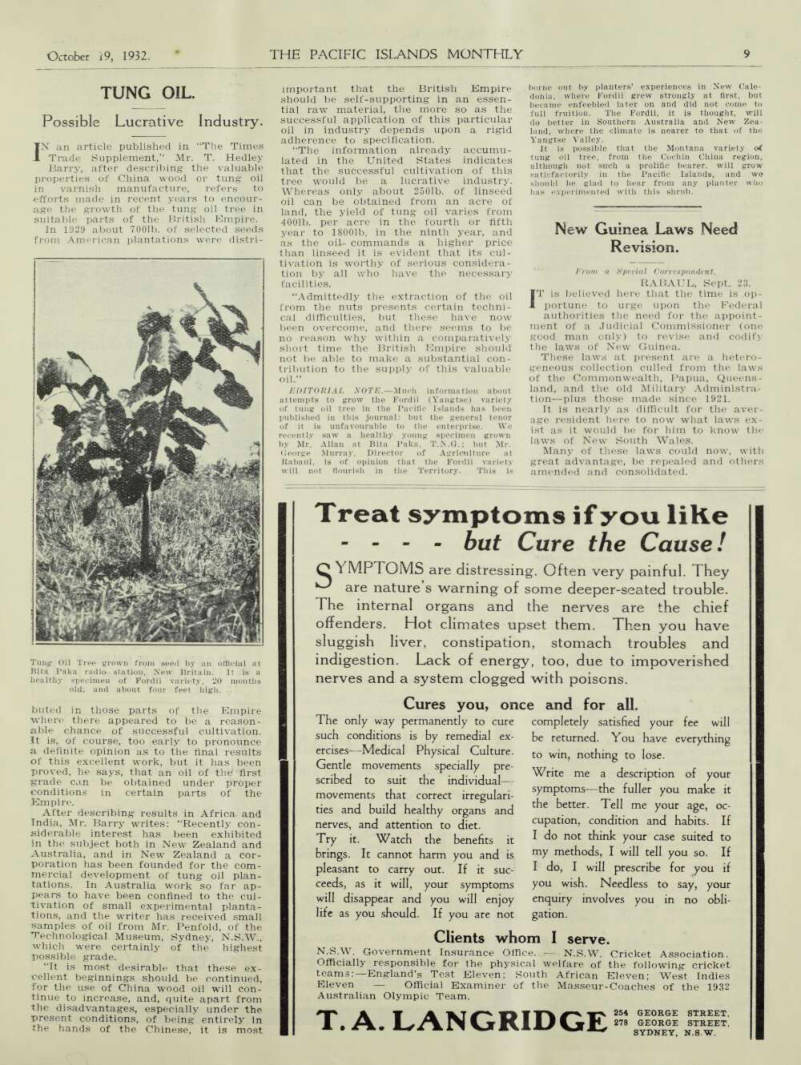
EDITORIAL NOTE. —Much information about attempts to grow the Fordii (Yangtse) variety of tung oil tree in the Pacific Islands has been published in this journal: but the general tenor of it is unfavourable to the enterprise. We recently saw a healthy young specimen grown by Mr. Allan at Bita Paka, T.N.G.; but Mr.
George Murray, Director of Agriculture at Rabaul, is of opinion that the Fordii variety will not flourish in the Territory. This is
borne out by planters’ experiences in New Cale donia, where Fordii grew strongly at first, but became enfeebled later on and did not come to full fruition. The Fordii, it is thought, will do better in Southern Australia and New Zea land, where the climate is nearer to that of the Yangtse Valley.
It is possible that the Montana variety of tung oil tree, from the Cochin China region, although not such a prolific bearer, will grow satisfactorily in the Pacific Islands, and we should be glad to hear from any planter who has experimented with this shrub.
Tung Oil Tree grown from seed by an official at Bita Paka radio station, New Britain. It is a healthy specimen of Fordii variety, 20 months old, and about four feet high.
New Guinea Laws Need
Revision.
From a Special Correspondent.
Rabaul, Sept. 23.
IT is believed here that the time is op portune to urge upon the Federal authorities the need for the appoint ment of a Judicial Commissioner (one good man only) to revise and codify the laws of New Guinea.
These laws at present are a hetero geneous collection culled from the laws of the Commonwealth, Papua, Queens land, and the old Military Administra tion —plus those made since 1921.
It is nearly as difficult for the aver age resident here to now what laws ex ist as it would be for him to know the laws of New South Wales.
Many of these laws could now, with great advantage, be repealed and others amended and consolidated.
Advertisements & other items, p. 11 (1 item)
Langridge
Treat symptoms if you liKe
- - - - but Cure the Cause!
SYMPTOMS are distressing. Often very painful. They are nature s warning of some deeper-seated trouble.
The internal organs and the nerves are the chief offenders. Hot climates upset them. Then you have
sluggish liver, constipation, stomach troubles and
indigestion. Lack of energy, too, due to impoverished nerves and a system clogged with poisons.
Cures you, once and for all.
The only way permanently to cure such conditions is by remedial ex ercises—Medical Physical Culture.
Gentle movements specially pre scribed to suit the individual— movements that correct irregulari ties and build healthy organs and nerves, and attention to diet.
Try it. Watch the benefits it brings. It cannot harm you and is pleasant to carry out. If it suc ceeds, as it will, your symptoms will disappear and you will enjoy life as you should. If you are not completely satisfied your fee will be returned. You have everything to win, nothing to lose.
Write me a description of your symptoms —the fuller you make it the better. Tell me your age, oc cupation, condition and habits. If I do not think your case suited to my methods, I will tell you so. If I do, I will prescribe for you if you wish. Needless to say, your enquiry involves you in no obli gation.
Clients whom I serve.
N.S.W. Government Insurance Office, r— N.S.W. Cricket Association.
Officially responsible for the physical welfare of the following- cricket teams:—England’s Test Eleven; South African Eleven; West Indies Eleven Official Examiner of the Masseur-Coaches of the 1932 Australian Olympic Team.
T. A.
LANGRIDGE
264 GEORGE STREET.
278 GEORGE STREET,
SYDNEY, N.S.W.
About Islands People.
Mr. William Keppie, formerly en gineer of the Papuan Government ves sel “Laurabada,” and for many years in the Papuan service, left Sydney by the September “Macdhui” on a holiday visit to the Territory. He became seri ously ill, from peritonitis, and was in too low a condition for an operation when the “Macdhui” reached Port Moresby. He died a few hours after his arrival. The Lieut.-Governor (Sir Hubert Murray), Government officials and leading residents attended the funeral. * • * Mr. J. Nason-Jones, F.G.S., F.R., G.S., M.lnst.P.T., left by the September “Macdhui” for New Guinea, where he will engage in scientific gold prospect ing in hitherto unpenetrated areas. He is a geologist by profession and was in charge of various surveys conducted in New Guinea and Papua by the Anglo- Persian Oil Company on behalf of the Commonwealth Government during the years 1927-1930. He was also geologi cal observer to the Papuan Survey Flight of the R.A.A.F. For six years he was engaged upon geological surveys and oil search in Persia, Russia and Iraq. He is now returning to active field work, after completing eighteen months special study at the University of Vienna. * * * Sir Murchison Fletcher, Governor of Fiji, will leave the colony on Novem ber 18 on seven months’ vacation. Dur ing his absence, the Colonial Secretary (Mr. A. W. Seymour) will administer the affairs of the Colony. * * * Rev. R. I. H. Stockdale, of the Angli can Mission Society, has been appointed to work in New Guineas. He left Brisbane for Samarai, by the “Mac dhui,” on September 24 and spent several weeks in the New Guinea Mis sion there with a view to gaining ex perience of native work before pro ceeding to Rabaul. * * * Mr. D. C. McFadyen, who was well known as a member of the staff of Messrs. Burns, Philp (S.S.) Co., Ltd., has been appointed manager in charge of the firm’s new branch in Pago Pago, American Samoa. This is an interest ing event, not only because Mr. McFad yen is well and favourably known in the Central Pacific Islands, but also be cause this appears to be the first branch of the Burns, Philp (S.S.) Co., Ltd. to be established in territory out side of the British Empire. Mr. Mc Fadyen, therefore, becomes something of an ambassador as well as a commer cial manager. * * * Mr. A, N. Lussick, of Kavieng, New Ireland, with his wife and family, ar rived in Sydney by the “Macdhui” on September 14, on a brief holiday. * * * Mr. C. J. Thompson, Kavieng (N.G.). manager for Messrs. W. R. Carpenter and Co., Ltd., is at present spending short leave in Sydney. * * Mr. J. G. Nelson, M.L.C., of Papua, arrived in Sydney by the “Montoro" early in October.
Nurse Clark, of the Methodist Mis sionary Society, returned to her work among the Indians in Fiji, after a short holiday in Sydney. She sailed by the ''Niagara” on September 15. * * * Mr. A. H. Wilson, Government Sur veyor, Solomon Islands, is absent on long leave. * * * Nurse Dorr, of the Methodist Mission in New Britain, returned to Melbourne recently, as she has retired from active mission work. She spent five years in New Britain. * * * Bishop H. Newton, of New Guinea, arrived in Sydney on September 14, and later addressed meetings on behalf of the Australian Board of Missions. * * * Mr. A. F. Grimble, M.A., C.M.G., Resident Commissioner in the Gilbert and Ellice Islands Colony, arrived in Sydney on September 5, en route to London. He has spent 18 years in the Pacific, and is not returning there.
Mr. Harry Bond, a well-known planter and owner of a plantation in the Arawe district. New Britain, was drowned when his schooner “Aliwa” was wrecked near Siassi Island. Mr. Bond was one of the oldest and most respected residents of the Territory, having lived there for nearly 20 years. He spent most of his time at Arawe, on the south coast of New Britain, where he was formerly the manager of Arawe Plantation for the German firm H.S.A.G.. and later for the Expropriation Board. * * * Mr. C. G. Kilner, of Messrs. Burns, Philp and Co.’s staff at Kavien, New Guinea, has been transferred to Kieta to relieve Mr. A. E. Ray, who left the Territory for Svdney by the September “Macdhui.” * * * Mr. Fred. Green, of Gizo, Solomon Is lands, came south by the “Mataram,” which reached Sydney on October 13.
Mr. Green, who is very well-known throughout the B.S.I., is on a combined, business and holiday trip. * * * Captain J. M. Rondahl, a former well known resident of New Guinea, died at his home in Roseville, New South Wales, on September 24. He was born in Sweden in 1860 and arrived in the Territory in 1891, as mate of a small schooner. Several years later, after an adventurous career, including trading in the Fead Islands, Captain Rondahl commenced trading at Kabanga and later bought the Kabakaul property, which has been his business head quarters ever since. He had control of various plantations at Kulon and Ma kurapau until he disposed of his pro perties in 1929 and retired to live in Sydney.
N.Z. Banana Market Improves.
From Our Own Correspondent.
Apia, Oct. 2.
THE “Maui Pomare” left here on Sep tember 22 for Lyttleton, Via Niue, with a cargo of 5,140 cases of bananas.
During the first week of September, the price of bananas in the Auckland market went up by 7/- to 25/- per case for ripe repacked bananas.
Unfortunately, Samoa producers will not receive the benefit of this rise, as the Samoan price is fixed by contract.
While the producer is paid at the paltry rate of 2/- per case or less, the New Zealand dealer will rake in the hand some profit of 10/- to 12/- per case.
Advertisements & other items, p. 12 (1 item)
Sunshine Harvester Works
Samples and prices on application.
BIRKMYRE’S CLOTH.
The best waterproof for motor car hoods, tarpaulins, horse and cow rugs, etc. Canvas of all kinds, cotton ducks and hessians, seaming, bagging and shop twines. Fishing nets and yarn, fishing lines and tennis nets.
THE GOUROCK ROPEWORK EXPORT CO. LTD.
397 KENT STREET, SYDNEY, N.S.W.
SUNSHINE PLANTATION IMPLEMENTS
Specially Designed for Queensland & Island Planters.
Here illustrated is the
“Satellite” No. 80 Cultivator or Scuffler.
A light horse or a bullock can haul it.
Price only £ 2 : 10 : 0. (Australian currency).
Delivered to Steamer.
All-steel frame expands from 12 to 30 inches wide.
Equipment includes four 3-inch points, one 7-inch shovel point, an extra 3-inch point and a spanner.
Write for a free Catalogue of all Sunshine Implements, to the
Sunshine Harvester Works
SUNSHINE, Near MELBOURNE, AUSTRALIA.
(Also SYDNEY and BRISBANE.)
Office.”
“Hand Samoa Over to Colonial Office.”
The following- letter from Mr. Ernest Davies, a leading merchant and public man in New Zealand, was published in the Auckland “Star” on August 17; While I was in Fiji recently I had numerous opportunities to discuss with prominent persons the subject of our administration of Samoa.
The view that the islands should be handed over to the Colonial Office was almost universal.
While people were not ready to discuss our Samoan troubles, the unmistakeable impression I gained, was that New Zealand had failed and was continuing to fail because we could not sup ply trained administrators, nor could we supply civil servants trained to handle a native race.
The natural corollary to this was that the Mandated Territory of Samoa should be handed to the Colonial Office in Downing Street to govern.
The Colonial Office has trained officials to call upon, and moreover I believe the Samoans themselves would prefer to be governed direct from Downing Street and not by New Zealand, which admittedly has been looked upon by the natives with such disfavour.
The impressions I gai.ed in Fiji and from people recently returned from Samoa are that this disfavour continues and I think New Zea land would be well advised to ask the Colonial Office to take over the administrations of the Western Samoan Territory.
New Zealand And Her
Mandate.
[To the Editor ] Sir, —Again I have to thank you for your courtesy in printing, in full, my somewhat lengthy letter of July 7 and also for correct ing the mistaken idea that I am owner of the “N.Z. Samoa Guardian” and responsible for all its contents, though your use of the possessive pronoun in your footnote now implies that its editor is mine, anyhow.
I do not wish to appear contumacious or determined to have the last word, but I must, reluctantly, again protest at the wrongful im plications in your August footnote.
I am not dominated by “hatred of New Zea land” and never have been. After five years’ compulsory exile here I find much to like and admire in the country, and have met innumer able friends of Samoa, whom I have the greatest respect for. But I certainly hate cruelty and oppression and the sufferings of my people and my blood relations in Samoa have filled me with the greatest contempt for those responsible.
I have no option but to face the facts as I see them, and one fact is that if New Zealand has been carrying out the terms of the Man date, which Versailles declares “a sacred trust of civilisation” and “the tutelage of a people unable to stand alone in the stress of modern world conditions,” then words have lost their meaning, and a policy of coercion, oppression, degradation, massacre, and war on a helpless people has become the spirit of “sacred trus teeship” and of Geneva.
But even the League of Nations has rebuked
the New Zealand Government for its conduct of the Mandate on more than one occasion, as a perusal of the findings of the Permanent Man dates Commission will disclose, and the report of the Verschaffelt-Park-Berendsen Inquiry was a tremendous revelation of maladministration, which shocked the League of Nations, especially when the New Zealand Government’s own public servants told it the administration of the Man date “was in no way creditable to New Zea land.” Nor has it been since that scathing exposure.
You also suggest “that the only way out of the present impasse is by a proper approach by the Mau to the New Zealand Government.”
I enclose a copy of such an approach, which the Mau made on August 31. together with the amazing reply of General Hart, the Adminis trator. In the face of this gesture by the administrative head towards a national organ isation representing 95 per cent, of the Samoan people, I presume you will no longer think much of your “only way of the present im passe.”
I am, etc..
O. F. Nelson.
Auckland, Sept. 14, 1932.
The exhibit of Fiji butter displayed at the recent Winter Exhibition in Auckland was received with much in terest. In the oversea butter section, the Fiji “Dove” brand was the only sample to be placed in the first grade.
Advertisements & other items, pp. 13-14 (2 items)
11
October 19, 1932.
THE PACIFIC ISLANDS MONTHLY
SAMOAN PROBLEM
(Continued from Page 4.)
Nelson And Robertson
Island Traders & Garages
A leading Motor Accessory and Re placement Parts House desires Representation in the Islands, and would be glad to hear from respon sible and interested parties who would be prepared to act in the capacity of an Agent.
All lines carried are fully guaranteed, and service a d attention is assured.
For general guide to the lines, we refer you to the advertisement appearing in the columns of this publication.
HISLOP, LLOYD, LIMITED,
SYDNEY.
NELSON and ROBERTSON
ISLAND MERCHANTS. [Established, 1895.]
Copra, Cocoa, Trocas Shell and other Island produce sold on commis sion. All classes of Merchandise purchased and original invoices supplied.
Agents for SKANDIA CRUDE OIL ENGINES. Marine and Stationary, powers from 5-h.p. up.
PENTA MARINE ENGINES, Outboard and Inboard types.
PUMPMOBIL, the only portable pumping plant manufactured, light in weight and reliable. Suitable for mining work.
UPSON WALL BOARD, in both Plain and Tile pattern, strong and light.
Non-conductor of heat and cold. British manufacture.
Also New Guinea, Papuan and Samoan representatives for the famous
CHALLENGER KEROSENE BATH HEATER
Communicate with
NELSON & ROBERTSON
12 SPRING STREET SYDNEY, AUSTRALIA
Telegraphic Address: “IVAN SYDNEY.”
T. ELLIOTT & CO.
(Established 15 years)
Real Estate Agents, Valuers,
Flat Specialists.
Controlling Agents for Principal Flat Buildings in Sydney, Darling hurst, Potts Point, Elizabeth Bay, Darling Pt., Edgecliff, Pt. Piper, etc.
When contemplating a visit to Sydney write regarding your re quirements and see us immediately on landing, and our services will be at your disposal.
72 DARLINGHURST ROAD,
(Opposite King’s Cross Theatre),
King’s Cross, Darlinghurst,
SYDNEY.
Telephone: FL 1968.
Sutton's
Canned Vegetables
Green Peas, In 1lb. and 2lb. Tins.
French Beans (Sliced) in 1lb. Tins.
Carrots, In 1lb. Tins.
Beetroot (Sliced) in 1lb. Tins.
Packed by
Delicia Food Products Co.
WATERLOO, N.S.W.
TRY THIS FREE!
A sample block of Pearson’s Carbolic Sand Soap will be posted free on request.
State usual grocer’s name when writing.
Pearson’s Sand Soap cleans and disinfects . . . helps to banish germs and vermin. It saves labour, too.
PEARSON’S CARBOLIC
SAND SOAP.
Made by Pearson Soap Co. Ltd. Rozelle N.S.W.
Primage On Territory
Products.
Anomaly Which Requires Attention.
THE following correspondence is self explanatory. Those who ship pro duce from Papua to Australia will heartily endorse the ancient saying that “the law is a hass.”
We have sent the correspondence on to the Sydney Chamber of Commerce, in the hope that representations may be made to the Federal Government, to give to Papua and New Guinea the same advantages as Norfolk Island.
Letter from editor of “The Pacific Islands Monthly” to Collector of Cus toms, Sydney, dated June 23, 1932: Dear Sir, —Some of our readers have asked us to ascertain why primage is charged on goods imported into Aus tralia from Papua, whereas there is no primage charge on similar goods im ported into Australia from Norfolk Is land. Both places are Territories of Australia and both are similarly gov erned from Canberra through Admin istrators in each place. If you could let me have a brief explanation of the position, I should be glad of your per mission to publish same for the in formation of a number of readers who appear to be somewhat puzzled by the circumstances.
Letter from Collector of Customs to “The Pacific Islands Monthly,” dated September 30, 1932: Dear Sir, —With reference to your letter of 23.6.32, relative to Primage Duty on goods imported into Australia from Norfolk Island and Papua, I quote hereunder for your information, Sec tion 15 of the Norfolk Island Act, 1913: “Duties of Customs shall not be chargeable on goods imported into Australia from Norfolk Island if the goods— (a) Are the produce or manufacture of Nor folk Island: and (b) are shipped direct from Norfolk Island to Australia; and (c) are not goods which if manufactured or produced in Australia would be subject to any Duty of Excise.
Primage duty being duty of customs is not, therefore, chargeable on goods from Norfolk Island exempted from duty under the above quoted section.
As no similar provision to that shown above is embodied in the PapuaAct, 1905-24, Primage Duty is chargeable on goods imported into Australia from Papua.
Aviation In Papua.
Additional Landing Grounds: New Air Mail Postage Rates.
From Our Own Correspondent.
Pt. Moresby, Oct. 2.
WITHIN the last month, two emer gency landing grounds have been completed in the heart of Papua, for the use of Guinea Airways, Ltd.
One of these is at Kabuna, in the Mekeo district, beyond Yule Island, and the other is at Kokoda in the Owen Stanley Range, near the Yodda gold fleld. The former is for the conveni ence of aircraft flying between Port Moresby and the Morobe goldfield in New Guinea, and the latter has been established for the purpose of facilitat ing transport to the Yodda, where min ing operations have been restarted.
Mr. Ward Williams, the American mining expert, was the first passenger from Kokoda to Port Moresby.
It is likely that the next emergency landing ground will be established at loma, which is in the mountains near the border of Papua and New Guinea.
Mishap At Kabuna.
Mr. Denny, a Guinea Airways’ pilot, on landing to inspect the emergency ground at Kabuna on September 15, damaged the undercarriage of his machine. Mr. Denny was uninjured.
Being unable to repair the under carriage, the pilot found it necessary to secure the services of some 40 natives in order that the ’plane could be car ried 15 miles through the jungle to the St. Joseph River. This was a big task.
It was then shipped down the river to Yule Island on the Catholic Mission punt and reached Port Moresby by the steamer “Papuan Chief” four days after the accident.
A Junkers-34 8-passenger ’plane is to taske the place of the present Junkers on the New Guinea goldfields to Port Moresby service. The old one is to be overhauled and refitted with a higher powered engine.
Aerial Postage Rates.
The chief postmaster of Port Moresby announced on September 23 that air mail rates of postage are to be charged on mail matter for the New Guinea goldfield. Up to the present time, no extra charge has been made for mails.
They were carried by the courtesy of the aerial companies.
A contract has been now made for the carriage by air of mails from Papua to New Guinea. The charge is 3d. per ½oz. for first-class mail matter, in ad dition to the ordinary rates of postage.
All second-class matter will be carried without special air mail fees. This is subject at any time to alteration, as regards newspaper matter published) outside the Territory of Papua.
The new rates are: Ordinary letters 5d. per ½oz. - Ordinary letters 8d. per 1oz.
Newspapers, magazines, books (Papuan and Australian) .. . 1d. per 6oz.
Printed elsewhere 1d. per 4oz.
Printed papers 1d. per 4oz.
H.M.S. “Veronica,” the sloop of the New Zealand Division of the Royal Navy, arrived in Suva from Lautoka on August 25 and, after remaining in port for a week, sailed for Auckland.
Advertisements & other items, p. 15 (1 item)
Shell Oil
The dipstick
will prove it ...
DRAIN YOUR
CRANKCASE
and Refill with
SHELL OIL
THE DIPSTICK
WILL PROVE ITS
GREATER MILEAGE
AND ECONOMY
START TESTING TODAY
SHELL OIL
is better
the shell company limited
N.G. Goldfields Ltd.’s September
Report.
THE following report for September has been issued by the Mining Trust, Ltd., consult ing engineers for New Guinea Goldfields, Limited —
Development.
Location 3—No. 1 shaft was sunk 42ft. to 66ft. below No. 1 level.
Location 8—No. 4 shaft was sunk to a total depth of 204 ft.
Golden Ridges Extension—A length of 400 ft. has so far been proven by seven trenches. The average assav of samples from these trenches was 13.08 dwts. gold and 2.3 ozs. silver over an average width of 10.9 ft.
Production.
Mill— The usual difficulties of starting a mill with unskilled labour have been increased by unusually heavy rains. The plant is being run on a small tonnage, and crews are being trained.
The alluvial operating profit for August from the low-grade ground reported last month was £4,823, Australian currency.
The September output has not yet been re ported.
General Griffiths.
Created a Spirit of Confidence
In N.G.
A LEADING planter of New Guinea makes the following comment upon the article, which appeared in the August issue of “The Pacific Islands Monthly,” entitled “ ‘Tropicalia’ and Other Things in New Guinea and Papua”: “I agree largely with your August article. There is not a doubt that General Wisdom had exhausted his capacity for good administration, but you are right in not using the ‘muck rake.’ It must not be forgotten that General Wisdom took up his job with a staff untrained and, in many instances, unfitted. Also, the Commonwealth Government was not always very helpful to him. Our regret is that General Griffiths will not be here long enough. I think the Commonwealth Government should make a special effort to keep him here for 18 months,
otherwise all his good beginnings will be wasted —especially if his successor does not follow the Griffiths’ policy of recognising that the public are after all the people whose interests are the most imporant.
“General Griffiths has created a won derful atmosphere and spirit of con fidence. He has most effectively broken down the barrier, which Central Ad ministration, in particular, had erected for the exclusion of the public. His outstanding policy is ‘give the public every facility to place its views before the authorities and let very responsible public official avail himself of all op portunities to know the public mind.’
“We very much want the Adminis trator to have the opportunity to visit all out-stations and see that the new policy is extended there effectively be fore he leaves.
“Who will be the new Administrator?
Many are mentioned, but we do hope that we get a worker, who will not allow subordinate officials to usurp his functions. We also want one who will be capable of keeping himself under the heels of the politicians.
"We mostly recognise the natives’ rights and the need for their proper protection and care, but we don’t wish to see a policy of ‘the native above all’ —which one or two district officers are rather inclined to favour.
“The announcement of the early in troduction of a Legislative Council has caused much satisfaction here. It seems, though, that only one unofficial member is to be on the Legislative Council. There should be two or, fail ing that, provision for a substitute member; otherwise, in the event of sickness or other cause necessitating the one member’s absence, the non official portion of the Council would be unrepresented.”
In Quest of Sepik Gold.
From Our Own Correspondent.
Madang, Sept. 19.
MR. WINTERS, mining engineer of Wau and Bulolo, accompanied by Mr. Alf Belfield, an old and ex perienced prospector, has returned to Marienberg, after visiting the upper reaches of the Yuat River, a tributary of the Sepik, some 80 miles from its mouth.
Mr. Winters reports the country very rough with many boulders and, al though gold bearing, the cost of pro duction would be too great for him to recommend the proposition to a com pany. Mr. Winters later returned to en route to Salamaua by the “Montoro.”
It is Mr. Belfield’s intention to now proceed to the reaches of the Upper Sepik for further test on wash that has shown good colour, in the hope that he may yet find the source of the Sepik gold. On this trip he will be accom panied by Messrs. J. C. Wauhope and R. Wightman.
Prospecting North Of Madang
Mr. A. J. Hunter, late D.O. at Mad ang who several months ago, in com pany with Mr. Banks, mining engineer, and Mr. Coomb, inspected a platinum and gold bearing area behind Dugnmor, seme 70 miles north of Madang on the coast, returned by September Mac dhui."
Mr Hunter is this time accompanied by Mr. Phipps, another mining engi neer, and together with all mining gear they have again gone to the area for further prospecting and tests.
Advertisements & other items, pp. 16-18 (2 items)
It’s ready
YOUR COPY OF
THE NEW
KODAK Catalogue
Hot from the press —a magnificent production —ninety-six pages just overflowing with illustrations and interesting reading matter covering every new development in modern
photography.
This beautiful production will certainly strengthen your conviction that photography is the hobby supreme.
There’s a copy reserved for you. Write or call at any Kodak Branch. Post free on request.
KODAK (Australasia) PTY LTD.
379 GEORGE STREET, SYDNEY.
Mobiloil
Economical
Transport
Economical transport of copra and other commodities depends largely on the efficient maintenance of the auxiliaries of your schooners and other vessels.
One of the most important factors is lub rication. With the correct grade of Mobiloil, you will get greater power; and wear will be reduced to a minimum. Lower maintenance cost, fewer repairs and longer
engine life, and positive insurance against
breakdown, are results that follow the use of Mobiloil. In your car too, Mobiloil, means fewer replacements and smoother
running.
For the most economical operation of engines, lubricate with Mobiloil, always.
Mobiloil
The 'World* Oil
Vacuum Oil Company Pty. Ltd.
ISLANDS STAMPS.
WANTED TO PURCHASE.
Collections or Loose Lots.
Highest Prices Paid.
We carry a large stock of Stamps of all kinds Want Lists Solicited. Approval Selections sent on Request. Send for Free Lists and Specimen Copy “Australian Stamp Journal.”
J. H. SMYTH LTD.,
121a Castlereagh St., SYDNEY.
BUILDING
SUPPLIES
Complete Stocks of Seasoned Timber of all descriptions on hand for immediate shipment.
Galvanised Iron, Fibro- Cement, Glass, and Builders' Ironmongery.
SEND FOR OUR CATALOGUE
OF READY-CUT HOMES AND
ISLAND BUNGALOWS.
A. C. SAXTON & SONS
LTD.,
Box 5, PYRMONT, SYDNEY.
FOR YOUR ISLAND HOME.
WUNDERLICH CEILINGS will enhance the beauty of your Island Home. Write for a free copy of our Homebuilders’ Catalogue M. 43.
Choose your design and tell us the sizes of the rooms you desire to ceil. The ceiling materials, together with a drawing, to assist you when fixing, will be forwarded by return steamer.
Wunderlich Ceilings are quickly and easily erected; furthermore, they pack compactly and cost very little to transport.
WUNDERLICH LIMITED, Manufacturers, Showrooms: Baptist Street, Redfern, Sydney.
WUNDEFULICH
ART METAL CEILINGS
M 2828
New Guinea.
What Medical Science Has Done For
[To The Editor.] Sir, —It was with interest and not a little inward chuckling that I read your article on New Guinea in the August issue.
You certainly have placed your fingers on a few vibrant chords. I do not intend to criticise Administration methods of running this vast Territory (most of us could successfully run a Territory—perhaps!) except in one in stance, which is at variance with your statement that the Administration does not foster private enterprise.
With regard to the Malaria problem and public health. I certainly disagree with what you say. During 1915 I sampled Rabaul as a health resort (?) and venture to state that malaria then and now are two vastly different dis eases. Kavieng, 1915-1916, ditto. Lor engau, Manus, 1916-1919, ditto; also Madang, 1921-1929. The difference can hardly be described, as from 20 to 15 years ago Madang was recognised as a veritable death-trap in these islands.
Now it is as healthy as most places up this way. This was brought about by P.H.D. activities, draining the town ship and nearby swamps and enforcing sanitary regulations by court fines, etc.
Rabaul it was recently stated, was entirely free from the anopheles and malaria. I do not altogether agree with that statement, but I will say it is a much healthier place to live in now than it was at the time of changing hands in 1914, despite the fact of the enormously increased population, which
entails more supervision from a health point of view. Many improvements have been made and much P.H.D. at tention given to combat the fever breeding pest. Private enterprise and population have not done this entirely, so must credit the medical department for a little of the work and thought in this matter of Mr. Anopheles, who has decreased his activities here, I should say, by at least 80 to 90 per cent, in the past 18 years.
Malaria is a much misused term in many instances up here; and our nose diving friend with the spotted wing gets the blame very often for things he does not do. One kind of malaria is caused by that very interesting occu pation of taking crimped tops off bottles—the symptoms usually show up the morning after. (I know, because I’ve had it.) Of course, enterprises and plantations outside Administration Centres natur ally must attend to their own health, and the extinction of the Anopheles, in their immediate vicinity. Advice as to how this could be done would, I am sure, be supplied by those who know how, upon request to the right quarter.
With regard to the Administration not fostering private enterprise—Mr.
Editor, you are wrong. In one instance, anyhow. Why is it that a person not employed by the Administration may not obtain the services of the Adminis tration doctors who, we are to believe, are Public Health officials? The two doctors practising privately may be ex cellent and very efficient men at their job, but surely the public should be per mitted to choose their own physician — especially as some of the Administra tion doctors have almost reared one’s own children from birth and through the few years of the little one’s life in not a few families in this Territory.
This state of affairs has only just re cently come to pass in Rabaul. There is a mistake somewhere that should be rectified. The Administration fos ter private enterprise.
Other articles on this Territory by your pen will be looked for with relish.
More power and success to your P.I.
Monthly!
I am, etc.,
Territory Resident.
Rabaul, Sept. 18, 1932.
EDITORIAL NOTE. —We are glad to publish this tribute to the good work of the Health Department of New Guinea. We freely ac knowledge that this Department, working along orthodox lines, has done much to render the town fit for European occupation. But the Ter ritory generally is still full of malarial fever; and our complaint is that the Department ap parently has made no attempt to deal with the general problem of preventing infection through the Anopheles Mosquito. There was, for in stance, the discovery of a predacious mosquito which feeds upon the larvae of the Anopheles when the latter is deposited in tree-water; yet nothing has been done to cultivate and study the predacious insect, with a view to using it to control the Anopheles. The problem of con trolling malaria by such means is an enormous one; but the benefits to be gained by even a small measure of success in that direction are equally enormous, and worth working for.
Savagery Of Sentence On Larkin
Confirmed By Parliamentary Inertia.
THE following is a report of a debate which took place in the House of Represen tatives, Canberra, on an adjournment motion, at the end of September. The case of Larkin is well-known in the Territory.
MR. R. GREEN: I desire to bring under the notice of the House, the case of a planter named James Joseph Larkin, who was sentenced in the Cen tral Court at Rabaul by Chief Judge Wanliss, to ten years hard labour after being convicted of the murder of a native named Sambung.
Larkin was in charge of the Noru Plantation, which he purchased from the custodian of expropriated proper ties in 1928. Prior to that, for about seven years, he had occupied the position of plantation manager in the territory for the board, having gone to New Guinea upon his return from the war, where he held a commission in the Air Force. About 50 native boys were employed on Noru, and the nearest white man, other than Larkin himself, was 40 miles away. Larkin, at the time, was in partnership with Mr. Edgill.
The evidence shows that on Satur day afternoon, October 24, Mr. Edgell sent three of his native boys to Noru plantation from another plantation about 80 miles distant, with instruc tions to remain on Noru for about three weeks. When they arrived, Larkin was in bed suffering from a bad attack of malaria. No work was done on Sunday, and on the Monday afternoon the three boys approached Mr. Larkin, and stated that they wanted to return immediately to Mr. Edgell. Larkin had given them some work to do, but, as he was in bed, he was unable to supervise them.
Sambung, the youngest of the three became insolent to Larkin. The atti tude of the three boys was really a direct challenge to Larkin’s authority.
He asked them why they wanted to leave, and Sambung told him that Edgell, and not Larkin, was their master. Because of Sambung’s insol ence, Larkin, who was in pyjamas, made a step towards the boy, but did not lay hands on him. Sambung then attacked Larkin. He got him down on the ground, bit him on the arm, and broke one of the bones in Larkin’s right hand. As he was being badly knocked about by Sambun, Larkin called to his cook-boy, who came and pulled Sambung off.
Larkin then washed away the blood caused by his injuries and immediately ordered his cook-boy to call some of his other native boys. Sambung was then seized, and spread-eagled on the verandah and beaten with a cane by the cook-boy. The evidence does not disclose how many strokes were ad ministered. Larkin said there were about 30 or 40, and as the native wit nesses are unable to count, they could not say. All this happened within the space of about five minutes.
At about 7 o’clock in the evening, Larkin went down to the native quar ters and found Sambung lying on a native blanket on the floor. The skin of one of his buttocks had been abrased by the cane and the wound
was in contact with the blanket. Mr.
Larkin had the injury bathed with Condy’s fluid, and, having applied olive oil to the damaged skin, gave the boy a clean bed sheet. He visited Sam bung again on the following morning and gave him further treatment. The boy was then able to walk about.
On the following Wednesday, the district officer arrived at Larkin’s plantation on his usual departmental inspection, and at about 2 o’clock made mention of Sambung’s condition. They then went down and found the boy sitting up in bed in a better house, to which he had been removed from the
native quarter. Sambung showed the district officer the injuries caused by the cane, and the district officer ordered his removal to Manus hospital for treatment.
Sambung made the journey in a small schooner, and during the voyage, which occupied 6 or 7 hours, received no attention whatever. When he ar rived at the hospital, he was in a state of collapse, and died shortly after wards. Mr. Lambert, the medical as sistant who saw the boy, is not a duly qualified medical man, the nearest doctor at the time being about 300 miles distant. In his evidence, Mr.
Lambert said that the boy had died from gangrene and shock. He ad mitted that the boat trip would have had a detrimental effect on the boy’s condition.
No Trial By Jury.
Following Sambung’s death, Larkin was brought to trial before Judge Wanliss, and, being found guilty of wilful murder, was sentenced to 10 years’ imprisonment.
Medical evidence called on behalf of
Larkin was to the effect that a caning on the buttocks was unlikely to cause death, but that direct contact with a native blanket would, in all proba bility, cause gangrene, and that the boat trip from Noru to Manus would have aggravated his condition. All the evidence before Judge Wanliss came from native witnesses, with the excep tion of Mr. Lambert, and as the judge does not understand the native language, he had to rely entirely upon an interpreter.
There is no trial by jury in New Guinea. Lambert, a man in the middle forties, was the principal witness as to the cause of death, and he is not a fully qualified medical man; his status would be equivalent to that of a person competent to render first aid.
Larkin was convicted of wilful murder, and the charge of murder is not laid if the person accused does not commit the crime with murderous in tent. In Larkin’s case, there certainly was no murderous intent. All he did was to have the boy spread-eagled and chastised, as a schoolmaster would punish an unruly pupil for insolence.
Even if the punishment was severe, Larkin had no intention of doing the boy serious injury.
MR. GABB: He admitted that 40 strokes of the cane were administered.
MR. MAXWELL; Has the honour able member given all the evidence submitted to the judge?
MR. GREEN: I have stated the facts as I know them.
MR. MAXWELL: The judge is one of the fairest-minded men who has ever sat on the bench.
MR. GREEN: I am not condemning him, but I am pointing out that Larkin had no murderous intent, and did not intend to inflict even grevious bodily harm. Yet, as I have pointed out, he was found guilty, not of man slaughter, but of murder. The nearest white man was 30 miles away, and the neighbourhood was not particularly quiet. Being an isolated white man, he had to maintain some semblance of discipline on his plantation.
Some Comparisons.
A month or so after this episode, Chun Wun, an old Chinaman, who managed an adjoining plantation, was murdered by a plantation boy. In 1921, at a place in the same group of islands, Reiss, a German landholder, was mur dered by natives, and the trouble started in a manner similar to the attack on Mr. Larkin. It is a fright ful indignity for the master of a plan tation to be “worsted” by a native.
There are about 75 boys working on the plantation, and if Larkin could not maintain discipline he would have to leave the plantation. Those familiar with native life know that the “boys" will always try a man out at least once, and it is essential for him to show that he is the absolute master, no matter under what circumstances his authority is challenged.
MR. JAMES: Do not the natives work under slave conditions?
MR. GREEN: Certainly not. Let us compare Larkin’s case, in which a sentence of ten years was imposed for murder, with a number of other cases in which lighter penalties were in flicted, for a I consider that Larkin’s sentence was excessive in every respect. Scott, a white man with one arm, was murdered in 1925. He was attacked by a native employee, and the
first blow he received resulted in his only arm being cut off. This left him incapable of defending himself. He was then practically hacked to pieces.
The verdict returned in that case was one of manslaughter; but I have yet to know a native who is capable of drawing a distinction between man slaughter and murder. All that the natives would know would be that one of their number had killed a white man, and had been sentenced to five years imprisonment for it. It was really a case of wilful murder, but the convicted man was not kept in gaol for the whole period of the sentence.
On the 27th August, 1929, a white man was convicted of having mur dered a native labourer. He had kicked him about the body with heavy boots, thereby causing his death. I understand that in the first place the white man was wearing sand shoes, but he afterwards changed into his heavy plantation boots for the purpose of punishing the native. He was con victed of wilful murder, and was sen tenced to two years hard labour.
In another case, a native named Poina wilfully murdered the manager of a plantation on which he was em ployed, by striking him on the head with a hammer while he slept. The native was sentenced to death, but the sentence was afterwards commuted to seven years’ hard labour.
When one compares those sentences with that in Larkin’s case, one ap preciates the extreme severity of the sentence imposed on him.
Twice recently I visited the territory concerned, and wherever I went the inhabitants were talking of Larkins case and of the severity of his sen tence. He had been grossly insulted, then assaulted, and afterwards he had the native beaten with a cane as a schoolmaster might punish an unruly pupil. As I have said, he had no in tention whatever of murdering him, or even inflicting grievous bodily harm.
After the punishment, he had the boys injuries attended to, and it is impos sible to say whether the native’s death resulted from the punishment. The person who gave the medical evidence, and who performed the examination, was not a qualified medi cal man. But it was on his testimony that Larkin was convicted.
I appeal to the Minister to review this case. When he ascertains what has been done in previous cases of a similar nature, and considers them in conjunction with such evidence as is procurable in Larkin’s case, I feel sure that it will be found that the sentence is out of all proportion to the offence.
Minister’S Reply.
MR. MARK (Minister for Health): The gravamen of the charge, I take it, is that the penalty inflicted was out of all proportion to the offence. I do not intend to express an opinion re garding the decision of the judge. The administration of the Mandated Ter ritory must be left to the officials ap pointed for that purpose. The judge in question was placed in his present position to administer justice in the islands in accordance with the law.
Shortly after I assumed control of the territorial services, this case was brought prominently before my notice.
I called for a full report, and the judge himself, through the administration, submitted a file of papers covering ten sheets of foolscap, setting out the whole of the facts from beginning to end. That file is open to examination.
The opening facts are practically as outlined by Mr. Green. There was a stand-up fight between the black man and the white. The evidence given to the court by the white man was, that the black man rushed in with his head pushing into his (the white man’s) chest. He grabbed the black man by the head, and closed with him. We know that at times trouble has been experienced in the islands. The New Guinea native especially is of primitive stock. White men at least know, or they should, the difference between right and wrong. The island native has not yet advanced to that extent. In administering its mandate in New Guinea, the Commonwealth has to per form the particular duty of safe guarding the interests of the natives.
If, during the heat of this fight, either the black man or the white man had been killed, I would have said that Mr. Green’s allegations were well founded. But this man, with his face spattered with blood, and his thumb broken from having been pressed over the verandah rail, retired and had a bath.
MR. GANDER: Still with his pyjamas on?
MR. MARR: No; he clothed himself in his white raiment. It is alleged that he was in his right mind He called his cookboy, who brought with him four other boys. The latter carried the native to the verandah or the bungalow, and, sitting on his arms and legs, held him down while the cookboy thrashed him with a walking stick. The accused, in his evidence to the court, stated that he told the boy to proceed to the bungalow and
fetch a stick. Here, are his own words: I told them to bring Sambung up on to the verandah. I told them to put him down and hold him fast, which they did. His arms were stretched out, legs extended out, with a boy holding each limb. I then walked into the dining-room, got a walking cane off the hat rack, calling the boy Ubahau at the same time. The top of the stick had a rooted end,, used as the handle part of the walking stick, gradually tapering to the smaller end, which was the size of exhibit B. Ubahau arrived, and I gave him the stick and said ‘You give him Sambung stick.” I did not tell him how many strokes to give Sambung.
Had the boy been told the number of strokes to give, and had the punish ment ceased when they had been given, there might have been less reason to take exception to it. But, when the cookboy was so fatigued that he could not continue, Larkin took the cane himself and went on with the thrashing. When he had had a “go,” he called upon another native to pro ceed with the castigation. As one be came tired, another took it over, until the boy who was being thrashed was in such a state that he could not even roll off the verandah, and was carried away by the natives, and thrown on to his wooden bunk in the hut.
I consider that Mr. Green was ill advised in bringing this case into the Commonwealth Parliament. I say that in the interests of the relatives of the man who was accused and found guilty. I have had many heartrending episodes in connection with his re latives. The news of his treatment of this native and the sentence imposed on him has been kept from his old father, who, up to the present moment, is not aware that such a thing hap pened. The judge, in his summing up, made most caustic reference to the fight, and to the manner in which the native was treated.
Under the mandate which they hold, the people of Australia, who have given the custody of these natives, owe a duty to the League of Nations. The black man, who cannot distinguish between right and wrong, is our peculiar charge. It is the duty of this Parlia ment, as well as of the people of this country, and particularly duty as Minister administering the territories, to see that the natives of the island are given a fair deal. In Papua, the administration under Sir Hubert Murray—a man whose name stands high in the annals of colonisation, and whose word is accepted unques tioningly—has never had an experi ence such as this. We have to be very careful, in the handling of our man date and the treatment of our natives, to show to the world that we are worthy of the trust that has been re posed in us. Probably, there are many faults in the black man. But we of the white race profess to be much further advanced than he in our civilisation. From the practical ex perience that I gained while living with the natives for some time, I can say that the native of New Guinea is most amenable to reason. He is a man who loves his children, and who jealously guards his “Mary.” The troubles in the islands are almost invariably caused by the interference of white men with the native women.
MR. MAXWELL: Mr. Green would not have touched the case had he known the facts.
MR. GREEN: I was supplied with the information by the people them selves.
MR. MARK: I agree with Mr.
Green’s contention that there may be some cause for complaint in that we have not the jury system in New Guinea. Since I became Minister in charge of the territories on the occasion, I have investigated the con ditions in other dominions, colonies, and protectorates. There is no British colony or protectorate that has the
jury system. They have assessors.
We have the assessor system in Papua, but it has never been availed of.
During my last term as Minister, in 1927-28 the assessor system was offered to New Guinea, but was not accepted.
MR. GREEN: They have the jury system in Papua.
MR. MARK; It obtains only in one particular spot, and no jury has yet been empanelled. There may be faults on both sides; but again I it is our duty to show the natives that we are anxious to see that they get justice.
MR. JAMES: Is it true that the rate of wages paid to the boys is only 4s. or 5s. a month?
MR. MARR: It is not a fact.
MR. JAMES: What is the rate?
MR. MARR: The rate is what the natives call one mark, which is equal to about 10d. a day. They are gener ally paid 1s. a day. It has been my experience that the natives will not take money.
MR. COLLINS: They would sooner have a bottle of rum.
MR. MARR: There is no intoxicating liquors in New Guinea. If the natives get liquor it is because the white man gives it to them. I have never yet found natives who willingly take liquor. Planters, traders, and miners have told me that they can give a native a case of whisky and he will carry it for eight days to the goldfields and not touch a drop of it.
MR. MAKIN; When were the labour conditions altered? When I was in the islands some years ago the pay was 5s. a month.
The "Summing Up.”
MR. MARR; The pay is 5s. a month and keep, but there are three years’ deferred pay and other conditions of employment. So many “lap-laps” are provided, and so on. Honorable mem bers who have visited the territory and who have seen natives at the time they were recruited, must admit that the recruiting is of inestimable value to the natives themselves. Natives are frequently brought in from the bush mere bundles of skin and bone. Of course, no native is forced to offer himself for service. He is taken be fore a magistrate and asked whether he is willing to “make paper.’’ If he says “No,” he simply goes back to his village again. But these natives, after having three square meals a day for a while, grow into practically new men.
The concluding paragraph of the judge’s summing-up in the Larkin case read as follows; To my mind it was abundantly proved, and there was no suggestion of any other cause of death. It was suggested that if he had not been taken in the pinnace to Lorungau he might have survived. The only possible chance he had of living was to be taken to Lorungau, where he would receive attention. If, as it was the case, it was necessary to take him in the pinnace, he had to be taken. He had to be taken in the pinnace or left to die where he was. The suggestion also that death was due to other causes also fails. The cause of death was the flogging. The shock, gangrene, etc., are all attributable to the flogging, and no thing else, and if ever a native was flogged to death this one was.
Now, I have stated that, in my opinion, the first assault, or the first fight, was the fault of the accused. The boy may have been, as he says, cheeky. That is quite possible, although he had only the accused’s word for it. There is the possibility that the boy was the attacker in that case, and, as it is a possibility, I am going to give the accused the benefit of that, but that is no excuse for what happened after wards.
The flogging, unfortunately, was a considered act, done after the heat of the struggle; after the other party to the struggle had gone and after Sambung had been brought back for
reasons of revenge and punishment. The re venge or punishment was brutal, cowardly and deliberate. The act was one which is a dis grace to the white race, and one of a type that discredits the territory. These things when they happen do more harm than many cases of vio lence by natives, and I cannot treat it as other than a very serious offence.
It has been pointed out to me that you served your country during the War. It may be that hardships of active service have affected you to some extent. That I do not know, but, at any rate, we know that you have served your coun try, and because of that your sentence will be lighter than would otherwise be the case.
When I took charge of the adminis tration of these territories (continued Mr. Green), and had this case brought under my notice, I was at first in clined to think that there was some justification for the view that justice had not been meted out to this man, but after I read the evidence and the judge’s summing-up, I could form no other conclusion than that the judge had summed-up in a masterly way and that the verdict was just. In these circumstances, I can see no reason why the Government or Parliament should intervene.
Advertisements & other items, pp. 19-21 (1 item)
"J.M.” Batteries
AND
Hisloyd Motor Accessories
J.M. Batteries, sturdy, strong and dependable, are in keen demand wherever long life and heavy duties are essential. Specially manufactured for MARINE, AUTO and RADIO work. They are guaranteed of full capacity and to function perfectly.
"J.M." MARINE AND AUTO BATTERIES.
Fully Guaranteed.
SYDNEY. PACKING AND CASES FREE.
SOLD SINCE 1925.
"J.M.” RADIO.
BATTERY.
MOTOR ACCESSORIES
“Service” Spark Plugs “Bosch Pyrox” Bendix brings Oil Filters Vulcanlzer, 5 min. .. Patches (12 to tin) Fuses, all cars (5 to tin Headlight Globes. 6 or 12 v Tail-light Globes, 6 or 12 v Piston Rings, Compress.
Piston Rings, Oil Scraper 4/6 4/6 2/- 16/- 5/- Tin 2/i 1/3 Each 1/3 9d. 1/- 2/- Bot.
Gasket Cement, 2oz. hot. 9d.
Hydraulic Jacks, 2-ton 39/6
"VOLTA" DRY BATTERIES
45-volt Single Duty . . 11/4 45 Double .. .. 18/8 45 Triple . . 23/- Torch Batteries, Round Bd- ,, Flat 17- Torches, Flat . . 1/6 Round, 2/6, 3/6, 4/6, SA- AR of our products are guaranteed of first quality.
Prompt shipment can be given on orders, and packing and cases are supplied no charge.
Send for our Price List,
“BATTERY CATALOGUE.
ISLAND AGENTS WANTED.
“J.M.”
CAR or MARINE
BATTERY.
BATTERIES ARE ALL FULLY GUARANTEED.
HISLOP, LLOYD, LTD.,
335/7 Pitt Street, SYDNEY.
Cable Address: “HISLOYD,” SYDNEY.
STEAMSHIPS TRADING COMPANY LIMITED,
Port Moresby PAPUA. Samarai
Shipowners, Wholesale and Retail Merchants and Traders; Shipping Customs and Insurance Agents.
AGENCIES:—At Port Moresby: Coral Sea Insurance Co.; Phoenix Insurance Co.; Port Romilly Sawmills; Acme Bakery Co. At Samarai: Royal Packet Nav. Co.: Yorkshire Insurance Co.; Coral Sea Insurance Co.; Papuan Rubber & Copna Co.
BRANCHES: —In Papua: Hanauabada, Sivitoi, Aroma, Koki, Hula, Ela Beach.
SYDNEY- NELSON & ROBERTSON, 12 Spring St.; Melbourne 396 Flinders ianeT London, E. Whiteaway & Co.. 7 Chiswell Street, Finsbury 11 Address: "STEAMSHIPS.” - Code: Bentley's.
A 10-light Electric Plant for less than £100.
the "NEVERTIRE” Junior
Semi-Automatic
Push-Button Starting
Automatic Stopping
THE BATTERY IS A SPECIAL EXIDE, built exclusively for this plant, 32 volt, 50 ampere-hour capacity.
“NEVERTIRE”
JUNIOR
Semi-Automatic
Lighting Plant,
Complete as illustrated.
This complete plant, driven by the worldfamous 1½-h.p. Lister-Junior Engine, is ready to connect to house wiring, and for any installation of ten lights or less represents the greatest possible value on the market. £ 92-10-0 F.o.b. (under bond), Sydney.
Send fo~ illustrated leaflet fully describing the plant and the sim plicity of its operation.
We can also supply all material needed for house wiring. For 20/- per point extra we will include wire, ceiling rose, drop flex, opal shade, lamp-holder and lamp. If you send a rough sketch of your house, marked with sizes of rooms and locations where lights are to go, we can supply all the material ready for use.
Any handy man can wire a house for use with the ‘‘Nevertire” Junior plant. Write us by next steamer.
DANGAR, GEDYE & CO. LTD.
G.P.O. Box 509 AA. “Malloch House,” 10-14 Young Street, Sydney.
Serious Miscarriage of Justice.
Review of Larkin Case.
The circumstances, as coldly re counted in the foregoing Parliamentary debate, can bring only one conviction to the mind of any reasonable man conversant with native labour con ditions in New Guinea namely, that the sentence imposed on Mr. Larkin was savage, brutal, and unjustified.
We have had many communications relating to the Larkin case; but pre ferred to leave the subject alone until we could learn all the facts. Presum ably, all the relevant details were stated in Parliament; and, with all due respect to the politicians, we say that they provide an unanswerable case for a revision of the sentence. Here are the facts: Larkin was a man of good family, and an educated man, with an excel lent war record as an airman. He was an average, respectable, law-abiding citizen.
Larkin’s job was the management of
a plantation, of which the most im portant duty was to maintain discipline among a class of natives who are always potentially dangerous.
Any man acquainted with New Guinea knows there is only one way to control these primitive natives — namely, by sharp, summary justice, promptly administered.
Larkin was savagely attacked by a “flash” native, and there is only one thing to do in such circumstances — namely, establish immediate authority over the “coon.”
Larkin did not deal with the native in a passionate, revengeful manner.
He calmly and deliberately arranged to have him flogged, and thoroughly flogged. That was Larkin’s honest conception of his duty—and not many white men who know New Guinea will say that he did wrong.
The native died —apparently from septic poisoning, owing to his broken skin coming in contact with dirt.
There is not much doubt that the flogging was too severe —that Larkin, in administering the prompt punish ment the case clearly called for, com mitted a serious error of judgment, by over-flogging.
To call this a case of murder is, on the circumstances as presented, one of the most ridiculous misconstructions of a term we have ever seen—about as ridiculous as Judge Wanliss’s “masterly” summing up. There can be no murder without deliberate in tent —and if Larkin had wished to kill the native, he could have done it much more conveniently in a dozen other ways. He could have shot the native immediately he made the assault, and quite fairly have pleaded justification.
It was possibly a case of man slaughter; and, in that connection, Larkin might have been punished for the excessive beating he gave the native. But to bring it in as murder, and impose ten years’ hard labour, is nothing more or less than a monstrous perversion of justice.
This necessarily brings up the whole question of the capacity of Judge Wanliss to deal with such cases; and, in that connection, a great deal may be said. It is sufficient, at this stage, merely to cite the verdicts and punish ments recorded by this court in cases where natives have murdered white men (as described by Mr. Green), and compare them with the Larkin case, to show there is reason for lack of confidence in the judgment of this Judge.
Something should be done to have the case of Larkin reconsidered and reviewed. To allow a man of Larkin’s type and record to remain ten years in a convict prison, on the solitary finding of one man (he is on the point of retirement, and the operations of his Court have been bitterly criticised in the Territory) is unthinkable.
The appeal from Judge Wanliss’s Court direct to the Federal Parliament, while apparently the only course open to Mr. Green, was actually defeated before it was made. The matter came up on the adjournment, while members were itching to get away, after a busy day, and they were content to accept the Minister’s statement, which was naturally in favour of established bureaucracy. The debate, such as it was, showed no reasoned consideration of the facts.
An agitation for the review of the sentence on Larkin should call also
for a close investigation of the whole system of administering justice in the Territory, which is in a very unsatis factory condition. Such an inquiry should embrace the police as well as the justice department. It should at tempt, also, the settlement of one of the Territory’s greatest problems— namely, the right of responsible Euro peans to administer corporal punish ment to delinquent natives. The present system is worse than a farce — it is a danger, because it tends to bring ridicule upon the whole ad ministration.
In the belief that there has been a grave miscarriage of justice, The Pacific Islands Monthly will do all it can to assist those who are working for a reconsideration of the Larkin case.
Advertisements & other items, p. 22 (1 item)
Excelsior Supply Co. Ltd.
The most extensive Manufacturers in the British Empire of
RUBBER STAMPS.
INKS, STENCILS.
Marking Devices.
ACME STAMP PADS
We have a big range of Special
FRUIT CASE MARKING SETS
We also Manufacture or Supply a complete line of
Spraying Machines
for all purposes.
Let us know your requirements and we will quote you by return. Ask for our Big Catalogue.
Sole Australasian Distributors of the World Famous SHEAFFER FOUNTAIN
PENS and PENCILS.
iim
EXCELSIOR SUPPLY CO. LTD.
Head Office:- 160 GEORGE STREET WEST,
SYDNEY. N.S.W.
Fees and Taxes In Papua.
Two statements about Papua, re cently published in “The Pacific Islands Monthly,” have been mildly corrected by a valued Port Moresby corre spondent.
It was stated recently that the Papuan Administration had greatly re duced the duties payable on the regis tration of companies. Actually, says our correspondent, the amount has been increased. Formerly, the cost of registering a foreign company had a maximum of £50; but recently 4 per cent, primage was added and all stamp duties doubled.
We also recently commented upon the ease and cheapness with which tele phone communication might be given in the Territory, owing to the Admin istration’s success in training natives as telephone mechanics. Our corre spondent quotes a case in which a firm applied for a telephone to be attached to a building two miles from the Trea sury. The quotation for the work was some £200 cash down and five years’ rent in advance. The firm did not put in the telephone!
Piracy Up-To-Date.
Boat Robberies Worry Thursday Islanders.
From Our Own Correspondent
Thursday Is., Sept. 10.
TORRES STRAIT will be soon able to recover some of its associations of bygone days in the realm of pirati cal romance.
At the end of last year a party of adventurers made away with a launch from Cairns and passed through the Strait to Dutch New Guinea, after call ing in at islands on the way; and a few weeks ago—despite the fact that the above-mentioned pirates were in due course collected and dealt with— another lot of sea-faring gentlemen from down the east coast decided to emulate their example, and ran off with another launch. So far they have not been captured, although traces of their passage through the Strait have been discovered.
The natives who own fishing craft are feeling a little nervy in consequence of these escapades, as the boat-robbers are armed and would probably not be averse to using their weapons if they desired to obtain food supplies, or any thing else they wanted.
The fact that there is no means of communication between Thursday Is land and the various islands of the Strait, other than by intermittent sailing craft and the visit of the Government ketch once in six weeks or so makes it difficult to follow up strange boats that are seen passing through should their movements seem suspicious.
Mr. Walter H. Gors, of Port Mores by, Papua, arrived in Sydney by the Montoro on October 11, with a view to spending several months in Australia.
Advertisements & other items, p. 23 (1 item)
Burns, Philp
(South Sea) Co. Ltd.
Island Traders & Shipowners Registered Office: Suva, Fiji.
Also Branches at Fiji: Levuka, Lautoka, Labasa, Ba, Sigatoka, Rotumah.
Tonga: Nukualofa, Haapai, Vavau.
Samoa: Apia.
Solomons: Makambo, Gizo, Faisi.
New Hebrides: Vila.
Gilberts: Tarawa.
Norfolk Island. Nauru. Niue.
Code Address: “Burnsouth.”
“Seeadler.”
Story of Famous Raider Revived.
From Our Oven Correspondent.
A Papeete. Sept. 14.
MYSTERIOUS radio message, emanating from a certain quar ter in Chicago, was received in Papeete the other day, asking for in formation regarding the remains of Von Luckner’s raider “Seeadler,” and whether the French authorities would raise objections to its removal.
The “Seeadler,” as will be remem bered by those who followed Von Luckner’s adventurous career, was a famous German raider in the War, and was taken to Meupiha, an isolated atoll about 250 miles N.W. of Tahiti, to have her bottom cleaned preparatory to an attempt to return to Germany by way of Cape Horn. Here she was kedged to the reef like any Island trading schooner, and the work commenced.
As the fates would have it, how ever—perhaps fortunately so for Von Luckner —a shift of wind and weather occurred, and the “Seeadler,” caught all unprepared, could not be extricated from her dangerous position, and was thrown upon the coral.
The subsequent adventures of Von Luckner have been so much written about that it is unnecessary to repeat them here, but it may not be gener ally known that there had been on board the “Seeadler” some officers of captured vessels, one at least of whom was well acquainted with the treacher ous currents around Moupiha. This officer, being very much averse to the hazards of a voyage round the Horn, with all its incidental chances of being shot to pieces by a British or Japanese cruiser, persuaded Von Luckner against his original plan of cleaning up his vessel at Rapa, where there is a good harbour, and was thus instrumental in bringing the “See adler” to her ignominious end.
After the war, the “Seeadler” was sold at auction and stripped of every thing valuable that was accessible by a local firm of shipbuilders, and no thing now remains of the wreck above water line. It is stated that she was fitted with specially fine engines, but these could scarcely be of any value after being submerged for seventeen years.
Some time ago, there was a rumour current in Papeete that Von Luckner proposed to visit the wreck, but his plans were objected to by the French Government.
Another Account of Historic
Incident.
In a book recently published, en titled, “White Man —Brown Woman,” the author, Mr. Richards, who was a supercargo in those seas for many years, gives the following account of the “Seeadler,” from first-hand in formation: — Approaching the island of Belling hausen, in the Schilly Group, to take aboard a load of pearl shell, left there on a previous trip, we espied a large
three-masted barque, high and dry on the outer reef of Mopihaa—sometimes referred to as Mopelia. Coming nearer, we found her men camped in tents on the island and that the vessel had ap parently caught fire after going on the reef, as she was now a charred, rusty hulk.
We dropped anchor in the lagoon and prepared to launch our boat.
So busy were we that we did not notice a ship’s longboat approach from the starboard side. We heard a voice, in French, ordering us to surrender, and turning, beheld an officer in the uniform of the Imperial German Navy.
He pointed a Mauser at the skipper, who became beside himself with ex citement and fear. I was too amazed to say anything.
They boarded us so suddenly that they might have dropped from the sky. The officer was a good-looking German, but there was a nasty glint in his eye as he lined us up on the poop. At last Captain Drisson found his tongue: “Mon Dieu! Mon Dieu! Mon Dieu!” he repeated; “Les Allemands! Les Allemands!”
The German officer, Second-Lieuten ant Alfred Kling of the “Seeadler” was a thorough gentleman. He explained to the now-weeping skipper that as the two countries were at war, he claimed our ship, the “Lutece,” and intended to set sail immediately and maroon us on Mopihaa.
“Hélas,” wept the skipper. “I come in ’ere to look for ze sheepwreck sailor, and I find les Allemands. Zey take my sheep, ma petite Lutece.”
Lieutenant Kling smiled and winked at me. If he ever reads this book, it may surprise him to learn that the writer was the then boyish super cargo of the “Lutece,” renamed the “Fortuna,” and finally piled up on a reef off Easter Island.
Ashore, we discovered Kananas, and members of crews of other schooners which had been captured by the “Sea Devil.” They represented the full com plements of the Tjiordken the Second and the Farallone. Their respective skippers had been dropped on an island in the Paumotus. As a greater part of the “Seeadler’s” crew was ill, these Kanakas were kept aboard to work the raider.
Lieutenant Kling invited the skipper and me to take possession of his tent.
He spoke excellent English, and was quite garrulous: “You’re English, eh, sonny?” he in quired, with an ingratiating smile.
“Yes, and England is a country you’re not going to beat,” I replied, heatedly.
“I think you’re right,” he replied sadly. “You people have too much spirit.”
“This isn’t a bad little island,” he went on.
“Been here long?” I questioned.
“About two months. That damned skipper of the Tjiordken the Second, which we downed, told our commander that this island was well out of the way, and an ideal place to beach the ship for cleaning. That passage is full of sunken coral, and as we felt our way through, a patch caught the ‘Seeadler’ amidships. Just when we had her about clear, a northerly caught us and she went broadside on. That skipper offered to pilot von Luckner in here himself. He’s a pretty brave man, and lucky he wasn’t shot. We dropped him and another skipper on Anaa, in the Paumotus,” and he
laughed reminiscently. “He was a wild one, all right—offered to fight any one of us, bare fists, but he was a bit too dangerous looking, even for the Count. Our commander liked people like that.’' “Good old Alex Doom!” I inter rupted.
“Yes, his name is very appropriate,” retorted Kling. “We sent him to his doom and he sent us to ours.”
Captain Alexander Doom, master of the Tjiordken, a huge quarter-caste Austral islander, later skippered the schooner Tereora.
I questioned the naval officer about the commander and other members of the crew, and was informed that they had left in the "Seeadler’s” launch, in an attempt to capture another vessel.
If successful, they were to return and pick up the marooned crew. But two months had gone by and he feared his dare-devil commander had been cap tured.
That evening the “Lutece” sailed for an unknown destination, with a strange crew aboard. I cannot de scribe my feeling as I saw her dis appear into the cloud banks on the horizon.
We were left marooned on the tiny island of Mopihaa, far off the beaten track of any vessel. The provisions left behind by the Germans could not last more than a month, as Kling had given us all the schooner stores he could spare.
The crews of the Tjiordken and Farallone described how the “See adler” had met her fate, and how von Luckner had accepted it all with philo sophic calm, typical of the man. The “Seeadler's” top gear had come down with a run, killing two men.
How she caught fire was a mystery.
It happened during the night. Von Luckner himself was surprised, and I have an idea that one of the native sailors knew a great deal about that fire. He did a service to France, as Alex. Doom had done when he advised the raider that Mopihaa was an ex cellent ishland on which to beach the "Seeadler.”
The daring of the Germans in em barking in a small launch to capture a vessel must be recognised. The risk in a small boat during the hurricane season was great.
I discussed matters with the skipper, who had cooled down. One of the raider’s boats had been left on the beach, but it needed a good deal of repairing.
I was astonished when Captain Drisson suggested an open boat voyage to Bora Bora, the nearest habited island, some three hundred miles to the south-westward, and right in the hurricane belt. But I understood his anxiety to reach that island, when he explained he had a young wife there, and was filled with a gloomy fore boding that she would give him up for lost, and marry another. From his description, I concluded that she was a rare peach.
Next day I wandered over the island and through the dense scrub. Wild fruits grew in profusion, and there were evidences of pearl shell in the small lagoon. The Kanakas went out fishing and returned with two large howk-bill turtles, the shells of which Captain Drisson promptly comman deered. We had turtle steak that night, and turtle eggs for breakfast the following morning.
Advertisements & other items, p. 24 (1 item)
Spencer Nolan
Crisp & Golden Brown
Lightly sprinkled with sugar crystals, delicately flavoured and not over-sweet, Harvest Home Biscuits are ideal for morning or afternoon tea . . . for luncheon or supper. They’re “short” and tender . . and thoroughly baked.
JOYCE
HARVEST HOME
Buy them by the tin . . . sealed in, fresh from the oven. Write to Post Office Box 31, Camperdown, N.S.W., if unobtainable locally.
FPL 3.
Teeth in one day for visitors to my surgeries. Painless extractions, reli able fillings, gold crowns and Bridge work. Old Plates remodelled. 28 OXFORD ST., over Winns;
139 ELIZABETH STREET,
Have Teeth by Post
Let me send you free full particulars of my well-known and successful method of
“SELF-TAKEN IMPRESSIONS”
by which I can make you teeth by post.
All details by return mail.
Natural gum, unbreakable sets, comfortable and long lasting.
SPENCER NOLAN
DENTIST,
177 OXFORD ST., opposite Mcllraths. two doors from Market Street, Slydney.
Beam Wireless, Telegraphic and Cable Address; “Fastplate,” Sydney.
Natives.
How To Handle
A PROFESSIONAL man who has spent very many years in different parts of the Pacific has written for Mr. A. J. Vogan, his summing up of native character, and his opinion of the best way to handle natives.
“First, I have learned that no white man thoroughly understands the natives, although he may get a cer tain amount of insight into the native mind. . . . One may win their con fidence and respect—and the latter is not an easy thing to do —but one can never get to bedrock. Even with boys I have had for years, there is always a certain amount of restraint after certain points have been passed—but, after all, it is capable of understanding —or, should I say, of being understood.
“Secondly, never get familiar with a native, I think that there lies the chief mistake of the Missions. Of course, they have to carry out that policy, but I think it is a dangerous one. If a boy comes into my camp I can tell in a second whether he is a Mission boy or not, and also, if he has been under the control of a lady.
“Thirdly, size has nothing to do with the successful handling of natives. I, myself, am only a little over 5 feet in height and my boys are from two very truculent tribes, and they range from 5 feet 9 inches to 6 feet 2 inches, and yet during the ten years I have been in this particular Territory, I have had trouble only twice. Also, they admire what is most inelegantly, but pithily, called Gutz. Also, they like discipline. When one of my boys comes along to report or to talk to me he salutes first.
“Apropos of size, I remember on one occasion a big, burly white man, a plantation manager, camped with me one night. He had his house boys with him. The insolence he took from those boys so annoyed me that finally I took charge and booted them all out of the rest house. It is an awful thing when a native gets a hold on a white man.
“Fourthly, never break your word to a native. They think a lot of that, and they have long memories.
“These are the chief points I have worked upon and, even if I say it my self, I have been moderately success ful in dealing with natives. At times, I have been as long as six months without seeing another white man.''
Filming Tahitian Life.
From Our Own Correspondent.
Papeete, Sept. 7.
Mrs. Gouveneur Morris, Wife
of the celebrated author, who owns a fine residence and plantation in the Paca district of Tahiti, returned from San Francisco on the “Makura" last month, bringing with her Mr. Irv ing Willat, the well-known cinema director.
During her stay here, which will be for two months only, Mrs. Morris and her associate will be engaged upon the production of a film intended to portray the various phases of present-day life among the native people. This picture, it is stated, is to be a mere preliminary to a much more important production to be commenced later in the year.
The party is at present in Moorea carrying out the initial part of the present programme.
Advertisements & other items, p. 25 (1 item)
James Barnes Limited
2 Botany Street, Waterloo, Sydney
(ESTABLISHED 1881)
MANUFACTURERS OF
“Globe” & “Victory” Brands
OF
SHEEP’S TONGUES OX TONGUES SAUSAGES
PRESERVED MEATS BEEF EXTRACT DRIPPING
Also “Castle” Brand, which is specially packed for use by the White Population.
Globe Beef Extract is invaluable to Young and Old.
Tested Recipes on the packet 4oz. and 8oz. sizes.
Tahiti’S Charm.
Made Manifest on July 14.
From Our Own Correspondent.
Papeete, Aug. 10.
THE French National festivities of the 14th July and following days, were, as is usual in Tahiti, favoured with perfect weather, and brilliant nights just snappy and exhilarating enough to make it a pleasure for the large number of visitors to take an active part in the general merry making.
The greatest interest and the largest crowds naturally centred about the community-singing and dancing events, which attracted competitive troupes, all in special costumes of native work manship, from every district of Tahiti, and also from the neighbouring island of Moorea.
To the Tahitian-born, these perform ances provide a never-ending source of uproarious hilarity. The old-time Euro pean resident, too, who is more than half-native in his outlook upon life, will regretfully realise the changes brought by the years, but will never theless, be stirred to action by the throbbing of the drums, and revive again his experiences of earlier days before our civilisation took such a strangle-hold upon the Islands.
But the greatest thrill of all is for the visitor who, for the first time in his life, is privileged to witness these unique events, enacted upon the flower strewn grass before the Governor’s palace at Papeete. Being ignorant of the native language, customs, and traditions, he will, of course, fail to grasp the real meaning of the scene before him, for these primitive and dances go back to the very roots of native life.
But something deep down and fun damental within him will be stirred, as never before, by the unaccustomed rhythm of the drums, the wild and sonorous euphony of the chant, and the seductive tremors of the dance. Strange and but dimly comprehended longings take possession of him as he stands like one In a trance among the sea of brown faces. The enchantment of Ta hiti, to which Robert Louis Stevenson succumbed, but which neither he nor any of his literary successors could adequately put before their readers, is upon him.
This stage will pass if he stays long enough to acquire an interest in more practical affairs. But whether he elects the next steamer away, his first July period, or is reluctantly obliged to take to remain in Tahiti for an indefinite fete will remain as an unforgettable experience.
Tahiti’S New Bishop.
From Our Own Correspondent
Papeete, Sept. 7.
AN interesting ceremony took place at the Catholic Mission at Papeete, when Pere Amedee Nouailles was consecrated as the fourth Vicar Apos tolique of Tahiti, to fill the vacancy left by the decease of His Excellency, the Rev. Andre Etienne Hermel some months ago.
The new Bishop, who comes from France, and belong to the Order of the Sacre Coeur de Picpus, has spent the last few years in various islands of the Tuamotu Archipelago,
Missions And Trade.
Complaint from New Ireland.
(To the Editor.) Sir, —There have in the past appeared letters in various papers from mem bers of the Roman Catholic Mission, denying that they take a penny from the Kanaka in return for their ser vices.
This may be so; but what about the pennies, not to say shillings and pounds, that they take out of the mouths of the already sorely afflicted planter (in many cases a returned soldier) by their policy of trading with the Kanaka, in competition with the aforementioned planter and at prices with which he cannot possibly compete.
The Missions are here for the pur pose of ministering to the spiritual and mental requirements of the Kanaka, and, in consideration of this, the Government allows them certain concessions. Why, then, should they not be made to confine themselves to their proper sphere, and not interfere with others who are at their wits’ end to know how to make a living?
The Roman Catholic Bishop of Vunapope, the headquarters of the Mission in the Mandated Territory, has most definitely informed the Planters & Traders’ Association that trading is opposed to the canon law of his Church. Is he, then, incapable of en forcing these laws, or are his men a law unto themselves? I am in a position to state that in the Kavieng district, at the Lemakott Mission, a large trade store is maintained and, in consequence of the prices charged, the turnover in the several stores maintained by planters in the vicinity has dropped to practically nil.
Here are a few examples of his prices: For 7 feet of laplap, of a quality which is unobtainable at any local store under sixpence a yard, or more one shilling.
For 2 bottles of kerosene—one shilling. (Kerosene is at least 19/6 a
case locally, plus freight. Approxi mately 48 bottles go to the case, so that by the time the bottles have been paid for there is not much profit left, if any).
He sells bicycle tyres for a string of mace (value to the Kanaka, and nobody else, 5/-) plus 3/- cash; and tubes for a string of mace, less 2/cash, which the Father returns to the native as change. How can the private individual compete with these prices?
The worst feature about the whole business, of which the Mission cannot be unaware, and which does nearly as much damage to the planter as the loss of revenue, is that it makes the Kanaka think he is being robbed at other stores which charge reasonable prices, and he is therefore suspicious of the bonafides of planters generally.
This state of affairs will never con duce to the advancement of this Ter ritory as an Australian Mandate.
Mortgaged.
Kavieng, N.G., August 15, 1932.
New Hebrides Complaint.
Sir, —In a recent letter to you—which was subsequently published in the P.I.M. —regarding mission trading, I remarked that it was part of the Mis sion tactics to injure those who do not see eye to eye with them. I was recently in conversation with a gentleman who, although not a mis sionary himself, is in contact with them. I enquired of him as to the reason for a certain missionary’s in tention to start trading—whether it was because I was a “profiteer”, or what.
This gentleman then informed me that the reason was to attack my neighbour, and when I pointed out that my neighbour did not engage in trade, my informant replied that I was a friend of his. This is an example of the true Christian spirit —if you cant “bump” your enemy, “bump” his friends. It is also an indication of what we may expect should this group ever pass under British control.
Planter And Trader.
Malo, N.H.,
Advertisements & other items, p. 26 (1 item)
Capstan
CIGARETTES
TIPPED
OR PLAIN
NAVY CUT
tobacco
fwm
BEST VIRGINIA
LEAF 4-085-6-2
“A Mother Does Not Sell Her Children.”
Pacific Frenchmen’s Reply To Argument That France Should Exchange Her Islands Possessions For African Territory.
We are indebted to M. Desmazures, editor of La France Australe (which circu lates in New Caledonia, New Hebrides and Tahiti), for a translation of the statement issued by the “Comite de l'Oceanie Francaise,” concerning the opinions of the French strategist , Rear-Admiral Castex.
The Rear-Admiral has argued that France is not wise in seeking to retain New Caledonia, Tahiti. New Hebrides and Cochin China as part of her Colonial Empire, because they have no economic value, offer few opportunities to Frenchmen seeking a home in the Colonies, and would be impossible to defend against an enemy with strong maritime forces.
A summary of M. Castex’s arguments was published in the June issue of this journal, in support of our opinion that France should exchange those Pacific Islands territories for more valuable lands in Africa. where French colonial interests are predominant, prosperous and much more easily defended. The following extracts from the Comite’s statement give the other side of the question.
M. Desmazures, in his letter to us, says— “The French of New Caledonia intend to offer some resistance in case our Home Government, acting as an unworthy mother, should contemplate the exchange of our native land for others.”
THERE are words which must be killed. It is the same with ideas one might believe to be dead and buried for ever and which return to life after a long oblivion, brought up again by one knows not what flow that follows the ebb which had carried them away.
The idea of selling, bartering, or sur rendering portions of our Colonial em pire is among those. It was lately the absurd suggestion of the President of the Financial Committee of the Ameri can Senate, Mr. MacFadden, to settle the war debts by a transfer of the French and British West Indies.
That scheme, which we had already seen come to light a few years ago, had however, been supremely stigmatised by M. Herriot, declaring from the Chair of the Chamber of Deputies that “a mother does not sell her- children.” The Assembly heard on that occasion the vehement and indignant protests of the representatives of those countries, united to France for the last three centuries, welded to her more by their souls than by their interests and that strength alone could now separate from the mother land.
Now here is the idea launched, a quarter of a century ago, by Onesime Reclus; “Let us abandon Asia, let us take Africa,” taken up again by one of our most subtle-minded statesmen, M.
Joseph Caillaux.
French Africa, no doubt, must be nevertheless the principal axis of our world-wide power, the one which re quires all our care and efforts, and is to enable the constitution of that French-African bloc, the basis of our power for the future. But should we, for that reason, give up our activities in the other parts of the world?
It is the real question which is set and which we shall answer after hav ing set forth the thesis upheld by one of the young chiefs of our Navy, Rear Admiral Castex, in the Third Volume of his “Strategic Theories,” just pub lished.
If the world was governed only by material forces likely to run riot bru tally and unexpectedly, if mankind had not made any progress and concluded treaties to which one cannot deny some value, strategical principles would surely induce us to pre-occupy our minds about a situation fraught with serious perils.
Yet, are we the only; ones to hold
territory thus scattered? Is it not also the case of Great Britain, the Nether lands, Belgium and Portugal? And are not those powers always as strategically exposed as we are? If it takes away but little from the nature of the situation, this fact establishes among those powers a real solidarity,
obvious in its principle, though yet im perfectly realised in their relations and that is a circumstance which should not be overlooked.
It is obvious that we should reply with difficulty to certain attacks—to aggression, for instance, from a yellow nation against our colonies in the Pacific Ocean. But Great Britain and the United States also are not free from such a risk. Yet they are not thinking of withdrawing from their possessions, thus threatened.
As for the fate of our colonies in other likely contests, the last war has taught us that it would be settled at the principal seat of war —in Europe, most likely. It is there we should con centrate all our land and sea forces.
The limited military or naval units we maintain outside the French-African axis cannot cause us to be accused of departing from that principle.
Strategy, we have said, is not all.
Politics have their share. The colonial problem cannot be considered solely from either the military or mercantile point of view. Our possessions are not lifeless pieces on some vast chess board, nor business houses which we could sell owing to a liquidation, or after having made a fortune.
Are we to be seriously asked to abandon territories, nowadays mostly inhabited by French people, such as New Caledonia, where 20,000 of our own folks have settled in answer to the call of our administrators and our gov ernors?
The flag flying over our distant lands covers no longer the mere possession of countries submitted to the sweating system. It has become the symbol of a tutelage which we freely fulfil on behalf of a principle of a superior civil isation. We have in that respect a twofold moral duty to fulfil; to bring up to it the peoples of whom we claimed to be the educators, and to make mankind take advantage of the wealth of those territories.
This idea of a mission, which hence forth is attached to our colonial under takings, is incompatible with thoughts of exchange or transfer, inspired by the antique notion of barter and that independently from any sentimentalism.
Still other reasons are opposed to it.
Does wisdom consist, as Goethe said, in placing oneself above events, with out ever mixing with them. We re member having learnt, in our youth, to comment on that maxim, but to prove how false it is. France has been, is still, and we think she expects to remain so, a great nation. She must be present wherever great world-wide interests are agitated. She cannot fol low the policy of falling back, which in most cases, would mean a policy of renouncement.
To abstain, outside the segment of our planet considered above, from any interference, any action, were it of moderation or conciliation, undertaken with a pacific or civilising spirit, would be indeed to abdicate, and that France cannot do.
As if it was not enough to hear Ger many openly and untiringly claim her pre-war colonies, and to read in foreign newspapers allusions to renewed sug gestions about the transfer of our col onies, we must hear Frenchmen can didly propose to return her former ter ritories to Germany or to recommend, now for equivocal reasons, now for pusillanimous reasons, the exchange or the surrender pf some of our posses sions.
Advertisements & other items, p. 27 (1 item)
Alex Hale
Consult ALEX. HALE
ABOUT YOUR EYES.
Accurate Optical Service and Comfort for your Eyes.
All Optical Repairs and Broken Lenses Replaced by return post.
Send for Self-testing Eye Chart for Reading and Near Work Glasses.
All our Prices will please you,
ALEX HALE
Optometrist Optician,
113 PITT STREET, SYDNEY.
Five other City Addresses. Est. over 30 years.
SAMUEL RUSSELL,
ESTATE AND GENERAL. AGENT,
P.O. Box 64, Papeete, Tahiti.
Real Estate. Investments. Estate management and administration. Valuations and Reports Houses and Lands for Lease or Sale.
Sole Proprietor; TAHITI PERFUMES.
Cables: Russell, Tahiti (Bentley’s Code).
DOCKERS
SUN BRAND PAINT
Made expressly to keep a lustrous, full gloss finish
against the varying con
ditions of moist weather exposure, and prevent the decaying ravages of rain and extreme heat by
giving a long lasting pro
tection to all surfaces.
SUN PROOF
RAIN PROOF
“Stronger than the Weather”
W. R. CARPENTER
& CO. LTD.
New Guinea, Solomon Islands, and all other South Sea Islands.
Rescuers of Native Fishermen
Honoured.
From Our Own Correspondent.
Rarotonga, Sept. 12.
AT a public function on September 2, Judge Ayson presented six awards made by the Royal Humane Society in connection with the rescue of a
native fisherman off the island of Raro tonga in August of last year. In mak ing the presentation, he outlined the thrilling story of the rescue, which has already been told in this journal.
The following were the awards; Bronze medal, Ekete and Potou Henry; certificate, Capt. J. D. Campbell and Mr. Fred Rennie; letter of commenda tion, Makea Tinirau (Ariki) and Ua Atiu.
Advertisements & other items, p. 28 (1 item)
Lysaght
The Famous Brands of
Galvanized Iron
ARE NOW MADE IN AUSTRALIA
At Newcastle, N.S.W The first cost of these brands is so very little more than that of inferior Qualities that to buy
“ORB” or “QUEEN’S HEAD” is a
proved sound investment.
The 15th edition of “The Referee,” a handbook of useful information, containing a ready-reckoner of much value to all engaged in building operations, may be obtained post free on application to John Lysaght (Aust.) Ltd., c/o. Box 196 D, G.P.O., Sydney.
CORRUGATED
PLAIN
Every Sheet Guaranteed
Interesting Memories of Papua
and Polynesia.
[To The Editor .] Sir,—I should like to congratulate you on your excellent publication, and, being an old “South Sea Islander,’’ I find that every page is of interest.
My connection with the Islands goes back to 1904, when R. H. Sharpe was the manager of the Cook Islands Trading Co., and “Watty” Taylor was (before that time) purser of the “Corinna.” When “L. & M.’’ bananas from Fiji had a good name, and Mr.
Griffiths owned and ran The Fiji Times.
Since those days, I have lived in British New Guinea, etc., and was Collector of Customs in Daru, when the Rupert Clarke party in the “Kismet,” left for the source of the Fly River. They discovered it, as Mr.
Leo. Austen states. The party was composed of Sir Rupert Clarke, Archi bald Mac Alpine, the Pryke Brothers, and M. McKay, the engineer (who is now in charge of the Sir John For rest, running out of Suva to the outer districts of the Fiji group). They had a smaller launch, and Sir Rupert, with Archie, returned ahead of the “Kismet.” During the interval of the arrival of the small launch and the “Kismet,” R. M. Ryan was sent to try to locate the main party, and—I think —got stuck in one of the rivers which feed the Fly.
The Pryke Brothers brought back a native dog, which they caught at a place named (by them) Maungatta, on account of the natives who, as the “Kismet” drew to their village, called out, “Maungatta! Maungatta ” What it meant is not really known, but what the Prykes thought it meant, would fill a book.
Eventually, they reached Daru, and Frank Pryke had a very bad arm, where part of a spearhead penetrated.
Mr. Baxter-Riley, the L.M.S. mission ary, who had studied medicine at Owen’s College, Manchester England, attended the injury. The whole party —both Sir Rupert’s and the “Kismet” —stayed at my house whilst in Daru.
Professor A. C. Haddon was also there, and he reaped a wonderful harvest of antiquities, etc., by being on the Island when the expedition returned.
Regarding the photographs, Mr. Leo.
Austen mentions, I believe I am the only person with these, because I got copies from the Prykes, and had—with their permission—plates made from them. One of the photographs shows what they considered was the very source of the Fly, and, if my memory serves me correctly, the picture was taken in what was then German ter ritory.
Other photographs show huge piles of turtle eggs and a tribe of natives, who were exceedingly docile, but had the most peculiar at weird manners and habits.
With best wishes for the success of your magazine.
I am, etc.,
J. E. Nixon Westwood.
P.O. Box 995, Bulawayo, Rhodesia.
Through Depreciated Currency.
Nauru Phosphate
Prices.
Australia and N.Z Benefit Through Depreciated Currency.
IT is reported by cable from London that when the British member of the Nauru Commission, Mr. L.
Lodge, returns from his visit to Nauru and Ocean Island, there is likely to be a close examination of advantages en joyed by Australia and New Zealand in paying for phosphates in depreci ated currencies.
The Federal Parliamentary Public Accounts Committee’s report shows that the position was lengthily inves tigated at one session, at which it was suggested that Britain should make an exchange profit of 15/- for every £2 purchased, but it was admitted that the cost was too high for Britain to use the supplies.
The committee’s report expresses the opinion that the position is in equitable, and the hope that an ar rangement will be made which is fairer to Britain, both in the form of ac counts and the price paid for the out put, instead of regarding all currencies as of equal values.
The Epidemic at Salamo.
THE outbreak of an influenza epidemic at Salamo, Eastern Papua, has been responsible for the death of several native mission workers there.
Among them was Sunema, who, with her husband, Polonga, had worked in Papua with the Methodist Missionary Society since 1915. She was a native of Falealili, Samoa, and commenced her mission work in the Solomon Islands, nearly 30 years ago. Sunema won the affection of all who knew her.
She was a most proficient teacher, and conducted both day and Sunday schools for the mission.
Apia.
American Governor Visits Apia.
The U.S.S. “Ontario” arrived at Apia on August 27, with Captain G. B. Lan denberger, the new Governor of American Samoa, on board. The Governor paid his first official call on our Administrator, General Hart.
The official party from Tutuila at tended a number of functions, and de parted again on August 30 for Pago Pago,
Advertisements & other items, p. 29 (1 item)
Gillespie’S
"ANCHOR”
FLOUR
TRADE
MARK
The Standard of Quality.
TISDALLS CAN SUPPLY
SOUTH SEAS FISHING TACKLE
and Equipment.
We Sell only the Best Quality of Fishing Tackle, and we stock a very wide range of
RODS, LINES, REELS, CASTS,
ARTIFICIAL BAITS, NETS, GAFFS, etc.
Every kind of Sporting Equipment in Stock, at Favourable Prices , such as Outboard Motors, Guns and Ammunition, Golf, Hockey, Football, Bad minton, Deck Tennis, and all Summer Sports Equipment.
Fishing Lines of Linen, Silk, Flax and Gut, specially manufac tured and Tested for the South Seas. Our Rods will Stand up to
Tropical Conditions Anywhere.
FOR FULL DETAILS and PRICES, SEND for OUR FREE ILLUSTRATED CATALOGUE.
W. H. TISDALL, LTD.
AUCKLAND WELLINGTON CHRISTCHURCH HAMILTON.
Mail Orders have special individual attention. Write to us fully about your fishing-tackle requirements.
“Doc.” Vernon.
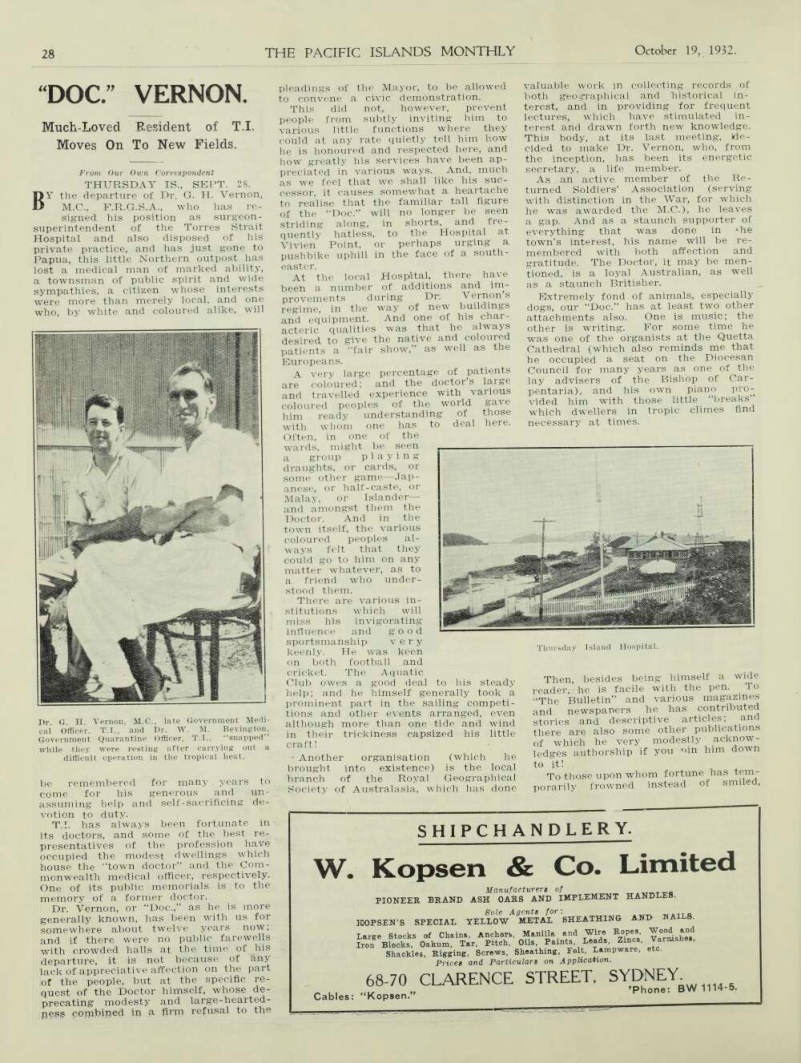
Much-Loved Resident of T.I Moves On To New Fields.
From Our Own Correspondent
Thursday Is., Sept. 28.
BY the departure of Dr. G. H. Vernon, M.C., F.R.G.S.A., who has re signed his position as surgeon superintendent of the Torres Strait Hospital and also disposed of his private practice, and has just gone to Papua, this little Northern outpost has lost a medical man of marked ability, a townsman of public spirit and wide sympathies, a citizen whose interests were more than merely local, and one who, by white and coloured alike, will
be remembered for many years to come for his generous and un assuming help and self-sacrificing de votion to duty.
T.I. has always been fortunate in its doctors, and some of the best re presentatives of the profession have occupied the modest dwellings which house the “town doctor” and the Com monwealth medical officer, respectively.
One of its public memorials is to the memory of a former doctor.
Dr. Vernon, or “Doc.,” as he is more generally known, has been with us for somewhere about twelve years now; and if there were no public farewells with crowded halls at the time of his departure, it is not because of any lack of appreciative affection on the part of the people, but at the specific re quest of the Doctor himself, whose de precating modesty and large-hearted ness combined in a firm refusal to the
pleadings of the Mayor, to be allowed to convene a civic demonstration.
This did not, however, prevent people from subtly inviting him to various little functions where they could at any rate quietly tell him how he is honoured and respected here, and how greatly his services have been ap preciated in various ways. And, much as we feel that we shall like his suc cessor, it causes somewhat a heartache to realise that the familiar tall figure of the “Doc.” will no longer be seen striding along, in shorts, and fre quently hatless, to the Hospital at Vivien Point, or perhaps urging a pushbike uphill in the face of a south easter.
At the local Hospital, there have been a number of additions and im provements during Dr. Vernon’s regime, in the way of new buildings and equipment. And one of his char acters qualities was that he always desired to give the native and coloured patients a “fair show,” as well as the Europeans.
A very large percentage of patients are coloured; and the doctor’s large and travelled experience with various coloured peoples of the world gave him ready understanding of those with whom one has to deal here.
Often, in one of the
wards, might be seen a group playing draughts, or cards, or some other game —Jap anese, or half-caste, or Malay, or Islander — and amongst them the Doctor. And in the town itself, the various coloured peoples al ways felt that they could go to him on any matter whatever, as to a friend who under stood them.
There are various in stitutions which will miss his invigorating influence and good sportsmanship very keenly. He was keen on both football and
cricket. The Aquatic Club owes a good deal to his steady help; and he himself generally took a prominent part in the sailing competi tions and other events arranged, even although more than one tide and wind in their trickiness capsized his little craft!
Another organisation (which he brought into existence) is the local branch of the Royal Geographical Society of Australasia, which has done
valuable work in collecting records of both geographical and historical in terest, and in providing for frequent lectures, which have stimulated in terest and drawn forth new knowledge.
This body, at its last meeting, (de cided to make Dr. Vernon, who, from the inception, has been its energetic secretary, a life member.
As an active member of the Re turned Soldiers’ Association (serving with distinction in the War, for which he was awarded the M.C.), he leaves a gap. And as a staunch supporter of everything that was done in town’s interest, his name will be re membered with both affection and gratitude. The Doctor, it may be men tioned, is a loyal Australian, as well as a staunch Britisher.
Extremely fond of animals, especially dogs, our “Doc.” has at least two other attachments also. One is music; the other is writing. For some time he was one of the organists at the Quetta Cathedral (which also reminds me that he occupied a seat on the Diocesan Council for many years as one of the lay advisers of the Bishop of Car pentaria), and his own piano pro vided him with those little “breaks” which dwellers in tropic climes find necessary at times.
Then, besides being himself a wide reader, he is facile with the pen. To “The Bulletin” and various magazines and newspapers he has contributed stories and descriptive articles; and there are also some other publications of which he very modestly acknow ledges authorship if you nin him down to it!
To those upon whom fortune has tem porarily frowned instead of smiled,
Dr. G. H. Vernon, M.C., late Government Medi cal Officer. T.I., and Dr. W. M. Bevington Government Quarantine Officer, T.I., “snapped’ while they were resting after carrying out a difficult operation in the tropical heat.
Thursday Island Hospital.
whether they happened to be resident or merely passing this way “hoping for something to turn up,” the subject cf this little sketch has always been ready to extend the hand of friendship, and, what is particularly to the point, to express his humanity in something more than words. Yes; there are many here —and elsewhere —who will miss the genial face and white-garbed figure; more perhaps than any out sider will ever know.
And although he is loath to receive any public testimony, and would rather face any number of batteries than sit on a platform to hear people say nice things of him, his many friends will echo every word, and more, of this brief “P.I.M.” tribute, and will wish for the Doctor in his new place of abode the best that life has to offer, with the hope that from time to time he may pass this way again.
Advertisements & other items, p. 30 (1 item)
W. Kopsen & Co. Limited
SHIPCHANDLERY.
Manufacturers of PIONEER BRAND ASH OARS AND IMPLEMENT HANDLES.
Sole Agents for ; KOPSEN’S SPECIAL YELLOW METAL SHEATHING AND NAILS.
Large Stocks of Chains, Anchors Manilla, and Wire Ropes Wood and Iron Blocks, Oakum, Tar, Pitch, Oils. Paints, Leads, Zincs, Varmsnes, Shackles, Rigging, Screws, Sheathing, Felt, Lampware, etc.
Prices and Particulars on Application.
68-70 CLARENCE STREET, SYDNEY
Cables: '‘Kopsen.’
Phone: BW 1114-5.
New Guinea.
Praise For Public Servants of New Guinea.
[To The Editor.] Sir, —Having in mind that “Fair play is bonnie play,” I could not allow the article in the August number of The Pacific Islands Monthly, “New Roads in the Territory,” to pass without a mild protest.
For an old resident to say the Kokopo Road is not as good as it was 10 years ago is quite wrong, and to say that no one seems to care is most unfair to the Roadmasters. All our Roadmasters are smart, conscientious lads, always on their jobs. As soon as rain falls heavy enough to cause a rut in the road they have their boys on it immediately and it is soon re paired.
I live in Kokopo, so I know the road well, and have seen the improvements made. To-day, the road is half as wide again as it used to be, the road at the bends at Raluana is twice the width, and the grades on all the hills have been reduced. The motor traffic between Kokopo and Rabaul has in creased considerably during the last five years, and the road has been im proved as necessity arose.
Ten years ago it would have been interesting to see a man handling fully loaded five-ton lorry round the hair-pin bend at Kuradui, which is the way the road passed in those days, and at the bends at Raluana one has only to think of the accidents that often took place until a few years ago. Now we have natives driving heavy lorries round them at a fair pace and plenty of room to avoid ac cidents.
On the Kavieng road, there were no motors in the German time —the only vehicles that passed over it were light sulkies. Riding in a car to-day at 30 miles an hour is a very different ex perience from riding in a sulky in the German time at about six, so again the comparison is not fair. The old story (which seems to be told to all visitors to the Territory) about Bulo miniski’s treatment of the natives when he found the road bad makes one smile. If the road was bad for a sulky to pass over, it must have been bad indeed, and to-day, if any of our Dis trict Officers found any such patches,
those responsible would be dealt with just as severely as in the German time.
From the stories that reach us from Australia one would think this place, instead of progressing rapidly, is going back and will continue to do so until Germany steps in to straighten things out.
There were many able administrators in the German time, and I raise my hat to their memory; but we have equally as clever men to-day, and, given the same authority and freedom that the German District Officers en joyed, would soon prove themselves and become as distinguished.
We who have adopted this country as our own take it very seriously. We are proud of the place, proud to know we are assisting in its development, and we do not like to read articles in such a valuable magazine as the Pacific Islands Monthly which do not emanate from a reliable source and, therefore, not always true.
Genuine and constructive criticism is welcome. Anything short of that does no good, and affects industry far more than it does the Administration.
Trusting these few remarks will be received in the spirit in which they are meant and wishing every success for the Pacific Islands Monthly.
I am, etc..
J. Duncan.
Rapopo Plantation, Kokopo, 28/9/32.
EDITORIAL NOTE. —We are glad to have this testimony to the good work of the district officers and staffs in the Territory of N.G.; and from personal observation, we endorse it. This journal has been critical of the New Guinea Administration, in certain directions: but the few weaknesses to which attention nas been directed may be usually traced back to de paitmental heads in Rabaul. and are generally not faults of personnel.
As a further step in the retrenchment campaign of the Administration, the Customs and Marine Department has been amalgamated with the Treasury Department and, as from September 1, the two departments are united under one head. The Treasurer, Mr. J. G. W.
T. Pound, has been appointed Collector of Customs and Taxes. Probably addi tional savings will be effected in the near future.
Advertisements & other items, p. 31 (1 item)
Ask For It
McLaren-Benz High - Speed
DIESEL ENGINES,
Marine, Stationary, Traction.
Used in the Royal Navy. British Made.
8-120 B.H.P.
GIBSON, BATTLE & CO., LIMITED,
535 Kent Street. Sydney.
Cables: Gibsbattle, Sydney.
HOLBROOKS’
TABLE DELICACIES
WORCESTERSHIRE
SAUCE.
No. 2 SAUCE
(A thick, fruity sauce).
TOMATO SAUCE.
FRENCH OLIVE OIL.
SPANISH OLIVES
(Plain and Stuffed).
CAPERS.
FLAVOURING ESSENCES.
CHUTNEY.
PURE MALT VINEGAR.
JELLY CRYSTALS.
TINNED SOUPS.
BAKED BEANS AND
SPAGHETTI.
In Tomato Sauce.
A wide variety of Pickles, including Sweet Gherkins and Small Pearl White Onions.
Holbrooks (A/sia.) Ltd.
WATERLOO, N.S.W,
ASK FOR IT
ESTABLISHED 1868.
Plea For Timber Conservation On Norfolk Is.
Wandering Cattle Provide Unpleasant Problem.
From Our Own Correspondent.
Norfolk Is., Sept. 9.
THE new Administrator, Captain C. R.
Pinney, is particularly interested in estimating our timber re sources, which he is determined to safeguard and to conserve; and it is well, indeed, that it is so.
At present, the timber is being ruth lessly cut down in all directions, not only by the mills, which must, of course, provide timber for building and for fruit cases, but by persons who are devastating the mountain reserve, in particular, by taking the finest woods for fence posts and firewood.
If our shelter goes, Norfolk will be come but a barren rock —blistered in the summer months, leaping with a thousand torrents in the wet winter season; the fertile soil all washed down the steep hillsides into the depths of the valleys that intersect the island from end to end.
And in regard to the general destruc tion of our invaluable timber, not only are thoughtless humans involved, but wandering, homeless cattle are also doing their share.
Owing to the fact that the island is heavily overstocked with animals, for whom their owners have no pasture, it is permissible, on payment of a very small charge, to allow stock to graze here and there and everywhere upon the roadsides and on such land as is not yet enclosed by fencing.
But that open land is shrinking month by month, as it is taken up
and fenced, and familiar water holes are also being lost to the wretched cattle, who suffer every summer from lack of water and who must suffer in creasingly with every hot season as it comes round. Very little pasture is de liberately cultivated, water is seldom conserved for them, and, on the whole, animals have as poor a time on this island as anywhere in the world.
Unwanted calves are never de stroyed at birth or even converted into veal at an early age. Tied up like dogs, they exist precariously on what they are allowed of their thin mothers’ milk and, at a month or so old, they are turned out to wander the island in little hungry bands, gnawing like sheep instead of browsing like cattle, at everything that promises sus tenance —even the prickly, inhospit able, infant pine.
The condition of horses and cattle towards the end of a long dry summer is almost unendurable to the tender hearted, and a prosperous dairy farmer from New Zealand, who left here by the last steamer, stated that no inducement would be sufficient to keep him here during the next few months.
This indictment sounds harsh, per haps, but it is long overdue and if, seeing the facts in cold, considered print will help stockowners on the island to realise the sorry circum stances under which their own actual cattle endure existence and to redress their lot, it will be well worth writing.
Tetanus Causes Death of Mission
Worker.
From Our Own Correspondent.
Thursday Is., Sept. 10.
AN event which cast a gloom over the whole island was the death here on September 8 of Miss Mary Earl, who, until this year, was on the staff of the Mitchell River Mission in charge of the school, but who, with another worker, relinquished her post owing to retrench ment.
Her death was very sudden. A few days pre viously, she ran a rusty nail into her foot and, although at the time there seemed no indica tion of danger, tetanus set in and, despite the efforts of the three medical men who were called in, she died in Thursday Island Hospital.
She was engaged to be married to one of our local young business men.
The funeral was attended by practically the whole community, the bishop and sub-dean both taking part in the service. Business places were closed for part of the day, the tragic suddenness of the happening producing a wave of sympathy from all sections.
Donation of New X-Ray Equip
ment for Suva Hospital.
From Our Own Correspondent.
SUVA, Sept. 30.
THE Colonial War Memorial Hospital was erected in Suva —as its name implies—as a war memorial. Returned men and their wives and families get free treatment, prob ably as good a form of war memorial as could be devised.
The hospital owes a debt of gratitude to the Hon. Henry Marks, C.B.E., for his munificent
gift in 1920 of an X-ray apparatus at a cost running into some thousands of pounds. Even X-ray apparatus gets obsolete, and so the in stallation at the Memorial Hospital needed some kind friend to come forward and bring it up to-date.
Once more the Hon. Henry Marks has done what was required and has given £500 odd in the shape of new apparatus. Fiji has every cause to be appreciative of such a citizen as the Hon. Henry Marks —a well-loved figure in Suva
T. I.’S Big Fish.
Zane Grey To Visit Straits.
From Our Own Correspondent
Thursday Is., Sept. 10.
NEWS has been received that the American novelist and angler, Zane Grey, hopes to sail his yacht into Torres Strait waters some time next year, with the object of seeing what we have to offer in the shape of big fish.
Local fishermen are turning up past records to find out what their heaviest catches in trevalli and ‘couta have been; and anglers, who have been fortunate enough to capture a speci men of the Indian sword fish (gener ally known as the sail-fish), are com paring notes as to size. The sail-fish has been caught out Murray Island way on an ordinary towline, one specimen measuring up nine feet in length: but they are not numerous.
The Strait can provide quite an amount of excitement in big fishing, however. Along the top end of the Barrier, the groper and shark assume large proportions; but even round T. I., through Endeavour Strait and about the surrounding islands, good sport may be found in trevalli, kingfish, and barracouta.
Advertisements & other items, p. 32 (1 item)
Younger
JOHN L PEADON LTD.,
RABAUL, NEW GUINEA,
Engineers and Garage
Proprietors,
All Classes of General Engineering Undertaken. cars FOR HIRE.
Territory Agents for — Goodrich Products. Clyde Batteries.
Berger’s Lacquers. B.E.S. Plugs.
Chas. Hope, Ltd., Brisbane.
Lamson Paragon Ltd., Printers. ’Phone: Rabaul 20.
Do you know that the Famous
YOUNGER
STOVES AND
RANGES
made with extended Firebox specially for long Wood fuel, are Self-Setting and, provided sufficient Flue Piping is attached, can be used in almost any position.
The No. 7W. “Younger” Range can now be supplied fitted with Legs, as per illustration.
Ask for quotation for this range, also Illustrated Catalogue and Price List for Dota Single and Double Oven Stoves.
Younger Stoves are Widely Used Throughout the Pacific Islands.
G FLETCHER & SON 50 Oxford Street, SYDNEY.
Land Transfers In
Tahiti.
Important New Law.
From Our Own Correapondent.
Papeete, Sept. 7.
AN important Ministerial decree, which will have a far-reaching effect on present land titles, and regulate all future transactions in real estate within the French Establish ments of Oceania, was promulgated in the Official Journal of the Colony on August 16.
This enactment provides that all future transfers of land, whether by sale, testament, or donation, must have the sanction of His Excellency, the Governor, and leases of ten years or longer are subject to the same con dition. The Governor may deliver the authorisation solicited, or refuse it, without being required, in the latter event, to furnish any explanation of the reasons determining his refusal.
Specal conditions apply to transfers, where such would cause property to pass into the hands of persons who have no legal domicile in the Colony.
In such cases, the Governor may, if he considers it necessary, exercise, in the name of the Colony, the right of pre emption with respect to the property in question upon payment for same according to a valuation arrived at by experts. Of these experts, one will be chosen by the interested parties and one by the Governor; failing agree ment between these two as to pric of the property, the matter will be submitted for arbitration to a third expert named by the President of the Superior Court.
The Decree is not made applicable to contracts and mortgages entered into prior to its promulgation except insofar as the right of pre-emption is concerned which is retro-active.
Article 8 of the Decree stipulates that public auctions of real estate, which are held from time to time as the result of judicial proceedings at the Civil Court of Papeete, may not be held without the authorisation of the Governor, to whom intending bidders must apply at least 15 days before the sale, when permission to bid will be granted or refused at the Governor’s discretion.
Special penalties, as well as the pro visions of Article 463 of the penal Code, are made applicable to infrac tions of the Decree.
From the comments heard around Papeete, it seems evident that the majority of the population has re ceived the measure favourably, real ising that it may be administered to operate as a check upon the acquisition of land by undesirables, and as a safe guard to native interests; it may also have the beneficial effect of placing the mortgage business on a sounder and more satisfactory basis than has been possible hitherto.
Mr. W. Grose did not seek election to the position of general president of the New Guinea Planters’ Association, which held its annual meeting in Rabaul in July, and has been succeeded by Mr.
D. Mullaly.
N.I. Administrator.
Entertained by Hospital Board.
(From Our Own Correspondent.)
Norfolk Is., Sept. 9.
ON August 31, a very pleasant party was held in the garden of our little hospital, in order that the wives and families of the Board and the ladies who compose the Hospital Guild should have an opportunity of meet ing, informally, the new Administrator and Mrs. Pinney, who had already paid an official visit to the institution, but who are most cordially meeting all sec tions of the community and making themselves popular wherever they go.
Tea was served on the lawn and, in response to one or two very brief speeches of welcome, His Honor said that he had been most agreeably sur prised by the up-to-date fittings and thorough equipment of the establish ment, even to an X-ray plant, which he considered an essential on this isolated island, although he had heard that
many people did not agree. He said that while it was not so large a build ing as that in Port Moresby, Papua— from which Territory he came to us— our hospital was much better equipped and more modern in every way. He congratulated the Board on the good Avork it was doing and complimented the ladies of the Guild for their ready assistance whenever asked.
Mrs. Pinney succeeds Mrs. Bennett as patroness of the Guild.
from Drought.
New Ireland Recovering from Drought.
From a Special Correspondent.
Kavieng, Sept. 19.
The effect of the 1930 drought is now rapidly disappearing and copra pro duction is increasing back to normal.
It has been a severe strain on the top of our other difficulties to have lost, for the last 18 months, over 40 per cent, of our normal production.
Advertisements & other items, p. 33 (1 item)
Recommended By All The Leading
FACE SPECIALISTS.
THIS WORLD FAMOUS FACE POWDER.
Made in France
FACE POWO
JAVA RICE FACE POWDER has unmistakably earned its wonderful world-wide popularity.
It never imparts unsightly flat appearance that sometimes happens with ordinary powders; but unfailingly throws a veil of loveliness over the most delicate skin—heightening the complexion in a subtle manner. Non-injurious to the ten derest skin.
The soft petal-like texture of JAVA RICE FACE POWDER achieves wonders with previously neglected complexions.
Obtainable everywhere. In two sizes and all shades.
Samoan Election.
Dearth of Candidates.
From Our Own Correspondent.
Apia, Sept. 5.
THOUGH an election of two new European-elected members to the Legislative Council was fixed some weeks ago, no candidates have come forward so far or announced their intention to stand.
The “Herald” has appealed to the public to nominate candidates and not to run the risk of losing their privilege of representation on the Council.
Among the planters, as well as among the commercial community there should be some suitable men who could represent the European interests in an able way.
It is true that there appears to be little interest amongst European re sidents in the coming election, caused by disappointment with the lack of in fluence the elected members can exer cise in the Council. They are out voted, in any case, by the official mem bers, whose number is sufficient to ratify any legislation the Adminis tration requires. However, as the “Herald” rightly points out, the elected members have the privilege of inter vening with the Administration on be half of their electors whenever neces sary. The late Hon. A. W. Johnston did a great lot of good work in this way, though quite unobstrusively.
Lately, several names have been mentioned as possible candidates. Mr.
S. H, Meredith, the second elected member, is expected to stand again, also Mr. A. Williams, a former mem ber, and Mr. T. H. Carruthers, who represents plantation and commercial interests. The most popular candidate, however, would be Mr. A. G. Smythe, the manager of Messrs. Morris, Hedstrom, Ltd., Apia, a resident of long standing and a favourite with all classes of the population. It is hoped, that Mr. Smythe can be persuaded to stand, and in this case his election by an overwhelming majority may be
predicted.
Another very popular candidate, a local-born resident, is also mentioned, and he may go on the one platform with Mr. Smythe.
The new electoral roll has caused surprise locally, as it contains only 103 names, as against 198 at the last election —striking evidence of the effects of the depression on our little country. Quite a number of those en titled to vote have been left out of the roll, and most of them will have this omission remedied.
As a result of the recent amalgama tion of the Customs and Treasury De partments, the Administration has lost one seat on the Council. There are now five official members, as against two European and two Samoan elected members.
Novel Mace for Fiji.
When the Fiji Legislative Council met on October 3, the Governor pre sented, for ceremonial use as a mace, King Cukobau’s war club given by him to Queen Victoria in 1874, on the executive deed of cession, and now re turned by King George to Fiji.
Mr. Grimble’s Long Service.
Double Farewell On
Ocean Is.
From Our Own Correspondent
Ocean Is., Sept. 1.
OCEAN Island was the scene of a double farewell on August 19, when Mr. Arthur Grimble and Mr. and Mrs. Lodge sailed by the S.S.
“Triona” for Australia, on their way to England.
It was with sincere regret that the Europeans and natives of Ocean Island said farewell to the Resident Commis sioner, Mr. Grimble. Genuine feeling was displayed by all, and it was a sad and sick-looking man who left the jetty. Mr. Grimble’s health has been very indifferent for some time past, and it is hoped that he will benefit considerably by his leave.
Rumour has it that he will not come back. If that be the case, he will be missed by many folk, to whom he has endeared himself during his long stay in the Gilbert and Ellice Colony.
Mr. Grimble came to the Islands in 1913, as a cadet, straight from Cam bridge University. He leaves it in 1932 as Resident Commissioner, a fact which speaks for itself.
Departure Of Phosphate
Commissioner.
The British Phosphate Commissioner, Mr. T. Lodge, accompanied by Mrs.
Lodge, has been visiting Ocean Island and Nauru on a tour of inspection.
Mr. and Mrs. Lodge have been most interested in everything they have seen. All who have met them are sorry they have gone. They have left a very warm spot in the hearts of the people, for they radiate good-nature wherever they go.
Mr. Christian, the manager for the
British Phosphate Commissioners on Ocean Island, and Mrs. Christian, gave a farewell luncheon at their home for Mr, and Mrs. Lodge. Mr. Christian, in a few suitable words, wished them “bon voyage.”
Mr. Lodge, in responding, said that when they left England, Ocean Island to them was a mere speck on the map, but, after their most enjoyable visit, it was now a very definite and pleasant place in the world. They were taking back to England the feeling that they had made some good and sincere friends on the Island.
Mr. and Mrs. Lodge also made a trip through the Gilbert Islands, when the S.S. “Triona” was recruiting labour there for Ocean Island.
It is quite probable that this will be the only occasion in the history of Ocean Island, on which two Commis sioners have left for England at the same time and on the same day.
Samoa.
Revival of Coffee Planting in Samoa.
From Our Own Correspondent.
Apia Sep. 10.
COFFEE planting, which had to be given up before the war by the D. H. & P. G. and other planters on account of the ravages of the rust and leaf disease, is to be re-started again with better prospects, owing to the introduction of a disease-proof variety of coffee, the Robusta.
Mr. F. Yahnke, of Fasitovuta, an old and experienced planter, has im ported seeds of this brand from Ceylon, and these have come on ex ceedingly well. It is hoped that it will be now possible to revive the industry.
It should not be difficult to produce a quality product, which will find a ready market in New Zealand and elsewhere.
Advertisements & other items, p. 34 (1 item)
Union
PORTLAND CEMENT
BRAND
GUARANTEED HIGHEST QUALITY.
Considerably exceeds strength required under British and Australian Standard Specifications.
ALSO
“UNIONITE” Quick Hardening Cement. (High Early Strength).
COMPETITIVE PRICES. :: ENQUIRIES INVITED.
THE COMMONWEALTH PORTLAND CEMENT COMPANY LTD.,
SYDNEY and PORTLAND, N.S.W.
Postal Address: Telegraphic Address:
Box 1571 E, G.P.O
SYDNEY.
“UMERIEZ,”
SYDNEY.
Sydney Club Facilities For Members
Members of The Pacific Islands Association.
AN arrangement has been practically completed under which Sydney club facilities will be made available to any member of the Pacific Islands As sociation who may visit Sydney.
Negotiations between the Pacific Is lands Association executive and the Council of the Millions Club have been proceeding for some time. An agree ment has been practically reached under which, on condition that the Pacific Islands Association makes an annual payment to the Millions Club, and Sydney members of the Association become full members of the Millions Club, the Millions Club will grant hon orary membership and full club facili ties to any non-Sydney member of the Pacific Islands Association, who may visit Sydney, during the full period of his visit, without any additional charge.
The Millions Club will also provide a room within the new Millions Club building, which will be specially set aside to be the office and headquarters of the Pacific Islands Association.
Members of the Association will find this a very convenient arrangement. As soon as they arrive in Sydney and re port at the office of the Association, they will be handed the necessary in troduction, entitling them to the use of the Millions Club rooms and privileges.
The Millions Club now occupies a new and excellently planned building ex tending over several floors, and it in cludes dining rooms, lounges, writing rooms, billiard rooms, dressing and bathrooms, licensed bar, etc.
Members of the Association will find the Millions Club—which is centrally situated at the corner of Pitt and Rowe Streets, directly opposite the G.P.O. — a very convenient place to which they may have their letters addressed, ar range interviews, attend to correspond ence, etc. The luncheon and dinner menus at this Club are kept up to a high standard.
It may be necessary to slightly in crease the present subscription of the Pacific Islands Association (now £1/1/for Sydney members and 10/6 for others) in order to cover the cost of these additional privileges. Members are to be circularised on the matter immediately.
It is intended, now that the question of accommodation and office facilities appears to have been settled, to deal immediately with the general purposes and organisation of the Association — more particularly in the direction of providing machinery so that the views of members can be obtained in such a way as to allow the Association to speak with a united voice on various matters affecting the common interests of Pacific Islands residents.
The following have been elected members of the Association: —W. F.
Robertson and A. R. Evans (both of New Hebrides), F. Headon (Papua), H.
Kuper, F. M. Campbell and A. D. C.
Stephens (all of British Solomon Is lands).
All stations of the New Hebrides Presbyterian Mission reported to Synod, which met at Santo recently, that native contributions had decreased. As a result, teachers’ salaries wall, in some cases, have to be reduced.
Lookout, N.I.!
Thousand Excursionists Due on December 26.
WEATHER permitting, Norfolk Island on or about Monday, December, 26, will have a unique experience.
It will be overwhelmed by a thousand or two care-free tourists from Aus tralia.
It was announced on Wednesday, Oc tober 12, that the magnificent new P. and O. liner, “Strathaird,” would run an excursion to Norfolk Island from Sydney during Christmas week. The steamer would leave on Friday, De cember 23, and return to Sydney on Thursday, December 29, and the in clusive fare for the six days’ holiday cruise would be from £6/10/- to £10 per head, according to cabin accommoda tion.
On Thursday morning, October 13,
the sober and dignified booking-clerks at the P. and O. office in Sydney were nearly killed in the rush. By that evening, practically the whole of the “Strathaird’s” accommodation was booked out.
So now Norfolk Island knows what to expect. The liner is expected to lie off Norfolk Island during Monday and her thousand or so passengers will be ferried ashore and permitted for a few hours to over-run the island. Weather permitting! Norfolk Island knows what that means!
Incidentally, there is much laughter in Sydney shipping circles concerning this development. On a number of oc casions the organisation of some such excursion as this has been urged upon the owners of coastal passenger steamers: but the latter, with singular lack of enterprise, have turned it down.
The P. and O. Co. have now hopped in and stolen the rich prize from under the noses of the Australian ship owners, who will have at least two first-class passenger liners lying idle during the Christmas holidays.
Advertisements & other items, p. 35 (1 item)
5 Symptoms
Repairs.
"OUR HANDS MAKE GOOD ARMS"
NO
BETTER
than the 22 Cal. WALTHER.
THERE IS
RIFLE MADE
It is a single shot Repeater and an Automatic, ALL IN ONE RIFLE.
Magazine holds 5 long rifle cartridges PRICE, £8/7/6.
Fitted with Zeiss Telescopic Sight PRICE, £15.
“A MASTER’S CHOICE.”
SIL ROHU (late A.I.F.), GUNSMITH
IMPORTER OF HIGH-GRADE FIREARMS AND FISHING TACKLE SPECIALIST, 143 P ELIZABETH STREET. SYDNEY (Near Market Street).
“FISHING TACKLE TO TACKLE FISHING."
5 SYMPTOMS
of TINEA or
Tropic
Ringworm
Perhaps you have in flammation, redness, or skin cracks between the toes, tiny itching blisters, white thick skin, which is always moist, or dry skin, which becomes scaly, accom panied by an unpleasant and characteristic odour. These are all definite symptoms of
“TINEA” or TROPIC
RINGWORM,
Or direct from
WHICH
BECOMES
ANTINEA DRUG CO.
Highly Contagious
TINEA is highly contagious and may spread to other parts of the body—scalp, ears, arms, hands, legs, etc.—if immediate steps are not taken to check same. “ANTINEA” is the only specific preparation that will cure Tinea and Tropic Ringworm.
For Dhobie Itch
Use “Antinca”
The penetrative power of “ANTINEA” rapidly destroys the “Tinea” fungi, relieves discomfort, restores skin wholeness, and ensures normal con dition. “ANTINEA” also relieves “DHOBIE ITCH.” Ringworm, Perionychia, Ringworm of the Nails and other similar skin troubles.
“ANTINEA” will not harm the living tissues.
THE CURE.
Obtainable from all branches of Burns, Philp & Co. Ltd., W. R. Carpenter & Co. Ltd., and A. J. Swann & Co. Ltd. (Suva).
WINCELLO HOUSE.
ANGEL PLACE. SYDNEY
Postage. 3d, extra.
Hope For Samoa.
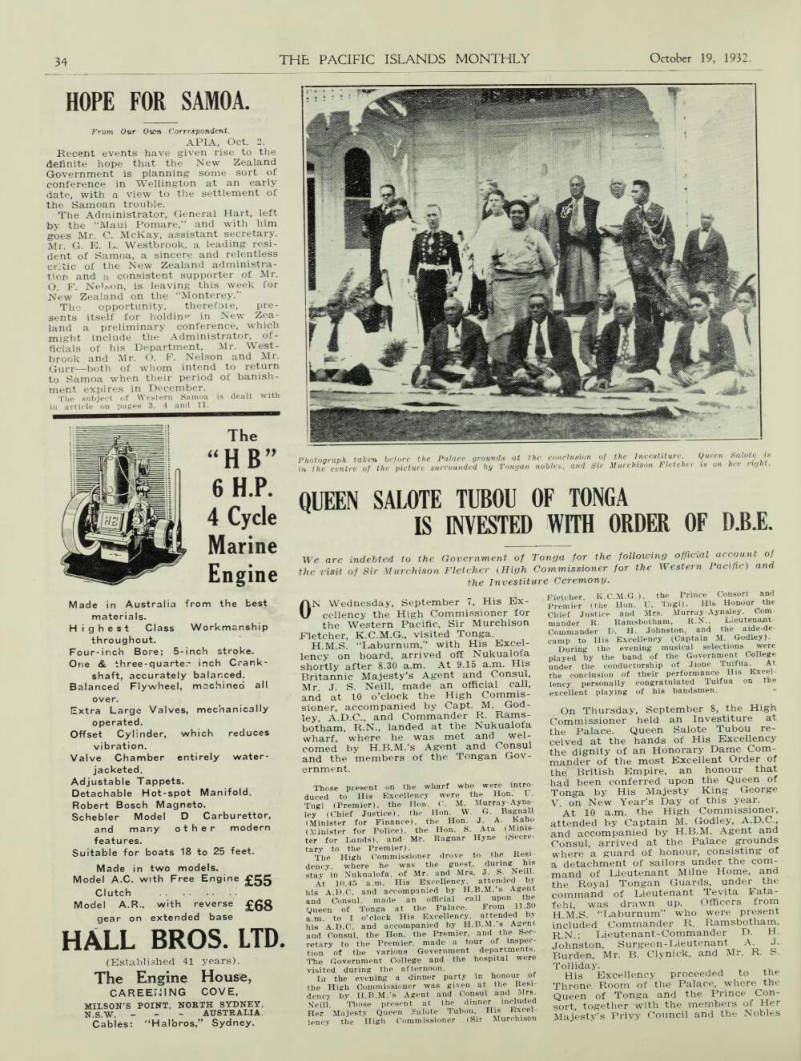
From Our Own Correspondent.
Apia, Oct. 2.
Recent events have given rise to the definite hope that the New Zealand Government is planning some sort of conference in Wellington at an early date, with a view to the settlement of the Samoan trouble.
The Administrator, General Hart, left by the “Maui Pomare,” and with him goes Mr. C. McKay, assistant secretary.
Mr. G. E. L. Westbrook, a leading resi dent of Samoa, a sincere and relentless critic of the New Zealand administra tion and a consistent supporter of Mr.
O. F. Nelson, is leaving this week for New Zealand on the “Monterey.”
The opportunity, therefore, pre sents itself for holding in New Zea land a preliminary conference, which might include the Administrator, of ficials of his Department, Mr. West brook and Mr. O. F. Nelson and Mr.
Gurr —both of whom intend to return to Samoa when their period of banish ment expires in December.
The subject of Western Samoa is dealt with in article on pages 3, 4 and 11.
Queen Salote Tubou Of Tonga
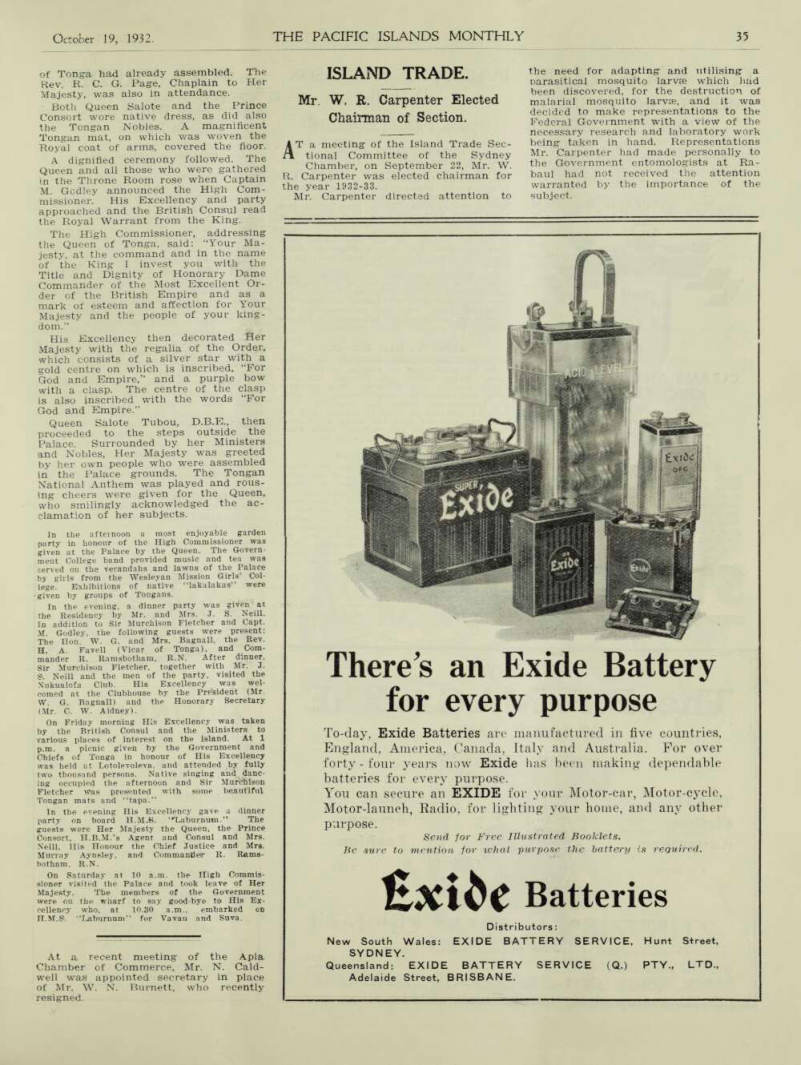
Is Invested With Order Of D.B.E.
We are indebted to the Government of Tonga for the following official account of the visit of Sir Murchison Fletcher (High Commissioner for the Western Pacific) and the Investiture Ceremony.
ON Wednesday, September 7, His Ex cellency the High Commissioner for the Western Pacific, Sir Murchison Fletcher, K.C.M.G., visited Tonga.
H.M.S. “Laburnum,” with His Excel lency on board, arrived off Nukualofa shortly after 8.30 a.m. At 9.15 a.m. His Britannic Majesty's Agent and Consul, Mr J. S. Neill, made an official call, and at 10 o’clock the High Commis sioner, accompanied by Capt. M. God ley A.D.C., and Commander R. Rams botham, R.N., landed at the Nukualofa wharf, where he was met and wel comed by H.B.M.'s Agent and Consul and the members of the Tongan Gov ernment.
Those present on the wharf who were intro duced to His Excellency were the Hon. U.
Tugi (Premier), the Hon. C. M. Murray-Ayns ley (Chief Justice), the Hon. W. G. Bagnall (Minister for Finance), the Hon. J. A. Kaho (Minister for Police), the Hon. S. Ata (Minis ter for Lands), and Mr. Ragnar Hyne ((Secre tary to the Premier).
The High Commissioner drove to the Resi dency, where he was the guest, during his stay in Nukualofa, of Mr. and Mrs. J. S. Neill.
At 10.45 a.m. His Excellency, attended by his A.D.C. and accompanied by H.B.M.’s Agent and Consul, made an official call upon the Queen of Tonga at the Palace. From 11.30 a.m. to 1 o’clock His Excellency, attended by his A D.C and accompanied by H.B.M.’s Agent and Consul, the Hon. the Premier, and the Sec retary to the Premier, made a tour of inspec tion of the various Government departments.
The Government College and the hospital were visited during the afternoon.
In the evening a dinner party in honour or the High Commissioner was given at the Resi dency by H.B.M.’s Agent and Consul and Mrs Neill. Those present at the dinner included Her Majesty Queen Salote Tubou, His Excel lency the High Commissioner (Sir Murchison
Fletcher, K.C.M.G.), the Prince Consort and Premier (the Hon. U. Tagi). His Honour the Chief Justice and Mrs. Murray-Aynsley. Com mander R. Ramsbotham, R.N., Lieutenant- Commander D. H. Johnston, and the aide-de camp to His Excellency (Captain M. Godley).
During the evening musical selections were played by the band of the Government College under the conductorship of Jione Tuifua. At the conclusion of their performance His Excel lency personally congratulated Tuifua on the excellent playing of his bandsmen.
On Thursday, September 8, the High Commissioner held an Investiture at the Palace. Queen Salote Tubou re ceived at the hands of His Excellency the dignity of an Honorary Dame Com mander of the most Excellent Order of the British Empire, an honour that had been conferred upon the Queen of Tonga by His Majesty King George V on New Year’s Day of this year.
At 10 a.m. the High Commissioner, attended by Captain M. Godley, A.D.C., and accompanied by H.B.M, Agent and Consul, arrived at the Palace grounds where a guard of honour, consisting of a detachment of sailors under the com mand of Lieutenant Milne Home, and the Royal Tongan Guards, under the command of Lieutenant Tevita Fata fehi, was drawn up. Officers from H.M.S. “Laburnum” who were present included Commander R. Ramsbotham, R.N.; Lieutenant-Commander D. H.
Johnston, Surgeon-Lieutenant A. J.
Burden, Mr. B. Clynick, and Mr. R. S.
Tolliday.
His Excellency proceeded to the Throne Room of the Palace, where the Queen of Tonga and the Prince Con sort, together with the members of Her Majesty’s Privy Council and the Nobles
Photograph taken before the Palace grounds at the conclusion of the Investiture Queen Salote is in the centre of the picture surrounded by Tongan nobles, and Sir Murchison Fletcher is on her right.
of Tonga had already assembled. The Rev. R. C. G. Page, Chaplain to Her Majesty, was also in attendance.
Both Queen Salote and the Prince Consort wore native dress, as did also the Tongan Nobles. A magnificent Tongan mat, on which was woven the Royal coat of arms, covered the floor.
A dignified ceremony followed. The Queen and all those who were gathered in the Throne Room rose when Captain M. Godley announced the High Com missioner. His Excellency and party approached and the British Consul read the Royal Warrant from the King.
The High Commissioner, addressing the Queen of Tonga, said: “Your Ma jesty, at the command and in the name of the King I invest you with the Title and Dignity of Honorary Dame Commander of the Most Excellent Or der of the British Empire and as a mark of esteem and affection for Your Majesty and the people of your king dom.”
His Excellency then decorated Her Majesty with the regalia of the Order, which consists of a silver star with a gold centre on which is inscribed, ‘‘For God and Empire,” and a purple bow with a clasp. The centre of the clasp is also inscribed with the words ‘‘For God and Empire.”
Queen Salote Tubou, D.B.E., then proceeded to the steps outside the Palace. Surrounded by her Ministers and Nobles, Her Majesty was greeted by her own people who were assembled in the Palace grounds. The Tongan National Anthem was played and rous ing cheers were given for the Queen, who smilingly acknowledged the ac clamation of her subjects.
In the afternoon a most enjoyable garden party in honour of the High Commissioner was given at the Palace by the Queen. The Govern ment College band provided music and tea was served on the verandahs and lawns of the Palace by girls from the Wesleyan Mission Girls’ Col lege. Exhibitions of native “lakalakas” were given by groups of Tongans.
In the evening, a dinner party was given at the Residency by Mr. and Mrs. J. S. Neill.
In addition to Sir Murchison Fletcher and Capt.
M. Godley, the following guests were present: The Hon. W. G. and Mrs. Bagnall, the Rev.
H, A. Favell (Vicar of Tonga), and Com mander R. Ramsbotham, R.N. After dinner, Sir Murchison Fletcher, together with Mr. J.
S. Neill and the men of the party, visited the Nukualofa Club. His Excellency was wel comed at the Clubhouse by the President (Mr.
W. G. Bagnall) and the Honorary Secretary (Mr. C. W. Aidney).
On Friday morning His Excellency was taken by the British Consul and the Ministers to various places of interest on the island. At 1 p.m. a picnic given by the Government and Chiefs of Tonga in honour of His Excellency was held at Lotolevoleva. and attended by fully two thousand persons. Native singing and danc ing occupied the afternoon and Sir Murchison Fletcher was presented with some beautiful Tongan mats and “tapa.”
In the evening His Excellency gave a dinner party on board H.M.S. ‘''Laburnum.” The guests were Her Majesty the Queen, the Prince Consort, H.B.M.’s Agent and Consul and Mrs.
Neill, His Honour the Chief Justice and Mrs.
Murray Aynsley. and Commanfletr R. Rams botham, R.N.
On Saturday at 10 a.m. the High Commis sioner visited the Palace and took leave of Her Majesty. The members of the Government were on the wharf to say good-bye to His Ex cellency who, at 10.30 a.m., embarked on H.M.S. ‘‘Laburnum” for Vavau and Suva.
At a recent meeting of the Apia Chamber of Commerce, Mr. N. Cald well was appointed secretary in place of Mr. W. N. Burnett, who recently resigned.
Advertisements & other items, p. 36 (1 item)
4 Cycle
The
“H B ” 6 H.P.
Marine
Engine
Made in Australia from the best materials.
Highest Class Workmanship throughout.
Four-inch Bore; 5-inch stroke.
One & three-quarter inch Crankshaft, accurately balanced.
Balanced Flywheel, machined all over.
Extra Large Valves, mechanically operated.
Offset Cylinder, which reduces vibration.
Valve Chamber entirely waterjacketed.
Adjustable Tappets.
Detachable Hot-spot Manifold.
Robert Bosch Magneto.
Schebler Model D Carburettor, and many other modern features.
Suitable for boats 18 to 25 feet.
Made in two models.
Model A.C. with Free Engine £55 Clutch Model A.R., with reverse £6B gear on extended base
HALL BROS. LTD.
(Established 41 years).
The Engine House,
CAREENING COVE,
MILSON’S POINT, NORTH SYDNEY,
N.S.W. - AUSTRALIA.
Cables: "Halbros,” Sydney.
Island Trade.
Mr W. R. Carpenter Elected Chairman of Section.
AT a meeting of the Island Trade Sec tional Committee of the Sydney Chamber, on September 22, Mr. W.
R. Carpenter was elected chairman for the year 1932-33.
Mr. Carpenter directed attention to
the need for adapting and utilising a parasitical mosquito larvae which had been discovered, for the destruction of malarial mosquito larvae, and it was decided to make representations to the Federal Government with a view of the necessary research and laboratory work being taken in hand. Representations Mr. Carpenter had made personally to the Government entomologists at Ra baul had not received the attention warranted by the importance of the subject.
Advertisements & other items, pp. 37-38 (1 item)
Batteries
There's an Exide Battery
for every purpose
To-day, Exide Batteries are manufactured in five countries, England, America, Canada, Italy and Australia. For over forty - four years now Exide has been making dependable batteries for every purpose.
You can secure an EXIDE for your Motor-car, Motor-cycle, Motor-launch, Radio, for lighting your home, and any other purpose.
Send for Free Illustrated Booklets.
Be sure to mention for tohat purpose the battery is required.
Batteries
Distributors: New South Wales: EXIDE BATTERY SERVICE, Hunt Street,
SYDNEY.
Queensland: EXIDE BATTERY SERVICE (Q.) PTY„ LTD., Adelaide Street, BRISBANE.
THE BOOK CLUB,
BURNT PINE,
NORFOLK ISLAND.
FIRST-RATE MODERN LIBRARY.
Five Hundred Books—added to by every mail. Very reasonable terms.
Mrs. CAMPBELL, Rep. P.I.M.
CLEANS AND POLISHES
KITCHENWARE
Quickly scouring off grease or burnt substance, Steelo makes kitchenware clean
and bright. It's splendid
for baths, basins, sinks.
Steelo is a fine steel wool, made up in handy pads and supplied in cartons, with special soap. If unobtainable locally, write for a free sample to the manufac turers, R. H. ARMSTRONG & CO.. 44 King Street, St. Peters. N.S.W., stating your grocer’s name. Try Steelo, too, for preparing wood and metal surfaces for painting ... or for cleaning off rust.
Visitors welcomed.
Conducted by
STEELO
SAIL WITH
The B.P. MAGAZINE
TO MAGIC LANDS.
Travel Fiction Adventure 1/- copy.
Stage Screen Fashion 1/- copy.
GET YOUR COPY NOW.
ANNUAL SUBSCRIPTION:
Within the Commonwealth of Australia, Mandated Territory and New ftee Guinea 5/4,. post-free Within the British Empire 6/8 post free U.S.A. and Foreign 6/8 post free From all Bookstalls or direct from the Publishers: Burns, Philp & Co. Ltd.
In Fiji.
Bumper Sugar Season
From a Special Correspondent.
Ba, Fiji. Sept. 4.
Things around this side of the Island are very quiet. The two sugar mills are this season crushing up to six o’clock on Saturday even ings, in order to cope with the surplus cane.
Both are still breaking long-standing records— the Rarawai Mill averaging 10,000 tons of cane weekly and Lautoka 13,000. Last season two sugar trains were sent daily from Rarawai to Lautoka—this season three are required.
An Indian was murdered down at Mami (Nadi) last month, but very few details have come to hand. The victim’s body was found four days after the deed, and was partly buried.
Mr. Munisami Mudaliar was elected (unop posed) as the honourable member for the Northern and Western Divisions, Indian section. We hope that this time the Indian members will accomplish more than their predecessors, who resigned on account of not being able to get the common roll for the Indian community.
Improved Mail Service.
The new mail contract seems to be giving a lot of satisfaction by keeping to the time table. Every Sunday and Thursday the lorry leaves Lautoka for Ellington with outward mails, and returns the same evenings with mail.
An Indian-owned launch runs regularly from Suva to Ellington in order to connect with the lorry and now we have two mails every week from Suva. Before the contract, mails some times took ten days from Suva to Ba.
Social And Sporting.
On July 30 the Ba dancing season was opened by a very successful dance in aid of the Namo san Tennis Club. A large number of visitors came from Lautoka, Nadi and Nadarivater.
The native football season ended a few weeks ago. The cup given by Mr. Upton was won by the Rarawai team, with Medical a close second.
Some very good games were played during the competition, but some of the natives have yet to learn how to control their tempers. Taken all round, a great improvement was noticed between the first and last games and the next season ought to prove a success.
We are quite proud of the bowling team that represented us at the carnival in Suva last month, for they won the Governor’s Cup. Our Mr Wilson won the much coveted Pineapple Cup and is the hero of the Carnival, which has been aptly termed —Wilson’s Carnival.
Fiji’S Credit.
Figures Show Why It Stands High In London.
From Our Own Correspondent.
Suva, Oct. 4.
THE Governor, Sir Murchison Fletcher, put before the Legislative Council, on October 3, his report on the state of the Colony’s finances. It showed that the estimated deficit for 1932 is £12,000. The estimated revenue for 1933 is £568,350 and expenditure £554,132.
Regarding conditions generally in the Colony, the Governor forecast record crops of sugar. Up-to-date in 1932, the production was 130,000 tons, twice the 1931 output. Copra was again on a paying basis, the estimated output for 1933 being a third in excess of the 1932 production.
In a budget of round about £550,000, this deficit for 1932 of £12,000 is a trifle, which should be recovered two or three times over in 1933.
Those of us who live in Fiji and whose boundary is Suva wharf, some times find difficulty in distinguishing the wood from the trees. The true financial position is measured more ac curately in London where, within the last couple of months, the Fiji Govern ment decided to raise portion of the balance of the Colonial Loan author ised to be issued. Fiji obtained money at £102 at 4 per cent. —a really extra ordinary demonstration of the high esteem in which the Colony’s finances are regarded in the centre of the finan cial universe.
Advertisements & other items, p. 38 (1 item)
Invincible
MARINE ENGINES are stocked in 15 different sizes, from 3 to 160 h.p.
Thousands of them are in use all over the world, literally from China to Peru.
INVINCIBLE MARINE ENGINES
run on Benzine, Kerosene and Crude Oil, and they are priced lower than any other Marine Engine sold anywhere.
ALL Spare Parts are ALWAYS available.
Write for our Catalogues: they will interest you.
INVINCIBLE MOTORS LTD.,
53 NORTH GEORGE STREET,
SYDNEY, AUSTRALIA.
Cable Address: “VINCO.”
Associated with
INVINCIBLE MOTORS INCORP.
4236 Lincoln Avenue, Chicago, U.S.A.
Cable Address: “INYINCO.”
Salary Cuts in Papuan Service
To Offset Decreased Subsidy.
From Our Own Correspondent.
Pt. Moresby, Oct. 1.
NEWS was received on September 16 that the Commonwealth Govern ment had decided that officers in the Public Service of Papua should be subjected to financial emer gency legislation and that a reduction of 10 per cent, on civil servants’ sal aries should take place from October 1, 1932.
At the same time, the Federal Gov ernment announced that the annual subsidy for Papua would be reduced by £6,000 per annum to £34,000.
The Commonwealth grant towards the expenses of the Administration of Papua which was originally £50,000, was reduced by 20 per cent, in 1931 bringing the amount to £40,000 The reduction then was not as drastic as it first appeared as, during the two previous years, the subsidy had been reduced to £45,000 and £42,000 respec tively.
Though the news of the reduction in salaries was expected by the Public Service and accepted by many with philosophic resignation, it was received with disapproval throughout the Terri toiy. It was considered that there were other means of effecting economy in the Government far preferable to that of the cut in salaries.
It was, therefore, with relief that the Public Service learned later that the Federal Cabinet had reconsidered the matter and that the reduction in ex penditure to meet the reduction in sub sidy might be effected otherwise than by a deduction from salaries.
The Papuan Government is consid ering the matter in council. The Pub lic Service Association has been in formed, however, that this does not necessarily mean that there will be no deductions in salaries at all.
Newspaper’S Comment.
The “Papuan Courier,” the only newspaper published in the Territory, has always opposed a salaries’ cut. Ex tracts from its leading article on this subject on September 16 are as follows: “To us, it has always appeared to be a clumsy method of retrenchment. It is perhaps a necessary step in emer gency, but not in the present case.
“If our finances had been taken firmly in hand, even a year ago, most officials would have been drawing their full salaries this year right through the depression. We think that it will be a scandal if the revenue is allowed to fall and further blind cuts are made. It is useless thinking of further taxation, as our industries are taxed to the utmost.
“The only thing now is for the public servants themselves to realise the posi tion and by force of public opinion within and without the Service force the Executive into considering schemes which will give us an increase in ex ports and increased revenue.”
Norfolk Island Trade.
Imports.
From Aust.
From N.Z.
August, 1931 . £1810 £1513 August, 1932 . £2329 £ 789
Exports.
To Aust.
To X.Z.
August, 1931 . £231 £1070 August. 1932 . £1498 £441
Sportsman.
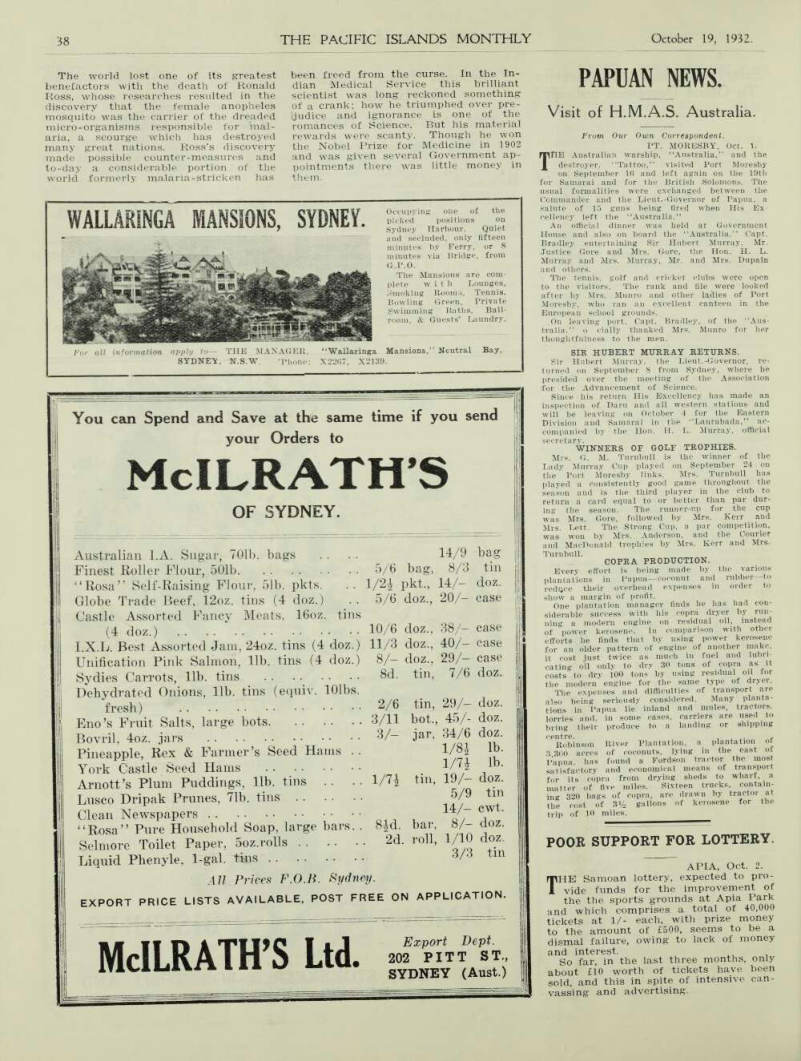
Samoans Stone Tongan Sportsman.
Ugly Scene at Apia Wharf.
From Our Own Correspondent.
Apia, Oct. 2.
BY the last “Waipahi,” the team of Tongan footballers who had played several matches against Fijian teams, arrived to play a match against a selected team of Samoan footballers, who had been training in camp for the preceding two weeks.
The Tongans, who had been unlucky in Fiji, were more successful in Samoa, beating the local team by 15 to 9.
In a boxing match between a Tongan heavyweight and the local heavyweight champion, Kilifi, the latter was given the decision on a foul in the third round, though the Tongan was by far the superior fighter. In a second heavyweight bout, the Tongan, Visa
vaka, knocked out the Samoan, Paulo, in the third round.
The Samoans showed a deplorable lack of sportsmanship when, after the boxing bouts, the Tongans returned to the wharf to embark on the “Waipahi.”’
A large crowd of Samoans booed and stoned the Tongan sportsmen, appar ently resenting the Samoan defeat, and police had to be requisitioned to pro tect the Tongans from serious assaults.
The world lost one of its greatest benefactors with the death of Ronald Ross, whose researches resulted in the discovery that the female anopheles mosquito was the carrier of the dreaded micro-organisms responsible for mal aria, a scourge which has destroyed many great nations. Ross’s discovery made possible counter-measures and to-day a considerable portion of the world formerly malaria-stricken has
been freed from the curse. In the In dian Medical Service this brilliant scientist was long reckoned something of a crank; how he triumphed over pre judice and ignorance is one of the romances of Science. But his material rewards were scanty. Though he won the Nobel Prize for Medicine in 1902 and was given several Government ap pointments there was little money in them.
Advertisements & other items, pp. 39-40 (1 item)
Famous L Biscuits
PLANTATION WANTED.
Wanted, in Western or Southern dis tricts of Viti Levu, PMji, an Established
PLANTATION.
Must have well-built, comfortable Homestead.
Send fullest particulars and price wanted to “G. C.,” C/o. “Pacific Islands Monthly,”
Union House, 247 George St., Sydney
These crisp, delicious Biscuits make ideal items for picnics or outings of any kind.
Try them with butter and cheese, fresh or stewed fruit, ham or paste.
Made in Australia, Financed by Australians, and produced by highly trained Australian Workers.
Manufactured by
WILLIAM ARNOTT LTD.
THE BISCUIT SPECIALISTS,
of sixty-four years’ experience
FAMOUS l BISCUITS
(Read.)
ASK YOUR STOREKEEPER FOR THEM AND
REFUSE SUBSTITUTES.
WALLARINGA MANSIONS, SYDNEY.
Occupying one of the picked positions on Sydney Harbour. Quiet and secluded, only fifteen minutes by Ferry, or 8 minutes via Bridge, from
G.P.O.
The Mansions are com plete with Lounges, Smoking Rooms, Tennis, Bowling Green, Private Swimming Baths, Ball room, & Guests’ Laundry.
For all information apply to — THE MANAGER, “Wallaringa Mansions," Neutral Bay,
SYDNEY, N.S.W ’Phone: X226T. X 2139.
You can Spend and Save at the same time if you send your Orders to
McILRATH’S
OF SYDNEY.
Australian LA. Sugar, 701 b. bags Finest Roller Flour, 501 b.
“Rosa” Self-Raising Flour, 51b. pkts.
Globe Trade Beef, 12oz. tins (4 doz.) Castle Assorted Fancy Meats, 16oz. tins (4 doz.) I.X.L. Best Assorted Jam, 240 z. tins (4 doz.) Unification Pink Salmon, lib. tins (4 doz.) Sydies Carrots, 11b. tins Dehydrated Onions, 11b. tins (equiv. lOlbs fresh) Eno’s Fruit Salts, large bots.
Bovril, 4oz. jars Pineapple, Rex & Parmer’s Seed Hams .
York Castle Seed Hams Arnott’s Plum Puddings, 11b. tins .. .
Lusco Dripak Prunes, 71b. tins Clean Newspapers “Rosa” Pure Household Soap, large bars.
Selmore Toilet Paper, Soz.rolls Liquid Phenyle, 1-gal. tins 14/9 bag 5/6 bag, 8/3 tin 1/24 pkt., 14/- doz. 5/6 doz., 20/- case 10/6 doz., 38/- case 11/3 doz., 40/- case 8/- doz., 29/- case Bd. tin, 7/6 doz. 2/6 tin, 29/- doz. 3/11 bot., 45/- doz. 3/- jar, 34/6 doz. 1/84 lb. 1/74 lb. 1/74 tin, 19/- doz. 5/9 tin 14/- cwt. 84d. bar, 8/- doz. 2d. roll, 1/10 doz. 3/3 tin All Prices F.O.P. Sydney.
EXPORT PRICE LISTS AVAILABLE. POST FREE ON APPLICATION.
McILRATH’S Ltd.
Export Dept.
202 PITT ST.,
SYDNEY (Aust.)
Papuan News.
Visit of H.M.A.S. Australia.
From Our Own Correspondent.
Pt. Moresby, Oct. 1.
THE Australian warship, “Australia,” and the destroyer, “Tattoo,” visited Port Moresby on September 16 and left again on the 19th for Samarai and for the British Solomons. The usual formalities were exchanged between the Commander and the Lieut.-Governor of Papua, a salute of 15 guns being fired when His Ex cellency left the “Australia.”
An official dinner was held at Government House and also on board the “Australia.” Capt.
Bradley entertaining Sir Hubert Murray, Mr.
Justice Gore and Mrs. Gore, the Hon. H. L.
Murray and Mrs. Murray, Mr. and Mrs. Dupain and others.
The tennis, golf and cricket clubs were open to the visitors. The rank and file were looked after by Mrs. Munro and other ladies of Port Moresby, who ran an excellent canteen in the European school grounds.
On leaving port, Capt. Bradley, of the “Aus tralia.” officially thanked Mrs. Munro for her thoughtfulness to the men.
Slr Hubert Murray Returns.
Sir Hubert Murray, the Lieut.-Governor, re turned on September 8 from Sydney, where he presided over the meeting of the Association for the Advancement of Science.
Since his return His Excellency has made an inspection of Daru and all western stations and will be leaving on October 4 for the Eastern Division and Samarai in the “Laurabada,” ac companied by the Hon. H. L. Murray, official secretary.
Winners Of Golf Trophies.
Mrs. G. M. Turnbull is the winner of the Lady Murray Cup played on September 24 on the Port Moresby links. Mrs. Turnbull has played a consistently good game throughout the season and is the third player in the club to return a card equal to or better than par dur ing the season. The runner-up for the cup was Mrs. Gore, followed by Mrs. Kerr and Mrs. Lett. The Strong Cup, a par competition, was won by Mrs. Anderson, and the Courier and MacDonald trophies by Mrs. Kerr and Mrs.
Turnbull.
Copra Production.
Every effort is being made by the various plantations in Papua—coconut and rubber —to reduce their overhead expenses in order to show a margin of profit.
One plantation manager finds he has had con siderable success with his copra dryer by run ning a modem engine on residual oil, instead of power kerosene. In comparison with other efforts he finds that by using power kerosene for an older pattern of engine of another make, it cost just twice as much in fuel and lubri cating oil only to dry 30 tons of copra as it costs to dry 100 tons by using residual oil for the modern engine for the same type of dryer.
The expenses and difficulties of transport are also being seriously considered. Many planta tions in Papua lie inland and mules, tractors, lorries and, in some cases, carriers are used to bring their produce to a landing or shipping centre.
River Plantation, a plantation of 3,300 acres of coconuts, lying in the east of Papua, has found a Fordson tractor the most satisfactory and economical means of transport for its copra from drying sheds to wharf, a matter of five miles. Sixteen trucks, contain ing 320 bags of copra, are drawn by tractor at the cost of 3% gallons of kerosene for the trip of 10 miles.
Poor Support For Lottery.
Apia, Oct. 2.
THE Samoan lottery, expected to pro vide funds for the improvement of the the sports grounds at Apia Park and which comprises a total of 40,000 tickets at 1/- each, with prize money to the amount of £500, seems to be a dismal failure, owing to lack of money and interest.
So far, in the last three months, only about £10 worth of tickets have been sold, and this in spite of intensive can vassing and advertising.
Samoa Balances Its Budget For 1932-33.
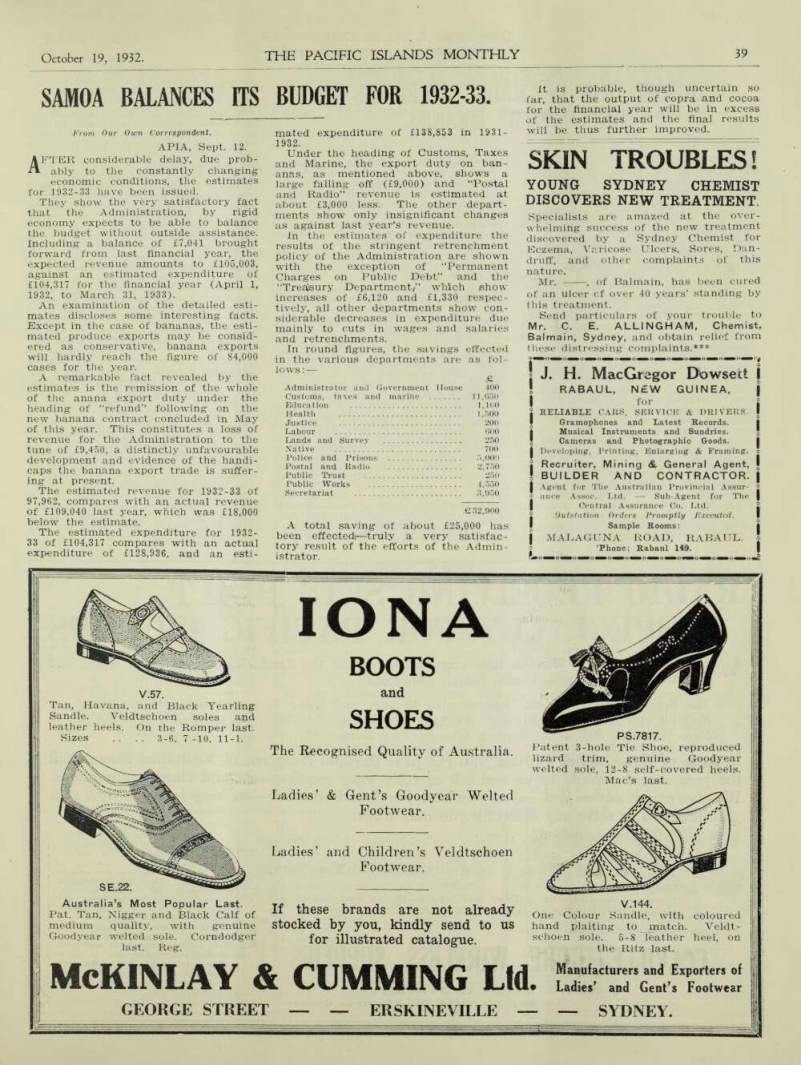
From Our Own Correspondent.
APIA, Sept. 12.
AFTER considerable delay, due prob ably to the constantly changing economic conditions, the estimates for 1932-33 have been issued.
They show the very satisfactory fact that the Administration, by rigid economy expects to be able to balance the budget without outside assistance.
Including a balance of £7,041 brought forward from last financial year, the expected revenue amounts to £105,003, against an estimated expenditure of £104,317 for the financial year (April 1, 1932, to March 31, 1933).
An examination of the detailed esti mates discloses some interesting facts.
Except in the case of bananas, the esti mated produce exports may be consid ered as conservative, banana exports will hardly reach the figure of 84,000 cases for the year.
A remarkable fact revealed by the estimates is the remission of the whole of the anana export duty under the heading of “refund” following on the new banana contract concluded in May of this year. This constitutes a loss of revenue for the Administration to the tune of £9,450, a distinctly unfavourable development and evidence of the handi caps the banana export trade is suffer ing at present.
The estimated revenue for 1932-33 of 97,962, compares with an actual revenue of £109,040 last year, which was £18,000 below the estimate.
The estimated expenditure for 1932- 33 of £104,317 compares with an actual expenditure of £128,936, and an esti
mated expenditure of £138,853 in 1931- 1932.
Under the heading of Customs, Taxes and Marine, the export duty on ban anas, as mentioned above, shows a large falling off (£9,000) and “Postal and Radio” revenue is estimated at about £3,000 less. The other depart ments show only insignificant changes as against last year’s revenue.
In the estimates of expenditure the results of the stringent retrenchment policy of the Administration are shown with the exception of “Permanent Charges on Public Debt” and the “Treasury Department" which show increases of £6,120 and £1,330 respec tively, all other departments show con siderable decreases in expenditure due mainly to cuts in wages and salaries and retrenchments.
In round figures, the savings effected in the various departments are as fol lows: —
A total saving of about £25,000 has been effected!—truly a very satisfac tory result of the efforts of the Admin istrator.
It is probable, though uncertain so far, that the output of copra and cocoa for the financial year will be in excess of the estimates and the final results will be thus further improved.
Administrator and Government House 400 Customs, taxes and marine . 11,650 £ Education 1,100 Health 1,500 Justice 200 Labour 600 Lands and Survey 250 Native 700 Police and Prisons 5,000 Postal and Radio 2,750 Public Trust 250 Public Works 4,550 Secretariat 3,950 €32,000
Advertisements & other items, p. 41 (1 item)
Iona
SKIN TROUBLES!
YOUNG SYDNEY CHEMIST
DISCOVERS NEW TREATMENT.
Specialists are amazed at the over whelming success of the new treatment discovered by a Sydney Chemist for Eczema, Varicose Ulcers, Sores, Dan druff, and other complaints of this nature.
Mr. —, of Balmain, has been cured of an ulcer of over 40 years’ standing by this treatment.
Send particulars of your trouble to Mr. C. E. ALLINGHAM, Chemist, Balmain, Sydney, and obtain relief from these distressing complaints.***
J. H. MacGregor Dowsett
RABAUL, NEW GUINEA,
for
RELIABLE CARS, SERVICE & DRIVERS.
Gramophones and Latest Records.
Musical Instruments and Sundries.
Cameras and Photographic Goods.
Developing, Printing, Enlarging & Framing.
Recruiter, Mining & General Agent,
BUILDER AND CONTRACTOR.
Agent for The Australian Provincial Assur ance Assoc. Ltd. Sub-Agent for The Central Assurance Co. Ltd.
Outstntion Orders Promptly Executed.
Sample Rooms:
MALAGUNA ROAD, RABAUL.
'Phone: Rahaul 149.
V. 57.
Tan, Havana, and Black Yearling Sandle. Veldtschoen soles and leather heels. On the Romper last.
Sizes . . . . 3-6, 7 -10, 11-1.
SE.22, Australia’s Most Popular Last.
Pat. Tan, Nigger and Black Calf of medium quality, with genuine Goodyear welted sole. Corndodger last. Reg.
IONA
BOOTS
and
SHOES
The Recognised Quality of Australia.
Ladies’ & Gent’s Goodyear Welted
Footwear.
Ladies’ and Children’s Veldtschoen
Footwear,
If these brands are not already stocked by you, kindly send to us
for illustrated catalogue.
P 5.7817.
Patent 3-hole Tie Shoe, reproduced lizard trim, genuine Goodyear welted sole, 12-8 self-covered heels.
Mac’s last.
V. 144.
One Colour Sandle, with coloured hand plaiting to match. Veldtschoen sole. 5-8 leather heel, on the Ritz last.
McKINLAY & GUMMING Lid.
GEORGE STREET
ERSKINEVILLE SYDNEY.
Growing Use Of Radio Receivers In
The Pacific Islands.
A PROBLEM which is increasingly exercising the minds of residents in the various Pacific Territories is that of securing for themselves an adequate and reliable supply of news.
It may be solved by the use of better and bigger wireless receiving sets.
These are now being built.
In past decades, the Pacific Islands resident reconciled himself to the fact that he was definitely far out of range of telegraphs and newspapers, and he was content to receive and consume his news in large lumps whenever the steamers called with his mail.
But with the development of radio, the whole position in that regard has altered.
Almost all Pacific Islands communi tics of anv size now have a radio station, and a radio official settled among them. The air is full of news services, broadcast in short-wave Morse from the surrounding continents. It is possible for men living in very remote is lands to know nowadays about great events within a few hours of their oc currence. But, up-to-date, no regular system of supplying news to the Pacific Islands communities has been devised.
The reason is that the preparation, broadcasting, transmission, copying and circulation of news by Morse de finitely represents a considerable cost; and when the amount is passed on to Pacific Islands residents, per medium of the local radio station, the sum rep
resents a too heavy tax on individuals.
Yet, in the South Seas there are thousands of planters and traders who recognise the possibilities of radio; and who now insist that it shall be used to provide them with a regular news ser vice, and a means of obtaining special messages from the mainland. This may yet be done by picking up broadcasts on individual receiving sets, instead of depending on messages copied through the Morse station.
Up to recently, radio receiving sets installed in the Pacific Islands, to keep their owners in touch with Aus tralian and New Zealand broadcasts. have not been satisfactory. Sets with six and seven valves can pick up the stations from almost any of the Is lands; but they also pick up static, and these older sets have been practically useless in the stormy season, for months at a time.
But, month by month, new and bet ter receiving sets are being produced; and the far more delicate adjustments that are now possible are very rapidly extending the radius of reliable broad cast reception. As a result, more and more Islands groups are becoming wirelessly workable, so that it, is now possible to bring Norfolk Island, New Caledonia. New Hebrides, Solomon Is lands, and some parts of Papua within effective range of Australian stations; and Fiji, Samoa, Tonga and Cook Is lands within range of Australian and
New Zealand stations, during practic ally the whole of the year.
We are much interested in these de velopments, because we believe they are going to solve one of the chief dis advantages of life in the Islands — namely, inability to keep in touch with the world’s current affairs. It is only a question of a short time before one or more of the big broadcasting sta tions in Australia and New Zealand will devote at least one regular session to Pacific Islands listeners-in, during which a special news service, and spe cial messages for Islands residents, will be broadcast. Under these conditions, a resident of New Ireland, or Malaita, or Santo, or Norfolk Island, who now re ceives a mail perhaps once a month, will listen in every evening to a news broadcast, and perhaps to special mes sages directed to him personally.
In this connection we have been much interested in conversations with makers of receiving sets—and particu larly with Mr. S. V. Colville, whose ad vertisement, directed to Pacific Islands residents, appears on this page. Mr.
Colville is a well-known radio engineer, who has been in practice in Sydney for about 12 years, and he has recently had remarkable success in building a special 7-valve set for Pacific Islands reception of Australian broadcasts. He claims that his sets are now being sat isfactorily operated in the New Heb rides, Solomons, Papua and Fiji, and he is studying the problem of consider ably extending the reception.
Mr. Colville does not urge Pacific Islands residents to blindly order a re ceiving set. They should write to a re liable firm dealing with radio appara tus, describe their requirement, and
place on the firm the option of stating: whether satisfactory service may be given, cost of same, etc.
One of the biggest problems con nected with radio for the Islands is that of supplying power. A big set is needed, and a big set places a con siderable strain on the storage bat teries. If the Islands resident can “plug in” to an electric power system he has an advantage over those who must use batteries; but there are vari ous Australian and New Zealand firms which now make storage batteries specially for big wireless sets.
“The Pacific Islands Monthly” will be glad to supply information to any Is lands resident interested in the instal lation or maintenance of a receiving set. Persons seeking information should state clearly whether there is an elec tric power supply available, to which they can plug in; and, if so, what is its voltage, and whether the current is alternating or direct. If there is no electric power available —which means that storage batteries must be depended on—correspondents should give the name of the nearest town or station where there is apparatus for re-charg ing the wet batteries.
Advertisements & other items, p. 42 (1 item)
Specially For Pacific Islands
RADIO RECEIVING SETS BUILT
WE have been building Wireless Receiving Sets for use in the Pacific Islands for eleven years, and we are conversant with Pacific Islands conditions The Sets we supply to the Islands give Reliable and Clear Reception to Australian New Zealand and American Stations. We have had scores of letters from satisfied purchasers in New Hebrides, Solomons, Norfolk Islands, New Guinea, Fiji, etc.
In some of these Islands Groups, you can have daylight reception of Australian Stations all the year round. Write to us and tell us fully your requirements and climatic conditions.
We give expert advice and —after you have purchased your Set we keep in touch with you, and help you to solve any difficulty you may meet.
With one of our 7-Valve 378 Sets (£27/10/- f.o.b. Sydney), which includes special “Dynamic” loud speaker, you may keep regularly in touch with the Mainland, and listen-in to an Australian World News Service
every morning.
If you are mechanically inclined, you may build you own Set.
We supply full kit of parts, blue prints and full instructions.
Full particulars on application to
COLVILIE-MOORE WIRELESS SUPPLIES
4 ROWE STREET, SYDNEY.
c u r.ni.VILLE. M.1.R.E.. Radio Engineer.
A member of the Staff of Burns, Philp (S.S.) Co.. Ltd., writing from Vila (New Hebrides) to us, on 2/9/32, says:— “One of these sets was sold to G. A. Joy, Esq., British Resident Commissioner for the New Hebrides.
It was installed by the writer, and Mr. Joy appears to be thoroughly satisfied with his purchase.
“Results have been exceedingly good. All the main Australian and N.Z. Stations come in at very good speaker volume, and most of the B class stations as well. Mr. Joy states he has received even West Australian Stations at good strength.”
Fijo Firm Gets Verdict Against
N.Z.R.E.
From Our Own Correspondent.
Apia, Oct. 2.
AN interesting case has been decided in the High Court of Samoa. A Fijian firm of sawmillers, Messrs.
Long and Co., claimed £750 from the N.Z. Reparation Estates for breach of contract.
The N.Z.R.E. had made a contract with Messrs. Long and Co., whereby the latter were to manufacture banana cases for export of Samoan bananas to New Zealand from lumber, supplied by the N-Z.R.E. for the purpose. After a considerable time, N.Z. banana buyers complained that the wood the boxes were made of was unsuitable and to some extent, spoiled the aroma and quality of the fruit.
Thereupon, the N.Z.R.E. terminated the contract, blaming the sawmillers for the trouble. The latter contended that they had nothing whatever to do with the selection of lumber for the boxes, as this was supplied by the Estates.
Judge Luxford awarded the claim ants £375 and costs.
Australia Admits Fiji Bananas.
Fiji Removes Tariff Barrier Against Australia.
AN important and interesting pro vision in the new Ottawa agree ment affects trade between Fiji and Australia.
The duty previously maintained by Australia against Fiji bananas has been reduced from 8/- per cental to 2/6 per cental and Australia, in future, will admit, under these conditions 4.100 cases of Fijian bananas each month to Sydney and Melbourne.
This is not a very large quantity of bananas—but it represents a definite relief for the Fijian banana growers, and a definite step towards the revival of Australian-Fijian trade Several years ago, before Australia became protection-mad, large quanti ties of Fijian bananas came into the Australian market and Australia in re turn shipped goods to Fiji of the an nual value of about £750,000. Then Australia settled a number of returned soldiers on banana-growing land and imposed a prohibitive tariff against Fiji bananas. The effect of that was that Fiji ceased to buy goods from Aus tralia; and when the Australian poli tician, in his usual fashion, declined to see the obvious the Fiji Government droye home the lesson in 1931 by im posing a tariff against Australian goods and giving preference to Britain and New Zealand.
That position has now been altered under the Ottawa treaty. Fiji bananas are to be allowed into the Australian market again and the Fijian tariff against Australia is to be removed.
There may be some revival of Aus tralia-Fiji trade. Fiji should not let the matter rest there, however—it must get the quantitative limitation removed.
If Australians cannot grow bananas for their own market under the double protection of 2/6 per cental, plus the cost of transport from the Islands, they should not be encouraged to grow bananas at all.
The admission of 4,100 cases of ban anas to Australia each month from Fiji will not necessitate any special shipping arrangement. The ordinary mail steamers running from America through Suva and Auckland, to Aus tralia can take care of this additional trade. There has been a suggestion that the Burns, Philp steamer Morinda on her way back from the New Heb rides to Australia, via Norfolk Island might call at Fijian ports to pick up bananas, thus giving quicker despatch than the shipment by the mail steamers through Auckland. The objection against this, however, is that the “Mor inda” might be delayed a day or two at Norfolk Island by bad weather which would not be very good for the banana cargo.
Fiji Airways.
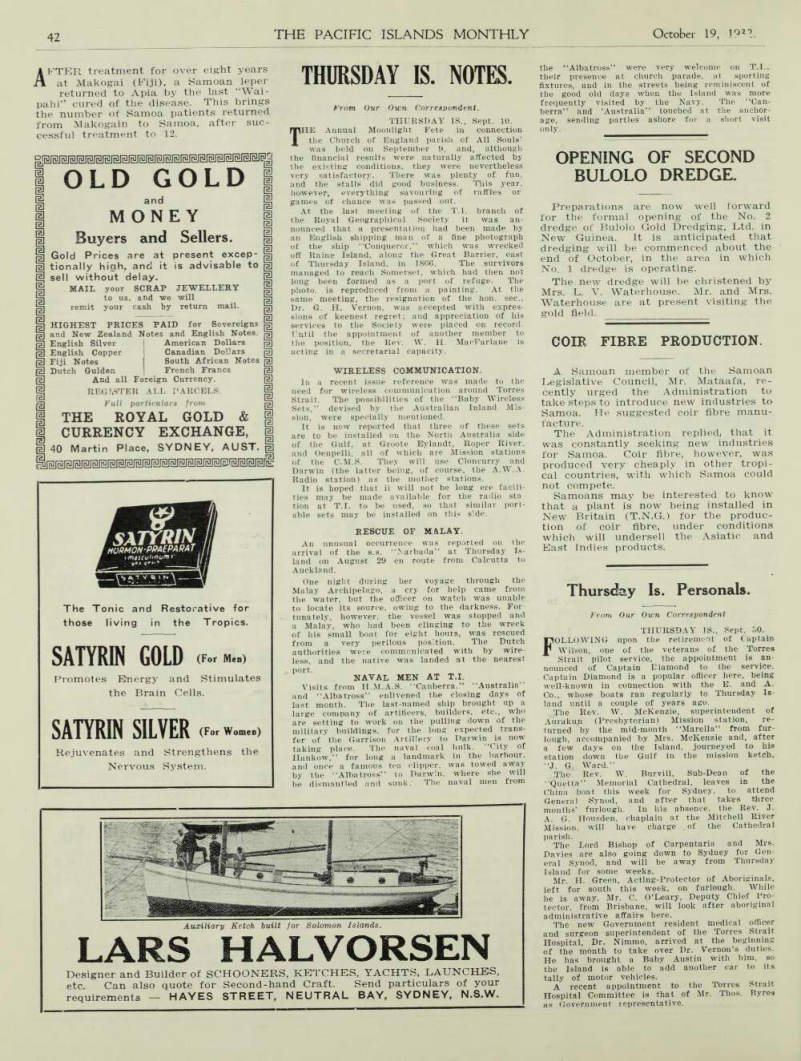
Plan Favourably Received by Government.
Mr. George Jeffreys, Who Ac
companied Mr. Alan Cross to Suva in order to interview the Fiji authorities in connection with the pro posed inter-island seaplane service to be inaugurated by Fiji Airways, Ltd., returned to Sydney, en route to Ade laide, by the “Monterey” on October 13.
He told a representative of the P.I.M. that they were received with courtesy and consideration by all concerned.
They found that the Governor, Sir Murchison Fletcher, who was a most progressive man, was deeply interested in their proposals and the Elected Members of the Legislative Council were also enthusiastic regarding such a service. It was felt on all hands that,
if an efficient and reliable service could be established, it would be of great benefit to the Colony.
After lengthy discussion, the Execu tive Council had recommended to the Governor that a reasonable subsidy should be paid to Fiji Airways to en able them to carry out their plan. The Governor brought this matter before Parliament, and it was agreed to Mr.
Jeffreys said that it should be under stood that the Governor, before defi nitely signing any agreement regard ing such a subsidy, had first submitted the proposals to the Home Secretary in London.
It was understood, however, that the Governor had received such encour agement that is looked upon as a fore gone conclusion that, before the end of the year, Fiji Airways seaplanes, as well as a fast motor boat, will be oper ating in the Fiji group.
Sir Maynard Hedstrom, of Suva, has consented to election as a local director of Fiji Airways, Ltd.
AFTER treatment for over eight years at Makogai (Fiji), a Samoan leper returned to Apia by the last “Wai pahi” cured of the disease. This brings the number of Samoa patients returned from Makogain to Samoa, after suc cessful treatment to 12.
Advertisements & other items, pp. 43-44 (1 item)
C. G. Piggott
Vitality and Health are the
Main Factors in Every-day Life.
Put yourself in the hands of Specialists who have made an intelligent study of your requirements; it is vital to your health. We are known everywhere the Suppliers of the Right Goods and which put the VITAL into VITALITY. Thirty-five years is our record of supplying Fresh Fruit, vegetables and Produce to the leading Houses throughout the world.
GET fully acquainted with us.
Tel.. MA 4799; FX 4350 Private.. Cable Address: Pigs, Sydney.
C. G. PIGGOTT
Code; Bentley’s
WHOLESALE FRUIT AND PRODUCE MERCHANTS
DIRECT IMPORTERS AND EXPORTERS SYDNEY.
Office: Bulk Stores and Packing House: Fruit Exchange, Sydney Sales Dept.: Fruit Exchange and City Markets, Sydney. Bank of N.S.W. Bankers.
RABAUL CARRYING CO.,
GENERAL FORWARDING
AGENTS, CUSTOMS AGENTS,
INSURANCE STORAGE.
Transport Work and Forwarding Work of Every Description Undertaken.
Modern Transport Equipment.
Telephones: Radio Address: Rabaul 176 and 135. “Rabcarco.”
E. M. GRANTER, Manager.
OLD GOLD
and
MONEY
Buyers and Sellers.
Gold Prices are at present excep tionally high, and it is advisable to sell without delay.
MAIL your SCRAP JEWELLERY
to us, and we will remit your cash by return mail.
HIGHEST PRICES PAID for Sovereigns and New Zealand Notes and English Notes.
English Silver I American Dollars English Copper I Canadian Dollars Fiji Notes I South African Notes Dutch Gulden French Francs And all Foreign Currency.
REGISTER ALL PARCELS.
Full particulars from
THE ROYAL GOLD &
CURRENCY EXCHANGE,
40 Martin Place, SYDNEY, AUST.
The Tonic and Restorative for those living in the Tropics.
SATYRIN GOLD (For Men)
Promotes Energy and Stimulates the Brain Cells.
SATYRIN SILVER (For Women)
Rejuvenates and Strengthens the Nervous System.
Auxiliary Ketch built for Solomon Islands.
LARS HALVORSEN
Designer and Builder of SCHOONERS, KETCHES, YACHTS, LAUNCHES, etc. Can also quote for Second-hand Craft. Send particulars of your requirements HAYES STREET, NEUTRAL BAY, SYDNEY, N.S.W.
Thursday Is. Notes.
From Our Own Correspondent.
Thursday Is., Sept. 10.
THE Annual Moonlight Fete in connection the Church of England parish of All Souls' was held on September 9, and, although the financial results were naturally affected by the existing conditions, they were nevertheless very satisfactory. There was plenty of fun, and the stalls did good business. This year, however, everything savouring of raffles or games of chance was passed out.
At the last meeting of the T.I. branch of the Royal Geographical Society it was an nounced that a presentation had been made by an English shipping man of a fine photograph of the ship “Conqueror,” which was wrecked off Raine Island, along the Great Barrier, east of Thursday Island, in 1866. The survivors managed to reach Somerset, which had then not long been formed as a port of refuge. The photo, is reproduced from a painting. At the same meeting, the resignation of the hon. sec., Dr. G. H. Vernon, was accepted with expres sions of keenest regret; and appreciation of his services to the Society were placed on record.
Until the appointment of another member to the position, the Rev. W. H. MacFarlane is acting in a secretarial capacity.
Wireless Communication.
In a recent issue reference was made to the need for wireless communication around Torres Strait. The possibilities of the “Baby Wireless Sets,” devised by the Australian Inland Mis sion, were specially mentioned.
It is now reported that three of these sets are to be installed on the North Australia side of the Gulf, at Groote Eylandt, Roper River, and Oenpelli, all of which are Mission stations of the C.M.S. They will use Cloncurry and Darwin (the latter being, of course, the A.W.A.
Radio station) as the mother stations.
It is hoped that it will not be long ere facili ties may be made available for the radio sta tion at T.I. to be used, so that similar port able sets may be installed on this side.
Rescue Of Malay.
An unusual occurrence was reported on the arrival of the s.s. “Narbada” at Thursday Is land on August 29 en route from Calcutta to Auckland.
One night during her voyage through the Malay Archipelago, a cry for help came from the water, but the officer on watch was unable to locate its source, owing to the darkness. For tunately, however, the vessel was stopped and a Malay, who had been clinging to the wreck of his small boat for eight hours, was rescued from a very perilous position. The Dutch authorities were communicated with by wire less. and the native was landed at the nearest port.
Naval Men At T.I.
Visits from H.M.A.S. “Canberra,” “Australia” and “Albatross” enlivened the closing days of last month. The last-named ship brought up a large company of artificers, builders, etc., who are setting to work on the pulling down of the military buildings, for the long expected trans fer of the Garrison Artillery to Darwin is now taking place. The naval coal hulk. “City of Hankow,” for long a landmark in the harbour, and once a famous tea clipper, was towed away by the “Albatross” to Darwin, where she will be dismantled and sunk. The naval men from
the “Albatross” were very welcome on T. I., their presence at church parade, at sporting fixtures, and in the streets being reminiscent of the good old days when the Island was more frequently visited by the Navy. The “Can berra” and ‘Australia” touched at the anchor age, sending parties ashore for a short visit only.
Opening Of Second
Bulolo Dredge.
Preparations are now well forward for the formal opening of the No. 2 dredge of Bulolo Gold Dredging, Ltd. in New Guinea. It is anticipated that dredging will be commenced about the end of October, in the area in which No. 1 dredge is operating.
The new dredge will be christened by Mrs. L. V. Waterhouse. Mr. and Mrs.
Waterhouse are at present visiting the gold field.
Coir Fibre Production.
A Samoan member of the Samoan Legislative Council, Mr. Mataafa, re cently urged the Administration to take steps to introduce new industries to Samoa. He suggested coir fibre manu facture.
The Administration replied, that it was constantly seeking new industries for Samoa. Coir fibre, however, was produced very cheaply in other tropi cal countries, with which Samoa could not compete.
Samoans may be interested to know that a plant is now being installed in New Britain (T.N.G.) for the produc tion of coir fibre, under conditions which will undersell the Asiatic and East Indies products.
Thursday Is. Personals.
From Our Own Correspondent
Thursday Is., Sept. Cso.
FOLLOWING upon the retirement of Captain Wilson, one of the veterans of the Torres Strait pilot service, the appointment is an nounced of Captain Diamond to the service.
Captain Diamond is a popular officer here, being well-known in connection with the E. and A.
Co., whose boats ran regularly to Thursday Is land until a couple of years ago.
The Rev. W. McKenzie, superintendent of (Presbyterian) Mission station, re turned by the mid-month “Marella” from fur lough, accompanied by Mrs. McKenzie and, after a few days on the Island, journeyed to his station down the GulL in the mission ketch, “J. G. Ward.”
The Rev. W. Burvill, Sub-Dean of the “Quetta” Memorial Cathedral, leaves in the China boat this week for Sydney, to attend General Synod, and after that takts three months’ furlough. In his absence, the Rev. J.
A. G. Housden, chaplain at the Mitchell River Mission, will have charge .of the Cathedral parish.
The Lord Bishop of Carpentaria and Mrs.
Davies are also going down to Sydney for Gen eral Synod, and will be away from Thursday Island for some weeks.
Mr. H. Green, Acting-Protector of Aboriginals, left for south this week, on furlough. While he is away, Mr. C. O’Leary, Deputy Chief Pro tector, from Brisbane, will look after aboriginal administrative affairs here.
The new Government resident medical officer and surgeon superintendent of the Torres Strait Hospital, Dr. Nimmo, arrived at the beginning of the month to take over Dr. Vernon’s duties.
He has brought a Baby Austin with him, so the Island is able to add another car to its tally of motor vehicles.
A recent appointment to the Torres Strait Hospital Committee is that of Mr. Thos. Byres as Government representative.
"Pestilential Hole.”
Self-Assured Traveller’s Opinion of New Guinea.
A GENTLEMAN named Mr. James S.
Inch, who is the manager of an Australian insurance company, made a visit to the East recently, travelling by E. and A. steamer, which means that, going and coming, he made a brief call at Rabaul.
Having thus fully qualified himself to speak as an authority on the Terri tory of New Guinea, Mr, Inch met newspaper reporters in Brisbane and Sydney and explained his views con cerning the economic value and prob able future of the Territory. He told the Brisbane reporter that Rabaul was “ruining Australians living there.”
“They seemed to prefer a life of ‘eat, drink and be merry,’ (said Mr. Inch) and did not seem to take life seriously. There were very few who had not contracted malaria, and they drank quinine all day. Many persons told him it would be better if the Germans again took over the country. Most of the men were work ing for practically no wages, and he had heard that a quarter of the revenue of the place was used up in leave pay and expenses for public servants.”
Mr. Inch made somewhat similar statements to a Sydney reporter and raised the question of whether Aus tralian expenditure in New Guinea was justified from the taxpayers’ point of view. Much of the trade at present went direct to Europe. Australia would suffer no great loss if the Mandated Territory were returned to Germany.
We had not previously heard of Mr.
Inch as an authority on public affairs, and were concerned only because of the prominence given to his somewhat ridiculous statements in a Sydney evening newspaper.
We therefore telephoned Mr. Inch to ascertain how long he had been in New Guinea and, in a decidedly snappy con versation, we learned that Mr. Inch merely called at Rabaul for a few hours on his way to the East; that he had had the opportunity of discussing New Guinea affairs with various fel low-travellers who lived there; and that he regarded New Guinea as “a pestilential hole.” He was also of opinion that the possession of New Guinea was of no use whatever to Aus tralia, and Australia would be better without it. He also informed us that we were quite mistaken in supposing that Australia held New Guinea under a mandate from the League of Nations —he had other information and knew much better than that!
With these few words, we may dis miss Mr. James S. Inch. But oppor tunity may be taken to express regret that supposedly responsible Australian newspapers allow irresponsible re porters to give such prominence, on a matter of national importance, to com pletely irresponsible and uninformed utterances.
Santo.
"Hold-Up” At South
Details were reported to the New Hebrides Presbyterian Mission Synod, which met during July, of a “hold-up” at a small coastal village at South Santo.
It appears that £4 was extorted from the villagers by two British half-castes, accompanied by a native, who were armed with firearms and mounted on horses.
At a later date, the people of the same village were evicted by a young Frenchman, who gave them 48 hours to quit, and took possession of their coconut trees.
It was stated at Synod that the New Hebrides Administration were investi gating these reports.
Tongan Notes.
From Our Own Corretpondent
Nukualofa. Sept. 16.
The Government’s decision to increase the payment to growers to 1/6 per case for to-day’s shipment of bananas by the “Waipahi” to New Zealand appears to have met with approval.
Government lorries distributed the empties a week ago to the country packing depots and these same lorries have been streaming to the wharf depot for the past two days laden with packed fruit. Unfortunately, the Dominion buyers have fixed our quota at 3,500 cases for this vessel, so, presumably, any surplus will either go forward “on spec.” or be fed to local pigs.
From a Tongan point of view, a wedding of the first magnitude is announced for the end of the present month. Princess Fusipala, half sister to Her Majesty the Queen, is to be married to Haamea, eldest son of high chief Finau, and descendant of that redoubtable Finau who, 130 years ago, was war lord of the Tongan Group. The wedding is to take place at the Royal Chapel, and the happy couple will then journey to Vavau, where Chief Haamea has extensive holdings.
An Islands Wedding.
A PICTURESQUE wedding took place on October 15 at St. Peter’s Church, Cremorne, Sydney, when Miss Pat Coates, of Balmoral, was married to Mr. Cecil Mason, of Chatswood.
The ceremony had a distinctly Is lands atmosphere, as the bride is the second daughter of Mr. and Mrs. A.
Ernest Coates, who already have a married daughter (Madam B. Lancon) and two sons—Keith and Col —on Ouesso Plantation, Malekula, New Hebrides.
The bridegroom, after varied New Guinea experience, is now stationed at Here Plantation, Guadalcanal, Solomon Islands, and the young couple will leave for their Island home by the “Mataram” on the 22nd instant. Mr. Mason is the third son of the late Mr. JJ. H. Mason (Crown Prosecutor) and Mrs. C. Mason, of Beaconsfleld Road, Chatswood, Syd ney.
Among the friends at the church were several with Islands interests, including Mr. and Mrs.
M. D. Cobb, of Karewap Plantation, Aitape, New Guinea; and Mrs. and Miss Cowley, late of Samarai and Port Moresby The bride was given away by her father and attended by her younger sisters, Joy and Made leine, the groom being looked after by his brother, Dick. The bride looked very sweet and handsome in a pretty soft cream lace cos tume and picture hat, and carried a shower bouquet of white lilac and roses, a most charm ing Island effect being created by a lovely orange blossom lei worn by the bride.
Advertisements & other items, p. 45 (2 items)
Chartres,
POSITION WANTED.
Young man (24), single, 9 years’ Bank experience, seeks POSITION involving part or whole time outdoor work, with opportunity for advancement; in New Guinea, Islands, or North Coast of Queensland. Apply
G.P.O. Box 3408 R, SYDNEY.
AUSTRALASIA’S CLEARING HOUSE FOR THE PRECIOUS METALS.
BUYERS OF—
GOLD OSMIRIDIUM, PLATINUM, SILVER, Etc.
GARRETT & DAVIDSON Ltd.
Assayers, Bullion Merchants, Metallurgists, BANK OF N.S.W. BUILDINGS, REGENT STREET. SYDNEY.
CHARTRES,
STOTT & HOARE’S
CORRESPONDENCE
COLLEGE
Founded 1885.
Pioneers and Specialists in Postal Instruction.
All Educational and Commercial subjects taught thoroughly and efficiently by correspondence.
Experienced Certificated Instructors.
Write for particulars.
CHARTRES, STOTT & HOARE’S CORRESPONDENCE COLLEGE,
Liverpool Street, Sydney, Australia.
McLaren-Benz High-Speed
DIESEL ENGINES
Marine, Stationary, Traction.
Used in the Royal Navy, British-made.
8-120 B.H.P.
GIBSON, BATTLE & CO. LIMITED,
535 Kent Street, SYDNEY, N.S.W.
Samoan News Budget.
Quality of Banana Shipments Improves.
From Our Own Correspondent APIA, Sept. 5.
THERE are hardly any changes in the copra and cocoa market. The local cocoa price has again dropped £5 per ton.
The last “Maui Pomare’’ took only about 4,500 cases of bananas for the New Zealand market, though she is to load about 2,000 cases from Niue on her way back.
A representative of the N.Z. buyers has recently noticed a great improve ment in the quality of the banana ship ments from Samoa and has expressed his appreciation. Unfortunately, this improvement will have no effect on the contract price nor is it likely to lead to larger shipments in the future, so
it does not help the producer very much.
Death Sentence Commuted.
The Niue murderer, recently brought to Apia by the “Maui Pomare” and sentenced to death by the Commissioner at Niue Island, has had his death sentence commuted by the Governor- General of New Zealand to imprisonment for life. The sentence will be served in Samoa.
Successful Race Meeting.
The Apia Turf Club held a successful race meeting on August 29, flag-raising day. A large crowd of natives had gathered, though the European attendance left much to be desired.
Some interesting races were run in the pre sence of the Administrator and an official party from American Samoa. The old racer “Buster” won the Roberts Memorial Handicap, while a newcomer, “Lady Scapani,” a promising filly of the imported stallion “Loyal Irish,” won the Maiden Plate and the Flag-raising Day Han dicap in record time.
Result Of Boxing Championship.
At the Tifaga Playhouse on August 31 before a crowded house, the eagerly-awaited bout be tween “Red” David and “Bill” Scanlon for the heavyweight championship title and the Car ruthers belt took place. Expectations had been rife for weeks regarding the outcome and quite a bit of money had been laid on both contest ants, though Scanlon, owing to his previous ring experience, had been the favourite. A number of visitors from Pago Pago had come over and some of the sailors of the U.S.S.
“Ontario” had stayed behind after their ship’s departure to witness the contest and back up Scanlon, who is a Tutuila boy. The bout lasted the full ten rounds and resulted in “Red David winning on points by a small margin.
The result is very creditable to the young local boxer and evoked intense enthusiasm amongst the local fans. Scanlon’s manager immediately issued a challenge to David for a return bout in three months’ time. Scanlon is confident that he will defeat David in the return bout.
Samoan Election
Prospects.
From Our Own Correspondent
Apia, Oct 2.
Preparations have begun for the coming election of two European elected members of the Legislative Council on November 9. So far, 16 additional names have been entered on the electoral roll, bringing the total up to 119.
Two candidates will represent the Planters’ Association, Messrs. I. H.
Carruthers and G. Miedicke, who both hold Crown leases. It is somewhat hard to understand, why the planters, though they are certainly entitled to representation, have put up and two candidates, whom they cannot possibly hope to get in, completely ignoring the right to representation of the commer cial interests. It is believed that Mr.
A. G. Smythe will stand as an inde pendent candidate and will be sup ported by the commercial community.
As Mr. Smythe is very popular, his election may be considered certain. An other independent candidate will be an nounced shortly.
Mr. S. H. Meredith has also declared his intention to contest the election, his chance of retaining his seat is very slight. With an eye on the coming election, he became active at the last Legislative Council meeting and brought several important matters to the notice of the Administration.
The electoral register closes on Oc tober 19. After that date, the fight will begin, and promises to be interest ing in view of the number of candi dates and the conflicting interests in the field. (An earlier reference to the Samoan election appears on page 32 of this issue.)
Advertisements & other items, p. 46 (1 item)
“Freez-All”
Wherever you live — Refrigeration
In spite of you being ever so far out of reach of Ice-Works or Electricity, all the benefits of refrigeration have been brought within the reach of every home by the
Home Refrigerator
Will hold a whole carcase of mutton, half a box of butter, as well as drinks.
Cheaper, more Efficient and Reliable than any other Selfcontained Refrigerator. Oper ates at the trifling cost of
1½d. per day.
Price Complete: £27/10/-
Australian Currency f.o.b. Sydney.
Many thousands are now in use in Australian country homes, and we provide a Guaranteed Service with every machine. We Specialise in Repairs for “Icyball” and Ice-stove Refrigerating Units.
Write to Sole Pacific Island Distributors:
McLEOD BOLTON & CO. LTD.,
THE ISLAND MERCHANTS,
249 GEORGE STREET. SYDNEY.
Established 20 Years. Cables: “NOTLOB," SYDNEY Please send me copy of your full descriptive Leaflet.
Name Address
1870. 1932.
QUALITY STANDS
THE TEST OF TIME.
B.M.P.
“WAR
MEDAL”
BRAND
Specially packed
for Island Trade
BEK
CORNED
CORNED BOILED, ROAST, BEEF OR MUTTON.
Packed in 12oz„ 1lb., 1½lb.. 2lb., 3lb., 4lb,. 5lb., 6lb. tins.
SAUSAGES
BEEF
Tins fitted with Patent Key Opener.
S.M.P. MILESTONE BRAND.
CHICKEN SAUSAGES
FRANKFURTS SHEEP TONGUES
RABBIT OX TONGUES, etc.
ASSORTED FANCY MEATS, ETC.
F. J. WALKER LTD., 33 Macquarie Place, Sydney.
Sole Selling Agents for; THE SYDNEY MEAT PRESERVING CO. LTD.
Market Quotations
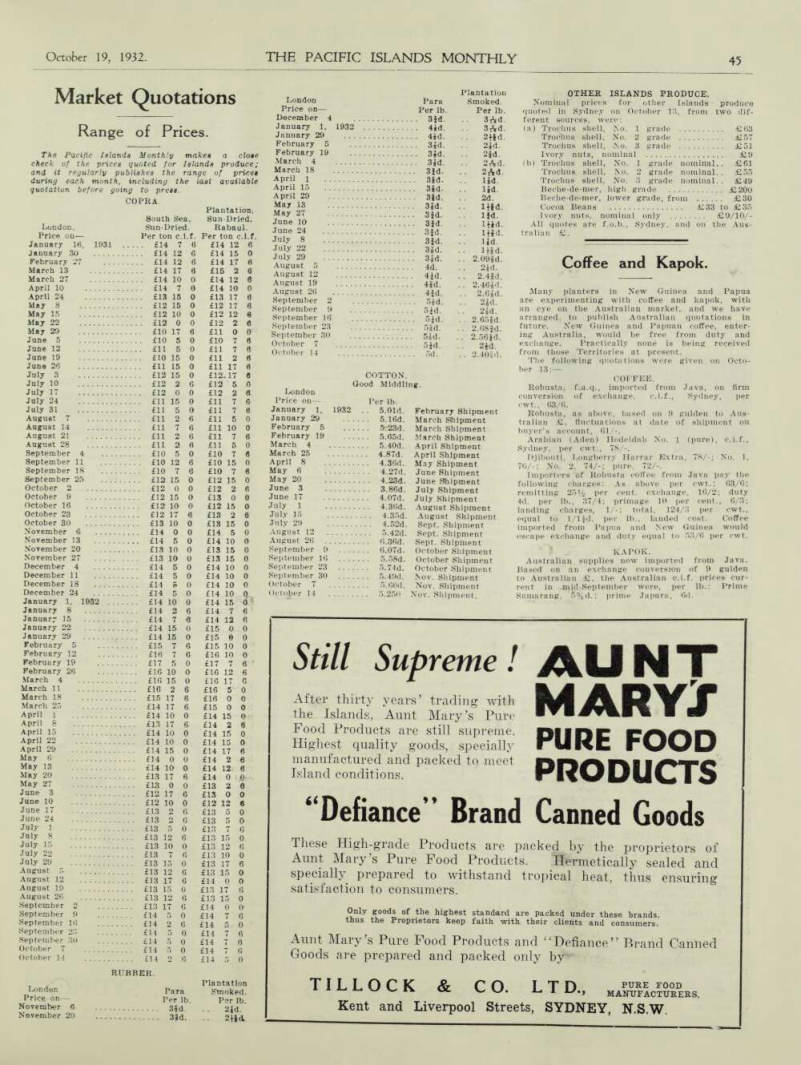
Range of Prices.
The Pacific Islands Monthly makes a close check of the prices quoted for Islands produce ; and it regularly publishes the range of prices during each month, including the last available quotation before going to press.
Other Islands Produce.
Nominal prices for other Islands produce quoted in Sydney on October 13, from two dif ferent sources, were: (a) Trochus shell, No. 1 grade £63 Trochus shell. No. 2 grade £57 Trochus shell, No. 3 grade £51 Ivory nuts, nominal £9 (b) Trochus shell, No. 1 grade nominal.. £61 Trochus shell, No. 2 grade nominal. . £55 Trochus shell. No. 3 grade nominal. . £49 Beche-de-mer, high grade £200 Beche-de-mer, lower grade, from £30 Cocoa Beans £33 to £35 Ivory nuts, nominal only £9/10/- All quotes are f.o.b., Sydney, and on the Aus tralian £.
Plantation Smoked. Per lb.
London Price on— Para Per lb.
December 4 ... 3Ad.
January 1, 1932 . . 3 Ad.
January 29 2f|d.
February 5 3Jd. 2id.
February 19 2fid.
March 4 ■ • 2 Ad.
March 18 3}d- 2Ad.
April l lid.
April 15 lid.
April 29 2d.
May 13 Ifld.
May 27 Ud.
June 10 Uid.
June 24 Ufd.
July 8 Ud.
July 22 U3d.
July 29 3|d. .. 2.093d.
August 5 4d. .. 2Jd.
August 12 . • 2.43d.
August 19 43d, .. 2.46id.
August 26 . . 2.6id.
September 2 5id. . . 2id.
September 9 5}d. 2id.
September 16 5*d. .. 2.653d.
September 23 ... r,jd. . . 2.68Jd.
September 30 Sid. .. 2.56Jd.
October 7 ... 5*d. 2*d.
October 14 . . 2.403d.
Cotton.
Good Middling.
London Price on— Per lb.
January 1, 1932 S.Old. February Shipment January 29 5.16d. March Shipment February 5 5v23d. March Shipment February 19 5.65d. March Shipment March 4 5.40d. April Shipment March 25 4.87d. April Shipment April 8 4.36d. May Shipment May 6 4.27d. June Shipment May 20 4.23d. June Shipment June 3 3.86d. July Shipment June 17 4.07d. July Shipment July 1 4.36d. August Shipment July 15 4.35d. August Shipment July 29 4.52d. Sept. Shipment August 12 5.42d. Sept. Shipment August 26 6.36d. Sept. Shipment September 9 6.07d. October Shipment September 16 5.58d. October Shipment September 23 5.74d. October Shipment September 30 5.49d. Nov. Shipment October 7 5.60d. Nov. Shipment October 14 5.250 Nov. Shipment.
Copra
South Sea. Sun-Dried, Per ton c.i.f.
Plantation, Sun-Dried. Rabaul. Per ton c.i.f.
London. Price on— January 16, 1931 £14 7 6 £14 12 6 January 30 £14 12 6 £14 15 0 February 27 £14 17 6 March 13 £16 2 6 March 27 £14 12 6 April 10 £14 10 0 April 24 £13 15 0 £13 17 6 May 8 £12 15 0 £12 17 6 May 15 £12 12 6 May 22 ... £13 0 0 £12 2 6 May 29 £10 17 6 £11 0 0 June 5 £10 5 0 £10 7 6 June 12 ... £11 5 0 £11 7 6 June 19 ... £10 15 0 £11 2 6 June 26 . . . . £11 15 0 £11 17 0 July 3 . ... £12 15 0 £12.17 fl July 10 . .. . £12 2 6 £12 5 0 July 17 . . . . £12 0 0 £12 2 0 July 24 ... £11 15 0 £11 7 6 July 31 £11 7 6 August 7 £11 5 0 August 14 £11 7 6 £11 10 0 August 21 £11 2 6 £11 7 6 August 28 £11 2 0 £11 5 0 September 4 £10 5 0 £10 7 0 September 11 £10 12 6 £10 15 0 September 18 £10 7 6 £10 7 0 September 25 £12 15 0 £12 15 0 October 2 £12 0 0 £12 2 6 October 9 . . . . £12 15 0 £13 0 0 October 16 ... £12 10 0 £12 15 0 October 23 ... £12 17 6 £13 2 6 October 30 ... £13 10 0 £18 15 0 November 6 . ... £14 0 0 £14 5 0 November 13 , ... £14 5 0 £14 10 0 November 20 £13 15 0 November 27 £13 10 0 £13 15 0 December 4 £14 10 0 December 11 ... £14 5 0 £14 10 0 December 18 ,... £14 5 0 £14 10 0 December 24 ... £14 5 0 £14 io a January 1, 1632 . . . . ... £14 10 0 £14 15 0 January 8 £14 7 6 January 15 ... £14 7 0 £14 12 6 January 22 ... £14 15 0 £15 0 0 January 29 £15 0 0 February 5 £15 10 0 February 12 £16 10 0 February 19 ... £17 5 0 £17 7 6 February 26 £16 12 6 March 4 . . . £16 15 0 £16 17 6 March 11 £16 5 0 March 18 £16 0 0 March 25 ... £14 17 6 £15 0 0 April i £14 15 0 April 8 £14 2 6 April 15 £14 15 0 April 22 £14 15 0 April 29 £14 17 6 May 6 £14 2 0 May 13 £14 12 6 May 20 £14 0 0 May 27 .. £13 0 0 £13 2 0 June 3 £13 0 0 June 10 £12 10 0 £12 12 6 June 17 £13 5 0 June 24 ... £13 2 6 £13 5 0 July 1 £13 7 6 July 8 £13 15 0 July 15 £13 12 6 July 22 ... £13 7 6 £13 10 0 July 29 .. £13 15 0 £13 17 6 August 5 .. £13 12 6 £13 15 0 August 12 .. £13 17 6 £14 0 0 August 19 . . £13 15 0 £13 17 6 August 26 £13 15 0 September 2 £14 0 0 September 9 £14 5 0 £14 7 6 September 16 .. £14 2 6 £14 5 0 September 23 ... £14 5 0 £14 7 6 September 30 ... £14 5 0 £14 7 0 October 7 . . £14 5 0 £14 7 6 October 14 £14 5 0
Rubber.
London Price on— Para Per lb.
Plantation Smoked. Per lb.
November 6 2{d.
November 20 2*44
Coffee and Kapok.
Many planters in New Guinea and Papua are experimenting with coffee and kapok, with an eye on the Australian market, and we have arranged to publish Australian quotations in future. New Guinea and Papuan coffee, enter ing Australia, would be free from duty and exchange. Practically none is being received from those Territories at present.
The following quotations were given on Octo ber 13:—
Coffee.
Robusta, f.a.q., imported from Java, on firm conversion of exchange, c.i.f., Sydney, per cwt., G3/6.
Robusta, as above, based on 9 gulden to Aus tralian £, fluctuations at date of shipment on buyer’s account, 61/-.
Arabian (Aden) Hodeidah No. 1 (pure), c.i.f., Sydney, per cwt., 78/-.
Djibouti, Longberry Harrar Extra, 78/-; No. 1, 76/-: No. 2, 74/-; pure. 72/-.
Importers of Robusta coffee from Java pay the following charges: As above per cwt.: 63/6; remitting 25% per cent, exchange, 16/2; duty 4d. per lb., 37/4; primage 10 per cent., 6/3; landing charges, 1/-; total, 124/8 per cwt., equal to 1/1 id. per lb.. landed cost. Coffee imported from Papua and New Guinea would escape exchange and duty equal to 53/6 per cwt.
Kapok.
Australian supplies now imported from Java.
Based on an exchange conversion of 9 gulden to Australian £, the Australian c.i.f. prices cur rent in mid-September were, per lb.: Prime Samarang, 0%d.: prime Japara, 6d.
Advertisements & other items, p. 47 (1 item)
Still Supreme
After thirty years’ trading with the Islands, Aunt Mary’s Pure Food Products are still supreme.
Highest quality goods, specially manufactured and packed to meet Island conditions.
AUNT
MARY'S
PURE FOOD
PRODUCTS
“Defiance” Brand Canned Goods
These High-grade Products are packed by the proprietors of Aunt Mary’s Pure Food Products. Hermetically sealed and specially prepared to withstand tropical heat, thus ensuring satisfaction to consumers.
Only goods of the highest standard are packed under these brands, thus the Proprietors keep faith with their clients and consumers.
Aunt Mary’s Pure Pood Products and “Defiance” Brand Canned Goods are prepared and packed only by
TILLOCK & CO. LTD.,
PURE FOOD
MANUFACTURERS,
Kent and Liverpool Streets, SYDNEY, N.S.W,
Exchange Quotations
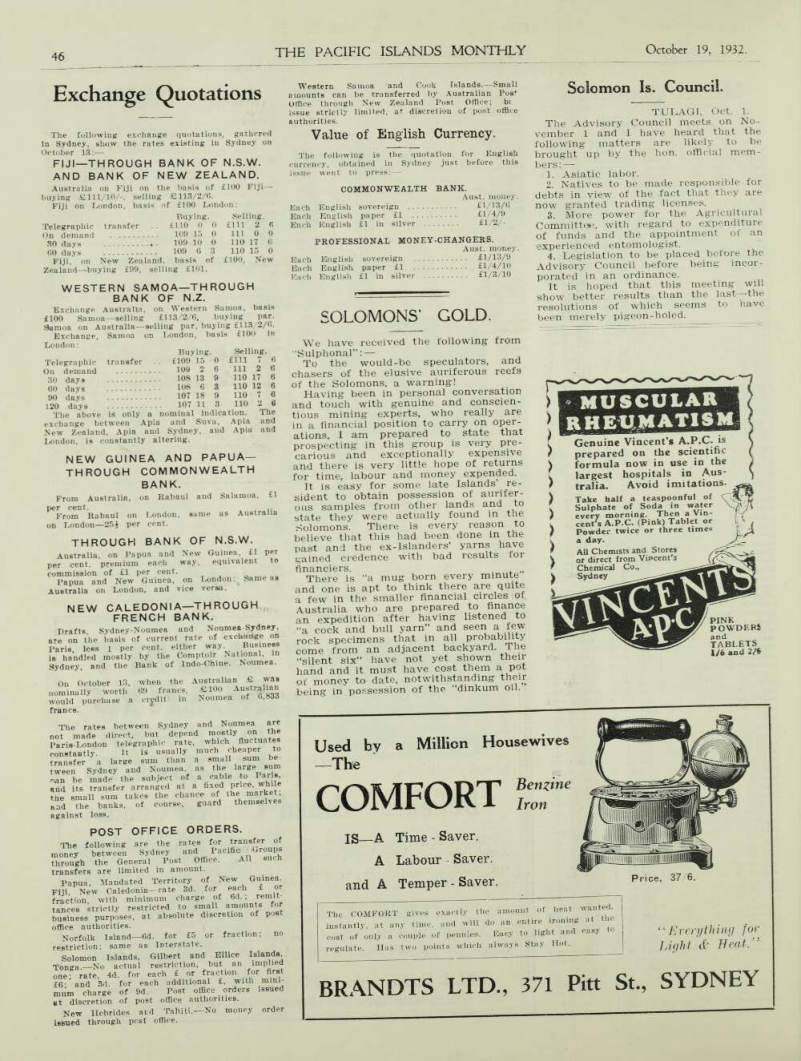
The following exchange quotations, gathered In Sydney, show the rates existing in Sydney on October 13:—
Fiji—Through Bank Of N.S.W.
And Bank Of New Zealand.
Australia on Fiji on the basis of £100 Fiji— buying £111/10/-, selling £113/2/6.
Fiji on London, basis of £100 London:
Western Samoa—Through
Bank Of N.Z.
Exchange Australia, on Western Samoa, basis £100 Samoa—selling £113/2/6. buying par.
Samoa on Australia—selling par, buying £113/2/0.
Exchange, Samoa on London, basis £100 in London:
The above is only a nominal indication. The exchange between Apia and Suva, Apia and New Zealand, Apia and Sydney, and Apia and London, is constantly altering.
New Guinea And Papua
Through Commonwealth
Bank.
From Australia, on Rabaul and Salamoa, fl per cent.
From Rabaul on London, same as Australia on London—25½ per cent.
Through Bank Of N.S.W.
Australia, on Papua and New Guinea, £1 per per cent, premium each way. equivalent to commission of £1 per cent.
Papua and New Guinea, on London; Same as Australia on London, and vice versa.
New Caledonia —Through
French Bank.
Drafts Sydney-Noumea and Noumea-Sydney. are on the basis of current rate of exchange on Paris, less 1 per cent, either way Business is handled mostly by the Comptoir National, in Sydney, and the Bank of Indo-Chme. Noumea.
On October 13, when the Australian £ was nominally worth 09 francs, £100 Australian would purchase a credit in Noumea of 0.833 francs.
The rates between Sydney and Noumea are not made direct, but depend mostly on the Paris-London telegraphic rate, which fluctuates constantly. It is usually much cheaper to transfer a large sum than a small sum be tween Sydney and Noumea, as the large sum can be made the subject of a cable to Pafis and its transfer arranged at a fixed price while the small sum takes the chance of the market and the banks, of course, guard themselves against loss.
Post Office Orders.
The following are the rates for transfer of money between Sydney and Pacific Groups through the General Post Office. All such transfers are limited in amount.
Papua, Mandated Territory of New Guinea.
Fiji, New Caledonia —rate 3d. for each for fraction, with minimum charge of 6d.; remit tances strictly restricted to small amounts for business purposes, at absolute discretion of post office authorities.
Norfolk Island—6d. for £5 or fraction; no restriction: same as Interstate.
Solomon Islands, Gilbert and Ellice Islands Tonga.—No actual restriction, but an implied one; rate, 4d. for each £ or fraction, for first £6- and 3d. for each additional £, with mini mum charge of 9d. Post office orders issued at discretion of post office authorities.
New Hebrides and Tahiti.—No money order issued through post office.
Western Samoa and Cook Islands.—Small amounts can be transferred by Australian Post Office through New Zealand Post Office; bi issue strictly limited, at discretion of post office authorities.
Value of English Currency.
The following is the quotation for English currency, obtained in Sydney just before this issue went to press:—
Buying. Selling.
Telegraphic transfer . . £110 0 0 £111 2 R On demand 109 15 0 111 0 0 30 days *. 109 10 0 110 17 0 00 days 109 G 3 110 15 0 Fiji, on New Zealand, basis of £100, New Zealand —buying £99, selling £101.
Buying. Selling.
Telegraphic transfer . . £109 15 0 £111 7 6 On demand *09 2 6 111 2 fi 30 days 108 13 9 110 17 6 60 davs 108 6 3 110 12 6 90 daVs 107 18 9 110 7 6 120 days 107 11 3 110 2 6
Commonwealth
Bank.
Aust. money.
Each English sovereign £1/13/0 Each English paper £1 £1/4/9 Each English £1 in silver . .. £1/2/-
Professional Money-Changers.
Aust. money.
Each English sovereign £1/13/9 Each English paper £1 £1/4/10 Each English £1 in silver . .. £1/3/10
Solomons’ Gold.
We have received the following from “Sulphonal”; — To the would-be speculators, and chasers of the elusive auriferous reefs of the Solomons, a warning!
Having been in personal conversation and touch with genuine and conscien tious mining experts, who really are in a financial position to carry on oper ations, I am prepared to state that prospecting in this group is very pre carious and exceptionally expensive and there is very little hope of returns for time, labour and money expended.
It is easy for some late Islands’ re sident to obtain possession of aurifer ous samples from other lands and to state they were actually found in the Solomons. There is every reason to believe that this had been done in the past and the ex-islanders’ yarns have gained credence with bad results for financiers.
There is "a mug born every minute" and one is apt to think there are quite a few in the smaller financial circles of Australia who are prepared to finance an expedition after having listened to “a cock and bull yarn” and seen a few rock specimens that in all probability come from an adjacent backyard. The “silent six” have not yet shown their hand and it must have cost them a pot of money to date, notwithstanding them being in possession of the “dinkum oil.
Solomon Is. Council.
Tulagi, Oct. 1.
The Advisory Council meets, on No vember 1 and I have heard that the following matters are likely to be brought up by the hon. official mem bers; — 1. Asiatic labor. 2. Natives to be made responsible for debts in view of the fact that they are now granted trading licenses. 3. More power for the Agricultural Committee, with regard to expenditure of funds and the appointment of an experienced entomologist. 4. Legislation to be placed before the Advisory Council before being incor porated in an ordinance.
It is hoped that this meeting will show better results than the last the resolutions of which seems to have been merely pigeon-holed.
Advertisements & other items, p. 48 (1 item)
rheumatism
MUSCULAR
Genuine Vincent’s A.P.C. is
prepared on the scientific
formula now in use in the
largest hospitals in Aus-
tralia. Avoid imitations.
Take half a teaspoonful of Sulphate of Soda in water every morning. Then a Vin cent’s A.P.C. (Pink) Tablet or Powder twice or three times a day.
All Chemists and Stores or direct from Vincent s Chemical Co., Sydney
PINK
POWDERS
and
TABLETS
1/6 and 2/6
Used by a Million Housewives
—The COMFORT Benzine Iron IS—A Time - Saver.
A Labour - Saver, and A Temper - Saver.
The COMFORT gives exactly the amount of heat wanted, instantly, at any time, and will do an entire ironing at the cost of only a couple of pennies. Easy to light an easy regulate. Has two points which always Stay Hot.
“Everything for Light & Heat. ’
BRANDTS LTD., 371 Pitt St., SYDNEY
Shipping Services in the Pacific
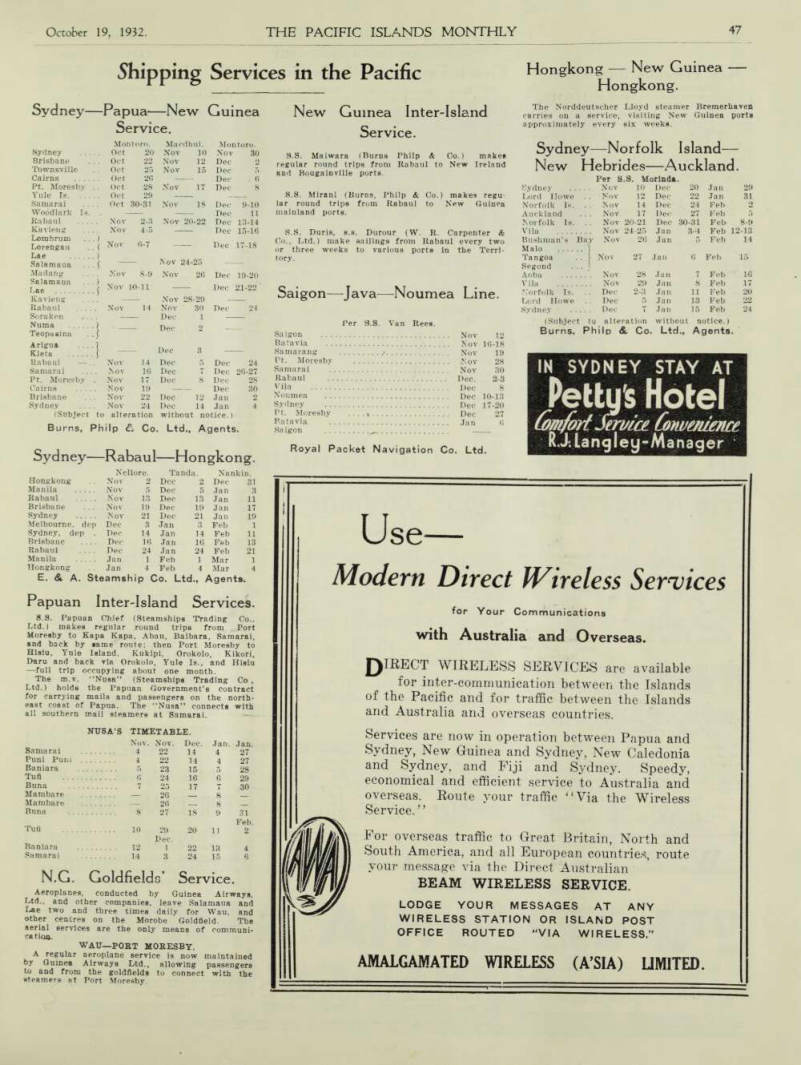
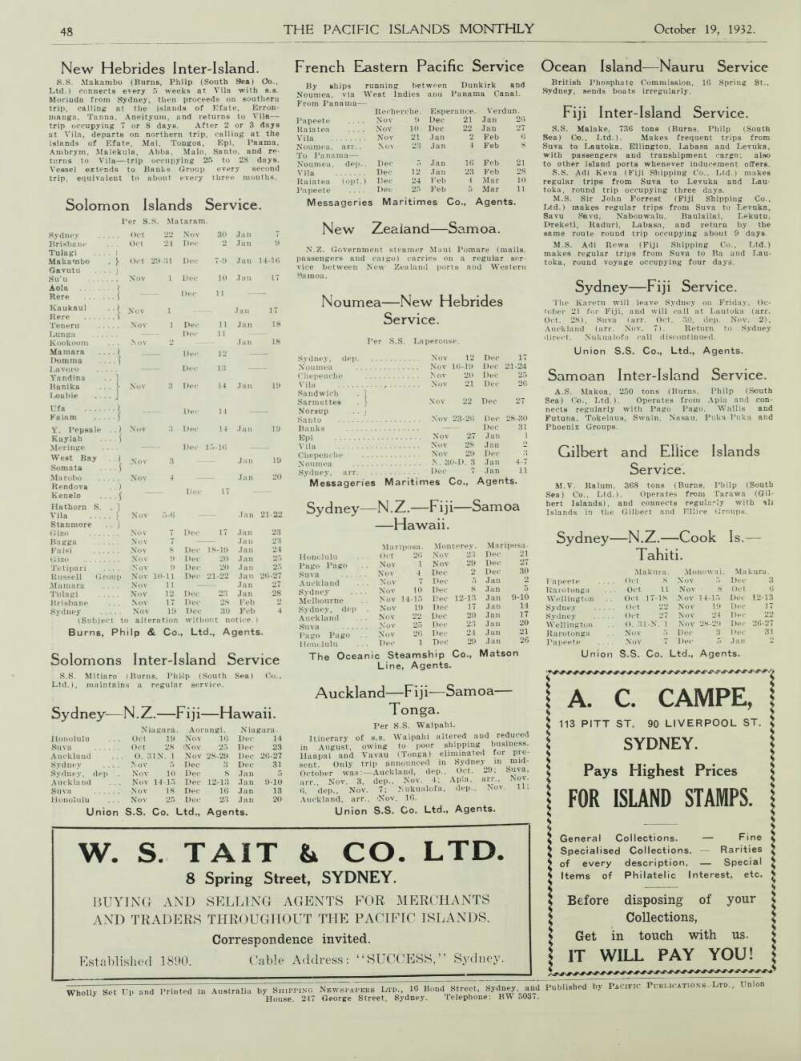
Sydney—Papuan—New Guinea Service.
Sydney—Rabaul—Hongkong.
Papuan Inter-Island Services.
S.S. Papuan Chief (Steamships Trading Co..
Ltd.) makes regular round trips from Port Moresby to Eapa Kapa, Abau, Baibara, Samarai, and back by same route; then Port Moresby to Hlsiu, Yule Island, Kuklpi, Orokolo, Kikori, Daru and back via Orokolo, Yule Is., and Hisiu —full trip occupying about one month.
The m.v. “Nusa” (Steamships Trading Co , Ltd.) holds the Papuan Government’s contract for carrying mails and passengers on the north east coast of Papua. The “Nusa” connects with all southern mail steamers at Samarai.
N.G. Goldfields’ Service.
Aeroplanes, conducted by Guinea Airways, Ltd., and other companies, leave Salamaua and Lae two and three times daily for Wau, and other centres on the Morobe Goldfield. The aerial services are the only means of communi cation.
Wau—Port Moresby.
A regular aeroplane service is now maintained by Guinea Airways Ltd., allowing passengers to and from the goldfields to connect with the steamers at Port Moresby.
New Guinea Inter-Island
Service.
S.S. Maiwara (Burns Philp & Co.) makes regular round trips from Rabaul to New Ireland and Bougainville ports.
S.S. Mirani (Burns, Philp & Co.) makes regu lar round trips from Rabaul to New Guinea mainland ports.
S.S. Duris, s.s. Durour (W. R. Carpenter & Co., Ltd.) make sailings from Rabaul every two or three weeks to various ports in the Terri tory.
Saigon—Java—Noumea Line.
Hongkong New Guinea Hongkong.
The Norddeutscher Lloyd steamer Bremerhaven carries on a service, visiting New Guinea ports approximately every six weeks.
Sydney—Norfolk Island — New Hebrides—Auckland.
Montoro.
Macdhui.
Montoro.
Sydney Oct 20 Nov 10 Nov 30 Brisbane Oct 22 Nov 12 Dec 2 Townsville Oct 25 Nov 15 Dec 5 Cairns . .
Oct 20 — Dec 6 Pt. Moresby Oct 28 Nov 17 Dec 8 Oct 20 Samarai Oct 30-31 Nov 18 Dec 9-10 Woodlark Is — — Dec 11 Rabaul Nov 2-3 Nov 20-22 Dec 13-14 Kavieng Nov 4-5 — Dec 15-16 Lombrum Lorengau Nov 6-7 — Dec 17-18 Lae ...
Salamaua Nov 24-25 Madang Nov 8-9 Nov 26 Dec 19-20 Salamaua Lae Nov 10-11 — Dec 21-22 Kavieng — Nov 28-29 Rabaul . .
Nov 14 Nov 30 Dec 24 Soraken Dec 1 Numa . .
Dec 2 Teopuaina Arlgus Kieta — Dec 3 Rabaul — Nov 14 Dec 5 Dec 24 Samarai Nov 16 Dec 7 Dec 26-27 Pt. Moresby Nov 17 Dec 8 Dec 28 Cairns Nov 19 — Dec 30 Brisbane Nov 22 Dec 12 Jan 2 Sydney Nov 24 Dec 14 Jan 4 (Subject to alteration without notice.) Burns, Philp & Co. Ltd., Agents.
Per S.S. Van Rees.
Saigon 12 Batavia -1H Samarang „■> 19 Pt. Moresby 28 Samarai 30 Rabaul 2-3 ft Vila Noumea Sydney -20 27 Pt. Moresby . .. ., Batavia Saigon 0 Royal Packet Navigation Co. Ltd.
Sydney Per S.S. Morinda.
Nov 10 Dec 20 Jan 20 Lord Howe Nov 12 Dec 22 Jan 31 Norfolk Is.
Nov 14 Dec 24 Feb o Auckland Nov 17 Dec 27 Feb 5 Norfolk Is. . . Nov 20-21 Dec 30-31 Feb 8-0 Vila 24-25 Jan 3-4 Feb 1 2-13 Bushman’s Bay Nov 20 Jan 5 Feb 14 Malo Tangoa
[ Nov
27 Jau G Feb 15 Segond Aoba 28 Jan 7 Feb 1G Vila 20 Jan 8 Feb 17 Norfolk Is.
Dec- 2-3 Jan 11 Feb 20 Lord Howe Dec 5 Jan 13 Feb 22 Sydney 7 Jan 15 Feb 24 (Subject to alteration without notice.) Burns, Philp & Co. , Ltd., Agents.
Nellore.
Tanda.
Nankin.
Hongkong .. Nov 2 Dec 2 Dec 31 Manila 5 Dec 5 Jan 3 Rabaul .. . . Nov 13 Dec 13 Jan 11 Brisbane Nov 19 Dec 19 Jan 17 Sydney .. . . Nov 21 Dec 21 Jan 19 Melbourne. dep Dec 3 Jan 3 Feb 1 Sydney, dep Dec 14 Jan 14 Feb 11 Brisbane . . . . Dec 16 Jan 16 Feb 13 Rabaul . .. . Dec 24 Jan 24 Feb 21 Manila 1 Feb 1 Mar 1 Hongkong Jan 4 Feb 4 Mar 4 E. & A, . Steamship Co. Ltd ,, Agents.
Samara 1
Nusa’S Timetable.
Nov. Nov. Dec. 4 22 14 Jan. 4 Jan. 27 Puni Puni 4 22 14 4 27 Baniara 23 15 5 28 Tufi 24 16 6 29 Buna 7 25 17 7 30 Mambare — 26 8 Mambare — 26 8 Buna 8 27 IS 9 31 Tufi 10 29 20 11 Feb. 2 Baniara Dec. 1 22 13 4 Samarai 14 3 24 15 6
New Hebrides Inter-Island.
S.S. Makambo (Burns, Philp (South Sea) Co., Ltd.) connects every 5 weeks at Vila with s.s.
Morinda from Sydney, then proceeds on southern trip, calling at the islands of Efate, Erron mauga, Tanna, Aneityum, and returns to Vila— trip occupying 7 or 8 days. After 2 or 3 days at Vila, departs on northern trip, calling at the islands of Efate, Mai. Tongoa, Epi, Paama.
Ambrym, Malekula, Abba, Malo, Santo, and re turns to Vila—trip occupying 25 to 28 days.
Vessel extends to Banks Group every second trip, equivalent to about every three months.
Solomon Islands Service.
Solomons Inter-Island Service S.S. Mitiaro (Burns, Philp (South Sea) Co., Ltd.), maintains a regular service.
Sydney—N.Z.—Fiji—Hawaii.
French Eastern Pacific Service
By ships running between Dunkirk and Noumea, via West Indies and Panama Canal.
From Panama —
New Zealand—Samoa.
N.Z. Government steamer Maui Pomare (mails, passengers and cargo) carries on a regular ser vice between New Zealand ports and Western Samoa.
Noumea—New Hebrides
Service.
Sydney —N.Z. —Fiji—Samoa —Hawaii.
Auckland —Fiji—Samoa —
Tonga.
Per S.S. Walpahi.
Itinerary of s.s. Waipahi altered and reduced in August, owing to poor shipping business.
Haapai and Vavau (Tonga) eliminated for pre sent. Only trip announced in Sydney in nnd- October was :—Auckland, dep., Oct. 29; Suva, air., Nov. 3, dep.. Nov. 4; Apia, arr., Nov. 6, dep., Nov. 7; Nukualofa, dep., Nov. 11.
Auckland, arr., Nov. 16.
Union S.S. Co. Ltd., Agents.
Ocean Island—Nauru Service
British Phosphate Commission, 16 Spring St., Sidney, sends boats irregularly.
Fiji Inter-Island Service.
S.S. Malake, 736 tons (Burns, Philp (South Sea) Cos., Ltd.). Makes frequent trips from Suva to Lautoka, Ellington, Labasa and Levuka, with passengers and transhipment cargo; also to other island ports whenever inducement offers.
S.S. Adi Keva (Fiji Shipping Cos., Ltd.) makes regular trips from Suva to Levuka and Lau toka, round trip occupying three days.
M.S. Sir John Forrest (Fiji Shipping Cos., Ltd.) makes regular trips from Suva to Levuka, Savu Savu, Nabouwalu, Baulailai, Lekutu, Dreketi, Raduri, Labasa, and return by the same route round trip occupying about 9 days M.S. Adi Rewa (Fiji Shipping Cos., Ltd.) makes regular trips from Suva to Ba and Lau toka, round voyage occupying four days.
Sydney—Fiji Service.
The Karetu will leave Sydney on Friday, Oc tober 21 for Fiji, and will call at Lautoka (arr.
Oct. 28), Suva (arr. Oct. 3.0, dep. Nov. 2), Auckland (arr. Nov. 7). Return to Sydney direct. Nukualofa call discontinued.
Union S.S. Cos., Ltd., Agents.
Samoan Inter-Island Service.
A.S. Makoa, 250 tons (Burns, Philp (South Sea) Cos., Ltd.). Operates from Apia and con nects regularly with Pago Pago, Wallis and Futuna, Tokelaus, Swain, Nasau, Puka-Puka and Phoenix Groups.
Gilbert and Ellice Islands
Service.
M.V. Ralum, 368 tons (Burns, Philp (South Sea) Cos., Ltd.). Operates from Tarawa (Gil bert Islands), and connects regularly with ah Islands in the Gilbert and Kllice Groups.
Sydney—N.Z.—Cook Is. —
Tahiti.
Per S.S. Mataram Sydney Oct 22 Nov 30 Jan 7 Brisbane Oct 24 Dec 2 Jan 9 Tulagi ...
Makambo .
Oct 29-31 Dec 7-9 Jan 14- 16 Gavutu ...
Su’u Nov 1 Dec 10 Jau 17 Aola Rere — Dec 11 Kaukaul .
Nov 1 Jan 17 Rere Teneru Nov 1 Dec 11 Jan 18 Lunga — Dec 11 Kookoom Nov 2 — Jan 18 Maraara . . .
Dec- 12
Domma . . . .
Dec 13
Yandina . .
Hanika Nov 3 Dec- 14 Jan 19
Loabie . . .
Ufa Dec 14 Fainm
Y. Pepsale
Nov 3 Dec- 14 Jan 19 Kaylah Meringe — Dec 13- 10 West Bay Nov 3 Jan 19 Somata Marobo Nov 4 — Jan 20 Rendova Kenelo Dec 17 Hatborn S.
Vila Nov 5-6 Jan 21-22 Stanmore Gizo Nov 7 Dec 17 Jan 23 Bagga Nov 7 — Jan 23 Faisi Nov 8 Dec 18 -19 Jan 24 Gizo Nov 9 Dec- 20 Jan 25 Tetipari ...
Nov 9 Dec 20 Jan 25 Russell Group Nov 10-11 Dec 21 -22 Jan 26 -27 Mamara Nov 11 — Jan 27 Tulagi Nov 12 Dec 23 Jan 28 Brisbane Nov 17 Dec 28 Feb 2 Sydney Nov 19 Dec 30 Feb 4 (Subject to alteration without notice.) Burns, Philp & Co., Ltd., Agents.
Niagara Aorangi.
Niagara.
Honolulu Oct 19 Nov 16 Dec 14 Suva Oct 28 Nov 25 Dec 23 Auckland 0. 31N. 1 Nov 28-29 Dec 26-27 Sydney Nov 5 Dec 3 Dec 31
Sydney, dep .
Nov 10 Dec 8 Jan 5 Auckland Nov 14-15 Dec 12-13 Jan 9-10 Suva Nov 18 Dec 16 Jan 13 Honolulu Nov 25 Dec 23 Jan 20 Union S.S. Co. Ltd., Agents.
Papeete ...
Recherche.
Nov 9 Esperance.
Dec 21 Verdun.
Jan 2G Raiaten ...
Nov 10 Dec 22 Jan 27 Vila Nov 21 Jan 2 Feb G Noumea, an-..
Nov 23 Jan 4 Feb 8 To Panama — Noumea, dep..
Dec 5 Jan 1G Feb 21 Vila Dec 12 Jan 23 Feb 28 Raiatea (opt.) Dec 24 Feb 4 Mar 10 Papeete ...
Dee 25 Feb 5 Mar 11 Messageries Maritimes Co Agents.
Per S.S. Laperouse.
Sydney, dep.
Nov 12 Dec 17 Noumea Dec 21-24 Chepencbe ...
Dec 25 Vila , Nov 21 Dec 26
Sandwich . ]
Sarmcttes . \
Nov 22 Dec 27 Noraup . . j Santo Nov 23-20 Dec 28-30 Banks Dec 31 Bpi Nov 27 Jan 1 Vila Nov 28 Jan 2 Chepencbe Nov 29 Dec 3 Noumea Jan 4-7 Sydney, arr.
Dec 7 Jan 11 Messagenes Maritimes Co., Agents.
Mariposa.
Monterey.
Mariposa Honolulu Oct 2(5 Nov 23 Dec 21 Pago Pago Nov i Nov 29 Dec 27 Sava Nov 4 Dec 2 Dec 30 Auckland Nov 7 Dec 5 Jan o Sydney ...
Nov 10 Dec 8 Jan 5 Melbourne Nov 14-15 Dec 12-13 Jan 9-10 Sydney, dep .
Nov 19 Dec 17 Jan 14 Auckland Nov 22 Dec 20 Jan 17 Suva Nov 25 Dec- 23 Jan 20 Pago Pago Nov 26 Dec 24 Jan 21 Honolulu Dec 1 Dec 20 Jan 26 The Oceanic Steamship Co., Matson Line, Agents.
Makura. Monowai. Makura.
Papeete ... Oct 8 Nov 3 Dec 3 Rarotonga . .. Oct 11 Nov 8 Oct 6 Wellington . . Oct 17-18 Nov 14-13 Dec 12-13 Sydney Oct 22 Nov 19 Dec 17 Sydney Oct 27 Nov 24 Dec 22 Wellington . . 0. 31-N. 1 Nov 28-29 Dec 26-27 Rarotonga . . Nov "> Dec 3 Dec 31 Papeete ... Nov 7 Dec 5 Jan 2
Union S.S. Co. Ltd., Agents.
Advertisements & other items, pp. 49-52 (2 items)
Petty's Hotel
IN SYDNEY STAY AT
Comfort Service Convenience R.J. Langley-Manager
Use—
Modern Direct JV Services
for Your Communications with Australia and Overseas.
WIRELESS SERVICES are available for inter-communication between the Islands of the Pacific and for traffic between the Islands and Australia and overseas countries.
Services are now in operation between Papua and Sydney, New Guinea and Sydney, New Caledonia and Sydney, and Fiji and Sydney. Speedy, economical and efficient service to Australia and overseas. Route your traffic “Via the Wireless Service. ”
For overseas traffic to Great Britain, North and South America, and all European countries, route your message via the Direct Australian
BEAM WIRELESS SERVICE.
LODGE YOUR MESSAGES AT ANY
WIRELESS STATION OR ISLAND POST
OFFICE ROUTED "VIA WIRELESS.”
AMALGAMATED WIRELESS (ASIA) LIMITED.
A. C. CAMPE,
113 PITT ST. 90 LIVERPOOL ST.
SYDNEY.
Pays Highest Prices
FOR ISLAND STAMPS.
General Collections. Fine Specialised Collections. Rarities of every description. Special Items of Philatelic Interest, etc.
Before disposing of your Collections, Get in touch with us.
IT WILL PAY YOU!
W. S. TAIT & CO. LTD.
8 Spring Street, SYDNEY.
BUYING AND SELLING AGENTS FOR MERCHANTS
AND TRADERS THROUGHOUT THE PACIFIC ISLANDS.
Correspondence invited.
Established 1890. Cable Address: “SUCCESS,” Sydney.
The Expert Staff of Guinea Airways Ltd. photographed in front of one of the large Hangars at Lae, New Guinea.
Staffed and Equipped to Carry on One of the Biggest Aerial Transport Services in the World W ITH its giant Three-motored Aeroplanes, and its large staff of Experienced Pilots and Expert Mechanics, Guinea Air ways Ltd. carries on the Transport Service between the Coast of New Guinea and the Goldfields Centres. There is no other form of Transport in this part of New
Guinea—only Aeroplanes.
In all kinds of weather, irrespective of the seasons, the Aeroplanes of Guinea Airways Ltd. maintain
communication with the Goldfields, safely carrying
mails, passengers, heavy mining machinery, native
labourers, foodstuffs, livestock, etc.
GUINEA AIRWAYS Ltd.
LAE • SALAMAUA
New Guinea Aerodromes
LAE
SALAMAUA
WATTUT
WAU
WAMPUT
SANGAN
BULOWAT
BULOLO
ZENAG
The game is well worth the winning when a glass of this satisfying Pilsener awaits the players!
There’s an old-world flav our of malt and hops in
every glass—that’s why it
has proved so popular.
RESCHS
PILSENER
48
October 19, 1932.
THE PACIFIC ISLANDS MONTHLY
Wholly Set Up and Printed in Australia by Shipping Newspapers Ltd., 16 Bond Street, Sydney and Published by Pacific Publication s-Ltd., Union House, 247 George Street, Sydney. Telephone: BW 5037.