Pacific

Islands
Monthly
September 21
1932
6 d
[Registered at G.P.O., Sydney, for transmission by post as a newspaper .]
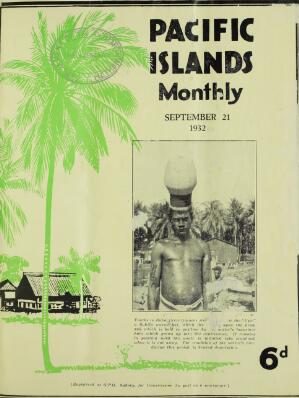
Youths in Buka (New Guinea) free [?] ur the “Upe," a lightly woven hat, Which fits [?] upon the head, and which is held in position by [?] native's luxuriant hair, which grows up into the contrivance. It remains in position until the youth is initiated into manhood, when it is cut away. The condition of the native's hair, during this period, is heyond description.
Advertisements & other items, p. 2 (1 item)
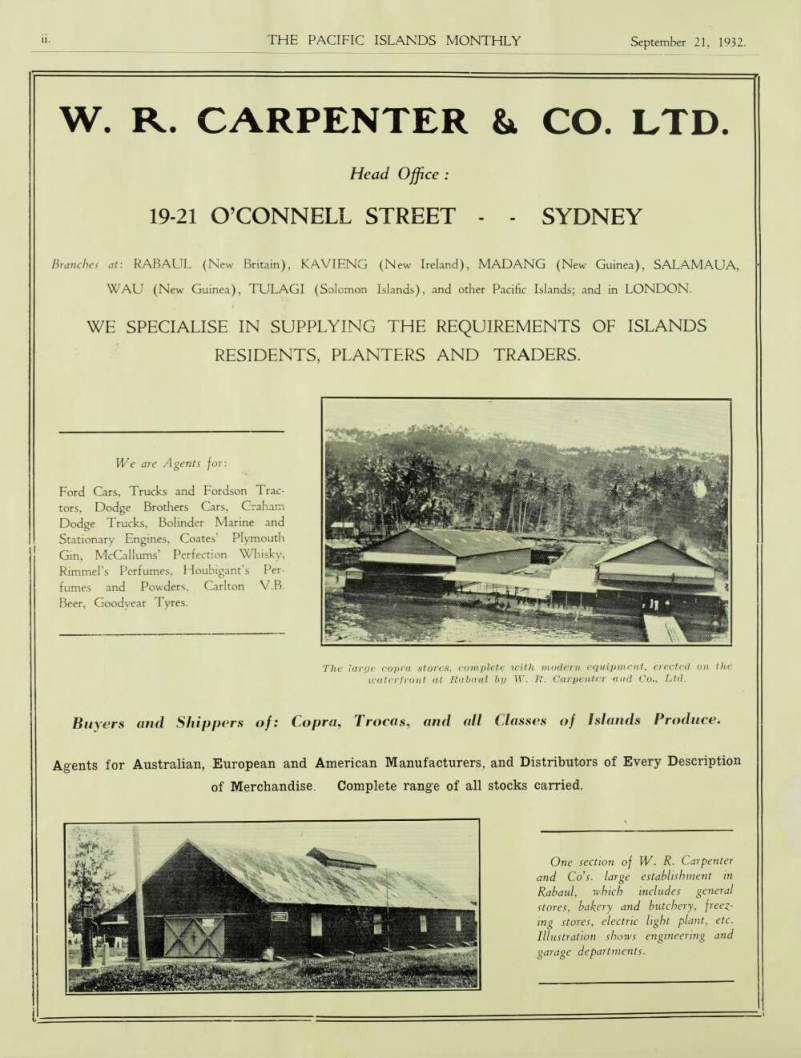
W. R. Carpenter & Co. Ltd.
Head Office :
19-21 O’CONNELL STREET - - SYDNEY
Branches at: RABAUL (New Britain), KAVIENG (New Ireland), MADANG (New Guinea), SALAMAUA, WAU (New Guinea), TULAGI (Solomon Islands), and other Pacific Islands; and in LONDON.
WE SPECIALISE IN SUPPLYING THE REQUIREMENTS OF ISLANDS
RESIDENTS, PLANTERS AND TRADERS.
We are Agents for: Ford Cars, Trucks and Fordson Trac tors, Dodge Brothers Cars, Graham Dodge Trucks, Bolinder Marine and Stationary Engines, Coates’ Plymouth Gin, McCallums’ Perfection Whisky, Rimmel’s Perfumes, Houbigant’s Per fumes and Powders, Carlton V.B.
Beer, Goodyear Tyres.
Buyers and Shippers of: Copra , Trocas , and all Classes of Islands Produce .
Agents for Australian, European and American Manufacturers, and Distributors of Every Description of Merchandise. Complete rang-e of all stocks carried.
The targe copra stores , complete with modern equipment , erected on the waterfront at Rabaul by W. R. Carpenter and Co., Ltd.
One section of W. R. Carpenter and Co’s, large establishment in Rabaul, which includes general stores, bakery and butchery, freez ing stores, electric light plant, etc.
Illustration shows engineering and garage departments.
Pacific Islands Travellers
Passengers Per “Montoro” From
Sydney On August 31 For Papua
AND NEW GUINEA :—Sir Hubert Alur ray, Sister James, Sister Juliette, Mr.
A. N. Bennett, Mr. L. H. Crews, Mr. and Mrs. W. H. Hughes, Miss D. Day, Rev. Father Fink, Miss C. Jamieson, Mr. and Mrs. W.
Martin, Miss L. Tonkin, Miss C. Heuston, Miss A. Calcutt, Miss E. Carden, Mrs. G. E. Mills, child and infant, Mrs. A. M. Lambert, Mr.
I. T. Jenkins, Mr. L. F. S. Hore, Mr. M. L.
Wilson, Mr P. A. Delme-Radcliffe, Mr. H. W.
Yates, Mr. G. Leeson, Mr. G. Lansley, Mr. and Mrs. J. A. Macandrew, Mr. and Mrs. A. S.
Green, Mr. D. M. Edwards, Mr. and Mrs. B.
Taylor, Mrs. D. S. Brown, Mr. and Mrs. E. N.
Mustar, Mr. E. W. P. Chinnery, Mr. A. J.
Egan, Mr. B. Calcutt, Mr. and Mrs. W. P. A.
Lapthorne, Miss Rogers, Mrs. Reinhart, Mr. P.
Lamb, Sister Veronika, Miss L. Stickley, Miss L. Maguire, Mr. J. W. Allan, Mr. E. S. Arm strong, Mr. J. Crockett.
Passengers Per “Montoro'' From
New Guinea And Papua, Who Arrived
IN SYDNEY ON AUGUST 25: —Mr. and Mrs.
A. W. Bushell, Miss L. M. Bushell, Capt. and Mrs. E. Butler, Miss M. Butler, Miss E. Clarke, Mrs. M. M. Clyne, Miss L. B. Dorr, Mrs. E. A.
Hammond, Miss L. King, Miss L. Maguire, Mr. and Mrs. R. Porter, Mrs. T. L. Tyrer and in fant, Mr. K. Aryidson, Mr. F. Bush, Mr. E.
Carli, Mr. I. Gerussi, Miss W. Eiseman, Mr. and Mrs. H. Hadley, Mr. W. P. Hunter, Capt.
L. H. Holden, Mr. J. Hynd, Mr. A. Innes, Mr. C. Knight, Mr. L. Leoni, Mr. K. W.
Nettleship, Mr. B. Roja, Mr. W. P. Wiltshire, Mr. J. Atherton, Mr. A. W. T. Brownlie, Miss R. Dorr, Mrs. J. Ewen, Mr. A. Longhurst, Mr.
G. Arnold, Mr. E. Crisp, Mr. F. Headon, Mr.
H. Huish, Miss J. M. Tullock, Mr. W. Digby, Mr. C. A. Fletcher, Mr. and Mrs. J. Garlick, Miss G. Gollweiler, Mr. A. de Groen, Miss E.
Jenner, Mr. A. L. Joubert, Mr. L. Joubert, Miss F. Mortimer, Mr. and Mrs. R. A. Owens, Miss E. Pope, Mr. S. C. Robertson, Mr. J. C.
Waldron, Mrs. F. L. Harston, Mrs. J. M. Vicars and infant, Mr. H. G. Evarts, Mr. H. G. Evarts (Jnr.).
Passengers Arrived In Sydney On
September 3 Per “Mataram'' From
SOLOMON IS. :—Mr. and Mrs. A. J. Eves, Sister M. Grant, Miss D. M. Jones, Miss M. L.
Robertson, Miss V. M. Sullivan, Mr. L. C.
Watkins, Sister Margaret, Mr. A. S. Arnold Mr. S. W. Brown, Miss H. Boyce, Mr. A. H.
Bowden, Mrs, and Miss K. Bignell, Mrs. R. O.
Boye, Mr. W. A. Chammberlain, Mr. R. P.
Creaghe, Mr. and Mrs. J. A. Cattell, Mr. L. C.
Durraut, Mr. and Mrs. G. J. Gummer, Mr.
W. W. Grainger, Mrs. B. Hall, Miss A. M.
Haddad, Miss M. B. Higgins, Dr. and Madame Kuraz, Mr. R. C. Laycock, Mr. E. F. McLean, Mr. J. L. Manning, Miss L. Manning, Mr. C. J.
Mason, Mr. V. F. Nagle, Mr. K. H. Procter, Mr. A. P. Penman, Mr. C. G. Quintall, Mr.
A. H. Robinson, Mr. J. B. Radeski, Mr. E. N.
Selden, Mr. C. A. Smithwick, Mrs. E. Scott, Mr. E. G. Smith, Mr. and Mrs. S. G. Timewell, Mr. S. W. Timewell, Miss V. Timewell, Mr.
F. W. Machin, Miss E. M. White, Mrs. M. J.
Williams, Mr. M. D. Cobb, Miss V. Permewan, Mr. A. Craig.
Passengers Per “Mataram" Which
Sailed From Sydney On September 14
FOR SOLOMON ISLANDS : —Miss V. Dawes, Rev. R. de Voil, Mr. P. H. Walmesley, Mr.
Ward. Mr. F. R. Merrick, Miss M. B. Higgins, Miss J. Radeski, Dr. L. Sharfstein, Miss B.
Larkins, Mr. A. AI. Turnbull, Mr. and Mrs.
R. B. McKinnon, Mr. H. M. Brindley, Sister Crescentia, Mrs. G. E. Keonig, Mr. and Mrs.
J. Harrison, Mr. A. O’M. Jones, Mr. S. Hitch cock, Mr. A. Gardner, Mr. H. Humphries, Mr.
C. Bell, Miss G. E. Dyson, Miss E. E. Dyson, Mr. F. O. Everett, Mrs. E. Bennetts.
Passengers Per R.M.S. “Niagara,”
Which Arrived In Sydney From Suva
ON SEPTEMBER 10: Mrs. A. G. Spow ers, Miss R. Spowers, Mrs. R. E.
Watson, Reverend Father G. E. Bergeron, Mr. and Mrs. L. L. Lickley, Mr. L. W. Rogers, Mr.
F. Heron and Alaster R. Heron, Mr. C. Hughes, Mr and Mrs. A. H. Bennett, Mr. and Mrs. D.
Robinson, Miss M. L. Hindson, Sister E. Baglin, Mr. F. Kennedy, Miss L. Ragg, Mr. A. Ousey, Mrs. A. Hill, Mrs. N. Hill, Mrs. N. A. Rauken, Mr. W. Hills, Mrs. N. F. Packer, Mr. C. Robin son, Mrs. J. E. Cuthbert, Mrs. E. N. Bucknell, Mr. C. J. Tremlett, Mr. B. St. J. Fisher.
Passengers Per “Macdhui ,” Which
Arrived From New Guinea And Papuan
PORTS ON SEPTEMBER 14: Mr. R. A. Arch bold, Mr. L. C. Bowman, Mr. J. K. Bruce, Mr.
J. S. Hayes, Mr. W. G. Johnson. Mr. N. J.
Lennon, Mr. W. L. Lowden, Mr. S. D. Sandes, Mr. J. Wylie, Mr. and Mrs. A. N. Lussick and four children, Mr. and Mrs. A. E. Ray, Mr.
C. O. Bell, Mr. F. C. Bryen, Miss B. Buring, Miss E. Cassell, Mr. .F R. S. Catchlove, Mr. A.
Maclean, Mr. C. C. Marr, Mrs. B. M. Mocatta, Mr. S. O’Connor, Mr. and Mrs. G. H. Roberts, Mr. R. W. Scott, Mr. and Mrs. H. G. Strong and infant, Mr. C. J. Thompson, Mr. L. N.
Tribolet, Miss E. M. White, Miss L. A. Barnett, Miss M. Blake, Mr. G. H. Green, Miss H. E.
Happ, Major and Mrs. E. P. Henty, Miss I. M.
Lynch. Mr R. L. Massie, Mrs. A. J. Monkley, Mrs. I. M. Tweddle, Miss S. T. Tweddle, Miss R. I. Waldon, Mr. and Mrs. C. AI. Werner, Miss E. West, Mr. A. S. Young, Miss H. Auerback, Mrs. M. H. Corke, Miss K. M. Corke, Dr. W. T.
Harse, Misses J., B., and P. Love, Bishop H.
Newton, Miss M. J. Stephen, Mr. E. Fahey, Mrs. F. A. Gors, Mr. J. J. Hartley, Mr. V. P.
Hides, Mrs. M. Hilder, Mrs. K. M. Hyde and infant, Mr. and Mrs. L. Logan and child, Mr.
H. C. Pearsall, Mr. G. R. Simpson, Mr. L. J.
Tuxworth.
Passengers Per "Monterey" Which
SAILED FROM SYDNEY ON AUGUST 27 FOR SUVA : Mr. and Mrs. G. Bladin, Miss P. Boulch, Mrs. J. S. Bovill and Master J. O. Bovill, Mr. and Mrs. A. E. Bridger, Mr. C. J. Curnow, Miss C. U. Donovan, Mr. and Mrs. V. G. Elliott, Mr. and Mrs. A. Hilton-Wood, Mr. T. Hughes.
Dr. H. Kincaide, Mr. J. D. Alay, Mrs. S. R.
McGrath, Mrs. R. B. Mair, Mr. D. Robinson, Mr. H. Robinson, Mr. and Mrs. A. W. Sneddon.
Mr. C. W. Stephenson, Mr. and Mrs. E. E.
Simpson, Miss S. Tyler, Mrs. P. F. Taylor, Mr.
J. H. Willson, Miss R. I. Willson. Mr. F. B.
Willson, Mrs. R. A. Watson, Mrs. R. K.
Wyndham, Mrs. B. D. Beiers, Mr. R. AI. Burgess.
Miss I. Knight, Air. Laisiasi, Miss B. Tall, Miss M. Myers, Mr. V. Cornaga, Mr. H. E. Vaile and Master G. Vaile, Mr. C. S. Ramsay, Mrs.
E. J. Boxall, Mr. R. R. Anson, Mr. E. J.
Bradman, Miss B. E. Totton, Mr. B. A. Patel, Mrs. K. E. Franzen.
Passengers By “Makura,” From
SYDNEY, ON SEPTEMBER 1, FOR COOK IS.
AND TAHITI: Mr. W. J. Heslehurst, Mrs. A.
Bright, Mrs. B. M. H. Spowers.
Passengers From Suva, Per ‘Mari-
Posa,” Arrived Ix Sydney On Septem
BER 15:—Mrs. J. S. Bovill and Master J. O.
Bovill, Sir Joseph Carruthers, Mr. and Mrs. V.
Cornaga, Mr. and Mrs. V. G. Elliott. Mr.
Thomas Hughes, Mr. and Mrs. McCullagh, Mr. and Mrs. A. W. Sneddon, Miss N. Sneddon, Mr.
Mr F B. Willson, Mr. J. H. Willson. Miss K.
I Willson. Miss M. Yynyard, Mr. F. U. Brown, Mr R Brown, Mr. W.L. R. Brown. Mr. and Mrs. R. C. Card, Mr. S. G. Davey. Mr J. F.
Grant, Mr. 11. Judge, Mr. L. Lawson. Mr H.
M Reymond, Mr. J. A. Smith, Mrs. L. Tur bet, Miss C. Turbet, Miss M. Turbet.
Passengers Per "Niagara,” From
Sydney For Suva On September 15:
Mr. and Mrs. W. J. Leech, Mr. and Mrs. H E.
Gilbert, Mr. AI. H. Gamson, Mr. H. G. Selby, Miss H. Clark. Mr. and Mrs. R. J. Alsop, Rev. and Mrs. N. A. Wright and Master M right Mr.
T. Wilson, Mr. D. Dudley, Mrs. H. M. Ander son, Miss R. I. Anderson, Mr. R. Sheedy.
Passengers Per "Nellore" For
Rabaul On September 14 :—Mrs. Marr,
Mrs. Conroy and two children.
“Guard, Dismiss!”
From a Special Correspondent.
Tulagi, Aug. 20.
IT was a tense moment in Tulagi.
The Acting Resident Commissioner, Mr. J. C. Barley, had arrived aboard the “Mataram,” and the heads of de partments, and a guard of native con stabulary assembled to greet him.
It usually rains when the steamer arrives; but, on this occasion, it poured. The Acting R.C. wisely re mained on the ship, awaiting a break in the weather. The unhappy officials, and the more unhappy policemen, stood around miserably in the rain.
At last the launch left the ship, and ran alongside.
“Shun!” barked the Commandant.
The dripping heads of departments as sumed welcoming smiles. The black bronze police stood stiffly to attention.
The launch curtains parted and out stepped the popular Government store keeper, Vic Shearwin, who also had arrived by the “Mataram.”
Vic stared: then, with pleased sur prise, he saluted the officials, and seemed about to inspect the troops.
“Guard, dismiss!” roared the indig nant Commandant. “Ass!” hissed the wet and angry heads of departments —and went home in disgust, to change their clothes.
But Vic Shearwin is still smiling.
Advertisements & other items, p. 3 (1 item)
REGULAR BI-MONTHLY Freight and Passenger Service
by the fast and modern K.P.M. Steamer VAN REES as under: Saloon and Intermediate class passengers carried in comfortable and airy cabins.
Cargo for Africa accepted for transhipment at Batavia.
SAIGON
BATAVIA
SAMARANG
PORT MORESBY
SAMARAI
RABAUL
PORT VILA
NOUMEA
ROYAL PACKET Sydney
PORT MORESBY
NAVIGATION CO., batavia
255 GEORGE STREET, SYDNEY.
SAIGON
The B.N.G. Trading Coy., Ltd., Port Moresby; Steamship Trading Co., Samarai; W. R.
Carpenter & Co., Ltd., Rabaul; Gubbay Freres, Port Vita; Carlo Leoni, Noumea; Diethelm & Co., Saigon.
Advertisers.
Page.
Adams, Wm„ & Co. 46 Amal. Wireless ... 47 Antinea Drug Co. .. 33 Armstrong. R. H., & Co 41 Arnott’s Biscuits . . 17 Barnes, James, Ltd. 28 Beaumont, W. N,, & Co 16 Bourjois et Cie ... 27 Brandts, Ltd 41 Brunton’s Flour ... 24 Burns, Philp & Co. 2 Burns, Philp (S.S.) Co 19 B.P. Magazine ... 36 Campe, A. C 48 Carpenter, W. R.
Cover ii.
Com. P’land. Cement 45 Dangar, Gedye & Co 31 Delicia Food Co, .. 38 Docker’s Paints .. 32 Dowsett, J. H. M. . 42 Duval Trading Co. . 42 Elliott, T., & Co. .. 9 Excelsior Supply Co. 21 Elver-Ready Batteries 19 Exide Batteries ... 37 Fletcher & Sons ... 30 Garrett & Davidson 43 Gibson. Battle & Co. 11 Gillespie’s Flour . . 30 Gourock Co 24 Guinea Airways cov. iii.
Hale, Alex.. Ltd. .. 35 Hall Bros., Ltd. .. 12 Halvorsen, L 34
Page.
Hislop, Lloyd Ltd 12 29 Holbrooks, Ltd. ... 20 Invincible Motors, Ltd 40 Joyce Biscuits 40 Kopsen & Co 36 Lysaght, John. Ltd. 25 Mcllrath’s, Ltd. ... 43 McKinlay & Cummins 35 Nelson & Robertson 16, 19, 21 Newbold Silica ... 34 Nolan, Spencer ... 18 Peadon. J. L., Ltd. 34 Pearson’s Soap Co.. 40 Petty’s Hotel ... 36 Piggott, C, G 26 Pike Bros 10 Rabaul Carr’g. Co. . 40 Prouds, Ltd 8 Rohu, Sil 26 Royal Gold Exchange 42 Royal Packet N. Co. 1 Russell, S 34 Saxton & Sons ... 18 Shell Oil Co 13 Steamships T. Co Ltd 12 Stoffer, A 42 Stuart, C 34 Tait & Co.. Ltd. . . 23 Tillock & Co., Ltd. 22 Tisdall, W. H.. Ltd. 23 Tooth & Co. Cover iv.
Vacuum Oil Co. ... 15 Vincent Chem. Co.. 46 Walker, F. J.. Ltd. 44 Wallaringa Mansions 8 Wills. W. D. & H.O 14 Wunderlich, Ltd. .. 38
At the half-yearly meeting of the Guinea Airways’ Recreation Club, Mr.
D. Wallace was elected Secretary. Mr.
C. J. H. Martin, the retiring Secretary, was accorded a vote of thanks for his services during the last six months.
A meeting was held recently at Rabaul to consider the possibilities of forming an Aero Club. A committee was appointed and is endeavouring to raise £200 to defray the cost of putting the club on a sound basis. Mr. A. T.
Collins was appointed Secretary, pro tem.
Contents.
Page Pacific Islands Travellers . . .. 1 Shall the German Eagle Return to the Pacific? 3, 4 The Mayor of Suva 5 Copra Market 6 Aerial Transport Co. for Fiji .. 7 Tropicalities 8 Rival Claims of Salamaua and Lae 9, 11 Jubilee of N.G. Catholic Mission 12, 14 A Papuan Plaint 16 Fiji Gold 17 End of Historic Bita Paka . . 18, 19 Tonga Critics Reply to Mr. Greene 20 De Rays’ Expedition of 1880 . . 21, 22 Planter’s Life in N. Hebrides .. 23 Samoa and Half-Caste Problem . . 24
Page Bird of Paradise Plumes 25 Indian Farmers in Fiji 26 Crown Colony of New Guinea? 28, 30 Treasure Seekers in Tuamotus .. 31 The Southern Cross VI 32 Australia’s Muddling Exporters 33, 34 Lae Social Notes 35 Papuan News 37 Solomon Islands Notes 38 Book Reviews 39 Legislative Council for New Guinea 41 Samoan News 42 Morinda’s Itinerary 43 N.G. and Papuan Gold Sharemarket 44 Market Quotations 45 Shipping Services 47, 48
Advertisements & other items, p. 4 (1 item)
Burns, Philp 8C Co. Ltd.
General Merchants )
Shipowners,
Tourist Agents, Etc.
Buyers of all Classes
of Island Produce
Head Office - 7 Bridge Street, Sydney - Australia Code Address : “BURPHIL”
Regular Steamer Services From Australia to New Guinea, Papua, Solomons, Lord Howe, Norfolk Islands, New Hebrides, Java and Singapore
The Pacific Islands Monthly
THE NEWSPAPER - MAGAZINE OF THE SOUTH SEAS [Registered at G.P.O., Sydney, for transmission by post as a newspaper .]
Published Once Each Month and Circulated in Australia and New Zealand and in the following Pacific Territories and Island Groups:
Crown Colony of Fiji.
Australian Territory of Papua.
Mandated Territory (Australia) of New Guinea, Bismarck Archipelago, and Northern Solo mon Islands.
Mandated Territory (Japan) of Marshall, Caro line and Mariana Islands.
American Territory of Guam.
Mandated Territory of Nauru.
British Crown Colony of Gilbert and Ellice Islands.
French Territory of New Caledonia.
British and French Condominium of New 7 Hebrides.
American Territory of Eastern Samoa.
Mandated Territory (New Zealand) of Samoa.
British Solomon Islands Protectorate.
British Protectorate of Tongan Islands.
New Zealand Territory of Cook Islands.
Australian Territory of Norfolk Island.
French Colony of Oceania (Tahiti etc.) American Territory of Hawaiian Islands.
Owned and Produced by ‘Pacific Publications Ltd., Union House, 247 George Street, Sydney
Telephone Bw 5037
P.O. Box 3408 R
Editor and Publisher :
R. W. Robson.
Registered Address tor Radiograms and Cables; "PACPUB” Sydney
Contributions
Articles, Stories and Photographs dealing with Pacific Islands Subjects are invited, and will be paid for on publication at usual rates.
Subscription Rates
Per Annum, within Postal Convention Territories, Prepaid, Post Free 6/- Per Annum elsewhere, Prepaid, Post Free 8/- Single Copies 6d.
Advertisements
Advertising rates furnished on application.
Colours, etc. by Arrangement Process Blocks made at Advertiser’s expense when required. Screen, 100.
Changes of Advertising Copy should reach this Office by Bth of each month, otherwise previous advertisement may be repeated.
Agents
The following are authorised to receive sub scriptions for The Pacific Islands Monthly— Islands Branches of Burns, Bhilp Co . Ltd.. and Burns, Philp (Sbuth Seas) Co., Ltd Islands Branches of W. R. Carpenter & Co., had.
All Branches of Morris. Hedstrom & Co.. Ltd.
F. Robartson, Rabaul.
T H MacGregor Dowsett, Rabaul.
Whitten Bros.. Ltd.. Port Moresby & Samarai.
All Branches and Representatives of W. H.
Grove & Sons, Ltd.. Auckland. 9 Russell. Papeete, Tahiti.
Oook Islands Trading Co., Rarotonga.
Mrs. M. Campbell, Cascades, Norfolk Island.
Vol. lII.—No. 2.
Sydney. September 21, 1932.
Price 6d. per copy Prepaid: 6/- p.a.
Shall The German Eagle Return To The South Seas?
THE future of the territories and groups of the Pacific is bound up with the fate of the League of Nations.
If the League survives, it is possible that Germany will resume possession of New Guinea and the Bis marck Archipelago, Bougainville, the Marshall, Caro line and Marianne Islands, Nauru, and Western Samoa.
If the League dies, those “Mandated Territories” will become the possessions respectively of Aus tralia, Japan and New Zealand.
The subject has been revived by recent develop ments in Europe. Germany, in a manner that admits of no doubt or misinterpretation, is again displaying the spirit of monarchism, militarism and imperialism.
The Republic still stands—but the sons of Wilhelm II., who retain their princely titles, are the leaders of the new Nationalism; and already there is talk of Germany “demanding the return of her colonies.”
The League of Nations was born of expediency, and is a puerile, footling thing. It is the comic sequel of mankind’s greatest tragedy, the World War. Fervently acclaimed and passionately sup ported by theorists, it is regarded with cynicism and amusement by all men who know humanity for what it is—who realise that in the ultimate analysis,
despite Christianity and science and altruism, force still rules the world, and the final law is the law of tooth and claw.
In 1917-18 a kind of hysteria possessed America, and President (Professor) Woodrow Wilson was its apostle. America, according to Wilson, fought ‘‘the war to end war,” fought “to make the world safe for democracy.” When the most critical period of the war arrived, and the continued support of America was vital, and there was a hurried can vassing of peace terms, Wilson thrust his famous “Fourteen Points” upon the Allies and the Allies reluctantly accepted them as the basis of settlement.
The Central Powers collapsed, and the weary and exhausted nations gathered at Versailles to fix the guilt and assess the damages.
It was agreed that Germany had precipitated the war, and that the Central Powers must pay. But when the Allies came to the disposal of the beaten enemy’s territories the Princeton professor’s “Four teen Points” had to be observed. The small nations were to have their freedom: a “spoils-to-the-victors policy, with conquered peoples as the spoils, would but lay the foundation of future wars.”
But how was this to be done? Who was to rule those coloured races incapable of ruling themselves?
To hand her colonies back to guilty Germany would be farcical. The difficulty seemed insurmountable.
Finally, amid blood and sweat and tears, the League of Nations was evolved. It was to police the world; guard the rights of the weaker peoples; arbitrate in disputes between powerful nations; forbid war; and generally to encourage humanity to lift its eyes to the stars. It was a wonderful, a marvellous creation, the glorious embodiment of a dream. It became possible only because every nation in the world, having suffered in the war, was utterly sick of war.
“The devil was sick: the devil a monk would be.
The devil was well —the devil a monk was he!”
If ever proof of the truth of that ancient saw is sought, consider the subsequent history of the League of Nations. As the Powers recovered their health, so they recovered their war spirit, and their respec tive membership of the League has become a grow ing embarrassment.
Meanwhile, what of the United States, whose visionary President caught the Allies when they were practically helpless, and shackled upon them his “Fourteen Points”? The United States, we should suppose, became the backbone and bulwark of the League of Nations, which was the logical outcome of the “Fourteen Points.” Not at all!
The U.S.A., for reasons that no one has ever appre ciated, or even understood, has consistently refused membership of the League.
The Covenant of the League of Nations is quite separate and distinct from the Peace Treaty of Versailles; but they were born at the same time, out of the same set of circumstances. Each has been closely linked with the other. The League took over the conquered German colonies, to hold them nomi nally in trust for Germany—although that never has been clearly stated —and then parcelled them out among the nations already in possession of them, granting to each a “mandate to govern.”
Theoretically, those ex-German colonies belong to the League of Nations, and are held at the ultimate disposal of that body. Actually, they are completely and irrevocably in the possession of the Manda tories, and nothing short of shot and shell will alter that position.
But Germany, increasingly noisy and belligerent, already is suggesting the “return” of her colonies.
What are the League of Nations, and the Manda tories, going to reply to that demand when it be comes—as it will—more clear and insistent?
Inevitably, sooner or later, the League of Nations will collapse like a house of cards. The only members of it who are sincere, and really hope for its success, are Great Britain and her Dominions, and the small nations who see in it their only future protection against aggression and aggrandisement.
The others go to Geneva filled with genuine ad miration for the Anglo-American ideal embodied in the League and for Britain’s painstaking efforts to make the League function. But all of the Powers are cynically certain that the League will never use force to prevent wars, and that therefore it must
collapse, and that any nation caught unprepared will pay the usual penalty for unpreparedness.
If any proof of this were needed, consider the recent Disarmament Conference, which was held in the spirit of the League and to which the nations came reluctantly in response to Ramsay MacDonald’s pleadings. We have been told of its “success.’ ’
Actually, it was a complete “washout”—it achieved exactly nothing.
Meanwhile, Europe is swinging once more towards extreme militarism. France and Italy are armed to the teeth. Japan is silent, but aggressive. Ger many is arming, and a fierce, suspicious Poland, rendered bold by her alliance with France, is ready and eager to fly at Germany’s throat. Mysterious, mad Russia, drunk with “freedom,” will sooner or later try out on her neighbours the efficiency of her colossal war machine. Can anyone in his senses believe, in the face of these facts, that the League of Nations is of any more real value than a house of cards in policing the world against war? As a matter of fact, Britain, in clinging so honestly and stubbornly to the League, is placing herself in terrible danger. Already her navy has fallen in strength, until it is now ranked second or third in the world; while her military establishment is negligible. With the co-operation and support of America, the League of Nations might really have controlled the world. Without America, the thing is hopeless.
Sooner or later—and all true British will pray that it is sooner—the logic of cruel facts will compel Great Britain to recognise her true position, and she will resume her proper standard of armaments.
From that moment the League of Nations will become a meaningless cypher.
“How long before this occurs?” ask thousands of people in New Guinea and Samoa. It is a little difficult to hazard a guess.
The difficult and complicating factor again is U.S.A. This colossal, blindly benevolent nation is trying to make a virtue of necessity by forcing dis armament upon Europe as a condition of war-debts reduction or cancellation. The position is really amusing. Europe will not pay any more war debts, and will not disarm, because Europe regards both armaments and the conservation of its future finance as essential to its future existence. But it is not going to say so. While professing the utmost sym pathy with American ideas and ideals, it is not paying war debts, and it is arming furiously. The European mind, by now, has gripped the fact that America is largely responsible for the world’s present economic agony. America seized the world’s trade while the world was at war, and so became the world’s creditor. America was too stupid to adjust her tariff to the new conditions, which would have permitted most of the debts due to her to be paid in goods; she insisted on pay ments in gold, so that a huge proportion of the world’s gold was sent to America to lie there “frozen” and useless, and the world’s system of in ternational exchange, in consequence, was crippled.
This evil condition was accentuated by the madness of over-production and over-export, which dominated America in 1921-29, so that the world was cluttered with American goods—which had to be paid for largely in gold.
Europe argues that America contri buted hugely to the present economic depression, and America, therefore, can whistle in future for her war debts.
Europe is not yet saying these things officially. Publicists are saying them, and newspapers, and the man in the street. But, in the Chancelleries, such crudities are blandly ignored, and the suave diplomats continue to play ping-pong with the idea of disarma ment, while the coo of their mutual good wishes drowns the rattle of the naval yards and the roar of the big gun factories.
The end, however, is certain. It will be most courteously expressed, with deep regrets and splendid flourishes; but a thumb at the nose, and a little finger pointed at America, would con vey the intimation just as effectively.
It will mean many things: and it will mean the end of the League of Nations.
This may come soon —perhaps in 1933. It may not come for five years.
But the end of the present decade will see no League of Nations—that quaint creation of a Princeton Professor’s dream, which the Princeton Professor’s own country repudiated.
It means a period of waiting—to see what foolish, trusting Britain will do; what this aggressive, re-awakening Germany will do; what stupid, altruis tic Uncle Sam will do. But the wise people in N'ew Guinea and Samoa, and the Mandatories, will read the signs and prepare accordingly.—R.W.R.
How Rev. “Mac” Dealt with
“Tree of Skulls.”
I AM indebted to Ion Idriess, Aus tralian author, for this little story of how “the wandering parson” put upon a Torres Straits island a hoodoo that was stronger than the age old superstitions of the natives.
In pre-European days, and until recent years, the savage Tugiri people used to come down the Kussa River, from Dutch New Guinea, and cross over to Boigu, Saibai and Dauan Islands, off the coast of Papua. At times, they attacked the inhabitants of those islands; sometimes, they joined forces with them, and carried out ferocious raids along the Papuan coast.
On Boigu Island, they established a sort of ceremonial ground, where they celebrated their victories in horrid fashion. There was a “zogo”, or a place where the priests and sorcerers performed; and there was a great tree, from which most of the small branches had been cut, and on every lopped-off limb a human skull stuck. The “Tree of Skulls”—or, in native lan guage, Sibu Poi —was notorious in that part of the Pacific.
Then there came to the Torres Islands, the Rev. W. McFarlane, known affectionately nowadays all over York Pennisula and Torres Strait as “Mac ” and the “wandering parson.” He looked Boigu over, and he did not like it a bit —neither its tree of skulls, nor its "zogo”, nor the unpleasant effect of the place upon the superstitious natives.
So, alongside the “zogo”, the Reverend “Mac” built a little church, where he sometimes held services;. and upon the “tree of skulls” he fixed a brass plate, giving its name and its cruel, grisly history. Thus did he exor cise the devil; for, from that time, the influence of Boigu Island in native affairs waned. Priests and sorcerers came no more to perform their rites, and the island lost its terrors for the natives.
But the “wandering parson’’ still pays his occasional visits to this section of his widely-scattered flock; and the mana of the little church is still stronger than the hoodoo of the zogo.
Big Copra Shipments From
Apia.
APIA, July 1.
THE S.S. “Benholm” has arrived from Tonga and is loading the largest shipment of produce despatched from the Territory for this year.
She is expected to take about 2,000 tons of copra, chiefly from Burns, Philp’s sheds and also about 100 tons of cocoa beans. She will leave on July 2 for European ports, via Rabaul.
The Swedish steamer “Yngaren” is expected at the beginning of August to lift another large shipment of about 1,500 tons of copra and about 80 tons of cocoa from the sheds of Messrs.
Morris, Hedstrom, Ltd.
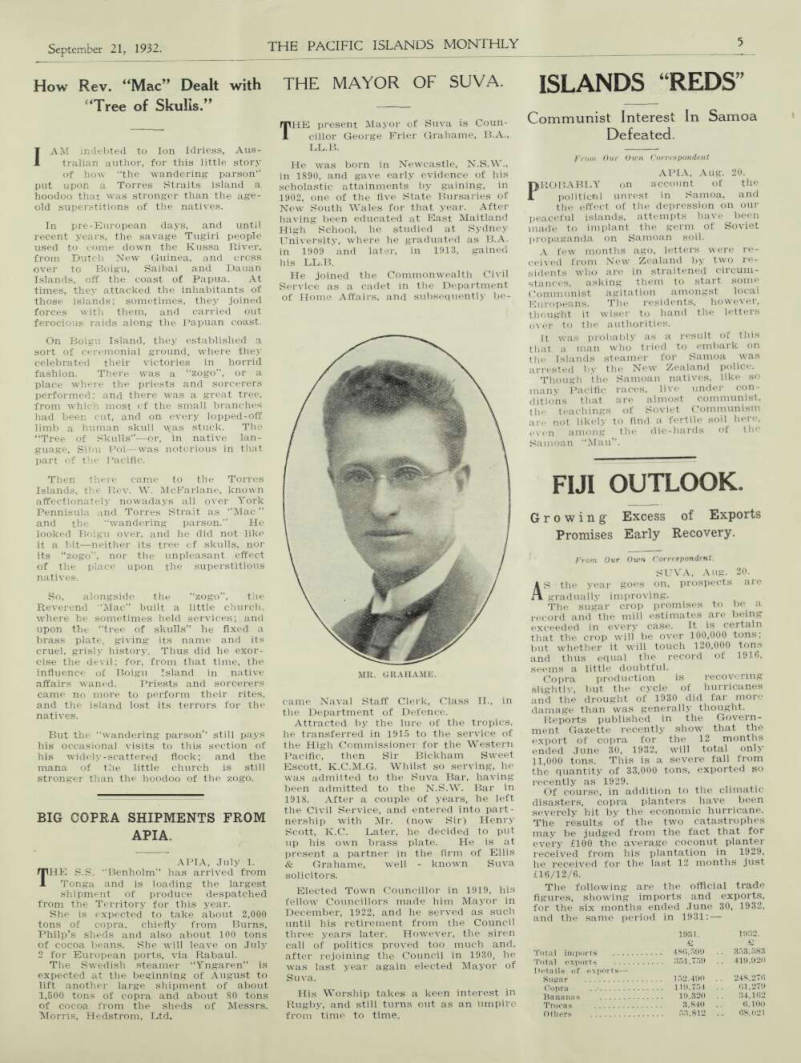
The Mayor Of Suva.
THE present Mayor of Suva is Coun cillor George Frier Grahame, B.A.,
Ll.B.
He was born in Newcastle, N.S.W., in 1890, and gave early evidence of his scholastic attainments by gaining, in 1902, one of the five State Bursaries of New South Wales for that year. After having been educated at East Maitland High School, he studied at Sydney University, where he graduated as B.A. in 1909 and later, in 1913, gained his LL.B.
He joined the Commonwealth Civil Service as a cadet in the Department of Home Affairs, and subsequently be
came Naval Staff Clerk, Class II., in the Department of Defence.
Attracted by the lure of the tropics, he transferred in 1915 to the service of the High Commissioner for the Western Pacific, then Sir Bickham Sweet Escott, K.C.M.G. Whilst so serving, he was admitted to the Suva Bar, having been admitted to the N.S.W. Bar in 1918. After a couple of years, he left the Civil Service, and entered into part nership with Mr. (now Sir) Henry Scott, K.C. Later, he decided to put up his own brass plate. He is at present a partner in the firm of Ellis & Grahame, well-known Suva solicitors.
Elected Town Councillor in 1919, his fellow Councillors made him Mayor in December, 1922, and he served as such until his retirement from the Council three years later. However, the siren call of politics proved too much and, after rejoining the Council in 1930, he was last year again elected Mayor of Suva.
His Worship takes a keen interest in Rugby, and still turns out as an umpire from time to time.
Mr. Grahame.
Islands “Reds”
Communist Interest In Samoa Defeated.
From Our Own Correspondent
Apia, Aug. 20.
PROBABLY on account of the political unrest in Samoa, and the effect of the depression on our peaceful islands, attempts have been made to implant the germ of Soviet propaganda on Samoan soil.
A few months ago, letters were re ceived from New Zealand by two re sidents who are in straitened circum stances, asking them to start some Communist agitation amongst local Europeans. The residents, however, thought it wiser to hand the letters over to the authorities.
It was probably as a result of this that a man who tried to embark on the Islands steamer for Samoa was arrested by the New Zealand police.
Though the Samoan natives, like so many Pacific races, live under con ditions that are almost communist, the teachings of Soviet Communism are not likely to find a fertile soil here, even among the die-hards of the Samoan “Mau”.
Fiji Outlook.
Growing Excess of Exports Promises Early Recovery.
From Our Own Correspondent.
Suva, Aug. 20.
AS the year goes on, prospects are gradually improving.
The sugar crop promises to be a record and the mill estimates are being exceeded in every case. It is certain that the crop will be over 100,000 tons; but whether it will touch 120,000 tons and thus equal the record of 1916, seems a little doubtful.
Copra production is recovering slightly, but the cycle of hurricanes and the drought of 1930 did far more damage than was generally thought.
Reports published in the Govern ment Gazette recently show that the export of copra for the 12 months ended June 30, 1932, will total only 11,000 tons. This is a severe fall from the quantity of 33,000 tons, exported so recently as 1929.
Of course, in addition to the climatic disasters, copra planters have been severely hit by the economic hurricane.
The results of the two catastrophes may be judged from the fact that for every £100 the average coconut planter received from his plantation in 1929, he received for the last 12 months just £16/12/6.
The following are the official trade figures, showing imports and exports, for the six months ended June 30, 1932, and the same period in 1931;
1931. 1932. £ £ Total imports 486,599 353.383 Total exports 351,759 419,920 Details of exports — Sugar 152,490 248,276 Copra 119,754 61,279 Bananas 19,320 34,162 Troeas 3,840 6,100 Others 53,812 68,021
Personal.
Sir Apirana Ngata (New Zealand Mini ster in charge of the Cook Islands) was a visitor to Rarotonga during August.
Like his predecessor in office (the late Sir Maui Pomare, who was a physi cian), Sir Apirana is a highly educated Maori, and an able administrator. The fact that these men of the Polynesian race can efficiently and creditably fill important professional and administra tive positions is not recognised as widely as it should be by those who study Pacific problems. * * * Dr. D. Young, medical officer at the Gilbert and Ellice Island groups, arrived in Sydney on August 30 by the Maunganui. He is returning to duty after a holiday in London. * * * Sister Mary James, of the Sisters of Our Lady of the Sacred Heart, Kens ington, left recently for Yule Island, Papua. Sister James has already spent nearly 15 years in missionary work, mostly at Inawaia, on the Mekeo Plain, where the missionaries of the Sacred Heart have a station.
Mr. B. Calcutt, district officer at Rabaul, accompanied by Miss Calcutt, returned to New Guinea by the Mon toro on August 30. * * * Mr. Allan Innes, of the Salamaua Trading Company, arrived in Sydney by the August Montoro, and will re turn by the September Macdhui. Two tons of machinery will travel with him, to be subsequently erected at Wau, centre of the New Guinea Goldfields, as an up-to-date freezer. * * * Mr. Ion L. Idriess, well-known Aus tralian author, is at present engaged on a book which will tell the fascin ating story of the discovery and de velopment of the Morobe goldfield, in New Guinea. The “old hands” — “Sharkeye” Park, Royal, Levien, Mrs.
Booth, George Arnold, etc. —will appear garbed in the full trappings of romance. The book will be published early in 1933, and will be called “Gold Dust and Ashes.” * * Mr. H. L. Gill, who was well-known in the Rabaul and Kavieng Districts, died at Arncliffe, New South Wales, on September 3. He is survived by Mrs.
Gill, four daughters and three sons. Mr.
W. Gill, his eldest son, is Inspector for Messrs. Burns, Philp and Co. and was formerly chief inspector of the New Guinea Expropriation Board. Mr. C.
G. Chadderton, his son-in-law, owns Kapsu Plantation, and Mr. G. Chadder ton, another son-in-law, is a plantation overseer in the Bainings district. * * * Mr. J. C. Barley, First District Officer in the British Solomon Islands, has been appointed to act as Resident Com missioner, during the absence on leave of Mr. F. N. Ashley. * * * Mr. P. C. Hubbard, who has been act ing as British judge on the Joint Court of the New Hebrides, has been ap pointed Chief Magistrate and Legal Adviser in the Solomon Islands. * * * Mr. F. B. Filose, District Officer, has been appointed to Ysabel district, Solo mon Islands.
Major C. A. Swinbourne, O.B. E., First District Officer, has been appointed acting Resident Commissioner of the Gilbert and Ellice Islands Colony, dur ing the absence on leave of Mr. A. F.
Grimtale, C.M.G. * * * Mr. Ah Tam, a former resident of New Guinea, died in Hongkong, China, on August 14. Last year, he disposed of his business interests in New Guinea and, owing to ill-health, left the Terri tory. He was 74 years old and had spent over 40 years in New Guinea. He was very well-known and was held in high regard by the European com munity. * * * Mr. E. Kenton, at one time assistant manager of Burns, Philp’s Rabaul branch, and now with Lewis Berger & Sons, Ltd., paint and varnish manu facturers, leaves for Papua and New Guinea by the September “Macdhui” on a business trip. * * * Mr. Norman Ducker died at Manly, New South Wales, on August 7. He was formerly a resident of Papua, hav ing been connected with the Austral Papuan Investments, Ltd., which has plantation interests in the Mekeo dis trict. * * * Dr. F. E. Montague, of Labasa, Fiji, returned by the “Aorangi,” on August 26, after a holiday abroad. * * * Dr. S. M. Lambert, the head of the Western Pacific Health Service, left New Zealand during August for the Cook Islands, in connection with the latrine campaign in that Group. He hopes to complete arrangements for the thorough sanitation of the whole of the Group by December. * * * Dr. C. S. James. M. B., F.R.C.S., ac companied by his wife and their son Ivan, arrived in Rabaul, by the August “Macdhui,” to take charge of the Stewart Hospital at Vunairima, on the North Coast. Dr. James has had considerable experience in New Zealand and was also engaged in similar work for three years in the Solomon Islands. * * * Mr. lan Morley, formerly on the staff of New Guinea Goldfields, Ltd., has joined the Administration. He took up his duties as assistant warden on August 15. * * * Mr. and Mrs. Wright, Methodist Missionaries, left Sydney by the Niagara on September 15, for Fiji. Mr. Wright spent five years in charge of the Indian mission station at Ba, Fiji. * * * Mr. A. H. Gauld, late manager of Choisel Plantations, Ltd., in New Guinea, arrived at Port Moresby dur ing August. Mr. Gauld has been ap pointed plantations inspector for Messrs. Burns, Philp and Co. in that Territory. * * * Mr. N. N. Lyons, manager of the Mur ray Island Fisheries, Ltd. (Torres Straits), has recently returned to Thursday Island from a successful business trip to Java, where the Com pany expects to place the greater part of its output shortly. * * * Mr. R. C. Latcock, of Tulagi, British Solomon Islands, arrived in Sydney by the last “Mataram,” and will spend some time with his family, who are at present residing in Sydney.
Mr. Colin Marr, son of the Federal Minister for Health, returned to Syd ney by the September “Macdhui” after two years’ study of tropical agriculture in New Guinea. He is the holder of Hawkesbury Agricultural College diploma, and will next take an agri cultural course at Trinidad. * * * Mr, Jas. H. Baldie, who has acted as honorary secretary of the Pacific Is lands Association since its formation, has resigned the duties of that office, and the work is being carried on tem porarily by Mr. J. P. Fitzgerald. Mr.
Baldie, who is a member of the execu tive, explained to the committee that his interest in the organisation is as keen as ever, but the growing work of the secretaryship had encroached con siderably on the time he required for his own business; and, in addition, it was highly probable that he would leave Sydney in the near future, pos sibly at very short notice. He would endeavour to assist the Association in every possible way, whether in Sydney or elsewhere. The Committee thanked Mr. Baldie very warmly for the interest he has taken in the Association and the great amount of work he has put into it since he took up the duties of secretary over twelve months ago. * * * Lady Murray, wife of the Lieutenant- Governor of Papua, will sail for Eng land this month, travelling via San Francisco and New York.
Copra.
THE copra market continues feature less, with the London c.i.f. price keeping in the vicinity of £14 per ton.
We have tried to get a line on the future of the market, but without much success. The following, sent to the Coconut Planters’ Union of Fiji, by its London brokers, under date early in August, appears to be a fair summary of the position: “No doubt if any constructive policy is made by international politicians, and they can settle some of the troubles now existing, sentiment will improve and prices for commodities will respond. We cannot get away from the fact that prices for every articles are very low.
As far as copra is concerned, it does seem that there is no great shortage of supplies at the moment ... At time of writing, we can see fair quantities of copra available . . . but there are so many different factors about that it is almost impossible to express a definite opinion. ’ ’
The correspondents of “The Pacific Islands Monthly” report the followings as the “average” of copra quotations at the places stated on the given dates.
Port Moresby, September 5—Smoke dried, £9/15/- per ton; sun-dried £9/5/-.
Rabaul, September 2. —Hot air dried, per ton, in store Rabaul, £9/12/6.
Suva, September s—£9/5/- per ton.
Tulagi, August 20—From £5 to £7 under London c.i.f. price, as reported in “Sydney Morning Herald.”
Rarotonga, August 15 —About £4/15/- per ton for native, sun-dried. Only two firms are buy ing. Export duty (£1 per ton) practically kills industry.
Apia, Western Samoa, September 5—Kilndried, £7/15/- per ton, on the beach here; sun dried, £7/5/-; native, Apia district, 1½ cents per lb.; native, outside districts, 1 cent per lb.
Tonga-Nukualofa, August 18—Copra, sun dried on the beach, £7 per ton.
Aerial Transport Co. For Fiji.
THE men and interests which
established the highly success
ful aerial transport company
known as Guinea Airways, Ltd.
are hoping to extend their oper
ations to Fiji, where they may con
duct an aerial transport service
with seaplanes.
A company is about to be formed in Adelaide called Fiji Airways, Ltd.
Leading shareholders in Guinea Air ways, Limited may take shares in the new company.
Mr. Alan Cross, who has been mana ger of the Guinea Airways services in New Guinea for some years, has re signed from that position in order to devote himself to the investigation and direction of the new aerial transport services, which it is hoped to establish in the Pacific.
Mr. Cross, accompanied by Mr.
George Jeffreys, who is a director of Guinea Airways, Ltd., will leave Syd ney for Suva by the “Mariposa” on September 24, with a view to thoroughly investigating the position in Fiji and making the best arrangements that are possible in the circumstances as they find them.
The management of the Guinea Air ways service in New Guinea is being taken over by Captain Mustar, who sailed for Lae by the “Montoro” at the beginning of September. Captain Mus tar is one of the best known pilots connected with the New Guinea service.
It was he who successfully carried out one of the riskiest feats ever under taken by an airman in the Pacific — namely, he took a De Havilland aero plane in one hop from Rabaul to Sala maua when the aerial service was first contemplated. There was no available landing ground between the two places, and if anything had gone wrong during the flight, disaster was certain. With
that aeroplane Guinea Airways Ltd. in augurated the great aviation service which made the development of the Morobe Goldfields possible.
Mr. Cross’s fine record and lengthy experience in New Guinea, where he supervised the establishment and de velopment of the aerial transport or ganisation, should fit him admirably for aerial developmental work in the Pacific.
Mr. Cross visited Fiji in August and carefully looked over the possibilities there; and the result of what he saw is a proposal to form and operate a company called Fiji Airways, Ltd.
The Crown Colony of Fiji is an ad mirable region for testing out the value of aerial transport in the future de velopment of the Pacific Islands Groups and Territories. It is not only a com pact group which can be easily covered by an aeroplane organisation, but it is also the richest territory in the South Pacific. There are small towns and important settlements scattered all over the two main islands, and there are several important centres on the hun dreds of adjacent islands. Prospects in Fiji are remarkably good—exports are far in excess of imports and the sugar industry is doing very well.
The active support of the Fijian Gov ernment and the principal commercial and financial institutions of Fiji is essential if this aerial transport Com pany is to be established with reason able prospects of success; and it is be lieved that that support will be forth coming.
A small aeroplane service connecting Suva with the main centres of Viti Levu and Vanua Levu was established in 1930, under Government subsidy, but the depression caused the Govern ment to withdraw the subsidy and the service was discontinued early in 1931.
We understand that the Suva interests which were instrumental in starting this service are prepared to link up with Fiji Airways, Ltd.
Les Holden Killed.
WELL known airman Les Holden, who has been conducting a successful aerial transport business between Salamaua and Wau, New Guinea, was killed in an aeroplane smash near Lis more on Sunday afternoon, Septem ber 18.
The news arrived just as we go to press, and details are few. Mr. Holden went south on the July “Macdhui” to have a rest and purchase new aero planes, and left a relative and Pilot Tommy O’Dea in charge of his busi ness. He left Sydney on Sunday morn ing, with his old friend, Dr. Hamilton, and Pilot Ralph Virtue, in a Puss Moth, for Brisbane. They were going fishing on the Barrier reef, and then Holden was to return to Brisbane, to prepare a new aeroplane for a flight to New Guinea.
The weather was very boisterous.
Something went wrong with the machine soon after they left Lismore, for many people saw it flying low, and the pilot trying to keep control. It nose-dived and crashed. All three were killed instantly.
Holden, who leaves a widow and three young children, had a splendid war record. It was he and Dr. Hamilton, in the aeroplane Canberra, who found Kingsford Smith when the latter, in the Southern Cross was lost in north-west Australia.
Marriages.
European - Polynesian
“W.G.B.” is outspoken on a delicate subject: The opinions, expressed, by “Sul phonal” in “The Pacific Islands Monthly” for July in an article en titled, “How the White Man Goes Native,” are unadulterated rubbish, and are insulting to many highly-respected residents of the Pacific.
There is something to be said against casual unions between European men and native women, on account of the often unhappy fate of any children that may result. But, so far as the asso ciation itself is concerned, I have never seen much actual harm done, and I have travelled and resided in most parts of the Pacific. White men who habitually associate with native women in an irregular manner are usually of a poor type, however, and are held in little regard by both Europeans and natives.
But what of white men who have married Polynesian women —particu larly high-caste women of the Samoan,
Tahitian or Tongan race? Would “Sul phonal” say that they are “fish-eye,”
with “occipital protuberances,” and
“distinctly oxycephalic head,” and gen erally degraded? If he does, I will say that he is not only the ass that his language suggests, but also a blither ing idiot, without any real knowledge of the Pacific.
Some of the most highly-respected men in the Pacific are happily married to Polynesian wives.
EDITORIAL NOTE. —We are glad to endorse the views of “W. G. B.” We think that “Sul phonal” was writing only about irregular unions between white men and the lower types of Melanesian women; but his remarks might have been applied to regular marriages between European men and Polynesian women, and to that extent they were untrue and deplorable.
Very many white men in the Pacific are married to Polynesians, and we could cite scores of such marriages which have been quite happy and successful. The writer has frequently met the Samoan wives of white traders and planters, and can testify to their intelligence and charm and to their ability as housekeepers.
The children of such marriages—and there are thousands of them in the Pacific —have the same status as full-blooded Europeans, and, so far as personality, ability and the qualities of good citizenship are concerned, are fully entitled to that status.
Queen Salote.
Dame of British Empire.
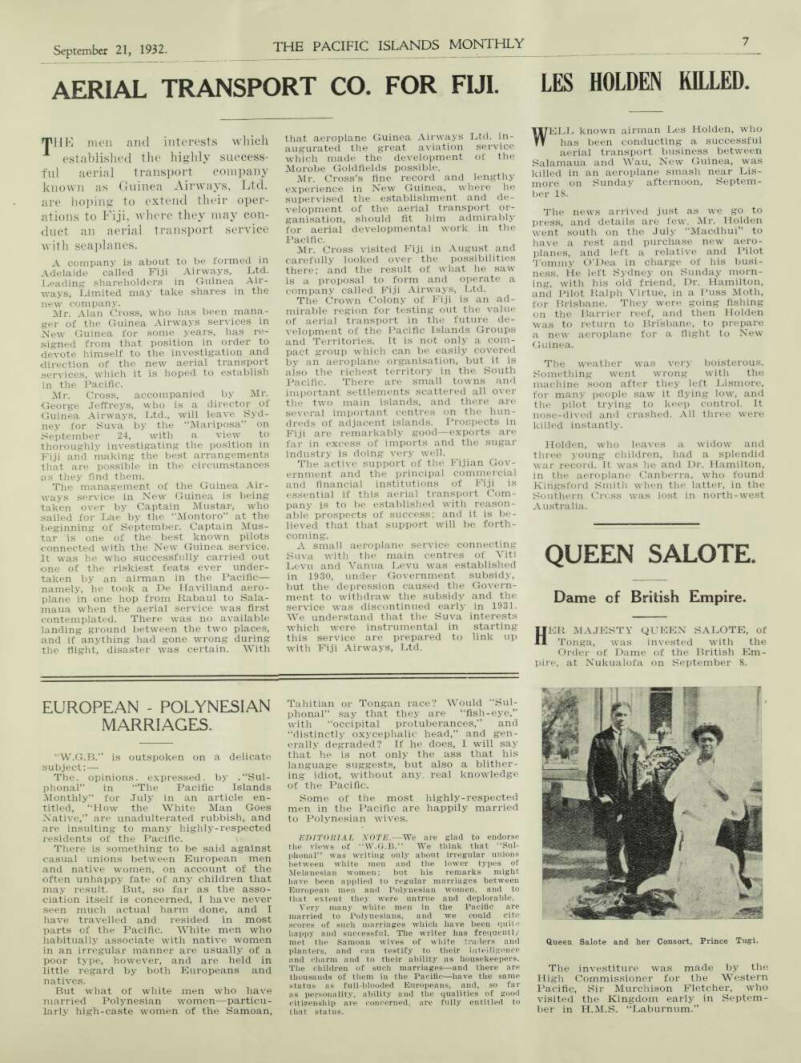
Her Majesty Queen Salote, of Tonga, was invested with the Order of Dame of the British Em pire, at Nukualofa on September 8.
The investiture was made by the High Commissioner for the Western Pacific, Sir Murchison Fletcher, who visited the Kingdom early in Septem ber in H.M.S. “Laburnum.”
Queen Salote and her Consort, Prince Tugi.
Tropicalities
IN May, 1914, in Rarotonga, Cook Islands, I met a loquacious planter, Mr. William McBirney, who was causing considerable com ment —mostly hostile among his neighbours because he was insisting that tomatoes, exported from Raro tonga to New Zealand in winter-time, would be a profitable crop. He showed me three modest rows of shy little tomato plants, with which he was ex perimenting. I think they were the only tomato plants in the Cook Islands.
And now, the sequel! The July steamer from Rarotonga to N.Z. car ried 1200 cases of tomatoes, and the August steamer over 2,000 cases—all of which realised the excellent price of from 11/- to 15/- per case. I am told that there are now great tomato gardens in this island; and orange production, once Rarotonga’s staple in dustry, is now comparatively neg lected. * * * IT was learned with pleasure in the offices of the Pacific Islands Monthly that the Governor of Fiji, Sir Murchison Fletcher, in the course of a public statement con cerning the rights and privileges of the Legislative Council, quoted “that monthly journal, The Pacific Islands Monthly, whose correpondent appears to be intelligent and well informed.”
We are glad that His Excellency paid this tribute to our correspondent.
The gentleman referred to has loyally carried out the policy of the Pacific Islands Monthly, which strives always to make fair and reasonable comment, free from personal bias and prejudice.
RUBBER planters in Papua, who have been in the doldrums for a con siderable time, are beginning to take heart of grace again. The London price of Para rubber, per lb., has steadily increased during the past two months, and is now getting back to price that makes a modest profit pos sible. The London c.i.f. quotation on September 9 was 5¼d. per lb. To this must be added the exchange premium of 25 per cent., which, allowing for freight, is worth 1d. per lb. Most of the Papuan rubber is sold in a pro tected market in Australia, and that protection is equal to at least another 2d. per lb. So the value of his product to the Papuan rubber planter, after allowing for freight reductions, should be somewhere close to 8d. per lb. in Australian currency. * * * THERE must be something very at tractive about Papuan sugar, from the company-promoting point of view. We have made references to the enterprise of Tropicane, Ltd., which is trying to sell bonds in connection with some vague sugar-growing project in Papua; and we now hear of another inquiry that is proceeding. A repre sentative from a company called Fed eral Taxation Pty., Ltd., of 77 King Street, Sydney, has gone to Papua to investigate sugar-growing possibilities.
Sangara Sugar, Ltd., and the group known as “‘Senator Kingsmill’s Co.,” both of which have land on the north
east coast of the Territory, are await ing details of the Ottawa agreements and sugar preferences, before proceed ing- further. * * * Travellers by the Bums, Philp steamers “Macdhui,” “Montoro” and ‘Mataram,” warmly praise a recent innovation, under which two young ladies, skilled musicians, are sent along on each vessel to organise entertain ments for the passengers. Solomon Is lands residents, who came to Sydney on
As we go to press, we have received the following radiogram from Mrs. Allen Innes, of the Salamaua Hotel, N.G.:— “Consider item in Tropicalities callous. Under stand deceased died in Rabaul. Totally unknown to me. Please correct.”
The paragraph referred to the reported death of a Mr. Davidson. We understood that it occurred several years ago. Any offence given by the paragraph was quite unintentional.
the last “Mataram,” were so pleased with the new arrangement that they called specially at B.P.’s head office to praise the good work of the “Matar am’s” musicians, Miss Higgins and Miss Radeski. * * * IT is reported that French interests in New Caledonia and New Hebrides are definitely moving towards bring ing in Javanese, instead of Tonkinese, to work the plantations under a system of indenture. The Tonkinese, although from French territory, are regarded as undesirable, because they have become permeated with Communism. * * * THE Bill now before the Common wealth Parliament, providing a Legislative and an Executive Council for New Guinea, has a business-like appearance; and, with the characteristic drive of Major Marr, the responsible Minister, behind it, it soon will be passed and in opera tion. There will not be any serious ob jection to it in New Guinea —except, perhaps, by the Missions, who are not to be directly represented on the Leg islative Council. Probably, the point received consideration, but the number of sects represented, and their jealousy of each other would be an insuperable difficulty to the appointment of any one man to represent the Missions.
Dr. G. H. Vernon, who has been a resident of Thursday Island for many years, has sold his practice there and is leaving immediately to engage in planting activities on a property which he has purchased in Daru, in Western Papua. Dr. Vernon is one of the most popular men in that part of the South Seas, and news of his intention to leave Thursday Island was received with universal expressions of regret. He has been a devoted and highly esteemed medical man, and has also proved him self a splendid citizen, and has taken a keen and helpful interest in all public movements for the benefit of the com munity. The goodwill of the people was expressed in many forms, with a remarkable underlying note of sin cerity, at a series of functions at which the popular doctor was farewelled. No one regrets more than “The Pacific Is lands Monthly” the departure of Dr.
Vernon from Thursday Island. He is a writer of unusual ability, and many of his little sketches describing Islands life have been among the most valued features of this journal.
Advertisements & other items, p. 10 (1 item)
Wallaringa Mansions, Sydney.
For XMAS, BIRTHDAY AND
WEDDING PRESENTS.
Prouds’ Gift Store
Six floors of Showrooms dis playing a wonderful variety of inexpensive articles suitable for gift purposes.
CATALOGUE SENT POST FREE.
Our Catalogue is not merely an illustrated price list, but is really a very handy guide to have by you, containing the latest novelties in Jewellery, Watches, Silver, Electroplate, Leather Goods, Xyloniteware, China, Cut Glass and Sports Goods.
Write now for a copy.
PROUDS LIMITED
Cnr. King and Pitt Sts., Sydney.
WALLARINGA MANSIONS, SYDNEY.
For all information apply to — THE MANAGER, “Wallaringa
SYDNEY, N.S.W, ’Phone: X2267, X2139.
Occupying one of the picked positions on Sydney Harbour. Quiet and secluded, only fifteen minutes by Ferry, or 8 minutes via Bridge, from
G.P.O.
The Mansions are com plete with Lounges, Smoking Rooms, Tennis, Bowling Green, Private Swimming Baths, Ball room, & Guests’ Laundry.
Mansions,” Neutral Bay,
The Rival Claims Of Salamaua And Lae
To Be Port Of N.G. Goldfields.
By R. W. Robson.
A CLOSE personal examination of the position of the port of Salamaua in relation to the Goldfields trans port system, and the question of erosion along the sand spit on which Salamaua is built, has convinced me that, if a shelter is necessary, there is no alternative to Salamaua; and that one of the three available routes —the Markham Valley, the Buangs, and Sheldon’s track —must be even tually used in order to build a road from the coast to the Goldfields.
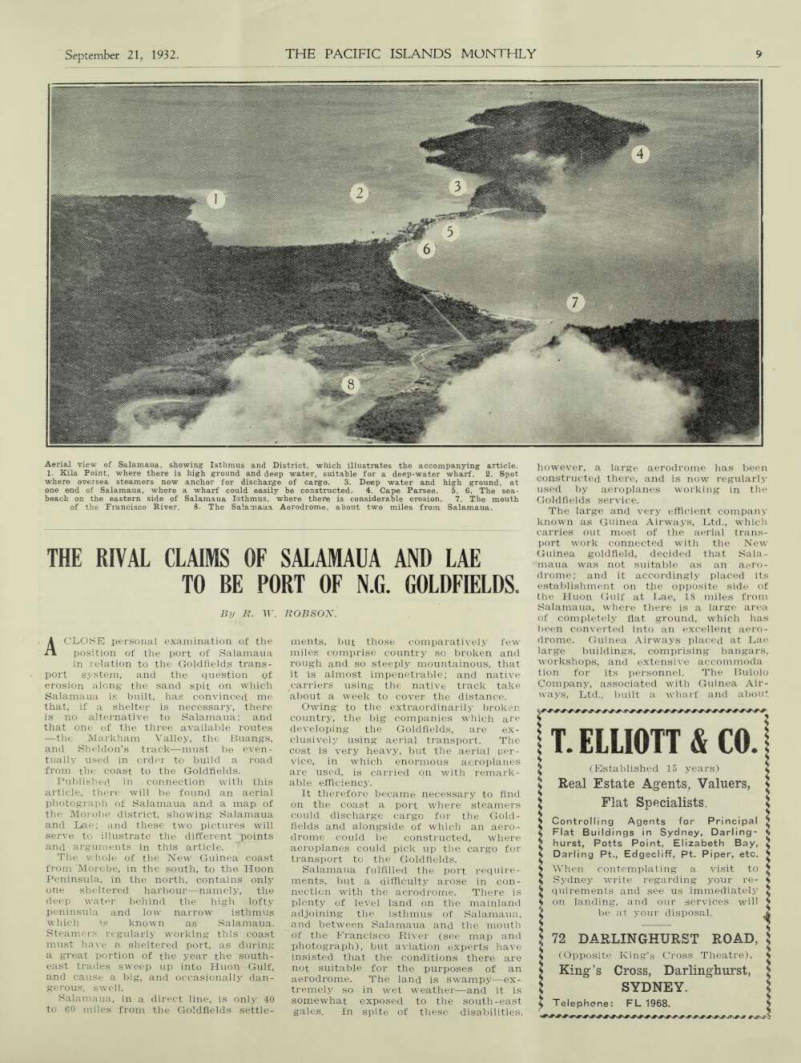
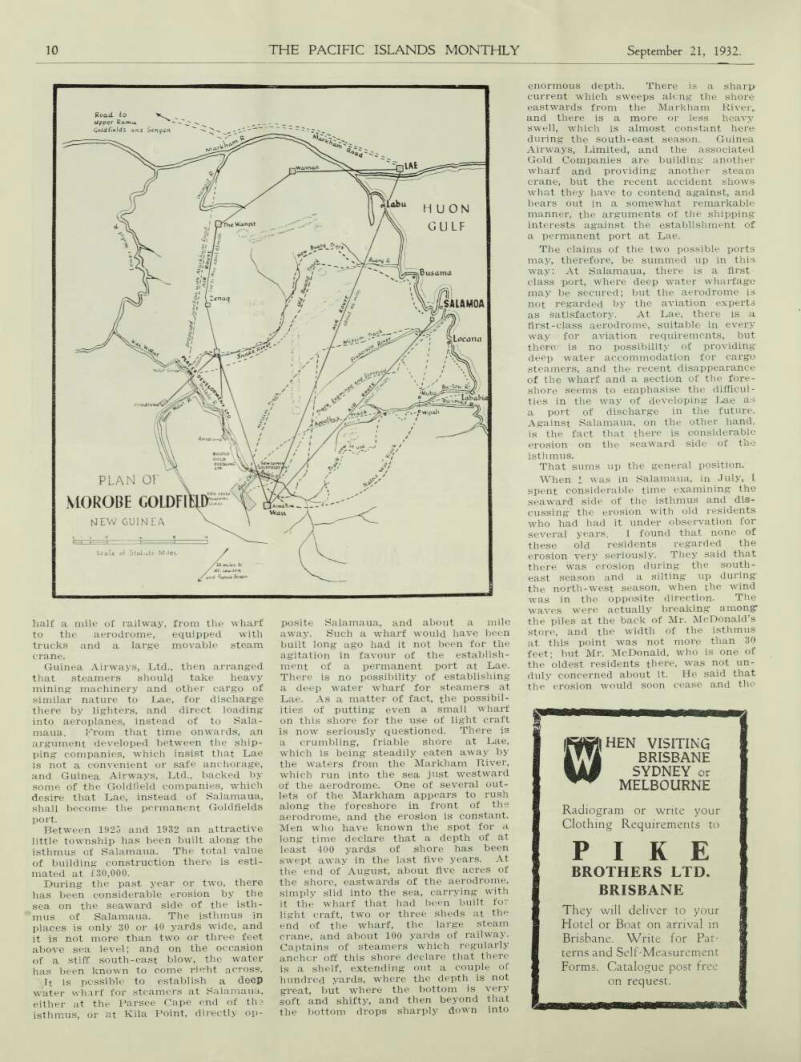
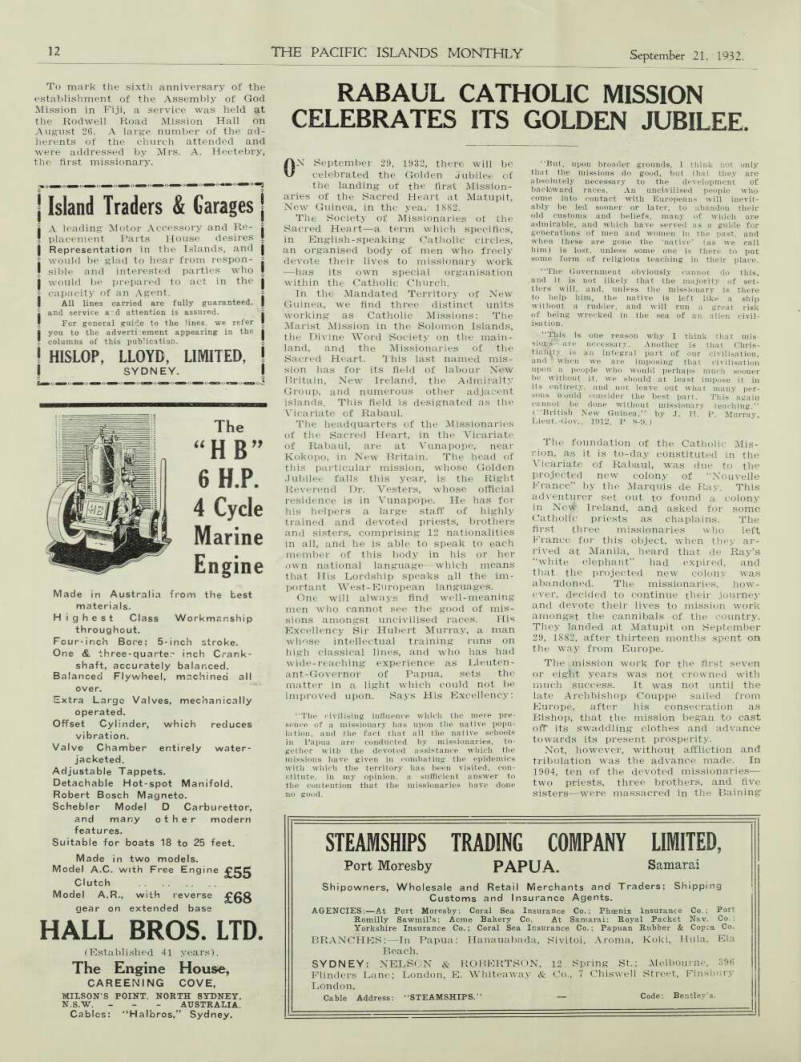
Published in connection with this article, there will be found an aerial photograph of Salamaua and a map of the Morobe district, showing Salamaua and Lae; and these two pictures will serve to illustrate the different points and arguments in this article.
The whole of the New Guinea coast from Morobe, in the south, to the Huon Peninsula, in the north, contains only one sheltered harbour —namely, the deep water behind the high lofty peninsula and low narrow isthmus which is known as Salamaua.
Steamers regularly working this coast must have a sheltered port, as during a great portion of the year the south east trades sweep up into Huon Gulf, and cause a big, and occasionally dan gerous, swell.
Salamaua, in a direct line, is only 40 to 60 miles from the Goldfields settle
merits, but those comparatively few miles comprise country so broken and rough and so steeply mountainous, that it is almost impenetrable; and native carriers using the native track take about a week to cover the distance.
Owing to the extraordinarily broken country, the big companies which are developing the Goldfields, are ex clusively using aerial transport. The cost is very heavy, but the aerial ser vice, in which enormous aeroplanes are used, is carried on with remark able efficiency.
It therefore became necessary to find on the coast a port where steamers could discharge cargo for the Gold fields and alongside of which an aero drome could be constructed, where aeroplanes could pick up the cargo for transport to the Goldfields.
Salamaua fulfilled the port require ments, but a difficulty arose in con nection with the aerodrome. There is plenty of level land on the mainland adjoining the isthmus of Salamaua, and between Salamaua and the mouth of the Francisco River (see map and photograph), but aviation experts have insisted that the conditions there are not suitable for the purposes of an aerodrome. The land is swampy—ex tremely so in wet weather —and it is somewhat exposed to the south-east gales. In spite of these disabilities,
however, a large aerodrome has been constructed there, and is now regularly used by aeroplanes working in the Goldfields service.
The large and very efficient company known as Guinea Airways, Ltd., which carries out most of the aerial trans port work connected with the New Guinea goldfield, decided that Sala maua was not suitable as an aero drome; and it accordingly placed its establishment on the opposite side of the Huon Gulf at Lae, 18 miles from Salamaua, where there is a large area of completely flat ground, which has been converted into an excellent aero drome. Guinea Airways placed at Lae large buildings, comprising hangars, workshops, and extensive accommoda tion for its personnel. The Bulolo Company, associated with Guinea Air ways, Ltd., built a wharf and about
Aerial view of Salamaua, showing Isthmus and District, which illustrates the accompanying article. 1. Kila Point, where there is high ground and deep water, suitable for a deep-water wharf. 2. Spot where oversea steamers now anchor for discharge of cargo. 3. Deep water and high ground, at one end of Salamaua, where a wharf could easily be constructed. 4. Cape Parsee. 5, 6. The sea beach on the eastern side of Salamaua Isthmus, where there is considerable erosion, 7. The mouth of the Francisco River. 8. The Salamaua Aerodrome, about two miles from Salamaua.
half a mile of railway, from the wharf to the aerodrome, equipped with trucks and a large movable steam crane.
Guinea Airways, Ltd., then arranged that steamers should take heavy mining machinery and other cargo of similar nature to Lae, for discharge there by lighters, and direct loading into aeroplanes, instead of to Sala maua. From that time onwards, an argument developed between the ship ping companies, which insist that Lae is not a convenient or safe anchorage, and Guinea Airways, Ltd., backed by some of the Goldfield companies, which desire that Lae, instead of Salamaua, shall become the permanent Goldfields port.
Between 1925 and 1932 an attractive little township has been built along the isthmus of Salamaua. The total value of building construction there is esti mated at £30,000.
During the past year or two, there has been considerable erosion by the sea on the seaward side of the isth mus of Salamaua. The isthmus in places is only 30 or 40 yards wide, and it is not more than two or three feet above sea level; and on the occasion of a stiff south-east blow, the water has been known to come right across.
It is possible to establish a deep water wharf for steamers at Salamaua, either at the Parsee Cape end of the isthmus, or at Kila Point, directly op
posite Salamaua, and about a mile away. Such a wharf would have been built long ago had it not been for the agitation in favour of the establish ment of a permanent port at Lae.
There is no possibility of establishing a deep water wharf for steamers at Lae. As a matter of fact, the possibil ities of putting even a small wharf on this shore for the use of light craft is now seriously questioned. There is a crumbling, friable shore at Lae, which is being steadily eaten away by the waters from the Markham River, which run into the sea just westward of the aerodrome. One of several out lets of the Markham appears to rush along the foreshore in front of the aerodrome, and the erosion is constant.
Men who have known the spot for a long time declare that a depth of at least 400 yards of shore has been swept away in the last five years. At the end of August, about five acres of the shore, eastwards of the aerodrome, simply slid into the sea, carrying with it the wharf that had been built for light craft, two or three sheds at the end of the wharf, the large steam crane, and about 100 yards of railway.
Captains of steamers which regularly anchor off this shore declare that there is a shelf, extending out a couple of hundred yards, where the depth is not great, but where the bottom is very soft and shifty, and then beyond that the bottom drops sharply down into
enormous depth. There is a sharp current which sweeps along- the shore eastwards from the Markham River,, and there is a more or less heavy swell, which is almost constant here during the south-east season. Guinea Airways, Limited, and the associated Gold Companies are building another wharf and providing another steam crane, but the recent accident shows what they have to contend against, and bears out in a somewhat remarkable manner, the arguments of the shipping interests against the establishment Of a permanent port at Lae.
The claims of the two possible ports may, therefore, be summed up in this way; At Salamaua, there is a first class port, where deep water wharfage may be secured; but the aerodrome is not regarded by the aviation experts as satisfactory. At Lae, there is a first-class aerodrome, suitable in every way for aviation requirements, but there is no possibility of providing deep water accommodation for cargo steamers, and the recent disappearance of the wharf and a section of the fore shore seems to emphasise the difficul ties in the way of developing Lae as a port of discharge in the future.
Against Salamaua, on the other hand, is the fact that there is considerable erosion on the seaward side of the isthmus.
That sums up the general position.
When I was in Salamaua, in July, I spent considerable time examining the seaward side of the isthmus and dis cussing the erosion with old residents who had had it under observation for several years. I found that none of these old residents regarded the erosion very seriously. They said that there was erosion during the south east season and a silting up during the north-west season, when the wind was in the opposite direction. The waves were actually breaking among the piles at the back of Mr. McDonald’s store, and the width of the isthmus at this point was not more than 30 feet; but Mr, McDonald, who is one of the oldest residents there, was not un duly concerned about it. He said that the erosion would soon cease and the
sea go back to its original line on the beach.
From various signs along the water front, it was clear to me that the sea had come in at least 20 feet from its customary line, and the erosion had reached the backyard of the Salamaua Hotel and the buildings on either side of it. Old residents declared that if there was abnormal erosion, it was due to the fact that foolish people, who arrived at the beginning of the settle ment, had cut away the overhanging kaliphylum trees, whose branches had served to break the wash of the waves.
At the northern end of the beach, a Mr. Powell, employed by the New Guinea Department of Public Works, with a few score native labourers, was putting in a series of wooden piles along the beach at the present high w-ater mark, and filling the intervening spaces with rubbish, and it was be lieved that this would serve to break the higher waves and stop the erosion.
Coming southwards, between the scene of Mr. Powell’s work and the hotel, I found the best evidence avail able that the erosion is not serious and can be controlled. It is 50 or 60 feet of concrete wall, erected by the pro gressive firm of W. R. Carpenter & Co., Ltd., whose land it guards. This wall rises from below low-water mark to a height well above high-water mark. It is about seven or eight inches thick, and it is solidly stayed on the landward side. The waves, on have not destroyed its solidity, and when I saw it there was a consider able accumulation of sand on its seaward side, protecting it from the water. The general opinion there abouts seemed to be that if such a wall were built along that foreshore, set deeply below low water level and thoroughly stayed on the landward side, there would be no further trouble from erosion. None of those people appear to recognise any danger—and the majority of them ridicule the idea that it will be necessary to abandon a port like Salamaua because of the comparatively slight amount of erosion that has taken place there.
I also got the clear impression that the Administration has simply fooled about with the whole problem of slop ping the erosion. Apparently, until Mr.
Powell and his small team of labourers began to drive in a few piles at the back of the radio station, nothing worthy of mention had been done by the Administration, although the erosion was noticed some two years ago. This probably is because the late Administrator, General Wisdom, was impressed by the establishment of Guinea Airways aerodrome at Lae, and was inclined to regard the Markham valley route as the ultimate route for the Goldfields road. That, of course, would have involved the establishment of a seaport at Lae.
The simplest solution of the whole problem, obviously, is to spend a few hundred pounds in stopping the erosion at Salamaua and leaving the whole position much as it is at present.
The Guinea Airways people say that the Salamaua aerodrome is unsuitable; but the other aerial transport concerns regularly use the Salamaua aero drome, and declare that with a little improvement and enlargement, it will become suitable for all purposes. In recent times, the aeroplanes of Guinea Airways, Limited, have regularly made use of the Salamaua aerodrome, for passengers and light cargo. All heavy cargo, of course, is handled at Lae.
It would be a comparatively simple and inexpensive matter to construct a deep water wharf at Salamaua —either at the Cape Parsee end, or round the bay, at Kila. From that wharf, it would be possible, and quite a simple matter, to construct a line of light railway to the aerodrome. It would then be open to the shipping com panies to do whatever they felt was most convenient —that is, they could discharge their cargo and passengers at either Salamaua or Lae, according to requirements. The ship could berth at Salamaua and cut out the cost and inconvenience of lightering. Lightering will always be necessary at Lae.
Another question to be settled in re lation to these two ports is that of
the Goldfields road. The route which ends at Lae is the Markham Valley route, and this road, while twice as long as any other route, would open up a considerable area of good agri cultural country. The route which ends at Salamaua follows the ranges between the Francisco and Butoi rivers, and is known as Sheldon’s route. It has a practicable grade, and is easily the shortest track between Wau and the coast. The third route, known as the Buangs, reaches the coast about half-way between Sala maua and Lae. It is believed to be the best graded track of the lot, and is reasonably short. It would have to run along the coast to Salamaua, how ever, as it could only reach Lae by crossing the Markham River, and the expense of such a bridge would be enormous.
One of these roads will bo built, sooner or later, and along it will be carried much of the heavy and bulky material whose transport by aeroplane is not economic. That will mean the discharge of much heavy cargo at whichever port—Salamaua or Lae—the road starts from.
The first big shipment of 7,200 cases of Fiji bananas to be sent to New Zea land under the new quota system, left Suva by the “Waiphai” on August 25.
Fiji’s quota is now 9,000 cases.
The steamer “Antonio” arrived in Port Moresby on September 3, after loading copra at Samarai and Tulagi, B.S.I.; and later departed for European ports via Torres Straits.
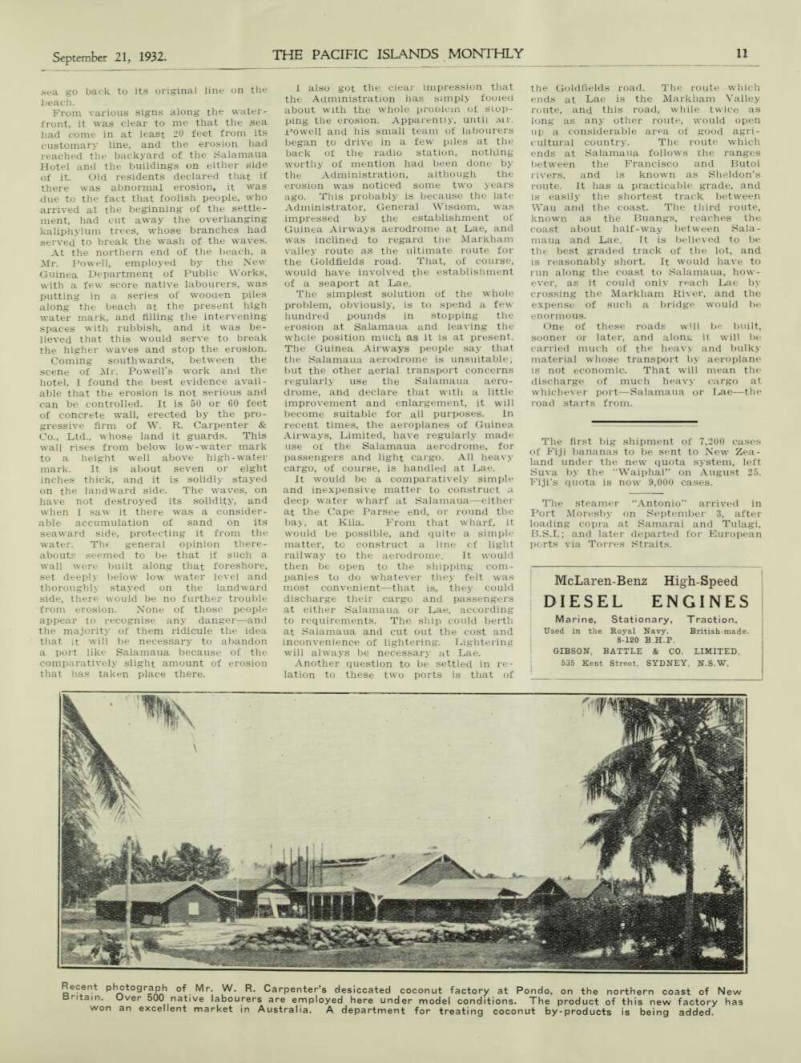
Recent photograph of Mr. W. R. Carpenter’s desiccated coconut factory at Rondo, on the northern coast of New Britain. Over 500 native labourers are employed here under model conditions. The product of this new factory has won an excellent market in Australia. A department for treating coconut by-products is being added.
To mark the sixth anniversary of the establishment of the Assembly of God Mission in Fiji, a service was held at the Rodwell Road Mission Hall on August 26. A large number of the ad herents of the church attended and were addressed by Mrs. A. Heetebry, the first missionary.
Advertisements & other items, pp. 11-14 (1 item)
T. Elliott & Co
(Established 15 years)
Real Estate Agents, Valuers,
Flat Specialists.
Controlling Agents for Principal Flat Buildings in Sydney, Darling hurst, Potts Point, Elizabeth Bay, Darling Pt., Edgecliff, Pt. Piper, etc.
When contemplating a visit to Sydney write regarding your re quirements and see us immediately on landing, and our services will be at your disposal.
72 DARLINGHURST ROAD,
(Opposite King’s Cross Theatre),
King’s Cross, Darlinghurst,
SYDNEY.
Telephone: FL 1968.
HEN VISITING
MELBOURNE
BRISBANE
SYDNEY or
Radiogram or write your Clothing Requirements to
PIKE
BROTHERS LTD.
BRISBANE
They will deliver to your Hotel or Boat on arrival in Brisbane. Write for Pat terns and Self-Measurement Forms. Catalogue post free on request.
McLaren-Benz High-Speed
DIESEL ENGINES
Marine, Stationary, Traction.
Used in the Royal Navy. British-made.
8-120 B.H.P,
GIBSON, BATTLE & CO. LIMITED.
535 Kent Street, SYDNEY. N.S.W.
Island Traders & Carages
A leading Motor Accessory and Re placement Parts House desires Representation in the Islands, and would be glad to hear from respon sible and interested parties who would be prepared to act in the capacity of an Agent.
All lines carried are fully guaranteed, and service a d attention is assured.
For general guide to the lines, we refer you to the advertisement appearing in the columns of this publication.
HISLOP, LLOYD, LIMITED,
SYDNEY.
“H B ” 6 H.P.
4 Cycle
Marine
Engine
The
Made in Australia from the best materials.
Highest Class Workmanship throughout.
Four-inch Bore; 5-inch stroke.
One & three-quarter inch Crank shaft, accurately balanced.
Balanced Flywheel, machined all over.
Extra Large Valves, mechanically operated.
Offset Cylinder, which reduces vibration.
Valve Chamber entirely waterjacketed.
Adjustable Tappets.
Detachable Hot-spot Manifold.
Robert Bosch Magneto.
Schebler Model D Carburettor, and many other modern features.
Suitable for boats 18 to 25 feet.
Made in two models.
Model A.C. with Free Eng ine £55 Clutch Model A.R., with reverse
HALL BROS. LTD.
(Established 41 years).
The Engine House,
CAREENING COVE,
MILSON’S POINT, NORTH SYDNEY,
N.S.W. - AUSTRALIA.
Cables: "Halbros,” Sydney. gear on extended base
Celebrates Its Golden Jubilee.

Rabaul Catholic Mission
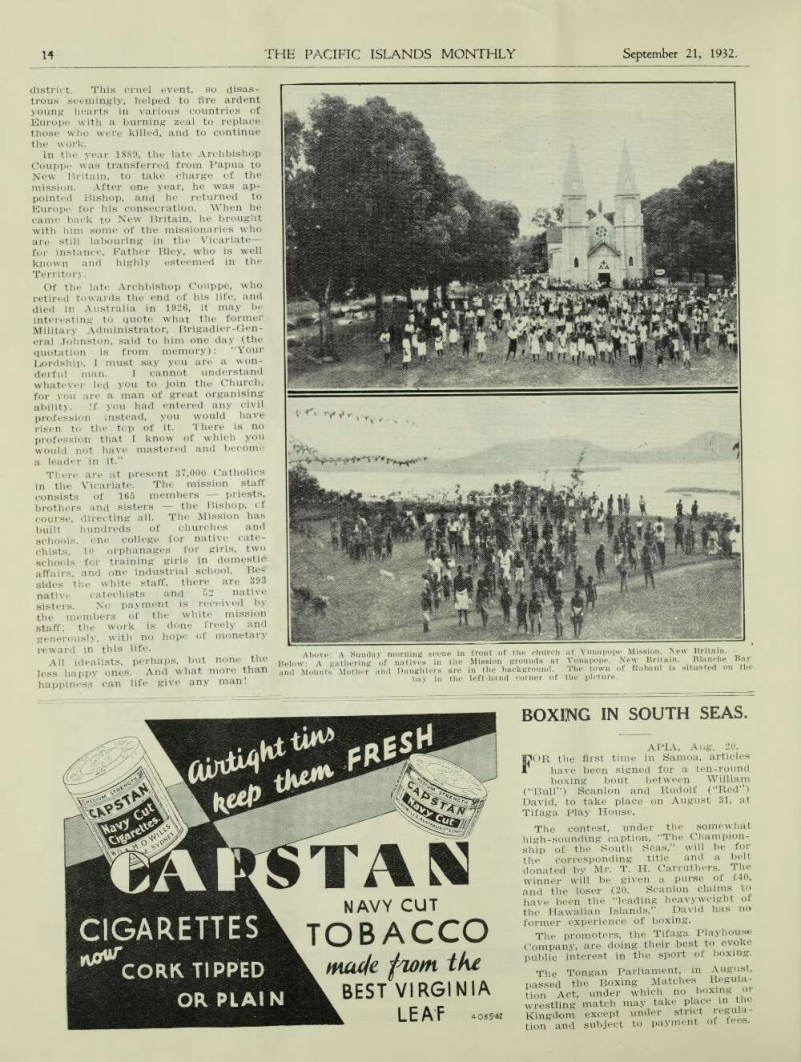
ON September 29, 1932, there will be celebrated the Golden Jubilee of the landing of the first Mission aries of the Sacred Heart at Matupit, New Guinea, in the year 1882.
The Society of Missionaries of the Sacred Heart —a term which specifies, in English-speaking Catholic circles, an organised body of men who freely devote their lives to missionary work —has its own special organisation within the Catholic Church.
In the Mandated Territory of New Guinea, we find three distinct units working as Catholic Missions: The Marist Mission in the Solomon Islands, the Divine Word Society on the main land, and the Missionaries of the Sacred Heart. This last named mis sion has for its field of labour New Britain, New Ireland, the Admiralty Group, and numerous other adjacent islands. This field is designated as the Vicariate of Rabaul.
The headquarters of the Missionaries of the Sacred Heart, in the Vicariate of Rabaul, are at Vunapope, near Kokopo, in New Britain. The head of this particular mission, whose Golden Jubilee falls this year, is the Right Reverend Dr. Vesters, whose official residence is in Vunapope. He has for his helpers a large staff of highly trained and devoted priests, brothers and sisters, comprising 12 nationalities in all, and he is able to speak to each member of this body in his or her own national language—which means that His Lordship speaks all the im portant West-European languages.
One will always find well-meaning men who cannot see the good of mis sions amongst uncivilised races. His Excellency Sir Hubert Murray, a man whose intellectual training runs on high classical lines, and who has had wide-reaching experience as Lieuten ant-Governor of Papua, sets the matter in a light which could not be improved upon. Says His Excellency: “The civilising influence which the mere pre sence of a missionary has upon the native popu lation, and the fact that all the native schools in Papua are conducted by missionaries, to gether with the devoted assistance which the missions have given in combating the epidemics with which the territory has been visited, con stitute, in my opinion, a sufficient answer to the contention that the missionaries have done no good.
“But, upon broader grounds, I think not only that the missions do good, but that they are absolutely necessary to the development of backward races. An uncivilised people who come into contact with Europeans will inevit ably be led sooner or later, to abandon their old customs and beliefs, many of which are admirable, and which have served as a guide for generations of men and women in the past, and when these are gone the ‘native’ (as we call him) is lost, unless some one is there to put some form of religious teaching in their place.
“The Government obviously cannot do this, and it is not likely that the majority of set tlers will, and, unless the missionary is there to help him, the native is left like a ship without a rudder, and will run a great risk of being wrecked in the sea of an alien civil isation.
“This is one reason why I think that mis sions' are necessary. Another is that Chris tiaflity is an integral part of our civilisation, and when we are imposing that civilisation upon a people who would perhaps much sooner be without it, we should at least impose it in its entirety, and not leave out what many per sons would consider the best part. This again cannot be done without missionary teaching.” ( “British New Guinea,” by J. H. P. Murray, Lieut.-Gov., 1912, P 8-9.) The foundation of the Catholic Mis sion, as it is to-day constituted in the Vicariate of Rabaul, was due to the projected new colony of “Nouvelle France” by the Marquis de Ray. This adventurer set out to found a colony in New Ireland, and asked for some Catholic priests as chaplains. The first three missionaries who left France for this object, when they ar rived at Manila, heard that de Ray’s “white elephant” had expired, and that the projected new colony was abandoned. The missionaries, how ever, decided to continue their journey and devote their lives to mission work amongst the cannibals of the country.
They landed at Matupit on September 29, 1882, after thirteen months spent on the way from Europe.
The mission work for the first seven or eight years was not crowned with much success. It was not until the late Archbishop Couppe sailed from Europe, after his consecration as Bishop, that the mission began to cast off its swaddling clothes and advance towards its present prosperity.
Not, however, without affliction and tribulation was the advance made. In 1904, ten of the devoted missionaries— two priests, three brothers, and five sisters —were massacred in the Raining
district. This cruel event, so disas trous seemingly, helped to fire ardent young hearts in various countries of Europe with a burning zeal to replace those who were killed, and to continue the work.
In the year 1889, the late Archbishop Couppe was transferred from Papua to New Britain, to take charge of the mission. After one year, he was ap pointed Bishop, and he returned to Europe for his consecration. When he came back to New Britain, he brought with him some of the missionaries who are still labouring in the Vicariate — for instance, Father Bley, who is well known and highly esteemed in the Territory.
Of the late Archbishop Couppe, who retired towards the end of his life, and died in Australia in 1926, it may be interesting to quote what the former Military Administrator, Brigadier-Gen eral Johnston, said to him one day (the quotation is from memory): “Your Lordship, I must say you are a won derful man. I cannot understand whatever led you to join the Church, for you are a man of great organising ability. If you had entered any civil profession instead, you would have risen to the top of it. There is no profession that I know of which you would not have mastered and become a leader in it.”
There are at present 37,000 Catholics in the Vicariate. The mission staff consists of 165 members priests, brothers and sisters the Bishop, of course, directing all. The Mission has built hundreds of churches and schools, one college for native cate chists, 10 orphanages for girls, two schools for training girls in domestic affairs, and one industrial school. Be sides the white staff, there are 393 native catechists and 52 native sisters. No payment is received by the members of the white mission staff; the work is done freely and generously, with no hope of monetary reward in this life.
All idealists, perhaps, but none the less happy ones. And what more than happiness can life give any man!
Above: A Sunday morning scene in front of the church at Vunapope Mission, New Britain.
Below: A gathering of natives in the Mission grounds at Vunapope, New Britain. Blanche Bay and Mounts Mother and Daughters are in the background. The town of Rabaul is situated on the bay in the left-hand corner of the picture.
Advertisements & other items, pp. 14-16 (1 item)
Steamships Trading Company Limited,
Port Moresby PAPUA. Samarai
Shipowners, Wholesale and Retail Merchants and Traders; Shipping Customs and Insurance Agents.
AGENCIES: —At Port Moresby: Coral Sea Insurance Co.; Phoenix Insurance Co.: Port Romilly Sawmills; Acme Bakery Co. At Samarai: Royal Packet Nav. Co.; Yorkshire Insurance Co.; Coral Sea Insurance Co.; Papuan Rubber & Copna Co.
BRANCHES:- —-In Papua: Hanauabada, Sivitoi, Aroma, Koki, Hula, Ela Beach.
SYDNEY: NELSON & ROBERTSON, 12 Spring St.; Melbourne, 396 Flinders Lane; London, E. Whiteaway & Co., 7 Chiswell Street, Finsbury London.
Cable Address: “STEAMSHIPS.” Code: Bentley’s.
FOR
INSTANT STARTING
INSTANT ACCELERATION
SUSTAINED POWER
GREATER MILEAGE
SHELL
IS BETTER
YOU USE SHELL SPIRIT. USE SHELL MOTOR OIL TOO.
THE SHELL COMPANY LIMITED
CAPSTAN
CIGARETTES
navy cut
tobacco
made ftom the
BEST VIRGINIA
LEAF 4-085
Boxing In South Seas.
Apia, Aug. 20.
FOR the first time in Samoa, articles have been signed for a ten-round boxing bout between William (“Bull”) Scanlon and Rudolf (“Red”) David, to take place on August 31, at Tifaga Play House.
The contest, under the somewhat high-sounding caption, “The Champion ship of the South Seas,” will be for the corresponding title and a belt donated by Mr. T. H. Carruthers. The winner will be given a purse of £40, and the loser £20. Scanlon claims to have been the “leading heavyweight of the Hawaiian Islands.” David has no former experience of boxing.
The promoters, the Tifaga Playhouse Company, are doing their best to evoke public interest in the sport of boxing.
The Tongan Parliament, in August, passed the Boxing Matches Regula tion Act, under which no boxing or wrestling match may take place in the Kingdom except under strict regula tion and subject to payment of tees.
Advertisements & other items, p. 17 (1 item)
Sweet Running .. .
Your engine will run more smoothly, more sweetly on Plume. This high quality Motor Spirit is famous for its perfect knockproof combustion. The absence of knocks means the presence of greater power as well as sweeter and more economical operation.
One tankful will demonstrate this sweeter running, this knockproof power, the extra mileage and lively response to the accelerator, obtainable with Plume.
PLUME Motor Spirit
“For added power and speed"
VACUUM OIL COMPANY PTY. LTD
Islands Newspapers.
FILES of the following: Pacific Islands news papers may examined at Pacific Publica tions office, Union House, 247 George Street, Sydney : Fiji Times and Herald (Suva).
The Samoan Herald (Apia).
The Rabaul Times (New Guinea).
Papuan Courier (Port Moresby).
Mr. A. C. Hall, of the Papuan public service, accompanied by his wife and family, returned to Port Moresby, Papua, on August 26, by the “Van Rees.”
Solomon Islands
Copra.
Recently, we asked a trader in the Solomon Islands what was the aver age price he has been receiving for his copra. His interesting reply follows: “In regard to copra price, I am afraid I am hardly able to quote “average,” for the simple reason that there are so many prices and I only know two of them. Much depends on one’s ability to haggle and work one firm against the other, and in this connection “con science” plays a big part. Again, the man well in debt gets from about £2 per ton less than the free agent; in deed, I believe the difference in some cases is even greater than this.
“The whole thing gives an example of where ‘it does NOT pay to adver tise’ what one really does get, for fear of causing trouble and making a rod for one’s own back. For instance, if I tell my trading opponents (say the Chinese) what I get for copra, there will be a chorus of ‘whaffors’ until my advantage in price is wiped out, when I will not be able to show a fair profit at trading. The sort of Chinese who trades about here in boats seems to have no idea of business or what ought to be a fair profit, and for the most part he makes no profit at all, but just goes bung, when another takes his place.
“I know of one regular parity price which is £5/2/6 under ‘Sydney Morning Herald’ quote, for copra landed at Makambo, while what we call ‘ordin ary’ price would be about £7 under.
The buyers are forever putting their heads together to pay certain prices, but along comes a rumour or a tail spinner, and one or other breaks the agreement.
"Altogether, we seem to get much less for our copra than New Guinea producers, but why this should be I do not know, especially as it is often carried away in the same boat.”
A Papuan Plaint.
By H.J.E.S.
I OBJECT to burglars and villains of every sort being pictured with pro jecting jaws, in popular papers. I have a projecting jaw.
On many mornings my wife missed things from the pantry. I work far into the night. She ever suspected me until this week. Someone sent her a parcel of literature of the lighter sort.
A big proportion of the pictures in cluded faces of gentlemen plate-and jewel-removers, ordinary thieves, stage sinners, and what not. All had pio jecting jaws!
My wife cut out all such pictures and pasted them over a print of beau tiful—I mean a beautiful print of Aphrodite, that adorned a calendar.
Vile vandalism, I call it! She hung the horror over the pastry-box in the pantry. I hate to think there was any inference ...
It all started at afternoon-tea. Some people came unexpectedly. My wife told the maid to rifle the bun-bin, and while we were chatting with the visitors I saw the girl moving agitatedly out side the door and looking plaintively at me. I got leave on the plea of ur gent private affairs and met her in the kitchen. Her face was blanched and brown. As she is a Papuan, the latter colour is accounted for.
“Velepara,” she cried, “Logeapara will be very angry. There is nothing for the people to eat.”
As a matter of fact, I had consumed all the cakes the previous night. I must say, in fairness to myself, it was the first time I had done that on the eve of a visitation. How was I to know there was a boat on the way?
We have visitors only once in many moons.
“I know the girl is innocent,” I ex plained to my wife; “ but the rations have . . . er . . . run out.”
My wife does get annoyed sometimes, and this was one of them. After the visitors had sailed away with biscuit crumbs on their shirt front, my wife held another enquiry. It was the fiercest in my memory, but, as no one would get hurt and I am an awful coward before women, I did not offer myself for sentence.
Then we opened the mail-bag or visitors had brought, and there were those pictures! My wife seemed to put two and two together ... in fact, there were twenty-two or so. There they were with their projecting jaws —and there was I, with mine.
I must be fair. My wife is a perfect lady, so never has called me a liar in the ordinary four-letter sound of the word, as it were; but her casual refer ence to the similarity of my jaw with those of the pictures placed over the pastry-box in the pantry seemed singu larly suggestive.
The matter recalls a painful incident in the life of a friend of mine. He is unfortunate enough to be a parson with what might be termed a proboscis. He was visiting a home one day and a little boy there kept gazing at the parson’s nose. The mother watched her offspring anxiously, and at last said, “Don’t forget what I told you, Johnnie! ”
“It’s all right, Mum,” replied the boy, “I’m not going to say anything, I’m just looking at it!”
Advertisements & other items, p. 18 (1 item)
Oil Engines
Skandia Marine and Stationary
Instantaneous Starting
CRUDE
Oil Engines
LATEST TYPE.
Delivery from Stock.
PARTICULARS—
NELSON & ROBERTSON,
SYDNEY.
Fresh Food! Cool Drinks!
The Beaumont Refrigerator operates on
KEROSENE or BENZINE.
Special Features: 1. Costs about 1d. per day to run. 2. Has no movable parts to get out of order. 3. One beating a day gives refrigera tion for 24 hours. 4. Freezing unit weighs about 321bs. 5. Every freezing unit guaranteed 3 years. 6. No installation costs. 7. Can be operated by a child. 8. Specially made for tropical condi tions. 0. Keeps food fresh indefinitely. 10. Operates efficiently under all wea ther conditions.
The Beaumont Refrigerator brings effi cient refrigeration to Homes that have no Gas or Electricity. All that has to be done is to heat the Chemical Con tainer for a short while each day over a Primus or similar stove. The inside measurements of Model “A” are: 18 inches high, 20½ inches wide, and 22½ inches deep, with a capacity of 5 cubic feet. White seamless porcelain enamel interior, stainless steel fittings, northing to wear out, nothing to be renewed. Refrigerating unit manufactured in accordance with the latest specifications recently imposed by the Queensland Government. Absolutely ideal for isolated homes.
Write for full particulars, prices and copies of testimonials. 3 YEARS’ GUARANTEE.
W. N. BEAUMONT & CO. PADDINGTON 00 SYDNEY Distributors for Mandated Territory of New Guinea and Solomon Islands: W. R- CARPENTER & CO,, LTD. For Papua: B. N. G. TRADING CO., LTD., Port Moresby. For New South Wales and Queensland: WESTCOTT, HAZELL & CO., LTD.
Fiji Gold.
Search in Very Broken Country.
From Our Own Correspondent.
Suva, Aug. 8.
THE recent shipment of 143 ounces of fine gold, from the Mount Kasi mine, in the Yanawai district of Vanua Levu, has directed attention the gold possibilities of Fiji.
For many years it has been known that gold could be found in Vanua Levu, in the country to the west of Savusavu. It is very difficult country, and cut off from regular communica tion. In a number of the creeks it has been possible to wash a dish and get colours of gold, and these colours have led to much prospecting. Many syn dicates have been formed and much money lost.
In recent years, the attempt which seemed to be most favoured by for tune was that of Ernest Creswell, who was then manager of the Grand Pacific Hotel. At great labour, a 6-head battery was erected near the Yanawai River, Savusavu district, and a quan tity of slimes brought to Suva to be retorted. The result was a lump of what was described by those in terested in the venture as superfine gold. It was sent away to a Sydney bank for assay.
However, the prospectors had been somewhat too optimistic in scraping the tables to remove the gold, and in this instance, at any rate, “all was not gold that glittered”, for the Sydney bank reported that the lump was brass.
In the last couple of years a small local syndicate, headed by Mr. A. O.
Mackenzie, the manager in Fiji of Burns, Philp & Co., has been working in the Yanawai district. Messrs. Collie and Cameron are in charge of the field activities, and they are employing about 10 Europeans and 20 Fijians at Mount Kasi. The development work has been very difficult, as the site of the mine is about 1300 feet above sea level. Apparently, the syndicate has ample financial backing and is quite content to find the money itself for all development work. Rumour has it that a very considerable sum has been spent.
Residency Collapses.
From Our Own Correspondent.
Tulagi, July 22.
The Residency, 24 years old, showed grave signs of collapsing recently, and the Resident Commissioner (Mr. Ash ley) hurriedly moved elsewhere. The building was pulled down, and it was found to be completely riddled by white ants.
Mr. and Mrs. Ashley have gone on long leave, and it is not certain whether he will return, as the term of his ap pointment almost has expired.
A new Residency will be built, how ever, in spite of the financial stringency —one cannot expect His Majesty’s rep resentative to sleep under the palms.
Moresby.
Native Cricket Club for Port Moresby.
From Our Own Correspondent.
Port Moresby, June 16.
HIS Excellency, the Lieut. Governor, Sir Hubert Murray, in the pres ence of a large number of Govern ment officials, residents, and natives, officially opened, on June 14, a new native cricket club and grounds, owned by Kapur and his “clan.”
Kapur, the Central Court interpreter, a prominent native of the village, and a member of the village Coun cil, had recently been granted the land by the Government for his club, and it was on his invitation that Sir Hubert Murray and Lady Murray and His Honor Justice Gore and Mrs.
Gore, and other Government officials were present.
An address, written in English, was presented to Sir Hubert, and was read out by the captain of the team. In the address, Kapur and his club mem bers thanked Sir Hubert Murray and
the Government for the gift of the land and for their presence at the opening, at the same time expressing the hope that the land would belong to them for all time.
His Excellency, in reply, thanked Kapur and his club. He pointed out the advantage of cricket as a game for the youth of the village, and voiced his appreciation of the interest they had shown in the sport within the last few years. He expressed a hope that they would continue to do so. The land, he said, was given by the Gov ernment to encourage and interest the youth of the village in sport and activity, as against idleness. He hoped Kapur and his club would take full advantage of it.
Tea was served by the members of the club. Chairs and tables were pro vided by them, as were also the cakes and sandwiches.
The reception of the guests and the address to Sir Hubert Murray were a great credit to the natives, more so when one remembers that fifty years ago these natives were “barbarians.”
Advertisements & other items, p. 19 (1 item)
Arnotts
The perfect Light Breakfast
Manufactured by William Arnott Limited, The Biscuit Specialists of sixty-four years’ experience.
FAMOUS
SHREDDED
WHEATMIAL
BISCUITS
ASK YOUR STOREKEEPER FOR THEM.
Made in Australia, Financed by Australians, and produce by highly trained Australian workers.
The End Of Historic Bita Paka,
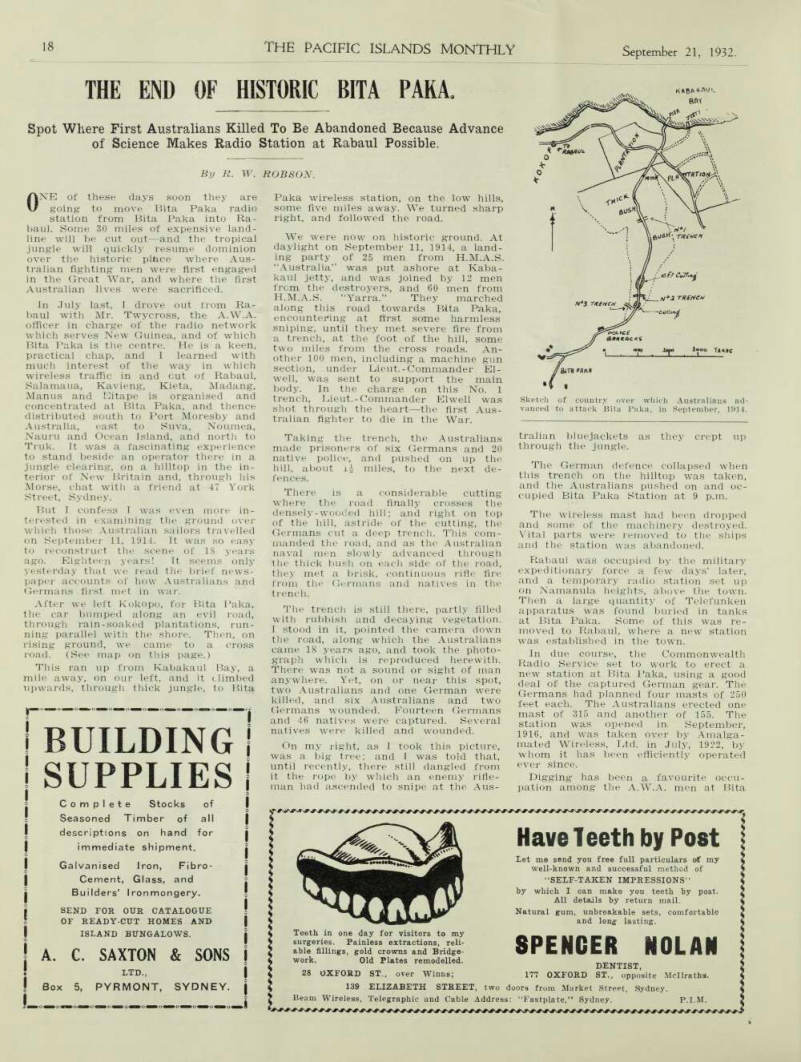
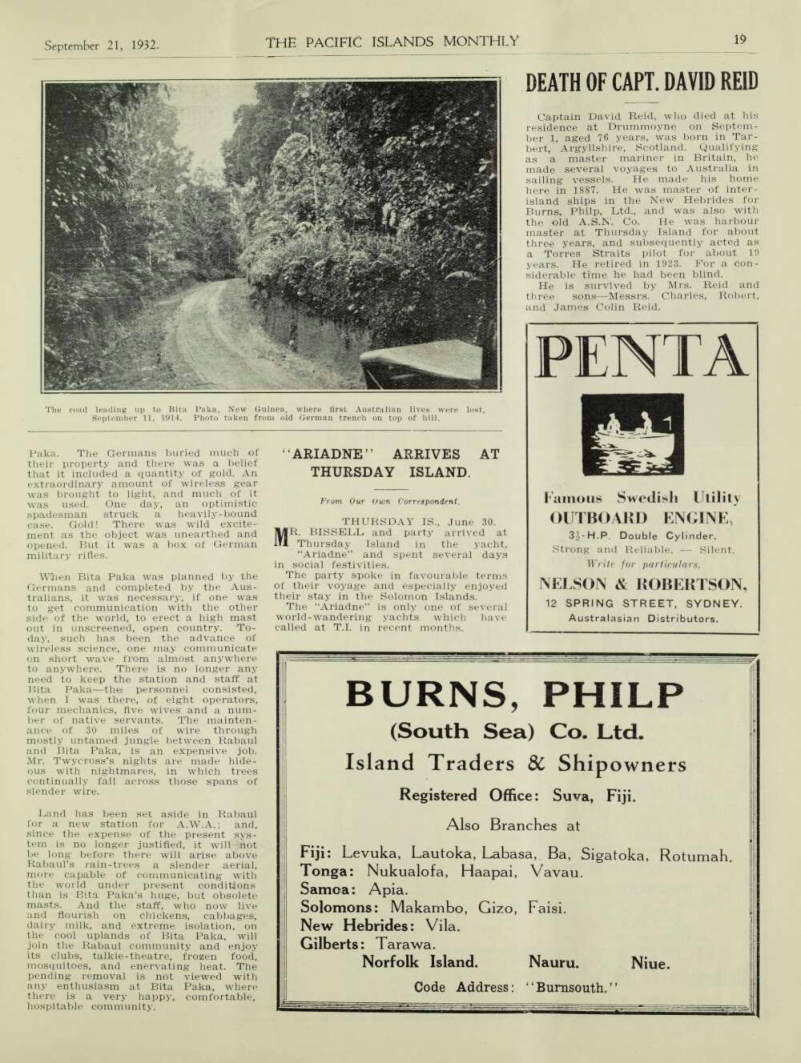
Spot Where First Australians Killed To Be Abandoned Because Advance of Science Makes Radio Station at Rabaul Possible.
By R. W. Robson.
ONE of these days soon they are going to move Bita Paka radio station from Bita Paka into Ra baul. Some 30 miles of expensive land line will be cut out —and the tropical jungle will quickly resume dominion over the historic place where Aus tralian fighting men were first engaged in the Great War, and where the first Australian lives were sacrificed.
In July last, I drove out from Ra baul with Mr. Twycross, the A.W.A. officer in charge of the radio network which serves New Guinea, and of which Bita Paka is the centre. He is a keen, practical chap, and I learned with much interest of the way in which wireless traffic in and cut of Rabaul, Salamaua, Kavieng, Kieta, Madang, Manus and Eitape is organised and concentrated at Bita Paka, and thence distributed south to Port Moresby and Australia, east to Suva, Noumea, Nauru and Ocean Island, and north to Truk. It was a fascinating experience to stand beside an operator there in a jungle clearing, on a hilltop in the in terior of New Britain and, through his Morse, chat with a friend at 47 York Street, Sydney.
But I confess I was even more in terested in examining the ground over which those Australian sailors travelled on September 11, 1914. It was so easy to reconstruct the scene of 18 years ago. Eighteen years! It seems only yesterday that we read the brief news paper accounts of how Australians and Germans first met in war.
After we left Kokopo, for Bita Paka, the car bumped along an evil road, through rain-soaked plantations, run ning parallel with the shore. Then, on rising ground, we came to a cross road. (See map on this page.) This ran up from Kabakaul Bay, a mile away, on our left, and it climbed upwards, through thick jungle, to Bita
Paka wireless station, on the low hills, some five miles away. We turned sharp right, and followed the road.
We were now on historic ground. At daylight on September 11, 1914, a land ing party of 25 men from H.M.A.S.
“Australia” was put ashore at Kaba kaul jetty, and was joined by 12 men from the destroyers, and 60 men from H.M.A.S. “Yarra.” They marched along this road towards Bita Paka, encountering at first some harmless sniping, until they met severe fire from a trench, at the foot of the hill, some two miles from the cross roads. An other 100 men, including a machine gun section, under Lieut.-Commander El well, was sent to support the main body. In the charge on this No. 1 trench, Lieut.-Commander Elwell was shot through the heart—the first Aus tralian fighter to die in the War.
Taking the trench, the Australians made prisoners of six Germans and 20 native police, and pushed on up the hill, about miles, to the next de fences.
There is a considerable cutting where the road finally crosses the densely-wooded hill; and right on top of the hill, astride of the cutting, the Germans cut a deep trench. This com manded the road, and as the Australian naval men slowly advanced through the thick bush on each side of the road, they met a brisk, continuous rifle fire from the Germans and natives in the trench.
The trench is still there, partly filled with rubbish and decaying vegetation.
I stood in it, pointed the camera down the road, along which the Australians came 18 years ago, and took the photo graph which is reproduced herewith.
There was not a sound or sight of man anywhere. Yet, on or near this spot, two Australians and one German were killed, and six Australians and two Germans wounded. Fourteen Germans and 46 natives were captured. Several natives were killed and wounded.
On my right, as I took this picture, was a big tree; and I was told that, until recently, there still dangled from it the rope by which an enemy rifle man had ascended to snipe at the Aus
tralian bluejackets as they crept up through the jungle.
The German defence collapsed when this trench on the hilltop was taken, and the Australians pushed on and oc cupied Bita Paka Station at 9 p.m.
The wireless mast had been dropped and some of the machinery destroyed.
Vital parts were removed to the ships and the station was abandoned.
Rabaul was occupied by the military expeditionary force a few days’ later, and a temporary radio station set up on Namanula heights, above the town.
Then a large quantity of Telefunken apparatus was found buried in tanks at Bita Paka. Some of this was re moved to Rabaul, where a new station was established in the town.
In due course, the Commonwealth Radio Service set to work to erect a new station at Bita Paka, using a good deal of the captured German gear. The Germans had planned four masts of 250 feet each. The Australians erected one mast of 315 and another of 155. The station was opened in September, 1916, and was taken over by Amalga mated Wireless, Ltd. in July, 1922, by whom it has been efficiently operated ever since.
Digging has been a favourite occu pation among the A.W.A. men at Bita
Sketch of country over which Australians ad vanced to attack Bita Paka, in September, 1914.
Paka. The Germans buried much of their property and there was a belief that it included a quantity of gold. An extraordinary amount of wireless gear was brought to light, and much of it was used. One day, an optimistic spadesman struck a heavily-bound case. Gold! There was wild excite ment as the object was unearthed and opened. But it was a box of German military rifles.
Wiien Bita Paka was planned by the Germans and completed by the Aus tralians, it was necessary, if one was to get communication with the other side of the world, to erect a high mast out in unscreened, open country. To day, such has been the advance of wireless science, one may communicate on short wave from almost anywhere to anywhere. There is no longer any need to keep the station and staff at Bita Paka —the personnel consisted, when I was there, of eight operators, four mechanics, five wives and a num ber of native servants. The mainten ance of 30 miles of wire through mostly untamed jungle between Rabaul and Bita Paka, is an expensive job.
Mr. Twycross’s nights are made hide ous with nightmares, in which trees continually fall across those spans of slender wire.
Land has been set aside in Rabaul for a new station for A.W.A.; and, since the expense of the present sys tem is no longer justified, it will not be long before there will arise above Rabaul’s rain-trees a slender aerial, more capable of communicating with the world under present conditions than is Bita Paka’s huge, but obsolete masts. And the staff, who now live and flourish on chickens, cabbages, dairy milk, and extreme isolation, on the cool uplands of Bita Paka, will join the Rabaul community and enjoy its clubs, talkie-theatre, frozen food, mosquitoes, and enervating heat. The pending removal is not viewed with any enthusiasm at Bita Paka, where there is a very happy, comfortable, hospitable community.
The road leading up to Bita Paka, New Guinea, where first Australian lives were lost, September 11, 1914. Photo taken from old German trench on top of hill.
Advertisements & other items, p. 20 (1 item)
Building
SUPPLIES
Complete Stocks of Seasoned Timber of all descriptions on hand for immediate shipment.
Galvanised Iron, Fibro- Cement, Glass, and Builders’ Ironmongery.
SEND FOR OUR CATALOGUE
OF READY-CUT HOMES AND
ISLAND BUNGALOWS.
A. C. SAXTON & SONS
LTD.,
Box 5, PYRMONT, SYDNEY.
Have Teeth by Post
Let me send you free full particulars of my well-known and successful method of
“SELF-TAKEN IMPRESSIONS’’
by which I can make you teeth by post.
All details by return mail.
Natural gum, unbreakable sets, comfortable and long lasting.
Teeth in one day for visitors to my surgeries, Painless extractions, reli able fillings, gold crowns and Bridge work. Old Plates remodelled. 28 OXFORD ST., over Winns;
139 ELIZABETH STREET, two
Beam Wireless, Telegraphic and Cable Addres
SPENCER NOLAN
DENTIST,
177 OXFORD ST., opposite Mcllraths. doors from Market Street, Sydney, s: “Fastplate,” Sydney. P.I.M.
Thursday Island.
"Ariadne” Arrives At
From Our Own Correspondent.
Thursday Is., June 30.
MR. BISSELL and party arrived at Thursday Island in the yacht, “Ariadne” and spent several days in social festivities.
The party spoke in favourable terms of their voyage and especially enjoyed their stay in the Solomon Islands.
The “Ariadne” is only one of several world-wandering yachts which have called at T.I. in recent months.
Death Of Capt. David Reid
Captain David Reid, who died at his residence at Drummoyne on Septem ber 1, aged 76 years, was born in Tar bert, Argyllshire, Scotland. Qualifying as a master mariner in Britain, he made several voyages to Australia in sailing vessels. He made his home here in 1887. He was master of inter island ships in the New Hebrides for Burns, Philp, Ltd., and was also with the old A.S.N. Co. He was harbour master at Thursday Island for about three years, and subsequently acted as a Torres Straits pilot for about 19 years. He retired in 1923. For a con siderable time he had been blind.
He is survived by Mrs. Reid and three sons—Messrs. Charles, Robert, and James Colin Reid.
Advertisements & other items, pp. 21-22 (1 item)
Penta
Famous Swedish Utility
OUTBOARD ENGINE,
Double Cylinder.
Strong and Reliable, Silent.
Write for particulars.
NELSON & ROBERTSON,
12 SPRING STREET, SYDNEY.
Australasian Distributors.
BURNS, PHILP
(South Sea) Co. Ltd.
Island Traders & Shipowners Registered Office: Suva, Fiji.
Also Branches at Fiji: Levuka, Lautoka, Labasa, Ba, Sigatoka, Rotumah.
Tonga: Nukualofa, Haapai, Vavau.
Samoa: Apia.
Solomons: Makambo, Gizo, Faisi.
New Hebrides: Vila.
Gilberts : Tarawa.
Norfolk Island. Nauru. Niue.
Code Address: “Burnsouth.’’
HOLBROOKS’
TABLE DELICACIES
WORCESTERSHIRE
SAUCE.
No. 2 SAUCE
(A thick, fruity sauce).
TOMATO SAUCE.
FRENCH OLIVE OIL.
SPANISH OLIVES
(Plain and Stuffed).
CAPERS.
FLAVOURING ESSENCES.
CHUTNEY.
PURE MALT VINEGAR.
JELLY CRYSTALS.
TINNED SOUPS.
BAKED BEANS AND
SPAGHETTI.
In Tomato Sauce.
A wide variety of Pickles, including Sweet Gherkins and Small Pearl White Onions.
Holbrooks (A/sia.) Ltd.
WATERLOO, N.S.W.
Travelling Journalist's Criticism Brings Sharp
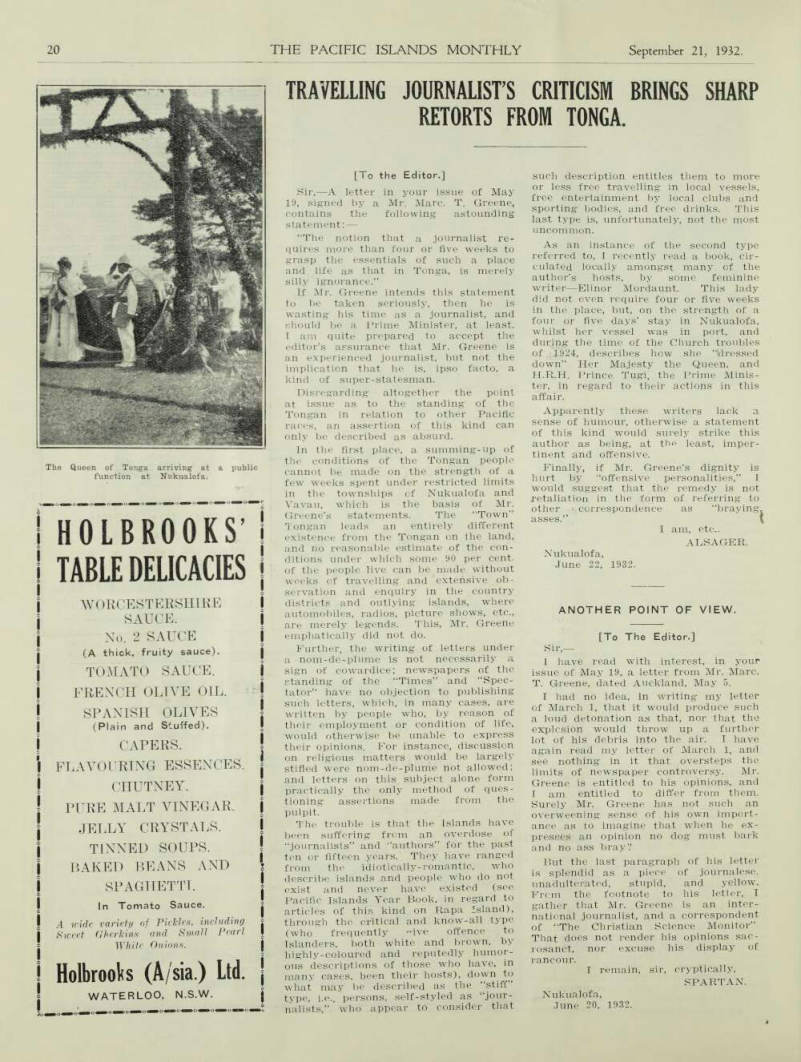
Retorts From Tonga.
[To the Editor.]
Sir, —A letter in your issue of May 19, signed by a Mr. Marc. T. Greene, contains the following astounding statement: “The notion that a journalist re quires more than four or five weeks to grasp the essentials of such a place and life as that in Tonga, is merely silly ignorance.”
If Mr. Greene intends this statement to be taken seriously, then he is wasting his time as a journalist, and should be a Prime Minister, at least.
I am quite prepared to accept the editor’s assurance that Mr. Greene is an experienced journalist, but not the implication that he is, ipso facto, a kind of super-statesman.
Disregarding altogether the point at issue as to the standing of the Tongan in relation to other Pacific races, an assertion of this kind can only be described as absurd.
In the first place, a summing-up of the conditions of the Tongan people cannot be made on the strength of a few weeks spent under restricted limits in the townships of Nukualofa and Vavau, which is the basis of Mr.
Greene’s statements. The “Town”
Tongan leads an entirely different existence from the Tongan on the land, and no reasonable estimate of the con ditions under which some 90 per cent, of the people live can be made without weeks of travelling and extensive ob servation and enquiry in the country districts and outlying islands, where automobiles, radios, picture shows, etc., are merely legends. This, Mr. Greene emphatically did not do.
Further, the writing of letters under a nom-de-plume is not necessarily a sign of cowardice; newspapers of the standing of the “Times” and “Spec tator” have no objection to publishing such letters, which, in many cases, are written by people who, by reason of their employment or condition of life, would otherwise be unable to express their opinions. For instance, discussion on religious matters would be largely stifled were nom-de-plume not allowed; and letters on this subject alone form practically the only method of ques tioning assertions made from the pulpit.
The trouble is that the Islands have been suffering from an overdose of “journalists” and “authors” for the past ten or fifteen years. They have ranged from the idiotically-romantic, who describe islands and people who do not exist and never have existed (see Pacific Islands Year Book, in regard to articles of this kind on Rapa Island), through the critical and know-all type (who frequently give offence to Islanders, both white and brown, by highly-coloured and reputedly humor ous descriptions of those who have, in many cases, been their hosts), down to what may be described as the “stiff” type, i.e., persons, self-styled as “jour nalists,” ’ who appear to consider that
such description entitles them to more or less free travelling in local vessels, free entertainment by local clubs and sporting bodies, and free drinks. This last type is, unfortunately, not the most uncommon.
As an instance of the second type referred to, I recently read a book, cir culated locally amongst many of the author’s hosts, by some feminine writer—Elinor Mordaunt. This lady did not even require four or five weeks in the place, but, on the strength of a four or five days’ stay in Nukualofa, whilst her vessel was in port, and during the time of the Church troubles of 1924, describes how she “'dressed down” Her Majesty the Queen, and H.R.H. Prince Tugi, the Prime Minis ter, in regard to their actions in this affair.
Apparently these writers lack a sense of humour, otherwise a statement of this kind would surely strike this author as being, at the least, imper tinent and offensive.
Finally, if Mr. Greene’s dignity is hurt by “offensive personalities,” I would suggest that the remedy is not retaliation in the form of referring to other correspondence as “braying, asses.”
I am, etc..
Alsager.
Nukualofa, June 22, 1932.
The Queen of Tonga arriving at a public function at Nukualofa.
Another Point Of View.
[To The Editor.] Sir,— I have read with interest, in your issue of May 19, a letter from Mr. Marc.
T. Greene, dated Auckland, May 5.
I had no idea, in writing my letter of March 1, that it would produce such a loud detonation as that, nor that the explosion would throw up a further lot of his debris into the air. I have again read my letter of March 1, and see nothing in it that oversteps the limits of newspaper controversy. Mr.
Greene is entitled to his opinions, and I am entitled to differ from them.
Surely Mr. Greene has not such an overweening sense of his own import ance as to imagine that when he ex presses an opinion no dog must bark and no ass bray?
But the last paragraph of his letter is splendid as a piece of journalese, unadulterated, stupid, and yellow.
From the footnote to his letter, I gather that Mr. Greene is an inter national journalist, and a correspondent of “The Christian Science Monitor”
That does not render his opinions sac rosanct, nor excuse his display of rancour.
I remain, sir, cryptically,
Spartan.
Nukualofa, June 20, 1932.
A Nightmare Expedition.
De Rays’ Attempt to Colonise New Ireland in 1880.
(By R. F. Thomson, F.R.G.S.)
OVER fifty years ago—on the 16th January, 1880 —the first vessel sent out with colonists by the Marquis de Rays to form a settlement at Port Preslin (renamed by the Mar quis, Port Breton —on the coast of New Ireland, opposite Rabaul) stood off this anchorage in New Ireland.
The vessel was the “Chandernagor,” a three-masted sailing ship, of 900 tons burden. The “Chandnernagor,” presum ably, was named after the little French settlement lying 20 miles from Calcutta.
The name, Chandernagor, has a significance to Australians, inasmuch as it is the burial place of Henry Pid dington, known to the maritime world as “Stormy Piddington,” who was an ancestor of our well-known Justice Piddington. He wrote the “Sailors’
Handbook for the Law of Storms,” a book which is in use on many ships at the present day. “Stormy Piddington” was the first man to use the word “cyclone” in his writings. A Greek word, signifying, amongst other things, the coil of a serpent, may have inspired Piddington with this expressive term.
Charles Marie Bonaventure du Breil, Marquis de Rays (who has at times been wrongfully described in many newspaper articles as the Marquis de Ray), a Catholic and a Royalist living in Brittany, France, dreamed of great colonisation schemes, and chafed against the irksomeness of civilised surroundings. His great idea was to establish an independent and Christian State, far away from the restrictions and prejudices of the Old World. He had been greatly influenced by the writings of Duperrey, commandant of the corvette “Coquille”, who had anchored for some days in Port Pres lin, New Ireland —a name given by Bougainville, to recall the Minister of Marine of the period, who was respon sible for the expedition he was making round, the world.
Duperry wrote glowingly of this part of New Ireland. According to him, this was indeed a land of milk and honey, well wooded and well watered by many beautiful cascades, which wended their way from the mountain slopes, and peopled by friendly natives, who offered many gifts of food, consisting of fruits, fish, and wild pig, to the visitors.
The reefs outlying this safe anchorage were found to be teeming with bechede-mer and valuable shells, while the woods on the mainland had many rare trees that would in all probability be very acceptable on the markets of the world.
The Marquis was so impressed with the description that he made up his mind to form a settlement on this part of New Ireland. Already, he had figured out in his Quixotic mind that huge forests had been cut down and that smiling plantations were producing sugar cane, coffee and other tropical products—a large city with churches gnd statuary, schools and public
buildings, with well laid-out gardens and town squares. Kind missionaries and Sisters of Mercy toiled hard amongst the hordes of autochtons, teaching them to love and cherish rather than to hate and destroy one another.
He established agencies in many parts of France, and the scheme unfolded itself very rapidly. Land was to be had at five francs the hectare, and as New Ireland was estimated to contain over one and a quarter million hectares, there was plenty of space for all operations.
The Marquis held meetings at Mar seilles, where he was the Bolivian Consul. His pale blue eyes beaming with honest intent, and his plain and honest Breton manner, induced many persons to subscribe to the scheme.
There was much enthusiasm in certain parts of France and Belgium.
However, the French Government looked askance at the proposals of the Marquis, and tried to thwart the sending of the “Chandernagor” out from any European port with emi
grants, whose welfare would not be guaranteed by the Republican Govern ment. The Marquis, not to be daunted, found a complacent and clever Ameri can of good character, named Captain MacLaughlin, who had fought in the Civil War in America, and could con verse fluently in seven different languages.
Flying the American flag, the “Chan dernagor,” in the early dawn of Sep tember 14, 1879, sailed from Flushing, in Holland, with a motley of humanity.
There were representatives of many trades and professions—waiter, gard ener, saddler, wharf labourer, actor, and writer all rubbed shoulders with one another. Fifty of these were French 20 were Germans, and the balance of 29 were Italians, Belgians and Poles — in all, 89 souls.
Having no bill of health, the “Chan dernagor” was quarantined at Cape de Verde Islands, on October 3, 1879, and the American Consul there objected to the use of the American flag on the vessel. Captain MacLaughlin, to avoid unpleasantness, stole away from these islands, where he had hoped to obtain fresh food. He made up his mind to refrain from calling at any other port until he reached Port Breton.
Everyone quarrelled, on board, and life in the ship was a little hell. No doctor was carried, although it must have been well known to the Marquis de Rays that malaria would be pre valent in New Ireland.
Titeu du la Croix, the provisional Governor of the new Colony, hated the captain. Seykens, the Belgian mate, was a violent drunkard and, although he was an excellent navigator, he at times became so obstreperous that it was found necessary to tie him to the mast until he recovered. Forgotten was the hymn of New France, which they
had sung so lustily when departing from Europe— Bonne est la brise, et l’esperance Sourit an navire valliant: Des vieux rivages de la France Nous aliens an soleil levant.
Terre aimee avant que connue, N'ouvelle-France, pays d’or, Prepare-toi pour la venue Des Francais du Chandernagor!
“Beloved earth that we do not know” —to give the fifth line of this first verse a free translation — is certainly the work of an optimist, who expands further in the second verse, and in the last two lines of this sings— Qu’il couvre tes plages desertee Des bienfaits du Chandernagor.
This strewing of benefits upon the sand beaches of wild New Ireland, by the good ship “Chandernagor” assists us to realise in the last verse that this vessel is the torch-bearer of a new civilisation in the Pacific — Tu deviendras grande et feconde, De travail sera ton tresor.
Ce beau pays, dira le monde, C’est l’enfant du Chandernagor!
The coast of Australia was sighted on December 17, 1879. The emigrants must have had a depressing Christmas, as the stout ship sailed up the Aus tralian coast. Eventually, New Breton was reached, on January 16, 1880.
At first, the emigrants were filled ‘with the wildest enthusiasm, but soon their hardships began. The dense jungle seemed to present to them difficulties that could not be overcome.
The coral soil appeared poor, being so different from the black loamy earth that they had been accustomed to in their home land.
Titeu de la Croix, after a little ex
ploration, summed up the situation, that the colony could never succeed in such an unsuitable country. The spongy soil, and the bitter water at Liki Liki, where the first settlement was made, filled him with only one de sire, and that was to hasten to some country where the fleshpots would be well filled. He fled to Sydney with the ship, taking Seykens with him as navigator.
The indomitable MacLaughlin was determined to justify his salt, and toiled hard at Liki Liki, where he hoped to establish the genesis of the colony and assist the Marquis de Rays in the realisation of his dream. He inspired the settlers with his wonder ful spirit, and worked hard at the cul tivation of bananas, sweet potatoes, and other tropical products. But nos talgia and fever played a strong part.
Discontent was rife, and the unhappy settlers resolved to abandon the enter prise.
The aid of the missionaries at the Duke of York group, which was not very far away from Liki Liki, was in voked, and the pioneer missionary, the Rev. George Brown, D.D., F.R.G.S., who gave MacLaughlin great assistance, describes the Liki Liki colony as he saw it: On the beach were a large steam boiler and fireplace, bricks for foundation of cathedral, sugar refining machinery, steam crane, incuba tors, saw mills, etc., etc. There were cases of knifes handles, but there were no blades; numbers of wheelbarrows, but there were no wheels; scarcely any axes; no quinine and few other medicines.
At the subsequent trial in France, many mis statements were made regarding the island being desolate, etc. The soil, however, was really very rich, and capable of growing yams, taro, bananas, sweet potatoes, etc. The fact is that the people were disheartened from the very commencement, and even before the “Chander nagor” left.
Out of the original 89 settlers, 27 were dead. The colony was a failure, but there is no doubt that it would have succeeded had a market been nearer than Australia. The country near Port Breton would have done well under tropical plants, such as bananas, coconuts, etc., but there is always a waiting period, and, during that period, the vitality of the settlers became lower and lower. There was plenty of time for fever and nostalgia to gain ground.
The French are a race subject to extreme home-sickness, but if this is conquered they seem to adapt them selves to the loneliest situations on the face of the globe. The French Fathers and Sisters of Mercy belonging to such orders as the Marist Mission and the Sacred Heart seldom see civilisation; and if they do they are surprised at the locomotion of the modern world — motor cars, aeroplanes, etc., being quite new and strange to them. They are happy in surroundings in the lone Solomons and other groups, that would make the average tourist shudder if he was told he had to spend an extra day there. The “nostalgia Francais” is no longer a disease that worries these devoted missionaries.
It was only a small band of the “Chandernagor” settlers that arrived in the “Victor” at Sydney—probably less than half the original number that had set out from Holland. The balance of
them had either died, or had been eaten by savages, and a few had been taken to Cooktown, in Queensland.
Captain MacLaughlin, after seven months at Liki Liki, finally abandoned the project during August, 1880. He died at Woy Woy, Sydney, in 1927, having attained the venerable age of 79 years.
MacLaughlin was a man of many parts. For some time he was editor of the “Lang Leader”, the “Newtown Chronicle,” and other papers; a lec turer at the Technical College, and sec retary of the Illawarra Tramway League. He was also a well known chess player. His greatest adventure must have been the leadership of this nightmare expedition, sent across the world by the Marquis de Rays.
Advertisements & other items, pp. 23-24 (1 item)
Excelsior Supply Co. Ltd.
PUMPMOBIL
Light & Portable MOTOR PUMPS.
PUMPMOBIL
Weight about 140 lbs. Automatic Priming. Reliable and Efficient.
Especially suitable for Prospecting and all Sluicing requirements.
Particulars from
NELSON & ROBERTSON,
12 Spring Street SYDNEY.
EXCELSIOR SUPPLY CO. LTD.
The most extensive Manufacturers in the British Empire of
RUBBER STAMPS,
INKS, STENCILS.
Marking Devices.
ACME STAMP PADS
We have a big range of Special
FRUIT CASE MARKING SETS
Wa We also Manufacture or Supply a complete line of
Spraying Machines
for all purposes.
Let us know your requirements and we will quote you by return. Ask for our Big Catalogue.
Sole Australasian Distributors of the World Famous SHEAFFER FOUNTAIN
PENS and PENCILS.
EXCELSIOR SUPPLY CO. LTD.
Head Office:--160 GEORGE STREET WEST,
SYDNEY. N.S.W.
Still Supreme AUNT
MARY'S
PURE FOOD
PRODUCTS
"Defiance" Brand Canned Goods
After thirty years’ trading with the Islands, Aunt Mary’s Pure Food Products are still supreme.
Highest quality goods, specially manufactured and packed to meet Island conditions.
These High-grade Products are packed by the proprietors of Aunt Mary’s Pure Food Products, Hermetically sealed and specially prepared to withstand tropical heat, thus ensuring satisfaction to consumers.
Only goods of the highest standard are packed under these brands, thus the Proprietors keep faith with their clients and consumers.
Aunt Mary’s Pure Food Products and “Defiance” Brand Canned Goods are prepared and packed only by
PURE FOOD
MANUFACTURERS.
TILLOCK & CO. LTD.,
Kent and Liverpool Streets, SYDNEY, N.S.W.
A Planter’S Life In
New Hebrides.
WE have taken the liberty of publish ing the following extract from a private letter to the editor from a planter in the New Hebrides. People, who read and write rubbish about the “romance” of the Pacific Islands, are invited to seek the romance in this simple recital of an average planter’s life.
“My wife and I went up to Australia last November, as we received word through 4QG, Brisbane, that her mother was very ill. We thought we would call on you, on our way back, but that was knocked on the head by the hurricane in February.
“By the time we got definite news, we had to hurry to get things together to get home, as all our buildings were un roofed and some destroyed altogether.
We had to take timber and iron for the roof of the dwelling house back with us.
“Our two sons were here during the hurricane. The settlers and natives say it was the worst ever known. The loss reported in the May issue of P.I.M. is not exaggerated, as far as our coconut palms are concerned. Most people say our palms suffered the worst on this island. A great number are down altogether, others badly bent and twisted about. In places it looks as though the wind had come straight down and then formed into a whirl wind. With other palms, the trunks are standing, with the tops snapped off and some of them broken in two places.
“The dwelling-house, store, two copra drying houses and bakehouse were un roofed, and beds for drying the copra on were also blown away. The copra house, which was a concrete building, collapsed altogether.
“This is a pretty hard knock for us settlers, on top of low copra prices.
Copra has been as low as £4/10/- per ton here and the highest I have re ceived since April, 1931, is £7/10/-. That was in May, 1931. In October I received £5/10/-. Just after the hurricane, my son says, they were offering £7/10/-.
This trip (June 24) they paid £6/15/per ton. So you can see we are not making fortunes down here.
“Although the French settlers got as sistance from their Government, as far as I know the British Government has given no assistance to the settlers here.
When I heard that the French were assisting their settlers, I wrote to the Resident Commissioner here to see if we could get anything, but so far I have had no reply.”
News For Islands.
Increasing Use of Radio,
The term “coconut wireless” is ap plied to items of news (principally of a “hush-hush’’ nature, released in the early morning) to indicate that no re liance can be placed on the information circulated.
But more and more wireless sets of the genuine type are coming into use here and the morning news dissemin ated for discussion is gradually being raised to a better and more reliable level.
As a means of entertainment for is land residents, a radio set is possibly unsurpassed. This was demonstrated to us at Rarotonga by the recent broadcast programmes specially sent for the benefit of the Pacific peoples, during the progress of the Olympic Games at Los Angeles.
These programmes were broadcast from the Olympic Stadium, Vivid de scriptions of the stadium and the events were given nightly. Competi tors from countries in and around the Pacific spoke over the air to their friends and relatives.
The radio is in many ways the next best thing to a daily newspaper. At Rarotonga, we have no daily or weekly newspaper. Our closest association with the printing press is ‘‘The Pacific Islands Monthly.”
Officials.
Honours for Former Fiji Officials.
From Our Own Correspondent.
Suva, Aug. 10.
AN interesting item of recent news is the award of a K.C.M.G. to H.
S. D. Rankine.
Sir Richard Rankine was Receiver- General in Fiji 10 or 12 years ago.
The office of Receiver-General has now been renamed as Colonial Treasurer.
Sir Richard went to Nyasaland. His promotion is peculiarly interesting to residents of Fiji, and it shows that the training which civil servants re ceive in Fiji stands them in good stead in later years.
The colonists in a small Crown Colony have a natural tendency to under-value the merits of the civil servants set in authority over them, and it is interesting to recall other in stances of those who received pro motion in recent years. There are many examples, but in recent years one recalls such names as those of the present Administrator of the Lee ward Islands, His Honour D. R.
Stewart, C.M.G.; the Colonial Secre tary of British Guiana, Hon. H. G.
Pilling, C.M.G.; and Mr. G. V. Maxwell, C.B.E., who recently retired from the post of Secretary of Native Affairs in Kenya. These three all served their apprenticeship in Fiji.
Advertisements & other items, p. 25 (1 item)
W. S Tait & Co. Ltd.
8 Spring Street, SYDNEY.
BUYING AND SELLING AGENTS FOR MERCHANTS
AND TRADERS THROUGHOUT THE PACIFIC ISLANDS.
Correspondence invited.
Established 1890. Cable Address: “SUCCESS,” Sydney.
TISDALLS CAN SUPPLY
SOUTH SEAS FISHING TACKLE
and Equipment.
We Sell only the Best Quality of Fishing Tackle, and we stock a very wide range of
RODS, LINES, REELS, CASTS,
ARTIFICIAL BAITS, NETS, GAFFS, etc.
Every kind of Sporting Equipment in Stock, at Favourable Prices, such as Outboard Motors, Guns and Ammunition, Golf, Hockey, Football, Bad minton, Deck Tennis, and all Summer Sports Equipment.
Fishing Lines of Linen, Silk, Flax and Gut, specially manufac tured and Tested for the South Seas. Our Rods will Stand up to
Tropical Conditions Anywhere.
FOR FULL DETAILS and PRICES, SEND for OUR FREE ILLUSTRATED CATALOGUE.
W. H. TISDALL, LTD. ZEALAND.
AUCKLAND WELLINGTON CHRISTCHURCH HAMILTON.
Mail Orders have special individual attention. Write to us fully about your fishing-tackle requirements.
What Is Western Samoa Doing
For Its 3800 Half-Castes?
Specially written for “The Pacific Islands Monthly’’ by a Samoan Planter.
AT the present time —and for the last six years—the “Mau”, or national movement of the Samoans, with its policy of passive resistance against the New Zealand Administration, at tracts the attention of those interested in Samoan affairs.
It is generally overlooked that, be sides this purely political problem, an other problem, social and economic, has grown more difficult and important, chiefly as a result of the world-wide depression during the last two years.; This is the problem of the ever-in creasing half-caste European popula tion, for which a place in the economic structure of the country cannot be found.
Of all the Pacific Islands, only in Hawaii is the problem of like import ance —though Hawaii, with its large and varied plantation industry, tourist traffic, etc., offers far more opportun ities for remunerative employment than the much smaller Samoan Islands.
According to Census figures of January 1, 1910, the half-caste popula tion of Western Samoa at that date amounted to 1003 souls, or, in a total population of about 35,000, approxim ately 3 per cent.
In 1930, the figures given in the official report to the League of Nations estimate the European and half-caste population, at December 31, 1930, 2,815. Of this number, about 500 are whites, so that the half-caste popula tion is estimated at 2,300. Out of a total population of about 45,000, at that date, the half-castes represented over 5 per cent.
The local-born of European-Samoan origin have, during the last 20 years, more than doubled their numbers, whilst their proportion of the total population has gone up from 3 per cent, to 5 per cent.
One very important point has to be taken into consideration. The demo graphic statistics of 1930 do not give any specific figures for the large number of Chinese-Samoan origin.
They are enumerated mostly as “Native Samoans”, though by educa tion and legal status they should be statistically treated as European half castes. Their number may be correctly estimated as 1,500. When added to the 2,300 half-castes of European descent, we thus find that the total half-caste population of Western Samoa comes to the large total of 3,800 out of a popu lation of 45,000 —or approximately 8½ per cent.
A large number of half-caste boys, attending mainly the Marist Brothers School at Apia, complete their school term every year and look for employ ment. Their chances of obtaining work of any kind are very slender. A very few may find work as office boys, mes sengers, engineers’ assistants, motor car drivers, or traders. But the majority must await some chance that the un certain future may bring them; and this chance may net come for years.
The first who realised the serious ness of the problem, and sought a solution, was the former Administrator, General Sir George Richardson, who, during his term of office, started courses of instruction for local born boys in plumbing, carpentering, wireless, etc. Unfortunately—probably owing to the political trouble —this well-meant attempt was given up after a few months.
General Richardson also requested the Planters’ Association to prepare some scheme of land settlement for local born boys, by which the Administration would lease small plots of land to suit able applicants and, under supervision, enable them to plant cocoa, bananas, and other products, so as to make a homestead and become useful members of the community. A scheme was pre pared and discussed, but for the same reason as the cessation of the instruc tion courses, did not get farther than the initial stage.
In a recent letter regarding the European petition to cut up the Gov ernment Reparation Estates, Sir George Richardson says: “I realised some years ago that such a policy would ultimately be necessary in the interests of that comparatively large section of the community—the locally-born Europeans, including those of mixed descent, whose well-being I strove so hard to serve during mv five years’ regime in Samoa, and whose future welfare I have still very much at heart. ... I have always viewed with anxiety the lack of suitable avenues of employment in Samoa for the large number of boys who receive a good education at the Marist Bros.’
School and leave there with no future prospects of playing their part as good citizens, because of the absence of a
land policy providing for their absorp tion as planters.
“If no progress has been made in so providing for these youths since I left the Territory, their position must now be very serious, and I feel sure that you have only to represent the problem to your Administrator and make constructive proposals to him, in order to have immediate action taken to remedy the position.”
There is no need to further elaborate the problem described by Sir George Richardson. The Administrator, it is true, is unable, owing to the difficult financial position of the Treasury, to render any financial assistance. In normal times, steps could be taken to establish some kind of agricultural school for local-born boys, or at least some kind of lessons, to prepare the boys for work on plantations.
Strange to say, Mr. O. F. Nelson, who is considered the leading local-born citizen of Samoa, in a political as well as economical sense, and who has de voted so much time to the furtherance of the Mau movement, has never paid much attention to the future of the Samoan half-castes, nor has he ad vanced any practical ideas or sugges tions for the solution of the problem.
Economically, the native Samoan is much better off than the unemployed half-caste. The former, living on his own land, is practically self-sustaining.
It is to be hoped that the New Zealand Government will realise the urgent need to make the Government planta tions and bush land in Government possession available for closer agricul tural settlement by the local and local born population.
Advertisements & other items, p. 26 (1 item)
Establishes 1868.
Samples and prices on application.
BIRKMYRE’S CLOTH.
The best waterproof for motor car hoods, tarpaulins, horse and cow rugs, etc. Canvas of all kinds, cotton ducks and hessians, seaming, bagging and shop twines. Fishing nets and yarn, fishing lines and tennis nets.
The GOUROCK Ropework Export Co. LTD
397 KENT STREET, SYDNEY, N.S.W.
ESTABLISHES 1868.
Bird Of Paradise.
Plea for Resumption of Trade.
THERE is probably no more mistaken policy in the Pacific than the pro hibition of export of bird of para dise plumes.
Professional ornithologists note a considerable depletion since the shooting of plumed males ceased. This would seem a paradox to the uninitiated; but the facts are that the male bird only develops full plumage and becomes saleable when his potency as a breeder is upon the wane. His interference with the matrimonial affairs of younger potent birds is the real cause of the very serious decline which is only too evident to close observers.
The hen bird is a mere little drab, and no one would shoot her on pur pose—while the younger males are not worth powder and shot.
There is some idea that shot car tridges are not discriminating in their effect —destroying all and sundry.
Were this true, a small calibre rifle or 410 bore shot gun could be pre scribed. But, as one familiar with the birds, I have seldom seen the plumed bird in close association — seated amongst the others. He is usually busy “showing off”, and dancing the “hula hula” some ten or twenty yards away, trying to attract attention to himself. The fact that he bounces the others and breaks up the family circle is to his detriment.
In the days of licensed shooting, the Germans built up many very fine plan tations from the income obtained by trading plumes, because licenses were only issued to bona-fide settlers.
Certain it is that, like many other well intentioned interferences, the pro hibition of plume trading is a failure.
Egrets may be a different matter —but the natives kill thousands of them, and bushels of “white grass” (egret feathers) can be got for a song on the Sepik river.
In the Paradise Birds, blue bird plumes have brought as high as £50 on occasion, and few marketed plumes of other species were worth less than £5.
Excise duty was £2 per plume, so that the trade was of appreciable assistance to revenue.—E.G.
More Gold Seekers.
American Expedition for Bismarck Range, N.G.
MR. ALFRED "TOWNSEND arrived in Sydney on August 27 from Chi cago by the steamer “Makura,” to make arrangements for an American expedition’s visit to New Guinea early in 1933.
Captain J. W. Harridine, consulting engineer to the American Steam Shovel and Tractor Company, will be in charge of the expedition, which will include doctors and anthropologists.
Operations will be centred about the Bismarck Ranges, where a search for gold and a geographical survey will be made. The scientific members of the party will study tropical diseases and
native psychology. The doctors will be from the Rush Medical College at Chicago.
A large aeroplane and scientific in struments are to be brought from America, but the rest of the outfit and a motor boat for the rivers will be bought in Sydney.
The Bismarck Mountains are on the
mainland of New Guinea, northwards of the Morobe goldfield. The range runs parallel with the Ramu River. This very rugged, broken country has had a great deal of attention lately from prospectors, who go in either from Salamaua, via the Markham Valley and the headwaters of the Ramu, or from Madang, via the Ramu River.
Advertisements & other items, p. 27 (1 item)
Lysaght
The Famous Brands of
Galvanized Iron
ARE NOW MADE IN AUSTRALIA
At Newcastle, N.S.W The first cost ot these brands is so very little more than that of inferior Qualities that to buy
“ORB” or “QUEEN’S HEAD” is a
proved sound investment.
The 15th edition of “The Referee,” a handbook of useful information, containing a ready-reckoner of much value to all engaged in building operations, may be obtained post free on application to John Lysaght (Aust.) Ltd., c/o. Box 196 D, G.P.O., Sydney.
CORRUGATED
PLAIN
Guaranteed
Doubtful Value Of Indian
Peasant Farmers In Fiji.
Old Resident Declares Asiatic Immigrants Useless, and Huge, Rich Districts Remain Empty and Undeveloped.
Written for the “Pacific Islands Monthly" by Richard B. Howard, of Racikulu, Nodroga, Fiji.
ATTENTION has been drawn to, and comments have recently been made in regard to an article, written by Mr. Trevor Casling-Cottle, under the title of “Chinese Labour in Fiji is Called Uneconomic,” and published in the “Pacific Island Monthly” of March last.
After some 15 years’ residence in Fiji, and having had every opportunity of studying this class of labour, I will say that Mr. Casling-Cottle’s view of the question is the correct and sensible one.
Mr. Casling-Cottle, however, has not touched upon the Indian labour. Thou sands of Indians are employed or resi dent in the colony, to, it is contended, the detriment of the native Fijian. The Indians certainly do not, to any appre ciable extent, send their earnings out of the colony, but they hoard them up by hiding them in the ground or other place thought to be safe, and thus stop any circulation of the money. In the meantime they live, proverbially, on the smell of an oil rag.
These remarks are intended to apply to those Indians who are supposed to be engaged on their own account in agricultural pursuits, and not to those in any other class of business.
As tenant farmers under the imme diate direction of a European, they no doubt may be considered fairly effi cient. But out on their own they are an utter failure, and it is a question if they grow even £1 worth of exportable pro duce. They seem to concentrate on growing rice—but only sufficient of that to supply their own food requirements.
Some may grow a little cotton, but nothing worth mentioning. Some years back maize was produced, but now there is little or no local demand for it.
The Indians persistently refuse to em ploy modern methods, but carry out the primitive ideas obtaining in their home land, and resent any attempt to educate them in this direction. They reside in what cannot be described as other than hovels, with no sanitary conveniences whatsoever. It is not uncommon to find a whole family, with adults of both sexes, sleeping in one room.
To the observer it is a problem to guess what the objection may be on the part of the Government in regard to these people. They are granted many concessions, but are still dissatisfied and incessantly clamour for more.
It is the custom to allow them to ob tain leases of land in small areas, which they are supposed to cultivate. But they do so in the most primitive and slovenly fashion. Some of these so called settlers will have a lease of any thing from 5 to 25 acres on which, in addition to any cultivation, they will try to depasture from 20 to 50 head of stock. It is needless to say that this can be done only by pirating the grass of adjoining holdings or vacant lands.
Moreover, quarrels amongst them are
frequent and free, often resulting in serious affrays.
The writer is of the opinion—and he is not alone in this respect—that it was not necessary and certainly undesirable, to bring large numbers of this class
Mr. Howard's article is interest ing and timely, because the ques tion of introducing Asiatic la bour is being considered by more than one Islands Administration, and information is being sought concerning the result of the In dian peasant farmer experiment in Fiji. — Editor.
to the colony, as under proper super vision and tuition the native Fijian would be equally or more efficient than the imported Indian.
After many suggestions in the local press, by experienced and practical men, Fijian labour is now being tried out, both by planters and the Government — the former being the first to make the effort—and it gives every promise of being a success. But it took years of hammering through the press before those responsible would take any steps in the desired direction.
The Fijians are acknowledged to be an intelligent race, capable of being brought into line with modern methods.
Hitherto, however, the whole task of uplifting these people has been left in the hands of the respective religious bodies, with almost negligible results as far as commercial undertakings are concerned. It was apparent to many that perhaps a little more work and little less praying would be beneficial.
Had the colony been blessed in years gone by with an Administrator of some experience of a new country, and some little vision, there is little doubt that the colony would have progressed to a much greater extent.
At the moment of writing there are thousands of acres of rich agricultural land, besides a still larger area of ex cellent grazing spaces, lying idle, un occupied and unproductive—just a breeding ground for all manner of noxious vegetable pests. These lands offer grand opportunities for both farmer and grazier, especially as there is few or no diseases among stock—no ticks, no dry spells, and abundant in digenous pasture.
The authorities, however, in their wisdom keep these lands locked up, by imposing conditions and tenures for occupation by Europeans which are not acceptable to the pioneer settler. It is contended, if these areas were thrown open to selection on reasonably easy terms and long tenures, they would be readily occupied by intending settlers from the adjacent colonies, especially those engaged in tropical or sub tropical pursuits. A considerable amount of capital would necessarily be brought into circulation, much to the advantage of the Government and the business community. These newcomers would settle the transport difficulty at present existing—even if they had to do the
work themselves —as was the case in many parts of Australia in the early pioneering days.
The writer was, in the early sixties, pioneering in the outer beyond of Aus tralia, particularly in the tropical and sub-tropical parts, and has had a fairly large experience of native races, not only Australian aboriginals, but also South Sea Islanders.
In the opinion of several it is evident that some steps in the direction indi cated will have to be taken by the authorities of Fiji, if the colony is to be lifted from its present state of unpro gressiveness and stagnation. The sug gestions of our elected members to the Legislative Council are ignored; and, as they are always in a minority, anything brought before the Council, no matter how practical or commensense it may be, if not in accordance with official views, is bludgeoned out by the nominee (or official) members. The great ma jority of these responsible officers are selected and appointed by the Home authorities to serve a given period in one or other of the Crown colonies.
Naturally, they have no interest in the future development of the place, and just perform their allotted duties with as little trouble as possible to them selves, awaiting the expiry of their term of office, then to be transferred to a pension.
So long as this state of affairs con tinues, just so long will the colony of Fiji remain in the doldrums.
Advertisements & other items, p. 28 (1 item)
C. G. Piggott
Repairs,
“OUR HANDS MAKE GOOD ARMS"
THERE IS
RIFLE MADE
NO BETTER
than the 22 Cal. WALTHER.
It is a single shot Repeater and an Automatic. ALL IN ONE RIFLE Magazine holds 5 long rifle cartridges PRICE, £8/7/6.
Fitted with Zeiss Telescopic Sight PRICE, £15.
“A MASTER’S CHOICE.”
SIL ROHU (late A.I.F.), GUNSMITH
IMPORTER OF HIGH-GRADE FIREARMS AND FISHING TACKLE SPECIALIST, 143 P ELIZABETH STREET, SYDNEY (Near Market Street).
“FISHING TACKLE TO TACKLE FISHING."
Vitality and Health are the
Main Factors in Every-day Life.
Put yourself in the hands of Specialists who have made an intelligent study of your requirements; it is vital to your health. We are knowu everywhere as the Suppliers of the Right Goods and which put the VITAL into VITALITY. Thirty-five years is our record of supplying Fresh Fruit, Vegetables and Produce to the leading Houses throughout the world.
GET FULLY ACQUAINTED WITH US.
Tel.: M A 4799; FX 4350 Private.. Cable Address: Pigs, Sydney. Code; Bentleys.
C. G. PIGGOTT
WHOLESALE FRUIT
DIRECT IMPORTERS
AND PRODUCE MERCHANTS
AND EXPORTERS SYDNEY.
Office: Bulk Stores and Packing House: Fruit Exchange, Sydney.
Sales Dept.: Fruit Exchange and City Markets, Sydney. Bank of N.S.W. Bankers.
Service.
New Guinea Public
From Our Own Correspondent.
Rabaul, Aug. 18.
THE Public Service Association held its annual general meeting at Rabaul on July 25.
The classification of the Service was discussed at some length. The Coun cil advised members that His Honor the Acting Administrator had in formed them in a recent interview that the whole question was under the con sideration of the Minister at Canberra, and that the delay was due to a hitch in connection with one or two of the senior positions; but, to the best of his knowledge, none of the junior staff were concerned.
His Honor was also of opinion that when the classification was published the classification would be ante-dated.
The Association reported having been successful in frustrating a pro posal to utilise superannuation funds at a low rate of interest to build the native labour quarters at Rapindik.
The Council had been in communi cation with the Sydney office of the E. & A. line of steamers, in conse quence of rumours that this company intended withdrawing from the Rabaul service. The company concerned had asked the Council of the Association to give these rumours an unqualified denial.
The Acting Administrator had indi cated his approval of a lease of land for the erection of a suitable building as a club-house for the Association.
The financial statement showed the Association’s affairs to be in a very healthy state.
Largest Islands
Church.
Sent to Solomon Islands in 203 Crates.
WHEN the “Mataram” left Sydney for the Solomons on September 14, she carried a complete church, to be erected at the port of Fui, and two carpenters, who will supervise the erection of the building.
The church, packed in 203 crates, was brought from Melbourne to Syd ney on the B.P. steamer “Marella”, and is the gift of Mr. Alfred C. Sage, of Clifton Hill, as a memorial to his son, the Rev. Charles C. Sage, who lost his life in the service of the South Sea Mission 19 years ago.
The church, when erected, will be 85 feet long and 58 feet wide, and will be the largest church in the Pacific Islands.
Botanical Research In
French Oceania.
From Our Own Correspondent
Papeete, July 15.
DR. GERRIT WILDER, of Honolulu, and Mrs. Wilder, arrived by the “Maunganui” last month for a lengthy stay in the Society Group.
Dr. Wilder has visited the Islands on several occasions, and the last time he was here spent many months on re search work in connection with the breadfruit species, many varieties of which are to be found here. He was also successful in transporting root cut tings of this valuable tree to the Hawai ian Islands, where it seems they are extremely scarce. The results of his investigations were subsequently pub lished in a bulletin by the Bishop Mu seum, Honolulu.
Dr. Wilder intends to continue his botanical work by investigating the plants in the Leeward Islands and Makatea.
Advertisements & other items, p. 29 (1 item)
Ashes Of Roses
BOURJOIS
PARIS
THE WORLD’S WONDER
TOILET PREPARATIONS
The fragrance of millions of roses exquisitely blended by a master hand for the world’s beautiful women.
FACE POWDER
All tints,
FACE POWDER
ROUGE
Brun., Blond. Mand
VANISHING CREAM
TALC POWDER
Also in Violets and Car nation A. of R. PERFUME A. of R. PERFUME A. of R. PERFUME To walk through a garden when the roses are in full bloom, with the morning dew sparkling upon them, is to understand the charm
Plea For Crown Colony Of New Guinea,
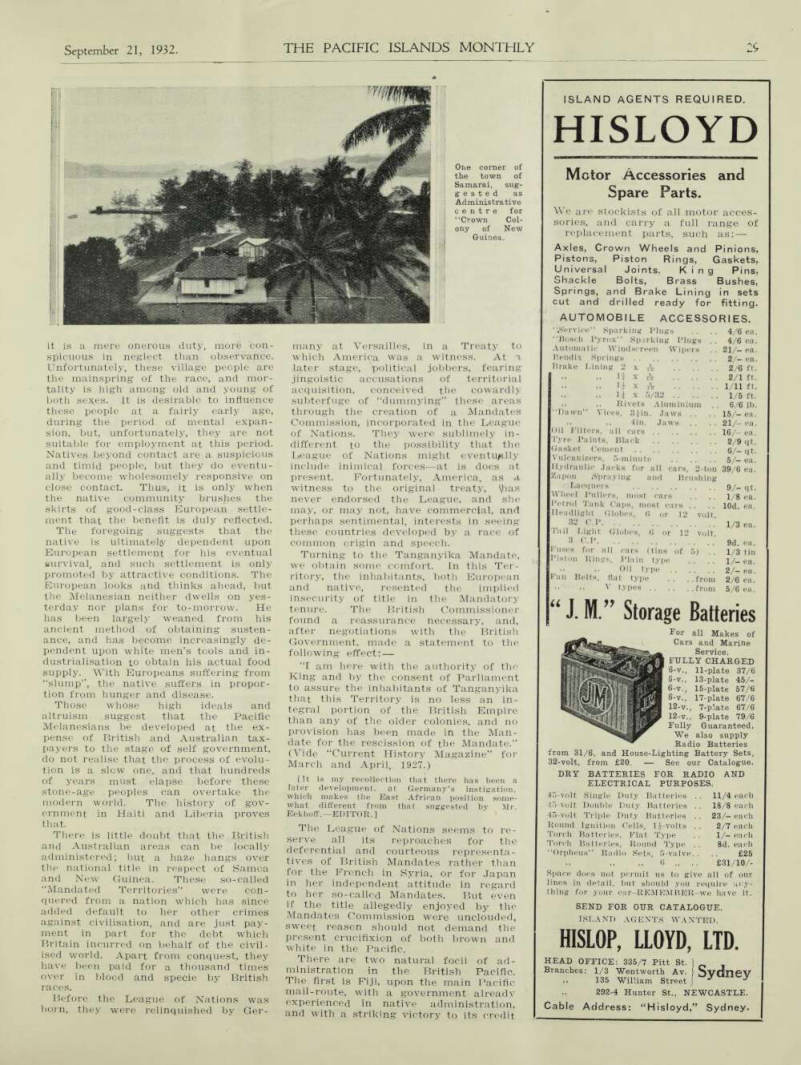
To Include Papua And Solomons.
(Written for “The Pacific Islands Monthly” by Henry K. Eekhoff .)
(A homogeneous self-governing Crown colony formed by the amalgama tion of the rich, half-developed Territories of Papua, New Guinea and British Solomon Islands, with the administrative centre at Samarai —that is the attractive, broad vision of the writer of the following article. He is a well-known trader in New Guinea.)
THE most ill-used dominions in the British Empire to-day are in the Pacific. It is the old tale of “too many cooks spoiling the broth.”
The League of Nations, the British Colonial Office, Australia, New Zealand, Foreign Mission Societies, and the itinerant free press politician, all wield a spoon in the soup.
Only in the Condominion of the New Hebrides can Britishers be found bar tering their birthright for foreign naturalisation. Only in New Guinea can be heard war veterans expressing the view that the Mandated Territory should be returned to Gemany with a note of apology. Only in Samoa can be found a handful of indigenous natives so incensed as to resort to boycott.
Only in the Solomon Islands do they moot the importation of Asiatic coolies to reinforce the depleted native popu lation, while there is a source of supply in both Papua and New Guinea under the same flag next door.
Only in Papua can be instanced a fertile island with prolific sources of labour, lacking a solvent industry.
Like stars in a murky firmament stand New Zealand, Fiji, and Tonga, for
New Zealand has succeeded in pre serving her Maori population and raising it to respectability. In Fiji, the native is recovering from the first shock of contact with European civil isation, and showing signs of the re covery being permanent. Tonga, with a native Government under intellectual European advice, is both happy and solvent.
Both New Zealand and Fiji instance the beneficial effect of the comprehen sion displayed by local administration.
Certainly, New Zealand has been estab lished for a long time —but she owes her success to local Colonial Govern ment in early days. Yet New Zealand, herself successful, is a conspicuous failure in the endeavour to govern the distant Samoans.
All this proves conclusively that the only successful spots in the British Pacific are those who administer their own affairs. As the attitude of Aus tralia and Britain to-day has changed, they no longer credit their pioneers with intelligence or humanity. It be comes necessary, therefore, to bring such issues home to them for the pur pose of emphasising that the pioneers are, on direct evidence, better adapted
to control these places than those who prefer to misgovern them from com paratively remote distances.
One great cause of the Pacific chaos is that well meaning, but uninformed, people in the Homeland, in the League of Nations, in Australia, New Zealand and the world in general, regard the interests of Europeans in the Pacific as being diametrically opposed to the best interests of the indigenous races.
No greater fallacy was ever pro pounded.
Because of this stupid misconception, the British people of the Pacific are distrusted, and steps are specially taken to frustrate the slightest initiative.
The wild and poisonous romances of Pacific fiction have done much to cloud the view of the outside world. The imaginary combination of beach comber, trader, and buccaneer, with the inevitable bottle of “squareface”, rises like a ghost to confuse common sense To such people, the Pacific is peopled with Bully Hayeses, hell ships, and Captain Kidds, instead of prosaic indus trious planters and traders, under going the inevitable honest struggle to make ends meet.
For centuries past, the Pacific races have been upon the decline. Long be fore Captain Cook visited the Pacific, the early Dutch and Spanish naviga tors found it so, and perhaps contri buted something to the causes.
The remoter natives have not re sponded generally to mission influences, and remain as decadent and insanitary as ever, after over fifty years of mis sion effort. The only native com munities showing increased vitality and productivity are those which are most in contact with Europeans.
The reason for this is self evident.
No settler would tolerate disease amongst the natives for whom he is responsible. Balanced rations, sanita tion, medical attention, and industrial incentive excited by precept —all go to rescue the native from misery, disease, and decline. Tourists along the beaten track observe these healthy contact people, and fail to discover the factors which stand as a reproach to the present system.
Could they proceed with one of these sleek Melanesians on a visit to his village brother, born of the same parents, in his native village, they would find the brother to be two stone lighter, filthy and disease ridden, and the parents in rapid decline at the age of forty. There in the village are no white mentors and, save for the annual tax collection, they are seldom visited by the casual official, enervated by travel in a humid climate. Other oc casional visitors are missionaries in pursuit of baptismal aspirants, and re cruiters.
The only meat is the tuberculous pig, which functions in life as the com munal septic tank. Malaria, elephan tiasis, skin diseases, hookworm, tuber culosis, and framboesia, with its hor rible disfigurations, sap the population —so much so, that most recruiters spend time and money in cleaning up their volunteer labourers before pre senting them to the local magistrate and the certifying medical officers.
The settler is vitally interested in the elimination of these evils from the source of his labour supply. To others.
it is a mere onerous duty, more con spicuous in neglect than observance.
Unfortunately, these village people are the mainspring of the race, and mor tality is high among old and young of both sexes. It is desirable to influence these people at a fairly early age, during the period of mental expan sion, but, unfortunately, they are not suitable for employment at this period.
Natives beyond contact are a suspicious and timid people, but they do eventu ally become wholesomely responsive on close contact. Thus, it is only when the native community brushes the skirts of good-class European settle ment that the benefit is duly reflected.
The foregoing suggests that the native is ultimately dependent upon European settlement for his eventual survival, and such settlement is only promoted by attractive conditions. The European looks and thinks ahead, but the Melanesian neither dwells on yes terday nor plans for to-morrow. He has been largely weaned from his ancient method of obtaining susten ance, and has become increasingly de pendent upon white men’s tools and in dustrialisation to obtain his actual food supply. With Europeans suffering from “slump”, the native suffers in propor tion from hunger and disease.
Those whose high ideals and altruism suggest that the Pacific Melanesians be developed at the ex pense of British and Australian tax payers to the stage of self government, do not realise that the process of evolu tion is a slow one, and that hundreds of years must elapse before these stone-age peoples can overtake the modern world. The history of gov ernment in Haiti and Liberia proves that.
There is little doubt that the British and Australian areas can be locally administered; but a haze hangs over the national title in respect of Samoa and New Guinea. These so-called “Mandated Territories” were con quered from a nation which has since added default to her other crimes against civilisation, and are just pay ment in part for the debt which Britain incurred on behalf of the civil ised world. Apart from conquest, they have been paid for a thousand times over in blood and specie by British races.
Before the League of Nations was born, they were relinquished by Ger
many at Versailles, in a Treaty to which America was a witness. At a later stage, political jobbers, fearing jingoistic accusations of territorial acquisition, conceived the cowardly subterfuge of “dummying” these areas through the creation of a Mandates Commission, incorporated in the League of Nations. They were sublimely in different to the possibility that the League of Nations might eventually include inimical forces —at is does at present. Fortunately, America, as a witness to the original treaty, never endorsed the League, and she may, or may not, have commercial, and perhaps sentimental, interests in seeing these countries developed by a race of common origin and speech.
Turning to the Tanganyika Mandate, we obtain some comfort. In this Ter ritory, the inhabitants, both European and native, resented the implied insecurity of title in the Mandatory tenure. The British Commissioner found a reassurance necessary, and, after negotiations with the British Government, made a statement to the following effect: “I am here with the authority of the King and by the consent of Parliament to assure the inhabitants of Tanganyika that this Territory is no less an in tegral portion of the British Empire than any of the older colonies, and no provision has been made in the Man date for the rescission of the Mandate.” (Vide “Current History Magazine” for March and April, 1927.) [It is my recollection that there has been a later development, at Germany’s instigation, which makes the East African position some what different from that suggested by Mr.
Eekhoff.— EDITOR.] The League of Nations seems to re serve all its reproaches for the deferential and courteous representa tives of British Mandates rather than for the French in Syria, or for Japan in her independent attitude in regard to her so-called Mandates. But even if the title allegedly enjoyed by the Mandates Commission were unclouded, sweet reason should not demand the present crucifixion of both brown and white in the Pacific.
There are two natural focii of ad ministration in the British Pacific.
The first is Fiji, upon the main Pacific mail-route, with a government already experienced in native administration, and with a striking victory to its credit
One corner of the town of Samarai, sug gested as Administrative centre for “Crown Col ony of New Guinea.
in the modern recovery of its indi genous peoples, and its successful European colonisation and establish ment of industries. Bravely has Fiji fought her pioneer battle against loaded tariffs and Australian prejudices.
This centre is surely worthy to control her Pacific environs, and it may be con fidently assumed that Samoa would be more happily circumstanced if governed from Suva than in association with New Zealand.
The second centre is Samarai, situated upon the China Straits, the direct route from Australia to China and the East, and the logical focus for Papua, the British Solomons, and New Guinea, as it can reach any of these centres with a radius of 600 miles.
There is a useful nucleus of popula tion, quite competent to control its own destiny, grouped in these areas, pos sibly five thousand whites in all.
There are, at present, three wholly heterogeneous and futile administrations in these areas.
The British Solomon Islands Protec torate, with a seriously depleted labour supply, is struggling along. After all these years, the interior of the islands is unsafe for European life, though an aeroplane could hop from one side to the other of the largest under an hour.
The Rabaul strike of New Guinea natives, though officially minimised, had a prophetic element of danger. Such rumblings are suggestive of the horrors of the Jamaican affair of the 1860’s, and the New Caledonian rising of half a century ago.
The use of the Papuan Government’s yacht to convey reprieved criminals away from curious eyes has contributed to the Papuans’ sense of security in the commission of crime, and also con tributed to the insecurity of European life generally—especially with sex offences on the increase. It may not be out of place to refer to the eleva tion of discharged murderers to the village constabulary in Papua, or to the case of O’Brien on the Yodda, a European committed for trial, put to work felling scrub with a line of native criminals. O’Brien eventually escaped, to perish in the bush. Though those days are past, the attitude is not ex tinct, officially.
The areas around Samarai are merely held through fear for Aus tralia’s unprotected coastline. The Solomons are an embarrassment to Britain; and Papua and New Guinea are white elephants to Australia.
It may surprise some people to know that no native or white British subject may travel between the Solomons, Papua, and New Guinea without special permission. No schooner may trade across the imaginary boundary line without £100 per capita guarantee upon her crew. There is no homogenity in the laws of these adjoining places, and each government represents an inde pendent experiment in native adminis tration.
New Guinea is afraid to put her Native Labour Ordinance into public print. New Guinea has, moreover, eventually succeeded in dissipating the heritage of German colonial prosperity, and her goldfields, which provide tem
porary rescue, are suffering under un sympathetic legislation, high tariffs (even on machinery), and the extra ordinary labour regulations which prescribe such items as “marmite ’ on the menu.
In Papua, a striking example of Aus tralian success is the introduction of electric light into the “native village’’ of Hanuabada, the residents of which prosper owing to the tourist traffic in “curios”.
The fact is that two of these ex pensive administrations must go, for many reasons, of which economy is not the least. With fertile country galore and ample labour, there is no reason why this area should not prosper under the direction of a sympathetic local ad ministration, familiar with local con ditions and requirements. With a home source of gold supply, and free dom from trade restrictions, financial stability in New Guinea could be made as certain as the sunrise.
The advantages of an incorporation of Papua, New Guinea, and the Solomons under free colonial con ditions would be enormous. Australia would have a buffer State in the Pacific, without having to support it by taxation upon her own citizens.
Britain would get rid of the reproach of the Solomons, and the Empire would benefit by the addition of a loyal colony.
Freedom has ever been a bond where restriction has been a failure, and the Empire of the past was built up of such colonial systems. The loyalty of the French Canadians, and the Boer races of Africa are proof of these things.
Certainly a Pacific Amalgamation is the best prophylactic against the arrival of a foreign power in Aus tralia’s unprotected north; and such in vasion is a certainty unless some sane policy is adopted in the Pacific.
Development of the Pacific Islands Association probably would be the best method of inaugurating a movement for better conditions of government in the New Guinea-Solomons section of the Pacific.
Advertisements & other items, pp. 30-32 (1 item)
James Barnes Limited
2 Botany Street, Waterloo, Sydney
(ESTABLISHED 1881)
MANUFACTURERS OF
“Globe” & “Victory” Brands
OF
SHEEP’S TONGUES OX TONGUES SAUSAGES
PRESERVED MEATS BEEF EXTRACT DRIPPING
Also “Castle” Brand, which is specially packed for use by the White Population.
Globe Beef Extract is invaluable to Young and Old.
Tested Recipes on the packet 4oz. and Boz. sizes.
ISLAND AGENTS REQUIRED.
HISLOYD
Motor Accessories and
Spare Parts.
We are stockists of all motor acces sories, and carry a full range of replacement parts, such as: Axles, Crown Wheels and Pinions, Pistons, Piston Rings, Gaskets, Universal Joints, King Pins, Shackle Bolts, Brass Bushes, Springs, and Brake Lining in sets cut and drilled ready for fitting.
AUTOMOBILE ACCESSORIES.
“Service” Sparking Plugs “Bosch Pyrox’’ Sparking Plugs Automatic Windscreen Wipers Hendix Springs Brake Lining 2 x A .. 1} x A .. H x A ... .. .. U x 5/32 1/5 ft. .. Rivets Aluminium .. 6/6 lb.
“Dawn” Vices, 3Jin. Jaws .. .. 15/-ea. .. 4in. Jaws .. .. 21/-ea.
Oil Filters, all cars 16/-ea.
Tv re Paints, Black 2/9 qt.
Gasket Cement 6/- qt.
Vulcanizers, 5-minute 5/_ ea.
Hydraulic Jacks for all cars, 2-ton 39/6 ea.
Zapon Spraying and Brushing Lacquers Wheel Pullers, most cars Petrol Tank Caps, most cars . .
Headlight Globes, G or 12 volt 32 C.P Tail Light Globes, 6 or 12 volt 3 C.P ’
Fuses for all cars (tins of 5) Piston Rings, Plain type Oil type 4/6 ea. 4/6 ea. 21/- ea. 2/- ea. 2/6 ft. 2/1 ft. 1/11 ft.
Fan Belts, flat type » V types 9/- qt. 1/8 ea. lOd. ea. 1/3 ea. 9d. ea. 1/3 tin 1/- ea. 2/- ea. ..from 2/6 ea. ..from 5/6 ea.
“J. M.” Storage Batteries
For all Makes of Cars and Marine Service.
FULLY CHARGED
6-v., 11-plate 37/6 6-v., 13-plate 46/- 6-v., 15-plate 57/6 6-v., 17-plate 67/6 12-v., 7-plate 67/6 12-v., 9-plate 79/6 Fully Guaranteed, We also supply Radio Batteries from 31/6, and House-Lighting Battery Sets, 32-volt, from £20. See our Catalogue.
DRY BATTERIES FOR RADIO AND
ELECTRICAL PURPOSES.
45-volt Single Duty Batteries . . 11/4 each 45-volt Double Duty Batteries . . 18/8 each 45-volt Triple Duty Batteries . . 23/- each Round Ignition Cells, 14-volts . . 2/7 each Torch Batteries, Flat Type .. 1/- each Torch Batteries, Round Type . . Bd. each “Orpheus” Radio Sets, 5-valve.. .. £25 „ 6 .. £3l/10/- Space does not permit us to give all of our lines in detail, but should you require anything for your car-REMEMBBR-we have it.
SEND FOR OUR CATALOGUE.
ISLAND AGENTS WANTED.
HISLOP, LLOYD, LTD.
HEAD OFFICE: 335/7 Pitt St.
Branches: 1/3 Wentworth Av. !- SvoneV .. 135 William Street .. 292-4 Hunter St., NEWCASTLE.
Cable Address: “Hisloyd,” Sydney.
JOHN L PEADON LTD.,
RABAUL, NEW GUINEA,
Engineers and Garage
Proprietors,
All Classes of General Engineering Undertaken.
CARS FOR HIRE.
Territory Agents for — Goodrich Products. Clyde Batteries.
Berger’s Lacquers. B.E.S. Plugs.
Chas. Hope, Ltd., Brisbane.
Lamson Paragon Ltd., Printers. ’Phone: Rabaul 20.
GILLESPIE’S
"ANCHOR”
FLOUR
TRADE
MARK
The Standard of Quality.
Do you know that the Famous
YOUNGER
STOVES AND
RANGES
made with extended Firebox specially for long Wood fuel, are Self-Setting and, provided sufficient Flue Piping is attached, can be used in almost any position.
The No. 7W. “Younger" Range can now be supplied fitted with Legs, as per illustration.
Ask for quotation for this range, also Illustrated Catalogue and Price List for both Single and Double Oven Stoves.
Younger Stoves are Widely Used Throughout the Pacific Islands.
G. FLETCHER & SON 50 Oxford Street, SYDNEY.
Treasure Seekers.
Lonely Hermit of The Tuamotus.
From Our Own Correspondent.
Papeete, Aug. 8.
THE ending of a long story of crime, bloodshed, and rich adventure by the discovery of the Cocos Island treasure, as reported in papers from New Zealand and elsewhere, has set the old-timers’ tongues a-wagging.
They are wondering if, after all, there may not be some truth behind the story of still another hoard on one of that labyrinth of islands known as the Tu amotu archipelago, and whether the employment of the latest scientific de vices used by Col. Lecky on Cocos might not bring the long-drawn quest to an equally successful conclusion.
Some of us recall the day, many years ago, when a certain individual dropped off the north-bound mail steamer, bought a few supplies, and vanished over the Eastern horizon on one of the island schooners, to be forthwith forgotten for many a long year.
Then, his funds having come to an end, he reappeared in Papeete in search of succour and financial aid to bring his plans to fruition. He had been subsisting largely on fish and coconuts on an uninhabited atoll, and was burnt to the colour of a Tuamotu native. But he was hot on the trail of what he came to seek.
Hard-headed business men put money into the venture on a share basis, and some others even went so far as to mortgage all they possessed in order to participate. So off our friend sailed again, to his island, in a schooner specially chartered and fully equipped to lift the loot, but with com pany this time. The expedition proved a failure and returned to Papeete with an empty ship. It was also minus the promoter, who again showed his faith by electing to remain on the island and continue the search single-handed.
Later on, our treasure seeker degen erated into vagabondage and received a polite request to leave the Colony, where he was becoming a public nuis ance.
But, even then, he did not relinquish the quest, and as recently as last year made another attempt to land in Tahiti, though without success. He did, however, while on board the steamer, induce a visiting yachtsman to take a hand in the game, and this gentleman subsequently spent some time at the island, with equally discouraging results.
Naturally, this affair could not be kept entirely secret. Rumour, aided by the “coconut radio,” soon worked up a story, and then embellished it and ex aggerated the same even to the extent of the actual lifting of the treasure and giving the value thereof in pounds, dollars, and francs. But, from time to time, details bearing at least the pos sibility of truth, did leak out, to a few.
The nameless old man dying in hos pital and imparting his secret to a be nevolent stranger; the theft of a loot laden vessel: the flight from Peru; the hiding of the treasure; and the sub sequent obliteration of landmarks by the tidal waves and shifting coast lines of the Tuamotus —all this may or may
not have a background of truth, but there was at least one person who had enough faith in the story to endure many years of hardship on one of the least attractive places in the Pacific.
Where others have failed someone, using Colonel Lecky’s appliances, might at least have a sporting chance of success.
It is reported that the Pratten in terests have secured important mining leases in the Lower Wattut area of the Morobe goldfield, New Guinea. The late Mr. H. E. Pratten and his brother were instrumental in introducing Aus tralian capital to the Malayan tin mines, where rich rewards were secured.
Advertisements & other items, p. 33 (1 item)
the "NEVERTIRE” Junior
A 10-light Electric Plant for less than £100.
Semi-Automatic
Push-Button Starting
Automatic Stopping
THE BATTERY IS A SPECIAL EXIDE, built exclusively for this plant, 32 volt, 50 ampere-hour capacity.
“NEVERTIRE”
JUNIOR
Semi-Automatic
Lighting Plant,
Complete as illustrated.
This complete plant, driven by the worldfamous 1½-h.p. Lister-Junior Engine, is ready to connect to house wiring, and for any installation of ten lights or less represents the greatest possible value on the market. £ 92-10-0 F.o.b. (under bond), Sydney.
Send for illustrated leaflet fully describing the plant and the sim plicity of its operation.
We can also supply all material needed for house wiring. For 20/- per point extra we will include wire, ceiling rose, drop flex, opal shade, lamp-holder and lamp. If you send a rough sketch of your house, marked with sizes of rooms and locations where lights are to go, we can supply all the material ready for use.
Any handy man can wire a house for use with the “Nevertire” Junior plant. Write us by next steamer.
DANGAR, GEDYE & CO. LTD.
G.P.O. Box 509 AA. ‘Malloch House,” 10-14 Young Street, Sydney.
Southern Cross Vi.
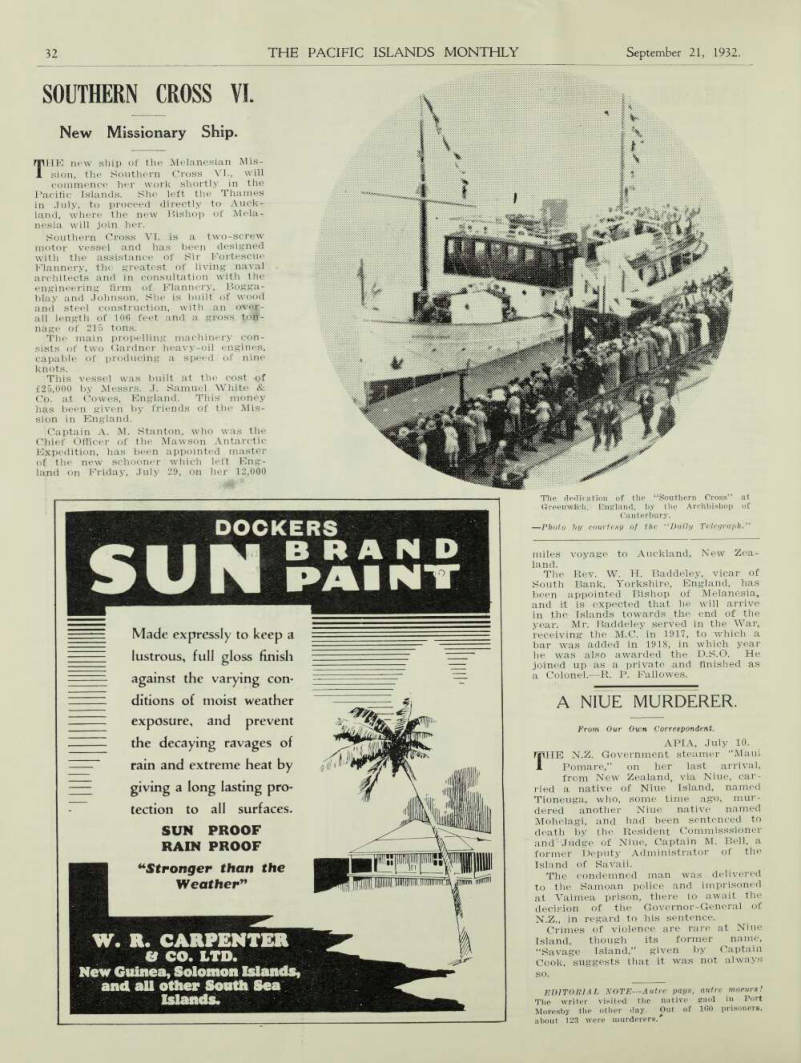
New Missionary Ship.
THE new ship of the Melanesian Mis sion, the Southern Cross VI., will commence her work shortly in the Pacific Islands. She left the Thames in July, to proceed directly to Auck land, where the new Bishop of Mela nesia will join her.
Southern Cross VI. is a two-screw motor vessel and has been designed with the assistance of Sir Fortescue Flannery, the greatest of living naval architects and in consultation with the engineering firm of Flannery, Bogga blay and Johnson. She is built of wood and steel construction, with an over all length of 106 feet and a gross ton nage of 215 tons.
The main propelling machinery con sists of two Gardner heavy-oil engines, capable of producing a speed of nine knots.
This vessel was built at the cost of £25,000 by Messrs. J. Samuel White & Co. at Cowes, England. This money has been given by friends of the Mis sion in England.
Captain A. M. Stanton, who was the Chief Officer of the Mawson Antarctic Expedition, has been appointed master of the new schooner which left Eng land on Friday, July 29, on her 12,000
miles voyage to Auckland, New Zea land.
The Rev. W. H. Baddeley, vicar of South Bank, Yorkshire, England, has been appointed Bishop of Melanesia, and it is expected that he will arrive in the Islands towards the end of the year. Mr. Baddeley served in the War, receiving the M.C. in 1917, to which a bar was added in 1918, in which year he was also awarded the D.S.O. He joined up as a private -and finished as a Colonel. —R. P. Fallowes.
The dedication of the “Southern Cross” at Greenwich, England, by the Archbishop of Canterbury.
Photo by courtesy of the “Daily Telegraph."
A Niue Murderer.
From Our Own Correspondent.
APIA, July 10.
THE N.Z. Government steamer “Maui Pomare,” on her last arrival, from New Zealand, via Niue, car ried a native of Niue Island, named Tioneuga, who, some time ago, mur dered another Niue native named Mohelagi, and had been sentenced to death by the Resident Commisssioner and Judge of Niue, Captain M. Bell, a former Deputy Administrator of the Island of Savaii.
The condemned man was delivered to the Samoan police and imprisoned at Vaimea prison, there to await the decision of the Governor-General of N.Z., in regard to his sentence.
Crimes of violence are rare at Niue Island, though its former name, “Savage Island,’’ given by Captain Cook, suggests that it was not always so.
EDITORIAL NOTE —Autre pays , autre moeurs!
The writer visited the native gaol in Port Moresby the other day. Out of 160 prisoners, about 128 were murderers.
Advertisements & other items, p. 34 (1 item)
Paint
DOCKERS
SUN BRAND
Made expressly to keep a lustrous, full gloss finish
against the varying con
ditions of moist weather exposure, and prevent the decaying ravages of rain and extreme heat by
giving a long lasting pro
tection to all surfaces.
SUN PROOF
RAIN PROOF
"Stronger than the Weather”
W. R. CARPENTER
& CO. LTD.
New Guinea, Solomon Islands, and all other South Sea Islands.
Australia’S Muddling

Exporters.
What Islands Traders Have to Endure.
(Written for The Pacific Islands Monthly by an Experienced Islands Trader .) ALL good Australians must applaud the efforts of The Pacific Islands Monthly to win back to Australia the Islands trade she has lost over the past years through (as you have put it) the short-sightedness of her politicians.
But perhaps the time is ripe to say that not all the blame can be portioned out in this direction, for there can be no question that many of our orders have gone overseas as a direct result of the slipshod methods of Australian agents, merchants, and manufacturers, whose motto at all times seems to have been, “Anything is good enough for the Islands.” This has been ad mitted to the writer on more than one occasion by men doing a fairly large business with us.
One of them unblushingly said that if he had difficulty in selling a doubt ful boat or engine in Australia, all he did was to give it a lick of paint and unload it on the Islands, per medium of an agent.
Of course, this sort of thing could not be if agents were alive to their responsibilities, and knew their busi ness. The late S. H. Howard, for in stance, though he had never visited the Islands, made it his business to know, not only what Islanders wanted, but where their requirements could be obtained, and their price, worth, and all about it.
There is far too much telephonebuying done now, and not nearly enough boot-leather used. Here is a rough illustration: An order is at hand for six dozen of Blogg’s tin-openers. The agent rings up some wholesalers and the following ensues: “I have an order here for Blogg’s tin-openers for the Islands. Do you stock them?”
“No! You won’t get them in Syd ney. But I have a better and cheaper line here, at 4/6 doz. We send, hun dreds of dozens of these to the Islands every boat.”
“Right. I want six dozen.”
The deal is closed, and with the goods goes the accompanying letter: “Blogg’s Tin-openers. We searched the City for these, but they were un procurable, so we have substituted Mugg's, which are cheaper and a much more popular Island line.”
And so our Islands Store shelves be come littered with unwanted stock.
The fact is well known that it seldom pays to return goods. I have received lines from one of Sydney’s largest Islands suppliers, which no conscientious merchant would dream
of keeping away from the tip, and full price has been charged.
As for the old confidence trick about “shipping large quantities to the Islands” —if the writer had been given a sovereign each time he has had this poured over him, he would not now be oft the gold standard.
The engineering fraternity of Sydney seem to be a particularly lax lot; they do not know our conditions and needs, and simply do not want to be told.
Letters of inquiry for quotations time and again do not fetch a reply by the same mail, and sometimes not at all.
A request for a metal benzine tank
to be supplied with a small Sydney made engine, in place of a tin one, which is standard equipment, fetches the reply that “we do not supply metal benzine tanks,” and, we assume, “Take what we supply, or go to blazes.”
Now, a metal tank will last years, where a tin one rusts through in weeks. The extra cost should not amount to sixpence. Yet this firm spends hundreds of pounds per annum in advertising As for repair work, one can only assume that award rates in Sydney are in the vicinity of £1 per hour in this trade. While, as regards electric re pairs, it is the exception rather than the rule to get a job done decently and successfully.
The Islands would use many more Australian-made engines if makers would only show that they really wanted business. But here is a very recent example of a small engine im ported on the strength of an adver tisement. On being uncased, it was almost too stiff to turn, and was found to be incorrectly lined up with the reverse. There was not a scrap of literature to aid installation and run ning. The starting handle was rivetted together wrong way about, rendering it useless. The exhaust connection was useless for our purpose, and a substi tute made by the makers—which was worth 30/- extreme value but charged 50/ had to have 15/- worth of work done to it to make it fit the engine.
And then, to cap the lot, the magneto was useless!
It is a waste of time to point out these errors to the makers themselves —they simply do not believe you.
Next, we come to importing agents and the dictionary meaning of the word “agent” in this connection seems to be “a person who retards business.”
Often they do not understand the first thing about the line they handle, and have to write back and ask you for further particulars.
One could go on, for pages, quoting 'instances like the following: I was quoted 13/6 each, for dozen lots, in bond, Sydney, of an American line.
But, knowing the American price, I got one of the larger stores here to stock them, and they were sold at 12/6 retail, after paying the extra freight and charges as between here and Syd ney, and showing the usual 33-1/3 per cent. What profit did that Sydney agent wish to show ?
The ridiculously high tariff walls in Australia have encouraged attempts to
manufacture some of our lines, but, judging by some of the stuff I have seen and handled and which is quite unsaleable for the purpose intended, Australia would be well advised to either mend her ways or keep well out of the business.
I do not suppose for one moment that you will find space in your valu able paper for all this, but it ought to be known generally. It is not the blathering of an inexperienced new comer, but the result of over 26 years of business dealings with Australia— and particularly with Sydney over the last ten years.
Let merchants and manufacturers sell us goods at fair world-parity value, and the agent show us that he is worthy to act in that capacity, and there will be no need to worry about a flow back of trade.
Advertisements & other items, pp. 35-36 (1 item)
Antinea
DANDRUFF
CURED
Keep Your
SCALP and HAIR
HEALTHY. .
BEAUTIFUL
ANTINEA SOAP
Prevents and Relieves Scurf, Dandruff, Toe-Rot, Dhobie Itch, Ringworm, Eczema, Acne, Prickly Heat, TINEA, Body-odour.
ANTINEA (Lotion) CURES ALL
Irritating Skin Infections of a fungus nature Toe-Rot, Tinea, Dhobie Itch, Ringworm, Septic Cuts, Insect Bites, etc.
In small and large bottles. from all
BURNS, PHILP STORES,
or Chemists.
Write for Free Booklet.
Antinea Drug
Antinea
Angel Place,
ANTISEPTIC SOAP SYDNEY
CO.,
AND LOTION
SAMUEL RUSSELL,
ESTATE AND GENERAL AGENT,
P.O. Box 64, Papeete, Tahiti.
Real Estate. Investments. Estate management and administration. Valuations and Reports Houses and Lands for Lease or Sale.
Sole Proprietor: TAHITI PERFUMES.
Cables: Russell. Tahiti (Bentley’s Code).
NEWBOLD SILICA
FIRE-BRICK CO. LTD.,
Manufacturers of High Grade Refractories, Silica Bricks, High Alumina Fire Bricks, Siliceous Fire Bricks, Chrome Bricks, Bauxite Bricks, "Sealtite" (hot patching' cement), Dia tomaceous insulation.
Enquirers are requested to give full particulars of temperatures and purposes for which refractories are required.
The Newbold Silica Fire-Brick Co. Ltd.
109 ELIZABETH ST., SYDNEY.
OIL-of-SALT
AMAZING HEALANT FOR TINEA.
Scientists hail OIL-of-SALT as one of the most remarkable discoveries of the day. This surprising antiseptic not only destroys bacteria and infection but it promotes amazingly quick healing as well. Non-poisonous and non-irritat ing—gentle and soothing. Can be applied to the most sensitive tissues of any part of the body without discomfort, no matter how badly injured or infected. The relief that speedily follows is little short of miraculous!
Because of its remarkable combination of germicidal and healing powers,
OIL-of-SALT
has a surprisingly wide range of effectiveness.
It destroys infection wherever applied—skin (eczema), gums (pyorrhoea) or throat (tonsilitis), Its ability to stop pain makes it simply priceless for treating burns, cuts, bruises, and injuries of all kinds. Rubbed on the skin, it gives remark able, penetrating relief in cases of foot-soreness, sunburn, muscle strain, etc.
Send two Stamps for FREE TRIAL Sample, to
CAMERON STUART,
63 Pitt St., Sydney. Prices: 2/6, 4/6, 7/6
YOU WILL NEVER REGRET IT.
Auxiliary Ketch built for Solomon Islands.
LARS HALVORSEN
Designer and Builder of SCHOONERS, KETCHES, YACHTS, LAUNCHES, etc. Can also quote for Second-hand Craft. Send particulars of your requirements HAYES STREET, NEUTRAL BAY, SYDNEY, N.S.W.
Bulolo G.D. Returns.
The Bulolo Gold-Dredging Ltd’s, yield for the 28-day period ended September 9, amounted to 3,592 ounces of bullion from 195,100 cubic yards of an approximate value of 48,492 gold dollars. Operations were delayed 41 hours through a shut-down of the power plant. Dredg ing has been confined to the eastern side of the property and for part of the period the dredge was digging ground outside the originally con templated dredging area, which on account of low operating costs is now profitable.
The order for the hull of No. 4 dredge was placed with Poole and Steel, Ltd. on 12th instant.
Advertisements & other items, p. 36 (1 item)
34
September 21, 1932.
German Eagle and South Seas. (Continued from page 4.)
THE PACIFIC ISLANDS MONTHLY
Lae Foreshore Slips Into Sea.
IT was officially reported at the end of August that about five acres of the foreshore at Lae to the east wards of the aerodrome had slipped down into the sea, and that the wharf, the travelling crane, 3 sheds and 100 yards of railway line had also dis appeared.
It appears that the wharf, railway and shed were owned by the Bulolo Gold Dredging Company, whose aerial transport service is operated by Guinea Airways, Limited. Mr. L. V. Water house, technical director of Bulolo Gold Dredgings, Ltd., stated in Sydney on September 3 that his Company had al ready made arrangements for a new wharf to be built on firmer ground and that a new steam crane was being sent to Lae by the Macdhui at the end of September.
The Chairman of Guinea Airways, Ltd., Mr. C. V. T. Wells, in a letter to the Pacific Islands Monthly remarked, “We do not yet know all the facts regarding the subsidence at Lae, but one thing is perfectly clear, and that is that it was a greatly exaggerated report. Perhaps it would be more cor rect to say that the construction placed on the report in Australia was greatly exaggerated. The subsidence was in the far corner of the Bay, which is low-lying and spongy ground, some of it below sea level. There is nothing to indicate that such a subsidence would be likely or possible on the settled sec tion of Lae.”
The cause of the subsidence is discussed in an article in this issue dealing Avith the rival claims of Salamaua and Lae.
Lae Social Notes.
From Our Own Correspondent.
LAE, Sep. 8.
A little round of gaiety for Lae commenced on July 30. Mr. and Mrs. Eric Haynes called together their friends and neighbours for a social party. The evening was pleasantly em ployed in dancing, singing and competitions and, although it was pouring with rain, the spirit of the party was not damped. Lae now being the proud possessor of numerous motor cars and plenty of volunteer drivers, guests were con veyed to the party in quite a dry condition.
A very dainty supper was served about 11 p.m.
On August 6 the scene of festivity was Mr. and Mrs. Eekhoff’s new residence and took the form of a fancy dress dance. Mrs. Innes, of Salamaua, being a guest of Mrs. Eekhoff for a few days, lent her talent and wit and the whole affair was voted a huge success. A great number of friends were going on leave by the next boat and the party was really to wish them “bon voyage” and a safe return. Amongst those going on leave were Messrs. Gordon Eek hoff, Ossie Priebe, Ted Priebe, Grabowsky, Gray and Bush. First prize for lady’s fancy dress was awarded to Mrs. Gurney, who was a “Lady Pirate”: second prize to Mrs. Innes, as a “bold buccaneeress. ” Both ladies looked charming in their costumes and well earned their awards.
The first prize for gentlemen went to Mr. G.
R. Simpson, as “Nero,” and second prize to Mr.
Haynes as "Harold Lloyd.” Dancing was the chief form of amusement. Supper was served at a late hour, and the usual toasts were fol lowed by community singing.
Another jolly evening was spent on Saturday, August 20, when the host and hostess were Mr. and Mrs. R. Gurney. The party was in honour of Mrs. Gurney’s 21st birthday. Guests in cluded Mr. and Mrs. Lewis (Wau) Mr. and Mrs. Bowan Jones (Wau) and Mrs. Jukes—some of whom arrived during the day by ’plane.
Dancing was kept going with a fine swing, and there was not a dull moment. After supper, Mrs. Gurney was presented with a huge key— being the proverbial ‘key of the door” which is available when one is 21. This ceremony was followed by the cutting of a very fine two-tier cake, decorated with 21 candles, and ornamented with a model Junker made especially for the occasion by one of the Guinea Airways’ staff.
Steelo—A New Line For
Traders.
The manufacturers of Steelo Steel Wool will forward samples and full particulars to traders ready to stock this line. Steelo is a cleaner for aluminium and all kitchenware and for baths, basins and sinks. It is used, as well, to smooth down woodwork before painting and to remove rust.
Steelo is packed in neat cartons, each con taining four pads and a cake of special soap.
That is enough for a month.
HouseAvives’ Samples.—A small, free carton of Steelo Avill be sent to any address. Write to K. H. Armstrong & Co., 44 King Street, St.
Peters, N.S.W., stating name of your usual storekeeper.
Advertisements & other items, p. 37 (1 item)
Iona
Consult ALEX. HALE
ABOUT YOUR EYES.
Accurate Optical Service and Comfort for your Eyes.
All Optical Repairs and Broken Lenses Replaced by return post.
Send for Self-testing Eye Chart for Reading and Near Work Glasses.
All our Prices will please you.
Alex Hale Ltd
Optometrist Optician,
113 PITT STREET, SYDNEY.
Five other City Addresses. Est. over 30 years.
WO.7865.
Nigger Brown, with Reproduced Seal Skin Gillie Tie Shoe, 15-8 leather heel. Genuine Goodyear light, close-edged welted sole.
Milo last.
SE.33 On the Superb Last.
Men’s All Patent Stepin Evening Shoe.
Specially designed with French Silk Elastic 3>ide Gussets. Genuine Goodyear light welted sole. Superb last. B.C.D.E. fitting.
IONA
BOOTS
and
SHOES
The Recognised Quality of Australia.
Ladies’ & Gent’s Goodyear Welted
Footwear.
Ladies’ and Children’s Veldtschoen
Footwear.
If these brands are not already
stocked by you, kindly send to us
for illustrated catalogue.
WO.7852 Dark Brown Calf Step-in Buckle Shoe, Genuine Goodyear welted sole, medium toe, 11-8 shaped leather heel. Winsome last.
Reproduced Croc. 1-bar Shoe, in Nigger, Brown and Black. Good college shoe; 9-8 leather heel. Genuine Goodyear welted sole, on the Nuform last.
McKINLAY & GUMMING Ltd.
GEORGE STREET — — ERSKINEVILLE
— SYDNEY.
Pacific Islands
Association.
THE membership of the Pacific Islands Associations now exceeds 100.
Members have recently admitted from the more distant groups in the Central and Eastern Pacific.
The steady growth of membership and the practical interest being shown makes it possible that the Association in 1933 will begin to carry out the primary purpose of its formation and speak with united voice on Pacific Is lands affairs.
Negotiations between the committee of the Association and the committee of a well-known Sydney Club have been further advanced during the month, but they have not been finalised.
It is expected that, when they are com pleted, membership of the Pacific Is lands Association will automatically carry with it membership of the Syd ney Club referred to —the privileges of which include facilities which will be of great value to members of the Pacific Islands Association when visit ing Sydney.
The following are among the newly elected members of the Association:
C. R. Pinney (Norfolk Island); W.
Grube (New Hebrides), F. L. Jones (Santa Cruz Group), W. S. Wells and Agnes Wells (Papua), C. C. Beckett, H.
L. Downing, M. J. Dwyer, J. L. Leahy and M. J. Leahy (all of New Guinea); C. T. Wirth (Papua), J. R. Clay (Papua).
Mrs. K. D. Bignell, of Fulakora Plan tation, Ysabel, Solomon Islands, accom panied by her young daughter, Mar garet, arrived in Sydney by the Sep tember “Mataram,” and will spend some months in Australia and in Nor folk Island before returning to the Protectorate early in the New Year.
Sugar Preference?
Will Papua Get Colonial Sugar Preference?
Two Big Plans Depend on News of Ottawa.
CERTAIN information, the character of which is as yet unknown, but which may have a direct bearing upon the future of Papua, is being brought to Australia from the Ottawa Conference by Mr. Harry Gullett, Mini ster for Customs.
The information —which is awaited with considerable eagerness in certain quarters—has to do with preferential duties on sugar, which have been promised or already granted to the im perial units by Great Britain. It will be remembered that, several months ago, Britain granted to her Crown Colonies a substantial preference for sugar grown in those Colonies. But that preference did not extend to Dominion-grown sugar. Britain held that up her sleeve as something with which to bargain at Ottawa. It was obvious, of course, that if Australian grown sugar is to freely enter the British market on the same terms as colonial-grown sugar, Australia will have to give something substantial in the way of preferences to Britain, in return.
So far, so good. But the position of Papua, in relation to sugar-growing, is most anomalous and unfortunate.
Papua, although a territory of Aus tralia, has an independent life of its own so far as customs duties are con cerned. That is to say, the import duties imposed by Papua are applied to all goods, quite irrespective of their country of origin. They are not Aus tralian duties, in any shape or form.
In any event, the Customs duties im posed by Papua, being purely revenue duties, are comparatively low.
It was quite a fair thing, therefore, that Papua should enjoy the same con ditions in regard to British sugar pre ferences as the Crown Colonies. If this were granted it would make a considerable difference to the future of Papua. It would permit the early es tablishment of the sugar industry in Papua on favourable conditions, and this would take the place of the rubber industry, which has collapsed, and of gold, on which were built high hopes which never materialised.
Before the Australian delegation left for Ottawa, the Ministers were asked by Sir Hubert Murray to specially bring before the British delegation in Ottawa the desirability of giving to Papuan sugar the same preference as is given to sugar grown in the Crown Colony. It is not yet known at Can berra whether this has been granted —the secret remains with Mr. Gullett, along with all the other details of what has been arranged on Australia’s behalf at Ottawa.
But if Papua is to have Colonial preference for sugar, at least two huge sugar-growing concerns will begin to operate immediately in Papua, and the effect upon the future of the Territory will be profound.
Advertisements & other items, p. 38 (1 item)
Petty's Hotel
IN SYDNEY STAY AT
Comfort Service Convenience R.J. Langley-Manager
SHIPCHANDLERY.
W. Kopsen & Co. Limited
Manufacturers of PIONEER BRAND ASH OARS AND IMPLEMENT HANDLES.
Sole Agents for: KOPSEN’S SPECIAL YELLOW METAL SHEATHING AND NAILS.
Large Stocks of Chains. Anchors, Manilla and Wire Ropes, Wood and Iron Blocks, Oakum, Tar, Pitch, Oils, Paints, Leads, Zincs, Varnishes, Shackles, Rigging, Screws. Sheathing, Felt, Lampware, etc.
Prices and Particulars on Application.
68-70 CLARENCE STREET, SYDNEY.
Cables: “Kopsen.” 'Phone: BW 1114-5.
SAIL WITH
The B.P. MAGAZINE
TO MAGIC LANDS.
Travel Fiction Adventure 1/- copy.
Stage Screen Fashion 1/- copy. get your copy now.
ANNUAL SUBSCRIPTION:
Within the Commonwealth of Australia, Mandated Territory and New free From all Bookstalls or direct from the Publishers. Burns. Philp Co. Ltd.
Papua’S Gold.
The Search Goes On.
From Our Own Correspondent.
Pt. Moresby, Sep. 3.
MR. WARD WILLIAMS, the American min ing expert, who returned to the Territory a few months ago, is at present on the Gira and Yodda, investigating the possibilities of the goldfields for low grade metals.
The Gira and Yodda are in the Northern Division of Papua. The Yodda is a tributary of the Mambare River. These fields were first exploited in 1897 and 1900 and yielded between them 144,427 ounces of gold.
The New Misima gold mines reports show that gold was produced valued approximately at £1786 for June and £1452 for July; also silver, 371 ounces, valued at £27. Two divi dends, Nos. 8 and 9, of 1/- each, were declared and paid. Important improvements were carried out during June and July. Electric light was installed throughout the battery and cyanide works, the smelting and assay rooms and the stores and offices. The running costs are nom inal, the dynamo being driven off the shaft of the main engine. The No. 5 concrete slime vat was completed and is in use, with satis factory results.
The Government patrol, under Mr. R. G.
Speedie, to the head waters of the Tauri River, has returned. Mr. Speedie was accom panied by Mr. Mahoney, a leader of the Mahoney Gold Syndicate, who made the journey to ex amine the country for minerals. The party at tempted the head waters of the Vailala River to the west, but came down the Ivori, a tribu tary. Twenty years ago both these rivers were examined for minerals. In 1911 Bob Elliott, the Pryke Bros., and Charles Priddle travelled up the Yailala to prospect the upper reaches and the flats, but were not successful. Mr.
Mahoney, in a report, considers the vast coun try covered by the Tauri well worth exam ing for minerals.
Native Tubu Feast.
Owing to the remarkable harvest of yams, taro, and other native products from the new native gardens by the Laloki River, the natives of Hanuabada, near Port Moresby, held a large “tubu” feast on August 28.
The Dubu (Ceremonial Platform) had on this occasion additional carved horizontal bearers, which the host of the feast, a Hohodae village native, placed on the “dubu” of his Hanua bada friend, A. Huia.
The feast was given by the Motu people to the Koiari and Koitapuans, once their bitter enemies, but who have been for several years now on friendly terms with them. The Laloki gardens are on the borders of the Koiari county; perhaps in their wisdom the Motu people see the advisability of sharing their first fruits with their former enemies.
The scene was quite remarkable for its bar baric splendour. The spectacular entrance of over a hundred dancing Koiari, gaily dressed in plumes and ornaments, and prancing wildly to the beat of the drums, was a singularly im pressive sight. They advanced in form to their hosts by the platform, who later on, as the dance ceased, distributed native foods to their guests, with great ceremony.
Europeans present at the opening of the feast included the Acting Lieut. Governor (Hon. Dr.
W. M. Strong), Mr. Justice Gore and Mrs.
Gore, members of the Executive Council, the Resident Magistrate, and Mr. F. E. Williams (Anthropologist to the Papuan Government).
Death Of Two Mission Sisters.
News has been received from the Sacred Heart Mission at Yule Island, of the death of two of their sisters—Sister Kevin and Sister Mary.
Sister Kevin (a sister of Dr. Gleeson, the Bishop of Maitland, New South Wales) was a very much loved worker, and a pioneer of the Mis sion in 1893. She died in July after a very long illness.
Sister Mary, from France, had arrived only four years ago. She became suddenly ill and died on August 26.
The Sisters of the Sacred Heart Mission are well known and respected throughout the Ter ritory. Their chief centres are at Yule Island and in the mountains in the interior on the mainland. In Port Moresby and the districts nearby, not only do they train the young Papuan and half-castes, but they superintend a day-school for the small white children of the community.
The Sacred Heart Mission started operations in the territory of Papua, after the proclama tion of the Protectorate in 1884, and established themselves ultimately at Yule Island about 1885-6, under Father Verjees, with Father Navarre as Superior, at Thursday Island.
Trade Figures.
The following shipments to Australia were made in August:—
All the coffee is from Mr. G.A. London’s Eilogo plantation, 30 miles inland from Port Moresby.
Customs duty was collected during July as follows:—Port Moresby. £1,227: Samarai, £843; Dam, £7; total. £2,078. About one-tbird of the amount was “primage.”
By By Macdhui. Montoro.
Des. coconut. packages 603 .. 538 Rubber, packings ... 1,232 . . 1,335 Coffee, bags 67 27 Pearl shell 9 Mauritius beans, bags. . — .. 81
Advertisements & other items, p. 39 (1 item)
Batteries
There's an Exide Battery
for every purpose
To-day, Exide Batteries are manufactured in five countries, England, America, Canada, Italy and Australia. For over forty-four years now Exide has been making dependable batteries for every purpose.
You can secure an EXIDE for your Motor-car, Motor-cycle, Motor-launch, Radio, for lighting your home, and any other purpose.
Send for Free Illustrated Booklets.
Be sure to mention for what purpose the battery is required.
Batteries
Distributors: New South Wales: EXIDE BATTERY SERVICE, Hunt Street,
SYDNEY.
Queensland: EXIDE BATTERY SERVICE (Q.) PTY., LTD., Adelaide Street, BRISBANE.
Tulagi Gossip.
From Our Own Correspondent.
Tulagi, Aug. 20.
OF the 53 passengers who arrived by the “Mataram” on August 13 from south, six were Government officials, as follows: Mr. J.
C. Barley (Acting Resident Commissioner), Dr.
Crichlow, Mr. Hubbard (Judicial Commissioner), and Mrs. Hubbard, Captain Middenway (D. O., Gizo), Mrs. Middenway and son, Mr. A. Dickes (Chief Customs Clerk) and Mrs. Dickes and children, and Mr. Shearwin (Govt. Storekeeper).
Mr. R. F. Thompson, who was retired on a pension a few months ago, when his office of Labor Inspector was abolished, is now man aging one of Lever’s plantations. He says that, as a result of starting work at 5 a.m.
and working hard all day, he has reduced from a Governmental 20-stone odd to a planter’s 15, and considers that he is now quite qualified to institute a correspondence course of “Weight Reduction.’’ But, as far as the Islands are concerned, as there are no longer any fat planters, and Government officials would rather shoot him than pay him for such advice, one is inclined to advise him against the venture.
Mr. P. S. Palmer, senr., is nearly ready to leave Tulagi Hospital, where he was carried many months ago in a frightful state of health.
A leg which appeared to be one huge sore was only part of his ailments. He now cannot say enough for Dr. Hetherington, C.M.O., and the nursing staff, who literally patched him up by grafting. The common idea is that such work is not feasible in this climate, but Dr. Hether ington has pretty conclusively dispelled the notion in this case, and Palmer has reason to be thankful to him.
On January 31, 1932, our finances showed an excess of assets over liabilities of £65,649/14/3, which is only a slight reduction on last figures published, so we are doing “fairly nicely, thank you.” Of course, as is natural to suppose, we have the taint of Australian politics in our midst and here are "statesmen” who consider that the sixty-five thou’, together with a heap of borrowed money, ought to be broadcast in the air to be scrambled for ad libitum.
Gold-mining activities do not appear to be booking freight-space ahead for the transport of their bullion. A mining engineer returned from an inspection of the most likely field the other day, but unless the connections have "poker faces,” his report did not create any undue excitement. It really looks as though we shall have to work hard for our bread and margarine after all.
Strange that nobody has thought of starting a lottery, so far! Of course, we have no money to put into such a venture, but we have heaps of coconuts, and a sweep made up of 500 tickets at ten coconuts each would pan out about a ton of copra, which, after cooking exes, were deducted, might net enough to buy a pac ket of cigarettes! Not very much, it is true, but every little helps to lift us out of the depression. Of course, as we only have about 500 white inhabitants, there might be some difficulty in filling each sweep; but we could get over this by allowing natives to take part; and, if missionaries did not care about coming in, we might call it a charitable affair by donating, say, ten coconuts from each lottery towards 'upkeep of hospitals.”
Cook Is.
Neighbourly Calls In
Rarotonga Sends Footballers and Trenchermen.
From Our Own Correspondent.
Rarotonga, Aug. 19.
IN the good old days, when a Poly nesian community wanted excite ment, an expeditionary army and a fleet of war-canoes were prepared; and some neighbourly island, if it was not alert, literally got it in the neck.
We do things differently to-day—we send our picked sportmen to call on our neighbours.
It has never been possible to send a local team of native footballers and cricketers to New Zealand to meet members of their own race, the Maoris, at sport.
The Rarotonga Sports’ Association decided to send a team of footballers and cricketers this year to Atiu, 116 miles away. Funds were raised, chiefly by dances. Troupes of native dancers gave a series of hula-hula dances of astonishing variety. These perform ances at last came to an end, and final arrangements were made to transfer some 40 players and visitors to Atiu by the schooner Tagua.
The party departed as “deck cargo” and provided their own rations while aboard ship. The journey was ex pected to last about 24 hours. Four or five days went by without news of the arrival of the Tagua, and fears were aroused that something had gone amiss With the schooner.
The party eventually reached their destination, and commenced a series of test matches. These are still in pro gress, and wireless results indicate that the Rarotongans are having the best of things.
A consideration which crops up when inter-island tours are being planned is whether the food resources of the island visited will stand up to the strain of the feasts that inevit ably have to be provided for the visitors. The next worst thing to a hurricane at an island is the arrival of teams of lusty footballers and cricketers.
Very little produce has been ex ported this year from Atiu, owing to the lack of shipping. In view of this, it has been estimated that the food re sources of the island will not be en tirely wiped out.
On the return of the tourists to Rarotonga, they will most likely be challenged to meet teams on their own island, both of footballers and cricketers. This arises from the some what peculiar custom which the selec tors are obliged to observe in deciding upon those to be included in the touring team. There is a kind of tribal law to be observed. An eaual number of players must be picked from each sports district. Consequently, many of the best players are left behind. They plan to have their revenge when the lucky ones return.
Advertisements & other items, p. 40 (1 item)
Durabestos
Sutton's
Canned Vegetables
Green Peas, In 11b. and 2lb. Tins.
French Beans (Sliced) in lib. Tins.
Carrots, In 1lb. Tins.
Beetroot (Sliced) in 1lb. Tins.
Packed by
Delicia Food Products Co.
WATERLOO, N.S.W
BUILD NOW WITH DURABESTOS
Island Homebuilders can now erect an everlasting Home easily and economically by using “DURABESTOS" (Asbestos Cement) Building Sheets to line the exterior walls and interior walls and ceilings.
Economical to transport, easy to fix, and fireproof.
Send for Prices and Free Catalogue “DURABESTOS HOMES OF COLOURFUL BEAUTY’ containing plans, designs and suggestions for Homebuilders.
WUNDERLICH LIMITED
BOX 474 AA, G.P.O., SYDNEY.
DURABESTOS
BUILDING sheets
Books Worth Buying.
“WHITE MAN, BROWN WOMAN”— the life-story of a trader in the South Seas; by T. L. Richards and T. Stuart Gurr. Our copy from Angus and Robertson, Ltd., Sydney. 6/6.
ONE who knows the Pacific Islands is repelled by the title of a new book, “White Man —Brown Woman,” and by the phrase that is blazed across the cover: “I have lived a life beyond the pale!” It is so obviously arranged to catch the attention of those who picture the Pacific in the colours of things exotic and erotic, and to stimulate their feverish imagination. To that extent, it is unfair to the Pacific Islands, which have suffered cruelly from that sort of reputation.
That is a pity, because “White Man —Brown Woman” is a really attractive description of present-day life in Poly nesia. It is well written, gives an accurate description of places and conditions far off the tourist track, and is packed with incidents of a picturesque and unusual kind. One be comes a little weary of the recital of “Trader Tom’s” amatory adventures, and the manner in which he proudly accepts parental responsibility for sundry infants on vari ous islands. It is as if complaisant ladies were peculiar to the Eastern Pacific. They can be found, in greater num bers, in Auckland and Sydney—the only difference being that their skin is white, and they are ingeniously hypocriti cal in concealing their love affairs. Mixed in with the “love motif,” however, is a great amount of valuable material describing the islands of French Oceania, and the Northern Cooks, the literature relating to which is far too scanty.
Every man who has been in Polynesia will meet old friends in these pages. Captain Viggo Rasmussen, for in stance, and his famous schooner, “Tiare Taporo”; old-time associates of Bully Hayes; the cafes and well-known resi dents of Tahiti and Rarotonga; skippers whose names are household words in the South Seas.
It is a most entertaining, interesting and readable book, which can be warmly recommended to Pacific residents. On account of its wealth of historic and descriptive material, we have added it to our reference library—although we use bad language whenever its ‘‘box-office” title catches our eye.
"MEN OF THE JUNGLE" —a description of life and conditions in York Peninsula, North Queensland; by Ion Idriess. Our copy from Angus and Robertson, Ltd. 6/6.
We started to read this book, lazily, at 8 p.m.; we finished it that night, after many hours of eager reading.
There is no “story” about it. It is simply a description of the life lived by three young Australians who, seeking gold, buried themselves for a period in the dense forest, in the ranges at the base of York Peninsula, between Cairns and Cooktown.
But what a description! And what power of observation!
And what a memory—for Ion Idriess is telling of the things he saw, and experiences he underwent, some twenty years ago. Nearly all men who walk through the bush, and make contact with primitive life, see nothing. But, with Ion Idriess, every leaf that flutters in the wind, every forest noise, every mark on the skin of an odoriferous native, every sullen splash in the mangrove river has a meaning and a story; and he tells it all in one of the most fascinat ing books we have read in years. Most men find the Aus tralian forest dull and lifeless. Idriess shows that it is brimful of interest and liveliness, if only one has the bush craft to see and hear. No less delightful than his stories of beasts and birds and trees, are his sympathetic descriptions of the natives—their ambitions and fears, their loves and hates. Through it all runs the inimitable Idriess humour— we are still chuckling at the memory of the pig-hunt, and the encounter between the cassowary and the porcupine.
Incidentally, how does Idriess do it? Four excellent books within a year—“Lasseter’s Last Ride,” “Flynn of the In land,” “The Desert Column,” “Men of the Jungle”—and another due early next year. The man must be a human dynamo! And what a “find” for the publishers—for each book has won big and ever-growing sales!
THE B.P. MAGAZINE FOR SEPTEMBER —Published by Burns Philp and Co., Ltd.
This magazine, quarter by quarter, grows bigger and better. The latest issue is full of excellent articles, beauti ful illustrations and attractive short stories; while the printing is quite exceptionally good, and a credit to Aus tralian typography.
Advertisements & other items, p. 41 (1 item)
Ever-Ready
NO MORE TROUBLE
WITH
YOUR TORCH REFILLS
The NEW
EVER-READY
REFILLS
are specially constructed
for tropical conditions!
In order to meet a long-felt want The Ever-Ready Co. (Gt. Britain) Ltd. has perfected Torch Refills specially suitable for use under tropical conditions.
These new Ever-Ready dry batteries are sealed in air-tight, water-proof containers, and are available in 2 and 3 cell sizes.
When you buy a torch or refill, you cannot afford to take risks you want to be certain of brilliant light whenever and wherever you need it.
INSIST ON EVER
READY—the dry bat teries that are the out come of more than thirty years’ intense research in the world wide EVER-READY Laboratories.
Manufactured by The Ever-Ready Co. (Gt. Britain) Ltd.,
SYDNEY.
Islands’ Properties For Sale.
Any property (plantation, store, manufacturing- "business, hotel, etc.) situated in any of the Pacific Islands may he advertised for sale in this section of “The Pacific Islands Monthly” at af specially low rate —namely, 15/- per insertion. Advertisers, when forwarding: particulars, should give all details of the property, for the information of possible buyers; but—unless otherwise instructed we shall advertise only essential information, and not indicate the location of the property.
Further details will be sent to genuine inquirers direct from this office; and, if such inquirers are interested, they will be referred to the advertiser.
Plantation For Sale.
Fiji Government Crown
LEASE, 99 years; 958 acres, ex road; 80 years to run, with a further renewal for 99 years. Normal ground rent, £49/5/- per annum, re duced to £15 per annum, for a period of two years, on account of hurricane damage, and low price for produce — Copra; 60/80 acres of young nuts bearing and commencing to bear; 28/30 tons copra per an num. increasing to 40 or 50 tons.
New homestead bungalow, concrete founda tions, with all woodwork securely bolted down to concrete with 12in. bolts, ½-in. thick. All plates tarred, and joints painted to prevent insect attacks, etc. Has withstood three hurricanes.
Nicely laid-out grounds, garden, lawn, fruit trees, kitchen and food garden. Fine panor amic view of the sea, river and mountains.
Homestead near Government road. Very acces sible, also by river and sea.
Copra equipment and shed, small punt, saddle horse milking cows, 100 wild and semi-wild cattle, poultry, etc.; 28/30 tons copra per annum.
Fruit consists of 80/100 Tahitian seedling orange trees, several lemons, dwarf and semi dwarf mangoes, three kinds very large fruiting varieties Tamarind trees shaddocks. 800/1000 cayenne pineapples (Queen variety). 100/200 Kipleys and others. 200 bananas, four kinds breadfruit trees, and various other native fruits.
Tapioca, taro, kawais, sweet potatoes, etc.
Any amount of root foods in the bush: yams, etc., unlimited supply. Very well supplied with fruit —in fact, self-supporting.
Furniture, working tools, implements, etc., etc.; carpentering tools, guns, etc., etc. Excel lent shooting and fishing.
Permanent water supply from various creeks, springs and river. Fertile river flats, alluvial loamy soil, running almost whole length of pro perty. Undulating, hilly land, suitable for pineapples and sweet potatoes.
Shipping facilities: Various local cutters run ning at irregular intervals.
A going concern which will be hard to equal and which will stand strictest investigation.
Special reasons for selling.
Price: £2,000. Terms.
For further information, write to Plantation No. 4, Pacific Islands Monthly, Union House, 247 George Street, Sydney.
Coconut Plantation For Sale In
Group contiguous to Australia. Rain fall, over 100 inches annually.
Over 2,000 acres, mostly first-class land, 365 acres under coconuts in full bearing. Estimated yield is from 80 to 95 tons of copra annually.
Some trade in native-grown copra.
Buildings; Small house, suitable for bachelor.
Livestock: 300 head of cattle.
Labour: There is a good recruiting-ground near. Local natives live near the property, and there are bush natives inland.
Markets: Produce may be sold for cash aboard B.P. inter-island steamer; or shipped direct to Sydney; or direct to European or American port per Messageries steamer (freight to Marseilles is 420 francs) ; or sold to local trading firms.
There is a small store trade, which might be increased.
The B.P. steamer calls every six weeks, and carries a large stock of general stores. Gen eral stores situated at centre, 24 miles away.
Price, walk in, walk out, £2,500, Terms may be arranged.
For further details, refer to Plantation No. 3, c/o. “Pacific Islands Monthly.”
Island Employment
Young lady, extensive office experi ence, shorthand and typewriting, de sires employment in New Guinea or other Pacific Islands. Good health and thoroughly familiar with Tropics. Ap ply L. Burkitt, c/o. Burkitt and Burkitt, Bourbon Street, Bundaberg, Q.
Public Notice.
TAKE NOTICE that the partnership heretofore subsisting and carried on at Vellalavella in the Goava District between Alan Henderson Gauld, Leslie Francis Gill, Leslie William Tulloh and Allan Macdonald Turnbull, under the style of “The Ruravai Plantation Syn dicate,” has been dissolved by mutual consent as and from the Thirtieth day of June One thousand nine hundred and thirty-two the said Alan Hender son Gauld and Allan Macdonald Turn bull having retired from the said part nership. The business of the Ruravai Plantation Syndicate will in future be carried on by the said Leslie Francis Gill and Leslie William Tulloh.
DATED at Sydney this 13th day of September One thousand nine hundred and thirty-two.
Smithers, Warren & Lyons,
Solicitors for Alan Henderson Gauld and Allan Macdonald Turnbull.
Death Notice.
(Notices of Births, Marriages. and Deaths will be inserted in “The Pacific Islands Monthly" for 2/6 each. All such notices must be accompanied by the full name and address of the sender.) BREMEN. —At War Memorial Hospital, Katoomba, N.S.W., on June 11, Tom, beloved son of Mrs. L. Bre men, of Samarai, Papua.
Advertisements & other items, p. 42 (2 items)
Rabaul Carrying Co.,
GENERAL FORWARD. ING
AGENTS, CUSTOMS AGENTS,
INSURANCE STORAGE.
Transport Work and Forwarding Work of Every Description Undertaken.
Modern Transport Equipment.
Telephones: Radio Address: Rabaul 176 and 135. “Rabcarco.”
E. M. GRANTEE, Manager.
SAMPLES FREE!
It’s antiseptic, quick-acting , and leaves everything fragrantly clean. So, if you cannot obtain Pearson’s Carbolic Sand Soap locally, write to the manufacturers for a free sample. State usual grocer’s name. Pearson’s Sand Soap is splendid for baths and tiling . . . for floors and woodwork.
PEARSON’S CARBOLIC SAND SOAP.
Made by Pearson Soap Co., Ltd. ... Rozelle, N.S.W.
Flaky Crackers
for dainty savouries
The most tempting savouries are easily made with Joyce Patsy Buttermilk Crackers. Serve them buttered, covered with cheese, then spread with thin slices of stuffed olive . . with capers, dried fruit or nuts. There are dozens of ways . . . and they are delicious just plain.
JOYCE
PATSY BUTTERMILKS
Packed td preserve oven-fresh crispness. If unobtainable locally write to
P.O. Box 31, CAMPERDOWN, N.S.W.
Legislative Council For
New Guinea.
Comprehensive Act Before Federal Parliament.
IN future, European interests in New Guinea will have some voice in the government of the Territory. In the past the Administrator has carried the whole responsibility for legislation and administration.
An amendment of the New Guinea Act was introduced in the Federal Par liament early in September and is still before Parliament. The measure may yet be amended in certain respects; but the following is a summary of its provisions, as originally introduced.
There will be a Legislative Council, which will be primarily concerned with the amendment and making of laws; and an Executive Council, whose pri mary duty will be to assist in the work of administration.
The executive council, “to advise and assist the administrator,” is to consist of nine members appointed by the Governor-General, to hold office dur ing his pleasure—eight to be officers of the Territory and one to be chosen by and from the non-official members of the Legislative Council. The Coun cillors are to have seniority as the Governor-General decides; or accord ing to the priority of their appoint ments; or, if appointed at the one time, in the order in which they are named.
The Administrator will summon meet ings, at which he, or the senior mem ber present, will preside.
Only the Administrator is entitled to submit matters to the Executive Coun cil; but if the Administrator refuses to submit a question when requested in writing by a member to do so, that member may require that his request, and the Administrator’s answer, be re corded on the minutes. The Admini strator may act contrary to the will of the Executive Council; but in that event he must report the circumstances fully to the Federal Minister.
The Legislative Council for the Ter ritory is to consist of the Administra tor, the eight official members of the Executive Council and seven non official members who shall be nomi nated by the Administrator. The seven shall be nominated as follows: Three as representing the planting industry; Two as representing the mining in dustry; Two as representing commercial in terests.
Non-official members must vacate their seats at the end of four years, subject to re-appointment; but they may be removed at any time by the Governor-General.
Whenever the Administrator wishes to obtain the views of any person within the Territory touching any matters before the Council, he may appoint such person to be an extra ordinary member of the Legislative Council for a required period.
One third of the members present will constitute a quorum. The Ad ministrator or the senior official mem ber present will preside. Questions shall be determined by a majority of votes.
The following are important clauses
defining the powers of the Legisla tive Council:— 26. An ordinance, vote, resolution, or ques tion, the object or effect of which is to dis pose of or charge any part of the revenue of the Territory, shall not be proposed in the Legislative Council except by the Administrator, unless this proposal has been expressly allowed or directed by him. 27. Subject to this Act, the Legislative Coun cil shall have power to make ordinances for the peace, order and good government of the Ter ritory.
Other provisions are that the Legis lative Council may not, in arranging Customs duties, discriminate in any way against importations from Aus tralia.
The Administrator has the power to assent to an Ordinance, refuse assent, or reserve same for the Governor- General’s pleasure. The Governor- General may, at any time within six months after the Administrator has given his consent, disallow an Ordin ance.
All Ordinances in force at the pass ing of this Act are to remain in force until altered or repealed by the Legis lative Council.
M.O.P. and Trochus.
Object Lesson In Tariffs.
From Our Own Correspondent.
Thursday Is., Aug. 26.
THE reduction of the duty on pearl and trochus buttons, and the re sumption of imports of this nature from Japan, emphasises the delicate balance which exists between Aus tralian - manufactured products and similar articles from overseas.
Australia is unable to use more than a very small portion of the pearl shell that is produced and protection can no
longer be given to the small button in dustry recently established in Australia without danger of retaliation from abroad.
The total pearl-shell produced in Australian waters is 2750 tons per an num, valued at £400,000. The value of pearl buttons used in Australia does not exceed £70,000. The output of the type of button that required protection was not more than £10,000.
The sale of trochus depends equally on international goodwill. Japan buys practically the whole Australian output, valued at £66,000 in normal years and, if the Commonwealth refused to buy Japanese buttons, there would be a strong possibility of Japan buying else where.
Advertisements & other items, p. 43 (1 item)
Steelo
FOR POTS
AND PANS
The quickest cleaner is STEELO.
It scours them bright and smooth with less rubbing than ever. Gets off every scrap of grease or burnt substance.. And doesn’t scratch. STEELO is a fine steel wool, made up in handy pads, and sold in cartons containing a month’s supply, with a cake of special soap. If unobtainable locally, write for free sample to the Manufac turers, R. H. ARMSTRONG & CO., 44 King Street, St. Peters, N.S.W., stating your grocer’s name.
STEELO
IRON IN COMFORT
WITH A
COMFORT IRON
EVERYTHING for
A Light that is Twenty ordinary wick coal-oil It will do your ironing Quickly, Easily, Thoroughly.
Will Save Time, Lighten Labour, Preserve your Health, Strength, and Good Looks.
Price, 37/6 each.
LIGHT and HEAT.
Times as Powerful as an lamp. NULITE always ready always reliable—always performing its one duty of furnishing a better light at a lower cost.
Write for Catalogue.
BRANDTS LTD.,
371 PITT STREET, SYDNEY.
Samoan News.
Plantation Manager Fined for Assault.
From Our Own Correspondent.
Apia, Aug. 18.
A prosecution which, on account of its unusual features and the persons concerned, has attracted wide attention was decided on August 6 at Apia High Court. A charge of assault had been brought by the police against A. B.
Stewart, assistant manager of one of the N.Z. Reparation Estates, and Mr.
F. L. A. Goetz, manager of the N.Z.R.E.
They were charged with assault on Alfred Leslie Williams, clerk on Fale launiu Plantation.
The first accused, Stewart, had, at a previous hearing, been convicted and fined 20/- on the charge. The hearing against Mr. Goetz brought out a lot of conflicting evidence. Whilst Wil liams asserted that he had been struck by Goetz and after falling down sub sequently been kicked so that he had to undergo medical treatment for his injuries, Mr. Goetz’s defence was a complete denial of Williams’ story.
There were no eye witnesses to the happenings. Chief Judge Luxford pointed out that there was no evidence to prove whether Williams’ injuries
were caused by blows or by a fall and that therefore the defendant must got the benefit of the doubt. His Honor further stated that when Goetz shouted at Williams in a booming voice, the latter might have become frightened and fallen over. The case consequently was dismissed.
The Coming Elections To The Legisla
Tive Council.
Official notice has just been given that an election of unofficial Elected Members (Euro peans) of the Legislative Council will be held on November 9, 1932. Two European members are to be elected. The seat of the First Mem ber has been vacant since the death of the Hon.
G. W. Johnston two months ago. The second member is the Hon. S. H. Meredith.
No meetings of the Council have been held for a considerable time.
So far, no candidates have come forward and in some circles a feeling seems to exist to ab stain from voting, as representation and vot ing power of the elected members in the Coun cil is of little practical value and of no in fluence on the decisions arrived at.
It is believed that the Hon. S. H. Meredith has fittle chance of re-election.
Club Life In Apia.
Though to the outsider club life in Apia may seem to be lively and varied, many of the club’s suffer considerably from lack of interest of the general public. Clubs which, for a short period after their foundation, were flourishing and seemed to be “going strong,” have faded away and are now for all practical purposes, defunct. Others exist, but show only intermit tent and temporary activity in no way cor responding to the initial programme.
To the former group belong, for instance, the Wel fare League, the Overseas Club, the Returned Soldiers’ Association, the “Sons of Samoa,” and others. In the second group are the Planters’
Association and the Chamber of Commerce.
Two new clubs have just been organised and it is hoped that they will not share the same fate. They are the German Club “Concordia” a social club, originally founded in 1893 and now revived—and a new tennis club, the “Es tates Tennis Club.” composed mainly of em ployees of the N.Z. Reparation Estates.
Our Products.
There is little change in the copra market to report. The arrivals at Apia sheds are very satisfactory and point to a good crop. Cocoa still holds its price, though during the present off-season only small quantities are available for shipment. The “Yngaren” ou August 6 took 12.1 tons away for delivery to the Euro pean market.
A recent visitor from New Zealand has pub The “Maui Pomare” took her full quota of bananas last trip. lished a statement in N.Z. papers to the effect that Samoa is not suffering from the depres sion and that in some districts the natives are getting much better prices for their copra.
This is incorrect, as there is a uniform rate paid in all districts which at present amounts to one cent, per lb.
Mr. Nelson’S Activities.
In a letter in the Samoa "Herald." Mr. O.
F. Nelson violently attacks General Sir George Richardson, of Auckland, N.Z., former Admin istrator of Samoa, for his support of the pub lic petition to divide and lease the N.Z. Repa ration Estates.
Mr Nelson does not advance any notable arguments against the proposed scheme but in his usual way delivers a personal attack on General Richardson and blames him for all his own and Samoa’s misfortunes. As the Peti tion is in the interest of and mainly signed bv the local-born residents of Samoa, Mr. Nel son’s letter does little credit to his intelli gence and his love of country.
Further proof of blind fanaticism is a com plaint advanced in Mr. Nelson’s own paper in New Zealand regarding the recent memorial service at Mulinu’u, when German, British and Samoan graves were decorated in honour of the sailors who lost their lives in Samoa in the late ’eighties of the last century. He claims that the grave of High Chief Tamasese, who was killed in 1929, should also have been decorated on the occasion.
As Tamasese had no connection whatever with the purpose for which the memorial ser vice was held and in any case this purpose was not an empty political demonstration, Mr.
Nelson’s strange attitude is generally resented.
Continuation Of Yaws Campaign.
The Yaws campaign, following its termina tion in Savaii, is being continued at present
on Upolu and round Apia. The very beneficial effect of the injections on children and adol escents is favourably commented upon by both Europeans and Samoans. The attempted boycott of the treatment has not eventuated. The campaign will be terminated in October.
Trophy For Football Competition.
Through the good services of Mr. A. G.
Smyth, manager for M.H., Ltd., at Apia, the firm has generously donated a handsome silver shield to the Apia Rugby Union for local com petition amongst Rugby football teams. The trophy will surely stimulate interest in the game.
New Governor Of American Samoa.
Governor G. S. Lincolns, of American Samoa, has resigned his office on the termination of his three years’ term. His successor, Captain George B. Lancaster, has already taken up his new duties.
Advertisements & other items, p. 44 (1 item)
Outboard Motors
INVINCIBLE
Marine Motors
BENZINE - KEROSENE - CRUDE OIL
20 MODELS ; 3 TO 160 H P.
INVINCIBLE MOTORS LIMITED
53 NORTH GEORGE STREET. SYDNEY. N.S.W
AND AT CHICAGO. ILLINOIS.
Evinrude
Outboard Motors
FOR
RACING, UTILITY, FISHING
12 Models to choose from, Send for latest Catalogue.
SPECIAL OFFER.
Two only, brand new 16-h.p.
“Speeditwin” Models, £45 each, f.o.b. Sydney (under Bond).
DUVAL TRADING CO. LTD.,
KEMBLA BUILDING SYDNEY.
J. H. MacGregor Dowsett
RABAUL, NEW GUINEA,
for
RELIABLE CARS, SERVICE & DRIVERS.
Gramophones and Latest Records.
Musical Instruments and Sundries.
Cameras and Photographic Goods.
Developing, Printing. Enlarging & Framing.
Recruiter, Mining & General Agent,
BUILDER AND CONTRACTOR.
Agent for The Australian Provincial Assur ance Assoc. Ltd. Sub-Agent for The Central Assurance Co. Ltd.
Out station Orders Promptly Executed.
Sample Rooms:
MALAGUNA ROAD, RABAUL.
'Phone: Rabaul 149.
OLD GOLD
MONEY
Buyers and Sellers.
Gold Prices are at present excep tionally high, and it is advisable to sell without delay.
MAIL your SCRAP JEWELLERY
to us, and we will remit your cash by return mail.
HIGHEST PRICES PAID for Sovereigns and New Zealand Notes and English Notes.
English Silver American Dollars English Copper Canadian Dollars Fiji Notes South African Notes Dutch Gulden French Francs And all Foreign Currency.
REGISTER ALL PARCELS.
Full particulars from
THE ROYAL GOLD &
CURRENCY EXCHANGE,
40 Martin Place, SYDNEY, AUST.
The Tonic and Restorative for those living in the Tropics.
SATYRIN GOLD (For Men)
Promotes Energy and Stimulates the Brain Cells.
SATYRIN SILVER (For Women)
Rejuvenates and Strengthens the Nervous System.
Morinda’S Route.
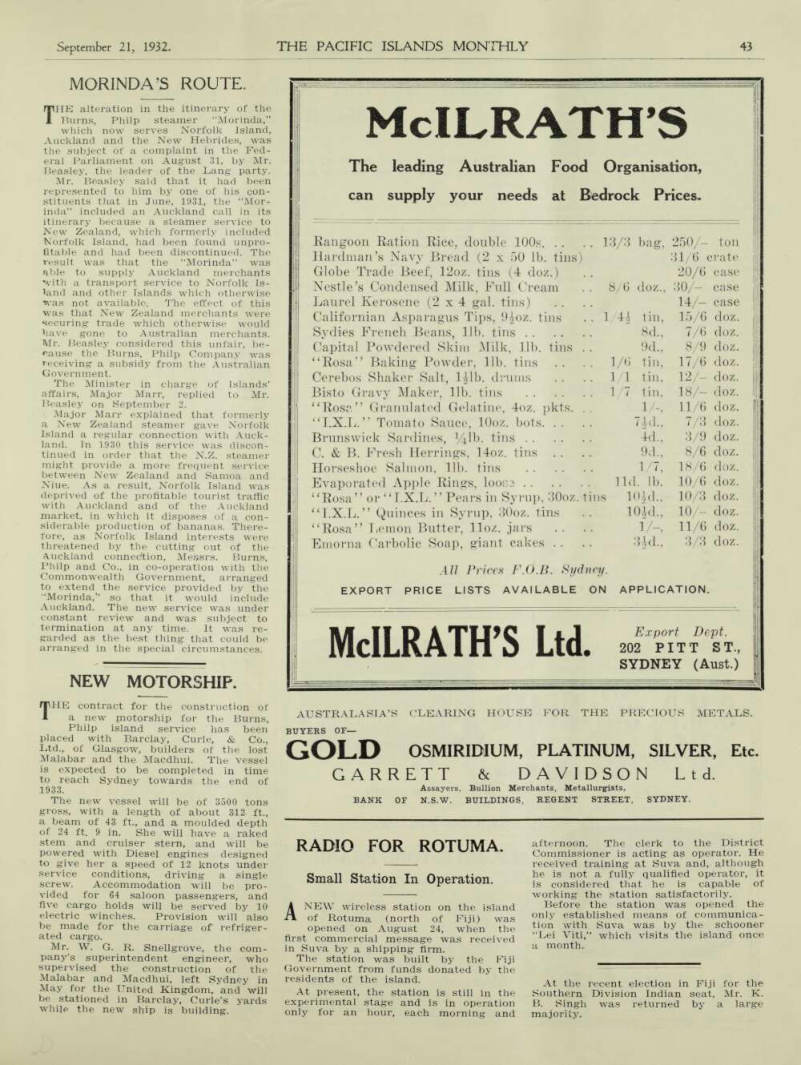
THE alteration in the itinerary of the Burns, Philp steamer “Morinda,” which now serves Norfolk Island, Auckland and the New Hebrides, was the subject of a complaint in the Fed eral Parliament on August 31, by Mr.
Beasley, the leader of the Lang party.
Mr. Beasley said that it had been represented to him by one of his con stituents that in June, 1931, the “Mor inda” included an Auckland call in its itinerary because a steamer service to New Zealand, which formerly included Norfolk Island, had been found unpro fitable and had been discontinued. The result was that the “Morinda” was able to supply Auckland merchants with a transport service to Norfolk Is land and other Islands which otherwise was not available. The effect of this was that New Zealand merchants were securing trade which otherwise would have gone to Australian merchants.
Mr. Beasley considered this unfair, be cause the Burns, Philp Company was receiving a subsidy from the Australian Government.
The Minister in charge of Islands’ affairs, Major Marr, replied to Mr.
Beasley on September 2.
Major Marr explained that formerly a New Zealand steamer gave Norfolk Island a regular connection with Auck land. In 1930 this service was discon tinued in order that the N.Z. steamer might provide a more frequent service between New Zealand and Samoa and Niue. As a result, Norfolk Island was deprived of the profitable tourist traffic with Auckland and of the Auckland market, in which it disposes of a con siderable production of bananas. There fore, as Norfolk Island interests were threatened by the cutting out of the Auckland connection, Messrs. Burns, Philp and Co., in co-operation with the Commonwealth Government, arranged to extend the service provided by the "Morinda,” so that it would include Auckland. The new service was under constant review and was subject to termination at any time. It was re garded as the best thing that could be arranged in the special circumstances.
New Motorship.
THE contract for the construction of a new piotorship for the Burns, Philp island service has been placed with Barclay, Curie, & Co., Ltd., of Glasgow, builders of the lost Malabar and the Macdhui. The vessel is expected to be completed in time to reach Sydney towards the end of 1933.
The new vessel will be of 3500 tons gross, with a length of about 312 ft., a beam of 43 ft., and a moulded depth of 24 ft. 9 in. She will have a raked stem and cruiser stern, and will be powered with Diesel engines designed to give her a speed of 12 knots under service conditions, driving a single screw. Accommodation will be pro vided for 64 saloon passengers, and five cargo holds will be served by 10 electric winches. Provision will also be made for the carriage of refriger ated cargo.
Mr. W. G. R. Snellgrove, the com pany’s superintendent engineer, who supervised the construction of the Malabar and Macdhui, left Sydney in May for the United Kingdom, and will be stationed in Barclay, Curie’s yards whilp the new ship is building.
Radio For Rotuma.
Small Station In Operation.
ANEW wireless station on the island of Rotuma (north of Fiji) was opened on August 24, when the first commercial message was received in Suva by a shipping firm.
The station was built by the Fiji Government from funds donated by the residents of the island.
At present, the station is still in the experimental stage and is in operation only for an hour, each morning and
afternoon. The clerk to the District Commissioner is acting: as operator. He received training at Suva and, although he is not a fully qualified operator, it is considered that he is capable of working the station satisfactorily.
Before the station was opened the only established means of communica tion with Suva was by the schooner “Lei Viti,” which visits the island once a month.
At the recent election in Fiji for the Southern Division Indian seat, Mr. K.
B. Singh was returned by a large majority.
Advertisements & other items, p. 45 (1 item)
Mcilrath’S
The leading Australian Food Organisation, can supply your needs at Bedrock Prices.
Rangoon Ration Rice, double 100 s. . .
Hardman’s Navy Bread (2 x 50 lb. tins) Globe Trade Beef, 12oz. tins (4 doz.) Nestle’s Condensed Milk, Full Cream Laurel Kerosene (2x4 gal. tins) Californian Asparagus Tips, 9½oz. tins Sydies French Beans, 1lb. tins Capital Powdered Skim Milk, 1lb. tins “Rosa” Baking Powder, 1lb. tins Cerebos Shaker Salt, 1½lb. drums Bisto Gravy Maker, 1lb. tins “Rosa” Granulated Gelatine, 4oz. pkts.
“I.X.L. ” Tomato Sauce, 10oz. bots. ..
Brunswick Sardines, tins C. &B. Fresh Herrings, 14oz. tins ..
Horseshoe Salmon, 1lb. tins Evaporated Apple Rings, loose "Rosa” or "I.X.L." Pears in Syrup, 30oz. tins "I.X.L.” Quinces in Syrup, 30oz. tins "Rosa” Lemon Butter, 11oz. jars Emorna Carbolic Soap, giant cakes . .
All Prices F. O. B. Sydney.
EXPORT PRICE LISTS AVAILABLE ON APPLICATION.
McILRATH’S Ltd.
Export Dept.
202 PITT ST.,
SYDNEY (Aust.)
AUSTRALASIA’S CLEARING HOUSE FOR THE PRECIOUS METALS.
BUYERS OF—
GOLD OSMIRIDIUM, PLATINUM, SILVER, Etc.
GARRETT & DAVIDSON Ltd.
Assayers, Bullion Merchants, Metallurgists, BANK OF N.S.W. BUILDINGS, REGENT STREET, SYDNEY.
Death Of Tom Bremen.
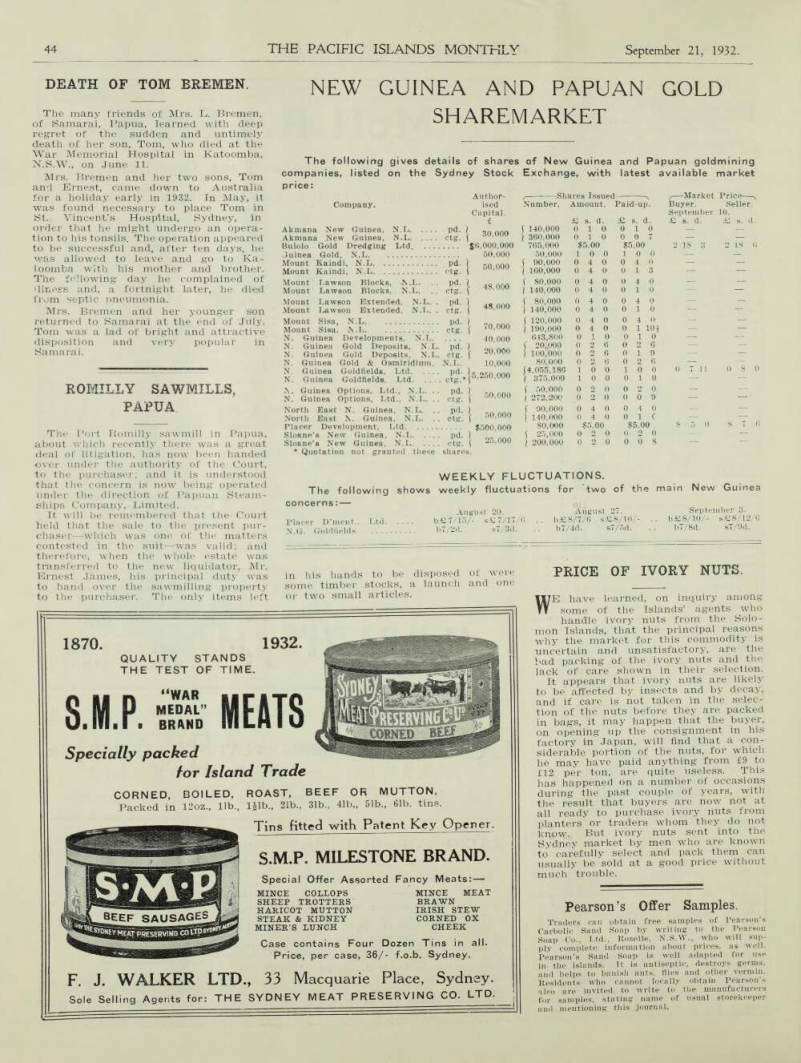
The many friends of Mrs. L. Bremen, of Samarai, Papua, learned with deep regret of the sudden and untimely death of her son, Tom, who died at the War Memorial Hospital in Katoomba, N.S.W., on June 11.
Mrs. Bremen and her two sons, Tom and Ernest, came down to Australia for a holiday early in 1932. In May, it was found necessary to place Tom in St. Vincent’s Hospital, Sydney, in order that he might undergo an opera tion to his tonsils. The operation appeared to be successful and, after ten days, he was allowed to leave and go to Ka toomba with his mother and brother.
The following day he complained of illness and, a fortnight later, he died from septic pneumonia.
Mrs. Bremen and her younger son returned to Samarai at the end of July.
Tom was a lad of bright and attractive disposition and very popular in Samarai.
Romilly Sawmills,
Papua
The Port Romilly sawmill in Papua, about which recently there was a great deal of litigation, has now been handed over under the authority of the Court, to the purchaser; and it is understood that the concern is now being operated under the direction of Papuan Steam ships Company, Limited.
It will be remembered that the Court held that the sale to the present pur chaser —which was one of the matters contested in the suit —was valid; and therefore, when the whole estate was transferred to the new liquidator, Mr.
Ernest James, his principal duty was to hand over the sawmilling property to the purchaser. The only items left
in his hands to be disposed of were some timber stocks, a launch and one or two small articles.
New Guinea And Papuan Gold
Sharemarket
The following gives details of shares of New Guinea and Papuan goldmining companies, listed on the Sydney Stock Exchange, with latest available market price:
Weekly Fluctuations.
The following shows weekly fluctuations for two of the main New Guinea concerns
Authorised Capital Shares Issued Market Price Company.
Number.
Amount.
Paid-up.
Buyer.
Seller.
September 10. £ £ s. d. £ s. d. £ s. d. £ s. d.
Akmana New Guinea, N.L pd. 140,000 0 1 0 0 1 0 — — Akmana New Guinea, N.L ctg. 360.000 0 1 0 0 0 7 — — Bulolo Gold Dredging Ltd. . . . . $6,000,000 765,000 $5.00 $5.00 2 IS 3 2 IS 6 Guinea Gold, N,L 50,000 50,000 1 0 0 1 0 0 — — Mount Kaindi, N.L pd. 90,000 0 4 0 0 4 0 — — Mount Kaindi, N.L ctg. 160,000 0 4 0 0 1 3 — — Mount Lawson Blocks, N.L. pd. 80,000 0 4 0 0 4 0 — — Mount Lawson Blocks. N.L. ctg. 140,000 0 4 0 0 1 0 — — Mount Lawson Extended. N.L. . pd. 48,000 80,000 0 4 0 0 4 0 — — Mount Lawson Extended, N.L. . ctg. 140,000 0 4 0 0 1 0 — — Mount Sisa, N.L Pd. ) 120,000 0 4 0 0 4 0 — — Mount Sisa, N.L. ctg. 70,000 190,000 0 4 0 0 1 10½ — — N. Guinea Developments, N.L. 40,000 643,800 0 1 0 0 1 0 — — N. Guinea Gold Deposits, N.L.
Pd. ) 20,000 20,000 0 2 6 0 2 6 — — N. Guinea Gold Deposits. N.L. ctg. 100,000 0 n 6 0 1 9 — — N. Guinea Gold & Osmiridium, N.L. 10,000 80,000 0 o 6 0 2 6 — — N. Guinea Goldfields, Ltd pd. 5,250,000 14,055,186 1 0 0 1 0 0 0 7 11 0 8 0 N. Guinea Goldfields, Ltd ctg. 375,000 1 0 0 0 I 0 — — N. Guinea Options, Ltd., N.L. ..
Pd. ) 50,000 50,000 0 2 0 0 2 0 — — N. Guinea Options, Ltd., N.L. .. ctg. 272,200 0 2 0 0 0 9 — North East N. Guinea, N.L. . . pd. 90,000 0 4 0 0 4 0 — — North East N. Guinea, N.L. . . ctg. 50,000 140,000 0 4 0 0 1 0 — — Placer Development, Ltd $500,000 80,000 $5.00 $5.00 8 5 0 8 7 6 Sloane’s New Guinea, N-L Pd. ) 25,000 0 2 0 0 2 0 — — Sloane’s New Guinea, N.L ctg. 25,000 200,000 0 2 0 0 0 8 — — * Quotation not granted these shares.
August 20.
August 27.
September 3.
Placer D’raent.. Ltd. b£7/15/- s£ 7/17/6 ., . b£ 8/7/0 s£8/10/- . . b£S/10/- s£8/12 0 N.G. Goldfields b7/2d. s7/3d. b7/4d. $7/5d. b7/8d. s7/9d.
Price Of Ivory Nuts.
WE have learned, on inquiry among some of the Islands’ agents who handle ivory nuts from the Solo mon Islands, that the principal reasons why the market for this commodity is uncertain and unsatisfactory, are the bad packing of the ivory nuts and the lack of care shown in their selection.
It appears that ivory nuts are likely to be affected by insects and by decay, and if care is not taken in the selec tion of the nuts before they are packed in bags, it may happen that the buyer, on opening up the consignment in his factory in Japan, will find that a con siderable portion of the nuts, for which he may have paid anything from £9 to £12 per ton, are quite useless. This has happened on a number of occasions during the past couple of years, with the result that buyers are now not at all ready to purchase ivory nuts from planters or traders whom they do not know. But ivory nuts sent into the Sydney market by men who are known to carefully select and pack them can usually be sold at a good price without much trouble.
Pearson’s Offer Samples.
Traders can obtain free samples of Pearson’s Carbolic Sand Soap by writing to the Pearson Soap Co., Ltd., Rozelle, N.S.W., who will sup ply complete information about prices, as well.
Pearson’s Sand Soap is well adapted for use in the islands. It is antiseptic, destroys germs, and helps to banish ants, flies and other vermin.
Residents who cannot locally obtain Pearson’s also are invited to write to the manufacturers for samples, stating name of usual storekeeper and mentioning this journal.
Advertisements & other items, p. 46 (1 item)
Specially packed
1870. 1932.
QUALITY STANDS
THE TEST OF TIME.
S.M.P. "War Medal Brand" MEATS
Specially packed
lor Island Trade
BEEF
CORNED
CORNED, BOILED, ROAST, BEEF OR MUTTON.
Packed in 12oz., 1lb., 1½lb., 2lb., 3lb., 4lb„ 5lb., 6lb. tins.
SAUSAGES
BEEF
Tins fitted with Patent Key Opener.
S.M.P. MILESTONE BRAND.
Special Offer Assorted Fancy Meats: —
MINCE COLLOPS
SHEEP TROTTERS
HARICOT MUTTON
STEAK & KIDNEY
MINER’S LUNCH
MINCE MEAT
BRAWN
IRISH STEW
CORNED OX
CHEEK
Case contains Four Dozen Tins in all.
Price, per case, 36/- f.o.b. Sydney.
F. J. WALKER LTD., 33 Macquarie Place, Sydney.
Sole Selling Agents for: THE SYDNEY MEAT PRESERVING CO. LTD.
Market Quotations
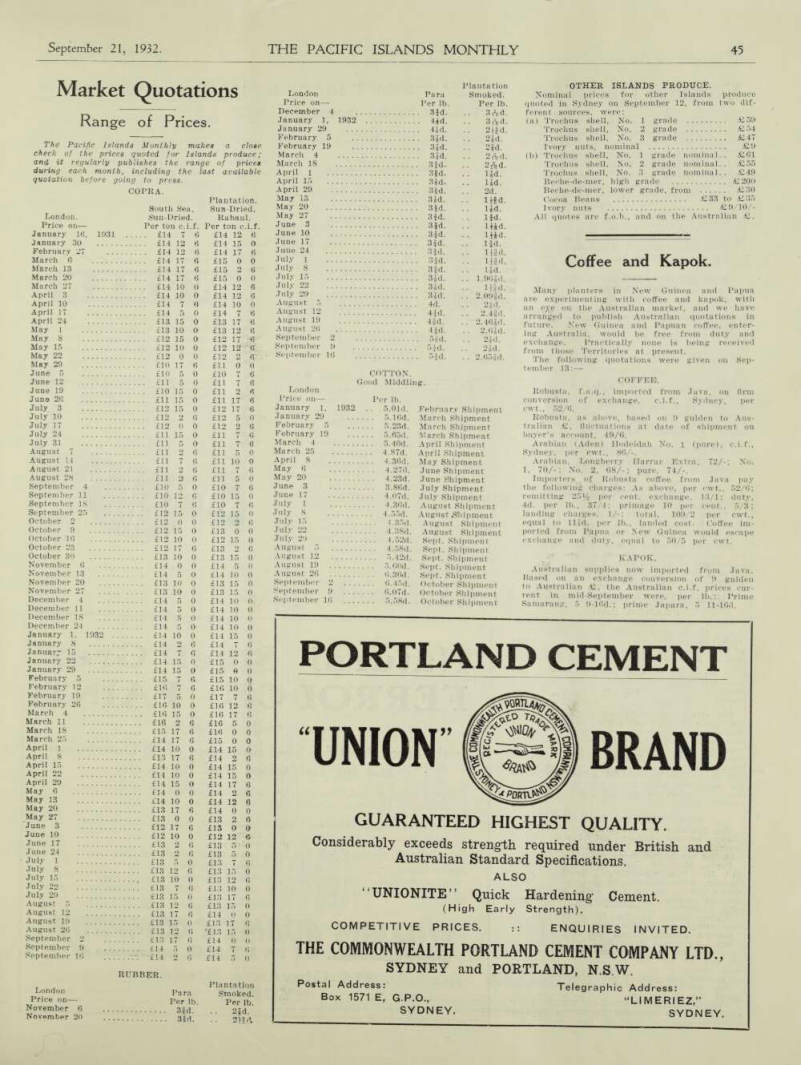
Range of Prices.
The Pacific Islands Monthly makes a close check of the prices quoted for Islands produce; and it regularly publishes the range of prices during each month, including the last available quotation before going to press.
Other Islands Produce.
Nominal prices for other Islands produce quoted in Sydney on September 12, from two dif ferent sources, Avere: (a) Trochus shell, No. 1 grade £59 Trochus shell, No. 2 grade £54 Trochus shell, No. 3 grade £47 Ivory nuts, nominal £9 (b) Trochus shell, No. 1 grade nominal.. £61 Trochus shell, No. 2 grade nominal. . £55 Trochus shell, No. 3 grade nominal.. £49 Beche-de-mer, high grade £200 Beche-de-mer, lower grade, from £30 Cocoa Beans £33 to £35 lA'ory nuts £9/10/- All quotes are f.o.b., and on the Australian £.
Plantation London Para Smoked.
Price on— Per lb.
Per lb.
December 4 .. 3Jd. .. 3*d.
January 1, 1932 44d. .. 3rtd.
January 29 . . 4id. 2fgd.
February 5 . . 3}d. •• 2|d.
February 19 .. 3Jd. •• 2|d.
March 4 .. 3|d. . • 2Ad.
March 18 . . 3id. .. 2^d.
April 1 .. 3|d. .. lid.
April 15 .. 3Jd.
Hd.
April 29 .. 3|d. 2d.
May 13 .. 3|d. .. l«d.
May 20 lid.
May 27 Ud.
June 3 IHd.
June 10 IHd.
June 17 IJd.
June 24 . 3Jd. l*|d.
July l . . 3Jd. .. IHd.
July 8 • • Ud.
July 15 .. 3|d. .. 1.90|d.
July 22 .. 3|d.
IHd.
July 29 .. 3|d. .. 2.093d.
August 5 2Jd.
August 12 . 4*d. .. 2.4|d.
August 19 .. 2.40|d.
August 20 .. 2.0|d.
September 2 .. 5|d. ■ • 2|d.
September 9 . 5} d. 2 id.
September 16 .. 5Jd. . . 2.053d.
Cotton.
Good Middling.
London Price on— Per lb.
January l, 1932 . . 5.Old.
February Shipment January 29 5.10d.
March Shipment February 5 5.23d.
March Shipment February 19 5.65d.
March Shipment March 4 5.40d.
April Shipment March 25 April Shipment April 8 4.36d.
May Shipment May 6 4.27d.
June Shipment May 20 4.23d.
June Shipment June 3 3.80d.
July Shipment June 17 4.07d.
July Shipment July 1 4.30d.
August Shipment July 8 August Shipment July 15 4.35d.
August Shipment July 22 4.38d.
August Shipment July 29 4.52d.
Sept. Shipment August 5 4.5Sd.
Sept. Shipment August 12 5.42d.
Sept. Shipment August 19 5.60d.
Sept. Shipment August 20 . . 0.30d.
Sept. Shipment September 2 6.45d.
October Shipment September 9 0.07d.
October Shipment September 10 5.58d.
October Shipment
London.
Copra.
South Sea, Sun-Dried.
Plantation, Sun-Dried, Rabaul.
Price on— Per ton c. i. f.
Per ton c.i.f.
January 16, 1931 £14 7 6 £14 12 6 January 30 ... 6 £14 15 0 February 27 £14 12 6 £14 17 6 March 6 6 £15 0 0 March 13 £14 17 6 £15 2 6 March 20 £14 17 6 £15 0 0 March 27 £14 10 0 £14 12 6 April 3 £14 10 0 £14 12 6 April 10 £14 7 0 £14 10 0 April 17 0 £14 7 6 April 24 0 £13 17 6 May 1 0 £13 12 6 May 8 0 £12 17 6 May If) 0 £12 12 6 May 22 0 £12 2 6 May 29 6 £11 0 0 June 5 0 £10 7 6 June 12 £11 5 0 £11 7 6 June 19 0 £11 2 6 June 26 0 £11 17 6 July 3 £12 15 0 £12 17 6 July 10 £12 2 6 £12 5 0 July 17 0 £12 2 6 July 24 £11 15 0 £11 7 6 July 31 £11 5 0 £11 7 6 August 7 £11 2 6 £11 5 0 August 14 £11 7 6 £11 10 0 August 21 £11 2 6 £11 7 6 August 28 £11 2 6 £11 5 0 September 4 £10 5 0 £10 7 6 September 11 6 £10 15 0 September IS .. . £10 7 6 £10 7 6 September 25 0 £12 15 0 October 2 0 £12 2 6 October 9 0 £13 0 0 October 16 0 £12 15 0 October 23 £12 17 6 £13 2 6 October 30 £13 10 0 £13 15 0 November 6 . . . . £14 0 0 £14 5 0 November 13 ... £14 5 0 £14 10 0 November 20 . . . . £13 10 0 £13 15 0 November 27 . .. . £13 10 0 £13 15 0 December 4 . . . . £14 5 0 £14 10 0 December 11 . . . . 0 £14 10 0 December 18 . . . . 0 £14 10 0 December 24 ... £14 5 0 £14 10 0 January 1, 1932 £14 10 0 £14 15 0 January 8 6 £14 7 6 January 15 £14 7 6 £14 12 6 January 22 0 £15 0 0 January 29 0 £15 0 0 February 5 £15 7 6 £15 10 0 February 12 £16 7 6 £16 10 0 February 19 £17 5 0 £17 7 6 February 26 0 £16 12 6 March 4 £16 15 0 £16 17 6 March 11 6 £16 5 0 March 18 £15 17 6 £16 0 0 March 25 6 £15 0 0 April l 0 £14 15 0 April 8 6 £14 2 6 April 15 0 £14 15 0 April 22 0 £14 15 0 April 29 0 £14 17 6 May 6 0 £14 2 6 May 13 £14 10 0 £14 12 6 May 20 6 £14 0 0 May 27 £13 0 0 £13 2 6 June 3 6 £13 0 0 June 10 0 £12 12 6 June 17 6 £13 5 0 June 24 6 £13 5 0 July 1 0 £13 7 6 July 8 6 £13 15 0 July 15 £13 10 0 £13 12 6 Julv 22 ... 6 £13 10 0 July 29 ... £13 15 0 £13 17 6 August 5 ... £13 12 6 £13 15 0 August 12 £13 17 6 £14 0 0 August 19 £13 15 0 £13 17 0 August 26 £13 12 6 '£13 15 0 September 2 £13 17 0 £14 0 0 September 9 . . 0 £14 7 6 September 16 ... £14 2 G £14 5 0 London
Rubber.
Para Plantation Smoked.
Price on — Per lb.
Per lb.
November 6 2Jd.
November 20 21K
Coffee and Kapok.
Many planters in New Guinea and Papua are experimenting Avith coffee and kapok, with an eye on the Australian market, and we have arranged to publish Australian quotations in future. New Guinea and Papuan coffee, enter ing Australia, would be free from duty and exchange. Practically none is being received from those Territories at present.
The following quotations were given on Sep tember 13: —
Coffee.
Robusta, f.a.q., imported from Java, on firm conversion of exchange, c.i.f., Sydney, per cwt., 52/6.
Robusta, as above, based on 9 gulden to Aus tralian £, fluctuations at date of shipment on buyer’s account, 49/6.
Arabian (Aden) Hodeidah No. 1 (pure), c.i.f., Sydney, per cvt., 86/-.
Arabian, Longberry Ilarrar Extra, 72/-; No. 1, 70/-; No. 2, 68/-; pure. 74/-.
Importers of Robusta coffee from Java pay the following charges: As above, per Cwt., 52/6; remitting 25% per cent, exchange, 13/1; duty, 4d. per lb., 37/4: primage 10 per cent., 5/3; landing charges, 1/-; total, 109/2 per cwt., equal to 11½d. per lb., landed cost. Coffee im ported from Papua or New Guinea would escape exchange and duty, equal to 50/5 per Cwt.
Kapok.
Australian supplies now imported from Java.
Rased on an exchange conversion of 9 gulden to Australian £, the Australian c.i.f. prices cur rent in mid-September were, per lb.: Prime Samarang. 5 9-16 d.; prime Japara, 5 11-16 d.
Advertisements & other items, p. 47 (1 item)
Brand
PORTLAND CEMENT
U
"UNION bRAND"
BRAND
GUARANTEED HIGHEST QUALITY.
Considerably exceeds strength required under British and Australian Standard Specifications.
ALSO
UNIONITE” Quick Hardening Cement.
(High Early Strength).
COMPETITIVE PRICES :: ENQUIRIES INVITED.
THE COMMONWEALTH PORTLAND CEMENT COMPANY LTD.,
SYDNEY and PORTLAND, NS W.
Postal Address:
Box 1571 E, G.P.O.,
SYDNEY.
Telegraphic Address:
“LIMERIEZ”
SYDNEY.
Exchange Quotations
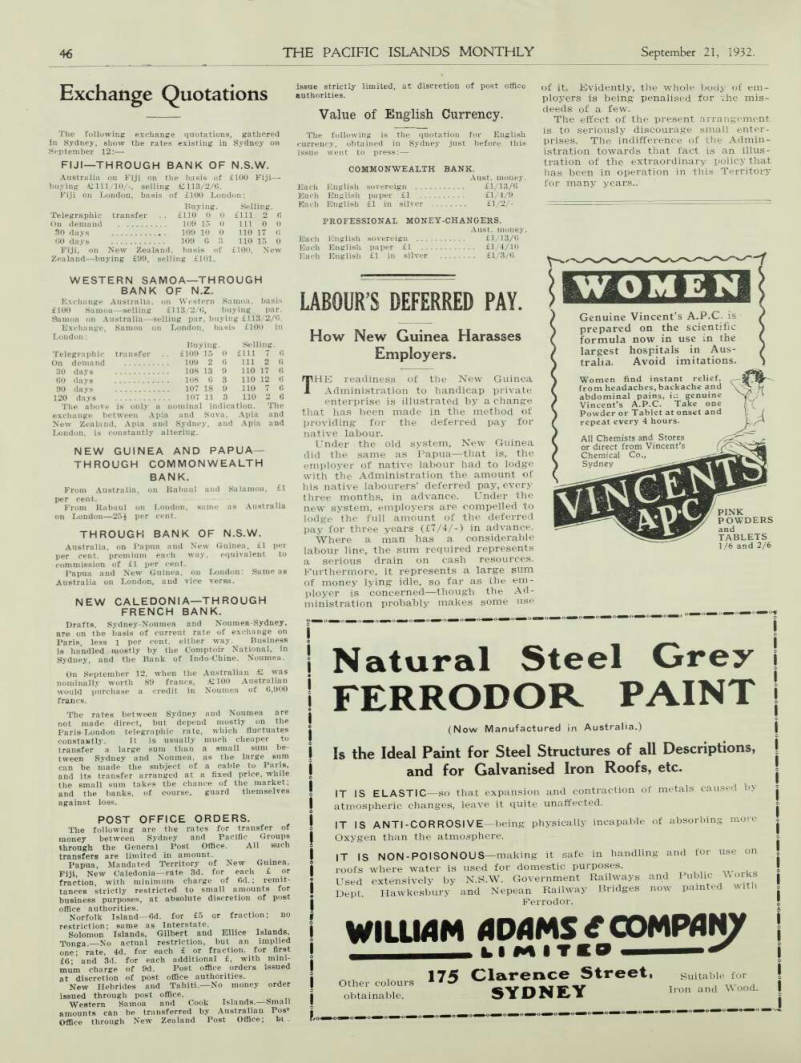
The following exchange quotations, gathered in Sydney, show the rates existing in Sydney on September 12:—
Fiji—Through Bank Of N.S.W.
Australia on Fiji on the basis of £100 Fiji— buying £111/10/-, selling £113/2/6.
Fiji on London, basis of £100 London;
Western Samoa—Through
Bank Of N.Z.
Exchange Australia, on Western Samoa, basis £100 Samoa—selling £113/2/6, buying par.
Samoa on Australia—selling par, buying £113/2/6.
Exchange, Samoa on London, basis £100 in London:
The above is only a nominal indication. The exchange between Apia and Suva, Apia and New Zealand, Apia and Sydney, and Apia and London, is constantly altering.
New Guinea And Papua
Through Commonwealth
Bank.
From Australia, on Rabaul and Salamoa, £1 per cent.
From Rabaul on London, same as Australia on London—25$ per cent.
Through Bank Of N.S.W.
Australia, on Papua and New Guinea, £1 per per cent, premium each way, equivalent to commission of £1 per cent.
Papua and New Guinea, on London: Same as Australia on London, and vice versa.
New Caledonia—Through
French Bank.
Drafts, Sydney-Noumea and Noumea-Sydney, are on the basis of current rate of exchange on Paris, less 1 per cent, either way. Business is handled mostly by the Comptoir National, in Sydney, and the Bank of Indo-Chine. Noumea.
On September 12, when the Australian £ was nominally worth 89 francs, £109 Australian would purchase a credit in Noumea of 6,900 francs.
The rates between Sydney and Noumea are not made direct, but depend mostly on the Paris-London telegraphic rate, which fluctuates constantly. It is usually much cheaper to transfer a large sum than a small sum be tween Sydney and Noumea, as the large sum can be made the subject of a cable to Paris, and its transfer arranged at a fixed price, while the small sum takes the chance of the market; and the banks, of course, guard themselves against loss.
Post Office Orders.
The following are the rates for transfer of money between Sydney and Pacific Groups through the General Post Office. All such transfers are limited in amount.
Papua, Mandated Territory of New Guinea, Fiji, New Caledonia —rate 3d. for each £ or fraction, with minimum charge of 6d.; remit tances strictly restricted to small amounts for business purposes, at absolute discretion of post office authorities.
Norfolk Island —6d. for £5 or fraction; no restriction; same as Interstate.
Solomon Islands, Gilbert and Ellice Islands, Tonga.—No actual restriction, but an implied one; rate, 4d. for each f or fraction, for first £6- and 3d. for each additional £, with mini mum charge of 9d. Post office orders issued at discretion of post office authorities.
New Hebrides and Tahiti.—No money order issued through post office.
Western Samoa and Cook Islands. —Small amounts can be transferred by Australian Post Office through New Zealand Post Office; bi-
issue strictly limited, at discretion of post office authorities.
Value of English Currency.
The following is the quotation for English currency, obtained in Sydney just before this issue went to press:—
Buying. Selling.
Telegraphic transfer . . £110 0 0 £111 2 0 On demand 109 15 0 111 0 0 30 davs 109 10 0 110 17 6 60 days 109 0 3 110 15 0 Fiji, on New Zealand, basis of £100. New Zealand—buying £99, selling £101.
Buying. Spelling.
Telegraphic transfer .. £109 15 0 £111 7 0 On demand 109 2 6 111 2 6 30 days 108 13 9 110 17 6 60 davs 108 6 3 110 12 6 90 days 107 18 9 110 7 6 120 days 107 11 3 110 2 6
Commonwealth
Bank.
Aust. money.
Each English sovereign £1/13/6 Each English paper £1 £1/4/9 Each English £1 in silver . .. £1/2/-
Professional Money-Changers.
Aust. money, Each English sovereign Each English paper £1 £1/4/10 Each English £1 in silver £1/3/6
Labour’S Deferred Pay.
How New Guinea Harasses Employers.
THE readiness of the New Guinea Administration to handicap private enterprise is illustrated by a change that has been made in the method of providing for the deferred pay for native labour.
Under the old system, New Guinea did the same as Papua—that is, the employer of native labour had to lodge with the Administration the amount of his native labourers’ deferred pay, every three months, in advance. Under the new system, employers are compelled to lodge the full amount of the deferred pay for three years (£7/4/-) in advance.
Where a man has a considerable labour line, the sum required represents a serious drain on cash resources.
Furthermore, it represents a large sum of money lying idle, so far as the em ployer is concerned —though the Ad ministation probably makes some use
of it. Evidently, the whole body of em ployers is being penalised for die mis deeds of a few.
The effect of the present arrangement is to seriously discourage small enter prises. The indifference of the Admin istration towards that fact is an illus tration of the extraordinary policy that has been in operation in this Territory for many years..
Advertisements & other items, p. 48 (1 item)
Isaaaaa
Genuine Vincent’s A.P.C. is prepared on the scientific formula now in use in the
largest hospitals in Aus
tralia, Avoid imitations.
Women find instant relief, from headaches, backache and abdominal pains, in genuine Vincent’s A.P.C. Take one Powder or Tablet at onset and repeat every 4 hours.
All Chemists and Stores or direct from Vincent’s Chemical Co.
Sydney
PINK
POWDERS
and
TABLETS
Natural Steel Grey
FERRODOR PAINT
Is the Ideal Paint for Steel Structures of all Descriptions,
and for Galvanised Iron Roofs, etc.
IT IS ELASTIC —so that expansion and contraction of metals caused by atmospheric changes, leave it quite unaffected.
IT IS ANTI-CORROSIVE—being physically incapable of absorbing more Oxygen than the atmosphere.
IT IS NON - POISONOUS —making it safe in handling and for use on
WILLIAM ADAMS & COMPANY
(Now Manufactured in Australia.) Ferrodor.
Other colours obtainable.
175 Clarence Street
SYDNEY
Suitable for Iron and Wood.
Sydney—Rabaul—Hongkong.
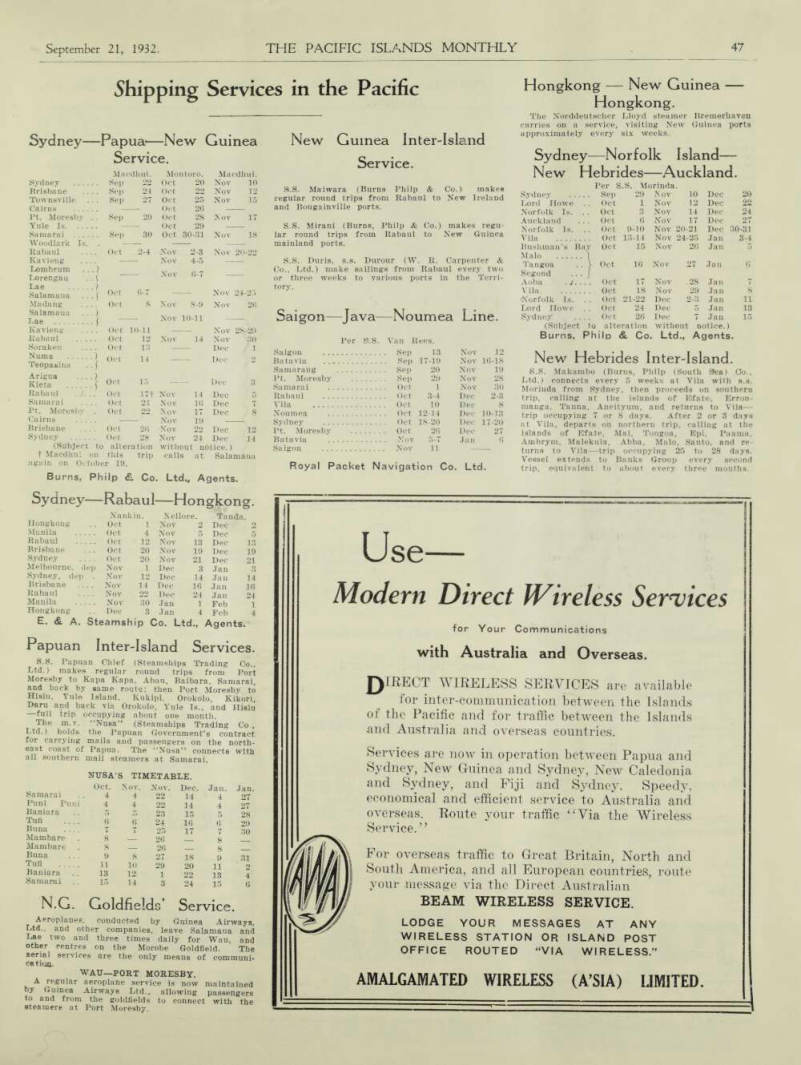
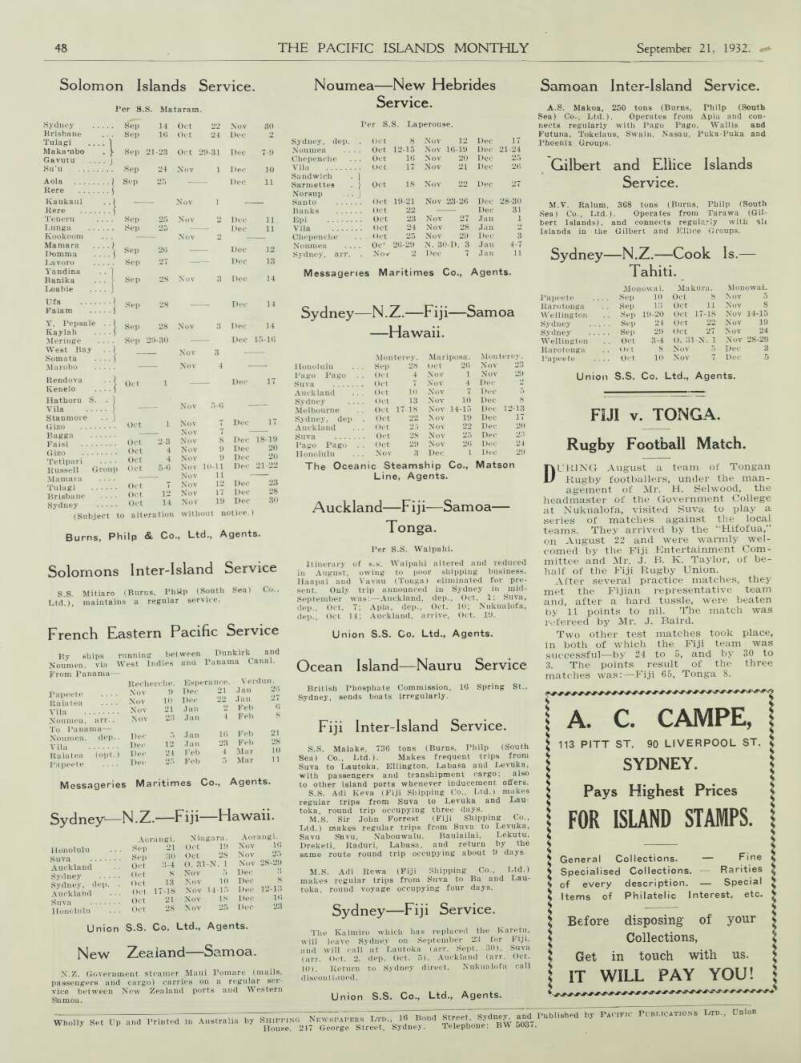
Shipping Services in the Pacific
Sydney—Papua—New Guinea Service.
Papuan Inter-Island Services.
S.S. Papuan Chief (Steamships Trading Co., Ltd.) makes regular round trips from Port Moresby to Kapa Kapa, Abau, Baibara, Samarai, and back by same route; then Port Moresby to Hisiu, Yule Island, Kukipi, Orokolo, Kikori, Daru and back via Orokolo, Yule Is., and Hisiu —full trip occupying about one month.
The m.v. “Nusa” (Steamships Trading Co, Ltd.) holds the Papuan Government’s contract for carrying mails and passengers on the north east coast of Papua. The “Nusa” connects with all southern mail steamers at Samarai.
N.G. Goldfields’ Service.
Aeroplanes, conducted by Guinea Airways, Ltd., and other companies, leave Salamaua and Lae two and three times daily for Wau, and other centres on the Morobe Goldfield. The aerial services are the only means of communi catioa.
Wau—Port Moresby.
A regular aeroplane service is now maintained by Guinea Airways Ltd., allowing passengers to and from the goldfields to connect with the steamers at Port Moresby.
New Guinea Inter-Island
Service.
S.S. Maiwara (Burns Philp & Co.) makes regular round trips from Rabaul to New Ireland and Bougainville ports.
S.S. Mirani (Burns, Philp & Co.) makes regu lar round trips from Rabaul to New Guinea mainland ports.
S.S. Duris, s.s. Durour (W. R. Carpenter & Co., Ltd.) make sailings from Rabaul every two or three weeks to various ports in the Terri tory.
Saigon—Java—Noumea Line.
Hongkong New Guinea
Hongkong.
The Norddeutscher Lloyd steamer Bremerhaven carries on a service, visiting New Guinea ports approximately every six weeks.
New Hebrides Inter-Island.
S.S. Makambo (Burns, Philp (South Sea) Co., Ltd.) connects every 5 weeks at Vila with s.s.
Morinda from Sydney, then proceeds on southern trip, calling at the islands of Efate, Erron manga, Tanna, Aneityura, and returns to Vila— trip occupying 7 or 8 days. After 2 or 3 days at Vila, departs on northern trip, calling at the islands of Efate, Mai, Tongoa, Epi, Paama, Ambrym, Malekula, Abba, Malo, Santo, and re turns to Vila—trip occupying 25 to 28 days.
Vessel extends to Banks Group every second trip, equivalent to about every three months.
Macdhui.
Montoro.
Macdhui.
Sydney Sep 22 Oct 20 Nov 10 Brisbane Sep 24 Oct 22 Nov 12 Townsville Sep 27 Oct 25 Nov 15 Oct 2G Pt. Moresby Sep 29 Oct 28 Nov 17 Onf 90 Samarai . .
Sep 30 Oct 30-31 Nov 18 Woodlark Is. . — Rabaul Oct 2-4 Xov ; 2-3 Xov 20-22 Kavieng Xov 4-5 Lombrum Xot i Lorengau o- t Lae .. .
Salamaua 4 Oct 6-7 — Nov 24-25 Madang Oct s Nov 1 8-9 Nov 26 Salamaua Lae 4 Xov 10 -11 Kavieng Oct 10-11 — Xov 28-29 Rabaul Oct 12 Xov 14 Xov 30 Soraken Oct 13 — Dec 1 Numa . . . .
Oct 14 Dec 2 Teopasina Arigua Kieta ...
Oct 15 — Dec 3 Rabaul . .1 Oct 17t Nov 14 Dec 5 Samara!
Oct 21 Xov 16 Dec 7 Ft. Moresby Oct 22 Nov 17 Dec 8 Cairns — Nov 19 Brisbane Oct 26 Xov 22 Dec 12 Sydney Oct 28 Nov 24 Dec 14 (Subject to alteration without notice.) t Macdhui on this trip calls at Salamaua again on October 19.
Burns, Philp & Co. Ltd., Agents.
Xankin.
Nellore.
Tanda Hongkong Oct I Xov 2 Dec 2 Manila Oct 4 Xov 5 Dec 5 Rabaul Oct 12 Xov 13 Dec 13 Brisbane Oct 20 Xov 19 Dec 19 Sydney ...
Oct 20 Xov 21 Dec 21 Melbourne, dep Xov 1 Dec 3 Jan 3 Sydney, dep .
Xov 12 Dee 14 Jan 14 Brisbane ...
Xov 14 Dec 16 Jan 16 Rabaul ...
Nov 22 Dec 24 Jan 24 Manila Xov 30 .Tan 1 Feb 1 Hongkong Dec 3 Jan 4 Feb 4 E. & A. Steamship Co. Ltd., Agents.
Nusa’S Timetable.
Oct.
Nov.
Nov.
Dec.
Jan.
Jan.
Samarai 4 4 22 14 4 27 Puni Puni 4 4 22 14 4 27 Baniara 5 5 23 15 5 28 Tufi 6 6 24 16 6 29 Buna ... 7 7 25 17 30 Mambare 8 26 8 Mambare 8 26 8 Buna 9 8 27 18 9 31 Tufi 11 10 29 20 11 2 Baniara 13 12 1 22 13 4 Samarai 15 14 3 24 15 6
Per 9.S. Van Rees.
Saieon Sen 13 Nov 12 Batavia Sep 17-1!) Nov 16-18 Samarang . . . . Sep 20 Nov 19 Pt. Moresby .. .. Sep 20 1 Nov 28 Samarai ... Oct N i < v 30 Rabaul .. .. Oct 3-4 Dec 2-3 Vila . .. . Oct 10 Dec 8 Noumea . . . . Oct 12-14 Dec- 10-13 Sydney Oct 18-20 Dec 17-20 Pt. Moresby ..., Oct 20 Dec 27 Batavia . . . . Xov 5-7 .la a c Saigon Nov 11 Royal Packet Navigation Co. Ltd.
Sydney—Norfolk Island—
New Hebrides—Auckland
Per S.S. Morlnda Sydney ... . . Sep 29 Nov 10 Dec 20 Lord Howe .
Oct 1 Nov 12 Dec 22 Norfolk Is. . Oct 3 Nov 14 Dec 24 Auckland Oct 6 Nov 17 Dec 27 Norfolk Is. . . Oct 9-10 Nov 20-21 Dec 3 0-31 Vila . Oct 13-14 Nov 24-25 Jan 3-4 Bushman's Ha y Oct 15 Nov 26 Jan 5 Malo 1 Tangoa Oct 10 Nov 27 Jan 6 Segond / Aoba . j ...
Oct 17 Nov 28 Jan 7 Vila . Oct 18 Nov 29 Jan S Norfolk Is. . . Oct 21-22 Dec 2-3 Jan 11 Lord Howe . . Oct 24 Dec o Jan 13 Sydney . Oct 26 Dec 7 Jan 15 (Subject to alteration without notice.) Burns, Philp & Co. Ltd., Agents.
Solomon Islands Service.
Solomons Inter-Island Service
S.S. Mitiaro (Burns, Philp (South Sea) Co..
Ltd.), maintains a regular service.
Sydney—N.Z. —Fiji—Hawaii.
New Zealand —Samoa.
N.Z. Government steamer Maui Pomare (mails, passengers and cargo) carries on a regular ser vice between New Zealand ports and Western Siamoa.
Noumea—New Hebrides Service.
Sydney—N.Z.—Fiji—Samoa —Hawaii.
Auckland —Fiji—Samoa—
Tonga.
Per S.S. Waipahi.
Itinerary of s.s. Waipahi altered and reduced in August, owing to poor shipping business.
Haapai and Vavau (Tonga) eliminated for pre sent. Only trip announced in Sydney in mid- September was:—Auckland, dep., Oct. 1; Suva, dep., Oct. 7; Apia, dep., Oct. 10; Nukualofa, dep., Oct 14; Auckland, arrive, Oct. 19.
Union S.S. Co. Ltd., Agents,
Ocean Island —Nauru Service
British Phosphate Commission, 16 Spring St., Sydney, sends boats irregularly.
Fiji Inter-Island Service.
S.S. Malake, 736 tons (Burns, Philp (South Sea) Co., Ltd.). Makes frequent trips from Suva to Lautoka, Ellington, Labasa and Levuka, with passengers and transhipment cargo; also to other island ports whenever inducement offers.
S.S. Adi Keva (Fiji Shipping Co., Ltd.) makes regular trips from Suva to Levuka and Lau toka, round trip occupying three days.
M.S. Sir John Forrest (Fiji Shipping Co., Ltd.) makes regular trips from Suva to Levuka, Savu Savu, Nabouwalu, Baulailai, Lekutu, Dreketi, Raduri, Labasa, and return by the same route round trip occupying about 9 days.
M.S. Adi Rewa (Fiji Shipping Co., Ltd.) makes regular trips from Suva to Ba and Lau toka, round voyage occupying four days.
Sydney —Fiji Service.
The Kaimiro which has replaced the Karetu, will leave Sydney on September 23 for Fiji, and will call' at Lautoka (arr. Sept. 30), Suva (arr. Oct. 2, dep. Oct. 5), Auckland (arr. Oct. 10). Return to Sydney direct. Nukualofa call discontinued.
Union S.S. Co., Ltd., Agents.
Samoan Inter-Island Service.
A.S. Makoa, 250 tons (Burns, Philp (South Sea) Co., Ltd.). Operates from Apia and con nects regularly with Pago Pago, Wallis and Futuna, Tokelaus, Swain, Nasau, Puka-Puka and Phoenix Groups.
Gilbert and Ellice Islands
Service.
M.Y. Ralum, 368 tons (Burns, Philp (South Sea) Co., Ltd.). Operates from Tarawa (Gil bert Islands), and connects regularly with all Islands in the Gilbert and Ellice Groups.
Sydney—N.Z.—Cook Is.—
Tahiti.
Per S.S. Mataram.
Sydney ...
Sep Sep Sep Sep 14 Oct Oct Oct 29- No v 22 Nov Dec Dec- Dec SO 2 7-9 10 Brisbane Tulagi ...
Makambo Gavutu ...
Su'u 10 21-23 24 24 31 1 Aola . .
Sep 25 Dec 11 Rere Kaukaul Rere Nov ] Teneru Sep Sep 25 25 Nov 2 Dec Dec 11.
Kookoom Mamara Nov 2 JL 1 26 27 Dec Dec 12 13 Ilomma Sep Sep Sep Yandina Banika Loabie ... 28 Nov 3 Dec 14 Ufa 28 Dec 14 Sep Y. Pepsale .
Kaylah Sep 29 28 -30 Nov 3 Dec Dec 14 15-16 Meriuge ..
West Bay Sep Nov 3 Somata Marobo ...
Nov 4 Rendova An f 1 Dec 17 Kenelo UCl Hathorn S. .
Nov 5-0 Vila Stanmore Gizo Oct 1 Nov ■\T 7 Dec- 17 Bagga Oct 2-3
In Ov
Nov 8 Dec 18-19 Oct 4 Nov 9 Dec 20 Tetipari Russell Group Oct Oct 4 5-0 Nov 9 Nov 10-11 XT,, ir 1 1 Dec Dec 20 21-22 Mamara Oct 7 Nov 12 Dec 23 Brisbane Sydney Oct Oct 12 14 Nov Nov 17 19 Dec Dec 28 30 (Subject to alteration without notice.) Burns, Philp & Co., Ltd., Agents.
French Eastern Pacific Service
By ships running between Dunkirk and Noumea, via West Indies and Panama Canal.
From Panama- Papeete Raiatea Vila Noumea, arr..
To Panama — Noumea, dep.
A’ila . . .. running between Dunkirk and West Indies and Panama Canal.
Recherche. Esperauce. Verdun.
Nov 9 Dec 21 Jan 20 Nov 10 Dec 22 Jan 27 . Nov 21 Jan 2 Feb 6 Nov 23 Jan 4 Feb 8 Dec o Jan 10 Feb 21 Dec 12 Jan 23 Feb 28 Raiatea (opt.
Papeete ) Dec . Dec 24 Feb Feb 4 5 Mar 10 Mar 11
Messageries Maritimes Co., Agents.
Aorangi. Niagara. Aorangi.
Honolulu ... Sep 21 Oct 19 Nov 16 «„va Sen 30 Oct 28 Nov 2o Auckland" .. Oc? 3-4 0. 31-N. Nov 28-29 Sydney Oct 8 Nov o Dec 3 Sydney, dep. . Oct 13 Nov 10 Dec Auckland .. . Oct 17-18 Nov 14-1 o Dec 12-13 Suva Oct 21 Nov 18 Dec !<• Honolulu ... Oct 28 Nov 25 Dec 23 Union S.S. Co. Ltd., Agents.
Per S.S. Laperouse.
Sydney, dep. . Oct 8 Nov 12 Dec 17 Noumea Oct 12-15 Nov 16-19 Dec- 21-24 Chepenche . . Oct 1G Nov 20 Dec 25 Vila Oct 17 Nov 21 Dec 26 Sandwich Sarmettes
't Oct
18 Nov 22 Dec 27 Norsup Santo . .. . . . Oct 19-21 Nov 23-26 Dec 28-30 Hanks . . .. . . Oct Dec 31 Epi .. Oct 23 Nov 27 Jan 1 Vila . . Oct 24 Nov 28 Jan 2 Chepenche . . Oct 25 Nov 29 Dec 3 Noumea . . Oc" 20-29 N. 30-D. 3 Jan 4-7 Sydney, arr. . Nov 2 Dec 7 Jan 11
Messagenes Maritimes Co., Agents.
Monterey.
Mariposa.
Monterey.
Honolulu Sep 28 Oct 26 Nov 23 Pago Pago . .
Oct 4 Nov 1 Nov 29 Suva Oct 7 Nov 4 Dec 2 Auckland Oct 10 Nov 7 Dec 5 Sydney ...
Oct 13 Nov 10 Dec 8 Melbourne Oct IT -18 Nov 14-15 Dec 12-13 Sydney, dep .
Oct 22 Nov 19 Dec 17 Auckland Oct 25 Nov 22 Dec 20 Suva Oct 28 Nov 25 Dec 23 Pago Pago . .
Oct 20 Nov 26 Dec 24 Honolulu Nov 3 Dec 1 Dec 29 The Oceanic Steamship Co., Matson
Line, Agents.
Mouowai.
Makura.
Mouowai.
Papeete ...
Sep 10 Oct 8 Nov 5 Rarotonga Sep 13 Oct 11 Nov 8 Wellington Sep 19-20 Oct 17-18 Nov 14-15 Sydney Sep 24 Oct 22 Nov 19 Sydney Sep 29 Oct 27 Nov 24 Wellington Oct 3-4 O. 31-N. 1 Nov 28-29 Rarotonga Oct 8 Nov 5 Dec 3 Papeete ...
Oct 10 Nov 7 Dec 5 Union S.S. Co. Ltd., Agents.
Advertisements & other items, p. 49 (1 item)
Modern Direct Wireless Services
Use—
for Your Communications with Australia and Overseas.
WiRELESS SERVICES are available for inter-communication between the Islands of the Pacific and for traffic between the Islands and Australia and overseas countries.
Services are now in operation between Papua and Sydney, New Guinea and Sydney, New Caledonia and Sydney, and Fiji and Sydney. Speedy, economical and efficient service to Australia and overseas. Route your traffic “Via the Wireless Service."
For overseas traffic to Great Britain, North and South America, and all European countries, route your message via the Direct Australian
BEAM WIRELESS SERVICE.
LODGE YOUR MESSAGES AT ANY
WIRELESS STATION OR ISLAND POST
OFFICE ROUTED “VIA WIRELESS.”
AMALGAMATED WIRELESS (A’SIA) LIMITED.
Rugby Football Match.
Fiji V. Tonga.
DURING August a team of Tongan Rugby footballers, under the man agement of Mr. H. Selwood, the headmaster of the Government College at Nukualofa, visited Suva to play a series of matches against the local teams. They arrived by the “Hifofua,” on August 22 and were warmly wel comed by the Fiji Entertainment Com mittee and Mr. J. B. K. Taylor, of be half of the Fiji Rugby Union.
After several practice matches, they met the Fijian representative team and, after a hard tussle, were beaten by 11 points to nil. The match was refereed by Mr. J. Baird.
Two other test matches took place, in both of which the Fiji team was successful —by 24 to 5, and by 30 to 3. The points result of the three matches was: —Fiji 65, Tonga 8.
Advertisements & other items, pp. 50-52 (2 items)
48
September 21, 1932.
THE PACIFIC ISLANDS MONTHLY
Wholly Set Up and Printed Australia by SHIPPING NEWSPAPERS LTD., 16 Bond Street, Sydney, and Published by PACIFIC PUBLICATIONS LTD., Union House, 247 George Street, Sydney. Telephone: BW 5037.
For Island Stamps.
A. C. CAMPE,
113 PITT ST. 90 LIVERPOOL ST.
SYDNEY.
Pays Highest Prices
FOR ISLAND STAMPS.
General Collections. Fine Specialised Collections. Rarities of every description. Special Items of Philatelic Interest, etc.
Before disposing of your Collections, Get in touch with us.
IT WILL PAY YOU!
The Heaviest Single Piece
Ever Carried by Aeroplane
ABOVE is the top tumbler shaft for the Bulolo Gold Dredging Company’s first dredge being loaded into one of the tri-motored G31 Junker Aircraft operated by Guinea Airways.
It is the heaviest piece ever carried by air in the World, and weighs 3½ tons.
The circular photograph is a close-up of the same shaft, and graphic as it is gives but a poor idea of the size and weight of this huge piece of machinery.
New Guinea Aerodromes
LAE
SALAMAUA
WATTUT
WAU
WAMPUT
SANGAN
BULOWAT
BULOLO
ZENAG
GUINEA AIRWAYS Ltd.
LAE ' SALAMAUA
CLEAR .. . BRIGHT . . COLD
IT MAKES A THIRST WORTH
WHILE. WHAT PROMISE OF
REFRESHMENT LIES IN THE
SIGHT OF A BOTTLE of a true £n/2
TOOTH's KB LAGER!