Pacific
Islands
Monthly
April 23
1932
6 d
[Registered at G.P.O., Sydney, for transmission by post as a newspaper .]
A village scene in the Markham Valley, New Guinea. Much of the labour for the Morobe Goldfield, which lies southward of the Markham River, is drawn from this region.
Photo by H. L. Downing.
Advertisements & other items, pp. 2-3 (1 item)
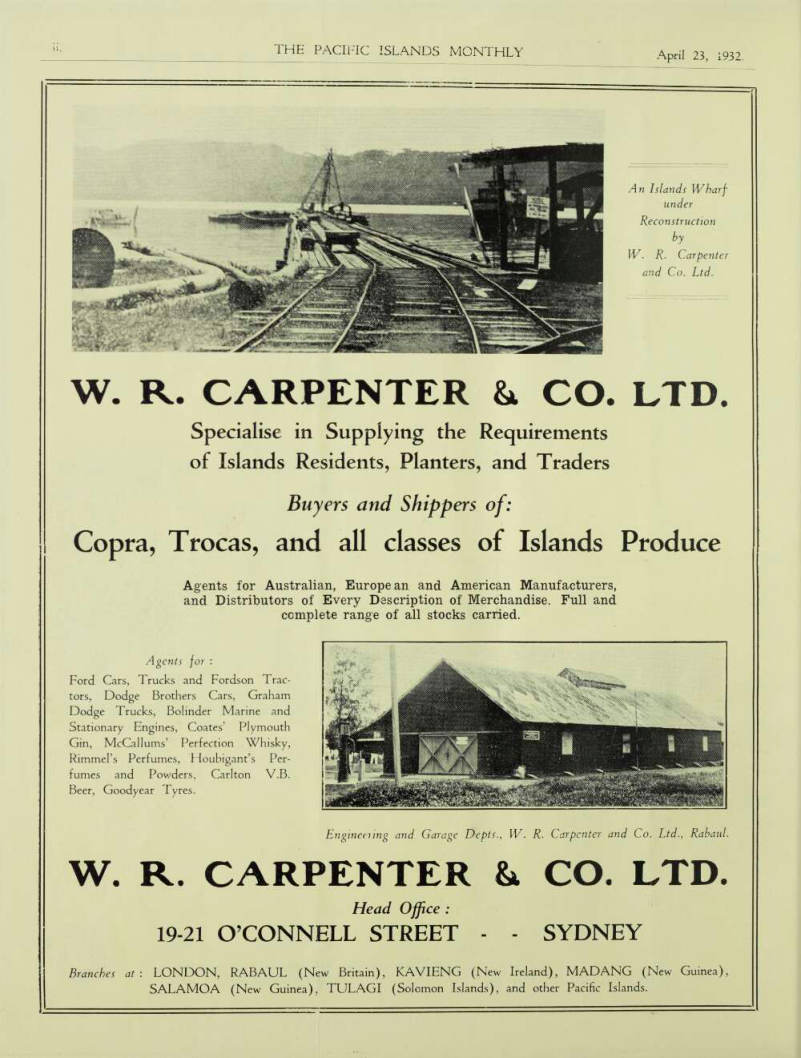
W. R. Carpenter & Co. Ltd.
An Islands Wharf under Reconstruction by W. R. Carpenter and Co. Ltd.
Specialise in Supplying the Requirements
of Islands Residents, Planters, and Traders
Buyers and Shippers of:
Copra, Trocas, and all classes of Islands Produce Agents for Australian, European and American Manufacturers, and Distributors of Every Description of Merchandise. Full and complete range of all stocks carried.
Agents for : Ford Cars, Trucks and Fordson Trac tors, Dodge Brothers Cars, Graham Dodge Trucks, Bolinder Marine and Stationary Engines, Coates’ Plymouth Gin, McCallums’ Perfection Whisky, Rimmel’s Perfumes, Houbigant’s Per fumes and Powders, Carlton V.B.
Beer, Goodyear Tyres.
Engineering and Garage Depts., W. R. Carpenter and Co. Ltd., Rabaul.
W. R. CARPENTER & CO. LTD.
Head Office :
19-21 O’CONNELL STREET - SYDNEY
Branches at: LONDON, RABAUL (New Britain), KAVIENG (New Ireland), MADANG (New Guinea), SALAMOA (New Guinea), TULAGI (Solomon Islands), and other Pacific Islands.
NOW ON SALE!
Pacific Islands
Year Book for
1932 Complete description of all Pacific Islands and Territories, including Details of Adminis trations. Trading Activities, Land Laws, Latest Statistical Information, Opportunities for New Settlers, &c., &c.
WITH MAPS AND A
COMPLETE INDEX.
8/6 at all Islands Stores, at all leading Australian and New Zealand Booksellers, or from—
UNION HOUSE,
247 GEORGE ST., SYDNEY.
Contents.
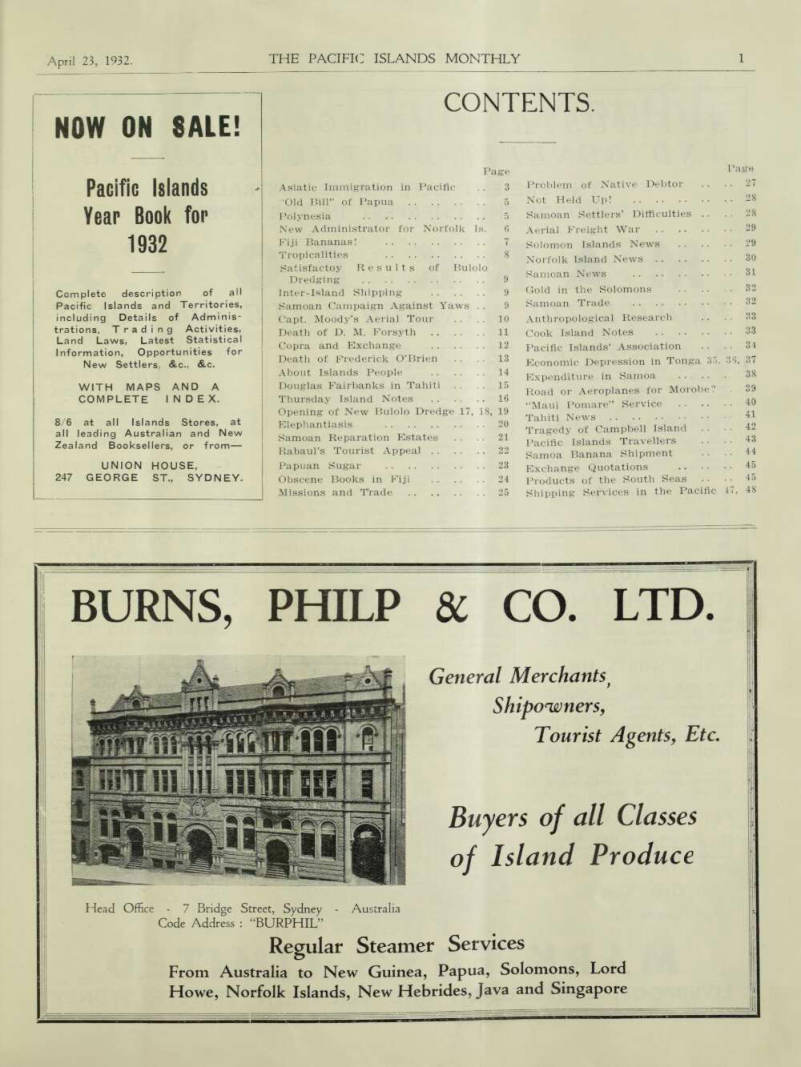
Page Asiatic Immigration in Pacific . . 3 "Old Bill” of Papua 5 Polynesia 5 New Administrator for Norfolk Is. 6 Fiji Bananas! 7 Tropicalities 8 Satisfactoy Results of Bulolo Dredging 9 Inter-Island Shipping 9 Samoan Campaign Against Yaws . . 9 Capt. Moody’s Aerial Tour 10 Death of D. M. Forsyth 11 Copra and Exchange 12 Death of Frederick O’Brien 13 About Islands People 14 Douglas Fairbanks in Tahiti . . . . 15 Thursday Island Notes 16 Opening of New Bulolo Dredge 17, 18, 19 Elephantiasis 20 Samoan Reparation Estates . . 21 Rabaul’s Tourist Appeal 22 Papuan Sugar 23 Obscene Books in Fiji 24 Missions and Trade 25
Page Problem of Native Debtor . . .. 27 Not Held Up! 28 Samoan Settlers’ Difficulties . . . . 28 Aerial Freight War 29 Solomon Islands News 29 Norfolk Island News 30 Samoan News 31 Gold in the Solomons . . . • • 32 Samoan Trade 32
Anthropological Research .. . . 33
Cook Island Notes 33 Pacific Islands’ Association ... 34 Economic Depression in Tonga 35, 36, 37 Expenditure in Samoa 38 Road or Aeroplanes for Morobe? 39 “Maui Pomare” Service 40 Tahiti News 41 Tragedy of Campbell Island . 42 Pacific Islands Travellers . . 43 Samoa Banana Shipment . . .44 Exchange Quotations 45 Products of the South Seas . . . 45 Shipping Services in the Pacific 47, 48
Advertisements & other items, pp. 3-4 (1 item)
Burns, Philp & Co. Ltd.
General Merchants,
Shipowners,
Tourist Agents, Etc.
Buyers of all Classes
of Island Produce
Head Office - 7 Bridge Street, Sydney - Australia Code Address : “BURPHIL”
Regular Steamer Services From Australia to New Guinea, Papua, Solomons, Lord Howe, Norfolk Islands, New Hebrides, Java and Singapore
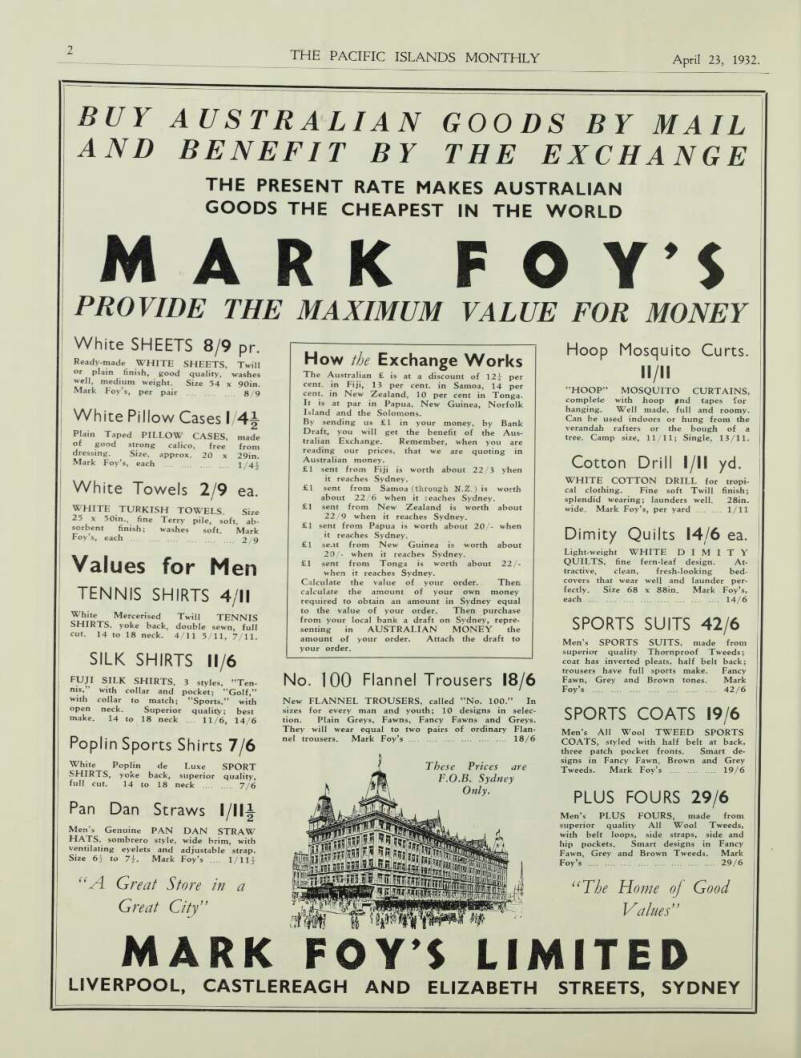
BUY AUSTRALIAN GOODS BY MAIL
AND BENEFIT BY THE EXCHANGE
THE PRESENT RATE MAKES AUSTRALIAN
GOODS THE CHEAPEST IN THE WORLD
MARK FOY’S
PROVIDE THE MAXIMUM VALUE FOR MONEY
White SHEETS 8/9 pr.
Ready-made WHITE SHEETS, Twill or plain finish, good quality, washes well, medium weight. Size 54 x 90in.
Mark Foy’s, per pair 8/9
White Pillow Cases I
Plain Taped PILLOW CASES, made of good strong calico, free from dressing. Size, approx. 20 x 29in.
Mark Foy’s, each 1/4½
White Towels 2/9 ea.
WHITE TURKISH TOWELS. Size
25 x 50in., fine Terry pile, soft, ab sorbent finish; washes soft. Mark Foy’s, each 2/9
Values for Men
TENNIS SHIRTS 4/11
White Mercerised Twill TENNIS SHIRTS, yoke back, double sewn, full cut, 14 to 18 neck. 4/11 5/11, 7/11.
SILK SHIRTS 11/6
FUJI SILK SHIRTS, 3 styles, "Ten nis,” with collar and pocket; "Golf,” with collar to match; "Sports,” with open neck. Superior qualitjy; best make. 14 to 18 neck 11/6, 14/6
Poplin Sports Shirts 7/6
White Poplin de Luxe SPORT SHIRTS, yoke back, superior quality, full cut. 14 to 18 neck 7/6
Pan Dan Straws 1/11½
Men’s Genuine PAN DAN STRAW HATS, sombrero style, wide brim, with ventilating eyelets and adjustable strap.
Size 6½ to 7½. Mark Foy’s ... 1/11½
“A Great Store in a
Great City’ ’
How the Exchange Works
The Australian £ is at a discount of 12½ per cent, in Fiji, 13 per cent, in Samoa, 14 per cent, in New Zealand, 10 per cent in Tonga.
It is at par in Papua, New Guinea, Norfolk Island and the Solomons.
By sending us £1 in your money, by Bank Draft, you will get the benefit of the Aus tralian Exchange. Remember, when you are reading our prices, that we are quoting in Australian money. £1 sent from Fiji is worth about 22/3 when it reaches Sydney. £1 sent from Samoa (through N.Z.) is worth about 22 /6 when it reaches Sydney. £1 sent from New Zealand is worth about 22/9 when it reaches Sydney. £1 sent from Papua is worth about 20 - when it reaches Sydney. £1 sent from New Guinea is worth about 20/- when it reaches Sydney. £1 sent from Tonga is worth about 22/when it reaches Sydney.
Calculate the value of your order. Then calculate the amount of your own money required to obtain an amount in Sydney equal to the value of your order. Then purchase from your local bank a draft on Sydney, repre senting in AUSTRALIAN MONEY the amount of your order. Attach the draft to your order.
No. 100 Flannel Trousers 18/6
New FLANNEL TROUSERS, called "No. 100.” In sizes for every man and youth; 10 designs in selec tion. Plain Greys, Fawns, Fancy Fawns and Greys.
They will wear equal to two pairs of ordinary Flan nel trousers. Mark Foy’s 18/6 These Prices are F.O.B. Sydney
Only.
Hoop Mosquito Curts.
11/ll
"HOOP” MOSQUITO CURTAINS,
complete with hoop fnd tapes for hanging. Well made, full and roomy.
Can be used indoors or hung from the verandah rafters or the bough of a tree. Camp size, 11/11; Single, 13/11.
Cotton Drill 1/11 yd.
WHITE COTTON DRILL for tropi cal clothing. Fine soft Twill finish; splendid wearing; launders well. 28in. wide. Mark Foy’s, per yard 1/11
Dimity Quilts 14/6 ea.
Light-weight WHITE DIMITY QUILTS, fine fern-leaf design. At tractive, clean, fresh-looking bed covers that wear well and launder per fectly. Size 68 x 88in. Mark Foy’s, each 14/6
SPORTS SUITS 42/6
Men’s SPORTS SUITS, made from superior quality Thornproof Tweeds; coat has inverted pleats, half belt back; trousers have full sports make. Fancy Fawn, Grey and Brown tones. Mark Foy’s 42/6
SPORTS COATS 19/6
Men’s All Wool TWEED SPORTS COATS, styled with half belt at back, three patch pocket fronts. Smart de signs in Fancy Fawn, Brown and Grey Tweeds. Mark Foy’s 19/6
PLUS FOURS 29/6
Men’s PLUS FOURS, made from superior quality All Wool Tweeds, with belt loops, side straps, side and hip pockets. Smart designs in Fancy Fawn, Grey and Brown Tweeds. Mark Foy’s 29/6
“The Home of Good
Values”
MARK FOY’S LIMITED
LIVERPOOL, CASTLEREAGH AND ELIZABETH STREETS, SYDNEY
The Pacific Islands Monthly
THE NEWSPAPER - MAGAZINE OF THE SOUTH SEAS [Registered at G.P.O., Sydney, for transmission by post as a newspaper .]
Published about 15th of Each Month and Circulated in Australia and New Zealand and in the following Pacific Territories and Island Groups:
Crown Colony of Fiji.
Australian Territory of Papua.
Mandated Territory (Australia) of New Guinea, Bismarck Archipelago, and Northern Solo mon Islands.
Mandated Territory (Japan) of Marshall, Caro line and Mariana Islands.
American Territory of Guam.
Mandated Territory of Nauru.
British Crown Colony of Gilbert and Ellice Islands.
French Territory of New Caledonia.
British and French Condominium of New Hebrides.
American Territory of Eastern Samoa.
Mandated Territory (New Zealand) of Samoa.
British Solomon Islands Protectorate.
British Protectorate of Tongan Islands.
New Zealand Territory of Cook Islands.
Australian Territory of Norfolk Island.
French Colony of Oceania (Tahiti, etc.) American Territory of Hawaiian Islands.
Owned and Produced by Pacific Publications Ltd., Union House, 247 George Street, Sydney TELEPHONE BW 5037 Editor and Publisher: Registered Address for Telegrams and Cables: P.O. BOX 3408 R R. W. ROBSON. "PACPUB” Sydney
Contributions
Articles, Stories and Photographs dealing with Pacific Islands Subjects are invited, and will be paid for on publication at usual rates.
Subscription Rates
Per Annum, within Postal Convention Territories, Prepaid, Post Free 6/- Per Annum elsewhere, Prepaid, Post Free 8/- Single Copies 6d.
Advertisements
Casual Advertising: £10 per page; £5/5/- per half page; £2/15/- per quarter page; £1/7/6 per eighth page; Casual Advertisements: 8/per inch. Contract rates by arrangement.
Colours, etc. by Arrangement Process Blocks made at Advertiser’s expense when required. Screen, 100.
Changes of Advertising Copy should reach this Office by Bth of each month, otherwise previous advertisement may be repeated.
Agents
The following are authorised to receive sub scriptions for The Pacific Islands Monthly — Islands Branches of Burns, Philp & Co., Ltd., and Burns, Philp (Sbuth Seas) Co., Ltd.
Islands Branches of W. R. Carpenter & Co.. Ltd.
All Branches of Morris, Hedstrom & Co., Ltd.
Greenwood & Laws (Rabaul).
Whitten Bros., Ltd., Port Moresby & Samarai.
All Branches and Representatives of W. H.
Grove & Sons, Ltd., Auckland.
S. Russell, Papeete, Tahiti.
Cook Islands Trading Co., Rarotonga.
Mrs. M. Campbell, Cascades, Norfolk Island.
Vol. II.—No. 9.
Sydney, April 23, 1932.
Price 6d. Per Copy. prepaid: 6/- p.a.
Immigration In South Pacific?
Should We Control Further Asiatic
SLOWLY, surely, the indigenous races are disap pearing from the Pacific.
The Polynesians—the cleverest and most attrac tive brown-skinned people in the world—are but a remnant now of what they were when Cook came among them. They are gone from the Marquesas; they are going from Tahiti and the Cook Islands; they are outnumbered already by Japanese and Chinese in Hawaii; they show vigorous life, but no increase in numbers in Samoa, Tonga and the Ellice Islands. The introduction of European “culture” was Polynesia’s death-knell.
The more primitive, negroid Melanesians still swarm in their respective territories. But, wherever European settlement has penetrated and established close contact with the social life of these people, their numbers are slowly dwindling—New Hebrides, New Caledonia and the Solomons, for example.
That the time will come—particularly in the Poly nesian islands —when these native peoples will have disappeared, and we must look for some other race to settle on their vacant lands, is unhappily a mat
ter of scientific demonstration and simple calcula tion. All who love the South Seas hope, even yet, that these charming Polynesian races will adapt themselves, like the Maoris of New Zealand, to Euro pean conditions and regain their racial virility; but, hoping for the best, we fear the worst.
We shall be soon confronted in the Pacific terri tories, with a period of expansion, progress and de velopment —that seems inevitable. Within the past decade or two, radio and the internal combus tion engine have destroyed the Islands’ deadly isola tion —deadly or desirable, according to the point of view; while advances in tropical medicine have made even towns like Rabaul, close up under the Equator, safe for European residence. The era of the sea plane as a medium of inter-island communication is about to open. It remains only for the world to re alise —as it surely will —that life in these Territories can be attractive and comfortable; that they are im mensely rich and can produce almost everything; that, for the most part, plantation labour is cheap and house servants plentiful; and that the Islands
are free from the crushing taxation of more ad vanced and enlightened countries—and then the rush will start. All of the southerly groups are “white man’s country”—Fiji, where stay-at-home Euro peans live to a ripe old age, has proved that; and white settlement is quite practicable and successful as far north as Kavieng, in New Ireland.
Between Papua, in the west, and the lonely, fertile Marquesas, in the east, there is room and there soon will be opportunity, for tens of thousands of settlers.
Soon the nations will be over their economic sick ness. All over the world men already are abandon ing the surplus secondary industries that were brought into false existence by the post-war period of forced over-production, and are turning back to the soil and to primary production. This vast, amaz ing, world-wide re-adjustment of economic values will take another year or two. When it is over, new markets for foodstuffs and raw material will de velop, or old ones re-appear. The world will begin to trade again. Then, the “discovery” of the Pacific Islands will come, as certainly as the sunrise. It will be the responsibility of Islands administrators to direct that settlement and development on sound lines.
Therefore, this is the time to consider the future of the indigenous races of the Pacific; and, if they have no future, to decide w r ho shall take their place.
There will be vastly increased settlement, but these great, fertile lands cannot be brought to due
fruitfulness by whites alone. Even if the Polynesians remain, in reduced numbers, there must be a social and industrial sub-stratum of coloured people to provide labour, servants, peasantry—for the Poly nesians provide no dependable labour supply and never will.
What is to be the character of this immigration?
Is it to be Asiatic and, if so, will it be Indian, or Chinese, or Javanese, or what? Will it be under strict indenture, as in the case of Chinese coolies brought to Samoa and Tonkinese brought to New Hebrides? Or should limited land settlement be pro moted, as in Fiji, where nearly 100,000 Indians have been introduced? Or should there be haphazard im migration, as in Hawaii and Tahiti, where Japanese and Chinese have come in and inter-married freely with the Polynesians?
These are matters of tremendous importance to the future of the Pacific. Many men in the South Seas have definite, valuable opinions to offer, based on experience and vision. Unfortunately, they re main inarticulate, simply because there is no medium to give them voice. If only the Pacific Adminis trators —British, French, Dutch, American, Japan ese, Australian, New Zealand—could get together in some sort of conference, to exchange views concern ing only the one subject of future immigration and settlement, the effect on the future of the Pacific might be profound.—R.W.R.
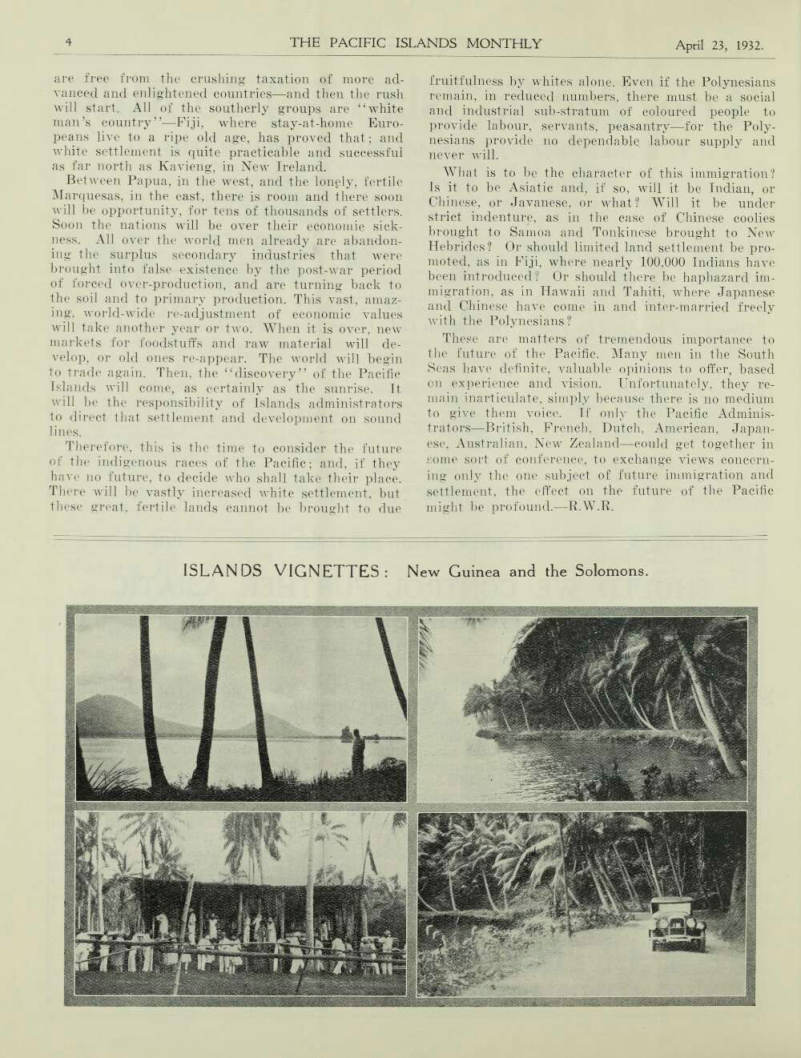
ISLANDS VIGNETTES: New Guinea and the Solomons.
“Old Bill” Of Papua.
A Goldfields Memory.
By Moni.
THE Great War was at its height when I landed in Port Moresby, I had no work in view there. I took a room at the Moresby Hotel. The town was dead, and the residents seemed to be suffering from chronic malaria or bad beer —the effects of which are similar in the Islands.
I sought work at several places. The Government told us that it had jobs only for soldiers, and the business people gave work only to natives. I was assured that an old man of 67, like me, would be better out of the Ter ritory.
I would soon show these people about the old man, I thought. I heard about the Yodda goldfield, and I decided to “waltz Matilda” there. When I reached the Owen Stanley range, about 7,000 feet high, some bush natives, thinking I was mad and might bring them bad luck, took my swag, and escorted me to the Government station at Kokoda, where I was hospitably received. The magistrate seemed also to conclude that I was an escaped lunatic when I told him of my lone journey without carriers or firearms. Anyway, he was a good chap, and made me have a bath and a good meal, which I needed badly. After a rest of three days, I felt no harm from my 76 miles’ journey over the mountains.
I felt fit to try my luck on the Yodda goldfields, 7 miles from the Kokoda station. The magistrate pro vided me with some food and carriers.
On arrival at Yodda, I went to the first house of native material. Two miners were seated at a table, with some bottles of rum and two tin pan nikins at hand. They were singing, with all their might— “"Drink and the devil have done for the rest: Yo ho! ho! and a bottle of rum.”
I was heartily welcomed, and in vited to stay “as long as I liked.”
After the rum was finished, we finished the party on paregoric, and felt bad for three days.
When we were all well again, “Old Bill,” the finest digger I have ever met in the bush, gave me four natives, and showed me a place where I might "“find grub.”
The first few weeks I made wages, and eventually I saved enough to go on to Edie Creek, in New Guinea, When it broke out, I did well.
Some few months ago, I met “Old Bill” again. He still believes in rum, and sings the old song from “Treasure Island.” I joined him again, drank to his future in O.P. rum, and sang in my best voice “Yo ho!”
The world is better for rum, if it keeps alive and happy such grand old pioneers as “Bill.”
Guinea.
An Aviator In New
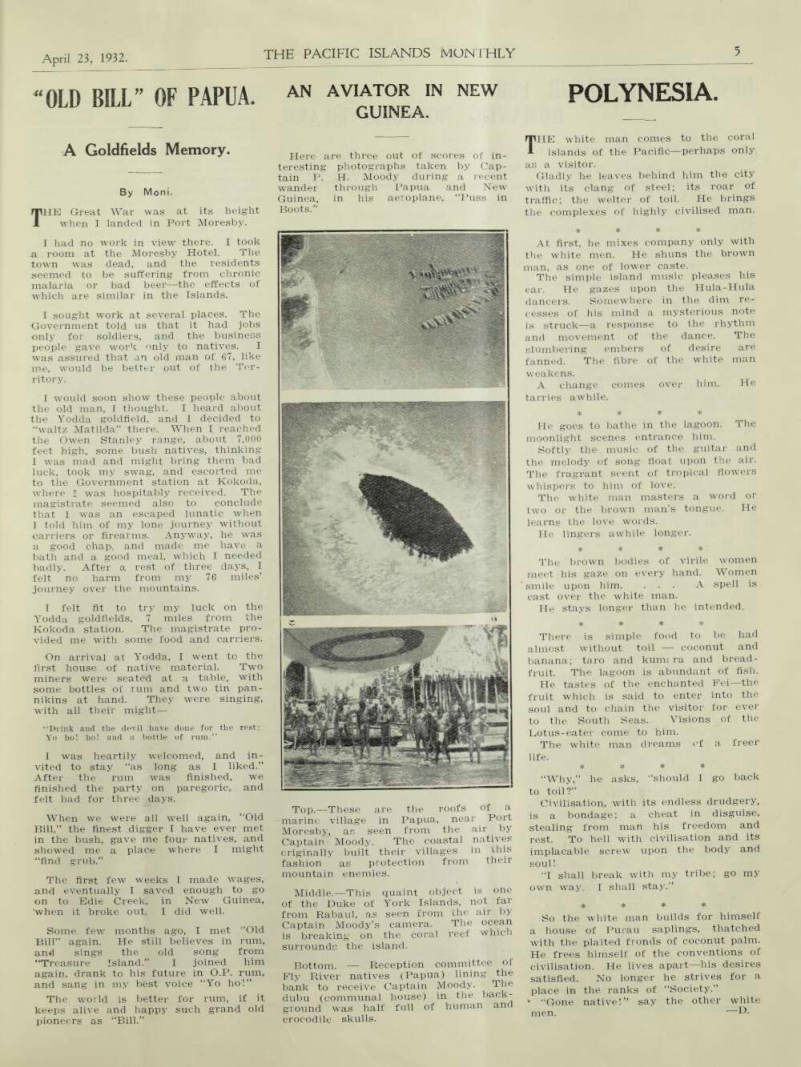
Here are three out of scores of in teresting photographs taken by Cap tain P. H. Moody during a recent wander through Papua and New Guinea, in his aeroplane, “Puss in Boots.”
Top.—These are the roofs of a marine village in Papua, near Port Moresby, as seen from the air by Captain Moody. The coastal natives originally built their villages in this fashion as protection from their mountain enemies.
Middle.—This quaint object is one of the Duke of York Islands, not far from Rabaul, as seen from the air by Captain Moody’s camera. The ocean is breaking on the coral reef which surrounds the island.
Bottom. Reception committee of Fly River natives (Papua) lining the bank to receive Captain Moody. The dubu (communal house) in the back ground was half full of human and crocodile skulls.
Polynesia.
THE white man comes to the coral islands of the Pacific —perhaps only as a visitor.
Gladly he leaves behind him the city with its clang of steel; its roar of traffic: the welter of toil. He brings the complexes of highly civilised man. * * * * At first, he mixes company only with the white men. He shuns the brown man, as one of lower caste.
The simple island music pleases his ear. He gazes upon the Hula-Hula dancers. Somewhere in the dim re cesses of his mind a mysterious note is struck —a response to the rhythm and movement of the dance. The slumbering embers of desire are fanned. The fibre of the white man weakens.
A change comes over him. He tarries awhile. * * * * He goes to bathe in the lagoon. The moonlight scenes entrance him.
Softly the music of the guitar and the melody of song float upon the air.
The fragrant scent of tropical flowers whispers to him of love.
The white man masters a word or two or the brown man’s tongue. He learns the love words.
He lingers awhile longer. * * * * The brown bodies of virile women meet his gaze on every hand. Women smile upon him. ... A spell is cast over the white man.
He stays longer than he intended. * * * * There is simple food to be had almost without toil—coconut and banana; taro and kumara and bread fruit. The lagoon is abundant of fish.
He tastes of the enchanted Fei—the fruit which is said to enter into the soul and to chain the visitor for ever to the South Seas. Visions of the Lotus-eater come to him.
The white man dreams of a freer life. * * * * “Why,” he asks, “should I go back to toil?”
Civilisation, with its endless drudgery, is a bondage: a cheat in disguise, stealing from man his freedom and rest. To hell with civilisation and its implacable screw upon the body and soul!
“I shall break with my tribe; go my own way. I shall stay.” * * * * So the white man builds for himself a house of Purau saplings, thatched with the plaited fronds of coconut palm.
He frees himself of the conventions of civilisation. He lives apart—his desires satisfied. No longer he strives for a place in the ranks of “Society.” * “Gone native!” say the other white men. —D.
New Administrator For
Romantic Norfolk Island.
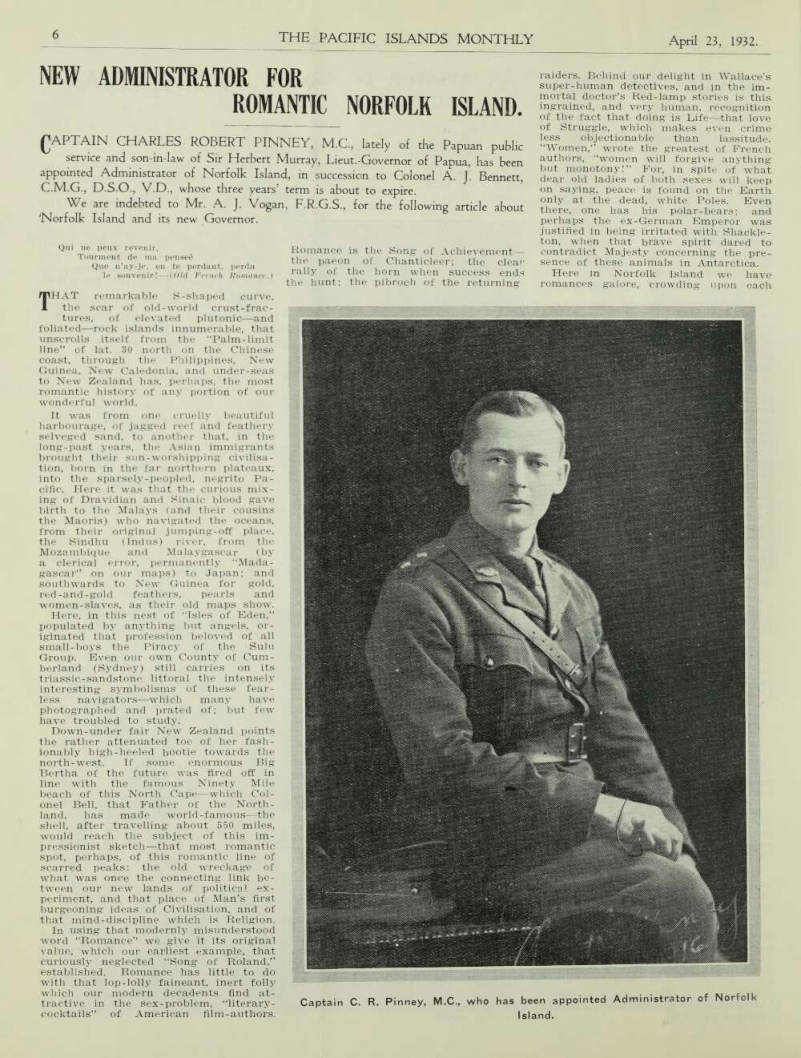
CAPTAIN CHARLES ROBERT PINNEY, M.C, lately of the Papuan public service and son-in-law of Sir Herbert Murray, Lieut.-Governor of Papua, has been appointed Administrator of Norfolk Island, in succession to Colonel A. J. Bennett, C.M.G., D.S.O., V.D., whose three years’ term is about to expire.
We are indebted to Mr. A. J. Vogan, F.R.G.S., for the following article about Norfolk Island and its new Governor.
Qui ne peux revenir, Tourment de ma penseé Que n’ay-je, en te perdant, perdu le souvenir!— (Old French Romance.) THAT remarkable S-shaped curve, the scar of old-world crust-frac tures, of elevated plutonic—and foliated —rock islands innumerable, that unscrolls itself from the “Palm-limit line" of lat. 30 north on the Chinese coast, through the Philippines, New Guinea, New Caledonia, and under-seas to New Zealand has, perhaps, the most romantic history of any portion of our wonderful world.
It was from one cruelly beautiful harbourage, of jagged reef and feathery selveged sand, to another that, in the long-past years, the Asian immigrants brought their sun-worshipping civilisa tion, born in the far northern plateaux, into the sparsely-peopled, negrito Pa cific. Here it was that the curious mix ing of Dravidian and Sinaic blood gave birth to the Malays (and their cousins the Maoris) who navigated the oceans, from their original jumping-off place, the Sindhu (Indus) river, from the Mozambique and Malaygascar (by a clerical error, permanently “Mada gascar" on our maps) to Japan; and southwards to New Guinea for gold, red-and-gold feathers, pearls and women-slaves, as their old maps show.
Here, in this nest of “Isles of Eden,” populated by anything but angels, or iginated that profession beloved of all small-boys the Piracy of the Sulu Group. Even our own County of Cum berland (Sydney) still carries on its triassic-sandstone littoral the intensely interesting symbolisms of these fear less navigators—which many have photographed and prated of; but few have troubled to study.
Down-under fair New Zealand points the rather attenuated toe of her fash ionably high-heeled bootie towards the north-west. If some enormous Big Bertha of the future was fired off in line with the famous Ninety Mile beach of this North Cape—which Col onel Bell, that Father of the North land, has made world-famous —the shell, after travelling about 550 miles, would reach the subject of this im pressionist sketch —that most romantic spot, perhaps, of this romantic line of scarred peaks: the old wreckage of what was once the connecting link be tween our new lands of political ex periment, and that place of Man’s first burgeoning ideas of Civilisation, and of that mind-discipline which is Religion.
In using that modernly misunderstood word “Romance" we give it its original value, which our earliest example, that curiously neglected “Song of Roland," established. Romance has little to do with that lop-lolly faineant, inert folly which our modern decadents find at tractive in the sex-problem, “literary cocktails" of American film-authors.
Romance is the Song of Achievement— the paeon of Chanticleer; the clea rally of the horn when success ends the hunt; the pibroch of the returning
raiders. Behind our delight in Wallace’s super-human detectives, and in the im mortal doctor’s Red-lamp stories is this ingrained, and very human, recognition of the fact that doing is Life—that love of Struggle, which makes even crime less objectionable than lassitude.
“Women," wrote the greatest of French authors, “women will forgive anything but monotony!" For, in spite of what dear old ladies of both sexes will keep on saying, peace is found on the Earth, only at the dead, white Poles, Even there, one has his polar-bears; and perhaps the ex-German Emperor was justified in being irritated with Shackle ton, when that brave spirit dared to contradict Majesty concerning the pre sence of these animals in Antarctica.
Here in Norfolk Island we have romances galore, crowding upon each
Captain C. R. Finney, M.C., who has been appointed Administrator of Norfolk Island.
other’s heels —Struggles; horrors of bleak convict days: North American whaler episodes; the great Bishop Sel wyn’s quarter of a century of Mission endeavour; the rendezvous of latter day Pacific pirates and cut-throats — the last of whom still resides (in the odour of sanctity) in New Zealand; and hardy ruffians who gave moonshine poison for stolen pearls and returned New Caledonian “fibres” and “recide vistes” “to their wives and their rela tions,’’ in spite of an exasperated gendarmerie.
Then again, to the westward, as if fencing off her Island-bashfulness from the uncouth, familiarity of her huge, hot neighbour Australia, are the ter rible, nightmare reefs and shoals of the Elizabeth and the Middleton, “where horror broods and mem’ry faints in dread" over countless sea-tragedies.
So it is most fitting that the Lyons government should have appointed for
so truly romantic a spot a new Admin istrator with a most delightfully inter esting and heroic past.
Captain Charles Robert Pinney, M.C., late Secretary for Lands and Director of Mines and Agriculture in Papua, was born in Ripponlea in Victoria, where his mother still lives —his father being dead. He has three brothers — one in business in Victoria.
Although I have known him so long I have never heard anything of what I am now going to relate; and probably the new Administrator (who is still up north) may not like my giving the pub lic what, like the typical Australian military hero he is, he never refers to in any way. I have discovered a letter signed by the great General Sir Wil liam Birdwood, directed to Captain Pinney. It says: “This is a letter to congratulate you most heartily upon the presen tation to you of the Military Cross, in recognition of your good work
during the operations near Zonne becke, on 26th of October. I know that you displayed great gallantry and skill in leading the attack in Decline Copse, and, although you were subjected to a severe shell-fire in forming up, you took the position without a hitch, and held it against a subsequent counter attack. Thank you so much for your good service!”
Captain Finney was with the 6th Battalion, A.I.F., and went in 1914 to the Great War, where he was wounded twice and took part in the Gallipoli affair —which, like the Charge of Bala clava, was at once an exhibition of supreme courage and endurance by soldiers and the muddled reasonings of over-fed politicians at Home.
“It was a dark and stormy night, when two travellers might have been descried” (here my appropriate quota tion must end) crossing the torpedo infested Channel towards war-dis tracted England in the year 1916. One of these was the daughter of our hon oured Lieut.-Governor of Papua, since then created a Knight-Commander, Sir J. H. P. Murray; she was leaving school to attend the wedding of her uncle, Major Murray, D.S.O., M.C., etc. The other passenger was Captain Pinney, aforesaid, who had received a command from the King to come and be con gratulated by his Majesty at Bucking ham Palace.
There were other passengers, no doubt; but, with the license of the raconteur, they remain in doubt whilst the “fierce fight that beats upon a throne,” or other prominently official position, touches the centre of the stage. I would like to dwell on the first meeting; and those that followed.
But the threatening blue-pencil pre cludes me from saying more than that the wedding took place on Janu ary 30, 1918; and the happy pair re turned to Australia in 1920. There are two children: one, Maura Desmond, who is devoted to her pony; and Peter, whose tastes lie, as is normal at his age, more towards a life among Sulu professionals, perhaps, than in any other known direction.
The new Administrator is a particu larly able bushman and mountaineer; and took the first woman to cross New Guinea —famous Miss Phillipa Bridges, of Devonshire, authoress of “A Walk About Papua”—from Port Moresby to Buna Bay—a great feat of endurance for them both.
Captain Pinney will take charge in Norfolk Island early next month; and, probably, Mrs. Pinney (who is devoted to horticulture) will reach Norfolk Is land a month later.
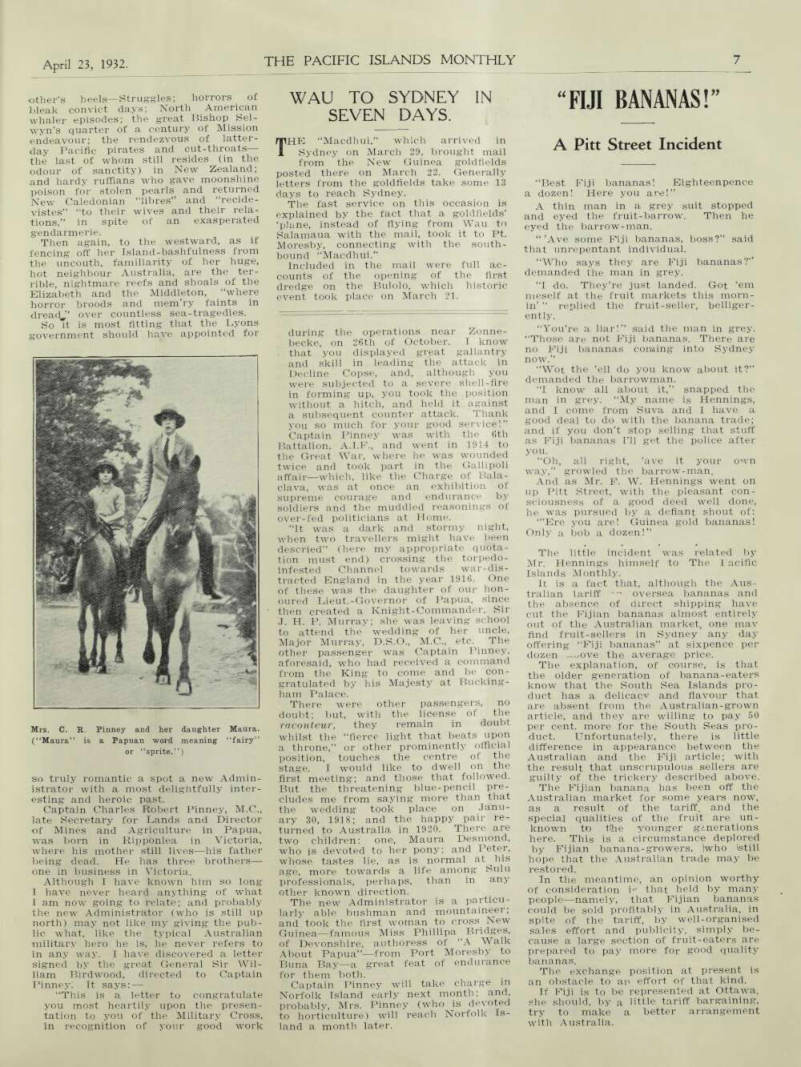
Mrs. C. R. Pinney and her daughter Maura. (“Maura” is a Papuan word meaning “fairy” or “sprite.”)
Wau To Sydney In
Seven Days.
THE “Macdhui,” which arrived in Sydney on March 29, brought mail from the New Guinea goldfields posted there on March 22. Generally letters from the goldfields take some 13 days to reach Sydney.
The fast service on this occasion is explained by the fact that a goldfields’ ’plane, instead of flying from Wau to Salamaua with the mail, took it to Pt.
Moresby, connecting with the south bound “Macdhui.”
Included in the mail were full ac counts of the opening of the first dredge on the Bulolo, which historic event took place on March 21.
“Fiji Bananas!”
A Pitt Street Incident
“Best Fiji bananas! Eighteenpence a dozen! Here you are!”
A thin man in a grey suit stopped and eyed the fruit-barrow. Then he eyed the barrow-man.
“ ’Ave some Fiji bananas, boss?” said that unrepentant individual.
“Who says they are Fiji bananas?” demanded the man in grey, “I do. They’re just landed. Got ’em meself at the fruit markets this morn in’ ” replied the fruit-seller, belliger ently.
“You’re a liar!” said the man in grey.
“Those are not Fiji bananas. There are no Fiji bananas coming into Sydney now.”
“Wot the ’ell do you know about it?” demanded the barrowman.
“I know all about it,” snapped the man in grey. “My name is Hennings, and I come from Suva and I have a good deal to do with the banana trade; and if you don’t stop selling that stuff as Fiji bananas I’ll get the police after you.
“Oh, all right, ’ave it your own way,” growled the barrow-man.
And as Mr. F. W. Hennings went on up Pitt Street, with the pleasant con sciousness of a good deed well done, he was pursued by a defiant shout of; “’Ere you are! Guinea gold bananas!
Only a bob a dozen!”
The little incident was related by Mr. Hennings himself to The Pacific Islands Monthly.
It is a fact that, although the Aus tralian tariff oversea bananas and the absence of direct shipping have cut the Fijian bananas almost entirely out of the Australian market, one may find fruit-sellers in Sydney any day offering “Fiji bananas” at sixpence per dozen the average price.
The explanation, of course, is that the older generation of banana-eaters know that the South Sea Islands pro duct has a delicacv and flavour that are absent from the Australian-grown article, and they are willing to pay 50 per cent, more for the South Seas pro duct. Unfortunately, there is little difference in appearance between the Australian and the Fiji article; with the result that unscrupulous sellers are guilty of the trickery described above.
The Fijian banana has been off the Australian market for some years now, as a result of the tariff, and the special qualities of the fruit are un known to tthe younger generations here. This is a circumstance deplored by Fijian banana-growers, who still hope that the Australian trade may be restored.
In the meantime, an opinion worthy of consideration P that held by many people—namely, that Fijian bananas could be sold profitably in Australia, in spite of the tariff, by well-organised sales effort and publicity, simply be cause a large section of fruit-eaters are prepared to pay more for good quality bananas.
The exchange position at present is an obstacle to an effort of that kind.
If Fiji is to be represented at Ottawa, she should, by a little tariff bargaining, try to make a better arrangement with Australia.
Tropicalities
THIS really happened.
Two traders and recruiters arrived in the port of Gizo (Solomon Is lands) and stocked up their vessel with both dry and liquid provisions, prepara tory to going on a recruiting trip.
After sampling the liquid provisions, to see if they were “fresh stock,” they they discovered that they had omitted to buy benzine, of which necessary commodity they had none. They re turned to the store and asked for sev eral cases—only to be told by the man ager that their credit was overdrawn and none could be supplied. Argument and appeal were in vain. After serious consultation, the two placed them selves outside the manager’s office and began to whistle, neither melodiously nor in tune.
The irate manager; “What are you whistling like that for?”
The benzineless ones: “Wind, of course!”
There was a short respite for re freshments to lubricate dry throats— then back to the office, to whistle for another hour.
The manager, savagely: “What are you still whistling for?”
The persistent ones; “More wind!”
“Oh, go inside and get your benzine!” cried the desperate manager, and slammed his office door.
Later, the benzined, alcoholic and victorious partners put out to sea. * * * WE were guilty, in the March issue, of a discourtesy towards that well known Pacific traveller and en thusiastic photographer, Mr. A. J.
Vogan, F.R.G.S. Mr. Vogan, at the cost of considerable personal trouble, supplied us with the photographs of Bourail (the New Caledonian town partly destroyed by the hurricane) and of Nukulau Island, Fiji—that beautiful picture which was reproduced on the front cover. The least we could do was to acknowledge those photographs as coming from Mr. Vogan—taut, through editorial inadvertence, this was not done. The omission is now remedied, though belatedly. Mr. Vogan is not only a well-known writer on economic and scientific subjects—he is also an old pressman, with a trained eye for news values in photographs. That particular eye has been put to good use in the South Seas. * * * THE editor of this journal acknow ledges, frankly and bitterly, that he was caught napping. There came to his hand a series of photo graphs, from an American agency, and labelled “Village Scenes in the Ellice Islands.” He selected one picture of merit, and it was placed on the front cover of the February issue. He had written reams about the Ellice Islands, at different times, and he ought to have known that no photograph show ing mountains in the background could possibly come from that group. None of the Ellice Islands rises more than a few feet above the sea. Yet the error was not noticed until a reproachful note came in from Mr. A. S. Fraser, of the motor ship “Ralum,” at Tarawa, pointing out that neither kava bowls nor mountains, —shown in the picture— were to be found in the Ellice group,
which Mr. Fraser has frequently visited. On further examination we are inclined to think the photograph was taken in Samoa or Hawaii. * * * A CORRESPONDENT who signs him self “Tulagi Tippler,” writes bit terly:— Drinks in the Solomon Island hostel ries still remain at Rolls-Royce prices, in spite of the fact that Ford salaries pay for them. To make matters worse, glasses are small and are filled—or not filled—in a manner well calculated to exclude waste by spilling—and break a man’s heart. This reminds me of the Englishman who had dined at a fashionable “slimming” restaurant.
“What did you have for dinner?” asked a friend, “Steak,” he replied.
“How did you find it?” “Oh, quite easily! I took up a Brussells sprout and there it was. What!” * * * * Thursday island is throwing out its collective chest and puffing with municipal pride at the fact that it now has electric light. Possibly the most remarkable thing about this in novation is that the new power-house has been installed completely free from debt, a thing which must make South ern aldermen perplexed by the worries of having to find interest charges on debenture issues, roll their eyes in en vious amazement. Most of the credit belongs to the Mayor, Alderman A.
Corran, who has battled indefatigably for this high-water mark of civic pro gress, and many T.I. housewives, form erly caught between the Scylla of the Alien Immigration Restriction Act and the Charybdis of the kerosene stove, now call him blessed. The jetty, along which one formerly felt one’s way in the murk of a tropical night at immin ent risk of a sudden plunge into the tepid waters of Port Kennedy, has be come a meeting-place which the en thusiastic residents in moments of an excess of exuberance, are now wont to liken to the Promenade des Anglaises at Nice. Most of all have the baths benefited and nowadays Islandites are able to enjoy those erratic tides which have a habit of rolling in unexpectedly in complete defiance of the erudite cal culations of the Hydrographic Survey.
Even the flying foxes have been sup plied with a new method of committing suicide and generally Thursday Island may be said definitely to have ad vanced. —Linda Burkitt. * * * * THE “colonel’s lady and Bridget O’Grady” met recently in Torres Straits. Separated from the main land by only three miles of sea, the island of Saibai is a tiny segment of New Guinea but just as completely iso lated from the outside world as though it were some remote mountain village up in the central ranges. The women on Saibai which is under Queensland rule so seldom see white visitors that when a party of four of us landed there recently from Thursday Island they were captivated by the smooth texture of the skins of those of their own sex.
They insisted on running their hands over our arms, while the writer, who was clad in shirt and shorts, took their interest especially. There was much
tittering- and many sidelong remarks in the local dialect, possibly not altogether of a complimentary nature, for the New Guinea native sees nothing more beau tiful in a white skin than a European woman sees in a dusky epidermis. But with those innate good manners which are so characteristic of the natives of New Guinea, they managed to give the appearance of admiration to what, in all probability, was only wonderment that any women could get along all right with such thin and fine skins.— Linda Burkitt.
IN some groups—and, notably, in the Solomons —the natives eagerly pur chase “flash calico” —that is, gaily decorated strips of cotton cloth for use as lava-lavas. Recently, Mr. Ken Bolton, of McLeod and Bolton Ltd., was in the Solomons, and his calcu lating eye noted that the supply of “flash calico” was a monopoly of the Chinese stores, and that as much as 7/- was paid for a vivid specimen.
Back in Sydney, Mr. Bolton launched himself upon certain factories, and dis covered that it was possible to pro duce these lava-lavas in bulk, with brilliant colours, at a mass production price. He made arrangements accord ingly, and now “Bolton’s Flash Calicos’” are going out into the Pacific in scores of dozens, at a c.i.f. price that brings joy to the hearts of the small traders.
Advance, Australia!
flight ever undertaken from Australia, excluding mail flights to England.
“We found the residents of the Is lands genuinely interested in aviation,” says Captain Moody, “and several transport schemes were discussed, to be advanced further when the depres sion has passed. Undoubtedly, the time will come when the aeroplane will speed up the communications in these Islands and become an accepted means of transport.”
Captain Moody has supplied us with a most interesting series of photo graphs, some of which are published herewith.
Advertisements & other items, p. 10 (1 item)
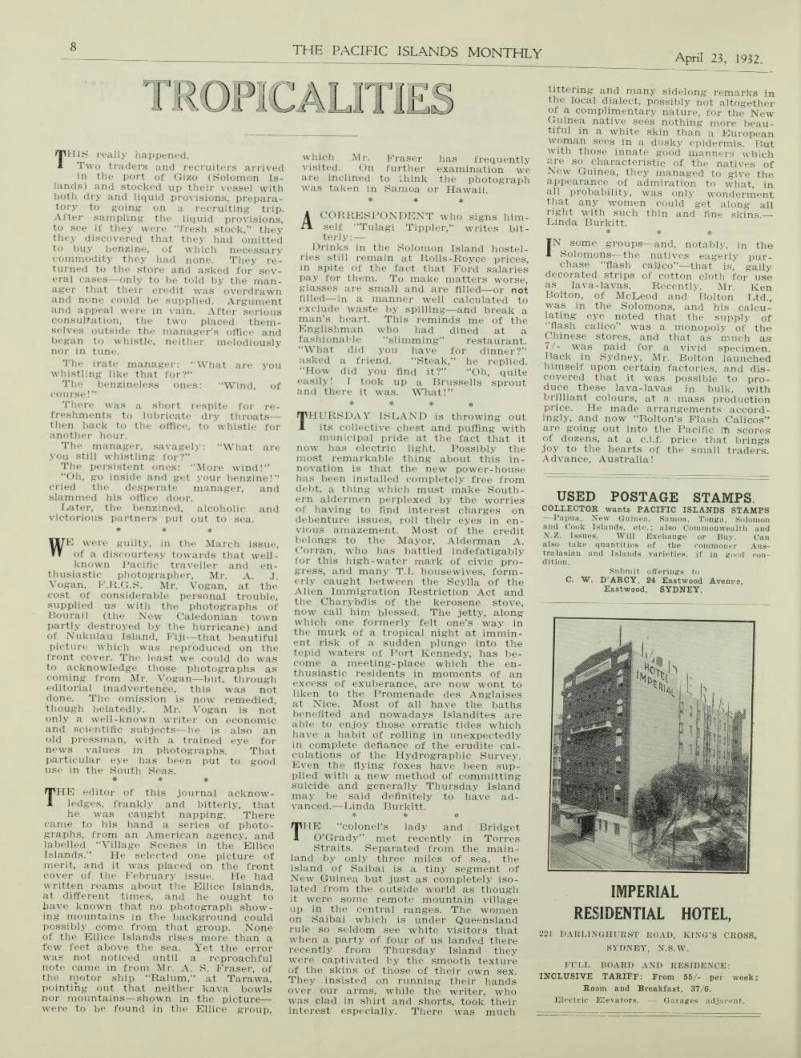
Residential Hotel,
USED POSTAGE STAMPS.
COLLECTOR wants PACIFIC ISLANDS STAMPS
—Papua, New Guinea, Samoa, Tonga, Solomon and Cook Islands, etc.; also Commonwealth and N.Z. Issues. Will Exchange or Buy. Can also take quantities of the commoner Aus tralasian and Islands varieties, if in good con dition.
Submit offerings to C. W. D’ARCY, 24 Eastwood Avenue, Eastwood, SYDNEY,
IMPERIAL
RESIDENTIAL HOTEL,
221 DARLINGHURST ROAD, KING’S CROSS,
SYDNEY, N.S.W.
FULL BOARD AND RESIDENCE:
INCLUSIVE TARIFF: From 65/- per week; Room and Breakfast, 37/6.
Electric Elevators. Garages adjacent.
Results At Bulolo.
“I am thoroughly satisfied with the results being obtained by the dredge,” said Mr. C. A. Banks, managing direc tor of Placer Development Ltd. and Bulolo Gold Dredging Ltd., on his ar rival in Sydney from New Guinea after attending the opening of the No. 1 Bu lolo dredge last month.
He stated that the bullion recovered is from 65 to 70 per cent, fine gold.
Goldfields Executives.
Among the arrivals by the “Montoro,” which reached Sydney on April 19, were Mr. and Mrs. C. A. Banks and Mr. L. V. Waterhouse. Mr. Banks is managing director of Placer Develop ment Ltd. and Bulolo Gold Dredging Ltd., and Mr. Waterhouse is a techni cal director of those companies. Mr.
T. D. Harris, general manager of both Placer and Bulolo, was also a passen ger. On reaching Sydney, he immedi ately left on the “Sonoma” on a hur ried visit to San Francisco. Mr. F, W.
R. Godden, field engineer for Placer, came South by the “Montoro” on fur lough.
Services Re-arranged.
Inter-Island Ships.
REFERENCE was made in last issue to a probable re-arrangement of the Inter-Island services controlled by Messrs. Burns, Philp (S.S.) Co. Ltd.
The Company’s contract with the Fijian Government, to maintain a fort nightly inter-island service, has ex pired. As a result, the “Makatea” has been withdrawn altogether; the “Ma koa” has been transferred to Samoa, to carry on a service in that and adjoin ing groups; and the “Malake” will continue to provide a service in Fiji.
The “Ralum,” which was recently brought from New Guinea to Suva and re-conditioned, is to carry on a regular service in the Gilbert and Ellice groups, with Tarawa as headquarters.
Fuller particulars will be found in cur shipping columns.
Known For 60 Years.
The Sydney Meat Preserving Co. Ltd. have laeen packing canned meats at their Auburn (New South Wales) Works for 60 years. The brand, which is renowned for its quality, is well-known to Island traders. In addition to the Island pack, they specialise in fancy meats for European use, such as Chicken in Jelly.
Rabbit in Jelly, Tripe in Milk, Sheep and Ox Tongues, and various other lines. A cordial Invitation is extended to visitors to Sidney to inspect the works and see the meats being packed.
Gold Prospecting.
Ion Idriess’s New Book.
We have received a copy of the en larged edition of Ion Idriess’s book, “Prospecting for Gold: Alluvial —Reef ing—Opals.” It should be of greatly added interest to the New Guinea miners, as it comprises reef-mining from the “dolly-pot to the stamper battery.”
As New Guinea looks to be a reefing field as well as alluvial, and as prac tically all the men over there are al luvial, a book which specialises in reef ing as well should be of particular in terest to them. There are chapters on reefing, the erecting of a 5-head stamper battery, amalgamation, treat ment of plates, cleaning up, retorting, right to the smelting of the gold. The chapters on the erection of a stamper battery, should alone be of interest to mining men operating in a country under pioneer conditions. It explains how they can erect their own battery, Svhereas it is generally thought that the erection of a battery is a job only capable of being performed by engin eers. The battery described, by the way, is at present operating in the Coramba district, N.S.W., where it was erected single-handed by “Lige” Hen derson, a well-known identity in the N.S.W. mining world.
In this enlarged edition there are chapters describing opal mining (light and black) from the prospecting, work ing, gouging, classing, facing, valuing, to the selling.
Campaign Against
Yaws.
Generous Assistance of Rocke feller Foundation.
From Our Own Correspondent.
APIA, March 31.
DR. S. M. LAMBERT, the well-known medical representative of the Rockefeller Foundation, who has paid several visits to Samoa, arrived a few weeks ago to start a widespread and energetic campaign against yaws — a disease prevalent amongst the Sam oans.
Dr. Lambert conducted a successful campaign for the eradication of hook worm m Samoa several years ago, which —as is the case with the present yaws campaign—was made possible through the liberal financial support of the Rockefeller Foundation.
The scheme, as expounded by Dr.
Lambert in an appeal to the natives, is to give mass treatment free of charge, not only to children but also to adults.
As Dr. Lambert explains further: “Yaws is the greatest cause of infant mortality, as well as of general sick ness among the native races of the Pacific.”
The campaign will be conducted in co-operation with the Chief Medical Officer of the Samoan Administration, Dr. E. Hunt, the Administration bear ing half the expenses with the Rocke feller Foundation. It is hoped that, as in other South Sea islands, the dread disease will be, if not wholly eradi cated, at least diminished to a degree when it can be handled easily.
Advertisements & other items, p. 11 (1 item)
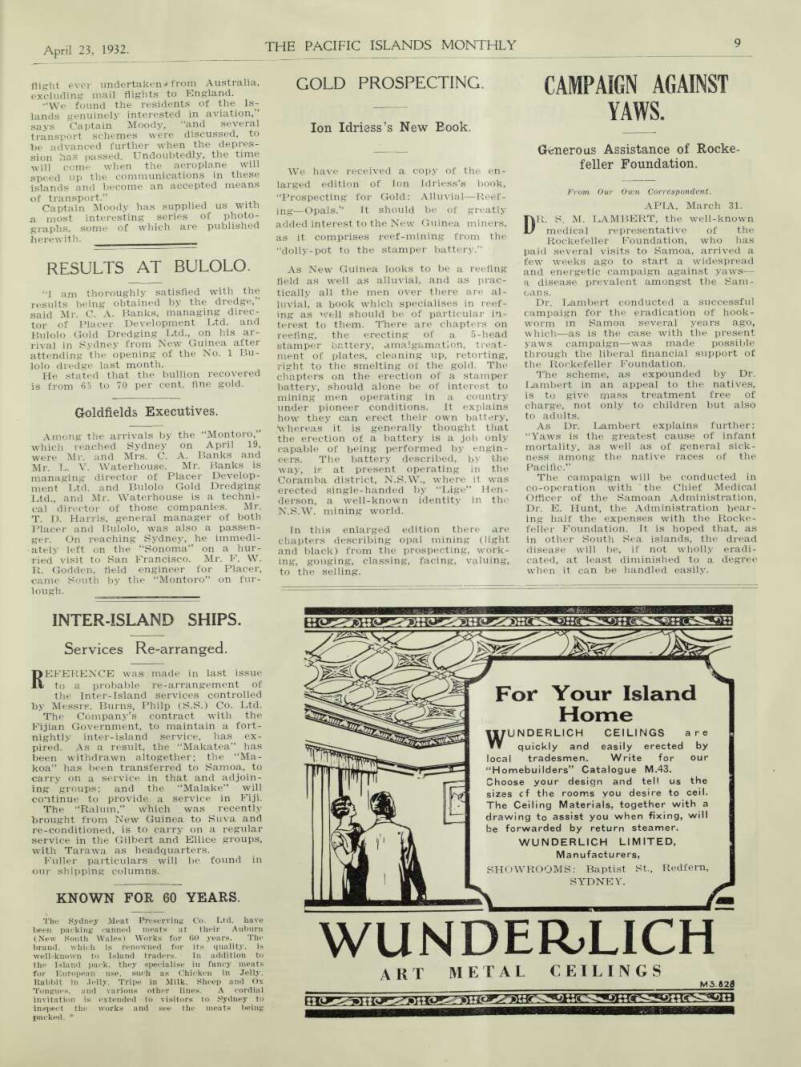
Wunderlich
For
Your Island
Home
CEILINGS are
easily erected by our
ERLICH
quickly and local tradesmen. Write for “Homebuilders” Catalogue M. 43.
Choose your design and tell us the sizes of the rooms you desire to ceil.
The Ceiling Materials, together with a drawing to assist you when fixing, will be forwarded by return steamer.
WUNDERLICH LIMITED,
Manufacturers, SHOWROOMS: Baptist St., Redfern,
SYDNEY.
WUNDERLICH
art metal ceilings
M3.62J
Captain Moody Flies 20,000 Miles—
Aerial Tour In New Guinea.
IT is inevitable that the seaplane will play an important part in the future development of the Pacific Islands groups and territories. It is the obvious vehicle of communication between islands scattered over comparatively calm seas, in a region where coal and petrol are necessarily costly. The low prices of Islands products , with re stricted spending power, are retarding this form of enterprise for the present, but when economic stability returns there is going to be a remarkable de mand for aeroplanes and seaplanes for the Pacific.
IN view of these things, the recent aerial tour of Papua and New Guinea, made by Captain P. H.
Moody, a well-known Sydney pilot, is full of interest. Captain Moody, for a time, did pioneer work in the air trans port service between Lae and the Bulolo goldfield. Unfortunately, through an accident, the Ryan monoplane he was flying crashed into Huon Gulf, and was lost; and he returned to Australia.
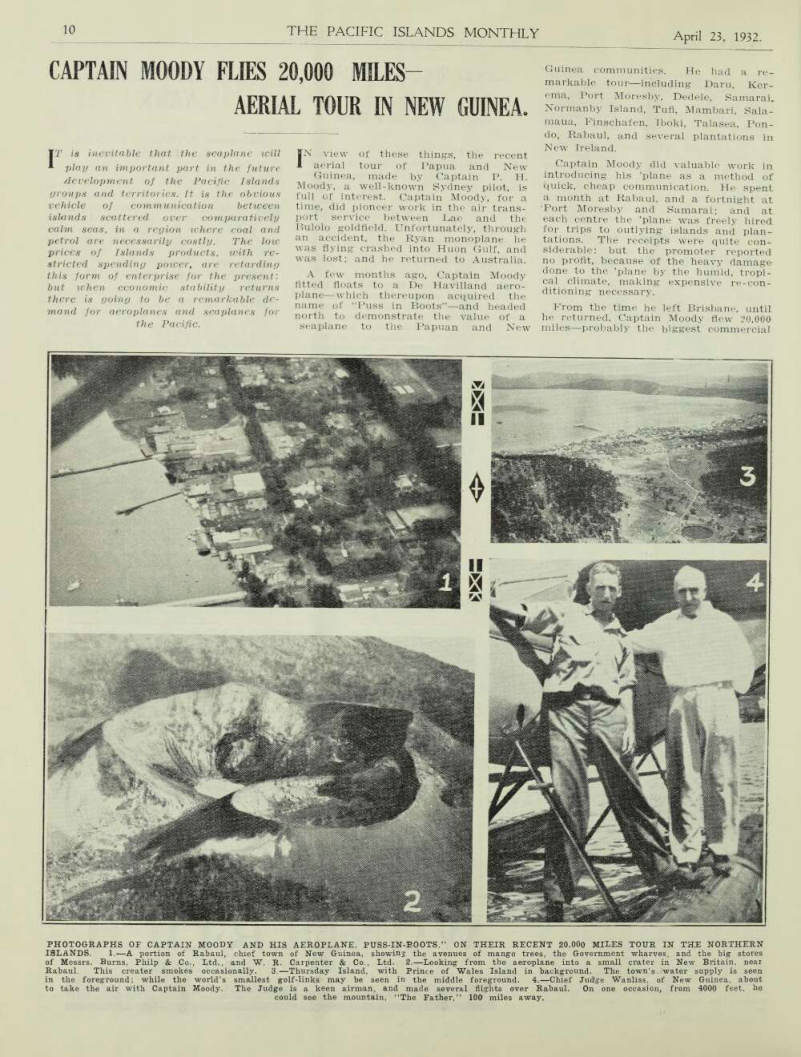
A few months ago, Captain Moody fitted floats to a De Havilland aero plane which thereupon acquired the name of "Puss in Boots”— and headed north to demonstrate the value of a seaplane to the Papuan and New
Guinea communities. He had a re markable tour —including- Daru, Ker ema, Port Moresby, Dedele, Samarai, Normanby Island, Tufi, Mambari, Sala maua, Finschafen, Iboki, Talasea, Pon do, Rabaul, and several plantations in New Ireland.
Captain Moody did valuable work in introducing his ’plane as a method of quick, cheap communication. He spent a month at Rabaul, and a fortnight at Port Moresby and Samarai; and at each centre the ’plane was freely hired for trips to outlying islands and plan tations. The receipts were quite con siderable: but the promoter reported no profit, because of the heavy damage done to the ’plane by the humid, tropi cal climate, making expensive re-con ditioning necessary.
From the time he left Brisbane, until he returned, Captain Moody flew 20,000 miles —probably the biggest commercial
PHOTOGRAPHS OF CAPTAIN MOODY AND HIS AEROPLANE, PUSS-IN-BOOTS,” ON THEIR RECENT 20,000 MILES TOUR IN THE NORTHERN ISLANDS, 1.—A portion of Rabaul, chief town of New Guinea, showing the avenues of mango trees, the Government wharves, and the big stores of Messrs. Burns, Philp & Co., Ltd., and W. R. Carpenter & Co., Ltd. 2.—Looking from the aeroplane into a small crater in New Britain, near Rabaul. This creater smokes occasionally. 3.—Thursday Island, with Prince of Wales Island in background. The town's water supply is seen in the foreground: while the world’s smallest golf-links may be seen in the middle foreground. 4.—Chief Judge Wanliss, of New Guinea, about to take the air with Captain Moody. The Judge is a keen airman, and made several flights over Rabaul. On one occasion, from 4000 feet, he could see the mountain, “The Father,” 100 miles away.
Death Of D. M.
Forsyth
Well-known New Guinea Planter.
NEWS of the death in Sydney of Mr.
D. M. Forsyth—a prominent resi dent of New Guinea —will be re ceived with great regret throughout the Territory. Mr. Forsyth, during his ten years there, had made many friends, to all of whom he was popu larly known as “Dad.” Of late, he had done invaluable work in the interests of the returned soldier settlers. He took a keen, helpful interest in public affairs.
Injuries received at the war had seriously undermined Mr. Forsyth’s health, and he recently came to Syd ney from Rabaul to consult a special ist. He was operated on at a private hospital, but never recovered, his death occurring on March 31.
Mr. Forsyth, who was about 55 years old, was a native of New Zealand. For some time he was an accountant at tached to an insurance company in the Dominion, and later came to Australia.
With the outbreak of War he enlisted and, while serving in France as a Lieutenant with the 19th Battalion, A.I.F., he was severely wounded.
He arrived in Rabaul in 1922 and joined the Expropriation Board as ac countant. Subsequently, he resigned from the Board and became secretary of the New Guinea Club, Rabaul. Sub sequently, he established himself as a public accountant in the town. When the coconut plantations were offered for sale by the Board, Mr. Forsyth ac quired Muschu Plantation, on the mainland of New Guinea, between Ai tape and Madang. Latterly, with Mr.
N. O’Dwyer, he took up Gavit Planta tion, in the Baining District of New Britain. He also acquired Galtum Plantation in the same district. Inci dentally, the product of Mr. Forsyth’s Gavit Plantation was recently selected by the New Guinea Department of Agriculture to go to a special exhibi tion in London, as a first-class sample of hot-air (Chula) dried copra.
Last year, as President of the New Guinea Returned Soldiers’ League, Mr.
Forsyth visited Australia to seek from the Federal Government some further relief for planters, on account of the low price of copra. His efforts were successful, for last June the Federal authorities announced that the mora torium for payments on “expropriated” plantations would be extended for an other year.
Mr„ Forsyth is survived by his wife, who is also well-known in the Terri tory.
The remains were cremated at Rook wood. Among those present were the Federal Minister for Health (Mr.
Marr), Colonel W. McKenzie, Colonel A. W. Hyman, Lieut.-Colonel H. B.
Taylor. Major W. J. Sherbon, Captain A. E. Dent, Captain W. P. C. Andrew, and Messrs. A. T. Carpenter, G. A. Gill, H. J. Aylward, R. G. Horniman, and R. Verney.
Cricket Ball
Throwing
Where Natives Excel.
IN the February issue, our Cook Is lands correspondent mentioned that at a recent sports meeting- at Raro tonga a native created a local record by throwing- a cricket ball 105 yards, and our correspondent wondered how this compared with competitions elsewhere.
Mr. B. G. Challis, of Salamaua, New Guinea, has kindly supplied us with interesting- information on the subject.
The world’s record throw is 140 yards 2 feet, and it was established by R.
Percival on Durham Sands racecourse, in 1884. An Australian aboriginal, King Billy, is credited with a throw of 140 yards.
Natives seem to specialise at this kind of sport, for Mr. Challis considers that one of the best cricket-ball throwers in the world to-day is a New Ireland schoolboy named Lauki, who attends the Government native school at Rabaul. This boy, at the annual sports meeting last December threw a ball 126 yards.
A similar event for Europeans at the Caledonian sports meeting at Rabaul on last New Year’s day was won with a throw of 104 yards.
Advertisements & other items, p. 13 (1 item)
Paint
C. S. SMITH,
4 Bridge Street,
SYDNEY,
One of the oldest established Brokers operating in the South Seas.
Is prepared to accept addi tional Buying Agencies for the Exportation of General Merchandise and Stores, also Importation of Island Produce.
Correspondence is invited, and should be addressed to—
Box 2841 N, G.P.O.,
Sydney.
Registered Telegraphic Address:
“LUTMIS, SYDNEY.”
Telephone Number: BW 6953.
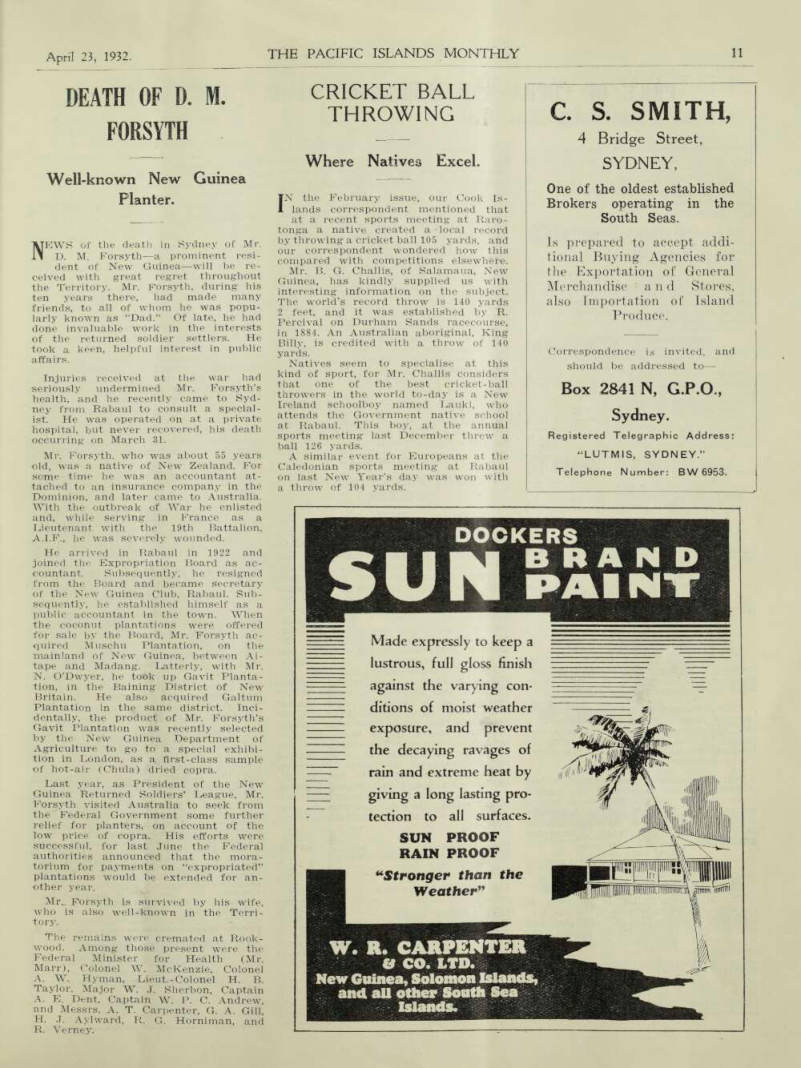
DOCKERS
SUN
BRAND
PAINT
Made expressly to keep a lustrous, full gloss finish
against the varying con
ditions of moist weather exposure, and prevent the decaying ravages of rain and extreme heat by
giving a long lasting pro
tection to all surfaces.
SUN PROOF
RAIN PROOF
“Stronger than the Weather"
W. R. CARPENTER
& CO. LTD.
New Guinea, Solomon Islands, and all other South Sea
Price Of Copra And Exchange.
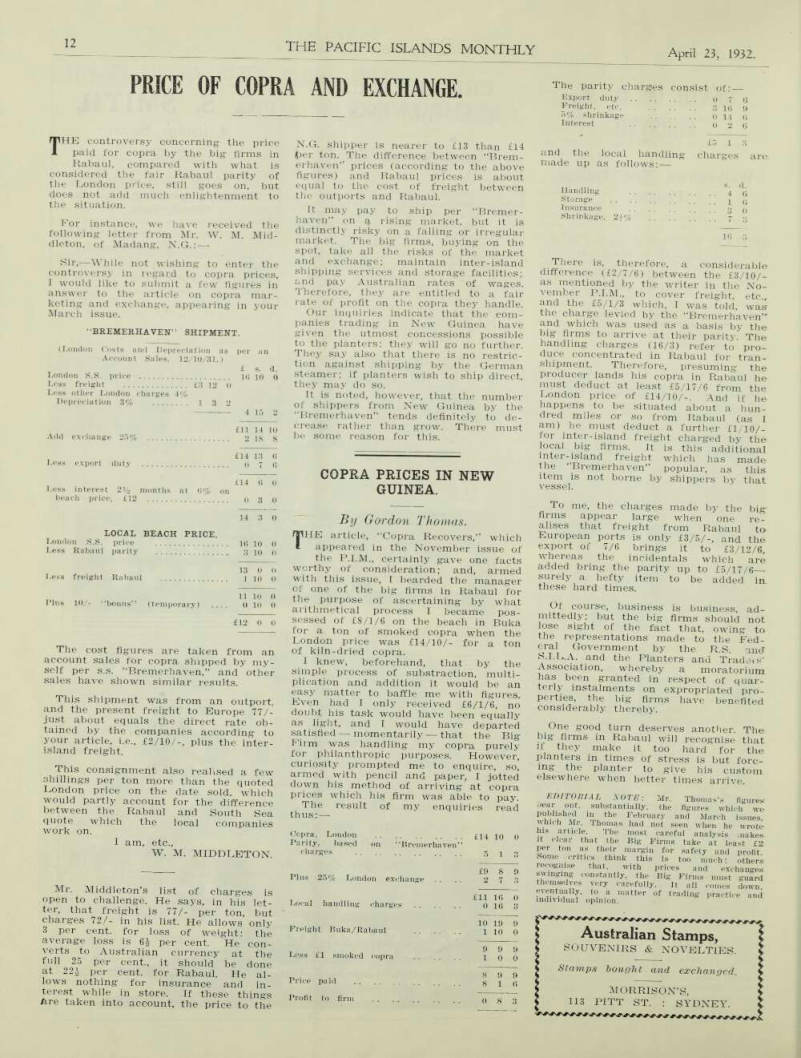
THE controversy concerning the price paid for copra by the big firms in Rabaul, compared with what is considered the fair Rabaul parity of the London price, still goes on, but does not add much enlightenment to the situation.
For instance, we have received the following letter from Mr. W. M. Mid dleton, of Madang, N.G.;— Sir, —While not wishing to enter the controversy in regard to copra prices, I would like to submit a few figures in answer to the article on copra mar keting and exchange, appearing in your March issue.
“Bremerhaven" Shipment.
(London Costs and Depreciation as per an Account Sales, 12/10/31.)
The cost figures are taken from an account sales for copra shipped by my self per s.s. “Bremerhaven,” and other sales have shown similar results.
This shipment was from an outport, and the present freight to Europe 77/just about equals the direct rate ob tained by the companies according to your article, i.e., £2/10/-, plus the inter island freight.
This consignment also realised a few shillings per ton more than the quoted London price on the date sold, which would partly account for the difference between the Rabaul and South Sea quote which the local companies work on.
I am, etc.,
W. M. Middleton.
Mr. Middleton’s list of charges is open to challenge. He says, in his let ter, that freight is 77/- per ton, but charges 72/- in his list. He allows only 3 per cent, for loss of weight: the average loss is 6i per cent. He con verts to Australian currency at the full 25 per cent, it should be done at 22½ per cent, for Rabaul. He al lows nothing for insurance and in terest while in store. If these things tire taken into account, the price to the
N.G. shipper is nearer to £13 than £14 per ton. The difference between “Brem erhaven” prices (according to the above figures) and Rabaul prices is about equal to the cost of freight between the outports and Rabaul.
It may pay to ship per “Bremer haven” on % rising market, but it is distinctly risky on a falling or irregular market. The big firms, buying on the spot, take all the risks of the market and exchange; maintain inter-island shipping services and storage facilities; and pay Australian rates of wages.
Therefore, they are entitled to a fair rate of profit on the copra they handle.
Our inquiries indicate that the com panies trading in New Guinea have given the utmost concessions possible to the planters: they will go no further.
They say also that there is no restric tion against shipping by the German steamer; if planters wish to ship direct, they may do so.
It is noted, however, that the number of shippers from New Guinea by the “Bremerhaven” tends definitely to de crease rather than grow. There must be some reason for this.
£ s. d.
London S.S. price 10 0 Less freight . . . . 0 Less other London charges 4% Depreciation 3% 1 3 2 — 4 15 2 £11 14 10 Add exchange 25% 9 18 8 £14 13 6 Less export duty 7 0 £14 6 0 Less interest 2 1 /, months at 6% on beach price, £12 3 0 14 3 0
Local
Beach Price.
London S.S. price 10 0 Less Rabaul parity 10 0 13 0 0 Less freight Rabaul 10 0 11 10 0 Pins 10/- “bonus” (temporary) 0 10 0 £12 0 0
By Gordon Thomas.
Copra Prices In New
Guinea.
THE article, “Copra Recovers,” which appeared in the November issue of the P.I.M., certainly gave one facts worthy of consideration; and, armed with this issue, I bearded the manager of one of the big firms in Rabaul for the purpose of ascertaining by what arithmetical process I became pos sessed of £8/1/6 on the beach in Buka for a ton of smoked copra when the London price was £l4/10/- for a ton of kiln-dried copra.
I knew, beforehand, that by the simple process of substraction, multi plication and addition it would be an easy matter to baffle me with figures.
Even had I only received £6/1/6, no doubt his task would have been equally as light, and I would have departed satisfied momentarily that the Big Firm was handling my copra purely for philanthropic purposes. However, curiosity prompted me to enquire, so, armed with pencil and I jotted down his method of arriving at copra prices which his firm was able to pay.
The result of my enquiries read thus:
and the local handling charges are made up as follows:
There is, therefore, a considerable difference (£2/7/6) between the £3/10/as mentioned by the writer in the No vember P.I.M., to cover freight, etc., and the £5/1/3 which, I was told, was the charge levied by the “Bremerhaven’' and which was used as a basis by the big firms to arrive at their parity. The handling charges (16/3) refer to pro duce concentrated in Rabaul for tran shipment. Therefore, presuming the producer lands his copra in Rabaul he must deduct at least £5/17/6 from the London price of £14/10/-. And if he happens to be situated about a hun dred miles or so from Rabaul (as I am) he must deduct a further £1/10/for inter-island freight charged by the local big firms. It is this additional inter-island freight which has made the ‘Bremerhaven” popular, as this item is not borne by shippers by that vessel.
To me, the charges made by the big firms appear large when one re alises that freight from Rabaul to European ports is only £3/5/-, and the export of 7/6 brings it to £3/12/6, whereas the incidentals which are added bring the parity up to £5/17/6 — surely a hefty item to be added in these hard times.
Of course, business is business, ad mittedly; but the big firms should not lose sight of the fact that, owing to the representations made to the Fed eral Government by the R.S. and S.I.L.A. and the Planters and Traders' Association, whereby a moratorium has been granted in respect of quar terly instalments on expropriated pro perties, the big firms have benefited considerably thereby.
One good turn deserves another. The big firms in Rabaul will recognise that if they make it too hard for the planters in times of stress is but forc ing the planter to give his custom elsewhere when better times arrive.
EDITORIAL NOTE : Mr. Thomas’s figures bear out, substantially, the figures which we published in the February and March issues, which Mr. Thomas had not seen when he wrote his article. The most careful analysis makes it clear that the Big Firms take at least £2 per ton as their margin for safety and profit.
Some critics think this is too much: others recognise that, with prices and exchanges swinging constantly, the Big Firms must guard themselves very carefully. It all comes down, eventually, to a matter of trading practice and individual opinion.
Copra, London Parity, based on “Bremerhaven” £14 10 0 charges 5 1 3 Pins 25% London exchange £9 8 9 2 7 Local handling charges £11 16 0 0 16 3
Freight Buka/Rabaul
10 19 9 1 10 0 9 9 9 Less £1 smoked copra 1 0 0 8 9 9 Price paid 8 1 6 Profit to firm 0 8 3
The parity charges consist of: — Export duty 0 7 6 Freight, etc. 3 16 9 5% shrinkage 0 1-16 Interest 0 2 6 £5 1 3
s - d- Handling 4 Storage 16 Insurance ... 30 Shrinkage, 21% . . 70 16 3
Advertisements & other items, p. 14 (1 item)
Australian Stamps,
SOUVENIRS & NOVELTIES.
Stamps bought and exchanged.
MORRISON’S,
113 PITT ST. : SYDNEY.
Author Of “White Shadows” Is Dead.
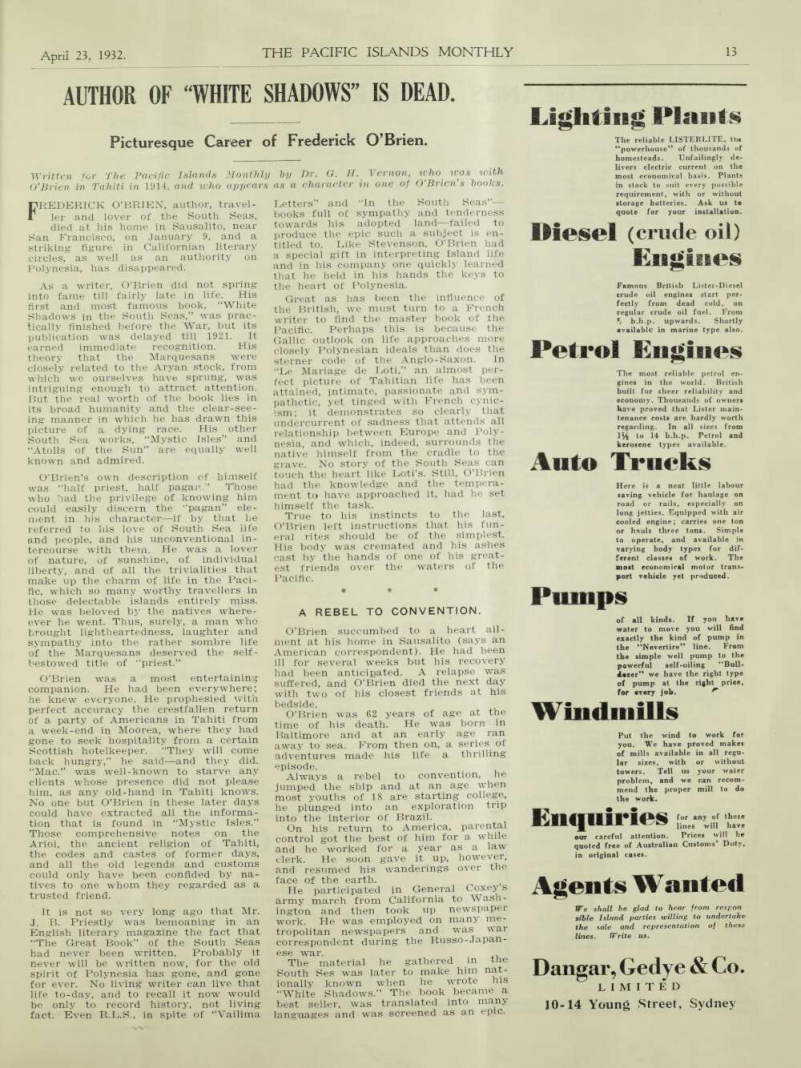
Picturesque Career of Frederick O’Brien.
Written for The Pacific Islands Monthly by Dr. G. H. Vernon, who was with O'Brien in Tahiti in 1914, and who appears as a character in one of O’Brien's books.
FREDERICK O’BRIEN, author, travel ler and lover of the South Seas, died at his home in Sausalito, near San Francisco, on January 9, and a striking figure in Californian literary circles, as well as an authority on Polynesia, has disappeared.
As a writer, O’Brien did not spring into fame till fairly late in life. His first and most famous book, “White Shadows in the South Seas,” was prac tically finished before the War, but its publication was delayed till 1921. It earned immediate recognition. His theory that the Marquesans were closely related to the Aryan stock, from which we ourselves have sprung, was intriguing enough to attract attention.
But the real worth of the book lies in its broad humanity and the clear-see ing manner in which he has drawn this picture of a dying race. His other South Sea works, “Mystic Isles” and “Atolls of the Sun” are equally well known and admired.
O’Brien’s own description of himself was “half priest, half pagan.” Those who had the privilege of knowing him could easily discern the “pagan” ele ment in his character —if by that he referred to his love of South Sea life and people, and his unconventional in tercourse with them. He was a lover of nature, of sunshine, of individual liberty, and of all the trivialities that make up the charm of life in the Paci fic, which so many worthy travellers in those delectable islands entirely miss.
He was beloved by the natives where ever he went. Thus, surely, a man who brought lightheartedness, laughter and sympathy into the rather sombre life of the Marquesans deserved the self bestowed title of “priest.”
O’Brien was a most entertaining companion. He had been everywhere; he knew everyone. He prophesied with perfect accuracy the crestfallen return of a party of Americans in Tahiti from a week-end in Moorea, where they had gone to seek hospitality from a certain Scottish hotelkeeper. “They will come back hungry,” he said —and they did.
“Mac.” was well-known to starve any clients whose presence did not please him, as any old-hand in Tahiti knows.
No one but O’Brien in these later days could have extracted all the informa tion that is found in “Mystic Isles.”
Those comprehensive notes on the Arioi, the ancient religion of Tahiti, the codes and castes of former days, and all the old legends and customs could only have been confided by na tives to one whom they regarded as a trusted friend.
It is not so very long ago that Mr.
J. B. Priestly was bemoaning in an English literary magazine the fact that “The Great Book” of the South Seas had never been written. Probably it never will be written now, for the old spirit of Polynesia has gone, and gone for ever. No living writer can live that life to-day, and to recall it now would be only to record history, not living fact. Even R.L.S., in spite of “Vailima
Letters” and ‘‘In the South Seas” — books full of sympathy and tenderness towards his adopted land —failed to produce the epic such a subject is en titled to. Like Stevenson, O’Brien had a special gift in interpreting Island life and in his company one quickly learned that he held in his hands the keys to the heart of Polynesia.
Great as has been the influence of the British, we must turn to a French writer to find the master book of the Pacific. Perhaps this is because the Gallic outlook on life approaches more closely Polynesian ideals than does the sterner code of the Anglo-Saxon. In “Le Manage de Loti,” an almost per fect picture of Tahitian life has been attained, intimate, passionate and sym pathetic, yet tinged with French cynic ism; it demonstrates so clearly that undercurrent of sadness that attends all relationship between Europe and Poly nesia, and which, indeed, surrounds the native himself from the cradle to the grave. No story of the South Seas can touch the heart like Loti’s. Still, O’Brien had the knowledge and the tempera ment to have approached it, had he set himself the task.
True to his instincts to the last, O’Brien left instructions that his fun eral rites should be of the simplest.
His body was cremated and his ashes cast by the hands of one of his great est friends over the waters of the Pacific.
A Rebel To Convention.
O’Brien succumbed to a heart ail ment at his home in Sausalito (says an American correspondent). He had been ill for several weeks but his recovery had been anticipated. A relapse was suffered, and O’Brien died the next day with two of his closest friends at his bedside.
O’Brien was 62 years of age at the time of his death. He was born in Baltimore and at an early age ran away to sea. From then on, a series of adventures made his life a thrilling episode.
Always a rebel to convention, he jumped the ship and at an age when most youths of 18 are starting college, he plunged into an exploration trip into the interior of Brazil.
On his return to America, parental control got the best of him for a while and he worked for a year as a law clerk. He soon gave it up, however, and resumed his wanderings over the face of the earth.
He participated in General Coxey s army march from California to Wash ington and then took up newspaper work. He was employed on many me tropolitan newspapers and was war correspondent during the Russo-Japan ese war.
The material he gathered in the South Ses was later to make him nat ionally known when he wrote his “White Shadows.” The book became a best seller, was translated into many languages and was screened as an epic.
Advertisements & other items, p. 15 (1 item)
Lighting Plasits
The reliable LISTERLITE, the “powerhouse” of thousands of homesteads. Unfailingly de livers electric current on the most economical basis. Plants in slock to suit every possible requirement, with or without storage batteries. Ask us to quote for your installation.
Diesel (crude oil)
Engines
Famous British Lister-Diesel crude oil engines start per fectly from dead cold, on regular crude oil fuel. From ½ b.h.p. upwards. Shortly available in marine type also.
Petrol Engines
The most reliable petrol en gines in the world. British built for sheer reliability and economy. Thousands of owners have proved that Lister main tenance costs are hardly worth regarding. In all sizes from to 14 b.h.p. Petrol and kerosene types available.
Auto Trucks
Here is a neat little labour saving vehicle for haulage on road or rails, especially on long jetties. Equipped with air cooled engine; carries one ton or hauls three tons. Simple to operate, and available in varying body types for dif ferent classes of work. The most economical motor trans port vehicle yet produced.
Pumps
of all kinds. If yon have water to move you will find exactly the kind of pump in the “Nevertire” line. From the simple well pump to the powerful self-oiling "Bulldozer” we have the right type of pump at the right price, for every job.
Windmills
Put the wind to work for you. We have proved makes of mills available in all regu lar sizes, with or without towers. Tell us your water problem, and we can recom mend the proper mill to do the work.
Enquiries for any of these lines will have our careful attention. Prices will be quoted free of Australian Customs’ Duty, in original cases.
Agents Wauted
We shall be glad to hear from respon sible Island parties willing to undertake the sale and representation of these lines. Write us.
Dangar, Gedye & Co.
LIMITED
10-14 Young Street, Sydney
About Islands People.
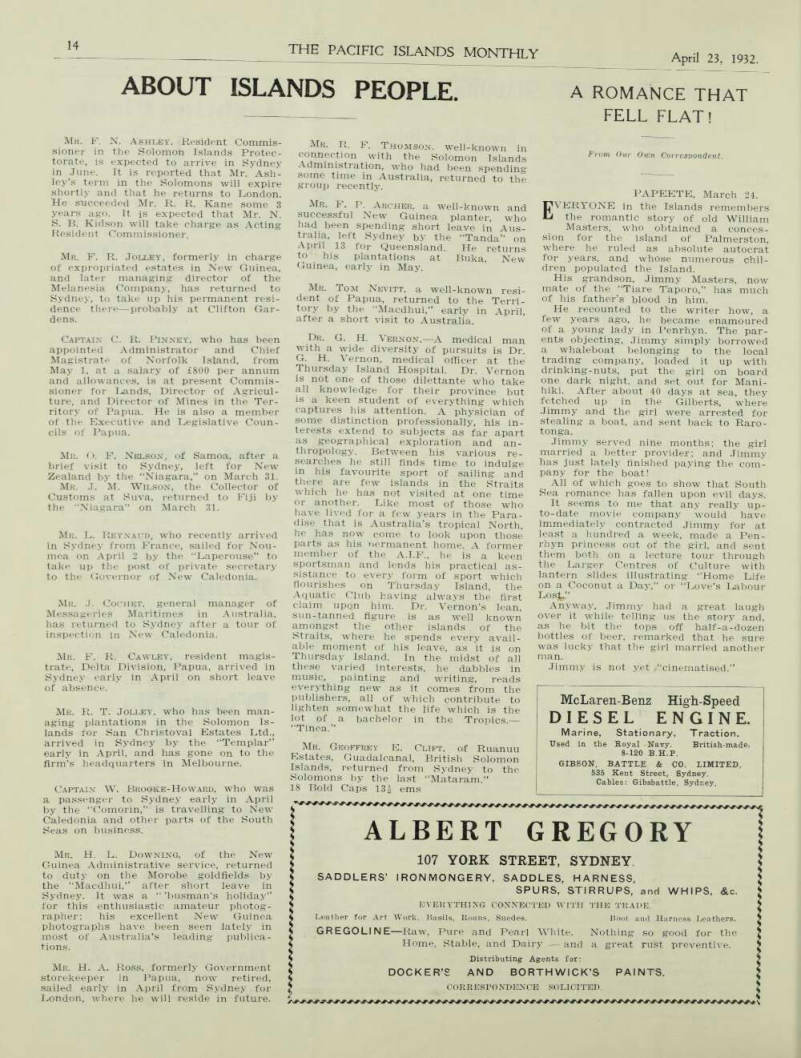
Mr. F. N. Ashley. Resident Commis sioner in the Solomon Islands Protec torate, is expected to arrive in Sydney in June. It is reported that Mr. Ash ley’s term in the Solomons will expire shortly and that he returns to London.
He succeeded Mr. R. R. Kane some 3 years ago. It is expected that Mr. N.
S. B. Kidson will take charge as Acting Resident Commissioner.
Mr. F. R. Jolley, formerly in charge of expropriated estates in New Guinea, and later managing director of the Melanesia Company, has returned to Sydney, to take up his permanent resi dence there—probably at Clifton Gar dens.
Captain C. R. Pinney, who has been appointed Administrator and Chief Magistrate of Norfolk Isliand, from May 1, at a salary of £800 per annum and allowances, is at present Commis sioner for Lands, Director of Agricul ture, and Director of Mines in the Ter ritory of Papua. He is also a member of the Executive and Legislative Coun cils of Papua.
Mr. O. F. Nelson, of Samoa, after a brief visit to Sydney, left for New Zealand by the “Niagara,” on March 31.
Mr. J. M. Wilson, the Collector of Customs at Suva, returned to Fiji by the “Niagara” on March 31.
Mr. L. Reynaud, who recently arrived in Sydney from France, sailed for Nou mea on April 2 by the “Laperouse” to take up the post of private secretary to the Governor of New Caledonia.
Mr. J. Cochet, general manager of Messageries Maritimes in Australia, has returned to Sydney after a tour of inspection in New Caledonia.
Mr. F. R. Cawley, resident magis trate, Delta Division, Papua, arrived in Sydney early in April on short leave of absence.
Mr. R. T. Jolley, who has been man aging plantations in the Solomon Is lands for San Christoval Estates Ltd., arrived in Sydney by the “Templar” early in April, and has gone on to the firm’s headquarters in Melbourne.
Captain W. Brooke-Howard, who was a passenger to Sydney early in April by the “Comorin,” is travelling to New Caledonia and other parts of the South Seas on business.
Mr. H. L. Downing, of the New Guinea Administrative service, returned to duty on the Morobe goldfields by the “Macdhui,” after short leave in Sydney. It was a “ ’busman’s holiday” for this enthusiastic amateur photog rapher; his excellent New Guinea photographs have been seen lately in most of Australia’s leading publica tions.
Mr. H. A. Ross, formerly Government storekeeper in Papua, now retired, sailed early in April from Sydney for London, where he will reside in future.
Mr. R. f. Thomson, well-known in connection with the Solomon Islands Administration, who had been spending some time in Australia, returned to the group recently.
Mr. F. P. Archer, a well-known and successful New Guinea planter, who had been spending short leave in Aus tralia, left Sydney by the “Tanda” on April 13 for Queensland. He returns to his plantations at Buka, New Guinea, early in May.
Mr. Tom Nevitt, a well-known resi dent of Papua, returned to the Terri tory by the “Macdhui,” early in April, after a short visit to Australia.
Dr. G. H. Vernon.— -A medical man with a wide diversity of pursuits is Dr.
G. H. Vernon, medical officer at the Thursday Island Hospital. Dr. Vernon is not one of those dilettante who take all knowledge for their province but is a keen student of everything which captures his attention. A physician of some distinction professionally, his in terests extend to subjects as far apart as geographical exploration and an thropology. Between his various re searches he still finds time to indulge in his favourite sport of sailing and there are few islands in the Straits which he has not visited at one time or another. Like most of those who have lived for a few years in the Para dise that is Australia’s tropical North, he has now come to look upon those parts as his nermanent home. A former member of the A.I.F., he is a keen sportsman and lends his practical as sistance to every form of sport which flourishes on Thursday Island, the Aquatic Club having always the first claim upon him. Dr. Vernon’s lean, sun-tanned figure is as well known amongst the other islands of the Straits, where he spends every avail able moment of his leave, as it is on Thursday Island. In the midst of all these varied interests, he dabbles in music, painting and writing, reads everything new as it comes from the publishers, all of which contribute to lighten somewhat the life which is the lot of a bachelor in the Tropics.— “Tinea.”
Mr. Geoffrey E. Clift, of Ruanuu Estates, Guadalcanal, British Solomon Islands, returned from Sydney to the Solomons by the last “Mataram.” 18 Bold Caps 13g ems
A Romance That
Fell Flat!
From Our Own Gorresvondent.
PAPEETE, March 24.
EVERYONE in the Islands remembers the romantic story of old William Masters, who obtained a conces sion for the island of Palmerston, where he ruled as absolute autocrat for years, and whose numerous chil dren populated the Island.
His grandson, Jimmy Masters, now mate of the “Tiare Taporo,” has much of his father’s blood in him.
He recounted to the writer how, a few years ago, he became enamoured of a young lady in Penrhyn. The par ents objecting, Jimmy simply borrowed a whaleboat belonging to the local trading company, loaded it up with drinking-nuts, put the girl on board one dark night, and set out for Mani hiki. After about 40 days at sea, they fetched up in the Gilberts, where Jimmy and the girl were arrested for stealing a boat, and sent back to Raro tonga.
Jimmy served nine months; the girl married a better provider; and Jimmy has just lately finished paying the com pany for the boat!
All of which goes to show that South Sea romance has fallen upon evil days.
It seems to me that any really up to-date movie company would have immediately contracted Jimmy for at least a hundred a week, made a Pen rhyn princess out of the girl, and sent them both on a lecture tour through the Larger Centres of Culture with lantern slides illustrating “Home Life on a Coconut a Day,” or “Love’s Labour
Lost’.
Anyway, Jimmy had a great laugh over it while telling us the story and, as he bit the tops off half-a-dozen bottles of beer, remarked that he sure was lucky that the girl married another man.
Jimmy is not yet ,“cinematised.”
Advertisements & other items, p. 16 (1 item)
Albert Gregory
McLaren-Benz High-Speed
DIESEL ENGINE.
Marine, Stationary, Traction.
Used in the Royal Navy. British-made.
8-120 B.H.P.
GIBSON, BATTLE & CO. LIMITED,
535 Kent Street, Sydney.
Cables: Gibsbattle, Sydney.
ALBERT GREGORY
107 YORK STREET, SYDNEY.
SADDLERS’ IRONMONGERY, SADDLES, HARNESS,
SPURS, STIRRUPS, and WHIPS, &c.
EVERYTHING CONNECTED WITH THE TRADE.
Leather for Art Work, Basils, Roans, Suedes. Boot and Harness Leathers.
GREGOLINE —Raw, Pure and Pearl White. Nothing- so good for the Home, Stable, and Dairy and a great rust preventive.
Distributing’ Agents for;
DOCKER’S AND BORTHWICK’S PAINTS.
CORRESPONDENCE SOLICITED.
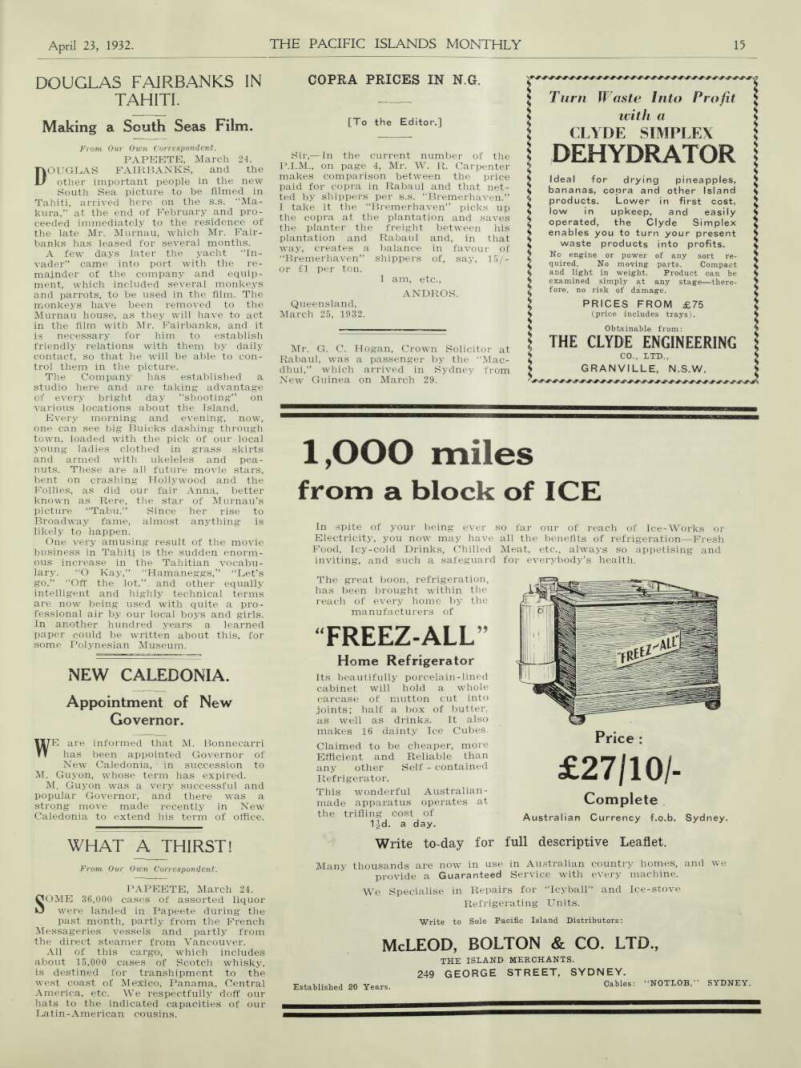
Douglas Fairbanks In
Tahiti.
Making a South Seas Film.
From Our Own Correspondent.
PAPEETE, March 24.
Douglas Fairbanks, and the other important people in the new South Sea picture to be filmed in Tahiti, arrived here on the s.s. “Ma kura,” at the end of February and pro ceeded immediately to the residence of the late Mr. Murnau, which Mr. Fair banks has leased for several months.
A few days later the yacht “In vader” came into port with the re mainder of the company and equip ment, which included several monkeys and parrots, to be used in the film. The monkeys have been removed to the Murnau house, as they will have to act in the film with Mr. Fairbanks, and it is necessary for him to establish friendly relations with them by daily contact, so that he will be able to con trol them in the picture.
The Company has established a studio here and are taking advantage of every bright day “shooting” on various locations about the Island, Every morning and evening, now, one can see big Buicks dashing through town, loaded with the pick of our local young ladies clothed in grass skirts and armed with ukeleles and pea nuts. These are all future movie stars, bent on crashing Hollywood and the Follies, as did our fair Anna, better known as Rere, the star of Murnau’s picture “Tabu.” Since her rise to Broadway fame, almost anything is likely to happen.
One very amusing result of the movie business in Tahiti is the sudden enorm ous increase in the Tahitian vocabu lary. “O Kay,” “Hamaneggs,” “Let’s go,” “Off the lot,”, and other equally intelligent and highly technical terms are now being used with quite a pro fessional air by our local boys and girls.
In another hundred years a learned paper could be written about this, for some Polynesian Museum.
Appointment of New
New Caledonia.
Appointment of New Governor.
WE are informed that M. Bonnecarri has been appointed Governor of New Caledonia, in succession to M. Guyon, whose term has expired.
M. Guyon was a very successful and popular Governor, and there was a strong move made recently in New Caledonia to extend his term of office.
What A Thirst!
From Our Own Correspondent.
PAPEETE, March 24.
SOME 36,000 cases of assorted liquor were landed in Papeete during the past month, partly from the French Messageries vessels and partly from the direct steamer from Vancouver.
All of this cargo, which includes about 15,000 cases of Scotch whisky, is destined for transhipment to the west coast of Mexico, Panama, Central America, etc. We respectfully doff our hats to the indicated capacities of our Latin-American cousins.
Copra Prices In N.G.
[To the Editor.]
Sir, —In the current number of the P.I.M., on page 4, Mr. W. R. Carpenter makes comparison between the price paid for copra in Rabaul and that net ted by shippers per s.s. “Bremerhaven.”
I take it the “Bremerhaven” picks up the copra at the plantation and saves the planter the freight between his plantation and Rabaul and, in that way, creates a balance in favour of “Bremerhaven” shippers of, say, 15/or £1 per ton.
I am, etc..
Andros.
Queensland, March 25, 1932.
Mr. G. C. Hogan, Crown Solicitor at Rabaul, was a passenger by the “Mac dhui,” which arrived in Sydney from New Guinea on March 29.
Advertisements & other items, p. 17 (1 item)
1,000 miles
Turn Waste Into Profit
with a
CLYDE SIMPLEX
DEHYDRATOR
Ideal for drying pineapples, bananas, copra and other Island products. Lower in first cost, low in upkeep, and easily operated, the Clyde Simplex enables you to turn your present waste products into profits.
No engine or power of any sort re quired. No moving parts. Compact and light in weight. Product can be examined simply at any stage—there fore, no risk of damage.
PRICES FROM £75
(price includes trays).
Obtainable from:
THE CLYDE ENGINEERING
CO., LTD.,
GRANVILLE, N.S.W.
1,000 miles
from a block of ICE
In spite of your being ever so far our of reach of Ice-Works or Electricity, you now may have all the benefits of refrigeration—Fresh Pood, Icy-cold Drinks, Chilled Meat, etc., always so appetising and inviting, and such a safeguard for everybody’s health.
The great boon, refrigeration, has been brought within the reach of every home by the manufacturers of
“FREEZ-ALL”
Home Refrigerator
Its beautifully porcelain-lined cabinet will hold a whole carcase of mutton cut into joints; half a box of butter, as well as drinks. It also makes 16 dainty Ice Cubes.
Claimed to be cheaper, more Efficient and Reliable than any other Self - contained Refrigerator.
This wonderful Australianmade apparatus operates at the trifling cost of a day.
Write to-day for full descriptive Leaflet.
Many thousands are now in use in Australian country homes, and we provide a Guaranteed Service with every machine.
We Specialise in Repairs for “Icyball” and Ice-stove Refrigerating Units.
Write to Sole Pacific Island Distributors:
McLEOD, BOLTON & CO. LTD.,
THE ISLAND MERCHANTS.
249 GEORGE STREET, SYDNEY.
Established 20 Years. Cables: “NOTLOB,” SYDNEY.
Price :
£27/10/-
Complete
Australian Currency f.o.b. Sydney.
Thursday Is. Notes.
From Our Own Correspondent.
Thursday Is., April 10.
A FIRST consignment of Murray Island sardines, specially prepared for the Eastern market, left here during the month by the “Marella” for Java. The quantity was small, but quality from all accounts excellent, the fish being well dried, clean and soft, and free from any odour.
Synthetic Rubber.
Will there ever be an end to the dis covery of new synthetic products which threaten the great natural in dustries of the tropics? We fear this is too much to expect from the scien tists who thereby justify their exist ence. Natural rubber, at present being sold at a cost far below that of pro duction, can now be undersold by a new synthetic article manufactured by the du Pont company out of limestone, coal, salt and water. During the pro cess, acetylene is formed from the first two ingredients, and. after chemical treatment and the addition of hydrogen chloride, the new material “Duprene” is produced. The discovery is regarded as of great importance in its land of origin, the U.S.A., where there is al ways a fear that in case of war, sup plies of natural rubber might be blocked.
The manufacturers of Duprene are only making modest claims for the use fulness of the product, and at its pre sent stage it will be chiefly employed as an adjuvant to the natural article, leplacing it perhaps where a cheaper and inferior material will suffice.
Produce Markets.
The amount of pearl shell required from Thursday Island for the year is 460 tons, which is an increase of 110 tons on 1931. This encouraging expan
sion is no doubt due to the efforts of the Gerdau Company of New York to popularise the use of M.O.P. in new directions. A contract for this amount has been signed by the combined pearlers.
Beche-de-mer prices remain at a very low and uncertain figure, owing to
the disturbed state of the Chinese mar kets. Just at present, beche-de-mer fishing must be a precarious game, but prices may improve at any moment.
Trochus stocks are depleted, none of the new season’s shell having come in yet. Good prices, £55 to £60, are being offered.
Advertisements & other items, p. 18 (1 item)
Head
The Masse Battery
is your
Logical Choice
Reliability of service, freedom from breakdown, simplicity of maintenance, economy in use, are the essentials to remember when buying batteries.
Weight for weight, size for size, Masse Batteries are unequalled.
For House Lighting.
Masse Batteries for House Lighting and Power are made in sizes and capacities ranging from 9-plate cells of 100 ampere hours, at the 10-hour rate to 19-plate cells of 225 ampere hours capacity.
For Cars.
From the casting of the grids, through every stage of manufacture, pasting, forming, assembling, testing, sealing, everything in Masse Car Batteries is subservient to Quality. Masse gives longer service and a reserve energy to stand up to abnormal service conditions.
There’s a type for every car.
For Radio.
If you could see the rigid tests to which they are subjected in the various stages of manufacture you wouldn’t hesitate to instal a Masse “A’' Battery in your set.
Booklets free on request.
Write to
MASSE BATTERIES LTD.,
Grace Building, York Street, Sydney.
Masse
CAR RADIO and HOME LIGHTING
BATTERIES
HEAD
AND
NERVOUS PAINS
RELIEVED BY
1/6 and 2/6
New Era Is Opened In New
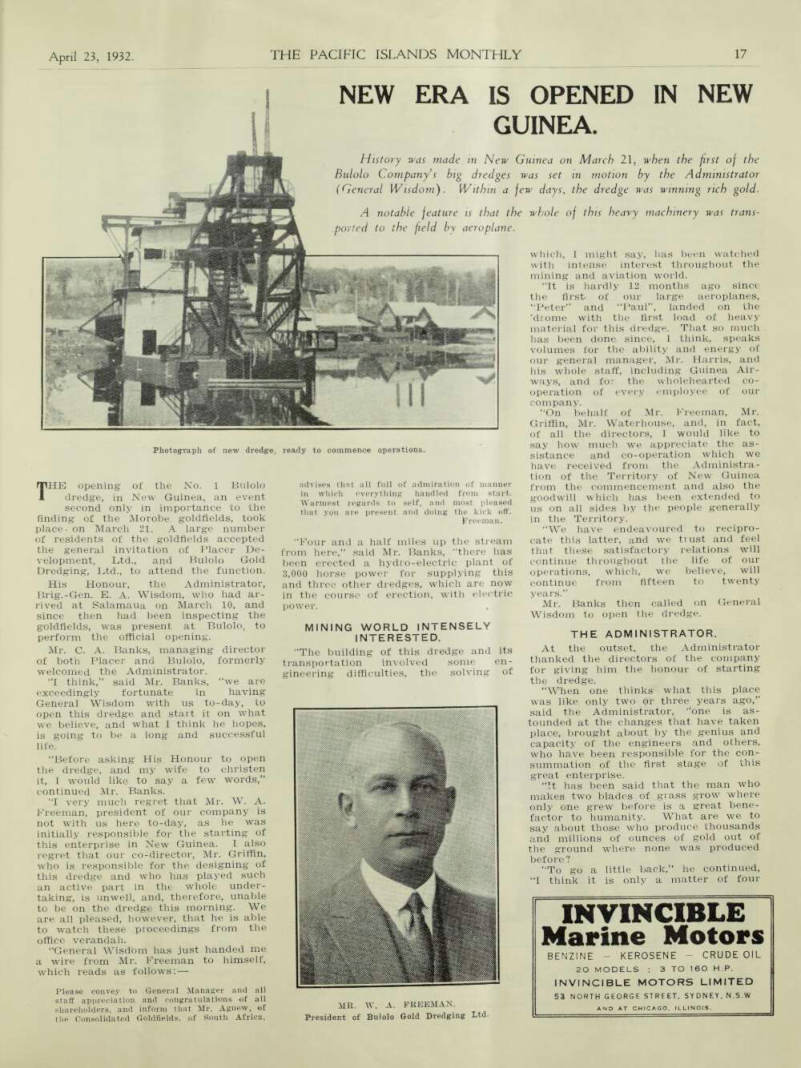
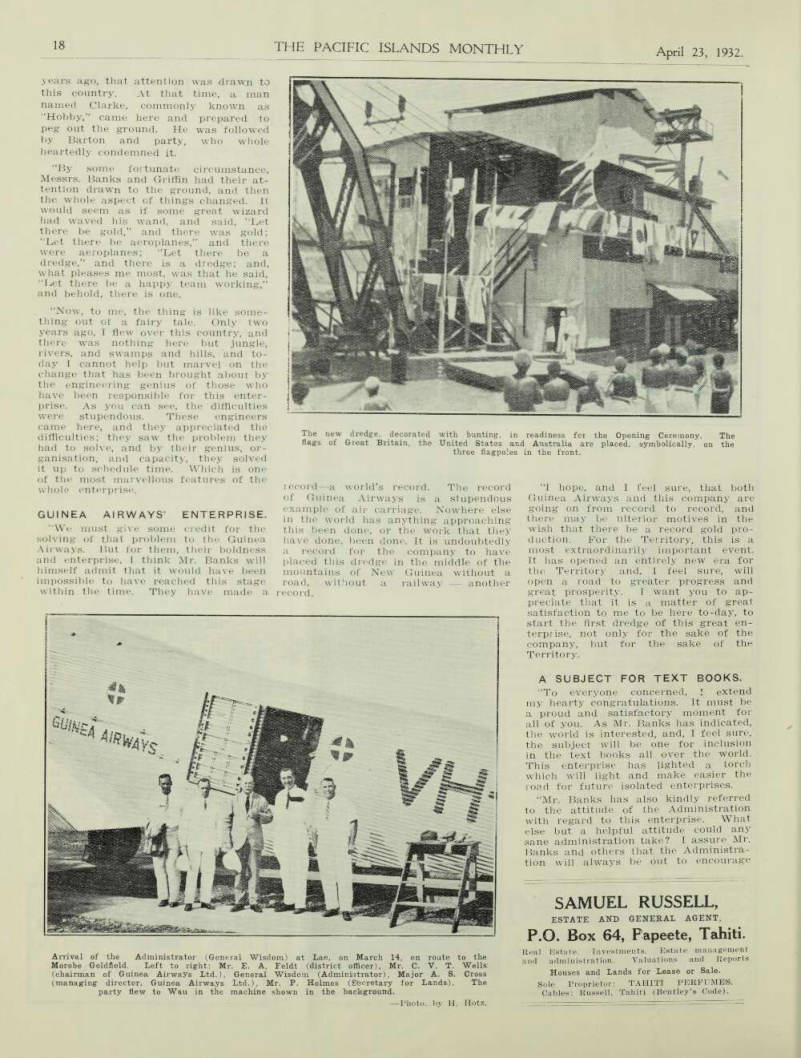
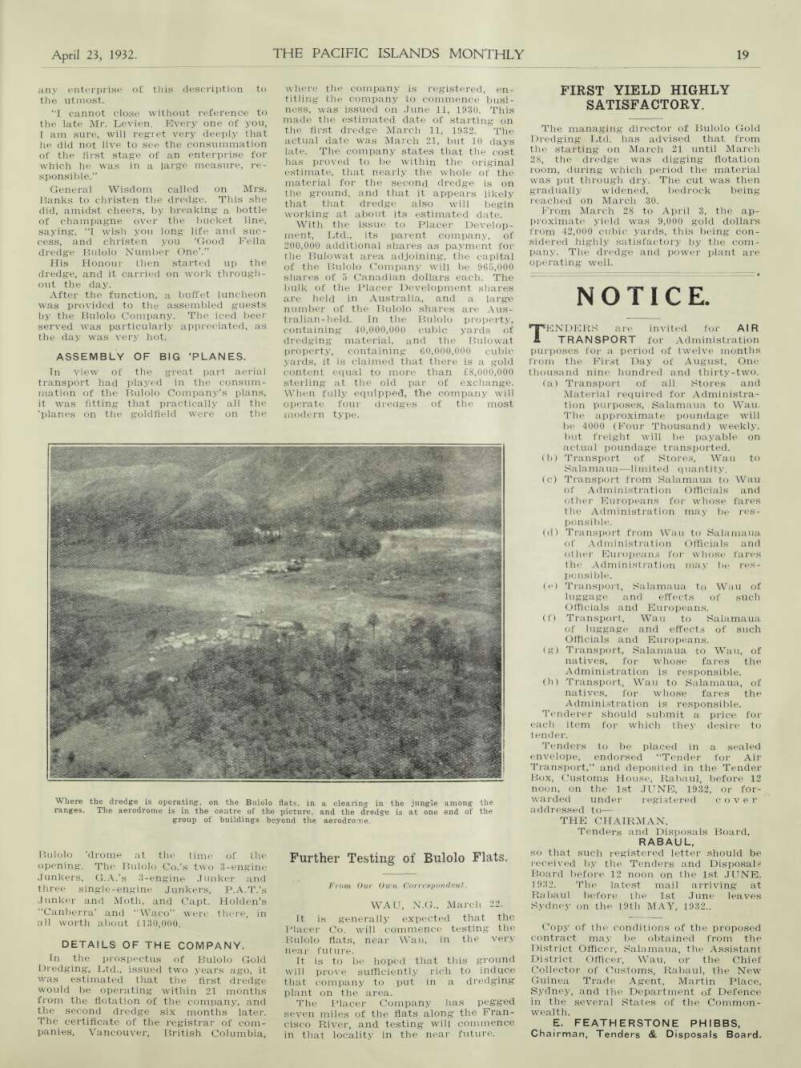
Guinea.
History was made in New Guinea on March 21, when the first of the Bulolo Company’s big dredges was set in motion by the Administrator (General Wisdom). Within a few days, the dredge was winning rich gold.
A notable feature is that the whole of this heavy machinery was trans
ported to the field by aeroplane.
THE opening of the No. 1 Bulolo dredge, in New Guinea, an event second only in importance to the finding of the Morobe goldfields, took place on March 21. A large number of residents of the goldfields accepted the general invitation of Placer De velopment, Ltd., and Bulolo Gold Dredging, Ltd., to attend the function.
His Honour, the Administrator, Brig.-Gen. E. A. Wisdom, who had ar rived at Salamaua on March 10, and since then had been inspecting the goldfields, was present at Bulolo, to perform the official opening.
Mr. C. A. Banks, managing director of both Placer and Bulolo, formerly welcomed the Administrator.
“I think,” said Mr. Banks, “we are exceedingly fortunate in having General Wisdom with us to-day, to open this dredge and start it on what we believe, and what I think he hopes, is going to be a long and successful life.
“Before asking His Honour to open the dredge, and my wife to christen it, I would like to say a few words,” continued Mr. Banks.
“I very much regret that Mr. W. A.
Freteman, president of our company is not with us here to-day, as he was initially responsible for the starting of this enterprise in New Guinea. I also regret that our co-director, Mr. Griffin, who is responsible for the designing of this dredge and who has played such an active part in the whole under taking, is unwell, and, therefore, unable to be on the dredge this morning. We are all pleased, however, that he is able to watch these proceedings from the office verandah.
“General Wisdom has just handed me a wire from Mr. Freeman to himself, which reads as follows: Please convey to General Manager and all staff appreciation and congratulations of all shareholders, and inform that Mr. Agnew, of the Consolidated Goldfields, of South Africa,
advises that all full of admiration of manner in which everything handled from start.
Warmest regards to self, and most pleased that are present and doing the kick off .
Freeman.
“Four and a half miles up the stream from here,” said Mr. Banks, “there has been erected a hydro-electric plant of 3,000 horse power for supplying this and three other dredges, which are now in the course of erection, with electric power,
Mining World Intensely
Interested.
“The building of this dredge and its transportation involved some en gineering difficulties, the solving of
which, I might say, has been watched with intense interest throughout the mining and aviation world.
“It is hardly 12 months ago since the first of our large aeroplanes, “Peter” and “Paul”, landed on the ’drome with the first load of heavy material for this dredge. That so much has been done since, I think, speaks volumes for the ability and energy of our general manager, Mr. Harris, and his whole staff, including Guinea Air ways, and for the wholehearted co operation of every employee of our company.
“On behalf of Mr. Freeman, Mr.
Griffin, Mr. Waterhouse, and, in fact, of all the directors, I would like to say how much we appreciate the as sistance and co-operation which we have received from the Administra tion of the Territory of New Guinea from the commencement and also the goodwill which has been extended to us on all sides by the people generally in the Territory.
“We have endeavoured to recipro cate this latter, and we trust and feel that these satisfactory relations will continue throughout the life of our operations, which, we believe, will continue from fifteen to twenty years.”
Mr. Banks then called on General Wisdom to open the dredge.
The Administrator.
At the outset, the Administrator thanked the directors of the company for giving him the honour of starting the dredge.
“When one thinks what this place was like only two or three years ago,” said the Administrator, “one is as tounded at the changes that have taken place, brought about by the genius and capacity of the engineers and others, who have been responsible for the con summation of the first stage of this great enterprise.
“It has been said that the man who makes two blades of grass grow where only one grew before is a great bene factor to humanity. What are we to say about those who produce thousands and millions of ounces of gold out of the ground where none was produced before?
“To go a little back,” he continued, “I think it is only a matter of four
Photograph of new dredge, ready to commence operations.
Mr. W. A. Freeman,
President of Bulolo Gold Dredging Ltd.
years ago, that attention was drawn to this country. At that time, a man named Clarke, commonly known as “Hobby,” came here and prepared to peg out the ground. He was followed by Barton and party, who whole heartedly condemned it.
“By some fortunate circumstance, Messrs. Banks and Griffin had their at tention drawn to the ground, and then the whole aspect of things changed. It would seem as if some great wizard had waved his wand, and said, “Let there be gold,” and there was gold; “Let there be aeroplanes,” and there were aeroplanes; “Let there be a dredge,” and there is a dredge; and, what pleases me most, was that he said, “Let there be a happy team working,” and behold, there is one, “Now, to me, the thing is like some thing out of a fairy tale. Only two years ago, I flew over this country, and there was nothing here but jungle, rivers, and swamps and hills, and to day I cannot help but marvel on the change that has been brought about by the engineering genius of those who have been responsible for this enter prise. As you can see, the difficulties were stupendous. These engineers came here, and they appreciated the difficulties; they saw the problem they had to solve, and by their genius, or ganisation, and capacity, they solved it up to schedule time. Which is one of the most marvellous features of the whole enterprise.
Guinea Airways’ Enterprise.
"We must give some credit for the solving of that problem to the Guinea Airways. But for them, their boldness and enterprise, I think Mr. Banks will himself admit that it would have been impossible to have reached this stage within the time. They have made a
lecord —a world's record. The record of Guinea Airways is a stupendous example of air carriage. Nowhere else in the world has anything approaching this been done, or the work that they have done, been done. It is undoubtedly a record for the company to have placed this dredge in the middle of the mountains of New Guinea without a road, without a railway another record.
“I hope, and I feel sure, that both Guinea Airways and this company are going - on from record to record, and there may be ulterior motives in the wish that there be a record gold pro duction. For the Territory, this is a most extraordinarily important event.
It has opened an entirely new era for the Territory and, I feel sure, will open a road to greater progress and great prosperity. I want you to ap preciate that it is a matter of great satisfaction to me to be here to-day, to start the first dredge of this great en terprise, not only for the sake of the company, but for the sake of the Territory.
A Subject For Text Books.
“To everyone concerned, I extend my hearty congratulations. It must be a proud and satisfactory moment for all of you. As Mr. Banks has indicated, the world is interested, and, I feel sure, the subject will be one for inclusion in the text books all over the world.
This enterprise has lighted a torch which will light and make easier the road for future isolated enterprises.
“Mr. Banks has also kindly referred to the attitude of the Administration with regard to this enterprise. What else but a helpful attitude could any sane administration take? I assure Mr.
Banks and others that the Administra tion will always be out to encourage
Arrival of the Administrator (General Wisdom) at Lae, on March 14, en route to the Morobe Goldfield. Left to right; Mr. E. A. Feldt (district officer), Mr. C. V, T. Wells (chairman of Guinea Airways Ltd.), General Wisdom (Administrator), Major A, S. Cross (managing director, Guinea Airways Ltd.), Mr. P. Holmes (Stecretary for Lands). The party flew to Wau in the machine shown in the background. —Photo, by H. Hotz.
The new dredge, decorated with bunting, in readiness for the Opening Ceremony. The flags of Great Britain, the United States and Australia are placed, symbolically, on the three flagpoles in the front.
any enterprise of this description to the utmost.
“I cannot close without reference to the late Mr. Levien. Every one of you, I am sure, will regret very deeply that he did not live to see the consummation of the first stage of an enterprise for which he was in a large measure, re sponsible.”
General Wisdom called on Mrs.
Banks to christen the dredge. This she did, amidst cheers, by breaking a bottle of champagne over the bucket line, saying, “I wish you long life and suc cess, and christen you ‘Good Fella dredge Bulolo Number One’.”
His Honour then started up the dredge, and it carried on work through out the day.
After the function, a buffet luncheon was provided to the assembled guests by the Bulolo Company. The iced beer served was particularly appreciated, as the day was very hot,
Assembly Of Big ’Planes.
In view of the great part aerial transport had played in the consum mation of the Bulolo Company’s plans, it was fitting that practically all the ’planes on the goldfield were on the
Bulolo ’drome at the time of the opening. The Bulolo Co.’s two 3-engine Junkers, G.A.’s 3-engine Junker and three single-engine Junkers, P.A.T.’s Junker and Moth, and Capt. Holden’s “Canberra’ and “Waco’’ were there, in all worth about £130,000.
Details Of The Company.
In the prospectus of Bulolo Gold Dredging, Ltd., issued two years ago, it was estimated that the first dredge would be operating within 21 months from the flotation of the company, and the second dredge six months later.
The certificate of the registrar of com panies, Vancouver, British Columbia,
where the company is registered, en titling the company to commence busi ness, was issued on June 11, 1930. This made the estimated date of starting on the first dredge March 11, 1932. The actual date was March 21, but 10 days late. The company states that the cost has proved to be within the original estimate, that nearly the whole of the material for the second dredge is on the ground, and that it appears likely that that dredge also will begin working at about its estimated date.
With the issue to Placer Develop ment, Ltd., its parent company, of 200,000 additional shares as payment for the Bulowat area adjoining, the capital of the Bulolo Company will be 965,000 shares of 5 Canadian dollars each. The bulk of the Placer Development shares are held in Australia, and a large number of the Bulolo shares are Aus tralian-held. In the Bulolo property, containing 40,000,000 cubic yards of dredging material, and the Bulowat property, containing 60,000,000 cubic yards, it is claimed that there is a gold content equal to more than £8,000,000 sterling at the old par of exchange.
When fully equipped, the company will operate four dredges of the most modern type.
Where the dredge is operating, on the Bulolo flats, in a clearing in the jungle among the ranges. The aerodrome is in the centre of the picture, and the dredge is at one end of the group of buildings beyond the aerodrome.
Advertisements & other items, pp. 19-20 (1 item)
Invincible
Marine Motors
BENZINE - KEROSENE - CRUDE OIL
20 MODELS : 3 TO 160 H P.
INVINCIBLE MOTORS LIMITED
53 NORTH GEORGE STREET. SYDNEY. N.S.W
AND AT CHICAGO. ILLINOIS.
SAMUEL RUSSELL,
ESTATE AND GENERAL AGENT,
P.O. Box 64, Papeete, Tahiti.
Real Estate. Investments. Estate management and administration. Valuations and Reports Houses and Lands for Lease or Sale.
Sole Proprietor; TAHITI PERFUMES.
Cables: Russell, Tahiti (Bentley’s Code).
Further Testing of Bulolo Flats.
From Our Own Correspondent.
WAU, N.G., March 22.
It is generally expected that the Placer Co. will commence testing the Bulolo flats, near Wan, in the very near future.
It is to be hoped that this ground will prove sufficiently rich to induce that company to put in a dredging plant on the area.
The Placer Company has pegged seven miles of the flats along the Fran cisco River, and testing will commence in that locality in the near future.
First Yield Highly
Satisfactory.
The managing director of Bulolo Gold Dredging Ltd. has advised that from the starting on March 21 until March 28, the dredge was digging flotation room, during which period the material was put through dry. The cut was then gradually widened, bedrock being reached on March 30.
From March 28 to April 3, the ap proximate yield was 9,000 gold dollars from 42,000 cubic yards, this being con sidered highly satisfactory by the com pany. The dredge and power plant are operating well.
Advertisements & other items, p. 21 (1 item)
Notice.
TENDERS are invited for AIR TRANSPORT for Administration purposes for a period of twelve months from the First Day of August, One thousand nine hundred and thirty-two. (a) Transport of all Stores and Material required for Administra tion purposes, Salamaua to Wau.
The approximate poundage will be 4000 (Four Thousand) weekly, but freight will be payable on actual poundage transported. (b) Transport of Stores, Wau to Salamaua —limited quantity. (c) Transport from Salamaua to Wau of Administration Officials and other Europeans for whose fares the Administration may be responsible. (d) Transport from Wau to Salamaua of Administration Officials and other Europeans for whose fares the Administration may be res ponsible. (e) Transport, Salamaua to Wau of luggage and effects of such Officials and Europeans. (f) Transport, Wau to Salamaua of luggage and effects of such Officials and Europeans. (g) Transport, Salamaua to Wau, of natives, for whose fares the Administration is responsible. (h) Transport, Wau to Salamaua, of natives, for whose fares the Administration is responsible.
Tenderer should submit a price for each item for which they desire to tender.
Tenders to be placed in a sealed envelope, endorsed “Tender for Air Transport," and deposited in the Tender Box, Customs House, Rabaul, before 12 noon, on the 1st JUNE, 1932, or for warded under registered cover addressed to —
THE CHAIRMAN,
Tenders and Disposals Board,
RABAUL,
so that such registered letter should be received by the Tenders and Disposal?
Board before 12 noon on the 1st JUNE, 1932. The latest mail arriving at Rabaul before the 1st June leaves Sydney on the 19th MAY, 1932.
Copy of the conditions of the proposed contract may be obtained from the District Officer, Salamaua, the Assistant District Officer, Wau, or the Chief Collector of Customs, Rabaul, the New Guinea Trade Agent, Martin Place, Sydney, and the Department of Defence in the several States of the Common wealth.
E. FEATHERSTONE PHIBBS,
Chairman, Tenders & Disposals Board.
Elephantiasis
“Layman,” in this article, discusses the incidence and cause of one of the most unpleasant of the South Sea Islands diseases.
ONCE again for a month or two, we, the inhabitants of the Pacific Is lands, are at the mercy of the mos quito.
During the hurricane season, weather conditions at most islands in the South Seas are conducive to the rapid and prolific breeding of the mosquito. The filaria hazard becomes real and men acing, and precautionary measures are necessary such as netting (cloth) over the beds, and mosquito-proof enclosures on verandahs.
Strangely there is no malaria amongst many of the Pacific Islands.
The Cook Group, for instance, is free from this scourge. Leprosy at many of the islands has been stamped out prac tically, but each summer there is, at some places, a slight addition, and at others a substantial accretion, to the number of filaria victims, both native and European.
Contemplation of becoming a sufferer from elephantiasis, with its hideous en larging effect upon the limbs and glands is not relished by anyone. At the same time, the effect upon the victim—as suming that he takes medical treatment and advice —is one, more of inconveni ence, than suffering.
Periodical bouts of fever occur, and the skin becomes blotched at times.
The swelling increases and surgical treatment is sometimes necessary, in advanced cases. It is held that a re turn to a cold climate will check the disease. Those Europeans affected are, generally speaking, persons who have been resident at one or other of the is lands in the Pacific for a number of years.
We laymen presume to know very little about filaria and all that goes on between this active little worm and the mosquito. Likewise, we are ignorant of the activities which take place in the body of an afflicted person between the filaria and the protective organisms of the blood stream.
What we learn, one from the other, no doubt does something to lessen the danger of infection and to minimise that risk. We are told definitely that the intermediate agent is the female mosquito.
The female of the species, to be found in many Pacific islands, is re cognised by the white bars on her hind legs and on the under part of her body.
She has also a white streak running along the forepart of her body, to a point at which her hair-like proboscis begins.
Immediately she settles on our skin her two hind legs swing upwards in the air and remain poised in that position during her blood-sucking operations.
This is her drinking posture, apparently, for each mosquito assumes the same attitude. Not until she flies off does the victim feel the stab of her skin piercing implement.
She drinks her fill and we crush her soft body to find that it contains a com paratively large measure of blood. We, of course, know this to be her purpose —to obtain a fill of blood without in flicting any appreciable sting in the
process. Any sharp stabbing sensation felt by our skin would be fatal to her purpose. Her tiny stab is neat, quick and generally absolutely painless, at the moment of her fill. We feel the sting later.
Occasionally, we observe a larger species of mosquito, with long, dangling legs, propelling himself dismally through the air. We are told that this is the male; also, that he does not feed upon our blood. The risk of his death at our hands is therefore small.
But, outside, hovering in large num bers above the lawn, we observe the great dragon flies with their huge eyes and transparent wings. They hover for a moment, then dart sideways, then hover again. They are at work prey ing upon the mosquito. But the mos quito likes the shady spots and prefers to hide itself beneath verandahs, and in the nooks and corners of the rooms and furniture of our homes.
The large house spiders, with their spindle legs, are not disturbed as they climb about the walls and ceilings of our houses. They, too, are said to be the enemy of the mosquito. Numbered, also, amongst its enemies are the small lizards, which climb about the rock fences and the sides of houses.
But with all our human weapons (sprays, pungent chemicals, etc.) in sects and other allies, the mosquito is always about, day and night.
Filaria! “How does infection take place?’’ we ask. “Does the mosquito in ject something into our bodies before it draws off its fill of blood?’’
One theory we hear much about is that, if the male joins, with the female during her blood drinking operations, filaria infection is likely to result. We confess to a certain degree of sceptic ism in accepting this explanation of the process of infection.
Another empirical conclusion come to by many is that infection is associated with the mud of Taro plots. (Taro is a native food and is cultivated in mud beds, many of which are stagnant pools of mud and water). The probable basis for this conclusion will be considered presently.
Scientists say that the filaria worm clings to the outside of the mosquito’s proboscis. The spearmen of New Guinea dip their spears into rotting carcases so that, in addition to inflict ing a wound, the implements are likely to set up within the body of the victim a filthy disease. In somewhat the same way, so it would seem, the mosquito’s instrument sometimes is tainted with the living worms of filaria.
If it can be taken that a person, already the victim of filaria, or ele phantiasis, is a source of infection, then, during the mosquito season, we ought to avoid him, because the chances are that, wherever he stands or sits for any length of time, a number of female mosquitoes in that vicinity may become active carriers of the disease. On the other hand, if such a person confines himself to places at which the mosquito is not plentiful—for instance, away from swampy areas, Taro beds, or wet masses of vegetation—the number of mosquitoes likely to become dangerous, will be comparatively small.
Along we go to the Taro plots. The water, shadowed by the huge leaves of the Taro plant, is swarming with mos quito larvae. Hosts of mosquitoes are about; and hosts of them are out of sight beneath Taro leaves and the leaves of nearby trees.
An odd native is thigh-deep in the mud plot, his only dress being a loin cloth. Along comes another native —a sufferer from filaria. Swarms of mos quitoes alight upon his body, to sip their fill of his blood. Having satisfied their appetites for the moment they may resume their hiding place but later, say the following day, or even the day after that, they will assail the body of the native worker in the Taro bed, and infect him.
Again, the filaria victim comes down to his Taro bed for his daily needs of Taro root and again numerous female
mosquitoes become infected with the filaria worm. Its lines of transport are working at high pressure. The process of filaria infection proceeds, but it may not be for months that infection will make itself felt. Bodily resistance probably plays a part in preventing in fection. The layman does not know.
This may be a partial explanation at least of the prevalence of filaria in the vicinity of Taro plots.
Certain villages and certain areas are also associated with the incidence of filaria. Again, we learn that the sur roundings are blamed for the trouble.
But the real source of infection, in the first instance, probably is the ar rival of a person suffering from ele phantiasis. If the surroundings are favourable to the prolific breeding of the mosquito, then the spread of the disease is inevitable. There can be no doubt of that. Given a fertile breeding ground for the mosquito, and one case of filaria, the number of cases will in crease with geometrical progression.
The sources of infection will multiply with each fresh case.
Amidst all the danger of infection, there is one very consoling feature which lessens the chances of a person becoming a victim of elephantiasis.
Both a male filaria worm and a female must be transplanted into the blood stream before colonies of micro-fllaria can be brought into existence.
Perhaps many infections may result before the female germ meets a male germ within the blood stream and and commences to breed in the ducts of the blood or the lymph—whichever is their chosen abode.
But again the layman runs into a fog of mystery and perplexity about the whole facts of filaria. It does seem, however, that the isolation of elephant iasis sufferers during the mosquito sea son is desirable.
Advertisements & other items, p. 22 (1 item)
'Florence’
KEROSENE
STOVES
ARE WICKLESS.
Cooler and Cleaner Kitchens.
Well built and easy to operate.
Write us for particulars.
Brandts Ltd.
371 PITT ST.
SYDNEY.
Everything for Light and Heat.
Tel. Address : BRANDTLAMP, SYDNEY.
P.O. Box 3626 S.
When Beans Are
Plentiful.
Hint for Islands Housekeepers.
Those who are interested in garden ing in the Islands and realise how dif ficult it is at times to procure seeds as often as required, will find the follow ing idea excellent: When you have a prolific crop of beans, try salting them down in glass preserving jars, with spring tops and rubber ring. They do not want any water, beyond the wetness of washed beans —this will make the salt melt.
Cut off the ends of the beans and place in a crockery bowl, sprinkle with common fine salt, and work them about, continuing this process till a brine is formed. Put them in the glass jars, press the beans down with your fingers, and pour over the self-made brine. See that they are completely covered by the brine before clamping down. They keep indefinitely.
When required for cooking, drain off the brine and wash well. Soak for several hours before cooking, and boil in the usual way. If too salty when cooking, change the water, —B.E.N.
Dissolution Anticipated.
Samoan Reparation
Estates
From Our Own Correspondent.
APIA, March 10.
THE General Manager of the Samoan “N.Z. Reparation Estates” is leav ing by the "“Maui Pomare” for Wellington.
Though nothing is given out offici ally regarding the purpose of the trip, it is known that drastic changes are intended owing to the large deficit of the estates incurred during the current year. A high Government official only recently has stated that New Zealand committed a grave blunder in not dis posing of the estates years ago.
The re-organisation of the estates after the report of the special commis sion in 1929 and the appointment of Mr. Golk as general manager, though greatly improving conditions, could not counter-balance the devastating effects of the drop in copra prices.
It seems the time has come to cut up the estates into allotments and lease them out to local residents. This would be, at the same time, a relief measure to enable a good number of settlers to
make a decent living, which they are unable to do at present, and would, secondly, distinctly benefit the Admin istration through rents paid by lessees, where at present they do not obtain any financial gain. Furthermore, it would save the New Zealand Govern ment from further losses. The mer chants would benefit by handling the produce of the new plantations and selling more goods to individual planters. In fact, every section of the community would profit by the disso lution of the Reparation Estates.
The decision of the New Zealand Government is, therefore, awaited with keen interest. The N.Z. Government is striving desperately to balance the N.Z. budget and it is hard to believe the Cabinet to be willing to support a losing venture by further financial grants.
The deficit of the Reparations Estates will be somewhere near £40,000 for the financial year ending March 31, 1932.
Islands Newspapers.
Persons interested are advised that files of most of the Pacific Islands newspapers and gazettes—particularly the “Fiji Times,” the ‘‘Rabaul Times,” and the “Samoan Herald” —may be consulted at the offices of Pacific Pub lications Ltd., Union House, 247 George Street, Sydney.
Advertisements & other items, p. 23 (1 item)
Pacific
COMMUNICATION
SERVICES
Modern direct Wireless Services are available for inter-communication between the Islands of the Pacific and for traffic between the Islands and Australia and overseas countries.
Services are now in operation between Papua and Sydney, New Guinea and Sydney, New Caledonia and Sydney and Fiji and Sydney. Speedy, economical and efficient service to Australia and overseas. Route your traffic “Via the Wireless Service. ’ ’
For overseas traffic to Great Britain, North and South America and all European countries, route your message via the Direct Australian
BEAM WIRELESS SERVICE.
LODGE YOUR MESSAGES AT ANY
WIRELESS STATION OR ISLAND POST
OFFICE ROUTED “VIA WIRELESS.”
AMALGAMATED WIRELESS (A’SIA) LIMITED.
Rabaul’S Special Appeal
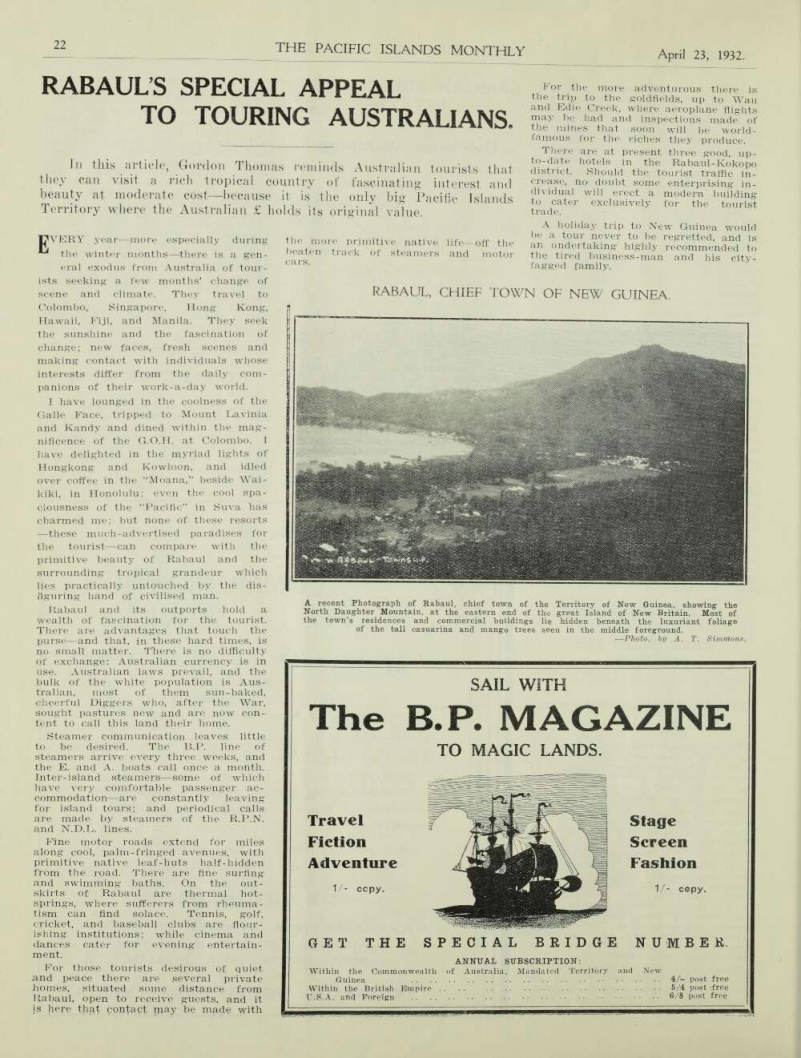
To Touring Australians.
In this article, Gordon Thomas reminds Australian tourists that they can visit a rich tropical country of fascinating interest and beauty at moderate cost—because it is the only big Pacific Islands Territory where the Australian £ holds its original value.
EVERY year—more especially during the winter months—there is a gen eral exodus from Australia of tour ists seeking a few months’ change of scene and climate. They travel to Colombo, Singapore, Hong Kong, Hawaii, Fiji, and Manila. They seek the sunshine and the fascination of change; new faces, fresh scenes and making contact with individuals whose interests differ from the daily com panions of their work-a-day world.
I have lounged in the coolness of the Galle Face, tripped to Mount Lavinia and Kandy and dined within the mag nificence of the G.O.H. at Colombo. I have delighted in the myriad lights of Hongkong and Kowloon, and idled over coffee in the “Moana,” beside Wai kiki, in Honolulu; even the cool spa ciousness of the “Pacific” in Suva has charmed me; but none of these resorts —these much-advertised paradises for the tourist —can compare with the primitive beauty of Rabaul and the surrounding tropical grandeur which lies practically untouched by the dis figuring hand of civilised man.
Rabaul and its outports hold a wealth of fascination for the tourist.
There are advantages that touch the purse—and that, in these hard times, is no small matter. There is no difficulty of exchange: Australian currency is in use. Australian laws prevail, and the bulk of the white population is Aus tralian, most of them sun-baked, cheerful Diggers who, after the War, sought pastures new and are now con tent to call this land their home.
Steamer communication leaves little to be desired. The B.P. line of steamers arrive every three weeks, and the E. and A. boats call once a month.
Inter-island steamers —some of which have very comfortable passenger ac commodation —are constantly leaving for island tours; and periodical calls are made by steamers of the R.P.N. and N.D.L. lines.
Pine motor roads extend for miles along cool, palm-fringed avenues, with primitive native leaf-huts half-hidden from the road. There are fine surfing and swimming baths. On the out skirts of Rabaul are thermal hot springs, where sufferers from rheuma tism can find solace. Tennis, golf, cricket, and baseball clubs are flour ishing institutions; while cinema and dances cater for evening entertain ment.
For those tourists desirous of quiet and peace there are several private homes, situated some distance from Rabaul, open to receive guests, and it is here that contact may be made with
the more primitive native life—off the beaten track of steamers and motor cars.
For the more adventurous there is the trip to the goldfields, up to Wau and Edie Creek, where aeroplane flights may be had and inspections made of the mines that soon will be world famous for the riches they produce.
There are at present three good, up to-date hotels in the Rabaul-Kokopo district. Should the tourist traffic in crease, no doubt some enterprising in dividual will erect a modern building to cater exclusively for the tourist trade.
A holiday trip to New Guinea would be a tour never to be regretted, and is an undertaking highly recommended to the tired business-man and his city fagged family.
Rabaul, Chief Town Of New Guinea.
A recent Photograph of Rabaul, chief town of the Territory of New Guinea, showing the North Daughter Mountain, at the eastern end of the great Island of New Britain. Most of the town’s residences and commercial buildings lie hidden beneath the luxuriant foliage of the tall casuarina and mango trees seen in the middle foreground. -Photo, by A. T. Simmons.
Advertisements & other items, p. 24 (1 item)
The B.P. Magazine
SAIL WITH
TO MAGIC LANDS.
Travel Fiction Adventure 1/- copy.
GET THE
SPECIAL BRIDGE
Stage Screen Fashion 1/- copy.
NUMBER.
ANNUAL SUBSCRIPTION:
Within the Commonwealth of Australia, Mandated Territory and New Guinea 4/- post free Within the British Empire . . . . 5/4 post -free U.S.A. and Foreign 6/8 post free
Papuan Sugar.
Progress of Sangara Scheme.
OWING to the depression and con tinued uncertainty about Australian financial conditions, the promoters of the Sangara sugar scheme —the pro duction of sugar on a large scale in north-east Papua—have further post poned their flotation.
Probably the postponement will not be lengthy. There is a powerful Lon don group interested in the scheme, and British financial conditions are im proving rapidly. Recent news from London indicate that British money is again becoming available in substan tial amounts for sound investments.
The Islands seems to have a peculiar attraction for “wild cats,” and wise in vestors will carefully scrutinise every flotation with an Islands basis. But, so far as our information goes, the Sangara project is in a different cate gory. Reputable people, with immense practical experience of Papuan condi tions, and with a far-reaching know ledge of the sugar industry, are con nected with it, and their main concern seems to be to produce cheap sugar in quantity, rather than get rich quickly at the expense of the gullible public.
The promoters have acquired 20,000 acres in north-east Papua, around the back of the excellent deep-sea port of Buna, and here they propose to culti vate the Badilla —the excellent, indi genous cane of Papua. They have first class soil, permanent streams, a rain fall of 130 inches, abundant timber, and an inexhaustible supply of native labour. They have 40 acres already under test plantation, with highly sat isfactory results.
It is urged, against the scheme, that the world already is over-supplied with sugar, and unprotected sugar-growers are starving. The Sangara people reply that the conditions surrounding their enterprise are so favourable that they can produce profitably, and show a sat isfactory dividend at the present prices —on which other sugar-producers are making no profits at all. They do not propose to enter the protected Aus tralian market: they can do very well, they say, by entering the world’s free market without bonus or subsidy.
Mr. Tom Nevitt, of Papua, one of the promoters of the scheme, was in Syd ney during March but has now re turned to the Territory. He is inclined to urge the early establishment of the industry on the ground that the sub stantial advantages given by the ex isting low scales of costs would more than offset the disadvantages of the financial depression.
A Disturbing Report.
There was a disturbing report ,in Sydney during March that Mr. W.
Beckett, a well-known promoter of commercial enterprises, was busy in London trying to interest British capi tal in a Papuan sugar enterprise. It is to be hoped that, for the sake of Papuan development, there is no truth in the report. There is nothing wrong with the Papuan sugar enterprise: but Mr. Beckett’s history and ass 'ciations do not suggest that he is the most suit able man to take any leading part in such an enterprise,
Advertisements & other items, p. 25 (1 item)
Perft
Not alone the wondrous fragrance of the Marechal Niel rose. And not the honeyed fragrance of the Sweet-briar. Nor the full rich odor of the old Red rose. And again,in, not the shy perfume of the Tea rose. Not one of these, nor of these alone. In “Ashes of Roses” Perfume, Monsieur Bourjois caught the elusive and joyous fragrance of a whole garden of roses, its spirit and its atmosphere.
Because of this, “Ashes of Roses” is famous throughout the world. While fashions come and fashions go, “Ashes of Roses” remains constant, ever new and delightful, presenting ever afresh its sensations of joy.—Always an added charm to beautiful womanhood!
Ashes of Roses
BOURJOIS - PARIS
Perft
Perfume
Sold by all Chemists, Perfumers, Coiffeurs and Stores.
A. BOURJOIS ET CIE, 177-9 Clarence St. & 47-49 King St., Sydney
BOURJOIS TOILET
PREPARATIONS
PERFUMES
COMPACT POWDER
BATH POWDER
BABY POWDER
FACE POWDER
TALCUM POWDER
VANISHING CREAM
NIGHT CREAM
LIP STICK
TOILET AND BATH SOAP
COLOGNE
To A. BOURJOIS et CIE (Aust.)Ltd.
Broughton House, 177-9 Clarence St., Sydney I enclose 2/6: please send, post free, the ASHES OF ROSES Presentation Case containing Perfume and Face Powder.
Name..
Street Town
Religious Argument Led to
Obscene Books.
Religious Argument Led to Public Prosecution in Fiji.
GREAT interest was taken in Fiji re cently in a prosecution launched by the Colonial authorities against two well-known Hindus, Vishnu Deo and Babu Ram Singh. They were charged in the Supreme Court at Suva on March 8 with having sold an ob scene book at Suva on January 8.
Subsequently the charge against Vishnu Deo was altered to read that he “unlawfully caused to be sold a certain indecent, scandalous and ob scene book.” It appeared that the charges arose out of arguments based on religious differences between two Hindu sects. Both accused are well known men—Vishnu Deo has been a member of the Legislative Council of Fiji. They are connected with the In dian Publishing Company.
Both accused are members of the Arya Samaj, a modernist sect of the Hindu religion, and the presiding judge quoted the following description of the organisation: “The Arya Samaj stands for progressive and militant Hinduism.
On the one hand, its leaders are often at odds with orthodox Brahmanism on questions of social reform; and, on the other, they carry on an active propa ganda directed against both Christian ity and the religious beliefs of their Moslem fellow countrymen.”
This body had a debate with another Hindu society, the Sanatam Dharm, and it was decided that the arguments should be set out in writing. This in volved quotations from the sacred writ ings, the Puranas. Unhappily, the mat ter did not end there. In response to various challenges, the executive com mittee of the Arya Samaj published the debate and argument in full, in cluding the extracts from the Puranas, and the matter got into general circu lation.
Counsel for the defence acknow ledged that the pamphlet was “disgust ing”: but urged that, in view of the special circumstances, a nominal pen alty would suffice. The Attorney- General (Mr. S. G. Howell) said it was the duty of the State to protect the public against “such filth.”
The judge fined each man £30 —£5 as a fine, and £25 to go towards paying the costs of the prosecution. He strongly urged the Indian community to keep religious disputes such as these out of public debates in future.
Bridge Party Cup.
Pacific Recipes—No. 3.
A delicious fruit cup, suitable for Bridge after noons, can be made from the following in gredients : Juices of two large pineapples, two oranges, one lemon or lime. Strain into a jug, add a cup of water, one tablespoon of Passiona, one tablespoon raspberry syrup, few dashes of An gostura bitters, and a wineglass of gin.
Add Schweppes Tonic Water, iced, to about a quarter of a glass of the above mixture when serving.—E.E.N,
at Apia.
Copra Prices Rise 40 per cent, at Apia.
From Our Own Correspondent.
APIA, March 20.
DURING the last month, the copra price has been raised twice to European and Samoan producers, which has caused considerable relief and stimulated trade conditions.
It is to be hoped that the copra mar ket keeps on improving, and thus gives a chance to traders and planters to re coup some of their losses of the past year. The price to Samoans stands at present at 1\ cents per lb., and to Europeans the Apia price is £8/10/per ton, which constitutes a rise of £2/10/- or about 40 per cent, during the last month.
Solomons.
“Mendana” Wrecked In
Another well-known vessel has passed out of the sight of man in the Solomons.
Named the “Mendana” (after the dis coverer of the Group) she had her full share of adventures during her 20 years’ afloat there. The “Mendana” was one of the smartest little vessels of her time and was owned by Mr. Jeff Clift. At the time of her loss, in Janu ary, she was in charge of Mr. E.
Palmer, and was anchored in Pamua Bay, San Cristoval (known locally at Makeira). A sudden N.W. squall came up, the anchor chain snapped and the vessel was on the rocks before any thing could be done to save her.
Thus was added yet another name to the long list of vessels lost on the treacherous Makeira coast.
Advertisements & other items, p. 26 (1 item)
Making Aeroplane Transport Sure
Here is a 600pounds boiler being loaded into a duplicate of the Junkers’ cargo cabins. All big pieces are tried in this way first, to ensure safe loading when they’re put into the aircraft themselves.
Modern methods in cargo handling and dependable aircraft have made the Morobe Goldfields possible; and, when other transport problems arise, Guinea Airways are equipped to solve them.
GUINEA AIRWAYS LTD
Lae ... Salamaua
Remarkable Controversy
About Missions And Trade.
Extraordinary interest has been taken in the published letter from Mr. A. J. Vogan, F.R.G.S., on “Money-making Missions," and the reply thereto of the Rev. J. W. Burton, general secretary of the Methodist mission organisations. Several people have written to the editor on the subject, and most of their letters are published hereunder.
None of them display antagonism to the missions—on the contrary, most of them praise the missionaries’ devoted, self-sacrificing work—but all express surprise to learn that trading by missionaries is not countenanced by the Methodist mission authorities.
Mr. Vogan’s Reply.
[To the Editor.] Sir. —If you think this rather stupid controversy worth further space, please permit me to state that I deny that anyone but our two selves were present when Mr. Gilmour made his unfriendly and purposely (as I know now) unacceptable offers to me. I have learned of his previous visitor, who criticised his mission. Magis trate Oldham is a very busy man. He introduced me; and then hurried away, Mr. Dixon certainly was not present. I don’t think I ever met him —but I meet so many!
I am quite content to leave the ver dict of my truthfulness to the unpre judiced opinion of your far-flung audience, who know “What’s what” in the Pacific ever better than I do. Mr.
Burton cannot injure me in the eyes of my larger public for whom I have been writing articles, reports to big London houses, and books, for nearly half a century.
I look upon the old type of Christian missionary enterprise as perhaps the noblest profession on earth. I have never, since I started exploring (in New Guinea in 1885) previously had occasion to adversely criticise a mission; and only did so now to obtain a reform, which I have been successful in doing—for the sub ordinates contradicting my statements had apparently broken a rule of the Methodist Missionary Society.
I am, etc.,
Arthur J. Vogan.
Pymble, March 22, 1932.
An Opinion from Papua.
[To the Editor.] Sir, —I was vastly interested and surprised to read the Rev. John W.
Burton’s reply to Mr. Vogan in your January issue.
Mr. Vogan knows what he is talking about, and his opinions coincide with those of many residents here.
Surely Mr. Burton is not so ignorant of Mission matters that he is not aware that in this district Mission trading has been going on for many years. It has, until quite recently, been the most powerful stumbling-block to the ad vancement —commercially—of the “gin sodden-traders” who, hitherto, have either been too spineless to protest in
the right quarters, or else were under the impression that trading was part of the Methodist Missions’ methods, to eke out the contributions of a parsi monious Australasian church-going public. Is he not aware that one of his ministers was, within the year, fined by the District Officer for “trad ing without a license”?
The Mission does not now trade of ficially, but it would be very interest ing to know exactly how much interest it has in the new trading concern, which is known locally as the “3 G.
Syndicate.”
Wishing your wonderful little paper all the success it rightly deserves, ‘I am, etc.,
A. W. Musgrave.
Gizo, B.S.I., March 1, 1932.
Another Point of View.
[To the Editor.]
Sir, —The planters and traders of the Western Solomons must have “smiled aloud” after reading Mr. Burton’s let ter in January issue about Methodist Missions and trading, If Mr. Burton would write to the District Officer at Gizo, he could get the names of Metho dist Mission schooners and stations holding trading licenses. Also, the D.O. could furnish him with the name of the unfortunate missionary who was fined for trading without a license —he think ing his license had been renewed by the head of the Mission.
A lot has been said about the “Yel low Peril,” which has long been a thorn in the side of the legitimate white trader, but it is no worse than the missions. I don’t know what term the missionaries use for the buying and selling of goods at a profit, be it ever so small, but we call it trading.
From what I see and hear, the Me thodists are not alone in this, although I think they are the only ones who have taken out licenses.
Is there any wonder that the trader smarts under such injustice? He has to pay for his own house, his own boat, and all the upkeep pertaining to both, recruiting fees, permits to engage labour, and the taxes of his indentured labourers, £10 per year for a store license, £5 per year for a boat used for trading purposes, etc. On the other hand, the missionaries get their work done for nothing, or for very little.
Missionaries live in a little world of th§ir own and I am sure they do not
realise what harm they do the white planter and trader by depriving him of his legitimate living. Also, when the native can get something for no thing, or for very little, from the mis sionary, he naturally thinks he is be ing taken down by the trader when the latter charges him a price to bring him in a profit, which does not exceed the profit made by the big firms when selling the said article to the trader.
There are always two sides to a question. Personally, I think it would be best if the missions were to confine their activities to the work for which they originally came here, that of teaching religion, cleanliness, and at tending to the sick, etc., and leave trading to those who call it trade. It would, I feel sure, sweep away a lot of the ill-feeling which is at present felt towards the missions through their trading activities.
Missionaries are here, we presume, for the benefit of the native. But is it for his good to encourage him in in herent laziness? It is impossible to recruit boys for any kind of work in this district (Western Solomons), where missions have been stationed for the past 20 years. Does this speak well for the progress of the Islands?
There would be no need for Levers to clamour for indentured Asiatic labour if the missionaries were to en courage their flock, instead of influenc ing them against it, to go out and work for the white men after he has finished his schooling term. The natives would then be able, after two years of regu lar work, regular food, regular rest, to return to their villages, hefty and strong, with the knowledge that they had been useful units in the progress of their country.
I am, etc.,
Planter & Trader.
March 7, 1932.
Something’ Further About
Missions.
[To the Editor.] Sir, —One so frequently hears, “I’ve no time for missions,” and so con stantly reads of them as if one and all were conducted on parallel lines that “Missions —Good and Bad’” will be read with interest by many (P.I.M. Dec., last).
Rev. Thatchell, a man of wide ex perience, and who has travelled, “per boot” over most of the inhabited globe, says, in “The Happy Traveller" (I quote from memory), “It is a moot point whether the coming of the mis sionary to the South Sea Islands re sulted in the good of the native, or the reverse.” He then gives some well-thought reasons for his doubt.
Mr. Westbrook’s article is re freshing. It strikes a new note.
There are “good” missions, and “bad” ones. He might also have added that there are also good missionaries, and bad ones.
I earn a crust as a trader, or small storekeeper, and have known the coastal natives of Papua for 20 years.
I have also had experience in other tropical countries, so I may claim to have seen something of both sides of the picture.
That the methods of the “bad” missionary would be condemned by the
“good” missionary just as quickly as by the layman is beyond doubt.
I remember an occasion when a bad one figured. It was in the bungalow belonging to the missionary, a L.M.S. man. A Government official spoke of three cases of V.D. among the children in the village close by. “Had the missionary done anything about it?
Had he reported it?’ The answer was, “I’m not here to look after the bodies of the natives, but their souls.”
Would it be fair to say, “I’ve no time for the L.M.S.,” simply because one of their number took that view? Would the late Rev. Dauncey have made such a reply; or can one imagine the genial big-hearted head of the Fife Bay Mission, the Rev. C. Rich, taking such a stand? Yet these are L.M.S. men.
I have a recollection of being landed on my way to hospital. I was too far gone at the time to know anything, but learned that the man who turned out and assisted the boys to carry me to the hospital was a missionary.
Many cases are known of Europeans in the “back of beyond” being nursed back to life by missionaries.
I agree with Mrs. Keelan, in “The Land of Dohori,” where she strongly advises the newcomer to shun the ex mission boy as a house servant. I’ve tried eight in the past 20 years, and seven were incurable thieves. The fault, nevertheless, may not lie at the door of the mission.
Mr. A. J. Vogan in your December number, speaks of the Methodist mission being “too much concerned with trading.” I do not think that is correct. I’ve visited some of their stations, and, as a trader, would have noticed indications of anything of the kind.
The missions which appear to me to be on the right lines are those teaching industries, medical missions, and, to some extent, those who are promoting clean sport.
And now, if there are missionary readers of the P.I.M., may I make an appeal to them on a matter on which I feel strongly.
I refer to the inhuman manner in which pigs are treated when a native “Xmas” is held. The manner in which the killing is done is so revolting that, were it possible, I would avoid details.
Imagine the pig, tied by the legs (it has probably been tied for weeks) and placed on a heap of fibre. More fibre is heaped on the poor animal. The fibre is lighted, and the animal’s shrieks die away, I regret to say that I saw this occur almost in the shadow of a white missionary’s house.
In one district, the pigs are brought from a distance. They are bartered over and over again; tied up so long that the knee joint often rots off. Pigs can be seen dragging out a painful existence on their fore-stumps. The blinding of pigs to prevent straying is also common.
The answer often given by the mis sionary is that “the native doesn’t mean to be cruel.” I am afraid that being burned alive is equally painful, whether it is “meant” or not.
May I appeal to all your readers, missionaries, traders, government officials, whatever they may be, to do what is in their power to stop such awful cruelty.
I am, etc., H.D, Papua, March 9, 1933,
Missionaries and Traders.
Is Jealousy Root Cause of Antagonism?
[Written for Pacific Islands Monthly by Gordon Thomas .] No doubt Mr. Yogurt is quite capable of keeping his own pen up against the challenge which General-Secretary Burton throws down in the January but the topic of discussion is such a well-worn subject in the Islands that it would be unfair to re strict expressions of opinion only to these two gentlemen.
Ever since my arrival in New Guinea —over 20 years ago—l have repeatedly heard discussions on missions and traders from various angles.
I have witnessed the bitter, almost fanatical, antagonism existing between Gospel-bearers of different denomin ations; I have watched the intrigues between trader and missionary, and the more subtle machinations being carried on between missionaries and government officials, and vice versa.
I have lived in both camps, and have studied closely the viewpoints of each, and have attempted to analyse, on an impartial and logical basis, the Why and the Wherefore of these constant antagonism, intrigues and machina tions: and, as a result, it appears to me that the fundamental reason for the aggressive attitude adopted by the various sections of the white com munity in a black country is jealousy — a jealousy of the power exerted by the “other chap” over the native.
A mission deplores the influence exercised by a trader. To the mis sionary, the trader is purely and simply out to exploit the natives. He obtains his livelihood from profits real ised from the produce of an ignorant, unsophisticated race who know little of the economic values of raw material.
Furthermore, he sells to these natives calicoes and cheap baubles at fabulous profits to himself. In short, he is the most ferocious of profiteers; a parasite of whom the natives must be warned, and whose influence must be combated and usurped by the missionaries and changed for an influence of good and uplift.
On the other hand, the trader, ac customed to a docile acquiescence from the natives in the matter of cutting copra, fishing trocas, and purchasing his trade lines, resents the advent of a missionary who, in an endeavour to in gratiate himself with natives who are living in Darkness and who provide a promising field for sowing the seeds of the Gospel, gratuitously issues presents of calicoes and tobacco, and, at the same time, explains to the natives that they are receiving but a tithe of the money due to them for their produce, and are being criminally overcharged for a calico or three sticks of tobacco.
The missionary prays fervently for the day when his power influence may dominate the native; the trader dog gedly fights to maintain his old power; and thus the war is commenced. It is a struggle for the possession of sup remacy over the native. Subsidiary to that arise the hundred and one bicker ings and intrigues; local court cases and ultimate appeals to politicians, the Press and Exeter Hall.
Both factions hold interests that
have little relation one with the other.
On the one hand, the dissemination of Christ’s Gospel and the spiritual awak ening of a benighted race; on the other, the purchasing of raw material which previously had no economic value to the native. There seems no logical reason why the two factions should not be able to propagate the Gospel and extend the economic resources of the natives without interfering with each other.
In parenthesis one might ask if it is the recognised policy of Missions to protect the primary producers and con sumers from the exploitation of the middle-man. Why, then, do they not take up the cudgels on behalf of the struggling planters in the grip of mon opolists who demand their pound of flesh far more persistently than the small trader.
Out of this struggle for power arise such expressions of opinion as men tioned by Mr. Vogan in regard to the trading activities of the Methodist Mis sions. (Mr. Burton apparently reads into Mr. Vogan’s remark a reference to the individual missionary. This, I must admit, I was unable to interpret from the latter’s article.) Mr. Vogan presumably was referring to the Papuan Missions. His observa tions there apparently prompted him to make such a statement. Personally, my own experiences have been limited to New Guinea and the British Solo mons, and I must agree with General- Secretary Burton’s remarks where he mentions the mission stores for the “brown staff.” It was, however, these very stores which caused no little dis content amongst traders owing to the fact that in these stores goods were re tailed to the native teachers at prices considerably lower than the ruling rates for trade lines, thus diverting business from the traders’ stores to
that of the Missions; and also creating in the mind of the natives generally a suspicion that they were being vic timised by the trades, whose living de pended on their profits: Whereas the Mission, as Mr. Burton states, made no profit “but frequently a considerable loss,” which they as individuals could well afford as their salaries were not in any way dependent upon store profits.
The argument was advanced by the Mission that, as it only catered for their teachers, the store could not affect the native population as a whole.
As a matter of fact, no small quantity of native money found its way to the store through the teachers, who made cheap purchases for their friends.
And thus the breach between mis sion and trader was widened.
It is easy to understand the mission viewpoint. They desire to assist in every way their native teachers so as to allow them to obtain the greatest value for their monthly salary. They are impervious to the complaints of the traders, as a section of the com munity deserving but little considera tion.
Of more recent experience, I can cite numerous instances of trade goods be ing given away by missionaries; in some instances as a return for some trifling service; in others as a means of ingratiating themselves with natives whom later they hope to number amongst their own particular denomin ation. These instances, however, do not refer to Mr. Burton’s particular So ciety.
There is nothing exceedingly out rageous in that. The traders naturally object, as it is interfering with their legitimate livelihood by a man or men who distribute largesse at the expense of enthusiastic donors in civilisation.
If, however, the missionary attains his ultimate end —which, we must naturally assume, is the Christianising of the black races —then the expenditure has been justified.
It has always seemed to me to be one of the regrettable features of Islands life that the white people, following their various pursuits, cannot live in more amicable relation, one to the other, than they do. There is some thing wrong somewhere something radically unchristianlike —when it is impossible for half-a-dozen so-called civilised Christians, living among na tives, to practice the common ethics of Christianity by being a little more charitable and a little less hostile: a little more tolerant and less selfish each to the other.
A prayer which might well be prayed throughout the South Seas is; Lord, Give Us All a Better Understanding of Our White Brethren.
The Man who made mention to His followers about going into the world to spread the Gospel at another time, made the remark about the Pharisee and the Publican. The Pharisee, of course, is always “the other chap.”
Advertisements & other items, pp. 28-29 (1 item)
Gillespie’S
"ANCHOR”
FLOUR
TRADE
MARK
The Standard of Quality.
FIJI FOR THE WINTER.
Private family would receive two paying guests. Unique opportunity of enjoying Islands —golf, tennis, bowls; cruising, fishing, shoot ing. Inclusive terms, £10/10/- monthly. Par ticulars from Pacific Publications, Ltd., Union House. 247 George Street, Sydney.
The Problem Of The Native Debtor.
Written for the Pacific Islands Monthly hy Solomonoo.
ACCORDING to the P.I.M. of Novem ber, native debtors are worrying New Guinea traders, and the same is said to be the case in other Island centres. So we in the Solomons are not alone in this respect.
Before the advent of the Chinese trader in the Solomons, giving credit to natives —or, as we called it, giving “trade” to natives —was a necessary risk of the trader in that it ensured his having at least some produce to pick up on his next trip round. It created busi ness, so to speak, and the trader who attended to his business in a proper manner lost very little in the practice.
Sometimes a native trader died, in which case one was lucky to get back whatever trade remained —though there were times when a relative or another boy “took over” and nothing at all was lost.
A very different state of affairs exists to-day. One reason for it is that the native is finding out, in increasing numbers, that he is not forced by law to pay his debts. Again, he has found that he can be much more lax in his dealings with Chinese, and, between the two, he worries less and less over the payment of his dues. You can reason with him as to the necessity of paying up till you are tired of talking; and he turns round and asks for more “count.”
I hesitate to say it is all sheer un scrupulousness; but call it what you will—there it is.
The question arises: “Are we traders in a position to cast the stone?” Have we not, for the most part, over the later years, piled up debt or been financed without strict regard to business com mon sense—many of us expressing our
displeasure if a belated curb were put upon our insanities? One has even heard of a Commonwealth and of States going- on a borrowing orgy, which some of them would be only too willing to continue if they possibly could. So the native’s languid efforts at repayment are to some extent understandable, or at least excusable.
Still, two wrongs will not make a right. And, since we endeavour to force our civilisation (?) upon the native— even though we are often doing him an injury—there could be no harm in teaching him that debts should either be paid or not entered into. The time is ripe for the authorities to take a hand, and either prohibit the giving of credit to natives (a doubtful procedure) or give the creditor power to recover just debts.
In the latter case the local district officers could decide each case on its merits, and, after the first couple of cases, it is next to a certainty that the trouble would almost fizzle out. Once the native saw he could be brought to book, he would take care not to indulge in credit beyond his means or intention of repayment.
In NOT taking this course we are simply encouraging him in dishonesty.
The common view, that “if the trader is fool enough to give credit without means of recovery, he deserves what is coming to him” sounds all right until one asks the question, “Then why in stitute any rules and regulations for the purpose of keeping the citizen on the straight and narrow path?” Why not give everybody an “open go,” and the devil take the hindmost?
Advertisements & other items, p. 29 (1 item)
Burns, Philp
(South Sea) Co. Ltd.
Island Traders & Shipowners Registered Office: Suva, Fiji.
Also Branches at Fiji: Levuka, Lautoka, Labasa, Ba, Sigatoka, Rotumah.
Tonga: Nukualofa, Haapai, Vavau.
Samoa: Apia.
Solomons: Makambo, Gizo, Faisi.
New Hebrides: Vila.
Gilberts: Tarawa.
Norfolk Island. Nauru. Niue.
Code Address: ‘‘Burnsouth.’*
Reply from N.I.
Not Held Up!
[To the Editor.] Sir, —The attention of this Chamber has been drawn to a “special” article writ ten by Lt.-Colonel T. Orde Lees, ap pearing in the January number of your paper under the heading “Held Up!”; and as the article has evidently been written and published hastily and with out any enquiry as to the facts of the case, I am directed to state the facts, as ascertained by the President of this Chamber from the Administration, Shipping Agents and Boating Company concerned, for the information of your readers.
All vessels trading with Norfolk Is land are anchored in an open road stead and passengers and cargo are carried between the vessels and the landing jetties in whale boats manned by the Norfolk Island Boating Com pany. The Boating Company consists of a number of competent Island boat men who have had many years’ experi ence in handling the boats under con ditions which are at times very dan gerous, and to whose credit it may be recorded that there has never been a casualty in the course of transit.
Immediately upon arrival of the “Morinda,” the ship’s launch and such boats as are required to supplement those of the boating company are handed over to and manned by mem bers of the boating company.
The boating company charges pas sengers arriving at Norfolk Island the sum of 2/- for fare and carriage of per sonal luggage, while “through” pas sengers are charged a return fare of 2/-.
Mr. Victor Edwards, referred to in the article, is the secretary of the Nor folk Island Boating Co., and is author ised by the Company to collect the fares on the jetty from all passengers arriving or departing. The launch and boat in use on the trip mentioned by your contributor were manned by the boating company on the occasion re ferred to, and the payment made was for the services of the company in bring ing the passengers safely ashore and taking them back to the “Morinda.”
I am, etc.,
W. H. Tustin.
N.J. 9/3/32. Secretary.
Norfolk Is. Chamber of Commerce.
Progress at Golden Ridges.
N.G. Goldfields
From Our Own Correspondent.
WAU, N.G., March 22.
NG. GOLDFIELDS, LTD. continue to make good progress in the erec tion of the mill at Golden Ridges, and this mine should reach the produc ing stage about the end of June.
The comments of the “Pacific Islands Monthly,” in its February issue* ns to the necessity of this company writing down its capital, has caused a good deal of discussion here, and it is generally ad mitted that this will be necessary be fore the company will be qble to pay reasonable dividends.
Small Settlers In Difficulties In Samoa
From Our Own Correspondent.
APIA, March 20.
QUITE a number of Europeans, lessees of small cocoa and banana planta tions from the New Zealand Repa rations Estates, are in serious straits financially as a result of the bad cocoa crop of last year and the cutting down in price and size of banana shipments to New Zealand.
Some of these settlers have invested all their savings in their holdings and now are facing ruin. It would be wise, if the Administration could see their way to give some measure of relief to these settlers, by reducing their rents or granting sufficient time for payment till the next cocoa crop is due. Samoa is still a purely agricultural country, and if the Administration intends to encourage agricultural production, the European planters should be given every possible assistance.
Owners of large cocoa plantations are not much better off than the small settlers. Only a very few have been able to make their plantations pay and these lucky ones have usually started with capital of their own or under very favourable circumstances. The great majority of cocoa planters are in debt to the cocoa buyers, some of them very heavily.
The first cocoa crop of 1932, on which many planters have built their hopes, has suffered heavily from brown rot disease and black pods owing to the wet season. So this crop, also, will be very small and not remotely up to ex pectations, which tends to increase difficulties. This is the more regret table, as there is a large demand for Samoan cocoa at present and prices are exceptionally good.
Advertisements & other items, p. 30 (1 item)
Bumpers,
SPRINGS,
Forgings
Henderson’s is the largest Spring factory in the Southern Hemis phere, and manufactures every conceivable type of spring for cars and trucks and all other purposes. Huge stocks are always on hand, and single leaves as well as complete motor springs may be supplied.
We specialise also in drop forg ing and manufacturing hardware of all kinds.
Send your orders direct or through any Islands storekeeper, enclosing exact particulars, and goods will be sent by next return steamer.
We Specialise in
SPRINGS, SHACKLES,
U-BOLTS, AXLES, etc.,
for all Cars and Trucks.
Also Miners’ Picks, Eyebolts, Tug - hooks, Springs and Tines for Agricultural Machinery, and All classes of Catalogues and Price Lists on all lines sent on request . Write for it!
SHOPKEEPERS’ .
HARDWARE.
Henderson s Federal Spring Works
PROPRIETARY LIMITED,
6 HUNT STREET, SYDNEY, N.S.W.
Telegraphic Address: “ Springs, Sydney.”
Head Office and Factory.
ALFRED STREET - - NORTH MELBOURNE.
Aerial Freight
War.
Developments on New Guinea Goldfields.
From Our Own Correspondent.
WAU, March 21.
ANOTHER move in the aerial trans port freight war in New Guinea occurred on March 16, when Guinea
Airways Ltd. issued the following cir
cular; — On and from Thursday, 17th instant, the following terms will come into operation for all consignors by the Company’s aircraft operating from Lae or Salamaua to the Wau, These terms will apply to all cargo suitable for hand load ing, which means single cases or items under two hundred lbs. in weight. (a) Based jn a standard net rate of six pence per lb. (which will not be increased except for economic reasons beyond the Company’s control, such as fluctuations in international ex change, or additional taxation, etc.) a cash, re bate of twopence per lb. (making the effective rate fourpence per lb.) will be granted forth with.
This rebate will continue in force for a period of three calendar months to the 16th of June next inclusive on all cargo carried, provided payment of accounts is made by the 20th of the month following that in which freight charges were incurred. (6) On the 16th of June next a further an nouncement will be published in respect of what ever rebate is to be generally applicable for the succeeding three months up till mid-Sep tember.
Such furtfher rebate may remain at two pence per lb., or be increased or reduced ac cording to circumstances. (c) The Company is now prepared to offer three-year contracts (if signed on or before the 30th April next) to any companies or indi viduals. All such contracts will provide for a peimanent rebate of one penny per lb. (i.e., to five pence per lb.).
In addition to this offer, any special rebates such as are mentioned in paragraphs (a) and (b) of this circular will be made to apply to such contracts as though no contracts existed.
The intention is that no long-term contrac tors shall lose any special benefits which may subsequently be granted by the Company from time to time to other consignors.
This circular supplies an answer to those people who suggested that
Guinea Airways Ltd. was simply try
ing to get its opposition out of the way, and would then increase freights
again.
Guinea Airways’ circular was used as a basis for a circular issued by Pacific Aerial Transport, offering the same rates, except that the net rate is to be sd. per lb., less 1d. for pay
ment of account by the 20th of the following month.
P.A.T. is offering three years’ con tracts, with the same advantages as G. A.; but whereas G.A. have stated that these freight rates apply only to packages or articles of up to 200 lbs. weight, P.A.T. grant their new terms irrespective of size or weight.
Some amusement has been caused at the Bulolo Hotel, where the circulars of both companies are posted side by side, by the appearance of another notice posted above them—presumably by Les Holden, the other aviation con tractor, quoting the words of the popu lar song: Wherever you go, Whatever you do, I want you to know.
I’m following you.
Freight at 4d. per lb. is considered fair by all parties on the field, but some of us are doubtful whether this price will remain long. However, it would appear that we have definitely got away from the 1/- per lb. rate, and the miners on the field will no doubt be able to spend more time prospect ing now that they are able to obtain cheaper goods.
Solomon Islands.
From Our Own Correspondent.
TULAGI, March 22.
THE recent rise in price of copra re leased the usual optimism which is always so ready to bob up, whether or not backed by sound reason. But the why-and-wherefore man asks, “How many of the world’s millions of unemployed are back in regular work and so are once again capacity con sumers?”
Of course, there are other factors bearing on the price of copra, but none quite so important as this, and it is hard to understand how we are to arrive at the true “normal” price until this problem is solved.
However, we are very thankful for small mercies—even should the price again touch bottom —and we can, for the moment, extend our sympathies to rubber-planting brother, getting his penny seven-eighths per lb.
We are still in a backwater, awaiting results —or otherwise—of the recom mendations and resolutions of the November Advisory Council meeting.
Everything comes, etc., etc. —even if it is nothing!
Nut-Fall Mystery.
The Agricultural Committee has had another sitting. But nothing, so far, seems to have been hatched as re gards the nut-fall bug, which (or who) still goes undetected of his crime. One suffering planter suggests putting the matter in the hands of the police.
“Gold in Them Thar Hills?”
Considerable excitement has been caused, under romantic circumstances.
A native was heating some stones for the purpose of cooking his meal of fish, when one of them cracked in two, dis closing “money,” as the native usually
calls gold—or pyrites—in its native state. He took the find along to a mis sionary, who sent it south for assay.
Sure enough, the “money” proved to be gold.
Then the question arose as to where the stone came from originally—as it was found on a coral islet, on the edge of a lagoon, where “stones” are not.
Anyhow, the hearts of those con cerned are a-flutter with expectancy, and hope that this locality will yet prove to be the location of King Solomon’s Mines, as was supposed in days of old.
Even as one writes, one may see one keen, hard-working delver with a stick, in the midst of a cloud of dust, tearing into the side of a hill, in his efforts to find the lode, what time the other members of “The Big Six” en thusiasically urge him on to increased effort, with mixed promises of iced beer and rewards based on the here after.
This is not the only gold mining ac tivity in these parts. There is an other, older and more secretive com bination, which is said to have some thing really good up its sleeve, awaiting the framing of the new mining regulations.
If enthuiastic anticipations count for anything, between the two factions we should soon be able to wipe out the British national debt.
Advertisements & other items, p. 31 (2 items)
Holbrooks’
TABLE DELICACIES
WORCESTERSHIRE
SAUCE.
No. 2 SAUCE
(A thick, fruity sauce).
TOMATO SAUCE.
FRENCH OLIVE OIL.
SPANISH OLIVES
(Plain and Stuffed).
CAPERS.
FLAVOURING ESSENCES
CHUTNEY.
PURE MALT VINEGAR.
JELLY CRYSTALS.
TINNED SOUPS.
BAKED BEANS AND
SPAGHETTI.
In Tomato Sauce.
A wide variety of Pickles, including Street Gherkins and Small Pearl White Onions.
Holbrooks (A/sia.) Ltd.
WATERLOO, N.S.W.
Solomon Islands
Visitors to the
A plantation home on the island of Ysabel, British Solomon Islands, is open to Tourists, or Travellers desiring ex perience of Islands life. Riding, tennis, bathing (sea-beach and river), etc.
Modern comforts include refrigeration.
Apply “Fulakora,’’ Ysabel, via Tulagi, British Solomon Islands. Or call for particulars at Pacific Publications Ltd., Union House, 247 George Street, Sydney.
Norfolk Island.
Plea for Second Medical Man— Lack of Tourist Publicity.
From Our Own Correspondent.
Norfolk Is., March 26.
LAST month, when Mr. J. Love (Chairman of the Hospitals’ Com mission of N.S.W., or something like that) rather high-handedly con ducted a meeting on this island, laying down the law none too politely to an audience whom he under-estimated as regards their education and natural in telligence, he pooh-poohed the idea of there being any necessity whatever for a second medical man on Norfolk. He pointed out that one doctor on the mainland was responsible for the health of far more than the thousand persons who make up the censor’s tally on this little speck of land.
What he did not mention in connec tion with this item of information was that on the mainland, while a doctor may easily carry on a practice of far wider range, his patients or potential patients have the option of calling in any other medical man within reach and the doctor himself can consult another man if he thinks it advisable.
Had Mr. Love been here last week, instead of last month, when the island might practically have been given a clean bill of health and there was not a person seriously indisposed, he might, perhaps, have reconsidered his hasty opinion and promised not only to boom Norfolk as a health resort but to re commend to some competent man look ing for an opening the opportunity awaiting him here.
Our Government Medical Officer of Health, Dr. Sydney Lawrence, was so busy with a number of extremely urgent cases that he was unable to go aboard the s.s. “Morinda”—early on Monday morning, March 7, en route from Vila to Auckland —and give her the necessary inspection to enable her passengers to come ashore for a pleas ant day among our pine-trees and ban ana groves. This clearing of visiting steamers is one of the principal rea sons for the appointment of medical officers to these outlying islands, and one of the duties for which the official salary is paid.
Among other causes for professional anxiety was the sad case of little Billy Schmidt who, during the previous week, had developed a mysterious ill ness accompanied by paralysis. This ailment Dr. Lawrence tentatively diag nosed as infantile paralysis, thereby terrifying the mothers of the children who had attended the same school and come into daily contact with Billy, and on Thursday he ordered the child into our small general hospi tal. On Sunday noon he died, the cause of death being still a mystery, although, in view of the fact that no other cases have so far developed, we think probably it was not infantile paralysis but some more obscure dis ease contracted perhaps in the New Hebrides, where the child lived during his infant years.
However, be that as it may, and however competent our reigning M.O. may be to deal with whatever necessity arises, the majority of us feel that the presence of a second medical man on
this island is highly desirable. In many cases a consultation would be of in estimable service in diagnosis and treatment and would also be a great sat isfaction to the relatives of the patient.
Our G.M.O., appointed from Australia for a term of three years, receives a handsome salary and a very good house in Kingston, together with the right of private practice, which must bring in at least as much more as the guaranteed income. But the right of private practice does not mean, as has been erroneously asserted, the sole right to practice on the island. This fact was particularly established in an in terview with one of the three mem bers of the visiting party or commis sion—or however they were exactly classified—during their holiday here.
A dozen doctors might settle here if they chose to and thought it worth while —which it certainly wouldn’t be; but there is room and a warm welcome awaiting one more doctor—just so long as he is completely competent, kind hearted and reasonable in his charges.
It is certainly a fact that of our thousand head of population, a certain small proportion are entitled to free treatment —or rather free diagnosis, for it appears that they pay for drugs or medicines —but that proportion dimin ishes automatically every year. Dr.
Duke, who was here for four years and left us last year to pursue his studies overseas, openly boasted that, with a wife and child to support, he never touched his official salary at all but lived more than comfortably on the fees from his private practice. And it must be remembered that our popula tion increases year by year; not only natural increase by birth but by the advent of new settlers.
There is an opportunity, then, for just the right man. Not a man of am bition, perhaps, nor with his whole professional life before him; nor a man who wants to make a great deal of money. But a middle-aged man, or even an elderly man with a small in come and a desire still to be of some service to his fellows while finding time to enjoy life himself. There is plenty of congenial society here —people from every class and all parts of the world —there are two golf clubs, a bowling club, and tennis and bridge from end to end of the island. A man of char acter and a good record as a general practitioner with some small skill of surgery. We have room for two doc tors.
Tourist Traffic Wanted.
After consideration of the shipping situation, B.P.’s have decided to make no alteration in their present running of the “Morinda” between Norfolk Is land and Auckland. For six months longer, at least, intending passengers may count upon the service and make plans accordingly.
But while we hear endlessly of hun dreds of New Zealanders yearning to make the trip, our passenger accommo dation is never anything like fully booked up. With the publicity cam paign embarked upon by B.P.’s them selves, both in Australia and New Zea land, the endeavours to reach intend ing visitors and potential settlers made by our own local Chamber of Com merce, and the unceasing advertise ment of Norfolk Island in the columns of the P.I.M. by this correspondent, it seems incredible that people should still obstinately assert that they are unable to obtain particulars of attrac
tions and opportunities here—indeed, that they cannot even locate us on the map of the Pacific. But they do.
New arrivals coming ashore with their eyes already searching the land scape for coconut groves and lovely, dusky, scantily-clothed maidens, assure us that they can scarcely believe—even after a trip on a B.P. island steamer — that they have actually pinned us down and stepped on us. Surely the Gov ernment Tourist Bureaux of whatever country they have fled are able to offer them a highly-coloured leaflet and to recommend to them some one or other of our excellent accommodation houses.
And now Mr. Love is also going to broadcast our unparalleled climate and recommend us as a health resort for convalescents and invalids. The heights of the island in particular, where the air is light and bracing even in the heaviest of summer months, and a glorious, wide-flung view over pine clad hillsides and fertile valleys away to the blue, limitless ocean is sufficient entertainment for hours at a stretch.
New Gold Company for New Guinea
New Guinea.
From Our Own Correspondent.
WAU, N.G., March 22.
IT is stated that a company is about to be floated in Australia to test and work the leases taken up by the syndicate headed by Mr. Tommy Thompson, along the Lower Watut, and in what is known as the Babual area.
Advertisements & other items, p. 32 (1 item)
Flaky Crackers
for dainty savouries
The most tempting savouries are easily made with Joyce Patsy Buttermilk Crackers. Serve them buttered, covered with cheese, then spread with thin slices of stuffed olive . . . with capers, dried fruit or nuts. There are dozens of ways . . and they are delicious just plain.
JOYCE
PATSY BUTTERMILKS
Packed to preserve oven-fresh crispness. If unobtainable locally write to
P.O. Box 31, CAMPERDOWN, N.S.W.
FPL2.
Samoan News Budget.
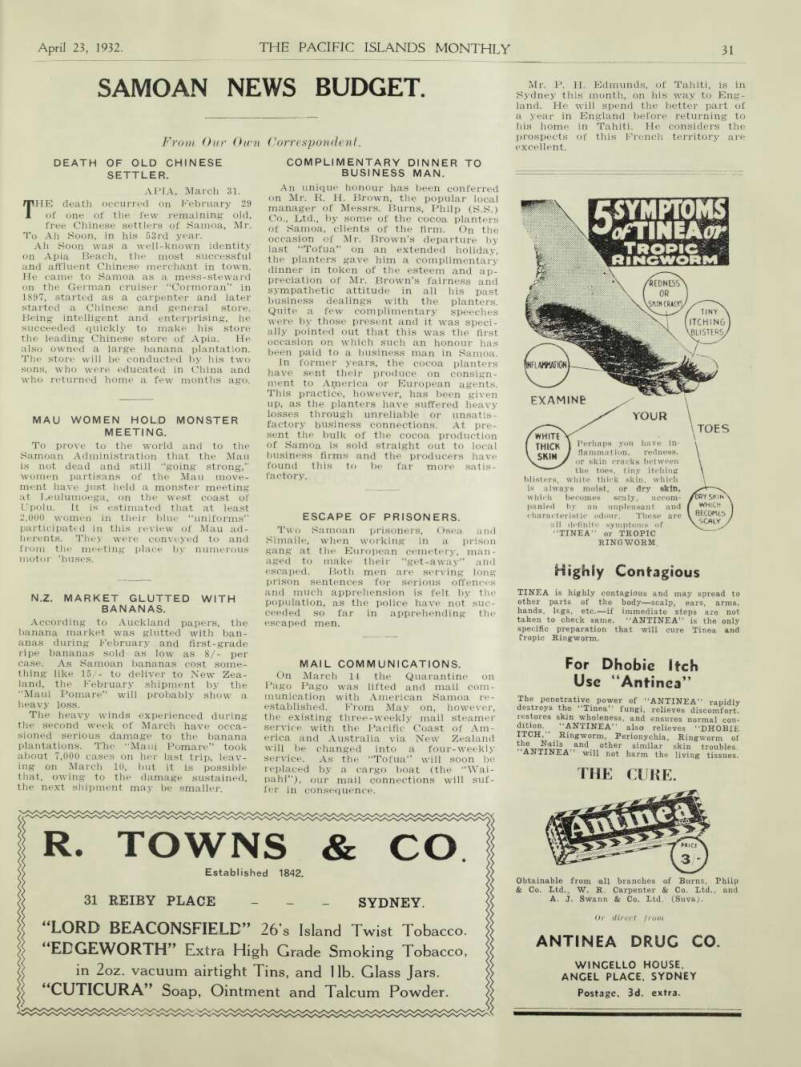
From Our Own Correspondent.
Death Of Old Chinese
Settler.
APIA, March 31.
THE death occurred on February 29 of one of the few remaining old, free Chinese settlers of Samoa, Mr.
To Ah Soon, in his 53rd year.
Ah Soon was a well-known identity on Apia Beach, the most successful and affluent Chinese merchant in town.
He came to Samoa as a mess-steward on the German cruiser “Comoran” in 1897, started as a carpenter and later started a Chinese and general store.
Being intelligent and enterprising, he succeeded quickly to make his store the leading Chinese store of Apia. He also owned a large banana plantation.
The store will be conducted by his two sons, who were educated in China and who returned home a few months ago.
Mau Women Hold Monster
Meeting.
To prove to the world and to the Samoan Administration that the Man is not dead and still “going strong,” women partisans of the Man move ment have just held a monster meeting at Leulumoega, on the west coast of Upolu. It is estimated that at least 2,000 women in their blue “uniforms” participated in this review of Mau ad herents. They were conveyed to and from the meeting place by numerous motor ’buses.
N.Z. Market Glutted With
Bananas.
According to Auckland papers, the banana market was glutted with ban anas during February and first-grade ripe bananas sold as low as 8/- per case. As Samoan bananas cost some thing like 15/- to deliver to New Zea land, the February shipment by the "Maui Pomare” will probably show a heavy loss.
The heavy winds experienced during the second week of March have occa sioned serious damage to the banana plantations. The “Maui Pomare” took about 7,000 cases on her last trip, leav ing on March 10, but it is possible that, owing to the damage sustained, the next shipment may be smaller.
Complimentary Dinner To
Business Man.
An unique honour has been conferred on Mr. R. H. Brown, the popular local manager of Messrs. Burns, Philp (S.S.) Co., Ltd., by some of the cocoa planters of Samoa, clients of the firm. On the occasion of Mr. Brown’s departure by last “Tofua” on an extended holiday, the planters gave him a complimentary dinner in token of the esteem and ap preciation of Mr. Brown’s fairness and sympathetic attitude in all his past business dealings with the planters.
Quite a few complimentary speeches were by those present and it was speci ally pointed out that this was the first occasion on which such an honour has been paid to a business man in Samoa.
In former years, the cocoa planters have sent their produce on consign ment to America or European agents.
This practice, however, has been given up, as the planters have suffered heavy losses through unreliable or unsatis factory business connections. At pre sent the bulk of the cocoa production of Samoa is sold straight out to local business firms and the producers have found this to be far more satis factory.
Escape Of Prisoners.
Two Samoan prisoners, Osea and Simaile, when working in a prison gang at the European cemetery, man aged to make their “get-away” and escaped. Both men are serving long prison sentences for serious offences and much apprehension is felt by the population, as the police have not suc ceeded so far in apprehending the escaped men,
Mail Communications.
On March 14 the Quarantine on Pago Pago was lifted and mail com munication with American Samoa re established. From May on, however, the existing three-weekly mail steamer service with the Pacific Coast of Am erica and Australia via New Zealand will be changed into a four-weekly service. As the “Tofua” will soon be replaced by a cargo boat (the “Wai pahi”), our mail connections will suf fer in consequence.
Mr. P. H. Edmunds, of Tahiti, is in Sydney this month, on his way to Eng land. He will spend the better part of a year in England before returning to his home in Tahiti. He considers the prospects of this French territory are excellent.
Advertisements & other items, p. 33 (1 item)
R. Towns & Co,
INFLAMMATION
Highly Contagious
TINEA is highly contagious and may spread to other parts of the body—scalp, ears, arms, hands, legs, etc.—if immediate steps are not taken to check same. “ANTINEA” is the only specific preparation that will cure Tinea and Tropic Ringworm.
For Dhobie Itch
Use “Antinca”
The penetrative power of “ANTINEA” rapidly destroys the “Tinea” fungi, relieves discomfort, restores skin wholeness, and ensures normal con dition. “ANTINEA” also relieves “DHOBIE ITCH,” Ringworm, Perionychia, Ringworm of the nails and other similar skin troubles.
ANTINEA will not harm the living tissues.
THE CURE.
Obtainable from all branches of Burns, Philp & Co. Ltd., W. R. Carpenter & Co. Ltd., and A. J. Swann & Co. Ltd. (Suva).
WINCELLO HOUSE.
ANGEL PLACE. SYDNEY
Postage, 3d. extra.
R. TOWNS & CO,
Established 1842.
31 REIBY PLACE - SYDNEY.
“LORD BEACONSFIELD” 26’s Island Twist Tobacco.
“EDGEWORTH” Extra High Grade Smoking Tobacco, in 2oz. vacuum airtight Tins, and lib. Glass Jars.
“CUTICURA” Soap, Ointment and Talcum Powder.
Solomons?
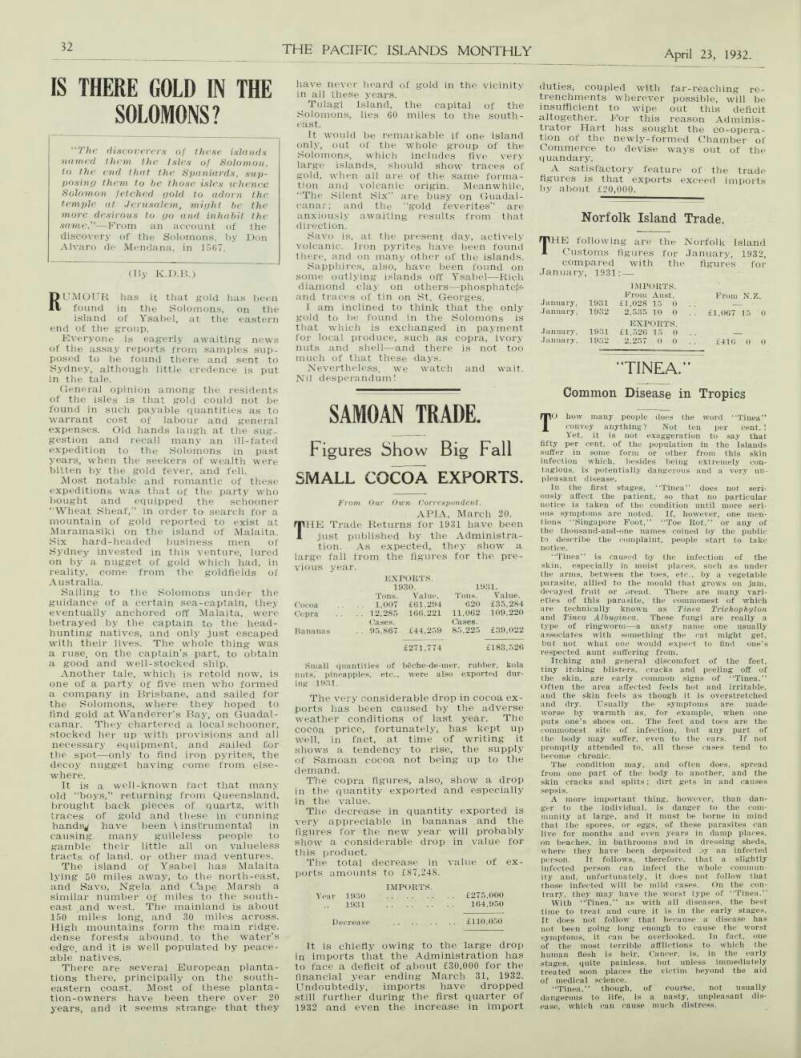
Is There Gold In The
“The discoverers of these islands named them the Isles of Solomon, to the end that the Spaniards, sup posing them to be those isles whence Solomon fetched gold to adorn the temple at Jerusalem, might be the more desirous to go and inhabit the same.” —From an account of the discovery of the Solomons, by Don Alvaro de Mendana, in 1567.
(By K.D.B.)
RUMOUR has it that gold has been found in the Solomons, on the island of Ysabel, at the eastern end of the group.
Everyone is eagerly awaiting news of the assay reports from samples sup posed to be found there and sent to Sydney, although little credence is put in the tale.
General opinion among the residents of the isles is that gold could not be found in such payable quantities as to warrant cost of labour and general expenses. Old hands laugh at the sug gestion and recall many an ill-fated expedition to the Solomons in past years, when the seekers of wealth were bitten by the gold fever, and fell.
Most notable and romantic of these expeditions was that of the party who bought and equipped the schooner “Wheat Sheaf,’’ in order to search for a mountain of gold reported to exist at Maramasiki on the island of Malaita.
Six hard-headed business men of Sydney invested in this venture, lured on by a nugget of gold which had, in reality, come from the goldfields of Australia.
Sailing to the Solomons under the guidance of a certain sea-captain, they eventually anchored off Malaita, were betrayed by the captain to the head hunting natives, and only just escaped with their lives. The whole thing was a ruse, on the captain’s part, to obtain a good and well-stocked ship.
Another tale, which is retold now, is one of a party of five men who formed a company in Brisbane, and sailed for the Solomons, where they hoped to find gold at Wanderer’s Bay, on Guadal canal They chartered a local schooner, stocked her up with provisions and all necessary equipment, and sailed for the spot—only to find iron pyrites, the decoy nugget having come from else where.
It is a well-known fact that many old “boys,’’ returning from Queensland, brought back pieces of quartz, with traces of gold and these in cunning hands have been instrumenta1 in causing many guileless people to gamble their little all on valueless tracts of land, or other mad ventures.
The island of Ysabel has Malaita lying 50 miles away, to the north-east, and Savo, Ngela and Cape Marsh a similar number of miles to the south east and west. The mainland is about 150 miles long, and 30 miles across.
High mountains form the main ridge, dense forests abound to the water’s edge, and it is well populated by peace able natives.
There are several European planta tions there, principally on the south eastern coast. Most of these planta tion-owners have been there over 20 years, and it seems strange that they
have never heard of gold in the vicinity in all these years.
Tulagi Island, the capital of the Solomons, lies 60 miles to the south east.
It would be remarkable if one island only, out of the whole group of the Solomons, which includes five very large islands, should show traces of gold, when all are of the same forma tion and volcanic origin. Meanwhile, “The Silent Six” are busy on Guadal canal ; and the “gold feverites” are anxiously awaiting results from that direction.
Savo is, at the present day, actively volcanic. Iron pyrites have been found there, and on many other of the islands.
Sapphires, also, have been found on some outlying islands off Ysabel—Rich diamond clay on others—phosphatefs and traces of tin on St. Georges.
I am inclined to think that the only gold to be found in the Solomons is that which is exchanged in payment for local produce, such as copra, ivory nuts and shell —and there is not too much of that these days.
Nevertheless, we watch and wait.
Nil desperandum!
Samoan Trade.
Figures Show Big Fall
Small Cocoa Exports.
From Our Own Correspondent.
APIA, March 20.
THE Trade Returns for 1931 have been just published by the Administra tion. As expected, they show a large fall from the figures for the pre vious year.
Small quantities of beche-de-mer, rubber, kola nuts, pineapples, etc., were also exported dur ing 1931.
The very considerable drop in cocoa ex ports has been caused by the adverse weather conditions of last year. The cocoa price, fortunately, has kept up well, in fact, at time of writing it shows a tendency to rise, the supply of Samoan cocoa not being up to the demand.
The copra figures, also, show a drop in the quantity exported and especially in the value.
The decrease in quantity exported is very appreciable in bananas and the figures for the new year will probably show a considerable drop in value for this product.
The total decrease in value of ex ports amounts to £87,248.
It is chiefly owing to the large drop in imports that the Administration has to face a deficit of about £30,000 for the financial year ending March 31, 1932.
Undoubtedly, imports have dropped still further during the first quarter of 1932 and even the increase in import
duties, coupled with far-reaching re trenchments wherever possible, will be insufficient to wipe out this deficit altogether. For this reason Adminis trator Hart has sought the co-opera tion of the newly-formed Chamber of Commerce to devise ways out of the quandary.
A satisfactory feature of the trade figures is that exports exceed imports by about £20,000.
Exports.
1930. 1931.
Tons.
Value.
Tons.
Value.
Cocoa 1,007 £61,294 620 £35,284 Copra . . 12,285 166.221 11,062 109,220 Bananas Cases. . . 95,867 £44,259 Cases. 85,225 £39,022 £271,774 £183,526
Year 1930 1931
Imports.
. £275,000 164,950 Decrease . . £110,050
Norfolk Island Trade.
THE following- are the Norfolk Island Customs figures for January, 1932, compared with the figures for January, 1931:
Imports.
From Aust. From N.Z.
January, 1931 £1,028 15 0 . . — January. 1932 2,535 10 0 £1,067 15 0
Exports.
January, 1931 £1,526 15 0 — January, 1932 2,257 0 0 . . £416 0 0
“Tinea.”
Common Disease in Tropics
TO how many people does the word “Tinea” convey anything ? Not ten per cent. !
Yet, it is not exaggeration to say that fifty per cent, of the population in the Islands suffer in some form or other from this skin infection which, besides being extremely con tagious, is potentially dangerous and a very un pleasant disease.
In the first stages, “Tinea” does not seri ously affect the patient, so that no particular notice is taken of the condition until more seri ous symptoms are noted. If, however, one men tions “Singapore Foot,” “Toe Rot,” or any of the thousand-and-one names coined by the public to describe the complaint, people start to take notice.
“Tinea” is caused by the infection of the skin, especially in moist places, such as under the arms, between the toes, etc., by a vegetable parasite, allied to the mould that grows on jam, decayed fruit or bread. There are many vari eties of this parasite, the commonest of which are technically known as Tinea Trichophyton and Tinea Albuginea. These fungi are really a type of ringworm—-a nasty name one usually associates with something the cat might get, but not what one would expect to find one’s respected aunt suffering from.
Itching and general discomfort of the feet, tiny itching blisters, cracks and peeling off of the skin, are early common signs of “Tinea.”
Often the area affected feels hot and irritable, and the skin feels as though it is overstretched and dry. Usually the symptoms are made worse by warmth as, for example, when one puts one’s shoes on. The feet and toes are the commonest site of infection, but any part of the body may suffer, even to the ears. If not promptly attended to, all these cases tend to become chronic.
The condition may, and often does, spread from one part of the body to another, and the skin cracks and splits; dirt gets in and causes sepsis.
A more important thing, however, than dan ger to the individual, is danger to the com munity at large, and it must be borne in mind that the spores, or eggs, of these parasites can live for months and even years in damp places, on beaches, in bathrooms and in dressing sheds, where they have been deposited by an infected person. It follows, therefore, that a slightly infected person can infect the whole commun ity and, unfortunately, it does not follow that those infected will be mild cases. On the con trary, they may have the worst type of “Tinea.”
With “Tinea,” as with all diseases, the best time to treat and cure it is in the early stages.
It does not follow that because a disease has not been going long enough to cause the worst symptoms, it can be overlooked. In fact, one of the most terrible afflictions to which the human flesh is heir, Cancer, is, in the early stages, quite painless, but unless immediately treated soon places the victim beyond the aid of medical science.
“Tinea,” though, of courtee, not usually dangerous to life, is a nasty, unpleasant dis ease, which can cause much distress.
Anthropology
Mr. W. C. Groves to Do Research Work in N.G.
AN interesting traveller, for New Guinea, by the “Montoro,” at the end of April, will be Mr. W. C.
Groves, who has been awarded to Fel lowship for research in anthropology by the Australasian National Research Council. The Council administers funds supplied by the Rockefeller Foundation, U.S.A., and money is thus provided for valuable research work.
Mr. Groves, who has been engaged for some time as a lecturer at the Teachers’ College, Melbourne, is a young man who is well-known in New Guinea, where he was employed in the administrative service between 1922 and 1926. His brother-in-law is Mr.
Norman Foxcroft, of the Bitapaka wireless station.
The study of anthropology has al ways appealed strongly to Mr. Groves and he will now, for a year, have ample opportunity to indulge his hobby. He will spend some time in the Territory, acquainting himself with New Guinea’s native educational methods and will then settle down at a special camp in the central district of New Ireland.
Mr. Groves is acquainted with the latest developments in anthropology, and has been following with interest the researches of Dr. Reo Fortune, who, with his talented wife (Dr. Mar garet Mead, a well-known author) has been busy in Papua and New Guinea for some time. Mr. Groves regards Dr. and Mrs. Fortune as two of the most expert field workers in anthropology in the world to-day. Dr. Fortune’s book on Papuan life, “Sources of Dobu,’’ is a distinct contribution to the literature on primitive life.
Cook Is. Notes
No Hurricane This Year.
From Our Own Correspondent.
Rarotonga, April 2.
OCR “monsoon” season is drawing to a close and we can say now, almost without risk of being wrong, that the weather for the next nine months will be free from hurricanes.
The Pacific Ocean, with its thousands of is lands, is becoming more and more an attrac tion to those seeking adventure in yachts and other sailing craft. Like many other Pacific islands, Rarotonga is frequently a port of call for these craft.
Unexpected Visitors.
The first to visit us this year was the yacht “Nahlin,” owned by Lady Yule. The “Nah lin” arrived unexpectedly on March 11, stayed two days and resumed her cruise, making Tahiti her next port of call. As she steamed away to the north-east at sunset, a white sail showed up on the horizon.
Our second visitor turned out to be the schooner “Tagua” returning to her headquarters after an absence of nearly three months at Penrhyn Island. She had sailed out of the lagoon at Penrhyn, although the danger from hurricane had not disappeared for the year and, consequently, met with dirty weather on the way down. The schooner and her captain. Andy Thomson, are rapidly coming into world-wide prominence.
An occasional article appears in the Atlantic Monthly, written by a journalist at Tahiti, Mr.
R. Frisbie, in which the “Tagua” and her skipper form the thread of the story.
After remaining at the wharf at Avarua for two days, during which time the sea laid to be watched almost from hour to hour, the “Tagua” proceeded to Tahiti, laden to her Plimsoll line with copra.
On the 21st another sail appeared to the north-west —the schooner “Aratapu,” bound from New Plymouth (N.Z.) to Tahiti. She ran into bad weather shortly after leaving Auckland and met with head winds the whole way. She reached Rarotonga 29 days after leaving New Zealand. Damage included a broken boom, ripped sails, and crippled Diesel engines (auxiliary).
Sickness also broke out amongst the crew. The “Aratapu” is now effecting temporary repairs here.
The Northern Islands.
Mail advices from Penrhyn, and the other two islands of the northern group visited by island schooners, Manihiki and Rakahanga, disclose that the inhabitants are having a lean time.
There is an absence of sickness and there have been no setbacks from hurricanes, how ever.
The people of Rakahanga (an atoll —a ring of coral encircling a large, almost landlocked lagoon report that they have succeeded in transplanting breadfruit trees sent from Raro tonga. The soil, in places, at Rakahanga is rich—what there is of it. Unfortunately, the magnificent lagoon at that island is not suited to the growth of the pearl oyster, as is the
lagoon at Penrhyn and the one at Manihiki.
The Rakahanga lagoon, being practically landlocked, except for one or two very shallow openings, is not emptied by the tide. The water becomes stagnant and the pearl oyster will not thrive in it.
There are no fresh water streams at Raka hanga. The main supply is rain water, run into large tanks from buildings—the roof of the Church being the chief source of water con servation. Other supplies are obtainable from wells.
The Fame of De Groot.
Amongst the items of world’s news flashed across the Pacific and picked up here (static permitting) we would like to refer to one which pleased many in this group.
The first was in reference to the opening of the Sydney Harbour Bridge. While much must be left to the imagination at this distance, the cryptic account of the opening of Sydney’s immense bridge by Captain De Groot indicated that the proceedings were given an epic-making twist. If this comparatively insignificant com munity is any index to the reception of this piece of news in other parts of the Pacific, then it would be difficult to find anyone expressing himself as dissatisfied with the opening cere mony in the circumstances. Indeed, the ma jority of onlookers from afar out in the Pacific are glad to think that the colossal structure is a symbol of the fine sentiments expressed by Captain De Groot.
Advertisements & other items, p. 35 (1 item)
Milk Arrowroot
THE great builder of brain, bone and muscle in growing children ARNOTT’S famous
BISCUITS
Ask Your A
Storekeeper
For Them
P.I. Association Meets
At Dinner.
Farewell to H. A. Ross.
MANY old Islands friendships were renewed, and new ones made, when members and guests of the Pacific Islands’ Association met at dinner in Sydney on March 23, to say farewell to Mr. H. A. Ross.
Mr. Ross is one of the foundation members of the Association. Formerly a well-known member of the Civil Ser vice of Papua, Mr. Ross retired re cently on superannuation. Papua seems to possess some Peter Pan quality, the effect of which is seen in the absurdly youthful appearance of the gentlemen who “retire on superannuation” from its service—and, being still in the prime of life, engage in other occupa tions. There are several such in Syd ney. Mr. Ross engaged in broking work; and then conceived the idea of transferring his activities to London, where he may act as the buying rep resentative and general agent of Pacific firms. He has gone off to London with a bag full of commissions; and, if any firm or planter wishes to buy or sell in London, he is invited to write to Mr.
Ross, c/o. Australia House, The Strand, London.
The genesis of the Pacific Islands’
Association was a chat between Mr. F.
R. Cawley, a Papuan resident magis trate, and Mr. R. W. Robson, of Pacific Publications Ltd. Mr. Cawley intro duced to Mr. Robson, Mr. Jas. R.
Baldie; and Mr. Baldie, in his turn, brought in Mr. H. A. Ross and Mr. J.
P. Fitzgerald; and these three ex Papuans (Messrs. Baldie, Ross and Fitzgerald) took up the idea of the As sociation with great enthusiasm, and carried it along to its present healthy stage.
The Association, therefore, was glad to do honour to Mr. Ross, on the occa sion of his removal to London.
The dinner was attended by about thirty ladies and gentlemen. The chair man of the executive, Mr. W. Bruce Rainsford, was in the chair. Apologies for inability to attend were received from Lady Murray, the Minister for the Islands Territories (Major C. W. C.
Marr), Rev. M. A. Warren, Dr. Calor.
Dr. Simson, Mr. W. R. Carpenter, Mr. and Mrs. Keelan.
The health of Mr. Ross was proposed by the Chairman, and supported in ad mirable little speeches by Messrs. J. P.
Fitzgerald and Jas. R. Baldie. In re sponding, Mr. Ross referred to the many lifetime friendships he had made in Papua and declared that, wherever he went, his Papuan associations would never be forgotten. He expressed con fidence in the future of the Pacific ter ritories, and said he was certain that the Pacific Islands’ Association would assist materially in making the voices of residents heard and assisting in the work of development in the years to come.
“Our Islands Friends” was proposed by Mr. R. W. Robson, who briefly outlined his conception of the work that the Pacific Islands’ Association may do for Islands residents and interests in the future. The work of the Association was necessarily being done by a com mittee of mainland residents, particu
larly in the early stages; but it was hoped to throw ever-increasing duties upon the Islands residents themselves.
Responses were made by Mr. J. G.
Fowler, of Papua, by Captain S. Green (Burns, Philp and Co. Ltd.), Mrs.
Elizabeth Mahony (formerly of Sudest Island, New Guinea), and by Mr. John Colclough (secretary of the Bulolo Dredging Company).
Captain Green gave some most inter esting reminiscences of early days in the Pacific Islands, and produced his famous black walking-stick, which had an important part in the ceremony of annexing Papua in 1884—at which Cap tain Green was present. He recalled a meeting with Mrs. Mahony, in Eastern Papua, very many years ago.
Mr. Colclough emphasised the great importance to the Islands and to Aus tralia of an event that had occurred only two days previously—the opening of the first dredge on the Morobe goldfield.
This meant that the production stage had at last been reached on the gold field; that gold in enormous quantities
would commence to flow out of that territory, and that a period of general development must soon ensue in New Guinea.
New Members.
The following have been elected members of the Pacific Islands’ Asso ciation:—Mrs. J. Fowler (Papua), Messrs. J. G. Boileau (Papua), F. R.
Cawley (Papua), H. G. Eekhoff (T.N.G.), H. E. Maude (Gilbert Is lands), I. T. Jenkins (Papua), A. H.
Bunting (Papua), L. Tracey (Papua).
A letter was received at the last meeting of the committee, asking if the Association would take action concern ing Chinese competition against Euro pean traders in the Pacific, and alleg ing that Chinese evaded the law in New Guinea, and secured trading stations, by getting Europeans to “dummy” for them.
It was decided to ask the writer for fuller particulars.
Advertisements & other items, p. 36 (1 item)
Excelsior Supply Co. Ltd,
The most extensive Manufacturers in the British Empire of
RUBBER STAMPS,
INKS, STENCILS,
Marking Devices.
ACME STAMP PADS
We have a big range of Special
FRUIT CASE MARKING SETS
We also Manufacture or Supply a complete line of
Spraying Machines
for all purposes.
Let us know your requirements and we will quote you by return. Ask for our Big Catalogue.
Sole Australasian Distributors of the World Famous SHEAFFER FOUNTAIN
PENS and PENCILS.
EXCELSIOR SUPPLY CO. LTD.
Head Office:—160 GEORGE STREET WEST,
SYDNEY, N.S.W.
Self-Contained Pacific Territory.
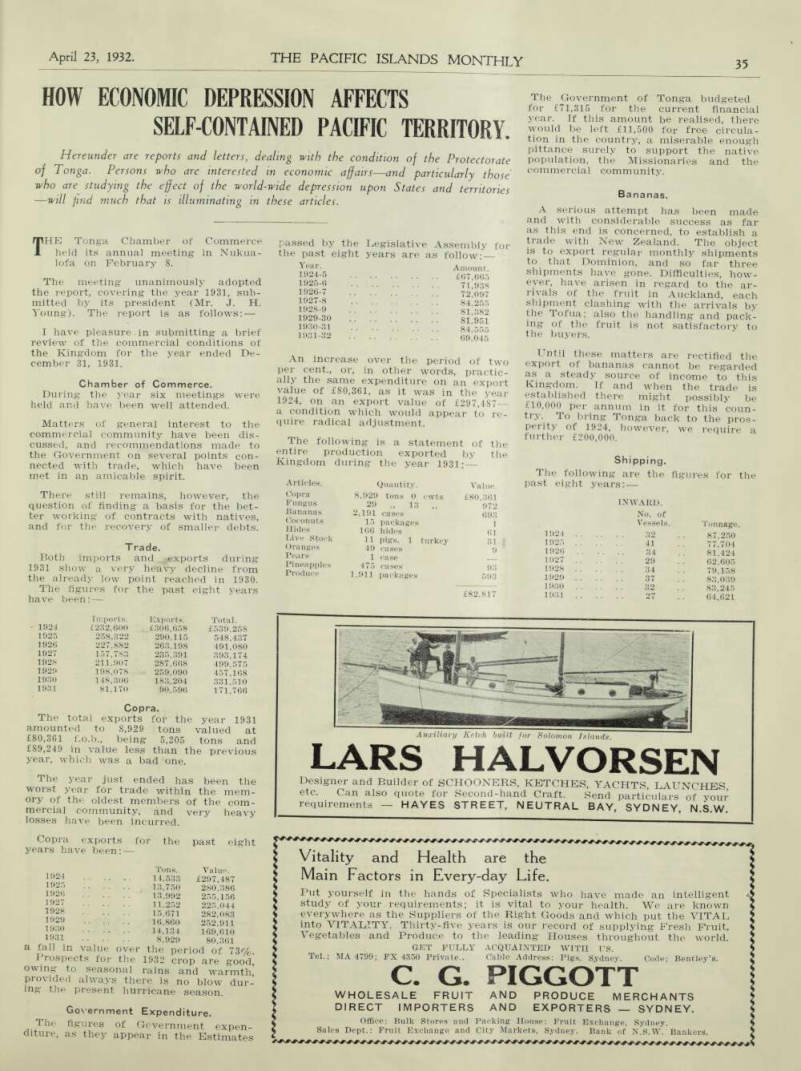
How Economic Depression Affects
Hereunder are reports and letters, dealing with the condition of the Protectorate of Tonga. Persons who are interested in economic affairs —and particularly those who are studying the effect of the world-wide depression upon States and territories —will find much that is illuminating in these articles.
THE Tonga Chamber of Commerce held its annual meeting in Nukua lofa on February 8.
The meeting unanimously adopted the report, covering the year 1931, sub mitted by its president (Mr. J. H.
Young). The report is as follows; I have pleasure in submitting a brief review of the commercial conditions of the Kingdom for the year ended De cember 31, 1931.
Chamber of Commerce.
During the year six meetings were held and have been well attended.
Matters of general interest to the commercial community have been dis cussed, and recommendations made to the Government on several points con nected with trade, which have been met in an amicable spirit.
There still remains, however, the question of finding a basis for the bet ter working of contracts with natives, and for the recovery of smaller debts.
Trade.
Both imports and exports during 1931 show a very heavy decline from the already low point reached in 1930.
The figures for the past eight years have been: —
Copra.
The total exports for the year 1931 amounted to 8,929 tons valued at £80,361 f.o.b., being 5,205 tons and £89,249 in value less than the previous year, which was a bad one.
The year just ended has been the worst year for trade within the mem ory of the oldest members of the com mercial community, and very heavy losses have been incurred.
Copra exports for the past eight years have been:—
a fall in value over the period of 73%.
Prospects for the 1932 crop are good, owing to seasonal rains and warmth, provided always there is no blow dur ing the present hurricane season.
Government Expenditure.
The figures of Government expen diture, as they appear in the Estimates
passed by the Legislative Assembly for the past eight years are as follow:—
An increase over the period of two per cent., or, in other words, practic ally the same expenditure on an export value of £80,361, as it was in the year 1924, on an export value of £297,487 — a condition which would appear to re quire radical adjustment.
The following is a statement of the entire production exported by the Kingdom during the year 1931;
The Government of Tonga budgeted for £71,315 for the current financial year. If this amount be realised, there would be left £11,500 for free circula tion in the country, a miserable enough pittance surely to support the native population, the Missionaries and the commercial community.
Bananas.
A serious attempt has been made and with considerable success as far as this end is concerned, to establish a trade with New Zealand. The object is to export regular monthly shipments to that Dominion, and so far three shipments have gone. Difficulties, how ever, have arisen in regard to the ar rivals of the fruit in Auckland, each shipment clashing with the arrivals by the Tofua; also the handling and pack ing of the fruit is not satisfactory to the buyers.
Until these matters are rectified the export of bananas cannot be regarded as a steady source of income to this Kingdom. If and when the trade is established there might possibly be £10,000 per annum in it for this coun try. To bring Tonga back to the pros perity of 1924, however, we require a further £200,000.
Shipping.
The following are the figures for the past eight years:
Imports. Exports. Total. 1924 £232,600 £306,658 £539.258 1925 258,322 290,115 548,437 1926 227.882 263,198 491,080 1927 157,783 235.391 393,174 1928 211.907 287.668 499,575 1929 198,078 259.090 457,168 1980 148,306 183,204 331.510 1931 81,170 90.596 171,766
Tons.
Value. 1024 14,533 £297,487 1925 13,750 280,386 192<; 13.992 255.156 1927 11,252 225,044 1928 15,671 282.083 1929 16,860 252,911 19.10 14.134 169,610 1931 8,929 80.361
Inward.
No. of Vessels.
Tonnage. 1924 . . . . . . 32 87,250 192'. . 77,704 102G • • • • 34 81.12 1 1927 . . . . . . 29 68,606 1928 79,158 1929 . . 83,039 1930 83,245 1931 . . • • • • 27 64,621
Year.
Amount. 1924-5 1925-6 1926-7 1927-8 1928-9 1929-30 1930-31 1931-32
Articles.
Quantity.
Value.
Copra 8,929 tons 0 cwts £80.361 Fungus 29 .. 13 972 Bananas 2,191 cases 693 Coconuts 15 packages 1 Hides 106 hides 61 Live Stock 11 pigs, 1 turkey 31 Oranges 49 cases 9 Pears 1 case Pineapples 475 cases 93 Produce 1.911 packages 593 £82,817
The Chamber of Commerce wishes to thank Messrs. Burns, Philp (South Sea) Company Btd., for the use of their offices for its meetings.
1924 ..
Outward.
.. .. 31 83,762 1925 . . .. .. 37 74,067 1926 .. . . . . 32 81,271 1927 . . .. 25 58.252 192'"- . . .. 32 79,092 1929 .. .. 34 81,243 1930 79,778 1931 . . . . . . 28 68.246
Advertisements & other items, p. 37 (1 item)
Lars Halvorsen
Designer and Builder of SCHOONERS, KETCHES, YACHTS, LAUNCHES etc. Can also quote for Second-hand Craft. Send particulars of your requirements — HAYES STREET, NEUTRAL BAY, SYDNEY, N.S.W.
Vitality and Health are the
Main Factors in Every-day Life.
Put yourself in the hands of Specialists who have made an intelligent study of your requirements; it is vital to your health. We are known everywhere as the Suppliers of the Right Goods and which put the VITAL into VITALITY. Thirty-five years is our record of supplying Fresh Fruit, Vegetables and Produce to the leading Houses throughout the world.
GET FULLY ACQUAINTED WITH US.
Tel.: MA 4799; FX 4350 Private.. Cable Address: Pigs, Sydney. Code: Bentley’s.
C. G. PIGGOTT
WHOLESALE FRUIT AND PRODUCE MERCHANTS
DIRECT IMPORTERS AND EXPORTERS SYDNEY.
Office: Bulk Stores and Packing House: Fruit Eixchange, Sydney.
Sales Dept.: Fruit Exchange and City Markets, Sydney. Bank of N.S.W. Bankers.
Constructive Policy
Suggested.
[To the Editor.] Sir, —Your own correspondent in a recent article has made persistent de mand for some constructive policy for Tonga. May I suggest something by way of a commencement?
First: To use the words of your own correspondent in another connection, it is absolutely necessary to bring into immediate operation “an interesting system of elimination” which would reduce by at least one half the civil servants of the Government of Tonga; then make those left do a day’s work for their pay, and lengthen the hours of attendance (I had almost written work) to 8 a.m. to 5 p.m., instead of 9 a.m. to 4 p.m. There is no reason why a bunch of parasites, some alien, some native, should batten and fatten on these islanders.
Second: The 1,200 unemployed re ferred to by her Majesty the Queen as having no taxed allotments should be placed on land without delay and made to produce something.
Third: The natives should be dis couraged from wasting their time joy riding on motor lorries, kava-drinking until the small hours of the morning, attending churches on week days, and all the other dodges for avoiding work, including excessive time for sports; they should be made to go on system atically planting coconuts and any thing else that will add to the coun try’s production.
Fourth: The labour force represented by the youths at present wasting their time in the two so-called “colleges,” amounting to several hundred, should be turned upon their only means of getting a living—viz., the land —and so save many thousands of pounds of tax payer’s money and voluntary contribu tions.
Fifth: Some method of ascertaining the amount of money contributed to Missions each year should be devised, returns to be furnished and made obli gatory by law.
Sixth; The natives, if they are al lowed to contract debts, should be forced to pay them.
Seventh: The Police Department should be made the subject of an ex haustive enquiry by a commission and completely re-organised I am, etc.,
Kataki.
Nukualofa, Feb. 29, 1932.
Tonga’S Economic
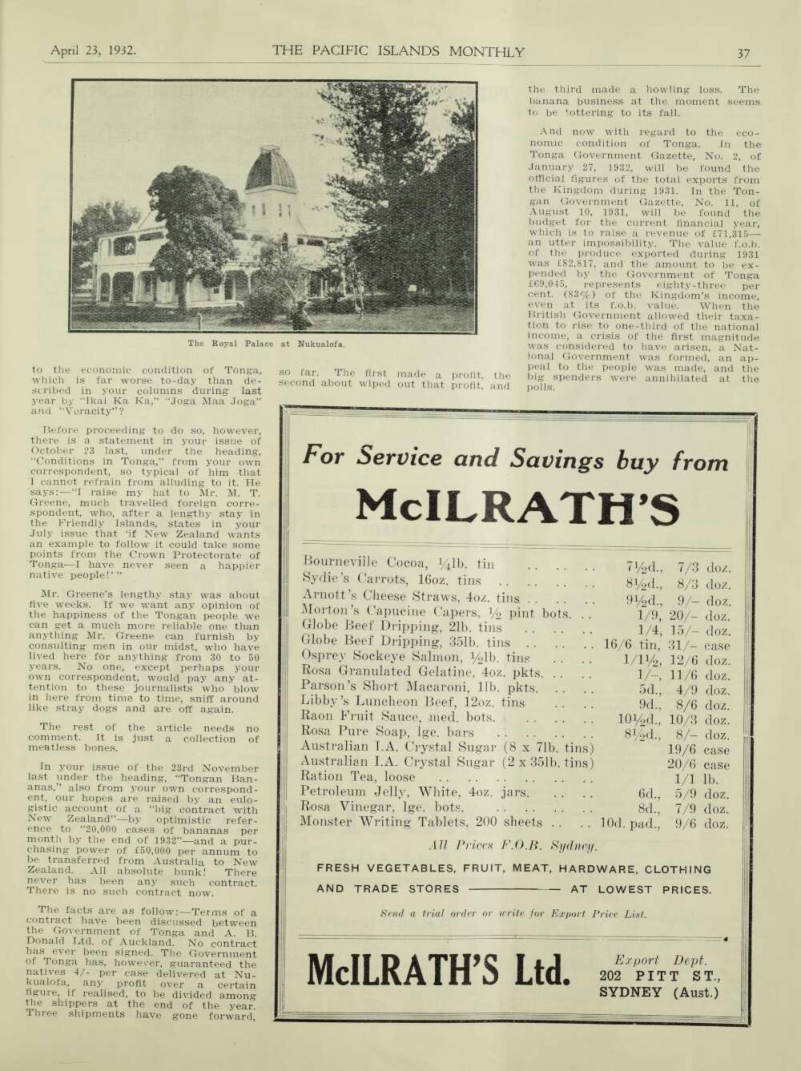
Condition.
[To the Editor.]
Sir, —May I encroach upon your valuable space to make some reference
to the economic condition of Tonga, which is far worse to-day than de scribed in your columns during last year by “Ikai Ka Ka,” “Joga Maa Joga” and “Veracity”?
Before proceeding to do so, however, there is a statement in your issue of October 23 last, under the heading, “Conditions in Tonga,” from your own correspondent, so typical of him that I cannot refrain from alluding to it. He says:—“l raise my hat to Mr. M. T.
Greene, much travelled foreign corre spondent, who, after a lengthy stay in the Friendly Islands, states in your July issue that ‘if New Zealand wants an example to follow it could take some points from the Crown Protectorate of Tonga—l have never seen a happier native people!’”
Mr. Greene’s lengthy stay was about five weeks. If we want any opinion of the happiness of the Tongan people we can get a much more reliable one than anything Mr. Greene can furnish by consulting men in our midst, who have lived here for anything from 30 to 50 years. No one, except perhaps your own correspondent, would pay any at tention to these journalists who blow in here from time to time, sniff around like stray dogs and are off again.
The rest of the article needs no comment. It is just a collection of meatless bones.
In your issue of the 23rd November last under the heading, “Tongan Ban anas,” also from your own correspond ent, our hopes are raised by an eulo gistic account of a “big contract with New Zealand”—by optimistic refer ence to “20,000 cases of bananas per month by the end of 1932”—and a pur chasing power of £50,000 per annum to be transferred from Australia to New Zealand. All absolute bunk! There never has been any such contract.
There is no such contract now.
The facts are as follow:—Terms of a contract have been discussed between the Government of Tonga and A. B.
Donald Ltd. of Auckland. No contract has ever been signed. The Government of Tonga has, however, guaranteed the natives 4/- per case delivered at Nu kualofa, any profit over a certain figure, if realised, to be divided among the shippers at the end of the year.
Three shipments have gone forward,
so far. The first made a profit, the second about wiped out that profit, and
the third made a howling loss. The banana business at the moment seems to be tottering to its fall.
And now with regard to the eco nomic condition of Tonga. In the Tonga Government Gazette, No. 2, of January 27, 1932, will be found the official figures of the total exports from the Kingdom during 1931. In the Ton gan Government Gazette, No. 11, of August 10, 1931, will be found the budget for the current financial year, which is to raise a revenue of £71,315 — an utter impossibility. The value f.o.b. of the produce exported during 1931 was £82,817, and the amount to be ex pended by the Government of Tonga £69,045, represents eighty-three per cent. (83%) of the Kingdom’s income, even at its f.o.b. value. When the British Government allowed their taxa tion to rise to one-third of the national income, a crisis of the first magnitude was considered to have arisen, a Nat ional Government was formed, an ap peal to the people was made, and the big spenders were annihilated at the polls.
The Royal Palace at Nukualofa.
The Government of Tonga appar ently is responsible to nobody. The Legislative Assembly is made up of nine official members and seven nom inated members, forming together a block of sixteen against the seven elected representatives of the people. (The Europeans in the Kingdom have no representation whatsoever, but they are amenable both to Tongan law and to British law; they are Europeans or Tongans, just as it suits the British or Tongan authorities.) By what means can this orgy of hare-brained expenditure be stopped, nepotism abolished, and a just equili brium as between the various interests in the State brought about? What is the British Agent and Consul doing about it? What is the High Commis sioner for the Western Pacific doing about it? And, finally, who or what does the British Protectorate of the Tongan Islands protect? 1 am, etc.,
Spartan.
Nukualofa, March 1, 1932.
Advertisements & other items, pp. 38-39 (1 item)
Quality!
Style !
Service !
Trade Mark.
Every “D&H” Hat that leaves our hands bears the Trade Mark tab inside, and the experienced buyer looks for that tab, knowing as he does that it has stood for Quality, Style and Service for the last 20 years. Throughout the length and breadth of Australia, “D&H” Millinery is recognised as the best selling line in the Trade.
Discerning women in Sydney, Brisbane and Adelaide, specially ask for the new range of “D&H” Hats each season, as by so doing they are able to keep abreast of Dame Fashion, and yet economise.
Give your customers similar facilities, write for a sample range of the newest offerings, and also obtain the latest catalogues and fashion forecasts.
A Smart Mid-season Model in Cellophane Straw
Decent 8C Hutchison
Cable Address: “Decency,” Sydney.
Bentley’s Code.
52-54 BAY STREET,
SYDNEY.
Pot Service Grid Savings buy from
McILRATH’S
Bourneviile Cocoa, ¼lb tin 7½d., 7/3 doz.
Sydie’s Carrots, 16oz. tins 8%d., 8/3 doz.
Arnott ’s Cheese Straws, 4oz. tins 9y 2 d., 9/- doz.
Morton’s Capucine Capers, y 2 pint hots. .. 1/9’ 20/- doz Globe Beef Dripping, 21b. tins 1/4, 35/- doz.
Globe Beef Dripping, 351 b. tins 16/6 tin,’ 31/- case Osprey Sockeye Salmon, y>lb. tins . . . . 1/1%, 12/6 doz.
Rosa Granulated Gelatine, 4oz. pkts 1/-, 11/6 doz.
Parson’s Short Macaroni, 11b. pkts 4/9 doz.
Libby’s Luncheon Beef, 12oz. tins .. .. 9d.! 8/6 doz.
Raon Fruit Sauce, med. bots 10y 2 d., 10/3 doz.
Rosa Pure Soap, Ige. bars 8y 2 d., 8/- doz.
Australian LA. Crystal Sugar (8 x 71b. tins) 19/6 case Australian LA. Crystal Sugar (2 x 351 b. tins) 20/6 case Ration Tea, loose 1/1 lb.
Petroleum Jelly, White, 4oz. jars 6d., 5/9 doz.
Rosa Vinegar, Ige. bots Bd., 7/9 doz.
Monster Writing Tablets, 200 sheets . . . . 10d. pad., 9/6 doz.
All Prices F. 0.8. Sydney.
FRESH VEGETABLES, FRUIT, MEAT, HARDWARE, CLOTHING
AND TRADE STORES AT LOWEST PRICES.
Send a trial order or write for Export Price List.
McILRATH’S Ltd.
SYDNEY (Aust.)
Changed to Tuasivi.
Savaii Government Centre Changed to Tuasivi.
From Our Own Correspondent.
APIA, March 20.
THE Administration announces the transfer of the administrative cen tre of the island of Savaii from Fagamalo to Tuasivi.
Fagamalo has been the centre since the German regime, and was for some years the seat of the well-known De puty Administrator Williams, an Irish man by birth and the only German of ficial in Samoa and elsewhere, who was unable to speak the German lan guage. He was taken over by the New Zealand Administration and retained in his position.
Tuasivi, the new seat of the Savaii Administration is situated in the densely populated district of Faasa leleaga and also considerably closer to Apia by motor-boat. There is a dis trict hospital in Tuasivi, and this will now be run in conjunction with the administrative department more effi ciently and economically.
Probably the doctor in charge of Tuasivi Hospital will hold the position of Deputy Administrator of Savaii, whereby a considerable saving may be effected.
Earthquake in Fiji.
A severe earthquake is reported to have occurred on Koro Island, in the centre of the Fiji Group, about equi distant from Viti Levu and Vanna Levu. A landslide carried down, into the sea, about half of one of the native vdlages which are strung along the coast. Alldin Point lighthouse, at the southern extremity of the island was damaged, and the apparatus which re volves the light was put out of action.
Interesting Comparison Emphasises Economic Difficulties.
Present And Pre-War Expenditure In Samoa
From Our Own Correspondent.
APIA, March 20.
IT is interesting to compare present and pre-war Government expendi ture, as related to the productivity of Samoa, represented by export values.
In 1912 the value of exports from Samoa amounted to £250,000, compared with £180,000 in 1931. Government ex penditure in 1912 amounted to less than £60,000, or related to export values not quite 25 per cent, of the latter.
No figures are known regarding Gov ernment expenditure in 1931-32. In 1930-31 the total Government expendi ture was £140,000, while, during the same period, the value of exports from Samoa amounted to £280,000, so that Government expenditure amounted to 50 per cent, of the total income of the Territory.
In 1912 there were no export duties on produce: import duties amounted to 12½ per cent., or just about half the present import duties. Ordinary expen diture in 1912 (salaries to officials, etc.) amounted to £45,000, in 1930-31, prob ably to over £100,000. It may be pointed
out that the total staff of German of ficials in 1912 comprised only 38 in number, the staff of the New Zealand Administration in 1931 numbered 127 European officials.
As for 1931, the productivity of Samoa, measured by exports values, amounted to only three-quarters of the productivity in 1912. T'he lesson to be drawn from this comparison is obvious.
The Administration, of course, can in no way be blamed for the unfortunate economic situation of the country, which is a result of the disastrous drop in copra prices, and lately in banana shipments and prices, also a very small cocoa crop in 1931. But, as it is impos sible and unavailing to put new bur dens of taxation on the population, the only way out is for the Administration to adapt itself to the circumstances and cut expenditure, chiefly in wages, right down to bedrock. The purpose of the above figures is to show that it can be done and has been done. Not all ways to economise have been yet exhausted.
Advertisements & other items, p. 40 (1 item)
Catalog
NOCK & KIRBY'S
General Mail Order
CATALOG 1932
Our 1932
GENERAL
CATALOG
ADAMS AIL STEEL iMSTCr LAWNMOWER
Write for Nock & Kirby’s profusely illustrated General Mail-Order Catalog NOW. It is an invaluable guide when ordering Hardware by mail.
SPECIAL CATALOGS.— Tradesmen’s Tool Catalog (36 pages), Ship Chandlery Catalog (34 pages), and Flyproof Screen Door and Window Catalog, will also be posted Free on request.
NOCR & KIRBY’S
Postal Address: Box 68 CC, G.P.O., Sydney.
EUCRASY BANISHES ALL DESIRE FOR DRINK.
It is a priceless boon to all who use it, VOLUNTARILY or SECRETLY, for their relatives or friends. If you suffer in any way through the liquor habit, let the voluntary testimoma s of actual users convince you that EUCRASY will soon sober the drinker and make you happy.
Letter received: “I have been waiting to see if my husband would drink again. 1 can safely say he has been cured by Eucrasy. It has made quite a different man of him. i cannot speak too highly.—Mrs. B.L.”
EUCRASY is guaranteed harmless, and can be given SECRETLY or Voluntarily. JNOi ruWTEY nail or write to-day for FREE SAMPLE. Booklet and Testimonials.
Dept B., THE EUCRASY CO., CANBERRA HOUSE. 297 ELIZABETH ST.. SYDNEY.
Road Or Aeroplanes For Morobe?
Wau Resident also Discusses Potential Value of the Sepik Area.
[To the Editor.] Sir, —I think that too much attention is being given to the construction of a road from Salamaua to Wau.
In the first place, is the road re quired, and by whom? The miners do not want it now, and it is too late to benefit the companies. They have all their heavy machinery here. We were quite satisfied to pay the Airways 1/per lb. Now, the price is down to 5d.
Another three years, and the Airways will be paying us a bonus on the goods they bring up and their ’planes will be even more up to date than they are now.
In the second place, who is to pay for it, and where is the money to come from? The planters have no wish to be taxed for it, nor do the miners themselves wish to be taxed. The Ad ministration would have to borrow the money, and that is the first step to the poor-house. Australia would be a good place to live in now if it had not got to pay £40,000,000 per year interest on its borrowed money. At present, it is a good place to be out of, and we up here consider ourselves lucky, and wish to live within our means —not try to make our means fit our method of living.
It is mooted that in Salamaua there is a company willing to transport goods up to Wau at £5 per ton, if the road is constructed. What about their constructing it themselves, and the Ad ministration giving them the sole right to the road and the right to charge £20 per ton for 10 years? They ought to jump at that offer. It is much cheaper than what the ’planes are charging. If that will not pay them, it won’t pay the Administration.
The cost of construction is going to be much greater than that estimated, and will require about 100 boys, every 10 miles, in the mountain part, to maintain it. On the mule track to Edie, the Company have to send up 100 boys, every now and again, to clear the land slides away, to let the mules pass; and this track is on the sunny side of the hill all the way, and been cut for three years. This gives no idea of what the maintenance will cost in the wet mountains.
The Administration has been working on the Markham Valley road since 1926 and, though level all the way and in some places little or no clearing to be done, not more than 25 miles is finished. Last time I went up the road it was dry. Coming back, I was up to the knees in water more than half of the way, and the culverts all washed away. The trouble starts after the Markham is crossed, to say nothing about the bridge, which I have not seen mentioned yet.
To give some idea of what the Markham is like, I may say that it takes from a day and a half to two days to go up by canoe to the first village, 25 miles, by poling along the bank. The centre of the stream is im possible. But you can go back from there on a raft made of logs in four hours —and it is some thrill, too —more so, if you have not got boys who un
derstand the game. There is a lot of recruiters and miners’ gear still in the Markham.
Certainly, this road would open up good country, but only as far as the bridge. Past that there are rivers that require half-mile bridges before San gan is reached. This puts most of the Markham Valley out of action and the Airways have a ’drome at Sangan.
But why open up country inland when there is plenty of good land on the waterfront? If a valley is wanted, what about Sepik Valley? A boat draw ing ten feet can go up 300 to 400 miles and tie up to the bank anywhere, thus giving 700 to 800 miles of waterfront.
The poorest business man knows that every time a bag of produce is handled it costs money, as does every mile it is hauled on land. It would only have to be taken to Madang, and would cost no more than if grown a few miles from Rabaul.
Private enterprise will open this country if given a little encourage ment. So far, private enterprise has done everything in Rabaul, by the merchants and others; in Wau, by the companies and miners. The companies have water and light laid on all their buildings; have cut roads and built many bridges. The P.A.T, now intends to instal light for the public. The tele phone is run by a private firm, the Day Dawn Co.
Placer have all their machinery in and in much better condition than if brought in by road. So it is a bit late in the day to borrow money and make a road.
The present miners will be regarded in the future as the pioneers of the Territory. What they want, if they find new fields, large or small, is a graded track blazed from the 'drome.
The airway companies are up-to-date and will have a ’drome handy almost as soon as the field is found.
The miner will have to find new fields, now he is deprived of the allu vial on Edie. It is all very well for the Administration to say that they will not allow any more leases to be taken up on new fields. That is a case of locking the stable door after the horse is stolen. What about recovering the horse and seeing how Wau and Sala maua would boom. The miner, if he is getting £100 per day, is going to spend it, and if he cannot spend it fast enough in Wau and Salamaua, he will take a trip south. His idea is to get all the milk and honey out of life while the going is good; whereas the wages man has to put away his fare back and also enough to keep him until he gets another job down south. So he has little or nothing to spend here.
In a previous issue of the P.I.M. it was mentioned that the miners sold their leases to the Co. This is true, but it must be understood that they were not alluvial leases and, as far as the miners knew, contained no gold.
The Company bought them on chance of their containing reefs, and having control of the country about their ac tivities.
If a miner takes up a lease, he has to pay the rent on making application, as well as the survey fees. After that, he has to pay it twelve months in ad
vance, or he is fined 100 per cent, rent and the lease may not be granted for three or four years after he applied for it. This lease is no good to him until it is granted, as he cannot float it into a company until he has the. lease to lay before the board of direc tors appointed, otherwise they are likely to meet trouble for obtaining money for something they have not got. Yet the Administration is obtain ing money for something they have not granted. In Victoria the rent does not become due until the lease is granted.
To open up the Sepik—what is wrong with giving some company or person a landed concession to adver tise and give it publicity, rent free the
(Continued on page 40.)
first five years and five years to pay the survey fees. This may attract many new planters, and there is plenty of native labour to be obtained. This would cost the Administration nothing and give them big returns in the future.
During the sale of the Expro Board properties, anyone caught dummying for the Germans was sentenced to a long term of imprisonment. But any one can dummy for a Chinese coolie to compete against a white trader. All the stores in Salamaua have white men’s names over the door but Chinese are interested in the ownership of some of them. One miner caught one of his boys taking 53 ounces of gold to sell to a Chinaman. If there is no place for the boys to sell the gold they will not steal it. This is placing the Chinese ahead of the Germans. Why?
I am, etc..
Liviara.
Wau, N.G.
February 22, 1932.
Advertisements & other items, p. 41 (1 item)
Cooking Stoves
“YOUNGER”
Built Specially for use in the Pacific Islands
FEATURES—
1. Solidly constructed. A “Younger” will stand up indefinitely to rough handling and great heat, where flimsier articles will collapse in a few months. 3. Extended Fire Box, to take long wood fuel. 3. All-Steel Oven, instead of Cast-iron; built to stand excessive heat and shocks. Will not crack. 4. Wide range of sizes, from small type, suitable for hut, to self-setting, double oven ranges, for hotels and large establishments. 5. So constructed that spare parts can be supplied and fitted at short notice; and various kinds of hot-water sys tems can be included in installation.
A “YOUNGER” Stove is scientifically— yet simply—constructed—so that it gives a steady, controlled heat, with ideal cook ing conditions and low-fuel consumption,
AND IT LASTS A LIFETIME.
Illustrated Catalogue sent to any address.
We Pack Securely and Ship Promptly
G. Fletcher & Son
50 OXFORD STREET, SYDNEY.
New Guinea Agents: CAMPBELL & CO., Rabaul, where stoves may be inspected and all information obtained.
Traffic.
New Caledonian Tourist
[To the Editor.]
Sir, —I have had my attention drawn to the article appearing in your issue of the 26th January (page 14) under the heading: “No tourists for Nou mea.”
The reasons given therein for the in significance of the above traffic seem to be somewhat lightly reviewed and could wrong our company by giving the impression that we are not endeav ouring to facilitate same.
It is correct to say that the drop in the Australian exchange is an import ant factor in the matter, but in reality the main one is rather the obligation to restrict expenditure which has been forced upon the whole world the present crisis.
As regards our Company’s co-opera tion, I must say that we declared our selves ready to adopt special low rates for tourist parties and have arranged schedules that ought to meet the re quirements of the case but our efforts have not met with very encouraging results.
I am, etc.,
J. Cochet,
General Manager.
Auckland Protests Strongly Against
Plan To Eliminate Islands Steamer.
FOR some reason that is difficult to understand, the New Zealand Gov ernment decided, at the end of March, to cut Auckland out of the it inerary of the steamer “Maui Pomare,” which maintains a service between the Dominion and the Pacific groups to the northward.
For economy's sake, the Government decided to eliminate two of the four ports of Auckland, Wellington, Lyttel ton and Dunedin. This plan had merit; but when it appeared that the ports omitted were to be Auckland and Dun edin, there was amazement; because, next to Sydney, Auckland probably is the biggest Islands trading port in the world. The two ports omitted should have been Dunedin and Lyttelton; or, if a South island connection had to be maintained, Dunedin and Wellington.
The Auckland Chamber of Commerce, on March 31, April 1 and 2, was very active, holding meetings of protest and telegraphing strong representations to the Government, pointing out that the proposed re-arrangement threatened to destroy a trade with the Islands built up over 40 years.
The Chamber asked the Prime Minister to consider the following points: The matter of catering for Island re quirements is a highly specialised one, and it does not pay to cater unless a comparatively large market is avail able. Auckland merchants understand this business and have gone into it only because practically the whole of the Island trade has in the past been centred in Auckland. If the trade with the Islands were scattered throughout New Zealand it would pay no mer chants to specialise in it, and much business would be permanently lost to New Zealand and go to Australia and elsewhere. The Auckland merchants who had to pay the rail or coastal freight to Wellington would be pro hibited from continuing to enjoy this trade, especially as New Zealand at the present time is already labouring under the disadvantage of the exchange “bonus’’ enjoyed by Australian exports.
If you will examine the manifests of the “Maui Pomare,” you will notice that (if banana shooks are eliminated) even when the South Island ports have had the advantage of a flat freight rate to the Islands, they have never been able between them to
provide as much as 5 per cent, of the total New Zealand exports to the Is land.
By way of illustration it may be mentioned that the whole population of Nuie is not sufficient to warrant piece goods being specially manufactured and it is only when the demand could be spread over a number of islands that it pays the merchants engaged in this trade to arrange for the special re quirements of the islands to be manu factured. Considerable stocks of such goods are held by Auckland merchants, and these would undoubtedly be left on their hands if the elimination of Auck land were made permanent.
Then, as regards tinned meats; A local brand, well and favourably known throughout the Islands, would not stand the freight to Wellington, in addition to the present freights. In all probability, Australian meats would supplant it, as with the Australian exchange advan tage local firms have already had some difficulty in holding their own. The New Zealand Co-operative Dairy Com pany is the only New Zealand company tinning butter, and it is tinned butter that the Islander requires. Here again the commodity would not stand the freight to Wellington, and there is dan ger the trade might slip to Australia.
Auckland, has natural geographical advantages to cater for the Islands trade, by reason of shorter distances, and the fact that the services in the past have existed. The Auckland ex porters have sunk considerable capital in establishing goodwill in the Islands, and generally in financing the Islands trade under the quite justifiable expec tations that there would be no artificial interferences with the natural advan tage of closer proximity. The removal of Auckland from the “Maui Pomare’s” itinerary would destroy that goodwill.
If, for reasons of economy, it is deemed necessary to confine the “Maui Pomare’s” calls to two New Zealand ports, surely Auckland and Lyttel ton suggest themselves rather than Wellington and Lyttelton. It may be mentioned that Wellington and Lyttel ton are both south of the centre of gravity of New Zealand’s population, Which at present is somewhere about Levin. Island produce would be dis tributed with a minimum of expense and with a minimum of delay if the ports of call in New Zealand were so chosen as to be approximately equal distances from the centre of gravity of population. This is a simple mathe matical proposition requiring no de monstration. The ports which natur ally suggest themselves in this connec tion are undoubtedly Auckland and Lyttelton.
Advertisements & other items, p. 42 (1 item)
Marine Engine
The Universal
6-8 H.P.
This is the highest grade One-cylinder Marine Engine on the market. A 2in. heavy counterbalanced Crankshaft, with oversize hearings, plus duralumin con necting rod and De Luxe pistons, make possible extreme smoothness of opera tion. Every part is balanced.
It is fitted with the famous Ricardo Cylinder head, Tillotson Carburettor, Wico Magneto, Highest Grade Reverse Gear and multiple disc clutch, bronze gear-type water circulating pump, and many exclusive features not found in any other engine of this kind.
Owing to the heavy duty and exchange we cannot sell this engine in Australia under £150, but we have a few in Bond which arrived just before the exchange oame into force, and we offer same f.o.b. Sydney, in bond for
£65 each.
HALL BROS. LTD.
(Established 40 years),
The Engine House,
CAREENING COVE,
MILSON’S POINT, NORTH SYDNEY,
N.S.W. - AUSTRALIA.
Repairs. “OUR HANDS MAKE GOOD ARMS” Firearms sent C.O.D.
THE WANT ED RIFLE AT LAST.
barrel, weight 6½lbs, cartridge, £5/10/-.
A go-between the 22 and 32. A heavy bolt action S.S. Rifle. Fires 25 cal.; rim fire cartridges (12/per 100), 24in. price £3/15/-, post free. A special Walther S.S. Rifle for same Illustrated Shooting and Fishing Catalogue sent on request
SIL, ROHU (late A.I.F.), GUNSMITH
IMPORTER OF HIGH-GRADE FIREARMS AND FISHING TACKLE SPECIALIST, 143 P.P. ELIZABETH STREET. SYDNEY (Near Market Sltreet).
“FISHING TACKLE TO TACKLE FISHING.”
Tahiti Notes.
From Our Own Correspondent.
PAPEETE, March 24.
The steam yacht “Nahlin,” belong ing to Lady Yule, and said to be one of the largest pleasure craft in the world, arrived at Papeete on March 14 and will remain here until the 26th, to take in fuel oil which is expected on s.s. “Monowai.” The vessel then pro ceeds to California, via the Marquesas.
It would be superfluous to give a description of the “Nahlin” and her elaborate equipment of machinery, el ectrical fitments, and speed boats, see ing that this has already appeared in great detail in the New Zealand papers. The inhabitants of Papeete and nearby districts are indebted to Lady Yule for a fine display of fire works given last night, which attracted large crowds of spectators.
At the moment of writing, the schooner “France Austral,” under char ter to Mr. Victor Berge, is just going out the Pass on a pearl-diving expedi tion to the shark-infested waters of the Marquesas Islands. We mentioned Mr. Berge’s expedition in a previous letter. We all wish them the best of luck. The yacht “Nahlin” gave them a farewell with her siren, which should carry them on their adventurous voyage.
Messrs. A. B. Donald’s trading schooner “Tiare Taporo” arrived yes terday, after an uneventful sojourn in the Northern Cook Group, where she has been laid up through the hurricane season. She brought a full load of copra, and returns shortly to her home port of Rarotonga with benzine and other lines which the mail steamers refuse to carry. The old-established firm of A. B. Donald appears to flourish in spite of bad times, and now has under construction a gasoline sta tion on a vacant lot adjoining their premises on the Papeete waterfront.
Mr. Cazeaux, Inspector of French Colonies, is now on a visit to Tahiti in his official capacity, and it is hoped in consequence that the plans which the local Government have been consider ing for the improvement of roads and the construction of new bridges will now take definite shape. It has been publicly known for some time past that an allocation from the war reparations fund amounting, it is stated, to 30,000,000 francs, has been set aside for
French Oceania to relieve the strain on local resources. New Caledonia ap bears to have received a similar sum.
Phenomenal Rain In
Rarotonga.
From Our Own Correspondent.
Rarotonga, March 27.
Rain commenced last night and con tinued to fall in torrents until noon to day. All the mountain streams came down as “bankers” and overflowed over the flat ground. The flood, in places, was feet deep, and the villages of Avarua, Arorangi and Manihiki were inundated, in places. Stores, garages, cookhouses, fowl-runs and a few dwell ings were swamped out, and much pro perty had to be hurriedly removed. The natives, running about excitedly in the warm, drenching rain, enjoyed them selves hugely.
The sudden rush of waters carried considerable loose property into the lagoon, whence it had to be rescued.
Advertisements & other items, p. 43 (1 item)
W. Kopsen & Co. Limited
1870. 1932.
QUALITY STANDS
THE TEST OF TIME.
S.M.P. "WAR MEDAL BRAND" MEATS
Specially packed
for Island Trade
SAUSAGES
beef
CORNED, BOILED, ROAST, BEEF OR MUTTON.
Packed in 120 z., 11b., lUb., 21b., 31b., 41b„ 51b., 61b. tins.
Tins fitted with Patent Key Opener.
S.M.P. MILESTONE BRAND.
CHICKEN
FRANKFURTS
RABBIT
SAUSAGES
SHEEP TONGUES
OX TONGUES, etc.
F. J. WALKER LTD., 33 Macquarie Place, Sydney.
Sole Selling Agents: THE SYDNEY MEAT PRESERVING CO., LTD.
SHIPCHANDLERY.
W. Kopsen & Co. Limited
Manufacturers of PIONEER BRAND ASH OARS AND IMPLEMENT HANDLES.
Sole Agents for : KOPSEN’S SPECIAL YELLOW METAL SHEATHING AND NAILS.
Large Stocks of Chains, Anchors, Manilla and Wire Ropes, Wood and Iron Blocks, Oakum, Tar, Pitch, Oils, Paints, Leads, Zincs, Varnishes, Shackles, Rigging, Screws, Sheathing, Felt, Lampware, etc.
Prices and Particulars on Application.
68-70 CLARENCE STREET, SYDNEY.
Cables: “Kopsen.” ’Phone: BW 1114-5.
The Tragedy of Bleak
An Island Princess.
The Tragedy of Bleak Campbell Island.
Written for The Pacific Islands Monthly hy Arthur J. Yogan, F.R.G.s.
FOR thousands of miles across the Western Pacific run the geological finger-posts, formed of isolated elevations of granitic and basaltic rocks. They have a north-easterly and south-westerly trend which, according to the great geologists, Woolnougb and Guppy, indicate that a land connec tion once obtained from China and Formosa, through New Guinea and New Caledonia, with New Zealand and the South Polar lands. Biologists gen erally confirm this view.
But our subject lies in a little island about 700 miles south of that best laid out city in Oceania, Dunedin —a cold, cold direction, the memory of which always makes the writer shiver; but which produces the finest specimens of Scottish humanity, perhaps, that the world has yet rejoiced in. Campbell Is land is chiefly famous for two things: the grave of a French princess, and for a patch of real Highland heather.
A few years after the Battle of Waterloo, when George IV., of undig nified memory, was on the British throne, some Scottish hot-heads, under a certain Prince whose name I need not recall, laid deep plots. They were aided by a French princess, whom he had promised to make his queen if all went according to schedule —a little habit of his apparently, as many a Northern story tells! He had rescued her from the French revolutionaries.
Just when the day had come for the long-prepared-for attack, the usual traitor “gave the whole plot away.”
The Prince was led away to durance vile; and the poor Princess was dragged from her castle and flung into prison. History has never satisfactorily accounted for the Prince’s end; but having “lost his head’’ at the start of the affair, he probably did so at its climax.
The beautiful Princess, it was de cided, could not be executed; and she was ex-patriated to a lonely and ter rible island just discovered, where no one was ever likely again to fore gather with her in plotting the down fall of the Royal wielder of the British sceptre.
In wind-swept Perseverance Harbour, on bleak Campbell Island, a substantial hut was built for her; and around it the poor lady planted sprigs of Scotch heather, which she had smuggled out amidst her meagre baggage. She did not live a year after her arrival, ap parently, but pined away and died on the inhospitable and desert temnant of storm-beaten rock.
When some sealers visited the place a year or so later, her skeleton was found lying on the rough boards of the shelter; and, still clenched in the poor withered hand, that once had been the toast of “bright Bordeau,” was a bunch of still fragrant heather, that her part ing breath had saluted and her fading thoughts had glorified with thoughts “o’ bonnie Scotland.”
There her mortal remains are lying to this day, surrounded by the sacred heather her own hand had planted; and the occasional visitor notes, with
something that may be superstition, or may be a just recognition of a power outside mere mundane matters, that on this one spot alone, out of the about 50,000 acres of knee-deep tussocky grass, is any of this plant to be dis covered. It has never spread; and within the encircling patch may still be seen the marks of the excavation on
the hillside where the hut stood, and where the bareheaded sailors, amidst the howling gale, lowered the fragile remnants of what had once been so exquisite a creature into its lonely, rock-bound grave, over which the sea birds sounded their shrill requiem as they swept from one surging sea-front to another.
Advertisements & other items, p. 44 (1 item)
Lysacht
The Famous Brands of
Galvanized Iron
ARE NOW MADE IN AUSTRALIA
At Newcastle, N.S.W The first cost of these brands is so very little more than that of inferior Qualities that to buy
“ORB” or “QUEEN’S HEAD” is a
proved sound investment.
The 15th edition of “The Referee,” a handbook of useful information, containing a ready-reckoner of much value to all engaged in building operations, may be obtained post free on application to John Lysaght (Aust.) Ltd., c/o. Box 196 D, G.P.0., Sydney.
CORRUGATED
PLAIN
Guaranteed
Pacific Islands Travellers
Passengers Per S.B. “Montoro,”
Which Sailed From Sydney On March
10 FOR PAPUA AND NEW GUINEA : Mrs. L.
Saunders, Mrs. E. A. Holland, Miss Holland, Mrs.
D. G. Irvine, Mrs. R. H. French, Mrs. V. Hadley, Miss Woodings, Miss E. Mulcahy, Mr. and Mrs.
E. J. O’Donnell and family, Dr. J. Fleming, Mr. G. Fleming, Miss L. O’Regan, Miss L. King, Mr. T. Fleming, Master R.
Fleming, Mrs. W. M. Crookshank, Mr. and Mrs. N. Jeffrey, Mr. V. Saunders, Dr. G.
H. McQueen, Mr. P. Moncur, Mr. E. C. Green, Master Stumbles, Mr. W. J. Simpson, Mr. and Mrs. J. H. Edwards, Mr. and Mrs. H. Mirow, Mr. and Mrs. A. J. Peadon, Mrs. Tait and two children, Mr. Duncan, Mr. and Mrs. D. H.
Gray and family, Mr. E. C. Corbett, Mrs.
Frame and child, Mr. T. J. Miller, Mr. E. M.
Granter, Mr. E. Tillford, Mr. C. L. Saunders, Mr. Davies, Dr. J. McM. Falkiner, Mr. W.
Dupain, Mr. and Mrs. R. Walshe, Dr. F. A.
Wiesener, Mr. W. R. Forwood, Mr. J. Barrie, Mr. L. Ankers, Mr. B. Arnold, Mr. E. P.
Fahey, Mr. F. Cook, Mr. B. C. Arthur, Mr.
J. H. L. McGuigan, Mr. J. E. Martin, Mr.
J. H. Ellis, Mr. Watsford, Miss C. Albrey.
Passengers Per M.V. “Macdhui,”
Which Arrived In Sydney On March
29 FROM PAPUA AND NEW GUINEA : Miss C. A. Ayton Lee, Mr. C. A. Hall, Mr. H.
Richardson, Mr. J. A. Davy, Mr. W. W. Harris, Mr. N. D. Lewis, Mr. A. D. Mackay, Mr. F.
South, Mr. E. Thomley, Mr. J. Yates, Miss I.
Corry, Mrs. M. G. McGregor, Mrs. F. I. Mur ray, Mr. and Mrs. A. H. Cropp and three chil dren, Mrs. R. J. McMullen and infant, Miss A.
Anderson, Mr. A. W. Ardlie, Mr. and Mrs. E.
Armstrong and child, Mr. L. S. Downs, Miss D. C. Green, Mrs. C. T. Hall. Mr. and Mrs.
G. G. Hogan, Mrs. E. Hore-Lacy and two chil dren, Mrs. A. Niall, Mr. and Mrs. A. Parry and three children, Miss M. D. Pomeroy, Mr.
B. W. Storey, Mr. A. H. Tregear, Mr. J. Wood, Miss N. Hullett, Mrs. P. Robertson, Misses J. and Y. Rudge. Mr. W. C. Sparks, Mr. J. G.
Boileau, Mr. F. R. Cawley, Mr. E. H. Chester, Mr. E. H. Dettman, Mr. W. R. Forwood, Mr.
J. N. Hoile, Mr. F. J. Smith, Mrs. G. Sutton, Mrs. K. Walke, Dr. F. A. Weisener.
Passengers Per S.S. “Morinda,”
Which Sailed From Sydney On March
31 For Lord Howe Island, Norfolk
Island, New Hebrides Ports And
AUCKLAND: Mr. J. S. Jaffray. Mrs. J. S.
Jaffray, Miss M. Castle, Mrs. I. Rennie, Mr.
O. C. Thompson, Mr. J. W. Nicholson, Mr. A.
J. Smith. Mrs. A. J. Smith, Miss R. Lyons, Miss E. Lyons, Mr. A. J. Cresswell, Mrs. A.
J. Cresswell, Mr. J. Mann, Mrs. J. Mann, Miss B. Robertson, Miss H. Forrest, Mrs. S. Quin tal, Miss B. Castle, Mr. E. Sarglnson, Mrs.
Sarginson, Mr. R. J. Keegan, Mrs. Keegan, Miss D. Nutter, Miss J. Nutter, Mr. E. D.
Mallett, Mr. Cincombe, Mr. O. S. Adam, Mr.
T. R. Salisbury, Mr. C. Murray, Mr. J. Davis, Miss M. Nobbs, Miss M. Marlowe, Mr. J. B.
Healy, Mrs. Healy, Mr. E. J. C. Stopp, Mrs.
Stopp and infant, Mr. C. F. Purdy, Mr. Mc Auliffe, Mr. R. Morris, Mr. R. Herkes, Miss E.
Wheeler. Mrs. N. C. Gray, Miss R. Betts, Mrs.
F. J. Purdy, Miss K. Birmingham, Miss M.
Jackson, Miss D. Arguimbau, Miss R. Johnson, Miss F. Johnson, Mrs. R. McElwaine, Matron Lovell, Miss Tworaey, Mrs. M. Perry, Miss N.
G. Fisher, Mrs. H. L. Clark, Miss M. Haworth, Miss N. Bristow, Mr. E. W. Ivory, Mrs. C. De Gruchy, Miss J. Ivory, Master J. Ivory, Mr.
E. W. Ivory, Mr. W. Ivory, Mr. A. R. Compton, Mr. R. S. Thomas, Mr. W. J. Wales, Mrs Wales, Mr. W. J. Flatt, Mr. F. Payten. Mr.
H. O. Selff, Mr. H. S. Williamson, Mr. G. B.
Thompson, Mr. H. L. Clark, Mr. A. A. Liv ingstone, Mr. R. Wales, Dr. C. Gearin, Mr. T.
L. Lougher.
Passengers Per S.S. “Mataram
Which Arrived In Sydney On April
2 FROM THE SOLOMON ISLANDS: Mr. C.
Koenig, Mr. and Mrs. W T . O. Broad, Miss D.
Atkinson, Mr. F. Everett, Mr. J. E. Wasley, Mrs. R. Wasley, Mr. R. Hallett, Mr. K. Hal lett, Mrs. E. Hallett, Miss E. Sheridan, Miss A. Sheridan, Mr. B. O. Forknall, Miss L.
Dingeman, Miss E. Mole, Mr. W. Teague, Sister Mary Crescentia, Mrs. R. Mathews, Mr. and Mrs. C. W. Carpenter, Mr. and Mrs. L.
Stokie, Mr. C. Pasley. Mr. W. Higgs, Rev.
Father Ernoult, Rev. Father Boudard, Mr. A. C.
Berry, Mr. G. Clift, Mr. A. W T . Dickens, Mr.
H. Mackenzie, Mr. A. N. Watkins.
Passengers Per M.V. “Macdhui,”
SAILED FROM SYDNEY ON APRIL 7 FOR PAPUAN AND NEW GUINEA PORTS : Mrs. E.
L. Moss, Mr. H. H. Yoffa, Mr. K. L. Spinks, Mrs. E. Byrnes, Mrs. A. G. Gee, Mrs. A.
Bunting, Miss Bunting, Mrs. W. M. Dupain, Mrs. M. Anthony and infant, Miss I. Laing, Mr.
M. A. Taylor, Mr. J. R. Stapleton, Mr. C.
Driver, Miss E. Palmer, Mrs, M. A. Irvine, Mr. S. A. Greaves, Mrs. Greaves, Mrs. B. T.
Butcher, Mrs. T. J. Miller, Miss E. Filliter, Misses B. and O. Lawson, Miss M. Steele, Mr.
H. L. Downing, Mr. W. Gibson, Lady Murray, Mrs. W. E. Foxall, Miss L. Foxall, Mrs. E.
Giblin, Mr. C. Van Low, Mr. G. Muller, Mrs.
Muller, Miss P. M. Jones, Mrs. A. Innes and infant, Mr. A. McLeod, Mr. A. Clarkson, Miss A. Parer, Mrs. E. F. Smith, Mr. R. B. Worden, Mr. W. Russell, Mr. R. A. Colyer, Mr. C. H.
White. Miss Job, Miss Waldon, Mr. S. W. Dye, Mr. W T . H. Lang, Mr. G. A. V. Stanley, Mr.
H. D. Eve, Mr. F, L. Watts, Mr. R. A. Hob son, Mr. J. Laird, Mr. R. D. Smith, Mr. J.
Brandis, Mrs. M. Preston, Mrs. A. E. Cody, Mr. W. W. Greenburg, Mr. W. E. Ryde, Mr.
G. A. Beer, Mrs. C. E. Dalton, Miss H. M.
Dalton, Mr. R. Chambers. Mrs. A. Bell, Miss N. Bell, Mrs. Williams and infant, Mr. W.
Connan, Mrs Connan, Mr. H. A. Treseder, Mr.
O. W. Harris. Mr. J. Feain, Mrs. Feain and two infants, Mr D. M. Lawler, Mr. P. R.
Weston, Mr. E. S. Peck, Mr. L. J. Tuxworth, Mr. J. Hynd, Mr. M. Shillilo, Mr. H. O. Clay, Mr. R. T. Fraser.
Passengers Per S.S. “Mataram,”
FROM SYDNEY ON APRIL 13, FOR SOLO MON ISLANDS PORTS: Mr. G. E. Clift, Mr.
A. E. Bamgarten, Mr. Farrant, Mrs. Farrant, Captain Newbiggen, Mrs. Newbiggen, Mr. J.
Hughes, Mr. C. Mason, Mrs. W. Hynam, Mrs.
V. M. Farrar and infant, Mrs. Hewitt, Mr. A.
Ward, Mr. L. L. Williams, Mr. Hicks, Mrs.
Hicks, Mr. J. A. Johnstone, Miss H. M. Cleaver, Miss E. Murray, Miss R. Murray, Miss A. B.
Finn, Miss M. Daly, Mrs. A. E. Osborne, Mr.
G. V. Meller, Mrs. Meller, Mr. E Y. Patterson, Mr. J. A. Phillips, Mr. W. Yeomans, Mr. C.
V. Widdy, Mr. E. D. Gates, Mr. N. W. Dick son, Miss M. Frost, Mrs. L. Larsen, Miss G.
Larsen, Mrs. B. Smith and child, Mr. L. H.
Stowell, Mrs. Stowell, Mr. F. G. Pratten, Mrs.
Pratten, Miss H. Seabrook, Miss M. Emanuel, Mr. H. Hill, Mr. L. J. Drinan, Mr. R. A.
Byrne.
Australian-Samoans Cele
Brate Bridge Opening.
From Our Own Correspondent.
APIA, March 31.
TO celebrate the opening of the Sydney Har bour Bridge, Australians in Samoa met at dinner at the Apia Casino on March 18.
Mr. A. G. Smyth, the pouular manager of Morris, Hedstrom Ltd., occupied the chair, with Mrs.
Smyth at his side, who had first suggested the meeting and helped to organise the function.
The rooms of the Casino and the table were appropriately decorated with the Commonwealth crest and the coat-of-arms of the Australian States. A special feature was a model of the Sydney bridge, worked by Mr. C. E. Hall, built to scale and showing in proportion the gigantic size of the master-work of engineering art.
During the dinner, broadcast messages of the happenings in Sydney were received. In several speeches the history and importance of the bridge were pointed out. Toasts were also pro posed of “The Prime Minister,” and “The Chairman, Mr. Smyth.”
A musical programme was much enjoyed by those present.
At the close of the festivities, the Rev. Mr.
Shinkfield suggested that a committee be set up to promote in future functions on Australia Day and other occasions.
A radio message was despatched by Mr. A. G.
Smyth to Mr. Lyons (Australian Prime Min ister): Forty Australians in Samoa, celebrat ing opening of Sydney Bridge, extend hearty congratulations and express hope for speedy re turn of prosperity throughout the Common wealth.”
To which a reply was received: “Your mes sage of seventeenth very much appreciated.”
Mr. Robert Ayland, well-known as a plantation overseer in New Guinea, died recently in the Territory. His in troduction to New Guinea was unusual —he sailed there in an open boat from Brisbane.
Advertisements & other items, p. 45 (2 items)
The Delicia
HIGH GRADE PICKLES
6 oz., 12 oz., and 18 oz. bottles.
ALL VARIETIES.
TOMATO SAUCE
Made from Fresh Ripe Tomatoes.
ABSOLUTELY PURE.
4 oz. and 10 oz. bottles.
The Delicia
Food Products Co.
WATERLOO, N.S.W.
Makes Home Safer
Where there are romping, heedless kid dies, Pearson’s Carbolic Sand Soap per forms a double household duty. It cleanses thoroughly with a minimum of effort. And its disinfectant lather helps to banish germs and vermin.
PEARSON’S CARBOLIC
SAND SOAP.
Made by Pearson Soap Co. Ltd. - Rozelle - N.S.W.
Samoan Banana
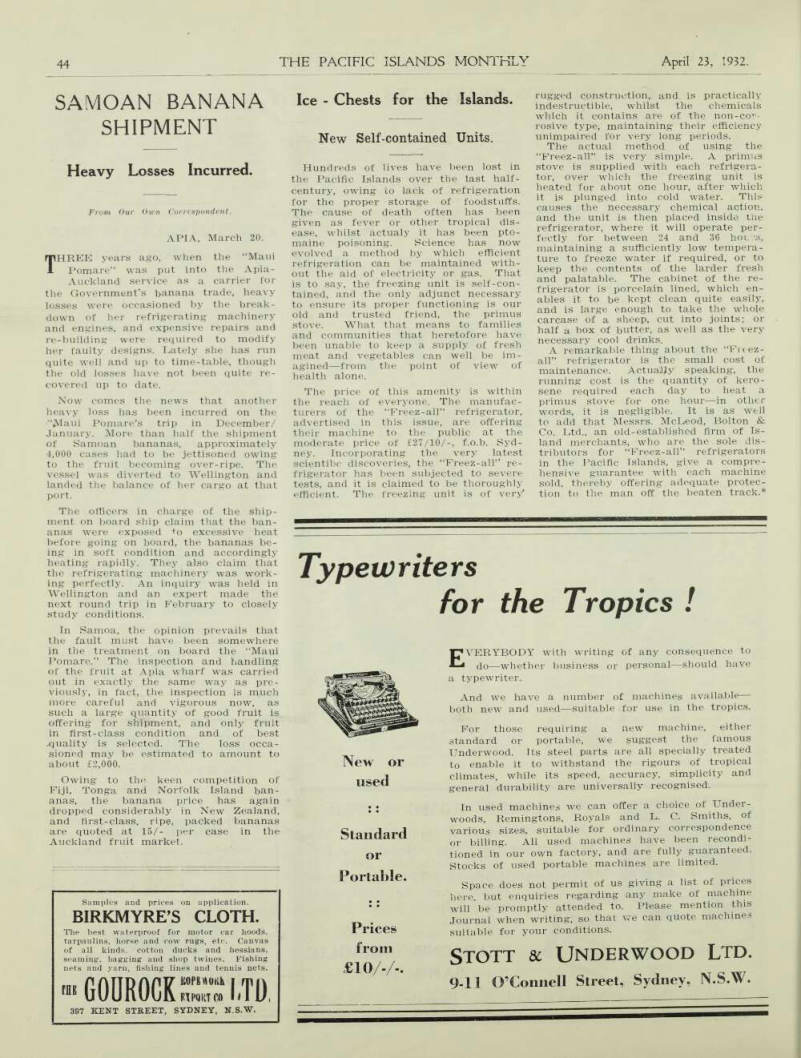
Shipment
Heavy Losses Incurred.
From Our Own Correspondent.
APIA, March 20.
THREE years ago, when the “Maui Pomare” was put into the Apia- Auckland service as a carrier for the Government’s banana trade, heavy losses were occasioned by the break down of her refrigerating machinery and engines, and expensive repairs and re-building were required to modify her faulty designs. Lately she has run quite well and up to time-table, though the old losses have not been quite re covered up to date.
Now comes the news that another heavy loss has been incurred on the “Maui Pomare’s trip in December/ January. More than half the shipment of Samoan bananas, approximately 4,000 cases had to be jettisoned owing to the fruit becoming over-ripe. The vessel was diverted to Wellington and landed the balance of her cargo at that port.
The officers in charge of the ship ment on board ship claim that the ban anas were exposed to excessive heat before going on board, the bananas be ing in soft condition and accordingly heating rapidly. They also claim that the refrigerating machinery was work ing perfectly. An inquiry was held in Wellington and an expert made the next round trip in February to closely study conditions.
In Samoa, the opinion prevails that the fault must have been somewhere in the treatment on board the “Maui Pomare.” The inspection and handling of the fruit at Apia wharf was carried out in exactly the same way as pre viously, in fact, the inspection is much more careful and vigorous now, as such a large quantity of good fruit is offering for shipment, and only fruit in first-class condition and of best quality is selected. The loss occa sioned may be estimated to amount to about £2,000.
Owing to the keen competition of Fiji, Tonga and Norfolk Island ban anas, the banana price has again dropped considerably in New Zealand, and first-class, ripe, packed bananas are quoted at 15/- per case in the Auckland fruit market.
New Self-contained Units.
Ice-Chests for the islands.
Hundreds of lives have been lost in the Pacific Islands over the last half century, owing to lack of refrigeration for the proper storage of foodstuffs.
The cause of death often has been given as fever or other tropical dis ease, whilst actualy it has been pto maine poisoning. Science has now evolved a method by which efficient refrigeration can be maintained with out the aid of electricity or gas. That is to say, the freezing unit is self-con tained, and the only adjunct necessary to ensure its proper functioning is our old and trusted friend, the primus stove. What that means to families and communities that heretofore have been unable to keep a supply of fresh meat and vegetables can well be im agined—from the point of view of health alone.
The price of this amenity is within the reach of everyone. The manufac turers of the “Freez-all” refrigerator, advertised in this issue, are offering their machine to the public at the moderate price of £27/10/-, f.o.b. Syd ney. Incorporating the very latest scientific discoveries, the “Freez-all” re frigerator has been subjected to severe tests, and it is claimed to be thoroughly efficient. The freezing unit is of very
rugged construction, and is practically indestructible, whilst the chemicals which it contains are of the non-cor rosive type, maintaining their efficiency unimpaired for very long periods.
The actual method of using the “Freez-all” is very simple. A primus stove is supplied with each refrigera tor, over which the freezing unit is heated for about one hour, after which it is plunged into cold water. This causes the necessary chemical action, and the unit is then placed inside the refrigerator, where it will operate per fectly for between 24 and 36 houvs, maintaining a sufficiently low tempera ture to freeze water if required, or to keep the contents of the larder fresh and palatable. The cabinet of the re frigerator is porcelain lined, which en ables it to be kept clean quite easily, and is large enough to take the whole carcase of a sheep, cut into joints; or half a box of butter, as well as the very necessary cool drinks.
A remarkable thing about the “Freez all” refrigerator is the small cost of maintenance. Actuary' speaking, the running cost is the quantity of kero sene required each day to heat a primus stove for one hour—in other words, it is negligible. It is as well to add that Messrs. McLeod, Bolton & Co. Ltd., an old-established firm of Is land merchants, who are the sole dis tributors for “Freez-all” refrigerators in the Pacific Islands, give a compre hensive guarantee with each machine sold, thereby offering adequate protec tion to the man off the beaten track.*
Advertisements & other items, p. 46 (2 items)
Typewriters
for the Tropics !
New or
used
Standard
or
Portable.
Prices
from
£10/-/-.
EVERYBODY with writing of any consequence to do —whether business or personal —should have a typewriter.
And we have a number of machines available — both new and used —suitable for use in the tropics.
For those requiring a new machine, either standard or portable, we suggest the famous Underwood. Its steel parts are all specially treated to enable it to withstand the rigours of tropical climates, while its speed, accuracy, simplicity and general durability are universally recognised.
In used machines we can offer a choice of Under woods, Remingtons, Royals and L. C. Smiths, of various sizes, suitable for ordinary correspondence or billing. All used machines have been recondi tioned in our own factory, and are fully guaranteed.
Stocks of used portable machines are limited.
Space does not permit of us giving a list of prices here, but enquiries regarding any make of machine will be promptly attended to. Please mention this Journal when writing, so that we can quote machines suitable for your conditions.
Stott & Underwood Ltd.
9-11 O’Connell Street, Sydney, N.S.W.
Godrociksi.Td,
Samples and prices on application.
BIRKMYRE’S CLOTH.
The best waterproof for motor car hoods, tarpaulins, horse and cow rugs, etc. Canvas of all kinds, cotton ducks and hessians, seaming, bagging and shop twines. Fishing nets and yarn, Ashing lines and tennis nets.
GODROCIKSI.TD,
397 KENT STREET, SYDNEY, N.S.W.
Exchange Quotations
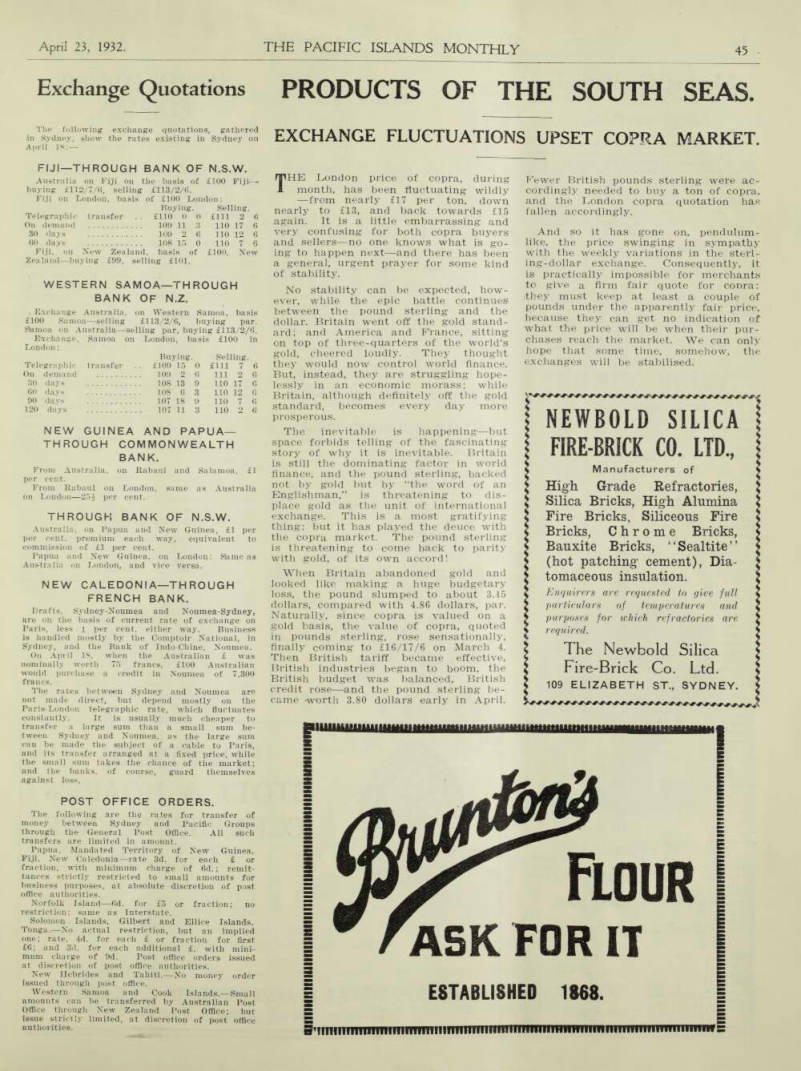
The following exchange quotations, gathered in Sydney, show the rates existing in Sydney on April 18:
Fiji—Through Bank Of N.S.W.
Australia on Fiji on the basis of £100 Fiji— buying £112/7/6, selling £113/2/6.
Fiji on London, basis of £100 London:
Fiji, on New Zealand, basis of £100, New Zealand—buying £99, selling £101.
Western Samoa—Through
Bank Of N.Z.
Exchange Australia, on Western Samoa, basis £100 Samoa —selling £113/2/6, buying par.
Samoa on Australia—selling par, buying £113/2/6.
Exchange, Samoa on London, basis £100 in London:
New Guinea And Papua
Through Commonwealth
Bank.
From Australia, on Rabaul and Salamoa, £1 per cent.
From Rabaul on London, same as Australia on London—25½ per cent.
Through Bank Of N.S.W.
Australia, on Papua and New Guinea, £1 per per cent, premium each way, equivalent to commission of £1 per cent.
Papua and New Guinea, on London: Same as Australia on London, and vice versa.
New Caledonia—Through
French Bank.
Drafts, Sydney-Noumea and Noumea-Sydney, are on the basis of current rate of exchange on Paris, less l per cent, either way. Business is handled mostly by the Comptoir National, in Sydney, and the Bank of Indo-Chine, Noumea.
On April 18, when the Australian £ was nominally worth 75 francs, £100 Australian would purchase a credit in Noumea of 7,300 francs.
The rates between Sydney and Noumea are not made direct, but depend mostly on the Paris-London telegraphic rate, which fluctuates constantly. It is usually much cheaper to transfer a large sum than a small sum be tween Sydney and Noumea, as the large sum can be made the subject of a cable to Paris, and its transfer arranged at a fixed price, while the small sum takes the chance of the market; and the banks, of course, guard themselves against loss.
Post Office Orders.
The following are the rates for transfer of money between Sydney and Pacific Groups through the General Post Office. All such transfers are limited in amount.
Papua. Mandated Territory of New Guinea, Fiji, New Caledonia —rate 3d. for each £ or fraction, with minimum charge of 6d.; remit tances strictly restricted to small amounts for business purposes, at absolute discretion of post office authorities.
Norfolk Island —6d. for £5 or fraction; no restriction; same as Interstate.
Solomon Islands, Gilbert and Ellice Islands, Tonga.—No actual restriction, but an implied one; rate. 4d. for each £ or fraction for first £6; and 3d. for each additional £, with mini mum charge of 9d. Post office orders issued at discretion of post office authorities.
New Hebrides and Tahiti.—No money order issued through post office.
Western Samoa and Cook Islands. —Small amounts can be transferred by Australian Post Office through New Zealand Post Office; but issue strictly limited, at discretion of post office authorities.
Buying. Selling.
Telegraphic transfer . . £110 0 0 fill 2 6 On demand 109 11 3 110 17 6 30 days 109 2 6 110 12 6 00 days 108 15 0 110 7 6
Buying. Selling.
Telegraphic transfer .. £100 15 0 fill 7 6 On demand 109 2 6 111 2 6 30 days 10S 13 9 110 17 G 60 days 108 6 3 110 12 G 90 days 107 18 9 110 7 6 120 days 107 11 3 110 2 6
Products Of The South Seas.
Exchange Fluctuations Upset Copra Market.
THE London price of copra, during month, has been fluctuating wildly —from nearly £17 per ton, down nearly to £13, and back towards £15 again. It is a little embarrassing and very confusing for both copra buyers and sellers —no one knows what is go ing to happen next —and there has been a general, urgent prayer for some kind of stability.
No stability can be expected, how ever, while the epic battle continues between the pound sterling and the dollar. Britain went off the gold stand ard; and America and France, sitting on top of three-quarters of the world’s gold, cheered loudly. They thought they would now control world finance.
But, instead, they are struggling hope lessly in an economic morass; while Britain, although definitely off the gold standard, becomes every day more prosperous.
The inevitable is happening—but space forbids telling of the fascinating story of why it is inevitable. Britain is still the dominating factor in world finance, and the pound sterling, backed not by gold but by “the word of an Englishman,” is threatening to dis place gold as the unit of international exchange. This is a most gratifying thing: but it has played the deuce with the copra market. The pound sterling is threatening to come back to parity with gold, of its own accord!
When Britain abandoned gold and looked like making a huge budgetary loss, the pound slumped to about 3.45 dollars, compared with 4.86 dollars, par.
Naturally, since copra is valued on a gold basis, the value of copra, quoted in pounds sterling, rose sensationally, finally coming to £16/17/6 on March 4.
Then British tariff became effective, British industries began to boom, the British budget was balanced, British credit rose—and the pound sterling be came worth 3.80 dollars early in April.
Fewer British pounds sterling were ac cordingly needed to buy a ton of copra, and the London copra quotation has fallen accordingly, And so it has gone on, pendulum like, the price swinging in sympathy with the weekly variations in the sterl ing-dollar exchange. Consequently, it is practically impossible for merchants give a firm fair quote for copra: they must keep at least a couple of Pounds under the apparently fair price, they can get no indication of what the price will be when their pur chases reach the market. We can only hope that some time, somehow, the exchanges will be stabilised.
Advertisements & other items, p. 47 (1 item)
Ask For It
NEWBOLD SILICA
FIRE-BRICK CO. LTD.,
Manufacturers of High Grade Refractories, Silica Bricks, High Alumina Fire Bricks, Siliceous Fire Bricks, Chrome Bricks, Bauxite Bricks, "Sealtite" (hot patching cement), Dia tomaceous insulation.
Enquirers are requested to give full particulars of temperatures and purposes for which refractories are required.
The Newbold Silica Fire-Brick Co. Ltd.
109 ELIZABETH ST., SYDNEY.
9
ASK FOR IT
ESTABLISHED 1868.
Market Quotations
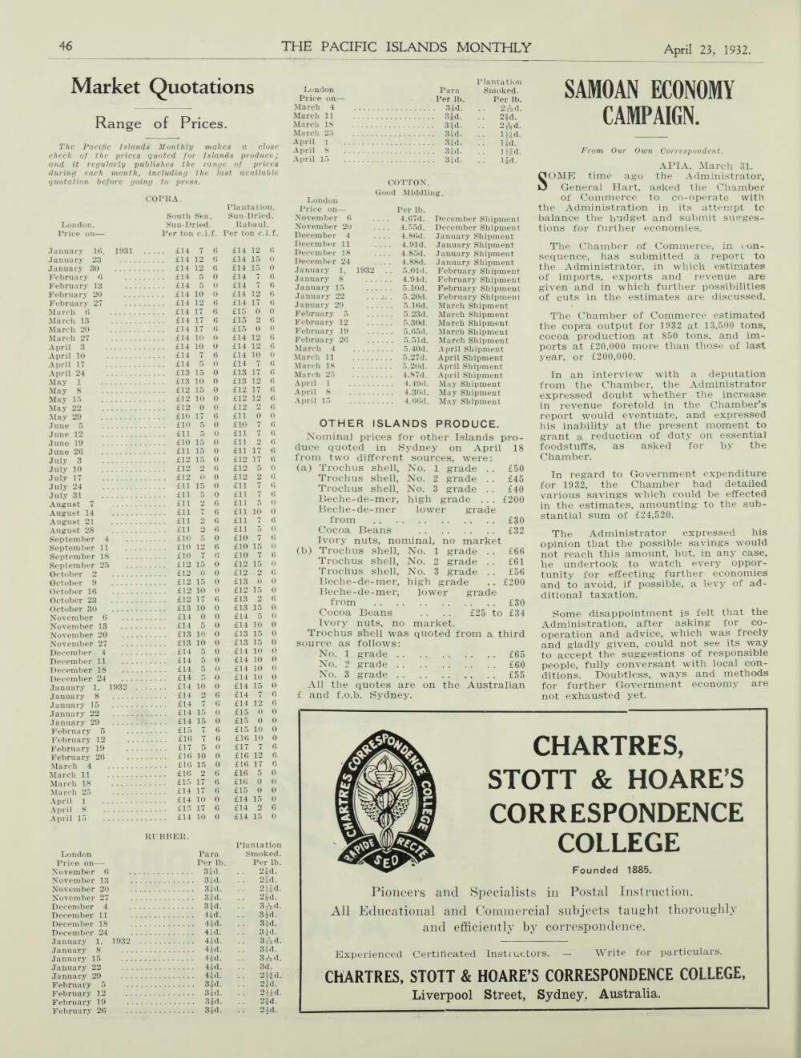
Range of Prices.
The Pacific Islands Monthly makes a close check of the prices quoted for Islands produce; and it regularly publishes the range of prices during each month, including the last available quotation before going to press.
Other Islands Produce.
Nominal prices for other Islands pro duce quoted in Sydney on April 18 from two different sources, were: (a) Trochus shell, No. 1 grade . . £50 Trochus shell, No, 2 grade . . £45 Trochus shell, No. 3 grade . . £40 Beche-de-mer, high grade .. . £200 Beche-de-mer lower grade from £30 Cocoa Beans £32 Ivory nuts, nominal, no market (b) Trochus shell. No, 1 grade . , £66 Trochus shell, No. 2 grade . . £61 Trochus shell, No. 3 grade .. £56 Beche-de-mer, high grade .. £200 Beche-de-mer, lower grade from £30 Cocoa Beans . . . . £25 to £34 Ivory nuts, no market.
Trochus shell was quoted from a third source as follows: No. 1 grade £65 No. 2 grade £60 No. 3 grade £55 All the quotes are on the Australian £ and f.o.b. Sydney.
London.
Price on—
Copra.
South Sea, Sun-Dried. Per ton c.i.f Plantation, , Sun-Dried, Rabaul. Per ton c.i.f.
January 16, 1931 £14 7 6 £14 12 6 January 23 January 30 £14 12 6 £14 15 0 £14 12 6 £14 15 0 £14 5 0 0 £14 7 6 £14 5 £14 7 6 £14 10 0 6 £14 12 6 £14 12 £14 17 6 £14 17 6 £15 0 0 March 13 £14 17 6 6 £15 2 6 £14 17 £15 0 0 £14 10 0 £14 12 6 April 3 £14 10 0 £14 12 6 £14 6 £14 10 0 £14 5 0 £14 7 6 April 24 £13 15 0 £13 17 6 £13 10 0 £13 12 6 May 8 £12 15 0 £12 17 6 May 15 £12 10 0 £12 12 6 May 22 £12 0 0 £12 2 6 May 20 £10 17 6 £11 0 0 £10 5 0 £10 7 6 £11 5 0 £11 7 6 £10 15 0 £11 2 6 £11 15 0 £11 17 6 July 3 £12 15 0 £12 17 6 July 10 £12 o 6 £12 5 0 July 17 £12 0 0 £12 2 6 July 24 £11 15 0 £11 7 6 July 31 £11 5 0 £11 7 6 August 7 August 14 August 21 August 28 September 4 September 11 September 18 September 25 October 2 October 9 October 16 October 23 October 30 November 6 November 13 £11 2 6 £11 5 0 £11 7 6 £11 10 0 £11 2 6 £11 7 6 £11 2 6 £11 5 0 £10 5 0 £10 7 6 £10 12 6 £10 15 0 £10 7 6 £10 7 6 £12 15 0 £12 15 0 £12 0 0 £12 2 6 £12 15 0 £13 0 0 £12 10 0 £12 15 0 £12 17 6 £13 2 6 £13 10 0 £13 15 0 £14 0 0 £14 5 0 £14 5 0 £14 10 0 November 20 November 27 December 4 December 11 December 18 £13 10 0 £13 15 0 £13 10 0 £13 15 0 £14 0 £14 10 0 £14 5 0 £14 10 0 £14 5 0 £14 10 0 December 24 January 1, 1 January 8 January 15 January 22 January 29 February 5 February 12 February 19 February 26 March 4 £14 5 0 £14 10 0 932 . £14 £14 10 2 0 6 £14 £14 15 0 7 6 £14 7 6 £14 12 6 £14 15 0 £15 0 0 £14 15 0 £15 0 0 £15 7 6 £15 10 0 £16 7 6 £16 10 0 £17 5 0 £17 7 6 £16 10 0 £16 12 6 £16 15 0 £16 17 6 March 11 £16 2 6 £16 5 0 March 18 March 25 April 1 £15 17 6 £16 0 0 £14 17 6 £15 0 0 £14 10 0 £14 15 0 April 8 £13 17 6 £14 2 6
April 15
£14 10 0 £14 15 0 London Price on — November 6 November 13
Rubber.
Para Per lb. 3|d. 3gd.
Plantation Smoked. Per lb. . . 2Jd. 2id.
November 20 3gd. 3|d. 3Jd. 4£d. . 4Jd. 4sd. . 4|d. . 4id. 4Jd. . 4|d. 44d. 21gd. 2|d. 3*d. 3id. 3Jd.
November 27 December 4 December 11 December 18 December 24 January 1, January 8 January 15 January 22 January 29 February 5 February 12 February 19 February 26 3id. 3*d. 3Jd. 3*0. 3d. 1932 2H<3. 2|d. 2Hd. 2id. 24d. . 3 id. . 3|d. . 3|d. . 3Jd.
London Plantation Smoked. Per lb.
Para Per lb.
Price on — March 4 . 3|d. .. 2Ad.
March 11 . 3Jd. . . 2id.
March 18 . 3fd. .. 2Ad.
March 25 . 3|d. .. IMd.
April i . 3gd. .. l|d.
April 8 . 3gd. .. im.
April 15 . 3§d. .. l|d.
Cotton.
Good Middling.
London Price on— Per lb.
November G 4.67d.
December Shipment November 20 4.55d.
December Shipment December 4 4.86d.
January Shipment December 11 4.Old.
January Shipment December 18 4.85d.
January Shipment December 24 4.88d.
January Shipment January 1, 1932 . . 5.01d.
February Shipment January 8 4.94d.
February Shipment January 15 5.10d.
February Shipment January 22 ...j.. 5.20d.
February Shipment January 29 5.16d.
March Shipment February 5 5.23d.
March Shipment February 12 5.30d.
March Shipment February 19 ... 5.65d.
March Shipment February 26 5.51d.
March Shipment March 4 5.40d.
April Shipment March 11 5.27d.
April Shipment March 18 5.20d.
April Shipment March 25 4.87d.
April Shipment April 1 4.49d.
May Shipment April 8 4.36d.
May Shipment April 15 4.GGd.
May Shipment
Campaign.
Samoan Economy
From Our Own Correspondent.
APIA, March 31.
SOME time ago the Administrator, General Hart, asked the Chamber of Commerce to co-operate with the Administration in its attempt to balance the budget and submit sugges tions for further economies.
The Chamber of Commerce, in con sequence, has submitted a report to the Administrator, in which estimates of imports, exports and revenue are given and in which further possibilities of cuts in the estimates are discussed.
The Chamber of Commerce estimated the copra output for 1932 at 13,500 tons, cocoa production at 850 tons, and im ports at £20,000 more than those of last year, or £200,000.
In an interview with a deputation from the Chamber, the Administrator expressed doubt whether the increase in revenue foretold in the Chamber’s report would eventuate, and expressed his inability at the present moment to grant a reduction of duty on essential foodstuffs, as asked for by the Chamber.
In regard to Government expenditure for 1932, the Chamber had detailed various savings which could be effected in the estimates, amounting to the sub stantial sum of £24,520.
The Administrator expressed his opinion that the possible savings would not reach this amount, but, in any case, he undertook to watch every oppor tunity for effecting further economies and to avoid, if possible, a levy of ad ditional taxation.
Some disappointment is felt that the Administration, after asking for co operation and advice, which was freely and gladly given, could not see its way to accept the suggestions of responsible people, fully conversant with local con ditions. Doubtless, ways and methods for further Government economy are not exhausted yet.
Advertisements & other items, p. 48 (1 item)
Chartres,
STOTT & HOARE’S
CORRESPONDENCE
COLLEGE
Founded 1885.
Pioneers and Specialists in Postal Instruction.
All Educational and Commercial subjects taught thoroughly and efficiently by correspondence.
Experienced Certificated Instructors. — Write for particulars.
CHARTRES, STOTT & HOARE’S CORRESPONDENCE COLLEGE,
Liverpool Street, Sydney, Australia.
Shipping Services in the Pacific
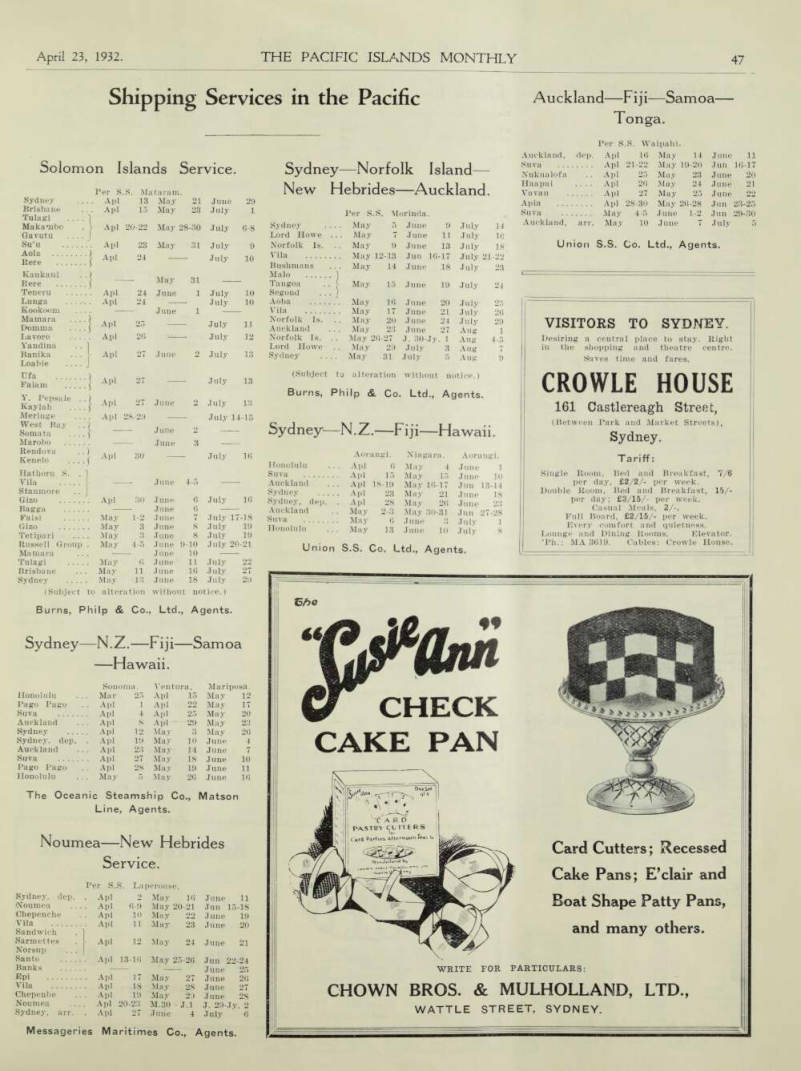
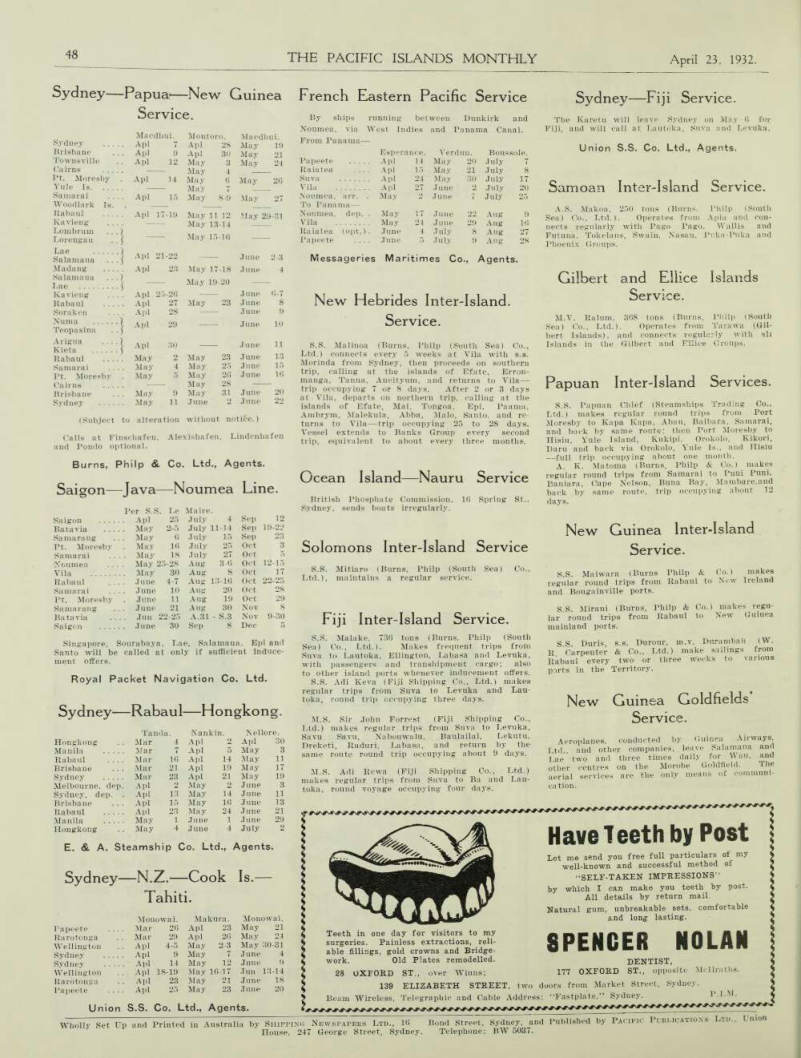
Solomon Islands Service.
Sydney—N.Z.—Fiji—Samoa —Hawaii.
Noumea—New Hebrides Service.
Sydney—Norfolk Island— New Hebrides—Auckland.
Sydney—N. Z. —Fiji—Hawaii.
Auckland—Fiji—Samoa— Tonga.
Per S.S. Waipahi.
Auckland, dep. Apl 10 May 14 June 11 Suva Apl 21-22 May 19-20 Jun 10-17 Nukualofa . . Apl 25 May 23 June 20 Haapai ... Apl 20 May 24 June 21 Vavau Apl 27 May 25 June 22 Apia Apl 28-30 May 20-28 Jun 23-25 Suva May 4-5 June 1-2 Jun 29-30 Auckland, arr. May 10 June 7 July 5 Union S.S. Co. Ltd., Agents.
Per S.S. Mataram.
Sydney Apl 13 May 21 June 29 Brisbane Apl 13 May 23 July 1 Tulagi . . . .
Makambo Apl 20-22 May 28-30 July 6-8 Gavutu . . . .
Su’u Apl 23 May 31 July 9 Aola Rere Apl 24 July 10 Kaukaul May 31 Rere — — Teneru . . ..
Apl Apl 24 June 1 July July 10 10 24 Kookoom June 1 Mamara Demina Apl 05 — July 11 26 July 12 Yandina Banika Apl 27 June o July 13 Loabie ...
Ufa Apl July 13 Faiam ... 27 — Y. Pepsale .
Kaylah Apl 27 June 2 July 13 Meringe Apl 28-29 July 14 -15 West Bay June Somata — 2 — Marobo J une 3 Rendova Kenelo Apl 30 — July 16 Hathorn S. .
Vila 4-5 Stanmore Gizo Apl 30 J une 6 July 16 June June G Faisi May 1-2 i July 17 ■18 Gizo May 3 June 8 July 19 Tetipari May 3 June 8 July 19 Russell Group May 4-5 June 9 •10 July 20- 21 Mamara June 10 — Tulagi May G June 11 July 22 Brisbane May 11 June 16 July 27 Sydney May 13 June 18 July 29 (Subject to alteration without notice. ) Burns, Philp & Co., Ltd., Agents.
Sonoma.
Ventura.
Mariposa.
Honolulu Mar 25 Apl 15 May 12 Pago Pago Apl i Apl 22 May 17 Suva Apl 4 Apl 25 May 20 Auckland Apl s Apl 29 May 23 Sydney Apl 12 May 3 May 26 Sydney, dep. .
Apl 19 May 10 June 4 Auckland Apl 23 May 14 June 7 Suva Apl 27 May 18 June 10 Pago Pago Apl 28 May 19 June 11 Honolulu Mav 5 May 26 June 16 The Oceanic Steamship Co., Matson
Line, Agents.
Per S.S Morinda.
Sydney . . . May 5 June 9 July 14 Lord Howe ... May 7 Juue 11 July ie Norfolk Is. .. May 9 June 13 July 18 Vila Juu 10- ■17 July 21-22 Bushmans ... May 14 June 18 July 23 Malo 1 Tangoa
f May
15 June 19 July 24 Segond • J Aoba ... . . May 16 J une 20 July 25 Vila . . . May 17 June 21 July 2(5 Norfolk Is. . . May 20 June 24 July 29 Auckland . .. May 28 June 27 Aug 1 Norfolk Is. . . May 20-27 J. 30-Jy. 1 Aug 4-5 Lord Howe .. May 2!) July 3 Aug j Sydney .. May 31 July 5 Aug 9 (Subject to alteration without notice.) Burns, Philp & Co. Ltd., Agents
Aorangi.
Niagara.
Aorangi.
Honolulu A pi (1 May 4 June 1 Suva Apl IT, May 1.1 June 10 Auckland A pi 18-19 May 10-17 .Tun 13-14 Sydney Apl 23 May 21 June 18 Sydney, dep. .
Apl 28 May 20 June 23 Auckland May 2-3 May 30-31 Jun 27-28 Suva May 0 •Tune 3 July 1 Honolulu May 13 June 10 July 8 Union S.S. Co. Ltd., Agents,
Per S.S. Laperouse.
Sydney, dep. .
Apl 2 May 16 June 11 'Noumea ...
Apl 6-9 May 20 -21 .Tun 15-18 Chepenche Apl 10 May 22 June 19 Vila Apl 11 May 23 June 20
Sandwich . ]
Sarmettes . i-
Apl 12 May 24 June 21
Norsup . . . J
Santo Apl 13-16 May 25 -26 .Tun 22-24 Banks — • June 25 Epi Apl 17 May 27 June 26 Vila Apl 18 May 28 June 27 Chepenhe Apl 19 May 29 June 28 Noumea ...
Apl 20-23 M.30 - J.l J. 29-Jy. 2 Sydney, arr. .
Apl 27 June 4 July 6 Messageries Maritimes Co., Agents.
Sydney—Papua*—New Guinea Service.
Saigon—Java—Noumea Line.
Sydney—Rabaul—Hongkong.
Sydney—N.Z.—Cook Is.— Tahiti.
French Eastern Pacific Service
By ships running between Dunkirk and Noumea, via West Indies and Panama Canal.
From Panama —
New Hebrides Inter-Island.
Service.
S.S. Malinoa (Burns, Philp (South Sea) Co., Ltd.) connects every 5 weeks at Vila with s.s.
Morinda from Slydney, then proceeds on southern trip, calling at the islands of Elate, Erron manga, Tanna, Aneityum, and returns to Vila— trip occupying 7 or 8 days. After 2 or 3 days at Vila, departs on northern trip, calling at the islands of Efate, Mai, Tongoa, Epi, Paama, Ambrym, Malekula, Abba, Malo, Santo, and re turns to Vila—trip occupying 25 to 28 days.
Vessel extends to Banks Group every second trip, equivalent to about every three months.
Ocean Island—Nauru Service
British Phosphate Commission, 16 Spring St., Sydney, sends boats irregularly.
Solomons Inter-Island Service
S.S. Mitiaro (Burns, Philp (South Sea) Co., Ltd.), maintains a regular service.
Fiji Inter-Island Service.
S.S. Malake, 736 tons (Burns, Philp (South Sea) Co., Ltd.). Makes frequent trips from Suva to Lautoka, Ellington, Labasa and Levuka, with passengers and transhipment cargo; also to other island ports whenever inducement offers.
S.S. Adi Keva (Fiji Shipping Co., Ltd.) makes regular trips from Suva to Levuka and Lau toka, round trip occupying three days.
M.S. Sir John Forrest (Fiji Shipping Co., Ltd.) makes regular trips from Suva to Levuka, Savu Siavu, Nabouwalu, Baulailai, Lekutu, Dreketi, Raduri, Labasa, and return by the same route round trip occupying about 9 days.
M.S. Adi Rewa (Fiji Shipping Go., Ltd.) makes regular trips from Suva to Ba and Lau toka, round voyage occupying four days.
Sydney—Fiji Service.
The Karetu will leave Sydney on May 6 for Fiji, and will call at Lautoka, Suva and Levuka.
Union S.S. Co. Ltd., Agents.
Samoan Inter-Island Service.
A.S. Makoa, 250 tons (Burns, Philp (South Sea) Co., Ltd.). Operates from Apia and con nects regularly with Pago Pago. Wallis and Futuna, Tokelaus, Swain, Nasau, Puka-Puka and Phoenix Groups.
Gilbert and Ellice Islands
Service.
M.V. Ralum, 368 tons (Burns, Philp (South Sea) Co., Ltd.). Operates from Tarawa (Gil bert Islands), and connects regularly with all Islands in the Gilbert and Ellice Groups.
Papuan Inter-Island Services.
S.S. Papuan Chief (Steamships Trading Co., Ltd.) makes regular round trips from Port Moresby to Kapa Kapa, Abau, Baibara, Samarai, and back by same route; then Port Moresby to Hisiu, Yule Island, Kukipi, Orokolo. Kikori, Daru and back via Orokolo, Yule Is., and Hisiu —full trip occupying about one month.
A. K. Matoma (Burns, Philp & Co.) makes regular round trips from Samarai to Puni Puni, Baniara, Cape Nelson, Buna Bay, Mambare.and back by same route, trip occupying about 12 days.
New Guinea Inter-Island
Service.
S.S. Maiwara (Burns Philp & Co.) makes regular round trips from Rabaul to New Ireland and Bougainville ports.
S.S. Mirani (Burns, Philp & Co.) makes regu lar round trips from Rabaul to New Guinea mainland ports.
S.S Duris s.s. Durour. m.v. Durambah (W.
R. Carpenter & Co., Ltd.) make sailings from Rabaul every two or three weeks to various ports in the Territory.
New Guinea Goldfields
Service.
Aeroplanes, conducted by Guinea Airways, Ltd., and other companies, leave Salamaua and Lae two and three times daily for Wau, and other centres on the Morobe Goldfield. The aerial services are the only means of communi cation.
Esper ance.
Verdun.
Boussole.
Papeete Apl 14 May 20 July 7 Raiatea ...
Apl 15 May 21 July 8 Suva Apl 24 May 30 July 17 Vila Apl 27 J une 2 July 20 .Noumea, arr. .
May 2 June 7 July 25 To Panama — Noumea, dep. .
May 17 June 22 Aug 9 Vila May 24 June 20 Aug 16 Raiatea (opt.).
June 4 Julv 8 Aug 27 Papeete ...
June 3 July 9 Aug 28
Messageries
Maritimes Co.
Agents.
Macdhui.
Montoro.
Macdhui.
Sydney Apl 7 Apl 28 May 19 Brisbane Apl 9 Apl 30 May 21 Townsville Apl 12 May 3 May 24 Cairns — May 4 Pt. Moresby Apl 14 May 6 May 26 Yule Is — May 7 Samarai ...
Apl 15 May 8-9 May 27 Woodlark Is.
Rabaul Apl 17 -19 May 11 12 May 29-31 Kavieng ... — May 13-14
Lombrum . .. ]
Lorengau .. j — May 15-16 — Lae 1 Salamaua . . . j Apl 21 -22 — June 2-3 Madang Apl 23 May 17-18 June 4 Salamaua ... ]
Lae f
May 19-20 -— Kavieng ...
Apl 25 -26 — June 6-7 Rabaul Apl 27 May 23 June 8 Soraken ...
Apl 28 — June 9 Numa ) . 29 June 10 Teopasina . . j Apl Arigua ... I Kieta J Rabaul Apl May 30 2 May 23 June June 11 13 Samarai ...
May 4 May 25 June 15 Pt. Moresby .
May 5 May 26 June 16 Cairns — May 28 — Brisbane May 9 May 31 June 20 22 Sydney May 11 June 2 June (Subject to alteration without notice.) Calls at Finscbafen, Alexisbafen, Lindenhafen and Pondo optional.
Burns, Philp & O o
Ltd., Agents.
Per S.S.
Le Maire.
Saigon . Apl 25 July 4 Sep 12 Batavia . May 2-5 July 11-14 Sep 19-22 Samarang May (i July 15 Sep 23 Pt. Moresby . May it: July 25 Oct 3 Samarai . May 18 July 27 Oct 5 Noumea . May 25-28 Aug 3-0 Oct 12-15 Vila . May 30 Aug 8 Oct 17 Rabaul . June 4-7 Aug 13-16 Oct 22-25 Samarai June 10 Aug 20 Oct 28 Pt. Moresby . June 11 Aug 19 Oct 29 Samarang . June 21 Aug 30 Nov 8 Batavia . Jim 22-25 A.31 - S.3 Nov 9-30 Saigon 30 Sep 8 Dec 5 Singapore, Sourabaya. Lae, Salamaua, Epi and Santo will be called at only if sufficient induce ment offers.
Royal Packet Navigation Co. Ltd.
Tanda. ■Nankin.
Nellore.
Hongkong Mar 4 Apl 2 Apl 30 Manila Mar 7 Apl 5 May 3 Rabaul ...
Mar 16 Apl 14 May 11 Brisbane Mar 21 Apl 19 May 17 Sydney Mar 23 Apl 21 May 19 Melbourne, dep.
Apl 2 May 2 June 3 Sydney, dep. .
Apl 13 May 14 June 11 Brisbane Apl 15 May 16 June 13 liabaul Apl 23 May 24 June 21 Manila May I June 1 June 29 Hongkong May 4 June 4 July 2 E. & A. Steamship Co. Ltd Agents.
Monowai.
Makura.
Monowai.
Papeete Mar 20 Apl 23 May 21 Rarotonga . . Mar 29 Apl 26 May 24 Wellington . . A pi 4-5 May 2-3 May 30-31 Sydney 9 May 7 June 4 Sydney A pi 14 May 12 June 9 Wellington .. Apl 18-19 May 16-17 Jun 13-14 Rarotonga Apl 23 May 21 June 18 Papeete ... Apl 25 May 23 June 20 Uni ion S.S.
Co. Ltd.,
Agents.
Advertisements & other items, pp. 49-52 (2 items)
Check
VISITORS TO SYDNEY.
Desiring a central place to stay. Right in the shopping and theatre centre.
Saves time and fares.
CROWLE HOUSE
161 Castlereagh Street,
(Between Park and Market Streets),
Sydney.
Tariff: Single Room, Bed and Breakfast, 7/6 per day, £2/2/- per week.
Double Room. Bed and Breakfast, 15/per day; £3/15/- per week.
Casual Meals, 2/-.
Full Board, £2/15/- per week.
Every comfort and quietness.
Lounge and Dining Rooms. Elevator. ’Ph.: MA 3619. Cables: Crowle House.
CHECK
CAKE PAN
Card Cutters; Recessed Cake Pans; Eclair and Boat Shape Patty Pans, and many others.
WRITE FOR PARTICULARS:
CHOWN BROS. & MULHOLLAND, LTD.,
WATTLE STREET, SYDNEY.
Have Teeth by Post
Let me send you free full particulars of my well-known and successful method of
“SELF-TAKEN IMPRESSIONS”
by which I can make you teeth by post.
All details by return mail.
Natural gum, unbreakable sets, comfortable and long lasting.
Teeth in one day for visitors to my surgeries. Painless extractions, reli able fillings, gold crowns and Bridge work, Old Plates remodelled. 28 OXFORD ST., over Winns;
139 ELIZABETH STREET.
SPENCER NOLAN
177 OXFORD
two doors from Market
DENTIST,
ST., opposite Mcllraths.
Street, Sydney.
W 0.2926.
Tan Havana or Black Box Calf Brogue Shoe, lined with white calf. Super quality materials used in this line.
Medium square toe last. Genuine Good year welted sole. Hydro last. Com pletely stitched right round the heel.
IONA
BOOTS
and
SHOES
The Recognised Quality of Australia.
Ladies’ and Gent.'s Goodyear Welted Footwear.
Ladies’ and Children’s Veldtschoen Footwear.
If these brands are not already stocked by you, kindly send to us for illus trated catalogue.
No. 50.2925.
Tan Havana or Black Box Calf Whole Golosh Shoe, calf lining. Neatly gimped and punched with stitch round the heel.
Genuine Goodyear welted sole. Medium square toe. Sure-fit last.
Mr. J. R. B. McKINLAY,
Managing Director.
ERSKINEVILLE
SYDNEY.
Mr. J. McKINLAY,
Governing Director.
"Lower away ” —and what a welcome cargo it is!
Resch's Pilsener—in the famous long bottle—the drink which eases the white man’s burden!
Call for a bottle to-night and relish its malt and
hop flavour.
RESCH'S
PILSENER
48
April 23, 1932.
THE PACIFIC ISLANDS MONTHLY
Wholly Set Up and Printed in Australia by Shipping Newspapers Ltd., 1G Bond Street, Sydney, and Published by Pacific Publications Ltd.. Union House, 247 George Street, Sydney. Telephone: BW 5037.