Pacific
Islands
Monthly
May 19
1932
6 d
[Registered at G.P.O., Sydney, for transmission by post as a newspaper.]
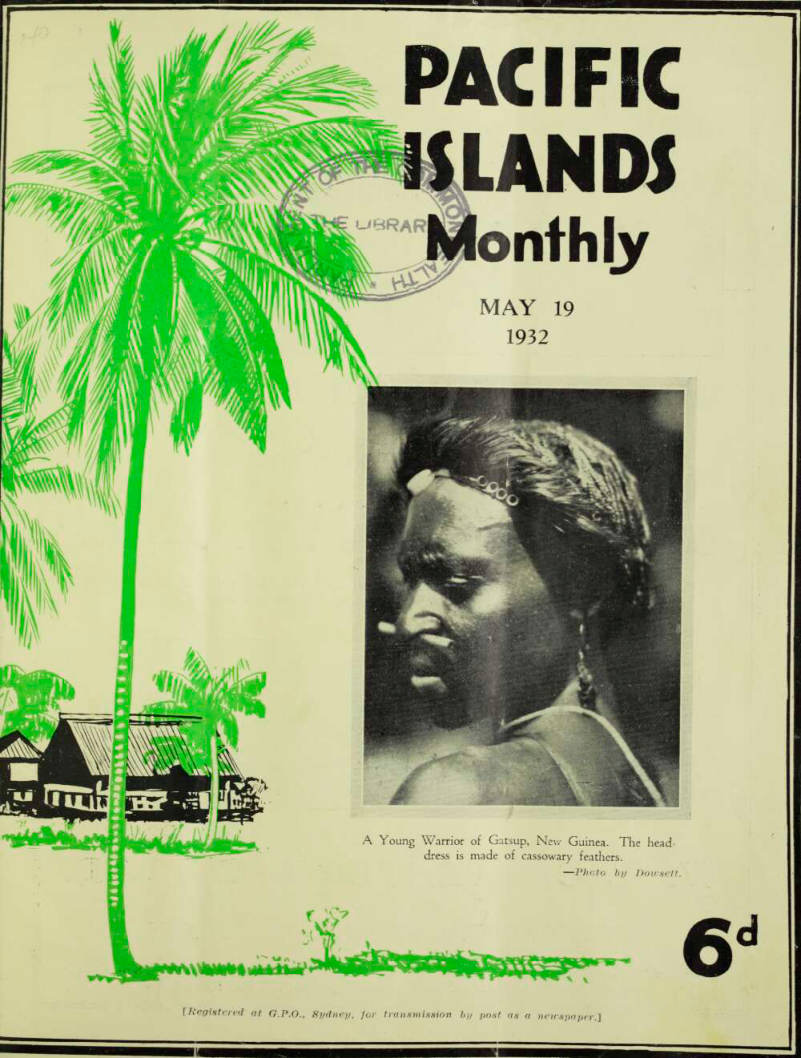
A Young Warrior of Gatsup, New Guinea. The head dress is made of cassowary feathers. —Photo by Dowsett.
Advertisements & other items, p. 2 (1 item)
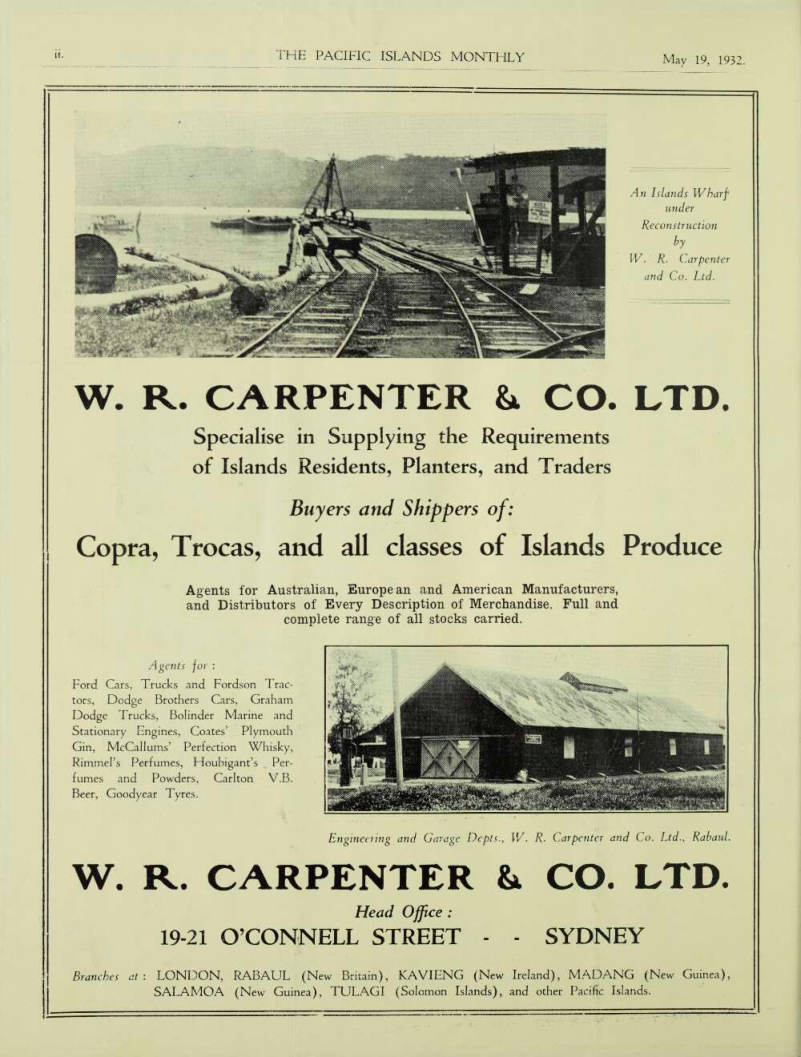
W. R. Carpenter & Co. Ltd.
An Islands Wharf under Reconstruction by W. R. Carpenter and Co. Ltd.
Specialise in Supplying the Requirements
of Islands Residents, Planters, and Traders
Buyers and Shippers of:
Copra, Trocas, and all classes of Islands Produce Agents for Australian, European and American Manufacturers, and Distributors of Every Description of Merchandise. Full and complete range of all stocks carried.
Agents for : Ford Cars, Trucks and Fordson Trac tors, Dodge Brothers Cars, Graham Dodge Trucks, Bolinder Marine and Stationary Engines, Coates’ Plymouth Gin, McCallums’ Perfection Whisky, Rimmel’s Perfumes, Houbigant’s Per fumes and Powders, Carlton V.B.
Beer, Goodyear Tyres.
Engineering and Garage Depts., W. R. Carpenter and Co. Ltd., Rabaul.
W. R. CARPENTER & CO. LTD.
Head Office :
19-21 O’CONNELL STREET - - SYDNEY
Branches at: LONDON, RABAUL (New Britain), KAVIENG (New Ireland), MADANG (New Guinea), SALAMOA (New Guinea), TULAGI (Solomon Islands), and other Pacific Islands.
Pacific Islands Travellers
Passengers Who Arrived On April 19
PER S.S. “ MONTORO ” FROM NEW GUINEA, VIA PAPUAN PORTS: Mr. C. F. Marsh, Dr.
J. Fleming, Mr. G. Fleming, Mr. T. Fleming, Master R. Fleming, Mr. and Mrs. N. Jeffery, Miss L. M. King, Miss L. R. T. O’Regan, Mr. and Mrs. C. Assange and child, Mr. C. Sibbald, Mr. F. Anstey, Mr. E. Fahey, Mr. M. V. Gib son, Mr. F. W. R. Godden, Mr. L. Hokin, Miss F. T. Lake, Mr. J. Lyall, Mrs. A. P. Nettle ship, Mr. J. H. Nicholls, Mr. F. A. O’Brien, Mrs. O. E. Scannell, Mr. W. J. Simpson, Mr.
C. Y. T. Wells. Miss J. Wilde. Mr. F. Barclay, Sister Borgia, Mr. P. Coote, Mr. K. V. Palmer, Mr. K. H. Thomas, Mr. L. Thornton, Miss J.
H. McMicking, Mr. A. L. Blyth. Hon. H. W.
Champion, Mr. A. C. Hall, Mr. J. P. Hammond, Mr. J. G. Hides, Mr. H. Huntington, Mr. I. T.
Jenkins, Mr. R. Parer, Mr. N. B. Spence, Mr.
E. Romberg, Mr. H. Mackenzie, Rev. M. Warren.
Passengers Who Arrived Per “Mor
INDA” ON APRIL 25 FROM NEW HEBRIDES
Via Lord Howe And Norfolk Islands:
Miss E. Wheeler, Mr. H. G. Cox. Mr. A. G.
Steel, Mr. and Mrs. Dowe and child, Mr. J.
Houston, Mr. and Mrs. K. McPhee, Mrs. A.
Page, Mr. A. Denovan, Miss N. G. Fisher, Mr.
A. W. Howells, Misses R. and E. Lyons, Mr. and Mrs. J. Mann, Mr. H. D. Niven, Mr. J.
W. Nicholson, Mrs. E. Pulle, Mr. A. Yeaman, Miss D. Arguimban, Miss N. Bristow, Mr. and Mrs. A. J. Oresswell, Miss R. Betts, Miss K.
Birmingham, Mr. and Mrs. H. L. Clarke, Mr.
E. Cohen, Mr. W. J. Flatt, Mrs. N. Fenton, Mrs. M. Fenton. Miss R. Gregg, Mr. R. Herkes, Miss M. Haworth, Mr. and Mrs. J. B. Healy, Miss R. Johnson, Mrs. F. Johnson, Miss M.
Jackson, Mr. A. Livingston, Miss T. Lovell, Miss M. Marlowe. Mrs. McElwain, Mrs. W.
Nichols and three children, Misses D. and J.
Nutter, Miss H. Thew, Mrs. C. Ross Owen, Mr. and Mrs. A. J. Smith. Mr. R. S. Thomas, Mr.
R. Wales, Mr. and Mrs. W. Wales.
Passengers Per S.S. “Montoro
WHICH SAILED ON APRIL 28, FOR PAPUA AND NEW GUINEA : Mr. W. J. Simpson, Mrs.
Simpson, Miss Auerbach, Mrs. C. W. Abel, Mrs.
E. M. Johansson, Mr. J. C. Goad. Mrs. Goad and three children, Mrs. J. H. Sutton, Mrs. W.
J. Jeffries, Miss M. Ryan, Miss E. B. Crichton, Miss D. Locking. Mrs. J. E. Brien and two infants, Mr. Howell, Mrs. Howell and infant, Mrs. M. B. Perkins, Mrs. G. Bowen Jones, Miss I. Webb, Mr. O. M. Rondahl, Mr. R. Abel, Mr.
W. R. Humphries, Mr. E. H. Chester. Mrs.
Chester and child and infant, Mrs. E. M.
Gunther, Miss D. Moore, Mrs. E. C. Green, Mr.
Bischoff, Mrs. Bischoff and two children. Mr.
G. H. Murray, Mr. J. Woodville, Dr. W. C.
Groves, Mr. B. N. Missen, Miss J. Hawnt, Miss M.
Hawnt, Mr. Shbppon, Mrs. Shoppon, Mr. Cameron, Mr. Cuniford, Mr. D. F. Stewart, Mr. H. Gordon, Mrs. W. A. Hamilton and child, Mr. P. Hufton, Mrs. Hufton, Mr. H. W. Holden. Mr. H. J, Preston, Dr. F. W. A. Clements, Mr. J. Gosby, Very Rev. Dean T. P. Davis, Mr. E. B. Bignold, Mr. S. A. Tame. Mr. R. G. Thornthwaite, Mr.
J. L. Bannigan, Rev. C. Yarrington, Miss A. R.
Cormack, Mrs. C. Bengson and two children, Mr. O. C. Kinne. Mrs. Kinne, Miss E. Kinne Mrs. M. Allen, Miss E. Olliffe. Miss F. Lake, Mr. A. E. Emerson. Mr. A. Rankin, Mr. G L Richards. Mr. A. Richie, Mr. J. S. Rutherford Mr. P. Walsh, Mr. E. G. James, Miss L. King Miss L. O’Regan..
Passengers Per “Morinda,” Which
SAILED ON MAY 5 FOR LORD HOWE IS
Laxd, Norfolk Islaxd, New Hebrides
PORTS AND AUCKLAND: Mrs. F. Franklin, Miss M. Franklin, Mr. and Mrs. W. P. Gillan, Mrs. E. M. Kirby, Mr. and Mrs. H C L Stewart, Miss M. Marshall. Miss J. Marshall,
Mr. and Mrs. S. B. Richards, Miss F. Neely, Mrs. E. M. Butler, Mr. A. Dibley, Mr. C. Hugh ston, Mr. W. R. Castle, Mr. C. L. Franklin, Mrs. Morton and infant, Miss U. Barker, Mrs. F Mackie and child, Rev. A. Fletcher. Mr. P. S.
Breusch, Miss I. Boot, Miss Mallett, Miss M Read, Miss G. Owen, Mr. W. H. Lucas, Mr G U. Shillinglaw, Mr. J. Dignam, Mrs. Dignam, Mrs. E. Stoker and infant, Miss O. Young, Mr J. P. Wilson, Mr. R. M. North, Mrs. A. Rennie, Miss R. King, Mrs. H. Christian, Mr. Whit worth, Miss C. Richmond, Miss E. Law, Mrs.
F. M. Brown, Miss N. Evesson, Mr. A. B Sandes, Mr. L. Lyons, Mr. J. Whitworth, Mr A. J. Clifton, Mrs. R. Palme, Miss R. Clifton, Mrs. W. Crichton, Miss E. Todd, Mrs. E. At teridge, Mrs. F. L. Crawshaw, Miss E. Wilson, Mrs. J. Harper, Mr. W. Thompson. Mr. R Barker, Mr. P. M. J. Wills, Mr. J. W. Storey, Mr. A. Atteridge, Mr. A. Armstrong, Master B Palme, Mr. R. Palme, Mrs. A. Armstrong, Miss E. Armstrong, Miss E. E. Armstrong, Miss E Smith, Mr. and Mrs. W. J. Wood, Mr. H. Neer ing, Mr. J. J. Berry, Mr. Morton, Mr. S M Rocke, Mr. W. Johnston, Mr. T. Wilson, Mr W. Crichton, Mr. T. Cahill, Mr. F. Mackie, Mr G. W. Hayward, Mr. Murdock, Mr. L. P. Smith, Mr. Schwent, Mrs. Murdock.
Passengers Who Arrived In Sydney
ON MAY 10 FROM NEW GUINEA AND PAPUAN PORTS PER M.V. “MACDHUI” : Mr.
R. A. Colyer, Mr. and Mrs. S. A. Greaves. Miss L. E. Job, Mrs. E. L. Moss, Miss A Parer, Mrs. E. F. Smith, Miss R. I. Waldon, Mr. H.
H. Yoffa, Mr. E. Bails, Mr. R. J. Burton, Mr.
F. J. Dechert, Mr. A. L. Howitt, Mr. A. E.
Martin, Mr. H. C. Rockett, Mr. A. H. Gauld, Mr. E. G. Banks, Mr. A. J. Hunter, Mrs. F., Miss I. Kroening and two children, Rev Father E McHardy, Mr. J. H. L. Waterhouse, Mr J N. Ainsworth, Mr. A. C. Eldridge, Capt C T Grantley, Miss M. F. Hall, Mr. A. L. Joubert, Mr. A. C. Scott, Dr. J.McI. Falkiner, Mrs. M Shaw and two children, Mrs. M. I. Rich, Mr. T.
Boylan, Mr. A. S. Cross, Mr. O. B. Hart, Mr W. H. McLaughlin, Mr. C. R. Pinney, Mr. G.
W. Pratt, Mr. F. L. Thomas, Mr. A. G New man.
Advertisements & other items, p. 3 (1 item)
60Dr0Cksltd,
NOW ON SALE!
Pacific Islands
Year Book for
1932 Complete description of all Pacific Islands and Territories, including Details of Adminis trations. Trading Activities, Land Laws, Latest Statistical Information, Opportunities for New Settlers, &c., &c.
WITH MAPS AND A
COMPLETE INDEX.
8/6 at all Islands Stores, at all leading Australian and New Zealand Booksellers, or from—
UNION HOUSE,
247 GEORGE ST., SYDNEY.
SHIPCHANDLERY.
W. Kopsen & Co. Limited
Manufacturers of PIONEER BRAND ASH OARS AND IMPLEMENT HANDLES.
Sole Agents for: KOPSEN’S SPECIAL YELLOW METAL SHEATHING AND NAILS.
Large Stocks of Chains, Anchors, Manilla and Wire Ropes, Wood and Iron Blocks, Oakum, Tar, Pitch, Oils, Paints, Leads, Zincs, Varnishes, Shackles, Rigging, Screws, Sheathing, Felt, Lampware, etc.
Prices and Particulars on Application.
68-70 CLARENCE STREET, SYDNEY.
Cables: “Kopsen.” 'Phone: BW 1114-5.
Vitality and Health are the
Main Factors in Every-day Life.
Put yourself in the hands of Specialists who have made an intelligent study of your requirements; it is vital to your health. We are known everywhere as the Suppliers of the Right Goods and which put the VITAL into VITALITY. Thirty-five years is our record of supplying Fresh Fruit, Vegetables and Produce to the leading Houses throughout the world.
GET FULLY ACQUAINTED WITH US.
Tel.: MA 4799; FX 4350 Private.. Cable Address: Pigs, Sydney. Code: Bentley’s,
C. G. PIGGOTT
WHOLESALE FRUIT AND PRODUCE MERCHANTS
DIRECT IMPORTERS AND EXPORTERS SYDNEY.
Office: Bulk Stores and Packing House: Fruit Exchange, Sydney.
Sales Dept.: Fruit Exchange and City Markets, Sydney. Bank of N.S.W. Bankers.
Samples and prices on application.
BIRKMYRE’S CLOTH.
The best waterproof for motor car hoods, tarpaulins, horse and cow rugs, etc. Canvas of all kinds, cotton ducks and hessians, seaming, bagging and shop twines. Fishing nets and yarn, fishing lines and tennis nets.
60DR0CKSLTD,
357 KENT STREET, SYDNEY, N.S.W,
Morrteon h"”t f.
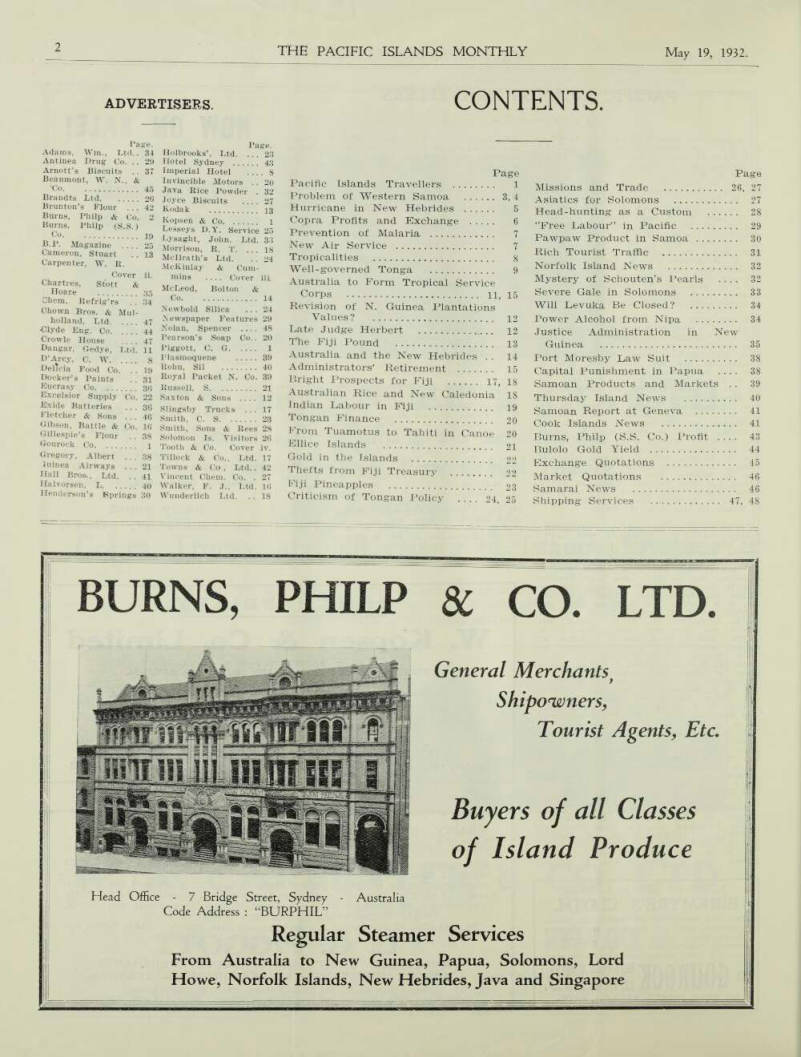
Advertisers.
Page.
Adams, Wm., Ltd.. 34 Antinea Drug Co. .. 29 Arnott’s Biscuits .. 37 Beaumont, W. N., & 45 Brandts Ltd 26 Brunton’s Flour ... 42 B.p. Magazine: 25 Cameron. Stuart .. 13 Carpenter, W. E.
Cover ii.
Hoar?’ S *°‘'... & 3s Dhem. Refrig’rs ..34 Ohown Bros. & Mulholland, Ltd . 47 •Clyde Eng. Co. ’44 Crowle House 47 Dangar, Gedye, Ltd. 11 D’Arcy, C. W 8 Delicia Food Co ! 19 Docker’s Paints . 31 Eucrasy Co ’ 36 Excelsior Supply Co. 22 Exide Batteries ... 36 Fletcher & Sons ... 46 Gibson, Battle & Co. 16 Gillespie’s Flour . . 38 Gourock Co 1 Gregory, Albert ... 38 Juinea Airways ... 21 Hall Bros-., Ltd. .. 41 Halvorsen, L 40 Henderson’s Springs 30
Page.
Holbrooks’, Ltd. ... 28 Hotel Sydney 43 Imperial Hotel ... 8 Invincible Motors . . 20 Java Rice Powder . 32 Joyce Biscuits .. 27 Kodak 13
Morrteon h"”t f.
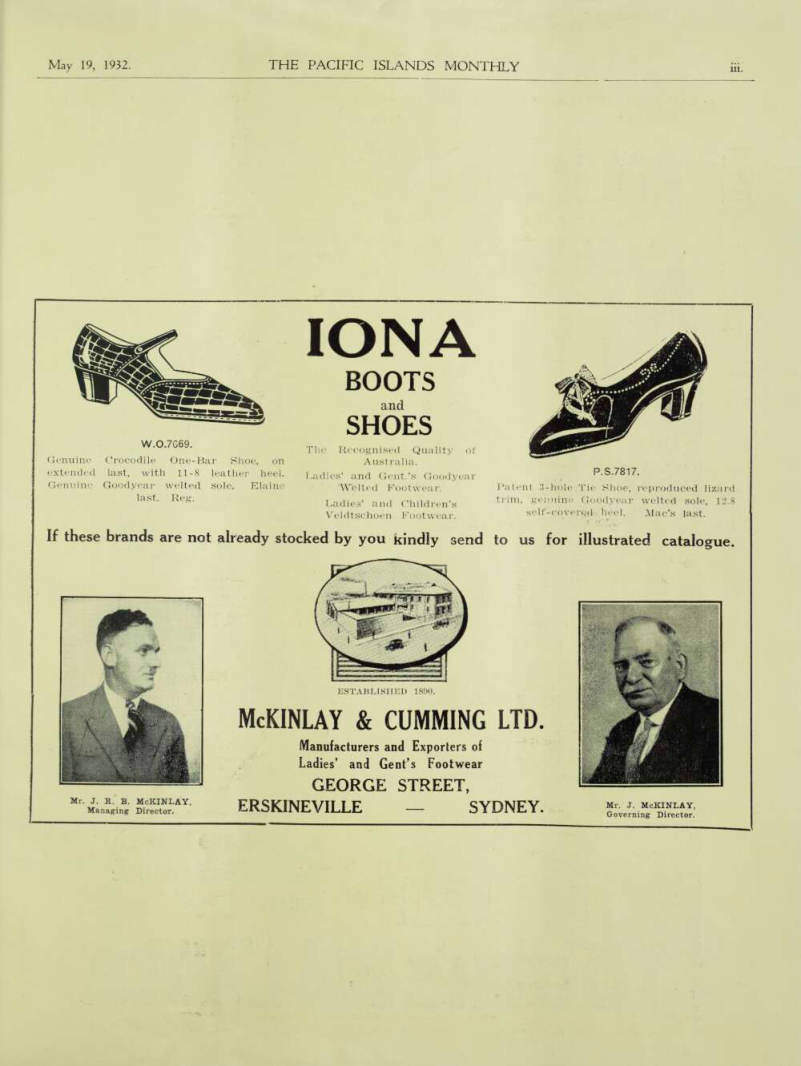
18 McKlnlaj & Cum mins Cover iii.
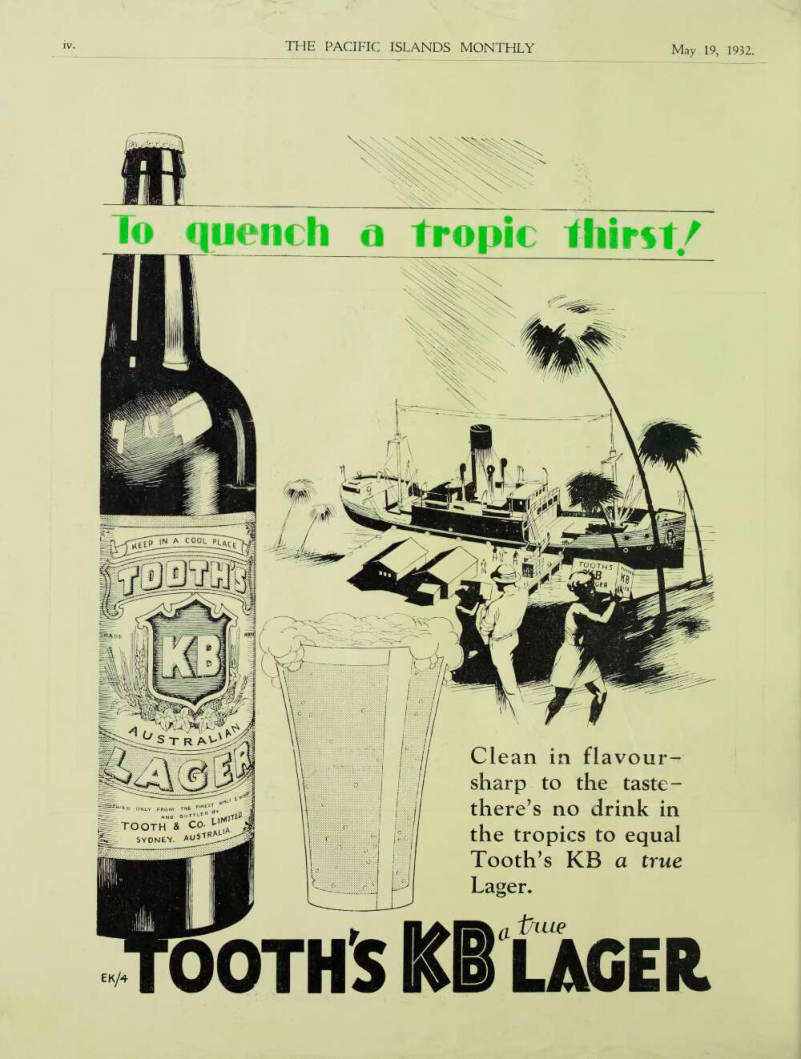
“cleoa, Bolton & Co 14 Newbold Silica ... 24 Newspaper Features 29 Nolan - Spencer 48 Pearson’s Soap Co.. 20 Piggott, C. G 1 39 Rohu > sil 40 R °y al Pticket N. Co. 39 Russell, S 21 Saxton & Sons 12 Slingsby Trucks ... 17 Smith, C. S 23 Smith, Sons & Rees 28 Solomon Is. Visitors 26 Tooth & Co. Cover iv.
Tillock & Co., Ltd. 17 Towns & Co , Ltd.. 42 Vincent Chem. Co. . 27 Walker, F. J., Ltd. 16 Wunderlich Ltd. .. 18
Contents.
Page Pacific Islands Travellers 1 Problem of Western Samoa 3, 4 Hurricane in New Hebrides 5 Copra Profits and Exchange 6 Prevention of Malaria 7 New Air Service 7 Tropicalities 8 Well-governed Tonga 9 Australia to Form Tropical Service Corps 11, 15 Revision of N. Guinea Plantations Values? 12 Late Judge Herbert.. 12 The Fiji Pound 13 Australia and the New Hebrides .. 14 Administrators’ Retirement 15 Bright Prospects for Fiji 17, 18 Australian Rice and New Caledonia 18 Indian Labour in Fiji 19 Tongan Finance 20 From Tuamotus to Tahiti in Canoe 20 Ellice Islands 21 Gold in the Islands 22 Thefts from Fiji Treasury 22 Fiji Pineapples 23 Criticism of Tongan Policy 24, 25
Pagre Missions and Trade 26, 27 Asiatics for Solomons 27 Head-hunting 1 as a Custom 28 “Free Labour” in Pacific 29 Pawpaw Product in Samoa 30 Rich Tourist Traffic 31 Norfolk Island News 32 Mystery of Schouten’s Pearls ... 32 Severe Gale in Solomons 33 Will Levuka Be Closed? 34 Power Alcohol from Nipa 34 Justice Administration in New Guinea 35 Port Moresby Law Suit 38 Capital Punishment in Papua ... 38 Samoan Products and Markets . . 39 Thursday Island News 40 Samoan Report at Geneva 41 Cook Islands News 41 Burns, Philp (S.S. Co.) Profit ... 43 Bulolo Gold Yield 44 Exchange Quotations 45 Market Quotations 46 Samarai News 46 Shipping Services 47, 48
Advertisements & other items, p. 4 (1 item)
Burns, Philp 8C Co. Ltd.
Head Office - 7 Bridge Street, Sydney - Australia Code Address : “BURPHIL”
General Merchants
Shipowners,
Tourist Agents, Etc.
Buyers of all Classes
of Island Produce
Regular Steamer Services From Australia to New Guinea, Papua, Solomons, Lord Howe, Norfolk Islands, New Hebrides, Java and Singapore
The Pacific Islands Monthly
THE NEWSPAPER - MAGAZINE OF THE SOUTH SEAS [Registered at G.P.O., Sydney, for transmission by post as a newspaper.]
Published about 15th of Each Month and Circulated in Australia and New Zealand and in the following Pacific Territories and Island Groups:
Crown Colony of Fiji.
Australian Territory of Papua.
Mandated Territory (Australia) of New Guinea, Bismarck Archipelago, and Northern Solo mon Islands.
Mandated Territory (Japan) of Marshall, Caro line and Mariana Islands.
American Territory of Guam.
Mandated Territory of Nauru.
British Crown Colony of Gilbert and Ellice Islands.
French Territory of New Caledonia.
British and French Condominium of New Hebrides.
American Territory of Eastern Samoa.
Mandated Territory (New Zealand) of Samoa.
British Solomon Islands Protectorate.
British Protectorate of Tongan Islands.
New Zealand Territory of Cook Islands.
Australian Territory of Norfolk Island.
French Colony of Oceania (Tahiti, etc.) American Territory of Hawaiian Islands.
Owned and Produced by Pacific Publications Ltd,, Union House, 247 George Street, Sydney
Telephone Bw 5037
P.O. Box 3408 R
Contributions
Articles, Stories and Photographs dealing with Pacific Islands Subjects are invited, and will be paid for on publication at usual rates.
Subscription Rates
Per Annum, within Postal Convention Territories, Prepaid, Post Free 6/- Per Annum elsewhere, Prepaid, Post Free 8/- Single Copies 6d.
Editor and Publisher:
R. W. Robson.
Advertisements
Casual Advertising: £10 per page; £5/5/- per half page; £2/15/- per quarter page; £1/7/6 per eighth page; Casual Advertisements: 8/per inch. Contract rates by arrangement.
Colours, etc. by Arrangement Process Blocks made at Advertiser’s expense when required. Screen, 100.
Changes of Advertising Copy should reach this Office by Bth of each month, otherwise previous advertisement may be repeated.
Registered Address for Telegrams and Cables: “PACPUB” Sydney
Agents
The following are authorised to receive sub scriptions for The Pacific Islands Monthly— Islands Branches of Burns, Philp & Co., Ltd., and Burns, Philp (South Seas) Co. Ltd Islands Branches of W. 11. Carpenter & Co., Ltd.
All Branches of Morris, Iledstrom & Co., Ltd.
Greenwood & Laws (Rabaul).
Whitten Bros., Ltd.. Port Moresby & Saniarai.
All Branches and Representatives of Grove & Sons, Ltd., Auckland.
S. Russell. Papeete, Tahiti.
Cook Islands Trading Co., Rarotonga.
Mrs M. Campbell, Cascades, Norfolk Island.
Vol. II.—No. 10.
Sydney, May 19, 1932.
Price 6d. Per Copy. prepaid: 6/- p.a.
Western Samoa—A Continuing Disappointment
THE position in Western Samoa remains unsatis factory and disappointing; and the fact is not now the fault of the New Zealand Government or the Administrator.
Neither is it the fault , altogether, of the Samoans. It seems to he due mostly to a most unhappy combin ation of circumstances.
OVER a series of years, Samoan national pride and prejudices were outraged by a succession of very well-meaning but singularly stupid officials, who were almost totally lacking in that apprecia tion of Polynesian psychology that is essential to successful Islands administration anywhere east of Longitude 180. The generous, over-expectant, hyper-sensitive Samoans objected to being ordered about as if they were Solomon Islanders. The stolid, unimaginative, well-drilled New Zealanders, very conscious of their excellent good purpose and Governmental rectitude, were driven by Samoan sulkiness from irritation to resentment, and from resentment to a sternness that was close to brutality.
Clashing temperaments and mutual disappoint ment naturally culminated in bloodshed.
Too many unsuitable men were sent to Samoa
from New Zealand —well-intentioned fellows of ex cellent character, no doubt, but men without any idea of the unique personal responsibility thrown upon all officials who enter this class of service.
Par too many went to Samoa simply with the idea of enjoying a “cushy job” in the pleasant, lan guorous surroundings of a lotus-eating land.
In view of the personnel and the conditions, and the extremely difficult character of the Samoans (disclosed in the distressful history of Samoa in the last 60 years), trouble was inevitable. The New Zealand Government, in the stolid British way, left everything to the officials. If there had been only one New Zealand Minister with sufficient vision and imagination to recognise the true position, therte need not have been the rebellion that culminated in the bloodshed of December, 1929. A wise Minister, instead of deporting Nelson, Smyth and Gurr, would have permitted those eager men to provide a channel of communication between the angry, clamant Samoans, and the only Caesar to whom they could appeal—the New Zealand Government.
However, this is all might-have-been. There were wrong, incredibly foolish acts on both sides.
It needed the clash of Christmas, 1929, and the death of Tamasese and a dozen others, to bring all
parties to their senses. Neither side had contem plated such a disaster—each must have felt bitter regrets.
Since then, 2½ years have gone—and little progress has been made.
The Samoans have relapsed into a strange con dition a blend of sulkiness, passivity and hopelessness.
New Zealand, while fiercely repudiating any sugges tion that she is acknowledging a fault, is honestly and smcerely trying now to establish better relations with the Samoans, and understand their national aspirations, and improve the condition of the Terri tory. She trying to improve the administrative personnel (a difficult thing to do, once a service has dug itself in!) and she has sent to Apia a wise, com petent and kindly administrator in General Hart whose methods differ so much from those of some of his swashbuckling predecessors that the contrast has distressed certain of our Samoan critics!
But all this has been to little purpose The Mau remains sullenly in its villages. There is much grumbling, about it and about. Mr. O. F. Nelson, regarded as the embodiment of the Samoan national spirit, remains in exile in Auckland, whence he issues a monthly newspaper that is full of aggressiveness and bitter criticism.
The Mau is making no effort to grasp New Zealand's outstretched, friendly hand. Why? It seems to be a sincere gesture on the part of the Dominion Government. Does the Mau expect New Zealand to grovel to it? That would be foolishness.
As a matter of fact, this lack of progress towards a better relationship between the Mandatory and the andated Territory is due, probably, to conditions over which neither has any control. The issue has shifted from the political to the economic field.
In 1930, just about the time when New Zea landers and Samoans were psychologically ready for a better understanding, the Great Depression settled down on the world. Every nation and every class of people in any way dependant on international barter suffered— and still suffer—acutely. Samoa, as a country of primary production, felt the pinch as keenly as any. It is a period in which taxpayers resent the burden of sheltered public services—and the more numerous the personnel and more luxurious its methods, the sharper the resentment. The Samoan public service, staffed largely by New Zealanders, was both numerous and expensive; and it has been hated accordingly by the Samoan taxpayers.
If there had been no quarrel between the Ad ministration and the indigenous population, there still would have been friction in Samoa—just as there is friction to-day in almost every civilised country in the world —friction which will continue until the economic readjustment is complete. The Samoan Mau to-day probably would be responding
to New Zealand’s conciliatory advances, were it not that its members generally are feeling the pinch of poverty, and are naturally blaming the Administra tion in a general way, for conditions that are really due to causes far beyond the control of any one country.
One is tempted to blame the Samoans for their stubborn, sullen temper, which will achieve nothing, and certainly will get Samoa nowhere. But anger with the Samoans, likewise, will accomplish nothing.
New Zealand must be patient and very tactful—all the more so, in view of the fact that she unwisely supported some very stupid officials in a very stupid policy, and placed an unjustifiable burden on the Territory in the shape of a swollen public service.
She must expiate her past faults by wisdom and great patience—in other words, follow her present policy. General Hart is doing very well, in a most difficult, discouraging job.
The Samoans, for their part, must remember that there is not the slightest indication that the Samoan Mandate will be taken from New Zealand.
Nothing is to be gained by sulking in the bush, counting grievances and gravestones. Samoa should be—and will be—one of the happiest and richest countries on God’s green earth. If the Samoans continue non-co-operation, there will be further con fusion, friction and hardship. If they take the chance now offering, and co-operate with a sympa thetic Administrator, they may secure a larger measure of self-government than they have ever known before, and do something really worth while for the future of their country. New Zealand seems to be in a mood, now, to answer generous gesture with generous gesture, and let the dead past bury its dead.
All who love Samoa and the Samoans, even those who know them only through books, hope that moderation and commonsense will be displayed by both sides, and that a new era will dawn in that beautiful country.
The immediate future seems to lie largely in the hands of Mr. O. F. Nelson, influential Mau leader, whose period of banishment will expire soon. If the New Zealanders show no vindictiveness, and Mr.
Nelson is big enough to regard the future in terms of his country’s good, rather than allow his judg ment to be coloured by the memory of his sufferings and his hatred of officialdom, the name of Mr.
Nelson may yet be written very large in the history of Samoa. Events in Samoa in the next twelve months will be very interesting and significant.
Following are extracts from private letters received in recent mails by the writer. They are presented exactly as they were written —and they were not written for publication:
The Need For Wisdom.
“To realise what the Samoans of the Mau, or any other Polynesians really are thinking, one must know their tongue—in fact, one must be one of them. . . . The official usually is only a temporary resident, and does not acquire more than a few colloquial terms in the native tongue. , . .
“If a wise administrator had spoken wisely to the Hon. O, F. Nelson a few years ago, and had made the right use of that gentleman’s abilities, there need have been no bloodshed, no titles taken, no ‘Mau.’ Fancy deporting Mr. A. G.
Smyth—how needless and absurd!
“So far as the Mau is concerned — why, it could quite easily be met and
placated even now —but not by presents of corned beef!
“Some officials have suggested that the Mau is dead. Not so! The Mau to-day is passive, obstinate, useless — but 95 per cent, are still Mau, and I suppose they will go on with it. The Mau now collect their own tax to meet
expenses, and they play Mau cricket matches —even the women.
“It’s a pity that these passive, proud Polynesians are not afforded better op portunity to till the soil and produce something in addition to the staple copra—not by force, or law —but by guidance and inducement. . . . To-day, the native does not even plant bread fruit trees to replace the dying trees.
No one in Samoa takes any real in terest in native affairs or welfare, ex cept to collect revenue or mete out the law. Therefore, one sees the natives’ growing indifference to their white lords.”
Six-Years-Old Problem.
Another writer says: “The Adminis tration is making truly desperate efforts to solve the Mau questions.
“Meetings are arranged between proved Government adherents and na tive officials on one side and Mau leaders on the other —without active and official participation of the Admin istration, however —to discuss means and methods of a final settlement. The Mau people attend these meetings, which sit for lengthy periods, because —attractive for the native —partici pants are supplied freely with food stuffs at the expense of the Adminis tration.
“But the acceptance of free meals apparently does not change the deter mination of the Mau to realise their ex pressed aims and ambitions. And so the negotiations have not led to any practical result so far.
“New Zealand, with acute political and economic internal troubles on its hands, is increasingly embarrassed by the difficulty in finding a solution of the Samoan problem, now pending for the last six years.”
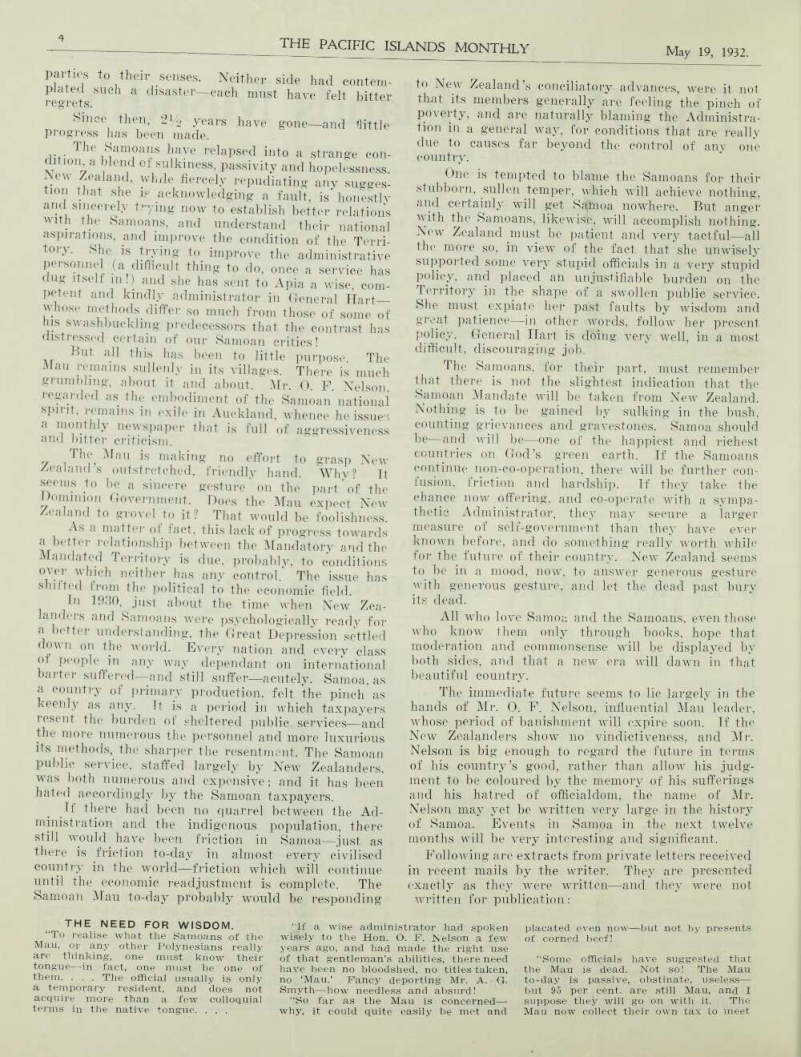
Pioneer Stock.
These three smiling: youngsters are the great grandsons of the late Mr. H. M. Chester, who formally took possession of Papua for the British Government, and hoisted the first British
flag in the Territory. Left to right: Kenneth Chester, as Johnnie Walker, prize-winner at a children’s fancy-dress ball, Port Moresby; Ian Grant Chester, as a Pierrot; Neville Chester, as Alladin.
Another Hurricane.
Singular Ill-fortune of New Hebrides Planters.
SINGULAR ill-fortune has befallen the New Hebrides planters in the mat ter of destruction by cyclones this season.
In February, as reported in this jour nal, a terrific hurricane swept through New Caledonia and the New Hebrides.
Much damage was done in central New Caledonia, while in the New Hebrides the islands which particularly suffered were those in the central division, especially Malekula and Epi.
The New Hebrides planters had no sooner finished counting their losses and taken neart of grace again than another hurricane swept down upon them and, so far as is known, it has done much damage.
The cyclone appears to have affected the central and northern islands. It struck Vila during Monday night, April 25, and continued during the early part of Tuesday. Houses and stores in Vila were unroofed, lighters were sunk in Vila Harbour, trading cutters were driven ashore and much damage done to plantations. The cyclone came down at 8 p.m. from the north-east, veered to the south and attained terrific vel ocity during the night.
An enormous amount of damage was done on Efate (Vila is situated on a sheltered harbour on the western side of Efate) but no estimate has been re ceived of the loss.
There are, up to the time of going to press, no particulars of the further damage that has been done in the is lands north of Vila.
“Malinoa” Ashore And Re
Floated.
The Burns, Philp inter-island steamer, “Malinoa,” was caught in the hurricane and apparently made a game fight of it. She was, however, driven ashore on to a reef off the coast of Aoba, about 10 o’clock on Tuesday night, April 26.
Passengers, with provisions and mails, were landed safely and efforts to re float the ship continued for several days. She was fast by the stern on a coral boulder and exposed to south easterly and northerly weather, and bumped heavily at high water. The position of the vessel was regarded as hopeless, and the well-known “Mak anibo,” which was lying idle in Sydney, was hurriedly commissioned and des patched to the New Hebrides on May 5 to take up the “Malinoa’s” running.
Splendid work, apparently, was done
Captain Perry, because quite unexpect edly, with the use of powerful ground tackle carried on the “Malinoa,” they succeeded in refloating the vessel on May 4 and getting her safely into port.
Surveyors left by the “Makambo” on May 5 to examine the “Malinoa.” It is announced that the “Makambo” will carry on the service in the meantime.
The February Hurricane.
The February hurricane completely destroyed about 20 per cent, of all co conut trees on the island of Epi.
Lacon’s plantations were seriously af fected and Hagen’s plantations were practically destroyed. Out of 23 build ings on Lacon’s plantations, only two remained intact. Extensive plantations of cocoa and coffee completely disap peared. The Government, for two months, has been feeding the labour gangs on Epi. There was only slight damage at Malekula.
There was damage done on Ambrym.
The volcano on Ambrym has been for some time making alarming noises, suggesting the possibility of another eruption.
French Government’S
Financial Aid.
From Our Own Correspondent.
VILA, April 20.
After the terrific hurricane, which swept through New Caledonia and the New Hebrides in February, the French Government sent up two inspectors to the New Hebrides to report and esti mate the damage. As a result, the Government is forwarding relief to the extent of 3,000,000 francs to be divided amongst the New Hebridian planters and 7,000,000 for the New Caledonian.
This, of course, is a help, but com pared with the losses, a mere drop in the ocean, as the coconuts, which re cover at all, will not bear for at least three years and there are the dead losses of those which were totally ruined.
Of the New Hebrides, Epi, Pauma and the South of Ambrym suffered the most. On one plantation at Epi an area covering 300 acres of cocoa and coffee was demolished entirely and can only be abandoned.
It is estimated at present that at least 20 per cent of the produce on the Epi plantations is ruined but the actual losses cannot be ascertained for about six months.
by the crew of the “Malinoa,” under
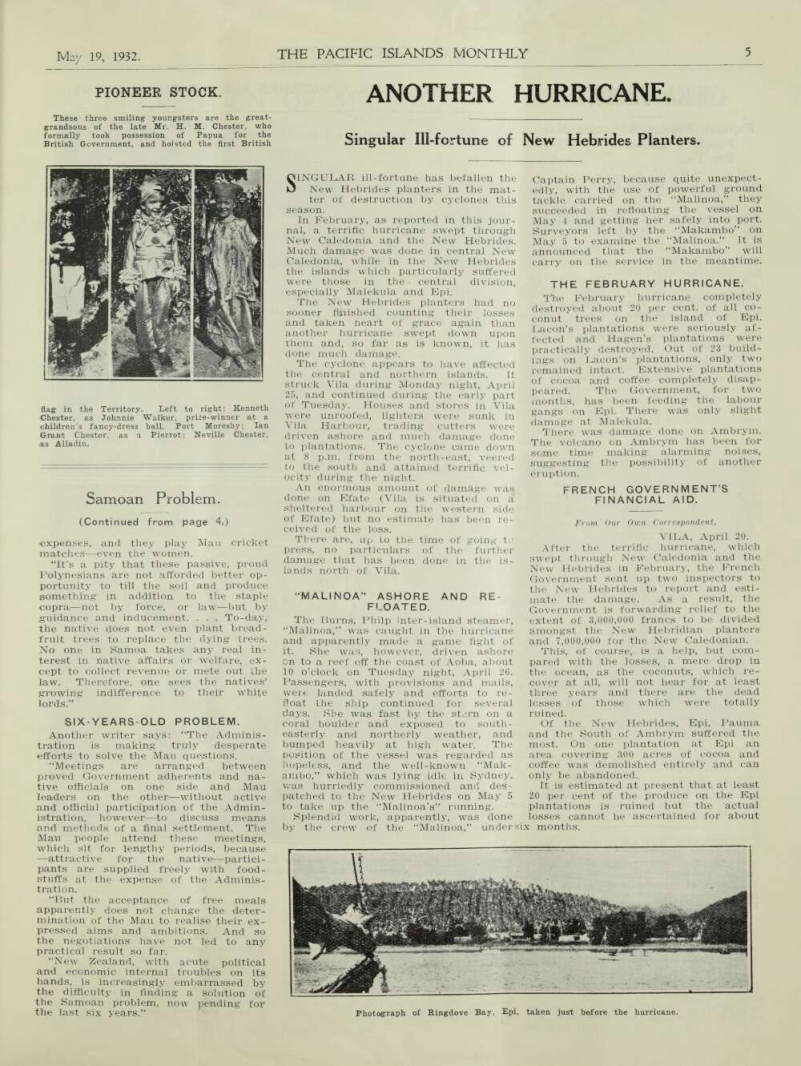
Photograph of Ringdove Bay, Epi, taken just before the hurricane.
Advertisements & other items, p. 7 (1 item)
5
THE PACIFIC ISLANDS MONTHLY
Samoan Problem. (Continued from page 4.)
May 19, 1932.
Copra Profits
Papuan Planter Ridicules N.G.
Planter’s Estimate of £3/5/-
Per Ton.
To the Editor.
Sir, —In your March issue you have an article on “Copra Profits,” from someone in New Guinea, who says he employs about 40 boys, and can turn out copra, landed in Rabaul, for £3/5/ per ton.
As a subscriber to your paper, would it be too much trouble to ask you for the following information: How he can manage to recruit 40 natives, at the cost of nothing? This is important, as I recruit all my own labour, and I only pay the boys when I recruit them 3/- each. Kerosene, boat, etc., cost me about £70 for the re cruiting trip (30 boys).
How does he manage to run the place without it costing anything for weeding and keeping clean? I have to clean my place up about three times a year, with 40 boys, and it takes about five weeks. A boy costs me about 9d. a day.
This is the most important question, and you will oblige me if you can get our plantation friend from New Guinea to answer it; The name of the philan thropic firm which supplies him with axes for breaking nuts (unless he breaks the nuts on rocks), copra knives, scrub knives, mattocks, etc., free. This is a big item on a plantation.
Of course, I understand he might not use the above articles. Ask him if he digs the meat out of the nuts with sharp-pointed sticks. Ask him if he can supply me with a manager who will work for no wages.
Does he never give his labour any medicine? Drugs cost me about £25 per annum.
I have been running my own plantation for 20 years, and anyone who says that he can turn out copra for £3/5/ per ton, including 25/- per ton for freight, should be a star boarder in Callan Park. Anyone who runs a coconut plantation, reading the article, can only come to one conclusion —that is, that the writer did not know what he was talking about, I am, etc., Samarai, Papua.
EDITORIAL NOTE : We are glad to publish our correspondent’s comments, particularly be cause —as we indicated at the time—the New Guinea planter’s figures were open to challenge.
Unfortunately, the signature of our correspond ent—like that of many great men—is inde cipherable, so we have left it out.
Norfolk Island Trade.
The following figures, relating to February, are kindly made available by the Customs Collector in Norfolk Is land:—
Imports.
From From Month. Aust. N.Z.
Feb., 1931 £2,966 Feb., 1932 2,426 £860 Exports.
Month. To Aust. To N.Z Feb., 1931 £3,158 Feb., 1932 3,508 £729
Advertisements & other items, p. 8 (1 item)
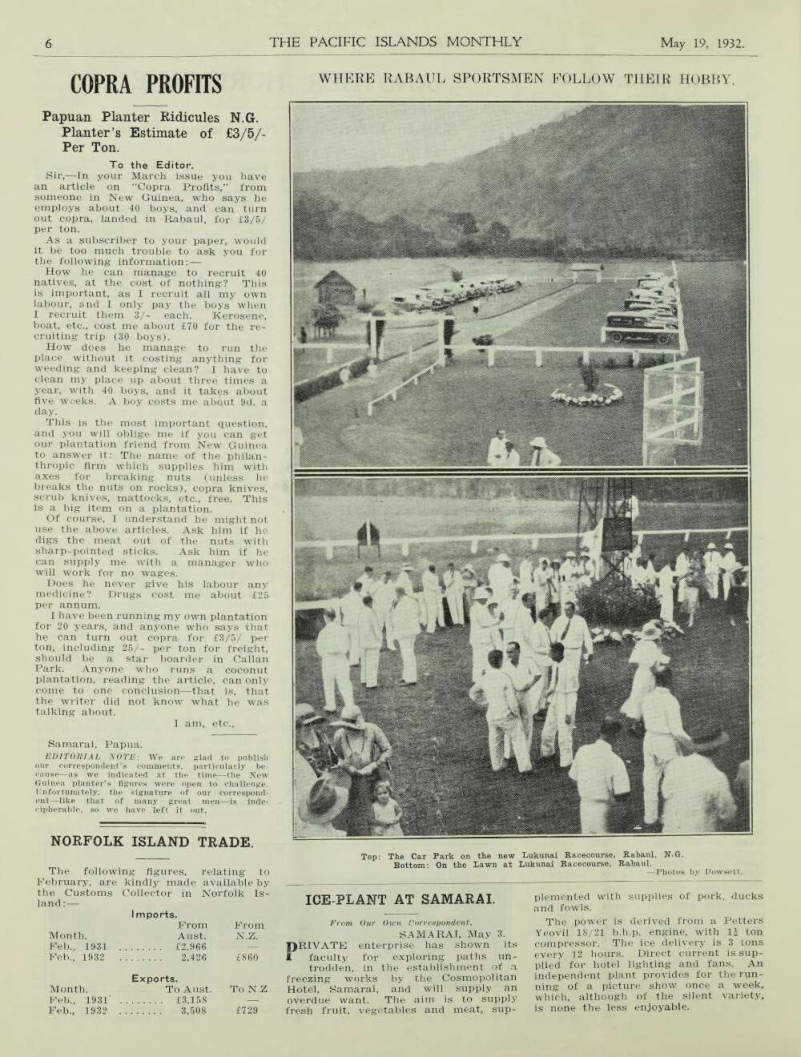
Where Rabaul Sportsmen Follow Their Hobby.
Top: The Car Park on the new Lukunai Racecourse, Rabaul, N.G.
Bottom: On the Lawn at Lukunai Racecourse, Rabaul.
Photos by Dowsett.
Ice-Plant At Samarai.
From Our Own Correspondent.
Samarai, May 3.
PRIVATE enterprise has shown its faculty for exploring paths un trodden, in the establishment of a freezing works by the Cosmopolitan Hotel, Samarai, and will supply an overdue want. The aim is to supply fresh fruit, vegetables and meat, sup
plemented with supplies of pork, ducks and fowls.
The power is derived from a Fetters Yeovil 18/21 b.h.p. engine, with l½ ton compressor. The ice delivery is 3 tons every 12 hours. Direct current is sup plied for hotel lighting and fans. An independent plant provides for the run ning of a picture show once a week, which, although of the silent variety, is none the less enjoyable.
Prevention Of Malaria.
Medical Science Holds Out Hopes by Discovery of New Remedies.
Specially Written for “The Pacific Islands Monthly,” by a Medical Practitioner ,
MALARIA is an enemy to be reckoned with in many parts of the Pacific.
Except by personal prophylaxis, the problem of its prevention has never been thoroughly tackled in our South Sea possessions, and judging from the enormous cost of draining swamp areas and destroying all breed ing spots, it seems likely that the ano pheles mosquito will hold its own.
Although such large scale attempts at prevention are always advisable where the cost is not prohibitive, a new method of personal prophylaxis has been introduced, and we believe that this journal, by making the method known, may do incalculable good to those who are obliged to live in mal arious districts. That it will not en tirely replace official measures to render certain districts healthier is in stanced by the present non-malarious state of Samarai, the port of Eastern Papua. Many years ago, all breeding places and swampy spots in that island were dealt with, and now malaria fever is a thing of the past in Samarai.
Malaria is caused by the injection into the blood of a parasite—the sporo zoite —by the bite of an infected mos quito. From the presence of these parasites spring the well-known mani festations of the disease. In course of time, the young parasites turn into a stage of their history which is very resistant to quinine.
For nearly a generation now, quinine has been used as a preventive of ma laria, under the impression that a suf ficient quantity of the drug circulating in the blood would attack and kill the parasites. This is now proved to be erroneous; quinine does not actually destroy the sporozoites, and even less the parasites in their advanced stage, though it does inhibit the attacks or fever and ague that follow infection.
Consequently, the daily or weekly doses of quinine which were at one time believed to protect the individual are better left alone. In fact, they may actually be harmful, by accustoming the sporozoites to the action of the drug in small doses.
Quinine for prevention is now re placed by a new synthetic compound called Plasmoquine, which is of Con tinental origin, and by no means a new discovery. French scientists, from the first, declared its efficiency in the pre vention and treatment of malaria; but British physicians, who are more in clined to caution, required very definite proof before advocating its substitution for quinine in prevention.
This is now forthcoming. The re sults of carefully-controlled experi ments, carried out at an English hos pital, were published recently in The Lancet, and prove conclusively that plasmoquine actually killed sporozoites introduced into the blood of volunteers who had been inoculated by malarious mosquitoes. Thus the drug is a definite preventive of the disease.
We need not go into the details of these experiments beyond saying that
they were conducted with the greatest care and were tested at every stage by means of “controls.” The primary ob ject in carrying them out was to dis cover if there was any known drug which would kill the sporozoites of malaria fever in the human blood, in all, seven substances were tried out, but only Plasmoquine emerged success fully.
No doubt, readers in the islands are more interested in the practical appli cation of these researches to them selves than in mere academic state merits of their value. Plasmoquine is easily obtainable, and a small dose taken every day is confidently believed to offer protection against infection, not only to newcomers to a malarious district, but to old hands who already harbour parasites.
In Guatemala, physicians attached to the United Fruit Company have freed hundreds of natives from the most re sistant type of parasite, and herein one discerns, it may be, the beginning of the end of this devastating disease.
The efficiency of the drug is en hanced by the addition of a little quinine, and the two drugs are com bined in tabloid form for prophylactic use.
We do not advocate self-drugging, without preliminary advice from a medical man, as Plasmoquine has proved itself occasionally to be a little uncertain and even dangerous in its action —enough to put one on one’s guard. What we do advise is that every man, woman and child who is exposed to frequent infection of ma laria by mosquitoes, write to the nearest doctor and obtain a supply of the drug, together with full instruc tions how to use it.
Wau to Pt. Moresby.
New Air Service.
From Our Own Correspondent.
Pt. Moresby, May 1.
ANEW mail service between New Guinea and Papua commenced in March.
Guinea Airways Ltd. are putting on a New Junkers F13 six-passenger mono plane, with a special de luxe cabin for a regular passenger service every three weeks between Wau, New Guinea, and Port Moresby, Papua to connect with the “Macdhui” and “Montoro” on their way up and down from Sydney to Rabaul. The charge per passenger is £15 each way.
The service should be very conveni ent to passengers’ travelling between the goldfields and Australia, who by this service will save a considerable amount of time. The carrying of mails overland by this service will also save the inconvenience which is now ex perienced on the goldfields, in not be ing able to reply to letters by the same mail.
Pilot O. Denny is flying the machine on this new service.
The place of quinine in the treatment of malaria attacks is, however, unas sailable, and no reader of this article should misunderstand its importance as a curative agent. But, for preventive purposes, quinine should be discarded in favour of Plasmoquine.
If Plasmoquine does all that is claimed for it, an attack of malaria may well be regarded in the future as the result of carelessness, or, in the case of a child, wilful negligence, and treated accordingly. It seems advis able to give the drug a thorough trial; but, unfortunately, too many white people regard “fever” as unavoidable, and will not take the trouble to pre vent its occurrence.
Its general introduction may lead to vastly improved conditions for Euro peans in such malarious districts as the New Hebrides, Solomons and parts of New Guinea.
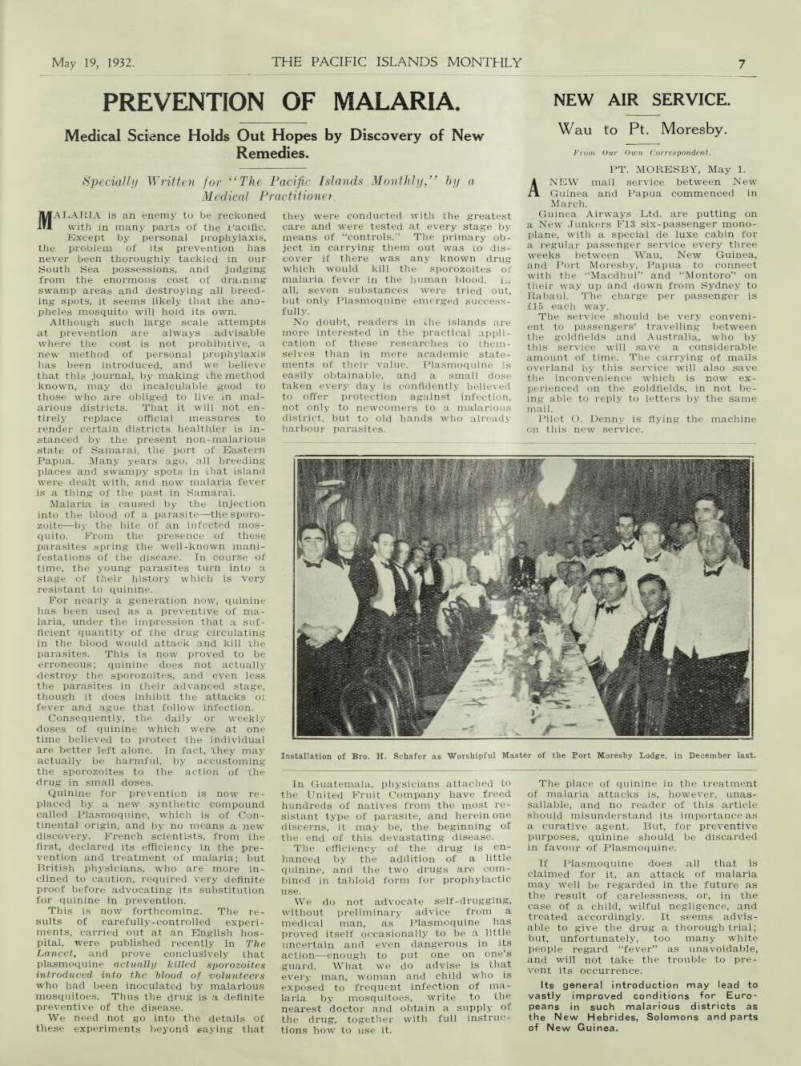
Installation of Bro. H. Schafer as Worshipful Master of the Port Moresby Lodge, in December last.
Tropicautiies
WE think it is the worst “poetry” we have ever seen; but our Nukualofa friend says that “it strikes a chord in the feelings of the Tongan public.”
So we publish it, exactly as it is writ ten —first, to cheer up the Tongan pub lic; and, secondly, as a horrible warn ing to young writers: Oh, people of Tonga! I’ll stand it no longer, Though ’tis a sad story and woeful to ponder.
In accents true and clear, I’ll shout so you can hear, What befell our fine bananas this most distress ing year.
Our Government said with the usual savoir faire.
Plant plenty bananas on your land so bare.
Impecunious Tongans and poor Europeans may Thereby watch their coffers filling day by day.
I rhymed and reasoned with the birds in charge, But they into bloomers continued to barge.
From four bob to two bob, then one and a part Thus the price dropped, and with it my heart.
But now comes the blow, triumphant aglow— I stagger, I reel, and my thinking grows slow!
The Consular Agent, with extremely bad grace.
Says, “Vive des anas I at a shilling a case.”
If the metre’s bad—then so’s the verse.
If you deem it rotten—then I think it worse.
But the story fits the facts —and not the rhyme, So for what it thus lacks—reader, your pardon this time! * * * ACCORDING to the Convention be tween Britain and France, under which that weird administrative ar rangement known as the Condominium of the New Hebrides is carried on, the King of Spain—as a presumably dis interested party—nominates the presi dent of the Joint Court and the Public Prosecutor. The Court has been func tioning very leisurely for some years under the presidency of Count de Buena Esperanza; but that charming Spanish nobleman left for Europe a few months ago, and it is reported that he will not return. The question now arises: How will his place be filled? There is now no King of Spain. Alfonso—according to news-films recently screened in Syd ney—is at present enjoying himself very happily in Paris, while a Republi can Government, strongly flavoured with Communism, is in charge of affairs in ancient Madrid. The Presi dent of Spain, no doubt, is prepared to undertake all the duties which formerly devolved upon his Majesty; but whether France and Britain are prepared to leave the nomination of a judge to a gentleman whose political colour ap proximates to scarlet remains to be seen. * * * A TYPOGRAPHICAL error, in our is sue of February, in an article en titled, “The Metropolis of the South Seas,” made it appear that the annual revenue of Suva municipality is “close on £4,500.” This was obviously ridicu lous —the amount should have been £45,000. The Suva Council’s estimated revenue for 1932 is £43,724. * * * THE Australian newspapers missed a remarkable news story the other day, when a case weighing three quarters of a ton was posted as a par cel in Adelaide and delivered O.K. by the Post Office in Sydney a couple of days later. The series of events started
in New Guinea where, for some reason, there was extraordinary mortality among the landing-wheels on the big aeroplanes with which Guinea Airways Ltd. maintain the famous goldfields service. Wheel after wheel collapsed, until it appeared as if the fleet would be crippled. A consignment of wheels was en route from Europe to Sydney: but it did not seem possible that it could connect with the Burns, Philp steamer about to leave for New Guinea.
The problem was handed to the Com pany’s Sydney agent, Mr. W. E. Goff, and that dynamic person became very busy. Between Fremantle and Ade laide, a case of four wheels was dug out of cargo and brought on deck; at Adelaide the postal authorities agreed to accept the case, for immediate trans mission, at parcel post rates; and it left immediately by train for Sydney in charge of a grim and suspicious Cus toms official. The porters at Albury, where postal matter is transferred from one railway system to the other, nearly fainted when they saw the “parcel,” but it was duly shifted. Ar rangements had been made to delay the steamer, if necessary; but the case of wheels was actually put aboard two hours before sailing time. Nothing would induce Mr. Goff to disclose the amount of the postage. “The wheels were needed—and Guinea Airways keeps faith with its people,” is how the matter was summed up. * * * OUR Solomon Islands correspondent (who, presumably, is also a tax payer) is bitter: “Old Fiji-ites may shed a tear when they learn that the ‘dashing’ Govern ment yacht Ranadi —which they neatly pushed off on to us some years ago— has turned up her toes and sunk by the stern in 25 fathoms of water; but there is no one here sorry to see the end of this financial nightmare. She had lain at her anchorage in Ellis Bay, Tulagi, for years, and whenever anyone who lacked manners and morals wanted a ringbolt or a porthole or two, he went along to Ellis Bay and helped himself.
Maybe, somewhere—perhaps in Fiji! she had friends; but Tulagi’s sad tax payers hated the poor old thing and not a soul breathed a lament when she sighed and suicided.” * * * A FACETIOUS resident of the British Solomon Islands sends this para graph. Emphatically, we do not vouch for the truth of it: Enforced economy obliges most of our Government officials who travel among the islands to do their own navi gating. Some of them are happy in the responsibility—some are not. One of them has displayed genius in protect ing himself against accident when out of sight of land. He takes with him on his voyages his little Irish terrier.
“Paddy” quickly recognises his respon sibility, and takes up his position in the bow of the vessel. He points an anxious nose landwards and sniffs vigorously.
The navigator says that the rest is easy.
Our correspondent says that this is a variation of the system followed by the famous “dog-barking skippers,” who
reckoned their position among the Is lands at night by attuning - their ears to the varying vocal efforts of the village mongrels!
A RATHER unfortunate impression was created by the following news item, published in Sydney Morning Herald on April 23: SUVA, April 9.—Every gaol in Fiji is filled with natives, who have failed to pay their an nual taxes. As they have no means of doing so, orders have been issued to revise the sen tences.
This may be literally true; but, with out some recitation of the attendant circumstances, it suggests that the Crown Colony of Fiji is in a pretty bad way. Even if a country is feeling the pinch severely, there is no need to blazon the fact-national credit is a sensitive thing, as the ineffable Mr.
Lang has shown. There is no country in the world in a sounder position, economically, than is Fiji; and that is the fact that Fiji should advertise as widely as possible. * * * ADVICE has been received that the samples of tobacco sent from Papua to England in February were priced, according to their grades, at 2/10, 3/-2 and 3/6 per lb. Further tobacco planting is in progress in the Territory. The position is described in an article on another page.
Advertisements & other items, p. 10 (1 item)
Residential Hotel,
USED POSTAGE STAMPS.
COLLECTOR wants PACIFIC ISLANDS STAMPS
—Papua, New Guinea, Samoa, Tonga, Solomon and Cook Islands, etc.; also Commonwealth and N.Z. Issues. Will Exchange or Buy. Can also take quantities of the commoner Aus tralasian and Islands varieties, if in good con dition.
Submit offerings to C. W. D’ARCY, 24 Eastwood Avenue, Eastwood, SYDNEY.
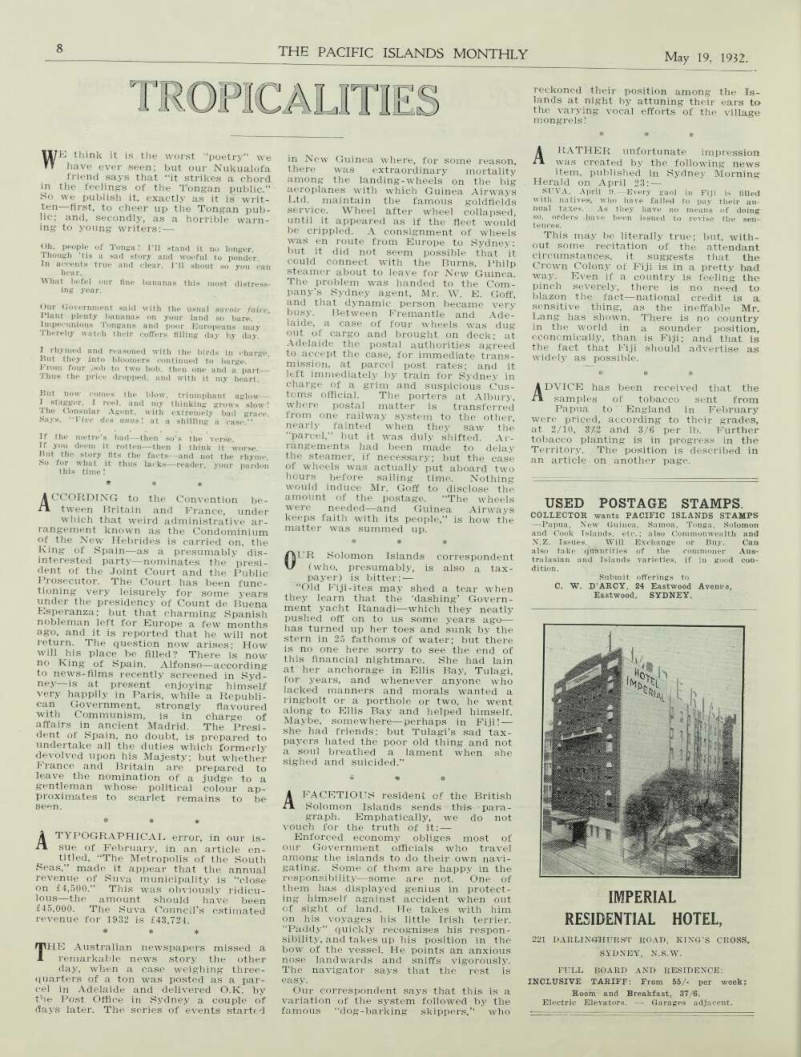
IMPERIAL
RESIDENTIAL HOTEL,
221 DARLINGHURST ROAD, KING’S CROSS,
SYDNEY, N.S.W.
FULL BOARD AND RESIDENCE:
INCLUSIVE TARIFF: From 55/- per week; Room and Breakfast, 37/6.
Electric Elevators. Garages adjacent.
"Across New Guinea.”
Ivan Champion’s Book Published.
From Our Own Correspondent.
Pt. Moresby, May 1.
Constable and Co., Ltd., London, have published “Across New Guinea,” by Ivan Champion.
It is an extremely interesting account of the remarkable patrol made in 1927 by Karius and Champion, when they crossed the island of New Guinea, from the Fly River to the Sepik River. It has an introduction by His Excellency Sir Hubert Murray, the Lieut.-Governor of Papua, in which he refers to the patrol as a really fine achievement.
Ivan Champion is a son of the Hon.
H. W. Champion, Government Secre tary to the Territory of Papua.
Another Record!
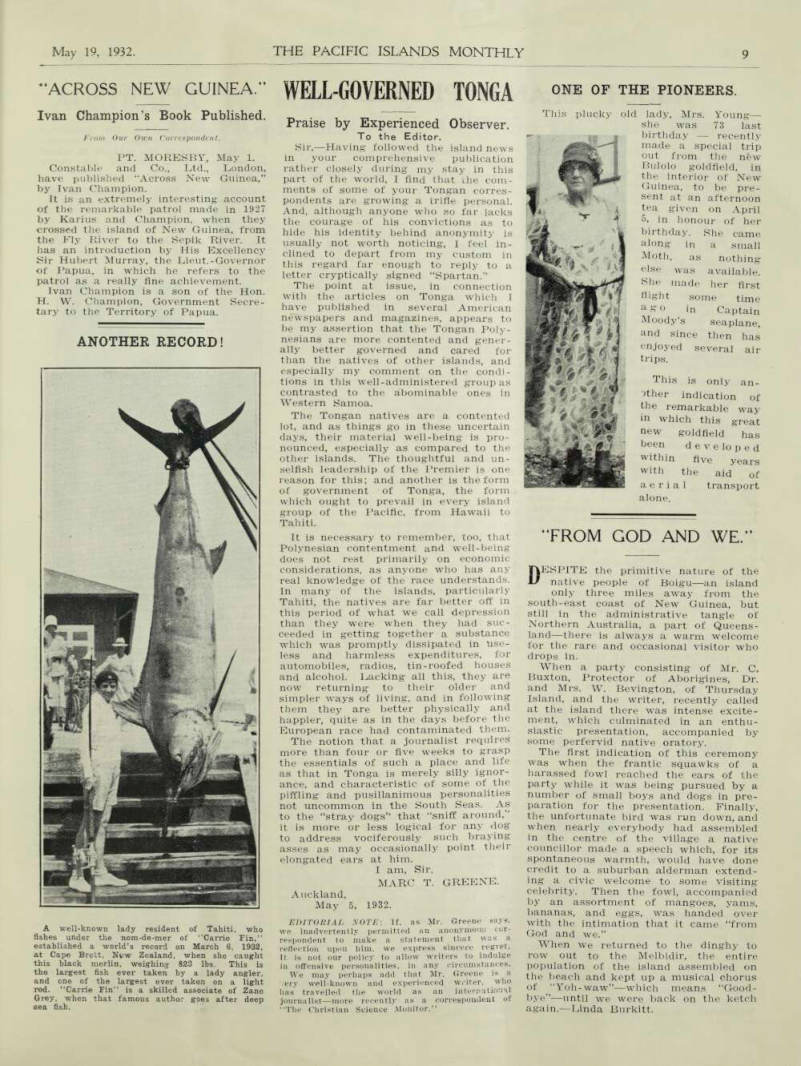
A well-known lady resident of Tahiti, who fishes under the nom-de-mer of “Carrie Fin,’’ established a world’s record on March 6, 1932, at Cape Brett, New Zealand, when she caught this black merlin, weighing 823 lbs. This is the largest fish ever taken by a lady angler, and one of the largest ever taken on a light rod. “Carrie Fin” is a skilled associate of Zane Grey, when that famous author goes after deep sea fish.
Well-Governed Tonga
Praise by Experienced Observer.
To the Editor.
Sir, —Having followed the island news in your comprehensive publication rather closely during my stay in this part of the world, I find that the com ments of some of your Tongan corres pondents are growing a trifle personal.
And, although anyone who so far lacks the courage of his convictions as to hide his identity behind anonymity is usually not worth noticing, I feel in clined to depart from my custom in this regard far enough to reply to a letter cryptically signed “Spartan.”
The point at issue, in connection with the articles on Tonga which I have published in several American newspapers and magazines, appears to be my assertion that the Tongan Poly nesians are more contented and gener ally better governed and cared for than the natives of other islands, and especially my comment on the condi tions in this well-administered group as contrasted to the abominable ones in Western Samoa.
The Tongan natives are a contented lot, and as things go in these uncertain days, their material well-being is pro nounced, especially as compared to the other islands. The thoughtful and un selfish leadership of the Premier is one reason for this; and another is the form of government of Tonga, the form which ought to prevail in every island group of the Pacific, from Hawaii to Tahiti.
It is necessary to remember, too, that Polynesian contentment and well-being does not rest primarily on economic considerations, as anyone who has any real knowledge of the race understands.
In many of the islands, particularly Tahiti, the natives are far better off in this period of what we call depression than they were when they had suc ceeded in getting together a substance which was promptly dissipated in use less and harmless expenditures, for automobiles, radios, tin-roofed houses and alcohol. Lacking all this, they are now returning to their older and simpler ways of living, and in following them they are better physically and happier, quite as in the days before the European race had contaminated them.
The notion that a journalist requires more than four or five weeks to grasp the essentials of such a place and life as that in Tonga is merely silly ignor ance, and characteristic of some of the piffling and pusillanimous personalities not uncommon in the South Seas. As to the “stray dogs” that “sniff around,” it is more or less logical for any dog' to address vociferously such braying asses as may occasionally point their elongated ears at him.
I am, Sir,
Marc T. Greene.
Auckland,
May 5, 1932.
EDITORIAL NOTE ; If. as Mr. Greene says, we inadvertently permitted an anonymous cor respondent to make a statement that was a reflection upon him, we express sincere regret.
It is not our policy to allow writers to indulge in offensive personalities, in any circumstances.
We may perhaps add that Mr. Greene is a very well-known and experienced writer, who has travelled the world as an international journalist—more recently as a correspondent of “The Christian Science Monitor.”
been developed
One Of The Pioneers.
This plucky old lady, Mrs. Young—
she was 73 last birthday recently made a special trip out from the nfew Bulolo goldfield, in the interior of New Guinea, to be pre sent at an afternoon tea given on April 5, in honour of her birthday. She came along in a small Moth, as nothing else was available.
She made her first flight some time ago in Captain
Moody’s seaplane,
and since then has enjoyed several air trips.
This is only an other indication of the remarkable way in which this great new goldfield has
been developed
within five years with the aid of aerial transport alone.
“From God And We.”
DESPITE the primitive nature of the native people of Boigu—an island only three miles away from the south-east coast of New Guinea, but still in the administrative tangle of Northern Australia, a part of Queens land —there is always a warm welcome for the rare and occasional visitor who drops in.
When a party consisting of Mr. C.
Buxton, Protector of Aborigines, Dr. and Mrs. W. Bevington, of Thursday Island, and the writer, recently called at the island there was intense excite ment, which culminated in an enthu siastic presentation, accompanied by some perfervid native oratory.
The first indication of this ceremony was when the frantic squawks of a harassed fowl reached the ears of the party while it was being pursued by a number of small boys and dogs in pre paration for the presentation. Finally, the unfortunate bird was run down, and when nearly everybody had assembled in the centre of the village a native councillor made a speech which, for its spontaneous warmth, would have done credit to a suburban alderman extend ing a civic welcome to some visiting celebrity. Then the fowl, accompanied by an assortment of mangoes, yams, bananas, and eggs, was handed over with the intimation that it came “from God and we.”
When we returned to the dinghy to row out to the Melbidir, the entire population of the island assembled on the beach and kept up a musical chorus of “Yoh-waw” —which means “Good bye”—until we were back on the ketch again.—Linda Burkitt.
About Islands People.
Captain C. R. Pinney, newly-ap pointed Administrator of Norfolk Is land, accompanied by Mrs. Pinney, will leave Sydney on July 14 for Norfolk Island, to take up his new duties. * * * Major Clive B. Joske, M.C., of Suva, who has been consular agent for France since 1922, has been appointed a Chevalier of the Legion of Honour.
The following appeared in “The London Times,” of February 27: The King has granted Mr. Clive Alexander Brewster Joske, M.C., Royal license and author ity to wear the Insignia of Chevalier of the Legion of Honour, which decoration has been conferred upon him by the President of the French Republic, in recognition of valuable ser vices rendered by him as Consular Agent of France at Suva, Fiji. * * * Mr. and Mrs. Eastham Guild returned to Tahiti from New Zealand on the last mail steamer, bringing with them the very latest thing in the way of fishing launches (writes our Tahiti correspondent). They have been spend ing some time at the famous New Zea land sword-fishing grounds, where Mrs.
Guild landed a record swordfish, A few days ago they christened the new boat by landing two small swordfish in one afternoon. The boat is a cabin cruiser, capable of sleeping comfortably four people, and equipped with all the latest gadgets for making swordfish miserable. * * * Mr. C. Urquhart, who has been radio officer in charge of Savu Savu station, Fiji, for over two years, has been transferred to the A.W.A. station at La Perouse, near Sydney. * * * Rev. Harold Chambers, of the Meth odist Missionary Society, who left Fiji last year on account of ill-health and was appointed to a Victorian circuit, has now returned to Fiji to again take up work there. He has quite recovered his health.
Rev. Ambrose Fletcher has been ap pointed by the Methbdist Home Mis sion authorities to Norfolk Island for 12 months. * * * * Nurse Holswich, who was attached to the Methodist Hospital at Ba, Fiji, has returned to Sydney. She is sever ing her connection with the Missionary Society, as she is to be married during the year. * * * * Rev. H. T. Shotton, M.A., left by the “Montoro” in April for Kiriwina, Papua.
He has been appointed superintendent of the Methodist Circuit, Fiji. * * * * Rev. W. R. Steadman, of the Method ist Missionary Society, has been ap pointed superintendent of the Nausori Circuit, Fiji. * * * * Rev. A. E. Brawn will leave Brisbane by the “Macdhui” on May 21 for New Britain. He is a member of the staff of the Methodist Missionary Society. « * * Mr. J. H. L. Waterhouse, who is well known throughout the Pacific Islands, returned to Sydney from Bougainville by the “Macdhui.” He has been col lecting plants on that island for the Kew Botanical Gardens, London. * * * * Mr. and Mrs. W. L. Heron, of Tnak undum Estate, via Rabaul are in Sydney after an extensive Eastern tour, and are staying at the Australia until the de parture of the Nankin on May 19 for Rabaul. * * * Mr. A. S. Cross, general manager of Guinea Airways Ltd.’s extensive enter prises in New Guinea, arrived in Sydney early in the month by the Macdhui on furlough. After a few days in Sydney, Mr. Cross went on to Melbourne and Adelaide, and will probably return to Sydney about the end of the month.
Although nominally on leave, Mr. Cross is actually attending the numerous im portant business matters. He hopes to return to the Territory about August.
Higher Duties In
Solomons.
Crude Oil and Timber.
From Our Own Correspondent.
TULAGI, April 30.
CRUDE oil, which, for some obscure reason, has hitherto come in free of duty (while benzine, a much dearer commodity used for the same purpose, was charged 3d. per gallon), is now to pay a duty of 12½ per cent, ad valorem.
Timber, which was charged 1/6 to 2/- per 100 ft super, is also altered to 12½ per cent. This will mean an in crease of duty in the case of the better quality timbers of about 500 per cent., which, to say the least, is uncalled for.
Fostering a local industry may be a slight excuse, but we have no local in dustry. Several have tried and failed hopelessly.
Vanikoro kauri is the only known timber suitable for boat-building and similar work, which might be milled here in commercial quantities, but, so far, all we have seen of it (if any) has been shipped south in the log and re turned here probably as New Zealand kauri, carrying in the past 2/- per 100 feet duty, and from now on about 10/per 100.
Marine transport must at all times be a most important item in the develop ment and commerce of this group, and it seems to be a matter of common logic that boats and fuels should be as cheap as possible, but evidently the authorities (probably in Fiji) think otherwise.
We are quite aware of the fact that revenue must be collected, but surely it would not be hard to find a wiser method of doing it. As for the policy of increasing taxation at a time like this —well, need we go further than New South Wales for an example?
Louis Becke.
IN a recent article in the magazine “To-day,” Arthur Jose, the historian critic, hinted at the manner in which Louis Becke first narrated his South Sea yarns.
Collectors of Louis Becke’s works will probably be interested in the first pub lished editions of his early novels and stories. There are curious little books, 6¾ x 3¾, the first “By Reef and Palm,” issued in the Antonym Library, 1894, by P. Fisher Unwin, with a fine intro
duction by the Earl of Pembroke, wherein hunters after biographical de tails of Louis Becke’s career will And a deal of material, for Pembroke arrived at Apia, Samoa, in 1870, when Becke was running a cutter between that port and Savaii, and “Bully” Hayes, the Pacific Island pirate had just paid a visit to the town and cleared off with Pease's armed schooner.
The year following Unwin’s publica tion of “By Reef and Palm” came the first Australian edition of one of Becke’s works, “His Island Wife,” very similar in get-up to “By Reef and Palm,” but in a light red paper cover.
It was published by Alexander Lindsay of Hamilton Street, Sydney, as the first of the Australander Library, 1895. Both volumes, in good condition, are now very scarce, and will become valuable as the years pass, for Becke’s fame as a writer of Pacific romances is increas ing annually.—From “To-day.”
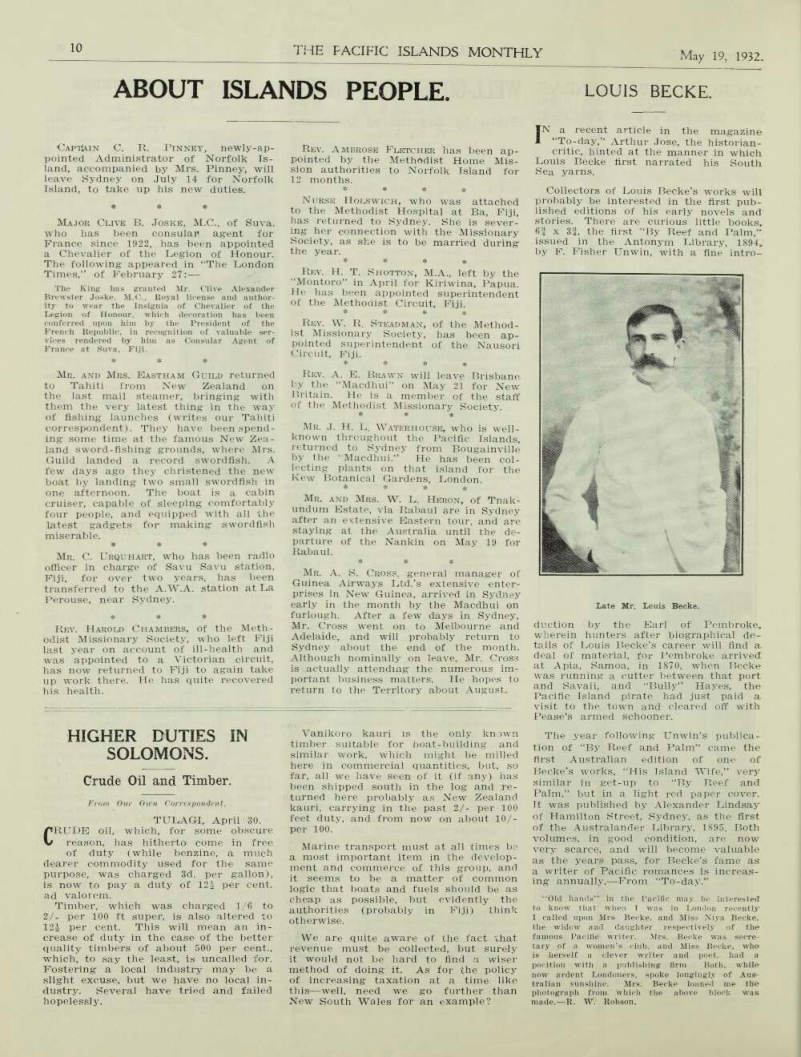
“Old hands” in the Pacific may be interested to know that when I was in London recently I called upon Mrs Becke, and Miss Niya Becke, the widow and daughter respectively of the famous Pacific writer. Mrs. Becke was secre tary of a women’s club, and Miss Becke, who is herself a clever writer and poet, had a position with a publishing firm Both, while now ardent Londoners, spoke longingly of Aus tralian sunshine. Mrs. Becke loaned me the photograph from which the above block was made.—R. W. Robson.
Late Mr. Louis Becke.
Australia To Form
Tropical Service Corps
The creation of a Commonwealth Administrative Corps for service in Australia’s tropical territories is a proposition now receiving the serious consideration of the Federal Government.
A GUARDED statement in some of the Australian newspapers on April 30 gave an indication of a far-reaching re-organisation of that section of the Commonwealth Public Service which is primarily concerned with the administration of Federal Territories.
It may be pointed out that the Com monwealth Government is directly re sponsible for the administration of the following tropical and sub-tropical Territories, which are governed under a system which permits of little of ho representation by the taxpayers con cerned and which, therefore, calls for a superior class of public servant: The Mandated Territory of New Guinea (for the good government of which the Common wealth is responsible to the League of Nations).
The Territory of Papua.
The Territory of Nauru (which is practically administered by Australia under a mandate from the League of Nations, held jointly by Great Britain, Australia and New Zealand.
The Territory of Norfolk Island.
The Territory of Northern Australia.
The Territory of Central Australia.
The services which administer the several Territories are all more or less in watertight compartments. Their only point of contact is in the Federal Departments at Canberra, to which they are all responsible. Even here, however, there is separation, for the Territories of North and Central Aus tralia are responsible to the newly created Department of the Interior, while the other Territories are con trolled by a branch of the Prime Minis ter’s Department. No one is to blame for this condition of affairs—it is due to the fact that these various terri tories have been added to the Common wealth administration bit by bit, and at different periods.
Not only from the point of view of economy, however, is it now considered necessary that they should be brought closer together—it is also desirable be cause they are all undergoing steady development, at a rate which probably will increase very much in the early future; and, as they all necessarily look to the Commonwealth Government for the main-spring of action, it is de sirable that the Commonwealth Gov ernment should have a definite policy of development concerning the Terri tories as a whole.
It is not proposed to amalgamate the administrations. In view of the varying circumstances under which the Com monwealth holds responsibility for the different Territories, amalgamation is quite impracticable. But, so far as ad ministrative personnel and the general machinery of administration is con cerned, there is no doubt at all that the creation of one large body of specially selected and trained men to carry on the administrative services generally would make for greater efficiency, and very much greater economy; and would provide oppor tunities of the kind which would at tract men of outstanding ability to the service. Costly duplication can be cut
out, the status of the service can be raised, and Australia can do her job of controlling- important tropical Terri tories in a creditable manner.
The plan has wide possibilities. It is hinted, for instance, that it may solve the problem of finding successors to both Sir Hubert Murray, Lieut.- Governor of Papua, and Brig.-Gen.
Wisdom, Administrator of New Guinea.
Although one Territory is held under mandate and the other is not, the fact is emphasised that they are adjoining Territories with the same general problems of Administration, and there is no insuperable difficulty to one able man supervising both Administrations.
There is a further and an even bigger consideration. From every point of view—commercial, political, strategical, industrial —it is desirable that Aus tralia, destined to be the dominant power of the South Pacific, should con trol the Island groups to the north east, which cover the mainland like a screen. Australia already holds Papua, North-East New Guinea, New Britain, New Ireland and the Northern Solomons. She does the lion’s share of the trade in the British Solomons, and she has large and important in terests in the New Hebrides. Sooner or later, she will be called upon to say whether or not she is prepared to accept administrative responsibility in the Solomon Islands and the New Hebrides, and, when that times comes, her hands will be greatly strengthened it she can show that she has already in existence a corps of officers trained and experienced in the administration of Pacific Territories.
We understand that the Federal Government is dealing quite seriously with this matter of the creation of a tropical administrative corps. The moving spirit, of course, is Major C.
W. C. Marr, Minister in Charge of Island Affairs, whose personal know ledge of administration generally and the Islands Territories in particular fit him admirably for the inauguration of a new policy. We believe that we can see already the new viewpoint in the recent appointment of Captain Pinney, as Administrator of Norfolk Island.
Captain Pinney goes from an important position in Papua, where he has re ceived admirable training and experi ence, to the chief position in another Territory. That is as it should be, and the appointment is deservedly ap plauded.
The people most concerned in this new policy, unfortunately, are people who have no opportunity of expressing their views—that is, members of the public services concerned. The Pacific Islands Monthly will be very glad to receive from any officials in the tropical services statements setting forth their opinions. These, if desired, will be kept quite confidential, but their points of view will be very helpful in guiding this journal in its task of giving ser vice to the Pacific Territories.
Advertisements & other items, p. 13 (1 item)
Enquiries
Lighting Plaints
The reliable LISTERLITE, the “powerhouse” of thousands of homesteads. Unfailingly de livers electric current on the most economical basis. Plants in stock to suit every possible requirement, with or without storage batteries. Ask us to quote for your installation.
Diesel (crude oil)
Engines
Famous British Lister-Diesel crude oil engines start per fectly from dead cold, on regular crude oil fuel. From ½ b.h.p. upwards. Shortly available in marine type also.
Petrol Engines
The most reliable petrol en gines in the world. British built for sheer reliability and economy. Thousands of owners have proved that Lister main tenance eosts are hardly worth regarding. In all sizes from 1½ to 14 b.h.p. Petrol and korosone types available.
Auto Trucks
Here is a neat little labour saving vehicle for haulage on road or rails, especially on long jetties. Equipped with air cooled engine; carries one ton or hauls three tons. Simple to operate, and available in varying body types for different classes of work. The most economical motor trans port vehicle yet produced.
Pumps
of all kinds. If you have water to move you will find exactly the kind of pump in the “Nevertire” line. From the simple well pump to the powerful self-oiling “Bull dozer” we have the right type of pump at the right price, for every job.
Windmills
Put the wind to work for you. We have proved makes of mills available in all regu lar siaes, with or without towers. Tell us your water problem, and wo can recom mend the proper mill to do the work.
Enquiries
our careful attention. Prices will be quoted free of Australian Customs’ Duty, in original cases.
Agents Wanted
We ihull be glad to hear from respon sible Island parties willing to undertake the sale and representation of these lines. Write us.
Dangar, Gedye & Co.
LIMITED
10-14 Young Street, Sydney
Suggested Revision Of New Guinea
Expropriated Plantations Values.
WHEN the world’s economic re-ad justment is complete and we are able to carry on with practically a new basis for all enterprises, one of the first tasks to be undertaken in the Pacific Territories will be a re-arrange ment of values as between the holders of New Guinea Expropriated planta tions and the Commonwealth Govern ment.
About 182 plantations taken over by the Commonwealth Government from their former German owners, as part of the War Reparations scheme, were ultimately disposed of to returned sol dier planters on a system of auction bids.
The sales were made in three groups.
The first group were disposed of at reasonable prices. Slightly higher prices ruled at the second sale. Some ridiculous prices were offered and ac cepted at the third sale. The price of copra had been steadily rising and this gave many people an entirely false idea of plantation values. The result was that a considerable number of compet ent and experienced planters, who sub mitted reasonable prices for plantations in the third group were shut out alto gether by the ridiculously high bids of inexperienced men.
For a few years after the completion of these sales, copra maintained good prices and the majority of the new sol dier planters were able to carry on.
Then came the depression, and copra fell to unheard-of prices. It was essen tial that all planters, wise and unwise, should have assistance if they were to remain on the job. The New Guinea Administration practically wiped out the Export Tax and the Commonwealth authorities granted a Moratorium, so far as payments of interest and princi pal on the expropriated plantations were concerned. Those conditions rule to-day.
It is pretty clear that copra will never return to the extraordinary prices which were ruling when the expropri ated plantations were sold. In other words, it is most unlikely that the nor mal earnings of the plantations in the future will justify the capital value that was placed upon them at the three auction sales. Inevitably, therefore, there will be a demand for a revision of these capital values, if the soldier settlers are to remain in possession.
The question that is at present agi tating many minds is how the re-valua tion of the plantations is to be ap proached. It obviously would be un
fair to simply re-value all the planta tions on the new basis of earning capa city, fixed by copra values, while per mitting the present owners to remain in occupation. That would simply mean that the various men who submitted absurdly high bids for their planta tions, thus shutting out possibly more competent men, would be allowed to escape the results of their folly. This system, while sound enough in a gen eral way, would in practice operate most unfairly.
A system that we understand is fav oured by the more careful thinkers among the planters is one based on a percentage reduction. For example, if it can be shown that the fall in copra prices over a period of six, eight or ten years is equal to a fall of 20 per cent, in the earning capacity of the planta tons, then the capital value of the plan tations, as fixed at the series of sales referred to, would be similarly reduced by 20 per cent. Under this system, the men who offered excessive prices for their plantations, based on foolish esti mates, will still have to bear the cost of their folly. The men who took over their plantations at a fair value would have their plantations reduced to a fair value.
The planters believe that in asking the Commonwealth Government for re lief regarding capital valuations, they will have the support of the big trad ing firms, which have been financing them in this crisis. It is pointed out that the security taken by the big firms is simply the equity in the properties after the Government’s first mortgage is provided for, and the big firms’ in terest in this equity is recognised by the Custodian of Expropriated Planta tions. It is obvious that, if the Gov ernment insists on the old valuations standing, while the possible earning ca pacity of the plantations is permanently reduced, the security of the big firms will tend to disappear. It is, in fact, probable that the planters will suggest to the big firms that, as a gesture to secure the goodwill and co-operation of the Government, they (the big firms) should further reduce the rates of in terest for the accommodation they have extended.
Nothing is likely to be done until there is more permanence about the fluctuating economic situation; but as soon as there is some stability in sight, there will be a move made in the direc tion indicated.
Papuan Tobacco.
Request for Australian Preference.
Froth' Our Own Correspondent.
Pt. Moresby, May 1.
Tobacco is still being grown outside Port Moresby, near the Laloki River, and within the last few weeks a large shipment has been sent to England. It is favourably received there, and is en titled to Empire preference.
While at Canberra, in January of this
year, His Excellency Sir Hubert Mur ray asked the authorities to give Papuan unmanufactured tobacco a pre ference over American. No preference was asked for tobacco grown by black labour in Papua in competition with that grown by white labour in Aus tralia, but Sir Hubert urged that Papuan grown tobacco might have a preference over American, which is also grown by black labour.
The Commonwealth authorities have not yet reached a decision in the matter.
Late Judge Herbert.
Memorial Dedicated in Papua.
From Our Own Gorrespondent.
Pt. Moresby, May 1.
AN impressive service was held in St.
John’s Anglican Church, Port Moresby, on April 5, when a mem orial was dedicated to the late Mr.
Justice Herbert.
His Lordship, the Bishop of New Guinea, assisted by the Rev. H. Mat hews, conducted the service. A large number of residents were presnt.
The memorial, a sanctuary lamp of exquisite design, was lit during the service by Mrs. H. L. Murray, daughter of the late Judge Herbert.
His Lordship addressed the gather ing, following the dedication. He spoke of the loving esteem in which the late Judge Herbert was held by all in Papua, and he said that this lamp was dedicated in loving memory of him. He had first come to Papua in 1910 from the Northern Territory; where as Judge and Administrator he had upheld with dignity the high traditions of his of fices, and had already spent much of his life in the service of his country.
These high standards he maintained throughout his career in Papua.
The late Mr. Justice Herbert on his appointment as Administrator of Nor folk Island in 1928, resigned his posi tion in Papua, and it was within a few months of taking up his new duties as Administrator there that he died.
Woodlark Island Wedding.
From Our Own Correspondent.
Pt. Moresby, April 1.
THE marriage took place at Woodlark Island, Papua, on February 26, of Miss Alma Nelsson, daughter of the Hon. J. G. Nelsson, Member of the Legislative Council, and Mr. J. Mac kensie, formerly of New Guinea. The Rev. R. Leek performed the ceremony.
There was a small gathering of friends who attended the service and later the reception. His Excellency Sir Hubert Murray, who was present, pro posed the health of the bride and bridegroom.
Advertisements & other items, p. 14 (1 item)
Building
SUPPLIES
Complete Stocks of Seasoned Timber of afl descriptions on hand for immediate shipment.
Galvanised Iron, Fibro- Cement, Glass, and Builders’ Ironmongery.
SEND FOR OUR CATALOGUE
OF READY-CUT HOMES AND
ISLAND BUNGALOWS.
A. C. SAXTON & SONS
LTD.,
Box 5, PYRMONT, SYDNEY.
The Fiji £.
Chance For a Shrewd Financier.
From Our Own Correspondent.
Suva, May 2.
FROM ‘‘The Sydney Morning Herald” one notices that quite a traffic has sprung up in Sydney in Fiji cur rency notes.
The average quotation for Fiji £1 notes seems to be about 21/9 and 22/-.
However, the quotation varies accord ing to the individual needs of the cur rency brokers. The position is purely an artificial one, as it is believed that the banks will only give par.
On the other hand, Suva cheques passed through Sydney accounts of old customers of the banks are usually cashed at 22/6 for every £ Fijian. For all practical purposes, the exchange rate is a blocking one.
In Fiji, we are on the same basis as New Zealand, although if we chose we would have every right to insist that our £ notes are worth just as much — if not more—than the English £ note.
For example, the Commissioners of Currency in Suva published in the Fiji Royal Gazette a statement of the posi tion of the currency at April 11. The notes in circulation were given as £378,883. Against that, as security, was held no less than £83,882 in actual coin of the realm, practically all gold; and a portfolio of investments forming what is called the Note Guarantee Fund. These cost the colony £357,643, whilst their latest known market price is £371,350. Their face value, of course, is greater, and is £409,402.
The investments are in dominions and colonial securities, and we are somewhat relieved to notice that there is only about £3,700 in Australian Gov ernment stocks, which have a face value of £6,500.
None, thank Heaven, are in New South Wales!
On the other hand, we have invested approximately £28,000 in New Zealand loans.
The currency is obviously in an al most impregnable position, in that £441,500 of coin and investments are held against the note issue of £378,883.
There is an amount owing of £56,000 to the Colonial Treasury for advances, but this is off-set by a separate bundle of investments which are held on account of the Depreciation Fund. Their cost price and their latest known market price are approximately the same— £41,000 —whilst their face value is ap proximately £45,000.
EDITORIAL NOTE: A shrewd financier should see a chance of making money, on the facts disclosed in this interesting note from our Fiji correspondent. The Fiji £ note is—and has been for a year—at a discount, compared with sterling. Yet, on the figures disclosed, it is per fectly clear that the Fiji £ is equal in value to the £ sterling—even if the value of the securities has been expressed in a depreciated Fijian currency. There is reason for the de preciation of the Australian £, seen in huge Government deficits, insistent talk of repudia tion, and an overseas floating debt that has not yet been funded. New Zealand, also, is showing a severe internal deficit, and a somewhat un satisfactory oversea position. But Fiji, with definite reserves to take care of any adminis trative deficit or wrong trade balance with over sea countries, and with valuable securities to completely back her note issue, should suffer nothing in exchange. The arbitrary fixing of her exchange with London at around nine per cent.—that is, making the f in Fiji worth only
about 90 per cent, of the £ in London—is probably done as a deliberate policy, to help the primary producers of Fiji in these difficult times. It is, however, an open invitation to tho world to buy Fijian currency. Money placed in Fiji, in this way, probably is as safe as any where else in the world; and, when the exchange with sterling swings nearer to par—as, on avail able figures, it must do—the investor will collect a nice little profit. That, probably, is the ex planation of the purchase of Fijian notes, as reported by the S. M. Herald. Of course, money invested in Fiji notes bears no interest; but the banks everywhere to-day are holding huge sums on the current account of people who are too “windy” to invest in anything.
from Trobriands
Sir Hubert Murray Returns from Trobriands
Pt. Moresby, May 5.
His Excellency Sir Hubert Murray has returned from a tour of inspection of the East Coast and the Trobriand Island. He was accompanied by the Hon. W. M. Strong, principal medical officer to the Territory.
Lady Murray is arriving- by the “Mon toro” from Queensland, where she has been staying- for a few weeks on her way up from Sydney.
Advertisements & other items, p. 15 (1 item)
Odak
OILW-SALT
AMAZING HEALANT FOR TINEA.
Scientists hail OIL-of-SALT as one of the most remarkable discoveries of the day. This surprising antiseptic not only destroys bacteria and infection but it promotes amazingly quick healing as well. Non-poisonous and non-irritat ing—gentle and soothing. Can be applied to the most sensitive tissues of any part of the body without discomfort, no matter how badly injured or Infected. The relief that speedily follows is little short of miraculous!
Because of its remarkable combination of germicidal and healing powers,
OIL-of-SALT
lias a surprisingly wide range of effectiveness.
It destroys infection wherever applied—skin (eczema), gums (pyorrhoea) or throat (tonsilitis).
Its ability to stop pain makes it simply priceless for treating burns, cuts, bruises, and injuries of all kinds. Rubbed on the skin, it gives remark able, penetrating relief in cases of foot-soreness, sunburn, muscle strain, etc.
Send two Stamps for FREE TRIAL Sample, to
CAMERON STUART,
63 Pitt St., Sydney. Prices; 2/6, 4/6, 7/6
YOU WILL NEVER REGRET IT.
THE LATEST KODAK INVENTION
LENGTHENS THE DAY
VERICHROME
No need to miss picture-making opportun ities now! Verichrome lengthens your photographic day —gives you better pictures —and gives them hours earlier and later.
Verichrome mean s better pictures all tnrough the year. On dull days, rainy days, misty days, gloomy days, Verichrome—the Faster Film, the Master Film— makes difficult pictures easy.
Get a spool or two to-day!
Of all Kodak Dealers, and
ODAK
KODAK (AUSTRALASIA) PTY. LTD.,
379 Georg-e Street, Sydney. All States and N.Z.
Must France Acquire
The New Hebrides?
To the Editor.
Sir,- —Your article dealing with the New Hebrides in the January issue of the “Pacific Islands Monthly” was read here with great interest, and your cor respondent’s statements will be en dorsed by most of the British planters here.
With regard to the suggestion that the New Hebrides should come under Australian control, it is doubtful whether this would find much support here, except, perhaps, among the mis sionaries.
I think the majority of British set tlers would prefer to see the group handed over to France for numerous reasons.
The British Government does not seem disposed to do anything to assist its nationals —in addition, its policy seems to be dictated by the missions.
It is possible that under British control we might be allowed to have imported labour, but regulations and restrictions on the recruiting of indigenous labour would be so onerous that the planter would find himself very little better off.
The Pacific Islands Year Book dealing with labour in the New Hebrides (p. 187) states: “The employment of natives under contract is regulated by the provisions of the Anglo-French Protocol of 1914, and by additional na tional legislation in the case of British settlers.” It is this additional national legislation (introduced at the behest of the missionaries) that has contributed to the present serious plight of the Bri tisher regarding labour.
In addition, under British govern ment, the missionaries would be free (and in some cases actually encour aged) to carry on their campaign of irritation and calumny against the Bri tish settler.
If the group were handed over to Australia it is hardly likely we should get imported labour. The Pacific Is lands Year Book (p. 182) says:—“It is believed the refusal to allow them (the British settler) to import Asiatic ’abour is due to Australian sensitiveness.’’
Under Australian rule this “sensitive ness” would probably be greatly in creased, and it would be interesting to know where the labour would be found to man the British as well as ex French plantations, as in the event of Australia taking control all Asiatic labour would be repatriated. Even with the large numbers of Asiatics employed by the French, the Britisher is sometimes hard put to obtain suffi cient labour for his needs. In regard to this, certain missionaries are to blame, as they openly advise natives not to “sign,” but only to work for a white man (themselves excepted) for a week or so. Anyone with the slightest knowledge of plantations will under stand that it is impossible to work a plantation profitably with weekly labour.
The majority of British settlers are of the opinion that their troubles can only be solved by handing the group over to France. Under control of this Government the Britisher will presum
a'oly enjoy the same rights as his French neighbour in respect to bonuses on produce, employment of Asiatic labour, regulations regarding recruiting of natives, elc.
Under Australian control would our produce, particularly cotton, maize and fruit, be allowed to enter the Common wealth to compete with the locally grown article. Presumably, we would still have to dispose of our produce in the European market.
In your article, you remark that French interests here have been so heavily subsidised that it is practically impossible for them ever to make any profit out of the colony. That is cor rect, and it is quite possible that should France succeed in getting con trol, those bonuses and loans may vanish into thin air. In any case Aus tralia would hardly be in a position to give settlers here any assistance.
There is no mention in your article of markets being found in Australia for Island produce. The cry of “black labour” would be raised at once. Ap parently, what Australia wants is to take control of the N.H. and impose a tariff to shut out foreign goods, but leave us to sell our produce where we can.
Finally, it is very improbable that France would agree to give up her in terests here, whether for a monetary payment or for a grant of territory elsewhere.
I am, etc.,
S. Dubois.
Malo, N.H., March 25, 1932.
Farce Should Be Ended.
The fact that, as stated by Mr.
Dubois, British interests in the past have been seriously neglected and mal treated by the British authorities does not mean that the conditions described will continue indefinitely.
On the contrary, British and Australian authorities must be brought to a frank recognition of the alterna tive before them, which is simply that conditions in the New Hebrides must be altered to make existence possible for the British planters or the Group must be given over wholly to France.
It is impossible for the British planters and traders to carry on without governmental assistance, and with the fact of their existence practic ally ignored, while French subjects are being actively helped and encouraged.
Australia’s responsibility in connec tion with the administration of the New Hebrides must be re-stated and in sisted upon. Australia, before the War, was eager enough to have a share in the development of the New Hebrides; she definitely accepted certain respon sibility in that Group; and scores of planters were settled there under Aus tralian auspices, with a promise of a market for their products.
Since the War, Australia seems to have forgotten all about the New Hebrides, while the British Government, in tragic fashion, has ignored the needs and hopes of this small but important British community. Is it any wonder that many Britishers have either de parted, or sought French citizenship?
The Condominium is a farce —and as it is an increasingly expensive farce, something must be done about it.
Neither party to the Condominium has carried out its part in the spirit of the Convention; but the greater fault has been with the British.
The British and Australian Govern ments must now do something—either take some action to protect their small but important interests in the New Hebrides, or hand the whole responsi bility over to France. —R.WiR.
Advertisements & other items, p. 16 (1 item)
“Freez-All”
Wherever you live — Refrigeration
In spite of you being- ever so far out of reach of Ice-Works or Electricity, all the benefits of refrigeration have been brought within the reach of every home by the
Home Refrigerator
Will hold a whole carcase of mutton, half a box of butter, as well as drinks.
Cheaper, more Efficient and Reliable than any other Selfcontained Refrigerator. Oper ates at the trifling cost of
1½d. per day.
Price Complete: £27/10/-
Australian Currency f.o.b. Sydney.
Many thousands are now in use in Australian country homes, and we provide a Guaranteed Service with every machine. We Specialise in Repairs for “Icyball” and Ice-stove Refrigerating Units.
Write to Sole Pacific Island Distributors:
McLEOD BOLTON & CO. LTD.,
THE ISLAND MERCHANTS,
249 GEORGE STREET, SYDNEY.
Established 20 Years. Cables: “NOTLOB,” SYDNEY.
Please send me copy of your full descriptive Leaflet.
Name Address
K.P.M. Services
In Pacific.
Extension to Sydney.
Commencing with the May sailing from Java, the s.s. “Van Rees’’—a fast and modern steamer —will replace the well-known steamer “Le Maire,” of the K.P.M., in the Saigon-Java-Noumea line.
Several important changes are being incorporated in the steamer's itinerary, including the extension of the service to Sydney, which will now run as fol lows : Saigon- Batavia- Samarang-Port Moresby-Samarai - Rabaul - Port Vila- Noumea-Sydney-Port Moresby-Batavia- Saigon.
Cargo for Epi and Santo will be ac cepted, with transhipment at Port Vila.
The sailings are to be maintained, every alternate month.
The company recently inaugurated a regular monthly service from Batavia to Rodriguez-Port Louis (Mauritius)- Beira-Lourenco Marques-Durban-Port Elizabeth-Capetown, returning via Port Elizabeth-Durban-Port Louis (Mau ritius) -Rodriguez-Zanzibar - Mombasa- Port Victoria-Mahe (Seychelles) to Ba tavia.
The steamers “Tasman” and “Hout man,” well-known in the Australia- Java-Singapore trade, were placed on the Java-Mauritius-Africa Line. This line is successfully fulfilling the long felt want of a regular shipping connec tion between Java and Africa, of which also Australia, New Guinea, New Cale donia and the New Hebrides can now obtain the benefit for marketing their products in Africa. The “Van Rees” will, therefore, connect in Java with the steamers “Houtman” and “Tasman,” of the Java-Mauritius-Africa Line.
The requirements of passengers have been provided for. The “Van Rees” can carry 60 saloon passengers, in comfort able and airy cabins, at attractive rates.
Through rates are quoted for travel ling via Java to Africa. The K.P.M. recently concluded an agreement with the Holland-Africa Line, whereby pas sengers may travel via Java and Africa to Europe, at specially reduced rates.
With calls at many picturesque ports, the route via Java to Africa and Europe should appeal to those who wish to make the most of their trip.
Another interesting route to Europe now offered by the K.P.M. is via Java, Sumatra, Ceylon and Egypt. Passen gers tranship in Java or Singapore to a luxurious liner of the “Rotterdam Lloyd” or “Nederland” Royal Mail Lines.
The new service by the “Van Rees” opens up opportunities for new travel.
Residents in Port Moresby, Rabaul and other Pacific ports are being in vited to make a round voyage by the Van Rees,” with stops of a few days in Java, Saigon and Sydney. Arrange ments may be made for a longer stay in Java, with side trips to the fascin ating islands of Bali and Sumatra.
Administrators.
Three Believed to be Consider ing Retirement.
THE Lieut.-Governor of Papua, Sir Hubert Murray, has been granted 10 months’ leave of absence. His Ex cellency will leave Port Moresby in July and probably, after visiting Syd ney, will proceed to London.
Sir Hubert Murray’s plans are not definitely known, but it is thought in semi-official quarters that, as he has now celebrated his 70th birthday, he is probably giving serious thought to re tirement at the end of this lengthy leave.
Mr. W. A. Newman, Administrator of Nauru, is approaching the retiring age of 65. It is understood that the period of his appointment has been extended by six months, and that he will then retire. The British and New Zealand Governments, which are jointly inter ested with Australia in the administra tion of Nauru, have been asked to ex press their views with regard to the appointment of a successor to Mr.
Newman. The administration of Nauru, since the War. has been left largely to the Australian Government by the other parties to the mandate.
It is also reported, semi-officially, that Brig.-General Wisdom, who has now reached the age of 61, is giving some thought to the question of retire ment, and may quite likely make a de cision before the end of the present year.
All three Administrators have been very successful in their respective of fices, and the probability of their re tirement within a few months of each other creates a difficult problem for the Commonwealth Government.
It is believed that this is one of the
reasons why the whole question of re organisation, permitting the creation of an Australian Tropical Service Corps, has been under the consideration of the Federal Government (as described else where in this issue). It probably also explains the fact that the re-classifica tion of the New Guinea Public Service, which was completed several months ago, has not been gazetted.
Advertisements & other items, p. 17 (1 item)
After Thirty Y ’ Trading
WHEN VISITING SYDNEY
HIRE A CAR
AND
DRIVE
YOURSELF
from Head Office and Service Station : NEILD AVENUE (nr. Stadium),
PADDINGTON
(Opposite Grammar School Cricket Ground.) Telephone: F 3196 (2 lines),
MILEAGE RATE ONLY, FROM 4d.
PER MILE,
Wire from Brisbane and a Car will Meet you at the Boat in Sydney.
After Thirty Y ’ Trading
with the Islands
AUNT MARY’S PURE FOOD
PRODUCTS ARE STILL SUPREME
Only goods of the highest standard are packed under the “Aunt Mary’s”
Brand. All are specially manufactured and packed to meet Island conditions.
“DEFIANCE” BRAND
CANNED GOODS.
These pure food products, like Aunt Mary’s, are all hermetically sealed and specially prepared to withstand the heat of the tropics, thus guaranteeing satisfaction to consumers.
The Proprietors of these goods keep faith with their clients, thus ensuring pure and wholesome products.
Aunt Mary’s Pure Food Products and “Defiance" Brand Canned Goods are prepared and packed only by
TILLOCK & CO. LTD.,
PURE FOOD
MANUFACTURERS.
Kent and Liverpool Streets, SYDNEY, N.S.W.
A Week’S-End Fishing Off Fiji’S Reefs.
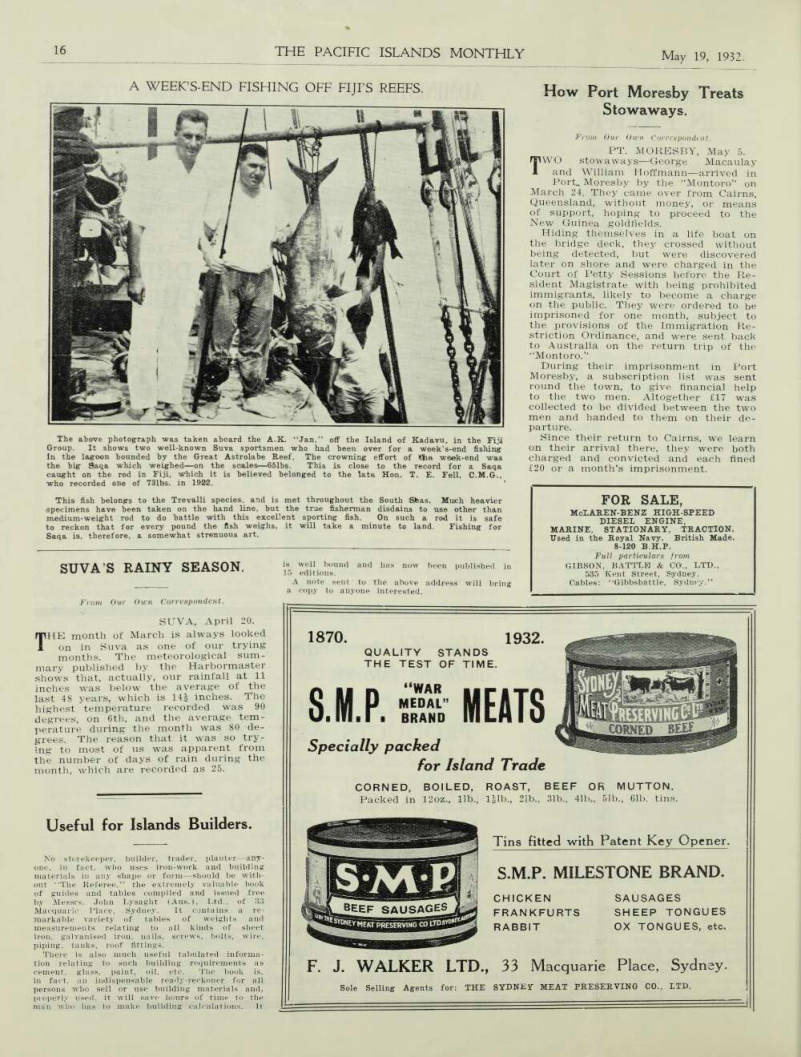
The above photograph was taken aboard the A.K. “Jan.” off the Island of Kadavu, in the Fiji Group. It shows two well-known Suva sportsmen who had been over for a week’s-end fishing in the lagoon hounded by the Great Astrolabe Reef. The crowning effort of the week-end was the big Saqa which weighed—on the scales—65lbs. This is close to the record for a Saqa caught on the rod in Fiji, which it is believed belonged to the late Hon. T. E. Fell, C.M.G., who recorded one of 73lbs. in 1922.
This fish belongs to the Trevalli species, and is met throughout the South Steas, Much heavier specimens have been taken on the hand line, but the true fisherman disdains to use other than medium-weight rod to do battle with this excellent sporting fish. On such a rod it is safe to reckon that for every pound the fish weighs, it will take a minute to land. Fishing for Saqa is, therefore, a somewhat strenuous art.
Suva’S Rainy Season.
From Our Own Correspondent.
SUVA, April 20.
THE month of March is always looked on in Suva as one of our trying months. The meteorological sum marv published by the Harbormaster shows that, actually, our rainfall at 11 inches was below the average of the last 48 years, which is 14½ inches. The highest temperature recorded was 90 degrees, on 6th, and the average tem perature during the month was 80 de grees. The reason that it was so try ing to most of us was apparent from the number of days of rain during the month, which are recorded as 25.
Useful for Islands Builders.
No storekeeper, builder, trader, planter—any one, in fact, who uses iron-work and building materials in any shape or form—should be with out “The Referee,” the extremely valuable book of guides and tables compiled and issued free by Messrs. John Lysaght (Aus.), Ltd., of 33 Macquarie Place, Sydney. It contains a re markable variety of tables of weights and measurements relating to all kinds of sheet iron, galvanised iron, nails, screws, bolts, wire, piping, tanks, roof fittings.
There is also much useful tabulated informa tion relating to such building requirements as cement, glass, paint, oil, etc. The book is, in fact, an indispensable ready-reckoner for all persons who sell or use building materials and, properly used, it will save hours of time to the man who has to make building calculations. It
is well bound and has now been published in 15 editions.
A note sent to the above address will bring a copy to anyone interested.
Stowaways.
How Port Moresby Treats Stowaways.
From Our Own Correspondent.
Pt. Moresby, May 5.
TWO stowaways—George Macaulay
and William Hoffmann —arrived in Port. Moresby by the “Montoro” on March 24. They came over from Cairns, Queensland, without money, or means of support, hoping to proceed to the New Guinea goldfields.
Hiding themselves in a life boat on the bridge deck, they crossed without being detected, but were discovered later on shore and were charged in the Court of Petty Sessions before the Re sident Magistrate with being prohibited immigrants, likely to become a charge on the public. They were ordered to be imprisoned for one month, subject to the provisions of the Immigration Re striction Ordinance, and were sent back to Australia on the return trip of the “Montoro.”
During their imprisonment in Port Moresby, a subscription list was sent round the town, to give financial help to the two men. Altogether £17 was collected to be divided between the two men and handed to them on their de parture.
Since their return to Cairns, we learn on their arrival there, they were both charged and convicted and each fined £2O or a month’s imprisonment.
Advertisements & other items, p. 18 (1 item)
Sip. £ Meats
FOR SALE,
McLAREN-BENZ HIGH-SPEED
DIESEL ENGINE,
MARINE. STATIONARY, TRACTION.
Used in the Royal Navy. British Made.
8-120 B.H.P,
Full particulars from
GIBSON, BATTLE & CO., LTD.,
535 Kent Street, Sydney.
Cables: “Gibbsbattle, Sydney.”
1870. 1932.
QUALITY STANDS
THE TEST OF TIME.
SIP. £ MEATS
Specially packed
for Island Trade
BEE*
CORNED
CORNED, BOILED, ROAST, BEEF OR MUTTON.
Packed in 12oz., 11b., l|lb., 21b., 31b., 41b„ 51b., 61b. tins.
SAUSAGES
beef Tins fitted with Patent Key Opener.
S.M.P. MILESTONE BRAND.
CHICKEN
FRANKFURTS
RABBIT
SAUSAGES
SHEEP TONGUES
OX TONGUES, etc.
F. J. WALKER LTD., 33 Macquarie Place, Sydney.
Sole Selling Agents for: THE SYDNEY MEAT PRESERVING CO.. LTD.
Bright Prospects For Fiji.
Preference for Fijian Sugar. New Market in Canada for Fijian Bananas.
Two developments during the month have altered the whole outlook for the primary producers of Fiji. Britain has granted a valuable preference to sugar produced in Fiji; and there is now a reasonable possibility that a new market will be found for Fiji bananas in Western Canada.
Fiji, with its great natural wealth, its good government, and its pleasant healthy climate, is one of the most attractive sub-tropical countries in the world; and the developments described hereunder are likely to increase the rate of its already rapid progress.
From Our Own Correspondent.
Suva, May 2.
A MOST important day in the history of Fiji was Wednesday, April 20, when the Chancellor of the British Exchequer announced in the House of Commons the welcome news of an in crease in the preference granted to Fiji sugar into the United Kingdom.
The statement marked a definite change in the attitude of the British Government towards the sugar-produc ing colonies, which had almost reached the point of despair as they watched the price of sugar falling and falling, without a stop.
The West Indies got into such a bad way that a Commission was despatched from London by the Labour Govern ment, under the chairmanship of Lord Olivier, himself a Labour Peer. The Colonial Sugar Refining Co., Ltd., sent their senior officer in Fiji, Mr. F. C. T.
Lord, to attend the meetings of the Com mission. The Commission reported in the most definite terms in which any Com mission could possibly report, that un less further assistance was given the West Indian sugar industry it would collapse and, in collapse, would most probably cause the fall of the structure of government in the West Indies.
Despite this grave warning the Labour Government did nothing.
The feeling of the Conservatives on the matter was well-known, and it was expected that some further measure of protection would be afforded the sugar producing colonies. In fact, one might almost say there has been every sign of a complete change in the attitude of the British Government towards her colonies in recent years. Once the colonies were looked upon as unwanted children, to be seen and not heard.
Now, they are being asked to sit down at the same table!
The immediate effects of the prefer ence to Fiji will be that the existing preference of £4/13/4 per ton will be in creased by £2 per ton on 40,000 tons of the colony’s output, and by £1 per von on the remaining 60,000 tons. The scheme lasts for five years, and thus will stabilise the industry on a basis of sugar fetching about £13/4/ in London.
There is certainly not much margin at that price; but any margin at all is preferable to uncertainty and loss.
Details Of The Scheme.
Details of the preference scheme, so far as it applies to Fiji, were contained in a despatch from the Secretary for the Colonies to the Governor of Fiji, and published in “The Fiji Times” of April 21. The despatch was as follows:
The Chancellor of the Exchequer announced in a Budget statement to-day that the following additional preferences will be granted on col onial sugar imported into the United Kingdom. (a) An increase in preference at the rate of one shilling per cwt. on 95-96 degrees sugar, and proportionately for lower and higher polar isations on all colonial sugar consigned from a colony to the United Kingdom. (b) A further special increase of preference, which will be one shilling per cwt. on a pre scribed quantity of colonial sugar as set out below. (i) The further special preference will be granted on 200,000 colonial tons for the year 1932-38, which is rather more than the actual imports of colonial sugar into the United King dom last year. (ii) This quantity is to be divided among colonies having substantial exports of sugar and for the year 1932-33 the division will be on a basis of their average annual exports of sugar to all destinations during the period 1928-30.
Certificates covering amount of each colony’s quota will be issued to colonial governments, which will divide them among its own producers.
We suggest that a reasonable oasis for division among producers is average production for the years 1928-30 but allocations will be left to colonial governments. (iii) Colonial sugar imported into the United Kingdom and accompanied by certificate issued as above will receive special preference at ap
piopriate rates (see iv.). Certificate will be transferable but evidence of colonial origin and consignment from the colony to the United King dom of any sugar which they accompany will be a necessary condition for special preference. (iv) During 1932-33 the special preference will be at the rate of one shilling per cwt. on 95 degrees—96 degrees sugar and proportion ately for higher and lower polarisations. In subsequent years if average sterling price dur ing latter half of any calendar year, of full duty 96 degrees raw sugar c.i.f. Loudon exceeds seven shillings and sixpence per cwt., but does not equal eight shillings, the extra preference to certificated sugar in the following financial year will be reduced by one-half and if such price equals or exceeds eight shillings, no such extra preference will be granted. If price equals or exceeds eight shillings and sixpence the original increase of preference [see (a)] will be reduced to sixpence, and if it equals or ex ceeds nine shillings the whole increase will be withdrawn.
Five Year Scheme.
The currency of the scheme will be five years, commencing as soon as possible in 1932-33 and both the first increase and further special in crease of preference will apply to colonial sugar only.
The certificate scheme has been adopted be cause his Majesty’s Government, while desirous of increasing the preference to colonial sugar by more than one shilling, were anxious to grant the further preference in a way which would
not encourage diversion of colonial sugar from Canada to the United Kingdom. A flat increase of two shillings would have made the United Kingdom preference higher than Canada and might therefore have led to such diversion.
The second one shilling is therefore granted in a way which divides benefits fairly between different colonies and obviates any diversion of trade. The effect of the certificate scheme is that each colonial producer will receive a cer tificate entitling him to special preference on a proportion of his production.
It is not, however, desired that each producer or even each colony should necessarily send that proportion of its production to the United Kingdom, as his Majesty’s Government is anxious to interfere as little as possible with existing channels of trade. The certificates will therefore be transferable from producer to pro ducer and from colony to colony and will be valid on presentation to the Customs authori ties here with sugar originating in any colony irrespective of the colony to which they were originally issued.
For example, a colony which now exports mainly to Canada, e.g., Jamaica, may sell the bulk of its certificates to a colony which ex ports mainly to the United Kingdom, e.g., Mau ritius. To reduce any trade difficulties to a minimum, I trust colonial governments will do everything to encourage and facilitate such trans fers and I shall be ready to facilitate them in London in any way possible.
Fiji’S Quota.
The quota to be allotted for 1932-33 to Fiji will be 40,400 tons.
It is proposed that each certificate shall cover 100 tons of sugar, as a smaller quantity would cause inconvenience to the Customs authorities.
The Customs authorities will, however, be pre pared to consider reasonable arrangements to meet difficulties due to consignments not weigh ing the exact multiple of 100 tons. The certi ficates are being printed and will be sent out for distribution to the colonies as quickly as possible.
Advertisements & other items, p. 19 (1 item)
Union
SLINGSBY TRUCKS,
LADDERS, BARROWS
AND CASTORS.
COMMISSION AGENTS, with
connection in Pacific Islands, required.
Send references and rough map of ground usually covered to —
H. C. SLINGSBY,
97 Kingsway, London, W.C.2, England.
PORTLAND CEMENT
UNION
BRAND
MANUFACTURED AT PORTLAND, N.S.W.
ALSO
“UNIONITE” Quick Hardening' Cement.
SUPERFINE HYDRATED LIME. LUMP LIME.
AGRICULTURAL LIME PURE GROUND CARBONATE.
THE COMMONWEALTH PORTLAND CEMENT COMPANY LTD.,
SYDNEY and PORTLAND, N.S.W.
Postal Address:
Box 1571 E, G.P.O.,
SYDNEY.
Telegraphic Address:
“LIMERIEZ,’
SYDNEY.
Bananas for Western Canada.
As a result of an experimental ship ment of bananas to Vancouver last year, the Fiji Department of Agricul ture has made arrangements for twelve further trial shipments The first will be made on May 6, and the bananas will thus arrive in Vancouver in sum mer weather.
In theory, there is no reason why Fiji should not supply the requirements of Western Canada, which at present draws its supplies through the United Fruit Co. of America from South America. The Canadian market is a very large one, but it is also a quality market. Canadians are wealthy, and will only have the best.
We in Fiji must realise that we have little chance of competing with the United Fruit Co., in view of the hap hazard manner in which our bananas are grown. The really good fruit comes by cutter from the outlying islands of the Group, and cannot avoid damage through rough handling.
The “Fiji Times and Herald” put the position very aptly when it wrote: “Not only the difficulties of carriage must be remembered, but also of mar keting; bearing in mind, particularly, the strength of the competition that will have to be faced.
“And certainly not the least of our difficulties is that confronting the De partment of Agriculture in its task of educating the growers of Fiji up to the realisation that bunches of bananas must be handled with the care that would be given if each banana was an egg.
“But difficulties are made to be over come, and we know of very few suc cessful ventures which were not accom panied by their full share of natural difficulties.”
EDITORIAL NOTE: This is news of first-rate importance. The sugar concession speaks for it self —it means the distribution in Fiji of large quantities of new money. But the banana de velopment, to our mind, is of much greater im portance. New trade got by tariffs and bonuses is fundamentally unsound, and is only justified if it is regarded as a temporary expedient.
A new market for Fijian bananas in Canada does not come into that category—it is a sign of enterprise and healthy growth. As to its signifi cance-look at the map! There in the Central Pacific are Fiji, Samoa and Tonga, capable of producing huge supplies of the world’s best bananas, but (since Australia foolishly closed her doors) with only the New Zealand banana market available to them. It has been as sumed that, so far as bananas are concerned, the North American market is too far away and too hostile; but Fiji’s enterprise shows that that is not so. It is possible to land the fruit in Vancouver in good condition; and it may be taken as certain that, in the new spirit of British reciprocity, Canada will as readily buy the products of Fiji as the products of Central America.
Hitherto, the enormous banana-growing pos sibilities of the Central Pacific have been lim ited by a restricted market : the exploitation of the West Canadian market changes the Fijian planters’ outlook to a degree that probably they do not yet realise. The difficulty about hand ling and packing is not an insurmountable one —it is mostly a matter of education and organ isation. This is a much smaller obstacle than the Levuana pest—and the Fijian officials con quered that.
Australian Rice.
And the New Caledonia Market.
A REMARKABLE answer to a ques tion about the market in the Pacific for Australian rice was given in the Federal House of Representatives on April 27.
Mr. James asked the Minister for Trade and Customs if “he was aware that it is the intention of the Govern ment of New Caledonia to impose on Australian-grown rice duty at the rate of 50 francs per 100 kilos, which, at the present rate of exchange, is ap proximately £7/16/3 per ton in Aus tralian currency? Up to the present the rate of duty on rice imported into
New Caledonia, irrespective of the country of production, has been 6/3 per ton.
“In view of the contemplated action of New Caledonia,” proceeded Mr.
James, “I ask the Minister whether the time is not opportune for preference to be extended to Australian-grown rice so far as the Mandated Territory of New Guinea is concerned. I understand that the present rate of duty on rice imported into the Territory is £1 a ton.
Will the Government give considera tion to the question of extending pre ference to Australian-grown rice which is available for export to that or any other country?”
The Minister (Mr. Gullett) replied: I am not aware of the position referred to, but I shall be pleased to give con sideration to his request. I doubt, how ever, if the duty said to have been im posed against Australian rice in New Caledonia is any higher than our own duty upon rice imported into Australia.
The Minister disclosed complete ig norance of the position in regard to New Caledonia, which was stated in this journal some months ago. The exchange position allowed Australian low-grade rice to be sold, as against the Javanese product, in New Cale donia, where large quantities are re quired for feeding Tonkinese and Javanese labourers. The French ad ministration at once took steps to im pose a tariff to keep out Australian rice, on the ground that Australia main tains a high tariff against practically all French products.
So far as finding a market for Aus tralian rice in Papua and New Guinea is concerned, the position is worth in quiry. The difficulty seems to be that Australia produces mostly first-grade rice, while the Territories’ requirements are confined largely to the very cheap, low-grade article.
Advertisements & other items, p. 20 (1 item)
Flour
Australian Stamps,
SOUVENIRS & NOVELTIES.
Stamps bought and exchanged.
MORRISON’S,
113 PITT ST. : SYDNEY.
Flour
ASK FOR IT
ESTABLISHED 1868.
Indian Labour In Fiji.
Should It Be Introduced To Other Islands Territories?
Written for the “Pacific Islands Monthly,” by a Fijian Planter.
INDIAN labour for the Solomon Is lands need not be viewed with ap prehension. This might also apply to Samoa, where Chinese are troublesome, and also to other Islands territories, where labour is scarce.
The Hindus are a very adaptable people, and the advantages of having them are considerable.
Fiji can be quoted as a very good example of where the experiment of introduced Indian labour has been a success. Many years ago the Govern ment saw the advisability of introduc ing into Fiji and adequate labour sup ply for all time. The Indians first in troduced were sent to the island of Taviuni in the Leau or Eastern group.
At first, the planters did not take kindly to them, but eventually they be came firmly established.
They were first brought to Fiji under the indenture system. Their term of in denture was usually for a period of five years. After that some of them became free settlers and successful land owners.
Others took up tenancies on small blocks let out by the sugar company for cultivating cane for the mills. While a good number occupy a considerable area of crown leases, others are store keepers, engineers, motor car drivers, etc. —in fact, practically every branch of trade is represented. They are splen did business people.
Think of all the extra revenue they represent in taxes, land rent, customs dues, to say nothing of income tax and residential tax of £1 per head for every male over sixteen in the colony! When one realises that there are about 80,000 Indians in the colony, the revenue is going to benefit considerably.
The introduction of Indian labour to the Solomons and Samoa would solve the labour problem —though it may raise other problems. All intending labour should be subject to strict me dical inspection before embarkation.
The selection of the healthiest would tend to build up a sturdy Indian popu lation which would soon adapt itself to the varying climates and conditions of the Islands.
There need not be a repetition of the errors committed in Fiji. For instance, a reasonable percentage of women should be allowed in. The decision to keep women out was a great mistake in Fiji, where the labour lines became notorious for iniquity. Married couples should be provided with separate quar ters, as is now done in Fiji.
Another early fault of Fiji employers was the engaging of inexperienced men as overseers. Only those experienced in handling Indian labour should be engaged. Much ill-feeling and mis understanding can be avoided by a good knowledge of the language. Over seers and cadets should be drawn from India and Ceylon, or from the ranks of those who have had some experience in the working of Indian labour.
It is useless to indenture high-caste Indians. They do not make good labour and are less inclined to the ways of discipline. I have often heard it said, the fairer the skin the lazier. The dark ones certainly are more energetic.
If you require cheap labour, by all means let them have their store goods at cost price, such as rice, tea, sugar, sharps, curry powder, onions and ghee.
The Indian loves his curry and roti (a kind of pancake made of sharps). The cost of this is deducted from their wages, weekly or monthly, as the case may be.
Indian tenants, or peasant farmers on various plantations, are certainly an asset to the place. Rent is derived from them for the amount of land occupied.
They grow rice, maize and all manner of produce, including vegetables, and they are always available as labour supply if their services are required.
Most plantation-lease agreements have that clause inserted, that they are to work on the owner’s plantation, at a reasonable rate of remuneration, when called upon to do so.
The Indians are a comparatively law abiding race, and I think would excel the Chinese coolie in that respect.
One outstanding feature of the In dians in Fiji is that they have not mixed with the native races to any ap preciative extent. In fact, the percent age is negligible. The two races do not blend. Even when Indian labour was first introduced into Fiji, and Indian women were few, the number of In dians married to native women could be counted on the fingers. Labour of this description would suit Samoa ad mirably, in view of the difficulty with half-caste Chinese.
When I arrived in Fiji in 1917, the Indians were still under the indenture system. The ruling wages were, at that time, women 9d. per day, men 1/- for a twelve-hours day, as far as I can recollect—Saturday half-pay. Men and women worked side by side, on identi cal field work, by the day, or task. If and when a task were finished, they could go home. There was always a rmall percentage who finished later than the others.
On various occasions, notably from about 1921 to 1927, and even years be
fore that. Solomon Islanders, and In dians were indentured to planters in Tonga, the Island Kingdom. The Solo mon Islanders were more successful as labour in Tonga than the Indians.
Solomon Islanders, from the time that they were introduced into Fiji, have been our best labour —very law abiding and obedient. They mix freely with the native races.
The Indians, on the other hand, were less successful in Tonga, due to the fact that planters, storekeepers, etc., did not understand them, or their ways.
Very few of the Indians understand any English and the planters and traders in Tonga knew perhaps as much Hin dustani as the Indians knew of English.
This does not mean to infer that, as they were not a success in Tonga, they will not be elsewhere. There is no reason why they should not be as suc cessful as those introduced to Fiji, pro vided that previous mistakes are not repeated.
Advertisements & other items, p. 21 (1 item)
Burns, Philp
Sutton’s
Canned Vegetables
Green Peas, In 1lb. and 2lb. Tins.
French Beans (Sliced) in 1lb. Tins.
Carrots, In 1lb. Tins.
Beetroot (Sliced) in 1lb. Tins.
Packed by
Delicia Food Products Co.
WATERLOO, N.S.W.
BURNS, PHILP
(South Sea) Co. Ltd.
Island Traders & Shipowners Registered Office: Suva, Fiji.
Also Branches at Fiji: Levuka, Lautoka, Labasa, Ba, Sigatoka, Rotumah.
Tonga: Nukualofa, Haapai, Vavau.
Samoa: Apia.
Solomons: Makambo, Gizo, Faisi.
New Hebrides: Vila.
Gilberts: Tarawa.
Norfolk Island. Nauru. Niue.
Code Address: "Burnsouth."
Tonga’S Deficit
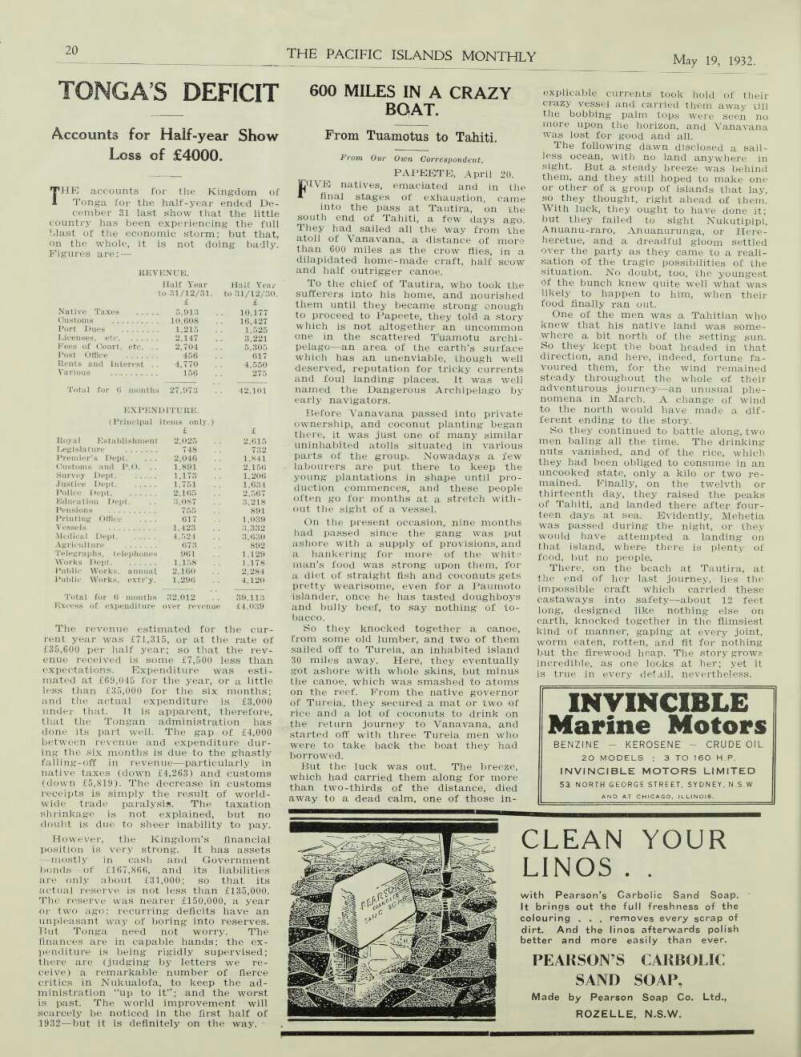
Accounts for Half-year Show Loss of £4000.
THE accounts for the Kingdom of Tonga for the half-year ended De cember 31 last show that the little country has been experiencing the full blast of the economic storm; but that, on the whole, it is not doing badly.
Figures are:
The revenue estimated for the cur rent year was £71,315, or at the rate of £35,600 per half year; so that the rev enue received is some £7,500 less than expectations. Expenditure was esti mated at £69,045 for the year, or a little less than £35,000 for the six months; and the actual expenditure is £3,000 under that. It is apparent, therefore, that the Tongan administration has done its part well. The gap of £4,000 between revenue and expenditure dur ing the six months is due to the ghastly falling-off in revenue—particularly in native taxes (down £4,263) and customs (down £5,819). The decrease in customs receipts is simply the result of world wide trade paralysis. The taxation shrinkage is not explained, but no doubt is due to sheer inability to pay.
However, the Kingdom’s financial position is very strong. It has assets —mostly in cash and Government bonds —of £167,866, and its liabilities are only about £31,000; so that its actual reserve is not less than £135,000.
The reserve was nearer £150,000, a year or two ago: recurring deficits have an unpleasant way of boring into reserves.
But Tonga need not worry. The finances are in capable hands; the ex penditure is being rigidly supervised; there are (judging by letters we re ceive) a remarkable number of fierce critics in Nukualofa, to keep the ad ministration “up to it”; and the worst is past. The world improvement will scarcely be noticed in the first half of 1932 —but it is definitely on the way.
Revenue.
Half Year Half Year to 31/12/31. to 31/12/30. £ £ Native Taxes 5,913 10,177 Customs 10,608 16,427 Port Dues 1,215 1,525 Licenses, etc 2,147 3,221 Fees of Court, etc. . . 2,704 5,305 Post Office 456 617 Rents and Interest . . 4,770 4,550 Various 156 275 Total for 6 months 27,973 42,101
Expenditure.
(Principal items only.) £ £ Royal Establishment 2,025 2,615 Legislature 748 732 Premier’s Dept. 2,046 1,841 Customs and P.O. . . 1,891 2,150 Survey Dept 1,173 1,206 Justice Dept 1,751 1.634 Police Dept 2,165 2,567 Education Dept. 3,087 3,218 Pensions 755 891 Printing Office ... 617 1,039 Vessels 1,423 3,332 Medical Dept. 4,524 3,630 Agriculture 673 892 Telegraphs, telephones 961 1,129 Works Dept 1,158 1,178 Public Works, annual 2,160 2,284 Public Works, extr’y. 1,296 4,120 Total for 6 months 32,012 39.113 Excess of expenditure over revenue £4,039
Boat.
600 Miles In A Crazy
From Tuamotus to Tahiti.
From Our Own Correspondent.
PAPEETE, April 20.
FIVE natives, emaciated and in the final stages of exhaustion, came into the pass at Tautira, on the south end of Tahiti, a few days ago.
They had sailed all the way from the atoll of Vanavana, a distance of more than 600 miles as the crow flies, in a dilapidated home-made craft, half scow and half outrigger canoe.
To the chief of Tautira, who took the sufferers into his home, and nourished them until they became strong enough to proceed to Papeete, they told a story which is not altogether an uncommon one in the scattered T'uamotu archi pelago—an area of the earth’s surface which has an unenviable, though well deserved, reputation for tricky currents and foul landing places. It was well named the Dangerous Archipelago by early navigators.
Before Vanavana passed into private ownership, and coconut planting began there, it was just one of many similar uninhabited atolls situated in various parts of the group. Nowadays a few labourers are put there to keep the young plantations in shape until pro ductipn commences, and these people often go for months at a stretch with out the sight of a vessel.
On the present occasion, nine months had passed since the gang was put ashore with a supply of provisions, and a hankering for more of the white man’s food was strong upon them, for a diet of straight fish and coconuts gets pretty wearisome, even for a Paumoto islander, once he has tasted doughboys and bully beef, to say nothing of to bacco.
So they knocked together a canoe, from some old lumber, and two of them sailed oft to Tureia, an inhabited island 30 miles away. Here, they eventually g-ot ashore with whole skins, but minus the canoe, which was smashed to atoms on the reef. From the native governor of Tureia, they secured a mat or two of rice and a lot of coconuts to drink on the return journey to Vanavana, and started off with three Tureia men who were to take back the boat they had borrowed.
But the luck was out. The breeze, which had carried them along for more than two-thirds of the distance, died away to a dead calm, one of those in
explicable currents took hold of their crazy vessel and carried them away till the bobbing palm tops were seen no more upon the horizon, and Vanavana was lost for good and all.
The following dawn disclosed a sail less ocean, with no land anywhere in sight. But a steady breeze was behind them, and they still hoped to make one or other of a group of islands that lay, so they thought, right ahead of them.
With luck, they ought to have done it; but they failed to sight Nukutipipi, Anuanu-raro, Anuanurunga, or Here heretue, and a dreadful gloom settled over the party as they came to a reali sation of the tragic possibilities of the situation. No doubt, too, the youngest Of the bunch knew quite well what was likely to happen to him, when their food finally ran out.
One of the men was a Tahitian who knew that his native land was some where a bit north of the setting sun.
So they kept the boat headed in that direction, and here, indeed, fortune fa voured them, for the wind remained steady throughout the whole of their adventurous journey—an unusual phe nomena in March. A change of wind to the north would have made a dif ferent ending to the story.
So they continued to battle along, two men baling all the time. The drinking nuts vanished, and of the rice, which they had been obliged to consume in an uncooked state, only a kilo or two re mained. Finally, on the twelvth or thirteenth day, they raised the peaks of Tahiti, and landed there after four teen days at sea. Evidently, Mehetia was passed during the night, or they would have attempted a landing on that island, where there is plenty of food, but no people.
There, on the beach at Tautira, at the end of her last journey, lies the impossible craft which carried these castaways into safety—about 12 feet long, designed like nothing else on earth, knocked together in the flimsiest kind of manner, gaping at every joint, worm eaten, rotten, and fit for nothing but the firewood heap. The story grows incredible, as one looks at her; yet it is true in every detail, nevertheless.
Advertisements & other items, p. 22 (1 item)
Invincible
Marine Motors
BENZINE - KEROSENE - CRUDE OIL
20 MODELS : 3 TO 160 H P.
INVINCIBLE MOTORS LIMITED
53 NORTH GEORGE STREET. SYDNEY. N.S.W
CLEAN YOUR
LINOS . .
with Pearson’s Carbolic Sand Soap.
It brings out the full freshness of the colouring , . . removes every scrap of dirt. And the linos afterwards polish better and more easily than ever.
PEARSON’S CARBOLIC
SAND SOAP,
Made by Pearson Soap Co. Ltd.,
ROZELLE, N.S.W.
Ellice Islands.
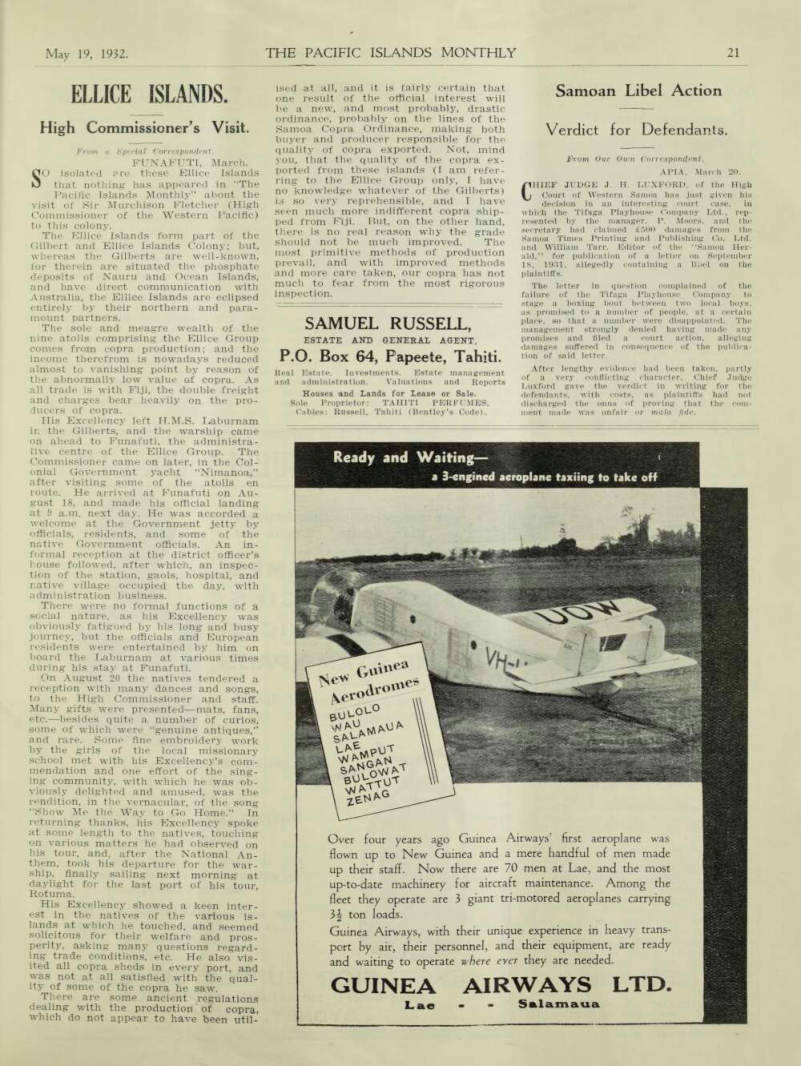
High Commissioner’s Visit.
From a Special Correspondent.
FUNAFUTI, March.
SO isolated are these Ellice Islands that nothing has appeared in ‘‘The Pacific Islands Monthly” about the visit of Sir Murchison Fletcher (High Commissioner of the Western Pacific) to this colony.
The Ellice Islands form part of the Gilbert and Ellice Islands Colony; but, whereas the Gilberts are well-known, for therein are situated the phosphate deposits of Nauru and Ocean Islands, and have direct communication with Australia, the Ellice Islands are eclipsed entirely by their northern and para mount partners.
The sole and meagre wealth of the nine atolls comprising the Ellice Group comes from copra production; and the income therefrom is nowadays reduced almost to vanishing point by reason of the abnormally low value of copra. As all trade is with Fiji, the double freight and charges bear heavily on the pro ducers of copra.
His Excellency left H.M.S. Laburnam in the Gilberts, and the warship came on ahead to Funafuti, the administra tive centre of the Ellice Group. The Commissioner came on later, in the Col onial Government yacht “Nimanoa,” after visiting some of the atolls en route. He arrived at Funafuti on Au gust 18, and made his official landing at 9 a.m. next day. He was accorded a welcome at the Government jetty by officials, residents, and some of the native Government officials. An in formal reception at the district officer’s house followed, after which, an inspec tion of the station, gaols, hospital, and native village occupied the day, with administration business.
There were no formal functions of a social nature, as his Excellency was obviously fatigued by his long and busy journey, but the officials and European residents were entertained by him on board the Laburnam at various times during his stay at Funafuti.
On August 20 the natives tendered a reception with many dances and songs, to the High Commissioner and staff.
Many gifts were presented—mats, fans, etc. —besides quite a number of curios, some of which were “genuine antiques,’’ and rare. Some fine embroidery work by the girls of the local missionary school met with his Excellency’s com mendation and one effort of the sing ing community, with which he was ob viously delighted and amused, was the rendition, in the vernacular, of the song “Show Me the Way to Go Home.” In returning thanks, his Excellency spoke at some length to the natives, touching on various matters he had observed on his tour, and, after the National An them, took his departure for the war ship, finally sailing next morning at daylight for the last port of his tour, Rotuma.
His Excellency showed a keen inter est in the natives of the various is lands at which he touched, and seemed solicitous for their welfare and pros perity, asking many questions regard ing trade conditions, etc. He also vis ited all copra sheds in every port, and was not at all satisfied with the qual ity of some of the copra he saw.
There are some ancient regulations dealing with the production of copra, which do not appear to have been util
ised at all, and it is fairly certain that one result of the official interest will be a new, and most probably, drastic ordinance, probably on the lines of the Samoa Copra Ordinance, making both buyer and producer responsible for the quality of copra exported. Not, mind you, that the quality of the copra ex ported from these islands (I am refer ring to the Ellice Group only, I have no knowledge whatever of the Gilberts) is so very reprehensible, and I have seen much more indifferent copra ship ped from Fiji. But, on the other hand, there is no real reason why the grade should not be much improved. The most primitive methods of production prevail, and with improved methods and more care taken, our copra has not much to fear from the most rigorous inspection.
Samoan Libel Action
Verdict for Defendants.
From Our Own Correspondent.
APIA, March 20.
CHIEF JUDGE J. H. LUXFORD. of the High Court of Western Samoa has just given his decision in an interesting court case, in which the Tifaga Playhouse Company Ltd., rep resented by the manager, P. Moors, and the secretary had claimed £500 damages from the Samoa Times Printing and Publishing Co. Ltd. and William Tarr, Editor of the “Samoa Her ald,” for publication of a letter on September 18, 1931, allegedly containing a libel on the plaintiffs.
The letter in question complained of the failure of the Tifaga Playhouse Company to stage a boxing bout between two local boys, as promised to a number of people, at a certain place, so that a number were disappointed. The management strongly denied having made any promises and filed a court action, alleging damages suffered in consequence of the publica tion of said letter.
After lengthy evidence had been taken, partly of a very conflicting character, Chief Judge Luxford gave the verdict in writing for the defendants, with costs, as plaintiffs had not discharged the onus of proving that the com ment made was unfair or mala fide.
Advertisements & other items, p. 23 (2 items)
Samuel Russell,
ESTATE AND GENERAL AGENT,
P.O. Box 64, Papeete, Tahiti.
Real Estate. Investments. Estate management and administration. Valuations and Reports Houses and Lands for Lease or Sale.
Sole Proprietor: TAHITI PERFUMES.
Cables: Russell, Tahiti (Bentley’s Code).
Guinea Airways Ltd.
Ready and Waiting—
a 3-engined aeroplane taxiing to take off Over four years ago Guinea Airways’ first aeroplane was flown up to New Guinea and a mere handful of men made up their staff. Now there are 70 men at Lae, and the most up-to-date machinery for aircraft maintenance. Among the fleet they operate are 3 giant tri-motored aeroplanes carrying 3½ ton loads.
Guinea Airways, with their unique experience in heavy trans port by air, their personnel, and their equipment, are ready and waiting to operate where ever they are needed.
GUINEA AIRWAYS LTD.
Lae - - Salamaua
Prospects in Many Places.
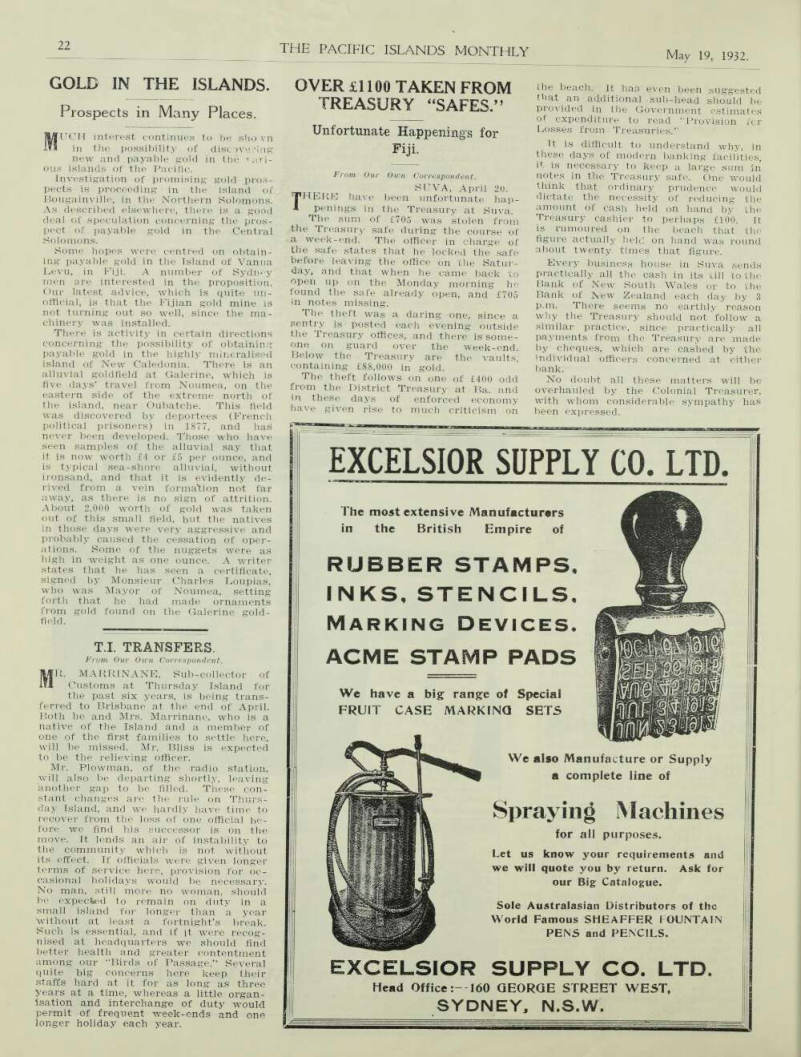
Gold In The Islands.
MUCH interest continues to be sho vn in the possibility of discovering new and payable gold in the vari ous islands of the Pacific.
Investigation of promising gold pros pects is proceeding in the island of Bougainville, in the Northern Solomons.
As described elsewhere, there is a good deal of speculation concerning the pros pect of payable gold in the Central Solomons.
Some hopes were centred on obtain ing payable gold in the Island of Vanua Levu, in Fiji. A number of Sydney men are interested in the proposition.
Our latest advice, which is quite un official, is that the Fijian gold mine is not turning out so well, since the ma chinery was installed.
There is activity in certain directions concerning the possibility of obtaining payable gold in the highly mineralised island of New Caledonia. There is an alluvial goldfield at Galerine, which is five days’ travel from Noumea, on the eastern side of the extreme north of the island, near Oubatche. This field was discovered by deportees (French political prisoners) in 1877, and has never been developed. Those who have seen samples of the alluvial say that it is now worth £4 or £5 per ounce, and is typical sea-shore alluvial, without ironsand, and that it is evidently de rived from a vein formation not far away, as there is no sign of attrition.
About 2,000 worth of gold was taken out of this small field, but the natives in those days were very aggressive and probably caused the cessation of oper ations. Some of the nuggets were as high in weight as one ounce. A writer states that he has seen a certificate, signed by Monsieur Charles Loupias, who was Mayor of Noumea, setting forth that he had made ornaments from gold found on the Galerine gold field.
T.I. Transfers.
From Our Own Correspondent.
MR. MARRINANE, Sub-collector of Customs at Thursday Island for the past six years, is being trans ferred to Brisbane at the end of April.
Both he and Mrs. Marrinane, who is a native of the Island and a member of one of the first families to settle here, will be missed. Mr. Bliss is expected to be the relieving officer.
Mr. Plowman, of the radio station, will also be departing shortly, leaving another gap to be filled. These con stant changes are the rule on Thurs day Island, and we hardly have time to recover from the loss of one official be fore we find his successor is on the move. It lends an air of instability to the community which is not without its effect. If officials were given longer terms of service here, provision for oc casional holidays would be necessary.
No man, still more no woman, should be expected to remain on duty in a small island for longer than a year Without at least a fortnight’s break.
Such is essential, and if it were recog nised at headquarters we should find better health and greater contentment among our “Birds of Passage.” Several quite big concerns here keep their staffs hard at it for as long as three years at a time, whereas a little organ isation and interchange of duty would permit of frequent week-ends and one longer holiday each year.
Fiji.
Over £1100 Taken From
Treasury “Safes.”
Unfortunate Happenings for Fiji.
From Our Own Correspondent.
SUVA, April 20.
THERE have been unfortunate hap penings in the Treasury at Suva.
The sum of £705 was stolen from the Treasury safe during the course of a week-end. The officer in charge of the safe states that he locked the safe before leaving the office on the Satur day, and that when he came back to open up on the Monday morning he found the safe already open, and £705 in notes missing.
The theft was a daring one, since a sentry is posted each evening outside the Treasury offices, and there is some one on guard over the week-end.
Below the Treasury are the vaults containing £88,000 in gold.
The theft follows on one of £400 odd from the District Treasury at Ba, and in these days of enforced economy have given rise to much criticism on
the beach. It has even been suggested that an additional sub-head should be provided in the Government estimates of expenditure to read “Provision for Losses from Treasuries.”
It is difficult to understand why, in these days of modern banking facilities, it is necessary to keep a large sum in notes in the Treasury safe. One would think that ordinary prudence would dictate the necessity of reducing the amount of cash held on hand by the Treasury cashier to perhaps £100. It is rumoured on the beach that the figure actually held on hand was round about twenty times that figure.
Every business house in Suva sends practically all the cash in its till to the Bank of New South Wales or to the Bank of New Zealand each day by 3 p.m. There seems no earthly reason why the Treasury should not follow a similar practice, since practically all payments from the Treasury are made by cheques, which are cashed by the individual officers concerned at either bank.
No doubt all these matters will be overhauled by the Colonial Treasurer, with whom considerable sympathy has been expressed.
Advertisements & other items, p. 24 (1 item)
Excelsior Supply Co. Ltd.
The most extensive Manufacturers in the British Empire of
RUBBER STAMPS.
INKS, STENCILS.
Marking Devices.
ACME STAMP PADS
We have a big range of Special
FRUIT CASE MARKING SETS
We also Manufacture or Supply a complete line of
Spraying Machines
for all purposes.
Let us know your requirements and we will quote you by return. Ask for our Big Catalogue.
Sole Australasian Distributors of the World Famous SHEAFFER FOUNTAIN
PENS and PENCILS.
EXCELSIOR SUPPLY CO. LTD
Head Office:- 160 GEORGE STREET WEST,
SYDNEY, N.S.W.
Fiji Pineapples.
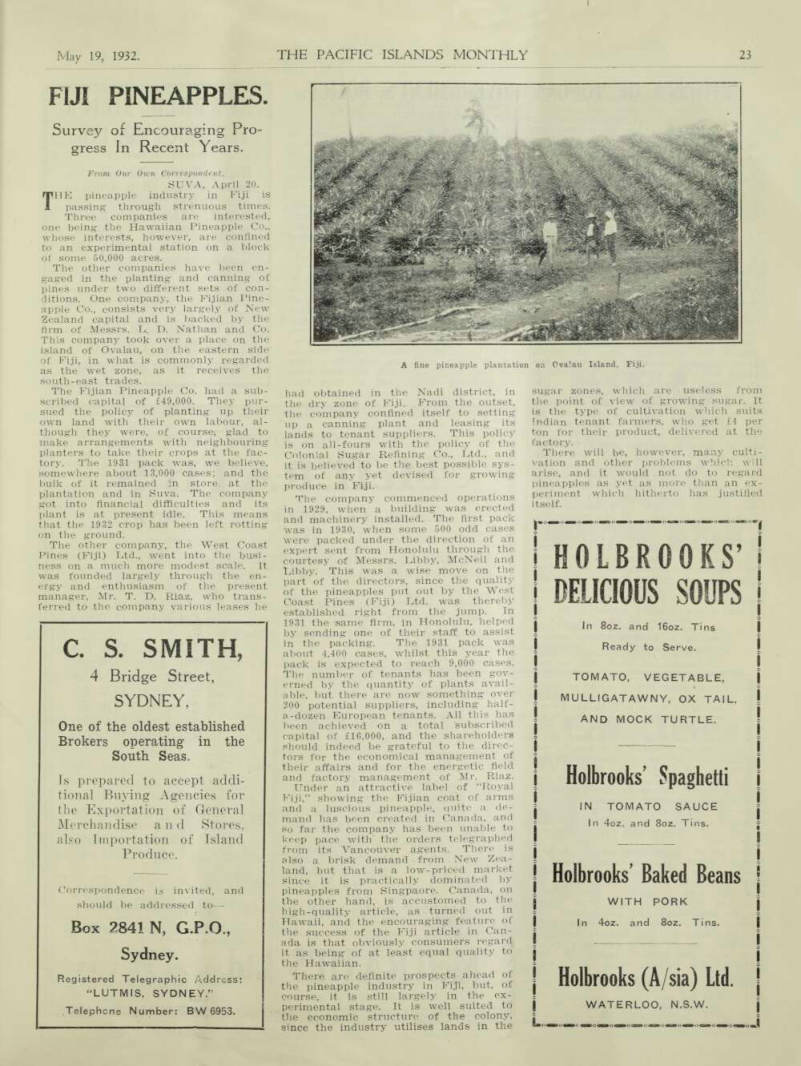
Survey of Encouraging Pro gress In Recent Years.
From Our Own Correspondent.
SUVA, April 20.
THE pineapple industry in Fiji is passing through strenuous times.
Three companies are interested, one being the Hawaiian Pineapple Co., whose interests, however, are confined to an experimental station on a block of some 50,000 acres.
The other companies have been en gaged in the planting and canning of pines under two different sets of con ditions. One company, the Fijian Pine apple Co., consists very largely of New Zealand capital and is backed by the Ann of Messrs. L. D. Nathan and Co.
This company took over a place on the island of Ovalau, on the eastern side of Fiji, in what is commonly regarded as the wet zone, as it receives the south-east trades.
The Fijian Pineapple Co. had a sub scribed capital of £49,000. They pur sued the policy of planting up their own land with their own labour, al though they were, of course, glad to make arrangements with neighbouring planters to take their crops at the fac tory. The 1931 pack was, we believe, somewhere about 13,000 cases; and the bulk of it remained in store at the plantation and in Suva. The company got into financial difficulties and its plant is at present idle. This means that the 1932 crop has been left rotting on the ground.
The other company, the West Coast Pines (Fiji) Ltd., went into the busi ness on a much more modest scale. It was founded largely through the en ergy and enthusiasm of the present manager, Mr. T. D. Riaz, who trans ferred to the company various leases he
had obtained in the Nadi district, in the dry zone of Fiji. From the outset, the company confined itself to setting up a canning plant and leasing its lands to tenant suppliers. This policy is on all-fours with the policy of the Colonial Sugar Refining Co., Ltd., and it is believed to be the best possible sys tem of any yet devised for growing produce in Fiji.
The company commenced operations in 1929, when a building was erected and machinery installed. The first pack was in 1930, when some 500 odd cases Were packed under the direction of an expert sent from Honolulu through the courtesy of Messrs. Libby, McNeil and Libby. This was a wise move on the part of the directors, since the quality of the pineapples put out by the West Coast Pines (Fiji) Ltd. was thereby established right from the jump. In 1931 the same firm, in Honolulu, helped by sending one of their staff to assist in the packing. The 1931 pack was about 4,400 cases, whilst this year the pack is expected to reach 9,000 cases.
The number of tenants has been gov erned by the quantity of plants avail able, but there are now something over 200 potential suppliers, including half a-dozen European tenants. All this has been achieved on a total subscribed capital of £16,000, and the shareholders should indeed be grateful to the direc tors for the economical management of their affairs and for the energetic field and factory management of Mr. Riaz.
Under an attractive label of “Royal Fiji,” showing the Fijian coat of arms and a luscious pineapple, quite a de mand has been created in Canada, and so far the company has been unable to keep pace with' the orders telegraphed from its Vancouver agents. There is also a brisk demand from New Zea land, but that is a low-priced market since it is practically dominated by pineapples from Singpaore. Canada, on the other hand, is accustomed to the high-quality article, as turned out in Hawaii, and the encouraging feature of the success of the Fiji article in Can ada is that obviously consumers regard it as being of at least equal quality to the Hawaiian.
There are definite prospects ahead of the pineapple industry in Fiji, but, of course, it is still largely in the ex perimental stage. It is well suited to the economic structure of the colony, since the industry utilises lands in the
sugar zones, which are useless from the point of view of growing sugar. It is the type of cultivation which suits Indian tenant farmers, who get £4 per ton for their product, delivered at the factory.
There will be, however, many culti vation and other problems which will arise, and it would not do to regard pineapples as yet as more than an ex periment which hitherto has justified itself.
A fine pineapple plantation on Ovabau Island, Fiji.
Advertisements & other items, p. 25 (1 item)
Delicious Soups
HOLBROOKS’
In 8oz. and 16oz. Tins Ready to Serve.
TOMATO, VEGETABLE,
MULLIGATAWNY, OX TAIL,
AND MOCK TURTLE.
Holbrooks’ Spaghetti
IN TOMATO SAUCE
In 4oz. and Boz. Tins.
Holbrooks’ Baked Beans
WITH PORK
In 4oz. and Boz. Tins.
Holbrooks (A/sia) Ltd.
WATERLOO, N.S.W.
C. S. SMITH,
4 Bridge Street,
SYDNEY,
One of the oldest established Brokers operating in the South Seas.
Is prepared to accept addi tional Buying Agencies for the Exportation of General Merchandise and Stores, also Importation of Island Produce.
Correspondence is invited, and should be addressed to—
Box 2841 N, G.P.O.,
Sydney.
Registered Telegraphic Address:
“LUTMIS, SYDNEY.”
Telephone Number: BW 6953.
Criticism Of Tongan Government’S Policy.
[To the Editor.]
Sir, —If your valuable paper can give space to a little more healthy criticism of Government policy, I would be greatly obliged. Believe me, I am not like the Irishman who, when he landed in New York, asked if there was a Gov ernment and, on being told there most certainly was, replied, “Then I’m agin it.”
The perfect Government has yet to be found, and the following remarks are made with the idea of helping the Government of Tonga to attain this ideal. A further hope is that during the process of attainment, the people of Tonga and others domiciled here will receive a little more encouragement from the Government and a few less kicks.
First of all, bananas.
Since the alarming drop in copra values, a wild scramble has been in dulged in by the Government to find a satisfactory secondary industry. (In passing, it is extremely interesting to note that for something like 20 years the Government has been satisfied to risk the welfare of the country on the export of copra and copra only.) It was at length decided that bananas would fill the bill admirably, and early last year the country began what one might call ‘a banana drive.” Suckers were begged, borrowed, purchased and possibly stolen, so great was the en thusiasm to produce. “Produce” was the order of the day. In the meantime, the Government made arrangements for the shipping and sale of the ban anas and undertook to pay its people and others, i.e., planters, etc., 4/- per case delivered Government wharf. The following is an extract from the Gazette in which this under taking was pub lished: —
Tongan Government Gazette, No. 18,
November 27, 1931. (2) That for the next twelve months from this date the price for bananas exported through the agency of the Government and delivered at the Government wharf at Nukualofa or Neiafu shall be four shillings per case.
Shipments- were finally made and the first two taken as a whole were moder ately successful from a financial view point. On the other hand, technicali ties were raised in connection with the picking and packing of the fruit. The third shipment resulted in a loss to the Government of approximately £1,500, owing, in the first place, to the fruit being cut long before the arrival of the fruit steamer; secondly, to extremely bad storage awaiting shipment; thirdly, the very poor price offering on the New Zealand market; and, fourthly, the jet tisoning of that fruit which became over-ripe.
One result of this distressing loss and blunder on the part of some person or persons was the discovery that the agreement with the Auckland buyers of the fruit was unsigned. This agree ment, it is believed, has been com pletely abandoned and presumably the Government will in the future ship to an open market. The Gazette issued a few days ago prompts one to suggest that this is another result of the blunder. The Gazette reads as follows:
Tongan Government Gazette, No. 6.
March 15, 1932. (1) That the price fixed for bananas in no tice published in Gazette No. 18 of 1931, is hereby cancelled.
(2) That until further notice the price for bananas exported through the agency of the Government, and delivered at the Government wharf at Nukualofa. Neiafu or Lifuka shall be as follows: Nukua lofa 2/6 per case, Neiaful 2/- per case, Lifuka 2/- per case.
It is obvious the Government intend to make the people meet the cost of the blunder, and, as a result of the Gazette just quoted, a collapse of the industry would be easy to predict only for the fact that the Tongan is so desperately hard up. The Government are, of course, aware of this, otherwise it is doubtful if they would have dared to so flagrantly ignore their moral obliga tion to pay 4/- per case as so definitely stated in their November Gazette There is little doubt, but that the Gov ernment have destroyed any national pride the Tongan might have had in the industry, and, as suggested, they are also within an ace of destroying the industry itself. Let us hope that
before such a calamity overtakes the Kingdom, the Government will have taken to heart the following remarks made by a great American legislator; “You can fool some of the people all the time, And all the people some of the time, But you can’t fool all the people all the time.”
The Police Force.
Secondly, a few remarks in connec tion with our amazing Police Force. At time of writing, two policemen are lodged in the local lock-up awaiting trial for the embezzlement of Govern ment funds. To date, it has been as certained that one has helped himself to £60 and the other to £50. No doubt, both these amounts will be augmented before the day of the trial. Possibly, these two policemen consider they have a Police Force reputation to uphold, as during the last two to three years about eight of their fraternity have assisted to keep the roads in order for similar crimes. Recently, a European resident referred to the sordidness of our Police Court. Naturally, our well-respected European magistrate was indignant, but surely on the evidence our resident was justified in his statement?
Such is the type of policeman, who is called to give evidence against both Tongans and Europeans. They delight in pestering Europeans with petty charges for absence of tail-lights, so called speeding, etc., but their over zealousness in this respect often causes their own discomfiture, as the majority of these cases are thrown out for lack of evidence or because of contradictory evidence.
For instance, some little time back, a European was before the court ac cused of speeding and the three police men who swore they saw the incident suggested the speed as being 10, 20 and 40 miles per hour. So, while it is ob vious the car could not have been travelling at any terrific speed, it is also evident that the police have little or no conception of speed whatsoever.
The case was, of course, dismissed, but no compensation was made the accused for loss of time. Of course, one does not expect compensation, but then I raise the point because neither does one expected to be foolishly inconveni enced. If the police really conducted their duties in the interests of the pub lic then the recent theft of 40 odd gal lons of benzine from a Bowser pump (Bowser pump, please particularly ob serve) would surely have been pre vented. The culprit is still at large and will probably remain a menace to the public.
Broadly speaking then, one would sum up our guardians of the peace, protectors of life and property, etc., as men with a tendency to embezzle, faithful disciples of the petty com plaints policy, hopeless as regards speed sense (a very important matter) and utterly futile when it comes to preventing or detecting real crime.
Surely then, we are justified in our feelings of high indignation that such men are allowed to detain and testify against us? And yet the Government actually gives these men lawful pro tection should they be sued for the re covery of debt as the following extract from the Tongan Police Act reveals.
It reads; “No amount shall be recovered in any Court from any person on account of anything bought by him upon credit at any store or shop whilst he was employed in the Force and every Court shall take notice of this section whether or not raised by the defend ant.” '
A merchant, therefore, finds he can not compel a member of the Police Force to meet his obligations, but, should this member help himself to Government property he is promptly gaoled. As pointed out, the police re cord is not one to be proud of—is it that the Act and section referred to has given the force a subconscious feel ing of security? If so, then it is evi dent the State financially and the Ton gan morally would be infinitely better off by its immediate repeal.
In any case, it will be seen from the foregoing that it is high time the Force and Regulations were overhauled.
I am, etc.,
Observer.
Nukualofa, Tonga.
March 19, 1932.
Advertisements & other items, p. 26 (1 item)
Mcilratm’S
NEWBOLD SILICA
FIRE-BRICK CO. LTD.,
Manufacturers of High Grade Refractories, Silica Bricks, High Alumina Fire Bricks, Siliceous Fire Bricks, Chrome Bricks, Bauxite Bricks, "Sealtite" (hot patching cement), Dia tomaceous insulation.
Enquirers are requested to give full particulars of temperatures and purposes for which refractories are required.
The Newbold Silica Fire-Brick Co. Ltd.
109 ELIZABETH ST., SYDNEY.
BUY YOUR STORES FROM
McILRATM’S
WHOSE WATCHWORD IS SERVICE.
Australian I.A. Crystal Sugar, 701 b. bags 15/ bag Finest Roller Flour, 501 b. bags (Tins, 2/9 extra) 5/6 bag Rosa Self-raising Flour, 51b. pkts. .. 1/3 pkt., 14/6 doz.
Rosa Baking Powder, 11b. tin ... 1/6 tin, 17/6 doz.
Granose Biscuit 1 ,31 b. cartons (tins 1/3 extra) 1/11 p kt., 22/6 doz.
Kraft Cheese, y 2 lb. pkts 10d. pkt., 9/6 doz.
Gartside’s Sweet Corn, 10oz. tins . . . . 9%d. tin, 9/ doz.
A.l. Red Salmon, 11b. tins 1/7 tin, 18/3 doz.
Smoked Sardines in Oil, 4oz. tins ... sd. tin, 4/6 doz.
Rosa Pears in Syrup, 30oz. tins . . . . 10y 2 d. tin, 10/3 doz.
I.X.L. Quinces in Syrup, 30oz. tins . . 10%d. tin, 10/- doz.
“Rosa” Garden Honey, 21b. tins . . . . 1/3 tin, 14/6 doz.
I.X.L. Best Assorted Jams, 240 z. tins . . 11/6 doz.
Uncle Toby’s Oats, 21b. tins 1/3 tin, 14/- doz.
Rex Pye, 16oz. tins .. .. 1/2 tin, 13/6 doz.
I.X.L. Tomato Sauce, lOoz. bots 7%d. bot., 7/4% doz.
Dandy Maize Starch, 14oz. boxes . . . . 7!/2d. box, 7/3 doz Sydies Green Peas, 16oz. tins lOd. tin, 9/6 doz.
Yoga Tea —Price . reduced, quality maintained 1/10 lb. in pkts.
All Prices F. O.B. Sydney.
EXPORT PRICE LISTS AVAILABLE ON APPLICATION.
McILRATH’S Ltd.
Export Dept.
202 PITT ST.,
SYDNEY (Aust.)
Fairbanks’ Filming Cut Short.
Return to Hollywood.
From Our Own Correspondent.
PAPEETE, April 20.
IT' is announced that the Douglas Fair banks Company, which has been en gaged on the production of a new South Sea Islands film for the past couple of months, will leave on the s.s.
Monowai on April 26.
The original intention was to remain in Tahiti till the end of June, and plans had been made to that end; but for some reason or other, whether climatic or mechanical we do not know, the sound equipment refused to function properly, and necessitated the decision to complete the picture in Hollywood.
Naturally, the business community here will greatly regret this premature departure for, although the costs of op erating in a place like Tahiti are con siderably less than in America, any Cinema company must inevitably spread a good deal of cash around, and this is all to the good in these days of low copra values.
The new film, in which Fairbanks himself is the leading feature, appears
to be an adaptation of the Robinson Crusoe idea, with the comic element predominating throughout. The title of the picture is as yet a secret. Mlle.
Alva, a beautiful Spanish girl, is the leading female star in the piece.
In her impersonation of a naive young cannibal maiden, Mile. Alva makes us all long for the old days of “long pig.” As a matter of fact, she represents one of those rare occasions where self-sacrifice could be considered a pleasure.
The yacht “Invader,” which plays a prominent part in the Fairbanks pro duction, left here for Los Angeles on April 7, as her part in the cast was finished. We received news on April 17, that she had just crossed the Equator on her way north. As she left all the monkeys and parrots behind, we have hopes that the crew will arrive safely, without undue hardship from lack of provisions.
Advertisements & other items, p. 27 (1 item)
The B.P. Magazine
KLG
PLUGS
Too good
to "miss"!
Obtainable from
Smith, Sons & Rees
LIMITED.
30-32 Wentworth Avenue,
SYDNEY.
Cable Address: “SPEEDOMET,” Sydney.
SAIL WITH
The B.P. MAGAZINE
TO MAGIC LANDS.
Travel Fiction Adventure 1/- copy.
Stage
Screen Fashion 1/- copy.
GET THE SPECIAL BRIDGE
ANNUAL SUBSCRIPTION:
Within the Commonwealth of Australia, Mandated Territory and Guinea Within the British Empire U.S.A, and Foreign
NUMBER.
New .. 4/- post free .. 5/4 post free 6/8 post free
Missions And Trade.
[To the Editor.] Sir, —I wish to express my apprecia tion of the article in your last issue by Mr. Gordon Thomas, and to support his plea for a better understanding be tween missionaries and traders and for a larger tolerance on both sides.
My present purpose in writing is to inform your Gizo correspondents that the Methodist Mission in the Solomons is not under the Society I represent, but is under the control of the Method ist Church of New Zealand. Should there be any grounds for complaint, I am sure that the General Secretary of the New Zealand Society (Rev. W. A.
Sinclair, Probert Chambers, Queen Street, Auckland) will see that proper investigation is made, for their ideals are the same as our own.
I would like to state the attitude of our own Society: 1. We allow no private trading of any kind by a missionary. 2. Our small mission stores are only for the use of our slenderly paid native staff and charges are only to cover cost. 3. The Board of Missions has or dered a full investigation, and if it should be shown that the privilege extended to our native staff has been abused, either the stores will be closed or regula tions so tightened up as to pre vent any future abuse.
It may be information to some of your readers that our two plantations in the Mandated Territory are not a source of profit to the Society, for any excess of income over expenditure (not much in these days) is handed over to the Native Church for educational and welfare purposes. Hence no Mission ary of our Society has the slightest personal interest, direct or indirect, in what might be considered the commer cial side of the Mission’s activity.
I am, etc.,
John W. Burton,
General Secretary, Methodist Missionary Society of Sydney, Australasia.
May 4, 1932.
A Word from New Hebrides.
[To the Editor.] Sir, —In the February issue of the P.I.M. I read a letter written by Mr.
Vogan in reply to a challenge from the General Secretary of the Methodist Mission Society of Australasia. As an old resident of 30 years’ standing in the New Hebrides and, after having had some encounters with missionaries, nothing they will do astonishes me.
Christianity, in theory, like most other ideas, may be good, if strictly adhered to and practiced and not merely preached. Many missionaries appear to believe more on commerce, and in irri tation tactics against those who will not be dictated to by missionaries.
What surprised me was that the P.I.M. dared publish anything detri mental to missionary enterprise. The writer has had experience of the Aus tralian newspaper taboo against anti mission comment. My letters were in variably rejected, with the statement that the policy of the paper was not against missions, etc. There is a tendency to pooh-pooh the planters’ or traders’ views, as simply being native talk they have heard. Allow me to try and correct that impression.
Where do the missionaries get their information? Simply by pumping na tives in their compounds, who invari ably have axes to grind and who are keenly alive to making use of the mis sionary. I might instance one mission ary who arrived recently full of self importance. He actually had the cheek to enter a certain planter’s dwelling house (while the planter was away at tending to his work) and inspect the various rooms, and when confronted later on by the planter returning to his house, who asked him where he came from, replied: “I came from Scotland!”
This same missionary informed me, be fore he had been a month on the island, that he understood natives. This type has had much to do with driving Brit ish interests out of the islands.
Twenty-five years ago I read articles in as far-away newspapers as the “Scotsman,” describing the ungodly planters, and the gin-sodden traders of the New Hebrides. That is the kind of mud we have had thrown at us by some missionaries, who pull the strings in influential quarters, including the House of Lords, and whom the planters and traders can thank for their present position in the New Hebrides.
And even to-day some of the same propaganda is doing its worst.
I take off my hat to you for having the pluck to publish articles unfav ourable to missionaries.
I am, etc.,
M. G. Wells.
Malo, New Hebrides. April 9, 1932.
EDITORIAL NOTE. —Sorry—but we must cor rect and undeceive our correspondent. We have not published any letters “unfavourable to mis sionaries.”
All that has happened is that Mr. Vogan, a traveller well-known in the Pacific, commenting upon the value of mission work generally, re marked that the Methodists somewhat weakened their good influence by engaging in trade. This brought from Rev. J. W. Burton, general sec retary of the Australian Methodist Mission or ganisation, the reply that missionaries under his supervision are not permitted to engage in com petitive trade. Following on that, there has been an interesting and quite friendly discussion con cerning Methodist missionaries and their alleged pre-occupation with trade.
So far as missionary work in the Pacific is concerned, the opinion of this writer—and it is the opinion of anyone who has studied history with an open mind —is that the missionaries have saved the name of the white man in the Pacific. European “civilisation,” wherever it has come into contact with primitive races, has had some ugly black marks recorded against it; and the ugliest and the blackest surely are those
relating to the white man’s exploitation of the Pacific Islands races. On the other side of the picture is the patient, self-sacrificing, heroic work of the missionaries of al,l denominations.
Where the early sailors and traders deaauched and destroyed, the missionaries have introduced decency and education and restored a sense of fundamental justice.
There have been some extremely foolish, bom bastic, tactless missionaries, but one no more condemns all missions for that, than one blames all planters and traders for the fact that rogues and bullies may be found in their ranks. The policy of the missions particularly in their man ner of introducing European standards of life and morals to primitive islanders, appears often ridiculous; but the immense good they actually do among the natives generally quite wipes out any suggestion that their work is useless. Simi larly, it can be said that 95 per cent, of traders nowadays are straight goers, who treat the natives fairly and decently; but that does not alter the fact that it is necessary to keep a wary official eye on the other 5 per cent., who will cheat and ill-treat natives when they can.
Trouble arises usually when a hot-headed, reasonably-decent trader joins issue with a tact less, conscience-driven missionary on the ques tion of whether a particular native is receiving a fair deal. Their respective standards are too far apart for compromise. Yet there must be compromise, because each has a certain amount of right on his side. “Exploitation!” says the missionary. “Mollycoddling!” retorts the trader.
The truth probably lies somewhere between the two. Fair-minded men recognise this, and get along together reasonably well. Fools and knaves quarrel.
Mr. Wells expresses surprise that we publish outspoken opinions. He has been unfortunate in his experiences—all well-conducted newspapers are open for honest views which are properly (that is, inoffensively) expressed—even although such views may run counter to policy.
A famous Frenchman put it admirably: “I may not agree with a word that you say—but I shall fight to the death for your right to say it.”
Advertisements & other items, p. 28 (1 item)
Brandts Limited,
Visitors to the
Solomon Islands
A plantation home on the island of Ysahel, British Solomon Islands, is open to Tourists, or Travellers desiring ex perience of Islands life. Riding, tennis, bathing (sea-heach and river), etc.
Modern comforts include refrigeration.
Apply “Fulakora,” Ysahel, via Tulagi, British Solomon Islands, Or call for particulars at Pacific Publications Ltd,, Union House, 2 47 George Street, Sydney.
Brandts Save you Money on quality Bath Heaters.
OUR
CHIP BATH HEATERS
owing to special construction, will give you
HOTTER WATER
and bigger flow Write for Catalogue.
BRANDTS LIMITED,
371 PITT STREET, SYDNEY.
Everything for Light and Heat.
New Hebrides Missions.
To the Editor.
Sir,— The writer was very interested to read Mr. Vogan’s articles on the missions in the Pacific, particularly with regard to Methodist traders; also the reply thereto by the general secre tary of the Methodist Missionary So ciety of Australasia.
Having had the pleasure of once travelling from Sydney to the New Hebrides with Mr. Vogan, on the old “Pacifique,” I am of the opinion that any statements made by him would be the result of careful observation. Of course he may have been “seriously misinformed,” but he appeared to me to be a gentleman who would carefully verify any statement before accepting it.
Wo have none of the Methodist mis sionaries in this group, but instead we have the Presbyterians. One of the latter arrived here a few months ago to take charge of a mission station not very far away from my place. This gentleman ha.s recently announced his intention of starting to trade, so that the natives can obtain goods at a “reasonable” price.
This missionary is in receipt of a salary which, in these days of depres sion, far exceeds the yearly income of the average planter or trader. In addi tion his goods are carried freight free (as far as he is concerned) from Syd ney—freight being paid out of a special fund. He is under no expense as re gards upkeep of boats or buildings, and he has no wages to pay. So, with all these advantages, it is quite easy to sell goods at a “reasonable” figure.
The policy of the Presbyterians seems to have been consistently antagonistic to the interests of British settlers.
They apparently overlook the fact that the smaller the British interest in the group, the stronger the case for France; and, when France takes over this group—as she undoubtedly will in the near future —the missionaries will find themselves in a very different position I will, perhaps, be accused of having a pro-French bias, but I venture to assert that my views will be endorsed by a large number of British settlers here.
I am, etc.,
S. Dubois.
Male, N.H., March 25, 1932.
Earthquake In Tahiti.
From Our Own Correspondent.
PAPEETE, April 20.
ON Sunday morning, at about 4 a.m., we experienced the first noticeable earthquake tremor which has vis ited these Islands since 1921. Windows and doors were shaken noisily, and several of our friends returning more or less on foot from very late parties were led to make some startling reso lutions.
We hope that this is not the pre cursor of a series of tremors such as we experienced in 1921. We really have enough to do to maintain our credit during these hard times, without being shaken down into the bargain.
Asiatics For
Solomons.
Planter Defends
Proposals.
“I IKE many other Groups, the British Solomon Islands are in the unfor tunate position of being wholly dependent upon one product—namely, copra,” said Mr. Geoffrey E. Clift, a well-known Solomon Islands planter, in the course of a chat with ‘‘The Pacific Islands Monthly.” ‘‘We hope,” he continued, ‘‘that the rising price of copra means the end of the depression so far as we are con cerned. We are always conscious of the fact that when the bottom falls out of the copra market, we have no sec ond line of defence. ‘‘l have always been of the opinion that our great need is a secondary crop, but it is difficult to decide which would be suitable for this purpose, be cause we are too far from the markets of the world, and the Australian mar ket, if not closed to us by Customs barriers, may become so at any mo ment. The production of a secondary crop on a large scale would also mean the introduction of fresh capital; and the main trouble in this connection is the shortage of native labour. ‘‘There is a fair amount of native labour available at the present time, but if copra continues to rise in price and the plantations resume normal pro duction, all the available labour will very soon be absorbed and we shall be back in the position that we were a couple of years ago, when labour was very hard to procure.
“So far as I can estimate, 4,000 na tive labourers is the limit of the labour supply in the Solomon Islands —that is, 2,000 entering into contract service each year. You have already published the fact that the old estimate of the native population, namely, 150,000, was quite inaccurate. The latest census gives us a little over 90,000.
“The work of developing the Solo mon Islands will be carried on under a severe handicap until such time we can draw upon Asiatic sources of labour. I am told that this is a vexed question, but what I am giving you is my deliberate opinion. In most cases the opponents of such a system of in dentured labour have not lived in countries where Asiatics are employed.
I am quite certain that had Indian labourers and peasants not been brought to Fiji many years ago, the position of Fiji to-day would resemble that of the Solomon Islands.
“Of course, we must give serious thought to the social effect of the in troduction of Asiatics to these Islands groups. I have read with interest Mr.
Vegan’s article in a recent number of “The Pacific Islands Monthly,” and I agree with him that even if there was an intermingling between the Asiatics and the Islands races, it would be to the benefit of the latter, both physic ally and mentally.
“So far as finance is concerned, I think that the introduction of Asiatic labour would benefit the Protectorate Government. Each Asiatic would have to pay at least £1 per annum toll tax, while the maintenance in the Solomon Islands of large numbers of Asiatic
labourers would add considerably to both exports and imports.
“The question of bringing in Asiatic labour is never likely to become acute under present conditions; but as soon as copra prices permit the full work ing of the coconut plantations, and all the available native labour is absorbed, the Asiatic labour question will become a very live one.”
Advertisements & other items, p. 29 (1 item)
Head
THROB
WHEN your head throbs after shopping, house work or quick re lief (1 to 8 minutes) by taking business, get All chemists and stores, or direct from Vincent Chemical Co Sydney.
GENUINE
Pink Powders and Tablets 1/6 & 2/6
Crisp & Golden Brown
Lightly sprinkled with sugar crystals, delicately flavoured and not over-sweet, Harvest Home Biscuits are ideal for morning or afternoon tea . . . for luncheon or supper. They’re “short” and tender . . and thoroughly baked.
JOYCE
HARVE ST HOME
Buy them by the tin . . . sealed in, fresh from the oven. Write to Post Office Box 31, Camperdown, N.S.W., if unobtainable locally.
FPD3.
Head -Hunting As A Custom.
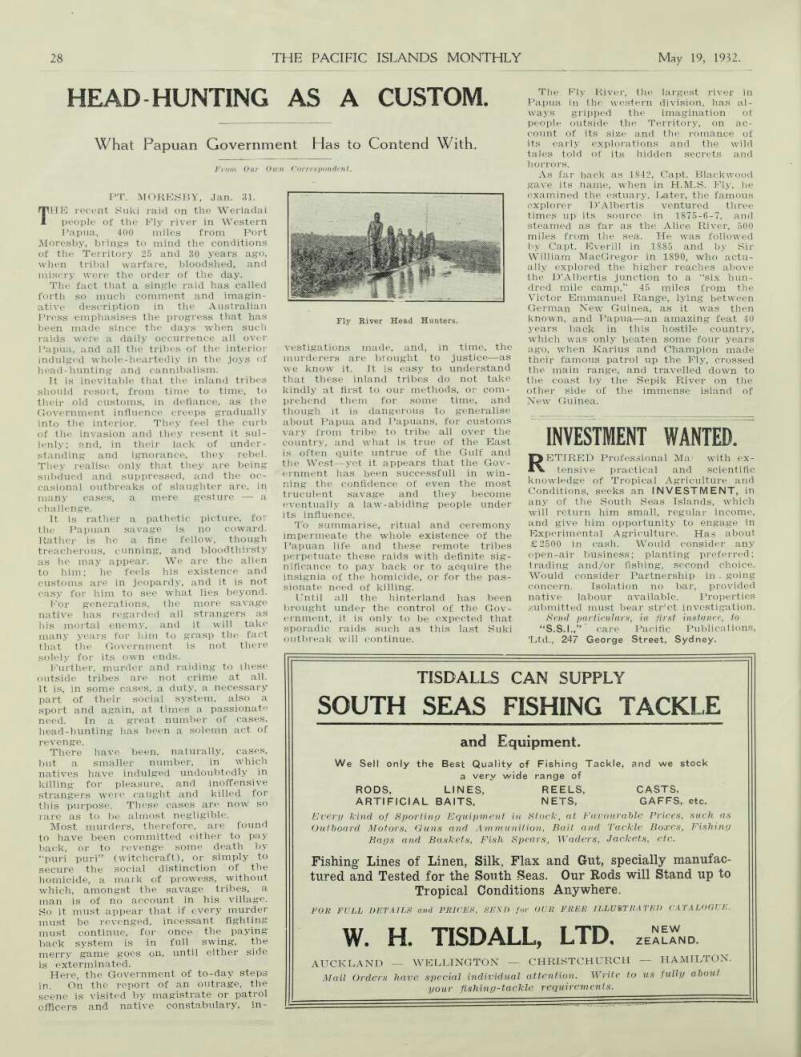
What Papuan Government Has to Contend With.
From Our Own Correspondent.
Pt. Moresby, Jan. 31.
THE recent Suki raid on the Weriadai people of the Fly river in Western Papua, 400 miles from Port Moresby, brings to mind the conditions of the Territory 25 and 30 years ago, when tribal warfare, bloodshed, and misery were the order of the day.
The fact that a single raid has called forth so much comment and imagin ative description in the Australian Press emphasises the progress that has been made since the days when such raids were a daily occurrence all over Papua, and all the tribes of the interim indulged whole-heartedly in the joys of head-hunting and cannibalism.
It is inevitable that the inland tribes should resort, from time to time, to their old customs, in defiance, as the Government influence creeps gradually into the interior. They feel the curb of the invasion and they resent it sul lenly; and, in their lack of under standing and ignorance, they rebel.
They realise only that they are being subdued and suppressed, and the oc casional outbreaks of slaughter are, in many cases, a mere gesture a challenge.
It is rather a pathetic picture, for the Papuan savage is no coward.
Rather is he a fine fellow, though treacherous, cunning, and bloodthirsty as he may appear. We are the alien to him; he feels his existence and customs are in jeopardy, and it is not easy for him to see what lies beyond.
For generations, the more savage native has regarded all strangers as his mortal enemy, and it will take many years for him to grasp the fact that the Government is not there solely for its own ends.
Further, murder and raiding to these outside tribes are not crime at all.
It is, in some cases, a duty, a necessary part of their social system, also a sport and again, at times a passionate need. In a great number of cases, head-hunting has been a solemn act of revenge.
There have been, naturally, cases, but a smaller number, in which natives have indulged undoubtedly in killing for pleasure, and inoffensive strangers were caught and killed for this purpose. These cases are now so rare as to be almost negligible.
Most murders, therefore, are found to have been committed either to pay back, or to revenge some death by “puri puri” (witchcraft), or simply to secure the social distinction of the homicide, a mark of prowess, without which, amongst the savage tribes, a man is of no account in his village.
So it must appear that if every murder must be revenged, incessant fighting must continue, for once the paying back system is in full swing, the merry game goes on, until either side is exterminated.
Here, the Government of to-day steps in. On the report of an outrage, the scene is visited by magistrate or patrol officers and native constabulary, in
vestigations made, and, in time, the murderers are brought to justice—as we know it. It is easy to understand that these inland tribes do not take kindly at first to our methods, or com prehend them for some time, and though it is dangerous to generalise about Papua and Papuans, for customs vary from tribe to tribe all over the country, and what is true of the East is often quite untrue of the Gulf and the West —yet it appears that the Gov ernment has been successfull in win ning the confidence of even the most truculent savage and they become eventually a law-abiding people under its influence.
To summarise, ritual and ceremony impermeate the whole existence of the Papuan life and these remote tribes perpetuate these raids with definite sig nificance to pay back or to acquire the insignia of the homicide, or for the pas sionate need of killing.
Until all the hinterland has been brought under the control of the Gov ernment, it is only to be expected that sporadic raids such as this last Suki outbreak will continue.
The Fly River, the largest river in Papua in the western division, has al ways gripped the imagination of people outside the Territory, on ac count of its size and the romance of its early explorations and the wild tales told of its hidden secrets and horrors.
As far back as 1842, Capt. Blackwood gave its name, when in H.M.S. Fly, he examined the estuary. Later, the famous explorer D’Albertis ventured three times up its source in 1875-6-7, and steamed as far as the Alice River, 500 miles from the sea. He was followed by Capt. Everill in 1885 and by Sir William MacGregor in 1890, who actu ally explored the higher reaches above the D’Albertis junction to a “six hun dred mile camp,” 45 miles from the Victor Emmanuel Range, lying between German New Guinea, as it was then known, and Papua-—an amazing feat 40 years back in this hostile country, which was only beaten some four years ago, when Karius and Champion made their famous patrol up the Ply, crossed the main range, and travelled down to the coast by the Sepik River on the other side of the immense island of New Guinea.
Fly River Head Hunters.
Advertisements & other items, p. 30 (1 item)
South Seas Fishing Tackle
INVESTMENT WANTED.
RETIRED Professional Male with ex tensive practical and scientific knowledge of Tropical Agriculture and Conditions, seeks an INVESTMENT, in any of the South Seas Islands, which will return him small, regular income, and give him opportunity to engage in Experimental Agriculture. Has about £2500 in cash. Would consider any open-air business; planting preferred; trading and/or fishing, second choice.
Would consider Partnership in, going concern. Isolation no bar, provided native labour available. Properties submitted must bear strct investigation.
Send particulars, in first instance, to “S.S.I.,” care Pacific Publications, Ltd., 247 George Street, Sydney.
TISDALLS CAN SUPPLY
SOUTH SEAS FISHING TACKLE
and Equipment.
We Sell only the Best Quality of Fishing Tackle, and we stock a very wide range of
RODS, LINES. REELS, CASTS,
ARTIFICIAL BAITS, NETS, GAFFS, etc.
Every kind of Sporting Equipment in Stock, at Favourable Prices, such as Outboard Motors, Guns and Ammunition, Bait and Tackle Boxes, Fishing Bags and Baskets, Fish Spears, Waders, Jackets, etc.
Fishing Lines of Linen, Silk, Flax and Gut, specially manufac tured and Tested for the South Seas. Our Rods will Stand up to
Tropical Conditions Anywhere.
FOR FULL DETAILS and PRICES, SEND for OUR FREE ILLUSTRATED CATALOGUE.
W. H. TISDALL, LTD, ZE So.
AUCKLAND WELLINGTON CHRISTCHURCH HAMILTON.
Mail Orders have special individual attention. Write to us fully about your fishing-tackle requirements.
Tree Labour” In The Pacific.
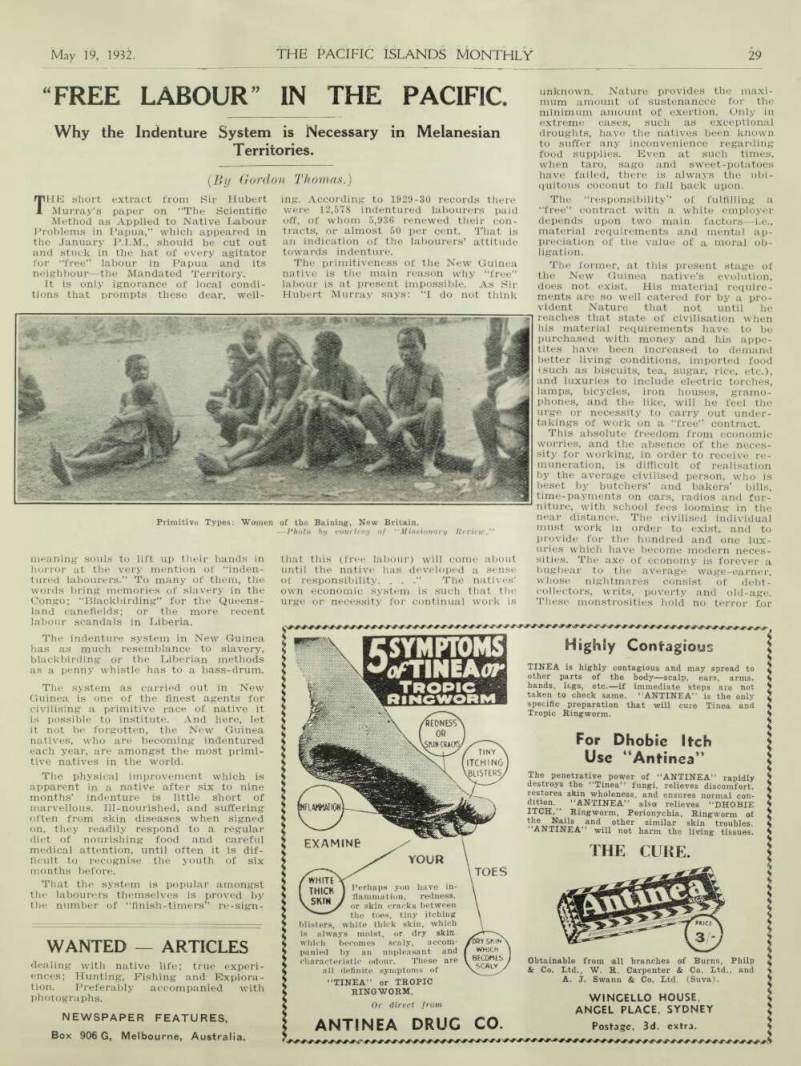
Why the Indenture System is Necessary in Melanesian Territories.
(By Gordon Thomas.)
THE short extract from Sir Hubert Murray’s paper on “The Scientific Method as Applied to Native Labour Problems in Papua,” which appeared in the January P.1.M., should be cut out and stuck in the hat of every agitator for “free” labour in Papua and its neighbour—the Mandated Territory.
It is only ignorance of local condi tions that prompts these dear, well
meaning souls to lift up their hands in horror at the very mention of “inden tured labourers.” To many of them, the words bring memories of slavery in the Congo; “Blackbirding” for the Queens land canefields; or the more recent labour scandals in Liberia.
The indenture system in New Guinea has as much resemblance to slavery, blackbirding or the Liberian methods as a penny whistle has to a bass-drum.
The system as carried out in New Guinea is one of the finest agents for civilising a primitive race of native it is possible to institute. And here, let it not be forgotten, the New Guinea natives, who are becoming indentured each year, are amongst the most primi tive natives in the world.
The physical improvement which is apparent in a native after six to nine months’ indenture is little short of marvellous. ill-nourished, and suffering often from skin diseases when signed on, they readily respond to a regular diet of nourishing food and careful medical attention, until often it is dif ficult to recognise the youth of six months before.
That the system is popular amongst the labourers themselves is proved by the number of “finish-timers” re-sign
ing. According to 1929-30 records there were 12,578 indentured labourers paid off, of whom 5,936 renewed their con tracts, or almost 50 per cent. That is an indication of the labourers’ attitude towards indenture.
The primitiveness of the New Guinea native is the main reason why “free” labour is at present impossible. As Sir Hubert Murray says: “I do not think
that this (free labour) will come about until the native has developed a sense of responsibility. . . .” The natives’ own economic system is such that the urge or necessity for continual work is
unknown. Nature provides the maxi mum amount of sustenancce for the minimum amount of exertion. Only in extreme cases, such as exceptional droughts, have the natives been known to suffer any inconvenience regarding food supplies. Even at such times, when taro, sago and sweet-potatoes have failed, there is always the ubi quitous coconut to fall back upon.
The “responsibility’' of fulfilling a “free” contract with a white employer depends upon two main factors —i.e., material requirements and mental ap preciation of the value of a moral ob ligation.
The former, at this present stage of the New Guinea native’s evolution, does not exist. His material require ments are so well catered for by a pro vident Nature that not until he reaches that state of civilisation when his material requirements have to be purchased with money and his appe tites have been increased to demand better living conditions, imported food (such as biscuits, tea, sugar, rice, etc.), and luxuries to include electric torches, lamps, bicycles, iron houses, gramo phones, and the like, will he feel the urge or necessity to carry out under takings of work on a “free” contract.
This absolute freedom from economic worries, and the absence of the neces sity for working, in order to receive re muneration, is difficult of realisation by the average civilised person, who is beset by butchers’ and bakers’ bills, time-payments on cars, radios and fur niture, with school fees looming in the near distance. The civilised individual must work in order to exist, and to provide for the hundred and one lux uries which have become modern neces sities. The axe of economy is forever a bugbear to the average wage-earner, whose nightmares consist of debt collectors, writs, poverty and old-age.
These monstrosities hold no terror for
Primitive Types: Women of the Baining, New Britain, Photo by courtesy of “Missionary Review."
the primitive native, whose material requirements are comparatively neg ligible.
Colonel Ainsworth, who made a re port on the Mandated Territory in 1924, expressed a truism when he said: “Get the natives to spend money and you will increase their desire to earn it,”
As for the mental appreciation of a moral obligation, this is a state farther from realisation than that of greater material requirements. The native is essentially material (where contact with the white is concerned); such ab stract qualities as Acts of Conscience, Gratitude, or Moral Responsibility to wards a white have, generally speak ing, no place in their scheme of things.
There is always an unconscious pro viso where a native makes an agree ment, and it is the provision to enable him to alter his mind, or change his plans to suit himself in the event of the unexpected happening. Any loss or inconvenience to the other party of the agreement is of no moment. His mind has not been sufficiently trained in the ethics of the white-man’s code to ap preciate the seriousness of any under taking of a purely moral nature. [Apparentlv Mr. Thomas has not heard of Mr. Lang, Premier for the moment of New South Wales! —Ed.,
P.I.M.]
The inculcation of moral rectitude and probity, and the responsibility of carrying out a mutual agreement should rest mainly with the missions, whose task it is to educate the nativfe along spiritual lines. That church members of comparatively long-stand ing are amongst the greatest offenders, where the observance of moral respon sibility is concerned, only shows that something is lacking somewhere in the systems of spiritual education which have been adopted by the missions.
It will be seen, therefore, that there are two distinct objects to be attained ere the New Guinea native is physic ally and morally fit to be placed in the same category as the more civilised natives of the Pacific, who can be de pended upon to serve as “free” labourers.
The desire for the material neces saries of life is a characteristic to be cultivated in the native by the com mercial community; while that of an appreciation of a moral obligation by the native should be developed by the Missions through their spiritual teach ing. There is no necessity for over lapping in developing: these evolution ary traits. The line of demarcation between the physical and the moral are distinct. All that is required is har monious team-work, and when that has been carried out then can we consider the introduction of “free” labour in New Guinea.
Advertisements & other items, p. 31 (1 item)
Highly Contagious
REDNESS
TINY
ITCHING
fLAMWION
EXAMINE
YOUR
TOES
WHITE
THICK
SKIN
Perhaps you have in flammation, redness, or skin cracks between the toes, tiny itching blisters, white thick skin, which is always moist, or dry skis, which becomes scaly, accom panied by an unpleasant and characteristic odour. These are all definite symptoms of
“TINEA” or TROPIC
RINGWORM.
Or direct from
WHICH
ANTINEA DRUG CO.
Highly Contagious
TINEA is highly contagious and may spread to other parts of the body—scalp, ears, arms, hands, logs, etc.—if immediate steps are not taken to check same. “ANTINEA” is the only specific preparation that will cure Tinea and Tropic Ringworm.
For Dhobie Itch
Use “Anfinea”
The penetrative power of “ANTINEA” rapidly destroys the “Tinea” fungi, relieves discomfort, restores skin wholeness, and ensures normal con dition. “ANTINEA” also relieves “DHOBIE ITCH,” Ringworm, Perionychia, Ringworm of the Nails and other similar skin troubles.
ANTINEA” will not harm the living tissues.
THE CUKE.
MICE
Obtainable from a.ll branches of Burns, Philp & Co. Ltd,, W. R. Carpenter & Co. Ltd., and A. J. Swann & Co. Ltd. (Suva).
WINCELLO HOUSE.
ANGEL PLACE. SYDNEY
Postage, 3d. extra.
WANTED ARTICLES
dealing with native life; true experi ences; Hunting, Fishing and Explora tion. Preferably accompanied with photographs.
NEWSPAPER FEATURES,
Box 906 G, Melbourne, Australia.
Ivory Nut Market
Lifeless.
Sydney agents report that the mar ket for ivory nuts —a Solomon Islands product used for button-making in Japan and Europe—is quite lifeless.
Some sales were made, early in April, at around £lO per ton; but, at date of publication, sales cannot be effected even at £9. It is reported that one Agent has had several tons lying in bond since January.
It is expected that buying will cease altogether until the market shows some sign of life. It is a curious market, which jumps up and down without any apparent cause.
Papain.
Samoa’s Experience with Papain.
From Our Own correspondent.
APIA, April 30.
THE article by your Thursday Island correspondent on the pawpaw and its uses has interested Samoan planters who have had a lengthy ex perience with the tapping and curing of papain.
For a long period during and after the war, papain was produced on Samoan cocoa plantations and ex ported to U.S.A., Germany and England.
The tapping was done by Chinese coolies or Samoan women mostly with the help of straps and galvanised fish hooks fastened to the top end. The pawpaw is lightly scratched, and from the incisions the milk-white latex runs out and is caught in a basin held un derneath. The latex is brought to co agulation by stirring with a wooden stick. The daily quota of a worker is about 6 to 8 lbs. of latex.
The papain is then dried on glass sheets in a small artificial dryer, heated
by a small kerosene stove for about 24 hours. The heat should always be kept even and slow.
For years, Samoan papain fetched profitable prices in the American and German markets. In 1929, however, there* was a considerable drop in the market price, and it became difficult to sell papain at any figure. This stopped tapping operations in Samoa.
The cost of tapping and drying pa pain is estimated at 4/- to 5/- per lb., dried. Added to this must be the hand ling, freight, packing and commission.
Papain is packed in used gasoline tins, and airtight soldered. Two tins are packed in a gasoline case. The above mentioned charges amount to about 1/per lb., so that the total cost of one pound of papain, delivered to America or Europe, would amount to about 6/-.
A market rate of 10/- to 12/- per lb. would enable Samoan planters to start tapping again.
The price as quoted in your corres pondent’s letter, of 25/- to 30/- a pound, allegedly paid in Great Britain, seems very high, and has never been realised for first-class Samoan papain.
Advertisements & other items, p. 32 (1 item)
Bumpers,
SPRINGS,
Forgings
Henderson’s is the largest Spring factory in the Southern Hemis phere, and manufactures every conceivable type of spring for cars and trucks and all other purposes. Huge stocks are always on hand, and single leaves as well as complete motor springs may be supplied.
We specialise also in drop forg ing and manufacturing hardware of all kinds.
Send your orders direct or through any Islands storekeeper, enclosing exact particulars, and goods will be sent by next return steamer.
Catalogues and Price Lists on all lines sent on request. Write for itl We Specialise in
SPRINGS, SHACKLES,
U-BOLTS, AXLES, etc.,
for all Cars and Trucks.
Also Miners’ Picks, Eye bolts, Tug - hooks, Springs and Tines for Agricultural Machinery, and All classes of
SHOPKEEPERS’ .
HARDWARE.
Henderson’s Federal Spring Works
PROPRIETARY LIMITED,
6 HUNT STREET, SYDNEY, N.S.W.
Telegraphic Address: “Springs, Sydney.”
Head Office and Factory :
ALFRED STREET - - NORTH MELBOURNE.
Rich Tourist
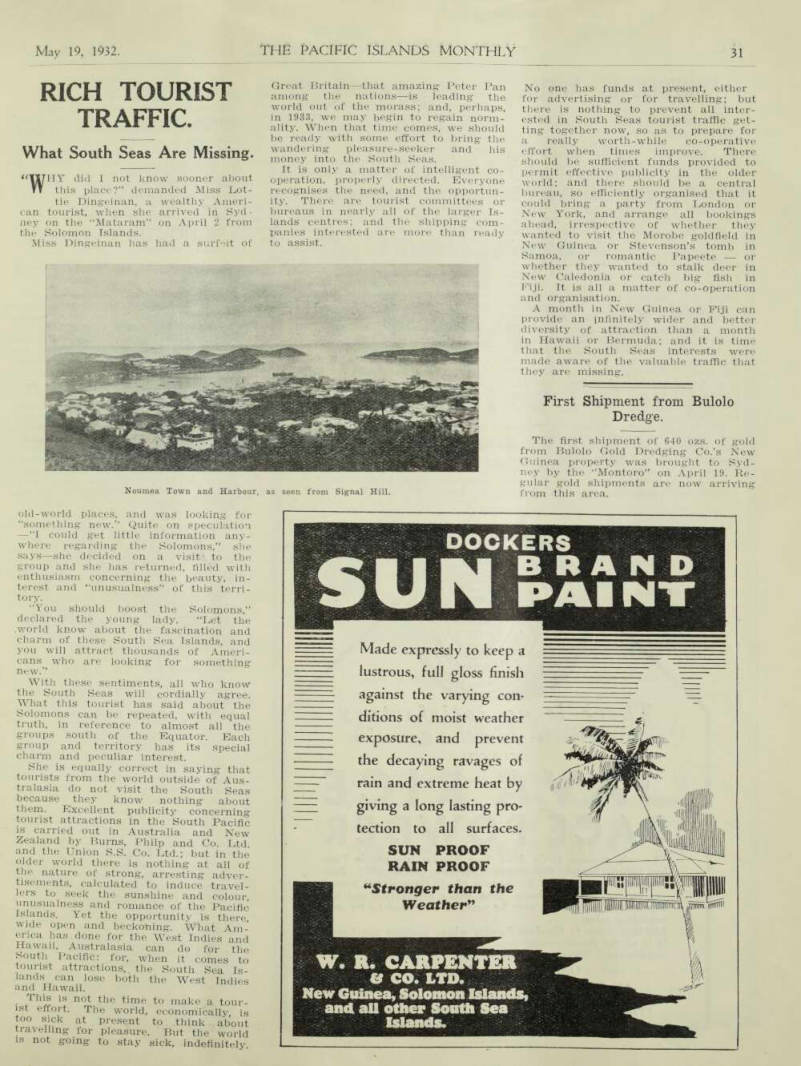
Traffic.
What South Seas Are Missing.
“WHY did I not know sooner about this place?” demanded Miss Lot tie Dingeinan, a wealthy Ameri can tourist, when she arrived in Syd ney on the “Mataram” on April 2 from the Solomon Islands.
Miss Dingeinan has had a surfeit of
old-world places, and was looking for “something new.” Quite on speculation —“I could get little information any where regarding the Solomons,” she says—she decided on a visit to the group and she has returned, filled with enthusiasm concerning the beauty, in terest and “unusualness” of this terri tory.
“You should boost the Solomons,” declared the young lady. “Let the world know about the fascination and charm of these South Sea Islands, and you will attract thousands of Ameri cans who are looking for something new.”
With these sentiments, all who know the South Seas will cordially agree.
What this tourist has said about the Solomons can be repeated, with equal truth, in reference to almost all the groups south of the Equator. Each group and territory has its special charm and peculiar interest.
She is equally correct in saying that tourists from the world outside of Aus tralasia do not visit the South Seas because they know nothing about them. Excellent publicity concerning tourist attractions in the South Pacific is carried out in Australia and New Zealand by Burns, Philp and Co. Ltd and the Union S.S. Co. Ltd.; but in the older world there is nothing at all of the nature of strong, arresting adver tisements, calculated to induce travel lers to seek the sunshine and colour, unusualness and romance of the Pacific Islands. Yet the opportunity is there wide open and beckoning. What Am erica has done for the West Indies and Hawaii, Australasia can do for the South Pacific: for, when it comes to tourist attractions,, the South Sea Is lands can lose both the West Indies and Hawaii.
This is not the time to make a tour ist effort. The world, economically, is too sick at present to think about travelling for pleasure. But the world is not going to stay sick, indefinitely
Great Britain—that amazing Peter Pan among the nations —is leading the world out of the morass; and, perhaps, in 1933, we may begin to regain norm ality. When that time comes, we should be ready with some effort to bring the wandering pleasure-seeker and his money into the South Seas.
It is only a matter of intelligent co operation, properly directed. Everyone recognises the need, and the opportun ity. There are tourist committees or bureaus in nearly all of the larger Is lands centres; and the shipping com panies interested are more than ready to assist.
No one has funds at present, either for advertising or for travelling; but there is nothing to prevent all inter ested in South Seas tourist traffic get ting together now, so as to prepare for a really worth-while co-operative effort when times improve. There should be sufficient funds provided to permit effective publicity in the older world; and there should be a central bureau, so efficiently organised that it could bring a party from London or New York, and arrange all bookings ahead, irrespective of whether they wanted to visit the Morobe goldfield in New Guinea or Stevenson’s tomb in Samoa, or romantic Papeete or whether they wanted to stalk deer in New Caledonia or catch big fish in Fiji. It is all a matter of co-operation and organisation.
A month in New Guinea or Fiji can provide an infinitely wider and better diversity of attraction than a month in Hawaii or Bermuda; and it is time that the South Seas interests were made aware of the valuable traffic that they are missing.
Noumea Town and Harbour, as seen from Signal Hill.
Dredge.
First Shipment from Bulolo Dredge.
The first shipment of 640 ozs. of gold from Bulolo Gold Dredging Co.’s New Guinea property was brought to Syd ney by the “Montoro” on April 19. Re gular gold shipments are now arriving from this area.
Advertisements & other items, p. 33 (1 item)
Made expressly to keep a lustrous, full gloss finish
lustrous, full gloss finish
against the varying con
ditions of moist weather exposure, and prevent the decaying ravages of rain and extreme heat by
giving a long lasting pro
tection to all surfaces.
SUN PROOF
RAIN PROOF
W. R. CARPENTER
& CO. LTD.
New Guinea, Solomon Islands, and all other South Sea
Norfolk Is. Notes.
From Our Own Correspondent.
N.I., April 25.
IN July our present administrator (Colonel A. J. Bennett) will retire, and his place will be taken by Cap tain Finney, who comes to us from Papua, from which territory we have of recent years drawn quite an appre ciable portion of our official executive.
We know little of Captain Pinney save that he has been for years in Papua, in charge of one of the Govern ment departments there, that he is 49 years old —at which age a man should be at the height of his mental powers, while still completely active physically —and a man of hobbies. He assembled with his own hands and for his own use, way back in the wilds, the first private wireless set built in Papua, and he also built his own launch. He mar ried, years ago, the only daughter of Sir Hubert Murray, then and now the able Administrator of Papua, and this means that he will have the experience and knowledge of his father-in-law at his service.
We are, of course, vitally interested and vitally concerned in the coming of this man, whose powers as Adminis trator, within the limits of the island, appear to be absolutely autocratic. We have no representation in any of the Australian Parliaments, and the casting
vote on any question that comes before our little local Executive Council, be longs to his Honor, who, likewise, sits alone upon our Bench as chief and only magistrate and controls our private fortunes. There is no appeal; there is no redress.
May the gods who direct our island destinies send us a good man!
The Hospital.
Changes are also taking place in the personnel of our small hospital. Miss Gordina Nobbs, who has been matron for the past three years with an exten sion of three months on the actual ex piration of her term of office, is leaving at the end of April. She is being re placed by a matron from New Zealand, who has every possible qualification for the post. She holds four certificates — general (which embraces surgical effi ciency, midwifery, Plunket), all forms of child welfare, and a post-graduate or refresher course. She is young somewhere about 30 —and comes with the highest personal recommendation from the doctor who was empowered by our Hospital Board to select her.
It may be argued—in fact, it almost certainly will be argued —that, seeing that we are a dependent colony, so to speak, of Australia, with a small hos pital subsidy paid over by the Com monwealth Treasury, our hospital staff should be Australian by birth and training. Miss Hawkes may be, for all we know —we only know that she ac
tually arrives here via N.Z.—but, in any case, if opposition is raised to her appointment, our board will reply that months ago they communicated with Mr. Love, Chairman of the Hospitals Commission of N.S.W., and requested him to secure a fully qualified matron to take over from Matron Nobbs. He did not care to do so, and the matter was thus left completely in the hands of the local board.
Schouten’S Pearls.
A Mystery of the Early Pacific.
HIDDEN away in an obscure corner of the vividly colourful pageant of the Pacific’s romantic his tory is the story of the remarkable voyage early in the 17th century of Jacob le Maire and Corneliuszoon Schouten.
These two Dutch navigators sailed from the Texel, in two small ships, with the intention of circumventing the all powerful Dutch East India Company’s absolute monopoly of all the trade west of Cape Horn. Their idea was that if they could make their way into the Pacific by a route other than that around the Horn, they would be able to trade with the rich lands in the Southern Ocean in defiance of the com pany’s charter.
They found the way which they sought by going through the Straits of Magellan and, after losing one of their vessels by fire while she was being careened, eventually arrived off New Guinea. They anchored somewhere about Geelvink Bay; but the real in terest of their story lies in the fact that after their arrival there they went somewhere else for several months.
Then Jan Pieterszoon Coen, the youthful Governor-General of the Dutch East Indies, learned of their presence in for bidden waters and sent a vessel to arrest them.
Where they were during the blank space, is still a geographical mystery.
Some believe that they crossed over to what is now New Britain and, landing in Gazelle Bay, went inland, in the savage district known as the Bainings, in search of gold.
Others believe that from Geelvink Bay they went to Torres Straits and there discovered a fabulously rich pearl bed, the locality of which, it is asserted, was in the vicinity of Horn Island, and which has never been re-discovered.
Coen sent both of them to Holland as prisoners, after confiscating their ship, and le Maire died on the voyage, it is said, of disappointment.
Schouten, however, was made of hardier stuff and lived to publish the journal of the voyage, since re-pub lished in an excellently-annotated edi tion by the Hakluyt Society of London.
He also left a smaller journal, less widely known, in which he makes several guarded references to a find of great value; and it is known that when he returned to Holland he took back with him a quantity of pearls of re markable quality and lustre. These he presented to his niece, Maria Schouten, whose only portrait shows her wearing the pearls! in the form of a string.
Linda Burkitt.
Advertisements & other items, p. 34 (1 item)
Java Rice
Recommended by all Skin Specialists throughout the World.
Recommended by all Skin Specialists throughout the World.
There is no satisfactory
substitute for the genuine
(BOURJOIS)
JAVA RICE
FACE POWDER
The only genuine |AVA RICE Face Powder is made in Pans by expert French Perfumers. Bourjois JAVA RICE Face Powder has been used by women of all Nations for several generations. It has always given entire satisfaction and has increased in popularity, year by year, as evidenced by its ever extending sales.
LADIES! Keep to the Face Powder whose qualities you know It is of the finest consistency. It is composed of the purest ingrediente. There is nothing to harm the tcndcrest skin.
Obtainable in all shades.
Ail Chemists and Stores throughout the World.
A. BOURJOIS ET CIE (Aust.) LTD.
177-179 Clarence Street and 47-49 King Street, Sydney.
Severe Gale.
Two Vessels Lost in Solomons.
From Our Own Correspondent.
TULAGI, April 30.
WE had made up our minds that the Nor-west season was over, when on April 17 the weather began to show us that it was not, and by the 19th it was as bad (in spots) as the famous 1916 “zephyr,” which was credited with blowing at least one man’s teeth out.
So far, no teeth are reported missing, but two vessels, at a time of writing, have been lost. One, the “Hambia,” a 10-ton vessel, belonging to the Marist Mission, in which Bishop Raucaz was making a trip round the weather side of Guadalcanal, was anchored at Qoiqoi, in Beauford Bay, when the fun started.
Both anchor chains parted, and the native crew got the vessel under way, but at a critical point the steering gear carried away, and she was thrown up on the reef and soon became a total wreck. Luckily, the Bishop was ashore at the time.
The other vessel, a craft of 5 tons, belonged to the Solomon Islands Devel opment Co. No details are to hand, but it is presumed she was cast up on the beach at Berande (one of the com pany’s properties), which is a treach erous spot in the Nor-west season, and where several vessels have been lost in the past.
It is more than likely that other vessels have been lost.
Planters report many losses of coco nut trees by sea erosion and the force of the gale. The abnormal tide during the blow did a fair amount of damage to reclaimed land around Tulagi and Makambo, and one householder on the latter island was very lucky he was not washed to sea, house and all.
Romance Of K.L.G. Plugs.
It seems rather difficult to find romance in business, yet the history of K.L.G. Sparking Plugs simply bristles with it.
Mr. Kenelin Lee Guinness was one of Eng land’s foremost racing car drivers just before the war, achieving many successes, chiefly with Sunbeam cars. Being unable to obtain sparking plugs that would satisfactorily stand up to rac ing conditions, he set about making his own, not on a commercial basis, but for the use of himself and his friends. When war broke out and the lessons learned in building racing cars were applied to aero engines, it was found that K.L.G. plugs were the most suitable, and ar rangements were made for commercial produc tion. The outstanding difference between K.L.G. and other plugs is the use of mica insulation instead of porcelain, but there are other features, not apparent to the eye of the casual observer.
So successful have these plugs proved that many of the outstanding flying and motoring achieve ments have been accomplished by their aid. Sir Malcolm Campbell used them to break the world’s land speed record, Kaye Don won the world’s motor boat record with them, and Cob ham, Hinkler, De Pinedo, Amy Johnson and Mollison used them in their Australian flights.
The new “K” range represents very important developments in sparking plug design, for never before has it it been possible to obtain a plug that would operate under every conceivable con dition presented by internal combustion engines.
This new range will fit practically all types of engine, and will operate on “hot” and “oily” engines without trouble. Smith, Sons and Rees Ltd., who are the distributors, will answer all inquiries gladly. The K.L.G. Plug is certainly “too good to miss.”
Miss Beatrice Grimshaw
Returns to Papua.
From Our Own Correspondent.
Pt. Moresby, April 30.
Miss Beatrice Grimshaw, The
famous novelist, returned to her
home in Port Moresby in March, after 18 months’ absence.
During that time Miss Grimshaw has been in England, Europe, and America.
In America, lecturing on New Guinea and the Pacific Islands, Miss Grimshaw met with great success. The reports of her tour through the States show that the Americans are greatly inter ested in this part of the world.
Advertisements & other items, p. 35 (1 item)
Lysaght
The Famous Brands of
Galvanized Iron
ARE NOW MADE IN AUSTRALIA
At Newcastle, N.S.W.
CORRUGATED
PLAIN
Every Sheet Guaranteed
The first cost of these brands is so very little more than that of inferior Qualities that to boy
“ORB” or “QUEEN’S HEAD” is a
proved soond investment.
The 15th edition of “The Referee,” a handbook of useful information, containing a ready-reckoner of much value to all engaged in building operations, may be obtained post free on application to John Lysaght (Aust.) Ltd., c/o. Box 196 D, G.P.O., Sydney.
Refrigeration
For Islands Residents.
WE wish to advise Pacific Islands resi dents that we have introduced a new refrigerator (the “Freez-all” Home Refrigerator), made specially for Pacific Islands conditions. It is described in the advertisement inserted on page 14 of this issue by Messrs. McLeod, Bolton and Co., Ltd., whom we have appointed sole selling agents for the Pacific Islands.
We are also supplying, to Messrs. Mc Leod, Bolton and Co., Ltd., Freezing Units which can be used in Icyball Cabinets or in Icestove Cabinets.
These new Units are an Australian in vention, and have now been proved by special tests, and by use throughout Aus tralia, to be the most effective Freezing Units ever introduced. They are the basis of the new “Freez-all’ Refrigerator.
All particulars from the agents —Mc Leod, Bolton and Co., Ltd., 249 George
Street, Sydney.
Manufacturers —
Chemical Refrigerators,
Ryans Road, Willoughby,
Sydney.
Progressive Firm Caters for Is
lands Ice Cream Trade.
Established in Melbourne five years ago, the National Cake Cone Co has grown steadily, owing to the excellence of its products Owing to the large demand in New South Males the Company extended its operations and erected a factory in Sydney. .
Originally ice cream cones of one size only were manufactured, known as Cupid Cones; but to meet the demand a smaller cone known as the Baby Cupid is made now. Last year a further addition to the Company’s products was made, and has proved a best seller. This is the Cupid Cream Cake, a delicacy somewhat ot the size of a pack of cards (actually 3in. x 2½in. x ¾in.) but distinct from an ice cream sandwich in that it is open on one side only, being closed on three sides and sells at the same price as the Cupid Cone.
Ice cream servers in the latest design are supplied by this up-to-date firm, incorporating the automatic cone server, and the cream cake server. The latter server was specially de signed for filling Cupid Cream Cakes. Attractive show cards and novelty cone carrying fans and palettes are distributed free to the firm’s cus tomers, thereby assisting sales materially.
Orders are now received from all over Aus tralia. New Zealand, Dutch East Indies, and from many islands in the Pacific, including Fiji, Papua aiid New Guinea. Special carton pack ing has been evolved for the tropics, ensuring safety in transit and perfect protection of the freshness and crispness for which Cupid Cake Cones are famous.
Supplies are available in most instances from leading island firms, but where not otherwise procurable, trade enquiries may be addressed to National Cake Cone Company, 52-56 Shepherd Street, Sydney, or 289-91 Coventry Street, South Melbourne.
Nipa.
Power Alcohol From
Beware of Under-capitalisation.
The Pacific Islands Monthly has already drawn attention to the possibilities of extracting alcohol from the Nipa palm of Papua —an in dustry that is successfully carried out on commercial lines in the Philippine Islands.
I would not say that such a pro position is easy. The spirit, of course, is obtained from the fermented sap by a distillation process, and the chemical reactions, etc., are quite de finite, presenting little difficulty to an expert chemist.
But the gathering, storing, and pre serving of the sap till ready for treat ment is the real problem.
For any company with small capital, the proposition would be useless. Only a company with large financial re sources would have a chance of success. I estimate that a company would require £250,000 to handle the proposition in Papua in a successful manner. Companies with insufficient capital become an annoyance to officials, native employees, and themselves.
Given ample capital, capable man agement, and scientific control, it would be a good paying venture. Probably the natives would bring the sap in in dependently to a central distillery, as is done in the Philippines.
It is a proposition similar to that of sago for alcohol —the same difficulties and disadvantages, and nearly the same treatment and plant.
There are plenty of nipa and also sago palms in Papua, and good, re liable native labour, but a capital of £250,000 must be assured. The causes
of most commercial failures in Papua have been insufficient capital and. inexperienced, management.
J.G.F.
Levuka.
Fate of Famous Port In Balance.
INTERESTING correspondence has ap peared recently in “The Fiji Times” from the pens of Mr. Edward Dun can, a well-known coconut planter, and Sir Maynard Hedstrom, managing director of Morris, Hedstrom Ltd., re garding the advisability of closing the port of Levuka.
The former has drawn the attention of the Government to the closing of the port as a means of effecting further economies in the administration of the colony. The trade of the old capital has dwindled, until last year only some £13,000 worth of merchandise was im ported through its Customs House.
Sir Maynard Hedstrom, in support of the retention of Levuka as a port of entry, points out it serves a very useful purpose to a considerable sec tion of the colony and the only justi fication for closing it would be a very substantial saving in expenditure. Le vuka, besides being a port of entry, is the centre of an important native pro vince, and he states that if it were closed as a port, it would be still neces sary to retain the District Commis sioner, Medical Officer, Police Officer and Postmaster. He adds that Levuka has suffered seriously from bad seasons and low prices of copra, but it has re covered from previous depressions and will recover from this one.
Advertisements & other items, p. 36 (1 item)
William Adams & Company
Ferrodor Paint
Natural Steel Grey
(Now Manufactured in Australia) Is the Ideal Paint for Steel Structures of all descriptions , and for Galvanised Iron Roofs , etc.
IT IS ELASTIC — so that expansion and contraction of metals caused by atmospheric changes leave it quite unaffected.
IT IS ANTI-CORROSIVE —being physically incapable of absorbing more Oxygen from the atmosphere.
IT IS NON - POISONOUS —making it safe in handling and for use on roofs where water is used for domestic purposes.
Used extensively by N.S.W. Government Railways and Public Works Department.. Hawkesbury and Nepean Railway Bridges now painted with Ferrodor.
WILLIAM ADAMS & COMPANY
LIMITED
175 CLARENCE STREET,
SYDNEY.
Other colours obtainable.
Branches in all States.
Suitable for Iron and Wood.
Questions About Administration Of

Justice In Mandated Territory.
A SERIES of questions asked in the Federal House of Representatives by Mr.
Roland Green, M.P., and answered by the Prime Minister on April 27 and 28, comprised a sort of catechism regarding the Administration of justice in the Territory of New Guinea.
The following report of the questions, and the Prime Minister’s answers, has been compiled from “Hansard.” Mr. Green’s purpose, in securing this mass of in formation, was not disclosed.
MR. GREEN asked: Have new uni forms recently been adopted for and issued to the native police in the Mandated Territory of New Guinea?
The Prime Minister replied; The Police Force Regulations made by the Acting Administrator on 18th Decem ber, 1931, prescribe that the uniforms, badges and buttons to be worn by native members of the constabulary shall be set out in the Third Schedule thereto: provided that the uniforms set out in the Second Schedule to the Police Force Regulations, 1923, may be worn until such time as the Adminis trator directs that their use shall be discontinued.
Who recommended the changes?— Inquiry is being made of the Adminis trator.
Of what did the old and new uni forms consist? —Particulars are lengthy and are being supplied to the hon. member.
What additional cost per annum is involved in the change?—lnquiry is being made.
Native Clothing.
Are other male natives allowed to cover the top parts of the body?—Re gulation 110 of the Native Administra tion Regulations forbids male natives, except those specially exempted by a district officer, to wear clothes on the upper part of the body. For the pur poses of this regulation “clothes” does not include clothing made of native material. Luluais and tultuls, as men of some responsibility, are permitted to wear shirts, subject to such clothing being kept clean. Male natives attend ing divine service are, at the request of the missions, permitted to wear shirts or singlets, and in this direction the Administration trusts to the co operation of the missions in ensuring that no such natives wear dirty cloth ing. Natives engaged in mining and carrying are, pursuant to the law, sup plied with jerseys. This is necessary on the Morobe gold-field on account of the climatic conditions. District officers issue permits to native motor drivers and crews of 'vessels to wear clothing on the upper part of the body when exposed to inclement weather.
Was medical opinion obtained before the change of uniform was made; if so, did such medical opinion favour the change?—lnquiry is being made of the Administrator.
Native Murderers.
Was a plantation manager named Scott murdered near Buka Passage, in
New Guinea; if so, when?—The plan tation manager was killed by one of his employees on the 24th February, 1925.
Was the murderer convicted; if so, what sentence was imposed?—The native was charged with having wilfully murdered Mr. Scott. He was con victed of manslaughter and sentenced to imprisonment for five years.
Has the murderer returned to his village, if not, where is he employed? —The native referred to was after careful consideration subsequently to his discharge from prison, returned to his own village. He is required to re main in that village, and his general conduct is reported upon by the police quarterly.
Was a prospector named H. Baum murdered in the Mandated Territory of New Guinea?—Yes.
If so, by whom, and what was the date of the murder?—He was attacked and killed in his camp near the border of New Guinea and Papua on the 23rd April, 1931, by a party of natives.
Were the murderers apprehended; if so, when?—No. The efforts of the Ad ministration to apprehend the natives concerned have so far been unsuccess ful.
Mr. Green: During the last ten years now many whites have been murdered
by natives in New Guinea? Were the murderers convicted; if so, what sen tences were imposed? How many of those murdered were officials of the Administration? During the same period, how many whites were con victed of murder or manslaughter?— What sentences were imposed?
Mr. Lyons: The information is being obtained, and will be supplied as early as practicable.
Mr. Green: How many natives during the past five years have been convicted of assaulting whites in New Guinea? What was the nature of such assaults? What sentences were im posed? After being convicted and hav ing served sentences of twelve months or more, are the natives returned to their own villages?
Mr. Lyons: The information is being obtained, and will be supplied to the honorable member as early as prac ticable.
Trial Of Europeans.
Is there a court of criminal appeal in the Mandated Territory of New Guinea?—Appeals from a District Court may be made to the Central Court.
If not, is there any appeal allowed against conviction and/or severity of sentence; if so, to what court?—The Full Court of the High Court of Aus tralia, consisting of at least two judges, may grant leave to appeal to the High Court of Australia from any conviction, sentence, judgment, decree or order of the Central Court.
In all cases of murder, manslaughter, or other serious criminal offences charged against a white, is a jury em panelled; if not, why not? —No. There is no provision in the law of the Ter ritory for trial by jury. It is not con sidered that the time has arrived when the jury system could appropriately be introduced into the Territory. Pro vision exists in the Central Court As sessors Ordinance 1925 for the appoint ment by the Central Court or by a judge of that Court, or in any cause in which natives are interested by the Administrator, of not more than two assessors, who when required by the Court, shall give their opinion on any
matters of fact, custom or usage, or any other matters arising out of the evidence given at the trial. Assessors shall not, however, adjudicate in any case before the court.
Has a white, convicted of a criminal offence in the Mandated Territory, a right of appeal to the Full Court of the High Court of Australia, or must leave to appeal be granted by the Central Court in the Territory? As there is no jury system in the Mandated Terri tory, has a white convicted of a crim inal offence the right of appeal to the High Court on questions of fact? —The Full Court of the High Court of Aus tralia, consisting of at least two judges, may grant leave to appeal to the High Court of Australia from any conviction, sentence, judgment, decree or order of the Central Court.
How many appeals against convic tion and/or severity of sentence in the Territory have been lodged in the High Court? —The information is being ob tained.
Does the High Court visit the Man dated Territory ? —No.
How many whites have been con victed of assault during the past five years? What is the nature of these as saults? What sentences were imposed?
How many appeals have been lodged, and with what result?—This informa tion is being obtained, and will be sup plied to the honorable member as early as practicable.
Judges And Officials.
How many judges are there in the
Mandated Territory?—Two.
What are their names, salaries, status, etc.?—David Sydney Wanliss (Chief Judge)—Salary, £1,200 per an num; date appointed, April 18, 1921; age, 68 years. Frederick Beaumont Phillips (Judge)—Salary, £1,100 per an num; date appointed, February, 1928; age, 42 years. Each of these judges holds office during the pleasure of the Governor-General. A judge of the Cen tral Court has the powers and author ity of a judge of the Supreme Court of Queensland in the administration of justice within the Territory.
Are there any stipendiary, police, or acting magistrates in the Mandated Territory ? —No.
Is Mr. John Walstab employed by the Administration in the Mandated Terri tory?—Yes.
In what capacity; what are his quali fications for the office he holds; what are his duties; how long has he held the position, and what is his salary?— District Inspector and Superintendent of Police. Four years’ experience as District Officer in the Territory, pre ceded by five years' active military service as a commissioned officer. His duties are to inspect the work of the administrative staffs in the several districts and to-assist generally in the administration of the district services.
As Superintendent of Police, Mr. Wal stab is in control of the New Guinea Police Force (European and native con stabulary) constituted under the Police Force Ordinance. He was promoted to be District Inspector from May 1, 1925, and was appointed to be also Superin tendent of Police as from December 3, 1927. Salary, £852 per annum.
District Courts.
Who presides over a district court in the Mandated Territory of New Guinea? —A district court may be con stituted by the district officer of the
district in which it is established, or by two or more justices of the peace.
What are the names, dates, terms of appointment, and salaries of the officers appointed to conduct district courts? — A district officer means an officer ap pointed to administer a district, and includes an assistant district officer, a district inspector and an assistant dis trict inspector. Every district officer is a justice of the peace of and for every district by virtue of his office. In ad dition, two other officers of the Admin istration have been appointed justices of the peace. There are eight district officers, sixteen assistant district officers, one district inspector and one assistant district inspector. Such of ficers are members of the Public Ser vice of the Territory, and their ap pointments are regulated by, and they are paid salary in accordance with, the provisions of the Public Service ordin ance and regulations. Further details as requested will be furnished to the honorable member.
What legal qualifications have these persons for the positions held by them?
Neither district officers nor justices of the peace are required to possess academic training in law. In the selec tion of officers for appointment as dis trict officers regard is had to their stability for the exercise of quasi judicial functions, as well as for the discharge of the administrative duties of the office.
The following questions and answers were recorded on May 3: Are district courts in the Mandated Territory of New Guinea limited as to jurisdiction; if so, to what extent?— Yes. Division 2 of Part 111. of the Dis trict Courts Ordinance 1924-1927 or dains the limits within which district courts in New Guinea have jurisdiction.
Seeing that all the presiding officers of district courts have admittedly no legal qualifications, what legal training, if any, have any of these persons had? —None so far as I am aware, other than the experience acquired in the dis charge of their duties as constituent members of courts for native affairs and of district courts. In the selection of officers for appointment as district officer, regard is had to their suitability for the exercise of quasi-judicial func tions as well as for the discharge of the administrative duties of the office.
Why is there at present no legally qualified stipendiary or police magis trate in the territory?—It is not con sidered that existing circumstances warrant the filling of the position of stipendiary magistrate which became vacant on the death, in June, 1931, of Lieutenant-Colonel S. J. Shillington.
Advertisements & other items, pp. 37-38 (1 item)
Chartres,
STOTT & HOARE’S
COR R ESPONDENCE
COLLEGE
Founded 1885.
Pioneers and Specialists in Postal Instruction.
All Educational and Commercial subjects taught thoroughly and efficiently by correspondence.
Experienced Certificated Instructors. Write for particulars.
CHARTRES. STOTT & HOARE’S CORRESPONDENCE COLLEGE,
Liverpool Street, Sydney, Australia.
If you want any information
on Batteries, write to us
As far back as 1891, the Chloride Electrical Storage Co., com monly known as the Exide Company, began the manufac ture of Electrical Storage Bat teries near Manchester, Eng land. To-day Exide Batteries are made in five countries: Eng land, Canada, America, Italy and AUSTRALIA and the Australian Exide is the equal of Exide quality the world over.
Everywhere where there is need for a battery you will find Exide Batteries giving unfailing ser vice. If you desire information on any battery, write to us. The whole of our forty odd years’ battery experience is at your service . . . we’ll send you free full information, together with literature. Ask for our free booklet, “Taking Care of Your Battery.”
There are Exide
Batteries for . . .
CARS - - CYCLES,
RADIO - - LAUNCHES,
HOUSELIGHTING, etc.
BATTERIES
of Australia Ltd.
Grace Building,
YORK STREET - - SYDNEY.
All Exide literature is FREE.
EUCRASY BANISHES ALL DESIRE FOR DRINK.
It is a priceless boon to all who use it, VOLUNTARILY or SECRETLY, for their relatives or friends. If you suffer in any way through the liquor habit, let the voluntary testimonials of actual users convince you that EUCRASY will soon sober the drinker and make you happy.
Letter received: “I have been waiting to see if my husband would drink again. I ca safely say he has been cured by Eucrasy. It has made quite a different man of him. cannot speak too highly.—Mrs. B.L.”
EUCRASY is guaranteed harmless, and can be given SECRETLY or Voluntarily. NOT COSTLY. Call or write to-day for FREE SAMPLE. Booklet Testimonial.
Dept. B. THE EUCRASY CO., CANBERRA HOUSE, 297 ELIZABETH ST., SYDNEY.
Anzac Day At Pt. Moresby.
From Our Own Correspondent.
Pt. Moresby. May 5.
THE Anzac Memorial Service was held in the Industrial Hall on Monday. April 25, and was presided over by his Honor, Mr. Jus tice Gore, who was assisted by Rev. H.
Mathews and Rev. Maurice Nixon.
Mr. Justice Gore spoke of the spirit of the men of Anzac; their unselfishness, generosity and endeavour, and how they expected us to carry on in the management of the State in that same spirit as they showed on Gallipoli.
He considered Anzac Day sacred, and one which we should keep up for all time, as long as Australia was a nation. Followed by a hymn and speeches by the Rev. H. Mathews and the Rev. T. Nixon, the service closed with the National Anthem. It was attended by many residents of the town.
N.G. Police Regulations.
A SERIES of questions relating to the issue of ordinances generally in New Guinea, and dealing particu larly with the Police Force Regulations made by the Acting-Administrator on December 18, 1931, were asked in the Commonwealth Parliament on May 4 by Mr. R. Green.
Mr. Green wanted to know if ordin ances and regulations made by an Act ing-Administrator must necessarily be accepted by the Administrator on his return. Had the Administrator no op tion but to accept the Police Force Re gulations issued in his absence?
The Prime Minister replied in the following terms: All ordinances for the territory are made by the Governor-General pursuant to section 14 of the New Guinea Act 1920-1926. Regulations under an ordinance are made by the Governor- General or by the Administrator according to Whether the ordinance so provides. Regulations made by the Administrator pursuant to the power conferred upon him by any ordinance take effect from the date of their publication in the New Guinea Gazette, unless some other
date is specified in the regulations, but they are subject to disallowance by the Governor-General.
The Governor-General may, pursuant to sec tion 9 of the New Guinea Act 1920-1926, ap point a person to act in the office of Adminis trator and to administer the government of the territory during any vacancy in the office of Administrator or when the Administrator is ab sent from the territory or unable, by reasons of illness or incapacity, to perform his duties; and such person who so administers shall have and may exercise and perform all the powers and functions of the Administrator. Any regu lations made by an Acting Administrator pur suant to power conferred upon the Administrator by any ordinance are therefore of the same force and effect as regulations made by the Administrator.
A draft of regulations to be issued under the Police Force Ordinance had been approved by the Administrator and refened to the Crown Law Officer of the territory prior to the de parture of the Administrator from the Terri tory in September, 1931, on leave of absence.
The regulations were made by the Acting Ad ministrator on December 18, 1931, in the ordin ary course of administration. The Administra tor did not return to the territory until January, 1932.
It is not considered that any circumstances have arisen which make it necessary or desir able to restrict the powers exercisable by an Acting Administrator in relation to the making of regulations.
Advertisements & other items, p. 39 (1 item)
Marie
Biscuits are ideal for Afternoon Tea.
Always ready and crisp, they save a world of work and never fail to please everyone.
Papua.
Capital Punishment In
Federal Government Waives Right of Reprieve.
From Our Own Correspondent.
Pt. Moresby, May 1.
RESIDENTS in Papua welcome the news that in future death sen tences pronounced by the Judge of the Central Court and ratified by the Lieutenant-Governor in Council will be carried out.
On several occasions in the last few years it has happened that natives sen tenced to death for exceptionally seri ous offences have been reprieved by the Federal Cabinet. As a result, the be lief has gained ground that the local Government lacks either the power or the courage, or both, to give effect to its own sentences; and the difficulties of controlling the more truculent tribes in their exercise of the principles of vendetta have been very greatly in creased.
By far the most usual form of pun ishment in Papua for the murder of natives by natives is a term of impris onment; and it is only in extreme cases that the death sentence is passed.
It should be obvious that only men of proved ability and wisdom, with long experience of native customs and men tality are fitted to decide whether or not the death-penalty is, in the peculiar circumstances of each case, just and necessary; and the Federal Cabinet has taken a step in the right direction in deciding to waive the right of veto which it has exercised hitherto, and to leave matters of such vital importance to the peace and orderliness of native life to the absolute discretion of Sir Hubert Murray and his Executive Council.
Port Moresby Law Suit.
Action Against Liquidator.
From Our Own Correspondent.
Pt. Moresby, May 5.
MUCH interest was taken in a case, which came up for hearing before Mr. Justice Gore, in the Central Court of Papua, on April 18, when the B.N.G. Trading Co. and Lewis Lett ap plied for an injunction restraining Cap tain Fitch, managing director of Steamships Trading Co., from complet ing the sale of a mill, as liquidator, to C. McKinnon, for £800, alleging fraud and collusion, and that the mill was being sold for less than its value. There was an alternative claim that he was never properly appointed.
Mr. R. D. Bertie, of Port Moresby, appeared for the plaintiffs, and Mr, J.
P. Guinane, of Townsville, for the de fendant.
The defendant’s council brought for ward a point of law, and Judge Gore ruled that the B.N.G. Trading Co., as creditor, had no locus standi and could not proceed. The case then proceeded with Lett, formerly manager of Romilly sawmills, as plaintiff.
Defendant’s counsel asked that the question of validity be taken first. This was agreed to, and after a great deal of argument a verdict was given for the plaintiff on April 26. Further argu ment followed on the question of costs, and resulted in an order for £25 against the unsuccessful plaintiff; £206 to be paid by Port Romilly Sawmills Limited to the successful plaintiff; and no further order.
The verdict on the point of invalid ity disposed of the other charges against the liquidator in this action.
Further litigation is pending.
Solomon’s Deficit Only £2000.
From Our Own Correspondent.
TULAGI, April 30.
REVENUE figures at the end of the financial year appear to have to talled up very much better than was anticipated some months ago, when a £10,000 deficit was feared. It is now rumoured that it will not be more than about £2,000.
Now all we need do, says a touring Australian politician, is to borrow £5,000, charge the spare £3,000 up to surplus, and we are “set.”
N.G. Gold Companies.
Alteration in Law.
The proportion of shares held by British and non-British shareholders in gold-mining companies operating in New Guinea has been altered.
There has been an amendment of the Ordinance, which formerly stipulated that the shareholders must be at least two-thirds British, so that the propor tion is now at least 55 per cent. British.
It was found that the operation of the old law placed a very severe han dicap upon the introduction of new capital to the gold-mining companies.
The Ordinance also provides that the Administrator may take immediate drastic action if he finds that the pro portion of shares, as stated, has been exceeded. An application has been made to the Commonwealth Government, which is likely to be favourably consid ered, asking that the law be amended so that the Administrator may not take such drastic action until three months’ notice of his intention has been given, so that companies may have the oppor tunity of re-arranging their sharehold ings to comply with the law.
Solomon Islands Trader’s Death.
From Our Own Correspondent.
TULAGI, April 30.
BLACKWATER is no respecter of persons, and it has carried off Mr, Charlie Cowan, a strong-, healthy looking New Zealander, part owner and skipper of the trading schooner “N’ava nora.”
It was Charlie who jumped into Tulagi harbour and saved the man and the maid of the “Comargo,” as men tioned in March P.I.M.
It was learned soon afterwards, with deep regret, that Mr. Cowan’s trading partner, Max Sarritch, had died on Santa Cruz, in the southern end of the group. The death of Mr. Cowan had been a great shock to him.
It is not yet known what will be done with the “Navanora.”
Advertisements & other items, p. 40 (2 items)
Gillespie’S
ANCHOR
FLOUR
TRADE MARK
The Standard of Quality.
Albert Gregory
107 YORK STREET, SYDNEY.
SADDLERS’ IRONMONGERY, SADDLES, HARNESS,
SPURS, STIRRUPS, and WHIPS, &c.
EVERYTHING CONNECTED WITH THE TRADE.
Leather for Art Work, Basils, Roans, Suedes. Boot and Harness Leathers.
GREGOLIN E — Raw, Pure and Pearl White. Nothing so good for the Home, Stable, and Dairy and a great rust preventive.
Distributing Agents for;
DOCKER’S AND BORTHWICK’S PAINTS.
CORRESPONDENCE SOLICITED.
Samoan Products.
Cocoa Prices Are Sustaining Trade.
From Our Own Correspondent.
APIA, April 30.
AFTER the double rise in the copra price during February had given a stimulus to cutting operations by the Samoans, the recent drop in price has had the opposite effect and things are very quiet at present.
It seems that the copra output for the current year, owing to ample rains, will far exceed last year’s crop. But if the price continues as low as at pre sent, the total value of the copra pro duction will be even less than last year’s low total.
That the natives are disinclined to offer bananas for shipment to New Zealand, and have a large portion re jected, is shown by the last shipment per “Maui Pomare,” when the boat had to be despatched without a full cargo.
And this, when there are bananas gal ore, all over the islands!
It remains to be seen, whether the new time-table of the “Maui Pomare,” which gives us regular monthly ship ments with a much shortened stay in N.Z. ports, will improve matters, as is hoped.
The cocoa crop is being brought in now and seems to be better than ex pected. As the price of cocoa keeps up satisfactorily, this should bring relief to the European producers and also enliven trade conditions in the terri tory. Contrary to what is customary, the main revenue of the country, as well as of the Administration, comes at present from European settlers and not from natives, as in former years. This, of course, is a result of the low copra price.
A topic very much discussed at pre sent in Samoa, is whether or not, the N.Z. Government will follow Australia’s example in New Guinea, ani lease out the remaining cocoa and coconut plan tations, now run by the Government as N.Z. Reparation Estates, to local Euro peans, of whom a large number are de sirous of leasing plantations, and who possess the necessary experience. Such a measure would, at the same time, re lieve distress and unemployment in Samoa, which exist here to a regret table degree at the present time.
Solomon Islands Personals.
From Our Own Correspondent.
TULAGI, April 30.
MRA ASHLEY (the Resident Commissioner’s wife) and daughter are passengers to Eng land by this Mataram, and, as Mrs. Ashley is not a good sailor, we can only wish her a pleasant, smooth voyage—both ways. Alas! it is rumoured she may not come back; and, if not, or in any case, her gentle and gracious presence will be greatly missed.
Mr. Ashley is due for furlough and may fol low on shortly. He has had a pretty lean time during his spell at the wheel of State, but if he has lacked funds, at least nobody can ac cuse him of lacking a keen interest in all mat ters pertaining to progress and reform.
We hear that the office of Labour Inspector has been abolished and its head, Mr. Thompson, has been retrenched on a pension. For some years it was felt that the duties of this office somewhat overlapped those of the local District Officers. Mr. Thompson, who goes south with this Mataram, carries with him the good wishes of the community.
Family.
Death of Miss R. P. Armit.
Member of Papuan Pioneer Family.
From Our Own Correspondent.
Pt. Moresby, May 1,
THE death occurred on April 7 of Ruby Pearl Armit, daughter of the late Captain and Mrs. W. E. Armit, after a very serious illness.
The funeral took place early on April 8. It was attended by very many resi dents and officers of the public service.
His Excellency Sir Hubert Murray was present.
A member of the oldest pioneer family in the Territory, Miss Armit was loved by her many friends. She was the youngest daughter of Captain W. E. Armit, who in the time or Sir William MacGregor was appointed from Queensland to act as Magistrate in Papua.
The late Miss Armit leaves two brothers and a sister, Mr. Lionel Armit, of the Lands Department; Mr. Reginald Armit and Mrs. Percy Leigh.
Advertisements & other items, p. 41 (1 item)
Royal Packet Navigation Co.
GUARD AGAINST
MALARIA
and its Attendant Ills.
The New Drug
PLASMOQUENE
is a Preventive of Malaria that has been Tested and Proved by the Medical Profession.
If you are in doubt, ask your Medical Adviser about Plasmoquene.
FROM ALL STORES.
Wholesale Supplies from
FASSETT & JOHNSON LTD.
36 Chalmers Street, Sydney.
New Freight 8c Passenger Service
Saigon Batavia Samarang- Port Moresby Samarai
Rabaul Port Vila Noumea Sydney Port Moresby
Batavia Saig’on.
Commencing- in May, and thereafter every two months, the fast and modern K.P.M. Steamer VAN REES will carry out the above Service.
The S.S. Van Rees can carry 60 saloon passengers in comfortable and airy cabins.
Cargo for Epi and Santo (New Hebrides) accepted for transhipment at Port Vila. Cargo for Africa accepted for transhipment at Batavia.
For Rates and Details apply to:
Royal Packet Navigation Co.
255 GEORGE STREET, SYDNEY
The B.N.G. Trading Coy., Ltd., Port Moresby: Steamship Trading Coy., Samarai; W.
R. Carpenter & Co., Ltd., Rabaul; Gubbay Freres, Port Vila; Carlo Leoni, Noumea.
Thursday Is. Notes.
From Our Own Correspondent.
Thursday Is., April 29.
Pearl Shell Ornaments.
Lying in the office of one of our principal pearlers is a beautiful piece of shell work which was recently sent from America —it probably represents one of the new articles by which the Gerdau Company hopes to popularise our staple commodity. It is charming enough to be coveted by any woman, and we hope that the fair sex will fall to this class of work in place of glass beads and other fashionable trifles.
The pearl shell has been cut into attractively shaped scales, about the size of half-a-crown, and these, slung on a slender metal chain, make an ornament fit for the neck of a princess.
Pearl shell used in this way has many adyan tages over other materials for neckwear. It is not easily broken, never tarnishes and its beautiful grey and silver tints make a perfect contrast to the warmer colour of the flesh.
Judging from the material used and the ease with which the scales can be cut, the neck girdle should not be expensive, and its charm and interest place it far above anything else of reasonable price on the market. We hope to see them adorning the neck of every well dressed woman, including those who live on this little island, where they originate.
A Temperamental Gem.
That pearls occasionally lose their colour and lustre is a well-known fact amongst jewellers, and the degeneration of the gem often depends on a curious chain of circumstances.
A magnificent rope of pearls was sold to a rich Cingalese merchant, who presented them to his wife. The lady was delighted and wore them on every possible occasion, but, after a time they began to grow dull and lose their lustre. She became distressed and hinted to her husband that he had been swindled. Inquiries were made, the pearls were pronounced by an expert to be worth far less than was paid for them owing to their dullness, and the buyer demanded his money back. There was quite a storm over those pearls, as the firm which had sold them had a reputation to lose and resented the ac cusation of false valuation.
In the end they sent a representative out from Paris to adjudicate, and his verdict was. ‘‘See a doctor.” It was then discovered that the lady, who had been in indifferent health for some time, was suffering from a slow poisoning of the system due to kidney trouble, which allowed certain acid substances to circulate in the skin. The excretion of these acids caused the pearls to become dull, and when successful treatment of the internal complaint was in stituted the former lustre returned.
A Link With The Past.
Thursday Island was recently honoured by a visit from the son of John Douglas, who has always been regarded as the ‘‘Grand Old Man” of Torres Strait, and everyone who is associated in any way with local history and traditions hastened to give our visitor a good time. Judge Robert Douglas, the son of our former resident, first came to the Island in the mid-’eighties, so that he re makes the acquaintance of his boy hood home after many years’ absence, and is able to review the progress made since he left without prejudice.
Judge Douglas is no believer in the oft-ex pressed opinion that T.I. has “gone down.” In fact, he feels it has very much “gone up” since the days when he knew it as a struggling little pioneer village. Certainly, a number of little shows —like the military and the naval forces and others —have been withdrawn or re duced, but the big industries keep going and will continue to place Thursday Island in the forefront of marine-producing centres in Aus tralia.
During his visit to the Torres Strait Hospi tal, Judge Douglas was shown the visitors’ book, with his father’s signature appearing as the second entry in the book. The Judge recorded his visit with appropriate remarks—but a period of 38 years separates the two entries!
Unemployment In The North..
While the number of old residents out of work at Thursday Island has been reduced to some extent, Darwin has been less fortunate. The “Marella” carried fifty of Darwin’s unemployed —men of all types and nationalities —to other parts of Australia. Free passages were given
to any port but, as the men are proteges of the Commonwealth Government, we consider that Canberra was the proper place to send them to, as they must become a charge on any place they land.
Wandana Week.
We prophesy that “Wandana Week” is to be come a feature of life on Thursday Island.
John Burke’s new steamer dropped a number of tourists here in April while she did her round of the Gulf ports and picked up a very satis fied company for the South on her return.
This monthly visitation will liven up T.I., for we can expect a stream of interesting and stimulating visitors.
The A. and O. ships are also helping to popularise the Island, but their ‘‘stay over” rarely exceeds two days—‘‘just enough to make one wish for more,” as one tourist remarked.
We shall, no doubt, see this embryo tourist traffic grow, but if it is to reach big dimen sions, some local enterprise will have to be shown. More entertainment for visitors and increased hotel accommodation will be neces sary.
His Excellency Sir Hubert Murray, Lieut.- Governor of Papua, accompanied by Mr. L.
Murray and Mr. O’Malley, visited Thursday Is land in the Laurabada shortly after Easter. The object of the visit was to discuss certain as pects of the employment of Papuans in the pearl ing industry.
Congratulations to a well-known local sailing man and pearler for his successful voyage in a launch from Maryborough to Thursday Island.
That such trips require grit and determination is apparent to anyone who has ventured to sea in small boats, for they are always risky undertakings. We remember the remarks of Captain Mulhauser’s American friend after a perilous trip from Suva to Sydney in the ‘‘Amaryllis.” As they were going up the har bour, a place which indeed neither of them hoped to reach, so stormy was the passage, the American opened his heart and gave his opinion of the voyage as follows: "I wouldn’t have missed it for a million dollars. But, if you were to put down a
million dollars on this table and ask me to do the trip again, I guess I wouldn’t.” Many people feel like that after a long sea trip in a small boat.
It is about time that that very cowardly form of crime—dog poisoning—was made the subject of public disapproval, as Thursday Is land has lately seen the results of such nefari ous work, and several families are mourning the loss of well-loved canine friends. Some people seem to imagine they have a divine right to destroy any dog they take a dislike to—a wholly erroneous idea, as they would find out if only dog owners could catch them. Moreover, by strewing poisoned baits about a neighbour’s yard, the perpetrator can give no guarantee that he is going to catch the right dog, nor can he be certain that someone’s toddler will not pick it up and suffer. The local council has the right to destroy forthwith any dog whose sav agery has been proved, but even they must adopt constitutional methods against dogs who merely bark at night or otherwise make them selves mildly offensive.
Another T.I, grievance is the continual thiev ing that goes on on the waterfront. Any form of boat-gear left on the beach, or even out on small boats at anchor is liable to disappear and, in spite of an active police force, convictions rarely follow. There is an immunity from house-thieving for which the residents are truly grateful: we only wish that consciences were not left behind when offenders get near the property of boat-owners.
Islands Newspapers.
Persons interested are advised that files Of most of the Pacific Islands newspapers and gazettes—particularly the Fiji Times ,” the “Rabaul Times,” and the Samoan Herald may be consulted at the offices of Pacific Pub lications Ltd., Union House, 247 George Street, Sydney.
Advertisements & other items, p. 42 (1 item)
Lars Halvorsen
Repairs. “OUR HANDS MAKE GOOD ARMS" Firearms sent C.O.D.
WINCHESTER 1906 Repeater ... £5/15/- BROWNING Repeater £5/5/- SAVAGE Sporter £6/5/- B.S.A, Repeater £6/7/6 REMINGTON 12A. Repeater £5/10/-
RELIABLE 22
CAL. RIFLES
WIN. AUTO £9/10/-
BROWNING AUTO £4/12/6
SAVAGE 1929 Repeater £6/5/- MAUSER Repeater £7/12/6 WALTHER Repeater and Auto £B/7/6 Write for Catalogue.
SIL, ROHU (late A.1.F.). GUNSMITH
IMPOSTER OF HIGH-GRADE FIREARMS AND FISHING TACKLE SPECIALIST, 143 ELIZABETH STREET, SYDNEY (Near Market Sltreet).
“FISHING TACKLE TO TACKLE FISHING.”
Auxiliary Ketch built for Solomon Islands.
LARS HALVORSEN
Designer and Builder of SCHOONERS, KETCHES, YACHTS, LAUNCHES, etc Can also quote for Second-hand Craft. Send particulars of your requirements HAYES STREET, NEUTRAL BAY, SYDNEY, N.S.W.
Samoan Report At
Geneva.
Inaccuracies Alleged.
Frcm Our Own Correspondent.
APIA, April 30.
THE report of discussions of Samoan affairs, before the Mandate Com mission of the Leag-ue of Nations at Geneva, has caused considerable com ment in Samoa.
The information supplied to the N.Z. representative at Geneva, and on which he based his statements and replies, appears to have been inaccurate in some particulars.
Sir Thomas Wilford, for instance, submitted to the members of the Man date Commission some photographs which had appeared in “The Auckland Weekly News” of August 12, 1931, show ing, according to Sir Thomas, the “en thusiastic welcome extended to the new Administrator, Brig.-General Hart, by the Mau leaders.” Unfortunately, this description is not true. The welcome was extended to General Hart by cer tain native chiefs, who are mostly in the employ of the Government. The guard of honour was supplied by the Government Agricultural School at Avele. The Mau kept completely aloof and, neither at that time nor since has taken part in official proceedings.
A similarly wrong impression is given by Sir Thomas’s reference to fhe Cen tenary celebrations of the London Mis sionary Society, and the participation of Mau adherents in the celebration. As the majority of the Samoans and, of course, of the Mau members, belong to the Mission, there was no reason for them to keep away from the celebra tion. This did not imply a change in their attitude towards the Administra tion, as Sir Thomas’s statement sug gested.
The participation of some Mau ad herents as assessors on the Land and Title Commission does not possess the significance and importance suggested by the N.Z. representative.
The paragraph relating to a represen tative Fono of the Samoan people should better have been deleted al together from the report to the League of Nations. The attempt of the Admin istration to call this representative Fono after an election by the Samoans, irrespective of their attitude towards the Administration, resulted in failure, owing to the refusal of Mau adherents to take part in such an election. No representative Fono is in existence to day and, apparently, the Administra tion has given up the attempt to have one elected.
Taken altogether, it may be said that the political situation has not improved much in the last few years; that the policy of non-participation in Govern ment affairs and passive resistance on the part of the Mau has not been aban doned; and that at present there seems to be little prospect of such a develop ment.
The Mau, apparently, is marking time till Mr. Nelson returns to Samoa at the end of the present year, after his term of banishment is over.
The Cook Islands.
From Our Own Correspondent.
Rarotonga, April 23.
Personal.
The following residents returned to Rarotonga during February and March:—Judge Ayson, Mr. and Mrs. C. Mooney, Mr. and Mrs. S. Bennet, Mr. H. E. Everett, Mr. E. A. Reid, Mr. E. J.
Mathews, Mr. and Mrs. J. McKenzie, Mr. and Mrs. R. McKegg, Mr. C. Brookfield.
New arrivals included; —Mr. and Mrs. A. L.
Hill and Mr. H. Scott (staff, Messrs. A. B.
Donalds Ltd.). Master A. Mooney.
Among visitors are Mr. C. Brunner (U.S.A.), Miss A. Brian (N.Z.), Miss Bond-James (N.Z.) Miss Matheson (N.Z.).
A happy event took place at the home of one of our most prominent officials during the month, and Mrs. and Dr. Ellison are to be con gratulated on the arrival of a son.
It is with regret that we record the death of Mrs. Campbell, wife of Mr. J. A. Campbell, secretary of the Cook Islands Trading Company.
Mrs. Campbell died on February 6, at Tahiti.
Sympathy is felt throughout the group for Mr.
Campbell and his four young children.
Mr. E. H. R. Mitchell was admitted to hos pital on April 16 suffering a breakdown in health. Mr. Mitchell’s condition had been caus ing concern to his family and friends for some time, but it is now improving.
The indisposition of Dr. Ellison, during the early part of the month, caused some appre hension when it was learned that he might have to proceed to New Zealand for medical treatment. However, timely professional atten tion was rendered by the medical officer of the R.M.S’. “Monowai.” upon whose advice Dr.
Ellison discontinued work for some days. The community is pleased to see the doctor about again.
Judge Ayson (Resident Commissioner) was obliged, through illness, to give up office at tendance for some days. A press of events con cerned with the close of the financial year the commencement of the fruit season, and the re sumption of inter-island schooner services, com pelled his Honor to continue official work at the Residency.
On April 14, Judge Ayson left by the schooner "Tiare Taporo” on an official visit to the is lands of the Lower Group—Mangaia, Mauke Atiu and Aitutaki.
The Fruit Season.
The month of March has been a particularly bad one for the export of fruit from the Cook Islands. All that bananas fetched (ex ‘‘Mono wai” March 28) was from 7/- to 9/6 per case.
At these prices, it is certain that shippers must, in a number of instances, come out on the wrong side in their Accounts Sales.
Space for 17,500 cases of fruit (principally oranges) has been applied for on the R.M.S.
"Makura” due to call here on April 25. The “Makura’s” shipment will be the first cargo of oranges from the Cook Islands for this year.
Our Glimpse Of Phar Lap.
The tragedy of the death of our most dis tinguished visitor of January 2 last—the vali ant racehorse Phar Lap—went very deeply into the hearts of the people of Rarotonga.
Our glimpse of that fine animal was but a tieeting one—a mere peep at him. There he was in his loose-box aboard the "Monowai,” munch ing away, the very soul of contentment. Only his bleached bones will pass this route again on their way to a museum. Still, their home coming will, we sincerely trust, not pass un noticed.
Blow To Fruit Industry.
We had hoped that, with the arrival of the s.s.
"Kanna” from Auckland, about May 6, the circle of fruit export from these islands would have been widened by bringing into direct com munication with New Zealand, the islands of Aitutaki, Atiu, Mauke and Mangaia.
News has now reached Rarotonga that the trip of the “Ivanna” in May is definitely can celled owing, it is stated, to the terrifically low prices realised at present on the Dominion mar ket. This is a smashing blow for the outer islands to receive at the very commencement of the fruit season.
From Aitutaki and Atiu, and possibly from Mauke as well, come the sweetest oranges of the Cook Group. Mangaia has both oranges and bananas to ship.
It is understood that all that could possibly be done to reverse the decision regarding can
oellation of the “Kanna’s” trip has been done.
Those who are unfortunately obliged to suffer the disappointment of not being able to reach the New Zealand market should not give up hope of a visit from the fruit boat in June when the market prospects may be more fav ourable.
Inter-Island Communication.
Although the “Kanna” has failed the group for the month of May, the two island schooners are busy moving about among the islands of the Lower Group.
The schooners re-establish cargo and passen ger communication amongst the islands them selves on the one hand, and between the is lands and Rarotonga on the other.
Whether or not the schooners will do any thing towards bringing fruit from the Lower Group to connect with the mail boats at Raro tonga, is not known.
Before proceeding to the Lower Group the schooner “Tagua” took a run up to Tahiti. Her arrival was urtreported for 21 days which caused some apprehension to he felt by the skipper’s friends at Rarotonga.
It transpires that the schooner was becalmed for several long periods on the way up. Calm weather is a tremendous trial for Captain Andy Thomson. He revels in the most terrifying storms—“a bit of a breeze” he terms them.
Advertisements & other items, p. 43 (1 item)
Marine Engine
CADY
Astonishing offer for May and June only, prior to stocktaking: 3-4 H.P. 3[ : in. bore, with genuine SCHEBLER Carburettor; ROBERT BOSCH High-tension Magneto: Bronze Plunger Pump, thrust bearing; Muffler, Spark Plug and Wire; sft. best British Bronze Shaft; 3-blade Propeller: Stuffing Box v/ith lag screws; Starting Handle. Suit boats 16 to 20 feet.
Price of above Outfit, £29 F.O.B. Sydney.
This is half present price. Cady engines have been made for 40 years, and hundreds are in use through Australia and the Islands.
ACT PROMPTLY.
HALL BROS. LTD.
(Established 40 years),
The Engine House,
CAREENING COVE,
MILSON’S POINT, NORTH SYDNEY,
N.S.W. - - - AUSTRALIA.
Cables: "Halbros,” Sydney.
Dredge Opening
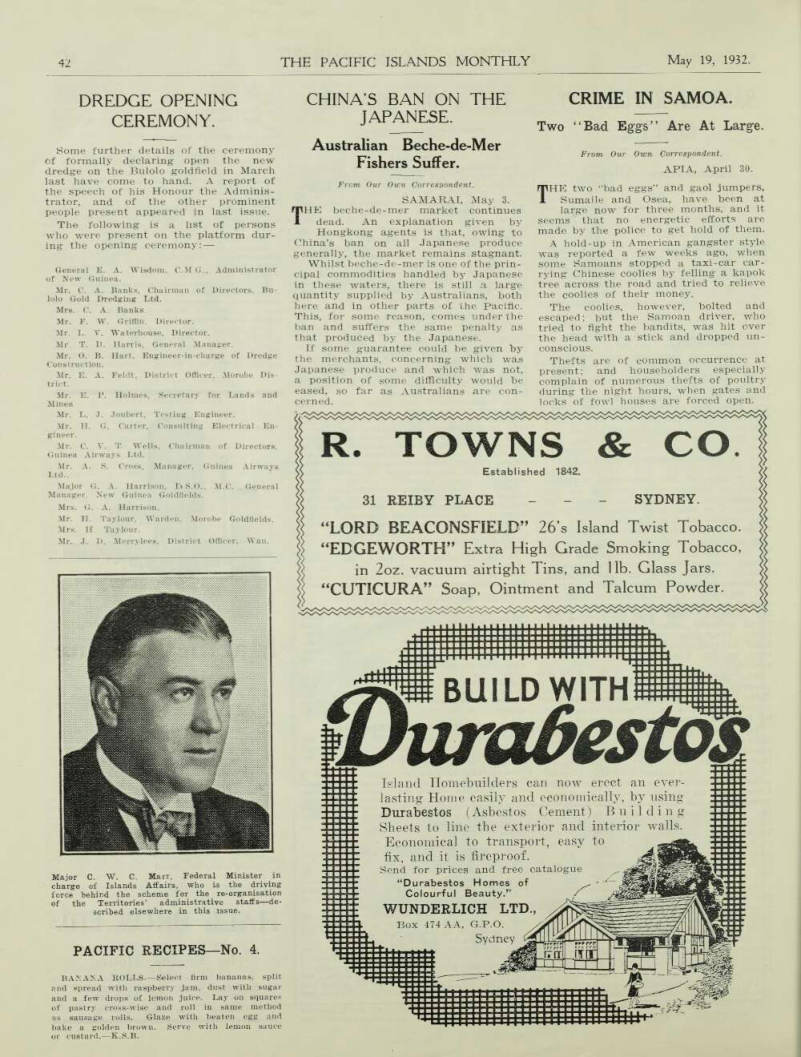
Ceremony.
Some further details of the ceremony of formally declaring open the new dredge on the Bulolo goldfield in March last have come to hand. A report of the speech of his Honour the Adminis trator, and of the other prominent people present appeared in last issue.
The following is a list of persons who were present on the platform dur ing the opening ceremony: General E. A. Wisdom, C.M G., Administrator of New Guinea.
Mr. C. A. Banks, Chairman of Directors, Bu lolo Gold Dredging Ltd.
Mrs. C. A. Banks Mr. F. W. Griffin. Director.
Mr. L. V. Waterhouse, Director.
Mr. T. D. Harris. General Manager.
Mr. O. B. Hart, Engineer-in-charge of Dredge Construction.
Mr. E. A. Feldt, District Officer, Morobe Dis trict.
Mr. E. P. Holmes, Secretary for Lands and Mines Mr. L. J. Joubert, Testing Engineer.
Mr. H. G. Carter, Consulting Electrical En gineer.
Mr. C. V. T. Wells, Chairman of Directors, Guinea Airways Ltd.
Mr. A. S. Cross, Manager, Guinea Airways Ltd..
Major G. A. Harrison, EtS.O., M.C. General Manager. New Guinea Goldfields.
Mrs. G. A. Harrison.
Mr. H. Taylour, Warden, Morobe Goldfields.
Mrs. H Taylour.
Mr. J. D. Merrylees, District Officer, Wau.
Major C. W. C. Marr, Federal Minister in charge of Islands Affairs, who Ls the driving force behind the scheme for the re-organisation of the Territories’ administrative staffs—de scribed elsewhere in this issue.
Pacific Recipes—No. 4.
BANANA ROLLS. —Select firm bananas, split and spread with raspberry jam, dust with sugar and a few drops of lemon juice. Lay on squares of pastry cross-wise and roll in same method as sausage rolls. Glaze with beaten egg and bake a golden brown. Serve with lemon sauce or custard.—K.S.B.
Japanese.
China’S Ban On The
Australian Beche-de-Mer Fishers Suffer.
From Our Own Corresvondent.
Samarai, May 3.
THE beche-de-mer market continues dead. An explanation given by Hongkong agents is that, owing to China’s ban on all Japanese produce generally, the market remains stagnant.
Whilst beche-de-mer is one of the prin cipal commodities handled by Japanese in these waters, there is still a large quantity supplied by Australians, both here and in other parts of the Pacific.
This, for some reason, comes under the ban and suffers the same penalty as that produced by the Japanese.
If some guarantee could be given by the merchants, concerning which was Japanese produce and which was not, a position of some difficulty would be eased, so far as Australians are con cerned.
Crime In Samoa.
Two “Bad Eggs” Are At Large.
From Our Own Correspondent.
APIA, April 30.
THE two “bad eggs” and gaol jumpers, Sumaile and Osea, have been at large now for three months, and it seems that no energetic efforts are made by the police to get hold of them.
A hold-up in American gangster style was reported a few weeks ago, when some Samoans stopped a taxi-car car rying Chinese coolies by felling a kapok tree across the road and tried to relieve the coolies of their money.
The coolies, however, bolted and escaped; but the Samoan driver, who tried to fight the bandits, was hit over the head with a stick and dropped un conscious.
Thefts are of common occurrence at present; and householders especially complain of numerous thefts of poultry during the night hours, when gates and locks of fowl houses are forced open.
Advertisements & other items, p. 44 (1 item)
Durabestos
R. TOWNS & CO.
Established 1842.
31 REIBY PLACE - SYDNEY.
“LORD BEACONSFIELD” 26’s Island Twist Tobacco.
“EDGEWORTH” Extra High Grade Smoking Tobacco, in 2oz. vacuum airtight Tins, and 1 lb. Glass Jars.
“CUTICURA” Soap, Ointment and Talcum Powder.
BUILD WITH
Durabestos
Island Homebuilders can now erect an ever lasting Home easily and economically, by using Durabestos (Asbestos Cement) Building Sheets to line the exterior and interior walls.
Economical to transport, easy to fix, and it is fireproof.
Send for prices and free catalogue “Durabestos Homes of Colourful Beauty.”
WUNDERLICH LTD
Box 474 AA, G.P.O.
Sydney
B.P. (South Seas) Co.
Maintains Satisfactory Profit.
THE Burns, Philp (South Seas) Co., Ltd. has published its accounts for the year ended January 31, and has disclosed a net profit of £58,105/4/9.
This is to be disposed of as follows: Dividend; 1/3 per share on 750,000 shares £46 875 To reserves 10,000 Carry forward 1,230 This Company is, next to the parent Company, the most important company in the Burns, Philp group. It owns and operates all the B.P. stores and other activities in the Pacific Islands outside of New Guinea and Papua. Not one of the territories in which it is interested has escaped the effects of the slump seen mostly in vastly reduced prices for all islands’ produce, and a cor responding reduction in the purchasing power of the Islands’ communities.
Yet, somehow, the Company has been able to show a profit for 1931 that compares not unfavourably with those of normal years. The achievement is the result of strict economies, direc torial foresight and good management —things for which most of the Islands residents have cause to be thankful, they would have been in a deplorable condition to-day if they had not been able to depend on the financial strength of this and other similarly controlled companies to help them through the bad times.
The B.P. (South Seas) Co. is regis tered in Suva—a small matter in nor mal years but a very important point in these days of lunatic Australian ad ministrations, because, one way and another, it should allow the BP in terests to escape some ferocious taxa tion. It means that nearly all the Company’s profit is actually made and controlled outside of Australia and therefore, is not subject to the fright ful imposts that are now placed on Sydney 168 controlled and operated in The subscribed capital of the Com pany is £750,000 (in £1 shares), so that 1/3 per share gives a return of over six per cent. The Company’s proper ties include shipping, land, wharves and investments, and are valued at £481,000. Merchandise and stock are given at £212,981, and sundry debtors at £204,668. The reserve fund, includ the £10,000 allotted from the 1931 profits, now stands at £95,000. The directors are Messrs. James Burns,
Lewis Armstrong, R. J. Nosworthy, Joseph Mitchell (general manager) and Lord Inchcape.
The Company opened branches dur ing 1931, at Sigatoka (Fiji) and Niue.
The Sydney Bulletin, in its review of the Company’s balance sheet, is highly complimentary to both the Directors and the management. The position of the Company is summed up in the fol lowing table:
The Bulletin also makes this inter esting comment: Much of the fall in the price of copra during the last few years has been due to competition from whale oil; and the outlook in this respect has improved, though present prices lack strength.
Still, the co. is unaffected by the dis turbed conditions in Australia, and the market prices the pound shares at 31s. as against 275. a year ago. At 31s. the return is 4.1 p.c. on a p.c. div. basis, or 5.1 p.c. should the distribution rise to 8 p.c. The book value of the back ing amounts to 225. 7d. in net tangibles
Net To Reserves Dec , Prolit.
Dividends.
To Reserves & £. & £ 1920 102,840 10 p.c. = 75,000 27,840 27,840 1921 57,549 74 ,. ,, 50,250 1,299 29,145 1922 4.192 Nil 4,192 33,337 1923 37,791 5 p.c. = 37.500 291 33,028 1924 51,272 0} ,. 40.875 4,397 38.025 1925 00,800 6% .. 50,000 10,806 48,831 1920 50,725 6% .. ,. 50,000 0,725 55,650 1927 04,104 7.1 .. .. 53,125 10,979 66,535 1928 65.141 74 .. 56,250 8,891 75,420 1929 02,995 .. .. 56,250 6,745 82,171 1930 Jan.. 00.489 74 .. .. 56,250 4.239 86,410 1932 50.095 01 .. ., 46,875 9,820 90,230
“Aratapu?”
Where Is Mysterious
Rarotonga, April 25.
What has become of the schooner Aratapu ?.
She made Rarotonga 29 days after leaving New Zealand. She received a bad handling on the way up, both at the hands of the weather and her crew, who were inexperienced.
Trouble occurred with her Diesel en gines; her sails were badly torn; her boom was broken. Certain crew re adjustments were made at Rarotonga, and repairs effected.
She flew the Peruvian flag. A haze of mystery seemed to hover about the craft.
On March 26 she left Rarotonga for Papeete, but at the time of writing she has not arrived. Neither has she been sighted by any other ships.
A shipping signal has been broadcast to all ships to keep a look-out for the schooner.
Notable Figure.
Capt. Svensen, of the Solomons.
From Our Own Correspondent.
TULAGI, April 30.
CAPTAIN SVEN SEN, of Brisbane, ar rived by the Mataram on the usual tour of inspection of his holding’s.
Captain Marau, as he still is called by the natives, first came to the Solomons in the dark head-hunting days of 1887, and he is one of the very, very few Solomon Islanders who have made a marked financial success of life.
He it was who first gave Levers Pacific Plantations, Ltd., their start in this group, what time he sold his hold ings to them back in 1905. Being a hard worker ever, and acting on the principle of sticking to “the devil he knew,” he reinvested a heap of his savings in further holdings, and is to day the largest individual holder we have.
Having a keen sense of humour, his tales of old-time derring-do are always most interesting, and the one which is tickling the writer at the moment is that about the straight-laced old mis sionary of Santa Cruz, who was so de terminedly honest that he would not allow his boys to bait his trawling line with other than something eatable, on the plea that white calico or a pearl hook meant deceiving the fish!
Monster Art Union.
Planned in Western Samoa.
From Our Own Correspondent.
APIA, March 31.
At a citizens’ meeting recently, a proposal to organise an art union with the object of rais ing funds for beautifying the beach and Apia Park and to assist sports bodies, was discussed.
It was decided to raise £3,000, of which amount £1,000 would be spent on prizes and expenses, the net proceeds of £2,000 to be used for improvements to Apia Park. Mr. W. E.
Burnett was appointed secretary of the art union.
It is strange that at the meeting no sugges tion was heard to set aside part of the proceeds of the art union for the relief of needy and destitute Europeans out of work, of whom there are quite a number in Samoa. That real dis tress exists in Samoa, due to unemployment among Europeans, was shown recently when at the Court House not less than 60 Europeans were summoned and prosecuted for non-payment of personal taxes. Some Europeans receive small weekly amounts from the Administration.
Advertisements & other items, p. 45 (1 item)
Stay At The Hotel Sydney
COME TO SYDNEY and when you do
which has Accommodation for 500 Guests, and is directly opposite the Sydney Central Railway Station and facing Belmore Park.
BEDROOMS from 7/- per night. Meals Optional. Breakfast from 2/-, Luncheon from 2/-, Dinner from 3/-.
Every Bedroom has Hot and Cold Water, Telephone, and Reading - Lamp.
UNIFORMED PORTER MEETS ALL BOATS.
HOTEL SYDNEY.
Sharemarket
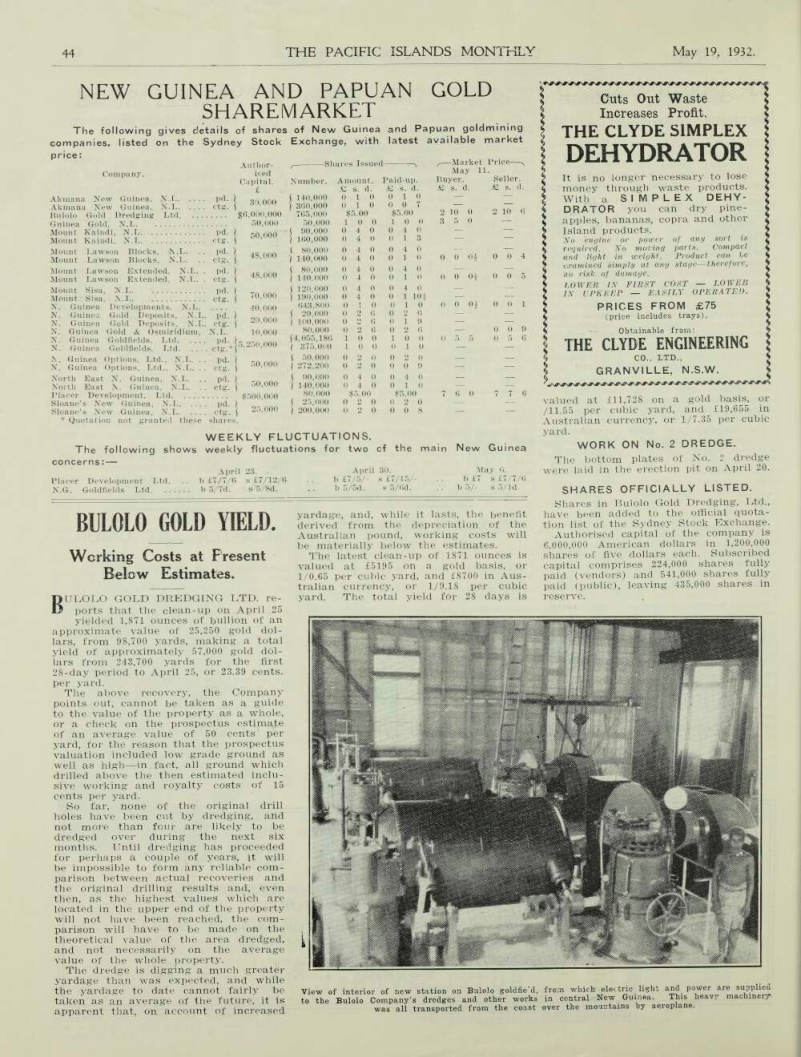
New Guinea And Papuan Gold
The following gives details of shares of New Guinea and Papuan goldmining companies, listed on the Sydney Stock Exchange, with latest available market price:
Weekly Fluctuations.
The following shows weekly fluctuations for two of the main New Guinea concerns:
April 23.
April 30.
May ti.
Placer Development Ltd. . b £7/7/0 s £7/12/0 b £7/3/- s £7/15/b £7 s £7/7/0 N.G. Goldfields Ltd. ... . . b 5/7d. »'5/8d. b 3/5d. s 5/Gd. . . b 5/- s 5/ld.
Author- Shares Issued I — s Market Price —^ Company. ised Capital.
Number.
Amount.
Paid-up.
May 11 Buyer.
Seller £ £ s. d 1. £ s. d. £ s. d. £ s. d.
Akmana New Guinea, X I I'd. ] 140,000 0 1 0 0 1 0 — — Akinana New Guinea. N.L. ... ctg. i
6 J,U(Ju
( 360,000 0 1 0 0 0 7 — Bulolo Gold Dredging Ltd. $6,000,000 765,000 $5.00 $r >.00 2 10 0 ** 10 t) Guinea Gold, N.L 50,000 50,000 1 0 0 i 0 0 3 5 0 •— I'd. 50 000 f 90,000 0 4 0 0 4 0 — Mount Kaindi, N.L
ctg. i
j 160,000 0 4 u o 1 3 — Mount Lawson Blocks, N.L. pd. \ 48,000 1 80,000 0 4 0 0 4 0 — — Mount Lawson Blocks, N.L.
ctg. (
) 140,000 0 4 0 0 1 0 0 0 01 0 0 4 Mount Lawson Extended. N.L. pd. ] ( 80,000 0 4 0 0 4 0 — — Mount Lawson Extended, N.L.
ctg.
48,000 140,000 0 4 0 0 1 0 0 0 OJ 0 0 5 Mount Sisa, N.L pd. 1 \ 120,000 0 4 0 0 4 0 —- — Mount Sisa. N.I
ctg.
70,000 1 190,000 0 4 0 0 1 10 i — — N. Guinea Developments. N.L. 40.000 643.800 0 I 0 0 1 0 0 0 04 0 0 1 N. Guinea Gold Deposits, N.I Pd. ) 20,000 0 2 6 0 2 6 — — X'. Guinea Gold Deposits, N.I ctg. 1 20.000 ) 100,000 0 2 6 0 1 9 — — N. Guinea Gold & Osmiridium, N.L. 10.000 80.000 0 2 6 0 o 6 — 0 0 9 N. Guinea Goldfields, Ltd.
I'd- 1 {4,055,186 1 0 0 1 0 0 0 5 5 0 5 6 N. Guinea Goldfields, Ltd.
ctg.* J
5,250,000 [ 375,000 1 0 0 0 1 0 — — N. Guinea Options, Ltd., N.L. .
Pd. ] 50,000 0 2 0 0 2 0 f — N. Guinea Options, Ltd.. N.L. .
ctg.
50,000 j 272,200 0 2 0 0 0 9 — — North East N. Guinea, N.L. pd. 1 90,000 0 4 0 0 4 0 — — North East X. Guinea. N.L.
ctg. (
50,000 140,000 0 4 0 0 1 0 — — Placer Development, Ltd $500,000 80.000 $5.00 $ 5.00 7 6 0 7 7 6 Sloane’s New Guinea, N.I pd- 1 f 25,000 0 2 0 0 2 0 — Sloane's New Guinea. N.L. ...
ctg. $
25,000 ] 200,000 0 2 0 0 0 8 T— — * Quotation not granted these shares.
Bulolo Gold Yield.
Working Costs at Present Below Estimates.
Bulolo Gold Dredging Ltd. re ports that the clean-up on April 25 yielded 1,871 ounces of bullion of an approximate value of 25,250 gold dol lars, from 98,700 yards, making a total yield of approximately 57,000 gold dol lars from 243,700 yards for the first 28-day period to April 25, or 23.39 cents, per yard.
The above recovery, the Company points out, cannot be taken as a guide to the value of the property as a whole, or a check on the prospectus estimate of an average value of 50 cents per yard, for the reason that the prospectus valuation included low grade ground as well as high—in.fact, all ground which drilled above the then estimated inclu sive working and royalty costs of 15 cents per yard.
So far, none of the original drill holes have been cut by dredging, and not more than four are likely to be dredged over during the next six months. Until dredging has proceeded for perhaps a couple of years, it will be impossible to form any reliable com parison between actual recoveries and the original drilling results and, even then, as the highest values which are located in the upper end of the property will not have been reached, the com parison will have to be made on the theoretical value of the area dredged, and not necessarily on the average value of the whole property.
The dredge is digging a much greater yardage than was expected, and while the yardage to date cannot fairly be taken as an average of the future, it is apparent that, on account of increased
yardage, and, while it lasts, the benefit derived from the depreciation of the Australian pound, working costs will be materially below the estimates.
The latest clean-up of 1871 ounces is valued at £5195 on a gold basis, or 1/0.65 per cubic yard, and £8700 in Aus tralian currency, or 1/9.18 per cubic yard. The total yield for 28 days is
valued at £11,728 on a gold basis, or /11.55 per cubic yard, and £19,655 in Australian currency, or 1/7.35 per cubic yard.
Work On No. 2 Dredge.
The bottom plates of No. 2 dredge were laid in the erection pit on April 20.
Shares Officially Listed.
Shares in Bulolo Gold Dredging, Ltd., have been added to the official quota tion list of the Sydney Stock Exchange.
Authorised capital of the company is 6,000,000 American dollars in 1,200,000 shares of five dollars each. Subscribed capital comprises 224,000 shares fully paid (vendors) and 541,000 shares fully paid (public), leaving 435,000 shares in reserve.
View of interior of new station on Bulolo goldfield, from which electric light and power are supplied to the Bulolo Company’s dredges and other works in central New Guinea. This heavy machinery was all transported from the coast over the mountains by aeroplane.
Advertisements & other items, p. 46 (1 item)
Dehydrator
Cuts Out Waste
Increases Profit.
THE CLYDE SIMPLEX
DEHYDRATOR
It is no longer necessary to lose money through waste products.
With a SIMPLEX DEHY
DRATOR you can dry pine apples, bananas, copra and other Island products.
No engine or power of any sort is required. No moving parts. Compact and light in weight. Product can he examined simply at any stage — therefore, no risk of damage.
LOWER IN FIRST COST LOWER
IN UPKEEP EASILY OPERATE.').
PRICES FROM £75
(price includes trays).
Obtainable from:
THE CLYDE ENGINEERING
CO., LTD.,
GRANVILLE, N.S.W.
Exchange Quotations
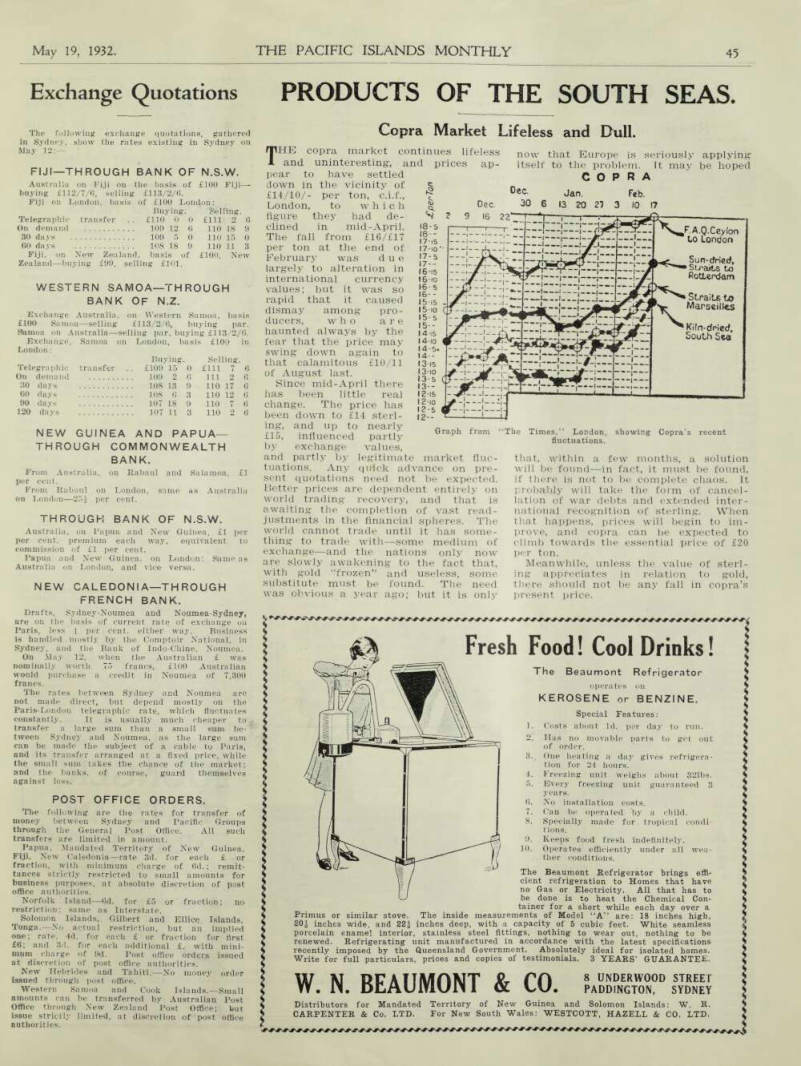
The following exchange quotations, gathered in Sydney, show the rates existing in Sydney on May 12:
Fiji—Through Bank Of N.S.W.
Australia on Fiji on the basis of £100 Fiji—buying £112/7/6, selling £113/2/6.
Fiji on London, basis of £100 London:
Western Samoa—Through
Bank Of N.Z.
Exchange Australia, on Western Samoa, basis £100 Samoa —selling £113/2/6, buying par.
Samoa on Australia—selling par, buying £113/2/6.
Exchange, Samoa on London, basis £100 in London;
New Guinea And Papua
Through Commonwealth
Bank.
From Australia, on Rabaul and Salamoa, £1 per cent.
From Rabaul on London, same as Australia on London—25½ per cent.
Through Bank Of N.S.W.
Australia, on Papua and New Guinea, £1 per per cent, premium each way, equivalent to commission of £1 per cent.
Papua and New Guinea, on London: Same as Australia on London, and vice versa.
New Caledonia—Through
French Bank.
Drafts, Sydney-Noumea and Noumea-Sydney, are on the basis of current rate of exchange on Paris, less 1 per cent, either way. Business is handled mostly by the Comptoir National, in Sydney, and the Bank of Indo-Chine, Noumea.
On May 12, when the Australian £ was nominally worth 75 francs, £100 Australian would purchase a credit in Noumea of 7,300 francs.
The rates between Sydney and Noumea are not made direct, but depend mostly on the Paris-London telegraphic rate, which fluctuates constantly. It is usually much cheaper to, transfer a large sum than a small sum be tween Sydney and Noumea, as the large sum can be made the subject of a cable to Paris, and its transfer arranged at a fixed price, while the small sum takes the chance of the market; and the banks, of course, guard themselves against loss.
Post Office Orders.
The following are the rates for transfer of money between Sydney and Pacific Groups through the General Post Office. All such transfers are limited in amount.
Papua. Mandated Territory of New Guinea, Fiji, New Caledonia—rate 3d. for each £ or fraction, with minimum charge of 6d.; remit tances strictly restricted to small amounts for business purposes, at absolute discretion of post office authorities.
Norfolk Island—6d. for £5 or fraction; no restriction: same as Interstate.
Solomon Islands, Gilbert and Ellice Islands, Tonga.—No actual restriction, but an implied one; rate. 4d. for each £ or fraction for first £6; and 3d. for each additional £, with mini mum charge of 9d. Post office orders issued at discretion of post office authorities.
New Hebrides and Tahiti.—No money order issued through post office.
Western Samoa and Cook Islands.—Small amounts can be transferred by Australian Post Office through New Zealand Post Office; but issue strictly limited, at discretion of post office authorities.
Buying. Selling.
Telegraphic transfer . . £110 0 0 £111 2 G On demand 100 12 6 110 18 9 30 days 109 5 0 110 15 0 CO days 108 18 9 110 11 3 Fiji, on New Zealand, basis of £100. New Zealand—buying £99, selling £101.
Buying. Selling.
Telegraphic transfer .. £10!) 15 0 fill 7 G On demand 109 2 6 111 2 6 .10 days 108 13 9 110 17 6 GO days 108 6 3 110 12 6 90 days 107 18 9 110 7 G 120 days 107 11 3 110 2 6
Products Of The South Seas.
Copra Market Lifeless and Dull.
THE copra market continues lifeless and uninteresting, and prices ap
pear to have settled down in the vicinity of £14/10/- per ton, c.i.f., London, to which figure they had de clined in mid-April.
The fall from £16/£17 per ton at the end of February was due largely to alteration in international currency values; but it was so rapid that it caused dismay among pro ducers, who are haunted always by the fear that the price may swing down again to that calamitous £10/11 of August last.
Since mid-April there has been little real change. The price has been down to £14 sterl ing, and up to nearly £15, influenced partly by exchange values,
and partly by legitimate market fluc tuations. Any quick advance on pre sent quotations need not be expected.
Better prices are dependent entirely on world trading recovery, and that is awaiting the completion of vast read justments in the financial spheres. The world cannot trade until it has some thing to trade with —some medium of exchange—and the nations only now are slowly awakening to the fact that, with gold “frozen” and useless, some substitute must be found. The need was obvious a year ago; but it is only
now that Europe is seriously applying itself to the problem. It may be hoped
that, within a few months, a solution will be found —in fact, it must be found, if there is not to be complete chaos. It probably will take the form of cancel lation of war debts and extended inter national recognition of sterling. When that happens, prices will begin to im prove, and copra can be expected to climb towards the essential price of £20 per ton.
Meanwhile, unless the value of sterl ing appreciates in relation to gold, there should not be any fall in copra’s present price.
Graph from “The Times,” London, showing Copra’s recent fluctuations.
Advertisements & other items, p. 47 (1 item)
Fresh Food! Cool Drinks!
The Beaumont Refrigerator operates on
KEROSENE or BENZINE.
Special Features: 1. Costs about 1d. per day to run. 2. Has no movable parts to get out of order. 3., One heating a day gives refrigera tion for 24 hours. 4. Freezing unit weighs about 321bs. 5. Every freezing unit guaranteed 3 years. 6. No installation costs. 7. Can be operated by a child. 8. Specially made for tropical condi tions. 0. Keeps food fresh indefinitely. 10. Operates efficiently under all wea ther conditions.
The Beaumont Refrigerator brings effi cient refrigeration to Homes that have no Gas or Electricity. All that has to be done is to heat the Chemical Con tainer for a short while each day over a Primus or similar stove. The inside measurements of Model “A” are: 18 inches high. 20 1 inches wide, and 22 \ inches deep, with a capacity of 5 cubic feet. White seamless porcelain enamel interior, stainless steel fittings, nothing to wear out, nothing to be renewed. Refrigerating unit manufactured in accordance with the latest specifications recently imposed by the Queensland Government. Absolutely ideal for isolated homes.
Write for full particulars, prices and copies of testimonials. 3 YEARS’ GUARANTEE.
W. N. BEAUMONT & CO.
8 UNDERWOOD STREET
PADDINGTON, SYDNEY
Distributors for Mandated Territory of New Guinea and Solomon Islands: W. R.
CARPENTER & Co. LTD. For New South Wales: WESTCOTT, HAZELL & CO. LTD.
Market Quotations
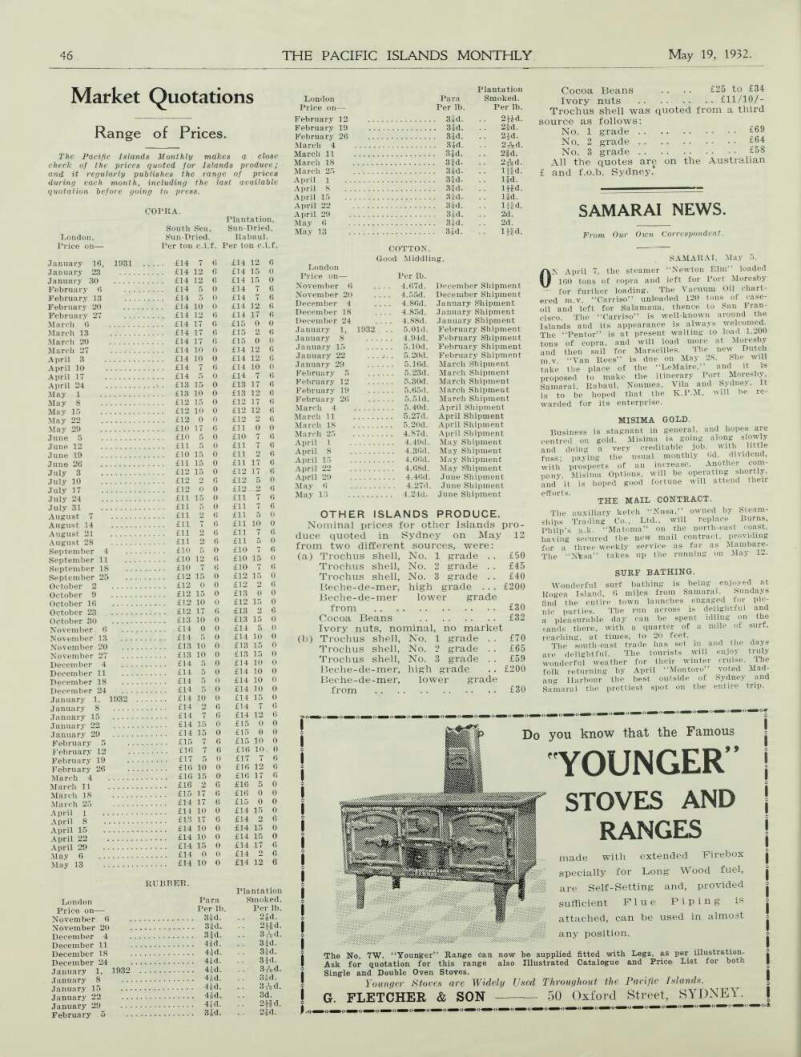
Range of Prices.
The Pacific Islands Monthly makes a close check of the prices quoted for Islands produce; and it regularly publishes the range of prices during each month, including the last available quotation before going to press.
Other Islands Produce.
Nominal prices for other Islands pro duce quoted in Sydney on May 12 from two different sources, were: (a) Trochus shell, No. 1 grade .. £50 Trochus shell, No. 2 grade .. £45 Trochus shell, No. 3 grade . . £40 Beche-de-mer, high grade ... £200 Beche-de-mer lower grade from £30 Cocoa Beans £32 Ivory nuts, nominal, no market (b) Trochus shell, No. 1 grade . . £70 Trochus shell, No. 2 grade . . £65 Trochus shell, No. 3 grade . . £59 Beche-de-mer, high grade .. £200 Beche-de-mer, lower grade from £30
Cocoa Beans . . .. £25 to £34 Ivory nuts £11/10/- Trochus shell was quoted from a third source as follows: No. 1 grade .. £69 No. 2 grade £64 No. 3 grade £5B All the quotes are on the Australian £ and f.o.b. Sydney.
London Price on- Plantation Smoked Per lb.
Para Per lb.
February 12 . 3|d. . . 2Hd- February 19 . 3Jd. .. 2|d.
February 26 . 3|d. .. 2^d.
March 4 . 3«d. .. 2Ad.
March 11 . 35d. .. 2fd.
March 18 . 3}d. .. 2&d.
March 25 . 3|d. .. llfd.
April 1 . 3id. . . l|d.
April 8 . 3|d. .. iHd.
April 15 . 3|d. .. lid.
April 22 . 38d. . . U|d.
April 20 . 3§d. .. 2d.
May 6 . 3|d. .. 2d.
May 13 . 3id. .. l^|d.
London Price on
Cotton.
Good Middling.
Per lb.
November 6 . . . 4.67d.
December Shipment November 20 ... 4.55d.
December Shipment December 4 4.86d.
January Shipment December 18 4.85d.
January Shipment December 24 4.88d.
January Shipment January 1, 1932 . . 5.01d.
February Shipment January 8 4.94d.
February Shipment January 15 5.10d.
February Shipment January 22 . j. . 5.20d.
February Shipment January 29 5.16d, March Shipment February 5 5.23d.
March Shipment February 12 5.30d.
March Shipment February 19 ... 5.65d.
March Shipment February 26 5.old.
March Shipment March 4 5.40d.
April Shipment March 11 ... 5.27d.
April Shipment March IS 5.20d.
April Shipment March 25 4.87d.
April Shipment April 1 4.49d.
May Shipment April 8 4.36d.
May Shipment April 15 4.66d.
May Shipment April 22 4.68d.
May Shipment April 29 4.46d.
June Shipment May 6 4.27d.
June Shipment May 13 .. .. 4.24d.
June Shipment
London. Price on—
Copra.
South Sea Stan-Dried. Per ton c.i.
Plantation, , Sun-Dried, Rabaul. f. Per ton c.i.f.
January 16, 1931 £14 7 6 £14 12 6 January 23 £14 12 6 £14 15 0 £14 12 6 £14 15 0 February 6 February 13 February 20 February 27 £14 5 0 £14 7 6 £14 5 0 £14 7 6 £14 10 0 6 £14 12 6 £14 12 £14 17 6 £14 17 6 £15 0 0 March 13 £14 17 6 £15 2 6 March 20 £14 17 6 £15 0 0 £14 10 0 £14 12 6 £14 10 0 £14 12 6 April lO £14 i 6 £14 10 0 £14 5 0 £14 7 6 April 24 .. . £13 15 0 £13 17 6 Mav 1 £13 10 0 £13 12 6 Mav 8 £12 15 0 £12 17 6 \f;i v 15 £12 10 0 £12 12 6 May 22 £12 0 0 £12 2 6 £10 17 6 £11 0 0 £10 5 0 £10 7 6 June 12 £11 0 £11 7 6 £10 15 0 £11 2 6 £11 15 0 £11 17 6 July 3 £12 15 0 £12 17 6 July 10 £12 6 £12 5 0 July 17 £12 0 0 £12 2 6 July 24 £11 15 0 £11 7 6 .Tulv 31 £11 5 0 £11 7 6 August 7 August 14 August 21 August 28 September 4 September 11 September 18 September 25 October 2 October 9 October 16 October 23 October 30 November 6 November 13 November 20 November 27 December 4 December 11 December 18 December 24 January 1, ] January 8 January 15 January 22 January 29 February 5 February 12 February 19 February 26 March 4 £11 o 6 £11 5 0 £11 7 6 £11 10 0 £11 2 6 £11 7 6 £11 2 6 £11 5 0 £10 0 £10 7 6 £10 12 6 £10 15 0 £10 7 6 £10 7 6 £12 15 0 £12 15 0 £12 0 0 £12 2 6 £12 15 0 £13 0 0 £12 10 0 £12 15 0 £12 17 6 £13 2 6 £13 10 0 £13 15 0 £14 0 0 £14 5 0 £14 5 0 £14 10 0 £13 10 0 £13 15 0 £13 10 0 £13 15 0 £14 5 0 £14 10 0 £14 5 0 £14 10 0 £14 5 0 £14 10 0 £14 5 0 £14 10 0 1932 . £14 10 0 £14 15 0 £14 2 6 £14 7 6 £14 7 6 £14 12 6 £14 15 0 £15 0 0 £14 15 0 £15 G 0 £15 T 6 £15 10 0 £16 7 6 £16 10 0 £17 5 0 £17 7 6 £16 10 0 £16 12 6 £16 15 0 £16 17 6 March 11 £16 2 6 £16 5 0 March 18 March 25 April 1 £15 17 6 £16 0 0 £14 17 6 £15 0 0 £14 10 0 £14 15 0 April 8 £13 17 6 £14 2 6 April 15 £14 10 0 £14 15 0 \pril 22 £14 10 0 £14 15 0 \pril 20 £14 15 0 £14 17 6 }j a y 0 t £14 0 0 £14 2 6 May 13 £14 10 0 £14 12 6 London Price on— November 6 November 20 December 4 December 11 December 18 December 24 January 1, January 8 January 15 January 22 January 29 February 5
Rubber.
Para Per lb 3§d.
Plantation Simoked. Per lb. .. 2|d. 3|d. . . 2Hd. 3|d. .. 3,Vd. , 4gd. 3*d. 3£d. 4id. 3Jd. 1932 4£d. .. Sftd. . 4id. 4id. .. 3Jd. .. S^d. . 4 id. 3d. 4 id. 2ff d. , 3Sd. .. 2id.
Samarai News.
From Our Own Correspondent.
Samarai, May 5.
On April 7, the steamer “Newton Elm’’ loaded 160 tons of copra and left for Port Moresby for further loading. The Vacuum Oil chart ered m.v. “Carriso” unloaded 120 tons of case oil and left for Salamaua, thence to San Fran cisco. The “Carriso” is well-known around the Islands and its appearance is always welcomed.
The “Pentor” is at present waiting to load 1,200 tons of copra, and will load more at Moresby and then sail for Marseilles. The new Dutch m.v. “Van Rees” is due on May 28. She will take the place of the “LeMaire,” and 18 proposed to make the itinerary Port Moresby.
Samarai, Rabaul, Noumea, Vila and Sydney. It is to be hoped that the K.P.M. will be re warded for its enterprise.
Misima Gold.
Business is stagnant in general, and hopes are centred on gold. Misima is going along slowly and doing a very creditable job, with little fuss- paying the usual monthly 6d. dividend, with prospects of an increase. Another com pany, Misima Options, will be operating shortly, and it is hoped good fortune will attend their efforts.
The Mail Contract.
The auxiliary ketch “Nusa,” owned by Steam ships Trading Co., Ltd., will replace Burns, Philp’s a.k. “Matoma” on the north-east coast, having secured the new mail contract, providing for a three-weekly service as far as Mambare.
The “Ntisa” takes up the running on May 12.
Surf Bathing.
Wonderful surf bathing is being enjoyed at Rogea Island, 6 miles from Samarai. Sundays find the entire town launches engaged for pic nic parties. The run across is delightful and a pleasurable day can be spent idling on the sands there, with a quarter of a mile of surf, reaching, at times, to 20 feet.
The south-east trade has set in and the days are delightful. The tourists will enjoy truly wonderful weather for their winter cruise. The folk returning by April “Montoro voted Mad ang Harbour the best outside of Sydney and Samarai the prettiest spot on the entire trip.
Advertisements & other items, p. 48 (1 item)
"Younger”
Do you know that the Famous
STOVES AND
RANGES
made with extended Firebox specially for Long Wood fuel, are Self-Setting and, provided sufficient Flue Piping is attached, can be used in almost any position.
The No. 7W. “Youn&er” Range can now be supplied fitted with Legs, as per illustration.
Ask for quotation for this range also Illustrated Catalogue and Price List for both Single and Double Oven Stoves.
Younger Stoves are Widely Used Throughout the Pacific Islands.
G. FLETCHER & SON 50 Oxford Street, SYDNEY.
Shipping Services in the Pacific
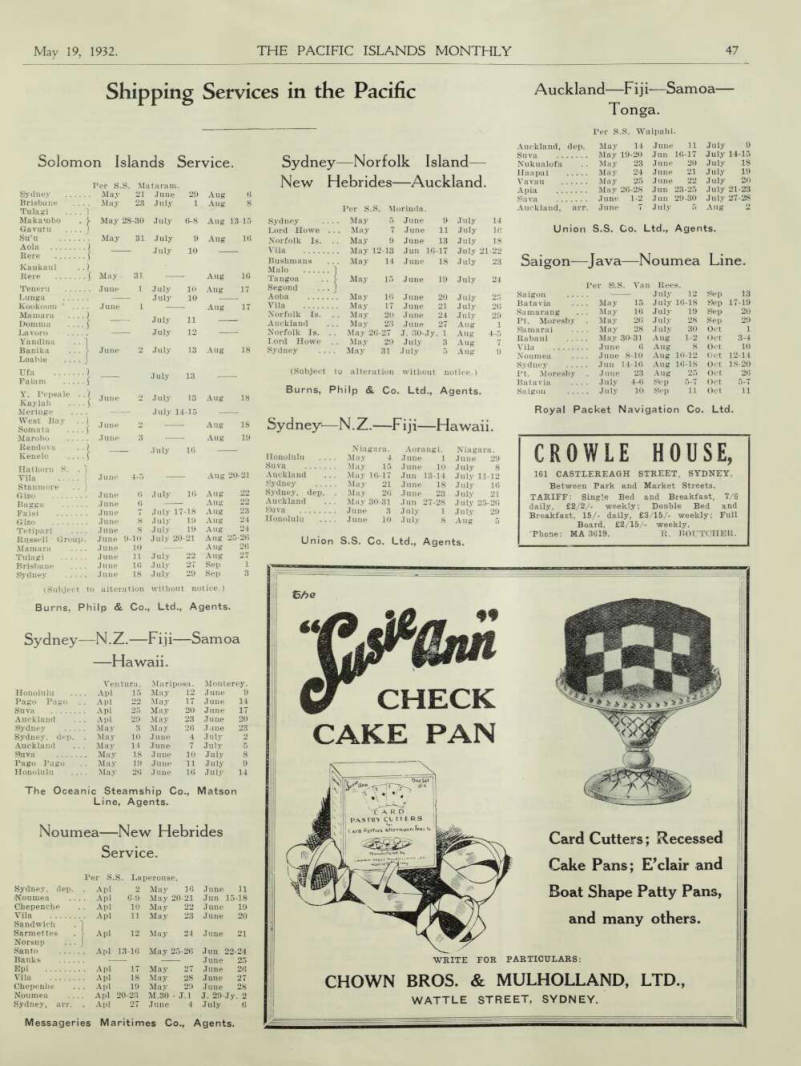
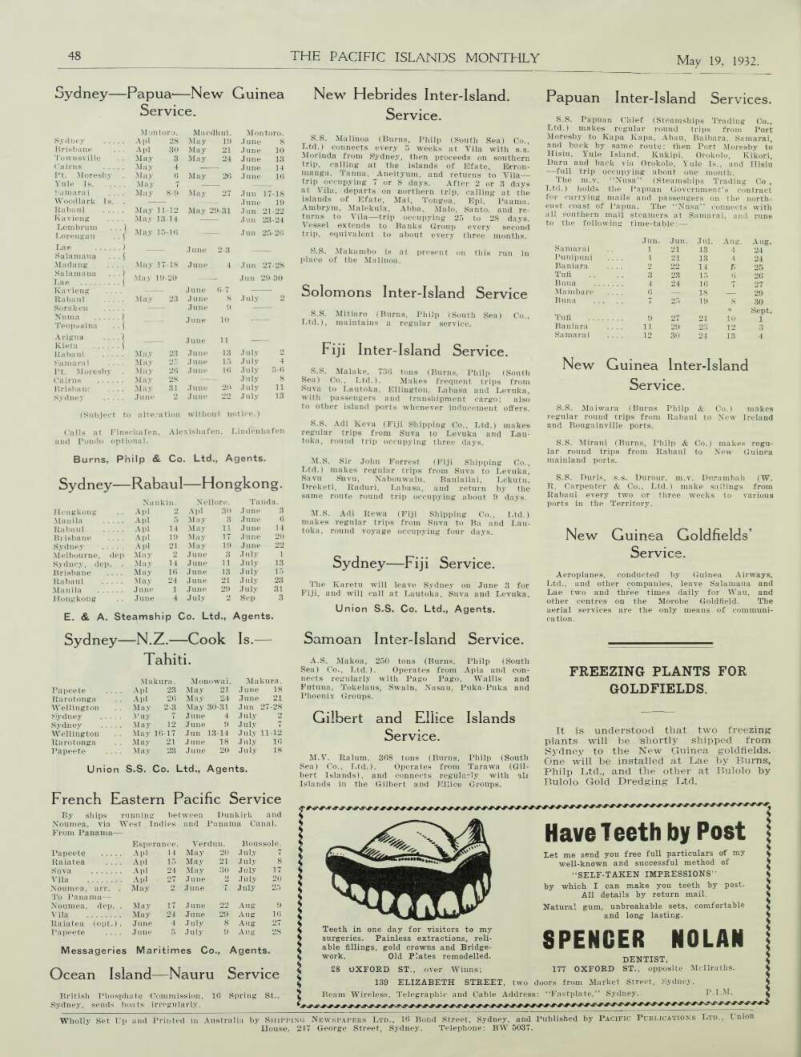
Solomon Islands Service.
Sydney —N. Z. —Fiji—Samoa —Hawaii.
Noumea —New Hebrides Service.
Sydney—Norfolk Island— New Hebrides—Auckland.
Sydney—N.Z.—Fiji—Hawaii.
Auckland —Fiji—Samoa— Tonga.
Saigon—Java—Noumea Line.
Per S.S. Waipahi.
Auckland, dep. May 14 June 11 July 9 Suva May 19-20 Jun 10-17 July 14-15 Nukualofa . . May 23 June 20 July 18 Haapai May 24 June 21 July 19 Vavau May 25 June 22 July 20 Apia May 20-28 Jun 23-25 July 21-23 Sava June 1-2 Jun 29-30 July 27-28 Auckland, arr. June 7 July 5 Aug 2 Union S.S. Co. Ltd., Agents.
Sydney Brisbane Tulagi Makambo Gavutu . . . .
Su’u Per S.S. Mi .. May 21 . . May 23 May 28-30 Mav 31 itaram.
June July July July 29 1 6-8 9 Aug 6 Aug 8 Aug 13-15 An v 16 Aola 10 Rere July Kaukaul May June 31 1 Aug 16 Teneru . ...
July 10 Aug 17 July July July 10 11 12 13 Kookooin Mamara June 1 Aug 17 Domma Yandina Banika Loabie ...
June 2 July Aug 18 Ufa July 13 Faiam ...
Y. Pepsale .
Kaylah Meringe West Bay Somata . ...
June 2 July July 14 13 -15 Aug 18 June June 3 Aug 18 19 Rendova July 10 Kenelo Hathoru S. • Vila June 4-5 Aug 20 -21 Stanmore Gizo June 6 July 16 Aug 22 Bagga June 6 Aug 22 Faisi June 7 July 17 -18 Aug 23 Gizo June 8 July 19 Aug 24 Tetipari Bussell Group Mamara Tulagi June June 9 June June 8 -10 10 11 July July 20- July 19 21 22 Aug Aug 25 Aug Aug 24 26 26 27 Brisbane Svdnev . . . .
June June 16 18 July July 27 29 Sep Sep 1 3 (Subject to alteration without notice.) Burns, Philp & Co. , Ltd., Agents.
Ventura.
Mariposa.
Monterey.
Honolulu ...
Apl 15 May 12 June 9 Pago Pago Apl 22 May 17 June 14 Suva Apl 25 May 20 June 17 Auckland Apl 29 May 23 June 20 Sydney May 3 May 26 J ane 23 Sydney, dep. .
May 10 June 4 July 2 Auckland May 14 June 7 July 5 Suva May 18 June 10 July 8 Pago Pago May 19 June 11 July 9 Honolulu ...
May 26 June 16 July 14 The Oceanic Steamship Co., Matson
Line, Agents.
Sydney I Per S.S. Morinda.
May 5 June 9 July 14 Lord Howe May 7 June 11 July 1C Norfolk Is.
May 9 June 13 July 18 Vila May 12 -13 Jun 16-17 July 21-22 Bushmans May 14 June 18 July 23 Malo Tangoa :{ May 15 June 19 July 24 Segond Aoba .. .. •J May 16 June 20 July 25 Vila May 17 June 21 July 26 Norfolk Is.
May 20 June 24 July 29 Auckland May 23 June 27 Aug 1 Norfolk Is.
May 20-27 J. 30-Jy . 1 Aug 4-5 Lord Howe May 2!) July 3 Aug 7 Sydney May 31 July 5 Aug 9 (Subject to alteration without notice.) Burns, Philp & Co. Ltd., Agents.
Per S.S. Van Rees.
Saigon ... — July 12 Step 13 Batavia . May 15 July 16-18 Step 17-19 Samarang . May 16 July 19 Sep 20 Pt. Moresby . May 2G July 28 Sep 29 Slamarai May 28 July 30 Oct 1 Rabaul ... . May 30-31 Aug 1-2 Oct 3-4 Vila June 6 Aug 8 Oct 10 Noumea June 8-10 Aug 10-12 Oct 12-14 Sydney ...
Juu 14 -16 Aug 16-18 Oct 18-20 Pt. Moresby . June 23 Aug 25 Oct 26 Batavia July 4-6 Sep 5-7 Oct 5-7 Saigon ... . July 10 Step 11 Oct 11 Royal Packet Navigation Co. Ltd.
Niagara.
Aorf mgi.
Niagara.
Honolulu ...
May 4 J une 1 June 29 Suva May 15 June 10 July 8 Auckland May 1G-17 Jun 13-14 July 11 -12 Sydney May 21 June 18 July 16 Sydney, dep. .
May 2G June 23 July 21 Auckland May 30-31 Jun 27-28 July 25 -2G Suva June 3 July 1 July 29 Honolulu June 10 July 8 Aug 5 Union S.S. Co. Ltd., Agents.
Per S.S. Laperouse.
Sydney, dep. .
Apl 2 May 16 June 11 'Noumea ...
Apl G-9 May 20-21 Jun 15-18 Chepenche Apl 10 May 22 June 19 Vila Apl 11 May 23 June 20 Sandwich . 1
Sarmettes , [
Apl 12 May 24 June 21
Norsup ... J
Santo Apl 13-16 May 25-26 Jun 22-24 Banks j une 25 Epi Apl 17 May 27 June 26 Vila Apl 18 May 28 June 27 Chepenhe Apl 19 May 29 June 28 Noumea ...
Apl 20-23 M.30 - J. 1 J. 29-Jy. 2 Sydney, arr. .
Apl 27 June 4 July 6 Messageries Maritimes Co., Agents.
Sydney—Papuan—New Guinea Service.
Sydney—Rabaul—Hongkong.
E. & A. Steamship Co. Ltd., Agents.
Sydney—N.Z.—Cook Is.—
Tahiti.
French Eastern Pacific Service
By ships running between Dunkirk and Noumea, via West Indies and Panama Canal.
From Panama —
Ocean Island—Nauru Service
British Phosphate Commission, 16 Spring St., Sydney, sends boats irregularly.
New Hebrides Inter-Island.
Service.
S.S. Malinoa (Burns, Philp (South Sea) Co., Ltd.) connects every 5 weeks at Vila with s.s.
Morinda from Siydney, then proceeds on southern trip, calling at the islands of Efate, Erron manga, Tanna, Aneityum, and returns to Vila— trip occupying 7or 8 days. After 2or 3 days at Vila, departs on northern trip, calling at the islands of Efate, Mai, Tongoa, Epi, Paama, Ambrym, Malekula, Abba, Malo, Santo, and re turns to Vila—trip occupying 25 to 28 days.
Vessel extends to Banks Group every second trip, equivalent to about every three months.
S.S. Makambo is at present on this run in place of the Malinoa.
Solomons Inter-Island Service
S.S. Mitiaro (Burns, Philp (South Sea) Co., Ltd.), maintains a regular service.
Fiji Inter-Island Service.
S.S. Malake, 736 tons (Burns, Philp (South Sea) Co., Ltd.). Makes frequent trips from Suva to Lautoka, Ellington, Labasa and Levuka, with passengers and transhipment cargo; also to other island ports whenever inducement offers.
S.S. Adi Keva (Fiji Shipping Co., Ltd.) makes regular trips from Suva to Levuka and Lau toka, round trip occupying three days.
M.S. Sir John Forrest (Fiji Shipping Co., Ltd.) makes regular trips from Suva to Levuka, Savu Savu, Nabouwalu, Baulailai, Lekutu, Dreketi, Raduri, Labasa, and return by the same route round trip occupying about 9 days.
M.S. Adi Rewa (Fiji Shipping Co., Ltd.) makes regular trips from Suva to Ba and Lau toka, round voyage occupying four days.
Sydney—Fiji Service.
The Karetu will leave Sydney on June 3 for Fiji, and will call at Lautoka, Suva and Levuka.
Union S.S. Co. Ltd., Agents.
Samoan Inter-Island Service.
A.S. Makoa, 250 tons (Burns, Philp (South Sea) Co., Ltd.). Operates from Apia and con nects regularly with Pago Pago, Wallis and Futuna, Tokelaus, Swain, Nasau, Puka-Puka and Phoenix Groups.
Gilbert and Ellice Islands
Service.
M.V. Ralum. 368 tons (Burns, Philp (South Sea) Co., Ltd.). Operates from Tarawa (Gil bert Islands), and connects regularly with all Islands in the Gilbert and Ellice Groups.
Papuan Inter-Island Services.
S.S. Papuan Chief (Steamships Trading Co., Ltd.) makes regular round trips from Port Moresby to Kapa Kapa, Abau, Baibara, Samarai, and back by same route; then Port Moresby to Hisiu, Yule Island, Kukipi, Orokolo, Kikori, Daru and back via Orokolo, Yule Is., and Hisiu —full trip occupying about one month.
The m.v. “Nusa” (Steamships Trading Co, Ltd.) holds the Papuan Government’s contract for carrying mails and passengers on the north east coast of Papua. The “Nusa” connects with all southern mail steamers at Samarai, and runs to the following time-table;—
New Guinea Inter-Island
Service.
S.S. Maiwara (Burns Philp & Co.) makes regular round trips from Rabaul to New Ireland and Bougainville ports.
S.S. Mirani (Burns, Philp & Co.) makes regu lar round trips from Rabaul to New Guinea mainland ports.
S.S. Duris, s.s. Durour, m.v. Durambah (W.
R. Carpenter & Co., Ltd.) make sailings from Rabaul every two or three weeks to various ports in the Territory.
New Guinea Goldfields’
Service.
Aeroplanes, conducted by Guinea Airways, Ltd., and other companies, leave Salamaua and Lae two and three times daily for Wau, and other centres on the Morobe Goldfield. The aerial services are the only means of communi cation.
Montoro.
Macdbui.
Montoro.
Sydney ... . Api 28 May 19 .1 une 8 Brisbane . A pi 30 May 21 June 10 Townsville . May 3 May 24 June 13 Cairns . . .. . May 4 — June 14 Ft. Moresby . May 6 May 26 June 16 Yule Is. ... . May 7 — Camarai . May 8-9 May 27 Jun 17-18 Woodlark Is. .
June 19 Kabaul . . . . . May 11-12 May 29-31 Jun 21-22 Kavieng . May 13-14 — Jun 23-24 Lombrum Lorengan f May 15-16 — Jun 25-26 Lae 1 June 1 ■> O Salamaua - O Madang . May 17-18 June 4 Jun 27-28 Salamaua Lae 1 May 19-20 — Jun 29-30 Kavieng — June 6-7 — Kabaul . May 23 June 8 July 2 Soraken ... — June 9 — Numa June 10 Teopasina Arigua June 11 Kieta Kabaul . May 23 June 13 July 2 Samarai . May 25 June 15 July 4 Ft. Moresby . May 26 June 16 July 5-6 Cairns . May 28 — July 8 Brisbane . May 31 June 20 July 11 Sydney .•..
June 2 June 22 July 13 (Subject to alteration without : notice.) Calls at Finscbafen, Alexisbafen . Lindenhafen and Pondo optional.
Burns, Philp & Co . Ltd., Agents.
Nankin. Nellore. Tauda.
Hongkong .. A pi 2 Apl 30 June 3 Manila Apl 5 May 3 June 6 Rabaul Apl 14 May 11 June 14 Brisbane Apl 19 May IT June 20 Sydney Apl 21 May 19 June 22 Melbourne, dep May 2 June 3 July 1 Sydney, dep. . May 14 June 11 July 13 Brisbane ... May 1G June 13 July 15 Rabaul May 24 June 21 July 23 Manila June 1 June 29 July 31 Hongkong . . June 4 July 2 Sep 3
Makura.
Monowai.
Makura.
Papeete ...
A pi 23 May 21 June 18 Rarotonga A pi 2G May 24 June 21 Wellington May 2-3 May 30-31 Jun 27-28 Sydney May 7 June 4 July 2 Sydney May 12 June 9 July 7 Wellington May 16-17 Jun 13-14 July 11-12 Rarotonga May 21 June 18 July 16 Papeete ...
May 23 June 20 July 18 Union S.S. Co. Ltd., Agents.
Jim.
Jun.
Jul.
Aug.
Aug.
Samarai 1 21 13 4 24 Punipuni 1 21 13 4 24 Baniara 2 22 14 r> 25 Tua 3 23 15 0 26 Buna 4 24 16 7 27 Mambare 6 18 29 Buna 7 25 19 8 « 30 Sept.
Tub . .. . 9 27 21 10 1 Baniara 11 29 23 12 3 Samarai 12 30 24 13 4
Espera nee.
Verdun.
Boussole.
Papeete Apl 14 May 20 July 7 Raiatea ...
Apl 15 May 21 July 8 Suva Apl 24 May 30 July 17 Vila Apl 27 June 2 July 20 Noumea, arr. .
To Panama — May <> June 7 July 25 Noumea, dep. .
May 17 June 22 Aug 9 Vila May 24 June 29 Aug 16 Raiatea (opt.).
June 4 July 8 Aug 27 Papeete ...
June 5 July 9 Aug 28 Messageries Maritimes Co. ,, Agents,
Advertisements & other items, p. 49 (1 item)
Crowle House,
161 CASTLEREAGH STREET, SYDNEY,
Between Park and Market Streets.
TARIFF: Single Bed and Breakfast, 7/6 daily, £2/2/- weekly: Double Bed and Breakfast, 15/- daily, £3/15/- weekly: Full Board, £2/15/- weekly.
Phone: MA 3619. R. ROUTCHER.
The "Susie Ann"
CHECK
CAKE PAN
Card Cutters; Recessed Cake Pans; E’clair and Boat Shape Patty Pans, and many others.
WRITE FOR PARTICULARS:
CHOWN BROS. & MULHOLLAND, LTD.,
WATTLE STREET, SYDNEY.
Freezing Plants For
Goldfields.
It is understood that two freezing plants will be shortly shipped from Sydney to the New Guinea goldfields.
One will be installed at Lae by Bums, Philp Ltd., and the other at Bulolo by Bulolo Gold Dredging Ltd.
Advertisements & other items, pp. 50-52 (2 items)
48
May 19, 1932.
THE PACIFIC ISLANDS MONTHLY
Wholly Set Up and Printed in Australia by Shipping Newspapers Ltd., 16 Bond Street, Sydney, and Published by Pacific Publications Ltd., Lnion House, 247 George Street, Sydney. Telephone: BW 5037.
Spencer Nolan
Have Teeth by Post
Let me send you free full particulars of my well-known and successful method of
“SELF-TAKEN IMPRESSIONS"
by which I can make you teeth by post.
All details by return mail.
Natural gum, unbreakable sets, comfortable and long lasting.
Teeth in one day for visitors to my surgeries. Painless extractions, reli able fillings, gold crowns and Bridge work. Old Plates remodelled. 28 OXFORD ST., over Winns;
139 ELIZABETH STREET, tw<
Beam Wireless, Telegraphic and Cable Addn
SPENCER NOLAN
DENTIST,
177 OXFORD ST., opposite Mcllraths. doors from Market Street, Sydney, s: “Fastplate,” Sydney. P.I.M.
as
W.O.7G69.
Genuine Crocodile One-Bar Shoe, on extended last, with 11-8 leather heel.
Genuine Goodyear welted sole. Elaine last. Reg.
IONA
BOOTS
and
SHOES
The Recognised Quality of Australia.
Ladies’ and Gent.’s Goodyear Welted Footwear.
Ladies’ and Children’s Veldtschoen Footwear.
P. S.7817.
Patent 3-hole Tie Shoe, rep trim, genuine Goodyear welted sole, 12.8 self-covered heel. M reduced lizard ac’s last.
If these brands are not already stocked by you kindly send to us for illustrated catalogue.
ESTABLISHED 1890.
Mr. J. R. B. McKINLAY.
Managing Director.
McKINLAY & CUMMING LTD.
Manufacturers and Exporters of
Ladies’ and Gent’s Footwear
GEORGE STREET,
ERSKINEVILLE SYDNEY.
Mr. J. McKINLAY,
Governing Director.
To quench a tropic thirst!
SYDNEY. AUSTRAL
EK/4 Clean in flavoursharp to the tastethere’s no drink in the tropics to equal Tooth’s KB a true Lager.
TOOTH'S KB LAGER.