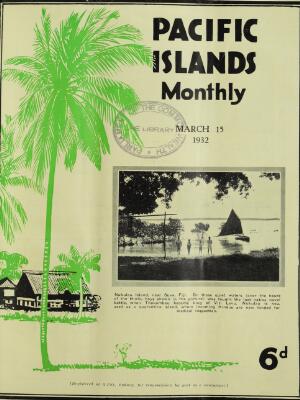
Pacific
Islands
Monthly
March 15
1932
6d
[Registered at G.P.O., Sydney, for transmission by post as a newspaper .]
Nukulau Island, near Suva, Fiji. On these quiet waters (over the heads of the Hindu boys shown in the picture) was fought the last native naval battle, when Thakombau became king of Viti Levu. Nukulau is now used as a quarantine island, where incoming Hindus are now landed for medical inspection.
Advertisements & other items, pp. 2-3 (1 item)
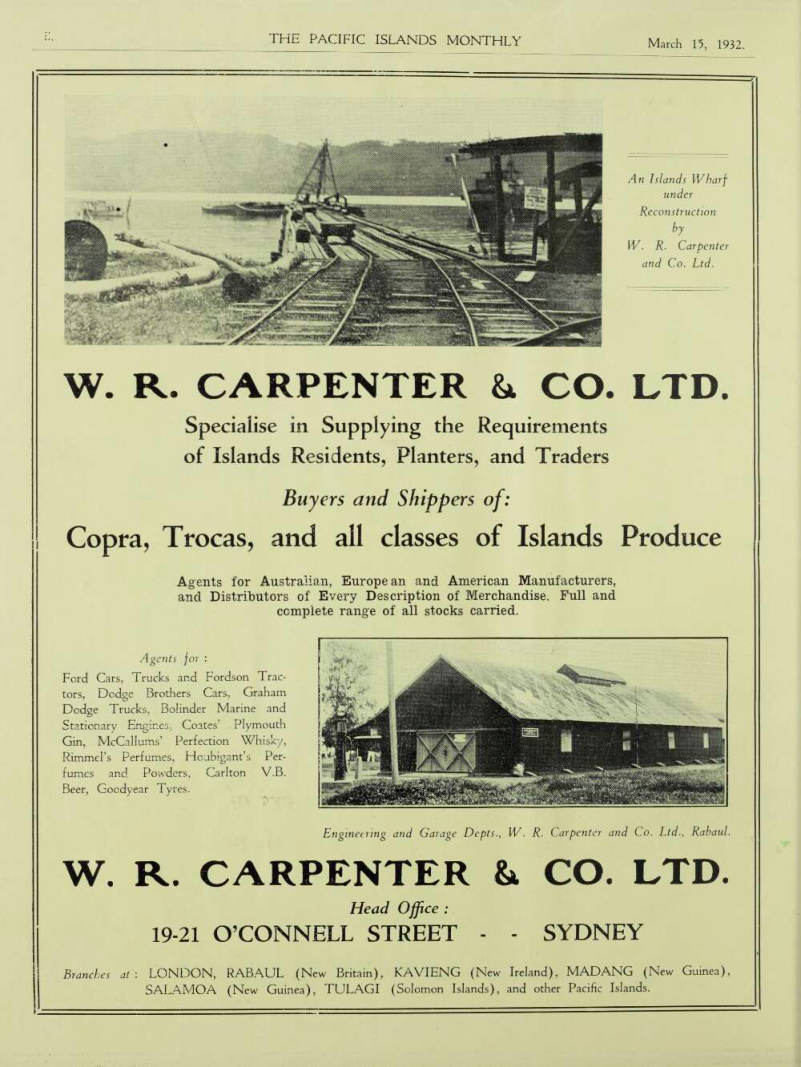
W. R. Carpenter & Co. Ltd.
An Islands Wharf under Reconstruction by W. R. Carpenter and Co. Ltd.
Specialise in Supplying the Requirements
of Islands Residents, Planters, and Traders
Buyers and Shippers of:
Copra, Trocas, and all classes of Islands Produce Agents for Australian, European and American Manufacturers, and Distributors of Every Description of Merchandise. Full and complete range of all stocks carried.
Agents for : Ford Cars, Trucks and Fordson Trac tors, Dodge Brothers Cars, Graham Dodge Trucks, Bolinder Marine and stationary Engines, Coates’ Plymouth Bin, McCallums’ Perfection Whisky, Perfumes, Houbigant’s Per umes and Powders, Carlton V.B.
Beer, Goodyear Tyres.
Engineering and Garage Depts., W. R. Carpenter and Co. Ltd., Rabaul.
W. R. CARPENTER & CO. LTD.
Head Office :
19-21 O’CONNELL STREET
SYDNEY
Branches at: LONDON, RABAUL (New Britain), KAVIENG (New Ireland), MADANG (New Guinea), SALAMOA (New Guinea), TULAGI (Solomon Islands), and other Pacific Islands.
NOW ON SALE!
Pacific Islands
Year Book for
1932 Complete description of all Pacific Islands and Territories, including Details of Adminis trations. Trading Activities, Land Laws, Latest Statistical Information, Opportunities for New Settlers &c.. &c.
WITH MAPS AND A
COMPLETE INDEX.
8/6 at all Islands Stores, at all leading Australian and New Zealand Booksellers, or from—
UNION HOUSE,
247 GEORGE ST., SYDNEY.
Contents.
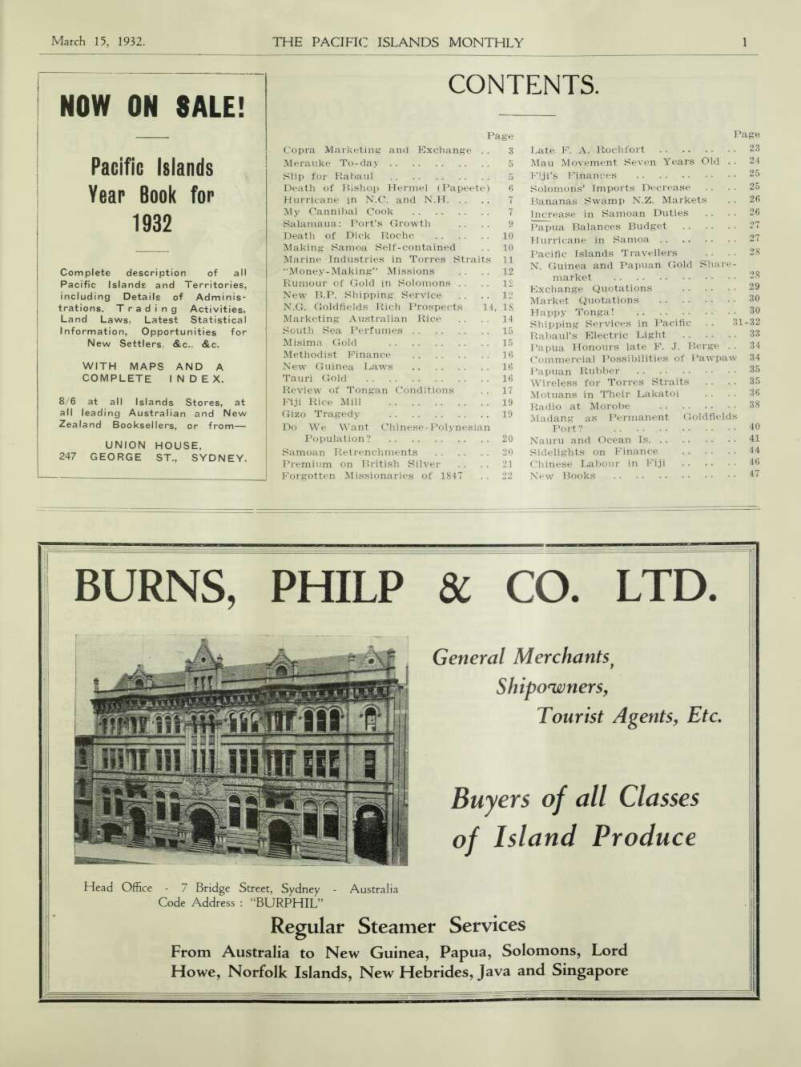
Page Copra Marketing and Exchange . . 3 Merauke To-day 5 Slip for Rabaul 5 Death of Bishop Hermel (Papeete) 6 Hurricane in N.C. and N.H 7 My Cannibal Cook 7 Salamaua: Port’s Growth . . . . 9 Death of Dick Roche 10 Making Samoa Self-contained . . 10 Marine Industries in Torres Straits 11 “Money-Making” Missions . . . . 12 Rumour of Gold in Solomons . . . . 12 New B.P. Shipping Service . . .. 12 N.G. Goldfields Rich Prospects 14, IS Marketing Australian Rice . . . . 14 South Sea Perfumes 15 Misima Gold 15 Methodist Finance 16 New Guinea Laws 16 Tauri Gold 16 Review of Tongan Conditions . . 17 Fiji Rice Mill 19 Gizo Tragedy 19 Do We Want Chinese-Polynesian Population? 20 Samoan Retrenchments 20 Premium on British Silver . . 21 Forgotten Missionaries of 1847 . . 22
Page Late F. A. Rochfort 23 Mau Movement Seven Years Old . . 24 Fiji’s Finances 25 Solomons’ Imports Decrease . . . . 25 Bananas Swamp N.Z. Markets . . 26 Increase in Samoan Duties .. . . 26 Papua Balances Budget 27 Hurricane in Samoa 27 Pacific Islands Travellers . . . . 28 N. Guinea and Papuan Gold Share market 28 Exchange Quotations 29 Market Quotations 30 Happy Tonga! 30 Shipping Services in Pacific . . 31-32 Rabaul’s Electric Light 33 Papua Honours late F. J. Berge . . 34 Commercial Possibilities of Pawpaw 34 Papuan Rubber 35 Wireless for Torres Straits . . . . 35 Motuans in Their Lakatoi . . . . 36 Radio at Morobe 38 Madang as Permanent Goldfields Port? 40 Nauru and Ocean Is 41 Sidelights on Finance 44 Chinese Labour in Fiji 46 New Books 47
Advertisements & other items, pp. 3-4 (1 item)
Burns, Philp & Co. Ltd.
General Merchant
Shipowners,
Tourist Agents, Etc.
Buyers of all Classes
of Island Produce
Head Office - 7 Bridge Street, Sydney - Australia Code Address : “BURPHIL”
Regular Steamer Services From Australia to New Guinea, Papua, Solomons, Lord Howe, Norfolk Islands, New Hebrides, Java and Singapore
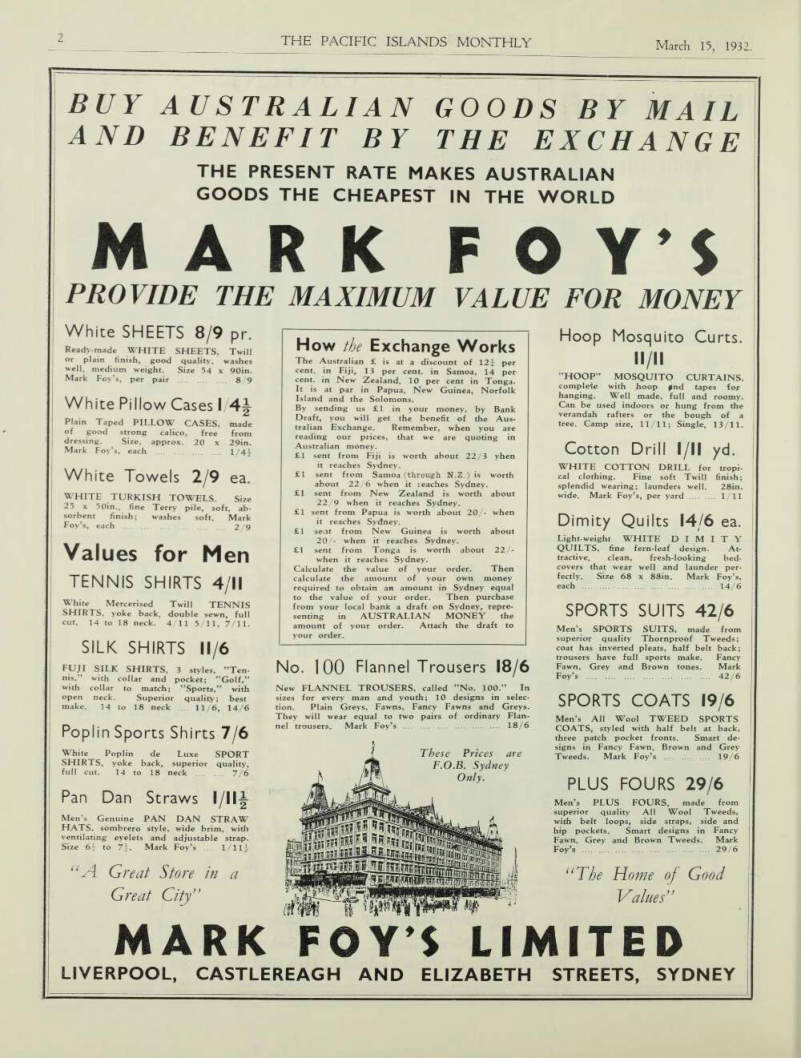
BUY AUSTRALIAN GOODS BY MAIL
AND BENEFIT BY THE EXCHANGE
THE PRESENT RATE MAKES AUSTRALIAN
GOODS THE CHEAPEST IN THE WORLD
MARK FOY’S
PROVIDE THE MAXIMUM VALUE FOR MONEY
White SHEETS 8/9 pr.
Ready made WHITE SHEETS, Twill or plain finish, good quality, washes well, medium weight. Size 54 x 90in.
Mark Foy’s, per pair 8 9
White Pillow Cases 1/4½
Plain Taped PILLOW CASES, made of good strong calico, free from dressing. Size, approx. 20 x 29in.
Mark Foy’s, each 1 /41
White Towels 2/9 ea.
WHITE TURKISH TOWELS. Size
25 x 50in., fine Terry pile, soft, ab sorbent finish; washes soft. Mark Foy’s, each 2/9
Values for Men
TENNIS SHIRTS 4/11
White Mercerised Twill TENNIS SHIRTS, yoke back, double sewn, full cut. 14 to 18 neck. 4/11 5/11, 7/11.
SILK SHIRTS 11/6
FUJI SILK SHIRTS, 3 styles, "Ten nis,” with collar and pocket; "Golf,” with collar to match; "Sports,” with open neck. Superior qualitjy; best make. 14 to 18 neck 11/6, 14/6
Poplin Sports Shirts 7/6
White Poplin de Luxe SPORT SHIRTS, yoke back, superior quality, full cut. 14 to 18 neck 7/6
Pan Dan Straws 1/11½
Men’s Genuine PAN DAN STRAW HATS, sombrero style, wide brim, with ventilating eyelets and adjustable strap.
Size 6-j to 7-j. Mark Foy’s ... 1/11½
“A Great Store in a
Great City
How the Exchange Works
The Australian £ is at a discount of 12½ per cent, in Fiji, 13 per cent, in Samoa, 14 per cent, in New Zealand, 10 per cent in Tonga.
It is at par in Papua, New Guinea, Norfolk Island and the Solomons.
By sending us £1 in your money, by Bank Draft, you will get the benefit of the Aus tralian Exchange. Remember, when you are reading our prices, that we are quoting in Australian money. £1 sent from Fiji is worth about 22/3 when it reaches Sydney. £1 sent from Samoa (through N.Z.) is worth about 22/6 when it reaches Sydney. £1 sent from New Zealand is worth about 22/9 when it reaches Sydney. £1 sent from Papua is worth about 20/- when it reaches Sydney. £1 sent from New Guinea is worth about 20/- when it reaches Sydney. £1 sent from Tonga is worth about 22/when it reaches Sydney.
Calculate the value of your order. Then calculate the amount of your own money required to obtain an amount in Sydney equal to the value of your order. Then purchase from your local bank a draft on Sydney, repre senting in AUSTRALIAN MONEY the amount of your order. Attach the draft to your order.
No. 100 Flannel Trousers 18/6
New FLANNEL TROUSERS, called "No. 100.” In sizes for every man and youth; 10 designs in selec tion. Plain Greys, Fawns, Fancy Fawns and Greys.
They will wear equal to two pairs of ordinary Flan nel trousers. Mark Foy’s 18/6 These Prices are F.O.B. Sydney
Only.
Hoop Mosquito Curts.
11/11
"HOOP” MOSQUITO CURTAINS,
complete with hoop fnd tapes for hanging. Well made, full and roomy.
Can be used indoors or hung from the verandah rafters or the bough of a tree. Camp size, 11/11; Single, 13/11.
Cotton Drill 1/11 yd.
WHITE COTTON DRILL for tropi cal clothing. Fine soft Twill finish; splendid wearing; launders well. 28in. wide. Mark Foy’s, per yard 1/11
Dimity Quilts 14/6 ea.
Light-weight WHITE DIMITY QUILTS, fine fern-leaf design. At tractive, clean, fresh-looking bed covers that wear well and launder per fectly. Size 68 x 88in. Mark Foy’s, each 14/6
SPORTS SUITS 42/6
Men’s SPORTS SUITS, made from superior quality Thornproof Tweeds; coat has inverted pleats, half belt back; trousers have full sports make. Fancy Fawn, Grey and Brown tones. Mark Foy’s 42/6
SPORTS COATS 19/6
Men’s All Wool TWEED SPORTS COATS, styled with half belt at back, three patch pocket fronts. Smart de signs in Fancy Fawn, Brown and Grey Tweeds. Mark Foy’s 19/6
PLUS FOURS 29/6
Men’s PLUS FOURS, made from superior quality All Wool Tweeds, with belt loops, side straps, side and hip pockets. Smart designs in Fancy Fawn, Grey and Brown Tweeds. Mark Foy’s 29/6
“The Home of Good
Values”
MARK FOY’S LIMITED
LIVERPOOL, CASTLEREAGH AND ELIZABETH STREETS, SYDNEY
The Pacific Islands Monthly
THE NEWSPAPER - MAGAZINE OF THE SOUTH SEAS [Registered at G.P.O., Sydney, for transmission ty post as a newspaper .]
Published about 15th of Each Month and Circulated in Australia and New Zealand and in the following Pacific Territories and Island Groups:
Crown Colony of Fiji.
Australian Territory of Papua.
Mandated Territory (Australia) of New Guinea, Bismarck Archipelago, and Northern Solo mon Islands.
Mandated Territory (Japan) of Marshall, Caro line and Mariana Islands.
American Territory of Guam.
Mandated Territory of Nauru.
British Crown Colony of Gilbert and Ellice Islands.
French Territory of New Caledonia.
British and French Condominium of New Hebrides.
American Territory of Eastern Samoa.
Mandated Territory (New Zealand) of Samoa.
British Solomon Islands Protectorate.
British Protectorate of Tongan Islands.
New Zealand Territory of Cook Islands.
Australian Territory of Norfolk Island.
French Colony of Oceania (Tahiti, etc.) American Territory of Hawaiian Islands.
Owned and Produced by Pacific ‘Publications Ltd., Union House, 247 George Street, Sydney
Telephone Bw 5037
P.O. Box 3408 R
Contributions
Articles, Stories and Photographs dealing with Pacific Islands Subjects are invited, and will be paid for on publication at usual rates.
Subscription Rates
Per Annum, within Postal Convention Territories, Prepaid, Post Free 6/- Per Annum elsewhere, Prepaid, Post Free 8/- Single Copies 6d.
Editor and Publisher :
R. W. Robson.
Advertisements
Advertising Rates; £10 per page; £5/5/- per half page; £2/15/- per quarter page; £1/7/6 per eighth page; Casual Advertisements: 8/per inch.
Colours, etc. by Arrangement Process Blocks made at Advertiser’s expense when required. Screen, 100.
Changes of Advertising Copy should reach this Office by Bth of each month, otherwise previous advertisement may be repeated.
Registered Address for Telegrams and Cables: PACPUB” Sydney
Agents
The following are authorised to receive sub scriptions for The Pacific Islands Monthly — Islands Branches of Burns, Philp & Co., Ltd., and Burns, Philp (Sbuth Seas) Co., Ltd.
Islands Branches of W. R. Carpenter & Co., Ltd.
All Branches of Morris, Hedstrom & Co., Ltd.
Greenwood & Daws (Rabaul).
Whitten Bros., Ltd.. Port Moresby & Samarai.
All Branches and Representatives of W. H.
Grove & Sons, Ltd., Auckland. 9. Russell, Papeete, Tahiti.
Cook Islands Trading Co., Rarotonga.
Mrs. M. Campbell, Cascades, Norfolk Island.
Vol. II.—No. 8.
Sydney: March 15, 1932.
6d. Per Copy.
Price prepaid: 6/- p.a.
Copra Marketing And Exchange.
More interesting information, bearing upon ihe problem of the cost of marketing copra on the world’s markets, has been made available.
WHEN, in the February Issue of The Pacific Islands Monthly, we sought to explain the relationship between the local price of copra, allowing for transport costs, exchange, etc., and the weekly price quoted in London, which is c.i.f., we stirred up a hornets’ nest.
Copra merchants have pointed out indignantly that our correspondents overlooked certain charges against copra; and that in seeking to assess a fair market price at Rabaul, we quoted the various charges (freight, handling, etc.) in Australian money, whereas those charges were in sterling—because they have to be paid in sterling.
We pointed out, in explanation, that the main item of cost referred to—namely, freight—was quoted at £3/5/-; and that as it is well-known that the mer chants ship this copra to London at from £2/10/- to £2/15/- per ton, we assumed that the freight, quoted
at £3/5/-, was in Australian money; and that, there fore, it must be converted into sterling to get the prevailing rate of freight—namely, £2/10/- per ton.
The merchants have replied to this by stating that the £3/5/- freight charged against copra in Rabaul is calculated in sterling and not in Australian cur rency. The merchants, in order to get a special freight rate of around £2/10/- per ton sterling, must guarantee shipments from Rabaul totalling not less than 60,000 or 70,000 tons per annum; and as they are responsible for providing this tonnage, they are entitled to the benefit of the lower freight rate.
Shippers by the “Bremerhaven,” for instance, must pay at least £3/5/- sterling per ton.
This appears to be a reasonable argument and we therefore have pleasure in making it public.
In response to our invitation, Mr. W. R. Carpenter has provided us with the following figures showing, first, the amount per ton, which his firm is paying to planters for copra delivered in Rabaul; and, second, the amount per ton it is calculated planters, ship ping independently, are receiving for their product.
As the usual method of independent shipment from New Guinea is per the “Bremerhaven,” Mr. Carpen ter has based his comparative calculations on a ton of copra bought by him in Rabaul; and another ton
shipped by the “Bremerhaven.” The statement is as follows:
“Thus it will be seen,” says Mr. Carpenter, “that the companies are paying to planters 3/6 per ton more than they get, it’ they ship direct themselves; and, in addition, they accept the risk of market, in surance (whilst in store awaiting shipment), rent (6d. per ton per week), handling charges, loss in weight whilst in store, interest and reclamations and - the greatest risk of all —a fall in the exchange rate, which may take place at any moment.
“The planter gets his money at once whilst, with shipment, he has to take his chance about payment.
“These figures, which cannot be challenged, put a different complexion upon the matter and show that those who ship are in a much worse position than those who sell.
“A glance at an account sales is very misleading, and gives the impression that it pays to ship; but
when one starts to make the correct deductions for loss in weight, interest, and all the other charges the complexion alters.”
In the calculations which we published in the Feb ruary issue, it was indicated that, taking exchange into consideration, Islands merchants were covering their costs and providing for their profit by paying a local price of about £7 per ton less than the price of copra quoted week by week in London. Later in formation seems to bear this out.
But the figures we published in February did not go quite far enough in stating merchants’ costs. The heavy cost of providing storage and shipping facili ties was not taken into consideration and this, in the aggregate, is a substantial item. Neither was risk of market and exchange sufficiently emphasised.
From about the middle of 1930 until nearly the end of 1931, the copra market fell steadily and the Islands merchants, who bought in the Islands for sale in Europe or America, must have met heavy losses. If they did not, the fact is a tribute to their foresight and shrewdness: and men are entitled to reward for those qualities.
The point is that a certain unknown proportion of the £7 per ton, to which we referred, is unquestion ably the merchant ’s profit. Some of the Islands pro ducers think that the rate of profit is too high. Mer chants, emphasising the enormous extent to which they support the Islands communities, and take the risks of market and exchange, declare that whatever profit they make is justified and earned. It is a mat ter of opinion. The discussion has had this value— that it has brought out for public consideration all the various details of costs charged against the mar keting of copra; and if there is any means by which producers and merchants can get together for the elimination of some of the many costs of getting the product to the world’s markets, there is little doubt there will be cordial co-operation from both sides.
Take copra at price as per “Sydney Morning Herald, 29/2/32, per ton in Europe £16 10 0 Less deduction made by merchants 3 10 0 Plus bonus £18 0 0 10 oo Price per ton for copra delivered at Rabaul 13 10 0 Shipment Per “Bremerhaven."
London price £16 10 0 Freight, £3/5/- per ton. plus 10% .. £3 11 6 Commission, etc., 3J% and loss of weight 6J% 1 13 0 5 4 6 Plus exchange (less allowance for inter- £11 5 6
est) 22}
2 9 6 Less duty 7/6, and wharfage 1/- £13 15 0 0 8 6 £13 6 6
To Assist N.G. Patrols.
A New ’Drome.
From Our Own Correspondent.
Wau, N.G., Feb. 24.
ASSISTANT District Officer Penglase and Patrol Officer Sanson are out from the Morobe goldfield in the direction of Mt. Lawson, making efforts to get in touch with the few natives in that district, and have built a new ’drome at the base camp there.
Patrol Officer Sanson is an ex-war pilot and knows what is required in the making of a landing ground; but has had a good deal of difficulty in finding a suitable site. However, Captain Holden has had no difficulty in land ing on the ’drome, and supplies are now being taken there regularly.
This, of course, makes unnecessary the employment of the usual large line of carriers between headquarters and the patrolling forces.
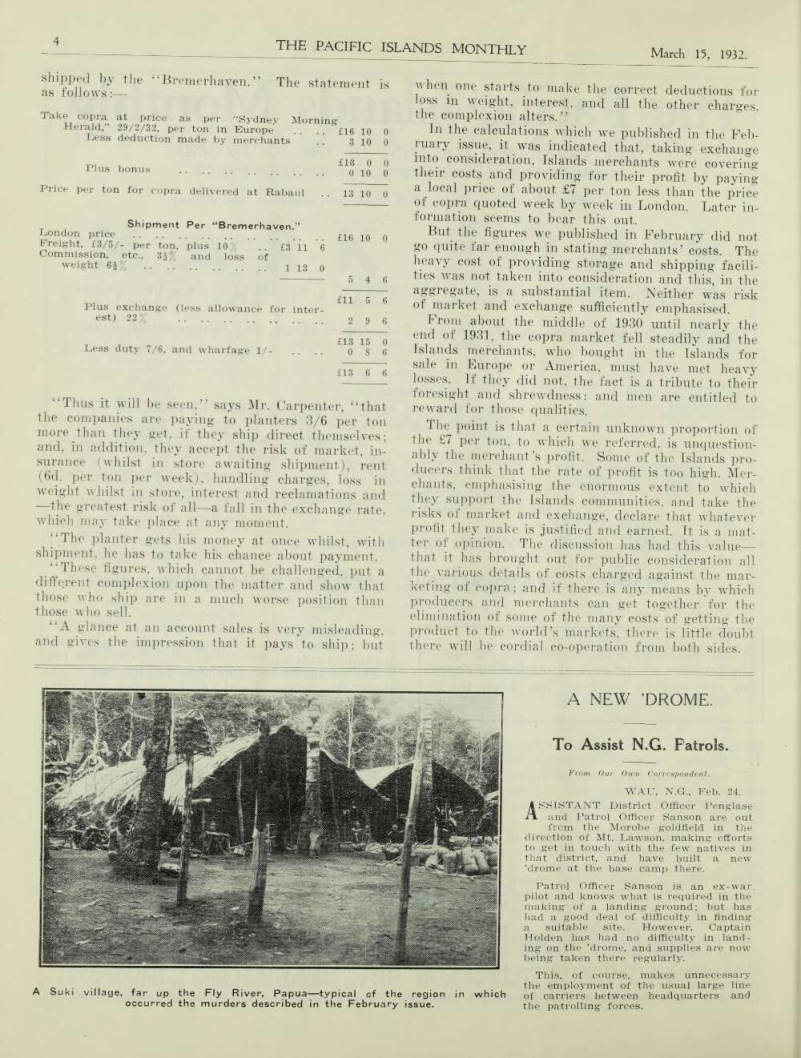
A Suki village, far up the Fly River, Papua—typical of the region in which occurred the murders described in the February issue.
Merauke Of To-Day
An Isolated Corner of Dutch New Guinea
From Our Own Correspondent.
THURSDAY IS., February 20.
Communication between Dutch New Guinea and Thursday Island is of rare occurrence, and, though the two places are less than 200 miles apart, letters by the regular route take over two months to be delivered.
This is an instance of the great gulf which separates various parts of the Island world, and is so typical of many parts of the Pacific, However, this terra incognita has been lately visited by a party of Thurs day Islanders, who have just returned with what news is to be gleamed from the decaying town of Merauke. The occasion was a hunt after an alleged motor launch thief who, after various adventures on his voyage from Cairns, through Torres Straits, arrived at Mer auke and was promptly detained by the authorities there. Constable Grant travelled over from Thursday Island in the Government ketch, Melbidir (which had been requisitioned by the police) for the purpose of bringing the wan dering launch and her erring navigator back from whence they had started many months ago.
During some delay in the completion of the extradition papers, the less of ficial members of the party went sight seeing, and, if rumour be correct, suc ceeded in making themselves thor oughly at home, the only fly in the ointment being the question of ex change. On arrival, the pound note was found to be only worth nine guilders (15/-), but worse was to come.
The next day, a notice at the post of fice informed the Australians that their money values had dropped consider ably during the night; alas! it was now reduced to a few cents over seven guilders.
This portion of the Dutch Empire depends now on a single product—copra —so naturally the district cannot be said to be in a flourishing condition.
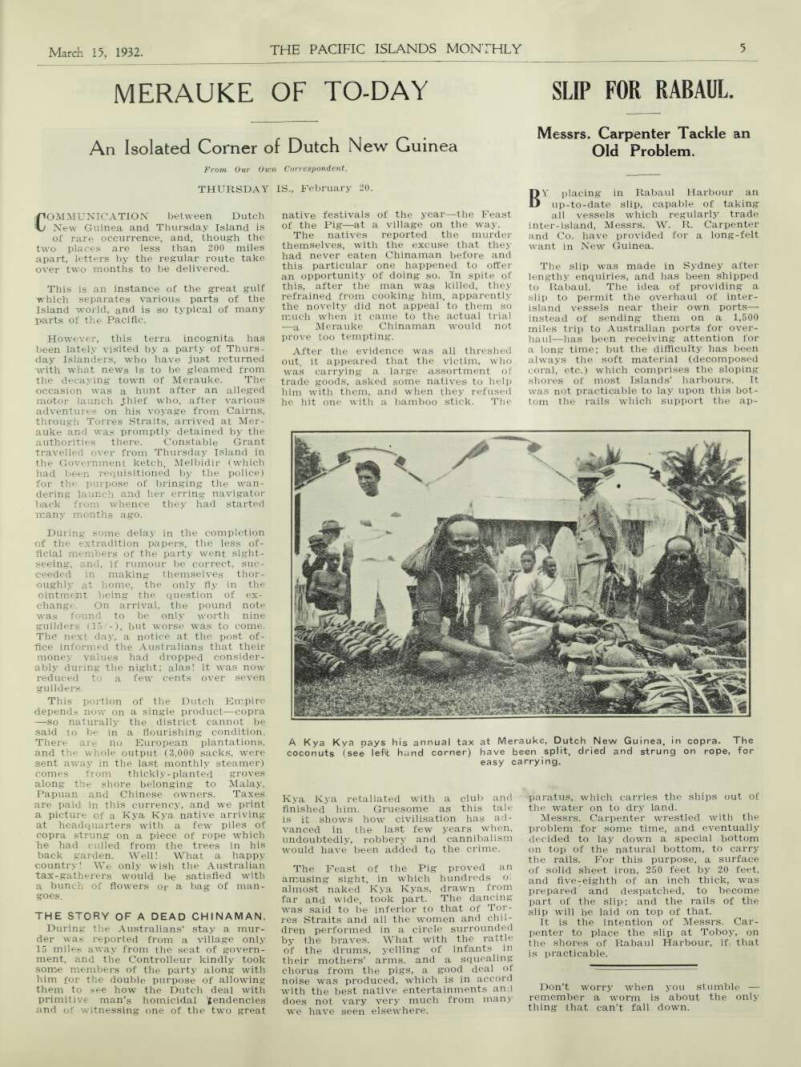
There are no European plantations, and the whole output (3,000 sacks, were sent away in the last monthly steamer) comes from thickly-planted groves along the shore belonging to Malay, Papuan and Chinese owners. Taxes are paid in this currency, and we print a picture of a Kya Kya native arriving at headquarters with a few piles of copra strung on a piece of rope which lie had culled from the trees in his back garden. Well! What a happy country! We only wish the Australian tax-gatherers would be satisfied with a bunch of flowers or a bag of man goes.
The Story Of A Dead Chinaman.
During the Australians’ stay a mur der was reported from a village only 15 miles away from the seat of govern ment, and the Controlleur kindly took some members of the party along with him for the double purpose of allowing them to see how the Dutch deal with primitive man’s homicidal pendencies and of witnessing one of the two great
native festivals of the year—the Feast of the Pig—at a village on the way.
The natives reported the murder themselves, with the excuse that they had never eaten Chinaman before and this particular one happened to offer an opportunity of doing so. In spite of this, after the man was killed, they refrained from cooking him, apparently the novelty did not appeal to them so much when it came to the actual trial —a Merauke Chinaman would not prove too tempting.
After the evidence was all threshed out. it appeared that the victim, who was carrying a large assortment of trade goods, asked some natives to help him with them, and when they refused he hit one with a bamboo stick. The
Kya Kya retaliated with a club and finished him. Gruesome as this tale is it shows how civilisation has ad vanced in the last few years when, undoubtedly, robbery and cannibalism would have been added to the crime.
The Feast of the Pig proved an amusing sight, in which hundreds of almost naked Kya Kyas, drawn from far and wide, took part. The dancing was said to be inferior to that of Tor res Straits and all the women and chil dren performed in a circle surrounded by the braves. What with the rattle of the drums, yelling of infants in their mothers’ arms, and a squealing chorus from the pig's, a good deal of noise was produced, which is in accord with the best native entertainments and does not vary very much from many we have seen elsewhere.
A Kya Kya Days his annual tax at Merauke, Dutch New Guinea, in copra. The coconuts (see left hand corner) have been split, dried and strung on rope, for easy carrying.
Slip For Rabaul.
Messrs. Carpenter Tackle an Old Problem.
BY placing in Rabaul Harbour an up-to-date slip, capable of taking all vessels which regularly trade inter-island, Messrs. W. R. Carpenter and Co. have provided for a long-felt want in New Guinea.
The slip was made in Sydney after lengthy enquiries, and has been shipped to Rabaul. The idea of providing a slip to permit the overhaul of inter island vessels near their own ports— instead of sending them on a 1,500 miles trip to Australian ports for over haul —has been receiving attention for a long time; but the difficulty has been always the soft material (decomposed coral, etc.) which comprises the sloping shores of most Islands’ harbours. It was not practicable to lay upon this bot tom the rails which support the ap
paratus, which carries the ships out of the water on to dry land.
Messrs. Carpenter wrestled with the problem for some time, and eventually decided to lay down a special bottom on top of the natural bottom, to carry the rails. For this purpose, a surface of solid sheet iron, 250 feet by 20 feet, and five T eighth of an inch thick, was prepared and despatched, to become part of the slip; and the rails of the slip will be laid on top of that.
It is the intention of Messrs. Car penter to place the slip at Toboy, on the shores of Rabaul Harbour, if that is practicable.
Don’t worry when you stumble remember a worm is about the only thing that can’t fall down.
Rabaul.
New Bakery For
FOR a good many years, there has been dissatisfaction in Rabaul with the quality of some of the local bakery service. Finally, Messrs. W. R Carpenter and Co. have opened a modern bakery in Rabaul, and have re duced the price of bread considerably.
The slight disturbance in the New Guinea bread trade thus caused appears to have stirred up the Administration, with the result that the new bakery has been called upon to comply very strictly with the Ordinances regarding cleanli ness, etc. The bakery manager has not complained, but he has made a public suggestion that it is only fair that the Chinese and other bakeries in Rabaul shall be forced to comply in the same strict fashion with the Government Or dinance.
Accident At Bulolo.
From Our Own Correspondent.
WAU, N.G., February 24.
THE first serious accident at Bulolo happened on Saturday last, when J. J. Lennon, lorry driver, suffered a fractured pelvis.
Whilst unloading- pipes, 4ft. 6in. in diameter and 20 to 30 feet long, from the truck, the natives holding the ropes, by which the pipes were being lowered, allowed too much slack, with the result that they were unable to hold the weight and a pipe started to career down the side of a hill.
When Mr. Lennon saw this he tried to stop the pipe, but was knocked down by it and his legs and pelvis were crushed Fortunately, at the time, Mr.
Lennon was standing near a stump, and this prevented the pipe from com pletely crushing him. A number of men working at the foot of the hill and in the road of the oncoming pipe were for tunate to escape.
Death Of Bishop Hermel At Papeete.
Papeete, Feb. 23.
I HAVE to record, with deep regret, the death of his Excellency, the Reverend Monsignor Athanase Andre Etienne Hermel, third Vicar Aposto lique of Tahiti, which took place in Papeete on February 20, after a long and painful illness. It was generally known here, some months ago, that the deceased gentleman underwent an un successful operation for some serious internal malady, so that this sad event was not altogether unexpected.
Bishop Hermel was born in Fecamp, France, 59 years ago, of a family which has given many officers to the French navy for generations; his surviving brother now holds the rank of Com mandant. He was educated in France, and latterly in Spain, and joined the order of the Sacre Coeur de Picpus.
Arriving in Tahiti in 1903, he was ap pointed Bishop three years later at the age of 34, thereby gaining the distinc tion of being the youngest Catholic Bishop in the world at that time.
As an example of high courage, un flinching self-sacrifice, and devotion to duty, Bishop Hermel will long be re membered in Tahiti and the surround ing archipelagoes, for he was as sin cerely loved by the wild people of the Tuamotu atolls as by their more so phisticated relatives in Papeete, and travelled there to see them under the most appalling difficulties.
To him also must be given the credit of re-building the boys’ and girls’ schools at Papeete, and the erection of similar edifices on the Island of Raia tea. The part of Papeete now known as the Mission Quarter also came into existence owing to his gen erosity and breadth of outlook. This was a piece of jungle land formerly be longing to the Catholic fraternity, which was cut up into sections, sold on very easy terms and now forms one of the most desirable residential sections.
During his distinguished career in Drench Oceania, Bishop Hermel won many laurels, including the coveted red ribbon of the Legion d’Honneur,
Samoan Planter’S
Enterprise
From Our Own Correspondent.
APIA, February 5.
ONE of the oldest cocoa planters of Samoa, Mr. F. Jahnke, has just completed the erection of an up-to date cocoa dryer at his Fasitovuta plantation.
This plant consists of a Gordon drier with grader, washer and electric light plant, and is a great improvement, installed at a considerable expense and showing the enterprise of the owner and his belief in the future of the industry.
A large number of planters and citi zens assembled to celebrate the instal lation of the drier and a happy time was spent by the guests of Mr. Jahnke to whom complimentary speeches were addressed.
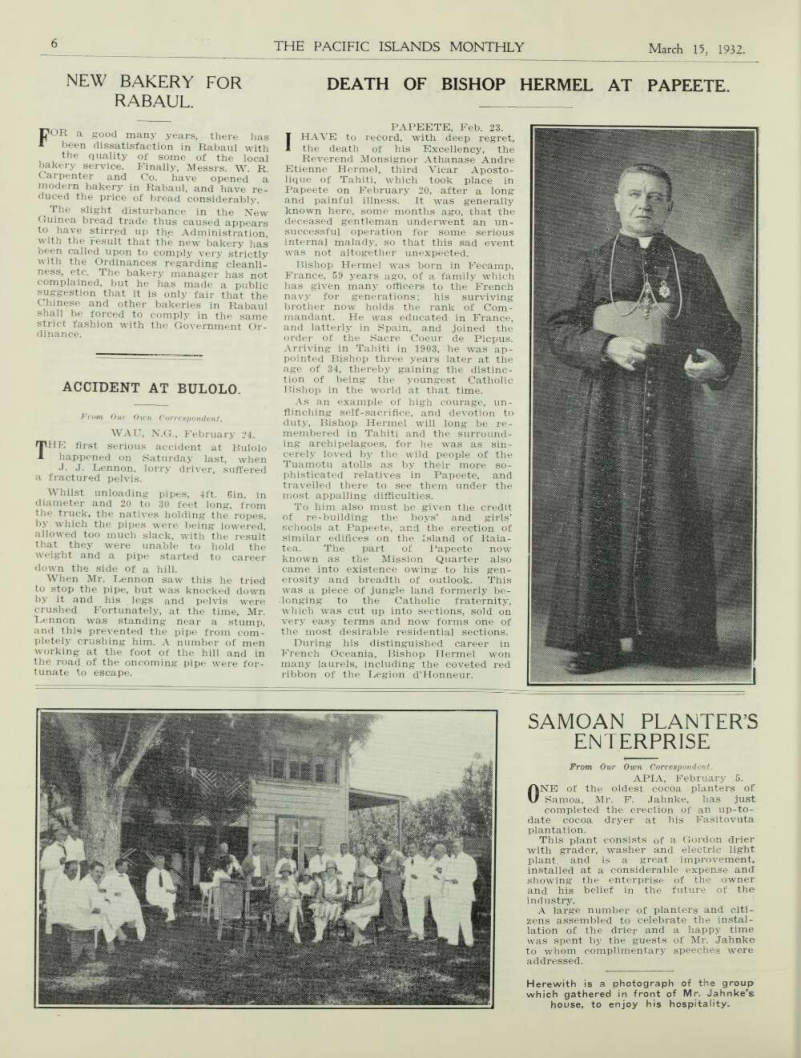
Herewith is a photograph of the group which gathered in front of Mr. Jahnke's house, to enjoy his hospitality.
Terrific Hurricane
Damages Central New Caledonia and New Hebrides.
A VERY severe hurricane swept over the New Hebrides and New Caledonia on February 24, doing a considerable amount of damage, especially on the island of Epi, New Hebrides, and in the agricul tural districts of Central New Caledonia.
IT is reported from Noumea that about 2,700 natives on Epi are completely destitute, and the plantations on the island, which comprise some of the finest in the group, have been badly damaged.
Rev, M. Frater, a Presbyterian mis sionary in the New Hebrides, has sent the following radio to the Melbourne office of his Mission: “Terrific hurricane. Houses unroofed.
Ten churches down. Burumba launch lost.”
The message does not state whether the hurricane was confined to Epi, but it is regarded by the mission authori ties as almost certain that the islands of Pauma and Ambrym were involved.
Burumba is the headquarters of the Mission on Epi.
It was also reported that the southern ond of Mallicollo (N.H.) had suffered severely.
The full force of the hurricane struck Central New Caledonia and the villages Houailou, Canala, and Bourail are all in ruins. Other villages suffered severely. Settlers in the vicinity are stated to be destitute.
The Governor of the Colony has sent an urgent appeal to France for financial help.
Laperouse Strikes Hurricane.
The steamer “Laperouse,” which was on her way from Noumea to Port Vila, struck a terrific wind, with high seas.
However, she came through the en counter undamaged. A few glasses in the saloon were broken.
The purser, interviewed on the ves sel’s return to Sydney, said that coco
nut plantations on Epi had suffered considerably, and it was thought it would take at least three years for these plantations to recover, Both the East and West Coasts of Centra| New Caledonia had been swept.
The most serious damage was at the town of Bourall, where houses were un roofed and badly battered.
No estimates of the losses caused by the hurricane were known in Noumea when the vessel left on her return to Sydney. It was believed that the na tives of both Epi and Central New Caledonia had suffered heavy losses.
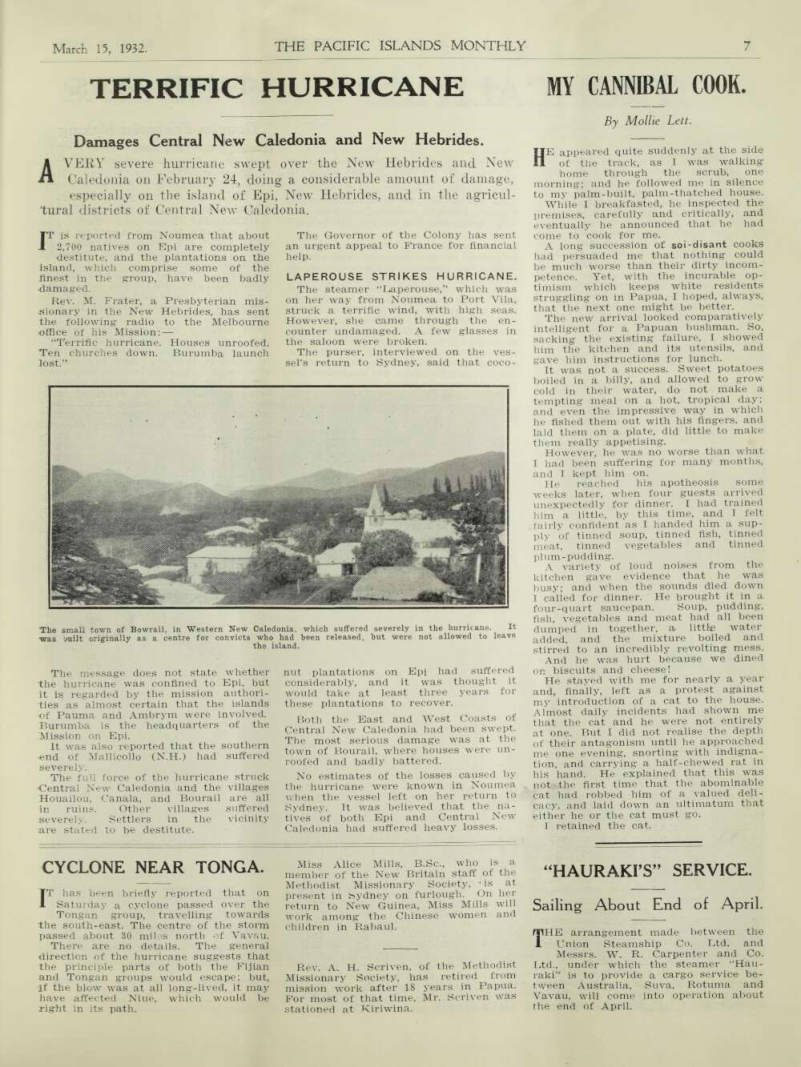
The small town of Bowrail, in Western New Caledonia, which suffered severely in the hurricane. It was built originally as a centre for convicts who had been released, but were not allowed to leave the island.
Cyclone Near Tonga.
IT has been briefly reported that on Saturday a cyclone passed over the Tongan group, travelling towards the south-east. The centre of the storm passed about 30 mil*s north of Vavau.
There are no details. The general direction of the hurricane suggests that the principle parts of both the Fijian and Tongan groups would escape; but, if the blow was at all long-lived, it may have affected Niue, which would be right in its path.
Miss Alice Mills, B.Sc., who is a member of the New Britain staff of the Methodist Missionary Society, is at present in Sydney on furlough. On her return to New Guinea, Miss Mills will work among the Chinese women and children in Rabaul.
Rev. A. H. Scriven, of the Methodist Missionary Society, has retired from mission work after 18 years in Papua.
For most of that time, Mr. Scriven was stationed at Kiriwina.
My Cannibal Cook.
By Mollie Lett.
HE appeared quite suddenly at the side of the track, as I was walking home through the scrub, one morning; and he followed me in silence to my palm-built, palm-thatched house.
While I breakfasted, he inspected the premises, carefully and critically, and eventually he announced that he had come to cook for me.
A long succession of soi-disant cooks had persuaded me that nothing could be much worse than their dirty incom petence. Yet, with the incurable op timism which keeps white residents struggling on in Papua, I hoped, always, that the next one might be better.
The new arrival looked comparatively intelligent for a Papuan bushman. So, sacking the existing failure, I showed him the kitchen and its utensils, and gave him instructions for lunch.
It was not a success. Sweet potatoes boiled in a billy, and allowed to grow cold in their water, do not make a tempting meal on a hot, tropical day: and even the impressive way in which he fished them out with his fingers, and laid them on a plate, did little to make them really appetising.
However, he was no worse than what I had been suffering for many months, and I kept him on.
He reached his apotheosis some weeks later, when four guests arrived unexpectedly for dinner. I had trained him a little, by this time, and I felt fairly confident as I handed him a sup ply of tinned soup, tinned fish, tinned meat, tinned vegetables and tinned
plum-pudding.
A variety of loud noises from the kitchen gave evidence that he was busy; and when the sounds died down I called for dinner. He brought it in a four-quart saucepan. Soup, pudding, fish, vegetables and meat had all been dumped in together, a little water added, and the mixture boiled and stirred to an incredibly revolting mess.
And he was hurt because we dined on biscuits and cheese!
He stayed with me for nearly a year and, finally, left as a protest against my introduction of a cat to the house.
Almost daily incidents had shown me that the cat and he were not entirely at one. But I did not realise the depth of their antagonism until he approached me one evening, snorting with indigna tion, and carrying a half-chewed rat in his hand. He explained that this was not the first time that the abominable cat had robbed him of a valued deli cacy, and laid down an ultimatum that either he or the cat must go.
I retained the cat.
“Hauraki’S” Service.
Sailing About End Of April.
THE arrangement made between the Union Steamship Co. Ltd. and Messrs. W. R. Carpenter and Co.
Ltd., under which the steamer “Hau raki” is to provide a cargo service be tween Australia, Suva, Rotuma and Vavau, will come into operation about the end of April.
Tropicalities
SOME of the Sydney newspapers will not discontinue their ridiculous stories about the South Sea Islands until some god, which dislikes sensa tion-mongers, puts them permanently out of existence. One Sunday paper, on March 5, published a “short story” about the wreck of a small vessel, when on a direct voyage from Sydney to the Solomons. The crew took to the long boat, rowed for about six hours, and landed in the Hermit group, among friendly natives. The Hermits are north of New Guinea. To get there, a ship bound for the Solomons would have to travel another 1,000 miles to the north ward, and about 1,100 miles westward of its course. The yarn was entitled, “East of Samarai.” The Hermits are about 800 miles north-west of Samarai! * * * MUCH of the worn is done by mon keys, said Mrs. J. A. Innes, when I asked her about the servant problem in Salamaua, where she assists her husband in the management of hotel, store, etc. “Monkeys!” I nearly exclaimed—and then remembered that in New Guinea all very young native males are so described—evidently to distinguish them from the “boys.” A “boy” is a native man in service— whether he is 20 or 60, he is still a “boy.”
Mrs. Innes takes the keenest interest in her “monkeys,” of which she has several in training. “They are Siassis, from near Eitape,” she said, “and they are the most impudent, mischievous little wretches one could find anywhere.
Yet they are very loyal and intelligent and, properly handled, they are excel lent houseboys. They are very cleanly in their habits and, if they were let, they would spend all their days in the surf. I have ‘boys’ from Madang, and some Kavieng ‘Marys.’ Really, if one is accustomed to handling natives, and sees to their welfare, the servant prob lem in New Guinea is not serious.” * * * THE story in Sydney “Sun” of Feb ruary 7, about Sir Hubert Murray (Lieut.-Governor of Papua) and his work—wherein his Excellency is pic tured with topi, riding-trousers and giddy little whip—has excited much de rision. “It is amusing and ridiculous,” writes “Tropic.” “If Sir Hubert had been sketched dressed in a flannel shirt, with a handkerchief round his neck, tweed trousers tucked inside his socks, a wide-brimmed felt hat and heavy boots, Papuans would have recognised him. In view of the work done by his predecessors, especially the late Sir William MacGregor, I cannot believe that Sir Hubert Murray said that ‘there was no existing scheme of government’ when he took charge. As a matter of fact, the way was well blazed for him by MacGregor, Le Hunte, Robinson and Barton. Sir Hubert’s chief work has been connected with the native popu lation.” * * * * NOT content with captaining affairs of State, the Solomon Islands Resident Commissioner (writes our Tulagi correspondent) is coming forth as
Captain of his Government yacht “Tulagi.” He recently set out on a trip to the western end of the group, but “the weather proved untrue,” as the song has it, and, as health also turned against him, he returned to port and later made the trip in the “Mataram.”
IN connection with the retrenchment policy of the Samoan Administra tion, an amusing incident is told of an official, who, some time ago, publicly boasted of his ability to save a large amount of money for the administra tion by taking over the duties of a brother official, in addition to his own, Probably the beach wireless carried his suggestions to the right quarter. But the result was not quite as expected, for the enterprising one is to be retired shortly and the man he wanted to re place takes over his job. * * * FROM one end of the Pacific to the other, there is more bitter feeling displayed about liquor control than about any other subject. Within the last few months we have heard shouts oi anger from Norfolk Island, Raro tonga, Samoa, and the Solomons con cerning liquor regulations; and now trouble is bubbling up in New Guinea.
In nearly every case, unpleasant inci dents occur, not through any serious abuse of alcohol, but because of official dom’s interference with the right of all free men to drink liquor how and when they like. There is nothing quite so easy to take as an iced beer on a tor rid afternoon; or a clean w. and s. at the end of a harsh day—and there is nothing more irritating than the self assumed right of otherwise very worthy folk to forbid or regulate the consump tion of liquor. “A little wine for the stomach’s sake” has been the Anglo- Saxon rule, through 2,000 years of so cial evolution —and if you quote Am erica to me, I shall say very rude things about Americans!
Certainly, we must protect the na tives against our liquors—al though our anxiety in this regard is a little belated, in view of what we have bequeathed to them in the shape of fatal and filthy diseases. All of which is merely leading us up to the mild suggestion that, if the New Guinea Ad ministration does not want to stir up a nest of hornets, it should apply its liquor ordinances with tact. British people will stand almost anything—the amazing career of Mr. Lang in New South Wales, for example—but when one tries to deprive them of their beer, one arouses a horde of furies. * * * * NOTHING beyond a few obscure lines on a back page of a Sydney news paper has been published to let the world know that one of the most im portant events in the history of New Guinea is about to occur —namely, the starting of the first big dredge on the Morobe goldfield. It is on the Bulolo River, some miles north-west of Wau.
A second dredge is nearly ready to start, and a third is under construc tion in Sydney. Very soon six figures will be needed to compute the gold an nually coming out of the Territory.
Tahiti News.
Douglas Fairbanks Making a Film.
From Our Oven Correspondent.
Papeete, Feb. 23.
THE recent arrival of the yacht ‘Cressida,” from New York, has given rise to much admiring com ment along the beach concerning her really beautiful lines and towering topsail-schooner rig.
She is here under charter to Messrs.
Jennings, Dick and Noyes, who, with a party of friends and a crew of 22, are making a pleasure cruise through the Islands.
On arriving here yesterday from a, side trip through the Leeward Group, the entire party proceeded to the beautiful residence of the late cinema director, Mr. Murnau, which they have engaged for a week, while the yacht is being overhauled. So delighted were they with the location that they wished to take the place for a longer term, but it had been already engaged from February 27 by Douglas Fair banks, for a long period. Mr. Fair banks is arriving with a large cast and equipment on the S.S. Makura, with the intention of filming a South Sea picture.
On February 25, we are expecting the yacht “Nourmahal,” belonging to Mr.
Vincent Astor, who, with a party of friends, expects to get some good big game fishing here in the Islands.
Advertisements & other items, p. 10 (1 item)
Residential Hotel.
IMPERIAL
221 DARLINGHURST ROAD, KING’S CROSS,
SYDNEY, N.S.W.
FULL BOARD AND RESIDENCE:
Weekly, from 45/- to 63/-. Daily, 10/-, Management: Mr. and Mrs. Cyril Edwards,
Goldfields Port.
SALAMAUA : Rapid Growth of the Goldfields Port.
THE suggestion that, owing to erosion by sea-action, it may be necessary to abandon the port of Salamaua, and seek another terminal point for the New Guinea goldfields road, is very strongly deprecated by Mrs. G. A.
Innes, who is at present in Sydney. Mrs. Innes is the wife of a well-known business man, Mr. G. A. Innes, who conducts the hotel at Salamaua, the Salamaua Trading Company’s store, and a number of allied industries. Mrs.
Innes has been 12 years in New Guinea—four of them at Salamaua.
WITHIN the space of five years, says Mrs. Innes, very much money has been spent in the establishment of Salamaua, on its narrow, sandy isth mus, and there is now quite a con siderable township.
There are the big stores of W. R.
Carpenter & Co., Ltd. (three buildings), Burns, Philp & Co., Ltd. (three Luildings), Salamaua Trading Co., Gregor McDonald, hotel containing 14 bedrooms. Bank of N.S.W., hospital, Government offices, buildings, and offices of Guinea Airways Ltd., and New
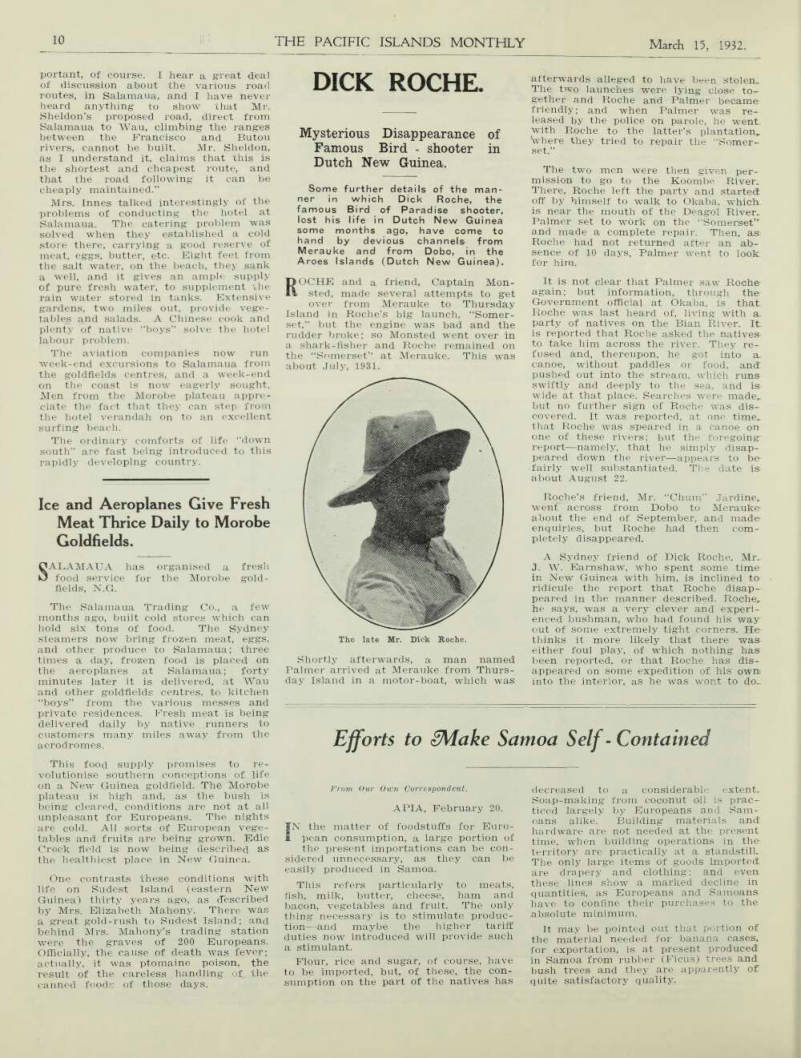
Guinea Goldfield, Ltd., and numerous private buildings. Two miles along the coast, connected by a very good road, is the aerodrome, through which regular communication is maintained with the goldfields. On the inner side of the isthmus, wharves have been built, and there is a good lighter ser vice for the steamers, which anchor in security in the bay behind the isthmus.
Once, Salamaua was unhealthy—there was an unpleasant mangrove swamp at the mainland end of the isthmus. But Guinea Goldfields built a concrete re
taining wall about it, and it is being converted into a park, where Mrs.
Innes has already planted many citrus trees.
Two miles away, near the aerodrome, the hotel management have established 22 acres of vegetable gardens, to pro vide fresh food for the township.
“There has certainly been consider able erosion in recent times,” says Mrs.
Innes, “but we are sure the situation can be dealt with satisfactorily. Mr.
Burley Gorman, one of the Trading Company’s shareholders, who ran a store there many years ago, says that this erosion has been just as bad before. It is seasonal —according to the prevailing winds of a particular season. The shore is partly washed away in one season, and restored in the following season. He says that, on the last erosion, the tide came 8 or 10 feet further in than it does now.
“It should be much easier and cheaper to put down retaining walls, and build up Salamaua, than try to create a new port much further away from the goldfield.
"The question of a road is very im
SALAMAUA, the port of the New Guinea goldfields, as seen from the air. The little town lies along the narrow isthmus. The surf breaks on the right-hand side; the wharves, off which oversea steamers anchor in safety, are on the left-hand side. The aerodrome is in the fore ground, between the cloud masses—where the mouth of the Francesco River can also be seen. The dark, sullen mass of the New Guinea mainland, with clouds hiding the mountain-tops, can he seen acrcss the bay, in the distance. Photo by Downing.
portant, of course. I hear a great deal of discussion about the various road routes, in Salamaua, and I have never heard anything to show that Mr.
Sheldon’s proposed road, direct from Salamaua to Wau, climbing the ranges between the Francisco and Butou rivers, cannot be built. Mr. Sheldon, as I understand it, claims that this is the shortest and cheapest route, and that the road following it can be cheaply maintained.”
Mrs. Innes talked interestingly of the problems of conducting the hotel at Salamaua. The catering problem was solved when they established a cold store there, carrying a good reserve of meat, eggs, butter, etc. Eight feet from the salt water, on the beach, they sank a well, and it gives an ample supply of pure fresh water, to supplement vhe rain water stored in tanks. Extensive gardens, two miles out, provide vege tables and salads. A Chinese cook and plenty of native “boys” solve the hotel labour problem.
The aviation companies now run week-end excursions to Salamaua from the goldfields centres, and a week-end on the coast is now eagerly sought.
Men from the Morobe plateau appre ciate the fact that they can step from the hotel verandah on to an excellent surfing beach.
The ordinary comforts of life “down south” are fast being introduced to this rapidly developing country.
Ice and Aeroplanes Give Fresh
Meat Thrice Daily to Morobe Goldfields.
SALAMAUA has organised a fresh food service for the Morobe gold fields, N.G.
The Salamaua Trading Co., a few months ago, built cold stores which can hold six tons of food. The Sydney steamers now bring frozen meat, eggs, and other produce to Salamaua; three times a day, frozen food is placed on the aeroplanes at Salamaua; forty minutes later it is delivered, at Wau and other goldfields centres, to kitchen “boys” from the various messes and private residences. Fresh meat is being delivered daily by native runners to customers many miles away from the aerodromes.
This food supply promises to re volutionise southern conceptions of life on a New Guinea goldfield. The Morobe plateau is high and, as the bush is being cleared, conditions are not at all unpleasant for Europeans. The nights are cold. All sorts of European vege tables and fruits are being grown. Edie Creek field is now being described, as the healthiest place in New Guinea.
One contrasts these conditions with life on Sudest Island (eastern New Guinea) thirty years ago, as described by Mrs. Elizabeth Mahony. There was a great gold-rush to Sudest Island; and behind Mrs. Mahony’s trading station were the graves of 200 Europeans.
Officially, the cause of death was fever; actually, it, was ptomaine poison, the result of the careless handling of the canned foods of those days.
Dick Roche.
Mysterious Disappearance of
Famous Bird - shooter in
Dutch New Guinea.
Some further details of the man ner in which Dick Roche, the famous Bird of Paradise shooter, lost his life in Dutch New Guinea some months ago, have come to hand by devious channels from Merauke and from Dobo, in the Aroes Islands (Dutch New Guinea).
ROCHE and a friend, Captain Mon sted, made several attempts to get over from Merauke to Thursday Island in Roche’s big launch, “Somer set,” but the engine was bad and the rudder broke; so Monsted went over in a shark-fisher and Roche remained on the “Somerset” at Merauke. This was about July, 1931.
Shortly afterwards, a man named Palmer arrived at Merauke from Thurs day Island in a motor-boat, which was
afterwards alleged to have been stolen.
The two launches were lying close gether and Roche and Palmer became friendly; and when Palmer was re leased by the police on parole, he went with Roche to the latter’s plantation,. where they tried to repair the “Somer set.”
The two men were then given per mission to go to the Koombe River.
There, Roche left the party and started off by himself to walk to Okaba, which is near the mouth of the Deagol River.
Palmer set to work on the “Somerset”’ and made a complete repair. Then, as Roche had not returned after an ab sence of 10 days, Palmer went to look for him.
It is not clear that Palmer saw Roche again; but information, through the Government official at Okaba, is that Roche was last heard of, living with a party of natives on the Bian River, It is reported that Roche asked the natives to take him across the river. They re fused and, thereupon, he got into a canoe, without paddles or food, and pushed out into the stream, which runs swiftly and deeply to the sea, and is wide at that place. Searches were made, but no further sign of Roche was dis covered. It was reported, at one time, that Roche was speared in a canoe on one of these rivers; but the foregoing report—namely, that he simply disap peared down the river—appears to be fairly well substantiated. The date is about August 22.
Roche’s friend, Mr. “Chum” Jardine, went across from Dobo to Merauke about the end of September, and made enquiries, but Roche had then com pletely disappeared.
A Sydney friend of Dick Roche, Mr.
J. W. Earnshaw, who spent some time in New Guinea with him, is inclined to ridicule the report that Roche disap peared in the manner described. Roche, he says, was a very clever and experi enced bushman, who had found his way out of some extremely tight corners. He thinks it more likely that there was either foul play, of which nothing has been reported, or that Roche has dis appeared on some expedition of his own into the interior, as he was wont to do..
The late Mr. Dick Roche.
Efforts to Make Samoa Self-Contained
From Our Own Correspondent.
APIA, February 20.
IN the matter of foodstuffs for Euro pean consumption, a large portion of the present importations can be con sidered unnecessary, as they can be easily produced in Samoa.
This refers particularly to meats, fish, milk, butter, cheese, ham and bacon, vegetables and fruit. The only thing necessary is to stimulate produc tion —and maybe the higher tariff duties now introduced will provide such a stimulant.
Flour, rice and sugar, of course, have to be imported, but, of these, the con sumption on the part of the natives has
decreased to a considerable extents Soap-making from coconut oil is prac ticed largely by Europeans and Sam oans alike. Building materials and hardware are not needed at the present time, when building operations in the territory are practically at a standstill.
The only large items of goods imported. are drapery and clothing: and even these lines show a marked decline in quantities, as Europeans and Samoans have to confine their purchases to the absolute minimum.
It may be pointed out that portion of the material needed for banana cases, for exportation, is at present produced in Samoa from rubber (Ficus) trees and bush trees and they are apparently of quite satisfactory quality.
Marine Industries Prospects In Torres Straits
From Our Own Correspondent.
Thursday Is., Feb. 29.
JANUARY and February are the busiest months of the year on Thursday Island. Engagement of crews, allotment to boats, victualling and overhaul of luggers are all crammed into the first few weeks of Ihe year, and everyone is busy.
As soon as the worst of the North west monsoon is seen to be over, a atart is made on actual operations. The first to leave are the trochus and beche de-mer boats, which work their way down the Barrier till a full cargo neces sitates unloading at Cairns or other Southern ports. Later, the diving boats, the aristocrats of the fleet, will spread their wings and disperse to the various pearling grounds in the Straits. They are a little later than usual how ever; pearl shell is now restricted to amounts that can easily be got in seven months, so a longer lay up than form erly is the rule.
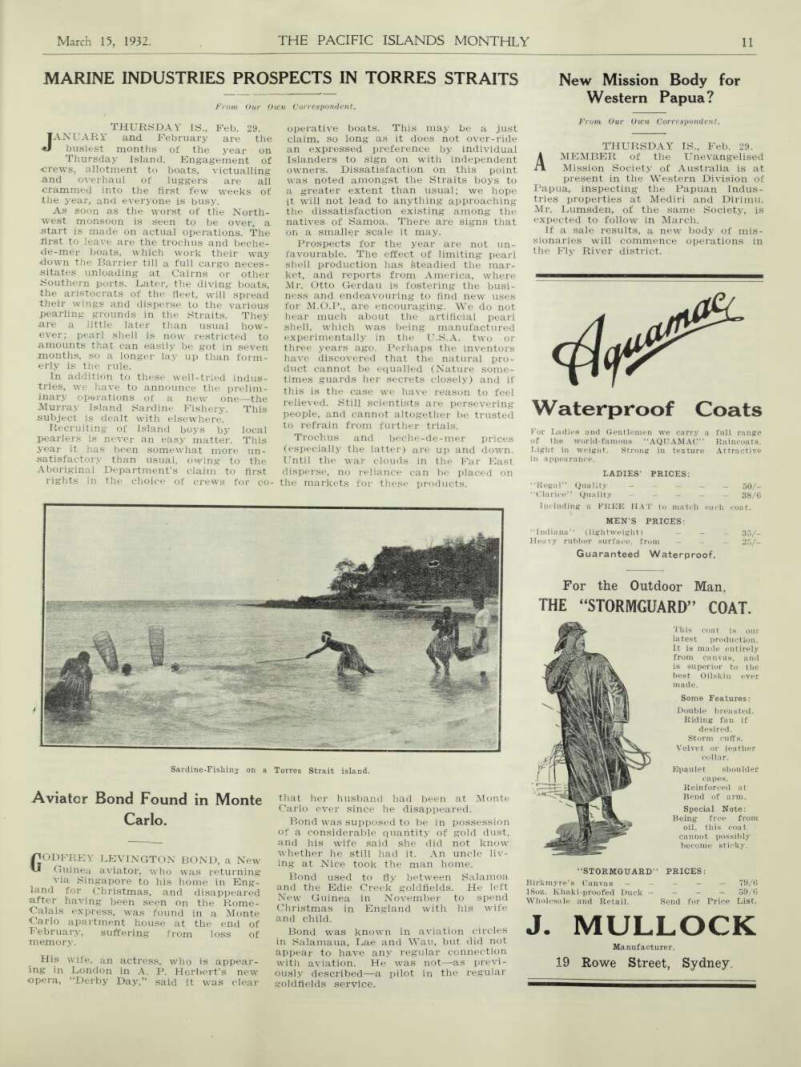
In addition to these well-tried indus tries, we have to announce the prelim inary operations of a new one—the Murray Island Sardine Fishery. This subject is dealt with elsewhere.
Recruiting of Island boys by local pearlers is never an easy matter. This year it has been somewhat more un satisfactory than usual, owing to the Aboriginal Department’s claim to first rights in the choice of crews for co
operative boats. This may be a just claim, so long as it does not over-ride an expressed preference by individual Islanders to sign on with independent owners. Dissatisfaction on this point was noted amongst the Straits boys to a greater extent than usual; we hope it will not lead to anything approaching the dissatisfaction existing among the natives of Samoa. There are signs that on a smaller scale it may.
Prospects for the year are not un favourable. The effect of limiting pearl shell production has Steadied the mar ket, and reports from America, where Mr. Otto Gerdau is fostering the busi ness and endeavouring to find new uses for M.O.P., are encouraging. We do not hear much about the artificial pearl shell, which was being manufactured experimentally in the U.S.A. two or three years ago. Perhaps the inventors have discovered that the natural pro duct cannot be equalled (Nature some times guards her secrets closely) and if this is the case we have reason to feel relieved. Still scientists are persevering people, and cannot altogether be trusted to refrain from further trials.
Trochus and beche-de-mer prices (especially the latter) are up and down.
Until the war clouds in the Far East disperse, no reliance can be placed on the markets for these products.
Sardine-Fishing on a Torres Strait island.
Carlo.
Aviator Bond Found in Monte Carlo.
Godfrey Levington Bond, a New Guinea aviator, who was returning via Singapore to his home in Eng land for Christmas, and disappeared after having been seen on the Rome- Calais express, was found in a Monte Carlo apartment house at the end of February, suffering from loss of memory.
His wife, an actress, who is appear ing in London in A. P. Herbert’s new opera, “Derby Day,” said it was clear
that her husband had been at Monte Carlo ever since he disappeared.
Bond was supposed to be in possession of a considerable quantity of gold dust, and his wife said she did not know whether he still had it. An uncle liv ing at Nice took the man home.
Bond used to fly between Salamoa and the Edie Creek goldfields. He left New Guinea in November to spend Christmas in England with his wife and child.
Bond was known in aviation circles in Salamaua, Lae and Wau, but did not appear to have any regular connection with aviation. He was not —as previ ously described —a pilot in the regular goldfields service.
Western Papua?
New Mission Body for Western Papua?
From Our Own Correspondent.
Thursday Is., Feb. 29.
A MEMBER of the Unevangelised Mission Society of Australia is at present in the Western Division of Papua, inspecting the Papuan Indus tries properties at Mediri and Dirimu.
Mr. Lumsden, of the same Society, is expected to follow in March, If a sale results, a new body of mis sionaries will commence operations in the Fly River district.
Advertisements & other items, p. 13 (1 item)
J. Mullock
Waterproof Coats
For Ladies and Gentlemen we carry a full range of the world-famous “AQUAMAC” Raincoats.
Light in weignt. Strong in texture Attractive in appearance.
LADIES’ PRICES:
“Regal” Quality - 50/- “Clarice” Quality 38/6 Including a FREE HAT to match each coat.
MEN’S PRICES:
‘Indiana’’ (lightweight) - - - 35/- Heavy rubber surface, from - - 25/-
Guaranteed Waterproof.
For the Outdoor Man,
THE “STORMGUARD” COAT.
This coat is our latest production.
It is made entirely from canvas, and is superior to the best Oilskin ever made.
Some Features; Double breasted.
Riding fan if desired.
Sltorm cuffs.
Velvet or leather collar.
Epaulet shoulder capes.
Reinforced at Bend of arm.
Special Note: Being free from oil, this coat cannot possibly become sticky.
“STORMGUARD’’ PRICES:
Birkmyre’s Canvas --- 79/6 18oz. Khaki-proofed Duck - - - — 59/6 Wholesale and Retail. Send for Price List.
J. MULLOCK
Manufacturer,
19 Rowe Street, Sydney.
“Money-Making” Missions.
To The Editor.
Sir, —In response to rny enquiry from Mr. A. J. Vogan for definite informa tion regarding any of our Methodist Missionaries trading in Papua—or else where —he declines to put any one “on the mat”; but cites a specific case of an entirely different character, alleging that he had asked one of our senior missionaries, the Rev. M. K. Gilmour, Chairman of the Papua District, for a passage on our mission boat (by no means a “yacht”) which was refused unless Mr. Vogan paid £25 for the trip and bought his goods at our stores.
The charge was so ridiculous that I came to the conclusion that our Chair man had been facetious and that Mr.
Vogan had failed to interpret the joke.
I radioed, however, to the Chairman of the District as follows: —“Vogan in Pacific Monthly states that you refused take him to Dobu unless he paid you £25 and bought provisions at our stores.
Kindly comment.”
To this the Chairman replied: “Vogan’s statement as your telegram absolutely without foundation. Magis trate corroborates.”
I had further information from the Rev. J. W. Dixon, who is now in Syd ney and who was present at the inter view with Mr. Vogan. Mr. Dixon states most definitely that nothing of this kind was said. The Chairman offered to take Mr. Vogan to Dobu as a guest, but stated that if Mr. Vogan desired to continue his trip to the Trobriands, he would have to ask him to pay for the fuel consumed on that portion of the trip—about £10. One would have thought that was a very fair and gen erous proposal.
I wish to say most definitely that the Methodist Missionary Society of Aus tralasia does not allow trading of any kind by its missionaries, and should a case of infringement of this rule be established, the culprit would be most promptly dealt with by the Society. As
I have pointed out, we have small stores on some of our Stations, but they are only for the convenience of our native staff, and it is one of the rules that if a native missionary abuses the privilege and obtains goods for friends, the privilege is withdrawn. The ques tion of the continuance of these stores was considered at the annual meeting of the Board of Missions held early in February last, and the whole question was remitted to the Papua District Synod for consideration and report.
As to the salaries of the European missionaries: the aim of the Board of Missions is to place its ministers on the Mission Field on a similar footing to the ministers here in the home work, and we think we have arrived at a fair basis. Certainly no one is overpaid.
I am sure that after this definite statement, Mr. Vogan, as a gentleman, will hasten to express his regret that he has published statements reflecting on an earnest body of men and women who are sincerely endeavouring to carry out their duty.
I am,
John W. Burton
General Secretary, Methodist Mission ary Society of Australasia.
Another Opinion.
Mr. Vogan has sent us a letter he has received from Mr. E. W. Harrison, Sebulugomwa, dated February 2, on this subject. Mr. Harrison “agrees with Mr. Vogan on most points; but not all of the Methodist Missionaries here are traders . . . The Mission stores at Sal amo, Bunama, East Cape, and also Bwaidoga are available to any village native who has a shilling or two to spend and, as goods are sold at cost price in these stores, no trader can hope to compete with them. It is time this unfair competition on the part of the Methodist missionaries was termin ated —it does the Society in question no credit.”
Rumour Of Gold
Solomons are Ready to Rush
From Our Own Correspondent.
TULAGI, February 10.
HUSH-HUSH rumours of a gold-find are going the rounds, and a section of the community stands trembling, with its front toe dug well into the ground, ready to make a blind rush to the scene of golden promise.
If there really is fire under the smoke, there will be little need of the proposed retrenchment in Administrative circles for two reasons: (1) that it will be un necessary, and (2) it will be voluntary.
Even the merest promise of gold at a 75 per cent, premium (to say nothing of copra rushing back to a payable figure) is, to say the least, “thrilling”—as the flapper puts it. So perhaps it will be excusable if we prematurely sling our hats in the air and forget the woes of the world for a spasm.
B.-P. Extend.
Small Steamer for Apia-Suva Run.
THE inter-island steamer “Ralum,” which was used by the old Melan esia Co., in New Guinea, and was subsequently taken over by Messrs.
Burns, Philp, has been in Suva lately, undergoing a general overhaul.
She left Suva on March 11, for Levuka, and is there awaiting the re turn from a northerly cruise of the auxiliary schooner “Makoa.”
It is intended to send the “Ralum” to the Gilbert Islands to maintain the ser vice hitherto carried out by the “Makoa,” while the “Makoa” is to be used to maintain a regular service be tween Apia and Suva.
It is believed that the entry of Messrs. Burns, Philp and Co. into the regular service between Samoa and Fiji is the result of the withdrawal of the “Tofua” from the Fiji—Samoa —Tonga run.
Advertisements & other items, p. 14 (1 item)
Lighting Plants
The reliable LISTERLITE, the “powerhouse” of thousands of homesteads. Unfailingly de livers electric current on the most economical basis. Plants in stock to suit every possible requirement, with or without storage batteries. Ask us to quote for your installation.
Diesel (crude oil)
Engines
Famous British Lister-Diesel crude oil engines start per fectly from dead cold, on regular crude oil fuel. From ½ b.h.p. upwards. Shortly available in marine type also.
Petrol Engines
The most reliable petrol en gines in the world. British built for sheer reliability and economy. Thousands of owners have proved that Lister main tenance costs are hardly worth regarding. In all sizes from 1½ to 14 b.h.p. Petrol and kerosene types available.
Auto Trucks
Here is a neat little labour saving vehicle for haulage on road or rails, especially on long jetties. Equipped with air cooled engine; carries one ton. or hauls three tons. Simple to operate, and available in varying body types for dif ferent classes of work. The most economical motor trans port vehicle yet produced.
Pumps
of all kinds. If you have water to move you will find exactly the kind of pump in the “Nevertire” line. From the simple well pump to the powerful self-oiling “Bull dozer” we have the right type of pump at the right price, for every job.
Windmills
Put the wind to work for you. We have proved makes of mills available in all regu lar sizes, with or without towers. Tell us your water problem, and we can recom mend the proper mill to do the work.
Enquiries tz
our careful attention. Prices will be quoted free of Australian Customs’ Duty, in original cases.
Agents Wanted
We shall be glad to hear from respons sible Island parties willing to undertake the sale and representation of these lines. Write us.
Dangar, Gedye & Co.
LIMITED
10-14 Young Street, Sydney
New Guinea Aviation.
Freight War Continues.
From Our Own Correspondent.
Wau, N.G., Feb. 24.
THE freight war continues unabated.
The two smaller concerns—Capt.
Holden and Mr. Parer’s Pacific Aerial Transport Ltd.—are offering goods and freights to their customers at the same rates as Guinea Airways and the Pacific Trading Co. P.A.T. ad vertise that goods will be delivered at Edie Creek from Salamaua at 6d. per lb.
Guinea Airways itself has not actu ally reduced prices, but the company known as the Pacific Trading Co., which is apparently a subsidiary of the big aerial company, offered goods at Wau at prices, which made it appear that it was obtaining freight for about 3d. per lb.
With goods delivered at Edie Creek for 6d. per lb., and allowing 1 1/3d. as the usual charge for cartage between Wau and Edie Creek, it would appear that P.A.T. has gone one better than the other firms for its customers, and is actually freighting goods to its cus tomers at the Creek for 4 2/3d. per lb.
Guinea Airways stationed their pas senger Junker and a Moth at Wau to cater for week-end trade between Bu lolo and Wau, thus offering keen com petition to Captain Holden.
On Sunday last, P.A.T. filled both its ’planes with passengers for a picnic trip to the new ’drome on the Waria, where a New Zealand company is starting operations. The Graina ’drome, on the Waria, is said to be as good as any in the Territory, and P.A.T. appears to be making a bid for the freighting for the new company.
Two Natives Sentenced.
Papuan Murder.
From Our Own Correspondent.
Pt. Moresby, March 1.
TWO natives of Eofi, a district in the mountains, 50 miles north of Pt.
Moresby, in the Central Division, were found guilty of murdering a native named Siloki, at the Central Court, before his Honor, Mr. Justice Gore, on February 24, The murder appears to have been the result of the usual sorcery, one of the accused alleging Siloki had ppri puri’d his father, who died soon after, and this crime was of the nature of a “pay back,” which is the motive of most crimes in Papua.
The body was found submerged in a creek, tied to a stake. After the arrest had taken place, one native admitted he had speared Siloki and that the other had broken his neck. The two natives were found guilty and sentenced to three years imprisonment with hard labour.
The Eon district lies off the main road to Kokoda. The natives are not war-like, but primitive and supersti tious, and their belief in sorcery is intense.
Advertisements & other items, p. 15 (1 item)
Dockers
REDNESS
ITCHING
YOUR
TOES
EXAMINE
WHITE
THICK Perhaps you have in SKIN J ammat * on - redness, or skin cracks between the toes, tiny itching blisters, white thick skin, which is always moist, or dry skin, which becomes scaly, accom panied by an unpleasant and characteristic odour. These are all definite symptoms of
“TINEA” or TROPIC
RINGWORM
Or direct from
ANTINEA DRUG CO.
BECOME
Highly Contagious
TINEA is highly contagious and may spread to other parts of the body—scalp, ears, arms, hands, legs, etc.—if immediate steps are not taken to check same. "ANTINEA” is the only specific preparation that will cure Tinea and Tropic Ringworm.
For Dhobie Itch
Use “Antinea”
The penetrative power of “ANTINEA” rapidly destroys the “Tinea” fungi, relieves discomfort, restores skin wholeness, and ensures normal con dition. “ANTINEA” also relieves "DHOBIE ITCH,” Ringworm, Perionychia, Ringworm of the Nails and other similar skin troubles.
ANTINEA ’ will not harm the living tissues.
THE CURE.
Obtainable from all branches of Burns, Philp & Co. Ltd,, W. R Carpenter & Co. Ltd., and A. J. Swann & Co. Ltd. (Suva).
WINCELLO HOUSE,
ANGEL PLACE. SYDNEY
Postage. 3d. extra.
DOCKERS
Made expressly to keep a lustrous, full gloss finish
against the varying con
ditions of moist weather exposure, and prevent the decaying ravages of and extreme heat by
giving a long lasting pro
tection to all surfaces.
SUN PROOF
RAIN PROOF
*Stronger than the Weather ”
W. R. CARPENTER
& CO. LTD.
New Guinea, Solomon Islands, and all other South o Sea
New Guinea Field’S Rich Prospects.
All Companies Hurrying on to Stage of Big Production.
From Our Own Correspondent.
Wau, N.G., Feb. 24.
New Guinea Goldfields Ltd.
had no sooner completed the power line on the Morobe field, from the power-station to Kunai Creek, over Mt.
Kaindi than a land-slide occurred, which brought down five poles and tore down the line. The Company is now looking for another route, over which to carry the line to the Edie Creek workings.
The erection of the milling plant at Golden Ridges is going on apace, and crushing should be commenced about the middle of the year.
A good deal of difficulty has been met with in getting a substantial founda tion for the mill site, but this has been now overcome and it is hoped that the company will not receive any further setback in their efforts to get the mill in operation.
The present price of gold makes prospects for the companies operating on this field, look rosy; and with the Bulolo Company commencing operations in March and the N.G.G. Ltd. soon afterwards, it is hoped that production during the next year will reach the million mark.
Bulolo Gold Dredging brought in their first load of machinery for their dredges at the end of March of last year, and it is expected that the first dredge will be producing by the end of this March.
All material for the second dredge, the keel of which was laid on February 8, is at Bulolo, so that there will be no delay in the building of this dredge. It will be similar in size to the one now completed.
Plans are completed for two further dredges, to work the lower areas of Bulowat; and a start has been made with the building of these machines in Sydney.
Mr. Godden, of the Placer Co. last week-end took a trip to the lower Watut area which was recently pegged by a syndicate headed by Mr. A. Thomp son, of Wau. This ground was previ ously pegged in what were known as the Babuaf Leases, and one of the Siamese tin dredging companies had a look at it some years ago. It is hoped that the ground will prove payable, as the area in that section is even greater than that held by Bulolo Gold Dredg ing Ltd.
A large area of the Bulolo, upstream from Koranga and alongside Wau, has recently been taken up as dredging claims, and efforts are being made to interest Placer Development in the area. If the upper Bulolo and Lower Watut areas should prove payable, it will not be many years before we see dredges operating along the rivers from Wau right down to Lae.
Day Dawn, on Edie Creek, is work ing three shifts, and the ore still re mains remarkably rich. The reefs on the Day Dawn property are locally re ferred to as “the jeweller’s shop.” This company, which has a very small capi tal, must prove in the near future to be one of the outstanding dividend-payers of Australasian gold-mining companies.
His Honour the Administrator, the Secretary for Lands, and several other Government officials are to visit the goldfields in March and will be present at the official ceremony of the opening of the Bulolo dredge on March 21.
Open Season for Paradise
Birds.
To the Editor.
Sir, —Owing to the wide world de pression and the heavy fall in prices of all tropical products, it is imperative that the combined Administrations of Papua and the Mandated Territory should explore every available source to try and alleviate the financial losses and distress amongst the primary pro ducers, planters, and traders.
In the Old World, owing to a change in fashions, there is at present a great demand for feathers and plumes. There is no reason why this could not be taken advantage of for the financial benefit of the whole community in the Pacific, by lifting the prohibition and declaring an open season for Birds of Paradise. Reasons are: It would give the planters and traders a source of revenue to meet their heavy obligations.
All the business firms would gain by increasing' the circulation of ready money and giving the unemployed the means of earning a living.
The greatest benefit of all would be to the prospectors, diggers and ex plorers, for it would give them an op portunity to pay their expenses, whilst prospecting and exploring new ground and territory which in itself may lead to further valuable gold and mineral finds.
Last of all, the Governments would gain a valuable supplement to their fading revenues in sales of licenses, customs duties, through larger circula tion of money, and royalties or export duties, without any outlay or expense to themselves.
Already there are precedents as a guide, for in Australia it has been deemed necessary to throw open a sea son for shooting ’possums and koala bears, to find employment and alleviate the financial strain amongst the rural population; and both the koala bear and opossum are far more valuable fauna and more easily exterminated than the Paradise bird. In fact, it is generally recognised it is only the name that has protected the Paradise bird. Had it been known as the Gehenna bird, it would have received but little attention.
I am, etc.,
P.N.C.
Papua.
Australian
Rice.
Fighting for Pacific Market.
THERE have been conflicting reports about the development of the Aus tralian rice trade with Fiji.
It will be remembered that Australian rice was finding a ready market in New Caledonia, when it was abruptly shut out by the special action of France, who took this means of retaliating against the Australian tariff.
Australian shippers of rice then found a very good market in Fiji, where some 80,000 Hindus seek the cheaper classes of rice as a staple article of diet. Fiji grows a considerable quantity of rice— as is described in an article elsewhere in this issue—but it does not nearly meet the local demand. It was found that, owing to the exchange position, it was possible to sell partly-dressed Aus tralian rice in Fiji for native use at about £11 per ton, f.o.b. Sydney—which price competed successfully with the importations from Burma.
This market has been developing in a healthy way, but there have been re ports in Australia that, because Aus tralian trade was favoured by the ex change position Australian rice ship pers were really dumping and that the Fijian Government was inclined to take action. Australian interests more readily took alarm, because of the ac tion of Fiji a few months ago in remov ing Australia from the British prefer ential tariff and placing her products on the middle-grade tariff. This, of course, was retaliation against Australia, be cause Australia has shut out Fiji bananas.
Our enquiries, so far, do not bear out the report that the Fiji Government will specially tax Australian rice. There is always the possibility of developments in that direction, however. Officially, Fiji is not at all friendly towards Aus tralia, owing to the banana situation.
In a personal letter to the Editor of The Pacific Islands Monthly, Lt.-Col. T.
Orde Lees, O.B.E., a well-known journal ist and traveller, writing from Auckland on January 7, 1932, says: I am a journalist, at present repre senting The Japan Advertiser, and for merly sole correspondent in Japan for The Times, London.
It was in June of last year that I first came across your very excellent publication; so well written, so well printed. Since then I have been able to secure every number, and it has been of immense value to me and has actu ally saved me pounds in planning a very extensive journey which has, so far, taken me to the Marianne Islands, the Caro lines, Celebes, Halmaheira, Bali, Java, Papua, New Caledonia, New Hebrides and Norfolk Island.
It has been due entirely to The P.I.M. that I have been able to find out the means of reaching several of the places I have visited and intend to visit, and that I have been able to pre inform myself about the prevailing in dustries and topics in them.
Captain Sleeker, of the K.P.M. Le Maire, had not seen The P.I.M. until I showed it to him. He urged me to ask you to make it obtainable at the ports of the Dutch East Indies. Even in Japan it would have a fair sale.
The Japanese officers of the N.Y.K. steamer were anxious to purchase copies.
Promising Tahiti Industry.
South Sea Perfumes.
From Our Own Correspondent.
Papeete, Feb. 23.
IN the line of new industries, we are interested to note that the old Tiki Products Co., manufacturers for several years of high-grade South Sea perfumes, has now passed into the con trol of Mr. Samuel Russell, of Papeete.
Mr. W. B. Jones, the perfumer and chemist, who, after more than ten years’ research on the local flower odours, produced the well-known Tiare Tahiti and Hinano perfumes, and who was the original organiser of the com pany, will continue to be associated with the new organisation, in charge of manufacturing.
One of the most important and highly appreciated products of this concern is “Monoi,” a highly purified coconut oil, scented lightly with the odour of the Tiare Tahiti flower. In the early days this product was used almost exclusively by natives and whites alike for the beautifying and health-giving effect it has on the hair. Witness, for example, the exceptionally beautiful hair of the Polynesian women, who have been using coconut oil from childhood. It has recently, however, come into great demand by our sea-bathing tourists for the alleviation of sun-burn, especially as it has been found to convert the painful lobster-like shade to a fine tan.
The great care used in the prepar ation of this product has resulted in an oil which never turns rancid, even under tropical conditions.
Mr. Jones announces that in a few months’ time the company will market a pure coconut oil shampoo of similar high quality.
Misima Gold.
£1 Recovery Per Ton in December.
From Our Own Correspondent.
Pt. Moresby, Feb. 20.
THE monthly report of New Misima Gold Mines Ltd., on the island of Misima, Eastern Papua, for Decem ber shows 884 tons put through the mill, yielding 653 tons of sand and 231 tons of slime; also 116 tons of crude ore were treated; making a total of 1,000 tons handled, for gold bullion valued at approximately £1,028/12/-, in addition to accumulated silver, 603 ozs. valued at approximately £50/5/-.
During the epidemic of influenza, 70 per cent, of the labour gangs were af fected. There were four deaths and the work was considerably held up. Euro peans were also handicapped. The epi demic was very severe.
Dividend No. 2, of 6d. per share, has been declared and is payable forthwith.
A further substantial amount has been also placed to the reserve fund on fixed deposit at the Bank of New South Wales.
Advertisements & other items, p. 17 (1 item)
Arnott's
ARNOTT’S FAMOUS SAO BISCUITS
halve the work and they never fail to
please. They are delicious buttered with
cheese ; they are equally delicious with ham or paste, fresh or stewed fruit.
ARNOTT'S
Manufactured by William Arnott Limited The Biscuit Specialists of over SIXTY years' experience
FAMOUS
SAO
BISCUITS
Made in Australia, financed by Australians and produced by highly trained Australian wotkers.
H. H. CROTH & CO.
(Est’d 1852.)
ISLAND TRADERS,
Groths for— Building Materials, New Season’s Wallpapers, Painting Materials (Floor Stains), “Duco” Roof and Bridge Paints, etc.
QUOTATIONS FOR ALL CLASSES
OF MERCHANDISE.
H. H. GROTH & Company
51 YORK STREET, SYDNEY.
CABLE; “GHOTH,” SYDNEY.
Methodist Finance.
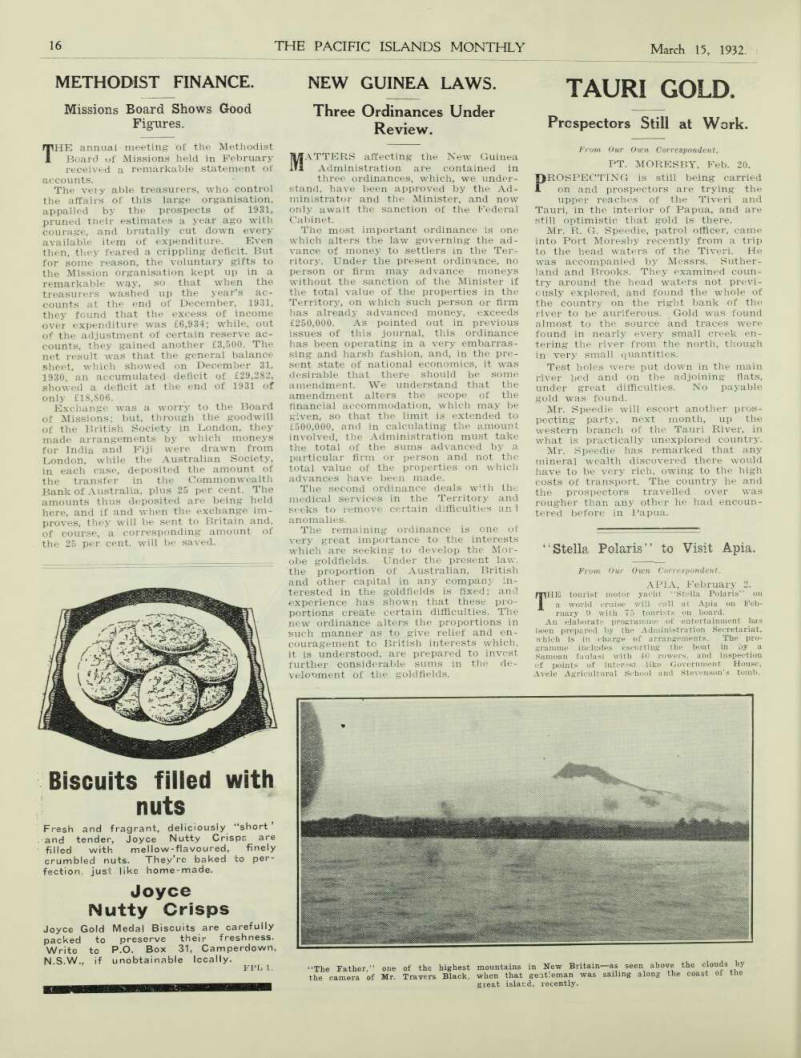
Missions Board Shows Good Figures.
THE annual meeting of the Methodist Board of Missions held in February received a remarkable statement of accounts.
The very able treasurers, who control the affairs of this large organisation, appalled by the prospects of 1931, pruned their estimates a year ago with courage, and brutally cut down every available item of expenditure. Even then, they feared a crippling deficit. But for some reason, the voluntary gifts to the Mission organisation kept up in a remarkable way, so that when the treasurers washed up the year’s ac counts at the end of December, 1931, they found that the excess of income over expenditure was £6,934; while, out of the adjustment of certain reserve ac counts, they gained another £3,500. The net result was that the general balance sheet, which showed on December 31, 1930, an accumulated deficit of £29,282, showed a deficit at the end of 1931 of only £18,806.
Exchange was a worry to the Board of Missions; but, through the goodwill of the British Society in London, they made arrangements by which moneys for India and Fiji were drawn from London, while the Australian Society, in each case, deposited the amount of the transfer in the Commonwealth Bank of Australia, plus 25 per cent. The amounts thus deposited are being held here, and if and when the exchange im proves, they will be sent to Britain and, of course, a corresponding amount of the 25 per cent, will be saved.
New Guinea Laws.
Three Ordinances Under Review.
MATTERS affecting the New Guinea Administration are contained in three ordinances, which, we under stand, have been approved by the Ad ministrator and the Minister, and now only await the sanction of the Federal Cabinet.
The most important ordinance is one which alters the law governing the ad vance of money to settlers in the Ter ritory. Under the present ordinance, no person or firm may advance moneys without the sanction of the Minister if the total value of the properties in the Territory, on which such person or firm has already advanced money, exceeds £250,000. As pointed out in previous issues of this journal, this ordinance has been operating in a very embarras sing and harsh fashion, and, in the pre sent state of national economics, it was desirable that there should be some amendment. We understand that the amendment alters the scope of the financial accommodation, which may be given, so that the limit is extended to £500,000, and in calculating the amount involved, the Administration must take the total of the sums advanced by a particular firm or person and not the total value of the properties on which advances have been made.
The second ordinance deals with the medical services in the Territory and seeks to remove certain difficulties ani anomalies.
The remaining ordinance is one of very great importance to the interests which are seeking to develop the Mor obe goldfields. Under the present law, the proportion of Australian, British and other capital in any company in terested in the goldfields is fixed; and experience has shown that these pro portions create certain difficulties. The new ordinance alters the proportions in such manner as to give relief and en couragement to British interests which, it is understood, are prepared to invest further considerable sums in the de velopment of the goldfields.
Tauroi Gold.
Prospectors Still at Work.
From Our Own Correspondent.
Pt. Moresby, Feb. 20.
Prospecting is still being carried on and prospectors are trying the upper reaches of the Tiveri and Tauri, in the interior of Papua, and are still optimistic that gold is there.
Mr. R. G. Speedie, patrol officer, came into Port Moresby recently from a trip to the head waters of the Tiveri. He was accompanied by Messrs. Suther land and Brooks. They examined coun try around the head waters not previ ously explored, and found the whole of the country on the right bank of the river to be auriferous. Gold was found almost to the source and traces were found in nearly every small creek en tering the river from the north, though in very small quantities.
Test holes were put down in the main river bed and on the adjoining flats, under great difficulties. No payable gold was found.
Mr. Speedie will escort another pros pecting party, next month, up the western branch of the Tauri River, in what is practically unexplored country.
Mr. Speedie has remarked that any mineral wealth discovered there would have to be very rich, owing to the high costs of transport. The country he and the prospectors travelled over was rougher than any other he had encoun tered before in Papua.
“Stella Polaris” to Visit Apia.
From Our Own Correspondent.
APIA, February 2.
THE tourist motor yacht “Stella Polaris’’ on a world cruise will call at Apia on Feb ruary 9 with 75 tourists on board.
An elaborate programme of entertainment has been prepared by the Administration Secretariat, which is in charge of arrangements. The pro gramme includes escorting the boat in by a Samoan faulasi with 40 rowers, and inspection of points of interest like Government House, Avele Agricultural School and Stevenson’s tomb.
“The Father,’’ one of the highest mountains in New Britain —as seen above the clouds by the camera of Mr. Travers Black, when that gentleman was sailing along the coast of the great island, recently.
Advertisements & other items, p. 18 (1 item)
Biscuits filled with
nuts
Fresh and fragrant, deliciously “short ’ and tender, Joyce Nutty Crisps are filled with mellow-flavoured, finely crumbled nuts. They’re baked to per fection, just like home-made.
Joyce
Nutty Crisps
Joyce Gold Medal Biscuits are carefully packed to preserve their freshness.
Write to P.O. Box 31, Camperdown, N.S.W., if unobtainable locally.
Review of Conditions in Tonga
[To the Editor.]
Sir, —There has appeared in your paper many conflicting versions of con ditions in Tonga and I would like to present to your readers what I con sider an unbiassed view of conditions as I see them.
To begin with commerce, trade is undoubtedly bad, in common with other countries but, though there is little prospect of any rapid improvement, and unemployment among the Europeans is increasing, the possibilities are not so bad as they looked six months ago.
The banana venture of the Govern ment has made a promising start and has already put a considerable sum of money in circulation. The last ship ment was of over 4,000 cases and future shipments will show a considerable in crease over this figure.
The Price Of Copra.
The price of copra has increased in Britain, and exchange is still in our favour but buyers are slow in passing this increase on to the producer. The present price, paid locally, is £7 per ton, and 1/- for 331bs. green. With £14/5/at home, and exchange showing an other £1/15/-, the margin must net a very nice profit. In view of this, and the high prices still being charged to the natives, one would doubt if mer chants are doing as much to assist the economic rehabilitation of the country as would be expected.
The native population, full and bye, does not appear to feel the effect of the depression as much as the small traders and European planters, or as the work ing classes do in the Dominions. They, in Tonga, have plenty of food and com fortable shelters, although the cash available for luxuries has been sadly reduced.
The general impression left, after associating with them for the last twelve months is that, provided the yam crop does not fail and they can raise nine dollars Government tax per annum, they still enjoy life and are not worrying a great deal about the state of Denmark—or the state of Tonga, for that matter. A happy-go-lucky race!
It is no wonder that their chiefs sub jected them almost to a state of slav ery in the old days, and it is highly probable that they would be again subjected were the guiding hand of the European removed.
Government Servants.
Government officials, provided they can keep their jobs, have nothing to complain about for, though the salaries paid here are small as compared with those paid for similar positions in other Governments, they are lucky to have them now. At present, they are on the box seat, but this is more or less as it should be for, during the bonanza years of the past, while traders and planters were making rich returns and natives were receiving top prices for their produce, the Government official was the poor relation, with little hope of putting anything away for a rainy day.
Well, the rainy day has arrived, and the Europeans are now threatened with wholesale retrenchment; a policy which
has little to commend it, either eco nomically or from the point of ef ficiency. The Public Works Dept, af fords an interesting example of the difference between European and Ton gan administration. This department, under the Hon. A. B. Wallace, was most efficiently conducted; but since his re tirement the running of the Depart ment has sadly depreciated.
Value Of Education.
The policy of educating the natives to govern their own country is a laud able one; but in a matter of this sort it is wise to hasten slowly, and any attempt to exchange European for native administrators at this stage of their advancement is bound to end dis astrously, particularly at the present time, when men of experience are so essential. Several Tongan chiefs have been to colleges in the Dominions for periods of from four to six years, most of which time was spent in learning English. Starting as they did, without even a primary schooling, they learned little of value to them in the positions they were later called upon to fill in the Govei'nment. I cannot recollect having ever heard of one who had reached Matriculation standard. A better sys tem has been in force of latter years, but so far the system has not produced any native of outstanding ability.
To sum up, I should say that while Tonga is feeling the effects of the pre vailing hard times, she does not suffer to anything like the extent of most other countries. Her inhabitants are in no danger of starvation and, in this mild climate, the terrors of exposure are nil, even were no shelter obtain able.
In the words of your correspondent, “Tonga is not a bad little place to be in just now,”
I am, etc.,
Fakamatala.
Nukualofa, February 6, 1932.
Government Competition
In Papua.
[To the Editor.] Sir, —In the December number of “The Pacific Islands Monthly,” on page 22, in an article entitled, “Vigorous Papuan Company,” it is stated that, ‘‘The Administration trades and runs coastal vessels in direct competition with private enterprise.”
You are mistaken; the Government does nothing of the kind, nor has it ever done so.
I am, etc.,
H. W. Champion.
Pt. Moresby,
January 5, 1932.
EDITORIAL NOTE: We are sorry, if we have inadvertently misrepresented the position.
But Papuan residents certainly do refer, in conversation to the freight service supplied by Government vessels on the coast of Papua. And in the last gazetted statement of the Territory’s accounts, under the heading of "Miscellaneous receipts,” we find: “Earnings of Government vessels, six months to December 31, 1930, £217/10/3; to December 31, 1931, £53.” So there is some excuse for our error.
Advertisements & other items, p. 19 (1 item)
Fire-Brick Co. Ltd.,
NEWBOLD SILICA
Manufacturers of High Grade Refractories, Silica Bricks, High Alumina Fire Bricks, Siliceous Fire Bricks, Chrome Bricks, Bauxite Bricks, “Sealtite” (hot patching cement), Dia tomaceous insulation.
Enquirers are requested to give full particulars of temperatures and purposes for which refractories are required.
The Newbold Silica Fire-Brick Co. Ltd.
109 ELIZABETH ST., SYDNEY.
ESTABLISHED 1868.
N.G. Goldfields Developments
First Dredge is Ready. —Second Building.—Third on Order.
EVERYTHING is now in readiness on the New Guinea goldfields for the starting of the No. 1 dredge of Bulolo Gold Dredging Ltd. The date for the commencement is March 21, and the official starting will be performed by Brig.-Gen. E. A. Wisdom, Administrator of the Territory.
FOLLOWING a memorandum to shareholders of both Placer De velopment Ltd. and Bulolo Gold Dredging Ltd. regarding the sale of the Bulowat and Burnside areas, in New Guinea, by Placer to Bulolo, a further memorandum was issued on February 29 concerning arrangements for financ ing the dredging operations on these areas. It was previously mentioned that two dredges would be installed on the property.
In the latest memorandum, it is stated that the Bulolo directors consid ered that, without jeopardising the or iginally contemplated dividends, the cost of equipping the newly-acquired areas, could be met from dredging pro fits, augmented by the proceeds of an issue of the comparatively small num ber of 65,000 new shares.
“In line with this,” the memorandum continues, “the Bulolo directors now advise that they have accepted from Oroville Dredging Company Limited and the International Mining Corpora tion an offer to take, at a net price of six United States dollars per share, the whole of the above issue. The price of six United States dollars represented in Canadian Currency $6.90, in English Currency £1/14/10, and in Australian Currency £2/3/7.
“Oroville Dredging Company Limited, which is an old established English cor poration in which the Consolidated Goldfields of South Africa Limited is substantially interested, is one of the world’s most successful gold dredging companies and, with its properties in Colombia now nearing exhaustion, it was desirous of becoming interested in Bulolo. The International Mining Cor poration, which is of New York, shared with the Consolidated Goldfields Com pany in the original Bulolo financing.
Of the new issue of 65,000 shares, the Oroville Company has taken 55,000, and the International Mining Corporation the balance.
“While the directors of the Bulolo Company welcome the co-operation of the Oroville Company, and the further co-operation of the International Min ing Corporation, they regret that it was found inadvisable to offer the new issue for subscription pro rata by all share holders. Consideration of the existing exchange position, which at present seriously handicaps Australian sub scribers, and the very disturbed world financial conditions, influenced them in their decision to follow the course adopted. Furthermore, an issue to all shareholders would have entailed delay, which in the interests of the Company it was desirable to avoid. The modesty of the sum of the present new issue of capital and of the issue of paid up
shares that will be made to satisfy the Placer Company’s sale consideration is very satisfactory in light of the large profit value of the new areas to be equipped.
“Placing of the order for construction of the pontoon and much of the super structure for the No. 3 Dredge, ar rangements for which were in train, has now been effected —the work has been entrusted to Poole and Steel Lim ited, of Sydney, who built the previous pontoons. All equipment required for the extension of the power line to the Bulowat area has also been ordered, so that electric power for construction workshops may be supplied to the new areas as fast as possible.
“As to the advantages to accrue to the Bulolo and Placer Companies re spectively, the Bulolo position will be improved by a very substantial in crease in the originally estimated in vestment return (theoretically by ap proximately 40 per cent.) as soon as the new areas are equipped, and by some increase in the life of the operation.
The increase in the monthly yardage to be dredged will contribute to this en hancement of return by its effect in re
ducing the dredging costs. As the Placer Company will be paid in Bulolo shares, and is already a large share holder in the Bulolo Company, it will profit from the satisfactory terms to the Bulolo Company upon which that Company is acquiring the new areas.
A further benefit to the Bulolo Com pany is the acquisition by it from the Placer Company, as part of the terms of sale and purchase, of such develop ment possibilities as may be found to exist in the two dredging claims shown on the plan attached to the fifth an nual report of the Placer Company as the Placer West area. A further bene fit to the Placer Company is its acquisi tion from the Bulolo Company of the right to recover gold from the undredg able area of about ten acres located at the Southern end of the Bulolo original area and immediately to the North of the Arnolds Leases already owned by the Placer Company.
“The settlement as between the two Companies of the terms of sale and purchase proved a difficult one. The arrangement, as set out in the previous Memorandum to the shareholders of both Companies, whereby the final share consideration that will pass to the Placer Company will be dependent on the actual gold recoveries and work ing costs on the original Bulolo area and also on the Bulowat Burnside areas, was considered to be the fairest and technically the soundest method of determining the matter. Seventy-five thousand fully paid shares of Bulolo Gold Dredging Limited will be allotted to the Placer Company two months after the first of the additional dredges commences operating on the new areas, and a like number two months after the second dredge commences operat ing thereon, while, after dredging has proceeded for two years on these areas there will, on a basis that has been agreed upon, be a further and final al lotment of shares to the vendor Com pany.”
Advertisements & other items, p. 20 (1 item)
Burns, Philp
(South Sea) Co. Ltd.
Island Traders & Shipowners Registered Office: Suva, Fiji.
Also Branches at Fiji: Levuka, Lautoka, Labasa, Ba, Sigatoka, Rotumah.
Tonga: Nukualofa, Haapai, Vavau.
Samoa: Apia.
Solomons: Makambo, Gizo, Faisi.
New Hebrides: Vila.
Gilberts : Tarawa.
Norfolk Island. Nauru. Niue.
Code Address: “Burnsouth.’’
Fiji Rice Mill
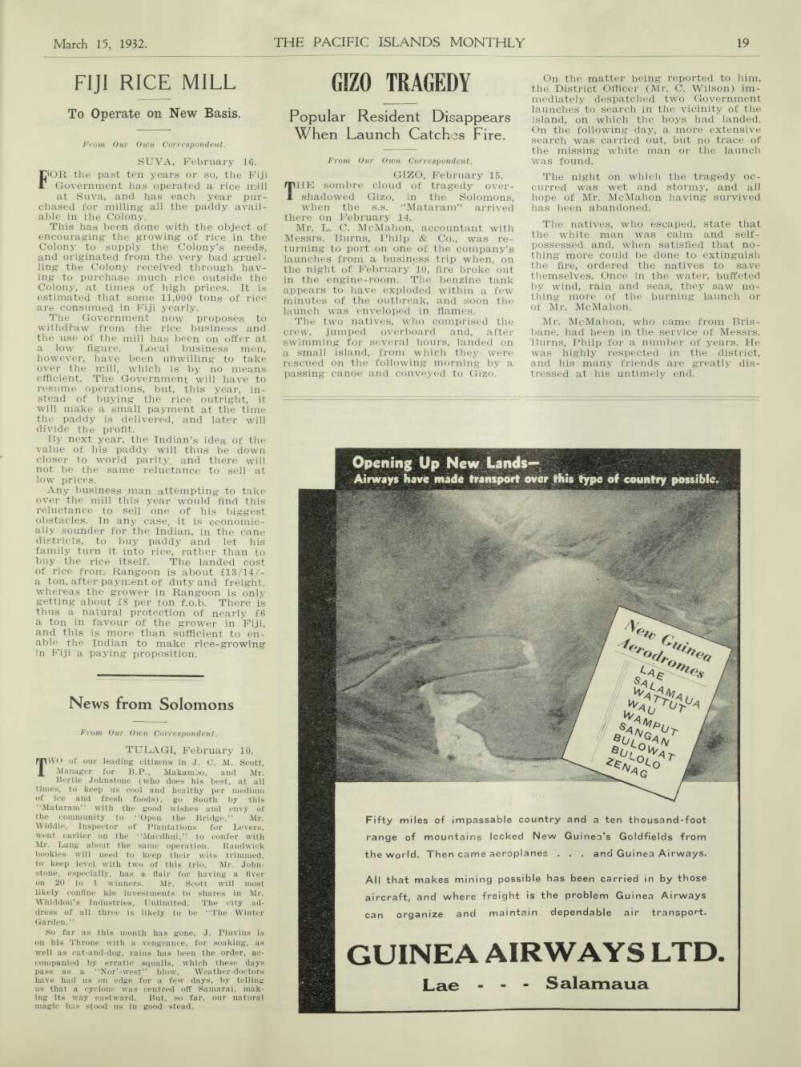
To Operate on New Basis.
From Our Own Correspondent.
SUVA, February 16.
FOR the past ten years or so, the Fiji Government has operated a rice mill at Suva, and has each year pur chased for milling all the paddy avail able in the Colony.
This has been done with the object of encouraging the growing of rice in the Colony to supply the Colony’s needs, and originated from the very bad gruel ling the Colony received through hav ing to purchase much rice outside the Colony, at times of high prices. It is estimated that some 11,000 tons of rice are consumed in Fiji yearly.
The Government now proposes to withdraw from the rice business and the use of the mill has been on offer at a low figure. Local business men, however, have been unwilling to take over the mill, which is by no means efficient. The Government will have to resume operations, but, this year, in stead of buying the rice outright, it will make a small payment at the time the paddy is delivered, and later will divide the profit.
By next year, the Indian’s idea of the value of his paddy will thus be down closer to world parity, and there will not be the same reluctance to sell at low prices.
Any business man attempting to take over the mill this year would find this reluctance to sell one of his biggest obstacles. In any case, it is economic ally sounder for the Indian, in the cane districts, to buy paddy and let his family turn it into rice, rather than to buy the rice itself. The landed cost of rice from Rangoon is about £13/14/a ton, after payment of duty and freight, whereas the grower in Rangoon is only getting about £8 per ton f.o.b. There is thus a natural protection of nearly £6 a ton in favour of the grower in Fiji, and this is more than sufficient to en able the Indian to make rice-growing in Fiji a paying proposition.
News from Solomons
From Our Own Correspondent.
TULAGI, February 10.
TWO of our leading citizens in J. C. M. Scott, Manager for B.P., Makamjo, and Mr.
Bertie Johnstone (who does his best, at all times, to keep us cool and healthy per medium of ice and fresh foods), go South by this “Mataram” with the good wishes and envy of the community to “Open the Bridge.” Mr.
Widdie, Inspector of Plantations for Levers, went earlier on the “Macdhui,” to confer with Mr. Lang about the same operation. Randwick bookies will need to keep their wits trimmed, to keep level with two of this trio. Mr. John stone, especially, has a flair for having a fiver on 20 to 1 winners. Mr. Scott will most likely confine his investments to shares in Mr.
Whiddon’s Industries, Unlimited. The city ad dress of all three is likely to be “The Winter Garden.”
So far as this month has gone, J. Pluvius is on his Throne with a vengeance, for soaking, as well as cat-and-dog, rains has been the order, ac companied by erratic squalls, which these days pass as a “Nor’-west” blow. Weather-doctors have had us on edge for a few days, by telling us that a cyclone was centred off Samarai, mak ing its way eastward. But, so far, our natural magic has stood us in good stead.
Gizo Tragedy
Popular Resident Disappears When Launch Catches Fire.
From Our Own Correspondent .
GIZO, February 15.
THE sombre cloud of tragedy over shadowed Gizo, in the Solomons, when the s.s. “Mataram” arrived there on February 14.
Mr. L. C. McMahon, accountant with Messrs. Burns, Philp & Co., was re turning to port on one of the company’s launches from a business trip when, on the night of February 10, fire broke out in the engine-room. The benzine tank appears to have exploded within a few minutes of the outbreak, and soon the launch was enveloped in flames.
The two natives, who comprised the crew, jumped overboard and, after swimming for several hours, landed on a small island, from which they were rescued on the following morning by a passing canoe and conveyed to Gizo.
On the matter being reported to him, the District Officer (Mr. C. Wilson) im mediately despatched two Government launches to search in the vicinity of the island, on which the boys had landed.
On the following day, a more extensive search was carried out, but no trace of the missing white man or the launch was found.
The night on which the tragedy oc curred was wet and stormy, and all hope of Mr, McMahon having survived has been abandoned.
The natives, who escaped, state that the white man was calm and self possessed and, when satisfied that no thing more could be done to extinguish the fire, ordered the natives to save themselves. Once in the water, buffeted by wind, rain and seas, they saw no thing more of the burning launch or of Mr. McMahon.
Mr. McMahon, who came from Bris bane, had been in the service of Messrs.
Burns, Philp for a number of years. He was highly respected in the district, and his many friends are greatly dis tressed at his untimely end.
Advertisements & other items, p. 21 (1 item)
Guinea Airways Ltd
Fifty miles of impassable country and a ten thousand-foot range of mountains locked New Guinea’s Goldfields from the world. Then came aeroplanes . . . and Guinea Airways.
All that makes mining possible has been carried in by those aircraft, and where freight is the problem Guinea Airways can organize and maintain dependable air transport.
Lae - - - Salamaua
Polynesian Population?
Do We Want A Chinese
Pan Pacific Union Secretary Defends Hawaiian Half-castes.
We have received, prom Mr. A. Y. Satterthwaite, secretary of the Pan-Pacific Union, Honolulu, a friendly letter, dated January 25, 1932, dealing with a subject of great and growing importance to all Pacific territories. The letter is as follows.
“IN your August number (writes Mr.
Satterthwaite) there is an edi torial entitled, ‘Chinese in Samoa.’
“Perhaps we have misunderstood this editorial but, as it stands, Hawaii takes exception to the sentence: “It may be a desirable and neces sary thing that Chinese labour be in troduced temporarily, for the economic development of the Polynesian terri tories; but if the practice is to be at tended by social consequences of the kind described elsewhere in this issue, and which have been only too tragic ally illustrated in Hawaii and Tahiti, then the economic advantage is im measurably outweighed by the sin against the Polynesian race.’
“We object especially to the reference to Hawaii. We are not prepared to dis cuss the situation in Tahiti, “Chinese and Hawaiian mixtures in Hawaii have produced some of our most brilliant and desirable citizens.
The following paragraph appeared in a brochure called ‘Every Child,’ dealing with primary and preparatory educa tion throughout the world, and written by George William Gerwig, eminent educator on the staff of the Frick Foundation at Pittsburgh; “'Outside of United States, on the continent, the best thing surveyed educationally was the McKinley High School, at Honolulu, together with its related primary schools.
This is the most successful ap proach to the problem of really and wisely helping a cosmopolitan group of people toward self-develop ment and self-control, in the world.
We were told on good authority that the blend in Hawaii between Chinese thoroughness and stability and Hawaiian alertness and adapt ability was producing a genuinely fine stock of people. The American Model School is working better in Hawaii than anywhere else off the continent.’
“McKinley High School has nearly 3,000 students and is a very interesting institution. The same could probably be said of the University of Hawaii, which many of the McKinley High School graduates attend.
“Just now, Hawaii has a pretty bad record all over the world, but do not allow anyone to think even for one moment that our present trouble is a result of racial antagonism, despite the fact that the Hearst papers are ridicu lously publishing right and left the statement that our trouble is due to Japanese propaganda. It is entirely the result of lax law observance on the part of the majority of us.
“I trust that this information will be of interest to your paper, which we find valuable and interesting.”
Editorial Note:
The foregoing communication raises issues of some concern to all residents of the Pacific Islands; and they may be summarised in the following ques tions:— Is it necessary, for the future econo mic development of the Pacific Islands, that an Asiatic population be in troduced?
If it is necessary, which race should be introduced to the British territory— Japanese, Chinese, Indians, or Tonk inese?
In considering- the relative desirable ness of these races as immigrants, should we give greater weight to their social rather than their economic value —that is, is the incoming race expected to blend with the indigenous race, and which mixture is likely to give the best citizens? Or is it to be regarded sim ply as a race of workers and peasants?
Are the British right, in officially op posing miscegenation in these Pacific Islands; or is it a sounder policy to permit a mixture of foreign blood? In this connection, would the same policy be applicable to both Polynesian and Melanesian races?
The foregoing points give some indi cation of the ramifications of the sub ject. The New Zealand administrators of Western Samoa are now vigorously active in preventing cohabitation be tween Chinese immigrants and Samoan women, which had been going on at a startling rate. The British adminis trators of Fiji, on the other hand, have found it unnecessary to interfere be tween the Fijian and the Hindu immi grants —there is practically no mis cegenation. Thousands of Japanese are settling down in the Caroline, Marshall and Mariana groups, and are not mix ing with the indigenous natives. But there is a large and growing population of Chinese-Polynesian half-castes in Tahiti and Hawaii.
Two further questions naturally arise: Are Chinese and Polynesians natur ally attracted towards one another?
Is the resulting half-caste population desirable from the point of view of citi zenship?
It is in that connection that our Hawaiian friend’s contribution to the discussion is so valuable. He is em phatically in favour of the Chinese- Hawaiian mixture.
When we wrote, in August, of the “tragic” results of Chinese immigration in Hawaii and Tahiti, we did not intend to condemn the half-castes. As a mat ter of fact, we have met, in Rarotonga and Tahiti, Chinese-Polynesians of great physical attractiveness and men tal ability. But, as a matter of policy, we do advocate the maintenance of
racial purity in the Pacific, and we do regard it as a tragedy that the pure Polynesian stock of Tahiti and Hawaii is so rapidly disappearing.
The great god Progress must be served, we suppose; but why should it be necessary, in the process, to sacrifice the Polynesian peoples, who have con tributed so much of charm and romance to the Pacific isles —and really made of them the place “where life is different”?
Life in Polynesia without the Poly nesians will not be “different” —no mat ter how desirable Chinese-Polynesians may be.
Samoan Retrenchments
Staffs Being Further Reduced.
From Our Own Correspondent.
APIA, February 12.
ACCORDING to an official statement of the Administration, the re trenchments since the start of the current financial year (April 1, 1931, to March 31, 1932), amount to £8,500, not including the 10 per cent, on salaries of European officials.
The total sum saved in expenditure will probably amount to something like £15,000, or about 10 per cent, of the ex penditure in the last financial year to March 31, 1931. The drop in revenue, however, may be confidently predicted to be much more than 10 per cent., so that further retrenchment will be un avoidable.
Amongst further retirements of Gov ernment officials are reported some in the Medical Department, Public Works Department and Police Department.
The present officer-in-charge of Apia wireless station, Mr. Dunwoodie, will also take charge of the post office. This is a very popular appointment, as Mr.
Dunwoodie, who has served in Samoa since 1914, is highly esteemed.
Solomons Copra.
Large Export Causes Surprise.
From Our Own Correspondent.
TULAGI, February 10.
IT is said that our output of copra at the end of March will be very little, if anything-, short of the previous year’s total —which, to say the least, is astonishing- on a number of accounts: (1) The native has produced very little. (2) The largest producer is said to be 400 tons down as a result of nut-fall. (3) A number are not producing to full capacity. (4) Some are not producing at all.
It follows that, had the depression not depressed, there would have been a very substantial increase in our ex ports; even in spite of nut-fall.
The nut-fall bug, or whatever it is that causes the damage, is still at large, and naturally we will all feel very much easier when it is run to earth or “treed” —as we used to say when ’possum hunting.
British Silver
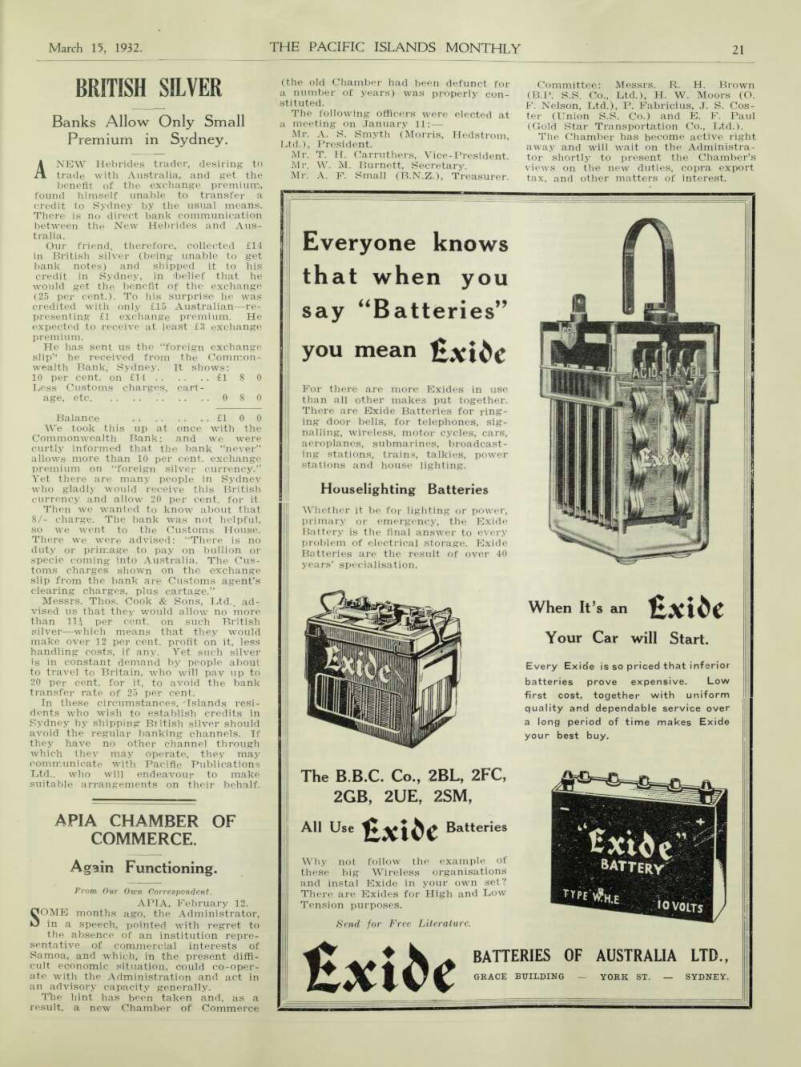
Banks Allow Only Small Premium in Sydney.
ANEW Hebrides trader, desiring to trade with Australia, and get the benefit of the exchange premium, found himself unable to transfer a credit to Sydney by the usual means.
There is no direct bank communication between the New Hebrides and Aus tralia.
Our friend, therefore, collected £14 in British silver (being unable to get bank notes) and shipped it to his credit in Sydney, in ibelief that he would get the benefit of the exchange (25 per cent.). To his surprise he was credited with only £15 Australian —re presenting £1 exchange premium. He expected to receive at least £3 exchange premium.
He has sent us the “foreign exchange slip’’ he received from the Common wealth Bank, Sydney. It shows: 10 per cent, on £14 £1 8 0 Less Customs charges, cart age, etc 0 8 0 Balance £10 0 We took this up at once with the Commonwealth Bank; and we were curtly informed that the bank “never” allows more than 10 per cent, exchange premium on “foreign silver currency.”
Yet there are many people in Sydney who gladly would receive this British currency and allow 20 per cent, for it Then we wanted to know about that 8/- charge. The bank was not helpful, so we went to the Customs House.
There we were advised: “There is no duty or primage to pay on bullion or specie coming into Australia. The Cus toms charges shown on the exchange slip from the bank are Customs agent’s clearing charges, plus cartage.”
Messrs. Thos. Cook & Sons, Ltd., ad vised us that they would allow no more than 11¾ per cent, on such British silver —which means that they would make over 12 per cent, profit on it, less handling costs, if any. Yet such silver is in constant demand by people about to travel to Britain, who wull pay up to 20 per cent, for it, to avoid the bank transfer rate of 25 per cent.
In these circumstances, 'lslands resi dents who wish to establish credits in Sydney by shipping British silver should avoid the regular banking channels. If they have no other channel through which they may operate, they may communicate with Pacific Publications Ltd., who will endeavour to make suitable arrangements on their behalf.
Again Functioning.
Apia Chamber Of
Commerce.
From Our Own Correspondent.
APIA, February 12.
SOME months ago, the Administrator, in a speech, pointed with regret to the absence of an institution repre sentative of commercial interests of Samoa, and which, in the present diffi cult economic situation, could co-oper ate with the Administration and act in an advisory capacity generally.
The hint has been taken and, as a result, a new Chamber of Commerce
(the old Chamber had been defunct for a number of years) was properly con stituted.
The following officers were elected at a meeting on January 11: Mr. A. S. Smyth (Morris, Hedstrom, Ltd.), President.
Mr. T. H. Carruthers, Vice-President.
Mr. W. M. Burnett, Secretary.
Mr. A. F. Small (B.N.Z.), Treasurer.
Committee: Messrs. R. H. Brown (B.P. S.S. Co., Ltd.), H. W. Moors (O.
F. Nelson, Ltd.), P. Fabricius, J. S. Cos ter (Union S.S. Co.) and E. F. Paul (Gold Star Transportation Co., Ltd.).
The Chamber has become active right away and will wait on the Administra tor shortly to present the Chamber’s views on the new duties, copra export tax, and other matters of interest.
Advertisements & other items, p. 23 (1 item)
Everyone knows
that when you
say “Batteries”
you mean
For there are more Exides in use than all other makes put together.
There are Exide Batteries for ring ing door bells, for telephones, sig nalling, wireless, motor cycles, cars, aeroplanes, submarines, broadcast ing stations, trains, talkies, power stations and house lighting.
Houselighting Batteries
Whether it be for lighting or power, primary or emergency, the Exide Battery is the final answer to every problem of electrical storage. Exide Batteries are the result of over 40 years’ specialisation.
When It’s an Exide
Your Car will Start.
Every Exide is so priced that inferior batteries prove expensive. Low first cost, together with uniform quality and dependable service over a long period of time makes Exide your best buy.
The B.B.C. Co., 2BL, 2FC,
2GB, 2UE, 2SM,
All Use Batteries
Why not follow the example of these big Wireless organisations and instal Exide in your own set?
There are Exides for High and Low Tension purposes.
Send for Free Literature.
battery
BATTERIES OF AUSTRALIA LTD.,
GRACE BUILDING YORK ST. SYDNEY.
Forgotten Missionaries Of 1847
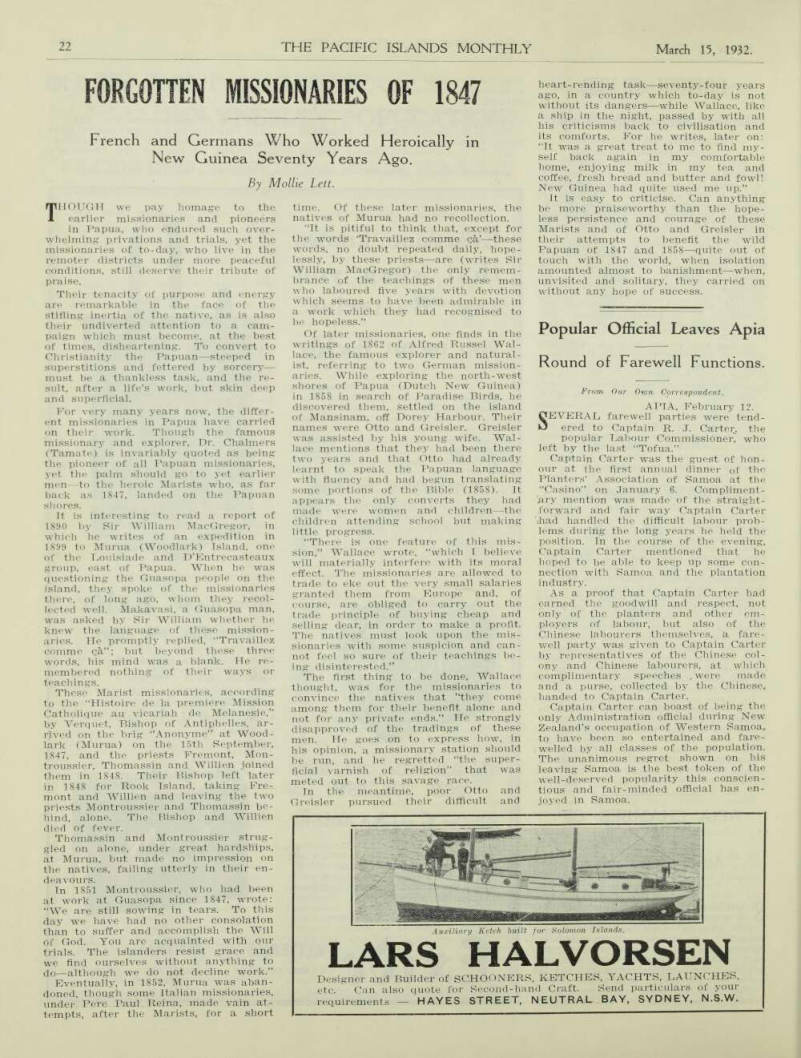
French and Germans Who Worked Heroically in New Guinea Seventy Years Ago.
By Mollie Lett.
THOUGH we pay homage to the earlier missionaries and pioneers in Papua, who endured such over whelming privations and trials, yet the missionaries of to-day, who live in the remoter districts under more peaceful conditions, still deserve their tribute of praise.
Their tenacity of purpose and energy are remarkable in the face of the stifling inertia of the native, as is also their undiverted attention to a cam paign which must become, at the best of times, disheartening. To convert to Christianity the Papuan—steeped in superstitions and fettered by sorcery— must be a thankless task, and the re sult, after a life’s work, but skin deep and superficial.
For very many years now, the differ ent missionaries in Papua have carried on their work. Though the famous missionary and explorer, Dr. Chalmers (Tamate) is invariably quoted as being the pioneer of all Papuan missionaries, yet the palm should go to yet earlier men—to the heroic Marists who, as far back as 1847, landed on the Papuan shores.
It is interesting to read a report of 1890 by Sir William MacGregor, in which he writes of an expedition in 1899 to Murua (Woodlark) Island, one of the Louisiade and D’Entrecasteaux group, east of Papua. When he was questioning the Guasopa people on the island, they spoke of the missionaries there, of long ago, whom they recol lected well. Makavasi, a Guasopa man, was asked by Sir William whether he knew the language of these mission aries. He promptly replied, “Travaillez comme ga”; but beyond these three words, his mind was a blank. He re membered nothing of their ways or teachings.
These Marist missionaries, according to the “Histoire de la premiere Mission Catholique au vicariah de Melanesie,” by Verquet, Bishop of Antiphelles, ar rived on the brig “Anonyme” at Wood lark (Murua) on the 15th September, 1847, and the priests Fremont, Mon troussier, Thomassin and Willien joined them in 1848. Their Bishop left later in 1848 for Rook Island, taking Fre mont and Willien and leaving the two priests Montroussier and Thomassin be hind, alone. The Bishop and Willien died of fever.
Thomassin and Montroussier strug gled on alone, under great hardships, at Murua, but made no impression on the natives, failing utterly in their en deavours.
In 1851 Montroussier, who had been at work at Guasopa since 1847, wrote: “We are still sowing in tears. To this day we have had no other consolation than to suffer and accomplish the Will of God. You are acquainted with our trials. The islanders resist grace and we find ourselves without anything to do —although we do not decline work.”
Eventually, in 1852, Murua was aban doned, though some Italian missionaries, under Pere Paul Reina, made vain at tempts, after the Marists, for a short
time. Of these later missionaries, the natives of Murua had no recollection.
“It is pitiful to think that, except for the words ‘Travaillez comme ga’—these words, no doubt repeated daily, hope lessly, by these priests—are (writes Sir William MacGregor) the only remem brance of the teachings of these men who laboured five years with devotion which seems to have been admirable in a work which they had recognised to be hopeless.”
Of later missionaries, one finds in the writings of 1862 of Alfred Russel Wal lace, the famous explorer and natural ist, referring to two German mission aries. While exploring the north-west shores of Papua (Dutch New Guinea) in 1858 in search of Paradise Birds, he discovered them, settled on the island of Mansinam, off Dorey Harbour. Their names were Otto and Greisler. Greisler was assisted by his young wife. Wal lace mentions that they had been there two years and that Otto had already learnt to speak the Papuan language with fluency and had begun translating some portions of the Bible (1858). It appears the only converts they had made were women and children—the children attending school but making little progress.
“There is one feature of this mis sion,” Wallace wrote, “which I believe will materially interfere with its moral effect. The missionaries are allowed to trade to eke out the very small salaries granted them from Europe and, of course, are obliged to carry out the trade principle of buying cheap and selling dear, in order to make a profit.
The natives must look upon the mis sionaries with some suspicion and can not feel so sure of their teachings be ing disinterested.”
The first thing to be done, Wallace thought, was for the missionaries to convince the natives that ‘‘they come among them for their benefit alone and not for any private ends.” He strongly disapproved of the tradings of these men. He goes on to express how, in his opinion, a missionary station should be run, and he regretted “the super ficial varnish of religion” that was meted out to this savage race.
In the meantime, poor Otto and Greisler pursued their difficult and
heart-rending task —seventy-four years ago, in a country which to-day is not without its dangers—while Wallace, like a ship in the night, passed by with all his criticisms back to civilisation and its comforts. For he writes, later on: “It was a great treat to me to find my self back again in my comfortable home, enjoying milk in my tea and coffee, fresh bread and butter and fowl!
New Guinea had quite used me up.”
It is easy to criticise. Can anything be more praiseworthy than the hope less persistence and courage of these Marists and of Otto and Greisler in their attempts to benefit the wild Papuan of 1847 and 1858 —quite out of touch with the world, when isolation amounted almost to banishment —when, unvisited and solitary, they carried on without any hope of success.
Popular Official Leaves Apia
Round of Farewell Functions.
From Our Otvn Correspondent.
APIA, February 12.
SEVERAL farewell parties were tend ered to Captain R. J. Carter the popular Labour Commissioner, who left by the last “Tofua.”
Captain Carter was the guest of hon our at the first annual dinner of the Planters’ Association of Samoa at the “Casino” on January 6. Compliment ary mention was made of the straight forward and fair way Captain Carter ihad handled the difficult labour prob lems during the long years he held the position. In the course of the evening.
Captain Carter mentioned that he hoped to be able to keep up some con nection with Samoa and the plantation industry.
As a proof that Captain Carter had earned the goodwill and respect, not only of the planters and other em ployers of labour, but also of the Chinese labourers themselves, a fare well party was given to Captain Carter by representatives of the Chinese col ony and Chinese labourers, at which complimentary speeches , were made and a purse, collected by the Chinese, handed to Captain Carter.
Captain Carter can boast of being the only Administration official during New Zealand’s occupation of Western Samoa, to have been so entertained and fare welled by all classes of the population.
The unanimous regret shown on his leaving Samoa is the best token of the well-deserved popularity this conscien tious and fair-minded official has en joyed in Samoa,
Advertisements & other items, p. 24 (1 item)
Lars Halvorsen
Auxiliary Ketch built for Solomon Islands.
Designer and Builder of SCHOONERS, KETCHES, YACHTS, LAUNCHES, etc. Can also quote for Second-hand Craft. Send particulars of your requirements HAYES STREET, NEUTRAL BAY, SYDNEY, N.S.W.
Depression Causes Samoans
To Return To Primitive Life .
From Our Own Correspondent.
APIA, February 12.
AS a result of the low copra and banana prices and the limitation of banana shipments, the spending power of the Samoan native is consid erably curtailed.
In consequence, he has to-day to go without many luxuries he has become used to in previous good times. The consumption of bread, biscuits, canned meat and canned fish, has very much decreased, and the native is now satis fied with his breadfruit, taro, yams, bananas, and the proceeds of his fishing.
One hears of native village meetings where people deliberate on a cessation of banana shipments at the low rate fixed by the Administration, also on reducing their purchases in the stores to the absolute minimum, after the rise in prices occasioned by the increased tariff duties.
Motor ’bus owners, taxi-drivers, and picture show proprietors all complain about bad business. The native is re turning from the joys of the mechanical age to the simple life of his fore fathers.
At the present time, the Samoans are very anxious to work on the European cocoa and banana plantations, even at much reduced wages. Men and women work for a daily wage of 2/-, without
meals, and 1/- a day with food, on weeding plantations. Bush felling is done for £1 per acre, contract price.
However, there is not much work of fering at present, so the labour supply far surpasses the demand, as planters are, owing to last year’s unsatisfactory cocoa crop, unable to undertake much new cultivation and developmental work.
“Gizo.”
New Engines for “Tulagi” and “Gizo.”
From Our Own Correspondent.
TULAGI, February 10.
THE Government is now standardising on British Gardiner crude oil en gines for its vessels. To date, two have been installed, in the “Tulagi” and “Gizo.”
Though these engines are costly to purchase, they should prove a decided economy, if appearance of workmanship goes for anything. The first Gardiner (kerosene-benzine) engine came to this group about 24 years ago and gave very good results. This was in the South Sea Evangelical Mission’s boat “Evan gel” (now called “Ruana”).
Of Woodlark Island, Papua.
Late Mr. F. A. Rochfort.
ANOTHER old pioneer, explorer and gold-digger passed away on October 26, F. A. Rochfort, aged 79, still work ing his gold claim on Woodlark Island right to the end. He arrived with the first band of gold diggers in Papua, 35 year ago. Mr. P, A. Rochfort belonged to an old Northumbrian family. He and his brother came to Australia when little more than boys, with a capital of £125,000 stg., which they invested in station property. Owing to the seven years drought they lost all their capital.
Frank Rochfort was in every sense of the word a highly cultured British gentleman of a bygone age, holding the highest principles, who scorned a lie and never broke his word. Too independent to accept a position on wages or salary, and always following up the goldfields, he worked by himself and for himself. He was a fine type of the courageous, independent band of explorers and settlers that are now. alas, almost extinct. Vale Frank Roch fort.
Miss A. M, Griffin, B.A., who is at tached to the staff of the Methodist Missionary Society in Fiji, arrived in Sydney recently. She is proceeding to India to gain further experience for her work among the Indian population of Fiji. Miss Griffin expects to be away from the colony for about 12 months.
Advertisements & other items, p. 25 (1 item)
J. H. Macgregor Dowsett
For
RELIABLE CARS, SERVICE
and DRIVERS
Gramophones & Latest Records ★ Musical Instruments & Sundries Cameras and Photographic Goods (Developing, Printing, Enlarging and Framing).
Recruiter, Mining and General Agent
BUILDER AND CONTRACTOR
Agent for Sub-Agent for The Australian Provincial Assurance Assoc. Ltd. The Central Assurance Co. Ltd.
Outstation Orders Promptly Executed SAMPLE ROOMS: MALAGUNA ROAD, RABAUL. ’Phone: 149.
Copra Profit.
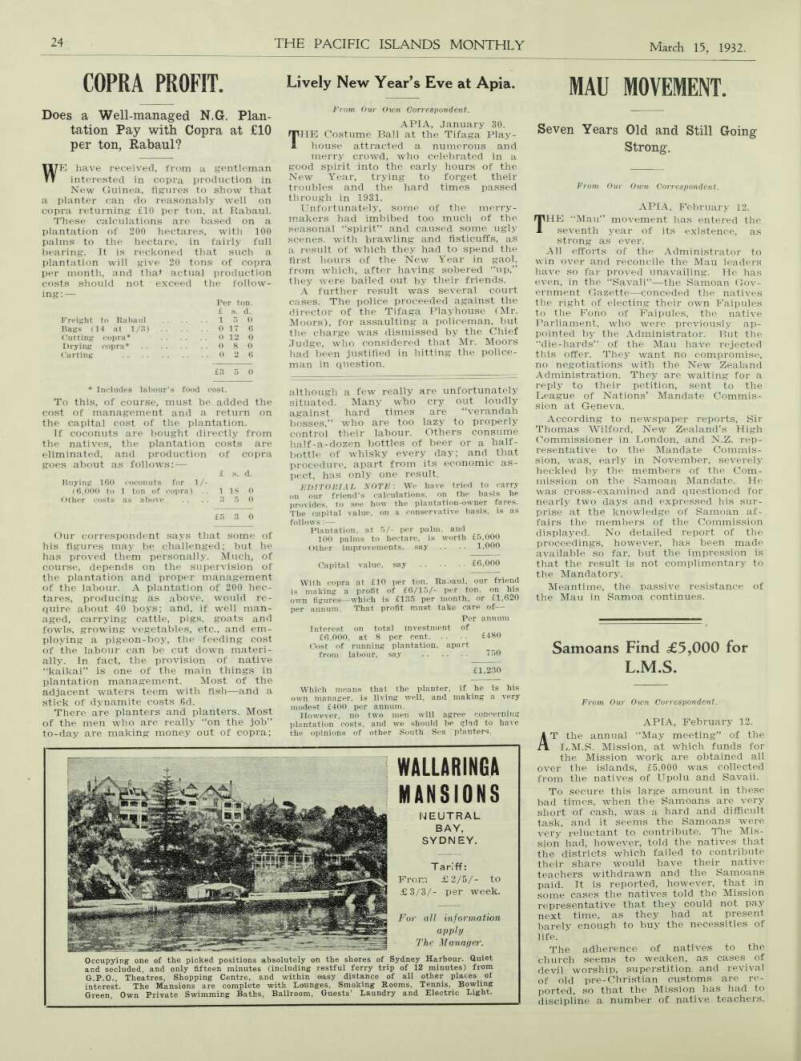
Does a Well-managed N.G. Plan
tation Pay with Copra at £10
per ton, Rabaul?
WE have received, from a gentleman interested in copra production in New Guinea, figures to show that a planter can do reasonably well on copra returning £10 per ton, at Rabaul.
These calculations are based on a plantation of 200 hectares, with 100 palms to the hectare, in fairly full bearing. It is reckoned that such a plantation will give 20 tons of copra per month, and that actual production costs should not exceed the follow ing:—
* Includes labour’s food cost.
To this, of course, must be added the cost of management and a return on the capital cost of the plantation.
If coconuts are bought directly from the natives, the plantation costs are eliminated, and production of copra goes about as follows:
Our correspondent says that some of his figures may be challenged; but he has proved them personally. Much, of course, depends on the supervision of the plantation and proper management of the labour. A plantation of 200 hec tares, producing as above, would re quire about 40 boys; and, if well man aged, carrying cattle, pigs, goats and fowls, growing vegetables, etc., and em ploying a pigeon-boy, the feeding cost of the labour can be cut down materi ally. In fact, the provision of native “kaikai” is one of the main things in plantation management. Most of the adjacent waters teem with fish—and a stick of dynamite costs 6d.
There are planters and planters. Most of the men who are really “on the job” to-day are making money out of copra;
although a few really are unfortunately situated. Many who cry out loudly against hard times are “verandah bosses,” who are too lazy to properly control their labour. Others consume half-a-dozen bottles of beer or a half bottle of whisky every day; and that procedure, apart from its economic as pect, has only one result.
EDITORIAL NOTE: We have tried to carry on our friend’s calculations, on the basis he provides, to see how the plantation-owner fares.
The capital value, on a conservative basis, is as follows: —
With copra at £10 per ton. Rabaul, our friend is making a profit of £6/15/- per ton, on his own figures—which is £135 per month, or £1,620 per annum. That profit must take care of —
Which means that the planter, if he is his own manager, is living well, and making a very modest £400 per annum.
However, no two men will agree concerning plantation costs, and we should be glad to have the opinions of other South Sea planters.
Per ton. f s. d.
Freight to Rabaul .. . . 15 0 Bags (14 at 1/3) .. . . . . 0 17 6 Cutting copra* . . . 0 12 0 Drying copra* ..080 Carting . . . . 0 2 6 £3 5 0
£ s. d.
Buying 160 coconuts for 1/- (6.000 to 1 ton of copra) 1 18 0 Other costs as above 3 5 0 £5 3 0
Plantation, at 5/- per palm, and worth £5,000 100 palms to hectare, is Other improvements, say . . . . 1.000 Capital value, say . . . . £6,000
Per annum Interest on total investment of £6,000. at 8 per cent £480 Cost of running plantation, apart from labour, say 750 £1,230
Lively New Year’s Eve at Apia.
From Our Own Correspondent.
APIA, January 30.
THE Costume Ball at the Tifaga Play house attracted a numerous and merry crowd, who celebrated in a good spirit into the early hours of the New Year, trying to forget their troubles and the hard times passed through in 1931.
Unfortunately, some of the merry makers had imbibed too much of the seasonal “spirit” and caused some ugly scenes, with brawling and fisticuffs, as a result of which they had to spend the first hours of the New Year in gaol, from which, after having sobered “up,” they were bailed out by their friends.
A further result was several court cases. The police proceeded against the director of the Tifaga Playhouse (Mr.
Moors), for assaulting a policeman, but the charge was dismissed by the Chief Judge, who considered that Mr. Moors had been justified in hitting the police man in question.
Mau Movement.
Seven Years Old and Still Going Strong.
From Our Own Correspondent.
APIA, February 12.
THE “Mau” movement has entered the seventh year of its existence, as strong as ever.
All efforts of the Administrator to win over and reconcile the Mau leaders have so far proved unavailing. He has even, in the “Savaii”—the Samoan Gov ernment Gazette —conceded the natives the right of electing their own Faipules to the Fono of Faipules, the native Parliament, who were previously ap pointed by the Administrator. But the “die-hards” of the Mau have rejected this offer. They want no compromise, no negotiations with the New Zealand Administration, They are waiting for a reply to their petition, sent to the League of Nations’ Mandate Commis sion at Geneva, According to newspaper reports. Sir Thomas Wilford, New Zealand’s High Commissioner in London, and N.Z. rep resentative to the Mandate Commis sion, was, early in November, severely heckled by the members of the Com mission on the Samoan Mandate. He was cross-examined and questioned for nearly two days and expressed his sur prise at the knowledge of Samoan af fairs the members of the Commission displayed. No detailed report of the proceedings, however, has been made available so far, but the impression is that the result is not complimentary to the Mandatory.
Meantime, the passive resistance of the Mau in Samoa continues.
Samoans Find £5,000 for
L.M.S.
From Our Own Correspondent.
APIA, February 12.
AT the annual “May meeting-” of the L.M.S. Mission, at which funds for the Mission work are obtained all over the islands, £5,000 was collected from the natives of Upolu and Savaii.
To secure this large amount in these bad times, when the Samoans are very short of cash, was a hard and difficult task, and it seems the Samoans were very reluctant to contribute. The Mis sion had, however, told the natives that the districts which failed to contribute their share would have their native teachers withdrawn and the Samoans paid. It is reported, however, that in some cases the natives told the Mission representative that they could not pay next time, as they had at present barely enough to buy the necessities of life.
The adherence of natives to the church seems to weaken, as cases of devil worship, superstition and revival of old pre-Christian customs are re ported, so that the Mission has had to discipline a number of native teachers.
Advertisements & other items, p. 26 (1 item)
Wallaringa
MANSIONS
NEUTRAL
BAY,
SYDNEY.
Tariff: From £2/5/- to £3/3/- per week.
For all information apply The Manager.
Occupying one of the picked positions absolutely on the shores of Sydney Harbour. Quiet and secluded, and only fifteen minutes (including restful ferry trip of 12 minutes) from G.P.O., Theatres, Shopping Centre, and within easy distance of all other places of interest. The Mansions are complete with Lounges, Smoking Rooms, Tennis, Bowling Green, Own Private Swimming Baths, Ballroom, Guests’ Laundry and Electric Light.
Fiji’S Finances
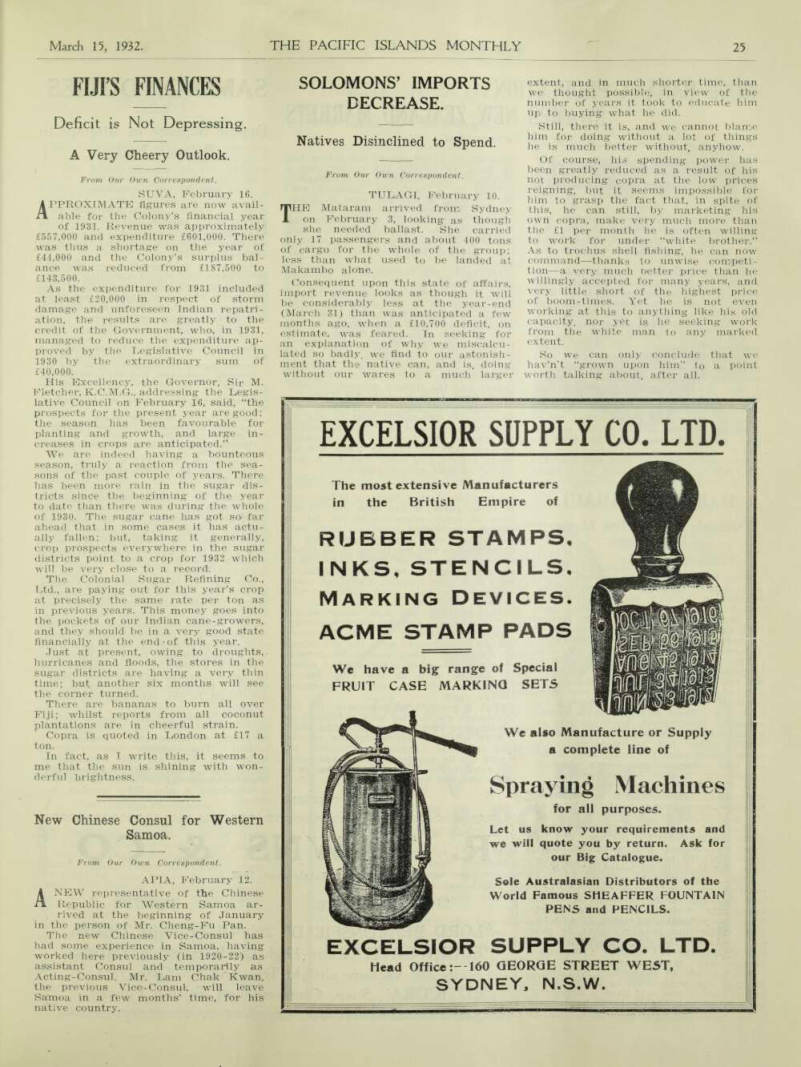
Deficit is Not Depressing.
A Very Cheery Outlook.
From Our Own Correspondent.
SUVA, February 16.
APPROXIMATE figures are now avail able for the Colony’s financial year of 1931. Revenue was approximately £557,000 and expenditure £601,000. There was thus a shortage on the year of £44,000 and the Colony’s surplus bal ance was reduced from £187,500 to £143,500.
As the expenditure for 1931 included at least £20,000 in respect of storm damage and unforeseen Indian repatri ation, the results are greatly to the credit of the Government, who, in 1931, managed to reduce the expenditure ap proved by the Legislative Council in 1930 by the extraordinary sum of £40,000.
His Excellency, the Governor, Sir M.
Fletcher, K.C.M.G., addressing the Legis lative Council on February 16, said, “the prospects for the present year are good; the season has been favourable for planting and growth, and large in creases in crops are anticipated.”
We are indeed having a bounteous season, truly a reaction from the sea sons of the past couple of years. There has been more rain in the sugar dis tricts since the beginning of the year to date than there was during the whole of 1930. The sugar cane has got so far ahead that in some cases it has actu ally fallen; but, taking it generally, crop prospects everywhere in the sugar districts point to a crop for 1932 which will be very close to a record.
The Colonial Sugar Refining Co., Ltd., are paying out for this year’s crop at precisely the same rate per ton as in previous years. This money goes into the pockets of our Indian cane-growers, and they should be in a very good state financially at the end of this year.
Just at present, owing to droughts, hurricanes and floods, the stores in the sugar districts are having a very thin time; but another six months will see the corner turned.
There are bananas to burn all over Fiji; whilst reports from all coconut plantations are in cheerful strain.
Copra is quoted in London at £17 a ton.
In fact, as I write this, it seems to me that the sun is. shining with won derful brightness.
New Chinese Consul for Western
Samoa.
From Our Own Correspondent.
APIA, February 12.
A NEW representative of the Chinese Republic for Western Samoa ar rived at the beginning of January in the person of Mr. Cheng-Fu Pan.
The new Chinese Vice-Consul has had some experience in Samoa, having worked here previously (in 1920-22) as assistant Consul and temporarily as Acting-Consul. Mr. Ram Chak Kwan, the previous Vice-Consul, will leave Samoa in a few months’ time, for his native country.
Solomons' Imports
Decrease.
Natives Disinclined to Spend.
From Our Own Correspondent.
TULAGI, February 10.
THE Mataram arrived from Sydney on February 3, looking as though she needed ballast. She carried only 17 passengers and about 400 tons of cargo for the whole of the group: less than what used to be landed at Makambo alone.
Consequent upon this state of affairs, import revenue looks as though it will be considerably less at the year-end (March 31) than was anticipated a few months ago, when a £10,700 deficit, on estimate, was feared. In seeking for an explanation of why we miscalcu lated so badly, we find to our astonish ment that the native can, and is, doing without our wares to a much larger
extent, and in much shorter time, than we thought possible, in view of the number of years it took to educate him up to buying what he did.
Still, there it is, and we cannot blame him for doing without a lot of things he is much better without, anyhow.
Of course, his spending power has been greatly reduced as a result of his not producing copra at the low prices reigning, but it seems impossible for him to grasp the fact that, in spite of this, he can still, by marketing his own copra, make very much more than the £1 per month he is often willing to work for under “white brother.”
As to trochus shell fishing, he can now command —thanks to unwise competi tion—a very much better price than he willingly accepted for many years, and very little short of the highest price of boom-times. Yet he is not even working at this to anything like his old capacity, nor yet is he seeking work from the white man to any marked extent.
So we can only conclude that we hav’n’t “grown upon him” to a point worth talking about, after all.
Advertisements & other items, p. 27 (1 item)
Excelsior Supply Co. Ltd.
The most extensive Manufacturers in the British Empire of
RUBBER STAMPS,
INKS, STENCILS.
Marking Devices.
ACME STAMP PADS
We have a big range of Special
FRUIT CASE MARKING SETS
We also Manufacture or Supply a complete line of
Spraying Machines
for all purposes.
Let us know your requirements and we will quote you by return. Ask for our Big Catalogue.
Sole Australasian Distributors of the World Famous SHEAFFER FOUNTAIN
PENS and PENCILS.
EXCELSIOR SUPPLY CO. LTD.
Head Office:— 160 GEORGE STREET WEST,
SYDNEY, N.S.W.
Huge Banana Production
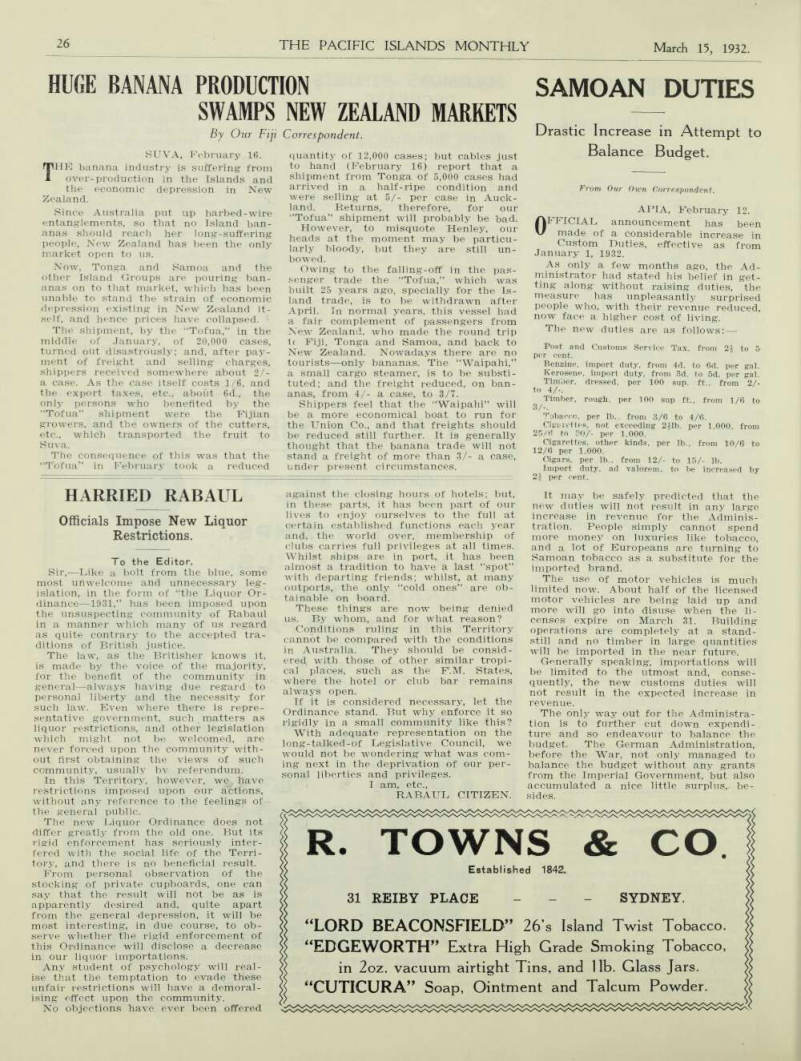
Swamps New Zealand Markets
By Our Fiji Correspondent.
SUVA, February 16.
THE banana industry is suffering from over-production in the Islands and the economic depression in New Zealand.
Since Australia put up barbed-wire entanglements, so that no Island ban anas should reach her long-suffering people, New Zealand has been the only market open to us.
Now, Tonga and Samoa and the other Island Groups are pouring ban anas on to that market, which has been unable to stand the strain of economic depression existing in New Zealand it self, and hence prices have collapsed.
The shipment, by the “Tofua,” in the middle of January, of 20,000 cases, turned out disastrously; and, after pay ment of freight and selling charges, shippers received somewhere about 2/a case. As the case itself costs 1/6, and the export taxes, etc., about 6d., the only persons who benefited by the “Tofua” shipment were the Fijian growers, and the owners of the cutters, etc., which transported the fruit to Suva.
The consequence of this was that the “Tofua” in February took a reduced
quantity of 12,000 cases; but cables just to hand (February 16) report that a shipment from Tonga of 5,000 cases had arrived in a half-ripe condition and were selling at 5/- per case in Auck land. Returns, therefore, for our “Tofua” shipment will probably be bad.
However, to misquote Henley, our heads at the moment may be particu larly bloody, but they are still un bowed.
Owing to the falling-off in the pas senger trade the “Tofua,” which was built 25 years ago, specially for the Is land trade, is to be withdrawn after April. In normal years, this vessel had a fair complement of passengers from New Zealand, who made the round trip to Fiji, Tonga and Samoa, and back to New Zealand. Nowadays there are no tourists —only bananas. The “Waipahi,” a small cargo steamer, is to be substi tuted; and the freight reduced, on ban anas, from 4/- a case, to 3/7.
Shippers feel that the “Waipahi” will be a more economical boat to run for the Union Co., and that freights should be reduced still further. It is generally thought that the banana trade will not stand a freight of more than 3/- a case, under present circumstances.
Harried Rabaul
Officials Impose New Liquor Restrictions.
To the Editor.
Sir, —Like a bolt from the blue, some most unwelcome and unnecessary leg islation, in the form of “the Liquor Or dinance —1931,” has been imposed upon the unsuspecting community of Rabaul in a manner which many of us regard as quite contrary to the accepted tra ditions of British justice.
The law, as the Britisher knows it, is made by the voice of the majority, for the benefit of the community in general—always having due regard to personal liberty and the necessity for such law. Even where there is repre sentative government, such matters as liquor restrictions, and other legislation which might not be welcomed, are never forced upon the community with out first obtaining the views of such community, usually by referendum.
In this Territory, however, we have restrictions imposed upon our actions, without any reference to the feelings of the general public.
The new Liquor Ordinance does not differ greatly from the old one. But its rigid enforcement has seriously inter fered with the social life of the Terri tory, and there is no beneficial result.
From personal observation of the stocking of private cupboards, one can say that the result will not be as is apparently desired and, quite apart from the general depression, it will be most interesting, in due course, to ob serve whether the rigid enforcement of this Ordinance will disclose a decrease in our liquor importations.
Any student of psychology will real ise that the temptation to evade these unfair restrictions will have a demoral ising effect upon the community.
No objections have ever been offered
against the closing hours of hotels: but, in these parts, it has been part of our lives to enjoy ourselves to the full at certain established functions each year and, the world over, membership of clubs carries full privileges at all times.
Whilst ships are in port, it has been almost a tradition to have a last “spot” with departing friends: whilst, at many outports, the only “cold ones” are ob tainable on board.
These things are now being denied us. By whom, and for what reason?
Conditions ruling in this Territory cannot be compared with the conditions in Australia. They should be consid ered with those of other similar tropi cal places, such as the F.M, States, where the hotel or club bar remains always open.
If it is considered necessary, let the Ordinance stand. But why enforce it so rigidly in a small community like this?
With adequate representation on the long-talked-of Legislative Council, we would not be wondering what was com ing next in the deprivation of our per sonal liberties and privileges.
I am, etc.,
Rabaul Citizen.
Samoan Duties
Drastic Increase in Attempt to Balance Budget.
From Our Own Correspondent.
APIA, February 12.
OFFICIAL announcement has been made of a considerable increase in Custom Duties, effective as from January 1, 1932.
As only a few months ago, the Ad ministrator had stated his belief in get ting along without raising duties, the measure has unpleasantly surprised people who, with their revenue reduced, now face a higher cost of living.
The new duties are as follows: Post and Customs Service Tax, from 1\ to 5 per cent.
Benzine, import duty, from 4d. to 6d. per gal.
Kerosene, import duty, from 3d. to sd. per gal.
Timber, dressed, per 100 sup. ft., from 2/to 4/-.
Timber, rough, per 100 sup ft., from 1/6 to 3/-.
Tobacco, per lb., from 3/6 to 4/6.
Cigarettes, not exceeding 2½lb. per 1,000, from 25/6 to 30/- per 1.000.
Cigarettes, other kinds, per lb., from 10/6 to 12/6 per 1.000.
Cigars, per lb., from 12/- to 15/- lb.
Import duty, ad valorem, to be increased by 2½ per cent.
It may be safely predicted that the new duties will not result in any large increase in revenue for the Adminis tration. People simply cannot spend more money on luxuries like tobacco, and a lot of Europeans are turning to Samoan tobacco as a substitute for the imported brand.
The use of motor vehicles is much limited now. About half of the licensed motor vehicles are being laid up and more will go into disuse when the li censes expire on March 31. Building operations are completely at a stand still and no timber in large quantities will be imported in the near future.
Generally speaking, importations will be limited to the utmost and, conse quently, the new customs duties will not result in the expected increase in revenue.
The only way out for the Administra tion is to further cut down expendi ture and so endeavour to balance the budget. The German Administration, before the War, not only managed to balance the budget without any grants from the Imperial Government, but also accumulated a nice little surplus, be sides.
Advertisements & other items, p. 28 (1 item)
R. Towns & Co.
Established 1842.
31 REIBY PLACE - SYDNEY.
“LORD BEACONSFIELD” 26’s Island Twist Tobacco.
“EDGEWORTH” Extra High Grade Smoking Tobacco, in 2oz. vacuum airtight Tins, and 1 lb. Glass Jars.
“CUTICURA” Soap, Ointment and Talcum Powder.
Papua Balances
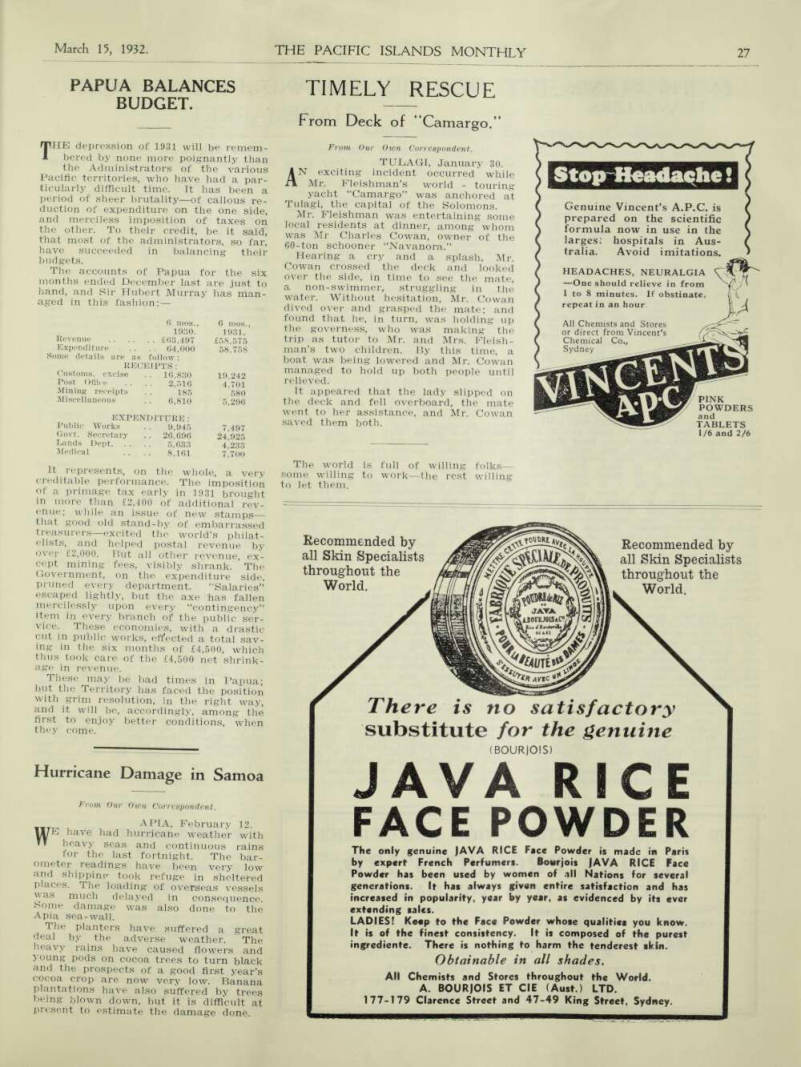
Budget.
THE depression of 1931 will be remem bered by none more poignantly than the Administrators of the various Pacific territories, who have had a par ticularly difficult time. It has been a period of sheer brutality—of callous re duction of expenditure on the one side, and merciless imposition of taxes on the other. To their credit, be it said, that most of the administrators, so far, have succeeded in balancing their budgets.
The accounts of Papua for the six months ended December last are just to hand, and Sir Hubert Murray has man aged in this fashion:
It represents, on the whole, a very creditable performance. The imposition of a primage tax early in 1931 brought in more than £2,400 of additional rev enue; while an issue of new stamps— that good old stand-by of embarrassed treasurers—excited the world’s philat elists, and helped postal revenue by over £2,000. But all other revenue, ex cept mining fees, visibly shrank. The Government, on the expenditure side, pruned every department. “Salaries” escaped lightly, but the axe has fallen mercilessly upon every “contingency” item in every branch of the public ser vice, These economies, with a drastic cut in public works, effected a total sav ing in the six months of £4,500, which thus took care of the £4,500 net shrink age in revenue.
These may be bad times in Papua; but the Territory has faced the position with grim resolution, in the right way, and it will be, accordingly, among the first to enjoy better conditions, when they come.
6 mos.. 6 mos., 1930. 1931.
Revenue £63,497 £58,575 Expenditure . . . . 64,000 58,758 Some details are as follow;
Receipts:
Customs, excise . . 16,830 19,242 Post Office . . . . 2,516 4,701 Mining receipts . . 185 580 Miscellaneous . . 6,810 5,296
Expenditure :
Public Works . . 9,945 7,497 Govt. Secretary . . 26.696 24,925 Lands Dept 5,633 4,233 Medical . . . . 8,161 7,700
Hurricane Damage in Samoa
From Our Own Correspondent.
APIA, February 12.
WE have had hurricane weather with heavy seas and continuous rains for the last fortnight. The bar ometer readings have been very low and shipping took refuge in sheltered places. The loading of overseas vessels was much delayed in consequence, borne damage was also done to the Apia sea-wall.
The planters have suffered a great deal by the adverse weather. The heavy rains have caused flowers and young pods on cocoa trees to turn black and the prospects of a good first year’s cocoa crop are now very low. Banana plantations have also suffered by trees being blown down, but it is difficult at present to estimate the damage done.
Timely Rescue
From Deck of “Camaergo."
From Our Own Correspondent.
TULAGI, January 30.
AN exciting- incident occurred while Mr. Fleishman’s world - touring yacht “Camargo” was anchored at Tulagi, the capital of the Solomons.
Mr. Fleishman was entertaining some local residents at dinner, among whom was Mr Charles Cowan, owner of the 60-ton schooner “Navanora.”
Hearing a cry and a splash, Mr.
Cowan crossed the deck and looked over the side, in time to see the mate, a non-swimmer, struggling in the water. Without hesitation, Mr. Cowan dived over and grasped the mate; and found that he, in turn, was holding up the governess, who was making the trip as tutor to Mr. and Mrs. Fleish man’s two children. By this time, a boat was being lowered and Mr. Cowan managed to hold up both people until relieved.
It appeared that the lady slipped on the deck and fell overboard, the mate went to her assistance, and Mr. Cowan saved them both.
The world is full of willing folks— some willing to work—the rest willing to let them.
Advertisements & other items, p. 29 (1 item)
Java Rice
Stop-Headache!
Genuine Vincent’s A.P.C. is prepared on the scientific formula now in use in the
larges: hospitals in Aus
tralia. Avoid imitations.
HEADACHES, NEURALGIA
—One should relieve in from 1 to 8 minutes. If obstinate, repeat in an hour.
All Chemists and Stores or direct from Vincent’s Chemical Co., Sydney
PINK
POWDERS
and
TABLETS
1/6 and 2/6
Recommended by all Skin Specialists
throughout the
World.
Recommended by all Skin Specialists throughout the World.
There is no satisfactory
substitute for the genuine
(BOURJOIS)
JAVA RICE
FACE POWDER
The only genuine JAVA RICE Face Powder is made in Paris by expert French Perfumers. Bourjois JAVA RICE Face Powder has been used by women of all Nations for several generations. It has always given entire satisfaction and has increased in popularity, year by year, as evidenced by its ever extending sales.
LADIES! Keep to the Face Powder whose qualities you know.
It is of the finest consistency. It is composed of the purest ingrediente. There is nothing to harm the tenderest skin.
Obtainable in all shades.
All Chemists and Stores throughout the World.
A. BOURJOIS ET CIE (Aust.) LTD.
177-179 Clarence Street and 47-49 King Street, Sydney.
Pacific Islands
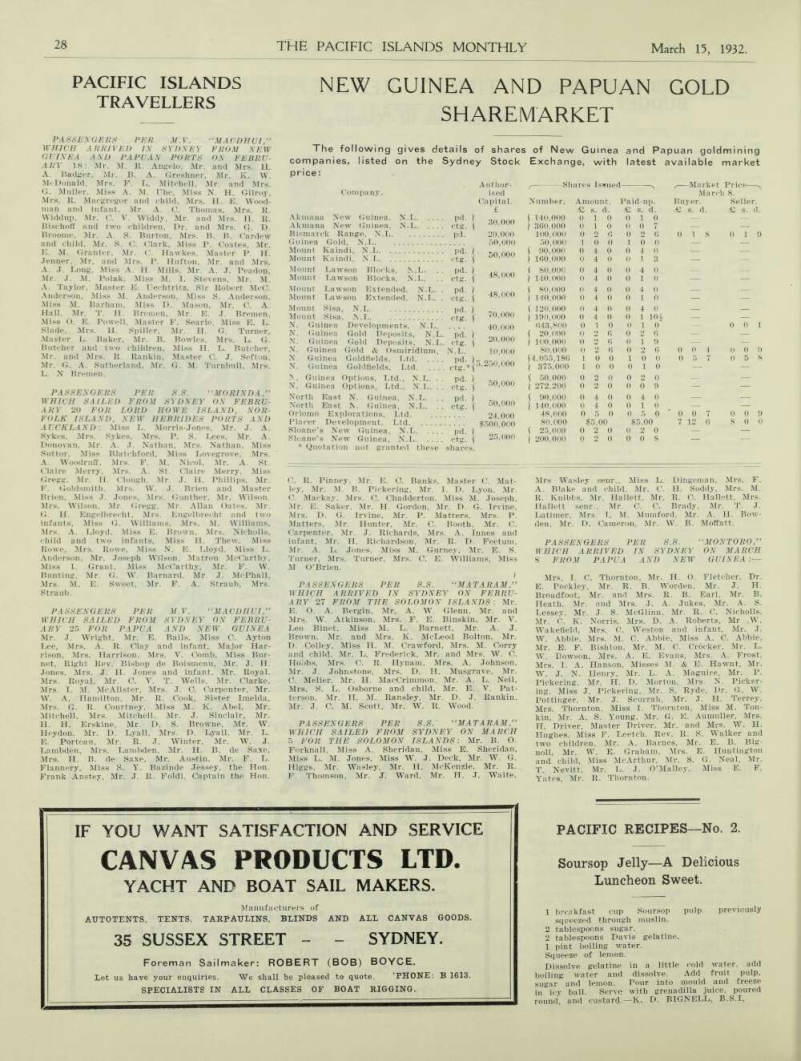
Travellers
Passengers Per M.V. “Macdhui,”
Which Arrived In Sydney From New
Guinea And Papuan Ports On Febru
ARY 18: Mr. M. R. Angelo, Mr. and Mrs. H.
A. Badger, Mr. B. A. Greshner, Mr. K. W.
McDonald, Mrs. F. L. Mitchell, Mr. and Mrs.
G. Muller, Miss A. M. Uhe, Miss N. H. Gilroy, Mrs. R. Macgregor and child, Mrs. H. E. Wood man and infant. Mr. A. C. Thomas, Mrs. R.
Widdup, Mr. C. Y. Widdy, Mr. and Mrs. H. R.
Bischoff and two children, Dr. and Mrs. G. D.
Broome, Mr. A. S. Burton, Mrs. B. B. Cardew and child, Mr. S. C. Clark, Miss P. Coates, Mr.
E. M. Granter, Mr. C. Hawkes, Master P. H.
Jenner, Mr. and Mrs. P. Hufton. Mr. and Mrs.
A. J. Long, Miss A. H. Mills. Mr. A. J. Peadon, Mr. J. M. Polak, Miss M. I. Stevens, Mr. M.
A. Taylor, Master E. Uechtritz. Sir Robert McC.
Anderson, Miss M. Anderson, Miss S. Anderson, Miss M. Barham, Miss D. Mason, Mr. C. A.
Hall, Mr. T. H. Bremen, Mr. E. J. Bremen, Miss O. E. Powell, Master F. Searle. Miss E. L.
Slade. Mrs. H. Spiller, Mr. H. G. Turner, Master L. Baker, Mr. B. Bowles, Mrs. L. G.
Butcher and two children, Miss H. L. Butcher, Mr. and Mrs. R. Rankin, Master C. J. Sefton, Mr. G. A. Sutherland, Mr. G. M. Turnbull, Mrs.
L. N Bremen.
Passengers Per S.S. “Morinda,”
Which Sailed From Sydney On Febru
ARY 20 FOR LORD HOWE ISLAND, NOR
Folk Island, New Hebrides Ports And
AUCKLAND : Miss L. Morris-Jones, Mr. J. A.
Sykes. Mrs. Sykes, Mrs. P. S. Lees, Mr. A.
Donovan, Mr. A. J. Nathan. Mrs. Nathan, Miss Suttor, Miss Blatchford, Miss Lovegrove, Mrs.
A. Woodruff, Mrs. F. M. Nicol, Mr. A. St.
Claire Merry, Mrs. A. St. Claire Merry, Miss Gregg, Mr. H. Clough. Mr. J. H. Phillips, Mr.
F. Goldsmith. Mrs. W. J. Brien and Master Brien, Miss J. Jones, Mrs. Gunther. Mr. Wilson, Mrs. Wilson, Mr. Gregg. Mr. Allan Oates. Mr.
G. H. Engelbrecht. Mrs. Engelbrecht and two infants, Miss G. Williams, Mrs. M. Williams, Mrs. A. Lloyd. Miss E. Brown, Mrs. Nicholls, child and two infants, Miss H. Thew, Miss Rowe, Mrs. Rowe, Miss N. E. Lloyd, Miss L.
Anderson, Mr. Joseph Wilson, Matron McCarthy, Miss I. Grant, Miss McCarthy, Mr. F. W.
Bunting. Mr. G. W. Barnard, Mr. J. McPhail, Mrs. M. E. Sweet, Mr. F. A. Straub. Mrs.
Straub.
Passengers Per M.V. “Macdhui,”
Which Sailed From Sydney On Febru
ARY 25 FOR PAPUA AND NEW GUINEA Mr. J. Wright, Mr. E. Bails, Miss O. Ayton Lee, Mrs. A. R. Clay and infant, Major Har rison, Mrs. Harrison, Mrs. V. Comb, Miss Bur net, Right Rev. Bishop de Boismenu, Mr. J. H.
Jones, Mrs. J. H. Jones and infant, Mr. Royal, Mrs. Royal, Mr. C. V. T. Wells, Mr. Clarke, Mrs. I. M. McAlister, Mrs. J. O. Carpenter, Mr.
W. A. Hamilton, Mr. R. Cook, Sister Imelda, Mrs. G. R. Courtney, Miss M. K. Abel, Mr.
Mitchell, Mrs. Mitchell. Mr. J. Sinclair, Mr.
H. H. Erskine, Mr. D. S. Browne, Mr. W.
Heydon, Mr. D. Lyall, Mrs. D. Lyall, Mr. L.
E. Porteau, Mr. R. J. Winter, Mr. W. J.
Lambden, Mrs. Lambden, Mr. H. B. de Saxe, Mrs. H. B. de Saxe, Mr. Austin, Mr. F. L.
Flannery, Miss S. Y. Bazinde Jessey, the Hon.
Frank Anstey, Mr. J. R. Foldi, Captain the Hon.
C. R. Pinney, Mr. E. O. Banks, Master C. Mat ley, Mr. M. B. Pickering, Mr. I. D. Lyon, Mr.
C. Mackay, Mrs. C. Chadderton, Miss M. Joseph, Mr. E. Saker, Mr. H. Gordon, Mr. D. G. Irvine, Mrs. D. G. Irvine, Mr. P. Matters, Mrs. P.
Matters, Mr. Hunter, Mr. C. Booth, Mr. C.
Carpenter, Mr. J. Richards, Mrs. A. Innes and infant, Mr. H. Richardson, Mr. R. D. Feetum, Mr. A. L. Jones, Miss M. Gurney, Mr. E. S.
Turner, Mrs. Turner, Mrs. C. E. Williams, Miss M O’Brien.
Passengers Per S.S. “Mataram ”
Which Arrived In Sydney On Febru
ARY 27 FROM THE SOLOMON ISLANDS: Mr.
E. O. A. Bergin, Mr. A. W. Glenn, Mr. and Mrs. W. Atkinson, Mrs. F. E. Binskin, Mr. V.
Leo Binet, Miss M. L. Barnett, Mr. A. J.
Brown, Mr. and Mrs. K. McLeod Bolton, Mr.
D. Colley, Miss H. M. Crawford, Mrs. M. Corry and child, Mr. L. Frederick, Mr. and Mrs. W. C.
Hobbs, Mrs. O. R. Hynam, Mrs. A. Johnson, Mr. J. Johnstone, Mrs. D. H. Musgrave, Mr.
O. Melier, Mr. H. MacCrimmon, Mr. A. L. Neil, Mrs. S. L. Osborne and child, Mr. B. V. Pat terson, Mr. EL M. Ransley, Mr. D. J. Rankin, Mr. J. C. M. Scott, Mr. W. R. Wood.
Passengers Per S.S. “Mataram.”
Which Sailed From Sydney On March
5 FOR THE SOLOMON ISLANDS : Mr. B. O.
Forknall, Miss A. Sheridan. Miss E. Sheridan, Miss L. M. Jones, Miss W. J. Deck, Mr. W. G.
Higgs, Mr. Wasley. Mr. H. McKenzie. Mr. R.
F. Thomson, Mr. J. Ward, Mr. H. J. Waite,
Mrs Wasley senr., Miss L. Dingeman. Mrs. F.
A. Blake and child, Mr. C. H. Soddy, Mrs. M.
R. Knibbs, Mr. Hallett, Mr. R. O. Hallett, Mrs.
Hallett senr., Mr. C. C. Brady, Mr. T. J.
Latimer, Mrs. I. M. Mumford, Mr. A. H. Bow den, Mr. D. Cameron, Mr. W. B. Moffatt.
Passengers Per S.S. “Montoro,”
Which Arrived In Sydney On March
8 From Papua And New Guinea
Mrs. I. C. Thornton, Mr. H. O. Fletcher, Dr.
E. Pockley, Mr. K. B. Worden, Mr. J. H.
Broadfoot, Mr. and Mrs. R. B. Earl, Mr. B.
Heath, Mr. and Mrs. J. A. Jukes, Mr. A. S.
Lessey, Mr. J. S. McGlinn, Mr. R. C. Nicholls, Mr. C. K. Norris, Mrs. D. A. Roberts, Mr .W.
Wakefield, Mrs. O. Weston and infant, Mr. J.
W. Abbie, Mrs. M. C. Abbie, Miss A. C. Abbie, Mr. E. F. Bishton, Mr. M. C. Crocker. Mr. L.
W. Dowson, Mrs. A. E. Evans, Mrs. A. Frost, Mrs. I. A. Hanson, Misses M. & E. Hawnt, Mr.
W. J. N. Henry, Mr. L. A. Maguire, Mr. P.
Pickering, Mr. H. D. Morton, Mrs. N. Picker ing, Miss J. Pickering, Mr. S. Ryde, Dr. G. W.
Pottinger, Mr. J. Scurrah, Mr. J. H. Terrey, Mrs. Thornton, Miss I. Thornton, Miss M. Ton kin, Mr. A. S. Young. Mr. G. E. Aumuller, Mrs.
H. Driver, Master Driver, Mr. and Mrs. W. H.
Hughes, Miss F. Leetch. Rev. R. S. Walker and two children, Mr. A. Barnes, Mr. B. B. Big noll, Mr. W. E. Graham, Mrs. E. Huntington and child, Miss McArthur, Mr. S. G. Neal, Mr.
T. Nevitt, Mr. L. J. O’Malley, Miss E. F.
Abates, Mr. R. Thornton.
Sharemarket
New Guinea And Papuan Gold
The following gives details of shares of New Guinea and Papuan goldmining companies, listed on the Sydney Stock Exchange, with latest available market price:
Authorised Capital Shares Issues Market Price Company.
March 8.
Number.
Amount. Paid-up.
Buyer.
Seller. £ £ 8. d. £ s. d. £ s. d. £ s. d.
Akmana New Guinea. N.L pd. 30,000 f 140,000 0 1 0 0 1 0 — — Akmana New Guinea, N.L
ctg. (
360,000 0 1 0 0 0 7 — — Bismarck Range. N.L pd. 20.000 100,000 0 2 6 0 2 6 0 1 8 0 1 9 Guinea Gold, N.L 50,000 50,000 1 0 0 1 0 0 — — Mount Kaindi, N.L Pd. ) f 90,000 0 4 0 0 4 0 — Mount Kaindi, N.L
ctg. (
\ 160,000 0 4 0 0 1 3 — — Mount Lawson Blocks, N.L. pd. ) f 80,000 0 4 0 0 4 0.
Mount Lawson Blocks, N.L.
ctg. (
48,000 ) 140,000 0 4 0 0 1 0 — — Mount Lawson Extended. N.L. . pd. ) f 80,000 0 4 0 0 4 0 . — Mount Lawson Extended, N.L. .
ctg. \
48,000 140.000 0 4 0 0 1 0 — — Mount Sisa, N.L pd. ) ( 120.000 0 4 0 0 4 0 Mount Sisa. N.L
ctg. (
70,000 1 190,000 0 4 0 0 1 10 i — — N. Guinea Developments, N.L. 40,000 643,800 0 1 0 0 1 0 — 0 0 1 N. Guinea Gold Deposits, N.L. pd. ) ( 20,000 0 o fi 0 2 6 — — N. Guinea Gold Deposits, N.L.
ctg. (
20,000 ) 100,000 0 O 6 0 1 9 — — N. Guinea Gold & Osmiridium, N.L. 10,000 80,000 o 2 6 0 o 6 0 0 4 0 0 9 N. Guinea Goldfields. Ltd pd. 1 (4,055,186 1 0 0 1 0 0 0 5 7 0 5 8 N. Guinea Goldfields, Ltd
ctg.*(
5,250,000 \ 375,000 1 0 0 0 1 0 — — N. Guinea Options, Ltd., N.L. .. pd. 1 ( 50.000 0 2 0 0 2 0 — — N. Guinea Options. Ltd., N.L. . .
ctg. (
50,000 ( 272,200 0 2 0 0 0 9 — — North East N. Guinea, N.L. .. pd. ] ( 90,000 0 4 0 0 4 0 — — North East N. Guinea, N.L. ..
ctg. (
50,000 ] 140,000 0 4 0 0 1 0 — — Oriomo Explorations, Ltd 24,000 48,000 0 5 0 0 5 0 * 0 0 7 0 0 9 Placer Development. Ltd $500,000 80,000 $5.00 $5.00 7 12 6 8 0 0 Sloane’s New Guinea. N.L pd. 1 ( 25,000 0 2 0 0 2 0 — — Slcane’s New Guinea, N.L
ctg. S
25,000 ] 200,000 0 2 0 0 0 8 — — *Quotation not granted these shares.
Soursop Jelly—A Delicious
Pacific Recipes—No. 2.
Soursop Jelly—A Delicious Luncheon Sweet.
1 breakfast cup Soursop pulp, previously squeezed through muslin. 2 tablespoons sugar. 2 tablespoons Davis gelatine. 1 pint boiling water.
Squeeze of lemon.
Dissolve gelatine in a little cold water, add boiling water and dissolve. Add fruit pulp, sugar and lemon. Pour into mould and freeze in icy ball. Serve with grenadilla juice, poured round, and custard, —K, D, BIGNELL, B,S.I,
Advertisements & other items, p. 30 (1 item)
Canvas Products Ltd.
IF YOU WANT SATISFACTION AND SERVICE
YACHT AND BOAT SAIL MAKERS.
Manufacturers of AUTOTENTS, TENTS, TARPAULINS, BLINDS AND ALL CANVAS GOODS.
35 SUSSEX STREET - - SYDNEY.
Foreman Sailmaker; ROBERT (BOB) BOYCE.
Let us have your enquiries. We shall he pleased to quote. 'PHONE; B 1613.
SPECIALISTS IN ALL CLASSES OF BOAT RIGGING.
Exchange Quotations
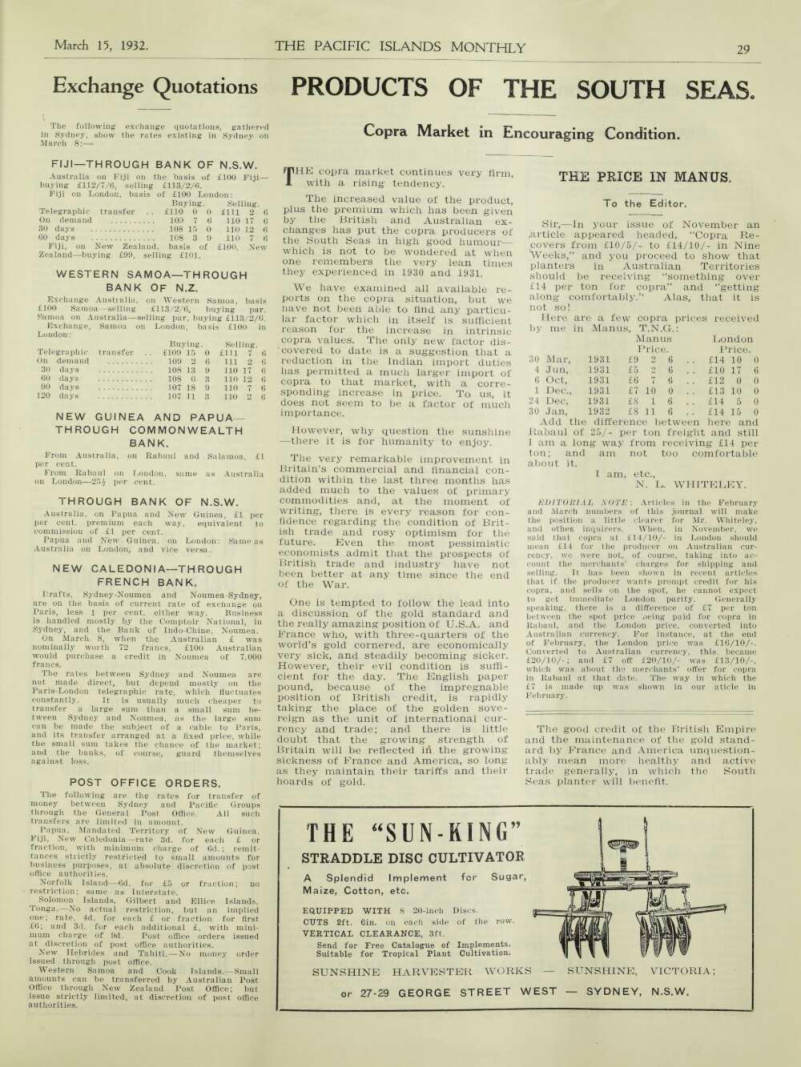
The following exchange quotations, gathered in Sydney, show the rates existing in Sydney on March 8: —
Fiji—Through Bank Of N.S.W.
Australia on Fiji on the basis of £100 Fiji— buying £112/7/6, selling £113/2/6.
Fiji on London, basis of £100 London:
Western Samoa—Through
Bank Of N.Z.
Exchange Australia, on Western Samoa, basis £100 Samoa—selling £113/2/6, buying par.
Samoa on Australia —selling par, buying £113/2/6.
Exchange, Samoa on London, basis £100 in London:
New Guinea And Papua—
Through Commonwealth
Bank.
From Australia, on Rabaul and Salamoa, £1 per cent.
From Rabaul on London, same as Australia on London—25½ per cent.
Through Bank Of N.S.W.
Australia, on Papua and New Guinea, £1 per per cent, premium each way, equivalent to commission of £1 per cent.
Papua and New Guinea, on London: Same as Australia on London, and vice versa.
New Caledonia—Through
French Bank.
Drafts, Sydney-Noumea and Noumea-Sydney, are on the basis of current rate of exchange on Paris, less l per cent, either way. Business is handled mostly by the Comptoir National, in Sydney, and the Bank of Indo-Ghine, Noumea.
On March 8, when the Australian £ was nominally worth 72 francs, £100 Australian would purchase a credit in Noumea of 7,000 francs.
The rates between Sydney and Noumea are not made direct, but depend mostly on the Paris-London telegraphic rate, which fluctuates constantly. It is usually much cheaper to transfer a large sum than a small sum be tween Sydney and Noumea, as the large sum can be made the subject of a cable to Paris, and its transfer arranged at a fixed price, while the small sura takes the chance of the market; and the banks, of course, guard themselves against loss.
Post Office Orders.
The following are the rates for transfer of money between Sydney and Pacific Groups through the General Post Office. All such transfers are limited in amount.
Papua, Mandated Territory of New Guinea, Fiji, New Caledonia—rate 3d. for each £ or fraction, with minimum charge of 6d.; remit tances strictly restricted to small amounts for business purposes, at absolute discretion of post office authorities.
Norfolk Island—6d. for £5 or fraction; no restriction; same as Interstate.
Solomon Islands, Gilbert and Ellice Islands, Tonga.—No actual restriction, but an implied one; rate, 4d. for each £ or fraction for first £6; and 3d. for each additional £, with mini mum charge of 9d. Post office orders issued at discretion of post office authorities.
New Hebrides and Tahiti.—No money order issued through post office.
Western Samoa and Cook Islands.—Small amounts can be transferred by Australian Post Office through New Zealand Post Office; but issue strictly limited, at discretion of post office authorities.
Buying. Selling.
Telegraphic transfer . . £110 0 0 £111 2 6 On demand 109 7 6 110 17 6 30 days 108 15 0 110 12 6 60 days 108 3 9 110 7 6 Fiji, on New Zealand, basis of £100, New Zealand—buying £99, selling £101.
Buying. Selling.
Telegraphic transfer .. £109 15 0 £111 7 6 On demand 109 2 6 111 2 6 30 days 108 13 9 110 17 0 60 days 108 6 3 110 12 6 90 days 107 18 9 110 7 6 120 days 107 11 3 110 2 0
Products Of The South Seas.
Copra Market in Encouraging Condition.
THE copra market continues very Arm, with a rising tendency.
The increased value of the product, plus the premium which has been given by the British and Australian ex changes has put the copra producers of the South Seas in high good humour — which is not to be wondered at when one remembers the very lean times they experienced in 1930 and 1931.
We have examined all available re ports on the copra situation, but we nave not been able to And any particu lar factor which in itself is sufficient reason for the increase in intrinsic copra values. The only new factor dis covered to date is a suggestion that a reduction in the Indian import duties has permitted a much larger import of copra to that market, with a corre sponding increase in price. To us, it does not seem to be a factor of much importance.
However, why question the sunshine —there it is for humanity to enjoy.
The very remarkable improvement in Britain’s commercial and financial con dition within the last three months has added much to the values of primary commodities and, at the moment of writing, there is every reason for con fidence regarding the condition of Brit ish trade and rosy optimism for the future. Even the most pessimistic economists admit that the prospects of British trade and industry have not been better at any time since the end of the War.
One is tempted to follow the lead into a discussion of the gold standard and the really amazing position of U.S.A, and France who, with three-quarters of the world’s gold cornered, are economically very sick, and steadily becoming sicker.
However, their evil condition is suffi cient for the day. The English paper pound, because of the impregnable position of British credit, is rapidly taking the place of the golden sove reign as the unit of international cur rency and trade; and there is little doubt that the growing strength of Britain will be reflected in the growing sickness of France and America, so long as they maintain their tariffs and their hoards of gold.
The good credit of the British Empire and the maintenance of the gold stand ard by France and America unquestion ably mean more healthy and active trade generally, in which the South Seas planter will benefit.
The Price In Manus.
To the Editor.
Sir,—ln your issue of November an ,article appeared headed, “Copra Re covers from £10/5/- to £14/10/- in Nine Weeks,” and you proceed to show that planters in Australian Territories should be receiving “something over £14 per ton for copra” and “getting along comfortably.” Alas, that it is not so!
Here are a few copra prices received by me in Manus, T.N.G.;
Add the difference between here and Rabaul of 25/- per ton freight and still I am a long way from receiving £14 per ton; and am not too comfortable about it.
I am, etc.,
N. L. Whiteley.
EDITORIAL NOTE : Articles in the February and March numbers of this journal will make the position a little clearer for Mr. Whiteley, and othes inquirers. When, in November, we said that copra at £14/10/- in London should mean £14 for the producer on Australian cur rency, we were not, of course, taking into ac count the merchants’ charges for shipping and selling. It has been shown in recent articles that if the producer wants prompt credit for his copra, and sells on the spot, he cannot expect to get immediate London parity. Generally speaking, there is a difference of £7 per ton between the spot price being paid for copra in Rabaul, and the London price, converted into Australian currency. For instance, at the end of February, the London price was £16/10/-.
Converted to Australian currency, this, became £20/10/-; and £7 off £20/10/- was £13/10/-, which was about the merchants’ offer for copra in Rabaul at that date. The way in which the £7 is made up was shown in our aticle in February.
Manus London Price. Price. 30 Mar, 1931 £9 2 6 . . £14 10 0 4 Jun, 1931 £5 2 6 . . £10 17 6 6 Oct, 1931 £6 7 6 . . £12 0 0 1 Dec,, 1931 £7 10 0 . . £13 10 0 24 Dec, 1931 £8 1 6 . . £14 5 0 30 Jan, 1932 £8 11 6 .. £14 15 0
Advertisements & other items, p. 31 (1 item)
The “Sun-King”
STRADDLE DISC CULTIVATOR
A Splendid Implement for Sugar, Maize, Cotton, etc.
EQUIPPED WITH 8 20-inch Discs.
CUTS 2ft. 6in. on each side of the row.
VERTICAL CLEARANCE, 3ft.
Send for Free Catalogue of Implements.
Suitable for Tropical Plant Cultivation.
SUNSHINE HARVESTER WORKS SUNSHINE, VICTORIA;
or 27-29 GEORGE STREET WEST SYDNEY, N.S.W.
Market Quotations
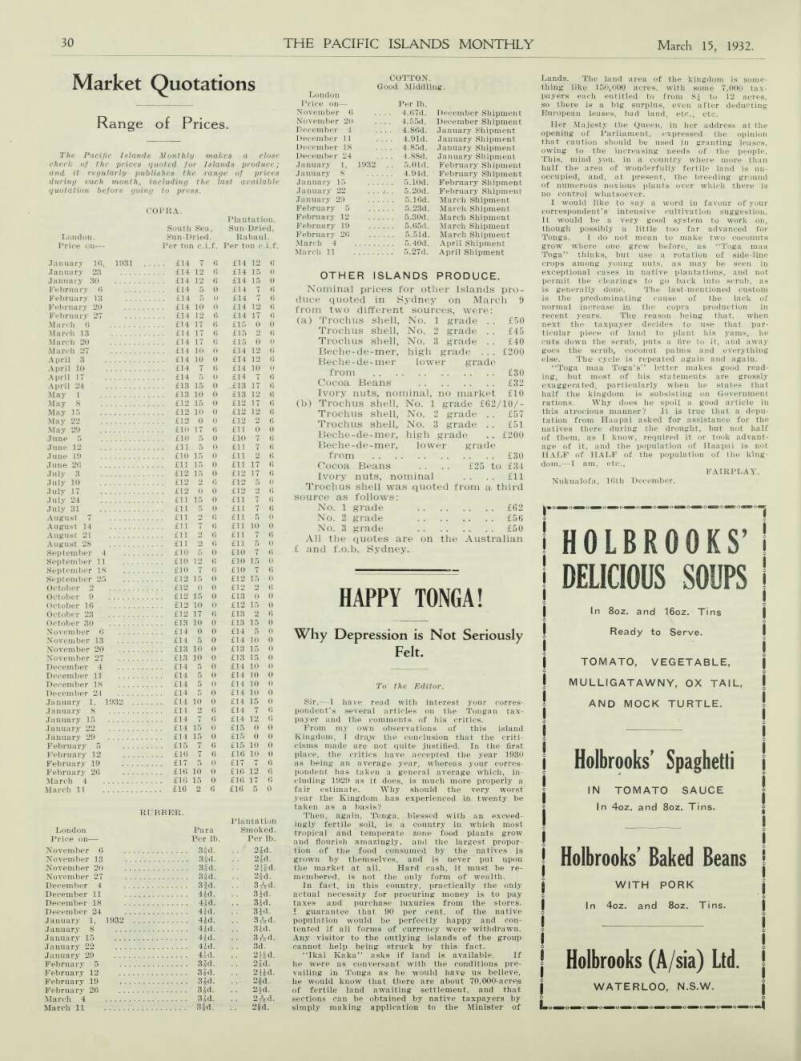
Range of Prices.
The Pacific Islands Monthly makes a close check of the prices quoted for Islands produce; and it regularly publishes the range of prices during each month, including the last available quotation before going to press.
Other Islands Produce.
Nominal prices for other Islands pro duce quoted in Sydney on March 9 from two different sources, were: (a) Trochus shell, No. 1 grade .. £50 Trochus shell, No. 2 grade . . £45 Trochus shell, No. 3 grade .. £40 Beche-de-mer, high grade .. . £200 Beche-de-mer lower grade from £30 Cocoa Beans £32 Ivory nuts, nominal, no market £10 (b) Trochus shell, No. 1 grade £62/10/- Trochus shell, No. 2 grade . . £57 Trochus shell, No. 3 grade .. £51 Beche-de-mer, high grade .. £200 Beche-de-mer, lower grade from £30 Cocoa Beans . . . . £25 to £34 Ivory nuts, nominal . . . . £11 Trochus shell was quoted from a third source as follows: No. 1 grade £62 No. 2 grade £56 No. 3 grade £5O All the quotes are on the Australian £ and f.o.b, Sydney.
London.
Price on—
Copra.
South Siea, Stan-Dried.
Per ton c.i.f.
Plantation, Sun-Dried, Rabaul.
Per ton c.i.f.
January 16, 1931 January 23 . . . £14 £14 7 12 6 £14 £14 12 6 15 0 January 30 £14 12 6 £14 15 0 £14 0 £14 7 6 £14 K 0 £14 7 6 February 20 ... £14 10 0 £14 12 6 February 27 ... £14 12 6 £ 1 1 17 6 £14 17 6 £15 0 0 March 13 £14 17 6 6 £15 2 6 £14 17 £15 0 0 March 27 £14 10 0 £14 12 6 April 3 £14 10 0 £14 12 6 £14 6 £14 10 0 £14 5 0 £14 7 6 April 24 £13 15 0 £13 17 6 May 1 £13 10 0 £13 12 6 May 8 £12 15 0 £12 17 6 May 15 £12 10 0 £12 12 6 May 22 £12 0 0 £12 2 6 May 29 £10 17 6 £11 0 0 June 5 £10 5 0 £10 7 6 £11 5 0 £11 7 6 June 19 £10 15 0 £11 2 6 June 26 £11 15 0 £11 17 6 July 3 £12 15 o 0 £12 17 6 July 10 £12 6 £12 5 0 July 17 £12 0 0 £12 2 6 July 24 £11 15 0 £11 7 6 July 31 £11 5 0 £11 7 6 £11 2 6 £11 5 0 August 14 £11 i 6 £11 10 0 August 21 £11 2 6 £11 7 6 August 28 £11 2 6 £11 5 0 £10 5 0 6 £10 7 6 September 11 ... £10 12 £10 15 0 September 18 .. . £10 6 £10 7 6 September 25 .. . £12 15 0 £12 15 0 £12 0 0 £12 2 6 October 9 £12 15 0 £13 0 0 October 16 £12 10 0 £12 15 0 October 23 £12 17 6 £13 2 6 October 30 £13 10 0 £13 15 0 November 6 £14 0 0 £14 5 0 November 13 £14 5 0 £14 10 0 November 20 £13 10 0 £13 15 0 November 27 £13 10 0 £13 15 0 December 4 £14 5 0 £14 10 0 December 11 £14 5 0 £14 10 0 December 18 £14 5 0 £14 10 0 December 24 £14 5 0 £14 10 0 January 1 1932 £14 10 0 £14 15 0 January 8 £14 2 6 £14 7 6 January 15 £14 7 6 £14 12 6 January 22 £14 15 0 £15 0 0 January 29 £14 15 0 £15 0 0 February 5 £15 6 £15 10 0 February 12 £16 j 6 £16 10 0 February 19 £17 5 0 £17 7 6 February 26 £16 10 0 £16 12 6 March 4 £16 15 0 £16 17 6 March 11 £16 2 6 £16 5 0 London Price on— November 6 November 13 . . .
Rubber.
Para Per lb. 3fd. 3gd.
Plantation Smoked. Per lb. .. 2|d. 2Jd.
November 20 November 27 . . .
December 4 3£d. 3fd. 3Jd. 4id. 4|d. 4Jd. 4Jd. 4£d. 2\id. 2gd. 3*d. 3id. 3Jd. 3 id. 3 Ad. 3Jd.
December 11 . ..
December 18 December 24 January 1 1932 January 8 January 15 4Jd. 4Jd. 4 id. 3Ad. 3d.
January 22 January 29 2^d. 2id. 2Hd. 2fd. 21d. 2Ad. 2§d.
February 5 February 12 .. ..
February 19 ... 3Jd.
Sid. 3Jd.
Sid. 3|d. 3|d.
February 26 Mflrc? 1 4 March 11
Cotton.
Good Middling.
London Price on Per lb.
November 6 4.67d.
December Shipment November 20 4.55d.
December Shipment December 4 4.86d.
January Shipment December 11 4.91d.
January Shipment December 18 4.85d.
January Shipment December 24 4.88d.
January Shipment January 1, 1932 . . a.Old.
February Shipment January S 4.94d.
February Shipment January 1 5.10d.
February Shipment January i 52 ...j.. 5.20d.
February Shipment January 29 5.16d.
March Shipment February 5 5.23d.
March Shipment February 12 5.30d.
March Shipment February 19 5.65d.
March Shipment February 26 5.51d.
March Shipment March 4 5.40d.
April Shipment March 11 5.27d.
April Shipment
Happy Tonga!
Why Depression is Not Seriously Felt.
To the Editor.
Sir, —I have read with interest your corres pondent’s several articles on the Tongan tax payer and the comments of his critics.
Prom my own observations of this island Kingdom, I draw the conclusion that the criti cisms made are not quite justified. In the first place, the critics have accepted the year 1930 as being an average year, whereas your corres pondent has taken a general average which, in cluding 1929 as it does, is much more properly a fair estimate. Why should the very worst year the Kingdom has experienced in twenty be taken as a basis?
Then, again, Tonga, blessed with an exceed ingly fertile soil, is a country in which most tropical and temperate zone food plants grow and flourish amazingly, and the largest propor tion of the food consumed by the natives is grown by themselves, and is never put upon the market at all. Hard cash, it must be re membered, is not the only form of wealth.
In fact, in this country, practically the only actual necessity for procuring money is to pay taxes and purchase luxuries from the stores.
I guarantee that 90 per cent, of the native population would be perfectly happy and con tented if all forms of currency were withdrawn.
Any visitor to the outlying islands of the group cannot help being struck by this fact.
“Ikai Kaka” asks if land is available. If he were as conversant with the conditions pre vailing in Tonga as he would have us believe, he would know that there are about 70,000-acres of fertile land awaiting settlement, and that sections can be obtained by native taxpayers by simply making application to the Minister of
Lands. The land area of the kingdom is some thing like 150,000 acres, with some 7,000 tax payers each entitled to from 8½ to 12 acres, so there is a big surplus, even after deducting European leases, bad land, etc., etc.
Her Majesty the Queen, in her address at the opening of Parliament, expressed the opinion that caution should be used in granting leases, owing to the increasing needs of the people.
This, mind you, in a country where more than half the area of wonderfully fertile land is un occupied, and, at present, the breeding ground of numerous noxious plants over which there is no control whatsoever.
I would like to say a word in favour of your correspondent’s intensive cultivation suggestion.
It would be a very good system to work on, though possibly a little too far advanced for Tonga. I do net mean to make two coconuts grow where one grew before, as “Toga maa Toga” thinks, but use a rotation of side-line crops among young nuts, as may be seen in exceptional cases in native plantations, and not permit the clearings to go back into scrub, as is generally done. The last-mentioned custom is the predominating cause of the lack of normal increase in the copra production in recent years. The reason being that, when next the taxpayer decides to use that par ticular piece of land to plant his yams, he cuts down the scrub, puts a fire to it, and away goes the scrub, coconut palms and everything else. The cycle is repeated again and again.
“Toga maa Toga’s” letter makes good read ing, but most of his statements are grossly exaggerated, particularly when he states that half tire kingdom is subsisting on Government rations. Why does he spoil a good article in this atrocious manner? It is true that a depu tation from Haapai asked for assistance for the natives there during the drought, but not half of them, as I know, required it or took advant age of it. and the population of Haapai is not HALF of HALF of the population of the king dom.—I am, etc.,
Fairplay.
Nukualofa, 16th December.
Advertisements & other items, p. 32 (1 item)
Holbrooks’
DELICIOUS SOUPS
In Boz. and 16oz. Tins Ready to Serve.
TOMATO, VEGETABLE,
MULLIGATAWNY, OX TAIL,
AND MOCK TURTLE.
Holbrooks’ Spaghetti
IN TOMATO SAUCE
In 4oz. and Boz. Tins.
Holbrooks’ Baked Beans
WITH PORK
In 4oz. and Boz. Tins.
Holbrooks (A/sia) Ltd.
WATERLOO, N.S.W.
Shipping Services in the Pacific
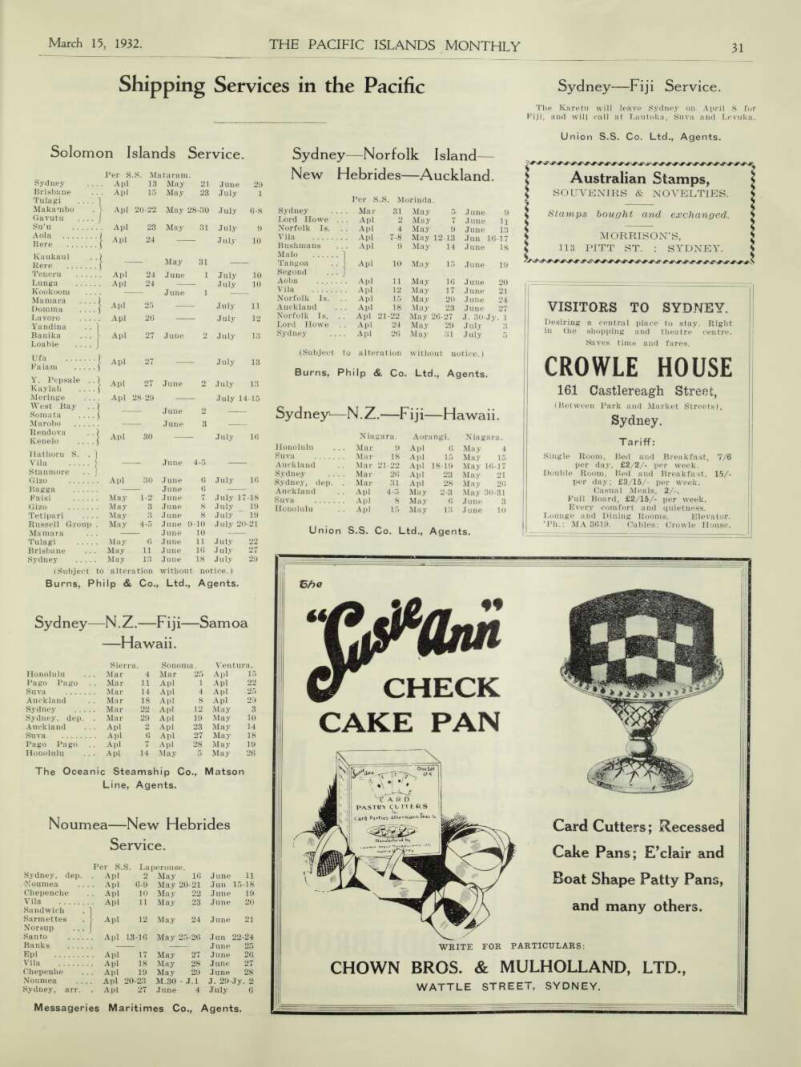
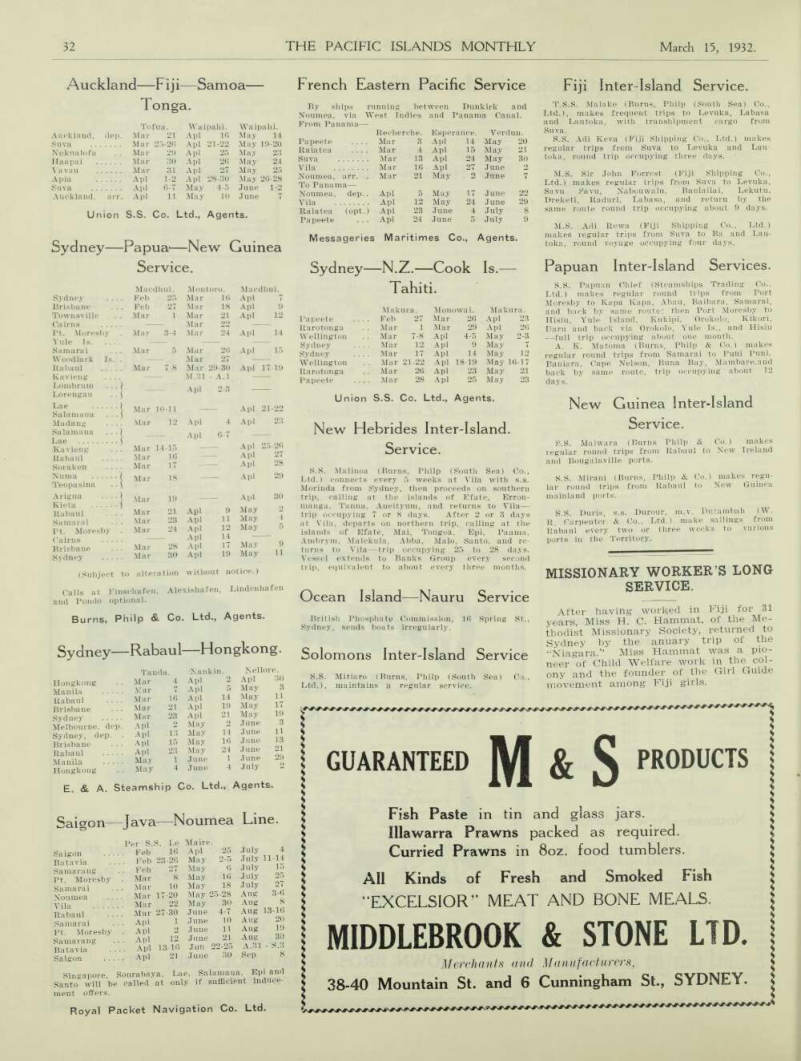
Solomon Islands Service.
Sydney—N.Z.—Fiji—Samoa —Hawaii.
Noumea —New Hebrides Service.
Sydney—Norfolk Island— New Hebrides—Auckland.
Sydney-—N.Z.—Fiji—Hawaii.
Sydney—Fiji Service.
The Karetu will leave Sydney on April 8 for Fiji, and will call at Lautoka, Suva and Levuka.
Union S.S. Co. Ltd., Agents.
Per S.S. Mataram.
Sydney Apl 13 May 21 June 29 Brisbane Apl 15 May 23 July 1 Tulagi Makambo Apl 20-22 May 28-30 July 6-8 Gavutu Su’u Apl 23 May 31 July 9 Aola Apl 24 Rere July 10 Kaukaul May 31 Rere — — Teneru Apl 24 Apl 24 June 1 July 10 July 10 Lunga Apr 24 Kookoom June 1 Mamara Domma Apl 25 July 11 Apl 26 July 12 Yandina Banika Apl 27 June 2 July 13 Loabie Ufa Apl 27 July 13 Faiam Y. Pepsale Kaylah Apl 27 June 2 July 13 Meringe Apl 28-29 July 14 -15 West Bay June 2 Somata — Marobo June 3 Rendova Kenelo Apl 30 July 16 Hatborn S.
Vila June 4-5 Stanmore Gizo Apl 30 June 6 July 16 June 6 June 7 Faisi May 1-2 July 17 -18 Gizo May 3 June 8 July 19 Tetipari May 3 June 8 July 19 Russell Group .
May 4-5 June 9 -10 July 20- 21 Mamara June 10 — Tulagi May 6 June 11 July 22 July 27 Brisbane May 11 June 16 Sydney May 13 June 18 July 29 (Subject to alteration without notice.) Burns, Philp & Co., Ltd., Agents.
Sierra Sonoma.
Ventura.
Honolulu . Mar 4 Mar 25 Apl ir.
Pago Pago . Mar 11 Apl 1 Apl 22 Suva Mar 14 Apl 4 Apl 23 Auckland Mar 18 Apl 8 Apl 29 Sydney 22 Apl 12 May 3 Sydney, dep. . Mar 29 Apl 19 May 10 Auckland . Apl 2 Apl 23 May 14 Suva . . Apl 6 Apl 27 May 18 Pago Pago . . Apl 7 Apl 28 May 19 Honolulu Apl 14 May 5 May 26 The Oceanic Steamship Co., Matson
Line, Agents.
Per S.S. Laperouse.
Sydney, dep. .
Apl 2 May 16 June 11 'Noumea ...
Apl 6-9 May 20-21 Jun 15 -18 Chepenche Apl 10 May 22 June 19 Vila Apl 11 May 23 June 20
Sandwich . ]
Sarmettes . >• Apl 12 May 24 June 21
Norsup ... J
Santo Apl 13-16 May 25-26 Jun 22-24 Banks 25 Epi Apl 17 May 27 June 26 Vila Apl 18 May 28 June 27 Chepenhe Apl 19 May 29 June 28 Noumea ...
Apl 20-23 M.30 - J.l J. 29-Jy. 2 Sydney, arr. .
Apl 27 June 4 July 6 Messageries Maritimes Co., Agents.
Per S.S Morinda.
Sydney Mar 31 May 5 June 9 Lord Howe Apl 2 May 7 June ll Norfolk Is.
Apl 4 May 9 June 13 Vila Apl 7-8 May 12 -13 Jun 16-17 Bushmans Apl 9 May 14 June 18 Malo • 1 Tangoa Apl 10 May 15 June 19 Segond . ) Aoba ...
Apl 11 May 16 June 20 Vila Apl 12 May 17 June 21 Norfolk Is.
Apl 15 May 20 June 24 Auckland Apl 18 May 23 June 27 Norfolk Is.
Apl 21-22 May 26-27 J. 30-Jy. 1 Lord Howe Apl 24 May 29 July 3 Sydney Apl 26 May 31 July 5 (Subject to alteration without notice.) Burns, Philp & Co. Ltd., Agents.
Niagara.
Aorangl.
Niagara.
Honolulu Mar 9 Apl 6 May 4 Suva Mar 18 Apl 15 May 15 Auckland Mar 21-22 Apl 18-19 May 16-17 Sydney ...
Mar 26 Apl 23 Mav 21 Sydney, clep. .
Mar 31 Apl 28 May 26 Auckland Apl 4-o May 2-3 May 30-31 Suva Apl 8 May 6 June 3 Honolulu Apl 15 May 13 June 10 Union s.s. Co. Ltd., Agents.
Auckland—Fiji—Samoa— Tonga.
Sydney—Papua—New Guinea Service.
Sydney —Rabaul —Hongkong.
Saigon—Java —Noumea Line.
French Eastern Pacific Service
Sydney—N.Z.—Cook Is. — Tahiti.
Union S.S. Co. Ltd., Agents.
New Hebrides Inter-Island.
Service.
S.S. Malinoa (Burns, Philp (South Sea) Co., Ltd.) connects every 5 weeks at Vila with s.s.
Morinda from Slydney, then proceeds on southern trip, calling at the islands of Efate, Erron manga, Tanna, Aneityum, and returns to Vila — trip occupying 7 or 8 days. After 2 or 3 days at Vila, departs on northern trip, calling at the islands of Efate, Mai, Tongoa, Epi, Paama, Ambrym, Malekula, Abba, Malo, Santo, and re turns to Vila—trip occupying 25 to 28 days.
Vessel extends to Banks Group every second trip, equivalent to about every three months.
Ocean Island—Nauru Service
British Phosphate Commission, 16 Spring St., Sydney, sends boats irregularly.
Solomons Inter-Island Service
S.S. Mitiaro (Burns, Philp (South Sea) Co., Ltd.), maintains a regular service.
Fiji Inter-Island Service.
T.S.S. Malake (Burns, Philp (Sbuth Sea) Co., Ltd.), makes frequent trips to Leyuka, Labasa and Lautoka, with transhipment cargo from Suva.
S.S. Adi Keva (Fiji Shipping Co., Ltd.) makes regular trips from Suva to Levuka and Lau toka, round trip occupying three days.
M.S. Sir John Forrest (Fiji Shipping Co., Ltd.) makes regular trips from Suva to Levuka, Savu Savu, Nabouwalu, Baulailai, Lekutu, Dreketi, Raduri, Labasa, and return by the same route round trip occupying about 9 days.
M.S. Adi Rewa (Fiji Shipping Co., Ltd.) makes regular trips from Suva to Ba and Lau toka, round voyage occupying four days.
Papuan Inter-Island Services.
S.S. Papuan Chief (Steamships Trading Co., Ltd.) makes regular round trips from Port Moresby to Kapa Kapa, Abau, Baibara, Samarai, and back by same route: then Port Moresby to Hisiu, Yule Island, Kukipi, Orokolo, Kikori, Darn and back via Orokolo, Yule Is., and Hisiu —full trip occupying about one month.
A. K. Matoma (Burns, Philp & Co.) makes regular round trips from Samarai to Puni Puni, Baniara, Cape Nelson, Buna Bay, Mambare,and back by same route, trip occupying about 12 days.
New Guinea Inter-Island
Service.
S.S. Maiwara (Burns Philp & Co.) makes regular round trips from Rabaul to New Ireland and Bougainville ports.
S.S. Mirani (Burns, Philp & Co.) makes regu lar round trips from Rabaul to New Guinea mainland ports.
S.S. Duris, s.s. Durour. m.v. Durambah (W.
R. Carpenter & Co., Ltd.) make sailings from Rabaul every two or three weeks to various ports in the Territory.
Tofua.
Waipalii.
Waipahi.
Auckland, dep.
Mar 21 Apl 16 May 14 Suva Mar 25-2(5 Apl 21-22 May 19-20 Nukualofa Mar 29 Apl 25 May 23 Haapai Mar 30 Apl 26 May 24 Vavau Mar 31 Apl 27 May 25 Apia A pi 1-2 Apl 28-30 May 26-28 Suva Apl 6-7 May 4-5 June 1-2 Auckland, arr.
Apl 11 May 10 June 7 Union S.S. Co. Ltd., Agents.
Macdhui.
Montoro.
Macdhui.
Sydney ...
Feb 25 Mar 16 Apl 7 Brisbane Feb 27 Mar 18 Apl 9 Townsville Mar i Mar 21 Apl 12 Cairns — Mar 22 Pt. Moresby .
Mar 3-4 Mar 24 Apl 14 Yule Is — — — Samara i Mar 5 Mar 26 Apl 15 Woodlark Is. . — Mar 27 Rabaul Mar 7-8 Mar 29-30 Apl 17-19 Kavieng ... — M.31 - A. 1 —
Lombrum ...)
Lorengau ..f
Api ; 2-3 Lae [ Mar 1C -11 Apl 21-22
Salamaua . . . \
Madang ...
Mar 12 A pi 4 Apl 23
Salamaua ...]
— A pi 1 5-7 — Kavieng Mar 14 -15 — Apl 25 26 Rabaul Mar 16 — Apl 27 Soraken ...
Mar 17 — Apl 28 Numa I Mar Apl 29 io Teopasina ..j
Arigua ...)
Mar 19
Apl
30 Kieta ) Rabaul ...
Mar 21 Apl 9 May 2 Samarai . . .
Mar 23 Apl 11 May 4 Pt. Moresby .
Mar 24 Apl 12 May 5 Cairns Brisbane Sydney Mar Mar 28 30 Apl Apl Apl 14 17 19 May May 9 11 (Subject to alteration without notice.) Calls at Finschafen, Alexishafen, Lindenhafen and Pondo optional.
Burns, Philp & Co. Ltd., Agents.
By ships running between Dunkirk and Noumea, via West Indies and Panama Canal.
From Panama— Recherche.
Esperance.
Verdun.
Papeete Mar 3 Apl 14 May 20 Raiatea Mar 4 Apl 15 May 21 Suva Mar 13 Apl 24 May 30 Vila Mar 16 Apl 27 June 2 Noumea, arr. .
Mar 21 May 2 June 7 To Pana ma— Noumea, dep..
Apl 5 May 17 June 22 Vila Apl 12 May 24 June 29 Raiatea (opt.) Apl 23 June 4 July 8 Papeete Apl 24 June 5 July 9 Messageries Maritimes Co., Agents.
Makura.
Monowai.
Makura.
Papeete ... Feb 27 Mar 26 Apl 23 Rarotonga Mar 1 Mar 29 Apl 26 Wellington Mar 7-8 A pi 4-5 May 2-3 Sydney Mar 12 A pi 9 May 7 Sydney ... Mar 17 Apl 14 May 12 Wellington . . Mar 21-22 A pi 18-19 May 16-17 Rarotonga Mar 26 Apl 23 May 21 Papeete Mar 28 Apl 25 May 23
Tanda. >iankin.
Nellore.
Hongkong Manila Mar 4 Mar 7 Apl Apl 2 5 Apl May 30 3 Rabaul • • • Mar 16 Apl 14 May 11 Brisbane Mar 21 Apl 19 May 17 Sydney Mar 23 Apl 21 May 19 Melbourne, dep.
A pi 2 May 2 June 3 Sydney, dep. .
Brisbane Apl 13 A pi 15 May May 14 10 June June 11 13 21 29 Rabaul Apl 23 May 24 June Manila May 1 June 1 June Hongkong May 4 June 4 July E. & A. Steamship Co. Ltd., Agents.
Per S.S. Le Maire. . . Feb 16 Apl 25 July 4 Batavia . . Feb 23-2G May 2-5 July 11-14 Samara ng . . Feb 27 May 6 July 15 Pt. Moresby Mar 8 May 16 July 25 Samarai . . Mar 10 May 18 July 27 Noumea . . Mar 17 •20 May 25-28 Aug 3-6 Mar 22 May 30 Aug 8 .. Mar 27 30 June 4-7 Aug 13-16 Samarai Apl 1 June 10 Aug 20 Pt. Moresby . Apl o June 11 Aug 19 Samarang .. . Apl 12 June 21 Aug 30 Batavia . . . Apl 13-16 Jun 22-25 A.31 - S.3 Saigon . .. Apl 21 June 30 Sep 8 Singanore, Sourabaya, Lae, Salamaua, Epi and Santo will be called at only if sufficient induce ment offers.
Royal Packet Navigation Co. Ltd.
Advertisements & other items, p. 33 (1 item)
Crowle House
Australian Stamps,
SOUVENIRS & NOVELTIES.
Stamps bought and exchanged.
MORRISON’S,
113 PITT ST. : SYDNEY.
VISITORS TO SYDNEY.
Desiring a central place to stay. Right in the shopping and theatre centre.
Saves time and fares.
CROWLE HOUSE
161 Castlereagh Street,
(Between Park and Market Streets),
Sydney.
Tariff: Single Room, Bed and Breakfast, 7/6 per day, £2/2/- per week.
Double Room. Bed and Breakfast. 15/per day; £3/15/- per week.
Casual Meals, 2/-.
Pull Board, £2/15/- per week.
Every comfort and quietness.
Lounge and Dining Rooms. Elevator. ’Ph.: MA 3619. Cables: Crowle House.
CHECK
CAKE PAN
Card Cutters; Recessed Cake Pans; E’clair and Boat Shape Patty Pans, and many others.
WRITE FOR PARTICULARS:
CHOWN BROS. & MULHOLLAND, LTD.,
WATTLE STREET, SYDNEY.
Missionary Worker’S Long
Service.
After having worked in Fiji for 31 years, Miss H. C. Hammat, of the Me thodist Missionary Society, returned to Sydney by the January trip of the “Niagara.” Miss Hammat was a pio neer of Child Welfare work in the col ony and the founder of the Girl Guide movement among Fiji girls.
Advertisements & other items, p. 34 (1 item)
Middlebrook & Stone Ltd.
GUARANTEED M&S PRODUCTS
Fish Paste in tin and glass jars, lllawarra Prawns packed as required.
Curried Prawns in Boz. food tumblers.
All Kinds of Fresh and Smoked Fish
“EXCELSIOR” MEAT AND BONE MEALS.
MIDDLEBROOK & STONE LTD.
Merchants and Manufacturers , 38-40 Mountain St. and 6 Cunningham St., SYDNEY.
Prospectus Criticised.
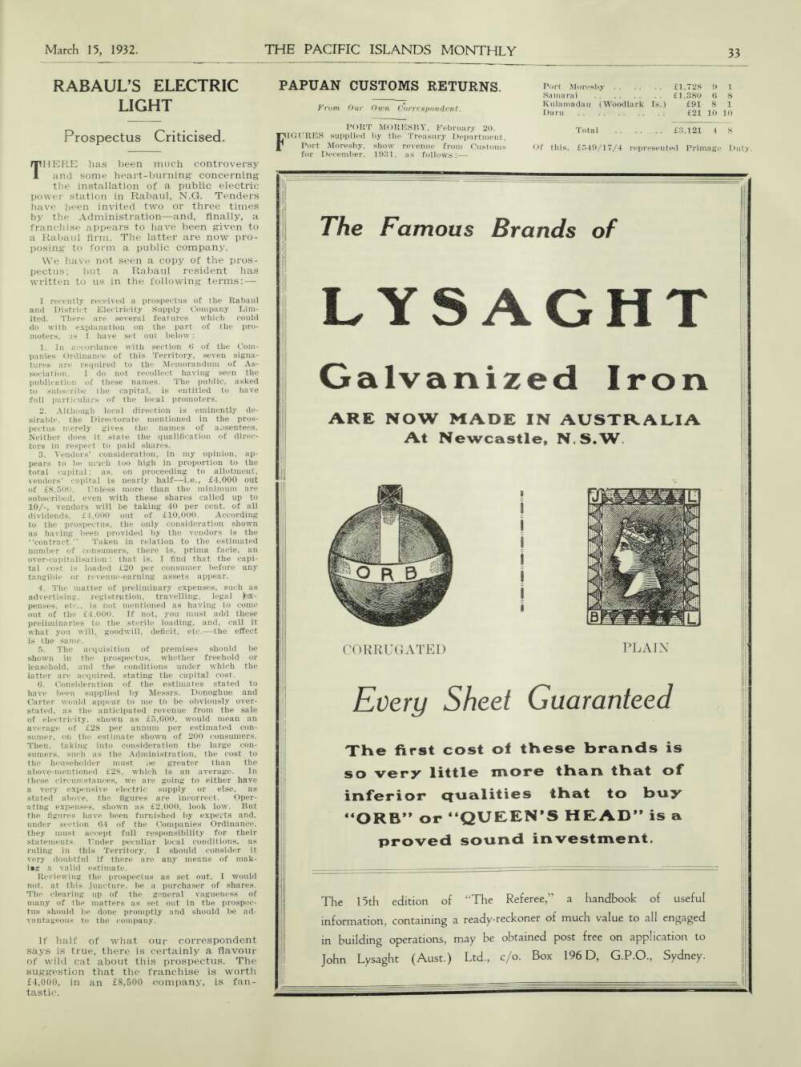
Rabaul’S Electric
Light
THERE has been much controversy
and some heart-burning concerning
the installation of a public electric power station in Rabaul, N.G. Tenders have been invited two or three times
by the Administration —and, finally, a
franchise appears to have been given to a Rabaul firm. The latter are now pro posing to form a public company.
We have not seen a copy of the pros pectus; but a Rabaul resident has written to us in the following terms: I recently received a prospectus of the Rabaul and District Electricity Supply Company Lim ited. There are several features which could do with explanation on the part of the pro moters, as I have set out below: 1. In accordance with section 6 of the Com panies Ordinance of this Territory, seven signa tures are required to the Memorandum of As sociation. I do not recollect having seen the publication of these names. The public, asked to subscribe the capital, is entitled to have full particulars of the local promoters. 2. Although local direction is eminently de sirable, the Directorate mentioned in the pros pectus merely gives the names of absentees.
Neither does it state the qualification of direc tors in respect to paid shares. 3. Vendors’ consideration, in my opinion, ap pears to be ranch too high in proportion to the total capital; as, on proceeding to allotment, vendors’ capital is nearly half—i.e., £4,000 out of £8,300. Unless more than the minimum are subscribed, even with these shares called up to 10/-, vendors will be taking 40 per cent, of all dividends, £4,000 out of £10,000. According to the prospectus, the only consideration shown as having been provided by the vendors is the “contract.” Taken in relation to the estimated number of consumers, there is, prima facie, an over-capitalisation; that is, I find that the capi tal cost is loaded £20 per consumer before any tangible or revenue-earning assets appear. 4. The matter of preliminary expenses, such as advertising, registration, travelling, legal Ex penses. etc., is not mentioned as having to come out of the £4,000. If not, you must add these preliminaries to the sterile loading, and, call it what you will, goodwill, deficit, etc.—the effect is the same. 5. The acquisition of premises should be shown in the prospectus, whether freehold or leasehold, and the conditions under which the latter are acquired, stating the capital cost. 6. Consideration of the estimates stated to have been supplied by Messrs. Donoghue and Carter would appear to me to be obviously over stated, as the anticipated revenue from the sale of electricity, shown as £5,600, would mean an average of £28 per annum per estimated consumer, on the estimate shown of 200 consumers.
Then, taking into consideration the large con sumers, such as the Administration, the cost to the householder must be greater than the above-mentioned £28, which is an average. In these circumstances, we are going to either have a very expensive electric supply or else, as stated above, the figures are incorrect. Oper ating expenses, shown as £2,000, look low. But the figures have been furnished by experts and, under section 64 of the Companies Ordinance, they must accept full responsibility for their statements. Under peculiar local conditions, as ruling in this Territory. I should consider it very doubtful if there are any means of mak ing a valid estimate.
Reviewing the prospectus as set out, I would not, at this juncture, be a purchaser of shares.
The clearing up of the general vagueness of many of the matters as set out in the prospec tus should be done promptly and should be ad vantageous to the company.
If half of what our correspondent says is true, there is certainly a flavour of wild cat about this prospectus. The suggestion that the franchise is worth £4,000, in an £8,500 company, is fan tastic.
Papuan Customs Returns.
From Our Own Correspondent.
PORT MORESBY, February 20.
FIGURES supplied by the Treasury Department.
Port Moresby, show revenue from Customs for December, 1931, as follows:—
Port Moresby £1,728 9 1 Samara i £1,380 6 8 Kulamadau (Woodlark Is.) £91 8 1 Dam £21 10 10 Total £3,121 4 8 Of this. £549/17/4 represented Primage Duty.
Advertisements & other items, p. 35 (1 item)
Lysaght
The Famous Brands of
Galvanized Iron
ARE NOW MADE IN AUSTRALIA
At Newcastle, N.S.W The first cost ot these brands is so very little more than that of inferior Qualities that to buy
“ORB” or “QUEEN’S HEAD” is a
proved sound investment.
The 15th edition of “The Referee,” a handbook of useful information, containing a ready-reckoner of much value to all engaged in building operations, may be obtained post free on application to John Lysaght (Aust.) Ltd., c/o. Box 196 D, G.P.O., Sydney.
CORRUGATED
PLAIN
Guaranteed
Papua Honours Memory of late F
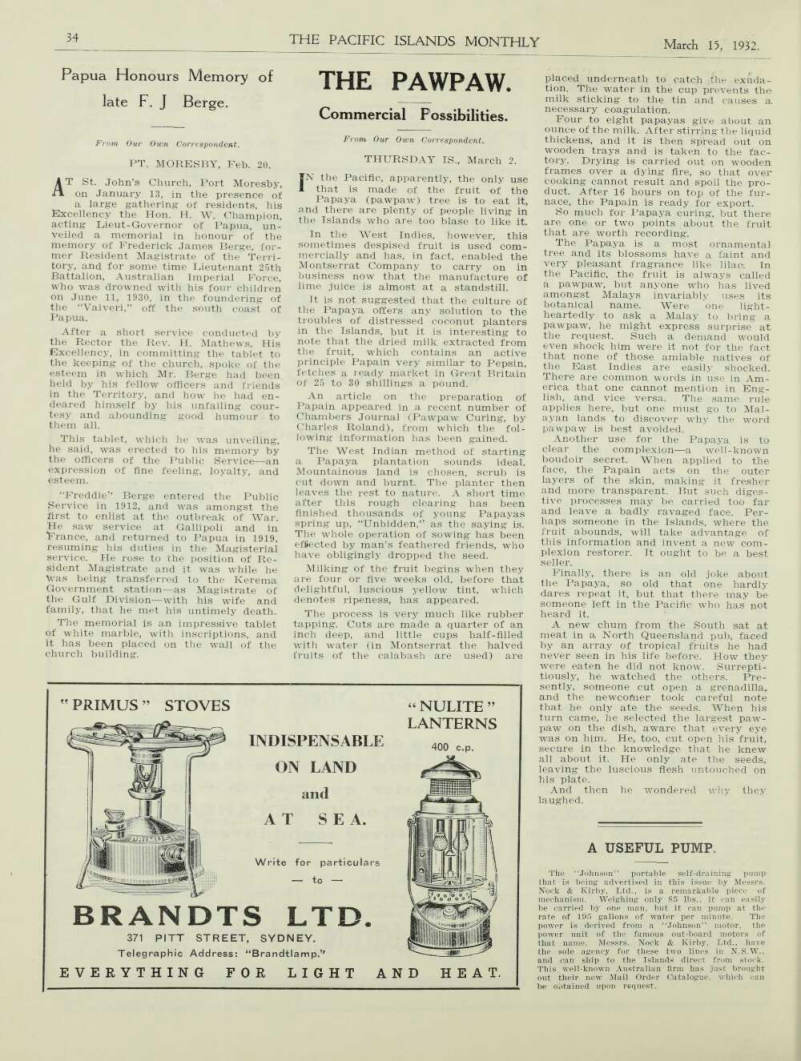
late F. J Berge.
From Our Own Correspondent.
Pt. Moresby, Feb. 20.
AT St. John’s Church, Port Moresby, on January 13, in the presence of a large gathering of residents, his Excellency the Hon. H. W. Champion, acting Lieut-Governor of Papua, un veiled a memorial in honour of the memory of Frederick James Berge, for mer Resident Magistrate of the Terri tory, and for some time Lieutenant 25th Battalion, Australian Imperial Force, who was drowned with his four children on June 11, 1930, in the foundering of the “Vaiveri,” off the south coast of Papua.
After a short service conducted by the Rector the Rev. H. Mathews, His Excellency, in committing the tablet to the keeping of the church, spoke of the esteem in which Mr. Berge had been held by his fellow officers and friends in the Territory, and how he had en deared himself by his unfailing cour tesy and abounding good humour to them all.
This tablet, which he was unveiling, he said, was erected to his memory by the officers of the Public Service —an expression of fine feeling, loyalty, and esteem.
“Freddie” Berge entered the Public Service in 1912, and was amongst the first to enlist at the outbreak of War.
He saw service at Gallipoli and in France, and returned to Papua in 1919, resuming his duties in the Magisterial service. He rose to the position of Re sident Magistrate and it was while he was being transferred to the Kerema Government station—as Magistrate of the Gulf Division —with his wife and family, that he met his untimely death.
The memorial is an impressive tablet of white marble, with inscriptions, and it has been placed on the wall of the church building.
The Pawpaw.
Commercial Possibilities.
From Our Own Correspondent.
Thursday Is., March 2.
IN the Pacific, apparently, the only use that is made of the fruit of the Papaya (pawpaw) tree is to eat it, and there are plenty of people living in the Islands who are too blase to like it.
In the West Indies, however, this sometimes despised fruit is used com mercially and has, in fact, enabled the Montserrat Company to carry on in business now that the manufacture of lime juice is almost at a standstill.
It is not suggested that the culture of the Papaya offers any solution to the troubles of distressed coconut planters in the Islands, but it is interesting to note that the dried milk extracted from the fruit, which contains an active principle Papain very similar to Pepsin, fetches a ready market in Great Britain of 25 to 30 shillings a pound.
An article on the preparation of Papain appeared in a recent number of Chambers Journal (Pawpaw Curing, by Charles Roland), from which the fol lowing information has been gained.
The West Indian method of starting a Papaya plantation sounds ideal.
Mountainous land is chosen, scrub is cut down and burnt. The planter then leaves the rest to nature. A short time after this rough clearing has been finished thousands of young Papayas spring up, “Unbidden,” as the saying is.
The whole operation of sowing has been effected by man’s feathered friends, who have obligingly dropped the seed.
Milking of the fruit begins when they are four or five weeks old, before that delightful, luscious yellow tint, which denotes ripeness, has appeared.
The process is very much like rubber tapping. Cuts are made a quarter of an inch deep, and little cups half-filled with water (in Montserrat the halved fruits of the calabash are used) are
placed underneath to catch the exuda tion. The water in the cup prevents the milk sticking to the tin and causes a, necessary coagulation.
Four to eight papayas give about an ounce of the milk. After stirring the liquid thickens, and it is then spread out on wooden trays and is taken to the fac tory. Drying is carried out on wooden frames over a dying fire, so that over cooking cannot result and spoil the pro duct. After 16 hours on top of the fur nace, the Papain is ready for export.
So much for Papaya curing, but there are one or two points about the fruit that are worth recording.
The Papaya is a most ornamental tree and its blossoms have a faint and very pleasant fragrance like lilac. In the Pacific, the fruit is always called a pawpaw, but anyone who has lived amongst Malays invariably uses its botanical name. Were one light heartedly to ask a Malay to bring a pawpaw, he might express surprise at the request. Such a demand would even shock him were it not for the fact that none of those amiable natives of the East Indies are easily shocked.
There are common words in use in Am erica that one cannot mention in Eng lish, and vice versa. The same rule applies here, but one must go to Mal ayan lands to discover why the word pawpaw is best avoided.
Another use for the Papaya is to clear the complexion—a well-known boudoir secret. When applied to the face, the Papain acts on the outer layers of the skin, making it fresher and more transparent. But such diges tive processes may be carried too far and leave a badly ravaged face. Per haps someone in the Islands, where the fruit abounds, will take advantage of this information and invent a new com plexion restorer. It ought to be a best seller.
Finally, there is an old joke about the Papaya, so old that one hardly dares repeat it, but that there may be someone left in the Pacific who has not heard it.
A new chum from the South sat at meat in a North Queensland pub, faced by an array of tropical fruits he had never seen in his life before. How they were eaten he did not know. Surrepti tiously, he watched the others. Pre sently, someone cut open a grenadilla, and the newcofner took careful note that he only ate the seeds. When his turn came, he selected the largest paw paw on the dish, aware that every eye was on him. He, too, cut open his fruit, secure in the knowledge that he knew all about it. He only ate the seeds, leaving the luscious flesh untouched on his plate.
And then he wondered why they laughed.
A Useful Pump.
The “Johnson” portable self-draining pump that is being advertised in this issue by Messrs.
Nock & Kirby, Ltd., is a remarkable piece of mechanism. Weighing only 85 lbs., it can easily be carried by one man, but it can pump at the rate of 195 gallons of water per minute. The power is derived from a “Johnson” motor, the power unit of the famous out-board motors of that name. Messrs. Nock & Kirby. Ltd., have the sole agency for these two lines in N.S.W., and can ship to the Islands direct from stock.
This well-known Australian firm has just brought out their new Mail Order Catalogue, which can be obtained upon request.
Advertisements & other items, p. 36 (1 item)
Brandts Ltd.
"PRIMUS” STOVES
INDISPENSABLE
ON LAND
and
AT SEA.
Write for particulars to
“NULITE”
LANTERNS
400 c.p.
BRANDTS LTD.
371 PITT STREET, SYDNEY.
Telegraphic Address: “Brandtlamp.”
EVERYTHING FOR LIGHT AND HEAT.
Papuan Rubber
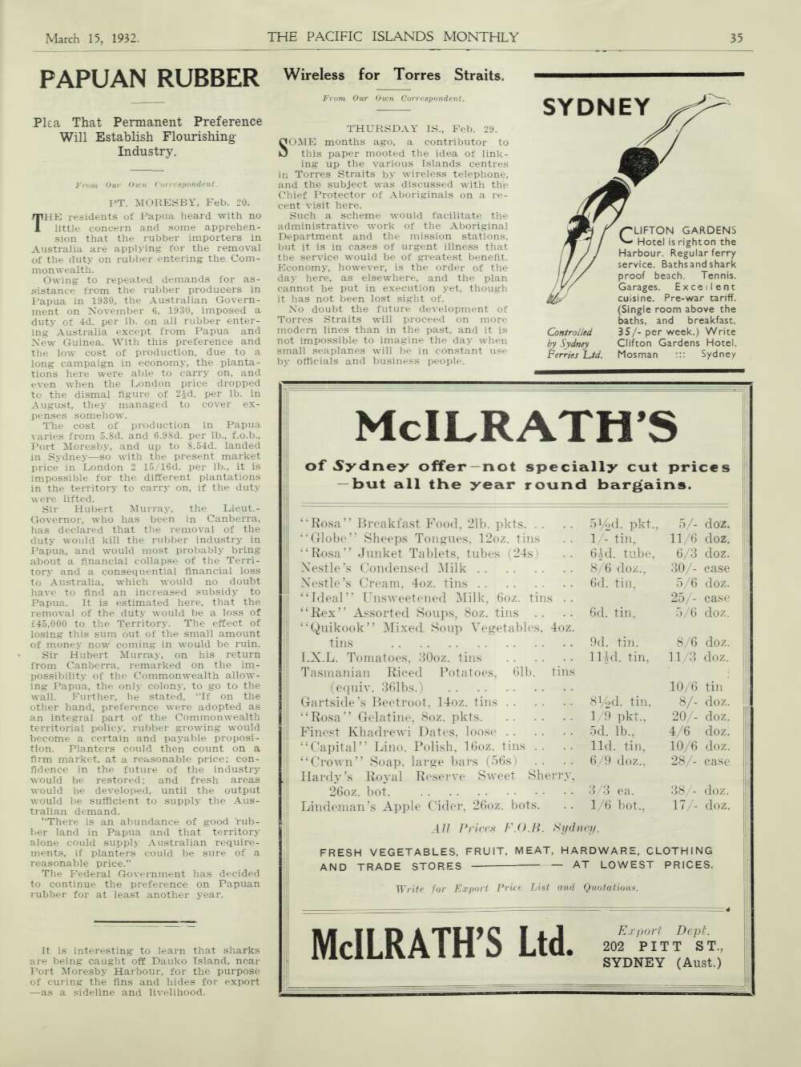
Plea That Permanent Preference Will Establish Flourishing Industry.
From Our Own Correspondent.
Pt. Moresby, Feb. 20.
THE residents of Papua heard with no little concern and some apprehen sion that the rubber importers in Australia are applying for the removal of the duty on rubber entering the Com monwealth.
Owing to repeated demands for as sistance from the rubber producers in Papua in 1930, the Australian Govern ment on November 6, 1930, imposed a duty of 4d. per lb. on all rubber enter ing Australia except from Papua and New Guinea. With this preference and the low cost of production, due to a long campaign in economy, the planta tions here were able to carry on, and even when the London price dropped to the dismal figure of 2½d. per lb. in August, they managed to cover ex penses somehow.
The cost of production in Papua varies from 5.8 d. and 6.98 d. per lb., f.o.b., Port Moresby, and up to 8.54 d. landed in Sydney—so with the present market price in London 2 15/16d. per lb., it is Impossible for the different plantations in the territory to carry on, if the duty were lifted.
Sir Hubert Murray, the Lieut.- Governor, who has been in Canberra, has declared that the removal of the duty would kill the rubber industry in Papua, and would most probably bring about a financial collapse of the Terri tory and a consequential financial loss to Australia, which would no doubt have to find an increased subsidy to Papua. It is estimated here, that the removal of the duty would be a loss of £45,000 to the Territory. The effect of losing this sum out of the small amount of money now coming in would be ruin.
Sir Hubert Murray, on his return from Canberra, remarked on the im possibility of the Commonwealth allow ing Papua, the only colony, to go to the wall. Further, he stated, “If on the other hand, preference were adopted as an integral part of the Commonwealth territorial policy, rubber growing would become a certain and payable proposi tion. Planters could then count on a firm market, at a reasonable price; con fidence in the future of the industry would be restored; and fresh areas would be developed, until the output would be sufficient to supply the Aus tralian demand.
“There is an abundance of good rub ber land in Papua and that territory alone could supply Australian require ments, if planters could be sure of a reasonable price.”
The Federal Government has decided to continue the preference on Papuan rubber for at least another year.
It is interesting to learn that sharks are being caught off Dauko Island, near Port Moresby Harbour, for the purpose of curing the fins and hides for export —as a sideline and livelihood.
Wireless for Torres Straits.
From Our Own Correspondent.
Thursday Is., Feb. 29.
SOME months ago, a contributor to this paper mooted the idea of link ing up the various Islands centres in Torres Straits by wireless telephone, and the subject was discussed with the Chief Protector of Aboriginals on a re cent visit here.
Such a scheme would facilitate the administrative work of the Aboriginal Department and the mission stations, but it is in cases of urgent illness that the service would be of greatest benefit.
Economy, however, is the order of the day here, as elsewhere, and the plan cannot be put in execution yet, though it has not been lost sight of.
No doubt the future development of Torres Straits will proceed on more modern lines than in the past, and it is not impossible to imagine the day when small seaplanes will be in constant use by officials and business people.
Advertisements & other items, p. 37 (1 item)
Mcilrath’S
SYDNEY
Controlled by Sydney Ferries Ltd.
CLIFTON GARDENS
Hotel is righton the Harbour. Regular ferry service. Baths and shark proof beach. Tennis.
Garages. Excellent cuisine. Pre-war tariff. (Single room above the baths, and breakfast. 35/- per week.) Write Clifton Gardens Hotel.
Mosman ::: Sydney
McILRATH’S
of Sydney offer not specially exit prices “Rosa” Breakfast Food, 21b. pkts. . .
“Globe” Sheeps Tongues, 12oz. tins “Rosa” Junket Tablets, tubes (245) Nestle’s Condensed Milk Nestle’s Cream, 4oz. tins “Ideal” Unsweetened Milk, 6oz. tins “Rex” Assorted Soups, Boz. tins ..
“Quikook” Mixed Soup Vegetables, 4oz tins I.X.L. Tomatoes, 30oz. tins Tasmanian Riced Potatoes, 61b. tins (equiv. 361b5.) Gartside’s Beetroot, 14oz. tins “Rosa” Gelatine, Boz. pkts Finest Khadrewi Dates, loose “Capital” Lino. Polish, 16oz. tins ..
“Crown” Soap, large bars (565) Hardy’s Royal Reserve Sweet Sherry 260 z. bot.
Lindeman’s Apple Cider, 260 z. bots.
All Prices F.O.B. Sydney.
FRESH VEGETABLES. FRUIT, MEAT, HARDWARE, CLOTHING
AND TRADE STORES AT LOWEST PRICES.
Write for Export Price List and Quotations.
McILRATH’S Ltd.
Export Dept.
202 PITT ST.,
SYDNEY (Aust.)
Pacific Islands Monthly.
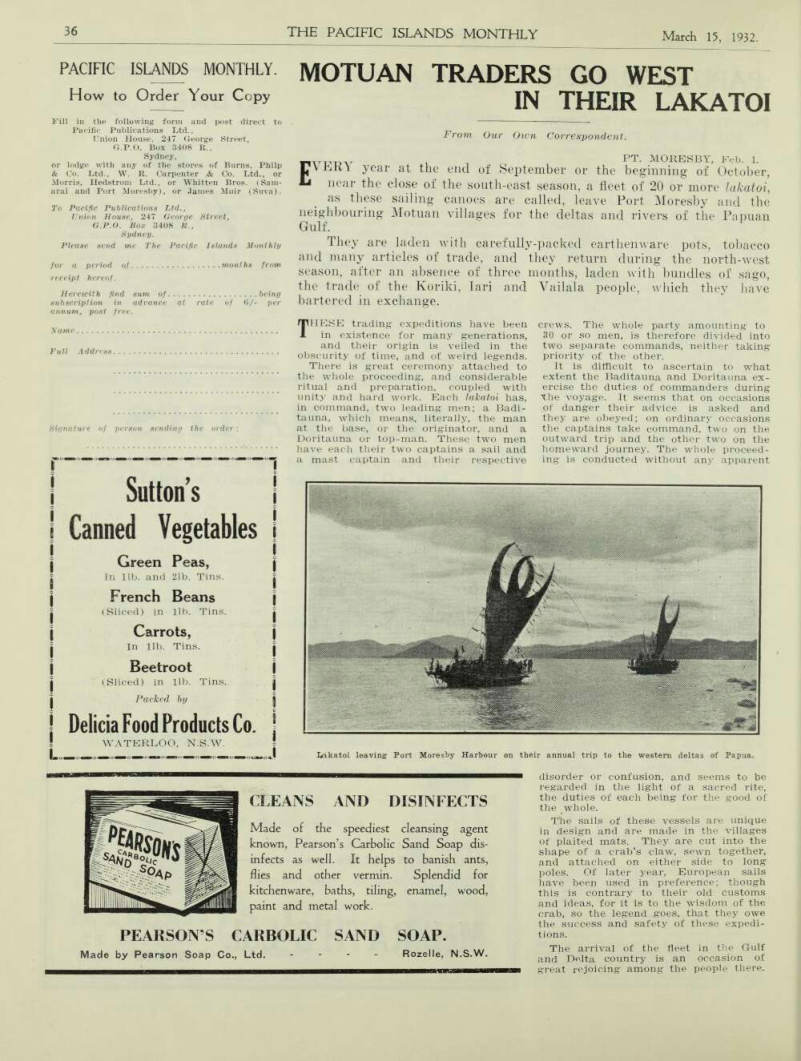
How to Order Your Copy
Fill in the following form and post direct to Pacific Publications Ltd., Union House, 247 George Street,
G.P.O. Box 3408 R.,
Sydney, or lodge with any of the stores of Burns, Philp & Co. Ltd., W. R. Carpenter & Co. Ltd., or Morris, Hedstrom Ltd., or Whitten Bros. (Sam arai and Port Moresby), or James Muir (Suva).
To Pacific Publications Ltd., Union House, 247 George Street,
G.P.O. Box 3408 R.,
Sydney.
Please send me The Pacific Islands Monthly for a period of months from receipt hereof.
Heretoith find sum of being subscription in advance at rate of 6/- per annum, post free.
Name Full Address Signature of person sending the order :
Motuan Traders Go West
In Their Lakatoi
From Our Own Correspondent.
Pt. Moresby, Feb. 1.
EVERY year at the end of September or the beginning of October, near the close of the south-east season, a fleet of 20 or more lakatoi , as these sailing canoes are called, leave Port Moresby and the neighbouring Motuan villages for the deltas and rivers of the Papuan Gulf.
They are laden with carefully-packed earthenware pots, tobacco and many articles of trade, and they return during the north-west season, after an absence of three months, laden with bundles of sago, the trade of the Koriki, Iari and Vailala people, which they have bartered in exchange.
THESE trading expeditions have been in existence for many generations, and their origin is veiled in the obscurity of time, and of weird legends.
There is great ceremony attached to the whole proceeding, and considerable ritual and preparation, coupled with unity and hard work. Each lakatoi has, in command, two leading men; a Badi tauna, which means, literally, the man at the base, or the originator, and a Doritauna or top-man. These two men have each their two captains a sail and a mast captain and their respective
crews. The whole party amounting to 30 or so men, is therefore divided into two separate commands, neither taking priority of the other.
It is difficult to ascertain to what extent the Baditauna and Doritauna ex ercise the duties of commanders during the voyage. It seems that on occasions ,pf danger their advice is asked and they are obeyed; on ordinary occasions the captains take command, two on the outward trip and the other two on the homeward journey. The whole proceed ing is conducted without any apparent
disorder or confusion, and seems to be regarded in the light of a sacred rite, the duties of each being for the good of the whole.
The sails of these vessels are unique in design and are made in the villages of plaited mats. They are cut into the shape of a crab’s claw, sewn together, and attached on either side to long poles. Of later year, European sails have been used in preference; though this is contrary to their old customs and ideas, for it is to the wisdom of the crab, so the legend goes, that they owe the success and safety of these expedi tions.
The arrival of the fleet in the Gulf and Delta country is an occasion of great rejoicing among the people there.
Lakatoi leaving Port Moresby Harbour on their annual trip to the western deltas of Papua.
As soon as the lakatoi are moored in the river opposite to the villages, all tabus cease to exist, and ceremonial visits are paid to the village chiefs. During their stay the different tribes make much of one another, each member of the crew selecting an individual to be his special friend for the time being.
Though the origin of the expeditions is obscure, they must have had their beginning in the times of scarcity, when the south-east season, with its pro longed dry spell and tearing winds, caused havoc and devastated the gar dens of the whole district, and the Motu people, in desperation, sought food farther afield. The conclusion of the legend of the “Hiri” runs as fol lows: —“Since that time the lakatoi have gone every year to the west, and there has consequently been food in plenty during the season of scarcity.”
Rev. W. Chalmers (“Tamate”), the famous missionary and explorer of Papua, made a remarkable trip as far back as 1879 to the Gulf and Delta country in one of these lakatoi, to get into touch with the tribes of the west. He was accompanied by a friend and by Motuan and Gulf natives. He remarked then on the abundance of native food and sago in these districts, which the natives bartered eagerly for the Motuan wares; a condition which is still that of to-day. The people there he found friendly on account of his adoption by the Motuan traders, but he describes them as “terrible cannibals,” who laughed and jeered at their Motuan friends for not eating such delicacies as human flesh.
He was amazed at the size of the villages, which lined the river banks, and their “temples” or Ravis, 30 to 40 feet in height, to which the chiefs of his lakatoi repaired at once, making of ferings of armshells and earthenware to the gods of Kaeva-Kuku, Semese and Tauparau; and he explained how, on departing, another visit was paid and further offerings made, to propiti ate these gods.
It is not known if this last custom is still in existence. It is doubtful, though Kaeva-Kuku, that strange wicker-work beast, still graces her sacred chamber in these weird Ravis, and those extra ordinary blocks of wood, Semese and Tauparau, stand as predominantly as ever at the entrance door and centre posts of the main buildings.
To-day, cannibalism in that district is non-existent. A Government station is nearby, and a station of the London Missionary society in their midst.
Advertisements & other items, p. 38 (1 item)
Canned Vegetables
Sutton’s
Green Peas, In 1lb. and 2lb. Tins.
French Beans (Sliced) in 1lb. Tins.
Carrots, In 1lb. Tins.
Beetroot (Sliced) in 1lb. Tins.
Packed by
Delicia Food Products Co.
WATERLOO, N.S.W.
CLEANS AND DISINFECTS
Made of the speediest cleansing agent known, Pearson’s Carbolic Sand Soap dis infects as well. It helps to banish ants, flies and other vermin. Splendid for kitchenware, baths, tiling, enamel, wood, paint and metal work.
PEARSON’S CARBOLIC SAND SOAP.
Made by Pearson Soap Co., Ltd, - Rozelle, N.S.W.
The Lakatoi Return.
February 15.
The lakatoi have now returned laden with sago, and the shortage of food in the Motuan villages is a thing of the past.
The Papuan native lives for the day —the semi-starvation of yesterday and the ‘‘big sick” (influenza) are all for gotten, as he gazes into the well-filled pots of sago, yams and taro from the Western country.
It is announced in the Tongan Gazette of January 18 that the Queen of Tonga has been appointed a Dame of the Civil Division of the Order of the British Empire.
A Rare Turtle.
Curious Incident in Dutch New Guinea.
A CROCODILE was killed in a singu lar manner, in a river in Dutch New Guinea, at the end of October, 1929; and the event had a peculiar sequel.
A luxurious yacht, the “Arpha,” 700 tons, flying the white ensign of the Royal Yacht Squadron, arrived at Me rauke, in Dutch New Guinea, and the owner-commander, Lieut.-Colonel the Rt. Hon. W. E. Guinness, D.S.O., M.P., asked the late Dick Roche, the famous Paradise-bird shooter, to lead the party into parts hitherto unknown. None was better qualified than Roche for such a commission. He piloted the yacht up the Eilanden River, 100 miles inland —away into a region where no steamer had been seen since the survey boats were there in 1905, and where a British ship had never before been seen.
They went, in a motor launch, into un known branches and creeks, on shooting expeditions—going among cannibals who had never seen white men before.
One day, in the Frendschaap River, Colonel Guinness and Mr. Roche fired simultaneously at a huge crocodile, and the beast never moved again. In its mouth was a fresh water turtle, of a species which Roche declared was hitherto unknown. He urged Colonel Guinness to take the reptile to a museum, and the Colonel—evidently fearing that it might be a known species which would look a little ridicu lous —finally agreed. It was placed, alive, in a tank of fresh water.
The “Arpha,” on its way back from
New Guinea to Singapore, ran on a reef on the Sula Islands, and was saved with difficulty. The turtle died; but the Colonel, true to his promise, put it in the freezer, and duly delivered it to the South Kensington Museum, London. It proved to be a rare specimen; and the Museum sent a special letter of thanks to Mr. Roche for his interest in the matter. It was only the double shot which, killing the crocodile instantly, made the salvage of this rare creature possible.
Further references to the mysterious death of Mr. Roche are published else where in this issue.
Earthquakes Shake Kieta
A series of earthquakes occurred at Kieta, Bougainville, on January 29.
They were not of a serious nature and no damage was done.
Miss M. Chambers, after 20 years’ missionary service in Fiji with the Methodist Society, has returned to Aus tralia.
Advertisements & other items, p. 39 (1 item)
William Adams & Company
Samples and prices on application.
BIRKMYRE’S CLOTH.
The best waterproof for motor car hoods, tarpaulins, horse and cow rugs, etc. Canvas of all kinds, cotton ducks and hessians, seaming, bagging and shop twines. Fishing nets and yarn, fishing lines and tenuis nets.
THE GTOUROCK ROPEWORK EXPORT CO. LTD.
357 KENT STREET, SYDNEY, N.S.W.
WHY YOU SHOULD
USE THE LEJOHN
Roller Fly Screen
It is of sound mechanical construction and first-class materials.
It is absolutely Fly and Mosquito Proof.
It is simple to erect and easy to operate.
It is fitted inside the window and is simply rolled up when not in use.
It will outlast the old-fashiohed fixed screen, because it is not directly exposed to the weather.
It is hidden from view when not in service.
It permits easy cleaning of windows.
It is suitable for box frame and case ments windows.
It is supplied in standard sizes, from 18ins. by 3ft. to 36ins. by 6ft.
It is made in Australia.
If visiting Sydney for the Bridge Celebrations, call and see the “Lejohn”
Roller Fly Screen in operation at our Stand, 129 Suitor Avenue, R.A. Show ground.
Sole Agents: Agents:
WILLIAM ADAMS & COMPANY
LIMITED
175 CLARENCE STREET - - SYDNEY.
New Guinea Oil Prospecting.
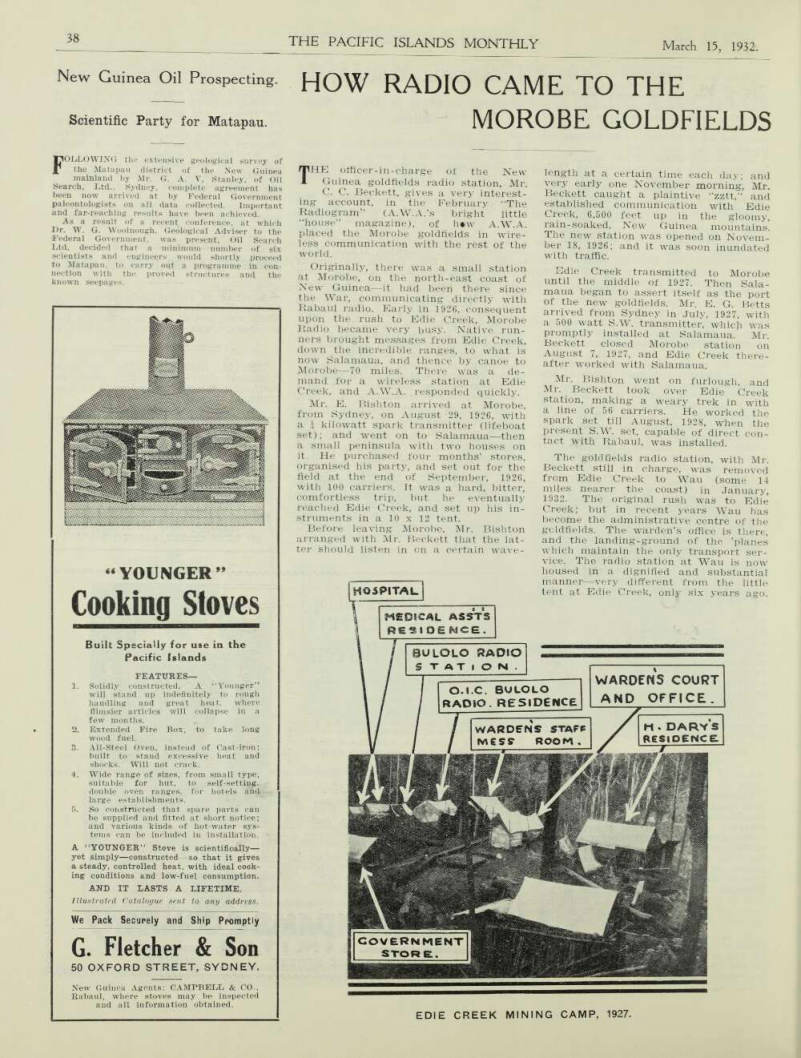
Scientific Party for Matapau.
FOLLOWING the extensive geological survey of the Matapau district of the New Guinea mainland by Mr. G. A. V. Stanley, of Oil Search, Ltd., Sydney, complete agreement has been now arrived at by Federal Government paleontologists on all data collected. Important and far-reaching results have been achieved.
As a result of a recent conference, at which Dr. W. G. Woolnough, Geological Adviser to the Federal Government, was present, Oil Search Ltd. decided that a minimum number of six scientists and engineers would shortly proceed to Matapau, to carry out a programme in con nection with the proved structures and the known seepages.
Morobe Goldfields
How Radio Came To The
THE officer-in-charge o( the New Guinea goldfields radio station, Mr.
C. C. Beckett, gives a very interest mg account, in the February ‘‘The Radiogram” (A.W.A.’s bright little “house” magazine), of how A.W.A. placed the Morobe goldfields in wire less communication with the rest of the world.
Originally, there was a small station at Morobe, on the north-east coast of New Guinea—it had been there since the War, communicating directly with Rabaul radio. Early in 1926, consequent upon the rush to Edie Creek Morobe Radio became very busy. Native run ners brought messages from Edie Creek, down the incredible ranges, to what is now Salamaua, and thence by canoe to Morobe—70 miles. There was a de mand for a wireless station at Edie Creek, and A.W.A. responded quickly.
Mr. E. Bishton arrived at Morobe, from Sydney, on August 29, 1926, with a ¼ kilowatt spark transmitter (lifeboat set); and went on to Salamaua—then a small peninsula with two houses on it. He purchased four months’ stores, organised his party, and set out for the field at the end of September, 1926, with 100 carriers. It was a hard, bitter, comfortless trip, but he eventually reached Edie Creek, and set up his in struments in a 10 x 12 tent.
Before leaving Morobe, Mr. Bishton arranged with Mr. Beckett that the lat ter should listen in on a certain wave
length at a certain time each day; and very early one November morning, Mr.
Beckett caught a plaintive “zztt,” and established communication with Edie Creek, 6,500 feet up in the gloomy, rain-soaked, New Guinea mountains.
The new station was opened on Novem ber 18, 1926; and it was soon inundated with traffic.
Edie Creek transmitted to Morobe until the middle of 1927. Then Sala maua began to assert itself as the port of the new goldfields. Mr. E. G. Betts arrived from Sydney in July, 1927, with a 500 watt S.W. transmitter, which was promptly installed at Salamaua. Mr.
Beckett closed Morobe station on August 7, 1927, and Edie Creek there after worked with Salamaua.
Mr. Bishton went on furlough, and Mr. Beckett took over Edie Creek station, making a weary trek in with a line of 56 carriers. He worked the spark set till August, 1928, when the present S.W. set, capable of direct con tact with Rabaul, was installed.
The goldfields radio station, with Mr.
Beckett still in charge, was removed from Edie Creek to Wau (some 14 miles nearer the coast) in January, 1932. The original rush was to Edie Creek; but in recent years Wau has become the administrative centre of the goldfields. The warden’s office is there, and the landing-ground of the ’planes which maintain the only transport ser vice. The radio station at Wau is now housed in a dignified and substantial manner—very different from the little tent at Edie Creek, only six years ago.
Edie Creek Mining Camp, 1927.
Advertisements & other items, p. 40 (1 item)
Cooking Stoves
“YOUNGER”
Built Specially for use in the Pacific Islands
FEATURES—
1. Solidly constructed. A “Younger” will stand up indefinitely to rough handling and great heat, where flimsier articles will collapse in a few months. 2. Extended Fire Box, to take long wood fuel. 3. All-Steel Oven, instead of Cast-iron; built to stand excessive heat and shocks. Will not crack. 4. Wide range of sizes, from small type, suitable for hut, to self-setting, double oven ranges, for hotels ahd large establishments. 5. So constructed that spare parts can be supplied and fitted at short notice; and various kinds of hot-water sys tems can be included in installation.
A “YOUNGER" Stove is scientifically— yet simply—constructed—so that it gives a steady, controlled heat, with ideal cook ing conditions and low-fuel consumption,
AND IT LASTS A LIFETIME.
Illustrated Catalogue sent to any address.
We Pack Securely and Ship Promptly
G. Fletcher & Son
50 OXFORD STREET, SYDNEY.
New Guinea Agents: CAMPBELL & CO..
Rabaul, where stoves may be inspected and all information obtained.
New Matson Liners will
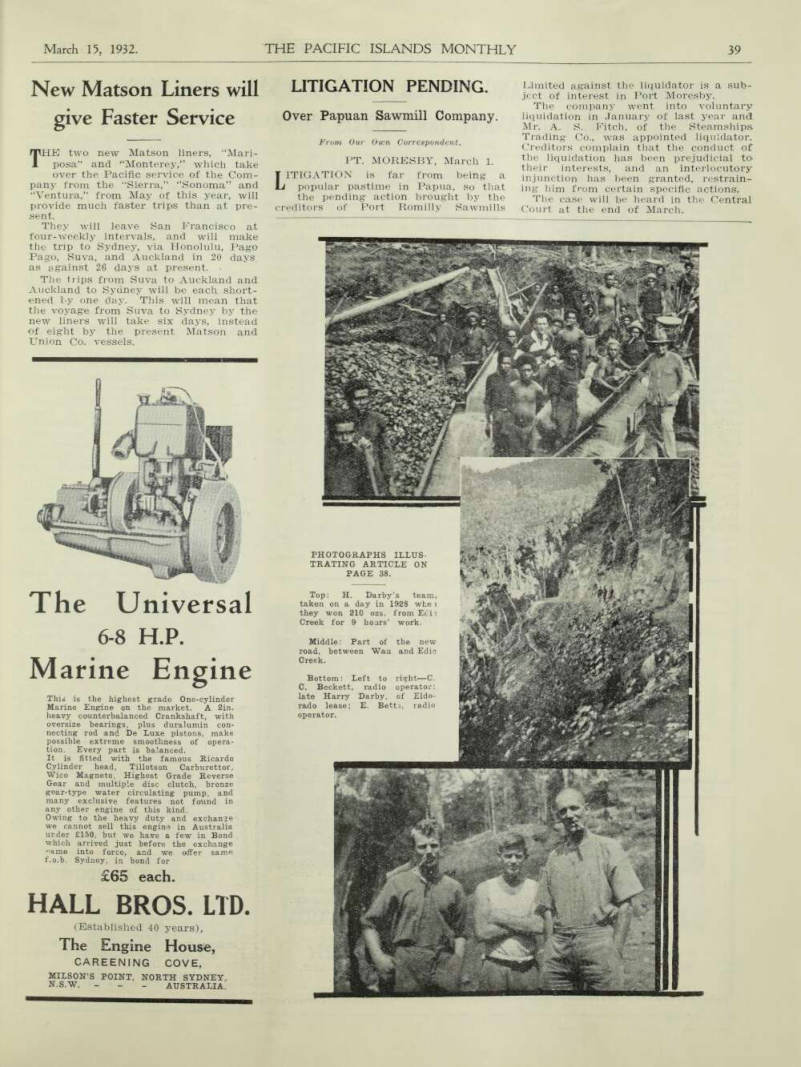
give Faster Service
THE two new Matson liners, “Mari posa” and “Monterey,” which take over the Pacific service of the Com pany from the “Sierra,” “Sonoma” and “Ventura,” from May of this year, will provide much faster trips than at pre sent.
They will leave San Francisco at four-weekly intervals, and will make the trip to Sydney, via Honolulu, Pago Pago, Suva, and Auckland in 20 days as against 26 days at present.
The trips from Suva to Auckland and Auckland to Sydney will be each short ened by one day. This will mean that the voyage from Suva to Sydney by the new liners will take six days, instead of eight by the present Matson and Union Co. vessels.
Litigation Pending.
Over Papuan Sawmill Company.
From Our Own Correspondent.
Pt. Moresby, March 1.
LITIGATION is far from being a popular pastime in Papua, so that the pending action brought by the creditors of Port Romilly Sawmills
Limited against the liquidator is a sub ject of interest in Port Moresby.
The company went into voluntary liquidation in January of last year and Mr. A. S. Fitch, of the Steamships Trading Co., was appointed liquidator.
Creditors complain that the conduct of the liquidation has been prejudicial to their interests, and an interlocutory injunction has been granted, restrain ing him from certain specific actions.
The case will be heard in the Central Court at the end of March.
Photographs Illus
Trating Article On
Page 38.
Top: H. Darby's team, taken on a day in 1928 whe they won 210 ozs. from Edie Creek for 9 hoars’ work.
Middle: Part of the new road, between Wau and Edie Creek.
Bottom: Left to right—C.
C. Beckett, radio operator: late Harry Darby, of Eldo rado lease; E. Betts, radio operator.
Advertisements & other items, p. 41 (1 item)
Marine Engine
The Universal
6-8 H.P.
This is the highest grade One-cylinder Marine Engine on the market. A 2in. heavy counterbalanced Crankshaft, with oversize bearings, plus duralumin con necting rod and De Luxe pistons, make possible extreme smoothness of opera tion. Every part is balanced.
It is fitted with the famous Ricardo Cylinder head, Tillotson Carburettor, Wico Magneto, Highest Grade Reverse Gear and multiple disc clutch, bronze gear-type water circulating pump, and many exclusive features not found in any other engine of this kind.
Owing to the heavy duty and exchange we cannot sell this engine in Australia under £150, but we have a few in Bond which arrived just before the exchange came into force, and we offer same f.o.b. Sydney, in bond for
£65 each.
HALL BROS. LTD.
(Established 40 years),
The Engine House,
CAREENING COVE,
MILSON’S POINT, NORTH SYDNEY,
N.S.W. - AUSTRALIA.
Suggestion That Madang Should
Be Permanent Goldfields Port.
THE New Guinea Administration,
and other interests closely con
nected therewith, are giving
very careful consideration to the
whole question of providing a suit
able port for the Morobe goldfields
—which port will also be a term
inal point for the goldfields road.
Salamaua was never quite suitable; but port facilities were provided there, and a township grew up, simply be cause there is not anywhere on that lengthy coastline anything resembling a port suitable for overseas shipping.
In the past year or two, it has be come increasingly evident that the long, narrow sandspit, on which Salamaua is built, is being steadily eroded away by sea action, and nothing that has been done in the way of constructing con crete retaining walls has proved effec tive. As has previously been pointed out, the question of building a traffic able road from the goldfields to the coast is intimately linked with the question of providing a suitable port.
The “Dollar Companies,” operating on the Morobe goldfields, have reached this month, after years of preparation, the point of big production; and it is likely that the development of this field will now be rapid, and that there will be an increasing demand for the con struction of a road.
Nothing- can be done concerning the road until the location of the goldfields port has been settled. An officer ap pointed by the Federal Government is now examining the coast of the Huon Gulf, seeking a suitable port. But those who know the north-east coast of New Guinea declare that it would be most unwise to attempt the establish ment of a port anywhere between Astrolabe Bay and the border of Papua.
There is in this long stretch of coast line approximately 200 miles no natural harbour suitable for big ships and no coastal configuration lending it self readily to the construction of an artificial harbour.
There appears to be a growing body of opinion in favour of making Madang the main port of the goldfields; and it is likely that this alternative to the attempted construction of a port on the Huon Gulf will receive very serious consideration.
The question of cost, of course, will be an important factor. The distance from the goldfields centre to Salamaua is only 50 miles in a direct line; but those 50 miles are over country in credibly broken and steep, representing an engineering problem of almost in soluble difficulty. The distance from the northern end of the goldfields to Madang in a straight line is about 150 miles, but it represents a much gentler grade, and, for more than half of the distance, the road would run through
rich country, consisting- of high, well watered plateaus, capable of great agricultural and pastoral development.
It is well-known that fine, rich, clean, healthy country lies around the head waters of the Ramu river; and a road from Madang to the goldfields, over part of its length, would make use of the Ramu valley itself.
There is a splendid harbour at Madang, and plenty of level ground suitable as an aerodrome. It is argued in this latter connection that it would be better for aeroplanes to run between the goldfields and Madang, where there is a gradual rise, rather than from Lae to the goldfields, where the rise is very steep, and on which route there is an ever-present danger of the big aero planes, in the frequent fogs, crashing into the mountain-side.
Port Moresby Busy.
Visits of “Mariposa” and “Stella Polaris.”
From Our Own Correspondent.
Pt. Moresby, March 1.
Approximately 50,000 tons of ship ping is entering Port Moresby this week —the “Montoro,” “Macdhui,”
“Le Maire,” “Pentyne,” and the new Matson liner “Mariposa.”
This last vessel which, is on a Pacific cruise, is causing some considerable at tention. She has on board between 250 and 300 passengers, who are filled with pleasant anticipations. Port Moresby has been so advertised lately that there seems to be a general desire that it should be included in the ports of call.
During her short stay, the usual native dance has been arranged, also visits to the mountains and Rona Palls.
The steamer “Pentyne, which left for the East and European ports on March 1, shipped 750 tons of copra. This had accumulated owing to the delay in shipping caused by the stranding of the “Newton Elm” some time ago.
The “Stella Polaris” arrived at Port Moresby, on her Pacific cruise on Feb ruary 20 and left after a very short visit. Owing to bad weather, she was unable to make port until 7 o’clock in the evening and sailed at 10 o’clock the same night. The tourists visited the parade ground and there, in the moon light, witnessed a native dance in a romantic setting of coconut palms and flaring torches —an exotic effect, which was distinctly pleasing.
The “Montoro” and “Macdhui” are on their usual runs from Sydney to Rabaul, via Port Moresby, and the “Le Maire” is on her three months’ trip from the Netherland Islands to Noumea,
Tragedy At Kiriwina.
Word has been received in Sydney that Mrs. R. S. Walker, wife of the Methodist Missionary at Kiriwina, Eastern Papua, has died, following an injury received from the explosion of an ice machine. Mrs. Walker leaves two small children.
Mr. Walker is coming South this month to take up a circuit in New South Wales.
Advertisements & other items, p. 42 (1 item)
Cinzano Vermouth
ORIGINAL IMPORTED—
Is made with the finest Italian white wines. It is very wholesome. It is not a liqueur. Some ways of using it: PLAIN: It’s not too sweet and not too dry. IN ALL COCKTAILS: Where Vermouth is used. AS A DONG DRINK IN SUMMER: With mineral aerated waters.
Agents:
FRANCESCO CINZANO & CIA (AUSTRALIA) LTD.
G.P.O. BOX 3708 S.S., SYDNEY, N.S.W.
Repairs. “OUR HANDS MAKE GOOD ARMS" Firearms sent C.O.D,
A Pistol or Revolver
Affords a Feeling* of Security.
Browning 32 cal. Auto. Pistol, holds 8 cartridges.
Price, £4/5/-. Police Model Walther, 22 Auto.
Pistol. Price, £6/5/-. Other brands to choose from.
Sil Rohu’s high standard of Quality Firearms and Fishing Tackle is well known throughout Australia.
If considering the purchase of any of these goods, write for Catalogue (Firearm, 500 Illustrations, or Fishing Tackle, 200 Illustrations).
SIL ROHU (late A.I.F ), GUNSMITH
IMPORTER OF HIGH-GRADE FIREARMS AND FISHING TACKLE SPECIALIST, 143 P.P. ELIZABETH STREET. SYDNEY (Near Market Street).
“FISHING TACKLE TO TACKLE FISHING."
Nauru And Ocean Island.
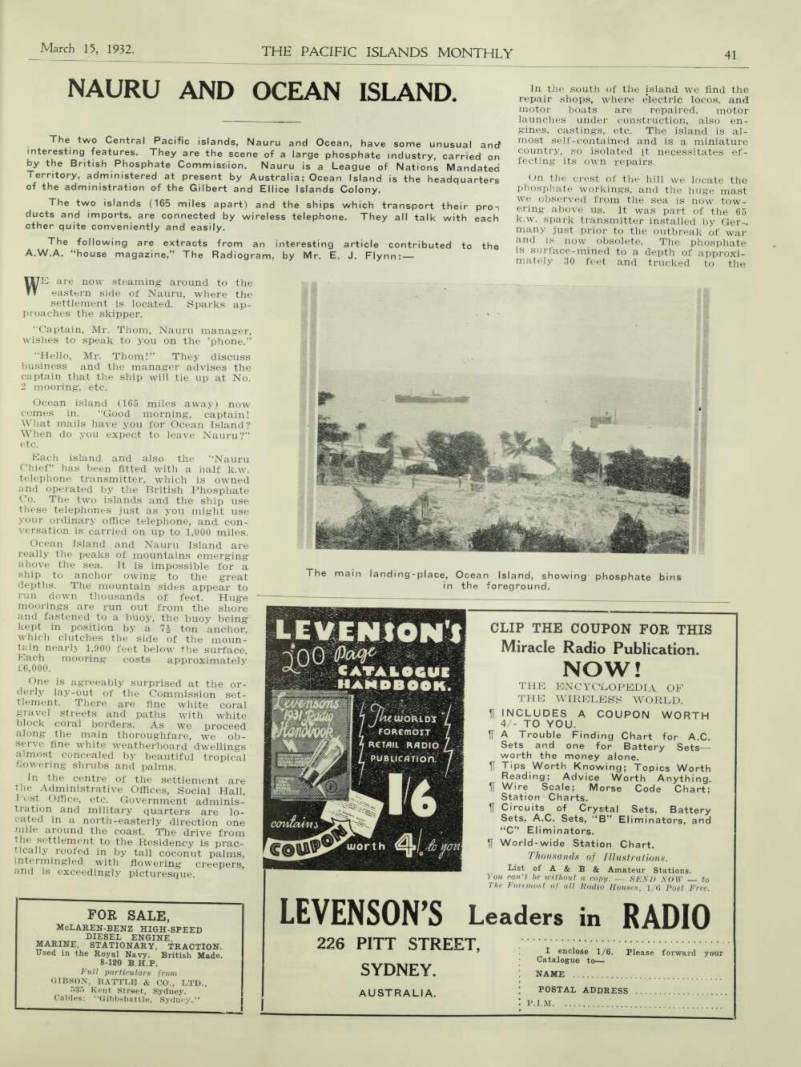
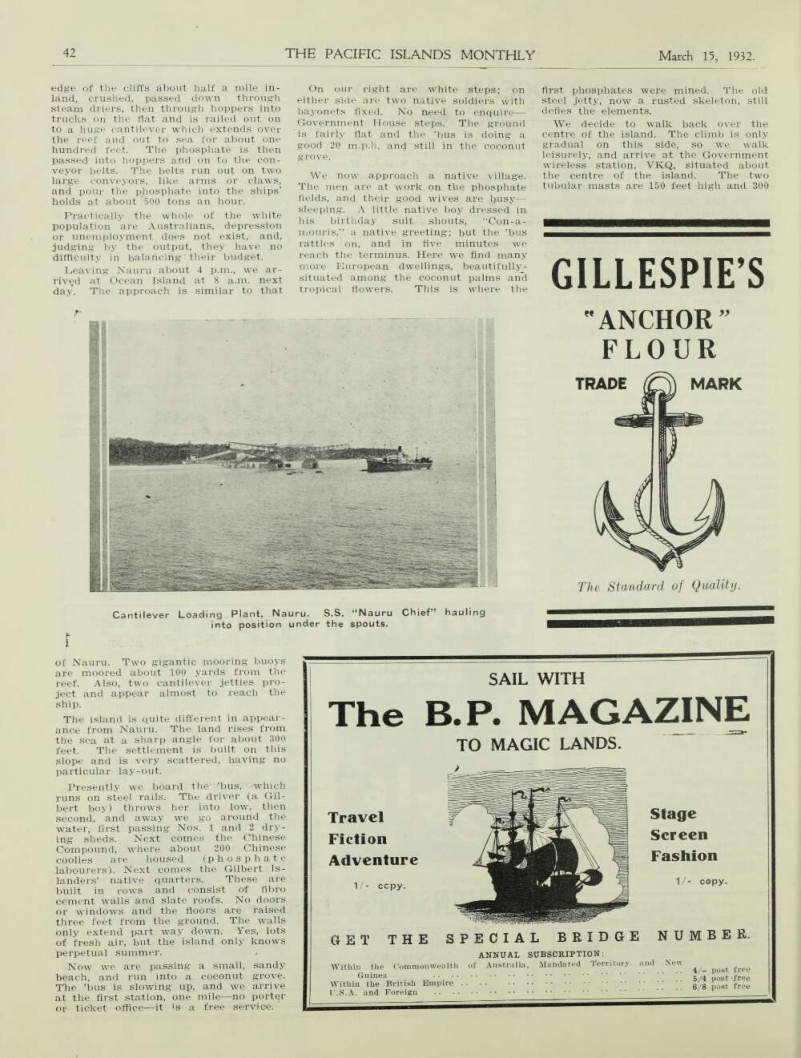
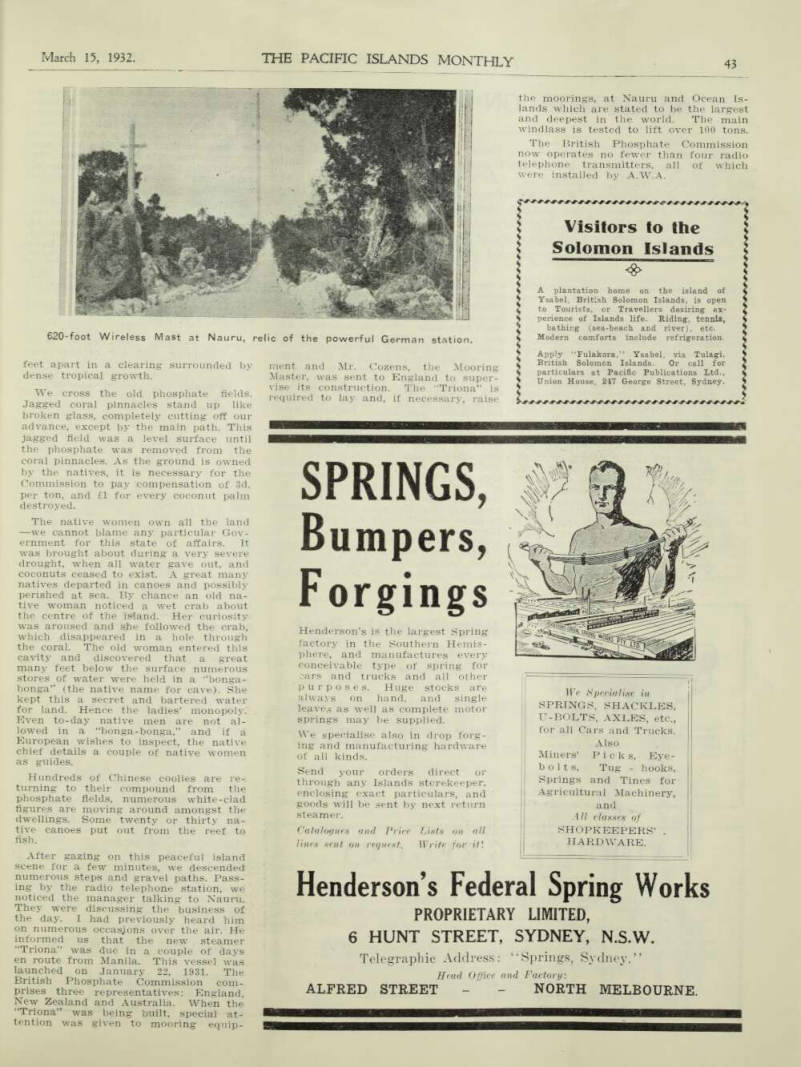
The two Central Pacific islands, Nauru and Ocean, have some unusual and interesting features. They are the scene of a large phosphate industry, carried on by the British Phosphate Commission. Nauru is a League of Nations Mandated Territory, administered at present by Australia; Ocean Island is the headquarters of the administration of the Gilbert and Ellice Islands Colony.
The two islands (165 miles apart) and the ships which transport their pro ducts and imports, are connected by wireless telephone. They all talk with each other quite conveniently and easily.
The following are extracts from an interesting article contributed to the A.W.A. “house magazine,” The Radiogram, by Mr. E. J. Flynn:—
WE are now steaming- around to the eastern side of Nauru, where the settlement is located. Sparks ap proaches the skipper.
“Captain, Mr. Thom, Nauru manager, wishes to speak to you on the ’phone.” ‘‘Hello, Mr. Thom!” They discuss business and the manager advises the captain that the ship will tie up at No. 2 mooring, etc.
Ocean island (165 miles away) now comes in. “Good morning, captain!
What mails have you for Ocean Island?
When do you expect to leave Nauru?” etc.
Each island and also the “Nauru Chief” has been fitted with a half k.w. telephone transmitter, which is owned and operated by the British Phosphate Co. The two islands and the ship use these telephones just as you might use your ordinary office telephone, and con versation is carried on up to 1,000 miles.
Ocean Island and Nauru Island are really the peaks of mountains emerging above the sea. It is impossible for a ship to anchor owing to the great depths. The mountain sides appear to run down thousands of feet. Huge moorings are run out from the shore and fastened to a buoy, the buoy being kept in position by a ton anchor, which clutches the side of the moun tain nearly 1,900 feet below the surface.
Each mooring costs approximately £6,000.
One is agreeably surprised at the or derly lay-out of the Commission set tlement. There are fine white coral gravel streets and paths with white block coral borders. As we proceed along the main thoroughfare, we ob serve fine white weatherboard dwellings almost concealed by beautiful tropical flowering shrubs and palms.
In the centre of the settlement are the Administrative Offices, Social Hall, Post Office, etc. Government adminis tration and military quarters are lo cated in a north-easterly direction one mile around the coast. The drive from the settlement to the Residency is prac tically roofed in by tall coconut palms, intermingled with flowering creepers, and is exceedingly picturesque.
In the south of the island we find the repair shops, where electric locos, and motor boats are repaired, motor launches under construction, also en gines, castings, etc. The island is al most self-contained and is a miniature country, so isolated it necessitates ef fecting its own repairs.
On the crest of the hill we locate the phosphate workings, and the huge mast we observed from the sea is now tow ering above us. It was part of the 65 k.w. spark transmitter installed by Ger many just prior to the outbreak of war and is now obsolete. The phosphate is surface-mined to a depth of approxi mately 30 feet and trucked to the
The main landing-place, Ocean Island, showing phosphate bins in the foreground.
edge of the cliffs about half a mile in land, crushed, passed down through steam driers, then through hoppers into trucks on the flat and is railed out on to a huge cantilever which extends over the reef and out to sea for about one hundred feet. The phosphate is then passed into hoppers and on to the con veyor belts. The belts run out on two large conveyors, like arms or claws, and pour the phosphate into the ships’ holds at about 500 tons an hour.
Practically the whole of the white population are Australians, depression or unemployment does not exist, and, judging by the output, they have no difficulty in balancing their budget.
Leaving Nauru about 4 p.m., we ar rived at Ocean Island at 8 a.m. next day. The approach is similar to that
of Nauru. Two gigantic mooring buoys are moored about 100 yards from the reef. Also, two cantilever jetties pro ject and appear almost to reach the ship.
The island is quite different in appear ance from Nauru. The land rises from the sea at a sharp angle for about 300 feet. The settlement is built on this slope and is very scattered, having no particular lay-out.
Presently we board the ’bus, which runs on steel rails. The driver (a Gil bert boy) throws her into low, then second, and away we go around the water, first passing Nos. 1 and 2 dry ing sheds. Next comes the Chinese Compound, where about 200 Chinese coolies are housed (phosphate labourers). Next comes the Gilbert Is landers’ native quarters. These are built in rows and consist of fibre cement walls and slate roofs. No doors or windows and the floors are raised three feet from the ground. The walls only extend part way down. Yes, lots of fresh air, but the island only knows perpetual summer.
Now we are passing a small, sandy beach, and run into a coconut grove.
The ’bus is slowing up, and we arrive at the first station, one mile —no porter or ticket office —it is a free service.
On our right are white steps; on either side are two native soldiers with bayonets fixed. No need to enquire— Government House steps. The ground is fairly fiat and the ’bus is doing a good 20 m.p.h. and still in the coconut grove.
We now approach a native village.
The men are at work on the phosphate fields, and their good wives are busy— sleeping. A little native boy dressed in his birthday suit shouts, “Con-a mouris,” a native greeting; but the ’bus rattles on, and in five minutes we reach the terminus. Here we find many more European dwellings, beautifully situated among the coconut palms and tropical flowers. This is where the
first phosphates were mined. The old steel jetty, now a rusted skeleton, still defies the elements.
We decide to walk back over the centre of the island. The climb is only gradual on this side, so we walk leisurely, and arrive at the Government wireless station, VKQ, situated about the centre of the island. The two tubular masts are 150 feet high and 300
Cantilever Loading Plant, Nauru. S.S. “Nauru Chief” hauling into position under the spouts.
feet apart in a clearing surrounded by dense tropical growth.
We cross the old phosphate fields.
Jagged coral pinnacles stand up like broken glass, completely cutting off our advance, except by the main path. This jagged field was a level surface until the phosphate was removed from the coral pinnacles. As the ground is owned by the natives, it is necessary for the Commission to pay compensation of 3d. per ton, and £1 for every coconut palm destroyed.
The native women own all the land —we cannot blame any particular Gov ernment for this state of affairs. It was brought about during a very severe drought, when all water gave out, and coconuts ceased to exist. A great many natives departed in canoes and possibly perished at sea. By chance an old na tive woman noticed a wet crab about the centre of the island. Her curiosity was aroused and she followed the crab, which disappeared in a hole through the coral. The old woman entered this cavity and discovered that a great many feet below the surface numerous stores of water were held in a “bonga bonga” (the native name for cave). She kept this a secret and bartered water for land. Hence the ladies’ monopoly.
Even to-day native men are not al lowed in a “bonga-bonga,” and if a European wishes to inspect, the native chief details a couple of native women as guides.
Hundreds of Chinese coolies are re turning to their compound from the phosphate fields, numerous white-clad figures are moving around amongst the dwellings. Some twenty or thirty na tive canoes put out from the reef to fish.
After gazing on this peaceful island scene for a few minutes, we descended numerous steps and gravel paths. Pass ing by the radio telephone station, we noticed the manager talking to Nauru.
They were discussing the business of the day. I had previously heard him on numerous occasions over the air. He informed us that the new steamer “Triona” was due in a couple of days en route from Manila. This vessel was launched on January 22, 1931. The British Phosphate Commission com prises three representatives: England, New Zealand and Australia. When the “Triona” was being built, special at tention was given to mooring equip
ment and Mr. Cozens, the Mooring Master, was sent to England to super vise its construction. The “Triona” is required to lay and, if necessary, raise
the moorings, at Nauru and Ocean Is lands which are stated to be the largest and deepest in the world. The main windlass is tested to lift over 100 tons.
The British Phosphate Commission now operates no fewer than four radio telephone transmitters, all of which were installed by A.W.A.
620-foot Wireless Mast at Nauru, relic of the powerful German station.
Advertisements & other items, pp. 43-45 (1 item)
LEVENSON’S Leaders in RADIO
CATALOGUE
HANDBOOK.
The WORLD'S
FOREMOST
RETAIL RADIO
PUBLICATION.
CLIP THE COUPON FOR THIS
Miracle Radio Publication.
NOW!
THE ENCYCLOPEDIA OF
THE WIRELESS WORLD.
INCLUDES A COUPON WORTH
4/- TO YOU.
A Trouble Finding Chart for A.C.
Sets and one for Battery Sets— worth the money alone.
Tips Worth Knowing; Topics Worth Reading; Advice Worth Anything.
Wire Scale; Morse Code Chart; Station Charts.
Circuits of Crystal Sets, Battery Sets, A.C. Sets, ‘B” Eliminators, and “C” Eliminators.
World-wide Station Chart.
Thousands of Illustrations.
List of A & B & Amateur Stations.
You can’t be without a copy. SEND NOW to The Foremost of all Radio Houses, 1/6 Post Free.
LEVENSON’S Leaders in RADIO
226 PITT STREET,
SYDNEY.
I enclose 1/6. Please forward your Catalogue to—
NAME
AUSTRALIA.
POSTAL ADDRESS
P.I.M
FOR SALE,
McLAREN-BENZ HIGH-SPEED
DIESEL ENGINE.
MARINE. STATIONARY, TRACTION.
Used in the Royal Navy. British Made.
8-120 B.H.P.
Full particulars from
GIBSON, BATTLE & CO., LTD.,
535 Kent Street, Sydney.
Cables: “Gibbsbattle, Sydney.”
GILLESPIE’S
"ANCHOR”
FLOUR
TRADE
MARK
The Standard of Qmlity.
SAIL WITH
GET THE SPECIAL BRIDGE NUMBER.
ANNUAL SUBSCRIPTION:
Within the Commonwealth of Australia, Mandated Territory and New free Guinea 5/4 post -free Within the British Empire 6/8 post free U.S.A. and Foreign
SPRINGS,
Bumpers,
Forgings
Henderson’s is the largest Spring factory in the Southern Hemis phere, and manufactures every conceivable type of spring for cars and trucks and all other purposes. Huge stocks are always on hand, and single leaves as well as complete motor springs may be supplied.
We specialise also in drop forg ing and manufacturing hardware of all kinds.
Send your orders direct or through any Islands storekeeper, enclosing exact particulars, and goods will be sent by next return steamer.
Catalogues and Price Lists on all lines sent on request. Write for it: We Specialise in
SPRINGS, SHACKLES,
U-BOLTS, AXLES, etc.,
for all Cars and Trucks.
Also Miners’ Picks, Eyebolts, Tug - hooks, Springs and Tines for Agricultural Machinery, and All classes of
SHOPKEEPERS’ .
HARDWARE.
Henderson s Federal Spring Works
PROPRIETARY LIMITED,
6 HUNT STREET, SYDNEY, N.S.W.
Telegraphic Address: “Springs, Sydney.”
Head Office and Factory ;
ALFRED STREET - - NORTH MELBOURNE.
Solomon Islands
Visitors to the Solomon Islands
A plantation home on the island of Ysabel, British Solomon Islands, is open to Tourists, or Travellers desiring ex perience of Islands life. Riding, tennis, bathing (sea-heach and river), etc.
Modern comforts include refrigeration.
Apply “Fulakora,” Ysabel. via Tulagi, British Solomon Islands. Or call for particulars at Pacific Publications Ltd., Union House, 247 George Street, Sydney.
Sidelights On Finance.
The name of W. R. Carpenter is known throughout the South Seas as that of a man who, in a few short years, has built up a huge and very successful trading organisation. As a merchant of substance, and a financier of long vision, Mr. Carpenter is held in respect in the City of Sydney. That is why we publish the following article —the text of an address recently given by Mr. Carpenter. It has no direct bearing on Pacific Islands affairs but, indirectly, it is important, because it seeks to explain conditions which have puzzled the shrewdest heads among us.
THE present depression, particularly
in Australia, points to two very definite causes, namely—time pay ment and cash orders. These were in troduced here from America, but, un like America, we are a debtor nation.
Time payment brought within the scope of those who could not afford it, the ability to purchase many things that could have been well done with out. This evil in itself was bad enough, but this was capped later by the cash order.
Whilst only one or two firms were operating on the cash order system, things were not so bad; but, on ac count of the prosperity shown by these few companies, many others sprang up.
The result was that money was got very easily, and on very easy terms of re payment. This enabled many people to get the cash to make the initial deposit to purchase things on time payment.
As we had to import nearly every thing, and most of the time payment goods included such things as motor cars, wireless sets, gramophones, and things of that nature, imports ran to
a very high figure, and there appeared to be prosperity here. But, as I have pointed out repeatedly, the next crash in Australia would be caused through these two evils. Our former crash was due to land speculation, but we did not seem to have learnt our lesson, Australia ran up to about the second or third country, for imports of such things as motor cars, gramophones, and wireless sets, and the total im ports were in the vicinity of about £140,000,000 annually. Imports from America ran up to something like £40,000,000 per year, because in the wake of motor cars came petrol, oils, and other things of that nature, When the end came to the purchas ing power of the public, by the means of cash orders, then started in the wave of unemployment. It was only necessary for the man at the bottom to make default for it to work through the whole tree, until it reached the top —namely, the bank.
Goods were sold at many times their value, because, in the first instance, the man who sold on time payment had to
load his goods, and he, in turn, could not afford to carry his paper Discount companies came in, and took that paper over at an additional profit. These, again, went on to a big merchant, or the bank, so that everything that was sold here was very heavily loaded, to enable it to pay the different sets of profit and expense that became necessary.
From the very fact that our total of imports fell from £140,000,000 as it was for two or three years, down to £60,000,000, shows that we imported very many things we could well have done without. Cash orders were abused to such an extent that, with a great number of people, the very clothes they wore were purchased on this cash order system.
This meant that the whole nation was really in debt.
We borrowed heavily abroad, be cause of Customs and income taxes were booming and our revenue was very high; but as soon as the depres sion came along, the purchasing power of the people fell, and, in consequence, every article had to recede in value, as people had to do without many things that they were formerly able to purchase.
As the spending powers of the public were reduced, firms began to see their turnover fall heavily. Many people in motor firms, and other luxury lines, were first to lose employment, and these were unable to buy the supplies that they formerly obtained. Conse quently, “up the tree”; the big retail stores felt the pinch, people were un able to buy; they, in turn, put off more hands; and thus unemployment grew.
As our revenue fell, so the Govern ment was unable to obtain money.
Public works, on which very many millions were spent annually, had at tracted many people to this country who should never have come; these were thrown out of work, and gradu ally our army of unemployed grew.
This put a tremendous strain upon Governments, and more taxation had to be levied on those who were able to pay. Finally, wage earners and every one had to be taxed so as to be able to keep the men who had, unfortun ately, lost their employment.
Our position is not irreparable. We have all now studied strict economy, and our vast number of unemployed will be absorbed, but it is going to be a slow process. In the long run, it will be best; because people will get mt permanent employment, whereas, be fore, we had a vast army of people who were dependent simply upon loan money and extravagance to keep their
employment.
When the exchanges in Australia were allowed to go, then we really started on our move upwards, and, o top of this, the British Government, having decided to go off their Sterling basis, gave a further 25 per cent, to our producers. Thus to-day we stand
with a 55 per cent, premium on our goods. Consequently, our primary producers are able to carry on, and this, in turn, reflects itself through the whole of the nation. They are able to pay their debts and purchase the goods they require. This means more work to stores and manufacturers, and increases employment.
The feeling of uncertainty as to what is going to happen to our exchange is now stultifying that progress a little; but if the Banks and the Government will come out with a bolder policy, and stabilise exchange at what it is, there will be a greater feeling of confidence.
This was reflected, a little while ago, in the Stock Exchange, when all stocks started to move upwards. But the first breath that exchanges were likely to fall stopped all this, and stocks began to fall —people began to hoard their money again.
France has stabilised her franc at 124 to £, although she has something between £500,000,000 and £600,000,000 of gold. If the laws of supply and de mand in gold were to operate, the franc would go to its original value of 20; but to do this would ruin many people.
France has been prosperous, because she stabilised her exchange, and the feeling of confidence amongst the people enabled them to go ahead.
Unfortunately, we owe great sums of money abroad, and having to pay in terest in England makes a big drain on our Government. When it is all said and. done, this only amounts to something like £7,000,000 annually, whereas the Sterling, having gone to P er cent - depreciation, and our own exchange to 30 per cent, depreciation, our exports, which, under former con ditions, would only realise somewhere about £55,000,000 or £60,000,000, now in the vicinity of £90,000,000 to £100,000,000 this year, thus giving Aus tralia much more money to use in ternally.
We have the pernicious theory of a fiduciary issue being driven at us all the time. Let us view what this means. Say the Government did issue £20,000,000 notes, what would be the result? Employment would be found for many people, it is granted. But this would lead to a false prosperity.
Goods would have to be imported to the demands of the people, and that £20,000,000 would gradually go into the hands of the big storekeepers and others, and drift back to the banks.
When that is done, what is to happen again? All the people who were put m temporary employment through the issue would be thrown out, or a further fiduciary issue put out. A fiduciary of this kind is like a snowball—it is no thing more or less than a loan, and, as we pile up debts, so we must under stand that we have to pay both in terest and redemption upon that debt!
The result would be far worse than any other cure.
By letting the exchanges stop as they are, the money is being circulated amongst the people, and it is giving permanent employment instead of casual employment, which latter is the worst kind of employment.
Australia had created a vast army of workmen who were dependent solely and simply upon our powers to borrow We, a small nation of between 6,000.000 and 7,000,000 people, have the colossal
debt of £1,100,000,000, and we have no reserves to live upon. The older nations have put by big sums, and they are able to draw upon those reserves, but, unfortunately, we have nothing of the kind to help us over the bad times.
Fiji For The Winter
Private family would receive two paying guests. Unique opportunity of enjoying Islands life—golf, tennis, howls; cruising, fishing, shoot ing. Inclusive terms, £10/10/- monthly. Par ticulars from Pacific Publications, Ltd., Union House. 247 George Street, Sydney.
Advertisements & other items, p. 46 (1 item)
Albert Gregory
Have Teeth by Post
Let me send you free full particulars of my well-known and successful method of
"SELF-TAKEN IMPRESSIONS'’
by which I can make you teeth by post.
All details by return mail.
Natural gum, unbreakable sets, comfortable and long lasting.
Teeth in one day for visitors to my surgeries. Painless extractions, reli able fillings, gold crowns and Bridge work. Old Plates remodelled. 28 OXFORD ST., over Winns;
139 ELIZABETH STREET, tw.
Beam Wireless, Telegraphic and Cable Addri
SPENCER NOLAN
DENTIST,
177 OXFORD ST., opposite Mcllraths. doors from Market Street, Sydney, “Fastplate,” Sydney. P.I.M.
ALBERT GREGORY
107 YORK STREET, SYDNEY.
SADDLERS’ IRONMONGERY, SADDLES, HARNESS,
SPURS, STIRRUPS, and WHIPS, &c.
EVERYTHING CONNECTED WITH THE TRADE.
Leather for Art Work, Basils, Roans, Suedes. Boot and Harness Leathers.
GREGOLINE—Raw, Pure and Pearl White. Nothing- so good for the Home, Stable, and Dairy and a great rust preventive.
Distributing Agents for;
DOCKER’S AND BORTHWICK’S PAINTS.
CORRESPONDENCE SOLICITED.
Test Cricket at Rarotonga.
From Our Own Correspondent.
Karotonga, Feb. 27.
THE London Mission Society’s sports ground was the scene of a fiasco the other after noon.
The fiasco was concerned with a test match (cricket) between a native and an European team.
The game was the outcome of a challenge made by Mr. W. P. Browne (proprietor of the local picture house) for his XI. to meet an XI. comprising Europeans.
The information is not very definite, but it appears that the honour of raking together an European team fell to Mr. E. Mosse.
It seems there was difficulty in getting this team together. One of the most useful colts with the bat could not play on account, so it was announced, of a broken toe.
At any rate the first innings resulted : Browne’s XL, 108; Europeans, 38. Mr. Mosse’s XI. fol lowed on and took second strike.
The report goes that Dr. Ellison was nearly laid out before he proceeded to the crease. A ripe bread-fruit fell heavily at his feet from a tall branch of a tree, under which he was standing.
No doubt this was a warning of disaster.
Another bad omen, according to all accounts, was a slight injury to a fowl in the outfield from a ball.
No one seems to be able to account for it, but the 10th wicket fell with the inning’s score at It is understood that Mr. Browns was re quested not to announce the result at the pic tures in the evening.
So many duck-eggs were recorded that perhaps it may be as well to spare players a perpetra tion of the ghastly horror of the scoring board.
Thursday Is. Notes.
From Our Own Correspondent.
Thursday Is., March 2.
TWO prominent Thursday Island families, noth descended from pioneers of the district, have lately left to settle in Southern Queens land. Mr. Jimmy Mills and his wife, late of the Metropole Hotel, both born on the Island, were the first to go, and now Mr. George Clarke, who was manager of Hodels for 24 years, and his family, are amongst the departing passengers by the “Changte.”
Both families will be missed, and a large circle of friends hope that their departure will not be completely final. With such confirmed “Wongai Eaters,” we fully expect that Thurs day Island will be the scene of future holidays at least. A farewell was tendered to Mr. and Mrs. Clarke by the Girls’ Friendly Society, and the former was entertained by the Municipal Council before leaving.
Mr. William Norgate. one of the finest and straightest men connected with Torres Straits, died during the early hours of the first day of March, aged 67. He was for many years, more from choice than necessity, head lighthouse keeper at Booby Island, and the name is insep arably connected with that rocky outlier of Aus tralia at the western entrance of the Straits.
We would like to extend our sympathy to Mrs.
Norgate and her family in their loss.
Advertisements & other items, p. 47 (1 item)
Durabestos
SAMUEL RUSSELL,
ESTATE AND GENERAL AGENT,
P.O. Box 64, Papeete, Tahiti.
Real Estate Investments. Estate management and administration. Valuations and Reports Houses and Lands for Lease or Sale.
Sole Proprietor: TAHITI PERFUMES Cables: Russell, Tahiti (Bentley’s Code).
The
Sturdy Rock-like
Material
DURABESTOS
BUILDING SMEETS
Build with an eye to the future. Banish the risk of weather-havoc in your walls. Here’s protective armour. Make your building safe and sound with Durabestos. It will hold your money in trust, maintaining value, preserving beauty.
Durabestos is indestructible asbestos united with cement under hydraulic pressure. Inexpensive; easy to cut and nail; hard as rock; resists fire, unaffected by weather.
Ideal for Island homes and buildings.
Write for full particulars and prices.
Wunderlich Limited
Manufacturers, Box 474 AA, G.P.0., Sydney.
Chinese Labour In Fiji
Is Called Uneconomic
Written for The Pacific Islands Monthly by Trevor J. Casling-Cottle
I SHOULD like to comment, in your, meritorious paper, on the subject of Asiatic labour in the Pacific Islands.
I have recently returned from a two years’ sojourn in Fiji where, according to your paper, Asiatic labour is an in teresting experiment.
In the article in the November issue of the P.I.M., you state that Chinese and Japanese make admirable emi grants. Now the question is, do they?
My opinion is, No. I am writing from knowledge gained through actually be ing in charge of Chinese tradesmen, and I am certain that anyone holding my position would see that they do the country no good at all.
Your article says that the Chinese are, “Mostly storekeepers and trades men, and generally speaking are very good citizens.” As far as their be haviour goes, they are good citizens; but that is not all that counts.
Take, for instance, the question of finance. The skilled Chinese trades man draws from 7/- to 10/- per day.
Of that money, which is taken from the colony, how much goes back? Not a cent, except the annual poll tax. The Chinese store contains nothing but what is Chinese-made, and the China man wfio draws the wages will not spend a penny on anything which is British-made. Therefore, the wages paid to these men are absolutely lost to the colony, and that is doing more
harm than good, because every penny will be used against us before many years are over.
It cannot be said that it is cheap labour, because an European drawing 16/- per day would do better work in half the time, and the money he was drawing would be circulating in the colony instead of going out of it. Any one with a little foresight, and a sense of loyalty, can see what is going to happen ere long—especially since the recent Manchurian dispute, The Chinese have had their eyes on the Pacific Islands for years, and we, by the methods previously mentioned, are inadvertently giving the Islands to them. Why should foreigners such as these be allowed to work in a British colony, drawing wages in British money, when there are hundreds of Britishers in Australian and New Zea land who could, and would, do the work better and quicker, and the wages they drew would be doing the colony good instead of harm, There is also the matter of the sex relationship between the Chinese and the Fijian women. In 1921 there were 910 Chinese in Fiji; to-day, there are over 1,500, and this without their half castes who are fairly numerous. What will become of these half-castes when the Chinamen have saved enough of our money—which is five times as valu able to them as Chinese and return to
their own country? What can this mean for the future?
The same trouble has occurred in Samoa recently. Why cannot the people responsible look to the future good of the country, instead of think ing of the immediate financial gain.
Why bother with Asiatics at all?
The Fijian, if trained properly, can be turned out as good a tradesman as anyone else, and he is one of our fel low subjects, and belongs to the coun try, yet those responsible ignore him.
I have known instances where Fijian boys, who with a little tuition would have made excellent tradesmen, have been put aside in favour of the quiet, cunning Chinaman. Why not encour age and help our own loyal natives?
The Chinaman is getting the mon opoly all round, where-ever you look.
In New Zealand he has control of fruit shops and vegetable gardens, and I am ashamed to say that the European population patronise him to the neglect of their own white man. Is this going to do any good in the future? In Fiji the native of the country is practically left in the background. Why should he not be brought forward, trained and encouraged, instead of the foreigner?
Certainly, the natives as a whole are independent, but if trained in the right way they would soon learn that not only was it a benefit to themselves, but to their country also.
Unemployment is a serious problem in Australasia to-day. Thousands of efficient, able-bodied Britishers want work, and cannot get it, and yet Chinese are doing a Britisher’s work in a Brit isher’s country. Is that the spirit which has made Britain what she is to-day?
It is a pity that those responsible do not go to the Islands and gain first hand information. They would get many surprises. People who call them selves loyal Britishers will tell you that the Chinaman is a quiet, peaceful, law abiding citizen. This is the opinion formed by the way he walks through the main street of a big city. But go to the place where he predominates, and under the shelter of British jus tice he will call you “white dog,” or any other epithet which suits him. A few months close association with the “peaceful” Chinaman will soon alter one’s opinion.
Working with Asiatics for a couple of years in the Islands, as I have, will soon show you that the Asiatic problem is far from an interesting experiment.
It is up to every man who calls him self a Britisher, and is in an appro priate position, to play the game to his fellow countrymen, and to do his duty to his country, by doing all in his power to abolish Asiatic labour.
Continues.
Prospecting On Sepik
Prospectors continue to explore the tributaries of the Ramu and Sepik rivers, New Guinea, in search of pay table gold. Although there have been small finds up these rivers, nothing to warrant development on a big scale has been yet found.
A further party of prospectors ar rived at Madang last month by the “Bremerhaven” and, later, left for the hinterland.
Advertisements & other items, p. 48 (1 item)
C. G. Piggott
SHIPCHANDLERY.
W. Kopsen & Co. Limited
Manufacturers of PIONEER BRAND ASH OARS AND IMPLEMENT HANDLES.
Sole Agents for: KOPSEN’S SPECIAL YELLOW METAL SHEATHING AND NAILS.
Large Stocks of Chains, Anchors, Manilla and Wire Ropes, Wood and Iron Blocks, Oakum, Tar, Pitch, Oils, Paints, Leads, Zincs, Varnishes, , Shackles, Rigging, Screws, Sheathing, Felt, Lampware, etc.
Prices and Particulars on Application.
68-70 CLARENCE STREET, SYDNEY.
Cables: “Kopsen." ’Phone: BW 1114-5.
Vitality and Health are the
Main Factors in Every-day Life.
Put yourself in the hands of Specialists who have made an intelligent study of your requirements; it is vital to your health. We are known everywhere as the Suppliers of the Right Goods and which put the VITAL into VITALITY. Thirty-five years is our record of supplying Fresh Fruit, Vegetables and Produce to the leading Houses throughout the world.
GET FULLY ACQUAINTED WITH US,
Tel.: MA 4799; FX 4350 Private.. Cable Address; Pigs, Sydney. Code: Bentley’s.
C. G. PIGGOTT
WHOLESALE FRUIT AND PRODUCE MERCHANTS
DIRECT IMPORTERS AND EXPORTERS SYDNEY.
Office; Bulk Stores and Packing House: Fruit Exchange, Sydney.
Sales Dept.: Fruit Exchange and City Markets, Sydney. Bank of N.S.W. Bankers.
New Books
Flynn Of Thf Inland: Ion L.
Idriess, in writing this most delightful book about the work of the Australian inland Mission, has done Australia a public service. Ten thousand books have been written about the inland places of North America and South Africa—but of the interior of Australia, where men are just as heroic and life is just as fascinating even we in the coastal cities know nothing at all. The work of the Inland Mission, of itself, is an extraordinary story; but Mr. Idriess in his inimitable style, makes it breathe the spirit of the great Australian Out back—“One can almost feel the lone liness of country so remote that Oodna datta is spoken of by the settlers as though it were the centre of civilisa tion!” Incidentally, it looks as if Ion Idriess is going to receive recognition as a most popular writer about the real Australia. His recent book, “Lasseter’s Last Ride.” has run into five editions, and is still selling freely.
Our copy from Angus and Robertson, Syd ney. Published at 6/-. 3
Problem Of The Australian
ABORIGINAL; Here is another worth while book about the real Australia.
Mr. E. R. Gribble packs into 150 pages, the experience of a lifetime among Aus tralia's natives; and the book probably will receive world-wide recognition as the best of modern authoritative com pilations dealing: with this interesting fast-disappearing race. Mr. Gribble has a wonderfully sympathetic understand ing of the black-fellow; and his plea that the race has so many good quali ties that it is worth saving should not be allowed to fall on deaf ears. Apart from its scientific value, this is a book of fascinating interest, which should not be missed by the general reader.
Our copy from Angus and Robertson, Syd ney. Published at 5/-.
Rarotongans Commence to Plant Tomato Crops
Plant Tomato Crops.
From Our Own Correspondent.
Rarotonga, Feb. 27.
SHORTLY, native growers will be erecting their wooden platforms— long, nanow benches raised up a foot or so oft the ground—on which loamy soil will be placed.
These are the beds for raising tomato plants. Later, the young shoots will be transplanted to large areas—in many instances cleared patches in the midst of thick, bush.
On these tomato cultivations, the native will labour with the patience of the Chinese coolie. His plantings will be set out in perfectly straight rows, evenly spaced. In due course, he will cut long sticks from the bush— straight and of even thickness —and proceed to stake up the plants.
For string, he will go to the Purau tree and strip it of its bark. When his tomato patch is in bearing, it will be as neat and trim and as well cared for as the vegetable gardens of those won derful tillers of the soil —the Chinese.
But his market (New Zealand) is some 1,800 miles distant, so that he must pick the fruit at the stage where
it is fairly well matured, but not sufficiently advanced to show signs of ripening.
The fruit boats arrive, sometimes once and sometimes twice monthly.
Despite his careful regard to the time for transplanting, the weather may push his tomatoes forward too rapidly or perhaps too slowly, so that the fruit steamer arrives either just too early or too late for his picking.
When this happens, he must simply allow his crop to go to waste. There is no alternative means of disposal.
We sometimes hear it mentioned that the native is lazy. Yet, at times, his hard work is about as worth while as digging post holes and filling them in again.
Cook Is. Notes
War and Copra.
From Our Own Correspondent.
Rarotonga, Feb. 27.
TWO items of outstanding interest to the is lands of the South Seas have reached us during the month. They are: (1) War activities in the East, and (2) a sharp rise in the price of copra.
Of the first, we join with the outside world in the apprehension felt at the aspect of two of the most densely populated territories of the earth rupturing the peace of the world.
Most of the news which reaches here from day to day concerning what is happening at Shanghai is picked up from the large broadcast station at Los Angeles.
We of these islands communities feel a re moteness from the centre of this disturbance.
Yet it may not be unlikely, at this present moment, that some of our companion islands scattered over the vast spaces of the Pacific are already pin-pointed on a map as strategical points in a great scheme of war.
Therefore, we of the business community may well view with mixed feelings the rise in copra.
If this betterment merely portends the immin ence of war, with the Pacific the scene of that conflict, then any rejoicings over copra may be nothing more than rejoicings at a tragedy.
The current price ought certainly to be a stimulus to greater production. For some years now coconuts have been so worthless as to be allowed to remain on the ground where they fall.
Plantation owners will be glad to see a bet ter price offering and will no doubt re-commence production with greater activity than during the last year or two.
The owners of inter-island schooners, who lately have collected very small quantities of copra from the islands, will welcome the pros pects of picking up full cargoes for shipment northwards to Papeete and San Francisco.
Personal Notes.
The following residents returned to Rarotonga at the end of the month: Misses Hirst and Mooney, Mrs. Calwell, Mr. McKegg, Mr. Tavener.
Mr. C. F. Harley (from London en route to New Zealand) has spent two months on the island.
Miss Irene Bryan, daughter of the local har bourmaster, is on a visit to her father here.
Chief Ariki Returns.
Makea Tinirau, the chief ariki, returned to Rarotonga on January 30, after a stay of two months in New Zealand. Press reports from New Zealand indicated that Makea made a tour of the north island, as the guest of the Gov ernor-General.
“France” At Rabaul.
The American schooner France ar rived at Rabaul early last month on an ornithological research trip.
The scientists on board recently com pleted work in the Gilbert and Ellice Islands. They now intend spending some twelve months in New Guinea.
Advertisements & other items, pp. 49-50 (1 item)
Nock &
Johnson’s
Portable Self-Priming
Drainage
PUMP
Suitable for Sluicing
on Goldfields .
195 GALLONS PER MINUTE.
This Pump is entirely new—a revel ation in pump performance. It means new speed, new economy, and a new facility of operation for all contractors who engage in trench work; for building contractors in foundation work; for road contractors in culvert construction; for barge operators in pumping bilge; for sluicing on Goldfields—for everyone in fact who has temporary jobs of water removal.
SIMPLICITY.
The Flow of Water can be regulated by simply regulating the speed of the motor, which is controlled by the gas throttle and spark. Its flow is constant—no loss caused by air being sucked through the impeller; no in terruption for repriming. Sufficient flows can be developed to raise a column of water, 3in. in diameter, 35ft. above the water level.
HIGH SPEED.
The Johnson Pump is 8ft. long, and delivers 195 gallons a minute. At this rate a body of water, 39ft. long x 10ft. wide x 4ft. deep, can be pumped dry in one hour. Such per formances are establishing astonish ingly new records of efficiency—at a lower cost—in pumping operations such as are required in trench work, wet excavation, boat operation and similar work. Weighs only 851 js.
DEPENDABILITY.
The Motor is cooled by special vacuum system which makes troublefree service possible; no special lubrication is necessary; the motor is oiled by the petrol mixture. The graphite bronze bearings which support the drive shaft are lubri cated by the drip from the motor.
The shaft extension of the impeller turns in a rubber bushing which needs no attention, as it is sub merged when operated and lubricated by the water. £40
(Ex-bond
NOCK &
KIRBY!
Postal Address:
Box 68 C.C., G.P.O., Sydney.
IMPROVE
YOUR CAR
fit
THE NEW
K*L*G
PLUGS
6/6 each
Smith Sons & Rees,
LIMITED,
30-32 Wentworth Avenue,
SYDNEY.
Exclusive Territory Available.
Drying Fruit.
Tahiti Invention Promises Great Success.
From Our Own Correspondent.
Papeete, Peb. 23.
OUR prominent local inventor and en gineer, Mr. Henry Rey, has re cently announced the highly success ful completion of a series of experi ments on a novel method of drying fruit, which he has been working on for some time.
He utilises the heat of the sun to bring the air in an enclosed space to a comparatively high temperature.
This air is continuously circulated by means of a water-driven propeller, through a series of wire nettings upon which the fruit is spread. In an amazingly short time, whole bananas, sliced pineapple, papaya, etc., are dried, with practically no expense, to the consistency of dates.
The samples which we have tried certainly have maintained a remarkably delicious flavour, are perfectly stable for indefinite periods, and have none of the usual toughness of dried fruit.
They are a high grade delicacy, just as they come from the drier.
We wish Mr. Rey the great success which he deserves in this undertaking, all the more so as we well remember the discouraging difficulties which he passed through in the development of his earlier inventions along mechanical lines.
Due to its cheapness of operation and our abundance of fruit, this process should provide us with a new industry, which will be extremely welcome.
Pacific Islands
Association.
THE members of the Pacific Islands Association will meet at dinner on Wednesday evening, March 23, to say good-bye to Mr. H. A. Ross, a member of the Council, who is leaving Sydney shortly to reside in London. Mr. Ross formerly was in the Papuan Govern ment service.
The membership of the Association continues to grow. The following— subject to some formalities being con cluded —were elected to membership at the last committee meeting:—Dr. W. L.
Calov, W. L. Gordon Thomas, H. A.
Voysey, H. J. Owen, Tom Nevitt, V. A.
Pratt, Rev. M. A. Warren, E. M. Bland, Richard Walshe, Wm. Keppie, G. A.
Loudon, Captain A. S. Fitch, Dr. W. M.
Strong, R. C. Laycock, Mrs. Hides.
A whale, 30ft. long, was recently caught outside Port Moresby Harbour.
Its blubber was boiled down for recov ery of the oil.
Fruit For N.Z.
Over-crowded Market will Affect Cook Island.
From Our Own Correspondent.
Rarotonga, Feb. 27 LOOKING forward at the fruit season now approaching, we feel here that the prospects for marketing are not promising.
There is a vague presentment felt amongst those handling fruit that changes may be pending in shipping and marketing, disadvantageous to these islands.
We know that our market in New Zealand is an open one, and, this being so, is well supplied from various sources in the Pacific. We see less and less fruit being shipped from the Cook Group.
The position is uncertain, but, doubt less, we shall find the usual facilities provided for both the purchase and shipping of our season’s output of fruit.
The Resident Commissioner, Judge Ayson, who is expected to arrive back from New Zealand in the course of a day or two, will, we trust, be in a position to make a forecast on the out look, for the immediate future at least.
It is certain that the Commissioner’s presence in New Zealand at this junc ture will result in the best possible consideration, in the interests of these islands, being given at the hands of the New Zealand Government.
Infantile Paralysis In
E. Samoa.
Two cases of infantile paralysis have been reported from Eastern Samoa— one with fatal results.
Every precaution is being taken at Suva to prevent the epidemic reaching the Colony of Fiji.
Fiji Official To Investi
Gate N.Z. Markets.
Mr. A. C. Barnes, Director of Agricul ture in Fiji, has left Suva for New Zealand. The purpose of his visit is to investigate the marketing conditions in the Dominion in regard to Fiji pro duce generally.
Yaws Campaign In Samoa.
A two years’ campaign to combat yaws will commence in Western Samoa on April 2. Dr. S. M. Lambert, Pacific representative of the Rockefeller Insti tute, recently left Suva for Apia to in augurate the work.
Residents of Eastern Polynesia will learn, with deep regret, of the death, on January 31, of Mr. Charlie Smith, of Maroeroa, Raiatea, Tahiti. He was known to the natives as Anani Charlie (Orange Charlie), because he was a large exporter of oranges to New Zealand. He amassed considerable wealth before he was attacked by a long, painful illness.
Advertisements & other items, pp. 50-52 (3 items)
48
Match 15, 1932.
THE PACIFIC ISLANDS MONTHLY
Wholly Set Up and Printed in Australia bv Shipping Newspapers Ltd., 16 Bond Street, Sydney, and Published by Pacific Publications Ltd.. L nion House, 247 George Street, Sydney. Telephone: BW 5037.
Eucrasy Banishes All Desire For Drink.
It is a priceless boon to all who use it, VOLUNTARILY or SECRETLY, for their relatives or friends. If you suffer in any way through the liquor habit, let the voluntary testimonials of actual users convince you that EUCRASY will soon sober the drinker and make you happy.
Letter received: “I have been waiting to see if my husband would drink again. I can safely say he has been cured by Eucrasy. It has made quite a different man of him. 1 cannot speak too highly.—Mrs. B.L.”
EUCRASY is guaranteed harmless, and can be given SECRETLY or Voluntarily. NOT COSTLY. Call or write to-day for FREE SAMPLE. Booklet and Testimonials.
Dept. 8., THE EUCRASY CO., CANBERRA HOUSE, 297 ELIZABETH ST., SYDNEY.
Iona
BOOTS
and
SHOES
BD 1740 —Pat. Tan, Nigger and Box Calf Derby Bal. Three Decker Sole. Genuine Goodyear Welted Sole. Fiteasy Last. m The Recognised Quality of Australia.
Ladies’ and Gent’s Goodyear Welted Footwear.
Ladies’ and Children’s Veldtschoen Footwear.
V 21. —White Washable Calf, with Blue and White Hand-plaited Kid.
Vamp Insertion, Veldtschoen Sole. 5/8 Leather Heel. Ritz Last.
V 118. —Reproduced Crocodile Derby Shoe, with Full Leather Lining to Toe. This Shoe can be had in Any Colour. Veldtschoen Soles. Leather Heels. Romper Last.
Sizes . . . . 3-G, 7-10, 11-1.
If these brands are not already stocked by you, kindly send to us for illustrated catalogue.
CW 10 —Patent Tan Havana and Black Box Calf Derby Shoe.
Creased Vamps. Genuine Goodyear Welted Soles. Quality Five Toes Last.
McKINLAY & CUMMING Ltd.
GEORGE STREET - ERSKINEVILLE - - SYDNEY.
You men need a bottle of KB at dusk ... there’s stimu lation in every glass!