Pacific Islands Monthly
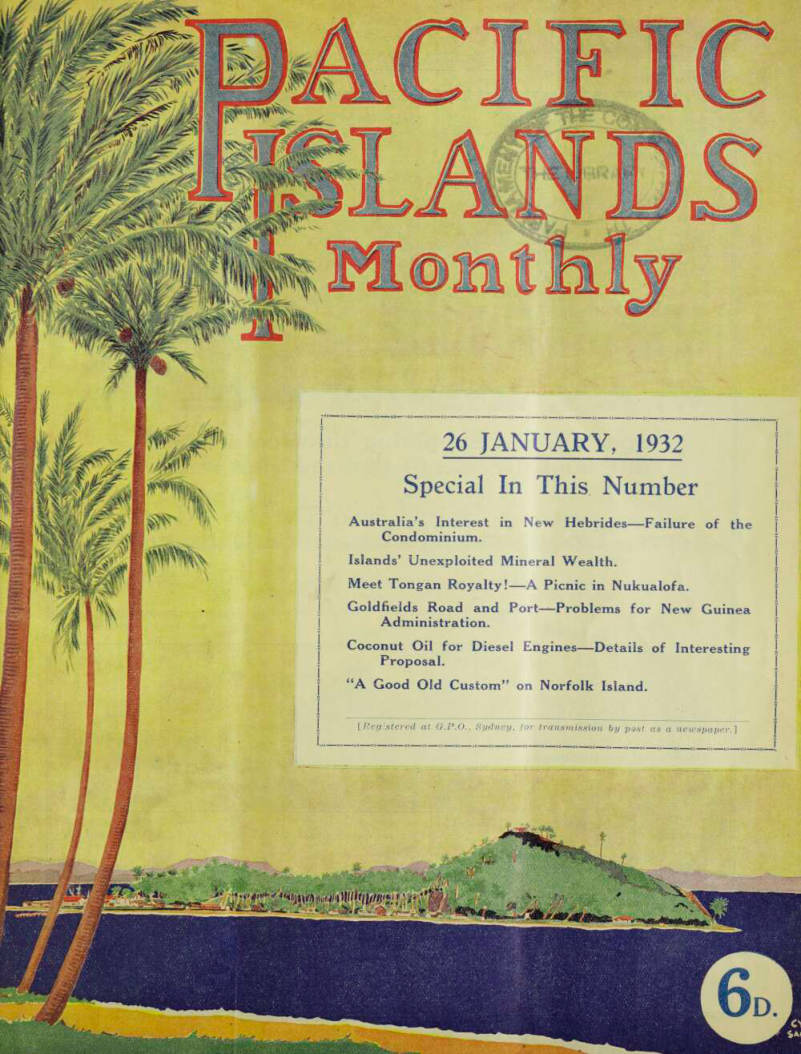
26 January, 1932
Special In This Number
Australia’s Interest in New Hebrides—Failure of the Condominium.
Islands’ Unexploited Mineral Wealth.
Meet Tongan Royalty!—A Picnic in Nukualofa.
Goldfields Road and Port—Problems for New Guinea Administration.
Coconut Oil for Diesel Engines—Details of Interesting Proposal.
“A Good Old Custom” on Norfolk Island.
[Registered at G.P.O., Sydney, for transmission by post as a newspaper .]
6d
Advertisements & other items, pp. 2-3 (1 item)
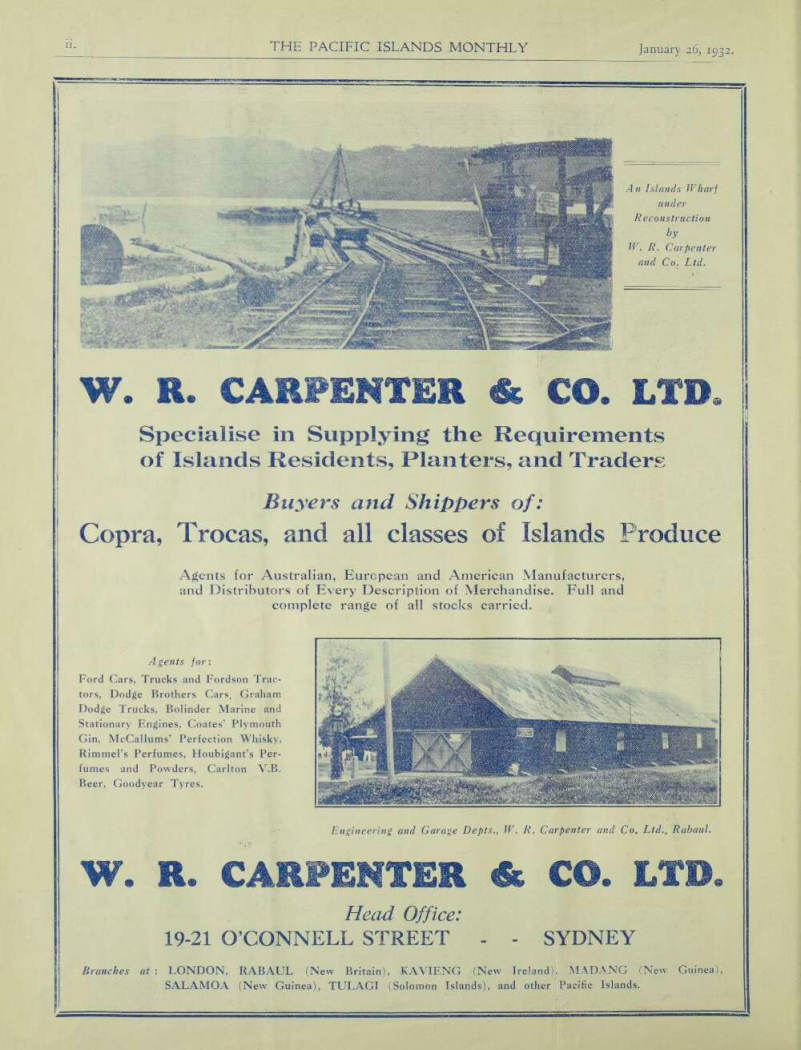
W. R. Carpenter & Co. Ltd.
An Islands Wharf under Reconstruction by W. R. Carpenter and Co. Ltd.
W. R. CARPENTER & CO. LTD,
Specialise in Supplying the Requirements
of Islands Residents, Planters, and Traders
Buyers and Shippers of:
Copra, Trocas, and all classes of Islands Produce Agents for Australian, European and American Manufacturers, and Distributors of Every Description of Merchandise. Full and complete range of all stocks carried.
Agents for: Ford Cars, Trucks and Fordson Trac tors, Dodge Brothers Cars, Graham Dodge Trucks, Bolinder Marine and Stationary Engines, Coates’ Plymouth Gin, McCallums’ Perfection Whisky, Rimmel’s Perfumes, Houbigant’s Per fumes and Powders, Carlton V.B.
Beer, Goodyear Tyres.
Engineering and Garage Depts., W. R. Carpenter and Co. Ltd., Rabaul.
W. R. CARPENTER & CO. LTD.
Head Office:
19-21 O’CONNELL STREET - - SYDNEY
Branches at : LONDON, RABAUL (New Britain), KAVIENG (New Ireland). MADANG (New Guinea), SALAMOA (New Guinea), TULAGI (Solomon Islands), and other Pacific Islands.
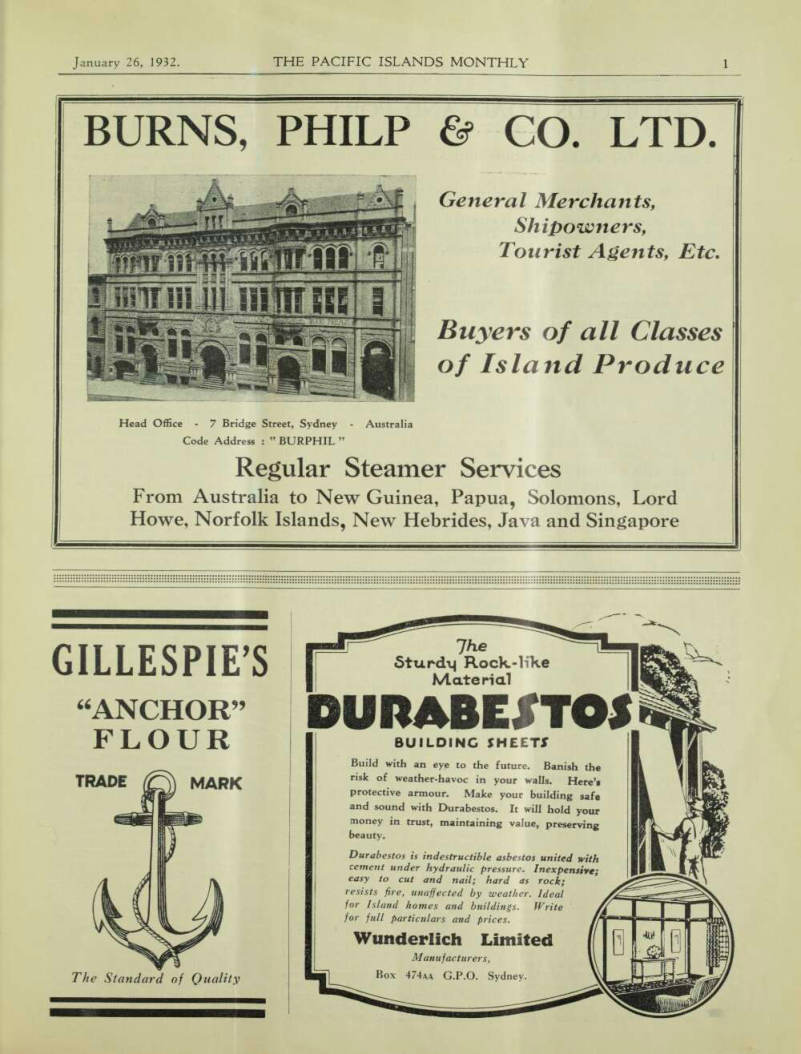
BURNS, PHILP & CO. LTD.
General Merchants, Shipowners, Tourist Agents, Etc.
Buyers of all Classes
of Island Produce Head Office - 7 Bridge Street, Sydney - Australia Code Address : " BURPHIL ”
Regular Steamer Services From Australia to New Guinea, Papua, Solomons, Lord Howe, Norfolk Islands, New Hebrides, Java and Singapore
The
Sturdy Rock-like
Material
DURABESTOS
BUILDING SHEETS
Build with an eye to the future. Banish the risk of weather-havoc in your walls. Here's protective armour. Make your building safe and sound with Durabestos. It will hold your money in trust, maintaining value, preserving beauty.
Durabestos is indestructible asbestos united with cement under hydraulic pressure. Inexpensive; easy to cut and nail; hard as rock; resists fire, unaffected by weather. Ideal for Island homes and buildings. Write for full particulars and prices.
Wunderlich Limited
Manufacturers, Box 474aa G.P.O. Sydney.
GILLESPIE’S
“ANCHOR”
FLOUR
TRADE
MARK
The Standard of Quality
Goldfields Road And Port
Problems for Administration and Gold Companies
THE question of constructing a road from the coast of the mainland of New Guinea to serve the new Morobe Goldfields has been receiving a good deal of attention lately, and it is expected that there will be definite developments during the current year. The question of whether Salamaua should be abandoned is now under consideration.
IT is recognised that, if gold produc tion in New Guinea is to be the important industry that it is expected to prove, it will be necessary sooner or later to build a suitable highway to give communication between the isolated Morobe plateau and the sea. The prob lem divides itself really into three
sections, namely:
1. The route that is to be followed. 2. The total cost and the financing of the work. 3. The question of which is to be the terminal port.
The problem was discussed at length in The Pacific Islands Monthly some time ago, when it was then shown that there are three rival routes.
The Rival Routes
One is called the Sheldon route and runs almost directly from Salamaua to Wau, following the ranges which lie between the Francesco and the Butou Rivers. This is a comparatively short route and will not be very expensive to build, but it will be expensive to maintain and it goes through country that is extremely broken and quite use less for any agricultural or pastoral purpose.
The second is the Buang route, which leaves the coast a few miles north of Salamaua, follows the Buang and Snake rivers, and enters the gold field near the junction of the Bulolo and Watut rivers. Mr. Charles Booth, a pioneer of the locality, declares that this comparatively short route provides the best and easiest grade of all and has been used to take in cattle. It opens up valueless country.
The third route is much longer and is known as the Markham Valley- Wampit route. It follows the Mark ham Valley for some thirty miles and then turns abruptly southwards and follows the valley of the Wampit, en tering the Morobe goldfields at the Watut river, which is a considerable distance northwards of Wau, The direct route from Salamaua to Wau has to provide for a grade which climbs to a height of 9,000 feet. The Buang route has no excessive slopes.
The maximum height which has to be provided on the Markham-Wampit grade is 3,500 feet. It has been cal culated that the Salamaua-Wau route can be constructed at a cost of less than £100,000. The total cost of the Mark ham-Wampit road would be not less than £225,000.
The latter road, although it is longer and more expensive, is officially fav oured because it is believed that it would open up a large area of excel lent agricultural country, which lies on the plateau at the head of the Mark ham and Ramu rivers. Because it has
not to provide such stiff grades it will be comparatively much cheaper to maintain.
All these routes have been surveyed by Mr. E. G. Sheldon, a well known civil engineer, who has been particu larly successful in finding grades for practicable roads through this extra ordinarily difficult country.
Problem Of Finance
However, the main point in connec tion with the construction of this road is that of finance. Although the New Guinea Administration has succeeded in balancing its budget, finance remains a nightmare. Revenue has been very considerably decreased because, owing to the depression, the Administration has had to make substantial reduction in taxation. It is obvious, therefore, that the Administration is not in a position to construct the road.
It became known several months ago that the Administration was quite pre pared to co-operate with the gold pro ducing companies operating on the Morobe Goldfields, if the latter were prepared to come together in a joint scheme, under which they would select a mutually acceptable route and each bear a proportion of the cost of con structing a suitable highway. The com panies have not turned down the scheme but have very wisely decided that it is better that they should in vestigate the value of their holdings and their probable profits before com mitting themselves to a quarter of a million expenditure on a road.
It was for this reason that the Placer group of companies decided to use the expensive aerial transport system to bring in their first dredges. It was calculated that they would thereby get to the point of production at least a year sooner than if they were to await the construction of a road. As soon as the dredges are in operation and have proved the value of the holdings —that point has now almost been reached —it is expected that the Placer Company will be in a position to at tack the road problem—the solution of which is absolutely necessary for the future of the field.
The Placer companies believe that they have 30 years’ productive work ahead of them. There is some doubt about the period but there is no doubt at all that there is at least 20 years’ very profitable work there. New Guinea Goldfields Ltd. are not so close to the point of profitable production, but that company has also brought in a consid erable quantity of machinery and ex pects within a few months to be in a position to thoroughly test its different leases. On the data thus obtained New Guinea Goldfields Ltd. will be able to
say how much it is prepared to spend on the construction of a road when it is prepared to make an allocation.
It is understood that the whole mat ter has been under consideration by the companies and different groups of companies recently, and it is quite probable that before the end of 1932 they will have come together in a co operative scheme for the construction of a suitable highway.
Question Of A Port
The third question—that is, the loca tion of the terminal port—is a really difficult one.
Recent events suggest that, after all, Salamaua may not be regarded as the permanent port of the Goldfields. The little town is built on a low-lying spit of very limited area. It cannot be ex tended, because all the surrounding country is quite unsuitable for building purposes. It is in an exposed position and a recent storm indicated that it is possible that a high sea would wash part of the spit away. The Adminis trator of New Guinea, General Wisdom, has always taken the view that Sala maua is not a suitable place to be built up as a permanent port and, for that reason, the Government buildings which have been placed there are of a temporary and flimsy character.
The Huon Gulf is the only portion of the New Guinea coast that is close to the Goldfield, and —apart from the safe anchorage provided behind the spit at Salamaua, there is not one good port along the length and breadth of the Gulf. Lae, to the north of Sala maua, is not a port at all. Ships can not berth there and may not even lie off the landing place if the weather is at all rough.
Yet, if there is to be a road built from the goldfields to the coast there must be a terminal port. The Admin istrator, before he left Sydney for Rabaul this month, arranged that a Commonwealth Public Works Engineer, Mr. Thornton, should immediately visit the locality and examine the coast very carefully, with a view to making a recommendation to the Government in regard to the location of the future port. He will examine the conditions at Salamaua and will also make a close inspection of the coast at the mouth of the Markham river, with a view to the possible construction of a port there. It is believed that the latter is the point favoured by the Administra tion because it is the obvious starting point for the Markham-Wampit road, and that appears to be the route to the goldfield approved by Administration.
Further along the coast, and lying almost due north of the Morobe Gold fields, is the excellent port of Madang.
A suggestion has been made that it might be possible to construct a road direct from Madang across the head waters of the Ramu and Markham rivers to the Morobe Goldfields, which would be entered in the vicinity of the Watut river. This would be a very much longer road than the route via Markham Valley and Wampit, but it would have the definite advantage that it would provide the goldfields with a first-class port and that it would open up the splendid pastoral and agricul tural lands contained in the high, fer tile plateaus at the head of the Ramu river.
The Pacific Islands Monthly
The Newspaper-Magazine Of The South Seas
[Registered at G.P.O. Sydney, for transmission by post as a newspaper.]
Published about 15th of Each Month and Circulated in Australia and New Zealand and in the following Pacific Territories and Island Groups;
Crown Colony of Fiji Australian Territory of Papua.
Mandated Territory (Australia) of New Guinea.
Bismarck Archipelago, and Northern Solo mon Islands Mandated Territory (Japan) of Marshall, Caroline and Ladrone Islands
American Territory of Guam Mandated Territory of Nauru British Crown Colony of Gilbert and Ellice Inlands French Territory of New Caledonia British and French Condominium of New Hebrides American Territory of Samoa
Mandated Territory (New Zealand) of Samoa British Solomon Islands Protectorate British Protectorate of Tongan Islands New Zealand Territory of Cook Islands Australian Territory of Norfolk Island French Colony of Society Islands (Tahiti) American Territory of Hawaiian Islands
Owned and Produced by Pacific Publications Ltd., Union House, 247 George St., Sydney
Telephone - Bw 5037
P.O. Box - 3408 R
Contributions
Articles, Stories and Photographs dealing with Pacific Islands Subjects are invited, and will be paid for on publication at usual rates.
Subscription Rates
Per Annum, within Postal Convention Territories, Prepaid, Post Free - 6/- Per Annum elsewhere, Prepaid, Post Free 8/- Single Copies - -- -- 6d.
Editor and Publisher:
R. W. Robson
Advertisements
Advertising Rates: £10 per page; £5/5/- per half page; £2/15/- per quarter page; £1/7/6 per eighth page; Casual Advertise ments --- 8/- per inch Colours, etc. by Arrangement Process Blocks made at Advertiser’s expense when required. Screen, 100.
Changes of Advertising Copy should reach this Office by 8th of each month, otherwise previ ous advertisement may be repeated.
4 Registered Address for Telegrams and Cables: “PACPUB” - -- -- -- - Sydney
Agents
The following are authorised to receive sub scriptions for The Pacific Islands Monthly.
Islands Branches of Burns, Philp & Co. Ltd. and Burns, Philp (South Seas) Co. Ltd.
Islands Branches of W. R. Carpenter & Co. Ltd.
All Branches of Morris, Hedstrom & Co. Ltd.
Greenwood & Laws (Rabaul).
Whitten Bros. Ltd., Port Moresby & Samarai.
All Branches and Representatives of W. H.
Grove & Sons Ltd., Auckland.
S. Russell, Papeete. Tahiti.
Cook Islands Trading Co., Rarotonga.
Mrs. M. Campbell, Cascades, Norfolk Island.
Vol. II.—No. 6.
Sydney: January 26, 1932
1 6d - Per copy Prepaid: 6/- per annum
Pacific Administration
New Hebrides Should Be Part of Australia’s Pacific Administration
The proposition is advanced in this article that Australia should take steps to end the New Hebrides Condominium and bring the group under Australian administration so as to protect her considerable land interests there.
It is desirable, from the points of view of administration, defence and trading that the Commonwealth’s tropical service should be extended from Papua and New Guinea over the Solomons and the New Hebrides.
Australia cannot release herself from her Pacific responsibilities. At present she is paying heavy costs of administration and shipping services while other nations are getting the cream of the trade. A rearrangement, to give Australia enough profitable trade to at least cover her Pacific costs, is long overdue.
IT is to be hoped that the new Fed eral Government will give some at tention to the deplorable conditions— from Australia’s point of view—that exist in the New Hebrides. Unless the Commonwealth does take some interest in this position an asset of much value to Australia, both actual and potential, will be lost.
The New Hebrides is one of the rich est of the Islands groups. It contains 5,700 sq. miles of land of which a great proportion is fertile and cultivable. It enjoys a comparatively pleasant clim ate, being in the same latitude as Samoa, and only slightly northwards of Fiji. The Group lies far southward of New Guinea and the Solomon Is lands, where climatic conditions are a little trying for Europeans.
The Condominium, under which the New Hebrides is administered, is unique: and a little history and ex planation are necessary. After half a century of “no-man’s” government, the British and French gradually took joint control. The British were first into the Group and, some 50 years ago, greatly outnumbered the French. But French commercial interests gradually reached up from New Caledonia and obtained a strong grip. Each country had sub stantial claims in the Group and even tually, early in this century, the posi tion was solved by the creation of a Condominium.
French and British each govern the affairs of their own nationals, and matters affecting them all in common are referred to certain joint institu
tions, at the head of which is the Joint Court, presided over by neutral judges.
In one way, the Condominium has worked quite well. There has been no friction worthy of the name between the two peoples, and the administra tion has gone on smoothly. A certain amount of give-and-take has been ne cessary; but the French, like the Brit ish, are gentlemen and sportsmen, and have met administrative and trading difficulties, as they have arisen, in an admirable spirit.
But it has become increasingly evi dent that the Condominium will not work and that sooner or later the Group must revert entirely to French or to British administration. There are two insuperable obstacles in the way of the success of the system. One is financial and the other has to do with labour.
In the period following the war, France was off the gold standard and the franc was “wild.” The British £ was more or less stabilised. The effect in the New Hebrides, where both French and British money are legal currency, can be imagined. The trad
ing difficulties were almost insuperable and, where Administration costs were brought together in a common fund, there was much confusion. Later, when the French franc was stabilised at 124 to the £ and the currency of both nations were settled on the gold basis, these difficulties disappeared. But they have appeared again in more acute form in recent months. The British £ is now off the gold standard, and fluctuating, while the French franc re mains on gold. Meanwhile, the Aus tralian £ is at a discount of 30 per cent, on sterling. All three currencies, British, French and Australian, are now in common use in the New Heb rides. The confusion that exists there at present in all matters relating to money can be better imagined than described.
So far as industrial conditions are concerned the position is lamentable.
In past years, owing to the unwilling ness of the New Hebrides natives to work, the French were allowed to in denture thousands of Tonkinese lab ourers, and by this means they oper ated their plantations profitably. For some reason the British have not been accorded the same privilege. As a result, one may see all through the New Hebrides flourishing French plantations, worked by Tonkinese lab our, alongside semi-bankrupt British plantations, languishing for lack of labour.
The effects of these disabilities need not be emphasised. They are apparent now in the population figures. Where, 50 years ago, the British predomin ated, there are now in the Group 930 French planters and traders and only 420 British. A considerable proportion of the British planters and traders, driven by these unfair conditions, have abandoned British and sought French nationality.
The position is very well summarised in the following article, written for us in December last by a resident of the New Hebrides: “The grievances of the British settlers in the New Hebrides are so many that it is hard to know which to start on first. But I will say at once that we have long ago given up appealing to the British administration and realise that no help can be expected in this direc tion. It was on this account that most of the big planters were forced to sell out to the French several years ago.
Of the remaining ones, several have become naturalised French, and one of the only two large British stores in Vila has been turned into a French com pany.
“There is not the slightest doubt that if conditions remain as they are, the remaining Britishers will either be forced under the French flag or forced out of business.
“I can claim to have a good know ledge of the state of affairs in this Group, as I have been a resident for several years. In recent years things have been going from bad to worse and are likely to continue so.
“It is the general opinion here that the Group will shortly be handed over to France. For some time past there have been rumours that Burns, Philp and Co. Ltd. are considering the ques tion of forming a French company, as they are likely to lose most of their French clients owing to the operation of the Credit Nationale. This is a loan of 42,000,000 francs from the French Government to French settlers in the New Hebrides, to assist them over the depression.
“Trade is at a standstill and we have derived no benefit from the rate of exchange. Recently the price offered locally for copra was only £4/5/- per ton, and it is at present £6. The natives refuse to make it for these prices and, on some islands, are going back to their old native costumes and standard of living. In fact, they still have the impression that the fall in prices of produce is due to a huge conspiracy on the part of the white man to rob them. In one part of the Group colour is lent to this theory by the actions of a certain missionary who listens on his wireless to the weekly broadcast of the price of copra in London and then re-broadcasts this news to the natives, forgetting to explain the difference be tween London and local prices.
“For many years the shortage of lab our has been a serious problem. The French solved their difficulties in 1922 by the introduction of Indo-Chinese coolies, and there are now several thousand employed. This has been the salvation of the French interests here.
British settlers are refused the privi lege of imported labour. In 1927 a Royal Commission, consisting of rep resentatives of Great Britain, Australia and New Zealand, visited the Group to inquire into this matter. After hearing evidence from most of the British planters they steamed away, and there the matter has ended, in profound ob scurity. Up to the present day no report of the decision of this Commis sion has ever been made public, but it is understood that it was decidedly un favourable to us.
“On top of all this, British settlers have for years had the annoyance of a campaign of irritation conducted against them by a certain section of
missionaries who seem to consider themselves unofficial agents of police and are ever ready to report any story or complaints the natives make to them without first trying to ascertain the true facts of the case. The result has been that persons concerned are put to the inconvenience and expense of going to Vila with witnesses, etc., and if the charges are found to be ground less —as has happened in most cases — they have no redress, but have just got to grin and bear it, as many know to their sorrow.
“Recently, one missionary made such grave charges against a planter that he was convicted in the British court of criminal libel. Yet, although this case was the subject of a special Com mission, appointed direct from London, the planter was not allowed damages, or anything towards his expenses, which were heavy.
“Commonwealth Government has large interests in the Group in the form of land claims, and ever since the formation of the Joint Court, about 20 years ago, has kept a solicitor resi dent in Vila, to watch over Australian interests. Owing to the extremely slow methods of the Joint Court, nothing was done about granting land titles until quite recently, and if the Condo minium continues to function it is doubtful if any of the present resi dents will see the land question settled in their lifetime.
“In the meantime the French com pany—which claims more land than actually exists in the Group—has been selling and leasing to Frenchmen some of this land which is claimed by the Commonwealth Government, and as there are no titles, possession seems to be nine points of the law. In one ins tance, a party of Frenchmen had been for 2 years clearing and planting one of these claims before the British offi cial heard of it. They have been in possession over 5 years now and have already made a fine plantation.”
So much for the general situation.
Now we come to the Commonwealth’s connection with the New Hebrides. The interests of Australia are as definite as
(Continued On Page 17)
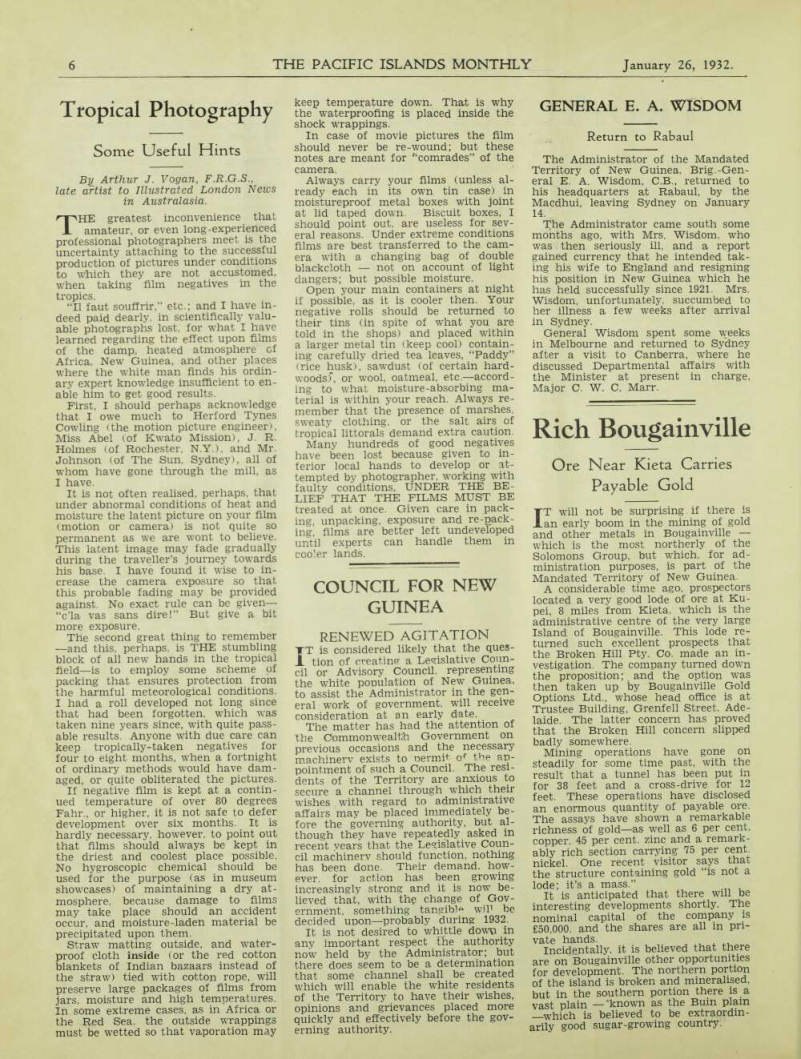
Vila, the headquarters of the Condominium Administration, as seen from the British Residency.
they are remarkable. It is necessary again to recount a little history.
If there is one man. more than an other, to whom honour is due for hav ing brought essential Pacific Islands interests to Australia, that man is the late Sir James Burns, founder of Messrs. Burns, Philp and Co. Ltd., and associated companies. He was not only a merchant and shipowner of great ability—he was also a wide-visioned imperialist. He extended the influence of his firm all over the western and southern Pacific Islands; but, wherever he went, he allowed his fervent patri otism to have full play, and he saw to it that, above all his enterprises the Union Jack was flying.
Some 50 years ago, Sir James Burns was impressed by the fact that unless someone displayed some enterprise and energy the large and potentially valu able New Hebrides Group would be lost to Britain. It is a fact that in the Pacific the flag has usually followed the trade; and Sir James Burns saw that the trade of the New Hebrides, unless prompt measures were taken, would not make British connections.
Therefore, he interviewed some of the leading men of Sydney and Melbourne and urged his patriotic viewpoint am ong them, with the result that they came together and formed the original Australasian and New Hebrides Co. Ltd.
This company, in close association with Sir James Burns’s own concerns, commenced trading and planting in the New Hebrides. Incidentally, its first manager was Mr. J. G. Laing, now a leading executive in Messrs. D. and W. Murray. He was in those early days a partner in Messrs. Prescott and Co., who were the Sydney agents of the New Hebrides Company. Another early manager was Mr. Joseph Mit chell, now General Manager of Messrs.
Burn, Philp (South Sea) Co. Ltd., and one of the Directors of the Burns, Philp group.
The Australasian and New Hebrides Co. Ltd. had a chequered career and did not flourish. It was reconstructed two or three times and was finally taken over by Messrs. Burns, Philp and Co. Ltd., and carried on for a few years. Finally, it was wound up al together and its trading interests taken over by Messrs. Burns, Philp and Co.
When the Australasian and New Hebrides Co. Ltd. was wound up it was owner of very large areas of land in practically all the islands of the New Hebrides. As soon as the com pany commenced operations it definitely set out to acquire good plantation land which it purchased from the native owners. As a matter of fact, it was the need for finding so much cash for this purpose that caused the financial crippling of the company. The land was obtained in various ways, but the transactions were all open and above board and the Company’s titles to the
various areas were as clean as was pos sible under the conditions which ruled in those days.
When the Company was wound up and its affairs taken over by Messrs.
Burns, Philp and Co., Sir James Burns —being a wise man of long vision— handed the whole of the Company’s land over to the Australian Common wealth Government. This fact is not generally known—but it is a fact. The Commonwealth Government is the owner of a very large proportion of the best land in the New Hebrides—and its claim to that land is as good as the claim of anyone else.
Sir James Burns literally gave the land to Australia. What his motive was exactly, it is hard to say. Prob ably he knew that an established Gov ernment of some kind was coming and he felt that when that central author ity proceeded to issue land titles the Australian Government would have a better chance of establishing its claim to the land than any private firm. At any rate, the gift was made and it was free from all conditions. All that Messrs. Burns. Philp and Co. have re ceived from the arrangement is the
continuance of the subsidy paid by the Commonwealth for the maintenance of the Pacific Islands services, of which the service to the New Hebrides forms a part.
The Condominium Government be gan to function in the New Hebrides on December 2, 1907, and for the last 20 years the Joint Court has been slowly and painfully scrutinising land claims and issuing titles. It is a colossal task and, so far, it has only been scratched at. An enormous amount of work yet remains to be done. If it has taken 24 years to issue titles to the land al ready dealt with, it will take at least another 100 years to deal with land claims covering the remainder of the Group. The slow-moving Joint Court, as a matter of fact, has reduced the whole position to absurdity.
The Commonwealth Government maintains in Vila a solicitor, Mr. F. E Wallace, whose duty it is to advance before the Joint Court the claims of the Commonwealth Government to the various areas of land taken over ori ginally from the Australasian and New Hebrides Co. Ltd. Mr. Wallace has been a resident of Port Villa for many years. Probably not 20 people in Aus tralia know that he is an official of the Commonwealth Government, or what he is doing. Probably, not 50 Australians, outside of the Government Department concerned, know that Aus tralia is the virtual owner of huge areas of valuable land in this Group.
It is the opinion of competent and experienced observers that Australia cannot afford to let the New Hebrides go by default. That appears to have been the policy of Federal Govern ments of the past. Matters relating to the New Hebrides have just drifted along, with the result that the enter prising French have slowly but steadily advanced their commercial hold on the Group.
The Group is of very little use to Bri tain —yet Britain continues to pay large sums annually to maintain the British Administration there. The Group is now of very little value to Australia, in a trade sense, yet Australia con tinues to pay a large sum annually to Messrs. Burns, Philp and Co. Ltd., by way of subsidy, so as to maintain a steamer service between Australia and the New Hebrides. The Group must be of comparatively little value to Messrs. Bums, Philp and Co., yet the big firm hangs on grimly in the face of the greatest difficulties, probably be cause it hopes that sometime, sooner or later, something will be done to secure this valuable territory for Aus tralia. Probably, Messrs. Burns. Philp and Co.’s reasons for retaining their New Hebrides connection are more sen timental than commercial. Even with the Commonwealth subsidy, there can not be much profit in this trade; and on account of the confused and jumpy exchanges, it is a very risky trade.
Why, then, should the present posi tion be allowed to continue? It seems certain that if the position was prop erly represented to France, a reason able solution could be found. Although French interests have poured money into the Group, so that they consider ably exceed British interests, the Group is of no more value to France than it is at present to Britain or Australia.
As a matter of fact, the French Gov ernment have subsidised French in
terests in the New Hebrides so heavily that it is now practically impossible for them ever to make any profit out of the Colony.
Developments since the Armistice have been remarkable. Australia has created an efficient tropical service and made a very good job of the Adminis tration of Papua and New Guinea; but, owing to extraordinary official indif ference, Australia has lost much of the Pacific Islands trade, won for her in the beginning by her merchants and shipowners and driven away in the past 15 years by bureaucratic stupidity and indifference. At one time, Aus tralia’s trade with New Caledonia, New Hebrides, Fiji, Tonga and Samoa was worth very many hundreds of thous ands of pounds more than it is to-day.
It has been literally driven away from Australia by certain political creeds and governmental policies. It is not possible to give details here, but it is a dismal story.
For nearly 20 years Australia has ig nored her responsibilities and oppor tunities in the Pacific. Prior to the war, owing to the enterprise of her merchants and the fine pioneering spirit of the late Sir James Burns and his associates, Australia acquired great trading interests in the Islands, ex tending from the Mariana and Caro line Group, in the north, to Samoa and Tahiti in the east. German aggrand isement forced Australia to take over Papua; the outbreak of war compelled the Commonwealth further to protect its interests by seizing New Guinea, the Bismarck Archipelago and the Northern Solomons (now grouped to gether as the Territory of New Guinea).
From that point onwards Australia should have become the dominant nower in the South Pacific. Instead of that, the Commonwealth seemed to spend most of its natural energy on class and political warfare and indus trial brawls, and its national heritage (the Pacific trade) was whittled away by other countries. Lunatics disguised as Harbour Trust officials drove the copra traffic out of Sydney Harbour; short-sighted tariffites gave grave of fence to Fiji and New Caledonia: in different bureaucrafts allowed the trade of Tonga and Samoa to drift away to New Zealand.
But Australia, in a trade sense, is now experiencing a change of heart. A decade’s orgy of spending—the result of easy loans and phenomenal prices for primary products—has ended. The nation is getting back to sanity and work: and. among other things, it will strive to regain as much as possible of the £6,000,000 of trade which is annu ally available in the Pacific Groups and territories.
Australia must either abandon her Pacific interests, or proceed to develop them. Two years ago the politicians would have said “abandon them.” To day, a new Government, eager to im prove the economic position and do something worth while for Australia, probably will take the other view. The new Ministers will have plenty of op portunities, so far as the Pacific is con cerned.
The New Hebrides represents one, which cries aloud for attention. The British Solomon Islands is another.
Nearly all the trade of this huge and potentially valuable group is done with Sydney: and there is a general belief that it would be for the convenience and benefit of all concerned if the
administration of the Solomons were removed from the British Colonial Office (operating through Suva) and given to Australia.
Here are the outlines of a plan that is being discussed and that is based on the facts dealt with in the foregoing article: 1. Extend the Commonwealth’s Is lands Administration (now suc cessfully functioning in Papua, New Guinea and Nauru) to other Islands Groups in which Aus tralia has important interests. 2. Make application for the trans fer of the Solomon Islands Ad ministration from Britain to Aus tralia. 3. Open negotiations with France, through London, for the transfer of the New Hebrides administra tion from the Condominium to Australia, compensating France for the loss of her interests there by either a monetary payment or a grant of Territory elsewhere. 4. Inaugurate, at the same time, a policy of vigorously developing these Islands territories, so that Australia may regain some of the trade that belongs to her by geo graphical right, and so that she may get some return for the huge sums she has already invested in grants and subsidies in the vari ous Pacific territories. 5. The tariffs of New Guinea and Papua should be examined, with a view to giving preference to Australia, which undertakes the costly responsibility of their Ad ministration.
Tropicalities
Written for The Pacific Islands Monthly, by “Sea Serpent”
ONE can almost hear the sigh of relief with which Messrs. Brown & Joske, managing agents for the Fiji Coconut Planters’ Union Ltd., penned this paragraph in a recent circular; “This will be the last Bulletin we shall issue in 1931 —a year the equal of which we hope not to see repeated. At the end of 1928 copra was £25 a ton; at the end of 1929 it was £22; and at the end of 1930 it had sunk to £ 16. That, however, was only child’s play as compared with the crash in the middle of 1931 —down to under £10 a ton. No one knows what the future holds in store for us. but one thing is certain —the future cannot be worse than 1931. We therefore take the oppor tunity of wishing you a happier and better new year.”
At the end of the previous year I was in London, and I was much in trigued when some of the popular newspapers there, dismissing 1930 with bitter curses, pointed out that if the figures in the wretched year were added together they made 13—so, perhaps, said the grumbling scribes, nothing much better could have been expected.
Now, Messrs. B. and J. say nearly as cruel things of 1931. It almost makes one uneasy regarding this promising young 1932. * * * FAR too little has been heard about the Nauru-Ocean Island radio telephone installation. How many peo ple know that these two islands —the seat of the important phosphate in dustry—talk regularly, easily and con veniently with each other by wireless, and also with approaching and de parting ships which carry the necessary telephone equipment? I wonder how many Pacific Islands administrators have examined the possibilities of this invaluable equipment. The problem of quick communication between groups and between important centres in the one group, has now been most success fully solved by wireless transmission of Morse signals; but the provision of wireless telephony, to supplement the necessarily limited Morse communica tions, would be a tremendous conveni ence. I understand that the wireless telephone is now used by Guinea Air ways Ltd. in carrying on its fine aerial transport service between Lae and Wau, in New Guinea. * * * Elsewhere in this issue, it is noted that the planters of Tonga have vigorously entered the New Zea land banana market and that an en deavour is being made to arrange ship ments so as to avoid a clash in that market with the bananas from Fiji, Samoa and the Cook Islands. It seems almost impossible that a market glut can be avoided. There is, in the four Groups Samoa, Fiji, Cook Islands and Tonga—an almost unlimited cap acity to produce bananas, whereas the New Zealand market is very limited indeed. The copra price is now more satisfactory, but uncertain; and there is a strong tendency throughout the four Groups to depend more for imme
diate income on the quick-growing banana. Unless there is some co-opera tion between these four Territories, it seems inevitable that they will get into each other’s way in New Zea land market, and that the growers will suffer the loss which is usual when a market glut occurs. If the four Ad ministrations could act jointly, they could not only hold their export down to the capacity of the market, but they might also be able to make effective representations to Australia, so as to bring about the opening of that huge market to Pacific Islands bananas. The effect of the present embargo is that the large populations of New South Wales and Victoria receive a limited quantity of bananas that are quite a miserable fruit in comparison with those from the Pacific. Also, Australia, so far as her tariffs are concerned, is now in a chastened mood. In trying to protect home industries, she has gone to ridiculous extremes, killed much of her overseas trade and learned some hard, bitter economic truths. She may now be in a position to listen to reason. * * * A METHOD of catching fish, which has been followed with keen in terest by many visitors to the Eastern Islands, has been prohibited by the Cook Islands Administration. The method is to block up two ends of a section of a lagoon and impregnate the water thus enclosed with a nar cotic, which is contained in the crush ed nuts of the utu tree. The fish, under the influence of the drug, become silly and helpless, and are easily speared by the men. or gathered from out of the coral by the women. Large num bers of natives organise these fish drives periodically, and feast mightily upon the harvest thus gathered. It is be lieved that the decision of the Raro tonga authorities to forbid the prac tice has been taken because of a grow ing paucity of fish in Rarotongan waters. * * * HERE is the latest one from the Solomons: A Mataram “towerist” (as Skipper Voy used to say) landed at Tulagi to view the sights, armed with the vague information that “the pub was on the hill.” He trudged around in the blaz ing heat; then, in his thirst, this young man’s fancy lightly turned to thoughts of iced beer. He ascended several hills without success, and then with flag ging footsteps made up the steepest grade, which leads to the highest hill.
At last he came to a building more imposing than the rest, and asked: “Is this the pub?” “No,” said the Resident Commissioner, sweetly, “This is the Residency!” * * * BEFORE Mr. J. G. Fowler, a Papuan Resident Magistrate, entered the tropical service he was a journalist, and he tells with keen enjoyment of
an unsual newspaper experience.
Through some combination of circum stances he edited one newspaper in Cooktown, Queensland, while his father edited the rival newspaper. They were friendly at home, but in the columns of their respective newspapers they quarrelled violently, after the manner of country editors. Spmetimes the advantage lay with one—sometimes with the other. One day, after the senior editor had been somewhat roughly handled by his “reptile con temporary,” he referred bitterly to his rival as “the young cock-a-doodle doo.” The junior editor, however, came back thus; “The difference is this; The old rooster has lost his spurs and feath ers. The young rooster has not.” The argument thereupon ceased. * * * THE curriculum of Tonga College, which has been in existence in Nukualofa for many years, was pub lished and commented on in a recent issue. It was pointed out that a large proportion of the 80 or 90 pupils there will spend their lives as planters on a limited area in the Tongan Islands; and it seemed ridiculous that, for this purpose, they should have forced upon them several subjects which belong to the realm of higher secondary educa tion. A recent visitor from Nukualofa strongly emphasises this view. He says that the majority of the young Ton gans from this college eagerly seek positions in the Government service, but there is not room there for a quar ter of them. It is believed that quite adequate education is provided by the missionaries and the primary schools.
The effect of this higher training given by Tonga College is, in a social sense, more harmful than otherwise. Euro peans in Tonga are strongly of opinion that far more good would be achieved if, instead of Tonga College, the Gov ernment maintained a college of Agri culture, where the better-class young Tongan men would learn the principles of the work to which they must apply their lives and, more particularly, would acquaint themselves with the technique of producing new crops. Re cently. when the depression and the drought rendered the production of copra impracticable, and the Tongan planters wanted new alternative crops, they were rather pathetically helpless.
They did not know what to grow, or how to grow it. * * * EVERYONE concerned was genuinely sorry to say farewell to Mr. Chifley (the Federal Labour Minister who had charge of Pacific Islands affairs) and to note that he had lost, his seat in the political debacle. Mr. Chifley’s strong and genial personality won for him many friends among the Islands Ad ministrators and residents. Unlike some members of his party, he never allowed political prejudices to colour his decisions—he was a just, fearless, far-seeing and hard-working Minister, who earned the respect of everyone with whom he came in contact. It is a great pity that political ties should sweep out of office a man who is so well qualified to give good service to his country.
Tropical Photography
Some Useful Hints
By Arthur J. Vogan, F.R.G.S., late artist to Illustrated London News in Australasia.
THE greatest inconvenience that amateur, or even long-experienced professional photographers meet is the uncertainty attaching to the successful production of pictures under conditions to which they are not accustomed, when taking film negatives in the tropics.
“Il faut souffrir,” etc.; and I have in deed paid dearly, in scientifically valu able photographs lost, for what I have learned regarding the effect upon films of the damp, heated atmosphere of Africa, New Guinea, and other places where the white man finds his ordin ary expert knowledge insufficient to en able him to get good results.
First, I should perhaps acknowledge that I owe much to Herford Tynes Cowling (the motion picture engineer), Miss Abel (of Kwato Mission), J. R.
Holmes (of Rochester, N.Y.), and Mr.
Johnson (of The Sun, Sydney), all of whom have gone through the mill, as I have.
It is not often realised, perhaps, that under abnormal conditions of heat and moisture the latent picture on your film (motion or camera) is not quite so permanent as we are wont to believe.
This latent image may fade gradually during the traveller’s journey towards his base. I have found it wise to in crease the camera exposure so that this probable fading may be provided against. No exact rule can be given— “c’la vas sans dire!” But give a bit more exposure.
The second great thing to remember —and this, perhaps, is THE stumbling block of all new hands in the tropical field—is to employ some scheme of packing that ensures protection from the harmful meteorological conditions.
I had a roll developed not long since that had been forgotten, which was taken nine years since, with quite pass able results. Anyone with due care can keep tropically-taken negatives for four to eight months, when a fortnight of ordinary methods would have dam aged, or quite obliterated the pictures.
If negative film is kept at a contin ued temperature of over 80 degrees Fahr., or higher, it is not safe to defer development over six months. It is hardly necessary, however, to point out that films should always be kept in the driest and coolest place possible.
No hygroscopic chemical should be used for the purpose (as in museum showcases) of maintaining a dry at mosphere, because damage to films may take place should an accident occur, and moisture-laden material be precipitated upon them.
Straw matting outside, and water proof cloth inside (or the red cotton blankets of Indian bazaars instead of the straw) tied with cotton rope, will preserve large packages of films from jars, moisture and high temperatures.
In some extreme cases, as in Africa or the Red Sea, the outside wrappings must be wetted so that vaporation may
keep temperature down. That is why the waterproofing is placed inside the shock wrappings.
In case of movie pictures the film should never be re-wound; but these notes are meant for “comrades” of the camera.
Always carry your films (unless al ready each in its own tin case) in moistureproof metal boxes with joint at lid taped down. Biscuit boxes, I should point out, are useless for sev eral reasons. Under extreme conditions films are best transferred to the cam era with a changing bag of double blackcloth not on account of light dangers; but possible moisture.
Open your main containers at night if possible, as it is cooler then. Your negative rolls should be returned to their tins (in spite of what you are told in the shops) and placed within a larger metal tin (keep cool) contain ing carefully dried tea leaves, “Paddy” (rice husk), sawdust (of certain hard woods, or wool, oatmeal, etc. —accord ing to what moisture-absorbing ma terial is within your reach. Always re member that the presence of marshes, sweaty clothing, or the salt airs of tropical littorals demand extra caution.
Many hundreds of good negatives have been lost because given to in ferior local hands to develop or at tempted by photographer, working with faulty conditions, UNDER THE BE
Lief That The Films Must Be
treated at once. Given care in pack ing, unpacking, exposure and re-pack ing, films are better left undeveloped until experts can handle them in cooler lands.
Guinea
Council For New
Renewed Agitation
IT is considered likely that the ques tion of creatine a Legislative Coun cil or Advisory Council, representing the white population of New Guinea, to assist the Administrator in the gen eral work of government, will receive consideration at an early date.
The matter has had the attention of the Commonwealth Government on previous occasions and the necessary machinery exists to permit of the ap pointment of such a Council. The resi dents of the Territory are anxious to secure a channel through which their wishes with regard to administrative affairs may be placed immediately be fore the governing authority, but al though they have repeatedly asked in recent years that the Legislative Coun cil machinery should function, nothing has been done. Their demand, how ever, for action has been growing increasingly strong and it is now be lieved that, with the change of Gov ernment. something tangible will be decided upon—probably during 1932.
It is not desired to whittle down in any imnortant respect the authority now held by the Administrator; but there does seem to be a determination that some channel shall be created which will enable the white residents of the Territory to have their wishes, opinions and grievances placed more quickly and effectively before the gov erning authority.
General E. A. Wisdom
Return to Rabaul
The Administrator of the Mandated Territory of New Guinea, Brig.-Gen eral E. A. Wisdom, C.B., returned to his headquarters at Rabaul, by the Macdhui, leaving Sydney on January 14.
The Administrator came south some months ago, with Mrs. Wisdom, who was then seriously ill, and a report gained currency that he intended tak ing his wife to England and resigning his position in New Guinea which he has held successfully since 1921. Mrs.
Wisdom, unfortunately, succumbed to her illness a few weeks after arrival in Sydney.
General Wisdom spent some weeks in Melbourne and returned to Sydney after a visit to Canberra, where he discussed Departmental affairs with the Minister at present in charge, Major C. W. C. Marr.
Rich Bougainville
Ore Near Kieta Carries Payable Gold
IT will not be surprising if there is an early boom in the mining of gold and other metals in Bougainville which is the most northerly of the Solomons Group, but which, for ad ministration purposes, is part of the Mandated Territory of New Guinea.
A considerable time ago, prospectors located a very good lode of ore at Ku pei, 8 miles from Kieta, which is the administrative centre of the very large Island of Bougainville. This lode re turned such excellent prospects that the Broken Hill Pty. Co. made an in vestigation. The company turned down the proposition; and the option was then taken up by Bougainville Gold Options Ltd., whose head office is at Trustee Building, Grenfell Street, Ade laide. The latter concern has proved that the Broken Hill concern slipped badly somewhere.
Mining operations have gone on steadily for some time past, with the result that a tunnel has been put in for 38 feet and a cross-drive for 12 feet. These operations have disclosed an enormous quantity of payable ore.
The assays have shown a remarkable richness of gold—as well as 6 per cent, copper, 45 per cent, zinc and a remark ably rich section carrying 75 per cent, nickel. One recent visitor says that the structure containing gold “is not a lode; it’s a mass.”
It is anticipated that there will be interesting developments shortly. The nominal capital of the company is £50,000, and the shares are all in pri vate hands.
Incidentally, it is believed that there are on Bougainville other opportunities for development. The northern portion of the island is broken and mineralised, but in the southern portion there is a vast plain —known as the Buin plain —which is believed to be extraordin arily good sugar-growing country.
Meet Tongan Royalty!
By Robert Slade
“KA-A-VA ko-he-e-e!”
The shrill cry, echoing down a beautiful valley some miles from Nuku alofa, announced that kava was ready and we gathered about King George Tabou II., ruler of Tonga, for the cere monial drinking. One by one, in strict order of official importance, we stepped forward, took a coconut bowl of the cloudy liquid from a bowing native, drank determinedly, swallowed desper ately, and threw the bowl away, with an underhand spinning motion, as in deck quoits.
The taste for kava is acquired pain fully, through years of grim trying. But there must be no shrinking from a ceremonial kava. Its drinking, parti cularly under the eye of a king, is a matter of awful punctiliousness. A splutter in the coconut shell would have been an insult to the Tongan realm.
Memories of how we—an official party from New Zealand —were most cordi ally and hospitably entertained in the Friendly Islands fourteen years ago, came crowding back recently when I saw the little prince of Tonga on a visit to Sydney. Our hosts then were the King and Princess (now Queen) Salote, respectively grandfather and mother of Sydney’s youthful visitor.
George Tabou II was a big man of enormous bulk, and his daughter was built on the same plan. Both were distinguished by quiet dignity and charming manners. Salote was young, obviously liked the colours that appeal to Islands femininity, but she never for a moment forgot that she was royal and on a plane apart. One of our ship’s officers, tickling his vanity with the thought of a flirtation with an is lands princess, was “put in his place” with a thump that echoed through the years. Salote was married several years ago. The display of her chic and beautiful wedding garments in the window of a Pitt Street shop caused a block in the traffic.
The king arranged a native picnic in our honour and the kava-drinking was a sort of aperetif. The booming of wooden drums summoned us to food.
It lay on banana leaves, on the ground, a succulent and smoking heap, thirty or forty feet long. There were chick ens, fish, young pigs, sweet potatoes, taro, birds, all jumbled together, cooked to a turn. The chefs had been at work since dawn, with shovels and axes. They had dug a huge trench, built in it a fire, heated many stones, removed the embers, wrapped the food in banana leaves and buried it with the stones half a fathom deep.
We squatted down on either side of the heap, sans plates, sans forks, sans salt —sans everything—and never have I tasted such delicious food. His Maj esty sat opposite me and he was a mighty trencherman. He seized a
delicately-browned chicken, a leg in either hand, tore it apart, and in ninety seconds it was part of a king. Like another famous royal personage, I think he crunched its bones. We drank the milk of green coconuts, out of coconut shells —at least, some of us did. Stronger liquors were available.
The king’s lieutenant, and master of ceremonies, was Tuikavano —surely the merriest and kindliest little Prime Min ister I have ever seen. He liked the stronger liquors and long before that feast had reached the savouries stage Tuikavano was in that condition known as “climbing hills.” He tried, in com ical fashion, to settle an old-standing difference with another of the King’s Ministers. The great stomach of George Tabou heaved spasmodically as he chuckled his appreciation of the scene. Years after I met Tuikavano strolling with his English secretary in Macleay Street, Potts Point, and re minded him of the picnic. The tem peramental little chap laughed and then he wept. George Tabou, his well loved master, was only recently dead.
Now Tuikavano himself has been gath ered to his fathers.
After the feast, native men and women produced for us one of the old time dances, banned since “civilisation” came to Tonga. The king watched the dancers, what time he discussed with me the theories of John Stuart Mill.
That night, in the palace—that pre tentious wooden building, the first ob ject to catch your eye as you come to Nukualofa —there was a State dinner.
Evening dress, cut glass, English dishes, formal toasts. The king was quite at ease and handled his armoury of forks without embarrassment. Mr. Grant, the British Resident (afterwards dis tinguished by war service and later Administrator of the Bahama Islands) wore an eyeglass and the insignia of the C.M.G.
A quaint little kingdom is Tonga and very loyal to Great Britain. There were more German flags than Union Jacks waving over the palm trees when I was there in May, 1914; but before that fateful year had ended there was not one emblem of Kaiserdom left in the Friendly Islands.
Land Settlement Scheme in New
Caledonia
From Our Own Correspondent.
NOUMEA, December 20.
IT is understood that five returned soldiers from France and five local returned soldiers are to be settled on the land, and for this purpose the sum of 700,000 francs has been made available by the Home Office.
It is also understood that a similar sum will be made available for next year and that, should the first settlers be satisfactory, a further extension of land settlement is possible.
Quaint Tally-Board
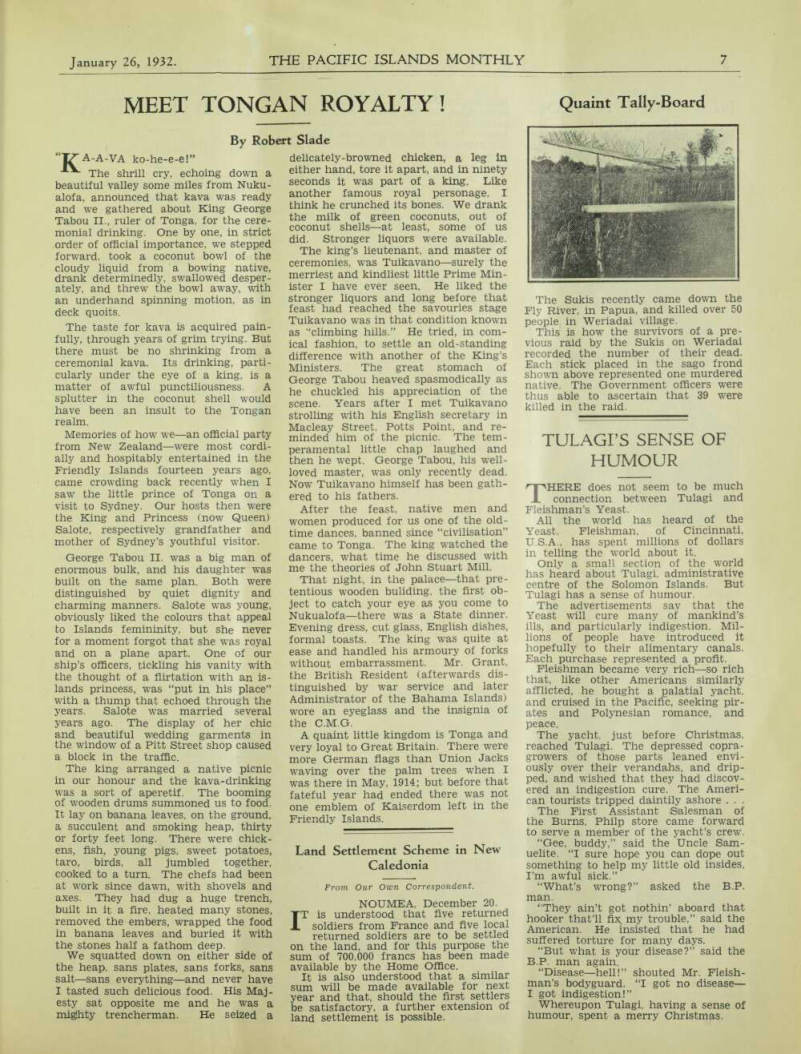
The Sukis recently came down the Fly River, in Papua, and killed over 50 people in Weriadai village.
This is how the survivors of a pre vious raid by the Sukis on Weriadai recorded the number of their dead.
Each stick placed in the sago frond shown above represented one murdered native. The Government officers were thus able to ascertain that 39 were killed in the raid.
Tulagi’S Sense Of
Humour
THERE does not seem to be much connection between Tulagi and Fleishman’s Yeast.
All the world has heard of the Yeast. Fleishman, of Cincinnati, U S.A., has spent millions of dollars in telling the world about it.
Only a small section of the world has heard about Tulagi administrative centre of the Solomon Islands. But Tulagi has a sense of humour.
The advertisements say that the Yeast will cure many of mankind’s ills, and particularly indigestion. Mil lions of people have introduced it hopefully to their alimentary canals.
Each purchase represented a profit.
Fleishman became very rich —so rich that, like other Americans similarly afflicted, he bought a palatial yacht, and cruised in the Pacific, seeking pir ates and Polynesian romance, and peace.
The yacht, just before Christmas, reached Tulagi. The depressed copra growers of those parts leaned envi ously over their verandahs, and drip ped, and wished that they had discov ered an indigestion cure. The Ameri can tourists tripped daintily ashore . . .
The First Assistant Salesman of the Burns, Philp store came forward to serve a member of the yacht’s crew.
“Gee, buddy,” said the Uncle Sam uelite. “I sure hope you can dope out something to help my little old insides.
I’m awful sick.”
“What’s wrong?” asked the B.P. man.
“They ain’t got nothin’ aboard that hooker that’ll fix my trouble,” said the American. He insisted that he had suffered torture for many days.
“But what is your disease?” said the B.P. man again.
“Disease—hell!” shouted Mr. Fleish man’s bodyguard. “I got no disease— I got indigestion!”
Whereupon Tulagi, having a sense of humour, spent a merry Christmas.
New "Minister For
Islands”
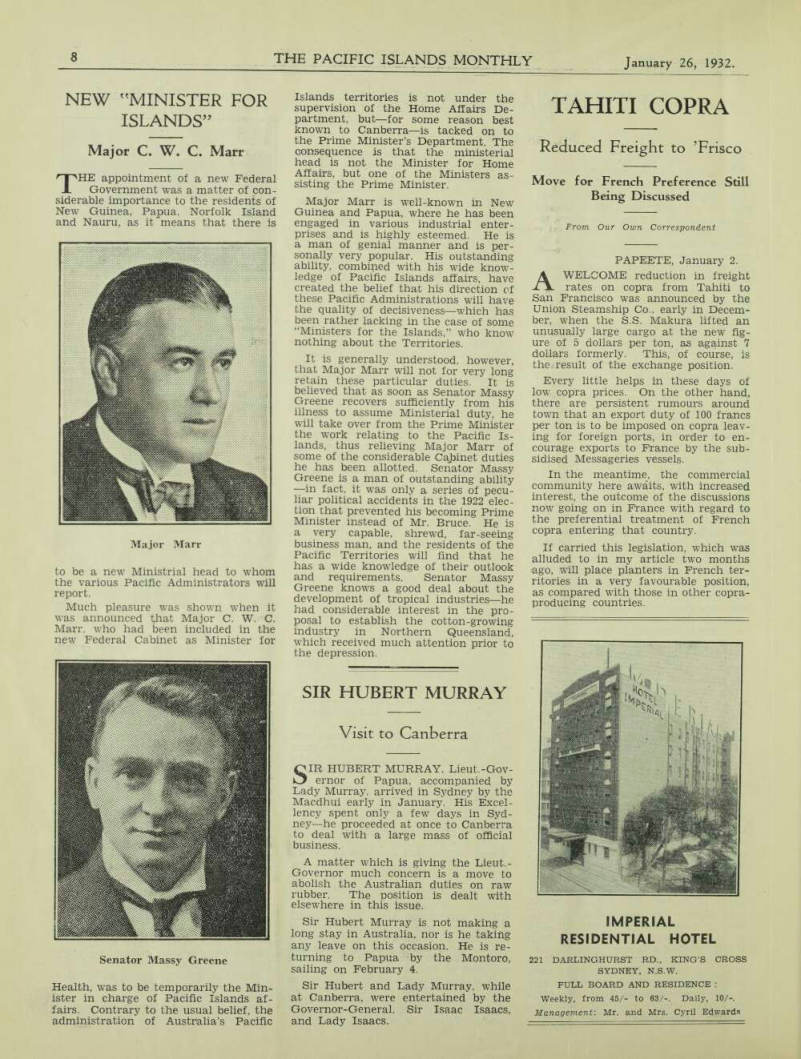
Major C. W. C.Marr
THE appointment of a new Federal Government was a matter of con siderable importance to the residents of New Guinea, Papua, Norfolk Island and Nauru, as it “means that there is
to be a new Ministrial head to whom the various Pacific Administrators will report.
Much pleasure was shown when it was announced that Major C. W. C.
Marr, who had been included in the new Federal Cabinet as Minister for
Health, was to be temporarily the Min ister in charge of Pacific Islands af fairs. Contrary to the usual belief, the administration of Australia’s Pacific
Islands territories is not under the supervision of the Home Affairs De partment, but —for some reason best known to Canberra—is tacked on to the Prime Minister’s Department. The consequence is that the ministerial head is not the Minister for Home Affairs, but one of the Ministers as sisting the Prime Minister.
Major Marr is well-known in New Guinea and Papua, where he has been engaged in various industrial enter prises and is highly esteemed. He is a man of genial manner and is per sonally very popular. His outstanding ability, combined with his wide know ledge of Pacific Islands affairs, have created the belief that his direction of these Pacific Administrations will have the quality of decisiveness—which has been rather lacking in the case of some “Ministers for the Islands,” who know nothing about the Territories.
It is generally understood, however, that Major Marr will not for very long retain these particular duties. It is believed that as soon as Senator Massy Greene recovers sufficiently from his illness to assume Ministerial duty, he will take over from the Prime Minister the work relating to the Pacific Is lands, thus relieving Major Marr of some of the considerable Cabinet duties he has been allotted. Senator Massy Greene is a man of outstanding ability —in fact, it was only a series of pecu liar political accidents in the 1922 elec tion that prevented his becoming Prime Minister instead of Mr. Bruce. He is a very capable, shrewd, far-seeing business man, and the residents of the Pacific Territories will find that he has a wide knowledge of their outlook and requirements. Senator Massy Greene knows a good deal about the development of tropical industries—he had considerable interest in the pro posal to establish the cotton-growing industry in Northern Queensland, which received much attention prior to the depression.
Major Marr
Senator Massy Greene
Sir Hubert Murray
Visit to Canberra
Sir Hubert Murray. Lieut.-Gov
ernor of Papua, accompanied by Lady Murray, arrived in Sydney by the Macdhui early in January. His Excel lency spent only a few days in Syd ney—he proceeded at once to Canberra to deal with a large mass of official business.
A matter which is giving the Lieut.- Governor much concern is a move to abolish the Australian duties on raw rubber. The position is dealt with elsewhere in this issue.
Sir Hubert Murray is not making a long stay in Australia, nor is he taking any leave on this occasion. He is re turning to Papua by the Montoro, sailing on February 4.
Sir Hubert and Lady Murray, while at Canberra, were entertained by the Governor-General, Sir Isaac Isaacs, and Lady Isaacs.
Tahiti Copra
Reduced Freight to ’Frisco Move for French Preference Still Being Discussed
From Our Own Correspondent PAPEETE, January 2.
A WELCOME reduction in freight rates on copra from Tahiti to San Francisco was announced by the Union Steamship Co., early in Decem ber, when the S.S. Makura lifted an unusually large cargo at the new fig ure of 5 dollars per ton, as against 7 dollars formerly. This, of course, is the result of the exchange position.
Every little helps in these days of low copra prices. On the other hand, there are persistent rumours around town that an export duty of 100 francs per ton is to be imposed on copra leav ing for foreign ports, in order to en courage exports to France by the sub sidised Messageries vessels.
In the meantime, the commercial community here awaits, with increased interest, the outcome of the discussions now going on in France with regard to the preferential treatment of French copra entering that country.
If carried this legislation, which was alluded to in my article two months ago, will place planters in French ter ritories in a very favourable position, as compared with those in other copra producing countries.
Advertisements & other items, p. 10 (1 item)
Residential Hotel
IMPERIAL
221 DARLINGHURST RD., KING’S CROSS
SYDNEY, N.S.W.
FULL BOARD AND RESIDENCE :
Weekly, from 45/- to 63/-. Daily, 10/-.
Management: Mr. and Mrs. Cyril Edwards
New Uses For Coconut Oil
Is It Suitable as a Motor Fuel?
CAN new uses be found for coconut oil? The answer to that question is of vital interest to every resident of the South Seas.
For many decades copra has been the source of the chief raw material for margarine, fine soap, and various other commodities requiring a high quality vegetable oil. But. in recent years, the world has been flooded with refined and deodorised whale oil, and with rival vegetable oils —particularly the products of soya beans, ground nuts and palm kernels. Coconut products still hold a good market, and will continue to do so—but much of the previous profit of coconut planting has disappeared.
There is only one remedy—the uses of coconut oil must be extended, and the demand for it increased. Early in 1931, when it was seen that the supply of whale oil was vastly in excess of the demand, the Scandinavian whale oil interests employed a corps of expert chemists to discover new uses for whale oil. Coconut oil interests could do the same.
An indication of one direction in which inquiries may be made, and inter esting questions raised, is given in the following article.
Is it practicable to use coconut oil as a fuel for Diesel engines? At first sight the proposition appears fantastic. It does not seem possible to use a vege table oil as a motor fuel; nor does it seem practicable to produce coconut oil at a price that will allow of its use as a motor fuel. Yet these, and other obvious objections, are dealt with in the article.
The waiter is Robert Aura Smith, special correspondent of “The New York Times,” who wrote from Manila on September 14, 1931; and the article was pub lished in “The New York Times” on October 11. The article is as follows:
RESEARCH scientists of the Uni versity of the Philippines have carried out the public demon stration of the use of coconut oil as fuel for Diesel engines.
Using a stationary motor, with no change in the mechanism. Professors Crisostomo Ortigas and Luis Gonzaga. assisted by Dr. Amando Clemente, showed that the vegetable product gave the same result as the same quantity of mineral fuel at full load.
This is in spite of the known fact that coconut oil in combustion turns up only 7258 calories as against 10,550 for mineral oil. Professor Ortigas as serts, however, that mineral oil suffers a higher degree of power loss, through malignant cracking, or absorption of heat in the formation of soot, and that therefore the potential power of the
two oils is almost identical.
Similarly this smaller degree of malignant cracking on the part of coconut oil makes the engine operation cleaner, since there is little or no residue or carbonised waste.
Other fuel engineers have asserted that the use of coco nut oil will produce corrosive acids in the cylinders, but this is flatly denied by the three experimenters, who de clare that repeated tests in the laboratory show no such acids, and that no corrosive effects have been observed during combustion.
The significance of the ex periment lies in the fact that they show the possibility of a permanent domestic fuel sup ply in the Philippines. At present that is lacking. There exists in the islands only a small deposit of low grade coal, and petroleum has not been discovered in any com mercially valuable quantity.
Hydroelectric experiments have been successful but re quire an enormous overhead and present unusually diffi cult engineering problems be cause of the climate and
the character of the terrain. At pre sent, therefore, the Philippines is de pendent upon imports for commercial fuel. Coconuts, on the other hand, are in practically inexhaustible supply in every part of the islands.
Cost Of Production
Nevertheless, under present condi tions of production and milling, coco nut oil is far more expensive than pet roleum. The current price of the for mer is sixteen centavos a liter, while crude oil sells at five or six centavos.
It is therefore essential to reduce the cost of coconut oil production to one third its present level before its use for commercial power operations is fea sible.
That is by no means impossible, but will require revolutionary changes in the essential coconut operations. The first requirement is a greatly increased yield to the hectare, which is an agri cultural problem affecting the entire country. The production can be greatly increased by closer planting, but closer planting than is now practised necessi tates the use of fertilisers if the soil is not to be exhausted, and at present the fertilisation of coconut groves is only beginning.
Of equal importance is the use of budded stock from high-yielding trees.
This has been tried on several large plantations with immediate results.
Efficient coconut operators now main tain their own nurseries, where bud ding from selected stock can take place.
Nevertheless, a large part of the copra supply comes from very small indi vidual units where nursery methods and fertilisation are virtually unknown.
The Milling Problem
The second essential to any mate erial reduction in price is a change in milling methods.
At present coconut oil is milled from copra, and while the milling process itself is highly efficient, registering in several large mills a total loss of poten tial oils of from only 6 to 18 per cent., the processes of the preparation of copra are primitive, wasteful and slow.
The nuts are usually split by hand, and then sun or oven dried, after which the copra kernel is extracted by hand. The process takes five days, and the product is not uniform. Re-drying cleaning and sorting are as important operations in the mills as pressing.
Consequently it is believed essential to cheap operation to perfect a process
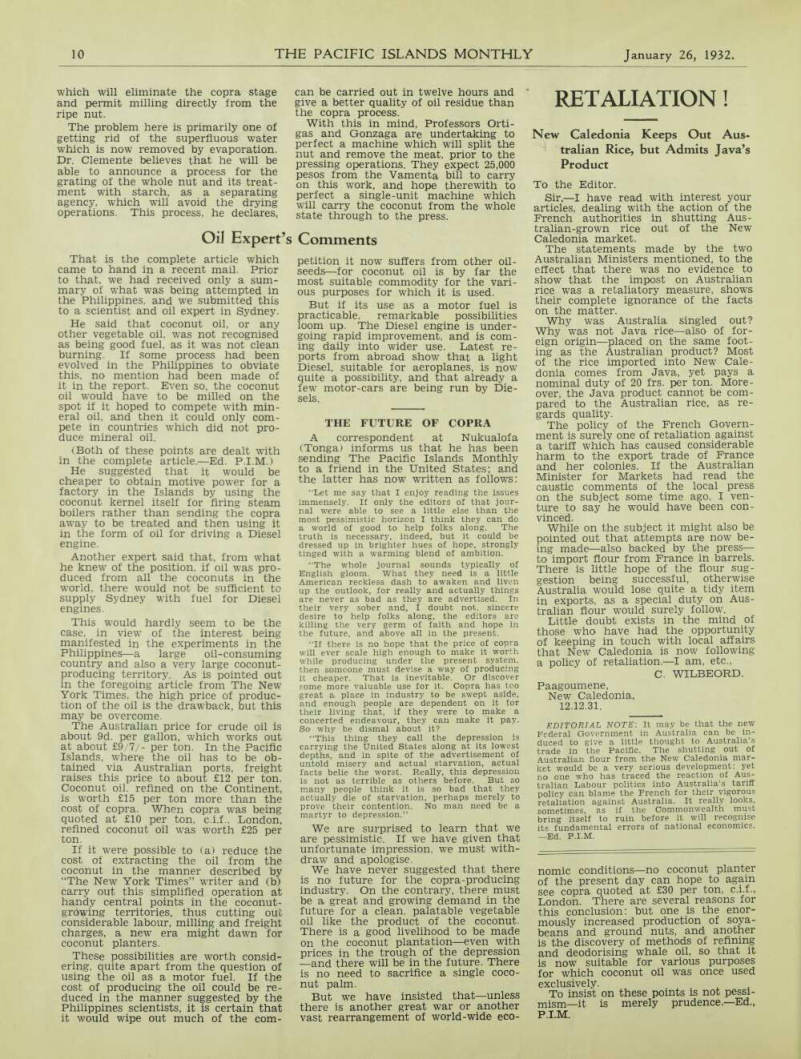
The President-General of the Methodist Church of Australasia (Rev. Frank Lade, M.A.), accompanied by Mrs.
R. C. G. Page (wife of the President of the Tongan Church) and Mrs. Smith (formerly a Mission Sister in Tonga) paid a visit to Western Samoa in November. The above photograph (which we publish by courtesy of The Mission Review) shows the visitors, with members of the mission staff and European residents at Apia.
which will eliminate the copra stage and permit milling directly from the ripe nut.
The problem here is primarily one of getting rid of the superfluous water which is now removed by evaporation Dr. Clemente believes that he will be able to announce a process for the grating of the whole nut and its treat ment with starch, as a separating agency, which will avoid the drying operations. This process, he declares,
can be carried out in twelve hours and give a better quality of oil residue than the copra process.
With this in mind, Professors Orti gas and Gonzaga are undertaking to perfect a machine which will split the nut and remove the meat, prior to the pressing operations. They expect 25,000 pesos from the Vamenta bill to carry on this work, and hope therewith to perfect a single-unit machine which wm carry the coconut from the whole state through to the press.
Oil Expert’s Comments
That is the complete article which came to hand in a recent mail. Prior to that, we had received only a sum mary of what was being attempted in the Philippines, and we submitted this to a scientist and oil expert in Sydney.
He said that coconut oil, or any other vegetable oil, was not recognised as being good fuel, as it was not clean burning. If some process had been evolved in the Philippines to obviate this, no mention had been made of it in the report. Even so, the coconut oil would have to be milled on the spot if it hoped to compete with min eral oil, and then it could only com pete in countries which did not pro duce mineral oil. (Both of these points are dealt with in the complete article. —Ed. P.I.M.) He suggested that it would be cheaper to obtain motive power for a factory in the Islands by using the coconut kernel itself for firing steam boilers rather than sending the copra away to be treated and then using it in the form of oil for driving a Diesel engine.
Another expert said that, from what he knew of the position, if oil was pro duced from all the coconuts in the world, there would not be sufficient to supply Sydney with fuel for Diesel engines.
This would hardly seem to be the case, in view of the interest being manifested in the experiments in the Philippines—a large oil-consuming country and also a very large coconut producing territory. As is pointed out in the foregoing article from The New York Times, the high price of produc tion of the oil is the drawback, but this may be overcome.
The Australian price for crude oil is about 9d. per gallon, which works out at about £9/7/- per ton. In the Pacific Islands, where the oil has to be ob tained via Australian ports, freight raises this price to about £12 per ton.
Coconut oil, refined on the Continent, is worth £15 per ton more than the cost of copra. When copra was being quoted at £10 per ton, c.i.f., London, refined coconut oil was worth £25 per ton.
If it were possible to (a) reduce the cost of extracting the oil from the coconut in the manner described by “The New York Times” writer and (b) carry out this simplified operation at handy central points in the coconut growing territories, thus cutting out considerable labour, milling and freight charges, a new era might dawn for coconut planters.
These possibilities are worth consid ering, quite apart from the question of using the oil as a motor fuel. If the cost of producing the oil could be re duced in the manner suggested by the Philippines scientists, it is certain that it would wipe out much of the com
petition it now suffers from other oil seeds —for coconut oil is by far the most suitable commodity for the vari ous purposes for which it is used.
But if its use as a motor fuel is practicable, remarkable possibilities loom up. The Diesel engine is under going rapid improvement, and is com ing daily into wider use. Latest re ports from abroad show that a light Diesel, suitable for aeroplanes, is now quite a possibility, and that already a few motor-cars are being run by Die sels.
The Future Of Copra
A correspondent at Nukualofa (Tonga) informs us that he has been sending The Pacific Islands Monthly to a friend in the United States; and the latter has now written as follows; “Let me say that I enjoy reading the issues immensely. If only the editors of that jour nal were able to see a little else than the most pessimistic horizon I think they can do a world of good to help folks along. The truth is necessary, indeed, but it could be dressed up in brighter hues of hope, strongly tinged with a warming blend of ambition.
“The whole journal sounds typically of English gloom. What they need is a little American reckless dash to awaken and liven up the outlook, for really and actually things are never as bad as they are advertised. In their very sober and, I doubt not, sincere desire to help folks along, the editors are killing the very germ of faith and hope in the future, and above all in the present.
“If there is no hope that the price of copra will ever scale high enough to make it worth while producing under the present system, then someone must devise a way of producing it cheaper. That is inevitable. Or discover some more valuable use for it. Copra has too great a place in industry to be swept aside, and enough people are dependent on it for their living that, if they were to make a concerted endeavour, they can make it pay.
So why be dismal about it?
“This thing they call the depression is carrying the United States along at its lowest depths, and in spite of the advertisement of untold misery and actual starvation, actual facts belie the worst. Really, this depression is not as terrible as others before. But so many people think it is so bad that they actually die of starvation, perhaps merely to prove their contention. No man need be a martyr to depression.”
We are surprised to learn that we are pessimistic. If we have given that unfortunate impression, we must with draw and apologise.
We have never suggested that there is no future for the copra-producing industry. On the contrary, there must be a great and growing demand in the future for a clean, palatable vegetable oil like the product of the coconut.
There is a good livelihood to be made on the coconut plantation—even with prices in the trough of the depression —and there will be in the future. There is no need to sacrifice a single coco nut palm.
But we have insisted that—unless there is another great war or another vast rearrangement of world-wide eco
nomic conditions —no coconut planter of the present day can hope to again see copra quoted at £30 per ton, c.i.f., London. There are several reasons for this conclusion: but one is the enor mously increased production of soya beans and ground nuts, and another is the discovery of methods of refining and deodorising whale oil, so that it is now suitable for various purposes for which coconut oil was once used exclusively.
To insist on these points is not pessi mism—it is merely prudence.—Ed.,
P.I.M.
Retaliation!
New Caledonia Keeps Out Aus
tralian Rice, but Admits Java’s
Product To the Editor.
Sir, —I have read with interest your articles, dealing with the action of the French authorities in shutting Aus tralian-grown rice out of the New Caledonia market.
The statements made by the two Australian Ministers mentioned, to the effect that there was no evidence to show that the impost on Australian rice was a retaliatory measure, shows their complete ignorance of the facts on the matter.
Why was Australia singled out?
Why was not Java rice—also of for eign origin—placed on the same foot ing as the Australian product? Most of the rice imported into New Cale donia comes from Java, yet pays a nominal duty of 20 frs. per ton. More over, the Java product cannot be com pared to the Australian rice, as re gards quality.
The policy of the French Govern ment is surely one of retaliation against a tariff which has caused considerable harm to the export trade of France and her colonies. If the Australian Minister for Markets had read the caustic comments of the local press on the subject some time ago, I ven ture to say he would have been con vinced.
While on the subject it might also be pointed out that attempts are now be ing made —also backed by the press— to import flour from France in barrels.
There is little hope of the flour sug gestion being successful, otherwise Australia would lose quite a tidy item in exports, as a special duty on Aus tralian flour would surely follow.
Little doubt exists in the mind of those who have had the opportunity of keeping in touch with local affairs that New Caledonia is now following a policy of retaliation. —I am, etc.,
C. Wilbeord.
Paagoumene,
New Caledonia,
12.12.31.
EDITORIAL NOTE : It may be that the new Federal Government in Australia can be in duced to give a little thought to Australia’s trade in the Pacific. The shutting out of Australian flour from the New Caledonia mar ket would be a very serious development: yet no one who has traced the reaction of Aus tralian Labour politics into Australia’s tariff policy can blame the French for their vigorous retaliation against Australia. It really looks, sometimes, as if the Commonwealth must bring itself to ruin before it will recognise its fundamental errors of national economics.
—Ed. P.I.M.
Opportunities In New Guinea
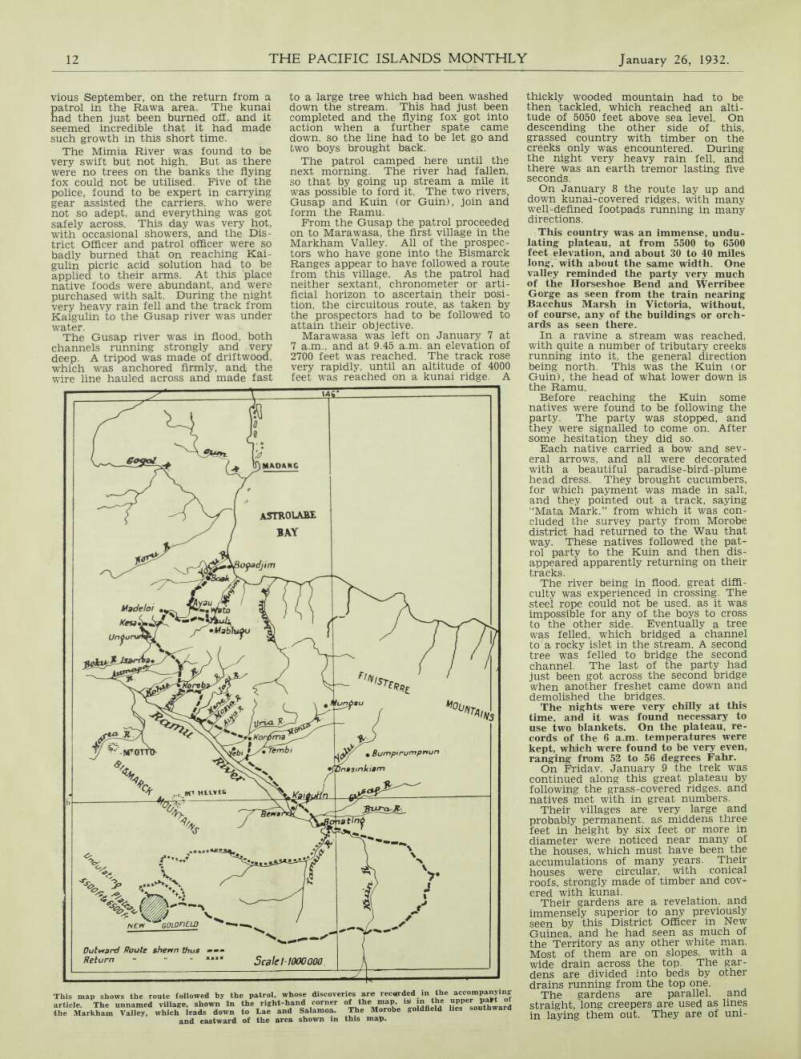
Rich Land on Temperate Plateaus Around Head-Waters of Ramu River
The Morobe goldfields, in New Guinea, lie in country so wild and broken that no one has yet been able to build a road into it, and communication with the coast is maintained by aeroplanes.
This very broken country continues northward to the Bismarck Mountains.
Beyond that range the country becomes tamer and more hospitable. It is practic ally unexplored. The maps simply show the wide valley of the Ramu River, lead ing on to the coastal district of Madang.
Hereunder are extracts from the official report of the Madang District Officer, who went up the Ramu Valley last year to make records connected with the discovery of a new goldfield between the Bismarck Mountains and the present Morobe gold field.
This report confirms other reports, that northward and north-west of the Morobe goldfields, in the valleys of the Ramu and Markham Rivers, where the broken in terior mountains grade down to the coastal plateaus, there is a vast tract of fertile country, suitable for development and settle ment.
Attention is directed particularly to the District Officer’s description of the mag nificent plateaus, 5,000 feet high, around the head-waters of the Ramu, where there are , a fertile soil, abundant water, vast plains of grass, and a January morning temperature of under 60 degrees.
It may reasonably be expected that the development of the goldfields, just south of this region, will give a great impetus to European settlement in New Guinea; and that these fertile regions between Morobe and Madang, now practically un known, will receive much attention from prospective agriculturists and pastoralists
THE necessity for a patrol from Madang to south of the Bismarck Ranges (in the mainland of New Guinea) having arisen, contrary to practice, and despite all difficulties, the attempt had to be made in January which is one of the months of the wet season.
This Patrol consisted of the District Officer from Madang, one patrol officer, one native non-commissioned officer and nine constables of native police.
The party proceeded from Madang by the launch Excel to Bogadjim, where native carriers were engaged.
A start made on the track from Bo gadjim to the village of Boak, where camp was made for the night.
Early next day the patrol proceeded and upon reaching the first crossing place it was seen that ordinary fording was impossible. Such eventualities had been anticipated. Two native police, experts in fording swift waters, crossed the river further up and a heaving line was across, then the wire, which was fastened to a tree on either side. A “flying fox” was then rigged with a heaving-line to each bank, cargo was slung to the block and hauled across. The carriers, police and Dis trict Officer and patrol officer crossed in this way. The crossing occupied two hours.
From Ayau the road, which is in ex cellent order, is uphill to Yauls, which has an elevation of 2420 feet and this place was reached at 6 p.m Continuing on from Yauls to Made loi and on through Kesa and Ungu ruma, may improvements were noticed
in the road, and many of the former gradients had been considerably re duced.
In the dry season the Boku forms a short cut to the Ramu Valley. On this occasion, however, it was not negoti able, and the much longer route through Kesa and Unguruma had to be taken.
On the morning of January 2, 1931, when Kesa was left, it was only pos sible to see a few yards ahead owing to dense fog. This was disappointing, as the view on a clear day from the summit of Unguruma Hill down the Ramu Valley is a magnificent one.
From the Boku to the Giagolo river the country is undulating, and no great difficulties were encountered. Good fortune remained with the party, as it was apparent that the Giagolo had been over a mile in width a day or two previously. It was now within its banks and only waist deep.
After leaving this river heavy rain fell until nearing Kesawai. In an in terlude between rainstorms camp was pitched, and the District Officer and patrol officer, after each taking a good stiff dose of quinine, were glad to turn in as the mosquitoes were in myriads.
Some of the police had to maintain smoke smudges all night, and got very little sleep.
Next day the patrol got under way early, but it was a very bad day, the track being through high kunai grass from five to eight feet high, which cut the knees and arms of the whole party and made very bad going.
This portion of the valley appeared to be much drier and had not been recently flooded. The patrol camped the night at Kokomo. Next day some very high patches of kunai were en countered, some of it being 12 and 15 feet high. This same patrol had passed this portion of the country in the pre
vious September, on the return from a patrol in the Rawa area. The kunai had then just been burned off, and it seemed incredible that it had made such growth in this short time.
The Mimia River was found to be very swift but not high. But as there were no trees on the banks the flying fox could not be utilised. Five of the police, found to be expert in carrying gear assisted the carriers, who were not so adept, and everything was got safely across. This day was very hot, with occasional showers, and the Dis trict Officer and patrol officer were so badly burned that on reaching Kai gulin picric acid solution had to be applied to their arms. At this place native foods were abundant, and were purchased with salt. During the night very heavy rain fell and the track from Kaigulin to the Gusap river was under water.
The Gusap river was in flood, both channels running strongly and very deep. A tripod was made of driftwood, which was anchored firmly, and the wire line hauled across and made fast
to a large tree which had been washed down the stream. This had just been completed and the flying fox got into action when a further spate came down, so the line had to be let go and two boys brought back, The patrol camped here until the next morning. The river had fallen, so that by going up stream a mile it was possible to ford it. The two rivers, Gusap and Kuin (or Guin), join and form the Ramu.
From the Gusap the patrol proceeded on to Marawasa, the first village in the Markham Valley. All of the prospec tors who have gone into the Bismarck Ranges appear to have followed a route from this village. As the patrol had neither sextant, chronometer or arti ficial horizon to ascertain their posi tion, the circuitous route, as taken by the prospectors had to be followed to attain their objective.
Marawasa was left on January 7 at 7 a.m., and at 9.45 a.m. an elevation of 2700 feet was reached. The track rose very rapidly, until an altitude of 4000 feet was reached on a kunai ridge. A
thickly wooded mountain had to be then tackled, which reached an alti tude of 5050 feet above sea level. On descending the other side of this, grassed country with timber on the creeks only was encountered. During the night very heavy rain fell, and there was an earth tremor lasting five seconds.
On January 8 the route lay up and down kunai-covered ridges, with many well-defined footpads running in many directions.
This country was an immense, undu lating plateau, at from 5500 to 6500 feet elevation, and about 30 to 40 miles long, with about the same width. One valley reminded the party very much of the Horseshoe Bend and Werribee Gorge as seen from the train nearing Bacchus Marsh in Victoria, without, of course, any of the buildings or orch ards as seen there.
In a ravine a stream was reached, with quite a number of tributary creeks running into it, the general direction being north. This was the Kuin (or Guin), the head of what lower down is the Ramu.
Before reaching the Kuin some natives were found to be following the party. The party was stopped, and they were signalled to come on. After some hesitation they did so.
Each native carried a bow and sev eral arrows, and all were decorated with a beautiful paradise-bird-plume head dress. They brought cucumbers, for which payment was made in salt, and they pointed out a track, saying “Mata Mark,” from which it was con cluded the survey party from Morobe district had returned to the Wau that way. These natives followed the pat rol party to the Kuin and then dis appeared apparently returning on their tracks.
The river being in flood, great diffi culty was experienced in crossing. The steel rope could not be used, as it was impossible for any of the boys to cross to the other side. Eventually a tree was felled, which bridged a channel to a rocky islet in the stream. A second tree was felled to bridge the second channel. The last of the party had just been got across the second bridge when another freshet came down and demolished the bridges.
The nights were very chilly at this time, and it was found necessary to use two blankets. On the plateau, re cords of the 6 a.m. temperatures were kept, which were found to be very even, ranging from 52 to 56 degrees Fahr.
On Fridav, January 9 the trek was continued along this great plateau by following the grass-covered ridges, and natives met with in great numbers.
Their villages are very large and probably permanent, as middens three feet in height by six feet or more in diameter were noticed near many of the houses, which must have been the accumulations of many years. Their houses were circular, with conical roofs, strongly made of timber and cov ered with kunai.
Their gardens are a revelation, and immensely superior to any previously seen by this District Officer in New Guinea, and he had seen as much of the Territory as any other white man.
Most of them are on slopes, with a wide drain across the top. The gar dens are divided into beds by other drains running from the top one.
The gardens are parallel, and straight, long creepers are used as lines in laying them out. They are of uni
This map shows the route followed by the patrol, whose discoveries are recorded in the accompanying article. The unnamed village, shown in the right-hand corner of the map, is in the upper past of the Markham Valley, which leads down to Lae and Salamoa. The Morobe goldfield lies southward and eastward of the area shown in this map.
form width and depth, yet these people have no iron tools.
Beans of several varieties, in per fectly straight lines, with crossed sticks on which they were trained, were in spected. There were sweet potatoes, maize, cucumbers, pumpkins and sugar cane, and not a single weed in any of the beds.
It would be hard to find a market garden in Australia better laid out or kept than these. The soil is not sim ply turned over in great lumps as with natives generally in this Territory. It is worked to a fine tilth, such as Euro pean gardeners would prepare for a seed bed.
Where could these natives have learned their methods of agriculture, and who could have taught them?
Compared with usual native methods of agriculture, these are a century ahead. There are not just a few iso lated patches, but hundreds of acres.
Every valley has its villages and gar dens, and it would be impossible to guess the number of inhabitants.
At some of these villages 100 to 120 armed men were counted, irrespective of women and children, who appeared to be in great numbers.
In not one instance was any sign of framboesia, tropical ulcers or sores of any kind seen, except a few cases of men wounded by arrows in tribal fighting.
Everywhere the patrol was met with warmest friendship, and huge quanti ties of native foods were brought in, the payment most desired in this area being beads. Salt appears to be un known or unappreciated. Numerous requests were made for small cowrie shells, of which the few who had them appeared to be inordinately proud.
Their implements of war were beau tifully worked and, as iron is unknown to them, the perfection and design of the carving was most surprising.
All communication with these natives was made by signs. As far as it was possible to ascertain, none of the natives on the northern side had ever crossed the Bismarck Ranges, and none of them could speak “pidgin.”
On Monday, January 12, the home ward journey was commenced it being the intention if possible to travel in a north-westerly direction to strike the Ramu just westward of Mt. Otto. But this was found to be impossible.
The patrol proceeded westward across a small wooded ridge, again finding grassed country, with numerous villages and similar wonderful gardens to those as already described. After much difficulty, it was possible to as certain the names of some of these villages—Sumuja, Uriki, Tapulo. Kor omo and Onkuma.
As far as practicable, ridges running in a northerly direction were followed until 5 p.m., when camp was made on the bank of a small stream in a fine wide valley.
There was a steep ridge on the oppo site side of the creek, from the crest of which a number of natives were watching. They were signalled to come down and soon did so. Their atten tions were rather embarrassing. They stroked the arms, chests and backs of the District and patrol officers with their hands.
To the north there seemed to be a pass into the main Bismarck Range, and a track showing signs of much usage was found. This was followed to the thickly-timbered mountains, where numerous plants and flowers previously not known were seen.
At about 11 a.m. some natives were met. They showed great friendliness, and some more pawing took place, to which the District and patrol officers were beginning to get accustomed. The patrol was taken to their village, which was strongly stockaded and in a highly defensible position. Sixty-three houses were counted, and the inhabitants ex plained that there were many other villages near. They were told by signs that it was desired to continue the journey to the north but they indi cated in a similar manner that this was impossible, owing to the rivers in the ravines being too deep to wade, and that there were immense preci pices which it would be impossible to scale. They pointed out a track which led eastward and accompanied the pat rol a short distance. This track led over to the main Bismarck Range at a height of 7100 feet.
From this point the Ramu Valley, with the Finesterre Mountains on the other side, could be seen, whilst on the right there was a deep valley with a river running towards the Ramu. As this was a large stream, it was con eluded it must be the Kuin, but later this was discovered to be incorrect.
From the crest of the range the first descent was most precipitous, and had it not been for the trees and bushes this would not have been negotiable.
In accomplishing a descent of 1500 feet one had to slide from one foothold to another at the base of some tree, sap ling or bush. This was most tiring, but accomplished without accident, and it was astonishing to see that the car riers were able to do it.
On the other side of the ravine a climb had to be made again to a vil lage, from whence numerous other vil lages could be seen. Continuing on up and! down well worn paths, three of these villages were visited.
On these heights dwarf raspberries were found to be flowering and fruit ing profusely, but were more or less tasteless.
The native gardens were found to be the usual irregularly shaped and
poorly-cultivated plots, in marked con trast to those as seen on the other side of the range, The next morning it was decided to take a short cut directly down the mountain to the valley below and fol low the creeks to the river which had been seen, instead of taking the path from the village, by which several days might be occupied by this indirect route to the Ramu.
This turned out to be a most difficult feat. There was thick jungle, through which a track had to be cut to enable the carriers to proceed, and when the creek was eventually reached it was found several times that cascades made further descent impracticable, and new tracks had to be cut around the moun tain contours. Eventually it was found that the first creek emptied into a larger one, down which the patrol pro ceeded, often in the creek itself, ankle deep—at times knee deep, and very often waist deep.
Towards noon the mountains began to draw in, and soon only a narrow gorge was left, down which the water rushed at great speed. It was nego tiated with difficulty. A second gorge lower down was not so dangerous, and the creek gradually broadened out until the river previously seen was reached, As the course was north, it was fol lowed until 5 p.m., when it widened out to about 100 yards and emptied into a larger stream, which turned out to be the Kuin.
A party of natives were seen watch ing from the other bank and signs were made to them to come across, so that a fording place could be found.
The stream was not running very strongly, and as the bottom was sand it was not very difficult to cross— though waist deep, As the patrol was now in familiar country, a start was made for Gusap, in an endeavour to make the crossing before dark. It was successful and camp was made on the western bank, Except for rainstorms and flooded rivers, the return journey to Madang was uneventful.
Advertisements & other items, pp. 13-15 (1 item)
Engines
Lighting Plants
The reliable LISTERLITE, the “powerhouse” of thousands of homesteads. Unfailingly de livers electric current on the most economical basis. Plants in stock to suit every possible requirement, with or without storage batteries. Ask us to quote for your installation.
Diesel (crude oil)
Engines
Famous British Lister-Diesel crude oil engines start per fectly from dead cold, on regular crude oil fuel. From ½ b.h.p. upwards. Shortly available in marlno type also.
Petrol Engines
The most reliable petrol en gines in the world. British built for sheer reliability and economy. Thousands of owners have proved that Lister main tenance costs are hardly worth regarding. In all sizes from 1½ to 14 b.h.p. Petrol and korosene types available.
Auto Trucks
Here is a neat little labour saving vehicle for haulage on road or rails, especially on long jetties. Equipped with air cooled engine; carries one ton or hauls three tons. Simple to operate, and available in varying body types for dif ferent classes of work. The most economical motor trans port vehicle yet produced.
Pumps
of all kinds. If you have water to move you will find exactly the kind of pump in the “Nevertire” line. From the simple well pump to the powerful self-oiling “Bull dozer” we have the right type of pump at the right price, for every job.
Windmills
Put the wind to work for you. We have proved makes of mills available in all regu lar sizes, with or without towers. Tell us your water problem, and we can recom mend the proper mill to do the work.
Enquiries -
our careful attention. Prices will be quoted free of Australian Customs’ Duty, in original cases.
Agents Wanteil
We shall he glad to hear from respon sible Island parties willing to undertake the sale and representation of these lines. Write us.
Dangar, Gedye & Co.
LIMITED
10-14 Young Street, Sydney
Where fro Sfray in Sydney
An Ideal Home where Islands visitors congregate.
THE
ORIENTAL HOTEL
Overlooking
KING’S CROSS
THE PREMIER RESIDENTIAL HOTEL
IN SYDNEY
Centrally situated, five minutes from C.P.O. or Railway Station. Trams and buses stop at our door.
This Hotel is lavishly furnished. Hot and Cold water in each room. Laundry, Spacious Lounges, Dancing, Splendid Table, and every convenience.
Tariff: Full beard and residence from 10/- to 13/6 per day; 50/- to 73/6 per week.
Room and Breakfast, from 5/6 to 8/6 per day, or 30/- to 45/- per week Cable or Radio, NEWOR, SYDNEY
SAIL WITH
The B.P. MAGAZINE
TO MAGIC LANDS
Travel Fiction Adventure Beautiful Cover Plates Stage Screen Books Fashion Children’s Pages
ANNUAL SUBSCRIPTION;
Within the Commonwealth of Australia, Mandated Territory and New Guinea 4/- post - free Within the British Empire 5/4 post free U.S.A. and Foreign 6/8 post free
Flying Fish Come South
Good Hauls at Rarotonga
From Our Own Correspondent.
RAROTONGA, December 4.
Flying fish have now returned to these waters from the north.
Fishermen are to be seen outside the reef even on very dark, stormy nights, burning their flares made from dried fronds of the coconut tree. The bright light lures the flying fish from all directions, so that they come gliding into the nets held up in the canoe to intercept their flight.
From Avarua the night flares are vis ible at many points along the reef, burning like large oil lamps, lighting up the surface of the sea spasmodically and casting a red glow in the surround ing darkness.
Inspection
Sir Hubert Murray’s Tour of Inspection
From Our Own Correspondent.
PT. MORESBY, December 2.
THE Lieut.-Governor, Sir Hubert Murray, accompanied by the Gov ernment Secretary. Mr. H. W. Cham pion, and the Official Secretary, Mr. H.
L. Murray, returned to Port Moresby by the Laurabada on November 28, after an extended tour of inspection in the Eastern and North-eastern Divisions of the Territory.
Influenza was raging at every port of call. At Samarai the business of the town was practically at a standstill for a few days. The crew of the Laura bada were laid up in consequence. For tunately the weather was particularly good throughout the trip and no seri ous inconvenience delayed the tour.
Noumea
No Tourists for Noumea Exchange Rates Kill Traffic
From Our Own Correspondent.
NOUMEA, December 20.
OWING to lack of co-operation be tween the shipping companies, the Administration and the mer chants, the tourist traffic has never really developed into anything substan tial; and it may be now considered to have faded into insignificance on ac count of the small number of francs exchanged for an English pound, and the even smaller number received for the Australian pound.
Apparently, the Messageries Mari times Shipping Co. bases its fares be tween Sydney and New Caledonia on the rate of exchange, as the first-class fare for the trip from Sydney to Nou mea has now reached the extravagant rate of over £7 per day—viz., £29—the return ticket costing £49.
These fares, of course, are quoted in Australian currency. There has been a recent reduction of about 10 per cent, of the fare from this end in French currency.
N. Caledonia—Queensland
Successful Fight Pleases French
From Our Own Correspondent.
NOUMEA, December 2.
ON November 21 history was made by the first aeroplane flight from New Caledonia to Australia by Mr. Victor Roffey, a young Australian, who has been conducting air flights in the Colony for some months past.
Great interest was taken by the local population in the flight, which has been under consideration for some time and it was with the utmost en thusiasm that the news of Mr. Roffey’s safe landing on the Queensland coast was duly received some hours after his departure.
Careful preparations were made for the flight and. early on the morning of the date mentioned, the young pilot, amid the good wishes of his friends, left Ouaoo, on the West Coast, for his trip, covering some 700 nautical miles.
Cook Islands’ Hard-Worked Doctor
From Our Own Correspondent.
RAROTONGA, December 4.
UNDER the economy measures now operating one doctor only, instead two as was usually the case, is detailed for service in the Cook Group.
Sympathy for Dr. Ellison, the Chief Medical Officer, at having to contend single-handed with the pressure of work with which at times he is sur rounded is expressed on all sides.
The doctor is at present on a tour of duty in the outlying islands of the Lower Group. No doctor is available here during Dr. Ellison’s absence, al though. in a case of emergency, medi cal advice might be obtainable by wire less.
Some day, doubtless, the presence of a seaplane at Rarotonga will come about, and the problem of first-hand medical service to the islands of the inner group be settled on these lines.
Advertisements & other items, p. 16 (1 item)
Chapman Marine Motors
ALBERT GREGORY
107 YORK STREET, SYDNEY
SADDLERS’ IRONMONGERY, SADDLES, HARNESS,
SPURS, STIRRUPS AND WHIPS, ETC.
EVERYTHING CONNECTED WITH THE TRADE.
Leather for Art Work, Basils, Roans, Suedes. Boot and Harness Leathers.
GRECOLINE —Raw, Pure and Pearl White. Nothing so good for the Home, Stable and Dairy and a great rust preventative.
Distributing Agents for :
DOCKER’S AND BORTHWICK’S PAINTS.
CORRESPONDENCE SOLICITED
CHAPMAN MARINE MOTORS
Here is an opportunity to secure one of these Famous Motors at a gift price. This particular motor, known as the CHAPMAN “PUP” EXPORT MODEL, is usually retailed abroad at £25. As our export business has been practically cut off through the world-wide depression, we are clearing out the entire stocks of these at £14 each fo b Sydney, complete with magneto and carburetter as illustrated. If an equipment is required we can supply a full outfit, including clutch, tank, shaft piping, etc., for £5 extra. Sales Tax of 12/- must be added for shipments within the Common wealth.
CHAPMAN & SHERACK, Erskineville - - - N.S.W.
A Sunday In Noumea
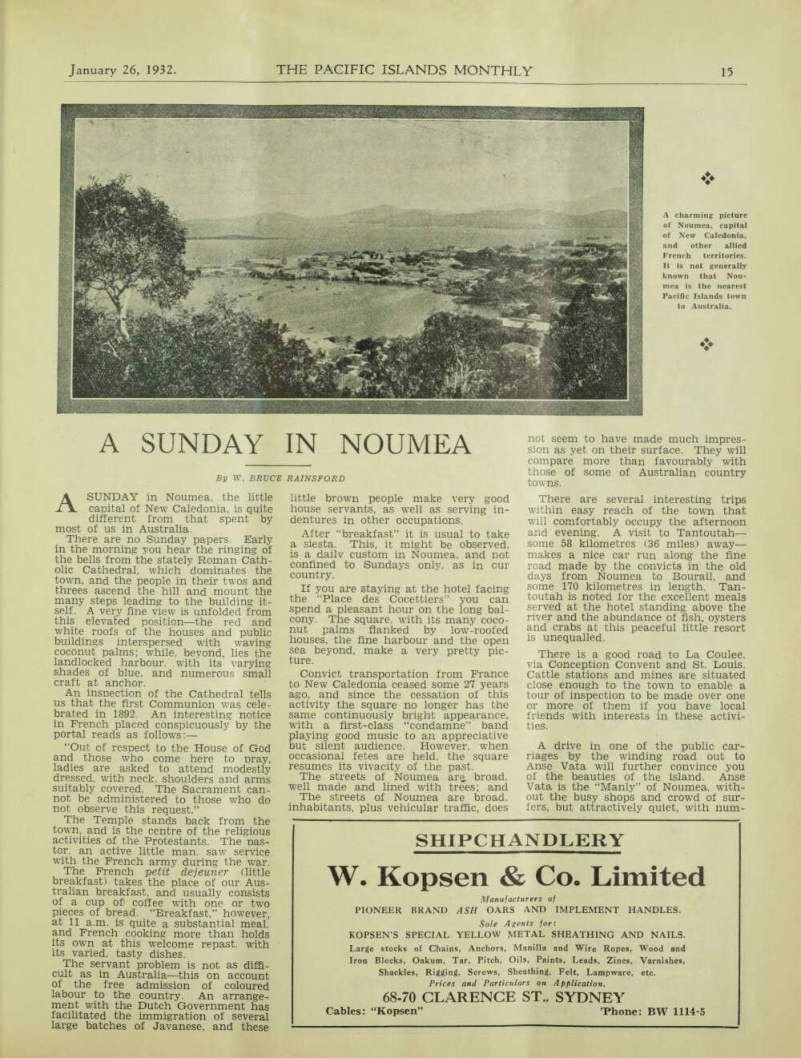
By W. Bruce Rainsford
A SUNDAY in Noumea, the little capital of New Caledonia, is quite different from that spent by most of us in Australia.
There are no Sunday papers. Early in the morning you hear the ringing of the bells from the stately Roman Cath olic Cathedral, which dominates the town, and the people in their twos and threes ascend the hill and mount the many steps leading to the building it self. A very fine view is unfolded from this elevated position—the red and white roofs of the houses and public buildings interspersed with waving coconut palms; while, beyond, lies the landlocked harbour, with its varying shades of blue, and numerous small craft at anchor.
An inspection of the Cathedral tells us that the first Communion was cele brated in 1892. An interesting notice in French placed conspicuously by the portal reads as follows; “Out of respect to the House of God and those who come here to pray, ladies are asked to attend modestly dressed, with neck, shoulders and arms suitably covered. The Sacrament can not be administered to those who do not observe this request.”
The Temple stands back from the town, and is the centre of the religious activities of the Protestants. The nas tor, an active little man, saw service with the French army during the war.
The French petit dejeuner (little breakfast) takes the place of our Aus tralian breakfast, and usually consists of a cup of l coffee with one or two pieces of bread. “Breakfast,” however, at 11 a.m. is quite a substantial meal, and French cooking more than holds its own at this welcome repast, with its varied, tasty dishes.
The servant problem is not as diffi cult as in Australia—this on account of the free admission of coloured labour to the country. An arrange ment with the Dutch Government has facilitated the immigration of several large batches of Javanese, and these
little brown people make very good house servants, as well as serving in dentures in other occupations.
After “breakfast” it is usual to take a siesta. This, it might be observed, is a daily custom in Noumea, and not confined to Sundays only, as in cur country.
If you are staying at the hotel facing the “Place des Cocettiers” you can spend a pleasant hour on the long bal cony. The square, with its many coco nut palms flanked by low-roofed houses, the fine harbour and the open sea beyond, make a very pretty pic ture.
Convict transportation from France to New Caledonia ceased some 27 years ago, and since the cessation of this activity the square no longer has the same continuously bright appearance, with a first-class “condamne” band playing good music to an appreciative but silent audience. However, when occasional fetes are held, the square resumes its vivacity of the past.
The streets of Noumea broad, well made and lined with trees; and The streets of Noumea are broad, inhabitants, plus vehicular traffic, does
not seem to have made much impres sion as yet on their surface. They will compare more than favourably with those of some of Australian country towns.
There are several interesting trips within easy reach of the town that will comfortably occupy the afternoon and evening, A visit to Tantoutah— some 58 kilometres (36 miles) away— makes a nice car run along the fine road made by the convicts in the old days from Noumea to Bourail, and some 170 kilometres in length. Tan toutah is noted for the excellent meals served at the hotel standing above the river and the abundance of fish, oysters and crabs at this peaceful little resort is unequalled.
There is a good road to La Coulee, via Conception Convent and St. Louis.
Cattle stations and mines are situated close enough to the town to enable a tour of inspection to be made over one or more of them if you have local friends with interests in these activi ties.
A drive in one of the public car riages by the winding road out to Anse Vata will further convince you of the beauties of the island. Anse Vata is the “Manly” of Noumea, with out the busy shops and crowd of sur fers, but attractively quiet, with num
A charming: picture of Noumea, capital of New Caledonia, and other allied French territories.
It is not generally known that Nou mea is the nearest Pacific Islands town to Australia.
erous coconut palms, long curving beach and a quiet sea inside the reef.
Sunday is a good day to take a trip out into the country in New Cale donia’s one and only train, which puffs noisily some thirty kilometres (19 miles) out to Paita in a couple of hours, breakdowns permitting. The train starts punctually from the “Gare” at anything from 2 to 2.30 p.m., crowded with coloured people of all kinds and sizes, in addition, of course, to a goodly number of French citizens taking their weekly outing into the country.
The overcrowding on this little De cauville is far worse than on Sydney’s North Shore line, and the people have become as used to it as the “metro” travellers in Paris. The train traverses some very pretty country, and several of the town residents have established quiet, rustic homes in comfortable sur roundings along the line. There are two trains on Sunday, and the early one carries mostly energetic parties out for a day’s sport—deer shooting, fish ing and picnics are popular week-end activities of the young Caledonian.
The two cinemas do a brisk business on Sunday, with both matinee and evening shows, and, though perhaps not quite up to the standard of the Gaumont-Palace at Paris, yet what would otherwise be an extremely dull New Caledonian evening can be whiled away until 11.30 p.m. among a spell bound audience of various colours and nationalities.
Advertisements & other items, pp. 17-18 (1 item)
W. Kopsen & Co. Limited
SHIPCHANDLERY
Manufacturers of PIONEER BRAND ASH OARS AND IMPLEMENT HANDLES.
Sole Agents for: KOPSEN’S SPECIAL YELLOW METAL SHEATHING AND NAILS.
Large stocks of Chains, Anchors, Manilla and Wire Ropes, Wood and Iron Blocks, Oakum, Tar, Pitch, Oils, Paints, Leads, Zincs, Varnishes, Shackles, Rigging, Screws, Sheathing, Felt, Lampware, etc.
Prices and Particulars on Application.
68-70 CLARENCE ST., SYDNEY
Cables: “Kopsen” ’Phone; BW 1114-5
BUY CHEAPER. SELL BETTER.
G. N. SADLEIR
BUYING & SELLING BROKER
26 BRIDGE ST., SYDNEY
’Phone, B 1052. Cables, “Berbl”
Enquiries invited.
BURNS, PHILP
(South Sea) Co. Ltd.
Island Traders & Shipowners Registered Office: Suva, Fiji Also Branches at FIJI: Levuka, Lautoka, Labasa, Ba, Sigatoka, Rotumah.
Tonga: Nukualofa, Haapai, Vavau.
Samoa: Apia.
Solomons: Makambo, Gizo, Faisi.
New Hebrides: Vila.
Gilberts: Tarawa.
Norfolk Island. Nauru. Niue.
Code Address: "Bumsouth”
Scientific Study Of Native Labor
Sir Hubert Murray Explains Why Indenture System Is Still Necessary in Papua
From Our Own Correspondent.
PT. MORESBY. December 19.
HIS Excellency, Sir Hubert Murray, the Lieut.-Governor of Papua, was invited early last year by the Australian Association for the Ad vancement of Science to be one of the representatives at the centenary meet ings of the British Association, which was held in London last September.
Unfortunately, Sir Hubert Murray was unable to leave the Territory at the time, and Papua had to forego the honour of being represented at these meetings of world-wide scientific in terest.
Sir Hubert had prepared a paper for the Association, namely, “The Scien tific Method as Applied to Native Lab our Problems in Papua.” and this was read by his brother, Prof. Gilbert Mur ray, before a large gathering of scien tists. It attracted considerable interest to those concerned with the problems of native welfare of the present day.
The paper, which is a clear exposi tion of the labour legislation of Papua, expresses the sincerity of the Govern ment in seeking to be guided by cer tain fixed principles, the most import ant of all being the welfare and the development of the native race en trusted to their care and the develop ment of the country in which they live, in their interests as well as in the in terests of the white settlers who have been attracted to the Territory.
The development is in most in stances a combination of white capital and native enterprise. The enterprise is supplied by voluntary Papuan labour —indentured or free —the indenture system being the most usual in prac tice and found to be satisfactory under
the existing circumstances of Papua to day.
To quote Sir Hubert Murray: “The indenture system is a necessary insti tution at the present stage of Papuan development, and its retention for the present can be fully justified, not only from the point of view of the em ployers, but also from that of the na tive.
“Still, the indenture system, though necessary under the existing circum stances of Papua, is not a system I should care to make permanent. Per sonally, I should be glad to see inden tured labour replaced by free labour, but I do not think that this will come about until the native has developed a sense of responsibility that will hold him to his contract without penal sanc tion; and it appears to me that when we can do without penal sanction we can do without indentured labour alto gether.”
In conclusion, Sir Hubert calls atten tion to development of native enter prises. In Papua, this is a slow and tedious affair, for the Papuan does not take kindly to continuous and mono tonous tasks on his own behalf. It would be extremely difficult to educate him to establish and maintain plan tations for himself on his own initia tive without supervision or punish ments. He makes no provision for the future; “Sufficient for the day is the evil thereof” is his motto.
Still, in time this policy of purely native enterprise will eventually be successful, though, Sir Hubert Murray states, “The danger is that the per sistence of the white man may break down before the vis inertiae of the Papuan’s ‘masterly inactivity.’ ”
The attempt to form a scientific lab our policy in Papua is no easy task for an administrator, for it means (to quote Sir Hubert Murray once more) “Imposing upon a primitive people a form of activity involving a conception of duty—which is really strange to them.”
Pineapples
£50,000 to Sell Hawaiian Pineapples
HAWAIIAN pineapple growers are facing the biggest crop yet pro duced and are joining in a greatly in creased advertising campaign.
Present estimates indicate 14,000,000 cases of pineapples, and present plans call for a 280.000 dollars advertising expenditure. This special campaign will be in addition to the advertising of the three leading packers of Hawaiian pineapples, who are also co-operating in the campaign.
Advertisements & other items, pp. 19-20 (2 items)
17
THE PACIFIC ISLANDS MONTHLY
Australia and New Hebrides
(CONTINUED FROM PAGE 4)
January 26, 1932.
Nock & Kirbys
Mesh Hammocks. Made from a good quality plain woven cotton mesh. Ob tainable in many different colours. Com plete with spreaders. Secure one for your garden or verandah and idle away your leisure hours in comfort.
PRICE, each 13/6
Post your
Orders to
BOX 68 cc
G.P.O., SYDNEY
Absolutely no delay. All Island orders are executed by return boat. Let us send quotations for Furniture, Gro ceries. Household Ironmongery, Crock ery, Ship Chandlery, Carden Tools, Tools 0 of Trade, Stationery, Cutlery, Paints, Sports Goods, etc. —you’ll be under no obligation whatever.
Lagoline. A paint to withstand tro pical heat, sea air, salt water and dampness.
Can be repeated ly washed. A gloss paint with an enamel finish.
Tins— 11b. 21b. 41b. 71b. 141 b.
PRICE, each 2/9 5/- 9/- 16/6 32/6
MAJORA
“Majora” Super Copper Paint.
Ideal for use in tropics Colours, Green and Red.
Quantity— 1-pt. 1-qrt. -2-gal. 1-gal.
PRICE—
3/6 6/- 12/3 23/- All Prices F.O.B. at Sydney. Packing free.
NOCK & KIRBY LTD.
mm Signora TOTI DAL MONTE The brilliant prima donna writes : "It is with real pleasure that I write to you of my preference for your creme 'mercolized.’ I use it every day with a real delight as it does so much to keep the complexion
good.”
Let the clear beauty of your skin prove the worth of wonderful mercolized wax. Use daily. It doesn’t grow hair. 2/6 and 5/6, chemists and stores. Highly recommended for sunburn and freckles. 509
"Drier” Conditions in the Solomons
Solomons
From Our Own Correspondent.
TULAGI, January 4.
YES! the spirit of Christmas is dy ing, and this one passed over very quietly in Tulagi.
Cases of beer and other good (or doubtful) cheer were not a marked feature of orders received by the stores, as in days of yore.
Indeed, there is a wave of sentiment towards home-made ginger-beer, and arguments are rife as to whether Mrs.
So-and-so’s recipe is better than Mrs.
Who’s-this’s, and whether “ground ginger” has virtues over “whole gin ger”; all of which must be aggravating to Treasurer-cum-Collector of Customs Johnson, in his efforts to balance the budget.
A rumour that an excise duty was to be imposed on ginger-beer made one lady switch over to home-made lime juice. It shows what can be done when you think you may be “pinched.”
Norfolk Island Trade
THE following are the Norfolk Island Customs figures for December, 1931, compared with the figures for De cember, 1930:
Imports.
From Aust.
From N.Z.
Dec., 1930 £1,316 £1,215 Dec., 1931 2,670 1,016
Exports.
To Aust.
To N.Z.
Dec., 1930 £865 £ 574 Dec., 1931 1,168 Nil
Mr. C. J. Levien
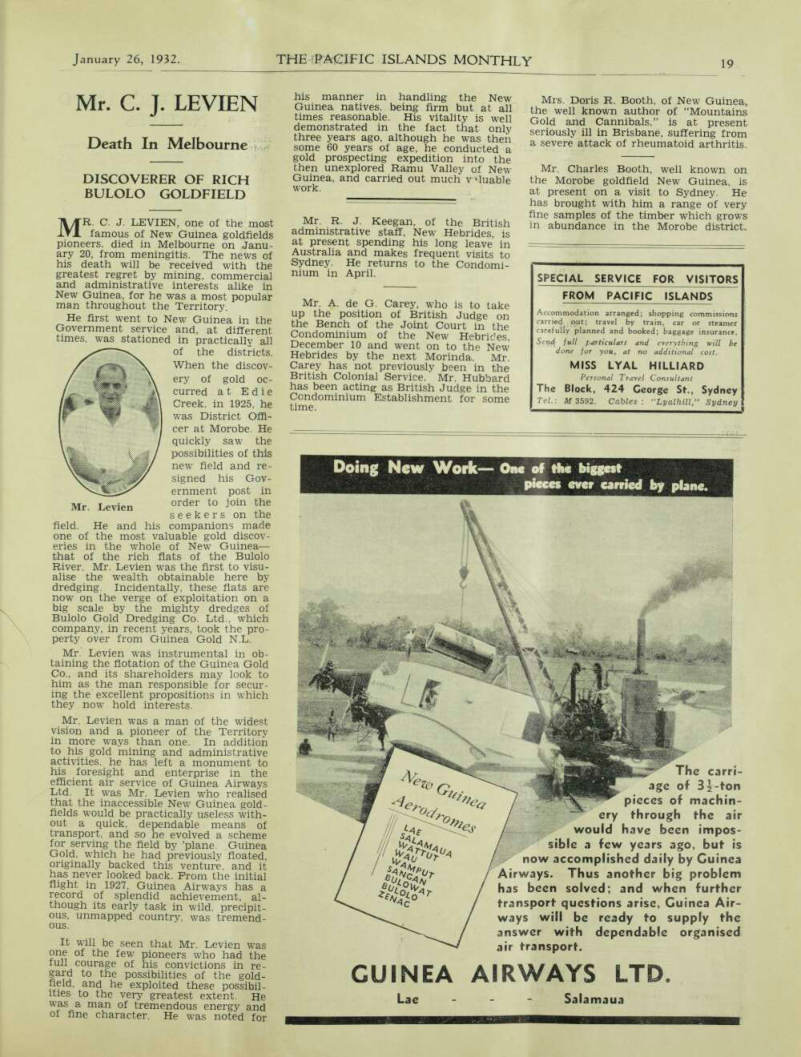
Death In Melbourne
Discoverer Of Rich
Bulolo Goldfield
MR. C. J. LEVIEN, one of the most famous of New Guinea goldfields pioneers, died in Melbourne on Janu ary 20, from meningitis. The news of his death will be received with the greatest regret by mining, commercial and administrative interests alike in New Guinea, for he was a most popular man throughout the Territory.
He first went to New Guinea in the Government service and, at different times, was stationed in practically all
of the districts.
When the discov ery of gold oc curred at Edie Creek, in 1925, he was District Offi cer at Morobe. He quickly saw the possibilities of this new field and re signed his Gov ernment post in order to join the seekers on the
field. He and his companions made one of the most valuable gold discov eries in the whole of New Guinea — that of the rich flats of the Bulolo River. Mr. Levien was the first to visu alise the wealth obtainable here by dredging. Incidentally, these flats are now on the verge of exploitation on a big scale by the mighty dredges of Bulolo Gold Dredging Co. Ltd., which company, in recent years, took the pro perty over from Guinea Gold N.L.
Mr. Levien was instrumental in ob taining the flotation of the Guinea Gold Co., and its shareholders may look to him as the man responsible for secur ing the excellent propositions in which they now hold interests.
Mr. Levien was a man of the widest vision and a pioneer of the Territory in more ways than one. In addition to his gold mining and administrative activities, he has left a monument to his foresight and enterprise in the efficient air service of Guinea Airways Ltd. It was Mr. Levien who realised that the inaccessible New Guinea gold fields would be practically useless with out a quick, dependable means of transport, and so he evolved a scheme for serving the field by ’plane. Guinea Gold, which he had previously floated, originally backed this venture, and it has never looked back. From the initial flight in 1927, Guinea Airways has a record of splendid achievement, al though its early task in wild, precipit ous, unmapped country, was tremend ous.
It will be seen that Mr. Levien was one of the few pioneers who had the full courage of his convictions in re gard to the possibilities of the gold field, and he exploited these possibil ities to the very greatest extent. He was a man of tremendous energy and of fine character. He was noted for
his manner in handling the New Guinea natives, being firm but at all times reasonable. His vitality is well demonstrated in the fact that only three years ago, although he was then some 60 years of age, he conducted a gold prospecting expedition into the then unexplored Ramu Valley of New Guinea, and carried out much valuable work.
Mr. R. J. Keegan, of the British administrative staff, New Hebrides, is at present spending his long leave in Australia and makes frequent visits to Sydney. He returns to the Condomi nium in April.
Mr. A. de G. Carey, who is to take up the position of British Judge on the Bench of the Joint Court in the Condominium of the New Hebrides, December 10 and went on to the New Hebrides by the next Morinda. Mr.
Carey has not previously been in the British Colonial Service. Mr. Hubbard has been acting as British Judge in the Condominium Establishment for some time.
Mrs. Doris R. Booth, of New Guinea, the well known author of “Mountains Gold and Cannibals,” is at present seriously ill in Brisbane, suffering from a severe attack of rheumatoid arthritis.
Mr. Charles Booth, well known on the Morobe goldfield New Guinea, is at present on a visit to Sydney. He has brought with him a range of very fine samples of the timber which grows in abundance in the Morobe district.
Mr. Levien
Advertisements & other items, p. 21 (1 item)
Guinea Airways Ltd.
SPECIAL SERVICE FOR VISITORS
FROM PACIFIC ISLANDS
Accommodation arranged; shopping commissions carried out; travel by train, car or steamer carefully planned and booked; baggage insurance.
Send full particulars and everything will be done for you, at no additional cost.
MISS LYAL HILLIARD
Personal Travel Consultant The Block, 424 George St., Sydney Tel.: M 3592. Cables: “Lyalhill,” Sydney
Doing New Work — One of the biggest pieces ever carried by plane.
The carri age of 3½-ton pieces of machin ery through the air would have been impos sible a few years ago, but is now accomplished daily by Guinea Airways. Thus another big problem has been solved; and when further transport questions arise, Guinea Air ways will be ready to suppfy the answer with dependable organised air transport.
GUINEA AIRWAYS LTD.
Lae Salamaua
Asiatic Labour for the Solomons
A Resident’s Protest
To the Editor.
Sir, —Nothing is more characteristic, at the present time, than the ardent desire to “burst forth into literary song” at the slightest pro vocation—with probably the ulterior motive of receiving recompense for the trouble, or com mendation from friends or those in authority, with a lower status of mentality than the author of the article.
The article signed “A. Olsen” and appear ing in The P.I.M. dated November 23, 1931, is certainly open to criticism, and although it is advisable to avoid criticism of certain specific faiths, one feels justified in not recon ciling statements of the nature made by A. Olsen, notwithstanding his 26 years of residence in this group.
I suggest that a highly important manipu lation of political and racial business requires careful consideration, and the facts of the article are too highly suggestive of theories and inferences, which seem to reach the ul timate limits of speculations and nothing but the bracing mental discipline of racial study in its broadest aspect will protect the mind addressed to the consideration of facts from conclusions, which shows same to be erro neous.
I should have thought that the comprehen sive articles appearing in The P.I.M. during 1931, dealing with the racial question (troubles in Samoa, New Hebrides, etc.) would have been sufficient to convince Mr. A. Olsen, or any other advocate of imported labour, that same was not advisable, and thus unconscious assertions could have been avoided.
There is one firm in this Group—to wit.
Levers—who are advocating the importation of Asiatic labour (Chinese) and it certainly seems an obsession with them. It would be interesting to know why, during 1931, this firm paid off hundreds of partly time-expired indentured labourers, yet they immediately commenced recruiting again, notwithstanding that each indentured labourer costs a con
siderable sum to recruit. I suggest that no well conducted business firm, dependent upon native labour. could tolerate such a policy, yet they are the firm advocating the impor tation of Asiatic labour.
We of the Solomons have been complaining of the hard times, and asking the Govern ment, through the Advisory Council, to eco nomise in every respect: (1) A cut in native wages. (2) A percentage reduction in official sal aries. (3) The deletion of certain Government positions. (4) The importation of Asiatic labour. (Lever’s request.) What a foolish request the latter seems.
Surely it points to minds that work in in verse ratio. If this was granted it would undoubtedly mean; fl) Increase of Government staff (consid erable) ; (2) increase of wages to Asiatics; (3) increase .of indenture fees; (4) increase brought into this Group on a large scale, ten are additional enlightening facts of con of returning fees;(s) importation of Asiatic diseases (yellow fever, for instance).
If imported labour (especially Asiatic) is brought into the Group on a large scale, those who have been advocating such impor tation will soon have ample opportunity of proving that, instead of the “sick ewe lamb” (copra) mentioned in Mr. Olsen’s article, remaining sick, owing to the shortage of island labour, the Solomon Islands’ planters and settlers will look and feel more like “cryptorchid billy-goats.” Mr. Olsen’s ver sion may receive the consideration and com mendation of “general opinion,” but I hon estly think it will not influence the small planter and genuine recruiter, or the major ity of genuine planters.—I am. etc.
H.C.S.
B.S.I., 10th January, 1932.
Missions and Trade
Reply to Mr. Vogan
To the Editor.
Sir, —In your issue of December you give some extracts from a letter sent to you by Mr. A. J. Vogan, in which he criticises Mis sions in the Pacific.
Everyone will welcome criticism that is based upon fact, but I must challenge Mr.
Vogan’s statement regarding the Methodist Missions. He states: “The Methodist Mis sions, in my opinion, are far too concerned with trading. In comparison with other Mis sionaries, the Methodists receive high salaries and are expert) traders.”
In the first place, the Missionary Society, of which I have the honour to be the Executive Officer, does not allow trading of any kind. We have on some of our stations In Papua small mission stores, but these are solely to enable our brown staff to obtain goods at reasonable rates. The Mission makes no profit, but frequently a considerable loss, on this convenience for its staff.
I challenge Mr. Vogan to give me, either privately or publicly, the name of any mis sionary who is engaged in trading, and can assure Mr. Vogan that if there should be such a man he will be dealt with by the Society. I myself do not believe that any such exists and Mr. Vogan must have been very seriously misinformed. —I am, etc..
John W. Burton.
General Secretary.
Methodist Missionary Society of Australasia.
Sydney, 31st December, 1931.
Judge Hubbard, of the Condominium Court, at Vila, in the New Hebrides, reached Sydney by the Morinda on January 17. His wife, who has been ill for some time, was taken to a private hospital.
"Seeing Red”
NO country in the world offers such a wealth of material for a book as does Soviet Russia, and in each new volume writ te nare additional enlightening facts of con ditions there.
“Seeing Red” is the apt title of the latest book of this kind by Eve Grady, who lived quietly in Russia, observing and recording the state of affairs. The result is that her book reads more like a novel than a general descriptive work, and some of her revela tions are astounding.
The writer of “Seeing Red” was ordered out of Russia because, in an article in an American journal, she told a joke about Stalin.
Our copy from Angus and Robertson Ltd.
"What Bird Is That?”
NATURE lovers will welcome Neville W.
Cayley’s book. “What Bird Is That?”
It is a guide to the many birds of Aus tralia and is the most comprehensive and in formative bird-book published in Australia — if not in the world. It will remain for per haps hundreds of years as one of the stan dard works of its kind.
Every known bird in Australia is dealt with and each one is admirably illustrated in the colour plates. The birds are grouped for the most part according to their habits, and information is given concerning the distri bution of the various species, their nests, eggs, etc. The fine colour reproductions of the drawings of the birds have eliminated the necessity for colour descriptions of the plum age.
“What Bird is That?” is published by Messrs. Angus and Robertson, The price is 12/6.
Those Undisciplined
Natives
To the Editor.
Sir, —I write as an experienced schoolmas ter who numbers among his pupils not a few Planters and District Officers, who has visited them recently in the Territory, who has talked to men and women representing its very varied interests.
I am glad to know that Captain Milton, who wrote on this topic last October, real ises to some extent the difficulties of the ad ministration of the Territory; but I very deeply regret, as I am sure that he will on mature reflection, certain things in con nection with his article. 1. I know quite well, and so does everyone in the Territory, the names of the officials who have caused him annoyance. Captain Milton is free to write his article. The offi cials cannot answer it over their own names.
They are not inexperienced or habitually gauche persons, but, because of official tradi tion, they must be regarded as such, because their hands are tied. This is not fair. 2. As the ordinary reader will interpret Captain Milton’s story of the Edmonds mur der trial it will sound as if witnesses other than natives were not permitted to give evi dence, or even as if Europeans were pre vented from giving evidence. He sounds as if he were charging the Central Court at Ra baul with acts of injustice. As I see no evi dence of any injustice, I regard the com ments of Captain Milton as singularly un fortunate. 3. As regards the plantation inspection inci dent, I read his story as suggesting that the usual procedure is for a District Officer to tell the natives that he is more powerful than their employer. I do not think any D.O. would thus go out of his way to saddle himself with responsibility for all indentured labourers in his district, as they might number some thousands. He would, and this is what he is there for, tell them that he is ready to hear their real or imaginary grievances. 4. Captain Milton, in regard to corporal punishment, seems to claim to write as the one real disciplinarian in a Territory coddled by officials. He should suggest what is well known, that nearly all residents are of opinion that corporal punishment for certain offences administered by District Officers, would do a great deal of good, and also that at a com bined Mission Conference held in Rabaul, corporal punishment was advocated by every Mission.
I have read with great pleasure the shorter and calmer and weightier article by Mr. Gor don Thomas, because it shows a much fuller appreciation of an official’s problems. He has to maintain European prestige to the same extent, but not in the same wav, as his German predecessors. He is under the mandate of the League of Nations, which is itself an inexperienced, because it is a young, body, and its natives is, to put it mildly, somewhat idealised. He has to deal with planters who naturally want their em ployees to work, and with natives who natur ally do not want to work. He has not only to deal with missionaries of wide and long experience, who value local customs in so far as they maintain a decent standard of morality, but also with less experienced men whose undoubted zeal makes them expect the adoption by the native of Christian moral standard a century before he has digested it.
After reading 35 pages of a patrol officer’s report, a privilege which probably has been denied to Captain Milton, I am disposed to marvel that Australia, inexperienced in work of this kind, should have already produced so many men who are, in spite of the con stant interference of the distant amateur with the local expert, doing their job with a patience and impartiality that is amazing to anyone who has the remotest conception of their difficulties. —I am, etc.
A. W. Tonge.
Sydney, 28th December, 1931.
Dr. C. M. Deland, Government Medi cal Officer at Kieta, Bougainville, Ter ritory of New Guinea, returned to the Territory by the Macdhui after spend ing four months’ leave in Australia.
He was accompanied by his wife and children. It is reported that Dr. Platt, who had been relieving Dr. Deland at Kieta. is being transferred to Sala maua. He was recently stationed at Madang.
Bulolo Dredge

To Start In March Epoch-Marking Event for N. Guinea
THE stage is fast being set on the New Guinea goldfield for the commencement of dredging by the No. 1 dredge of Bulolo Gold Dredging Co.
Ltd. early in March.
All the machinery for this dredge and also for the company’s power house was landed by plane on the field by January 4. The dredge will be the first in the world to have been trans ported to its field of operation by plane, and this alone speaks volumes for the organising ability and enterprise of the company. The whole installation is well up to schedule.
By the January Sierra, Mr. Frank W. Griffin, a director of the company, arrived from the U.S.A., and he is proceeding to the field by the Montoro, on February 3, to supervise the final work of construction. He is accom panied by his son, Mr. Frank F. Grif fin.
Another arrival by the Sierra was Mr. L. V. Waterhouse, also a director of the company, who returned to Syd ney from a health and business trip to the States. His many friends in New Guinea will be pleased to know that he is very fit again. Mr. Waterhouse is also leaving for the field by the Mon toro.
It is expected that Brig.-General A.
E. Wisdom, Administrator of New Guinea, will be present at the official opening of the Bulolo No. 1 dredge, which will mark the beginning of a new epoch on the New Guinea gold fields.
An Authority On Exchange
“W. R. C.”
In Sydney, where every business ex ecutive is studying the world’s economic sickness, trying to gain the great ad vantage that will accrue to the man who can read the obscure future just a little sooner than the others, the name of Mr. W. R. Carpenter, head of the big Islands organisation, is held in high respect. He is an authority on ex change and international finance. The condition of his company proves it.
Therefore, it may interest Islanders to know that “W.R.C.” is predicting to day—with the same confidence that he, 18 months ago, predicted the present exchange position—that the ultimate and early solution of the present stale mate in world finance and trade is the creation of what will be virtually an international bank. Gold, as the me dium of international trade —the es sential rectifier of trade balances —is “cornered,” and out of action. Some thing must take its place, or some means found of bringing it back into world circulation. “W.R.C.” argues that an international bank, giving a fixed monetary standard, is the only solution.
The Rev. Father Graton, a French missionary, who has been stationed in the Solomon Islands for 25 years (which has been unbroken except for a stay of a few weeks in Sydney), ar rived in Brisbane by the Mataram on January 16. He is now on six months’ furlough, which he will spend in France.
Mr. E. H. Gregson, who was con nected with the New Guinea police force, and who has been on leave in Australia, has decided to remain in Sydney and is resigning from the ser vice. Mr. Gregson was recently sta tioned at Wau, on the goldfields.
Advertisements & other items, p. 23 (1 item)
The Masse Battery
is your
Logical Choice
Reliability of service, freedom from break down, simplicity of maintenance, economy in use. are the essentials to remember when buying batteries.
Weight for weight, size for size, Masse Batteries are unequalled.
For House Lighting
Masse Batteries for House Lighting and Power are made in sizes and capacities ranging from 9-plate cells of 100 ampere hours, at the 10-hour rate, to 19 plate cells of 225 ampere hours capacity.
For Cars
From the casting of the grids, through every stage of manufacture, pasting, form ing, assembling, testing, sealing, everything in Masse Car Batteries is subservient to Quality. Masse gives longer service and a reserve energy to stand up to abnormal service conditions. There’s a type for every car.
For Radio
If you could see the rigid tests to which they are subjected in the various stages of manufacture you wouldn’t hesitate to instal a Masse “A” Battery in your set.
Booklets jree on request.
Write to
MASSE BATTERIES LTD.
Grace Building, York Street, Sydney
CAR RADIO aod HOME LIGHTING
BATTERIES
11 Killed at Kekesup
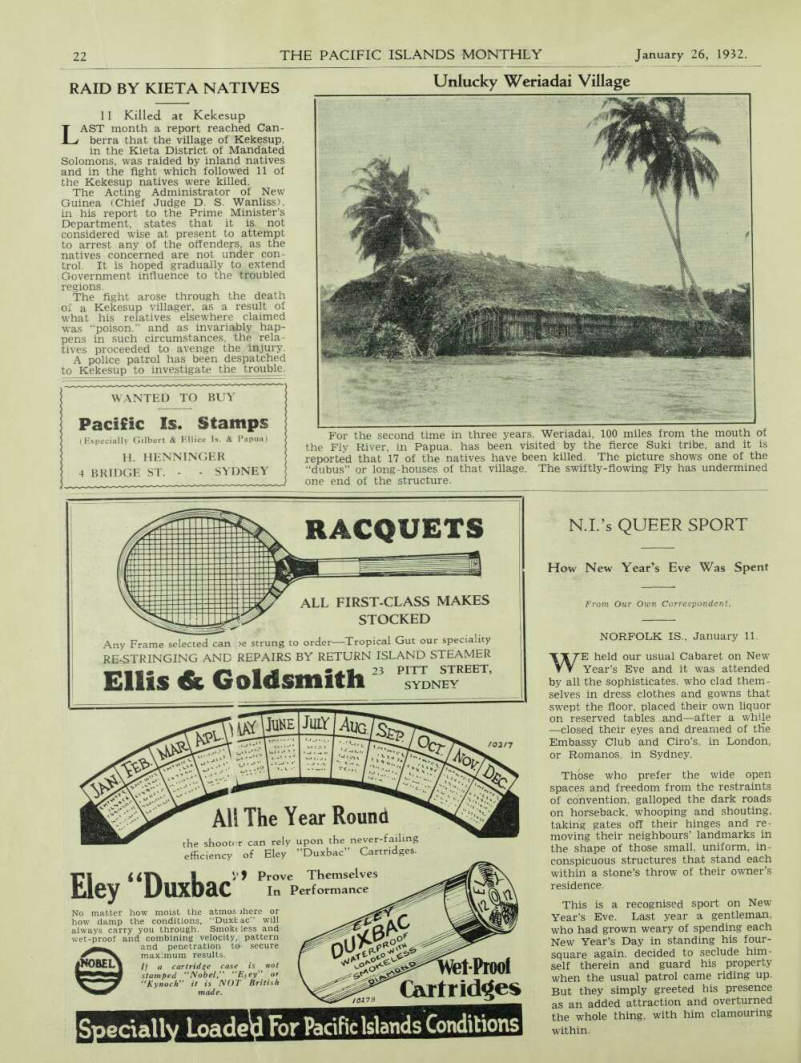
Raid By Kieta Natives
LAST month a report reached Can berra that the village of Kekesup, in the Kieta District of Mandated Solomons, was raided by inland natives and in the fight which followed 11 of the Kekesup natives were killed.
The Acting Administrator of New Guinea (Chief Judge D. S. Wanliss). in his report to the Prime Minister’s Department, states that it is not considered wise at present to attempt to arrest any of the offenders, as the natives concerned are not under con trol. It is hoped gradually to extend Government influence to the troubled regions.
The fight arose through the death of a Kekesup villager, as a result of what his relatives elsewhere claimed was “poison," and as invariably hap pens in such circumstances, the rela tives proceeded to avenge the injury.
A police patrol has been despatched to Kekesup to investigate the trouble.
Unlucky Weriadai Village
For the second time in three years, Weriadai, 100 miles from the mouth of the Fly River, in Papua, has been visited by the fierce Suki tribe, and it is reported that 17 of the natives have been killed. The picture shows one of the “dubus” or long-houses of that village. The swiftly-flowing Fly has undermined one end of the structure.
N.I.’S Queer Sport
How New Year’s Eve Was Spent
From Our Own Correspondent.
NORFOLK IS., January 11.
WE held our usual Cabaret on New Year’s Eve and it was attended by all the sophisticates, who clad them selves in dress clothes and gowns that swept the floor, placed their own liquor on reserved tables and —after a while —closed their eyes and dreamed of the Embassy Club and Giro’s, in London, or Romanos, in Sydney.
Those who prefer the wide open spaces and freedom from the restraints of convention, galloped the dark roads on horseback, whooping and shouting, taking gates off their hinges and re moving their neighbours’ landmarks in the shape of those small, uniform, in conspicuous structures that stand each within a stone’s throw of their owner’s residence.
This is a recognised sport on New Year’s Eve. Last year a gentleman, who had grown weary of spending each New Year’s Day in standing his four square again, decided to seclude him self therein and guard his property when the usual patrol came riding up.
But they simply greeted his presence as an added attraction and overturned the whole thing, with him clamouring within.
Advertisements & other items, p. 24 (2 items)
Pacific Is. Stamps
WANTED TO BUY
(Especially Gilbert & Ellice Is. & Papua)
H. HENNINGER
4 BRIDGE ST. - - SYDNEY
Eley “Duxbac
RACQUETS
ALL FIRST-CLASS MAKES
STOCKED
Any Frame selected can be strung to order—Tropical Gut our speciality RE-STRINGING AND REPAIRS BY RETURN ISLAND STEAMER
Ellis & Goldsmith SYDNEY
All The Year Round
the shoot, r can rely upon the never-failing efficiency of Eley "Duxbac” Cartridges.
Eley “Duxbac
No matter how moist the atmosphere or how damp the conditions, “Duxbac" will always carry you through. Smoke less and wet-proof and combining velocity, pattern and penetration to secure maximum results.
If a cartridge case is not stamped “Nobel,” or “Kynoch” it is NOT British made.
Prove Themselves
In Performance
Wet-Proof
Cartridges
Specially loaded For Pacific Islands Conditions
Dauncey
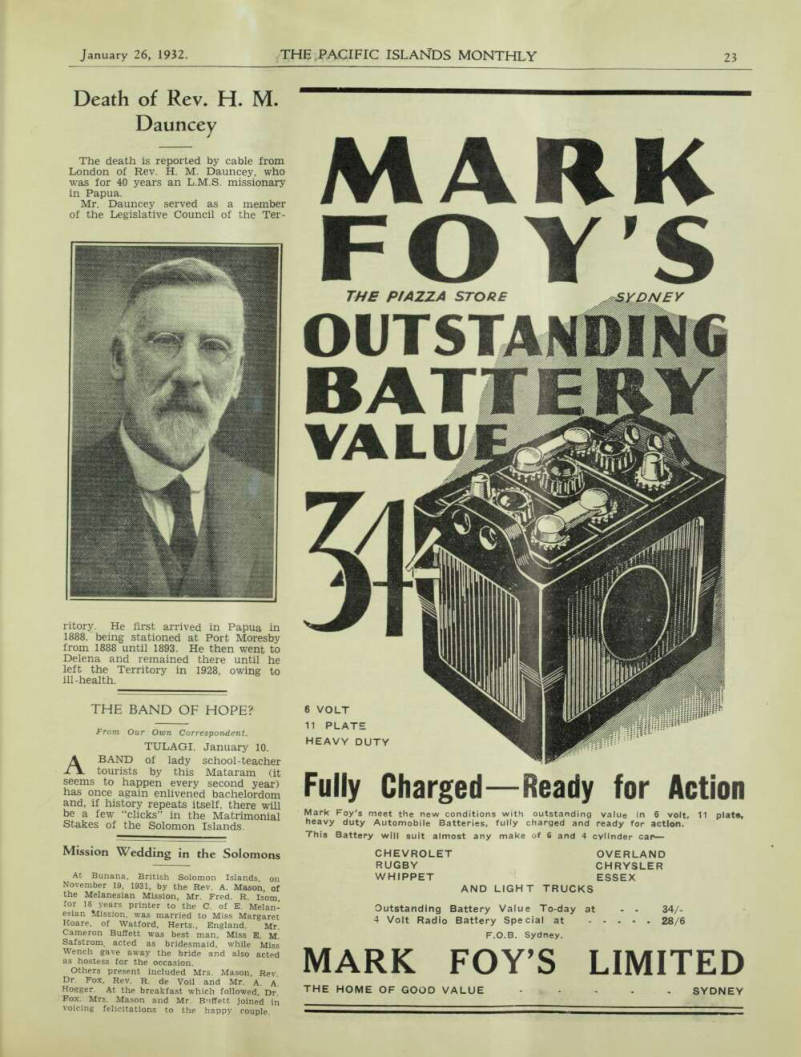
Death of Rev. H. M.
The death is reported by cable from London of Rev. H. M. Dauncey, who was for 40 years an L.M.S. missionary in Papua.
Mr. Dauncey served as a member of the Legislative Council of the Ter
ritory. He first arrived in Papua in 1888, being stationed at Port Moresby from 1888 until 1893. He then went to Delena and remained there until he left the Territory in 1928, owing to ill-health.
The Band Of Hope?
From Our Own Correspondent.
TULAGI, January 10.
A BAND of lady school-teacher tourists by this Mataram (it seems to happen every second year) has once again enlivened bachelordom and, if history repeats itself, there will be a few “clicks” in the Matrimonial Stakes of the Solomon Islands.
Mission Wedding in the Solomons
At Bunana, British Solomon Islands, on November 19, 1931, by the Rev. A. Mason, of the Melanesian Mission, Mr. Fred. R. Isom for 18 years printer to the C. of E. Melan esian Mission, was married to Miss Margaret Hoare, of Watford, Herts., England. Mr.
Cameron Buffett was best man, Miss E. M.
Safstrom acted as bridesmaid, while Miss Wench gave away the bride and also acted as hostess for the occasion.
Others present included Mrs. Mason, Rev Dr. Pox. Rev. R. de Voil and Mr. A. A.
Hogger, At the breakfast which followed, Dr Fox. Mrs. Mason and Mr. Bnffett joined in voicing felicitations to the happy couple.
Mr. J. G. Fowler, a Resident Magis trate of the Papuan service, who has spent more than a quarter of century in the Territory, is at present in Syd ney enjoying 12 months’ leave. He has seen service in practically every one of the Papuan administrative districts.
Mr. H. L. Downing, of the New Guinea administrative service, who is well known in the Morobe end of the Territory, arrived in. Sydney by the Macdhui, in January, on leave.
Advertisements & other items, pp. 25-26 (1 item)
Foys
MARK
THE PIAZZA STORE
VALU
6 VOLT
11 PLATE
HEAVY DUTY
Fully Charged —Ready for Action
Mark Foy's meet the new conditions with outstanding value in 6 volt, 11 plate, heavy duty Automobile Batteries, fully charged and ready for action.
This Battery will suit almost any make of 6 and 4 cylinder car—
CHEVROLET OVERLAND
RUGBY CHRYSLER
WHIPPET ESSEX
AND LIGHT TRUCKS
Outstanding Battery Value To-day at - - 34/- 4 Volt Radio Battery Special at 28/6 F.O.B. Sydney.
MARK FOY’S LIMITED
THE HOME OF GOOD VALUE ... SYDNEY
“BEECHWORTH,” POTTS PT.
In this Modern Apartment House of 44 Flats, Furnished and Unfurnished Flats are available. Sleep-out balcony and kitchenette, hot-water service. Moder ate rents, from 30/-. Opposite St.
Vincent’s Convent.
71 and 73 VICTORIA STREET
POTTS POINT, SYDNEY
Tel. F 1863 Manageress at Office
The Universal
6-8 H.P,
Marine Engine
This is the highest grade One-cylinder Marine Engine on the market. A 2in. heavy counterbalanced Crankshaft, with oversize bearings, plus duralumin con necting rod and De Luxe pistons, make possible extreme smoothness of opera tion. Every part is balanced.
It is fitted with the famous Ricardo Cylinder head, Tillotson Carburettor, Wico Magneto, Highest Grade Reverse Gear and multiple disc clutch, bronze gear-type water circulating pump, and many exclusive features not found in any other engine of this kind.
Owing to the heavy duty and exchange we cannot sell this engine in Australia under £150 but we have a few in Bond which arrived just before the exchange came into force, and we offer same f.o.b. Sydney, in bond for
£65 each.
HALL BROS. LTD.
(Established 40 years)
The Engine House
CAREENING COVE
MILSON’S POINT, NORTH SYDNEY
N.S.W. - - - AUSTRALIA
Travellers
Pacific Islands
Passengers Per S.S. “Mataram," Ar
RIVED IN SYDNEY ON 18th JANUARY, 1932
From Solomon Islands: Miss A. Bruce,
Miss E. Briley, Mrs. V. Kennard-Broadfoot Mrs. E. Barkely, Mr. J. C. Barkley, Miss J Carr, Mr. C. Collins, Miss C. Deck, Mrs L Dickes and infant. Mr. F. Everett, Father H.
Graton, Mrs. R. Green and child, Mr. and Mrs. P. Hawkes. Misses P. and K. Higgins, Misses A. and E. Hale, Miss M. Hart, Mrs.
G. Hewitt and 2 children, Mrs. M. Heritage, Capt. W. Hamilton, Miss E. Hamilton, Miss J. Johnson, Mr. and Mrs. L. Kepert, Miss E. Jliuby, Miss C. Lamb, Mr. and Mrs. T. J.
Latimer, Mr. D. MacMillan, Mrs. D. Meller, Mr. and Mrs. A. Middenway and infant, Mr.
P. Matters, Miss W. Nash, Mrs. Neil. Misses E. and M. Nankivell, Dr. and Mrs. A. Platt, Mr. E. S. Quital, Misses E. and R. Rosen berg. Mr G. J. Reed, Miss B. Scott, Mrs. A.
Sim and child, Mr. V. J. Shearwln, Mr. B.
J. Tollis, Mr. G. Tapper, Miss G. I. Thorp, Miss L. Windridge, Miss E. Wright, Mr. T.
B. Walker, Mr. D. Munro.
Passengers Per S.S. “Morinda ” Ar
Rived In Sydney 16Th January. 1932,
FROM NEW HEBRIDES: Miss D. M. Cooper, Miss M. Crouch, Miss E. McMahon, Miss E.
M. Watson, Mr. R. J. Clancy, Mrs. A. Mich elsen, Mr. J, Storey, Mr. A. E. Chamier, Mr. and Mrs. C. P. Hubbard, Mr. J. Payne, Misses M. and L. Adams, Miss E. Alexander, Misses M. and E. Baldwin, Mr. L. J. Booty, Mr. F.
W. Bunting, Mrs. C. Campbell, Miss G. M.
Dorney, Mr. T. Dyos, Miss M. E. Hill, Miss R. Hindmarsh, Mr. W. T. Hyder, Miss M.
Jones, Master V. Likely, Miss F. L. Martin, Mr. E. J. Matthews, Miss I. Olsson, Mr. C.
Rollinshaw, Mr. E. Stopp, Rev. L. L. Wenzel, Miss C. M. Bertie, Miss Braddock, Mr. J.
Creer, Mr. and Mrs. and Master J. Creer, Mr.
A. B. Dege, Miss C. A. Dunster, Miss E.
Davies, Miss A. Drennan, Miss B. Davis, Miss C. Dunphy, Mr. E. Embury, Mr. and Mrs.
H. G. Edwards, Miss Floyd, Miss Golding, Mrs. E. Giles, Mrs. E. Cole and family, Capt.
F. Hurley, Mr. T. Iredale, Mr. G. B. Jack son, Mr. E. Jenner, Mrs. J. E. B. Molloy, Mr. and Mrs. J. L. Mclnerney, Miss M.
Mansley, Mr. Mason, Mr. J. C. Maken, Mr.
J. Murphy, Miss Knight, Miss G. Lochrin, Miss M. Ross, Mr. W. T. Roberts, Mr. E. H.
Scott, Mr. and Miss Stott, Mrs. B. Stevenson, Miss M. Thompson, Miss K. Taylor, Master P. Toose, Mr. E. G. Troughton, Mr. R. Wes ton, Mr. G. Perry, Mr. J. Wilson, Mr. L.
Wood.
Passengers Per S.S. “Morinda" Sailed
From Sydney, 21St January, 1932, For
Lord Howe Island, Norfolk Islands,
New Hebrides Ports And Auckland:
Mr. R. J. Love, Dr. A. E. Colvin, Mr. C, Fitz patrick, Mr. C. J. Stephenson, Mrs. Ross Owen, Miss E. Yeend, Mrs. S. A. Norman, Mrs. G. E. Forrest, Mrs. P. Hordern, Miss J. Hordern, Miss M. Hordern, Mr. E. T.
Cohen, Mr. G. A. Solomon, Mr. H. P. Pay ton, Mr. H. S. Edgar, Mr. H. Walton, Mrs.
Walton, Mr. S. G. Jones, Mrs. Jones and infant, Miss O. Tyrer, Mr. Barnard, Mrs.
Barnard, 2 children and infant, Miss Macleod, Mrs. Macleod and infant, Misses (2) Ramsay, Mr. and Mrs. G. W. Allsop, Miss J. McKean, Miss M. McKean, Miss S. O’Brien, Miss D.
Rowland, Mr. W. Ferris, Mrs. Ferris, Miss L. Ingram, Miss B. Paton, Mr. C. B. Duper tuis, Mr. McGibbon, Miss M. Daniel, Miss M.
Merrick, Miss G. Watson, Miss M. Hammond, Mr. A. C. Fry, Mrs. Fry, child and infant, Mrs. Borthwick, Mrs. Beale, Miss G. Patten, Mrs. E. Seldon, Mr. F. J. Dawson, Mrs.
Dawson, Miss N. Davies, Miss E. Hall, Mrs.
M. Barwick, Miss M. Whitfield, Mr. P. A.
Cameron, Mrs. Cameron, Mr. J. Merrick, Mr. R. A. Baxter, Mr. S. B. Morton, Mr.
C. Rollinshaw, Rev. Father Andre, Mr. R. O.
Dennison, Mr. E. Davies, Mr. W. H. Hamill, Mr. S. Kemmis, Mr. W. H. Harris, Mr. D.
Rea, Mr. L. G. Crommelin, Mr. J. Brett, Mr. D. Johnston, Mr. E. P. Andreas, Mr.
James Cox, Mr. J. Stewart, Mr. N. Morrow, Mr. A. S. Thomas, Mr. W. McDonald, Mr.
H. Higgs, Mr. T. Rich, Mr. M. Lapin, Mr.
B. Lapin, Mr. A. G. Steel, Mr. C. Hilde brand, Mr. G. J. R. Beale.
Passengers Arrived In Sydney Per
M.V. “Macdhui" On 6Th January, 1932,
From New Guinea And Papuan Ports:
Miss M. Barham, Miss J. Brownlee, Miss D. Mason, Master M. Scholer, Miss M. War dell, Mr. and Mrs. W. H. Westeon, Mr.
H. C. F. Mirow, Mr. W. J. Know, Mr. J. K McCarthy, Mr. E. C. Arthur, Mr. H. A.
Barker, Mr. H. L. Downing, Mr. F. Hodgson, Mrs. G. Bowen-Jones and child, Mr. G. M.
Knight, Mr. C. J. Levien, Mrs. A. M. Lewis, Mr. W. G. Mitchell, Miss B. Mitchell, Mr F. A. Pearce, Mr. G. Rose, Mrs. J. L. Smith, Mr. W. T. Stewart, Mr. T. Williams, Mr.
C. Booth, Mr. S. J. Taylor, Mr. W. Bieri, Mr. J. A. L. Capron, Master J. A. Ewen, Mr. and Mrs. D. M. Forsyth, Mrs. M. P. Frog gart, Mrs. M. Garrett and 3 children, Mr.
E. C. D. Green, Mr. and Mrs. G. E. Hall, Rev.
G. E. Martin, Mr. P. D. Moncur, Mr. J.
Morris, Mr. J. Woodville, Mr. W. E. Tan son, Mr. C. L. Driver, Father M. McEncroe, Sir Hubert and Lady Murray, Mr. L C Schoppee, Mrs. P. Waldby and 2 children, Mr. W. F. Winspear.
Passengers Per M.V. “Macdhui ”
Sailed From Sydney On 14Th January
For Papuan And New Guinea Ports:
Mr. B. T. Webb, Mrs. Webb, Rev. R. Leek, Mrs. Leek, Sir R. McC. Anderson, K.C.M.G., Miss S. Anderson, Miss M. Anderson, Mr.
W. D. Brown, Mrs. Brown, Master Brown, Miss Brown, Mr. N. M. Fraser, Captain E.
Muster, Mr. L. W. Dowson, Mr. W. J. Henry, Mrs. G. F. W. Zimmer, Mr. A. S. Burton, Mr. Young, Mr. A. Beavis, Mr. F. H. Daul ton, Mr. A. Gibson, Mr. E. Peterson, Mr. C.
Scribner, Miss G. Backhouse, Miss S. Back house, Miss M. H. Hodge, Mr. R. H. French, Mr. J. Bryan, Mr. S. Bryan, Mr. S. A. Green land, Mrs. Greenland, Mr. C. B. Bell, Mr.
J. Polak, Mrs. R. Peddie and 2 children, Mr.
B. E. Fairfax-Ross, Mr. G. McKechnig, His Honor Brigadier-General E. A. Wisdom, C.B., C.M.G., D.S.O., V.D., Miss Powell, Mr. A.
Lohmanne, Mrs. R. Thornton, Miss C. Thorn ton, Mrs. G. Schmidt, Miss B. Schmidt, Mr.
Sidney Smith, Mr. J. E. Brien, Mr. K. L.
Cunningham, Mr. H. T. Bolten, Miss M.
Stevens, Mr. A. F. Kyle, Mr. H. Manns, Mr.
P. Walther, Mr. C. R. Gurney, Mrs. Gurney, Mr. N. Weldon, Mr. R. Hyde, Miss D. Mason, Miss M. Barham, Mr. N. H. Izod, Mrs. Izod, Mr. R. Staker. Mr. J. H. Lewis, Mr. C. K.
Kingston, Mr. E. C. Trevallion, Dr. C. M.
Deland, Mrs. Deland and three children, Mr.
F. H. Craig, Miss K. M. Betts.
Advertisements & other items, p. 26 (1 item)
Now On Sale!
Pacific Islands
Year Book for
1932 Complete description of all Paci fic Islands and Territories, in eluding Details of Administra tions, Trading Activities, Land Laws, Latest Statistical Informa tion, Opportunities for New Settlers, etc., etc.
WITH MAPS AND A COM
PLETE INDEX
8/6 at all Islands Stores, at all leading Australian and New Zealand booksellers, or from
UNION HOUSE
247 GEORGE STREET, SYDNEY
Samoan Bananas
Competition Affects Price
From Our Own Correspondent APIA, January 1 WITH Tongan and Fijian competition in the New Zealand market growing stronger it seems to be more difficult to dispose of the large quantities of Samoan bananas avail able now, at a satisfactory price.
The rate paid to growers locally by the Ad ministration is 4/- per case, the reduction of 1/- per case bringing our price in line with that paid in Tonga.
The inspection of the bananas is very rigid, to ensure that only first-class fruit is sent away. This is, of course, quite as it should be and to the final benefit of the growers. By the last Maui Pomare about 7,500 cases were accepted, while about 1,200 cases were re jected by the inspector for various reasons.
The handling of the banana export trade is now in the hands of Samoa Reparation Estates.
Wedding on "Mataram”
From Our Own Correspondent.
MAROVO, Sol. Is., January 1.
QUITE a new departure from the usual at tractions for the tourists was provided when the Mataram, with flags flying, came to anchor in Rendova, Western Solomon Islands, on November 28. The occasion was the mar riage of Miss Mae Simon, of Auburn, Sydney, and Mr. Richard Fuller, manager of Kenelo Plantations, Gizo.
The ceremony took place on board, in the flag decorated lounge, in the presence of pas sengers and many local friends of the bride groom. Mr. Sydney Marks acted as best man.
The Rev. J. F. Goldie officiated, and the bride was given away by Mr. J. Sims, Lever Bros, inspector for the western end of the Solo mons.
The bride looked charming in a shell pink lace frock, wearing a hat to tone. A fellow passenger of the bride. Miss Desmond Atkin son, acted as bridesmaid.
A wedding breakfast was afterwards served in the dining saloon, the chef and stewards surpassing themselves in their efforts to make everything a complete success. The happy couple afterwards departed to their home on Kenelo plantation, about five miles from Rendova, where many friends congregated to give the bride a welcome home.
Armistice Day In Tahiti
From Our Own Correspondent PAPEETE, December 20.
BRIGHT weather favoured Armistice Day celebrations in Tahiti, and a fair crowd gathered at the Cenotaph on St. Amelie Ave nue for the impressive ceremony of remem brance.
The children from the various schools, all carrying bouquets, were out in force, so that the monument, upon which is inscribed the names of all Tahitians who died for France, was literally buried in flowers.
Later on in the day there were various amusements, but the chief attraction, as usual, was the racecouse at Fautaua. Here the “tote” was going full swing and the fact that they sometimes ran out of tickets for a particular horse seemed to matter not at all: the crowd bought the others just as readily.
Tonga’s Surplus Funds
At the close of the 1930 financial year, the surplus funds of the Tongan Islands amounted to £148,332. These funds are invested in United Kingdom War Bonds, New Zealand. Australian, Strait Settlements and Nigeria stock, and in fixed deposits with the Bank of New Zealand in Sydney and Auckland.
Advertisements & other items, p. 27 (1 item)
F. Chilton
SOME BOOKS YOU NEED
POST FREE
AMUSING STORIES, 3/3; OFFICIAL RULES OF CARD GAMES, HOYLES UP-TO- DATE, 2/9; HOW TO ENTERTAIN, 1/9; COCKTAILS AND HOW TO MAKE THEM, 3/3; ETIQUETTE FOR WOMEN, 2/9; PUDDINGS, PASTIES AND SWEET DISHES, 4/9; OLD TIME DANCING, 1/9; THE BOOK OF LUCK, 1/9; CASSELS’ CONCISE ENGLISH DICTIONARY. 3/6; EVERY MAN HIS OWN MECHANIC, 9/6; THE MYSTERY OF YOUR PALM, 3/3; DYNAMO AND MOTOR ERECTION AND MANAGEMENT, 2/9; SKETCHING FROM LIFE, 1/6; TICKET AND SIGN WRITING, 1/6; FORTUNE TELLING BY TEALEAVES, 1/9; BOOTMAKING AND MENDING, 2/9; LEE’S 3,000 PRICELESS RECIPES, 4/6; UNIVERSAL TRADE RECKONER. 4/6; LEE’S GUIDE TO THE GAME OF DRAUGHTS, 4/6; CHESS LESSONS FOR BEGINNERS, 2/9; CHESS AND DRAUGHTS, 1/6: HOW TO REPAIR AND RESTRING TENNIS RACKETS, 3/6; POPULAR CARD GAMES AND HOW TO PLAY THEM AND WIN. 1/6; MAGNETO REPAIR AND ADJUSTMENT. 2/9; SUGAR CANE AND ITS MANUFACTURE (H. C.
GEERLIGS), 35/6; THE FIFTY BEST PARTY GAMES, 1/6; MOTOR MANUAL, 4/9; MY SYSTEM OF EXERCISES FOR MEN (J. C. Muller), 6/6: MY SYSTEM FOR LADIES (EXERCISES), 6/6; FUN ON THE BILLIARD TABLE, 3/9; BILLIARDS AND TABLE GAMES. 1/6; TOASTS AND SPEECHES. 1/6; EASY FURNITURE MAKING, 2/9; BOXING SELF TAUGHT. 2/3; SIMPLE TESTS FOR MINERALS, 4/6; PROSPECTING FOR GOLD. 5/3; THE IDEAL OFFICE READY RECKONER, 9/8; PEARS ENCY- CLOPOEDIA, 5/9; ENQUIRE WITHIN UPON EVERYTHING. 5/6; THE MODERN LETTER WRITER, 3/3; THE NEW WONDER BOOK OF KNOWLEDGE, 14/-; MODERN PALMISTRY. 2 6; BACKGAMMON OF TO-DAY (JOHN LONGACRE), 5/6; CHAMBERS 20th CENTURY DICTIONARY, 13/6 (thoroughly revised edition); HOW TO SWIM. 3/6: CARD FORTUNE TELLING. 3/3; HOUSE’S CANARY BOOK, 16/-; POPULAR CAGE BIRDS, 2/9; DIESEL’S ENGINES (GOLDINGHAM), 33/6; A TREATISE ON ELECTRICITY (F. B. PIDDOCK), 32/-; PROSPECTING FOR MINERALS? 9/-; FRENCH SELF TAUGHT. 3/9; NOVELTY EVENINGS. 2 6; THE BOOK OF MYSTERY AND MAGIC, 1/6; MONEY MAGIC, 3/9; TRICKS FOR EVERYONE, 3/9; THE POWER OF WILL. 1 /-; THE COLLIE DOG BOOK, 3/6; KNITTING AND CROCHET WORK, 2/-; AUCTION BRIDGE, 1/9; THE SCHOOL GIRLS’ ANNUAL, 7/6; RECITATIONS FOR CHILDREN. 3/3; ADVENTURE LAND FOR BOYS. 9/-; MODEL AEROPLANES (fully illustrated), 2/7; PHOTOGRAPHY SIMPLIFIED (illustrated). 2/9; THE COMMONSENSE COOKERY BOOK. 2/6; A MANUAL OF CARPENTRY AND JOINERY (RILEY), 9 6; THE SECRETS OF CLAIRVOYANCE, 1/3; MICKY THE MOUSE ANNUAL. 5/3; HOUSE BUILDING FOR AMATEURS. 2/9: KNOTTING AND SPLICING, 2/9: MOTOR CAR OVERHAUL. 2/9; HOW TO BECOME QUICK AT FIGURES. 1/9; JU JITSU. 4/6; HEADS AND HOW TO READ THEM. 2/9; THE MODERN LETTER WRITER. 3/3; THE
UNIVERSAL DREAM BOOK, 1/9.
Books supplied on any Subject.
English and American Magazines supplied. All books sent securely packed in plain wrapper. Any book adver tised elsewhere supplied. No orders sent V.P.P. System.
Send P.N. or M.O. with order. The old reliable Mail Order Firm of 40 years’ standing. Compare my prices.
Delivery Guaranteed.
SIR ROBERT BEAR
Cheap Book Store, Royal Arcade, SYDNEY
FRESH FRUITS—VEGETABLES
F. CHILTON
WHOLESALE DISTRIBUTOR, CITY MARKETS
SYDNEY - - Established 1894 Quality—BEST. Price—LOWEST. Attention—PßOMPT.
Codes: Bentley’s and Private. Cable Address: Chiltons, Sydney Agent for —Celebrated "Vallo” Brand Spray Preparations, used successfully by Orchardists throughout Australia.
HAMS € BACON
When ordering Ham or Bacon remember
CROWN AND WARATAH
Brands.
Wholesale only from
FOLEY BROS. LTD.
353 SUSSEX STREET, SYDNEY
N.S.W.
Loan For Samoa?
From Our Own Correspondent
Apia, Jan. 1.
THE jovial secretary of the Adminis tration, Mr. Turnbull, left by the last Maui Pomare. on an official visit to Wellington.
Though officially nothing has been stated regarding the object of this trip, it is whispered by the knowing ones that he is to try his best to obtain a loan for the Administration to alleviate the difficult financial situation. Should he prove unsuccessful a sweeping cam pain for the most stringent economy must be started right away, and there is much apprehension felt in official circles as to who will be hit next.
New Export Activity
Tongan Bananas
New Export Activity Commenced
WHEN, a few weeks ago, the Union S.S. Co.’s cargo steamer Wai hemo. from ’Frisco to New Zealand, was diverted to Tonga to pick up bananas for the New Zealand market, a new era opened up for the little Islands Kingdom.
Tonga has been close to starvation.
Copra is the group’s staple product and main source of revenue; and the combined result of the depression and a long continued drought—which al most killed copra production and pre vented the planters taking advantage of the recovery of the copra market — spelled disaster for many people.
In the circumstances, it was essen tial that the Group should find some other source of income. The matter was discussed from all angles by vari ous interests, but it remained for the vigorous organising ability of Rev. R.
C. Page, head of the Methodist Church in the Kingdom, to provide a solution.
The economic problem impressed itself on Mr. Page over a year ago, when he began to seek alternative crops and finally he came to the conclusion that there was only one way of obtaining quick relief—namely, by sending ban anas to the New Zealand market. He kept pegging away and finally was able to bring together the three interests concerned —namely, the Union Steam ship Co., the Government and the na tive planters. As a result the Union Co. agreed to provide shipping facilities on condition that it received a guarantee
of a certain quantity of cargo. The Government and planters guaranteed the shipment of 1,500 cases of bananas, and the Waihemo, on her November trip from San Francisco to New Zea land, was diverted to Tonga to pick up the cargo.
The native planters brought in their bananas, which were graded and re packed, and they received an advance payment of 4/- per case. The steamer actually picked up 2,500 cases, which were taken to Auckland to the order of Messrs. A. B. Donald and Co., and realised the excellent price of 17/- per case. The balance due on each case, after providing for freight and charges and the original payment of 4/- per case, is to be divided between agents (Messrs. Donald and Co.) and the growers. The Waihemo also carried 300 cases of pineapples, which found a good market.
This development has given new life to Tonga, and the growers are eagerly preparing for further shipments. The Karetu, which left Sydney on Decem ber 22, called at Vavau and Nukualofa, after leaving Fiji, to pick up further consignments of bananas for Auckland.
The Tongan planters are now think ig seriously of developing the tomato trade with New Zealand. Tomatoes grow exceedingly well in Tongatabu— as do also the cold country vegetables such as potatoes, cabbages, carrots, wheat, etc. This is the result of a very remarkable climatic change, to which we referred in last issue.
The shipping company and the agents are trying to so arrange ship ments that bananas from Tonga will not clash in the New Zealand market with bananas from Fiji, Samoa and the Cook Islands.
Cook Island Oranges
From Our Own Correspondent RAROTONGA, January 1., RANGE trees are well laden with fruit, which at present is only in its green and immature stage.
The fruit is well forward and the oranges appear to be of fair average size. There is every promise of a good crop for the coming season.
The shipment of fruit from here by the R.M.S. Monowai (December 7) comprised: Bananas, 5,400 cases; tomatoes, 400; nuts, 50; kumaras 175, and lemons, 2 cases. Growers who sold in the sheds received 4/- a case for bananas, (fruit only) whereas according to radio advice from New Zealand dated De cember 16, bananas brought from 18/- to 24/a case.
Domestic crops and fowl runs have been heavily called upon during the last few days to meet demands for presents for the Christ mas festive season.
Advertisements & other items, p. 28 (2 items)
Cinzano
SYDNEY
Controlled by Sydney Ferries Ltd.
CLIFTON GARDENS
Hotel is righton the Harbour. Regular ferry service. Baths and shark proof beach. Tennis.
Garages. Excellent cuisine. Pre-war tariff. (Single room above the baths, and breakfast. 35/- per week.) Write Clifton Gardens Hotel, Mosman Sydney
Repairs. “OUR HANDS MAKE GOOD ARMS” Firearms sent C.O.D.
A Pistol or Revolver Affords a Feeling of Security Browning 32 cal. Auto. Pistol, holds 8 cart ridges. Price, £4/5/-. Police Model Walther, 22 Auto. Pistol, Price, £6/5/-. Other brands to choose from.
Sil Rohu’s high standard of Quality Fire arms and Fishing Tackle is well known throughout Australia. If considering the pur chase of any of these goods, write for Cata logue (Firearm, 500 illustrations, or Fishing Tackle, 200 Illustrations).
SIL ROHU (late A.1.F.), Gunsmith
IMPORTER OF HIGH-GRADE FIREARMS AND FISHING TACKLE SPECIALIST. 143 P.P. ELIZABETH STREET, SYDNEY (Near Market Street)
“FISHING TACKLE TO TACKLE FISHING"
ORIGINAL IMPORTED—
CINZANO
ITALIAN
VERMOUTH
Is made with the finest Italian white wines. It is very wholesome. It is not a liqueur. Some ways of using it: PLAIN: It’s not too sweet and not too dry. IN ALL COCKTAILS; Where Vermouth is used. AS A LONG DRINK IN SUMMER: With mineral aerated waters.
Agents.:
FRANCESCO CINZANO & CIA (Australia) LTD.
G.P.O. BOX 3708 S.S., SYDNEY, N.S.W.
Samuel Russell
ESTATE AND GENERAL AGENT
P.O. Box 64 Papeete, Tahiti
Real Estate investments. Estate management and administration. Valuations and Reports. Houses and lands for lease or sale. Sole Proprietor, Tahiti Perfumes.
Cables: Russell, Tahiti (Bentley’s Code).
Louisiade Gold
Progress at Misima and Mt. Sisa
A RECENT visitor in Sydney from the Louisiade Archipelago (east of Papua) reports that good progress is being made at the Misima gold mine.
The operations are producing very sat isfactory returns and it is expected that the mine will have a long and profitable life.
In striking contrast with the Misima mine, the position at the Mt. Sisa Mine, only a few miles away from Misima, and believed to be on the same lode, has been unsatisfactory. The trouble seems not to have lain with the mine management or staff, nor with the prospects of obtaining payable gold, but with the directorate in Sydney.
Funds have not been sufficient to carry on operations and, according to re ports in the Louisiades, the mine man ager there at times actually had to pay for his native labour out of his own pocket, the alternative being the loss of a well organised gang.
It should be noted, however, that the Mt. Sisa mine property has recently been taken over by a new Sydney com pany and that development along more business-like lines is now probable.
Disappears In Europe
N G. Pilot
A YOUNG air pilot, Mr. Godfrey Levington Bond, who, until re cently, was flying aeroplanes in the regular New Guinea Airways service, between Lae and Wau, has been mak ing front-page history in the world’s newspapers.
Mr. Bond left New Guinea in Nov ember, with the expressed intention of reaching England in time to spend Christmas with his wife and child in Sussex. It is understood that he car ried a considerable sum of money in raw gold.
He appears to have left a mail steamer in Italy and spent some time in Rome. He joined the Rome-Calais express shortly before Christmas and from that moment was completely lost sight of. The police of Europe have been searching for him and his start ling disappearance was given consid erable prominence in the newspapers.
A few days later (on January 14, to be precise) a mysterious cablegram from Singapore, addressed to Bond, was received by Mr. Bond’s mother, in Sus sex. It read; “Give mother £1,100 balance yours (Signed) Elias Tiny.”
A couple of days afterwards a man, who said he was H. R. Wilson, tele poned to Mrs. Bond, enquiring for Mr.
Bond, and saying he had travelled with him from Singapore. He said that “Elias Tiny” was the name of a wealthy mining syndicate at Singapore.
Subsequent enquiries showed that Wilson was unknown at a bank address which he had given, and no trace has been found of the alleged Singapore syndicate.
Advertisements & other items, p. 29 (1 item)
Iona
BOOTS and SHOES
QUALITY PRODUCTS
WO 2926 Patent Tan, Nigger of Black Calf. Genu ine Goodyear welted sole. Sterling last.
Medium square toe.
SO 2925 Tan Havana or Black Box Calf, whole golosche Shoe. Calf lining. Neatly gimped and punched with stitch round heel. Genuine Goodyear welted sole.
Medium square toe.
WO 7708 Patent Tan, Nigger Brown and Black Step-in Court Shoe, elastic gusset, 10/8 leather heel.
PS 7817 Patenf 3-hole Tie Shoe, reproduced Lizard trim, genuine Goodyear welted sole. 12/8 self covered heel.
IF THESE BRANDS ARE NOT ALREADY STOCKED BY YOU KINDLY
SEND TO US FOR ILLUSTRATED CATALOGUE.
McKINLAY & GUMMING LTD.
Manufacturers and Exporters of Ladies’ and Cents’ Footwear.
GEORGE STREET - ERSKINEVILLE - SYDNEY
R. TOWNS & CO.
Established 1 842 31 REIBY PLACE - - - SYDNEY “LORD BEACONSFIELD” 26’s Island Twist Tobacco “EDGEWORTH” Extra High Grade Smoking Tobacco, in 2oz. vacuum airtight Tins, and lib. Class Jars.
“CUTICURA” Soap, Ointment and Talcum Powder.
Major H. O. Newport
Death in New Guinea
THE death occurred at Namanula Hospital, New Britain, on Decem ber 15, of Major H. O. Newport, who was very well known and highly res pected throughout New Guinea.
He first arrived in the Territory in 1915, and in April of that year he be came Curator of the Rabaul Botanic Gardens. Later he was appointed Dir ector of Agriculture, which position he held until the sale of Expropriated Pro perties. when he resigned and pur chased the Portland Islands.
Major Newport was a very distin guished Freemason.
Unexploited Mineral Wealth In
New Hebrides And Solomon Islands
By a Special Correspondent
VILA. N.H., January 15.
IN common with other parts of the Pacific, Melanesia is feeling the ef fects of low copra prices and one hears of planters who have been forced to the wall by depressed markets. Yet in both the Solomon Islands and the New Hebrides are possibilities of great wealth awaiting the man with capital and confidence who is sufficiently far sighted to take full advantage of what nature is offering.
It is pleasing to note that at last two Queensland companies have turned their attention to one of the mineral deposits and that experts have been sent to the large island of Vanualava, in the Banks group, New Hebrides, to prepare a way for the commercial ex ploitation of the large sulphur beds.
Their activities are still shrouded in secrecy, but a reliable source states that specimens of sulphur examined have proved 96 per cent, pure and that a trial shipment will be made shortly.
The sulphur deposits on Vanualava were worked, for some time, many years ago, by a French company. In vestigations have also been made of the beds on Aoba, one of the central islands of the New Hebrides group, but at present they are considered unecon omical to work owing to transport diffi culties. Tanna, Ambrym and Tinakula are very active peaks which may yet yield mineral wealth.
Mountain Of Coal
The New Hebrides group contains a mountain of coal. It is on the island of Malekula, home of the cannibal Nambus tribes. Reports of this remark able outcropping—the deposit is really a mountain a mile in circumference
and several hundred feet high—were considered worth investigation by the British chief of police at Vila, and ac cordingly he made the difficult journey.
Specimens were taken and finally the whole of the hill purchased from the chief of the tribe for a trifling sum.
The British Foreign Office is investi gating the commercial value of the mountain.
A well known trader and one-time planter, Mr. L. Macmillan, recently made the climb to the 2,000-ft. peak of Aoba. He found five tiny lakes, some hot, some ice cold, two pure and the remainder strongly mineral. Silica and sulphur were prominent. Rock speci mens taken from the island and examined at Sydney University have shown all the base metals, also a little silver and some pyrites. Indications are for gold in country similar to New Guinea but infinitely easier of access.
The inland range of Pentecost has yielded promising signs and plans are well ahead for an exhaustive search.
Their Spanish discoverer, de Men dana, named northern Melanesia the ‘Solomon Islands,” from a belief they were as rich in minerals as the land from which King Solomon won gold for his temple. What justification he had for his view we cannot say to-day.
Possibly there were golden ornaments worn then by natives in the island of Ysabel, which first he sighted. This theory is lent weight by the interest of a group, including two government of ficials, in prospecting which is being done there now.
Those to whom the progress of Mel anesia is of vital interest are agreed that minerals alone can bring the group to prosperity and that every as sistance should be given those trained in prospecting who are now investi gating these hidden sources of wealth.
Scenery Among Islands
Quaint Life and Beautiful Scenery Among Islands of Torres Straits
From Our Thursday Island Correspondent THE great variety of life and beauty in and around the Torres Straits Islands is shown in a striking collection of moving pic tures taken by Mr. Sullivan, manager for Morey and Company.
Every, phase of island life, industry and sport has been snapped and the result is a very vivid representation of the sort of pro gramme. awaiting a wanderer in these fav oured parts.
Native dancing at Badu and Murray, won derful and novel entertainments to strangers, receive due attention. Sardine catching, with a cast net at Murray proves the ease with which the fish can be taken and the enorm ous hauls obtained. Mr. Sullivan has caught the white children racing at their annual picnic; little darkies performing physical drill, natives spearing fish and turtle, swimming and diving for trochus. climbing coconuts and making copra; the whole pageant of Tor res Straits is being gradually brought to gether in this interesting film series. As for local scenery, the views of sailing dinghies on Thursday Island waters and the falls on Prince of Wales ought to attract the most blase of travellers.
Mr. Sullivan has amused and entertained a number of local people with his pictures and we suggest that he lends the films occa sionally to the shipping companies so that they may be shown to passengers on the way up the coast. With these proofs of our dis trict’s attractions before them it seems likely that we would quickly increase the number of pleasure-seekers among the Isles of Tor res Straits.
Advertisements & other items, p. 30 (1 item)
Let Ferrodor Paint
Sutton's
Canned Vegetables
Green Peas In 1 lb. and 2 lb. Tins French Beans (Sliced) in 1 lb. Tins Carrots In 1 lb. Tins Beetroot (Sliced) in 1 lb. Tins Packed by
Delicia Food Products Co.
WATERLOO. N.S.W,
£500,000,000
Wasted Annually
Through Rust!
The Association of Non-corrosive and Anti-corrosive Products has declared war on RUST! Mr. Robert Hadfield, the leading spirit of the movement, declares that the world’s rust and corrosion represents an annual wastage of more than £500,000,000 —practically one-third of the annual output of iron and steel products.
Let FERRODOR PAINT
(Anti-corrosive and Elastic)
DEFEND YOUR STEEL STRUCTURES
Against the ravages of rust and corrosion caused by the action of moisture-laden atmosphere, chemical fumes, etc.
Obtainable from all Leading Paint Houses and the Sole Agents :
WILLIAM ADAMS & COMPANY
LIMITED
175 CLARENCE STREET SYDNEY
£3,000 For N.I.
Christmas, Rains and Beans
From Our Own Correspondent.
NORFOLK IS.. January 11.
FROM Norfolk Island we send our best wishes for the new year to our brethren all over the Pacific. May the exchange drop to normal. May the price of all tropical products soar. And may all heart-sick exiles see home again before next Christmas.
The last month of the year is gen erally, with us, a very dry month, fore cast of the parching summer to come; but this last December will pass into local history as one of unprecedented wetness. On Sunday, December 13, a gentle drizzle commenced and was wel comed; but during the night the heav ens opened and rain thundered on our iron roofs, flooded our tanks and roared down our hillsides. Monday and Tues day were damp and melancholy, with very little sun to dry off the beans that were just about ripe for picking, and Wednesday dawned dark and threat ening and then settled down to an other steady, unrelenting downpour that lasted well into the night.
We couldn’t believe it; this kind of thing didn’t happen in December —not in December. We went about with a stunned look upon our faces, walked drenched and incredulous upon the roads, measured each other’s rain gauges and shook our heads unbeliev ingly over the total of ten inches. Oh, no! Not in December!
But if it was true and we were not all in bed dreaming the same wild dream together, what about the beans?
How would they stand up to the rotting moisture just at this time? Christmas passed rather gloomily, except among the children and the irresponsible, and for the following week planters were to be observed wandering throughtfully over their acres, gathering samples here and there and pinching the contents for symptoms of undue softness.
Good Bean Crops But the rain had ceased and the sun was shining hot and strong; and when harvesting set in just after the new year, and the beans were threshed, it was discovered that very little damage indeed had been done; that 75 per cent, of the first crop was in splendid condition and that the second sowing had benefited greatly by the soaking.
The creeks and swampy watercourses that here are called drains are run ning full and free, and the vagabond cattle that graze the bare roadsides and unfenced crown lands push on incredulously from one bright jpatch of herbage to another. So, on tlie whole, we benefited immeasurably by the un seasonable weather and all hearts are pretty glad.
The sale of 1,000 bushels or so of first-rate bean seed will bring round about £3,000 of good hard cash upon the island, paid out by the storekeep ers, who act as local agents for the buyers overseas.
Tongan imports for 1930 were valued at £148,306 and exports at £169,610. In 1929, the figures were: imports £198,078, exports £259,090.
Advertisements & other items, p. 31 (1 item)
Mcilraths
Groth’s
WALLPAPERS, PAINTS,
and “DUCO”
CROTH’S Agents for B.A.L.M. PAINTS. the Paint so suitable for hot climates.
“DUCO” for Verandah and Household Furniture.
FLOOR STAINS MARINE VARNISHES
Write for Wallpaper suggestions and samples, Colour Cards and Prices for painting materials.
H. H. GROTH & Company
51 YORK STREET - - SYDNEY
Est. 1852. Cable: “GROTH. SYDNEY.”
Brisbane Rep.: J. A. C. KINCSFORD, Griffiths House, Queen Street, Brisbane.
McILRATHS
OF SYDNEY
Offer HIGH QUALITY GOODS—LOW
PRICES and EFFICIENT SERVICE
Arnott’s Plum Puddings, 11b. tins 1/7J tin, 19/- doz.
“Rosa” Self-raising Flour, 21b. pkts 6|d. pkt., 6/- doz.
Finest Roller Flour, 501 b. bags 5/6 bag Australian Crystal Sugar, 701 b. bags 15/- bag “I.X.L.” Best Assorted Jam, 240 z. tins . . 11/- doz., 40/- case “1I.X.L.” Passionfruit, 12oz. tins 1/1½ tin, 13/- doz.
“Rosa” Jelly Crystals, pint pkts pkt., 4/3 doz.
Solpak Apples (no juice), 240 z. tins . . . . 1/1 tin, 12/9 doz.
Crystallised Ginger, loose 9yd. lb., 9/- doz.
Fairplay Dripping, 21b. tins 1/5 tin, 16/6 doz.
Australian Ration Rice, double 100 s. Ton lots ... £10/15/- Gartside’s Carrots, 14qz. tins 7Jd. tin, 7/- doz.
Kream Cornflour, Üb. pkts 7d. pkt., 6/6 doz.
Dandy Maize Starch, 14oz. pkts 7\ d. pkt., 7/3 doz.
“Rosa” Pure Soap, Ige. bars (60) 9/- doz., 40/- case Lifebuoy Carbolic Soap, cakes 4d. cake, 3/9 doz.
All Prices f.o.b. Sydney
FRESH VEGETABLES, FRUIT, MEAT, HARDWARE,
CLOTHING, AND TRADE STORES, at Lowest Prices.
Write for Export Price List and Quotations
McILRATH S Ltd.
Sydney (Aust.)
New Guinea Natives?
How Should We Treat The
To the Editor.
Sir, —It was with great pleasure and interest that I read the article by Cap tain Milton, and now that we have an unbiased organ to voice our many needs there will be many more willing to risk the displeasure of the Admin istration, and what improvements take place in the future will be solely to the credit of the P.I.M.
Captain Milton was unfortunate in his “Kiap.” I have been here for 17 years, and have met many good fel lows on the Administrative staff, and there are still many here, but they are tied down by ordinances not of then making.
The other kind never had such a job in their fives, so make the most of it by slinging their brass hat about on all and every occasion, without any consideration for the man who pays their salary. They do not want advice; they know everything. Some of them have been here a long time (nearly a week) so should be pitied, not abused.
They do not know what they are doing is not “cricket.”
As regards the treatment of native labour, the following has come under my notice. The recruiter will go many days in the bush. At one village he will recruit six “boys”—only to find two days later, that they have run back to their village. It is no use his going back after them, as he will not get the axes, knives, etc., that he paid them, or the boys. So they sit down and wait for another recruiter to come along and so get a big supply of goods in. Many villages make a practice of this, and nothing is done to prevent it.
Again, the recruiter will find many boys in the towns, willing to “make paper.” In this case he gives them 20/- hand money, and they are to sign on in the morning. In the morning they have changed their minds—“no like,” and will not give the hand money back. If the recruiter complains to the “Kiap” he gets no satisfaction, but is told that it is his own look-out, and the boy gets the twenty shillings for nothing. There are many in the towns living on this game.
Is this looking after the best interests of all concerned—allowing the boy to become a rogue and the recruiter —well, that old saying, that the recruiter has one foot in the grave and the other in calaboose, leaves the recruiter lucky, very lucky, that he is not a centipede, or he would have ninety-nine feet in the calaboose.
An employer will take a boy to be signed at the District Office. After every question has been put to him to find out if there are any faults with the recruiting, and the boy is made to understand what he is doing, the con tract is signed by the D.O. on behalf of both parties, the Administrator acting as guardian and trustee for the native. This boy has cost the em ployers, with issue and fees, anything from £12 to £25.
Three months later this boy deserts.
No attempt is made to return him;
but the Administration wants the three months’ wages that are due to him, and they will give it to him first time a patrol officer goes to his village. The boy is entitled to three months’ cala boose for deserting; so if they can pay the boy, why cannot they bring him back, give him the three months, and make him complete his contract?
They say that they cannot be both ered, going out to all these outlandish villages. So who gets the money, and why?
Say that the boy does not desert but dies. We pay his wages into the District Office, that his next-of-kin may get it. This no employer objects to. But if the Administration cannot be bothered going out to these out landish villages to bring back desert ers or pay them, they cannot be both ered to pay the next-of-kin. So far, I have never met any of the next-of kin of my boys, who have received the wages of the dead boy.
The native is only a child; but he is also a born thief, liar and black mailer, and the policy of sparing the rod and spoiling the child has proved itself rotten. During the military ad ministration, when the kunds was in vogue, I never saw a boy get worse than I received myself as a child. No one told me that it was brutal. In fact, they seemed to think that I did not get enough. Anyhow, it did not do me any harm. There are hundreds of boys in calaboose, and thousands more running about that ought to be in cala boose; so if that is called looking after the interests of the native, it is time they gave it another name.
The other day a boy stole about £15 worth of goods from me. This means that he has got to go to Rabaul to be tried, and will cost me £100 and two months’ lost time. So the boy goes free, and the only one who is sorry is the boy himself, as he would willingly do 12 months for a trip to Rabaul.
The British flag flies on all the Ad ministrative offices, yet we have no voice in the making of the laws by which we are ruled, or trial by jury for a capital offence, or even one of the many privileges that that glorious flag has always stood for.
When I first came, 17 years ago, I made it my business to learn the na tive “talk,” without the native know ing the fact. My object was to get a knowledge of the native mind, and to know what he was thinking about. To this purpose I obtained the services of a house boy to a former German Gov ernor. Afterwards I was in Native Affairs, Police Master, and other branches that were connected with na tives. Since civil administration I have bought from the natives, sold to them, recruited them, and worked them in large numbers for a living. So I should claim to have as good a knowledge of the native, if not better, than most people up here. I am now left with one arm (a good one), one eye (by
no means good), have never called any man “master” except my father and King; but ask, with many others, the right to be allowed to earn an honest living in a country which we helped to take.
I am, etc.,
A. Le Breton Mount.
Wau, New Guinea.
December 18, 1931.
Ship
Tahiti Naval
Station
Addition of Oil Depot and Training Ship
From Our Own Correspondent.
PAPEETE, January 2.
IT is stated that work will be com menced shortly on the construction of ah oil storage depot at Papeete, for the use of the French naval depart ment.
The plant will be located some dis tance from town, in the St. Amelie valley, but full details as to capacity, etc., are not yet available.
In this connection it is interesting to note that the local Administration has recently purchased the schooner, “Papeete” from S. R. Maxwell and Co. and intends to use her as a training ship for our local youths. Many years ago the “Papeete” put up a sailing re cord from San Francisco to Tahiti, which, I understand, has not yet been broken.
Tonga’S Despatch
Vessels
Hifofua Again In Service
From Our Own Correspondent.
NUKUALOFA, December 30.
SOME time ago there was a diverg ence of opinion as to the possibility of getting the engines of the Hifofua to again function satisfactorily.
Now, after being reconditioned and reconstructed by marine engineer Mr.
L. Summers, it is pleasant to report that the original engines have been doing weekly inter-island runs without mishap for three months. Mr. Sum mers, we hear, has been the recipient of a letter of appreciation from the Tongan Government and, needless to say, the pessimists (why are they al ways with us?) have been confounded.
The other despatch boat, Tokaga— that disastrous Government deal of two short years ago—has now taken on every appearance of a derelict, and lies above high-water mark at the island of Pagai. The odds are against her ever again being put into commission, and so’ we draw a veil over this one time purchase of old timbers and an cient iron from Nippon.
That Quarter Million
Limit Amendment of N. G. Law Expected
IT is expected that the New Guinea Ordinance which prevents a per son or firm making monetary advances on New Guinea property, except with the special approval of the Minister, if his or its interests in New Guinea have reached a total of £250,000. will be amended at an early date.
The purpose of the Ordinance is obvious. It was to prevent persons or firms acquiring a dangerously large in terest in New Guinea properties. It has worked out, however, in a manner that was not contemplated by those who framed it.
In the first place, in calculating the total, the officials take the total value of the property on which money has been lent and not the amount of the loan. That is to say, if £1,000 has been advanced on a property worth £10,000, the £10,000 counts towards the £250,000 total and not the £1,000. Consequently, both Burns, Philp and Co. Ltd. and W. R. Carpenter and Co. Ltd., in their extensive operations in New Guinea, have long since reached the £250,000 limit, although their actual advances to planters and traders may not be a quarter of that. The result now is that the registration of mortgages and sim ilar instruments securing advances on properties, made by either of the two firms, cannot be completed until each individual application has been sent to Canberra to receive the Minister’s ap proval.
The other effect is apparent. In these difficult times, numbers of pro perty-owners in New Guinea require financial assistance, and usually go to the only two firms operating in New Guinea who have money to lend. Usu ally this accommodation, when sought, is urgently needed. The firms may be quite ready to give the assistance re quired but the transaction cannot be completed until Ministerial approval has been given and months may elapse although the borrower is in urgent need of help. In a number of cases the firms, recognising urgency, have pro vided money on the assumption that Ministerial approval will not be with held; but, owing to the delay in final ising documents, there have been other financial developments which have in volved the firms concerned in heavy losses.
The Ordinance has been interpreted in a way which has caused some exas peration to traders, and urgent repre sentations were made to the Scullin Government in relation thereto without anything at all being done. The mat ter, however, was carefully considered between General Wisdom and Major Marr, the new Federal Minister at Can berra, early in January, and a gazettal of an amendment of the Ordinance is expected at an early date.
Papuan Rubber
Lt.-Governor Pleads for Retention of Austra lian Preference Duty.
A STRONG plea on behalf of the Papuan rubber-growers was made by Sir Hubert Murray (Lieut.-Gover nor of Papua) when he visited Can berra early in January.
The special preference of 4d. per lb. imposed by the Federal Government last year in favour of rubber grown in Australian territories has been the sal vation of Papuan rubber-growers; and Sir Hubert in consequence was much disturbed to learn that rubber con sumers in Australia are trying to get that preference removed.
“So far as I am aware.” said Sir Hubert, in a public statement, “no rub ber has been planted in the Mandated Territory of New Guinea. It has been cultivated successfully for many years in Papua but development has been hindered by the uncertainty of the price. Rubber grown in either terri tory has a preference of 4d. a lb. in the Commonwealth; that is rubber from those territories is admitted into Australia free of duty, while other rubber has to pay a duty of 4d. a lb.
“This preference is just sufficient to make rubber growing in Papua a pay able proposition; but it is feared that importers in Australia may succeed in getting the preference removed. There is not as yet sufficient rubber produced in Papua to supply the Australian mar ket, and the Australian consumer has, therefore, to use a lot of rubber from Malaya and elsewhere, on which duty has been paid. Naturally, therefore, the importer and the consumer wish to get rid of the duty.
“Their case seems at first sight a good one, but consider what the effect would be on Papua if the duty were removed. The rubber plantations would immediately close down and their clos ure would have a disastrous effect upon the storekeepers and merchants who
had been supplying the rubber plant ers and their staff of European and native employees. Many storekeepers and merchants would be driven out of business, and the general dislocation of business would Cause the ruin of many coconut plantations, which at present prices are barely paying their way.
“All this would mean the loss of a very large amount of Australian cap ital that has been invested in Papua.
It would also cause great embarrass ment to the Papuan Government and would probably necessitate an increase in the subsidy at present granted by the Commonwealth—for it would be im possible for the Commonwealth to al low Papua, its only overseas territory, to go to the wall.
“On the other hand, if the prefer ence were adopted as an integral part of the Commonwealth’s territorial pol icy, rubber-growing would become a certain and payable proposition. Plant ers could then count upon a firm mar ket at a reasonable price, confidence in the future of the industry would be restored and fresh areas would be de veloped until the output would be suffi cient to supply the Australian demand.
There is an abundance of good rubber land in Papua, and that territory alone could supply Australian requirements if planters could be sure of a reason able price.
“It is apparent, therefore, from the broader point of view, that the free importation of rubber would be pur chased at too high a price. The duty need not always remain at 4d. For instance, if the price rose to 1/- it would be absurd for Papua to expect any assistance. The duty might be made a sliding one, so as to ensure a price of, say, 8d.”
EDITORIAL NOTE. —The export of rubber in Papua in recent years has been as follows:
Those figures show the disastrous fall in the price of the product and why a prefer ence is necessary. On December 31, 1929, there were 9,012 acres in Papua under rub ber, mostly in the Central Division. A con siderable number of rubber plantations are owned by the Government.
Year.
Tons.
Value. 1928 811 £102,158 1929 470 48,616 1930 764 50,640
Advertisements & other items, p. 33 (1 item)
Brandts Ltd.
“PRIMUS’ STOVES
“NULITE ’
LANTERNS
400 c.p.
INDISPENSABLE
ON LAND
and
AT SEA
Write for particulars to
BRANDTS LTD.
371 PITT STREET, SYDNEY
Telegraphic Address, “Brandtlamp”
EVERYTHING FOR LIGHT AND HEAT
Goldfield Progress
Sale of Watut Leases—The Upper Ramu Field—Developments on the Lower Watut
From Our Own Correspondent
THE Macdhui, which arrived at Salamaua on December 20. brought 45 passengers for the Morobe district—13 of whom came to join New Guinea Goldfields Ltd. Day Dawn (New Guinea) Ltd. had two new em ployees arrive.
New Guinea Goldfields Ltd. have completed the power-house at Kunai Creek and are now busy completing the erection of transmission lines over Mt.
Kaindi to Edie Creek and to Golden Ridges and the Wau.
The machinery for Golden Ridges is coming forward by aeroplane quickly enough to allow good progress to be made with the installation of the plant and it will not be long before active production commences.
Guinea Airways carried in 330 short tons of machinery to Bulolo in the B.G.D.’s two 3-engined Junkers, dur ing November. Work is going ahead well with the power-house, and a good deal of the structural steel work has been erected. B.G.D. is employing over 100 Europeans and some 400 or 500 natives on the job at Bulolo.
A good deal of interest is being taken in the sale of the Watut leases, which are being sold under an order of the Central Court, Rabaul. These leases have been held and worked by the Upper Watut Gold Mining Company and are said' to contain good values.
The Company have had a lot of bad luck, with floods and break-downs, and
it is to be regretted that they are un able to carry on after the great expense they have been put to in opening up the properties.
As there is considerable doubt among tributors as to whether tributes will be renewed by the N.G.G. Ltd., a num ber of miners are looking further afield and it is to be hoped that with those miners who are used to local conditions prospecting, new ground will be opened up in the near future.
Messrs. Rowlands and Übank have been working quietly on the Upper Ramu. and it will not be surprising if some of the Edie Creek miners drift off in that direction.
A. D. O. Penglase is returning to Salamaua, and the miners hope that the country in which he has recently been patrolling will now be opened up for prospectors. This area has been closed ever since Baum was murdered by the natives.
Interest is being displayed in the re pegging of the ground on the Lower Watut, which was previously known as the Babuaf Leases. A syndicate headed by Mr. A. “Tommy” Thompson, of Wau, has taken up four dredging claims in the area. From a transport point of view these properties should be easily accessible as the country is almost flat as far as Lae and no difficulty should be experienced in putting in a suitable road. The area over which the leases are held is flat kunai country and very hot.
Nukualofa Club Ball
From Our Own Correspondent.
NUKUALOFA, December 30.
WE must confess with regret that, until to-day. we did not notice the letter at the foot of page 16 of the P.I.M. October issue, where the Hon. Secretary of the Nu kualofa Club, on behalf of the Committee, takes us to task for our remarks in the August issue, anent the (then) forthcoming ball.
We feel that we have been misread and that our attempt at something in the nature of a prediction has been misconstrued as a statement of accomplished fact. The “mis leading article” could only be proven as such after the event, and, as the views and deduc tions expressed were prophecy, we hasten to
assure the hon. secretary that we are glad that we were wrong in some of our prognosti cations.
For instance, we now know that only one committeeman was absent, and we now know that the function was a success, although hardly the success of previous years, because the ball was held “on a much reduced scale.”
Still, we are rather astonished that the committee, while they were about it, did not inform us how many guests were invited — to say that “63 invitations were sent out” is rather misleading, when it is known to the initiated that a, big percentage of those in vitations were sent to the subscribing mem bers and their wives.
Nevertheless, with the limited funds sub scribed, we agree that the evening turned out to be a jolly little affair, and we sin cerely hope that the next one will be just as jolly—if not jollier.
Tongan Notes
Much Social Activity
From Our Own Correspondent.
NUKUALOFA, December 30.
THIS month has seen in Tonga a revival of social functions. The annual prize givings to successful college boys of both the Government and Wesleyan Colleges were made occasions for community singing and band selections on two nights of the month.
On these evenings, the British Agent and Consul, Mr. J. S. Neill, addressed the boys and rubbed in some home truths. He em phasised the greater need of sportsmanship in their inter-collegiate games and the total elimination of that bitter rivalry, which has been only too evident on the playing fields of Tonga in the past.
He further pointed out the necessity of increased cultivation of their allotments on leaving college, laying particular stress upon the fact that only a few of the boys could be absorbed in the Government service and trading posts, and that they must always bear in mind that the future prosperity of their little Kingdom depended upon the re sults of their exertions on their plantations.
Successful Vocal Recital.
A keen desire on the part of the ladies to present a new organ to the Anglican Church, motived by Mrs. J. S. Neill to call a meeting of C. of E. ladies at the Residency.
The outcome of this gathering was the ac ceptance of an offer from Mrs. C. Murray- Aynsley to give a vocal recital on behalf of the Church. Mr. W. Briggs was then ap proached and he kindly offered his large pic ture hall for the evening free of charge.
The function proved a great success, owing undoubtedly to the novelty of the event and the versatility of this entertaining lady.
Assisted by Miss Helen Wall and Princess Fusipala alternately at the piano, and with the support of a Tongan choir in two of her items, Mrs. Murray-Aynsley rendered selections in a rich and cultivated mezzo-soprano voice for nearly two hours. On the success of the evening, we learn that the purchase of an organ is well on its way to completion.
Masquerade Ball.
The next social event of moment was a masquerade ball, held in the Victoria Mem orial Hall, where the youth and beauty of Tongatabu made merry. The successful prize-winners were as follows: Most original costume (lady) Mrs. Darrell-Wall as “West Indian ‘Mammy’ best fancy dress (ladyl Miss Margaret Anderson as “Spanish Dancer”; most original costume (gent.), Miss Helen Wall as “Male Apache Dancer”; best fancy dress (gent.), Mr. Frank Edwards, as “The Ban dolero.” The hall was most tastefully decor ated and the music was supplied by the Premier String Band.
Approaching Christmas attention was de voted more to the children, and many Christ mas trees were in evidence at several homes.
Probably the largest gathering of kiddies was held at the residence of the Hon. Garfield Bagnall.
On that day some 50 children congregated in the grounds and thoroughly enjoyed them selves with a multitude of toys, cakes and cream puffs. We are informed by a helper at the party that it is simply amazing the amount that even dyspeptic youngsters can “put away” on an occasion such as this.
Death Of Samoan
Pioneer
From Our Own Correspondent APIA, January 1.
MR. George Gray, the oldest Euro pean settler in the Samoan Is lands, and a well-known identity on the island of Savaii, has passed away, at the ripe old age of 89 years.
Mr. Gray, who came to Samoa over 40 years ago, after a varied and adven turous career as miner and sailor in Australia and the islands, owned a trading station and small plantation at Satupaitea (Savaii). He was a native of England.
Advertisements & other items, p. 34 (1 item)
Canvas Products Ltd.
IF YOU WANT SATISFACTION AND SERVICE
YACHT AND BOAT SAIL MAKERS
Manufacturers of : AUTOTENTS. TENTS, TARPAULINS, BLINDS AND ALL CANVAS GOODS
35 SUSSEX STREET - - SYDNEY
Foreman Sailmaker : ROBERT (BOB) BOYCE Let us have your enquiries. We shall be pleased to quote. ’PHONE, B 1613 SPECIALISTS IN ALL CLASSES OF BOAT RIGGING
Hurricane Season
In Cook Islands
From Our Own Correspondent.
RAROTONGA, December 4.
DECEMBER marks the commence ment of the rainy season, which continues until about the end of March. This period is commonly re ferred to as the “hurricane” season.
Geographically, Rarotonga is only just within the tropical zone, and for tunately escapes the wreckage of plan tations by cyclones and tornadoes which occasionally sweep wildly across the South Seas.
Between now and the end of March we shall experience frequent tropical downpours, followed by steaming hot days, with the high rocky peaks on the island shrouded in heavy mist.
The mosquito will now become more prevalent and very active. Water-filled coconut shells strewn in great numbers about the plantations and throughout the bush, and re-filled at each down pour, will provide ideal breeding re ceptacles; in the bush the wet, sodden masses of fallen leaves will create other breeding spots; the mud plots of taro, terraced along the valleys, also will sustain prolific mosquito life until the “wing” stage is reached.
The surroundings at Avarua, the main village, are more open, and be cause of this the pest is not so bad there as at many other parts of the island. A case of filaria occurs from time to time, but happily there is no incidence of malaria.
We shall expect fairly severe gales to occur at odd times dyring the next few months. Usually they are short lived, but on account of their cyclonic nature are a menace to the small ves sels which constitute the island ship ping service.
The two island schooners therefore either remain in the land-locked la goon at Penrhyn or tie up at Rarotonga.
Sometimes one or other of them pro ceeds to Papeete for overhaul until the recommencement in April of more sett led conditions. There is no harbour at Rarotonga or at any of the islands of the inner group in which a vessel might take safe shelter from a storm.
The nearest port of safety for shipping in these waters is Papeete. From now until April 15 the islands of the Cook Group will remain isolated from one another, except for the wireless sta tions at four of the main islands.
Big French Loan
New Caledonia Benefits
NOUMEA, December 2.
Altogether, 33,000,000 francs (about £350,000 sterling) has been now made available out of the first instalment of the large Paris loan, and it is estimated that a lot of useful work will be done with this money and, naturally, a good deal of employment created.
Later on, of course, the money will have to be paid back, but it is hoped that the work on which the money is expended will be of such a reproduc tive nature and the repayment spread over such a lengthy period that the population will not eventually have to pay very much additional taxation.
Advertisements & other items, p. 35 (1 item)
Java Rice
Begin the New Year well by installing a
“YOUNGER” COOKING STOVE
Made with Extended Fire Box, specially for Long Wood fuel.
We can also supply Self- Setting
DOUBLE OVEN
RANGES
suitable for Hotels or large establishments.
Send for our Illustrated Catalogue and further information, sent Post Free to any address.
G. FLETCHER & SON
50 OXFORD STREET SYDNEY
Residents of Rabaul can inspect sample Stove and obtain quotations from CAMPBELL 8C CO,, General Agents, Rabaul
Recommended by all Skin Specialists throughout the World.
Recommended by all Skin Specialists throughout the World.
There is no satisfactory
substitute for the genuine
(BOURJOIS)
JAVA RICE
FACE POWDER
The only genuine JAVA RICE Face Powder is made in Paris by expert French Perfumers. Bourjois JAVA RICE Face Powder has been used by women of all Nations for several generations. It has always given entire satisfaction and has increased in popularity, year by year, as evidenced by its ever extending sales.
LADIES! Keep to the Face Powder whose qualities you know.
It is of the finest consistency. It is composed of the purest ingrediente. There is nothing to harm the tenderest skin.
Obtainable in all shades.
All Chemists and Stores throughout the World.
A. BOURJOIS ET CIE (Aust.) LTD.
177-179 Clarence Street and 47-49 King Street, Sydney.
"Merakon!”
Cannibal and Bird Shooter
By Our Thursday Island Correspondent.
“Birds,” the bird of paradise shooter, was up one of his most profitable rivers in Dutch New Guinea, looking for his particular quarry, when he fell in with a certain hard-faced cannibal, who told him of four or five likely places to visit.
As additional proof of his sincerity the native threw up a handful of leaves into the air, to indicate how numerous were the birds in one lo cality.
“Birds” was intrigued. He ques tioned the man over and over again, drew maps in the sand, and put him through the third degree on the sub ject of bird-hunting grounds gener ally.
“Well, now, tell us some more places,” he went on, when the location of sev eral bird haunts had been satisfactorily settled.
“Ain’t that enough?” said the Pap uan.
“No, I want more—I want all I can get.”
The heathen looked a little disgus ted. “Well,” he said, “there’s one other place, called Merakon, where you’ll get more birds than you ever saw be lore.”
Then he vanished into the scrub.
“Now,” said “Birds” to himself, “I mustn’t forget that name. I’ll get a big haul there.”
To every native he met he put the same question: “Where’s Merakon?”
But he always got the same answer.
First a puzzled look, a repetition of the name and, finally, a roar of laughter, when “Birds” explained.
“Birds,” becoming more mystified, made no progress in his quest.
He asked some native women. They merely put their fingers to their lips and looked shocked. At last, one plucked up courage and told that the place he had been recommended to visit was “where the bad men went to when they died.”
In other words the untutored savage had told the hunter to “go to hell!”
Fisherman Took His Chance
From Our Own Correspondent.
RAROTONGA, December 4.
A NATIVE fisherman, John Mani hiki, nearly lost his life recently.
He was fishing off the reef at night in a small, out-rigged dugout, when somehow his canoe was thrown up on the reef and smashed to matchwood in one hit. Manihiki was fortunate enough to get clear of the canoe with out injury and managed to struggle out to sea on the backwash of the breaker.
Manihiki’s only hope was to shoot in over the reef on a curler sufficiently high to clear the sharp coral forma tions. Failing an attempt to cross the reef the fisherman would probably have drowned before morning or before he could reach the reef passage some miles north or south.
Manihiki waited and took his chance on a high breaker. He reached the lagoon practically unhurt and swam ashore.
Advertisements & other items, p. 36 (1 item)
Lysaght
EUCRASY BANISHES ALL DESIRE FOR DRINK
It is a priceless boon to all who use it, VOLUNTARILY or SECRETLY, for their relatives or friends. If you suffer in any way through the liquor habit, let the voluntary testimonials of actual users convince you that EUCRASY will soon sober the drinker and make you happy Letter received: “I have been waiting to see if my husband would drink again. I can safely say he has been cured by Eucrasy. It has made quite a different man of him. I cannot speak too highly.—Mrs. B.L.”
EUCRASY is guaranteed harmless, and can be given SECRETLY or Voluntarily. NOT COSTLY. Call or write to-day for FREE SAMPLE. Booklet and Testimonials.
Dept. 8., THE EUCRASY CO., CANBERRA HOUSE, 297 ELIZABETH STREET, SYDNEY.
The Famous Brands of
LYSAGHT
Galvanized Iron
ARE NOW MADE IN AUSTRALIA
At Newcastle, N.S.W.
CORRUGATED
PLAIN
Every Sheet
The first cost of these brands is so very little more than that of inferior qualities that to buy
“ORB” or “QUEEN’S HEAD” is a
proved sound investment.
The 15th edition of "The Referee,” a handbook of useful information, containing a ready-reckoner of much value to all engaged in building operations, may be obtained post free on application to John Lysaght (Aust.) Ltd., c/o. Box 196 D, G.P.O., Sydney.
Silver Lining
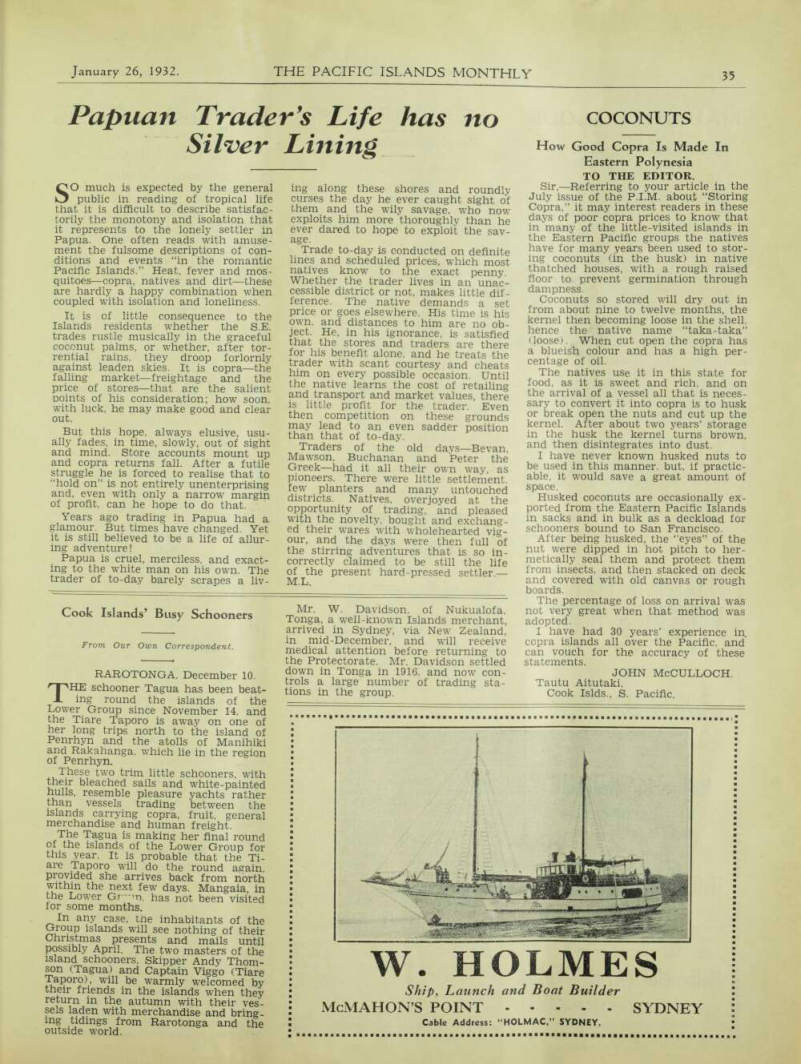
Papuan Trader’s Life has no Silver Lining
SO much is expected by the general public in reading of tropical life that it is difficult to describe satisfac torily the monotony and isolation that it represents to the lonely settler in Papua. One often reads with amuse ment the fulsome descriptions of con ditions and events “in the romantic Pacific Islands.” Heat, fever and mos quitoes—copra, natives and dirt —these are hardly a happy combination when coupled with isolation and loneliness.
It is of little consequence to the Islands residents whether the S.E. trades rustle musically in the graceful coconut palms, or whether, after tor rential rains, they droop forlornly against leaden skies. It is copra—the falling market—freightage and the price of stores—that are the salient points of his consideration; how soon, with luck, he may make good and clear out.
But this hope, always elusive, usu ally fades, in time, slowly, out of sight and mind. Store accounts mount up and copra returns fall. After a futile struggle he is forced to realise that to “hold on” is not entirely unenterprising and, even with only a narrow margin of profit, can he hope to do that.
Years ago trading in Papua had a glamour. But times have changed. Yet it is still believed to be a life of allur ing adventure!
Papua is cruel, merciless, and exact ing to the white man on his own. The trader of to-day barely scrapes a liv
ing along these shores and roundly curses the day he ever caught sight of them and the wily savage, who now exploits him more thoroughly than he ever dared to hope to exploit the sav age.
Trade to-day is conducted on definite lines and scheduled prices, which most natives know to the exact penny.
Whether the trader lives in an unac cessible district or not, makes little dif ference. The native demands a set price or goes elsewhere. His time is his own, and distances to him are no ob ject. He, in his ignorance, is satisfied that the stores and traders are there for his benefit alone, and he treats the trader with scant courtesy and cheats him on every possible occasion. Until the native learns the cost of retailing and transport and market values, there is little profit for the trader. Even then competition on these grounds may lead to an even sadder position than that of to-day.
Traders of the old days—Bevan.
Mawson, Buchanan and Peter the Greek —had it all their own way, as pioneers. There were little settlement, few planters and many untouched districts. Natives, overjoyed at the opportunity of trading, and pleased with the novelty, bought and exchang ed their wares with wholehearted vig our, and the days were then full of the stirring adventures that is so in correctly claimed to be still the life of the present hard-pressed settler.— M.L.
Cook Islands’ Busy Schooners
From Our Own Correspondent.
RAROTONGA, December 10.
THE schooner Tagua has been beat ing round the islands of the Lower Group since November 14. and the Tiare Taporo is away on one of her long trips north to the island of Penrhyn and the atolls of Manihiki and Rakahanga, which lie in the region of Penrhyn.
These two trim little schooners, with their bleached sails and white-painted hulls, resemble pleasure yachts rather than vessels trading between the islands carrying copra, fruit, general merchandise and human freight.
The Tagua is making her final round of the islands of the Lower Group for this year. It is probable that the Ti are Taporo will do the round again provided she arrives back from north within the next few days. Mangaia, in the Lower Gr-m, has not been visited for some months.
In any case, the inhabitants of the Group islands will see nothing of their Christmas presents and mails until possibly April. The two masters of the island schooners. Skipper Andy Thom son (Tagua) and Captain Viggo (Tiare Taporo), will be warmly welcomed by their friends in the islands when they return in the autumn with their ves sels laden with merchandise and bring ing tidings from Rarotonga and the outside world.
Mr. W. Davidson, of Nukualofa, Tonga, a well-known Islands merchant, arrived in Sydney, via New Zealand, in mid-December, and will receive medical attention before returning to the Protectorate. Mr. Davidson settled down in Tonga in 1916, and now con trols a large number of trading sta tions in the group.
Coconuts
How Good Copra Is Made In Eastern Polynesia
To The Editor.
Sir,—Referring to your article in the July issue of the P.I.M. about “Storing Copra,” it may interest readers in these days of poor copra prices to know that in many of the little-visited islands in the Eastern Pacific groups the natives have for many years been used to stor ing coconuts (in the husk) in native thatched houses, with a rough raised floor to prevent germination through dampness.
Coconuts so stored will dry out in from about nine to twelve months, the kernel then becoming loose in the shell, hence the native name “taka-taka” (loose). When cut open the copra has a blueish colour and has a high per centage of oil.
The natives use it in this state for food, as it is sweet and rich, and on the arrival of a vessel all that is neces sary to convert it into copra is to husk or break open the nuts and cut up the kernel. After about two years’ storage in the husk the kernel turns brown, and then disintegrates into dust.
I have never known husked nuts to be used in this manner, but, if practic able, it would save a great amount of space.
Husked coconuts are occasionally ex ported from the Eastern Pacific Islands in sacks and in bulk as a deckload for schooners bound to San Francisco.
After being husked, the “eyes” of the nut were dipped in hot pitch to her metically seal them and protect them from insects, and then stacked on deck and covered with old canvas or rough boards.
The percentage of loss on arrival was not very great when that method was adopted.
I have had 30 years’ experience in copra islands all over the Pacific, and can vouch for the accuracy of these statements.
John Mcculloch.
Tautu Aitutaki, Cook Islds., S. Pacific.
Advertisements & other items, p. 37 (1 item)
W. Holmes
Ship, Launch and Boat Builder
McMAHON’S POINT SYDNEY
Cable Address: “HOLMAC.” SYDNEY.
Mau Still Aloof
Stalemate Continues In Samoa
From Our Own Correspondent APIA, January 1.
THERE are few signs of improve ment in the political arena so far.
The hopes expressed by the New Zea land High Commissioner before the Mandate Commission of the League of Nations, and which seemed to be based on statements made by the late Ad ministrator, Colonel Allen, in his re cently published annual report, appear to be without foundation.
The participation of a few isolated Mau chiefs in the deliberations of the Land and Title Commission has not had any effect on the activities of the Mau movement. Efforts of the present Administrator, General Hart, to get in touch with and bring about a meet ing with the leading chiefs of the Mau have, unfortunately, so far proved un availing.
The petition of the Mau leaders, re cently despatched to the British. Am erican and German Governments (the signatories of the Three Power agree ment) attacks the New Zealand ad ministration and suggests that we are far from a reconciliation.
Bountiful Rains
Tahiti Plantations Benefit
From Our Own Correspondent PAPEETE, December 20.
TAHITI experienced an unusual number of rainy days during November, so that the streams, even on the so-called dry belt of the island, are flowing once more.
Floods and washaways are reported from the south-eastern districts, where the precipitation has amounted to sev eral inches a day in some places, but no serious damage has been done. Al ready the hills behind Papeete are resuming their normal greenness and those occupied on the land —as are most of the population here —are hoping that the present season will approach something near the average in the matter of rainfall.
Experience in the tropics proves that the coconut, the principal crop, of course, does not produce to full capac ity on less than about 70 inches of rain per annum.
The recent downfall will also greatly relieve the municipal water supply situation in Papeete and adjacent vil lages. where the shortage had occa sioned great inconvenience in some localities.
Castaways
On Cocos
Rescued By American Cruiser
From Our Own Correspondent PAPEETE, December 20.
THE palatial yacht, Camargo, owned by the Fleishmann family, of Cin cinnati, U.S.A., who are famous as the proprietors of Fleishmann's yeast, called in at Papeete on November 13, on her way to the Western Pacific.
When approaching Cocos Island, which lies off the Ecuadorian coast and has been combed over many times for a treasure which is supposed to be buried there, the people on the Cam argo were surprised to observe some huts ashore showed signs of recent renovation and occupation. Nobody appeared, however, in answer to their signals, but a landing party discovered a note in one of the huts saying that the late occupants had departed for the opposite end of the island, where they expected a better chance of finding coconuts and other food.
Steaming round the island a search among the densely-wooded hills and broken country of the interior yielded no results. Fortunately, the Camargo was able to get into wireless touch with the U.S. Cruiser, Richmond, and the castaways, three in number, were ulti mately rescued.
It appears that thev had escaped from the wreck of an American vessel some time previously and had existed ever since on the wild pigs and other natural products of Cocos. What hap pened to the rest of the crew we have yet to learn.
The Camargo left Papeete for Raro tonga, in the Cook group, after a three days’ stay in this port.
Polynesian Cattle
Wild Herds Roam Far Eastern Islands
From Our Own Correspondent PAPEETE, December 20.
THE results of the recent live stock census have been just published.
According to these, the island of Tahiti together with its neighbour, Moorea, contains 5,703 head of cattle, 1,841 horses, 247 sheep, 3,252 goats, and 6,679 pigs.
Most of the cattle are of course, kept as a necessary adjunct to coconut plan tations, where they not only supple ment the revenue derived from the palms, but also provide the most desir able sort of fertiliser for the land and save the planter money by keeping the growth of weeds and grass within reas onable limits.
The total number of cattle appears small, nevertheless the Papeete market is well supplied with beef at low prices.
Butchers are now paying 2.50 francs per kilo, live weight, for steers, and round about a franc per kilo more for dressed carcases, and it is noticeable, as one result of the drop in cattle prices, that veal is always in evidence on the market. This could seldom be had when cattle were selling at 9 to 10 francs per kilo live weight. Undoubt edly there are more than enough cattle to meet the local demand for beef in these depressed times. The importa tion of cold-storage beef from New Zealand has entirely ceased.
No figures are available for the Lee ward Urioup and other parts of French Oceania, where considerable numbers of cattle also exist.
Herds of wild cattle, sleek and beau tiful, whose progenitors probably date back to the first animals landed on the island by Captain Cook, roam the interior valleys of Tahiti. These are often dangerous to approach, and as the places they frequent are most difficult of access, it is seldom that our local Nimrods work up enough energy and enthusiasm to go after them.
Wild pigs and goats are also plenti ful in most of the islands, and it is said that the former have increased to such an extent in some of the Mar quesas Islands as to constitute a real menace. There, over considerable areas, the goats have eaten out and eventu ally killed off the natural pasturage and taken to the bark of trees as the only remaining means of sustenance, thus transforming in the course of years a tropical paradise into a dry and wind swept wilderness devoid of vegetation
Further Taxation In
N. Caledonia
From Our Own Correspondent NOUMEA, January 5.
THE Governor, in the course of his address at the opening of the second ordinary session of the Censeil General, at Noumea, in December, stated that it had been found impos sible to reduce expenditure to the ex tent of the anticipated fall in revenue for the ensuing financial year.
Consequently, it would be necessary to lew further charges and taxation in order to balance the budget.
Advertisements & other items, p. 38 (1 item)
Holbrooks’
DELICIOUS SOUPS
In 8 oz. and 16 oz. Tins Ready to serve.
TOMATO, VEGETABLE,
MULLIGATAWNY, OX TAIL
AND MOCK TURTLE.
Holbrooks’ Spaghetti
IN TOMATO SAUCE
In 4 oz. and 8 oz. tins.
Holbrooks’ Baked Beans
WITH PORK
In 4 oz. and 8 oz. tins
Holbrooks (A/sia) Ltd.
WATERLOO, N.S.W.
Radio Boom Likely
In French Oceania
From Our Own Correspondent PAPEETE, December 20.
NEW regulations of considerable im portance to local radio enthusi asts were promulgated in The Journal Officiel of the Colony, on November 16.
These do away with a lot of confu sion and difficulty hitherto existing in regard to the installation of both re ceiving and sending outfits, and are expected to beneficially affect certain privately-owned outlying islands, which have been denied wireless communica tion up to the present.
Incidentally, there will be probably a large increase in the number of ama teur receiving sets in and around Pa peete.
Massacres On
The Fly River
28 Arrests In Papua
From Our Own Correspondent PT. MORESBY, December 31.
THE Resident Magistrate of the Western Division reported in Nov ember that there had been a raid on the villages of Weriadai and Suwami, 100 miles up the Fly River, by head hunters of the hinterland, and that, on investigation, he had found that 17 men of these villages had been killed.
The offending tribe, a nomadic people near Suki Creek, had made friendly approaches and mixed freely with their intending victims, “holding up bunches of tobacco and intimating their desire to trade.” Bau-baus (native pipes) were exchanged and the Weriadia people were completely deceived.
It appears that the Suki men had brought down their women with them in their canoes to allay any suspicions that might arise, and these women sur reptitiously handed out tomahawks and spears at the opportune moment.
The Sukis attacked without warning and of the 22 villagers only 5 escaped with their lives, although they were wounded by tomahawks and spears.
News has been now received that 28 of the Suki murderers have been caught and brought down to the Gov ernment station at Daru, by Mr. Wood ward and Mr. Jack Hides, Patrol Offi cer and their armed constabulary.
The severed heads of the victims, found in the possession of the raiders, have been identified by the Weredai people and the trial of these head hunters is in progress.
Sir Hubert Murray, the Lieut.-Gov ernor, who was accompanied by Lady Murray and the Hon. H. L. Murray, the official secretary, has just returned from a special trip of investigation to the Fly River.
Mr. Woodward and Mr. Hides are to be congratulated on their quick work.
Considering the character of the coun try and the semi-nomadic tribe they had to deal with, it was not expected that they would have been successful in so short a time.
Advertisements & other items, p. 39 (1 item)
Greenwood & Laws
MARIE
Biscuits are ideal for Afternoon Tea.
Always ready and crisp, they save a world of work and never fail to please everyone.
(Bottom of King Street)
Tarpaulins & Tents
Made and Hired
Sails of all descriptions by expert workmen.
COOLA VERANDAH BLINDS
of all descriptions made from a Codes used: Bentley's large selection of multi-coloured Cable Address and A.8.C., 6th Ed. * canvas Alune. Sydney
GREENWOOD & LAWS
MINING, LAND AND MANUFACTURERS’ AGENTS
COMPANY SECRETARIES AND REPRESENTATIVES. IMPORTERS AND
EXPORTERS.
RABAUL - - NEW GUINEA
Tonkinese Labour
Big Exodus From N. Caledonia
From Our Own Correspondent NOUMEA, January 5.
AS forecast in The Pacific Islands Monthly, the outflow of inden tured Tonkinese and Javanese labour ers continues and it is estimated that within the next two or three months fully 1,000 coloured people will leave the colony.
It is evident that the absence of this indentured labour will make itself felt in the economic life of the col only. Not only will the revenue earned by these workers be lost to New Cale donia, but the circulation of money earned by them, as well as their own consuming power, will also be missed.
It is, however, only part of the gen eral readjustment of conditions and values throughout the world. New Caledonia has been particularly lucky so far, but it cannot continue to escape the natural readjustment at present going on.
Scientists For Tahiti
PAPEETE, January 1.
THE Union Steamship Co.’s freighter Waihemo, just recently landed 1,600 drums of fuel oil for the yacht Iolanda, which is expected to arrive at Tahiti at an early date with a large scientific research party aboard.
Shooting Affray in Cook Islands
From Our Own Correspondent.
RAROTONGA, December 4.
THE community was painfully stir red by the news of a shooting affray at one of the villages (Aorangi) on the island.
The trouble appears to have occurred over the question of removal of a cot tage from a piece of land, the property of a white man, Mr. T. Watson. The other person interested in the matter of possession of the cottage, Mr. D.
McBirney, also a white man, took steps to demolish the structure with the idea of carting it away in sections by lorry.
With a working party of natives, Mr.
McBirney made a start on the work at about 7 o’clock in the morning. Mr.
Watson appeared on the scene with a small shotgun and, it is believed, fired upon Mr. McBirney, who at the moment was on the roof of the build ing.
Mr. McBirney, who was peppered about the arms and body with small shot, was taken to the hospital for attention. In the absence of the doc tor the extent of his injuries is not definitely known, but reports disclose that he is in no danger.
Watson has been arrested and is to be tried at Rarotonga for attempted murder. Conflicting opinions are said to exist in the community as to whether the shooting was intentional.
New Machinery For Pt. Moresby
Power House
From Our Own Correspondent.
Pt. Moresby, Dec. 9.
THE work of installing the new en gine in the Local Government Power House is still proceeding and is nearing completion.
Mr. W. Chisholm, engineer for the Ruston Hornsby Company, is erecting the 150-165 horse power Ruston Hornsby engine, and it is being tested and inspected by Mr. Cuthbertson, the Government’s consulting engineer, who arrived by the last boat, before it is taken over from the contractors.
It is expected the engine will be in running order within the next few weeks and will make a great diflerence to the electric supply of Port Moresby, which has been overtaxed for some time.
Cook Islands Notes
Many Residents Leave for N.Z.
From Our Own Correspondent.
RAROTONGA, December 11.
NUMEROUS privately arranged farewell parties are taking place on the eve of the departure by the R.M.S. Monowai of a number of residents for New Zealand.
The majority will return to Rarotonga in February and March next year. Two of the local school teachers, Miss M. Mooney and Mr. C. Taverner, intend to proceed to New Zealand for their vacation.
Amongst those leaving to resume permanent residence in the Dominion is Mr. S. Hegin botham, superintendent of the wireless sta tion, with his wife and child. Mr. Heginbotham has spent over five years at Raro tonga and leaves behind him a good record of service to the inhabitants of these islands.
The local chief, Ariki, Makea Tinirau, also leaves for New Zealand by the Monowai.
Armistice Day Celebrations.
Armistice day was observed as a special holiday at Rarotonga. The Rev. Bond James and his newly appointed assistant, the Rev.
Cater, conducted a service at the London Mission Church. Returned soldiers of the Cook Islands Pioneer Battalion paraded in uniform.
Also a troop of native Girl Guides attended in regimental dress. Later the units marched to the memorial outside the Administrative Building. Overnight native women had en closed portion Of the grass plot surrounding the monument with ropes of flowers the sweetly scented Frangi pani. The enclosure was also decorated with streamers of flowers strung from the top of the monument to each corner of the barrier. Two minutes’ silence was observed, the only sound heard being the subdued roar and crunching of breakers on the reef, no doubt, recalling to many of those present memories of the firing line in France and on other battle fronts.
The Resident Commissioner, Judge Ayson, accompanied by the chief Ariki, Makea Tini hau, and members of the Island Council, each placed a wreath at the foot of the monu ment in honour of the dead who enlisted from amongst the native race here. Many of those present bore evidence in their grey hair of the passing of the years since they first stood with bare head before the small granite column erected on the narrow, well kept, grass plot outside the Administrative Offices.
The school concert, long looked forward to by the native boys and girls, took place recently. Tremendous applause greeted the Hula Hula dance.
Several of the boys, playing leading parts, threw in lively oddments off their own bat, to the dismay of the teachers and the delight of everyone present. A ballet, headed by Miss Ada Savage, introduced a Hollywood touch to the performance. The school children carried through their individual parts with vigour and confidence and threw themselves whole-heartedly into the various items, whether vocal parts or gymnastic turns.
Advertisements & other items, p. 40 (1 item)
Flour
Teeth in one day for visitors to my surgeries. Painless extractions, reli able fillings, gold crowns and Bridge work. Old plates remodelled. 28 OXFORD ST., over Winns;
Have Teeth By Post
Let me send yon free full particulars of my well known and successful method of
“SELF TAKEN IMPRESSIONS”
by which I can make you teeth by post.
All details by return mail.
Natural gum, unbreakable sets, comfortable and long lasting.
SPENCER NOLAN,
DENTIST
177 OXFORD ST., opposite Mcllraths; 139 ELIZABETH ST., two doors from Market St., Sydney.
Beam Wireless, Telegraphic and Cable Address: “Fastplate,” Sydney. P.I.M.
Flour
ASK FOR IT
ESTABLISHED 1868.
Port Moresby’s
New Hospital Historic Landmark Passes
From Our Own Correspondent PT. MORESBY, December 31.
ANOTHER landmark of the old pioneering days in Papua, the old European Hospital, is being removed.
The new hospital, an imposing and beautiful building of reinforced con crete, is now completed and patients are being admitted.
The old building, which has been in use for 26 years, was on its last legs.
It could tell some tragic tales of the end of many a pioneer’s struggles against too heavy odds, when prospect ing and pioneering in the Papuan wilds In the old days of the Tiveri, Lakekamu and the Astrolabe gold rushes were more disastrous than romantic or re munerative.
In 1909, when gold was discovered on the Lakekamu by Mat Crow and the Pryke brothers, miners poured into the country. Inexperienced men with no knowledge of the country and its con ditions came unequipped, without money or provisions. Some were under the impression that the field was within walking distance, others set off alone, refusing to engage boys or to take tents and scorning nets, on the ground that they had ever used them before. In a very short time dreadful days followed, the hospital was taxed to its utmost, for many fell and malaria and dysen tery had their way.
The old hospital was indebted, in the first instance, to Mr. Charles Kow ald, a government agent of the Mekeo district, who met with an accident on an expedition with His Excellency, Sir William MacGregor, and died later in the Cooktown Hospital, in 1896. He bequeathed two building blocks of land and a good residence for a hospital in Port Moresby. Later the Port Moresby citizens subscribed a sum of money and the present site was selected, building material was bought by private sub scription and the work of erection was carried out by the Government. The total cost of the building was £570, of which the Government provided £324, and the building was completed in 1905.
In exchange for the present site, the Government took possession of the pro perty bequeathed by Charles Kowald.
The buildings originally consisted of one large ward and four small rooms, with a verandah all round, with a de tached kitchen and bathroom, a gal vanised iron roof and plain iron walls and ceiling. Stores and dispensary, additions and improvements came later.
Primitive as it was it served the need of the country for some years, but lat terly it has been found quite inadequate and the new hospital, with its spacious rooms and balconies, will be a welcome relief to the citizens of Port Moresby and the planters outside.
The new hospital was designed by Mr. G. M. Turnbull, Architect to the Papuan Government, and is an impos ing landmark on a hill facing the har bour, in full view of the town.
Noumea’S Electric Light
Scheme
From Our Own Correspondent NOUMEA, January 5.
THE Conseil-General has agreed to lend up to 100,000 francs to the company which is installing the elec tric lighting system in Noumea, to en able this work to be properly carried out.
The residents of Noumea are anxi ously awaiting the completion of this desirable service.
Tahiti Yacht Club’s New Premises
PAPEETE, December 20.
THE Tahiti Yacht Club has removed from its old quarters in the Levy building and has taken a lease of the premises up to re cently occupied by the Cercle Bougainville.
Alex. Sturgeons, who ran the Bougainville for a number of years, will be the future manager of the Yacht Club. The new quar ters are airy and commodious and in close proximity to the wharf, so that it is hoped that some financial benefit will accrue to the club as a result of the change to a more central location.
Moresby
Newton Elm’s Stranding Causes Copra Congestion at Port Moresby
From Our Own Correspondent PT. MORESBY, December 31 OWING to the Newton Elm, a copra vessel, being stranded somewhere north of Sydney and not call ing here this month, as scheduled, there is a congestion of copra in Port Mor esby awaiting shipment.
The Newton Elm is one of the steam ers under the agency of Burns, Philp which call here regularly at intervals of three months for the purpose of carrying copra direct to European ports.
Her non-arrival will mean a loss to planters and Burns, Philp, besides general inconvenience through the ac cumulation of copra in the wharf sheds.
The Newton Elm has been since re floated and towed to Sydney for dock ing.
Advertisements & other items, p. 41 (1 item)
Excelsior Supply Co. Ltd.
The most extensive Manufacturers in the British Empire of
RUBBER STAMPS.
INKS, STENCILS.
Marking Devices.
ACME STAMP PADS
We have a big range of Special
FRUIT CASE MARKING SETS
We alto Manufacture or Supply a complete line of
Spraying Machines
for all purposes.
Let us know your requirements and we will quote you by return. Ask for our Big Catalogue.
Sole Australasian Distributors of the World Famous SHEAFFER FOUNTAIN
PENS and PENCILS.
EXCELSIOR SUPPLY CO. LTD.
Head Office:—160 GEORGE STREET WEST,
SYDNEY, N.S.W.
Rarotongan Products
Some Fine Pineapples
From Our Own Correspondent.
RAROTONGA, December 4.
WATERMELONS and Avacado pears are plentiful just now, and locally grown pineapples of good size are being picked.
There are several fairly large areas under pineapple cultivation at Raro tonga, but it would seem that, for the present at least, the supply is not greatly in excess of that which will meet local demand.
In past years (but not now) coffee, tobacco and vanilla beans were grown here and formed part of the export trade of these islands. Competition from without has killed each of these exports, leaving bananas, oranges, copra and tomatoes the support of the Cook Group.
South Seas Wanderers
Mr. Preston Moore, who has taken the New Zealand yacht, Valkyre, on a long-time charter, planned to leave Tahiti at the end of November, with a party of friends, for the Gambier group.
Thence they proposed to visit some of the other Far Eastern groups.
Industry
Samoan Cocoa Industry Good Prices But Small Crops
From Our Own Correspondent APIA, January 1.
THE main cocoa crop of this year has been picked and is much smaller than of last year. On many plantations it amounts in fact to only half of normal.
So far the trees are flowering ex tremely well, which promises for a good first crop next year. Fortunately, the cocoa price continues to be good and even to improve in all our markets.
There is a fair demand and a recent sale in London brought £90 per ton for for first-class washed.
Mr. Patterson, of Magia Plantation, who a few months ago lost his cocoa dryer by fire, has disposed of the lease of his plantation to Mr. Miedicke, who is resigning his position as Chief Eng ineer of the Administration. Mr. Pat terson is at present lying sick at Apia
Hospital,
Thefts from the European cocoa plantations have for a long time pre sented a serious problem to the plant ers, but are now diminishing.
Helping Papua Producers
Primage Exemptions
From Our Own Correspondent FT. MORESBY, December 31.
SOME measure of relief for producers from the primage duty has been granted by His Excellency the Lieut.- Governor, by an order that goods or packages for use in exporting Papuan produce shall be added to the list of exemptions under the Primage Duty Ordinance.
Such items will include hessian or the like used in packing rubber for export. The proclamation will take effect as from July last, and applica tions for refunds will be accepted.
New Caledonian Notes
From Our Own Correspondent.
NOUMEA, December 27.
ARMISTICE Day was celebrated in a true French manner at Noumea.
The festivities were organised by the local Association of Returned Soldiers, and there were sporting fixtures, including bi cycle racing, cross-country running, basket ball and other attractions. Large numbers of people attended the various functions, and everything passed off very successfully. Review of troops took place in the morning in the Square, where the war monument is located; decorations were presented, and an aeroplane circled round overhead, dropping small tokens in the French colours.
Savings Bank
People making deposits in the Government Savings Bank have been notified that the maximum amount which they can lodge to their credit has been now increased to 20,000 francs. The interest rate is 3½ per cent.
Exchange Rate
The Bank of Indo-Chine has been quoting selling rates for English and Australian pounds at approximately 96 and 79 francs respectively.
Agricultural Exhibition
On Armistice Day a successful agricultural exhibition was held at Canala. Monsieur Bonnard was president of the judging com mittee and the exhibits, particularly the coffee, were numerous and of a high stan dard. There were a number of prize-winners, including: M. Cherrier, Mme. J. Loquet, Messrs. H. David, Arthur Fere, Cl. Persan, L.
Page and Lacout.
Art Exhibition
A very interesting exhibition was recently organised at Noumea, when a large array of exhibits was displayed. The exhibition con sisted of paintings, sketches, sculpture, em broidery, needlework and other exhibits, and the skill, application and industry of the French people, and incidentally the Italians, was very much in evidence. It is hoped that these exhibitions will take place from time to time.
Advertisements & other items, p. 42 (1 item)
Harry West
BE WISE! - - - SAVE THE RATE OF EXCHANGE.
ORDER YOUR SAILS NOW
From
HARRY WEST
SYDNEY’S SAILMAKER
Sail Makers for 26 years.
Tarpaulins specially made for tropical climates.
Let next Spring find this part of your equipment ready. Have West make your Sails, Awnings and Upholstery. Tents and every class of canvas work a speciality. If it’s in canvas, rope or wire, we make it to any specification.
FOOT DUKE STREET - - - BALMAIN EAST ’Phone W 1105
THE GRAINGER GLASS COMPANY
Stocks all kinds of PLATE, SHEET and FANCY GLASS. Send us Specifications, or a description of your requirements, and we will pack and ship to you at PRICES EQUAL TO THE WORLD’S BEST.
headlight Artists - - Mirror Manufacturers
Buy from Australia and get the full benefit of the Exchange .
GRAINGER GLASS CO., 32 Chalmers St., Sydney
Papuan News
Dull Christmas Holidays
From Our Own Correspondent
Port Moresby, Dec. 31.
Excessively hot weather, followed by a cy clonic storm, helped to mar Christmas Day and the holidays in Port Moresby, though, as a whole, anticipations for a bright and merry time were fairly restrained in this part of the world.
Anyone who has the good fortune to be able to leave the territory for the season does so at the first opportunity. Many residents left the town for the hills, either to stay at rest houses or to visit friends on plantations, and those who were unable foregathered and persuaded themselves that conditions might conceivably be worse and thanked their lucky stars that Christmas comes but once a year.
Commercially Christmas was quiet, even tame, though to some extent the stores have recaptured a little of their former trade, since they have reduced their prices to meet those of the southern) firms. Economists hold the floor in Port Moresby and even those who have no need burble plaintively of the hard times and count their coppers before ventur ing on anything but the most ordinary ex penditure.
Copra, rubber, coffee and gold, the assets of the country, are all not bringing much wealth into the territory, and as the days of investments in Papua seem over for the present, the scale of living in the country has been lowered. Life is much simpler and people are living at bedrock and there is prac tically no social life —a healthier existence, no doubt, if a little corrosive to enterprise.
Father Macenoroe
Farewelled
Father Macencroe, of the Roman Catholic Presbytery, leaves by the Macdhui for a long holiday in Australia, on December 22. His friends gathered in the Presbytery to wish him farewell and to present him with a small gift and generally to express the kindly friendliness with which he is regarded by everyone in Port Moresby.
Little Sporting Activity
Sport, on the whole, is at a standstill, owing to the heat and the general conditions of the N.W. season.
The Cricket Club held it gala day, followed by a dance, and the Golf Club has closed its season, after the finals of the Fitch and Gutheridge Cups were played and won by Mr. Anderson and Mr. de Groen, respectively.
A club dinner was given at which the cups were presented to the winners by the Presi dent of the Club, His Honour, Mr. Justice Gore.
On Boxing Day, the Port Moresby Golf Club entertained the native caddies on the links to a “bunfight” and tournament. It was arranged in their honour in recognition of their consistently good work throughout the year.
Home-made clubs were used, of astonishing good workmanship, made by the caddies themselves, little boys from Hanuabada be tween the ages of 9 and 12. They all played an extraordinarily good game in the tourna ment and at the first hole of 350 yards one little boy of 11 was on the green in 2 and holed out for a 4—a performance which has not been beaten by our best players.
Tongans Enjoy "Sea-Beef”
Two Whales Captured
TWO whales were recently captured at Tonga, and a big trade was done in the whale meat, which was sold to the natives at 20 lbs for 1s.
The whales were cut up alongside the wharf at Nukualofa. During this operation, many sharks were attracted to the scene, some big specimens being harpooned from the wharf.
Unfortunately, during cutting-up operations, one whale floated away and became beached in front of the British Consulate. The odour from the mon ster made the locality rather unpopu lar for the rest of that day.
Solomon Islands
Recruiters Have Lean Days
From Our Own Correspondent.
TULAGI, January 4.
SINCE last writing, little has occurred to disturb the calm; even the price of copra tends toward the monotonous in that it has remained stationary for about four weeks on end, a most unusual happening which optim istic souls take as a sign of stability and promised improvement. The compliments of the season to their hopes.
This depression (hateful word) has cer tainly altered things from a recruiter’s point of view. For years, he was able to pick and choose his orders and complete them at his leisure, but now he goes after them with hat in hand. Fees have been cut almost in half One undecided planter the other day was cajoled into giving a small order by an offer to fix his own price. Still the price agreed upon was profitable to the recruiter, because there is a surplus of labour offering, and completing an order is now a matter of days where it used to be weeks or months.
Bowls Popular at Rarotonga
From Our Own Correspondent.
RAROTONGA, December 4.
An item of extreme importance in Raro tongan bowling circles—sufficient to make the whole place sit up and take notice—was the defeat of the club’s singles champion, Mr.
Alex Baron, proprietor qf the local guest house. Mr. Barron met his Waterloo at the hands of Mr. H. Shearman.
It is rumoured that the present champion pinned his faith to a new grip which he practised in defiance of strong criticism from local experts—graduates of Australian clubs, and clubs as far afield as Scotland.
Improvements at the green appear to be under way. The base and framework of a structure have appeared on the southern bank. Apparently, this is to be the pavilion, for which the club has been striving during the last two years to raise funds. Members of the club remark upon the surprise shown by visitors off the mail boats at the existence of the game here. The bowling grounds, also the tennis club’s grounds which adjoin, cer tainly are very nicely laid out and well pat ronised by visitors to the island
Bulolo Gold Co.
Increase in Capital
IN the annual meeting proceedings of Bu lolo Gold Dredging Ltd. shareholders were advised that the directors were negotiating with Placer Development Ltd. for the pur chase from that company of a large dredging area located immediately down stream from the company’s dredging property in New Guinea.
The terms of purchase have not yet been fully settled, but as the purchase considera tion is to be in Bulolo shares, the directors recommend that the authorised capital of the Bulolo Company be increased to 6,000,000 dollars, in order that an agreement may be signed immediately the terms are settled.
This proposed increase of capital will pro vide, after the above purchase from Placer Development Ltd. is concluded, a large reserve of unissued capital in case further properties should later be acquired.
Advertisements & other items, pp. 43-44 (1 item)
Highly Contagious
CREDIT GUARANTEES LIMITED
350 George Street, Sydney
Est. 1927. Authorised Capital, £50,000 Services undertaken in the Pacific Islands.
INSURANCES COLLECTIONS
TAXATION GUARANTEES
INVESTMENTS
Confidential Reports Supplied TELEPHONE: B 5067. Cables: “Certac.”
Tropic
Ringworm
REDNESS
TINY
ITCHING
UAMMAIION
EXAMINE
YOUR
TOES
WHITE
Perhaps you have in flammation, redness, or skin cracks be tween the toes, tiny itching blisters, white thick skin which is always moist, or dry skin which becomes scaly, accompanied by an unpleasant and characteristic odour. These are all definite symptoms of
"TINEA’’ or TROPIC RING
WORM. This disease is very prevalent Tropical or Semi-Tropical climates
DRY SKIN
WHICH
BECOMES
SCALY
Highly Contagious
This disease is highly contagious and may spread to other parts of the body—scalp, ears, arms, hands, legs, etc.—if immediate steps are not taken to check same. To the many thousands who are suffering from these irri tating skin diseases. “ANTINEA." the definite cure, will come as a blessing.
For Dhobie Itch
Use “Antinea”
"ANTINEA” is a specific preparation for Trnea or ringworm infections. The penetrative power of "ANTINEA" rapidly destroys the "Tinea" fungi, relieves discomfort, restores skin whole ness and ensures normal condition "AN TINEA” also relieves "DHOBIE ITCH." Ring worm, Perionychia, Ringworm of the Nails and other similar skin troubles "ANTINEA" will not harm the living tissues.
Obtainable from all branches of Burns, Philp and Co. Ltd., W. R. Carpenter and Co. Ltd., and A. J. Swann and Co. Ltd. (Suva).
Or direct from
ANTINEA DRUG CO.
WINCELLO HOUSE.
ANGEL PLACE. SYDNEY
Postage, 3d. extra.
Australian Stamps
SOUVENIRS & NOVELTIES
Stamps bought and exchanged
MORRISON’S
113 PITT ST. - - SYDNEY
IMPROVE
YOUR CAR
fit
THE NEW
KLG
K
PLUGS
6/6 each
Smith Sons & Rees,
LIMITED
30-32 Wentworth Avenue,
SYDNEY.
Exclusive Territory Available.
GARDNER HEAVY OIL ENGINES
7 to 300 H.P. HORIZONTAL AND VERTICAL COLD STARTING - - SUITABLE FOR MARINE AND GENERAL INDUSTRIAL PURPOSES
PERRIER & DICKINSON LTD.
26 CLARENCE STREET - - SYDNEY - - N.S.W. - - AGENTS
Held Up!
A "Good Old Custom” On Norfolk Island
Written for The Pacific Islands Monthly by
Lt.-Colonel T. Orde Lees, O.B.E., A.F.C.
UNTIL I read about it in The Pacific Islands Monthly, I do not remem ber clearly having ever heard of Nor folk Island.
From what I read I became roman tically interested in this modern his torical spot and determined to include it in my itinerary on my way from Japan, where I live, to England, my native land.
I went to much trouble and consid erably greater expense than I need otherwise have done, so as to visit the descendants of the famous Bounty.
Sailing from Port Vila in the Mor inda, we arrived at Norfolk Island on January 3. The next morning my wife and I, together with a dozen or more other passengers, decided to go ashore.
The captain of the Morinda kindly placed the ship’s motor boat at our disposal for the purpose, but for con venience in landing we were placed in a rowing boat towed by the motor boat.
The rowing boat was the property of Messrs. Burns, Philp.
On reaching the jetty, the motor boat slipped the rowing-boat, which drifted alongside the jetty under her own way.
Our passage down the jetty was ob structed by a Mr. Victor Edwards, who demanded from each passenger the sum of two shillings. As other pas sengers were following behind me. I judged that it was no time for alter cation, but asked Mr. Edwards what the charge was for and what service, if any, it represented. He replied that it was for “return boat fare.”
As Mr. Edwards was not the owner of the boat, and as neither he nor any of his men did anything at all towards propelling the boat, it seems to me that this is in the nature of a “hold up.” People of whom I inquired about it merely laughed and said it was “an old custom,” and seemed to think that no one ought to mind paying so small a sum. But then they were all people who did not have to pay it.
Inquiries amongst my fellow passen gers revealed that they were all just as much incensed about it as I was. It is, of course, the principle of the thing rather than the amount that consti tutes its impropriety. Really, a Mr.
Nobody, standing on the pier, has no earthly right to charge passengers an admittance fee to an island unless he or his employees own or propel the landing boat or are the proprietors of the jetty. I understand that Mr. Ed
wards is neither, and I should be very much surprised to learn that he is in any way authorised to make such a charge.
As to our return journey, this was made in the motor-boat of the Morinda so that no employee of Mr. Edwards had anything whatever to do with it.
It seems a pity, just when the is landers are doing their utmost to encourage tourists, that Mr. Edwards, or anyone else, should be allowed to waylay well-disposed tourists and mulct them of, in the aggregate, a substantial sum. No intimation whatever was given to passengers about this charge before leaving the ship, nor in the boat.
The first one learns of it is having one’s landing obstructed on the jetty by Mr.
Edwards, where argument is undesir able.
I might add that when I included Norfolk Island in my itinerary I wrote to the authorities there offering to lec ture on the island, free of charge, in aid of the hospital or any other charity as can be gathered from the enclosed letter. Owing to changes in the sched ule of the Morinda I should have been unable to have fulfilled my promise, but that is no reason why I should become a hold-up victim on landing.
I might add that Mr. Edwards’s ac tion deprived a tourist car of two pas sengers, for having been once tricked I declined the attractive offer of the driver of a car to make a tour of the island. I was afraid of being tricked a second time. I was afraid of being set down far from the ship and of being forced to pay a ransom for the return journey.
Steamship Trading Co.’s New
Papuan Mails
Steamship Trading Co.’s New Contract
From Our Own Correspondent
Port Moresby, Dec. 17.
THE successful tenderer for the Government mail contract ser vice for the south coast is the Steamship Trading Co. Ltd. The Gov ernment is making a contract for 12 months from January 1, 1932.
The subsidy in the new contract is reduced to £1,600 per annum, but an increase of 5 per cent, on freights and fares has been approved.
The vessel so employed is the Papuan Chief. Her run will be from Daru to Samarai. taking 32 days, conditions in all respects being similar to those which have been in existence for the past few years.
Lazy Natives of Thursday
Island What’s Bred In the Bone Will Not Be Cured by Free Fishing Boats
From Our Own Correspondent THE large and increasing number of young darkies of both sexes, born and bred on Thursday Island, seems to have again at tracted attention and it is rumoured plans to provide the local men with fishing boats of their own, and other similar schemes in readiness for the coming generation, are under consideration.
In fact, the employment of T.I.’s coloured citizens has become the latest “problem” of philanthropists.
There is no necessity, however, to magnify the prevailing unemployment of local natives to such dimensions. As a problem it does not exist, or if so is capable of a very easy solu tion. The coloured boys of the town can always get work from the local shellers, at any rate till they prove themselves utterly useless, and the girls would be rushed for domestic service if only they were willing to do it.
The co-operative boats of the outer islands have always needed a lot of spoon-feeding, and some of the methods used to induce the boys to work would not go down with the local youth—he knows too much. In any case, good results, which have not been jacking, depend on the personality and industry of the captain and these may be lacking amongst our town bred lads.
When both girls and boys of local origin show an inclination to take advantage of what is actually offering at the present time, it will be time enough to offer the latter boats of their own. But if they are to come under the existing Act we doubt if any independent natives will rush them.
However, most people here know the root trouble responsible for the laziness of the local native. A single axe blow in one direc tion, would send some of our best known street ornaments rushing for a job at sea in order to keep the home fires burning. What about instituting reforms of that nature?
Legalisation of certain matters would bring them about, even if our Anglo-Saxon sense of fitness is temporarily shocked thereby.
It must not be thought that the T.I. nat ives have been totally neglected up to date.
Both churches have made efforts to remedy their condition, and the establishment of a school and station at Hammond Island was a step in the right direction.
But wider reforms must be political and may run contrary to our accepted notions if they are to succeed. The special problems of Thursday Island need different treatment from the rest of Queensland and, with the best will in the world, new fishing boats will not solve them.
"Camargo” at Solomons
From Our Own Correspondent.
MAROVO, Sol. Is., Jan. 1.
LAST month the Solomon Islands were honoured by a visit from the American millionaire, Mr. Julius Fleischmann, and his family, in his 1,000-ton yacht, “Camargo.” It is their plan to make a two-years’ tour of the world.
Their main object in coming to the Islands was to see the simple life of the natives and collect curios and photographs. It is Mr. Fleischmann’s intention, after returning to America, to furnish a room in his palatial home at Cincinnati with all the curios he collects on his voyage.
After leaving Tulagi the Camargo was piloted through the Marovo and Roviana Lagoons, where Mr. Fleisch mann and his visitors had ample op portunities of visiting the most beauti ful parts of the Islands. With their up-to-date fishing tackle and fast launches they were able to enjoy some very good fishing, the Marovo lagoon being particularly suitable for this sport.
They intended calling in at the Bou gainville Group and hoped to reach Batavia in the early part of the New Year.
“I find your paper most interesting, and it certainly fills a long-felt want in the Islands. The majority of people living ashore on any of these Island Groups are surprisingly ignorant of conditions elsewhere in the Pacific.” . . . Capt. John McCulloch, Aitutaki, Cook Islands.
Advertisements & other items, pp. 45-46 (2 items)
against the varying con
THE pains of Stiff
Neck, Stiff Joints
or Backache are quickly All chemists and stores, or direct relieved from Vincent Chemical Co.,
by taking Sydney.
GENUINE
Pink Powders and In packets of 12 and 24 Tablets 1/6 & 2/6
Made expressly to keep a lustrous, full gloss finish
against the varying con
ditions of moist weather exposure, and prevent the decaying ravages of rain and extreme heat by
giving a long lasting pro
tection to all surfaces.
SUN PROOF
RAIN PROOF
“Stronger than the Weather”
W. R. CARPENTER
& CO. LTD.
New Guinea, Solomon Islands, and all other South Sea
FOR SALE
FETTER MARINE OIL ENGINE,
36/42. Slightly used but in first-class condition. Full particulars from—
GIBSON, BATTLE & CO. LTD.
535 KENT ST. SYDNEY
Wallaringa
Mansions
NEUTRAL
BAY
SYDNEY
Tariff: From £2/5/- to £3/3/- per week For all information apply The Manager Occupying one of the picked positions absolutely on the shores of Sydney Harbour. Quiet and secluded and only fifteen minutes (including restful ferry trip of 12 minutes) from G.P.O., Theatres, Shopping Centre, and within easy distance of all other places of interest. The Mansions are complete with Lounges, Smoking Rooms, Tennis, Bowling Green, Own Private Swimming Baths, Ball Room, Guests’ Laundry and Electric Light.
THE IDEAL COOLING APPARATUS FOR
TROPICAL
CLIMATES
COLD STORE SAFE
Special Advantages:
1. Collapsible—saves freight. 2. Water supply is absolutely dust-proof. 3. No cloth to move or taps to shut off when opening door. 4. Bottom of door-cloth always in water, 5. Door and side cloths instantly removable for washing. 6. Safe fitted with Patent Valves and adjust able float, guaranteeing no drying of side or front cloths; no overflow. 7. Uses 50 per cent, less water. 9. Lacquered green outside.
8. ONCE FILLED WITH WATER, SAFE
WILL RUN FOR THREE DAYS WITHOUT
ATTENTION.
PRICE, Complete, packed in case: No. 1, 16½ xl5 x 17½in. high .. £4 5 0 No. 2, 20½ xl6 x 17½in. high . . £5 0 0 No. 3, 22 xl7 x 27½in. high .. £6 0 0 No. 1 packed weighs 461bs. Cubic Measure 3½ft. No. 2 packed weighs 561bs, Cubic Measure 4½ft, No. 3 packed weighs 901bs, Cubic Measure 6*ft. C.LF. delivered port of call. If not obtainable from your local storekeeper write to us direct. Spare parts for this cooling chest always kept on hand. Illustrated Catalogue on request.
CHOWN BROS. & MULHOLLAND LTD.
WATTLE STREET - - SYDNEY
Cable Address: Chowns, Sydney.
Newbold Silica
FIRE-BRICK Co. Ltd.
Manufacturers of High Grade Refractories Silica Bricks, High Alumina Fire Bricks, Siliceous Fire Bricks, Chrome Bricks, Bauxite Bricks, “Sealtite” (hot patching cement), Diatomaceous insulation.
Enquirers are requested to Rive full particulars of temperatures and purposes for which refractories are required.
The Newbold Silica Fire-Brick Co. Ltd.
109 ELIZABETH ST., SYDNEY
Pt. Moresby Delights Malolo
Tourists
From Our Own Correspondent.
PT. MORESBY, December 9.
The Matson liner Malolo arrived in Port Moresby on November 19 on a pleasure cruise of the Pacific from the Celebes (Dutch East Indies) en route to Sydney.
There were 150 tourists on board, who seemed eager to see as much of this “Cannibal Isle” as was possible in the short-time they were here. They were delighted and charmed with the harbour, the view, the natives and the country in general. The weather was perfect, and Port Moresby and its sur rounding hills looked at their best. A native dance had been arranged at the headquarters parade ground, which was of more than usual interest; also a canoe race over the harbour.
Residents were invited on board in the afternoon, and inspected the lounges, smoking-rooms and swimming pools and decks with as much interest and curiosity as the Americans did Port Moresby—an exchange of courtesy —or mutual inquisitiveness.
The American Express Companies intend to include Port Moresby on the next pleasure cruise which the new Matson liner will make next year.
Fancy Dress Functions in the Solomons
Solomons
From Our Own Correspondent.
TULAGI, January 10.
THE “Residency” staged a Fancy Dress affair on Christmas night, much to the enjoyment of those pre sent, and a similar event was given on the 28th by the Gavotu (Lever’s) Re creation Club.
At this there must have been the better part of a hundred guests present, including the Mataram’s passengers and officers. The Fancy Dress judges had no difficulty in deciding on Mrs.
Ashley (wife of the R.C.) as being the best of the ladies, with her portrayal of a Venetian lady; while in the men’s section Major Frank Hewitt gave them an easy task with his “Mrs. Gamp.”
If the judges erred at all, it was in not awarding Bertie Johnstone a spe cial prize for his most appropriate “Pirate.”
Advertisements & other items, p. 46 (1 item)
Visitors to the
Solomon Islands
A plantation home on the island of Ysabel, British Solomon Islands, is open to Tourists, or Travellers desiring ex perience of Islands life. Riding, tennis, bathing (sea-beach and river), etc. Mod ern comforts include refrigeration.
Apply “Fulakora,” Ysabel, via Tulagi, British Solomon Islands. Or call for particulars at Pacific Publications Ltd., Union House, 247 George St., Sydney.
Exchange Quotations
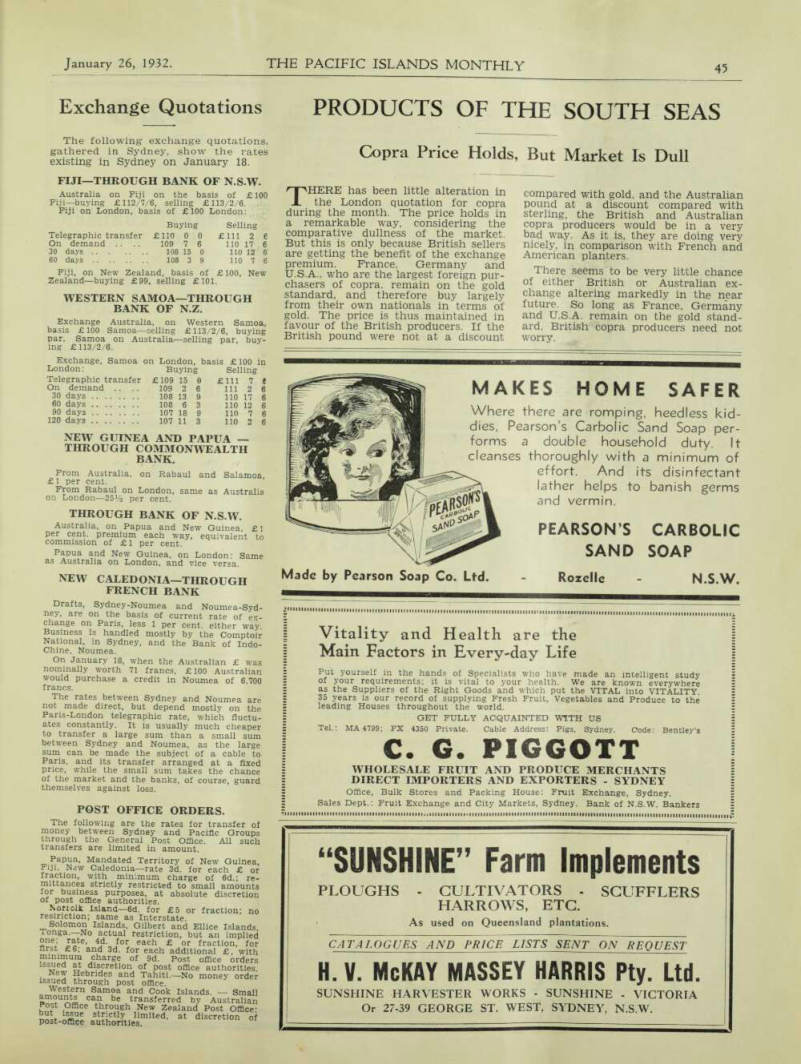
The following exchange quotations, gathered in Sydney, show the rates existing in Sydney on January 18.
Fiji—Through Bank Of N.S.W.
Australia on Fiji on the basis of £100 Fiji—buying £112/7/6, selling £113/2/6.
Fiji on London, basis of £100 London:
Western Samoa—Through
Bank Of N.Z.
Exchange Australia, on Western Samoa, basis £100 Samoa —selling £113/2/6, buying par. Samoa on Australia —selling par, buy ing £113/2/6.
Exchange, Samoa on London, basis £100 in
New Guinea And Papua
Through Commonwealth
Bank.
From Australia, on Rabaul and Salamoa, £1 per cent.
From Rabaul on London, same as Australia on London—25½ per cent.
Through Bank Of N.S.W.
Australia, on Papua and New Guinea, £1 per cent, premium each way, equivalent to commission of £1 per cent.
Papua and New Guinea, on London: Same as Australia on London, and vice versa.
New Caledonia—Through
French Bank
Drafts, Sydney-Noumea and Noumea-Syd ney, are on the basis of current rate of ex change on Paris, less 1 per cent, either way.
Business is handled mostly by the Comptoir National, in Sydney, and the Bank of Indo Chine, Noumea.
On January 18, when the Australian £ was nominally worth 71 francs, £100 Australian would purchase a credit in Noumea of 6,700 francs.
The rates between Sydney and Noumea are not made direct, but depend mostly on the Paris-London telegraphic rate, which fluctu ates constantly, it is usually much cheaper to transfer a large sum than a small sum between Sydney and Noumea, as the large sum can be made the subject of a cable to Paris, and its transfer arranged at a fixed price, while the small sum takes the chance of the market and the banks, of course, guard themselves against loss.
Post Office Orders.
The following are the rates for transfer of money between Sydney and Pacific Groups through the General Post Office. All such transfers are limited in amount.
Papua, Mandated Territory of New Guinea Fiji. New Caledonia—rate 3d. for each £ or fraction, with minimum charge of 6d.; re mittances strictly restricted to small amounts for business purposes, at absolute discretion of post office authorities.
Norfolk Island—6d. for £5 or fraction; no resinction; same as Interstate.
Solomon Islands, Gilbert and Ellice Islands Tonga.—No actual restriction, but an implied one rate, 4d. for each £ or fraction, for first £6; and 3d. for each additional £, with minimum charge of 9d. Post office orders issued at discretion of post office authorities.
New Hebrides and Tahiti.—No money order issued through post office Weston Samoa and Cook Islands. Small amounts can be transferred by Australian Post Office through New Zealand Post Office: nnof limited, at discretion of post-office authorities.
Buying Selling Telegraphic transfer £110 0 0 £111 2 e On demand ... 109 7 6 110 17 6 30 days 108 15 0 110 12 6 60 days 108 3 9 110 7 6 Fiji, on New Zealand, basis of £100, New Zealand—buying £99, selling £101.
London: Buying Selling Telegraphic transfer £109 15 0 £111 7 fl On demand ... 109 2 6 111 2 6 30 days 108 13 9 110 17 6 60 days 108 6 3 110 12 6 90 days 107 18 9 110 7 6 120 days 107 11 3 110 2 6
Products Of The South Seas
Copra Price Holds, But Market Is Dull
THERE has been little alteration in the London quotation for copra during the month. The price holds in a remarkable way, considering the comparative dullness of the market.
But this is only because British sellers are getting the benefit of the exchange premium. France, Germany and U.S.A., who are the largest foreign pur chasers of copra, remain on the gold standard, and therefore buy largely from their own nationals in terms of gold. The price is thus maintained in favour of the British producers. If the British pound were not at a discount
compared with gold, and the Australian pound at a discount compared with sterling, the British and Australian copra producers would be in a very bad way. As it is, they are doing very nicely, in comparison with French and American planters.
There seems to be very little chance of either British or Australian ex change altering markedly in the near future. So long as France, Germany and U.S.A. remain on the gold stand ard. British copra producers need not worry.
Advertisements & other items, p. 47 (1 item)
“SUNSHINE” Farm Implements
MAKES HOME SAFER
Where there are romping, heedless kid dies. Pearson’s Carbolic Sand Soap per forms a double household duty. It cleanses thoroughly with a minimum of effort. And its disinfectant lather helps to banish germs and vermin.
Made by Pearson Soap Co. Ltd.
PEARSON’S
SAND
Rozelie
CARBOLIC
SOAP
N.S.W.
Vitality and Health are the
Main Factors in Every-day Life
Put yourself In the hands of Specialists who have made an intelligent study of your requirements: it is vital to your health. We are known everywhere as the Suppliers of the Right Goods and which put the VITAL into VITALITY. 35 years is our record of supplying Fresh Fruit, Vegetables and Produce to the leading Houses throughout the world.
GET FULLY ACQUAINTED WITH US
Tel.: MA 4799; FX 4350 Private. Cable Address; Pigs, Sydney. Code: Bentley’s
C. C. PIGGOXT
WHOLESALE FRUIT AND PRODUCE MERCHANTS
DIRECT IMPORTERS AND EXPORTERS - SYDNEY
Office, Bulk Stores and Packing House: Fruit Exchange, Sydney.
Sales Dept.: Fruit Exchange and City Markets, Sydney. Bank of N.S.W. Bankers
“SUNSHINE” Farm Implements
PLOUGHS - CULTIVATORS - SCUFFLERS
HARROWS, ETC.
As used on Queensland plantations.
CATALOGUES AND PRICE LISTS SENT ON REQUEST H. V. McKAY MASSEY HARRIS Pty. Ltd.
SUNSHINE HARVESTER WORKS - SUNSHINE - VICTORIA Or 27-39 GEORGE ST. WEST, SYDNEY, N.S.W.
Market Quotations
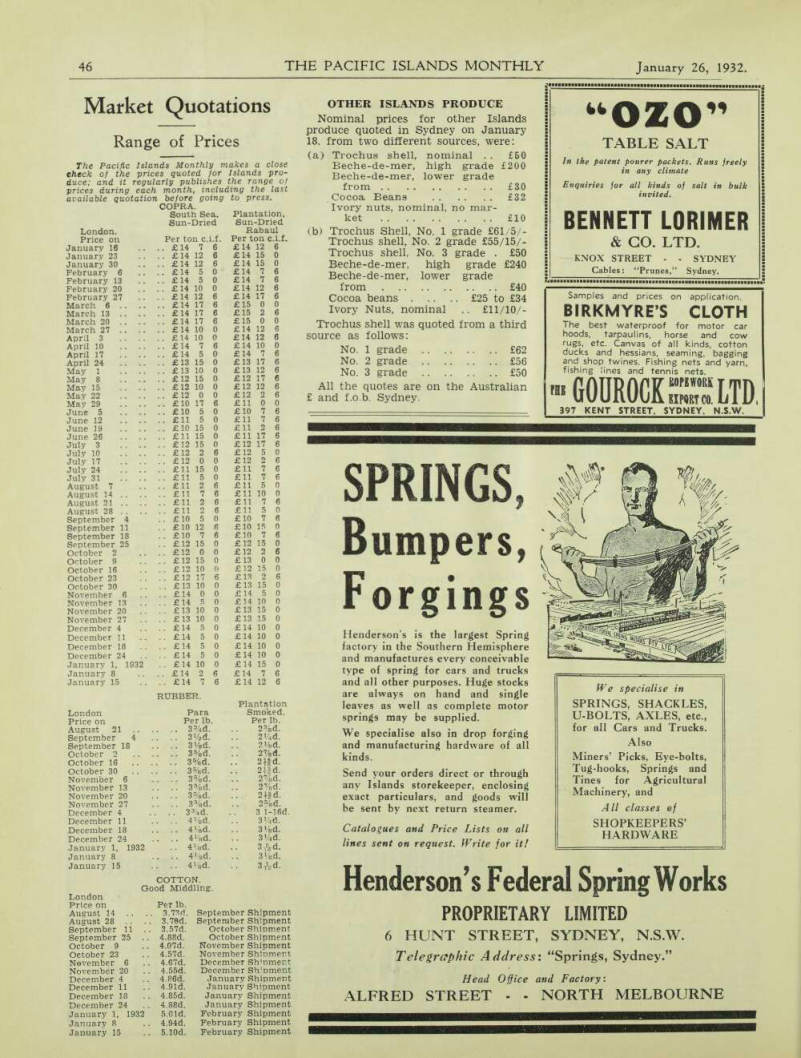
Range of Prices
The Pacific Islands Monthly makes a close check of the prices quoted for Islands pro duce; and it regularly publishes the range of prices during each month, including the last available quotation before going to press.
Other Islands Produce
Nominal prices for other Islands produce quoted in Sydney on January 18, from two different sources, were: (a) Trochus shell, nominal . . £50 Beche-de-mer, high grade £200 Beche-de-mer, lower grade from £30 Cocoa Beans £32 Ivory nuts, nominal, no mar ket £100 (b) Trochus Shell, No. 1 grade £61/5/- Trochus shell, No. 2 grade £55/15/- Trochus shell, No. 3 grade . £50 Beche-de-mer, high grade £240 Beche-de-mer, lower grade from £40 Cocoa beans £25 to £34 Ivory Nuts, nominal .. £11/10/- Trochus shell was quoted from a third source as follows; No. 1 grade £62 No. 2 grade £56 No. 3 grade £50 All the quotes are on the Australian £ and f.o.b. Sydney.
Copra.
South Sea.
Plantation, Sun-Dried Sun-Dried London.
Rabaul Price on Per ton c.i.f.
Per ton c.i.f.
January 16 .. £14 7 6 £14 12 6 January 23 .. £14 12 6 £14 15 0 January 30 .. £14 12 6 £14 15 0 February 6 .. £14 5 0 £14 7 6 February 13 .. £14 5 0 £14 7 6 February 20 .. £14 10 0 £14 12 6 February 27 .. £14 12 6 £14 17 6 March 6 .. £14 17 6 £15 0 0 March 13 .. . . £14 17 6 £15 2 6 March 20 .. .. £14 17 6 £15 0 0 March 27 .. .. £14 10 0 £14 12 6 April 3 . . £14 10 0 £14 12 6 April 10 .. £14 7 6 £14 10 0 April 17 . . £14 5 0 £14 7 6 April 24 .. £13 15 0 £13 17 6 May 1 .. £13 10 0 £13 12 6 May 8 .. £12 15 0 £12 17 6 May 15 .. £12 10 0 £12 12 6 May 22 .. £12 0 0 £12 2 6 May 29 .. £10 17 6 £11 0 0 June 5 .. £10 5 0 £10 7 6 June 12 .. £11 5 0 £11 7 6 June 19 .. £10 15 0 £11 2 6 June 26 .. £11 15 0 £11 17 6 July 3 .. £12 15 0 £12 17 6 July 10 .. £12 2 6 £12 5 0 July 17 .. £12 0 0 £12 2 6 July 24 .. £11 15 0 £11 7 6 July 31 .. £11 5 0 £11 7 6 August 7 .. £11 2 6 £11 5 0 August 14 . . . . £11 7 6 £11 10 0 August 21 .. £11 2 6 £11 7 6 August 28 . . .. £11 2 6 £11 5 0 September 4 .. £10 5 0 £10 7 6 September 11 .. £10 12 6 £10 15 0 September 18 .. £10 7 6 £10 7 6 September 25 .. £12 15 0 £12 15 0 October 2 . . £12 0 0 £12 2 6 October 9 .. £12 15 0 £13 0 0 October 16 . . £12 10 0 £12 15 0 October 23 .. £12 17 6 £13 2 6 October 30 .. £13 10 0 £13 15 0 November 6 . . £14 0 0 £14 5 0 November 13 . . £14 5 0 £14 10 0 November 20 . . £13 10 0 £13 15 0 November 27 .. £13 10 0 £13 15 0 December 4 .. £14 5 0 £14 10 0 December 11 .. £14 5 0 £14 10 0 December 18 .. £14 5 0 £14 10 0 December 24 . . £14 5 0 £14 10 0 January 1, 1932 . . £14 10 0 £14 15 0 January 8 .. £14 2 6 £14 7 6 January 15 . . £14 7 6 £14 12 6
Rubber.
Plantation London Para Smoked.
Price on Per lb.
Per lb.
August 21 . .. .. 3 3 Ad. 2%d.
September 4 .. .. 3V 2 d. 2’Ad.
September 18 .. .. 3 Vad. 2 V 8 d.
October 2 .. .. 3%d. 2%d.
October 16 . . .. 3 5 /sd. 2«d.
October 30 .. .. 3 s / 8 d. 21|d.
November 6 .. .. 3%d. 2 Vad.
November 13 .. .. 3%d. 2 V 8 d.
November 20 . . .. 3 3 8d. 2}£d.
November 27 .. .. 3 s 8 d. 2 5/ 8 d.
December 4 .. .. 3 : Ad. 3 1- 16d.
December 11 .. . . 4 Vad. 3’Ad.
December 18 . . . . 4 1 sd. 3 Vad.
December 24 .. . . 4 ’ad. 3’Ad.
January 1, 1932 . . 4 ’ad. 3-fed.
January 8 . . .. 4 Vad. 3 Vad.
January 15 . . . . 4 1/ sd. 3*d.
Cotton.
Good Middling.
London Price on Per lb.
August 14 .. . 3.73d.
September Shipment August 28 .. . 3.70d.
September Shipment September 11 . 3.57d.
October Shipment September 25 4.88d.
October Shipment October 9 4.07d.
November Shipment October 23 4.57d.
November Shinment November 6 4.67d.
December Shinment November 20 , 4.55d.
December Sh ; pment December 4 4.86d.
January Shipment December 11 , 4.91d.
January Shipment December 18 4.85d.
January Shipment December 24 4.88d.
January Shipment January 1, 1932 5.01d.
February Shipment January 8 , 4.94d.
February Shipment January 15 . 5.10d.
February Shipment
Advertisements & other items, p. 48 (1 item)
Bumpers,
“OZO”
TABLE SALT
In the patent pourer packets. Runs freely in any climate Enquiries for all kinds of salt in bulk invited.
BENNETT LORIMER
& GO. LTD.
KNOX STREET - - SYDNEY
Cables: “Prunes,” Sydney.
Samples and prices on application.
BIRKMYRE’S CLOTH
The best waterproof for motor car hoods, tarpaulins, horse and cow rugs, etc. Canvas of all kinds, cotton ducks and hessians, seaming, bagging and shop twines. Fishing nets and yarn, fishing lines and tennis nets.
THE GOUROCK ROPEWORK EXPORT CO. LTD.
397 KENT STREET, SYDNEY. N.S.W.
SPRINGS,
Bumpers,
Forgings
Henderson's is the largest Spring factory in the Southern Hemisphere and manufactures every conceivable type of spring for cars and trucks and all other purposes. Huge stocks are always on hand and single leaves as well as complete motor springs may be supplied.
We specialise also in drop forging and manufacturing hardware of all kinds.
Send your orders direct or through any Islands storekeeper, enclosing exact particulars, and goods will be sent by next return steamer.
Catalogues and Price Lists on all lines sent on request. Write for it!
We specialise in
SPRINGS, SHACKLES,
U-BOLTS, AXLES, etc.,
for all Cars and Trucks.
Also Miners’ Picks, Eye-bolts, Tug-hooks, Springs and Tines for Agricultural Machinery, and All classes of
SHOPKEEPERS’
HARDWARE
Henderson’s Federal Spring Works
PROPRIETARY LIMITED
6 HUNT STREET, SYDNEY, N.S.W.
Telegraphic Address : “Springs, Sydney.”
Head Office and Factory:
ALFRED STREET - - NORTH MELBOURNE
Shipping Services in The Pacific
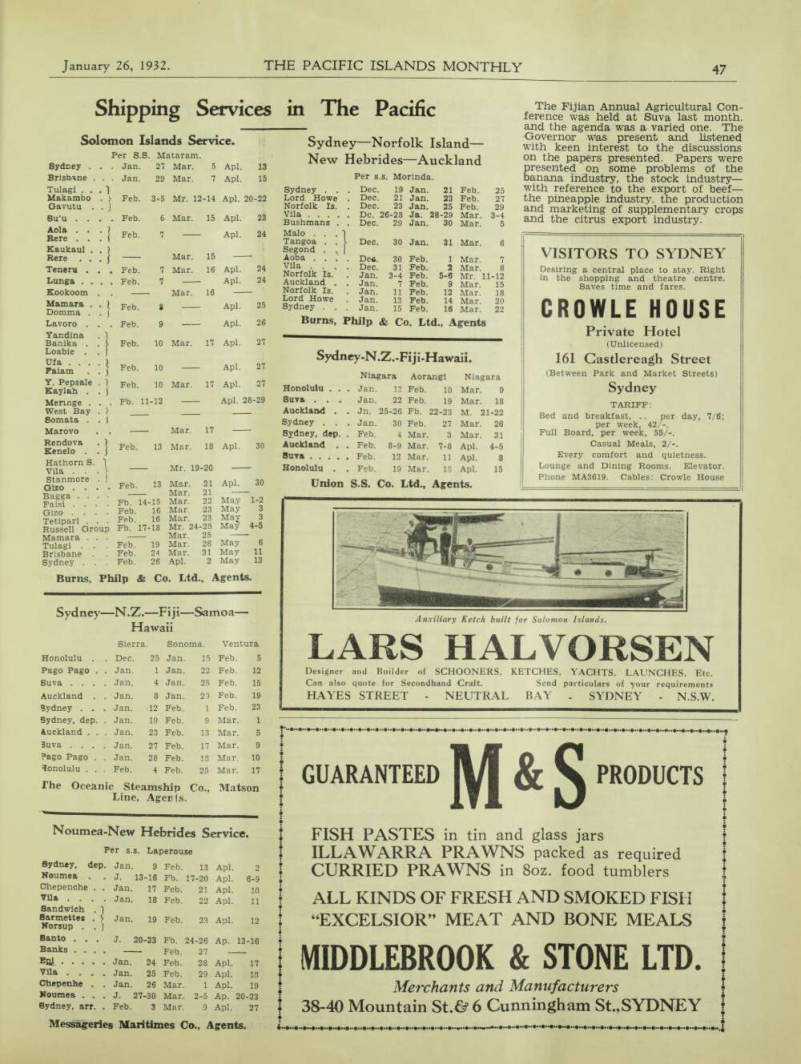
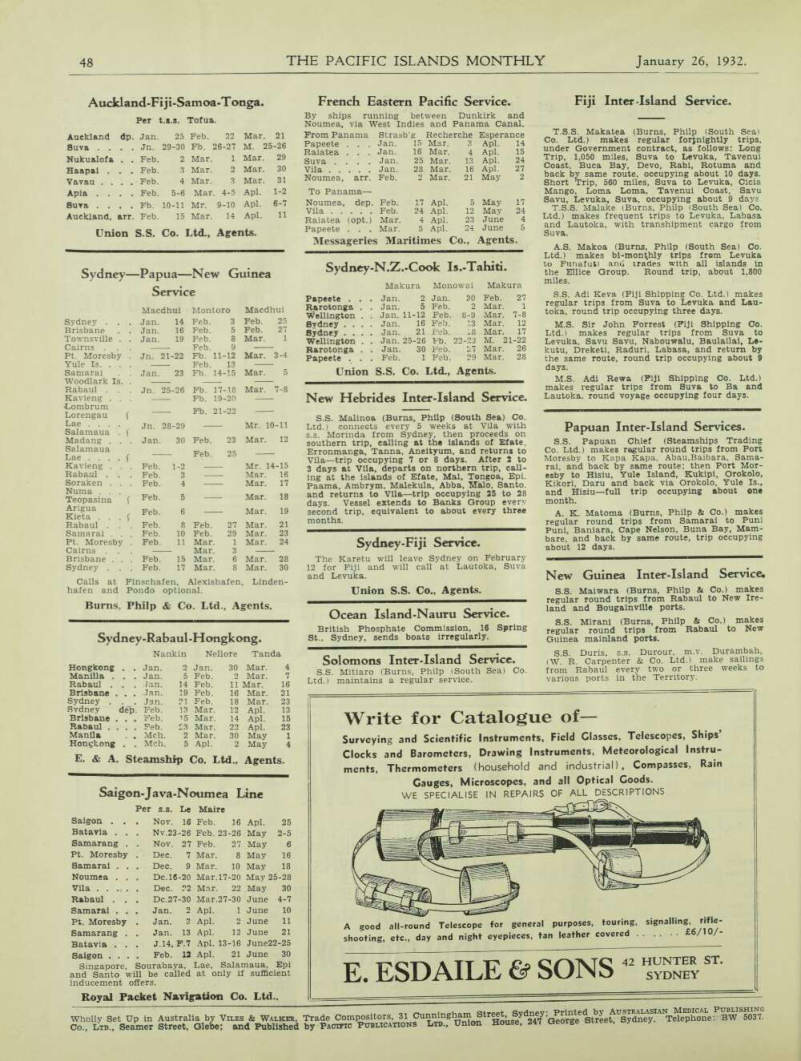
Sydney—N.Z.—Fiji—Samoa — Hawaii
Noumea-New Hebrides Service.
Sydney —Norfolk Island — New Hebrides —Auckland
Sydncy-N.Z.-Fiji-Hawali.
The Fijian Annual Agricultural Con ference was held at Suva last month, and the agenda was a varied one. The Governor was present and listened with keen interest to the discussions on the papers presented. Papers were presented on some problems of the banana industry, the stock industry— with reference to the export of beef— the pineapple industry, the production and marketing of supplementary crops and the citrus export industry.
Solomon Islands Service.
Per S.S Mataram.
Sydney . . Jan. 27 Mar. 5 Apl. 13 Brisbane • Jan. 29 Mar. 7 Apl. 15 Tulagi . .
Makambo > Feb. 3-5 Mr. 12-14 Apl. 20-22 Gavutu .
Bu’u . . . Feb. 6 Mar. 15 Apl. 23 Aola . .
Here . .
j Feb.
7 Apl. 24 Kaukaul . 15 Rere . .
Mar. — Teneru . . Feb. 7 Mar. 16 Apl. 24 Lunga . . . Feb. 7 Apl. 24 Kookoom Mar. 16 — Mamara .
Domma .
J Feb.
8 — Apl. 25 Lavoro . . Feb. 9 — Apl. 26 Yandina 27 Banika .
Feb. 10 Mar. 17 Apl.
Loabie .
Ufa . . .
Faiam Feb. 10 — Apl. 27 Y. Pepsale . i
[ Feb.
10 Mar. 17 Apl. 27 Kaylah .
Mennge . . Fb. 11 -12 — Apl. 28-29 West Bay Somata .
Marovo Mar. 17 — Rendova Kenelo . • Feb, 13 Mar. 18 Apl. 30 Hathorn S. 1 Vila . . — Mr. 19-20 Stanmore Gizo . . 1 . Feb. 13 Mar. 21 Apl. 30 Bagga . .
Paisi . ! Fb. 14- -15 Mar.
Mar, 21 22 May 1 -2 Gizo . . . Feb. 16 Mar. 23 May 3 Tetinari . . Feb. 16 Mar. 23 May 3 Russell Group Fb. 17- •18 Mr. 24- ■25 May 4-0 Mamara . — Mar. 25 — Tulagi . .
! Feb.
19 Mar. 26 May 6 Brisbane , Feb. 24 Mar. 31 May 11 Sydney . , Feb. 26 Apl. 2 May 13 Burns, Philp & Co. Ltd., Agents.
Per s.s. Morinda.
Sydney . . , Dec. 19 Jan. 21 Feb. 25 Lord Howe . Dec. 21 Jan. 23 Feb. 27 Norfolk Is. , Dec. 23 Jan. 25 Feb. 29 Vila . . . . . Dc. 26-28 Ja. 28 -29 Mar. 3-4 Bushmans . . Dec. 29 Jan. 30 Mar. 5 Malo . . . 1 Tangoa . . > Dec. 30 Jan. 31 Mar. 6 Segond . . f Aoba . .
Dec. 30 Feb. 1 Mar. 7 Vila . . , . Dec. 31 Feb. 2 Mar. 8 Norfolk Is. . Jan. 3-4 Feb. 5-6 Mr. 11 -12 Auckland . . Jan. 7 Feb. 9 Mar. 15 Norfolk Is. . Jan. 11 Feb. 12 Mar. 18 Lord Howe . Jan. 13 Feb. 14 Mar. 20 Sydney . . . Jan. 15 Feb. 16 Mar. 22 Burns, Philp & Co. Ltd., Agents.
Niagara Aorangl Niagara Honolulu . . . Jan. 13 Feb. 10 Mar. 9 Suva . . .
Jan. 22 Feb. 19 Mar. 18 Auckland . . Jn. 25-26 Pb. 22-23 M. 21-22 Sydney . . . Jan. 30 Feb. 27 Mar. 26 Sydney, dep. . Feb. 4 Mar. 3 Mar. 31 Auckland . . Feb. 8-9 Mar. 7-8 Apl. 4-5 Suva . . . . , , Feb. 12 Mar. 11 A pi. 8 Honolulu . . . Feb. 19 Mar. 10 Apl. 15 Union S.S. Co. Ltd., Agents.
Sierra Sonoma.
Ventura Honolulu . . Dec. 25 Jan. 15 Feb. 5 Pago Pago . . Jan. 1 Jan. 22 Feb. 12 Suva . . . . Jan. 4 Jan. 25 Feb. 15 Auckland . . Jan. 8 Jan. 20 Feb. 19 Sydney . . . Jan. 12 Feb. 1 Feb. 23 Sydney, dep. . Jan. 19 Feb. 9 Mar. 1 Auckland . . . Jan. 23 Feb. 13 Mar. 5 3uva . . . . Jan. 27 Feb. 17 Mar. 9 ?ago Pago . . Jan. 28 Feb. 18 Mar. 10 Honolulu . . . Feb. 4 Feb. 25 Mar. 17 The Oceanic Steamship Co., Matson
Line, Agents.
Per s.s. Laperouse Sydney, dep.
Jan. 9 Feb. 13 Apl. 2 Noumea J. 13 -16 Fb. 17-20 Apl. 6-9 Chepenche . .
Jan. 17 Feb. 21 Apl. 10 Vila . . . .
Jan. 18 Feb. 22 Apl. 11 Sandwich . 1 Sarmettes . V
Norsup , . J
Jan, 19 Feb. 23 Apl. 12 Santo . . .
J. 20-23 Fb. 24-26 Ap. 13 -16 Banks . . . . — Feb. 27 Effil Jan. 24 Feb. 28 Apl. 17 Vila . . . .
Jan. 25 Feb. 29 Apl. 18 Chepenhe . .
Jan. 26 Mar. 1 Apl. 19 Noumea . . .
J. 27-30 Mar. S !-5 Ap. 20-23 Sydney, air. .
Feb. 3 Mar. 9 Apl. 27
Messageries Maritimes Co., Agents.
Auckland-Fiji-Samoa-Tonga.
Sydney—Papua—New Guinea Service
Sydney-Rabaul-Hongkong.
Saigon-Java-Noumea Line
French Eastern Pacific Service.
Sydney-N.Z.-Cook Is.-Tahiti.
New Hebrides Inter-Island Service,
S.S. Malinoa (Burns, Philp (South Sea) Co.
Ltd.) connects every 5 weeks at Vila with s.s. Morinda from Sydney, then proceeds on southern trip, calling at the Islands of Efate.
Erronmanga, Tanna, Aneityum, and returns to Vila—trip occupying 7or 8 days. After 2 to 3 days at Vila, departs on northern trip, call ing at the islands of Efate, Mai, Tongoa, Epi.
Paama, Ambrym. Malekula, Abba, Malo, Santo, and returns to Vila —trip occupying 25 to 28 days. Vessel extends to Banks Group every second trip, equivalent to about every three months.
Sydney-Fiji Service.
The Karetu will leave Sydney on February 12 for Fiji and will call at Lautoka, Suva and Levuka.
Union S.S. Co., Agents.
Ocean Island-Nauru Service.
British Phosphate Commission, 16 Spring St., Sydney, sends boats irregularly.
Solomons Inter-Island Service.
S.S. Mitiaro (Burns, Philp (South Sea) Co.
Ltd.) maintains a regular service.
Fiji Inter Island Service.
T.S.S. Makatea (Burns, Philp (South Sea) Co. Ltd.) makes regular fortnightly trips, under Government contract, as follows: Long Trip, 1,050 miles, Suva to Levuka, Tavenui Coast, Buca Bay, Devo, Rabi, Rotuma and back by same route, occupying about 10 days.
Short Trip, 560 miles, Suva to Levuka, Cicia Mango, Loma Loma, Tavenui Coast, Savu Savu, Levuka, Suva, occupying about 9 days T.S.S. Malake (Burns, Philp (South Sea) Co.
Ltd.) makes frequent trips to Levuka, Labasa and Lautoka, with transhipment cargo from Suva.
A.S. Makoa (Burns, Philp (South Sea) Co.
Ltd.) makes bi-monthly trips from Levuka to Funafuti and trades with all islands in the Ellice Group. Round trip, about 1,800 miles.
S.S. Adi Keva (Fiji Shipping Co. Ltd.) makes regular trips from Suva to Levuka and Lau toka, round trip occupying three days.
M.S. Sir John Forrest (Fiji Shipping Co.
Ltd.) makes regular trips from Suva to Levuka, Savu Savu, Nabouwalu, Baulailai, Le kutu, Dreketi, Raduri, Labasa, and return by the same route, round trip occupying about 9 days.
M.S. Adi Rewa (Fiji Shipping Co. Ltd.) makes regular trips from Suva to Ba and Lautoka. round voyage occupying four days.
Papuan Inter-Island Services.
S.S. Papuan Chief (Steamships Trading Co. Ltd.) makes regular round trips from Port Moresby to Kapa Kapa. Abau, Baibara, Sama rai, and back by same route; then Port Mor esby to Hisiu, Yule Island, Kukipi, Orokolo, Kikori, Daru and back via Orokolo, Yule Is., and Hisiu—full trip occupying about one month.
A. K. Matoma (Burns, Philp & Co.) makes regular round trips from Samarai to Puni Puni, Baniara, Cape Nelson, Buna Bay, Mam bare, and back by same route, trip occupying about 12 days.
New Guinea Inter-Island Service.
S.S. Maiwara (Burns, Philp & Co.) makes regular round trips from Rabaul to New Ire land and Bougainville ports.
S.S. Mirani (Burns, Philp & Co.) makes regular round trips from Rabaul to New Guinea mainland ports.
S S Duris, s.s. Durour, m.v. Durambah, (W. R. Carpenter & Co. Ltd.) make sailings from Rabaul every two or three weeks to various ports in the Territory.
By ships running between Dunkirk and Noumea, via West Indies and Panama Canal.
From Panama Strasb’g Recherche Esperance Papeete . . .
Jan.
IS Mar. 3 Apl. 14 Raiatea . . .
Jan. 16 Mar. 4 Apl. 15 Suva ...
Jan. 25 Mar. 13 Apl. 24 Vila Jan. 28 Mar. 16 Apl. 27 Noumea, arr.
Feb. 2 Mar. 21 May 2 To Panama— Noumea, dep.
Feb. 17 Apl. 5 May 17 Vila Feb. 24 Apl. 12 May 24 Raiatea (opt.) Mar. 4 Apl. 23 June 4 Papeete . . .
Mar. 5 Apl. 24 June 5
Messageries Maritimes Co.,
Agents.
Makura Monowai Makura Papeete . .
Jan. 2 Jan. 30 Feb. 27 Rarotonga .
Jan. 5 Feb. 2 Mar. 1 Wellington .
Jan. 11-12 Feb. 8-9 Mar. 7-8 Sydney . . .
Jan. 16 Feb. 13 Mar. 12 Sydney . . . .
Jan. 21 Feb. i8 Mar. 17 Wellington . .
Jan. 25-26 Fb. 22-23 M. 21-22 Rarotonga . . , Jan. 30 Feb. 27 Mar. 26 Papeete . . . , Feb. 1 Feb. 29 Mar. 28 Union S.S. Co. Ltd.,
Agents.
Per t.s.s.
Tofua.
Auckland dp. Jan. 25 Feb. 22 Mar. 21 Suva . . . . Jn. 29-30 Fb. 26-27 M. 25-26 Nukualofa . . Feb. 2 Mar. 1 Mar. 29 Haapal . . . Feb. 3 Mar. 2 Mar. 30 Vavau . . . . Feb. 4 Mar. 3 Mar. 31 Apia . . . . Feb. 5-6 Mar. 4-5 Apl. 1-2 Suva . . . . Fb. 10-11 Mr. 9-10 Apl. 6-7 Auckland, arr. Feb. 15 Mar. 14 Apl. 11 Union S.S.
Co. Ltd.,
Agents.
Macdhui Montoro Macdhui Sydney . . .
Jan. 14 Feb. 3 Feb. 25 Brisbane .
Jan. 16 Feb. 5 Feb. 27 Townsville . .
Jan. 19 Feb. 8 Mar. 1 Cairns . . — Feb. 9 — Pt. Moresby Jn. 21-22 Fb. 11-12 Mar. ' 1-4 Yule Is. . . — Feb. 13 — Samarai Jan. 23 Fb. 14-15 Mar. 5 Woodlark Is. - — Rabaul . .
Jn. 25-26 Fb. 17-18 Mar. 7-8 Kavieng . .
Fb. 19-20 — Lombrura Lorengau f — Fb. 21-22 — Lae ...
Jn. 28-29 Mr. 10 -11 Salaraaua . f Madang . .
Jan. 30 Feb. 23 Mar. 12 Salamaua Feb. 25 Lae ... f — — Kavieng . .
Feb. 1-2 Mr. 14 -15 Rabaul . .
Feb. 3 Mar. 16 Soraken . .
Feb. 4 Mar. 17 Numa . . . 18 Teopasina f Feb. 5 — Mar.
Arigua Kieta . . . f Feb. 6 — Mar. 19 Rabaul . .
Feb. 8 Feb. 27 Mar. 21 Samarai . .
Feb. 10 Feb. 29 Mar. 23 Pt. Moresby Feb. 11 Mar. 1 Mar. 24 Cairns . . — Mar. 3 — Brisbane . .
Feb. 15 Mar. 6 Mar. 28 Sydney . .
Feb. 17 Mar. 8 Mar. 30 Calls at Pinschafen, Alexishafen, Lindenhafen and Pondo optional.
Bums. Philp & Co. Ltd., Agents.
Nankin Neliore Tanda Hongkong . .
Jan. 2 Jan. 30 Mar. 4 Manilla . . .
Jan. 5 Feb. 2 Mar. 7 Rabaul . . .
Jan. 14 Feb. 11 Mar. 16 Brisbane . . .
Jan. 19 Feb. 16 Mar. 21 Sydney . . .
Jan. ?1 Feb. 18 Mar. 23 Sydney dep.
Feb. 13 Mar. 12 Apl. 13 Brisbane . . .
Feb. ’5 Mar. 14 Apl. 15 Rabaul ...
Feb. 23 Mar. 22 Apl. 23 Manila . .
Mch. 2 Mar. 30 May 1 Hongkong . .
Mch. 5 Apl. 2 May 4
E. & A. Steamship Co. Ltd.,
Agents.
Per s.s. Le Maire Saigon . .
Nov. 16 Feb. 16 Apl. 25 Batavia . , Nv.23-26 Feb.23 -26 May 2-5 Samarang .
Nov. 27 Feb. 27 May 6 Pt. Moresby Dec. 7 Mar. 8 May 16 Samaral . .
Dec. 9 Mar. 10 May 18 Noumea . .
Dc.16-20 Mar.17-20 May 25-28 Vila . . . .
Dec. ?2 Mar. 22 May 30 Rabaul . .
Dc.27-30 Mar.27 -30 June 4-7 Samarai . .
Jan. 2 Apl. 1 June 10 Pt. Moresby Jan. 3 Apl. 2 June 11 Samarang .
Jan. 13 Apl. 12 June 21 Batavia . .
J.14, F.7 Apl. 13- -16 June22-25 Saigon . . .
Feb. 12 Apl. 21 June 30 Singapore, Sourabaya, Lae, Salamaua, Epi and Santo will be called at only if sufficient inducement i offers.
Royal Packet Navigation Co. Ltd.
Advertisements & other items, pp. 49-50 (2 items)
Lars Halvorsen
VISITORS TO SYDNEY
Desiring a central place to stay. Right in the shopping and theatre centre,.
Saves time and fares.
CROWLE HOUSE
Private Hotel
(Unlicensed)
161 Gastlereagh Street
(Between Park and Market Streets)
Sydney
TARIFF:
Bed and breakfast, .. per day, 7/6; per week, 42/-.
Full Board, per week, 55/-.
Casual Meals, 2/-.
Every comfort and quietness.
Lounge and Dining Rooms. Elevator.
Phone MA3619. Cables: Crowle House
Auxiliary Ketch built for Solomon Islands.
LARS HALVORSEN
Designer and Builder of SCHOONERS, KETCHES, YACHTS. LAUNCHES, Etc.
Can also quote for Secondhand Craft. Send particulars of your requirements HAYES STREET - NEUTRAL BAY . SYDNEY - N.S.W.
GUARANTEED M&S PRODUCTS
FISH PASTES in tin and glass jars ILLAWARRA PRAWNS packed as required CURRIED PRAWNS in Boz. food tumblers ALL KINDS OF FRESH AND SMOKED FISH
“EXCELSIOR” MEAT AND BONE MEALS
MIDDLEBROOK & STONE LTD.
Merchants and Manufacturers 38-40 Mountain St.£? 6 Cunningham St.,SYDNEY
Write for Catalogue of—
Surveying and Scientific Instruments, Field Glasses, Telescopes, Ships’
Clocks and Barometers, Drawing Instruments, Meteorological Instruments, Thermometers (household and industrial), Compasses, Ram Gauges, Microscopes, and all Optical Goods.
WE SPECIALISE IN REPAIRS OF ALL DESCRIPTIONS A good all-round Telescope for general purposes, touring, signalling, rifleshooting, etc., day and night eyepieces, tan leather covered £6/ /
E. ESDAILE & SONS SYDNEY
48
January 26, 1932.
THE PACIFIC ISLANDS MONTHLY
Wholly Set Up in Australia by Viles & Walker, Trade n e; BW 5037 Co., Ltd., Seamer Street, Glebe; and Published by Pacific Publications Ltd., Union House, mi ueorge ’
Pacific Islands Association.
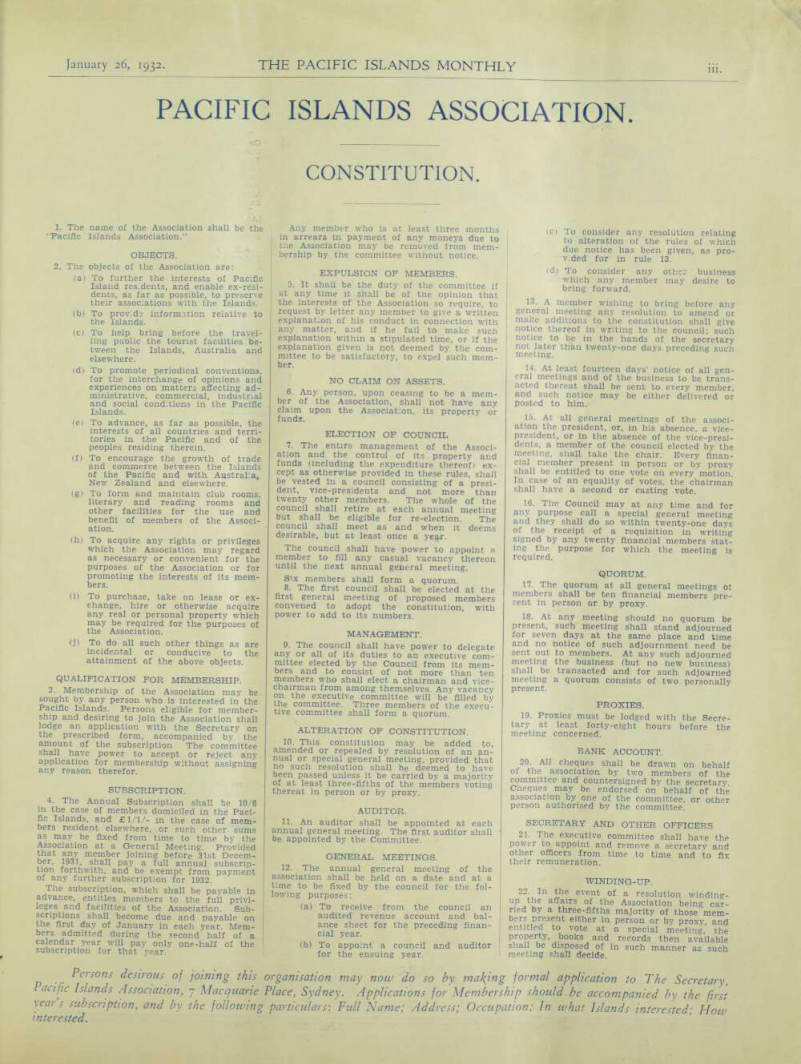
Constitution.
1. The name of the Association shall be the “Pacific Islands Association.”
Objects.
2. The objects of the Association are: (a) To further the interests of Pacific Island residents, and enable ex-resi dents, as far as possible, to preserve their associations with the Islands. (b) To provide information relative to the Islands. (c) To help bring before the travel ling public the tourist facilities be tween the Islands, Australia and elsewhere. (d) To promote periodical conventions, for the interchange of opinions and experiences on matters affecting ad ministrative, commercial, industrial and social conditions in the Pacific Islands. (e) To advance, as far as possible, the interests of all countries and terri tories in the Pacific and of the peoples residing therein. (f) To encourage the growth of trade and commerce between the Islands of the Pacific and with Australia, New Zealand and elsewhere. (g) To form and maintain club rooms, literary and reading rooms and other facilities for the use and benefit of members of the Associ ation. (h) To acquire any rights or privileges which the Association may regard as necessary or convenient for the purposes of the Association or for promoting the interests of its mem bers. (i) To purchase, take on lease or ex change, hire or otherwise acquire any real or personal property which may be required for the purposes of the Association. (j) To do all such other things as are incidental or conducive to the attainment of the above objects.
Qualification For Membership.
3. Membership of the Association may be sought by any person who is interested in the Pacific Islands. Persons eligible for member ship and desiring to join the Association shall lodge an application with the Secretary on the prescribed form, accompanied by the amount of the subscription The committee shall have power to accept or reject any application for membership without assigning any reason therefor.
Subscription.
4. The Annual Subscription shall be 10/6 in the case of members domiciled in the Paci fic Islands, and £1/1/- in the case of members resident elsewhere, or such other sums as may be fixed from time to time by the Association at a General Meeting. Provided that any member joining before 31st Decem ber, 1931, shall pay a full annual subscrip tion forthwith, and be exempt from payment of any further subscription for 1932.
The subscription, which shall be payable in advance, entitles members to the full privi leges and facilities of the Association. Sub scriptions shall become due and payable on the first day of January in each year. Mem bers admitted during the second half of a calendar year will pay only one-half of the subscription for that vear
Any member who is at least three months in arrears in payment of any moneys due to the Association may be removed from mem bership by the committee without notice.
Expulsion Op Members.
5. It shall be the duty of the committee if at any time it shall be of the opinion that the interests of the Association so require, to request by letter any member to give a written explanation of his conduct in connection with any matter, and if he fail to make such explanation within a stipulated time, or if the explanation given is not deemed by the com mittee to be satisfactory, to expel such mem ber.
No Claim On Assets.
6. Any person, upon ceasing to be a mem ber of the Association, shall not have any claim upon the Association, its property or funds.
Election Op Council
7. The entire management of the Associ ation and the control of its property and funds (including the expenditure thereof; ex cept as otherwise provided in these rules, shall be vested in a council consisting of a presi dent, vice-presidents and not more than twenty other members. The whole of the council shall retire at each annual meeting but shall be eligible for re-election. The council shall meet as and when it deems desirable, but at least once a year.
The council shall have power to appoint a member to fill any casual vacancy thereon until the next annual general meeting.
Six members shall form a quorum. 8. The first council shall be elected at the first general meeting of proposed members convened to adopt the constitution, with power to add to its numbers.
Management.
9. The council shall have power to delegate any or all of its duties to an executive com mittee elected by the Council from its mem bers and to consist of not more than ten members who shall elect a chairman and vice chairman from among themselves. Any vacancy on the executive committee will be filled by the committee. Three members of the execu tive committee shall form a quorum.
Alteration Of Constitution.
10. This constitution may be added to, amended or repealed by resolution of an an nual or special general meeting, provided that no such resolution shall be deemed to have been passed unless it be carried by a majority of at least three-fifths of the members voting thereat in person or by proxy.
Auditor.
11. An auditor shall be appointed at each annual general meeting. The first auditor shall be appointed by the Committee.
General Meetings.
12. The annual general meeting of the association shall be held on a date and at a time to be fixed by the council for the fol lowing purposes: (a) To receive from the council an audited revenue account and bal ance sheet for the preceding finan cial year. (b) To appoint a council and auditor for the ensuing year.
(c) To consider any resolution relating to alteration of the rules of which due notice has been given, as pro vided for in rule 13. (d) To consider any other business which any member may desire to bring forward. 13. A member wishing to bring before any general meeting any resolution to amend or make additions to the constitution shall give notice thereof in writing to the council; such notice to be in the hands of the secretary not later than twenty-one days preceding such meeting. 14. At least fourteen days’ notice of all gen eral meetings and of the business to be trans acted thereat shall be sent to every member, and such notice may be either delivered or posted to him. 15. At all general meetings of the associ ation the president, or, in his absence, a vice president, or in the absence of the vice-presi dents, a member of the council elected by the meeting, shall take the chair. Every finan cial member present in person or by proxy shall be entitled to one vote on every motion.
In case of an equality of votes, the chairman shall have a second or casting vote. 16. The Council may at any time and for any purpose call a special general meeting and they shall do so within twenty-one days of the receipt of a requisition in writing signed by any twenty financial members stat ing the purpose for which the meeting is required.
Quorum.
17. The quorum at all general meetings ot members shall be ten financial members pre sent in person or by proxy. 18. At any meeting should no quorum be present, such meeting shall stand adjourned for seven days at the same place and time and no notice of such adjournment need be sent out to members. At any such adjourned meeting the business (but no new business) shall be transacted and for such adjourned meeting a quorum consists of two personally present.
Proxies.
19. Proxies must be lodged with the Secre tary at least forty-eight hours before the meeting concerned.
Bank Account.
20. All cheques shall be drawn on behalf of the association by two members of the committee and countersigned by the secretary Cheques may be endorsed on behalf of the association by one of the committee, or other person authorised by the committee.
Secretary And Other Officers
21. The executive committee shall have the power to appoint and remove a secretary and other officers from time to time and to fix their remuneration.
Winding-Up.
22 In the event of a resolution winding up the affairs of the Association being ear ned by a three-fifths majority of those mem bers present either in person or by proxy, and entitled to vote at a special meeting, the property, books and records then available shall be disposed of in such manner as such meeting shall decide.
Persons desirous of joining this organisation may now do so by making formal application to The Secretary, Pacific Islands Association, 7 Macquarie Place, Sydney. Applications for Membership should be accompanied by the first year's subscription, and by the following particulars: Full Name; Address; Occupation; In what Islands interested; How interested.
Advertisements & other items, p. 52 (1 item)
Resch’S Pilsener
“HERE YOU ARE, SIR! RESCH’S PILSENER
. . . THE MOST REFRESHING AND CERTAINLY
THE MOST POPULAR DRINK I SERVE.”
RESCH’S PILSENER
The drink a man remembers