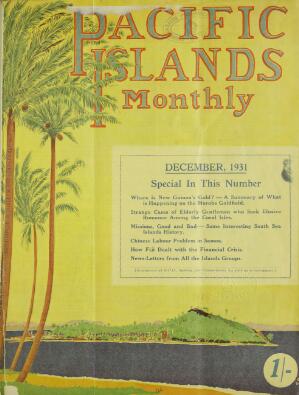
December, 1931
Pacific Islands Monthly
Special In This Number
Where Is New Guinea’s Gold?—A Summary of What is Happening on the Morobe Goldfield.
Strange Cases of Elderly Gentlemen who Seek Elusive Romance Among the Coral Isles.
Missions, Good and Bad Some Interesting South Sea Islands History.
Chinese Labour Problem in Samoa.
How Fiji Dealt with the Financial Crisis.
News-Letters from All the Islands Groups.
[Registered at G.P.O.. Sydney, for transmission by post as a newspaper. ]
1/-
Pacific Islands Association.
Constitution.
1. The name of the Association shall be the “Pacific Islands Association.”
Objects.
2. The objects of the Association are: (a) To further the interests of Pacific Island residents, and enable ex-residents, as far as possible, to preserve their assocations with the Islands. (b) To provide information relative to the Islands. (c) To help bring before the travelling public the tourist facilities be tween the Islands, Australia and elsewhere. (d) To promote periodical conventions, for the interchange of opinions and experiences on matters affecting administrative, commercial, industrial and social conditions in the Pacific Islands. (e) To advance, as far as possible, the interests of all countries and territories in the Pacific and of the peoples residing therein. (f) To encourage the growth of trade and commerce between the Islands of the Pacific and with Australia, New Zealand and elsewhere. (g) To form and maintain club rooms, literary and reading rooms and other facilities for the use and benefit of members of the Association. (h) To acquire any rights or privileges which the Association may regard as necessary or convenient for the purposes of the Association or for promoting the interests of its members. (i) To purchase, take on lease or exchange, hire or otherwise acquire any real or personal property which may be required for the purposes of the Association. (j) To do all such other things as are incidental or conducive to the attainment of the above objects.
Qualification For Membership.
3. Membership of the Association may be sought by any person who is interested in the Pacific Islands. Persons eligible for membership and desiring to join the Association shall lodge an application with the Secretary on the prescribed form, accompanied by the amount of the subscription. The committee shall have power to accept or reject any application for membership without assigning any reason therefor.
Subscription.
4. The Annual Subscription shall be 10/6 in the case of members domiciled in the Pacific Islands, and £1/1/- in the case of members resident elsewhere, or such other sums as may be fixed from time to time by the Association at a General Meeting. Provided that any member joining before 31st December, 1931, shall pay a full annual subscription forthwith, and be exempt from payment of any further subscripfon for 1932.
The subscription, which shall be payable in advance, entitles members to the full privileges and facilities of the Association. Subscriptions shall become due and payable on the first day of January in each year. Members admitted during the second half of a calendar year will pay only one-half of the subscription for that year.
Any member who is at least three months in arrears in payment of any moneys due to the Association may be removed from membership by the committee without notice.
Expulsion Of Members.
5. It shall be the duty of the committee if at any time it shall be of the opinion that the interests of the Association so require, to request by letter any member to give a written explanation of his conduct in connection with any matter, and if he fail to make such explanation within a stipulated time, or if the explanation given is not deemed by the committee to be satisfactory, to expel such member.
No Claim On Assets.
6. Any person, upon ceasing to be a member of the Association, shall not have any claim upon the Association, its property or funds.
Election Of Council
7. The entire management of the Association and the control of its property and funds (including the expenditure thereof) except as otherwise provided in these rules, shall be vested In a council consisting of a president, vice-presidents and not more than twenty other members. The whole of the council shall retire at each annual meeting but shall be eligible for re-election. The council shall meet as and when it deems desirable, but at least once a year.
The council shall have power to appoint a member to fill any casual vacancy thereon until the next annual general meeting.
Six members shall form a quorum. 8. The first council shall be elected at the first general meeting of proposed members convened to adopt the constitution, with power to add to its numbers.
Management.
9. The council shall have power to delegate any or all of its duties to an executive committee elected by the Council from its members and to consist of not more than ten members who shall elect a chairman and vice chairman from among themselves. Any vacancy on the executive committee will be filled by the committee. Three members of the executive committee shall form a quorum.
Alteration Of Constitution.
10. This constitution may be added to, amended or repealed by resolution of an annual or special general meeting, provided that no such resolution shall be deemed to have been passed unless it be carried by a majority of at least three-fifths of the members voting thereat in person or by proxy.
Auditor.
11. An auditor shall be appointed at each annual general meeting. The first auditor shall be appointed by the Committee.
General Meetings.
12. The annual general meeting of the association shall be held on a date and at a time to be fixed by the council for the following purposes : (a) To receive from the council an audited revenue account and balance sheet for the preceding financial year. (b) To appoint a council and auditor for the ensuing year.
(c) To consider any resolution relating to alteration of the rules of which due notice has been given, as provided for in rule 13. (d) To consider any other business which any member may desire to bring forward. 13. A member wishing to bring before any general meeting any resolution to amend or make additions to the constitution shall give notice thereof in writing to the council ; such notice to be in the hands of the secretary not later than twenty-one days preceding such meeting. 14. At least fourteen days’ notice of all general meetings and of the business to be transacted thereat shall be sent to every member, and such notice may be either delivered or posted to him. 15. At all general meetings of the association the president, or, in his absence, a vice president, or in the absence of the vice-presia member of the council elected by the meeting, shall take the chair. Every financial member present in person or by proxy shall be entitled to one vote on every motion.
In case of an equality of votes, the chairman shall have a second or casting vote. 16. The Council may at any time and for any purpose call a special general meeting and they shall do so within twenty-one days of the receipt of a requisition in writing signed by any twenty financial members stating the purpose for which the meeting is required.
Quorum.
17. The quorum at all general meetings of members shall be ten financial members present in person or by proxy. 18. At any meeting should no quorum be present, such meeting shall stand adjourned for seven days at the same place and time and no notice of such adjournment need be sent out to members. At any such adjourned meeting the business (but no new business) shall be transacted and for such adjourned meeting a quorum consists of two personally present.
Proxies.
19. Proxies must be lodged with the Secretary at least forty-eight hours before the
meeting concerned.
Bank Account.
20. All cheques shall be drawn on behalf of the association by two members of the committee and countersigned by the secretary.
Cheques may be endorsed on behalf of the association by one of the committee, or other person authorised by the committee.
Secretary And Other Officers
21. The executive committee shall have the power to appoint and remove a secretary and other officers from time to time and to fix their remuneration.
Winding-Up.
22. In the event of a resolution winding up the affairs of the Association being carried by a three-fifths majority of those members present either in person or by proxy, and entitled to vote at a special meeting, the property, books and records then available shall be disposed of in such manner as such meeting shall decide.
Persons desirous of joining this organisation may now do so by making formal application to The Secretary, Pacific Islands Association, 7 Macquarie Place, Sydney. Applications for Membership should be accompanied by the first years subscription, and by the following particulars : Full Name ; Address ; Occupation ; In what Islands interested ; How interested.
Advertisements & other items, pp. 3-4 (1 item)
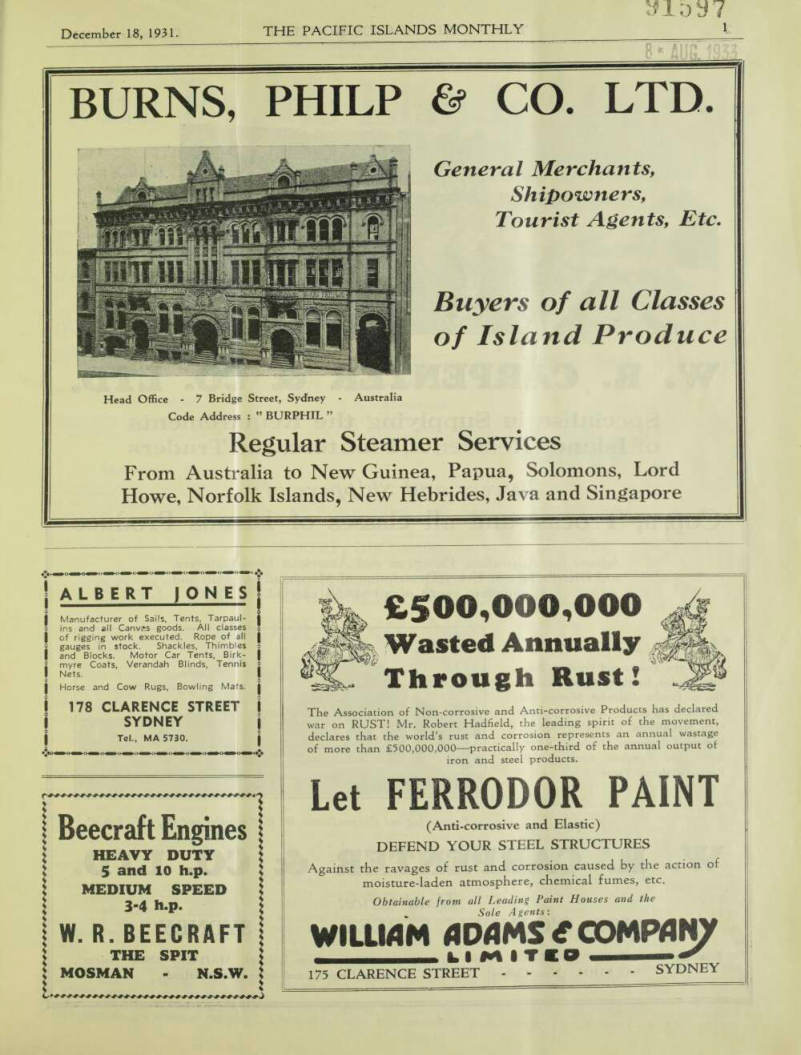
Let Ferrodor Paint
BURNS, PHILP & CO. LTD.
Head Office - 7 Bridge Street, Sydney - Australia Code Address : "BURPHIL ”
General Merchants, Shipowners, Tourist Agents, Etc.
Buyers of all Classes
of Island Produce Regular Steamer Services From Australia to New Guinea, Papua, Solomons, Lord Howe, Norfolk Islands, New Hebrides, Java and Singapore
ALBERT JONES
Manufacturer of Sails, Tents, Tarpaul ins and all Canvas goods. All classes of rigging work executed. Rope of all gauges in stock. Shackles, Thimbles and Blocks. Motor Car Tents, Birk myre Coats, Verandah Blinds, Tennis Nets.
Horse and Cow Rugs, Bowling Mats.
178 CLARENCE STREET
SYDNEY
Tel., MA 5730.
£500,000,000
Wasted Annually
Through Rust!
The Association of Non-corrosive and Anti-corrosive Products has declared war on RUST! Mr. Robert Hadfield, the leading spirit of the movement, declares that the world’s rust and corrosion represents an annual wastage of more than £500,000,000 —practically one-third of the annual output of iron and steel products.
Let FERRODOR PAINT
(Anti-corrosive and Elastic)
DEFEND YOUR STEEL STRUCTURES
Against the ravages of rust and corrosion caused by the action of moisture-laden atmosphere, chemical fumes, etc.
Obtainable from all Leading Paint Houses and the Sole Agents:
WILLIAM ADAMS & COMPANY
LIMITED
175 CLARENCE STREET
SYDNEY
Beecraft Engines
HEAVY DUTY
5 and 10 h.p.
MEDIUM SPEED
3-4 h.p.
W. R. BEECRAFT
THE SPIT
MOSMAN - N.S.W.
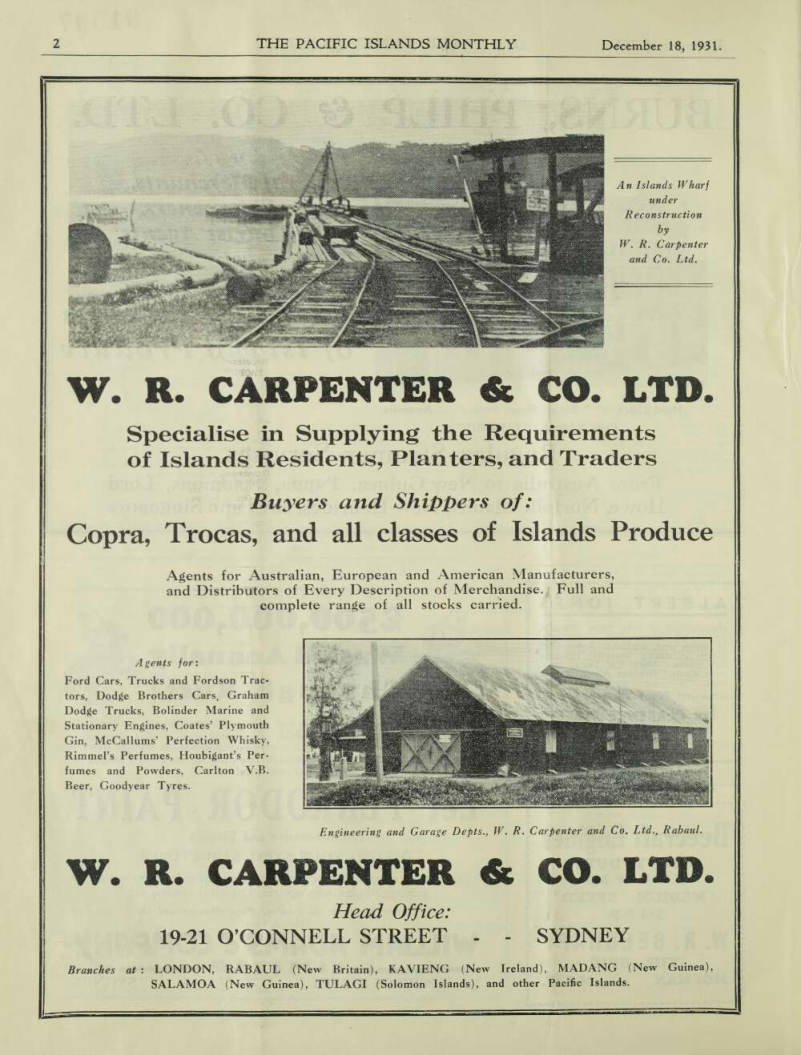
An Islands Wharf under Reconstruction by W. R. Carpenter and Co. Ltd.
W. R. CARPENTER & CO. LTD
Specialise in Supplying the Requirements
of Islands Residents, Planters, and Traders
Buyers and Shippers of:
Copra, Trocas, and all classes of Islands Produce Agents for Australian, European and American Manufacturers, and Distributors of Every Description of Merchandise. Full and complete range of all stocks carried.
Agents for: Ford Cars, Trucks and Fordson Trac tors, Dodge Brothers Cars, Graham Dodge Trucks, Bolinder Marine and Stationary Engines, Coates’ Plymouth Gin, McCallums’ Perfection Whisky, Rimmel’s Perfumes, Houbigant’s Per fumes and Powders, Carlton V.B.
Beer, Goodyear Tyres.
Engineering and Garage Depts., W. R. Carpenter and Co, Ltd., Rabaul.
W. R. CARPENTER & CO. LTD.
Head Office:
19-21 O’CONNELL STREET - - SYDNEY
Branches at : LONDON, RABAUL (New Britain), KAVIENG (New Ireland), MADANG (New Guinea), SALAMOA (New Guinea), TULAGI (Solomon Islands), and other Pacific Islands.
The Pacific Islands Monthly
The Newspaper-Magazine Of The South Seas
[Registered at G.P.O., Sydney, for transmission by post as a newspaper .]
Published about 15th of Each Month and Circulated in Australia and New Zealand and in the following Pacific Territories and Island Groups:
Crown Colony of Fiji Australian Territory of Papua.
Mandated Territory (Australia) of New Guinea.
Bismarck Archipelago, and Northern Solomon Islands Mandated Territory (Japan) of Marshall, Caroline and Ladrone Islands
American Territory of Guam Mandated Territory of Nauru British Crown Colony of Gilbert and Ellice Islands French Territory of New Caledonia British and French Condominium of New Hebrides American Territory of Samoa
Mandated Territory (New Zealand) of Samoa British Solomon Islands Protectorate British Protectorate of Tongan Islands New Zealand Territory of Cook Islands Australian Territory of Norfolk Island French Colony of Society Islands (Tahiti) American Territory of Hawaiian Islands ... ———
Owned and Produced by Pacific Publications Ltd., Union House, 247 George St., Sydney
Telephone - - Bw 5037
P.O. Box 3408 R
Editor and Publisher:
R. W. Robson
Registered Address for Telegrams and Cables; “PACPUB” Sydney ... ———
Contributions
Articles, Stories and Photographs dealing with Pacific Islands Subjects are invited, and will be paid for on publication at usual rates. ... ———
Subscription Rates
Per Annum, within Postal Convention Territories, Prepaid, Post Free - 6/- Per Annum elsewhere, Prepaid, Post Free 8/- Single Copies - - 1/- ... ———
Advertisements
Advertising Rates: £10 per page; £5/5/- per half page; £2/15/- per quarter page ; £1/7/6 per eighth page ; Casual Advertisements 8/- per inch Colours, etc. by Arrangement ... ——— Process Blocks made at Advertiser’s expense when required. Screen, 100. ... ——— Changes of Advertising Copy should reach this Office by 8th of each month, otherwise previous advertisement may be repeated. ... ———
Agents
The following are authorised to receive subscriptions for The Pacific Islands Monthly.
Islands Branches of Burns, Philp & Co. Ltd. and Burns, Philp (South Seas) Co. Ltd.
Islands Branches of W. R. Carpenter & Co. Ltd.
All Branches of Morris, Hedstrom & Co. Ltd.
Greenwood & Laws (Rabaul).
Whitten Bros. Ltd., Port Moresby & Samarai.
All Branches and Representatives of W. H.
Grove & Sons Ltd., Auckland.
S. Russell, Papeete, Tahiti.
Cook Islands Trading Co., Rarotonga.
Mrs. M. Campbell, Cascades, Norfolk Island. ———
Vol. II.—No. 5
Sydney: December 18, 1931
Price 1/- Per Copy Prepaid: 6/- per annum ———
Producing No Gold
Why New Guinea Goldfields Are
Shareholders in some of the New Guinea gold companies are becoming restive. The public is beginning to ask questions. The Administration, which is entitled to a substantial royalty on gold produced, and had begun to plan accordingly, is a little peevish.
These things are not surprising. The figures, published on this page, show how gold production rose to a peak in 1928 and has since fallen away. The 1931 export is considerably less than that of 1930.
New Guinea’S Gold
Production
1925 £18,572 1926 25,169 1927 195,428 1928 256,216 1929 179,433 1930 96,338
THE value of the gold taken from the Morobe field since it was discovered early in 1925, is about £900,000.
That is nothing to the huge quantity of the recoverable gold that is still there. Then why the shrinkage in production?
The reason is that the whole industry has passed from the hands of the individual miner into the hands of big corporations: and the latter have spent two years preparing for big-scale production.
Gold production by miners and little parties of miners, working with pick and shovel, windlass and tin dish, has almost ceased. From the beginning of 1929 onwards, the whole of the gold
producing country has passed, little by little, into the possession of less than half-a-dozen big companies. Most of the alluvial country near Wau is now held by New Guinea Goldfields Ltd., a £5,000,000 organisation, while the equally rich country along the Bulolo River, to the northwards is now in the hands of Placer Development Ltd. and its subsidiary, Bulolo Gold Dredging Ltd. These companies have obtained large leases on their own account; and N.G. Goldfield Ltd. have also acquired innumerable small leases originally taken up by individual miners and the pioneers of the field in 1926-28.
The net result of this is that the companies hold the accessible gold
bearing lands pending the inauguration of new methods. They have subscribed huge sums of money, have carried out elaborate tests and are planning developmental operations and production on an enormous scale. No gold is being won—except modest amounts by “tributers”; and the general public, having awaited results for well over two years, is now beginning to sit up and howl, Leading the dismal chorus are the voices of the miners who sold out their leases and rights to the big companies a considerable time ago. One cannot blame them—there is some reason for their woe. For the most part, they accepted scrip in payment. The shares of N.G. Goldfields Ltd. are unofficially quoted at between 4/- and 5/-, so that ———
there is nothing to be gained by selling the scrip. The big companies during this period of testing and development are winning no gold and paying no dividends. Meanwhile, the miner is not permitted to mine—practically all land known to hold profitable gold has been taken up, preparatory to exploit ation by the big corporations.
All that the miners still on the field can do is either to work some of the big companies’ leases on tribute or go back further into the wild country of the interior and seek new prospects.
Some are doing that—but the country is almost inaccessible, its penetration requires equipment and funds and there is no money on the goldfields just now for enterprises of that character.
Another factor operating against individual enterprise in opening up new goldfields country, or in anything else, is the tremendous cost of transport.
There is no road between the coast and the goldfield, and transport by air adds 6d. to every pound of food and equipment that is carried in. It must be a very rich lode indeed if it is to pay for the cost of finding and working it.
If the cost of transporting everything necessary from the coast to Wau were not so high, and if the unknown country inland from Wau were not so difficult to explore, the incursion of the big companies would not have paralysed gold production, because the individual miners, having been displaced by the companies, would soon have opened up new propositions further inland. The gold is there and private enterprise eventually will get it; but, at present, private enterprise is killed through lack of funds. All the available money is being used for the establishment of the companies.
It is a most unfortunate position.
According to our information, there are scores of men—excellent bushmen, keen prospectors and skilled miners— wandering about New Guinea to-day, looking for any kind of a job, who ought to be out in the ranges behind Wau and Bulolo, locating the further goldfields that are believed to exist there.
Meanwhile, on the Morobe goldfield, it is all spending and no earning; and interested observers are becoming restive and critical. However, the position is not at all bad.
So far as the “Dollar Companies” (Placer and Bulolo, which are running on Canadian and United States capital) are concerned, operations are proceeding swiftly and definitely, apparently on a clear cut plan. They have established their own aerial transport system, have brought in two dredges by aeroplane, and will commence gold -winning early in 1932. The gold is there and they have the equipment, the staff and the plan to recover it.
Their shares are at a premium—and justifiably so.
The other group, New Guinea Gold fields Ltd., is not so happy in either its progress or its plans. Its enormous capital (which runs far into seven figures) is partly British, partly Euro-
pean, partly Australian, and is partly represented in the shares in which the various miners and small concerns accepted payment for their leases and other rights. This company appears to be still a long way from the stage of production which will guarantee dividends. It is still carrying out an elaborate testing of its ground—the only revenue which can be depended upon in the early future appears to be that derived from tributers, and from whatever gold is won by a special treatment plant now being installed.
This company’s shareholders seem to be critical because they compare the progress being made by the “Dollar Companies” with the somewhat indefinite activity of N.G. Goldfields Ltd. If the directors of the latter are being wrongly judged it is their own fault; their public announcements have been meagre and vague—and the public is justifiably suspicious of vagueness in
gold-mining reports.
Here are the latest reports published in Sydney newspapers early in December. They are not calculated to cheer shareholders: The report of New Guinea Goldfields Ltd. for the year ended September 30, contained the following: "During the year the company’s application that its tenements should be declared a ‘special area’ under the Mining Ordinances, was granted by the Government, and provided we expend a sum per annum in the working of the property it is no longer necessary to man individual leases, but we may concentrate our activities on such portion of our holdings as developments suggest to be the best for economic exploitation of the whole of our leases.
“The installation of a central power plant is complete and with the power now available developments below water level will be pushed forward.
“The plant for treating the flat ore body in the Wau area has been landed and is now being erected. It is expected that the mill will be working early in 1932.
“Tributes were let early in 1931 for the working of the alluvial leases which, before the declaration of the special area we were compelled to man. The company’s share of the production to September 30 amounted to £34,646.
“It is intended to work the main alluvial deposits by the company’s own staff on the expiry of the present tributes in January next.”
The annual meeting of this company was to have been held on December 9, but was adjourned until such time as the accounts
of the company could be compiled and presented to the shareholders.
The adjournment of the meeting was not received favourably by some shareholders and it was moved that the meeting be called not later than the second week in January, 1932.
The chairman (Mr. F. Hambridge) explained that no business could be transacted at any meeting until the accounts were available.
He assured shareholders that the meeting would be called as soon as possible. An amendment that the meeting stand adjourned at the will of the directors was then carried.
In an informal discussion that followed the question of the listing of the company’s shares on the Stock Exchange was raised. Mr.
Hambridge explained that application for listing had been made, but the Stock Exchange had required that the scrip be issued in a way different from that used at present. It had also required that the scrip be issued in denominations that would involve considerable expense in stamp duties. Moreover to comply with the listing requirements would probably involve an alteration of the company's articles. After considerable discussion Mr. Hambridge stated that in view of the evident desire of shareholders that the shares should be listed the board would again go into the matter.
There are points raised herein concerning which both the shareholders and the Administration really should have more information.
This company, by absorbing nearly all the small enterprises in the Wau area of the goldfield, has put an end to individual gold production. It has gathered in the small leases, from near and far. A condition of the original grant of those leases was that the leases should be manned-in other words, that gold should be produced. The company has had that condition abrogated— under what conditions, we do not know.
Presumably, the company has given an undertaking that, within a certain period it will, by working its holdings as a whole, be producing gold on a large scale. If no such undertaking has been given then the removal of the manning conditions is a development concerning which some awkward questions will be asked of the Administration. It would be a monstrous thing if this huge corporation were allowed to spread itself lazily over the rich goldfield, blotting out the enterprise and acitivity of individuals, while large numbers of eager miners sit idly around Wau and Bulolo waiting for something to happen.
(Concluded On Page 19)
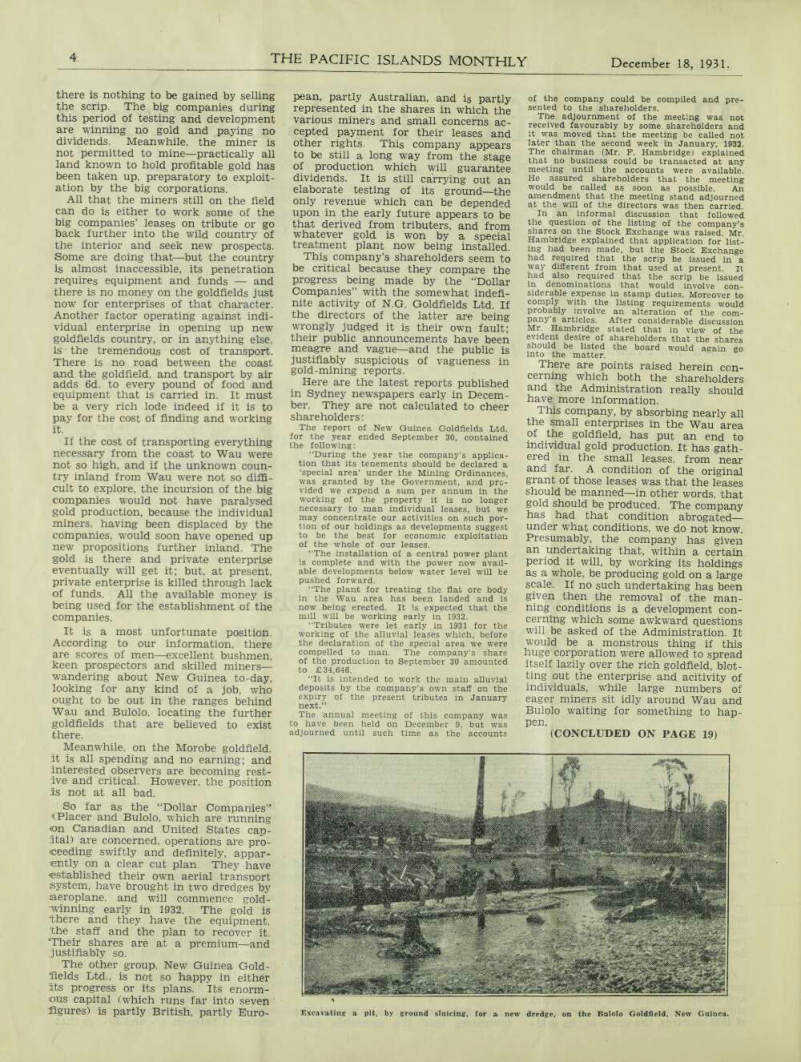
Excavating: a pit, by ground sluicing:, for a new dredge, on the Bulolo Goldfield, New Guinea.
flotation and operations to date, must commence production in 1932 on a scale sufficient to pay substantial dividends on its huge subscribed capital. If the treatment plant, to the introduction of which it makes brief reference, is sufficient to do this, the shareholders should know. If 1932 is going to be notable mostly for an indeterminate moving about of the company’s affairs and enterprises, the public should know.
It is imperative, from the Administration’s viewpoint that the Morobe field be brought to big-scale production without further unnecessary delay. An outpouring of Morobe gold will help New Guinea enormously in weathering the economic storm; and if this or any other company, for any reason than “act of God.” is not able to take advantage of its wonderful opportunities, then the Administration must act quickly and firmly and clear the way for those who will.
For ourselves, we are of opinion, despite the apparent pessimism in the share markets, that N.G. Goldfields Ltd. have not fallen down on the job— and presently the Co. will be a producer of enormous wealth for its share holders. But there seems to have been a hesitancy and a lack of definiteness in its policy which have alarmed some observers: and this has been accentuated by lack of information.
There certainly should be more frequent and fuller reports. Shareholders rightly expect to find themselves on an El Dorado —and if they are not, the fault is due to directoral and managerial shortcomings. It is certain that events have moved far too slowly—the “Dollar” group have shown what can be done.
N.G.G. directors should open the new year with quick action and frank reports. Otherwise they are going to be pursued vindictively by shareholders who are afraid for their investments, and bv critics pro bono publico, who will stir the Administration up to insist on Morobe being properly exploited.
These in charge of N.G.G. must remember that the unpleasant smell of the “snide” company promoter, and the smooth-tongued, cheating director, has been all over about 75 per cent, of gold mine flotations in Australia during the last quarter century; so that the average investor is always ready to believe
the worst - R.W.R. ===
The "Dog” Incident
Why Sir Hubert Murray Attended Papuan Sorcery Demonstration
From Our Own Correspondent
Port Moresby, Nov. 10.
A TEARING south-east wind and a prolonged dry spell have caused havoc along the coast of the Central Division of Papua, and the inland districts for miles. Not for many years have Port Moresby and its surroundings looked so barren and dismal.
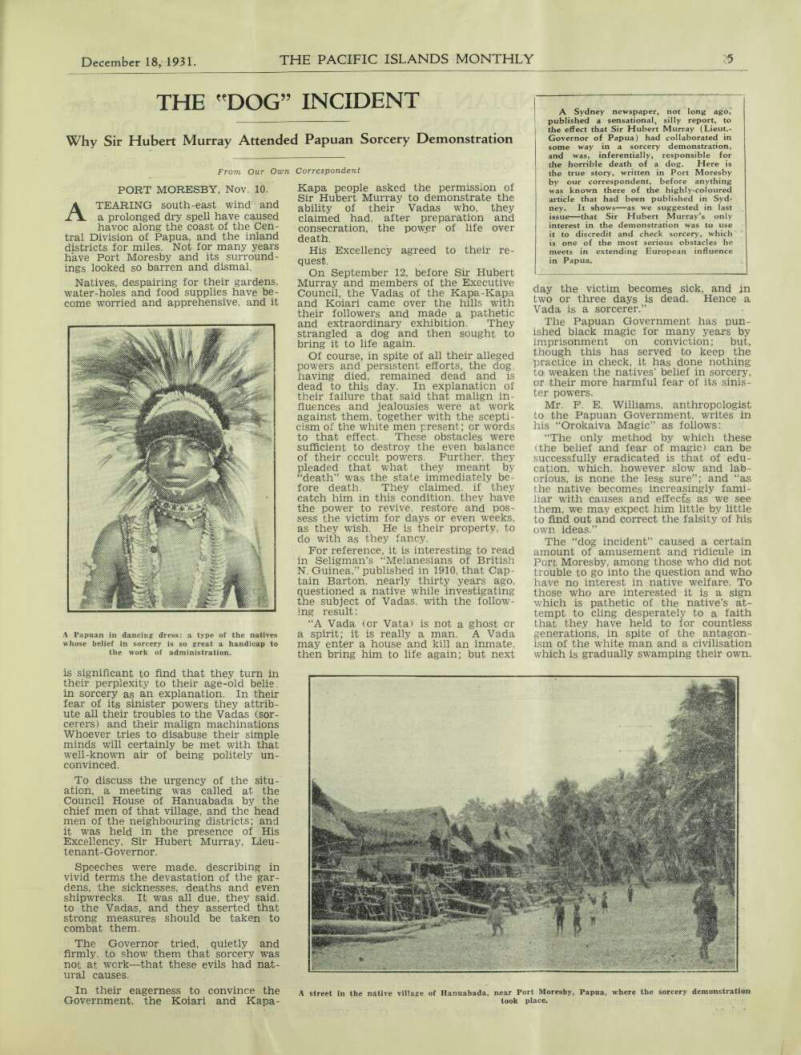
Natives, despairing for their gardens, water-holes and food supplies have become worried and apprehensive, and it A Papuan in dancing: dress: a type of the natives whose belief in sorcery is so great a handicap to the work of administration.
is significant to find that they turn in their perplexity to their age-old belief in sorcery as an explanation. In their fear of its sinister powers they attribute all their troubles to the Vadas (sorcerers) and their malign machinations Whoever tries to disabuse their simple minds will certainly be met with that well-known air of being politely unconvinced.
To discuss the urgency of the situation, a meeting was called at the Council House of Hanuabada by the chief men of that village, and the head men of the neighbouring districts; and it was held in the presence of His Excellency, Sir Hubert Murray, Lieutenant-Governor.
Speeches were made, describing in vivid terms the devastation of the gardens, the sicknesses, deaths and even shipwrecks. It was all due, they said, to the Vadas, and they asserted that strong measures should be taken to combat them.
The Governor tried, quietly and firmly, to show them that sorcery was not at work —that these evils had natural causes.
In their eagerness to convince the Government, the Koiari and Kapa-
Kapa people asked the permission of Sir Hubert Murray to demonstrate the ability of their Vadas who, they claimed had, after preparation and consecration, the power of life over death.
His Excellency agreed to their request.
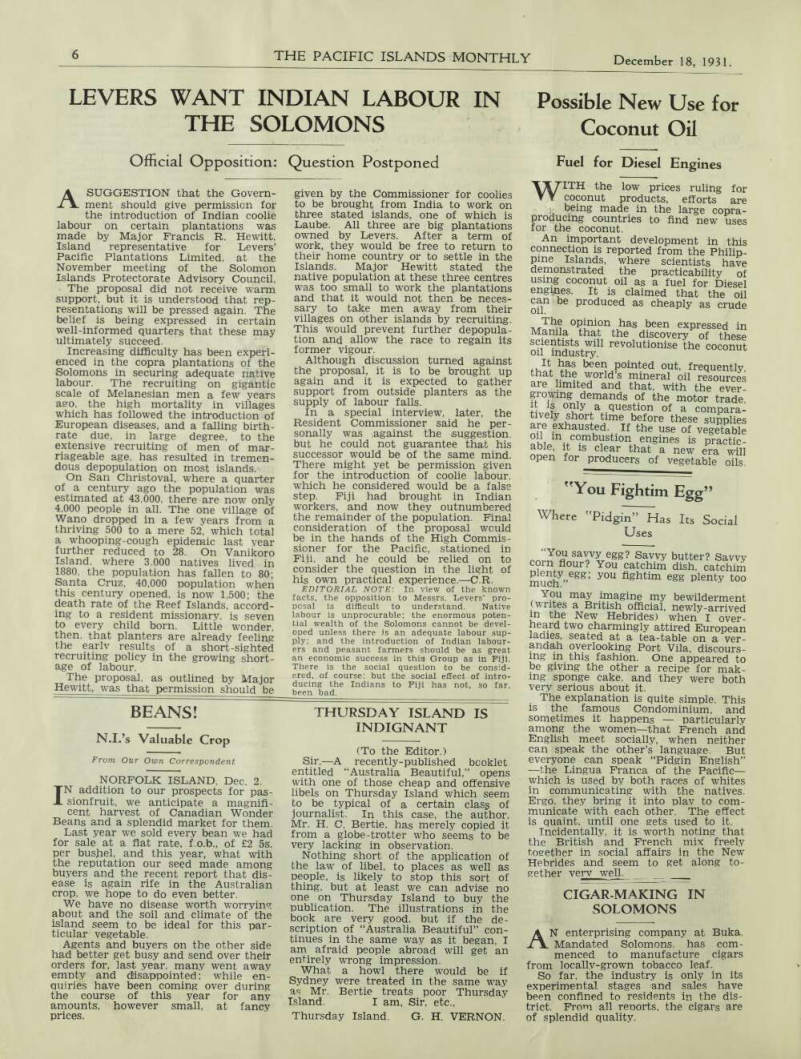
On September 12, before Sir Hubert Murray and members of the Executive Council, the Vadas of the Kapa-Kapa and Koiari came over the hills with their followers and made a pathetic and extraordinary exhibition. They strangled a dog and then sought to bring it to life again.
Of course, in spite of all their alleged powers and persistent efforts, the dog, having died, remained dead and is dead to this day. In explanation of their failure that said that malign influences and jealousies were at work against them, together with the scepticism of the white men present; or words to that effect. These obstacles were sufficient to destroy the even balance of their occult powers. Further, they pleaded that what they meant by “death” was the state immediately before death. They claimed, if they catch him in this condition, they have the power to revive, restore and possess the victim for days or even weeks, as they wish. He is their property, to do with as they fancy.
For reference, it is interesting to read in Seligman’s “Melanesians of British N. Guinea,” published in 1910, that Captain Barton, nearly thirty years ago, questioned a native while investigating the subject of Vadas, with the following result: “A Vada (or Vata) is not a ghost or a spirit; it is really a man. A Vada may enter a house and kill an inmate, then bring him to life again; but next A street in the native village of Hanuabada, near Port Moresby, Papua, where the sorcery demonstration took place. ---
A Sydney newspaper, not long ago, published a sensational, silly report, to the effect that Sir Hubert Murray (Lieut.- Governor of Papua) had collaborated in some way in a sorcery demonstration, and was, inferentially, responsible for the horrible death of a dog. Here is the true story, written in Port Moresby by our correspondent, before anything was known there of the highly-coloured article that had been published in Sydney. It shows —as we suggested in last issue—that Sir Hubert Murray’s only interest in the demonstration was to use it to discredit and check sorcery, which is one of the most serious obstacles he meets in extending European influence in Papua. ---
two or three days is dead. Hence a Vada is a sorcerer.”
The Papuan Government has punished black magic for many years by imprisonment on conviction; but, though this has served to keep the practice in check, it has done nothing to weaken the natives’ belief in sorcery, or their more harmful fear of its sinister powers.
Mr. F. E. Williams, anthropologist to the Papuan Government, writes in his “Orokaiva Magic” as follows: “The only method by which these (the belief and fear of magic) can be successfully eradicated is that of education, which, however slow and laborious, is none the less sure”; and “as the native becomes increasingly familiar with causes and effects as we see them, we may expect him little by little to find out and correct the falsity of his own ideas.”
The “dog incident” caused a certain amount of amusement and ridicule in Port Moresby, among those who did not trouble to go into the question and who have no interest in native welfare. To those who are interested it is a sign which is pathetic of the native’s attempt to cling desperately to a faith that they have held to for countless generations, in spite of the antagonism of the white man and a civilisation which is gradually swamping their own.
Advertisements & other items, p. 7 (1 item)
December 18, 1931. . . . . The Pacific Islands Monthly . . . . . 5
The Solomons
Levers Want Indian Labour In
... ——— Official Opposition: Question Postponed ... ———
A SUGGESTION that the Government should give permission for the introduction of Indian coolie labour on certain plantations was made by Major Francis R. Hewitt, Island representative for Levers’
Pacific Plantations Limited, at the November meeting of the Solomon Islands Protectorate Advisory Council.
The proposal did not receive warm support, but it is understood that representations will be pressed again. The belief is being expressed in certain well-informed quarters that these may ultimately succeed.
Increasing difficulty has been experienced in the copra plantations of the Solomons in securing adequate native labour. The recruiting on gigantic scale of Melanesian men a few years ago, the high mortality in villages which has followed the introduction of European diseases, and a falling birth rate due, in large degree, to the extensive recruiting of men of marriageable age, has resulted in tremendous depopulation on most islands.
On San Christoval, where a quarter of a century ago the population was estimated at 43,000, there are now only 4,000 people in all. The one village of Wano dropped in a few years from a thriving 500 to a mere 52 which total a whooping-cough epidemic last year further reduced to 28. On Vanikoro Island, where 3,000 natives lived in 1880, the population has fallen to 80; Santa Cruz, 40,000 population when this century opened, is now 1,500; the death rate of the Reef Islands, according to a resident missionary, is seven to every child born. Little wonder, then that planters are already feeling the early results of a short-sighted recruiting policy in the growing short age of labour.
The proposal, as outlined by Major Hewitt, was that permission should be
given by the Commissioner for coolies to be brought from India to work on three stated islands, one of which is Laube. All three are big plantations owned by Levers. After a term of work, they would be free to return to their home country or to settle in the Islands. Major Hewitt stated the native population at these three centres was too small to work the plantations and that it would not then be necessary to take men away from their villages on other islands by recruiting, This would prevent further depopulation and allow the race to regain its former vigour, Although discussion turned against the proposal, it is to be brought up again and it is expected to gather support from outside planters as the supply of labour falls.
In a special interview, later, the Resident Commissioner said he personally was against the suggestion, but he could not guarantee that his successor would be of the same mind, There might yet be permission given for the introduction of coolie labour, which he considered would be a false step. Fiji had brought in Indian workers, and now they outnumbered the remainder of the population. Final consideration of the proposal would be in the hands of the High Commissioner for the Pacific, stationed in Fiji and he could be relied on to consider the question in the light of his own practical experience.—C.R.
EDITORIAL NOTE : In view of the known facts, the opposition to Messrs. Levers’ proposal is difficult to understand. Native labour is unprocurable; the enormous potential wealth of the Solomons cannot be developed unless there is an adequate labour supply: and the introduction of Indian labour ers and peasant farmers should be as great an economic success in this Group as in Fiji, There is the social question to be considered, of course: but the social effect of introducing the Indians to Fiji has not, so far, been bad. ===
Beans!
... ——— N.I.’s Valuable Crop ... ———
From Our Own Correspondent ... ———
Norfolk Island, Dec. 2.
IN addition to our prospects for passionfruit, we anticipate a magnificent harvest of Canadian Wonder Beans and a splendid market for them.
Last year we sold every bean we had for sale at a flat rate, f.o.b., of £2 5s. per bushel, and this year, what with the reputation our seed made among buyers and the recent report that disease is again rife in the Australian crop, we hope to do even better.
We have no disease worth worrying about and the soil and climate of the island seem to be ideal for this particular vegetable.
Agents and buyers on the other side had better get busy and send over their orders for, last year, many went away empty and disappointed: while enquiries have been coming over during the course of this year for any amounts, however small, at fancy prices. ===
Thursday Island Is
Indignant
(To the Editor.) Sir,—A recently-published booklet entitled “Australia Beautiful,” opens with one of those cheap and offensive libels on Thursday Island which seem to be typical of a certain class of journalist. In this case, the author, Mr. H. C. Bertie, has merely copied it from a globe-trotter who seems to be very lacking in observation.
Nothing short of the application of the law of libel, to places as well as people, is likely to stop this sort of thing, but at least we can advise no one on Thursday Island to buy the publication. The illustrations in the book are very good, but if the description of “Australia Beautiful” continues in the same way as it began, I am afraid people abroad will get an entirely wrong impression.
What a howl there would be if Sydney were treated in the same way as Mr. Bertie treats poor Thursday Island. I am. Sir, etc.,
Thursday Island. . . . . G. H. VERNON.
Possible New Use for Coconut Oil
Coconut Oil ... ——— Fuel for Diesel Engines ... ———
WITH the low prices ruling for coconut products, efforts are being made in the large copraproducing countries to find new uses for the coconut.
An important development in this connection is reported from the Philippine Islands, where scientists have demonstrated the practicability of using coconut oil as a fuel for Diesel engines. It is claimed that the oil can be produced as cheaply as crude oil.
The opinion has been expressed in Manila that the discovery of these scientists will revolutionise the coconut oil industry.
It has been pointed out, frequently that the world’s mineral oil resources are limited and that, with the evergrowing demands of the motor trade it is only a question of a comparatively short time before these supplies are exhausted. If the use of vegetable oil in combustion engines is practicable, it is clear that a new era will open for producers of vegetable oils. ===
"You Fightim Egg”
... ——— Where "Pidgin” Has Its Social Uses ... ———
"You savvy egg? Savvy butter? Savvy corn flour? You catchim dish, catchim plenty egg; you fightim egg plenty too much."
You may imagine my bewilderment (writes a British official, newly-arrived in the New Hebrides) when I over heard two charmingly attired European ladies, seated at a tea-table on a verandah overlooking Port Vila, discoursing in this fashion. One appeared to be giving the other a recipe for making sponge cake, and they were both very serious about it.
The explanation is quite simple. This is the famous Condominium, and sometimes it happens particularly among the women—that French and English meet socially, when neither can speak the other’s language. But everyone can speak “Pidgin English” —the Lingua Franca of the Pacific— which is used by both races of whites in communicating with the natives.
Ergo, they bring it into play to communicate with each other. The effect is quaint, until one gets used to it.
Incidentally, it is worth noting that the British and French mix freely together in social affairs in the New Hebrides and seem to get along to gether very well. ===
Cigar-Making In
Solomons
AN enterprising company at Buka, Mandated Solomons, has commenced to manufacture cigars from locally-grown tobacco leaf.
So far, the industry is only in its experimental stages and sales have been confined to residents in the district. From all reports, the cigars are of splendid quality.
Advertisements & other items, p. 8 (1 item)
6 . . . . The Pacific Islands Monthly . . . . December 18, 1931.
Entomoligcal Triumph
December 18, 1931.
How Malayan Fly Destroyed Fijian Pest and Restored Coconut Industry December 18, 1931.
From Our Own Correspondent SUVA, November 26.
The story of how the destructive moth, Levuana irridescens, was swept out of Fiji, and coconut plantations restored to the great island of Viti Levu, has been briefly sketched in The Pacific Islands Monthly.
But it is worth re-telling—particularly the later developments. It reads almost like a fairy tale. Full credit for the remarkable achievement must go to our live-wire Department of Agriculture, of which Hon. A. C. Barnes is Director.
AFTER years of investigation, it was discovered that a natural enemy of the purple moth, Levuana, was a fly with the unpronouncable name of Ptychomyia remote, found in Malaya and the East Indies. There is a moth in Malaya which is very similar to Levuana and it attacks coconuts.
Entomologists observed that, whenever the Malayan moth appeared in any numbers it was promptly wiped out by the fly, which laid its eggs in the cocoon of the moth. The entomologists said that, if this fly could be introduced to Fiji it might destroy the Levuana pest, which had appeared mysteriously in Viti Levu about 1860, and prevented the cultivation of the coconut for more than half a century.
A number of the flies were captured and an endeavour was made to bring them to Fiji, via Sydney. However, a cold snap in transit wiped them out.
All sorts of plans were then mooted for bringing in another consignment.
It was even suggested that Fiji might utilise the services of the ubiquitous navy.
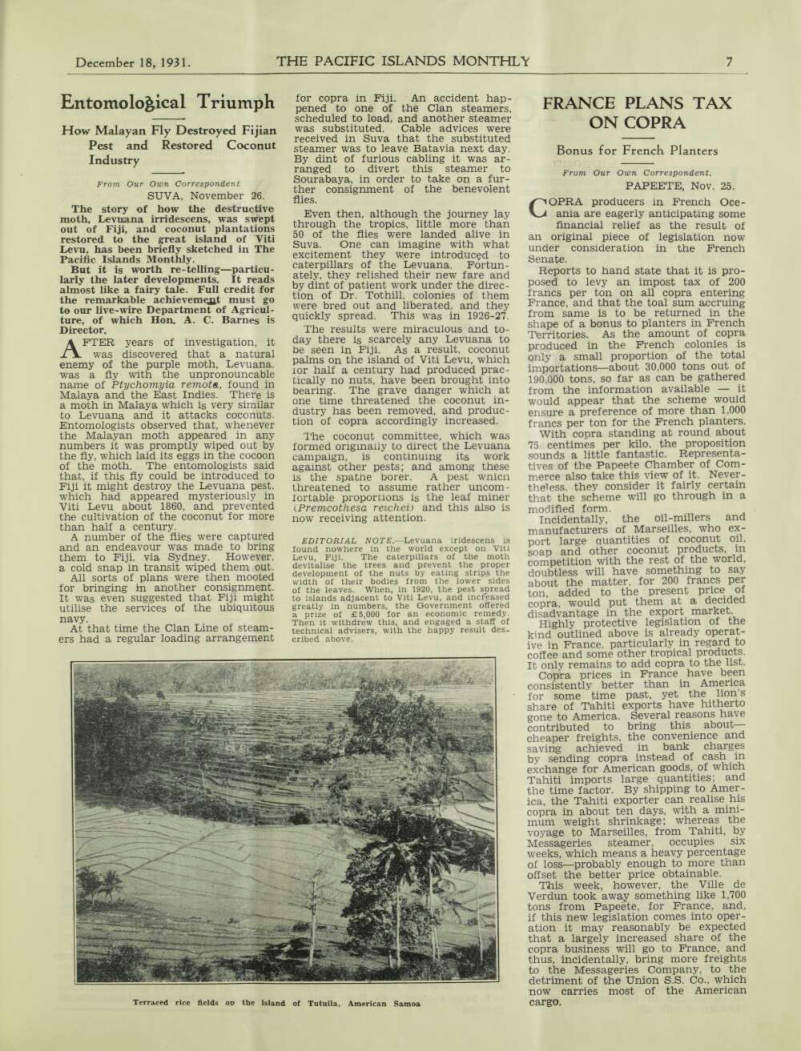
At that time the Clan Line of steamers had a regular loading arrangement Terraced rice fields op the island of Tutuila, American Samoa
for copra in Fiji. An accident happened to one of the clan steamers, scheduled to load, and another steamer was substituted. Cable advices were received in Suva that the substituted steamer was to leave Batavia next day.
By dint of furious cabling it was arranged to divert this steamer to Sourabaya, in order to take on a further consignment of the benevolent flies.
Even then, although the journey lay through the tropics, little more than 50 of the flies were landed alive in Suva. One can imagine with what excitement they were introduced to caterpillars of the Levuana. Fortunately, they relished their new fare and by dint of patient work under the direction of Dr. Tothill, colonies of them were bred out and liberated, and they quickly spread. This was in 1926-27.
The results were miraculous and to day there is scarcely any Levuana to be seen in Fiji. As a result, coconut palms on the island of Viti Levu, which for half a century had produced practically no nuts, have been brought into bearing. The grave danger which at one time threatened thc coconut instry has been removed, and production of copra accordingly increased.
The coconut committee, which was formed originally to direct the Levuana campaign, is continuing its work against other pests; and among these is the spathe borer. A pest which threatened to assume rather uncomfortable proportions is the leaf miner (Premcothesa reichei) and this also is now receiving attention.
Editorial Note. —Levuana iridescens is found nowhere in the world except on Viti Levu, Fiji. The caterpillars of the moth devitalise the trees and prevent the proper development of the nuts by eating strips the width of their bodies from the lower sides of the leaves. When, in 1920, the pest spread to islands adjacent to Viti Levu, and increased greatly in numbers, the Government offered a prize of £5,000 for an economic remedy.
Then it withdrew this, and engaged a staff of technical advisers, with the happy result described above. ===
France Plans Tax
On Copra
... ——— Bonus for French Planters ... ———
From Our Own Correspondent.
Papeete, Nov. 25.
COPRA producers in French Oceania are eagerly anticipating some financial relief as the result of an original piece of legislation now under consideration in the French Senate.
Reports to hand state that it is proposed to levy an impost tax of 200 francs per ton on all copra entering France, and that the toal sum accruing from same is to be returned in the shape of a bonus to planters in French Territories. As the amount of copra produced in the French colonies is only a small proportion of the total importations—about 30,000 tons out of 190,000 tons, so far as can be gathered from the information available — it would appear that the scheme would ensure a preference of more than 1,000 francs per ton for the French planters.
With copra standing at round about 75 centimes per kilo, the proposition sounds a little fantastic. Representatives of the Papeete Chamber of Commerce also take this view of it. Nevertheless, they consider it fairly certain that the scheme will go through in a modified form.
Incidentally, the oil-millers and manufacturers of Marseilles, who export large quantities of coconut oil, soap and other coconut products, in competition with the rest of the world, doubtless will have something to say about the matter, for 200 francs per ton, added to the present price of copra, would put them at a decided disadvantage in the export market.
Highly protective legislation of the kind outlined above is already operative in France, particularly in regard to coffee and some other tropical products.
It only remains to add copra to the list.
Copra prices in France have been consistently better than in America for some time past, yet the lion's share of Tahiti exports have hitherto gone to America. Several reasons have contributed to bring this about— cheaper freights, the convenience and saving achieved in bank charges by sending copra instead of cash in exchange for American goods, of which Tahiti imports large quantities; and the time factor. By shipping to America, the Tahiti exporter can realise his copra in about ten days, with a minimum weight shrinkage; whereas the voyage to Marseilles, from Tahiti, by Messageries steamer, occupies six weeks, which means a heavy percentage of loss—probably enough to more than offset the better price obtainable.
This week, however, the Ville de Verdun took away something like 1,700 tons from Papeete, for France, and, if this new legislation comes into operation it may reasonably be expected that a largely increased share of the copra business will go to France, and thus, incidentally, bring more freights to the Messageries Company, to the detriment of the Union S.S. Co., which now carries most of the American cargo.
Advertisements & other items, p. 9 (1 item)
7 . . . . The Pacific Islands Monthly . . . . December 18, 1931.
Tropicalities
I NOTICE in The Rabaul Times of November 13 that a correspondent exercises a somewhat feeble wit at the expense of Captain Milton, who supplied this journal with very interesting information regarding the treatment of native labourers in New Guinea. Most of the gentleman’s observations are simply silly, and his letter calls for no comment beyond this fact: Captain Milton, in giving his statement to The Pacific Islands Monthly, was not afraid to make it over his own name, and take responsibility for his opinions. The gentleman who writes in The Rabaul Times, although evidently very pleased with his own idea of wit, has not the courage to sign his own name, but protects himself under a nom de plume.
A little cur will always yap loudly from the safe side of its own backyard fence. * * * THE renewal of his company’s coastal mail-carrying contract with the Papuan Government may serve to soothe the ruffled feelings of Captain A. S. Fitch, managing director of Steamships Trading Co. Ltd., Port Moresby.
Captain Fitch came to Sydney not long ago, spent ten days here, and then had to pay the Federal Government 10s. before he could get a clear passport back to Papua; and had also to vigorously fight off Taxation Department’s assessment on the amount of income he had drawn during his ten days in Australia. “Murder,”
“outrage,” “piracy,” were only a few of the highly-coloured terms employed by the energetic Papuan when he called at this office, fresh from his brush with the Department.
“This is indeed the land of Ned Kelly,” said the Captain; “but, believe me, it is not a policy that pays. I have not only placed orders in this country worth tens of thousands of pounds, but I have also spent £3,000 here on my child’s education. Now, they have not only ‘pinched’ my wife’s Commonwealth bonds, representing money which she had invested in Australia, but they try to bush-range me for income-tax during my few days’ stay here.
“Is it any wonder that Australia’s trade with the Pacific territories is being killed by fat-headed officialdom!
You can imagine the enthusiasm with which I shall send any future orders to Australia. Compare this treatment with the treatment we receive from other nations. The Dutch shipping company, for instance, offers me substantial concessions in connection with shipping in recognition of the fact that I have the placing of substantial orders for goods.”
Australia, in many ways, is a wonderful country; but if there is to be any real advance made in the encouragement and development of overseas trade, there will have to be a tremendous change in the attitude of the hordes of officials. * * *
A LIST of the subjects taught at the well-known Tonga College, Nukualofa, has come to hand. They include, not only the three necessary R’s, but also such things as geology, physiology, algebra, mensuration, drawing, shorthand and bookkeeping. It is a little difficult to see the use of all this educational equipment for young Tongans who are to spend their lives growing coconuts and bananas on a very limited area of land: but one supposes that the tireless educationalist of the South Seas must be served.
Tonga wants native doctors, teachers, craftsmen and administrators: but a quarter of the present college enrolment would meet all demands under those heads. Two much education forced on a community that its not ready for the innovation, can create greater evils than illiteracy. • • • SUVA, capital of a prosperous Crown Colony that, only half a century ago, was sunk in savagery, now has 15,000 inhabitants; many miles of cement and tar-macadam streets: modern services supplying water, sewerage, electricity and telephones; and some 300 cars running for hire. It is a cosmopolitan city—its inhabitants are in five main groups: Europeans, Fijians, Hindus, Chinese and half-castes. It is at the cross-roads of the South Seas and it is destined to become as famous as Honolulu, over which over-boomed city it has many natural advantages. • • • THIS has nothing to do with the Islands—but I approve of it so heartily that I must give it space.
A man from England. Mr. C. C. Lynam. said that he came to Australia, expecting to find Australians characterised by strong individual independence, dislike of interference with their private life and doings, and contempt for regulations and inhibitions of which they did not approve. But, according to The Sydney Morning Herald, this is what Mr. Lynam found: “I am bound to say that I find him meekly, almost good-humouredly, submitting to a Governmental and political tyranny that reminds one of the dark ages. In New South Wales he submits to the dictatorship of an uneducated, blatant, overbearing demagogue, and, all over the continent, to the dictatorship of so-called workers’ unions which prevent the real worker from calling his soul his own.
“Here you have a glorious country with unrivalled possibilities and climates, and a young, vigorous, intelligent, and noble people, all being ruined by a small minority of detestable, self-seeking, interfering, loud-voiced, lying politicians. It would be a Gilbertian absurdity if it were not such an unbelievable tragedy. “If I were King,” I would make short work of these blighters (in the true sense of the word).
“A strong and efficient police to restrain passion and lust, to protect the weak, and to do justice is all the Government that a people like the Australians require. Give them that, and leave everything else to private enterprise, capacity, and individual work, and Australia would be the happiest and most prosperous country in the world.”
I have seldom seen it so well expressed. * * *
THUS writes our Thursday Island correspondent: “Great interest in the article, “Undisciplined Natives, which appeared in the October issue of the Pacific Islands Monthly, and sympathy with the writer, have been expressed locally. Free ventilation of grievances of this nature should do a lot of good and the P.I.M. is fulfilling one of its objects in help ing residents of the Pacific by drawing attention to such experiences.
Fortunately, this community is rarely harassed by local officials, whose endeavour obviously is to work harmoniously with the business section of the island. Annoyance to the public generally comes from higher up, where there anpears to be a determined wish to augment the powers of Government departments bv a host of regulations and restrictions, many of which might well be cancelled. As a nation, we are suffering from being over-governed, and it is press articles like “Undisciplined Natives” that pave the way to protest. We trust that the matters revealed in this article will result in more consideration being shown to planters and business men, as well as the general public. * * * WE try to make this journal of real value to residents in the Pacific Islands. Therefore, it is most encouraging to receive letters such as this one, which comes from a planter in the Solomon Islands: “Your paper supplies a long-felt want and is eagerly looked for by all my acquaintances in this group. Long may it thrive and continue the success it deserves! It supplies its readers with considerable information regard ing other Islands in the Pacific which, other wise, would remain in obscurity. Not only that, its market quotations and sailing list of steamers make it a sine qua non to all its readers, who have a very meagre mail service.”
Advertisements & other items, p. 10 (2 items)
8 . . . The Pacific Islands Monthly . . . December 18, 1931.
===
Imperial
RESIDENTIAL HOTEL
221 DARLINGHURST RD., KING’S CROSS
SYDNEY, N.S.W.
FULL BOARD AND RESIDENCE :
Weekly, from 45/- to 63/-. Daily, 10/-.
Management : Mr. and Mrs. Cyril Edwards
"Daddas” Who Seek Elusive
Romance In Coral Islands
By Robert Slade
STRANGE, the call that the Pacific Islands have for elderly super-civilised men of ardent temperament!
The years may harden their arteries, but their hearts—and their heads —stay soft. A remarkable number of them throw off the family and business responsibilities of middle age and disappear among the coral isles, following the beckoning finger of Romance—and a lively imagination.
I met one of these rebels some years ago, when travelling on a small steamer from Auckland to Eastern Polynesia.
We were following an unusual course: and he had taken passage with us because we were calling at a somewhat isolated island where he had made himself a home.
He was a lively little grey-headed man; and, because he was panting with eagerness to see his island again and I was a sympathetic cabin-mate, he told me the story of his life. He had been a warehouseman and a softgoods traveller in Dunedin, with a large wife, a small suburban garden, and a brood of lusty youngsters. For a quartercentury he had remained on his selfmade treadmill. Then, somehow, his chance had come. His wife was well provided for, his children were selfsupporting. The starved, romantic soul of him burst its bonds and Charles Green —that was not his name, but it will serve—cleared out. He, so to speak, crawled into a hole in the Pacific and pulled it in after him.
Charles told me that he wandered about the Cook and Society groups until he found a small, very beautiful island, where he settled down as a trader and planter. He had started life all over again. A charming Polynesian girl, said Charles, superintended his modest bungalow, soothed his loneliness and presented him with two half caste babies. I gathered that he was soaking himself in sunshine, beauty and tropical romance, and the greying years had lost their terrors.
Frankly, I was very pleased with Charles. I had partaken lavishly of Louis Beck and Herman Melville and. almost before Rangitoto was out of sight I was looking ahead for Rarotonga’s peaks, and for dusky belles with frangipanni flowers behind their ears.
Charles, with his passionate Islands wife and his fervid descriptions of crooning palm trees and sparkling lagoons, fitted into the picture.
Charles was pleased with me. I listened eagerly, for hours, to his stories about his Polynesian girl’s warmth and devotion, and her loveliness and charm.
He told me all sorts of stirring, intimate things. Seeing his ardour, one forgot his bald head and forgave him the wrinkles on his leathery old neck.
Romeo and Strephon and all the lovers of ancient Romance were not a circumstance to my yearning and impatient Charles. He was ready to get out and push the ship along. . . .
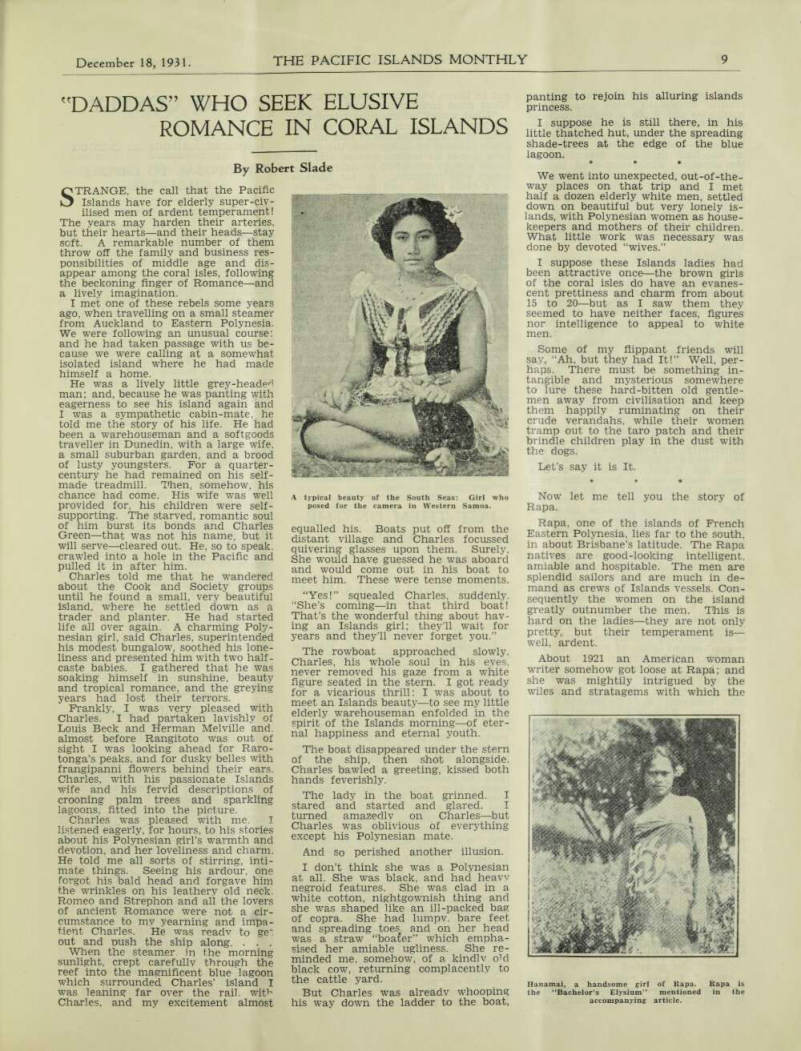
When the steamer, in the morning sunlight, crept carefully through the reef into the magnificent blue lagoon which surrounded Charles’ island I was leaning far over the rail, with Charles, and my excitement almost A typical beauty of the South Seas: Girl who posed for the camera in Western Samoa.
equalled his. Boats put off from the distant village and Charles focussed quivering glasses upon them. Surely, She would have guessed he was aboard and would come out in his boat to meet him. These were tense moments.
“Yes!” squealed Charles, suddenly.
“She’s coming—in that third boat!
That’s the wonderful thing about having an Islands girl; they’ll wait for years and they’ll never forget you.”
The rowboat approached slowly.
Charles, his whole soul in his eyes, never removed his gaze from a white figure seated in the stern. I got ready for a vicarious thrill: I was about to meet an Islands beauty—to see my little elderly warehouseman enfolded in the spirit of the Islands morning—of eternal happiness and eternal youth.
The boat disappeared under the stern of the ship, then shot alongside.
Charles bawled a greeting, kissed both hands feverishly.
The lady in the boat grinned. I stared and started and glared. I turned amazedly on Charles —but Charles was oblivious of everything except his Polynesian mate.
And so perished another illusion.
I don’t think she was a Polynesian at all. She was black, and had heavy negroid features. She was clad in a white cotton, nightgownish thing and she was shaped like an ill-packed bag of copra. She had lumpy, bare feet and spreading toes and on her head was a straw “boater” which emphasised her amiable ugliness. She reminded me, somehow, of a kindly old black cow, returning complacently to the cattle yard.
But Charles was already whooping his way down the ladder to the boat,
panting to rejoin his alluring islands princess.
I suppose he is still there, in his little thatched hut, under the spreading shade-trees at the edge of the blue lagoon. * * * We went into unexpected, out-of-the way places on that trip and I met half a dozen elderly white men, settled down on beautiful but very lonely islands, with Polynesian women as housekeepers and mothers of their children.
What little work was necessary was done by devoted “wives.”
I suppose these Islands ladies had been attractive once—the brown girls of the coral isles do have an evanescent prettiness and charm from about 15 to 20—but as I saw them they seemed to have neither faces, figures nor intelligence to appeal to white men.
Some of my flippant friends will say, “Ah, but they had It!” Well, perhaps. There must be something intangible and mysterious somewhere to lure these hard-bitten old gentlemen away from civilisation and keep them happily ruminating on their crude verandahs, while their women tramp out to the taro patch and their brindle children play in the dust with the dogs.
Let’s say it is It. * * * Now let me tell you the story of Rapa.
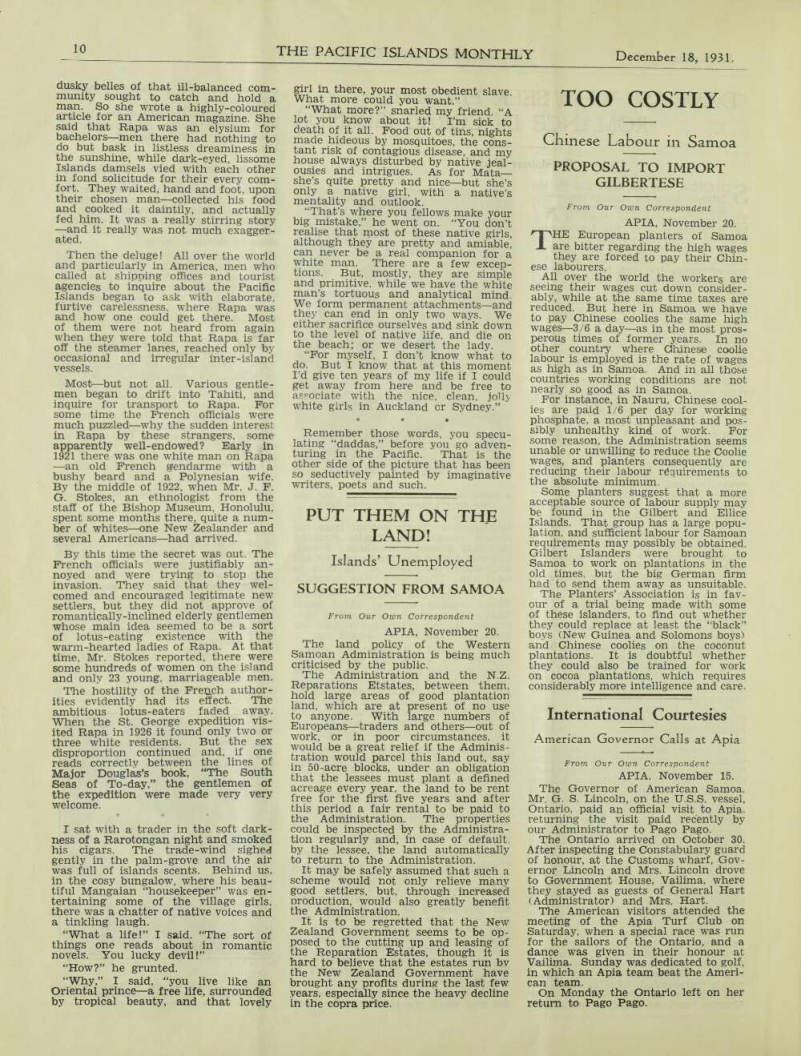
Rapa, one of the islands of French Eastern Polynesia, lies far to the south, in about Brisbane’s latitude. The Rapa natives are good-looking intelligent, amiable and hospitable. The men are splendid sailors and are much in demand as crews of Islands vessels. Consequently the women on the island greatly outnumber the men. This is hard on the ladies—they are not only pretty, but their temperament is— well, ardent.
About 1921 an American woman writer somehow got loose at Rapa; and she was mightily intrigued by the wiles and stratagems with which the
Hanamai, a handsome girl of Rapa. Rapa is the “Bachelor’s Elysium” mentioned in the accompanying article.
dusky belles of that ill-balanced community sought to catch and hold a man. So she wrote a highly-coloured article for an American magazine. She said that Rapa was an elysium for bachelors—men there had nothing to do but bask in listless dreaminess in the sunshine, while dark-eyed, lissome Islands damsels vied with each other in fond solicitude for their every comfort. They waited, hand and foot, upon their chosen man—collected his food and cooked it daintily, and actually fed him. It was a really stirring story —and it really was not much exaggerated.
Then the deluge! All over the world and particularly in America, men who called at shipping offices and tourist agencies to inquire about the Pacific Islands began to ask with elaborate, furtive carelessness, where Rapa was and how one could get there. Most of them were not heard from again when they were told that Rapa is far off the steamer lanes, reached only by occasional and irregular inter-island vessels.
Most—but not all. Various gentlemen began to drift into Tahiti, and inquire for transport to Rapa. For some time the French officials were much puzzled—why the sudden interest in Rapa by these strangers, some apparently well-endowed? Early in 1921 there was one white man on Rapa —an old French gendarme with a bushy beard and a Polynesian wife.
By the middle of 1922, when Mr. J. F.
G. Stokes, an ethnologist from the staff of the Bishop Museum, Honolulu, spent some months there, quite a number of whites —one New Zealander and several Americans —had arrived.
By this time the secret was out. The French officials were justifiably annoyed and were trying to stop the invasion. They said that they welcomed and encouraged legitimate new settlers, but they did not approve of romantically-inclined elderly gentlemen whose main idea seemed to be a sort of lotus-eating existence with the warm-hearted ladies of Rapa. At that time, Mr. Stokes reported, there were some hundreds of women on the island and only 23 young, marriageable men.
The hostility of the French authorities evidently had its effect. The ambitious lotus-eaters faded away.
When the St. George expedition visited Rapa in 1926 it found only two or three white residents. But the sex disproportion continued and, if one reads correctly between the lines of Major Douglas’s book, “The South Seas of To-day,” the gentlemen of the expedition were made very very welcome. * * * I sat with a trader in the soft darkness of a Rarotongan night and smoked his cigars. The trade-wind sighed gently in the palm-grove and the air was full of islands scents. Behind us, in the cosy bungalow, where his beautiful Mangaian “housekeeper” was entertaining some of the village girls, there was a chatter of native voices and a tinkling laugh, “What a life!” I said. “The sort of things one reads about in romantic novels. You lucky devil!”
“How?” he grunted.
“Why,” I said, “you live like an Oriental prince—a free life, surrounded by tropical beauty, and that lovely
girl in there, your most obedient slave.
What more could you want.”
“What more?” snarled my friend. “A lot you know about it! I’m sick to death of it all. Food out of tins, nights made hideous by mosquitoes, the constant risk of contagious disease, and my house always disturbed by native jealousies and intrigues. As for Mata— she’s quite pretty and nice—but she’s only a native girl, with a native’s mentality and outlook.
“That’s where you fellows make your big mistake,” he went on. “You don’t realise that most of these native girls, although they are pretty and amiable, can never be a real companion for a white man. There are a few exceptions. But, mostly, they are simple and primitive, while we have the white man’s tortuous and analytical mind.
We form permanent attachments—and they can end in only two ways. We either sacrifice ourselves and sink down to the level of native life, and die on the beach ; or we desert the lady.
“For myself, I don’t know what to do. But I know that at this moment I’d give ten years of my life if I could get away from here and be free to associate with the nice, clean, jolly white girls in Auckland or Sydney.” * * * Remember those words, you speculating “daddas,” before you go adventuring in the Pacific. That is the other side of the picture that has been so seductively painted by imaginative writers, poets and such. ... ===
Advertisements & other items, p. 11 (1 item)
9 . . . The Pacific Islands Monthly . . . December 18, 1931.
Islands’ Unemployed
Put Them On The
Land!
Suggestion From Samoa
From Our Own Correspondent APIA, November 20.
The land policy of the Western Samoan Administration is being much criticised by the public.
The Administration and the N.Z.
Reparations Estates, between them, hold large areas of good plantation land, which are at present of no use to anyone. With large numbers of Europeans—traders and others—out of work, or in poor circumstances, it would be a great relief if the Administration would parcel this land out, say in 50-acre blocks, under an obligation that the lessees must plant a defined acreage every year, the land to be rent free for the first five years and after this period a fair rental to be paid to the Administration. The properties could be inspected by the Administration regularly and, in case of default, by the lessee, the land automatically to return to the Administration.
It may be safely assumed that such a scheme would not only relieve many good settlers, but, through increased nroduction, would also greatly benefit the Administration.
It is to be regretted that the New Zealand Government seems to be opposed to the cutting up and leasing of the Reparation Estates, though it is hard to believe that the estates run by the New Zealand Government have brought any profits during the last few years, especially since the heavy decline in the copra price. ... ===
Too Costly
Chinese Labour in Samoa
Proposal To Import
Gilbertese
From Our Own Correspondent APIA, November 20.
THE European planters of Samoa are bitter regarding the high wages they are forced to pay their Chinese labourers.
All over the world the workers are seeing their wages cut down considerably, while at the same time taxes are reduced. But here in Samoa we have to pay Chinese coolies the same high wages—3/6 a day—as in the most prosperous times of former years. In no other country where Chinese coolie labour is employed is the rate of wages as high as in Samoa. And in all those countries working conditions are not nearly so good as in Samoa.
For instance, in Nauru, Chinese coolies are paid 1/6 per day for working phosphate, a most unpleasant and possibly unhealthy kind of work. For some reason, the Administration seems unable or unwilling to reduce the Coolie wages, and planters consequently are reducing their labour requirements to the absolute minimum.
Some planters suggest that a more acceptable source of labour supply may be found in the Gilbert and Ellice Islands. That group has a large population, and sufficient labour for Samoan requirements may possibly be obtained.
Gilbert Islanders were brought to Samoa to work on plantations in the old times, but the big German firm had to send them away as unsuitable.
The Planters’ Association is in favour of a trial being made with some of these islanders, to find out whether they could replace at least the “black” boys (New Guinea and Solomons boys) and Chinese coolies on the coconut plantations. It is doubtful whether they could also be trained for work on cocoa plantations, which requires considerably more intelligence and care. ... ===
International Courtesies
American Governor Calls at Apia
From Our Own Correspondent APIA, November 15.
The Governor of American Samoa.
Mr. G. S. Lincoln, on the U.S.S. vessel, Ontario, paid an official visit to Apia, returning the visit paid recently by our Administrator to Pago Pago.
The Ontario arrived on October 30.
After inspecting the Constabulary guard of honour, at the Customs wharf, Governor Lincoln and Mrs. Lincoln drove to Government House, Vailima, where they stayed as guests of General Hart (Administrator) and Mrs. Hart.
The American visitors attended the meeting of the Apia Turf Club on Saturday, when a special race was run for the sailors of the Ontario, and a dance was given in their honour at Vailima. Sunday was dedicated to golf, in which an Apia team beat the American team.
On Monday the Ontario left on her return to Pago Pago.
Advertisements & other items, p. 12 (1 item)
10 . . . . The Pacific Islands Monthly . . . December 18, 1931.
How Fiji Is Ruled
Evolution of Constitutional System, from being Wholly Nominative to Partly Elective ---
Editorial Note. —In View
of the growing demand in New Guinea for some form of elective Council to aid the Administrator, the following details of the Fijian system are interesting. ---
From Our Own Correspondent SUVA, November 26.
THE Legislative Council of Fiji represents a certain step which is always reached in the evolution of a Crown Colony. After cession, Fiji started with a Governor and a small Council of heads of departments as his advisers. The next step came when a number of the colonists were nominated by the Governor to sit on this Advisory Council ; but a few years before the war, a system of elective representation was adopted, under which the Colonists elected seven members to represent them.
Post-war developments have been mainly on the lines of providing representation for the increasing Indian section of our population.
Nowadays the Legislative Council consists of six European elected members, three Fijian nominated and three Indian elected members. The franchise for both European and Indian electors is on the basis of property and income.
The Fijian members are selected by the Governor from a list of six names sent to him by the Great Council of Chiefs. It is a rather pleasant fiction to consider them as able to exercise an independent judgment; but, in practice.
they are to all intents and purposes Government nominees and nearly always holders or ex-holders of posts in the Government.
To balance these 12 representatives of the Colonists, there are 12 Civil Servants, nominated by the Governor and approved by the Secretary of State. The Governor sits as President of the Council and thus there is an official majority.
The system of government is a good one and is rather like the benevolent despotism under which England flourished in the time of Henry VIII.
The elections are held three years, the next being due in 1932.
The three Indian members elected in 1929 resigned shortly afterwards, because they disapproved of the system under which European, Fijian and Indian communities were divided into compartments, each represented by members of its own race. However, the “common roll controversy” has rather faded into the background, and we hope that at the next elections, in 1932, some of the Indian agriculturists will offer themselves for election, so that this very important section of the colonists in Fiji may have their voices heard in the Legislative Council. ... ===
Story Of "Tabu”
How a Film Was Made on Borabora
From Our Own Correspondent.
PAPEETE, November 25.
THE latest reviews from America and Europe indicate that the film, “Tabu,” is proving a big success, both financially and artistically, and appears to be quite the best South Sea picture so far put upon the screen.
The late Mr. Murnau spent more than a year in the Society Group in connection with this production, and collaborated with Mr. Bob Flaherty.
The latter had already made a name for himself in Samoa, where he produced “Moana,” a picture of great artistic merit but too high-class to appeal to the great masses who bring in the dollars.
In “Tabu,” Murnau and Flaherty between them appear to have hit the happy medium.
Most of “Tabu” was filmed in Bora bora, an island situated some 150 miles north-west of Tahiti, and which holds
every variety of island scenery within its encircling reef.
Borabora has always been a favourite stopping place for British men-of-war visiting the Society Group, before proceeding to the main port of Papeete.
Here one finds the typical atoll formation of low wooded islets along the outer reef, an easy passage leading to a navigable lagoon, and the jagged peaks of a real volcanic island sticking up in the centre of it.
Murnau’s main camp was built on the atoll, which ensured the greatest degree of isolation and absence of unwanted spectators from the settlements who have a weakness for getting in the way of the camera at unpropitious moments.
Somewhere on Borabora to-day.
Matahi, the leading man in “Tabu,” plants his sweet potatoes and tends his vanilla vines, all unconscious of the fame he has acquired, and probably all the happier for his ignorance.
The heroine, however, “Here,” other wise known as Anna Chevalier, departed some months ago to follow on the trail of the picture she had played in, and got a job in Ziegfield’s Follies, New York. She is still there, from all accounts, and her picture, in the latest mode, frequently adorns the front page of illustrated theatrical publications.
Flaherty is in Hollywood, planning another masterpiece.
Advertisements & other items, p. 13 (2 items)
December 18, 1931. . . . The Pacific Islands Monthly . . . . 11
Lighting Plants
The reliable LISTERLITE, the “powerhouse” of thousands of homesteads. Unfailingly delivers electric current on the most economical basis. Plants in stock to suit every possible requirement, with or without storage batteries. Ask us to quote for your installation.
Diesel (crude oil)
Engines
Famous British Lister-Diesel crude oil engines start perfectly from dead cold, on regular crude oil fuel. From b.h.p. upwards. Shortly available in marine type also.
Petrol Engines
The most reliable petrol engines in the world. British built for sheer reliability and economy. Thousands of owners have proved that Lister maintenance costs are hardly worth regarding. In all sizes from 1½ to 14 b.h.p. Petrol and kerosene types available.
Auto Trucks
Here is a neat little labour saving vehicle for haulage on road or rails, especially on long jetties. Equipped with air cooled engine; carries one ton or hauls three tons. Simple to operate, and available in varying body types for dif ferent classes of work. The most economical motor transport vehicle yet produced.
Pumps
of all kinds. If you have water to move you will find exactly the kind of pump in the “Neverlire” line. From the simple well pump to the powerful self-oiling “Bulldozer” we have the right type of pump at the right price, for every job.
Windmills
Put the wind to work for you. Ve have proved makes of mills available in all regular sizes, with or without towers. Tell us your water problem, and we can recommend the proper mill to do the work.
Enquiries for any of these lines will have our careful attention. Prices will be quoted free of Australian Customs’ Duty, in original cases.
Agents Wanted
We shall he glad to hear from responsible Island parties willing to undertake the sale and representation of these lines. Write us.
Dangar, Gedye & Co,
LIMITED
10-14 Young Street, Sydney
Missions—Good And Bad
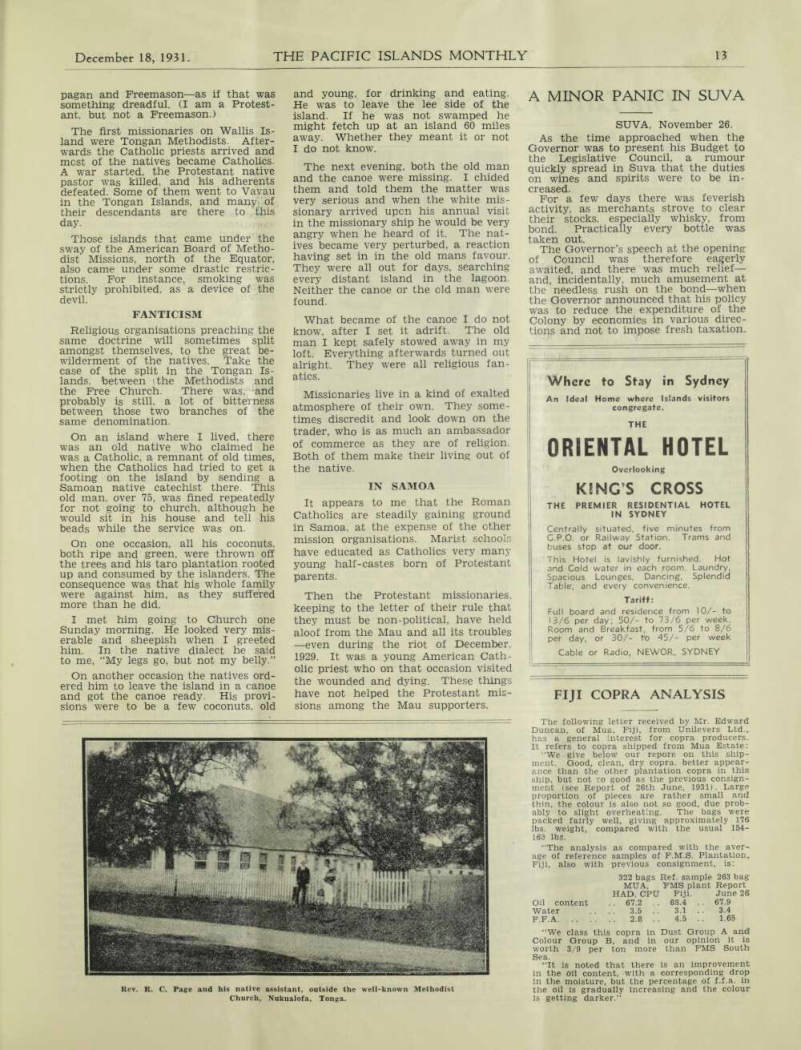
Interesting Comments on Missionary Activity and Influence in the South Seas
Written for The Pacific Islands Monthly by G. E. L. Westbrook, Samoa.
I AM not against the Pacific Islands Missions—but neither am I for them.
Man and boy, I have lived for long over half-a-century in the South Seas —the last 40 years in Samoa. I have seen, on the one hand, natives assisted and educated by the missionaries: and on the other hand I have seen sectarian jealousy cause cruel wars and religious fanaticism manifest itself in monstrous oppression of native communities. I give the mission system full credit: and, also, it must take the discredit of many shortcomings and much injustice.
Everyone must respect and admire those earnest Christian men and women, of all denominations, who have spent much of their lives in efforts to convert and educate the heathen.
Many of them have suffered martyrdom.
It is now more than 100 years since the Samoans welcomed the mission aries and all became Christians. The missionaries have not only translated and given to this primitive race the whole of the Bible, but also a written language. There is now not one per cent, of the Samoans who cannot read or write in their own language. There are over 220 churches and schools in the Group, all built, paid for and main tained by the natives.
But I will not say that this has been altogether for the good of the natives. The church is too powerful in many places. The life of the native has changed. The church really rules and governs everything. The native has lost all that he knew formerly of the arts and crafts which made him self-reliant. He now has a literature but it is practically all on one subject —religion. He, therefore, tends to be come fanatical and narrow minded.
It is a difficult problem to say where the good of the missionary effort ends and the evil commences. During my long residence in Samoa I have known and admired most of the men of the London Missionary Society. No one can fail to recognise their good work.
But is their great influence, nowadays, being used for the real advancement of these Pacific Territories?
More than 50 years ago I lived on South Seas Islands where natives were governed entirely by their own chiefs, without interference by European na tions or missionaries. They kept to their own manners and customs and were happy and prosperous. Then came the missionaries, who under mined the power of the chiefs, destroyer the ancient communal life, and opened the way for the vices and hypocrisies of the white man.
I know that missionaries blame the traders for the things I have mentioned. I tell only of what I have seen.
Rotuma’S Sectarian War
In the year 1880-1881 I was on the island of Rotuma. trading for a New Zealand firm. While I was there, Rotuma was annexed to Fiji by Governor de Vouex. I attended the flag raising at Matusa, the warship Miranda
having brought the Governor of Fiji for that express purpose. This is what led up to the annexation: On Rotuma there were Methodists and Catholics. The Methodists had established themselves first. Some years afterwards the Catholics landed some priests and, out of a population of 2,500, 500 became Catholics. Being anxious to gain converts—if it was possible to get a convert in a Protestant village—the Catholics would build a little chapel, even if it consisted only of a few coconut leaves and sticks.
On the roof a cross would be erected.
A fanatical native Melholist pastor, upon returning from wild pig shooting, passed a number of villages where these small chapels were. He deliberately took pot-shots at the crosses. This was reported to the priests, who indignantly protested to the Rev. Mr. Moore, head of the Methodist mission. He, however, had no control over the fanatical native pastor.
A priest then wrote directly to the pastor himself. The native sent back a very insulting reply, accusing the priest of certain misdemeanours. This led to a war, which lasted about 8 months, and it was said about 80 people were killed.
The traders on the island, most of whom were German, persuaded the natives to petition to come under the protection of Fiji, and that was why the island was annexed to Fiji while I was there.
Sunday In Funafuti
I afterwards left for the Ellice group and, for some years, was stationed on the island of Funafuti. Funafuti, like
many of the other islands in the Ellice group was sparsely populated, most of the inhabitants having been kidnapped by Peruvian slavers in the later ’sixties.
The natives lived in one big village and mustered a little over 200. The czar and controller of almost every thing, both state and church, was a Samoan native pastor. The leading men of the island were under his control, as deacons in his church.
There were some most absurd laws in operation.
One law was that it was a sin and a punishable offence to either bathe or cook on the sabbath day—punishable by fine, and worse still to the simple islanders, by being turned out of church membership. To miss going to church on Sundays, unless one could prove severe illness, was also a fineable offence. On Sundays, I did my own bit of cooking.
The Ellice Islands, in those days, were governed by the natives them selves; they had not then come under the sphere of the High Commissioner for the Western Pacific. I was fined regularly for breaches of their laws and, because I would neither acknowledge their laws or pay my fines, they christened me “O le Papalangi super” (the whiteman who was gone in the upper storey). They were not in a position to boycott my business, as I was the only trader who had goods to suit their requirements. It was not till some time afterwards that the annoyance I was subject to was fixed up by Captain (afterwards Admiral) Cyprian Bridge, of H.H.S. Espiogle, giving them a severe reprimand.
Wallis Island’S War
My next experience of missionaries was on Wallis Island. The natives were all Catholics. In fact, no opposition mission would have been tolerated on that island. The Mission was conducted by French Marists. On account of my not being a Catholic I was called all kinds of names by a French priest whom I clashed with—heretic.
A typical pioneer Missionary of the South Seas. Rev. J. Flierl, D.D., who retired recently after spending 43 years in the service of the Lutheran Mission in New Guinea.
pagan and Freemason —as if that was something dreadful. (I am a Protestant, but not a Freemason.) The first missionaries on Wallis Island were Tongan Methodists. Afterwards the Catholic priests arrived and most of the natives became Catholics.
A war started, the Protestant native pastor was killed, and his adherents defeated. Some of them went to Vavau in the Tongan Islands, and many of their descendants are there to this day.
Those islands that came under the sway of the American Board of Methodist Missions, north of the Equator, also came under some drastic restrictions. For instance, smoking was strictly prohibited, as a device of the devil.
Fanticism
Religious organisations preaching the same doctrine will sometimes split amongst themselves, to the great bewilderment of the natives. Take the case of the split in the Tongan Islands, between ithe Methodists and the Free Church. There was, and probably is still, a lot of bitterness between those two branches of the same denomination.
On an island where I lived, there was an old native who claimed he was a Catholic, a remnant of old times, when the Catholics had tried to get a footing on the island by sending a Samoan native catechist there. This old man, over 75, was fined repeatedly for not going to church, although he would sit in his house and tell his beads while the service was on.
On one occasion, all his coconuts, both ripe and green, were thrown off the trees and his taro plantation rooted up and consumed by the islanders. The consequence was that his whole family were against him, as they suffered more than he did.
I met him going to Church one Sunday morning. He looked very miserable and sheepish when I greeted him. In the native dialect he said to me, “My legs go, but not my belly.”
On another occasion the natives ordered him to leave the island in a canoe and got the canoe ready. His provisions were to be a few coconuts, old
and young, for drinking and eating.
He was to leave the lee side of the island. If he was not swamped he might fetch up at an island 60 miles away. Whether they meant it or not I do not know.
The next evening, both the old man and the canoe were missing. I chided them and told them the matter was very serious and when the white missionary arrived upon his annual visit in the missionary ship he would be very angry when he heard of it. The natives became very perturbed, a reaction having set in in the old mans favour.
They were all out for days, searching every distant island in the lagoon.
Neither the canoe or the old man were found.
What became of the canoe I do not know, after I set it adrift. The old man I kept safely stowed away in my loft. Everything afterwards turned out alright. They were all religious fanatics.
Missionaries live in a kind of exalted atmosphere of their own. They some times discredit and look down on the trader, who is as much an ambassador of commerce as they are of religion.
Both of them make their living out of the native.
In Samoa
It appears to me that the Roman Catholics are steadily gaining ground in Samoa, at the expense of the other mission organisations. Marist schools have educated as Catholics very many young half-castes born of Protestant parents.
Then the Protestant missionaries, keeping to the letter of their rule that they must be non-political, have held aloof from the Mau and all its troubles —even during the riot of December, 1929. It was a young American Catholic priest who on that occasion visited the wounded and dying. These things have not helped the Protestant missions among the Mau supporters.
Rev. R. C. Page and his native assistant, outside the well-known Methodist Church, Nukualofa, Tonga. ———
Advertisements & other items, p. 14 (1 item)
12 . . . . The Pacific Islands Monthly . . . . December 18, 1931.
A Minor Panic In Suva
SUVA, November 26.
As the time approached when the Governor was to present his Budget to the Legislative Council, a rumour quickly spread in Suva that the duties on wines and spirits were to be increased.
For a few days there was feverish activity, as merchants strove to clear their stocks, especially whisky, from bond. Practically every bottle was taken out.
The Governor’s speech at the opening of Council was therefore eagerly awaited, and there was much relief— and, incidentally, much amusement at the needless rush on the bond —when the Governor announced that his policy was to reduce the expenditure of the Colony by economies in various directions and not to impose fresh taxation.
Fiji Copra Analysis
The following letter received by Mr. Edward Duncan, of Mua, Fiji, from Unilevers Ltd., has a general interest for copra producers.
It refers to copra shipped from Mua Estate: “We give below our report on this shipment. Good, clean, dry copra, better appearance than the other plantation copra in this ship, but not so good as the previous consignment (see Report of 26th June, 1931). Large proportion of pieces are rather small and thin, the colour is also not so good, due probably to slight overheating. The bags were packed fairly well, giving approximately 176 lbs. weight, compared with the usual 154- 160 lbs.
“The analysis as compared with the average of reference samples of F.M.S. Plantation, Fiji, also with previous consignment, is: ... 322 bags .. Ref. sample .. 263 bags ... MUA, ... FMS plant ... Report ... HAD. CPU ... Fiji. ... June 26 Oil content .. 67.2 ... 68.4 ... 67.9 Water ... 3.5 ... 3.1 ... 3.4 F.F.A. ... 2.8 ... 4.5 ... 1.65
“We class this copra in Dust Group A and Colour Group B, and in our opinion it is worth 3/9 per ton more than FMS South Sea.
“It is noted that there is an improvement in the oil content, with a corresponding drop in the moisture, but the percentage of f.f.a. in the oil is gradually increasing and the colour is getting darker.”
Oil content
Advertisements & other items, p. 15 (2 items)
December 18, 1931. . . . . The Pacific Islands Monthly . . . . 13
———
Oriental Hotel
Where to Stay in Sydney
An Ideal Home where Islands visitors congregate.
THE
ORIENTAL HOTEL
Overlooking
KING’S CROSS
THE PREMIER RESIDENTIAL HOTEL
IN SYDNEY
Centrally situated, five minutes from C.P.O. or Railway Station. Trams and buses stop at our door.
This Hotel is lavishly furnished. Hot and Cold water in each room. Laundry, Spacious Lounges, Dancing, Splendid Table, and every convenience.
Tariff: Full board and residence from 10/- to 13/6 per day; 50/- to 73/6 per week.
Room and Breakfast, from 5/6 to 8/6 per day, or 30/- to 45/- per week Cable or Radio, NEWOR, SYDNEY
The Lali of Ancient Fiji
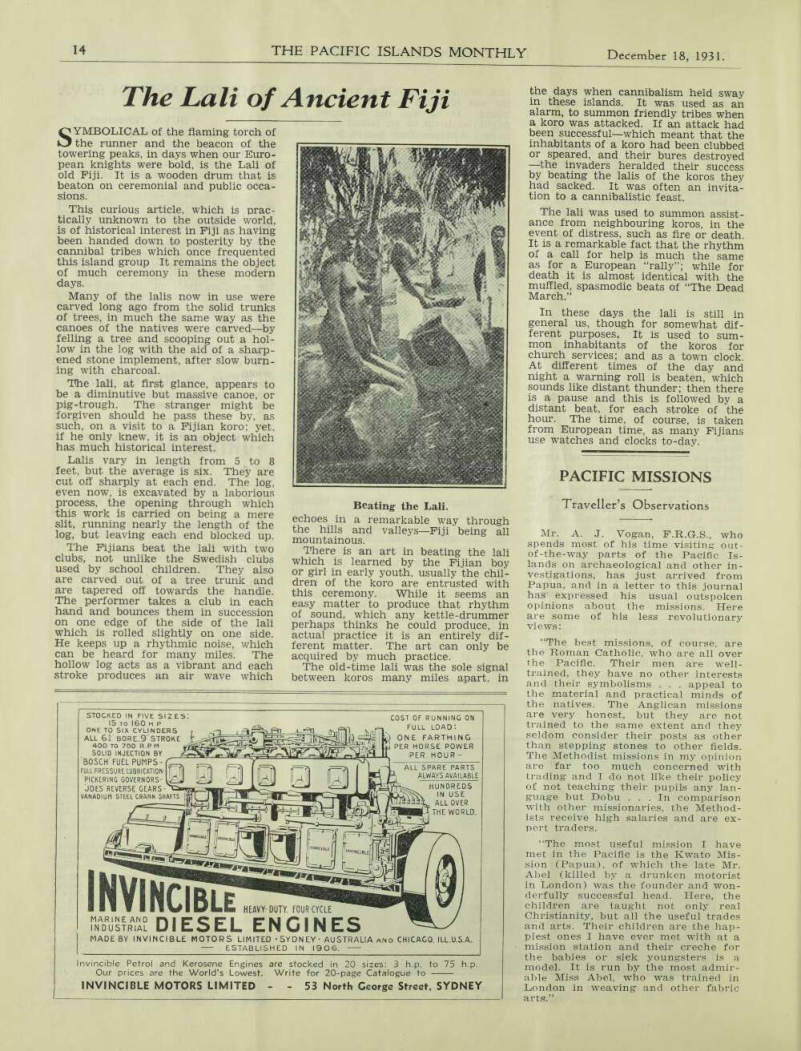
SYMBOLICAL of the flaming torch of the runner and the beacon of the towering peaks, in days when our European knights were bold, is the Lali of old Fiji. It is a wooden drum that is beaten on ceremonial and public occasions.
This curious article, which is practically unknown to the outside world, is of historical interest in Fiji as having been handed down to posterity by the cannibal tribes which once frequented this island group. It remains the object of much ceremony in these modern days.
Many of the lalis now in use were carved long ago from the solid trunks of trees, in much the same way as the canoes of the natives were carved—by felling a tree and scooping out a hollow in the log with the aid of a sharpened stone implement, after slow burning with charcoal.
The lali, at first glance, appears to be a diminutive but massive canoe, or pig-trough. The stranger might be forgiven should he pass these by, as such, on a visit to a Fijian koro; yet, if he only knew, it is an object which has much historical interest.
Lalis vary in length from 5 to 8 feet, but the average is six. They are cut off sharply at each end. The log, even now, is excavated by a laborious process, the opening through which this work is carried on being a mere slit, running nearly the length of the log, but leaving each end blocked up.
The Fijians beat the lali with two clubs, not unlike the Swedish clubs used by school children. They also are carved out of a tree trunk and are tapered off towards the handle.
The performer takes a club in each hand and bounces them in succession on one edge of the side of the lali which is rolled slightly on one side.
He keeps up a rhythmic noise, which can be heard for many miles. The hollow log acts as a vibrant and each stroke produces an air wave which Beating the Lali.
echoes in a remarkable way through the hills and valleys—Fiji being all mountainous.
There is an art in beating the lali which is learned by the Fijian boy or girl in early youth, usually the children of the koro are entrusted with this ceremony. While it seems an easy matter to produce that rhythm of sound, which any kettle-drummer perhaps thinks he could produce, in actual practice it is an entirely different matter. The art can only be acquired by much practice.
The old-time lali was the sole signal between koros many miles apart, in
the days when cannibalism held sway in these islands. It was used as an alarm, to summon friendly tribes when a koro was attacked. If an attack had been successful—which meant that the inhabitants of a koro had been clubbed or speared, and their bures destroyed —the invaders heralded their success by beating the lalis of the koros they had sacked. It was often an invitation to a cannibalistic feast.
The lali was used to summon assistance from neighbouring koros, in the event of distress, such as fire or death.
It is a remarkable fact that the rhythm of a call for help is much the same as for a European “rally”; while for death it is almost identical with the muffled, spasmodic beats of “The Dead March.”
In these days the lali is still in general us, though for somewhat different purposes. It is used to summon inhabitants of the koros for church services; and as a town clock.
At different times of the day and night a warning roll is beaten, which sounds like distant thunder; then there is a pause and this is followed by a distant beat, for each stroke of the hour. The time, of course, is taken from European time, as many Fijians use watches and clocks to-day. ... ===
Pacific Missions
Traveller’s Observations
Mr. A. J. Vogan, P.R.G.S., who spends most of his time visiting outof-the-way parts of the Pacific Islands on archaeological and other investigations, has just arrived from Papua, and in a letter to this journal has expressed his usual outspoken opinions about the missions. Here are some of his less revolutionary views: “The best missions, of course, are the Roman Catholic, who are all over the Pacific. Their men are well trained, they have no other interests and their symbolisms . . . appeal to the material and practical minds of the natives. The Anglican missions are very honest, but they are not trained to the same extent and they seldom consider their posts as other than stepping stones to other fields.
The Methodist missions in my opinion are far too much concerned with trading and I do not like their policy of not teaching their pupils any language but Dobu ... In comparison with other missionaries, the Methodists receive high salaries and are expert traders.
“The most useful mission I have met in the Pacific is the Kwato Mission (Papua), of which the late Mr.
Abel (killed by a drunken motorist in London) was the founder and wonderfully successful head. Here, the children are taught not only real Christianity, but all the useful trades and arts. Their children are the happiest ones I have ever met with at a mission station and their creche for the babies or sick youngsters is a model. It is run by the most admirable Miss Abel, who was trained in London in weaving and other fabric arts.”
Advertisements & other items, p. 16 (2 items)
14 . . . . . The Pacific Islands Monthly . . . . December 18, 1931.
===
INVINCIBLE MOTORS LIMITED - - 53 North George Street, SYDNEY
STOCKED IN FIVE SIZES:
15 to 160 H P
ONE TO SIX CYLINDERS
ALL 6¾ BORE. 9 STROKE
400 TO 700 R.P M
SOLID INJECTION BY
BOSCH FUEL PUMPS-
FULL PRESSURE LUBRICATION
PICKERING GOVERNORS-
" JOES" REVERSE GEARS-
VANADIUM STEEL CRANK SHAFTS
COST OF RUNNING ON
FULL LOAD:
ONE FARTHING
PER HORSE POWER
PER HOUR
ALL SPARE PARTS
ALWAYS AVAILABLE
HUNDREDS
IN USE
ALL OVER
THE WORLD
INVINCIBLE HEAVY-DUTY. FOUR CYCLE
MARINE AND
INDUSTRIAL
DIESEL ENGINES
MADE BY INVINCIBLE MOTORS LIMITED - SYDNEY - AUSTRALIA and CHICAGO. ILL. U.S.A.
ESTABLISHED IN 1906.
Invincible Petrol and Kerosene Engines are stocked in 20 sizes: 3 h.p. to 75 h.p.
Our prices are the World’s Lowest. Write for 20-page Catalogue to INVINCIBLE MOTORS LIMITED - - 53 North George Street, SYDNEY
37-Stone Woman
Special Burial for 37-Stone Woman Officialdom’s Pounce on Erring Husband
From Our Own Correspondent APIA, November 26.
THERE died recently, at Apia, a Samoan woman, Pii Moananu, wife of a Samoan Cchief, Moananu, aged 38 years. She was the heaviest woman in Samoa and probably in the South Seas, turning the scales at just under 37 stone. Her height was 6ft. 7in. She was only with great difficulty able to rise and walk a few steps.
Owing to transport difficulties, her husband, on her decease, decided to avoid the trouble of burying her in the native cemetery, and interred her in his back yard.
But he had not reckoned with our ever-vigilant police force. He was promptly grabbed and taken to court, to stand trial for having used land for burial purposes without the permission of the chief medical officer. The judge had no consideration for Moananu’s natural grief, or the unusual circumstances. He fined the delinquent £2, and 7/- costs. ... ===
Position Improved
Chinese Problem In
Samoa
From Our Own Correspondent APIA, November 20.
THE letter from an official in Samoa recently published in this journal, defending the New Zealand Administration against the charge that it is responsible for the social penetration of Samoa by Chinese, has been read here with much interest.
But the letter, as you have very properlv pointed out, evades the main issue.
Nobody, of course, denies that the number of Chinese coolies in Samoa has been considerably reduced under New Zealand’s administration; but the lax handling of the existing regulations has permitted the cohabitation of coolies with Samoan women and brought about the large Chinese half-caste problem.
The writer of the letter said that the stabbing affray did not occur in a gambling den, but on the road. He, however, forgot to mention that the trouble among the coolies was caused by their differences after gambling the whole of the preceding night at a Chinese trader’s house.
I wish to stress the point that since the departure of the S.S. Apoey matters in regard to Chinese gambling and association with Samoan women have much improved, as many of the worst offenders were repatriated. The Administration has, furthermore, published new regulations, prohibiting Samoan women altogether from entering buildings occupied by Chinese coolie labour. The newly-imported coolies are very intent on saving their wages, or sending their money back to China, and this will put another effective stop to miscegenation. ... ===
Idle Miners
On New Guinea Field Serious Condition of Stalemate Alleged
To the Editor Sir, —One of the many things here that is out of step with the rest of the world is that a man out of work is a criminal and gets three months’ imprisonment and is deported from the Territory. What would it be like if all the unemployed in Australia received the same treatment? Lang’s ambition would be realised and Australia off the map.
In this case it is due to the short sighted policy of the Administration that the men are out of work (that is, the mining portion of the community).
Once they have worked out their small claim there is no other ground for them to work. Yet there are hundreds of acres of payable ground on Edie Creek.
This is the only country in the world where ground payable to the alluvial miner has been allowed to be taken up in leases. Although these leases were granted, subject to Sec. 38a, the miner is not allowed a permit to work under that section. A few who obtained permits before December, 1928, are still allowed to work, but these are very few. Still, there are many who applied before that time and were refused permits.
After December, 1928, the miners were told that Section 38a was illegal, if so, then the leases were illegally granted and the few who are still working them under that section are illegally working them. These leases belong to the N.G.G. Co., who do not want the alluvial portion of the leases
so have let them, on tribute, in certain cases, to their employees, who, in turn, sublet them and continue working for the Co. Now, the Administration says that tributes are illegal and only the Co. is allowed that privilege.
There is no other work here for the miner to do but to mine. Many of them spent hundreds of pounds to come here, then had to get a bond of £50 to be allowed to work and earn a living in a country which they helped to make—only to find that their work is taken away from them and they are classed as criminals.
It should be remembered that there is no work up here for a man to do.
The plantations do not want men and there are no works being carried on.
The Co. imports all its employees from South —mostly from Broken Hill, where it can get them for lower wages.
A few years back the “Montoro” used to arrive in Sydney with 15,000 to 20,000 ozs. of gold from the New Guinea fields. Now the amount is not worth publishing. Yet the amount would still be the same if the miners were allowed to work. So far, the Co. has not sent away one ounce of gold; while the miners are trying to make a bare living in the back creeks, hoping that they will be able to pay what they owe the merchants who stuck to them when they were thrown out of Edie Creek. If they cannot make that living, then they are classed as criminals.
The thousands of pounds of public money spent on the Markham Valley road for the benefit of a small cotton company had been spent in sending miners out to discover new fields, there would to-day have been a better chance for these men to pay their way, a larger output of gold, and work for all the men who wished to come from Australia and increase the productive ness of New Guinea. —I am, etc.
Wau, N.G. ... Liviara.
October 30, 1931.
Advertisements & other items, p. 17 (2 items)
December 18, 1931. . . . . The Pacific Islands Monthly . . . . 15
===
R. Towns & Co.
Established 1842 31 REIBY PLACE - - - SYDNEY “LORD BEACONSFIELD” 26’s Island Twist Tobacco “EDGEWORTH” Extra High Grade Smoking Tobacco, in 2oz. vacuum airtight Tins, and 1lb. Class Jars.
“CUTICURA” Soap, Ointment and Talcum Powder. ===
When ordering Ham or Bacon Wholesale only from remember FOLEY BROS. LTD.
CROWN AND WAR AT AH 353 SUSSEX STREET, SYDNEY Brands. N.S.W.
Nukualofa to Vavau
Interesting Sidelights
From Our Tonga Correspondent FROM far off to the eastward, in the direction of the Island Pagaimotu, came the mournful dirge from a conch shell.
Away to the south-west on the mainland someone was beating the “lali” (drum), summoning worshippers to morning prayer. The booming of the shell, held to the lips of some all-night fisherman, was conveying glad news to his friends on shore, and they, I knew were hastening about somewhere at the back of those distant palms, preparing the red-hot stones to receive the catch.
Searching along the horizon and back to the long stretch of palm-fringed beach, my vision alighted on no living thing to mar this perfect prospect— a morning in the Tongan Islands in early Spring.
The captain’s voice from the other end of the bridge, suggesting a cup of coffee, brought me back to earth and the seething mass of humanity that we had between decks down below. As
I had watched these brown-faced islanders, men, women and children, coming aboard at the Nukualofa wharf I had not then realised that even a 60-ton despatch vessel had its limit in deck space.
On the captain’s assurance that he
had many times carried “half as many again,” and that, before we reached the outer reef, “they would all be snug,” I followed him down to the cup of coffee.
True enough, when we emerged from the depths, they had apparently sorted themselves into some sort of order, for I discovered quite an appreciable amount of deck space to move around in.
We are now passing the revolving light on little Malinoa Island and, with the aid of glasses, I could see the six white mounds that mark the resting place of those poor misguided wretches who, 43 years ago, made a nearly successful attempt to assassinate their European Premier, Shirley Baker. Were those men the “tools” of someone “higher-up”? Just rumour, probably! If true, they went to the Flying Squad with sealed lips.
An Old Cannon.
At four o’clock we dropped anchor close to the reef at the Island of No muka, and, within the hour, a sturdy boat’s crew had got us through the breakers to the sandy beach. Strolling up to high water mark my attention was directed to the cannon, half buried in the soil, which the natives claim, was left there by Captain Cook.
I doubt this claim.
For what reason would Cook feel justified in leaving a part of his armament on this island? Or Tasman? Or Bligh? Of what earthly use to the native, anyway? They couldn’t make nails or spears out of it; if they could have done so, it is palpable that there would be no cannon there to-day.
Furthermore, there is no ground to suppose that one of those old-time captains was that deficient in common sense that he would thoughtlessly leave with such a people, a weapon which, with the theft of a little powder, might, at some future date, make his landing troublesome. No! I think that cannon dates farther back; a relic of some vessel that touched at the savage island and never sailed away. The design of the rusted old piece favours my theory!
The “Bounty” Mutiny.
Late at night, I sat under that traditional two-century-old knarled stump, which marks the landing place on Nomuka’s sands, awaiting the ship’s boat. Did I [doze]? Is it possible! Mr.
Sandys, the uncrowned king of No-||
A tourist attraction in the Tonga Group—the “Liku” at Tongatabu.
muka, had given me a wonderful time, and I have never tasted better liquor —never any with just that bouquet . . .
I know this, that, under that tree, I suddenly felt that in some distant past a fearful compact had been made here.
I cannot explain the feeling, except to say that it was numbing.
Then, in a flash, my brain seemed to function —I must have [dozed]—to hear my voice say in a detached sort of way “Fletcher Christian.” Shivering, I moved quickly down to the water’s edge and hailed the incoming boat.
Did Fletcher Christian hatch his mutiny under that tree. We know the ship called here and that, a few days later, the mutineers of the Bounty set their captain (Bligh) and his loyal followers off in an open boat; but I wasn’t thinking of Christian that night on Nomuka beach. No, sir! He just “grew” under that old tree!
At daylight, we sailed northward through intricate reefs and past coral islets of exquisite beauty. The luxuriance of the foliage in the Tongan Islands is not surpassed. At noon, we dropped in alongside the jetty at Lifuka, in the Haapai Group. This island, a century and a quarter ago, was the stronghold of the redoubtable warrior chief Finau, and, from this base, he was wont to raid both Tongatabu in the south, and Vavau in the north.
Buried Treasure?
At four o’clock in the afternoon, we are on our way again. We are promised that daylight will disclose something new; that the beauty of waterline verdure will fade from our memories when gorgeous Vavau looms ahead with the rising sun.
Off to starboard we are shown an ugly patch of coral awash with the breaking sea. This is called Mariner’s Patch, and Tongan history tells us that between here and the mainland, is where the ill-fated Port-au-Prince was raided and burnt by Finau and his men.
Somewhere, deep down, the coral, with a century’s growth, has completely covered her remains. And what of the bar gold and silver, and Church plate and precious stones, which Mr. Mariner tells candidly she had “privateered” on her voyage?
This treasure, too, must lay below there, under perhaps eight or ten feet of mounting coral, and will probably remain there for all time.
As we go chugging northwards in the sunset glow, we see away off to the nor’-west Tofua, the smoking table mountain and, seemingly close, the clear-cut cone of Kau, its tapering peak buried now in a hovering cloud.
At daybreak, we are up betimes, and discover that already the little vessel is entering the harbour. Away to the left, the undulating land rises higher and higher to the distant plateau known as the Logamapu Plains. In front and to starboard are numerous islands, richly endowed with exquisite tropical foliage and, towering over all, the stately coconut palms bow to the rising sun.
With all their attractions, the islands we have passed in our journey north cannot compare with this. Deep Water on every hand, the little boat dodges in and out and through this kaleidoscopic setting of wondrous natural beauty to drop anchor at last in the inner haven.
I have seen Vavau—that one perfect harbour in the Pacific. . . . ===
Advertisements & other items, p. 18 (2 items)
16 . . . The Pacific Islands Monthly . . . December 18, 1931.
===
Burns, Philp
(South Sea) Co. Ltd.
Island Traders & Shipowners Registered Office: Suva, Fiji Also Branches at Fiji: Levuka, Lautoka, Labasa, Ba, Sigatoka, Rotumah.
Tonga: Nukualofa, Haapai, Vavau.
Samoa: Apia.
Solomons: Makambo, Gizo, Faisi.
New Hebrides: Vila.
Gilberts: Tarawa.
Norfolk Island. Nauru. Niue.
Code Address: "Burnsouth” ===
THE CARTER PAINT CO. LTD.
13 LITTLE BOURKE STREET - - SYDNEY Manufacturers of : Mixed Paints ... Cold Water Paints Kalsomines ... Dry Colours Varnish ... Stains Putty, etc.
Lines Specially Manufactured for Tropical Conditions.
Write for particulars of prices.
New Zealand In
Samoa
Sir Maynard Hedstrom Is Critical .
Speaking at the weekly luncheon of the Rotorua Rotary Club in New Zealand on November 18, Sir Maynard Hedstrom, a member of the Fiji Legislative Council, commented on what he termed the failure of New Zealand administrators properly to appreciate the attitude of the native races.
Dealing with politics and the general commercial situation in Western Samoa, Sir Maynard expressed the belief that some of the recent troubles in that country could have been avoided if the men handling the Administrative work had been men officially trained in the work of governing and controlling native races. With the best intentions in the world, New Zealand’s officials lacked the requisite training to deal with the problems of Samoa. The Dominion certainly had the best interests of the natives at heart, but amateurs were sent out to do the work. Trained men would not have fallen into the pitfalls placed in the way of past Administrators. ———
Advertisements & other items, p. 19 (2 items)
December 18, 1931. . . . . The Pacific Islands Monthly . . . . 17
The B.P. Magazine
Visitors to Sydney
who desire a REFINED GUEST HOUSE at a moderate price, can be accommodated at
KIRKETON HOTEL
(Unlicensed)
229 DARLINGHURST ROAD,
KING’S CROSS
(5 minutes from G.P.O.) where, in addition to our exclusive and artistic furnishings and appointments, comfortable Lounge (equipped with Wireless and Wurlitzer Player Piano), Card Rooms and unsurpassed Table, this modern Hotel has hot and cold water in every bedroom. Telephones on all floors.
MOTOR TOURS ARE ALSO
ARRANGED
and intending Guests can be assured of every courtesy and excellent service.
TARIFF:
10/6 per day, or from £2/10/ to £3/5/ per week.
Bed and Breakfast, £2/2/- per week.
Night Porter in attendance Phones : F 3640 and FL 1868 Cable and Radio Address:
“KIRKETON, SYDNEY”
SAIL WITH
The B.P. MAGAZINE
TO MAGIC LANDS
Travel Fiction Adventure
Stage
Screen Books Fashion Beautiful Cover Plates Children’s Pages
ANNUAL SUBSCRIPTION:
Within the Commonwealth of Australia, Mandated Territory and New Guinea 4/ post free Within the British Empire 5/4 post free U.S.A. and Foreign 6/8 post free ===
SHIPCHANDLERY
W. Kopsen & Co. Limited
Manufacturers of PIONEER BRAND ASH OARS AND IMPLEMENT HANDLES.
Sole Agents for: KOPSEN’S SPECIAL YELLOW METAL SHEATHING AND NAILS.
Large stocks of Chains, Anchors, Manilla and Wire Ropes, Wood and Iron Blocks, Oakum, Tar, Pitch, Oils, Paints, Leads, Zincs, Varnishes, Shackles, Rigging, Screws, Sheathing, Felt, Lampware, etc.
Prices and Particulars on Application.
68-70 CLARENCE ST.. SYDNEY
Cables; “Kopsen” ’Phone; BW 1114-5
In Kukukuku Country
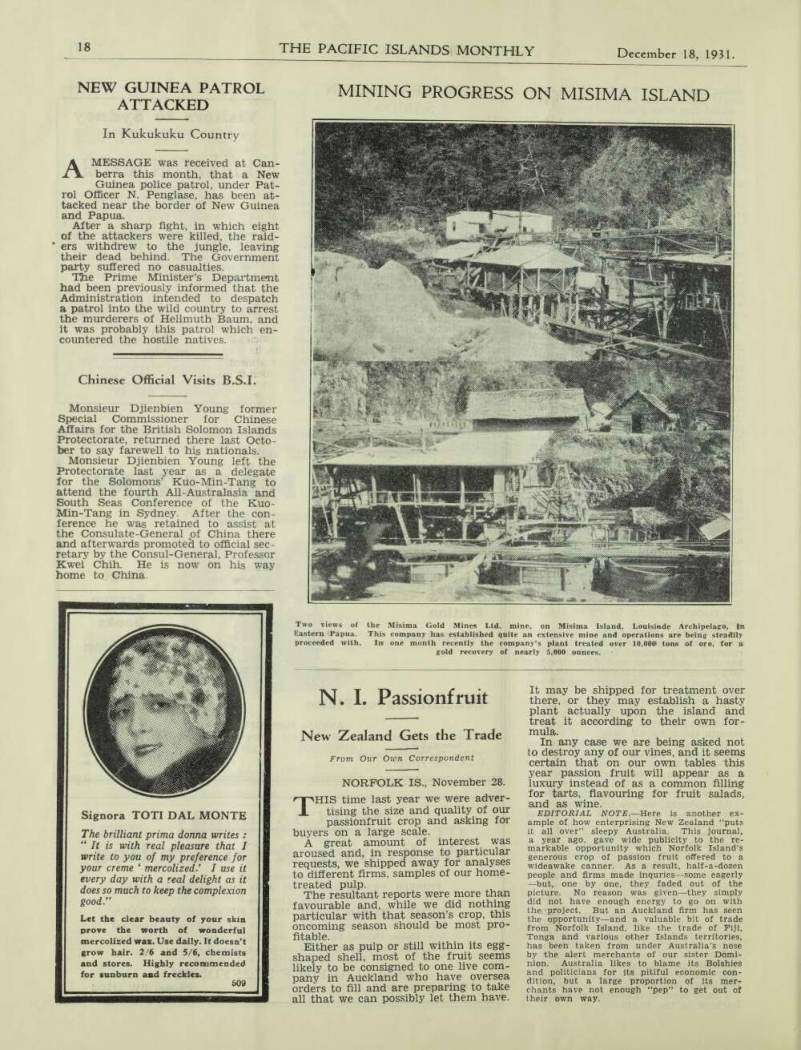
New Guinea Patrol
Attacked
... ——— In Kukukuku Country ... ———
A MESSAGE was received at Canberra this month, that a New Guinea police patrol, under Patrol Officer N. Penglase, has been attacked near the border of New Guinea and Papua.
After a sharp fight, in which eight of the attackers were killed, the raiders withdrew to the jungle, leaving their dead behind. The Government party suffered no casualties.
The Prime Minister’s Department had been previously informed that the Administration intended to despatch a patrol into the wild country to arrest the murderers of Hellmuth Baum, and it was probably this patrol which encountered the hostile natives. ... ===
Chinese Official Visits B.S.I.
———
Monsieur Djienbien Young former Special Commissioner for Chinese Affairs for the British Solomon Islands Protectorate, returned there last October to say farewell to his nationals.
Monsieur Djienbien Young left the Protectorate last year as a delegate for the Solomons’ Kuo-Min-Tang to attend the fourth All-Australasia and South Seas Conference of the Kuo- Min-Tang in Sydney. After the conference he was retained to assist at the Consulate-General jof China there and afterwards promoted to official secretary by the Consul-General, Professor Kwei Chih. He is now on his way home to China. ... ===
Mining Progress On Misima Island ||
Mining Progress On Misima Island
Two views of the Misima Gold Mines Ltd. mine, on Mislma Island, Louisiade Archipelago, in Eastern Papua. This company has established quite an extensive mine and operations are being steadily proceeded with. In one month recently the company’s plant treated over 10,000 tons of ore, for a gold recovery of nearly 5,000 ounces. ... ===
N. I. Passionfruit
——— New Zealand Gets the Trade ... ———
From Our Own Correspondent ... ——— NORFOLK IS., November 28.
THIS time last year we were advertising the size and quality of our passionfruit crop and asking for buyers on a large scale.
A great amount of interest was aroused and, in response to particular requests, we shipped away for analyses to different firms, samples of our home treated pulp.
The resultant reports were more than favourable and, while we did nothing particular with that season’s crop, this oncoming season should be most profitable.
Either as pulp or still within its egg shaped shell, most of the fruit seems likely to be consigned to one live company in Auckland who have oversea orders to fill and are preparing to take all that we can possibly let them have.
It may be shipped for treatment over there, or they may establish a hasty plant actually upon the island and treat it according to their own formula.
In any case we are being asked not to destroy any of our vines, and it seems certain that on our own tables this year passion fruit will appear as a luxury instead of as a common filling
for tarts, flavouring for fruit salads,
and as wine.
EDITORIAL NOTE. —Here is another example of how enterprising New Zealand “puts it all over” sleepy Australia. This journal, a year ago. gave wide publicity to the remarkable opportunity which Norfolk Island’s generous crop of passion fruit offered to a wideawake canner. As a result, half-a-dozen people and firms made inquries—some eagerly —but, one by one, they faded out of the picture. No reason was given—they simply did not have enough energy to go on with the project. But an Auckland firm has seen the opportunity—and a valuable bit of trade from Norfolk Island, like the trade of Fiji, Tonga and various other Islands territories, has been taken from under Australia’s nose by the alert merchants of our sister Dominion. Australia likes to blame its Bolshies and politicians for its pitiful economic condition, but a large proportion of its merchants have not enough “pep” to get out of their own way. ===
Advertisements & other items, p. 20 (2 items)
18 . . . . The Pacific Islands Monthly . . . . December 18, 1931.
===
Signora TOTI DAL MONTE
The brilliant prima donna writes : “ It is with real pleasure that I write to you of my preference for your creme " mercolized." I use it every day with a real delight as it does so much to keep the complexion good."
Let the clear beauty of your skin prove the worth of wonderful mercolized was. Use daily. It doesn’t grow hair. 2/6 and 5/6, chemists and stores. Highly recommended for sunburn and freckles. 509
Papua Can Grow First-Class
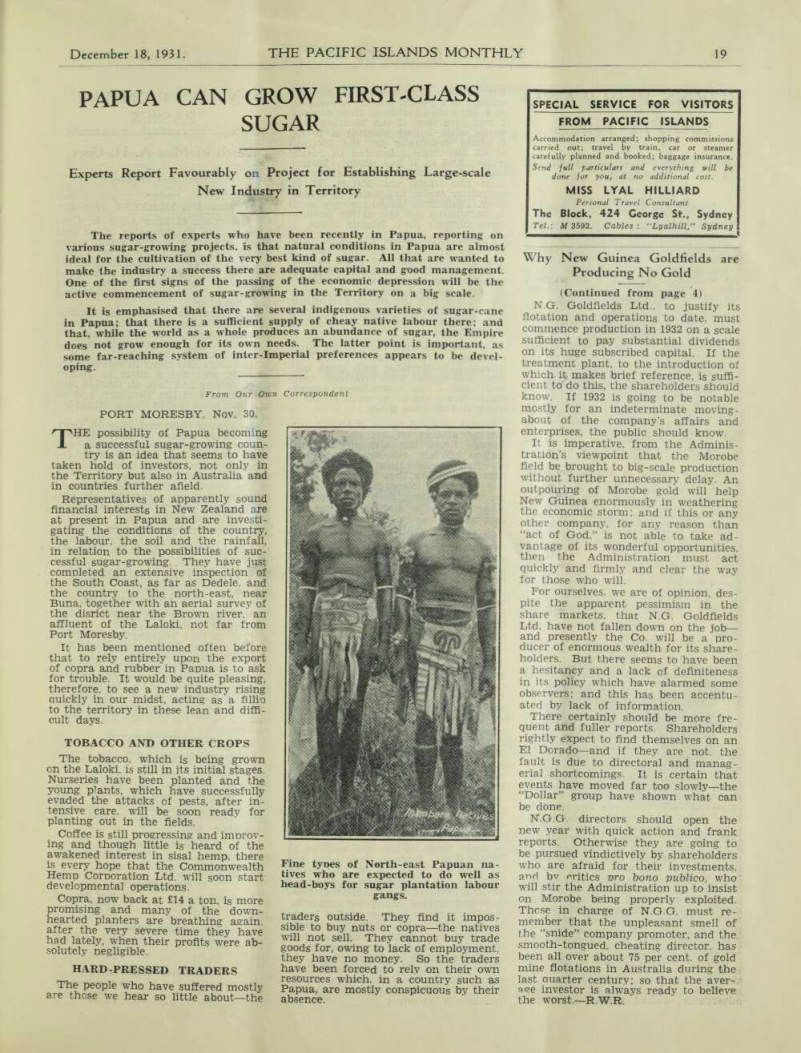
Sugar
Experts Report Favourably on Project for Establishing Large-scale New Industry in Territory ... ———
The reports of experts who have been recently in Papua, reporting on various sugar-growing projects, is that natural conditions in Papua are almost ideal for the cultivation of the very best kind of sugar. All that are wanted to make the industry a success there are adequate capital and good management.
One of the first signs of the passing of the economic depression will be the active commencement of sugar-growing in the Territory on a big scale.
It is emphasised that there are several indigenous varieties of sugar-cane in Papua; that there is a sufficient supply of cheap native labour there; and that, while the world as a whole produces an abundance of sugar, the Empire does not grow enough for its own needs. The latter point is important, as some far-reaching system of inter-imperial preferences appears to be developing. ... ——— From Our Own Correspondent
Port Moresby. Nov. 30.
THE possibility of Papua becoming a successful sugar-growing country is an idea that seems to have taken hold of investors, not only in the Territory but also in Australia and in countries further afield.
Representatives of apparently sound financial interests in New Zealand are at present in Papua and are investigating the conditions of the country, the labour, the soil and the rainfall, in relation to the possibilities of successful sugar-growing. They have just completed an extensive inspection of the South Coast, as far as Dedele, and the country to the north-east, near Buna, together with an aerial survey of the disrict near the Brown river, an affluent of the Laloki, not far from Port Moresby.
It has been mentioned often before that to rely entirely upon the export of copra and rubber in Papua is to ask for trouble. It would be quite pleasing, therefore, to see a new industry rising quickly in our midst, acting as a fillip to the territory in these lean and difficult days.
Tobacco And Other Crops
The tobacco, which is being grown on the Laloki, is still in its initial stages.
Nurseries have been planted and the young plants, which have successfully evaded the attacks of pests, after in tensive care, will be soon ready for planting out in the fields.
Coffee is still progressing and improving and though little is heard of the awakened interest in sisal hemp, there is every hope that the Commonwealth Hemp Corporation Ltd. will soon start developmental operations.
Copra, now back at £14 a ton, is more promising and many of the down hearted planters are breathing again, after the very severe time they have had lately, when their profits were absolutely negligible.
Hard-Pressed Traders
The people who have suffered mostly are those we hear so little about—the Fine types of North-east Papuan na tives who are expected to do well as head-boys for sugar plantation labour gangs.
traders outside. They find it impossible to buy nuts or copra—the natives will not sell. They cannot buy trade goods for, owing to lack of employment, they have no money. So the traders have been forced to rely on their own resources which, in a country such as Papua, are mostly conspicuous by their absence. ===
Advertisements & other items, p. 21 (2 items)
December 18, 1931. . . . . The Pacific Islands Monthly . . . . 19
===
Special Service For Visitors
FROM PACIFIC ISLANDS
Accommodation arranged; shopping commissions carried out; travel by train, car or steamer carefully planned and booked; baggage insurance.
Send full particulars and everything will be done for you, at no additional cost.
MISS LYAL HILLIARD
Personal Travel Consultant The Block, 424 George Sh, Sydney Tel.: M 3592. Cables : “Lyalhill,” Sydney
Burns, Philp And
Carpenter’S
And The Pacific Islands
Monthly
By R. W. Robson.
THE following is portion of a pri-
vate letter, received by the pro-
prietor of this journal, from a valued correspondent in New Guinea: “Generally speaking, your paper is very well received. It naturally comes in for a certain amount of criticism, but is considered to have filled a long-felt want.
“There are, however, many people in the Territory still of the opinion that Messrs.
Burns, Philp & Co. Ltd. are interested in the paper, either financially or have some control over its expressed opinions, etc., and, on this account, you lose many prospective subscribers. ‘'This view is said to be borne out by your reputed refusal to publish criticisms of the methods of trading, etc., of both firms, as sent in to you from time to time by subscribers.
“As you are aware, both Messrs. Burns.
Philp & Co. Ltd. and Messrs. W. R. Carpenter & Co. Ltd., wield an immense influence in the affairs of this Territory, both financial and otherwise: and, no matter what phases or cycles business may pass through, everything seems to return to one of these two centres.
“Take the instance of desiccated coconut.
Australia, in an endeavour to help the planters of this Territory, prohibited the importation from any other place except Papua and this Territory. The result is that no individual planter benefits, as the only people interested are the two firms. In the event of a planter selling his copra for use in the desiccated factory, he is not paid on the basis of what his copra might be worth. He is paid, still, on London parity only.
“As a result of these and similar conditions. the population of the Territory is divided into two camps—i.e., those who favour W. R. Carpenter & Co. Ltd., and those who are pro Burns, Philp & Co. Ltd. The firms meantime carry on with their buying and selling prices which, to all intents and purposes, obviate any competition worth mentioning.
“I mentioned earlier in this letter about your refusal to publish criticism of the firms.
Believe me, there is deep resentment by the general public, and a good deal of feeling regarding the Bremerhaven, and the tactics being used to try and oust this steamer.
“The sympathy of the residents of the Territory is all for the Bremerhaven.” . . . . . . .
I have met this sort of criticism on several occasions. The time has come for facts and figures. I am going to run my own publication as I consider best in the public interest. No other consideration counts.
The idea of publishing a Pacific Islands Year Book was entirely my own, and was conceived about 1925, when it appeared that “Stewart’s Handbook of the Pacific” had ceased regular publication. I commenced work on the Year Book in 1927. In the course of this work, I was struck by the wealth of newspaper material offering in South Seas; and so the idea of The Pacific Islands Monthly was born. The organisation and compilation of these two
publications involved many disappoint-
ments and an enormous amount of work and expense: but both have duly reached publication — the Monthly in August, 1930, and the Year Book in
December, 1931.
If my friends will turn to the first issue of the Monthly, they will see that neither Burns, Philp & Co. Ltd. or W. R. Carpenter & Co. Ltd. were advertisers. I had approached them,
but neither firm seemed to like my scheme of a Pacific Islands newspaper ; so I went ahead without their support.
I was sure that if the Monthly were to be what I had planned it to be, I would eventually get the goodwill of all the firms interested in Pacific trade. And so it has proved. Messrs.
Burns, Philp & Co. Ltd. bought space after two issues, and Messrs. W. R.
Carpenter & Co. Ltd. came in a little later. Both firms helped me very much by permitting the sale of my publications through their Islands stores.
Pacific Publications Ltd. was registered as a company in May, 1931. I was the sole proprietor prior to that date ; and as I now own 601 out of the 607 shares in the company—the others are held by my assistants and associates—I am still the owner and editor.
Anyone interested may check these statements at the office of the Registrar of Companies.
My relations with the two big firms mentioned are friendly. They have treated my enterprise with great fairness, and myself with invariable courtesy ; and I am appreciative accordingly. But I am in no sense bound to these or any other firms.
I have received scores of letters containing attacks on not only the big Islands firms, but also on Administration officials, missionaries, traders, etc. In some cases these have been published ; in others, they have not. Every one has been investigated, and in 50 per cent. of them, there has been another side to the case, so that no further action was called for.
Statements which are libellous may not, in any case, be published. Other statements containing attacks and criticism receive publication only when we believe they are written for the public good, and not in any spirit of malice or self-interest. “If in doubt— leave out” is an editorial maxim we try to follow. Perhaps, at times, we are over-cautious: but we do try to be fair.
When an occasion arises demanding an attack on Messrs. Burns, Philp & Co. Ltd. or Messrs. W. R. Carpenter & Co. Ltd., or an Administrator, or anyone else, we shall attack ; and, as we are entirely a free concern, we shall attack as we please and how we please.
But we are not going to engage in the kind of irresponsible sharp-shooting journalism that has made some Sydney newspapers a by-word, and debauched Australian public life.
Our policy, so far as the “big firms” are concerned, is bound up with our effort to hold Pacific trade for Australia and New Zealand. Our object is to assist them, if possible, and not to harass them. Perhaps their large and far-reaching interests in the South Seas are not altogether in accord with modern ideas of what individual freedom and private enterprise should be.
But the position is there, and it is not of our making. The big firms generally recognise their public trust and their great power, and do not abuse them.
So long as those conditions obtain, we shall do what we can to help them, and assist in the development of the Pacific Territories, and not make a nuisance of ourselves ———
Papuan Pioneeer
Passes
Death of Miss A. H. Gors
From Our Own Correspondent.
Pt. Moresby, Dec. 9.
THE death of Miss Adele H. Gors occurred on November 25 in Port Moresby after a very long and severe illness and, though it was not expected that Miss Gors would recover, the news of her death was a shock, and was very distressing to her many friends in the Territory, who admired and loved her.
Miss Gors was an exceptionally capable and intelligent woman and of great personality, charm and kindliness, and the loss of her companionship will be felt by many in the town.
Miss Gors had many interests in the country, and was a sister to Messrs.
Otto, Arthur and Leo, all notable men and pioneers of the Territory, and all of whom have died in Papua within the past few years.
Mr. Walter Gors and Miss M. Gors, who are at present in Port Moresby, are the only remaining brother and sister of the late Miss Gors in the Territory. Mr. Walter Gors, who has been in Papua over 30 years, will act in the interests of his late sister and brothers, besides managing his own estates, and that of Miss M. Gors, his only surviving sister. ... ===
Goldfields’ Planes Visit Pt. Moresby
From Our Own Correspondent.
Pt. Moresby, Dec. 9.
THE Pacific Aerial Transport Co’s Junker, piloted by Lieut. Parer, arrived in Port Moresby on December 4, also a Gipsy Moth, piloted by Capt.
Shoppee, both from New Guinea.
The Junker brought Major Harrison, Messrs. Rich, Barr and Johns as passengers, the Gipsy Moth Mr. Ross.
Major Harrison, who is the manager of New Guinea Goldfields Ltd., came over to catch the Montoro going south on December 9. ... ===
Norfolk Island Trade
THE following are the Norfolk Island Customs figures for October and November, 1931, compared with the figures for October and
November, 1930:
... October Imports.
From Australia. From New Zealand, 1930 .. £3,370 ... £1,784 1931 .. £2,519 ... £1,416 ... October Exports.
To Australia. To New Zealand. 1930 .. £1,056 ... .. £998 1931 ... £672 ... £1,354 ... November Imports.
From Australia. From New Zealand. 1930 .. £4.104 ... Nil. 1931 .. £3,948 ... £329
November Exports.
To Australia. To New Zealand. 1930 .. £1,236 ... Nil. 1931 .. Nil ... £1,370 ———
Advertisements & other items, p. 22 (1 item)
20 . . . . The Pacific Islands Monthly . . . . December 18, 1931.
Returns to Rabaul on Jan. 12
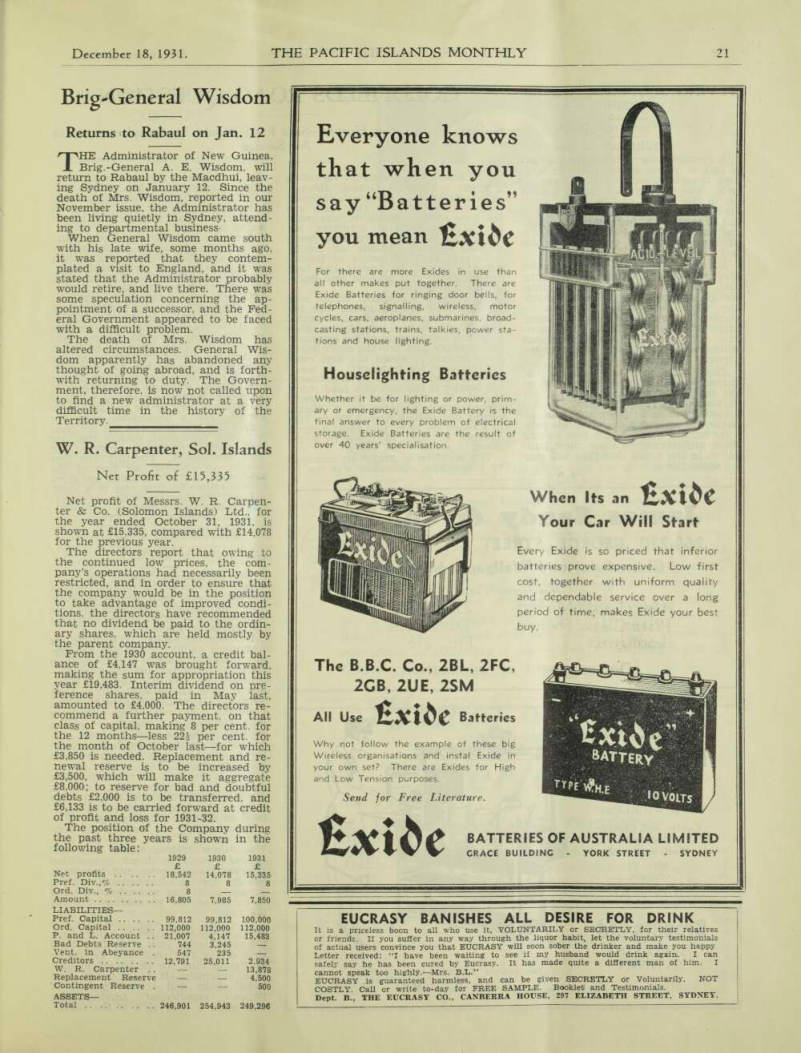
THE Administrator of New Guinea, Brig.-General A. E. Wisdom, will return to Rabaul by the Macdhui, leaving Sydney on January 12. Since the death of Mrs. Wisdom, reported in our November issue, the Administrator has been living quietly in Sydney, attending to departmental business.
When General Wisdom came south with his late wife, some months ago, it was reported that they contemplated a visit to England, and it was stated that the Administrator probably would retire, and live there. There was some speculation concerning the appointment of a successor, and the Federal Government appeared to be faced with a difficult problem.
The death of Mrs. Wisdom has altered circumstances. General Wisdom apparently has abandoned any thought of going abroad, and is forthwith returning to duty. The Government, therefore, is now not called upon to find a new administrator at a very difficult time in the history of the Territory. ... ===
W. R. Carpenter, Sol. Islands
Net Profit of £15,335
Net profit of Messrs. W. R. Carpenter & Co. (Solomon Islands) Ltd., for the year ended October 31, 1931, is shown at £15,335, compared with £14,078 for the previous year.
The directors report that owing to the continued low prices, the company’s operations had necessarily been restricted, and in order to ensure that the company would be in the position to take advantage of improved conditions, the directors have recommended that no dividend be paid to the ordinary shares, which are held mostly by the parent company.
From the 1930 account, a credit balance of £4,147 was brought forward, making the sum for appropriation this year £19,483. Interim dividend on preference shares, paid in May last, amounted to £4,000. The directors recommend a further payment, on that class of capital, making 8 per cent. for the 12 months—less 22½ per cent. for the month of October last—for which £3,850 is needed. Replacement and renewal reserve is to be increased by £3,500, which will make it aggregate £8,000; to reserve for bad and doubtful debts £2,000 is to be transferred, and £6,133 is to be carried forward at credit of profit and loss for 1931-32.
The position of the Company during the past three years is shown in the following table; :
Replacement Reserve ... 1929 ... 1930 ... 1931 £ ... £ ... £ Net profits .. 18,542 ... 14,078 ... 15,335 Pref. Div., % ... 8... 8 ... 8 8 Ord. Div., % ... 8 ... — ... — Amount .. 16,805 ... 7,985 ... 7,850
Liabilities—
Pref. Capital ... 99,812 ... 99,812 .. 100,000 Ord. Capital .. 112,000 .. 112,000 .. 112,000 P. and L. Account .. 21,007 ... 4,147 ... 15,483 Bad Debts Reserve .. 744 ... 3,245 Vent, in Abeyance ... 547 ... 235 ... — Creditors .. 12,791 ... 25,011 ... 2,934 W. R. Carpenter ... — ... — ... 13,878 Replacement Reserve ... — ... — ... 4,500 Contingent Reserve ... — ... — ... 500
Assets—
Total ... 246,901 .. 254,943 .. 249,296 ===
Advertisements & other items, p. 23 (1 item)
Everyone knows
that when you
say “Batteries"
you mean EXIDE
For there are more Exides in use than all other makes put together. There are Exide Batteries for ringing door bells, for telephones, signalling, wireless, motor cycles, cars, aeroplanes, submarines, broadcasting stations, trains, talkies, power stations and house lighting.
Houselighting Batteries
Whether it be for lighting or power, primary or emergency, the Exide Battery is the final answer to every problem of electrical storage. Exide Batteries are the result of over 40 years’ specialisation.
When Its an EXIDE
Your Car Will Start
Every Exide is so priced that inferior batteries prove expensive. Low first cost, together with uniform quality and dependable service over a long period of time, makes Exide your best buy.
The B.B.C. Co., 2BL, 2FC,
2GB, 2UE, 2SM
All Use Batteries Why not follow the example of these big Wireless organisations and instal Exide in your own set? There are Exides for High and Low Tension purposes.
Send for Free Literature.
EXIDE BATTERIES OF AUSTRALIA LIMITED
GRACE BUILDING - YORK STREET - SYDNEY ===
EUCRASY BANISHES ALL DESIRE FOR DRINK
It is a priceless boon to all who use it, VOLUNTARILY or SECRETLY, for their relatives or friends. If you suffer in any way through the liquor habit, let the voluntary testimonials of actual users convince you that EUCRASY will soon sober the drinker and make you happy Letter received: “I have been waiting to see if my husband would drink again. I can safely say he has been cured by Eucrasy. It has made quite a different man of him. I cannot speak too highly.—Mrs. B.L.”
EUCRASY is guaranteed harmless, and can be given SECRETLY or Voluntarily. NOT COSTLY Call or write to-day for FREE SAMPLE. Booklet and Testimonials.
Dept. B. THE EUCRASY CO., CANBERRA HOUSE, 297 ELIZABETH STREET, SYDNEY.
Flying Squirrels’ Queer
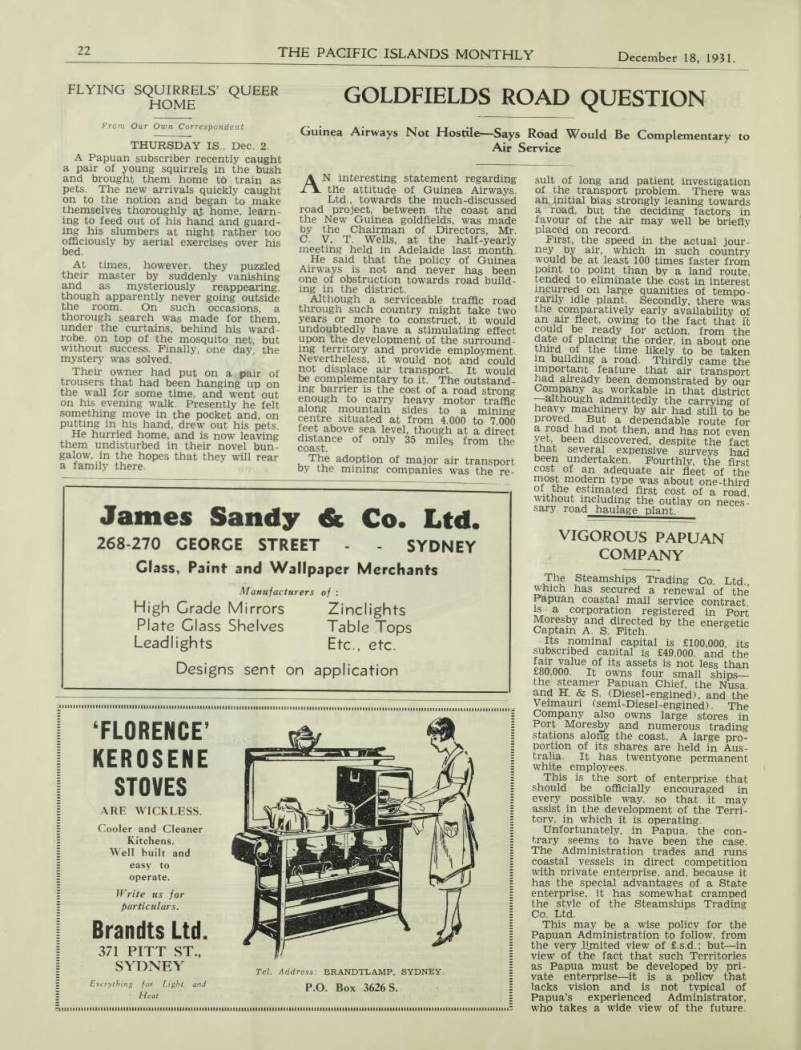
Home
Frovi Our Own Correspondent
Thursday Is.. Dec. 2.
A Papuan subscriber recently caught a pair of young squirrels in the bush and brought them home to train as pets. The new arrivals quickly caught on to the notion and began to make themselves thoroughly at home, learn ing to feed out of his hand and guard ing his slumbers at night rather too officiously by aerial exercises over his bed.
At times, however, they puzzled their master by suddenly vanishing and as mysteriously reappearing, though apparently never going outside the room. On such occasions, a thorough search was made for them, under the curtains, behind his ward robe. on top of the mosquito net, but without success. Finally, one day, the mystery was solved.
Their owner had put on a pair of trousers that had been hanging up on the wall for some time, and went out on his evening walk. Presently he felt something move in the pocket and, on putting in his hand, drew out his pets.
He hurried home, and is now leaving them undisturbed in their novel bun galow, in the hopes that they will rear a family there.
Goldfields Road Question
Guinea Airways Not Hostile—Says Road Be Complementary to Air Service
AN interesting statement regarding the attitude of Guinea Airways.
Ltd., towards the much-discussed road project, between the coast and the New Guinea goldfields, was made by the Chairman of Directors, Mr.
C. V. T. Wells, at the half-yearly meeting held in Adelaide last month.
He said that the policy of Guinea Airways is not and never has been one of obstruction towards road build ing in the district.
Although a serviceable traffic road through such country might take two years or more to construct, it would undoubtedly have a stimulating effect upon the development of the surround ing territory and provide employment.
Nevertheless, it would not and could not displace air transport. It would be complementary to it. The outstand ing barrier is the cost of a road strong enough to carry heavy motor traffic along mountain sides to a mining centre situated at from 4,000 to 7,000 feet above sea level, though at a direct distance of only 35 miles from the coast.
The adoption of major air transport by the mining companies was the re
suit of long and patient investigation of the transport problem. There was an initial bias strongly leaning towards a road, but the deciding factors in favour of the air may well be briefly placed on record.
First, the speed in the actual jour ney by air, which in such country would be at least 100 times faster from point to point than by a land route, tended to eliminate the cost in interest incurred on large quantities of tempo rarily idle plant. Secondly, there was the comparatively early availability of an air fleet, owing to the fact that it could be ready for action, from the date of placing the order, in about one third of the time likely to be taken in building a road. Thirdly came the important feature that air transport had already been demonstrated by our Company as workable in that district —although admittedly the carrying of heavy machinery by air had still to be proved. But a dependable route for a road had not then, and has not even yet been discovered, despite the fact mat several expensive surveys had been undertaken. Fourthly, the first cost of an adequate air fleet of the most modern type was about one-third of the estimated first cost of a road without including the outlay on neces sary road haulage plant.
Vigorous Papuan
Company
The Steamships Trading Co. Ltd which has secured a renewal of the Papuan coastal mail service contract is a corporation registered in Port Moresby and directed by the energetic Captain A. S. Fitch.
Its nominal capital is £100,000, its subscribed capital i s £49,000, and the fair value of its assets is not less than £80,000. It owns four small ships— the steamer Papuan Chief, the Nusa and H. & S. (Diesel-engined), and the Veimauri (semi-Diesel-engined). The Company also owns large stores in Port Moresby and numerous trading stations along the coast. A large pro portion of its shares are held in Aus tralia. It has twentyone permanent white employees.
This is the sort of enterprise that should be officially encouraged in every possible way. so that it may assist in the development of the Terri tory, in which it is operating.
Unfortunately, in Papua, the con trary seems to have been the case.
The Administration trades and runs coastal vessels in direct competition with private enterprise, and, because it has the special advantages of a State enterprise, it has somewhat cramped the style of the Steamships Trading Co. Ltd.
This may be a wise policy for the Papuan Administration to follow, from the very limited view of f.s.d.: but—in view of the fact that such Territories as Papua must be developed by pri vate enterprise—it is a policy that lacks vision and is not typical of Papua’s experienced Administrator, who takes a wide view of the future.
Advertisements & other items, p. 24 (1 item)
James Sandy & Co. Ltd.
268-270 GEORGE STREET - - SYDNEY
Glass, Paint and Wallpaper Merchants Manufacturers of : High Grade Mirrors Zinclights Plate Class Shelves Table Tops Leadlights Etc., etc.
Designs sent on application
‘FLORENCE’
KEROSENE
STOVES
ARE WICKLESS.
Cooler and Cleaner Kitchens.
Well built and easy to operate.
Write us for particulars.
Brandts Ltd.
371 PITT ST.,
SYDNEY
Everything for Light and Tel. Address: BRANDTLAMP, SYDNEY.
P.O. Box 3626 S.
Colder?
Is Tonga Growing
Curious Weather Phenomenon
A CURIOUS meteorological pheno menon is referred to by a corre spondent of this journal at Nukualofa, Tonga.
It is pointed out that Tongatabu, which is the most southerly of the larger islands of the Tongan Group, had a climate 20 years ago which was highly favourable to the cultivation of tropical plants and which did not per mit the successful growth of vegetables common to the temperate zone. Dur ing the last couple of decades, how ever, the climate has definitely changed, and has become sub-tropical, if not actually temperate, in its char acter. Instead of a comparatively brief period of cool weather, there are now three months of cold weather and some four months of weather that is quite cool.
The result is seen, according to our correspondent, in the vegetation. The plants which definitely require tropical conditions are not showing the same vigorous growth as formerly, while the landowners of Tongatabu have discov ered that they can now grow an abun dance of vegetables not usually seen outside the temperate zone. Within very recent years, large quantities of these vegetables have been grown and sent to the Auckland market —but the effect has been only to create a glut of this produce, and the growers have lost money.
From the scientific point of view, the development is very interesting.
Is it merely the effect of a regular weather cycle, with possibly an un usual succession of long winters, or is some permanent change taking place in Tongan meteorology? It is worth noting that Tongatabu is in the same latitude as New Caledonia and Raro tonga. but is considerably south of Fiji, Tahiti, Samoa and other Pacific territories regarded as having a cool tropical climate.
The Tongan Islands, incidentally, are right on the edge of the Challen ger Deep, that tremendous hole in the Pacific that is almost bottomless and which is on one of the world’s vol canic belts.
Missionary Transferred from B.S.I.
Pastor Peacock, who has been in charge of the affairs of the Seventh Day Adventist Mission in the Solomon Islands for the past six years, has been transferred to the New Hebrides. He hopes to take up his new duties by the beginning of the New Year.
Pastor Peacock will be greatly missed from the Marovo Lagoon by the white residents, as well as the natives, to whom he has endeared himself by his genuine kindness and unbiassed and manly attitude. His place will be taken bv Mr. Borgas, from Noma Noma, Queensland.
Advertisements & other items, p. 25 (1 item)
rfsheS of
Not alone the wondrous fragrance of the Marechal Kiel rose. And not the honeyed fragrance of the Sweet-briar. Nor the full rich odor of the old Red rose. And again, not the shy perfume of the Tea rose. Not one of these, f nor of these alone. In "Ashes of Roses” Perfume, Monsieur Bourjois caught the elusive and joyous fragrance of a whole garden of roses, its spirit and its atmosphere.
Because of this, “Ashes of Roses” is famous throughout the world. While fashions come and fashions fco, Ashes of Roses” remains constant, ever new and delightful, presenting ever afresh its sensations of joy. Always an added charm to beautiful womanhood!
ume
Sold by all Chemists, Perfumers, Coiffeurs and Stores.
A. BOURJOIS ET CIE, 177-9 Clarence St. & 47-49 KinfeSt., Sydney
BOURJOIS TOILET
PREPARATIONS
PERFUMES
COMPACT POWDER
BATH POWDER
BABY POWDER
FACE POWDER
TALCUM POWDER
VANISHING CREAM
NIGHT CREAM
LIP STICK
TOILET AND BATH SOAP
COLOGNE
To A. BOURJOIS et CIE (Aust.)Ltd.
Broughton House, 177-9 Clarence St., Sydney I enclose 2/6: please send, post free, the ASHES OF ROSES Presentation Case containing Perfume and Face Powder.
Name..
Street ...
Town
50 Fatalities On San
Christoval
TULAGI, December 2.
It has not yet been established just how many natives on San Christoval, British Solomon Islands, lost their lives in the recent tidal wave, following the severe ’quake. It is believed that fatal ities will number about 50.
Rejected Wooers’
Revenge
Five Murders In Papua
From Our Own Correspondent
Port Moresby, Nov. 20.
Regarding the murder of five native women in the village of Euale, Eastern Division, in August last, the Assistant Resident Magistrate at Abau has made arrests and the accused have been brought to the Government Station at Abau.
Prom inquiries made, the A.R.M. found that five Dorowaida men, re cently paid off from Otamata planta tion, had made weekend visits to Euale village nearby, and had endeavoured to marry girls of the village, who would have nothing whatever to do with them. It appears that the girls laughed and jeered at these men, who became furious and threatened them. They however, ceased visiting the village.
Acting on this information, the A.R.M. made a patrol into the hills, and, on the evidence of one named Wahu of Oi Oi village, who knew about the murders, he arrested four men, together with others, who were mixed up in the affair and who had accompanied the supposed murderers to the garden where the women were working.
Very Sly Grog!
Old Norfolk Custom to Cease Government Proclamation
From Our Own Correspondent NORFOLK IS., November 28.
IT is certain that we shall not con sume any passion-fruit this year in the form of wine—oh, dear, no! Not even “surreptitious like,” as we have done in the past—gazing cautiously around us, closing the doors, drawing down the blinds, and then producing and pouring out a golden “spot” for chosen friends.
For here is the latest proclamation in this free and happy land, suddenly appearing before our stupefied gaze on Saturday, November 21, when we went gaily down to Kingston to purchase our authorised fortnightly issue of wine, beer or spirits—rationed accord ing to our age and degree of innocence.
Public Notification
A number of residents appear to be under a misapprehension that it is permitted to make wine or brew beer for their own consumption, provided that they do not trade in it. This is not so, and it constitutes an offence against the Liquor Prohibition Law, 1913, which provides that no beer, wine or spirituous liquor shall be kept in any place on the island unless under and in accordance with a permit issued by the Administration.
Any person found in possession of wine, beer or spirituous liquor in contravention of the Liquor Prohibition Law, 1913, is liable to a fine of NOT LESS THAN TEN POUNDS or more than ONE HUNDRED POUNDS, or to imprisonment for a term not exceeding: six months, OR BOTH.
By direction of His Honour the Administrator. (Sard.) Private Secretary.
That is pretty definite, isn’t it? And, as a safeguard of our sobriety and mor ality, it makes interesting reading when compared with the official figures of revenue returned from the island last year for strong liquors authorised and issued by a Government official from the most popular of all our stores —the Bond Store, our local Temple of Bacchus.
This revenue—so I read in an Auck land paper, in an article the material for which had been supplied by a retir ing constable, whose business it had been to serve out the liquor each Satur day-amounted to over £4,000; and our population, including infants, minors, and that considerable portion of the community who prefer to go without drink rather than line up in an un dignified queue outside the door of the Bond Store—totals up to something round about 900.
The general feeling is that, as a body of reputable subjects of the British Em pire, as decent and self-respecting as any other island settlement, we should be permitted at least a restricted liberty in making our own liquor.
The total trade of Western Samoa for 1930 amounted to £559,870, com pared with £582,787 for the previous year. Copra exported in 1930 was 12,285 tons, valued at £166,221, as against 12,941 tons, valued at £205,330 for 1929.
Advertisements & other items, p. 26 (2 items)
Sydney
Controlled hy Sydney Ferries Ltd.
CLIFTON GARDENS
Hotel is right on the Harbour. Regular ferry service. Baths and shark proof beach. Tennis.
Garages. Excellent cuisine. Pre-war tariff. (Single room above the baths, and breakfast, 35/- per week.) Write Clifton Gardens Hotel, Mosman Sydney
Ask For It
Teeth in one day for visitors to my surgeries. Painless extractions, reliable fillings, gold crowns and Bridgework. Old plates remodelled.
Have Teeth By Post
Let me send you free full particulars of my well known and successful method of
“SELF TAKEN IMPRESSIONS”
by which I can make you teeth by post.
All details by return mail.
Natural gum, unbreakable sets, comfortable and long lasting.
SPENDER NOLAN,
DENTIST
28 OXFORD ST., over Winns; 177 OXFORD ST., opposite Mcllraths; 139 ELIZABETH ST., two doors from Market St., Sydney.
Beam Wireless, Telegraphic and Cable Address: “Fastplate,” Sydney. P.I.M.
ASK FOR IT
ESTABLISHED 1868.
Notable Prospector
Accidentally Shot in Papuan Wilds
Dick Roche’S Partner
From Our Own Correspondent
Port Moresby, Nov. 17.
A WELL-KNOWN prospector, Mr.
Tom Jackson, was killed acci dentally on September 15 in his tent, on the upper reaches of the Tiveri River, in the Kuku-Kuku coun try of Papua.
It appeared that the natives had been particularly hostile, and it had been found necessary to place a “boy” on guard at night, and to relieve the native from duty, Mr. Jackson and his mate, Mr. “Scotty” Sutherland, set an alarm-clock at midnight.
Mr. Jackson, it seems, waking with the alarm, found the guard asleep, and, in his annoyance, threw the boy’s rifle, butt-end first, onto his bunk. It jarred and, as it fell, the cartridge ex ploded, shooting Mr. Jackson. He dropped and died as his mate jumped to his help.
Mr. Sutherland carried his dead companion on a three-days’ journey to the old Nepa Station, and from there sent messages to other prospectors, Mr. Jackson first came to Papua 20 years ago. Later on he left for Dutch New Guinea, where he and his partner, Dick Roche, made expeditions into the interior after Paradise Plumes and be came the most successful hunters of their day.
They then established a cocoanut plantation, on the proceeds of their sales, but this life proved too tame for Mr. Jackson, and he returned to Papua in 1926.
Since then, Mr. Jackson has tried his luck on Edie Creek, New Guinea, and the upper reaches of the Tauri and Tiveri, in prospecting for gold, and his mates say he was never happy un less clambering over strange mountain ranges, in search of the unknown.
He was well-liked by his friends and was known as “a good man and a straight mate.”
In the last issue of The Pacific Islands Monthly, it was reported that Mr. Dick Roche, who, for some years, was Mr. Jackson’s partner, was missing somewhere in the south of Dutch New Guinea, and there was no hope of his safe return. Thus fate has shown a cruel hand with these two hardened pioneers, who faced many dangers together in the wild, unexplored regions of New Guinea. The two men apparently met their deaths within a few days of each other.
Plane’S Big Lift
Dredge Part Weighing Three Tons
ADVICE has been received by Guinea Airways Ltd., Adelaide, that one of the G31 aeroplanes belonging to Bulolo Gold Dredging Ltd., operated by Guinea Airways, transported in one flight the upper tumbler shaft of No. 1 Bulolo Dredge without the least difficulty, from the coast to the Bulolo Goldfields, New Guinea.
This single part of the dredge, weighing 6,870 lbs., was considered to be the most awkward portion of the machinery to be transported by plane.
Advertisements & other items, pp. 27-28 (1 item)
Guinea Airways Ltd.
Wau Aerodrome— Serviced by Guinea Airways Planes.
New Guinea
Aerodromes
LAE
SALAMAUA
WATTUT
WAU
WAMPUT
SANCAN
BULOWAT
BULOLO
ZENAC
Before Guinea Airways’ aero planes linked Wau, headquar ters of the goldmines, to the seaport, here was the end of the seventh day’s trek from the coast.
Native carriers were the only transport then and fifty pounds their maximum load. Now Guinea Airways’ aircraft arc flying three-ton loads over the same routes in thirty-five minutes; maintaining
dependable transport service always.
GUINEA AIRWAYS LTD.
Lae Salamaua
Write for Catalogue of —
Surveying and Scientific Instruments, Field Classes, Telescopes, Ships* Clocks and Barometers, Drawing Instruments, Meteorological Instruments, Thermometers (household and industrial), Compasses, Rain Gauges, Microscopes, and all Optical Goods.
WE SPECIALISE IN REPAIRS OF ALL DESCRIPTIONS A good all-round Telescope for general purposes, touring, signalling, rifleshooting, etc., day and night eyepieces, tan leather covered £6/10/- E. ESDAILE & SONS “ H “ ST '
HOLBROOKS’
TABLE DELICACIES
WORCESTERSHIRE
SAUCE
No. 2 SAUCE
(A thick, fruity sauce)
TOMATO SAUCE
FRENCH OLIVE OIL
SPANISH OLIVES
(Plain and Stuffed)
GAPERS
Flavouring Essences
CHUTNEY
PURE MALT VINEGAR
JELLY CRYSTALS
TINNED SOUPS
BAKED BEANS AND
SPAGHETTI
In Tomato Sauce.
A wide variety of Pickles including Sweet Gherkins and Small Pearl White Onions.
Holbrooks (A/sia) Ltd.
WATERLOO. N.S.W.
Care Of The Aged
How Natives Are Being Contami nated by Whites
From Our Own Correspondent
Thursday Island, Dec. 2.
OUT on one of the distant islands in Torres Straits, there is a quaint little thatched house where a young native lives with his wife and family, and attached to the dwelling is a roomy lean-to, where a very old man, toothless and nearly blind, spends his days in comparative comfort.
The young Islander, who built the old man this shelter, provides him with food and tobacco, and his family do all in their power to make life easy for him.
I asked if the old chap were a relative, but the boy said that he was not, and I expressed some surprise at his having kept him for so long and thus given him a per manent home. I was told that he was merely an old friend of the boy’s father and came many years ago from the same Pacific Island, and he was therefore in honour bound to do what he could for him.
Such care of the aged, even if there is no blood tie, is a typical and praiseworthy trait in the character of the Torres Straits Islanders, and indeed of South Sea natives generally, and has always been faithfully carried out by the younger people. To-day, however, it is becoming exceptional. The modern tendency is to apply to a “Guv’ment” for a pension as soon as parents become a charge on their children through old age or sickness, and this habit, encouraged very often by well-meaning whites, is growing apace.
What with pensions, compensation money, and in some cases unemployment doles, the natives are quickly adopting the customs of their white neighbours and looking to the State to help them where, in the past, it would have been a dishonour to do so. It seems a pity that public relief measures should apply to natives at all, for, if left to act for themselves, their custom has always been never to allow relations or friends to remain in want. But the spirit of the age has crept in. like the serpent into Eden, and has already weakened their ancient sense of duty.
Death of F. A. Rochfort
Well-Known Papuan Miner
From Our Own Correspondent.
Pt. Moresby, Dec. 9.
THE death occurred at Woodlark Island of Mr. Francis Augustine Rochfort, one of the most notable min ing men the Territory has known.
He was on the tragic Gira field and the Yodda in 1897. Dysentry, fever and turbulent natives, apart from the discovery of gold were salient features in the history of the fields, and Roch fort stood out as a leader of the min ers in their troubles and was accepted by them as an authority, on account of his knowledge of mining, general education and integrity.
In 1909 Mr. Rochfort set off from the Yodda to the Lakekamu, on an overland trip to the newer field, a dis tance of 150 miles, through unknown country, inhabited by hostile natives This was the longest overland trip made up to that time, a feat requiring con siderable courage and endurance. The Lakekamu, like the Yodda, though rea sonably rich for the miners of that day, were both found to be too expensive, owing to the high cost of transport and provisions to the field, and after an epidemic of dysentry, and recruit ing being forbidden, Rochfort, with other miners, left for Woodlark, for the field was practically killed.
Luck evaded Rochfort. Woodlark gold proved illusive, but the years went by and with a few odd jobs and his claim to be worked, Rochfort ended his last years in peace, amidst friends and congenial surroundings at the age of 79.
Coconut Estate’S By
Product
Profit From Cattle-Raising
THE important part that cattle play nowadays on well-managed coconut plantations throughout the South Seas was emphasised by Mr. E. Duncan, when he read a paper on the Fiji meat industry, at an agricultural con ference held at Suva recently.
Cattle save much hand-weeding on plantations, and in Fiji bring in a cer tain amount of income, through sale to the Fijians, and always provide good beef for estate use. In fact, said Mr.
Duncan, they are a sort of by-product on a coconut estate, and for that rea son alone can be produced profitably in competition with any purely cattle raising venture in the Colony.
Trochus Market Dis
Organised.
SYDNEY, December 14.
It is reported that owing to the resig nation of the Japanese Cabinet, which has rendered the rate of exchange ob scure, the market for trochus shell is now momentarily suspended. Big al terations in price are now possible— probably unfavourable to the producer.
Rainfall in Apia, Western Samoa, for 1930, totalled 89 inches. The mean tem perature for the period was 79.73 deg rees.
Advertisements & other items, p. 28 (1 item)
Albert Gregory
107 YORK STREET, SYDNEY
SADDLERS’ IRONMONGERY, SADDLES, HARNESS.
SPURS, STIRRUPS AND WHIPS. ETC.
EVERYTHING CONNECTED WITH THE TRADE.
Leather for Art Work, Basils, Roans, Suedes. Boot and Harness Leathers.
CRECOLINE —Raw, Pure and Pearl White. Nothing so good for the Home, Stable and Dairy and a great rust preventative.
Distributing Agents for :
DOCKER’S AND BORTHWICK’S PAINTS.
CORRESPONDENCE SOLICITED
CLEANS AND DISINFECTS
Made of the speediest cleansing agent known, Pearson’s Carbolic Sand Soap disinfects as well. It helps to banish ants, flies and other vermin. Splendid for kitchenware, baths, tiling, enamel, wood, paint and metal work.
PEARSON’S CARBOLIC
Made by Pearson Soap Co., Ltd.
SAND
SOAP
Rozelle, N.S.W.
Plea For Bremerhaven
Planter’s Point of View
Mr. Victor A. Pratt, of Tobera Plan tation, Rabaul, New Guinea, writes: The Bremerhaven has done, and is doing, a lot of useful pioneering for the planting community. It is the only overseas ship which will call and pick up copra from individual outport plan tations, thereby being the only means of enabling many planters to ship their copra directly overseas.
Although the freight rates do not appear to be lower than other ship ping to European ports (even if prac ticable privately), its convenience and effect is the great advantage. In the handling of cargo all native labour is used on the German ship, and not Chinese labour.
The big firms have assisted the plan ters considerably through the present world depression, as well as in more prosperous times. However, that assist ance is not all on one side, as a perusal of their recent balance sheets will disclose. That should also be suf ficient answer to your reference to the alleged ‘daily loss arising from the running of two Australian-owned ves sels.
Your remark “Any man of intelli gence . . . can calculate what Messrs.
Burns, Philp & losing in these lean times on their island services,” is rather severe on us. Apart from the staff of the firm named, I doubt if there is one person here who could obtain the necessary information to make a calculation. The huge Com monwealth subsidy, the collection of the copra from the firm’s own planta tions, and the effects of high freights and fares immune from free competi tion, must be taken into account.
The E. and A. Steamship Co. boats are giving us a good, direct, fast and regular service between Melbourne and Rabaul, without subsidy. Therefore, does it not appear that the Common wealth subsidy is unwarranted? As for inter-island communication, Messrs. W.
R. Carpenter & Co.’s boats ply without subsidy over the same routes as the B.P. boats, again suggesting that the subsidy is not required.
“The situation is solving itself.” Yes, by more planters shipping by the Bremerhaven. Although account sales are not received for many weeks (not “many months”) immediate advances may be received against copra ship ped. Shippers through the Bremer haven get full credit for the exchange between Australia and London, plus the exchange between London and Germany.
I must congratulate you on the pro duction of The Pacific Islands Monthly which, I consider, serves a very useful purpose. It disseminates the doings and needs of the different tropical countries comprising the Pacific Is lands, which must be advantageous to all their white citizens. The quality and quantity of the news-matter is most satisfactory. We hope that you will continue to criticise subjects fairly and freely, where warranted.
EDITORIAL NOTE: A reference, elsewhere, to the Bremerhaven shows that the Federal Government has decided to take no further action. The subject, for the present, is dead.
But, of course, if there is to be a new Federal Government, it may be revived.
Advertisements & other items, pp. 29-30 (1 item)
Arnott's
A HANDY
FAMILY SIZE
Cherry Ripe Biscuits.
These delicious biscuits are now available to you in a most economical and convenient size for the family. They are carefully packed in air-tight tins and are always crisp, fresh, rich and delicious.
Sold by all ‘Dealers
ARNOTT'S
FAMOUS
BISCUITS
Vitality and Health are the
Main Factors in Every-day Life
Put yourself in the hands of Specialists who have made an intelligent study of your requirements: it is vital to your health. We are known everywhere as the Suppliers of the Right Goods and which put the VITAL into VITALITY. 35 years is our record of supplying Fresh Fruit, Vegetables and Produce to the leading Houses throughout the world.
GET FULLY ACQUAINTED WITH US
Tel.: MA 4799; FX 4350 Private. Cable Address: Pigs, Sydney. Code; Bentley’s
C. G. PIGGOTT
WHOLESALE FRUIT AND PRODUCE MERCHANTS
DIRECT IMPORTERS AND EXPORTERS - SYDNEY
Office, Bulk Stores and Packing House: Fruit Exchange, Sydney.
Sales Dept.: Fruit Exchange and City Markets, Sydney. Bank of N.S.W. Bankers
HOUSEHOLD
CHEMICALS
B.T. 9
TOILET PREPARATIONS
Musk Brilliantine Eau de Cologne Face Creams Lime Cream Milk of Magnesia White Pine and Tar Tincture of lodine Glycerine and Linseed Syrup of Figs Zinc Ointment Highest Pharmaceutical Quality of a wide range of chemical and toilet goods at Manufacturers’ prices.
Oil Extracts Chemical Co.
Manufacturers and Merchants
9, 11, 13 BRISBANE ST.
SYDNEY
Also at Melbourne, Brisbane, Adelaide Eucalyptus Glycerine Phenyle Fly Spray Peroxide Lysol Petroleum Jellies Mosquito Panic Lavender and Bay Rum
MEDICINES
CREDIT GUARANTEES LIMITED
350 George Street, Sydney
Est. 1927. Authorised Capital, £50,000 Services undertaken in the Pacific Islands.
INSURANCES COLLECTIONS
TAXATION. GUARANTEES
INVESTMENTS
Confidential Reports Supplied TELEPHONE: B 5067. Cables: “Certac.”
LARS HALVORSEN
Designer and Builder
SCHOONERS KETCHES YACHTS
LAUNCHES, Etc.
Quotations Free.
Hayes St., Neutral Bay, Sydney, N.S.W.
The White Fly
Reassuring Statements From Java
Little Danger Of Pest
From Our Own Correspondent
Port Moresby, Nov. 20.
IN November, 1930, a question and discussion arose as to the danger and likelihood of a coconut pest, now known ag Aleurodicus, spreading into the plantations of Papua and New Guinea.
The pest, it was said, was common to the Philippines, Celebes and the Moluccas, and there was a fear that it would spread through the shipping from the affected areas by the Dutch boats.
The question was thoroughly exam ined by the authorities, both in Aus tralia and in the Netherland Islands, and the following statements by the Director of the General Experimental Bureau of Agriculture at Buitenzorg, Java, in June, in reply to letters from both the British Consul-General at Batavia (Java) and Macassar (Celebes) will certainly allay any fears of the
pest spreading and will prove interest ing reading.
They run as follows: The damage caused by Aleurodicus can only be effective when other cir cumstances arise which in themselves conduce to a less favourable condition for coconuts. This is now the case in Southern Celebes, where the cultiva tion of coconuts has never stood a good chance owing to the dry climate. It is improbable that the pest has spread from the Philippines to Celebes and the Mollucas. Aleurodicus has for a long time been known in Java, where the insect is of no economic significance, just as elsewhere in the archipelago, where the conditions for growing coco nuts are entirely favourable.
As a coconut pest it is not in any sense new to the Celebes and the Molluccas. It has been known in the Celebes at least since 1912. Besides the Philippines and Malaya, Aleuro dicus was also reported in the South Sea Islands in 1913, and in the Solo mons in 1909.
If an inquiry into the spread of this pest were held in New Guinea and in Northern Australia, it would most prob ably show that this insect is also to be found there and it causes just as little damage in those places where the conditions for coconut growing are en tirely favourable as for instance in Java and Sumatra.
The possibility of Aleurodicus spread ing from coconut palms to other palms and fruit trees appears to us very small indeed. A control of the import of such plants would be the only effect ive means of prevention together with fumigation.
In May, 1931, the matter was brought under the notice of the authorities at Canberra, when the Custodian of Ex propriated Property in New Guinea for warded a letter from a firm there in which they emphasised the danger of this pest being introduced into the country, through the agency of the Dutch boats calling in from the east and carrying cargo to Papua and New Guinea.
Previously to this, owing to an art icle on the subject in the Pacific Is lands Monthly, on November 20, 1930. the Dutch authorities had assured the British Consul at Batavia that no seri ous pests had arisen in their country in the last year or two, and there was no risk of the spread of the disease into New Guinea whatever, and that the statements made in this direction had been needlessly alarming.
Owing to this discussion and any apprehensions that mieht arise, the Papuan Government is taking all precautions to prevent the introduc tion of this or similar diseases into the Territory.
Armistice Dance at Tulagi
A very enjoyable evening was spent at The Tulagi Hotel on Armistice night when a dinner and dance were held and most of the Tulagi residents were present: also leading citizens from Makambo, Gavutu, and out lying places.
Unfortunately, an official dinner given by the Resident Commissioner to the members of the Advisory Council (which happened to be in full swing at the time) prevented several from attending in the earlier part of the evening, but some arrived later on. Host Fyfe and his capable wife, who are recent acquisitions of The Tulagi Hotel were at their best, and made everyone feel at home from the start.
Native Traders As
Dummies
Solomon Is. Development
Can White Traders
Survive?
From Our Own Correspondent TULAGI, November 28.
NATIVES are to be given trading licenses at £2 per year in place of the full £10 store licence, which has always been demanded, but seldom paid.
The chances are that this will turn in extra revenue, for one sees visions of the natives dummying for traders, particularly Chinese, ad lib; and in this case they are in for a gloriously cheap time. It is certainly true that, since the advent of Chinese traders there has been a growing tendency on the part of the native to expect un limited credit. When and how it is to be repaid, in our days, does not give him a moment’s worry.
Chinese, in my experience, will give credit in competition even to the loss of profit, and as a number of natives are finding out that the law does not force them to pay it is not hard to foresee what is going to happen, unless some steps are taken to teach the native his resoonsibilities.
Anyhow, European trader sympathis ers may as well prepare the wreath to place upon the grave of “the last of his tribe.” Many of the thoughtless and ignorant will add, “and good rid dance.” But he has played a most important part in pioneering, and got exceptionally little in return, as wit ness dear old Sam Atkinson (just dead of cancer in Sydney after a lifetime of toil and hardship, and to whose wife and family we extend the deepest sympathy). What is this British Pos session going to get in place of this type? Is it to be a happy hunting ground for “poor class Chinamen!”
“Government Yacht.”
The Tulagi is herself again, though we shudder at her cost of repairs. Still, as she has been promoted to the dis tinction of “Resident Commissioner’s Yacht,” at least until times improve, she is a financial nerve sedative as compared with the poor old Ranadi, which now lies in a tearful condition at the head of the harbour, quite ready to go to her “long rest”; having been stripped of everything, but the remains of her last coat of paint. No flowers by request!
Her chattels are to be auctioned on December 3, but the proceeds are not expected reduce the deficit to any marked extent. (Fiji papers please copy.)
Regulations!
The Rhinoceros beetle regulation, which practically debars ships coming here from certain other ports, still threatens to add to our freight charges, but we are hoping shipping firms will be successful in bringing about a modi fication or deletion of the foolishness.
Alsatian dogs have incurred the dis pleasure of the authorities and are to be strictly prohibited; all others must first obtain a permit from the Resi dent Commissioner. Debt-collecting ones would be wasting time to apply.
Popular In The Solomons
Mr. John Rawden Ward, the well known and genial first engineer of the Burns Philp inter-island steamer Mitiaro, has announced his intention of spending a few months’ leave at Katoomba. Mr. Ward, who is well known throughout the Solomon Islands as “Wardie,” has a fine record as an all-round sportsman, and has that fine development peculiar to all great swimmers.
The coming of the Mitiaro is a keenly-awaited event at many a lonely plantation in the Solomons; for, after a strenuous morning wrestling with the intricacies of the Mitiaro’s engines he is always ready to come ashore and swim, play half a dozen sets of keen tennis, and trip the light fantas tic toe with unfailing good humour till the early hours.
His cheery face will be missed by his many friends, who do not grudge him his well-earned holiday, but hope, for their own sakes, it will be as short as possible.—Special Correspondent.
Advertisements & other items, p. 31 (1 item)
Mcilrath’S
“KEEP AWAY!”
“KEEP AWAY!”
This is very possibly the unspoken thought of YOUR friend to YOU. There is simply nothing more embarrassing to friendship than the odour of perspiration.
Without JEXYL, and Jexyl
only, none can be certain of freedom from this intolerable and (now) un necessary burden.
JEXYL
Instantly banishes every semblance of body odour under all conditions. JEXYL is just a fine white powder with which you dust the essential parts every few days at first—later, once a week, and in many cases once a fortnight only.
Harmless, Certain, Instantaneous.
SEND P.O. 1/6 FOR 60-DAY SAMPLE
Money immediately refunded if dissatisfied. JEXYL is sent to you privately under plain cover.
JEXYL LABORATORIES
195 GEORGE STREET, SYDNEY
Agency for Islands is open to reputable distributors.
McILRATH’S
“AUSTRALIA’S PREMIER FOOD
STORE”
Provides Quality, Variety and Economy for
Wise Buyers.
Australian Crystal Sugar (4 x 141 b. tins) .. .. 18/-case Uncle Toby’s Rolled Oats, 21b. tins . . . . 1/4 tin, 15/- doz.
St. George Fancy Meats, 14oz. tins . . 16/6 doz., 62/- case Globe Sheeps Tongues, 12oz. tins . . . . 1/- tin, 11/6 doz.
Hardman’s Navy Bread (2 x 501 b. tins), including tins and crate 32/6 case Finest Khadrewi Dates, loose sd. lb., 4/6 doz.
Parson’s S.G. Macaroni, lib. pkts sd. pkt., 4/9 doz.
“Rosa” Mixed Coffee and Chicory, 11b. tins, 2/2 tin, 25/- doz.
“Rosa” Flavouring Essences, loz. bots. . . 9d. bot., 8/6 doz.
Tooth’s Pure Lime Juice, 260 z. bots. . . 2/3 bot., 26/6 doz.
Ration Tea, loose 1/1 lb.
“Rosa” Cloudy Ammonia, large bots. . . lOd. bot., 9/6 doz.
Capital Lino Wax, 16oz. tins lid. tin, 10/6 doz.
Grown Soap, large bars, 56 to case . . . . 7/- doz., 28 7 6 case All Prices f.o.b. Sydney
BACON, EGGS, BUTTER, CHEESE, VEGETABLES,
FISH, MEAT AND FRUIT AT LOWEST RATES Write for Export Price List and Quotations
McILRATH’S Ltd.
Sydney (Aust.)
Spend a Vacation In
An Islands Paradise
From Our Own Correspondent
PAPEETE, November 20.
TOURISTS intending to visit the Eastern Pacific will be interested to learn that there is now an excellent accommodation house on the Island of Moorea.
Moorea—or Eimeo, as it was called when Herman Melville made it famous in his book, “Omeo,” nearly a hundred years ago—is separated from Tahiti by a channel a dozen miles or so across and it is on the picturesque north coast that Capt. Wainwright has established an up-to-date hostelry, a resort that is already becoming exceedingly popular amongst those who have been fortun ate enough to discover it.
Here, where the bay of Faatoai pene trates deeply into the land and pro vides smooth water for all sorts of aquatic amusements, is an ideal place
for a holiday, the whole year round.
With water at a temperature of 80 degrees, and glorious weather most of the time, the seeker after health or pleasure can laze away day after day, on a white sand beach, with no more equipment than a minimum of cloth ing and a liberal supply of coconut oil which turns sunburn into a healthy tan.
Add to these attractions the unbeliev able colours of the lagoon, the rich verdure of the tropics all around, and the fantastic skyline in the background and it is hard to imagine a more unique or enticing place in which to spend a vacation. At the Faatoai Hotel the jaded man of business, troubled with insomnia, will sleep serenely to the crooning of the reef, and find all the comforts he has become accustomed to.
Solomon Islands
Finance
How to Meet £8,000 Deficit
From Our Own Correspondent TULAGI, November 28.
SINCE last writing, the main topic of conversation has been the an nual advisory council meeting, which was timed to go off on October 28, but missed fire until November 11. owing to the absence of the Resident Commissioner on his mission of en quiry into the damage done by the San Christoval ’quake and tidal wave.
Ill-health took a hand and pre vented the Bishop of Melanesia and Mr. Geoff. Clift from being present at the council meeting, but Mr. Donald McKinnon (the father of the House) and Major Hewitt (manager of Levers Pacific Plantations Pty. Ltd.) very ably carried the banner of the unofficial side, being supported somewhat by Geoff. Clift, from his bed in Tulagi hospital.
The Government benches (?) were occupied by the Resident Commissioner (president), Messrs. Hyne (Actg. Judi cial Commissioner), Kidson (Govern ment Secretary) and Johnson (Treas urer and Customs).
In his opening address, the Resident Commissioner soon made it plain that the outstanding business was the bal ancing of the budget. Import revenue, he said, for the six months ending September, stood at £12,200, and at this rate would show a deficit on esti mate for the year of about £10,700.
Copra exports for the six months showed 9,901 tons. An export tax had been reimposed on April 1, on a slid ing scale of 5 per cent, on island value of copra, which is reckoned at £7 below London quotation on the Monday prior to the arrival of steamer in the group.
This, of course, would take up a little of the slack, but altogether it looks as though a further £8,000 will have
to be subtracted from surplus funds at the end of the year.
Retrenchment will have to take place but it can be done gradually. This was favoured rather than salary re duction, as those retrenched can either be pensioned off or fitted in somewhere else.
The cost of living, said the Resident Commissioner, has not really been reduced, while soup and meat was slightly cheaper, other things are dearer —and soaps are no cheaper!
Another dash of sly humour came when Major Hewitt remarked that, in the absence of the Bishop, the nat ives were not represented at the meet ing.
On the other hand, “the natives have four representatives,” said the Presi dent; and thus once more the old “Protectorate” bug-bear was aired.
Not to be outdone in humour, Mr.
Geoff. Clift, sent along his testimony favouring the proposed new stamp is sue. Said Geoff.; “There seems no reason why this Government should not follow the example of others and make a profit out of the idiosyncrasies of philatelists.”
In sorting out possible avenues of income a motion was put to increase the import duty from 121 to 15 per cent., but it was turned down on the show of hands and there is to be no alteration at all, so the ponular plea to reduce the tobacco tax fell flat.
It is to be recommended that the “minimum” wage he abolished and wage fixing left to supply and de mand. On paper this appears, if granted, to give us what we have been asking for —reduction of wages to bring us more into line with other copra producing centres; but whether there will be unity of employers remains to be seen, and if not. the chances are that the cost of labour will go even higher.
Again, steps are to be taken to that the native gets a fair deal, and much depends on what is considered to be a fair deal. Traders, said the Resident Commissioner, must be pre
pared to accept less profit, but as that would be an impossibility under pre sent circumstances, seeing nothing from nought leaves a whole heap of the same stuff, traders are amused rather than apprehensive.
The old suggestion of a Legislative Council (this time nominee) was made, but, “the time is not yet ripe,” saith the higher authorities, and there are those of us who agree, for it is more than doubtful that it would be an ad vantage, all things considered. The present Council —at least over the last couple of sessions—hag done very well indeed and business has been put through with a dignity and sincerity of purpose that must have been most marked and refreshing to anyone hav ing witnessed, say, a N.S.W. State Par liamentary session.
Advertisements & other items, p. 32 (1 item)
Pacific Islands
YEAR-BOOK
JUST PUBLISHED.
A valuable work of reference, filling a longfelt want.
This Handbook, which comprises several hun dred pages, contains a great mass of carefullyarranged and well-indexed information relating to the following Territories, Colonies, Groups and Islands of the Pacific: FIJI (British Crown Colony), NEW GUINEA (Australian Mandated Territory), PAPUA (Aus tralian Territory), HAWAII (American Territory), NEW CALEDONIA (French Colony), DUTCH EAST INDIES, NEW HEBRIDES (Condominium), MAR SHALL and CAROLINE ISLANDS (Japanese Mandated Territory), GUAM (American Territory), SAMOA (New Zealand Mandated Territory), SOLOMON ISLANDS (British Protectorate), PHIL IPPINES (American Territory), TONGA (British Protectorate), COOK ISLANDS (New Zealand Ter
ritory), SOCIETY and MARQUESAS ISLANDS
(French Colony), NORFOLK ISLAND (Australian Territory), GILBERT and ELLICE ISLANDS (British Crown Colony), EASTERN SAMOA (American Territory).
The available Year Books and Handbooks con tain only meagre information about these Pacific countries, most of which are growing rapidly in European populations, trade and industry, and providing an ever-widening field for new settle ment and enterprise. The Pacific Islands Year Book has been compiled to meet a steadily in creasing demand for an annual giving all parti culars of the Groups and Territories, and which wil! supply the latest trade and administrative statistics- The material relating to each Terri tory, Group or Island has been arranged under the following heads and fully and carefully in dexed : Name, position and area.
History—Containing much matter of unique interest, emphasising the romantic character of these Pacific countries.
How owned and administered.
Opportunities for trade, industries and land settlement.
Description of principal tourist attractions.
Population, trade, industry, finance, communi cations, taxation, port facilities, health, education, post and telegraph facilities, religions, with latest statistics, all classified and analysed.
Special articles on interesting aspects of Islands life.
Information and advice for planters and traders.
Lists of Administration officials, chief trading firms and financial institutions, etc.
Maps of all the principal Territories and Islands.
Size: Medium Octavo. Bound in stiff board.
ALL BOOKSELLERS.
Price: 8/6 PER COPY, POST FREE.
Publishers:
PACIFIC PUBLICATIONS LIMITED
UNION HOUSE, 247 GEORGE STREET, SYDNEY.
Those Undisciplined
Natives A Word on Behalf of the Officials
Written for The Pacific Islands Monthly by Gordon Thomas.
MUCH too much criticism has appeared from time to time in southern papers about the New Guinea Administration launched, invariably, by some malcontent who has been un fortunate enough to clash with official dom.
Sometimes the aggrieved party is perfectly justified in complaining of discourtesies received at the hands of some over-zealous cub-official; some times he is not. But, in either case, there is always the proper channel through which such grievances may be made.
Invariably we islanders, when we read in the southern Press some fea tured tale of victimisation that has occurred in our midst, and knowing the circumstances of the case, shrug our shoulders and pass it over for the sporting page or weekly market quo tations. Invariably, the particular in dividual has had other grievances “agin the government,” in which he has come off second best; and his tales of incompetent officials are a method of balancing the ledger.
In many of these “featured stories” from the Islands there is just sufficient truth to warrant action. But often it is neither sufficient or politic for the incident to be figured with glaring headlines for a sensation-loving read ing public.
I do not necessarily maintain that the article founded on Captain Mil ton’s allegations come exactly within this category. It is quite within the bounds of possibility that the publicity given to Captain Milton’s clash with the Kavieng officials has, as its dom inating object, a thorough review of conditions which are brought about at intervals by inexperienced officials who “clothed in brief authority,” often are responsible for a great deal of irrita tion to the older settlers. If so, then seems a pity that Captain Milton, wih his experience, could not suggest a more concise solution to the diffi cutly, which all planters await only too eagerly.
The Captain says; “Most of the trouble in New Guinea can be traced to the fact that Australia has had no experience of this kind of responsibility, and it is incapable of appreciating the need for sending to New Guinea officials who are en dowed with the necessary education and training and some understanding of the na tive mind.’’
He realises, no doubt, that experi ence can only be gained after the effluxion of a number of years. Aus tralia’s Territorial service is in its in fancy, and planters like Captain Mil ton unfortunately have to bear the burden of the mistakes of young offici aldom, no less than the more experi enced officers of the Administration holding executive positions. It is one of the many trials which fall to the lot of the pioneer. Captain Milton cannot expect Australia to put into the field a fully-trained and highly efficient ser vice in her second “colony” (so to speak) which would compare favour
ably with the old-established Colonial Office Service at Home. As many—if not more—mistakes were sheeted home to the Colonial Office staffs during the first years of its activities.
My personal experience of conditions in New Guinea is that the personnel of the Administration Staff is improv ing with remarkable speed, taking everything into consideration, and I do not suppose any other country in the world would have had more satisfac tory results with the material at its command. There is no more adaptable man than the Australian.
As for the policy of “molly-coddling” —that is a matter outside the purview of the Administration. “Mandateite,” who is quoted in the article, seems to hit the nail on the head when he men tions “the policy forced upon the Ad ministration by the League of Na tions.” That is where the trouble lies, and any change in the present policy must come from the League; not from the Administration.
If Captain Milton were to peruse the official minutes of the Sessions of the Permanent Mandates Commission who review, dissect and criticise the annual reports tendered by the Administration to the League, he would realise some of the difficulties with which the Ad ministration has to contend.
There are one or two points in Cap tain Milton’s remarks which, to my mind, require modifying or correcting, and which, I feel sure, as a Sandhurst gentleman, he will take in the right spirit.
He refers to that regrettable affair of the Edmonds’ murder, which hap pened, to be precise, on the Island of New Britain (not New Ireland), on September 15, 1930 (not “18 months ago” as stated). The evidence of white men not being accepted is contradic tory to the report of the Judge’s sum ming-up, where he said: “Any fear that the story of ill-treatment is untrue or a gross exaggeration is set at rest by the evidence of Mr. Pinching, the owner of an adjoining plantation. Mr. Pinch ing gave his evidence in a straight-forward, honest and eminently fair way, though one could see that he gave it reluctantly.”
And then mentions certain details, the repetition of which would only be distressing to the relatives of the de ceased.
There is ever little gained in bring ing into the light of publicity sordid and distressing affairs such as the Ed monds’ case. No relevant facts bearing on the Milton affair were emphasised, and they only tend to make the Per manent Mandates Commission more
vigilant and exacting in their require ments of the Mandatory Power. (Editorial Note: We are obliged to Mr. Thomas for his fair and moderate comment on Captain Milton’s state ment; and we have published it with out alteration or deletion. Other let ters on the same subject are vitriolic and truculent, and would require so much editing to make them suitable for publication that it has been deemed wiser to merely file them, as records.)
Advertisements & other items, p. 33 (1 item)
Foys
MARK
THE PIAZZA STORE
6 VOLT
11 PLATE
HEAVY DUTY
Fully Charged —Ready for Action
Mark Foy's meet the new conditions with outstanding value in 6 volt, 11 plate, heavy duty Automobile Batteries, fully charged and ready for action.
This Battery will suit almost any make of 6 and 4 cylinder car—
CHEVROLET
RUGBY
WHIPPET
OVERLAND
CHRYSLER
ESSEX
AND LIGHT TRUCKS
Outstanding Battery Value To-day at 4 Volt Radio Battery Special at F.O.B. Sydney. 34/- 28/6
MARK FOY’S LIMITED
THE HOME OF GOOD VALUE
SYDNEY
Pacific Islands Year
Book
The Pacific Islands Year Book for 1932 has just been published and is being posted this week to all those who have ordered it.
The book contains 350 pages of care fully-indexed matter, dealing in detail with practically every island in the Pacific. It contains, among other things, complete lists of the Administrative staffs in the different Islands terri tories; lists of the various trading houses; the complete Customs tariff in each Islands territory; the mining and trading regulations; complete lists of missionaries in the South Seas; and a great mass of general and statistical information. It is a compilation indis pensable to anyone interested in any way in the Pacific Territories and Islands.
The price of the book is 8/6, Austra lian currency. It is on sale at all Islands stores; by all booksellers in Australia and New Zealand; or copies will be posted directly on receipt of order and remittance, by Pacific Publi cations Ltd., Union House, 247 George Street, Sydney.
Those requiring copies should order immediately, as present indications are that the edition will be quickly sold out.
’Flu Reaches Papua
In Virulent Form
COMBINED with the intense heat this month, an epidemic of influ enza has swept through the coastal settlements and villages of the Terri torv from the east coast and has now reached Port Moresby and the villages nearby.
It is causing a great deal of suffer ing and misery amongst the natives, who do not take kindly to any foreign importations such as this, and have little or no resistance to diseases on the whole.
Advertisements & other items, p. 34 (1 item)
Tropical Conditions
SAMUEL RUSSELL
ESTATE AND GENERAL AGENT
P.O. Box 64 Papeete, Tahiti
Real Estate investments. Estate management and administration. Valuations and Reports. Houses and lands for lease or sale. Sole Proprietor, Tahiti Perfumes.
Cables: Russell, Tahiti (Bentley’s Code).
Specially Made for
Tropical Conditions
WATER-PROOF
RUBBER PACKING
FULL WATERTIGHT TONGUE ONE PIECE FULL VAMP
WATTLE BARK
TANNED UPPERS
DOUBLE BACK
SOLID LEATHER
HEAVY WAXED STITCHING
STOUT 3 DECKER SOLES
Ask for No. T 654 The soles of these boots are sewn on with wax thread and screwed as well.
The stitches cannot rot, nor the soles lift off. We guarantee it.
Designed to withstand tropical conditions, the uppers are of specially prepared bark tanned leather, well stitched with wax thread. A double toecap and full tongue add rugged strength without excessive weight. An ideal working-walking boot with stout three-decker soles of top-grade leather or Kromhyd. Price per pair 25/-
How to Order—
Below is our self-measurement form. To ensure a perfect fit follow the instructions and mention the size usually worn.
Remit by Draft. Cheque or Money Order.
Add exchange and make payable to the
order of CHALMERS BOOTERY PTY. LTD
We pay freight on all orders. Write name and address clearly and mention your usual size.
Chalmers Bootery
Pty. Ltd.
223 Barkly Street, Footscray
Victoria - Australia
Write for Illustrated Catalogue
Repairs. “OUR HANDS MAKE GOOD ARMS” Firearms sent C O D.
THE WALTHER 22-CaI. RIFLE IS WONDERFUL
It is a Single Shot, Repeater and Automatic, ALL IN ONE RIFLE.
Price, £8/7/6, Post Free.
Sil Rohu’s high standard of Quality Firearms and Fishing Tackle is well known throughout Aus tralia. If considering the purchase of any_ of these goods, write for Catalogue (Firearms, 500 illustrations; or Fishing Tackle, 200 illustrations)
SIL ROHU (late A.I.F.), Gunsmith
IMPORTER OF HIGH-GRADE FIREARMS AND FISHING TACKLE SPECIALIST. 143 P.P. ELIZABETH STREET, SYDNEY (Near Market Street)
“FISHING TACKLE TO TACKLE FISHING”
Samoan Notes
Price Of Copra
From Our Own Correspondent APIA, November 20.
AT the time of writing the London copra price is reported at £ 14/2/6, a substan tial rise during the last fortnight or so.
As, however, the exchange is adverse, the pro ducer here has not benefited so far and the local price is not raised.
Bananas For N.Z.
By the last Maui Pomare and by the Waiohapu, over 12,000 cases of bananas have been shipped to the South Island of New Zealand and Auckland, respectively. The Tofua, next week, should lift another 4,000, and there is a possibility that before the end of the year altogether 24,000 cases will be shipped. The price, however, from the next Tofua shipment on, will be reduced from 5/- to 4/- per case to the producer. This compares with 4/- per case paid in Tonga and 3/- per case in Fiji.
Suicide Of Samoan Girl
Following on a trivial altercation with her Samoan family, a young native schoolgirl hurled herself from a high cliff at Papauta, near Apia, down into a gully. She was found some time later by a boy, still alive, but with the lower part of her body frightfully smashed. The girl was taken to the hospital but died shortly after admission. In a letter left behind the girl announced her intention of taking her own life.
Several cases of suicide amongst Samoans have occurred in recent years, though suicide was practically unknown amongst these natives formerly.
Mr. O. F. Nelson
In the October issue of The Pacific Islands Monthly, Mr. O. F. Nelson strongly protests against a statement made oy your corres pondent regarding an attempted boycott of his competitors’ trading stations by the Mau.
He terms this statement “a personal attack,” and wants to know the origin of the report.
Mr. Nelson, who is very impulsive and sen sitive to a degree towards any criticism of his methods, though he himself levels very strong criticism against his adversaries, cannot pos sibly reny facts, which are known to all the business community of Samoa. During the attempted boycott, copra deliveries, as well as cash sales, in the outer stations of Messrs.
Burns, Philp and Co. and Messrs. Morris Hedstrom Ltd., decreased very considerably in the strong Mau districts. Nobody has said that Mr. Nelson or his instructions were res ponsible, but, without the slightest doubt, some of his employees were. Employees of the same firm were supposed to nave blundered in connection with the alleged transmission of Mau money to New Zealand.
Your correspondent holds the highest opinion of Mr. O. F. Nelson’s personal integrity and bona fides, even though he does not share his political methods and views. Mr. Nelson has borne very heavy sacrifices in his fight for the cause he believes in, and there is no possible suspicion that he has done so for personal gain. It is only fair to pay Mr.
Nelson this tribute.
Advertisements & other items, pp. 35-36 (1 item)
Harry West
ORIGINAL IMPORTED—
CINZANO
ITALIAN
VERMOUTH
Is made with the finest Italian white wines. It is very wholesome. It is not a liqueur. Some ways of using it: PLAIN: It’s not too sweet and not too dry. IN ALL COCKTAILS: Where Vermouth is used. AS A LONG DRINK IN SUMMER: With mineral aerated waters.
Agents.:
FRANCESCO CINZANO & CIA (Australia) LTD.
G.P.O. BOX 3708 S.S., SYDNEY, N.S.W.
IF YOU WANT SATISFACTION AND SERVICE
CANVAS PRODUCTS LTD.
YACHT AND BOAT SAIL MAKERS
Manufacturers of AUTOTENTS. TENTS, TARPAULINS, BLINDS AND ALL CANVAS GOODS
35 SUSSEX STREET - - SYDNEY
Foreman Sailmaker : ROBERT (BOB) BOYCE Let us have your enquiries. We shall be pleased to quote, ’PHONE. B 1613 SPECIALISTS IN ALL CLASSES OF BOAT RICCINC
BE WISE! - - - SAVE THE RATE OF EXCHANGE.
ORDER YOUR SAILS NOW
From
HARRY WEST
SYDNEY’S S AILMAKER
Sail Makers for 26 years.
Tarpaulins specially made for tropical climates.
Let next Spring find this part of your equipment ready. Have West make your Sails, Awnings and Upholstery. Tents and every class of canvas work a speciality. If it’s in canvas, rope or wire, we make it to any specification.
FOOT DUKE STREET - - - BALMAIN EAST ’Phone W 1105
MONEL METAL The Wonderful Alloy of Nickel & Copper The Best Metal for Propeller Shafts, etc.
Strong as Steel. - Is not affected by salt water. - Stocks include Sheets, Rods, Bars, Wire, Tubes, etc.
Australian Distributors:
FERRIER & DICKINSON LTD.
26 CLARENCE STREET - . SYDNEY - - N.S.W. - - AGENTS
“OZO"
TABLE SALT
In the patent pourer packets. Runs freely in any climate Enquiries for all kinds of salt in bulk invited,
BENNETT LORIMER
& GO. LTD.
KNOX STREET - - SYDNEY
Cables: "Prunes,” Sydney.
BLACKLOCKS
R. E. FORSSBERG - Proprietor
Manufacturer’s Representative
381 PITT STRtET - SYDNEY
Buying Agents for all requirements, at lowest prices, on commission basis.
Cable Address: “Diamondess” Sydney
A. E. LUEN
51 Day St., Sydney
(Bottom of King Street)
’Phone: MA 4574 Codes used: Bentley’s and A.8.C., 6th Ed.
Tarpaulins & Tents
Made and Hired
Sails of all descriptions by expert workmen.
COOLA VERANDAH BLINDS
of all descriptions made from a large selection of multi-coloured canvas.
Cable Address ‘Alune,’ Sydney
GUARANTEED M&S PRODUCTS
FISH PASTES in tin and glass jars ILLAWARRA PRAWNS packed as required GURRIED PRAWNS in Boz. food tumblers ALL KINDS OF FRESH AND SMOKED FISH
“EXCELSIOR” MEAT AND BONE MEALS
MIDDLEBROOK & STONE LTD.
Merchants and Manufacturers 38-40 Mountain St. & 6 Cunningham St., SYDNEY
How Fiji Dealt with Financial Crisis
Civil Service Escapes Cuts—Deficit Charged Against Accumulated Surplus
From Our Own Correspondent
SUVA, November 26.
THE October session of the Legislative Council of Fiji was opened with the usual ceremony.
The Governor, Sir Murchison Fletcher, and his A.D.C. arrived in brilliant uniforms, to be received by a guard of honour of smart and soldierly Fijians (volunteers) headed by the Fiji Defence Force Band.
The main interest of the session was centred in the estimates of revenue and ex penditure, which were presented for the year 1932.
This shows that the estimated revenue in 1931 will be £557,424 and that the expendi ture is estimated to total £606,302. There will thus be a deficit on the year of £48,878, and it is proposed to charge this deficit against the surplus funds of the Colony, thus reduc ing the surplus to £138,842 for 1932.
The 1932 revenue is estimated at £543,778, against which expenditure is estimated to total approximately £542,500. In 1930 the actual revenue amounted to £638,763 and the actual expenditure is £645,292.
The annual expenditure has greatly in creased since 1913, although the products of the colony are, in the case of sugar and copra, below 1913 prices. This fact led to a resolution being proposed that the salaries
of Civil Servants should be reduced tempor arily in view of the economic condition of the Colony. The debate on this motion cre ated more interest in the proceedings of the Legislative Council than has been the case for a long time.
The Governor ruled that the question of salaries was not one which he could decide, and he gave permission to the official (i.e.
Civil Service) members to vote on the motion.
The result was naturally a foregone conclu sion: but, in any case, it was generally agreed on the beach that the Government side had easily the best of the debate. In view of public interest in the question the official report on the debate (which had to be printed in any case to send to send to the Secretary of State for the Colonies) was published by the Government and made available through out Fiji. The Government is, indeed, to be congratulated on having taken this step and thus permitting every colonist to judge the question for himself.
Sir Maynard Hedstrom led off with an in teresting statement showing the salaries paid to the holders of various posts in 1913, as com pared with the salaries paid for the same posts in 1930. Some of the increases were striking, such as that of the Superintendent of Agriculture, the salary of whose post jumped from £475 to £1,150, and the Treas urer, from £600 to £1,200. In 1913, 30 per cent, of the revenue was paid out in personal emoluments (i.e. salaries, etc.). In 1930 the percentage had risen to 41 per cent. Exports in 1913 and 1930 were valued at about the same figure, i.e., one and a half millions sterling. The proportion of personal emolu ments to the value of our exports amounted to 6.7 per cent, in 1913, but in 1930 had risen to 15 per cent.
All of the members of the Council spoke in turn, but it would be impossible to deal with all their speeches in this summary.
The Secretary for Native Affairs (the Hon ourable I. McOwan, C.M.G.. who retires this year, after close on 40 years’ service, mainly in Fiji) was most interesting in his speech, which dealt with the depression of the 80’s and the similar series of disasters which affected the Colony, in the shape of hurri canes. The Colony has accumulated sur pluses during prosperous years, has seen them disappear during the lean years, and has been able to accumulate further surpluses in the next cycle.
The burden of most of the elected mem bers’ speeches was that the Colony was in a very bad way. and that the Governor had been unduly optimistic in his estimate of revenue. They claimed, in view of their closer connection with the planting and business community, to be more in touch with the position than Government officials.
The burden of the official members’ replies was that the Colony was not really in such a bad way. that its finances were sound, and that reduction in Civil Servants’ salaries would lead to eventual reduction in the standard of the service.
The Governor summed up the debate by pointing out that in the past two years he had reduced salaries by the sum of £13,000, and that if the Government were to put into force the reductions adopted by certain commercial firms the total sum re quired would be £17,000, an addition of only £4,000 over the saving already made. He said that there are only 5 places in the whole of the Empire which stand above Fiji in re gard to the value of their exports as com pared with their revenue. These places are all small territories—Solomons, Gilbert and Ellice, Falkland Islands, Sarawak, and Nauru.
Was the Colony really in such a bad wav?
The Governor then proceeded to quote the opinion of one who, he said, had a distinct place in the business world in Fiji, and was entirely untrammelled by any political inhi bitions, i.e., Hon. Henry Marks. C.B.E.. whose whose opinion was that the Governor’s esti mate of revenue was, if anything, too con
servative, and he thought that results for 1932, would be, subject to normal weather conditions, very much better than the Gov ernor had provided for.
This opinion, of course, was a very strong blow to the case put forward by the elected Members and took much of the sting out of their case. The Governor finished a witty and pleasant speech with a simile which will bring delight to many in these islands who go down to the sea in ships. He was dealing with the question as to whether the alternative before the Colony was economy or shipwrek, and he said, “I see rocks on the lee shore, but I feel a favourable wind blowing off it—force not too great, certainly not hurricane force, and I hope with your help I may be able to steer the ship of State safely into smooth waters.”
The motion for the reduction of civil service salaries was then, put and lost by 14 votes to 6, the three Fijian members voting with the official members. The question now goes to the Secretary of State for the Colonies for decision. We think that any civil servant would be able to insure himself against a reduction in salary, at odds of at least 100 to 1 against!
Fijian Bananas
How Trade is Regulated
Export To N. Zealand
From Our Own Correspondent
SUVA, November 26.
A FURTHER attempt was made to regulate the banana industry at the last meeting of Legislative Council.
Two or three years ago, in the interests of the Fijian banana growers themselves and in order to prevent their complete demoralisation it was decided to proclaim certain areas and to allow only certain buyers to operate in those areas at prices to be fixed by Govern ment.
This was certainly a step in the right direction. It might be described as the ration alisation of the banana industry in Fiji, and had the effect of eliminating uneconomic overhead costs caused by numerous buyers equipped with launches, punts, native assist ants and other impedimenta, all fighting to get a few miserable cases of fruit.
Nowadays the various areas are parcelled out amongst those who had been in the banana business; and, of course, some injus tices occurred. One firm was excluded simply because the Banana Licences Board felt that they were under an obligation to one of their own members, and so he was allotted the area in which this particular firm oper ated —and not the licensed buyer—for many a decade. Such anomalies are annoying, but probably unavoidable.
However, this treatment brought its own reward, in that a system was devised under which fruit was handled from proclaimed areas by outsiders, purely as agents for the Fijians. This system, in its turn, suffered abuses, and it was necessary to regularise it by providing that firms handling fruit as Agents should enter into a bond with the Government in the sum of £100, the same as is required by banana buyers.
This direct control is welcomed by all res ponsible shippers and is realised to be very much in the interests of the banana trade.
Next year will see an increasing quantity of bananas being shipped from Fiji to New Zealand, and all this fruit will have been grown on fresh soil since the floods and hurricanes of 1929-31.
This fruit is just commencing to come in and its influence was seen in the shipment by the Tofua to New Zealand, which rose from 2,500 cases in April, to 11,500 this month. In normal years the Tofua would have taken about 15,000-18,000 cases of bananas at this time of year, so you will see we have still some way to go before we get back to normal.
One of the satisfactory features is that the decline in freights between Canada and Aus
tralia has results in space being available in the mail steamers, Niagara and Aorangi, for bananas from Suva to Auckland. The Niagara to-morrow is to take 3,000 cases, whilst a week later, a cargo steamer, the Karetu, is expected to load 5,000 cases. A fortnight after that, the Tofua is again to load for New Zealand, but she is not likely to take such a large cargo, owing to these other two shipments Bananas are not fetching such a high price as in previous years, but are still realising 10/- a case, f.o.b. The moneys paid out in the purchase of bananas form the bread and
butter moneys of the Fijians, and so between £10,000 and £15,000 should circulate in the Colony in time for Christmas trade, with presumably resulting benefits all round, As to the future, we have to face severe competition in 1932 from Tonga and Samoa, and one hears the usual beach pessimist wax eloquent upon the approaching distinction of the banana industry in Fiji. Our shipping opportunities to New Zealand are so frequent, and the time of transit so much shorter, that these pessimists should realise that unless we can do more than hold our own, the banana industry in Fiji deserves to go under.
Miss Olive Nelson, of Mr. O. F.
Nelson, of Samoa, who lives in Auck land under a decree of banishment, successfully passed her first section of the New Zealand University Law Exams, with great distinction. Miss Nelson was awarded the Butterworth Prize, which is given to the student who passes with highest marks in Jurisprudence.
Advertisements & other items, pp. 37-38 (1 item)
F. Chilton
RACQUETS
ALL FIRST-CLASS MAKES
STOCKED
Any Frame selected can be strung to order—Tropical Gut our speciality RE-STRINGING AND REPAIRS BY RETURN ISLAND STEAMER
Ellis Goldsmith 21
Groth’s
WALLPAPERS, PAINTS,
and “DUCO”
CROTH’S Agents for B.A.L.M. PAINTS. the Paint so suitable for hot climates.
“DUCO” for Verandah and Household Furniture.
FLOOR STAINS MARINE VARNISHES
Write for Wallpaper suggestions and samples, Colour Cards and Prices for painting materials.
H. H. GROTH & Company
51 YORK STREET - - SYDNEY
Est. 1852. Cable: “GROTH. SYDNEY.”
Brisbane Rep.: J. A. C. KINGSFORD, Griffiths House, Queen Street, Brisbane.
FRESH FRUITS—VEGETABLES
F. CHILTON
WHOLESALE DISTRIBUTOR, CITY MARKETS
SYDNEY - - Established 1894 Quality—BEST. Price—LOWEST. Attention—PROMPT.
Codes: Bentley’s and Private. Cable Address: Chiltons, Sydney Agent for —Celebrated "Vallo” Brand Spray Preparations, used successfully by Orchardists throughout Australia.
IMPROVE
YOUR CAR
fit
THE NEW
KLG
K
PLUGS
6/6 each Smith Sons & Rees,
LIMITED
30-32 Wentworth Avenue,
SYDNEY.
Exclusive Territory Available.
Samoan Finance
Search for Economy Administrator Reviews Situation From Our Own Correspondent
APIA, November 20.
THE axe of economy has been brought into operation in Samoa at last.
The Commissioner of Labour, Cap tain Carter, has resigned his position, after having held the office for 16 years. The crown prosecutor, Mr. A.
MacCarthy, will take over the duties of Commissioner of Labour, whereby a saving of about £100 per year will be made.
Captain Carter had also been Gov ernment Tourist Agent and Commis sioner of the Supreme Court of Samoa, besides acting as Coroner. The Plant ers’ Association of Samoa has sent a letter of appreciation of Caotain Car ter’s services, and will give him a send off before his departure in December.
There is much apprehension in offi cial circles regarding further develop ments of the economy campaign.
Administrator’S Summary
On October 29 the Administrator (General Hart) called and addressed a meeting of the Legislative Councillors on the economic situ ation of Samoa.
His Excellency is to be commended on the sten he took to inform the community of the views of the Administration, and the hope may be expressed that his action will lead to a discussion of ways to meet the extraordinary situation.
The Administrator pointed out that the effects of the denression were felt in Samoa only recently, and mainly owing to the rapid fall in the copra price. He then proceeded to give the appended figures for the trade of Samoa during the last six years, as follows:
The figures for 1931 are estimated for the full year, based on the actual returns for the first nine months to September, 1931. The decrease, as against 1930, would amount to £113,000 in imports and £134,000 in exports.
The actual figures for nine months of 1931 were, for imports, £122,000, and exports £112,000, respectively—a reduction of 41 per cent, on imports and 43 per cent, on exports.
To meet the situation, the Governor con tinued, two ways are open and possible: (1) To increase the revenue; (2) to reduce the expenditure. Economies in the administration services had already been effected and would be further extended, starting with a 10 per cent, cut in the salaries of officials. It had been possible to avoid increased taxation so far, but he could not say whether this would be possible in future. Every section of the community asked for relief but nobody could advise where to put the additional burden of taxation.
Still, after all, in the opinion of the Admin istrator, Samoa is more fortunate than other countries, in spite of the present depression.
The Samoans, although short of cash, do not suffer from the cold or from starvation, or are homeless, as are people in other parts of the world. We have been spared from earthquakes, floods, hurricanes and similar misfortunes. Also, there have been no life taking epidemics recently. Samoa enjoyed, furthermore, the advantage of a good and profitable banana export trade. In conclu sion, the Administrator appealed for the co-operation of all sections of the community in the difficult task of overcoming the present troubles.
When looking over the address of the Ad ministrator, one point is at once noted—His Excellency has not given figures for the revenue and expenditure of the Administra tion. As in England, the Administration should lead the people in economy and sav
ing by trying in every way to balance the budget. But in Samoa, the taxpayers are not taken into the confidence of the Adminis tration and the yearly estimates are never brought up for discussion by the Legislative Council before their publication.
The Medical Service
One of the most expensive branches of the administration is the Medical Department.
Previously, a special medical tax was col lected from the natives to cover part of the large expense involved by the medical ser vice. As, owing to the political trouble, the natives refuse to pay any taxes, the Adminis tration had to charge the natives for medical treatment as well as the Europeans. Previ ously, while the tax was paid, the service was free.
A solution of the present difficulty would be to go back to the German pre-war system and allow private medical practitioners to take up practice in Samoa. This system was found quite satisfactory and only one Government Medical Officer was required to act as port officer and supervise a small hospital. A very large amount could be saved in this way.
At the present time, many natives are very poor and do not visit the hospitals, even in cases of serious disease, as they are unable to pay the fees.
Native quacks are numerous in all districts and it is believed that the mortality rate is rather high among the natives. It is im possible to obtain correct figures, as the natives also refuse to provide data for any Governmental purposes, and deatns and births figures are not available for the last five years.
Imports. Exports. 1925 .. .. £345,000 .. £379,000 1926 .. .. 324,000 .. 320,000 1927 .. .. 304,000 .. 335,000 1928 . . . . 326,000 . . 422,000 1929 . . . . 288,000 . . 293,000 1930 . . . . 275,000 . . 284,000 1931 . . . . 162,000 . . 150,000
The Case For China
We have received from the Society of Chin ese Residents in Australia a copy of an interesting and informative pamphlet entitled “China, and the Trouble in Manchuria —What it Means to China, Japan, Russia and the World.”
At the moment of this writing (mid- November) the position in Manchuria is extremely grave and it seems as if there is no possibility of the League of Nations per suading Japan to release in any degree her grip on Manchuria. It is likewise the opinion of well-informed observers of events in the East that it is only a question of time before Japan will seek to dominate and direct the enormous potential power that is China. The effects of such a re-alignment of Asiatic forces upon world affairs and upon European settlement in and around the Pacific would be of an epoch-marking character.
That there is much to be said on behalf of both China and Japan is obvious from the embarrassments which have fallen upon the League of Nations since it attempted to arbitrate.
The pamphlet we have received is of great value in explaining the position from China’s point of view. It is being freely issued and will be very acceptable in the Pacific Terri tories, where there are so many influential Chinese residents.
Advertisements & other items, p. 38 (1 item)
The Delicia
HIGH GRADE PICKLES
6 oz., 12 oz. and 18 oz. bottles
ALL VARIETIES.
TOMATO SAUCE
Made from Fresh Ripe Tomatoes.
ABSOLUTELY PURE.
4 oz. and 10 oz. bottles.
The Delicia
Food Products Co.
WATERLOO, N.S.W.
Vanikoro Timber
Discussion at Canberra Unfair Treatment Alleged
IN the House of Representatives, Canberra, on September 23, a dis cussion took place regarding the duty of 30 per cent, recently imposed on kauri logs entering Australia from Yanikoro, British Solomon Islands, where the Yanikoro Kauri Timber Co. operates.
Hansard thus records the proceed ings: Mr. White (Balaclava): The Treas urer (Mr. Theodore) has invited us to bring matters under the notice of the House, if we think that there are suspicious circumstances connected with them. I draw attention to the case of the Yanikoro Kauri Timber Company. This is a Victorian com pany operating in the Solomon Is lands. It imports Kauri logs into Aus tralia and they are landed mostly at Sydney and Melbourne. In June, last year, the duty was increased to 30 per cent, against that company, yet a company operating in British North Borneo, and importing similar timber, has to pay only a 10 per cent. duty.
Mr. A. Green: Is that Charley Marr’s outfit?
Mr. White: I do not know. Since this company has repeatedly ap proached honourable members, hav ing sent a representative to Canberra repeatedly, and since its secretary re sides in my electorate and has brought the matter under my notice, I again direct the attention of the Government to it. The company was formerly permitted to bring the logs to Melbourne and saw them into planks in bond, but even that conce sion has now been withdrawn. This company has to land its timber in planks, and pay a duty of 30 per cent, ad valorem, whereas a company oper ating nearer Queensland is allowed to land its goods at 10 per cent.
Mr. Latham: Is the Yanikoro Com pany an Australian concern?
Mr. White: Entirely; the whole of its capital has been found in Aus tralia. Burns, Philp and Company are paid a subsidy of £9,000 a year by the Commonwealth Government to trade to the Solomon Islands, but its ships are getting very little cargo there, because the Yanikoro Com pany’s logs are shut out. I raised this subject on the estimates, when the subsidy to Burns, Philp and Company was under consideration, but no ex planation has been given why discri mination has been shown in the treatment extended to these two com panies.
Mr. Scullin: Do the two duties ap ply to the same class of timber?
Mr. White: I believe so. Let me read the following quotation relating to the operations of the company: Vamkoro kauri does not compete to any extent with Australian timbers, as it is a Zealand kauri; and practically identical with New Zealand kauri; and, though New Zealand might benefit should Vanikoro kauri cease to come to Australia, there would be little or any benefit gained by the local saw-milling industry . . . Logs from British Borneo are allowed into Australia at the rate of 10 per cent, ad valorem, and whilst it is claimed that there is no justification for the imposi tion of any duty on Yanikoro logs, the rate should certainly not be in excess of the pre
ferential rate allowed on timbers imported from British Borneo.
In the last letter I received from the company it was stated that, as the result of the Government’s withdrawal of the permission to saw the logs in bond, about 50 persons had lost their employment in Melbourne and Syd ney. On more than one occasion I have drawn the attention of the Min ister to this matter, and he has pro mised to bring it under the notice of the Government. I now ask him why this discrimination has been shown, and whether the tariff will be satis factorily adjusted?
Since the subject was discussed in the House, the Federal Government has increased the duty against the Borneo timber, so that it now has no advantage over that from Yanikoro.
A notable event in November was the gift by the Crown Colony of Fiji of £5,000 from its surplus funds, to the Home Government, as a little gesture of goodwill towards present difficulties in England. The amount is small but it is at any rate a token of appreci ation of the services of the Royal Navy.
Advertisements & other items, pp. 39-40 (1 item)
Bumpers,
NEWBOLD SILICA
FIRE-BRICK Co. Ltd.
Manufacturers of High Grade Refractories Silica Bricks, High Alumina Fire Bricks, Siliceous Fire Bricks, Chrome Bricks, Bauxite Bricks, “Sealtite” (hot patching cement), Dia tomaceous insulation.
Enquirers are requested to give full particulars of temperatures and purposes for which refractories are required.
The Newbold Silica Fire-Brick Co. Ltd.
109 ELIZABETH ST., SYDNEY
SPRINGS
Bumpers,
Forgings
Henderson's is the largest Spring factory in the Southern Hemisphere and manufactures every conceivable type of spring for cars and trucks and all other purposes. Huge stocks are always on hand and single leaves as well as complete motor springs may be supplied.
We specialise also in drop forging and manufacturing hardware of all kinds.
Send your orders direct or through any Islands storekeeper, enclosing exact particulars, and goods will be sent by next return steamer.
Catalogues and Price Lists on all lines sent on request. Write for it!
We specialise in
SPRINGS, SHACKLES,
U-BOLTS, AXLES, etc.,
for all Cars and Trucks.
Also Miners’ Picks, Eye-bolts, Tug-hooks, Springs and Tines for Agricultural Machinery, and All classes of
SHOPKEEPERS’
HARDWARE
Henderson’s Federal Spring Works
PROPRIETARY LIMITED
6 HUNT STREET, SYDNEY, N.S.W.
Telegraphic Address :“Springs, Sydney.”
Head Office and Factory :
ALFRED STREET - - NORTH MELBOURNE
AND
NERVOUS PAINS
RELIEVED BY
and
Use —
The Direct Wireless Service
With Australia & Overseas
for your communications MODERN high-speed direct wireless ser vices are now in operation between Port Moresby and Sydney, Rabaul and Sydney, Noumea and Sydney, and Fiji and Sydney.
Speedy, economical and efficient service to Australia and overseas. Route your traffic “Via the Wireless Service ”
Lodge your message at the Wireless Stations.
For Great Britain. North and South America and all European Countries, route your message “VIA BEAM” the longest direct wireless telegraph service in the world.
AMALGAMATED WIRELESS (AUSTRALASIA) LTD.
Spasmodic Prospecting
Papuan Gold
N.Z. Co. Acquires Lease
From Our Own Correspondent
Port Moresby, Nov. 17.
GOLD is still attracting attention in the Territory, Mr. Dunstan’s report of the Tauri and Tiveri proved disappointing, as it is not as promising as he hoped it would be.
The more experienced miners man age to pay their way and make a living, in spite of the difficulties of the coun try, the expensive transport, and the hostility of the natives.
Until very much bigger finds are made, it seems hardly worth while to eke out a miserable existence in such isolation for a few pennyweights of gold, but the constant fear of attack by the inhabitants, who resent the miners’ invasion of their hills.
A mineral lease of 117 acres has been taken up by Mr. J. A. Miller, well-known in Papua, near Monda, inland from Yule Island, in the inte rests of a New Zealand company.
Mr F. Fason. a mining engineer, together with Mr. Miller, has pro ceeded to the lease to crosscut and open up the lode, so that later on it may be inspected by Mr. F. T. Gimson. a mining expert from New Zealand, who is expected to arrive later on.
The Flattened Can
Innovation to Save Freight
The Empire Canning Council, with headquarters in London, which is in vestigating canning problems in dif ferent portions of the Empire, has ex perimented in the export of cans in a flattened condition, to be reformed at the port of destination or place of fill ing. To complete the process, machi nery and can manufacturers in Eng land were induced to design compara tively inexpensive equipment for re forming the flattened bodies, with the result that canning operations, which hitherto have been impossible, may now be started in a small way in any remote part of the Empire. Standard sizes of cans may now be obtained by anyone anywhere without the prohibi tive cost of transport involved in the bulkiness of finished cans, and with out the difficulties of capital expendi ture and costly technical experts in volved in the local manufacture of cans.
Pt. Moresby Visited by Mololo—
Papuan Notes
Pt. Moresby Visited by Mololo— Governor Inspects Outstations
From Our Own Correspondent
Port Moresby, Nov. 17.
THE tourist ship Malolo is due to arrive in Port Moresby on November 19 at 6 a.m., and is leaving that afternoon at 5 o’clock.
One hundred and fifty passengers are on board, and Port Moresby is setting out to captivate and charm the Americans. A large native dance and a canoe race have been organised. These should, amuse the tour ists, as they are both entertaining sights, even to the inhabitants here, who are used to them. Visits to Rona Falls have been arranged, and Captain Moody in his Puss Moth will take flights over the surrounding hills and country, taking the tourists as passengers.
A few years ago the Corinthic called in with tourists from America, and it was after wards remarked that they mentioned Port Moresby as being the most interesting port of call of all on their world’s tour. Port Moresby is certainly unique in many respects.
The Macdhui arrived from Sydney on Nov ember 3, and left at midnight for Samarai on the same day. While she was here, all Port Moresby went on board and inspected the new vessel, which is a luxurious ocean liner of vast proportions to the residents here who, for so long, have been used to the old Morinda.
The Montoro is expected to arrive on Novem ber 22. The Macdhui is sailing to-day, Nov ber 17, and the Malolo, the luxury steamer, on the 19th. The size and wealth of these three steamers are in danger of creating an atmosphere of wealth in Port Moresby well above our station.
His Excellency, Sir Hubert Murray, has been away on visits of inspection to the stations in the West of Papua. He left again on November 13, accompanied by the Government Secretary, Hon. H. W. Champion, and the Offi cial Secretary, Hon. H. L. Murray, for the east and north-east divisions of the Territory, making his usual official visits.
Social.
Lady Murray is expected to arrive by the Le Maire from Batavia on December 7, with the idea of spending Christmas with Sir Hubert Murray, who, owing to Lady Murray not being well, has been alone at Government House for some time.
Mrs. Ernest Brooks, a sister of Mr. James Burns, managing-director of Messrs. Burns Philp & Co. was a through passenger by the Macdhui. While in Port Moresby, Mrs. Brooks was the guest of Mrs. William Dupain, who motored Mrs. Brooks and her niece to the mountains to see the Rona Falls.
Mr. Dupain. the manager of Burns Philp & Co. in Port Moresby, has received advice that he is shortly to proceed to Rabaul to relieve Mr. P. Coote, the general manager there. Mr.
Dupain is leaving Port Moresby in January for Svdney, and in March will leave Sydney for Rabaul.
Goldfields Progress
Bulolo Dredging Commences in March
FOR the forthcoming annual meet ing of the Consolidated Gold Fields of South Africa, Ltd., to be held shortly in London, that com pany has been advised by the directors of Bulolo Gold Dredging Ltd. that the No. 1 Bulolo dredge will probably com mence by the prospectus date, March 11, 1932, and within its estimated cost.
The former company has been fur ther advised that 42,000,000 cubic yards of dredging material of an average value of 32 cents per cubic yard, has been proved from the lower end of the Bulowat area to the junction of the Watut and Bulolo rivers, and that, above the junction in the Watut branch of the area, and in the Bulolo River portion of the property from the junction up to the lower end of the Bulolo property, it is expected that a further 18,000,000 cubic yards of like value will be developed. Drilling up to the junction has been completed, and the drilling of the ground above the junction is proceeding.
The General Manager of the Bulolo Gold Dredging Ltd. has advised that the flying conditions are now better, and that for the month of November a total of 361 short tons of freight was delivered at Bulolo from the coast.
Parable Of The Pacific
By Arthur J. Vogan, F.R.G.S., etc., in “The Christian World.”
As I sat on the Stoep of the native built government Rest-house at Oma rakana, the principal village in Kiri wina, the big island of the Trobiands, our cook, a native prisoner, kindly lent to me by the local Resident Mag istrate, took a look too long as a comely passing garden-worker, and spilled some of the precious sugar on the sensitive-plants at my feet.
As a dog-fight attracts the intelligent part of the mob round a butter-box politician so the famous red ants rushed in to enjoy the rare feast spread be fore them. In a surprisingly short time the white crystals had disap peared “into the Evigkeit”; and the cupboard was bare once more. But the news had spread, just as it did throughout the world that Australia was borrowing and spending money galore; and that big wages, and ca’canny methods during abbreviated work-hours, obtained.
More and more ants arrived; but not even a Dole remained for them. Star vation has no laws; and to the disap pointed and hungry ant or man, there is no conscience; and no-barbed-wire fence of “Meum et Tuum.”
Those “careful-bodies” of red-ants that that had hurried off with grains to store in Savings Banks of mulch and mud, now became the objective.
But more insects kept arriving; and the robbers themselves were being rob bed, there amongst the purple-blossom and dark-green leaves! Anarchy, mur der , and all the horrors of a fierce multitude of angry creatures milling amidst the wreckage caused by a dis turbance in the natural and usual flow of economic events, went on; a micro cosmic parable of the gigantic world folly of greed and luxury that I had left behind me in Australia.
Advertisements & other items, pp. 41-42 (1 item)
Chapman Marine Motors
If You Want the Best ...
“THE YOUNGER” COOKING STOVE
Made with Extended Fire Box, specially for long wood fuel.
Also
DOUBLE OVEN
RANGES
suitable for Hotels or large establishments.
We always stock dupli cate parts, and they can be easily fixed in posi tion because the top plate of each stove is moveable.
Send for a copy of our Illustrated Catalogue and further information.
G. FLETCHER & SON
50 OXFORD STREET SYDNEY
Residents of Rabaul can inspect sample of “Younger” Stove and obtain quotations from: CAMPBELL & CO., General Agents, Rabaul.
CHAPMAN MARINE MOTORS
Here is an opportunity to secure one of these Famous Motors at a gift price. This particular motor, known as the CHAPMAN “PUP” EXPORT MODEL, is usually retailed abroad at £25. As our export business has been practically cut off through the world-wide depression, we are clearing out the entire stocks of these at £l4 each f.o.b. Sydney, complete with magneto and carburetter as illustrated. If an equipment is required we can supply a full outfit, including clutch, tank, shaft, piping, etc., for £5 extra. Sales Tax of 12/- must be added for shipments within the Commonwealth.
CHAPMAN & SHERACK, Erskineville - - - N.S.W.
GOLDFIELDS OF NEW GUINEA
Information supplied by one who has been in close touch with the fields for past eight years.
PHOTOGRAPHS :
Series numbers over 300 photos and is being constantly added to. Subjects include: Morobe Goldfields Area, New Guinea Aerial Activities, Island Scenic Studies and Native Life and Types. Prints: 9/- per dozen, post free.
Native Implements, Weapons and Curios,
C. MACDONALD
Trader and Importer Mining, Customs, Recruiting & General Agent
SALAMAUA
TERRITORY OF NEW GUINEA
The Universal
6-8 H.P.
Marine Engine
This is the highest grade One-cylinder Marine Engine on the market. A 2in. heavy counterbalanced Crankshaft, with oversize bearings, plus duralumin con necting rod and De Luxe pistons, make possible extreme smoothness of opera tion. Every part is balanced.
It is fitted with the famous Ricardo Cylinder head, Tillotson Carburettor, Wico Magneto, Highest Grade Reverse Gear and multiple disc clutch, bronze gear-type water circulating pump, and many exclusive features not found in any other engine of this kind.
Owing to the heavy duty and exchange we cannot sell this engine in Australia under £150, but we have a few in Bond which arrived just before the exchange came into force, and we offer same f.o.b. Sydney, in bond for
£65 each.
HALL BROS. LTD.
(Established 40 years)
The Engine House
CAREENING COVE
MILSON’S POINT, NORTH SYDNEY
N.S.W. - - - AUSTRALIA
Tonga’S Economic Condition
Nukualofa Resident Insists that Affairs in Little Kingdom are Not as stated.
To the Editor.
Sir, —To quote as extensively as I would like from your correspondent’s pointless and futile article in your current issue (October 23) would make this “doleful effusion” of undue length. I propose, therefore, to deal specifically with but two paragraphs therein, Nos. 4 and 5, and follow with a brief review of the whole article.
I meet the fourth paragraph with a direct challenge to your correspondent, to test the opinion there expressed in the only way likely to prove convincing, by addressing a questionnaire to all business people in Tonga, asking if they do “concur in the belief that Tonga is a prosperous little place to be in just now?” If you elicit even one reply in the affirmative, from a bona fide business man I will donate the sum of £5 toward providing singlets for those poor Tongans whose dire poverty has driven them to ask that they may appear in public clothed a la Gandhi.
Paragraph 5: I have never made any such “demand” whatever that that word may denote as used in the context! I am as ignorant of the identity of “Veracity” and “Ikaikaka” as of your correspondent. But, for the second time in this controversy, I emphatically deny that any Tongan gets the benefits enmerated for “£2 per annum in taxation,” and when I am driven to reiter ating such falsities I will withdraw.
The published impressions of Mr. Green convey no surprise to the trading community.
Your readers have a sample of the fairy stories with which Mr. Green was regaled during his lengthy stay of a dog-watch in Tonga, in the very paragraph here refuted.
The readers of the P.I.M. also, but for the challenging criticism, would be equally misled.
But, pray, Mr. Correspondent, don’t carry this dis-robing process to extremes will you?
The High Commissioner might blow in, and if he expressed favourable sentiments you might, to signify your appreciation, discard so much of your wardrobe as to prove very embarrassing to His Excellency.
I am not a member of the Chamber of Commerce, and have none of that cock-sure ness of your correspondent as to what that body “appreciates.” The Chamber, asking for economy in public expenditure is—right or wrong—in very good company. The col umns of your admirable paper are full of such requests. To take only one—Tulagi, September 14: “We are months, if not years, behind the rest of the world in applying the axe to our over-manned and over-paid Ad ministration; meantime Mr. Planter takes yet another hitch in his lava-lava; he has long since relinquished his shirt and trousers to the tax-gatherer.”
Your correspondent’s contention that re quests like this, if acted upon, would result in further impoverishment of either natives or traders is too absurd for serious comment, unless, as I strongly suspect, it is a veiled (official) intimation that if economies were instituted, the Tongan (who, instead of being on the “box-seat,” is saddled and bridled, and, since the war, has been ridden to exhaustion by a booted and spurred bureau cracy) would be afforded no relief.
You will welcome constructive criticism.
Well, here is a great chunk of it, as briefly and tersely as it can be expressed. Get off his back. Mr. Cor.! Get off his back. No true sportsman objects to fair handicapping, but under this welterweight of £49,000 he cannot stay the distance. Get off his back and give him a square deal.
But why this sudden interest in the wel fare of the trading community? Isn’t Tonga a prosperous place? Haven’t we the most stable government in the world, a replete treasury, etc., etc., ad lib? Really. Cor., if you are not careful, you will discredit your own fairy stories anent Tonga’s prosperity and the unique position of having no unem ployed.
An this word, “unemployed,” brings us to a very important point. You affected an air
of virtuous indignation at a statement (by Ikaikaka) that there were a large number who were landless out of the 6,000 taxpayers, and stigmatised the statement as a reflection upon your bona fides, and appealed to taxi drivers and the man-in-the-street to witness that the statement was untrue. Well, since your virtuous outburst, the Queen of Tonga has publicly stated that there are 1,200 tax payers without a bit of land on which to bestow their labour. I submit that Her Majesty is a better authority on this mat ter than either yourself, the taxi-driver, or the man-in-the-street.
Now, where is your Tonga without any unemployed? Here are 1,200 of them—rather a big percentage of 6,000 isn’t it? The Ton gan has no other means of employing him self but by the application of his labour — the active factor —to the land —the passive factor —in production. If those 1,200 potential workers were placed in a position to become actual wealth producers, it would surely be better for all classes —if betterment is pos sible where everybody is happy and pros perous—or would be if it were not for three pessimistic critics. You want constructive criticism. Do you recognise it now it is before you?
“Ill fares the land, to hastening ills a prey, “Where wealth accumulates and men decay.”
I quite agree that there are too many stores and, further, that many of them are the exotic growth of the immediate post-war scatter-cash period, when Tonga in common with the rest of the world lost its head. But alreody drastic readjustment is in progress.
Stations are being closed, salaries reduced and, in some cases, staff also. All the cur tailment necessary for a return to saner business will, slowly, perhaps, but most surely be accomplished, by the free play of economic law. Many of these stations are a liability, not an asset, to the trading firms, and no cultivation possible to Tonga—inaugurated at this stage—can save them from the fate which many of them richly deserve.
Among so much which is utterly unten able, it affords relief to find even one point of agreement. But let me draw attention to the close analogy—up to a certain point— between the over-staff administrative force and the surplus stations. It also is largely an unhealthy growth, grafted on the little country during the same period when lucative posts were lavishly bestowed to many whose chief occupation consists in extending the hand for a monthly pay-voucher. It was a way of distributing consular largesse, at Tonga’s expense. The little country has paid dearly to rid itself of one of these place-men so appointed, and there is still room for further reductions.
Unfortunately, bureaucracy is not subject to the adjusting operation of economic law, but that is no reason why the whole burden of adjustment to changed conditions should fall upon the trader alone. The British Consul even, has been subject to a cut in salary and an increase in income tax. Why should the Administration here, with its good qualities too numerous for recapitulation, be deemed sacrosanct? The trader is adjusting his overhead to meet changed conditions. The 1,200 unemployed would doubtless produce sufficient to maintain themselves if pro vided with land and given a little assistance at the start. Some stalwart young fellows are peddling vegetables.
A large number of the able-bodied youth of the country are in the various colleges, qualifying for—what? I enclose a copy of the curriculum now in use, from which you can see how admirably they are prepared for a future which consists of growing coconuts on a 12-acre patch of ground if they are fortunate enough to secure it.
Amid these numerous activities, actual and potential, resulting in either weal or woe to the little country, what is this wonderful Government doing for its betterment? And would it be an impertinence to extend the inquiry to your own good self, Mr. Cor.?
Had the Diehards —in June last —surrendered salaries, it might have been credited to them as a virtue. Methinks that by June, 1932,
even the war bonus from their easily-acquired virtue will be non est —’twill be a damned necessity.
Let trade and commerce with the people die, But spare, oh spare, our dear Bureaucracy!
Tonga’s future prosperity, as in the past, depends upon the coconut. This may be supplemented by bananas, if the industry can be resuscitated and a market secured. It was of great value to Tonga 30 and more years ago.
Any hopes based on the expectation of successfully emporting temperate climate veg etables will not materialise. Three small shipments of Kumeras, and N.Z. is glutted.
Shippers’ experience over the last lot, and a few potatoes, will doubtless serve for a long time.
There is an improvement in copra. But we haven’t any, and the outlook for the ap proaching first shipment of bananas is not at all rosy. It has been a bad year for tropical products. On the other hand, we have cabbages, peas, beans, tomatoes and the whole gamut of temperate climate veget ables in profusion; and a whole army of itinerant vendors, some of whom produce certificates of proficiency as vegetable grow ers, are keenly competing, till there is a chronic over-supply. These deluded caterers for the white man’s table had far better been taught to wash and iron, or cook a dinner decently. Vegetable growing might afford a living for one gardener; but to the many now competing it is as profitable as though each took in the other’s washing.
As a means of adding to the prosperity of the country, it is as effective as trying to lift oneself by tugging at one’s own boot straps.
The larger economic outlook is this: Twenty years ago it was impossible to grow veget ables, and their growth to-day is due to the fact that for the past 20 years the duration of cold has annually increased, until to-day we have three months’ winter, followed by six months’ cold weather. It is a phenomena which is deserving of serious investigation, because, pari passu, coconuts and real trop ical products have declined.
Now, please let me define for your Cor., “constructive criticism.” In criticism, con structiveness naturally results as a corollary or inference from the systematic exposure of the evils and injustice of the system which the criticism condemns.
In conclusion, Mr. Cor., in what does your own constructive policy consist? How much cultivation, intensive or extensive, are you guilty of? In all you have written has there been one sane suggestion which, if carried into effect, would benefit the country? Your polemic has, from its very inception, been written with a prior purpose of inducing the belief that there is no need in Tonga for government economy. In short, you have tried to make the worse appear the better side. You ask for a better scheme than cul tivation. Here it is, short and terse: Get a Government position!
May I, Mr. Editor, ask your readers’ atten tion to the vital discrimination made in the historic pronouncement concerning Charles II and James II of England? It was that Charles could see things if he would; and James would see things if he could. Your readers can determine for themselves into which category your Tongan correspondent falls.
I discard my nom de guerre and subscribe myself, Yours sincerely (pessimistically if you like), but most decidedly truthfully,
A. Cowley.
Nukualofa, November 23, 1931.
The number of vessels, which arrived from overseas at Apia, Western Samoa, for the year ended March 31, 1931, was 118, with a registered tonnage of 122,104 as compared with 84 vessels, registered tonnage 102,147, for the previous 12 months.
Cook Islands
N.Z. Fruit Prices Improve
From Our Own Correspondent RARATONGA, November 16.
LOCAL exporters were heartened at the prices obtained for fruit shipped to New Zealand per the R.M.S. Monowai on October 12.
Bananas fetched from 14s. to 15s. 6d.; 17s. 6d. to 21s. These are the best prices recorded here for a long time.
Severe Storm
A severe thunderstorm occurred at Raro tonga on the night of November 4, preceded by a heavy gale which lasted for two days.
No damage is reported. It is expected that a number of banana plantations may have suffered slightly.
Mr. C. Bouchier, chief fruit inspector, is reported to have had a close call recently from serious injury. He was struck a glanc ing blow on the head from a coconut which fell from a height of about 40 feet as he was passing under the tree. Fortunately he was not hurt.
Messrs. A. B. Donald and Co. Ltd. are awaiting the return of their island schooner, the Tiare Taporo, from the northern group The schooner left here on October 16 for the islands of Penrhyn, Manihiki, and Raka hanga. Father David, of the Catholic Mis sion, returned to Manihiki by the schooner after spending three months at Rarotonga.
Despite the unfavourable outlook, several persons have established small businesses on the island during the last few months. The following businesses are now represented at Rarotonga as separate units: Chemist, tobac conist and hairdresser, billiard saloon, sta tioner, tailor, jeweller and optician.
Commissioner’S Tour
The Resident Commissioner, Judge Ayson, accompanied by the Registrar of Courts, Mr.
S. Savage, sailed by the schooner Tagua on October 19, on a visit to all the islands of the lower group with the exception of Man gaia. The two smaller islands—Manuae and Mitiaro —are included in the itinerary.
Manuae produces principally copra—about 200 tons annually.
The Tagua which returned to Rarotonga on November 7, brings news that a more extensive planting of domestic crops is tak ing place at Mauke under the guidance and upon the suggestion of the new Resident Commissioner, Mr. Villenoweth.
Broadcasting In Western
Samoa
EARLY this year, a privately-owned and operated broadcasting sta tion was opened at Apia. West ern Samoa.
The power used is 21 watts, on a wave length of 320 metres. The pro gramme consists of gramophone rec ords.
Altogether 20 amateur radio receiv ing licenses were in force in the Terri tory at the end of March.
Three more Samoan medical practi tioners have graduated from the Suva Medical School, making six in all now working in Samoa. Reports from Suva show that the present students at the Medical School are making gratify ing progress.
Advertisements & other items, p. 43 (1 item)
™ 60Dr0Ckltd.
5 SYMPTOMS OF TINEA or
Tropic
Ringworm
REDNESS
ITCHING
NFIAMMAIION
EXAMINE
YOUR
WHITE
THICK
SKIN
TOES
Perhaps you have in flammation, redness, or skin cracks be tween the toes, tiny itching blisters, white thick skin which is always moist, or dry skin which becomes scaly, accompanied by an unpleasant and characteristic odour. These are all definite symptoms of
“TINEA” or TROPIC RING
WORM. This disease is very prevalent in oil Tropical or Semi-Tropical climates
WHICH
BECOMES
SCALY
Highly Contagious
This disease is highly contagious and may spread to other parts of the” body—scalp, ears, arms, hands, legs, etc. —if immediate steps are not taken to check same. To the many thousands who are suffering from these irri tating skin diseases. ‘‘ANTINEA.” the definite cure, will come as a blessing.
For Dhobic Itch
Use “Antinca”
“ANTINEA” is a specific preparation for Tinea or ringworm infections. The penetrative power of “ANTINEA” rapidly destroys the "Tinea” fungi, relieves discomfort, restores skin whole ness and ensures normal condition. “AN TINEA” also relieves "DHOBIE ITCH.” Ring worm. Perionychia. Ringworm of the Nails and other similar skin troubles "ANTINEA” will not harm the living tissues.
Obtainable from all branches of Burns, Philp and Co. Ltd., W. R. Carpenter and Co. Ltd., and A. J. Swann and Co. Ltd. (Suva).
Or direct from
ANTINEA DRUG CO.
WINCELLO HOUSE,
ANGEL PLACE. SYDNEY
Postage, 3d. extra.
Samples and prices on application.
BIRKMYRE’S CLOTH
The best waterproof for motor car hoods, tarpaulins, horse and cow rugs, etc. Canvas of all kinds, cotton duck? and hessians, seaming, bagging and shop twines. Fishing nets and yarn, fishing lines and tennis nets.
™ 60DR0CKLTD.
397 KENT STREET, SYDNEY, N.S.W.
Notes From Thursday Island
Brighter Prospects for 1932 —Market for Marine Products Firms
From Our Own Correspondent
Thursday Island. Dec. 2.
THE December issue of the P.I.M. will reach here just about New Year, and we wish all local industries and resi dents a prosperous twelve months.
The year 1931 showed the marine indus tries of Torres Straits at a very low ebb, but, in spite of this, they have, kept going and have proved that they can be worked in bad times as well as good. Even with the greatly restricted output of M.O.P. and the uncertain prices offered for other pro ducts, the firms have been able to make ends meet though profits have been greatly re duced.
With this record behind us, it is possible to face the coming twelve months with a greater feeling of security than was evident at the commencement of the ’31 season, and there is reason to believe that the prospects for ’32, apart from the knowledge that the various industries are able to stand up to the prevailing depression, show an improve ment on those of last year.
In M.O.P., a small percentage of the boats that were laid up in 1931 will be recom missioned, beche-de-mer prices have in creased enormously, and trochus prices will probably again rise as the demand overtakes the supply.
All trochus shell will in future be inspected by an official of the Fisheries Department, as shell measuring less than 2½ inches across the base may not be collected. This regula tion is likely to decrease the catch to some
extent, but the advantage of conserving the young fish will outweigh this.
The surprise of the month of November was a sudden increase in the price of beche de-mer, as high as £90 being offered for chalk fish. The value of this commodity depends on the exchange rate of the Hong kong dollar, which is now worth nearly double its former value, and prices are likely to be maintained at a higher average than last year.
Pilots Busy.
A good deal of shipping has been passing through Torres Straits lately, and the pilots have been busy. A huge British-built float ing-dock, towed by two Dutch tugs, one at each forward angle, passed about the middle of November en route to Wellington. N.Z.
The dimensions of the dock, nearly 600 feet long and 170 feet wide, give some idea of the magnitude of the task of towing it half across the globe, and accounts for the length of the voyage, which began in July. A few years ago such an immense hull could not have got through the Suez Canal, but this has recently been widened. Pilot Wilson was entrusted with the work of navigating the huge structure down the Barrier passage.
The Cerissa recently arrived from San Francisco, via Queensland ports, to the agency of the Port Kennedy Co., and landed 1500 cases of kerosene and 300 cases motor spirit. She left for Lae and Rabaul.
In Aid Of Charity.
A large number of entertainments in aid of local charities have been held lately, and the promoters in each case have expressed satisfaction at the financial results.
The Roman Catholic bazaar, as usual,
proved an enjoyable affair, and was im proved by the facilities given to stroll about and have refreshments under the trees. An exhibit of paintings by a young Chinese teacher at the Hammond Island mission at tracted much attention, and it is evident that he possesses real talent. The various chari ties carried on by the Sisters of the Sacred Heart Convent will benefit to the extent of over £200.
A week later, a dance and sale of work organised by the ladies of the island was held at the Church of England Institute, and a further £20 will be added to the funds of the Anglican Church Schools of North Queensland.
A combined concert organised by the Town Band and the Country Women’s Association on November 27 proved that local talent is by no means wanting, and the large audience was delighted with the performance. It is to be hoped that concerts of this nature will be arranged more often, though they undoubtedly entail a good deal of work on the part of organisers and performers. The £40 made at the concert will be divided between the two institutions.
A Resolution For T.I
New Year resolutions are, at best, pretty fragile and rarely survive longer than the month of January.
We suggest, with all respect, that a reso lution to return borrowed books be made a feature of Thursday Island’s annual self communing, and that it be acted upon at once. It would doubtless cause great satis faction on T.I as well as other isolated places, where books are scarce and owners usually prize them.
Norfolk Island
Success of Annual Show—Tourist Boom
From Our Own Correspondent
Norfolk Island, Dec. 2.
OUR Agricultural and Horticultural Show duly took place on a beautiful Novem ber day, and was the usual success.
In addition to the time-honoured range of exhibits, Mr. Blake showed a remarkable entry of furniture, beautifully made and finished by young Norman Ireland, who is his right-hand man in his recently-established furniture fac tory. All the essentials of a home were dis played and many were bought on the spot.
One of our favourite diversions is the attend ing of domestic sales, where we bid so eagerly against each other that we have been known to run up the bidding against ourselves, but with Mr. Blake and his trained assistants making brand new stuff to order at reasonable prices, the sale of second-hand furniture will lose both in interest and in value.
There was a very handsome and well behaved bull on exhibition, also, the property of a small and far-sighted syndicate who are anxious to improve the quality of the non descript animals now roaming this island. I don’t know what breed this bull was: but Mrs. Hopkins think it was a Hereford Short horn, and perhaps it was.
That Tourist Traffic
Our passenger lists both from Australia and from New Zealand grow with every sailing, though I can’t say that if I lived in New Zealand and was contemplating a holiday across the ocean I should hasten to accept the invitation offered by the Auckland agents of the Morinda. In The New Zealand Herald, dated October 15, I read as follows: “A grand opportunity for a complete change and restful holiday amid congenial surround ings. No other holiday out of New Zealand can be obtained at so low a cost. Regular five-weekly service. Subject to alteration without notice!”
The italics and exclamation mark are mine. Such an advertisement would indicate to me only a grand opportunity and a strong probability of being suddenly stranded on an island that would very shortly assume an extremely uncongenial aspect. If I were en deavouring to lure visitors to any particular spot. I certainly should not think it politic to tell them in so many words that at any moment I might remove all facilities for return.
However, perhaps when potential passen gers make enquiries at the shipping office they are reassured and some sort of guar antee given them, for they are certainly arriving in increasing numbers. There is a grand rumour to the effect that both this December sailing and the next, sometime in January, are booked to capacity.
Advertisements & other items, p. 44 (1 item)
Cold Store Safe
THE IDEAL COOLING APPARATUS FOR
TROPICAL
CLIMATES
COLD STORE SAFE
Special Advantages;
1. Collapsible—saves freight. 2. Water supply is absolutely dust-proof. 3. No cloth to move or taps to shut off when opening door. 4. Bottom of door-cloth always in water. 5. Door and side cloths instantly removable for washing. 6. Safe fitted with Patent Valves and adjustable float, guaranteeing no drying of side or front cloths; no overflow. 7. Uses 50 per cent, less water. 9. Lacquered green outside.
8. ONCE FILLED WITH WATER, SAFE
WILL RUN FOR THREE DAYS WITHOUT
ATTENTION.
PRICE, Complete, packed in case: No. 1, 16! xl5 x 17|in. high . . £4 5 0 No, 2,20 j xl6 x 17|in. high .. £5 0 0 No. 3, 22 xl7 x 27±in. high .. £6 0 0 No. 1 packed weighs 461bs. Cubic Measure Sift. No. 2 packed weighs 561bs. Cubic Measure 4½ft. No. 3 packed weighs 901bs. Cubic Measure 6½ft. C.I.F. delivered port of call. If not obtainable from your local storekeeper write to us direct. Spare parts for this cooling chest always kept on hand. Illustrated Catalogue on request.
CHOWN BROS. & MULHOLLAND LTD.
WATTLE STREET - • SYDNEY
Cable Address: Ghowns, Sydney.
Company
Tribute To Bulolo
By Guinea Gold
I SHOULD like to dispel once and for all an idea that still seems to prevail in certain quarters that it is a pity that Guinea Gold itself did not retain and work the Bulolo properties instead of disposing of them,” said the Chairman of Direc tors of Guinea Gold, N.L., at the re cent half-yearly meeting of that New Guinea company.
“Without in any way disparaging Australian talent in mining matters,” he continued, “your Directors will never believe that this dredging scheme, which has been carried through with masterly precision and efficiency by the Bulolo Company, could have been as well handled by ourselves.
“With past experience gained in many parts of the world, the principal executives of that Company soon dem onstrated beyond doubt that they had very little to learn from us. More over, the Australian monetary situa tion during the past two years has been such that the local financing of an undertaking of this magnitude would have been almost an impossi bility.
“The relationship between the three Companies, Guinea Gold, Placer Devel opment and Bulolo Gold Dredging as Vendors. Promoters and Operators re spectively could not have been more satisfactory and it is therefore to be hoped that due weight will be given to the fact that our friends from Canada have already proved them selves most able, energetic and punc tual in their handling of this particu lar undertaking on behalf of their shareholders.”
T.I.’S Many Visitors
From Our Own Correspondent
Thursday Island, Dec. 2.
A number of interesting visitors have been on the Island lately, and have helped to liven up the place. In an isolated commu nity like this, new faces are welcome, and the interchange of impressions and ideas very beneficial to both parties.
Amongst them is Professor Watson, of Adelaide, a self-confessed lover of the tropics, who seems to have for once deserted Darwin in favour of T.I. The professor is 83 years of age and as lively as a two-year-old. He has a tremendous stock of stories, profes sional and otherwise, gleaned in a long life, and no doubt he will be adding to them by his studies of humanity on this island.
Thursday Island has always been a fertile source of “stories.”
School-inspector Moorhouse paid us a visit during November and was able to make a round of some of the islands in which he is much interested. The thoughtful official, who can get an intelligent and sympathetic grip of some of the special problems of Torres Straits, is always welcome here. We expect to hear of some changes, which will give local satisfaction as a result of Mr Moor house’s visit.
A lively party from New Guinea, who came over for the express purpose of infusing a bit of life into Thursday Island, achieved their purpose in true New Guinea style. They are always welcome and we hope they wiil come again.
Miss Birkett, an enterprising Bundaberg journalist, has made a special pilgrimage to the island of pearls, goats and New Guinea boys. Doubtless we shall later on be featured in southern papers as a tribe of lotus-eaters and we are looking forward to seeing Miss Birkett’s impressions in print.
Advertisements & other items, pp. 45-46 (1 item)
Usaght
GREENWOOD & LAWS
MINING, LAND AND MANUFACTURERS’ AGENTS
COMPANY SECRETARIES AND REPRESENTATIVES. IMPORTERS AND
EXPORTERS.
RABAUL - - NEW GUINEA
The Famous Brands of
USAGHT
Galvanized Iron
ARE NOW MADE IN AUSTRALIA
At Newcastle, N.S.W.
CORRUGATED
PLAIN
Every Sheet Guaranteed
The first cost of these brands is so very little more than that of inferior qualities that to buy
“ORB” or “QUEEN’S HEAD” is a
proved sound investment.
The 15th edition of "The Referee,” a handbook of useful information, containing a ready-reckoner of much value to all engaged in building operations, may be obtained post free on application to John Lysaght (Aust.) Ltd., c/o. Box 196 D G.P.O., Sydney.
GILLESPIE’S
“ANCHOR”
FLOUR
TRADE MARK
The Standard of Quality
W. HOLMES
Ship, Launch and Boat Builder
McMAHON’S POINT SYDNEY
Cable Address: “HOLMAC,” SYDNEY.
THE GRAINGER GLASS COMPANY
Stocks all kinds of PLATE, SHEET and FANCY GLASS. Send us Specifications, or a description of your requirements, and we will pack and ship to you at PRICES EQUAL TO THE WORLD’S BEST.
Leadlight Artists - - Mirror Manufacturers Buy from Australia and get the benefit of the Exchange.
GRAINGER GLASS CO., 32 Chalmers St., Sydney
No Restrictions For
Bremerhaven
The protests made by various inte rests concerned against the German steamer Bremerhaven having unre stricted access to the outports of the New Guinea Territory, have received the attention of the Commonwealth authorities.
We have been advised by the Secre tary of the Prime Minister’s Depart ment, Canberra, that Federal officials made enquiries of the High Commis sioner of the Western Pacific and of the Government of Fiji, and have been informed that there is no dis crimination in those territories against German shipping, and that the Brem erhaven has not been prevented from calling at ports of entry controlled by the Western Pacific High Commission.
The Federal Minister responsible, after careful consideration of all rep resentations and of all the information available, has declined both sugges tions that had been submitted to him —namely, that the Bremerhaven be excluded from visiting outports, or that foreign overseas vessels, which call at ports of the Territory other than main ports, be required to pay a special license fee.
Sea-Dromes
New Idea for Sea Travel
Some day—not too far away—there will be aeroplane services connecting Australia and New Zealand with the Pacific Islands. A new aviation devel opment, to be tested shortly, therefore is interesting.
At Delaware Bay, on the eastern seaboard of the United States, a sea drome is being constructed. As the name implies, this structure is a float ing aerodrome or landing platform for aeroplanes. It is the invention of Edward R. Armstrong, president of the Armstrong Seadrome Development Company, and upon completion the first one, which is to be named “Lang ley,” will be towed out to a point approximately half-way between New York and Hamilton, Bermuda.
Displacing 28,000 tons, of which 17,500 are steel, the “Langley,” when on deep-sea duty and with all the water ballast in place, will have a dis placement of round about 50,000 tons.
The landing deck, raised 80 feet above the water level, will be 1,100 feet long and 180 feet wide. Incor porated in the seadrome will be han gars for refuelling and servicing aero planes, as well as accommodation for passengers, run upon hotel lines.
The idea underlying this project is the establishment of an airway across the Atlantic, which is to be accom plished by the permanent anchoring of eight seadromes at regular inter vals, approximately 350 miles apart, thus breaking an Atlantic flight up into a series of comparatively short flights.
The inventor of this ingenious device has ambitious plans for linking up all the continents, and on his outline chart of the world proposes to place three seadromes between San Fran cisco and Honolulu, two on different routes between Hawaii and Wake Island, two others by way of Guam to the Philippines, and another be tween Australia and New Zealand.
The experiment with the “Langley” seadrome, about mid-summer 1932, may mark the opening of a new epoch in air travel.
Products Of The South Seas
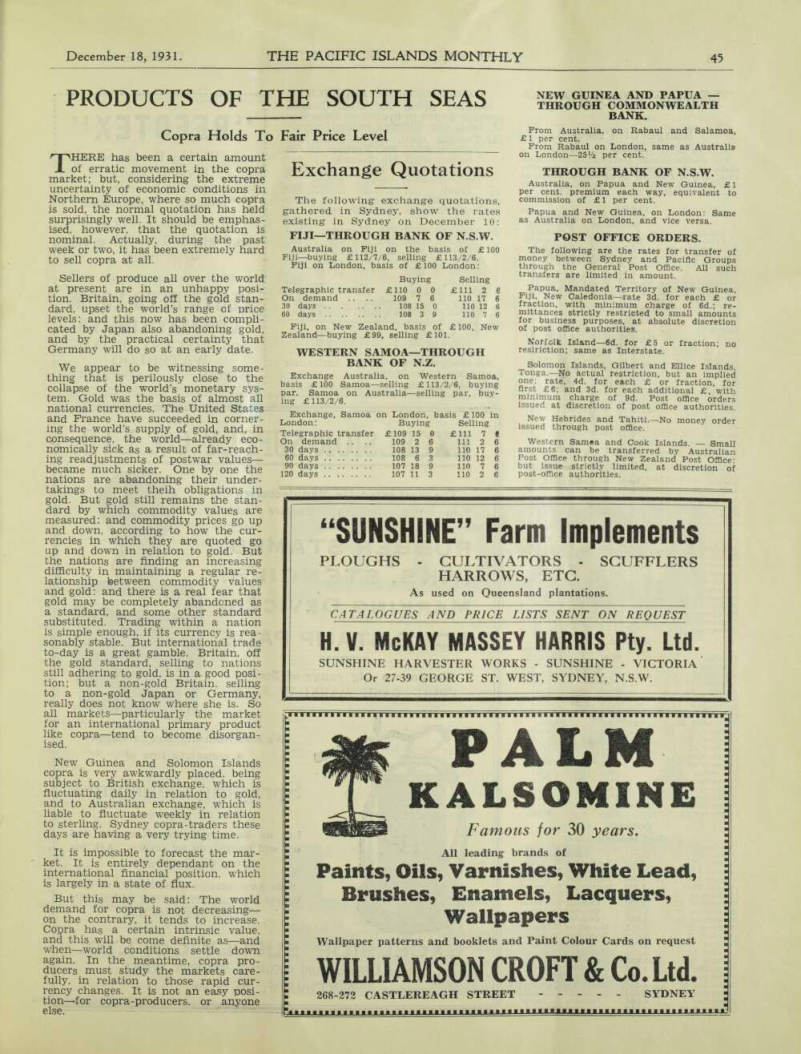
Copra Holds To Fair Price Level
THERE has been a certain amount of erratic movement in the copra market; but, considering the extreme uncertainty of economic conditions in Northern Europe, where so much copra is sold, the normal quotation has held surprisingly well. It should be emphas ised, however, that the quotation is nominal. Actually, during the past week or two, it has been extremely hard to sell copra at all.
Sellers of produce all over the world at present are in an unhappy posi tion. Britain, going off the gold stan dard, upset the world’s range of price levels: and this now has been compli cated by Japan also abandoning gold, and by the practical certainty that Germany will do so at an early date.
We appear to be witnessing some thing that is perilously close to the collapse of the world’s monetary sys tem. Gold was the basis of almost all national currencies. The United States and France have succeeded in corner ing the world’s supply of gold, and, in consequence, the world —already eco nomically sick as a result of far-reach ing readjustments of postwar values — became much sicker. One by one the nations are abandoning their under takings to meet theih obligations in gold. But gold still remains the stan dard by which commodity values are measured: and commodity prices go up and down, according to how the cur rencies in which they are quoted go up and down in relation to gold. But the nations are finding an increasing difficulty in maintaining a regular re lationship between commodity values and gold: and there is a real fear that gold may be completely abandoned as a standard, and some other standard substituted. Trading within a nation is simple enough, if its currency is rea sonably stable. But international trade to-day is a great gamble. Britain, off the gold standard, selling to nations still adhering to gold, is in a good posi tion; but a non-gold Britain, selling to a non-gold Japan or Germany, really does not know where she is. So all markets —particularly the market for an international primary product like copra—tend to become disorgan ised.
New Guinea and Solomon Islands copra is very awkwardly placed, being subject to British exchange, which is fluctuating daily in relation to gold, and to Australian exchange, which is liable to fluctuate weekly in relation to sterling. Sydney copra-traders these days are having a very trying time.
It is impossible to forecast the mar ket. It is entirely dependant on the international financial position, which is largely in a state of flux.
But this may be said: The world demand for copra is not decreasing— on the contrary, it tends to increase.
Copra has a certain intrinsic value, and this will be come definite as —and when—world conditions settle down again. In the meantime, copra pro ducers must study the markets care fully, in relation to those rapid cur rency changes. It is not an easy posi tion—for copra-producers, or anyone else.
Exchange Quotations
The following exchange quotations, gathered in Sydney, show the rates existing in Sydney on December 10:
Fiji—Through Bank Of N.S.W.
Australia on Fiji on the basis of £100 Fiji—buying £112/7/6, selling £113/2/6.
Fiji on London, basis of £100 London:
Fiji, on New Zealand, basis of £ 100, New Zealand —buying £99, selling £101.
Western Samoa—Through
Bank Of N.Z.
Exchange Australia, on Western Samoa, basis £100 Samoa—selling £113/2/6, buying par. Samoa on Australia —selling par, buy ing £113/2/6.
New Guinea And Papua
Through Commonwealth
Bank.
From Australia, on Rabaul and Salamoa, £ 1 per cent.
From Rabaul on London, same as Australia on London — 25½ per cent.
Through Bank Of N.S.W.
Australia, on Papua and New Guinea, £1 per cent, premium each way, equivalent to commission of £ 1 per cent.
Papua and New Guinea, on London: Same as Australia on London, and vice versa.
Post Office Orders.
The following are the rates for transfer of money between Sydney and Pacific Groups through the General Post Office. All such transfers are limited in amount.
Papua, Mandated Territory of New Guinea.
Fiji. New Caledonia—rate 3d. for each £ or fraction, with minimum charge of 6d.; re mittances strictly restricted to small amounts for business purposes, at absolute discretion of post office authorities.
Norfolk Island—6d. for £5 or fraction; no resiriction; same as Interstate.
Solomon Islands, Gilbert and Ellice Islands Tonga.—No actual restriction, but an implied one: rate, 4d. for each £ or fraction, for first £6; and 3d. for each additional £, with minimum charge of 9d. Post office orders issued at discretion of post office authorities.
New Hebrides and Tahiti.—No money order issued through post office.
Western Samea and Cook Islands. Small amounts can be transferred by Australian Post Office through New Zealand Post Office; but issue strictly limited, at discretion of post-office authorities.
Buying Selling Telegraphic transfer £110 0 0 £111 2 6 On demand ... 109 7 6 110 17 6 30 days 108 15 0 110 12 6 60 days 108 3 9 110 7 6
Exchange, Samoa on London, basis £ 100 in London: Buying Selling Telegraphic transfer £109 15 0 £111 7 6 On demand ... 109 2 6 111 2 6 30 days 108 13 9 110 17 6 60 days 108 6 3 110 12 6 90 days 107 18 9 110 7 6 120 days 107 11 3 110 2 6
Advertisements & other items, p. 47 (1 item)
Palm
“SUNSHINE” Farm Implements
PLOUGHS - CULTIVATORS - SCUFFLERS
HARROWS, ETC.
As used on Queensland plantations.
CATALOGUES AND PRICE LISTS SENT ON REQUEST H. V. McKAY MASSEY HARRIS Pty. Ltd.
SUNSHINE HARVESTER WORKS - SUNSHINE - VICTORIA Or 27-39 GEORGE ST. WEST, SYDNEY, N.S.W.
PALM
KALSOMINE
Famous for 30 years.
All leading brands of Paints, Oils, Varnishes, White Lead, Brushes, Enamels, Lacquers, Wallpapers Wallpaper patterns and booklets and Paint Colour Cards on request
WILLIAMSON CROFT & Co. Ltd.
268-272 CASTLEREAGH STREET SYDNEY
Market Quotations
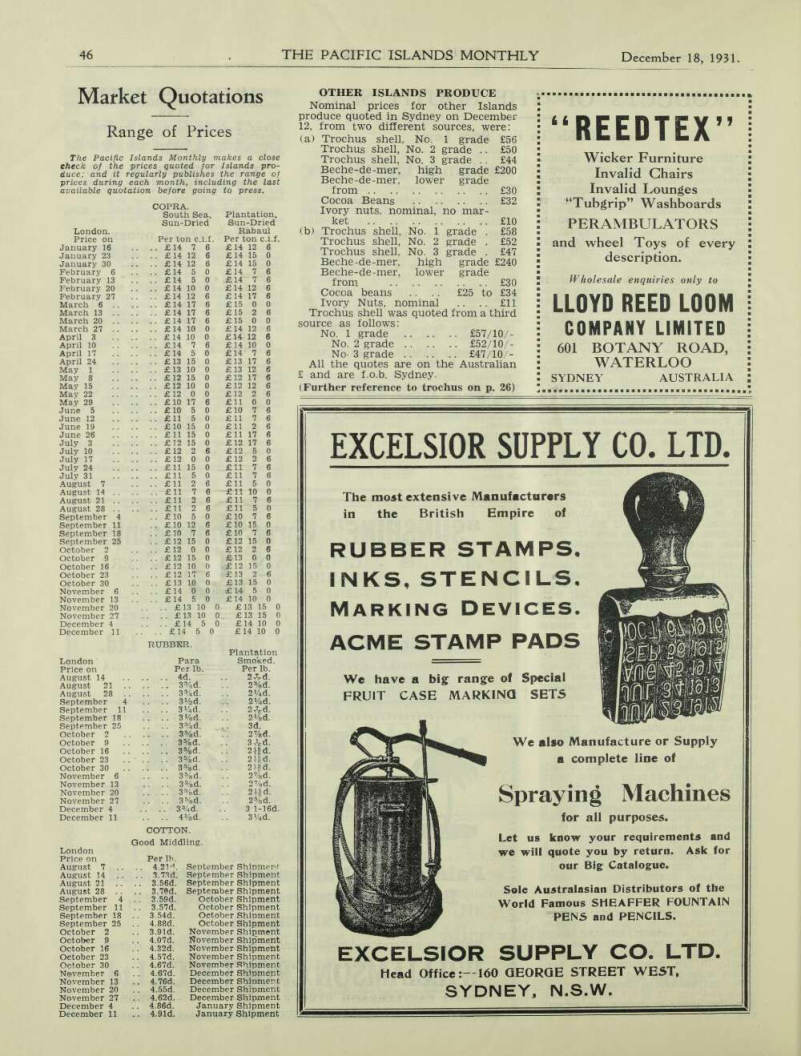
Range of Prices
The Pacific Islands Monthly makes a close check of the prices quoted for Islands pro duce; and it regularly publishes the range of prices during each month, including the last available quotation before going to press.
Other Islands Produce
Nominal prices for other Islands produce quoted in Sydney on December 12, from two different sources, were: (a) Trochus shell, No. 1 grade £56 Trochus shell, No. 2 grade .. £50 Trochus shell, No. 3 grade .. £44 Beche-de-mer, high grade £200 Beche-de-mer, lower grade from £30 Cocoa Beans £32 Ivory nuts, nominal, no mar ket £10 (b) Trochus shell, No. 1 grade . £58 Trochus shell, No. 2 grade . £52 Trochus shell, No. 3 grade . £47 Beche-de-mer, high grade £240 Beche-de-mer, lower grade from £30 Cocoa beans .. .. £25 to £34 Ivory Nuts, nominal .. .. £11 Trochus shell was quoted from a third source as follows: No. 1 grade £57/10/- No. 2 grade £52/10/- No- 3 grade £47/10/- All the quotes are on the Australian £ and are f.o.b. Sydney. (Further reference to trochus on p. 26)
Copra.
South Sea.
Plantation, Sun- Dried Sun-Dried London.
Rabaul Price on Per ton c.i.f.
Per ton c.i.f.
January 16 .. .. £14 7 6 £14 12 6 January 23 . . . . £14 12 6 £14 15 0 January 30 .. .. £14 12 6 £14 15 0 February 6 .. .. £14 5 0 £14 7 6 February 13 . . . . £14 5 0 £14 7 6 February 20 . . .. £14 10 0 £14 12 6 February 27 . . . . £14 12 6 £14 17 6 March 6 . . .. .. £14 17 6 £15 0 0 March 13 .. .. .. £14 17 6 £15 2 6 March 20 .. .. .. £14 17 6 £15 0 0 March 27 . . .. .. £14 10 0 £14 12 6 April 3 . . . . £14 10 0 £14 12 6 April 10 . . . . £14 7 6 £14 10 0 April 17 . . . . £14 5 0 £14 7 6 April 24 . . . . £13 15 0 £13 17 6 May 1 . . . . £13 10 0 £13 12 6 May 8 .. .. £12 15 0 £12 17 6 May 15 . . . . £12 10 0 £12 12 6 May 22 . . . . £12 0 0 £12 2 6 May 29 .. .. £10 17 6 £11 0 0 June 5 .. .. £10 5 0 £10 7 6 June 12 . . . . £11 5 0 £11 7 6 June 19 .. .. £10 15 0 £11 2 6 June 26 . . . . £11 15 0 £11 17 6 July 3 . . . . £12 15 0 £12 17 6 July 10 . . . . £ 12 2 6 £12 5 0 July 17 .. .. £12 0 0 £12 2 6 July 24 . . . . £11 15 0 £11 7 6 July 31 ., . . £11 5 0 £11 7 6 August 7 . . . . £11 2 6 £11 5 0 August 14 . . . . . . £11 7 6 £11 10 0 August 21 . . . . . . £11 2 6 £11 7 6 August 28 . . . . . . £11 2 6 £11 5 0 September 4 .. £10 5 0 £10 7 6 September 11 . . £10 12 6 £10 15 0 September 18 . . £10 7 6 £10 7 6 September 25 . . £12 15 0 £12 15 0 October 2 .. .. £12 0 0 £12 2 6 October 9 . . . . £12 15 0 £13 0 0 October 16 . . . . £12 10 0 £12 15 0 October 23 . . . . £12 17 6 £13 2 6 October 30 . . . . £13 10 0 £13 15 0 November 6 . . . . £14 0 0 £14 5 0 November 13 . . . . £14 5 0 £14 10 0 November 20 .. .. £13 10 0 £13 15 0 November 27 . . . . £ 13 10 0 £13 15 0 December 4 . . . . £14 5 0 £14 10 0 December 11 . . . . £14 5 0 £14 10 0
Rubber.
Plantation London Para Smoked.
Price on Per lb.
Per lb.
August 14 4d. 2 -V d.
August 21 . 3 3 / 4 d. 2%d.
August 28 3 3 / 4 d. 2V 4 d.
September 4 .. .. 3V 2 d. 2V 4 d.
September 11 .. .. 3V 4 d. 2^ ff d.
September 18 .. .. 3Vsd. 2Vsd.
September 25 .. . . 3 3 4d. 3d.
October 2 .. .. 3%d. 2%d.
October 9 . . . 3 5 /ad. 3iVd.
October 16 . . .. 3%d. 2«d.
October 23 .. .. 3 5 / 8 d. 2«d.
October 30 .. . . 3 5/ sd. 213d.
November 6 .. .. 3%d. 2%d.
November 13 . . . . 3 5 /sd. 2%d.
November 20 . . . . 3s/ 8 d. 2**d.
November 27 .. .. 3 s 4d. 2 5 4d.
December 4 . . . . 3%d. 3 1- -16d.
December 11 .. .. 4y 8 d. 3V 4 d.
Cotton.
Good Middling.
London Price on Per lb.
August 7 .. .. 4.21*.
September Shipment August 14 .. . . 3.73d.
September Shipment August 21 .. .. 3.56d.
September Shipment August 28 . . 3.70d.
September Shipment September 4 .. 3.59d.
October Shipment September 11 . . 3.57d.
October Shipment September 18 . . 3.54d.
October Shipment September 25 . . 4.88d.
October Shipment October 2 .. 3.91d.
November Shipment October 9 . . 4.07d.
November Shipment October 16 . . 4.32d.
November Shipment October 23 .. 4.57d.
November Shipment October 30 .. 4.67d.
November Shipment November 6 . . 4.67d.
December Shipment November 13 .. 4.76d.
December Shinment November 20 . . 4.55d.
December Shipment November 27 . . 4.62d.
December Shipment December 4 . . 4.86d.
January Shipment December 11 . . 4.91d.
January Shipment
Advertisements & other items, p. 48 (1 item)
Excelsior Supply Co. Ltd
“REEDTEX”
Wicker Furniture Invalid Chairs Invalid Lounges “Tubgrip” Washboards
PERAMBULATORS
and wheel Toys of every description.
Wholesale enquiries only to
LLOYD REED LOOM
COMPANY LIMITED
601 BOTANY ROAD,
WATERLOO
SYDNEY AUSTRALIA
EXCELSIOR SUPPLY CO. LTD
The most extensive Manufacturers in the British Empire of
RUBBER STAMPS.
INKS, STENCILS.
Marking Devices.
ACME STAMP PADS
We have a big range of Special
FRUIT CASE MARKING SETS
We also Manufacture or Supply a complete line of
Spraying Machines
for all purposes.
Let us know your requirements and we will quote you by return. Ask for our Big Catalogue.
Sole Australasian Distributors of the World Famous SHEAFFER FOUNTAIN
PENS and PENCILS.
EXCELSIOR SUPPLY CO. LTD.
Head Office:—160 GEORGE STREET WEST,
SYDNEY, N.S.W.
Shipping Services in The Pacific
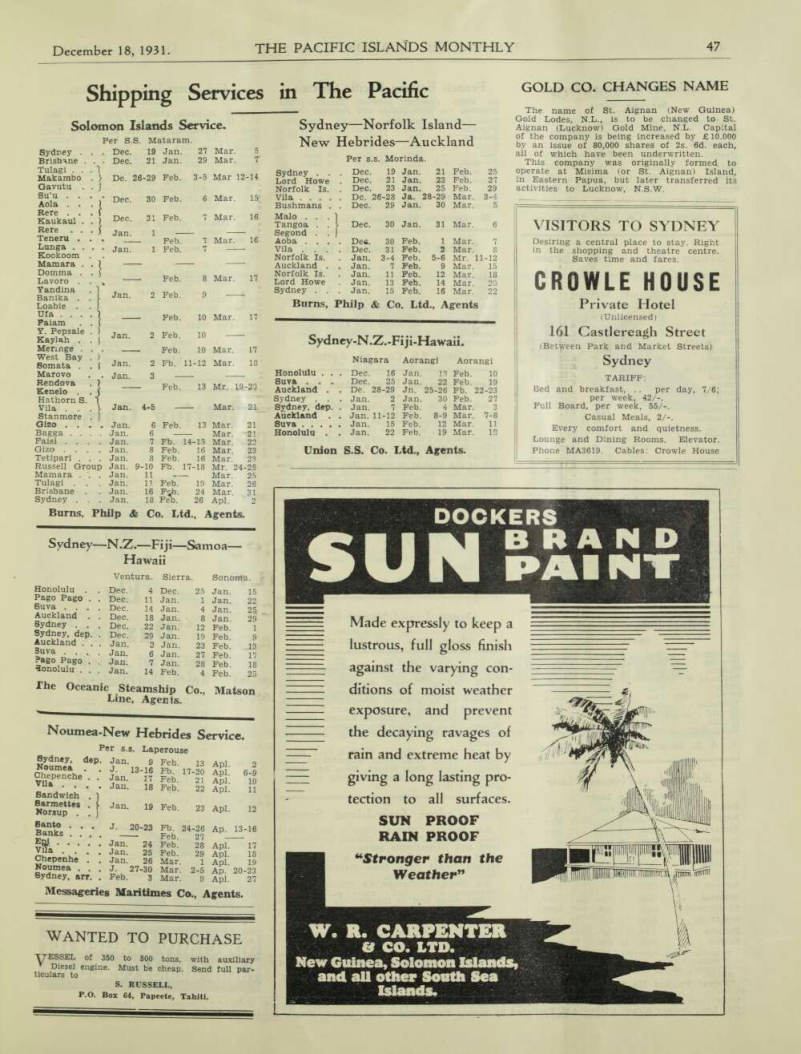
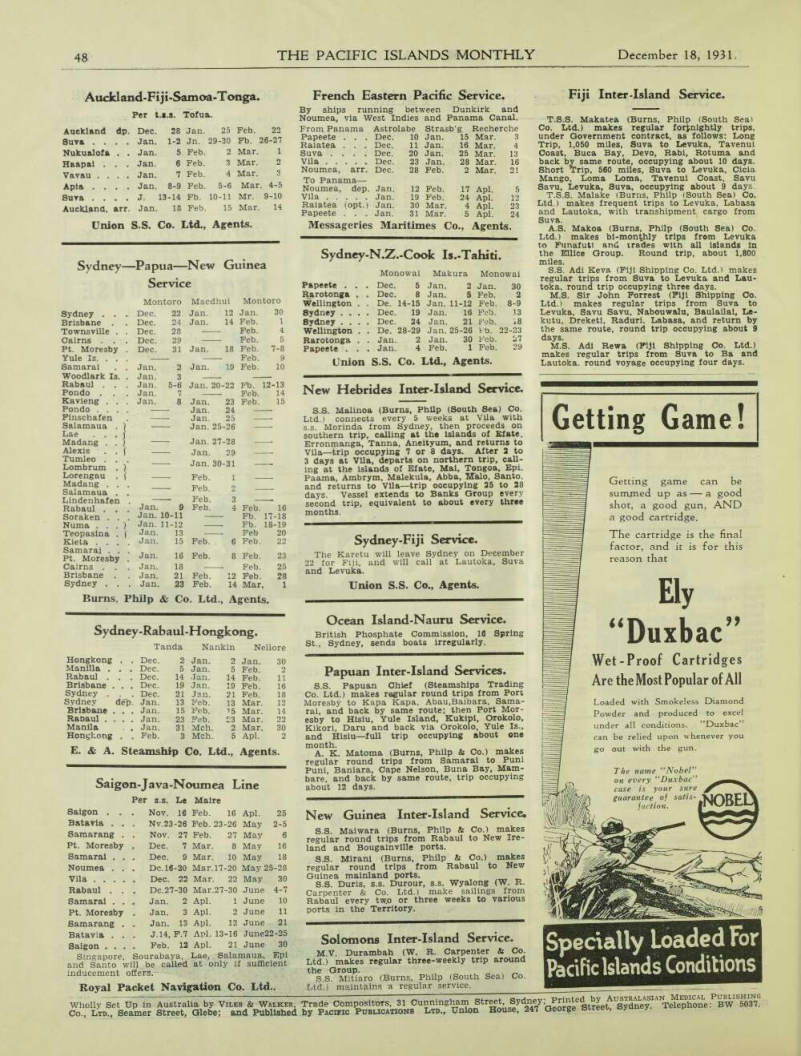
Solomon Islands Service.
Sydney—N.Z.—Fiji—Samoa— Hawaii
Noumea-New Hebrides Service.
Sydney —Norfolk Island — New Hebrides —Auckland
Sydncy-N.Z.-Fiji-Hawaii.
Per S.S.
Mataram.
Sydney .
Dec. 19 Jan. 27 Mar. 5 Brisbane Dec. 21 Jan. 29 Mar. r Tulagi . .
Makambo De. 26-29 Feb. 3-5 Mar 12 -14 Gavutu Su’u . .
Aola . .
Dec. 30 Feb. 6 Mar. 15 Rere . .
Kaukaul .
Dec. 31 Feb. 7 Mar. 16 Rere . . 1 Teneru .
J an.
Feb. 7 Mar. 16 Lunga . .
Jan. 1 Feb. 7 Kookoom Mamara Domma . 17 Lavoro . — Feb. 8 Mar.
Yandina Jan.
Feb. 9 Banika . 2 — Loabie .
Ufa . . .
Paiam — Feb. 10 Mar. 17 Y. Pepsale o Feb. 10 Kaylah .
J an.
Mennge .
Feb. 10 Mar. 17 West Bay Somata .
Jan. 2 Fb. 11-12 Mar. 18 Marovo Rendova Kenelo Jan.
Q O Feb. 13 Mr. 19-20 Hathorn S.
Vila . .
Jan. 4-5 — Mar. 21 Stanmore Glzo . .
Jan. 6 Feb. 13 Mar. 21 Bagga . .
Jan. 6 — Mar. 21 Falsi . .
Jan. 7 Fb. 14-15 Mar. 22 Gizo . .
Jan. 8 Feb. 16 Mar. 23 Tetipari .
Jan. 8 Feb. 16 Mar. 23 Russell Group Jan. 9- -10 Fb. 17-18 Mr. 24-25 Mamara .
Jan. 11 Mar. 25 Tulagi .
Jan. 11 Feb. 19 Mar. 26 Brisbane Jan. 16 24 Feb. 26 Mar. 31 Sydney .
Jan. 18 Apl. 2 Burns, Philp & Co. Ltd., Agents.
Ventura. Sierra.
Sonoma.
Honolulu . . Dec. 4 Dec. 25 Jan. 15 Pago Pago . . Dec. 11 Jan. 1 Jan. 22 Suva . , . . Dec. 14 Jan. 4 Jan. 25 Auckland . . Dec. 18 Jan. 8 Jan. 29 Sydney . . . Dec. 22 Jan. 12 Feb. 1 Sydney, dep. . Dec. 29 Jan. 19 Feb. 9 Auckland . . . Jan. 2 Jan. 23 Feb. 13 Suva . . . • Jan. 6 Jan. 27 Feb. 17 Pago Pago . . Jan. 7 Jan. 28 Feb. 18 Honolulu . . . Jan. 14 Feb. 4 Feb. 25 The Oceanic Steamship Co., Matson
Line, Agents.
Per s.s.
Laperouse Sydney, dep.
Noumea .
Chepenche . .
Vila ... .
Jan.
J. 13 Jan.
Jan, 9 -16 17 18 Feb.
Fb. 17 Feb.
Feb. 13 -20 21 22 Apl.
Apl.
Apl.
Apl. 2 6-9 10 11 Sandwich . 1
Sarmettes . £
Norsup . . j Jan. 19 Feb. 23 Apl. 12 Santo . , .
Banks ...
Eni . . .
Vila ...
Chepenhe . .
J. 20-23 Jan. 24 Jan. 25 Jan. 26 Pb. 24-26 Feb. 27 Feb. 28 Feb. 29 Mar. 1 Ap.
Apl.
Apl.
Apl. 13-16 17 IS 19 Noumea . . .
J. 27-30 Mar. ; 2-5 Ap. 20-23 Sydney, arr. .
Feb. 3 Mar. 9 Apl. 27 Messageries Maritimes Co., Agents.
Per s.s.
Morinda.
Sydney . .
Dec. 19 Jan. 21 Feb. 25 Lord Howe . Dec. 21 Jan. 23 Feb. 27 Norfolk Is. . Dec. 23 Jan. 25 Feb. 29 Vila . . . . Dc. 26-28 Ja. 28-29 Mar. 3-4 Bushmans . . Dec. 29 Jan. 30 Mar. 5 Malo . . . 1 Tangoa . .
V Dec. 30 Jan. 31 Mar. 6 Segond . . 1 Aoba . . .
De«. 30 Feb. 1 Mar. 7 Vila . . . . Dec. 31 Feb. 2 Mar. 8 Norfolk Is. . Jan. 3-4 Feb. 1 5-6 Mr. 11 -12 Auckland . . Jan. 7 Feb. 9 Mar. 15 Norfolk Is. . Jan. 11 Feb. 12 Mar. 18 Lord Howe Jan. 13 Feb. 14 Mar. 20 Sydney . . . Jan. 15 Feb. 16 Mar. 22 Burns, Philp & Co. Ltd., Agents.
Niagara Aorangl Aorangi Honolulu . . .
Dec. 16 Jan. 18 Feb. 10 Suva . . .
Dec. 25 Jan. 22 Feb. 19 Auckland . .
De. 28-29 Jn. 25-26 Fb. 22-23 Sydney . . .
Jan. 2 Jan. 30 Feb. 27 Sydney, dep. .
Jan. 7 Feb. 4 Mar. 3 Auckland . .
Jan. 11-12 Feb. 8-9 Mar. 7-8 Suva Jan. 15 Feb. 12 Mar. 11 Honolulu . .
Jan. 22 Feb. 19 Mar.
IS Union S.S. Co. Ltd., Agents.
Auckland-Fi ji-Samoa-Tonga.
Sydney—Papua—New Guinea Service
Sydney-Rabaul-Hongkong.
Saigon-Java-Noumea Line
French Eastern Pacific Service.
Sydney-N.Z.-Cook Is. Tahiti.
New Hebrides Inter-Island Service.
S.S. Malinoa (Burns, Philp (South Sea) Co.
Ltd.) connects every 5 weeks at Vila with s.s. Morinda from Sydney, then proceeds on southern trip, calling at the islands of Efate, Erronmanga, Tanna, Aneityum, and returns to Vila —trip occupying 7 or 8 days. After 2 to 3 days at Vila, departs on northern trip, call ing at the islands of Efate, Mai, Tongoa, Epi.
Paama, Ambrym. Malekula, Abba, Malo, Santo, and returns to Vila—trip occupying 25 to 28 days. Vessel extends to Banks Group every second trip, equivalent to about every three months.
Sydney-Fiji Service.
The Karetu will leave Sydney on December 22 for Fiji, and will call at Lautoka. Suva and Levuka.
Union S.S. Co., Agents.
Ocean Island-Nauru Service.
British Phosphate Commission, 16 Spring St., Sydney, sends boats irregularly.
Papuan Inter-Island Services.
5.5. Papuan Chief (Steamships Trading Co. Ltd.) makes regular round trips from Port Moresby to Kapa Kapa. Abau, Baibara, Sama rai, and back by same route; then Port Mor esby to Hisiu, Yule Island, Kukipl, Orokolo, Kikori, Daru and back via Orokolo, Yule Is., and Hisiu—full trip occupying about one month.
A. K. Matoma (Burns, Philp & Co.) makes regular round trips from Samarai to Puni Puni, Baniara, Cape Nelson, Buna Bay, Mam bare, and back by same route, trip occupying about 12 days.
New Guinea Inter-Island Service.
S.S. Maiwara (Burns, Philp & Co.) makes regular round trips from Rabaul to New Ire land and Bougainville ports.
S.S. Mirani (Burns, Philp & Co.) makes regular round trips from Rabaul to New Guinea mainland ports.
S.S. Duris, s.s. Durour, s.s. Wyalong (W. R.
Carpenter & Co. Ltd.) make sailings from Rabaul every two or three weeks to various ports in the Territory.
Solomons Inter-Island Service.
M.V. Durambah (W. R. Carpenter & Co.
Ltd.) makes regular three-weekly trip around the Group.
S.S. Mitiaro (Burns, Philp (South Sea) Co.
Ltd.) maintains a regular service.
Fiji Inter'lsland Service.
T.S.S. Makatea (Burns, Philp (South Sea) Cos. Ltd.) makes regular fortnightly trips, under Government contract, as follows: Long Trip, 1,050 miles, Suva to Levuka, Tavenui Coast, Buca Bay, Devo, Rabi, Rotuma and back by same route, occupying about 10 days.
Short Trip, 560 miles, Suva to Levuka, Cicia Mango, Loma Loma, Tavenui Coast, Savu Savu, Levuka, Suva, occupying about 9 days.
T.S.S. Malake (Burns, Philp (South Sea) Cos.
Ltd.) makes frequent trips to Levuka, Labasa and Lautoka, with transhipment cargo from Suva.
A.S. Makoa (Burns, Philp (South Sea) Cos.
Ltd.) makes bi-monthly trips from Levuka to Funafuti and trades with all islands in the Ellice Group. Round trip, about 1,800 miles.
S.S. Adi Keva (Fiji Shipping Cos. Ltd.) makes regular trips from Suva to Levuka and Lau toka, round trip occupying three days.
M.S. Sir John Forrest (Fiji Shipping Cos.
Ltd.) makes regular trips from Suva to Levuka, Savu Savu, Nabouwalu, Baulailai, Le kutu, Dreketl, Raduri. Labasa, and return by the same route, round trip occupying about 9 days.
M.S. Adi Rewa (Fiji Shipping Cos. Ltd.) makes regular trips from Suva to Ba and Lautoka. round voyage occupying four days.
By ships running between Dunkirk and Noumea, via West Indies and Panama Canal.
From Panama Astrolabe Strasb’g Recherche Papeete . . . Dec. 10 Jan. 15 Mar. 3 Raiatea . . . Dec. 11 Jan. 16 Mar. 4 Suva ... Dec. 20 Jan. 25 Mar. 13 Vila Dec. 23 Jan. 28 Mar. 16 Noumea, arr. Dec. 28 Feb. 2 Mar. 21 To Panama — Noumea, dep. Jan. 12 Feb. 17 Apl. 5 Vila Jan. 19 Feb. 24 Apl. 12 Raiatea (opt.) Jan. 30 Mar, 4 Apl. 23 Papeete . . . Jan. 31 Mar. 5 Apl. 24
Messageries Maritimes Co., Agents.
Monowai Makura Monowai Papeete . .
Dec. 5 Jan. 2 Jan. 30 Rarotonga , Dec. 8 Jan. 5 Feb. 2 Wellington .
De. 14-15 Jan. 11-12 Feb. 8-9 Sydney . , .
Dec. 19 Jan. 16 Feb. 13 Sydney . . . . . Dec. 24 Jan. 21 Feb. 18 Wellington . . . De. 28-29 Jan. 25-26 Fb. 22-23 Rarotonga . . Jan. 2 Jan. 30 Feb. 27 Papeete . . . Jan. 4 Feb. 1 Feb. 29 Union S.S. Co. Ltd., Agents.
Per t.s.s.
Tofua.
Auckland dp. Dec. 28 Jan. 25 Feb. 22 Suva ... Jan. 1-2 Jn. 29-30 Fb. 26-27 Nukualofa . . Jan. 5 Feb. 2 Mar. 1 Haapal . . . Jan. 6 Feb. 3 Mar. 2 Vavau ... Jan. 7 Feb. 4 Mar. 3 Apia ... Jan. 8-9 Feb. 5-6 Mar . 4-5 Suva . . . . J. 13-14 Fb. 10-11 Mr. 9-10 Auckland, arr. Jan. 10 Feb. 15 Mar. 14 Union S.S. Co. Ltd., Agents.
Montoro Macdhui Montoro Sydney . • Dec. 22 Jan. 12 Jan. 30 Brisbane , Dec. 24 Jan. 14 Feb. 1 Townsville .
Dec. 28 — Feb. 4 Oairns . .
Dec. 29 — Feb. 5 Pt. Moresby Dec. 31 Jan. 18 Feb. 7-8 Yule Is. . . — — Feb. 9 Samarai Jan. 2 Jan. 19 Feb. 10 Woodlark Is.
Jan. 3 Rabaul . .
Jan. >-6 Jan. 20- -22 Fb. 12-13 Pondo . .
Jan. 7 Feb. 14 Kavieng . .
Jan. 8 Jan. 23 Feb. 15 Pondo . . . — Jan. 24 Finschafen — Jan. 25 Salamaua . — Jan. 25 -26 Lae . . .
Madang . . — Jan.27-28 — Alexis . . Jan. 29 Tumleo . .
Lombrum , — Jan.30-31 — Lorengau Feb. 1 Madang . .
Salamaua . — Feb. 2 — Lindenhafen Feb. 3 - Rabaul . .
Jan. 9 Feb. 4 Feb. 16 Soraken . .
Jan. 10 -11 Fb. 17-18 Numa . . . ) Jan. 11 -12 — Fb. 18-19 Teopasina .
Jan. 13 Feb 20 Kieta . . .
Jan. 15 Feb. 6 Feb. 22 Samarai . .
Pt. Moresby Jan. 16 Feb. 8 Feb. 23 Cairns . .
Jan. 18 Feb. 25 Brisbane .
Jan. 21 Feb. 12 Feb. 28 Sydney . .
Jan. 23 Feb. 14 Mar. 1 Burns, Philp & Co. Ltd., Agents.
Tanda Nankin Nellore Hongkong . . Dec. 2 Jan. 2 Jan. 30 Manilla . . . Dec. 5 Jan. 5 Feb. 2 Rabaul . . . Dec. 14 Jan. 14 Feb. 11 Brisbane , , . Dec. 19 Jan. 19 Feb. 16 Sydney . . . Dec. 21 Jan. 21 Feb. 18 Sydney dep. Jan. 13 Feb. 13 Mar. 12 Brisbane . . . Jan. 15 Feb. 15 Mar. 14 Rabaul ... Jan. 23 Feb. 23 Mar. 22 Manila . . Jan. 31 Mch. 2 Mar. 30 Hongkong . . Feb. 3 Mch. 5 Apl. 2 E. & A. Steamship Co. Ltd., Agents.
Per s.s. Le Maire Saigon . . . Nov. 16 Peb. 16 Apl. 25 Batavia . . . Nv.23-26 Feb. 23- -26 May 2-5 Samarang . . Nov. 27 Feb. 27 May 6 Pt. Moresby . Dec. 7 Mar. 8 May 16 Samaral . . . Dec. 9 Mar. 10 May 18 Noumea . . . Dc. 16-20 Mar. 17-20 May 25-28 Vila . . . . . Dec. 22 Mar. 22 May 30 Rabaul . . . Dc.27-30 Mar.27-30 June 4-7 Samara! . . • Jan. 2 Apl. 1 June 10 Pt. Moresby . Jan. 3 Apl. 2 June 11 Samarang . . Jan. 13 Apl. 12 June 21 Batavia . .
J.14, P.7 Apl. 13' -16 June22-25 Saigon . . . . Peb. 12 Apl. 21 June 30 Singapore, Sourabaya, Lae, Salamaua, Epi and Santo will be called at only if sufficient inducement offers.
Royal Packet Navigation Co. Ltd
Gold Co. Changes Name
The name of St. Aignan (New Guinea) Gold Lodes, N.L., is to be changed to St.
Aignan (Lucknow) Gold Mine, N.L. Capital of the company is being increased by £10,000 by an issue of 80,000 shares of 2s. 6d. each, all of which have been underwritten.
This company was originally formed to operate at Misima (or St. Aignan) Island, in Eastern Papua, but later transferred its activities to Lucknow, N.S.W.
Advertisements & other items, pp. 49-52 (3 items)
Nbrand
VISITORS TO SYDNEY
Desiring a central place to stay. Right in the shopping and theatre centre.
Saves time and fares.
CROWLE HOUSE
Private Hotel
(Unlicensed)
161 Gastlereagh Street
(Between ParK and Market Streets)
Sydney
TARIFF:
Bed and breakfast, .. per day, 7/6; per week, 42/-.
Full Board, per week, 55/-.
Casual Meals, 2/-.
Every comfort and quietness.
Lounge and Dining Rooms. Elevator.
Phone MA3619. Cables: Crowle House
SUN
DOCKERS
NBRAND
PAINT
Made expressly to keep a lustrous, full gloss finish
against the varying con
ditions of moist weather exposure, and prevent the decaying ravages of rain and extreme heat by
giving a long lasting pro
tection to all surfaces.
SUN PROOF
RAIN PROOF
“Stronger than the Weather”
W. R. CARPENTER
& CO. LTD.
New Guinea, Solomon Islands, and all other South Sea
Getting Game!
Getting game can be summed up as a good shot, a good gun, AND a good cartridge.
The cartridge is the final factor, and it is for this reason that
Ely
“Duxbac
99
Wet-Proof Cartridges
Are the Most Popular of All
Loaded with Smokeless Diamond Powder and produced to excel under all conditions. "Duxbac” can be relied upon whenever you go out with the gun.
The name “Nobel ’’ on every “Duxbac” case is your sure guarantee of satis faction.
Specially Loaded For
Pacific Islands Conditions
W 02917
IONA
BOOTS
and
SHOES
Medium Tan Willow Calf Circular Vamp Cent’s Shoe. Special Goodyear storm welted sole. (Corndodger Last, Regd.).
The Recognised Quality of Australia
V 238 All White Washable Calf, with carefully designed black patent trim. High grade Veldtschoen. Half-inch low leather heel
Ladies’ and Cents’ Goodyear Welted
Footwear.
Ladies’ and Children’s Veldtschoen
Footwear.
If these brands are not already
stocked by you, kindly send to us
for illustrated catalogue
PE2669 All Patent Circular Vamp Men’s Light Evening Shoe. Genuine Goodyear welt.
A high-class product.
W 07354 Brown Calf Shoe inserted with reproduced brown crocodile. Genuine Goodyear light welted sole. 11/8 shaped leather heel.
McKINLAY & CUMMING LTD.
Manufacturers and Exporters of Ladies’ and Cents’ Footwear.
GEORGE STREET ERSKINEVILLE SYDNEY
* v-wr
“THAT, GENTLEMEN, IS RESCH’S EXPORT
LAGER—IN ITS LONG BOTTLE. IT’S NOW THE
MOST POPULAR DRINK IN THE HOUSE—A
MILD LAGER WHICH APPEALS TO EVERY-
ONE. . . YES, SIR! I WILL BRING YOU A
BOTTLE NOW.”
RESCH’S EXPORT LAGER
Wanted To Purchase
VESSEL of 350 to 500 tons, with auxiliary Diesel engine. Must be cheap. Send full par ticulars to
S. RUSSELL,
P.O. Box 64, Papeete, Tahiti.
48
December 18, 1931.
THE PACIFIC ISLANDS MONTHLY
Wholly Set Up in Australia by Viles & Walker, Trade Compositors, 31 Streep Syttaey; Printby 5037.
Co., Ltd., Seamer Street, Glebe; and Published by Pacific Publications Ltd., Union House. 247 George &ireet, oy y