THE Pacific Islands
Monthly
THE ONLY JOURNAL CIRCULATING THROUGHOUT THE ISLAND TERRITORIES AND GROUPS
Of The Central And South Pacific.
Vol. 1.—No. 5.
Registered at G.P.O., Sydney, for transmission by Post as a Newspaper
Sydney: Tuesday, December 16, 1930
Per Annum, posted, Single Copy, 6d. ———
Tonga Bananas
———♦——— Marketing Trouble Predicted
Will Australia Open Her
Door?
From Our Tonga Correspondent
Nukualofa, Nov. 15,
WHERE will a market be found for Tongan bananas? From September next, it is estimated this group will produce about 30,000 cases a month.
The native and foreign growers have been planting up large areas and nine months hence Tongatabu, alone of the group, will be getting ready to dispose of from 12,000 to 15,000 cases a month.
If the northern islands —Haapai and Vavau —have been as active, the figures for the group can conservatively be doubled.
Will this Tongan fruit be thrown on a New Zealand market flooded with shipments from Fiji, Samoa and Raratonga? It can hardly reach Australia, that Commonwealth surrounded by “a barbed-wire entanglement.” Will Australia snip the wires and let the Tongan banana through in exchange for Australian products?
An answer to the questions should already be in the mould.
A Case For Pacific Islands
Federation.
The obstinacy of the Commonwealth has led to many suggestions from prominent island men. Probably the most feasible is that a not too unwieldy round table conference be staged at Suva with representatives of the Islands’ Administrations and delegates from the Islands’ Chambers of Commerce who, backed up by their respective Governments and executives, can make a concerted frontal attack on Australia’s tariff wall.
And, even if the conference was unsuccessful (as far as the Commonwealth is concerned), the cost would be negligible when compared with the incalculable benefits, which would ultimately accrue from a confederated exchange of ideas, views and opinions. ———
Crocodile Farming
Possibilities Being Investigated New Industry for Torres Straits?
From Our Own Correspondent
Thursday Is., Nov. 29.
CROCODILE farming is to be one of the industries of the future; to-day in Northern Australia, no one is very A Typical Crocodile from North Australian waters.
much impressed with its prospects, but this may be from lack of knowledge of the facts.
The representatives of the crocodile family, formerly so numerous in the southern portion of the U.S.A., are rapidly becoming extinct from slaughter. During the last few years the supply does not nearly meet the demand and the Americans, with characteristic shrewdness, not only protect, but rear them for commercial uses. From the hide, a number of useful articles are made, such as trunks, purses, pocket books, shoes, etc., and the demand for the leather is expanding.
Here, in North Australia, we have large numbers of these reptiles and practically no use is made of them.
The east coat rivers are well stocked, but their Saurian population is far exceeded in the north-west, where, as at Wyndham, and other small settlements, they fairly teem.
Just at present, Captain de Teliga, who has amassed a tremendous amount of information about their habits and locality, is travelling round the district in order to investigate its possibilities for crocodile farming. He estimates that, large as is the supply, all the crocodiles in Australia could be used up in nine years to supply the wants of this country alone, if the present demand were met by systematic destruction. The local species are only two in number, Crocodilus porosus, the salt water variety, and C. Johnstoni, which live in fresh water rivers. The skin of the latter is even more valuable than that of the former.
Crocodile farming, as explained by Captain de Teliga, consists in the reservation of a large area of otherwise practically useless country. The nests are sought for and penned round with wire netting. The average number of fertile eggs per nest is about 55, and for two months the little Saurians require no food. After the period of growth begins, they require feeding with fish, but eventually the flesh of the slaughtered beasts for the crocodile hide market would form the major portion of the diet. The stock is in-
creased by the capture of suitable bulls and mothers.
At four years the reptile averages five feet in length and its hide is then worth sixteen shillings. By-products of considerable value, including the oil, would augment the returns.
It does not appear that even twenty shillings a head would pay very handsomely after four years’ tending and feeding, but it does pay in Florida, where enormous numbers of crocodiles are kept in quite small pens, and apparently thrive in captivity.
Perhaps some of the forlorn estuaries and swamps of the mainland may be turned into payable farms some day, when Australia wakes up to the necessity fer exploiting the minor sources of wealth that she possesses. ———
Pacific Federation
High Commissioner Silent
From Our Fiji Correspondent.
Suva, Nov. 27.
WHEN asked if he would favour The Pacific Islands Monthly with his views on the suggestion of some form of Pacific Islands Federation, as outlined in the October number, the High Commissioner, Sir Murchison Fletcher, declined to say anything.
He stated that such a subject was a matter of policy and, as such, he did not feel inclined to discuss any of its aspects. ———
Expected
N.I. Bananas
———♦——— Removal of Sales Tax Expected
THE removal of the sales tax on Norfolk Island bananas was one of the matters which the Administrator, Col.
A. J. Bennett, went to Canberra to discuss with the Federal Authorities.
As a result, it has been now referred to Mr. Lyons, Acting Treasurer, and it is expected steps will be taken to remove the tax.
Reference is made to the subject in the interview with Col. Bennett on page 7 of this issue. ———
500 Die
Whooping Cough in New Hebrides
From Our Auckland Correspondent OFFICERS of the Melanesian mission steamer, which has arrived at Auckland, report that 500 native children died during a recent epidemic of whooping cough in the New Hebrides. ———
Asiatic Menace In Pacific
———♦——— What Chinese Traders are Doing in The Solomons
Economic Problem Which Demands
Attention
A very serious and rapidly-growing problem, which must be faced by British and French Islands Administrations, is that of Asiatics in the South Seas. There are Chinese in Samoa, Chinese and Hindus in Fiji, Tonkinese in New Hebrides, Tonkinese and Javanese in New Caledonia, and Chinese in the Solomons.
Each community presents special difficulties, while all must be considered in relation to a general policy. The Pacific Islands Monthly proposes to deal with each territory separately; and then to urge on all the authorities concerned the grave need for a common policy. The subject is dealt with in our leading article.
In this issue Mr. Chaperlin, who spent many years in the Pacific as a trader and planter, writes frankly about the Asiatic menace in the Solomon Islands.
Written for The Pacific Islands Monthly by H. Chaperlin
THE problem of the Asiatic immigrant is not new to many tropical countries enjoying the benefits of British administration.
In some of them, it has long since become part and parcel of the accepted order of things, with established settlements and not inconsiderable commercial interests and activities.
In others, it is of more recent date, and the effect of the influx of Asiatics on the economic life of the country concerned is more noticeable.
In no case is this more pronounced than in the British Solomon Islands Protectorate.
During the past twenty years, the number of Asiatics, mostly Chinese, residing in the Protectorate has gradually risen, until this element now forms one-sixth of the total non-native population; and it was not until the year 1922 that any move towards the restriction of such immigration was made by the Administration.
Prior to 1910 there had been but two Chinese employed in the Protectorate, these being cooks, who, on the expiry of their contracts, left the Group and, so far as the writer’s recollection serves, did not return.
Doubtless, the comparatively unsettled state of the Solomons in those days did not offer sufficient inducement or security from the Asiatic point of view, although already an increase in the number of European settlers was becoming apparent. It is doubtful, too, if the significance of the advance guard of Asiatic aliens was realised when, early in 1910, four Chinese artisans were imported by one of the merchant companies.
It must be said in that company’s favour that they had been particularly unfortunate in their experiences with shipwrights, boatbuilders and carpenters of European origin. It had al-
ready been demonstrated by the late Mr. W. Pope, at Aola, that not only boatbuilding, but the repair of fairsized vessels could be undertaken by European labour in a tropical climate.
Furthermore, it had also been possible to at least partly train a few natives to assist in such work, and the “boys” were apt pupils—a fact to which little heed seems to have been given by either the Administration, missions or commercial interests of the time.
Practically co-incident with the big rubber boom in other countries, a mild boom in coconut planting occurred in the Solomons, and most people were then mainly concerned in securing suitable areas for plantations, which threw a heavy burden upon the shoulders of the Resident Commissioner and his Assistant at Tulagi, who were the only two officials available to deal with the applications.
First Chinese Trader
It was not until 1912, however, that the first Chinese trader put in an appearance, and it was then that the initial mistake was really made. This man had come across from what was then the German Territory of New Guinea as a tailor, and if his activities had been restricted to the exercise of his trade, little harm would have been done. However, after unsuccessfully endeavouring to obtain a footing with the merchant companies on account of his desire to trade, he was accommodated by the then Acting Resident Commissioner with the lease of a small area of land at Tulagi, on which a building was erected for him, at Government expense.
It is with regret that one has to record that facilities similar to those granted to this alien had been applied for by, and refused to, a colleague of the writer, some months previously With the expiry of the Chinese artisans’ contracts, soon after the outbreak of war, it was not long before a Chinese settlement had sprung up at Tulagi, the seat of Government, and this settlement was definitely encouraged by the then Acting Resident Commissioner. The attitude of this official can be more easily understoood when it is explained that he was virtually Dictator of the Group, and had been known to express the opinion that “Chinese made excellent colonists” —an expression of opinion which on one occasion at least drew forth the retort that if such was the case, Chinese Civil Servants would be the logical sequel!
Chinatown
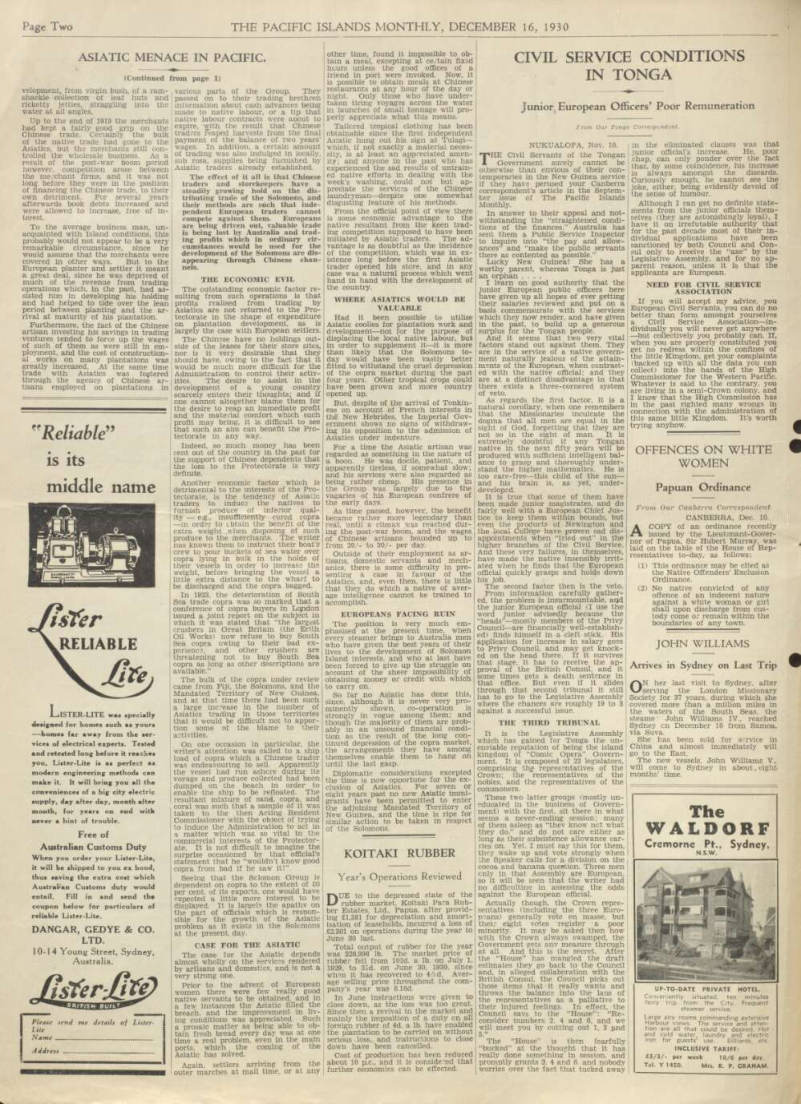
To the writer the development of the Chinese settlement was brought home in a marked manner, since on his return to the Group after four years of absence during the war period, it could not fail to be noticed. Occupying a swampy foreshore site on Tulagi Island it was next to the various houses and offices of the Government officials, easily the most prominent feature of the harbour front—-a de- A photograph of the Chinese section of the town of Tulagi, in the Solomons. The rapid growth of the Chinese community in the Solomons is dealt with in the accompanying article.
(Continued On Page 2)
shackle collection of leaf huts and ricketty jetties, straggling into the water at all angles.
Up to the end of 1919 the merchants had kept a fairly good grip on the Chinese trade. Certainly the bulk of the native trade had gone to the Asiatics, but the merchants still controlled the wholesale business. As a result of the post-war boom period however, competition arose between the merchant firms, and it was not long before they were in the position of financing the Chinese trade, to their own detriment. For several years afterwards book debts increased and were allowed to increase, free of interest.
To the average business man, unacquainted with Island conditions, this probably would not appear to be a very remarkable circumstance, since he would assume that the merchants were covered in other ways. But to the European planter and settler it meant a great deal, since he was deprived of much of the revenue from trading operations which, in the past, had assisted him in developing his holding and had helped to tide over the lean period between planting and the arrival at maturity of his plantation.
Furthermore, the fact of the Chinese artisan investing his savings in trading ventures tended to force up the wages of such of them as were still in employment, and the cost of constructional works on many plantations was greatly increased. At the same time trade with Asiatics was filtered through the agency of Chinese artisans employed on plantations in
various parts of the Group. They passed on to their trading brethren information about cash advances being made to native labour, or a tip that native labour contracts were about to expire, with the result that Chinese traders reaped harvests from the final payment of the balance of two years’ wages. In addition, a certain amount of trading was also indulged in locally, sub rosa, supplies being furnished by Asiatic traders already established.
The effect of it all is that Chinese traders and storekeepers have a steadily growing hold on the distributing trade of the Solomons, and their methods are such that independent European traders cannot compete against them. Europeans are being driven out, valuable trade is being lost by Australia and trading profits which in ordinary circumstances would be used for the development of the Solomons are disappearing through Chinese channels.
The Economic Evil
The outstanding economic factor resulting from such operations is that profits realised from trading by Asiatics are not returned to the Protectorate in the shape of expenditure on plantation development, as is largely the case with European settlers.
The Chinese have no holdings outside of the leases for their store sites, nor is it very desirable that they should have, owing to the fact that it would be much more difficult for the Administration to control their activities. The desire to assist in the development of a young country scarcely enters their thoughts; and if one cannot altogether blame them for the desire to reap an immediate profit and the material comfort which such profit may bring, it is difficult to see that such an aim can benefit the Protectorate in any way.
Indeed, so much money has been sent out of the country in the past for the support of Chinese dependents that the loss to the Protectorate is very definite.
Another economic factor which is detrimental to the interests of the Protectorate, is the tendency of Asiatic traders to induce the natives to furnish produce of inferior qual ity e.g., insufficiently cured copra —in order to obtain the benefit of the extra weight when disposing of such produce to the merchants. The writer has known them to instruct their boat’s crew to pour buckets of sea water over copra lying in bulk in the holds of their vessels in order to increase the weight, before bringing the vessel a little extra distance to the wharf to be discharged and the copra bagged.
In 1923, the deterioration of South Sea trade copra was so marked that a conference of copra buyers in London issued a joint report on the subject in which it was stated that “the largest crushers in Great Britain (the Erith Oil Works) now refuse to buy South Sea copra owing to their bad experience, and other crushers are threatening not to buy South Sea copra as long as other descriptions are available.”
The bulk of the copra under review came from Fiji, the Solomons, and the Mandated Territory of New Guinea, and at that time there had been such a large increase in the number of Asiatics trading in those territories that it would be difficult not to apportion some of the blame to their activities.
On one occasion in particular, the writer’s attention was called to a ship load of copra which a Chinese trader was endeavouring to sell. Apparently the vessel had run ashore during its voyage and produce collected had been dumped on the beach in order to enable the ship to be refloated. The resultant mixture of sand, copra, and coral was such that a sample of it was taken to the then Acting Resident Commissioner with the object of trying to induce the Administration to act in a matter which was so vital to the commercial interests of the Protectorate. It is not difficult to imagine the surprise occasioned by that official’s statement that he “wouldn’t know good copra from bad if he saw it! ”
Seeing that the Solomon Group is dependent on copra to the extent of 80 per cent, of its exports, one would have expected a little more interest to be displayed. It is largely the apathy on the part of officials which is responsible for the growth of the Asiatic problem as it exists in the Solomons at the present day.
Case For The Asiatic
The case for the Asiatic depends almost wholly on the services rendered by artisans and domestics, and is not a very strong one.
Prior to the advent of European women there were few really good native servants to be obtained, and in a few instances the Asiatic filled the breach, and the improvement in living conditions was appreciated. Such a prosaic matter as being able to obtain fresh bread every day was at one time a real problem, even in the main ports, which the coming of the Asiatic has solved.
Again, settlers arriving from the outer marches at mail time, or at any
other time, found it impossible to obtain a meal, excepting at certain fixed hours unless the good offices of a friend in port were invoked. Now, it is possible to obtain meals at Chinese restaurants at any hour of the day or night. Only those who have undertaken tiring voyages across the water in launches of small tonnage will properly appreciate what this means.
Tailored tropical clothing has been obtainable since the first independent Asiatic hung out his sign at Tulagi— which, if not exactly a material necessity, is at least an appreciated amenity; and anyone in the past who has experienced the sad results of untrained native efforts in dealing with the week’s washing, could not but appreciate the services of the Chinese laundryman—despite one somewhat disgusting feature of his methods.
From the official point of view there is some economic advantage to the native resultant from the keen trad ing competition supposed to have been initiated by Asiatic traders. The advantage is as doubtful as the incidence of the competition, which was in existence long before the first Asiatic trader opened his store, and in any case was a natural process which went hand in hand with the development of the country.
Where Asiatics Would Be
Valuable
Had it been possible to utilise Asiatic coolies for plantation work and development—not for the purpose of displacing the local native labour, but in order to supplement it—it is more than likely that the Solomons to day would have been vastly better fitted to withstand the cruel depression of the copra market during the past four years. Other tropical crops could have been grown and more country opened up.
But, despite of the arrival of Tonkinese on account of French interests in the New Hebrides, the Imperial Government shows no signs of withdrawing its opposition to the admission of Asiatics under indenture.
For a time the Asiatic artisan was regarded as something in the nature of a boon. He was docile, patient, and apparently tireless, if somewhat slow; and his services were also regarded as being rather cheap. His presence in the Group was largely due to the vagaries of his European confrere of the early days.
As time passed, however, the benefit became rather more legendary than real, until a climax was reached during the post-war boom, and the wages of Chinese artisans bounded up to from 20/- to 30/- per day.
Outside of their employment as artisans, domestic servants and mechanics, there is some difficulty in presenting a case in favour of the Asiatics, and, even then, there is little that they do which a native of average intelligence cannot be trained to accomplish.
Europeans Facing Ruin
The position is very much emphasised at the present time, when every steamer brings to Australia men who have given the best years of their lives to the development of Solomon Island interests, and who at last have been forced to give up the struggle on account of the sheer impossibility of obtaining money or credit with which to carry on.
So far no Asiatic has done this, since, although it is never very prominently shown, co-operation is strongly in vogue among them; and though the majority of them are probably in an unsound financial condition as the result of the long continued depression of the copra market, the arrangements they have among themselves enable them to hang on until the last gasp.
Diplomatic considerations excepted the time is now opportune for the exclusion of Asiatics. For seven or eight years past no new Asiatic immigrants have been permitted to enter the adjoining Mandated Territory of New Guinea, and the time is ripe for similar action to be taken in respect of the Solomons. ———
Advertisements & other items, p. 1 (1 item)
Leipzig Spring Trade Fair
If You are Interested in the Pacific Islands Shipping, Mining or Trade Write or Cable
W. FARMER WHYTE
Who can give you Direct Representation
at CANBERRA
All communications strictly confidential.
Telephone: Canberra 8070 Code Address. "Farmerite,” Canberra ———
m.
Leipzig Spring Trade Fair
1931 (Germany)
(THE GREATEST TRADE EXHIBITION
IN THE WORLD)
Despite the heavy and almost impossible Australian Tariff Legislation, Australian business men and overseas buyers can profitably visit the 1931 Spring Fair at Leipzig.
The Great Spring Fair begins on March 1st, 1931, incorporating the Great Engineering Fair, until March 11th.
Inquiries invited. All Official Data, Transport Concessions, Hotel Accommodation, Rail Services, Etc., including Letters of Introduction, Free of Cost.
Authorised Representatives:
LARS C. BRUNDAHL,
121 Pitt Street Sydney, N.S.W. (’Phones B 4006, MW 2201);
C. N. KEPPEL,
Box 585 D, C.P.O. Melbourne Victoria.
Koitaki Rubber
Year’s Operations Reviewed
DUE to the depressed state of the rubber market, Koitaki Para Rubber Estates, Ltd., Papua, after providing £1,381 for depreciation and amortisation of leaseholds, incurred a loss of £2,301 on operations during the year to June 30 last.
Total output of rubber for the year was 328,998 lb. The market price of rubber fell from 10¾d. a lb. on July 1, 1929, to 3⅞d. on June 30, 1930, since when it has recovered to 4-9/16d. Average selling price throughout the company’s year was 8.16 d.
In June instructions were given to close down, as the loss was too great.
Since then a revival in the market and mainly the imposition of a duty on all foreign rubber of 4d. a lb. have enabled the plantation to be carried on without serious loss, and instructions to close down have been cancelled.
Cost of production has been reduced about 10 p.c., and it is considered that further economies can be effected. ———
Civil Service Conditions
In Tonga
———♦——— Junior European Officers’ Poor Remuneration
From Our Tonga Correspondent.
Nukualofa, Nov. 10.
THE Civil Servants of the Tongan Government surely cannot be otherwise than envious of their contemporaries in the New Guinea service if they have perused your Canberra correspondent’s article in the September issue of The Pacific Islands Monthly.
In answer to their appeal and not withstanding the “straightened conditions of the finances,” Australia has sent them a Public Service Inspector to inquire into “the pay and allowances” and “make the public servants there as contented as possible.”
Lucky New Guinea! She has a worthy parent, whereas Tonga is just an orphan . . . .
I learn on good authority that the junior European public officers here have given up all hopes of ever getting their salaries reviewed and put on a basis commensurate with the services which they now, render, and have given in the past, to build up a generous surplus for the Tongan people.
And it seems that two very vital factors stand out against them. They are in the service of a native government naturally jealous of the attainments of the European, when contrasted with the native official; and they are at a distinct disadvantage in that there exists a three-cornered system of veto.
As regards the first factor, it is a natural corollary, when one remembers that the Missionaries inculcate the dogma that all men are equal in the sight of God, forgetting that they are not so in the sight of man. It is extremely doubtful if any Tongan native in the next fifty years will be produced with sufficient intelligent balance to grasp and thoroughly understand the higher mathematics. He is too care-free—this child of the sun— and his brain is, as yet, underdeveloped.
It is true that some of them have been made junior magistrates, and do fairly well with a European Chief Justice to keep them within bounds, but even the products of Newington and the local College have proven sad disappointments when “tried out” in the higher branches of the Civil Service.
And these very failures, in themselves, have made the native insensibly irritated when he finds that the European official quickly grasps and holds down his job.
The second factor then is the veto.
From information carefully gathered, the problem is insurmountable, and the junior European official (I use the word junior advisedly because the “heads” —mostly members of the Privy Council —are financially well-established) finds himself in a cleft stick. His application for increase in salary goes to Privy Council, and may get knocked on the head there. If it survives that stage, it has to receive the approval of the British Consul, and it some times gets a death sentence in that office. But even if it slides through that second tribunal it still has to go to the Legislative Assembly where the chances are roughly 19 to 3 against a successful issue.
The Third Tribunal
It is the Legislative Assembly which has gained for Tonga the unenviable reputation of being the island kingdom of “Comic Opera” Government. It is composed of 22 legislators, comprising the representatives of the Crown; the representatives of the nobles, and the representatives of the commoners.
These two latter groups (mostly uneducated in the business of Government) with the first, sit there in what seems a never-ending session; many of them asleep as “they know not what they do,” and do not care either as long as their subsistence allowance carries on. Yet, I must say this for them, they wake up and vote strongly when the Speaker calls for a division on the cocoa and banana question. Three men only in that Assembly are European, so it will be seen that the writer had no difficulting in assessing the odds against the European official.
Actually though, the Crown representatives (including the three Europeans) generally vote en masse, but their eight votes register a poor minority. It may be asked then how with the Crown always swamped, the Government gets any measure through at all. And this is the secret. After the “House” has mangled the draft estimates they go back to the Council and, in alleged collaboration with the British Consul, the Council picks out those items that it really wants and throws the balance into the laps of the representatives as a palliative to their injured feelings. In effect, the Council says to the “House”: “Reconsider numbers 2, 4 and 6, and we will meet you by cutting out 1, 3 and 5.”
The “House” is then fearfully “bucked” at the thought that it has really done something' in session, and promptly grants 2, 4 and 6, and nobody worries over the fact that tucked away
in the eliminated clauses was that junior official’s increase. He, poor chap, can only ponder over the fact that, by some coincidence, his increase is always amongst the discards.
Curiously enough, he cannot see the joke, either, being evidently devoid of the sense of humour.
Although I can get no definite statements from the junior officials them selves (they are astonishingly loyal), I have it on irrefutable authority that for the past decade most of their individual applications have been sanctioned by both Council and Consul only to receive the “axe” by the Legislative Assembly, and for no apparent reason, unless it is that the applicants are European.
Need For Civil Service
Association
If you will accept my advice, you European Civil Servants, you can do no better than form amongst yourselves a Civil Service Association —individually you will never get anywhere —but collectively you probably can. If, when you are properly constituted you get no redress within the confines of the little Kingdom, get your complaints (backed up with all the data you can collect) into the hands of the High Commissioner for the Western Pacific.
Whatever is said to the contrary, you are living in a semi-Crown colony, and I know that the High Commission has in the past righted many wrongs in connection with the administration of this same little Kingdom. It’s worth trying anyhow. ———
Papuan Ordinance
Offences On White
Women
From Our Canberra Correspondent
Canberra, Dec. 10.
A COPY of an ordinance recently issued by the Lieutenant-Governor of Papua, Sir Hubert Murray, was laid on the table of the House of Representatives to-day, as follows: (1) This ordinance may be cited as the Native Offenders’ Exclusion Ordinance. (2) No native convicted of any offence of an indecent nature against a white woman or girl shall upon discharge from custody come or remain within the boundaries of any town. ———
John Williams
Arrives in Sydney on Last Trip
ON her last visit to Sydney, after serving the London Missionary Society for 37 years, during which she covered more than a million miles in the waters of the South Seas, the steamer John Williams IV., reached Sydney on December 10 from Samoa, via Suva.
She has been sold for service in China and almost immediately will go to the East.
The new vessels, John Williams V., will come to Sydney in about eight months’ time.
Advertisements & other items, p. 2 (2 items)
"Reliable”
is its
middle name
LISTER-LITE was specially designed for homes such as yours homes far away from the services of electrical experts. Tested and retested long before it reaches you, Lister-Lite is as perfect as modern engineering methods can make it. It will bring you all the conveniences of a big city electric supply, day after day, month after month, for years on end with never a hint of trouble.
Free of Australian Customs Duty When you order your Lister-Lite, it will be shipped to you ex bond, thus saving the extra cost which Australian Customs duty would entail. Fill in and send the coupon below for particulars of reliable Lister-Lite.
DANGAR, GEDYE & CO.
LTD.
10-14 Young Street, Sydney,
Australia. ———
Waldorf
The
Sydney,
Cremorne Pt.,
N.S.W.
UP-TO-DATE PRIVATE HOTEL.
Conveniently situated, ten minutes ferry trip from the City. Frequent steamer service.
Large airy rooms commanding extensive Harbour views. The service and attention are all that could be desired. Hot and cold water, laundry and electric iron for guests’ use. Billiards, etc.
INCLUSIVE TARIFF:
£3/3/- per week 10/6 per day.
Tel. Y 1450. Mrs. R. P. GRAHAM.
Thursday Island Notes
The Market for Marine Products—Memories of the E. and A. Fleet- Pearls and Imitations
From Our Own Correspondent
Thursday Is., Nov. 29.
THE December issue of the P.I.M. will be delivered on Thursday Is land at the beginning of the New Year and, unfortunately, it looks as if 1931 were going to be a lean year.
If rumour is correct, the demand for pearl shell appears to be lessening, and the surplus mounting up on the other side of the globe, so much so, that we understand the stocks in the hands of the dealers represent about two years’ supply.
America is now the principal buyer of pearl shell. A great deal has been used there lately in embellishing places of entertainment, the walls of some of the more luxurious class of dance hall being entirely composed in some cases of M.O.P. Now that America is feel ing the hard times, the Americans will be forced to dance in rooms with less expensive decorations, and this source of profit to us will be closed.
Pearl shell is undoubtedly the back bone of Thursday Island. Hopes were raised a while ago when trochus made a mcve up, but this commodity has
beautiful ships. The skippers, too, of those days were well-known identities in the shipping world, and many local people will recall with pleasure their associations with men like St. George, Helms, MacArthur, Ellis and Dobelle, who all held commands in the fleet.
One of their vessels, the Australian, was wrecked near Port Darwin, the whole of her bottom being ripped open, but there was no loss of life. A well known identity of the Arafura Sea, made an attempt to refloat her, bv pumping her out, an impossible task as she had no and his scheme will probably still be remembered by some investors in Sydney.
The Australian was not forgotten in these parts of the world for other rea sons. Shortly after the wreck a local schooner carried a new outfit of very superior china, all branded E. and A., evidently the result of a visit to the stranded vessel, and probably many others obtained souvenirs from the same source.
Vale E. and A., we shall miss you.
At the same time, it must be admitted
again dropped in price. So has tri pang, and if these lines also remain down in price next year, then it is a question of all adopting a mark-time policy—of short duration, let us hope.
The present depression should draw attention to the local manufacture of buttons and other M.O.P. articles. That there are many difficulties in the way, both as regards oversea marketing and local labour, is obvious, but the matter should be borne in mind by business men here. If button making were established here it would mean a new era of prosperity.
E. And A. Withdrawal From
Thursday Island.
Business interests on Thursday Is land have received a set-back by the withdrawal of the Eastern and Aus tralian Mail Line steamers from this port, their future route to the East being via Rabaul. The E. and A. is the oldest established line to serve Tor res Straits. Their vessels first visited Somerset more than half a century ago. and through all the intervening years, during which Thursday Island was formed and the pearling industry built up, they have kept up regular communications.
The steamers of this company have always had a reputation for solid com fort and for something else, which can only be defined as “tone.” The older class of ship were renowned for their graceful lines, and the Eastern and Empire, models of all that a passen ger ship of their day should be, were
that we only have ourselves to blame for the withdrawal of the company.
Of late years the line has not been “nursed” as it should, the local cargo having been distributed almost entirely between the other two lines, and pre sumably the E. and A. found it was not worth while to call. This is a mistaken policy for little island com munities, where “the more the merrier” particularly holds good.
Some Beautiful Pearls.
From the time of Cleopatra right up to the present day, pearls always have been the mostly highly-prized of all jewels; they will always be in de mand, for they undoubtedly play a large part in the absorbing business of love-making, with which they seem to be peculiarly associated and, as long as women are women, and there are men to buy them pearls, the indus try will survive. It is reassuring to know this in these present days of doubt about the future of marine pro ducts.
The natural pearl has two rivals in the markets. Artificial pearls were first made as long ago as 1680—in Paris, of course—and it may be said they have reached their highest quality now. Art can do no more in this direc tion. Beautiful as they are, however, moneyed people will have nothing to do with them; they will always be “artificials.”
Some years ago it was feared that the “culture” pearl would drive out the natural variety, but they now only
supply the needs of those who desire a cheaper article. Any expert can tell a culture pearl at once, and this ruins them in the eyes of a true con noisseur. The culture pearl industry is not expanding. Japan is still the leading exporter, but no other coun tries have been experimenting in pearl culture. It may be safely said that the culture pearl does not in any way interfere with the sale of legitimate pearls.
The demand for Australian pearls moderately brisk, though, in common with everything else, it is suffering from the world-wide depression. While the pearls from Torres Straits are of very high quality, a preference is sometimes shown for those from the Persian Gulf, where pearl fishing has been carried on since the days of the Ptolemies. The famous La Pelligrina pearl, considered the most beautiful in the world, came from those waters. La Pelligrina was formerly housed in the Zosmin museum in Moscow; it may be there still, but it does not seem very likely to have been overlooked by communist agents in that city. The South Kensington museum contains the largest pearl in the world; it is of irregular shape and weighs no less than three ounces.
But these are famous varieties, be longing to the art treasures of Europe Nowadays, the Americans are the prin cipal buyers, and they like to get the best. The popularity of pearls is however, world-wide, and, doubtless when finances right themselves, pearls will be more in demand than ever.
General Items.
The quarantine launch, Calopus, has been fitted with a 55-horse power Aus tralian-made engine, and, so far re sults have been highly satisfactory.
The engine was built by the Neptune Engineering and Slipway Co., of Syd ney, and one of the principals of the firm, Mr. R. Meredith, has been here supervising the installation of the en gine.
The Port Kennedy Engineering Shipyards Ltd. are now well estab lished and have been kept busy of late. The firm has been appointed local agent for the Vacuum Oil Co. and the motor vessel, Beulah, brought a consignment of oil in the middle of December. Mr. Newman, the newly appointed manager, lately returned from a hurried trip to the Old Coun try.
Advertisements & other items, p. 3 (1 item)
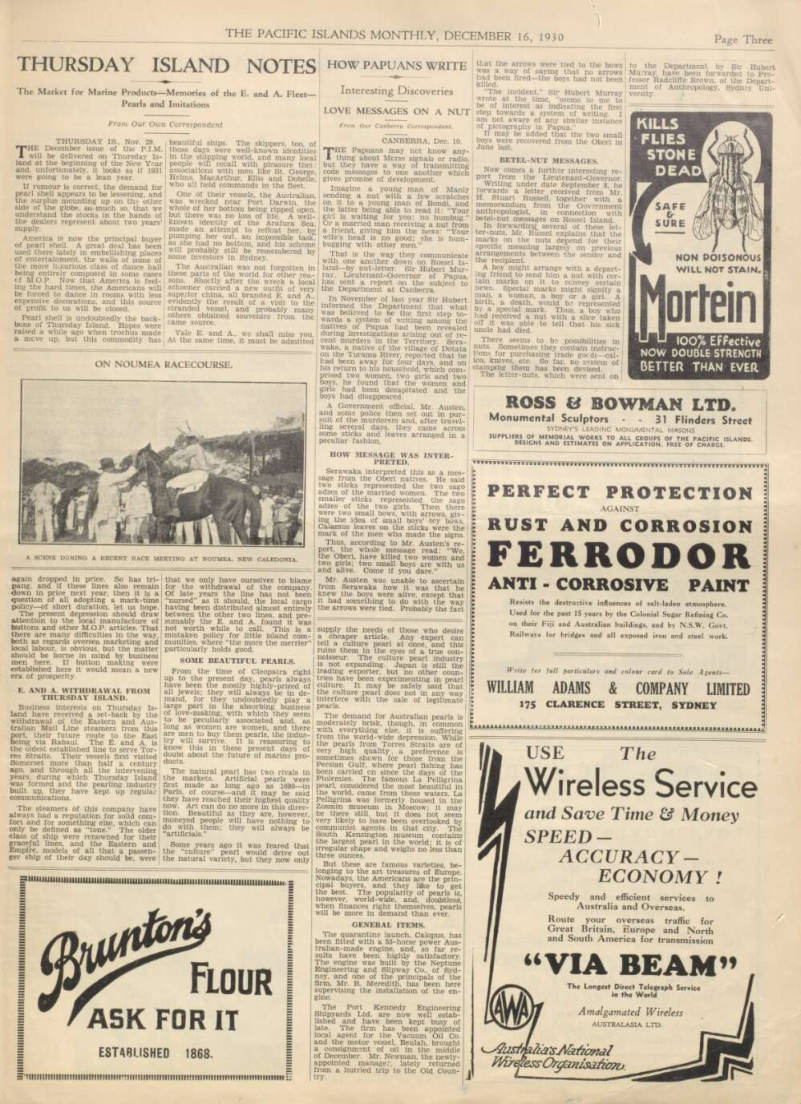
On Noumea Racecourse.
A SCENE DURING A RECENT RACE MEETING AT NOUMEA, NEW CALEDONIA.
Interesting Discoveries
How Papuans Write
Love Messages On A Nut
From Our Canberra Correspondent.
Canberra, Dec. 10.
THE Papuans may not know any thing about Morse signals or radio, but they have a way of transmitting code messages to one another which gives promise of development.
Imagine a young man of Manly sending a nut with a few scratches on it to a young man of Bondi, and the latter being able to read it: “Your girl is waiting for you; no humbug.”
Or a married man receiving a nut from a friend, giving him the news: “Your wife’s head is no good; she is hum bugging with other men.”
That is the way they communicate with one another down on Rossel Is land—by nut-letter. Sir Hubert Mur ray, Lieutenant-Governor of Papua, has sent a report on the subject to the Department at Canberra.
In November of last year Sir Hubert informed the Department that what was believed to be the first step to wards a system of writing among the natives of Papua had been revealed during investigations arising out of re cent murders in the Territory. Sera waka, a native of the village of Dotata on the Turama River, reported that he had been away for four days, and on his return to his household, which com prised two women, two girls and two boys, he found that the women and girls had been decapitated and the boys had disappeared.
A Government official, Mr. Austen, and some police then set out in pur suit of the murderers and, after travel ling several days, they came across some sticks and leaves arranged in a peculiar fashion.
How Message Was Inter
Preted.
Serawaka interpreted this as a mes sage from the Oberi natives. He said two sticks represented the two sago adzes of the married women. The two smaller sticks represented the sago adzes of the two girls. Then there were two small bows, with arrows, giv ing the idea of small boys’ toy bows.
Calamus leaves on the sticks were the mark of the men who made the signs.
Thus, according to Mr. Austen’s re port, the whole message read: “We, the Oberi, have killed two women and two girls; two small boys are with us and alive. Come if you dare.”
Mr. Austen was unable to ascertain from Serawaka how it was that he knew the boys were alive, except that it had something to do with the way the arrows were tied. Probably the fact
that the arrows were tied to the bows was a way of saying that no arrows had been fired—the boys had not been killed.
“The incident,” Sir Hubert Murray wrote at the time, “seems to me to be of interest as indicating the first step towards a system of writing. I am not aware of any similar instance of pictography in Papua.”
It may be added that the two small boys were recovered from the Oberi in June last.
Betel-Nut Messages.
Now comes a further interesting re port from the Lieutenant-Governor Writing under date September 8, he forwards a letter received from Mr.
H. Stuart Russell, together with a memorandum from the Government anthropologist, in connection with betel-nut messages on Rossel Island.
In forwarding several of these let ter-nuts, Mr. Russel explains that the marks on the nuts denend for their specific meaning largely on previous arrangements between the sender and the recipient.
A boy might arrange with a depart ing friend to send him a nut with cer tain marks on it to convey certain news. Special marks might signify a man, a woman, a boy or a girl. A birth, a death, would be represented by a special mark. Thus, a boy who had received a nut with a slice taken off it was able to tell that his sick uncle had died.
There seems to be possibilities in nuts. Sometimes they contain instruc tions for purchasing trade goods—cal ico, knives, etc. So far, no system of stamping them has been devised.
The letter-nuts, which were sent on
to the Department by Sir Hubert Murray, have been forwarded to Pro fessor Radcliffe Brown, of the Depart ment of Anthropology, Sydney Uni versity. I
Advertisements & other items, pp. 3-4 (2 items)
Wireless Service
KILLS
FLIES
STONE
DEAD
NON POISONOUS
WILL NOT STAIN.
100% Effective
NOW DOUBLE STRENGTH
BETTER THAN EVER
ROSS & BOWMAN LTD.
Monumental Sculptors - - 31 Flinders Street
SYDNEY’S LEADING MONUMENTAL MASONS
SUPPLIERS OF MEMORIAL WORKS TO ALL CROUPS OF THE PACIFIC ISLANDS.
DESIGNS AND ESTIMATES ON APPLICATION, FREE OF CHARGE.
PERFECT PROTECTION
AGAINST
RUST AND CORROSION
FERRODOR
ANTI - CORROSIVE PAINT
Resists the destructive influences of salt-laden atmosphere.
Used for the past 15 years by the Colonial Sugar Refining Co. on their Fiji and Australian buildings, and by N.S.W. Govt.
Railways for bridges and all exposed iron and steel work.
Write for full particulars and colour card to Sole Agents —
WILLIAM ADAMS & COMPANY LIMITED
175 CLARENCE STREET, SYDNEY
USE The
Wireless Service
and Save Time & Money
SPEED -
ACCURACY-
ECONOMY !
Speedy and efficient services to Australia and Overseas.
Route your overseas traffic for Great Britain, Europe and North and South America for transmission
‘‘VIA BEAM”
The Longest Direct Telegraph Service in the World Amalgamated Wireless
AUSTRALASIA LTD.
SELF INSTRUCTORS FREE WITH ALL
INSTRUMENTS
Portable Phonographs (Micro perophone), £8/8/-.
JOHNSTONS
Musical Instrument Stores
211-215 GEORGE ST., SYDNEY
COLD STORAGE WITHOUT ICE
“TRAFALGAR”
COLD SAFE
Invaluable for Hotels, Indispensable to the Suitable for any Home Accommodation Houses Housewife.
IT KEEPS FOOD, MILK AND MEAT
FRESH IN THE HOTTEST WEATHER
Inside Storage Space 17 x 15½ x 13 in. 20 x 18 x 14 in. 23½ x 20½ x 16 in. 26 x 23 x 18½ in 29 x 26 x21 in. 32 x 28½ x 24 in.
Weight Packed 28 lbs. 39 lbs. 47 lbs. 59 lbs. 77 lbs. 85 lbs.
Net f.o.b.
Sydney £2 17 6 £3 17 6 £4 10 0 £5 10 0 £6 10 0 £7 15 0 1,2 and 3 two shelves. Nos. 4 and 5 three shelves. Packed separately. Packing free.
S. W. O’NEAL
233 GEORGE ST. - SYDNEY
JUST STEP OFF THE BOAT &
DRIVE YOURSELF AWAY.
Our Fleet consists of different types of Cars, from Light Tourers to large closed Cars, and our rates vary according to the type.
THE USE OF A CAR IS ESSENTIAL to the complete enjoyment of a HOLIDAY IN AUSTRALIA or the quick transaction of your business. Under our system you can hire any type of Car of the latest Model and drive yourself.
Write for further particulars:
PYKE’S DRIVE YOURSELF SERVICE LTD.
Circular Quay West - Sydney - Australia.
GEO. A. STEWART
SHIP AND BOAT BUILDER
SLIP PROPRIETOR
PORT MORESBY, PAPUA
P.M. SLIP: For vessels up to 400 tons Length of carriage 120 ft.
Samarai Slip : For vessels up to 150 tons Length of carriage 90ft.
ALL KINDS OF SALVAGE WORK EXECUTED
General Engineering & Blacksmithing Work Undertaken in complete New
Shop at PORT MORESBY SLIP
WORKMANSHIP GUARANTEED
Punts and Launch for Hire or Charter Sole Agent in Papua for the British Anti-Fouling Composition Paint Co. Ltd.
GABLES: Stewart, care Burphil, Pt. Moresby or Samarai.
Flour
ASK FOR IT
ESTABLISHED 1868.
Economies In Papua
Public Servants Again Circularised
From Our Own Correspondent
Port Moresby, Nov. 15.
A FURTHER “economy” circular has been issued to all Public Servants.
It advises them to economise still more, yet congratulates them on their efforts, since the first circular. It points out that the financial position is such that their efforts must be re doubled.
The circular also states that while it was hoped the position during the pre sent financial year would not necessi tate any reductions of salaries or re trenchments, it was thought likely the position in, the next financial year might not be the same, and officers should prepare themselves for possible drastic retrenchment.
Economy in every way is being exer cised by everyone in the Territory, and in consequence there is very little doing in the way of trade. Therefore the import duties are lower than they have been for a long time, which makes a rather vicious circle with no obvious remedy or solution.
The Tongan Islands
That Typical Tongan —The Payment of Copra Duty
From Our Own Correspondent
Nukualofa, Nov. 10.
THE publication in the second issue of The Pacific Islands Monthly of the Tongan who netted £55 a year for the copra on his selection has now produced a host of supermen from other parts of the Group.
A Vavau man writes: “That man was a loafer compared with my native neighbour who, in the last four years, out of copra, has cleaned up £80 a year off an 8-acre block after paying all expenses.”
And this is one from Haapai: “What is the matter with that Tongan in Nukualofa who can only knock out £55 from his allotment? Is he para lysed or tubercular? If not, I can quote you any one of fifty ”
To stop all this I feel it incumbent on me to say that I was not out to establish a record with my Tongan friend at all. I simply state again that he is a fairly industrious native who seems contented with his lot (except for that egg-eating pig) and, from what I know of him, breaking records is not his “strong suit.”
In fairness to the Editor, I must pro test against the gambling spirit which seems to be creeping in, and I can as sure each and every one of you that, no matter how much you stimulate your favorite Tongan grower with sub sidies and such-like to produce the peak result, there will be no prize donated by the P.I.M. I know that it is usual with some publications to offer a trophy to the fisherman who leg ropes the biggest crayfish, and the naturalist who gathers in the longest blue-tailed lizard, but, you island gamblers, clear your brains of the hope that you will gather in any Press honorarium for exhibiting the best copra-producing native . . . Cut it right out!
The Copra Duty
It has been pointed out that there was—what appeared on the face of it to be —a serious omission when that statement of a Tongan taxpayer’s con tributions to the Treasury by way of taxation was compiled in your corres pondent’s article in the September is sue.
Figures have been produced to show and on these figures it is claimed that the average taxpayer (or “abi” holder) contributed roughly a further £3 in copra export fees to the Government.
The figures do not lie either! It is in dubitable that the Government cer tainly did get £16,000 from the copra shipped last year, and the ardent critic, after ascertaining the number of “abi” holders in the Kingdom, makes out a pretty good case.
But now let us see if “dummy” (the taxpayer) really is being stung for this further £3 per annum. When the tax of 15/- per ton was originally schedul ed by the Government, “dummy” was thought deserving of consolation —and got it —until the bubble was burst by the copra buyers. “The taxpayer be hanged,” said the prominent buyers in unison, “he has nothing to worry about; we can’t pass it on to the fel low' with his basket of copra, and the Government knows it. No! It’s a crack at us, and we have to stand the racket.”
Two years ago the tax was increas ed to 20/- and, once again, there was an outcry from the buyers. If they could not hand on the original 15/in fractions of a penny they certainly couldn’t pass on the further five —and they said so, very forcibly too. So, once again sympathy was diverted from the “abi” holder to the unfortu nate buyer.
And when the executive were con sidering ways and means of relieving the taxpayer this year, it was the very knowledge that if the buyer could not—and therefore did not —pass the duty on to “dummy” it was ridiculous to suppose that, if the Government lifted the duty, the buyer would —even if he could—relieve the taxpayer by passing any benefit on. And why should he? Copra buyers are not benevolent institutions.
So now we have the position clearly defined. It is the poor buyer and not old “dummy” who is swelling the Government coffers to the extent of £16,000 per annum and every body will be glad to get that cleared up. I know; and “dummy,” with his basket of “green,” smiles one time . . .
Hifofua To Be Laid Up
The Government despatch vessel Hifofua, is, according to the latest re ports, to be laid un indefinitely at Nukualofa, pending the report of some committee or other which is to meet at some future date and decide on the type of engine that may be installed in her hull. It is not expected that she will be in commission before the end of next year.
The other vessel of our fleet, the To bago. is to go away somewhere this month, either to Fiji or Auckland, for re-coppering and general overhaul.
Personal And Social
Leaving Tonga by the incoming Tofua this month, Mr. Macreadie (of Levers’) and his good lady will carry with them the knowledge that they
have left behind on this tropic isle many very sincere friends. During their stay, covering the best part of a year, they certainly have made them selves popular with the local folk. It is extremely doubtful if, as host and hostess, they can be excelled anywhere; certainly not in this island group and with the farewell on “steamer day,” there will be many expressions of hope that they will return.
Mr. C. E. Dalton, who for some time has been managing the Vavau branch of Morris Hedstrom’s activities, has been appointed accountant at the head office in Nukualofa; and we learn that he is a particularly happy man just now, for a wireless message just to hand, conveys the good news that Mrs. Dalton (Sydney) has presented him with a son.
Mr. Knapp, late of Tahiti, who re cently leased 1000 acres of soil on the island of Eua, is, we learn, timed to arrive back here from the United States early in the New Year.
Mr. A. G. Slocombe (of Levers’), ac companied by his bride, is due back in Tonga this month. Mr. Slocombe and Mr. Hutchison, of Vavau, have com pleted a six months’ tour of the Con tinent, so old friends can be depended upon to greet them with requests for a detailed account of their travels.
Mrs. Slocombe, by the way, is the eldest daughter of Mr. and Mrs. F.
Jones, of Nukualofa.
Mr. Ryder, who is so popular in Suva, has now transferred himself to Vavau where, as manager of Morris Hed strom’s branch, he will, as an old island man, assuredly make himself quickly at home in the business and social circles of that delightful port.
Of interest to the foreign and native population is the advice that an assistant medical officer has now been appointed to this island. Doctor Court ney, of Sydney, should arrive here at an early date, and Doctor Dawson (C.M.O.), who has been in demand day in and night out, will certainly be glad of his assistance.
Mr. Murray-Aynesley, of British Honduras, has been appointed by the Secretary of State to fill the Chief Justiceship recently vacated by Jus tice C. K. Horne, on his transfer to Gambia. The new Justice is expected to take up his duties here early in the New Year. In the meantime, Mr.
G. Scott, Land Judge, is locum tenens.
The Misses Cocker invited a host of friends to their well-appointed home on October 31, and these charming girls produced, as usual, a wonderful night of entertainment. The music was a revelation, the dancing floor not over-polished, the cooling drinks kept at the correct temperature, and the supper produced at the right time; so it is not surprising to learn that it was probably the most successful function of its kind up to date in the present year.
The output of Fiji’s five sugar mills in 1929 was about 90,000 tons, which was somewhat below normal. The re duction was mainly due to dry weather conditions, which adversely affected the crop in the early stages of its growth.
ON
New Guinea
Goldfields.
Gradually, slowly, roads are being constructed be tween the Morobe goldfields, New Guinea, and the coast.
Top picture shows a bridge across the Bulolo River.
In the bottom pic ture native la bourers are shown making a road through the jungle.
Rhinoceros Beetle
Additional Precautions in Fiji
Coconut Planters’
Union Acts
A DEPUTATION of directors of the Coconut Planters’ Union Ltd., of Fiji, waited upon His Honour, the Governor’s Deputy, in Suva, recently, and received an assurance that ves sels coming from Apia, Samoa, would not be permitted to remain alongside the wharf at Suva at night time.
This action was rendered desirable by the fact that Apia is badly in fested with the rhinoceros beetle, which causes damage to coconuts.
The question was raised when the Tofua this year commenced to load bananas at Apia and then on her arrival at Suva to load further bananas.
The directors of the Coconut Plan ters’ Union at the time approached the Acting Governor and, as a result, more stringent action was taken.
It was noticed that on a recent trip the Tofua, en route from Apia to Auck land, remained alongside Suva wharf at night.
In view of a warning by Mr. T. H. C.
Taylor, published in The Agricultural Journal of Fiji, the directors of the Coconut Planters’ Union felt that the mere presence of the Tofua alongside the wharf at night, with the wharf lights burning brightly, provided an element of danger to the coconut in dustry of the Colony, and, therefore, pressed for action which would obviate the recurrence of this danger.
Satisfactory Test Crops
Rarotonga Expert
Mental Farm
THE Cook Islands Administration, in co-oneration with Mr. Senn, mana ger of the Raratonga Pure Fruit Pro ducts Co., has been growing on the experimental farm spices, canning beans and tomatoes.
It is hoped to obtain a payable mar ket in New Zealand for these commodi ties. At the close of operations for the season, it was reported that most of the spices planted had grown satis factorily.
The canning beans were making good progress, and there were possibilities of developing this industry.
The tomato crop was most successful, and it is considered that in the event of the failure of New Zealand sup plies, Raratonga could supply the de mand for pulp. A contract for the sunply of pulp has been already made with New Zealand manufacturers.
New Hebrides in 1929, imported 6 547 cases of snirits, valued at £7,170; 5,417 cases of fine wines valued at £6,300; 1,122 barrels of light wines, valued at £7,100. The territory also imported 2 000,000 cigarettes and £10,796 worth of tobacco.
New Hebrides, in 1929, imported 11 motor cars and over 80,000 gallons of petrol. There are good roads in the island of Efate. The highway from Vila, the capital of the Group, to Devil’s Point, gives a direct run, through delightful country, of 17 miles.
Experiments have been carried out in the Cook Islands with the growing of gherkins. The initial crop has been quite successful.
Restless Samoa
Irresponsible Criticism
Not Desired
Where Lies Solution
Of Troubles?
BECAUSE, in October, we published a summary of the annual report of the Administrator of Samoa, and headed it “Samoa Is Settling Down,” we have been asked by a valued correspondent to publish some portion of an article entitled “What The Samoans Want.”
The article was produced in New Zea land in October, and was written by the Hon. O. F. Nelson, who has worked hard and suffered for the Cause of Samoan independence.
Now, it is a notorious fact that, when New Zealand assumed responsibility for the government of Samoa, 15 years ago, she took on the liveliest adminis trative job in the Pacific. The Samo ans are a clever, proud, restless, in triguing people, who are temperamen tally and everlastingly “agin the Gov ernment.” They have well been named “the Irishmen of the South Seas.”
Anyone acquainted with the stormy history of the beautiful islands, extend ing over the last 75 years, will sympa thise with any country asked to govern such a hornets’ nest.
Into this den of trouble came the New Zealanders —wholly inexperienced in this kind of administration, lacking any sort of trained personnel, inclined to treat the Samoans as if they were indeed the simple, harmless islanders of a hundred South Seas romances—and, above all, making the initial mistake of regarding the Samoan mandate as a means of finding attractive jobs for a swarm of semi-military officials.
Of course, there was trouble. The Samoans resented the autocratic, some what bombastic administration, and the manner in which high administra tive costs were throwing the country into debt. The New Zealanders, very proud of the fact that the League of Nations had entrusted them with a mandate to govern, and inclined to compare the critical Samoans with the tractable, friendly Maoris, were too ready to display the truculence of the iron hand instead of the persuasiveness of the velvet glove.
Both sides were honest and sincere in their wish to do the best thing for Samoa —only, unfortunately, neither could understand the other’s point of view.
Had New Zealand had available, for the Samoan job, a man of exceptional wisdom, with some knowledge of native administration in general, and Samoan history and psychology in particular, all might have been well. But super men are rare and the officials who were sent to Samoa were just average honest, one-idea’d men. who tackle the job in the same way they would have undertaken the building of a bridge or the preparation of a report—by rule of thumb methods, backed by the force of law and authority. An American writer, describing Samoa under the New Zealanders, called them “Prus sians from Auckland.”
The inevitable clash came in Decem ber, 1929, and valuable lives were lost, including the patriotic chief Tamasese.
Since then both sides have kept apart, licking their wounds, and wondering where lies the solution of their diffi culties. Each side must realise it has made grave errors —the New Zealand ers, in the manner described; the Samoans, in their too ready inclination to deal with intriguers and under ground engineers—and there can be no peace in Samoa until they come to gether in a spirit of mutual tolerance, and a greater readiness to appreciate each other’s viewpoint and motives.
The New Zealander must throw aside his arrogance, and the Samoan his pride and suspicion.
Mr. Nelson, in his article, is charac teristically outspoken, but is hyper critical, intolerant and threatening.
There is much justice in his demands, but they have been framed in an atmosphere of belligerence, and so they cannot help much in the search for a peaceful solution of Samoa’s difficul ties.
Therefore, we do not publish them.
The Pacific Islands Monthly does not wish to take sides in this Samoan con troversy, because to do so, it must de pend upon ex parte statements. It pre fers to independently investigate the position, later on, and try to offer con structive comment, rather than irre sponsible and irritating criticism.
R.W.R.
Our Fijian Newsletter
Severe Gale Sweeps Colony—Much Damage to Banana Crops
From Our Own Correspondent
Suva, Nov. 28.
THERE is a great deal of talk about hurricanes in Fiji. Indeed, new comers are told so much about hurri canes when they come to Fiji, that they believe they are quite a common sort of thrill.
As a matter of fact, cyclonic storms are rarer in Fiji than they are in Queensland, or perhaps in other parts of Australia. It is twenty years since a real hurricane struck Suva. A lesser one visited the town in 1912, but since then gales have been record ed only at rare intervals.
One of these gales hit the capital on Sunday last. The wind grew in velocity during the day and at 7.55 p.m. reached its peak—71 miles an hour.
Good rain fell all day and much minor damage was reported. A small cutter crashed through the wall of the gaol bath, and, after enjoying a swim there, dived to the bottom, with sev eral planks staved in. The river launch Rogovoka was swept ashore at Suva Point during the height of the gale.
The big liner Rotorua, from London, drew out from the wharf and achored in the harbour, where she safely rode out the storm.
The Rewa River rose 17 feet at Nau sori, and the sugar mill stopped crush ing, owing to the confusion. It is believed that some of the C.S.R. Co’s
northern part of Viti Levu, especially affecting Penang and Ellington, and Nananu Island. At Penang, the sugar mill lost its roof and chimney, while the police office was blown clean away with all the official archives. The re creation hall became a of twist ed timbers. Many other buildings were badly damaged. At Ellington the big shed of the C.S.R. Co. Ltd. was full of bagged sugar, and, I under stand, quite 600 tons is being sent away to be reconditioned, which will mean a substantial loss.
Many Vessels Lost
The list of vessels lost include the Seventh Day Adventist auxiliary ketch Loloma, which was driven ashore at Nabuwalu. The Provincial launch was also wrecked there being thrown right up among the mangroves. At Gau Is land it is reported the Elizabeth was smashed and foundered, Captain Ger rish and a Chinese still being missing.
The native crew was saved. Two cut ters were wrecked on the island of Wakaya and the Makogai launch, Jean, was wrecked on Makogai. The crew of the cutter, Tui Nukurawa, ar rived in Levuka in two open boats.
The Provincial cutter, Marama ni Yanuyanu, is ashore at Naikorokoro. A cutter coming from Wainunu saw some wreckage floating outside the reef and a hatch painted grey has been picked up at Naikorokoro in Ovalau.
floating stock was missing. It is also alleged that a launch and five punts be long to a banana buyer are missing.
Thousands of banana trees were seen floating down to the sea, and it is feared that fruit losses will be heavy.
Further news of the storm shows that it has done much more damage in certain places than was imagined at first. Owing to the telephone line to Levuka being down no news came through from the old capital until Captain Fenton. M.C., flying his Spar tan ’plane, passed over Ovalau, and, landing ten miles from Levuka, heard that a great deal of damage had been done on the island. Both the R.C.
Mission stations at Loreta and at Ca waci sustained damage, buildings being flattened out and trees uprooted every where.
A report states that Mr. F. Lang, teacher at the Seventh Day Adventist Training School, had gone out, with seven native students, in a launch and a punt, and was missing. The Govern ment has sent out the yacht, Adi Beti, to look for them.
An Exciting Experience
During the height of the gale, Mr.
Honson, the managing director of Jang King Loong Co. Ltd., who had set out that morning from Suva for Macuata, found that his vessel, the cutter Tui Vuni Macawa, even with her auxiliary engine, could make no headway against the fierce gale, so he ordered the native captain to turn for the Tailevu coast. The wind took charge and swept them along blindly, in a mist of pouring rain. It was “blind man’s buff” all right, for they drove on. without knowing where they were.
Luck was with them, as the vessel drove through the passage of the reef, and safely went aground on a soft sand bank. But the seas roared, and every minute they expected to be their last, so, battening up and casting out their two anchors they piled into the lone whale boat and gave themselves into the care of the wind, which was still of gale force. It was useless to put out an oar, so away the boat flew, and to their surprise ran into the only tiny creek along that mangrove-lined bit of coast. Even the hardy native skipper was impressed. “It is the devil,” he said, and everybody believed him.
They eventually reached Suva. Mr.
Honson said that all native villages were flat and hardly a banana tree remained standing.
The storm came right through the
Other casualties make up a total which is more than the Colony can well stand.
The Governor is taking immediate action to afford relief. There is utter ruin in the banana area so far as can be seen. Fiji fruit output will be sadly curtailed for many long months.
The banana growers are very unfor tunate, as the plantations were only just recovering from the gale last De cember.
Council Of Chiefs
The Council of Chiefs was opened on November 18 at the Government House “bure” by His Excellency the Gover nor, who delivered an address. In it, he gave special attention to such things as the health of the native race, to the new system of child welfare, and to the chief ideas of modern hy giene and sanitation. He also referred to the recently-introduced system of allotting certain districts of the Colony to certain banana buyers, the idea being to secure for the native growers the best price obtainable for their fruit. The Government fixes the price according to the season and the amount of fruit available.
The Council was in session during the week, but the matters discussed were purely domestic. This Council of Chiefs every three years elects cer tain of its number, from which His Excellency chooses three as nominated members of the Legislative Council.
Personal
Suva has been entertaining quite a number of distinguished visitors dur ing the month. Among them were Earl Beauchamp and Sir Otto Nie meyer.
Two old friends came along on the passenger list of the Rotorua. One was Professor Macmillan Brown, the famous authority on the Pacific, who was returning home with his daughter after a private pleasure visit to the Old Country. The Professor met many old friends.
The other traveller was Dr. W. G.
Woolnough, of Canberra, the Com monwealth Geological Adviser, a well known authority on geology. Dr. Wool nough, 25 years ago, made a survey of this island of Viti Levu for geological purposes. He stated in an interview that he did not think it likely that permanent gold would be found in Fiji.
A nice little function took place last week, when the Councillors placed on record in the Municipality’s books their high appreciation of the services to the town of Hon. Henry Marks,
C.B.E. All the Councillors joined in expressing their high sense of his value as a citizen and a Mayor and Coun cillor.
Dr. Clunie, who left per Aorangi on nine months’ holiday was presented by the medical students with a very hand some tortoise shell and gold cigarette holder. The doctor is very popular with all who know him.
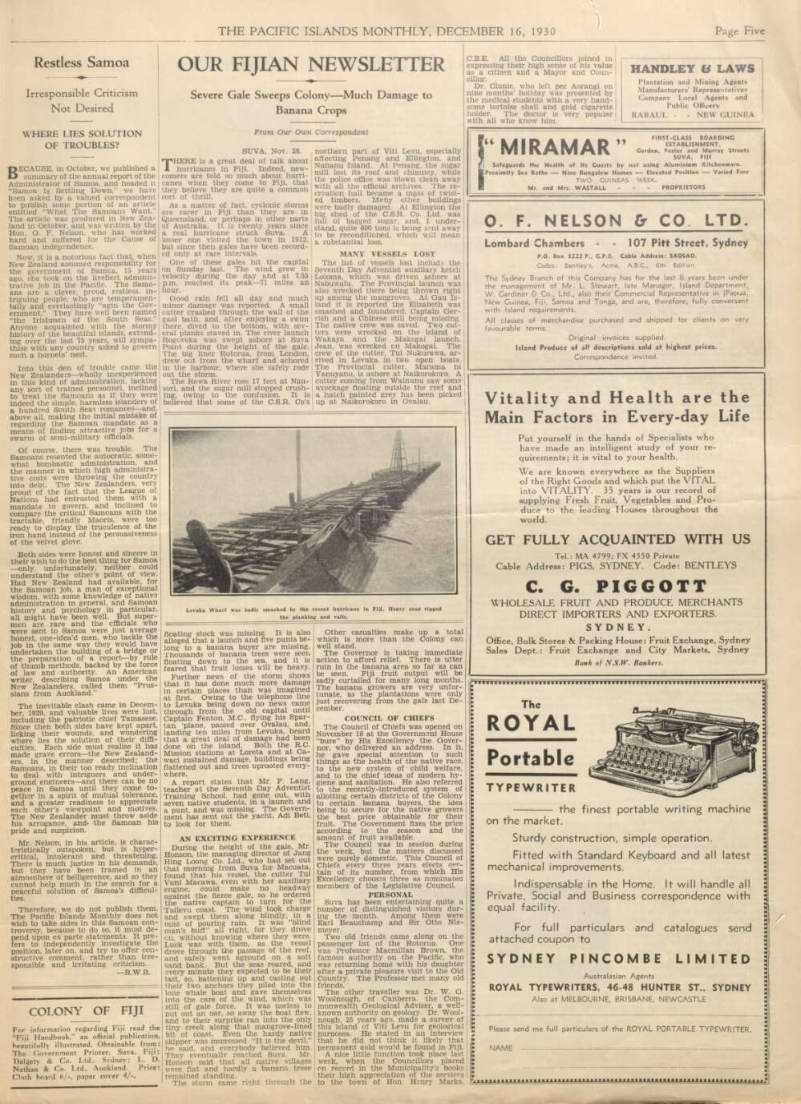
Levuka Wharf was badly smashed by the recent hurricane In Fiji. Heavy seas ripped the planking and rails.
Advertisements & other items, p. 5 (2 items)
Royal
HANDLEY & LAWS
Plantation and Mining Agents Manufacturers’ Representatives Company Local Agents and Public Officers
RABAUL - - NEW GUINEA
MIRAMAR
FIRST-CLASS BOARDING
ESTABLISHMENT,
Cordon, Foster and Murray Streets
SUVA, FIJI
Safeguards the Health of its Guests by not using Aluminium Kitchenware.
Proximity Sea Baths Nine Bungalow Homes Elevated Position Varied Fare
TWO GUINEAS WEEK.
Mr. and Mrs. WASTALL - - - PROPRIETORS
O. F. NELSON & CO. LTD.
Lombard Chambers - - 107 Pitt Street, Sydney P.O. Box 3222 P„ C.P.O. Cable Address; SAOSAO.
Codes; Bentley’s, Acme, A.8.C., 6th Edition.
The Sydney Branch of this Company has for the last 81 years been under the management of Mr. L. Stewart, late Manager, Island Department, W. Gardiner & Co., Ltd., also their Commercial Representative in JPapua, New Guinea, Fiji, Samoa and Tonga, and are, therefore, fully conversant with Island requirements.
All classes of merchandise purchased and shipped for clients on very favourable terms.
Original invoices supplied.
Island Produce of all descriptions sold at highest prices.
Correspondence invited.
Vitality and Health are the
Main Factors in Every-day Life
Put yourself in the hands of Specialists who have made an intelligent study of your requirements; it is vital to your health.
We are known everywhere as the Suppliers of the Right Goods and which put the VITAL into VITALITY. 35 years is our record of supplying Fresh Fruit, Vegetables and Produce to the leading blouses throughout the world.
GET FULLY ACQUAINTED WITH US
Tel: MA 4799; FX 4350 Private Cable Address: PIGS, SYDNEY. Code: BENTLEYS
C. C. PIGGOTT
WHOLESALE FRUIT AND PRODUCE MERCHANTS
DIRECT IMPORTERS AND EXPORTERS.
SYDNEY.
Office, Bulk Stores & Packing House: Fruit Exchange, Sydney Sales Dept.; Fruit Exchange and City Markets, Sydney Bank of N.S.W. Bankers.
The
ROYAL
Portable
TYPEWRITER
the finest portable writing machine on the market.
Sturdy construction, simple operation.
Fitted with Standard Keyboard and all latest mechanical improvements.
Indispensable in the Home. It will handle all Private, Social and Business correspondence with equal facility.
For full particulars and catalogues send attached coupon to
SYDNEY PINCOMBE LIMITED
Australasian Agents
ROYAL TYPEWRITERS, 46-48 HUNTER ST., SYDNEY
Also at MELBOURNE. BRISBANE, NEWCASTLE
Please send me full particulars of the ROYAL PORTABLE TYPEWRITER.
NAME
Colony Of Fiji
For information regarding Fiji read the “Fiji Handbook.” an official publication, beautifully illustrated. Obtainable from; The Government Printer. Suva, Fiji; Dalgety & Co. Ltd., Svdney; L. D.
Nathan & Co. Ltd., Auckland. Price: Cloth hoard 6/-, paper cover 4/-.
Pacific Islands Monthly
Published once a month, and circulated among residents of: New Guinea Fiji Solomon Is.
Papua Tonga New Hebrides Norfolk Is. Samoa New Caledonia Cook Is. Nauru Ocean Is.
Gilbert Is. Tahiti Thursday Is.
Read also by residents of Australia and New Zealand who are interested in Pacific Islands trade and activities.
Publishers: Pacific Publications, Union House, 247 George Street, Sydney. Tel.: BW 5037.
Editor: R. W. Robson.
Subscription Rates:
Advertising:
Casual: Per single column inch 8 0 Contract; 6/6, 7/- and 7/6 per inch, accord ing to conditions.
Changes of advertising copy should reach publishers by 7th of each month.
Contributions:
Contributions on matters of Interest to Pacific Islands residents and traders are in vited; and, if accepted, will be paid for, on publication, at the rate of 2½d. per line.
Special payment for photographs. No respon sibility is taken for contributions forwarded; but, if return is desired in the event of rejec tion, a stamped and addressed envelope should be enclosed.
Distribution:
In Australia, New Zealand and Great Britain copies may be obtained from, and subscription orders lodged with, Messrs. Gordon & Gotch, Limited.
In the Pacific Islands, copies may be ob tained from, and subscription orders lodged at any of the stores of Messrs. Burns Philp & Co.
Ltd., Messrs. Burns Philp (South Seas) Co Ltd., Messrs. W. R. Carpenter & Co. Ltd., and Messrs. Morris Hedstrom & Co. Ltd.
New Guinea Fiji Solomon Is.
Papua Tonga New Hebrides Norfolk Is.
Samoa New Caledonia Cook Is.
Nauru Ocean Is.
Gilbert Is.
Tahiti Thursday Is.
Per annum, post free, within British Empire; in advance. 6/-; booked post free, beyond British Empire ..
Pacific
Asiatics And The
Future Of The
Vol. 1.—No. 5.
December, 1930.
AS an amusing commentary upon the lack of co-ordination of Brit ish policy in the administration of the Islands territories, we may cite the cases of New Hebrides and the Solo mons.
British interests in New Hebrides are being steadily wiped out. The French planters use indentured Ton kinese labour and —so long as a fair price is obtained for their produce— they can operate profitably. But the British planters are not permitted under British laws to indenture Asiatic workers, and must depend upon unsatisfactory and almost unob tainable native labour. A British Commission, after close inquiry in 1927, recommended that British plan ters he given at least the same privi leges as the French, and allowed to employ Asiatics. Nothing has been done—and the British have been forced either to seek French national ity or to sell out to the French. The position has been reached when we might as well hand over New Hebrides altogether to France, and put an end to the “Pandemonium Government,” as the Condominium Government is called. We have lost our share of New Hebrides —which is only another ex ample of British official fatheadedness.
Now turn to the Solomons. The same British officials —or their near relations —who have ruined the Brit ish New Hebrides planters fay refusing to let them indenture Asiatics (and indenture means that they must even tually be deported) have seriously em barrassed British traders and planters in the Solomons by permitting the un restricted entry and activity of Asiatic traders. The thing would be comic if its effects were not so tragic.
We do not want Chinese traders in these British Islands territories, yet Chinese traders have been encour aged to come in and get busy. We do want Asiatic labourers in many groups—Chinese for preference —and they are resolutely kept out.
These quaint contradictions are not, of course, deliberately arranged. Our British administration do try to he rea sonable and logical. It is all the fault of the system—or the lack of system —and it all goes to show how essen tial it is that some attempt should be made to co-ordinate idea and policy.
There are many matters of tremend ous importance to the future of these Pacific territories, which require the united attention of the half-score of administrations which function inde pendently in the South Seas; but none is of a more vital character than our future relationship of the Asiatic races, which are constantly pressing forward into these rich, undeveloped territories.
The subject raises issues which can not be much longer ignored. To whom does the future of the Pacific Islands belong? To the indigenous
natives who, in spite of our eagerness to impart education and culture, show a definite inclination to disappear be fore the forward march of our civi lisation? To the Europeans, who are seeking for lands where (as in Java) they can make comfortable homes and, as the superior, directing race, take charge of the native populations and their industrial activities? Or to the Asiatics who, as demonstrated already in Hawaii and Fiji, will quickly estab lish themselves in any of the islands, live close to the soil and take com plete and permanent possession?
Britain, as the principal power in the South and Central Pacific, must accept the responsibility for an early and definite answer to these ques Ijons. And Australia, as Britain’s chief deputy in the Pacific, should take the initiative in seeking the answer.
Tropicalities
Written for The Pacific Islands Monthly by "Sea-Serpent”
WHEN A. J. Vogan, scientist and Pacific Islands wanderer, was look ing for the remains of an ancient civilisation in New Caledonia in 1922, he found huge forests of kauri. Think ing his fortune made, he personally called upon every big timber firm in Sydney and Auckland. The timber merchants laughed at him. “If there are such quantities of this priceless timber available,” they said, “why are they not worked?” And they would not even send a representative to in quire, although Mr. Vogan offered that if his statement was proved wrong, he would pay the cost of the inquiry.
“To-day,” says the disgusted and cyni cal Mr. Vogan, “those forests of kauri are in the hands of American syndi cates, and Australians and New Zea landers are paying for the timber about three times as much as they should.” * * * THE Fiji Government, by what it considers a necessary act of econ omy, has decided to discontinue, for the present, the subsidy of the Inter Islands air service, established a few months ago, and since operated very satisfactorily. The Colony’s income is down, and something must go; but it is a thousand pities that the air ser vice should be classed as a “luxury” and chopped out. Because it is new, it is in no sense a luxury—no more than the motor car, which superseded trains and horses, and radio, which superseded wire telegraph, are luxur ies. Radio and seaplanes will com pletely revolutionise life in the islands.
These utilities, by establishing regular and easy communications and remov ing the terrors of isolation, are going to promote developments and estab lish European communities in the Pacific territories in a manner never dreamed of 25 years ago. Within a Couple of decades every group will have its regular seaplane services. Fiji, which provides an example to the world in Pacific Islands progress and development, should not take a retro grade step. * * * TWO or three people have written to The Pacific Islands Monthly asking if it is a fact that the New Guinea ad ministration officials exercise a secret censorshio over correspondence leaving the Territory, and giving instances of alleged interference with private mail.
We have no knowledge of any such censorship; and, so far as the New Guinea mail services are concerned, we have not only found them efficient, but we have been treated with much cour
tesy and consideration in connection with the distribution of this journal.
It should be noted, however, that an Administrator in charge of a Mandated Territory has wider powers than are usually held by a Governor. Within the limitations imposed by the govern ment which appoints him, he is prac tically an autocrat.
As against that, the Administrator is constantly subject to irresponsible, carping criticism, which may gravely prejudice the relationship of himself or his Government with the League of Nations, and against which he has neither recourse nor remedy. In these circumstances, it would not be surpris ing if an administrator were in favour of some form of censorship—although any interference with private mail would be intolerable, and is most un likely, anyway. * * * THERE is a good deal of similarity be tween the problems of British North Borneo and those of the Mandated Territory of New Guinea. It is an in teresting fact that the Administration of North Borneo is controlled by a De velopment Company. All officials are included in that one organisation, and the whole Territory is governed and developed by the company. The coal industry has been receiving much at tention in North Borneo, and, as a re sult of cheap cost of production, it is considered possible that coal from there will capture the Eastern market. * * * A RESIDENT of Townsville sends me more lively examples of “pid gin.” This is how a New Guinea boy says: “You’re bald!” : “Grass belong coconut he no more stop.” “Piccaninny” is a “baby”; “deewhy” is a tree —“pic caninny belong deewhy,” therefore is “fruit.” “Copper” is a covering, such as a roof; therefore “copper belong ’and,” for fingernail, is quite ingenious.
“Lik lik” is “small”; “lik lik too much” is “smaller”; “lik lik plenty too much” is “very small.” * * * A SWEDISH LINER, en route to Sydney, called recently at the island of Nuie; and a description of Nuie, obtained from a passenger by a reporter, which appeared in a Sydney newspaper, is typical of the utter rub bish about the Pacific Islands so often published in Australia and New Zea land. We are told, for instance, that the people are “mostly of Maori and Hawaiian descent”; that only a mere handful can be induced to work on the plantations; that those who do work for 1/- per week consider them selves so rich that they do not mix with those who are content merely “to idle on the sands.” Anyone who has ever visited “Savage Island,” or who has ever met the hard-working Nuiean labourers in Samoa and Tonga, will recognise how funny this is. * * * AS a result of the readjustment of the payments of reparations by Germany to France, the port of Nou mea is “taking it in the neck.” The New Caledonian administration had planned to spend considerable sums in the improvement of port facilities, and in the deepening of the port itself.
But, as pointed out by the Bulletin du Commerce, in consequence of the easing of the terms imposed on Ger many, the grant from France to New Caledonia for oublic works has fallen from 14 to 15 million francs. The French authorities, however, insist that Noumea shall have attention. It is, they point out, France’s best har bour in the South Seas and for naval and military reasons, as well as for the stimulation of commerce, must be constantly improved.
New Chinese School at Rabaul
A new Chinese school was opened recently at Rabaul, the official opening being performed by His Hon. the Administrator, Brig.-General Wisdom. The Rev. W. H. Cox, of the Methodist Missionary Society, presided. The school consists of one large fibre-plaster classroom, a porch and two dwelling rooms for the teachers, Miss D. Coltheart and Mr. John Ha. The Chinese community of Rabaul have undertaken to pay for the entire school, and already a sub stantial sum has been raised.
Before the advent of the new school, the education of the young Chinese had been conducted by Rev. J. W. Ackroyd, who established night classes. Later, the Chinese Oversea School was founded and it was aided by the Methodist Mission Society of Australasia.
Block by courtesy of The Missionary Review.
Notable Men of The Pacific
WHEN the War came, in 1914, and the world’s trade was thrown into chaos, the buyers and distributors of copra grew panicky. The price fell as low as £3 per ton, and some traders said it was not worth even that. But one man, who knew the copra market better than he knew his own hand, took a different view—and backed his opinion with rare courage. He bought copra at £12 per ton, chartered ships wherever he could find them, got the product to the European and American markets just when the warring nations were commencing a feverish search for vegetable oils —and reaped a fortune.
That man was Walter Randolph Carpenter, who started business as a youth, with no capital, at Thursday Island, 30 years ago, and who is now head of W. R. Carpenter & Co. Ltd.— a firm with huge financial reserves and a turnover of over £1,000,000 annu ally. Although his present business relationships are confined to the Mandated Territory of New Guinea and the Solomons, Mr. Carpenter is one of the best known men in the Pacific; and, although he has established so large and successful an organisation, he is still a comparatively young man.
The son of an American-born father and an English mother, Mr. Carpenter was born in Singapore and educated in Sydney. Before the dawn of this century he was trading in Thursday Island, where he established the well known firm (still successfully operat ing) of J. B. Carpenter and Son Ltd.
There he spent some strenuous years.
He tells to-day, with keen pleasure, of how he introduced the “lay” system of pearl-shelling—simply because he wanted to take part in the industry and he had not enough capital to engage in it under the conditions then existing. In a few years, the old sys tem had disappeared, all the schooners were gone, and the present system has been followed ever since.
About 1908, W.R.C. went to Fiji, to manage the trading firm of Robby Kadd and Co. Ltd. (now Burns, Philp and Co. Ltd.), and he was there for six years. In 1914, he founded his pre sent firm, and the war, with its tre mendous derangement of the copra market, gave him his big chance. He bought every ton of copra he could
find, and he chartered every ship that was available. He paid £15,000 cash for a charter of the Westfield, for one trip with copra—she was sold twelve months later for £3,000. He bought the old sailer Speedway, 670 tons, simply that she might, take one cargo of copra to Europe, and then sold her. It was worth any money to get the copra into the world markets. The firm of W. R. Carpenter and Co. Ltd. became rich and powerful.
The mule-headed officials of Austra lia put incredible restrictions on the handling of copra in Australian ports, and drove away trade worth millions.
Mr. Carpenter was one of those who saw the chance and he arranged ship ments of copra from New Guinea direct to Europe—to the profit of the copra producers and Australia’s loss.
The firm soon became considerable property-owners in the Islands terri tories. After the war, Mr. Carpenter again backed his opinion—his firm, on a large scale, financed the returned soldiers who wished to take up cocoa nut plantations, and again the risk turned up trumps. He stood by the soldier-planters and the planters have stood by him.
The Carpenter firm, in 1920, amal gamated with Messrs. Morris, Hedstrom Ltd., of Fiji. But the new organisation did not run smoothly and the two big firms separated again in 1921. Since then, both have prospered greatly.
Carpenter and Co. Ltd. are among the biggest (if they are not the biggest) shippers of copra in the world. In a good year they handle 50,000 tons — more than the total copra production of the Southern groups (Tonga, Samoa and Fiji) put together. No firm in the world is watching the copra market with keener interest.
Mr. Carpenter has not found much time, in a busy life, for public affairs; but there is no keener student of public finance. His arguments in favour of “unpinning the exchange,” as a means of restoring Australian industrial activ ity, have received much public atten tion lately. He was Mayor of Thursday Island on two occasions. He takes an interest in the Royal Colonial Institute, in Freemasonry, and in motoring. His brother and his two sons are now associated with him in his big firm.
Mr. W. R. Carpenter, Managing Director of Messrs. W. R.
Carpenter & Co. Ltd., Islands Merchants.
Personal Notes
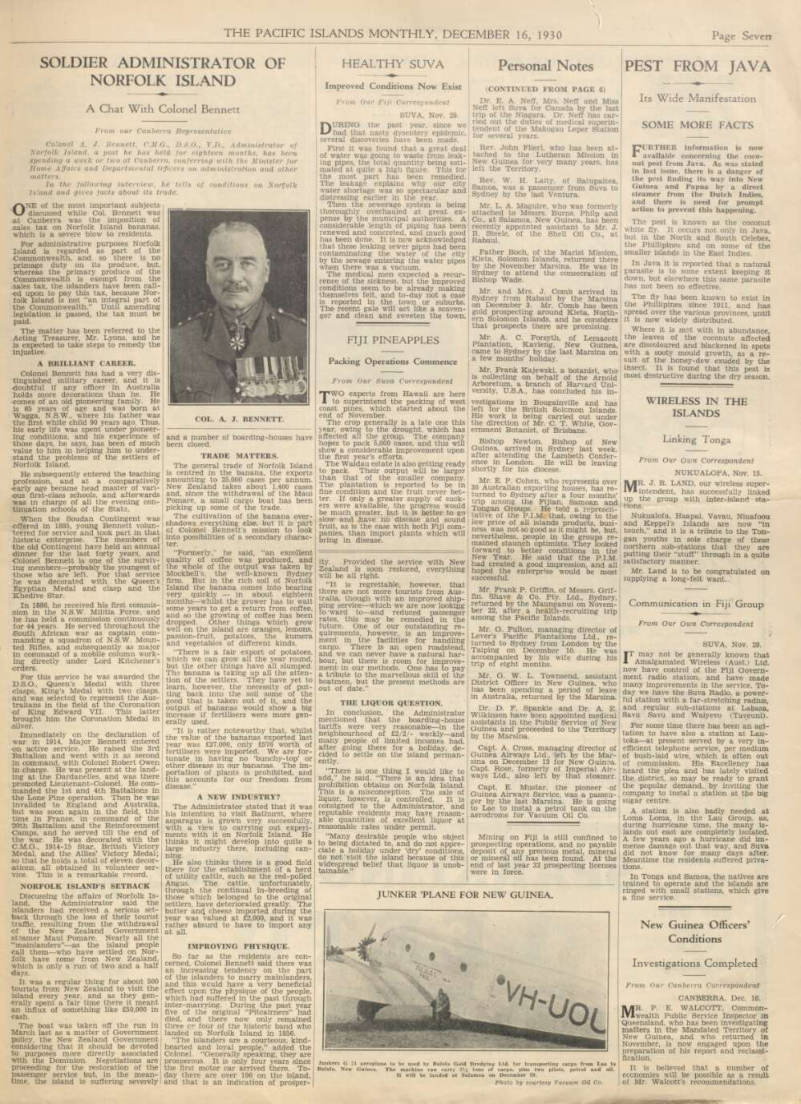
Mr. E. J. Banks, well-known mining engineer, returned to Sydney by the last Marsina, after a tour of the Man dated Territory of New Guinea.
Messrs. Bell and Fitzgibbons, of Rabaul, New Guinea, arrived at Kieta, Solomon Islands, last month, on a holiday cruise. They later left for Faisi. Mr. Bell is a member of the staff of the Department of (Public Works and Mr. Fitzgibbons has trading interests on New Britain.
Mr. W. M. Greer, of Aropa Planta tion, Bougainville, came south on holi days by the last Marsina.
Mrs. C. O. Lelean, who is attached to the Methodist Missionary Society in Fiji, arrived in Sydney by the Ventura on December 4.
Captain R. R. Cook, a New Guinea planter, sailed from Sydney for the United Kingdom by the Hobson’s Bay last month. He intends being abroad for a year.
Among the passengers by the La psrouse, which arrived in Sydney from Noumea, on December 3, were Mr. C. de Mangoux, manager of Ballandes Ltd.; Mr. A. E. Daking-Smith, com pany director: and Captain G. Chariot, who delivered the steamer Gailong to her new owners, Messageries Maritimes.
Dr. E. A. Neff, Mrs. Neff and Miss Neff left Suva for Canada by the last trip of the Niagara. Dr. Neff has car ried out the duties of medical superin tendent of the Makogau Leper Station for several years.
Rev. John Flierl, who has been at tached to the Lutheran Mission in New Guinea for very many years, has left the Territory.
Rev. W. H. Laity, of Satupaitea, Samoa, was a passenger from Suva to Sydney by the last Ventura.
Mr. L. A. Maguire, who was formerly attached to Messrs. Burns, Philp and Co., at Salamoa, New Guinea, has been recently appointed assistant to Mr. J.
B. Steele, of the Shell Oil Co., at Rabaul.
Father Boch, of the Marist Mission, Kieta, Solomon Islands, returned there by the November Marsina. He was in Sydney to attend the consecration of Bishop Wade.
Mr. and Mrs. J. Comb arrived in Sydney from Rabaul by the Marsina on December 3. Mr. Comb has been gold prospecting around Kieta, North ern Solomon Islands, and he considers that prospects there are promising.
Mr. A. C. Forsyth, of Lemacott Plantation, Kavieng, New Guinea, came to Sydney by the last Marsina on a few months’ holiday.
Mr. Frank Kajewski, a botanist, who is collecting on behalf of the Arnold Arboretum, a branch of Harvard Uni versity, U.S.A., has concluded his in vestigations in Bougainville and has left for the British Solomon Islands.
His work is being carried out under the direction of Mr. C. T. White, Gov ernment Botanist, of Brisbane.
Bishop Newton, Bishop of New Guinea, arrived in Sydney last week, after attending the Lambeth Confer ence in London. He will be leaving shortly for his diocese.
Mr. E. P. Cohen, who represents over 30 Australian exporting houses, has re turned to Sydney after a four months’ trip among the Fijian, Samoan and Tongan Groups. He told a represen tative of the P.I.M. that, owing to the low price of all islands products, busi ness was not so good as it might be, but, nevertheless, people in the groups re mained staunch optimists. They looked forward to better conditions in the New Year. He said that the P.I.M. had created a good impression, and all hoped the enterprise would be most successful. .
Mr. Frank P. Griffin, of Messrs. Grif fin. Shave & Co. Pty. Ltd., Sydney, returned by the Maunganui on Novem ber 22, after a health-recruiting trip among the Pacific Islands.
Mr. G. Fulton, managing director of Lever’s Pacific Plantations Ltd., re turned to Sydney from London by the Taiping on December 10. He was accompanied by his wife during his trip of eight months.
Mr. G. W. L. Townsend, assistant District Officer in New Guinea, who has been spending a period of leave in Australia, returned by the Marsina.
Dr. D. F. Spankie and Dr. A. E.
Wilkinson have been appointed medical assistants in the Public Service of New Guinea and proceeded to the Territory by the Marsina.
Capt. A. Cross, managing director of Guinea Airways Ltd., left by the Mar sina on December 13 for New Guinea.
Capt. Rose, formerly of Imperial Air ways Ltd., also left by that steamer.
Capt. E. Mustar, the pioneer of Guinea Airways Service, was a passen ger by the last Marsina. He is going to Lae to instal a petrol tank on the aerodrome for Vacuum Oil Co.
Mining on Fiji is still confined to prospecting operations, and no payable deposit of any precious metal, mineral or mineral oil has been found. At the end of last year 32 prospecting licenses were in force.
Soldier Administrator Of
Norfolk Island
A Chat With Colonel Bennett
From our Canberra Representative Colonel A. J. Bennett, C.M.G., D.S.O., V.D., Administrator of Norfolk Island, a post he has held for eighteen months, has been spending a week or two at Canberra, conferring with the Minister for Home Affairs and Departmental Officers on administration and other matters.
In the following interview, he tells of conditions on Norfolk Island and gives facts about its trade.
ONE of the most important subjects discussed while Col. Bennett was at Canberra was the imposition of sales tax on Norfolk Island bananas, which is a severe blow to residents.
For administrative purposes Norfolk Island is regarded as part of the Commonwealth, and so there is no primage duty on its produce, but, whereas the primary produce of the Commonwealth is exempt from the sales tax, the islanders have been call ed upon to pay this tax, because Nor folk Island is not “an integral part of the Commonwealth.” Until amending legislation is passed, the tax must be paid.
The matter has been referred to the Acting Treasurer, Mr. Lyons, and he is expected to take steps to remedy the injustice.
A Brilliant Career.
Colonel Bennett has had a very dis tinguished military career, and it is doubtful if any officer in Australia holds more decorations than he. He comes of an old pioneering family. He is 65 years of age and was born at Wagga, N.S.W., where his father was the first white child 90 years ago. Thus, his early life was spent under pioneer ing conditions, and his experience of those days, he says, has been of much “value to him in helping him to under stand the problems of the settlers of Norfolk Island.
He subsequently entered the teaching profession, and at a comparatively early age became head master of vari ous first-class schools, and afterwards was in charge of all the evening con tinuation schools of the State.
When the Soudan Contingent was offered in 1885, young Bennett volun teered for service and took part in that historic enterprise. The members of the old Contingent have held an annual dinner for the last forty years, and Colonel Bennett is one of the surviv ing members —probably the youngest of those who are left. For that service he was decorated with the Queen’s Egyptian Medal and clasp and the Khedive Star.
In 1886, he received his first commis sion in the N.S.W. Militia Force, and he has held a commission continuously for 44 years. He served throughout the South African war as captain com manding a squadron of N.S.W. Moun ted Rifles, and subsequently as major in command of a mobile column work ing directly under Lord Kitchener’s orders.
For this service he was awarded the D.S.O., Queen’s Medal with three clasps, King’s Medal with two clasps, and was selected to represent the Aus tralians in the field at the Coronation of King Edward VII. This latter brought him the Coronation Medal in silver.
Immediately on the declaration of war in 1914, Major Bennett entered on active service. He raised the 3rd Battalion and went with it as second in command, with Colonel Robert Owen in charge. He was present at the land ing at the Dardanelles, and was there promoted Lieutenant-Colonel. He com manded the 1st and 4th Battalions in the Lone Pine operation. Then he was invalided to England and Australia, but was soon again in the field, this time in France, in command of the 20th Battalion and the Reinforcement Camps, and he served till the end of the war. He was decorated with the C.M.G., 1914-15 Star, British Victory Medal, and the Allies’ Victory Medal; so that he holds a total of eleven decor ations, all obtained in volunteer ser vice. This is a remarkable record.
Norfolk Island’S Setback
Discussing the affairs of Norfolk Is land, the Administrator said the islanders had received a serious set back through the loss of their tourist traffic, resulting from the withdrawal of the New Zealand Government steamer Maui Pomare. Nearly all the "mainlanders"—as the island people call them —who have settled on Nor folk have come from New Zealand, which is only a run of two and a half days.
It was a regular thing for about 500 tourists from New Zealand to visit the island every year, and as they gen erally spent a fair time there it meant an influx of something like £50,000 in cash.
The boat was taken off the run in March last as a matter of Government policy, the New Zealand Government considering that it should be devoted to purposes more directly associated with the Dominion. Negotiations are proceeding for the restoration of the passenger service but, in the mean time, the island is suffering severely
and a number of boarding-houses have been closed.
Trade Matters.
The general trade of Norfolk Island is centred in the banana, the exports amounting to 25,000 cases per annum.
New Zealand takes about 1,400 cases and, since the withdrawal of the Maui Pomare, a small cargo boat has been picking up some of the trade.
The cultivation of the banana over shadows everything else, but it is part of Colonel Bennett’s mission to look into possibilities of a secondary charac ter.
“Formerly,” he said, “an excellent quality of coffee was produced, and the whole of the output was taken by Mockbell’s, the well-known Sydney firm. But in the rich soil of Norfolk Island the banana comes into bearing very quickly in about eighteen months —whilst the grower has to wait some years to get a return from coffee, and so the growing of coffee has been dropped. Other things which grow well on the island are oranges, lemons, passion-fruit, potatoes, the kumera and vegetables of different kinds.
“There is a fair export of potatoes, which we can grow all the year round, but the other things have all slumped.
The banana is taking up all the atten tion of the settlers. They have yet to learn, however, the necessity of put ting back into the soil some of the good that is taken out of it, and the output of bananas would show a big increase if fertilisers were more gen erally used.
“It is rather noteworthy that, whilst the value of the bananas exported last year was £37,000, only £576 worth of fertilisers were imported. We are for tunate in having no ‘bunchy-top’ or other disease in our bananas. The im portation of plants is prohibited, and this accounts for our freedom from disease.”
A New Industry?
The Administrator stated that it was his intention to visit Bathurst, where asparagus is grown very successfully, with a view to carrying out experi ments with it on Norfolk Island. He thinks it might develop into quite a large industry there, including can ning.
He also thinks there is a good field there for the establishment of a herd of utility cattle, such as the red-polled Angus. The cattle, unfortunately, through the continual in-breeding of those which belonged to the original settlers, have deteriorated greatly. The butter and cheese imported during the year was valued at £2,000, and it was rather absurd to have to import any at all.
Improving Physique.
So far as the residents are con cerned, Colonel Bennett said there was an increasing tendency on the part of the islanders to marry mainlanders, and this would have a very beneficial effect upon the physique of the people, which had suffered in the past through inter-marrying. During the past year five of the original “Pitcairners” had died, and there now only remained three or four of the historic band who landed on Norfolk Island in 1856.
“The islanders are a courteous, kind hearted and loyal people,” added the Colonel. “Generally speaking, they are prosperous. It is only four years since the first motor car arrived there. To day there are over 100 on the island, and that is an indication of prosper
ity. Provided the service with New Zealand is soon restored, everything will be all right.
“It is regrettable, however, that there are not more tourists from Aus tralia, though with an improved ship ping service—which we are now looking forward to —and reduced passenger rates, this may be remedied in the future. One of our outstanding re quirements, however, is an improve ment in the facilities for handling cargo. There is an open roadstead, and we can never have a natural har bour, but there is room for improve ment in our methods. One has to pay a tribute to the marvellous skill of the boatmen, but the present methods are out of date.”
The Liquor Question.
In conclusion, the Administrator mentioned that the boarding-house tariffs were very reasonable —in the neighbourhood of £2/2/- weekly—and many people of limited incomes had, after going there for a holiday, de cided to settle on the island perman ently.
“There is one thing I would like to add,” he said. “There is an idea that prohibition obtains on Norfolk Island.
This is a misconception. The sale of liquor, however, is controlled. It is consigned to the Administrator, and reputable residents may have reason able quantities of excellent liquor at reasonable rates under permit.
“Many desirable people who object to being dictated to, and do not appre ciate a holiday under ‘dry’ conditions, do not visit the island because of this widespread belief that liquor is unob tainable.”
Col. A. J. Bennett.
Healthy Suva
Improved Conditions Now Exist
From Our Fiji Correspondent
Suva, Nov. 29.
DURING the past year, since we had that nasty dysentery epidemic, several discoveries have been made.
First it was found that a great deal of water was going to waste from leak ing pipes, the total quantity being esti mated at quite a high figure. This for the most part has been remedied.
The leakage explains why our city water shortage was so spectacular and distressing earlier in the year.
Then the sewerage system is being thoroughly overhauled at great ex pense by the municipal authorities. A considerable length of piping has been renewed and concreted, and much good has been done. It is now acknowledged that these leaking sewer pipes had been contaminating the water of the city by the sewage entering the water pipes when there was a vacuum.
The medical men expected a recur rence of the sickness, but the improved conditions seem to be already making themselves felt, and to-day not a case is reported in the town or suburbs.
The recent gale will act like a scaven ger and clean and sweeten the town.
Fiji Pineapples
Packing Operations Commence
From Our Suva Correspondent TWO experts from Hawaii are here to superintend the packing of west coast pines, which started about the end of November.
The crop generally is a late one this year, owing to the drought, which has affected all the group. The company hopes to pack 5,000 cases, and this will show a considerable improvement upon the first year’s efforts.
The Waidau estate is also getting ready to pack. Their output will be larger than that of the smaller company.
The plantation is reported to be in fine condition and the fruit never bet ter. If only a greater supply of suck ers were available, the progress would be much greater, but it is better to go slow and have no disease and sound fruit, as is the case with both Fiji com panies, than import plants which will bring in disease.
Junker ’Plane For New Guinea.
Junkers G 31 aeroplane to be used by Bulolo Gold Dredging Ltd. for transporting cargo from Lae to Bulolo, New Guinea. The machine can carry 3½ tons of cargo, plus two pilots, petrol and oil.
It will be landed at Salamoa on December 29.
Photo by courtesy Vacuum Oil Co.
Pest From Java
Its Wide Manifestation
Some More Facts
FURTHER information is now available concerning the coco nut pest from Java. As was stated in last issue, there is a danger of the pest finding its way into New Guinea and Papua by a direct steamer from the Dutch Indies, and there is need for prompt action to prevent this happening.
The pest is known as the coconut white fly. It occurs not only in Java, but in the North and South Celebes, the Phillipines and on some of the smaller islands in the East Indies.
In Java it is reported that a natural parasite is to some extent keeping it down, but elsewhere this same parasite has not been so effective.
The fly has been known to exist in the Phillipines since 1911, and has spread over the various provinces, until it is now r widely distributed.
Where it is met with in abundance, the leaves of the coconuts affected are discoloured and blackened in spots with a sooty mould growth, as a re sult of the honey-dew exuded by the insect. It is found that this pest is most destructive during the dry season.
Linking Tonga
Wireless In The
Islands
From Our Own Correspondent
Nukualofa, Nov. 15.
MR. J. R. LAND, our wireless super intendent, has successfully linked up the group with inter-island sta tions.
Nukualofa, Haapai, Vavau, Niuafoou and Keppel’s Islands are now “in touch,” and it is a tribute to the Ton gan youths in sole charge of these northern sub-stations that they are putting their “stuff” through in a quite satisfactory manner.
Mr. Land is to be congratulated on supplying a long-felt want..?
Communication in Fiji Group
From Our Own Correspondent
Suva, Nov. 29.
IT may not be generally known that Amalgamated Wireless (Aust.) Ltd. now have control of the Fiji Govern ment radio station, and have made many improvements in the service. To day we have the Suva Radio, a power ful station with a far-stretching radius, and regular sub-stations at Labasa, Savu Savu and Waiyevo (Tayeuni).
For some time there has been an agi tation to have also a station at Lau toka —at present served by a very in efficient telephone service, per medium of bush-laid wire, which is often out of commission. His Excellency has heard the plea and has lately visited the district, so may be ready to grant the popular demand, by inviting the company to instal a station at the big sugar centre.
A station is also badly needed at Loma Loma, in the Lau Group, as, during hurricane time, the many is lands out east are completely isolated.
A few years ago a hurricane did im mense damage out that way, and Suva did not know for many days after.
Meantime the residents suffered priva tions.
In Tonga and Samoa, the natives are trained to operate and the islands are ringed with small stations, which give a fine service.
Investigations Completed
New Guinea Officers’
Conditions Investigations Completed
From Our Canberra Correspondent
Canberra, Dec. 10.
Mr. P. E. Walcott, Common
wealth Public Service Inspector in Queensland, who has been investigating matters in the Mandated Territory of New Guinea, and who returned in November, is now engaged upon the preparation of his report and reclassi fication.
It is believed that a number of economies will be possible as a result of Mr. Walcott’s recommendations.
Advertisements & other items, p. 7 (1 item)
7
Personal Notes
(CONTINUED FROM PAGE 6)
THE PACIFIC ISLANDS MONTHLY, DECEMBER 16, 1930
Cheap Commodities
Australia Ignores Her Chances
“One of the most puzzling things to me is the failure of Australia to take advantage of the cheap supplies which she could obtain at so little cost from the nearer islands,” said Mr. A. J.
Vogan, F.R.G.S., a well known Pacific traveller, to The Pacific Islands Monthly.
“There is timber, for instance. There are huge supplies of magnificent tim ber in the different groups, right at our doors. Yet we buy the American softwoods that are forced upon us by rings and combines. The most ex quisite things can be made from the grained timbers of Fiji and New Cale donia.
“The people here are starving for fish, and the prices are kept mon strously high; yet Lord Howe Island, only a comparatively few hours’ steam away, could supply all the fish that Sydney needs, at very low prices.
“The finest island bananas should be sold for a penny per pound in Syd ney. Instead, in her tariff madness, Australia keeps out the Fiji banana, feeds her children on poor quality stuff at high prices, and allows a little ring to make fortunes out of Queensland bananas.
“As for the cost of living in Australia —words fail me. Folk live comfortably enough in Fiji on one-sixth of what an Australian labourer earns. In New Caledonia you can buy for sixpence enough fish to keep a family for a week. You can live at the best hotel in Noumea ; with wine at every meal, for five shillings a day—less, up-coun try. Yet, Australians who want cliange of scene and people go off on most expensive trips to Colombo, and such places!”
Mail Day
On Quiet Norfolk
Island
By Our Own Correspondent
NO visitor to our island should fail to follow us down to Kingston upon our infrequent mail day. It is an occa sion to arouse pity or envy, according to his turn of mind.
Our temperature commences to rise several days earlier as soon as a wireless is received from the ship upon her departure from Lord Howe Island to be precise informing us of the approximate day and hour of her ar rival here, her list of passengers, the amount of cargo she is bringing and the number of mail-bags, which generally
and we were here to carry out the sen tence in face of all opposition.
But, once inside, the boldest and most aggressive sings sweet and low, for there is one beyond the counter who, with a glance of his eye, quells all disorder and puts every upstart in his place. Meekly we wait our turn, confusedly we accept our packet of let ters and, with a mumble of gratitude, back out of the presence and fall into line with these gone before who are now forming a queue around the corner of the building to wait for their papers and parcels.
We slowly advance, a lockstep at a time, crushed between a wooden rail ing and the rough wall and, at an open doorway, guarded from entry by a bar, Mr. Pat Broder, from South Africa, hands out papers with accu racy and despatch. A step further on, at an open window, something like a ticket office, Mr. Clapp, who once had
lie somewhere between 70 and 80, and include a heavy mail from New Zea land for the exiles from that well-be loved land.
Word flies round that the Makambo is due at daylight on this coming Thursday, and thenceforth we watch the drifting of the clouds, the shifting of the wind, and speculate as to whether she will come in at Kingston, which suits us all best, or will have to go round to Cascade Landing, and send everything and everybody right across the island to their various destinations.
A long drawn howl from the steam er’s whistle at dawn on Thursday morning announces that she is here and about to drop her anchor. All the men and boys who comprise the Nor folk Island Boating Company, and who will travel to and fro across the water all day long transporting cargo, spring from their beds, devour their break fasts and hurry off; and everyone else goes to their gates or a little way up the road, in order to see the colour of the flag that streams the flagpoles dot ted here and there for their informa tion. If it is white the ship is lying off Kingston, if red, then cars and lorries, sulkies and saddle-horses will shortly begin to converge upon Cascade.
Before eight o’clock the doctor, in his capacity as Medical Officer of Health, will go aboard to clear the passengers.
Then a whaleboat loaded to the gun wales with bulky canvas sacks is rowed ashore; Burns Philp’s lorry backs to the edge of the jetty to receive it, and our mail has safely arrived! It is rushed to the post office, a small stone build ing dating from convict days, and situated, as all administrative offices are, in Kingston. Behind locked doors the business of sorting goes on, to the accompaniment of an increasing mur mur of longing and impatience outside.
The hungry crowd is gathering and growing larger and larger, the first comers flattened against the door that gives upon Paradise. Somewhere about noon, as a rule, that door is unlocked, and we burst in as though there was a prisoner inside waiting to be lynched,
the finest voice in Peking, China, as sembles our parcels on a small counter, and when we have signed our undis tinguished names in a book, passes them through. We burst out at the far end, like peas squeezed out of a pod, and the ranks behind close up one.
If, as happens every alternate call of the Makambo. she is returning to Sydney within a few hours, the tourist will now observe us propped against ruined stone walls, or extended on the sands of Emily or Slaughter Bay, across the green marshes that lie be tween the post office and the shore; devouring our correspondence and making hasty additions with pencils or fountain pens, to letters written in ad vance. The timid ones borrow stamps from one another. The bolder spirits dare the entry to the post office again and, if the business of distribution is finished with, ask in faint voices for the accommodation of half a dozen, and perhaps a postal order, or the reg istration of an outgoing packet.
Picnic parties finish the day upon the beaches, while newcomers pass through Gallows Gate and roam about the prison ruins that strew the foreshore.
Loaded lorries are rumbling up and down the hilly roads that lead “up country.” The sun slopes into the wes tern sea.
Our outward bound mail is gathered into bags and sent aboard; the hatches close upon the last boatload of bana nas; the steamer hoots three times, turns slowly round with smoke pouring from her funnel, and is off again, over the sea rim and back to the busy world.
We gather our baskets and our pack ages and go home silently.
The Colony of Fiji is not yet self supporting in the matter of rice sup plies, although large quantities are now produced there. In 1929 the Gov ernment Rice Mill purchased 1,461 tons, which constitutes a record.
The Pier At Kingston, Norfolk Island.
Fiji Tomatoes
No Blight in Colony
Result Of Government’S
Investigations
From Our Own Correspondent LOCAL shippers and residents are hurt at the attack in The Pacific Islands Monthly of October, concern ing what was stated to be blight in the shipments of Fiji tomatoes sent to Sydney.
It is a fact that no blight exists in Fiji. A case was taken at random from the last shipment and held by the Department in a close room with out any cooling and, at the end of a week, it was found to be in perfect condition.
It is freely asserted that there is a definite conspiracy in Australia to keep any fruit from Fiji out of the Commonwealth and, however fantastic the idea may be, these folks say that there is some sort of arrangement to make Fiji bananas and tomatoes so unsaleable that shippers will tire of sending them to Sydney.
An incident has been made public which rather emphasises this idea. A local resident was recently in New South Wales and asked a shopkeeper for some tomatoes.
The man told him that he had some special Fiji tomatoes, and these he found to be perfect. The seller said they were the finest he had bought for his shop this year. Why, then, say the people here, should our tomatoes be blackballed and sold at ridiculous prices? The matter certainly should be more critically investigated.
It is asserted that the blighty sam ples came from the heap of Queensland tomatoes which lay alongside the Fiji article. Whatever may be said, I want to assure buyers of tomatoes in Syd ney that our tomatoes have no blight and are absolutely clean. (The matter has been further investi gated by The Pacific Islands Monthly, and it has been found that a later shipment to Sydney arrived in first class condition.)
Cook Islands Oranges
From Our Rarotonga Correspondent New Zealand merchants are ne gotiating for next year’s orange crop at 6/6 per case f.o.b. Rarotonga.
This price is not acceptable to native growers, especially as they have heard that these merchants are offering 9/per case f.o.b. to Tahitian growers for the same seedling orange, and, in ad dition, there is a duty of 5/- per case into New Zealand for the Tahitian, product.
On the face of it, it hardly looks as if Rarotongan growers are getting a fair deal.
Answers to Correspondents
The Pacific Islands Monthly has a large quantity of information about the Pacific groups and territories on file, and will be glad to answer through this column any reasonable question about Pacific life and conditions.
Papalangi, Kyogle: (1) The sawmil ling companies in Fiji cutting the in digenous timbers of Fiji are: Fiji Kauri Co., Nadarivatu, Fiji; Marlows Ltd., Suva; Hathaway Saw Mills, Nausorl or Suva. (2) The common passion fruit (purple) is grown in Fiji, Tonga and Samoa only by cultivation. The hard-shell variety is more common and easily grown. Neither are so far a com mercial proposition. (3) For November the cream suppliers were paid 1/1 per lb. for their cream by the butter fac tories in Fiji. During October the price was 1/3, but owing to the bonus agreed to last month, the price was re duced. There are three butter fac tories in Fiji.
Advertisements & other items, p. 8 (1 item)
Leeto
REV
The Wonder Liniment for
RHEUMATISM
SCIATICA
LUMBAGO
Swollen and Painful Knees, and all Painful Affections of the Joints
IT SOOTHES AS IT HEALS
Try a Bottle - - 3/6
REV
Obtainable at the Stores of
W. R. CARPENTER & CO. LTD.
Or write to the Controlling Agents,
LESLIE BRAY LTD.
Malcolm Bldg., Sydney
Comfort
For Your Eyes
For Reading, Sewing and aU near work. Sunglare, Eyestrain and Headaches relieved.
When visiting Sydney call and we will test and examine your eyes and prescribe glasses if necessary. We are the largest and most qualified Opticians in Sydney.
Prices most moderate. We replace broken lenses and repair broken frames.
If unable to visit Sydney, send for Self-testing Eye Chart.
ALEX HALE LTD. Qualified Sight Testing Opticians
113 PITT STREET - - SYDNEY
Also Five Other City Addresses. Established 30 Years
Painless extractions. Reliable fillings. Cold crowns and comfortable and lasting plate work.
Have Teeth by Post
If you are unable to visit Sydney, I can make you comfortable, natural and long lasting teeth by means of my well known method of “Self Taken Impressions.” Cut out this advertisment, attach your name and address, and post to me for full particulars.
SPENCER NOLAN, Dentist
28 OXFORD ST., over Winns; 177 OXFORD ST., opposite Mcllraths; 139 ELIZABETH ST., two doors from Market St., Sydney.
Beam Wireless and Cable Address: "Fastplate,” Sydney. P.I.M.
“At Your Service!
McILRATH’S Ltd.
Exporters of
GROCERIES, PROVISIONS AND STORES
Of all Descriptions
202 PITT STREET, SYDNEY
ONLY
25/- Per Doz.
Case f.o.b.
Sydney
SPARKLING WINE
LEETO
ONLY
ZSI-
Per Doz.
Case f.o.b.
Sydney Agents in the Pacific: BURNS, PHILP & CO. ITD.-HORRIS, HEDSTROM LTD.
A Product of McWilliams Wines, 15 Alberta Street, Sydney If you wish to test this Delicious New Wine, please cut out this Coupon and return to McWilliams Wines: — Please forward me sample of Sparkling Leeto, free of charge :— Name Address
Papuan News
Slight Recovery in Copra Prices—Many "Pay-offs” at Samarai — Gold on the Tauri River —Water Shortage at Port Moresby
From Our Own Correspondent
Port Moresby, Nov. 15.
COPRA has risen from £14/2/6, to which low price it dropped in Octo ber, to £16/5/-.
This has cheered the planters up a little, for at the former price it was quite unprofitable, and there are ru mours that it is going to rise steadily.
Unfortunately, this is only a rumour.
The desiccated coconut factories have been a great boon to a few plantations, both in the west and east of Papua, buying up the green nuts and paying a better price than that offered for copra. As many planters as are able are selling their coconuts in this way.
Samarai is in the centre of this in dustry and, in consequence, has not felt the pinch so badly as other dis tricts, which are dependent on outside markets. Also the traders in Samarai are enjoying a brief wave of prosperity, owing to so many native labourers being paid off at one time, which gives the place a fictitious feeling of comfort and security, quite in variance to Port Moresby, where “depression” is the only topic of conversation.
Reduced October Exports.
The following exports in October will give a fair idea of the state the territory is in at the present time and its general output; though, besides this list, copra is shipped direct to European ports every three months, through the agency of Burns, Philp, but to no very great degree. 901 packages desiccated coconut. 1453 packages rubber. 369 bags beche-de-mer. 24 bales hemp. 8 bags Mauritius beans. 50 packets sundries.
Result Of Gold Expedition.
The rush to the Tauri River for gold has not quite come up to the expecta tions of the few who had the courage and determination to go prospecting in such a hostile country. The spot where the find was reported is situated on one of the branches of the Tauri River, about 5 days’ walk from the landing.
The party of six, accompanied by Patrol Officer J. Hide, who had found the gold, reached the spot, but here the prospects did not correspond with the previous find. To test the area thoroughly a box was put down and a gang of twenty natives worked on the box, and the average, over five days, was only 3 dwts. per day, which was disappointing. The party then divided, some prospecting further upstream. In one place they obtained prospects of 6 dwts. per day, which proved unsatis factory, also.
The leader of the party says they secured fine colours at the headwaters
of the Tauri, and considers the country promising. He hopes to return to the district shortly. The natives around the Tauri are numerous and hostile.
On four occasions they attacked the camps, and it was impossible to become friendly with them.
The new Tauri find is within the boundaries of the old Lakekamu gold field, which had considerable fame some years back. It would be a great help to Papua if the Tauri River proved successful and we could export gold like New Guinea.
Unique Dances At Hanua
Bada.
The natives of Hanuabada, the large village near Port Moresby, have given two remarkable dances in the last month; dances that have not been per formed for over twenty years. One was given by a native named Uala, quite a famous character, who for years had followed the white man’s ways, had become proficient and had
commanded big wages, and later owned a lorry of his own. This last venture of his, with its incidental expenditures and depressed conditions of trade, made him very tired of civilisation, so he decided to return to the bosom of his vallage and become again a true Papuan. In honour of this he built himself a “dubu” (council house) and gave a big dance and feast, to which he invited the hill tribe, the Koiaries.
Together, they performed a peace offering dance, with all its spectacular significance. They were bedecked for the occasion with head-dresses and ornaments and carried spears and drums.
Their Excellencies Sir Hubert and Lady Murray and the heads of the dif ferent Government departments were invited, and after the dances gifts of bananas and fowls were laid at their feet.
A return dance was later given and its splendour equalled the first. It is considered extraordinary that the natives should so suddenly indulge in these old dances. It may be that they are tired of civilisation and its com plicated ways.
North-West Season Expected
Daily.
Social life in the territory, as far as Port Moresby is concerned, is quite latent and unresponsive. Except for a children’s fancy dress ball and a bazaar, there has been nothing at all.
Many residents are going away, and the weather has become very hot.
Any day the north-west season is expected. Rain is very badly needed, nearly every householder suffering from shortage of water.
Port Moresby has a water catchment with a reservoir on the slope of, one of the hills near the town. The water supply is drawn off in pipes and is sold at the rate of £1 per 1,000 gallons to any resident. It would be a very seri ous problem without this supply, for if the rain holds off, nearly every tank will be empty by the time the rainy season commences.
Native Teachers Entertain
The Governor.
His Excellency Sir Hubert Murray was entertained recently by the native teachers of Lawes Mission College.
The teachers performed an original play and received no assistance what ever from the European missionaries.
The acting was very well done. The play took place in the large schoolroom, one end of which was used as a stage.
The audience numbered hundreds of natives and a dozen or so Europeans.
A Papuan Decked For The Dance.
A Great Nauruan
Tribute to Daimon, A Chief For 42 Years
(Specially Written by Mr. W. A. New man, Administrator of Nauru) DAIMON, Head Chief of Nauru, who died on October 21, was born in the Ewa district about the year 1850 and, with the exception of two or three visits to Ocean Island, he had not during a long life of 80 years been away from his native land. Daimon was the only son of Audoa and Eda ganuwe. He had been married three times. By his first wife, Eibiaun, he had eight children —his eldest son, Deireragea, is the present Chief of Anibare district.
Daimon held the rank of Chief for about 42 years, a record for Nauruan service, and ten years ago, on the death of Auweieda, succeeded to the office of Head Chief of Nauru. Dai mon was not of the royal blood —out standing personality, bravery in battle and strength of character were the factors which contributed to his leader ship.
Daimon was a big man in every sense of the word. He was 6ft. 4in. in height—unusual for a Nauruan — and splendidly proportioned. As a lad he was noted for his strength and prowess. In the early days when—as the result, so it is said, of the in fluence of visiting traders—Nauru be came disrupted, when strife arose be tween the North and the South, and when firearms were introduced to a hitherto peaceful people, Daimon as sumed automatically the leadership of the Northern warriors.
Many are the stories of those stirring days, in which Daimon played such a valiant part. The folk songs of Nauru are rich with accounts of combats be tween the North and the South when lands, canoes, and other possessions became the spoil of war, and many a Southern family had reason to mourn for a victim to Daimon’s unerring marksmanship. But, happily, those days of warfare were not lasting.
In course of time, when better feel ings prevailed and a truce was called, no man behaved more magnanimously than Daimon.
With the introduction of civilisation, Daimon set a high standard of citizen ship. After the occupation of the Is land by the Germans in 1888, Daimon, with a smattering of “pidgin” English, was able to act as an intermediary be tween the German authorities and the tribes.
With the British occupation of Nauru in 1914, Daimon threw in his lot loyally with the new administrative body and, throughout the period of Mandatory control, he continued to render valuable and devoted service.
Daimon had a high sense of honour and a magnetic influence over his countrymen. With the difficult adminis trative problems which confront a community emerging from the primi tive stage, Daimon’s common sense and whole-hearted service gained him the grateful appreciation of the author ities.
In recent years Daimon suffered from a heart affection and he also was troubled by an old war wound, but his spirit remained strong and un checked. A few weeks before his death he attended the meeting of the Coun cil of Chiefs and took part in the proceedings. As usual he was driven to the meeting in his motor car.
By his courtesy and earnest service Daemon retained the respect of his countrvmen including. strangely enough, many who in the days when might was right fought in the oppos ing lines.
Daimon was accorded a public funeral, flags fluttered at half-mast and work was suspended. At the graveside the Administrator and the members of the Administration staff joined with the Chiefs and the Nau ruan community in paying respect to a great Nauruan.
In the hearts and minds of those who were privileged to know Daimon, he will live as long as memory lasts.
Norfolk Island
Orchids
Our Norfolk Island correspondent
writes as follows concerning the in
formation desired by Dr. G. H. Ver non, secretary of the Thursday Island and Torres Strait branch of the Royal
Geographical Society of Australasia,
regarding orchids on N. I.;
I believe there are orchids on the island, lost in the bush that clothes the slopes of our solitary “mountain”—one thousand and forty magnificent feet high—but I have not seen them, nor do I know if they are rare of unique. I will find out what I can, however, and let you have the result.
At the show the other day there was a beautiful creature—imported, though, I fancy, and possibly, quite common wherever it came from. It was a single, fleshy, scarlet petal, about an inch and a half wide by two inches long, threaded upon a long twisted green and orange stem that pierced it like a needle stabbed through a fragment of cloth. You probably know it, but I had never seen it before, and returned to it again and again.
Cook Islands
Notes
From Our Own Correspondent
Rarotonga, Nov. 20.
Mr. Norton Stuart, Of The
Stuart-Chancellor Expedition, which arrived in Rarotonga by the Waipahi in September, is going on to America by the next Maunganui.
While in Aitutaki, the Stuart-Chan cellor Expedition took numerous cine matograph photos of marine life. They also preserved some thousands of specimens of fish, which they are tak ing back to the States. Cinemas were taken of the orange industry in Aitu taki.
Mr. P. M. Chancellor, together with other members of the party, proceeded to San Francisco, by the last Makura.
Whales In The Group
Recently there have been numerous whales around these waters and the native have spent endless hours chas ing out after them. They have met with no luck, though on two occasions managed to scratch the whales with harpoons.
However, Aitutaki natives have been better favoured, as advice was received that they landed two whales over there.
Bowling Club Benefits
The Bowling Club is busy raising funds to provide for a pavilion on the newly-opened green. Numerous card evenings have been held, and a very successful concert was given last week.
The net proceeds from this function were in the vicinity of £25.
Yacht Franklin in Sydney
The Franklin, the yacht of the Ad ministrator of New Guinea, arrived in Sydney from Rabaul last month for overhaul. Commander Webb was in charge.
Several members of the Administra tion staff, who were going on furlough, came south by the vessel, including Messrs. Squires and Simmons (of the Public Health Department), Mr.
Groves (of the District Service), Mr.
Findlay (of the Government schooner Eros), and Mr. Granter.
Advertisements & other items, p. 9 (2 items)
White Wings
IS ALUMINIUM KITCHENWARE POISONOUS?
Learn the facts and judge for yourselves.
Free Literature to any address, from
A. WASTALL
"MIRAMAR,” SUVA, FIJI
Of In Good Times 1. C. S. Men are
The FIRST taken on
and in Bad times they are
The LAST put off!
DON'T TAKE RISKS!
JOIN THE I. C. S. I
Its training has put THOUSANDS of average men into big jobs and kept them there.
Don t Say You Never Had A Chance ! c C7ie I.C.S. Illustration JXCethod makes home study practical
International
Correspondence Schools
(AUSTRALASIA) LIMITED
140 ELIZABETH STREET. SYDNEY
Sirs, —Please rend me free pro'pectus giving full particulars of all branches of the profession or occupation before which I have marked X (If your subject is not on this list, write it here) —Jh chilecl, —General Bookkeeper, — Mech.Draughtsman,—Station Bookkeeper, — Structural Eng’r, —.Sa/esman(anybranch) —Concrete Contractor, —Show Card If rite r, —Building Contractor, — Advert’rOny branch) — Carpenter, — Com. Illustrator, — Plan Drawer, — Joutn’isl (any branch) —Shire Engineer, —General Education, Shire Overseer, Language (G’phone) Motor Engineer Special Examinations -Motor Mechanic -Accountant(ln.lEx) -Eleclrtca!Engineer -Matriculation, -E,ec Mech Exams._ Intetmedal ' —Mechanical fingm r.-<p tn , al p re . 7m- —Mine Electrician, —Public Service, —Aeroplane Engin’r, Special Women’s Dept. -Aeroplane Rigger. - Dn „ makingt Textile Expert. —Milliner]).
Plumber, — Shorthand-Typing, —Mathematician, — Bus. Correspondence (There are over 4,200,000 I.C.S. Students, over 83,000 of these being in Australasia).
ENQUIRIES COST NOTHING—POST NOW
Name Age Occupation.
Address
SAO BISCUITS are rich and crisp, you will find them delicious in many and varied forms, with butter and cheese, with fresh or stewed fruit, with ham or paste.
Delivered oven fresh and delicious in airtight tins. They keep their crisp perfection for weeks.
White Wings
High Standard Pure Foods Cream Milk Self Raising Flour Wholemeal (Brown) Self Raising Flour XTC Wholemeal Breakfast Flakes Needs only 5 minutes cooking.
Superfine Baking Powder Double Dried Pure Fruit Jelly Crystals 18 Delicate Flavours Pure Fruit Cordial Extract Six Flavours Fruit Flavoured Saline Powder Lemon and Orange. Nonaperient.
Makes a Deliciously Refreshing and Cooling Drink. 1 lb. and -Jib. Tins.
Please write for Our Price List.
H. L. BUSSELL & CO. LTD.
Bankers, Bank N.S.W.
White Wings Mills. SYDNEY
Fires
without fire engines
need
“ SIMPLEX ”
CHEMICAL
EXTINGUISHERS
They will put fires out much quicker than water—are easy to use —only cost a few shillings to re-charge—and are guaranteed to pass all regulations. You need them.
The Australian Governments have installed thousands of Simplex Hand Extinguishers.
Write now for full details to the makers.
Wormald Bros. Ltd.
“PARK WORKS/’ YOUNG ST.,
WATERLOO, SYDNEY, N.S.W.
Mt. Sisa Gold
Shareholders Meet
An informal meeting of shareholders of Mount Sisa Gold Fields (Papua), No Liability, was held in Sydney on December 9. A representative number of shareholders were present. Mr. S.
Mordin presided.
Mr. Arthur H. Hill addressed the meeting on the activities of the com pany. At the close of the meeting those present were invited to sign a requisi tion to the directors to call a meeting for the purpose of altering the rules relating to the election of directors.
News From Norfolk Island
Crown Lands Thrown Open—Successful Horticultural Show— "Tons of Money”—The Flying Dutchman
From Our Own Correspondent
Norfolk Island, Nov. 29.
AN area of Crown Land has been just thrown open for settlement at Anson Bay, on the road to the cable station, at the western end of the island.
What are stated to be harsh and ar bitrary conditions have been made in regard to the taking up of the various twelve acre blocks, which are offered on 28 years’ lease. Every block must be surrounded with a cattle-proof fence within a year, the successful ten derer must reside continuously upon his section, and, with every tender put forward, the first year’s rent —at an upset price of ten shillings per acre— together with survey fee and a guinea deed fee, must be enclosed.
With money as tight as it is, this locking up of even a few pounds in an investment that may not be realised, would prohibit many possible tenderers, while, I believe, also, that the land is so heavily timbered that the cost, per acre, cleared and planted, would run into anything between £60 and £80.
This would be a fantastic price to pay anywhere in the world for the pri vilege of growing bananas by the sweat of one’s personal brow; especially as the last few' shipments, both to Aus tralia and New Zealand, have brought returns barely sufficient to cover the cost of sending them to market.
As cne planter ruefully put it the other day: “This rotten tax of 21 per cent., imposed by our paternal Gov ernment, just about means the differ ence between a credit note and a debit slip.” His hearers laughed, but the statement was almost literally true.
Great satisfaction is felt at the an nouncement that the Pacific Islands Monthly is going to fight the issue for us and the deepest interest will follow the campaign.
Of course, things will improve— good times will come again; invest ment in land on Norfolk Island is still essentially the attractive proposition that it was a year ago—when every thing was booming and properties were changing hands every week. There are good places in the market now, either for sale or long lease, whose owners have reason to leave the island permanently or for a period; and this writer, running a library in a central position, with a typewriter and time to spare, would be willing to deal with enquiries and to put buyers and sellers into touch with each other. (For a fee, of course—time is money here as else where —but a small one.)
Fine Exhibits At Show
Last week our public hall was thronged by exhibitors and their ex hibits in the largest and most success ful Horticultural Show this island has ever known; a real old-time country
show, and all the sweeter for its sim plicity. Mammoth vegetables—mag nificent fruits —exquisite flowers in single blooms, in vases, in massed bunches, and on decorated tables.
There was one table, a thing of airy fairy scarlets, sprayed about with deli cate, lacy green, that caught the eye at once and most justly carried off the prize in its class. And there were cakes —such cakes —and rich black plum puddings, and pickles, and jams, and jellies and sweets. No wonder everything was fenced-in with wire netting against plundering hands.
The two public schools put in won derful entries of maps and drawings and raffia work, and there were em broidered cushions and table centres and a marvellous supper cloth that was practically all hand-made lace, worked around a centre of fine linen.
And there were prize fowls and tur keys, and a captive pig—poor fellow — and an interested ring of spectators around a banana packing competition that was won by a thirteen year old girl. The prizes went in the right direction; old friends and new friends met and gossiped and took each other to tea in one or other of the two at tractively arranged tea tents, and, alto gether, under a blue and cloudless sky a pleasant time was had by all, as they say in reporting similar doings in small town American papers.
Theatrical Entertainment
Another social event that drew the whole island and crowded the same hall was our third theatrical entertain ment. This time it was “Tons of Money,” with an entirely new cast, apart from Mr. Jarvis himself, who not only played the biggest part, but produced, stage managed, painted new and striking scenery and extended the small stage beyond the proscenium with his own hands. It was a tre mendous success and the talent dis covered on this island almost inclines one to believe that half the popula tion consists of runaway actors and actresses who have turned their backs upon metropolitan audiences to play the parts of Adam and Eve upon our primeval stage. The front of the house, too, becomes more imposing with every production. Evening dress, elegant chatter with no reference to the humble tasks that engaged us eight up to the moment of dressing and set ting out, presentation bouquets and tall-handled, gilt baskets brimming with beauty, boxes of chocolates and speeches from both sides of the foot lights at the conclusion of the per formance !
The other day we actually saw a strange ship—a sailing ship—a dream ship; blown like a cloud across the distant horizon with not a glance, not a pause for our little green island lifting in the seas; bound vaguely and in haste into the spicy north of Java and the Celebes. Master, perchance, the Flying Dutchman on his everlast ing voyages about the endless ocean.
Marketing Of Passion Fruit
Crop
To come back to earth and the fruits thereof. Let us talk of passion fruit, of which there are tons and tons and countless tons, swelling and filling and ripening upon the island from the commencement of this month until the end of February. Both soil and cli mate are ideal for its production, it grows profusely and without care, it will challenge comparison with that produced anywhere in the world; yet. year by year, something goes wrong with the marketing and half of it goes to waste.
The first fruits are shipped away in half bushel cases and fetch luxury prices. With tbe next consignment re turns are cut down 50 to 75 per cent.
Thereafter, we either gamble on re ceiving something or nothing from our mainland agents, or we cram sugar sacks with choice fruit and haul it to a local pulp factory, thankfully dis posing of it for an average price of lid a pound. Yet. year by vear, we hear that overseas, in England and America, it is becoming increasingly popular in salads, as flavouring or con verted into non-alcoholic wine; that a demand is growing: that it will be come difficult to fill.
But it never makes anv difference to us; we never realise better prices, we never find a new market, and we lose half our fruit each season. Surely in the huge cities of Sydney and Mel bourne, with their populations that live upon ices and cool drinks all through the summer months, there must be manufacturers of these de lights who would gladly come to some arrangement with us whereby our pas sion fruit was pooled upon the island and consigned direct—cutting out the agent and the greedy middleman.
We don’t ask fancy prices; one fair price to be agreed upon and guaran teed from the beginning of the sea son to the end, would amply content us.
springs, forcing their way through the sulphur deposits, formed a remarkable sight. These springs were at an ele vation of between 1000 and 2000 feet.
The party investigated the occurrence of sulphur in the centre of a volcanic crater, and many samples have been brought back to Australia for further examination.
Travelling on this island was at all times most difficult. A gang of native boys had to be employed to cut tracks through the scrub and carry the gear and stores. Even with this assistance the rate of travel only averaged half a mile per hour.
Mr. Dunstan found the several weeks spent on the Banks and New Hebrides Islands intensely interesting. The Brit ish people there were very hospitable and rendered great assistance to the expedition.
Mr. Dunstan considers that the apathy of Australia to develop mineral resources in the New Hebrides and New Caledonia is greatly to be re gretted. These islands contain chrome, cobalt, manganese, mercury, asbestos, coal, molybdenite, oil, lead, silver, gold and sulphur. Very little has been published about the deposits in Eng lish, but considerable notice has been given to them in French publications.
Great Sulphur Wealth
In New Hebrides
Opportunity For
Australian Capital
THAT vast deposits of sulphur in in the New Hebrides Group are wiorthy of development by Australia is the opinion of Mr. B. Dunstan, Chief Government Geologist of Queensland.
Mr. Dunstan, who, with Mr. F. C.
Richards, a Brisbane metallurgist, has just returned from the New Hebrides, carried out preliminary geological and geophysical surveys of sulphur deposits on Yanua Lava, one of the large islands of the Banks Group, on behalf of Queensland mining interests.
A fact that impressed him was that although British capital has an equal right with the French to work the various deposits, by virtue of the Con dominium, so far no effort has been made to develop the fields. The re sult was that French and American companies were operating exclusively, On Vanua Lava there were thous ands of tons of pure sulphur. Hot
Mr. B. Dunstan.
Advertisements & other items, p. 10 (2 items)
Star
World-Famous
MARINE
ENGINES
at New Low Prices
Marine Engines
are the highest grade and have by far the largest sale of any Marine engine in the world.
They are made in all sizes, from 3-4 h.p. to 225 h.p., 1 to 6 cylinders, and are suitable for every class of work or pleasure boat.
We are the Sole Distributors for Australia and the South Pacific Islands, and keep very large stocks of engines and parts in Sydney.
Owing to the general depression, and with a desire to reduce our stocks, we are offering these engines at prices hitherto unheard of for this class of goods.
The following are the most popular sizes:: All the above, excepting the 3-4 h.p.,, include built-in reversing gear.
All engines are fitted with BOSCH hightension Magneto and Impulse Starters.
All prices include packing and delivery on> Board Steamer Sydney. In bond.
UNIVERSAL
Marine Engines
These are high-speed engines, and have a very large sale. We keep all sizes in Sydney, from 6-8 h.p. to 1 1 0 h.p., one to eight cylinders.
VERY KEEN PRICES.
CADY
Marine Engines
are the most popular 2 cycle engines.
Stocked in two sizes only—2 h.p. and 3 h.p. Suit boats from 14 to 20 feet.
PRICES FROM £lB.
Outboard Motors
We stock these from 2½ h.p. to 14 h.p., and offer them at greatly reduced prices.
WRITE US. IT WILL PAY YOU.
HALL BROS. LTD.
(Established 40 Years)
The Engine House
CAREENING COVE
Near Milson’s Point
NORTH SYDNEY
To Let for a Term
Attractively furnished oneroomed shack, 20ft. by 12; set in pretty garden on hillside, off the road; overlooking sea, valley and pinetrees. Ideal for artist or writer desiring peace and solitude, £2/10/per month. Cable rate, 3d. —Campbell, Cascades, Norfolk Island.
SILVER
STAR
STARCH
Spaghetti Spaghetti
THE
CENTRAL STORE
NORFOLK ISLAND
GROCERIES HARDWARE
DRAPERY BOOTS AND
SHOES MANURES AND
SEEDS
Agents for
MASSEY-HARRIS IMPLEMENTS
Goods Imported Direct from England
SHOP AT HOPKINS!
Norfolk Island
M. B. Blake, Builder
PLANS DRAWN AND ANY TYPE
OF BUILDING ERECTED
All Building Material Imported.
Large, Well Equipped Workshop.
First-class Joinery and Furniture turned out.
TO LET AT NORFOLK ISLAND
In central position, on high land, a 9-roomed furnished cottage to let.
Can be subdivided into 2 flats. Stands in 2 acres of land. Many fruit trees. To let, or lease, from 1 to 5 years. Full particulars on application to Mr. A. Campbell, Solicitor Norfolk Island
Macaroni Macaroni
Spaghetti Spaghetti
Vermicelli & Vermicelli
MANUFACTURED IN AUSTRALIA
FROM PURE SEMOLINA
Savoy Brand Macaroni is claimed by the proprietors to be the only Macaroni manufactured in Australia equal to Italian and American imported.
Solely used by leading makers of Spaghetti and Tomato in tins, and the company’s bulk packing in 221 b. boxes is purchased by a leading Sydney Italian Merchant with sole rights of distribution throughout Australia.
The lib. packet grade is stocked by leading grocers.
So, from the above (which is guaranteed correct in every detail by the proprietors) it should be conceded that
SAVOY MACARONI
is of a Special Quality and Worthy of a Trial.
Manufactured in 37 Different Varieties and packed in specially lined boxes for the Tropics.
Prices for 221 b. boxes, F. 0.8. Sydney, will be forwarded urgently upon application by all wholesalers throughout the Pacific Islands
ITALIA - AUSTRALIA DELICACIES
LTD.
23 KING STREET - SYDNEY, N.S.W.
Cable and Telegraphic Address : Breadstuffs * Sydney
Products Of The South Seas
Copra Market Still Dull
ALTHOUGH copra prices remain at a low level, recent weeks have seen a, slightly healthier tone in the market, with prices around £15/15/- and £16 per ton. General opinion seems to lavour the maintenance of this price, with, perhaps, a stronger price early in the new year. But it can hardly be expected that this will exceed £17.
Information was given in last issue about the whaling industry in the Antarctic, and it was shown how the large production of whale oil from there was affecting the demand for coconut oil. During the month, re ports were received in London, from the Antarctic, announcing that a catch of whales, producing 11,000 barrels of oil —valued at over £45,800 —had been made by the Anglo-Norwegian Holdings fleet, the largest British Empire unit In the whaling industry, for the first week of the 1930-31 season, ended October 19.
If this average is maintained by the fleet throughout the season, it is likely that a record supply of whale oil may be on the market in the coming year.
No further news is to hand concern ing the supply of other alternate oils, such as palm kernel oil and soya bean oil.
Messrs. Brown & Joske, of Suva, in their summary of the copra position during last month, state that both buy ers and sellers appeared to be sitting back, each waiting for the other to make the first move. The tone of the market was described as steadier to North European ports, but somewhat slow at Marseilles. San Francisco crushers still had ample supplies. A later report stated that the European market was firm, with an upward ten dency, which, it was feared, would be only temporary.
New Guinea-Papuan Gold Share Market
Activities Of The Companies
VARIOUS of the companies operating on the New Guinea goldfields issued their annual reports during the month.
The first report and balance sheet, to Sep tember 30, ot the Directors of New Guinea Goldfields Ltd., shows that paid-up capital amounted to £4,065,654. Expenditure totalled £130,791, and tne debit balance at profit and loss account carried forward to prospecting and development account is £110,688.
The company was incorporated on July 25, 1929, but did not acquire the leases from tne vendors until October and later. Work on the Plateau has been confined to proving the ex tension of the main mineralised zone. On this a total distance had been driven of more than 2,000 feet in ore of an average assay value of 72/- per lon, over an average width of 44½ inches. A new discovery parallel to this zone has been traced for a distance of over 1,000 feet, and on it over 660 feet of underground driving has been done in ore averaging 35/yaver a width of 78 inches. This lode has Keen proved to be of greater width and value Kvhere crosscut in depth, and promises to be a most important deposit.
To test the lode as quickly as possible diamond drilling has been commenced, and the samples obtained below water level have proved the ore to be of high value.
In the lower area, 3.000 feet below the plateau, a flat ore body has been proved where ore averaging over 110/- per ton can toe mined very cheaply. A vein carrying equal values has been located beneath this flat ore body, and is still being driven on.
The shares of New Guinea Goldfields Ltd. have received renewed support. Recent sales on the Sydney Stock Exchange were made at around 5/- for £ 1 shares. A month ago these shares were at 3/11.
N.G. Developments And
Options.
Because the general manager, Mr. E. Bails, had reported that the scale of future opera tions on the company’s leases and the methods of sinking would depend upon the amount of capital available, the directors of New Guinea Developments, N.L., in their annual report, state that it will be necessary for share holders to consider what steps shall be taken for the provision of the necessary funds to bring the mine to a producing stage, and the directors will submit an alternative proposal at the annual meeting, to be held shortly. The whole of the authorised capital of £40,000 has been called up.
The first annual report of New Guinea Options, N.L., covering the period from August 26, 1929, to June 30, 1930, shows a loss
of £7,593, including preliminary expenses, £6,402. Development and administrative ex penses together accounted for £3,253. After negotiations for other leases had been aban doned application was made for four leases on the western boundary of the New Guinea Developments property. Work on these leases, known as the Option Ridges, is not sufficiently advanced to make a report of any value, but the directors consider that a continuation of the Developments Company’s reefs will probably be found.
Placer And Bulolo.
Placer Development Ltd. reports that the test boring of the Bulowat areas is proceed ing without interruption. While it will re quire some months to complete the prospect ing of these extensive areas, the boring to date gives reasonable assurance that tne property will be equipped with dredges and make a highly profitable undertaking for the parent company; consequently the principal options have been exercised. Areas adjacent to and extending the property have been taken under further option, and certain additional ground has been pegged by the company. These fur ther areas are considered favourable and will be test bored at an early date.
The purchase of the Arnold and Robertson Leases, which comprise some 6,500 feet of the Bulolo River upstream from the leases held by Bulolo Gold Dredging Limited, has been completed, and plans are in hand for the equipment and operation of the property.
While not considered suitable for dredging, from its known high values it is believed that substantial profits will be derived. The Bu lolo Gold Dredging Ltd. power race, which will take the waters of the Bulolo River from this area, is a part of the general plan of working.
A progress report of Bulolo Gold Dredg ing Ltd. states that a clearing 646 feet by 2,900 feet for the large aerodrome at Bulolo has almost been completed, and will shortly be used by the ’planes now operating.
The race line of the hydro-electric installa tion has been cleared and track built, and other preliminary work in connection with the installation is well In hand. A contract has been let for the driving of the three longest tunnels, amounting to 1,360 feet. The site for the erection of the dredges has been located and its preparation and arrangements for saw-milling and camp erection are also well in hand.
The following table shows the price on December 10 of shares in New Guinea and Papuan gold companies listed on the Sydney Stock Exchange:—
Authorised Shares Issued
Price, December 10
B Company
Capital
Number Amount Paid up Buyer Seller w £ £ s. d. £ s. d. £ s. d. s. d.
Akmana New Guinea, N.L pd. 30,000 140,000 0 1 0 0 1 0 Akmana New Guinea, N.L ctg. 360,000 0 1 0 0 0 6
JBulolo, N.L
ctg. 25,000 150,000 0 2 0 0 0 6 Guinea Gold, N.L 50,000 50,000 1 0 0 1 0 0 Mt. Kaindi, N.L pd. 50,000 90,000 0 4 0 0 4 0 0 0 6 Mt. Kaindi. N.L ctg. 160,000 0 4 0 0 0 10 0 0 6 Mt. Lawson (N.G.), N.L pd. 17,500 18,000 0 2 6 0 2 6 Mt. Lawson (N.G.), N.L ctg. 103,000 0 2 6 0 2 3 Mt. Lawson Blks. (N.G.), N.L. . pd. 48,000 80.000 0 4 0 0 4 0 Mt. Lawson Blics. (N.G.). N.L. .. ctg. 140,000 0 4 0 0 1 0 Mt. Lawson Extended, N.L pd. 48,000 80,000 0 4 0 0 4 0 Mt. Lawson Extended, N.L ctg. 140,000 0 4 0 0 1 0 — Mt. Slsa, N.L pd. 70,000 120,000 0 4 0 0 4 0 Mt. Sisa, N.L ctg. 190,000 0 4 0 0 1 6 0 0 3 0 0 6 New G. Development. N.L pd. 40,000 110,000 0 1 0 0 1 0 New G. Development, N.L ctg. 510.000 C 1 0 0 1 0 0 0 3 N.G. Gold Deposits, N.L pd. 20,000 20,000 0 2 6 0 2 6 N.G. Gold Deposits. N.L ctg. 100,000 0 2 6 0 1 7 N.G. Gold & Osmiridium, N.L. . . 10.000 80.000 0 2 6 0 2 6 0 1 0 New Guinea Options, N.L Pd. 50,000 50,000 0 2 0 0 2 0 New Guinea Options. N.L ctg. 279,000 0 2 0 0 0 6 North East New G., N.L pd. 50,000 90,000 0 4 0 0 4 0 North East New G.. N.L ctg. 140,000 0 4 0 0 0 10 Oba River iPapua), N.L pd. 25,000 40.000 0 2 6 0 2 6 — Oba River (Papua), N.L
ctg.
140,000 0 2 6 0 1 0 Orimo Explorations Ltd 12,000 48,000 0 5 0 0 5 0 — Papuan Gold Arears, N.L pd. 18,750 40,000 0 2 6 0 2 6 Papuan Gold Areas, N.L ctg. 100,000 0 2 6 0 0 10 — Placer Development Ltd.* $500.00 44,515 $5.00 $5.00 2 15 0 2 18 6 Sloane’s New Guinea, N.L pd. 25,000 25,000 0 2 0 0 2 0 Sloane’s New Guinea. N.L ctg. 200,000 0 2 0 0 2 0 0 0 3 Solomon Islands Gold, N.L pd. 25,000 20,000 0 2 6 0 2 6 Solomon Islands Gold, N.L. . ctg. 120,000 0 2 6 0 0 10 • In addition there are 25,485 contributing 5 dollar shares paid to 3’/a dollars, which are not quoted on the Stock Exchange.
Market Quotations
Range of Prices
The Pacific Islands Monthly makes a close check of the prices quoted for Islands pro duce; and it regularly publishes the range of prices during each month, including the last available quotation before going to press.
Other Products.
Prices quoted in Sydney on December 10 for other Island produce were:
The market during the month for the above products was quiet. The price for all grades of trochus shell weakened.
South Seas Exchange
Sydney, with Samoa buying O.D., 25/- per cent, disc., selling 15/- per cent, premium.
Telegraphic Transfer, with Fiji, 20/per cent, premium; with Papua, Ra baul, Noumea, 20/- per cent.
Copra
South Sea, Plantation, Sun-Dried Sun-Dried, Rabaul Per ton c.i.f.
Per ton c.i.f.
London Price on £ s. d. £ s. d.
November 7 .. 15 10 0 15 15 0 November 14 15 7 6 is in n November 21 15 10 0 15 15 0 November 28 .. 15 15 0 15 17 6 December 5 .. 15 15 0 16 0 0
Rubber.
London Para Plantation Smoked Price on Per lb.
Per lb.
November 7 5 7 /ed. 4'Ad.
November 14 fi d. 4'/ 2 d.
November 21 6 d. 4 Ad.
November 28 6'Ad. 4 Ad.
December 5 6'Ad. 4%d.
Cotton.
Good Middling.
London Price on Per lb.
November 7 . .. 5.90d. ..
Dec. Shipment November '4 . . . 5.92d. . .
Dec. Shlnment November 21 . . . . 5.73d. . .
Dec. Shipment November 28 . . .. 5.58d. ..
Dec. Shipment December 5 .. .. 5.51d. ..
Dec. Shipment
Trochus Shell, No. 1 grade ..
Per Ton .. £60 Ditto, No. 2 grade .. £45 Ditto, No. 3 grade . . £31 Beche-de-mer, high grade .. .. £160 Ditto, lower grade, from .. £50 Cocoa Beans (nominal) .. £40 Coffee, Parchment .. £56 Ivory Nuts
Torres Straits
Orchids
Many Beautiful Varieties
From Our Thursday Island Correspondent.
THE numerous islands of Torres Straits were formerly well endowed by Nature with a rich assortment of vigorous and beautiful orchids, but, alas, to-day they are by no means so common as they were.
No wild flower is so highly developed as the orchid, and none provides quite such a thrill when seen growing in its natural surroundings, even the most insignificant having an air of distinc tion lacking in other flowers.
Orchids are notoriously hard to culti vate in captivity and, even in the wilds, they are rather temperamental in their growth. Some species have been known to disappear from a local ity for years and come again into be ing after a bush fire has swept over the site of their former existence; other species break into new varieties from unknown causes. And if they ob ject in this manner to Nature’s de mands, it is quite certain they do not flourish when they are continually be ing pulled and destroyed by thought less people here.
On Thursday Island the orchids are practically extinct, and on Hammond, where they once covered the trees with their beautiful blooms, they are hard to find. Prince of Wales and Wednesday have had their treasures depleted to a large extent, and this is true of practically every island in the archipelago.
In fact, our orchids were in a fair way to becoming exterminated and, in consequence, the Forestry Department of Queensland has prohibited the re moval of plants from their natural sur roundings. This is a wise precaution and has been well received by local people, many of whom realised that the orchids needed protection.
There must be a wonderful variety of orchids in the Pacific Islands, and probably all need sympathetic handling like the rest of our native flora. Will not some orchid lover in each centre where the P.I.M. circulates look round the varieties of his district and take steps to protect them where such ap pears necessary?
Advertisements & other items, p. 11 (2 items)
Champion
W. R. CARPENTER & CO. LTD.
GENERAL MERCHANTS
INSURANCE AND
SHIPPING AGENTS, ETC.
Agents and Distributors of every class of Merchandise.
Full and complete range of stocks of every description carried. Specialising in supplying the requirements of Islands Residents.
Agents for Ford Gars, Trucks and Fordson Tractors; Dodge Bros. Gars; Bolinder Marine and Stationary Engines; Cream of Yeast; Kupper’s Lager; Goodyear Tyres, Etc.
Buyers of
COPRA, TROCAS AND
ALL ISLANDS PRODUCE
HEAD OFFICE:
19-21 O’CONNELL STREET, SYDNEY
Branches at: RABAUL (New Britain); KAVIENG (New Ireland); MADANG AND SALAMOA (New Guinea); TULAGI (Solomon Is.).
Telegraphic Address : "CAMOHE." Code: BENTLEYS.
are surely killed with
“SOLVENTO”
The simple-to-use NON-POISONOUS Powder. lib. tin 5/9 post free 51b. tin 23/6 post free Small Blowers 1/3 Large Blowers 7/6 Money Refunded if not Effective
Houghton & Byrne
2 BRIDGE STREET, SYDNEY
CHAMPION
TOBACCO
Harris & Wagg
12 CUNNINGHAM STREET
ENGRAVERS
IN LINE TONE andCOLOR.I
ARTISTS, DESIGNERS,
PHOTO-LITHOGRAPHERS,
STEREOTYPERS, NEWS-
PAPER PRINTER
ETC
Shipping Services in The Pacific
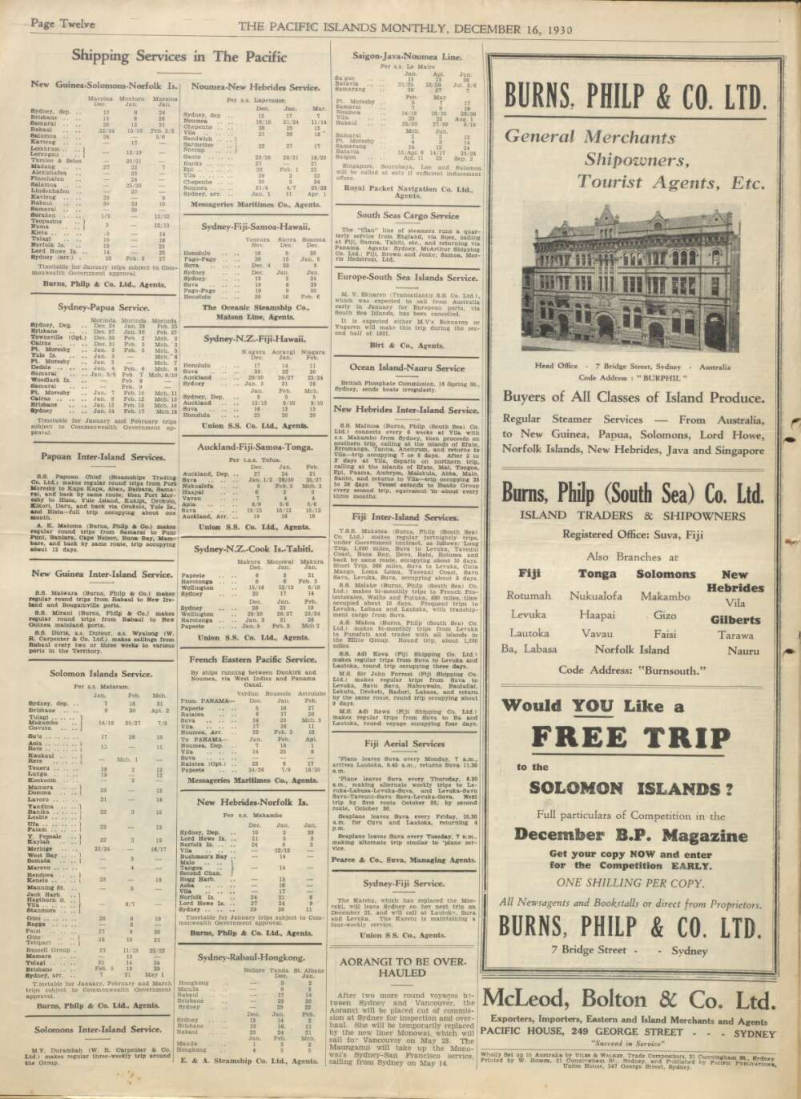
New Guinea-Solomons-Norfolk Is.
Timetable for January trips subject to Com monwealth Government approval.
Burns, Philp & Co. Ltd., Agents.
Sydney-Papua Service.
Timetable for January and February trips subject to Commonwealth Government ap proval.
Papuan Inter-Island Services.
S.S. Papuan Chief (Steamships Trading Co. Ltd.) makes regular round trips from Port Moresby to Kapa Kapa, Abau, Baibara, Sama rai, and back by same route; then Port Mor esby to Hlslu, Yule Island. Kuklpi, Orokolo, Kikori, Daru, and back via Orokolo, Yule Is., and Hisiu—full trip occupying about one month.
A. K. Matoma (Burns, Philp St Co.) makes regular round trips from Samarai to Puni Puni, Batiiara, Cape Nelson, Buna Bay, Mam bare, and back by same route, trip occupying about 12 days.
New Guinea Inter-Island Service.
S.S. Maiwara (Burns, Philp St Co.) makes regular round trips from Rabaul to New Ire land and Bougainville ports.
S.S. Mlrani (Burns, Philp St Co.) makes regular round trips from Rabaul to New Guinea mainland ports.
S.S. Duris, s.s. Durour, s.s. Wyalong (W.
R. Carpenter St Co. Ltd.) makes sailings from Rabaul every two or three weeks to various ports in the Territory.
Solomon Islands Service.
Per s.s. Mataram.
Timetable for January, February and March trips subject to Commonwealth Government approval.
Burns, Philp & Co. Ltd., Agents.
Solomons Inter-Island Service.
M.V. Durambah (W. R. Carpenter & Co.
Ltd.) makes regular three-weekly trip around the Group.
Noumea-New Hebrides Service.
Per s.s. Laperouse.
Messageries Maritimes Co., Agents.
Sydney-Fiji-Samoa-Hawaii.
The Oceanic Steamship Co., Matson Line, Agents.
Sydney-N.Z.-Fiji-Hawaii.
Union S.S. Co. Ltd., Agents.
Auckland-Fiji-Samoa-Tonga.
Union S.S. Co. Ltd., Agents.
Sydncy-N.Z.-Cook Is.-Tahiti.
French Eastern Pacific Service.
By ships running between Dunkirk and Noumea, via West Indies and Panama Canal.
New Hebrides-Norfolk Is.
Per s.s. Makambo
Timetable for January trips subject to Com monwealth Government approval.
Bums, Philp & Co. Ltd., Agents.
Sydney-Rabaul-Hongkong.
E. & A. Steamship Co. Ltd., Agents.
Saigon-Java-Noumea Line.
Per s.s. Le Maire
Singapore, Sourabaya, Lae and Salamoa will be called at only if sufficient inducement offers.
Royal Packet Navigation Co. Ltd.,
Agents.
South Seas Cargo Service
The “Clan” line of steamers runs a quar terly service from England, via Suez, calling at Fiji, Samoa, Tahiti, etc., and returning via Panama. Agents: Sydney, McArthur Shipping Co. Ltd.; Fiji, Brown and Joske; Samoa, Mor ris Hedstrom, Ltd.
Europe-South Sea Islands Service.
M. V. Eknaren (Transatlantic S.S. Co. Ltd.), which was expected to sail from Australia early in January for European ports, via South Sea Islands, has been cancelled.
It is expected either M.V’s Ecknaren or Yngaren will make this trip during the sec ond half of 1931.
Birt & Co., Agents.
Ocean Island-Nauru Service
British Phosphate Commission, 16 Spring St., Sydney, sends boats irregularly.
New Hebrides Inter-Island Service.
S.S. Malinoa (Burns, Philp (South Sea) Co.
Ltd.) connects every 6 weeks at Vila with s.s. Makambo from Sydney, then proceeds on southern trip, calling at the islands of Efate, Erromanga, Tanna, Aneityum, and returns to Vila—trip occupying 7 or 8 days. After 2 to 3 days at Vila, departs on northern trip, calling at the islands of Efate, Mai, Tongoa.
Epi, Paama, Ambrym, Malekula, Abba, Malo, Santo, and returns to Vila—trip occupying 25 to 28 days. Vessel extends to Banks Group every second trip, equivalent to about every three months.
Fiji Inter-Island Services.
T.S.S. Makatea (Burns, Philp (South Sea) Co. Ltd.) makes regular fortnightly trips, under Government contract, as follows: Long Trip, 1,050 miles, Suva to Levuka, Taveuni Coast, Buca Bay, Devo, Rabi, Rotuma and back by same route, occupying about 10 days.
Short Trip, 560 miles, Suva to Levuka, Cicia Mango, Loma Loma, Taveuni Coast, Savu Savu, Levuka, Suva, occupying about 9 days.
S.S. Malake (Burns, Philp (South Sea) Co.
Ltd.) makes bi-monthly trips to French Pro tectorates, Wallis and Futuna, 880 miles, time occupied about 10 days. Frequent trips to Levuka, Labasa and Lautoka, with tranship ment cargo from Suva.
A.S. Makoa (Burns, Philp (South Sea) Co.
Ltd.) makes bi-monthly trips from Levuka to Funafuti and trades with all islands in the Ellice Group. Round trip, about 1,800 miles.
S.S. Adi Keva (Fiji Shipping Co. Ltd.) makes regular trips from Suva to Levuka and Lautoka, round trip occupying three days.
M.S. Sir John Forrest (Fiji Shipping Co.
Ltd.) makes regular trips from Suva to Levuka, Savu Savu, Nabouwalu, Baulailal, Lekutu, Dreketi, Raduri, Labasa, and return by the same route, round trip occupying about 9 days.
M.S. Adi Rewa (Fiji Shipping Co. Ltd.) makes regular trips from Suva to Ba and Lautoka, round voyage occupying four days.
Fiji Aerial Services
'Plane leaves Suva every Monday, 7 a.m., arrives Lautoka, 8.45 a.m., returns Suva 11.30 a.m.
'Plane leaves Suva every Thursday. 6.30 a.m., making alternate weekly trips to Le vuka-Labusa-Levuka-Suva, and Levuka-Savu Savu-Taveuni-Savu Savu-Levuka-Suva. Next trip by first route October 23; by second route, October 30.
Seaplane leaves Suva every Friday, 10.30 a.m. for Cuvu and Lautoka, returning 4 p.m.
Seaplane leaves Suva every Tuesday, 7 a.m., making alternate trip similar to 'plane ser vice.
Pearce & Co., Suva, Managing Agents.
Sydney-Fiji Service.
The Karetu, which has replaced the Moe raki, will leave Sydney on her next trip on December 23, and wi’ll call at Lautok-Suva and Levuka. The Karetu is maintaining a four-weekly service.
Union S S. Co., Agents.
Marsina Montoro Marsina Dec.
Jan.
Jan.
Sydney, dep. .
13 6 24 Brisbane 15 8 26 Samara! 20 13 31 Rabaul ,. . 22/24 15/16 Feb. 2/3 Salamoa ., 26 5/6
Kavieng
17
Lombrum .. .. J
Lorengau .. .. f
— 18/19 — Tumleo & Seleo 20/21 Madang 27 22 7 Alexishafen 23 Plnschafen 24 Salamoa . . 25/26 LIndenhafen 27 Kavieng 29 9 Rabaul 30 23 10 Samarai .. .. — 30 Soraken 1/2 11/12 Teopasino ..
Numa ,, j
3 — 12/13 Kleta .5 14 Tulagi .. .. 10 . 16 Norfolk Is. 12 23 Lord Howe Is. . 14 25 Sydney (arr.) . 16 Feb. 5 27
Morinda Morinda Morinda Sydney, Dec. . . Dec. 24 Jan.28 Peb. 25 Brisbane . . Dec. 27 Jan. 30 Peb. 27 Townsville (Opi .) Dec. 30 Peb. 2 Mch. 2 Cairns Feb. 3 Mch. "3 Pt. Moresby .. Jan. 2 Feb. 5 Mch. 5 Yule Is. .. Jan. 3 Mch.' 6 Pt. Moresby . . Jan. 3 Mch. 7 Dedele .. 4 Peb. 6 Mch. 8 Samar&i .. Jan. 5/6 Peb. 7 Mch. 9/10 Woodlark Is. — Peb. 8 Samarai . .
Peb. 9 Pt. Moresby .. Jan. 7 Peb. 10 Mch. 11 Cairns .. .. 9 Feb. 12 Mch. 13 Brisbane .. Jan. 12 Feb. 15 Mch. 16 Sydney .. Jan. 14 Feb. 17 Mch. 18
Jan.
Feb.
Mch.
Sydney, dep. 7 18 31 Brisbane 9 20 Apl. 2 Tulagl .. ..
Makambo Gavutu 14/16 25/27 7/9 Su’u 17 28 10 Aola Rere U — 11 Kaukaul ..
Rare .. . . - Mch. 1 Teneru .. .. 19 19 Bunga . . . . 12 Kookoom 2 Mamara Domma 20 — 13 Lavoro .. . . 21 — 14 Yandina .. 1 V 22 3 15 Loable .. . .
Ufa Falam .. .. 22 — 15 Y. Pepsale Kaylah 22 3 15 Meringe West Bay ..
Somata .. 23/24 3 16/17 4 Rendova .. .. 25 18 Manning St. 5 Jack Harb.
Hagthorn S.
Vila •• 1 • • 6/7 Stanmore .. :: 26 8 8 9 10 19 Faisi ..
Gizo Tetlpari .. 27 28 20 21 Russell Group Mamara 23 11/12 13 22/23 Tulagl . . . .
Brisbane Sydney, arr. 31 Feb. 5 7 14 19 21 24 29 May 1
Sydney, dep
Dec. 12 Jan. 17 Mar. 7 Noumea . . 16/19 21/24 11/14
Chepenhe ..
20 25 15 Vila .. . 21 26 16 '
Sandwich .. ,
Sarmettes .. 1 .. }■ 22 27 17
Norsup .. ,
Santo .. .. • • 1 23/26 28/31 18/20 Banks .. .. 27 — 21 Epi 28 Feb. 1 22 Vila 29 2 23
Chepenhe ..
30 3 24 Noumea . . .. 31/4 4/7 25/28
Sydney, arr.
Jan. 1 11 Apr. 1
Ventura Sierra Sonoma Nov.
Dec.
Dec.
Honolulu 19 8 29
Pago-Pago ..
26 15 Jan. 5 Suva .. .. .. Dec. 4 23 8
Sydney
.. Dec.
Jan.
Jan.
Sydney
13 3 24 Suva .. .. 18 8 29
Pago-Pago ..
19 9 30 Honolulu 26 16 Feb. 6
Niagara Aorangi Niagara Dec.
Jan.
Feb.
Honolulu 17 14 11 Suva 26 23 20 Auckland .. 29/30 26/27 23/24 Sydney ,. Jan, 3 31 28 Jan.
Feb.
Mch.
Sydney, Dep. .. 8 5 5 Auckland 12/13 9/10 9/10 Suva 13 13 Honolulu .. 23 20 20
Per t.s.s. Tofua.
Dec.
Jan.
Feb.
Auckland, Dep. . • 27 24 21 Suva .. .. Jan. 1/2 28/30 25/27 Nukualofa ... 5 Feb. 2 Mch. 2 Haapal ... 6 3 3 Vavau ... 7 4 4 Apia .. .. 8/9 5/6 5/6 Suva .. .. 13/15 10/12 10/12 Auckland, Arr. .. 19 16 16
Makura Monowai Makura Dec.
Jan.
Jan.
Papeete . .. 6 3 31 Rarotonga . . .. 9 6 Feb. 3 Wellington 15/16 12/13 9/ID Sydney . .. 20 17 14 Dec.
Jan.
Feb.
Sydney . .. 25 22 19 Wellington 29/30 26/27 23/24 Rarotonga .
Jan. 3 31 28 Papeete . .. Jan. 5 Feb. 2 Mch 2 Union
S.S. Co. Ltd., Agents.
From Panama-
Verdun Boussole — Dec. Jan.
Astrolabe Feb.
Papeete 5 16 27 Raiatea 6 17 28 Suva .. .. 25 Mch. 5 Vila .. .. 17 28 11 Noumea, Arr. 22 Feb. 16
To Panama—
Jan.
Feb.
Apl.
Noumea, Dep. 7 18 1 Vila .. .. 14 25 8 Suva .. .. . . — — Raiatea (Opt.) 23 6 17 Papeete 24/26 7/9 18/20
Messageries Maritimes
Co.,
Agents.
Dec.
Jan.
Jan.
Sydney, Dep.
19 2 30 Lord Howe Is. .. 21 5 2 Norfolk Is 24 8 5 Vila — 12/13 — Bushman's Bay ..
Malo .. .. I — 14 — Tangoa .. }• Second Chan. ] — 14 — Hogg Harb. — 15 — Aoba — 16 — Vila — 17 — Norfolk Is. 24 21 6 Lord Howe Is. .. 27 24 9
Sydney
29 26 11
Nellore Tanda Dec.
St. Albans Jan.
Hongkong — 5 2 Manila — 8 5 Rabaul —; 17 14 Brisbane — 23 20 Sydney — 25 22 Dec.
Jan.
Feb.
Sydney .. 13 14 2 Brisbane 15 16 11 Rabaul 23 24 21 Jan.
Feb.
Mch.
Manila 1 2 2 Hongkong 4 5 5
Jan.
Apl.
Jun.
Sa'gon .. .. 15 15 26 Batavia .. .. 22/25 23/26 Jul. 3/6 Samarang 26 27 7 Peb.
May Pt. Moresby .. 5 7 17 Samarai 7 9 19 Noumea 14/18 16/20 26/30 Vila 20 22 Aug. 1 Babaul .. 25/23 27/30 6/10 Mch.
Jun.
Samarai 3 2 13 Pt. Moresby .. 4 3 14 Samarang 14 13 24 Batavia 15/Apl. 6 14/17 25/28 Saigon .. ..
Apl. 11 22 Sep. 2
Aorangi To Be Over
Hauled
After two more round voyages be tween Sydney and Vancouver, the Aorangi will be placed cut of commis sion at Sydney for inspection and over haul. She will be temporarily replaced by the new liner Monowai, which will sail for Vancouver on May 28. The Maunganui will take up the Mono wai’s Sydney-San Francisco service, sailing from Sydney on May 14.
Advertisements & other items, p. 12 (2 items)
The Pacific Islands Monthly, December 16, 193 0
12
Wholly Set up In Australia by Viles & Walker, Trade Compositors, 31 Cunnlnsham Printed by W, Homer, 31 Cunningham St. Sydney, and Published h? Paot£PtoiSSK Union House, 247 George Street, Sydney. ication*.
Burns, Philp & Co. Ltd.
General Merchants
Shipowners,
Tourist Agents, Etc.
Head Office - 7 Bridge Street, Sydney - Australia Code Address : " BURPHIL ”
Buyers of All Classes of Island Produce.
Regular Steamer Services From Australia, to New Guinea, Papua, Solomons, Lord Howe, Norfolk Islands, New Hebrides, Java and Singapore
Burns, Philp (South Sea) Co. Ltd.
ISLAND TRADERS SHIPOWNERS
Registered Office: Suva, Fiji Would YOU Like a
FREE TRIP
to the
SOLOMON ISLANDS?
Full particulars of Competition in the December B.P. Magazine Get your copy NOW and enter £or the Competition EARLY.
ONE SHILLING PER COPY.
All Newsagents and Bookstalls or direct from Proprietors
BURNS, PHILP & CO. LTD.
7 Bridge Street - - Sydney
McLeod, Bolton 8C Co. Ltd.
Exporters, Importers, Eastern and Island Merchants and Agents PACIFIC HOUSE, 249 GEORGE STREET - . . SYDNEY "Succeed in Service”