Monthly
THE Pacific islands
THE ONLY JOURNAL CIRCULATING THROUGHOUT THE ISLAND TERRITORIES AND GROUPS
Of The Central And South Pacific.
Vol 1 No 4
Registered at G.P.O., Sydney, for transmission by Post as a Newspaper
Sydney: Thursday, November 20, 1930
Single Copy, 6d.
Per Annum, posted, 6/-.
Pest From Java
Definite Threat to N.G.
Coconuts
Need For Quick Action
THE danger of a pest, that is causing havoc in the coconut
plantations in Java, finding its way
into Eastern New Guinea and the islands of the Mandated Territory, is causing lively concern among
plantation-owners.
The pest is a small moth, which takes possession of the under-side of the palm leaves. The leaves presently decay and drop off; and the palm becomes useless.
Not much is known here about the pest, how long it has been at work, or where it comes from. Coconut plantations in Java are mostly native owned, and the industry is not under close supervision. It is probable that the pest has been known in Java and not actually combated for a long time.
But, in recent times, it has assumed most serious proportions—and is a contributing factor to the fact that only 6,800 tons of copra were shipped from Java in the 8 months to the end of August, 1930, as compared with 37,900 tons shipped in the same period of 1929. It is reported that nine-tenths of the Javanese coconut plantations are affected.
The pest, while somewhat similar in its occurrence, is not the Levuana moth —which practically wiped out all coconut palms in Viti Levu (Fiji) until itself was destroyed in recent time by a fly imported from Malaya. Apparently, also, the Dutch entomologists have found nothing, as yet, to check it.
From Java to New Guinea is only a step. Communication between the ports of the two territories is maintained by the Dutch steamer, which runs a regular cargo service. If the pest is transferable, it would be very easy to convey it in cargo from Java to Port Moresby or Rabaul.
The Federal authorities are to be urged to make an immediate inquiry, and if there is danger, to take immediate steps to guard against the danger.
The introduction of the pest to the New Guinea copra plantations, which already are suffering severely from the depressed prices, would be nothing short of a national calamity.
The danger, if it exists, could be averted by a little care now. Prompt action seems to be demanded. ———
Mr. C. B. Higginson
Death In Papua
His Good Service As Magistrate
(From Our Own Correspondent.) Port Moresby, October 10.
WORD was received in Port Moresby last Saturday, of the death of Mr. C. B. Higginson. who died at Kopipi on September 29th, while on his
way to Popo, where he was employed by the Anglo-Persian Oil Co. He was another of the fast lessening number of old timers in Papua, and had been in the Territory for about 25 years, twenty of which had been spent in the service of the Government.
Mr. Higginson was almost the last of the older Magistrates—those fine men who, in the old days, did such magnificent work in subduing and training, with wisdom and justice, the fierce and savage Papuans.
Mr. Higginson leaves a widow and three children, who had only just left the territory by the last Morinda.
The news of his death cast a gloom over Port Moresby. One of his friends writes: “Good sport, firm friend, fearless officer and able administrator of justice, he will be long missed and remembered in Papua.” ———
Mr. C. B. Higginson.
E. & A. A. Line Alters Itinerary
New Shipping Service
Rabaul to Hongkong E. & A. A. Line Alters Itinerary
A NEW shipping service between the Mandated Territory of New Guinea and the East will be established by the Eastern and Australian Steamship Co. Ltd., which has decided to include Rabaul in the itinerary of its three Australia-Japan liners.
The Tanda, Nellore and St. Albans will call at Rabaul on both the outward and homeward journeys.
The first vessel to run the new time-table will be the Tanda, which leaves Yokohama at the end of the month for Australian port.
The vessel will load cargo and embark passengers for Rabaul at Hongkong.
The service in the other direction will be inaugurated by the Nellore, leaving Sydney on December 13.
The new itinerary will not lengthen the voyage between Australian ports and Japan, arrangements having been made to omit the present calls at Cairns, Thursday Island, Sandakan, on the northward journey, and Sandakan, Thursday Island, Cairns and Townsville on the voyage south.
The journey between Sydney and Hongkong will thus actually be shortened, from 23 to 21 days. ———
Island
Hotel For Norfolk
To Stimulate Tourist Traffic
Liquor System Criticised
PLANS are afoot for the establishment of a first-class residential hotel on Norfolk Island.
An application for a liquor license was refused some two years ago, but a petition has been now signed by many of the Islanders, asking that such license be granted. The petition is being forwarded to the Minister for Home Affairs (Mr. Blakeley) for his consideration.
Should this request be granted and an hotel to cater from 70 to 80 guests be built, a new era of prosperity may dawn on N.I., as it is certain that valuable tourist traffic will follow, and land values rise.
A natural result also should be a better steamer service, not only with Australia, but probably with New Zealand, thus providing more extensive markets for Norfolk Island produce.
Liquor By Permit
The existing liquor laws of the Island have been the subject of adverse criticism. At present a permit for liquor is only granted to a resident if he is considered a “fit and proper person” by the Government Medical Officer, and this permit allows him one bottle of spirits or six bottles of beer a fortnight.
Only twice a week is the liquor distributed by the Clerk of Court. People due for their ration then line up, and as many as 60 residents have been in the queue.
An undesirable feature, according to a recently-returned traveller, is that non-drinkers, who are also granted permits on application, obtain their rations, and have no trouble in re-selling the liquor at a handy profit.
It is estimated that last year £1,500 worth of spirituous liquor was imported into Norfolk Island. ———
Hymen at Thursday Island
From Our Own Correspondent
Thursday Is., Nov. 12.
The best wishes of the whole community were offered to-day to a popular young couple who were married in the Cathedral —Mr. Otter, a member of the Garrison Artillery, and Miss Byers.
There was a large attendance at the wedding breakfast. The bride’s parents are old and highly-esteemed residents of Thursday Island. ———
Scientists on Niuafoou Island
The largest camera in the world is shown in position on Niuafoou Island, in the Tongan group, where perfect weather conditions permitted a very successful observation of the total eclipse of the sun on October 21. The photograph shows the camp of the American scientists, who included Professor Jagger, of Hawaii; Professor
Mitchell, and other well-known Americans.
The camera is 65 feet long.
Niuafoou is an isolated place, extremely difficult of access, but it was the only island in this part of the Pacific that was right in the narrow track of the complete eclipse. ———
Steamer Services
Re-Arrangement Of Northern
Discussion Of Various Possibilities
Plea for Reduced Fares and Co-ordination of Inter-Island Schedules
By Our Rabaul Correspondent
In the following article our New Guinea representative discusses the problem of the Northern Steamer Services.
The people of Papua and New Guinea naturally want an ever-improving steamer and mail service with Australia.
Messrs. Burns Philp & Co. Ltd, who hold the Australian mail contract, and are vitally interested in the growth and development of these territories, are naturally anxious to give the best possible service. But steamer services must be profitably conducted; and the “big firm” is embarrassed by the fact that so much trade is being driven away from Australia in direct shipments to Europe and America. If that trade were being done with Australia, the B.P. shipping lines could be more profitably operated; and, of course, better and more frequent service could be given.
The whole matter is now under consideration by the Commonwealth and Territories authorities and the shipping company.
The subject is dealt with in our leading article on page 6.
WITH the possibility of the arrival of a new steamer, now in course of construction, in March or April of next year, public interest has been aroused in the proposed new schedule, and our steamer and mail services generally.
The new vessel is on much the same lines as M/v Malabar. It is slightly shorter, but has two feet more beam, and, being designed for Islands service, has a shallow draught. The sailing speed is 14 knots. The passenger accommodation is quite equal to the Malabar, but the appointments are superior. The public rooms and the cabins are commodious —a feature that will be much appreciated after the confined space on the older vessels.
Messrs. Burns Philp & Co. Ltd. evidently appreciate that, as practically the whole of the copra from this Territory is now shipped by vessels plying direct with Europe, they will have to rely to a greater extent on passenger traffic. Cargo from Australia is also declining, owing to the competition of s.s. Le Maire, bringing cargoes from India, Rangoon and Java; and s.s. Bremerhaven, bringing through freights from Europe, China and Japan.
To Join Service With Papua
One would have thought that a new and large vessel, taking the place of the antiquated Marsina, would have
been welcomed without question. But, as Burns Philp & Co. evidently do not consider the trade of this Territory yet warrants two large vessels engaged solely on this service, they propose to amalgamate the New Guinea and Papuan services, to be undertaken by the new vessel and the Montoro.
The Morinda, now on the Papuan run will be transferred to the Norfolk Island service.
Local objection is taken to the incorporation of the Papuan service, on the grounds that to call at Port Moresby and one (possibly two) North Queensland ports will increase the length of the journey; and, further, that in order to bring in these ports and still maintain a three-weekly service, it will be necessary to omit certain minor ports in this Territory.
Most people travelling from here to Australia wish to get to Sydney as quickly as possible; they are not in terested in Port Moresby or any North Queensland ports, and it was thought that when a new and speedier vessel was put on the run the journey would be appreciably shortened. As Burns Philp & Co. base fares on the number of days a journey occupies, some were optimistic enough to hope for a reduction in the present high rates. The present run from Rabaul to Sydney, calling at Samarai, takes eight days (it has been done by the Montoro in six and a half days).
It is announced that the new steamer will take 8 days for the journey— Rabaul-Sydney—and the Montoro 13 days. It is exceedingly doubtful if such a schedule could be maintained, because, even allowing an average sail ing speed of 14 knots, there would be only a margin of 36 hours for calls at five ports; this makes no allowance for bad weather or arriving at ports outside of official hours. If there are delays, time would have to be made up by cutting short the stay in Sydney, which would be a serious matter for the commercial interests. At least seven clear days are required at Sydney each trip, in order that orders for shipment by return vessel may be attended to.
The only benefit to the travelling public will be the advantage of a new and commodious vessel in place of the Marsina, which is exceedingly uncomfortable. This Territory will also benefit by being brought into direct communication with Port Moresby—a factor that may be of some importance in the future—and with North Queensland ports.
Planters here who wish to purchase cattle for their plantations naturally look to North Queensland for their
(Continued On Page 2)
market, but owing to heavy transhipment charges, freight rates have been
prohibitive.
The Minor Ports
A feature of much economic importance, especially to the planter, is the proposed elimination of certain minor ports now visited by the mail steamers.
No doubt, it is not profitable to Burns Philp & Co. Ltd. to send a vessel such as the Montoro to small places like Manus, Aitape, Boram, etc.; but to remove the vessel without replacing her by an adequate subsidiary service would inflict a hardship on the already sorely pressed planter at the more remote places.
The present inter-island service is neither adequate nor satisfactory, and this is largely due to lack of co-operation between Burns Philp & Co. and W. R. Carpenter & Co. Ltd. A complete re-organisation of the interisland services should be instituted in conjunction with the suggested new mail service.
At the present time, the steamers Maiwara and Mirani, owned by Burns Philp, and the steamers Duris and Durour, owned by Carpenters, follow much the same routes respectively. All make round trips, but all take the same route, following each other up.
If the two firms were to co-operate, and arrange services so that one vessel would follow a reverse route to the other, greater efficiency could be obtained, with resultant decrease in concentration costs, less expenditure on the
re-patriation of native labourers and better mail facilities. At present, these services appear to be conducted to suit the particular requirements of the respective owners but, with co-operation, considerable savings could be effected, and at the same time the public would be given a more efficient and satisfactory service.
If the inter-island services could be re-organised to counteract the omission of the minor ports referred to, and there is no increase in fares on account of the longer journey to Sydney, the suggested new schedule should be welcomed.
The matter is still under the consideration of the authorities concerned, and no official pronouncement has yet been made. ———
Advertisements & other items, p. 1 (1 item)
1931 (Germany)
Leipzig Spring Trade Fair
(THE GREATEST TRADE EXHIBITION
IN THE WORLD)
Despite the heavy and almost impossible Australian Tariff Legislation, Australian business men and overseas buyers can profitably visit the 1931 Spring Fair at Leipzig.
The Great Spring Fair begins on March 1st, 1931, incorporating the Great Engineering Fair, until March 11th.
Inquiries invited. All Official Data, Transport Concessions, Hotel Accommodation, Rail Services, Etc., including Letters of Introduction, Free of Cost.
Authorised Representatives:
LARS C. BRUNDAHL,
121 Pitt Street Sydney, N.S.W. (’Phones B 4006, MW 2201);
C. N. KEPPEL,
Box 585 D, C.P.O. Melbourne Victoria.
Installation by Sydney Firm
Electricity Scheme For
Rabaul
From Our Canberra Correspondent An ordinance was passed some time ago to enable an electricity scheme to be installed in Rabaul. Messrs. Donoghue & Carter, of Sydney, have signified their intention of applying to the Administrator for the right to supply light and power for public and private purposes for a period not exceeding 30 years.
At present, electric light is supplied by private plants over a restricted portion of the town. ———
Wedding At Rabaul
(From Our New Guinea Correspondent )
A wedding of interest took place at the Methodist Church, Rabaul, on October 21, when Mr. Hermann Mirow, son of Mr. W. Mirow, chief inspector for Messrs.
Carpenter & Co. Ltd., was married to Miss Freda Hargreaves, of Sydney.
The parents of the bridegroom are both well-known identities in New Guinea.
Mr. Mirow, senr., came here 30 years ago, and was formerly the owner of Gunentambu Plantation. Mrs. Mirow arrived some 20 years ago, being associated with the Methodist Mission.
The wedding was largely attended, and amongst those present at the reception, held at the Rabaul Hotel, were Mr. and Mrs. J. A.
Carpenter, Mr. and Mrs.
Perriman, Mr. and Mrs. H.
O. Townsend, Mr. and Mrs.
J. L. Street, Messrs. P. R.
Jolley, Frank Kirchner, O.
Soltwedel, and E. Paatzsch.
Subsequently the guests proceeded to the German Club, one of the most popular resorts in town, where dancing was indulged in until the early hours.
Mr. and Mrs. Hermann Mirow spent a brief honeymoon at Kokopo, and have now proceeded to Pondo Plantation, of which Mr. Mirow is manager. ———
In Western Samoa
Condition of the Planting Industry
(From Our Own Correspondent.)
Apia, October 22.
LIKE other cocoanut-growing countries, Western Samoa to-day is feeling the effects of the present low price of copra in the Home and Continental markets. The market price to-day— which is the price in Europe after freight, etc., has been paid—is really what the planter should be receiving on the plantation, in order that a reasonable profit might be shown, yet, ever optimistic, planters face the position all square, and hope for improvement.
The biggest producers of copra are the Samoans, but the low price offered for the product does not encourage them to produce too heavily. In some districts there has been a falling off in supply. But these conditions will alter, as at times circumstances compel the native to produce in order to get ready cash.
It is from copra sales, mainly, that the native collects money. Sometimes he needs money pretty badly—i.e., when with other villagers he considers a new church should be built, or when a collection for Church Missions is required, of maybe communal requirements demand ready cash. Having little other means of raising money, it is to copra making that they apply themselves.
Cocoa Production
Although there is a fair tonnage of cocoa beans produced in the Territory, the Samoans do not pay much attention to a cocoa production. It is not an easy crop to produce, requiring experience in growing, and in the fermentation and drying processes essential to a first-class marketable product. Cocoa plantations are therefore controlled only by Europeans with the necessary experience, and cocoa to-day is helping
them to balance their ledger on the right side.
Cutting out and drying of copra are simple processes as compared with cocoa and its intricate methods of preparation for market. To the Samoan, the making of copra is easy; it is a labour that suits his temperament.
Easy-going to a degree, he finds he can employ on the job all other members of his family. Consequently, his cost of production is nil, in that he does not have to pay a monthly wage bill.
The Reparations Estates
Likely to be hard-hit by the unfavourable market prices is the large acreage of cocoanut under cultivation by the New Zealand Reparation Estates, but as middleman’s profits hardly enter into the proposition, the Estates are likely to come out with a small margin of profit, as against the copra-buying firms who purchase direct from the native grower. Although maintaining a general manager, an office staff of several clerks, and plantation managers and overseers, and a big army of Chinese coolies and Solomon Island boys, the N.Z. Reparation Estates are in a fairly sound position and should be able to show a satisfactory report at the end of the year.
The big drop in copra prices affects merchants very considerably, as the spending power of the native to-day is about half of what it was a year ago.
The general impression here is that unless the cost of production can be lessened there will not be much margin of profit until the market price in London and the Continent rises to some where about £20 a ton, and is maintained at that figure.
However, we are fortunate in Samoa insofar that we have a valuable alternative crop in bananas. This industry is described in another article. ———
Callous Crime
By a New Guinea Cook-Boy
Plantation Manager
Murdered
From Our Rabaul Correspondent A SENSATION was caused in Rabaul by the report of the murder of Mr.
D. G. Edmonds by his native cook-boy.
Mr. Edmonds was manager of the Melanesia Co.’s Kolai Plantation, on the south coast of New Britain.
The murder was particularly brutal and callous and was undoubtedly premeditated.
It is reported that Mr. Edmonds’s cook-boy, who bore a grudge against his master for some unknown reason, told the plantation boss-boy that he intended to kill his master. Whilst Mr. Edmonds was sleeping he carried out his threat by attacking Mr. Edmonds with a 141b. sledge hammer. The boy battered Mr. Edmonds about the head and killed him. He then washed the body, clothed it in a clean suit, even to collar, tie and cuff-links, and then buried it. He washed away the blood stains and put clean linen on the bed.
When he reported his action to the natives employed on the plantation, they became scared and ran away.
The murderer then walked to the next plantation and gave himself up to Mr.
Pinching, the manager.
The reason for the murder is not yet known. The boy has been brought in to Kokopo, the chief office for New
Britain, and will be brought to trial at Rabaul.
Further reports of violence by natives towards their European employers have been received from Kavieng. Mr. Jack Melville, of Selapui Plantation, was injured, but, we understand, is recovering. (An article in the September issue of The Pacific Islands Monthly referred to the growing problem of imposing adequate discipline upon native employees in New Guinea, and the need for a review of the Administration’s method of imposing punishment for minor offences.) ———
Among The Missions
Rev. and Mrs. J. H. Margetts return by the Montoro on November 22 to New Britain, after furlough in Australia.
They are attached to the Methodists Mission station at Vunairima.
Miss D. Coltheart, of the Methodist Missionary Society, returned to Sydney by the last Montoro on holidays. She has been working among the Chinese at Rabaul.
Miss Common left Sydney by the November Marsina to take up duties with the Methodist Missionary Society in the Solomon Islands. Miss Dalziel, and a party of Tongans, returned from there by the Mataram, on their way to New Zealand.
Rev. A. W. Guy, who has been attached to the Methodist Missionary Society in Papua for the last fifteen years, has now retired from service there. The Methodist Synod, at a recent meeting, expressed deep regret at losing such an able minister. ———
Advertisements & other items, p. 2 (3 items)
Page Two
THE PACIFIC ISLANDS MONTHLY, NOVEMBER 20, 1930 ———
Northern Mail Services
(CONTINUED FROM PAGE 1)
lift
"Reliable"
is its
middle name
Lister
RELIABLE
lift
LISTER-LITE was specially designed for homes such as yours —homes far away from the services of electrical experts. Tested and retested long before it reaches you, Lister-Lite is as perfect as modern engineering methods can make it. It will bring you all the conveniences of a big city electric supply, day after day, month after month, for years on end with never a hint of trouble.
Free of Australian Customs Duty When you order your Lister-Lite, it will be shipped to you ex bond, thus saving the extra cost which Australian Customs duty would entail. Fill in and send the coupon below for particulars of reliable Lister-Lite.
DANGAR, GEDYE & CO.
LTD.
10-14 Young Street, Sydney,
Australia. ———
If You are Interested in the Pacific Islands Shipping, Mining or Trade Write or Cable
W. FARMER WHYTE
Who can give you Direct Representation
at CANBERRA
All communications strictly confidential.
Telephone: Canberra 8070 Code Address, “Farmerite,” Canberra ———
Leeto
SPARKLING WINE
A Product of McWilliams Wines, 15 Alberta Street, Sydney
Papuan News
Low Prices of Products Cause Anxiety Aeroplane Connection with Salamoa — Luxurious Yacht Arrives — The November Exodus.
(From Our Own Correspondent)
Port Moresby, October 15.
THE market has fallen yet lower this month, as regards rubber and copra. Rubber has actually fallen to 315-16 pence per lb., and copra to £14/12/6 per ton.
The rubber producers find this figure fatal. Some plantations give their low est cost price at 10d.; others, nearer Port Moresby, manage at a lower figure.
The huge profits these plantations are making can be left to the imagination.
Copra—though the market is so low —is not in quite so bad a plight. The cost of production is from £8 to £10 approximately. Added to this, in most cases, is the freight into Port Moresby.
So just at present the copra producer is far from pleased when he rakes in his returns.
Still, there is an outlet in Papua itself. Three desiccated cocoanut fac tories, or plants, buy up a great deal of copra and pay a higher rate than the market prices. Cocoanut Products Ltd., a company operating on Hisiu Beach, 60 miles to the west of Port Moresby, in the centre of a nest of plantations, buys as much as it can handle.
Ahioma, a Samarai Syndicate, off Milne Bay, and the Gili Gili plant, account for quite a number of nuts in that district, and all the product of the plantation of the same name (Gili Gili, owned by Lever Bros.). So there is every hope, despite the fluctuating price, that these plantations will hold on, with economy, yet awhile, until things improve.
Traders Feel Pinch
The traders along the coast are feel ing the slump most of all. Natives cannot understand the fall in market prices, and gather the impression that they are being “taken down.” In con sequence, they will not sell their nuts, preferring to let them fall and rot.
Cash, with them, is also less plentiful, so the sales of trade goods have fallen off. This is more serious for the trader than for the average native, for the latter’s purchases were generally lux uries—certainly not necessities—where as it is the trader’s actual livelihood and it is hard to know what is ahead for him.
As regards the Government itself cir culars were sent to every department and station, instructing every one to observe the strictest economy, and hop ing to get through this difficult time without retrenchment or reduction of wages. It is sincerely hoped this will be
possible, for unemployment of whites in this Territory would be a ghastly proposition.
Aerial Port Of Call
Mr. Ray Parer, flying from Salamoa, New Guinea, to Port Moresby, about September 27, had, it is rumoured, an unpleasant experience. His petrol ran out 60 miles or so from Port and he was compelled to make a forced landing.
Happily, he was over a well known stretch of beach at Hisiu. The flying conditions lately have been particularly bad.
Mr. L. C. Shoppe, flying his Gypsy Moth, also flew over from Salamoa with a passenger, in order to catch the s.s. Morinda going south.
A large Fokker aeroplane is being imported by the Le Maire, K.P.M. (Dutch) boat to Port Moresby, for the gold fields, and will be assembled here, after which the machine will be flown to Salamoa.
Port Moresby has lately been used as a landing stage for aeroplanes flying to and from the New Guinea goldfields.
They cause considerable interest here, among the natives, who have not be come used to them. The white people always greet them with pleasure, for they keep us in touch with the other side of the Territory and help to kill the monotony between mails.
Mail Connections
Port Moresby relies on s.s. Morinda every month for mails and stores from Sydney, and a three monthly call of the K.P.M. Le Maire, a Dutch boat, sailing between Singapore and Java ports and Noumea, calling at different ports enroute. in Papua and New Guinea. The Le Maire has accommo dation for a few passengers, which enables anyone to tranship at Singa pore, for European ports, cutting out the voyage to Australia.
A cargo boat, under the agency of Burns, Philp, calls also every three months, to take copra direct to Euro pean ports from here and Rabaul. For merly, copra had to be transhipped at Sydney, which entailed greater expense.
All three steamers bring mails and carry general cargo.
On A World Pleasure Cruise
The American yacht, Zara, arrived in Port Moresby on October 3, causing a considerable stir. She hails from San Francisco and is on a world pleasure
cruise, having been out already some four months, travelling round the Pacific. Her owner is Mr. Templeton Crocker, a San Francisco business man and he is accompanied by four friends —Capt. Rotch, Dr. A. E. Larsen, Mr.
L. C. Brooke, and Mr. Geoffrey Dodge, besides a crew of twelve. The vessel is luxuriously fitted, with dining saloon, lounge cabins and bathrooms, and car ries a fine speed boat for harbour and river work. The Zara will call at Java, Borneo, Singapore and Ceylon after leaving here, through the Suez Canal to the South of France. We all envied them their easy and happy life, apparently free from worries.
His Excellency, Sir Hubert, and Lady Murray entertained Mr. Crocker and his friends at Government House and were entertained in return on the yacht Zaia, and the Papuan Club made all the party honorary members.
Social Life
Social life since the arrival and de parture of H.M.A.S. Australia and Anzac, with Admiral Evans and his staff, has been very quiet. While the navy was here, for three days, the resi dents did their best to entertain their visitors. All the sporting duos were open for their amusement and a dance was given in their honour by the Ten nis Club. His Excellency, Sir Hubert and Lady Murray, entertained Admiral Evans and his staff, and His Excel lency’s horses were put at their dis posal. The Admiral gave, in return, an At Home on the Australia. The guests danced to an excellent band, and afternoon tea was served.
In spite of the hot weather, the Golf Club is more popular than ever, and daily the course is improving, under the able management of its sec retary, Mr. Brossey. Women, as well as men, play daily. The nine hole course is very prettily situated in a valley amongst the hills and yet close to the sea. There is generally a cool breeze, which tempers the heat of the sun and players.
Lady Murray is leaving the Terri tory by the Morinda to-morrow, and is making a hurried trip to England for a few months.
In November, there will be a gen eral exodus of residents who are able to get away. The bookings of the November and December Morinda’s passenger lists is nearly complete.
Malaria’S After-Effects
Not many people, living for lengthy periods in the Pacific Islands, can escape malaria.
The fever, in itself, is not serious; but some times its after-effects are of an undesirable and lasting character. When the after-effects take the form of rheumatism and allied ail ments (as they not infrequently do) the suf ferer is glad to know of new medicines and treatments. To such, an announcement in this issue by Messrs. Leslie Bray, Ltd., about the merits of “Rev” may be interesting. It is claimed that “Rev” is an efficacious liniment, and gives remarkable results” in rheumatism, sciatica, and similar troubles.
Kava And The Major
A Memory of Sunny Nukualofa
WHEN we met the Chief Justice of Tonga, in Nukualofa, he intro duced us to the Minister for Lands, and then the five of us went to a little cafe to drink kava.
Nixon and I had had a taste of the stuff over in the Cook Islands. Nick said it was like the washing-water of the week before last, kept in a soap-vat and flavoured with pepper. I agreed.
But kava was new to Major O’Sulli van. The sound of the name tickled his palate. He had tasted many liq uors in many lands and in jovial com pany—and he was eager to add to his experiences.
We threw dice to see who “shouted.”
The Chief Justice explained the sys tem. He was a white man who had settled down happily in the island kingdom after having been driven from Samoa in 1890 by the squawking of the German eagle. The Minister for Lands was a native —all the Tongan Minis ters were natives except the Auditor- General.
We drank. I watched the Major’s face delightedly. It changed from an ticipation to incredulity, then to hor ror and disgust. I checked his hurried attempt to empty his mouthful back into the wooden mug by whispering that such a procedure would give seri ous offence.
The Chief Justice was proudly showing Nick the skin of his hands. When
he rubbed, it gave off a crumbly pow der. That, he explained, happened to all white kava-drinkers. The Major snorted.
The dice were thrown again and, to his visible relief, the Major won, and “shouted.” He had had visions of hav ing to sit through five rounds of kava.
He left before the third round, to at tend urgent business.
That afternoon, in a cocoanut grove some miles out, we attended an old time, ceremonial, kava-drinking, con ducted by the late King George Tabou IV. The procedure was simple. Each person was called up in his order of official importance, received a half-co coanut shell full of kava from the king’s servitor, bowed, drank the liquor, and threw the shell away with an un derhand spinning motion.
When the Major discovered what he was in for, he wanted to go and hide in the bush. We told him that he must respond to his name, and that he must drink the kava. Tongan etiquette on this matter is very strict. The Major declared, unhappily, that: “This damned stuff would be the death of him.”
The Court officials did not know the exact order of the official importance of our party. Nixon and I helped them with the list.
“Kava Kohe-e-e-e!” The call echoed through the forest aisles. Kava was
ready. It was made by squatting men of solemn appearance, who pounded the pepper-tree roots in wooden basins, and added water to the mess. In ancient days, the prettiest girls of the village chewed the roots, and spat the result into bowls, where water was added.
The Major’s name was called early in the list. He stepped up and drank his kava like a man; but he was breathing deeply, and there was feroc ity in his eye when he rejoined us near the Royal group.
To the accompaniment of quaint mis pronunciations of names by the native announcer, we stepped one by one be fore His Majesty, and quaffed the Royal beverage. Then: “Major O’Sullivan!” called the an nouncer, for the second time.
The Major gave a startled yelp. He waved his arms, and wanted to explain that there had been a mistake.
We pushed our friend forwards, whispering urgently. “Drink it —been a mis take —matter of etiquette—can’t explain now.”
The wretched Major seized the bowl and heroically drank. He spluttered and cursed. The bloody fields of Flan ders never heard worse language.
He returned to the steamer and went to bed, and remained there all next day—declared he had been poisoned.
Dr. Pomare (later Sir Maui Pomare, and recently dead), who was a member of our party, prescribed for him.
I never could get the permission of the repentant Nick to disclose the way in which we “cooked” that official list. —
R.W.R.
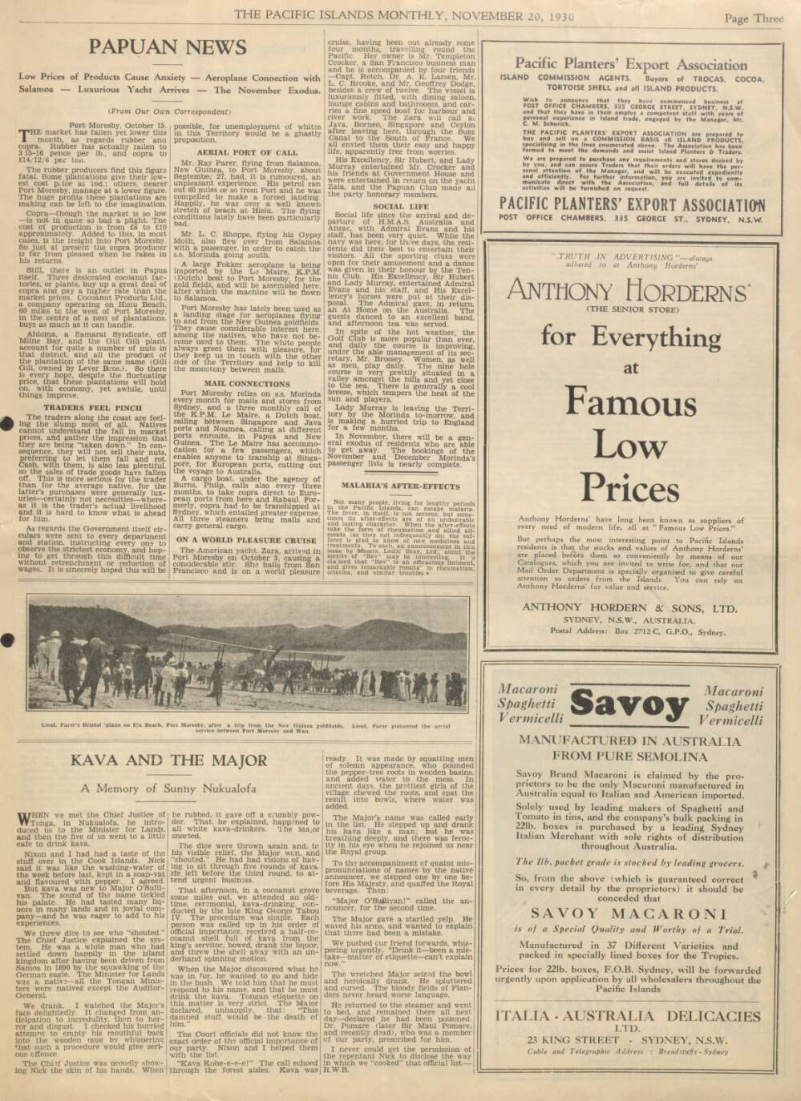
Lieut. Parer’s Bristol ’plane on Ela Beach, Port Moresby, after a trip from the New Guinea goldfields. Lieut. Parer pioneered the aerial service between Port Moresby and Wau.
Advertisements & other items, p. 3 (1 item)
Famous
Pacific Planters’ Export Association
ISLAND COMMISSION AGENTS. Buyers of TROCAS, COCOA,
TORTOISE SHELL and all ISLAND PRODUCTS.
Wish to announce that they have commenced business at POST OFFICE CHAMBERS, 335 GEORGE STREET, SYDNEY, N.S.W. and that they have in their employ a competent staff with years of personal experience in Island trade, engaged by the Manager, Mr.
C. M. Schurick.
THE PACIFIC PLANTERS’ EXPORT ASSOCIATION are prepared to buy and sell on a COMMISSION BASIS all ISLAND PRODUCTS, specialising in the lines enumerated above. The Association has been formed to meet the demands and assist Island Planters tr Traders.
We are prepared to purchase any requirements and stores desired by by you, and can assure Traders that their orders will have the personal attention of the Manager, and will be executed expediently and efficiently. For further information, you are invited to communicate direct with the Association, and full details of its activities will be furnished on request.
PACIFIC PLANTERS’ EXPORT ASSOCIATION
POST OFFICE CHAMBERS, 335 GEORGE ST., SYDNEY, N.S.W.
TRUTH IN ADVERTISING ” —always
adhered to at Anthony Horderns’
Anthony Horderns
(THE SENIOR STORE)
for Everything
at
Famous
Low
Prices
Anthony Horderns have long been known as suppliers of every need of modern life, all at " Famous Low Prices.”
But perhaps the most interesting point to Pacific Islands residents is that the stocks and values of Anthony Horderns’ are placed before them so conveniently by means of our Catalogues, which you are invited to write for, and that our Mail Order Department is specially organised to give careful attention to orders from the Islands. You can rely on Anthony Horderns’ for value and service.
ANTHONY HORDERN & SONS, LTD.
SYDNEY, N.S.W., AUSTRALIA.
Postal Address: Box 2712 C, G.P.0., Sydney.
Macaroni
Spaghetti
Vermicelli
MANUFACTURED IN AUSTRALIA
FROM PURE SEMOLINA
Savoy Brand Macaroni is claimed by the proprietors to be the only Macaroni manufactured in Australia equal to Italian and American imported.
Solely used by leading makers of Spaghetti and Tomato in tins, and the company’s bulk packing in 22lb. boxes is purchased by a leading Sydney Italian Merchant with sole rights of distribution throughout Australia.
The 1lb. packet grade is stocked by leading grocers.
So, from the above (which is guaranteed correct in every detail by the proprietors) it should be conceded that
SAVOY MACARONI
is of a Special Quality and Worthy of a Trial .
Manufactured in 37 Different Varieties and packed in specially lined boxes for the Tropics.
Prices for 221 b, boxes, F. 0.B. Sydney, will be forwarded urgently upon application by all wholesalers throughout the Pacific Islands
ITALIA - AUSTR ALIA DELICACIES
LTD.
23 KING STREET - SYDNEY, N.S.W.
Cable and Telegraphic Address ; Breadstuffs - Sydney
The Svaap Safe
The anxiety felt for the safety of the auxiliary yacht, Svaap, has now been allayed. A report has been received that she has been seen cruising around in the vicinity of the Sepik River, Man dated Territory of New' Guinea.
Fishing Industry
Facts From Thurs
Day Island
Curing Sardines in Torres Straits
From Our Thursday Is. Cor’pondent EVERY year the Commonwealth im ports over a million pounds’ worth of edible fish from abroad!
This is enough to make the average citizen of Australia sit up and think, when he knows that his own waters and those around the Pacific Islands contain an almost inexhaustible sup ply. Can no remedy be found for this tremendous gift to other nation’s pro ducers?
This important matter was the sub ject of an informative address by Mr.
H. Lang at a recent meeting of the Thursday Island branch of the Royal Geographical Society of Australasia.
The lecturer has been engaged in vari ous fishing pursuits on a large scale in Australia and New Zealand.
Local interest in the speaker’s re marks was enhanced by the fact that Mr. Moorhouse is working on the sub ject of sardine curing at Murray Is.
Mr. Lang gave an account of the sar dine fisheries in France, where the business has been reduced to a fine art, and where the nets alone cost as much as £400 a piece. It is impossible to imagine the happy-go-lucky Murray Is landers developing the necessary pa tience to make a success of their vast supplies or sardines, and when the lec turer mentioned the large capital and the strict attention to detail required, he left a rather pessimistic feeling with regard to fish-canning in the North.
However, it was consoling to hear that every acre of sea-water contains potential wealth to the extent of £3O.
There seems plenty of room for expan sion in that direction.
There are 136 miles of good roads in Western Samoa —14 of them tar-dress ed. No new roads of importance have been built within the last five years.
Most of Samoa’s traffic is water-borne, as the majority of towns and produc tion centres are on or near the shores of the islands.
Getting T.I.’S Goat
A Claim Now Justified
(From Our Own Correspondent ) LADY novelists have been rather hard on poor old Thursday Island in the past.
One who has written many romances about our island and returns to it from time to time for fresh inspiration, in variably makes mention of our numer ous population of goats—the four footed variety, that is to say. In fact, one might believe that goats are our main production. Still, it may be true.
The other night at the Hotel, after a game of bridge, we helped our hostess shut and bolt all the numerous doors on the ground floor before leav ing.
“Do you lock up every night?” she was asked.
“Yes, obliged to.”
“Frightened of burglars?”
“Burglars? No! Keep out the goats!
They eat the furniture.”
Shades of Miss — — ; at last your vivid tales of our solitary claim to notoriety would seem to be justified!
Solomon Islands
Government Finance —Who Are Getting Benefit of Low Copra Prices ?
From Our Own Correspondent
Tulagi, Nov. 2.
Our annual Advisory Council meet ing was held earlier in the month, and it is hoped and thought that the ad vice of our Councillors will be of service to the Government in striving to keep our heads above water finan cially.
At present, we still have a surplus, but it is going to be increasingly hard to maintain it unless little short of a miracle happens in the near future, and miracles are unreliable things to trust to at best.
Our Councillors are chosen by the Government. Some little time ago, we petitioned for “Elective Representa tion,” but, so long as we have a good man at the head of affairs, and he chooses his councillors as wisely as the present lot have been chosen, then “Elective Representation” would only be as big a failure (proportionately) as it is in Australia, or any other country which embraces universal suffrage.
We all extend a vote of thanks to the Government for deciding to lay up the Ranadi (Government steamer), which was a most unnecessarily big ex pense these hard times; but we were somewhat astonished to learn that the budgeted expenditure for the coming year (in spite of the saving over the Ranadi) was somewhat greater than last year. Possibly, there is a point of view not apparent to the average out sider.
It seems little short of a certainty that, with copra prices so low, many plantations must go out of production, and, assuming that the same will ap ply to other parts and to other oil producing industries, it seems reason able to expect a somewhat better price, say, next year.
What planters would like to know is: “To what extent is the big Margarine Combine to blame for present low prices?” and “Are they giving con sumers of their products the full and fair benefit of the “good times?” If not, is there no way of forcing them to realise their responsibilities in the matter of bringing down the cost of living?
Land which cost about £60 per acre to bring into bearing will possibly be selling shortly for around £15. One can see this octupus reaching out its tentacles and gathering in ready-made plantations, what time the trail-blazing pioneers grimly and helplessly stand by and see the product of their life work evaporate into thin air.
If it meant that the necessities of life were brought more within reach of the workless and poor multitude, then there might be some ironical compen sation in the loss of one’s all; but, if it only means the fattening of the bank balances of a comparative few ghoulish money-spinners, then it*is high time the British and other Governments took a hand to show them where they get off.”
Bishop of North Solomons
Consecration of Rev. Dr. Wade
The Right Rev. Dr. Thomas Wade was consecrated in Sydney last month as Roman Catholic Bishop of the North Solomon Islands.
The headquarters of the Marist Mis sion in the Group has a staff of 23 priests, 24 sisters and 4 brothers, and controls 20 mission stations.
It is estimated that there are 60,000 natives in the vicariate and of these 13,000 have embraced the Roman Catholic faith.
Thursday Is. Topics
Electric Light For
Town
(From Our Own Correspondent) THURSDAY IS., November 1.
TENDERS have been called for the various sections of the Town Coun cil’s electric light scheme and if these prove reasonable in cost we may expect to see town lighting within eighteen months.
The power plant will be housed near the swimming baths in a fibrolite build ing, and from here the wires will radiate on overhead wooden poles. The whole residential area will be served from the Wanetta station to the hos pital, and a trunk line is to be laid out as far as the reservoir, where in future all pumping will be carried out with electric power. The generating machine will most probably come from Crossleys, Manchester, but in any case it will be British. An electrical engi neer and one assistant will be in charge of the power house.
The service is to be continuous. It is estimated that the cost of lighting at 1/6 per unit will amount to £7/10/annually in the case of an average consumer. Power for cooking and iron ing, etc., will be supplied more cheaply, perhaps as low as 4d. per unit. The cost of wiring and fitting will come to about £15 for a medium-sized house, and the Council will be prepared to do this work at consumer’s expense.
Spare parts, accessories, such as fans, etc., will be kept for the convenience of residents at the Council’s office.
Twenty-four street lights are being erected, including those on the jetty, and in placing poles for these it is hoped that no interference with our street trees will result.
Signs Of An Early Wet
During the month of November, the favourite topic of North Queenslanders is whether there will be an early “wet” or not. Signs and portents are notori ously unreliable in predictions of this sort, taut, as everyone who takes part in the discussion favours an early on set, there is no one left to say “I told you so,” when Providence decides other wise. We shudder to think what might befall the man who is foolhardy enough to remark that there may be a late wet; such opinions are unpopular in N.Q. hamlets, and tropical tempers would surely resent such utterances.
Even as these lines are being written it may be that some weather prophet is giving reasons for his faith in a local pub, where the subject usually comes up at this time of year; perhaps his wife’s tassel fern, or her corns, are shooting, or he heard one of George’s milking cows sneeze twice the night before.
Everybody has his own particular fan cies on the matter.
It may be taken for granted that with the usual cussedness of Nature there will be a delayed onset of the rains when the town water supply gives out earlier than usual, and as it is lasting better this year than for some time past, the writer joins the major ity and plumps for rains in early De cember.
Concerning Lights And
Lighthouses
A familiar feature of Thursday Is land’s harbour, the oil lighter, will shortly disappear for good, its useful ness having come to an end by the installation of increased storage for oil on board the two lighthouse steam ers which visit Torres Straits regularly.
The lighter, which resembles a cross between Noah’s original ark and an up-to-date destroyer, will probably be towed to Brisbane before the end of the year, and some hundreds of pounds in upkeep and wages saved by its de parture.
Apropos of the Commonwealth Lights service comes a little story of how the goose that lays the golden eggs may be killed by clever people. Some time ago engines for hauling stores from beach to lighthouses were installed and the keepers saved much unnecessary labour. Two bright spirits at a south ern station, after enjoying the use of their engine for six months, put in a claim for wages as engine drivers, and the Department was forced to pay it.
But as the engines themselves were not compulsory they were all removed to prevent further impositions, and nowa days the old back-breaking system of doing your own carrying has been re vived.
Gold In Papua
Some years ago a very observant man with a scientific training told me that gold will be found along the course of the southern escarpment of the central Papuan plateau, a region which is per haps somewhat more precipitous in nature than a plateau is usually sup posed to be. At any rate he based his opinion on the fact that the Edie Creek (New Guinea) lodes were found along the northern boundaries of the same plateau. No one would grudge our neighbours in Papua a really good gold field as some compensation for their present troubles.
For the year 1928-1929, 313 European males and 77 females were treated in New Guinea Administration hospitals.
Of that total twelve males and one female (3.34 per cent.) died. Malaria was responsible for 88 admissions and three deaths.
Copra Trade
Interesting Figures Show Distribution
The N.S.W. Statistical Register for 1928-29 shows the imports of copra for that period were valued at £651,000.
Of this amount, £274,000 worth came from the Solomon Islands and £283,000 from the Mandated Territory of New Guinea. Papua, New Hebrides, Gilbert Islands and Samoa made up the bal ance.
The re-exports were valued at £397,000. Over £123,000 worth was sent to the United States and the rest to British and Continental ports.
Breaking the Slump
Some Suggestions From Papua Why Not Reduce Native Wages?
PLANTATIONS in Papua, dependent solely on copra and rubber—the prices for which at present barely pay production costs—are in a serious posi tion. In the event of financial assist ance not being forthcoming from the Commonwealth or Papuan Govern ments, many planters will be unable to carry on under present conditions.
Various suggestions are being made as to how to relieve the situation and recent issues of The Papuan Courier have contained views of plantation owners on the subject.
One writer advocates a reduction in the wages of native labour. He points out that as it is necessary to lower the salaries paid to the white staffs, it would be only fair to also lower the natives’ wages. He recommends that instead of paying laborers 10/- per month, a 10 per cent, reduction be made, thus giving the “boys” 9/- per month. The saving in a year where hundreds of “boys” are employed— along with the smaller salaries of the white staffs—might mean the differ ence between success and failure of the plantations.
This appears to be sound argument.
It might be possible to carry out the idea with the sanction of the Papuan Government, but some loss of faith would be inevitable as between the Administration and the natives. Most of the “boys” are signed-on for terms of service ranging from one to two years, at a set figure per month, and it is the duty of the Government to see that they are paid this sum at the expiry of their “contract of service.”
The sane way to regard the sugges tion is that something has to be done to save the two mainstay industries of the Territory—copra and rubber. But if it is so difficult to persuade “edu cated and enlightened” Australian workmen to face the economic situ ation, how can the natives be brought to reason and induced to accept a wage lower than their signed-on rate! It might, of course, be explained to them that, should they fail to agree to this it will mean that work would “alto gether finish” for them and their kin.
And, alas, this might prove the case, if plantations fail to weather the present storm.
A Novel Method Of Storing.
Another planter offers a batch of suggestions. To save cocoanuts from wasting, in the event of copra produc tion ceasing, he recommends a new method of storing the cocoanuts. The husked cocoanuts are dipped in rubber latex and given a thin airtight covering of rubber. They are smoked for a short period and then stacked in a dry place. When the market improves the cocoanuts can be quite easily turned into copra. The rubber itself is not wasted, for it can be carefully washed, macerated and converted into crepe rubber. Should this market also have improved, a better price would be obtainable for the rubber as well.
As an alternative scheme, the writer recommends the fencing of cocoanut and rubber areas and the establish ment of piggeries with a central bacon factory. He states that green copra and rubber seeds are ideal for fatten ing pigs.
The Eclipse At Niua
Foou
From Our Fiji Correspondent
Suva, Oct. 30.
NEWS was received from the Consul Tonga on Wednesday evening that fine weather had obtained at Niuofoou for the observation of the eclipse.
On Saturday, the American mine sweeper, Paniger, arrived in Suva with Dr. Adams and the members of the New Zealand astronomical expedition aboard.
Both the New Zealand and American parties obtained first-class photogra phic records of the eclipse.
Advertisements & other items, p. 4 (1 item)
Mcilrath’S Ltd.
Its training has put THOUSANDS of average men into big jobs and kept them there.
Don’t Say You Never Had A Chance !
The I.C.S. Illustration makes home study practical
International
Correspondence Schools
(AUSTRALASIA) LIMITED
140 ELIZABETH STREET, SYDNEY
Sirs, —Please «end me Lee pro p<*ctus giving full particulars of all branches of thf- profession or occupation be ( ore which 1 hav** marked X (If your subject it not on this list, write it here) —,/Ji chilecl, —General Bookkeeper, — Mech.Draughtsman,—Station Bookkeeper, — Structural Lng’r, —sa/esm<in(anybranch) —Conciele Contractor, —Shorv Card Writer. —Building Contractor,—Advert* r(any branch) Carpen'er, — Com. Illusirat r, —Plan Drawer, —-Jouinist (any branch) —Shire Engineer, —Geneial Education. —Language (G’phone) Special Examinations —A ccounfantf Inst Ex) Matriculation, Sh re Overseer, • —Motor Engineer —Motor Mechanic - malrtcwallon a/ C ; . , Z xam , s —lnterned ale, -Mechanical fin*,n rPrrim. —Mine Electrician, Public Service, —aeroplane Engin r. Special Women’s Dept. -Aeroplane Rigger. - Dtessmakingi ' Texh/e Expert, —Millinery.
Plumber, — Shorthand-Typing, Mathematician, — Bus. Correspondence (There ere over 4,200,000 I.C.S. Student', over 85,000 of these being in Australasia).
ENQUIRIES COST NOTHING—POST NOW
Name Age Occupation.
Address P.I.
“ At Your Servite I
McILRATH’S Ltd.
Exporters of
GROCERIES, PROVISIONS AND STORES
Of all Descriptions
202 PITT STREET, SYDNEY
Special Attention Given to Orders from Pacific Islands and all Goods Specially Packed for Despatch thereto. WRITE FOR EXPORT PRICE LIST.
ant todaylight
SEE NEW STUDENT LAMP MODELS
ALADDIN INDUSTRIES, LTD.,
Aladdin House, Sydney.
F 2. AN ALADDIN DEALER IN EVERY TOWN.
New Guinea News
The Breaking of the Drought
From Our Own Correspondent
Rabaul, Nov. 1.
THE prolonged drought, which has been causing the gravest concern, has broken at last; several showers have fallen during the past week, and there are promises of more to come.
At one time residents were faced with the possibility of no ice—a dire catas trophe—as Messrs. Carpenter and Co.’s own supply was exhausted, and the Ad ministration was obliged to conserve the little left at the old Government Ice Works. Fortunately, Carpenter & Co. arranged that an incoming cargo steamer, m.v. Talleyrand, should bring 300 tons of water for their ice works and inter-island steamers.
It will seem extraordinary that water should have to be imported to a place with the heavy rainfall that we average each year—bringing “coals to Newcastle” with a vengeance—but it would appear that we may be subject to droughts, as in drier parts of the world.
Possibly the Administration will take action to safeguard residents against a recurrence of the recent conditions,
ports of call. The Catholic Mission is amongst the biggest individual copra exporters, and it is now concentrating copra from its mainland stations at Alexishafen per motor schooner Stella Maris, which has just been placed in commission for that purpose. As the Catholic Mission at Vunapope, Rabaul, is also shipping copra by s.s. Bremer haven, it would appear that this vessel is assured of at least profitable return cargoes to Hongkong.
At one time it appeared as if this service would have to be discontinued owing to lack of cargo for the home ward run. The Bremerhaven provides low through-freights from Europe and Japan for our direct importers. The Lutheran Mission, with headquarters at Finschhafen, and a considerable estab lishment at Madang, has recommis sioned the motor schooner Bavaria, in which a new full Diesel engine has been installed.
Commercial Progress
It is understood that Carpenter and Co. Ltd. intend to re-open their retail store premises at the corner of Mango
and, when public funds are available, arrange for the conservation of water in the hills at the back of the town ship, which it is understood can be done at comparatively little expense.
Trade Still Depressed
Trade here is still in a very depressed state, although the steady increase dur ing the month in the price of copra to £15/12/6 has had a re-assuring effect.
The exporting firms have advised plant ers of a further allowance of 5/- per ton on account of the profits being rea lised on the exchange rate. This makes a total allowance of 15/- per ton that has been granted.
New Shipping Service
Last week brought m.v. Talleyrand, of the William Williamson line, to this port, this being the first call of a new service. The Talleyrand, and sister ships of the same line, are to make a bi-monthly call at Rabaul to pick up copra and to land merchandise from European ports. The route to Europe will be via Australian ports. These vessels have limited, but very superior, passenger accommodation.
Wunawutung Hotel Sold
The sale of Giri-Giri plantation did not take place, the auction being with drawn at the last minute.
Wunawutung Hotel, on the North Coast road, was sold for a nominal amount to the mortgagee, Mr. J. Comb, who has since leased it to Mrs. J. J.
Gilmore for a period of twenty years.
Extensive alterations are to be made to the hotel, chief of which is a new dance floor and a new bar. The hotel will fill a long-felt want for a pleasure resort within easy distance of Rabaul, and, as Mrs. Gilmore is an able mana geress, and is well known and popular, there is little doubt but that the resort will be well patronised. As hotel ac commodation in Rabaul is limited, and usually taxed to its fullest capacity when the mail steamers are in, and, as Wunawutung is but seven miles from Rabaul, the hotel will doubtless be of great convenience for visitors and tour ists. The management intends to maintain a service car, so that trans port to and from the hotel will not be an expensive item.
The Bremerhaven Service
The N.D.L. steamer Bremerhaven, which has been making regular trips from Hongkong to Rabaul for some time past, has now included Madang and Alexishafen, on the mainland, as
Avenue and Park Street. These prem ises have been closed since the re moval of the stores department to the former store of the Expropriation Board. They are now to be used for motor car and truck display, and for the sale of all motor accessories, with a service station combined. A better site could not be selected for the pur pose.
The bulk store adjoining the above premises is to be converted into a club for Carpenter & Co.’s staff. Alterations are now in progress, and a new floor is to be laid to permit dancing.
Public Service Conditions
Mr. Wallcott, Civil Service Commis sioner, who is investigating the condi tions of our service with, it is hoped, a view to bettering these, and, at the same time effecting economies, recently visited Salamoa and Madang. The of ficial yacht, S. Y. Franklin (Comman der C. J. R. Webb, R.A.N.R.), was used for the purpose, and the public are wondering why the Administration went to what appears a quite unneces sary expense. Within a few days of the departure of the Franklin two in ter-island vessels left for Salamoa, both of which had passenger accommoda tion, whilst a quick return could have been effected by the Montoro. The pub lic have long questioned the need for this vessel, which is regarded as an ex pensive luxury, probably costing the Territory £10,000 per annum.
Some civil servants have expressed the opinion that they would rather work longer hours, with a proportion ate increase in pay, than the present hours. These are from 8 to noon and from 1.30 to 3.30. The hours could easily be extended to 4.30 without in flicting any hardships, and at the same time, this would be to the public convenience, as commercial houses and professional men keep open until 4.30.
Even a public office, such as the Post Office, closes at 3.30, which is a great inconvenience at times. A proportion of civil servants must find difficulty in filling in time after 3.30—and, incidentally, “filling in time” in Rabaul is an expensive pastime.
Tragic Death Of Well-Known
Identity
Mrs. Calder, of the Mortlock Islands, a well-known identity in New Guinea, met with a tragic fate last month. Mrs.
Calder was about to dynamite some fish when the charge, from some un known reason, prematurely exploded.
Mrs. Calder’s head and face were badly
injured, whilst both hands were blown off.
Shortly after the accident s.s. Mai wara arrived and took Mrs. Calder on board. Medical assistance from Mr.
Pickwell (Medical Assistant in the Ad ministration) and Dr. Spiese, who were on board, was of no avail, and Mrs.
Calder died the following day.
Mrs. Calder was associated with “Queen Emma,” whom she accom panied to this Territory many years ago.
Copra Drops Again
Consternation reigned in Rabaul last month when advice was received of a fall of 27/6 per ton in the London market price of Cop-a. London parity of £14/12/6 spells disaster for most planters as, taken by and large, it is not possible to produce and land copra in Rabaul at a profit. Those unfor tunate owners who are located in the outlying districts and have to pay heavy freights to bring their produce to the overseas loading points are faced with a loss on every ton produced. Even those more favourably situated can, at the best, only hope for a bare margin of profit.
The suspension of payments of instal ments to the Custodian of Expropriated Properties on plantations for a period of one year and the writing-off of interest for the same period is a wel come relief. But this is a temporary measure only and it is very doubtful if copra will ever again reach the level on which purchases were made, it is probable that similar representa tions for relief will be made again in future years. No doubt the Planters and Traders’ Association, who have devoted much time to this problem, will submit proposals to the Federal Government for its solution.
No Help For The Pioneers
A point that appears to have been entirely overlooked is that relief has been sought, and secured, only for those who purchased plantations from the Custodian of Expropriated Proper ties, whilst aliens (non-enemy) who held plantations prior to the war, and those British subjects who, since the termination of the war, have taken up and planted new land, have received no relief whatever. This falls parti cularly hard on the last-named, who are doing actual development work in the Territory and yet receive no assist ance.
As this Territory depends almost entirely on copra, the slump in the price is immediately reflected in all walks of life. Imports are reduced with a cor responding lower revenue from duties to the Administration, which in turn is cutting down expenditure on public works. A number of temporary em ployees have already been put off. The stores report reduced sales, whilst several of the smaller Chinese traders are closing down.
W. R. Carpenters’ Enterprise
In contrast to this it is pleasing to note that Messrs. W. R. Carpenter and Co. Ltd. have just completed a new wharf at Malaguna, Rabaul, specially designed for the accommodation of overseas vessels loading copra at this port. A shed 250 feet long, sixty feet wide and twenty feet high, with a stor age capacity of 3,750 tons, has been erected at the new wharf. Two weigh bridges have been installed and copra will be loaded by means of trucks each having a carrying capacity of 15 bags.
One pier at the wharf has a frontage of 70 feet, which will enable two hatches of vessels to be worked simultaneously.
The minimum depth at the wharf is 26 feet, which is sufficient to accom modate any of the overseas vessels now calling at Rabaul. A second and simi lar shed is to be erected and excava tions for this are already well in hand.
This additional accommodation should do much to remove the congestion that has arisen at times in the past and will facilitate rapid loading so that overseas vessels will not be unduly delayed.
In addition to their two inter-island Steamers, Carpenter and Co. Ltd. have inaugurated a bi-monthly service with Tulagi with their motor vessel Duram bah.
It is anticipated that the new Gov ernment wharf on the Malaguna road will be ready for use next month. Work is completed with the exception of the approaches. It is understood that the cost to date is in the neighbourhood of £28,000.
Personal Items
His Excellency the Administrator, Brig.-Gen.
E. A. Wisdom, who has been absent from Rabaul on his annual tour of inspection of New Ireland, returned by S. Y. Franklin on October 18.
Mrs. Wisdom returned to Rabaul per Mon toro on October 20, and will leave again for Australia with the Administrator in December.
Mr. Burleigh Gorman, a director and one of the principal shareholders of Salamoa Trading Co. Ltd., which conducts the Sala moa Hotel, is at present on a business visit to this Territory.
Mr. C. J. Levien, a director of Guinea Air ways Ltd., is also at Salamoa.
Mr. W. Royal, of the “Big Six,” who pegged out the richest portion of Edie Creek, has re turned to the Territory. He is at present at Salamoa, and it is rumoured that he intend
to do further prospecting in the Morobe district.
Mr W. Korn, a well-known identity on Edie Creek in the early days, and one of the for tunate Day Dawn Syndicate, was married on board s.s. Durour, on October 12 to Miss Agnes Wall, of Box Hill, Victoria. Mr. Korn is now manager of the plantation at Matty Island whence the Durour had proceeded with the bride.
Mr. J Comb of Kupei Goldfields, Kieta, has returned to the field, accompanied by Mr.
Banks, an official of Placer Development Ltd.
The death is announced of Peter, elder son of Mr. and Mrs. Uechtritz, of Sum-Sum Plan tation. Peter who was but eight years old, died at Bowral, where he was at school.
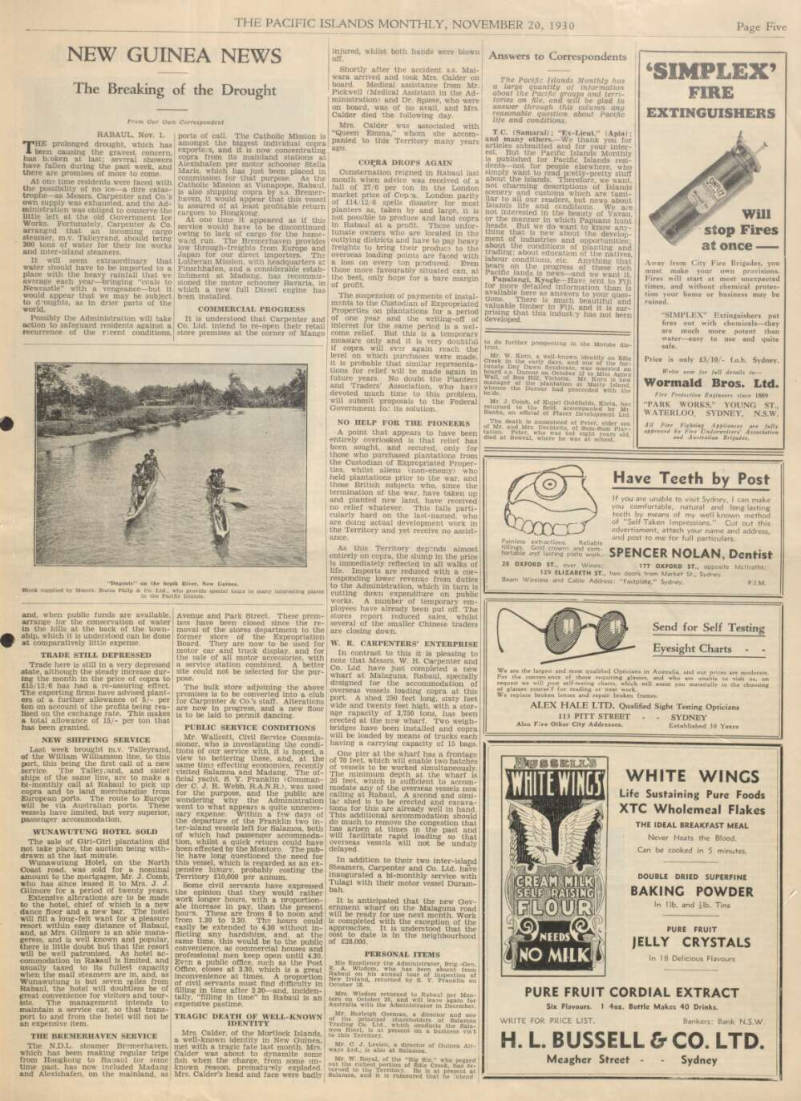
“Dugouts” on the Sepik River, New Guinea.
Block supplied by Messrs. Burns Philp & Co. Ltd., who provide special tours to many interesting places in the Pacific Islands.
Answers to Correspondents
The Pacific Islands Monthly has a large quantity of information about the Pacific groups and terri tories on file, and will he glad to answer through this column any reasonable question about Pacific life and conditions.
T.C. (Samarai); “Ex-Lieut.” (Apia); and many others.— We thank you for articles submitted and for your inter est. But the Pacific Islands Monthly is published for Pacific Islands resi dents —not for people elsewhere, who simply want to read pretty-pretty stuff about the islands. Therefore, we want, not charming descriptions of Islands scenery and customs which are fami liar to all our readers, but news about Islands life and conditions. We are not interested in the beauty of Vavau, or the manner in which Papuans hunt heads. But we do want to know any thing that is new about the development of industries and opportunities; about the conditions of planting and trading; about education of the natives, labour conditions, etc. Anything that bears on the progress of these rich Pacific lands is news—and we want it Papalangi, Kyogle—Have sent to Fiji for more detailed information than is available here as answers to your ques ts. There is much beautiful and valuable timber in Fiji, and it is sur prising that this industry has not been developed.
Advertisements & other items, p. 5 (1 item)
H.L Bussell & Co. Ltd.
FIRE
EXTINGUISHERS
Away from City Fire Brigades, you must make your own provisions.
Fires will start at most unexpected times, and without chemical protection your home or business may be ruined.
“SIMPLEX” Extinguishers put fires out with chemicals—they are much more potent than water —easy to use and quite safe.
Price is only £3/10/- f.o.b. Sydney.
Write now for full details to —
Wormald Bros. Ltd.
Fire Protection Engineers since 1889
“PARK WORKS,” YOUNG ST.,
WATERLOO. SYDNEY, N.S.W.
All Fire Fighting Appliances are fully approved by Fire Underwriters’ Association and Australian Brigades.
Have Teeth by Post
If you are unable to visit Sydney, I can make you comfortable, natural and long lasting teeth by means of my well known method of “Self Taken Impressions.” Cut out this advertisment, attach your name and address, n,- . . .. and post to me for full particulars.
Painless extractions. Reliable K fortable and lasting plate work. SPENCER NOLAN, Dentist 28 OXFORD ST., over Winns; 177 OXFORD ST., opposite Mcllraths; 139 ELIZABETH ST., two doors from Market St., Sydney.
Beam Wireless and Cable Address: “Fastplate,” Sydney. P.| M.
Send for Self Testing
Eyesight Charts
We are the largest and most qualified Opticians in Australia, and our prices are moderate.
For the convenience of those requiring glasses, and who are unable to visit us, on request we will post self-testing charts, which will assist you materially in the choosing of glasses yourse'f for reading or near work.
We replace broken lenses and repair broken frames.
ALEX HALE LTD. Qualified Sight Testing Opticians
113 PITT STREET - - SYDNEY
Also Five Other City Addresses. Established 30 Years
NEEDS
NO MILK
WHITE WINGS
Life Sustaining Pure Foods XTC Wholemeal Flakes
THE IDEAL BREAKFAST MEAL
Never Heats the Blood.
Can be cooked in 5 minutes.
DOUBLE DRIED SUPERFINE
BAKING POWDER
In 1lb. and 41b. Tins
PURE FRUIT
JELLY CRYSTALS
In 18 Delicious Flavours
PURE FRUIT CORDIAL EXTRACT
Six Flavours. 1 4oz. Bottle Makes 40 Drinks.
WRITE FOR PRICE LIST.
Bankers; Bank N.S.W.
H.L BUSSELL & CO. LTD.
Meagher Street - - Sydney
Pacific Islands Monthly
Published once a month, and circulated among residents of: New Guinea Fiji Solomon Is.
Papua Tonga New Hebrides Norfolk Is. Samoa New Caledonia Cook Is. Nauru Ocean Is.
Gilbert Is. Tahiti Thursday Is.
Read also by residents of Australia and New Zealand who are interested in Pacific Islands trade and activities.
Publishers: Pacific Publications, Union House, 247 George Street, Sydney. Tel.: BW 5037.
Editor: R. W. Robson.
Subscription Rates;
s. d.
Per annum, post free, within British Empire: in advance, 6/-; booked .. (3 6 Per annum, post free, beyond British Empire 8 8
Advertising:
Casual; Per single column inch 8 0 Contract; 6/6, 7/- and 7/6 per inch, accord ing to conditions.
Changes of advertising copy should reach publishers by 7th of each month.
Contributions:
Contributions on matters of Interest to Pacific Islands residents and traders are in vited; and, if accepted, will be paid for, on publication, at the rate of 2½d. per line.
Special payment for photographs. No respon sibility is taken for contributions forwarded; but, if return is desired in the event of rejec tion, a stamped and addressed envelope should be enclosed.
Distribution:
In Australia, New Zealand and Great Britain copies may be obtained from, and subscription orders lodged with, Messrs. Gordon & Gotch, Limited.
In the Pacific Islands, copies may be obtained from, and subscription orders lodged at any of the stores of Messrs. Burns Philp & Co.
Ltd Messrs. Burns Philp (South SeasJ Co Ltd., Messrs. W. R. Carpenter & Co. Ltd., and Messrs. Morris Hedstrom & Co. Ltd.
Vol. 1.—No. 4.
November, 1930.
Sharpshooters
Burns Philp And The
WE have received, since this journal was launched, a remarkable num ber of invitations to attack Messrs.
Burns Philp & Co. Ltd. Because we have not responded, we have ourselves been attacked, and accused of being “a B.P. show, anyway.” So, perhaps, a few words on the subject of B.P. and Co. will be timely—particularly just now, when so many people are suffering from the world’s economic sickness, and are ready to blame anyone for things they cannot understand.
A frequent complaint against the big firm is that, while receiving substan tial subsidies from the Commonwealth for maintaining certain shipping com munications, it provides poor and ex pensive services. The point to be re membered is that B.P. ships, unfortu nately, must register in Australia, and trade under the appallingly expensive conditions thereby imposed. They must pay Australian wage: rates, observe Australian working conditions, employ ing only white crews, and provide for the innumerable taxes which the Aus tralian politician, in his madness, im poses upon every form of enterprise.
The effect is that B.P., in comparison with the shipping lines of other coun tries, are enormously handicapped.
They have tried to be all-Australian in their activities; but, gradually, the in tolerable burdens imposed by Australia are forcing them to defensive measures, such as direct trading between the South Seas and Europe. Australia, thereby, is losing trade of inestimable value —but no one seems to care! If Australians think that bigger and bet ter ships should run to the Islands, they should remove some of the taxa tion from private enterprise, and espec ially from shipping.
Messrs. Burns Philp are criticised be cause of their large holdings in Islands properties, and their “strictness” in connection with accounts. If the B.P. companies had not been very efficiently conducted, and placed in a strong posi tion by shrewd and far-seeing direc tors, what chance would they, and the hundreds of planters and traders de pendent on them, have had of weather ing the present financial storm? The fact that powerful and wealthy cor porations are vitally interested in South Seas properties and industry is the South Seas residents’ best guarantee that, if it is possible, they will come safely through their present troubles.
Finally: This journal is privately owned and completely independent. Its purpose is to serve the best interests of the Pacific residents. If, in pursuance of that, it becomes necessary to attack corporation, or administration, or mis sionary organisation, that attack will be made, without fear or favour. But we see nothing to attack, at present. On the contrary, the burdens which the big corporations are being asked to carry are so onerous that, in the in terests of the whole community, they should be supported just now, rather than embarrassed by irresponsible criti cism.
Tropicalities
Written for The Pacific Islands Monthly by “Sea-Serpent”
A VALUED correspondent in Papua, who signs himself “Papuan,” sends along some more information concern ing that much-used word, “dohori,” or “dohore,” as he states it should be spelt. He gives as its meaning, “Not yet—presently.” He sends the follow ing example of its application: “A steamer has been sighted, and you ask a Motu man, ‘Is the steamer in?’ If she is not, he will reply ‘Dohore.’ ”
“Papuan” continues; “An Australian journalist visiting the Malay States, once wrote that he had found out what was the call of the East—it was ‘boy!’
There is so much ‘boy’ in Papua that the native has adopted ‘dohore’ in self defence, and what he means now', I think, is ‘Give me a chance, I am not a centipede.’ ” * * * WHEN the price of rubber fell on the London market to 3½d. per lb recently, it was generally accepted as a low record. But it has teen stated that very many years ago, before the indus try had developed in the East Indies, the Brazilian article sold in London for 2d. per lb. At the present price, it is doubtful if any plantation in the world is making a profit, although plantations in the East have greatly reduced pro duction costs in recent years. Sir Eric Geddes, chairman of the Dunlop Rub ber Co., which owns about 70,000 acres of planted rubber, stated recently that the production costs on the company’s plantations average 4½d. per lb. f.o.b. during the current year. For August this year, he estimated they were less than 4d., and, when new and improved areas come into tapping, a cost of un der 3d. per lb., f.0.b., is expected.
In Papua, where the value of rubber exported has been equal to that of copra, a price of Bd. per lb. is consid ered necessary to enable plantations to carry on. * * * IN spite of general depression in New Guinea, it looks as though the Ad ministration will not be kept waiting long before it commences to receive worth-while royalties from Morobe goldfields. New Guinea Goldfields an nounce that, commencing from Janu ary next, the profit from the alluvial deposits on their leases will be £4,000 per month. Crushings of the reef gold will not commence until more drilling and general exploration work has been done. Then there is Bulolo Gold Dred ging Ltd. The ’planes for taking in the huge dredges will be delivered very soon, and the transport and erection of the machinery will follow. The com pany estimates the profits from its Southern Bulolo leases will be in the vicinity of £2,800,000. It should take about 13 years before this property is worked out, and all the time the Ad ministration will be collecting its 5 per cent, royalty from the gross value of the gold. A rich reef has been devel oped by Day Dawn (New Guinea) Ltd., and crushing here should com mence early in the new year.
Apart from the Morobe field, the pos sibilities of the Sepik River and Ramu River headwaters are receiving the at tention of prospectors, and there is a good chance of something being opened up in these quarters.
FROM that hard-bitten N.S.W. politi cal warrior, Sir Thomas Henley, I have received a copy of his book, “A Pacific Cruise —Musings and Opinions on Island Problems.” Although it has no pretentions to literary style, and al though the author has rushed in to solve political problems where even the angels would fear to tread, I read the book from cover to cover, with keen in terest. Sir Tom has collected in these pages an amazing amount of chatty matter about Tonga and Samoa —much of it historically valuable, and all of it instructive and entertaining. He also publishes over 100 “human interest” photographs. The method and style of the book certainly pays tribute to the author’s habits of observation and philosophy.
With the best motives in the world, Sir Thomas went to Samoa, to study and give advice concerning that mass of political gunpowder. He strove very earnestly to find a “formula,” and was taken almost as seriously by a few people as he took himself; but the solution of the Samoan problem was not brought appreciably nearer. As a contribution to the literature on Sa moan politics, the book has little value; but it does throw some interesting side lights on Mau and anti-Mau personali ties. * * * TROUBLES, both financial and ad ministrative, crowded thickly upon Islands Plantations Ltd. during October and November, with the result that the enterprise has been more or less reorga nised. Its plan was to establish a bond selling business, based on the develop ment of coffee-plantations in New Guinea. It announced that Messrs.
Hanson, Washington and Pennefather, well-known New Guinea planters, were the directors; and it brought itself un der the notice of Sydney investors with a mighty flurry of publicity. But bond selling operations dragged; Mr. Wash ington publicly denied that he was a director of the company, or was res ponsible in any way for the prospectus; and finance became a serious problem.
Finally, the directors’ shares were taken over by a Mr. Knight, a well known Sydney bond salesman, and he is now trying to get the seriously crumpled enterprise back again on to the commercial rails. We hope he suc ceeds—for the sake of New Guinea. It would be a thousand pities if the development of this rich and wonder ful country were retarded by the pro motion and collapse of schemes that are fundamentally unsound. * * * THE Governor of Fiji, Sir Murchison Fletcher, is advocating the use of more copper coins in the Colony. He considers that it would help to bring financial relief by reducing the cost of living. He can see no obstacle in the way, and thinks that the scheme would be ideal in a country where so much native labour is used. It is reported that the banks are prepared to co operate with him in the plan. The 3d. piece is the lowest coin commonly used.
The use of silver is a legacy from the old days, when copper was almost un known.
Death Of Head Chief Of Nauru
From Our Canberra Correspondent
ON November 6 the Acting Prime Minister (Mr. Fenton) received a letter from Mr. W. A. Newman, Ad-
ministrator of Nauru, giving particu lars of the death of Daimon, Head Chief of the Island, whom he described as probably the most picturesque per sonality of the Pacific. Daimon died on October 21, aged 80 years.
Nauru was captured by an Aus tralian Expeditionary Force in 1914, and it supplies the greater part of the Commonwealth’s phosphate require ments.
Formerly, the Chiefdom of the Nauru district was an hereditary office, but in recent years the Chiefs have been se lected by the adult population. On the last occasion the election was con ducted by ballot, and it is interesting to note that the procedure of the Com monwealth electoral system was fol lowed, and that voting was compulsory!
Women are eligible to stand as candi dates. but no woman has held office as Chief since 1925.
The Chiefs are entrusted with the maintenance of order and other mat ters associated with local government in the districts under their control, and the Administrator presides at their periodical conferences. (An interesting account of Daimon’s life, and a tribute to his many fine qualities, specially written by Mr. W. A.
Newman. Administrator of Nauru, will be published in the December issue of this journal.)
Recent photograph of Daimon.
Notable Men of The Pacific
THE lucky star of the B.P. firm was in the ascendant one day 40 years ago, when a long, lean, dark youth entered the B.P. service as office-boy.
It was then a very modest establish ment, trading mostly with Queensland.
To-day, it is one of Australia’s biggest and soundest commercial institutions, with a capital running into millions and activities extending into every part of the world. The one-time office-boy is now Mr. Joseph Mitchell, general manager of one of the B.P. companies, and a director of all of them. He has been closely associated with almost every move in the enormous growth made by the B.P. firm and, in the course of his career, he has acquired an incomparable knowledge of the his tory, personalities, administrations and trading and industrial conditions in the Pacific Islands.
When Mr. Mitchell joined up, the big firm was running two schooners —the Myrtle from Cooktown to Port Mor esby, and the Ivanhoe from Cooktown to Samarai and Sudest. His early Islands experience was gained by an accident. Col. James Burns was a director of the Australasian-New Heb rides Company, formed to develop Bri tish interests in the New Hebrides.
Young Mitchell was appointed to assist the manager of this company (Mr. V.
R. Bowden) at its office in 10 Bridge St.
The Vila manager of the New Hebrides Company (Mr. Cooper) became ill, and Mr. Mitchell was sent down to relieve him. He was appointed to the mana gership, and remained there for several years.
There was no Government in the New Hebrides then, and the only law was the law of individual brain and muscle. Mr. Mitchell was happy enough—he stands 6ft. 2in. in his socks, and is built in proportion. Small men fared badly. Mr. Mitchell could fill a book with hectic stories of events in the New Hebrides 33 years ago.
Transferred back to Sydney to look after the B.P. firm’s growing Islands business, Mr. Mitchell had a great deal to do with the chartering of ships for Island voyages and the development of Islands trade. He has interesting mem ories of some notable ships of that time —the Kelloe, Karara, Mt. Kembla, Emu, Hesketh, Croydon, Wyrallah, Rob Roy, and others. They carried the B.P. traders into all corners of the Pacific.
About 1900, Messrs. Burns Philp bought their first steamer, the Titus, and on this staunch vessel Mr. Mitchell went trading to Papua, to Ralu (now Rabaul) to the Solomons; and he per sonally opened un the B.P. trade with the Gilberts, Ellice and Marshall Is lands. Coming back from his first trip, in the Titus, he stooped at and walked over Ocean Island, never dreaming that millions of pounds worth of phos phate lay beneath his feet. Mr. Mit chell, in the Titus, landed the first Resident Commissioner, Mr. C. M.
Woodfull, in the Solomons; and the first Administrator. Col. Spalding-, on Norfolk Island. In those days, there
were not 20 white residents in the Solo mons. The islands were overrun with cannibals and head-hunters, and no one slept ashore on the main islands — they stayed on their vessels, or main tained well-guarded residences on the small islets.
Later, Mr. Mitchell took over the management of his firm’s branch on Thursday Island and, whilst there, he established and managed the very profitable Wyben Pearl Shelling Co., of which he is at the present managing director. In 1912, he became the firm’s chief inspector, travelling regularly all over the South Seas.
After the outbreak of war, the big firm experienced difficulties in regard to shipping services. Mr. Mitchell went to the U.S.A., and established the B.P. Co., of San Francisco, which en gaged, in a big way and very profitably, in shipping activities. At one period of the war, it had nearly 70 ships under charter; and it also bought five ships outright. The American owners did not like the South Seas trade, because of risk of wreck. The B.P. Co. demon strated that these waters were quite safe for experienced mariners, with the result that the South Seas ports ob tained quite a good name among the American owners. The B.P. Co. of San Francisco is still an active and profit able corporation.
Mr. Mitchell returned from America after the Armistice and resumed his work as chief inspector. Subsequently, the B.P. (South Seas) Co Ltd. was in corporated, with Mr. Mitchell as gen eral manager. A little later, he became a director of that company and a direc tor of the main company.
His reminiscences are most interest ing and informative. In the New Heb rides, for instance, before the days of government, the B.P. firm established its own paper currency, mainly £1 and £5 notes. It also carried out the mail services throughout these islands, and it established its own postage stamps, which became widely known and rec ognised. Later, the N.S.W. Govern ment agreed to subsidise the B.P. ser vices with the New Hebrides—the first subsidy of the kind that was paid—but it made a condition that the B.P. post age stamp should be withdrawn, and N.S.W. stamps used instead. Sir Joseph Carruthers arranged the subsidy, and the details were carried out by Mr.
Murphy, then in the Lands Department, and afterwards Administrator of Nor folk Island. All kinds of silver circu lated. The basis of its value was the English florin. The value of any silver coin was in proportion to its size, com pared with a florin.
It is interesting to recall that Mr.
Mitchell, on some of his notable pio neering voyages—particularly in the Gilberts and Marshalls—was accom panied. by his wife, who shared many adventures with him. Few white women have a more extensive know ledge of the Islands of 20 and 25 years ago than Mrs. Mitchell.
Mr. Joseph Mitchell, General Manager of Burns Philp (South Seas) Co. Ltd.
Colony’s Founder
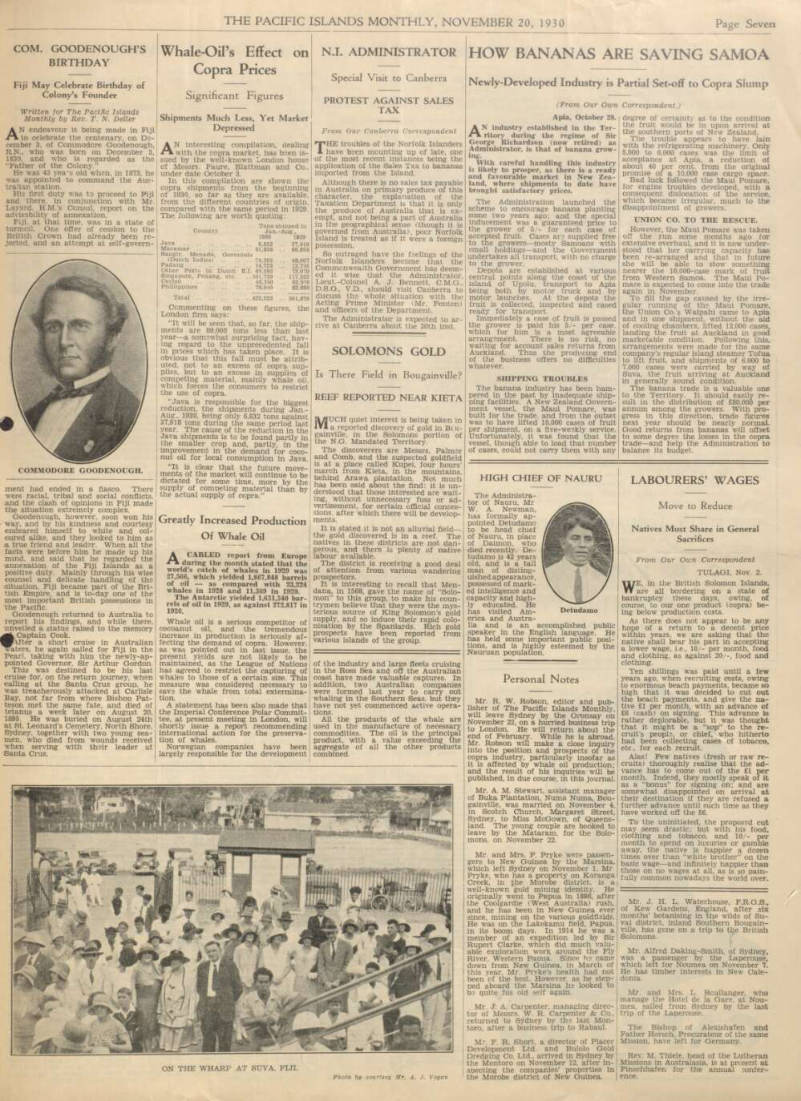
Com. Goodenough’S
Birthday
Fiji May Celebrate Birthday of Colony’s Founder Written for The Pacific Islands Monthly by Rev. T. N. Deller
AN endeavour is being made in Fiji to celebrate the centenary, on De cember 3, of Commodore Goodenough, R.N., who was born on December 3, 1830, and who is regarded as the “Father of the Colony.”
He was 43 years old when, in 1873, he was appointed to command the Aus tralian station.
His first duty was to proceed to Fiji and there, in conjunction with Mr.
Layard, H.M.’s Consul, report on the advisability of annexation.
Fiji, at that time, was in a state of turmoil. One offer of cession to the British Crown had already been re jected, and an attempt at self-govern-
ment had ended in a fiasco. There were racial, tribal and social conflicts, and the clash of opinions in Fiji made the situation extremely complex.
Goodenough, however, soon won his way, and by his kindness and courtesy endeared himself to white and col oured alike, and they looked to him as a true friend and leader. When all the facts were before him he made up his mind, and said that he regarded the annexation of the Fiji Islands as a positive duty. Mainly through his wise counsel and delicate handling of the situation, Fiji became part of the Bri tish Empire, and is to-day one of the most important British possessions in the Pacific.
Goodenough returned to Australia to report his findings, and while there, unveiled a statue raised to the memory Captain Cook.
After a short cruise in Australian waters, he again sailed for Fiji in the Pearl, taking with him the newly-ap pointed Governor, Sir Arthur Gordon.
This was destined to be his last cruise for, on the return journey, when calling at the Santa Cruz group, he was treacherously attacked at Carlisle Bay, not far from where Bishop Pat teson met the same fate, and died of tetanus a week later on August 20, 1895. He was buried on August 24th at St. Leonard’s Cemetery, North Shore, Sydney, together with two young sea men, who died from wounds received when serving with their leader at Santa Cruz.
Commodore Goodenough.
Copra Prices
Whale-Oil’s Effect on
Significant Figures Shipments Much Less, Yet Market Depressed
AN interesting compilation, dealing with the copra market, has been is sued by the well-known London house of Messrs. Faure, Blattman and Co., under date October 3.
In this compilation are shown the copra shipments from the beginning of 1930, so far as they are available, from the different countries of origin, compared with the same period in 1929.
The following are worth quoting;
Commenting on these figures, the London firm says: “It will be seen that, so far, the ship ments are 89,000 tons less than last year—a somewhat surprising fact, hav ing regard to the unprecedented fall in prices which has taken place. It is obvious that this fall must be attrib uted, not to an excess of copra sup plies, but to an excess in supplies of competing material, mainly whale oil, which forces the consumers to restrict the use of copra.
“Java is responsible for the biggest reduction, the shipments during Jan.- Aug., 1930, being only 6,832 tons against 37,918 tons during the same period last year. The cause of the reduction in the Java shipments is to be found partly in the smaller crop and, partly, in the improvement in the demand for coco nut oil for local consumption in Java.
“It is clear that the future move ments of the market will continue to be dictated for some time, more by the supply of competing material than by the actual supply of copra.”
Tons shipped in Country Jan.-Aug., 1930 1929 Java . . 37,918 Macassar . . . . 66,653 Sangir, Menado, Gorontolo (Dutch Indies) . . 54,202 . . 48,907 Padang .. 14,725 .. 12,795 Other Ports in Dutch E.I 69.092 73,070 Singapore, Penang etc. ..101,729 .. 117.332 Ceylon . . .. . . 62,500 Philllppines Total ..422,323 .. 501.879
Greatly Increased Production
Of Whale Oil
A CABLED report from Europe during the month stated that the world’s catch of whales in 1929 was 27,566, which yielded 1,867,848 barrels of oil as compared with 23,224 whales in 1928 and 11,369 in 1920.
The Antarctic yielded 1,631,340 bar rels of oil in 1929, as against 272,817 in 1920.
Whale oil is a serious competitor of cocoanut oil, and the tremendous increase in production is seriously af fecting the demand of copra. However, as was pointed out in last issue, the present yields are not likely to be maintained, as the League of Nations has agreed to restrict the capturing of whales to those of a certain size. This measure was considered necessary to save the whale from total extermina tion.
A statement has been also made that the Imperial Conference Polar Commit tee, at present meeting in London, will shortly issue a report recommending international action for the preserva tion of whales.
Norwegian companies have been largely responsible for the development
of the industry and large fleets cruising in the Ross Sea and off the Australian coast have made valuable captures. In addition, two Australian companies were formed last year to carry out whaling in the Southern Seas, but they have not yet commenced active opera tions.
All the products of the whale are used in the manufacture of necessary commodities. The oil is the principal product, with a value exceeding the aggregate of all the other products combined.
N.I. Administrator
Special Visit to Canberra
Protest Against Sales
Tax
From Our Canberra Correspondent THE troubles of the Norfolk Islanders have been mounting up of late, one of the most recent instances being the application of the Sales Tax to bananas imported from the Island.
Although there is no sales tax payable in Australia on primary produce of this character, the explanation of the Taxation Department is that it is only the produce of Australia that is ex empt, and not being a part of Australia in the geographical sense (though it is governed from Australia), poor Norfolk Island is treated as if it were a foreign possession.
So outraged have the feelings of the Norfolk Islanders become that the Commonwealth Government has deem ed it wise that the Administrator, Lieut.-Colonel A. J. Bennett, C.M.G., D. 5.0., V.D., should visit Canberra to discuss the whole situation with the Acting Prime Minister (Mr. Fenton) and officers of the Department.
The Administrator is expected to ar rive at Canberra about the 20th inst.
Solomons Gold
Is There Field in Bougainville?
Reef Reported Near Kieta
MUCH quiet interest is being taken in a reported discovery of gold in Bou gainville, in the Solomons portion of the N.G. Mandated Territory.
The discoverers are Messrs. Palmer and Comb, and the suspected goldfield is at a place called Kupei, four hours’ march from Kieta, in the mountains, behind Arawa plantation. Not much has been said about the find: it is un derstood that those interested are wait ing, without unnecessary fuss or ad vertisement, for certain official conces sions, after which there will be develop ments.
It is stated it is not an alluvial field— the gold discovered is in a reef. The natives in these districts are not dan gerous, and there is plenty of native labour available.
The district is receiving a good deal of attention from various wandering prospectors.
It is interesting to recall that Men dana, in 1568, gave the name of “Solo mon” to this group, to make his coun trymen believe that they were the mys terious source of King Solomon’s gold supply, and so induce their rapid colo nisation by the Spaniards. Rich gold prospects have been reported from various islands of the group.
How Bananas Are Saving Samoa
Newly-Developed Industry is Partial Set-off to Copra Slump
(From Our Own Correspondent.)
Apia, October 28.
AN industry established in the Ter ritory during the regime of Sir George Richardson (now retired) as Administrator, is that of banana grow ing.
With careful handling this industry is likely to prosper, as there is a ready and favourable market in New Zea land, where shipments to date have brought satisfactory prices.
The Administration launched the scheme to encourage banana planting some two years ago; and the special inducement was a guaranteed price to the grower of 5/- for each case of accepted fruit. Cases are supplied free to the growers—mosty Samoans with small holdings—and the Government undertakes all transport, with no charge to the grower.
Depots are established at various central points along the coast of the island) of Upolu, transport to Apia being both by motor truck and by motor launches. At the depots the fruit is collected, inspected and cased ready for transport.
Immediately a case of fruit is passed the grower is paid his 5/- per case, which for him is a most agreeable arrangement. There is no risk, no waiting for account sales returns from Auckland. Thus the producing end of the business offers no difficulties whatever.
Shipping Troubles
The banana industry has been ham pered in the past by inadequate ship ping facilities. A New Zealand Govern ment vessel, the Maui Pomare, was built for the trade, and from the outset was to have lifted 10,000 cases of fruit per shipment, on a five-weekly service.
Unfortunately, it was found that the vessel, though able to load that number of cases, could not carry them with any
degree of certainty as to the condition the fruit would be in upon arrival at the southern ports of New Zealand.
The trouble appears to have lain with the refrigerating machinery. Only 5,000 to 6,000 cases was the limit of acceptance at Apia, a reduction of about 40 per cent, from the original promise of a 10,000 case cargo space.
Bad luck followed the Maui Pomare, for engine troubles developed, with a consequent dislocation of the service, which became irregular, much to the disappointment of growers.
Union Co. To The Rescue.
However, the Maui Pomare was taken off the run some months ago for extensive overhaul, and it is now under stood that her carrying capacity has been re-arranged and that in future she will be able to stow something nearer the 10,000-case mark of fruit from Western Samoa. The Maui Po mare is expected to come into the trade again in November.
To fill the gap caused by the irre gular running of the Maui Pomare, the Union Co.’s Waipahi came to Apia and in one shipment, without the aid of cooling chambers, lifted 12,000 cases, landing the fruit at Auckland in good marketable condition. Following this, arrangements were made for the same company’s regular island steamer Tofua to lift fruit, and shipments of 6,000 to 7.000 cases were carried by way of Suva, the fruit arriving at Auckland in generally sound condition.
The banana trade is a valuable one to the Territory. It should easily re sult in the distribution of £80,000 per annum among the growers. With pro gress in this direction, trade figures next year should be nearly normal.
Good returns from bananas will offset to some degree the losses in the copra trade—and help the Administration to balance its budget.
High Chief Of Nauru
The Administra tor of Nauru, Mr W. A. Newman, has formally ap pointed Detudamo to be head chief of Nauru, in place of Daimon, who died recently. De tudamo is 42 years old, and is a tall man of disting uished appearance, possessed of mark ed intelligence and capacity and high ly educated. He has visited Am erica and Austra-
lia and is an accomplished public speaker in the English language. He has held some important public posi tions, and is highly esteemed by the Nauruan population.
Detudamo
Personal Notes
Mr. R. W. Robson, editor and pub lisher of The Pacific Islands Monthly, will leave Sydney by the Oronsay on November 22, on a hurried business trip to London. He will return about the end of February. While he is abroad, Mr. Robson will make a close inquiry into the position and prospects of the copra industry, particularly insofar as it is affected by whale oil production; and the result of his inquiries will be published, in due course, in this journal.
Mr. A. M. Stewart, assistant manager of Buka Plantation, Numa Numa, Bou gainville, was married on November 4, in Scotch Church, Margaret Street, Sydney, to Miss McGown, of Queens land. The young couple are booked to leave by the Mataram, for the Solo mons, on November 22.
Mr. and Mrs. F. Pryke were passen gers to New Guinea by the Marsina, which left Sydney on November 1. Mr.
Pryke, who has a property on Koranga Creek, in the Morobe district, is a well-known gold mining identity. He originally went to Papua in 1896, after the Coolgardie (West Australia) rush, and he has been in New Guinea ever since, mining on the various goldfields.
He was on the Lakekamu field, Papua, in its boom days. In 1914 he was a member of an expedition led by Sir Rupert Clarke, which did much valu able exploration work around the Fly River, Western Panua. Since he came down from New Guinea, in March of this year. Mr. Pryke’s health had not been of the best. However, as he step ped aboard the Marsina he looked to be quite his old self again.
Mr. J. A. Carpenter, managing direc tor of Messrs. W. R. Carpenter & Co., returned to Sydney by the last Mon toro, after a business trip to Rabaul.
Mr. F. R. Short, a director of Placer Development Ltd. and Bulolo Gold Dredging Co. Ltd., arrived in Sydney by the Montoro on November 12, after in specting the companies’ properties in the Morobe district of New Guinea.
Mr. J. H. L. Waterhouse, F.R.G.S., of Kew Gardens, England, after six months’ botanising in the wilds of Su vai district, inland Southern Bougainville, has gone on a trip to the British Solomons.
Mr. Alfred Daking-Smith, of Sydney, was a passenger by the Laperouse, which left for Noumea on November 7.
He has timber interests in New Cale donia.
Mr. and Mrs. L. Boullanger, who manage the Hotel de la Gare, at Nou mea, sailed from Sydney by the last trip of the Laperouse.
The Bishop of Alexishafen and Father Horsch, Procurateur of the same Mission, have left for Germany.
Rev. M. Thiele, head of the Lutheran Missions in Australasia, is at present at Finschhafen for the annual conference.
On The Wharf At Suva. Fiji.
Photo by courtesy Mr. A. J. Vogan
Labourers’ Wages
Move to Reduce Natives Must Share in General Sacrifices
From Our Own Correspondent
Tulagi, Nov. 2.
WE, in the British Solomon Islands, are all bordering on a state of bankruptcy these days, owing, of course, to our one product (copra) be ing below production costs.
As there does not appear to be any hope of a return to a decent price within years, we are asking that the native shall bear his part in accepting a lower wage, i.e., 10/- per month, food and clothing, as against 20/-, food and clothing.
Ten shillings was paid until a few years ago, when recruiting costs, owing to enormous beach payments, became so high that it was decided to cut out the beach payments, and give the na tive £1 per month, with an advance of £6 (cash) on signing. This advance is rather deplorable, but it was thought that it might be a “sop” to the re cruit’s people, or chief, who hitherto had been collecting cases of tobacco, etc., for each recruit.
Alas! Few natives (fresh or raw re cruits) thoroughly realise that the ad vance has to come out of the £1 per month. Indeed, they mostly speak of it as a “bonus” for signing on; and are somewhat disappointed on arrival at their destination if they are refused a further advance until such time as they have worked off the £6.
To the uninitiated, the proposed cut may seem drastic; but with his food, clothing and tobacco, and 10/- per month to spend on luxuries or gamble away, the native is happier a dozen times over than “white brother” on the basic wage—and infinitely happier than those on no wages at all, as is so pain fully common nowadays the world over.
Discovery by Patrol Officer
Gold In Papua
Rich Specimens From
Wild Country
(From Our Own Correspondent.) Port Moresby, October 10.
A PATROL Officer attached to the Kambisi police camp, Mr. J. G.
Hide, reported finding gold when on his way home from a patrol, in a tri butary of the Tari River, not far from Mt. Lawson.
Since then there has been a mild gold rush and a good deal of activity amongst those men in Port Moresby who find themselves able to follow on.
The find is in very rough country, far from the beaten track and amongst natives who are far from civilised and in places quite definitely hostile.
Mr. Hide considers his find of con siderable value and brought specimens down with him.
A small party of four men have al ready gone off and others are follow ing shortly to stake out claims and try their fortunes.
Perhaps Papua will yet prove to be the El Dorado it was once hoped it would be.
The "Overtaxed" Tongan
Readers Communicate Their Views
Typical Tongan’s Taxes To The Editor
The following two letters have been received from readers of The Pacific Islands Monthly in Tonga, and express their views on the subject of the taxation of natives of that group.
The article referred to by the writers appeared in our September issue.
Sir; Since taxation in Tonga forms the basis of your correspondent’s first contribution to your pages, no apology should be needed from one seeking further elucidation.
If the facts are as stated by your corres pondent then, the Tongan is indeed in a very enviable position. He contributes to the Gov ernment an annual sum of £2/14/-, and re ceives, as a “quid pro quo,” land, education and medical attention, and your readers are left to infer that this annual contribution of £2/14/- constitutes the whole burden he has to bear.
If the position—thus briefly summarised — was “fact” there would be no need to invoke either the grace of cocoa, or the saving effi cacy of bananas, to save Tonga. The little country would be, in spite of the low price of copra, in a very prosperous condition.
Balancing The Budget
This mythical Tongan having served your correspondent’s purpose is left with his pigs and poultry, while his creator proceeds to a general review of parliamentary proceedings, and, unfortunately for his “facts,” reveals that the “finalised budget” calls for £85,630 of revenue, and since your correspondent for gets to inform your readers how far this “Typical Tongan’s'’ remittance of £2/14/per annum meets this —for such a small coun
try—exorbitant sum, we endeavour to supply the omission.
The poll tax, which can be more closely esti mated than any other item of revenue is, for the current year, expected to yield £12,000.
This, at 36/- per head, gives about 6,700 tax payers, not all of whom will be contributing land, horse or gun tax, but to not unduly em barrass your correspondent we will assume that they each contribute £2/14/-, which will yield approximately the sum of £ 18,000.
But the Government requires nearly £70,000 in excess of the “Typical Tongan’s” contribu tion. This is real “fact.”
May I ask your correspondent who provides it? He has dismissed his mythical Tongan from the “mise en scene” after accepting his £2/14/-, and cannot very well recall him from his worry over his pigs to worry over a trifling sum of £70,000 I’ve oft heard stories men called “cock-and bull,”
But tales about a Tongan pig and hen Pail to obscure the “fact” I sadly pen— The Tongan’s taxed beyond all human ken.
Yours faithfully,
Toga-Ma-Toga.
Conditions in the Group
To The Editor
Sir: I have read with interest an article from your Tongan Correspondent, which appeared in your issue of Sept. 16, but I fail to appreciate the points he wishes to impress upon your readers.
Commenting upon taxation, he asserts the native pays to the Government 36/- per an num poll tax. The Treasurer estimates he will receive from this source £12,000 this cur rent year. This means there are some 6,600 taxpayers in the kingdom, and, as he esti mates the expenditure for the year will be £84,555, your correspondent does not state where the difference (£72,555) is to come from.
Your correspondent quotes a “typical case” of native contentment, which appears to me as if he wishes your readers to believe that many of the taxpayers enjoy this content ment, and that Tonga is a very happy and prosperous land. He does not mention that hundreds of taxpayers do not possess land, nor anything of the hundreds who have land which produces little, if anything. I have been in the kingdom for many years, but I have not yet met any native situated as your correspondent’s “typical case.”
Commenting upon the banana industry, your correspondent states “Bananas is a catch crop that may yet be the salvation of Tonga.”
What does he mean? If Tonga is full of his “typical cases” it needs no salvation.
A further statement he makes in his letter Is “The Government Executive asked Parlia ment to grant relief by abolishing the horse tax, 4/-; dog tax. 1/-; and town tax, 4/-.
This was done, but he does not inform your readers that Parliament Increased the amount of personal emoluments by £3,756.
For the past three years, much controversy has taken place regarding taxation and the cost of administration, opinions differing therefore, to enable your readers to figure the matter out for themselves, I would state: The population of Tonga is approximately 26,000. The sources of income are copra, in terest on investments, and several minor ones.
The Government estimate that 16,000 tons of copra will be exported this current year. The value of this copra to the native, computed on the basis of the average price paid to him on Tongatabu for the past two years, is £192,000. This includes 20/- export duty he does pay to the Government indirectly—to day’s value is £48,000, less interest on in vestments brings in £7,800, and if we assess the amount of public money expended in so cial services in the country, together with the receipts from minor sources at £40,000 we get a total of £239,800. May we not take this as the income of the Kingdom? An average of £9 per head of population.
How The Income Is Expended
The Treasurer estimates the expenditure for the year at £84,555, being 35 per cent, of the income, or on to-day’s value of copra to the native, 48 per cent. The expenditure is clas sified as: Personal emoluments .. .. £45,913 Public works £ 16,494 Other charges £22,148 Total £84,555 Of personal emoluments the European offi cers and pensioners, 51 of them absorb £20,459, an average cost per head of popu lation 15/8; native officials absorb £25,454.
Administration of law, gaols and police costs, £ 11,634 —9/- per head of population—educa tion, £7,100; medical, £7,377; and other pay ments, which include nat.ve salaries, £37,985.
This amounts to 29/2 per head of population.
The Treasurer estimates he will receive from import dues £23,500 during the current year.
At tariff rates the value of the imports wil be approximately £190,000. As European re quirements are not one-tenth of this, it is ob vious that the native requires things that he cannot get off his allotment, and on these requirements, such as wearing apparel, tools, drays, harness, etc., he is taxed to the extent of 12½ per cent, import duty. After satis fying his Government, there is hardly any thing left to buy other things he may want.
Revenues of Governments to meet their ex penditure are raised from taxation direct and indirect. Whilst the European in this coun try has no direct taxation, he contributes a full quota by indirect taxation, viz.; the duties imposed on practically all that he eats, drinks, smokes, wears and uses. But as there are but a few of them, the great bulk of the revenue must of necessity come from the native; and his present position shows that the expend ture in relation to the income of the kingdom is excessive, and at the present time altogether too heavy for him to stand up to unless he 1 to be regarded in the nature of a beast of burden.
Recently, a full meeting of the Tonga Cham ber of Commerce was held, at which the fol lowing resolution was unanimously carried: “That in view of the marked decline in the national income of the Kingdom of Tonga through the heavy and probably per manent fall in the price of copra, and in view of the impoverished condition of the Tongan people and the great restriction of trade as a consequence, this Chamber re gards with surprise and alarm the continual heavy expenditure by the Tongan Govern ment, with its undue pressure upon the people, and recommends as the only proper and prudent course, a drastic reduction to expenditure in all departments.”
Yours, etc.,
Ikai Ka Ka.
Suspicious Fire Quelled by Chinese
Apia Observatory
Suspicious Fire Quelled by Chinese Watchman
A blaze, originating in a pile of dried cocoanut fronds, nearly caused the des truction of the Apia Ooservatory, West ern Samoa, last month. Fortunately, a Chinese watchman saw the flames and extinguished them before much damage was done.
The fronds were lying alongside the kitchen, a wooden building, situated not many feet away from the mam building, also of wood, with a concrete base.
This is the second time within a few weeks that “accidents” have occurred in connection with the Observatory buildings. On the first occasion an attempt was mads to break in through the front door from the verandah. The windows were smashed by stones and the wire mosquito netting torn from the main door.
Extend Preference
To New Caledonian Produce Value of Reciprocal Trade
Written for The Pacific Islands Monthly by Mr. C. J. Sullivan, Island Agent and General Mer chant, of Sydney.
IT is time that something was done in the way of giving customs preference to New Caledonia by the insertion of a “most favoured na tion” clause in the Australian tariff.
If we are to expand our export trade or even retain our present figures, that is absolutely essential. New Caledonia has been a good customer of Australia, and it is only fair to encourage recip rocal trade.
New Caledonia, although a French Colony, has been described as a “com mercial dependency” of Australia. It is closer to this country than to any other important land, and this prox imity should naturally ensure that a large proportion of New Caledonian im ports particularly foodstuffs should come from Australia.
Until recently, this was so. New Caledonia has been and still is a very good customer to Australia, although our last year’s exports there are down to £264,000, compared with £460,000 ten years ago.
The decline must be largely attrib uted to our foolish tariff policy—fool ish in that it does not discriminate be tween customer and non-customer.
Admitting that the grave state of our national finances demands restriction of imports and, if possible, expansion of our export trade, surely it is abso lute folly to rouse the ire of good cus tomers by practically prohibiting im ports from them, especially when it happens—as in the case of France— that our exports are many times in excess of imports from them.
New Caledonia, as a French Colony, must naturally react to any retaliation on Australia by France. The Caledon ians are friendly—very friendly—dis posed indeed towards Australia. The writer cannot speak too highly of the kindness and courtesy he has received from all classes there, and Australian tourists, who visit the country, always come away charmed with the place and its people; but the New Caledonians are loyal Frenchmen, and must naturally be dissatisfied with the trading condi tions between the two countries.
Black Labour Problem
Whenever the question of preference to Pacific Island produce is raised, the voice of the demagogue sneers “black labour.” Admittedly so—and this wri ter is an ardent believer in the White Australia policy—but seeing that we must import commodities produced in black labour countries, it is to our ad vantage to give preference to our cus tomers.
We buy coffee, for instance, from East Africa, India, West Indies, Abys sinia, Arabia, East Indies, etc., and, with the exception of the East Indies and India we sell them absolutely no thing in return, and even with those countries our trade balance is millions of pounds on the wrong side of the ledger.
Coffee is but one of the many arti cles imported into Australia which could be obtained from New Caledonia and other Pacific Islands, and it can not be denied that a preference ex tended, however small, would be of great assistance to Island planters, and react to our own advantage by increasing the spending power of con sumers of our own products.
Over a period of four years since July 1, 1925, there have been 161 changes in the personnel of the pub lic service of the Mandated Territory of New Guinea. Of this number 32 officers resigned, due to the discovery of gold in the Territory, and 15 owing to ill-health. Unsatisfactory services were responsible for 44 dismissals.
The enumerated and estimated native peculation of the Territory of New Guinea on June 30, 1929, was 339,841 an increase of 16,557 over the number for the preceding year.
Altering for the Worse
Conduct of Papuans Attitude Towards White Women
“One heard on all sides the ex pressed opinion that the Papuan is altering, and not for the better.
From my short four years among them, I know it to be true. It seems as though a legislation and education, originally designed for their protection and uplift, is pro ducing merely arrogance and con ceit, as well as a tendency to re gard the white race with contempt, if not absolute disrespect, and thinly-veiled hostility.”
This is how Alice J. Keelan sums up the Papuan in her very readable book, “In the Land of Dohori.” It describes life in Papua, where her husband was a public official.
“To support these opinions,” she says, “many occurrences were quoted to me, but the most irrefutable of all were the shocking happenings between native boys and white women, or small white girls, of three, four and five years of age, that at times set the white com munity seething with indignation.
These are not of as frequent occurrence as may be imagined, but the fact of their occurring at all, when in former years they were unknown, is regarded as indicative of the trend of native opinion and proof of anything but im provement in the native outlook. The sentences imposed for such offences were frequently considered inadequate by the majority of the white popula tion, and at times fanned their resent ment to fever heat.
“The adoption of a sort of ‘hush” policy regarding matters did not tend to improve things in that respect, since was considered that, by the stifling of publicity, a shelter was provided for a wrongdoer. But an atmosphere of dif fidence—or is it self-interest? —seemed to preclude any public expression of outspoken thought on the subject.
“Without desiring to hold a brief for the native, justice compels the theory that, knowing many white men regard the native woman as their legitimate prey, the Papuan, apparently coming to regard himself as the white man’s equal, may possibly feel justified in re garding the white woman from the same point of view.”
The book is entertaining and instruc tive, and contains many character sketches and anecdotes of both the white and coloured communities, as well as sidelights on the Administra tion. It gives a somewhat startling in dication of the conditions with which-, white women have to contend in the remoter administrative stations.
“In the Land of Dohori” is published by Messrs. Angus and Robertson, at
7/6.- R.S.K.
Three Vessels Lost
Methodists’ Bad Luck
Foundering Of John
Wesley
The Methodist Missionary Society has been most unfortunate during the past three months. Over that period it has lost three of the valuable ketches with which it maintains communica tion throughout the islands groups.
The McBride was lost in the North ern Territory; the Bromilow off the east coast of Papua; and then came news of the foundering of the John Wesley, near Lakeba, in Fiji.
The Chairman of the Fiji District,.
Rev. R. L. McDonald, in a letter to the General Secretary in Sydney, said that the John Wesley struck the Argo- Reef and sank in 15 to 20 minutes, in about three fathoms of water. The dinghy was launched (directly after the impact and passengers and crew reached Lakeba, 30 miles away.
It was expected that the vessel could be salvaged, so a party left Suva for that purpose. A cable later reached Sydney stating that this was carried out and that she was towed to Lakeba. An examination showed that the vessel had been badly dam aged through pounding on the reef, and experts have advised that it is not worth carrying out repairs.
New Mission Yacht For
Vila
The auxiliary yacht Le Phare, of 20 tons gross, left Sydney last month for Vila, New Hebrides, where she will run in the service of the Seventh Day- Adventist Mission.
The vessel is equipped with a 45horse-power Diesel engine.
The total expenditure on medical and sanitary services by the New Guinea Administration during the year 1928-1929 was £71,726. This represents: about one-fifth of the total revenue of the Territory, which was £350,976 Revenue from the medical and sani tary services totalled £16,221.
Advertisements & other items, p. 8 (1 item)
Capstan
Vitality and Health are the
Main Factors in Every-day Life
Put yourself in the hands of Specialists who have made an intelligent study of your requirements; it is vital to your health.
W e are known everywhere as the Suppliers of the Right Goods and which put the VITAL into VITALITY. 35 years is our record of supplying Fresh Fruit, Vegetables and Produce to the leading Houses throughout the world.
GET FULLY ACQUAINTED WITH US
Tel.: MA 4799; FX 4350 Private Cable Address: PIGS, SYDNEY. Code: BENTLEYS
C. G. PIGGOTT
WHOLESALE FRUIT AND PRODUCE MERCHANTS
DIRECT IMPORTERS AND EXPORTERS.
SYDNEY.
Office, Bulk Stores & Packing House: Fruit Exchange, Sydney Sales Dept.: Fruit Exchange and City Markets, Sydney Bank of N.S.W. Bankers.
CAPSTAN
CIGARETTES
Poisoned
Minds Of Natives
New Guinea Opinions
Praise For District
Officers
From Our Rabaul Correspondent THE interview with a “well-known planter” appearing in your issue of September 16, on the subject of natives being taken to Australia, has aroused a good deal of comment, both favourable and unfavourable.
Most residents deprecate the practice, and there is no doubt that a great deal of harm results. The “boy’s” morale suffers by the unwonted attention paid him by the curious-minded, and, in some instances, the undesirable atten tions of low-class whites.
On his return, he relates his experi ences —much distorted and invariably to the detriment of the white race—to his associates. In the majority of cases there is no real need to take natives to Australia, and, considering the few who really need servants en route, the prac tice should be stopped.
It is perhaps hard to believe, but, with quite a number of people, the mo tive underlying the wish to be accom panied by native servants is pure “swank,” occasioned by a desire to cre ate an impression on friends in Aus tralia. In such cases, it appears that in order to satisfy a foolish conceit, the mind of a native is poisoned, and the prestige of the white man lowered.
It is well known that, when natives ac company private residents to Australia, they usually become a hindrance, and are frequently left much to their own devices with disastrous results. Except under the care and supervision of the or Education authorities, no should be permitted to leave the
Efficiency Of Public Service
But in ventilating the above subject, your informant rather covertly attacks our District Officers.
The writer would not refer to this, except that the impression may be con veyed that our District Officers are a regiment of rag-tag and bob-tail indi viduals, undertaking the difficult task of administering our Ordinances with no experience or qualifications for such work. Admittedly, we have not men highly trained in Colonial administra tion, and this Territory, being self-sup porting and not in receipt of subsidies, has probably not been in a position to offer conditions that would attract such men.
Our public service was necessarily built up from the material available at the close of the military regime, and we now have, by a process of elimina tion, a body of men of sound common sense and intelligence, who have very successfully tackled their jobs.
The reference your “well-known planter” makes to the previous occupationss of certain of our District Officers is unfair and, in so doing, he treads on exceedingly thin ice.
If an investigation were made into the previous occupations of many of our planters, prior to their acquisition of plantations, you would have a list so varied that many of your readers would be puzzled to know how such men could manage even a coconut plan tation successfully.
Monthly
Pacific Islands
How To Order Your Copy
Order Form
Fill in the following form, and post direct to Pacific Publications Union House, 247 George Street Sydney or lodge with any of the stores of Burns Philp & Co. Ltd., W. R. Carpenter & Co. Ltd . or Morris, Hedstrom Ltd.; or Whitten Bros. (Samarai and Port Moresby); or James Muir (Suva), To Pacific Publications Union House, 247 George St., Sydney Please send me The Pacific Islands Monthly jor a period of - months from receipt hereof.
Herewith find sum of...- ,being subscription in advance at rate of 6/- per annum, post free. OR Please charge to me at the rate of 6/6 per annum. (Strike out lines not wanted) Hame full Address Signature of person sending the order: Date
Our Fijian Newsletter
Strictest Economy Being Exercised Government Grant For Air Service Opposed
From Our Own Correspondent
Suva, Oct. 30.
HIS Excellency the Governor is very much interested in improving com munications and roads, and it was through his energy that a flying service was started in the Colony, the com pany receiving £1,500 for six months, with a suggestion that the subsidy might be continued.
The company had decided that, if it received this assistance, it would im port a twin-engined ’plane, capable of carrying, say, four passengers. But when the vote come before the Legis lative Council, when considering the estimates, the Elected Members, who had been fighting hard to cut down ex penditure, in order to balance the Bud get, were faced with the item “£3,000 for air services.”
They opposed it, while confessing that their action might appear to be re trogressive. His Excellency said that he was very keen to have the service, but he recognised that the strictest economy was necessary, so with reluct ance agreed to the deletion of the item.
General regret is expressed at the decision, but the Elected Members said: “How could we impose fresh taxation upon flour, salt, meats, tobacco, etc., and then vote away £3,000 upon what must, after all, be regarded as a lux ury?”
The company will carry on with the subsidy for 1930 until December 31, but so far nothing has been decided as to what will happen after that date. Our new air stamp is therefore still “up in the air.”
New Wakaya
Lighthouse
Another notable work has been completed, and completed well, by the men of the Public Works De partment. It is the new lighthouse which has just been erected on the border of the reef, five miles out from the island of Wakaya.
The old lighthouse had survived its term of usefulness, and a better one was needed, so a site was chosen right on the edge of the reef, and here, exposed to
the rolling of the Pacific, 20 men waged war with the elements for 7 long months.
The building measures 28ft. by 27ft. at the base. The work was carried out by Mr. Fred Midson, assisted by three half-caste foremen and 16 labourers.
For days little progress could be made, because of the heavy seas, which threatened to sweep the party away, and for days at a time no work was possible, but as soon as they could get a footing, on went the work. The men had to travel back and forth for five miles, morning and evening, to their camp on the island. The actual work ing period occupied five months and fifteen days. While the base was being constructed, the men had to work in water, as at the very lowest tide there was 18 inches of water on the reef.
The lighthouse will prove of great benefit to all mariners trading in the Koro Sea. Great credit is due to Mr.
Midson and his men for their good work.
A Quick Reply
When the Legislative Council was dis cussing a trade agreement. Sir Henry Scott said that the C.S.R. Co. should be applauded for charging New Zealand only £50 per ton for sugar during the war, when the world’s price was £100 per ton. His Excellency raised a quick laugh when he promptly replied: “I think it was this Government that de served the applause, in that it did not charge £50 per ton duty on the sugar, ere it left the Colony.”
Hindu Propaganda
The Pacific Press —a Suva weekly, printed in English, Hindi and Fijian— published an article in Hindi which was headed ‘‘May the British Empire be destroyed?” Then followed an ar ticle taken from an Indian anti-British paper wherein were offensive passages regarding the attitude of India to the Empire.
In the Legislative Council, the Hon.
A. Barker was informed, in reply to his question, that the Government had seen the article, and was considering the introduction, at an early date, of a Bill, to provide punishment for sedi tious acts and seditious libel to facili tate the suppression of seditious publi cations, and to provide for the suspen sion of newspapers containing seditious
matters. The incident caused some ex cited comment “on the beach.’’
Fijian Cricketer
Fiji is proud of the records of its Fijian lad, E. T. L. Cakobau —a descen dant of the first “King of Fiji,” as he was called King Cakobau—who is a student in Auckland. Playing for the Eden Club, this young Fijian gave fur ther evidence of the cleverness of the native with the cricket bat, by knock ing up the fine average for four in nings of 109.33. We hope to see him in action in Suva, as he is coming home for the Christmas holidays.
A Plane’S Chapter Of Acci
Dents
Mr. Marlow’s Domier Lipelle flying boat has had a series of accidents re cently along the south coast.
While taxi-ing, the ’plane hit a coral patch, tearing two rivets out of the bot tom, and the cylinder head gaskets were found to have blown. After a lot of bother and hard travelling, the spare parts were taken overland to the boat, and repairs effected.
Captain Man flew to Sigatoka, where the plane was fully tested, but the revolutions again dropped below the minimum in the air, and further in vestigations showed that the valves re quired regrinding, copper from the blown cylinder head gaskets having been deposited in the valve seatings.
Again this was remedied, and after a test of an hour in the air passengers were taken up for joy rides.
After a while, when the revolutions again dropped, a forced landing be came necessary, so the ’plane made for the river, and safely landed upon the water. It was slackening speed when the pilot suddenly saw several natives bathing in the river, right in front of the machine. All would probably have gone well, but the passenger got “the wind up,” and in his trepidation, kicked or hit the throttle wide open, and to avoid killing the natives, Captain Man had to make straight for the bank.
Happily no one was hurt, but the luckless ’plane came home to Suva in a cutter in pieces. Repairs are being ef fected, and she will soon be again in the air.
Farewells To Mr. Caughley
Mr. J. Caughley, M.A., who is retiring from the Fiji Civil Service as Director of Educa tion, has about established a record in fare wells. Within the past few days he has re ceived addresses and presents from many In dian bodies, including being garlanded and receiving over nine addresses from a great assemblage of Indian children in the Imperial Picture Hall; a presentation from the Bowling Club; a presentation and dinner from the teachers, and many other farewells. His daughter, Miss Caughley, received a farewell tea and presentation from over 60 ladies at the Grand Pacific Hotel last Saturday. The party leaves for New Zealand by the Niagara.
Death Of Well-Known
Citizen
The death is announced of Cr. W. H. Terry, head of W. H. Terry & Son, shipbuilders and ship chandlers. Mr. Terry had been in the hospital for some weeks. He was 63 years old, and had been in Fiji since he arrived from Melbourne as a boy with his parents. He occupied many positions of trust, and was for many years a town councillor. He was also a member of the Central Board of Health.
President of the Suva Cricket Club, and elder of St. Andrew’s Church. He caused a sensa tion some little time ago by resigning the presidency of the Cricket Club, as a protest against the committee’s decision to play on Sundays.
Personal
His Excellency the Governor left by H.M.C.S. Pioneer for a fortnight’s cruise, which will take in Levuka, Ellington, Lautoka Ba and Nandi, and then on to the Yasawas Group, and later out over the 500 miles of ocean to the lonely Island of Potumah. Sev eral officials accompany His Excellency, and at each centre the natives are arranging a welcome with the customary native cere monies.
Mr. A. P. Matthews has come to Suva from Marton, New Zealand, as manager of the Bank of New Zealand, vice Mr. S. T.
Uren. The retiring manager has not had very good health of late, and it is reported is going off on six months’ leave. Mr. Uren has been a regular member of the bowling club, and he will leave many friends behind him.
Lady Hedstrom, after a pleasant holiday In New Zealand, returned by the Aorangi to Suva, looking much better for the change.
Mrs. Alport Barker, wife of the Hon. Alport Barker, has returned to her pretty Suva home after a short stay in Auckland. She left her daughter, Miss Molly, with friends in Auckland, and she will probably follow by the Niagara this month.
Mining Engineer to Inspect
Sloane’S Property
Sloane’s New Guinea N.L., which has gold mining leases in Eastern Papua, decided to send Mr. Erie Huntley, a mining engineer, to inspect its pro perty.
Mr. Huntley left Sydney by the Mar sina this month for the field. After thoroughly testing the area, he will report to the company on the value of the leases.
Edie Creek Goldfields
News
Two new gold finds are reported, one by Ned Rowlands at the headwaters of the Ramu River, and the other by “Bill” Anderson, at Black Cat Creek.
The latter is a fairly big find and about thirty miners have pegged out claims.
It promises a few months work and will be of much assistance to the men who have been idle for so long.
Guinea Airways Ltd., one of the best organised and managed concerns in this country, will be in full operation again within the next two months. Two new Junker planes, fitted with three Hornet G. 31 engines, are due to arrive on December 13. These planes were specially purchased to handle the heavy hydraulic and dredging machinery for Bulolo Gold Dredging Ltd. This machinery is expected to arrive in December.
The existing fleet of Guinea Airways comprises three Junker all-steel planes, I with Bristol Jupiter engines, two Moths I and a Widgeon. The Junker planes have given wonderful service, as witness No. 1’s 886 trips with but one forced landing and no accidents.
The popular Captain H. McGilvery, acting manager for Guinea Airways during the absence of Mr. Alan Cross, and the Company’s chief pilot, was married last month at Salamoa to Miss Jean Mitchell, daughter of Mr. W G Mitchell, manager of Burns Philp and Co.’s branch at Salamoa.
Advertisements & other items, pp. 9-10 (1 item)
Mortein
KILLS Flies Fleas
mosquitoes
and all
MORTEIN
NON POISONOUS
WILL NOT STAIN
MADE IN
AUSTRALIA
NOW DOUBLE STRENGTH
BETTER THAN EVER
SAO BISCUITS are rich and crisp, you will find them delicious in many and varied forms, with butter and cheese, with fresh or stewed fruit, with ham or paste.
Delivered oven fresh and delic i o u s in airtight tins. They keep their crisp perfection for weeks.
The Wonder Liniment
for
RHEUMATISM
SCIATICA
LUMBAGO
Swollen and Painful Knees, and all Painful Affections of the Joints.
IT SOOTHES AS IT HEALS
Try a Bottle - - 3/6 Obtainable at the Stores of
W. R. CARPENTER & CO. LTD.
Or Write to the Controlling Agents—
LESLIE BRAY
MALCOLM BUILDING SYDNEY
COCKROACH DESTRUCTION
Many districts in The Pacific Islands have this offensive pest; but not many people know how to get rid of Cockroaches.
SOLVENTO has solved the problem for you.
Solvento is an Insecticide that not only destroys the insect, but acts as a deterrent, inasmuch as it
DISSOLVES THE CAPSULES OR ECC-CASES.
SOLVENTO is blown into the crevices haunted by the pests and allowed to remain for a few days. It will do its work tor months without any effort on your part. It is NON-POISONOUS.
Money Refunded if Not Effective
The loathsome Cockroach docs much damage and creates an awful amount of filth. Let SOLVENTO clear your building of this pest.
Prices: lib. Tins, 5/9 Post Free; 51b. Tins, 23/6 Large Blowers, 7/6 - - Small Blowers, 1/3
HOUGHTON
2 BRIDGE STREET
& BYRNE
- - SYDNEY
Opportunity!
HAVE YOU CONSIDERED THE CLAIMS
OF
Norfolk Island?
HERE ARE SOME OF THEM :
The Land is Marvellously Fertile; the Rainfall Regular and Certain; the Climate Equable and Pleasant; the Population (now nearly 1,000) is White, and Rapidly Increasing; the Taxation Very Small; the Cost of Living Remarkably Low; Close to Sydney and Auckland.
The Ideal Home for Retired Professional and Business People.
Particulars can be obtained from any of the N.I. Advertisers on this Page.
Why Not Spend a Holiday in
NORFOLK ISLAND?
FISHING BATHING RIDING
GOLF TENNIS.
All Particulars from
BURNS PHILP & CO. LTD.
Bridge Street, Sydney
THE
CENTRAL STORE
NORFOLK ISLAND
GROCERIES HARDWARE
DRAPERY BOOTS AND
SHOES MANURES AND
SEEDS
Agents for
MASSEY-HARRIS IMPLEMENTS
Goods Imported Direct from England
SHOP AT HOPKINS!
Norfolk Island
M. B. Blake, Builder
PLANS DRAWN AND ANY TYPE
OF BUILDiNC ERECTED
All Building Material Imported.
Large, Well Equipped Workshop.
First-class Joinery and Furniture turned out.
USE The
Wireless Service
and Save Time & Money
SPEED -
ACCURACY -
ECONOMY !
Speedy and efficient services to Australia and Overseas.
Route your overseas traffic for Great Britain, Europe and North and South America for transmission
VIA BEAM”
The Longest Direct Telegraph Service in the World Amalgamated Wireless
AUSTRALASIA LTD.
News from Norfolk Island
Three Steamers in a Week Boating Company Busy An Elaborate New Store
(From Our Own Correspondent)
NORFOLK IS., October 29.
SITUATED as we are, right off all the trade routes, the only ships we see are those headed direct for the island— eager to transact their business, hasty to lift their anchors and be gone be fore a storm blows up and they find themselves in danger off our rocky shores.
In these circumstances it seems strange that almost inevitably our three regular visitors —the Makambo, the Marsina and the little Hikurangi from New Zealand—raise the land together.
As though some resistless tide, regard less of time and space, bore them in, they appear within a few hours of each other; competing for cargo, dis puting the services of the quaintly named Boating Company, and each clamouring to discharge, load and get away ahead of the others.
Last week we had them all in as usual —the Hikurangi on Wednesday afternoon, the Makambo bound for Vila at daybreak on Thursday, and the Marsina, for Sydney, from the Solo mons, on Saturday.
The Hikurangi discharged her cargo on Wednesday, but was hung up on Thursday until the Makambo, carrying mails, landed her passengers, mailbags and groceries and proceeded on her way. Then the Hikurangi came into action again, loaded 1,400 cases of mixed produce for Wellington, and left on Friday afternoon.
On Saturday, dawn was heralded by a screech from the Marsina coming in off her course for what the N.Z. boat had left and patriotic Australians had saved for her. It wasn’t much and, incidentally, fetched a miserable price in the Sydney market, which was ap parently glutted with local stuff. At midday on Saturday she was gone— and we wait five weeks for our next mail from anywhere!
It seems all wrong and is particu larly hard upon the members of the Norfolk Island Boating Company who work day and night—from dawn till long after dark —for three or four fev erish days in the month, and then col lapse for the best part of a week from the strain.
Every ton of cargo is manhandled aboard ana ashore; is lowered into whaleboats that, either singly or in a flotilla, swing like the tail of a kite behind a power launch, traverse the long mile between ship and shore and negotiate the reef and its curling waves; every ton of cargo is hoisted at its journey’s end either up the rough face of the convict-built jetty, or in board and down the hold of the steamer. And that, no matter what the weather may be. Nothing is ever lost overboard, nothing is ever dam aged.
This writer has watched an elderly motor bus, lashed upon two whale boats travelling as one, come sweep ing in over the reef like a sea gull floating on the water, rise as though upon wings in the grip of the little handworked crane, and settle calm and unruffled—unsplashed by a single drop of water —on the pier ready to be driven away. It was a wonderful feat and the Norfolk Island Boating Com
pany are a wonderful body of men— Islanders all.
What N.I. Offers Tourists
Never since the island was discovered as a commercial and agricultural pro position and inundated by “outsiders” has it been as dull as now. Every thing is at its lowest ebb and if you ask us if we are downhearted we ans wer in a chorus, “Yes.” But to the discerning eye we are not dead, but sleeping, and the hour of our awaken ing is at hand —just as soon as those new passenger steamers from Australia and New Zealand, with accommoda tion, one for eighty and the other for fifty tourists, get upon the run.
We have everything to offer visitors —especially now when the overseas ex change is so seriously against the whole of Australasia that only the very richest can afford to disregard it and still travel overseas.
Our climate is wonderful—as good as it is reported to be, and that is the best in the world. The temperature never rises above 80 in the height of summer and seldom drops below 56 in the winter. Our rainfall averages 43 inches and we get it mainly between March and October. We have a very good golf course and good resident players, several tennis clubs, a bridge club, a beautiful bathing beach and cars and riding horses for hire; and there are a dozen boarding houses in which to stay. But the steamer fares from Australia are too high for the length of the trip and the food and accommodation provided.
B.P.’S Extend Operations
October 6 saw the formal opening of Burns, Philp’s second store, situated at Middle Gate, on the direct road between our two landings, Kingston and Cascades, and about two miles from each.
It is most artistically designed and harmoniously coloured in pale stone and cool refreshing green; bulk store and living quarters on either side and under the same roof, garage and oil depot behind. Mr. Blake, whose name will be found elsewhere in this issue, was in charge of the construction. He is an enterprising Scotsman—and what Scot is not enterprising born and brought up in Edinburgh, where he was articled to an architect. Twenty-two years ago he went out to New Zealand and settled in Whangarei, in the north of the North Island, where he estab lished a big business as a builder. Forty years ago he saw prospects in Norfolk Island and came over with his wife and family. He employs several skilled men, has a well-equipped workshop where he turns out really fine furniture and joinery, and is responsible for nearly all the up-to-date buildings on the island; this new store being his latest achievement.
Mr. Grey, the capable young manager for B.P.’s in Kingston business is pleasure with him is manager also up at Middle Gate, with Mr. Maple toft as sub-manager and deputy Mr.
Grey has learned his business all over the Islands, having spent ten years between Tonga, Samoa, the Solomons, Fiji and here on Norfolk. Mr. Maple toft knows only Australia, but has ranged the whole of Queensland and a great part of N.S.W. Bill Chapman, a most popular young Islander, who grew uo in New Zealand and has been with Mr. Grey practically ever since the firm opened here two years ago, will divide his time between the two stores. It is only fair, and Mr. Grey recognises it, that opportunities should be given to those born on Norfolk Island equally with those coming here to make a living.
Social Activities
On Thursday afternoon, October 23, at Government House down in Kings ton, a “Gift” afternoon was organised to relieve the necessities of the new hospital which, since being transferred “up country,” has apparently doubled its running expenses and is always in distress.
On October 30 —postponed a day on account of the arrival of the Makambo, bound this time for Sydney—a Garden Party Fete was held at Ivy House, one of our largest boarding houses, in the interests of the forthcoming Horticul tural Show. Both entertainments were well supported and substantial sums of money were realised.
Duty On Rubber
To Save Papuan Planters
4D. Per Pound On All
Foreign Production
(From Our Own Correspondent.)
Pt. Moresby, Nov. 8.
IN reply to the representations of the Lieut.-Governor (Sir Hubert Murray), urging that assistance for the rubber planters of Papua was absolutely essen tial if the industry was to be saved, advice was received by radio from Can berra on November 6, agreeing to pay a bounty of 4d. per pound on the pro duction of Papuan No. 1 sheet rubber, and to impose a duty of 4d. per pound on all rubber entering Australia from countries other than the Australian Territories.
This bounty has saved the situation for the larger plantations, raising the price to just above 8d. Smaller holdings, however, find the bounty not en tirely satisfactory, for the overhead costs of production are heavier, and they are still below the margin of pro fits.
But, considering how gloomy the outlook was a few days ago, when it was an extremely vexed question how to carry on at all, there should not be any complaints. The news has been a great relief to all the residents in the Territory.
The production in Papua in 1927-28 was 811 tons, but it dropped to about 470 tons the following year, owing to the bottom falling out of the market.
The price actually fell below 4d. per pound. Some years ago it brought 4/8 a pound—but, of course, that was in the boom days.
The steady fall in the price of rub ber is a serious matter for the Ter ritory. The annual value of Papua’s rubber export rose from £5,800 in 1921 to nearly £200,000 in 1926—in fact it has been equal to copra. There are over 6,000 acres under rubber in the Central Division alone, representing many sep arate plantations.
It is also a serious matter for the Administration. It owns one large and several small rubber plantations and three or four years ago, its profits from this source were not less than £7,000 annually. That is gone.
Bussell’S Food Commodities
Increased quantities of Australian manu factured food products are being sent to the Pacific Islands. One of the companies to benefit has been H. L. Bussell & Co. Ltd., of Sydney. This firm has a good reputation as manufacturers of high-class food commodities.
Their brand, ‘ White Wings,” is a guarantee of purity and standard quality. An advertise ment for this firm will be found elsewhere.
The export of copra from the Man dated Territory of New Guinea for the year 1928-1929 amounted to 60,435 tons, a decrease of 4,850 tons on tlie figures for the previous twelve months.
Cattle thrive in the Solomon Islands.
Latest official figures show that on the islands of Guadalcanal there as 5,158 head, Ysabel 4,792, Gizo 3,572. On the other islands in the group there are altogether about 2,000.
Advertisements & other items, p. 10 (2 items)
Marine
World-Famous
ENGINES
at New Low Prices
Marine Engines
are the highest grade and have by far the largest sale of any Marine engine in the world.
They are made in all sizes, from 3-4 h.p. to 225 h.p., 1 to 6 cylinders, and are suitable for every class of work or pleasure boat.
We are the Sole Distributors for Australia and the South Pacific islands, and keep very large stocks of engines and parts in Sydney.
Owing to the general depression, and with a desire to reduce our stocks, we are offering these engines at prices hithertounheard of for this class of goods.
The following are the most popular sizes: All the above, excepting the 3-4 h.p.,. include built-in reversing gear.
All engines are fitted with BOSCH hightension Magneto and Impulse Starters.
All prices include packing and delivery on Board Steamer Sydney. In bond.
UNIVERSAL
Marine Engines
These are high-speed engines, and have a very large sale. We keep all sizes in Sydney, from 6-8 h.p. to 1 1 0 h.p., one toeight cylinders.
VERY KEEN PRICES.
CADY
Marine Engines are the most popular 2 cycle engines.
Stocked in two sizes only—2 h.p. and 3 h.p. Suit boats from 14 to 20 feet.
PRICES FROM £18.
Outboard Motors
We stock these from 2½- h.p. to 14 h.p., and offer them at greatly reduced prices.
WRITE US. IT WILL PAY YOU.
HALL BROS. LTD.
(Established 40 Years)
The Engine House
CAREENING COVE
Near Milso:i’s Fo.'nt
NORTH SYDNEY
To Let for a Term
Attractively furnished oneroomed shack, 20ft. by 12; set in pretty garden on hillside, off the road; overlooking sea, valley and pinetrees. Ideal for artist or writer desiring peace and solitude. £2/10/per month. Cable rate, 3d. —Campbell, Cascades, Norfolk Island.
JUST STEP OFF
DRIVE YOURSELF
THE
BOAT &
27V AWAY.
Our Fleet consists ol different types of Cars from Light Tourers to large closed Cars and our rates vary according to the type.
THE USE OF A CAR IS ESSENTIAL to the complete enjoyment of a HOLIDAY IN AUSTRALIA or the quick transaction of your business. Under our system you can hire any type of Car of the latest Model and drive yourself.
Write for further particulars:
PYKE’S DRIVE YOURSELF SERVICE LTD.
Circular Quay West - Sydney - Australia.
To Let At Norfolk Island
In central position, on high land, a 9-roomed furnished cottage to let.
Can be subdivided into 2 flats. Stands in 2 acres of land. Many fruit trees. To let, or lease, from 1 to 5 years. Full particulars on application to Mr. A. Campbell, Solicitor Norfolk Island
Products Of The South Seas
The Fluctuating Price of Copra
THE opinion expressed a month ago that copra prices had fallen as low as was possible for them to go, and that some slight recovery might be looked for, was borne out during recent weeks, when the price quite suddenly came back to between £16 and £17 per ton, at the beginning of November. It did not remain there, however—but has slip ped back .again in the past fortnight to the Vicinity of £15/7/6 and £15/10/- per ton.
If, in attempting to forecast the copra market, one had to consider only copra, the proposition would be comparatively simple.
We could say that the law of supply and demand would operate, and that, if the price had fallen to unprofitable levels, there would be a falling-off in supply, and an inevitable rise in prices. The decrease in supply, as a matter of fact, has happened. Most interest ing figures published elsewhere in this issue show that shipments of copra from all ports between January and August last fell very substantially and, in ordinary circumstances this shrinkage in supply would inevitably mean increased quotations.
But, as has been repeatedly explained, the whole position remains complicated by the enormous production of commodities which
may be used as an alternative to coconut oil—whale oil, soya bean oil, palm kernel oil, etc. Of these, undoubtedly, the one which is causing the greatest disturbance to the copra market is whale oil. All the available evi dence goes to show that the activities of the Norwegians in the Antarctic continue to bring whale oil into the market in huge quantities, and this is a continuously depressing factor so far as copra is concerned. Two conditions however, militate against the whale oil indus try. One is the reduced price which, of course, must discourage whaling enterprise. The other is the fact that the nations of the world are becoming seriously alarmed by the enormous slaughter of whales in the Antarctic and, sooner or later, this industry will be restricted.
The signs show an inclination on the part of copra prices to rise. If it were not for the factors indicated above, we might expect a definite recovery of prices. We feel certain, taking all things into consideration, that copra eventually will come back and stabilise at a price that, while representing nothing phe nomenal in the way of profits, will be accept able. But it would be over-optimistic to sug gest that the price will recover quickly. The probabilities are that it will flutter around its present mark for several months to come.
New Guinea-Papuan Gold Share Market
Activities Of The Companies
DURING the month reports have been forthcoming from various companies operating on the New Guinea and Papuan goldfields.
A statement by Mining Trust Ltd., London, on behalf of New Guinea Goldfields Ltd., was of special interest, as it provided definite in formation concerning the New Guinea com pany.
It was reported that the company had a cash balance of £174,000 at the end of Sep tember, and the monthly expenditure on dril ling and exploration was £9,000. As from January, 1931, the profit from working the alluvial would be about £4,000 per month.
In addition, the Mining Trust was under an obligation to subscribe £356,000 as and when required, New Guinea Goldfields Ltd., it was H(ed, had proved the existence of valuable HP ore for an aggregate length of more than feet, and the proving of the ore reserves and the nature of the ore at depth was being undertaken.
The shares of New Guinea Goldfields Ltd were quoted on the Sydney Stock Exchange last week at 3/11 per £1 share.
The first Junker ’plane for the Bulolo Gold Dredging Company is expected to be delivered at Salamoa by the end of next month. A start will be then made to trans port the dredging machinery.
The parent company, Placer Development Ltd., has issued its annual report. It is stated that the Southern Bulolo leases contain ap proximately 40,000,000 cubic yards of gravel of average recoverable value of 2/1 per yard.
Average value of gold is stated as £2/16/1 an ounce. Operating profit is estimated at £2,800,000.
The shares of Placer have received a great deal of attention during the month, and have risen 10/- to around £2/14/-.
Guinea Gold N.L., in a report, states that its policy is to keep a continuous lookout for opportunities to acquire and develop fresh properties, and the funds of the company are being conserved for that purpose.
Ara Creek (New Guinea), N.L., operating on Misima Island, Eastern Papua, reports that machinery has been all erected, and crushing operations are about to commence.
Another company on Misima Island, Mt.
Sisa Goldfields, N.L., has decided to send Mr.
Thebon, a well-known mining engineer, to carry out an inspection of the property. Mr.
Thebon is leaving Sydney for the field this month.
The following table shows the price on Nov. 15 of Shares in New Guinea and Papuan gold companies listed on the Sydney Stock Ex change :
Authorised
Shares
Issued
Price, November 15
Company
Capital
Number Amount Paid up Buyer Seller £ £ s. d. £ s. d. £ s. d. • £ s. d. .Akmana New Guinea. N.L pd. 30,000 140,000 0 1 0 0 1 0 — — ..Akmana New Guinea, N.L. ctg. 360,000 0 1 0 0 0 6 — — Bulolo, N.L ctg. 25,000 150,000 0 2 0 0 0 6 — — Guinea Gold, N.L 50,000 50,000 1 0 0 1 0 0 — — Mt. Kaindi, N.L pd. 50,000 90,000 0 4 0 0 4 0 0 1 0 — Mt. Kaindi, N.L ctg. 160,000 0 4 0 0 0 10 — 0 0 6 Mt. Lawson (N.G.), N.L pd. 17,500 18,000 0 2 6 0 2 6 — — Mt. Lawson (N.G.), N.L ctg. 102,000 0 2 6 0 2 3 — — Mt. Lawson Elks. (N.G.), N.L. pd. 48,000 80,000 0 4 0 0 4 0 — — Mt. Lawson Blks. (N.G.). N.L. . ctg. 140,000 0 4 0 0 1 0 — — Mt. Lawson Extended. N.L pd. 48,000 80.000 0 4 0 0 4 0 — — Mt. Lawson Extended, N.L. ctg. 140,000 0 4 0 0 1 0 — — Mt. Sisa, N.L Pd. 70,000 120,000 0 4 0 0 4 0 — 0 1 2 Mt. Sisa, N.L ctg. 190,000 0 4 0 0 1 6 0 0 4 0 0 6 New G. Development, N.L pd. 40,000 110,000 0 1 0 0 1 0 — — New G. Development, N.L ctg. 510,000 0 1 0 0 1 0 0 0 iVs 0 0 5 N.G. Gold Deposits, N.L pd. 20,000 20,000 0 2 6 0 2 6 — — N.G. Gold Deposits. N.L ctg. 100,000 0 2 6 0 1 7 — — N.G. Gold & Osmiridium, N.L. . 10,000 80,000 0 2 6 0 2 6 — 0 1 1 New Guinea Options. N.L Pd. 50.000 50,000 0 2 0 0 2 0 — — New Guinea Options, N.L ctg. 279.000 0 2 0 0 0 6 — — Nnrth East New G., N.L Pd. 50,000 90,000 0 4 0 0 4 0 — — Ah East New G.. N.L ctg. 140,000 0 4 0 0 0 10 — — River (Papua), N.L pd. 25,000 40,000 0 2 6 0 2 6 — — <Jtra River (Papua i, N.L
ctg.
140,000 0 2 6 0 1 0 — — Orimo Explorations Ltd 12,000 48,000 0 5 0 0 5 0 — — Papuan Gold Arears, N.L pd. 18.750 40,000 0 2 6 0 2 6 — — Papuan Gold Areas, N.L ctg. 100,000 0 2 6 0 0 10 — — Placer Development Ltd.* $500.00 44,515 S5 00 S5 OC 2 14 0 2 15 0 Sloane’s New Guinea, N.L pd. 25,000 25,000 0 2 0 0 2 0 Sloane's New Guinea, N.L ctg. 200,000 0 2 0 0 2 0 — 0 0 3 Solomon Islands Gold, N.L pd. 25,000 20,000 0 2 6 0 2 6 — Solomon Islands Gold. N.L ctg. 120,000 0 2 6 0 0 10 — — • In addition there are 25.485 contributing 5 dollar shares paid to 3½ dollars, which are not quoted on the Stock Exchange.
Surprise Trip by Prospectors
Across New Guinea Surprise Trip by Prospectors Valuable Exploration Work
THE inland of New Guinea is still largely a terra incognita, and it can play queer tricks on even the most experienced bushmen.
This was shown only the other day when two prospectors from the Edie Creek, New Guinea goldfields, who had set out to explore the head waters of the Sepik River, on the northern side of the great island, found that they had crossed the great island from north-east to south-west, and had ar rived at the mouth of the Purari River, in Papua.
These two miners, Messrs. M. J.
Leahey and M. Dwyer, who have been gold-seeking for four years in the Morobe District, were sent out to pros pect in central New Guinea, as the result of a fund subscribed to by resi dents of the goldfields. They left Sal amoa on April 12 with 14 natives and established a camp at Kaigurin, on the Ramu River, about 100 miles from Salamoa. It was their intention to prospect the country around the head waters of the Sepik and Ramu, and north along the Valley of the Sepik.
After travelling a short distance the party struck a stream, which they sup posed to be a tributary of the Sepik, and they decided to follow it. Seeing that it ran in a westerly direction for a considerable distance, they began to doubt the route, but, possessing no maps, they had no way of checking up. They walked on for about 150 miles before they became convinced that they were on a stream emptying
on to the southern coast (Papua). A further 130 miles was covered by canoe and then the prospectors reached Port Romilly Saw Mills, near the mouth of the Purari. The trip overland had taken six weeks. They sailed to Port Moresby and later left for Morobe, walking via Kokoda and Ioma. Their intention is to return to the bass camp at the head of the Ramu and start again for Sepik Valley.
The prospectors report that the country in the Ramu and Sepik water sheds looks promising for minerals, but on the Purari they saw nothing what ever to warrant the belief that min erals might be found there.
As a result of the trip they have been able to provide much valuable geographical information concerning a vast tract of country previously un explored.
Morris Hedstrom’s Profits
Company’s Strong Position
The directors of Messrs. Morris Hedstrom Ltd., Suva (trading in Fiji, Tonga and Sa moa) are to be congratulated on the fact that, in spite of general depression, and the calami tously low prices of copra and sugar, they have shown a net profit of £73,276 on their year’s trading, which is only £3,813 less than was earned in the previous year. They have made their usual additions to reserves, have written £ 15,000 off plantation values (a very wise proceeding, in view of the uncertainty of the future), have paid a dividend of 6 per cent., and have carried £41,000 forward to the credit of the current year’s accounts.
The company’s position is strong and ap parently very sound. This, from the public viewpoint, is all to the good. South Seas planters, like all other producers, are having a bad time just now; but there can be little danger of a general collapse so long as the big trading and financial corporations of the South Seas—particularly Burns Philp, Morris Hedstrom and W. R. Carpenter—are held on their present safe and steady course.
Market Quotations
Range of Prices
The Pacific Islands Monthly makes a close check of the prices quoted for Islands pro duce; and it regularly publishes the range of prices during each month, including the last available quotation before going to press.
Other Products
Prices quoted in Sydney on November 17 for other Island produce were;
For the above products, the market during the month remained steady, without much movement. The prices for high-grade beche-de-mer and ivory nuts weakened slightly.
South Seas Exchange
Sydney, with Samoa buying O.D., 25/- per cent, disc., selling 15/- per cent, premium.
Telegraphic Transfer, with Fiji, 20/per cent, premium; with Papua, Ra baul, Noumea, 20/- per cent.
Copra
South Sea, Plantation, Sun-Dried Sun-Dried, Per ton c.i.f.
Rabaul Per ton c.i.f.
London Price on £ s. d. £ s. d.
October 17 .. 15 5 0 15 7 6 October 24 15 2 C 15 17 6 October 31 16 5 0 16 10 0 November 7 15 10 0 15 15 0 November 14 .. 15 7 6 15 10 0 London
Rubber.
Para Plantation Price on Per lb Smoked Per lb.
October 17 5V 2 d. 3 7 /sd.
October 24 5%d. 4 Ad.
October 31 5 7 /sd. 4Xd.
November 7 5%d. 4 •. 4%d.
November 14 6 d.
London Price on
Cotton.
Good Middling.
Per lb.
October 17 . .. 5.49d. ..
Nov. Shipment October 24 . .. 5.83d. . .
Nov. Shipment October 31 . . . 6.0Gd.
Dec. Shipment November 7 . .. 5.90d. . .
Dec. Shipment November 14 . .. 5.92d. ..
Dec. Shipment
Per Ton Trochus jShell. No. 1 grade .. .. £64 Ditto No. 2 grade .. £49 Ditto, No. 3 grade . . £35 Beche-de-mer, high grade .. .. £160 Ditto, lower grade, from .. £50 Cocoa Beans (nominal) . . £40 Coffee, Parchment . . £56 Ivory Nuts .. £9
Monthly
Praise for Pacific Islands Monthly
Letters continue to reach the pub
lishers by every Islands mail, gener
ously praising the appearance and
objects of this journal. We publish
extracts from some of them: J. G. Nelsson, Woodlark Island,
Papua:
A copy which I recently read proved very interesting and should prove of much benefit in bringing' before the public notice of the Pacific Islands in general and particularly Papua and New Guinea. I wish your publication every success.
Mr. D. Godwin Irvine, Manager of
Commonwealth Copra Co., Milne Bay,
Papua:
I have to congratulate you on the appearance of this very excellent Island paper.
Mr. T. I. Sefton, Manager of Koi taki Para Rubber Estates Ltd., Port
Moresby, Papua:
This paper is filling a long-felt want.
Mr. G. C. Foulis, managing partner
of Foulis & Marsh, Fiji: The colonies grouped in the Pacific have long since felt the need of a paper such as your journal, wherein our interests can be more fully discussed. At present, each group has to face its problems individually. I congratulate you on bringing out the abovementioned journal, and if the present high standard of publication is maintained, I feel sure the success of Pacific Publications is assured.
Mr. F. H. Harvey, Planter and
Trader, Epi, New Hebrides:
I desire to congratulate you on your initia tive and enterprise in starting this publica tion, which fulfils a long-felt want.
Mr. S. Dubois, Malo, New Hebrides: I think this paper will fill a long-felt want. and I wish you every success.
Hon. J. A. Beasley (Federal Minister), writing on behalf of the Acting Prime Minister; I have read with interest the first and second numbers of this publication. I welcome its advent as a means of disseminating in Aus tralia, in a convenient and attractive form, information concerning the territories of Papua and Norfolk Island, and the mandated territories of New Guinea and Nauru, and the many islands in the Pacific Ocean which are in close political and commercial relationship with the Commonwealth. The publication will supply a definite need, and should be of ser vice to the Commonwealth.
Capt. Viggo Rasmussen, Rarotonga,
Cook Islands: The Pacific Islands Monthly certainly seems to fill a long-felt want in the Islands, and I hope it will turn out a success.
Mr. W. R. Smith, Aitutaki, Cook Is lands : This publication will fill a long-felt want in the Islands, and I hope it goes ahead and prospers.
Mr. E. C. Vellenoweth, Aitutaki, Cook
Islands:
I feel that this is a publication that has teen wanted for a long time.
Advertisements & other items, p. 11 (1 item)
W. R. Carpenter & Co. Ltd.
GENERAL MERCHANTS
INSURANCE AND
SHIPPING AGENTS, ETC.
Agents and Distributors of every class of Merchandise.
Full and complete range of stocks of every description carried. Specialising in supplying the requirements of Islands Residents.
Agents for Ford Gars, Trucks and Fordson Tractors; Dodge Bros. Gars; Bolinder Marine and Stationary Engines; Cream of \east; Kupper’s Lager; Goodyear Tyres, Etc.
Buyers of
COPRA, TROGAS AND
ALL ISLANDS PRODUCE
HEAD OFFICE:
19-21 O’CONNELL STREET, SYDNEY
Branches at: RABAUL (New Britain); KAVIENG (New Ireland); MADANG AND SALAMOA (New Guinea); TULAGI (Solomon Is.).
Telegraphic Address : "CAMOHE.” Code: BENTLEYS.
GEO. A. STEWART
SHIP AND BOAT BUILDER
SLIP PROPRIETOR
PORT MORESBY, PAPUA
P.M. SLIP: For vessels up to 400 tons Length of carriage 120 ft.
Samarai Slip : For vessels up to 150 tons Length of carriage 90ft.
ALL KINDS OF SALVAGE WORK EXECUTED
General Engineering & Blacksmithing Work Undertaken in complete New
Shop at PORT MORESBY SLIP
WORKMANSHIP GUARANTEED
Punts and Launch for Hire or Charter Sole Agent in Papua for the British Anti-Fouling Composition Paint Co. Ltd.
CABLES: Stewart, care Burphil, Pt. Moresby or Samarai.
ASK FOR IT
ESTABLISHED 1868.
Shipping Services in The Pacific
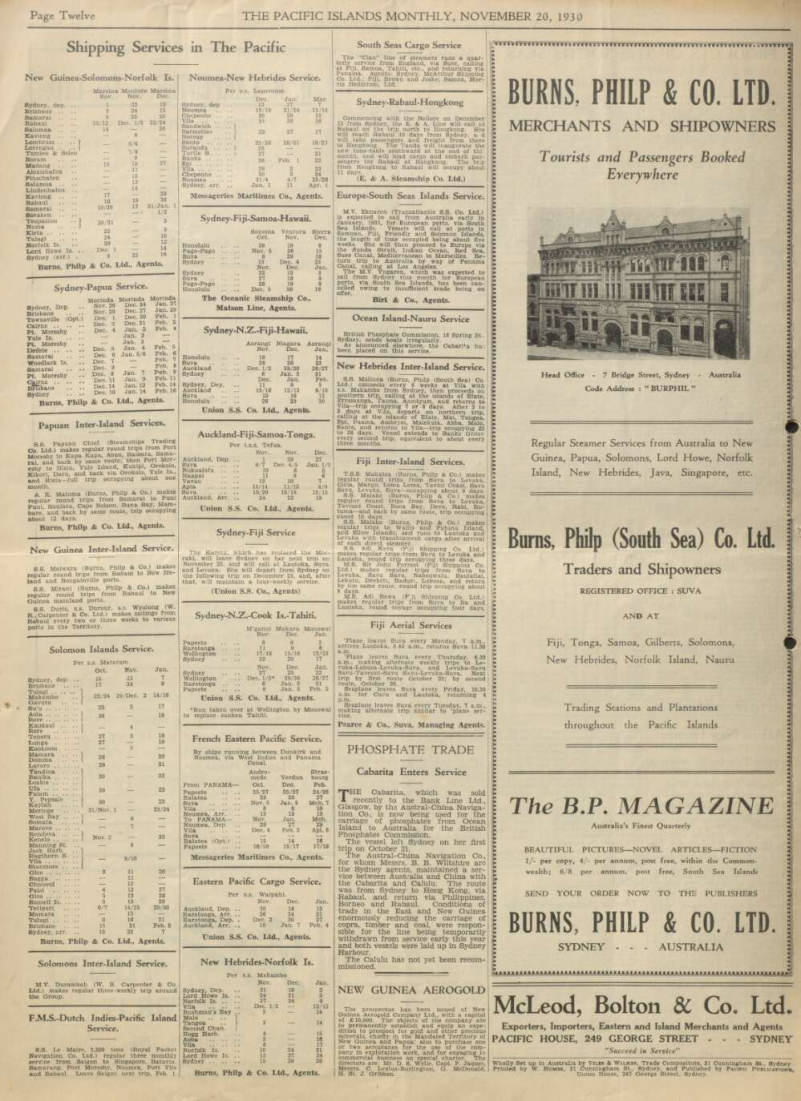
New Guinea-Solomons-Norfolk Is.
Sydney-Papua Service.
Papuan Inter-Island Services.
S.S. Papuan Chief (Steamships Trading Co Ltd.) makes regular round trips from Port Moresby to Kapa Kapa, Abau. Baibara. Samu rai, and back by same route; then Port Mor esby to Hisiu, Yule Island. Kukipi, Orokolo, Kikori, Daru, and back via Orokolo, Yule Is., and Hisiu—full trip occupying about one month.
A. K. Matoma (Burns, Philp & Co.) makes regular round trips from Samarai to Puni Puni, Baniara, Cape Nelson, Buna Bay, Mam bare, and back by same route, trip occupying about 12 days.
Burns, Philp & Co. Ltd., Agents.
New Guinea Inter-Island Service.
S.S. Maiwara (Burns, Philp & Co.) makes regular round trips from Rabaul to New Ire land and Bougainville ports.
S.S. Mirani (Burns, Philp & Co.) makes regular round trips from Rabaul to New Guinea mainland ports.
S.S. Duris, s.s. Durour, s.s. Wyalong (W.
R. iCarpenter & Co. Ltd.) makes sailings from Rabaul every two or three weeks to various ports in the Territory.
Solomon Islands Service.
Solomons Inter-Island Service.
M.V. Durambah (W. R. Carpenter & Co.
Ltd.) makes regular three-weekly trip around the Group.
F.M.S.-Dutch Indies-Pacific Island
Service.
S.S. Le Malre, 3,200 tons (Royal Packet Navigation Co. Ltd.) regular three monthly service from Saigon to Singapore, Batavia.
Samarang, Port Moresby, Noumea, Port Vila and Rabaul. Leave Saigon next trip, Feb. 1.
Noumea-New Hebrides Service.
Sydney-Fiji-Samoa-Hawaii.
Sydney-N.Z.-Fiji-Hawaii.
Auckland-Fiji-Samoa-Tonga.
Sydney-Fiji Service
The Karetu, which has renlaced the Moe raki, will leave Svdnev on her next trin on November 25, and will call at Lautoka, Suva, and Levuka. She will depart from Sydney on the following trip on December 23, and, after that, will maintain a four-weekly service.
(Union S.S. Co., Agents)
Sydney-N.Z.-Cook Is.-Tahiti.
French Eastern Pacific Service.
By ships running between Dunkirk and Noumea, via West Indies and Panama Canal.
Eastern Pacific Cargo Service.
New Hebrides-Norfolk Is.
South Seas Cargo Service
The “Clan” line of steamers runs a quar terly service from England, via Suez, calling at Fiji, Samoa, Tahiti, etc., and returning via Panama. Agents; Sydney, McArthur Shipping Co. Ltd.; Fiji, Brown and Joske; Samoa, Mor ris Hedstrom, Ltd.
Sydney-Rabaul-Hongkong
Commencing with the Nellore on December 13 from Sydney, the E. & A. Line will call at Rabaul on the trip north to Hongkong. She will reach Rabaul 10 days from Sydney, a. d will take passengers and freight from there to Hongkong. The Tanda will inaugurate the new time-table southward at the end of thi month, and will load cargo and embark pas sengers for Rabaul at Hongkong. The trip from Hongkong to Rabaul will occupy about 11 days.
(E. & A. Steamship Co. Ltd.)
Europe-South Seas Islands Service.
M.V. Eknaren (Transatlantic S.S. Co. Ltd.) is expected to sail from Australia early in January, 1931, for European ports, via South Sea Islands. Vessels will call at ports in Samoan, Fiji, Friendly and Solomon Islands, the length of time occupied being about five weeks. She will then proceed to Europe via the Sunda Strait, Indian Ocean, Red Sea, Suez Canal, Mediterranean to Marseilles. Re turn trip to Australia by way of Panama Canal, calling at Los Angeles.
The M.V. Yngaren, which was expected to sail from Sydney this month for European ports, via South Sea Islands, has been can celled owing to insufficient trade being on offer.
Birt & Co., Agents.
Ocean Island-Nauru Service
British Phosphate Commission, 16 Spring St.
Sydney, sends boats irregularly.
As announced elsewhere, the Cabarita has been placed on this service.
New Hebrides Inter-Island Service.
S.S. Malinoa (Burns, Philp (South Sea) Co.
Ltd.) connects every 6 weeks at Vila with s.s. Makambo from Sydney, then proceeds on southern trip, calling at the islands of Efate, Erromanga, Tanna, Aneityum, and returns to Vila—trip occupying 7 or 8 days. After 2 to 3 days at Vila, departs on northern trip, calling at the islands of Efate, Mai, Tongoa, Epi, Paama, Ambrym, Malekula, Abba, Male, Santo, and returns to Vila —trip occupying 25 to 28 days. Vessel extends to Banks Group every second trip, equivalent to about every three months.
Fiji Inter-Island Services.
T.S.S. Makatea (Burns, Philp & Co.) makes regular round trips from Suva to Levuka, Gicia, Mango, Loma Loma, Tavini Coast. Savu Savu, Levuka, Suva —occupying about 9 days.
S.S. Malake (Burns, Philp & Co.) makes regular round trips from Suva to Levuka, Taviuni Coast, Buca Bay, Devo, Rabi, Ro tuma —and back by same route, trip occupying about 10 days.
S.S. Malake (Burns, Philp & Co.) makes regular trips to Wallis and Futuna Island, and Ellice Islands; and runs to Lautoka and Levuka with transhipment cargo after arrival of each direct steamer.
S.S. Adi Keva (Fiji Shipping Co. Ltd.) makes regular trips from Suva to Levuka and Lautoka, round trip occupying three days.
M.S. Sir John Forrest (Fiji Shipping Co.
Ltd.) makes regular trips from Suva to Levuka, Savu Savu. Nabouwalu, Baulailai, Lekutu, Dreketi, Raduri, Labasa, and return by the same route, round trip occupying about 9 days.
M.S. Adi Rewa (Fiji Shipping Co. Ltd.) makes regular trips from Suva to Ba and Lautoka, round voyage occupying four days.
Fiji Aerial Services
’Plane leaves Suva every Monday, 7 a.m., arrives Lautoka, 8.45 a.m., returns Suva 11.30 a.m. ’Plane leaves Suva every Thursday, 6.30 a.m., making alternate weekly trips to Le vuka-Labusa-Levuka-Suva. and Levuka-Savu Savu-Taveuni-Savu Savu-Levuka-Suva. Next trip by first route October 23; by second route, October 30.
Seaplane leaves Suva every Friday, 10.30 a.m. for Cuvu and Lautoka, returning 4 p.m.
Seaplane leaves Suva every Tuesday, 7 a.m., making alternate trip similar to ’plane ser vice.
Pearce & Co., Suva, Managing Agents.
Marsina Montoro Marsina Nov.
Nov.
Dec.
Sydney, dep. .. 1 22 13 Brisbane 3 24 15 Samarai 3 29 20 Babaul 10/12 Dec. 1/3 22/24 Salamoa .. .. 14 — 26 Kavieng — 4 —
Lombrum .. ..
5/6 Lorengau .. .. 1 Tumleo & Seleo — 7/8 Boram — 9 — Madang .. .. 15 10 27 Alexishafen — 11 Pinschafen — 12 Salamoa .. .. — 13 Llndenhafen .. — 14 29 Kavieng .. 17 — Rabaul .. ..
Samarai .. 18 19/20 15 17 30 31/Jan. 1 1/2 Boraken — Teopasino .. 1 Numa .. • • 1 20/21 — 3 Kieta 22 — 5 10 12 14 16 Tulagi .. • • 24 Norfolk Is. 29 Lord Howe Is. ..
Dec. — Sydney (arr.) . 3 23 Burns, Philp & Co.
Ltd., Agents.
Morinda Morinda Morinda Sydney, Dep.
Brisbane .. • • Townsville (Opt.) Cairns Pt. Moresby Nov. 26 Nov. 28 Dec. 1 Dec. 2 Dec. 4 Dec. 24 Dec. 27 Dec. 30 Dec. 31 Jan. 2 Jan. 27 Jan. 29 Feb. 1 Feb. 2 Feb. 4 Yule Is — Jan. 3 Pt. Moresby Dec. 5 Jan. 3 Jan. 4 Feb. 5 Samaraj .. . • Dec. 6 Jan. 5/6 Feb. 6 Feb. 7 Feb. 8 Deb. 9 Feb. 11 Feb. 14 Feb. 16 Woodlark Is.
Dec. 7 — Samarai .. • • Pt. Moresby
Cairns
Brisbane .. • • Sydney . • • • Dec. 8 Dec. 9 Dec. 11 Dec. 14 Dec. 16 Jan. 7 Jan. 9 Jan. 12 Jan. 14
Burns, Philp & Co.
Ltd., Agents.
Per s.s. Mataram.
Oct.
Nov.
Jan.
Sydney, dep.
15 22 7 9 Brisbane 17 24 . ' Makambo • • 22/24 29/Dec. 2 14/16 Gavutu • • 17 25 3 .. 1 26 18 ..
Kaukaul .. 4 Teneru .. .. 27 5 19 Bunga .. .. 27 — 19 Kookoom — 5 — Mamara Domma :: 28 - 20 29 21 Yandina 1 22 ■ 30 Ufa 30
Y. Pepsale
•• \ 30 22 Kavlah Meringe 31/Nov. 1 — 23/24 West Bay .. 6 Somata .. ( 7 Rendova Nov. 2 25 ' — Manning St. 8 — Jack Harb.
Hagthorn S.
Vila — 9/10 — Stanmore .. 3 11 26 11 Ohoiseul — 12 — Falsi .. .. 4 12 27 5 13 28 Russell Is. .. 5 13 28
Tetipari
6/7 14/15 29/30 Mamara — 15 —
Tulagi .. . .
8 16 31 Brisbane 13 21 Feb. 5
Sydney, arr.
15 23 7
Burns, Philp
& Co
Ltd., Agents.
Sydney, dep Per s.s. Laperouse.
Dec. Jan. 12 17 Mar. 7 Noumea 16/19 21/24 11/14 Chepenhe . . 20 25 15 Vila .. .. 21 26 16 Sandwich ..
Sarmettes ::J 22 27 17 Norsup Santo . . .. .. 1 23/26 28/31 18/20 Suranda .. 1 28 Turtle B. .. 27 21 Banks . . ..
Epi Vila 28 Feb. 1 22 29 2 23 Chepenhe .. 30 3 24 Noumea .. .. 31/4 4/7 25/28 Sydney, arr.
Jan. 1 11 Apr. 1
Messageries Maritimes
Co., Agents.
Sonoma Ventura Sierra Oct.
Nov.
Dec.
Honolulu ... 29 19 8 Pago-Pago .. .. Nov. 5 26 15 Suva ... 8 29 18
Sydney
... 13 Dec. 4 23 Nov.
Dec.
Jan.
Sydney
... 22 13 3 Suva ... 27 18 8
Pago-Pago
... 28 19 9 Honolulu .. .. Dec. 5 26 16
The
Oceanic Steamship Co.
Matson Line, Agents.
Aorangi Niagara Aorangl
Nov.
Dec.
Jan.
Honolulu 19 17 14 Suva .. .. 28 26 23 Auckland .. Dec. 1/2 29/30 26/27
Sydney
6 Jan. 3 31 Dec.
Jan.
Feb.
Sydney, Dep.
11 8 5 Auckland 15/16 12/13 9/10 Suva 19 16 13 Honolulu 26 23 20
Union
S.S. Co. Ltd-,
Agents.
Per t.s.s. Tofua.
Nov.
Nov. Dec.
Auckland, Dep. .. 1 29 27 Suva 6/7 Dec. 4/5 Jan. 1/2 Nukualofa ... 10 8 5 Haapai ... 11 9 6 Vavau ... 12 10 7 Apia 13/14 11/12 8/9 Suva 18/20 16/18 13/15 Auckland, Arr. .. 24 22 19 Union S.S. Co. Ltd.,
Agents.
M'ganui Makura Monowai Nov.
Dec.
Jan.
Papeete 8 6 3 Rarotonga 11 9 6 Wellington 17/18 15/16 12/13 Sydney 22 20 17 Nov.
Dec.
Jan.
Sydney 27 25 22 Wellington Dec. 1/2» 29/30 26/27 Rarotonga .. 6 Jan. 3 31 Papeete 8 Jan. 5 Feb. 2 Union s.s.
Co. Ltd., Agents.
•Run taken over at Wellington by Monowai to replace sunken Tahiti.
Andromede Verdun Strasbourg
From Panama—
Oct.
Dec.
Feb.
Papeete .. .. 25/27 25/27 24/26 Raiatea 28 28 27 Suva Nov. 5 Jan. 5 Mch. 7 Vila 8 8 10 Noumea, Arr. 13 13 15
To Panama—
Nov.
Jan.
Mch.
Noumea, Dep* 28 27 29 Vila Dec. 4 Feb. 3 Apl. 5 Suva — — — Raiatea (Opt.) .. 15 14 16 Papeete .. .. 16/18 15/17 17/19
Messageries Maritime*
Co., Agents.
Per s.s. Waipahi.
Nov.
Dec.
Jan.
Auckland, Dep. .. 20 18 15 Rarotonga, Arr. .. 26 24 21 Rarotonga, Dep. .
Dec. 2 30 27 Auckland. Arr. .. 10 Jan. 7 Feb. 4
Union S.S.
Co. Ltd.,
Agents
Per s.s.
Makambo Nov.
Dec.
Jan.
Sydney, Dep. 21 19 2 Lord Howe Is. .. 24 21 5 Norfolk Is 27 24 8 Vila Dec. 1/2 — 12/13 Bushman’s Bay ..
Malo .. .. ]
3 — 14 Tangoa ..
Second Chan. 3 — 14 Hogg Harb. 4 — 15 Aoba 5 — IS Vila 6 • 17 Norfolk Is. 10 24 21 Lord Howe Is. .. 13 27 24 Sydney 15 29 26
Burns, Philp &
Co. Ltd
, Agents.
Phosphate Trade
Cabarita Enters Service
THE Cabarita, which was sold recently to the Bank Line Ltd., Glasgow, by the Austral-China Naviga tion Co., is now being used for the carriage of phosphates from Ocean Island to Australia for the British Phosphates Commission.
The vessel left Sydney on her first trip on October 21.
The Austral-China Navigation Co., for whom Messrs. B. B. Wiltshire are the Sydney agents, maintained a ser vice between Australia and China with the Cabarita and Calulu. The route was from Sydney to Hong Kong, via Rabaul, and return via Philippines, Borneo and Rabaul. Conditions of trade in the East and New Guinea enormously reducing the carriage of copra, timber and coal, were respon sible for the line being temporarily withdrawn from service early this year and both vessels were laid up in Sydney Harbour.
The Calulu has not yet been recom missioned.
New Guinea Aerogold
The prospectus has been issued of New Guinea Aerogold Company Ltd., with a capital of £10,000. The objects of the company are to permanently establish and equip an expe dition to prospect for gold and other precious minerals, chiefly in the Mandated Territory of New Guinea and Papua; also to purchase one or two aeroplanes for the use of the com pany in exploration work, and for engaging in commercial business on special charter. The directors are: Mr. D. S. Wylie, Capt. F. Jaques, Messrs. C. Lexius-Burlington, G. McDonald, H. St. J. Gribben.
Advertisements & other items, p. 12 (1 item)
Burns, Philp & Co. Ltd.
MERCHANTS AND SHIPOWNERS
Tourists and Passengers Booked
Everywhere
Head Office - 7 Bridge Street, Sydney - Australia Code Address : " BURPHIL ”
Regular Steamer Services from Australia to New Guinea, Papua, Solomons, Lord Howe, Norfolk Island, New Hebrides, Java, Singapore, etc.
Burns, Philp (South Sea) Co. Ltd.
Traders and Shipowners
REGISTERED OFFICE : SUVA
AND AT
Fiji, Tonga, Samoa, Gilberts, Solomons, New Hebrides, Norfolk Island, Nauru Trading Stations and Plantations throughout the Pacific Islands
The B.P. MAGAZINE
Australia’s Finest Quarterly
BEAUTIFUL PICTURES—NOVEL ARTICLES—FICTION
1/- per copy, 4/- per annum, post free, within the Commonwealth; 6/8 per annum, post free, South Sea Islands SEND YOUR ORDER NOW TO THE PUBLISHERS
BURNS, PHILP & CO. LTD.
SYDNEY - - - AUSTRALIA
McLeod, Bolton 8C Co. Ltd.
Exporters, Importers, Eastern and Island Merchants and Agents PACIFIC HOUSE, 249 GEORGE STREET - - - SYDNEY “Succeed in Service”
Wholly Set up in Australia by Viles & Walker, Trade Compositors, 31 Cunningham St., Sydney Printed by W. Homer, 31 Cunningham St., Sydney, and Published by Pacific PtrßLicAiioNai, Union House, 247 George Street, Sydney.