The Pacific Islands
Monthly
THE ONLY JOURNAL CIRCULATING THROUGHOUT THE ISLAND TERRITORIES AND GROUPS
Of The Central And South Pacific.
Vol. 1. —No. 3.
Sydney: Thursday, October 16, 1930
Single Copy, 6d.
Per Annum, posted, 6/-.
In Liquidation
Bechades Go Under
New Caledonian Smash
THE large trading establishments known as Les Establissements de Bechade (New Caledonia) and Societe de Bechade des Nouvelles Hebrides have been definitely forced into liquidation. As a result, very many planters and traders in New Caledonia and the New Hebrides are in difficulties, and trading conditions generally in those two territories are seriously disturbed.
It was explained in our last issue that the trouble has been caused by drastic uncompromising action by the Bank of Indo-Chine. The bank for years gave liberal credit to the Bechade concerns, and Bechades, in their turn, allowed easy financial terms to individual planters and traders everywhere.
Then came the depression and the bank became alarmed and made a hurried valuation of assets.
There is, of course, a vast difference between the values of plantations in times when produce is being readily disposed of, and in times like the present, when everything is extraordinarily depressed. On that basis. Bechades’ position looked bad, and the bank forthwith demanded that it meet its liabilities. Bechades pointed out that that was impossible; but that the debts due to it were greatly in excess of its liabilities and, if given reasonable latitude, and allowed to carry on over the period of depression, it would meet its obligations.
At this point the other creditors of Bechades became interested particularly about 40 Australian merchants, to whom large sums were due. The whole position was most carefully scrutinised on their behalf by Mr. P.
F. Parkes, of Messrs. W. S. Tait & Co.
Ltd., and they were satisfied that if Bechades were allowed to carry on, they would survive the economic storm and meet all their debts. Strong representations were made along these
lines to the bank. The bank, however, was adamant; and in spite of all the efforts that were made to save the firm, which had been trading honourably and successfully for 40 years, it was compelled to file its schedule.
In addition to its relations with innumerable planters and traders, the Bechade firm owned about 30,000 acres on the north-west coast of New Caledonia, where it produced cattle, coffee, etc. It had a large staff and its collapse will mean the ruin, not only of hundreds of people, but of the members of the Bechade family, whose pri-
vate fortunes are wholly involved in the smash.
According to current report the Bank of Indo-Chine believes that it will recover its full debt from the liquidation. But the opinion of other observers is that the bank will sustain a heavy loss.
Perhaps the wish is father to the thought. If the bank does suffer a loss, it apparently will gather no sympathy in New Caledonia. ———
Pa-fater, the God of Good Gardens. Only four of these images are known to be in existence—the one shown above, which is on Darnley Island, in Torres Straits; one in the Brisbane Museum; while two have disappeared. ———
'Digoel’ Disbands
End of Communists’ Camp
FORMED about five years ago as a concentration camp for Dutch East Indies natives possessing communistic tendencies, the settlement at Diogel, Southern Dutch New Guinea, is being broken up, as it is extremely unhealthy. Hundreds of the prisoners, it is reported, are being pardoned and paroled, and sent back to Java, but others are to be interned elsewhere.
When the camp was first established the communists were deported to New Guinea with their wives and families.
By the end of 1928 there were 3,000
inhabitants. Being political prisoners, a certain monetary allowance was made to them each year. This was spent with an enterprising Chinese trader, who attached himself to the settlement.
The camp was situated only four days’ walk from the Fly River, close to the boundary of Dutch and British territory. The lo-
cation was considered ideal because of its isolation, but the low-lying, mosquito-infested swamps surround ing it caused much sickness.
Only one party was successful in escaping from the camp, which was guarded by Dutch soldiers. The prisoners reached the Suki country in
Papua, and, no doubt, had a trying experience there. With the Suki tribe headhunting is a pastime and “the survival of the fittest” still reigns. Two years ago a few of them [came] 200 miles down the Fly River in their war canoes and wiped out the village of Weredai. Forty bodies were eaten in the feast that followed. It took the Sukis about four months to paddle back to their homes. The Government then paid them a visit and brought some of their number down to Daru Island as prisoners. This, however, hardly dampened the ardour of the multitude or spoiled their taste for “long pig.”
Nevertheless, the communists reached the coast unscathed. Eloquence evidently won the day, the mouth proving mightier than the spear. But, meantime, the Australian magistrate at Daru received word of the Javanese escapees and he arrested them. They were taken over to Thursday Island and from there returned to the Dutch authorities. ———
A Suki war canoe in one of the narrow streams running into the Middle Fly River.
These reed-bordered avenues twist and turn for innumerable miles among the swamps and lagoons, on the banks of which are situated the villages. ———
A human skull used by members of the Suki tribe to decorate their huts. ———
Planters Helped
Relief for New Guinea Purchasers
B.-P. And Carpenters
Co-Operate
SUBSTANTIAL concessions have been made by the Commonwealth Government to the numerous planters in New Guinea, who are paying off plantations which they took over from the Custodian of Expropriated Property ; and who are suffering severely owing to the general depression.
Early in 1929 the New Guinea Planters’ Association asked the Commonwealth Government for relief and, after the Custodian, Mr. W. C. Thomas, had inquired into the position, some relief was given. But as copra maintained its downward tendency, the Planters’ Association petitioned for still further relief.
The representations of the Planters’
Association were reinforced by those of the New Guinea Branch of the Returned Soldiers’ Association.
The Federal Government in September announced complete suspension of all payments connected with the purchase of expropriated properties, this suspension to operate until June 30, 1931, when the position will be further reviewed.
The effect of the suspension is to relieve the planters altogether of the payment of interest for this financial year, and to defer payment of principal moneys owing in respect of the purchase of plantations. Cash value of the concessions is estimated to be over £100,000.
An interesting feature of this decision is that Messrs. Burns, Philp & Co. Ltd. and Messrs. W. R. Carpenter & Co. Ltd. have agreed with the Commonwealth Government to also assist planters, who owe them money, by making an ex-gratia allowance equivalent to a reduction of two per cent, in the interest charged by the companies in their clients’ accounts. ———
The Bremerhaven
Why Does She Run to Rabaul?
THE continued visits of the Nordeutscher Lloyd steamer, Bremerhaven, to the Mandated Territory of New Guinea are a subject of comment and speculation.
It was reported that this service— which is run by German interests, between Hong Kong and Rabaul—had been discontinued, but the Bremerhaven again put in an appearance at Rabaul recently.
Very little cargo is carried either way by this vessel, and it would be interesting to know whether she represents merely a shipping service which is being continued without profit in the hope that business will improve when the depression has passed ; or whether the maintenance of the service has some political and national significance. ———
On A Friendly Visit
The British cruiser from New Zealand, H.M.S. Dunedin, has been visiting various ports in the Pacific. Here is a photograph of the vessel entering the harbour at Noumea, New Caledonia.
Oil Palm’S Challenge To
The Coconut
Production Extending Rapidly From West Africa to East Indies
Specially Compiled for The Pacific Islands Monthly.
A PRIMARY contributing cause to the low price of copra is the extraordinarily heavy production throughout the world of oils which may be used, as an alternative to coconut oil, in the manufacture of soap, margarine, etc. They are mainly palm kernel oil, whale oil, peanut oil and soya bean oil.
As the growth and development of rival oils are likely to affect the future of the copra industry, and as some South Sea observers regard palm oil as an even greater menace than whale oil, The Pacific Islands Monthly has collated all available in formation about the position and prospects of palm oil.
PALM oil, and palm kernel oil, are the product of a West African palm, extensively cultivated in West Africa and the East Indies, but unknown in Australia. There is said to be an experimental plantation in the Solomon Islands ; and experiments are also being made in the Cook Islands.
The palm itself is of a bushy type, not at all resembling the palm of popular conception, and it produces a fruit of coffee colour, and about the size of a Rugby football.
This fruit has a pulpy exterior and a hard kernel. The fleshy, outside portion contains a very large proportion of a white oil, known as palm oil. The semi-hard kernel of the fruit gives two products, oil and feeding-cake, used for stock. The white palm oil merely supplements coconut oil, tallow and the other constituents of soap ; but the kernel oil is almost identical in character to coconut oil and possesses the same qualities. This kernel oil, then, is one of copra’s great rivals.
During the past half century, the production of palm kernel oil has been definitely on the increase. About 1880, Germany established large factories for the treatment of the product, which at that time all came from the one source—West Africa. During the Great War, England saw the necessity of establishing her own crushing plants for dealing with the product from her African possession, and in 1916 a Government committee decided that ample facilities could be provided in the United Kingdom for crushing the whole of the kernel crop.
West Africa’S Oil Wealth.
In evidence before this committee some interesting facts were disclosed.
It was stated that in 1913 the value of the trade in palm oil and palm kernel, oil from West Africa amounted to over £8,000,000.
Particular emphasis was laid on the fact before the committee that the oil from the kernel could be made into soap, vegetable lard or margarine, and the balance of the kernel —the feeding cake—could be sold in its existing form as palm-kernel cake, or meal, or used
as a component of one of the compound cakes then on the market.
Competition likely from new varieties of nuts, produced in other parts of the world, was also considered. In Central and South America, it was stated, the cohune and babassu nuts had been engaging attention, and the committee was informed that other varieties of oil-producing nuts might become available.
One compilation subsequently gave the following as the exports from West Africa, over a quarter of a century : ... Year ... Kernels ... Palm Oil ... Tons ... Tons ... 1900 ... 85,600 ... 45,500 ... 1905 ... 136,600 ... 54,900 ... 1909 ... 158,800 ... 67,900 ... 1917 ... 186,000 ... 67,500 ... 1925 ... 272,900 ... 70,000
Oil Palms In East Indies.
It is since the war that the greatest strides have been made in growing the African oil palm. West Africa has continued its crude native methods of cultivation, and its market is now challenged by the Dutch East Indies, where the area under crop in Sumatra alone is over 50,000 acres. This has been planted scientifically and systematically, with improved methods of treatment, and a corresponding improvement in the value of the product.
Indeed, West African trade circles fear that the Dutch Indies and Malay Archipelago will soon be strong competitors in the palm oil markets previously controlled by them.
Sir Hugh Clifford, G.C.M.G., when Governor of Nigeria, pointed out that the gradual extension of plantations in the Dutch East Indies was a menace which it would be the height of imprudence to ignore. He suggested the introduction of central factories, equipped with modern machinery and under scientific management for manufacturing the oil for export. It was estimated that in the Gold Coast alone as the result of crude methods employed palm products to the value of well over £1,000,000 were being allowed to go to waste annually—a loss to the nation and the industry.
In the Gold Coast Handbook for 1924, the hope is expressed “that efforts will be made to cultivate the oil palm on plantation lines, with the necessary machinery, otherwise the product will be unable to compete with that of plantations in other parts of the world.”
A writer in “The British Soap Manufacturer” in July, 1930, said that it is calculated that within 10 or 15 years Sumatra will be exporting 100,000 tons of palm oil, as compared with an estimated total export of palm oil from West Africa of 140,000 tons. Sumatra produced 8,000 tons of palm oil in 1925.
A report on commerce, industry and agriculture in the Netherland East Indies in 1927, published fairly recently, stated that oil palm plantations on the east coast of Sumatra produced 13,283 tons of oil in 1926 and 21,617 tons in 1927. There were then 54 estates cultivating oil palms 9 in
(Continued On Page 2)
Java, and most of the remaining 45 were in Sumatra. It was remarked that the oil palm was not very subject to diseases and pests.
West African Production.
It has been difficult to get actual West African production figures of a recent date. In 1925, according to the Statesmen’s Year Book, the West African production was as follows: ... Palm Oil ...Palm Kernels ... Tons ... Tons Nigeria ... 128,113 ... 272,925 Gold Coast ... 1,423 ... 6,569 Sierra Leone ... 2,988 ... 63,231 There is also a large export of both commodities from the French territories of Togo and Cameroon.
While all these facts about the fight for markets between Africa and Dutch Indies may not interest the South Sea plantation owner, they do show the attention that is being paid to this commodity throughout the world, and to its extensive cultivation.
Copra To The Fore.
The main point at issue is how palm kernel oil compares with and affects copra as a marketable product. As has been already stated, they are interchangeable with one another.
To revert again to the proceedings of the British Committee in 1916. It was then stated: “Effective competition of coconut and palm kernel oil does not necessarily mean that each will not continue to used AT A PRICE; and it is only if the price fell below that of profitable production that the oil would go out of use altogether.
“As regards the two oils, the ruling price is affected by both, but
predominantly by coconut oil, in so far as the present world’s supplies of it is double that of kernel oil.
The production of both is increasing and it would be rash to say which has the greater possibilities.”
The position at present is that one is regarded as a foil to the other. When the price of coconut oil increases the users turn to palm kernel oil; when palm kernel oil increases in price, the users turn back to coconut oil. On August 1 of this year the market price at Hamburg for palm kernel oil was £26/15/- a ton and for coconut oil £28/17/- a ton.
Where copra possesses a distinct advantage is in the oil content, which is of greater value than the cake. A ton of copra yields 60-72 per cent. oil and the balance cake. But the production of the white palm oil, worth at present about £22 per ton, from the same tree, may swing the pendulum slightly in favour of the cultivation of the African oil palm.
Regarding this palm, a writer in a recent issue of The British Soap Manufacturer says: “The demand for palm oil is strong and increasing, not only in Europe and America, but also in the Far East, where large markets are developing, and Sumatra palm oil is specially adapted to the manufacture of margarine by reason of its low percentage of free fatty acids. With expenses for development of an oil palm estate being low and the upkeep, through profitable catch crops, working out at quite a small figure, and with good returns already being obtained at the end of seven years, the Dutch East Indies is making a bold bid for the palm oil trade.”
The article also mentions that in British Malaya, the oil palm bears fruit three years after planting. But in most other places it takes twice as long. ———
Steady Increase
Cook Islands Native Population
A STEADY natural increase in the native populations and an excess of Government revenue over expenditure are strikingly satisfactory conditions disclosed in the annual report of the Cook Islands and Niue Administrations for the year ended March 31, 1930, made by the New Zealand Minister for the Cook Islands (Hon. A. T.
Ngata). The Rarotonga Treasury showed an excess of revenue over expenditure amounting to £1,287 and the Niue revenue Treasury an excess of £2,203.
The motor vessel Maui Pomare, provided and managed by the New Zealand Government, has carried out a satisfactory fruit trade with the islands. She has given to Niue the first regular service and has opened up a banana trade which the natives have been eager to exploit. The vessel has been the means also of creating a valuable banana trade between New Zealand and Samoa.
During the year 106,187 cases of oranges and other citrus fruits, 51,026 cases of bananas and 52,685 cases of tomatoes were exported to New Zealand from the Cook Islands. The export of copra totalled 2.020 tons. The value of exports up to December 31, 1929, was £124,486 and imports £106,835, showing an excess of exports of £17,651. For the previous year the figures were, exports £133,051; imports £117,639.
Imports for the year 1929 for Niue Island totalled £19,109, as against £18,637 for 1928. Exports amounted to £22,206, as against £20,938 for 1928. Of this amount £13,449 went to New Zealand and the balance to the United Kingdom. Western Samoa. Australia, Fiji, American Samoa and Hawaii. ———
Coconut and Oil Palm: A Comparison
Summed up, there is not much difference, economically, between the cultivation of coconuts and of oil palms.
Each is grown at about 55 to the acre. The oil palm comes into full production two or three years sooner than the coconut.
Where a good coconut plantation, 12 years old, will give about 8 cwt. of copra to the acre, an oil palm plantation, eight years old, will give 1 ton of palm oil and 5 cwt. of kermels per acre.
Labour is about the same. The meat has to be extracted from the coconut and dried. The pulp (producing palm oil) has to be extracted from the fruit of the palm, and the kernels have to be broken.
Dried copra produces an average of 67 per cent. and palm kernels an average of 50 per cent. good oil. The value of the respective oils is about the same—sometimes one, sometimes the other, is most highly quoted. Each is subject to acidity, the degree of acidity being governed by the care taken in preparing the copra or the kernels for export.
Palm kernel oil has a strong flavour that is absent from coconut oil, giving the latter greater value to soapmakers.
The chief byproduct from each, after the extraction of the oil, is equally valuable as a food for stock.
In Hamburg, on August 1, 1930, palm oil was quoted at £33 per ton; palm kernel oil at £26/15/-; and coconut oil at £28/17/- per ton.
Apparently, it comes down to this—The coconut has an advantage because it gives a higher percentage of oil; but the oil palm makes up for this by giving palm oil (from the pulp of the fruit) as well as kernel oil. It looks like an even break; but that does not get rid of the disturbing fact that palm kernel oil, which so closely resembles coconut oil, is being produced in enormous and ever-increasing quantities. ———
Mr. Redtape On The
Warpath
Futile and Ridiculous Taxes
Burden Of Pacific
Islands Trade
THERE is no end to the irritations and stupidities with which officialdom surrounds Pacific Islands trade.
We have dealt elsewhere with Mr.
Redtape’s attack on the Norfolk Island banana traffic. We will now give two incidents in the normal business life of a Sydney firm engaged in the Islands trade.
An Islands resident sent to Sydney for a replacement of an article that had been broken. So that there would be no mistake regarding size, etc., he sent along the broken article.
Mr. Redtape examined the broken article and, though it cut him to the heart, he had to acknowledge that it was entirely useless and valueless, and therefore non-dutiable.
But the article had been packed in a wooden box. Mr. Redtape’s piratical eye fell upon the box, and he whooped with joy. Here was something he could tax!
“Worth a lot of money, that ’ere case,” said Mr. Redtape.
The Islands agent groaned. “For God’s sake, take it away and give it to Mr. Scullin,” he begged. “I don’t want it.”
Mr. Redtape would not release the “consignment” until the box had been solemnly assessed and paid for. For three hours—half a day— a £6 per week Customs clerk was chasing round
with entries and arguments, clearing the case, and its broken and useless contents. And here is the Customs bill he had to pay: ... s. .. d. 30 per cent. duty on one case valued 2/6 .. 0 .10 2½ per cent. pimage duty on same ... 0 .. 1 2½ per cent. sales tax on same ... 0 .. 1 ... ———
Could anything be more utterly futile and ridiculous!
The next day this firm received from another Islands trader an order for goods. Instead of forwarding a cheque he sent a small bag of Australian silver coins—money that had been paid to him in small sums by travellers, and which he had no means of banking.
Mr. Redtape had a wonderful time with that bag of coins—he felt that, somehow, it ought to pay a primage duty of 2½ per cent. He could not get it into his thick head that there is no essential difference between money that comes in in a man’s pocket and a cheque that comes in by post, and a heap of coins that comes in in a bag.
The utterly fed-up merchant argued the point for three days. Mr. Redtape finally referred the matter to High Authority and High Authority told him, in effect, not to make an ass of himself. Even then, it is reported, Mr. Redtape spent a half hour of gloom over the consignment, wondering if he could tax the bag which contained the coins!
This is typical of what Islands traders are subject to.
Is it any wonder that ws are regarded as a nation of footlers, and that this valuable Pacific Islands trade shows so strong a tendency to drift away to other countries which conduct their affairs in a businesslike manner? ———
Island
Injustice to Norfolk Island Sales Tax on Bananas Contrary to Spirit of Act
THE Commonwealth authorities continue their stubborn refusal to forgo the 2½ per cent. sales tax which they have imposed upon the sale of Norfolk Island bananas in Australia.
When, as announced in our last issue, it was discovered that the sales tax was being claimed in connection with this produce, most people believed that it was merely another case of departmental blundering. Urgent representations were made by various interests concerned; and Mr. S. Pollard, on behalf of the N.I. banana growers, took up the question very vigorously with the Taxation Commissioner. The reply simply was that “the sales tax is imposed upon the produce of N.I., because N.I. is not an integral part of the Commonwealth.” And there the matter rests.
Anything more unfair and ridiculous could scarcely be imagined. N.I., so far from not being an “integral part” of the Commonwealth, is so completely in the power of the Commonwealth that it is practically helpless. Except for a very rare ship to New Zealand, it has no market for its produce except the Australian market; and it has no chance of getting away from the Australian market. It must meekly accept whatever conditions and prices are imposed by Australia. It
is governed by Australia, but has no voice in the Australian Government.
It is without representation.
The position of the Territory is recognised in the Customs laws, which (as set out in the Norfolk Island Act) specially provide that there shall be no duty or excise charged in regard to N.I. produce. It surely is obvious that both the spirit and the letter of this undertaking are broken by the imposition of the sales tax. The primary products of Australia are free; the primary products of N.I. are taxed.
The matter will be forcibly presented to the Federal Parliament as soon as it meets at the end of October.
The expansion in the export of N.I. bananas to Sydney has been rather striking: Year ... Centals ... Value 1926-27 ... 4,600 ... £5,079 1927-28 ... 6,914 ... 8,256 1928-29 . 20,457 ... 23,929 ———
Slightly Exaggerated !
It was reported in a Sydney newspaper during the month that the Swedish liners running through the Panama Canal intend in future to call regularly at the Island of Niue, with a view to picking up the products of that somewhat isolated community.
The report was quite incorrect. All that happened was that, as the New Zealand Government steamer, Maui Pomare, was temporarily laid up and could not make her regular call at Niue, the Swedish liner, Parrakoola, was asked to call there to pick up the accumulated stock of bananas and land them at Auckland. This was done.
The Swedish line has no intention of competing with the Maui Pomare for the carrying trade of Niue. ———
New Guinea’s Unique Air Service
How 12 Planes Carry Freight and Passengers to Goldfield
An aeroplane service, probably unique in the world, was established in New Guinea in 1927.
It was, then, in the nature of a bold experiment, but its rapid growth is testimony to ite outstanding success. It now provides the only regular transport between the 300 residents on the Edie plateau—up in the Morobe goldfields—and the outside world.
THE first aerodrome was built at Lae, 18 miles by water from Salamoa, the nearest port to the goldfield. Passengers and freight were taken there from Salamoa, from the incoming steamers, by pinnace and lighters. The water journey, under even normal weather conditions, took about five hours. From Lae, the plane trip to Wau, on the plateau, occupied about 40 minutes, for the 60 miles covered.
The Ellyou Company, which afterwards become New Guinea Goldfields Ltd., then considered the practicability of constructing an aerodrome at Salamoa, thus cutting out the journey to Lae. The site at Lae was first chosen because it provided almost a natural landing ground, whereas Salamoa was covered by jungle growth, and was crossed by a large overflow from the Frisco River.
The company’s plan was adopted, and an aerodrome was constructed by its officers at Salamoa. On its completion, the plane trip, from Salamoa to Wau. took only 25 minutes. The big trimotored Handley-Page machine, which recently crashed, held the record for this flight, accomplishing it in 18 minutes.
It is now possible for residents of Edie Creek, where New Guinea Goldfields Ltd. has its headquarters, to leave their homes early in the morning, walk to Wau (12 miles), catch a plane to Salamoa, transact business there for two hours, fly back to Wau and return to Edie Creek before dark. Without planes, the walk to the coast, through country which is almost incredibly wild and broken, would have taken ten days.
The Services
About twelve planes are operating at present.
Messrs. Ross and Taylor, and Capt.
Shoppe (Papuan Airways) have regular services from Salamoa to Wau.
Guinea Airways Ltd., the largest transport organisation there, which has always lifted freight from Lae, has instituted a Junker service, from Lae to Wau, to Salamoa, and return to Lae.
From reports, it appears likely that this company may adopt Salamoa as a permanent hoppin-off ground. Shipping facilities are far superior at Salamoa, which has been declared a " port of
entry” for the Mandated Territory.
Fares and freight rates are being gradually reduced. To-day, it costs a passenger £3/15/- for the trip to the field. Freight is lifted at 9d. per lb.
A service, known as the Morlae Airline, was started by Lieut. Parer, well remembered for his famous flight, with
McIntosh, from England to Australia. The route was from Port Moresby to Lae, and the time taken was from 2½ to 3 hours.
Later, Lieut. Parer placed his machine on the Lae to Wau service, and he now holds the record of making altogether 63 solo flights in a month, with freight, between those ’dromes — truly a great performance.
Until a road or rail track is laid to connect the coast with the field,
planes will continue their indispensable service. The surprisingly few mishaps to the machines, under what have been described as very difficult flying conditions, show the efficiency attained by the companies and the pilots. ———
A glimpse of the aerodrome at Wau. ———
The journey overland to the coast is through country of indescribable wildness. This is the method of communication—a string of native carriers on the track. ———
Advertisements & other items, p. 2 (2 items)
2
THE PACIFIC ISLANDS MONTHLY, OCTOBER 16, 193 0
THE CHALLENGE OF THE OIL PALM
(CONTINUED FROM PAGE 1)
Lister
Reliable”
is its
middle name
Lister
LISTER-LITE was specially designed for homes such as yours —homes far away from the services of electrical experts. Tested and retested long before it reaches you, Lister-Lite is as perfect as modern engineering methods can make it. It will bring you all the conveniences of a big city electric supply, day after day, month after month, for years on end with never a hint of trouble.
Free of Australian Customs Duty When you order your Lister-Lite, it will be shipped to you ex bond, thus saving the extra cost which Australian Customs duty would entail. Fill in and send the coupon below for particulars of reliable Lister-Lite.
DANGAR, GEDYE & CO.
LTD.
10-14 Young Street, Sydney,
Australia.
Islands Monthly
Praise for Pacific
Some Further Letters
WE gratefully acknowledge the re
ceipt of letters from many places expressing appreciation of the purpose of The Pacific Islands Monthly and
praising the early issues. Space per
mits the publication of extracts from
only a few; but we take this oppor tunity of thanking our many kind cor
respondents for the encouragement
they have given this enterprise.
Hon. E. A. Ransom, M.P., Acting
Prime Minister of New Zealand: I have perused the first Issue, and find it very interesting, and I am sure it will form a very valuaole medium for exchange of views between the various Pacific territories.
Hon. T. R. Bavin, K.C., M.L.A., Pre mier of New South Wales: I have looked through the first issue of The Pacific Islands Monthly and take this earliest opportunity of congratulating you on your enterprise. The publication will, I believe, serve a very useful purpose in promoting a helpful co-operative spirit among the peoples of the Pacific and in developing trade between the various territories. I wish your enterprise the success it deserves.
Mr. W. McRae, Director of New Guinea Goldfields Ltd., and a former resident of Suva: I wish you every success with the venture, which should receive the support and interest of all those concerned in the development of the islands of the Pacific, whose trade possi bilities have not been realised by Australia and New Zealand—in fact, have been seri ously alienated.
Mr. J. G McLaren. Secretary, Prime
Minister’s Department, Canberra:
The publication of The Pacific Islands Monthly impresses me as development that is likely to prove of very great advantage, not only to the Territories, but also to Australia.
It should serve the dual purpose of provid ing a medium through which public opinion in the Territories may communicate itself to the Australian public, and of assisting the Australian public to a better understanding and appreciation of the problems of the Ter ritories.
The Pacific Islands Monthly, however, does not concern itself solely with the affairs of the Australian territories, but caters also for the other groups in the Central and Southern Pacific. In addition, therefore, to stimulating a healthy interest by Australia in her own Territories, it should add greatly to Aus tralia's knowledge of and interest in Pacific problems generally, which are to her matters of ever-increasing concern.
Sir Joseph Carruthers, K.C.M.G.,
M.L.C., Sydney:
I think The Pacific Islands Monthly is a fine publication and supplies a long-felt need.
Chinese Immigration to Fiji
Production of Tomatoes for Sydney Market
Written for The Pacific Islands Monthly by C. L. Ching, Chinese Consul in Suva.
THE establishment of the Chinese Consulate in Suva is merely another step for ward in the mater iahsmg of a scheme, approved last year by the National Government of the Republic of China, to increase the number of legations and consulates abroad, with a view to keeping closer touch with the many thousands of Chinese citizens re
siding away from their Homeland.
The Chinese diplomatic service is comparatively young, for it was only 80 years ago that the Opium War was fought and China began to have her first real contact with the outside world. Even after the gradual open ing of the treaty ports of China, the Manchu Government were reluctant to send their representatives abroad to be accredited to foreign governments, although Chinese emigrants were leav ing the country in large numbers.
The inherent weakness of the Man chu Government was soon evident.
China’s defeat at the hands of Britain during the Opium War began a series of military and diplomatic disasters which continued right on even after the overthrow of the Manchu Govern ment by a gradually awakening people, and it did not cease until the ascend ancy of the Kuo Min Tang was de finitely established.
At home concessions had been wrested by the Powers from the helpless and disinterested officials, who cared neither for the welfare of the country or the people. Abroad our immigrants had to put up with the discriminatory legation enacted by governments who were quick to realise the weakness of a corrupt regime at home, and numer ous were the indignities that Chinese suffered.
In 1928 a new era in Chinese history began. The Kuo Min Tang (Nation alist Party) had succeeded in unifying China under a strong Government with the capital in Nanking. New treaties, based on equality and reciprocity, were negotiated with the European
What is to be the respective parts of the four communities —Europeans, Fijians, Indians and Chinese—in the future de velopment of rich and prosperous Fiji?
In 1921 there were only 900 Chinese in Fiji. To-day there are nearly 1,500. They control a large proportion of the small store trade, and they are energetically ex tending their agricultural activities. They are building up a valuable export trade in tomatoes.
A Chinese Consul, Mr. Ching, a clever, well-educated man, has now taken up his residence in Suva. In this article, which he has kindly supplied, Mr. Ching gives some indication of the probable future con nection of the Chinese with Fijian develop ment.
Powers and America while a great num ber of unilateral provisions of the old ones were ab rogated. The new Government consis ted of active, hon est and patriotic men, who set very earnestly about the complicated task of construction. A de finite foreign policy was formed which provided for the adequate protection of oversea Chin ese nationals. The consular service was
to be re-organised, more consulates established and trade commissioners sent abroad.
The story of Chinese immigration in Fiji is but a repetition on a small scale, perhaps, of that of Chinese in other countries. The first immigrants were usually hard-working labourers who were utilised to do the pioneering and developmental works. As soon as the arduous part of the pioneering was complete, they found that they were not so wslcome.
In Fiji, we find that from amongst the more enterprising of the first arrivals, as they became settled down, small traders sprang up, and some of these gradually built up fairly large businesses which, in the end, were staffed with intellectual Chinese who were introduced from China.
Chinese agriculturists in the Colony utilise much ground that otherwise would go to waste, even in such close proximity to Tamavua. The fact that Chinese market gardeners throughout the whole world are responsible for a constant and abundant supply of cheap vegetables is recognised by all Europeans who, I feel sure, agree that no other race would be capable of doing the same.
Since my arrival in Fiji, I have in duced several of the large gardeners to export their tomatoes for the Sydney market; and I have reason to believe that in a short time the tomato busi ness will develop into a very import ant phase of the Colony’s export
trade, which may help to recoup for the lost banana business with Aus tralia. Other projects are also under consideration.
The inherent respect of the Chinese people for established law and order is proverbial, and lawlessness among our people is very rare. But, notwith standing this, and the creditable part they have contributed to the building up of the prosperity of the Colony,
many disabilities were placed on them.
Happily, the present Government is most sympathetic and, following a re cent visit of the Consul-General, Mr.
Fartsung T. Sung, to Suva, many of these disabilities were removed, and the recognition of the qualities of our people as useful and law-abiding citi zens was placed on record.
C. L. Ching.
Advertisements & other items, p. 3 (1 item)
Anthony Horderns
The
ROYAL
Portable
typewriter the finest portable writing machine on the market.
Sturdy construction, simple operation.
Fitted with Standard Keyboard and all latest mechanical improvements.
Indispensable in the Home. It will handle all Private, Social and Business correspondence with equal facility.
For full particulars and catalogues send attached coupon to
SYDNEY PINCOMBE LIMITED
ROYAL TYPEWRITERS, 46-48 HUNTER ST., SYDNEY
Also at MELBOURNE, BRISBANE, NEWCASTLE
Please send me full particulars of the ROYAL PORTABLE TYPEWRITER.
Australasian Agents
NAME
ADDRESS
TRUTH IN ADVERTISING —always adhered to at Anthony Horderns’
Anthony Horderns
(THE SENIOR STORE)
FOR EVERYTHING!
Anthony Horderns’ claim to be Universal Providers is no mere idle boast—through more than a century of retail trading this business has grown and constantly developed until to-day it embraces every need of modern life. And always the idea of Famous Low Prices has been adhered to— comparison of quality for quality and price for price will show that Anthony Horderns’ values remain unequalled. Anthony Horderns’ mighty Store and comprehensive stocks are brought right to your door, for you can order from our Catalogues with perfect confidence and know that our Mail Order service will ensure that the goods reach you promptly and in perfect condition.
Special Attention
to Islands Orders Get Our
Catalogues
Anthony Horderns’ huge Mail Order Department is efficiently organised and expertly supervised to ensure that orders from the Islands receive special attention. The result- is Service to Mail Order customers — and this we support by a guarantee of satisfaction or money refunded.
Anthony Horderns’ are constantly issuing up-todate Catalogues giving the full details of the newest goods in every section of the business.
We will be pleased to place you on our Mailing List so that you will receive Catalogues if you will send us your name and address.
Special Grocery
Price List Manchester Values
ANTHONY HORDERN & SONS, LTD.
SYDNEY, N.S.W.
Postal Address : Box 2712 C, G.P.O., Sydney Anthony Horderns’ supply Groceries to Pacific Islands customers under specially favourable conditions. The ruling principle is that all goods are thoroughly reliable in quality and perfectly pure, offered at specially low prices. Send for Grocery Price List for Island customers.
Manchester Goods form such an important part of the World’s requirements, that Anthony Horderns’ have specialised in supplying them at very favourable prices.
Qualities are always excellent, so that the value challenges comparison.
Send for special Islands Price List.
Guano
Torres Straits
A Dead Industry?
Raine Island’S Wealth
(From Our Thursday Island Correspondent.) AMONG the hopes that spring eternal in the human breast is that of making easy money, and there are optimists who persist in believing that Nature leaves fortunes scattered around in desert places for the mere picking up. The world could ill spare such folk; occasionally their instincts prove true and universal benefit re sults.
It was probably for this reason that a sample of guano was recently brought in from one of the many small islands where it is found, and submitted for analysis to Brisbane.
The results did not encourage further investigations, and it may be taken for granted that guano seekers here abouts are wasting their time. In the past some money was made out of guano and, seeing that deposits occur on Channel Rock, Red Wallis, Bramble Cay and other islands, the subject is not without interest to local people.
Excluding the well-known deposits of the Pacific, guano hails principally from the coasts of Peru. Probably it was used by the ancient Incas, and it was introduced to the notice of Euro pean farmers by Humboldt, who bought samples from South America.
It requires an almost rainless climate and an abundant fish supply for the sea birds to feed on. After deposit, various chemical substances percolate into underlying rocks of a soft nature, such as coral, for instance, and form a friable material rich in phosphorus and nitrogen.
The guano formerly obtained from Raine Island on the Barrier Reef, about eighty miles south-east of Thurs day Island, was of this nature, and had the appearance of soft white sand stone. The centre of Raine Island almost entirely removed during the ’seventies of last century, when an American, and later a Scottish com pany, were engaged in the collection of guano there The work was done by Chinese coolies, seme of whom left their bones on this desolate spot and were provided with gravestones by their employers; these are still visible near the old workings.
Another curiosity of Raine Island is a hollow round tower, made of blocks of guano stone, which was erected by a party of naval men from H.M. ships Bramble and Fly, in the year 1843, or thereabouts. It was put there to mark the passage through the reefs for ves sels coming from the Pacific, in the days when it was thought nothing short of suicidal to venture through the Bar rier Channel from Capricorn north wards. The tower, or beacon, is vis ible for a long distance, and has proved very useful in the past. Un fortunately, it is now starting to crumble, and the name of the erect ing vessel can no longer be deciphered.
After Raine Island was worked out a move was made to Rocky Island, one of the Wellesley group, lying well down in the Gulf of Carpentaria. One of the most tragic wrecks in the history of Torres Straits was that of the Kana hooka, which was destroyed at Rocky Island during a cyclone while loading guano. After this mishap the busi ness was discontinued. Nor is it likely to be revived in Torres Straits.
Dutch New Guinea
Huge and Unknown Territory Movement of Settlers to North Coast
SO far the huge territory known as Dutch New Guinea has received little attention.
The Dutch have settled and culti vated their other possessions in the East Indies and, what with copra, rub ber, petroleum, rice, etc., each island has proved to be extraordinarily rich.
Now, with the fall in the market price for copra and rubber, the Dutch are looking further afield for new country to develop.
According to a message from Welte vreden, Java, published in The Sydney Sun, a movement of settlers towards New Guinea has started. One agricul tural settlement has been formed near Sentanilahe, on the north coast, not far from the Mandated Territory; and another near Manokwari, on the north west coast.
Little native labour is being used in these enterprises. The promoters hope that the settlements wifi decrease the number of planters now unemployed in consequence of the fall of rubber prices and also diminish the number of unemployed Dutch ex-Government servants crowded out of the service by trained natives.
Although not much is known of the country in northern Dutch New Guinea it is understood to be similar to that along the coast on the mainland of the Mandated Territory, with the same potentialities. It is believed to have valuable petroleum resources; and it is likely that there are other valuable mineral deposits.
Gold In New Britain
Present But Not Payable
Mr. A. Travers Black, a mining ex pert, who has been associated for many years with gold mining in New Guinea, has reported to Nakanai Mines Ltd., a Sydney company, that its holding on the island of New Britain is unpay able.
Mr. Black spent about a month on the property and returned to Sydney in July last. He found that an ex tensive mineral belt existed through the mountains of the island, but, in his opinion, there was nothing that could be payably worked.
Mission Schools In New
Guinea
Mission schools in the Mandated Ter ritory of New Guinea now number 1,305. Of these, 167 are in the charge of Europeans, and 1,138 are under na tive teachers. The teachers engaged by the various missions comprise 231 Europeans, 4 Asiatics, 1,186 natives, and 1 half-caste. Pupils receiving instruc tion total 36,507.
The figures showing the trade turn over in Western Samoa in the year ended March 31 last indicate a shrink age, but in values rather than in quan tities. The value of the principal ex ports was coora £217,800, cocoa £58,575, rubber £9,655, bananas £24,825.
Thursday Island Topics
From Our Own Correspondent Government’s Attitude Towards Pearling Industry—Now Recognised that Asiatic Divers are Necessary— Medical Survey Proceeding
Thursday Island, Sept. 30.
THE intentions of the Federal Gov ernment in regard to the pearl shell industry have been explained by the Federal member for this district, Mr. G. W. Martens, M.P.. who has paid us a very welcome visit.
It had been reported that this new Labour Government was determined to
keep the industry for the whites, and push out the Asiatics; and the indus try, in consequence, has been in a jumpy and uncertain state for some time.
Your representative had the pleasure of a chat with Mr. Martens, and the latter gave the following assurances with regard to the industry.
“Of course,” said Mr. Martens, “we would like to see the pearling industry wholly in the hands of people of our own race, but that does not mean that we are seeking to im pose impossible conditions to that end.
“The Royal Commission on the shelling in dustry, presided over by Mr. Bamford, was strongly Labour in its personnel and sympa thies, and it came to a definite conclusion when it took evidence here in 1912. In spite
almost immediately and expects to be in Thursday Island towards the end of October.
Mr. Mocrhouse, B.Sc., a member of Dr. Young’s expedition to the Barrier Reef in 1929, has apparently been eat ing Wongais, for he has returned to his old haunts around these parts and is at present investigating the growth of pearl shell and other biological sub jects, at Murray Island.
Dr. Baldwin, Assistant Director of the Sydney School of Tropical Medi cine, is to make a complete survey of medical matters in Torres Straits and wall be conveyed from island to island by the Government ketch Melbidir.
While the main object is to investigate the various forms of tropical disease that exist in the Straits, the general health and hygiene of the natives will be looked into. It is many years since a similar medical survey was made, the last being by Dr. Brien before the war.
The Resident Magistrate of Daru (Papua) and his wife, Mr. and Mrs.
Woodward, are at present on leave and have gone as far afield as Col ombo. Captain Zimmer, who was A.R.M, of the same district, has been promoted to R.M.. and will, I am in formed, take up duties at Kerema after his leave.
Trochus Shell.
A rise in the price of trochus shell is announced, to-day’s local quotation being £63 per ton.
Neighbourly Daru.
Daru, the official seat of adminis tration for the Western Division of Papua, is almost as much in touch with Thursday Island as with its own metropolis of Moresby. When a resi dent of Daru sees no prospect of the desired “Trip South,” he finds busi ness to do in Thursday Island, where a daily newspaper, afternoon tea par ties, bridge and iced drinks make a pleasant change from a Papuan out station. In fact, it has been openly stated here that “T.I. is a paradise compared to Daru”; or, as some people would put it, “T.I. is a somewhat less unpleasant sort of hell.”
Daru is a great recruiting ground and supplies Thursday Island with, its collection of “New Guinea boys,” who, in reality the most communistic of all the races gathered here, are the last to adopt Bolshevik principles. In fact, the highest form of economic subtlety that the Kiwai boy is as yet capable of is to develop a headache two hours before his lugger is ready for the sea —and the mere suggestion of a visit to hos pital is often enough to cure that.
Daru is a place that has —temporarily at least —missed the bus. It was
of a strong desire to the contrary, the find ing was that Asiatic labour, especially as regards the actual diving, was essential to the industry. Before the present Government can reverse that verdict it must make sure that fundamental changes have occurred which could justify its taking such a step.
And it does not need a Royal Commission to prove that that has not yet come about.
“As far as the actual winning of the shell is concerned, we realise that methods must remain very much as they were. We are cer tainly introducing changes in the accessory operations of grading, packing and cart ing, by which we hope that white men may find employment, but even these must be re garded as experimentals. If they prove un workable they may be remitted. The Gov ernment is fully aware of the great value of the shelling industry in promoting local prosperity and in helping to adjust adverse trade balances abroad. For this reason alone we are not likely to hamper the Industry unduly.
“We are not alone in our wish to preserve pearling for white men. Some time ago a prominent Darwin pearler offered to fit out a boat and hand it over to any competent white team for purposes of pearling, with the remark that, if the white men of Aus tralia could work the industry successfully, the pearlers would prefer it so. Such an offer was genuine enough, but it failed for the want of white men with the necessary qualifications and local knowledge. Added to this is the disinclination to put up with con ditions which the Japanese diver and his crew regard as satisfactory.
“While our object is to introduce white labour where it can be done without burden ing the industry, we are prepared to give the nearler a fair deal and we expect the same from him.”
Personal Items.
A cable has been received from M.
Max Rabin, the well-known pearl buy
er, stating that he is leaving Paris
to have been the Texas of Papua, and was much in the public eye when the Oriomo Oil Co. started operations there in 1925—so much so that Thursday Island was beginning to feel quite apprehensive about the reputed coming prosperity of its neighbour across the Straits. However, no one has any illu sions of this sort about Daru at the present time, and the traders there are more likely to dream of boatloads of returned and very financial boys from Torres Straits (Daru gets the cream of the wages paid to Papuans in the pearling industry), than of oil derreks and American millionaires.
Typical Japanese Pearl Divers,
Thursday Island.
Some vessels of the pearling fleet at Thursday Island.
Shipping
Weather Warnings
How Radio Assists Pacific Shipping
An efficient system of giving weather advices and forecasts has been evolved m the South Pacific during recent years.
Daily reports are issued from the Apia Observatory. Western Samoa; Papeete, Tahiti; Suva radio station; Norfolk Island; Vila, New Hebrides; and Ocean Island.
These reports, which, during last year numbered about 2,900 render useful service to shipping in South Pacific waters by giving timely warning of the development and progress of cyclones.
Copra Output
Is It Possible To Reduce?
"One Product Which Can
Not Be Regulated”
Is if possible to regulate the
production of copra, so that a
world-glut of the product,
which has caused such serious depression in the industry, may be avoided? Is it possible to
arrange united action between
the copra-growers of Java,
Ceylon, Malaya and the South
Seas?
THESE questions were submitted by The Pacific Islands Monthly to Major Clive B. Joske, of Messrs. Brown and Joske Ltd.. Suva, who are the man aging agents of the Coconut Planters’
Union of Fiji. Major Joske, who is a keen student of the conditions sur rounding the copra industry, courte ously replied as follows: I do not agree with the idea of res tricted output, because, in the first place, I believe it to be economically unsound to attempt restriction of any primary product, and, secondly, because I think that if there was ever a primary product in which restriction of output was absolutely impossible, it is copra.
As far as my first reason is con cerned. I have merely stated this as a proposition. The arguments in its fav our would involve such a long disserta tion on the theory of economics that, even if I were capable of setting them out, I refrain from doing so. This is really rather like the question of re ligious faith either you believe or you don’t believe in it, so why waste time arguing about it.
As regards my second reason, I refer you first of all to that classic failure of restriction, i.e., the Stevenson scheme for rubber. There you had an article produced practically only in two or three countries, and whose cultivation was therefore limited to a small area.
You had, further, an article for which it was impossible to find a substitute.
You have a parallel to that product to-day in tin. (Where there is also over-production and depressed prices.) Now compare those products with copra, which is made along a broad band of varying countries, practically right round the world. It is not pro duced by the art of man to anything like the extent of rubber or tin. Prob ably 60 per cent, or even higher, of the world production of copra comes from small native holdings. If the Stevenson scheme was wrecked by native-produced rubber, how much more so would any scheme for the res triction of copra be wrecked? I should say that to devise any effective scheme for the control of the output of copra would be as effective as a snowball in Hades.
Copra has by no means got any shadow of a monopoly of any section of the fats and oils business. Its pres ent price position is not due so much to over-production in copra itself, as to over-production in almost every other oil seed, coupled wdth the energetic re entry into the oil markets of whale oil.
This has coincided with an era of phenomenal trade depression. So all we can do is to set to work to reduce the cost of our production of copra, so that we may compete adequately upon a lower price level with the other fats and oils. This and patience —is a far better reed upon which to lean than restriction of output.
At the annual meeting of the Oriomo Oil Co. Ltd., a company registered in Papua for oil prospecting, Mr. J. M.
Maughan, who presided, said it was hoped that as a result of the company’s interest in Oil Search Ltd., Oriomo Oil would soon be financially strong enough to undertake the required ex tension of its work in parts of Papua, already indicated by Dr. Woolnough, Federal Geological Adviser, as potential oil areas.
A seven-ton cutter, The Teddy, has reached Tahiti on her voyage round the world. She is owned by Captain Thams, who is accompanied by only his wife and one young child, born on the trip. The vessel sailed from Nor way two years ago and has called at the Canaries, Azores, Curacoa and the Marquesas. From Tahiti, the Teddy will go to New Zealand.
The soya bean—the cultivation of which in recent years has profoundly affected the present price of copra—is being grown in Fiji. Mr. R. V. Howard, writing in The Fiji Times, states that Mr. H. Howard has a small plantation of soya beans on his holding at Vaka viwai, Sigatoka River. The varieties growing are from seeds imported from Virginia and Georgia, U.S.A. The plants are flourishing, suggesting that this is a crop that might be profitably cultivated in Fiji.
New Guinea Development Co. N.L., has reported that Mr. P. R. Short, one of the technical directors of Placer De yelopment Ltd., who is now on the Morobe goldfields, is making an imme diate inspection of the company’s pro perty on behalf of the New York option holders.
Advertisements & other items, p. 4 (1 item)
Wireless Service
USE The
and Save Time & Money
SPEED -
ACCURACY -
ECONOMY !
Speedy and efficient services to Australia and Overseas.
Route your overseas traffic for Great Britain, Europe and North and South America for transmission
“VIA BEAM”
The Longest Direct Telegraph Service in the World Amalgamated Wireless
AUSTRALASIA LTD.
South Seas Tours
Scenes of Great Beauty and Charm Where the B.P. Steamers Go
Persons with the means to travel have many pleasure-trips to choose from. There is no doubt that the most popular are those to the islands of many enchantments in the sunny South Seas.
A large number of new booklets and pamphlets, describing some of the most attractive Pacific Island tours, have just been issued by Burns Philp & Co.
Each trip has some particular feature, apart from contact with native races, who are still living in the fashion which delighted the first travellers to the South Seas, 150 years ago.
Three trips of great charm are to Papua, the Mandated Territory of New Guinea, and the Solomon Islands.
Papua is a country of allurement and adventure. The B.P. steamer to Papua calls at Brisbane, Townsville and Cairns. From Cairns, it goes on to Port Moresby, the seat of Government of Papua. A day’s run from there is Samarai, the commercial centre of the Territory, situated on a small islet of about 58 acres. It is a pretty little place
with its main street of stores and offices alternating with tall waving coconut palms and rows of brilliant crotons and other tropical shrubs. Some half a dozen other interesting ports are visited before the return to Australia.
A round trip to New Guinea lasts five weeks, and during that time many calls are made in the Territory. After Samarai, the steamer passes the D Entrecasteaux and Trobriand Islands, and then on through St. George s Channel, providing scenes of great beauty. Rabaul, the capital of the Territory, is situated on the shores of Simpson's Harbour beneath an almost circular range, the arms of which terminate in volcanic hills known as “The Mother and Daughters.” From Rabaul, visits may be made to hot sulphur springs, and to the islands of Matupi. The voyage is continued through an archipelago of islets and reefs to Kavieng, the principal town of New Ireland. Then there are numerous other ports of call before the return journey is commenced.
The Solomon Islands are only seven days’ steaming time north-east from Sydney. They consist of seven large islands and innumerable small ones, mostly of volcanic origin. Tulagi, the port of entry, rests in a lovely harbour, the approach to which is magnificent, Ths Island steamer “Mataram” calls at more than a score of ports, and the opportunity is available to tourists to pay a visit to many native villages and see for themselves the quaint customs, mode of living and handicrafts of the inhabitants.
ledge or understanding of the high class Polynesian natives. There was much muddling and many errors of administration. The Samoans, whose social and political sensibilities had been frequently lacerated during 50 years of turbulent history, were not in a mood to treat their new masters with patience.
The expression of their discontent and of their national aspirations was the Mau. Many people have tried to define the Mau and each produces something different. Roughly stated, the Mau is simply a fierce patriotic or ganisation of natives who want, if not Samoa for the Samoans, as much of Samoa as they can get.
Nothing can be gained by traversing the history of the past ten years. New Zealand is genuinely doing her utmost to make this country contented and prosperous—the tragedy lies in the fact that for several years she was badly served, and opportunity was given to mischief-makers to stir up much trouble among the natives. Perhaps the agitators were justified. Probably, a serious error was mads when New Zealand took the extreme course of de porting Mau leaders and persons in close sympathy with the Mau. How ever, it is finished, Conditions are bet ter, now. Let the dead past bury its dead.
In December last, certain people con nected with the Mau returned to Sa moa. The Mau, early one morning, came out of the bush and the hills in full strength, to welcome its heroes.
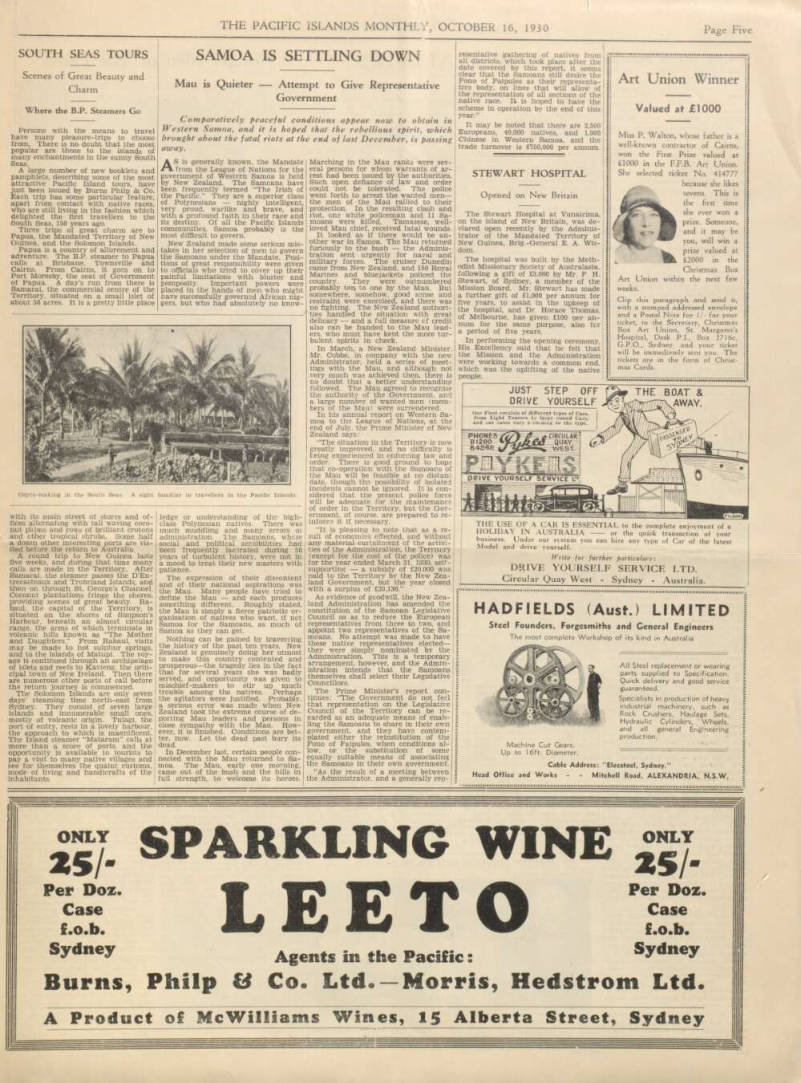
Copra-making In the South Seas. A sight familiar to travellers in the Pacific Islands.
Samoa Is Settling Down
Mau is Quieter Attempt to Give Representative Government
Comparatively peaceful conditions appear now to obtain in Western Samoa, and it is hoped that the rebellious spirit, which brought about the fatal riots at the end of last December, is passing away.
AS is generally known, the Mandate from the League of Nations for the government of Western Samoa is held by New Zealand. The Samoans have been frequently termed “The Irish of the Pacific.” They are a superior class of Polynesians highly intelligent, very proud, warlike and brave, and with a profound faith in their race and its destiny. Of all the Pacific Islands communities, Samoa probably is the most difficult to govern.
New Zealand made some serious mis takes in her selection of men to govern the Samoans under the Mandate. Posi tions of great responsibility were given to officials who tried to cover up their painful limitations with bluster and pomposity. Important powers were placed in the hands of men who might have successfully governed African nig gers, but who had absolutely no know-
Marching in the Man ranks were sev eral persons for whom warrants of ar rest had been issued by the authorities.
Such open defiance of law and order could not be tolerated. The police went forth to arrest the wanted men— the men of the Mau rallied to their protection. In the resulting clash and riot, one white policeman and 11 Sa moans were killed. Tamasese, well loved Mau chief, received fatal wounds.
It looked as if there would be an other war in Samoa. The Mau returned furiously to the bush the Adminis tration sent urgently for naval and military forces. The cruiser Dunedin came from New Zealand, and 150 Royal Marines and bluejackets policed the country. They were outnumbered probably ten, to one by the Mau. But somewhere, somehow, good sense and restraint were exercised, and there was no fighting. The New Zealand authori ties handled the situation with great delicacy and a full measure of credit also can be handed to the Mau lead ers, who must have keot the more tur bulent spirits in check.
In March, a New Zealand Minister, Mr. Cobbe, in company with the new Administrator, held a series of meet ings with the Mau, and although not very much was achieved then, there is no doubt that a better understanding followed. The Mau agreed to recognise the authority of the Government, and a large number of wanted men (mem bers of the Mau) were surrendered.
In his annual report on Western Sa moa to the League of Nations, at the end of July, the Prime Minister of New Zealand says: “The situation in the Territory is now greatly improved, and no difficulty is being experienced in enforcing law and order. There is good ground to hope that co-operation with the Samoans of the Mau will be feasible at no distant date, though the possibility of isolated incidents cannot be ignored. It is con sidered that the present police force will be adequate for the maintenance of order in the Territory, but the Gov ernment. of course, are prepared to re inforce it if necessary.
“It is pleasing to note that as a re sult of economies effected, and without any material curtailment of the activi ties of the Administration, the Territory (except for the cost of the police) was for the year ended March 31, 1930, self supporting — a subsidy of £20,000 was naid to the Territory by the New Zea land Government, but the year closed with a surplus of £20,136.”
As evidence of goodwill, the New Zea land Administration has amended the constitution of the Samoan Legislative Council so as to reduce the European representatives from three to two, and appoint two representatives of the Sa moans. No attempt was made to have these native representatives elected — they were simply nominated by the Administration. This is a temporary arrangement, however, and the Admin istration intends that the Samoans themselves shall select their Legislative Councillors.
The Prime Minister’s report con tinues: “The Government do not feel that representation on the Legislative Council of the Territory can be re garded as an adequate means of enab ling the Samoans to share in their own government, and they have contem plated either the reinstitution of the Fono of Faipules, when conditions al low, or the substitution of some equally suitable means of associating the Samoans in their own government.
“As the result of a meeting between the Administrator, and a generally rep
resentative gathering of natives from all districts, which took place after the date covered by this report, it seems clear that the Samoans still desire the Fono of Faipules as their representa tive body, on lines that will allow of the representation of all sections of the native race. It is hoped to have the scheme in operation by the end of this year.”
It may be noted that there are 2,500 Europeans, 40,000 natives, and 1,000 Chinese in Western Samoa, and the trade turnover is £750,000 per annum.
Stewart Hospital
Opened on New Britain
The Stewart Hospital at Vunairima, on the island of New Britain, was de clared open recently by the Adminis trator of the Mandated Territory of New' Guinea, Brig.-General E. A. Wis dom.
The hospital was built by the Meth odist Missionary Society of Australasia, following a gift of £3,000 by Mr. F. H.
Stewart, of Sydney, a member of the Mission Board. Mr. Stewart has made a further gift of £1,000 per annum for five years, to assist in the upkeep of the hospital, and Dr. Horace Thomas, of Melbourne, has given £100 per annum for the same purpose, also for a period of five years.
In performing the opening ceremony, His Excellency said that he felt that the Mission and the Administration were working towards a common end, which was the uplifting of the native people.
Advertisements & other items, p. 5 (1 item)
Leeto
Art Union Winner
Valued at £1000
Miss P. Walton, whose father is a well-known contractor of Cairns, won the First Prize valued at £1000 in the F.F.B. Art Union.
She selected ticket No. 414777 Art Union within the next few weeks.
Clip this paragraph and send it, with a stamped addressed envelope and a Postal Note for 1/- for your ticker, to the Secretary, Christmas Box Art Union, St. Margaret’s Hospital, Desk P. 1., Box 2716 c, G.P.O., Sydney, and your ticket will be immediately sent you. The tickets are in the form of Christmas Cards. because she likes sevens. This is the first time she ever won a
prize. Someone,
and it may be you, will win a prize valued at £2000 in the Christmas Box
JUST STEP OFF
DRIVE YOURSELF
BOAT &
AWAY.
Our Fleet consists of different types of Cars, from Light Tourers to large closed Cars, and our rates vary avoiding to the type.
THE
DRIVE YOURSELF SERVICE
THE USE OF A CAR IS ESSENTIAL to the complete enjoyment of a HOLIDAY IN AUSTRALIA or the quick transaction of your business. Under our system you can hire any type of Car of the latest Model and drive yourself.
Write for further particulars:
DRIVE YOURSELF SERVICE LTD.
Circular Quay West - Sydney - Australia.
HADFIELDS (Aust.) LIMITED
Steel Founders, Forgesmiths and General Engineers The most complete Workshop of its kind in Australia All Steel replacement or wearing parts supplied to Specification.
Quick delivery and good service guaranteed.
Specialists in production of heavy industrial machinery, such as Rock Crushers, Haulage Sets, Hydraulic Cylinders, Wheels, and all general Engineering production.
Cable Address; “Elecsteel, Sydney.”
Head Office and Works - - Mitchell Road, ALEXANDRIA, N.S.W.
Machine Cut Gears.
Up to 16ft. Diameter.
ONLY
Z5/- Per Doz.
Case f.o.b.
Sydney
SPARKLING WINE °£T
LEETO
Per Doz.
Case f.o.b.
Sydney Agents In the Pacific: Burns, Phllp & Co. Ltd. —Morris, Hedstrom Ltd.
A Product of McWilliams Wanes, 15 Alberta Street, Sydney
More Evidence
Vol. 1.—No. 3.
October, 1930.
THE need for combined action by Pacific Islands interests against Government and official indifference and interference becomes ever more apparent.
In previous issues we have refer red to the dwindling of Australia’s valuable trade with New Caledonia, and the failure of the Federal Gov ernment even to recognise that that situation urgently demands atten tion. We have referred, also, to the action of the Federal authorities in imposing a duty on mining machin ery and aeroplanes entering New Guinea goldfields—surely the year’s most priceless example of blind stu pidity.
Now, as is described in another column, we have the imposition of the sales tax (2½ per cent.) on Norfolk Island bananas. The primary pro ducts of Australia are exempt from this tax, but it has been placed on Norfolk Island produce because that Territory “is not an integral part of the Commonwealth’’! There are a dozen reasons, based on both principle and self-interest, why our Norfolk Island trade should be encouraged in stead of attacked through this per nicious sales tax. But one should be sufficient namely, that our annual trade with Norfolk Island is worth a very large sum, and that the Nor folk Islanders would be glad to break away from selfish and indifferent Australia and form commercial rela tions elsewhere.
During the month there has been bitter complaint from the great gold companies, which are preparing to spend millions in the exploitation of New Guinea gold and, incidentally, the development of the vast, rich ter ritory. Those people are expected to invest huge sum& in the new industry —yet the Federal authorities, so far, have failed to give them any secur ity of title to the lands which they are to exploit. The prevailing eco nomic crisis is of that peculiar character that it is in the highest degree desirable that Australia should produce gold. The New Guinea com panies are steadily approaching the point when they will win enormous quantities of gold for Australia’s benefit. Yet Australia imposes a duty on their machinery, declines to give them a secure title and generally dis plays utter indifference to the whole subject.
Customs officials are imposing sales and primage taxes on the containers of Islands produce—sacks, boxes, etc. Instead of trying to assist and stimulate our oversea traffic, they are expending much energy and time in a frantic pursuit of twopences, made by putting ridiculous values on bags and boxes, and taxing them accord ingly. Meanwhile, our eager and efficient trade competitors are taking away the Pacific Islands trade from under our nose.
Is it any wonder that oversea critics say that this nation has been made drunk by loan-money and acci dental prosperity, and therefore is as silly as any drunk man ever could be?
Tropicalities
Written for The Pacific Islands Monthly by “Sea-Serpent”
EVERYONE who wishes well of Fiji, and of the staunch little party of big-visioned men who have led the Col ony in its remarkable progress during the past ten years, will be genuinely sorry to hear that Mr. Henry Marks' has been forced to put his Tova meat cannery (Fiji Development Co.) into liquidation, and that his personal loss is over £40,000. The company bought 85,000 acres of broken country in the north-east part of Viti Levu a few years ago, commenced cattle produc tion on a large scale and built a very modern cannery. The canned meats were of excellent quality and com manded a good market in Fiji and the adjoining territories. We have not heard what caused the failure; but it is usually the fact that the bold pio neers of this kind of enterprise, hav ing to bear the heavy preliminary and exploratory costs, frequently take it in the neck. Presumably, the spirit of this canning enter prise, like the soul of the lament ed John Brown, will go marching on.
Someone will buy up the Tova organi sation cheaply and, getting the advan tage of Mr. Marks’ pioneering work, will gather in the profits. But that is small comfort to Mr. Marks. There is opportunity for cattle farming and meat canning in Fiji, just as he fore saw; only, someone else will reap what he has sown. * * * THE title of Mrs. Keelan’s Papuan book “The Land of Dohori,” started an argument. Our reviewer, who knows Papua, said that “Dohori” is an onomatopoeia—and that thing, we may inform the uninitiated, is a word that is formed by imitating the sound of that which it refers to. “Wail,” “howl,”
“cluck” comes within the category. We said we could not understand how “dohori” —which means “wait a while” or “don’t be in a hurry”—could be an onomatopoeia: but the other man re torted “wait until you have heard a native drawling it out —it will almost send you to sleep.” It is one of the words most frequently heard in Papua; and it is of interest to note that when the Motuan boy says “Dohori taubada” or “Dohori sinabada” to his master or mistress, he really does not mean to be insolent, although at first it cre ates a bad impression upon anyone knowing little of the race. A white man will order his servant to bring him something. The native may hap nen to be otherwise occupied at the time, and he will drawl out “Dohori taubada, dohori.”
It is simply the custom of the coun try. * * * THE permanent establishment in Fiji of an Indian population of 75,000 is one of the most interesting developments of British colonisation in the South Seas—particularly as the history of this Indian settlement will do much to guide our Dominion states men of the future. I was glad to re ceive a copy of “Vriddhi—a quarterly review published in Suva, in Hindu and English, for the discussion of all prob lems affecting the welfare of Indian Colonists in Fiji,” capably edited by Dr. I. Hamilton Beattie, M.A., and Pandit Durga Prasad. Anxious to get some idea of what is in the minds of these Fijian Indians regarding them selves, their colonisation activities and ambitions, and their relationship with the political and social life of Fiji, I read the review with eagerness. I was much disappointed. The maga zine is devoted almost wholly to a discussion of the problems of the In dian empire, and its main object seems to be that of carrying forward the propaganda of Gandhi. Running through the various articles there is hostility to British rule in India, and an agitation for self-government and a very large measure of independence.
This is no place for the discussion of the Indian problem. Some day In dia will achieve self-government—-but not while only 23,000,000 out of a population of 317,000,000 can read and write, and while the country is torn by racial and caste hatreds which extend back into the Middle Ages, and are far more bitter and deep-seated than is the antagonism of a section of the
population towards the British —an an tagonism cultivated and influenced by Russian Communists. Some Power must govern India —no one, who knows the Indians, would suggest that they are capable of controlling that huge empire, as cne administrative unit— and, until some better alternative is found, that Power must be Britain. * * * THE Fijian-Indians are crying be cause they are not allowed upon the common electoral roll with the European population but, instead, are given a communal franchise. How can they expect to be handed the responsi bility of the common franchise when they show so little understanding of their position that they import to their free, comfortable and happy home in Fiji the viewpoints, agitations and pre judices of India? One had hoped that these people, given the marvellous opportunities and freedom of life in Fiji, would have settled down, forgot ten the troubles of their home land, and devoted themselves to the arts of good citizenship and the improvement and advancement of the land of their adoption. The British Raj is stern, but just—the subject races of Britain who become entitled to self-government in variably receive it. But the Indians’ assumption of race equality, based on the mere fact of permanent residence, without proof of the qualities of citi zenship that the common franchise de mands, is likely to be an embarrass ment to the British Administration in Fiji, just as it has been in Natal and elsewhere. Individual Indians can take an honoured place in any British society; but the average Indian of the masses, ethnographically, culturally and temperamentally, is below the standard demanded for full British citizenship, and can attain that standard only by constant striving through several gen erations.
On present appearances the Colony of Fiji has a glorious and rich future, in which the Indians will share. But the Indians must recognise their pro per place, and not make a nuisance of themselves. The permeation of the Fijian Indian community by the Gandhi school of thought is a discour aging sign. * * * NOUMEA is a delightful place in which to spend a holiday; but, says Mr. P. F. Parkes, “one can have too darned much of a good thing.” He has spent several months in New Cale donia, trying to save Bechades from liquidation and about 40 Sydney mer chants from losses running into dis tressing figures. His days were more or less occupied with business; but the long, dreary evenings in the small Noumea hotel were almost unendur able. Had it not been for the wonder ful hospitality of his many French friends, Mr. Parkes probably would have broken the monotony by assault ing a gendarme or starting a two-up school among the Annamites.
When he returned in September, Air.
Parkes startled his family by going for long walks into the bush and talk ing earnestly to himself. But every thing was in order. The explanation was that Mr. Parkes had bean using the French language for so long that he was thinking in it; and he was merely drilling himself into resuming the natural use of his mother tongue. * * * I NOTE in a Melbourne report that one, Maynard Hedstrom, has been elected president of the College Club of Trinity College, Melbourne—a posi tion that carries with it the designa tion of Senior Student. No boy can achieve this honour unless he has marked qualities and strong individu ality. I mention the fact because it is something on which the well-known merchant knight of Suva can be con gratulated; and also, because, as de monstrated in scores of families, it is seldom that the qualities of the mas terful, pioneering father are repro duced in the son. But Maynard, Junior, apparently, is a chip of the old block.
Mission Workers Return To Islands
Three workers of the Melanesian Mission, who sailed from Auckland by the mission steamer Southern Cross in September.
Left: Rev. S. G. Caulton, who is returning to the mission school at Ugi, in the Solomon group.
Miss E. Burdett (centre) is also bound for the Solomons, to do nursing work at Malaita Island Hospital. Miss M. A. Hurse (right) is returning to Banks Island, to re-open the mission' school for native girls.
Notable Men of The Pacific
THE fact that Brigadier-General E.
A. Wisdom has held for nine years the post of Administrator of the Man dated Territory of New Guinea, and looks like holding it for another nine or nineteen years, is the greatest testi mony to his ability, calm temperament and good judgment. From a distance, it appears a gorgeous job—a high official position, generous emoluments, residence amid delightful surroundings, and almost autocratic powers. But no one who might look behind the scenes will envy General Wisdom.
The Administrator of any Mandated Territory, apart from the ordinary difficulties of his work, is beset by petty intrigues, incipient civil disloy alty and general “underground engi neering”—we need not look beyond Samoa and Palestine for evidence of that. In New Guinea General Wis dom has met all these troubles, with others peculiar to the region. When Australia received the Mandate in 1921, and he was given charge of the Ad ministration, the Territory was in that state of muddle inseparable from a change-over from one Power to an other, with a military administration intervening; it was seething with pro- German propaganda, and was full of petty trouble resulting from the fact that during the War and post-war years, it had been a happy hunting ground for all sorts of commercial ad venturers. On top of that the Admin istrator was without a staff trained to tropical conditions, and had to make the best use nossible of the unsuitable material available.
The Australian public was periodi cally agitated by newspaper stories of muddle, inefficiency and roguery in the Mandated Territory. Much of it was German propaganda; much could be traced to disgruntled 'traders< and officials who—probably with justice— had received “the order of the boot”; some of it was true. Bitter attacks were made on the Administrator. He seldom replied—he simply went on quietly with the job. He had this great advantage—that the Australian Government left him alone and gave him the time necessary to bring order out of chaos. Little by little, year by year, he has improved the Adminis tration. The pro-German influences have largely disappeared, the hostility that caused so much trouble in the civil population has been checked, and many of the obvious misfits have been
removed from the Public Service. Much remains to be done, but the position in 1930, compared with what it was in 1921, shows a vast improvement, and great credit must accordingly be given to General Wisdom. He has displayed much strength of character, broad vision and a calm, steady purposeful ness that have completely justified his selection for one of the most difficult posts under the Commonwealth Gov ernment.
General Wisdom is Scottish-born and 60 years of age. Educated at In verness at Edinburgh, he was only 21 when he arrived in West Australia, and he spent over 20 successful years in that State. He was engaged in gold-mining and various commercial enterprises, and took a keen interest in public affairs. He was mayor of Cottesloe, a suburb of Perth, from 1908 until 1912, and he represented Clare mont in the West Australian Parlia ment from 1911 to 1917.
Interest in military affairs profoundly influenced General Wisdom’s later life.
He obtained a commission in the De fence Forces in 1901 and rose to the rank which gave him the position of a General Staff Officer in W.A. on the outbreak of war. His war record —a very distinguished one—needs no re capitulation here. He served in Gal lipoli, in the Sinai, and in France, and his services were recognised by many awards—notably the C. B., the D. S. O., and the Order of Danilo. He was four times mentioned in despatches and once specially mentioned. He was temporarily in command of the Second Australian Division, in August, 1918, when the Australian Army Corps was doing such big things on the Somme.
The selection of a man to take charge of New Guinea—and be responsible to the League of Nations as well as to the Commonwealth Government —was extremely difficult. Subsequent events have proved the wisdom of the choice.
This very brief sketch of the career of a distinguished and successful man would be incomplete without some re ference to his wife. General Wisdom, in 1895, married Miss Agnes Bell-Jack son, of Edinburgh; and Mrs. Wisdom has been of great assistance to him in New Guinea, where social activities count for a good deal. She has not only presided worthily over Govern ment House, but she has also taken a helpful interest in the work of admin istration, and her tact and kindness have made her popular with all classes.
Mr. Arthur Snow, of Viti Levu Bay.
Fiji, died last month at the age of 72 years. He had spent nearly 50 years in the Group.
Mr. Bird, Inspector of Schools in New Zealand, who has been examining the Fiji Grammar Schools and Levuka Public School, has returned to Auck land, N.Z.
Professor A. Thompson, Director of the Apia Observatory, Western Samoa,
la ft bv the Clan Ogilvie last month.
His destination is Germany, where he will remain about six months.
Dr. and Mrs. Heaslip sailed for Sal amo. Eastern Papua, by the Morinda on September 27, Dr. Heaslin is to take charge of the Salamo Hospital in succession to Dr. F. J. Williams.
Miss F. Pearce, who is attached to the staff of the Methodist Missionary oociety in Panua. has returned to Kiri wma, after furlough in Victoria.
Brigadier-General E. A. Wisdom, C.B., C.M.G., D.S.O., Administrator of the Mandated Territory of New Guinea
Advertisements & other items, p. 6 (1 item)
The Pacific Islands Monthly, October 16, 1930
6
Pacific Islands Monthly
Published once a month, and circulated among residents of: New Guinea Fiji Solomon Is.
Papua Tonga New Hebrides Norfolk Is. Samoa New Caledonia Cook Is. Nauru Ocean Is.
Gilbert Is. Tahiti Thursday Is.
Read also by residents of Australia and New Zealand who are interested in Pacific Islands trade and activities.
Publishers ; Pacific Publications, 30 Carrington St., Wynyard Sq., Sydney. Tel.: BW 5037.
Editor: R. W. Robson.
SUBSCRIPTION RATES:
s. d.
Per annum, post free, within British Empire; in advance, 6/-; booked .. 6 6 Per annum, post free, beyond British Empire 8 0
ADVERTISING;
Casual; Per single column inch 8 0 Contract; 6/6, 7/- and 7/6 per inch, accord ing to conditions.
Changes of advertising copy should reach publishers by 7th of each month.
CONTRIBUTIONS:
Contributions on matters of interest to Pacific Islands residents and traders are in vited; and, if accepted, will be paid for, on publication, at the rate of 2½d. per line.
Special payment for photographs. No respon sibility is taken for contributions forwarded; but, if return is desired in the event of rejec tion, a stamped and addressed envelope should be enclosed.
DISTRIBUTION;
In Australia, New Zealand and Great Britain copies may be obtained from, and subscription orders lodged with, Messrs. Gordon & Gotch, Limited.
In the Pacific Islands, copies may be ob tained from, and subscription orders lodged at any of the stores of Messrs. Burns Philp & Co.
Ltd., Messrs. Burns Philp (South Seas) Co Ltd., Messrs. W. R. Carpenter & Co. Ltd., and Messrs. Morris Hedstrom & Co. Ltd.
Big Game Fish
Where the Sport is Worthy of the Name
All men dream that some day, some where, they will enjoy a day's REAL fishing. Sport worthy of the name can be had, at almost any time, in the end less, sheltered waters of the Fiji Groups.
The most enthusiastic fishermen in Suva are Sir Maynard Hedstrom and Mr.
Thomas Horne, who know the waters of Fiji from end to end. Mr. Horne, who took Earl Beauchamp fishing recently, dur ing his brief call at Suva, has kindly written these notes for The Pacific Islands Monthly.
NEARLY everyone who comes to Fiji wants to know about the fish ing—where to go and what kind of fish are to be caught.
The best plan is to find out where Andy Smoothey is. He can take you to all the good spots about Suva. If there are any fish to be caught Andy Smoothey will find them for you.
In my experience I found that the best artificial baits are the No. 6 Gibb-
Stuart and the No. 6 Knowles Auto matics. I always keep a piece of red wool to keep the hook in its place in the No. 6 Knowles Automatics. With the Gibb-Stuart I find that by using a triple hook, hanging two inches from the top triple, I get the best results. You must use a steel wire trace —brass is of no use, because the “Ogo” and “Walu” have sharp
and such strong teeth that they bite through the brass ware.
In the vicinity of Suva a large var iety of fish are to be found; “Sanga” from 5 to 60 lbs.; “Ogo” from 1 to 70 lbs.; “Walu” from 5 to 50 lbs.; “Donu” from 5 to 25 lbs.; and rock cod up to 70 lbs. If you are lucky enough to get into a school of “Bonita,” or you can get on to a “Ligone,” you will have all the fun you want.
Anyone coming into Suva and
wanting to know about accommodation and where they can go around the island, should com municate with Mr. J. Herrick (Secre tary of the Tourist Bureau), and he will be only too pleased to give all
information required.
Mr. Thomas Horne, managing director of Messrs. Walter Horne & Co., of Suva and Sydney: vice-president of Suva Chamber of Commerce; has been forty-eight years in the Pacific. Mr. Horne is a noted deep-sea fisherman.
A sample of the fish caught in Fijian waters.
Appeal To Pacific Islands
Naturalists
To The Editor Sir, —Would your Norfolk Island cor respondent be so kind as to supply a list of the various orchids that are found on the island, together with any interesting particulars regarding them, either through your columns or direct to me.
We should be most happy here to ex change any local information with other Pacific centres, per medium of our Society.
I remain, yours sincerely,
G. H. Vernon, F.R.G.S.A.,
Hon. Sec. T.I. & T.S. Branch of the Royal Geographical Society of Australasia.
Thursday Island.
September 15.
Mr. Quihcy F. Roberts, Consul for the U.S.A.. has received a cablegram noti fying him of another promotion in the Consular Service. This is his third in the past six years. He has received many congratulations from his friends throughout the Pacific.
New Guinea Market for Australian Rice
Australian Rice
(From Our Own Correspondent.) CANBERRA, October 14.
I understand that enquiries are be ing made to ascertain whether the market for rice in New Guinea Man dated Territory may not be captured lor the Australian article.
As has been previously pointed out, Australia’s production of rice now meets her domestic requirements and leaves a surplus for export amounting to approximately 10,000 tons. Rice is an article of diet that is being increas ingly used by planters and other em ployers of native labour for feeding their “boys”; and the value of the an nual importation is now about £90,000.
Up to date most of this has been purchased from Eastern countries, and there is no reason why, if the price can be adjusted, New Guinea should not absorb Australia’s surplus produc tion.
Officials are reticent, but it is stated that the matter is now being discussed between the Administrator of the Ter ritory (Brig.-General Wisdom), the Prime Minister’s Department and the shipping companies concerned, who are being asked to make some freight con cessions so as to assist Australia in capturing this trade.
Big Merger
Four New Hebrides Companies
FOUR big French companies, each owning numerous and valuable plantation properties in New Hebrides, have been merged, and in future will be operated as one concern, under the name of Societe Francaise des Nouv elles Hebrides. They are: Societe des Nouvelles Hebrides, Compagnie General Franco Hebridaise, Compagnie Agricole et Miniere des Nouvelles Hebrides, Compagnie Coloniale de Vale.
Mr. Vigoreux, a well-known resident of Noumea, is the managing director of the new organisation; and the Directeur Technique is M. Pinelli, who has just arrived from France, and who left Sydney for Port Vila by the La perouse last week.
The combined capital of the new concern is 50,000,000 francs. The oper ations at present are devoted mostly to coconuts and cocoa production, but with the low prices ruling for these products, other lines will doubtless be sought.
It is hoped that this re-organisation will be of benefit to Australia, as it is expected to sell considerable por tions of its products here and to pur chase Australian foodstuffs and manu factured goods in return.
Well-Known Pacific
Traveller
Having been engaged in industrial and scientific research for half a cen
tury, Mr. A. J.
Vogan, F.R.G.S., is as well known in the Pacific as the John Williams. He has just arrived from Fiji, where he has discovered some most interesting rock carvings; and is en route to New Caledonia and the Trobriands, on the track of ancient migrations and more ancient civili sations. He has had an extraordin ari1y interesting career, as explorer,
soldier, scientist, newspaper artist, etc.
He has written some books and count less articles—but his coming book on Pacific archaeology probably will be his most valuable contribution to the world’s knowledge.
How Taxation is Killing
Our Pacific Trade
By Graham Kerr
Sydney should be the clearing-house for the South Pacific trade; but, with Aus tralia’s blind restrictions on this, that and the other, the trade is driven else where. Traffic with Fiji and other groups has been driven away.
After all, the question boils down to this; What is of the most advantage to Australia? Does Australia benefit by put ting State and Federal income tax on island produce (on quite an arbitrary basis and on a problematical income) sold here to pay for goods bought here?
To be well in the picture New South Wales claps on an Unemployment Relief Tax on produce sold.
Now we have the Primage Tax on top of the rest! The Primage Tax, although the heaviest, being a straight-out tax, is perhaps the most satisfactory of the lot. The miserable State Unemployment Relief Tax and the State and Federal Income Tax are driving Relief and Income away!
Is it not time for the Governments con cerned to scrap these ridiculous taxes on produce sold here to pay for Australian goods?
Is there no scientific review of the bene fit or otherwise of these measures?
Mr. C. C. Brady, the well-known in spector for Messrs. Burns, Philp (South Sea) Co. Ltd., left by the Makambo last week for Lord Howe, Norfolk Is land, and the New Hebrides ports. He will be back early in November and will then visit the New Zealand and Fiji branches. Probably he will remain in Fiji for several months on relieving duty.
Fijian Pineapple Industry Prospering
From our Fiji Correspondent.
WHILE our other leading primary industries are all confronted to day with strong opposition and low world’s prices, the baby industry of pineapple growing and canning prom ises to prove one of Fiji’s most valu able assets. The only drag on the pro gress of the industry is difficulty in getting a sufficient quantity of suckers, lime alone will overcome this draw back, but a large quantitiy is in sight for next season’s planting.
The Fiji Pineapple Co.’s plantation at Waidau, on Ovalau, is coming along splendidly, and the crop looks very healthy and strong, the slopes of the hills where the pines are planted pre senting a pretty sight from the sea.
At Nandi, where West Coast Pines Ltd. has a fine plantation and fac tory, good solid progress has been made.
The company has a large area of speci ally suitable land, whose soil shows,- by careful analysis, that it is better adap ted for pineapple growing than the land of Hawaii. The company has let a good quantity of this land to Indian farmers, and already has three European farmers with crops in. Be sides these tenants, there are a num ber of outside farmers who have signed contracts to grow fruit, so the com pany has a bright future before it. and with every promise of success. The pack this season will be carried out
under the supervision of the Superin tendent of Messrs. Libby, McNeil and Libby Ltd., of Honolulu, while the can ning will be done by an expert “double seamer” from the same company. The suckers in sight for the next season will allow of a large addition to the plantation.
It is announced privately that a third pineapple growing and canning com pany is about to be launched on the West Coast of Viti Levu. The proposed capital is £200,000.
Pineapple plants on the Fijian Pineapple Co.’s plantation at Waidau, on the Island of Ovalau, Fiji.
140 Acres In Bearing
From our Auckland Correspondent.
Most of the £50,000 subscribed for the Fijian Pineapple Co. Ltd., incor porated in October, 1928, is New Zeal land capital. About 140 acres have been planted on the island of Ovalau, and most of this will be in full bear ing in this coming summer. It is esti mated that the 1930-31 pack will be 18,000 cases. The reports on the qual ity of the canned pineapples, already exported are first-class. Another 100 acres will be planted between Novem ber and March.
The demand for canned pineapples throughout the world continues in ex cess of the supply, and the prospects of the industry are excellent.
Federation?
Why Not a Pacific Islands Federation?
Need For Machinery For Consideration
Of Common Problems
The proposal to form, out of the British islands and territories of the Pacific, a Pacific Islands Federation, has been under consideration for many years. It was first brought into the sphere of practical politics by a series of well-written articles published in The Western Pacific Herald in 1913; and it was advanced a further stage in 1921 when the Legislative Council of Fiji, on the motion of Sir (then Mr.) Henry Scott, passed a resolution approving of Federation.
Sir Henry Scott very kindly has acceded to our request that he write for The Pacific Islands Monthly an explanation of this important proposal. Sir Henry is a well-known legal practitioner in Suva and is a member of both the Executive and Legislative Councils of Fiji,
IN the year 1921, I moved the Legis lative Council of Fiji in the above matter and the resolution was, I under stand, forwarded to the Colonial Office.
But no steps have since been taken.
The object of the motion was to give publicity to the views expressed and to try and bring about an inter change of ideas. To some extent this was successful, as the Kingdom eff Tonga (through its Premier) did not approve; and some expression of opin ion was heard from the British Solo mon Islands in opposition. The ques tion has not since been publicly de bated or considered.
That there are difficulties and practical ones to be faced no one can deny, and it may be that it will be some years before anything further can be done; but I
am convinced that sooner or later a closer union of British interests in these islands will be brought about. Nothing is ever achieved without opposi tion, and the trouble is that vast distances ex isting between the various islands make it extremely difficult to have an interchange of ideas which, of course, is so necessary if agree ment is ever to be reached on so vital a question. Such a conference is a condition prece dent.
The area cover ing what we know
In 1921 the Legislative Council of Fiji, on the motion of Sir Henry (then Mr.) Scott, K.C., passed the following motion as an expression of opinion from the Elected side of the Council : THAT in the opinion of this Council. (a) The interests of the Em pire in the Pacific would best be served by a confed eration of the British Is lands of the Western Paci fic, governed and controlled from a common centre. (b) That this resolution be transmitted to the Right Honourable the Secretary of State for the Colonies, respectfully asking for his approval.
as the Western Pacific is, in extent, as large as the area stretching across the Continent of Africa from Mom bassa to the mouth of the Congo River—really enormous. I would, however, like to see the representatives of all the present varied forms of governments meet together at a round table conference, to discuss the ques tion and see whether the difficulties could not be minimised, if not over come. I mention the following admin istrations by way of illustration: (a) British Crown Colony of Fiji. (b) British Crown Colony of Gilbert and Ellice Islands (controlled by the High Commissioner for the Western Pacific residing in Fiji). (c) British Solomon Islands (also controlled by the High Commis sioner for the Western Pacific, residing in Fiji). (d) Samoa. (e) Tonga.
It seems to me that the question might at first be classed under three heads:
(a) Administration,
(b) Financial, and (c) Trade and Commerce.
Variety Of Administration.
In dealing with the first it would be difficult to conceive more varying forms of administration than now exist.
In Fiji there is an Executive Council and a Legislative Council. The former is to some extent analogous to a Min istry in a pelf-goveming Dominion, and this Council determines the pol icy of the Government—subject, of course, to specific directions received by the Governor from the Secretary of State. It is the highest institution in the country, being, in effect, the Gov ernor’s Cabinet.
For some years past, in addition to the official members, two unofficial members are appointed to this Coun cil by the King, on the recommenda tion of the Governor and the Secretary of State for the Colonies.
The Legislative Council is the body that is partly elective. The Europeans, enjoying a fairly liberal franchise, elect six members and the Indians three members. The Fijians, also, have three native members, who are appointed by the Governor from names selected by the Great Council of Chiefs, usually once in three years. There are 13 nominated (official) members The Gilbert and Ellice Islands Col ony (including Ocean Island) is gov erned by Resident Commissioners, who are directly controlled by the High Commissioner for the Western Pacific
(who is also Governor of Fiji) from Suva, as is also the British Solomon Islands.
Tonga is a Kingdom with a British Agent and Consul.
Samoa is Governed by New Zealand, under a mandate from the League of Nations.
It may be that, as a first step, a Customs Union might be attempted.
I would not like to see island jeal ousies aroused, but I always have thought that Suva should be the dis tributing centre for most of these is lands.
Example Of Medical School,
Fiji, to-day, is gradually showing what can be done. We now have— thanks to the assistance received from the Rockfeller
Foundation repre sented in Fiji by Dr. S. M. Lam bert, M.D., Deputy Medical Central Authority, West ern Pacific High Commission a very fine central Medical School, close to the Col onial War Memor ial Hospital, Suva, where native stu dents are being taught; and, after their course of training, and they become qualified, they return to their own island homes to practise medicine. The ad ministrations now linked up in this are Fiji, Samoa, Niue, Cook Islands, Tonga,
Solomons and Gilbert and Ellice Islands.
Makogai Island Hospital (Fiji) is now a centre for a particular class of oatient. and some wonderful cures have been effected. New Zealand (in cluding Samoa and the Cook Islands) and Tonga are now linked up to this institution, which is controlled by the Fiji Administration.
Education—and particularly tuition in agricultural and technical subjects —will, in my opinion, find a centre in Fiji before many years pass.
Need For Co-Operation And
Co-Ordination.
The whole question of Islands Ad ministration in this part of the Pacific, wants careful, sympathetic and unsel fish consideration; and, if eventually some mors central and unified admin istration could be brought about. I feel sure that good would result. With the faults admittedly attendant on any ad ministration, it must be conceded that in the officials whom the Colonial Office has at its command there ex ists a great asset in native administra tion; and my own view 1 is that a Confederation of the British Islands in the Pacific will eventually lead to a greater co-ordination of work and pol icy, lesser costs and improved com mercial and trade relations, not only amongst the islands themselves, but with the outside world.
The predominant need of all these islands is the establishment of a system of co-operation, so that they may work and act conjointly for their better ment, as a whole.
The same problems of health, hygiene, education, native life and customs, and administrative difficul ties are common to them all. To con tend with these problems by individual effort is but experimental, and of poor effect, compared with what unity amongst them is capable of achieving.
The British rightly regard it a bounden duty towards a primitive people to lift them up and protect them against themselves. The protection Great Britain affords these islands is not given because they are regarded as being of anv great economic value.
Prom an economic standpoint, however, I know of no better service towards the nrosperity of the Western Pacific Islands than unification Mr. A. W. Freeman, 8.A., 8.E., chair man and managing director of Aus tral-Malay Tin Ltd., and its subsidi aries, died from heart failure on board the Nieuw Holland on October 1. Mr.
Freeman was a brother of Mr. W. A.
Freeman, chairman of directors of Placer Development and Bulolo Gold Dredging Ltd.
Where Is Svaap?
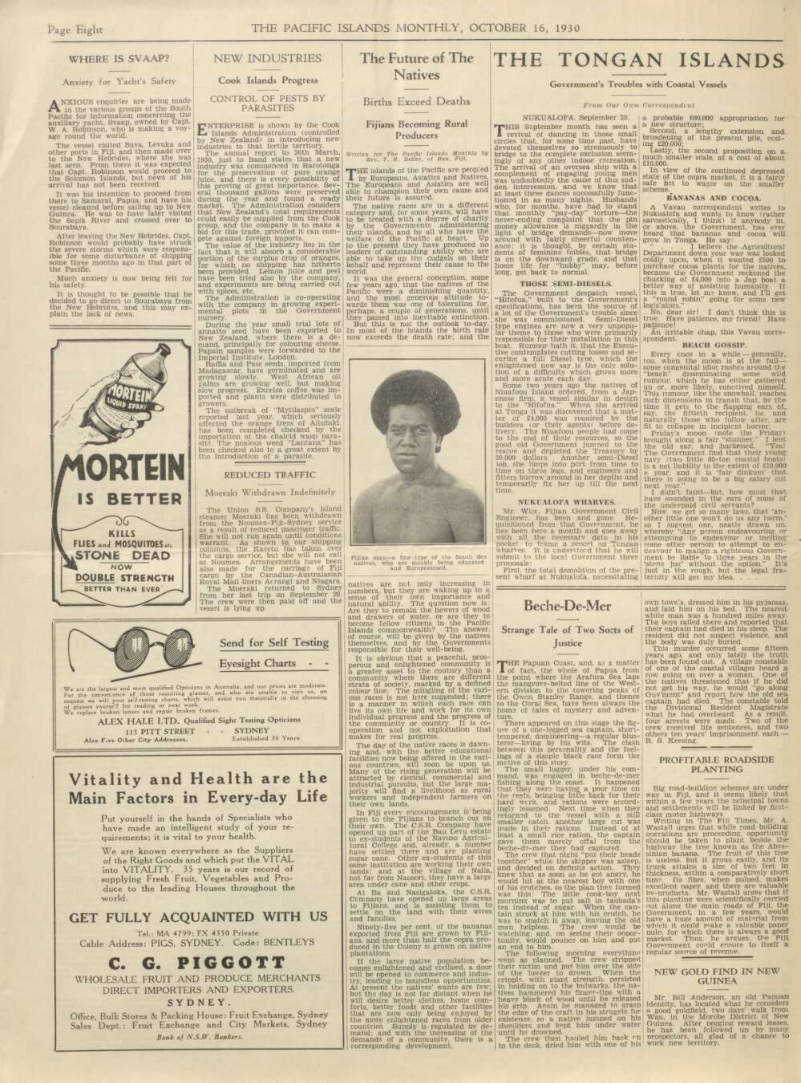
Anxiety for Yacht’s Safety
ANXIOUS enquiries are being made in the various groups of the South Pacific for information concerning the auxiliary yacht, Svaap, owned by Capt.
W. A. Robinson, who is making a voy age round the world.
The vessel visited Suva, Levuka and other ports in Fiji, and then made over to the New Hebrides, where she was last seen. From there it was expected that Capt. Robinson would proceed to the Solomon Islands, but news of his arrival has not been received.
It was his intention to proceed from there to Samarai, Papua, and have his vessel cleaned before sailing up to New Guinea. He was to have later visited the Sepik River and crossed over to Sourabaya.
After leaving the New' Hebrides, Capt.
Robinson would probably have struck the severe storms which were respons ible for some disturbance of shipping some three months ago in that part of the Pacific.
Much anxiety is now being felt for his safety.
It is thought to be possible that he decided to go direct to Sourabaya from the New Hebrides, and this may ex plain the lack of news.
New Industries
Cook Islands Progress
Control Of Pests By
Parasites
Enterprise is shown by the cook Islands Administration (controlled by New Zealand) in introducing new industries to that fertile territory.
The annual report to 30th March, 1930, just to hand states that a new industry was commenced in Rarotonga for the preservation of pure orange juice, and there is every possibility of this proving of great importance. Sev eral thousand gallons were preserved during the year and found a ready market. The Administration considers that New Zealand’s total requirements could easily be supplied from the Cook group, and the company is to make a bid for this trade, provided it can com pete against foreign imports.
The value of the industry lies in the fact that it will absorb a considerable portion of the surplus crop of oranges, for which no shipping has hitherto been provided. Lemon juice and peel have been tried also by the company, and experiments are being carried out with spices, etc.
The Administration is co-operating with the company in growing experi mental plots in the Government nursery.
During the year small trial lots of annatto seed have been exported to New Zealand, where there is a de mand, principally for colouring cheese.
Papain samples were forwarded to the Imperial Institute, London.
Raffia and Pass seeds, imported from Madagascar, have germinated and are growing slowly. West African oil palms are growing well, but making slow progress. Excelsa coffee was im ported and plants were distributed to growers.
The outbreak of “Mytilaspes” scale reported last year, which seriously affected the orange trees of Aitutaki, has been completed checked by the importation of the chalcid wasp nara site. The noxious weed “Lantana” has been checked also to a great extent by the introduction of a parasite.
Reduced Traffic
Moeraki Withdrawn Indefinitely
The Union S.S. Company’s island steamer Moeraki has been withdrawn from the Noumea-Fiji-Sydney service as a result of reduced passenger traffic.
She will not run again until conditions warrant. As shown in our shipping columns, the Karetu has taken over the cargo service, but she will not call at Noumea. Arrangements have been also made for the carriage of Fiji cargo by the Canadian-Australasian Royal Mail liners Acrangi and Niagara.
The Moeraki returned to Sydney from her last trip on September 29.
The crew were then paid off and the vessel is lying up.
The Future of The
Natives Births Exceed Deaths Fijians Becoming Rural Producers
Written for The Pacific Islands Monthly by Rev. T. N. Deller, of Bau, Fiji.
THE islands of the Pacific are peopled by Europeans, Asiatics and Natives.
The Europeans and Asiatics are well able to champion their own cause and their future is assured.
The native races are in a different category and, for some years, will have to be treated with a degree of charity by the Governments administering their islands, and by all who have the welfare of the Pacific at heart. Up to the present they have produced no leaders of outstanding ability who are able to take up the cudgels on their behalf and represent their cause to the world.
It was the general conception, some few years ago, that the natives of the Pacific were a diminishing quantity, and the most generous attitude to wards them was one of toleration for, perhaps, a couple of generations, until they passed into inevitable extinction.
But this is not the outlook to-day.
In most of the islands the birth rate now exceeds the death rate; and the
natives are not only increasing in numbers, but they are waking up to a sense of their own importance and natural ability. The question now is; Are they to remain the hewers of wood and drawers of water, or are they to become fellow citizens in the Pacific Islands commonwealth? The answer, of course, will be given by the natives themselves, and by the Governments responsible for their well-being.
It is obvious that a peaceful, pros perous and enlightened community is a greater asset to the coutnry than a community where there are different strata of society, marked by a defined colour line. The mingling of the vari ous races is not here suggested; there is a manner in which each race can live its own life and work for its own individual progress and the progress of the community or country. It is co operation and not exploitation that makes for real progress.
The day of the native races is dawn ing and, with the better educational facilities now being offered in the vari ous countries. will soon be upon us.
Many of the rising generation will be attracted by clerical, commercial and industrial pursuits, but the large ma jority will find a livelihood as rural workers and independent farmers on their own lands.
In Fiji everv encouragement is being given to the Fijians to branch out on their own. The C.S.R. Company have opened up part of the Bau Levu estate to ex-students of the Navuso Agricul tural College and, already, a number have settled there and are planting sugar cane. Other ex-students of this same institution are working their own lands; and at the village of Naila, not far from Nausori, they have a large area under cane and other crops.
At Ba and Nasigatoka, the C.S.R.
Company have opened up large areas to Fijians, and is assisting them to settle on the land with their wives and families.
Ninety-five per cent, of the bananas exported from Fiji are grown by Fiji ans, and more than half the copra pro duced in the Colony is grown on native plantations.
If the large native population be comes enlightened and civilised, a door will be opened to commerce and indus try, leading to boundless opportunities.
At present the natives’ wants are few; but the day is not far distant when he will desire better clothes, home com forts, better foods and other facilities that are now only being enjoyed by the more enlightened races from older countries. Supply is regulated by de mand; and with the increasing of the demands of a community, there is a corresponding development.
Fijian man—a fine type of the South Sea natives, who are quickly being educated and Europeanised.
The Tongan Islands
Government’s Troubles with Coastal Vessels
From Our Own Correspondent
NUKUALOFA, September 20.
THIS September month has seen a revival of dancing in those small circles that, for some time past, have devoted themselves so strenuously to bridge to the complete exclusion seem ingly of any other indoor recreation.
The arrival of an oversea ship with a complement of engaging young men was undoubtedly the cause of this sud den intercession, and we know that at least three dances successfully func tioned in as many nights. Husbands who, for months, have had to stand that monthly “pay-day” torture —the never-ending complaint that the pin money allowance is niggardly in the light of bridge demands —now move around with fairly cheerful counten ance; it is thought, by certain stu dents of feminine foibles, that bridge is on the downward grade, and that home life for “hubby” may, before long, get back to normal.
Those Semi-Diesels.
The Government despatch vessel, “Hifofua,” built to the Government’s specifications, has been the source of a lot of the Government’s trouble since she was commissioned. Semi-Diesel type engines are now a very unpopu lar theme to those who were primarily responsible for their installation in this boat. Rumour hath it, that the Execu tive contemplates cutting losses and se curing a full Diesel type, which the enlightened now say is the only solu tion of a difficulty which grows more and more acute each day.
Some two years ago the natives of Niuafoou Island ordered, from a Jap enese firm, a vessel similar in design to the “Hifofua.” When she arrived at Tonga it was discovered that a mat ter of £4,000 was required by the builders (or their agents) before de livery. The Niuafoou people had come to the end of their resources, so the good old Government jumped to the rescue and depleted the Treasury by 20,000 dollars. Another semi-Diesel job, she limps into port from time to time on three legs, and engineers and fitters burrow around in her depths and temporarily fix her up till the next time.
Nukualofa Wharves.
Mr. Wise, Fijian Government Civil Engineer, has been and gone. Re quisitioned from that Government, he has been here a month and goes away with all the necessary data in his pocket, to frame a renort on Tongan wharves. It is understood that he will submit to the local Government three proposals: First, the total demolition of the pre sent wharf at Nukualofa, necessitating
a probable £60,000 appropriation for a new structure; Second, a lengthy extension and broadening of the present pile, cost ing £20,000; Lastly, the second proposition on a much smaller scale, at a cost of about £10,000.
In view of the continued depressed state of the copra market, it is a fairly safe bet to wager on the smaller
scheme.
Bananas And Cocoa.
A Vavau correspondent writes to Nukualofa and wants to know (rather sarcastically, I think) if anybody in, or above, the Government, has ever heard that bananas and cocoa will grow' in Tonga. He say: “ . . . I believe the Agricultural Department down your way was looked coldly upon, when it wanted £500 to purchase cocoa plants for the natives, because the Government reckoned the chucking of £4,000 into a Jap boat a better way of assisting humanity. If this is true, let me know, and I’ll get a “round robin” going for some new legislators.”
No, dear sir! I don’t think this is true. Have patience, my friend! Have patience!
An irritable chap, this Vavau corre spondent.
Beach Gossip.
Every once in a while generally,, too, when the moon is at the full— some congenital idiot rushes around the “beach” disseminating some wild rumour, which he has either gathered up or, more likely, conceived himself.
This rumour, like the snowball, reaches such dimensions in transit that, by the time it gets to the flapping ears of, say, the fiftieth recipient, he, and naturally those who follow after, are fit to collapse in incipient horror.
Friday’s moon (note the Friday) brought along a fair “stunner.” I lent the old ear, and (harkened. “Yes!
The Government find that their young navy (two little 60-ton coastal boats) is a net liability to the extent of £10,000 a year, and it is ‘fair dinkum’ that there is going to be a big salary cut next year.”
I didn’t faint —but, how must that have sounded in the ears of some of the underpaid civil servants?
Now. we get so many laws, that ‘an other little one won’t do us any harm,’' so I suggest one, neatly drawn un. whereby “Any person endeavouring or attempting to endeavour or inciting some other person to attempt to en deavour to malign a righteous Govern ment be liable to three years in the ‘stone jug’ without the option.” It’s just in the rough, but the legal fra ternity will get my idea. . . .
Beche-De-Mer
Strange Tale of Two Sorts of Justice
THE Papuan Coast, and, as a matter of fact, the whole of Papua from the point where the Arafura Sea laps the mangrove-belted line of the West ern division to the towering peaks of the Owen Stanley Range, and thence to the Coral Sea, have been always the home of tales of mystery and adven ture.
There appeared on this stage the fig ure of a one-legged sea captain, short tempered, domineering—a regular blus terer-living by his wits. The clash between this personality and the feel ings of a simple black race form the motive of this story.
The small lugger, under his com mand, was engaged in beche-de-mer fishing along the coast. It happened that they were having a poor time on the reefs, bringing little back for their hard work, and rations were accord ingly lessened. Next time when they returned to the vessel with a still smaller catch, another large cut was made in their rations. Instead of at least a small rice ration, the captain gave them merely offal from the beche-de-mer they had captured.
The crew that night “put their heads together” while the skipper was asleep, and decided on definite action. They knew that as soon as he got angry, he would hit at the nearest boy with one of his crutches, so the plan they formed was this: The little cook-boy next morning was to put salt in taubada’s tea instead of sugar. When the can tain struck at him with his crutch, he was to snatch it away, leaving the old man helpless. The crew would be watching, and, on seeing their onpor tunity, would pounce on him and put an end to him.
The following morning everything went as planned. The crew stripped their victim and put him over the side of the lugger to drown. When the cripple, with giant strength, persisted in holding on to the bulwarks, the na tives hammered his finger-tips with a heavy block of wood until be released his grip. Again he managed to grasp the edge of the craft in his struggle for existence, so a native jumped on his shoulders and kept him under water until he drowned.
The crew then hauled him back in to the deck, dried him with one of his
own towels, dressed him in his pyjamas,, and laid him on his bed. The nearest white man was a hundred miles away.
The boys sailed there and reported that their captain had died in his sleep. The resident did not suspect violence, and the body was duly buried.
This murder occurred some fifteen years ago, and only lately the truth has been found out. A village constable of one of the coastal villages heard a row going on over a woman. One of the natives threatened that if he did not get his way, he would “go along Guv’ment” and report how the old sea captain had died. The constable told the Divisional Resident Magistrate what he had overheard. As a result, four arrests were made. Two of the crew received life sentences, and two others ten years’ imprisonment each. —
R. S. Keesing.
Profitable Roadside
Planting
Big road-building schemes are under way in Fiji, and it seems likely that within a few years the principal towns and settlements will be linked by first class motor highways.
Writing in The Fiji Times, Mr. A.
Wastall urges that while road building operations are proceeding, opportunity should be taken to plant beside the highway the tree known as the Abys sinian banana. The fruit of this tree is useless, but it grows easily, and its trunk attains a size of two feet in thickness, within a comparatively short time. Its fibre, when pulped, makes excellent papier, and there are valuable bv-products. Mr. Wastall urges that if this planting were scientifically carried nut along the main roads of Fiji, the Government, in a few years, would have a huge amount of material from which it could make a valuable paper pulp, for which there is always a good market. Thus, he argues, the Fiji Government could ensure to itself a regular source of revenue.
New Gold Find In New
Guinea
Mr. Bill Anderson, an old Papuan identity, has located what he considers a good goldfield, two days’ walk from Wau, in the Morobe District of New Guinea. After pegging reward leases, he has been followed up by many prospectors, all glad of a chance to work new territory.
Advertisements & other items, p. 8 (1 item)
Mortein
IS BETTER
KILLS
FLIES and MOSQUITOES efc.
STONE DEAD
NOW
DOUBLE STRENGTH
BETTER THAN EVER
Send for Self Testing
Eyesight Charts
We are the largest and most qualified Opticians in Australia, and our prices are moderate.
For the convenience of those requiring glasses, and who are unab e to visit us. on request we will post self-testing charts, which will assist you materially in the choosing of glasses yourself for reading or near work.
We replace broken lenses and repair broken frames.
ALEX HALE LTD. Qualified Sight Testing Opticians
113 PITT STREET - - SYDNEY
Also Five Other City Addresses. Established 30 Years
Vitality and Health are the
Main Factors in Every-day Life
Put yourself in the hands of Specialists who have made an intelligent study of your requirements; it is vital to your health.
We are known everywhere as the Suppliers of the Right Goods and which put the VITAL into VITALITY. 35 years is our record of supplying Fresh Fruit, Vegetables and Produce to the leading Houses throughout the world.
GET FULLY ACQUAINTED WITH US
Tel: MA 4799; FX 4350 Private Cable Address: PIGS, SYDNEY. Code: BENTLEYS
C. G. PIGGOTT
WHOLESALE FRUIT AND PRODUCE MERCHANTS
DIRECT IMPORTERS AND EXPORTERS.
SYDNEY.
Office, Bulk Stores & Packing House: Fruit Exchange, Sydney Sales Dept.: Fruit Exchange and City Markets, Sydney Bank of N.S.W. Bankers.
Rice for the Islands
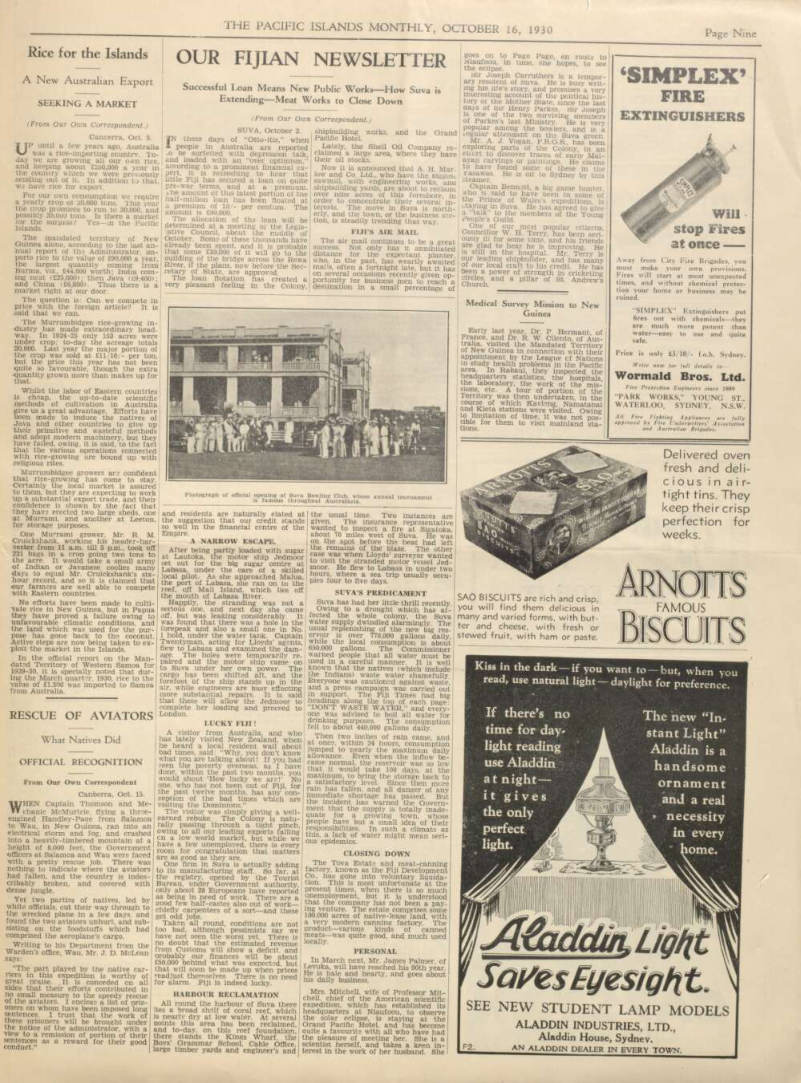
A New Australian Export
Seeking A Market
(From Our Own Correspondent.) Canberra, Oct. 5.
UP until a few years ago, Australia was a rice-importing country. Today we are growing all our own rice, and keeping about £250,000 a year in the country which we were previously sending out of it. In addition to that, we have rice for export.
For our own consumption we require a yearly crop of 20,000 tens. This year the crop promises to run to 30,000, and possibly 35,000 tons. Is there a market for the surplus? Yes—in the Pacific Islands.
The mandated territory of New Guinea alone, according to the last an nual report of the Administrator, im ports rice to the value of £90,000 a year, the largest quantity coming from Burma, viz., £44,000 worth; India com ing next (£25,000); then Java (£9,400); and China (£6,800). Thus there is a market right at our door.
The question is; Can we compete in price with the foreign article? It is said that we can.
The Murrumbidgee rice-growing in dustry has made extraordinary head way. In 1924-25 only 153 acres were under crop; to-day the acreage totals 20,000. Last year the major portion of the crop was sold at £11/10/- per ton, but the price this year has not been quite so favourable, though the extra quantity grown more than makes up for that.
Whilst the labor of Eastern countries is cheap, the up-to-date scientific methods of cultivation in Australia give us a great advantage. Efforts have been made to induce the natives of Java and other countries to give up their primitive and wasteful methods and adopt modern machinery, but they have failed, owing, it is said, to the fact that the various operations connected with rice-growing are bound up with religious rites.
Murrumbidgee growers are confident that rice-growing has come to stay.
Certainly the local market is assured to them, but they are expecting to work up a substantial export trade, and their confidence is shown by the fact that they have erected two large sheds, one at Murrami, and another at Leeton, for storage purposes.
One Murrami grower, Mr. R. M.
Cruickshank. working his header-har vester from 11 a.m. till 5 p.m., took off 221 bags in a crop going two tons to the acre. It would take a small army of Indian or Javanese coolies many days to equal Mr. Cruickshank’s six hour record, and so it is claimed that our farmers are well able to compete with Eastern countries.
No efforts have been made to culti vate rice in New Guinea, but in Papua they have proved a failure owing to unfavourable climatic conditions, and the land which was used for the pur pose has gone back to the coconut.
Active steps are now being taken to ex ploit the market in the Islands.
In the official report on the Man dated Territory of Western Samoa for 1929-30, it is specially noted that dur ing the March quarter, 1930, rice to the value of £1,306 was imported to Samoa from Australia.
Rescue Of Aviators
What Natives Did
Official Recognition
From Our Own Correspondent Canberra, Oct. 15.
WHEN Captain Thomson and Me chanic McMurtrie, flying a threeengined Handley-Page from Salamoa to Wau, in New Guinea, ran into an electrical storm and fog, and crashed into a heavily-timbered mountain at a height of 8,000 feet, the Government officers at Salamoa and Wau were faced with a pretty rescue job. There was nothing to indicate where the aviators had fallen, and the country is indes cribably broken, and covered with dense jungle.
Yet two parties of natives, led by white officials, cut their way through to the wrecked plane in a few days, and found the two aviators unhurt, and sub sisting on the foodstuffs which had comprised the aeroplane’s cargo.
Writing to his Department from the Warden’s office, Wau, Mr. J. D. McLean says: “The part played by the native car riers in this expedition is worthy of great praise. It is conceded on all sides that their efforts contributed in no small measure to the speedy rescue of the aviators. I enclose a list of pris oners on whom have been imposed long sentences. I trust that the work of these prisoners will be brought under the notice of the administrator, with a view to a remission of portion of their sentences as a reward for their good conduct.”
Our Fijian Newsletter
Successful Loan Means New Public Works —How Suva is Extending—Meat Works to Close Down
(From Our Own Correspondent.)
SUVA, October 2.
IN these days of “Otto-itis,” when people in Australia are reported to be surfeited with depression talk, and loaded with an “over optimism,” according to a prominent financial ex pert, it is refreshing to hear that little Fiji has secured a loan on quite pre-war terms, and at a premium, the amount of this latest portion of the half-million loan has been floated at a premium of 10/- per centum. The amount is £90,000.
The allocation of the loan will be determined at a meeting of the Legislative Council, about the middle of October. Some of these thousands have already been spent, and it is probable that some £30,000 of it will go to the building of the bridge across the Rewa River, if the plans, now before the Sec retary of State, are approved.
The loan flotation has created a very pleasant feeling in the Colony,
and residents are naturally elated at the suggestion that our credit stands so well in the financial centre of the Empire.
A Narrow Escape.
After being partly loaded with sugar at Lautoka, the motor ship Jedmoor set out for the big sugar centre at Labasa, under the care of a skilled local pilot. As she approached Malua, the port of Labasa, she ran on to the reef, off Mali Island, which lies off the mouth of Labasa River.
Happily, the stranding was not a serious one, and next day she came off, but was leaking considerably. It was found that there was a hole in the forepeak and also a small one in No. 1 hold, under the water tank. Captain Twentyman, acting for Lloyds’ agents, flew to Labasa and examined the dam age. The holes were temporarily re paired and the motor ship came on to Suva under her own power. The cargo has been shifted aft, and the forefoot of the ship stands up in the air, while engineers are busy effecting more substantial repairs. It is said that these will allow' the Jedmoor to complete her loading and proceed to London.
Lucky Fiji !
A visitor from Australia, and who has lately visited New Zealand, when he heard a local resident wail about bad times, said: “Why, you don’t know what you are talking about! If you had seen the poverty overseas, as I have done, within the past two months, you would shout ‘How lucky we are!’ "No one, who has not been out of Fiji, for the past twelve months, has any con ception of the bad times which are visiting the Dominions.”
The visitor was simply giving a well earned rebuke. The Colony is natu rally passing through a tight pinch, owing to all our leading exports falling on a low world market, but while we have a few unemployed, there is every room for congratulation that matters are as good as they are.
One firm in Suva is actually adding to its manufacturing staff. So far, at the registry, opened by the Tourist Bureau, under Government authority, only about 28 Europeans have reported as being in need of work. There are a good few half-castes also out of work— chiefly carpenters of a sort—and these get odd jobs.
Taken all round, conditions are not too bad, although pessimists say we have not seen the worst yet. There is no doubt that the estimated revenue from Customs will show a deficit, and probably our finances will be about £50,000 behind what was expected, but that will soon be made up when prices readjust themselves There is no need for alarm. Fiji is indeed lucky.
Harbour Reclamation
All round the harbour of Suva there lies a broad shelf of coral reef, which is nearly dry at low water. At several points this area has been reclaimed, and to-day, on this reef foundation, there stands the Kings Wharf, the Boys’ Grammar School, Cable Office, large timber yards and engineer’s and
shipbuilding works, and the Grand Pacific Hotel.
Lately, the Shell Oil Company re claimed a large area, where they have their oil stocks.
Now it is announced that A. H. Mar low and Co. Ltd., who have the biggest sawmill, with engineering works, and shipbuilding yards, are about to reclaim over nine acres of this foreshore, in order to concentrate their several in terests. The move in Suva is north erly, and the town, or the business sec tion, is steadily trending that way.
Fiji’S Air Mail
The air mail continues to be a great success. Not only has it annihilated distance for the expectant planter, who, in the past, has wearily awaited mails, often a fortnight late, but it has on several occasions recently given op portunity for business men to reach a destination in a small percentage of
the usual time. Two instances are given. The insurance representative wanted to inspect a fire at Sigatoka, about 70 miles west of Suva. He was on the spot before the heat had left the remains of the blaze. The other case was when Lloyds’ surveyor wanted to visit the stranded motor vessel Jed moor. He flew to Labasa in under two hours, where a sea trip usually occu pies four to five days.
Suva’S Predicament
Suva has had her little thrill recently Owing to a drought which has af fected the whole colony, the Suva water supply dwindled alarmingly. The usual replenishing of the new big res ervoir is over 770,000 gallons daily while the local consumption is about 650,000 gallons. The Commissioner warned people that all water must be used in a careful manner. It is well known that the natives (which include the Indians) waste water shamefully.
Everyone was cautioned against waste, and a press campaign was carried out in support. The Fiji Times had big headings along the top of each page: “DON’T WASTE WATER,” and every one was advised to boil all water for drinking purposes. The consumption fell to about 440,000 gallons daily.
Then two inches of rain came, and at once, within 24 hours, consumption jumped to nearly the maximum daily allowance. Even when the inflow be came normal, the reservoir was so low that it would take 100 days, at the maximum, to bring the storage back to a satisfactory level. Since then more rain has fallen, and all danger of any immediate shortage has passed. But the incident has warned the Govern ment that the supply is totally inade quate for a growing town, whose people have but a small idea of their responsibilities. In such a climate as this, a lack of water might mean seri ous epidemics.
Closing Down
The Tova Estate and meat-canning factory, known as the Fiji Development Co., has gone into voluntary liquida tion. This is most unfortunate at the present times, when there is so much unemployment, but it is understood that the company has not been a pay ing venture. The estate comprises some 100,000 acres of native-lease land, with a very modern canning factory. The product—various kinds of canned meats —was quite good, and much used locally.
Personal
In March next, Mr. James Palmer, of Levuka, will have reached his 90th year.
He is hale and hearty, and goes about his daily business.
Mrs. Mitchell, wife of Professor Mit chell, chief of the American scientific expedition, which has established its headquarters at Niaufoou, to observe the solar eclipse, is staying at the Grand Pacific Hotel, and has become quite a favourite with all who have had the pleasure of meeting her. She is a scientist herself, and takes a keen in terest in the work of her husband. She
goes on to Pago Pago, en route to Niaufoou, in time, she hopes, to see the eclipse.
Sir Joseph Carruthers is a tempor ary resident of Suva. He is busy writ ing his life’s story, and promises a very interesting account of the political his tory of the Mother State, since the last days of Sir Henry Parkes. Sir Joseph is one of the two surviving members of Parkes’s last Ministry. He is very popular among the bowlers, and is a regular attendant on the Suva green.
Mr. A. J. Vogan, F.R.G.S., has been exploring parts of the Colony in an effort to discover traces of early Malayan carvings or paintings. He claims to have found some of these in the Yasawas. He is off to Sydney by this steamer.
Captain Bennett, a big game hunter, who is said to have been in some of the Prince of Wales’s expeditions, is staying Suva, He has agreed to give a talk to the members of the Young People’s Guild.
One of our most popular citizens, Councillor W. H. Terry, has been seri ously ill for some time, and his friends are glad to hear he is improving. He is still in the hospital. Mr. Terry is our leading shipbuilder, and has many of our local craft to his credit. He has been a power of strength in cricketing circles, and a pillar of St. Andrew’s Church.
Photograph of official opening of Suva Bowling Club, whose annual tournament is famous throughout Australasia.
Medical Survey Mission to New
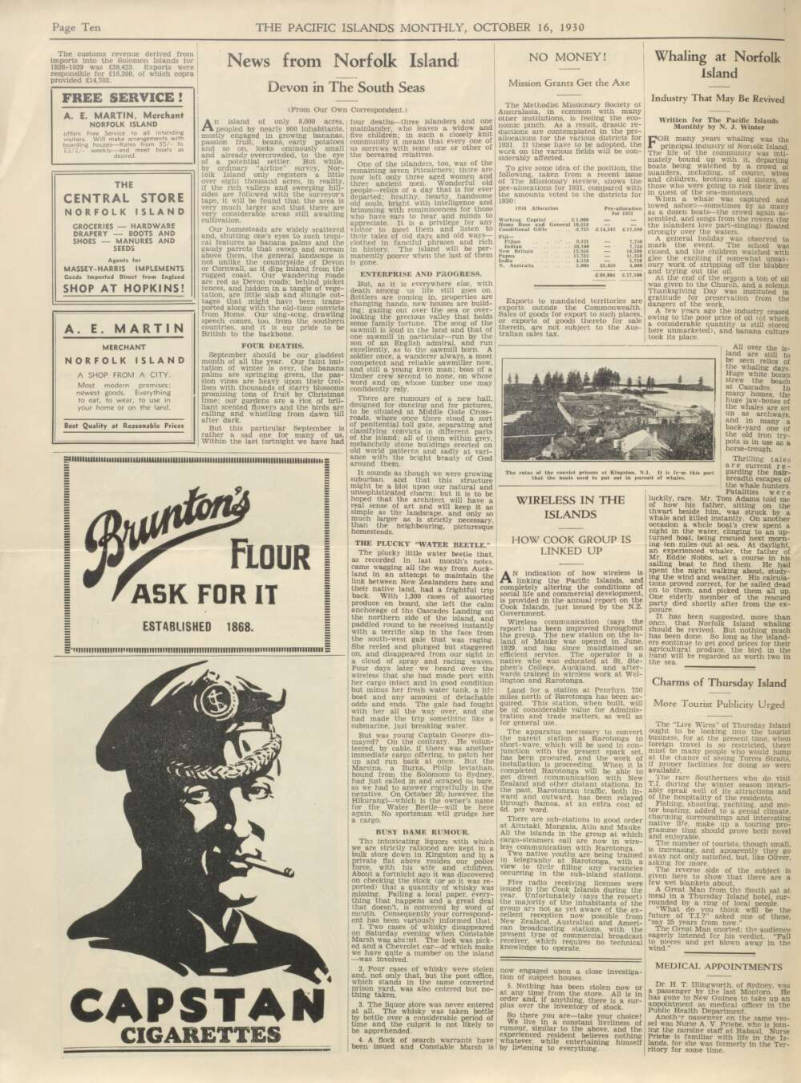
Guinea
Early last year, Dr. P. Hermant, of France, and Dr. R. W. Cilento, of Aus tralia, visited the Mandated Territory of New Guinea in connection with their appointment by the League of Nations to study health problems in the Pacific area. In Rabaul, they inspected the headquarters statistics, the hospitals the laboratory, the work of the mis sions, etc. A tour of portion of the Territory was then undertaken, in the course of which Kavieng, Namatanai and Kieta stations were visited. Owing to limitation of time, it was not pos sible for them to visit mainland sta tions.
The customs revenue derived from imports into the Solomon Islands for 1928-1929 was £38,423. Exports were responsible for £16,398, of which copra provided £14,703.
Advertisements & other items, pp. 9-10 (1 item)
Fire
‘SIMPLEX'
EXTINGUISHERS
Will
stop Fires
at once
Away from City Fire Brigades, you must make your own provisions.
Fires will start at most unexpected times, and without chemical protection your home or business may be ruined.
"SIMPLEX” Extinguishers put fires out with chemicals—they are much more potent than water—easy to use and quite safe.
Price is only £3/10/- f.o.b. Sydney.
Write now for full details to —
Wormald Bros. Ltd.
Fire Protection Engineers since 1889
“PARK WORKS,” YOUNG ST.,
WATERLOO, SYDNEY, N.S.W.
All Fire Fighting Appliances are fully approved by Fire Underwriters’ Association and Australian Brigades.
SAO BISCUITS are rich and crisp, you will find them delicious in many and varied forms, with butter and cheese, with fresh or stewed fruit, with ham or paste.
Delivered oven fresh and delicious in airtight tins. They keep their crisp perfection for weeks.
FAMOUS
SEE NEW STUDENT LAMP MODELS
ALADDIN INDUSTRIES, LTD.,
Aladdin House, Sydney.
AN ALADDIN DEALER IN EVERY TOWN.
FREE SERVICE!
A. E. MARTIN, Merchant
NORFOLK ISLAND
offers Free Service to all intending visitors. Will make arrangements with boarding houses —Rates from 35/- to £2/2/- weekly—and meet boats as desired.
THE
CENTRAL STORE
NORFOLK ISLAND
GROCERIES HARDWARE
DRAPERY BOOTS AND
SHOES MANURES AND
SEEDS
Agents for
MASSEY-HARRIS IMPLEMENTS
Goods Imported Direct from England
SHOP AT HOPKINS!
A. E. MARTIN
MERCHANT
NORFOLK ISLAND
A SHOP FROM A CITY.
Most modern premises; newest goods. Everything to eat, to wear, to use in your home or on the land.
Best Quality at Reasonable Prices
ESTABLISHED 1868.
CAPSTAN
CIGARETTES
News from Norfolk Island
Devon in The South Seas
(From Our Own Correspondent.)
An island of only 8,000 acres, peopled by nearly 900 inhabitants, mostly engaged in growing bananas, passion fruit, beans, early potatoes and so on, looks ominously small and already overcrowded, to the eye of a potential settler. But while, by ordinary “airline” survey, Nor folk Island only registers a little over eight thousand acres, in reality, if the rich valleys and sweeping hill sides are followed with the surveyor’s tape, it will be found that the area is very much larger and that there are very considerable areas still awaiting cultivation.
Our homesteads are widely scattered and, shutting one’s eyes to such tropi cal features as banana palms and the gaudy parrots that swoop and scream above them, the general landscape is not unlike the countryside of Devon or Cornwall, as it dips inland from the rugged coast. Our wandering roads are red as Devon roads; behind picket fences, and hidden in a tangle of vege tation, are little slab and shingle cot tages that might have been trans ported along with the old-time convicts from Home. Our sing-song, drawling speech comes, too, from the southern countries, and it is our pride to be British to the backbone.
Four Deaths.
September should be our gladdest month of all the year. Our faint imi tation of winter is over, the banana palms are springing green, the pas sion vines are heavy upon their trel lises with thousands of starry blossoms promising tons of fruit by Christmas time; our gardens are a riot of bril liant scented flowers and the birds are calling and whistling from dawn till after dark.
But this particular September is rather a sad one for many of us.
Within the last fortnight we have had
four deaths —three islanders and one mainlander, who leaves a widow and five children; in such a closely knit community it means that every one of us sorrows with some one or other of the bereaved relatives.
One of the islanders, too, was of the remaining seven Pitcairners; there are now left only three aged women and three ancient men. Wonderful old people—relics of a day that is for ever departed; healthy, hearty, handsome old souls, bright with intelligence and brimming with reminiscences for those who have ears to hear and minds to appreciate. It is a privilege for any visitor to meet them and listen to their tales of old days and old ways— clothed in fanciful phrases and rich in history. The island will be per manently poorer when the last of them is gone.
Enterprise And Progress.
But, as it is everywhere else, with death among us life still goes on.
Settlers are coming in, properties are changing hands, new houses are build ing; gazing out over the sea or over looking the precious valley that holds some family fortune. The song of the sawmill is loud in the land and that of one sawmill in particular—run by the son of an English admiral, and run excellently, as to the sawmill born. A soldier once, a wanderer always, a most competent and reliable sawmiller now, and still a young keen man; boss of a timber crew second to none, on whose word and on whose timber one may confidently rely.
There are rumours of a new hall, designed for dancing and for pictures, to be situated at Middle Gate Cross roads, where once there stood a sort of penitential toll gate, separating and classifying convicts in different parts of the island; all of them within grey, melancholy stone buildings erected on old world patterns and sadly at vari ance with the bright beauty of God around them.
It sounds as though we were growing suburban, and that this structure might be a blot upon our natural and unsophisticated charm; but it is to be hoped that the architect will have a real sense of art and will keep it as simple as the landscape, and only so much larger as is strictly necessary, than the neighbouring, picturesque homesteads.
The Plucky “Water Beetle.”
The plucky little water beetle that, as recorded in last month’s notes, came wagging all the way from Auck land in an attempt to maintain the link between New Zealanders here and their native land, had a frightful trip back. With 1,300 cases of assorted produce on board, she left the calm anchorage of the Cascades Landing on the northern side of the island, and paddled round to be received instantly with a terrific slap in the face from the south-west gale that was raging.
She reeled and plunged but staggered on, and disappeared from our sight in a cloud of spray and racing waves.
Four days later we heard over the wireless that she had made port with her cargo intact and in good condition but minus her fresh water tank, a life boat and any amount of detachable odds and ends. The gale had fought with her all the way over, and she had made the trip something like a submarine, just breaking water.
But was young Captain George dis mayed? On the contrary. He volun teered, by cable, if there was another immediate cargo offering, to patch her up and run back at once. But the Marsina, a Burns, Philp leviathan, bound from the Solomons to Sydney, had just called in and scraped us bare, so we had to answer regretfully in the negative. On October 20, however, the Hikurangi—which is the owner’s name for the Water Beetle—will be here again. No sportsman will grudge her a cargo.
Busy Dame Rumour.
The intoxicating liquors with which we are strictly rationed are kept in a bulk store down in Kingston and in a private flat above resides our police force, with his wife and children.
About a fortnight ago it was discovered on checking the stock (or so it was re ported) that a quantity of whisky was missing. Failing a local paper, every thing that happens and a great deal that doesn’t, is conveyed by word of mcuth. Consequently your correspond ent has been variously informed that: 1. Two cases of whisky disappeared on Saturday evening when Constable Marsh was absent. The lock was pick ed and a Chevrolet car—of which make we have quite a number on the island —was involved. 2. Four cases of whisky were stolen and, not only that, but the post office, which stands in the same converted prison yard, was also entered but no thing taken. 3. The liquor store was never entered at all. The whisky was taken bottle by bottle over a considerable period of time and the culprit is not likely to be apprehended. 4. A flock of search warrants have been issued and Constable Marsh is
now engaged upon a close investiga tion of suspect houses. 5. Nothing has been stolen now or at any time from the store. All is in order and, if anything, there is a sur plus over the inventory of stock.
So there you are—take your choice!
We live in a constant liveliness of rumour, similar to the above, and the experienced resident believes nothing whatever, while entertaining himseif by listening to everything.
No Money!
Mission Grants Get the Axe
The Methodist Missionary Society of Australasia, in common with many other institutions, is feeling the eco nomic pinch. As a result, drastic re ductions are contemplated in the pre allocations for the various districts for 1931. If these have to be adopted, the work on the various fields will be con siderably affected.
To give some idea of the position, the following, taken from a recent issue of The Missionary Review, shows the pre-allocations for 1931, compared with the amounts voted to the districts for 1930:
Exports to mandated territories are exports outside the Commonwealth.
Sales of goods for export to such places, or exports of goods thereto for sale therein, are not subject to the Aus tralian sales tax.
1930 Allocation Pre-allocation for 1931 Working Capital Home Base and General Conditional Gifts £1.000 10,010 Ci, 735 £ 14,345 £12,500 Fiji— Fijian v ..
Indian New Britain Papua India N. Australia 9,321 10,100 13,950 13.732 4.350 5,000 55,459 7.750 7.750 10,500 11,250 3.750 4,000 £69,804 £57,500
Whaling at Norfolk
Island
Industry That May Be Revived Written for The Pacific Islands Monthly by N. J. Winter
FOR many years whaling was the principal industry of Non oik Island.
The life of the community was inti mately bound up with it, departing boats being watched by a crowd of islanders, including, of course, wives and children, brothers and sisters, of those who were going to risk their lives in quest of the sea-monsters.
When a whale was captured and towed ashore —sometimes by as many as a dozen boats—the crowd again as sembled, and songs from the rowers (for the islanders love part-singing) floated strongly over the waters.
A general holiday was observed to mark the event. The school was closed, and the children watched with glee the exciting if somewhat unsav oury work of stripping off the blubber and trying out the oil.
At the end of the season a ton of oil was given to the Church, and a solemn Thanksgiving Day was instituted in gratitude for preservation from the dangers of the work.
A few years ago the industry ceased owing to the poor price of oil (of which a considerable quantity is still stored here unmarketed), and banana culture took its place.
All over the is land are still to be seen relics of the whaling days.
Huge white bones strew the beach at Cascades. In many homes, the huge jaw-bones of the whales are set up as archways, and in many a back-yard one of the old iron try pots is in use as a
horse-trough.
Thrilling tales are current re garding the hair breadth escapes of the whale hunters.
Fatalities were
luckily, rare. Mr. Tom Adams told me of how his father, sitting on the thwart beside him, was struck by a whale and killed instantly. On another occasion a whole boat’s crew spent a night in the water, clinging to an up turned boat, being rescued next morn ing ten miles out at sea. At daylight, an experienced whaler, the father of Mr. Eddie Nobbs, set a course in his sailing boat to find them. He had spent the night walking about, study ing the wind and weather. His calcula tions proved correct, for he sailed dead on to them, and picked them all up.
One elderly member of the rescued party died shortly after from the ex posure.
It has been suggested, more than once, that Norfolk Island whaling should be revived. But nothing much has been done. So long as the island ers eontinue to get good prices for their agricultural produce, the bird in the band vail be regarded as worth two in the sea.
The ruins of the convict prisons at Kingston, N.I. It Is this port that the boats used to put out in pursuit of whales.
Islands
Wireless In The
How Cook Group Is
Linked Up
AN indication of how wireless is linking the Pacific Islands, and completely altering the conditions of social life and commercial development, is provided in the annual report on the Cook Islands, just issued by the N.Z.
Government.
Wireless communication (says the report) has been improved throughout the group. The new station on the island of Mauke was opened in June, 1929, and has since maintained an efficient service. The operator is a native who was educated at St. Ste phen’s College, Auckland, and after wards trained in wireless work at Wel lington and Rarotonga.
Land for a station at Penrhyn, 750 miles north of Rarotonga has been ac quired. This station, when built, will be of considerable value for Adminis tration and trade matters, as well as for general use.
The apparatus necessary to convert the parent station at Rarotonga to short-wave, which will be used in con junction with the present spark set, has been procured, and the work of installation is proceeding. When it is completed Rarotonga will be able to get direct communication with New Zealand and other distant stations. In the past, Rarotongan traffic, both in ward and outward, has been relayed through Samoa, at an extra cost of 6d. per word.
There are sub-stations in good order at Aitutaki, Mangaia. Atiu and Mauke.
All the islands in the group at which cargo-steamers call are now in wire less communication with Rarotonga.
Two native youths are being trained in telegraphy at Rarotonga, with a view to their filling any vacancies occurring in the sub-island stations.
Five radio receiving licenses were issued in the Cook Islands during the year. Unfortunately Isays the report) the majority of the inhabitants of the group are not as yet aware of the ex cellent reception now possible from New Zealand. Australian and Ameri can broadcasting stations, with the present type of commercial broadcast receiver, which requires no technical knowledge to operate.
More Tourist Publicity Urged
Charms of Thursday Island More Tourist Publicity Urged
The “Live Wires’’ of Thursday Island ought to be looking into the tourist business, for at the present time, when foreign travel is so restricted, there must be many people who would jump at the chance of seeing Torres Straits, if proper facilities for doing so were available.
The rare Southerners who do visit T.I. during the winter season invari ably speak well of its attractions and of the hospitality of the residents.
Fishing, shooting, yachting, and mo tor boating, added to a genial climate, charming surroundings and interesting native life, make up a touring pro gramme that should prove both novel and enjoyable.
The number of tourists, though small, is increasing, and apparently they go aw r ay not only satisfied, but, like Oliver, asking for more.
The reverse side of the subject is given here to show that there are a few wet blankets about.
A Great Man from the South sat at meal in a Thursday Island hotel, sur rounded by a ring of local people.
“What do you think wfill be the future of T. I.?” asked one of these, “say 25 years from now.”
The Great Man snorted; the audience eagerly listened for his verdict. “Fall to pieces and get blown away in the wind.”
Medical Appointments
Dr. H. T. Illingworth, of Sydney, was a passenger by the last Montoro. He has gone to New Guinea to take up an appointment as medical officer in the Public Health Department.
Another passenger on the same vessel was Nurse A. V. Priebe. who is joining the nursing staff at Rabaul Nurse Priebe is familiar with life in the Is lands, for she was formerly in the Ter ritory for some time.
Products Of The South Seas
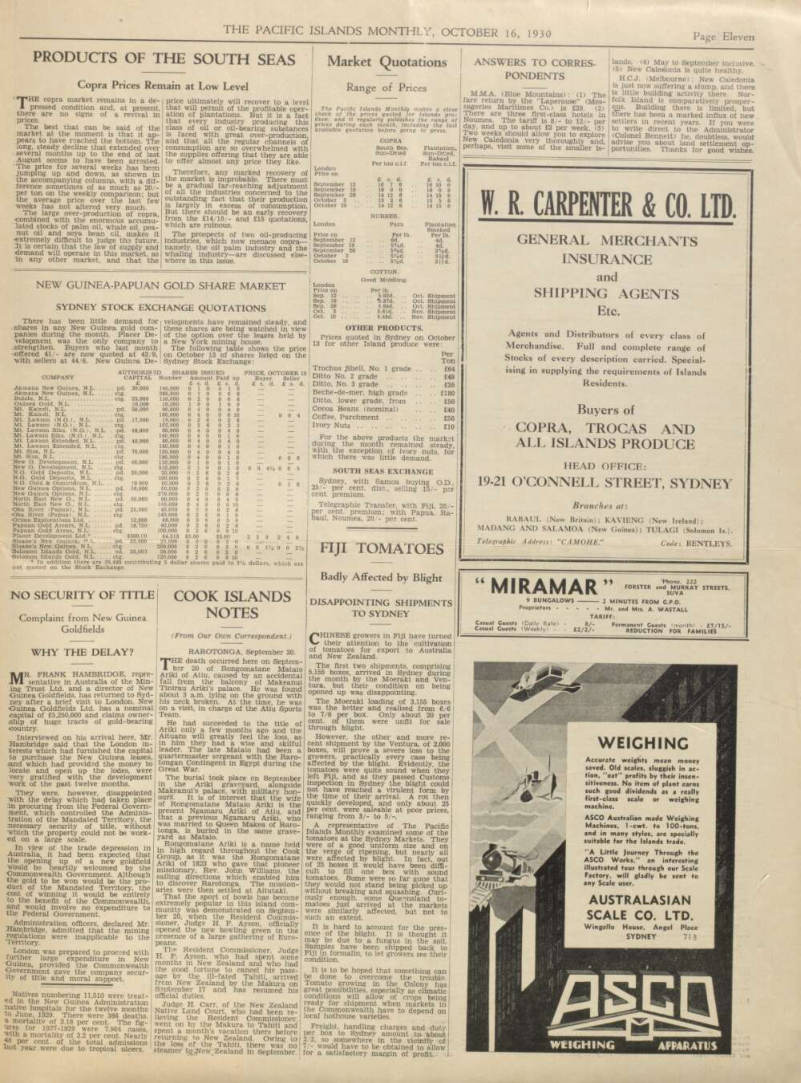
Copra Prices Remain at Low Level
THE copra market remains in a de pressed condition and, at present, there are no signs of a revival in prices.
The best that can be said of the market at the moment is that it ap pears to have reached the bottom. The long, steady decline that extended over several months up to the end of last August seems to have been arrested.
The price for several weeks has been jumping up and down, as shown in the accompanying columns, with a dif ference sometimes of as much as 20/per ton on the weekly comparison; but the average price over the last few weeks has not altered very much.
The large over-production of copra, combined with the enormous accumu lated stocks of palm oil, whale oil, pea nut oil and soya bean oil, makes it extremely difficult to judge the future.
It is certain that the law of supply and demand will operate in this market, as in any other market, and that the
price ultimately will recover to a level that will permit of the profitable oper ation of plantations. But it is a fact that every industry producing this class of oil or oil-bearing substances is faced with great over-production, and that all the regular channels of consumption are so overwhelmed with the supplies offering that they are able to offer almost any price they like.
Therefore, any marked recovery of the market is improbable. There must be a gradual far-reaching adjustment of all the industries concerned to the outstanding fact that their production is largely in excess of consumption.
But there should be an early recovery from the £14/10/- and £15 quotations, which are ruinous.
The prospects of two oil-producing industries, which now menace copra— namely, the oil palm industry and the whaling industry—are discussed else where in this issue.
New Guinea-Papuan Gold Share Market
Sydney Stock Exchange Quotations
There has been little demand for shares in any New Guinea gold companics during the month. Placer Development was the only company to strengthen. Buyers who last month offered 41/- are now quoted at 43/9, with sellers at 44/6. New Guinea De-
velopments have remained steady, and these shares are being watched in view of the option over the leases held by a New York mining house.
The following table shows the price on October 13 of shares listed on the Sydney Stock Exchange:
Authorised
Shares
Issued
Price, October 13
Company
Capital
Number Amount Paid up Buyer Seller £ £ s. d. £ S. d. £ s. d. £ s. d.
Akmana New Guinea, N.L pd. 30,000 140,000 0 1 0 0 i 0 Akmana New Guinea, N.L ctg. 360,000 0 1 0 0 0 6
Bulolo, N.L
ctg.
25,000 150,000 0 2 0 0 0 6 Guinea Gold. N.L 50,000 50,000 1 0 0 1 0 0 Mt. Kaindi, N.L pd. 50,000 90,000 0 4 0 0 4 0 Mt. Kaindi. N.L ctg. 160,000 0 4 0 0 0 10 0 0 4 Mt. Lawson (N.G.), N.L Pd. 17,500 18,000 0 2 6 0 2 6 Mt. Lawson (N.G.I, N.L ctg. 102,000 0 2 6 0 2 3 Mt. Lawson Blks. (N.G.), N.L. pd. 48.000 80,000 0 4 0 0 4 0 Mt. Lawson Blks. IN.G.I. N.L. . ctg. 140,000 0 4 0 0 1 0 Mt. Lawson Extended. N.L. . . pd. 48,000 80,000 0 4 0 0 4 0 Mt. Lawson Extended, N.L, ctg. 140,000 0 4 0 0 1 0 Mt. Sisa, N.L pd. 70,000 120,000 0 4 0 0 4 0 Mt. Sisa, N.L ctg. 190,000 0 4 0 0 1 6 0 0 6 New G. Development, N.L pd. 40,000 110,000 0 1 0 0 1 0 New G. Development, N.L ctg. 510,000 0 1 0 0 1 0 rr o O 0 0 5 N.G. Gold Deposits, N.L pd. 20,000 20,000 n 2 6 0 2 6 - N.G. Gold Deposits. N.L ctg. 100,000 0 2 6 0 1 7 N.G. Gold & Osmiridium, N.L. 10 000 P.0,000 0 2 6 0 2 6 0 1 0 New Guinea Options, N.L Pd. 50,000 50,000 0 2 0 0 2 0 New Guinea Options, N.L ctg. 279,000 0 2 0 0 0 6 North East New G., N.L pd. 50,000 90,000 0 4 0 0 4 0 North East New G., N.L ctg. 140,000 0 4 0 0 0 10 Oba River (Papua), N.L pd. 25,000 40.000 0 2 6 0 2 6 Oba River (Papua), N.L
ctg.
140.000 0 2 G 0 1 0 Orimo Explorations Ltd 12,000 48,000 0 5 0 0 5 0 Papuan Gold Arears, N.L pd. 18.750 40.000 0 2 6 0 2 6 Papuan Gold Areas, N.L ctg. 100,000 0 2 6 0 0 10 Placer Development Ltd.* $500X0 44.515 $5.00 $5. 00 2 3 9 2 4 6 Sloane’s New Guinea, N.L pd. 25,000 25,000 0 2 0 0 2 0 Sloane’s New Guinea. N.L
ctg.
200.000 0 2 0 0 2 n 0 0 1 y 2 0 0 2>A Solomon Islands Gold, N.L nd. 25,003 20,000 0 2 6 0 2 6 Solomon Islands Gold, N.L ctg. 120.000 0 2 6 0 0 10 * In addition there are 25,485 contributing 5 dollar shares paid not quoted on the Stock Exchange.
No Security Of Title
Complaint from New Guinea Goldfields
Why The Delay?
Mr. Frank Hambridge, Repre
sentative in Australia of the Min ing Trust Ltd. and a director of New Guinea Goldfields, has returned to Syd ney after a brief visit to London. New Guinea Goldfields Ltd. has a nomina capital of £5,250,000 and claims owner ship of huge tracts of gold-bearing country.
Interviewed on his arrival here, Mr Hambridge said that the London in terests which had furnished the capita to purchase the New Guinea leases and which had provided the money to locate and open up the lodes, were very gratified with the developmen work of the past twelve months.
They were, however, disappointed with the delay which had taken place in procuring from the Federal Govern ment, which controlled the Adminis tration of the Mandated Territory, the necessary security of title, without 'which the property could not be work ed on a large scale.
In view of the trade depression in Australia, it had been expected that the opening up of a new goldfield Would be heartily welcomed by the Commonwealth Government. Although the gold to be won would be the pro duct of the Mandated Territory, the cost of winning it would be entirely to the benefit of the Commonwealth, and would involve no expenditure to the Federal Government.
Administration officers, declared Mr.
Hambridge, admitted that the mining regulations were inapplicable to the Territory.
London was prepared to proceed with further large expenditure in New Guinea, provided the Commonwealth Government gave the company secur ity of title and moral support.
Natives numbering 11,510 were treat ed in the New Guinea Administration native hospitals for the twelve months to June, 1929. There were 366 deaths, a mortality of 3.18 per cent. The figures for 1927-1928 were 7,901 cases, with a mortality of 3.2 per cent. Nearly 40 per cent, of the total admissions last year were due to tropical ulcers.
Cook Islands
Notes
(From Our Own Correspondent.) RAROTONGA, September 30.
THE death occurred here on Septem ber 20 of Rongomatane Matai Ariki of Atiu, caused by an accidental fall from the balcony of Makeanu Tinirau Ariki’s palace. He was found about 3 a.m. lying on the ground with his neck broken. At the time, he was on a visit, in charge of the Atiu Sport Team.
He had succeeded to the title of Ariki only a few months ago and the Aituans will greatly feel the loss, as in him they had a wise and skilfull leader. The late Mataio had been a quartermaster sergeant with the Raro tongan Contingent in Egypt during the Great War.
The burial took place on September in the Ariki graveyard, alongside Makeanui’s palace, with military hon ours. It is of interest that the wife of Rongomatane Mataio Ariki is the present Ngamaru Ariki of Atiu, and that a previous Ngamaru Ariki, who was married to Queen Makea of Raro tonga, is buried in the same grave yard as Mataio.
Rongomatane Ariki is a name held in high regard throughout the Cook Group, as it was the Rongomatane Ariki of 1823 who gave that pioneer missionary, Rev. John Williams, the sailing directions which enabled him to discover Rarotonga. The mission aries were then settled at Aitutaki.
That the sport of bowls has become extremely popular in this island com munity was demonstrated on Septem ber 20, when the Resident Commis sioner, Judge H. F. Ayson, officially opened the new bowling green in the presence of a large gathering of Euro peans.
The Resident Commissioner, Judge H. P. Ayson, who had spent some months in New Zealand and who had the good fortune to cancel his pass age by the ill-fated Tahiti, arrived from New Zealand by the Makura on September 17 and has resumed his official duties.
Judge H. Carr, of the New Zealand Native Land Court, who had been re lieving the Resident Commissioner, went on by the Makura to Tahiti and spent a month’s vacation there before returning to New Zealand. Owing to the loss of the Tahiti, there was no steamer to New Zealand in September.
Market Quotations
Range of Prices
The Pacific Islands Monthly makes a close check of the prices quoted for Islands pro duce: and it regularly publishes the range of prices during each month, including the last available quotation before going to press.
Other Products.
Prices quoted in Sydney on October 13 for other Island produce were:
For the above products the market during the month remained steady, with the exception of ivory nuts for which there was little demand.
South Seas Exchange
Sydney, with Samoa buying O.D, 25/- per cent, disc., selling 15/- per cent, premium.
Telegraphic Transfer, with Fiji, 20/per cent, premium; with Papua, Ra baul, Noumea, 20/- per cent.
London Price on September 12
Copra
South Sea.
Sun-Dried Per ton c.i.f. £ s. d. .. 16 7 6 Plantation, Sun-Dried, Rabaul Per ton c.i.f. £ s. d. 16 10 0 September 19 .. 16 0 0 16 0 0 September 26 .. 14 12 6 14 15 0 October 3 .. 15 2 6 15 5 0 October 10 ... 14 12 6 14 15 0 London
Rubber.
Para Plantation Price on Per lb Smoked Per lb.
September 12 .. .. 6d. 4d.
September 19 .. .. 5 3 /«d. 4d.
September 26 .. .. 5 5 /ad. 3½ad.
October 3 .. .. 5'/ a d. 3}&d.
October 10 . . .. 5Vbd. 3 1 ;* d.
London Price on Sep. 12
Cotton.
Good Middling.
Per lb. .. 5.93d. ..
Oct. Shipment Sep. 19 .. .. *5,87d. ..
Oct. Shipment Sep. 26 .. 5.64d. ..
Oct. Shipment Oct. 3 .. .. 5.61d. ..
Nov. Shipment Oct. 10 .. .. 5.48d. ..
Nov. Shipment
Per Ton Trochus Shell, No. 1 grade .. .. £64 Ditto No. 2 grade .. £49 Ditto, No. 3 grade .. £35 Beche-de-mer, high grade .. £180 Ditto, lower grade, from .. £50 Cocoa Beans (nominal) . . £40 Coffee, Parchment .. . . £56 Ivory Nuts
Fiji Tomatoes
Badly Affected by Blight
Disappointing Shipments
To Sydney
CHINESE growers in Fiji have turned their attention to the cultivation of tomatoes for export to Australia and New Zealand.
The first two shipments, comprising 5,155 boxes, arrived in Sydney during the month by the Moeraki and Ven tura, but their condition on being opened up was disappointing.
The Moeraki loading of 3,155 boxes was the better and realised from 6/6 to 7/6 per box. Only about 20 per cent, of them were unfit for sale through blight.
However, the other and more re cent shipment by the Ventura, of 2,000 boxes, will prove a severe loss to the growers, practically every case being affected by the blight. Evidently, the tomatoes were quite sound when they left Fiji, and as they passed Customs inspection in Sydney the blight could not have reached a virulent form by the time of their arrival. A rot then quickly developed, and only about 25 per cent, were saleable at poor prices, ranging from 3/- to 5/-.
A representative of The Pacific Islands Monthly examined some of the tomatoes at the Sydney Markets. They were of a good uniform size and on the verge of ripening, but nearly all were affected by blight. In fact, out of 25 boxes it would have been diffi cult to fill one box with sound tomatoes. Some were so far gone that they would not stand being picked up without breaking and squashing. Curi ously enough, some Queensland to matoes just arrived at the markets were similarly affected, but not to such an extent.
It is hard to account for the pres ence of the blight. It is thought it may be due to a fungus in the soil.
Samples have been shipped back to Fiji in formalin, to let growers see their condition.
It is to be hoped that something can be done to overcome the trouble.
Tomato growing in the Colony has great possibilities, especially as climatic conditions will allow of crops being ready for shipment when markets in the Commonwealth have to depend on local hothouse varieties.
Freight, handling charges and duty per box to Sydney amount to about 2/3, so somewhere in the vicinity of 7/- would have to be obtained to allow for a satisfactory margin of profit.
Pondents
Answers To Corres
M.M.A. (Blue Mountains): (1) The fare return by the “Laperouse” (Mes sageries Maritimes Co.) is £29. (2) There are three first-class hotels in Noumea. The tariff is 8/- to 12/- per day, and up to about £3 per week. (3) Two weeks should allow you to explore New Caledonia very thoroughly and, perhaps, visit some of the smaller is
lands. (4) May to September inclusive. (5) New Caledonia is quite healthy.
H.C.J. (Melbourne): New Caledonia is just now suffering a slump, and there is little building activity there. Nor folk Island is comparatively prosper ous. Building there is limited, but there has been a marked influx of new settlers in recent years. If you were to write direct to the Administrator (Colonel Bennett) he, doubtless, would advise you about land settlement op portunities. Thanks for good wishes.
Advertisements & other items, p. 11 (1 item)
W. R. Carpenter & Co. Ltd
GENERAL MERCHANTS
INSURANCE
and
SHIPPING AGENTS
Etc.
Agents and Distributors of every class of Merchandise. Full and complete range of Stocks of every description carried. Specialising in supplying the requirements of Islands Residents.
Buyers of
COPRA, TROCAS AND
ALL ISLANDS PRODUCE
HEAD OFFICE:
19-21 O’CONNELL STREET, SYDNEY
Branches at: RABAUL (New Britain) ; KAVIENG (New Ireland) ; MADANG AND SALAMOA (New Guinea); TULAGI (Solomon Is.).
Telegraphic Address : "CAMOHE.” Code: BENTLEYS.
“MIRAMAR ”
’Phone. 222
FORSTER and MURRAY STREETS,
SUVA
Casual Casual
9 BUNGALOWS 2 MINUTES FROM C.P.O.
Proprietors Mr. and Mrs. A. WASTALL
TARIFF:
WEIGHING
Accurate weights mean money saved. Old scales, sluggish in action, “cat” profits by their insensitiveness. No item of plant earns such good dividends as a really first-class scale or weighing machine.
ASCO Australian made Weighing Machines, 1-cwt. to 100-tons, and in many styles, are specially suitable for the Islands trade.
“A Little journey Through the ASCO Works,” an interesting illustrated tour through our Scale Factory, will gladly be sent to any Scale user.
AUSTRALASIAN
SCALE CO. LTD.
Wingello House, Angel Place
SYDNEY 713
WEIGHING
APPARATUS
Shipping Services in The Pacific
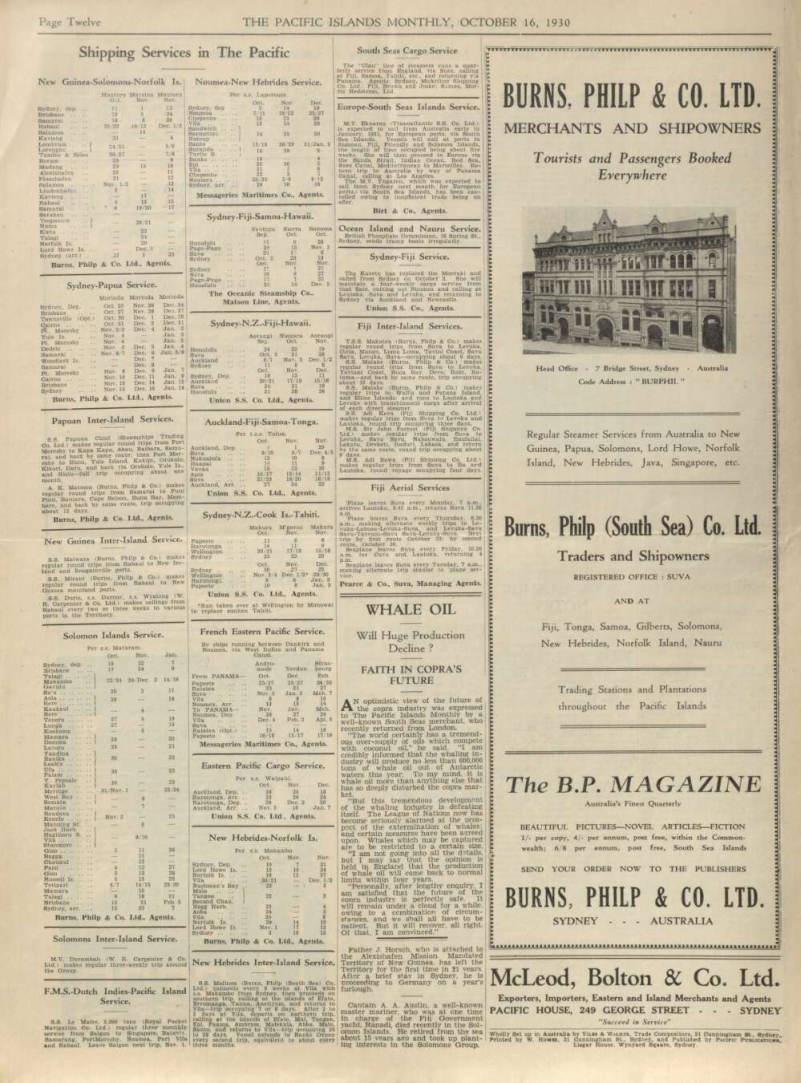
New Guinea-Solomons-Norfolk Is.
Burns, Philp & Co. Ltd., Agents.
Sydney-Papua Service.
Burns, Philp & Co. Ltd., Agents.
Papuan Inter-Island Services.
S.S. Papuan Chief (Steamships Trading Co Ltd.) makes regular round trips from Port Moresby to Kapa Kapa, Abau, sama rai, and back by same route; then Port Mor esby to Hisiu. Yule Island, Kukipi, Orokolo, Kikori Daru, and back via Orokolo, Yule Is., and Hisiu—full trip occupying about one month.
A. K. Matoma (Burns, Philp & Co.) makes regular round trips from Samarai to Puni Puni, Baniara, Cape Nelson, Buna Bay, Mam bare, and back by same route, trip occupying about 12 days.
Burns, Philp & Co. Ltd., Agents.
New Guinea Inter-Island Service.
S.S. Maiwara (Burns, Philp & Co.) makes regular round trips from Rabaul to New Ire land and Bougainville ports.
S.S. Mirani (Burns, Philp & Co.) makes regular round trips from Rabaul to New Guinea mainland ports.
S.S. Duris, s.s. Durour, s.s. Wyalong (W.
R. Carpenter & Co. Ltd.) makes sailings from Rabaul every two or three weeks to various ports in the Territory.
Solomon Islands Service.
Per s.s. Mataram.
Burns, Philp & Co. Ltd., Agents.
Solomons Inter-Island Service.
M.V. Durambah (W. R. Carpenter & Co.
Ltd.) makes regular three-weekly trip around the Group.
F.M.S.-Dutch Indies-Pacific Island
Service.
S.S. Le Maire, 3,200 tons (Royal Packet Navigation Do. Ltd.) regular three monthly service from Saigon to Singapore, Batavia.
Samarang, PortMoresby, Noumea, Port Vila and Rabaul. Leave Saigon next trip, Nov. 1.
Noumea-New Hebrides Service.
Messageries Maritimes Co., Agents.
Sydney-Fiji-Samoa-Hawaii.
The Oceanic Steamship Co., Matson Line, Agents.
Sydney-N.Z.-Fiji-Hawaii.
Union S.S. Co. Ltd., Agents.
Auckland-Fiji-Samoa-T onga.
Union S.S. Co. Ltd., Agents.
Sydney-N.Z.-Cook Is.-Tahiti.
Union S.S. Co. Ltd., Agents. *Run taken over at Wellington by Monowai to replace sunken Tahiti.
French Eastern Pacific Service.
By ships running between Dunkirk and Noumea, via West Indies and Panama Canal.
Messageries Maritimes Co., Agents.
Eastern Pacific Cargo Service.
Per s.s. Waipahi.
Union S.S. Co. Ltd, Agents.
New Hebrides-Norfolk Is.
Per s.s. Makambo
Burns, Philp & Co. Ltd., Agents.
New Hebrides Inter-Island Service.
S.S. Malinoa (Burns, Philp (South Sea) Co.
Ltd.) connects every 6 weeks at Vila with s.s. Makambo from Sydney, then proceeds on southern trip, calling at the islands of Efate, Erromanga, Tanna, Aneityum, and returns to Vila—trip occupying “7 or 8 days. After 2 to 3 days at Vila, departs on northern trip, calling at the islands of Efate, Mai, Tpngoa, Epi, Paama, Ambrym, Malekula, Abba, Malo, Santo, and returns to Vila —trip occupying 25 to 28 days. Vessel extends to Banks Group every second trip, equivalent to about every three months.
South Seas Cargo Service
The “Clan” line of steamers runs a quar terly service from England, via Suez, calling at Fiji, Samoa, Tahiti, etc., and returning via Panama. Agents: Sydney. McArthur Shipping Co. Ltd.; Fiji, Brown and Joske; Samoa, Mor ris Hedstrom, Ltd.
Europe-South Seas Islands Service.
M.V. Eknaren (Transatlantic S.S. Co. Ltd.) is expected to sail from Australia early in January, 1931, for European ports, via South Sea Islands. Vessels will call at ports in Samoan, Fiji, Friendly and Solomon Islands, the length of time occupied being about five weeks. She will then proceed to Europe via the Sunda Strait, Indian Ocean, Red Sea, Suez Canal, Mediterranean to Marseilles. Re turn trip to Australia by way of Panama Canal, calling at Los Angeles.
The M.V. Yngaren, which was expected to sail from Sydney next month for European ports, via South Sea Islands, has been cancelled owing to insufficient trade being on offer.
Birt & Co., Agents.
Ocean Island and Nauru Service,
British Phosphate Commission, 16 Spring St.
Sydney, sends tramp boats irregularly.
Sydney-Fiji Service.
The Karetu has replaced the Moeraki and sailed from Sydney on October 2. She will maintain a four-weekly cargo service from that date, cutting out Noumea and calling at Lautoka, Suva and Levuka, and returning to Sydney via Auckland and Newcastle.
Union S.S. Co., Agents.
Fiji Inter-Island Services.
T.S.S. Makatea (Burns, Philp & Co.) makes regular round trips from Suva to Levuka, Cicia, Mango, Loma Loma, Tavini Coast, Savu Savu, Levuka, Suva —occupying about 9 days.
S.S. Malake (Burns, Philp & Co.) makes regular round trips from Suva to Levuka.
Taviuni Coast, Buca Bay. Devo, Rabi, Ro tuma—and back by same route, trip occupying about 10 days.
S.S. Malake (Burns. Philo Co.) makes regular trips to Wallis and Futuna Island, and Ellice Islands: and runs to Lautoka and Levuka with transhipment cargo after arrival of each direct steamer.
S.S. Adi Keva (Fiji Shipping Co. Ltd.) makes regular trios from Suva to Levuka and Lautoka, round trip occupying three days.
M.S. Sir John Forrest (Fiji Shipping Co.
Ltd.) makes regular trios from Suva to Levuka, Savu Savu, Nabouwalu, Baulailai, Lekutu, Dreketi, Raduri, Labasa, and return by the same route, round trip occupying about 9 daYs.
MS. Adi Rewa (Fiji Shipping Co. Ltd. makes regular trips from Suva to Ba and Lautoka, round voyage occupying four days.
Fiji Aerial Services
’Plane leaves Suva every Monday, 7 a.m., arrives Lautoka, 8.45 a.m., returns Suva 11.30 a.m. ’Plane leaves Suva every Thursday, 6.30 a.m., making alternate weekly trips to Le vuka-Labusa-Levuka-Suva, and Levuka-Savu Savu-Taveuni-Savu Savu-Levuka-Suva. Next trip by first route October 23; by second route, October 30.
Seaplane leaves Suva every Friday, 10.30 a.m. for Cuvu and Lautoka, returning 4 p.m.
Seaplane leaves Suva every Tuesday, 7 a.m., making alternate trip similar to ’plane ser vice.
Pearce & Co., Suva, Managing Agents.
Montoro Marsina Montoro Oct.
Nov.
Nov.
Sydney, dep. ..
11 1 22 Brisbane 13 3 24 Samarai .. 18 8 29 Rabaul 20/22 10/12 Dec. 1/3 Salamoa — 14 — Kavieng 23 — 4
Lombrum . . ..
Lorengau .. .. (
24/25 - 5/6 Tumleo & Seleo 26/27 — 7/8 "
Boram 23 — 9 Madang 29 15 10 Alexishafen 30 — 11 Plnschafen 31 — 12 Salamoa .. ..
Nov. 1/2 — 13 Lindenhafen .. 3 — 14
Kavieng
— 17 — Rabaul .. 4 18 15 Samarai • 6 19/20 • 17 Soraken — — —
Teopasiro ..
Kuma .. )
- 20/21 — Kieta — 22 —
Tulagi ..
— 24 — Norfolk Is. — 29 — Lord Howe Is. . — Dec. 1 — Sydney (art.) .
J2 3 23
Morinda Morinda Morinda
Sydney, Dep.
Oct. 25 Nov. 26 Dec. 24 Brisbane Oct. 27 Nov. 28 Deo. 27
Townsville l Opt.)
Oct. 30 Dec. 1 Dec. 30 Cairns Oct. 31 Dec. 2 Dec. 31
jft. Moresby
Nov. 2/3
Dec. 4 Jan. 2 Yule Is Nov. 4 — Jan. 3 Pt. Moresby Nov. 4 — Jan. 3 Dedele Nov. 5 Dec. 5 Jan. 4 Samara; . • Nov. 6/7 Dec. 6 Jan. 5/6 Woodlark Is. — Dec. 7 — Samarai
Pt. Moresby
Cairns Brisbane
Sydney . • • •
Nov. 8 Nov. 10 Nov. 13 Nov. 15 Dec. 8 Dec. 9 Dec. 11 Dec. 14 Dec. 16 Jan. 7 Jan. 9 Jan. 12 Jan. 14
Per s.s. Laperouse.
Oct.
Nov.
Dec.
Sydney, dep
3 14 19 Noumea 7/11 18/22 23/27
Chepenhe ..
13 23 28 Vila ..
Sandwich .. 12 24 29 Sarmettes Norsup .. \ 14 .. 1 25 30 Santo . . . 15/18 26^29 31/Jan. 3 Suranda ..
Turtle B. . . •• 1 18 • • 1 29 3 Banks .. .. 19 — 4 Epi 20 30 5 Vila 21 1 6
Chepenhe .
22 2 7 Noumea .. . , . 23/25 3'6 8/12 Sydney, arr. 29 10 16
Ventura Sierra Sonoma Sep.
Oct.
Oct.
Honolulu n 8 29 Pago-Pago .. 24 15 Nov. 5 Suva .. 2 7 I'l 8
Sydney
Oct. 2 23 13 Oct.
Nov.
Nov.
Sydney
r. i 22 Suva id 6 27
Pago-Pago ..
17 7 20 Honolulu 24 14 Dec. 5
Aorangi
Niagara Aorangi
Sep.
Oct.
Nov.
Honolulu 24 22 19 Suva Oct. 3 31 28 Auckland 6/7 Nov. 3 Dec. 1/2 Sydney 11 8 6 Oct.
Nov.
Dec.
Sydney, Dep, 16 13 11 Auckland 20/21 17/18 15/16 Suva 24 21 19 Honolulu 31 28 26
Oct.
Nov.
Jan.
Sydney, dep.
Brisbane
Tulagi ...
Makambo Gavutu 15 17 22/24 25 22 24 29/Dec. 2 3 7 9 14/16 17 1 ( 18 Kaukaul .. 1 — 4 — 27 5 19 27 19 Kookoom 1 5 — Mamara Domma Lavoro .. ..
Yandina 28 29 30 - 20 21 22 Loabie .. .. f Ufa 1 30 30 31/Nov.
Nov. 2 Faiam ..
Y. Pepsale
Kaylah Meringe West Bay . .
Somata Marovo ..
Kendova .. 1 — 6 7 22 23/24 25
Manning St.
Jack Harb.
Hagthorn S.
Vila 8 9/10 Stanmore . . 1 3 11 26 11 ChoiseuI Faisl .. .. 4 5 12 12 13 27 28 13 23
Tetipari
Mamara
Tulagi .. ..
Brisbane
Sydney, arr.
6/7 R 13 15 14/15 15 16 21 23 29/30 31 Feb. 5 7
Per t.s.s. Tofua.
Oct.
Nov.
Nov.
Auckland, Dep. .. 4 1 29 Suva .. .. 9/10 6/7 Dec. 4/5 Nukualofa ... 13 10 8 Haapai ... 14 11 9 Vavau ... 15 12 10
Apia
.. .. ie/17 13/14 11/12 Suva .. .. 21/23 18/20 16/18
Auckland,
Arr. .. 27 24 22
Makura
M’gar.ui
Makura Oct.
Nov.
Nov.
Papeete 11 8 6 Rarotonga 14 11 9
Wellington
20/21 17/18 15/16
Sydney
25 22 20 Oct.
Nov.
Dec.
Sydney
30 27 25
Wellington
.. Nov. 3/4 Dec. 1/2* 29/30 Rarotonga .. 8 6 Jan. 3 Papeete 10 8 Jan. 5
n Andromede Verdun Stras-
bourg
Prom Panama —
Oct.
Dec.
Peb.
Papeete
25/27 25/27 24/26 Raiatea 28 23 27 Suva Nov. 5 Jan. 5 Mch. 7 Vila 8 8 10 Noumea. Arr. 13 13 15
To Panama—
Nov.
Jan.
Mch.
Noumea. Dep. 28 27 29 Vila Dec. 4 Peb. 3 Apl. 5 Suva — — Raiatea (Opt. 1 .. 15 14 16 Papeete .. .. 16/18 15/17 17/19
Oct.
Nov.
Dec.
Auckland, Dep. .. 16 20 18 Rarotonga, Arr. .. 22 26 24 Rarotonga, Dep. . 28 Dec. 2 30 Auckland, Arr. ..
Nov. 5 10 Jan. 7
Oct.
Nov.
Nov.
Sydney, Dep. 10 7 21 Lord Howe Is. .. 13 10 24 Norfolk Is 16 13 27 Vila 20/21 — Dec. 1/2 Bushman’s Bay ..
Malo .. . . ]
22 — 3 Tangoa ..
Second Chan. 22 — 3
Hogg Harb.
23 . 4 Aoba 24 — 5 Vila 25 — 6 Norfolk Is. 29 14 10 Lord Howe Is. ..
Nov. 1 17 13
Sydney
3 19 15
Whale Oil
Will Huge Production Decline ?
Faith In Copra’S
Future
AN optimistic view of the future of the copra industry was expressed to The Pacific Islands Monthly by a well-known South Seas merchant, who recently returned from London.
“The world certainly has a tremend ous over-supply of oils which compete with coconut oil,” he said. “I am credibly informed that the whaling in dustry will produce no less than 600,000 tons of whale oil out of Antarctic waters this year. To my mind, it is whale oil more than anything else that has so deeply disturbed the copra mar ket.
“But this tremendous development of the whaling industry is defeating itself. The League of Nations now has become seriously alarmed at the pros pect of the extermination of whales; and certain measures have been agreed upon. Whales which may be captured are to be restricted to a certain size.
“I am not going into all the details, but I may say that the opinion is held in England that the production of whale oil will come back to normal limits within four years.
“Personally, after lengthy enquiry. I am satisfied that the future of the copra industry is perfectly safe. It will remain under a cloud for a while, owing to a combination of circum stances, and we shall all have to be patient. But it will recover, all right.
Of that, I am convinced.”
Father J. Horsch, who is attached to the Alexishafen Mission, Mandated Territory of New Guinea, has left the Territory for the first time in 21 years.
After a brief stay in Sydney, he is proceeding to Germany on a year’s furlough.
Captain A. A. Austin, a well-known master mariner, who was at one time in charge of the Fiji Government yacht, Ranadi, died recently in the Sol omon Islands. He retired from the sea about 15 years ago and took up plant ing interests in the Solomons Group.
Advertisements & other items, p. 12 (2 items)
The Pacific Islands Monthly, October 16, 1930
12
Wholly Set up in Australia by Vilis & Walker, Trade Compositors, 31 Cunningham St., Sydney, Printed by W. Homer, 31 Cunningham St., Sydney, and Published by Pacific Publication*, Lisgar House, Wynyard Square, Sydney.
Burns, Philp & Co. Ltd.
MERCHANTS AND SHIPOWNERS
Tourists and Passengers Booked
Everywhere
Head Office - 7 Bridge Street, Sydney - Australia Code Address : "BURPHIL"
Regular Steamer Services from Australia to New Guinea, Papua, Solomons, Lord Howe, Norfolk Island, New Hebrides, Java, Singapore, etc.
Burns, Philp (South Sea) Co. Ltd.
Traders and Shipowners
REGISTERED OFFICE : SUVA
AND AT
Fiji, Tonga, Samoa, Gilberts, Solomons, New Hebrides, Norfolk Island, Nauru Trading Stations and Plantations throughout the Pacific Islands
The B.P. MAGAZINE
Australia’s Finest Quarterly
BEAUTIFUL PICTURES—NOVEL ARTICLES—FICTION
1/- per copy, 4/- per annum, post free, within the Commonwealth; 6/8 per annum, post free. South Sea Islands SEND YOUR ORDER NOW TO THE PUBLISHERS
BURNS. PHILP & CO. LTD.
SYDNEY - - - AUSTRALIA
McLeod, Bolton 8C Co. Ltd.
Exporters, Importers, Eastern and Island Merchants and Agents PACIFIC HOUSE, 249 GEORGE STREET - - - SYDNEY"
“Succeed in Service”