The Pacific Islands
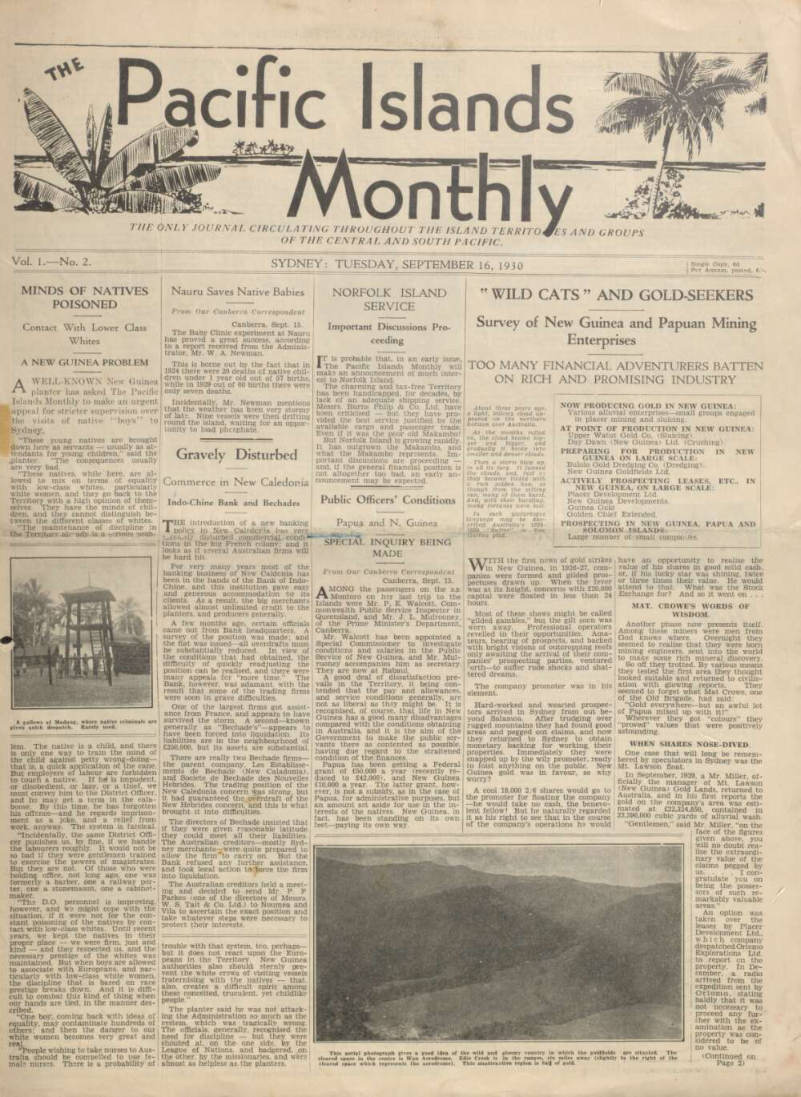
Monthly
THE ONLY JOURNAL CIRCULATING THROUGHOUT THE ISLAND TERRITORIES AND GROUPS
Of The Central And South Pacific.
Vol. 1. —No. 2.
Sydney: Tuesday, September 16, 1930
(Single Copy, 6d. ) 1 Per Annum, posted, 6/-.
Minds Of Natives
Poisoned
Contact With Lower Class Whites
A New Guinea Problem
A WELL-KNOWN New Guinea
planter has asked The Pacific Islands Monthly to make an urgent appeal for stricter supervision over the visits of native “boys” to
Sydney.
“These young natives are brought down here as servants usually as attendants for young children,” said the planter. “The consequences usually are very bad.
“These natives, while here, are allowed to mix on terms of equality with low-class whites, particularly white women, and they go back to the Territory with a high opinion of themselves. They have the minds of children, and they cannot distinguish between the different classes of whites.
“The maintenance of discipline in the Territory already is a serious prob-
lem. The native is a child, and there is only one way to train the mind of the child against petty wrong-doing— that is, a quick application of the cane.
But employers of labour are forbidden to touch a native. If he is impudent, or disobedient, or lazy, or a thief, we must convey him to the District Officer, and he may get a term in the calaboose. By this time, he has forgotten his offence —and he regards imprisonment as a joke, and a relief from work, anyway. The system is farcical.
“Incidentally, the same District Officer punishes us, by fine, if we handle the labourers roughly. It would not be so bad if they were gentlemen trained to exercise the powers of magistrates.
But they are not. Of those who were holding office, not long ago, one was formerly a barber, one a railway porter, one a stonemason, one a cabinetmaker.
“The D.O. personnel is improving, however, and we might cope with the situation, if it were not for the constant poisoning of the natives by contact with low-class whites. Until recent years, we kept the natives in their proper place we were firm, just and kind and they respected us, and the necessary prestige of the whites was maintained. But when boys are allowed to associate with Europeans, and particularly with lower-class white women, the discipline that is based on race prestige breaks down. And it is difficult to combat this kind of thing when our hands are tied, in the manner described.
“One boy, coming back with ideas of equality, may contaminate hundreds of others; and then the danger to our white women becomes very great and real.
"People wishing to take nurses to Australia should be compelled to use female nurses. There is a probability of
trouble with that system, too, perhaps— but it does not react upon the Europeans in the Territory. New Guinea authorities also should sternly prevent the white crews of visiting vessels fraternising with the natives that, also, creates a difficult spirit among these conceited, truculent, yet childlike people.”
The planter said he was not attacking the Administration so much as the system, which was tragically wrong.
The officials, generally, recognised the need for discipline but they were shouted at, on the one side, by the League of Nations, and badgered, on the other, by the missionaries, and were almost as helpless as the planters. .
A gallows at Madang, where native criminals are given quick despatch. Rarely used. ———
Nauru Saves Native Babies
From Our Canberra Correspondent Canberra, Sept. 15.
The Baby Clinic experiment at Nauru has proved a great success, according to a report received from the Administrator, Mr. W. A. Newman.
This is borne out by the fact that in 1924 there were 20 deaths of native children under 1 year old out of 57 births, while in 1929 out of 60 births there were only seven deaths.
Incidentally, Mr. Newman mentions that the weather has been very stormy of late. Nine vessels were then drifting round the island, waiting for an opportunity to load phosphate. .
Gravely Disturbed
Commerce in New Caledonia Indo-Chine Bank and Bechades
THE introduction of a new banking policy in New Caledonia has very seriously disturbed commercial conditions in the big French colony; and it looks as if several Australian firms will be hard hit.
For very many years most of the banking business of New Caldonia has been in the hands of the Bank of Indo- Chine, and this institution gave easy and generous accommodation to its clients. As a result, the big merchants allowed almost unlimited credit to the planters, and producers generally.
A few months ago, certain officials came out from Bank headquarters. A survey of the position was made; and the fiat was issued —all overdrafts must be substantially reduced. In view of the conditions that had obtained, the difficulty of quickly readjusting the position can be realised, and there were many appeals for “more time.” The Bank, however, was adamant, with the result that some of the trading firms were soon in grave difficulties.
One of the largest firms got assist ance from France, and appears to have survived the storm. A second—known generally as “Bechade’s”—appears to have been forced into liquidation. Its liabilities are in the neighbourhood of £250,000, but its assets are substantial.
There are really two Bechade firms — the parent company, Les Establissements de Bechade (New Caladonia), and Societe de Bechade des Nouvelles Hebrides. The trading position of the New Caledonia concern was strong, but it had guaranteed the overdraft of the New Hebrides concern, and this is what brought it into difficulties.
The directors of Bechade insisted that if they were given reasonable latitude they could meet all their liabilities.
The Australian creditors—mostly Sydney merchants—were quite prepared to allow the firm to carry on. But the Bank refused any further assistance, and took legal action to force the firm into liquidation.
The Australian creditors held a meeting and decided to send Mr. P. F Parkes (one of the directors of Messrs.
W. S. Tait & Co. Ltd.) to Noumea and Vila to ascertain the exact position and take whatever steps were necessary to protect their interests. .
ceeding
Norfolk Island
Service
Important Discussions Proceeding
IT is probable that, in an early issue.
The Pacific Islands Monthly will make an announcement of much interest to Norfolk Island.
The charming and tax-free Territory has been handicapped, for decades, by lack of an adequate shipping service.
Messrs. Burns Philp & Co. Ltd. have been criticised but they have provided the best service justified by the available cargo and passenger trade.
Even if it was the poor old Makambo !
But Norfolk Island is growing rapidly.
It has outgrown the Makambo, and what the Makambo represents. Important discussions are proceeding and, if the general financial position is not altogether too bad, an early announcement may be expected. .
Public Officers’ Conditions
Papua and N. Guinea
Special Inquiry Being
Made
From Our Canberra Correspondent Canberra, Sept. 15.
AMONG the passengers on the s.s.
Montoro on her last trip to the Islands were Mr. P. E. Walcott, Commonwealth Public Service Inspector in Queensland, and Mr. J. L. Mulrooney, of the Prime Minister’s Department, Canberra.
Mr. Walcott has been appointed a Special Commissioner to investigate conditions and salaries in the Public Service of New Guinea, and Mr. Mulrooney accompanies him as secretary.
They are now at Rabaul.
A good deal of dissatisfaction prevails in the Territory, it being contended that the pay and allowances, and service conditions generally, are not as liberal as they might be. It is recognised, of course, that life in New Guinea has a good many disadvantages compared with the conditions obtaining in Australia, and it is the aim of the Government to make the public servants there as contented as possible, having due regard to the straitened condition of the finances.
Papua has been getting a Federal grant of £50,000 a year (recently reduced to £42,000), and New Guinea £10,000 a year. The latter grant, however, is not a subsidy, as in the case of Papua, for administrative purposes, but an amount set aside for use in the interests of the natives. New Guinea, in fact, has been standing on its own feet —paying its own way. .
Enterprises
"Wild Cats” And Gold-Seekers
Survey of New Guinea and Papuan Mining
Too Many Financial Adventurers Batten
On Rich And Promising Industry
About three years ago, a light, billowy cloud appeared on the northern horizon over Australia.
As the months rolled on, the cloud beame bigger and bigger, and gradually it broke into smaller and denser clouds.
Then a storm blew up, in all its fury. It fanned the clouds, and, just as they became tinted with a rich golden hue, as though from the setting sun, many of them burst.
And, with their bursting, many fortunes were lost.
In such picturesque language may be described Australia’s 1928- 1929 "flutter" in New Guinea gold. ———
Now Producing Gold In New Guinea:
Various alluvial enterprises—small groups engaged in placer mining and sluicing.
AT POINT OF PRODUCTION IN NEW GUINEA: Upper Watut Gold Co. (Sluicing).
Day Dawn (New Guinea) Ltd. (Crushing).
Preparing For Production In New
Guinea On Large Scale:
Bulolo Gold Dredging Co. (Dredging).
New Guinea Goldfields Ltd.
Actively Prospecting Leases, Etc., In
New Guinea, On Large Scale:
Placer Development Ltd.
New Guinea Developments.
Guinea Gold Golden Chief Extended.
Prospecting In New Guinea, Papua And
Solomon Islands;
Large number of small companies. ———
WITH the first news of gold strikes in New Guinea, in 1926-27, co panies were formed and gilded propectuses drawn up. When the fever was at its height, concerns with £20,000 capital were floated in less than 24 hours.
Most of these shows might be called “gilded gambles,” but the gilt soon was worn away. Professional operators revelled in their opportunities. Amateurs, hearing of prospects, and backed with bright visions of outcropping reefs only awaiting the arrival of their companies’ prospecting parties, ventured north—to suffer rude shocks and shattered dreams.
The company promoter was in his element.
Hard-worked and wearied prospectors arrived in Sydney from out beyond Salamoa. After trudging over rugged mountains they had found good areas and pegged out claims, and now they returned to Sydney to obtain monetary backing for working, their properties. Immediately they were snapped up by the wily promoter, ready to foist anything on the public. New Guinea gold was in favour, so why worry?
A cool 18,000 2/6 shares would go to the promoter for floating the company —he would take no cash, the benevolent fellow! But he naturally regarded it as his right to see that in the course of the company’s operations he would
have an opportunity to realise the value of his shares in good solid cash, or, if his lucky star was shining, twice or three times their value. He would attend to that. What was the Stock Exchange for? And so it went on . . .
Mat. Crowe’S Words Of
Wisdom.
Another phase now presents itself.
Among these miners were men from God knows where. Overnight they seemed to realise that they were born mining engineers, sent into the world to make some rich mineral discovery.
So off they trotted. By various means they tested the first area they thought looked suitable and returned to civilisation with glowing reports. They seemed to forget what Mat Crowe, one of the Old Brigade, had said: “Gold everywhere—but an awful lot of Papua mixed up with it!”
Wherever they got “colours” they “proved” values that were positively astounding.
When Shares Nose-Dived.
One case that will long be remembered by speculators in Sydney was the Mt. Lawson float.
In September, 1929, a Mr. Miller, of ficially the manager of Mt. Lawson (New Guinea) Gold Lands, returned to Australia, and in his first reports the gold on the company’s area was estimated at £22,324,850, contained in 33,396,000 cubic yards of alluvial wash.
“Gentlemen,” said Mr. Miller, “on the
face of the figures given above, you will no doubt realise the extraordinary value of the claims pegged by us. ... I congratulate you on being the “possessors of such remarkably valuable areas.”
An option was taken over the leases by Placer Development Ltd., which company despatched Oriomo Explorations Ltd. to report on the property. In December, a radio arrived from the expedition sent by Oriomo, stating baldly that it was not necessary to proceed any further with the examination as the property was considered to be of no value.
(Continued on Page 2) ———
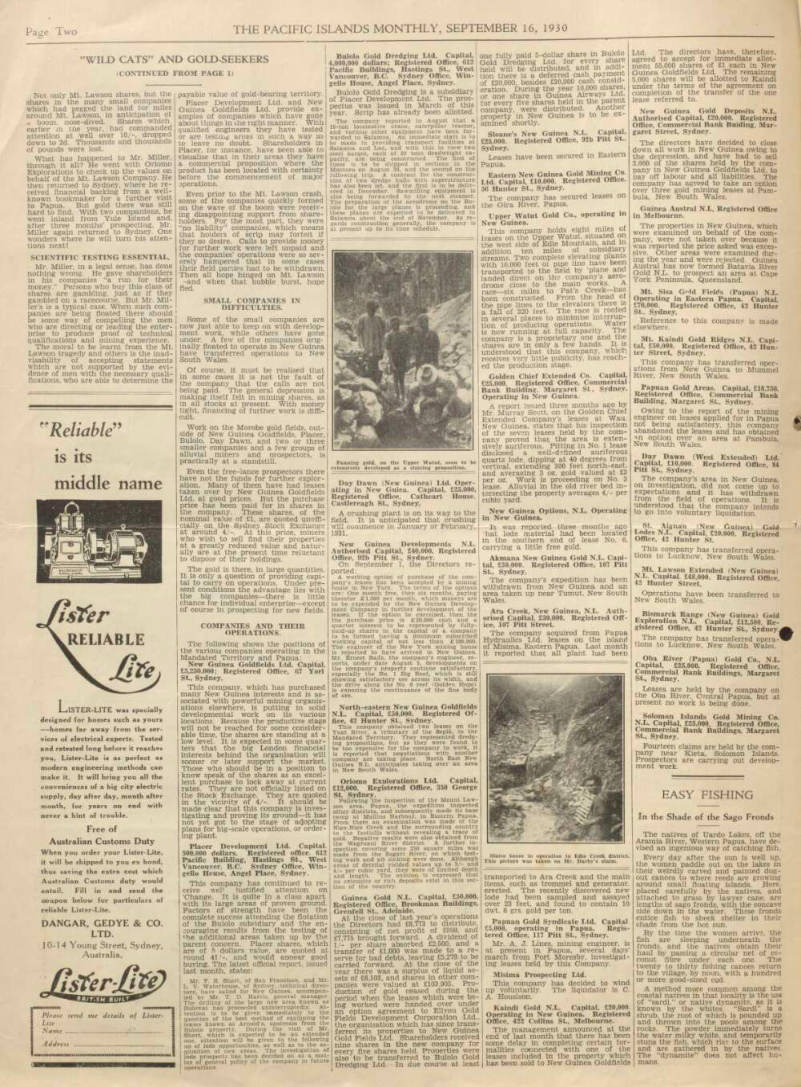
This aerial photograph gives a good idea of the wild and gloomy country in which the goldfields are situated. The cleared space in the centre is Wau Aerodrome. Edie Creek is in the ranges, six miles away (slightly to the right of the cleared space which represents the aerodrome). This unattractive region is full of gold.
Not only Mt. Lawson shares, but the shares in the many small companies which had pegged the land for miles around Mt. Lawson, in anticipation of a boom, nose-dived. Shares which, earlier in the year, had commanded attention at well over 10/-, dropped down to 2d. Thousands and thousands of pounds were lost.
What has happened to Mr. Miller, through it all? He went with Oriomo Explorations to check up the values on behalf of the Mt. Lawson Company. He then returned to Sydney, where he received financial backing from a well known bookmaker for a further visit to Papua. But gold there was still hard to find. With two companions, he went inland from Yule Island and, after three months’ prospecting, Mr.
Miller again returned to Sydney. One wonders where he will turn his attentions next !
Scientific Testing Essential.
Mr. Miller, in a legal sense, has done nothing wrong. He gave shareholders in his companies “a run for their money.” Persons who buy this class of shares are gambling, just as if they gambled on a racecourse. But Mr. Miller’s is a typical case. When such companies are being floated there should be some way of compelling the men who are directing or leading the enterprise to produce proof of technical qualifications and mining experience.
The moral to be learnt from the Mt.
Lawson tragedy and others is the inadvisability of accepting statements which are not supported by the evidence of men with the necessary qualifications, who are able to determine the
payable value of gold-bearing territory.
Placer Development Ltd. and New Guinea Goldfields Ltd. provide examples of companies which have gone about things in the right manner. With qualified engineers they have tested or are testing areas in such a way as to leave no doubt. Shareholders in Placer, for instance, have been able to visualise that in their areas they have a commercial proposition where the product has been located with certainty before the commencement of major operations.
Even prior to the Mt. Lawson crash, some of the companies quickly formed on the wave of the boom were receiving disappointing support from shareholders. For the most, part, they were “no liability” companies, which means that holders of scrip may forfeit if they so desire. Calls to provide money for further work were left unpaid and the companies’ operations were so severely hampered that in some cases their field parties had to be withdrawn.
Then all hope hinged on Mt. Lawson -and when that bubble burst, hope fled.
Small Companies In
Difficulties.
Some of the small companies are now just able to keep on with development work, while others have gone under. A few of the companies originally floated to operate in New Guinea have transferred operations to New South Wales.
Of course, it must be realised that in some cases it is not the fault of the company that the calls are not being paid. The general depression is making itself felt in mining shares, as in all stocks at present. With money tight, financing of further work is difficult.
Work on the Morobe gold fields, outside of New Guinea Goldfields, Placer, Bulolo, Day Dawn, and two or three smaller companies and a few groups of alluvial miners and prospectors, is practically at a standstill.
Even the free-lance prospectors there have not the funds for further exploration. Many of them have had leases taken over by New Guinea Goldfields Ltd. at good prices. But the purchase price has been paid for in shares in the company. These shares, of the nominal value of £1, are quoted unofficially on the Sydney Stock Exchange at around 4/-. At this price, miners who wish to sell find their properties at a greatly reduced value and naturally are at the present time reluctant to dispose of their holdings.
The gold is there, in large quantities.
It is only a question of providing capital to carry on operations. Under present conditions the advantage lies with the big companies—there is little chance for individual enterprise—except of course in prospecting for new fields.
Companies And Their
Operations.
The following shows the positions of the various companies operating in the Mandated Territory and Papua: New Guinea Goldfields Ltd. Capital, £5,250,000; Registered Office, 67 York St., Sydney.
This company, which has purchased many New Guinea interests and is associated with powerful mining organisations elsewhere, is putting in solid developmental work on its various locations. Because the productive stage will not be reached for some considerable time, the shares are standing at a low level. It is expected in some quarters that the big London financial interests behind the organisation will sooner or later support the market.
Those who should be in a position to know speak of the shares as an excellent purchase to lock away at current rates. They are not officially listed on the Stock Exchange. They are quoted in the vicinity of 4/-. It should be made clear that this company is investigating and proving its ground—it has not yet got to the stage of adopting plans for big-scale operations, or order-
ing plant.
Placer Development Ltd. Capital, 500,000 dollars. Registered office. 612 Pacific Building, Hastings St., West Vancouver. B.C. Sydney Office, Wingello House, Angel Place, Sydney.
This company has continued to receive well justified attention on ’Change. It is quite in a class apart, with its large areas of proven ground.
Factors of strength have been the complete success attending the flotation of the Bulolo subsidiary and the encouraging results from the testing of the additional areas taken up by the parent concern. Placer shares, which are of 5 dollars value, are quoted at round 41/-. and would appear good buying. The latest official report, issued last month, states : Mr. P. R. Short, of San Francisco, and Mr.
L. V. Waterhouse, of Sydney, technical directors, have sailed for New Guinea, accompanied by Mr. T. D. Harris, general manager.
The drilling of the large new area known as Bulowat has proceeded uninterruptedly. Attention is to be given immediately to the question of the best method of equipping the leases known as Arnold’s, upstream from the Bulolo property. During the visit of Mr.
Short, which is expected to be an extended one, attention will be given to the following up of lode opportunities, as well as to the acquisition of new areas. The investigation of lode prospects has been decided on as a matter of general policy of the company in future operations.
Bulolo Gold Dredging Ltd. Capital,
4,000,000 dollars; Registered Office, 612
Pacific Buildings, Hastings St., West
Vancouver, B.C. Sydney Office, Win-
gello House, Angel Place, Sydney.
Bulolo Gold Dredging is a subsidiary
of Placer Development Ltd. The prospectus was issued in March of this year. Scrip has already been allotted.
The company reported in August that a 10-ton locomotive crane, caterpillar tractor, and various other equipment have been forwarded to Salamoa. An immediate start is to be made in providing transport facilities at Salamoa and Lae, and with this in view two steel barges, each of 50 tons deadweight capacity, are being constructed. The first of these is to be shipped in sections in the Montoro on August 30, and the second on the following trip. A contract for the construction of two dredge hulls with superstructure has also been let, and the first is to be delivered in December. Sawmilling equipment is also being forwarded by the next steamer.
The preparation of the aerodrome on the Bulolo for the large planes is proceeding, and these planes are expected to be delivered in Salamoa about the end of November. As regards construction generally, the company is at present up to its time schedule.
Day Dawn (New Guinea) Ltd. Operating in New Guiea. Capital, £25,000,
Registered Office, Cathcart House.
Castlereagh St,, Sydney, A crushing plant is on its way to the field. It is anticipated that crushing will commence in January or February, 1931.
New Guinea Developments N.L.
Authorised Capital, £40,000. Registered Office, 92b Pitt St., Sydney.
On September 1, the Directors reported : A working option of purchase of the company’s leases has been accepted by a mining house in New York. The terms of the options are : One month free, then six months, paying therefor £1,000 per month, which moneys are to be expended by the New Guinea Development Company in further development of the leases. If the option be exercised, then the the purchase price is £20,000 cash and a quarter interest to be represented by fully paid-up shares in the capital of a company to be formed having a minimum subscribed working capital of not less than £100,000.
The engineer of the New York mining house is reported to have arrived in New Guinea.
Mr. Ernest Bails, the company’s engineer, reports, under date August 3, developments on the company’s property continue satisfactory, especially the No. 1 Big Reef, which is still showing satisfactory ore across its width, and the drive along the No. 6 reef (Golden Hope) is exposing the continuance of the fine body of ore.
North-eastern New Guinea Goldfields N.L. Capital, £50,000. Registered Office, 42 Hunter St., Sydney.
This company obtained two leases on the Yuat River, a tributary of the Sepik. in the Mandated Territory. They represented dredging propositions, but as they were found to be too expensive for the company to work, it is reported that negotiations with another company are taking place. North East New Guinea N.L. anticipates taking over an area in New South Wales.
Oriomo Explorations Ltd. Capital, £12,000. Registered Office, 350 George St. Sydney.
Following the inspection of the Mount Lawson area, Papua, the expedition inspected other districts, and subsequently made its base camp at Mullins Harbour, in Eastern Papua.
From there an examination was made of the Nigo-Nigo Creek and the surrounding country to the foothills without revealing a trace of gold. Negative results were also obtained from the Wegruani River district. A further inspection covering some 250 square miles was made from the Sagari River, on which testing work and pit sinking were done. Although areas of detrital yielded values up to 3/- and 4/- per cubic yard, they were of limited depth and length. The opinion is expressed that no extensive or rich deposits exist in this section of the country.
Guinea Gold N.L. Capital, £50,000.
Registered Office, Brookman Buildings, Grenfell St., Adelaide.
At the close of last year’s operations the Directors had £8,773 to distribute, consisting of net profit of £998, and £7,775 brought forward. A dividend of 1/- per share absorbed £2,500, and a transfer of £1,000 was made to a reserve for bad debts, leaving £5,273 to be carried forward. At the close of the year there was a surplus of liquid assets of £6,103, and shares in other companies were valued at £103,905. Production of gold ceased during the period when the leases which were being worked were handed over under an option agreement to Ellyou Gold
Fields Development Corporation Ltd.,
the organisation which has since transferred its properties to New Guinea Gold Fields Ltd. Shareholders received nine shares in the new company for every five shares held. Properties were also to be transferred to Bulolo Gold Dredging Ltd. In due course at least
one fully paid 5-dollar share in Bulolo Gold Dredging Ltd. for every share held will be distributed, and in addition there is a deferred cash payment of £20,000, besides £30,000 cash consideration. During the year 10,000 shares, or one share in Guinea Airways Ltd. for every five shares held in the parent company, were distributed. Another property in New Guinea is to be examined shortly.
Sloane’s New Guinea N.L. Capital, £25,000. Registered Office, 92b Pitt St..
Sydney.
Leases have been secured in Eastern Papua.
Eastern New Guinea Gold Mining Co.
Ltd. Capital, £10,000. Registered Office. 56 Hunter St., Sydney.
The company has secured leases on the Gira River, Papua.
Upper Watut Gold Co., operating in New Guinea.
This company holds eight miles of leases on the Upper Watut, situated on the west side of Edie Mountain, and in addition ten miles of subsidiary streams. Two complete elevating plants with 10,000 feet of pipe line have been transported to the field by ’plane and landed direct on the company's aerodrome close to the main works. A race—six miles to Pat’s Creek—has been constructed. From the head of the pipe lines to the elevators there is a fall of 320 feet. The race is roofed in several places to minimise interruption of producing operations. Water is now running at full capacity. The company is a proprietary one and the shares are in only a few hands. It is understood that this company, which, receives very little publicity, has reached the production stage.
Golden Chief Extended Co. Capital, £25,000. Registered Office, Commercial Bank Building, Margaret St, Sydney.
Operating in New Guinea.
A report issued three months ago by Mr. Murray Scott, on the Golden Chief Extended Company’s leases at Wau.
New Guinea, states that his inspection of the seven leases held by the company proved that the area is extensively auriferous. Pitting in No. 1 lease disclosed a well-defined auriferous quartz lode, dipping at 40 degrees from vertical, extending 300 feet north-east, and averaging 3 oz. gold valued at £3 per oz. Work is proceeding on No. 3 lease. Alluvial in the old river bed in tersecting the property averages 4/- per cubic yard.
New Guinea Options, N.L. Operating in New Guinea, It was reported three months ago that lode material had been located in the southern end of lease No. 6, carrying a little free gold.
Akmana New Guinea Gold N.L. Capital, £30.000. Registered Office, 107 Pitt St., Sydney.
The company’s expedition has been withdrawn from New Guinea and an area taken up near Tumut, New South Wales.
Ara Creek, New Guinea, N.L. Authorised Capital. £30,000. Registered Office, 107 Pitt Street.
The company acquired from Papua Hydraulics Ltd. leases on the island of Misima, Eastern Papua. Last month it reported that all plant had been
transported to Ara Creek and the main items, such as trommel and generator, erected. The recently discovered new lode had been sampled and assayed over 23 feet, and found to contain 10 dwt. 8 grs. gold per ton.
Papuan Gold Syndicate Ltd, Capital £5,000, operating in Papua. Registered Office, 117 Pitt St., Sydney.
Mr. A. J. Lines, mining engineer, is at present in Papua, several days’ march from Port Moresby, investigating leases held by this Company.
Misima Prospecting Ltd.
This company has decided to wind up voluntarily. The liquidator is C.
A. Housison.
Kaindi Gold N.L. Capital, £20,000.
Operating in New Guinea. Registered Office, 422 Collins St., Melbourne.
The management announced at the end of last month that there has been some delay in completing certain formalities connected with one of the leases included in the property which has been sold to New Guinea Goldfields
Ltd. The directors have, therefore, agreed to accept for immediate allotment 55,000 shares of £1 each in New Guinea Goldfields Ltd. The remaining 5.000 shares will be allotted to Kaindi under the terms of the agreement on completion of the transfer of the one lease referred to.
New Guinea Gold Deposits N.L.
Authorised Capital, £20,000. Registered Office, Commercial Bank Buiding, Margaret Street, Sydney.
The directors have decided to close down all work in New Guinea owing to the depression, and have had to sell 3,000 of the shares held by the company in New Guinea Goldfields Ltd. to pay off labour and all liabilities. The company has agreed to take an option over three gold mining leases at Pambula, New South Wales.
Guinea Austral N.L. Registered Office in Melbourne.
The properties in New Guinea, which were examined on behalf of the company, were not taken over because it was reported the price asked was excessive. Other areas were examined during the year and were rejected. Guinea Austral has now formed Batavia River Gold N.L. to prospect an area at Cape York Peninsula, Queensland.
Mt. Sisa Fields (Papua) N.L.
Operating in Eastern Papua. Capital, £70,000. Registered Office, 42 Hunter St., Sydney.
Reference to this company is made elsewhere.
Mt. Kaindi Gold Ridges N.L. Capital, £50,000. Registered Office, 42 Hunter Street, Sydney.
This company has transferred operations from New Guinea to Mummel River, New South Wales.
Papuan Gold Areas. Capital,. £18,750.
Registered Office, Commercial Bank Building, Margaret St., Sydney.
Owing to the report of the mining engineer on leases applied for in Papua not being satisfactory, this company abandoned the leases and has obtained an option over an area at Pambula, New South Wales.
Day Dawn (West Extended) Ltd.
Capital, £10,000. Registered Office, 84 Pitt St., Sydney.
The company’s area in New Guinea, on investigation, did not come up to expectations and it has withdrawn from the field of operations. It is understood that the company intends to go into voluntary liquidation.
St. Aignan (New Guinea) Gold Lodes N.L. Capital, £20.000. Registered Office, 42 Hunter St.
This company has transferred operations to Lucknow, New South Wales.
Mt. Lawson Extended (New Guinea) N.L. Capital. £48,000. Registered Office, 42 Hunter Street.
Operations have been transferred to New South Wales.
Bismarck Range (New Guinea) Gold Exploration N.L. Capital, £12,500. Re gistered Office, 42 Hunter St., Sydney.
The company has transferred operations to Lucknow, New South Wales.
Oba River (Papua) Gold Co., N.L.
Capital, £25.000. Registered Office, Commercial Bank Buildings, Margaret St., Sydney.
Leases are held by the company on the Oba River, Central Papua, but at present no work is being done.
Solomon Islands Gold Mining Co.
N.L. Capital, £25,000. Registered Office, Commercial Bank Buildings, Margaret St., Sydney.
Fourteen claims are held by the company near Kieta, Solomon Islands.
Prospectors are carrying out development work. ... ===
Sluice boxes in operation in Edie Creek district.
This picture was taken on Mr. Darby’s claim. ———
Panning gold, on the Upper Watut, soon to be extensively developed as a sluicing proposition. ———
Easy Fishing
In the Shade of the Sago Fronds
The natives of Uardo Lakes, off the Aramia River, Western Papua, have devised an ingenious way of catching fish.
Every day after the sun is well up, the women paddle out on the lakes in their weirdly carved and painted dugout canoes to where reeds are growing around small floating islands. Here, placed carefully by the natives, and attached to grass by lawyer cane, are lengths of sago fronds, with the concave side down in the water. These fronds entice fish to sheek shelter in their shade from the hot sun.
By the time the women arrive, the fish are sleeping underneath the fronds, and the natives obtain their haul by passing a circular net of co conut fibre under each one. The twenty to thirty fishing canoes return to the village, by noon, with a hundred or more good-sized cod.
A method more common among the coastal natives in that locality is the use of “sardi,” or native dynamite, as it is known by the whites. “Sardi” is a shrub, the root of which is pounded up and thrown into the pools among the rocks. The powder immediately turns the water milky white, and temporarily stuns the fish, which rise to the surface and are gathered in by the natives.
The “dynamite” does not affect humans. ———
Advertisements & other items, p. 2 (2 items)
Page Two
THE PACIFIC ISLANDS MONTHLY, SEPTEMBER 16, 1930 ———
"WILD CATS” AND GOLD-SEEKERS
(CONTINUED FROM PAGE 1)
lite
"Reliable”
is its
middle name
Lister
RELIABLE
lite
LISTER-LITE was specially designed for homes such as yours —homes far away from the services of electrical experts. Tested and retested long before it reaches you, Lister-Lite is as perfect as modern engineering methods can make it. It will bring you all the conveniences of a big city electric supply, day after day, month after month, for years on end with never a hint of trouble.
Free of Australian Customs Duty When you order your Lister-Lite, it will be shipped to you ex bond, thus saving the extra cost which Australian Customs duty would entail. Fill in and send the coupon below for particulars of reliable Lister-Lite.
DANGAR, GEDYE & CO.
LTD.
10-14 Young Street, Sydney,
Australia.
Pacific Islands Monthly is Well Received
We acknowledge with grateful thanks, letters received from all directions congratulating us on, the establishment of The Pacific Islands Monthly. We also acknowledge very welcome support in the shape of new advertising contracts. We are thus encouraged to proceed, in spite of the temporary depression, with our effort to assist and stimulate trade relations between Australia, New Zealand, and the Pacific. Following are extracts from letters received:
Mr. Lewis Armstrong, general mana ger, Messrs. Burns Philp & Company Limited, Sydney: “The first issue of The Pacific Is lands Monthly was read through with a great amount of interest.
“The journal contains quite a lot of good and entertaining reading matter, with the addition of valuable infor mation, all applicable to the Pacific Islands, and I have no doubt that so long as the high standard of the first issue is maintained your publication will be eagerly looked for each month by all subscribers.”
Rev. J. W. Burton, M.A., general sec retary of The Mdthodist Missionary Society of Australasia:— “I am very interested in the venture.
I think the first issue is an excellent production, and it ought to meet a need, particularly in bringing the dif ferent Island groups into some sort of relation. The trouble at present is that each group faces its problems individu ally, not realising how common they are to every other group. I hope the journal is a success.”
Mr. U. R. Ellis, private secretary to Dr. Earle Page, M.P.:— “May I congratulate you on your en terprise in producing The Pacific Is lands Monthly and its general make up? I believe you have opened up a journalistically lucrative proposition which will be of untold value to Aus tralia. It is remarkable that the Pacific has remained so long neglected from the Australian side, while the Phil lipines and Hawaii have been so swiftly developed commercially, and in a tour ist sense. The tourist angle alone is one which must ultimately bring us untold wealth.”
Mr. Harold James, East Brunswick, Melbourne:— “Being interested generally in the Pacific Islands, it gives me much pleas ure to congratulate you after reading; the first issue of the Monthly. I feel sure it is going to provide much needed publicity for the Islands.”
The Daily Mail, Brisbane;— “The first issue furnishes a great deal of useful information about trade pros pects in the islands, and contains also much interesting reading matter of a general character about the Pacific.
Many of these island communities are without their own newspaper, and The Pacific Islands Monthly should find a considerable circulation in them, as well as amongst the business community of Australia.”
Mr. W. A. Freeman, of Sydney, who is deeply interested in New Guinea devel opmental activities:— As a director of the Placer Develop ment and Bulolo Gold Dredging Com panies, operating in New Guinea, I have been pleased indeed to receive the first issue of your paper. The name, The Pacific Islands Monthly, is, I think, well chosen. I have been much struck by the literary and journalistic merits of the paper, by the wealth of matter given, and by the general reach of the publication. In fact, it is one of the most interesting publications of the sort that I have ever seen. I shall be in terested to see whether you can main tain the standard you have set. The amount of territory and interests cov ered by these Island possessions and Governments, I find rather an eye opener, and I feel sure that this will be the case with most people who read the publication for the first time.
Major Clive B. Joske, M.C. (Messrs.
Brown & Joske Ltd., merchants), Suva, Fiji:— I congratulate you upon the first number of The Pacific Islands Monthly.
May it increase with each issue in health, wealth and prosperity!
Mr. J. Horne (managing director, Messrs. Walter Horne & Co. Ltd., mer chants, and vice-president of the Suva Chamber of Commerce), Suva, Fiji:— I have read with great interest the first issue of The Pacific Islands Mon thly, and I am, sure it will find a ready sale, and will be read with great in terest all over the Pacific, especially by people in the outlying islands. I wish you every success.
Dr. J. P. Thompson, C.8.E., general secretary of the Royal Geographical So ciety of Australasia (Queensland): — “I have read your Pacific Islands Monthly with much interest, and hope your enterprise will succeed. There is room for such a publication if con ducted on progressive lines.”
Mr. F. S. Boyce, K.C., MLC, At torney-General in the N.S.W. Cabinet, and a director of New Guinea com panies:— As one who has some acquaintance with the field covered I have been in New Guinea, Fiji, and Norfolk Is land, though, of course, not for long I appreciate the fullness of the infor mation which the publication gives.
Wishing you every success.
Hon, Henry Marks, C.B E,, Mayor of Suva: I have read with much pleasure the first number of The Pacific Islands Monthly, and feel that such a journal, including in its influence the whole of the Pacific, should provide a medium of a closer union and a greater sympathy among the peoples of the Pacific. I wish it every success.
Sir Henry Scott, K.C., Member of the Legislative Council and Executive Council, of Fiji: I have read with interest a copy of the first issue of The Pacific Islands Monthly. I have little doubt that the object of this much-needed journal will be achieved; that it will serve the in terests of the Pacific communities by not only improving knowledge and communication between the various administrations of the Central and Southern Pacific, but will also convey to Australia and New Zealand reliable information concerning the Pacific Is lands and their peoples. If the stand ard of the first issue of The Pacific Islands Monthly be maintained, I am optimistic as to the success I wish the publication.
Mr. Alan O. Mackenzie, of Suva (vice-president of the Suva Chamber of Commerce): The proprietors of The Pacific Islands Monthly are to be congratu lated on the high standard of their initial issue. This journal will fill a long-felt want as a medium of exchange of inter-island news and, provided the high standard is maintained, its success and permanence will be assured.
Mr. David W. Amos. F.A.I.I., manager of the Pacific Insurance Co., Ltd., Suva: I hasten to congratulate you upon your enterprise in publishing The Pacific Islands Monthly. This paper will embrace within its ambit all the
different administrations of the Pacific and should no doubt in time have great influence in creating a greater harmony amongst the various islands communi ties. It will not be an easy work to establish this paper at least that is my opinion but it will be possible, and it will be well worth while. I con gratulate you upon the general lay out of the paper and character of the news provided.
The Advertiser, Adelaide: The Pacific Islands Monthly should prove a valuable publication to resi
dents and traders of the Central and South Pacific.
Colonel A, J. Bennett, Administrator of Norfolk Island (through his private secretary, Mr. C. A. Leonard): The Administrator has read, with pleasure, the first number of The Pacific Islands Monthly. His Honour congratulates you on the attractive reading matter and appearance, and expresses his good wishes for continued success of so useful a publication.
Advertisements & other items, p. 3 (1 item)
Anthony Horderns’
“MIRAMAR ”
FIRST-CLASS BOARDING
ESTABLISHMENT
SUVA - FIJI
Safeguards the Heath of its Guests by not using Aluminium Kitchenware PROXIMITY SEA BATHS NINE BUNGALOW HOMES ELEVATED POSITION VARIED FARE - - TWO GUINEAS WEEK
Mr. and Mrs. WASTALL PROPRIETORS
Vitality and Health are the
Main Factors in Every-day Life
Put yourself in the hands of Specialists who have made an intelligent study of your requirements; it is vital to your health.
We are known everywhere as the Suppliers of the Right Goods and which put the VITAL into VITALITY. 35 years is our record of supplying Fresh Fruit, Vegetables and Produce to the leading Houses throughout the world.
GET FULLY ACQUAINTED WITH US
Tel: MA 4799; FX 4350 Private Cable Address: PIGS, SYDNEY. Code: BENTLEYS
C. G. PIGGOTT
WHOLESALE FRUIT AND PRODUCE MERCHANTS
DIRECT IMPORTERS AND EXPORTERS.
SYDNEY.
Office, Bulk Stores 6c Packing House: Fruit Exchange, Sydney Sales Dept.: Fruit Exchange and City Markets, Sydney Bank of N.S.W. Bankers.
“TRUTH IN ADVERTISING’’—when Anthony Horderns’ say a thing you know it is true.
This Mighty Store Brought to Your Door Through more than a century of retail trading, Anthony Horderns’ progress has been continuous —public support has been accorded in increasing measure as a natural result of the outstanding values offered and the straightforward business methods always adhered to.
Anthony Horderns’ great store is one of the landmarks of Sydney, but its service to the Public extends far beyond the limits of the "Queen City of the South.” By means of profusely illustrated Catalogues, the comprehensive stocks of this great business are brought to those who are unable to shop in person, and all requirements can be ordered from these Catalogues with the perfect assurance that the
goods will be exactly as represented.
Anthony Horderns’ next Catalogue will be the 1930 Christmas Gift and Toy Book, and if you do not receive a copy by this or the next mail, kindly forward your name and address to Anthony Horderns’, and you will be placed on the regular mailing list. This is a service which you will appreciate more and more as time goes on.
Anthony Horderns’
Anthony Hordern 8C Sons, Ltd. (THE SENIOR STORE) Sydney, N.S.W.
Postal Address : Box 2712 C, G.P.O., Sydney
"Despised”
Pacific Trade and Australia
Impressions Of A Fiji
Resident
FIJI’S trade goes where it is best served. Australia seemed to despise the Pacific as being a small place, and never made the most of her opportuni ties.
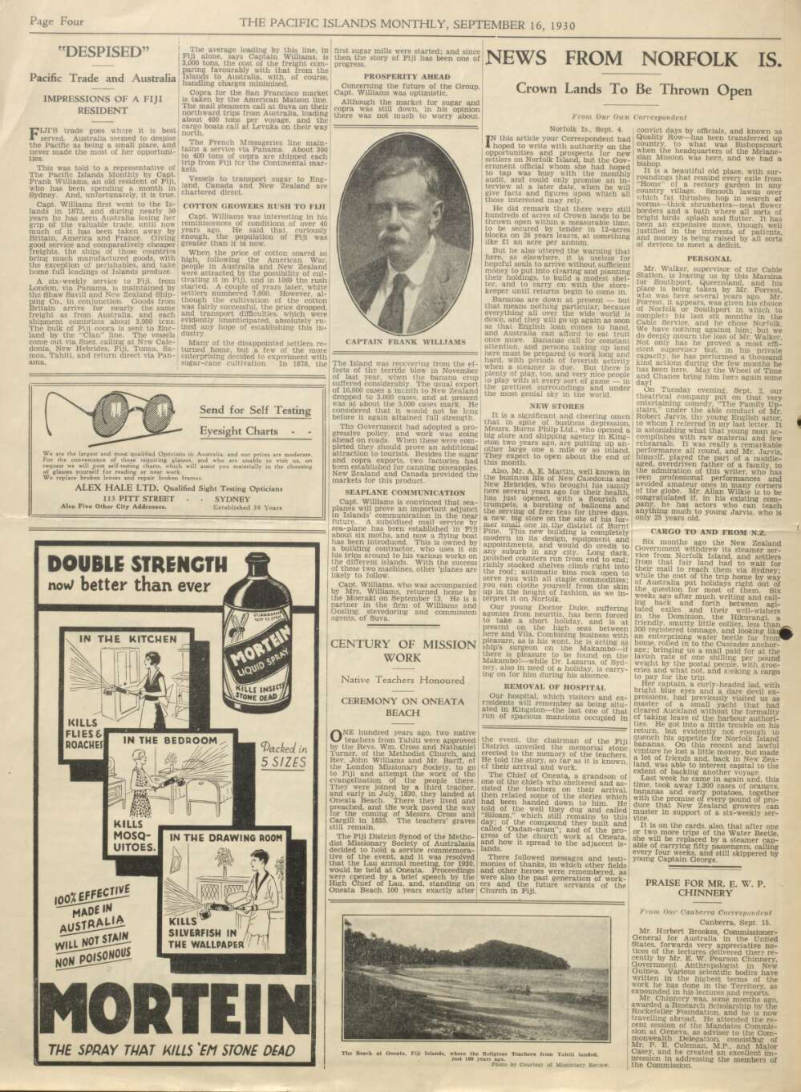
This was told to a representative of The Pacific Islands Monthly by Capt.
Frank Williams, an old resident of Fiji, who has been spending a month in Sydney. And, unfortunately, it is true.
Capt. Williams first went to the Is lands in 1872, and during nearly 50 years he has seen Australia losing her grip of the valuable trade, until now much of it has been taken away by Britain, America and France. Giving good service and comparatively cheaper freights, the ships of those countries bring much manufactured goods, with the exception of perishables, and take home full loadings of Islands produce.
A six-weekly service to Fiji, from London, via Panama, is maintained by the Shaw Savill and New Zealand Ship ping Co., in conjunction. Goods from Britain arrive for nearly the same freight as from Australia, and each shipment comnrises about 3,000 tens.
The bulk of Fiji copra is sent to England by the “Clan” line. The vessels come out via Suez, calling at New Cale donia, New Hebrides, Fiji, Tonga, Sa moa, Tahiti, and return direct via Pan ama.
The average loading by this line, in Fiji alone, says Captain Williams, is 3,000 tons, the cost of the freight com paring favourably with that from the Islands to Australia, with, of course, handling charges minimised.
Copra for the San Francisco market is taken by the American Matson line.
The mail steamers call at Suva on their northward trips from Australia, loading about 400 tons per voyage, and the cargo boats call at Levuka on their way north.
The French Messageries line main tains a service via Panama. About 300 to 400 tons of copra are shipped each trip from Fiji for the Continental mar kets.
Vessels to transport sugar to Eng land, Canada and New Zealand are chartered direct.
Cotton Growers Rush To Fiji
Capt. Williams was interesting in his reminiscences of conditions of over 40 years ago. He said that, curiously enough, the population of Fiji was greater than it is now.
When the price of cotton soared so high, following the American War, people in Australia and New Zealand were attracted by the possibility of cul tivating it in Fiji, and in 1869 the rush started. A couple of years later, white settlers numbered 7,000. However, al though the cultivation of the cotton was fairly successful, the price dropped, and transport difficulties, which were evidently unanticipated, absolutely ru ined any hope of establishing this in dustry.
Many of the disappointed settlers re turned home, but a few of the more enterprising decided to experiment with sugar-cane cultivation. In 1878, the
first sugar mills were started; and since then, the story of Fiji has been one of progress.
Prosperity Ahead
Concerning the future of the Group, Capt. Williams was optimistic.
Although the market for sugar and copra was still down, in his opinion there was not much to worry about.
The Island was recovering from the ef fects of the terrific blow in November of last year, when the banana crop suffered considerably. The usual export of 10,000 cases a mcnth to New Zealand dropped to 3,000 cases, and at present was at about the 5,000 cases mark. He considered that it would not be long before it again attained full strength.
The Government had adopted a pro gressive policy, and work was going ahead on roads. When these were com pleted they should prove an additional attraction to tourists. Besides the sugar and copra exports, two factories had been established for canning pineapples.
New' Zealand and Canada provided the markets for this product.
Seaplane Communication
Capt. Williams is convinced that sea planes will prove an important adjunct in Islands’ communication in the near future. A subsidised mail service by sea-plane has been established in Fiji about six moths, and now a flying boat has been introduced. This is owned by a building contractor, who uses it on his trips around to his various works on the different islands. With the success of these two machines, other ’planes are likely to follow.
Capt. Williams, who was accompanied by Mrs. Williams, returned home by the Moeraki on September 12. He is a partner in the firm of Williams and Gosling, stevedoring and commission agents, of Suva.
Captain Frank Williams
Century Of Mission
Work
Native Teachers Honoured
Ceremony On Oneata
Beach
ONE hundred years ago, two native teachers from Tahiti were approved by the Revs. Wm. Cross and Nathaniel Turner, of the Methodist Church, and Rev. John Williams and Mr. Barff, of the London Missionary Society, to go to Fiji and attempt the work of the evangelisation of the people there.
They were joined by a third teacher, and early in July, 1830, they landed at Oneata Beach. There they lived and preached, and the work paved the way for the coming of Messrs. Cross and Cargill in 1835. The teachers’ graves still remain.
The Fiji District Synod of the Metho dist Missionary Society of Australasia decided to hold a service commemora tive of the event, and it was resolved that the Lau annual meeting, for 1930, would be held at Oneata. Proceedings were opened by a brief speech by the High Chief of Lau, and, standing on Oneata Beach 100 years exactly after
the event, the chairman of the Fiji District unveiled the memorial stone erected to the memory of the teachers He told the story, so far as it is known of their arrival and work.
The Chief of Oneata, a grandson of one of the chiefs who sheltered and as sisted the teachers on their arrival, then related some of the stories which had been handed down to him. He told of the well they dug and called “Siloam,” which still remains to this day; of the compound thev built and called ‘Oadan-aram”; and of the pro gress of the church work at Oneata, and how it spread to the adjacent is lands.
There followed messages and testi monies of thanks, in which other fields and other heroes were remembered, as were also the past generation of work ers and the future servants of the Church in Fiji.
The Beach at Oneata, Fiji Islands, where the Religious Teachers from Tahiti landed, just 100 years ago.
Photo by Courtesy of Missionary Review.
News From Norfolk Is.
Crown Lands To Be Thrown Open
From Our Own Correspondent
Norfolk Is., Sept. 4.
IN this article your Correspondent had hoped to write with authority on the opportunities and prospects for new settlers on Norfolk Island, but the Gov ernment official whom she had hoped to tap was busy with the monthly audit, and could only promise an in terview at a later date, when he will give facts and figures upon which all those interested may rely.
He did remark that there were still hundreds of acres of Crown lands to be thrown open within a measurable time, to be secured by tender in 12-acres blocks on 28 years leases, at something like £1 an acre per annum.
But he also uttered the warning that here, as elsewhere, it is useless for hopeful souls to arrive without sufficient money to put into clearing and planting their holdings, to build a modest shel ter, and to carry on with the store keeper until returns begin to come in.
Bananas are down at present but that means nothing particular, because everything all over the wide world is down, and they will go up again as soon as that English loan comes to hand, and Australia can afford to eat fruit once more. Bananas call for constant attention, and persons taking up land here must be prepared to work long and hard, with periods of feverish activity when a steamer is due. But there is plenty of play, too, and very nice people ro play with at every sort of game in the prettiest surroundings and under the most genial sky in the world.
New Stores
It is a significant and cheering omen that in spite of business depression, Messrs. Burns Philp Ltd., who opened a big store and shipping agency in King ston two years ago, are putting up an other large one a mile or so inland.
They expect to open about the end of this month.
Also, Mr. A. E. Martin, well known in the business life of New Caledonia and New Hebrides, who brought his family here several years ago for their health, has just opened, with a flourish of trumpets, a bursting of balloons and the serving of free teas for three days, a new, big store on the site of his for mer small one in the district of Burnt Pine. This new building is completely modern in its design, equipment and appointments, and would do credit to any suburb in any city. Long dark, polished counters run from end to end richly stocked shelves climb right into the roof; automatic bins rock open to serve you with all staple commodities; you can clothe yourself from the skin up in the height of fashion, as we in terpret it on Norfolk.
Our young Doctor Duke, suffering agonies from neuritis, has been forced to take a short holiday, and is at present on the high seas between here and Vila. Combining business with pleasure, as is his wont, he is acting as ship’s surgeon on the Makambo—if there is pleasure to be found on the Makambo!—while Dr. Lazarus, of Syd ney, also in need of a holiday, is carry ing on for him during his absence.
Removal Of Hospital
Our hospital, which visitors and ex residents will remember as being situ ated in Kingston—the last one of that run of spacious mansions occupied in
convict days by officials, and known as Quality Row—has been transferred up country, to what was Bishopscourt when the headquarters of the Melane sian Mission was here, and we had a bishop.
It is a beautiful old place, with sur roundings that remind every exile from “Home” of a rectory garden in any country village. Smooth lawns over which fat thrushes hop in search of worms—thick shrubberies—neat flower borders and a bath where all sorts of bright birds splash and flutter. It has been an expensive move, though well justified in the interests of patients, and money is being raised by all sorts of devices to meet a deficit.
Personal
Mr. Walker, supervisor of the Cable Station, is leaving us by this Marsina for Southport, Queensland, and his place is being taken by Mr. Forrest, who was here several years ago. Mr.
Forrest, it appears, was given his choice of Norfolk or Southport in which to complete his last six months in the Cable Service, and he chose Norfolk.
We have nothing against him; but we do deeply mourn the loss of Mr. Walker Not only has he proved a most effi cient supervisor but, in his private capacity, he has performed a thousand kind actions during the few months he has been here. May the Wheel of Time and Chance bring him here again some day!
On Tuesday evening, Sept. 2, our theatrical company put on that very entertaining comedy, “The Family Up stairs,” under the able conduct of Mr.
Robert Jarvis, the young English actor, to whom I referred in my last letter. It is astonishing what that young man ac complishes with raw material and few rehearsals. It was really a remarkable performance all round, and Mr. Jarvis, himself, played the part of a middle aged, overdriven father of a family to the admiration of this writer, who has seen professional performances and avoided amateur ones in many corners of the globe. Mr. Allan Wilkie is to be congratulated if, in his existing com pany, he has actors who can teach anything much to young Jarvis, who is only 25 years old.
Cargo To And From N.Z.
Six months ago the New Zealand Government withdrew its steamer ser vice from Norfolk Island, and settlers from that fair land had to wait for their mail to reach them via Sydney; while the cost of the trip home by way of Australia put holidays right out of the question for most of them. Six weeks ago after much writing and call ing back and forth between agi tated exiles and their well-wishers in the Dominion, the Hikurangi, a friendly, smutty little collier, less than, 300 registered tonnage, and looking likejj an enterprising water beetle far home, rolled in to the Cascades anchor age; bringing us a mail paid for at the lavish rate of one shilling per pound weight by the postal people, with groc eries and what not, and seeking a cargo to pay for the trip.
Her captain, a curly-headed lad, with bright blue eyes and a dare devil ex pressions, had previously visited us as master of a small yacht that had cleared Auckland without the formality of taking leave of the harbour authori ties. He got into a little trouble on his return, but evidently not enough to quench his appetite for Norfolk Island bananas. On this recent and lawful venture he lost a little money, but made a lot of friends and, back in New Zea land, was able to interest capital to the extent of backing another voyage.
Last week he came in again and, this time, took away 1.300 cases of oranges, bananas and early potatoes, together with the promise of every pound of pro duce that New Zealand growers can muster in support of a six-weekly ser vice.
It is on the cards, also, that after one or two more trips of the Water Beetle, she will be replaced by a steamer cap able of carrying fifty passengers, calling every four weeks, and still skippered by young Captain George.
Praise For Mr. E. W. P.
Chinnery
From Our Canberra Correspondent Canberra, Sept. 15.
Mr. Herbert Brookes, Commissioner- General for Australia in the United States, forwards very appreciative no tices of the lectures delivered there re cently by Mr. E. W. Pearson Chinnery,
Goyernment Anthropologist in New
Guinea. Various scientific bodies have written in the highest terms of the work he has done in the Territory, as expounded in his lectures and reports.
Mr. Chinnery was, some months ago, awarded a Research Scholarship by the Rockefeller Foundation, and he is now travelling abroad. He attended the re cent session of the Mandates Commis sion at Geneva, as adviser to the Com monwealth Delegation,, consisting of Mr. P. E. Coleman, M.P., and Major Casey, and he created an excellent im pression in addressing the members of the Commission.
Advertisements & other items, p. 4 (1 item)
Double Strength
Send for Self Testing
Eyesight Charts
We are the largest and most qualified Opticians in Australia, and our prices are moderate.
For the convenience of those requiring glasses, and who are unable to visit us, on request we will jpost self-testing charts, which will assist you materially in the choosing of glasses yourself for reading or near work.
We replace broken lenses and repair broken frames.
ALEX HALE LTD. Qualified Sight Testing Opticians
113 PITT STREET - - SYDNEY
Also Five Other City Addresses. Established 30 Years
DOUBLE STRENGTH
now better than ever THE SPRAY THAT KILLS 'EM STONE DEAD
Killing The Gold-Laying Goose
Federal Government’s Extraordinary Tax on New Guinea Mining Industry
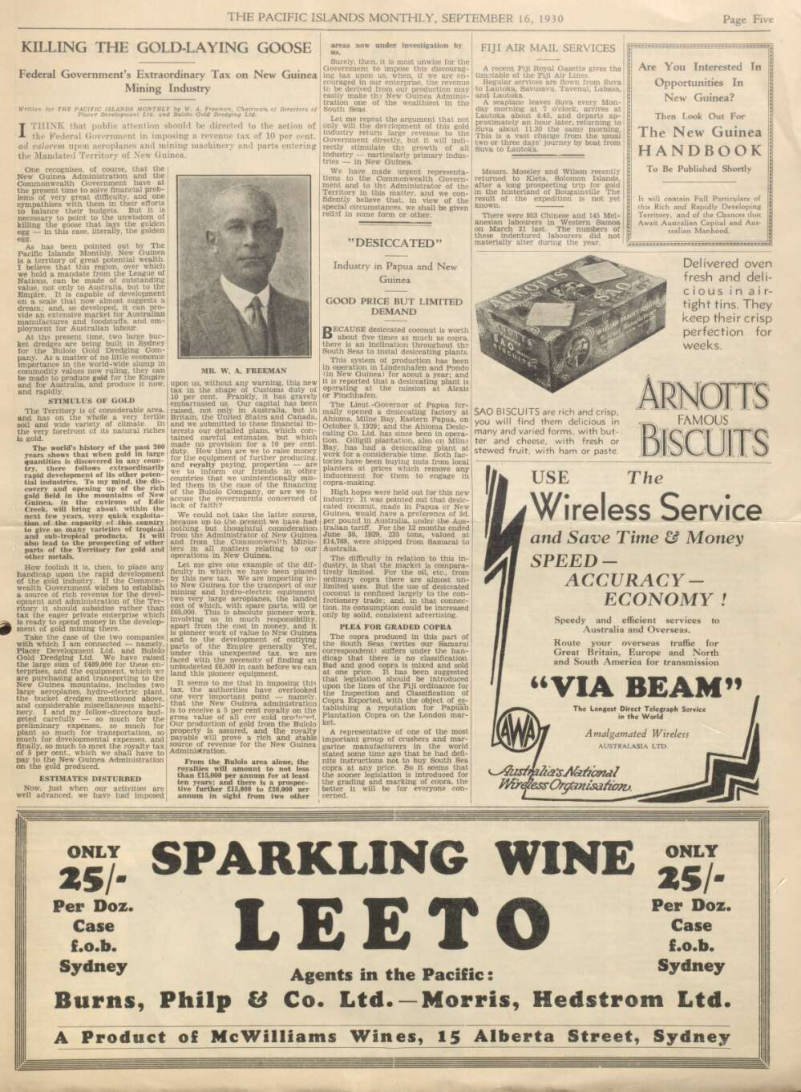
Written for THE PACIFIC ISLANDS MONTHLY by W. A. Freeman, of Directors of Placer Development Ltd. and Bulolo Gold Dredging Ltd.
I THINK that public attention should be directed to the action of the Federal Government in imposing a revenue tax of 10 per cent. ad valorem upon aeroplanes and mining machinery and parts entering the Mandated Territory of New Guinea.
One recognises, of course, that the New Guinea Administration and the Commonwealth Government have at the present time to solve financial prob lems of very great difficulty, and one sympathises with them in their efforts to balance their budgets. But it is necessary to point to the unwisdom of killing the goose that lays the golden egg in this case, literally, the golden egg.
As has been pointed out by The Pacific Islands Monthly, New Guinea is a territory of great potential wealth.
I believe that this region, over which we hold a mandate from the League of Nations, can be made of outstanding value, not only to Australia, but to the Empire. It is capable of development on a scale that now almost suggests a dream; and, so developed, it can pro vide an extensive market for Australian manufactures and foodstuffs, and em ployment for Australian labour.
At the present time, two large buc ket dredges are being built in Sydney for the Bulolo Gold Dredging Com pany. As a matter of no little economic importance in the world-wide slump in commodity values now ruling, they can be made to produce gold for the Empire and for Australia, and produce it now, and rapidly.
Stimulus Of Gold
The Territory is of considerable area, and has on the whole a very fertile soil and wide variety of climate. In the very forefront of its natural riches is gold.
The world’s history of the past 200 years shows that when gold in large quantities is discovered in any coun try, there follows extraordinarily rapid development of its other poten tial industries. To my mind, the dis covery and opening up of the rich gold field in the mountains of New Guinea, in the environs of Edie Creek, will bring about, within the next few years, very quick exploita tion of the capacity of this country to give us many varieties of tropical and sub-tropical products. It will also lead to the prospecting of other parts of the Territory for gold and other metals.
How foolish it is, then, to place any handicap upon the rapid development of the gold industry. If the Common wealth Government wishes to establish a source of rich revenue for the devel opment and administration of the Ter ritory it should subsidise rather than tax the eager private enterprise which is ready to spend money in the develop ment of gold mining there.
Take the case of the two companies with which I am connected namely, Placer Development Ltd. and Bulolo Gold Dredging Ltd. We have raised the large sum of £489,000 for these en terprises, and the equipment, which ws are purchasing and transporting to the New 7 Guinea mountains, includes two large aeroplanes, hydro-electric plant, the bucket dredges mentioned above, and considerable miscellaneous machi nery. I and my fellow-directors bud geted carefully so much for the preliminary expenses, so much for plant so much for transportation, so much for developmental expenses, and finally, so much to meet the royalty tax of 5 per cent., which we shall have to pay to the New Guinea Administration on the gold produced.
Estimates Disturbed
Now, just when our activities are well advanced, we have had imposed
upon us, without any warning, this new tax in the shape of Customs duty of 10 per cent. Frankly, it has gravely embarrassed us. Our capital has been raised, not only in Australia, but in Britain, the United States and Canada, and we submitted to these financial in terests our detailed plans, which con tained careful estimates, but which made no provision for a 10 per cent, duty. How then are we to raise money for the equipment of further producing, and royalty paying, properties are we to inform our friends in other countries that we unintentionally mis led them in the case of the financing of the Bulolo Company, or are we to accuse the governments concerned of lack of faith?
We could not take the latter course, because up to the present we have had nothing but thoughtful consideration from the Administrator of New Guinea and from the Commonwealth Minis ters in all matters relating to our operations in New Guinea.
Let me give one example of the dif ficulty in which we have been placed by this new tax. We are importing in to New Guinea for the transport of our mining and hydro-electric equipment two very large aeroplanes, the landed cost of which, with spare parts, will be £65,000. This is absolute pioneer work, involving us in much responsibility, apart from the cost in money, and it is pioneer work of value to New Guinea and to the development of outlying parts of the Empire generally Yet, under this unexpected tax. we are faced with the necessity of finding an unbudgeted £6,500 in cash before we can land this pioneer equipment.
It seems to me that in imposing this tax, the authorities have overlooked one very important point namely, that the New Guinea administration is to receive a 5 per cent royalty on the gross value of all our gold Our production of gold from the Bulolo property is assured, and the royalty payable will prove a rich and stable source of revenue for the New Guinea Administration.
From the Bulolo area alone, the royalties will amount to not less than £15,000 per annum for at least ten years; and there is a prospec tive further £15,000 to £20,000 ner annum in sight from two other
areas now under investigation by us.
Surely, then, it is most unwise for the Government to impose this discourag ing tax upon us, when, if we are en couraged in our enterprise, the revenue to be derived from our production may easily make the New Guinea Adminis tration one of the wealthiest in the South Seas.
Let me repeat the argument that not only will the development of this gold industry return large revenue to the Government directly, but it will indi rectly stimulate the growth of all industry particularly primary indus tries in New Guinea.
We have made urgent representa tions to the Commonwealth Govern ment and to the Administrator of the Territory in this matter, and we con fidently believe that, in view of the special circumstances, we shall be given relief in some form or other.
Mr. W. A. Freeman
"Desiccated”
Industry in Papua and New Guinea
Good Price But Limited
Demand
BECAUSE desiccated coconut is worth about five times as much as copra, there is an inclination throughout the South Seas to instal desiccating plants.
This system of production has been in operation in Lindenhafen and Pondo (in New Guinea) for about a year; and it is reported that a desiccating plant is operating at the mission at Alexis or Finchhafen.
The Lieut.-Governor of Papua for mally opened a desiccating factory at Ahioma, Milne Bay, Eastern Papua, on October 5, 1929; and the Ahioma Desic cating Co. Ltd. has since been in opera tion. Giligili plantation, also on Milne Bay, has had a desiccating plant at work for a considerable time. Both fac tories have been buying nuts from local planters at prices which remove any inducement for them to engage in copra-making.
High hopes were held out for this new industry. It was pointed out that desic cated coconut, made in Papua or New Guinea, would have a preference of 3d. per pound in Australia, under the Aus tralian tariff. For the 12 months ended June 30, 1929, 235 tons,, valued at £14,769, were shipped from Samarai to Australia.
The difficulty in relation to this in dustry, is that the market is compara tively limited. For the oil, etc., from ordinary copra there are almost un limited uses. But the use of desiccated coconut is confined largely to the con fectionery trade; and, in that connec tion. its consumption could be increased only by solid, consistent advertising.
Plea For Graded Copra
The copra produced in this part of the South Seas (writes our Samarai correspondent) suffers under the han dicap that there is no classification.
Bad and good copra is mixed and sold at one price. It has been suggested that legislation should be introduced upon the lines of the Fiji ordinance for the Inspection and Glassification of Copra Exported, with the object of es tablishing a reputation for Papuan Plantation Copra on the London mar ket.
A representative of one of the most important group of crushers and mar garine manufacturers in the world stated some time ago that he had defi nite instructions not to buy South Sea copra at any price. So it seems that the sooner legislation is introduced for the grading and marking of copra, the better it will be for everyone con cerned.
Fiji Air Mail Services
A recent Fiji Royal Gazette gives the timetable of the Fiji Air Lines.
Regular services are flown from Suva to Lautoka, Savusavu, Tavenui, Labasa, and, Lautoka.
A seaplane leaves Suva every Mon day morning at 7 o’clock, arrives at Lautoka about 8.45, and departs ap proximately an hour later, returning to Suva about 11.30 the same morning.
This is a vast change from the usual two or three days’ journey by boat from Suva to Lautoka.
Messrs. Moseley and Wilson recently returned to Kieta, Solomon Islands, after a long prospecting trip for gold in the hinterland of Bougainville The result of the expedition is not yet known.
There were 953 Chinese and 145 Mel anesian labourers in Western Samoa on March 31 last. The numbers of these indentured labourers did not materially alter during the year.
Advertisements & other items, p. 5 (1 item)
Wireless Service
Are You Interested In
Opportunities In
New Guinea?
Then Look Out For
The New Guinea
HANDBOOK
To Be Published Shortly It will contain Full Particulars of this Rich and Rapidly Developing Territory, and of the Chances that Await Australian Capital and Australian Manhood.
Delivered oven fresh and delicious in airtight tins. They keep their crisp perfection for weeks.
SAO BISCUITS are rich and crisp, you will find them delicious in many and varied forms, with butter and cheese, with fresh or stewed fruit, with ham or paste.
FAMOUS
The
Wireless Service
and Save Time & Money
SPEED -
ACCURACY -
ECONOMY !
Speedy and efficient services to Australia and Overseas.
Route your overseas traffic for Great Britain, Europe and North and South America for transmission
“VIA BEAM”
The Longest Direct Telegraph Service in the World Amalgamated Wireless
AUSTRALASIA LTD.
The Murder of Islands Trade
Vol. 1.—No. 2. September, 1930.
IF any evidence were wanted to prove that Australian officialdom is mur dering Australia’s trade with the Pacific territories and colonies—which is the contention of The Pacific Islands Monthly, and the main reason for its establishment—it has been provided during the past month. The Federal Government has imposed a 10 per cent.
Customs duty on aeroplanes and min ing machinery entering New Guinea; it has compelled consignees to pay the new 2½ per cent, primage tax on all copra entering this country; and by some weird twisting of the official mind, it has found that bananas from Norfolk Island are subject to the sales tax of 2½ per cent.
One examines each of these items, by itself, with growing amazement.
How can any country, which has almost ruined itself in the untimely establishment of secondary industries, deliberately do things which will close against it one of the most accessible and friendly markets for its manufac tured goods! If one takes the three together, and tries to examine the national or trade policy behind them, one can only ask helplessly, Is this country mad?
Take, for example, the imposition of a heavy tax on mining and develop mental machinery entering New Guinea. The whole subject is dealt with, with admirable restraint, in an article in this issue by Mr. Freeman.
But three points may be emphasised here. The first is that the New Guinea administration will receive 5 per cent, royalty on all gold produced in New Guinea, which probably will yet make it the richest administration in the Pacific. The second is that much of the mining machinery for New Guinea is being made in Australia, by Aus tralian workmen. The effect of the tax, of course, will be to drive machi nery orders to other countries, where cheaper production will probably off set the new customs tax. The third is that Australia is under a pledge to do everything possible to encourage de velopmental enterprises in New Guinea—otherwise she has no right to the mandate.
Everyone knows that idiotic imposts and regulations (since removed) drove away from Sydney a trade in copra that was worth millions per annum to Australia. But Sydney’s geographical situation ensures still a modified traf fic in copra. Large shipments come here for the Lever soap works, etc.
The Commonwealth has included these imports in its 2½ per cent, primage tax. The inevitable effect, of course, is to drive away more of the copra traf fic. Every ton that can he converted into oil and soap in other countries, will go to other countries, of course — and payment will, of course, go back to the Islands in the shape of goods— from other countries.
Norfolk Island is part of the Com monwealth. Bananas are a primary product. Yet the gentlemen of the taxation service decided that N.I. bananas, coming to Sydney, shall pay sales tax of 2½ per cent. It is an
untenable position, and to be soon aban doned. It is only another example of the attitude of the unimaginative of ficial mind towards the vital question of protecting Australian trade and developing her markets.
The long-neglected Northern Territory now has a representative in the Fed eral Parliament. Is it not time that a similar arrangement was made in the interests of Papua, Norfolk Island and New Guinea Mandated Territory, so that those communities, whose future is bound up with Australia, may not be entirely inarticulate when of ficialdom muddles around with their vital interests?
Tropicalities
Written for The Pacific Islands Monthly hy “ Sea-Serpent”
THIS “pidgin”! Since publication of my note in last issue, quite a num ber of good friends have sent in some startling examples of lingual ingenuity.
The best comes from the Editor of a Metropolitan daily—a man, otherwise, of unblemished reputation—but as this is a family journal of unchallenged res pectability, we must firmly refuse to print it. Here, however, are two, direct from New Guinea, which have been passed by the censor: A European Lady: “Big fella missus he got water belong stink along him.” in other words, the average white woman is best remembered by the natives owing to her use of perfume.
A Piano: “Big fella bokus (box) you fightem he cry.” This is highly ingeni ous—particularly the description of keyboard action.
THERE are some stalwarts among the Fijian Methodists on the iso lated island of Vanua Vatu, and they take their religion seriously. There is only one village and one church, but there are thirteen qualified preachers.
A couple of generations ago they would have settled their claims to the coveted pulpit by the “cursed arbitrament of arms.” But to-day they take the Sun day services in strict rotation. There must be a certain charm in having three months to think up a sermon. But none of the 13 is qualified to perform the marriage service—and sometimes young folk desiring nuptial union will wait a year for a qualified parson to come along. Those approaching the end of this earthly span display no such consideration —they die and are buried, irrespective of whether a clergyman is in the offing or not. It seems a pity that the prospective bene dicts should have to await a visiting clergyman when so much real enthusi asm is running to waste in those 13 local preachers.
IT is interesting to recall the fact that “pidgin” (or “Beche-de-mer English”) was the lingua franca of New Guinea while it was under Ger man administration. The practical Germans did not waste time trying to force their language upon the hundred and one tribes —each of which has a different dialect. Instead, they adopted the “pidgin English” of the adjoining group (the Solomon Islands) and made that the medium of communication be tween themselves and the natives throughout the Bismarck Archipelago.
The natives naturally picked up a little German—but, generally, the officials discouraged the use by the natives of the language of the dominant and rul ing race. There is food for thought in that.
SOMEONE had better warn New Zea land, while there is yet time, that it is in danger of being choked alive with bananas, or buried under an ava lanche of the succulent fruit.
The law of supply and demand is operating in the copra industry, and planters everywhere are turning away from the staple crop, leaving the coco nuts on the trees, and seeking other products with which to pay the storekeeper. With remarkable unanimity the producers of the Southern groups are producing extra bananas. In this issue of the P.I.M it will be noted that the Samoan banana industry is being encouraged and developed; that the Fijian plantations are recovering rap idly from the recent hurricane, so that banana production is coming back to normal; and that Tonga, seeking new sources of revenue, is devising wavs and means of getting bananas to the outside market.
Since the Australian market is closed by the tariff, all three territories —Samoa, Fiji and Tonga—must look to New Zealand for the disposal of their fruit. And new Zealand, in addition, gets supplies from the Cook Islands.
Why do these communities not get together and attack Australia’s foolish policy of shutting out the finest bananas in the world—and, incidentally, hundreds of thousands of pounds worth of trade —for the sake of protecting the poor, flavourless fruit grown in northern New South Wales? Here is a job. right at hand, for the suggested Pacific Islands Association.
NOT long ago, an incapacitated native arrived in Thursday Island, with the following letter addressed to an official there: “Danger—The Protector of Abori ginal Thursday Island Please This boys Name Cocawa he fell from H. tree great big tree he climb up for get fruit he get hold on dead branch then he fell with that branch very high tree
we couldnt tell how many foot high so far the boy fell thats why we send him to Doctor to cure him in Hospital thanks”
The remarkable thing is that, al though the composition was so quaint, the letter did not contain one single mistake in spelling.
TWO lively American ladies stirred Suva out of its accustomed phlegm recently. True to American practice, each decided to create a record. One.
Miss Merrill, displayed interest in the newly-established aeroplane service, and one day she flew right round the large island of Viti Levu. Thereby. she became the first woman to accom- olish the feat. Her friend, not to be outdone, borrowed a taxi-car, qualified for a driver’s license, and was the first woman driver of a taxi in Fiji. She actually picked un a passenger and col lected his fare. Both girls were greatly pleased with their own exploits.
AUTRES pays, autres moeurs! The annual report of the Administra tor of the Mandated Territory of New Guinea for the year ended 30th June, 1929, came to hand during the month.
The annual report of the Administra tor of Western Samoa for the year ended 31st March, 1930, reached us the following day. The Australian Gov ernment, responsible for New Guinea, took 14 months to print and circulate the report—New Zealand, responsible for Samoa, took only five months. The delay in the Australian-produced docu ment seems extraordinary particu larly as the report is full of statistics, which rapidly lose their value, with the expiry of time.
SOME of these administration officials paralyse me with their erudition, Trying to learn everything possible about cocoa and coffee production, I have been dredging through soporific reports about Islands horticulture. I got along very well in the sections headed: “Cocoa”; but I was much puzzled because, in certain reports, I found no reference whatever to the berry. It was only by accident that I discovered that this particular official referred consistently to cocoa as “cacao,” which I thought was some other kind of tropical product. The dictionary shows that “cacao” is quite correct —“cocoa” is a corruption of “cacao,” which is a Spanish derivation from the Mexican “kakauatl.”
“Cocoanut” is another bad word. It should be “Coco-nut,” but was acci dentally mis-spelled in Johnson’s dic tionary, and got loose as “cocoanut.”
Many people spell it correctly now, however. The name came from the Portuguese. They thought the end of the palm shell resembled the face of a small monkey, or “coco.” And —since we’re off on this fascinating track! — it is interesting to note that “copra” comes from the Malayan “koppara.”
TRAVELLERS in Polynesia note with interest the manner in which South Sea natives are engaging in skilled trades, and actually knocking at the door of the professions. In the latest official report from Samoa it is stated that three radio sub-sta tions are being run by native Samoan operators. A Tokelau native, who was running the radio station in the Toke lau group, north of Samoa, could not make repairs when breakdowns occur red —although he was a competent operator—and so he was brought down to Ania for further instruction in the maintenance of his transmitting and receiving sets. Some of the more iso lated of the Burns, Philp stores are conducted and managed by educated natives. Much skilled medical work is now being done by educated Fijians.
APOLOGIES to New Guinea! In our last issue we announced that new duties had been imposed on aero planes and mining machinery entering the Mandated Territory, rising from 3 to 10 per cent. The news was re ceived from Canberra by long-distance telephone, and the “3” was the result of that system. The man in Canberra said that, under the other tariff the goods “were free —now to 10 per cent."
We thought he said “were 3, now to 10 per cent.,” and we printed it accord ingly. So for “3” please read “free.”
Notable Men of The Pacific
WHEN, sooner or later, as will inev itably happen, the British-owned islands of the Pacific are brought to gether in one federation, credit for the original idea must go to Sir Henry Scott, K.C. It was at his instigation that the Legislative Council of Fiji, in April, 1921, passed a motion support ing the principle of such a federation; and in the years since then Sir Henry, with characteristic industry and tenac ity of purpose, has urged constantly the merits of such an organisation of British interests in the South Seas. It takes men of vision to be Empire builders to see the possibility of gathering together disunited elements for the creation of a State or Federa tion, and the ultimate strengthening and well-being of the Empire. Sir Henry is essentially an Empire-builder.
If proof of his vision were needed, it is supplied in a report of an interview he granted to The Sydney Morning Herald, and which was published on October 6, 1921. He urged that a new British dominion could be created by the federation of British-owned Pacific Islands. “All these islands have the same problems to face,” he said. “They have the same labour difficulties the same products.” Then he went on to comment on Australia’s amazing stu pidity in deliberately adopting legisla tion (particularly the duties on ba nanas) to drive away Fijian trade, then worth to Australia £1,000,000 per an num.
“Do Australians realise that where our people sell their products, they will buy their goods?” asked Sir Henry. And he made the prophecy that much of Australia’s export trade to Fiji would disappear; that direct steamers, not calling at Australian ports, would go to Suva to load Fijian products and unload manufactured goods for Fiji; and that Suva would grow quickly in importance, taking Sydney’s place as a distributing centre for Pacific trade. Nine years have passed, and every word of Sir Henry’s prophecy has been borne out.
Sir Henry Scott was born in Fiji in Levuka, in 1876. His father was a barrister: and young Scott, after he
had been educated in Australia, also adopted the legal profession, following his father, and building up a very fine practice in Suva, as head of the legal firm of W. Scott and Co. He was called to the Bar in Fiji in 1899. Ever since he settled down in Suva, 30 years ago, he has devoted himself to the ad vancement of the interests of the Col ony, and can claim no small share of credit for Fiji’s marvellous development and growth. He acted as Attorney- General on many occasions, and was president of the Suva Chamber of Commerce from 1908 until 1922. He was a member of the Executive Coun cil of Fiji for many years, and repre sented Suva in the Legislative Council for lengthy periods. He was Mayor of Suva for seven years, from 1915 to 1922. He held a commission in the Fiji Volunteer Force, and was for a lengthy period captain of the Suva Cricket Eleven. In fact, his interests have been, and are, almost innumer able. His activities have always been dominated by his firm belief in the strength and glory of the British Em pire he is a life member of the Royal Empire Society.
Born in Fiji, devoting his life to the advancement of the Colony, it was fit ting that he should also marry into a family closely associated with Pacific interests. He married, in 1900, Miss Nellie Lindsay, fourth daughter of the late Rev. W. W. Lindsay, who was chairman for many years of the Metho dist Mission in Fiji. For his out standing services to the Colony and the Empire, in the New Year Honours for 1928, he was created a knight. Few men have done more to merit the dis tinction. —R.W.R.
During the year 1928-1929. the pro jected amalgamation in the Mandated Territory of New Guinea, of Kavieng and Namatanai was effected, under the title “District of New Ireland.”
There are now eight Administrative districts, namelv; Aitape, Sepik. Man dang and Morobe. on the mainland of New Guinea: and New Britain. New Ireland, Manus and Kieta, comprising the insular portion of the Territory.
Sir Henry Milne Scott, Kt., K.C., of Suva, Crown Colony of Fiji
Wedding In
Papua
At Salamo, in Eastern Papua, recently, the Rev. H.
T. Williams was married to Miss M. Berlin. We are in debted to The Missionary Review for the accompany ing photograph of the wed ding group: From left to right (back row): Miss H. Purnell, Miss C. Woodings, Mrs. R. V.
Grant, Mr. P. C. Chapman, John Scrlvin, Rev. A. H.
Scrivin, Mrs. R. J. Burt, Miss M. Hodge, Miss B. Elvery, Rev. J. W. Dixon.
Sitting: Rev. R. V. Grant, Rev. H. T. Williams, Mrs. H.
T. Williams, Miss O. Fielding, Mrs. A. H. Scrivin, Baby Margaret.
Children: Mervyn and Enid Burt.
Advertisements & other items, p. 6 (1 item)
Pacific Islands Monthly
6
THE PACIFIC ISLANDS MONTHLY, SEPTEMBER 16, 1930
Published once a month, and circulated among residents of: New Guinea Fiji Solomon Is.
Papua Tonga New Hebrides Norfolk Is. Samoa New Caledonia Cook Is. Nauru Ocean Is.
Gilbert Is. Tahiti Thursday Is.
Read also by residents of Australia and New Zealand who are interested in Pacific Islands trade and activities.
Publishers : Pacific Publications, 30 Carrington St., Wynyard Sq., Sydney. Tel.: BW 5037.
Editor: R. W. Robson.
SUBSCRIPTION RATES:
s. d.
Per annum, post free, within British Empire; in advance. 6/-; booked .. 6 6 Per annum, post free, beyond British Empire 8 0
ADVERTISING;
Casual: Per single column inch 8 0 Contract; 6/6, 'I/- and 7/6 per inch, accord ing to conditions.
Changes of advertising copy should reach publishers by 7th of each month.
CONTRIBUTIONS:
Contributions on matters of interest to Pacific Islands residents and traders are in vited; and, if accepted, will be paid for, on publication, at the rate of 2Vzd. per line.
Special payment for photographs. No respon sibility is taken for contributions forwarded; but, if return is desired in the event of rejec tion, a stamped and addressed envelope should be enclosed.
DISTRIBUTION;
In Australia, New Zealand and Great Britain copies may be obtained from, and subscription orders lodged with, Messrs. Gordon & Gotch, Limited.
In the Pacific Islands, copies may be ob tained from, and subscription orders lodged at any of the stores of Messrs. Burns Philp & Co.
Ltd., Messrs. Burns Philp (South SeasJ Co Ltd., Messrs. W. R. Carpenter & Co. Ltd., and Messrs. Morris Hedstrom & Co. Ltd.
Eclipse And Eruption
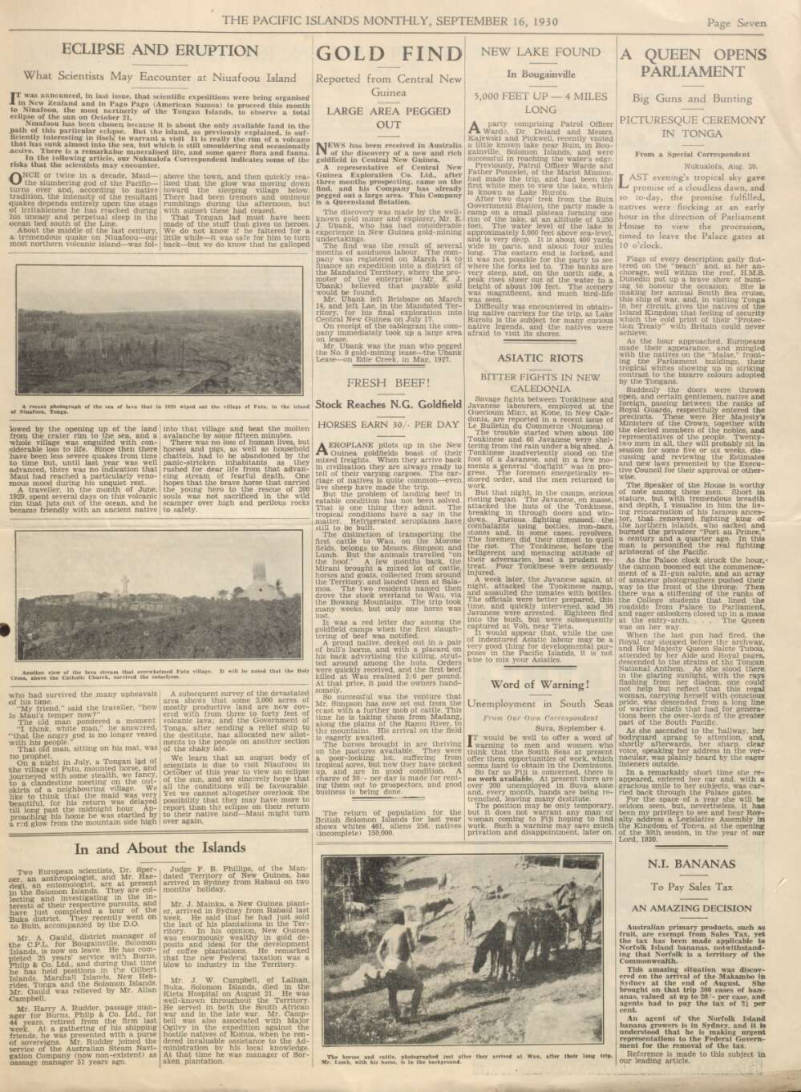
What Scientists May Encounter at Niuafoou Island
IT was announced, in last issue, that scientific expeditions were being organised in New Zealand and in Pago Pago (American Samoa) to proceed this month to Niuafoou, the most northerly of the Tongan Islands, to observe a total eclipse of the sun on October 21.
Niuafoou lias been chosen because it is about the only available land in the path of this particular eclipse. But the island, as previously explained, is sufficiently interesting in itself) to warrant a visit. It is really the rim of a volcano that has sunk almost into the sea, but which is still smouldering and occasionally active. There is a remarkable mineralised life, and some queer flora and fauna.
In the following article, our Nukualofa Correspondent indicates some of the risks that the scientists may encounter.
ONCE or twice in a decade, Maui— the slumbering god of the Pacific— turns over and, according to native tradition, the intensity of the resultant quakes depends entirely upon the stage of irritableness he has reached during his uneasy and perpetual sleep in the ocean bed south of the Line.
About the middle of the last century, a tremendous quake on Niuafoou —our most northern volcanic island—was fol
above the town, and then quickly rea lised that the glow was moving down toward the sleeping village below, There had been tremors and ominous rumblings during the afternoon, but with sunset these had ceased, That Tongan lad must have been made of the stuff that gives us heroes.
We do not know if he faltered for a little while—it was safe for him to turn back—but we do know that he galloped
lowed by the opening up of the land from the crater rim to the sea, and a whole village was engulfed with con siderable loss to life. Since then there have been less severe quakes from time to time but, until last year was well advanced, there was no indication that Maui had reached a particularly veno mous mood during his unquiet rest.
A traveller, in the month of June, 1929, spent several days on this volcanic rim that juts out of the ocean, and he became friendly with an ancient native
into that village and beat the molten avalanche by some fifteen minutes.
There was no loss of human lives, but horses and pigs, as well as household chattels, had to be abandoned by the panic-stricken inhabitants as they rushed for dear life from that advan cing stream of fearful death. One hopes that the brave horse that carried the young hero to the rescue of 200 souls was not sacrificed in the wild scamper over high and perilous rocks to safety.
who had survived the many upheavals of his time.
“My friend,” said the traveller, ‘ how is Maui’s temper now?”
The old man pondered a moment “I think, white man,” he answered, "that the angry god is no longer vexed with his people.”
That old man, sitting on his mat, was no prophet.
On a night in July, a Tongan lad of the village of Futu, mounted horse, and journeyed with some stealth, we fancy, to a clandestine meeting on the out skirts of a neighbouring village. We like to think that the maid was very beautiful, for his return was delayed till long past the midnight hour. Approaching his home he was startled by ard glow from the mountain side high
A subsequent survey of the devastated area shows that some 2,000 acres of mostly productive land are now cov ered with from three to forty feet of volcanic lava; and the Government of Tonga, after sending a relief ship to the destitute, has allocated new allot ments to the people on another section of the shaky isle.
We learn that an august body of scientists is due to visit Niaufoou in October of this year to view an eclipse of the sun, and we sincerely hope that all the conditions will be favourable.
Yet we cannot altogether overlook the possibility that they may have more to report than the eclipse on their return to their native land—Maui might turn over again.
A recent photograph of the sea of lava that in 1929 wiped out the village of Futu, in the island of Niuafoou, Tonga.
Another view of the lava stream that overwhelmed Futu village. It will be noted that the Holy Cross, above the Catholic Church, survived the cataclysm.
In and About the Islands
Two European scientists, Dr. Sper ser an anthropologist, and Mr. Hae degi an entomologist, are at present in the Solomon Islands. They are col lecting and investigating in the in terests of their respective pursuits, and have just completed a tour ot tne Buka district. They recently went on to Buin, accompanied by the D.O.
Mr. A. Gauld, district manager of the C.P.L. for Bougainville, Solomon Islands, is now on leave. He has com pleted 25 years’ service with Burns, Philp & Co. Ltd., and during that time lie has held positions in the Gilbert Islands. Marshall Islands. New Heb rides, Tonga and the Solomon Islands.
Mr. Gauld was relieved by Mr. Allan Campbell.
Mr. Harry A. Rudder, passage man ager for Burns, Philp & Co. Ltd., for 44 years, retired from the firm last week. At a gathering of his shipping friends, he was presented with a purse of sovereigns. Mr. Rudder joined the service of the Australian Steam Navi gation Company (now non-existent) as oassage manager 51 years ago.
Judge F. B. Phillips, of the Man dated Territory of New Guinea, has arrived in Sydney from Rabaul on two months’ holiday.
Mr. J. Mainka, a New Guinea plant er, arrived in Sydney from Rabaul last week. He said that he had just sold the last of his plantations in the Ter ritory. In his opinion, New Guinea was enormously wealthy in gold de posits and ideal for the development of coffee plantations. He remarked that the new Federal taxation was a blow to industry in the Territory.
Mr. J. W. Campbell, of Lalhan, Buka, Solomon Islands, died in the Kieta Hospital on August 21. He was well-known throughout the Territory.
He served in both the South African war and in the late war. Mr. Camp bell was also associated with Major Ogilvy in the expedition against the hostile natives of Konua, when he ren dered invaluable assistance to the Ad ministration by his local knowledge.
At that time he was manager of Sor aken plantation.
Gold Find
Reported from Central New Guinea
Large Area Pegged
Out
NEWS has been received in Australia of the discovery of a new and rich goldfield in Central New Guinea.
A representative of Central New Guinea Exploration Co. Ltd., after three months prospecting, came on the find, and his Company has already pegged out a large area. This Company is a Queensland flotation.
The discovery was made by the well known gold miner and explorer, Mr. E.
J. Ubank, who has had considerable experience in New Guinea gold-mining undertakings.
The find was the result of several months of assiduous labour. The com pany was registered on March 14 to finance an expedition into a district of the Mandated Territory, where the pro moter of the enterprise (Mr. E. J.
Ubank) believed that payable gold would be found.
Mr. Ubank left Brisbane on March 14, and left Lae, in the Mandated Ter ritory, for his final exploration into Central New Guinea on July 17.
On receipt of the cablegram the com pany immediately took up a large area on lease.
Mr. Ubank was the man who pegged the No. 9 gold-mining lease —the Ubank Lease—on Edie Creek, in May, 1927.
Fresh Beef!
Stock Reaches N.G. Goldfield
Horses Earn 30/- Per Day
Aeroplane pilots up in the New Guinea goldfields boast of their mixed freights. When they arrive back in civilisation they are always ready to tell of their varying cargoes. The car riage of natives is quite common—even live sheep have made the trip.
But the problem of landing beef in eatable condition has not been solved.
That is one thing they admit. The tropical conditions have a say in the matter. Refrigerated aeroplanes have still to be built.
The distinction of transporting the first cattle to Wau, on the Morobe fields, belongs to Messrs. Simpson and Lumb. But the animals travelled “on the hoof.” A few months back, the Mirani brought a mixed lot of cattle, horses and goats, collected from around the Territory, and landed them at Sala moa. The two residents named then drove the stock overland to Wau, via the Bowang Mountains. The trip took many weeks, but only one horse was lost.
It was a red letter day among the goldfield camps when the first slaugh tering of beef was notified.
A proud native, decked out in a pair of bull’s horns, and with a placard on his back advertising the killing, strut ted around among the huts. Orders were quickly received, and the first beef killed at Wau realised 2/6 per pound.
At that price, it paid the owners hand somely.
So successful was the venture that Mr. Simpson has now set out from the ccast with a further mob of cattle. This time he is taking them from Madang, along the plains of the Ramu River, to the mountains. His arrival on the field is eagerly awaited.
The horses brought in are thriving on the pastures available. They were a poor-looking lot, suffering from tropical sores, but now they have picked up, and are in good condition. A charge of 30/- per day is made for rent ing them out to prospectors, and good business is being done.
The return of population for the British Solomon Islands for last year shows whites 461, aliens 256, natives (incomplete) 150,000.
The horses and cattle, photographed just after they arrived at Wau, after their long trip.
Mr. Lumb, with his horse, is in the background.
In Bougainville
New Lake Found
5,000 Feet Up-4 Miles
Long
A party comprising Patrol Officer Wards, Dr. Deland and Messrs.
Kajewski and Pickwell, recently visited a little known lake near Buin, in Bou gainville, Solomon Islands, and were successful in reaching the water’s edge.
Previously, Patrol Officer Warde and Father Poncelet, of the Marist Mission, had made the trip, and had been the first white men to view the lake, which is known as Lake Rurolu.
After two days’ trek from the Buin Government Station, the party made a camp on a small plateau forming one rim of the lake, at an altitude of 5,250 feet. The water level of the lake is approximately 5,000 feet above sea-level, and is very deep. It is about 400 yards wide in parts, and about four miles long. The eastern end is forked, and it was not possible for the party to see where the forks led to. The banks are very steep, and, on the north side, a peak rises sheer out of the water to a height of about 100 feet. The scenery was magnificent, and much bird-life was seen.
Difficulty was encountered in obtain ing native carriers for the trip, as Lake Rurolu is the subject for many curious native legends, and the natives were afraid to visit its shores.
Asiatic Riots
Bitter Fights In New
Caledonia
Savage fights between Tonkinese and Javanese labourers, employed at the Guerioum Mins, at Kone, in New Cale donia, are reported in a recent issue of Le Bulletin du Commerce (Noumea).
The trouble started when about 100 Tonkinese and 60 Javanese were shel tering from the rain under a big shed. A Tonkinese inadvertently stood on the foot of a Javanese, and in a few mo ments a general “dogfight” was in pro gress. The foremen energetically re stored order, and the men returned to work.
But that night, in the camps, serious rioting began. The Javanese, en masse, attacked the huts of the Tonkinese, breaking in through doors and win dows. Furious fighting ensued, the combatants using bottles, iron- bars, stones and, in some cases, revolvers.
The foremen did their utmost to quell the riot. The Tonkinese, before the belligerent and menacing attitude of their adversaries, beat a prudent re treat. Four Tonkinese were seriously injured.
A week later, the Javanese again, at night, attacked the Tonkinese camp, and assaulted the inmates with bottles.
The officials were better prepared, this time, and quickly intervened, and 36 Javanese were arrested. Eighteen fled into the bush, but were subsequently captured at Voh, near Tieta.
It would appear that, while the use of indentured Asiatic labour may be a very good thing for developmental pur poses in the Pacific Islands, it is not wise to mix your Asiatics.
Word of Warning!
Unemployment in South Seas
From Our Own Correspondent Suva, September 4.
IT would be well to offer a word of warning to men and women who think that the South Seas at present offer them opportunities of work, which seems hard to obtain in the Dominions.
So far as Fiji is concerned, there is no work available. At present there are over 200 unemployed in Suva alone and, every month, hands are being re trenched, leaving many destitute.
The position may be only temporary, but it does not warrant any man or woman coming to Fiji hoping to find work. Such a warning may save much privation and disappointment, later on.
A Queen Opens
Parliament
Big Guns and Bunting
Picturesque Ceremony
In Tonga
From a Special Correspondent Nukualofa, Aug. 20.
LAST evening’s tropical sky gave
promise of a cloudless dawn, and
so to-day, the promise fulfilled,
natives were flocking at an early hour in the direction of Parliament House to view the procession, timed to leave the Palace gates at 10 o’clock.
Flags of every description gaily flut tered on the “beach” and, at her anchorage, well within the reef, H.M.S.
Dunedin put up a brave show of bunt ing to honour the occasion. She is making her annual South Sea cruise, this ship of war, and, in visiting Tonga in her circuit, gives the natives of the Island Kingdom that feeling of security which the cold print of their “Protec tion Treaty” with Britain could never achieve.
As the hour approached, Europeans made their appearance, and mingled with the natives on the “Malae,” front ing the Parliament buildings, their tropical whites showing up in striking contrast to the bizarre colours adopted by the Tongans.
Suddenly the doors were thrown open, and certain gentlemen, native and foreign, passing between the ranks of Royal Guards, respectfully entered the precincts. These were Her Majesty’s Ministers of the Crown, together with the elected members of the nobles, and representatives of the people. Twenty two men in all, they will probably sit in session for some five or six weeks, dis cussing and reviewing the Estimates and new' laws presented by the Execu tive Council for their approval or other wise.
The Speaker of the House is worthy of note among these men. Short in stature, but with tremendous breadth and depth, I visualise in him the liv ing reincarnation of his famous ances tor, that renowned fighting king of the northern islands, who sacked and burned the privateer “Port au Prince,” a century and a quarter ago. In this man is personified the real fighting aristocrat of the Pacific.
As the Palace clock struck the hour, the cannon boomed out the commence ment of a 21-gun salute, and an array of amateur photographers pushed their way to the front of the throng. Then there was a stiffening of the ranks of the College students that lined the roadside from Palace to Parliament, and eager onlookers closed up in a mass at the entry-arch, . . . The Queen was on her way.
When the last gun had fired, the Royal car stopped before the archway, and Her Majesty Queen Salote Tubou, attended by her Aide and Royal pages, descended to the strains of the Tongan National Anthem. As she stood there in the glaring sunlight, with the rays flashing from her diadem, one could not help but reflect that this regal woman, carrying herself with conscious pride, was descended from a long line of warrior chiefs that had for genera tions been the over-lords of the greater part of the South Pacific.
As she ascended to the hallway, her bodyguard sprang to attention, and, shortly afterwards, her sharp, clear voice, speaking her address in the ver nacular, was plainly heard by the eager listeners outside.
In a remarkably short time she re appeared, entered her car and, with a gracious smile to her subjects, was car ried back through the Palace gates.
For the space of a year she will be seldom seen, but, nevertheless, it has been my privilege to see and hear Roy alty address a Legislative Assembly in the Kingdom of Tonga, at the opening of the 30th session, in the year of our Lord, 1930.
N.I. Bananas
To Pay Sales Tax
An Amazing Decision
Australian primary products, such as fruit, are exempt from Sales Tax, yet the tax has been made applicable to Norfolk Island bananas, notwithstand ing that Norfolk is a territory of the Commonwealth.
This amazing situation was discovered on the arrival of the Makambo in Sydney at the end of August. She brought on that trip 300 cases of ban anas, valued at up to 20/- per case, and agents had to pay the tax of 21 per cent.
An agent of the Norfolk Island banana growers is in Sydney, and it is understood that he is making urgent representations to the Federal Govern ment for the removal of the tax.
Reference is made to this subject in our leading article.
Blame Ford!
For Low Prices of Copra
Peanuts And Cheap
Trucks
“If there’s one man, more than an other, to blame for this fall in copra prices, it’s Henry Ford.”
With this dictum, Mr. George Wilson, Sydney director of Morris Hedstrom Ltd., whose stores are scattered all over Fiji, Tonga and Samoa, leaned back in his chair and, with a characteristic twinkle, faced The Pacific Islands Monthly representative.
“Ford!” exclaimed the pressman.
“What on earth has Henry got to do with it?”
So Mr. Wilson expounded his theory.
In past decades, the West African negro, or the Indian or Chinese farmer, tilled his little bit of ground, grew his peanuts, and painfully carried them to the trading station or market —usually
on his head, over a jungle track. And so the world’s supply of peanuts, while constant, was not excessive.
Then cheap machinery began to in vade the wilds of Africa, and in the forefront of the invasion was the Ford truck. It provided methods of trans port that, a generation before, had never been dreamed of. It not only opened up roads —it also brought in labour-saving devices for the use of the native agriculturist. The world pro duction of peanuts, in a few years, in creased five-fold. In the same period, the world’s annual production of copra went from about 300,000 tons to 800,000 tons, while the production of soya beans, and whale oil (the other com petitors of copra) was also vastly in creased But, according to Mr. Wilson’s argu ment, the main factor in the world’s inability to absorb the huge annual production of copra has been the de velopment of the peanut industry; and it is the enormous output of cheap American machinery, typified in the Ford Car, which has brought this about.
So one more world-wide change is written to the debit of “Liz.”
The Tongan Islands
Luck of the "Overtaxed” Native—Some Revenue Problems
From Our Own Correspondent
Nukualofa, Aug. 20.
MUCH has been said and written in the past regarding taxation in Tonga. It has been affirmed that the taxes bear so heavily on the native that, in fulfilling his obligations to the Gov ernment, he is reduced to a state of penury. But what are the facts?
On his making application, at the age of sixteen years, the Government is compelled by law to grant the youth a plantation allotment of 81 acres, to gether with a village allotment of 1 acre, and for this registered allocation he pays a yearly rental of 8/-. As an alternative, if he foregoes the village allotment, the Government grants him a full 12-acres plantation block and, as inducement to accept the latter pro position, charges him a yearly rental of only 4/- for this area.
If he is industrious, and wishes to extend his boundaries, he can apply for a lease of any unoccupied land (there is plenty of it), and this will be granted to him at an annual rental of 4/- per acre. But, for the present, we will confine ourselves to the taxpayer who is satisfied with a statutory allot ment.
A Typical Case
I have in mind a man who, for 25 years, has had an acre section. He states that his average annual return for copra for 17 years works out at about £55. Included in this, of course, is the extraordinary price which ob tained during some of the war years, but may we not take the good with the bad? Now, every year, out of that return, he has contributed to the Treas ury 36/- for poll tax, 8/- for land ren tal, 6/- for a gun, and 4/- for) a horse.
Roughly, then, he has been remitting to the Government 5 per cent, of the monetary copra productiveness of the soil that the Crown gave to him. Is this too much? I do not think so.
He acknowledges that, through the years he, and his family have had free education, free medical attendance, free medicine, and also free dental treat ment.
Apart from the coconuts, his allot ment has supplied most of his humble wants. It has produced in sufficient quantities yams, bananas, kumalas, pineapples and kava. There are nine pigs in the sty, and he says that a dozen more are running loose —and it is rather a source of anxiety to him that one of these tracks a hen to her nest every little while, and conse quently deprives the larder of a num ber of eggs. He has three strapping young sons, each with a 12-acres plot in the neighbourhood and, although the coconut trees on their lands are not all in full bearing as yet, other products of the soil make a welcome addition to the home table.
On the whole, this typical native is, I think, quite contented with his lot.
He is particularly pleased that the Government’s metalling of the main highway has now reached his property, thus giving him better access to the capital, and he is proud to think that he, and his sons, control some 40 odd acres of land, productive and poten tially productive.
Still, I cannot help think that, as I left him sitting on his mat, he was worrying about that pig.
Reducing Taxation
Although the Tongan Government, without a National Debt, is in a very sound position financially—having, in fact, a surplus of £140,000, of which £125,000 is invested in gilt-edged—it is known that the Executive found it no easy task to balance the Budget for the ensuing year.
A firm promise, made last year, to relieve the Tongans of taxation in I some direction could not be disregarded, and the present depressed state of the copra market emphasised the need of relief. It was thought by the man in the street that easement would be reached by either reducing, or abolish ing altogether, the £1 per ton export fee on copra.
The Government’s Executive, howe ever, had other views. They were not satisfied that such a concession would ever reach the native producer, for his benefit, and so decided to ask Parlia ment to grant direct relief by abolish ing the Horse Tax (4/-), the Dog Tax (1/-) and the Town Tax (4/-). The House agreed to this, but relief has only been gained at the expense of the other side of the Budget, where the Public Works estimates received the axe.
The Pension Problem
The question of pensions ran into a long and heated debate. The appro priation for the coming year is £1,933, being an increase of £1,400 in the last 10 years. The Representatives view with some alarm the potential possibil ties of the appropriation ten years hence.
As an illustration, the post of Audi tor-General was reviewed. The present officer, who is also a Minister of the Crown, will retire shortly on a substan tial pension, and it was urged upon the Executive body to refrain from selecting a high-salaried officer from the Colo nial Service to fill the vacancy when a local man might be eligible and with
out Ministerial rank, at a proportion
ately greatly reduced salary.
The Draft Estimates, as a whole, were put through the House without much alteration. Increases in the emoluments of some of the junior
European officials, sponsored by the
Executive, were vetoed by the elected members and struck off accordingly.
The finalised Budget shows the esti mated revenue at £85,630, and the Ex
penditure £84,555.
Cocoa In Favour
A matter of momentous interest to planters, and one which has been the subject of much earnest discussion in Parliament (and rightly so) is the
prospect of introducing a secondary, or
even another primary industry, into the
Kingdom.
For many years, stray cocoa trees had been noticed flourishing here and there in the islands of the group, taut it was not until the recently appointed Director of Agriculture took the matter up that anyone seemed to give them a thought, unless it was to remark that the pods looked very quaint and pretty.
Last year, a bag of the beans was forwarded overeas, and a first class
quality report was duly received. Un
fortunately, some hitch occurred (good ness knows where), and the whole thing was shelved.
However, Parliament has now been
asking questions and, fearing that
there is no prospect of much improve ment in the price of copra, has strongly urged the Executive to consider the ad visability of introducing a disease-re
sisting cocoa during the present year.
This, at any rate, has the appearance of being a move in the right direction.
Revival Of Banana Trade?
If the cocoa, when introduced, is not a revenue proposition for 5 or 6 years, we have here at the present time, in bananas, a catch-crop that may yet prove to be the salvation of Tonga. The
Tongan banana, acknowledged by
many to be the most succulent pro duced in the Pacific is languishing for want of facilities to get it to the over sea markets. Twenty years ago, Tonga was exporting as much as 14,000 cases a month to New Zealand, but the big
shipning company suddently altered
the route of its Islands vessel, and the little Kingdom was left to suffer.
Devising ways and means of trans port for this fruit has fortunately been a subject of very keen debate in Par liament and, rumour hath it, the House has pledged itself to support the Executive up to a very wide margin of expenditure in an endeavour to re-es tablish this industry.
That Charity Fete
The 4th of July is not on the calendar for the specific purpose of giving the nationals of the “Stars and Stripes” an opportunity to re joice. No, Sir! That date happens to be the anniversary of the birth of the Heir to the Tongan Throne; and Tonga never fails each year to get something going to mark the oc casion.
The last 4th was seized upon by the Nukua lofa ladies to stimulate enthusiasm in Church matters. The fine new Anglican Chapel was complete from an external point of view, but the time had come to give earnest atten tion to devising ways and means of furnishing the interior. The ladies decided upon a garden fete.
British Consul, Mr. J. S. Neill, was ap proached. and he willingly offered the use of the Residency with its extensive grounds; the business men were canvassed, and a stock of toys and fancy goods was got together; cakes of all sizes and descriptions were forthcoming from household larders; whilst a goodly num ber of natives, not to be outdone, came along with gifts of native craft, and pigs, fowls and fruit.
The morning broke fine, and from mid-day onwards, the Residency was the scene of an activity seldom witnessed on this tropic isle.
Luckily indeed was the man who, it is re ported, subsequently found an overlooked florin in his pocket, and produced it as evi dence after the event. What a day out the kiddies had, too. . . .
The “Houpla” table, under the energetic control of Mrs. McCreadie and Mr. Smith, vied in popularity with the “Duck Pond,” where Mrs. A. Riechelmann and Mr. McCreadie held sway. Under a spreading mango tree a weird-looking arrangement, under the man agement of Miss Taylor, enticed both young and old to try their luck with a fishing line.
Always an indifferent fisherman, I reeled from this part of the grounds, mentally count ing my cash balance; passed the cordials stall, where Mesdames Miles and Smith were attending to the apparently unending wants of a host of small boys, under the patronage of Magistrate Pearson; and then literally fell into the arms of Consul Neill.
He, attended by an Audit official to in spire confidence, presumably produced a pickle bottle of split beans. Now, I’m gener ally good at this sort of thing, but my guess of 268 didn’t hit just right perhaps I was thinking of Bradman as the audited count revealed 84 half beans!
A visit to the cake stall seemed in order, and there, what with the far-reaching and varied suggestions of Stallholders Mesdames Darrell-Wall and Sundin, I was lucky to get Jet off with the 2-lb. cake that, later, became the main item at a bachelor’s board.
Wending my way toward the afternoon tea tables was not so easy, either. A beautiful patch-work quilt (the gift of Mrs. Grahame) was being displayed by a sho'r of hands on the part of Mr. Clements. Who won that quilt? I was interested to the extent of two tickets.
The afternoon tea was good, and ably dis pensed under the jurisdiction of Mesdames Neill, Heenan, Barnes-Moss and Clements.
Wonderful is the thirst that one works up in unsuccessfully dodging peddlers and such like at these functions. Indication of some excitement at the tennis court hurried me through the third cup, and I was just in time to see the final game of the final set in the tournament. Mr. Finau Riechelmann deserves credit, too, for the able manner in which he conducted this section of the day’s entertain ment.
Haviner earmarked a dollar for an intend ing purchase at the native stall. I made off
in that direction, only to be informed by the lady-in-charge (Mrs. Tuivakano) that an Offi cer of the “Dunedin” had bought the only mat I had favoured. Rather disconsolate at this set-oack I was cheered up considerably a little later to hear the “Dunedin” band (kindly lent for the occasion) strike up “It Ain’t Goin’ To Rain No Mo’,” and in a burst of fervour, I cut out the remaining dollar on four guesses at the doll’s name. It was sheer throwing money away. Who would have guessed a name like that, anyway?
I was sorry, too, because I think I could have made things interesting at clock golf, on the lawn even Mr. Nicholson favoured my chances but the deed was done. I was stoney-broke, and tottered out of the gate with a 2-lb. currant cake under the right arm.
It was a great day. Everybody I know en joyed themselves and, added to previous do nations generously collected by Inspector Bal lard, the total contribution toward Church furniture according to Vicar Favell was in the near vicinity of £lOO. The Church Garden Fete was a triumph for the ladies.
God bless ’em!
“Nuggets” From Vavau
The price of £13 per ton for “dry” in.
Vavau, as against £9/10/- in Nukualofa and Haapai, is deflecting many inter island copra cutters to the northern market.
The epidemic of “Slatteritis,” hitherto confined to Vavau, has spread as far south as Nukualofa, the capital town of the group.
If the powers that be had thought in terms of cocoa, as well as copra, ten years ago, the copra market would not have been such a source of worry to day.
A certain buyer, when invited to be present at an important “fixing price" meeting, regretted that he was unable to attend, owing to the fact that he was too busy weighing copra.
There is foundation in the rumour that a large number of natives who, in. a fit of generosity, loaded a ship with 800 tons purchased by a local merchant, did refuse to accept wages.
There is no truth in the report that the Chamber of Commerce in Nukua lofa is at loggerheads with the Govern ment over the problem of reviving the banana industry.
Fight for Pacific Trade
America Challenges Japan Huge Ship-Building Programmes
A BIG commercial war between.
America and Japan has been laun ched for the trade supremacy of the Pacific.
During recent months, building pro grammes to the extent of £20,000,000 have been laid down by the Dollar Line, the Matson Line and the Nippon.
Yusen Kaisha. Other lines, whose de velopmental programmes bring them in to the competition for Pacific trade, are the Oceanic and Oriental Navigation Company, the American-Hawaiian Steamship Company, the Los Angeles Steamship Company, and the Osaka, Shosen Kaisha Lines: the Barber Line; Furness-Withy; and Trans-At lantic Line of Sweden.
Apart from the £20,000,000 program mes other developments on a vast scale indicate a new activity in the Pacific.
It is estimated that a quarter of the inter-coastal west-bound freight of America is now transhipped to the Or ient; and the Oceanic, Oriental and Dollar Lines have recently restablished a refrigerated freight service across the Pacific for Californian fruits and veget ables in the East.
Big development works are in pro gress at Los Angeles, where an attempt is being made to wrest the port suprem acy of the West Coast from San Fran cisco. The Matson Line has just estab lished a direct freight service between.
America and the Phillipines. Nippon.
Yusen Kaisha have placed three new “super-excess” liners on the America- Japan run, and these are securing a larger proportion of the tourist trade.
The Osaka Shosen Kaisha has re plied with five motor liners for round the-world trips, and the New York-Los Angeles East lines.
The activities of the Barber Line.
Furness-Withy and Trans-Atlantic fleets into the Pacific is a new develop ment.
The fight is being waged not only in the sea and across the railway sys tems of America. The Goodyear Rub ber Company has announced its plans for the establishment of a dirigible air ship service between Los Angeles and Hawaii, and the Matson Line has es tablished its own radio service station at a cost of £400,000.
Australia and New Zealand, the Dutch East Indies, the Malay, and the South Pacific are all included in the field of battle.—U.E.
Threat To U.S.S. Co.
A press cablegram from San Fran cisco, to The Sun, published on Septem ber 6, said: “The latest plans for replacement of ships in the Matson line are said by shipping men here, to be the first bid in an attempt to divert Australian traf fic from the South Sea Islands and Vancouver route to the San Francisco route.”
Advertisements & other items, p. 8 (1 item)
This MAGIC
MANTLE
GIVES PERFECT LIGHT -
LIKE DAYLIGHT
It‘s the heart of the new, "Instant Light"
Aladdin — the Lamp that made electric light old fashioned for reading.
Children run the Aladdin and they love it at home lesson time. For study —for reading —for sewing.
ALADDIN
IS A NECESSITY IN EVERY HOME
Agents wanted throughout the Islands
ALADDIN INDUSTRIES LTD.
ALADDIN HOUSE fio
63 WILLIAM STREET. SYDNEY, N.S.W.
Thursday Island Topics
From Our Own Correspondent Demand for Trochus Shell Missionary Trading Company May Discontinue Can Our Turtles Be Canned? Wedding in the Jardine Family
Thursday Is., Sept. 2.
COINCIDENT with the lessened de mand for pearl shell comes a drop in trochus and beche de mer prices.
The former is quoted at £50 per ton, and finds its sole market in Japan.
Trochus sales depend largely on the eastern exchange, Japanese buyers be ing very cautious and rarely venturing unless the exchange is in their favour.
Button-making from the trochus is largely a home industry in Japan, and the shell is sold in small lots to indi vidual makers.
So far, this year, the trochus catch has been disappointing. This is said to be due to the unusually cold weather, which prevents the trochus from mov ing about for surface feeding, and in clines it to bury itself in the coral.
By the time that the diver, who can only stop down for less than two min utes, has found his quarry and broken into its hiding place, he is often forced to the surface for air.
Trochus is generally fished for at low water, and at this time of the year, when high tides are nocturnal, the divers can work all day. The trochus lugger carries about four dinghies, each manned by a Japanese, who supervises the work of the Malay or native skin diver.
The latest price quoted for chalk fish is somewhere about £30 per ton, which does not allow much profit for the firms who deal in it. In fact, it looks as if some of the boats will be laid up and more unemployment will result.
Some relief has been afforded by permission having been granted to con tinue working these subsidiary indus tries with the old Japanese crews for another twelve months. The present is a bad time to try exoeriments, which can only result in lessened efficiency and greater costs of production, and evidently the Commonwealth authori ties have awakened to this fact.
A New Enterprise
A new boat-building and repairing company, financed by three well-known firms here, has been formed with a capital of £10,000 and operations will probably commence in October, under the management of Mr. Newman.
The new enterprise expects to carry out repairs at a lower cost than that of existing boat slips, run by Asiatics.
Public opinion is strongly in favour of this innovation, and a good measure of support wall doubtless be given the new firm.
Papuan Industries Ltd.
Papuan Industries Ltd., an organisa tion formed in London in conjunction with the L.M.S., with a distinct philanthropic aim to help the natives, seems to be gradually lessening its activities, and may eventually disappear.
The big store at Badu, the head quarters of the Pacific Islands in Tor res Straits, has been sold to the Queensland Aboriginal Department, but the late manager, Mr. Harmon, will continue in office under the new own ers. Two of the firm’s plantations, both situated on the Fly River, are, I understand, up for sale, and both, in the words of a neighbouring Papuan planter, offer good livings in the way of copra and trade to an energetic man.
Papuan Industries will not cease operations without regret on the part of those who know them. Though their objects have been misunderstood by a few, there is no doubt that they were worthy ones, and that the company has lived up to them. The organisation has been helpful to its white neigh bours, and has conferred many bene fits on the natives of Torres Straits and Western Papua.
Turtle Soup
Word has been received on the Island that a company has been formed in Sydney and Melbourne for the purpose of turning our vast resources of turtle into soup, in association with the well known American firm of Heinz.
Definite particulars are lacking, but a representative of the new company is said to be shortly visiting Thursday Island with a view to starting opera tions.
With this new enterprise at least proposed, if not actually in existence we may believe that our marine re sources are not to be entirely neglected.
There is room for hope, and T. I., like many other small communities, has a wonderful vitality of its own.
Personal Items
We have to record with regret the death of a very old identity, Mrs.
Marion Thomas, who was the first matron of the local hospital. Mrs.
Thomas, who was a personal friend of John Douglas, and well known to all the early residents, carried on her work in the institution for three years single-handed. She received her pro fessional education in the well-known Edinburgh Infirmary, whence so many famous medical men have come, and had a fund of interesting stories
about the old-time doctors under whom she trained.
Mr. A. E. Harvey, manager for the Papuan Industries Fly River planta tions, had to return to Victoria for health reasons, after a dangerous at tack of blackwater fever. He was a well trained tropical agriculturist, with ex perience in Borneo and the New Heb rides. He will be missed by many people in Western Papua.
Mr. C. G. Vidgen, a grandson of Frank Jardine, the pioneer of Northernmost Australia, was recently mar ried to Miss Lynch, of Innisfail, in Brisbane, and returned with his bride by the Changte. A very pleasant wel come home, which took the form of a song evening, was given by the bride groom’s parents in honour of the young couple, at which nearly fifty guests at tended. It is noteworthy that most members of the Jardine family have made their homes round Torres Straits or in the not far distant Aroe group, where Mr. Chum Jardine is engaged in pearling and copra ventures.
The old Jardine homestead at Som erset is still in the hands of the fam ily. Coconuts have been extensively planted there, on an area of red “beach” sand, a hundred feet or so above the sea, on an underlying gran ite formation. The palms bear very freely, and Somerset may claim to be the most productive coconut planta tion on the mainland of Australia.
Vessels passing through Albany Pas sage, in sight of Somerset, still salute the old home in memory of its founder, as a tribute to Mr. Jardine’s successful efforts in saving many lives at the time of the Quetta disaster.
Vale, Jack Bruce
The remains of the late Mr. Jack Bruce, who died in Sydney last year, were interred at Murray Island during August. No more fitting resting place for faithful Jack Bruce could be found,
for his name is inseparably connected with that remote and picturesque is land lying out on the Barrier Reef.
For over 35 years Mr. Bruce laboured among the Murray Island people, as government representative and teacher, and his work there remains as one of the finest examples of devotion to duty in the annals of Torres Straits. The party that went out to Murray Island in the Government vessel Melbidir included a brother and nephew of the deceased, the mayor of Thursday Island, and a few old friends.
The grave of Jack Bruce on Murray Island. The ashes are in a brass urn of great antiquity.
Impracticable?
Closer Association Between Administrations
The suggestion made in the last issue of The Pacific Islands Monthly, that there should be a closer association of Pacific Islands administrations, for consideration of numerous problems of mutual interest, is referred to by Sir Maynard Hedstrom, of Suva, in a letter to the editor.
“With regard to your suggestion un der the heading “Seventeen Independ ent Administrations,” says Sir May nard, “I am afraid I must say that in my opinion geographical difficulties at present render the suggestion imprac ticable.
“There is some communication and some co-operation between Fiji, Samoa, Tonga, the Cook Islands, and the Crown Colony of Gilbert and Ellice Is lands particularly in medical f.nd educational service but any rapid extension to other island groups would be impracticable.”
Cook Island
Notes
From Our Own Correspondent Rarotonga, August 14.
The Laburnum sailed on August 3 for Niue and Pago Pago, after spending two days here.
Prior to her arrival in Rarotonga, she had called at Pukapuka, Rakahanga and Penrhyn in the Northern Cook Group, the Society Islands (Papeete), and at Hervey Island, in the Lower Cook Group.
From the latter place, she brought Robert Dean Frisbie (author of “The Book of Pukapuka,” with a further book coming out this year) to Raro tonga. Mr. Frisbie, who is an Ameri can, had been spending some months on the Islands of Manuae and Te-au-o-tu (Hervey Islands) as the guest of the owner manager, Mr. J. A. Bunting.
American Yacht In Port
Mr. Templeton Crocker, of San Fran cisco, in the yacht Zaca, with three guests on board, arrived at Rarotonga on August 1. The yacht had spent some time in Papeete and had called at Borabora on her voyage to Rarotonga.
The vessel anchored fairly close to the Laburnum, and with the heavy swell running her capstan carried away, and she had to slip her cable. Later, she managed to get a rope on to the Labur num, and swung there all night and most of next day. Mr. Wm. O’Brien, wharfinger for the Union Company, took a lighter out, and managed to pick up her cable and anchor.
About 7 p.m. on August 2, the Zaca sailed for Suva, via Aitutaki. The ves sel left Aitutaki again on Wednesday, August 6. She is to travel up through the Straits Settlements and Suez Canal to be in the Mediterranean for the season in February, and will then go across the Atlantic.
Wireless Sets Useful
There are at present 8 wireless re ceiving sets on this island, and more coming along. From about mid-day until 2 a.m. concerts are received over the wireless from America, Australia and New Zealand.
The mortgagee has foreclosed on the Taylor Plantation (comprising 99 hec tares approx, in two leases, one with 74 years and one with 73 years to run), and the property, together with dwel ling house, is up for sale by public auc tion on August 25.
Late Sir Maui Pomare
The following is a copy of a public notice issued by the Administrator; “The ashes of the late Sir Maui Pomare will be brought ashore on arrival of the R.M.S. Makura on Monday, 18th August, and taken to the Palace, Taputapuatea, where a tangi will take place according to native custom.
“All European friends are respec tively invited to attend.”
Sir Maui Pomare was cremated in California, and Lady Pomare travelled to New Zealand with the ashes by the R.M.S. Makura.
Quick Help For Tahiti
When advice was received through Samoa of the helpless condition of the Tahiti, 450 miles south west of Raro tonga, the A.S. Tagua, which was lying in Avarua Harbour, and was the near est vessel in the vicinity, was prepared immediately for despatch to the scene. She had just come in from the northern islands, She was quickly un loaded, and filled with provisions and oil, and then left port. The Tagua was 52 miles from Rarotonga, when she was recalled by wireless, following news that the Tofua, Penbryn and Ventura were on their way to the Tahiti’s assistance.
Serious Fruit Losses
The fruit report on s.s. Waipahi ship ment this month shows: Oranges, ap proximate percentage waste fruit, aver age—Rarotonga, 10 per cent.; Aitutaki, 6 per cent.; Atiu, 11 per cent.; Mauke, 3 per cent. The condition of the balance was good. The average prices were 6/6 to 10/6. Tomatoes, good condition, brought 5/6 to 7/6. These prices are not payable.
On the July trip of the Tahiti from San Francisco to Wellington 16,000 cases of fruit were despatched from here. This was the largest shipment for the year. Unfortuntely, the vessel met with very heavy weather en route to New Zealand, and according to wire less reports between 50 per cent, and 70 per cent, of the fruit cargo was lost.
By the s.s. Waipahi on July 30, two fruit inspectors were sent to the outer islands for the remainder of the season, Mr. Binfield going to Mauke, and Mr.
Nottage to Atiu.
Cheaper Transport
For Copra When Reduced to Oil Form
Mr. B. B. Wiltshire, of Sydney, who has had a long connection with com merce in the Pacific, expressed the opinion in an interview recently that the tariffs imposed on products arriv ing in Australia from Fiji, Samoa and the Mandated Territory of New Guinea were responsible for Islands’ trade be ing lost to Australia.
Sydney, he said, was at one time the depot and Clearing-house for all the produce of the Pacific. Then copra was made dutiable, and submitted to cer tain restrictions by the Harbour Trust Commissioners, who declared it a dan gerous commodity. Handling costs also increased and, gradually, the volume of
trade decreased, until now it had been practically all diverted to England, the Continent, and the United States.
While discussing copra, Mr. Wiltshire mentioned that when he was in Manila a couple of years ago, he had observed that the export of copra in the raw had almost ceased. It was being ground down and despatched in the form of coconut oil, first in drums and casks, and then, when the quantities in creased, ships fitted with tanks carried the oil in bulk. This method of export was now used throughout the Philli pines and Java, and he considered that the time would soon come when produ cers in the Pacific Islands would adopt this process. Minimised balk in freight
was a great advantage, another being the recovery of the by-products—fod der, desiccated coconut, etc.
Summing up the trade position, Mr.
Wiltshire stated that if Australia wished to make the most of her oppor tunities in the Islands, the following would be necessary: (1) Better transhipment facilities in Sydney. (2) More liberal tariff towards Is lands produce. (3) Cheaper transport of produce Government subsidies for ship ping would be essential. (4) Supply of Australian foodstuffs and manufactured goods at reas onable cost.
Advertisements & other items, p. 9 (1 item)
The Alumenite
It Makes Its Own Gas—SOMETHING NEW !
(Pronounced Aloomenite)
SAFETY CAS STOVE
FOR COUNTRY AND PLANTATION USE
To Replace Wood Fires and the Old Oil Cooker It lights instantly, and boils, toasts, grills and roasts —cooks all food to perfection and is so simple a child can use it.
By means of the newly designed burners, ordinary benzine is converted into gas and passed through an automatic valve which only opens when the stove is hot (it is thermostatic) .
You start the stove from a reserve of gas in the reservoir— no methylated spirit required.
The reservoir can be placed out of doors or may be had attached to stove.
We guarantee these goods against mechanical defects.
They are Australian made and our “by mail’’ service is prompt, efficient and inexpensive. It is the outcome of our sixteen years’ experience.
The trying experiences of cooking in a hot kitchen are avoided, for the gas stove is alight only when and while it is required and it is only turned up so high as to do the work needed. This also makes the Alumenite Stove very cheap to run: A family of three or four people can do all their cooking for a whole month with the fuel contained in one four-gallon can of benzine. Prices from £26
LAMPS AND LIGHTING SYSTEMS
Buy a new type Wizard hand lamp—it gives you floods of light at a nominal cost (½d. per hour).
It is handsome and sturdily built to stand up to long service, these beautiful lamps are now available at the specially reduced price of .. £3/5/- Wizard systems can be installed right throughout a bungalow for less than a quarter the cost of an electric plant. The quality of the light is better—renewals are merely nominal and quite infrequent.
No expert is needed to look after the plant and no expensive battery or housing is required. A two-lights plant costs no more than £20 while a complete fivelights plant is £35.
The Wizard Hurricane Lantern is made especially for outdoor or camp service; it is very strongly built, lights with a taper and is very inexpensive in upkeep. It will light up a roadway for fifty yards.
Special Price --- 70/- We make Lighting, Heating and Cooking apparatus suitable for almost any purpose.
Write to us about your requirements. Our A suggestions will be valuable.
AUSTRALIAN ALUMENITE COMPANY
and WIZARD LIGHTING SYSTEMS
283 b GEORGE STREET, SYDNEY
Estab. 1914.
Ask for Our Descriptive Literature. ’Phone BW 1514, 1515
LIVE AGENTS WANTED.
ASK FOR IT
ESTABLISHED 1868.
Our Fijian Newsletter
How Experts Are Conquering Pests-Need for Pacific Islands Convention-New Fish Arrives in Fiji
From Our Own Correspondent
Suva, Sept. 4.
THE Department of Agriculture and the Coconut Committee, established by the Government, are doing splendid work, which is of special interest to all planters in the Pacific.
The Department is doing everything it can to provide parasites or other means of controlling or destroying those noxious plants which have been gradu ally spreading through the islands of the Pacific, and becoming a serious menace to successful settlement. Set
tiers cannot afford to be hampered by noxious weeds as, in spite of reasonably cheap labour, the lot of the average planter just now is hardly a happy one, owing to very low prices for all primary products of the tropical areas.
Our scientists have already obtained a thrip, which, it is hoped, will control the Clydemia hirta (or Koster’s Curse), and a wasp Which should exterminate the spæthe borer, and they are trying experiments for the eradication of the coconut scale.
A reference was made in the first number of The Pacific Islands Monthly concerning what the Malayan fly may do when it has exterminated the Levuana moth. It would die, for it feeds upon no other insect, and the only worry of our scientists now is how to preserve the fly (Ptychomyma) when the supply of moths is low, as has happened here more than once. The parasite certainly does not become itself a nuisance, when its main work is completed.
The latest importation is a wasp, which is believed to be fatal to the lantana plant, which, as is the case in Australia and many other islands, is becoming a serious pest.
The work that is going on here is of first importance, and must prove of great value to all island communities,
Island Co-Operation
The suggestion, offered in your first number, that an attempt should be made to organise some sort of roundtable conference among the governing authorities of the various Pacific Island groups, is one which deserves careful consideration. There are many matters which commonly affect most or all of them.
There is, for instance, the control of noxious animals, insects, weeds or plants.
At present, the shipping trade between, say, Fiji and the Solomons, is discouraged in every way because of the fear of the malarial mosquito being introduced, while new precautions are now in force in respect of all shipping coming to Fiji from Samoa, owing to the presence there of the dreaded rhinocerous beetle, which is not yet located in this colony.
Then the question of native labour is one which must in time be faced, if the supply of labour is to be maintained, and if the progress and w'elfare of the native is to be regarded as of primary importance.
Postal and radio communications are other subjects which call for concerted action, along with air mail services.
The means of communication, at present, present many paradoxes, and there is at times unnecessary overlanpings, which a conference might straighten out. The idea is one well worth following up.
Healthy Finance
While the colony is suffering, like every other community, from low world markets and necessarily depressed business conditions, the general financial position is extremely healthy. This is owing to a strict conservatism during the past few years in the Treasury.
The last returns show the assets of the Colony to be £585,317, while the surplus of assets over liabilities is £219,573—a very satisfactory position.
A Queer Fish
He was not a specimen of the genus homo, but a fish—a real fish. He is known elsewhere, but up to last month had never been found in Fiji waters.
He is well described by Zane Gray in one of his books, and is known as the Sail Fish.
It is also remarkable that, when two Tokelau fishermen hooked him on a
small line near Suva Point, and fought him to a standstill three miles away, a few days previously, Commander Bur rows, the D.C., at Levuka, had landed one near Wakaya.
The former fish was 12 feet long, and the latter 10 feet. Both had large sail fins along their backs, measuring about 3 feet by 3 feet; and each had a boney sword —about 21 inches long. They were black in colour, and fought strongly all the time.
Their presence in Fijian waters is regarded with considerable interest by all sportsmen.
He Deserved A Medal
When our air-mail plane, the Spar tan, owned and flown by Captain Fen ton, M.C., landed recently in Levuka Harbour, it ran into an iron rail, set up on a coral patch as a beacon. The plane was badly damaged, and went out of commission. Happily no one was hurt.
To the surprise of everyone the plane arrived in Suva, seemingly all right, a few days later, having flown from Le vuka at an altitude of seme 2,000 feet.
When seen by your representative at Korovou, two miles out, at its han gar, it looked “a regular box of tricks.”
When another airman saw the machine, he exclaimed to Captain Fenton: “Man, you deserve a medal!”
The two axles were broken, and had been temporarily stayed by being lashed to two galvanised iron pipes.
The front steel strut, which was broken badly, had been opened, and some hardwood inserted, and the whole bound up with wire, while two wires had been strained alongside to give greater strength. The floor of the rear of the fuselage, which had been ripped open, and was patched with three-ply board, screwed on. Part of the tail, or rudder, was tied with string.
It certainly looked casual, although really very stout, but no official would have passed the plane as “air worthy.”
It was a doughty deed by a brave, yet cautious man.
N.Z.’S Prime Minister
The passage through Suva by the Hon. G. W. Forbes (Prime Minister) and his delegation representing New Zealand, en route to the Imperial Con ference, was made the occasion for some mild festivities. The Prime Min ister was welcomed on board the Aorangi, on arrival, by the Mayor (Hon. Henry Marks, C.B.E.), and Captain Sir Wilfred Graham-Moon, A.D.C., on behalf of the Governor. There was a civic welcome, and the speakers, in addition to the Mayor and Mr. Forbes, were Sir Thomas Sidey, Sir Maynard Hedstrom and Sir Henry Scott, K.C.
The visitors were later entertained at luncheon at Government House, where the Prime Minister had a long chat with His Excellency.
Obituary
Captain Hugh Clark, who has resided in retirement in the Colony, for the past six years, died on August 30, in his 67th year. He leaves a widow and one son, who is a member of the Pacific Cable staff.
On Adventure Bent
Suva had a visitor on August 30 dur ing the few hours in which the “Tofua”’ was in port, in Mr. Hector Macquarrie, the rising author, whose new book, “We and the Baby,” is already in its third, edition.
Mr. Macquarrie was a passenger in the ill-fated “Tahiti,” and with a com panion, Mr. Matthews, was off on an “all round the world” trip, taking with them a motor car, which went down with the ship. Undeterred, they are off to Auckland to buy another kit and an other car, and will travel home by the “Makura.” They propose to return by car through Siberia.
Mr. Macquarrie was A.D.C. to our late Governor, Sir Cecil Rodwell, and was very popular in Suva.
Notable Indian Dead
A notable figure passed away ten days ago at Penang, one of the sugar ports, in the person of Badri Maha raj, who was for years a member of the Legislative Council, nominated to rep resent the Indian community. He came here as an indentured Indian, having run away from a high-caste college in India, in search of adventure.
He was intensely interested in educa tion, and for years maintained a school at Penang. He was also a member of the Board of Education. He retired when the Indians obtained the fran chise. He has two sons in the Fiji Civil Service, and he was the first Fiji Indian to send his children abroad for their education.
Stern Warning Against Pests
A very welcome visitor for a day while passing through on the Niagara, was Mr. Charles Judd, Director of Ag riculture in Hawaii. He was enter tained by our Director of Agriculture, and driven round to see some of the Indian settlements. He said he strongly urged the necessity for the most determined preventative measures; against the importation of plant pests, and disease, and he gave the excellent advice that “when in doubt burn the consignment.” Hawaii had realised toolate the need for the most careful con trol of imported plant matter, and that it was suffering from that neglect.
Mr. Judd agreed that Fiji would be unwise to import pineapple suckers from other countries, in view of the fact that the Colony is at present free of any diseases that attack pineapples.
He also offered to assist in exchanging any parasites which might prove use ful in freeing Fiji from any pest.
The only importation of pineapple suckers ever made to Fiji was a con signment from Hawaii, and all had to be burned, owing to disease.
Severe Water Shortage
The whole colony is still suffering from drought, and feed is becoming scarce. Notices are advertised locally asking residents to be careful in using water in Suva, and all water for garden hosing is prohibited. There is only 21 days’ water supply for Suva, and rain is urgently needed. A slight fall occur red on September 5.
Papuan Notes
Growth of Industries
From Our Own Correspondent Port Moresby, Sept. 9.
IN spite of the general depression in Papua, the average settler is taking things fairly calmly perhaps the calm of despair. Plantations and business houses, though heavily hit, are still carrying on. hoping vainly for a rise in prices; fully prepared to re trench still further and to stand by and see things through.
Sisal Hemp
The one outstanding gleam of prom ise seems to be sisal hemp. Its market price has risen lately to £56 per ton.
Javai Plantation, Rigo district, lately taken over by a new company, has quite reasonable hopes of making out of a forsaken and deserted proposition a considerable success. Labour condi tions are more reasonable, owing to natives finding it difficult to obtain work, and willing to work for smaller wages.
The Sangara Sugar Company, a fairly large company, recently formed, in the N.E. division, near Baniaig, is regarded by experienced men of long standing to be well worth considering, and well! able to compete in the world’s markets, in cost and production, when on its feet and in full working order.
However, this has yet to be proved.
Coffee is another new’ enterprise in a smaller way. Started lately in the hills north of Port Moresby, the reports are very promising, and it is said to have every chance of becoming, with its small bounty, a successful proposition.
If sugar and coffee prove successful, as well as sisal hemp, the gloom will be lifted a little, for rubber and copra are dead, and oil and gold seem as illusive as ever. Copper, some time ago, was an overwhelming disappointment.
Social Activities
The Annual Turf Club Meeting and Ball were a complete success, though fewer horses were entered, and the at tendance was not so large. Sir Hubert and Lady Murray put in an appearance on both occasions, and were very interested in the races. Mr. F. B. Godson
won both the Moresby Cup and the Samarai Handicap with Lady Eclipse.
The Samarai cricketers and athletes recently paid a visit to Port Moresby, challenging them to sports and cricket.
They beat Port Moresby badly in the sports events, but in cricket they were easily behind, Port Moresby recovering the shield. Sport plays a big part in the lives of the residents of Port Mor esby. Besides the Cricket Club, the Tennis, Aquatic and Golf Clubs have many devout followers, the Golf Club being the latest institution to be a safety valve for many depressed spir its with the help of the 19th hole at the Papuan Club on the homeward green.
Lady Murray has made a consider able difference to social life among the women in Port Moresby. Since her mar riage and arrival, her gracious and charming manner to all and her pleas ing personality, have won many friends.
Captain and Mrs. Pinney (the daugh ter of Sir Hubert Murray) have been her guests, and during their visit Lady Murray gave an At Home, and for the first time for many years Government House was the scene of much gaiety, the guests dancing until midnight. The main rooms, lounge and verandahs were decorated with finely shredded coconut palm leaves, hanging from the ceilings in fringes, presenting an extra ordinary effect of tropical splendour and illusiveness. Lady Murray must be congratulated on the success and originality of the evening, and the pleasures of her guests.
On August 12, His Excellency the Lieut.-Governor, Sir Hubert Murray, opened the London Missionary Soci ety’s new school Lawes College at Fife Bay. The buildings comprise a church, two houses for white mission aries, a native teacher’s house, and eleven houses for married couples, and a hospital. These buildings will give a fair idea of the splendid work covering many years of the L.M.S. in the Sam arai district.
In the midst of all our troubles, we receive news that Rear-Admiral Evans, on board H.M.A.S. Australia, accom panied by the Anzac, is due in Port Moresby on September 11. The excite ment and pleasure of seeing them has cheered us all up, and already arrange ments are being made for their enter tainment.
Mount Sisa
What Is Position On Misima Is.?
Shareholders Asking
Questions.
THE latest report (issued on August 18) of Mt. Sisa Gold Fields (Papua) N.L., operating on Misima Island (Eastern Papua) has not come up to the expectations of some shareholders.
Following it, a further call has been made to provide funds for developing a big 64ft. lode, carrying good payable values, which has been opened up.
This call makes the shares paid to 1/6.
The rich ore exhibited at the trial crushing at Hadfield’s works in Sydney led shareholders to believe that when the small Harney crushing plant, pur chased by the company, was erected, rich crushings could be anticipated. It was expected that gold would be won in December of last year. To date, the result of crushings has been only about 93 ounces of amalgam.
Now comes news of the developing of a further lode, which, it has been stated, could not be economically treated by the present mill.
The questions that shareholders would like answered are: (1) Why has not the rich ore been developed, as promised in the company’s prospectus? (2) Is it advisable to push on with further development of the low grade ore, as against putting through the richer ore, and mak ing the return from that pav for the development of the lower grade, thus avoiding making calls at such a time as the present?
The board now states that it intends sending a mining expert “of high re pute” to examine and give an inde pendent report on the value of the property.
When is he going, and who is he?
Net revenue for 1928-1929 the British Solomon Islands totalled £79,935. The expenditure over the period was £91,632.
Advertisements & other items, p. 10 (1 item)
Royal
WEIGHING
Accurate weights mean money saved. Old scales, sluggish in action, “cat” profits by their insensitiveness. No item of plant earns such good dividends as a really first-class scale or weighing machine.
ASCO Australian made Weighing Machines, 1 -cwt, to 100-tons, and in many styles, are specially suitable for the Islands trade.
“A Little Journey Through the ASCO Works,” an interesting illustrated tour through our Scale Factory, will gladly be sent to any Scale user.
AUSTRALASIAN
SCALE CO. LTD.
Wingello House, Angel Place
SYDNEY 713
The
ROYAL
Portable
TYPEWRITER
the finest portable writing machine on the market.
Sturdy construction, simple operation.
Fitted with Standard Keyboard and all latest mechanical improvements.
Indispensable in the Home. It will handle all Private, Social and Business correspondence with equal facility.
For full particulars and catalogues send attached coupon to
SYDNEY PINCOMBE LIMITED
Australasian Agents
ROYAL TYPEWRITERS, 46-48 HUNTER ST., SYDNEY
Also at MELBOURNE, BRISBANE, NEWCASTLE
Please send me full particulars of the ROYAL PORTABLE TYPEWRITER.
NAME
ADDRESS
Products Of The South Seas
Considerations Which Affect the Future of the Copra Industry
THE extraordinarily steady decline in the price of copra, over a period of many weeks, to which reference was made in our last issue, was arrested to wards the end of August and, since then, the prices have remained com paratively stationary.
There is a point reached in the sell ing price of any commodity of the character of copra when it becomes im possible to permit any further sales, and the thousands of people whose future is more or less bound up with the copra industry sincerely hope that that stage has been reached in regard to their own product.
The price of copra, of course, cannot remain where it is—it must come back to a figure equal to something between £12 to £15 per ton on the plantation, otherwise its production is not economi cally practicable. When that swing back to regular rates is coming, it is impossible to say. If the present de pressed rates were the result, simply of the world-wide fall in the price of all primary products, we might expect to see a recovery fairly soon. But the position is complicated by the phenom enal increase in the production of soya beans, peanut oil and whale oil, all of which are in certain important respects an alternative to copra. It will be ne cessary to forecast the future of the market for those commodities pretty accurately before it will be possible to get a line on the probable future trend of copra prices.
In considering the future of the copra industry, two items published in
this issue are worthy of note. One is the opinion expressed by Major Joske, of Suva, to the effect that it is quite impossible to so regulate the production of a commodity like copra, that the output may not overwhelm the normal market demand. The other item is the statement by Mr. Wiltshire, to the effect that copra-producers in the Phil ippines have adopted the practice of crushing the copra and shipping it away in the form of oil, thus consider ably reducing the cost of transport and distribution.
This is an aspect of the industry which seems worthy of serious con sideration. Mr. Robinson, of the well known Sydney firm of Messrs. McLeod and Bolton, Island agents, has for years advanced the argument that if Australia would provide mills on a big scale for the crushing and treatment of copra, so that this staple product of the South Seas could be converted into a form easily handled and transported, Sydney might again become the clear ing house for the South Sea plantation products, and the distributing centre of Pacific Islands trade. Such an indus try would not only give much employ ment in Australia, but it would provide in one by-product of the coconut, a very valuable fodder for our stock. In view of the fact that it is necessary that Australia take bold measures to regain the Pacific Islands, trade, lost by of ficial stupidity and bungling, this sug gestion seems to be one worth con sideration and investigation.
New Guinea And Papuan Share Market
Sydney Stock Exchange Quotations
Business has been restricted during the past month for shares in New Guinea gold companies. These to receive most attention were Placer Develop
ment, New Guinea Development, and Mt. Sisa.
The following table shows the price on September 10 of shares listed on the Sydney Stock Exchange;
Authorized Shares
Issued
Price, September 10
Company
Capital.
Number Amount Paid up Buyer Seller £ £ s. d. £ s. d. £ s. d. £ s. d.
Akmana New Guinea, N.L. pd. 30,000 140,000 0 1 0 0 1 0 —. —.
Akmana New Guinea, N.L ctg. 360,000 0 1 0 0 0 6 — 0 0 iVi Bulolo, N.L ctg. 25,000 150,000 0 2 0 0 0 6 — —- Guinea Gold, N.L 50.000 50,000 1 0 0 1 0 0 — —• Mt. Kaindi, N.L pd. 50,000 90,000 0 4 0 0 4 0 — 0 0 7 Mt. Kaindi, N.L ctg. 160,000 0 4 0 0 0 10 0 0 2 0 0 4 Mt. Lawson (N.G.), N.L pd. 17,500 18,000 0 2 6 0 2 6 — — Mt. Lawson (N.G.). N.L ctg. 102,000 0 2 6 0 2 3 —• — Mt. Lawson Blks. (N.G.), N.L. pd. 48,000 80,000 0 4 0 0 4 0 —• — Mt. Lawson Blks. (N.G. i. N L. ctg. 140,000 0 4 0 0 1 0 0 0 2 0 0 5 Mt. Lawson Extended. N.L. . . pd. 48,000 80,000 0 4 0 0 4 0. — — Mt. Lawson Extended, N.L. .. ctg. 140,000 0 4 0 0 1 0 0 0 2 0 0 5 Mt. Sisa, N.L pd. 70,000 120,000 0 4 0 0 4 0 0 0 7 0 0 9 Mt. Sisa, N.L ctg. 190,000 0 4 0 0 1 6 — 0 0 5 Vi New G. Development. N.L. .. pd. 40,000 110,000 0 1 0 0 I 0 0 0 4 Vi 0 0 6 New G. Development. N.L ctg. 510,000 0 1 0 0 0 9 0 0 3 Vi 0 0 5 JJ.G. Gold Deposits, N.L pd. 20,000 20,000 0 2 6 0 2 6 — —
■fep Oold Deposits, N.L
ctg. 100,000 0 2 6 0 1 7 0 0 9 0 1 3 oold & Osmiridium. N.L. 10,000 80,000 0 2 6 0 2 6 — 0 1 3 Guinea Options, N.L
pel.
50,000 50,000 0 2 0 0 2 0 0 0 6 — New Guinea Options, N.L ctg. 279,000 0 2 0 0 0 6 — —.
North East New G., N.L pd. £0,000 90,000 0 4 0 0 4 0 — 0 0 7 North East New G., N.L ctg. 140,000 0 4 0 0 0 10 0 0 4 Oba River (Papua), N.L pd. 25,000 40,000 0 2 6 0 2 6 — Oba River (Papua), N.L ctg. 140,000 0 2 6 0 1 0 Oriomo Explorations Ltd 12.000 48,000 0 5 0 0 5 0 .
Papuan Gold Areas, N.L pd. 18,750 40,000 0 2 6 0 2 6 Papuan Gold Areas, N.L ctg. 100,000 0 2 6 0 0 10 —. .
Placer Development Ltd.* $500.00 44,515 $5,00 $5.00 2 1 0 Sloane’s New Guinea. N.L pd. 25,000 25,000 0 2 0 0 2 0 0 0 1 Sloane’s New Guinea, N.L ctg. 200,000 0 2 0 0 2 0 0 0 1 Solomon Islands Gold. N.L. .. pd. 25,000 20,000 0 2 6 0 2 6 Solomon Islands Gold. N.L. .
ctg.
120,000 0 2 6 0 0 10 — — * In addition there are 25,485 contributing 5 dollar
shares paid
to 3 Vi dollars which are not quoted on the Stock Exchange.
Coffee Bonds
Activities of Island Plantations Ltd.
The plans of Island Plantations Ltd., a large company formed to establish a coffee plantation in New Britain, near Rabaul, on the bond-holding system, have been advanced considerably dur ing the month.
The Company’s prospectus has been favourably reviewed by the various Australian financial journals, and the company itself has engaged in very considerable publicity, apparently with satisfactory results. It is reported that enquiries about the bonds have been received at the company’s Sydney office from all parts of Australia. Bond salesmen have been engaged, and left during the past week for the different States.
The company believes that it is of fering a sound and attractive proposi tion to Australian investors, and has been courting the fullest investigation of its proposals. In this way, it has considerably strengthened the selling arguments of the men who are seeking to dispose of its bonds.
A feature of its proposals, which is attracting considerable attention is its offer to send to New Guinea, with all expenses paid, the nominated represen tatives of groups of people who are in terested in the proposition as prospec tive purchasers of bonds. The idea is that the utmost facilities for investi gation of the company’s plans, on the practical or planting side, as well as on the financial side, shall be afforded to anyone interested.
Among The Missions
Rev. J. C. Rundle, L.Th., and Matron Henry were married at Lindfield, Syd ney, on July 26. Both have served in Papua on behalf of the Methodist Mis sionary Society. The couple sailed by the “Morinda” on August 26 for their station at Bwaidoga, in the Territory.
Rev. C. M. Churchward, M.A., who underwent a serious operation in the Native Hospital at Rotuma, Fiji, in July, is progressing satisfactorily.
Miss Wootton, who has been at tached to the staff of the Methodist Missionary Society in New Britain, re turned to Australia by the Montoro on August 22. She has gone to her home at Rockhampton, Queensland, on fur lough.
Dr. E. Sayers arrived in Sydney from the Solomon Islands on August 23 by the “Mataram,” and has now left for New Zealand to join his wife.
Rev. and Mrs. G. J. Flatten, and their little son, returned to New Britain by the last Montoro, after furlough in South Australia.
Dr. and Mrs. Gordon Heaslip left Sydney by the August “Morinda” for Papua, where Dr. Heaslip is to take charge of the Methodist Missionary So ciety’s Salamo Hospital.
Miss F. Pearce, of the Methodist Mis sionary Society, has returned to Kiri wina, Papua, after furlough in Vic toria.
Rev. J. W. Burton, general secretary of the Methodist Missionary Society, has now completed his missionary sur vey of the Pacific. It was undertaken at the request of the National Mission ary Council of Australia. The book is now being published by the World Do minion Press.
Market Quotations
Range of Prices
The Pacific Islands Monthly makes a close check of the prices quoted for Islands pro duce; and it regularly publishes the range of prices during each month, including the last available quotation before going to press.
Copra.
South Sea, Plantation, Sun-Dried Sun-Dried Rabaul Per ton c.i.f. Per ton c.i.f. £ s. d. £ s. d.
Rubber
Cotton
Other Products
Prices quoted in Sydney on Septem ber 12 for other Island produce were:
The market during the month for the above products was steady. There was no material change except for tro chus shell, for which slightly improv ed prices obtained.
South Seas Exchange
Sydney, with Samoa buying O.D., 25/- per cent, disc., selling 15/- per cent, premium.
Telegraphic Transfer, with Fiji, 20/ner cent, premium; with Papua, Ra baul, Noumea, 20/- per cent.
London Price on August 15 .. . 16 5 0 16 10 0 August 22 .. . 16 0 0 16 5 0 August 29 . . . 16 0 0 16 5 0 September 5 16 2 6 16 7 6
September 12 .
. 16 7 6 16 10 0
London Para Plantation Smoked Price on Per lb.
Per lb.
Aug. 15 . . . . BVzd. *«d.
Aug. 22 .. . . 6%d. 4|||d.
Aug. 29 . . . . .. .. 6 3 / s d. 4%d.
P»n. 5 . . .. 6V 4 d. 3 3 4d.
Sep. 12 .. .. .. . . 6d. 4d.
Good Middling London Price on Per lb.
Aug. 15 .. .. .. 6.29d. ..
Sep.
Shipment Aug. 22 .. .. 5.97d. ..
Sep.
Shipment Aug. 29 .. .. 6.16d. ..
Sep.
Shipment Sep. 5 .. . . 6.07d. ..
Oct.
Shipment Sep. 12 .. .. .. 5.93d. ..
Oct.
Shipment
Per Ton Trochus Shell, No. 1 grade . .. £64 Ditto, No. 2 grade .. £49 Ditto, No. 3 grade . . £35
Beche-de-mer, high grade .
Ditto, lower grade, from .. £180 . . £50 Cocoa beans .. £40 Coffee, parchment . . £56 Ivory Nuts . . £11
N. Guinea Bank Figures
An abstract of average liabilities and as sets of the Commonwealth Bank, in the ter ritory of New Guinea, for the quarter ended June 30, compares with that of the previous quarter and with the corresponding quarter
of 1929, as follows; Quarter ended June March June 30 31 30 1929 1930 1930 Deposits— Bearing interest 60.127 191,617 199,387 Non-interest . 74,479 43,559 23,793 Coin and bullion 1,903 4,501 4,284 Advances w 3.786 12,525 8,858
Advertisements & other items, p. 11 (1 item)
Invest in Coffee Bonds
SYDNEY
EIGHT-HOUR
ART UNION
1855--75th Anniversary--1930
(Under the sanction of the Attorney-General)
BIGGEST, BRIGHTEST AND BEST
£2914 Total Value of Prizes £2914
First Prize £1,000; second, £320; third, £225: and 147 others, ranging from £168 to £4.
SOMEBODY MUST WIN THESE PRIZES,
WHY NOT YOU ?
Drawn at Sydney Trades Hall, November 19, 1930, at 3 p.m. Results advertised Sydney, November 20.
Tickets One Shilling Each
Obtainable up till the sth November, from all leading Tobacconists, Newsagents, etc., or direct from ARTHUR W. YAGER. M.L.C., Trades Hall. Sydney
Invest in Coffee Bonds
One of the Most Attractive Investments
Ever Offered to the Public
Island Plantations Ltd. has acquired 3,500 acres of first-class Coffee Land in New Britain, 32 miles from Rabaul. It is offering this property, fully planted and established as a Coffee
Plantation, to purchasers of its Bonds.
The Company, under strict guarantee, undertakes to plant the Estate with Coffee, to equip the Estate fully with Buildings, Plant and Machinery and Transport facilities; to bring the Estate to the production stage (approx. 3 years); and if required, to act as Managing-
Agents for the Bondholders.
Bonds of "A” Series are now being offered, on easy terms, at £29/10/- each. Each Bondholder will own a proportionate share of the Estate. Each Bond is well secured by
Trust Deeds.
There is a great and growing market for Coffee. Each Bond should begin to give a return after three years. Present estimates indicate that six years after purchase (when the plantation is in full bearing) each Bond should return £2O/10/- per annum.
As proof of its bona fides, the Company is prepared to send to New Guinea, for a Four weeks’ tour at its own expense, the nominated representative of any group of persons who are interested in this Bond issue and who want first-hand information about local conditions.
Every facility for gathering information will be provided.
This Investment should appeal particularly to Pacific Islands residents, who are acquainted with the conditions and will recognise the advantages of developing a new industry in the
South Seas.
SEND FOR FULL PARTICULARS.
Extract from the “Rabaul Times,”
Friday, March 21st, 1930.
“Recently registered in Rabaul, this company has for its objects, inter alia, the planting of coffee on a large scale, 3,500 acres being one of the areas mentioned.
If you are looking for a profitable investment for your savings, or a fine endowment for your children, fill in and post this form. It places no obligation upon you — we shall simply supply you with full particulars.
The Secretary, Island Plantations Ltd., St. James’ Buildina. 107 Elizabeth Street, Sydney.
Please forward me particulars of your "A” Series Bonds, which you are now offering for sale.
Name .. - Full Address Date
RETURNS
Estimated Investment to Return per Annum 1 Bond, £29/10/- - £20/10/- 2 Bonds, £59 - - £41 5 Bonds, £147/10/-, £lO2/10/- 10 Bonds. £295 - - - £205 20 Bonds, £590 - - - £410 “The Board of Directors comprises Mr. H.
G. W. Hanson (owner of Samo Plantation), Mr. Y. B. Pennefather (owner of Tokua Plantation), and Mr. H. J. Washington (owner of Kabaira Plantation). It would be difficult to Imagine a stronger directorate for such a company, each member being a practical planter, well and favourably known throughout the Territory.
“The planting and general agricultura: activities will be in the proved capable bands of Mr. Geo. Hanson, who planted, in a phenomenally short time, Samo Plantation, the largest post-war British plantation in New Guinea.
“Mr. H. G. Murray (Director of Agriculture) has reported that the area mentioned above is eminently suited to the growing of coffee and other tropical products.
“We have been privileged to peruse the company’s draft prospectus, and are of the opinion that the estimates are conservative.
It would appear that the returns from an investor’s point of view will be excellent.”
Shipping Services in The Pacific
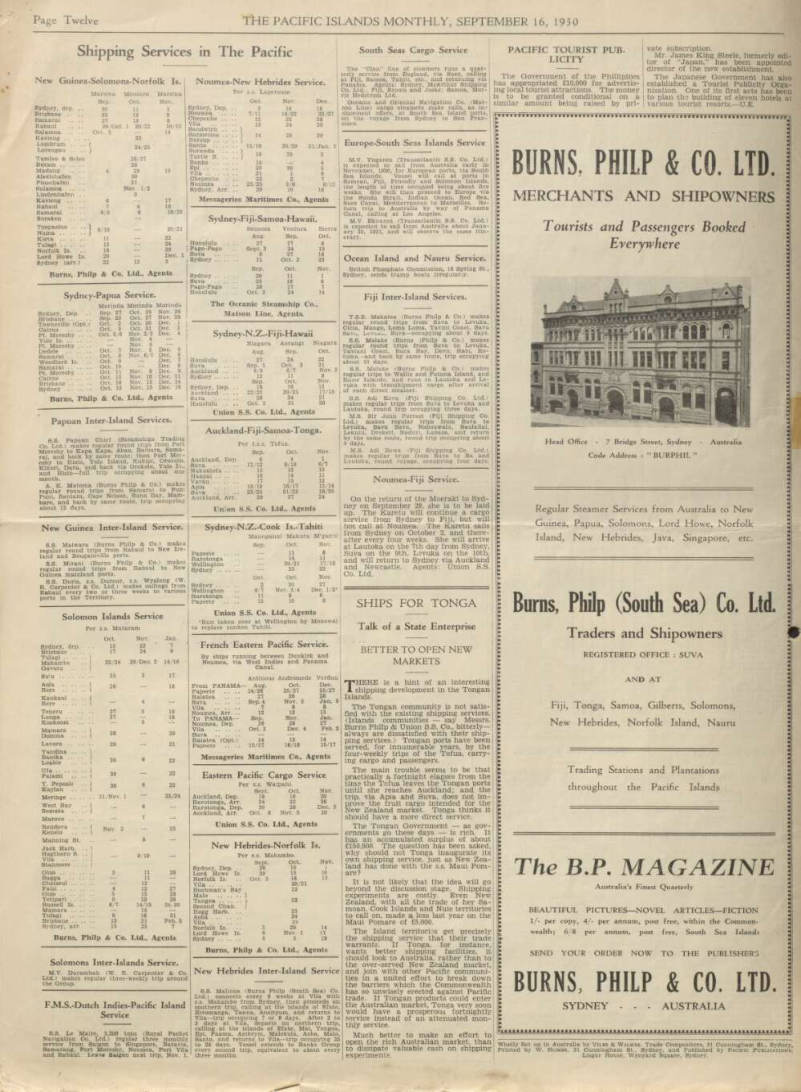
New Guinea-Solomons-Norfolk Is.
Sydney-Papua Service.
Papuan Inter-Island Services.
S.S. Papuan Chief (Steamships Trading Co. Ltd.) makes regular round trips from Port Moresby to Kapa Kapa, Abau, Baibara, Sama rai, and back by same route; then Port Moi esby to Hisiu, Yule Island, Kukipi, Orokolo, Kikori, Daru, and back via Orokolo, Yule Is., and Hisiu —full trip occupying about one month.
A. K. Matoma (Burns Philp & Co.) makes regular round trips from Samarai to Puni Puni, Baniara, Cape Nelson, Buna Bay, Mam bare, and back by same route, trip occupying about 12 days.
New Guinea Inter-Island Service.
5.5. Maiwara (Burns Philp & Co.) makes regular round trips from Rabaul to New Ire land and Bougainville ports. 5.5. Mirani (Burns Philp & Co.) makes regular round trips from Rabaul to New Guinea mainland ports.
SS. Duris, s.s. Durour, s.s. Wyalong (W.
R. Carpenter & Co. Ltd.) makes sailings from Rabaul every two or three weeks to various ports in the Territory.
Solomon Islands Service
Solomons Inter-Islands Service.
M.V. Durambah (W. R. Carpenter & Co.
Ltd.) makes regular three-weekly trip around the Group.
F.M.S.-Dutch Indies-Pacific Island
Service
S.S. Le Maire, 3,200 tons (Royal Packet Navigation Co. Ltd.) regular three monthly service from Saigon to Singapore, Batavia, Samarang, Port Moresby, Noumea, Port Vila and Rabaul. Leave Saigon next trip, Nov. 1.
Noumea-New Hebrides Service.
Sydney-Fiji-Samoa-Hawaii.
Sydney-N.Z.-Fiji-Hawaii
Auckland-Fiji-Samoa-T onga.
Sydney-N.Z.-Cook Is.-Tahiti
French Eastern Pacific Service.
By ships running between Dunkirk and Noumea, via West Indies and Panama Canal.
Eastern Pacific Cargo Service
New Hebrides-Norfolk Is.
New Flebrides Inter-Island Service
S.S. Malinoa (Burns Philp (South Sea) Co.
Ltd.) connects every 6 weeks at Vila with s.s. Makambo from Sydney, then proceeds on southern trip, calling at the islands of Efate, Erromanga, Tanna, Aneityum, and returns to Vila—trip occupying 7 or 8 days. After 2 to 3 days at Vila, departs on northern trip, calling at the islands of Efate, Mai, Tongoa, Epi, Paama, Ambrym, Malekula, Aoba, Malo, Santo, and returns to Vila —trip occupying 25 to 28 days. Vessel extends to Banks Group every second trip, equivalent to about every three months.
South Seas Cargo Service
The “Clan” line of steamers runs a quar terly service from England, via Suez, calling at Fiji, Samoa, Tahiti, etc., and returning via Panama. Agents: Sydney, McArthur Shipping Co. Ltd.; Fiji, Brown and Joske; Samoa, Mor ris Hedstrom Ltd.
Oceanic and Oriental Navigation Co. (Mat son Line) cargo steamers make calls, as in ducement offers, at South Sea Island ports, on the voyage from Sydney to San Fran cisco.
Europe-South Seas Islands Service
M.V. Yngaren (Transatlantic S.S. Co. Ltd.) is expected to sail from Australia early in November, 1930, for European ports, via South Sea Islands. Vessel will call at ports in Samoan, Fiji, Friendly and Solomon Islands, the length of time occupied being about five weeks. She will then proceed to Europe via the Sunda Strait, Indian Ocean, Red Sea, Suez Canal, Mediterranean to Marseilles. Re turn trip to Australia by way of Panama Canal, calling at Los Angeles.
M.V. Eknaren (Transatlantic S.S. Co. Ltd.) is expected to sail from Australia about Janu ary 20, 1931, and will observe the same itin erary.
Ocean Island and Nauru Service.
British Phosphate Commission, 16 Spring St., Sydney, sends tramp boats irregulany.
Fiji Inter-Island Services.
T.S.S. Makatea (Burns Philp & Co.) makes regular round trips from Suva to Levuka, Cicla, Mango, Loma Loma, Tavini Coast, Savu Savu, Suva —occupying about 9 days. 5.5. Malake (Burns (Philp & Co.) makes regular round trips from Suva to Levuka, Taviuni Coast, Buca Bay, Devo, Rabi, Ro tuma -and back by same route, trip occupying about 10 days. 5.5. Malake (Burns Philp & Co.) makes regular trips to Wallis and Futuna Island, and EUice Islands; and runs to Lautoka and Le vuka with transhipment cargo after arrival of each direct steamer. 5.5. Adi Keva (Fiji Shipping Co. Ltd.) makes regular trips from Suva to Levuka and Lautoka, round trip occupying three days.
M.S. Sir John Forrest (Fiji Shipping Co.
Ltd.) makes regular trips from Suva to Levuka, Savu Savu, Nabouwalu, Baulailai, Lekutu, Dreketi, Naduri, Labasa, and return by the same route, round trip occupying about 9 days.
M.S. Adi Rewa (Fiji Shipping Co. Ltd.) makes regular trips from Suva to Ba and Lautoka, round voyage, occupying four days.
Noumea-Fiji Service.
On the return of the Moeraki to Syd ney on September 29, she is to be laid up. The Karetu will continue a cargo service from Sydney to Fiji, but will not call at Noumea. The Karetu sails from Sydney on October 2, and there after every four weeks. She will arrive at Lautoka on the 7th day from Sydney, Suva on the 9th, Levuka on the 10th, and will return to Sydney via Auckland and Newcastle. Agents; Union S.S.
Co. Ltd.
Marsina Montoro Marsina 1
Sep.
Oct.
Nov.
Sydney, dep.
20 11 1 Brisbane 22 13 3 Samarai 27 18 8 Rabaul 29/Oct 1 20/22 10/12 Salamoa Oct. 3 — 14
Kavieng ..
23 Lombrum ..
Lorengau , .
24/25 Tumleo & Seleo 26/27 Boram .. .. 28 Madang 4 29 15 Alexishafen 30 Pinschafen 31 Salamoa
Nov. 1/2
Lindenhafen 3 Kavieng .. 6 — 17 Rabaul 7 4 18 Samarai 8/9 6 19/20 Soraken —
Teopaslno .
Numa .. .. • • 9/10 - 20/21 Kieta .. .. 11 22
Tulagi .. ..
13 — 24 Norfolk Is. 18 — 29 Lord Howe Is. 20 — Dec. 1
Sydney (arr.) 22
12 3
Burns,
Philp & Co.
Ltd., Agents
Sydney, Dep.
Per
s.s. Laperouse
Oct. Nov. 3 14 Dec. 19 Noumea 7/11 18/22 23/27
Chepcnhe ..
12 23 28 Vila . . .. 13 24 29 Sandwich ..
Sarmettes .. • • 1 • • y 14 25 30
Norsup ..
Santo .. .. 15/18 26/29 31/Jan. 3 Suranda Turtle B. .. 18 29 3 Banks .. .. 19 — 4 Epi 20 30 5 Vila 21 1 6
Chepenhe ..
22 2 7 Noumea 23/25 3/6 8/12
Sydney, Arr.
29 10 16
Messageries
Maritimes Co.,
Agents
Sonoma Ventura Sierra Aug.
Sep.
Oct.
Honolulu . . 27 17 8 Pago-Pago Sept. 3 24 15 Suva .. . 6 27 18 Sydney .. . 11 Oct. 2 23 Sep.
Oct.
Nov.
Sydney .. . 20 11 1 Suva . . . . .. 25 16 6 Pago-Pago 26 17 7 Honolulu .. Oct. 3 24 14 The Oceanic Steamship Co ,
Matson Line,
Agents*
Per s.s. Mataram Oct.
Nov.
Jan.
Sydney, dep.
15 22 7 17 24 9
Tulagi 1
Makambo .. J-
22/24 29/Dec 2 14/16
Gavutu .. ..
Su’u 25 3 17
Aola 1
26 18
Kaukaul .. . . ]
Teneru 27 5 19 Lunga 27 19 Kookoom .. .. — 5 —
Mamara .. .. )
28 20
Domma . . .. (
Lavoro 29 — 21
Yandina .. .. 1
Banika ... }■
Loabie .. .. I
30 6 22
Ufa 1
Faiami . , .. i 30 - 22
Y. Pepsale ..
30 6 22
Kaylan .. .. i
31/Nov. 1 23/24
West Bay .. )
6
Somata .. .. (
Marovo — 7 —
Rendova .. .. )
Nov. 2
25 Kenelo .. .. 1
Manning St.
— 8 —
Jack Harb. .. 1
Hagthorn S. ..
Vila [
- 9/10 - Stanmore .. .. Gizo 3 11 26 Bagga — 11 — 12 Falsi 4 12 27 Gizo 5 13 28 5 13 28 Russell Is 6/7 14/15 29/30 15
Tulagi
8 16 31 13 21 Feb. 5
Sydney, arr.
15 23 7
Burns, Philp & Co.
Ltd.,
Agents
Maunganui Makura M’ganui Sep. Oct.
Nov.
Papeete .. .
Rarotonga Wellington Sydney — 11 — 14 — 20/21 — 25 8 11 17/18 22 Oct. Oct.
Nov.
Sydney Wellington Rarotonga Papeete .. . 2 30 6/7 Nov. 3/4 11 8 13 10 27 Dec. 1/2" 6 8 Union
S.S. Co. Ltd., Agents
“Run taken over at Wellington by to replace sunken Tahiti.
Monowai
From Panama—
Antinous Aug.
Andromede Verdun Oct. Dec.
Papeete .. .. 24/26 25/27 25/27 Raiatea .. .. 27 28 28 Suva Sep. 4 Nov. 5 Jan. 5 Vila 7 8 8 Noumea, Arr. .. 12 13 13
To Panama—
Sep.
Nov.
Jan.
Noumea, Dep. 26 28 27 Vila Oct. 3 Dec. 4 Feb. 3 Suva — — — Raiatea (Opt.) 14 15 14 Papeete .. .. 15/17 16/18 15/17
Messageries
Maritimes Co.
Agents
Per s.s. Waipahi.
Sept.
Oct.
Nov.
Auckland, Dep.
18 16 20 Rarotonga, Arr. 24 22 26 Rarotonga, Dep. 30 28 !
Dec. 2
Auckland, Arr.
Oct. 8 Nov. 5 10
Union S.
S. Co.
Ltd., Agents
Per s.s. Makambo.
Sept. Oct. Nov Sydney, Dep. ,. 26 10 V Lord Howe Is. 29 13 10 Norfolk Is.
Oct. 2 16 13 Vila 20/21 Bushman’s Bay 22 Malo 1 Tangoa )■ 22 Second Chan. j Hogg Harb. .. 23 Aoba 24 Vila 2 b Norfolk Is. 3 29 14 Lord Howe Is. 6 Nov. 1 17 Sydney 8 3 19
Bums, Philp & Co. Ltd.,
Agents
Morinda Morinda Morinda
Sydney, Dep. ..
Sep. 27 Oct. 25 Nov. 26 Brisbane Sep. 29 Oct. 27 Nov. 28 Townsville (Opt.) Oct. 2 Oct. 30 Dec. 1 Cairns Oct. 3 Oct. 31 Dec. 2
Pt. Moresby .. ..
Oct. 5/6 Nov. 2/3 Dec. 4 Yule Is
Nov.
4 — Pt. Moresby ...
Nov. 4 — Oct. 7 Nov. 5 Dec. 5 Samarai Oct. 8 Nov. 6/7 Dec. 6 Woodlark Is.
Oct. 9 Dec. 7 Oct. 10 Dec. 8 Pt. Moresby ...
Oct. 11 Nov. 8 Dec. 9 Oct. 13 Nov. 10 Dec. 11 Oct. 16 Nov. 13 Dec. 14
Sydney
Oct. 18 Nov. 15 Dec. 16
Burns, Philp &
Co.
Ltd.,
, Agents
Niagara Aorangi Niagara Aug.
Sep.
Oct.
Honolulu .. . 27 24 22 Suva Sep. 5 Oct. 3 31 Auckland .. . 8/9 6/7 Nov. 3 Sydney 13 11 8 Sep.
Oct.
Nov.
Sydney, Dep. . 18 16 13 Auckland .. . . 22/23 20/21 17/18 Suva 26 24 21 Honolulu .. . . Oct. 3 31 28 Union
S.S. Co.
Ltd., Agents
Per t.s.s.
Sep.
Tofua.
Oct.
Nov.
Auckland, Dep 6 4 1 Suva 11/12 9/10 6/7 Nukualofa .. . 15 13 10 Haapai 16 14 11 Vavau 17 15 12 Apia 18/19 16/17 13/14 Suva . 23/25 21/23 18/20 Auckland, Air. 29 27 24 Union
S.S. Co.
Ltd., Agents
Ships For Tonga
Talk of a State Enterprise
Better To Open New
Markets
THERE is a hint of an interesting shipping development in the Tongan Islands.
The Tongan community is not satis fied with the existing shipping services. (Islands communities — say Messrs.
Burns Philp & Union S.S. Co., bitterly— always are dissatisfied with their ship ping services.) Tongan ports have been served, for innumerable years, by the four-weekly trips of the Tofua, carry ing cargo and passengers.
The main trouble seems to be that practically a fortnight elapses from the time the Tofua leaves the Tongan ports until she reaches Auckland; and the trip, via Apia and Suva, does not im prove the fruit cargo intended for the New Zealand market. Tonga thinks it should have a more direct service.
The Tongan Government — as gov ernments go these days — is rich. It has an accumulated surplus of about £150,000. The question has been asked, why should not Tonga inaugurate its own shipping service, just as New Zea land has done with the s.s. Maui Pom are?
It is not likely that the idea will go beyond the discussion stage. Shipping experiments are costly. Even New Zealand, with all the trade of her Sa moan, Cook Islands and Nuie territories to call on, made a loss last year on the Maui Pomare of £5,000.
The Island territories get precisely the shipping service that their trade warrants. If Tonga, for instance, wants better shipping facilities, it should look to Australia, rather than to the over-served New Zealand market, and join with other Pacific communi ties in a united effort to break down the barriers which the Commonwealth has so unwisely erected against Pacific trade. If Tongan products could enter the Australian market, Tonga very soon would have a prosperous fortnightly service instead of an attenuated mon thly service.
Much better to make an effort to open the rich Australian market, than to dissipate valuable cash on shipping experiments.
Pacific Tourist Pub
Licity
The Government of the Phillipines has appropriated £lO,OOO for advertis ing local tourist attractions. The money is to be granted conditional on a similar amount being raised by pri
vate subscription.
Mr. James King Steele, formerly edi tor of “Japan,” has been appointed director of the new establishment.
The Japanese Government has also established a Tourist Publicity Orga nisation. One of its first acts has been to plan the building of eleven hotels at various tourist resorts.—U.E.
Advertisements & other items, p. 12 (2 items)
The Pacific Islands Monthly, September 16, 193 0
12
Wholly Set up in Australia by Viles & Walker, Trade Compositors, 31 Cunningham St., Sydney, Printed by W. Homer, 31 Cunningham St., Sydney, and Published by Pacific Publications, Lisgar House, Wynyard Square, Sydney.
Burns, Philp & Co. Ltd.
MERCHANTS AND SHIPOWNERS
Tourists and Passengers Booked
Everywhere
Head Office - 7 Bridge Street, Sydney - Australia Code Address : " BURPHIL ”
Regular Steamer Services from Australia to New Guinea, Papua, Solomons, Lord Howe, Norfolk Island, New Hebrides, Java, Singapore, etc.
Burns, Philp (South Sea) Co. Ltd.
Traders and Shipowners
REGISTERED OFFICE : SUVA
AND AT
Fiji, Tonga, Samoa, Gilberts, Solomons, New Hebrides, Norfolk Island, Nauru Trading Stations and Plantations throughout the Pacific Islands
The B.P. MAGAZINE
Australia’s Finest Quarterly
BEAUTIFUL PICTURES—NOVEL ARTICLES—FICTION
1/- per copy, 4/- per annum, post free, within the Commonwealth; 6/8 per annum, post free. South Sea Islands SEND YOUR ORDER NOW TO THE PUBLISHERS
BURNS, PHILP & CO. LTD.
SYDNEY - - - AUSTRALIA