Pacific Islands
The
Pacific Islands Monthly
THE ONLY JOURNAL CIRCULATING THROUGHOUT THE ISLAND TERRITORIES AND GROUPS
Of The Central And South Pacific.
Vol. 1.—No. 1.
Sydney: Saturday, August 16, 1930
Single Copy, 6d.
Per Annum, posted, 6/-.
Pacific Trade
Prospects
Fiji-Samoa-Tonga
A Strong Spirit Of
Optimism
Written for The Pacific Islands Monthly
by Sir Maynard Hedstrom I CAN SPEAK, on trade developments and prospects, only of the three groups in which I am personally interested —Fiji, Samoa and Tonga.
Business in Fiji is depressed by the very low price of our primary products; but there are other factors which give hope for the future.
Though our sugar is selling at, or below cost of production, the Colonial Sugar Refining Co. Ltd. continues its policy of expansion and consolidation, and continues to expend money in improvements which are intended to effect permanent reduction in the cost of production. The policy of establishing peasant farmers as growers of sugar is working out very successfully, so that when the pendulum swings and world production and consumption become more nearly balanced, the Colonial Sugar Refining Co. Ltd. will be in an excellent position to take advantage of the improvement in market conditions.
The copra producer, also, is having a rather “thin time” and, in the case of the small man, the selling price is almost below the cost of production. On the other hand, the output of the Colony is steadily increasing—partly owing to the successful work of the entomologists of the Coconut Committee.
Producers will have to study economy during the present period of depressed prices and, when the market recovers, they will benefit substantially by the increased production per acre.
Owing to floods, last December, banana shipments have been greatly reduced; but that is a temporary condition, and shipments will be back to normal about the end of the year.
Butter And Pineapples
Our little dairy factories are fully supplying local requirements, and we are exporting regularly to Honolulu and Canada.
The shareholders in the two small pineapple factories have confidence in the ultimate success of that industry.
Probably, by January next, the Hawaiian Pineapple Co. Ltd. will have come to a decision as to whether they will commence operations on a commercial scale on the land over which they hold options. They have studied the proposition very carefully and, if they decide to establish themselves in Fiji, there can be little doubt that the venture will be successful.
Our aim here is to get greater variety in our products, so that we may not be entirely dependent upon one or two lines, but build our prosperity on a broader basis.
Public finances are very sound, but undoubtedly the Government will have to cut down expenditure during the next year or two, in this period of low prices. Because our exports are always substantially in excess of our imports, producers have benefitted considerably by the exchange position.
The number of tourist visitors increases year by year, and, this year, we have been favoured with exceptionally good weather, which has delighted our visitors.
Position In Samoa
In Western Samoa the financial position is not unlike ours in Fiji—they depend upon copra and cocoa, and trade is affected by the low prices of these two products.
On the other hand, their export of bananas is increasing steadily, and the shortage in Fiji has given Samoa an excellent opportunity of competing in the New Zealand market.
Tonga’S Good Record
The little island kingdom of Tonga is entirely dependent for revenue upon its copra production — consequently it feels the results of the depressed mar-
ket more severely than either of the other groups.
Here, also, the Government is endeavouring to encourage the production of bananas. There is no difficulty about producing excellent fruit. The trouble is transportation, and the Tongan Parliament has indicated that it is willing to consider a small subsidy to any vessel which will carry bananas regularly to New Zealand.
Owing to careful administration, under the guidance of the British Agent and Consul, the Tongan public finances are in a very sound condition — it is probably one of the few governments in the world which has an actual cash balance in the Treasury.
Speaking generally, it seems probable that these three groups will, in the future, do an increasing volume of trade with Great Britain, Canada and New Zealand, which countries give some preference to their products. ... ———
Sir Maynard Hedstrom
N.G. Tariff
Canberra, Aug. 16.
A number of alterations have been notified in the New Guinea Customs tariff. The following are the principal changes: ... Was ... Is Now Tobacco, manufactured, per lb. .. 2.6 ... 4.8 Automobiles and Accessories .. 10 p.c. .. 20 p.c.
Linseed Oil ... 3 p.c. .. 10 p.c.
Aeroplanes and Parts ... 3 p.c. .. 10 p.c.
Mining Machinery and Parts ... 3 p.c. .. 10 p.c.
The other items are unimportant.
The duty on trade tobacco remains unaltered at 2/6 per lb. ... ———
Descendant of Bounty Midshipman
Death Of "Aunt”
Ninnie Young
From Our Own Correspondent Norfolk Island July 25.
I HAVE just returned home from one of the most moving and picturesque ceremonies I have ever witnessed — the burial, after sudden death, of one of the remaining Pitcairners.
Old Miss Young—or Aunt Ninnie, as she was generally and most affectionately known—was actually born upon Pitcairn, and brought to Norfolk when she was only two or three years old, when the descendants of the Bounty mutineers were transferred from their overcrowded island to Norfolk.
Her father, who was appointed first magistrate and leader of his people upon their arrival here, was grandson of the Midshipman Young, who together with the First Lieutenant Christian, led the mutiny upon the “Bounty,” cast adrift the captain and other officers, sailed the “Bounty” back to Tahiti, where they took native wives—magnificent women of a magnificent race—and sailed further on to Pitcairn, where they sank the ship and settled ashore.
Young came, no doubt, from a middle-class, conventional family, where the children were taught to speak almost reverently of their parents; and that tradition was evidently maintained in the succeeding generations, for dear old Miss Young would talk to me of “Dear Papa” and “Dear Mamma” in the best Victorian manner, and I loved to listen to her.
Her name, all her life long, was synonymous with charity, goodness and the deepest religious feeling and, islanders and mainlanders alike, we all had tears in our eyes as we stood around her grave this morning in the quaint old cemetery, set beside the wide blue sea, beneath the wide blue sky, and joined in the singing of that wonderful anthem, “I was an-hungered and ye gave me meat. . . I was sick and in prison and ye visited me. . . .”
Those words might have been written for the dear old lady and, sung in the rich, warm, colourful voices, harmonising and blending in the passion of grief of her lifelong friends and neighbours, were almost intolerably moving.
It is a memory I shall carry with me wherever I may go. ... ———
Recent Visitors to San Francisco
These two Fijian village headmen created much interest in San Francisco recently when they arrived to attend the International Conference of Seventh Day Adventists. Residents of Fiji, to whom they are well known, will be interested to learn that the American papers said their names were “Ratu Jiali Tikowale and Setareki Shadrack Cevaca”; that they were the grandsons of cannibals ; and that they were “dressed in English coats with smart cravats and short skirts instead of trousers.”
They dressed and posed for this photograph in San Francisco. ... ———
Radio Links The Pacific
Life In The Islands Has Been Revolutionised By Wireless
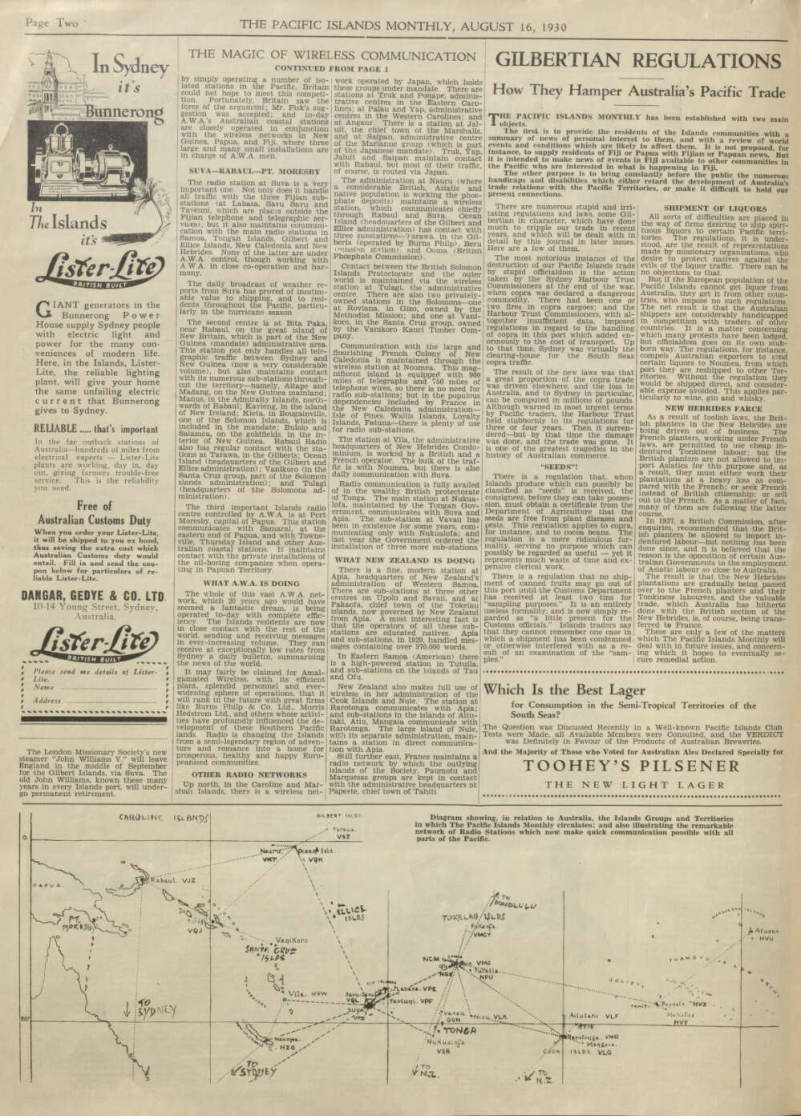
Centres Of The Pacific Network
SUVA (to Sydney, Samoa, Tonga, New Caledonia, New Hebrides, Gilbert & Solomon Is., Hawaii, and San Francisco). 3 sub-stations in Fijian Islands.
RABAUL (to Sydney, Gilbert, Solomon, Caroline, and Marshall Is.). 7 Sub-stations in Mandated Territory.
Port Moresby (To Aus-
tralia) . 1 Sub-station in Samarai.
NOUMEA (to Sydney, Suva, Vila).
Sub-stations in Allied Is.
NUKUALOFA (to Suva, Apia). 1 Sub-station in Tonga.
APIA (to Suva, Wellington and Hawaii, Cook and Hervey Islands). 6 Sub-stations in Samoan Islands.
TULAGI (to Rabaul and Suva). 1 Sub-station in Solomon Islands.
OCEAN ISLAND (to Rabaul, Nauru and. Suva). 3 Sub-stations in Gilbert and Ellice Islands.
RAROTONGA (to Suva, and Wellington). 4 Sub-stations in Cook Is.
TAHITI (to Apia). 3 Sub-stations in Society and Marquesas Islands.
TRUK (to Japan & Rabaul).
Sub-stations in Marshall, Caroline and Marianne Islands.
PRACTICALLY all the Europeanised towns and settlements in the Pacific Island, and many plantations and trading stations, now have direct communication with the rest of the world.
The complete isolation of "the Islands,” which early in this century was at once their greatest charm and their most serious handicap, is a thing of the past. The economic importance of this development, and its effect on the future of the Pacific, cannot be exaggerated.
TWENTY years ago, a man who lived in Bougainville or Vanua Levu, or Aitutaki, was almost as inaccessible as if he were buried in Darkest Africa. A letter written in London, or Sydney, or New York, might reach him six months after it was posted. To-day, a resident of almost any of the Pacific Islands, unless he is very remotely situated, can send a message to Europe, or America, or Australia, and receive a reply within twelve hours. To-day, people who reside in Rabaul or Vila, Suva or Nukualofa or Rarotonga, are little, if any more isolated, in relation to world affairs, than if they lived in New Zealand, Natal, or Newfoundland.
The magic of radio has revolutionised life in The Islands. Europeans may make their homes in the South Seas, enjoy the benefits of climate, soil-fertility, cheap labour, and the charm of sunshine and colour, while suffering none of the disadvantages of complete separation from their friends or their business principals, which residence in the Pacific entailed for so many decades.
The coming of wireless, and the development of the internal combustion engine, have removed from Islands life whatever terrors previously existed by reason of isolation and loneliness, and have greatly reduced the element of risk in the operations of planters and merchants. Even residents on the outer islands of the groups need be no more isolated than an Australian inland squatter. Radio takes the place of the squatter’s long-distance telephone; and, instead of the grazier’s motor-car, the planter has a fast-travelling, petrol driven launch, which conveys him easily to the trading centre and the route of the mail-steamers.
Few people realise how completely the Islands are covered, now, by a network of wireless stations.
In the eastern and north-eastern Islands, nearest to Australia, there are three main wireless centres, which have direct communication with Australia, on the one hand, and, on the other with the smaller “feeder” stations in the Islands round about. Northwards, in the Marshalls and Carolines, and eastward in Samoa, the Cook Islands, Tahiti, etc., there are other similar radio organisations.
The history of what has happened in the nearer Islands provides an example of radio developments throughout the Pacific.
In 1914, when war broke out, Islands radio stations were just beginning to be commercially valuable. Already, a few had been established. It will be remembered that the first Australian casualties occurred when the Australian force was seizing the German
wireless station at Rabaul; and that
the Emden was trapped at Cocos Island, on November 9, 1914, because the radio operator got a message away to
H. M. A. S.
Sydney before the Germans could get ashore and destroy his apparatus.
There was a German wireless sta-
tion at Apia when the New Zealanders took possession of Samoa in September, 1914.
But it was not until after the War that the Governments of Britain, France, United States, Australia and New Zealand, as administrators of Islands territories, began to link up the fertile and beautiful lands of the South Pacific with a real network of wireless.
In 1922, while he was in England, Mr. E. T. Fisk, managing director of Amalgamated Wireless (Aust.) Ltd., interviewed the British authorities, and urged that, for purposes of efficient coordination and operation, the whole of the British radio stations in the South western Pacific should be controlled by A.W.A, It was pointed out that other nations were becoming active in the installation of wireless stations in their Pacific Islands possessions, and that,
SEE MAP WITH CONTINUATION OF THIS ARTICLE ON PAGE 2
Radio Station at Bita Paka, near Rabaul
The London Missionary Society’s new steamer “John Williams V.” will leave England in the middle of September for the Gilbert Islands, via Suva. The old John Williams, known these many years in every Islands port, will under go permanent retirement. ... ———
The Magic Of Wireless Communication
Continued From Page 1
by simply operating a number of isolated stations in the Pacific, Britain could not hope to meet this competition. Fortunately, Britain saw the force of the argument; Mr. Fisk’s suggestion was accepted; and to-day A.W.A.’s Australian coastal stations are closely operated in conjunction with the wireless networks in New Guinea, Papua, and Fiji, where three large and many small installations are in charge of A.W.A. men.
Suva—Rabaul—Pt. Moresby
The radio station at Suva is a very important one. Not only does it handle all traffic with the three Fijian substations (at Labasa, Savu Savu and Taveuni, which are places outside the Fijian telephone and telegraphic services), but it also maintains communication with the main radio stations in Samoa, Tongan Islands, Gilbert and Ellice Islands, New Caledonia and New Hebrides. None of the latter are under A.W.A. control, though working with A.W.A. in close co-operation and harmony.
The daily broadcast of weather reports from Suva has proved of inestimable value to shipping, and to residents throughout the Pacific, particularly in the hurricane season The second centre is at Bita Paka, near Rabaul, on the great island of New Britain, which is part of the New Guinea (mandate) administrative area.
This station not only handles all telegraphic traffic between Sydney and New Guinea (now a very considerable volume), but also maintains contact with its numerous sub-stations through out the territory—namely, Aitape and Madang, on the New Guinea mainland; Manus, in the Admiralty Islands, northwards of Rabaul; Kavieng, in the island of New Ireland; Kieta, in Bougainville, one of the Solomon Islands, which is included in, the mandate; Bulolo and Salamoa, on the goldfields, in the interior of New Guinea. Rabaul Radio also has regular contact with the stations at Tarawa, in the Gilberts; Ocean Island (headquarters of the Gilbert and Ellice administration); Vanikoro (in the Santa Cruz group, part of the Solomon slands administration); and Tulagi (headquarters of (the Solomons administration) .
The third important Islands radio centre controlled by A.W.A. is at Port Moresby, capital of Papua. This station communicates with Samarai, at the eastern end of Papua, and with Townsville, Thursday Island and other Australian coastal stations. It maintains contact with the private installations of the oil-boring companies when operating in Papuan Territory.
What A.W.A. Is Doing
The whole of this vast A.W.A. network, which 20 years ago would have seemed a fantastic dream, is being operated to-day with complete efficiency. The Islands residents are now in close contact with the rest of the world, sending and receiving messages in ever-increasing volume. They can receive at exceptionally low rates from Sydney a daily bulletin, summarising the news of the world.
It may fairly be claimed for Amalgamated Wireless, with its efficient plant, splendid personnel and ever widening sphere of operations, that it will rank in the future with great firms like Burns Philp & Co. Ltd., Morris Hedstrom Ltd., and others whose activities have profoundly influenced the development of these Southern Pacific lands. Radio is changing the Islands from a semi-legendary region of adventure and romance into a home for prosperous, healthy and happy Europeanised communities.
Other Radio Networks
Up north, in the Caroline and Marshall Islands, there is a wireless net-
work operated by Japan, which hold these groups under mandate. There are stations at Truk and Ponape, administrative centres in the Eastern Carolines; at Palau and Yap, administrative centres in the Western Carolines; and at Angaur. There is a station at Jaluit, the chief town of the Marshalls and at Saipan, administrative centre of the Marianne group (which is part of the Japanese mandate). Truk, Yap, Jaluit and Saipan maintain contact with Rabaul, but most of their traffic of course, is routed via Japan.
The administration at Nauru (where a considerable British, Asiatic and native population is working the phosphate deposits) maintains a wireless station, which communicates chiefly through Rabaul and Suva. Ocean Island (headquarters of the Gilbert and Ellice administration) has contact with three substations—Tarawa, in the Gilberts (operated by Burns Philp), Beru (mission station), and Ooma (British
Phosphate Commission).
Contact between the British Solomon Islands Protectorate and the outer world is maintained via the wireless station at Tulagi, the administrative centre. There are also two privately owned stations in the Solomons—one at Roviana, in Gizo, owned by the Methodist Mission; and one at Vanikoro, in the Santa Cruz group, owned by the Vanikoro Kauri Timber Company.
Communication with the large and flourishing French Colony of New Caledonia is maintained through the wireless station at Noumea. This magnificent island is equipped with 900 miles of telegraphs and 750 miles of telephone wires, so there is no need for radio sub-stations; but in the populous dependencies included by France in the New Caledonia administration— Isle of Pines. Wallis Islands, Loyalty Islands, Fatuna—there is plenty of use for radio sub-stations.
The station at Vila, the administrative headquarters of New Hebrides Condominium, is worked by a British and a French operator. The bulk of the traffic is with Noumea, but there is also daily communication with Suva.
Radio communication is fully availed of in the wealthy British protectorate of Tonga. The main station at Nukualofa, maintained by the Tongan Government, communicates with Suva and Apia. The sub-station at Vavau has been in existence for some years, communicating only with Nukualofa; and last year the Government ordered the installation of three more sub-stations.
What New Zealand Is Doing
There is a fine, modern station at Apia, headquarters of New Zealand’s administration of Western Samoa.
There are sub-stations at three other centres on Upolu and Savaii, and at Fakaofa, chief town of the Tokelau islands, now governed by New Zealand from Apia. A most interesting fact is that the operators of all these substations are educated natives. Apia and sub-stations, in 1929, handled messages containing over 570,000 words.
In Eastern Samoa (American) there is a high-powered station in Tutuila, and sub-stations on the islands of Tau and Ofu.
New Zealand also makes full use of wireless in her administration of the Cook Islands and Nuie. The station at Rarotonga communicates with Apia; and sub-stations in the islands of Aitutaki, Atiu, Mangaia communicate with Rarotonga. The large island of Nuie, with its separate administration, maintains a station in direct communication with Apia.
Still further east, France maintains a radio network by which the outlying islands of the Society, Paumotu and Marquesas groups are kept in contact with the administrative headquarters at Papeete, chief town of Tahiti. ... ———
Diagram showing, in relation to Australia, the Islands Groups and Territories in which The Pacific Islands Monthly circulates; and also illustrating the remarkable network of Radio Stations which now make quick communication possible with all parts of the Pacific.
Gilbertian Regulations
How They Hamper Australia’s Pacific Trade
THE PACIFIC ISLANDS MONTHLY has been established with two main objects.
The first is to provide the residents of the Islands communities with a summary of news of personal interest to them, and with a review of world events and conditions which are likely to affect them. It is not proposed for instance, to supply residents of Fiji or Papua with Fijian or Papuan news. But it is intended to make news of events in Fiji available to other communities in the Pacific who are interested in what is happening in Fiji.
The other purpose is to bring constantly before the public the numerous handicaps and disabilities which either retard the development of Australia’s trade relations with the Pacific Territories, or make it difficult to hold our present connections.
There are numerous stupid and irritating regulations and laws, some Gilbertian in character, which have done much to cripple our trade in recent years, and which will be dealt with in detail by this journal in later issues.
Here are a few of them.
The most notorious instance of the destruction of our Pacific Islands trade by stupid officialdom is the action taken by the Sydney Harbour Trust Commissioners at the end of the war when copra was declared a dangerous commodity. There had been one or two fires in copra cargoes; and the Harbour Trust Commissioners, with altogether insufficient data, imposed regulations in regard to the handling of copra in this port which added enormously to the cost of transport. Up to that time, Sydney was virtually the clearing-house for the South Seas copra traffic.
The result of the new laws was that a great proportion of the copra trade was driven elsewhere, and the loss to Australia, and to Sydney in particular can be computed in millions of pounds.
Although warned in most urgent terms by Pacific traders, the Harbour Trust held stubbornly to its regulations for three or four years. Then it surrendered —but by that time the damage was done, and the trade was gone. It is one of the greatest tragedies in the history of Australian commerce.
“Seeds”!
There is a regulation that, when Islands produce which can possibly be classified as “seeds” is received, the consignees, before they can take possession, must obtain a certificate from the Department of Agriculture that the seeds are free from plant diseases and pests. This regulation applies to copra, for instance, and to cocoa beans. The regulation is a mere ridiculous formality, serving no purpose which can possibly be regarded as useful yet it represents much waste of time and expensive clerical work.
There is a regulation that no shipment of canned fruits may go out of this port until the Customs Department has received at least two tins for “sampling purposes.” It is an entirely useless formality, and is now simply regarded as “a little present for the Customs officials.” Islands traders say that they cannot remember one case in which a shipment has been condemned or otherwise interfered with as a result of an examination of the “samples.”
Shipment Of Liquors
All sorts of difficulties are placed in the way of firms desiring to ship spirituous liquors to certain Pacific territories. The regulations, it is understood, are the result of representations made by missionary organisations, who desire to protect natives against the evils of the liquor traffic. There can be no objections to that.
But if the European population of the Pacific Islands cannot get liquor from Australia, they get it from other countries, who impose no such regulations The net result is that the Australian shippers are considerably handicapped in competition with traders of other countries. It is a matter concerning which many protests have been lodged, but officialdom goes on its own stubborn way. The regulations, for instance, compels Australian exporters to send certain liquors to Noumea, from which port they are reshipped to other Territories. Without the regulation they would be shipped direct, and considerable expense avoided. This applies particularly to wine, gin and whisky.
New Hebrides Farce
As a result of foolish laws, the British planters in the New Hebrides are being driven out of business. The French planters, working under French laws, are permitted to use cheap indentured Tonkinese labour; but the British planters are not allowed to import Asiatics for this purpose and, as a result, they must either work their plantations at a heavy loss as compared with the French; or seek French instead of British citizenship; or sell out to the French. As a matter of fact, many of them are following the latter course.
In 1927, a British Commission, after enquiries, recommended that the British planters be allowed to import indentured labour—but nothing has been done since, and it is believed that the reason is the opposition of certain Australian Governments to the employment of Asiatic labour so close to Australia.
The result is that the New Hebrides plantations are gradually being passed over to the French planters and their Tonkinese labourers, and the valuable trade, which Australia has hitherto done with the British section of the New Hebrides, is, of course, being transferred to Prance.
These are only a few of the matters which The Pacific Islands Monthly will deal with in future issues, and concerning which it hopes to eventually secure remedial action. ... ———
Advertisements & other items, p. 2 (3 items)
Page Two
THE PACIFIC ISLANDS MONTHLY, AUGUST 16, 1930 ... ———
In The Islands
In Sydney it's Bunnerong
it's Lister-Lite British Built GIANT generators in the Bunnerong Power House supply Sydney people with electric light and power for the many conveniences of modern life.
Here, in the Islands, Lister- Lite, the reliable lighting plant, will give your home the same unfailing electric current that Bunnerong gives to Sydney.
RELIABLE ... that’s important In the far outback stations of Australia—hundreds of miles from electrical experts Lister-Lite plants are working, day in, day out, giving farmers trouble-free service. This is the reliability you need.
Free of
Australian Customs Duty
When you order your Lister-Lite, it will be shipped to you ex bond, thus saving the extra cost which Australian Customs duty would entail. Fill in and send the coupon below for particulars of reliable Lister-Lite.
DAKGAR, GEDYE & CO. LTD
10-14 Young Street, Sydney,
Please send me details of Lister- Lite.
Name Address Australia. ... ———
Toohey’S Pilsener
Which Is the Best Lager
for Consumption in the Semi-Tropical Territories of the South Seas?
The Question was Discussed Recently in a Well-known Pacific Islands Club.
Tests were Made, all Available Members were Consulted, and the VERDICT was Definitely in Favour of the Products of Australian Breweries.
And the Majority of Those who Voted for Australian Ales Declared Specially for
TOOHEY’S PILSENER
THE NEW LIGHT LAGER
Is Edie Creek Another
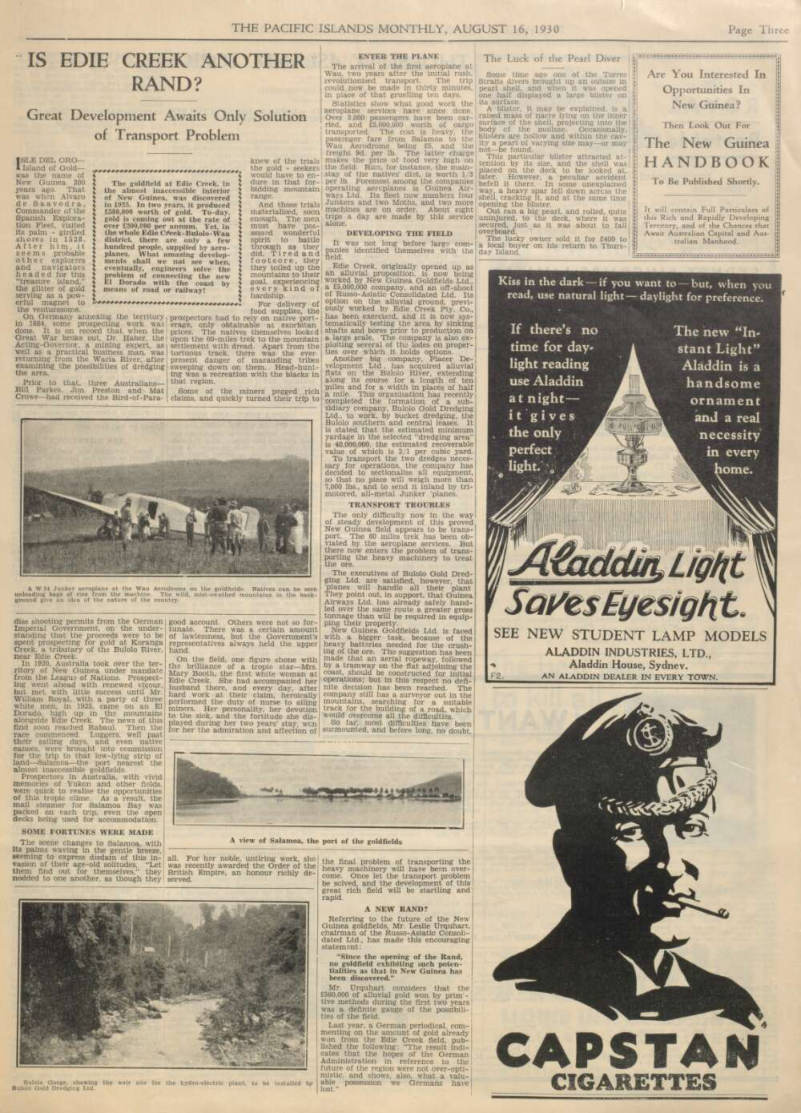
Rand?
Great Development Awaits Only Solution of Transport Problem
Isle Del Oro—
Island of Gold — was the name of New Guinea 300 years ago. That was when Alvaro de Saavedra, Commander of the Spanish Explora tion Fleet, visited its palm-girdled shores in 1528.
After him, it seems probable other explorers and navigators headed for this “treasure island,” the glitter of gold serving as a pow erful magnet to the venturesome.
On Germany annexing the territory in 1884, some prospecting work was done. It is on record that when the Great War broke out, Dr. Haber, the Acting-Governor, a mining expert, as well as a practical business man, was returning from the Waria River, after examining the possibilities of dredging the area.
Prior to that, three Australians— Bill Parkes, Jim Preston and Mat Crowe—had received the Bird-of-Para-
The goldfield at Edie Creek, in the almost inaccessible interior of New Guinea, was discovered in 1925. In two years, it produced £580,000 worth of gold. To-day, gold is coming out at the rate of over £200,000 per annum. Yet, in the whole Edie Creek-Bulolo-Wau district, there are only a few hundred people, supplied by aero planes. What amazing develop ments shall we not see when, eventually, engineers solve the problem of connecting the new El Dorado with the coast by means of road or railway!
knew of the trials the gold-seekers would have to en dure in that for bidding mountain range.
And those trials materialised, soon enough. The men must have pos sessed wonderful spirit to battle through as they did. Tired and footsore, they they toiled up the mountains to their goal, experiencing every kind of hardship.
For delivery of food supplies, the
prospectors had to rely on native port erage, only obtainable at exorbitant prices. The natives themselves looked upon the 60-miles trek to the mountain settlement with dread. Apart from the tortuous track, there was the ever present danger of marauding tribes sweeping down on them. Head-hunting was a recreation with the blacks in that region.
Some of the miners pegged rich claims, and quickly turned their trip to
dise shooting permits from the German Imperial Government, on the under standing that the proceeds were to be spent prospecting for gold at Koranga Creek, a tributary of the Bulolo River, near Edie Creek.
In 1920, Australia took over the ter ritory of New Guinea under mandate from the League of Nations. Prospect ing went ahead with renewed vigour, but met with little success until Mr.
William Royal, with a party of three white men, in 1925, came on an El Dorado, high up in the mountains alongside Edie Creek. The news of this find soon reached Rabaul. Then the race commenced. Luggers, well past their sailing days, and even native canoes, were brought into commission for the trip to that low-lying strip of land —Salamoa —the port nearest the almost inaccessible goldfields.
Prospectors in Australia, with vivid memories of Yukon and other fields, were quick to realise the opportunities of this tropic clime. As a result, the mail steamer for Salamoa Bay was packed on each trip, even the open decks being used for accommodation.
Some Fortunes Were Made
The scene changes to Salamoa, with its palms waving in the gentle breeze, seeming to express disdain of this in vasion of their age-old solitudes. “Let them find out for themselves,” they nodded to one another, as though they
good account. Others were not so for tunate. There was a certain amount of lawlessness, but the Government’s representatives always held the upper hand.
On the field, one figure shone with the brilliance of a tropic star —Mrs.
Mary Booth, the first white woman at Edie Creek. She had accompanied her husband there, and every day, after hard work at their claim, heroically performed the duty of nurse to ailing miners. Her personality, her devotion to the sick, and the fortitude she dis played during her two years’ stay, won for her the admiration and affection of
all. For her noble, untiring work, she was recently awarded the Order of the British Empire, an honour richly de served.
Enter The Plane
The arrival of the first aeroplane at Wau, two years after the initial rush, revolutionised transport. The trip could now be made in thirty minutes, in place of that gruelling ten days.
Statistics show what good work the aeroplane services have since done.
Over 3,000 passengers have been car ried, and £3,000,000 worth of cargo transported. The cost is heavy, the passenger fare from Salamoa to the Wau Aerodrome being £5, and the freight 9d. per lb. The latter charge makes the price of food very high on the field. Rice, for instance, the main stay of the natives’ diet, is worth 1/3 per lb. Foremost among the companies operating aeroplanes is Guinea Air ways Ltd. Its fleet now numbers four Junkers and two Moths, and two more machines are on order. About eight trips a day are made by this service alone.
Developing The Field
It was not long before large com panies identified themselves with the field.
Edie Creek, originally opened up as an alluvial proposition, is now being worked by New Guinea Goldfields Ltd., a £5,000,000 company, and an off-shoot of Russo-Asiatic Consolidated Ltd. Its option on the alluvial ground, previ ously worked by Edie Creek Pty. Co., has been exercised, and it is now sys tematically testing the area by sinking shafts and bores prior to produdppnbn a large scale. The company is also ex ploiting several of the lodes on proper ties over which it holds options.
Another big company, Placer De velopment Ltd., has acquired alluvial flats on the Bulolo River, extending along its course for a length of ten miles and for a width in places of half a mile. This organisation has recently completed the formation of a sub sidiary company, Bulolo Gold Dredging Ltd., to work, by bucket dredging, the Bulolo southern and central leases. It is stated that the estimated minimum yardage in the selected “dredging area” is 40,000,000, the estimated recoverable value of which is 2/1 per cubic yard.
To transport the two dredges neces sary for operations, the company has decided to sectionalise all equipment, so that no piece will weigh more than 7,000 lbs., and to send it inland by tri motored, all-metal Junker ’planes.
Transport Troubles
The only difficulty now in the way of steady development of this proved New Guinea field appears to be trans port. The 60 miles trek has been ob viated by the aeroplane services. But there now enters the problem of trans porting the heavy machinery to treat the ore.
The executives of Bulolo Gold Dred ging Ltd. are satisfied, however, that ’planes will handle all their plant They point out, in support, that Guinea Airways Ltd. has already safely hand led over the same route a greater gross tonnage than will be required in equip ping their property.
New Guinea Goldfields Ltd. is faced with a bigger task, because of the heavy batteries needed for the crush ing of the ore. The suggestion has been made that an aerial ropeway, followed by a tramway on the flat adjoining the coast, should be constructed for initial operations; but in this respect no defi nite decision has been reached. The company still has a surveyor out in the mountains, searching for a suitable track for the building of a road, which would overcome all the difficulties.
So far, most difficulties have been surmounted, and before long, no doubt,
the final problem of transporting the heavy machinery will have been over come. Once let the transport problem be solved, and the development of this great rich field will be startling and rapid.
A New Rand?
Referring to the future of the New Guinea goldfields, Mr. Leslie Urquhart, chairman of the Russo-Asiatic Consoli dated Ltd., has made this encouraging statement: “Since the opening of the Rand, no goldfield exhibiting such poten tialities as that in New Guinea has been discovered.”
Mr. Urquhart considers that the £580,000 of alluvial gold won by primtive methods during the first two years was a definite gauge of the possibilities of the field.
Last year, a German periodical, com menting on the amount of gold already won from the Edie Creek field, pub lished the following: “The result indi cates that the hopes of the German Administration in reference to the future of the region were not over-optimistic, and shows, also, what a valuable possession we Germans have lost.”
The Luck of the Pearl Diver
Some time ago one of the Torres Straits divers brought up an outsize in pearl shell, and when it was opened one half displayed a large blister on its surface.
A blister, it may be explained, is a raised mass of nacre lying on the inner surface of the shell, projecting into the body of the mollusc. Occasionally, blisters are hollow and within the cav ity a pearl of varying size may—or may not—be found.
This particular blister attracted at tention by its size, and the shell was placed on the deck to be looked at, later. However, a peculiar accident befell it there. In some unexplained way, a heavy spar fell down across the shell, cracking it, and at the same time opening the blister.
Out ran a big pearl, and rolled, quite uninjured, to the deck, where it was secured, just as it was about to fall overboard.
The lucky owner sold it for £400 to a local buyer on his return to Thurs day Island.
A W 34 Junker aeroplane at the Wau Aerodrome on the goldfields. Natives can be seen unloading bags of rice from the machine. The wild, mist-swathed mountains in the back ground give an idea of the nature of the country.
Bulolo Gorge, showing the weir site for the hydro-electric plant, to be installed by Bulolo Gold Dredging Ltd.
A view of Salamoa, the port of the goldfields
Advertisements & other items, pp. 3-4 (1 item)
Capstan
Are You Interested In
Opportunities In
New Guinea?
Then Look Out For
The New Guinea
HANDBOOK
To Be Published Shortly.
It will contain Full Particulars of this Rich and Rapidly Developing Territory, and of the Chances that Await Australian Capital and Australian Manhood.
SEE NEW STUDENT LAMP MODELS
ALADDIN INDUSTRIES, LTD.,
Aladdin House, Sydney, F 2. AN ALADDIN DEALER IN EVERY TOWN.
CAPSTAN
CIGARETTES
The
ROYAL
Portable
—the preferred Typewriter for Home and Personal use.
Strongly constructed — easy to use.
Built on standard lines — Four-bank Keyboard.
Two-colour Ribbon, Back-spacer, Margin Release.
Extra wide Writing Line, etc.
SYDNEY PINCOMBE LIMITED
Australasian Agents
46-48 HUNTER STREET, SYDNEY
Also at NEWCASTLE, MELBOURNE, BRISBANE.
Vitality and Health are the
Main Factors in Every-day Life
Put yourself in the hands of Specialists who have made an intelligent study of your requirements; it is vital to your health.
We are known everywhere as the Suppliers of the Right Goods and which put the VITAL into VITALITY. 35 years is our record of supplying Fresh Fruit, Vegetables and Produce to the leading Houses throughout the world.
GET FULLY ACQUAINTED WITH US
Tel.: MA 4799; FX 4350 Private Cable Address: PIGS, SYDNEY. Code: BENTLEYS
C. G. PIGGOTT
WHOLESALE FRUIT AND PRODUCE MERCHANTS
DIRECT IMPORTERS AND EXPORTERS.
SYDNEY.
Office, Bulk Stores & Packing H ouse: Fruit Exchange, Sydney Sal es Dept.: Fruit Exchange and City Markets, Sydney Rank of N.S.W. Bankers.
BRITON —MAKER OF MEN
I’LL MAKE YOU FEEL ALIVE!
I’ll give you a new and wonderful THRILL! I’ll put glorious LIFE into every cell, nerve and organ of your body. Man, things happen when I start working on that body of yours! And they happen FAST. Floods of vitality surge through you, your vital organs tune up and start hitting on all six; your muscles begin to GROW. In 30 days you’re a changed man. You feel better and look better thafi you ever did in your life. Your body has been completely rebuilt you’ll wonder where those big, beautifully proportioned muscles came from!
Another MIRACLE IN MUSCLE. Yes, and this time it’s YOU. Just give me a few minutes a day in your own home—and watch yourself.
I DON’T PROMISE ANYTHING.
I GUARANTEE to put two inches of sold muscle on your arms; to increase your chest five inches; to develop your neck to a size larger collar; to add three inches of powerful development to your thighs; two inches to your calves; to give you a firm, slim waist line that will make you take in a notch or two in your belt.
And I don’t ask you to take my word for it—l don’t promise anything—l back every statement with an iron-clad GUARANTEE. I’ve done all this for others.
I can do it for you. Get the PROOF—send for my amazing new book—now—-it’s FREE!
Even if you do not live in Sydney—if you are in the Pacific Islands, a week’s journey—you can get the full benefit of this amazing new system.
I WANT YOU NEXT!
New Sensational Extraordinary! The greatest demonstration of muscle-building known to the world of physical culture! YOU can be next! Almost over-night I II transform you into a marvel of muscular power—give you astounding new health, strength and vitality. Read how!
MIRACLES IN MUSCLE! You hear everybody talking about them. Physical culture authorities are amazed. Think of it! Men made over—almost over-night.
Puny, sickly weaklings transformed into superb specimens of MANHOOD! Strong men made STRONGER. This astounding new method works its wonders for ALL —young or old, sick or well. Incredible? Yes! But this is an age of marvels.
We speed across Continents by aeroplane, where once we plodded by stage coach.
We talk through the air by radio, where once we depended upon slow-footed couriers. And now BRITON brings to physical culture the greatest advance of the century.
BRITON, the pioneer—the first in the field —to-day, as always, is years ahead of his time. Briton training—the original, the genuine, the system that has built the world’s great strong men —still sets the pace—startling new developments make it the most modern system of body-building in the world.
Ordinary systems become as old-fashioned as the one-horse shay in comparison.
HRITON TRAINING accomplishes almost overnight what other systems can never accomplish in months and years!
The Greatest Book in the World
"THE SECRETS OF MUSCULAR STRENGTH.”
It’s FREE! This book will startle you, amaze you. Get it while it is FREE!
ALFRED J. BRITON, Dept. P., 107 PITT STREET, SYDNEY, N.S.W.
RIP THIS OUT—SEND NOW
IT IS F R E E Dear Sir, —Please send me absolutely FREE and without any obligation on my part whatsoever, a copy of your latest book, "The Secrets of Muscular Strength—And How to Acquire It.” I enclose 6d. in stamps for postage.
NAME -
FULL ADDRESS
Alfred J. Briton, Dept P., 107 Pitt St.,
Sydney, N.S.W.
(Known throughout the Southern Hemisphere.) 14th August, 1930.
Thursday Island Topics
From Our Own Correspondent
THREAT TO PEARLING INDUSTRY — COPRA TRADE IN DUTCH NEW GUINEA — WHEN NATIVES SAW THEIR FIRST AEROPLANE — SPORT
And Entertainments.
Thursday Is., July 26.
THE first issue of The Pacific Islands Monthly will be eagerly looked for on Thursday Island, as it will bring local residents in touch with other island groups in a way that has hither to not been attempted. This northern outpost of Queensland cannot properly be said to belong to “The Islands,” but there are many points of resemblance, and the circulation of a paper dealing with the different parts of the Pacific ought to foster better knowledge of and closer relations with our neighbours.
Apart from this, the new journal will treat with a very interesting part of the globe, and one that makes its appeal to nearly all Australians. Its introduc tion should do much to induce our leis ured classes to visit these island para dises, to which T.I. claims to belong.
Personal
There is a constant changing of offi cials at Thursday Island, and the latest is the transfer of Dr. C. R. Wiburd, who has been acting Quarantine Officer for three months, to a more important post in Brisbane. The post has been filled by Dr. Bevington, of Sydney, who arrived with his wife by the Marella.
The vacancy in the Roman Catholic presbytery, caused by the transfer of the Rev. Father Doyle to the south coast of Papua, has been filled by the Rev. Father Finch, who gave up his appointment as a teacher of philosophy in the Sacred Heart College, near Syd ney, for work with the Sacred Heart Mission. Father Finch makes a notable addition to the clergy of the district.
Shell Output Restricted
The pearling industry, outwardly, is normal, though production is now re stricted owing to a lessened demand abroad, and this has resulted in about 15 per cent of the fleet being laid up.
But the whole industry is apparently, destined to undergo radical changes in its organisation, to an extent yet un known, and with results that cannot be foreseen.
The present time of depression is not a suitable one to disturb an industry which is of great service to the country.
Worked as it has been for many years past, it has been eminently successful; to-day the export of shell is of more importance to the Commonwealth than ever. Any drastic changes, even if they fulfil the ideas of enthusiastic politi cians, may result in disaster to an im portant industry.
It may be said that the industries of the district are only in their infancy, though the pearling may decline. The fishing grounds, if wisely worked, are a permanent asset. In years to come, the methods of production may be very different to those of to-day, but the old system should be only gradually altered.
Like many other Australian concerns, the raw material is exported and repur chased in the finished state, and all the profits of manufacture and the wages paid are placed in alien pockets, instead of in those of the Commonwealth. If the authorities endeavoured to start local manufacture of the shell, new avenues for white employment would be opened, and another export added which would be clear profit to Australia.
Other Industries Needed
What this district needs is other marine industries, which could be worked quite independently of the pearling concerns, and which would give employment to small white capita lists and a certain number of white employees.
That such openings exist is undeni able. The canning of various edible marine products seems to offer pros pects of success, if wise management and freedom from impossible restric tions were assured. But policies which insist upon advanced labour conditions on the one hand, and on preference to native fishing concerns (to the extinc tion of the white owner) on the other, will not bring this desirable state of affairs about.
The settlement of white people in the Far North is a matter of national im portance, and if it is to increase a more sympathetic and intelligent attitude to wards the peculiar needs of the district is necessary.
Copra Then—And Now
How are the mighty fallen!
I have before me a newspaper cut ting quoting the opinion of a Fiji coco nut planter, in which he says: “A good copra plantation is better than most gold mines.” But that was written 12 years ago.
To-day, a planter from New Guinea spoke bitterly of the coconut industry.
Said he: “Talk about the Consols of the East! Why, to-day, the crop is hardly worth the gathering.”
Readers of the P.I.M. do not want to have a subject like this rubbed in—it is too serious for that —but they may be interested in reading about the pro duction of copra in Dutch New Guinea.
The local price offered by Chinese merchants in Merauke, the chief set tlement there, is about £8/10/- per ton.
The coastline of Dutch New Guinea is studded with coconut groves, which are exclusively native owned, and, as may be expected, suffer from close planting and lack of care. Beach areas give the best returns. The soil is a sandy loam, with a big percentage of disin tegrated coral, the rainfall is copious, and the production could be very largely increased if better methods of planting were introduced.
There are usually one or two Chinese traders in each kampong or village, who more or less supervise the prepara tion of the copra. It is universally smoke-dried, and is of good quality, but it is usually sold as sun-dried. The copra is picked up by small Chinese owned cutters, which bring it to Mer auke. From that centre over 200 miles of coastline are exploited in this way.
There is no government inspection, but an export duty, at present about five guilders (8/-) is extracted. There is only one possible avenue of export, which is the vessels of the big Dutch shipping company who control the trade of the Archipelago, and who, in the case of New Guinea, hold the sole rights to carry copra.
None of the copra from Merauke comes to Thursday Island for tran shipment, although it is only 150 miles away, nor does the Island get any share of the copra exported from the western division of Papua. The latter goes via Port Moresby, where hand ling charges are considerably less than the 10/- per ton exacted in Australia’s northernmost port
Football Persists
In spite of racial prejudice the na tions of Europe have secretly a great respect for England, and occasionally it is openly expressed I quote from the tag-end of an eulogistic comment in a Spanish newspaper, “El Sol,” which has on this occasion come out in the open to give the Old Country a pat on the back. Says the writer: “O England, whose word is bond, country of fair play, you deserve immortality and the veneration of all men. May you be for given for having invented football.”
Which is Preliminary to saying that football still manages to keep amongst a few enthusiasts on Thursday island, but so few white players turn were it not for the keenness of the local coloured men the sport would be dead. This would be a thousand pities, as there is no game like it to induce a healthiness of mind and body, especially for small tropical com munities. However, some interesting matches are played by mixed teams.
The Sailing Season
The sailing season is in full swing and great interest is shown in the con tests for the May Flag every Saturday The open nature of the harbour, the strong tides and winds and lumpy seas
make sailing a thrilling pastime in our small and heavily canvassed twelve footers. The Alice, Jean, Mystic and Koonya are all in the running for the flag, while the other captains are just as enthusiastic in their efforts to win. A word of thanks must be accorded launch owners who place their launches at the disposal of club officials.
A club rule exists which forbids rac ing without an attendant launch, and the number of capsizes fully justifies this precaution.
Exodus From Hospital
The first plane to visit Torres Straits was one used by Captain Hurley during his expedition to Papua, in 1923, and the majority of spectators on that oc casion were probably seeing one for the first time in their lives.
At the Thursday Island Hospital the patients, principally aboriginals, Papu ans, and other coloured odds and ends, went mad with excitement on its ap pearance. Easy chairs and beds were vacated while their owners rushed out side to see the new “bird”.
After circling round several times, the plane gave a last waggle of its tail and shot off out of sight to take the water near the jetty. The crowd of pyjama-clad invalids and cripples gaped at it open-mouthed; then, with the single-mindedness of a mob of goats chased by a small dog, followed it down the road, yelling and cheering. One solitary patient was left in the wards— he was unconscious!
The A.W.L. crowd returned, minus sundry bandages and poultices and re sumed their aches and pains, prepared for a reprimand, which was withheld owing to the rarity of the occurrence.
Not long ago another plane, this time bound for the Edie Creek goldfield, in New Guinea, flew over, but the dark ies did not turn a hair. Not so a white visitor to the island, hailing from the Cairns hinterland. He was a thoroughly interested spectator—but he confessed, later, that it was the first plane he had ever seen.
The Difference
Some countries are worth living in.
A friend of mine has just been explain ing about—but never mind where.
“You see its this way,” he said. “Over there the Government robs you all the time. But they shut their eyes and let you rob everyone else.” Of course, in Australia, the robbing is all on one side!
Entertainments
Most of the ladies are busy preparing for the annual bazaars in aid of the two churches and several preliminary entertainments to help the various stalls have been held. Successful dan ces in aid of the respective “Work Stalls” were held at the Convent Hall and the Residency.
Fancy Dress Ball
A fancy dress dance, in aid of the Roman Catholic Fete, was held in the Town Hall on July 25, and proved one of the outstanding events of the 1930 round of gaieties. In fact, it was evi dent that an opportunity to relax in fancy dress was exactly what was wanted, and it was simply rushed by everyone on the island.
Sister Hunt, on the staff of the local hospital, organised the entertainment, and was ably assisted with the decora tions, music and supper by a number of helpers. The outstanding success of the evening was due to the remarkable excellence and variety of the fancy cos tumes.
The ladies’ prize was won by Miss Burgess, representing an Oriental maiden. John Bull hopped off with a well deserved memento of the evening.
Mr. G. Assange was greeted with roars of laughter, and awarded the prize for the most comic costume.
It is hardly fair to disclose the iden tity of the most striking characters.
Some were strictly incog—if only for a time—and several mysteries were brought to light during the evening.
Britannia and John Bull lent a patri otic air to the proceedings; Bradman was a “run-getter,” and carried his bat through the innings; Monsieur and Madame Apache (a desperate pair); several Pearl Kings, in disguise; But terfly and Little Miss Muffit were in charming contrast to a disreputable locking female in nurse’s costume; pirates, clowns, red devils, Jeff and Mutt, barrister, Old Times, Tankard, Matador—all were present. The mas culine hit of the evening was provided by Charlie Chaplin, who gained a special prize.
The fancy sets were particularly good, especially a troupe of lads and lasses in brilliant scarlet, and a raf fish-looking Spanish set. Ah me!
Those Spanish ladies—how alluring; but their partners were so very fierce looking. Mr. Neenan acted as M.C.
The International Jazz Band, man dolins, guitars and ukuleles rendered plaintive Hawaiian music, assisted by volunteers at the piano, and the open ing march, with its host of gaily dressed revellers, was quite a triumph for a serious-minded place like Thurs day Island.
The last guest was removed in the ice-cream cart, under the supervision of John Bull, and the ball was declared at an end with three cheers for the orga niser.
The financial results were very satis factory to those concerned.
Lost By Default
Our Trade with N. Caledonia
Federal Government’S
Indifference
PROMINENCE was given by the newspapers recently to a state ment by M. Rene Contal (manager of the Societe le Nickel, of Paris), that high production costs in Aus tralia were driving away to Euro pean countries, trade from New Caledonia worth £500,000 per annum to the Commonwealth.
THESE figures are exaggerated. The total value of Australian exports to New Caledonia, for ten years past, has not averaged much more than £250,000 per annum.
It has ranged between £200,000 and £480,000 each year.
But this trade, nevertheless, is ex tremely valuable, and, as M. Contal has pointed out, the condition of some of it is precarious.
It is true that the nickel mines of New Caledonia are large consumers of coal, coke, machinery, and foodstuffs, and that Australia, whose mainland is only 800 miles from Noumea, is the natural market for the purchase of such commodities. In the past, the nickel producing corporation represented by M. Contal has spent £75,000 per annum in Australia on these goods.
M. Contol says that it now has been ascertained that the required goods can be imported from Europe, more cheaply
To Kill Mosquitoes
After 16 months’ work in the northern Islands, Mr. C. E. Pember ton, an entomologist, arrived in Sydney, en route to Honolulu, with about 250 mosquito-killing insects, with which he hopes to reduce Hawai’s pests. The insects are themselves a type of mosquito, but are not blood suckers; and in their larvae stage they devour the larva of the common mos quito. Mr. Pemberton secured his specimens in the forests of New Britain, about 10 miles from Rabaul.
than from Australia, and most of that £75,000 per annum, accordingly, is going elsewhere. Other nickel producers, it appears, are likely to follow the ex ample of the Societe le Nickel.
There is nothing new about this. It is only another chapter in the weari some, discouraging story of Australia’s trade connection with the Pacific. Here in the South Seas territories, right at Australia’s front door, is a market which each year buys nearly £4,000,000 worth of goods. This takes into ac count only the Islands nearest Aus tralia —going no further north than New Guinea, and no further east than Samoa. Australia sells in that market only about £1,900,000 worth of her com modities.
That trade has been held for Aus tralia, first, by her geographical position in proximity to the market; sec ond, because the Islands definitely want the goods which Australia has for sale; and, third, by the efficiency of big commercial institutions such as Burns Philp & Co. Ltd., Morris Hedstrom Ltd., W. R. Carpenter & Co. Ltd., Union S.S.
Co. Ltd.
Apart from the payment of a few shipping subsidies, the Australian Gov ernment has done nothing to foster the Islands connection. Actually, it has been held in spite of Australian official dom. If Australia set out to capture the South Pacific markets, she could sell to these communities three-quar ters of the £4,250,000 worth which they annually buy.
This French merchant has said, in emphatic fashion, that our com modities are too dear, and that trade worth anything up to a quar ter of a million sterling is going elsewhere. Has the Federal Govern ment said one word in reply or ex planation? Has it ordered a prompt investigation of the posi tion? It has not.
Yet anyone acquainted with the cir cumstances knows that that trade could be retained by Australia if real effort were made. The Government is preparing to send expensive commis sioners to seek trade for us in America, and The East, and Canada. It has virtually sacrificed Australia’s primary industries to the secondary industries, os part of its deliberate economic policy; yet when a very good market for our manufactured as well as our primary products shows signs of closing up, this Government displays not the slightest interest.
It is notified from Thursday Island that the ketch “Goodwill,” owned by Papuan Industries Ltd., is for sale.
There is no further need for her, be cause the Government has taken over all the interests of this company at Dogai, on Badu Island. Papuan In dustries Ltd is an industrial missionary organisation.
News From Norfolk Is.
From Our Own Correspondent
IN 1930, we are a completely modern community, replete with wireless sets, motor cars, Ford lorries, a picture show on Saturday nights, a Literary Society (where we partly read and partly act stuff to one another), a Bridge Club and, quite recently, a most creditable dramatic company raw material, but whipped surprisingly into shape by a young English actor, tem porarily retired from Allan Wilkie’s well-known band.
We play golf on a very good course, and several tennis clubs challenge each other towards the close of the sum mer.
Six or seven stores compete for our custom —Burns Philp are building a second “up country.” There is a very good private school, as well as the usual public one. Our hospital is well run, and in the charge of a young doc tor, who hesitates at no sort of opera tion, and is destined to go far in sur gery. We have two solicitors and three brands of religion. What more could life offer us anywhere?
Our population is between 800 and 900, of which roughly two-thirds are “Islanders,” descendants of the Pitcairn folk—a little darker than you or me, but often with eyes as blue as mine or yours—if yours are blue. We mix upon equal terms, thinking pretty well of each other, exult together over good prices for our produce, lament together when the bottom falls out of the mar ket, or we hear that for still another term we are doomed to travel or to consign our fruit to Sydney by that well-known but little respected steamer, the s.s. “Makambo,” that has plodded about the blue Pacific for uncounted years, and is surely due for honourable retirement.
Houses to let, and boarding houses, are dotted about the island; but an up to-date, residential hotel, situated at Kingston, where our little administra tion functions, our golfers swing their clubs, and we all picnic and swim on holidays and Saturdays, is badly needed.
There is a deleterious idea abroad that we are strictly teetotal, but that is not true. We are temperate by virtue of a system of liquor permits issued by the Administrator, and good for a lim ited amount per week, but we are not teetotal, nor do we wish to be. So don’t spread that base rumour any fur ther, will you?
On the whole, we are prosperous, particularly while good prices are ob taining for the produce we export— bananas, passion-fruit, oranges, lemon juice and seeds, Canadian Wonder Beans and early potatoes. Plantations change hands as residents of several years feel the urge to go “Home” or to wander further, and new settlers are attracted by what scant informa tion they can glean as to our gorgeous climate and enviable freedom from taxation. New lands are being taken up on easy Government leases, fences and hedges are rising where they never rose before; the timber mills are busy among the pine trees, and on every steamer day, from dawn till dark, lor ries, piled high with cases, roar along our hilly roads and swoop down upon the jetty, beyond which the Makambo lies wearily at anchor.
H.M.S. Dunedin’S Visit
Well, now you all know where we live, and how we live, and next month when you see the heading, “News from Nor folk Island,” you will have some idea
of what you are going to read—Chron icles of Small Beer —and here is a sample glassful.
H.M.S. Dunedin is expected in at daybreak on Wednesday morning next, July 30, and the island is agog with excitement. It has been officially an nounced that only 15 officers and 50 ratings—whatever they are, in the in nocent minds of many of us! —will be allowed ashore. All available cars are invited to render themselves upon the jetty upon arrival of the warship, in order that the officers and the “ratings,” if they ride in motor cars— may take the air and view our island paradise from end to end. A football match will take place in the afternoon, when a local team will play against the ship, and some festivity will also be arranged for the evening hours. At midnight our magnificent visitor will leave for other Island ports and by courtesy of her commander, will carry a mail. At least we hope he will; we are going to ask him.
Boy Scout Arrives
The Boy Scout Movement has just reached our happy shores, and is raging like a pestilence. Dressed in brand new uniforms, with whistles and knives complete, little boys, middling-sized boys and large boys, are galloping about the island performing, every day, some good deeds, and others not so good, as is the manner of boyhood all the world over.
The Administrator of New Guinea, Brigadier-General E. A. Wisdom, is at present making his annual tour of the Territory.
Mr. H. C. Cardew, Commissioner for Native Affairs and Director of Educa tion in New Guinea, is in Sydney on official business.
Mr. E. M. Bland, of the Shell Co. of Australia Ltd., left by the last “Morinda” on a five months’ business trip to the Islands. After visiting Papua, he will proceed to Fiji, Tonga and Samoa.
An Introduction
Norfolk Island—a thousand miles east of Australia and a little lower on the map than Brisbane—is one of the most interesting and romantic islands in the world, brimming over with history from the moment of its dis covery by an English naval survey ship in 1789.
Intersected by long, deep valleys, in which we grow our bananas for export, crowned on every crest by tall dark pine-trees that seem, beneath the stars, to tower into heaven, it seems a great deal larger than its seven miles by four, because of its amazing road mileage and the fact that one can spend a long day getting from one end of the island to the other.
A hundred years and more ago those seventy miles of road were cut and graded by convicts, used like cattle, and driven in teams.
That era passed, and in 1856, by special decree of Good Queen Victoria, the island was deeded for ever to the descendants of the famous Bounty Mutineers. The latter had been discovered living in happiness and peace, but under frightfully overcrowded conditions, on tiny Pitcairn Island, then remote from all the world, but now lying right in the track of all shipping between New Zealand and the Panama Canal.
For many years, the Pitcairn Islanders (as they are still called) lived on Norfolk Island, in an isolation almost as complete as on Pit cairn, except that whalers, American for the most part, put in, in the whaling season, for wood, water and beef, killed and salted from the wild cattle left behind from convict days.
Gradually, however, civilisation seeped in; an overseas administrator took the place of their own appointed head, and acted under instructions from Australia; a parson, a doc tor, a schoolmaster came: and settlers of all classes, and from all parts of the world, ar rived to take up land and cultivate the ourishing banana and the fruitful passion vine which, here, grows to perfection and bears marvellously.
Mission Ketch Lost off Papuan Coast
The mission vessel “Bromilow,” owned by the Methodist Mission Society, was wrecked at Amphettes, near Samarai, Papua, recently, and seven natives were drowned. The Rev. G. P. Lassam and one native were rescued from a reef, after five days’ exposure, without food or water, and two natives reached Salamo from the vessel.
The “Bromilow” was a wooden auxiliary ketch of 14 tons gross, and had been in service in Papuan waters since 1917. She was named after a famous missionary, Dr. Bromilow, whose death recently occurred.
The above photograph shows the Bromilow lying in Salamo Harbour.
Advertisements & other items, p. 5 (1 item)
Wireless Service
Send for Self Testing
Eyesight Charts
We are the largest and most qualified Opticians in Australia, and our prices are moderate.
For the convenience of those requiring glasses, and who are unable to visit us, on request we will post self-testing charts, which will assist you materially in the choosing of glasses yourself for reading or near work.
We replace broken lenses and repair broken frames.
ALEX HALE LTD. Qualified Sight Testing Opticians
113 PITT STREET
Also Five Other City Addresses.
SYDNEY
Established 30 Years
USE The
Wireless Service
and Save Time & Money
SPEED -
ACCURACY -
ECONOMY!
Speedy and efficient services to Australia and Overseas.
Route your overseas traffic for Great Britain, Europe and North and South America for transmission
“VIA BEAM”
The Longest Direct Telegraph Service in the World Amalgamated Wireless
AUSTRALASIA LTD
Australia's National
Wireless Organisation
The best way
to kill all pests
FLIES and all insects breathe it & die. (non poisonous) MOSQUITOES no need for Nets spray before retiring.
COCKROACHES easily exterminated.
Spray in the Cracks & Haunts.
FLEAS
Keep your animals clean.
BUGS
Spray bedding well,no stain.
ANTS
Drop dead on the spot.
SILVERFISH
Curl up die immediately.
YOUR STORE SELLS IT.
MORTEIN —LIQUID INSECT SPRAY.
KILLS EM STONE DEAD
only sold in sealed bottles or tins
MORTEIN IS BETTER WHY PAY MORE?
Pacific Islands Monthly
Published once a month, and circulated among residents of: New Guinea Fiji Solomon Is.
Papua Tonga New Hebrides Norfolk Is. Samoa New Caledonia Cook Is. Nauru Ocean Is.
Gilbert Is. Tahiti Thursday Is.
Read also by residents of Australia and New Zealand who are interested in Pacific Islands trade and activities.
Publishers: Pacific Publications, 30 Carrington St., Wynyard Sq., Sydney. Tel.: BW 5037.
Editor: R. W. Robson.
Subscription Rates;
s. d.
Per annum, post free, within British Empire; in advance, 6/-; booked .. 6 6 Per annum, post free, beyond British Empire 8 0
Advertising:
Casual: Per single column inch 8 0 Contract: 6/6, 7/- and 7/6 per inch, accord ing to conditions.
Changes of advertising copy should reach publishers by 7th of each month.
Contributions:
Contributions on matters of interest to Pacific Islands residents and traders are in vited; and, if accepted, will be paid for, on publication, at the rate of 2½d. per line.
Special payment for photographs. No respon sibility is taken for contributions forwarded; but, if return is desired in the event of rejec tion, a stamped and addressed envelope should te enclosed.
Distribution:
In Australia, New Zealand and Great Britain.
Copies may be obtained from, and subscrip tion orders lodged with Messrs. Gordon & Gotch, Limited.
In the Pacific, Islands, copies may be ob tained from, and subscription orders lodged at any of the stores of Messrs.- Burns Philp & Co.
Ltd., Messrs. Burns Philp (South Seas) Co Ltd.. Messrs. W. R. Carpenter & Co. Ltd., and Messrs. Morris Hedstrom & Co. Ltd.
Vol. 1.—No. 1. August, 1930.
A Journal For The
Pacific
LYING right at the front doors of Australia and New Zealand there are Island territories com prising over 200,000 square miles of mostly fertile land, and main taining about 1,250,000 natives, 30,000 Europeans and 80,000 Asia tics.
These Islands are of particular interest to Australia : because they offer an attractive field for Euro pean settlement, enterprise and the investment of capital; because, as they are developed, and settlement increases, and the natives become Europeanised, they provide a growing market for foodstuffs and manufactured goods; and because, as they comprise a vast semi circle of good posts and handy bases, paralleling our shores, their control by friendly powers is es sential to the future safety of the South Pacific section of the British Empire.
That is the British Imperial viewpoint. But there is another — the interests of the Islands com munities themselves. For a hun dred years, they have been merely nations—transferred helplessly to this administration and that, as the fortunes of the Powers waxed or waned. But they have grown, and to-day they can speak force fully and individually on their own account. Even as small units “there are 17 independent admin istrations in the Pacific ! —they compel attention; but if they can get together, to speak as one as sociation or federation on Pacific Islands affairs, no nation can af ford to ignore them. These terri tories are growing, and a move ment towards closer association, pawns in the hands of the great giving united action on matters of common interest, is inevitable— particularly among the British administrations.
The need for a journal that will try to serve the interests of the Pacific communities, while also giving Australia and New Zealand reliable information about the marvellous growth and wealth of the Islands, is apparent.
Mr. Ayson, Resident Commissioner at Rarotonga, had booked by the Tahiti; but he escaped that disaster because he became ill in Wellington, and had to cancel his passage.
Tropicalities
Written for The Pacific Islands Monthly by "Sea Serpent”
THE new racecourse built by the en thusiastic people of Rabaul, known as Lakunai Racecourse, is most pic turesquely situated, right under the shadow of Mount Mother and the tow ering ranges. One observer has said that, in its wild beauty, it is compar able to the famous Happy Valley Racecourse, in Hongkong. One won ders whether these sylvan delights will soothe the savage bookmaker and leng then the odds a little. There are some fairly good performers now located in Rabaul, being regularly trained for the occasional race meetings. An enter prising community with Australian habits! * * * IT is reported that the Bremerhaven — the German cargo-carrier which comes down from the East and, to the irritation of the established Australian firms, carries copra away from the New Guinea territory at “ridiculous” rates — left with a very small cargo on her last visit, and may not be seen again in those waters. These are hard days in the shipping business and, if the Bremerhaven is finished, there will be joy in Bridge and O’Connell Streets, Sydney.
What with German, Dutch and French steamers, to say nothing of British, Swedish, Japanese and Ameri can, these Island ports seem to exercise an extraordinary attraction for the ships of other nations.
THE decision of the New Zealand authorities to cut out the Norfolk Island call of the steamer Sir Maui Pomare, provoked mighty protests from Auckland shippers, who lost valu able trade. Norfolk Island producers who had found a satisfactory market for their goods in the Dominion —that section of them that is, whose goods were not affected by the cooking habits of the Pomare also had a few words to say. But Sydney export houses viewed the matter with complete equanimity. The venerable Makambo will now carry a little more cargo out of this port. The Norfolk Island mar ket has become quite a healthy one— and it will become healthier as the industrious producers of that fertile territory are provided with improved transport to convenient markets.
SEAPLANES for the Islands! If one but dared wag the beard of a pro phet, one would say that, 20 years hence, the seaplane will be the princi pal means of inter-island communica tion. Outlying planters and traders will fly to such centres as Suva, or Tul agi, or Rabaul, covering in an hour a journey that now may occupy a week.
Seaplanes are now running regular mail services between Suva and the smaller Fijian ports; aeroplanes pro vide the only means of communica tion between the New Guinea goldfields and the coast; there was talk of a regular seaplane service from the Queensland Coast, via Samarai, to New Guinea —though nothing has been heard of that particular project for some time.
“Air-travel for the Islands”—what a slogan for an advertisement! If only the copra market would buck up, there should be a great chance for an aero plane salesman in the Pacific. But under present conditions he would have difficulty in selling a planter the air that goes under a seaplane’s wings!
WHEN it was announced that 75,000 nickel coins, for the use of the natives in the Mandate Territory, had been minted in Melbourne, the hard bitten planters of New Guinea roared
in unholy glee. They do not love the Administration, and they think the Administration has made an ass of it self. The coins are of the value of 1d. and ½d., and they have holes through the centre, so that the pocketless “coons” can string them around their necks. Quite a good idea —theoretically.
But, say the planters, the natives have no sense of money values, and recognise no currency tokens except “marks” and “half-marks,” as our shil lings and sixpences are still generally known. They will not look at any other coin—twelve pennies mean literally no thing to them. Then, again, 1/- gener ally represents the lowest price of goods sold to the native —tobacco is four sticks 1/-, “bullamakau” 1/- a tin. Just imagine a big “pay-off” of labour with the new currency. The one-year in dentured “boys” would each receive 1,440 penny coins, and would need the necks of elephants to stand the weight of their new wealth.
It is reported that the 75,000 nickels have not yet been issued, but are hiding shyly in some Government store. If the issue is not to be a dead loss, the best scheme would be to make the coins up into necklaces. They should be worth at least 6d. per string!
IT is a notorious fact that the great B.-P. firm will not talk. It goes silently and calmly on its way, appar ently indifferent to praise or criticism.
So one can only speculate about what it would say, if it could, about the price of copra. There is little doubt that the cruel depression of copra prices is due partly, at least, to the operations of a combine, and that the combine has been tightening its grip for the past two years. There is much talk about other vegetable oils and whale oil; but the biggest factor in the situation probably is “a little understanding” among big European copra-buyers. B.-P., within recent times, made a determined effort to beat the ring by diverting copra shipments from Europe to America; but, while this temporarily checked the bears, it did not rout them, and they seem to be again in command of the market.
If B.-P. say nothing, it can be assumed they are doing a lot. The copra market means too much to them, to allow them to sit with folded hands.
A NOTABLE old identity passed away recently in the person of Thomas Alexander Bryson, who had been building boats in Levuka for at least 30 years. He arrived in the South Seas about 1865, from Scotland, and wandered far and wide through the Islands before settling in Levuka. He was 85, and his numerous descendants include many valuable residents of Fiji.
Incidentally, Fiji is becoming noted for the longevity of its white popula tion —four score years, at least, seems to be the allotted span there. “The longer you have lived in Fiji, the longer you live,” seems to sum it up.
THE ingenuity of “pidgin”—particu larly the variety employed in New Guinea —is a source of constant delight to me; and no Islands friend is more welcome than he who tells me a new one. I considered “House money gam mon,” to describe bank-notes, when when they were introduced to Rabaul savages, pretty good; but when some mainland mission-boys saw their first aeroplane recently, they produced a beauty—“ Motor car belongum Jesus.”
I’m afraid it will shock the padre—but it really is too funny to be hidden.
In and About the Islands
Dr. E. J. Ryan, Medical Officer at Kavieng Hospital, New Ireland, is in Sydney on leave. Owing to an attack of pleurisy, he has had to postpone his return to the Islands.
Capt. J. Duncan, of Rapopo Plantation, New Britain, is in Sydney.
Mrs. E. A. Wisdom, wife of the Ad ministrator of the Mandated Territory, has been seriously ill here. She hopes to leave for New Guinea shortly.
Dr. T. Brennan, Director of Public Health, New Guinea, has been in Sydney for some months, taking a post-graduate course at the University, and is now going on long leave. He is accompanied by his wife and two daughters.
Mr. G. Ingels, who has been pros pecting for gold in the Sepik River dis trict of New Guinea, on behalf of the North-east New Guinea Gold Co., N.L., has returned to Sydney.
Mr. Travers Black, of Nakanai Min ing Co., Ltd., was a passenger to Sydney by the July “Montoro.” His party of white men was the first to visit Nakanai since 1926, when four prospectors were speared to death by natives. Accompanying Mr. Black to Sydney was Mr. J. Thurston, a member of the prospecting expedition on that occasion, who escaped, after being badly wounded.
Mr. W. B. Ball, Assistant District In spector, New Guinea, has returned to the Territory, after furlough.
Mr. P. Veyret, representative of the Noumea Tourist Bureau, returned to Noumea by the “Moeraki,” in August, after a business tour in Australia.
Mr. J. A. d’Alpuget, of Fiji, also sailed from Sydney by the “Moeraki.”
Miss Olive Russell, of Victoria, has left for Fiji on behalf of the Methodist Mission Society. She is to be stationed at Lautoka.
Rev. M. K. Gilmour, chairman of the Papuan district of the Methodist Mis sionary Society, accompanied by Mrs.
Gilmour, travelled back to the Terri tory by the July “Montoro.” Miss Trudinger, of South Australia, who has been appointed to New Britain for the Society, was also a passenger on the steamer.
Father Thomas James Wade, S.M., has been created first Roman Catholic Archbishop of the new Vicariate Apos tolic of North Solomon Islands, which has recently been raised from a Pre fecture Apostolic. Bishop Wade has been an island missionary for seven years and, until recently, was stationed at Temanmanu, in the Solomon Islands. The new bishop will be con secrated by the Papal Delegate (Arch bishop Cattaneo) in about a month’s time.
Sir Murchison Fletcher, Governor of Fiji, and Lady Fletcher, left Sydney by the Ventura on August 9, for Fiji.
Mr. C. H. Parker, a missionary from Atchin, off the island of Malekula, New Hebrides, returned here by the s.s.
La Perouse on August 9. He is pro ceeding to Melbourne to attend a con ference of Seventh Day Adventists.
Mr. E. P. Cohen sailed for Fiji, Samoa and Tonga on August 9. He represents over 30 Australian exporting
houses, and as he has been carrying their samples along the same track for over 30 years, he probably is the best known man in the South Seas. It is said of him that he has Seen clubbed by Samoans, lured by dusky princesses, admitted to the secret rites of Fijians, and eaten by cannibals; but his cheery smile still makes him a welcome visi tor in the remote stores of Taviuni or Haapai. He says he will write a book on his experiences, when he gets tired and retires probably on present appearances about 1950.
Notable Men of The Pacific
OFFICIALLY, he is Sir Hubert Mur ray, Lieut-Governor, lawyer soldier, judge, author, traveller, student, and athlete. But he will be known always in the history of the Pacific as “Judge Murray, the man who tamed Papua.” When he was attached to the Papuan Administration, in 1904, the Territory was not a healthy place to travel in. Headhunters and cannibals were liable to bring to an abrupt ter mination the career of anyone who ven tured far from the European settle ments of the southeast. To-day, white people move freely through the Terri tory, even into the remote region be yond the Fly River, without fear of at tack. To “Judge Murray” belongs the credit of instilling fear and respect for the whites into the primitive minds of 275,000 savages.
John Hubert Plunkett Murray was not trained for Pacific Islands administration. Born in Sydney 68 years ago, son of that Sir Terence Murray, who was famous in N.S.W. public life, he was educated in Germany and at Ox ford (Magdalen College). He gained many scholastic distinctions, and he be came a noted athlete. He was, for a time, amateur heavyweight boxing champion of England, and he was a crack oarsman. He was called to the Bar at the Inner Temple in 1885, and engaged in legal practice in Sydney.
He was appointed Crown Prosecutor, and acted several times as a District Court Judge.
His interests were manifold. He was a keen supporter of the N.S.W. defence forces, and in 1898 he was commander of the N.S.W. Irish Rifles. He volun teered for service in the South African war, and from that campaign he re turned with a medal and four clasps, and the commission of Major in the Imperial Army.
In 1904, when he was 42 years old, and already had a distinguished record, Mr. Murray commenced a new and more brilliant career. He accepted of fice as Chief Judicial Officer (Judge) and member of the Executive and Legislative Councils of Papua, under the Hon. R. F. Barton, Administrator, in September, 1904. He took charge of the administration 2½ years later; and in 1908 he was formally appointed Lieutenant-Governor. Thus, he was the first Australian Governor of the first Australian dependency.
Many qualities combined to gain for Judge Murray the esteem, respect and goodwill of the very critical communi ties of the Pacific. One is his abhor rence of “swank.” He found himself faced with a difficult job of work—and he applied himself with a simple direct ness of method, a thoroughness and a
tenacity of purpose which made his ultimate success a certainty. He pro ceeded to “tame” Papua—and in a quarter of a century, by wisdom, moderation, firm but kindly discipline, and a human as well as a scientific understanding of the native mind, he has practically accomplished his pur pose. The Territory is safe, and every year it is providing a home for more and more producers. When he took charge there were only 600 Europeans there, and the annual trade was about £150,000. To-day, there are nearly 2,000 whites in the Territory, and the annual trade turnover exceeds one mil lion sterling. It is a magnificent record. He has gone personally into every corner of this savage land —right in among the wildest, most treacher ous tribes —and by personal contact has acquainted himself with every aspect of life in his huge domain. He was awarded the C.M.G. in 1914, and raised to K.C.M.G. in 1925.
In one direction, Sir Hubert Murray has been subjected to criticism —and that is a matter of policy rather than a weakness of judgment or administra tion. It is held by many persons ex perienced in tropical administration that Australia’s attitude towards the New Guinea aboriginals is wrong—that to rate them, on European standards, as a people with a high degree of in telligence and a sense of honour, and treat them accordingly, will have social consequences of a very serious charac ter. That is the policy followed scru pulously by Sir Hubert Murray, and by General E. A. Wisdom (Administrator of New Guinea); but many of the Europeans in their territories condemn it bitterly, demand stricter discipline and, as evidence, point to the growing difficulty in controlling the natives domiciled in Port Moresby and Rabaul.
It is a subject for future argument.
However, Sir Hubert Murray’s methods unquestionably have been wonderfully successful in taming the wild bushmen of Papua.
As was to be expected of a member of so brilliant a family (his brother is Professor Sir Gilbert Murray, of Oxford University) Sir Hubert is a notable writer. He published “Papua” in 1912, and “Papua To-Day” in 1926. The lat ter is regarded as a classic.
Like many other distinguished men, whose lives have been filled with ac tivity and interest, Sir Hubert Murray is a man of remarkably youthful ap nsarance. Within the compass of one lifetime, he has had two fine careers.
On present appearances, he is quite capable of carrying through a third, before age lays a withering hand upon
him.
R.W.R.
Sir Hubert Murray, K.C.M.G., Lieutenant-Governor of Papua
Prosperous Fiji
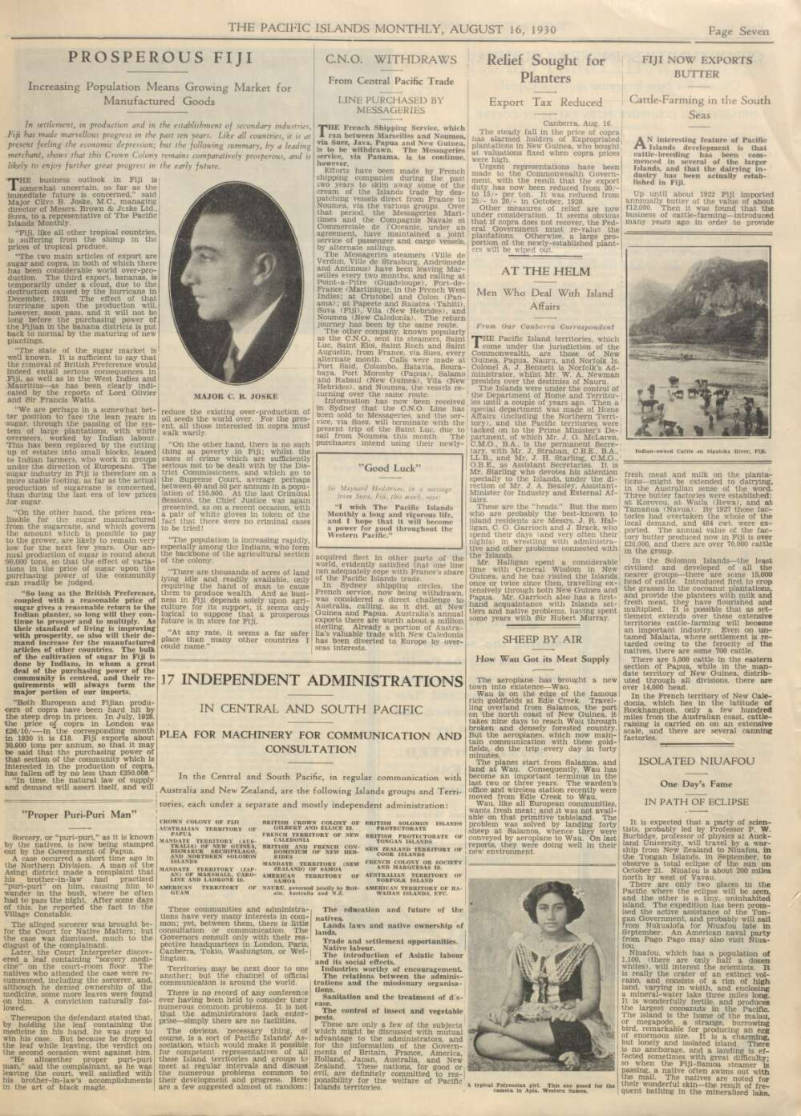
Increasing Population Means Growing Market for Manufactured Goods
In settlement, in production and in the establishment of secondary industries, Fiji has made marvellous progress in the past ten years. Like all countries, it is at present feeling the economic depression; but the following summary, by a leading merchant, shows that this Crown Colony remains comparatively prosperous, and is likely to enjoy further great progress in the early future.
THE business outlook in Fiji is somewhat uncertain, so far as the immediate future is concerned,” said Major Clive B. Joske, M.C., managing director of Messrs. Brown & Jcske Ltd.
Suva, to a representative of The Pacific Islands Monthly.
“Fiji, like all other tropical countries is suffering from the slump in the prices of tropical produce.
“The two main articles of export are sugar and copra, in both of which there has been considerable world over-pro duction. The third export, bananas, is temporarily under a cloud, due to the destruction caused by the hurricane in December, 1929. The effect of that hurricane upon the production will however, soon pass, and it will not be long before the purchasing power of the Fijian in the banana districts is put back to normal by the maturing of new plantings.
“The state of the sugar market is well known. It is sufficient to say that the removal of British Preference would indeed entail serious consequences in Fiji, as well as in the West Indies and Mauritius —as has been clearly indi cated by the reports of Lord Olivier and Sir Francis Watts.
“We are perhaps in a somewhat bet ter position to face the lean years in sugar, through the passing of the sys tem of large plantations, with white overseers, worked by Indian labour.
This has been replaced by the cutting up of estates into small blocks, leased to Indian farmers, who work in groups under the direction of Europeans. The sugar industry in Fiji is therefore on a more stable footing, as far as the actual production of sugarcane is concerned, than during the last era of low prices tor sugar.
“On the other hand, the prices rea lisable for the sugar manufactured from the sugarcane, and which govern the amount which is possible to pay to the grower, are likely to remain very low for the next few' years. Our an nual production of sugar is round about 90,000 tons, so that the effect of varia tions in the price of sugar upon the purchasing power of the community can readily be judged.
“So long as the British Preference, coupled with a reasonable price of sugar gives a reasonable return to the Indian planter, so long will they con tinue to prosper and to multiply. As their standard of living is improving with prosperity, so also will their de mand increase for the manufactured articles of other countries. The bulk of the cultivation of sugar in Fiji is done by Indians, in whom a great deal of the purchasing power of the community is centred, and their re quirements will always form the major portion of our imports, “Both European and Fijian produ cers of copra have been hard hit by the steep drop in prices. In July, 1928, the price of copra in London was £26/10/ —in’“the corresponding month in 1930 it is £lB. Fiji exports about 30,000 tons per annum, so that it may be said that the purchasing power of that section of the community which is interested in the production of copra, has fallen off by no less than £250,000.”
“In time, the natural law of supply and demand will assert itself, and will
reduce the existing over-production of oil seeds the world over. For the pres ent, all those interested in copra must walk warily.
“On the other hand, there is no such thing as poverty in Fiji; whilst the cases of crime which are sufficiently serious not to be dealt with by the Dis trict Commissioners, and which go to the Supreme Court, average perhaps between 40 and 50 per annum in a popu lation of 155,000. At the last Criminal Sessions, the Chief Justice was again presented, as on a recent occasion, with a pair of whits gloves in token of the fact that there were no criminal cases to be tried!
“The population is increasing rapidly, especially among the Indians, who form the backbone of the agricultural section of the colony.
“There are thousands of acres of land lying idle and readily available, only requiring the hand of man to cause them to produce wealth. And as busi ness in Fiji depends solely upon agri culture for its support, it seems only logical to suppose that a prosperous future is in store for Fiji.
“At any rate, it seems a far safer place than many other countries I could name.”
Major C. B. Joske
"Proper Puri-Puri Man”
Sorcery, or “puri-puri,” as it is known by the natives, is now being stamped out by the Government of Papua.
A case occurred a short time ago in the Northern Division. A man of the Asingi district made a complaint that his brother-in-law had practised “puri-puri” on him, causing him to wander in the bush, where he often had to pass the night. After some days of this, he reported the fact to the Village Constable.
The alleged sorcerer was brought be for the Court for Native Matters; but the case was dismissed, much to the disgust of the complainant.
Later, the Court Interpreter discov ered a leaf containing “sorcery medi cine” on the court-room floor. The natives who attended the case were re summoned, including the sorcerer, and, although he denied ownership of the medicine, some more leaves were found on him. A conviction naturally fol lowed.
Thereupon the defendant stated that, by holding the leaf containing the medicine in his hand, he was sure to win his case. But because he dropped the leaf while leaving, the verdict on the second occasion went against him.
“He altogether proper puri-puri man,” said the complainant, as he was leaving the court, well satisfied with his brother-in-law’s accomplishments in the art of black magic.
C.N.O. Withdraws
From Central Pacific Trade
Line Purchased By
Messageries
THE French Shipping Service, which ran between Marseilles and Noumea, via Suez, Java, Papua and New Guinea, is to be withdrawn. The Messageries service, via Panama, is to continue, however.
Efforts have been made by French shipping companies during the past two years to skim away some of the cream of the Islands trade by des patching vessels direct from France to Noumea, via the various groups. Over that period, the Messageries Mari times and the Compagnie Navale et Commerciale de l’Oceanic, under an agreement, have maintained a joint service of passenger and cargo vessels, by alternate sailings.
The Messageries steamers (Ville de Verdun, Ville de Strasburg, Andromede and Antinous) have been leaving Mar seilles every two months, and calling at Point-a-Pitre (Guadeloupe), Fort-de- France (Martinique, in the French West Indies; at Cristobel and Colon (Pan ama); at Papeete and Raiatea (Tahiti), Suva (Fiji), Vila (New Hebrides), and Noumea (New' Caledonia). The return journey has been by the same route.
The other company, known popularly as the C.N.O., sent its steamers, Saint Luc, Saint Eloi, Saint Roch and Saint Augustin, from France, via Suez, every alternate month. Calls were made at Port Said, Colombo, Batavia, Soura baya. Port Moresby (Papua), Salamo and Rabaul (New Guinea), Vila (New Hebrides), and Noumea, the vessels re turning over the same route.
Information has now been received in Sydney that the C.N.O. Line has been sold to Messageries, and the ser vice, via Suez, will terminate with the present trip of the Saint Luc, due to sail from Noumea this month. The purchasers intend using their newly
acquired fleet in other parts of the world, evidently satisfied that one line can adequately cope with France’s share of the Pacific Islands trade.
In Sydney shipping circles, the French service, now being withdrawn, was considered a direct challenge to Australia, calling, as it did, at New Guinea and Papua. Australia’s annual exports there are worth about a million sterling. Already a portion of Austra lia’s valuable trade with New Caledonia has been diverted to Europe by over seas interests.
"Good Luck”
Sir Maynard Hedstrom, in a message from Suva, Fiji, this week, says: “I wish The Pacific Islands Monthly a long and vigorous life, and I hope that it will become a power for good throughout the Western Pacific.”
17 Independent Administrations
In Central And South Pacific
Plea For Machinery For Communication And
Consultation
In the Central and South Pacific, in regular communication with Australia and New Zealand, are the following Islands groups and Terri tories, each under a separate and mostly independent administration:
Crown Colony Of Fiji
Australian Territory Of
Papua
Mandate Territory (Aus
Tralia) Of New Guinea,
Bismarck Archipelago,
And Northern Solomon
Islands
Mandate Territory (Jap
An) Of Marshall, Caro
Line And Ladrone Is.
American Territory Of
Guam
British Crown Colony Of
Gilbert And Ellice Is.
French Territory Of New
Caledonia
British And French Con
Dominium Of New Heb
Rides
Mandate Territory (New
Zealand) Of Samoa
American Territory Of
Samoa
NAURU, ffoverned jointly by Brit ain, Australia and N.Z.
British Solomon Islands
Protectorate
British Protectorate Of
Tongan Islands
New Zealand Territory Of
Cook Islands
French Colony Or Society
And Marquesas Is.
Australian Territory Of
Norfolk Island
American Territory Of Ha
Waiian Islands, Etc.
These communities and administra tions have very many interests in com mon; yet, between them, there is little consultation or communication. The Governors consult only with their res pective headquarters in London, Paris, Canberra, Tokio, Washington, or Wel lington.
Territories may be next door to one another; but the channel of official communication is around the world.
There is no record of any conference ever having been held to consider their numerous common problems. It is not that the administrators lack enterprise—simply there are no facilities.
The obvious, necessary thing, of course, is a sort of Pacific Islands’ As sociation, which would make it possible for competent representatives of all these Island territories and groups to meet at regular intervals and discuss the numerous problems common to their development and progress. Here are a few suggested almost at random:
The education and future of the nativesi.
Lands laws and native ownership of lands.
Trade and settlement opportunities.
Native labour.
The introduction of Asiatic labour and its social effects.
Industries worthy of encouragement.
The relations between the adminis trations and the missionary organisa tions.
Sanitation and the treatment of disease.
The control of insect and vegetable pests.
These are only a few of the subjects which might be discussed with mutual advantage to the administrators, and for the information of the Govern ments of Britain, France, America, Holland,, Japan, Australia, and New Zealand. These nations, for good or evil, are definitely committed to res ponsibility for the welfare of Pacific Islands territories.
Relief Sought for Planters Export Tax Reduced
Planters Export Tax Reduced
Canberra, Aug. 16.
The steady fall in the price of copra has alarmed holders of Expropriated plantations in New Guinea, who bought at valuations fixed when copra prices were high.
Urgent representations have been made to the Commonwealth Govern ment, with the result that the export duty has now been reduced from 20/to 15/- per ton. It was reduced from 25/- to 20/- in October, 1928.
Other measures of relief are now under consideration. It seems obvious that if copra does not recover, the Fed eral Government must re-value the plantations. Otherwise, a large pro portion of the newly-established plant ers will be wiped out.
At The Helm
Men Who Deal With Island Affairs
From Our Canberra Correspondent THE Pacific Island territories, which come under the jurisdiction of the Commonwealth, are those of New Guinea, Papua, Nauru, and Norfolk Is.
Colonel A. J. Bennett is Norfolk’s Ad ministrator, whilst Mr. W. A. Newman presides over the destinies of Nauru.
The Islands were under the control of the Department of Home and Territor ies until a couple of years ago. Then a special department was made of Home Affairs (including the Northern Terri tory), and the Pacific territories were tacked on to the Prime Minister’s De partment, of which Mr. J. G. McLaren, C.M.G., 8.A., is the permanent Secre tary, with Mr. J. Strahan, C.B.E., B.A., LL.B., and Mr. J. H. Starling, C.M.G., O.B.E., as Assistant Secretaries. It is Mr. Starling who devotes his attention specially to the Islands, under the di rection of Mr. J. A. Beasley, Assistant- Minister for Industry and External Af fairs.
These are the “heads.” But the men who are probably the best-known to island residents are Messrs. J. R. Hal ligan, C. G. Garrioch and J. Brack, who spend their days (and very often their nights) in wrestling with administra tive and other problems connected with the Islands.
Mr. Halligan spent a considerable time with General Wisdom in New Guinea, and he has visited the Islands once or twice since then, travelling ex tensively through both New Guinea and Papua. Mr. Garrioch also has a first hand acquaintance with Islands set tlers and native problems, having spent some years with Sir Hubert Murray.
Sheep By Air
How Wau Got its Meat Supply
The aeroplane has brought a new town into existence —Wau.
Wau is on the edge of the famous rich goldfields at Edie Creek. Travel ling overland from Salamoa, the port on the north coast of New Guinea, it takes nine days to reach Wau through broken and densely forested country.
But the aeroplanes, which now' main tain communication with these gold fields, do the trip every day in forty minutes.
The planes start from Salamoa, and land at Wau. Consequently, Wau has become an important terminus in the last two or three years. The warden’s office and wireless station recently were moved from Edie Creek to Wau.
Wau, like all European communities, wants fresh meat; and it was not avail able on that primitive tableland. The problem was solved by landing forty sheep at Salamoa, whence they were conveyed by aeroplane to Wau. On last reports, they were doing well in their new environment.
A typical Polynesian girl. This one posed for the camera in Apia, Western Samoa.
Cattle-Farming in the South
Fiji Now Exports
Butter
Cattle-Farming in the South Seas
AN interesting feature of Pacific Islands development is that cattle-breeding has been com menced in several of the larger Islands, and that the dairying in dustry has been actually estab lished in Fiji.
Up until about 1922 Fiji imported annually butter of the value of about £12,000. Then it was found that the business of cattle-farming—introduced many years ago in order to provide
fresh meat and milk on the planta tions—might be extended to dairying, in the Australian sense of the word.
Three butter factories were established: at Korovou, at Waila (Rewa), and at Tamanua (Navua). By 1927 those fac tories had overtaken the whole of the local demand, and 484 cwt. were ex ported. The annual value of the fac tory butter produced now in Fiji is over £20,000, and there are over 70,000 cattle in the group.
In the Solomon Islands —the least civilised and developed of all the nearer groups—there are some 15,000 head of cattle. Introduced first to crop the grasses in the cocoanut plantations, and provide the planters with milk and fresh meat, they have flourished and multiplied. It is possible that as set tlement extends over these extensive territories cattle-farming will become an important industry. Even on un tamed Malaita, where settlement is re tarded owing to the ferocity of the natives, there are some 700 cattle.
There are 5,000 cattle in the eastern section of Papua, while in the man date territory of New Guinea, distrib uted through all divisions, there are over 14,000 head.
In the French territory of New Cale donia, which lies in the latitude of Rockhampton, only a few hundred miles from the Australian coast, cattle raising is carried on on an extensive scale, and there are several canning factories.
Indian-owned Cattle on Sigatcka River, Fiji.
Isolated Niuafou
One Day’s Fame
In Path Of Eclipse
It is expected that a party of scien tists, probably led by Professor P. W.
Burbidge, professor of physics at Auck land University, will travel by a war ship from New Zealand to Niuafou, in the Tongan Islands, in September, to observe a total eclipse of the sun on October 21. Niuafou is about 200 miles north by west of Vavau.
There are only two places in the Pacific where the eclipse will be seen, and the other is a tiny, uninhabited island. The expedition has been prom ised the active assistance of the Ton gan Government, and probably will sail from Nukualofa for Niuafou late in September. An American naval party from Pago Pago may also visit Niua fou.
Niuafou, which has a population of 1,100, (there are only half a dozen whites), will interest the scientists. It is really the crater of an extinct vol cano, and consists of a rim of high land, varying in width, and enclosing a mineral-water lake three miles long.
It is wonderfully fertile, and produces the largest cocoanuts in the Pacific.
The island is the home of the malau. or megapode, a strange, burrowing bird, remarkable for producing an egg of enormous size. It is a charming, but lonely and isolated island. There is no anchorage, and a landing is ef fected sometimes with great difficulty; so when the Fiji-Samoa steamer is passing, a native often swims out with the mail. The natives are noted for their wonderful skin—the result of fre quent bathing in the mineralised lake.
Opportunities In New Guinea
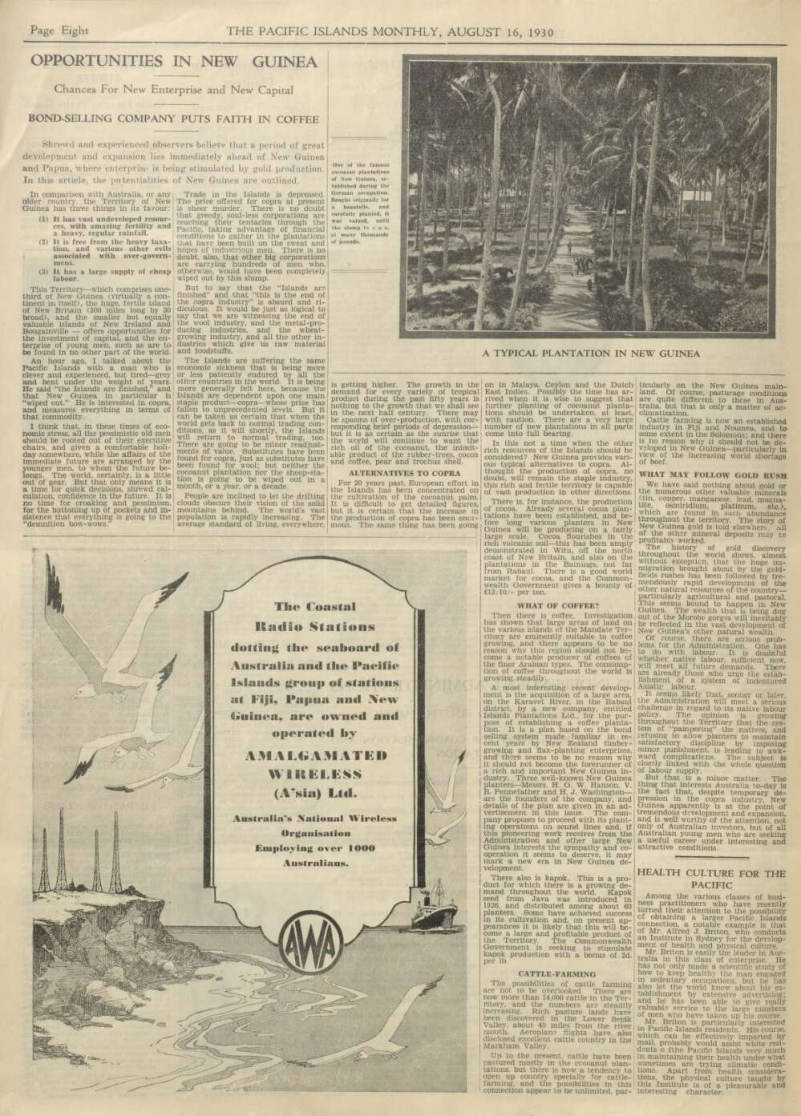
Chances For New Enterprise and New Capital
Bond-Selling Company Puts Faith In Coffee
Shrewd and experienced observers believe that a period of great development and expansion lies immediately ahead of New Guinea and Papua, where enterprise is being stimulated by gold production.
In this article, the potentialities of New Guinea are outlined.
In comparison with Australia, or any older country, the Territory of New Guinea has three things in its favour: (1) It has vast undeveloped resour ces, with amazing fertility and a heavy, regular rainfall. (2) It is free from the heavy taxa tion, and various other evils associated with over-government. (3) It has a large supply of cheap labour.
This Territory—which comprises one third of New Guinea (virtually a con tinent in itself), the huge, fertile island of New Britain (300 miles long by 30 broad), and the smaller but equally valuable islands of New Ireland and Bougainville offers opportunities for the investment of capital, and the en terprise of young men, such as are to be found in no other part of the world.
An hour ago, I talked about the Pacific Islands with a man who is clever and experienced, but tired —grey and bent under the weight of years.
He said “the Islands are finished,” and that New Guinea in particular is “wiped out.” He is interested in copra, and measures everything in terms of that commodity.
I think that, in these times of eco nomic stress, all the pessimistic old men should be rooted out of their executive chairs, and given a comfortable holi day somewhere, while the affairs of the immediate future are arranged by the younger men, to whom the future be longs. The world, certainly, is a little out of gear. But that only means it is a time for quick decisions, shrewd cal culation, confidence in the future. It is no time for croaking and pessimism, for the buttoning up of pockets and in sistence that everything is going to the “demnition bow-wows.”
Trade in the Islands is depressed.
The price offered for copra at present is sheer murder. There is no doubt that greedy, soul-less corporations are reaching their tentacles through the Pacific, taking advantage of financial conditions to gather in the plantations that have been built on the sweat and hopes of industrious men. There is no doubt, also, that other big corporations are carrying hundreds of men who, otherwise, would have been completely wiped out by this slump.
But to say that the “Islands are finished” and that “this is the end of the copra industry” is absurd and ri diculous. It would be just as logical to say that we are witnessing the end of the wool industry, and the metal-pro ducing industries, and the wheat growing industry, and all the other in dustries which give us raw material and foodstuffs.
The Islands are suffering the same economic sickness that is being more or less patiently endured by all the other countries in the world. It is being more generally felt here, because the Islands are dependent upon one main staple product—copra—whose price has fallen to unprecedented levels. But it can be taken as certain that when the world gets back to normal trading con ditions, as it will shortly, the Islands will return to normal trading, too.
There are going to be minor readjust ments of value. Substitutes have been found for copra, just as substitutes have been found for wool; but neither the cocoanut plantation nor the sheep-sta tion is going to be wiped out in a month, or a year, or a decade.
People are inclined to let the drifting clouds obscure their vision of the solid mountains behind. The world’s vast population is rapidly increasing. The average standard of living, everywhere,
is getting higher. The growth in the demand for every variety of tropical product during the past fifty years is nothing to the growth that we shall see in the, next half century. There may be spasms of over-production, with cor responding brief periods of depression— but it is as certain as the sunrise that the world will continue to want the rich oil of the cocoanut, the inimit able product of the rubber-trees, cocoa and coffee, pear and trochus shell.
Alternatives To Copra
For 20 years past, European effort in the Islands has been concentrated on the cultivation of the cocoanut palm.
It is difficult to get detailed figures, but it is certain that the increase in the production of copra has been enor mous. The same thing has been going i
on in Malaya, Ceylon and the Dutch East Indies. Possibly the time has ar rived when it is wise to suggest that further planting of cocoanut planta tions should be undertaken, at least, with caution. There are a very large number of new plantations in all parts come into full bearing.
Is this not a time when the other rich resources of the Islands should be considered? New Guinea provides vari ous typical alternatives to copra. Al thought the production of copra, no doubt, will remain the staple industry, this rich and fertile territory is capable of vast production in other directions.
There is, for instance, the production of cocoa. Already several cocoa plan tations have been established, and be fore long various planters in New Guinea will be producing on a fairly large scale. Cocoa flourishes in the rich volcanic soil —this has been amply demonstrated in Witu, off the north coast of New Britain, and also on the plantations in the Bainings, not far from Rabaul. There is a good world market for cocoa, and the Common wealth Government gives a bounty of £l3/10/- per ton.
What Of Coffee?
Then there is coffee. Investigation has shown that large areas of land on the various islands of the Mandate Ter ritory are eminently suitable to coffee growing, and there appears to be no reason why this region should not be come a notable producer of coffees of the finer Arabian types. The consump tion of coffee throughout the world is growing steadily.
A most interesting recent develop ment is the acquisition of a large area, on the Karavet River, in the Rabaul district, by a new company, entitled Islands Plantations Ltd., for the pur pose of establishing a coffee planta tion. It is a plan based on the bond selling system made familiar in re cent years by New Zealand timber growing and flax-planting enterprises, and there seems to be no reason why it should not become the forerunner of a rich and important New 1 Guinea in dustry. Three well-known New Guinea planters—Messrs. H, G. W. Hanson, V.
B. Pennefather and H. J. Washington— are the founders of the company, and details of the plan are given in an ad vertisement in this issue. The com pany proposes to proceed with its plant ing operations on sound lines and, if this pioneering work receives from the Administration and other large New Guinea interests the sympathy and co operation it seems to deserve, it may mark a new era in New Guinea de velopment.
There also is kapok. This is a pro duct for which there is a growing de mand throughout the world. Kapok seed from Java was introduced in 1926, and distributed among about 60 planters. Some have achieved success in its cultivation and, on present ap pearances it is likely that this will be come a large and profitable product of the Territory. The Commonwealth Government is seeking to stimulate kapok production with a bonus of 2d. per lb.
Cattle - Farming
The possibilities of cattle farming are not to be overlooked. There are now more than 14,000 cattle in the Ter ritory, and the numbers are steadily increasing. Rich pasture lands have been discovered in the Lower Sepik Valley, about 40 miles from the river mouth. Aeroplane flights have also disclosed excellent cattle country in the Markham Valley.
Up to the present, cattle have been pastured mostly in the cocoanut plantations, but there is now a tendency to open up country specially for cattle farming, and the possibilities in this connection appear to be unlimited, par
ticularly on the New Guinea main land. Of course, pasturage conditions are quite different to those in Aus tralia, but that is only a matter of ac climatisation.
Cattle farming is now an established industry in Fiji and Noumea, and to some extent in the Solomons; and there is no reason why it should not be de veloped in New Guinea —particularly in view of the increasing world shortage of beef.
What May Follow Gold Rush
We have said nothing about gold or the numerous other valuable minerals (tin, cooper, manganese, lead, magna tite, osmiridium, platinum, etc.),, which are found in such abundance throughout the territory. The story of New Guinea gold is told elsewhere. All of the other mineral deposits may be profitably worked.
The history of gold discovery throughout the world shows, almost without exception, that the huge im migration brought about by the gold fields rushes has been followed by tre mendously rapid development of the other natural resources of the country— particularly agricultural and pastoral.
This seems bound to happen in New Guinea. The wealth that is being dug out of the Morobe gorges will inevitably be reflected in the vast development of New Guinea’s other natural wealth.
Of course, there are serious prob lems for the Administration. One has to do with labour. It is doubtful whether native labour, sufficient now, will meet all future demands. There are already those who urge the estab lishment of a system of indentured Asiatic labour.
It seems likely that, sooner or later, the Administration will meet a serious challenge in regard to its native labour policy. The opinion is growing throughout the Territory that the sys tem of “pampering” the natives, and refusing to allow planters to maintain satisfactory discipline by imposing minor punishment, is leading to awk ward complications. The subject is closely linked with the whole question of labour supply.
But that is a minor matter. The thing that interests Australia to-day is the fact that, despite temporary de pression in the copra industry, New Guinea apparently is at the point of tremendous development and expansion, and is well worthy of the attention, not only of Australian investors, but of all Australian young men who are seeking a useful career under interesting and attractive conditions.
One of the famous cocoanut plantations of New Guinea, es tablished during the German occupation.
Bought originally for a bagatelle, and carefully planted, it was valued, until the slump in c.p.a, at many thousands of pounds.
A Typical Plantation In New Guinea
Health Culture For The
Pacific
Among the various classes of busi ness practitioners who have recently turned their attention to the possibility of obtaining a larger Pacific Islands connection, a notable example is that of Mr. Alfred J. Briton, who conducts an Institute in Sydney for the develop ment of health and physical culture.
Mr. Briton is easily the leader in Aus tralia in this class of enterprise. He has not only made a scientific study of how to keep healthy the man engaged in sedentary occupations, but he has also let the world know about his es tablishment by extensive advertising; and he has been able to give really valuable service to the large numbers of men who have taken up his course.
Mr. Briton is particularly interested in Pacific Islands residents. His course, which can be effectively imparted by mail, probably would assist white resi dents o fthe Pacific Islands very much in maintaining their health under what sometimes are trying climatic condi tions. Apart from health considera tions, the physical culture taught by this Institute is of a pleasurable and
interesting character.
Advertisements & other items, p. 8 (1 item)
(A'sia) Ltd.
The Coastal Radio Stations dotting the seaboard of Australia and the Pacific Islands group of stations at Fiji, Papua and Neu Guinea, are owned and operated by
AMALGAMATED
WIRELESS
(A'sia) Ltd.
Australia's National Wireless Organisation Employing over 1000 Australians.
Exit Levuana
End of a Fijian Pest
Malay Fly Saves Copra
Industry
ONE of the most important and in teresting developments in the South Seas in recent years is the success which has attended the efforts of the Fijian administration to get control of the cocoanut pest, the purple moth, known as Levuana Iridescens. By this success, a menace to the chief indus try of the Pacific has been removed.
It is sixty years since this insect was first noted in the large island of Viti Levu, where its attacks on coconut palms were found to bd so serious that the production of copra was impossible.
The result has been that, while all the other islands of the rich group have produced copra, worth not less than £500,000 annually, Viti Levu has had to look to sugar and other crops for reve nue.
During many years, while the pest was confined to the main island, the authorities sought methods of checking it, but nothing of moment was achieved. Suddenly, the moth appeared in the island of Ovalau, between Viti Levu and Vanua Levu—which meant
that the other islands and therefore the whole copra industry were threat ened. It meant, also, that if the pest could reach Ovalau, it might get across from Fiji to other South Ssa groups.
The Fijian entomologists speeded up their work. They had introduced from the Federated Malay States, with the greatest difficulty, a fly with the unpro nounceable name of Ptychomyia Re mota. At first, this creature did not appear to like its new home, and lang uished. Then, very quickly, it began to multiply, and by the end of 1926 war against Levuana began to enter a new phase.
By the end of 1927, so rapidly did the fly operate, the ranks of the moth, in the words of Sam Weller, had be gun to “wisibly shrink.” The defolia tion of the cocoanut palms by the pest in the affected areas of Viti Levu and Ovalau has now been markedly re duced, and there seems every reason for believing that the end of the Levuana moth is within sight, and that the copra industry can be established at last in Viti Levu. It is all in line with the great prosperity which Fiji has been enjoying.
Other parasites, calculated to cause Levuana a certain amount of excite ment and distress, had been discovered in Java; but in view of what the Malayan fly had achieved, they were not called into the conflict.
The only source of anxiety in Fiji now concerns the future activities of the fly. What will it attack when it has wiped out Levuana?
A glimpse of Suva, the capital of the flourishing colony of Fiji. This place, with its tropical beauty and equable and healthy climate, is destined to be the popular winter resort of Australians and New Zealanders.
Our Fijian Newsletter
Rapid Growth Of Indian Population
From Our Own Correspondent
Suva, July 26.
THE population of Fiji is curiously divided. There are over 4,000 Euro peans. The native population numbers 90,000—and the natives, of course, are largely the landowners. The Indians, brought in originally to work the sugar plantations, are now 65,000. They are largely engaged in agriculture, and are rapidly overhauling the native popula tion. And there are 1,000 Chinese.
The Indians are now a power to be reckoned with in the Colony’s economy.
They have in many cases become wealthy, and all the motor cars (some 700), are driven, and mostly owned, by Indians.
The Chinese have mostly driven the Indian storekeepers out of business in the country districts, and are slowly but surely capturing the small trade of the colony.
With the dissolution of Brodziak Ltd. there are now only two European main trading concerns in Fiji—Burns Philp (South Sea) Co. Ltd., and Morris Hed strom Ltd., who have branches in the chief country towns. Besides them,
there Is Brown and Joske Ltd., a big trading firm in Suva, and agents for the Fiji Coconut Planters’ Union, which comprise the leading planters of the colony, and others of less importance.
The climate is perfect, although rather humid or muggy in the summer months, but the glass seldom goes over 90, and the winter is perfection. There is no malaria, and Europeans live to a great age. A favourite example given is that a gentleman who a few years ago, personally canvassed the whole municipality for votes, when he con tested an election, and he was 96 years old.
The Big Carnival
During the past fortnight all foot steps led to the Suva Bowling Green, where the sixth annual bowling carni val was taking place. This event is the big social function of the year, and right along its course there is a trail of balls, picnics, motor drives, and all sorts of social functions. The function was quite up to the best traditions, and the only regret was that Australia, which has taken so successful a part in these contests in the past, was able only to make up one team for the big event (The South Pacific Pennant), While in the past, N.S.W., Victoria, and South Australia have each had a sepa rate team of two rinks. This year, for the first time, New Zealand, which was heavily represented, won everything, including the Open Rinks, the Cham pion Pairs, the Champion Singles, and the Pacific Pennant.
Personal
It is seldom the lot of a police officer to have greatness thrust upon him, yet that was the fats of Sub-Inspector Holland, hon. A.D.C. to the Governor, when H.M.S. Dunedin was in port.
His Excellency, the Acting-Governor, was indisposed, so he sent his Aide to represent him on the official call.
On leaving, the Sub-Inspector was honoured with the salute of guns usually accorded to Governors.
Hon. Henry Marks, C.B.E., the Mayor of Suva, accompanied by Mrs. Marks, arrived by the Remuera from London, after spending six months in travel through Australia and the Old Coun try.
This afternoon, at Holy Trinity pro- Cathedral, by the Venerable Arch deacon Hands, Sub-Inspector W.
Flower, elder son of Major and Mrs.
Stanley Flower, of Spencers Green Tring, Herts, England, was married to Miss Dorothy Drage, elder daughter of Lieut.-Colonel and Mrs. Drage, of “Tarciau,” Criccuth, North Wales. The bride, who had recently arrived with her mother and sister from England, entered the church on the arm of His Honour the Chief Justice, who gave her away. Mr. Pakenham-Walsh, Acting D.C., was best man. A reception was
held at the residence of the Chief Justice (Captain Anderson, K.C., R.N.) Sir Henry Scott, K.C., who has been laid up for some time, suffering from blood-poisoning, has resumed business activities.
His Excellency, the Acting-Governor, Mr. Islay McOwan, C.M.G., who has been ill with throat trouble, is once more back on duty.
On the motion of Sir Henry Scott, K.C., Mr. William Lambert Davidson has been admitted to the Fiji Bar. He has practised in New Zealand. It is understood that Mr. Davidson will practice at Labasa, the big sugar centre.
Religious Differences
For forty years or more during their life in Fiji, the Indians have left their religious differences (which are the cause of so much trouble in India) at home, and the Colony has been free of religious strife. But the spirit of dis cord which is penetrating into all corn ers of the world has at last reached us, and there are reports of trouble among Indian canegrowers on the Rewa River.
Hindus will not work under a Ma hommedan, or vice versa and, mean time, business stands still.
Still, the thing that makes an Indian “sit up and take notice” is his pocket, and as some £6,000 worth of cane is in jeopardy, it is believed that the need to save the cane-money will dominate all other considerations—at least, for the time being.
A Government With A
Surplus!
While financial troubles are being re ported from all over the world, it is re freshing to hear of a country that is living within its income, and whose Budget shows a credit balance. Such is the happy position of Fiji, whose Treasurer has shown a credit for the past four years, and converted a former debit balance of £200,000 into a credit of over £150,000. On top of this, so good is the credit of the Colony, that the Government is committed to a loan expenditure policy running into nearly half a million.
The first big job will be the extension of the main round-the-Island road, so that when the connecting links are finished, a tourist will be able to travel by car, over 150 miles of excellent road, amid the most lovely scenery, combin ing coastal and reef beauties, with the grandeur of mountain peaks and deep verdant valleys, full of flowering bush and majestic timber.
Other public works will follow, and much progress can be looked for in Fiji during the next three years.
Naval Courtesies!
The visit of H.M.S. Dunedin was the occasion of a good deal of soreness among Suva citizens. It appears that the Deputy-Mayor, in the absence of the Mayor, who was abroad, attended by the town clerk, called upon the Commodore on the arrival of the ship.
At the same time, the Acting-Colonial Secretary also made a formal call. To neither of these public officials did Commodore Blake see fit to accord a return call. Neither were they in vited to any function on board the warship during her week’s stay.
The injury was aggravated by a be lated call from the Commodore’s sec retary, prior to leaving, to say that the Commodore did not know of the visit— although both visitors were duly per sonally introduced, and chatted with the naval gentleman. Further, the Colonial Secretary arranged a big pic nic to the men of the ship, and the event proved a great success.
Hurricane’S Silver Lining
The Rev. R. L. McDonald, chairman of the Fiji Methodist Mission, has just completed 1,100 miles by water in four weeks, in the small schooner John Wesley, visiting the Yasawas and the Lau groups.
In the latter, at the island of One ata, a special dedication and centenary service was held to commemorate the centenary of the landing of the three Tahitian native missionaries, who pre pared the way for Rev. Mr. Cross and the Rev. Mr. Cargill, five years later.
Generally, Mr. McDonald found that the late hurricane had had a beneficial effect by improving the land. At the Yasawas, the land was salted by the flying spray, which swept over the highest hills; and on the Rewa it was improved by layers of silt, which man ured the land.
The mission is taking steps to im prove the general elementary educa tion of the natives by grouping the vil lage schools into district schools, with a higher standard of teaching.
Although on the island of Oneata, the natives would not be able to earn their tax money, owing to a drought, the outlying native population gener ally was in quite a happy and pros perous condition.
Island Plantations Limited
New Guinea
Particulars of Profit-Sharing Bonds Now Offered for Sale
Directors:
H. G. W. Hanson, Esq.
Owner, Same Plantation, Namatanai, New Guinea.
V. B. Pennefather, Esq.
Owner, Tokua Plantation, Kopoko, New Guinea.
H. J. Washington, Esq.
Owner, Kabaria Plantation, Rabaul, New Guinea.
ILAND PLANTATIONS LIMITED has been formed with a nominal Bond and Share Capital of £216,500, for the purpose of acquiring land in New Britain, 32 miles from Rabaul, and establishing a Coffee Planta tion. The whole of the Share Capital necessary to allow the Company to function and carry out its obligations has been subscribed. It has acquired 3,500 acres of first-class coffee land, and Bonds are now being offered to the public.
There are three series of Bonds —"A,” “B” and "C.” Xt is the issue of “A” Bonds, limited to 2,000, which are now for sale, at £29/10/- each, cash or terms.
Approximately 1,000 acres of the estate are to be transferred to Trustees on behalf of the ' A” issue Bondholders—that is, each Bondholder will own half an acre of the plantation. "B” and "C” Bonds, representing further divisions of the estate, are not yet for sale. The Company will commence operations with that portion of the estate represented by "A” Bonds.
The Company makes itself respons ible to the Trustees appointed by the Bondholders and enters into guaran tees that it will faithfully discharge the following obligations:
It will transfer to the Bondhold ers of “A” issue the ownership of approximately one thousand acres of suitable land.
It will plant the estate with cof fee and bring it to the production stage (approxi mately 3 years).
It will fully equip the estate with proper trans port facilities, plant and machi nery, and all the necessary build ings.
It will act as Managing Agents for the Bondhold ers after the ac tual stage of pro duction has been reached.
It will definitely contract with the purchasers of the first 1,000 Bonds of “A” issue, if the latter desire it, to re sell the Bonds in December, 1933, at a premium equal to 10 per cent, per an num on their face value. In other words, during the three years of plant ing and preparation, before production is reached, purchasers of the first Bonds are guaranteed 10 per cent, per annum on the amount they have in vested.
It will pay half the amount received from the sale of each Bond into a Trust Account, to be operated jointly by the Bondholders’ Trustees and the Com pany, in accordance with stated condi tions, as a guarantee that the Company will carry out its undertakings.
The Bonds carry a Death Benefit.
Should any purchaser die before his Bond is fully paid for, the Bond will be regarded as fully paid up and trans ferred accordingly to his legal heir.
The land is to be planted with Ro busta Coffee, a species thoroughly tried, tested and proved to be profitable.
Statistics show that it will yield from 10 to 15 cwt. of coffee per acre per annum; but in all estimates of profits only 10 cwt. per annum has been al lowed for. There is a steady, growing market for coffee. It is also calculated that there will be no production in the first three years after planting; half production in the fourth year; three quarters production in the fifth year, and full production in the sixth year.
These are highly conservative esti mates, as a Coffee Plantation, favour ably situated and skilfully managed, as this one will be, should be in full production in considerably less than six years.
On the basis of the above figures, purchasers in 1930 of “A” Bonds should receive on their £29/10/- investment a profit of £6/10/- in 1934, £l3/10/- in 1935, and £2O/10/- in 1936, and thereafter.
Planting And
Technical.
As regards the planting and tech nical side, the Di rectors have been fortunate in being able to retain the services of Mr. H.
G. W. Hanson, Plantation Owner, of New Guinea.
He will direct the planting opera tions, and will see that a careful up keep of the plan tation is provided; he will alvise his co-directors, all of whom are plan tation owners and men of practical experience, on matters of planting policy, and will indicate the most up-to date and scientific
lines on which to proceed.
The following are extracts from the report by Mr. George Murray, Director of Agriculture in New Guinea: “I consider the land acquired by the Company is ideal for coffee culti vation. The soil at the Karavat is a deep volcanic loam, well drained, and should produce good crops of coffee.
“Coffee now growing on this pro nerty is flowering at eighteen months from time of planting.
“I consider the Company’s land is ideally situated as regards transport by motor road and water, “There is not the slightest risk of damage to the plantation by fire or floods.
“I consider Mr. Hanson has the practical knowledge necessary for the planting and developing of the Company’s plantations.”
Special Advantages.
The establishment of a Coffee Plan tation in New Guinea has several pecu liar advantages. The land and climate are eminently suitable; there is an absence of the heavy taxation which is now being experienced in Australia; there is plenty of cheap, native labour; and there is in Australia alone a huge market for the product. Australia in 1929- imported 3,600,000 lb. of coffee.
Coffee from foreign countries is subject to a duty of 3d. per lb. Coffee grown in New Guinea is admitted into Aus tralia free.
This is one of the most attractive investments of this kind ever offered to the Australian public. The Directors invite anyone interested to make the fullest investigation of the detailed in formation, which they will supply in a handbook.
Extract from the “Rabaul Times,”
Friday, March 21st, 1930.
“Recently registered in Rabaul, this com pany has for its objects, inter alia, the planting of coffee on a large scale, 3,500 acres being one of the areas mentjoped.
“The Board of Directors comprises Mr. H.
G. W. Hanson (owner of Samo Plantation), Mr. V. B. Pennefather (owner of Tokua Plantation), and Mr. H. J. Washington (owner of Kabaira Plantation). It would be difficult to imagine a stronger directorate for such a company, each member being a practical planter, well and favourably known throughout the Territory.”
“The planting and general agricultural activities will be in the proved capable bands of Mr. Geo. Hanson, who planted, in a phenomenally short time, Samo Planta tion, the largest post-war British plantation In New Guinea.
“Mr. H. G. Murray (Director of Agricul ture) has reported that the area mentioned above is eminently suited to the growing of coffee and other tropical products.
“We have been privileged to peruse the company’s draft prospectus, and are of the opinion that the estimates are conservative, it would appear that the returns from an investor’s point of view will be excellent.”
Advertisements & other items, p. 9 (2 items)
Do You Want This Journal?
THE Pacific Islands Monthly will provide you with a reliable summary of all that is happening in the Central and South Pacific Islands.
Particularly will it give you early information about trade, settlement and industrial opportunities. If you wish to keep in touch with developments in these rich and growing territories, fill in and post this form: To Pacific Publications, Lisgar House, Wynyard Square, Sydney.
"Please find herewUh 6/-. being one year’s subscription to The Pacific Islands Monthly, which please post regularly to M 1 Signature of person ordering Date
Returns
If you are looking for a profitable investment for your savings, or a fine endowment for your children, fill in and post this form. It places no obligation upon you—we shall simply supply you with full particulars: The Secretary, Islands Plantations Ltd., St. James’ Building. 107 Elisabeth Street, Sydney.
Please forward me particulars of your "A” Series Bonds, which you are now offering for sale.
Name Full Address Date
RETURNS
Estimated Investment to Return per Annum 1 Bond, £29/10/- - £20/10/- 2 Bonds, £59 - - £41 5 Bonds, £147/10/-, £102/10/- 10 Bonds, £295 - - - £205 20 Bonds, £590 - - - £410
Air Services
Inaugurated in Fiji
Running Mails To Outer
Ports
REGULAR aeroplane communi
cation between the more im portant centres in the Fijian group
was inaugurated recently.
There was great excitement in Lau toka on July 15, when the seaplane “Adi Lagi,” piloted by Captain Fenton, ar rived at 8 a.m. from Suva, on its in augural, mail-carrying trip. About 1,000 Europeans, Fijians, Hindus, and Chinese assembled at the wharf about 8 a.m., to welcome the unusual visitor.
The natives were convinced that the plane was either a god or a devil-ship, otherwise she could not have travelled from Suva in 75 minutes. Amid the shrieks of the excited Fijians, the plane took off again before 10 a.m. for Ba, and back to Suva.
Soon after 10 a.m., on the following day (the 16th), a wild clamour among the natives in Levuka announced the arrival of the plane at Ovalau Island, and it came gracefully to rest at Na sova (in Levuka Harbour), thence being towed to King’s Wharf. It brought the District Commissioner (Commander W.
Burrows) as its first passenger. A little later it flew over to Koro Island, 40 miles away, with Mr. C. H. Hopewell, and landed him at his plantation (Ma tana), and returned to Levuka. It re turned that evening to Suva, with a Levuka mail.
On Thursday the plane flew from Suva to the island Qf Wakaya, north east of Levuka, with Mr. Wise (Com missioner of Works), and returned to Levuka. The following day, it flew over to Vanua Levu, landed mails at La basa, and returned to Suva via Wakaya, where it picked up Mr. Wise.
The machine used is a Moth biplane, equipped witn floats; and the success ful inauguration of this service shows the important part that aeroplanes are likely to play in the development of these rich island groups of the South Seas.
Cook Islands Notes
Maori Chiefs Visit the Track of the Ancient Migration
From Our Our Correspondent
Rarotonga, July 20.
BY recent mail steamer we received a visit from a party of N.Z. Maori chiefs, who spent the w'eek-end here meeting our Rarotongan Maoris. Ac cording to the New Zealand press, the party came down to try and establish relationships with our Maoris. It is established tradition (both here and in N.Z.) that it was from Rarotonga that the Maoris went to New Zealand (about 600 years ago). The language is practically the same. Their time here was spent mainly in feasting, though they had an opportunity of see ing the fruit packing sheds in opera tion, the schools, hospital, and one or two native plantations. The party was accompanied by Mr. H. R. H. Balneavis, Private Secretary to the Minister of the Cook Islands, and Masters H. and H. Ngata (2), and Miss Hana Ngata.
It was originally intended that the Hon. Sir Aspirana Ngata, N.Z. Minis ter of the Cook Islands, would visit the Island, and that the party would ac company him, but he was detained in N.Z. on account of the political situa tion there at the time, and the party came on without him.
By the same steamer Judge H. Carr (N.Z. Native Land Court, Gisborne) ar rived to relieve Resident Commissioner Judge H. F. Ayson for three months, the latter leaving for New Zealand to undertake some special Land Court work for the New Zealand Government.
Mr. S. J. Smith (Secretary of the Cook Islands Department, Wellington.
N.Z.) recently stayed a month here During this time he paid a visit to the Lower Group Islands per s.s. “Wai pahi,” and managed to stay a week at Mangaia, connecting with a schooner from there back to Rarotonga.
Mr. A. F. Scherer, headmaster of the Avarua School, has retired, and re turned to N.Z. In addition to his ordi nary duties, Mr. Scherer had acted as Superintendent of Schools for the past two years. His place was filled by the transfer of Mr. A. McKenzie from the Aitutaki School, to be headmaster of Avarua School and local Education Officer. A male assistant has also been appointed to the Avarua School (Mr.
C. E. Taverner), in order to relieve Mr.
McKenzie of some of the routine work, and allow him to devote more time to the general work of all the schools.
Death Of Maui Pomare
News of the death in California cf Sir Maui Pomare, K.B.E., C.M.G., came
as a great shock to the people of Rarotonga, where he was well known and very popular.
Sir Maui passed through on May 24 by mail steamer on his health re cruiting visit to California, and al though he was too ill to come ashore a great many of his friends went out on board to see him. He died in California on June 27. He had been Minister of the Cook Islands for 16 years.
On his retire ment, at the ter mination of the Reform Govern
merit in December, 1928, the people of the Cook Islands presented him with an illuminated address. This was made locally by Mr. Wm. McBirney, of Arorangi, planter. It was signed by the leading Europeans and natives. Here is a small photograph of it.
The Pure Fruit Products Company are at present working at full pressure, canning orange juice, lemon juice, lemon peel, etc., for the N.Z. market.
This co. was formed on the strength of the experiments of Mr. F. V. Senn on the preservation of orange juice.
Last year a Bowling Club was formed in Rarotonga, and slowly and surely
the green has been got in order. At present a top-dressing is being put on, and it is hoped to open the green soon.
H.M.S. Laburnum is due at Raro tonga in August, and the Sports Asso ciation has decided to put an Associa tion team against the warship. Al though the natives do not now play Soccer —much preferring Rugby—it has always been found possible to get a team to score a win against the war ships, every time they have played.
Good For The Labourers
Quite a stir was caused early in the orange season by the people of Aro rangi taking all the labour away from Avarua at the rate of 6/- per day.
“They had so many oranges they didn’t know what to do,” so they came in and took all the Avarua labour they could get at 6/- per diem, instead of the usual 4/-, to help them pick.
That district has had a very heavy crop of oranges this season—the pack ing shed at Arorangi has averaged over 6,000 each boat —more than twice the number handled by any of the other packing sheds. This has occa sioned a lot of night work at the shed, in order to get the fruit graded and packed in time.
The younger and more agile Euro peans have taken to climbing the pre-
cipitous peaks of this island. They surmounted Te Kou (1850 ft.), one Sun day, and on another occasion went right across the island, up the Avatiu Valley and past The Needle.
Expedition At Aitutaki
At present, in Aitutaki, there is an American Expedition, investigating the marine life there, and taking moving pictures of same. It is the Chancellor - Stuart Expedition (Mr. P. M. Chancel lor and Mr. Norton Stuart). Mr. Chan cellor is either a millionaire or mil lionaire’s son, and has taken up this work as a hobby. Mr. Stuart is the business man of the combination.
The Needle, a rock on the summit of one of Rarotonga's mountain peaks, familiar to all travel lers between Wellington and San Francisco.
Address to late Sir M. Pomare. See Letterpress.
A charming picture of Noumea, capital of New Caledonia, and tha other allied French territories. It is not generally known that Noumea is the nearest Pacific Islands town to Australia.
Information About The
Pacific Islands
Do you want any information about the Pacific Islands? If so, send your questions to The Editor, Pacific Islands Monthly, Lisgar House, Wynyard Sq., Sydney; and an answer will, if possible, be published in the next issue of the journal. In writing, please supply a nom-de-plume to which our answer may be addressed—otherwise we will use your initials.
The compilation of The Pacific Is lands Year Book, containing most of the information about the Pacific Is lands, which is now in demand, is practically complete, and will be pub lished at an early date. In the mean time, we shall try to meet requirements through this colupin.
Answers To Correspondents
E.R. (Newcastle): The trade of the Marshalls and Carolines has gone al most completely to Japan, since that nation took over the Mandate in 1919; and there is now very little communi cation between Australia and those groups. We have Japan’s annual re ports to the League of Nations on these groups, which you may see if you care to call at this office.
J.L. McG. (Sydney): Generally, diffi cult to obtain. The policy of most of the administration is to protect the native titles to land. If you could give more exact indications of your require ments, and what locality you favour, we might help you. Have you consid ered Norfolk Island?
W.R.D.: We are not quite sure, and have written for the information.
S.L. (Sydney): Companies registered under some of the Islands administra tions certainly escape a good deal of heavy taxation, compared with Aus tralian registration.
W.N. (Parramatta): Thanks may use if space permits. There are useful, statistics, dealing with New Guinea, in a folder entitled “The Golden Islands,”' just issued by the Department of Home and Territories, Canberra.
In Dutch New
Guinea
The Lure of The Unknown
From Our Thursday Island Correspondent THE man in the street does not know much about Dutch New Guinea, which I recently had the privilege of visiting.
It may occur to him that the country is largely peopled by cannibals, and of the interior this is still true. However, there is no danger in this respect along the seaboard. A road runs for ninety miles west from Merauke, crossing many rivers in its course, and along this, regular patrols are carried out by the Dutch officials.
The country might be described as crude; it has an unfinished appearance which suggests that Providence lost in terest in it before completion. There are swamps of mangrove, swamps of ti-tree, and swamps of grass. In ad dition, there are areas which might be called “Just Swamps.” The jungle is often knee-deep in water, and is trav ersed by a maze of creeks. Crocodiles and mosquitoes abound.
Apparently not a very attractive country, and yet, like other parts of the great island continent of New Guinea, it has a tremendous fascina tion for men of a roving disposition. It is the unknown that lures! What the unexplored parts of Dutch New Guinea might bring to light is the bait, gold the prize. The mountainous interior must be most interesting.
It may not be generally known that Thursday Island provides fine sport for duck-shooters. Several parties have been out recently in the Jardine Swamps, making the journey by motor boat.
Advertisements & other items, p. 10 (1 item)
Murdoch’S
Greet
m
the
Call
to Cricket !
The Alan Fairfax "Autograph” Bat
The Highest Grade Bat possible to produce. Q /
"SUPER GRADE” f \J
"The Special,” a Bat of super excellence 55/- "Standard,” exceptionally good Club or private Bat 47/6 "Super Club,” High Grade Club Bat 35/ "Club,” suitable for hard Club use 30/- "College Driver,” a size 6 Boy’s Bat. Club or private Bat. A quality seldom seen in the size 22/6
The Alan Fairfax "Practice” Bat
wear. AU Cane Handle. Made by 21/- 17/6 15/6 An excellent Bat for hard Cobbett & Sons, of London Full size Size 6 Size 5 All the above Bats bear the facsimile of the signature of Alan Fairfax, and have been personally selected by him while in England.
The "True flex”
An exceptionally good clear blade. Three-ply Cane and Rubber Handle 13/6 .. 10/6 .. 10/6 .. 10/6 9/6 Size 6 Size 6, with Two-ply Rubber and Cane Handle .
Size 5 Size 5, with Two-ply Rubber and Cane Handle
Gunn & Moore 9 s Bats
Most favourably known by all cricketers.
Autograph "Star”
Autograph Extra Special . .
Autograph Specially Selected Monogram Super Special Monogram Selected 55/- 50/- 47/6 45/- 42/6 Write for a copy of Murdoch’s New Illustrated Cricket List - - FREE
POSTAGE PAID TO YOUR DOOR.
Kindly Address all letters to Desk "C”8.
Money must accompany all Orders.
Murdochs Ltd
Park & GEORGE ST SYDNEY
“The Store of a Thousand Bats."
Products Of The South Seas
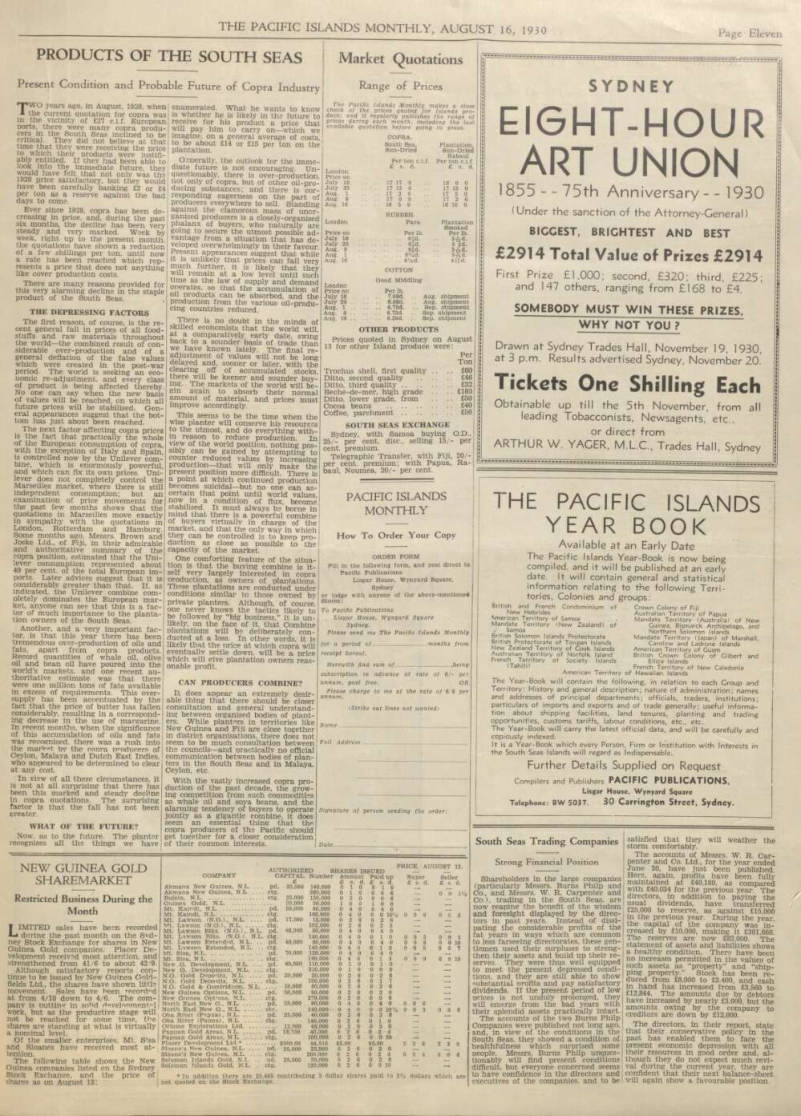
Present Condition and Probable Future of Copra Industry
TWO years ago, in August, 1928, when the current quotation for copra was in the vicinity of £27 c.i.f. European ports, there were many copra produ cers in the South Seas inclined to be critical. They did not believe at that time that they were receiving the price to which their products were justifi ably entitled. If they had been able to look into the immediate future, they would have felt that not only was the 1928 price satisfactory, but they would have been carefully banking £3 or £4 per ton as a reserve against the bad days to come.
Ever since 1928, copra has been de creasing in price, and, during the pas six months, the decline has been very steady and very marked. Week by week, right up to the present month the quotations have shown a reduction of a few shillings per ton, until now a rate has been reached which rep resents a price that does not anything like cover production costs.
There are many reasons provided for this very alarming decline in the staple product of the South Seas.
The Depressing Factors
The first reason, of course, is the re cent general fall in prices of all food stuffs and raw materials throughout the world—the combined result of con siderable over-production and of general deflation of the false values which were created in the post-wai period. The world is seeking an eco nomic re-adjustment, and every class of product is being affected thereby No one can say when the new basis of values will be reached, on which all future prices will be stabilised. Gen eral appearances suggest that the bot tom has just about been reached.
The next factor affecting copra prices is the fact that practically the whole of the European consumption of copra with the exception of Italy and Spain is controlled now by the Unilever com bine, which is enormously powerful and which can fix its own prices. Uni lever does not completely control the Marseilles market, where there is still independent consumption; but an examination of price movements for the past few months shows that the quotations in Marseilles move exactly in sympathy with the quotations in London, Rotterdam and Hamburg.
Some months ago, Messrs. Brown and Joske Ltd., of Fiji, in their admirable and authoritative summary of the copra position, estimated that the Uni lever consumption represented about 40 per cent, of the total European im ports. Later advices suggest that it is considerably greater than that. If, as indicated, the Unilever combine com pletely dominates the European mar ket, anyone can see that this is a fac tor of much importance to the planta tion owners of the South Seas.
Another, and a very important fac tor, is that this year there has been tremendous over-production of oils and fats, apart from copra products.
Record quantities of whale oil, olive oil and bean oil have poured into the world’s markets, and one recent au thoritative estimate was that there were one million tons of fats available in excess of requirements. This over supply has been accentuated by the fact that the price of butter has fallen considerably, resulting in a correspond ing decrease in the use of margarine.
In recent months, when the significance of this accumulation of oils and fats was recognised, there was a rush into the market by the copra producers of Ceylon, Malaya and Dutch East Indies, who appeared to be determined to clear at any cost.
In view of all these circumstances, it is not at all surprising that there has been this marked and steady decline in copra quotations. The surprising factor is that the fall has not been greater.
What Of The Future?
Now, as to the future. The planter recognises all the things we have
enumerated. What he wants to know is whether he Is likely in the future to receive for his product a price that will pay him to carry on—which we imagine, on a general average of costs, to be about £14 or £15 per ton on the plantation.
Generally, the outlook for the imme diate future is not encouraging. Un questionably, there is over-production, not only of copra, but of other oil-pro ducing substances; and there is cor responding eagerness on the part of producers everywhere to sell. Standing against the clamorous mass of unor ganised producers is a closely-organised phalanx of buyers, who naturally are going to secure the utmost possible ad vantage from a situation that has de veloped overwhelmingly in their favour.
Present appearances suggest that while it is unlikely that prices can fall very much further, it is likely that they will remain at a low level until such time as the law' of supply and demand operates, so that the accumulation of oil products can be absorbed, and the production from the various oil-produ cing countries reduced.
There is no doubt in the minds of skilled economists that the world will, at a comparatively early date, swing back to a sounder basis of trade than we have known lately. The final re adjustment of values will not be long delayed and. sooner or later, with the clearing off of accumulated stocks, there will be keener and sounder buy ing. The markets of the world will be gin again to absorb their normal amount of material, and prices must improve accordingly.
This seems to be the time when the wise planter will conserve his resources to the utmost, and do everything with in reason to reduce production. In view of the world position, nothing pos sibly can be gained by attempting to counter reduced values by increasing production—that will only make the present position more difficult. There is a point at which continued production becomes suicidal—but no one can as certain that point until world values, now in a condition of flux, become stabilised. It must always be borne in mind that there is a powerful combine of buyers virtually in charge of the market, and that the only way in which they can be controlled is to keep pro duction as close as possible to the capacity of the market.
One comforting feature of the situa tion is that the buying combine is it self very largely interested in copra production, as owners of plantations.
These plantations are conducted under conditions similar to those owned by private planters. Although, of course, one never knows the tactics likely to be followed by “big business,” it is un likely, on the face of it. that Combine plantations will be deliberately con ducted at a loss. In other words, it is likely that the price at which copra will eventually settle down, will be a price which will Erive plantation owners reas onable profit.
Can Producers Combine?
It does appear an extremely desir able thing that there should be closer consultation and general understand ing between organised bodies of plant ers. While planters in territories like New Guinea and Fiji are close together in district organisations, there does not seem to be much consultation between the councils—and practically no official communication between bodies of plan ters in the South Seas and in Malaya, Ceylon, etc.
With the vastly increased copra pro duction of the past decade, the grow ing competition from such commodities as whale oil and soya beans, and the alarming tendency of buyers to operate jointly as a gigantic combine, it does seem an essential thing that the copra producers of the Pacific should get together for a closer consideration of their common interests.
Market Quotations
Range of Prices
The Pacific Islands Monthly makes a close check of the prices quoted for Islands pro duce; and it regularly publishes the range of prices during each month, including the last available quotation before going to press.
Other Products
Prices quoted in Sydney on August 13 for other Island produce were:
South Seas Exchange
Sydney, with Samoa buying 0.D., 25/- per cent, disc., selling 15/- per cent, premium.
Telegraphic Transfer, with Fiji, 20/per cent, premium; with Papua, Ra baul, Noumea, 20/- per cent.
Copra.
South Sea, Plantation, Sun-Dried Sun-Dried Rabaul Per ton c.i.f. Per ton c.i.f.
London Price on July 18 £ s. d. ., .. 17 17 6 £ s. d. 18 0 0 July 25 17 12 6 17 15 0 Aug. 1 . . .. 17 2 6 17 5 0 Aug. 8 . . . . 17 0 0 17 2 6 Aug. 16 . . . . 16 5 0 16 10 0 London
Rubber
Para Plantation Price on Per lb.
Smoked Per lb.
July 18 6Zd. 5Ad.
July 25 6?d. 5 id.
Aug. 8 6 id. 5*d.
Aug. 1 6 3 /id. 5&d.
Aug. 16 6'/ 2 d. 4|&d.
London Price on July 18
Cotton
Good Middling Per lb, .. .. 7.08d. . .
Aug. shipment July 25 . . . . . 6.88d.
Aug. shipment Aug. 1 . . .. .. 6.75d. ..
Sep. shipment Aug. 8 . .. .. 6,73d. ..
Sep. shipment Aug. 16 . . .. . . 6,29d. . .
Sep. shipment
Per Ton Trochus shell, first quality .. £60 Ditto, second quality .. .. , . £46 Ditto, third quality . . £32 Beche-de-mer, high grade ..
Ditto, lower grade, from .. £180 .. £50 Cocoa beans , , £40
Coffee, parchment
. . £56
Monthly
Pacific Islands
How To Order Your Copy
Order Form
Fill in the following form, and post direct to Pacific Publications Lisgar House, Wynyard Square, Sydney or lodge with anyone of the above-mentioned Stores: To Pacific Publications Lisgar House, Wynyard Square Sydney.
Please send me The Pacific Islands Monthly for a period of months from receipt hereof.
Herewith find sum of ,being subscription in advance at rate of 6/- per annum, post free. OR Please charge to me at the rate of 6'6 per annum. (Strike out lines not wanted) Name Full Address Signature of person sending the order: Date 1
Sharemarket
New Guinea Gold
Restricted Business During the Month
LIMITED sales have been recorded during the past month on the Sid ney Stock Exchange for shares in New Guinea Gold companies. Placer De velopment received most attention, and strengthened from 41/6 to about 42 d).
Although satisfactory reports con tinue to be issued by New Guinea Gold fields Ltd., the shares have shown little movement. Sales have been recorded at from 4/10 down to 4/6. The com pany is putting in solid developmental work, but as the productive stage will not be reached for some time, the shares are standing at what is virtually a nominal level.
Of the smaller enterprises, Mt. Sisa and Sloanes have received most at tention.
The following table shows the New Guinea comnanies listed on the Sydney Stock Exchange, and the price of shares as on August 13:
Price.
August
13.
Authorized Shares Issued
Company
Capital
Number Amount Paid up Buyer Seller £ £ s. d. £ S. d. : s. d. £ s. d.
Akmana New Guinea, N.L pd. 30.000 140,000 0 1 0 0 i 0 Akmana New Guinea, N.L. ...
ctg.
360,000 0 1 0 0 0 6 0 0 1 »/ a Bulolo, N.L ctg. 25,000 150,000 0 2 0 0 0 6 Guinea Gold. N.L £0,000 50,000 1 0 0 1 0 0 .
Mt. Kaindi, N.L pd. 50,000 90,000 0 4 0 0 4 0 Mt. Kaindi. N.L ctg. 160,000 0 4 0 0 0 10V 2 0 0 6 0 0 8 Mt. Lawson (N.G.), N.L pd. 17,500 18,000 0 2 6 0 2 6 — Mt. Lawson (N.G.), N.L ctg. 102,000 0 2 6 0 2 3 Mt. Lawson Blks. (N.G.), N.L. pd. 48,000 80.000 0 4 0 0 4 0 — .
Mt. Lawson Blks. (N.G.i. N.L ctg. 140,000 0 4 0 0 1 0 0 0 2 0 0 5 Mt. Lawson Extended, N.L. . . pd. 48,000 80,000 0 4 0 0 4 0 0 0 8 0 0 10 Mt. Lawson Extended. N.L. . ctg. 140,000 0 4 0 0 1 0 0 0 5 0 0 7 Mt. Slsa, N.L pd. 70,000 120,000 0 4 0 0 4 0 —• —.
Mt. Sisa, N.L ctg. 190.000 0 4 0 0 1 3 0 0 9 0 0 10 New G. Development, N.L pd. 40,000 110,000 0 1 0 0 1 0 — — New G. Development, N.L
ctg.
510.000 0 1 0 0 0 9 — — N.G. Gold Deposits, N.L pd. 20,000 20,000 0 2 6 0 2 6 — — N.G. Gold Deposits, N.L ctg. 100,000 0 2 6 0 1 7 — —.
N.G. Gold & Osmirldium, N.L. 10,000 80,000 0 2 6 0 2 6 — — New Guinea Options. N.L pd. 50,000 50.000 0 2 0 0 2 0 — New Guinea OpV'ons, N.L ctg. 279,000 0 2 0 0 0 6 — —.
North East New G., N.L pd. 50,000 90,000 0 4 0 0 4 0 0 0 6 — North East New G., N.L ctcr. 140,000 0 4 0 0 0 10 '4 0 0 3 0 0 6 Oba River (Papua), N.L pd. 25,000 40,000 0 2 6 0 2 6 — Oba River (Papua), NL
ctg.
140,000 0 2 6 0 1 0 Oriomo Explorations Ltd 12,000 48,000 0 5 0 0 5 0 Papuan Gold Areas, N L pd. 18,750 40,000 0 2 6 0 2 6 — Papuan Gold Areas, N L ctg. 100,000 0 2 6 0 0 10 —.
Placer Development Ltd.* $500.00 44,515 $5.00 $5.00 2 2 9 2 3 0 Sloane’s Npw Guinea, N.L pd. 25,000 25,000 0 2 0 0 2 0 — Sloane’s New Guinea. N.L ctg. 200.000 0 2 0 0 2 6 0 0 4 0 0 6 Solomon Islands Gold, N.L. ..
DCl. 25,000 20,000 0 2 6 0 2 6 — Solomon Islands Gold, N.L. .
Ctg.
120,000 0 2 6 0 0 10 — — » In addition there are 25,485 contributing 5 dollar shares paid to 3'/ 2 dollars which are not quoted on the Stock Exchange.
South Seas Trading Companies
Strong Financial Position
satisfied that they will weather the storm comfortably.
The accounts of Messrs. W. R. Car penter and Co. Ltd., for the year ended June 30, have just been published.
Here, again, profits have been fully maintained at £40,180, as compared with £40,034 for the previous year. The directors, in addition to paying the usual dividends, have transferred £25.000 to reserve, as against £15,000 in the previous year. During the year, the capital of the company was in creased by £10,000, making it £301,666.
The reserves are now £82,000. The statement of assets and liabilities shows a healthy condition. There have been no increases permitted in the values of such assets as “property” and “ship ping property.” Stock has been re duced from £8,000 to £3.400, and cash in hand has increased from £3,560 to £12,844. The amounts due by debtors have increased by nearly £3,000, but the amounts owing by the company to creditors are down by £12,000.
The directors, in their report, state that their conservative policy in the past has enabled them to face the present economic depression with all their resources in good order and, al though they do not expect much revi val during the current year, they are confident that their next balance-sheet will again show a favourable position.
Shareholders in the large companies (particularly Messrs. Burns Philp and Co., and Messrs. W. R. Carpenter and Co.), trading in the South Seas, are now reaping the benefit of the wisdom and foresight displayed by the direc tors in past years. Instead of dissi pating the considerable profits of the fat years in ways which are common to less farseeing directorates, these gen tlemen used their surpluses to streng then their assets and build up their re serves. They were thus well equipped to meet the present depressed condi tions, and they are still able to show substantial nrofits and pay satisfactory dividends. If the present period of low' prices is not unduly prolonged, they will emerge from the bad years with their splendid assets practically intact.
The accounts of the two Burns Philp Companies were published not long ago, and, in view of the conditions in the South Seas, they showed a condition of healthfulness which surprised some people. Messrs. Burns Philp unques tionably will find present conditions difficult, but everyone concerned seems to have confidence in the directors and executives of the companies, and to be
Advertisements & other items, p. 11 (1 item)
Eight-Hour
SYDNEY
ART UNION
1855--75th Anniversary - - 1930 (Under the sanction of the Attorney-General)
BIGGEST, BRIGHTEST AND BEST
£2914 Total Value of Prizes £2914
First Prize £1.000; second, £320; third, £225; and 147 others, ranging from £l6B to £4.
SOMEBODY MUST WIN THESE PRIZES,
WHY NOT YOU ?
Drawn at Sydney Trades Hall, November 19, 1930. at 3 p.m. Results advertised Sydney, November 20.
Tickets One Shilling Each
Obtainable up till the 5th November, from all leading Tobacconists, Newsagents, etc., or direct from ARTHUR W. YAGER. M.L.C., Trades Hall, Sydney
THE PACIFIC ISLANDS
YEAR BOOK
Available at an Early Date
The Pacific Islands Year-Book is now being compiled, and it will be published at an early date. It will contain general and statistical information relating to the following Territories, Colonies and groups: British and French Condominium of New Hebrides \merican Territory of Samoa Mandate Territory (New Zealand) of - Samoa British Solomon Islands Protectorate British Protectorate of Tongan Islands New Zealand Territory of Cook Islands Australian Territory of Norfolk Island French Territory of Society Islands (Tahiti) Crown Colony of Fiji Australian Territory of Papua Mandate Territory (Australia) of New Guinea, Bismarck Archipelago, and Northern Solomon Islands Mandate Territory (Japan) of Marshall, Caroline and Ladrone Islands American Territory of Guam British Crown Colony of Gilbert and Ellice Islands French Territory of New Caledonia American Territory of Hawaiian Islands The Year-Book will contain the following, in relation to each Croup and Territory: History and general description; nature of administration; names and addresses of principal departments; officials, traders, institutions; particulars of imports and exports and of trade generally; useful information about shipping facilities, land tenures, planting and trading opportunities, customs tariffs, labour conditions, etc., etc.
The Year-Book will carry the latest official data, and will be carefully and copiously indexed.
It is a Year-Book which every Person, Firm or Institution with Interests in the South Seas Islands will regard as Indispensable.
Further Details Supplied on Request
Compilers and Publishers PACIFIC PUBLICATIONS, Lisgar House, Wynyard Square Telephone: BW 5037. 30 Carrington Street, Sydney.
Shipping Services in The Pacific
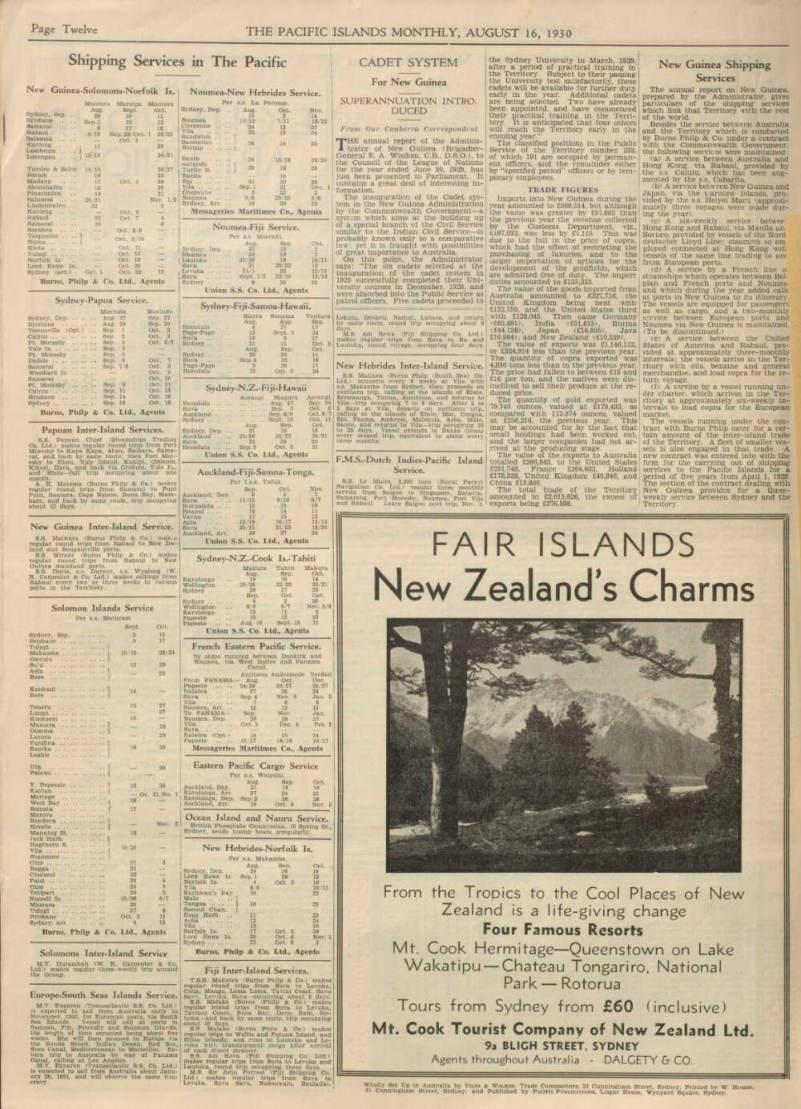
New Guinea-Solomons-Norfolk Is.
Sydney-Papua Service.
Papuan Inter-Island Services.
S.S. Papuan Chief (Steamships Trading Co. Ltd.) makes regular round trios from Port Moresby to Kapa Kapa, Abau, Baibara, Sama rai, and back by same route; then Port Mor esby to Hisiu, Yule Island, Kukipi, Orokolo, Kikori, Daru, and back via Orokolo, Yule Is., and Hisiu—-full trip occupying about one month.
A. K. Matoma (Burns Philp & Co.) makes regular round trips from Samarai to Puni Puni, Baniara, Cape Nelson, Buna Bay, Mam bare, and back by same route, trip occupying about 12 days.
New Guinea Inter-Island Service.
5.5. Maiwara (Burns Philp & Co.) makts regular round trips from Rabaul to New Ire land and Bougainville ports. 5.5. Mirani (Burns Philp & Co.) makes regular round trips from Rabaul to New Guinea mainland ports. 5.5. Duris, s.s. Durour, s.s. Wyalong (W.
R. Carpenter & Co. Ltd.) makes sailings from Rabaul every two or three weeks to various ports in the Territory.
Solomon Islands Service Per s.s. Mataram
Solomons Inter-Island Service
M.V. Durambah (W. R. Carpenter & Co.
Ltd.) makes regular three-weekly trip around the Group.
Europe-South Seas Islands Service.
M.V. Yngaren (Transatlantic S.S. Co. Ltd.) is expected to sail from Australia early in November, 1930, for European ports, via South Sea Islands. Vessel will call at ports in Samoan, Fiji, Friendly and Solomon Islands, the length of time occupied being about five weeks. She will then proceed to Europe via the Sunda Strait, Indian Ocean, Red Sea, Suez Canal, Mediterranean to Marseilles. Re turn trip to Australia by way of Panama Canal, calling at Los Angeles.
M.V. Eknaren (Transatlantic S.S. Co. Ltd.) is expected to sail from Australia about Janu ary 20, 1931, and will observe the same Itin erary.
Noumea-New Hebrides Service.
Noumea-Fiji Service.
Sydney-Fiji-Samoa-Hawaii.
Sydney-N.Z.-Fiji-Hawaii
Auckland-Fiji-Samoa-Tonga.
Sydney-N.Z.-Cook Is.-Tahiti
French Eastern Pacific Service.
By ships running between Dunkirk and Noumea, via West Indies and Panama Canal.
Eastern Pacific Cargo Service
Ocean Island and Nauru Service.
British Phosphate Commission, 16 Spring St., Sydney, sends tramp boats irregularly.
New Hebrides-Norfolk Is.
Per s.s. Makambo.
Fiji Inter-Island Services.
T.S.S. Makatea (Burns Philp & Co.) makes regular round trips from Suva to Levuka, Cicla, Mango, Loma Loma, Tavini Coast, Savu Savn. Levuka, Suva—occupying about 9 days. 5.5. Malake (Burns (Philp & Co.) makes regular round trips from Suva to Levuka, Taviuni Coast, Buca Bay, Devo, Rabi, Ro tuma —and back by same route, trip occupying about 10 days. 5.5. Malake (Burns Philo & Co.) makes regular trips to Wallis and Futuna Island, and Ellice Islands; and runs to Lautoka and Le vuka with transhipment cargo after arrival of each direct steamer. 5.5. Adi Keva (Fiji Shipping Co. Ltd.) makes regular trips from Suva to Levuka and Lautoka. round trip occupying three days.
M.S. Sir John Forrest (Fiji Shipping Co.
Ltd.) makes regular trips from Suva to Levuka, Savu Savu, Nabouwalu, Baulailai,
Lekutu, Dreketi, Naduri, Labasa, and return by same route, round trip occupying about 9 days.
M.S. Adi Rewa (Fiji Shipping Co. Ltd.) makes regular trips from Suva to Ba and Lautoka, round voyage, occupying four days.
New Hebrides Inter-Island Service.
5.5. Malinoa (Burns Philp (South Sea) Co.
Ltd.) connects every 6 weeks at Vila with s.s. Makambo from Sydney, then proceeds on southern trip, calling at the islands of Efate, Erromanga, Tanna, Aneityum, and returns to Vila —trip occupying 7 to 8 days. After 2 to 3 days at Vila, departs on northern trip, calling at the islands of Efate, Mai, Tongoa, Epi, Paama, Ambrym, Malekula, Aoba, Malo, Santo, and returns to Vila —trip occupying 25 to 28 days. Vessel extends to Banks Group every second trip, equivalent to about every three months.
F.M.S.-Dutch Indies-Pacific Island
Service.
5.5. Le Maire, 3,200 tons (Royal Packet Navigation Co. Ltd.) regular three monthly service from Saigon to Singapore, Batavia, Samarang, Port Moresby, Noumea, Port Vila and Rabaul. Leave Saigon next trip, Nov. 1.
Montoro Marsina Montoro Sydney, dep.
Aug.
Sept.
Oct. 30 20 11 Brisbane ..
Sep. I 22 13 Samarai 6 27 18 Rabaul 8/10 Sep. 29/Oct. 1 20/22 Salamoa ..
Oct. 3 Kavieng ..
I U 23 Lombrum . .
Lorengau .. 1 12/13 24/25 Tumleo & Seleo 14/15 26/27 16 17 28 29 Madang Oct. 4 Alexishafen 18 30 Finschafen 19 31 Salamoa 20/21 Nov. 1/2 Lindenhafen 22 3 Kavieng .. — Oct. 6 —: Rabaul 23 Oct. 7 4 Samarai 25 6 Soraken — Oct. 8/9 — Teopasino ..
Numa .. .. 1 J Oct. 9/10 — Kieta .. ..
Oct. 11 — Oct. 13 Norfolk Is. — Oct. 18 — Lord Howe Is. — Oct. 20 — Sydney (arr.) Oct. 1 Oct. 22 12
Burns,
Philp & Co
Ltd., Agents
Morinda Morinda Sydney, Dep Sep. 27 Brisbane Sep. 29 Townsville (Opt.) .. Sep. 1 Oct. 2 Cairns Oct. 3 Pt. Moresby .. ..
Oct. 5/6 Yule Is — Pt. Moresby .. .. — Dedele Oct. 7 Samarai Oct. 8 Woodlark Is Oct. 9 Samarai — Oct. 10 Pt. Moresby .. ..
Oct. 11 Cairns Oct. 13 Brisbane Oct. 16 Sydney .. Sep. 16 OCt. 18
Burns, Philp
& Co. Ltd.,
Agents
Per s.s.
Moeraki.
Aug Sep.
Oct.
Sydney, Dep. . 22 12 3 Noumea . . . 26 16 7 Lautoka .. . . 29/30 19 10/11 Suva 31 20/22 12 Levuka 31/1 22 12/13 • Suva . Sept. 1/2 22/23 13/14 Sydney 8 29 20 Union
S.S. Co
. Ltd., Agents
Sierra Sonoma Ventura Aug.
Aug.
Sep.
Honolulu . . 6 27 17 Pago-Pago 13 Sept. 3 24 Suva .. .. 16 6 27
Sydney .. ..
21 11 Oct. 2 Aug.
Sep.
Oct.
Sydney ...
30 20 11 Suva .. .. 25 16 Pago-Pago 5 26 17 Honolulu 12 Qct. 3 24
Aorangi Niagara Aorangi Honolulu .. .
Sep. 24 Suva Oct. 3 Auckland .. . . Sep. 8/9 Oct. 6/7 Sydney . Sept. 13 Oct. 11 Aug.
Sep.
Oct.
Sydney, Dep. . 21 18 16 Auckland . . , . 25/26 22/23 20/21 Suva 29 26 24 Honolulu .. .
Sep. 5 Oct. 3 31 Union
S.S. Co.
Ltd., Agents
Per s.s. La Perouse.
Sydney, Dep. ..
Aug.
Oct.
Nov. 15 3 14 Noumea .. .. 19/23 7/11 18/22 Chepenhe .. .. 24 12 23 Vila 25 13 24 Sandwich .. .. i Sarmettes .. .. 26 14 25
Norsup j
Santo 26 15/18 26/29 fauranda .. .. ] Turtle B j 30 18 29 Banks — 19 Epi 31 20 30 Vila Sep. 1 21 Dec. 1 Chepenhe . . .. 2 22 2 Noumea .. .. 3/6 23/25 3/6 Sydney, Arr. .. 10 29 10
Messageries Maritimes Co.,
Agents
Sept.
Oct.
Sydney, dep 3 15 Brisbane 5 17 Tulagi • 1 Makambo ■ \ 10/12 22/24 . Su’u 13 25 Aola • \ 26 . ) Kaukaul • I 14 , f Teneru 15 27 Lunga — 27 Kookoom 15 — . ) . Lavoro — 29 Yandina • 30 Banika 16 Loabie Ufa 30 Palami Y. Pepesale • 1 16 30 Kaylan ■ ( Oc. 31/No. 1 West Bay • 1 16 — Somata 17 — Rendova . ) Nov. 2 Kenelo Manning St 18 — Jack Harb • 1 . I Hagthorn S 19/20 Vila • f . J Stanmore GIzo 21 3 Bagga 21 — Choiseul 22 — Faisi 23 4 24 5 24 5 25/26 6/7 26 Tulagi 27 8 Brisbane Oct. 2 13 4 15
Burns, Philp &
Co.
Ltd.,
Agents
Per t.s.s.
Sep.
Tofua.
Oct.
Nov.
Auckland, Dep '6 4 1 Suva 11/12 9/10 6/7 Nukualofa . . . 15 13 10 Haapai .. . . 16 14 11 Vavau 17 15 12 Apia . . . . 18/19 16/17 13/14 Suva . 23/25 21/23 18/20 Auckland, Arr. 29 27 24 Union
S.S. Co.
Ltd., Agents
Makura Tahiti Makura Aug.
Sep.
Oct.
Rarotonga 19 16 14 Wellington 25/26 22/23 20/21 Sydney 30 27 25 Sep.
Oct.
Oct.
Sydney 4 2 30 Wellington 8/9 6/7 Nov. 3/4 Rarotonga 13 11 8 Papeete .. .. 15 13 10 Papeete .. ..
Aug. 16 Sept. 13 11
Union S.S. Co. Ltd., Agents
Antinous Andromede Verdan
Prom Panama—
Aug.
Oct Dec.
Papeete .. ..
24/26 25/27 25/27 Raiatea .. .. 27 28 28 Suva
Sep. 4
Nov. 5 Jan. 5 Vila 7 8 8 Noumea, Arr. . . 12 13 13
To Panama—
Sep.
Nov.
Jan.
Noumea, Dep. 26 28 • 27 Vila Oct. 3 Dec. 4 Feb. 3 Suva —
Raiatea (Opt.)
14 15 14 Papeete .. .. 15/17 16/18 15/17
Messageries
Maritimes Co.
Agents
Per s.s. Waipahi.
Aug.
Sep.
Oct.
Auckland, Dep. 21 18 16 Rarotonga, Arr. 27 24 22 Rarotonga. Dep.
Sep. 2 30 28 Auckland, Arr. 10 Oct. 8 Nov. 5
Aug.
Sen.
Oct.
Sydney. Dep. . .
29 26 10 Lord Howe Is. Sep. 1 29 13 Norfolk Is. 4 Oct. 2 16 Via 8 9 20/21 Bushman’s Bay 10 22
Malo 1
Tangoa 10 22 Second Chan.
Hogg Harb. ..
11 23 Aoba 12 24 Vila 13 25 Norfolk Is. 17 Oct. 3 29 lord Howe Is. 20 Oct. 6 Nov. 1
Sydney
22 Oct. 8 3
Burns, Philp
& Co.
Ltd.
Agents
Cadet System
For New Guinea
Superannuation Intro
Duced
From Our Canberra Correspondent THE annual report of the Adminis trator of New Guinea (Brigadier- General E. A. Wisdom, C.B., D.S.O.), to the Council of the League of Nations for the year ended June 30, 1929, has just been presented to Parliament. It contains a great deal of interesting in formation.
The inauguration of the Cadet sys tem in the New' Guinea Administration by the Commonwealth Government—a system which aims at the building up of a special branch of the Civil Service similar to the Indian Civil Service —is probably known only to a comparative few; yet it is fraught with possibilities of great importance to Australia.
On this point, the Administrator says; “The six cadets selected at the inauguration of the cadet system in 1925 successfully completed their Uni versity courses in December, 1928, and were absorbed into the Public Service as patrol officers. Five cadets proceeded to
the Sydney University in March, 1929, after a period of practical training in the Territory. Subject to their passing the University test satisfactorily, these cadets will be available for further duty early in the year. Additional cadets are being selected. Two have already been appointed, and have commenced their practical training in the Terri tory. It is anticipated that four others will reach the Territory early in the ensuing year.”
The classified positions in the Public Service of the Territory number 233, of which 191 are occupied by perman ent officers, and the remainder either by “specified period” officers or by tem porary employees.
Trade Figures
Imports into New Guinea during the year amounted to £869,514, but although the value was greater by £57,682 than the previous year the revenue collected by the Customs Department, viz., £197,032, was less by £7,115. This was due to the fall in the price of copra, which had the effect of restricting the purchasing of luxuries, and to the larger importation of articles for the development of the goldfields, which are admitted free of duty. The import duties amounted to £125,233.
The value of the goods imported from Australia amounted to £327,716, the United Kingdom being next with £132,755, and the United States third with £128,045. Then came Germany (£63,491), India (£51,615), Burma (£44,138), Japan (£18,805), Java £10,984), and New Zealand (£10,539).
The value of exports was £1,146,112, or £324,914 less than the previous year.
The quantity of copra exported was 4,850 tons less than in the previous year.
The price had fallen to between £15 and £16 per ton, and the natives were disinclined to sell their produce at the re duced price.
The quantity of gold exported was 79,748 ounces, valued at £179,433, as compared with 113,874 ounces, valued at £256,216, the previous year. This may be accounted for by the fact that small holdings had been worked out, and the larger companies had not ar rived at the producing stage.
The value of the exports to Australia totalled £386,843, to the United States £251,748, France £264,602, Holland £178,328, United Kingdom £40,846, and China £13,800.
The total trade of the Territory amounted to £2,015,626, the excess of exports being £276,598.
New Guinea Shipping
Services
The annual report on New Guinea, prepared by the Administrator, gives particulars of the shipping services which link that Territory with the rest of the world.
Besides the service between Australia and the Territory which is conducted by Burns Philp & Co. under a contract with the Commonwealth Government, the following services were maintained; (a) A service between Australia and Hong Kong, via Rabaul, provided by the s.s. Calulu, which has been aug mented by the s.s. Cabarita. (b) A service between New Guinea and Japan, via the Caroline Islands, pro vided by the s.s. Heiyei Maru (approximately three voyages were made dur ing the year). (c) A six-weekly service betwee Hong Kong and Rabaul, via Manila an Borneo, provided by vessels of the Nord deutscher Lloyd Line; steamers so em ployed connected at Hong Kong with vessels of the same line trading to am from European ports. (d) A service by a French line of steamships which operates between Bel gian and French ports and Noumea and which during the year added calk at ports in New Guinea to its itinerary.
The vessels are equipped for passengers as well as cargo, and a two-monthly service between European ports and Noumea via New Guinea is maintained. (To be discontinued.) (e) A service between the United States of America and Rabaul, pro vided at approximately three-monthly intervals; the vessels arrive in the Ter ritory with oils, benzine and general merchandise, and load copra for the re turn voyage. (f) A service by a vessel running un der charter, which arrives in the Ter ritory at approximately six-weekly in tervals to load copra for the European market.
The vessels running under the con tract with Burns Philp cater for a cer tain amount of the inter-island trade of the Territory. A fleet of smaller ves sels is also engaged in that trade. A new contract was entered into with the firm for the carrying out of shipping services to the Pacific Islands for a period of five years from April 1, 1929.
The section of the contract dealing with New Guinea provides for a three weekly service between Sydney and the Territory.
Advertisements & other items, pp. 12-13 (2 items)
The Pacific Islands Monthly, August 16, 1930
Page Twelve
Wliolljr Set Up in Australia by Viles & Walker. Trade Compositors, 31 Cunningham Street. Sydney: Printed by W Homer. 31 Cunningham Street, Sydney: and Published by Pacific Publications, Lisgar House, Wynyard Square, Sydney.
New Zealand’s Charms
FAIR ISLANDS
& M From the Tropics to the Cool Places of New Zealand is a life-giving change Four Famous Resorts Mt. Cook Hermitage—Queenstown on Lake Wakatipu Chateau Tongariro, National Park Rotorua Tours from Sydney from £60 (inclusive) Mt. Cook Tourist Company of New Zealand Ltd.
9a BLIGH STREET. SYDNEY
Agents throughout Australia - DALGETY & CO.
Telephone hw r>u;{<
Pacific publications
LISGAR HOUSE, WYNYARD SQUARE
SYDNEY
14th August, 1930.
This Complimentary Copy of the Pacific Islands Monthly will give you some idea of the character and purpose of the journal.
Divided, with few means of communication between Groups, Territories and Colonies, controlled by a dozen different Administrations, the residents of the Pacific Islands suffer under many disabilities, with few means of securing redress. United, the Island Territories of the South and Central Pacific are quite powerful and important enough, now, to make their voice heard in Canberra, or Wellington, or London, or in any other capital.
This journal hopes to provide the Pacific Islands with a means of securing unity of expression and action; to let the world know something of the wonderful progress that is being made in the different Groups; to keep up a constant agitation for redress of genuine grievances; to broadcast information about the unique opportunities offered to capital and enterprise in these rich, tax-free, undeveloped lands; to assist Australian and New Zealand exporters in strengthening their Pacific trade relationships; and last, but not least, to supply Islands residents with a useful summary of what is happening in other parts of the Pacific, and in the Pacific trade generally.
If there is any way in which we can assist you, as one interested in Pacific Islands development, please write to us. In any event, we should be very glad to have your opinion of this journal, and of the purpose behind it.
If you wish to receive the journal regularly, kindly fill in this form, and either lodge it with one of our agents, whose names are printed in the paper, or post it direct.
Pacific Publications, Lis gar House, Wynyard Square, Sydney.
Please send me the Pacific Islands Monthly for a period of months from receipt hereol.
Herewith find sum of , being subscription at rate of 6/- per annum, post free.
Please charge to me at rate of 6/6 per annum. (Strike out lines not wanted.)
NAME
ADDRESS