Fortune in the hills
pp. 54-55 · Read in the full issue
Yachting
Women collecting clams on the reef stopped and waved good-bye. Two men, eyes sharp for schools of fish in the shallows, sauntered along the beach. They, too, lifted their heads in our direction as if to say “Bon voyage”.
We’d enjoyed our stopover at Mahemate but it was time to press on.
Unlike early French explorers Tardy de Montravel and
Jean-Joseph de
Brun, we didn’t want to overstay our welcome.
After two hours of downwind sailing, we rounded a point well marked by a lighted red flashing buoy and anchored in front of a deserted mine in Baie de Pam. With its dry, sparse vegetation, He Pam resembled Baja Mexico.
From the anchorage, we climbed the nearest ridge,
walking through grassy savannah land dotted with papery niaouli trees and giant century plants, ultimately gaining a panoramic view to the north and east.
On the edge of the bay, ruins of past copper and gold mining operations lay hidden in overgrown vegetation - brick walls from a defunct treatment factory (1909), an old steam engine, and great conical plugs of heavy slag.
A quasi-Caledonian gold rush in 1869 brought John Higginson and 65 Aussie prospectors to the area for several months. They returned home disappointed, and later mining activity waxed and waned with booms and depressions until 1936.
We tried our luck, and after scrubbing a chunk of rich glittery ore with a toothbrush, it shone like gold, though many
flecks of the mystery mineral spiraled down the drain.
Looking at the chart, we knew the next stretch of water would be difficult. The long channel between He Pam and Balabio is not particularly well-marked but, as we found out, is easily navigated at low water
in light winds and good visibility.
With “Goldilocks” weather and low
tide auspiciously at midday, we sailed swiftly past reefs high and dry. Ahead of us, two islands floated in the sky - a bizarre illusion created by atmospheric conditions.
In the lee of Hots Saint-Phalle, we found a
lovely anchorage.
It goes without saying that the first thing to do after stepping ashore on a small uninhabited island edged in white sand is walk around it. So we did. Seabirds nests lay perched in the windswept and bleached arms of trees, and ospreys and white eagles flew above us, warning us away from their lairs. Turtle tracks, laid out in a sneaky meandering figure-eight shape dotted with several big hollows, camouflaged where the turtle’s eggs had buried.
We swam in sheltered turquoise
shallows, fossicked along the tide-line where deep-sea sponges had been washed up. To the south, an incredible range of chalky bare-boned mountains of sandstone and limestone were transfigured by the changing light. When the sky suddenly darkened, though, we rowed back to the boat, praying the squall-line would
dissipate.
On the horizon, the high island of Balabio beckoned - but between us and it lay many dangerous uncharted coral heads
and shoals which, combined with poor visibility and strong head winds, conspired to make the task difficult.
Ultimately we
opted for very early start to take
advantage of lighter
morning winds.
Perhaps Captain
Cook would have been ashamed of our timid navigation - using GPS and following a
longer “swept”
route (rather than eyeballing our way through a shorter
uncharted area)
seemed the safe but sissy way of
approaching Balabio. In any case, we were mighty glad we’d tackled the gap before breakfast, too, because the wind had doubled by the time we anchored.
Like Circe, Balabio lured us to the summit where we gained a heroic view in all directions. Rocks pediculous with orange, green, yellow lichen lay scattered about the landscape and a great handbuilt rock cairn marked the high point.
Espying a beach on the windward side of the island where tall coconut trees danced in the gusts like girls with crazy hairdos, we followed the ridge south, then dropped down to sea level. Someone with a whimsical sense of flotsam and jetsam had put bottles and floats and shells and things on the ends of sticks all along the beach. We did “just one more beach” until
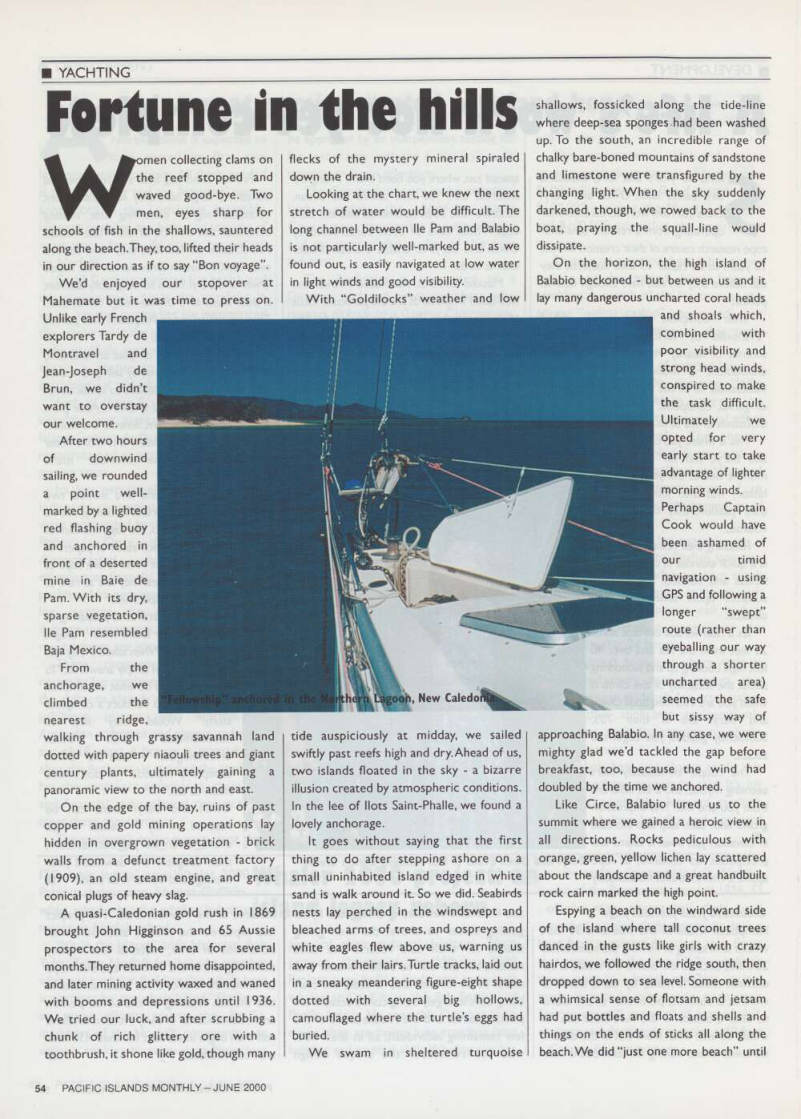
"Fellowship" anchored in the Northern Laoon, New Caledonia
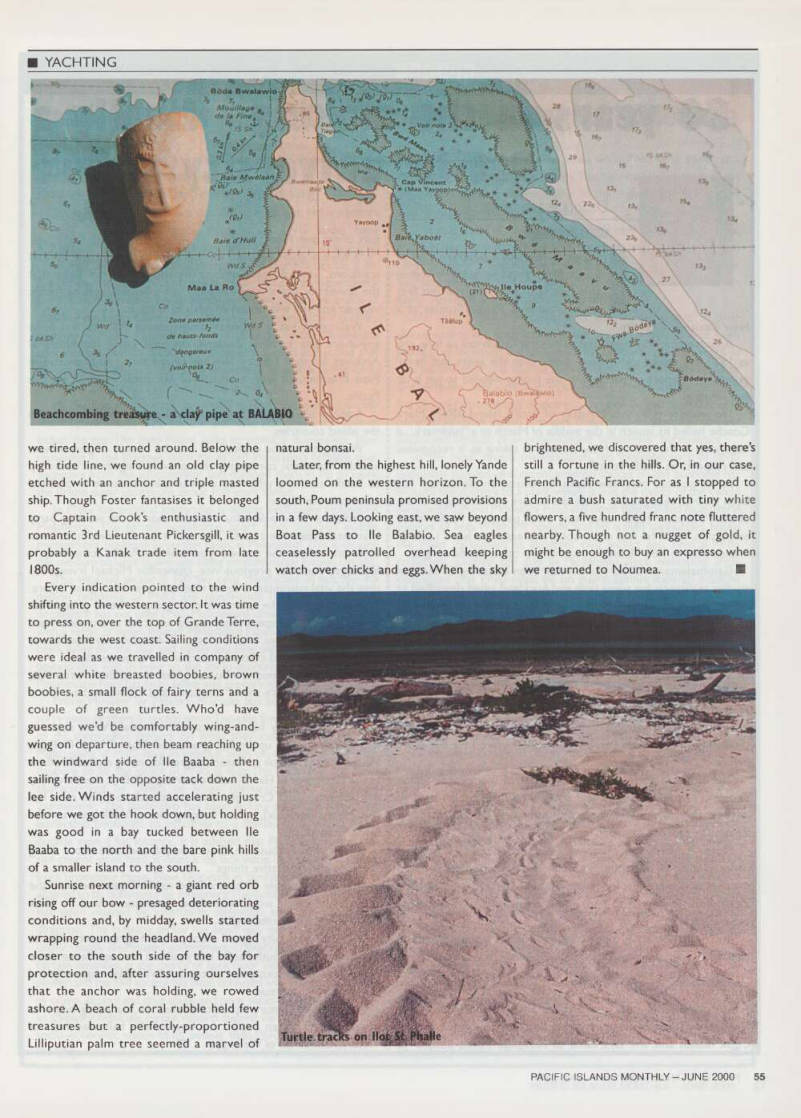
we tired, then turned around. Below the high tide line, we found an old clay pipe etched with an anchor and triple masted ship. Though Foster fantasises it belonged to Captain Cook’s enthusiastic and romantic 3rd Lieutenant Pickersgill, it was probably a Kanak trade item from late 1800 s.
Every indication pointed to the wind shifting into the western sector. It was time to press on, over the top of Grande Terre, towards the west coast. Sailing conditions were ideal as we travelled in company of several white breasted boobies, brown boobies, a small flock of fairy terns and a couple of green turtles. Who’d have guessed we’d be comfortably wing-and wing on departure, then beam reaching up the windward side of He Baaba - then sailing free on the opposite tack down the lee side. Winds started accelerating just before we got the hook down, but holding was good in a bay tucked between He Baaba to the north and the bare pink hills of a smaller island to the south.
Sunrise next morning - a giant red orb rising off our bow - presaged deteriorating conditions and, by midday, swells started wrapping round the headland. We moved closer to the south side of the bay for protection and, after assuring ourselves that the anchor was holding, we rowed ashore. A beach of coral rubble held few treasures but a perfectly-proportioned Lilliputian palm tree seemed a marvel of
natural bonsai.
Later, from the highest hill, lonely Yande loomed on the western horizon. To the south, Poum peninsula promised provisions in a few days. Looking east, we saw beyond Boat Pass to lie Balabio. Sea eagles ceaselessly patrolled overhead keeping watch over chicks and eggs. When the sky
brightened, we discovered that yes, there’s still a fortune in the hills. Or, in our case, French Pacific Francs. For as I stopped to admire a bush saturated with tiny white flowers, a five hundred franc note fluttered nearby. Though not a nugget of gold, it might be enough to buy an express© when we returned to Noumea. ■
Beachcombing treasure-a clay pipe at BALABIO
Turtle tracts on llofeS& Wjalle