A life’s work net yet complete
p. 53 · Read in the full issue
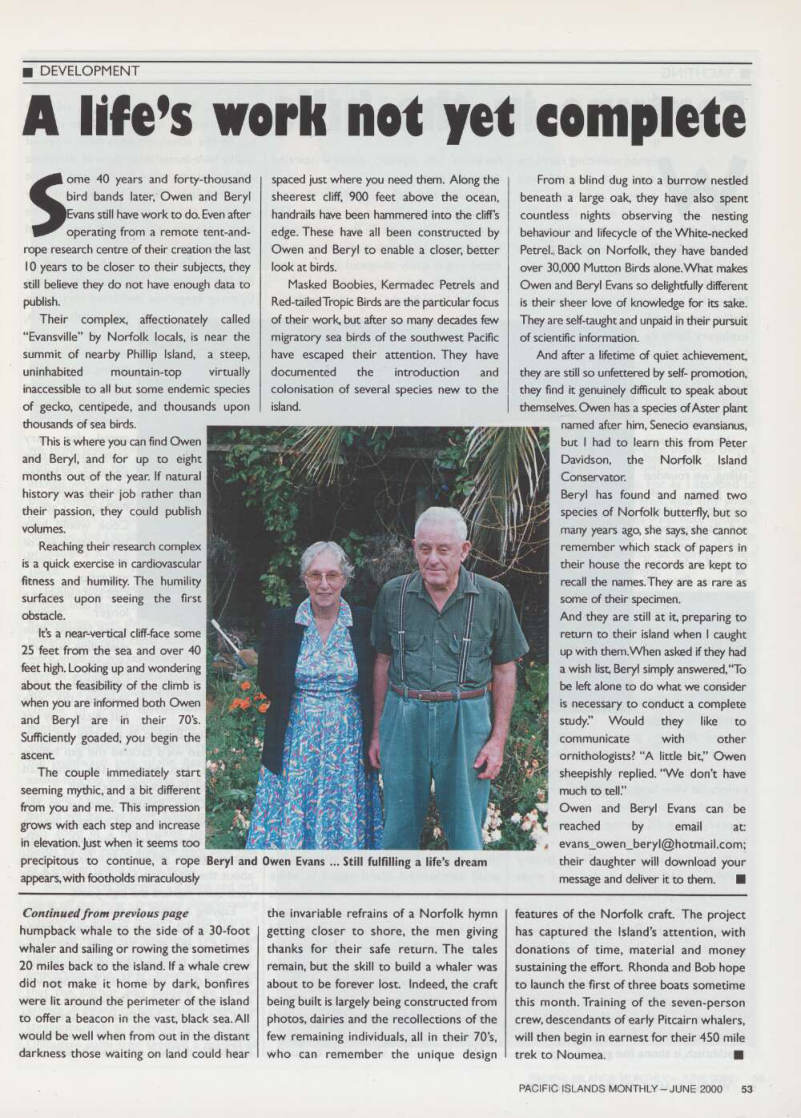
Some 40 years and forty-thousand bird bands later, Owen and Beryl Evans still have work to do. Even after operating from a remote tent-and rope research centre of their creation the last 10 years to be closer to their subjects, they still believe they do not have enough data to publish.
Their complex, affectionately called
“Evansville” by Norfolk locals, is near the summit of nearby Phillip Island, a steep, uninhabited mountain-top virtually inaccessible to all but some endemic species of gecko, centipede, and thousands upon
thousands of sea birds.
This is where you can find Owen and Beryl, and for up to eight months out of the year. If natural history was their job rather than their passion, they could publish volumes.
Reaching their research complex is a quick exercise in cardiovascular fitness and humility. The humility surfaces upon seeing the first obstacle.
It’s a near-vertical cliff-face some 25 feet from the sea and over 40
feet high. Looking up and wondering
about the feasibility of the climb is when you are informed both Owen and Beryl are in their 70’s.
Sufficiently goaded, you begin the
ascent
The couple immediately start
seeming mythic, and a bit different from you and me. This impression grows with each step and increase in elevation. Just when it seems too precipitous to continue, a rope appears, with footholds miraculously
spaced just where you need them. Along the sheerest cliff, 900 feet above the ocean, handrails have been hammered into the cliffs edge. These have all been constructed by Owen and Beryl to enable a closer, better look at birds.
Masked Boobies, Kermadec Petrels and Red-tailed Tropic Birds are the particular focus of their work, but after so many decades few migratory sea birds of the southwest Pacific have escaped their attention. They have documented the introduction and colonisation of several species new to the island.
From a blind dug into a burrow nestled beneath a large oak, they have also spent countless nights observing the nesting behaviour and lifecycle of the White-necked Petrel. Back on Norfolk, they have banded over 30,000 Mutton Birds alone. What makes Owen and Beryl Evans so delightfully different is their sheer love of knowledge for its sake.
They are self-taught and unpaid in their pursuit of scientific information.
And after a lifetime of quiet achievement, they are still so unfettered by self- promotion, they find it genuinely difficult to speak about themselves. Owen has a species of Aster plant
named after him, Senecio evansianus, but I had to learn this from Peter Davidson, the Norfolk Island Conservator.
Beryl has found and named two species of Norfolk butterfly, but so many years ago, she says, she cannot remember which stack of papers in their house the records are kept to recall the names. They are as rare as some of their specimen.
And they are still at it, preparing to return to their island when I caught up with them. When asked if they had a wish list, Beryl simply answered, “To be left alone to do what we consider is necessary to conduct a complete study.” Would they like to communicate with other ornithologists? “A little bit,” Owen sheepishly replied. “We don’t have much to tell.”
Owen and Beryl Evans can be reached by email at
their daughter will download your message and deliver it to them. ■
Beryl and Owen Evans ... Still fulfilling a life’s dream