Tribal warfare
pp. 46-47 · Read in the full issue
wang ia PNG
By Francis Tekei
Papua New Guinea’s Enga Province is often viewed as the place where the most ferocious tribal wars occur.
The first white men set foot in Enga only in 1938 and it became PNG’s youngest province in 1975 (the year
PNG gained Independence).
As such, many aspects of
culture, such as tribal fights, have been prevalent and have been seen or regarded as part of the social norm.
Whilst tribal fights occur in all Highlands Provinces - Eastern
Highlands, Chimbu, Western Highlands,
Southern Highlands and Enga - tribal wars in Enga are viewed more negatively than the other four provinces. Why that has been so depends on a variety of reasons.
But times are changing and tribal fighting in Enga has come down to an all time low.
In the last one year. Provincial Police Commander Jerry Frank revealed there
were only two instances of tribal wars.
The first one was in the Kandep District where eight months of fighting resulted in the death of 16 people from both sides.
The other tribal conflict was in the Laiagam District where the warring factions burnt down school buildings including classrooms at a high school in the area.
But the two fights were only a fraction of the incidence of tribal conflicts and the magnitude of destruction to properties and human lives that have occurred in the province in previous years. The changing
state of tribal warfare in Enga, Superintendent Frank said, was due to the current leadership of the province.
“Tribal fighting has really gone down mainly because of the leadership we now have in the province. Enga has come a long way in the last two years. With the leadership of the Governor (Enga Governor Peter Ipatas)
one big thing we have seen is that tribal fighting is becoming lesser and lesser,” said Superintendent Frank.
Governor Ipatas is an advocate of peace and his policies are directed towards achieving peace and unity.
Priority is given to Education (Enga is the only province in PNG where its Government has paid for the school students of all students in all educational institutions in the country).
Agriculture is next, followed by infrastructure developments as the keys to the growth of the Province.
There is now an air of optimism and
Continued next page
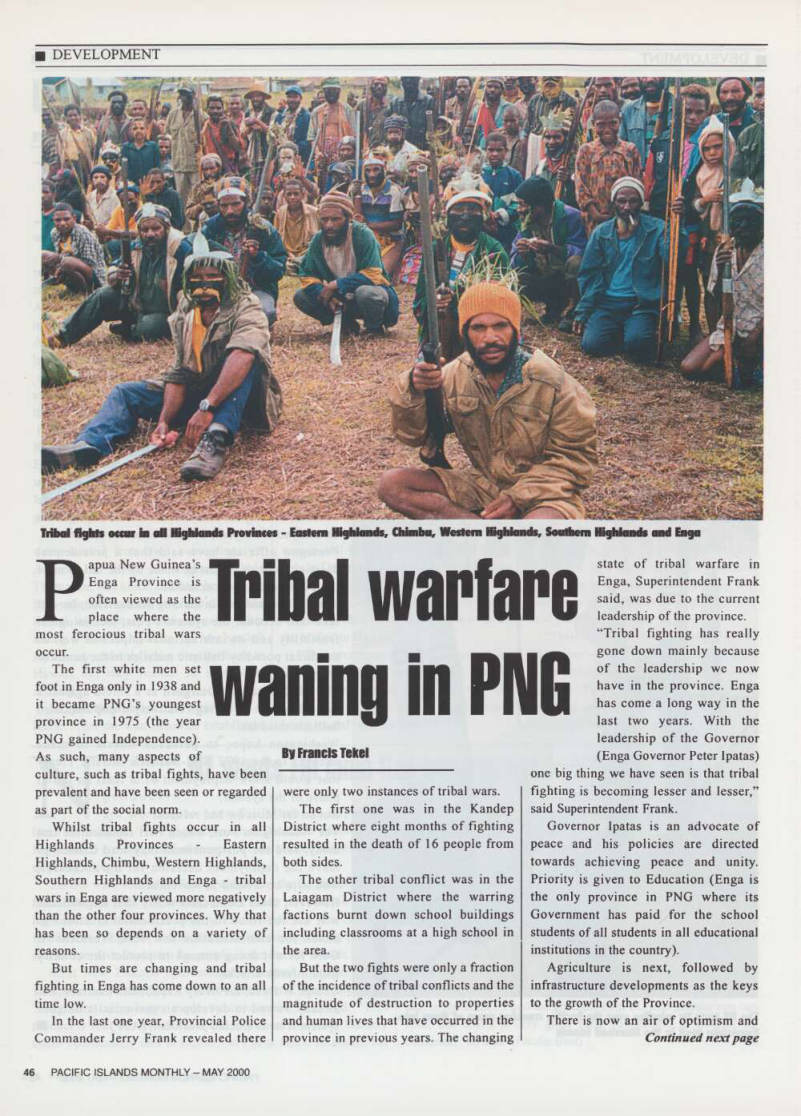
Tribal fights occur in all Highlands Provinces-Eastern Highlands, Chimbu, Western Highlands, Southern Highlands and Enga
Continued from previous page people are laying down their arms and getting into farming and other projects to improve their livelihood.
A clear illustration attesting to the decline in Enga tribal wars was a reconciliation ceremony between the two warring sides in Kandep District.
The reconciliation ceremony occurred in the middle of last month (February) at the Kandep District Government Station.
Leaders of the two clans pledged to abandon their weapons, forgive each other and allow peace and normalcy to rule their lives.
This was after eight months of fighting, using traditional weapons such as bows and arrows and spears and home made shotguns as well as factory made firearms.
According to a reliable source, high powered weapons were also used. This is true because tribal fighting in PNG now employs the most powerful weapons such as police or military issue ARIS and SLR rifles.
In the case of Enga, the most notorious province for tribal fights, the Kandep reconciliation was the most significant symbol and serious indication that when the leadership is right, the people want peace.
“It was a breakthrough with the reconciliation between the two clans,”
Superintendent Frank said.
Tribal fighting occurs regularly in all Highland provinces and occasionally in the coast regions of the country. Their causes are varied and the extent of fighting and the use of weapons also vary.
But the Enga reconciliation, inspired by the provincial leadership, is a sure sign that the province is beginning to live in peace.
This can also happen in other
provinces when the leadership is right
and the people are willing to live peacefully.
Only then can PNG’s tribal wars, which have been negatively portrayed overseas and are a major cause for the lack of development be completely eradicated. And this approach will bring peace without bloodshed. ■