Missile Defense system
p. 45 · Read in the full issue
US postpones test of National Missile Defense system
The Pentagon has decided to delay the next test of the US National Missile Defense system (NMD) until next month, which would push back to at least late summer a presidential decision on whether to
deploy the system by 2005, US defence officials said.
The Ballistic Missile Defense Organisation had scheduled the flight test - a third attempt to intercept an intercontinental missile with a missile - for late April or early May.
The Pentagon’s minimum requirement for recommending deployment of the system is two “metal-on-metal” interceptions with one of them being a test of the full
system.
Of two interception attempts so far, only one has succeeded.
The last test, on January 18, failed when the interceptor narrowly missed its target, a dummy warhead fired over the Pacific from an Air Force base in California.
The near-miss was attributed to a leaking coolant pipe that shut down the interceptors two infrared sensors.
In a more limited test of the system in October, an interceptor successfully hit a target missile over the Pacific.
The Pentagon was supposed to review the three tests and make a recommendation to President Bill Clinton next month on whether the system is ready for deployment.
But with the delay of the third test, the earliest deployment readiness review will be held is late summer, raising the risk that the actual deployment be delayed for a year, defense officials said.
Pentagon officials have said that a presidential decision to deploy must be made by the fall to meet the 2005 deployment schedule.
Clinton has said that in making his decision, he will take into account the system’s cost, technological feasibility and its international impact as well as the threat posed by ballistic missiles in the hands of “rogue” states.
The NMD system is designed as a shield against a limited attack involving relatively unsophisticated ballistic missiles.
Washington hopes to persuade Russia to make changes to the 1972 Anti-Ballistic Missile Treaty that would allow deployment of at least an initial phase of the system.
But so far Moscow has refused.
The Washington Post, which first reported the test delay, said the postponement may lead Clinton to leave the deployment decision for his successor, who is to be elected in November.
However, some Democrats worry that Republicans will use the issue in the presidential elections to attack the administration and Vice President A 1 Gore for not doing enough to protect the country from missile attacks.
George W Bush, the likely Republican nominee, has already vowed to develop an anti-missile defense system if he is elected president. (AFP) ■
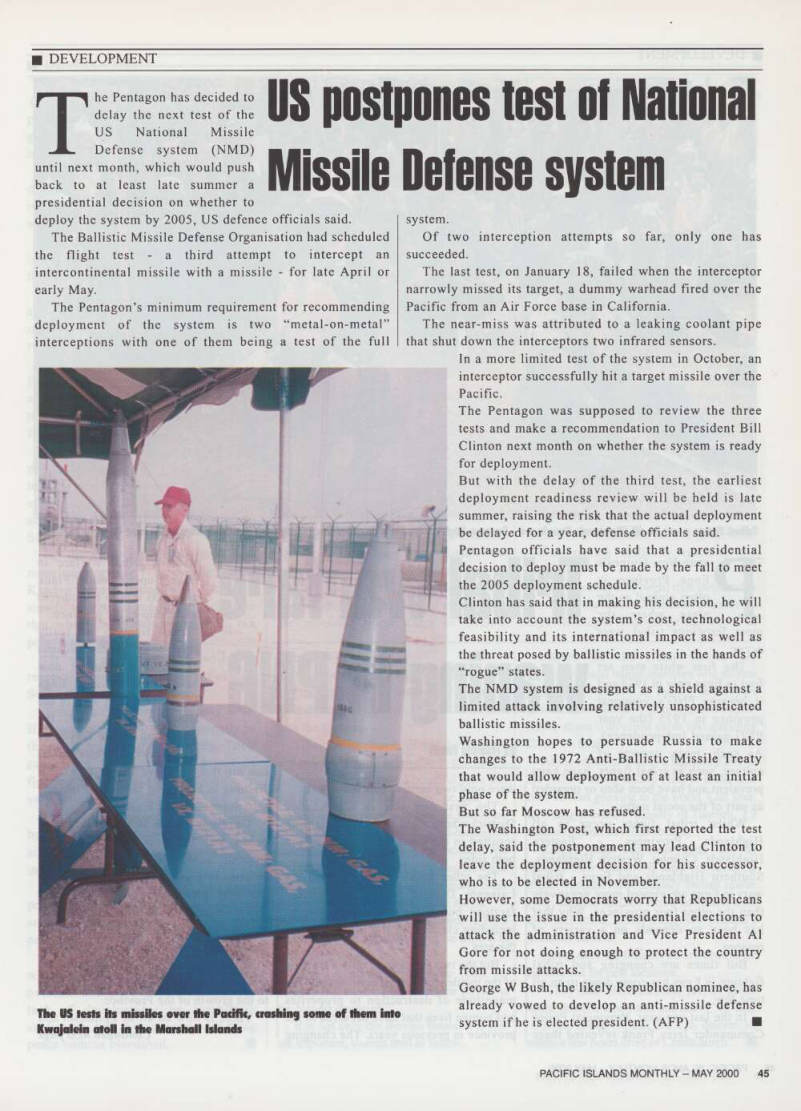
The US tests its missiles over the Pacific, crashing some of them into Kwajalein atoll in the Marshall Islands