Education without frontiers in the new century
pp. 28-29 · Read in the full issue
By Saphle Faster Hildebrand
The new century will be marked by rapid social and economic change - brought about largely by advances in science and technology - which will see the rise of new businesses and industries.
In such a world, knowledge and its effective application will become the important assets for economic and social advancement. These sentiments were expressed as part of a joint statement from the second Asia-Pacific Economic Co operation (APEC) Education ministerial meeting in Singapore last month.
“The world is now truly the global village it was once envisaged to be. Economies have become more inter-connected and interdependent, and this will continue to be more so in the future. In the new millennium, technology and information networks will continue to re-orientate how economies communicate with each other.”
The ministers said education must equip the workforce with relevant knowledge and skills for the new economy and society of the 21st century. They predicted that in the new millennium, education will focus increasingly on developing intellectual capacity, not only for the mastery of content but in processing, adapting, applying existing information, and, creating new knowledge.
“Education provides individuals the access to knowledge and the means to
develop their potential. In particular, high
standards in literacy, mathematics, science and technology provide the necessary foundation needed for the new global economy. “Lifelong learning will be the characteristic of this society. As formal pre employment education continues to be
important, continual re-training and
upgrading of knowledge for adult workers to develop themselves will also become
paramount.”
The statement said with lifelong learning, individuals will be able to better contribute to their communities and work-places.
“In this inter-connected world, where knowledge and understanding of the languages and cultures of other communities
is an asset and a way of life, the learning of foreign languages can help our people unlock new doors of information and opportunities. Education can help learning societies sustain and enrich cultures, and build mutual respect and understanding that transcends cultural differences.” The
statement said. IT in education will be a key strategy to meet the needs of the knowledge based economy but challenges had to be addressed.
These include: identifying clear goals for an IT programme; managing resources and stakeholders; equipping teachers with the
Ministers said globalisation presented opportunities for education to play a role in helping people communicate and co-operate in the new world. They recognised the immense potential IT has to better prepare students for the future as well as provide opportunities for adults to continue learning.
“IT offers new and innovative modes of learning at all educational levels. IT can also facilitate greater long-distance research collaborations and distance learning, and the Ministers agreed to encourage these activities and studies on the implications of the advent of ‘education without frontiers’ among the APEC member economies,” the
attitude, knowledge and skills; designing instruments to evaluate the effectiveness of using IT in education and; formulating policies and programmes to bridge the ‘digital divide’ among economies and among members within each economy so that all can keep pace with the rapid developments of technology.
The Ministers said in the classroom of the future, the teacher will face the challenge of striking a right balance between the more traditional role of delivering structured, content-based lessons and the role of facilitator to encourage open, independent Continued on next page
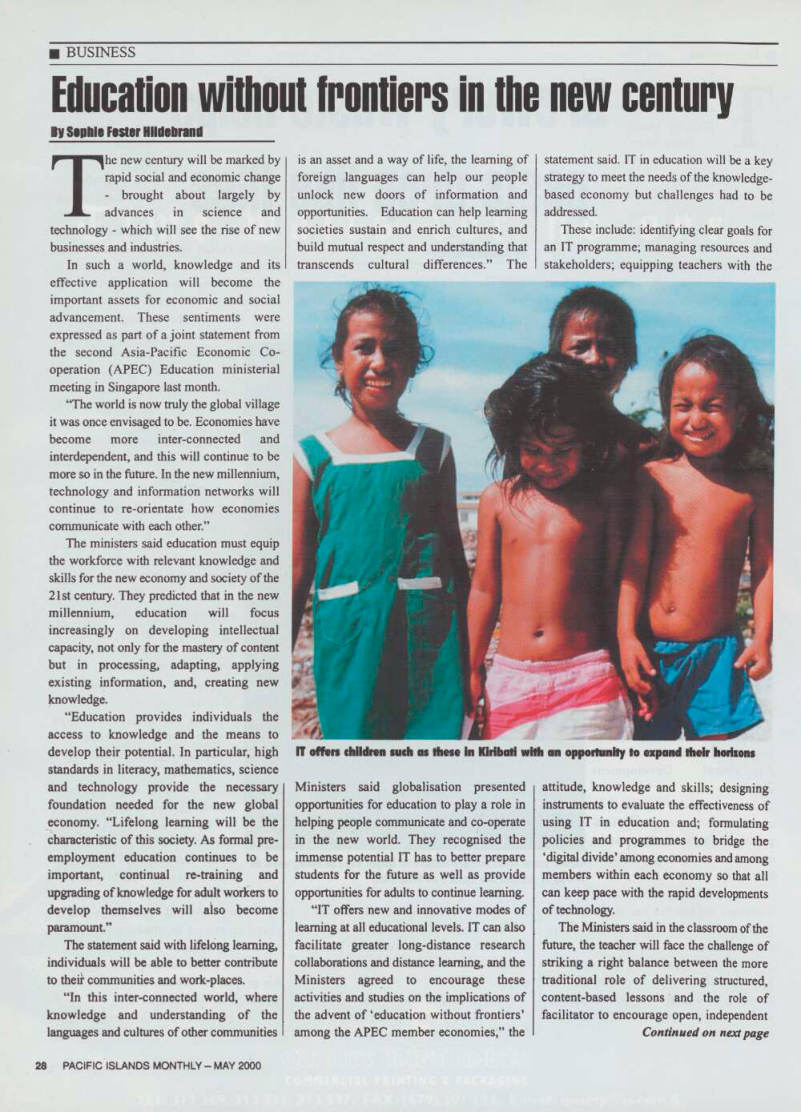
IT offers children such as these in Kiribati with an opportunity to expand their horizons
Continued from previous page learning. “Teacher preparation is key to equipping teachers at all levels to adapt their new roles as facilitators of learning. Teacher development is a life-long process comprising both pre-service training and continual professional development The Ministers noted that, in the globalised future, economies would no longer develop their education systems in isolation. Global economic and social trends will have an impact on the development of education systems, they said.
“The diversity of the various member economies makes APEC an ideal platform for the exchange of information, ideas and expertise as economies seek to overcome similar challenges. The advent of technology increases the opportunities and modes available for such exchanges.”
The Ministers recognised that, in the new century, the Asia-Pacific region will face new opportunities and confront unique challenges in all areas, including education.
“These opportunities and challenges have to be managed actively in order to realise our people’s hope for life-long self improvement.
“Education must play a critical role in preparing students for the new future, to be successful and responsible global citizens who can contribute to the social and economic progress of their community and the world.”
Four strategic areas have been identified to transform education systems for the 21st Century, These are the Information Technology, teacher development, sound management practices in education, and active engagement among APEC member economies in education to forge deeper understanding within the Asia-Pacific community. ■