They’re
p. 27 · Read in the full issue
Brewery waste helps pests drop like flies
By Donna Hoerder
dropping like flies in Tonga ... fruit flies, that is. Drunk on waste yeast from the production of Royal Beer, fruit flies may finally be getting the “heave ho” in the islands.
Tonga was the first Pacific Island country to establish an environment friendly plant to convert brewery waste yeast into a protein bait to control fruit
flies.
But Vanuatu isn’t far behind with a project planned to go ahead this month. And others could follow.
The Project on Regional Management of Fruit Flies (RMFFP) is working closely with other breweries in the Pacific, so that waste yeast from the breweries can be converted into protein autolysate like in Tonga.
Australia is the only other country in the region using the method.
The result of the conversion is called Tongalure protein bait. The waste yeast was provided by the Royal Beer Company. This project was set up by RMFFP, the Australian Centre for International Agriculture Research (ACIAR) and the USAID Commercial Agricultural Development Project.
The project aimed at converting waste yeast into protein autolysate, the protein component used in the protein bait spray.
Protein bait spraying is a
technique used in the Pacific to control fruit flies, a major insect pest of fruits and vegetables.
This technique is a type of behavioural control. It involves the spraying of a protein solution mixed with insecticide and water, under the leaves of fruit trees.
Because female fruit flies need protein to produce viable eggs, this meal is lethal. After they feed on the
protein under the leaves, they die.
The waste yeast from the Royal Beer was used as a form of protein instead of acid hydrolysates in the bait sprays.
It is cheaper than buying acid hydrolysates and environmentally friendly because the waste yeast is
recycled rather
than disposed of into the sea.
Protein bait sprays are also less harmful to beneficial insects than cover sprays using insecticides
only. In Tonga, this method slashed the damage caused by fruit flies for capsicum crops and some varieties of chillies from 100 per cent to seven per cent. In Fiji, the damage level of
guavas was reduced from 45 per cent to four per cent.
In Fiji, the local brewery Carlton Brewery has provided the research staff at Koronivia with waste yeast for sample testing. But the establishment of a plant for conversion of the waste yeast has not been discussed yet.
However, Tusker Brewery in Vanuatu is preparing to modify its waste yeast into protein autolysate for fruit fly control.
Chief technical adviser, Allan Allwood of the regional project said that the brewery was keen to set up a plant to modify waste yeast into protein autolysate for controlling fruit flies in Vanuatu.
“At the moment, RMFFP in conjunction with UNDP are investigating the introduction of protein bait sprays into small island communities such as Futuna, Aniwa and Anatomt, to help decrease losses of fresh fruits caused by fruit flies.”
These are islands south of Efate, Vanuatu’s main island.
Vanuatu’s steps toward fruit
fly control should encourage other island countries to produce their own protein bait spray.
All wood said funding assistance for this project in Vanuatu may come from
Rmffp, Aciar, And Undp.
The project should begin this month. ■
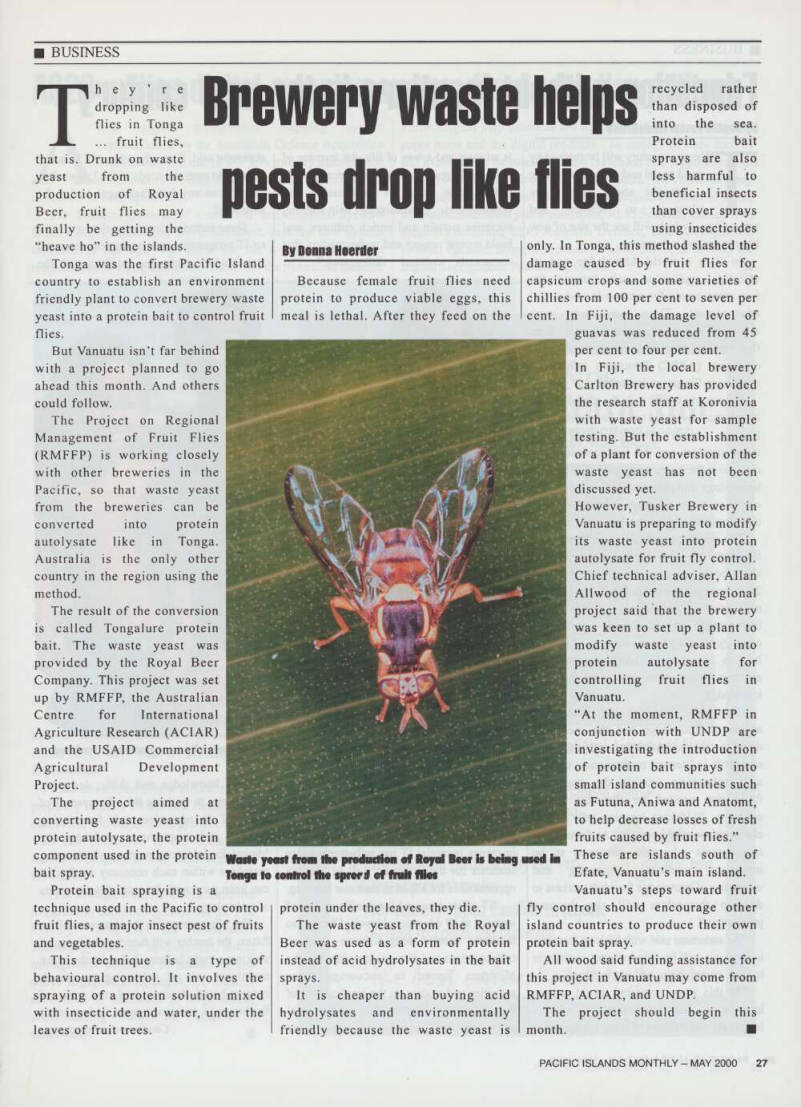
Waste yeast from the production of Royal Beer is being used in Tonga to control the sprerd of fruit flies