Former Fiji couple help bring Bollywood to NZ
pp. 12-47 · Read in the full issue
By Michael Reid
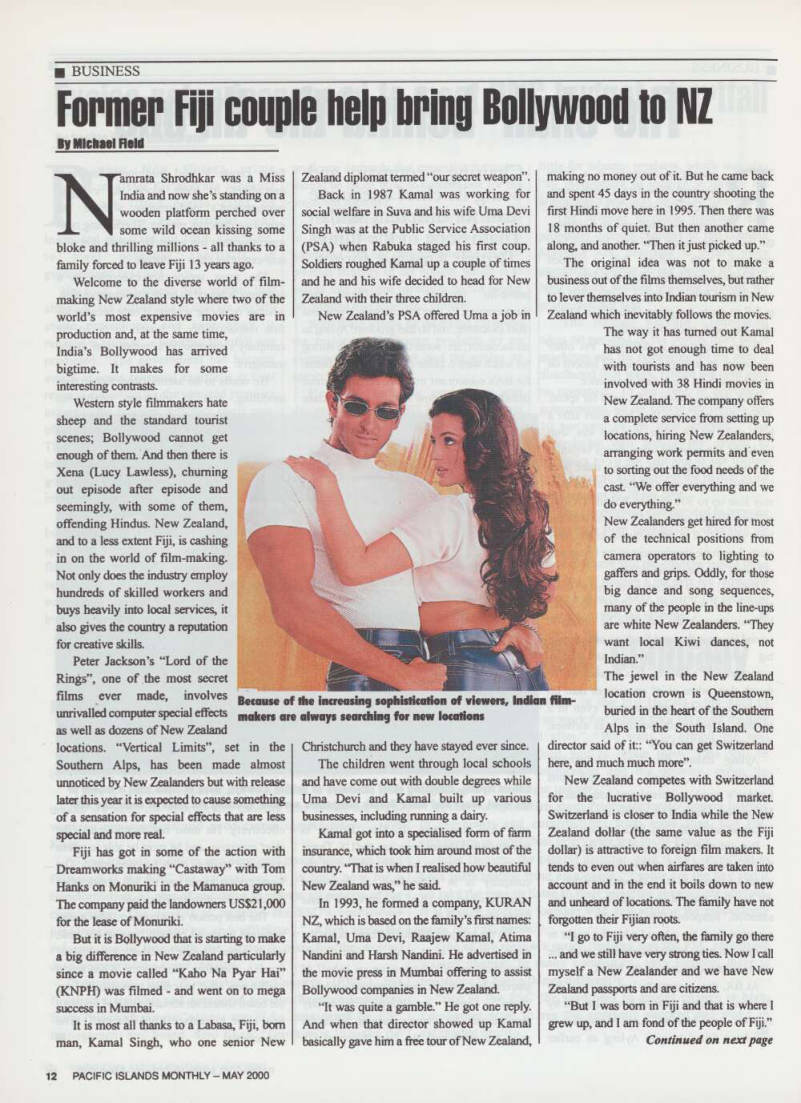
Namrata Shrodhkar was a Miss India and now she’s standing on a
wooden platform perched over
some wild ocean kissing some bloke and thrilling millions - all thanks to a family forced to leave Fiji 13 years ago.
Welcome to the diverse world of film making New Zealand style where two of the world’s most expensive movies are in
production and, at the same time, India’s Bollywood has arrived bigtime. It makes for some interesting contrasts.
Western style filmmakers hate sheep and the standard tourist scenes; Bollywood cannot get enough of them. And then there is Xena (Lucy Lawless), churning out episode after episode and seemingly, with some of them, offending Hindus. New Zealand, and to a less extent Fiji, is cashing in on the world of film-making.
Not only does the industry employ hundreds of skilled workers and buys heavily into local services, it also gives the country a reputation for creative skills.
Peter Jackson’s “Lord of the Rings”, one of the most secret films ever made, involves unrivalled computer special effects as well as dozens of New Zealand
locations. “Vertical Limits”, set in the Southern Alps, has been made almost unnoticed by New Zealanders but with release later this year it is expected to cause something of a sensation for special effects that are less special and more real.
Fiji has got in some of the action with Dreamworks making “Castaway” with Tom Hanks on Monuriki in the Mamanuca group.
The company paid the landowners US$2l,OOO for the lease of Monuriki.
But it is Bollywood that is starting to make a big difference in New Zealand particularly since a movie called “Kaho Na Pyar Hai” (KNPH) was filmed - and went on to mega success in Mumbai.
It is most all thanks to a Labasa, Fiji, bom man, Kamal Singh, who one senior New
Zealand diplomat termed “our secret weapon”.
Back in 1987 Kamal was working for social welfare in Suva and his wife Uma Devi Singh was at the Public Service Association (PSA) when Rabuka staged his first coup.
Soldiers roughed Kamal up a couple of times and he and his wife decided to head for New Zealand with their three children.
New Zealand’s PSA offered Uma a job in
Christchurch and they have stayed ever since.
The children went through local schools and have come out with double degrees while Uma Devi and Kamal built up various businesses, including running a dairy.
Kamal got into a specialised form of farm insurance, which took him around most of the country. “That is when I realised how beautiful New Zealand was,” he said.
In 1993, he formed a company, KURAN NZ, which is based on the family’s first names: Kamal, Uma Devi, Raajew Kamal, Atima Nandini and Harsh Nandini. He advertised in the movie press in Mumbai offering to assist Bollywood companies in New Zealand.
“It was quite a gamble.” He got one reply.
And when that director showed up Kamal basically gave him a free tour of New Zealand,
making no money out of it. But he came back and spent 45 days in the country shooting the first Hindi move here in 1995. Then there was 18 months of quiet. But then another came along, and another. “Then it just picked up.”
The original idea was not to make a business out of the films themselves, but rather to lever themselves into Indian tourism in New Zealand which inevitably follows the movies.
The way it has turned out Kamal has not got enough time to deal with tourists and has now been involved with 38 Hindi movies in New Zealand. The company offers a complete service from setting up locations, hiring New Zealanders, arranging work permits and even to sorting out the food needs of the cast. “We offer everything and we do everything.”
New Zealanders get hired for most of the technical positions from camera operators to lighting to
gaffers and grips. Oddly, for those
big dance and song sequences, many of the people in the line-ups are white New Zealanders. “They want local Kiwi dances, not Indian.”
The jewel in the New Zealand location crown is Queenstown, buried in the heart of the Southern Alps in the South Island. One
director said of it:; “You can get Switzerland here, and much much more”.
New Zealand competes with Switzerland for the lucrative Bollywood market.
Switzerland is closer to India while the New Zealand dollar (the same value as the Fiji dollar) is attractive to foreign film makers. It tends to even out when airfares are taken into account and in the end it boils down to new and unheard of locations. The family have not forgotten their Fijian roots.
“I go to Fiji very often, the family go there ... and we still have very strong ties. Now I call myself a New Zealander and we have New Zealand passports and are citizens.
“But I was bom in Fiji and that is where I grew up, and I am fond of the people of Fiji.”
Continued on next page
Because of the increasing sophistication of viewers, Indian film makers are always searching for new locations
Continued from previous page Kamal said he has had “vague inquiries” from movie makers thinking about Fiji as a location. “My biggest competition for getting film shows here is Switzerland, and the biggest competition for Fiji would be Mauritius. The reason being is that Mauritius is so close to India ...” The fact that Fiji has a strong Indian culture doesn’t cut much ice in Bollywood.
“Fiji needs a bit more exposure in the Indian market... Most of the people in India don’t
know where Fiji is. Most of the people in India don’t know where New Zealand is,”
Fiji, he believes, could sell itself simply as a new location that the ever demanding Indian audiences have not heard of.
“Fiji being a new location itself, just like New Zealand being a new location, in itself is attractive.” Most people in India know where the movies are shot. “Most movies that have been shot in New Zealand have been very successful and a lot of people go and watch
those movies because they are shot at locations nobody knows about. “If a movie was shot in Fiji people would just go and have a look.”
The pay-off is significant. New Zealand’s Delhi based South Asia trade commissioner, Peter Healy, reckons they would have spent around NZ$5,OOO helping KNPH get to New Zealand.
In return they got a three hour movie which cost around NZ$4OO,OOO dollars to make which featured New Zealand for 40 per cent of
Continued on page 47
Continued from page 13 the time and since its release has been seen by 300 million people in India. KNPH director Rakesh Roshan says success had a lot to do with the location.
“The new location heightens the romance and makes the story believable in that people think that if they were in a beautiful place like that they would fall in love too,” he said.
“It’s a lovely place to shoot. The people are
straightforward, fun-loving, good-humoured
and helpful. The contractors are excellent. We had brilliant service from the lighting crew and the catering contractors and the many other companies involved in making the movie.
“We don’t attract the big crowds in New Zealand that we do in India and we are left to get on with the job.
“The scenery’s great, the cost is competitive, but the people and the service is the biggest drawcard.”
It is not only the movies themselves that are important; tourists tend to follow.
Almost all the Hindi movies use Queenstown and tourist operators who several years ago never saw an Indian, now report busloads and tales are told of Indian shoppers hitting stores with credit cards and spending $20,000 a time.
At the centre of it all is a legendary 200 to 250 million strong middle class in India, said to be the fast growing in the world. Last year, according to India’s Ministry of Tourism, 3.9 million of them travelled aboard.
Kamal Singh has other ideas too; he reckons New Zealand is ideal for shooting Indian commercials. Already Indian motor cycle, condom and ice cream advertisements have been made, mostly using New Zealand’s and local Indians.
Healy says the film crews are always on the look out for new locations.
“They like New Zealand for its green fields, flowers, blue water and snow,” he said.
“Our advantage is that we can deliver all within a few hours drive of Christchurch.” ■