The chair behind the throne
p. 11 · Read in the full issue
Chairing a company and being its chief executive call for different skills.
That is c ne of the things British Airways forgot
Running a company is a scary business these days. One moment, the chief executive is a princeling,
controlling billions and shaping
the lives of thousands. The next, he may be a nonentity, with nothing but a golden handshake to sustain him. Robert Ayling, chief executive of British Airways, is the latest star to fall to earth, resigning abruptly in March after four years as chief executive.
Every departure is different. Yet other companies could learn some useful lessons on governance from the Ayling experience.
One obvious lesson is the need for speed.
Ayling departed more than two years after a bitter strike by BA cabin crew that was, with hindsight, the moment when things began to go wrong. Since then, the airline’s share price has fallen 60 per cent and this year the firm may lose up to 300 million Pounds (As69o million). Boards never find it easy to sack the boss: after all, it in effect means saying they made the wrong appointment in the first place, or bought into the wrong strategy.
Besides, a new strategy takes time to show results, and to dismiss a chief executive halfway through the job may be unfair. A second lesson is the need for those at the top of big companies to avoid too many extracurricular activities. It is a good rule of thumb that, when chief executives take up
demanding public appointments, even in a
business as politically sensitive as airlines, their companies are a sell.
Ayling chairs the New Millennium Experience Co., which built and runs London’s much criticised and loss-making Millennium Dome. This public service gave him close links with Tony Blair’s government.
But, although BA is a sponsor of the dome, the job was a big, high-profile distraction. And it sent a message to BA’s shareholders that he did not feel their worries required his full attention. Responsibility for how a chief executive does his job and when he ought to go rests, in most public companies, with the non-executive directors on the board.
At BA, they eventually lost patience; but the revolt does not seem to have been led by the chair, Lord Marshall. Lord Marshall may well have failed to give Ayling an earlier
heave-ho bee iuse he suffered two shortcomings: he was the company’s previous chief executive,; nd so had groomed Ayling as his successor; ani i some decisions made during his watch were c. pable of bearing some blame for BA’s subseqi ent troubles. More and more British com pan i( s now split the roles of chair
and chief executive. In this, Britain is increasingly different from, say, the US. There, the two jobs tend to be split only when the company is in difficulties, as happened recently when the chief executive of Waste Management fell ill.
Yet the two jobs call for different skills; the chair’s role is, as it were, a “forest” job, exercising overall supervision on behalf of shareholders, and the chief executive’s role is a “trees” one, involving day-to-day management and strategic planning. When the roles are combined, the best governed US
firms create instead machinery for non executives to meet alone, to evaluate management’s performance without the executive directors present. The leading non executive thus has a similar role to that of a non-executive chair in Britain.
The most senior non-executive in a company is bound to be in a delicate position, whether or not he is chair, if only because his first responsibility is bound to be to the company’s shareholders, rather than to the managers.
He needs to be authoritative rather than meddling, and to intervene rarely but
effectively. He must not second-guess the chief executive, and he must be able to assess corporate strategy with an open mind. The worst person to put into the job is thus often the chief executive’s predecessor.
The best person is an outsider, who is also prepared to spend enough time on the task, which means limiting his other commitments.
For BA, therefore, the moment it has found itself a new chief executive to replace Ayling, the board should set about the task of finding a new chair to replace Lord Marshall. (The Economist) ■
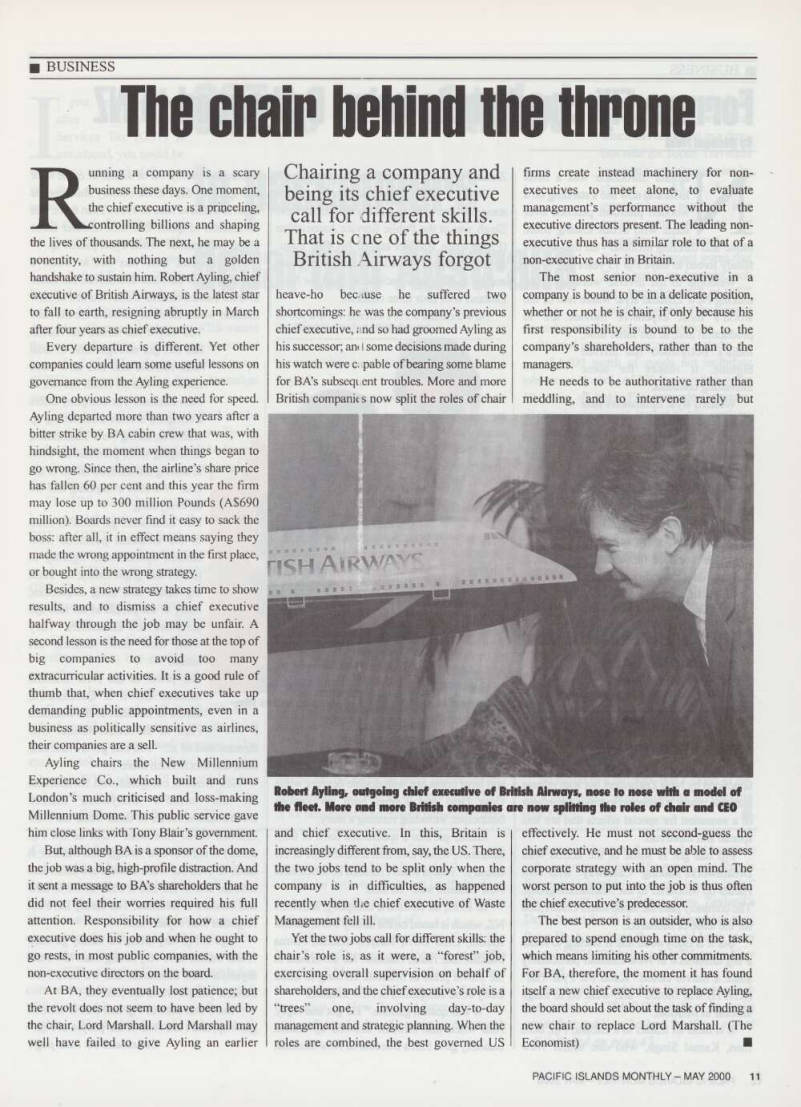
Robert Ayling, outgoing chief executive of British Airways, nose to nose with a model of the fleet. More and more British companies are now splitting the roles of chair and CEO