Fears grow of civil war in Solomon Islands
p. 52 · Read in the full issue
There is growing evidence that the Solomon Islands, already wracked by ethnic tensions, is edging towards a full-scale and potentially savage civil war, diplomatic sources believe.
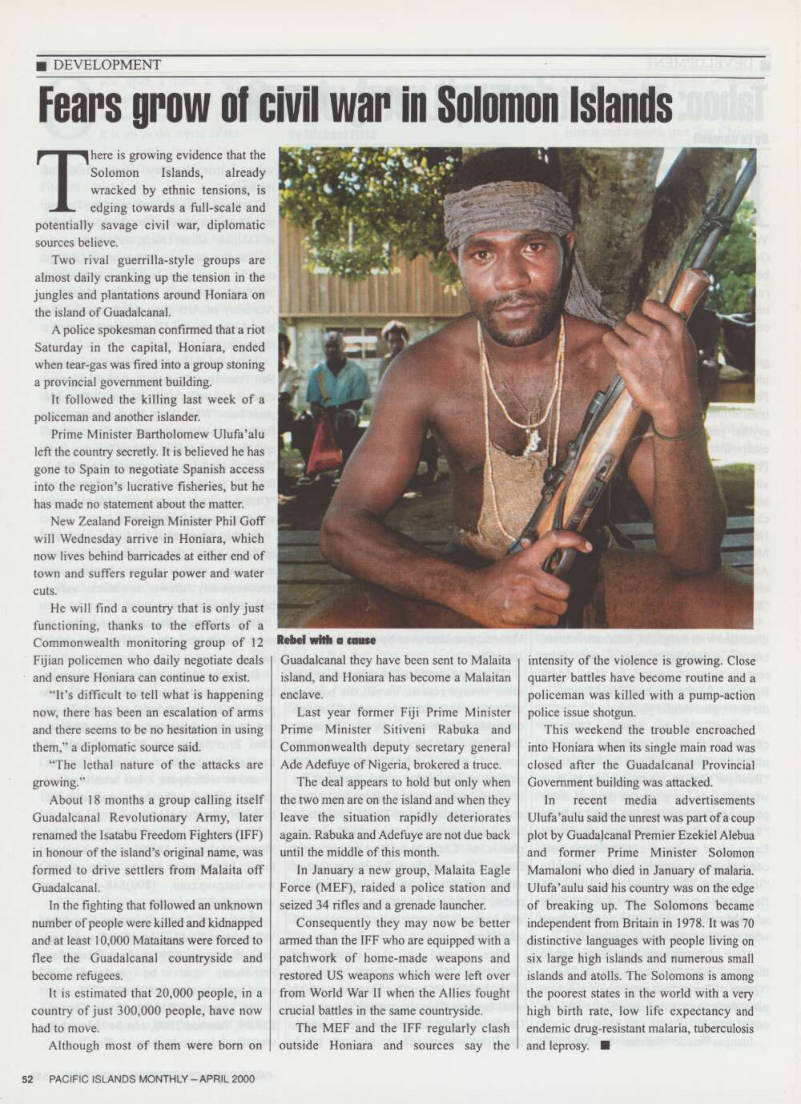
Two rival guerrilla-style groups are almost daily cranking up the tension in the jungles and plantations around Honiara on the island of Guadalcanal.
A police spokesman confirmed that a riot Saturday in the capital, Honiara, ended when tear-gas was fired into a group stoning a provincial government building.
It followed the killing last week of a policeman and another islander.
Prime Minister Bartholomew Ulufa’alu left the country secretly. It is believed he has gone to Spain to negotiate Spanish access into the region’s lucrative fisheries, but he has made no statement about the matter.
New Zealand Foreign Minister Phil Golf will Wednesday arrive in Honiara, which now lives behind barricades at either end of town and suffers regular power and water cuts.
He will find a country that is only just functioning, thanks to the efforts of a Commonwealth monitoring group of 12 Fijian policemen who daily negotiate deals and ensure Honiara can continue to exist.
“It’s difficult to tell what is happening now, there has been an escalation of arms and there seems to be no hesitation in using them,” a diplomatic source said.
“The lethal nature of the attacks are growing.”
About 18 months a group calling itself Guadalcanal Revolutionary Army, later renamed the Isatabu Freedom Fighters (IFF) in honour of the island’s original name, was formed to drive settlers from Malaita off Guadalcanal.
In the fighting that followed an unknown number of people were killed and kidnapped and at least 10,000 Mataitans were forced to flee the Guadalcanal countryside and become refugees.
It is estimated that 20,000 people, in a country of just 300,000 people, have now had to move.
Although most of them were born on
Guadalcanal they have been sent to Malaita island, and Honiara has become a Malaitan enclave.
Last year former Fiji Prime Minister Prime Minister Sitiveni Rabuka and
Commonwealth deputy secretary general
Ade Adefuye of Nigeria, brokered a truce.
The deal appears to hold but only when the two men are on the island and when they leave the situation rapidly deteriorates again. Rabuka and Adefuye are not due back until the middle of this month.
In January a new group, Malaita Eagle Force (MEF), raided a police station and seized 34 rifles and a grenade launcher.
Consequently they may now be better armed than the IFF who are equipped with a patchwork of home-made weapons and restored US weapons which were left over from World War II when the Allies fought crucial battles in the same countryside.
The MEF and the IFF regularly clash outside Honiara and sources say the
intensity of the violence is growing. Close quarter battles have become routine and a policeman was killed with a pump-action police issue shotgun.
This weekend the trouble encroached into Honiara when its single main road was closed after the Guadalcanal Provincial Government building was attacked.
In recent media advertisements Ulufa’aulu said the unrest was part of a coup plot by Guadalcanal Premier Ezekiel Alebua and former Prime Minister Solomon Mamaloni who died in January of malaria.
Ulufa’aulu said his country was on the edge of breaking up. The Solomons became independent from Britain in 1978. It was 70 distinctive languages with people living on six large high islands and numerous small islands and atolls. The Solomons is among the poorest states in the world with a very high birth rate, low life expectancy and endemic drug-resistant malaria, tuberculosis and leprosy. ■
Rebel with a cause