Taboo: The Art of Tiki, Leeteg of Tahiti
p. 51 · Read in the full issue
By Ed Rampell
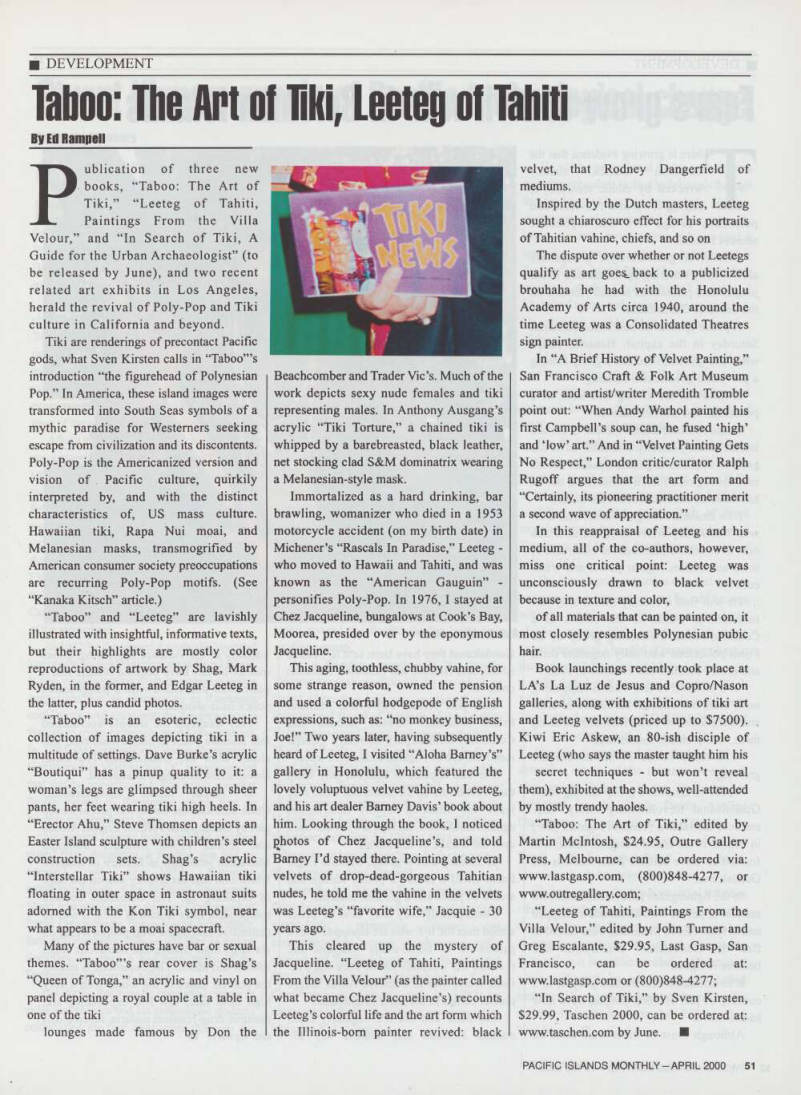
Publication of three new books, “Taboo: The Art of Tiki,” “Leeteg of Tahiti, Paintings From the Villa Velour,” and “In Search of Tiki, A Guide for the Urban Archaeologist” (to be released by June), and two recent related art exhibits in Los Angeles, herald the revival of Poly-Pop and Tiki culture in California and beyond.
Tiki are renderings of precontact Pacific gods, what Sven Kirsten calls in “Taboo’”s introduction “the figurehead of Polynesian Pop.” In America, these island images were transformed into South Seas symbols of a mythic paradise for Westerners seeking escape from civilization and its discontents.
Poly-Pop is the Americanized version and vision of Pacific culture, quirkily interpreted by, and with the distinct characteristics of, US mass culture.
Hawaiian tiki, Rapa Nui moai, and Melanesian masks, transmogrified by American consumer society preoccupations are recurring Poly-Pop motifs. (See “Kanaka Kitsch” article.) “Taboo” and “Leeteg” are lavishly illustrated with insightful, informative texts, but their highlights are mostly color reproductions of artwork by Shag, Mark Ryden, in the former, and Edgar Leeteg in the latter, plus candid photos.
“Taboo” is an esoteric, eclectic collection of images depicting tiki in a multitude of settings. Dave Burke’s acrylic “Boutiqui” has a pinup quality to it: a woman’s legs are glimpsed through sheer pants, her feet wearing tiki high heels. In “Erector Ahu,” Steve Thomsen depicts an Easter Island sculpture with children’s steel
construction sets. Shag’s acrylic
“Interstellar Tiki” shows Hawaiian tiki floating in outer space in astronaut suits adorned with the Kon Tiki symbol, near what appears to be a moai spacecraft.
Many of the pictures have bar or sexual themes. “Taboo’”s rear cover is Shag’s “Queen of Tonga,” an acrylic and vinyl on panel depicting a royal couple at a table in one of the tiki lounges made famous by Don the
Beachcomber and Trader Vic’s. Much of the work depicts sexy nude females and tiki representing males. In Anthony Ausgang’s acrylic “Tiki Torture,” a chained tiki is whipped by a barebreasted, black leather, net stocking clad S&M dominatrix wearing a Melanesian-style mask.
Immortalized as a hard drinking, bar brawling, womanizer who died in a 1953 motorcycle accident (on my birth date) in Michener’s “Rascals In Paradise,” Leeteg who moved to Hawaii and Tahiti, and was known as the “American Gauguin” personifies Poly-Pop. In 1976, I stayed at Chez Jacqueline, bungalows at Cook’s Bay, Moorea, presided over by the eponymous Jacqueline.
This aging, toothless, chubby vahine, for some strange reason, owned the pension and used a colorful hodgepode of English expressions, such as: “no monkey business, Joe!” Two years later, having subsequently heard of Leeteg, I visited “Aloha Barney’s” gallery in Honolulu, which featured the lovely voluptuous velvet vahine by Leeteg, and his art dealer Barney Davis’ book about him. Looking through the book, I noticed photos of Chez Jacqueline’s, and told Barney I’d stayed there. Pointing at several velvets of drop-dead-gorgeous Tahitian nudes, he told me the vahine in the velvets was Leeteg’s “favorite wife,” Jacquie - 30 years ago.
This cleared up the mystery of Jacqueline. “Leeteg of Tahiti, Paintings From the Villa Velour” (as the painter called what became Chez Jacqueline’s) recounts Leeteg’s colorful life and the art form which the Illinois-born painter revived: black
velvet, that Rodney Dangerfield of mediums.
Inspired by the Dutch masters, Leeteg sought a chiaroscuro effect for his portraits of Tahitian vahine, chiefs, and so on The dispute over whether or not Leetegs qualify as art to a publicized brouhaha he had with the Honolulu Academy of Arts circa 1940, around the time Leeteg was a Consolidated Theatres sign painter.
In “A Brief History of Velvet Painting,”
San Francisco Craft & Folk Art Museum curator and artist/writer Meredith Tromble point out: “When Andy Warhol painted his first Campbell’s soup can, he fused ‘high’ and ‘low’ art.” And in “Velvet Painting Gets No Respect,” London critic/curator Ralph Rugoff argues that the art form and “Certainly, its pioneering practitioner merit a second wave of appreciation.”
In this reappraisal of Leeteg and his medium, all of the co-authors, however, miss one critical point; Leeteg was unconsciously drawn to black velvet because in texture and color, of all materials that can be painted on, it
most closely resembles Polynesian pubic
hair.
Book launchings recently took place at LA’s La Luz de Jesus and Copro/Nason galleries, along with exhibitions of tiki art and Leeteg velvets (priced up to $7500).
Kiwi Eric Askew, an 80-ish disciple of Leeteg (who says the master taught him his secret techniques - but won’t reveal them), exhibited at the shows, well-attended
by mostly trendy haoles.
“Taboo; The Art of Tiki,” edited by Martin Mclntosh, $24.95, Outre Gallery Press, Melbourne, can be ordered via: www.lastgasp.com, (800)848-4277, or
www.outregallery.com;
“Leeteg of Tahiti, Paintings From the Villa Velour,” edited by John Turner and Greg Escalante, $29.95, Last Gasp, San Francisco, can be ordered at: www.lastgasp.com or (800)848-4277; “In Search of Tiki,” by Sven Kirsten, $29.99, Taschen 2000, can be ordered at: www.taschen.com by June. ■