Africa gives birth to new ocean
p. 46 · Read in the full issue
The Arabian geological plate, the land mass that is now Saudi Arabia and Yemen, is struggling to break free and drift north of the fixed Nubia and Somalia plates, which also hold Ethiopia, Eritrea and Djibouti, scientists say.
The tectonic battle has raged for 30 million years, according to Isabelle Manighetti, a researcher in active tectonics at the Paris-based Institute de Physique de Globe.
“There is no equivalent anywhere else on earth,” said Manighetti, the institute’s co-coordinator of the Horn of Africa study
project.
said, noting that the process seen today is the same geological process that created the North Atlantic Ocean more than 80 million years ago.
Showing a map of the region, Manighetti points out how perfectly the corner of Arabia fits into the Horn of Africa’s Afar region near Djibouti.
“When the two plates broke apart, they created the Afar triangle,” explained Manighetti, pointing to the bottom of the “V” shape where the Red Sea and Gulf of Aden meet.
That break opened up two new oceanic basins, but Manighetti notes the unusual break is not yet complete.
“We are seeing a continent give birth to an ocean, the youngest ocean on earth,” said
Manighetti.
The three-member research team was in Eritrea last month to arrange scientific cooperation with Asmara University for the research project, which has so far lasted nearly a decade and has involved several universities in France.
“The region makes for a very unique laboratory. Here we can understand the basic mechanism of the creation of an oceanic floor, and we can do detailed studies because everything is visable,” she
“For some reason there was no break at the comer, so the plates remain attached at Yemen, Djibouti and Eritrea,” she said.
“Our project is to understand how that break will happen,” she said.
The current hypothesis is an enormous hot spot coming from deep in the earth which began erupting 30-million years ago, and continued over the relatively short geological time of one-million years.
“It was a catastrophic event, probably changing the climate of the earth and causing several species to become extinct,” explained fellow project coordinator,
Michel Cara, a geological physics professor at Strasbourg University.
The evidence today is a lawa field stretching 1,000 kilometers (600) miles) across, and two to three kilometeirs deep, with several small hot spots reimaining throughout in the region.
Scientists believe the force of the eruptions caused Arabia to begin breaking away, thereby creating two large Ifissures which became the Red Sea and Gulf of Aden, but it is in the Afar region, the epicentre of the hot spot, where the composition is too soft to make a clean break, thereby preventing the two fissures from meeting.
“They are about 100 kilometers apart, but all fissures in the region between them go parallel instead of perpendicular, which would connect them,” said Manighetti, noting that the field of fissures and faults is about 10 kilometers wide and 40 kilometers long.
The research team believes that over the next four million years the zone will become weakened and part of the Afar region, probably the section in Eritrea, will break away with Arabia.
“There is a constant struggle for the plates to fully break apart, with movement measured at the very fast geological rate of two centimeters per year,” said Manighetti.
The result is a major earth quake zone stretching underneath the Red Sea and Aden Sea, and down the Rift Valley through Eritrea, Djibouti and Ethiopia.
A map of previous earth quakes in the region shows the vulnerability of the Horn.
“Asmara could be destroyed by an earthquake,” said Cara. “The seismic risk is significant.”
Part of the project is to install seismometers, a high-tech mapping devise that can also help scientists to understand the earth’s deep structures, and hopefully in the future predict earthquakes.
“The area is really very poorly covered,” explained Cara, noting that in California there are thousands of seismometers, but from Saudi Arabia to the Seychelles Islands four thousand there are only five. ■
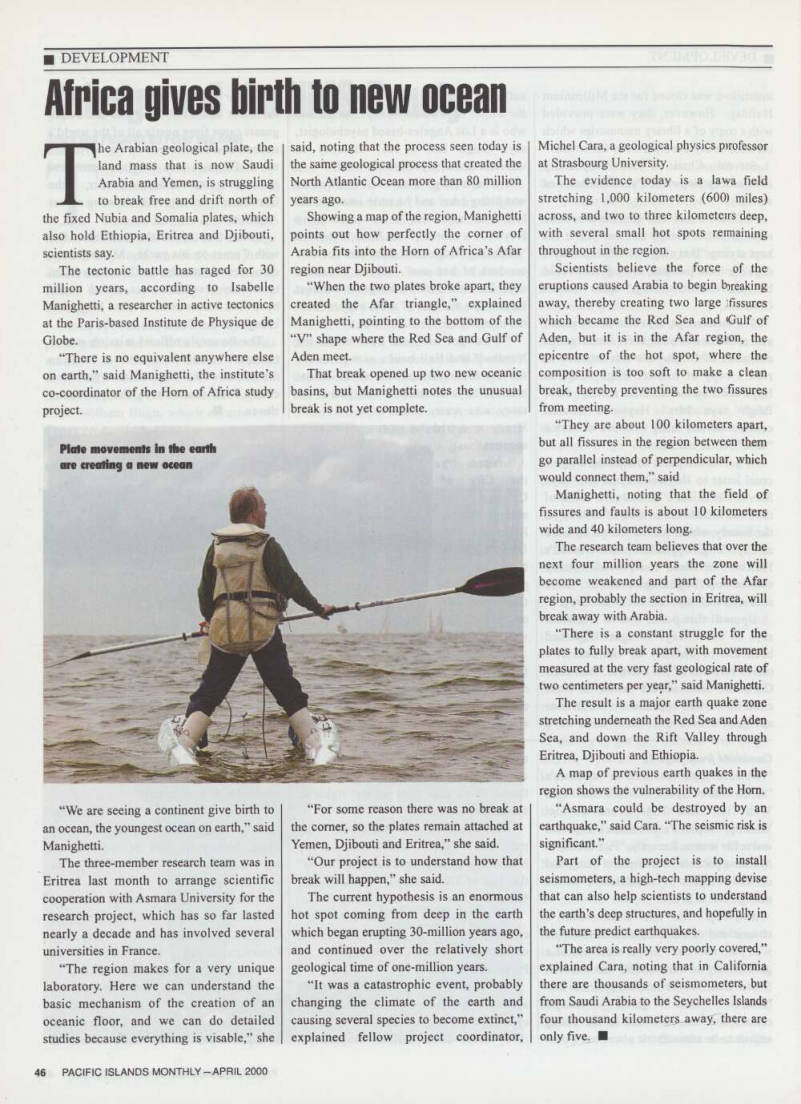
Plate movements in the earth are creating a new ocean