Chicago and the HMS Bounty
pp. 44-45 · Read in the full issue
Story and Pictures by Peter von Buol
T Though they are separated by thousands of miles, a very important link connects the Pitcairn Islands and Chicago, USA. A collection of letters and drawings by Peter Heywood, who had been a junior officer on board the HMS Bounty, can be found at the Newberry Library in Chicago.
As an eyewitness, and some say active participant, to the most famous open-seas mutiny in British naval history, Heywood’s words explain in vivid detail his actions during the insurrection against Capt. William Bligh, which occurred off Tonga on April 28, 1789.
Heywood’s letters, which continue to attract readers from around the world,
also describe what happened to the Bounty and its remaining crew after the mutiny, which had been led by Bligh’s friend and second-in-command, Lt.
Fletcher Christian.
After two failed attempts to settle on Tubuai, Christian sailed to Tahiti to deposit Heywood and 15 other members of the ships’s crew. Eventually, Christian and his fellow mutineers found refuge on desolate Pitcairn Island.
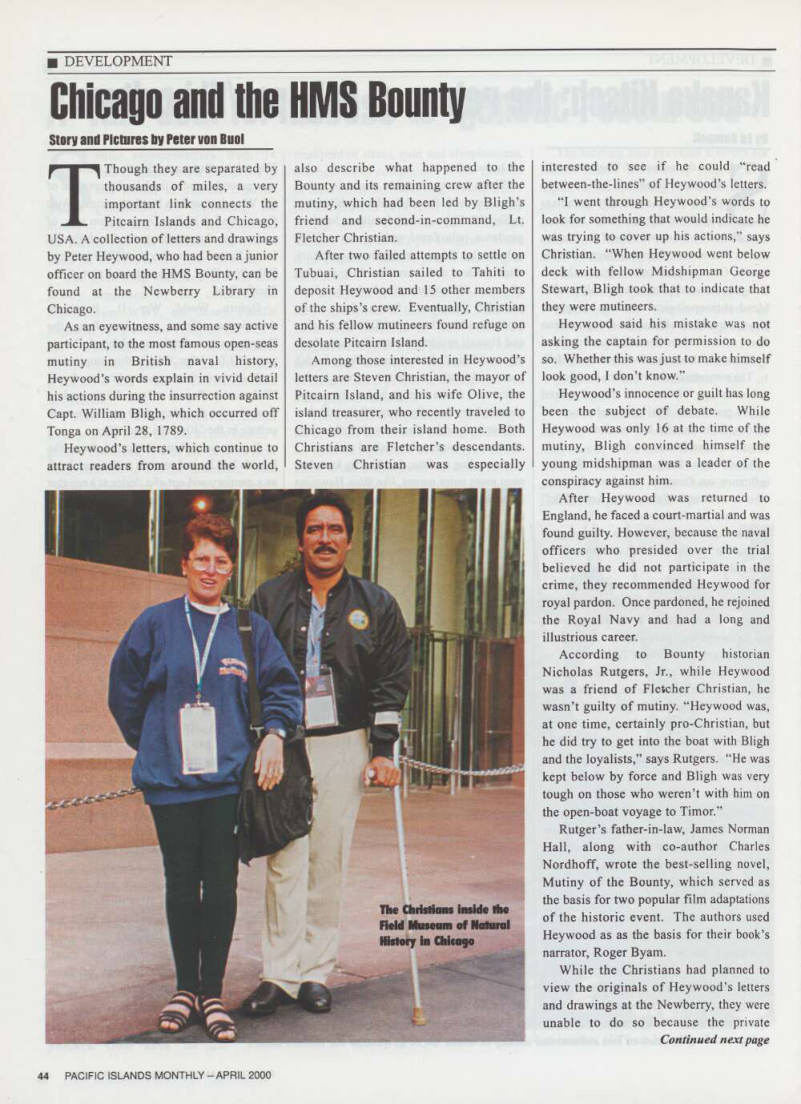
Among those interested in Heywood’s letters are Steven Christian, the mayor of Pitcairn Island, and his wife Olive, the island treasurer, who recently traveled to Chicago from their island home. Both Christians are Fletcher’s descendants.
Steven Christian was especially
interested to see if he could “read between-the-lines” of Heywood’s letters.
“I went through Heywood’s words to look for something that would indicate he was trying to cover up his actions,” says Christian. “When Heywood went below deck with fellow Midshipman George Stewart, Bligh took that to indicate that they were mutineers.
Heywood said his mistake was not asking the captain for permission to do so. Whether this was just to make himself look good, I don’t know.”
Heywood’s innocence or guilt has long been the subject of debate. While Heywood was only 16 at the time of the mutiny, Bligh convinced himself the young midshipman was a leader of the conspiracy against him.
After Heywood was returned to England, he faced a court-martial and was found guilty. However, because the naval officers who presided over the trial believed he did not participate in the crime, they recommended Heywood for royal pardon. Once pardoned, he rejoined the Royal Navy and had a long and illustrious career.
According to Bounty historian Nicholas Rutgers, Jr., while Heywood was a friend of Fletcher Christian, he wasn’t guilty of mutiny. “Heywood was, at one time, certainly pro-Christian, but he did try to get into the boat with Bligh and the loyalists,” says Rutgers. “He was kept below by force and Bligh was very tough on those who weren’t with him on the open-boat voyage to Timor.”
Rutger’s father-in-law, James Norman Hall, along with co-author Charles Nordhoff, wrote the best-selling novel, Mutiny of the Bounty, which served as the basis for two popular film adaptations of the historic event. The authors used Heywood as as the basis for their book’s narrator, Roger Byam.
While the Christians had planned to view the originals of Heywood’s letters and drawings at the Newberry, they were unable to do so because the private Continued next page
The Christians inside the Field Museum of Natural History in Chicago
institution was closed for the Millennium Holiday. However, they were provided with a copy of a library manuscript which includes many excerpts from the letters.
Steven Christian was especially intrigued by Heywood’s curious choice of words.
“I found it odd that in some places he referred to the Bounty as “that ship”. He kept saying “that ship”. I wouldn’t say I didn’t believe him but, some pieces could be read as misleading,” adds Steven Christian.
The manuscript, says Steven Christian, also contains new insight for him as to the character of Bligh. He was stunned to read a copy of a letter Bligh wrote to Heywood’s mother after the mutiny. In it, Bligh says Mrs. Heywood should consider herself lucky to be rid of such a “base” son as her Peter.
“I got to the point of reading Bligh’s cruel letter to Heywood’s mother,” says Steven Christian. “It made me think of the 1962 MGM film version of Mutiny on the Bounty, which starred Trevor Howard as Capt. Bligh opposite Marlon Brando’s Fletcher Christian. In it, Howard really showed how rough Bligh could be. Olive read it as well and said the same thing.”
Up until that point, Steven Christian says he had always thought Bligh had been treated unfairly by the first two movie versions of the sea tale. But, adds Christian, who is the father of four children, he was appalled by the famous navigator’s cold and harsh letter to a
suffering parent Sven Wahlroos, Ph.D., the author of A Bounty Encyclopedia and who is a Los Angeles-based psychologist, says Bligh had a real inability to understand the impact of his words.
He says Bligh didn’t know when he was being cruel and he truly intended his letter to serve as a consolation to Heywood’s mother, who he thought was “suffering from the baseness of the conduct of her son”. Steven Christian says he also read with great interest Heywood’s account of what happened on the morning of April 28,1789.
“What got me was how much the Nordhoff and Hall books as well as the movies accurately portrayed the actual mutiny,” says Christian. “That part of the story was pretty close to
Heywood’s account.”
Invited by fl the City of I Chicago to I attend Mayor ■ Richard M. I Daley’s official I New Year’s Eve party, the S Christians were H on their first H visit to America. J The Pitcairn 1 Islanders almost I didn’t make the S city’s festivities, wl arriving at the 1
New Year’s Eve celebration with a police escort at about 8:00 pm. At the event, guests came from nearly all of the world’s nations and territories. At the invitation of a Chicago-area businessman and philanthropist, Gary Comer, the Christians spent a month traveling across America.
Later, they sailed the Caribbean Sea with Comer on his yacht. Making stops on numerous islands, the Christians failed to see any breadfruit trees, which would have been descendants of those Bligh first brought to the Caribbean in 1793.
The Bounty’s official mission was to transport breadfruit trees from Tahiti to the islands of the West Indies to provide a cheap food resource to the plantation slaves. ■
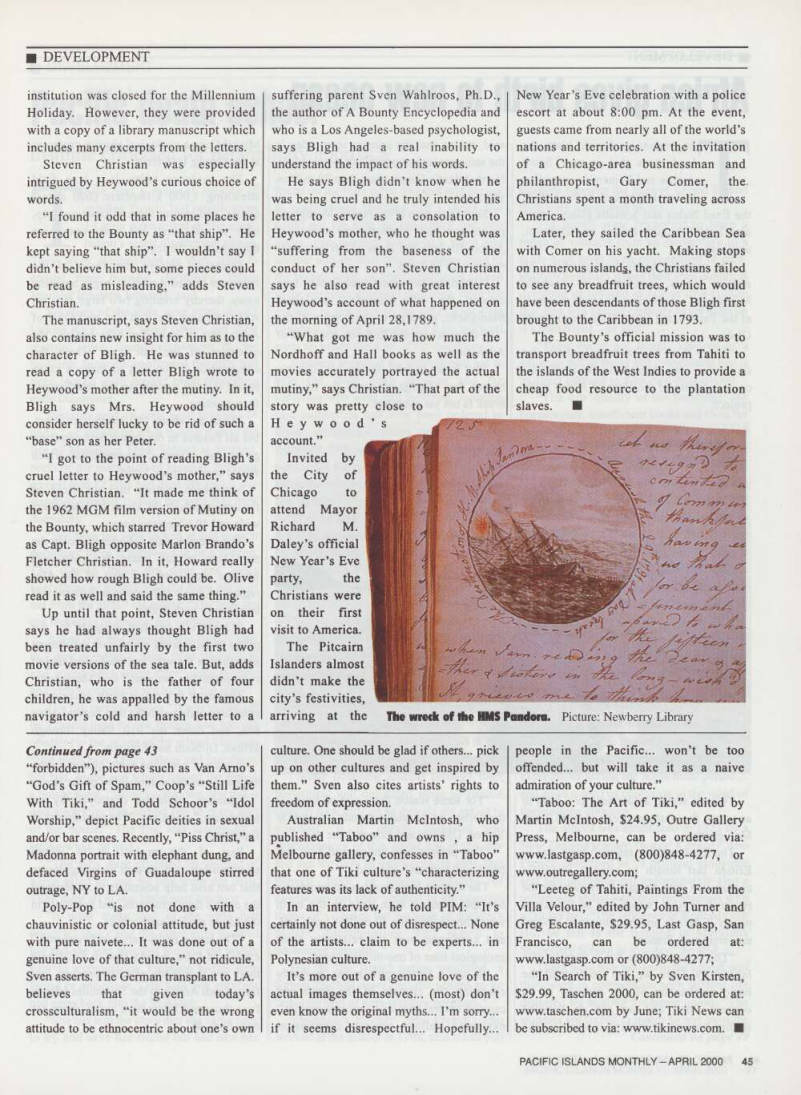
The wreck off the HMS Pandora. Picture: Newberry Library