US lays it on the line to Marshalls
pp. 38-39 · Read in the full issue
By Gift Johnson
The United States has a message for the Marshall Islands and Federated States of Micronesia: “Compact II” will be dramatically different from the current agreement.
US State Department Compact negotiator Allen P Stayman has put the Marshall Islands and Federated States of Micronesia governments on notice on two key issues: • That the days of “loose” cash in the form of large lump sum transfers from Washington to Majuro and Pohnpei are soon to end; and • The US plans to tighten regulations for islanders who can now enter the United States and its territories without need of a visa.
The Marshalls and FSM kicked off preliminary rounds of negotiations with US officials late last year. The focus of the talks are economic provisions that expire next year, with a two year grace period at the same level of funding in case the talks drag on.
Stayman acknowledged that unlike economic assistance provisions which expire in 2001, immigration provisions of a Compact of Free Association with the Marshalls and FSM are not expiring next year. But, he said, “we’ve put the (governments) on notice that the United States will seek changes in immigration” during the Compact negotiations.
Stayman was in Majuro in February and again in early March to meet government and business officials. A
no-nonsense, put-your-cards-on-the
table negotiator, Stayman has been frank about changes that the US wants in the long-term relationship with the Marshall Islands and FSM.
Since the US has provided nearly $2 billion to the FSM and $1 billion to the Marshalls through the Compact since 1986 and, for the Marshalls, Compact funds currently account for about 60 per cent of the national budget, the economic negotiations are pivotal for
the future of these nations.
A big failure of the current Compact, Stayman said in Majuro, was the lack of oversight of island spending by the US government. “We’ve learned a lot of lessons (in the first 13 years),” Stayman told more than 40 local business people at a special Majuro Chamber of Commerce meeting in response to a question of why the US waited 13 years to begin major financial audits of Marshall Islands and FSM Compact spending.
“We should have been more aggressive in monitoring programs,” he said.
Recent US and local audits have reported mismanagement of funds, political influence in issuing development bank funding for economically unviable projects, and generally questioned use of large amounts of US federal funds.
The Compact, he said, provided no uncertainty about the funding to the island governments. The annual appropriations have been guaranteed by the Congress. But Department of
Interior oversight was left to a “discretionary” Congressional budget, which while Stayman was at Interior in the mid-19905, was slashed 40 per cent.
Interior simply didn’t have the staff to oversee spending in the two countries, he said.
“It is one of the big failures of the Compact,” he said. “We must provide for people to oversee and manage programmmes.” In anticipation of the renegotiation of Compact economic provisions, US Congressional leaders asked the General Accounting Office to audit 13 years of spending in the FSM and Marshall Islands.
GAO audit teams were in the islands in late March and April conducting the audits in preparation for a series of Congressional oversight hearings in Washington later this year. At which, said US Ambassador to the Marshalls Joan Plaisted, Marshall Islands leaders will be asked some “hard questions” about how money was used.
Asked how the US will seek to increase accountability in “Compact 11,”
Stayman replied that in his opinion this will likely be done through grants that require auditable books, and that funding be spent according to specific goals and objectives.
Noting that his comments were not State Department policy, Stayman said it was his hope that the US would shift from “payments to grants” in the next Compact.
Stayman’s announcement that the US plans to tighten entry to the US has sparked a wave of concern from rank and file Marshall Islanders accustomed to being able, with their passports and airline tickets, to simply hop on a plane and enter the US to work, study and live.
But Stayman said that concern over the impact of large numbers of islanders from the FSM and Marshall Islands migrating to Guam, Saipan, Hawaii and the mainland US has prompted the US to put immigration issues on the table Continued next page
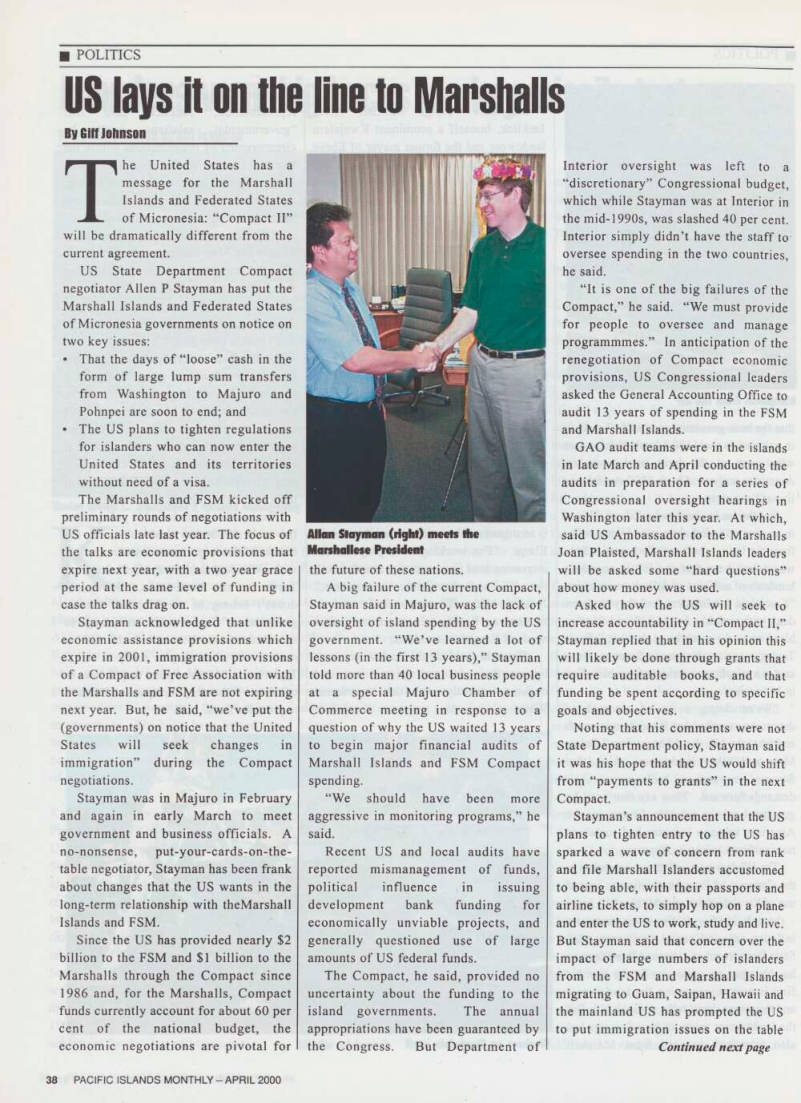
Allan Stayman (right) meets the Marshallese President
Continued from previous page during upcoming economic talks with the two island nations.
Stayman estimated that as many as 10,000-15,000 Federated States of Micronesia and Marshall Islands citizens have moved to Hawaii, Guam and Saipan since the Compact was established in 1986, becoming “quite a political issue” because of health and social costs to handle the large influx of islanders in those areas.
Political leaders in Guam, Saipan and Hawaii have increasingly demanded multi-million dollar annual reimbursements from the US federal government for the expense of providing social and health services to islanders who have moved there from the FSM and Marshall Islands.
A recent incident in which a nine year old Marshall Islands boy living in a small town in North Dakota infected 56 people with tuberculosis has also put the lack of health screening for entering islanders on the front burner.
In response to questions from Majuro business people about just how the US would seek to change the current visa free entry status of islanders, Stayman said that the US government has not exercised its right to screen people coming from the islands for such information as criminal records, health status and whether they are likely to becomepublic charges.
“The US hasn’t enforced this screening right because the Compact waived the need for visas,” he said.
Under the Compact of Free Association, Marshall Islands and FSM citizens may travel without visa to the US to live, work and study.
The US may consider a “pre screening mechanism” that would require islanders to apply for entry with a possible several week waiting period for US immigration to carry out its screening, he said. Or a more sophisticated tracking system could be used, he said.
This could be of mutual benefit to the Marshall Islands government, which has expressed an interest in knowing where its citizens are in the US, Stayman said. ■