Islanders want bin bucks for key missile test range
pp. 36-37 · Read in the full issue
Politics
Story and pictures by Gift Johnson
Kwajalein, a boomerang shaped necklace of coral islands touted as the world’s largest atoll, is the bread-winner for the Marshall Islands and the key to American plans for a national missile defense system.
Although the US by agreement has use of Kwajalein until 2016, island landowners have put the US and Marshall Islands governments on notice that they want vastly increased rental payments for the missile testing range. The hints have turned into loud demands as the two nations prepare for negotiations to renew economic provisions of a Compact of Free Association.
In February, a group of leading Kwajalein landowners, including former President Imata Kabua, hired a high-profile US law firm to get them a “better deal.”
Senator Ataji Balos, who along with Kabua and newly elected Senator Sato Maie represents Kwajalein Atoll in the Marshall Islands Nitijela (parliament), announced that Kwajalein landowners have hired the law firm of Mississippi-based Richard F Scruggs, an American attorney credited with engineering the first victory against the American tobacco industry in the mid -19905, which resulted in a $4 billion settlement for the state of Mississippi.
Halos said in an interview that this high powered legal firm has been hired to “get the landowners a better deal” in upcoming negotiations on a Compact of Free Association between the US and Marshall Islands governments. US State Department officials, however, have said repeatedly in response to Halos and other landowners that the issue of Kwajalein rental payments is not on the table in the negotiations that will address future economic aid to the Marshall Islands.
“I can see how much the United States needs Kwajalein,” said Maie. “It’s worth more than what they are paying. That’s why I say that Kwajalein isn’t a done deal.
They haven’t been fair.”
The underlying threat - so far unspoken by landowners - is the knowledge that in the 1970 s and early 1980 s, disgruntled Kwajalein landowners repeatedly led “sail in’’ protests to their off-limits islands, disrupting US missile testing schedules.
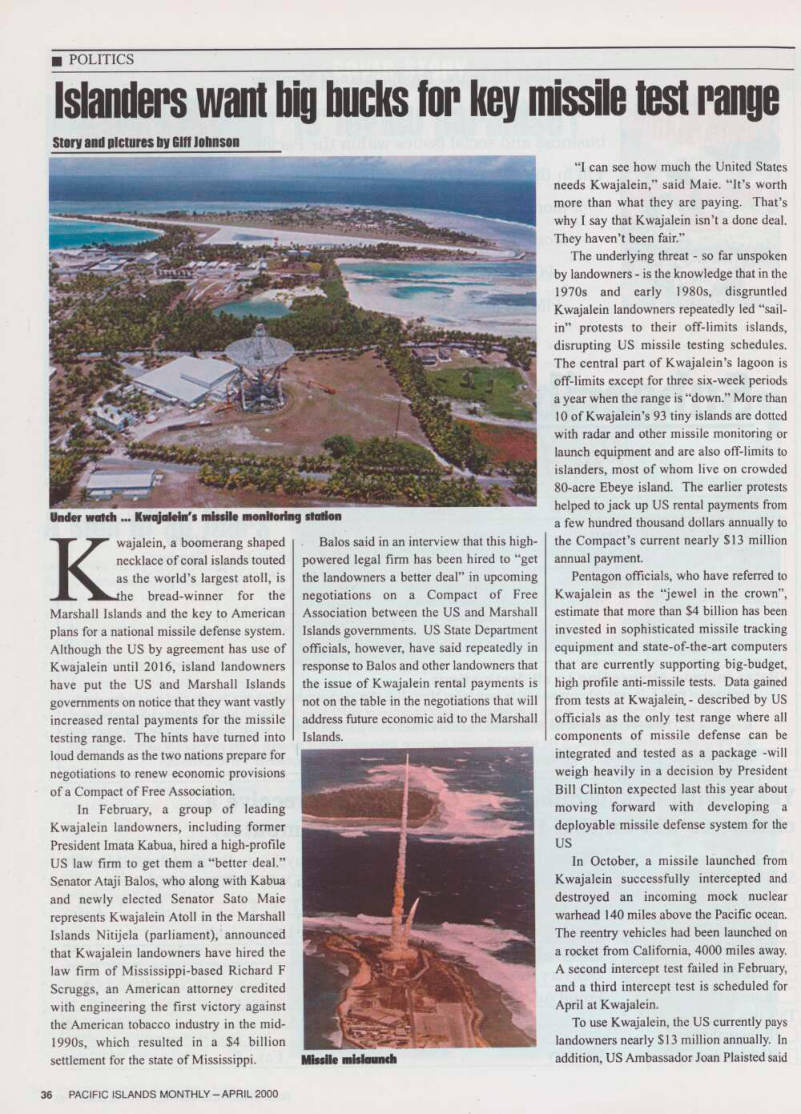
The central part of Kwajalein’s lagoon is off-limits except for three six-week periods a year when the range is “down.” More than 10 of Kwajalein’s 93 tiny islands are dotted with radar and other missile monitoring or launch equipment and are also off-limits to islanders, most of whom live on crowded 80-acre Ebeye island. The earlier protests helped to jack up US rental payments from a few hundred thousand dollars annually to the Compact’s current nearly $l3 million annual payment.
Pentagon officials, who have referred to Kwajalein as the “jewel in the crown”, estimate that more than $4 billion has been invested in sophisticated missile tracking equipment and state-of-the-art computers that are currently supporting big-budget, high profile anti-missile tests. Data gained from tests at Kwajalein, - described by US officials as the only test range where all components of missile defense can be integrated and tested as a package -will weigh heavily in a decision by President Bill Clinton expected last this year about moving forward with developing a deployable missile defense system for the US In October, a missile launched from Kwajalein successfully intercepted and destroyed an incoming mock nuclear warhead 140 miles above the Pacific ocean.
The reentry vehicles had been launched on a rocket from California, 4000 miles away.
A second intercept test failed in February, and a third intercept test is scheduled for April at Kwajalein.
To use Kwajalein, the US currently pays landowners nearly $l3 million annually. In addition, US Ambassador Joan Plaisted said
Under watch ... Kwajalein's missile monitoring station
Missile mislaunch
that the base generates another $l7 million in salaries to the 1100 Marshall Islanders who work at the base, and taxes on American wages. About 3000 Americans live at Kwajalein.
But the landowners, who live on Ebeye, in an over-crowded slum island three miles from the base, aren’t satisfied, particularly when they hear that the US is spending hundreds of millions of dollars on each test.
“Kwajalein landowners feel they’ve been dealt with unfairly by the US and they’ve hired us to do something about it,” Scott Taylor, a senior attorney in Scruggs’ firm, said in a telephone interview from his office
in Mississippi.
“We’re doing a lot of research to determine exactly what Kwajalein is worth and what the US should be paying.” Balos, Maie and other landowners think that Scruggs’ reputation will move their demands forward. They say that until he got involved in tobacco litigation, the American tobacco industry had sustained no significant losses in 50 years.
The US last year exercised its option in the Compact of Free Association to extend use of Kwajalein for an additional 15 years - through 2016 - at the same, annually inflation-adjusted rental payments. US State Department negotiator Allen Stayman has been put on notice by Taylor that his firm is now representing the landowners and they want direct talks with the US But the landowners move to hire Scruggs has also prompted concern from Marshall
Islands leaders.
Marshalls Foreign Minister Alvin Jacklick, himself a prominent Kwajalein landowner and the former mayor of Ebeye Island, indicated that in light of the fact that there is a lease in place giving the US use of Kwajalein until 2016, the Marshalls must be creative in approaching the US government to increase assistance to
Kwajalein.
The slum-like conditions for the majority of the population on Ebeye give landowners an angle, but Jacklick says the real issue boils down to getting a more fair distribution of US rental payments.
Currently, most of the rental payment goes to a handful of senior landowners, while the majority of Kwajalein landowners get little, Jacklick contends.
“If we ask for an increase in money for social and health programmes, it will be considered more (positively),” Jacklick said. “But if the proposal is just to give the landowners $lOO million a year, no way will the US consider it.” Jacklick said there is an urgent need to address social issues on Ebeye. “I’m working on a proposal for increasing land payments that satisfies both the US and Kwajalein landowners,”
Jacklick said. His proposal, he said, is focused on health, education and social needs of Kwajalein residents.
But, said Jacklick, the landowners can’t bypass their national government and negotiate directly with the Americans.
While saying he respects Kwajalein
landowners’ right to have their own legal representation, Jacklick said that “governmental relations can’t be circumvented by organizations within the Marshall Islands. While I respect the notion that landowners have the right to negotiate, they should respect the government and submit proposals to the government.”
But direct negotiations and big money is what Balos, Maie and other landowners are after. “I hear people, Americans, say that Kwajalein is a done deal, but I live there,”
Maie said. “I’ve been victimized by the Americans. I don’t hate the US, but we don’t have a good deal.”
Landowners’ attorney Taylor said his firm isn’t taking an adversarial stance toward the Marshalls government. “We’re not at odds with the Marshalls and don’t intend to interfere in the Compact negotiations,” he said. It’s just that Kwajalein landowners felt it was in their best interests to have a law firm represent them whose only agenda is Kwajalein.
The fact that it has been US policy since the early 1980 s to deal only with the Marshall Islands government and not to talk with individual landowners isn’t deterring Taylor or the landowners. “Kwajalein doesn’t belong to the Marshall Islands government,” Taylor said. “It belongs to the landowners. I’ve asked the US to contact me when they’re ready to talk,”
Taylor said. “At some point they’ll have to talk to us. Either they’ll respond or I’ll have to press the issue. ■
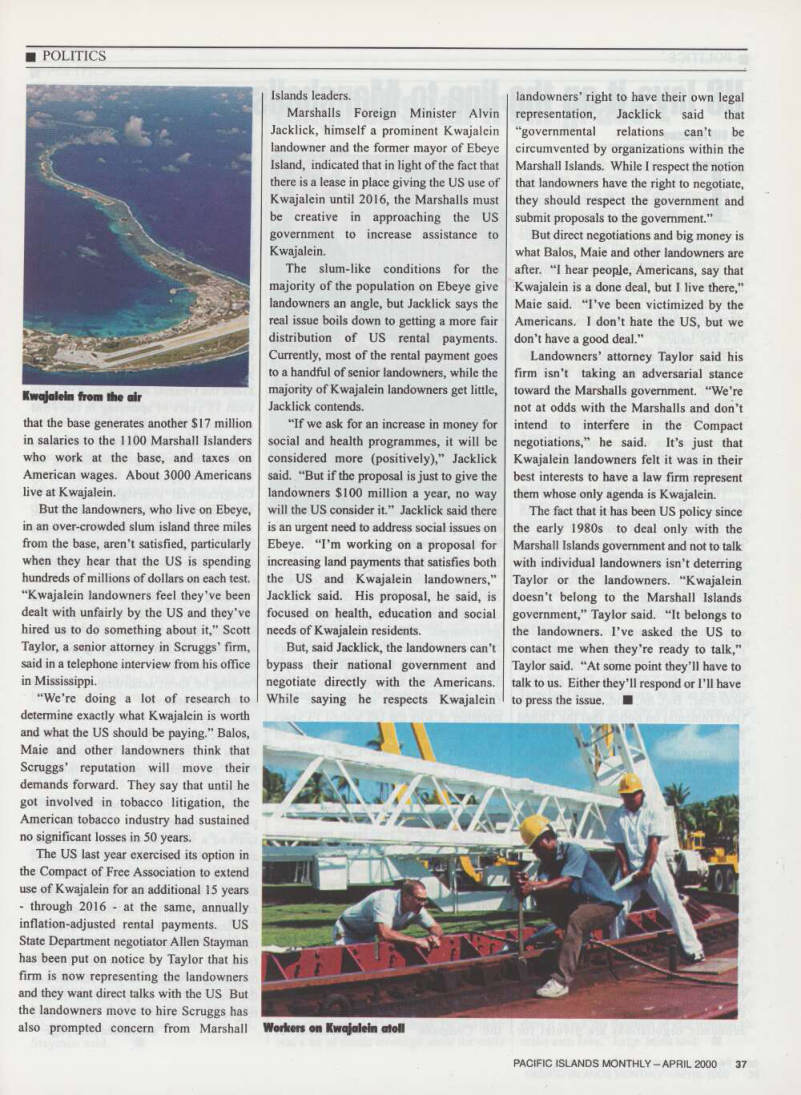
Kwajalein from the air
Workers on Kwajolein atoll