Victims of a silent killer on the rise
pp. 26-27 · Read in the full issue
By Eileen Tugum-Kolma
On 16 February a handful of people, mostly strangers, surrounded a small freshly dug grave at Port Moresby’s (Papua New Guinea’s capital) 9-Mile cemetery.
They watched somberly as a small brown coffin containing the body of five-month old Raymond was lowered into the grave.
There were no parents, no relatives to say goodbye. Raymond’s mother died of AIDS after giving birth to him. His father died earlier. The living relatives wouldn’t have anything to do with Raymond. They feared they would catch AIDS from him.
Raymond, innofcent as he was, was among the growing number of Papua New Guinea children and adults dying from AIDS. Like Raymond, many are innocent, paying the price for a choice made by someone else, in many cases someone they loved and trusted.
Raymond’s death brought to 158 the reported number of people who had died from AIDS in Papua New Guinea, a figure considered too high for a nation of only 4.5 million people.
For many of these people the problem would be devastating enough if limited to these people alone. But it also has serious repercussions on their families.
Apart from the huge emotional loss of people dear to them, the families will also face loss of income as breadwinners sicken and die; a loss of care, nurturing and stability; and in rural areas as AIDS takes its toll on the labour available to till the soill, loss of food supply.
Since the first case was reported in 1987 the number of cases reported and the rate of infection has gone up dramatically. Over the past two years the numbers have increased by 50 per cent each year.
As at September 1999 (latest figures available) there were 2100 known people living with HIV, the virus that can ultimately cause AIDS. Of these 661 had full blown AIDS. The ratio of male to female infection was almost one to one with four per cent being children under 15 years of age. The Health Department estimates between 10,000 to 20,000 others are carrying the virus and bound to develop AIDS in the next five to 10 years.
But the estimates are conservative.
Director of the PNG National AIDS Council Secretariat Dr Clement Malau is concerned that there could be many more than that. He said Papua New Guinea would have a better idea of what was happening “if we had a good surveillance system throughout the
country”. Right now only the Port Moresby General Hospital has a comprehensive surveillance system. AIDS is increasingly infecting Papua New Guinea’s 4.5 million population at alarming rates. It is currently the leading cause of deaths at the Medical Ward of the Port Moresby General Hospital, the country’s biggest hospital. But authorities believe that soon it will be the leading cause of deaths among healthy, young (15-48 age group) adults in the nation’s capital, Port Moresby, if the current trend continues.
AIDS is affecting the young sexually active and economically important members of the country.
Dr Malau, a leading authority on AIDS in the country told Pacific Islands Monthly: “It may even become the single biggest killer in the country in the next 12 months, taking the place of deaths by road accidents for instance. “As those infected do not show symptoms immediately we can expect more people to continue to die of and this will
definitely continue.”
He said Papua New Guinea is seeing the same pattern as that in Africa and if not treated early could have catastrophically and devastating effects on the country.
Prime Minister Sir Mekere Morauta said in his World AIDS Day message: “We are already seeing the impact of AIDS on society. People disowning bodies of those that have died of AIDS, children left without
parents, villagers stigmatizing other villages,
and many more complex consequences.
“Recent experiences indicate that even court systems at local level need to deal with the issues surrounding HIV/AIDS through demands for compensation.
“It is safe to say that we are only seeing the tip of the ice burg f the full impact of AIDS on a diverse society like Papua New Guinea. “As the epidemic worsens the social and economic impacts will be astronomical.
“AIDS is a major development issue and must be given a central focus of government.
All sectors of both the public and private sectors much be encouraged to take part in the nation prevention care and support Continued next page
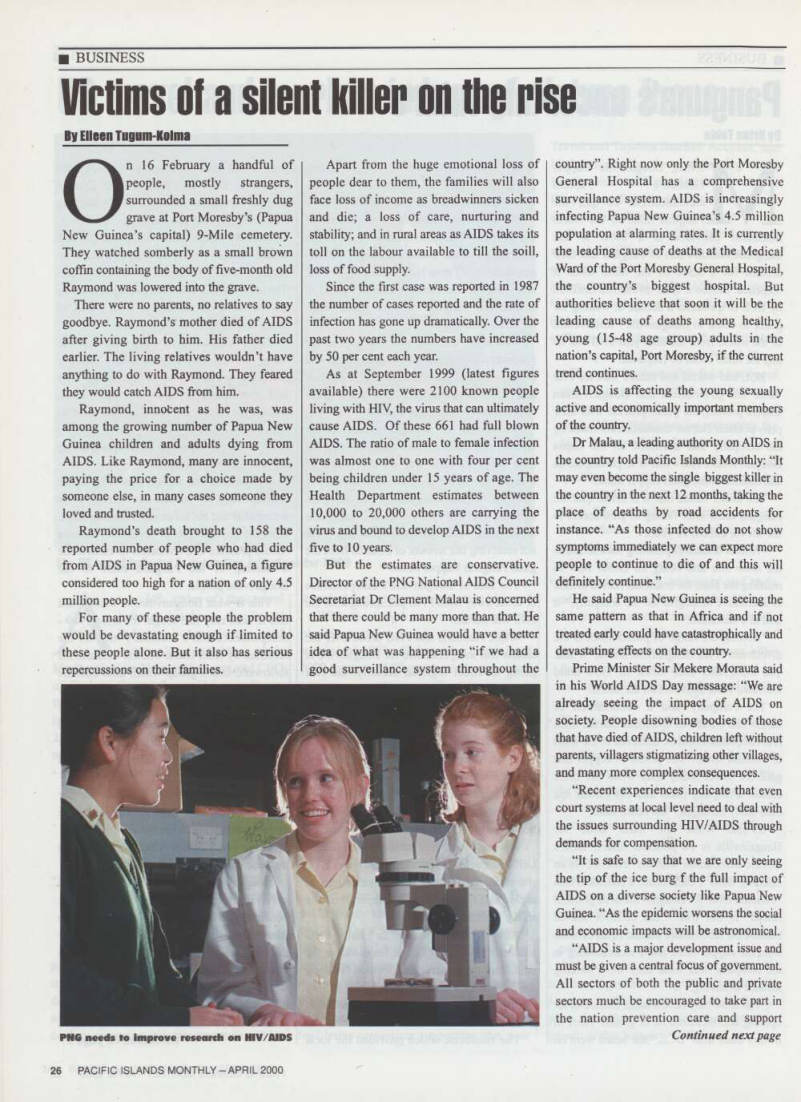
PNG needs to improve research on HIV/AIDS
Continued from previous page
strategy stipulated in the medium-term plan.
If measures are not put in place to curb this trend Papua New Guinea is heading for disaster. The future predicted if the trend continues is worrying. Papua New Guinea could end up as Prime Minister Sir Mekere said: “With a vaccum left by a whole generation of young people never to be filled”, especially in the labor force a whole generation of young children infected with HIV who may also be orphans because their parent(s) have died of AIDS, a poor economy due to a loss of a productive formal as well as informal workforce.
For a nation struggling with an ailing economy, disrupted by political upheaval, and law and order problems, AIDS is an added burden. And the country faces many challenges in tackling it. Sir Mekere said the biggest include the diversity of PNG culture, its difficult geographic terrain coupled with the language barriers (800 languages) and the high illiteracy rate (87 per cent?) which make communication a daunting task, myths about AIDS and different religious philosophies.
He said the evolution of culture and the shifts in rural subsistence way of life to an urban setting and the mixing of cultures and subcultures makes education for behavior changes a very challenging task.
Sir Mekere said: “In particular the practice of polygamy has become increasingly difficult to define in a modem setting. Polygamy in the traditional and rural setting had been well defined but appear to
have taken on a different form and entity in the modern setting, thus making sexual networking more complex then in the past.
This is also so with certain permissive cultural sexual encounters in traditional settings in some societies in the country.
The need and want for money he said has brought with it the practice of buying and selling goods and services, some of which are now regarded as needs and not luxury items. Close to 1 in 5 sex workers in Port Moresby are HIV positive He said also that the AIDS epidemic is bound to get worse as the economic situation worsens.
As more and more people continue to die and a few of those brave commendable people living with AIDS come out publicly, the country is slowly coming to terms with the fact that AIDS is very much alive and in PNG and is here to stay, many of the general public, especially those in the rural communities even more so than the leaders and the educated. But like many countries throughout the world PNG is now giving AIDS priority and has set up a National AIDS Council to develop comprehensive responses to combat the spread of AIDS.
The Prime Minister said there is not time for denial and urged all sectors to cooperate in the national AIDS response. He also urged everyone to do risk analysis at the family and individual level.
Dr Malau said; “AIDS is everybodyis business. And it will take individuals making a decision not to to put themselves at risk to effectively stop its spread.” ■