US travel and tourism industry's future focus
p. 24 · Read in the full issue
At a US state of the travel industry luncheon, the Travel Industry Association of America’s national chair Marilyn Carlson Nelson, chairman and CEO of Carlson Companies, told her audience that, acting for the US travel and tourism industry, TIA will advance an agenda for 2000 that will focus on three specific initiatives: • Raising awareness of the economic, social and cultural impact of travel and tourism in the United States; • Exerting greater influence on federal legislation and policies that affect the travel industry’s collective needs; and • Launching a long-range industry program to increase the number of international visitors to the U.S. and reverse a decline in US share of world travel.
“If 1999 can be characterized as a year of planning and development to prepare the travel industry for the new century,” declared Nelson, “then 2000 will be known as the year of action. As we begin the new century, more new industry programs will be
launched than at any time in recent history.”
With the travel and tourism industry playing a major part in the E-commerce success of 1999, Nelson also proclaimed 2000 the year of “T-commerce” - travel and tourism commerce. T-commerce is everything that has to do with travel and its distribution, Nelson said that T-commerce was “the” industry of the future and should be recognized as such by opinion leaders.
As one effort to increase awareness of T commerce as a key U.S. industry, Nelson announced the release of the just-published Tourism Works for America 2000, Ninth Edition, the annual comprehensive study that details the economic impact of travel and tourism.
During her address, she spoke of the five public policy issues TIA will concentrate on in 2000. These include repeal of sections of the Illegal Immigration Reform and Immigrant Responsibility Act of 1996, moving the aviation trust fund off-budget, making the visa waiver pilot programme permanent, funding and creation of a legislative provision supporting the new
Travel and Tourism Satellite Account, and lastly, monitoring the restructuring of the Immigration and Naturalization Service so the primary focus remains on inspections and service rather than enforcement.
Nelson stated that TIA late last year approved funding for a wide-ranging series of activities designed to increase international travel to the U.S. and increase U.S. share of overall global travel, including: • The opening of overseas offices in the UK and Japan and a presence in Brazil. These offices will be responsible for a number of
specific programs including coordinating
industry activities with local and regional Visit USA committees, representing the U.S. at international trade shows and expositions, working to identify and qualify international tour operators who send visitors to the U.S., running Discover USA Educational Seminars, organizing international sales missions, and
managing a comprehensive international
media relations program. • TIA is developing consumer and trade advertising campaigns in the UK and Japan built around a series of specific themes that capitalize on the diversity of the American travel experience. The theme campaigns will be supported by familiarization trips and targeted public relations. • TIA has also created a new international research division to provide the intelligence necessary to select the advertising themes and to make available to the industry research and analysis on international consumer preferences, travel patterns and trends not available from other sources. • Internet-based products have been implemented or will soon be launched that facilitate communications between the U.S. travel and tourism industry, international tour producers and the media.
Nelson said that “only when T commerce gets the recognition that it truly deserves will our opinion leaders finally grasp the value of nurturing the continued growth of this industry.” ■
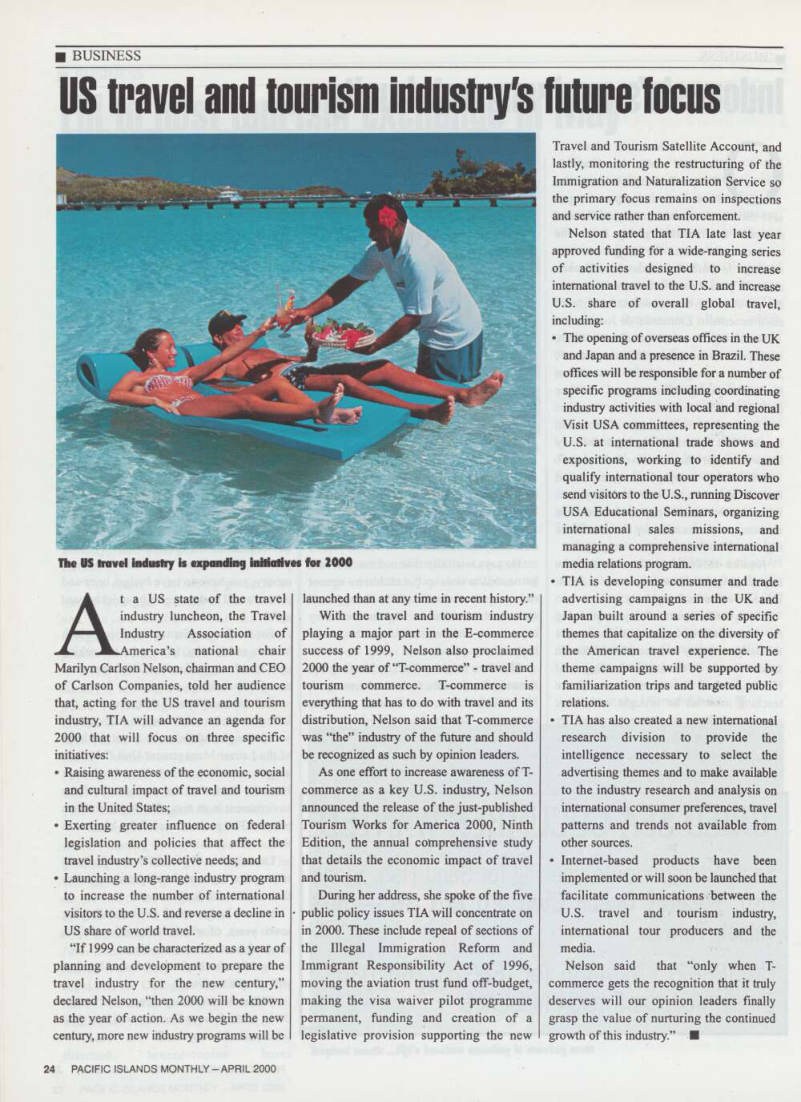
The US travel industry is expanding initiatives for 2000