Indonesia's environmental unity
p. 23 · Read in the full issue
On the Indonesian island of Sumatra and in France’s Basque Country, children who have never met are working to save their forests-drawn-in by the efforts of a small environment group from the southwest of France. “We bring a common message to both Indonesian and French children: your forests interest us. You must be proud of your environment,” said environmentalist Emmanuel de Joantho.
“In raising the awareness of the children, we hope to do the same with their parents”, Joantho, a manager with the Association For Introducing Fauna and Nature (MIFEN) said.
“After all it is they who will count, because in 15 years it is going to be they that will inherit what we leave behind us.”
MIFEN is a non-profit company based in the Basque area, at Urcuit, near Bayonne, in the southwest of France, dedicated to environmental education for children in the region and local river restoration projects.
Joantho landed in Indonesia and the tropical jungles of North Sumatra in 1994, has since come back regularly.
This year he spent 12 days explaining the temperate zone forests that characterize the Basque country to some 100 children in small schools in the isolated villages of Sibolangit and Ketambe. Some of the teaching material he brought with him,
photos and drawings, were prepared by
French children. He will return to the Basque Country loaded with questions from the curious Indonesian children.
“Environment issues cannot be blocked by politics or borders, protection can only be effective if it is international,” says Joantho, who revels in the possibilities offered by the Internet.
He says wistfully that not much would be needed to link up the children - one or two computers which could be second hand - to a web site. But he says he knows by experience that with children this could happen very quickly.
There are no phone lines at Sibolangit or Ketambe but Joantho took his chances with PT PRAMINDO, a French telecom company which is working on telecommunications infrastructure in the area.
“They didn’t throw me out,” he said.
“They didn’t laugh in my face, they listened, took some notes and said they would look into it.”
“Everything being done today in environmental education gets only peanuts,” he says. “You have to have money, you have to have budget lines and ours is small and going to be quickly used up.”
For the Basque-Sumatran project, which he sees as his baby, he says he is working on a total budget of only 6,000 francs (less than 1,000 dollars).
But he was hopeful that, one day, the European Union might chip in with a grant.
Sibolangit and Ketambe are at the heart of the Leuser Management Unit (LMU), a unique experiment including the Leuser National Park for the protection of the environment in an area affecting 1.4 million people. The park is one of the biggest in Asia.
Launched in 1996, LMU was designed to promote regional development in a way that respects the environment.
It has a budget of 65 million dollars for seven years, of which 45.5 million dollars comes from the European Union.
And Joantho hopes that his small project will get some of it.
“What we are doing there, what we are doing in the Basque Country will bear fruit in 15 years,” he says. ■
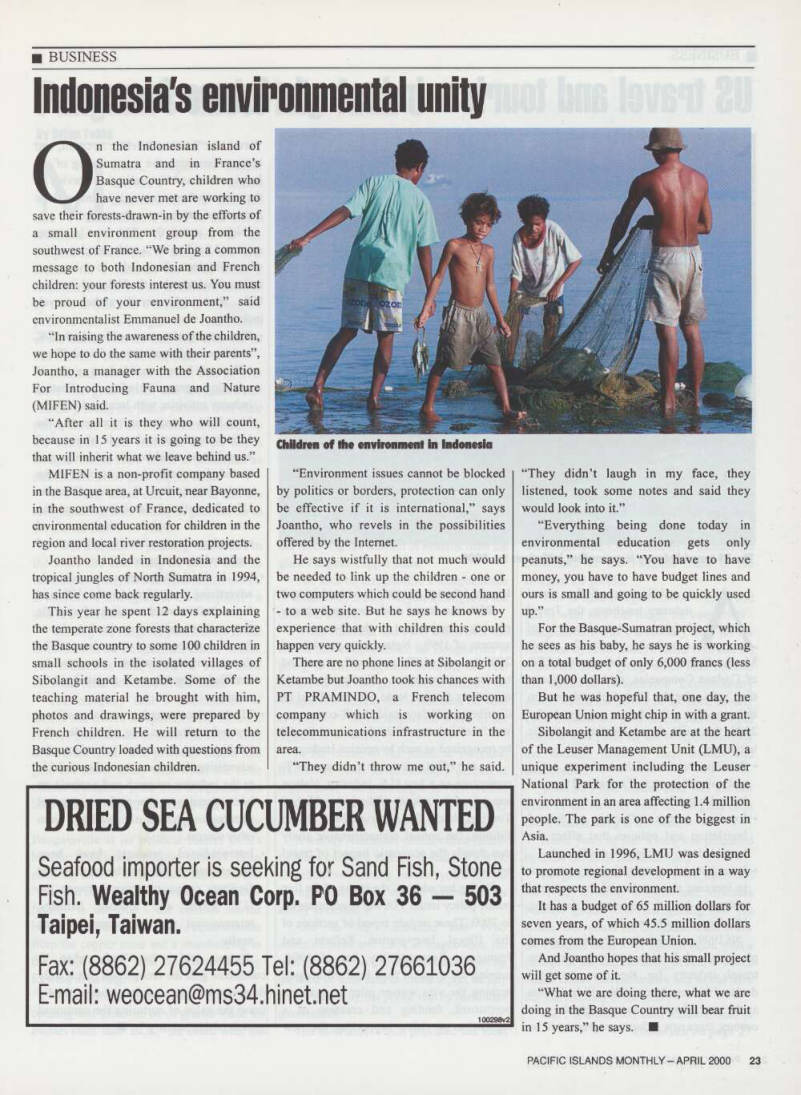
Children of the environment in Indonesia