Academics lead fight against family businesses
p. 21 · Read in the full issue
A group of South Korean academics has declared war on the nation’s omnipotent conglomerates, accusing them of backtracking on corporate reforms and demanding fair play and transparency in big business.
The campaign is led by Korea
University professor Jang Ha-Sung,
figurehead of the influential People’s Civic Solidarity for Participatory Democracy, which has won a cascade of public support for its quest for political reforms.
“The family-controlled structure of South Korean conglomerates is a major obstacle to corporate reforms,” Jang said.
The professor is whetting his sword to do battle with the wiley owners of the
country’s giant conglomerates, or “chaebol,” as the season of annual shareholders’ meetings kicks off here.
His campaign
has already got some firms on the defensive, with bosses floating a flurry of offers including new stock
options to
sharholders, share buybacks, and new business plans - to help prop up its stock price and broaden its shareholder base.
The most
ensure the firms introduce real reforms to break the absolute power of the behemoths’ ruling famlies as demanded by the reformist government.
“We will take tougher action to invoke minor shareholders’ rights such as bringing damages suits and calling for an inspection of company books,” Jang said.
He suggested the protection of minor stockholders was an effective tool to crack the chaebol’s family-controlled structure and introduce more open business practices after decades of opaque
operations.
The over-leveraged conglomerates, blamed for South Korea’s descent into crisis in late 1997, have been under enourmous government pressure to reform
remarkable change came at Hyundai Motor Co., the flagship of the country’s largest firm Hyundai Group, which replaced half of its directors - including members of its controlling family - with outside members at a shareholders’ meeting on Friday.
Hyundai officials said the new reforms would also spread to other Hyundai units.
But the civic group was not overly impressed, pledging stronger steps to
their debt-financed business styles that helped the economy boom in the 1980 s.
The drive has led to the dismantling of the failed Daewoo group, once the country’s second largest conglomerate.
Daewoo head Kim Woo-Choong was the first chaebol owner to step down amid revelations of mismanagement.
The chaebol were last year barred from transferring assets between subsidiaries to prop up weak units, a practice often used
to disguise losses or shady practice as Seoul called for owning families to relinquish their grip.
This year they were obliged to present stricter consolidated balance sheets covering all their operations as Seoul forges ahead with its reforms crusade to wipe out the weaknesses that contributed to the crisis.
“Overall, we see improvement in corporate reforms. We will move further to curb circular shareholding next year,” Lee Jae-Koo, a Fair Trade Commission official, said.
But Professor Jang insisted local firms still have a long way to go, accusing some chabol owners of using shadowy in-house transactions to entrench their power.
“Corporate reforms are now at a critical junction. The rules have not been fully translated into action,” he said.
The crusader singled out Samsung and Hyundai as targets, saying the powerful groups had abused “circular shareholdings” to \ retain family control.
For example, he S says, Samsung chief 1 Lee Kun-Hee has i only a two per cent stake in Samsung I Electronics Co but ( effectively controls 1 the money-spinner through a 25 per cent
stake in the firm held by other group affiliates. Lee came under under fire last year when a substantial portion of shares in Samsung SDS, an Internet-related business, was transferred to relatives at 7000 won per share.
Samsung SDS is unlisted, but its shares are traded at 500,000 won (445 dollars) in the over the counter market. The group has flatly denied any illegality in the share transfer. ■
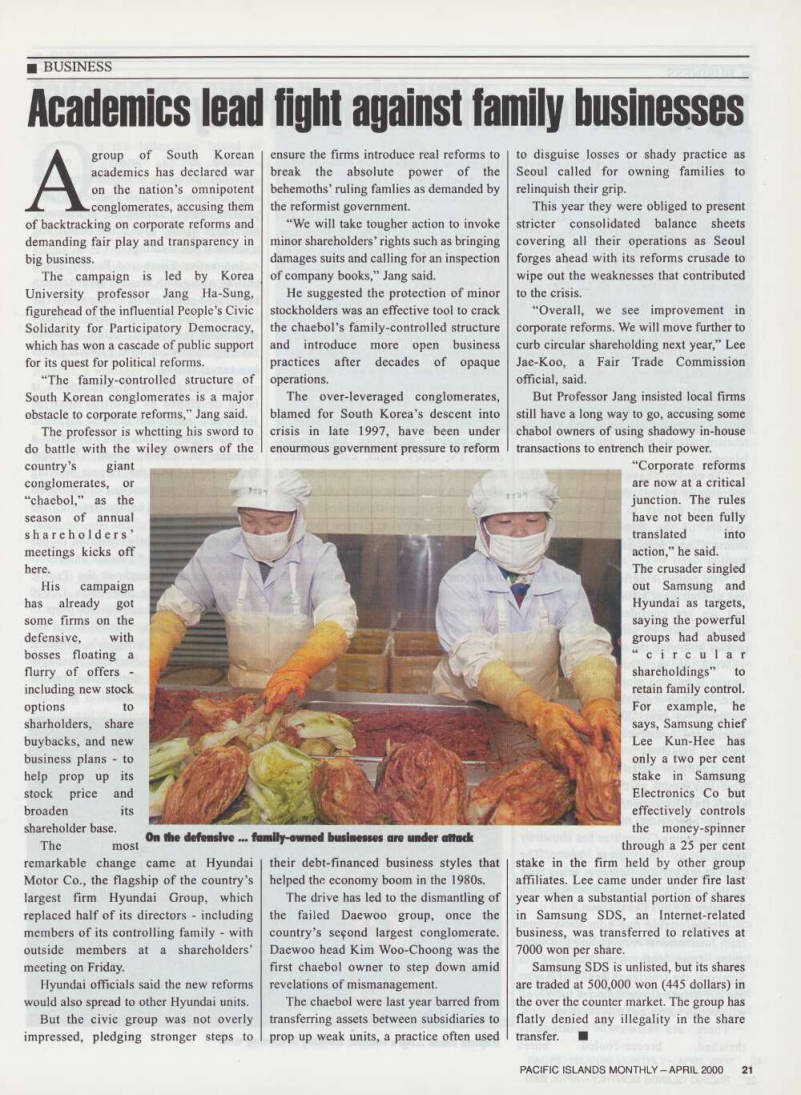
On the defensive ... family-owned businesses are under attack