Asia-Pacific airlines slow to cash in on the Net
p. 20 · Read in the full issue
Airlines in the Asia-Pacific region are a long way off from using the Internet to conduct business even though they are keen to boost information technology systems, aviation firms say. Among obstacles facing regional airlines in selling tickets or sourcing supplies on line is the reluctance by companies to move away from traditional modes of doing business, through the telephone or fax.
While electronic commerce is being embraced by various sectors in the region to speed up transactions, the aviation industry is slow to adopt the practice because of infrastructure problems and the preference to stick to current ways of doing business, the firms said.
In a recent survey on information technology (IT) trends among the top 150 carriers, SITA, a leading provider of integrated telecoms solutions for the air transport industry, found that the average planned IT investment by Asia Pacific airlines was only 1.7 per cent of revenues.
This was far from North American carriers’ 4.2 per cent and their European counterparts’ 2.2 per cent, said the Societe
Internationale de Telecommunications Aeronautiques (SITA). However, it said 80 per cent of the respondents were optimistic that Asia-Pacific carriers would increase their IT investments this year.
SITA, along with Illinois-based aerospace parts supplier AAR Corp. launched in Singapore an electronic marketplace for products and services for the air transport industry, which they said spent up to some 100 billion dollars a year
on supplies.
Asia’s premier air show Asian Aerospace 2000, which concluded in Singapore recently, showcased for the first time dot.coms in the industry, such as SITA and AAR’s joint venture aerospan.com and similar ventures aviall.com and aviationX.com.
“Asia’s certainly embraced the Internet, but if that’s become the method of ordering, I don’t see that yet,” said Charles Elkins, director for marketing of Texas based Aviall, Inc., among the world’s largest aviation aftermarket parts distributor. Ten per cent of Aviall’s revenues came from business transacted on its aviall.com website, and over the next
two years, it hoped it would grow to 50 per cent, Elkins said. “For Asian carriers, they know the whole industry is moving towards business-to-business electronic commerce and they know there are advantages in coming on board,” said Karl Moore, SITA public relations manager.
He cited streamlined supply processes and less expensive distribution costs as among the benefits.
AviationX, a new entrant and competitor to aerospan.com, said it hoped to save the aviation industry at least 300 million dollars each
year by getting
transactions done online.
On the retail side, online booking of air tickets over the Internet had yet to catch on.
Electronic commerce and management consulting firm Boston Consulting Group in an earlier report said that online travel was still “in its early days, “accounting for 11 per cent or only 320 million dollars of 2.8 billion dollars in revenues from retail sales transacted over the Internet in the region.
Online travel in the group’s survey not only included ticket purchases but also hotel room bookings. The report noted the presence of 126 Asia-based websites on travel alone. US investment house Goldman Sachs estimated that online travel transactions would be one of the fastest growing electronic commerce areas with significantpotential for growth in the region.
“Airlines based in countries with high degrees of Internet awareness and adoption - Australia, Hong Kong and Singapore should fare better,” in taking advantage of new Internet technologies to bring their businesses closer to consumers, the Goldman Sachs report said. ■
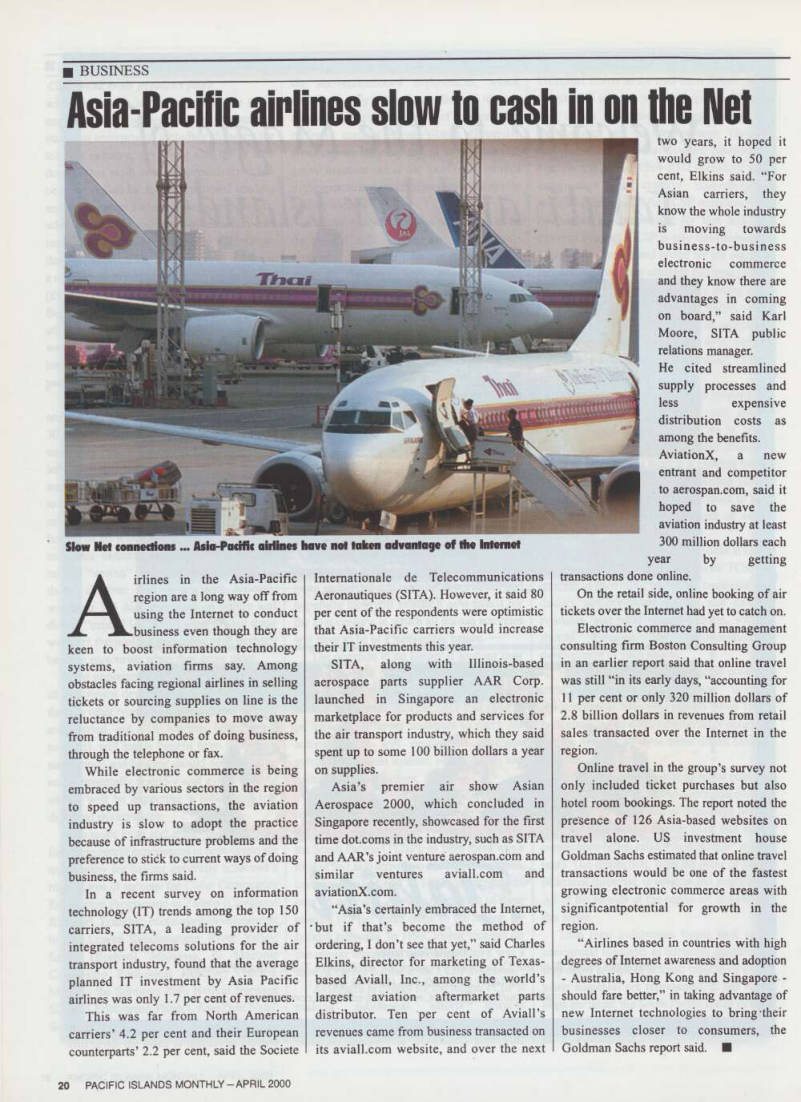
Slow Net connections ... Asia-Pacific airlines have not taken advantage of the Internet