Asian Development Bank warns against slowing
p. 15 · Read in the full issue
down reforms
Asia is recovering faster than expected but should resist calls to slow down reforms in its headlong pursuit of higher economic growth, the region’s premier development bank said.
The Asian Development Bank (ADB) warned that a “growth first approach” was risky and may invite a recurrence of the financial crisis that swept through the region in 1997.
A report by the Manila-based bank’s regional economic monitoring unit said that as recovery firms up in the five most affected countries - Indonesia, Malaysia, the Philippines, Thailand and South Korea -
there were already signs complacency was
setting in.
“Some have suggested that a more cautious approach to reform is now needed to allow growth to take firmer root. They point out that the initial impact of restructuring is likely to be deflationary as retrenchment and bankruptcies occur, and that this could disrupt the recovery,” said the report.
The ADB said that while the suggestion was appealing, there were dangers involved in postponing the reforms, which were often painful as they would result in the closure of debt-ridden banks and companies.
“A ‘growth first’ strategy is not only risky, it may invite recurrence of problems at a later date, particularly if underlying structural difficulties are not tackled,” the report said. It said the high public debt of these countries limited the effectiveness of such a scheme and stressed that the “best chances for durable recovery require perseverance with reform”.
The report added:“Encouraging economic activity by postponing or cancelling needed but difficult reforms can exact a high cost in terms of a reduction in
long-run potential growth.”
The ADB said the region’s recovery has been “encouraging and faster than
expected”, although incomes and living standards were still below pre-crisis levels.
But the recovery has been “uneven” with South Korea springing back the fastest to post a gross domestic product (GDP) growth of 10.2 per cent in 1999, and Indonesia lagging behind because of domestic political problems.
The recovery has also not been broad based, with the stock markets leading the rebound and property markets eating the dust, the bank said. Private investment and consumption have yet to catch up with public spending and industry has yet to keep pace with the growth in agriculture.
Favorable external conditions such as the strength of the US, Japanese and European economies are seen to bolster recovery. The investor panic that gripped the region has also subsided, the bank said.
While the rebound is expected to strengthen this year, the reforms in the finance and corporate sectors were not being implemented as scheduled in some of the affected countries.
“In all five countries, progress on the
resolution of corporate debt is slower than banking sector restructuring,” the bank said, adding that there have been isolated cases of bailouts.
It described the situation in Indonesia as “highly problematic” as most banks were insolvent and operating only with the support of the Indonesian central bank.
In Indonesia, “bank privatization programs have progressed slower than envisaged, and reforms targetting non-bank financial intermediaries have lagged behind those targetting banks,” it said.
Malaysia and South Korea have “made the most progress” on bringing down the ratio of bad loans and restoring bank capital. Thailand’s private sector-led approach “seems to be delivering results” as bad loans were on a downward trend.
It said social issues present a long-term challenge to Asian economies, as the social and environmental costs of the crisis were likely to be felt much longer after the recovery. The bank suggested an approach that “empowers people rather than provides unsustainable subsidies.” ■
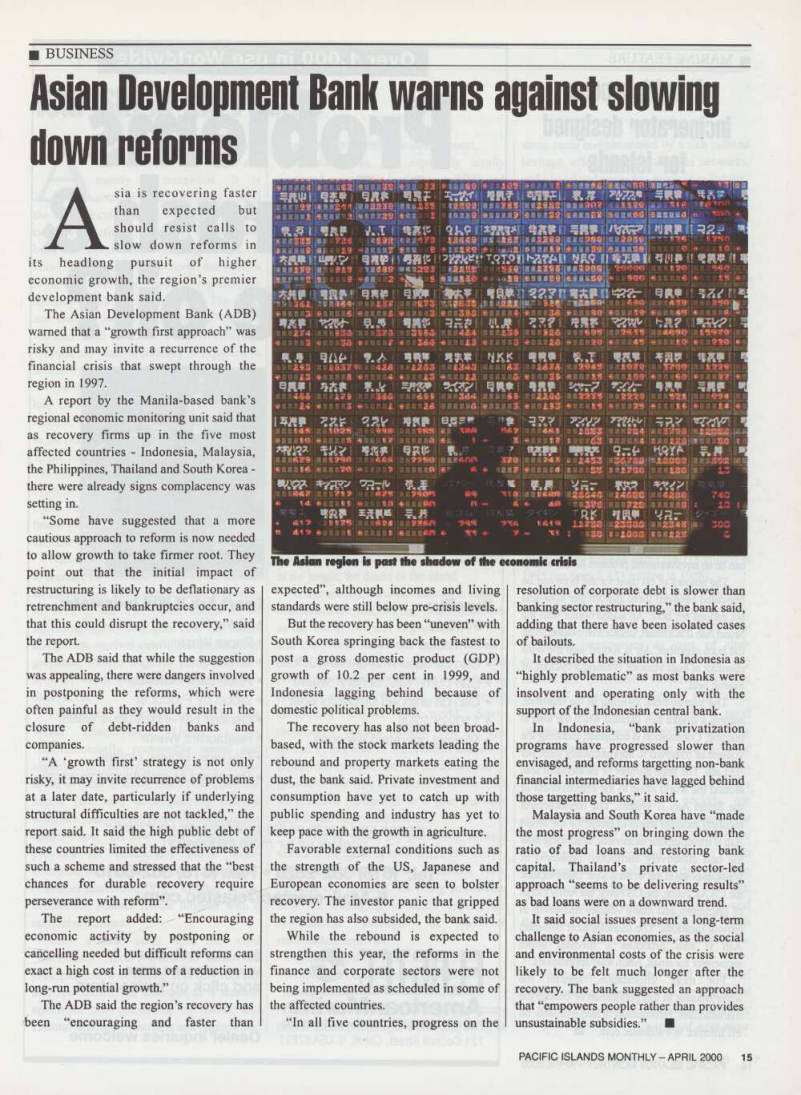
The Asian region is past Hie shadow of the economic crisis