While widespread
p. 14 · Read in the full issue
Petroleum's fall from the frontier
By Sam Vulum
international interest has been mounting on Papua New Guinea’s offshore mining, the direct opposite is being experienced in the country’s frontier
petroleum exploration activities.
PNG has reached a stage where the biggest oil fields have probably been found already and concentration must now be shifted towards developing marginal fields, deep-water and other frontier areas.
However, it appears that progress in this area has reached a stalemate.
Mining and Petroleum Department secretary Joe Gabut confirmed this.
Gabut said a 35 per cent tax incentive for fields discovered under frontier licences have attracted strong exploration activity in the frontier areas.
“Maybe more incentives are required to make the frontier areas attractive,” Gabut said. He said frontier areas or sites are scattered around all five sedimentary basins in the country. These are the Papua 1 Basin, the North New Guinea Basin, Cape I Vogel Basin and the Bouganville Basin.
The secretary said the government wa aware of the problem and was doing all it could do to address it. He said the department intended to undertake a detailed apprisal of the fiscal regime affecting the marginal fields, deep-water areas and other frontier areas to identity what changes are
required.
He said some of the areas that the government would consider for additional incentives for frontier areas are; • Change depreciation rates, but this may not necessarily persuade oil company boards to reorient their exploration
portfolios;
• Tax holidays, which may have marginal impact in light of existing provisions on
accelarated depreciation;
• Relaxation of ring-fencing, but this could be fraught with many difficulties; • Condensate, an issue to be discussed with the gas to Queensland proponents in the next few months.
Gabut also reassured investors in the
petroleum industry in general that any tax changes would be physically neutral to the industry - that is, any tax increases should be offset by concessions elsewhere.
He was responding to frequent complaints from the industry representatives over what they claimed to be an increasing tax burden by the government on the industry. Gabut said these complaints were the strongest during 1998 when oil prices collapsed to as low as US$9 per barrel. He said prices had since risen, thus the industry’s profitability had increased
substantially during 1999.
Despite these complaints, Gabut said the industry had been given zero rating under the recently introduces value added tax (VAT) system. He said the basics of the petroleum tax system in PNG were similar to that in Australia.
PNG has a licensing system, with taxes and royalties, rather than the production sharing contract system that is common in Indonesia, Malaysia and other parts of the Asia-Pacific region.
PNG also has a much more progressive tax system than most other countries because the tax payments are directly linked to profitability. The royalty rate of two per cent is low. The oil tax rate of 50 per cent on the other hand is high. And there is an additional profits tax which applies if rates of return exceed 27 per cent. However, the additional profits tax has never been triggered.
Gabut said that three years ago, PNG announced a lower 30 per cent tax rate for gas projects in recognition of their lower profitability. In 1998. The country announced a 35 per cent tax rate for oil projects discovered under frontier licences.
This is intended to encourage exploration in the under-exploited parts of the country.
Gabut also announced that a survey on petroleum fiscal regimes in the world ranked PNG 61 out of 116 countries in terms of the State’s take in petroleum projects. The survey by Petroconsultants of Switzerland, identify three types of fields - economic, upside and marginal. The ranking comes under the economic field. The estimated State take in PNG is 65.43 per cent.
Gabut said that according to the survey, the PNG regime was much harsher that in Australia and New Zealand, but much softer than in Indonesia and Malaysia.
“I believe this is a reaosnable position, bearing in mind the prospectivity of the country’s petroleum resources and the risks in exploration ad production. There is no evidence that the petroleum fiscala regime in Papua New Guinea is too harsh or that it is too generous to the oil companies.
“We have compared the actual tax payments for Kutubu fields with the theorectical models of Petroconsultants and Van Meurs, and the actual PNG Government take has been significantly less than their predictions. I think it has been about 58 to 60 per cent. “We can mprove on the State taake if the capacity of the Internal Revenue Commission to collect taxes was
strengthened.
“We do not have adequate financial expertise in the Government, particularly the IRC, and we cannot afford to pay for that at the present time. There has not been a single audit of an oil company’s tax returns since Kutubu began production, which I think is unfortunate,” he said.
“Thus it is inevitable that the actual tax paid by the indutry in PNG will be less than the theoretical estimates. I believe that adds strength to my view that our fiscal regime is a fair one at the present time.” ■
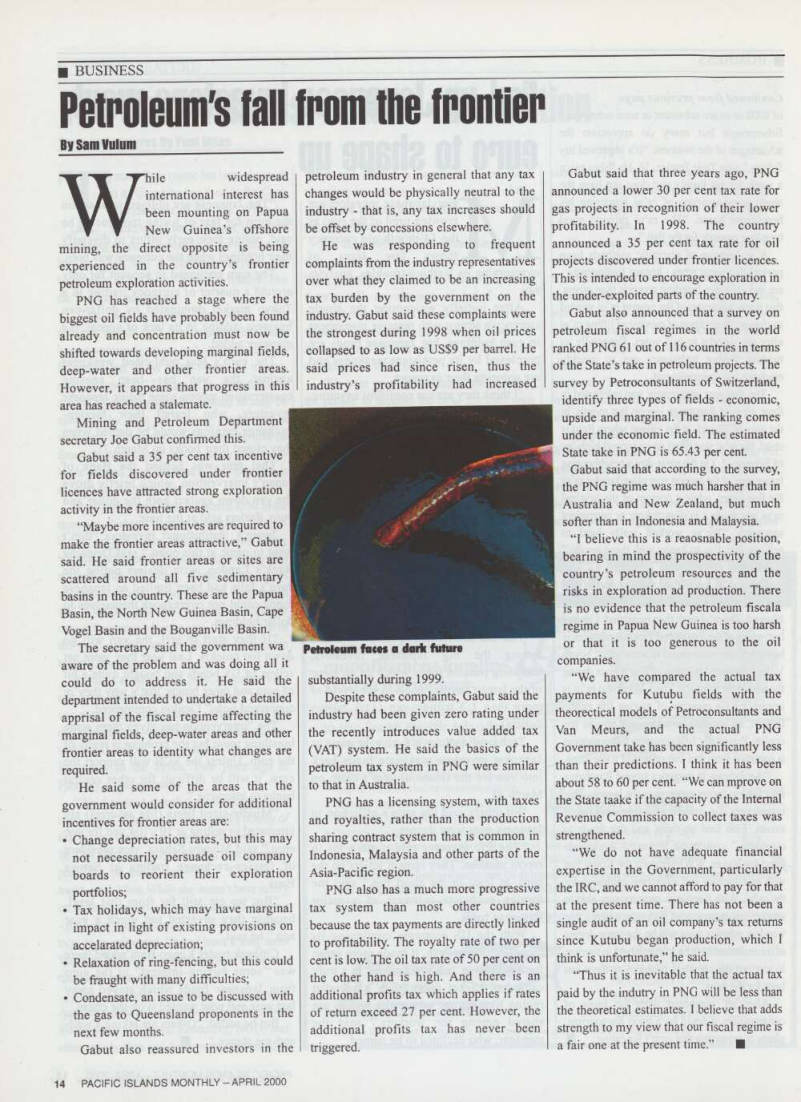
Petroleum faces a dark future