Fiji to inject expertise into PNG's medical field
p. 48 · Read in the full issue
By Brian Tobia
Papua New Guinea will tap into the Fijian academic expertise in medicine to
produce more qualified
medical doctors.
This follows the signing of a Memorandum of Understanding between the University of Papua New Guinea (UPNG) and the Fiji School of Medicine to effect some form of collaboration or a exchange program involving academics and students from both institutions and exchange of ideas and other research
materials.
And senior medical students at the UPNG’s Medical School for the first time are now being introduced to a new method of teaching known as Problem Based Learning (PBL) starting this academic year.
This would see an increase in visits by academics from Fiji and vice-versa.
This (PBL) is a method successfully and widely practiced in many Australian Medical Schools and in Canada. Acting Dean of the Medical School, Dr Mathias Sapuri said recently that new method of teaching is a direct shift away from the aging style of presentations by lecturers.
According to Dr Sapuri, the old method is not a very effective way of learning and the PBL method is directly aimed at motivating the students more.
He said the issue of PBL is basically like the lecturer “spoon-feeding” the students and often feed students only the information the lecturer wanted to deliver.
But the new method would generally enable the future medical officers to leam every aspect of the medical field or profession.
Dr Sapuri explained that students would be using patients to do their own research into the problems, analysing the information gathered and try to solve the
problems in the process.
“It is a new approach to medical training and geared towards making students motivated through their own learning.
“They will be able to use a trigger (a patient) to resolve a particular problem ... lecturers will provide medical history of a patient and the disease to a student would be used to directly trigger their research and collection of information in all areas of the medical discipline. By then they would have an understanding of the patient’s problem and how to deal with it.
“The Problem Based Learning method is really a new multi-disciplinary approach to solving a clinical problem in any given situation ... this method of training would provide a future medical doctors a very solid base to advance in their careers as medical officers,” added Dr Sapuri.
He said that from this year onwards, there would be no more spoon-feeding as in the past because students would be able to conduct their own research into cases and in the process gain more savvy which would be used later in their professions.
According to Dr Sapuri, it is the first time the PBL method is being introduced in this medical school in PNG.
However, he added that the new method
has been proven to be successful in leading Australian Medical Schools which include the New Castle University, Sydney University, University of New South Wales, Melbourne University (slowing changing), Adelaide University, University of Western Australia (Perth), Graduate School of Medicine in Brisbane and James Cook University.
Outside of Australia, it is been successfully implemented in McMaster University in Canada and Fiji School of Medicine (in the Pacific).
Dr Sapuri said PBL was introduced in Fiji in 1991 and Fiji is well ahead of Papua New Guinea - Fiji is successfully running the program since then.
UPNG School of Medicine has already introduced the new teaching method on January 17, 2000 and senior students from the second to'fourth years would benefit greatly.
Dr Sapuri also announced that he had arranged for the exchange of examiners from the Fiji Medical School and UPNG to examine and assess students.
The first such exchange took place in November , 1999 when students from both schools were having exams.
It is another way of drawing some expertise and experiences from academics in Fiji and vice-versa, he added.
According to Dr Sapuri, a Memorandum of Understanding was signed between the UPNG and Fiji School of Medicine.
It was signed by Dean of the Fiji School of Medicine, himself and the then UPNG acting Vice Chancellor, Dr Cecilia Nembou in November to effect some form of collaboration or a exchange program involving academics and students from both institutions and exchange of ideas and other research materials Dr Sapuri added that the MOU was signed late but there had already been some form of collaboration going a few years back.
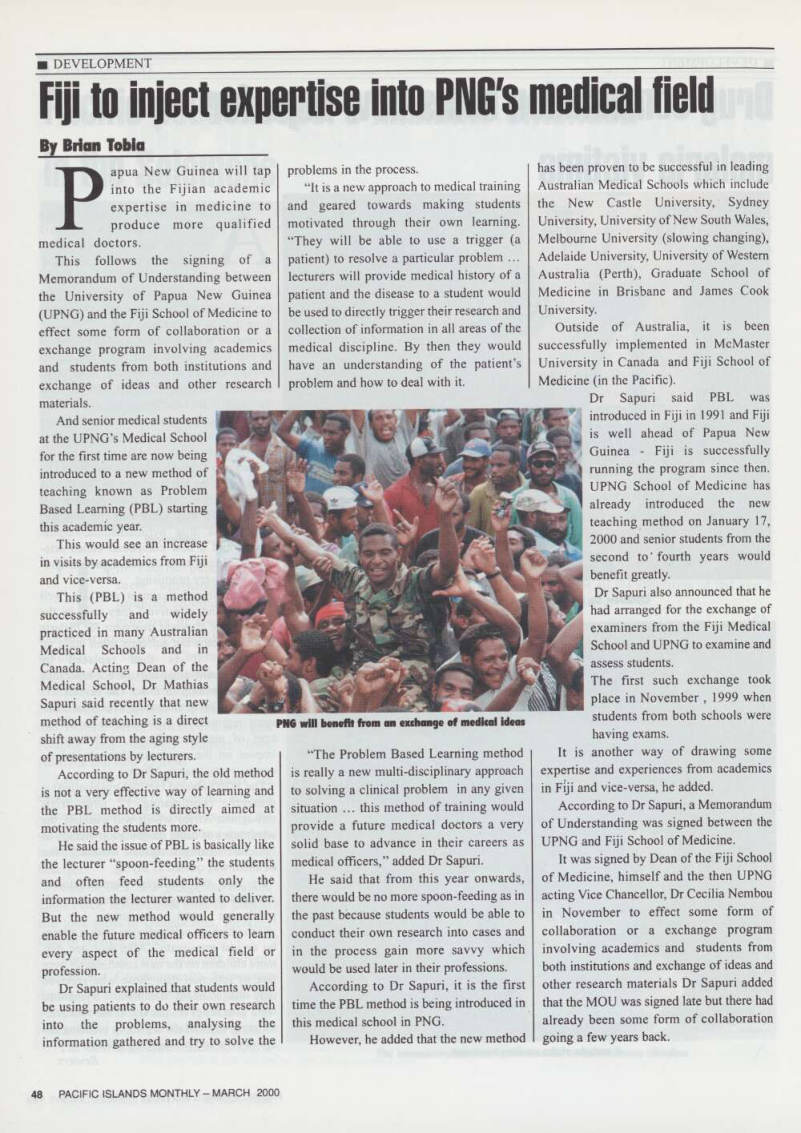
PNG will benefit from on exchange of medical ideas