'Coming of Age in Samoa' named 20th
p. 42 · Read in the full issue
worst non fiction
In 1925, a 23-year-old New York City college student set sail for American Samoa to observe the transition from childhood to adulthood among members of a primitive culture.
Margaret Mead hoped to test theories taking hold among Western social scientists about the inherent turbulence of adolescence.
What she concluded after visiting the Manu’an Islands, 3700 kilometres south of Hawaii, was that teenage girls and boys there were free of the hang-ups of their Western counterparts and that sexual promiscuity was common.
“Samoans laugh at stories of romantic love, scoff at fidelity to a long absent wife or mistress, believe explicitly that one love will quickly cure another,” Mead wrote in the best-selling Coming of Age in Samoa.
Those conclusions long have been scoffed at by American Samoans. And now a conservative academic research institute promises to keep the debate going by naming Mead’s 1928 treatise the worst nonfiction book of the past 100 years.
The Intercollegiate Studies Institute of Wilmington, Delaware, criticised Mead’s methods as scandalously sloppy and her findings as patently false.
“So amusing did the natives find the white women’s prurient questions that they told her the wildest tales- and she believed them!” the 46-year-old nonprofit institute wrote recently.
Mead’s book joined Beatrice and Sidney Webb’s Soviet Communism: A New Civilisation? (1935) and Alfred Kinsey’s Sexual Behaviour in the Human Male (1948) atop the institute’s list of the 20th century’s 50 worst nonfiction books originally published in English.
“The books on the worst list are still very popular on college campuses nationwide in spite of subsequent scholarship that has demonstrated the flaws in their conclusions,” said Winfield J C Myers, one of three editors who made the selections.
Scholarly criticism of Mead, who died in 1978, isn’t new.
in 1983, Derek Freeman, an anthropologist at the Australian National University at Canberra, attacked Mead’s Samoa work. "Her account of the sexual behaviour of Samoans is a mind-boggling contradiction,” he wrote in “Margaret Mead and Samoa: The Making and Un making of an Anthropological Myth.”
Freeman said Mead was inexperienced in fieldworkand stayed only six months in the territory - hardly long enough to draw such sweeping conclusions about Samoan society.
He also said Mead was duped by her teenage subjects and ignored evidence that did not support her hypothesis in order to please her mentor, Columbia University professor Franz Boas, a pioneer of the cultural school of anthropology.
In 1996, Martin Orans, an anthropologist at the University of California at Riverside, argued in his book
Not Even Wrong; Margaret Mead, Derek Freeman, and Samoa that Mead’s field records do not support her claims,which are so grandiose that they could not be empirically tested.
But others in academia defend Mead.
Lowell Holmes, former chairman of anthropology at Wichita State University, retraced Mead’s steps in the 1950 s and
disagreed with Freeman’s criticism in his own 1987 book, “Quest for the Rea!
Samoa.”
Although critical of Mead’s findings, Hol mes said Freeman’s icritique stemmed from ideological differences.
He also said he found no evidence that she was trying desperately to satisfy Boas by concluding that the storm and stress of adolescence were pro
ducts of nurture rather than nature.
American Samoa-born Caroline Sinavaiana-Gabbard, an assistant professor of Pacific literature at the University of Hawaii, said Mead has been victimized by “the dissemination of idle rumour faintly disguised as scholarship by certain organs of popular media.”
She said Coming of Age in Samoa was an important challenge to the growing chorus of social scientists in the early 20th century who believed that biology - not culture - was the main determining factor for human behaviour and intelligence.
The biology argument provided intellectual support for eugenics, the pseudoscience of human breeding that aimed to produce a superior race, Sinavaiana-Gabbard said. Myers coun tered; “Obviously, eugenics is a great evil, but you don’t answer sloppy scholarship with sloppy scholarship.” AP
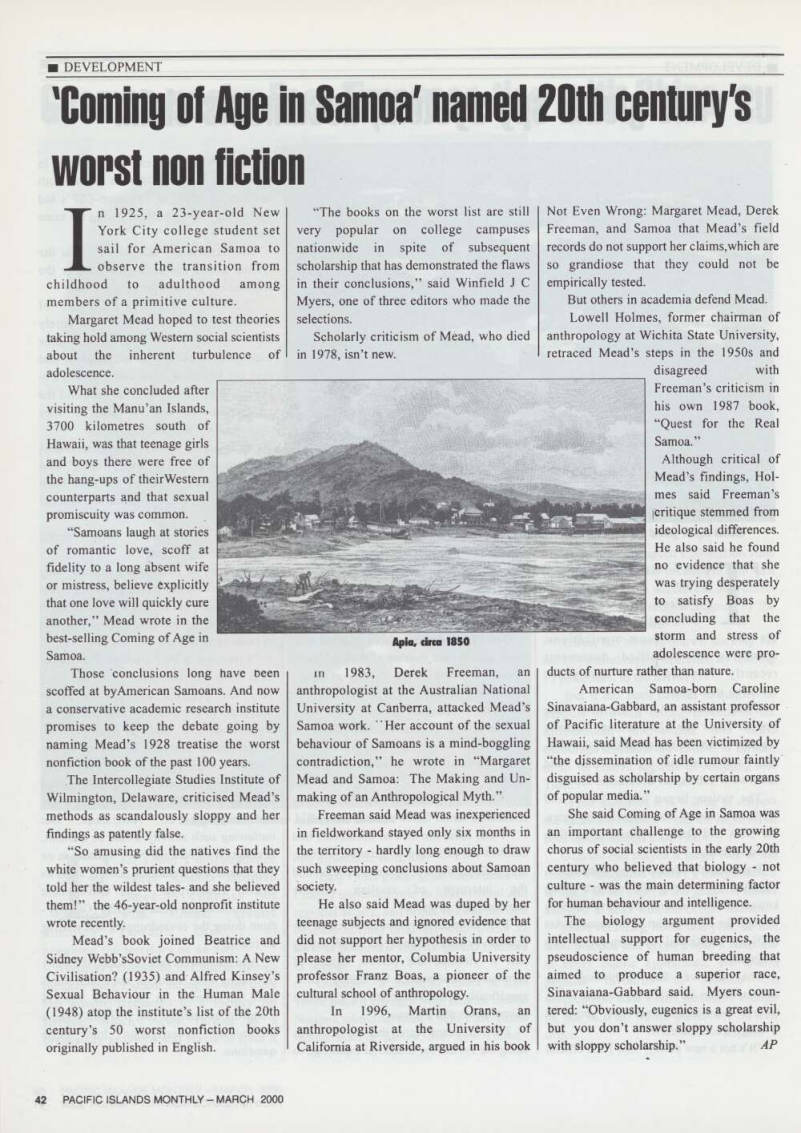
Apia, circa 1850