US runs global spy system, documents claim
p. 41 · Read in the full issue
Development
The United States runs a vast eavesdropping system that intercepts both military and private, civilian telecom-munications, according to classified documents recently released to a non-profit research institute.
Code named “P-415 Echelon,” the system allow the US National Security Agency (NSA) to tap telephone, fax or e mail transmissions by satellites and underwater cables, the documents show.
The system began in the 1980 s, and while its existence was suspected for years, the NSA had always refused to confirm those hunches.
But recently declassified documents, obtained by a non-profit research group known as the National Security Archive through the US Freedom of Information Act (FOIA), mentioned the top-secret spy program.
The archive has published the documents on its Website, housed at the George Washington University server at www.gwu.edu/nsarchiv/.
“It’s not a new policy,” one NSA official
said of the documents’ release.
“They were released through the normal FOIA process,” the official said, on condition of anonymity The first document, dated September 3, 1991, sets out the mission of the US Navy’s electronic surveillance center, at Sugar Grove in West Virginia, in conjunction with the 544th Information Group.
The second document, dated June 15, 1995, refers to the activation of Echelon units in the air force at bases around the world.
“Their significance is twofold,” Jeffrey Richelson, senior fellow at the archive, said.
“First, those are official documents that confirm the existence of Echelon. Second, they indicate the link between Echelon and the intercept of civilian satellite communications traffic.”
The European Parliament criticized the Echelon system in September 1998, saying that it violated the private nature of communications outside the United States, specifically communications by European governments and citizens.
The Europeans feared that the NSA was using the system for industrial espionage to
benefit US businesses, for example in Boeing’s bid against Airbus for a Saudi contract in 1994, or Thomson-CSF’s bid against Raytheon in Brazil during the same year.
But experts say it’s unlikely that the United States has either the time or the resources to monitor the entire world.
“Echelon targets a lot of communications that are not purely governmental, for instance in trade technologies, but the notion however that they are bothering treat every person’s e mail, and that they have the time and the interest to do any of that is very questionable,” said Richelson.
“It is highly unlikely that Echelon is monitoring everyone, everywhere,” said James Banford, author of the 1982 book “The Puzzle Palace: Inside the National
Security
Agency, America’s most secret intelligence organization.”
“Because of personnel cutbacks, they have to concentrate on the most important targets: Osama bin Laden, missile activities in North Korea, testing of nuclear weapons in India and Pakistan, etc,” he said.
“Listening in on European business to help American corporations would be a very low priority, and passing secret intercepts to companies would quickly be discovered,” he said. In spring 1999, congressional committees created in the
1970 s to investigated alleged illegal
activities by the NSA on US soil opened hearings into accusations that the NSA was eavesdropping on Americans. But outlawing such activity would be difficult.
If congress forbids the NSA to listen in on Americans’ conversations, nothing stops its British counterpart - the Government Communications Head-quarters (GCHQ) from doing the eavesdropping and sharing its findings.
And lawmakers face the added difficulty of dealing with electronic communications over the Internet. In December, the US Congress announced that it would make a preliminary investigation into those questions.
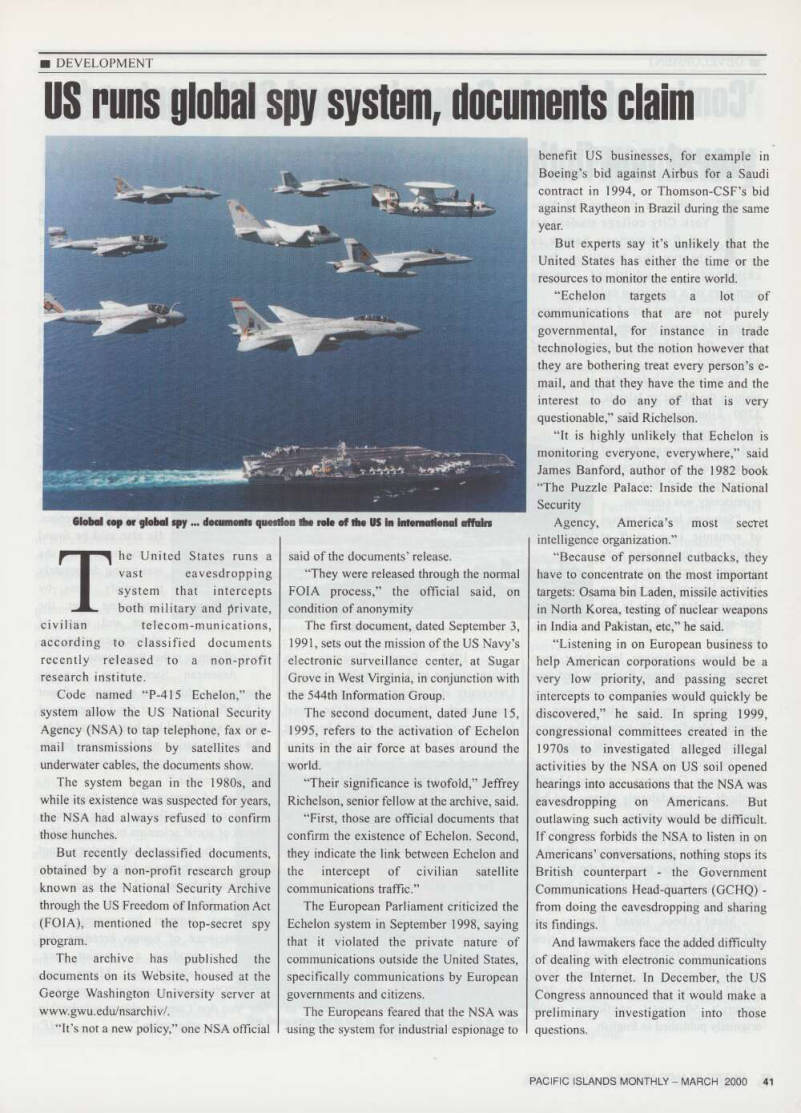
Global cop or global spy ... documents question the role of the US in international affairs