Hospital laces drug, morale 'crisis'
pp. 24-25 · Read in the full issue
By Gifff Johnson
When the President of a country announces that the Ministry of Health “lacks proper supplies, medicines and morale,” you know you’ve got a problem. When the main hospital runs out of such basic supplies as Tylenol, insulin (in country where half of all hospital admissions are diabetes-related) and other basic drugs, because the government’s health insurance program is $700,000 in debt to off-island pharmaceutical companies, it confirms the depth of the problem. Welcome to the Marshall Islands in the first month of the new millennium.
Last August, hospital doctors, nurses and support staff took theextraordinary step of shutting down all non-essential clinics andservices, and picketing at the Nitijela (Parliament) demanding action from the government on a series of problems - chief among them was the demand to implement a long-stalled plan to transfer authority for hiring and firing from the ineffective and politicized public service commission to the Ministry, so it would have the authority to fill vacancies - such as national health planner, hospital administrator and others -
that had, in some cases, been unstaffed for years.
Although the strike virtually shut down health services in the nation over a 10-day period, the government essentially ignored the demands from the hospital’s professional staff.
Many political observers in the Marshalls view the hospital strike and the government’s inability to manage the problem as one of a series of high profile
problems that led to the previous government’s defeat in national elections last November.
In December, Majuro Hospital staff reported that they were beginning to run out of some essential medicines and the reason was that the Social Security programme, which administers the government’s health fund, had not ordered medicines and supplies for months, despite requests from the hospital to do so.
By law. Social Security program runs the government’s health fund, including purchases of medicines, adding an additional layer of red-tape to an already highly bureaucratized health system.
Health Fund administrators offered a variety of excuses for the lack of medicines - blaming it on cash-flow problems, low health fund collection rates from employers, and the action of overseas pharmaceutical vendors - but when the new government came into office in January, the seriousness of the problem soon emerged.
Acting hospital administrator Sandy Alfred said in December that hospital
requisitions from July, August, September
and October for tens of thousands of dollars of medicines and supplies were not ordered by the Social Security-administered Health Fund until November 21 - complicating the
Donald Capelle, permanent secretary of health
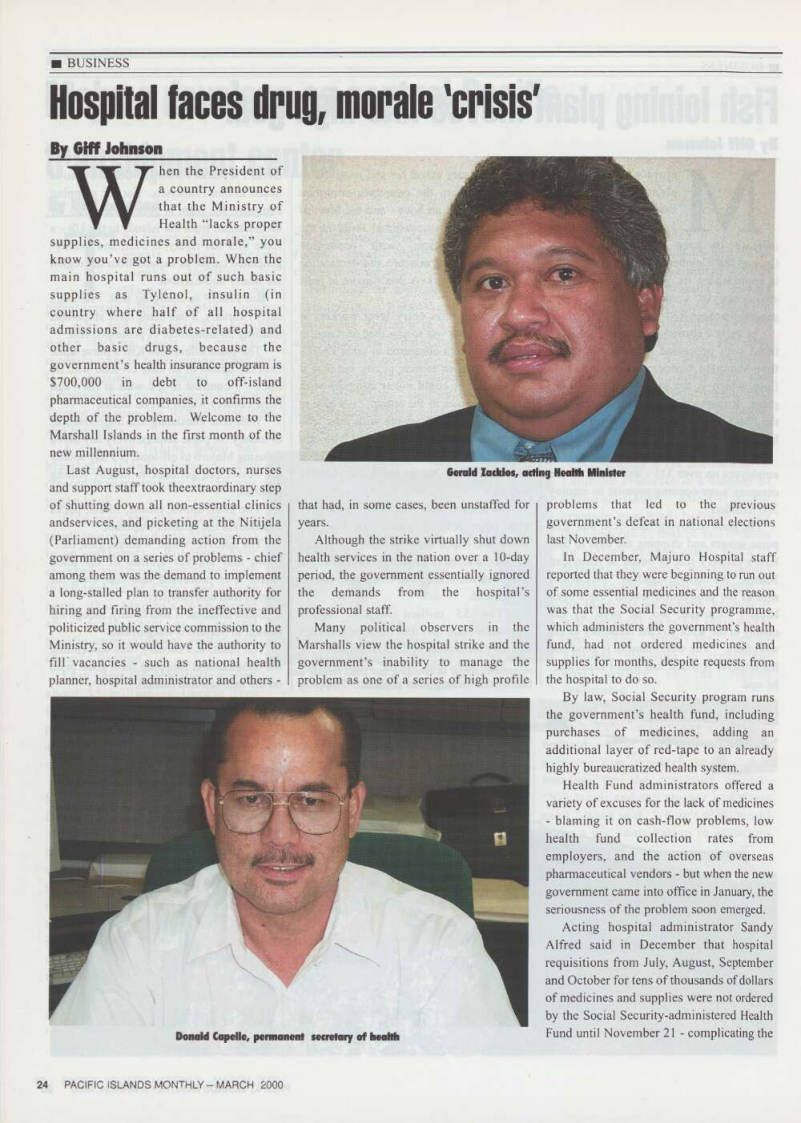
Gerald Zackios, acting Health Minister
picture is that a huge health fund deficit, not public at the time, had vendors refusing to send new orders of drugs until old debts
were cleared. With payments not forthcoming, the Ministry’s drug supply was virtually shut off.
By mid-December, the hospital had run out of at least 12 medicines, “more than half of which are essential drugs,”
Alfred said.
But the situation is more critical than medicines alone.
One medical doctor working at the hospital said that because of the lack of supplies, the hospital laboratory cannot function properly.
“Who gets blamed?” he asked. “It’s the doctors, but we can’t get proper diagnoses because the lab doesn’t have supplies.” Alfred confirmed this: “It’s definitely affecting hospital services.”
The situation didn’t improve. By the end of January, acting Health Minister Gerald Zackios told the Nitijela (Parliament) that the Ministry of Health is in a “crisis situation.”
The lack of medicines Majuro and Ebeye hospitals have run out of many essential medicines because the Health Fund owed $700,000 to vendors who will not release medicines to the Marshalls until they get paid.
Moreover, Zackios said, a report from March last year showed that the Health Fund had a $1 million deficit.
Health Secretary Donald Capelle said in January “we’re in a worse position now (compared to late 1999) because we’re really running out of a lot of medicines.”
Ebeye hospital is in the same situation and is trying to get medicines from the U.S.
Army hospital at Kwajalein so it can continue to provide services, he added.
“Not so many people know the situation, but we are in a mess,” Capelle said of the state of health services in the country.
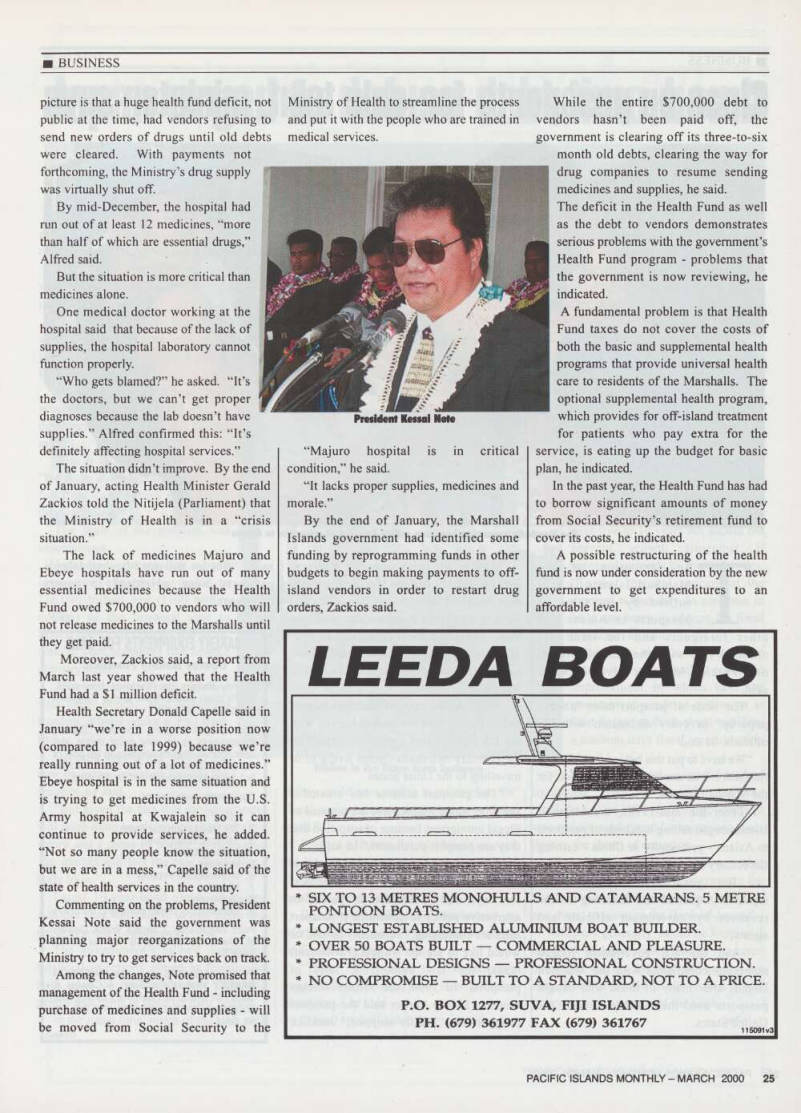
Commenting on the problems, President Kessai Note said the government was planning major reorganizations of the Ministry to try to get services back on track.
Among the changes, Note promised that management of the Health Fund - including purchase of medicines and supplies - will be moved from Social Security to the
Ministry of Health to streamline the process and put it with the people who are trained in medical services.
“Majuro hospital is in critical condition,” he said.
“It lacks proper supplies, medicines and morale.”
By the end of January, the Marshall Islands government had identified some funding by reprogramming funds in other budgets to begin making payments to off island vendors in order to restart drug orders, Zackios said.
While the entire $700,000 debt to vendors hasn’t been paid off, the government is clearing off its three-to-six month old debts, clearing the way for
drug companies to resume sending medicines and supplies, he said.
The deficit in the Health Fund as well as the debt to vendors demonstrates serious problems with the government’s Health Fund program - problems that the government is now reviewing, he indicated.
A fundamental problem is that Health Fund taxes do not cover the costs of both the basic and supplemental health programs that provide universal health care to residents of the Marshalls. The optional supplemental health program, which provides for off-island treatment for patients who pay extra for the
service, is eating up the budget for basic plan, he indicated.
In the past year, the Health Fund has had to borrow significant amounts of money from Social Security’s retirement fund to cover its costs, he indicated.
A possible restructuring of the health fund is now under consideration by the new government to get expenditures to an affordable level.
President Kessai Note