Fish loining plant moves into high gear
p. 23 · Read in the full issue
By Gift Johnson
Majuro’s fish loining plant added a night shift at the end of January in order to increase its pace of tuna processing.
Opened last October, the loining operation
is approaching its 50-ton per day output envisioned by company planners, said general manager Rod McLachlin.
In early February, a dozen containers filled with processed tuna were shipped from Majuro to American Samoa on PM&O Line, which is the major investor in the plant. It marks the third fish export from the PMO. Processing plant since it started late last year.
The night shift has brought the level of employees up over 315 - delivering on the company’s pre-opening promise to employ 300 islanders.
The plant is buying tuna from Star Kist purse seiners and shipping the tuna to Star Kist’s cannery that is based in American Samoa. “It’s coming together,” McLachlin said of the production levels. He’s been happily surprised, too, he says, by the quality of the work and the reliability of the workforce. “The workmanship is good and the turnover is much less than I expected,” he said.
The factory asked for and received an exemption from the country’s minimum wage law of $2 an hour - and the level of pay has been an occasional issue in the national parliament, with opposition
politicians raising concern and demanding
to know why workers don’t make at least two dollars.
The plant pays entry level workers at $1.50 per hour - a salary that McLachlin says is still high compared to other Pacific island and Asian loining plants, but that at two dollars it could never compete with other companies in the region. “It’s nice to see more than 300 people with jobs who otherwise wouldn’t be employed,” he said of government incentives that made it financially feasible to build the plant in Majuro.
The Majuro plant “has to be competitive with other loining plants” in Fiji, the Solomons, Papua New Guinea, Philippines and Thailand, he said, adding that the wages in the Marshalls are three times what is paid in Thailand.
The $5 million Majuro factory represents one of the most significant foreign investments in the Marshalls.
The principle mover and investor behind the loining plant is PM&O Shipping
Lines President Robert T. Colson, who is based in San Francisco. For the shipping company, the plant is generating cargo for the backhaul from the islands to the US - a route that has rarely, if ever, had locally generated cargo, as exports from the region are nearly non-existent.
But PMOP is changing that. Through early February, it had made three shipments totalling 26 containers of processed fish.
The plant offers Star Kist’s purse seine fleet the option of an easy off-load with no lines - a contrast to the wait at the Pago Pago cannery which can be weeks.
With time translating into huge amounts of money for purse seiners, every day saved by using Majuro to off-load, is a day sooner the vessel can get back to nearby fishing grounds.
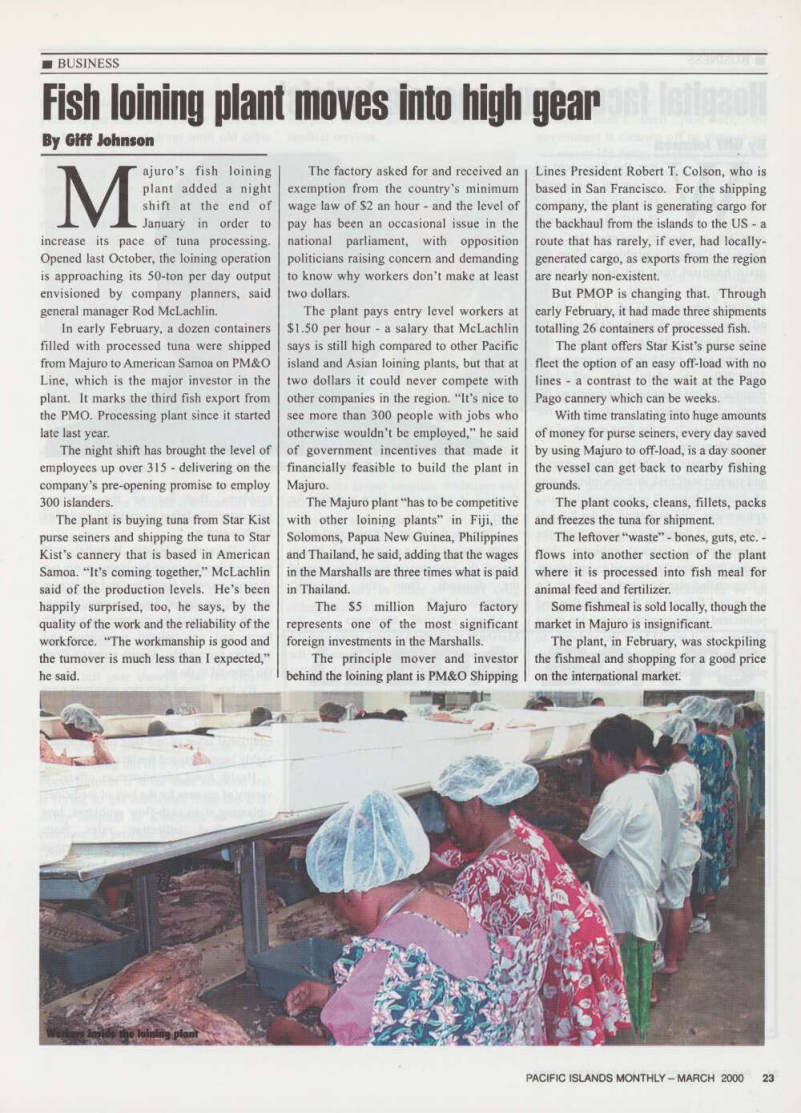
The plant cooks, cleans, fillets, packs and freezes the tuna for shipment.
The leftover “waste” - bones, guts, etc. flows into another section of the plant where it is processed into fish meal for animal feed and fertilizer.
Some fishmeal is sold locally, though the market in Majuro is insignificant.
The plant, in February, was stockpiling
the fishmeal and shopping for a good price on the international market;