Island-hopping in the Pacific
pp. 14-16 · Read in the full issue
not so easy these days
Island-hopping in the Pacific isn’t as easy as it used to be. Once connected by a network of trade and cruiseship routes, the thousands of tiny islands scattered across a huge area of the South Pacific have in many cases become more isolated as airplanes have become the dominant form of transport-ation for people and goods.
Fewer small boats carrying copra and bananas ply the trade routes these days, as the industries modernise and use bulk car riers, and the number of passenger ships is also in decline, with people saving time by flying to their holiday destination.
But. many of the region’s airlinks are once-weekly or once-fortnightly services, the most frequent flights going to only the larger of the region’s 22 independent coun tries and US- and French-controlled terri tories.
Businessmen, diplomats and bureaucrats often groan about their need to linger in
Tuvalu or Kiribati for a week or two after a mission that took just one or two days.
Now, several small airlines are buying new planes and planning to expand and upgrade services in the region.
This year, several airlines are planning to launch fast, frequent flights with turboprop aircraft which can carry up to 40 people, twice the number of seats in the small, cramped and noisy machines providing cur rent services.
In November last year, the Fiji domestic air line Air Fiji opened a thrice-weekly service to Tonga, 700 km southeast, using a 30-seater Brasilia.
The airline plans to extend a twice-weekly Brasilia service currently flying to Tuvalu, 965 km north of Fiji, to isolated Kiribati, a further 1125 km north.
The airline is also considering starting flights to Samoa and Niue.
Air Rarotonga, the Cook Islands domestic airline, said it will buy a Brasilia and estab lish a route to Samoa, 1300 km to the north west, stopping in Niue.
Farther north, Air Marshal Islands announced it had ordered two Domerier 328 30-seat turbo props for local and regional flights; and Air Vanuatu recently opened a weekly flight from the capital Vila to New Caledonia via the cargo cult island of Tanna in southern Vanuatu with a 40-seat Dash-8 aircraft.
Royal Tongan Airlines, which recently leased a Boeing 737 jet for daily flights to New Zealand, plans to lease a 40-seater Short 360 turboprop for domestic and Niue service.
But all this expansion hasn’t been without
complications.
Niue’s prime minister, Sani Lakataki, faces a parliamentary no confidence vote as a result of his plan to establish an airline with two 19-seat Beech 19 aircraft, which have already been ordered.
Toke Talagi, who resigned as associate minister for aviation recently in protest at the plan, said it was doomed to fail because of marketing problems.
AP
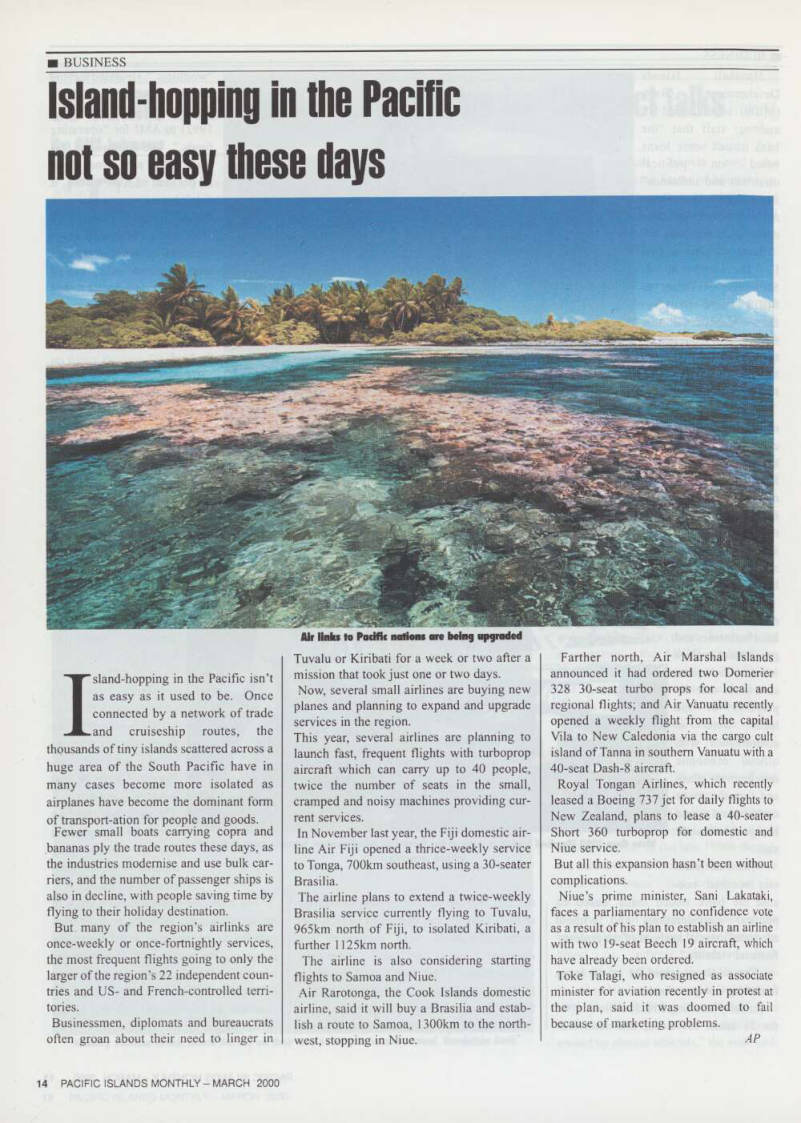
Air links to Pacific nations are being upgraded
Tuvalu seeks UN membership The Pacific Island nation of Tuvalu has applied to become the 189th member of the United Nations.
A letter from Tuvalu’s Prime Minister, lonatana lonatana has been circulated as a UN document to member countries at the UN. Secretary to the Government, Saufatu Sapoanga said the Prime Minister wrote to the UN Secretariat in November last year, expressing the country’s interest to join the UN.
Sapoanga said Tuvalu is seeking membership so it can raise its concerns at the international level on issues like the environment, particularly climate change, at the international level. He said the membership would also allow Tuvalu to seek for continued development assistance.
However, Tuvalu’s application first has to be endorsed by the 15 member UN Security Council and then by the 188national General Assembly.
Tuvalu, with a population of about 10,500 consists of nine coral atolls in the South Pacific which gained independence from Britain in October 1978. Tuvalu is one of the world’s smallest independent countries. It has a total surface area of 26 square kilometres dispersed over 1.3 million kilometres of the central Pacific.
The main focus of Tuvalu!’s foreign policy is the Pacific Islands region and Tuvalu is a member of the South Pacific Forum and the Pacific Community, along with the Asian Development Bank, UNESCO, and the World Health Organisation. A brief from the Australian Foreign Affairs office notes that Tuvalu has become increasingly active in regional and international forums particularly those address environmental issues.
Last September, the UN Assembly admitted three other Pacific Island countries: Kiribati, Nauru and Tonga.
Sapoanga said Tuvalu was encouraged by the admission of the small Pacific Island countries.
Korean fishing vessel escapes from custody in the Solomon islands Authorities in the Solomon Islands confirmed that a Korean vessel accused of fishing without a valid licence in Solomon
Islands territorial waters, escaped from custody last December The vessel, New Star Number One, was charged for breaching the country’s fisheries laws. It was impounded and ordered by the High Court to pay a SIS 1.6 million. The amount for bond was to equal the amount of catch on board the vessel when it was impounded The vessel’s master and owner were to have appeared in court on February 21 to face six charges of fishing without a valid licence. However, Fisheries Secretary Ezekiel Walaoda said the boat escaped on the December 17, adding that authorities discovered the escape a day later.
The Solomon Islands Government has applied to Forum Fisheries Agency to ban the vessel from operating in FFA-member countries. It also informed authorities in Papua New Guinea and Fiji and advised the US Coast Guard in American Samoa about the Korean vessel.
City Council tells US embassy in Suva to
Improve security or relocate
The City Council in Fijiis capital, Suva, asked the United States Embassy to re-locate or tighten its security.
According to radio reports, Town Clerk, Patrick Garguilo, said city officials had relayed the option to the US Embassy.
The Embassy is located at Loftus Street, which has been closed to traffic since early last year following reported threats made directly to the Embassy. The threats followed the bombing of two US missions in Africa.
Garguilo said if the US Government wanted its embassy to remain at Loftus Street, then it has to strengthen its security as the public road has to be re-opened. The Town Clerk said the Embassy is yet to decide on the option it will take.
However, a newspaper report quoted Garguilo as saying that the City Council had no intention of forcing the American Embassy to re-locate. Garguilo said the council was working with the embassy to meet its safety requirements. “We recognise the security requirements and are happy to work with them on security measures,” he said.
Ron McMullen, the Deputy Chief of
Mission at the Embassy, said; “We are exploring options, including relocation”.
The approval to close Loftus Street was made by the previous Government, which at the time said the closure would be temporary and the Embassy would have to
consider re-locating.
Fiji's Police Commissioner holds talks with Solomon Islands on peace group Fiji’s Police Commissioner Isikia Savua held talks with high ranking police officials in the Solomon Islands during his visit to Guadalcanal Provincein January.
Commissioner Savua was in the Solomon Islands to meet with 10 Fiji policemen who have been deployed on Guadalcanal as part of the Multinational Police Peace Monitoring Group (MPPMG). He was accompanied to Guadalcanal by Superintendent Romanu Tikotikoca, the Director of Uniform Operations.
The Commissioner also wanted to visit Guadalcanal to find out how the Fiji officers were copying with their work and the impact they had on the peace process.
Superintendent Tikotikoca said the Commissioner also paid a courtesy call to the Solomon Islands Prime Minister Bartholomew Ulufa’alu and the Premier of Guadalcanal, Ezekiel Alebua.
He said the Prime Minister appreciated the Commissioner’s visit and the courtesy call.
He said the Commissioner also accompanied Fiji soldiers to a number of villages where they held talks with locals about law and order and the peace agreements, among other things.
He said members of the MPPG are communicating well the locals.
Superintendent Tikotikoca said the cross section of the community praised the presence of the officer officers and the MPPMG for providing stability and maintaining peace in Guadalcanal.
“The morale of the Fiji officers are also high. They are doing fine,” he said.
He added that the locals had high regard for Fiji people because of Fiji’s track record in the Solomon Islands.
He said Fiji solders had served on Guadalcanal Islands during World War
Two and many officials had also visited and worked in the country over the years.
Commissioner Savua upon his return to Fiji also briefed the Commonwealth Envoy to the Solomon Islands, former Prime Minister Sitiveni Rabuka about the situation on Guadalcanal.
This was Commissioner Savua’s first official visit to the officers deployed on Guadalcanal since October last year.
The Fiji contingent left in October. The first three officers left on October 19, and the other seven followed on October 23.
The multinational group is assisting authorities in the Solomon Islands monitor the Honiara Peace Accord, the Panatina Agreement, and the surrender of weapons by Guadalcanal militants.
The multinational group was sanctioned by the Commonwealth Secretariat in London.
The multinational group, which also consists of policemen from Vanuatu, is led by Fijiis former Assistance Commissioner of Police, Savenaca Tuivaga.
In December a meeting between Commonwealth officials, donors and representatives of countries involved in the MPPMG operations decided to extend the mandate of MPPMG for another six weeks until the end of January 2000.
Earthquake hits close to Tongatapu Island Tongan authorities confirmed that an earthquake measuring 5.8 on the Richter Scale hit close to the main island of Tongatapu.
Government Geologist Kelepi Mafi from the Ministry of lands, Survey and Natural Resources said the earthquake struck at about 7.13 am on a Sunday morning.
He said the epicentre of the earthquake was located east of Tongatapu between Tonga and Niue.
Kelepi said the quake occurred 30 kilometres below the earth’s crust, adding that it could have caused much damage if it was closer to the surface.
Tonga sits on the most active tectonic plates in the world, the Indo-Australia and Pacific plates, and vibrations from the movement of these plates occur quite
regularly. However, Kelepi said the tremors are not felt because they occur deep inside the earth’s crust.
Meanwhile the earthquake which shook Guadalcanal earlier ion January is said to have been one of the biggest to hit Solomon Islands in more than 15 years.
The Seismology Division said the country has been hit by earthquakes since 1984 but none measuring more than six on the Richter scale. The National Earthquake Information Centre in Denver, Colorado has confirmed the earthquake, which occurred just after mid-day last Saturday on Guadalcanal, measured 6.4 on the Richter Scale.
It was an offshore earthquake and its epicentre was located 30 kilometres off the Weathercoast of Guadalcanal.
Solomon Islands biggest earthquake in recent times was the one recorded in 1977, which occurred on Guadalcanal measuring more than seven on the Richter scale US owners visit their cannery in American Samoan High level officials from the US-owned H.J. Heinz Company, owners of StarKist Samoa in Pago Pago, American Samoa, made an official visit to the local cannery as part of a round the world tour to compare different manufacturing techniques.
As one the largest tuna canning operation in the world with a daily output of 600 tonnes of fish, the StarKist plant provided an excellent case study for the fact-finding mission, according to StarKist Samoa General Manager Phil Thirkell.
“They were very impressed with the scale of the operation here,” said Thirkell.
The General Manager said the visitors did not come to American Samoan to inspect the StarKist plant but rather to gather information for a comparative study on how manufacturing plants around the world operate.
However, the visitors were not able to see the cannery in full production, as many of the cannery workers had not returned to work after the Christmas and New Year celebrations.
Nevertheless the group was taken with the size of the local plant, said Thirkell.
Heinz’s second largest cannery has a daily
output of 450-500 tonnes per day.
Leading the Heinz group was one of the company’s Vice Presidents Michael Bertasso. The visitors, travelling on a corporate jet, departed for Bangkok.
Asked of StarKist’s plans for the year 2000 Thirkell said there are no major projects in the pipeline and the cannery will concentrate on consolidation and meeting its present level of output on a consistent basis.
Starkist samoa impresses HJ Heinz officials High level officials from HJ Heinz Company, owners of StarKist Samoa, made a one day visit to the local cannery as part of a round the world tour to compare different manufacturing techniques.
As the largest tuna canning operation in the world with a daily output of 600 tons of fish, the StarKist plant provided an excellent case study for the fact finding mission, according to StarKist Samoa General Manager Phil Thirkell.
They were very impressed with the scale of the operation here, said Thirkell.
The General Manager said the visitors did not come here to inspect the StarKist plant but rather to gather information for a comparative study on how manufacturing plants around the world operate.
The visitors were not able to see the fish canning plant in full production however, as many of the cannery workers had not returned to work after the Christmas and New Year celebrations. Nevertheless the group was taken with the size of the local plant, said Thirkell.
Heinz’s second largest cannery has a daily output of 450 to 500 tons per day.
Leading the Heinz group was one of the company’s Vice Presidents Michael Bertasso. The visitors, traveling on a corporate jet, departed for Bangkok, early Saturday morning.
Asked of StarKist’s plans for the year 2000 Thirkell said there are no major projects in the pipeline and the cannery will concentrate on consolidation and meeting its present level of output on a consistent basis.