US audits Marshalls in preparation for Compact talks
pp. 12-13 · Read in the full issue
Business
By Gift Johnson
The first United States audit report on a Marshall Islands agency demonstrates that the newly elected government and its still-to-be-named negotiating team will have their work cut out for them when they start talks with the US on future funding for theislands.
An Interior Department Inspector General’s audit on the Marshall Islands Development Bank, released in Majuro in December, is going to be fodder for US Congressmen skeptical about handing over large sums of funding to the Marshalls in the next phase of the Compact,
whose economic provisions expire in 2001.
And it’s only the first in a series of audits that are being prepared as the US positions itself for the start-up of serious
talks.
Late last year, a powerful US Congressman asked the US General Accounting Office to conduct a broad review of Compact spending by the
Marshall Islands and the Federated States of Micronesia.
Rep. Doug Bereuter, chairman of the Subcommittee on Asia and the Pacific, made the request on September 30 and the GAO is gearing for its audits.
Bereuter asked the GAO to “review the amount, use and accountability of the financial assistance that has been provided by the US in accordance with the Compacts.” The US has provided close to $BOO million to the Marshalls and closer to $2 billion to the FSM during the 15year period of the Compacts.
He asked the GAO to “examine and assess how the FSM and RMI have used these resources provided by the US and, based on
this analysis, make recommendations for any future assistance the US may provide.”
The Inspector General’s review of the Marshall Islands Development Bank (M1DB), separate from the GAO investigation, was point blank in its assessment: the MIDB violated the Compact of Free Association, US federal and Marshall Islands laws, and its own policies in the use of $17.5 million in US funds. The Inspector General is now in the process of auditing Air Marshall Islands.
The scathing US review of the Majuro-based bank’s lending policies said that political influence from and directives of the Marshall Islands Cabinet in the late 1980 s through the mid-1990s caused the bank to issue numerous loans that could not be collected.
For 17 of 21 loans checked in the audit, “11 loans were issued based on direct or indirect direction from government officials, three loans were issued to businesses owned by relatives of senior-level government officials, and three loans were issued to businesses owned by elected officials,” the audit said.
Reentry vehicles streak across the sky on their way to targets in and around Kwajalein Atoll
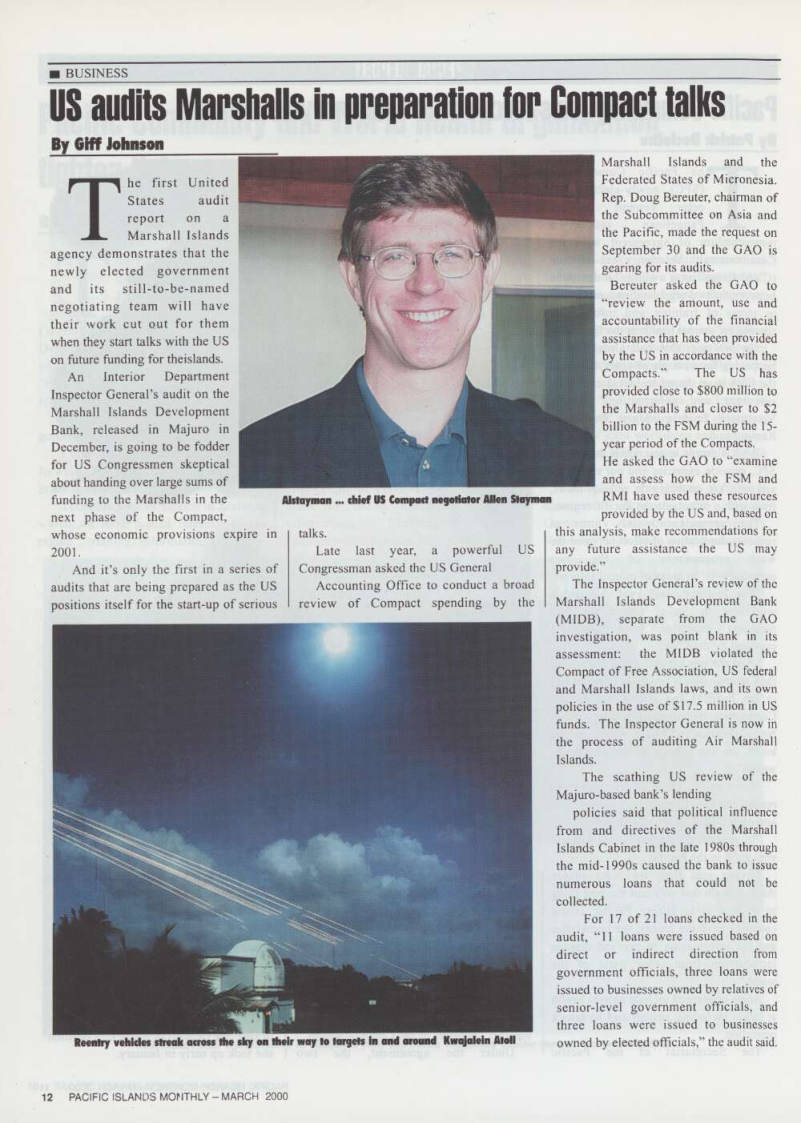
Alstayman ... chief US Compact negotiator Allen Stayman
Marshall Islands
Development Bank
(MIDB) officials told US auditing staff that “the bank issued some loans based on political direction and influence” and that such loans “may not have been made under normal circumstances.”
Inspector General Earl E. Devaney, in a September 30 letter to MIDB board chairman Donald Capelle, said that the audit was requested by US Ambassador to the Marshall Islands Joan Plaisted.
“The board feels that most of the non compliance would have been avoided if the Bank
had been given more autonomy and independence from the start,” Capelle said in a reply to the audit’s criticism of bank loans.
MIDB issued commercial loans to local businesses and government entities without “adequate assurances that the purposes of the loans were in conformance with official economic
development plans
and that the loans could be and would be repaid,” the audit said.
“These deficien cies occured bec
ause the bank issued loans...based on political considerations and without adequate financial analyses of the projects’ financial viability.”
The audit reviewed 21 of 48 loans funded by Compact funds (initially totalling $18.5 million). “Of the 21 loans reviewed, one loan was
current, 18 loans were delinquent an average of 46.3 months, and two loans (which had been delinquent) were exchanged for common stock of the borrowing organization.” This stock, exchanged for two loans to Air Marshall Islands totalling $3.5 million, was described by MIDB managing director Amon Tibon as
“worthless.” He added that the Cabinet directed MIDB to make these loans (in 1991 and 1992) to AMI for “operating funds.” The audit noted that while MIDB now owned about 30 per cent of AMDs stock, it didn’t have a representative on the AMI board. Tibon, in a 1991 memo, objected to a loan for an office building project that involved relatives of former President Amata Kabua and totalled $4.9 million, an amount representing almost 30 per cent of the total capital of the bank.
But the Cabinet directed that the loan be issued, the audit reported. Seven years after the loan was made, no payments had been made to the bank.
Both Capelle and Tibon told
the auditors that the RMI “Cabinet had direct control over the bank’s operations until August 1993, when the bank’s enabling
legislation was
amended to remove the Cabinet’s direct authority over the bank.”
Even after 1993 legislation reduced the Cabinet’s control over MIDB operations, “the bank was subject to some political in fluence,” Capelle and Tibon told auditors.
The audit said that “we noted, for example, that five of the six bank directors were gov ernment officials.”
The Inspector General made a series of recommendations, including revising bank policies to require that loans be issued according to goals and objectives of Marshall Islands national economic development plans, and reducing the presence of government officials on the MIDB board.
The US is estimated to have invested more than $4 billion in sophisticated missile tracking equipment at its Kwajalein missile range
More than 1000 Marshall Islanders work at the Kwajalein missile range, earning more than $10 million annually