New Marshalls President breaks tradition ot chiefly control
pp. 46-47 · Read in the full issue
By Giff Johnson
The Marshall Islands used the first working day of the new millennium to make its biggest political change.
While the opposition United Democratic Party gained a majority in the November nationalelection - the first time an opposition party has done so in this once paramount chief-dominated nation - the party itself was only recently formed and there were many who doubted it could maintain its majority through the six weeks until parliament met in early January.
But hold together, the UDP did. The result: the election of Kessai Note, a three-term Speaker, and the first commoner to hold the
chief executive position in the Marshalls. Note took office with the backing of the UDP, which campaigned on a strong anti-corruption platform that has promised island voters major reforms to government operations.
Note becomes the third President of the Marshall Islands since this north Pacific nation began constitutional government in 1979. But unlike his two predecessors - cousins Amata Kabua and Imata Kabua - who were ranking traditional chiefs for the major atolls of Majuro and Kwajalein, respectively, Note is a commoner from the smallest inhabited island in the Marshalls.
Barely a speck of dry sand in the Pacific, Note’s home island of Jabot is just one-fifth of a square mile in size and, according to a national census in July, it has only 95 residents. The new President has run unopposed for Nitijela (Parliament) since the late 1980 s.
Note swept to power on the strength of a UDP victory in the November national election. The UDP’s message clearly appealed to voters, who voted out four of six incumbent cabinet ministers standing for reelection, shifting the balance of power from Kabua’s party to the UDP.
Note’s election is the culmination of two years of topsy-turvy political developments in this once-staid, culturally controlled island group. Since the death of first President Amata Kabua in late 1996, the control wielded in the
political arena by traditional leaders has begun to wane. First there was a massive outpouring of opposition byreligious and community groups to legalized gambling which led, in March 1998, to the Nitijela voting to ban gambling. It was a watershed event, the first time that community groups had successfully influenced a major Nitijela decision.
It was significant, too, for the fact that President Imata Kabua had led a strong pro gambling faction, but had been unable to win the vote - the first time that a sitting President had not gotten his way in Nitijela.
The gambling vote established Note as a power to be reckoned with.
The gambling ban was successful because he ruled that Kabua, Senator Tony deßrum (who was later brought into Cabinet as finance minister) and Foreign Minister Phillip Muller could not vote since they had an obvious conflict of interest as owners or operators of poker machines. The trio appealed to the High Court and Supreme Court, arguing that Note had denied them their right to vote. But both courts endorsed Speaker Note’s ruling.
Later, in August 1998, Kabua shook up his cabinet by dropping six Amata-era Cabinet ministers including his nephew Jiba Kabua
and Senator Litokwa Tomeing, chairman of the UDP and now the Speaker of the Nitijela, and bringing deßrum on board. This sparked Tomeing to bring the first ever vote of no confidence against the government. The voteproved another test of wills between Kabua and Note, as Note agreed to a request from the opposition that the no confidence vote be carried out by secret ballot, a decision Kabua’s party called a violation of Nitijela procedures. Kabua led a walkout and didn’t come back in for weeks, until after the High Court ruled that the vote must be held and the walkout was illegal.
The vote lost by one vote, but it showed
thegrowing power of the opposition.
Meanwhile, Kabua once again took Note to the Supreme Court, and the court once again said Note was correct.
During the 17 year tenure of first President Amata Kabua, the Speaker’s position was little more than a traffic cop who did the President’s bidding.
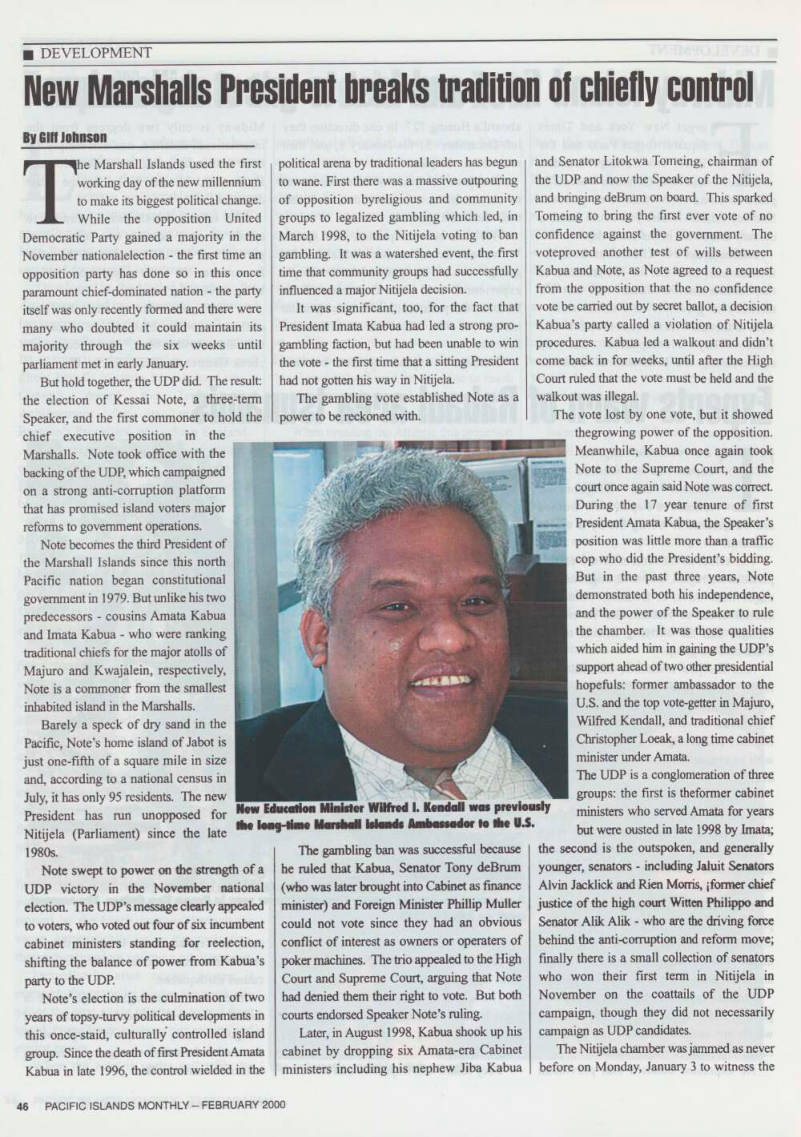
But in the past three years, Note demonstrated both his independence, and the power of the Speaker to rule the chamber. It was those qualities which aided him in gaining the UDP’s support ahead of two other presidential hopefuls: former ambassador to the U.S. and the top vote-getter in Majuro, Wilfred Kendall, and traditional chief Christopher Loeak, a long time cabinet minister under Amata.
The UDP is a conglomeration of three groups: the first is theformer cabinet ministers who served Amata for years but were ousted in late 1998 by Imata;
the second is the outspoken, and generally younger, senators - including Jaluit Senators Alvin Jacklick and Rien Morris, jfoimer chief justice of the high court Witten Philippe and Senator Alik Alik - who are the driving force behind the anti-corruption and reform move; finally there is a small collection of senators who won their first term in Nitijela in November on the coattails of the UDP campaign, though they did not necessarily campaign as UDP candidates.
The Nitijela chamber was jammed as never before on Monday, January 3 to witness the
New Education Minister Wilfred I. Kendall was previously the long-tine Marshall Islands Ambassador to the U.S.
expected, but still not certain, election of Note.
The Speaker’s job came up first and the secret ballot tallying proved the dominance of the UDP: He won over Kabua party nominee Vice Speaker Jurelang Zedkaia, 20-13. But in a show of respect to Zedkaia, the ranking chief for Majuro and a middle-of-the-road senator who works with all factions, the UDP renominated him to continue in his vice speaker role, and he was unanimously selected.
When Note was nominated for the Presidency, following election of Tomeing and Zedkaia, President Kabua stepped in and moved the nomination process be closed, insuring a unanmious vote for Note and avoiding a vote that would have led to his defeat.
In an interview shortly after his election, the new President said the United Democratic Party’s call for government reform was “not just a campaign slogan.” The new government “is committed to carrying out” its election promises, he said.
The UDP campaigned against government corruption and has indicated that as a first step it will make sweeping changes in the boards of directors on key government-related agencies.
including the national Social Security program which has been the focus of numerous allegations - and two commissions of inquiry - regarding mismanagement of funds. The new government has promised to amend legislation in order to prevent Cabinet Ministers from sitting on government appointed boards, to avoid abuse of position by high government officials.
Note said that the Marshallese public wants transparency in government operations, and “deserves to know what their government is doing.” Note said he intends to make sure that happens. His selection of a cabinet that is dominated by the reform-minded senators is a good indication that he intends to deliver on the campaign platform. Eight of the 10 new Cabinet posts are held by younger Mps, including three who are just starting their first term in Nitijela.
Only two, Wilfred Kendall (who is Education Minister) and Brenson Wase (Minister of Transportation and Communications), were cabinet ministers in previous administrations.
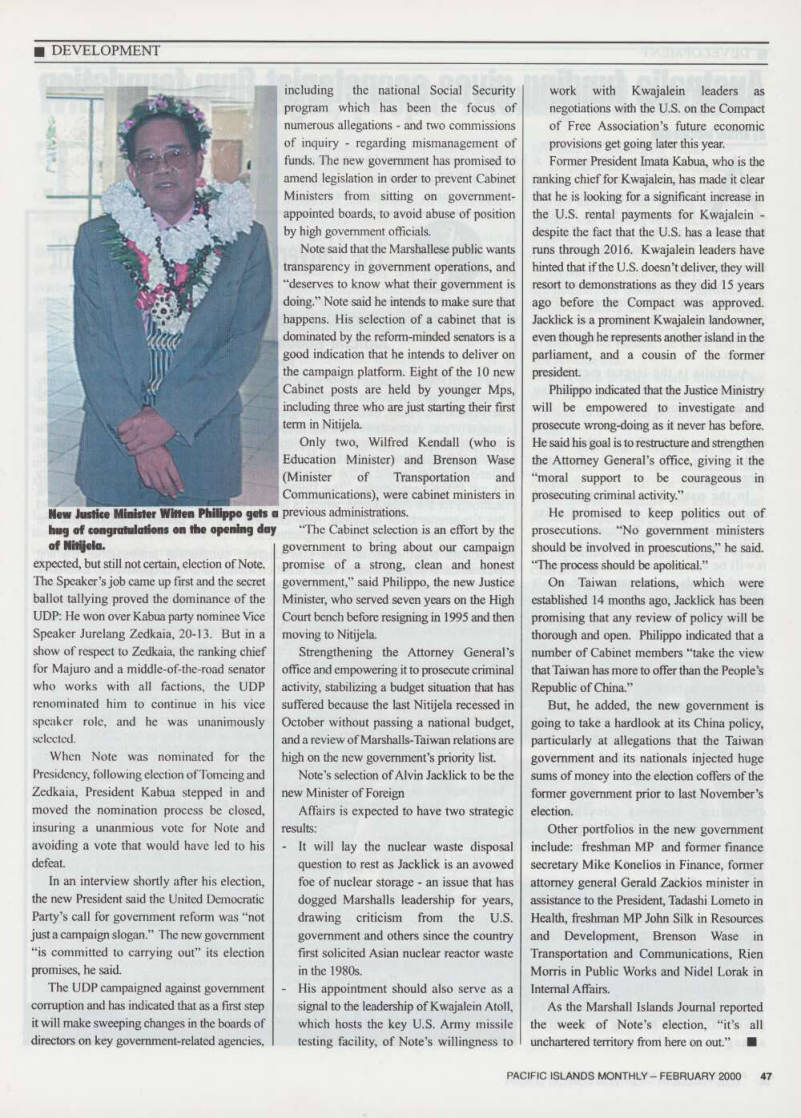
“The Cabinet selection is an effort by the government to bring about our campaign promise of a strong, clean and honest government,” said Philippo, the new Justice Minister, who served seven years on the High Court bench before resigning in 1995 and then moving to Nitijela.
Strengthening the Attorney General’s office and empowering it to prosecute criminal activity, stabilizing a budget situation that has suffered because the last Nitijela recessed in October without passing a national budget, and a review of Marshalls-Taiwan relations are high on the new government’s priority list.
Note’s selection of Alvin Jacklick to be the new Minister of Foreign Affairs is expected to have two strategic results: - It will lay the nuclear waste disposal question to rest as Jacklick is an avowed foe of nuclear storage - an issue that has dogged Marshalls leadership for years, drawing criticism from the U.S. government and others since the country first solicited Asian nuclear reactor waste in the 1980 s. - His appointment should also serve as a signal to the leadership of Kwajalein Atoll, which hosts the key U.S. Army missile testing facility, of Note’s willingness to
work with Kwajalein leaders as negotiations with the U.S. on the Compact of Free Association’s future economic provisions get going later this year.
Former President Imata Kabua, who is the ranking chief for Kwajalein, has made it clear that he is looking for a significant increase in the U.S. rental payments for Kwajalein despite the fact that the U.S. has a lease that runs through 2016. Kwajalein leaders have hinted that if the U.S. doesn’t deliver, they will resort to demonstrations as they did 15 years ago before the Compact was approved.
Jacklick is a prominent Kwajalein landowner, even though he represents another island in the parliament, and a cousin of the former president.
Philippo indicated that the Justice Ministry will be empowered to investigate and prosecute wrong-doing as it never has before.
He said his goal is to restructure and strengthen the Attorney General’s office, giving it the “moral support to be courageous in prosecuting criminal activity.”
He promised to keep politics out of prosecutions. “No government ministers should be involved in proescutions,” he said. ‘The process should be apolitical.”
On Taiwan relations, which were established 14 months ago, Jacklick has been promising that any review of policy will be thorough and open. Philippo indicated that a number of Cabinet members “take the view that Taiwan has more to offer than the People’s Republic of China.”
But, he added, the new government is going to take a hardlook at its China policy, particularly at allegations that the Taiwan government and its nationals injected huge sums of money into the election coffers of the former government prior to last November’s election.
Other portfolios in the new government include: freshman MP and former finance secretary Mike Konelios in Finance, former attorney general Gerald Zackios minister in assistance to the President, Tadashi Lometo in Health, freshman MP John Silk in Resources and Development, Brenson Wase in Transportation and Communications, Rien Morris in Public Works and Nidel Lorak in Internal Affairs.
As the Marshall Islands Journal reported the week of Note’s election, “it’s all unchartered territory from here on out.” ■
New Justice Minister Witten Philippo gets a hug of congratulations on the opening day of Nitijela.