Experts warn of Rabaul area tsunamis
p. 45 · Read in the full issue
Two volcano experts from Japan have warned that Rabaul and neighboring islands in Papua New Guinea are vulnerable to being hit by a major tsunami.
The effect of movement of the earth’s plates in the region, they said, might cause a major tidal wave, or tsunami, within the coastal areas of Rabaul and its nearby villages and the outlying islands of the Duke of York group.
And the two scientists, seismologists from Hokkaido University, have recommended that the East New Britain Provincial Government and the National Disaster and Emergency Services come up with an evacuation plan to cope with such a disaster.
Nishimura Yuichi and Nakagawa Mitsushiro were attached to the Rabaul Volcanological Observatory for three weeks, carrying out studies of earthquakes, underground formations and plates under the local seabed.
They have specifically studied the physical effects of the 1994 twin volcanic eruptions in Rabaul and the danger of a major tsunami along the coastal villages and the islands of the Duke of York group.
Mitushiro said in Rabaul that there was a general deformation on plate movements, which are considered to be the potential cause of a possible major tsunami.
He expressed concern that provincial
authorities were not equipped or prepared to adequately warn the public if there is a tidal wave disaster.
The scientists said East New Britain and New Ireland provinces were located along the volcanic “Ring of Fire” that crosses the Pacific to Japan.
They said it was important that scientists
carry out regular studies to update data and record the movements of the plate that causes earthquakes.
The two seismologists will make a formal report to the Rabaul observatory and the government, with special emphasis on the need to formulate emergency plans for a tsunami disaster. ■
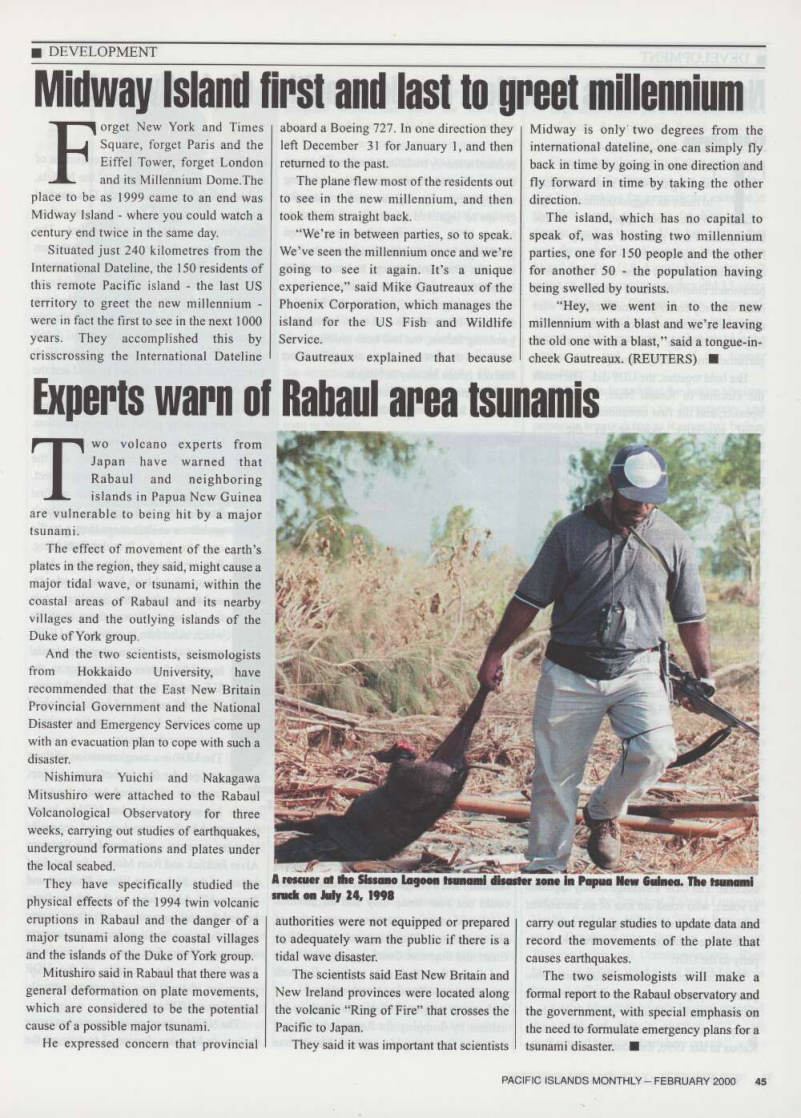
A rescuer at the Sissano lagoon tsunami disaster zone in Papua New Guinea. The tsunami snick on July 24, 1998