Walles Kotra: the Loyalty Islander with a global television vision
pp. 24-25 · Read in the full issue
By Patrick Decloltre
If you’re lucky, you’ll find a few people who know the Loyalty islands are in the north of New Caledonia. If you’re even luckier, you’ll find those who can actually tell you that the Loyalty group consists of three islands, Mare, Lifou and Ouvea.
Close enough. But there is a fourth island, a tiny one that not a lot of people know about. It is Tiga, home to about 150 people. And this is where Walles Kotra was bom in 1956.
From Tiga to Noumea, then on to Paris, this Pacific Islands editor’s route to the top has made him a living example of achievement.
Walles Kotra is now based in Paris, where he is the Director of International Relations at the headquarters of RFO (Reseau France Outremer, France’s overseas radio and television network). He was appointed to this top position (as well as that of Director of Information) last February.
Kotra is also a driving force in RFO’s Regional Satellite Television initiative, which was announced in the Pacific during the Pacific Islands News Association (PINA) convention in Suva in October last year.
From very small Pacific island to very big international television role? How did such a journey take place?
Kotra stayed in Tiga for his primary school studies, then went on to secondary
school in the French territory’s capital Noumea.
A few years later, he was one of the first indigenous New Caledonian Kanaks to undergo journalism studies at the prestigious Ecole Superieure de Joumalisme (ESJ) in Lille (in the north of France), from where he graduated.
Back in New Caledonia, in 1981, at 25, he started his career as a journalist at RFO- New Caledonia, in both television and radio sections.
This was a difficult time for the French territory and for Kotra personally. Kotra was covering and presenting the news when, in 1984-85, what became known as “the events” saw civil unrest between pro (mainly Kanak) and anti-independence (mainly European and other races) parties in this multiracial territory. This only ended with the signing of the Matignon accords in 1988.
In 1989, Kotra was promoted chief of the political department at RFO’s headquarters in Paris. During a short period, he jumped from one step to another, higher up in the RFO hierarchy.
Still at RFO’s headquarters in Paris, he was promoted editor in 1995, then Chief Editor, a position he held until 1996. He then made a triumphant return to his home, New Caledonia, where he headed the RFO- New Caledonia stations from 1996 to 1999 as Regional Director.
Paris called him again early 1999, this time to wear the double hat: Director of International Relations (a newly-created position) and Director of Information.
His new international role includes facilitating the development of a project which he helped create: RFO’s Regional Satellite Television (RST).
In terms of programme production on the global scale, Kotra advocates for a reverse of the worldwide trend, which all too often is a North to South direction. That is from the Northern industrialised countries to the developing countries of the South.
Kotra told the PINA convention: “Even if some Southern countries are seen as being huge production reservoirs (that is
the case of India, for instance), mosst of the images you can see these dayys on a television screen wherever you anre in the world are produced in the North. I i insist on the word ‘produced,’ because somnetimes, and even often, these images arte about countries and people from the Souith, they are produced by the North. But tlhis also means these programmes convey a point of view, a presentation, editorial choices from the North too.”
He was presenting his concept to fellow PINA members, with the hope of rallying their contributions to come up with a “Pacific television regional channel.”
This was made technically possible with the arrival of a new satellite transmission system last November, now covering the whole of the Pacific region.
“The satellite channels, what I call ‘the pipes,’ are here and available, in fact there are more than we need, but the challenge is now to fill these pipes with contents, programmes.
“It seems already that the ‘contents battle’ is on. It is happening right now with the launching of channels specialising in news, or specific themes, or offering a ‘bunch’ of programmes. Operators arc digging deep into every possible and available source.”
The concept is now up and running in the Indian Ocean, where it was officially launched in December. RIO has struck deals with television stations from Mauritius and Madagascar, on top of contributions from its station in the area, based in the French overseas department of La Reunion.
In the Caribbean, the RST is brewing with the participation of Cuban television, working in partnership with RFO
Guadeloupe and Martinique. The project
could be launched by June 2000, RFO’s chairman Andre-Michel Besse predicts.
Kotra is also the President of the University of the Communication for Oceania (a global network gathering mainly the French-speaking world). Recent talks held during the Second University of the Communication in New Caledonia
Continued next page
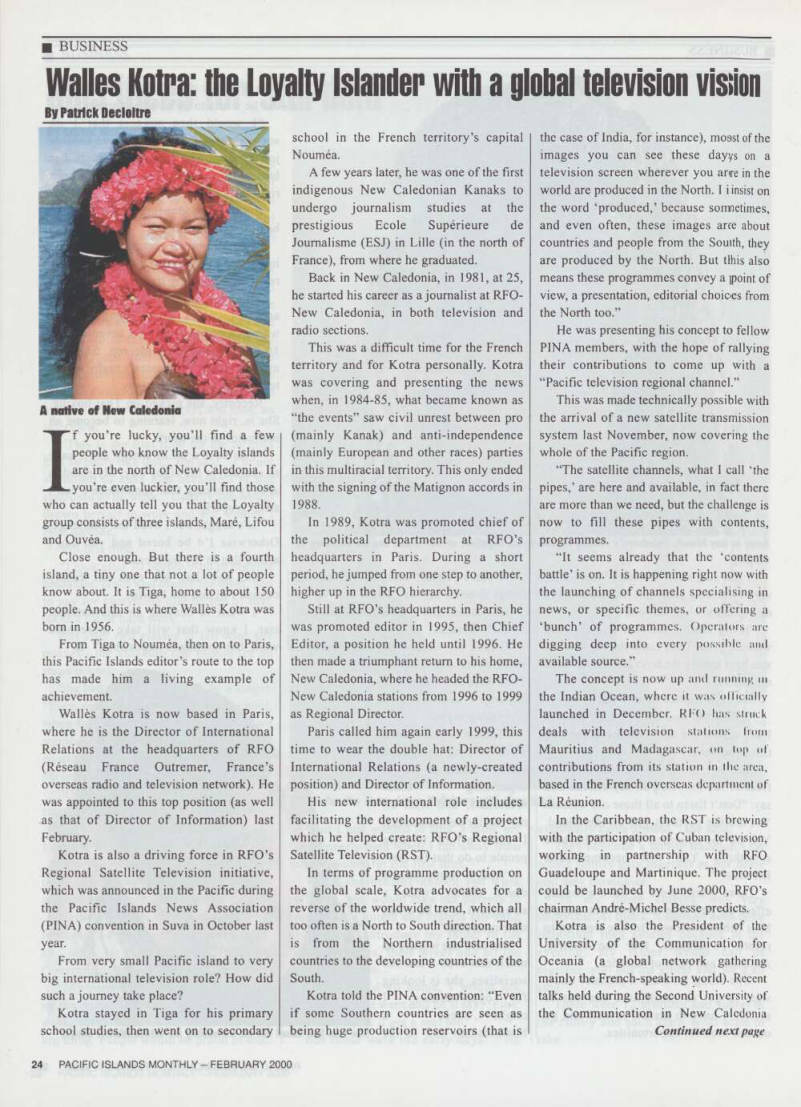
A native of New Caledonia
Continued from previous page
between RFO and other PINA member
television stations (including Fiji
Television and Papua New Guinea’s EM TV) could lay the foundation for a Pacific RST to be launched in the first half of 2000. Kotra said the Pacific RST was a “strategic” one.
Although such matters as copyright and transmission schedules remain to be settled, Tiga- born Kotra hopes the project will soon become a reality, not only in other parts of the world, but, if anywhere, in his Pacific Islands home.
He is determined to fight for the Pacific Islands to have a voice in the global television spectrum and express their own viewpoints, cultures, and news.
Kotra says, “It seems always the same models are being reproduced, the same cultural references, the same patterns, endlessly duplicated by the televisions of the world, including our televisions of the Pacific.
“I remember visiting an old New Caledonian Kanak from Mare Island who was undergoing treatment at a Sydney hospital. He then told me he was getting rather bored because he didn’t speak English, so he couldn’t understand anything on Australian television. But he said fortunately, the Australian television was broadcasting at least ‘one movie from home. So I don’t need to understand English to follow the story,’ he said. In fact, this ‘movie from home’ turned out to be an American TV soap opera that was also included in programmes in New Caledonia.
“For this old fellow from tiny Mare Island, this soap opera could only be a movie from home, because it was part of his daily life in New Caledonia. And he didn’t know this was probably the case too for Australian, Fijian, African or European simple people.
“Everything is in the process of being uniformed. Cultural products, and even more serious, values. This is probably a debate that philosophers, more than journalists, have at heart. The fact remains that I believe this is dangerous.”
In Paris, for sure, the Pacific islands have an able advocate: he is from the island of Tiga. Remember the name. (PINA Nius Online) ■