Sacrifices for stardom
pp. 22-23 · Read in the full issue
By Arthur McCutchan
Behind the apparent glamour and attractions of successful musicians, is the sacrifice and pain they go through. For Fiji singer, Laisa Vulakoro, it still takes a lot of hard work.
On a humid Wednesday afternoon Vulakoro arrives sweaty, hot and in a bad mood. She has just come back from the movies with nine children; she hasn’t had time to go to the bank; she missed her training; she lost an 18-carat gold saxophone pendant; her boyfriend has gone to Papua New Guinea for business and she misses him terribly; and now, an interview.
“This is the first time for me to miss him so badly like this,” she said. “I’m not supposed to miss him because I’m not supposed to be weak.” Usually she would drown herself in work and she wouldn’t miss anyone.
Not this time.
“I look after 10 people. And to provide breakfast, lunch and dinner for them, and to pay for everything else on top of that, takes a lot of hard work.”
But after two glasses of red wine she relaxes - the Vulakoro that people see on stage is back.
She had always wanted to be a singer.
“Even as a young girl in primary school, when the teacher would ask us what we wanted to be when we grew up, the others would say they wanted to be teachers or nurses or policemen.
“I would always say I wanted to be a star.
“Then they’d ask me what I meant and I’d say I wanted to be a singer.
“For me, stars were also those things that lit up the sky at night, but I decided I would get up there somehow.”
Her father , a choir master, wanted her to become a nurse or teacher, anything, as long as she worked for the Government.
“My parents can’t speak English and in the village, if one of your children works for Government, it becomes a very big thing. People would be proud of that.
“But I just wanted to sing. I think my father nearly died when I ran away from school to sing for the first time.”
When she became known and work rolled in, she would take her parents to some of the hotels and resorts she sang at. “I would introduce my father to the hotel managers, their wives and all the top people there.
“When we’d go home, I would ask him how things went and he’d say: ‘Fine.
But I hope you’ll get a real job.’ “ But those were the early days. “He
eventually came around,” she said.
They continue a family tradition - the whole family gets together at her home and they harmonise.
“In my home singing was very important. At times, it seemed even more important than studies because in the evening, my father would call us together, pull out his guitar and we’d all sing.”
There were 12 brothers and sisters in the family and each knew what scale to take.
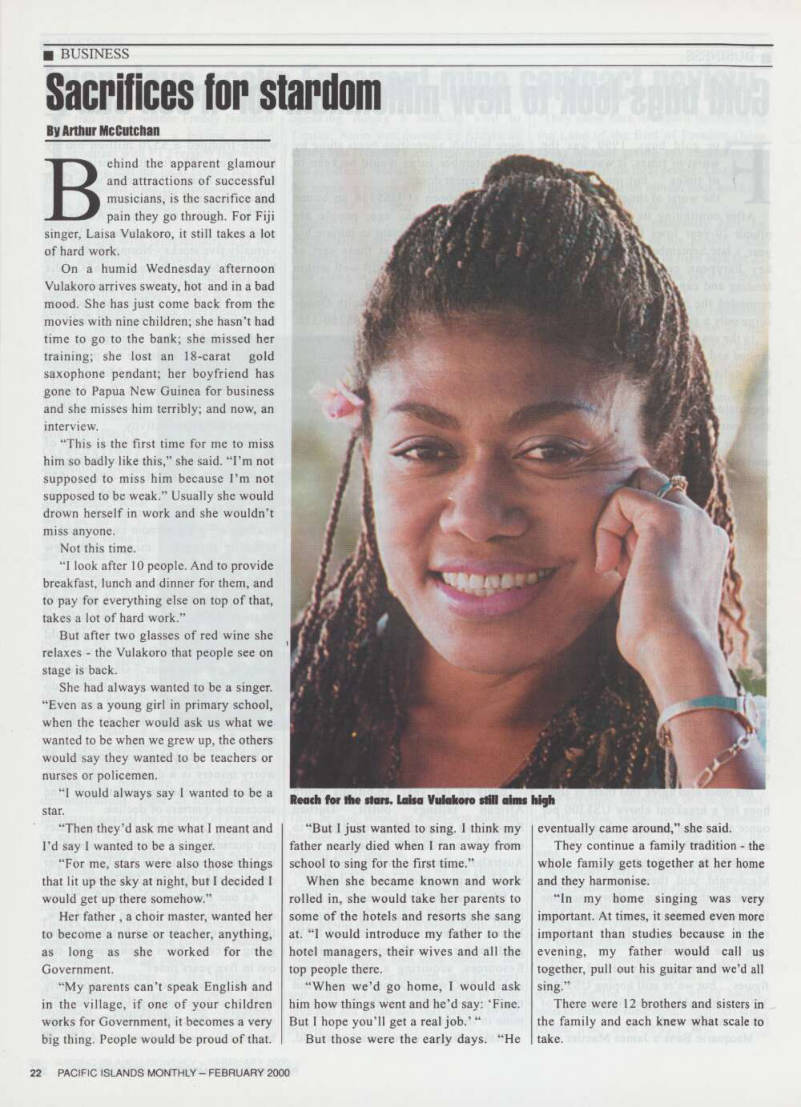
Reach for the stars. Laisa Vulakoro still aims high
“I still sing alto,” she said. Which isn’t very surprising since she was something of a tomboy when she was a girl.
“In my family, the first five children were all girls. Then came the boys, and I was bom among the boys and they treated me as one.”
She even learned how to box.
“All the old women would tell me that I was ugliest one out of all my sisters and that I had skinny legs.
“But my father would stand me in front of the mirror, pull my cheeks and say: “Don’t listen to all those old women.
You are the prettiest girl on the island.
You are the smartest. You will become something. You will become Miss Hibiscus.’ “ Those words were to have a lasting effect on her. She did not win Suva’s Miss Hibiscus crown. But she went on to record 14 albums, tour the Pacific, Australia, and parts of America.
“The thing is, I am a product and I want to get as much as I can out of myself. I have to market myself and go out and look for opportunities.
“I can’t just sit there and hope for things to come my way.”
This month she is on a two-week tour of the Solomons.
“I look for work doing commercials,
voice-overs and jingles.
Then there are concerts to organise and I do everything myself.
“That is a lot of hard work making telephone calls, booking tours, organising other musicians, and with all my family commitments, I can’t afford to hire people to do that for me.
“And, it seems, people don’t realise what a struggle it is to be a full time musician.”
She said she worked so much that even when she socialises, she is looking for opportunities. “I might meet a businessman and in the
course of our conversation I might find out he wants to do an advertisment.
“1 would then suggest that I do something for him and I’d have another job to do.” She mainly conducts her business by instinct. “So far, I have been right most of the time.”
But to be good mentally, she needs to
be healthy physically.
“I make sure I exercise. This is so important to me that my daily timetable revolves around my training.”
Vulakoro jogs, does high impact aerobics, plays club rugby in the women’s competition as a seven-a-side, 10-a-side, and 15-a-side rep. She is a member of the Fiji women’s rugby league team, and plays touch rugby.
Recently, she picked up Thai boxing.
She is, right now, learning to become an instructor in the sport.
“I do have a lot of energy and I have to channel it the right way. My mind is always working that sometimes I can’t
sleep properly.
“It’s tough, but I need the challenge.
Otherwise I’d be bored and you can’t afford that in my business.”
She now has her eyes set firmly outside Fiji and the Pacific.
“I want to become an international star. I know that will take more hard work, but nothing is impossible.” ■
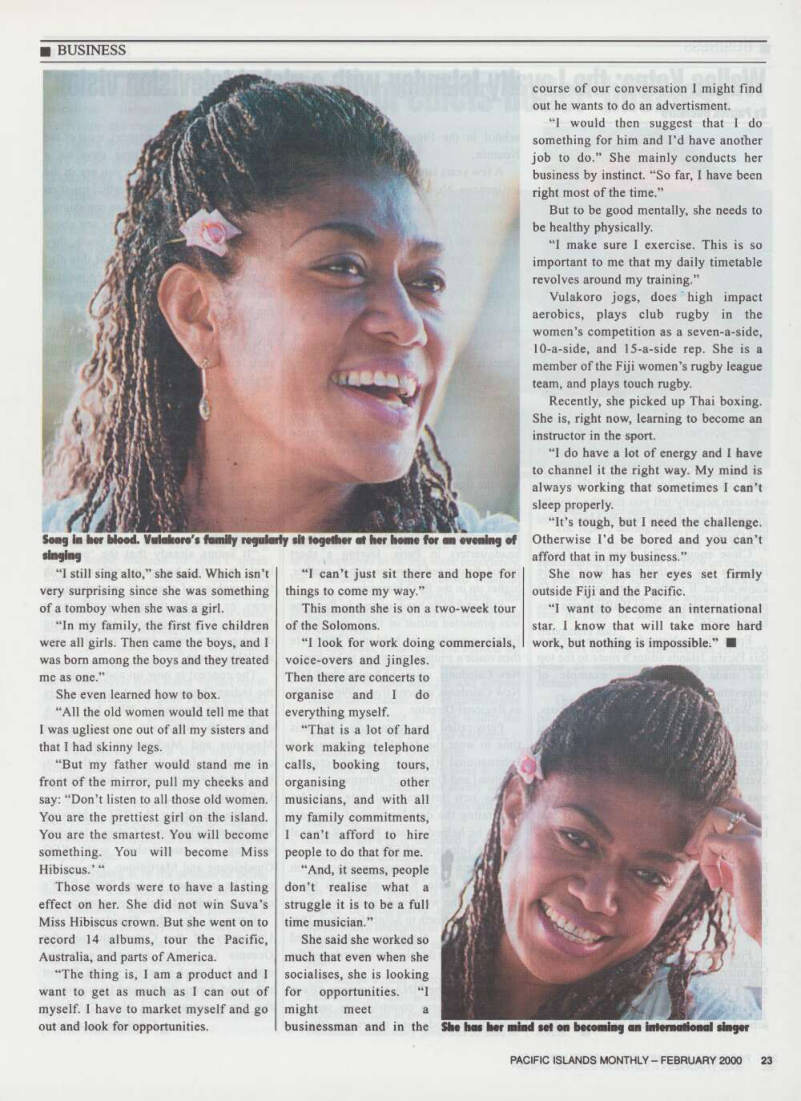
Song in her blood. Vulakoro's family regularly sit together at her home far an evening of singing
She has her mind set on becoming an international singer