energy self-sufficiency
p. 19 · Read in the full issue
Pacific communities aim for energy self-sufficiency
Energy is essential for socio economic development; yet, as the 21st century dawns, at least 70 per cent of the Pacific region’s population has no access to electricity.
Renewable energy technologies, in particular solar photovoltaic and wind energy, have the potential to change all this, improving the quality of life and facilitating economic development. France and Australia have responded to the Pacific Community member countries’ requests by funding the Regional Rural Renewable Energy Development Programme. Together they have contributed A 53.5 million, two-thirds of which will be spent on equipment to be installed on islands in the region.
The project will be implemented within the framework of the Rural Energy Development Programme of the Secretariat of the Pacific Community (SPC) over a three-year period.
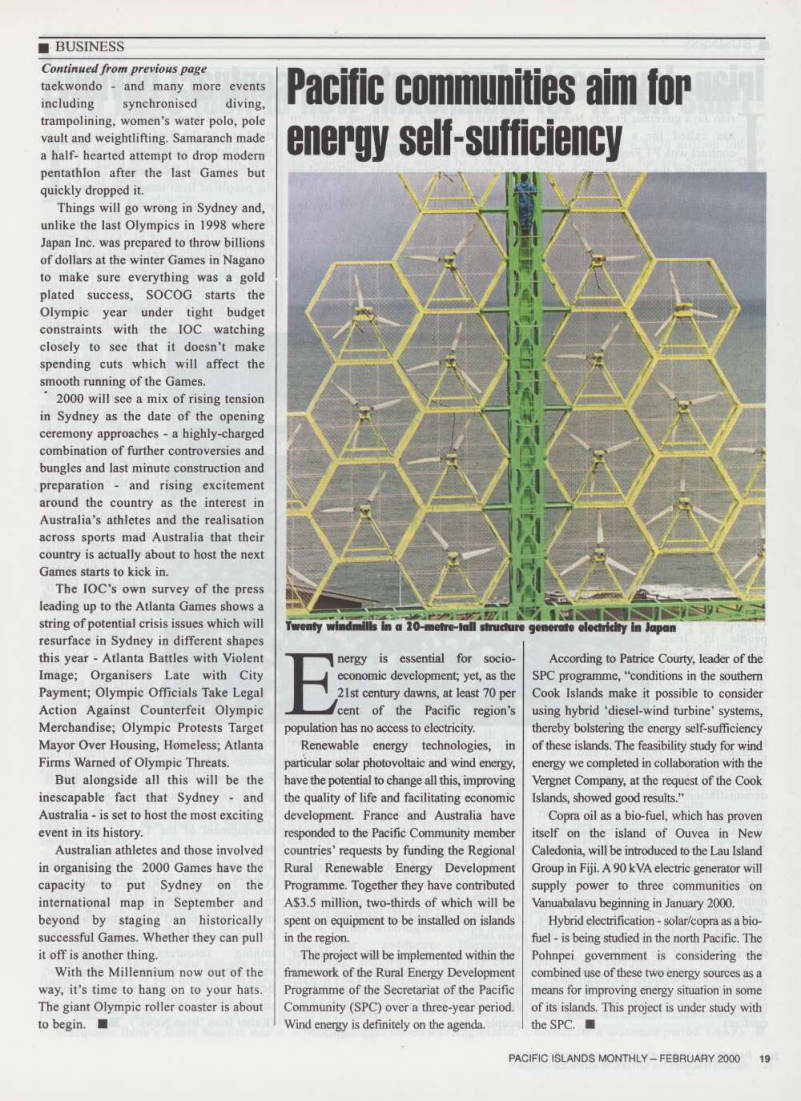
Wind energy is definitely on the agenda.
According to Patrice Courty, leader of the SPC programme, “conditions in the southern Cook Islands make it possible to consider using hybrid ‘diesel-wind turbine’ systems, thereby bolstering the energy self-sufficiency of these islands. The feasibility study for wind eneigy we completed in collaboration with the Vergnet Company, at the request of the Cook Islands, showed good results.”
Copra oil as a bio-fuel, which has proven itself on the island of Ouvea in New Caledonia, will be introduced to the Lau Island Group in Fiji. A 90 kVA electric generator will supply power to three communities on Vanuabalavu beginning in January 2000.
Hybrid electrification - solar/copra as a bio fuel - is being studied in the north Pacific. The Pohnpei government is considering the combined use of these two energy sources as a means for improving energy situation in some of its islands. This project is under study with the SPC. ■
Twenty windmills in a 20-metre-tall structure generate electricity in Japan