All eyes on Australia for Olympics
pp. 18-19 · Read in the full issue
The year 2000 will go down as the first big test of Australia’s international reputation as the rest of the world watches how well the country runs the first Olympics of the new millennium.
Will the Sydney Olympics be like the last games in Atlanta which made the city’s name synonymous with poor organisation and punctured many illusions about the superiority of American technology and skills in staging major events?
Or will it be like the last Olympics in a seaside city - Barcelona in 1992 - where
the Games help to boost its image to one of the major cities in Europe, now a fashionable destination for tourists and business conventions? Or even Seoul in 1988 which helped transform Korea’s image from a struggling third world economy to an emerging Asian tiger.
Australians, particularly Sydneysiders, have been living with the prospect of the Games for more than six years since the narrow vote over Beijing by the International Olympic Committee in
Monte Carlo in September 1993. But the rest of the world will focus on Sydney for a few brief weeks - maybe less- and pass their judgement on the country under the glare of the international media.
If the rest of the world judges Australia as having done a good job, the Games will go down as a major step in Australia’s efforts to assert itself as a serious player on the world stage - and in its own struggle for identity.
The amazing sensitivity over who should utter the few words opening the Games at the Olympic Stadium on September 15 has raised eyebrows in the
Olympic headquarters in Lausanne and has only confirmed Australia as being a country still wrestling with what sort of nation it wants to be.
If it is done badly, Australia’s outdated but still persistent international image of being laid back, work shy and not quite bothering to get it right will only be confirmed on the eyes of critics.
On this score Australia is vulnerable to the fact that the Olympic Games with their 28 sports and more than 15,000 athletes
and officials and eight million or so tickets and scores of sponsors have simply become far too big. The Games of 2000 will only confirm this.
Despite the unprecedented planning
and preparation which has gone into the Sydney Games, mistakes will be made, things will go wrong, confusion and crowds will be the order of the day alongside the excitement of the sport and other events around the Olympic City.
The America bashing which the Europeans delighted in during the 1996 Olympics ignored the fact that the Games themselves have become a juggernaut
which rolls along under the groaning weight of ever growing expectations and interest groups.
Under the twenty year reign of lOC President Juan Antonio Samaranch, the Olympics have changed from a loss making, boycott-tarnished event which few cities wanted to stage to a massive
phenomenon.
The 2000 Games has seen the addition of two new sports - triathlon and
Continued next page
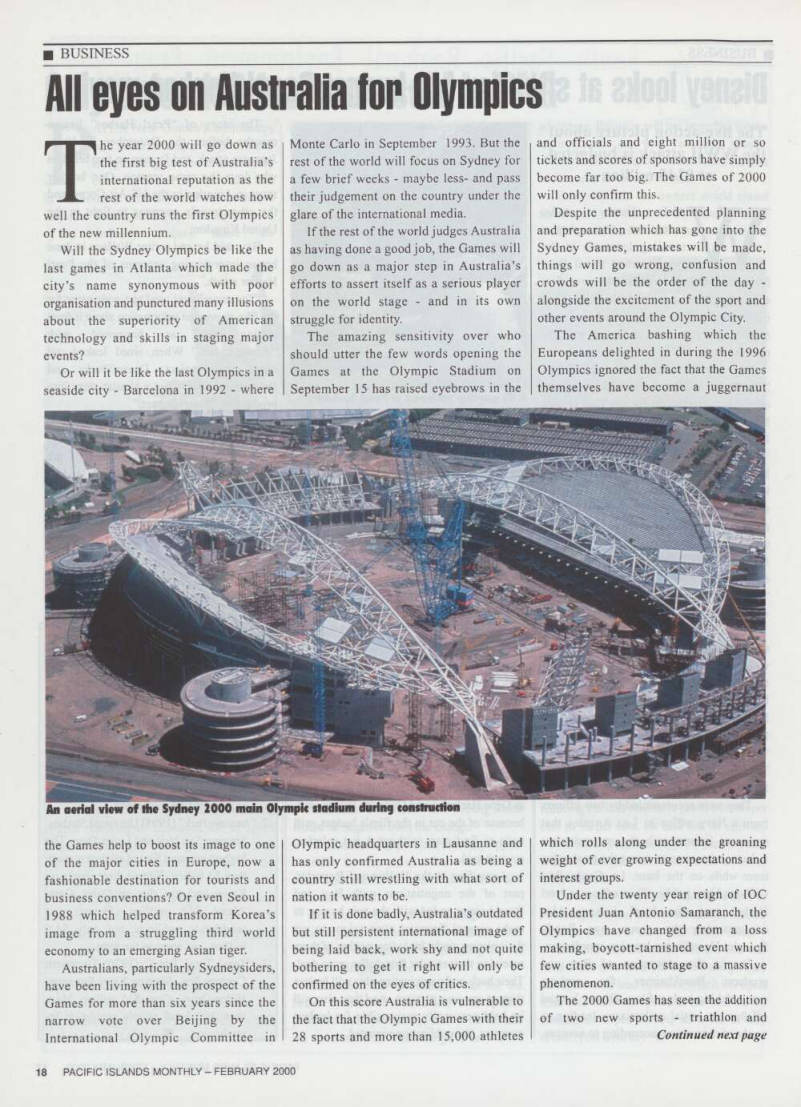
An aerial view of the Sydney 2000 main Olympic stadium during construction
Continued from previous page
taekwondo - and many more events including synchronised diving, trampolining, women’s water polo, pole vault and weightlifting. Samaranch made a half- hearted attempt to drop modern pentathlon after the last Games but quickly dropped it.
Things will go wrong in Sydney and, unlike the last Olympics in 1998 where Japan Inc. was prepared to throw billions of dollars at the winter Games in Nagano to make sure everything was a gold plated success, SOCOG starts the Olympic year under tight budget constraints with the lOC watching closely to see that it doesn’t make spending cuts which will affect the smooth running of the Games. 2000 will see a mix of rising tension in Sydney as the date of the opening ceremony approaches - a highly-charged combination of further controversies and bungles and last minute construction and preparation - and rising excitement around the country as the interest in Australia’s athletes and the realisation across sports mad Australia that their country is actually about to host the next Games starts to kick in.
The lOC’s own survey of the press leading up to the Atlanta Games shows a string of potential crisis issues which will resurface in Sydney in different shapes this year - Atlanta Battles with Violent Image; Organisers Late with City Payment; Olympic Officials Take Legal Action Against Counterfeit Olympic Merchandise; Olympic Protests Target Mayor Over Housing, Homeless; Atlanta Firms Warned of Olympic Threats.
But alongside all this will be the inescapable fact that Sydney - and Australia - is set to host the most exciting event in its history.
Australian athletes and those involved in organising the 2000 Games have the capacity to put Sydney on the international map in September and beyond by staging an historically successful Games. Whether they can pull it off is another thing.
With the Millennium now out of the way, it’s time to hang on to your hats.
The giant Olympic roller coaster is about to begin. ■